Instruments & Voices
String Quartet
A string quartet is a chamber group of two violins, a viola and a cello, and also the name of a piece written for them. It is one of the central forms of chamber music from the Classical era to today.
A string quartet is a group of four string players: two violins, a viola and a cello. The same word names the music written for them, so a string quartet plays string quartets. With no conductor and one player per part, it is the classic example of chamber music: four equal partners listening to each other.
Who plays what
- First violin: usually the highest part, often with the main melody. The first violinist often leads, giving the starting breath and cues.
- Second violin: plays below the first, sharing melodies, adding harmony and rhythm.
- Viola: fills the middle of the harmony, with its own melodies and inner lines.
- Cello: the bass of the group, and a melody instrument in its own right.
The four instruments together cover more than five octaves and blend closely, because they are all built the same way. That even sound is why composers have used the quartet for some of their most personal music, and why students analyze quartets to learn four-part harmony and voice leading.
How a quartet score looks
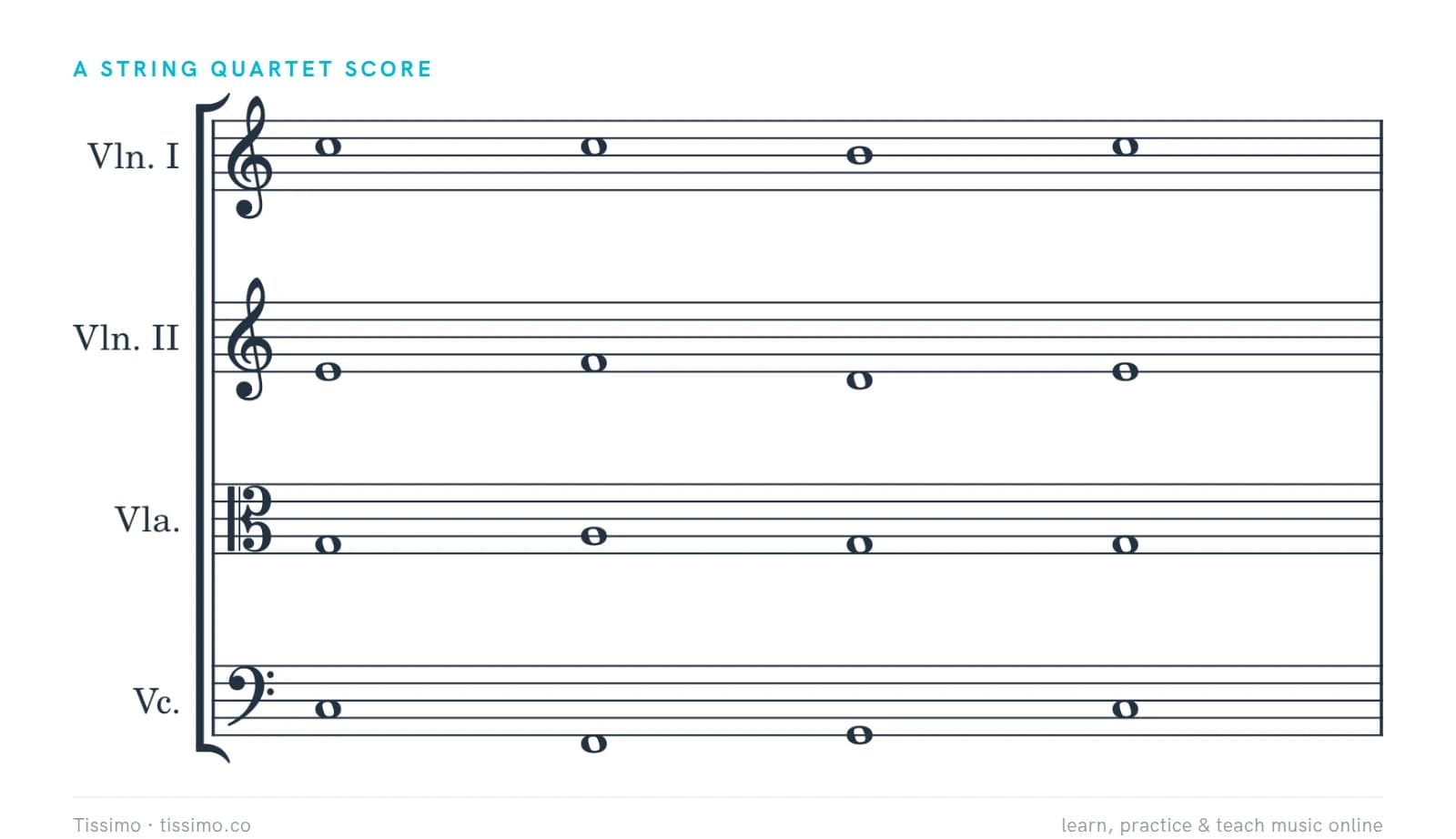
A quartet score has four staves joined by a bracket: violin 1 and violin 2 in treble clef, viola in alto clef (a C clef) and cello in bass clef. Each player reads a separate part, and the full score lets the group see how the lines fit together.
The music
The string quartet as a genre took shape in the Classical era. Haydn, who wrote dozens of quartets, is often called the "father of the string quartet," and Mozart, Beethoven and Schubert followed with works that are still central to the repertoire. A typical Classical quartet has four movements: a fast first movement (often in sonata form), a slow movement, a minuet or scherzo, and a fast finale. Later composers such as Dvořák, Debussy, Ravel, Bartók and Shostakovich wrote famous quartets in their own styles, and many quartets today also play contemporary music, arrangements, folk and crossover programs.
Playing in a quartet
Quartet players learn skills that every ensemble musician needs: matching articulation, vibrato and dynamics; intonation that fits the chord rather than just the tuner; and nonverbal cues, a nod or a breath, to start, stop and change tempo together. Rehearsals are often as much about listening as about playing.
Common questions
What instruments are in a string quartet?
Two violins, one viola and one cello. There is no double bass; the cello plays the bass line.
Does a string quartet have a conductor?
No. The players lead themselves, usually with the first violinist giving most of the cues, though every member leads when their part needs it.
Practice it: free worksheets
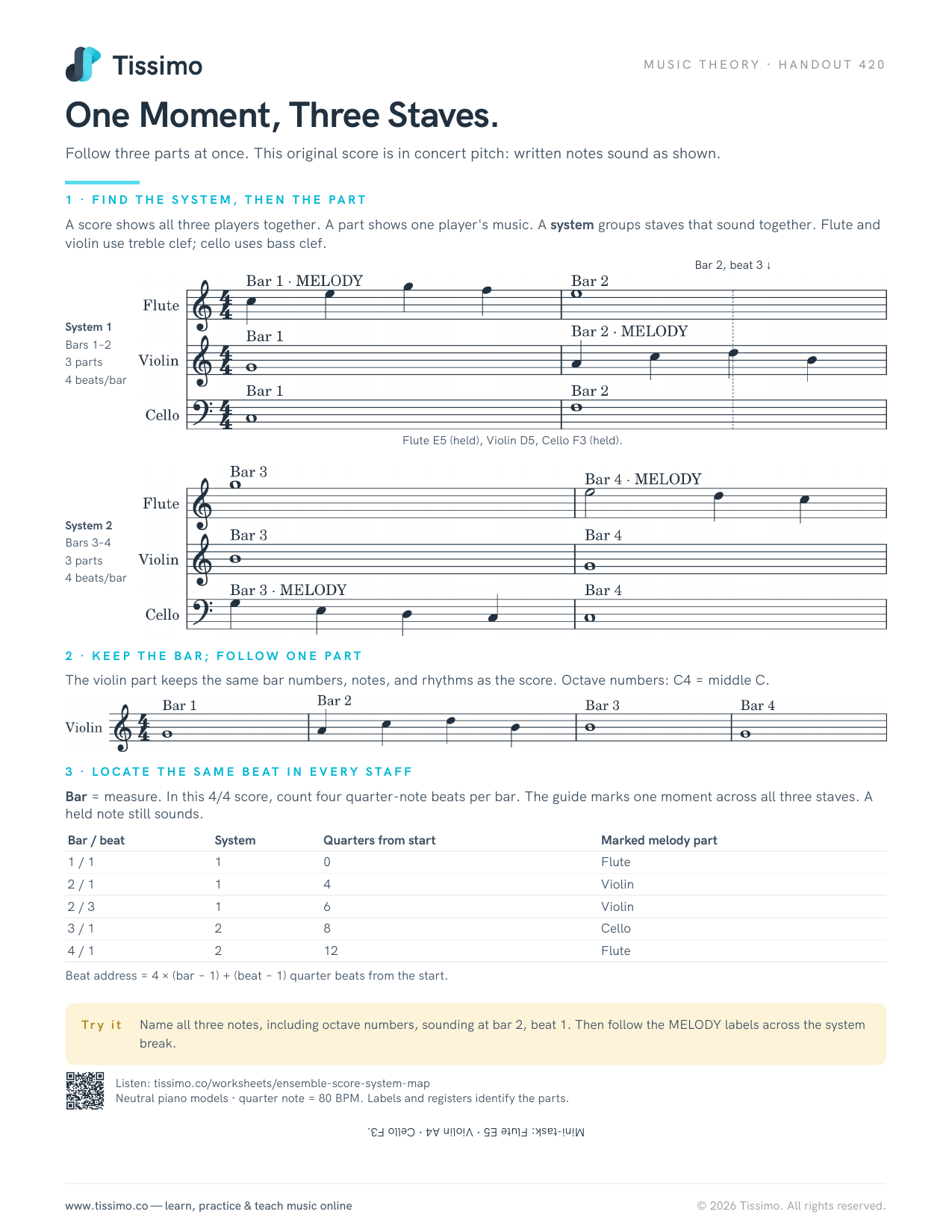 One Moment, Three Staves.Follow three parts at once. This original score is in concert pitch: written notes sound as shown.
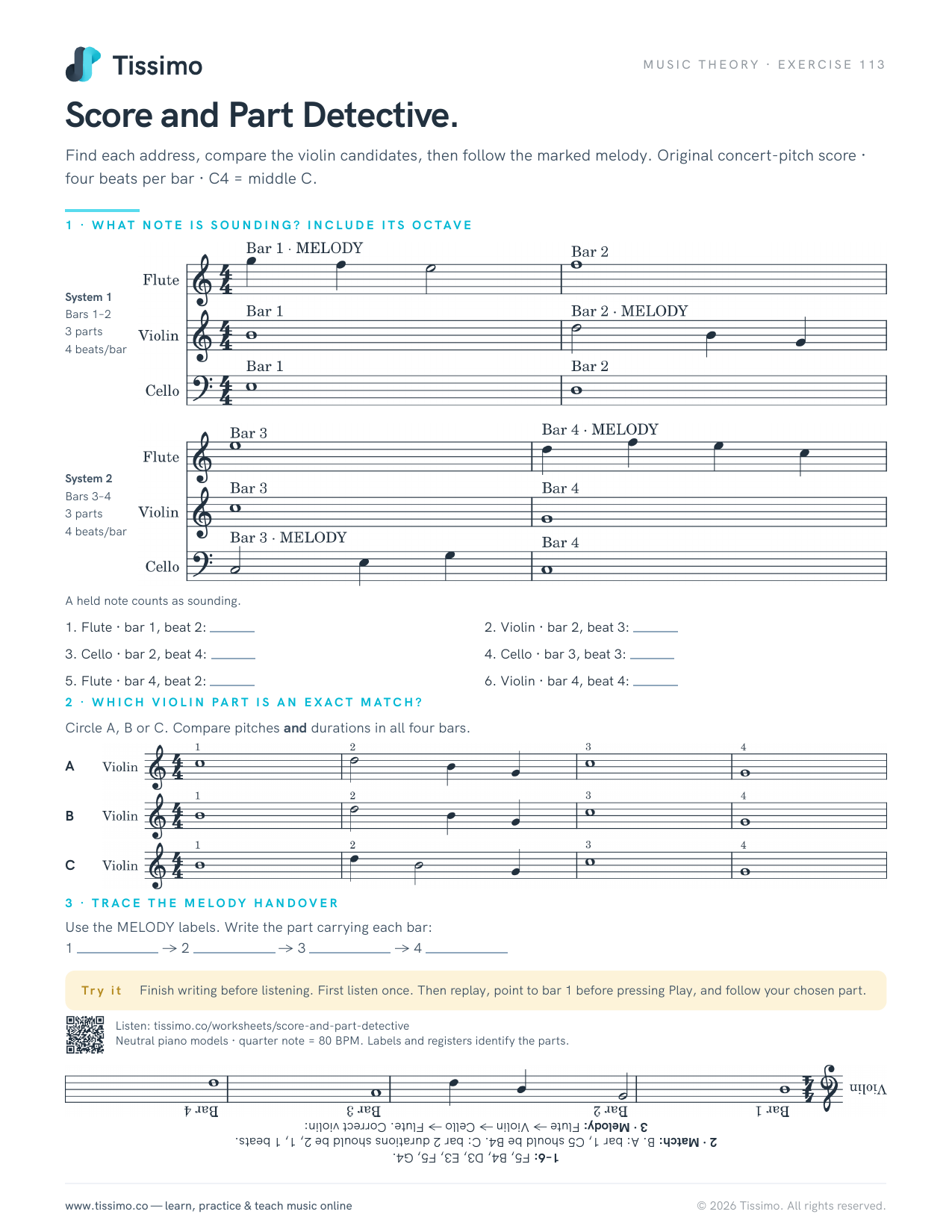 Score and Part Detective.Find each address, compare the violin candidates, then follow the marked melody. Original concert-pitch score · four beats per bar · C4 = middle C.
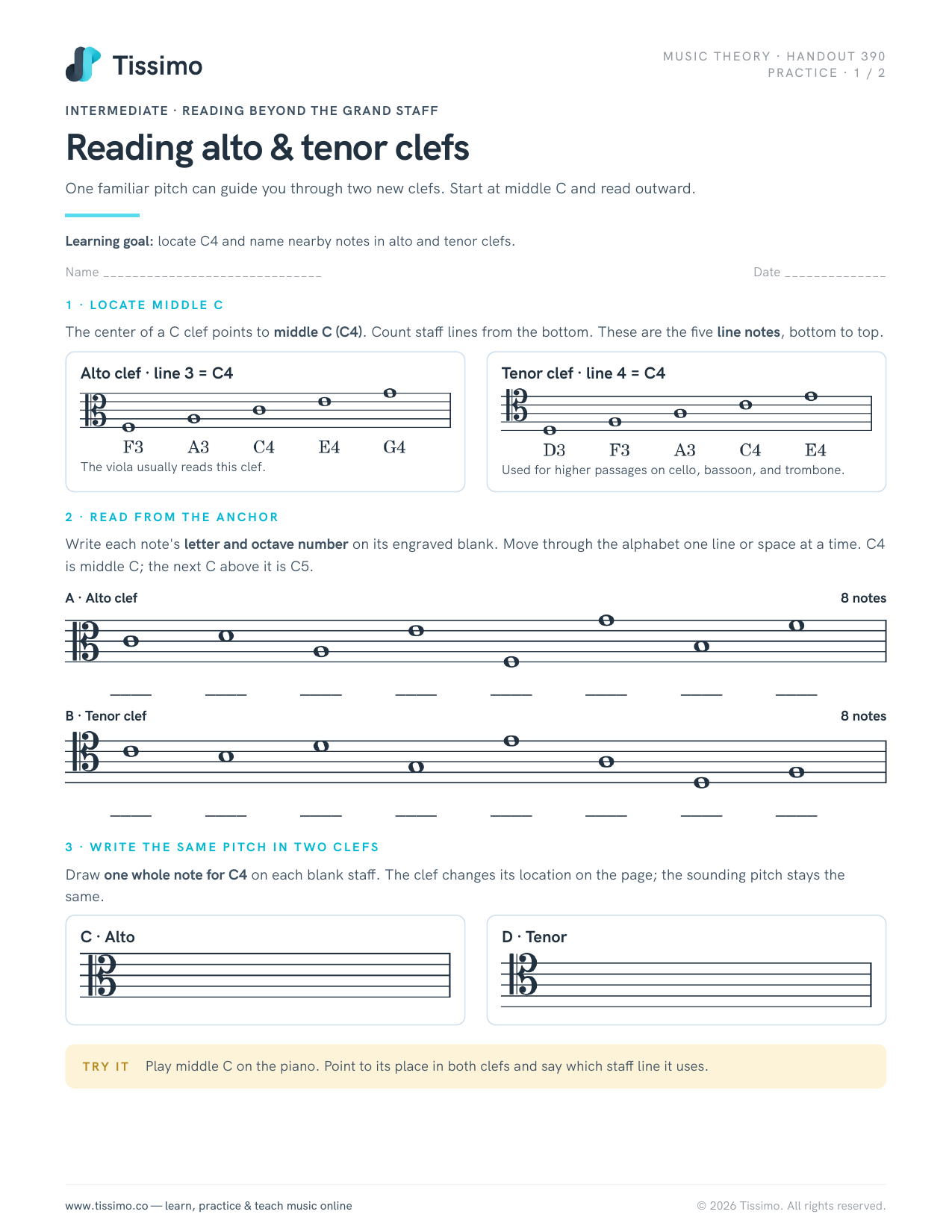 Reading alto & tenor clefsOne familiar pitch can guide you through two new clefs. Start at middle C and read outward.
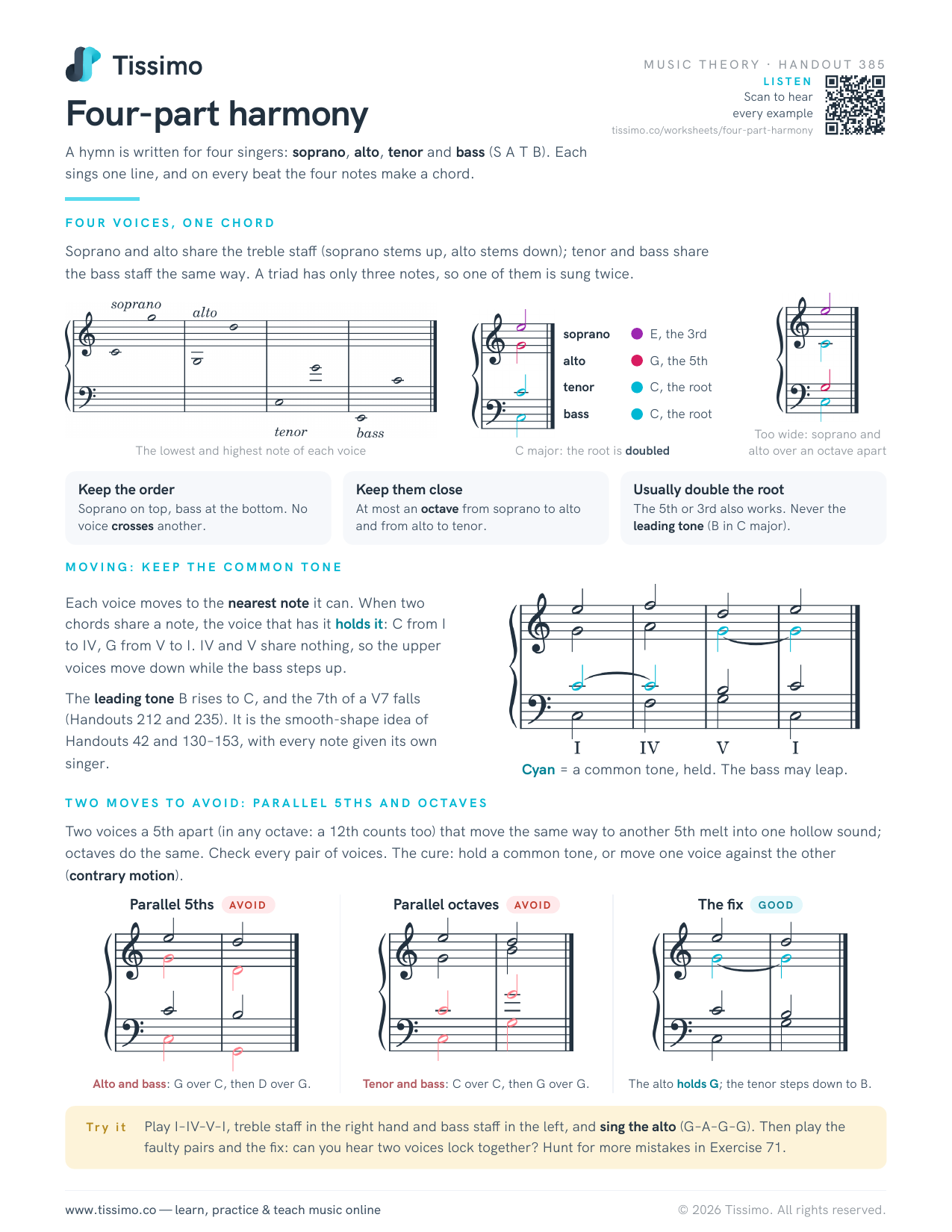 Four-part harmonyA hymn is written for four singers: soprano, alto, tenor and bass (S A T B). Each sings one line, and on every beat the four notes make a chord.