Notation & Symbols
Bass Clef
The bass clef, or F clef, is the symbol whose two dots surround the fourth staff line, marking it as the F below middle C. It is used for lower music: the piano's left hand, cello, bassoon, trombone and tuba.
The bass clef (bass rhymes with "base") is an F clef: a curved sign that grew out of a letter F, followed by two dots placed either side of the fourth line of the staff, counting from the bottom. That line is the F below middle C, F3, and every other line and space follows from it.
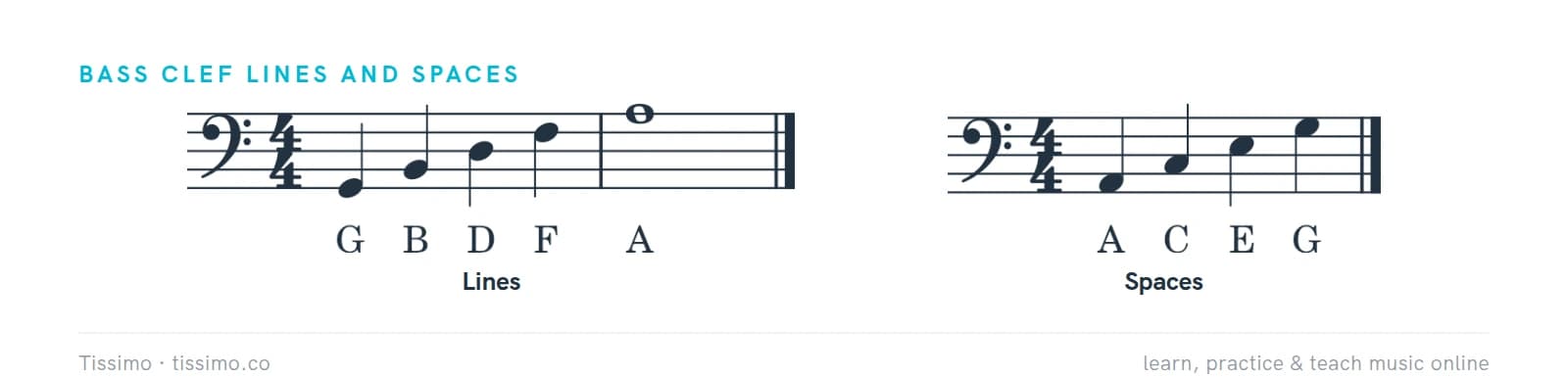
Lines and spaces of the bass staff
- Lines, bottom to top: G, B, D, F, A ("Good Boys Do Fine Always").
- Spaces, bottom to top: A, C, E, G ("All Cows Eat Grass").
Landmarks help more than rhymes once you are reading real music: the F line between the dots, the D on the middle line and the A on the top line. Middle C sits on the first ledger line above the staff, which is how the bass staff connects to the treble staff in the grand staff.
Coming from treble clef
Each position in the bass clef has a letter name two letters higher than in the treble clef: the bottom line is E in treble clef but G in bass clef, and the bottom space is F in treble clef but A in bass clef. That is a useful check, but try not to translate note by note. Read the bass clef from its own landmarks and it soon becomes as quick as the treble.
Who reads bass clef?
The left hand of the piano, the cello, double bass, bassoon, trombone, tuba, bass guitar and timpani, and baritone and bass singers. When four-part choral music is printed on two staves, the tenors share the bass staff with the basses.
The double bass and bass guitar sound an octave lower than written, which keeps their low notes on the staff. Cellos, bassoons and trombones switch to the tenor clef (a C clef) or to treble clef when they play high.
Practice with The Bass Clef & the Grand Staff and Name the notes: bass clef.
Common questions
Why is the bass clef called the F clef?
It developed from a letter F, and its two dots surround the line where the F below middle C is written: the fourth line from the bottom.
What notes are on the bass clef lines and spaces?
The lines, from the bottom, are G, B, D, F and A. The spaces are A, C, E and G.
Practice it: free worksheets
 The Bass Clef & the Grand StaffThe bass staff holds the lower notes, usually played by the left hand. It works just like the treble staff (Handout 351), but its clef names a different line.
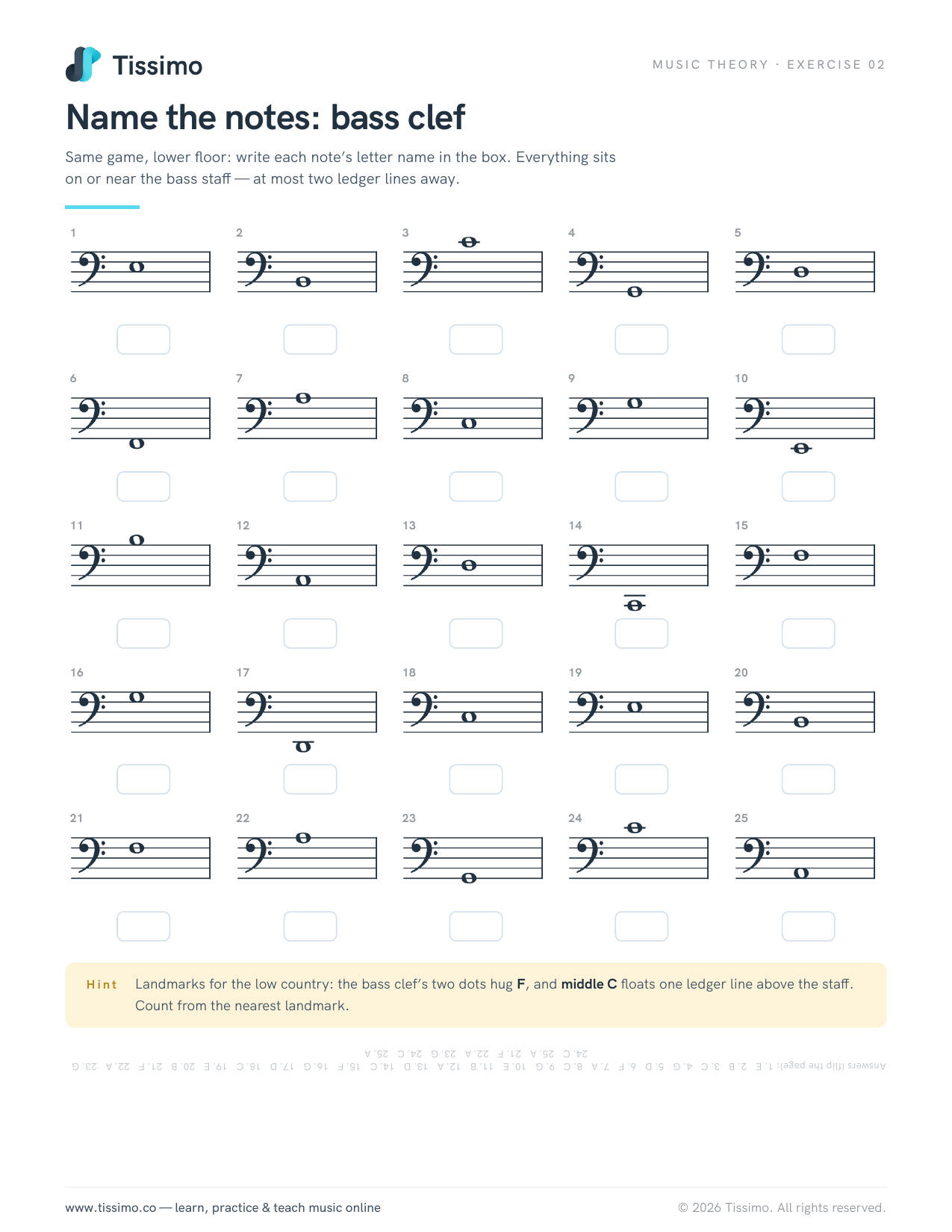 Name the notes: bass clefSame game, lower floor: write each note’s letter name in the box. Everything sits on or near the bass staff — at most two ledger lines away.
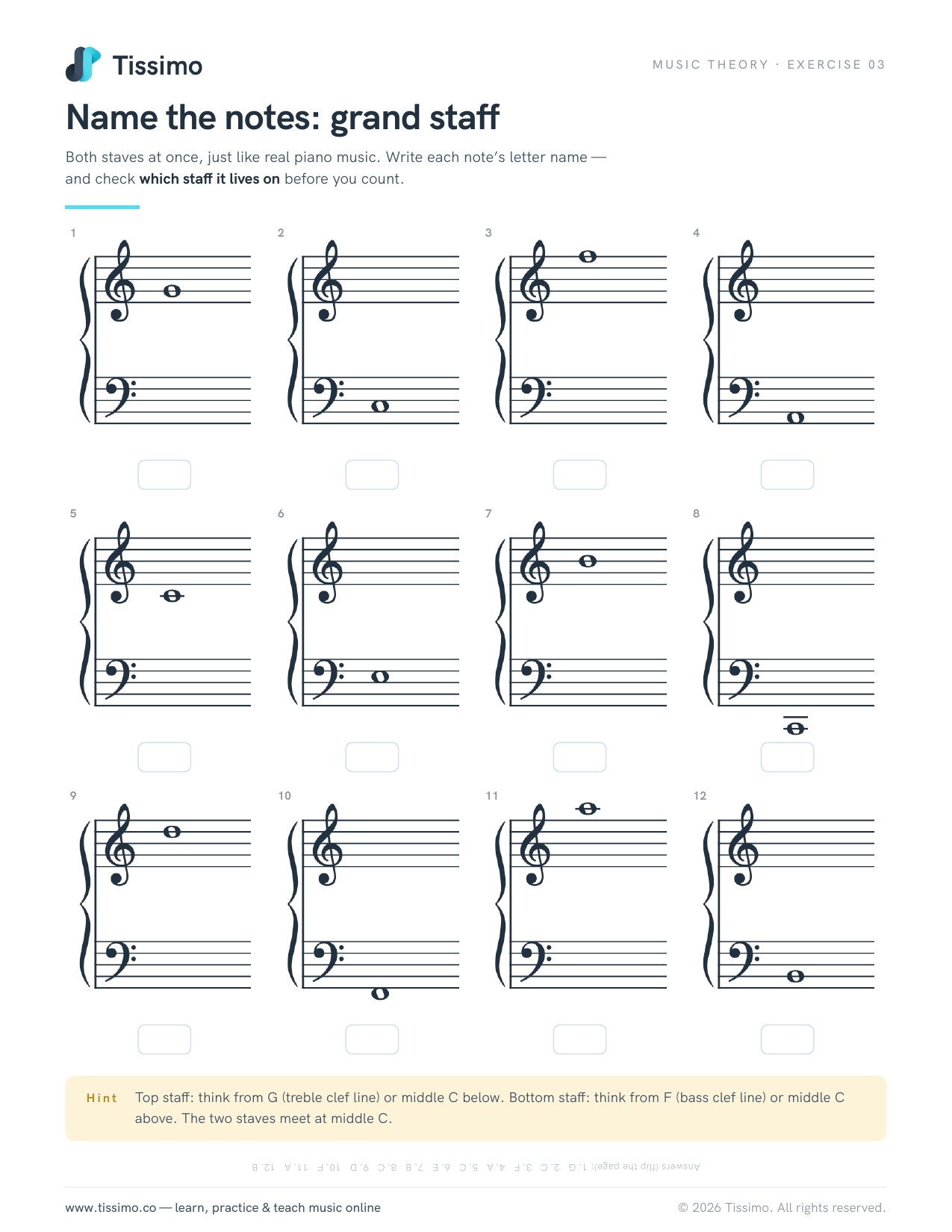 Name the notes: grand staffBoth staves at once, just like real piano music. Write each note’s letter name — and check which staff it lives on before you count.
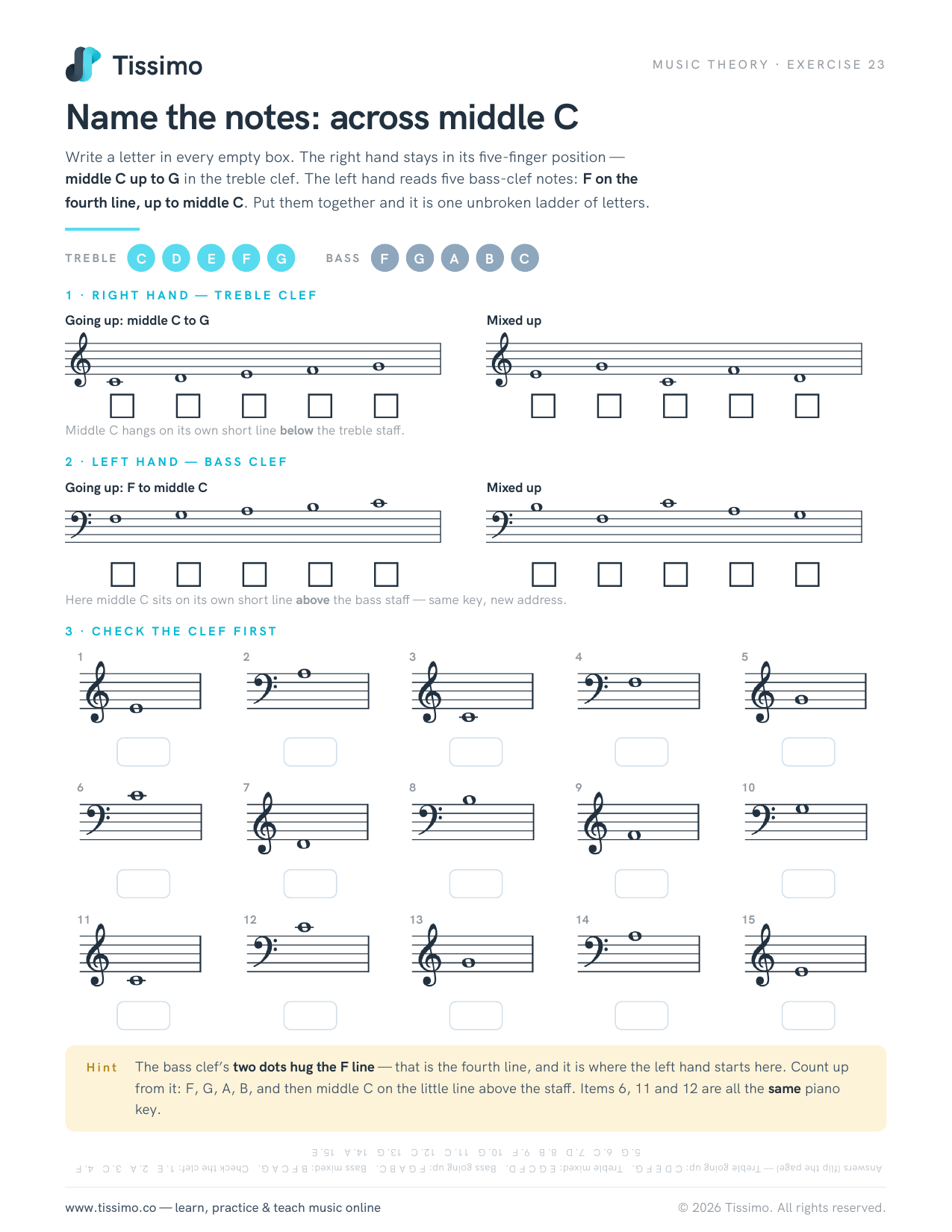 Name the notes: across middle CWrite a letter in every empty box. The right hand stays in its five-finger position — middle C up to G in the treble clef. The left hand reads five bass-clef notes: F on the fourth line, up to middle C. Put them together and it is one unbroken ladder of letters.
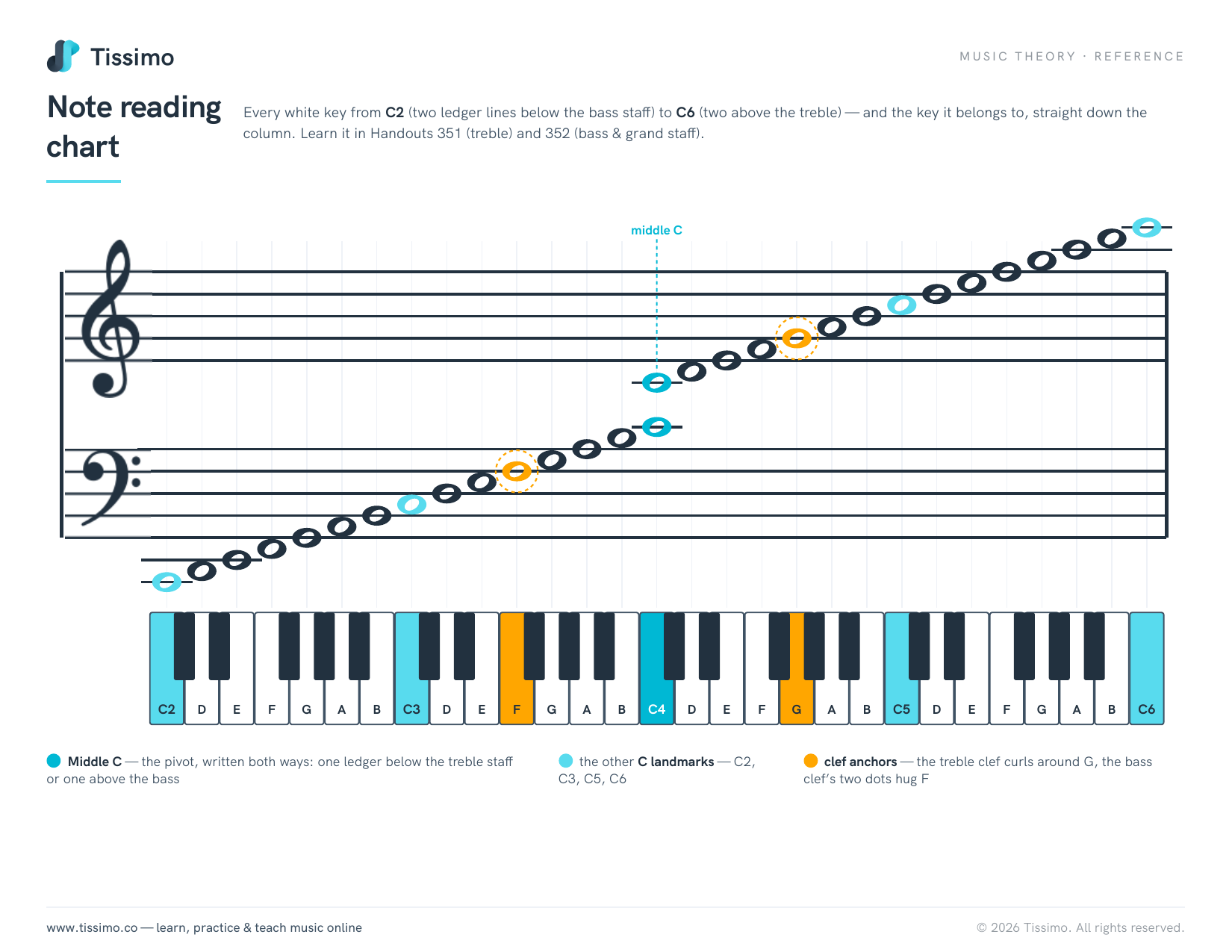 Note reading chartEvery white key from C2 (two ledger lines below the bass staff) to C6 (two above the treble) — and the key it belongs to, straight down the column. Learn it in Handouts 351 (treble) and 352 (bass & grand staff).