Styles, Genres & Eras
Baroque Music
Pronounced buh-ROKE
Baroque music is European music from roughly 1600 to 1750, the era of Bach, Handel and Vivaldi. It is known for basso continuo, driving rhythms, ornamentation and contrapuntal forms such as the fugue.
The Baroque period runs roughly from 1600, when opera was born in Italy, to 1750, the year J. S. Bach died. The name is usually traced to a Portuguese word for an irregularly shaped pearl, and it was first used as an insult for art that seemed overdecorated. Today it is simply the name of the era.
The sound of Baroque music
- Basso continuo. A bass line played by a cello or bassoon, with a keyboard or lute filling in chords from figured bass. It underlies almost every Baroque ensemble piece.
- Driving, steady rhythm: a single pulse often runs unbroken through a whole movement.
- One mood per movement. A movement typically explores a single character, joyful, grieving or majestic, rather than contrasting several.
- Dynamic contrasts: loud and soft may change in blocks, especially through changes in scoring. This does not rule out gradual shaping by singers and instruments that can vary their volume.
- Ornamentation: trills, mordents and other decorations, many of them added by the performer.
- Counterpoint, from simple imitation to the fugue, alongside the new major and minor keys.
Forms and genres
Opera, oratorio (such as Handel's Messiah) and cantata; the concerto, both the concerto grosso and the solo concerto; the suite of dances; the sonata for one or two instruments and continuo; the prelude and fugue; the chorale prelude for organ.
Composers and works
Claudio Monteverdi, Arcangelo Corelli, Henry Purcell, Antonio Vivaldi (The Four Seasons), Georg Philipp Telemann, Jean-Philippe Rameau, François Couperin, Domenico Scarlatti, George Frideric Handel and Johann Sebastian Bach (The Well-Tempered Clavier, the Brandenburg Concertos, the Passions).
Instruments
The harpsichord and organ were the main keyboards; the harpsichord cannot change its volume with touch. The violin family, recorder, Baroque oboe, natural trumpet and lute were common. Instruments of the time used gut strings and, often, a lower pitch than today's A440.
Playing Baroque music on the piano
Keep a steady pulse, use little or no sustain pedal, articulate lightly (many notes are slightly detached), shape dynamics to the phrases and texture rather than assuming every change must be terraced, and treat the voices as independent melodies. The Periods of Music History worksheet compares the eras, and Ornaments through the eras shows how Baroque ornaments are played. Good first pieces: the Minuet in G and Bach's Prelude in C.
Common questions
What are the dates of the Baroque period?
Roughly 1600 to 1750: from the first operas in Italy to the death of J. S. Bach. Like all period dates, these are approximate.
What are the main characteristics of Baroque music?
A basso continuo, steady driving rhythms, one mood per movement, terraced dynamics, abundant ornamentation and counterpoint such as the fugue.
Practice it: free worksheets
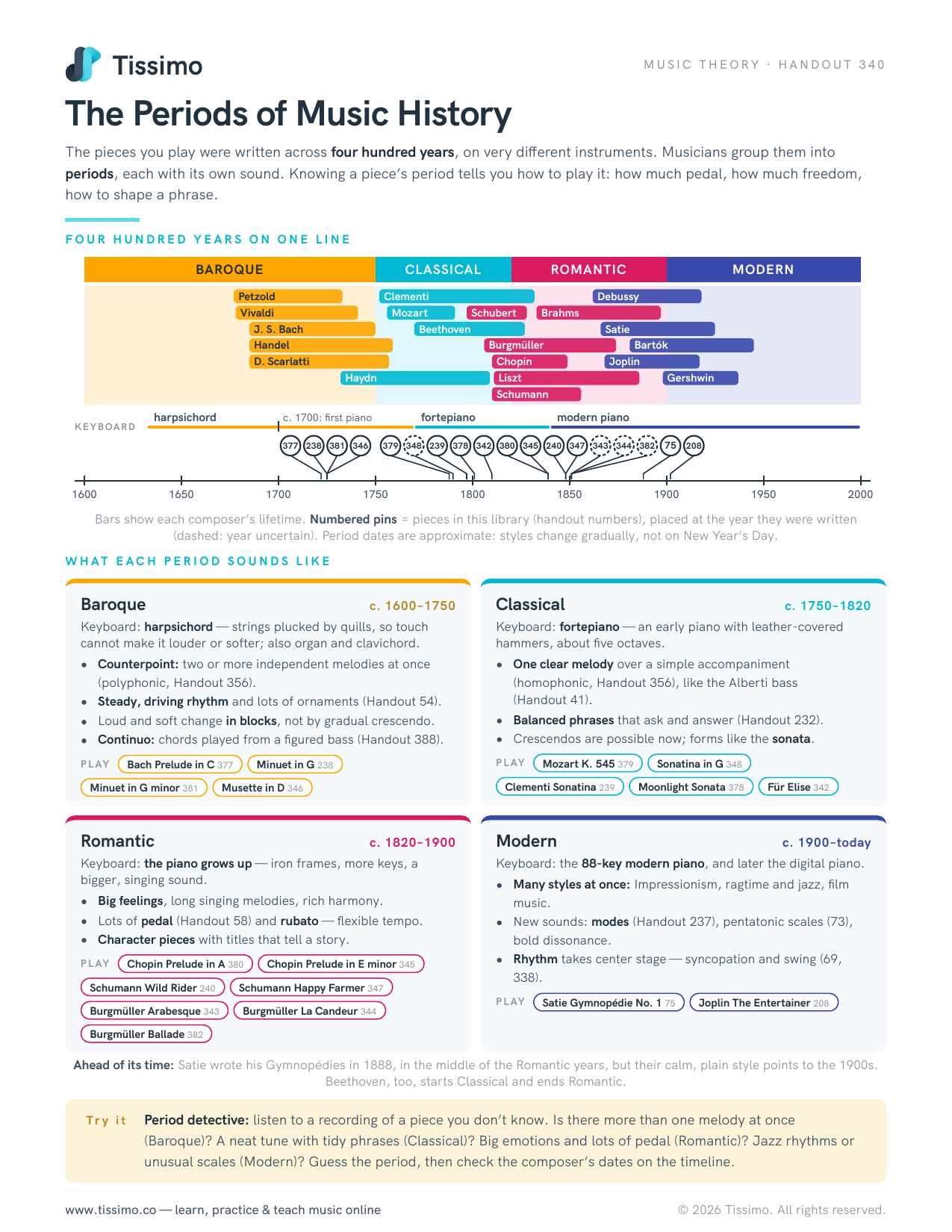 The Periods of Music HistoryThe pieces you play were written across four hundred years, on very different instruments. Musicians group them into periods, each with its own sound. Knowing a piece’s period tells you how to play it: how much pedal, how much freedom, how to shape a phrase.
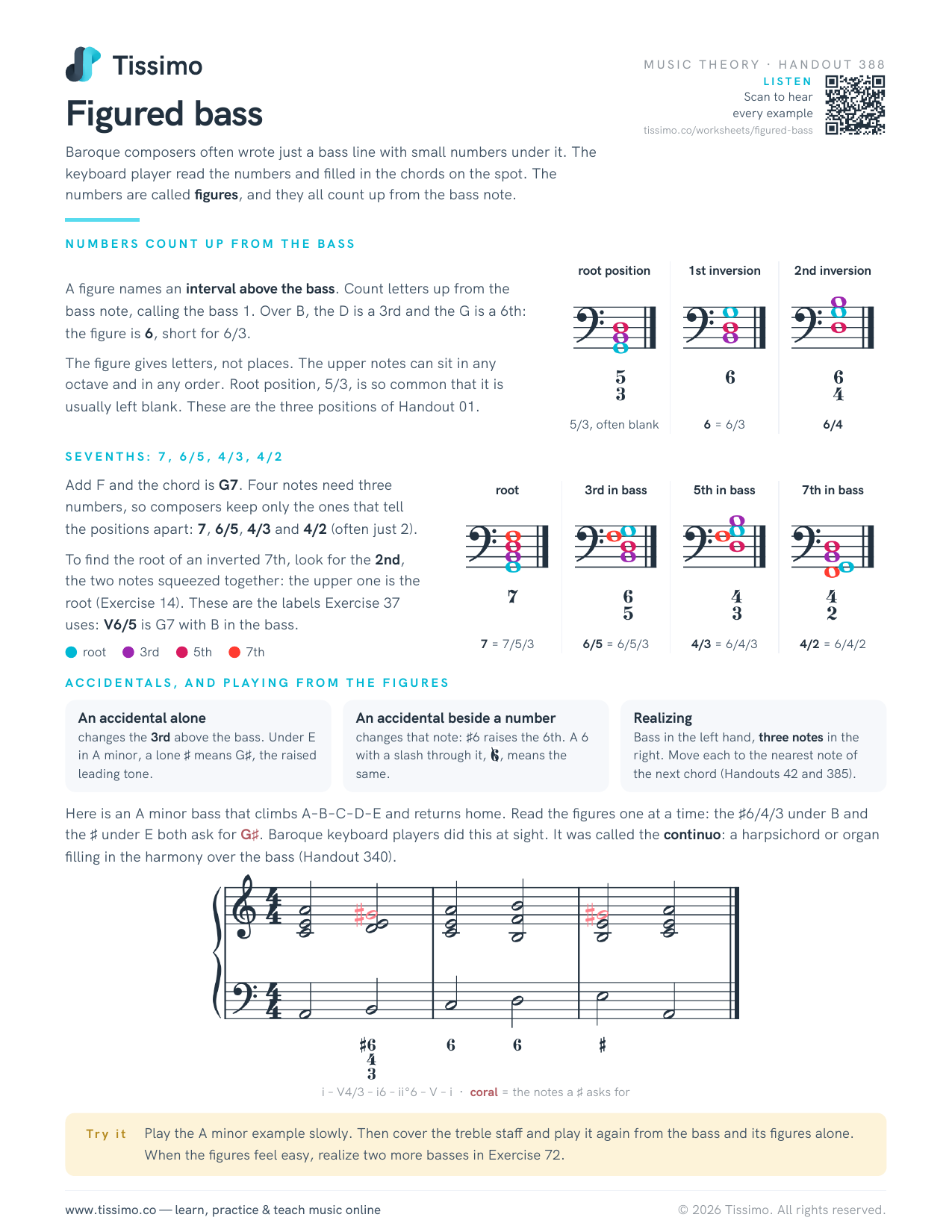 Figured bassBaroque composers often wrote just a bass line with small numbers under it. The keyboard player read the numbers and filled in the chords on the spot. The numbers are called figures, and they all count up from the bass note.
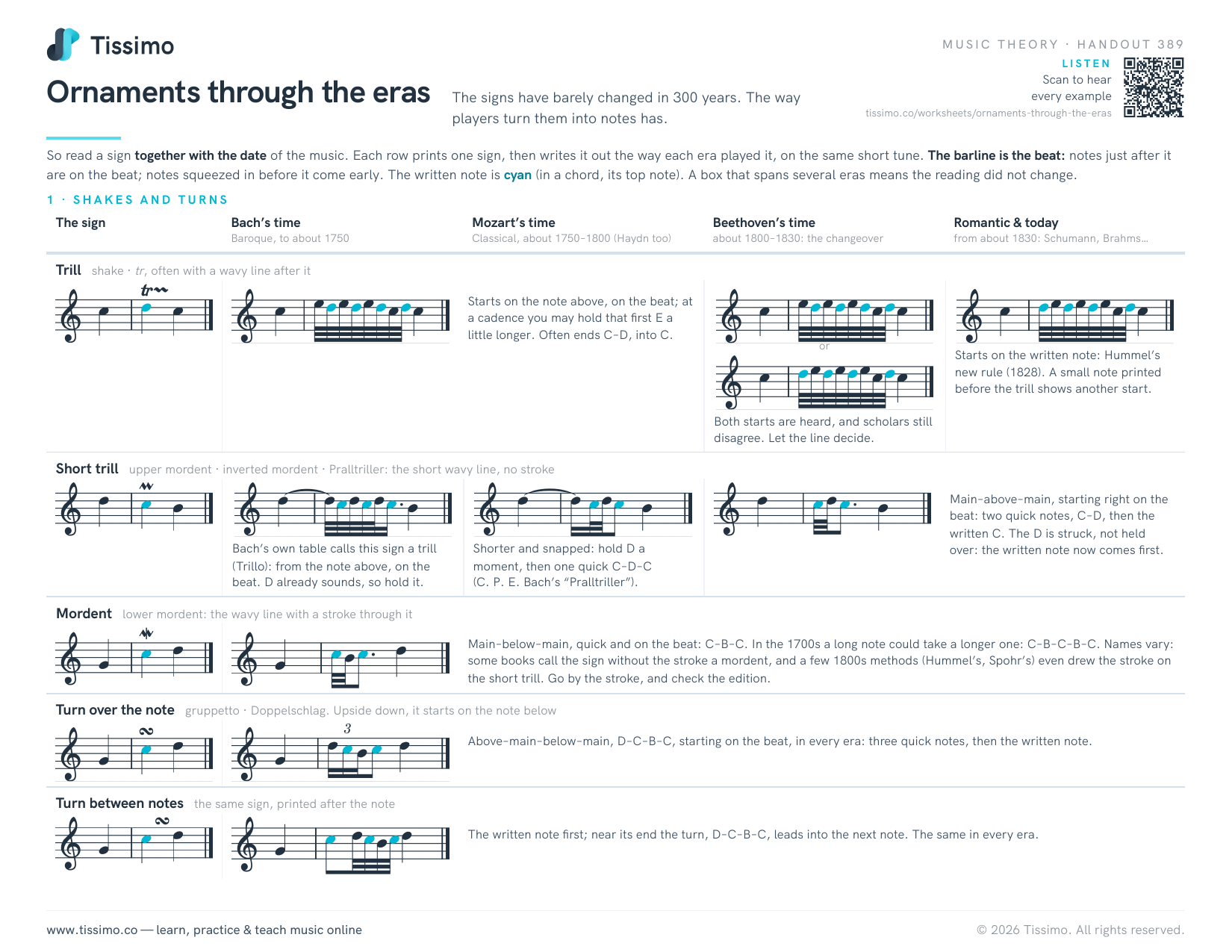 Ornaments through the erasThe signs have barely changed in 300 years. The way players turn them into notes has.
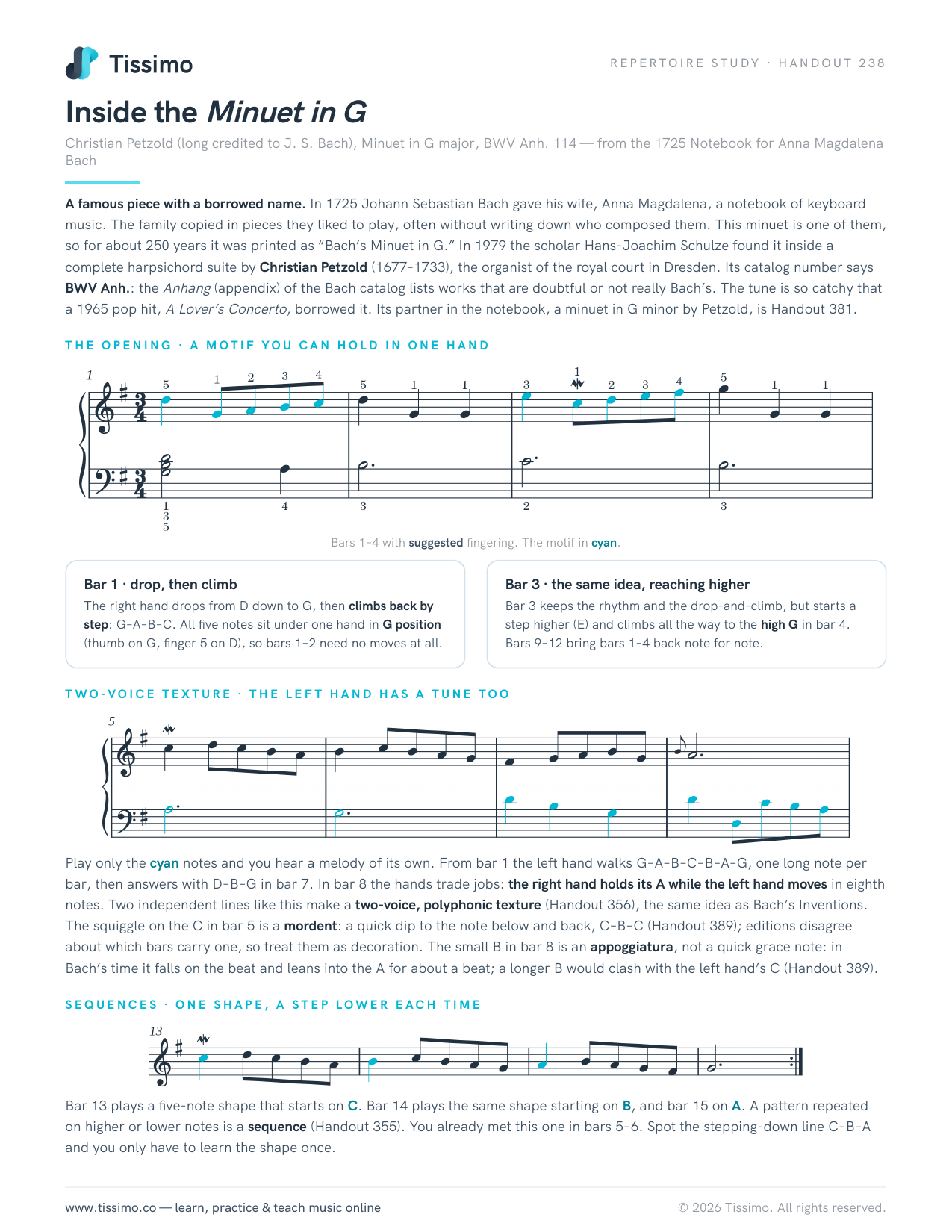 Inside the Minuet in GChristian Petzold (long credited to J. S. Bach), Minuet in G major, BWV Anh. 114 — from the 1725 Notebook for Anna Magdalena Bach
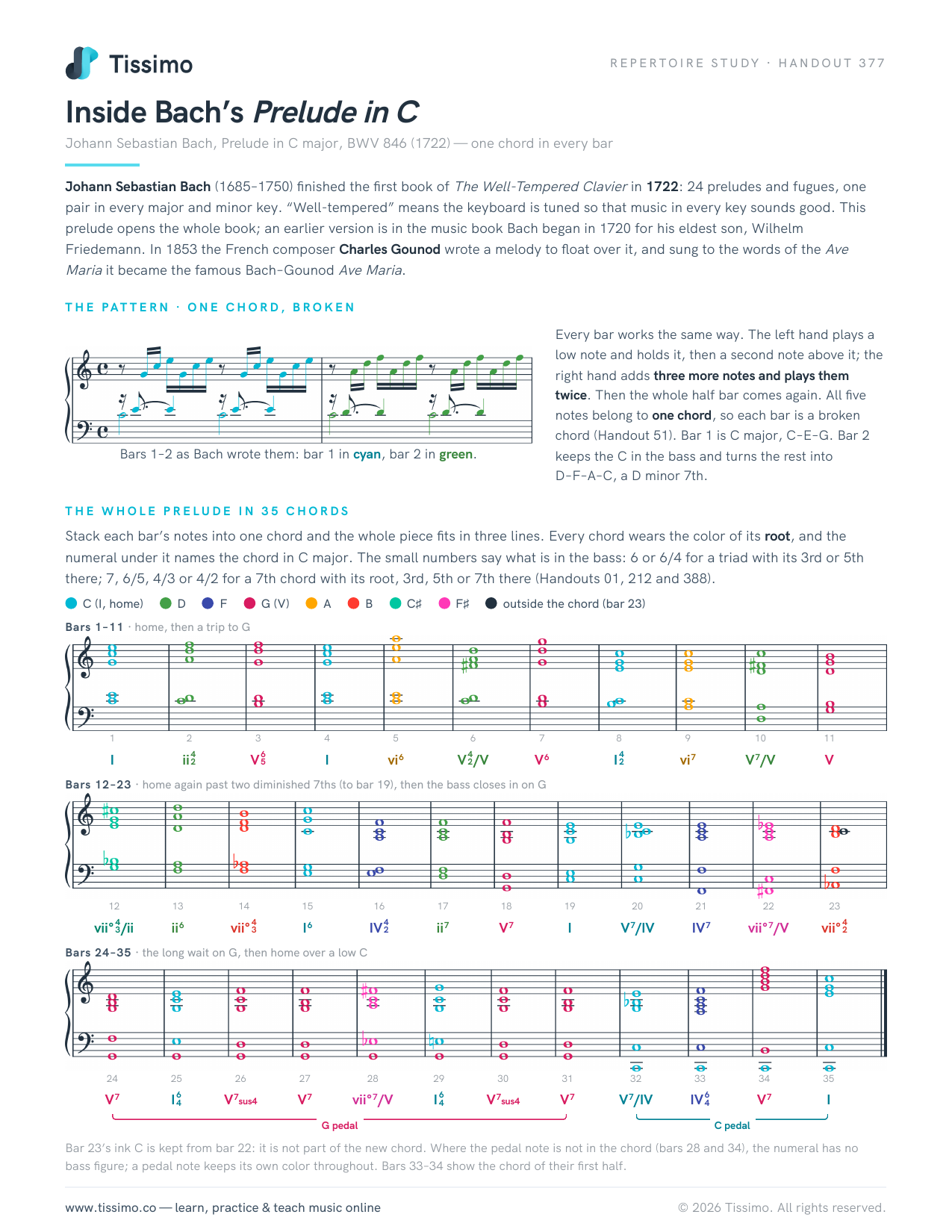 Inside Bach’s Prelude in CJohann Sebastian Bach, Prelude in C major, BWV 846 (1722) — one chord in every bar
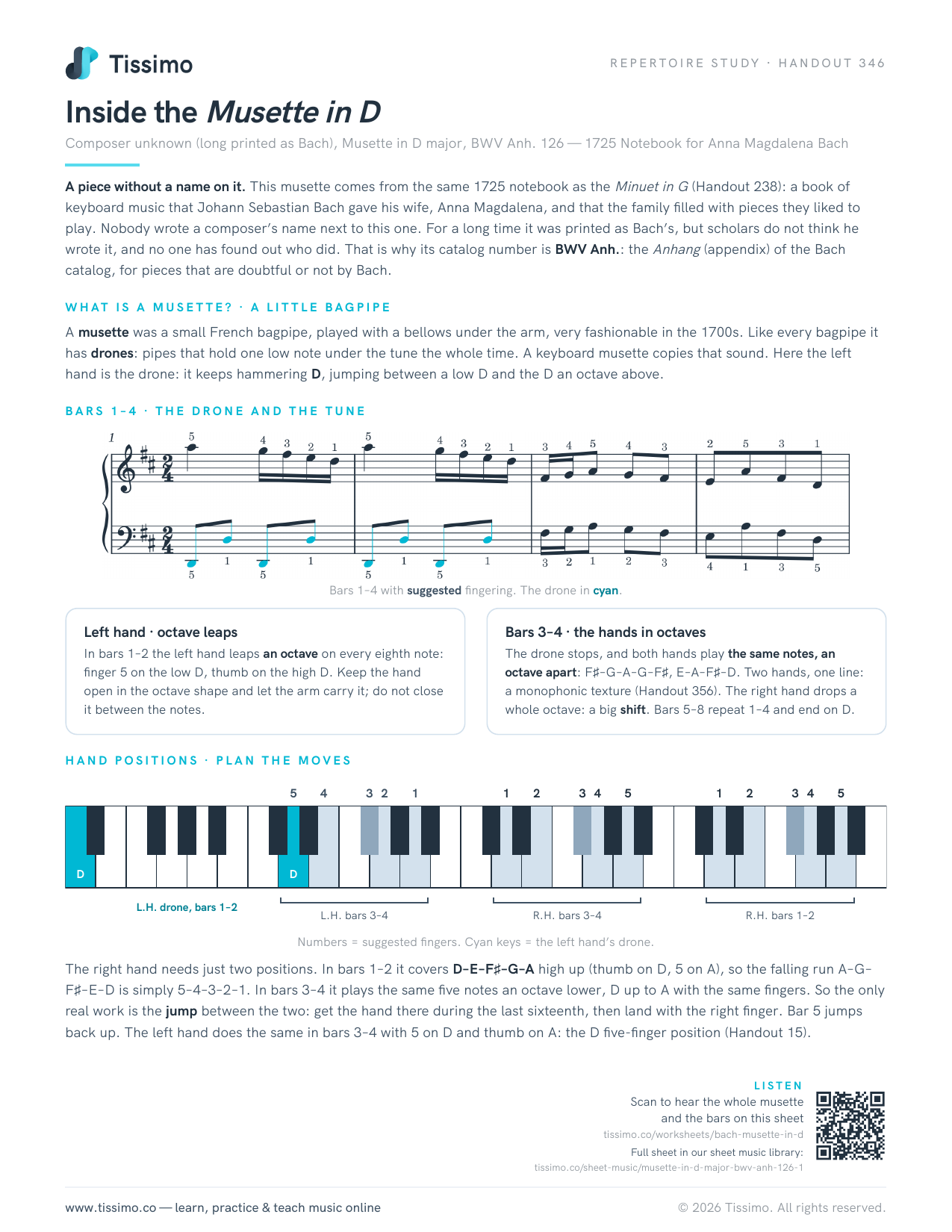 Inside the Musette in DComposer unknown (long printed as Bach), Musette in D major, BWV Anh. 126 — 1725 Notebook for Anna Magdalena Bach