Instruments & Voices
Organ
The organ (pipe organ) is a keyboard instrument that sounds when air flows through pipes. Organists play one or more keyboards with their hands and a pedalboard with their feet, choosing the sounds with stops.
The pipe organ is a keyboard instrument that makes its sound with air. A blower (in older organs, bellows pumped by hand) fills a wind chest with pressurized air. Each key opens a valve that lets air into a pipe, and the pipe sounds for as long as the key is held. Unlike a piano note, an organ note does not fade: it stays at the same volume until you let go.
Pipes, ranks and stops
Each pipe plays one pitch with one tone color. A complete row of pipes, one for every key, is called a rank. Organs have anything from a few ranks to many dozens, and the organist chooses which ones sound by pulling stops (knobs or tabs at the console). There are two main kinds of pipe:
- Flue pipes work like a whistle or a recorder: air strikes a sharp edge at the pipe's mouth. Most of an organ's pipes are flue pipes.
- Reed pipes contain a vibrating brass tongue, which gives trumpet-like or buzzing colors.
Stop names include a length in feet that tells you the pitch. An 8′ stop sounds at written pitch. The number refers to the approximate speaking length of an open pipe at low C; a stopped pipe producing the same note is about half as long. A 4′ stop sounds an octave higher, a 2′ stop two octaves higher and a 16′ stop an octave lower. Combining stops at different pitches is how the organ builds its bright, full sound, and choosing them for a piece is called registration.
Keyboards and pedals
The hand keyboards are called manuals. Many organs have two or three, and large instruments may have four or more, each with its own group of stops, often named Great, Swell and Choir (or Positive). The Swell pipes usually stand in a box with shutters that a foot pedal opens and closes, which gives the organ a way to make a gradual crescendo. The feet play the pedalboard, a large keyboard on the floor, usually for the bass line.
Range
A typical modern manual has 61 keys, C2 to C7, and a typical pedalboard has 32 keys, C2 to G4 (written pitch). Stops then move the sound up or down by octaves. A 32′ stop sounds its low C at about 16 Hz, a rumble you feel as much as hear, and the smallest pipes, shorter than a pencil, sound far above the top of the piano. No other acoustic instrument covers as many octaves.
How organ music is written
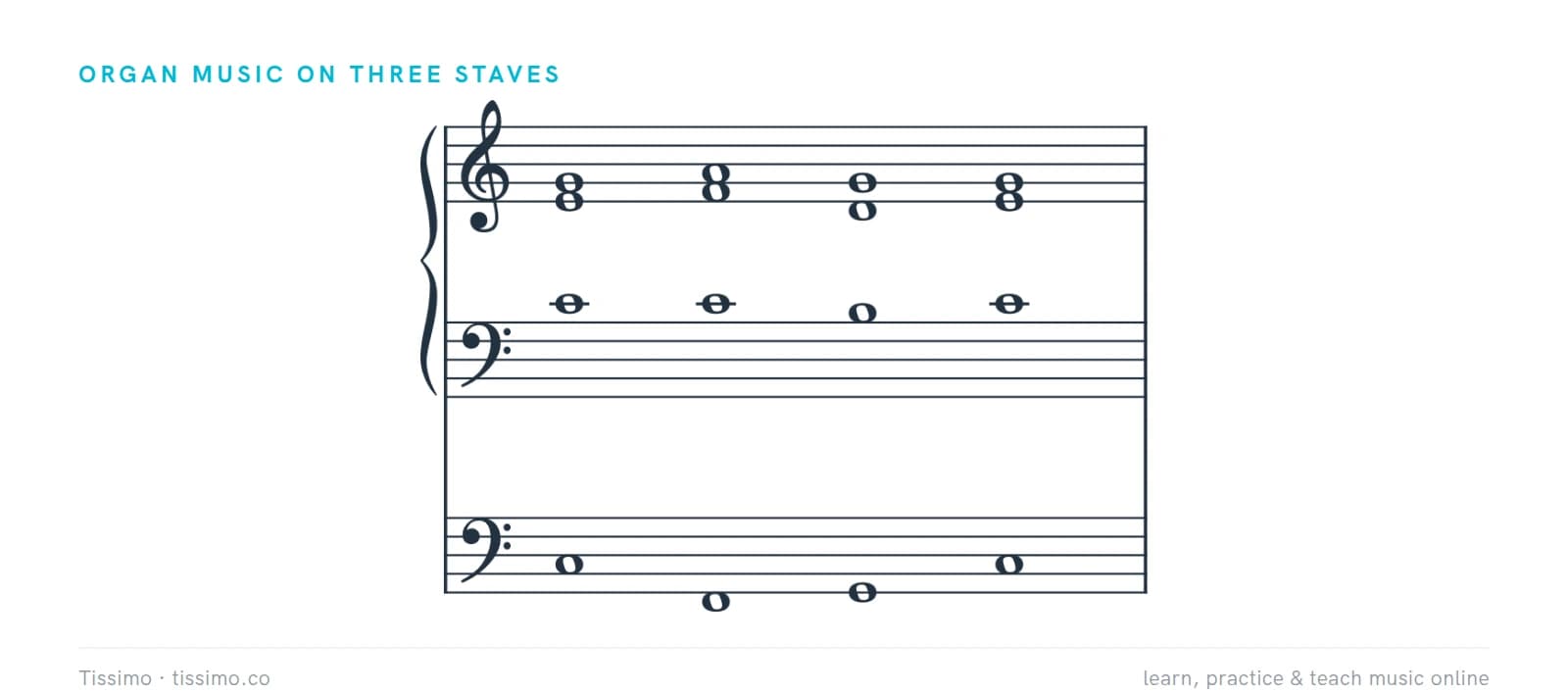
Organ music is usually printed on three staves: two joined by a brace for the hands, as in piano music, and a third in bass clef for the feet. The organ does not transpose, but the stops can change the octave you hear: a passage written around C4 sounds an octave higher on a 4′ stop. Registration is often left to the player, or suggested in words above the music.
Where you hear it
The organ is closely tied to church music, from hymn accompaniment to large solo works, and Bach's organ preludes and fugues are at the center of its repertoire. Concert halls also have organs, which sometimes join the orchestra. Electric and electronic organs, such as the Hammond, are a staple of gospel, jazz and rock.
Tips for beginners
- Most organists start as pianists. Good keyboard technique, especially smooth legato fingering, carries straight over.
- Thin-soled organ shoes help you feel the pedals; you play them with both the toe and the heel of each foot.
- A note stops the moment you release the key, so practice clean releases as carefully as clean attacks.
Common questions
Why is organ music written on three staves?
The organist plays with both hands and both feet. The top two staves, joined by a brace, are for the hands, as in piano music, and the third staff is for the pedalboard, which the feet play.
What does 8′ mean on an organ stop?
8′ describes normal written pitch, based on the speaking length of an equivalent open low-C pipe. Stopped pipes can be shorter. A 4′ stop sounds an octave higher, 2′ two octaves higher and 16′ an octave lower.
Practice it: free worksheets
 The Bass Clef & the Grand StaffThe bass staff holds the lower notes, usually played by the left hand. It works just like the treble staff (Handout 351), but its clef names a different line.
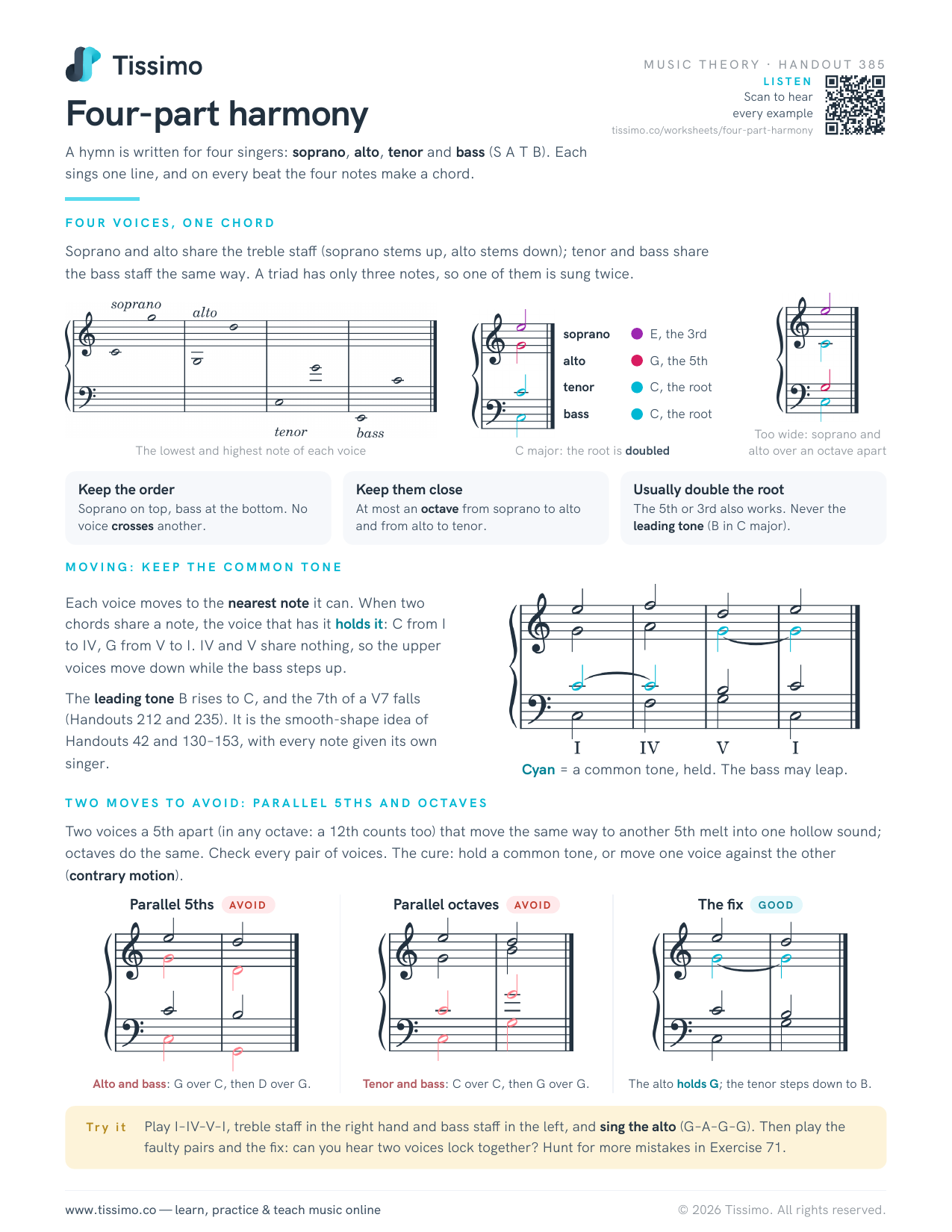 Four-part harmonyA hymn is written for four singers: soprano, alto, tenor and bass (S A T B). Each sings one line, and on every beat the four notes make a chord.
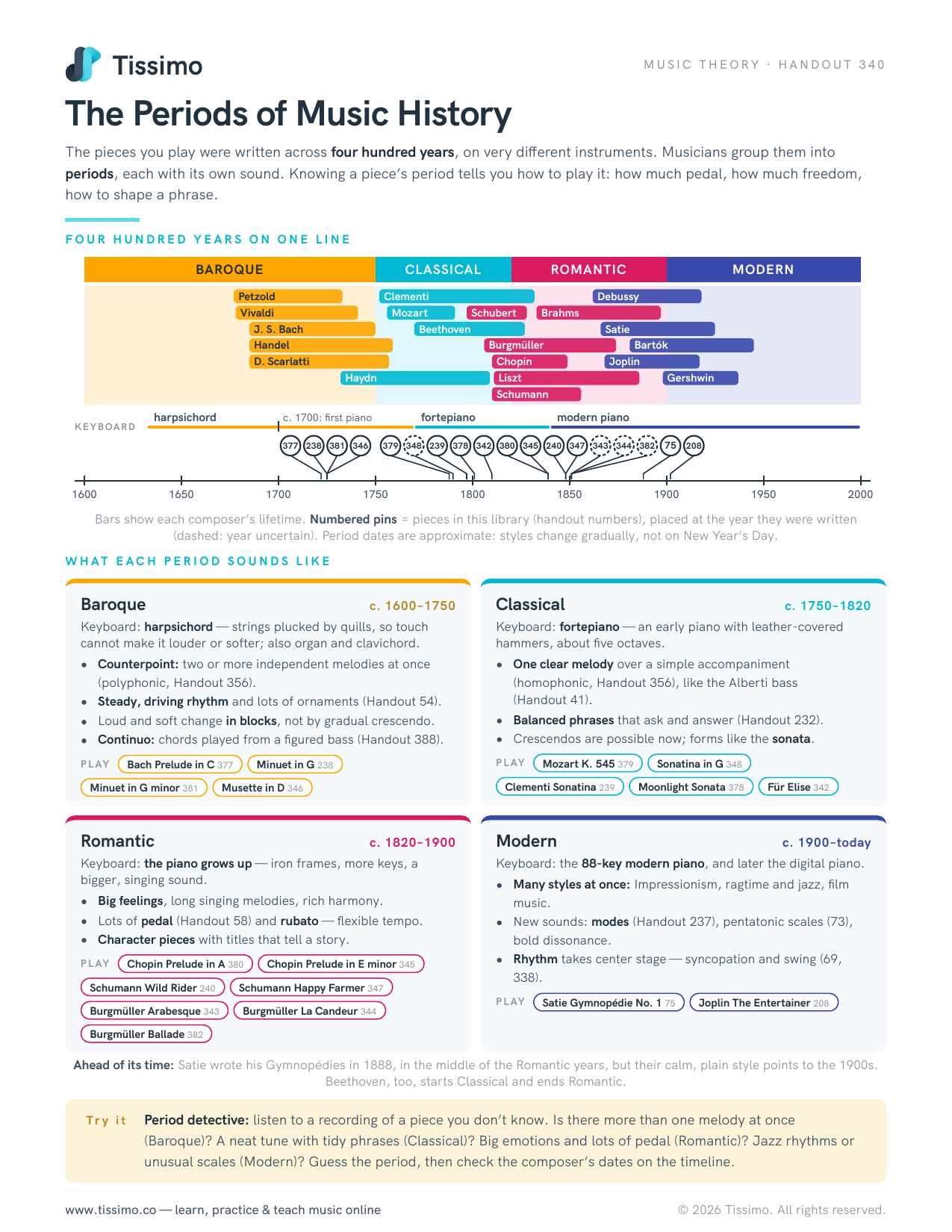 The Periods of Music HistoryThe pieces you play were written across four hundred years, on very different instruments. Musicians group them into periods, each with its own sound. Knowing a piece’s period tells you how to play it: how much pedal, how much freedom, how to shape a phrase.