Instruments & Voices
Piano
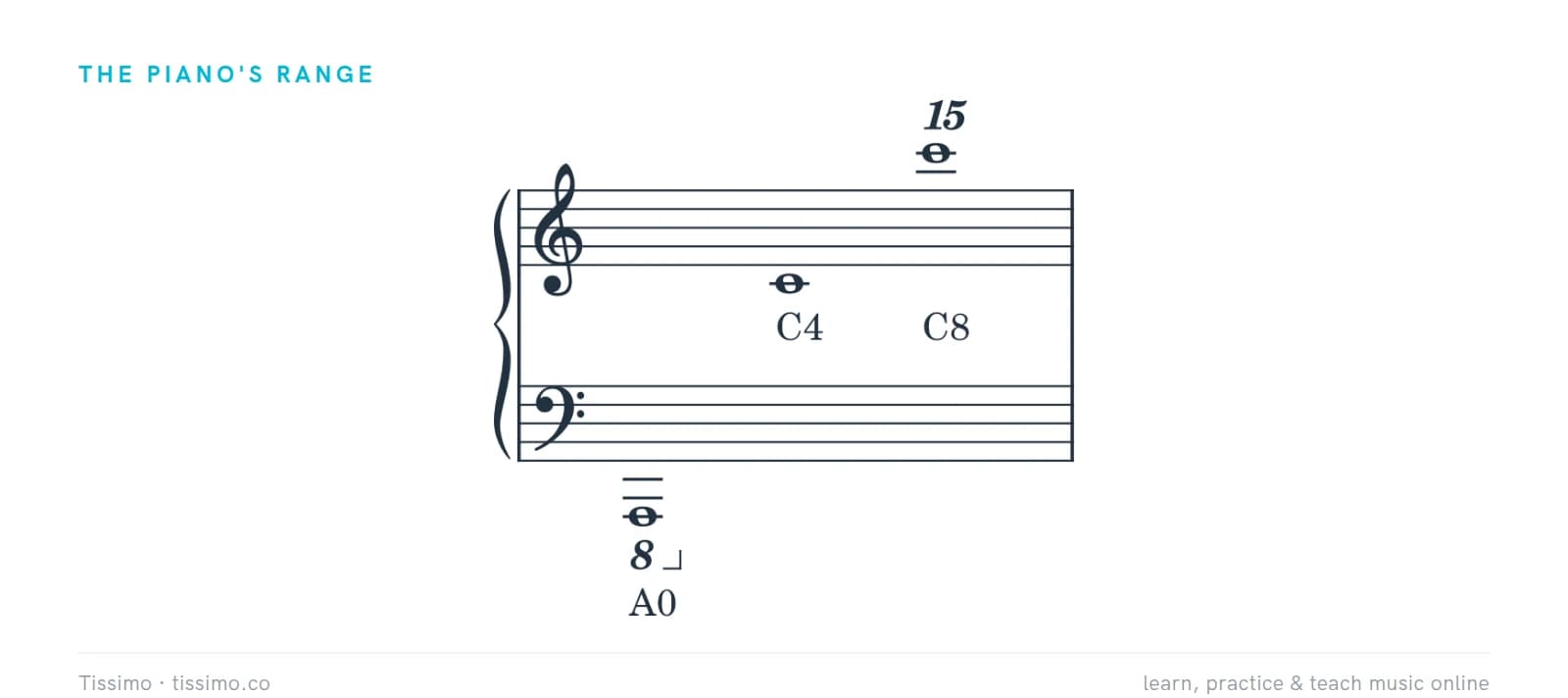
The piano is a keyboard instrument in which felt hammers strike steel strings. A standard piano has 88 keys, from A0 to C8, and plays softer or louder depending on how quickly you press each key.
The piano is a keyboard instrument with strings inside. Press a key and a felt-covered hammer strikes the strings for that note, then rebounds so they can vibrate freely. Its full name, pianoforte, is Italian for "soft-loud": unlike the harpsichord that came before it, a piano plays louder when you press faster and softer when you press gently.
How a piano makes its sound
Pressing a key throws a hammer toward its strings and, for notes fitted with dampers, lifts the damper. Just before the hammer arrives, escapement lets it fly free and rebound. Releasing the key normally returns the damper, unless a pedal holds it raised. The highest strings have no dampers and fade naturally.
Most notes have two or three strings tuned to the same pitch, which makes the tone fuller. The lowest notes have one thick string wound with copper wire. The strings are stretched across a cast-iron frame and pass over a large wooden soundboard, which turns their vibration into the sound you hear.
Range: 88 keys from A0 to C8
A standard modern piano has 88 keys, 52 white and 36 black, spanning just over seven octaves from A0 to C8. Only the organ among common acoustic instruments reaches further, and the piano covers the ranges of the whole orchestra. Middle C (C4) sits near the center of the keyboard.
Grand, upright and digital pianos
- Grand pianos lie flat, with the strings running away from you. Gravity returns the hammers, which helps fast repeated notes.
- Upright pianos stand the strings on end to save floor space. They are the usual instrument in homes and schools.
- Digital pianos play recorded or modeled piano sound through speakers, with weighted keys that imitate the feel of an acoustic action. They never need tuning, and you can practice with headphones.
The pedals
The right pedal is the damper (sustain) pedal: it lifts every damper, so notes keep ringing after you release the keys. The left pedal is the soft pedal. On a grand it shifts the hammers so they strike fewer strings; on an upright it moves them closer to the strings. A middle pedal is a sostenuto pedal on most grands; on many uprights it lowers a strip of felt to make the piano quieter for practice.
How piano music is written
Piano music is written on the grand staff: two staves joined by a brace, usually with the treble clef on top for the right hand and the bass clef below for the left. Either hand can move to the other staff, and clef changes are common. The piano does not transpose: a written C sounds as C.
Where you hear it
The piano plays solo music, accompanies singers and other instruments, joins chamber groups such as the piano trio, and takes the solo part in concertos. Jazz, pop and gospel pianists often read from lead sheets and build their own chords. Because you can see and play whole chords, it is also the usual instrument for learning harmony.
Pianos are usually traced to Bartolomeo Cristofori, who built the first ones in Florence around 1700. Over the next century and a half the keyboard grew from about four or five octaves to more than seven.
Tips for beginners
- Find middle C first, then learn the pattern of black keys in twos and threes: every C sits just to the left of a group of two black keys.
- Sit tall at the front half of the bench, with your forearms roughly level with the keys.
- Start in a five-finger position, with fingers numbered 1 (thumb) to 5 (little finger) in each hand.
- Have an acoustic piano tuned regularly, typically once or twice a year.
Common questions
How many keys does a piano have?
Most modern pianos have 88 keys, 52 white and 36 black, from A0 to C8. Many older pianos have 85, and a few large concert grands add extra keys in the bass. Digital keyboards often have 61 or 76 keys; for serious piano study, 88 weighted keys are the best match.
Is the piano a string instrument or a percussion instrument?
Both answers have a case. The sound comes from vibrating strings, so instrument classifications group it with string instruments, but those strings are struck by hammers, which is why the piano is sometimes called a percussion instrument. Most musicians simply call it a keyboard instrument.
What is the difference between a grand piano and an upright piano?
A grand piano's strings and soundboard lie horizontally; an upright's stand vertically. Grands are larger and usually allow faster repetition and finer control; uprights take far less space and are the usual choice for home practice.
Practice it: free worksheets
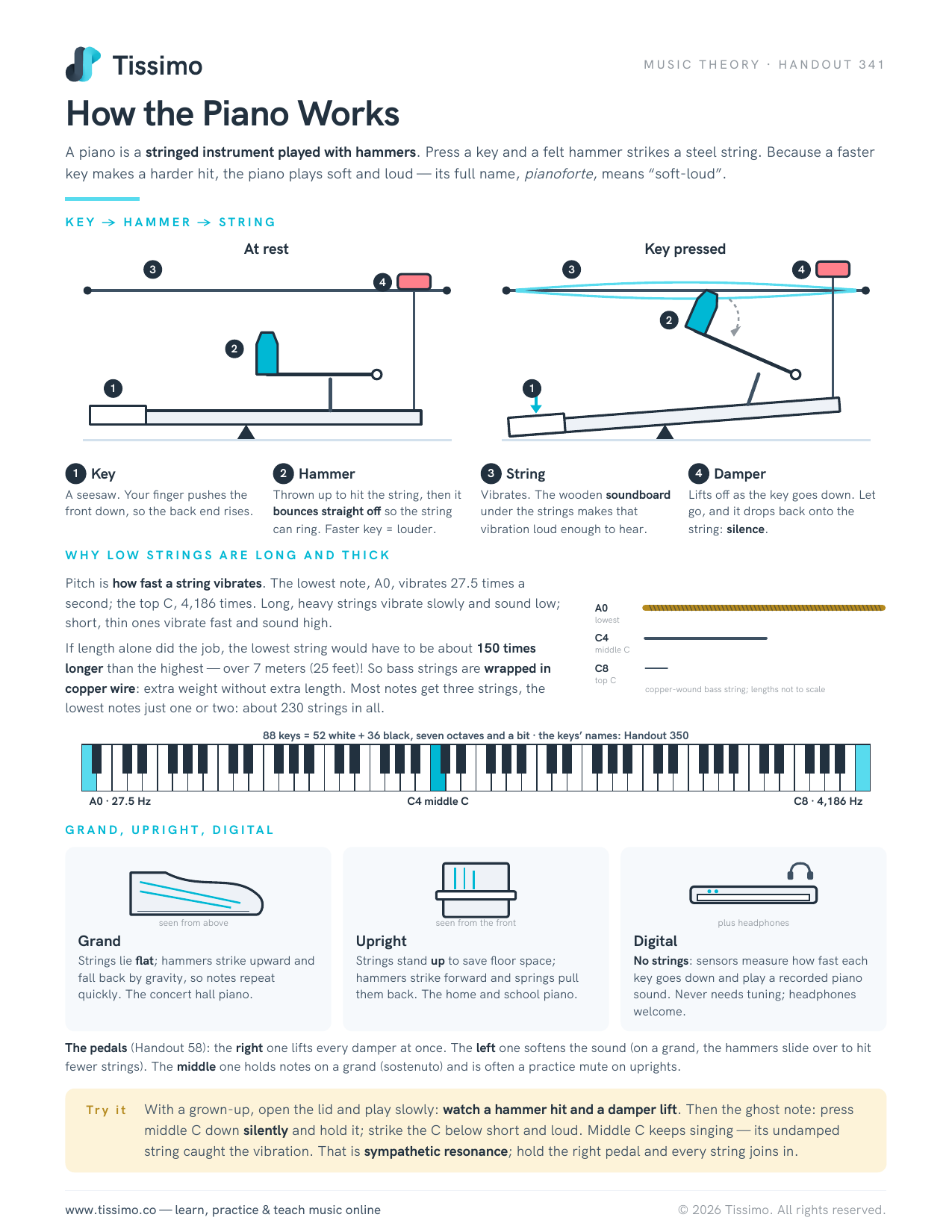 How the Piano WorksA piano is a stringed instrument played with hammers. Press a key and a felt hammer strikes a steel string. Because a faster key makes a harder hit, the piano plays soft and loud — its full name, pianoforte, means “soft-loud”.
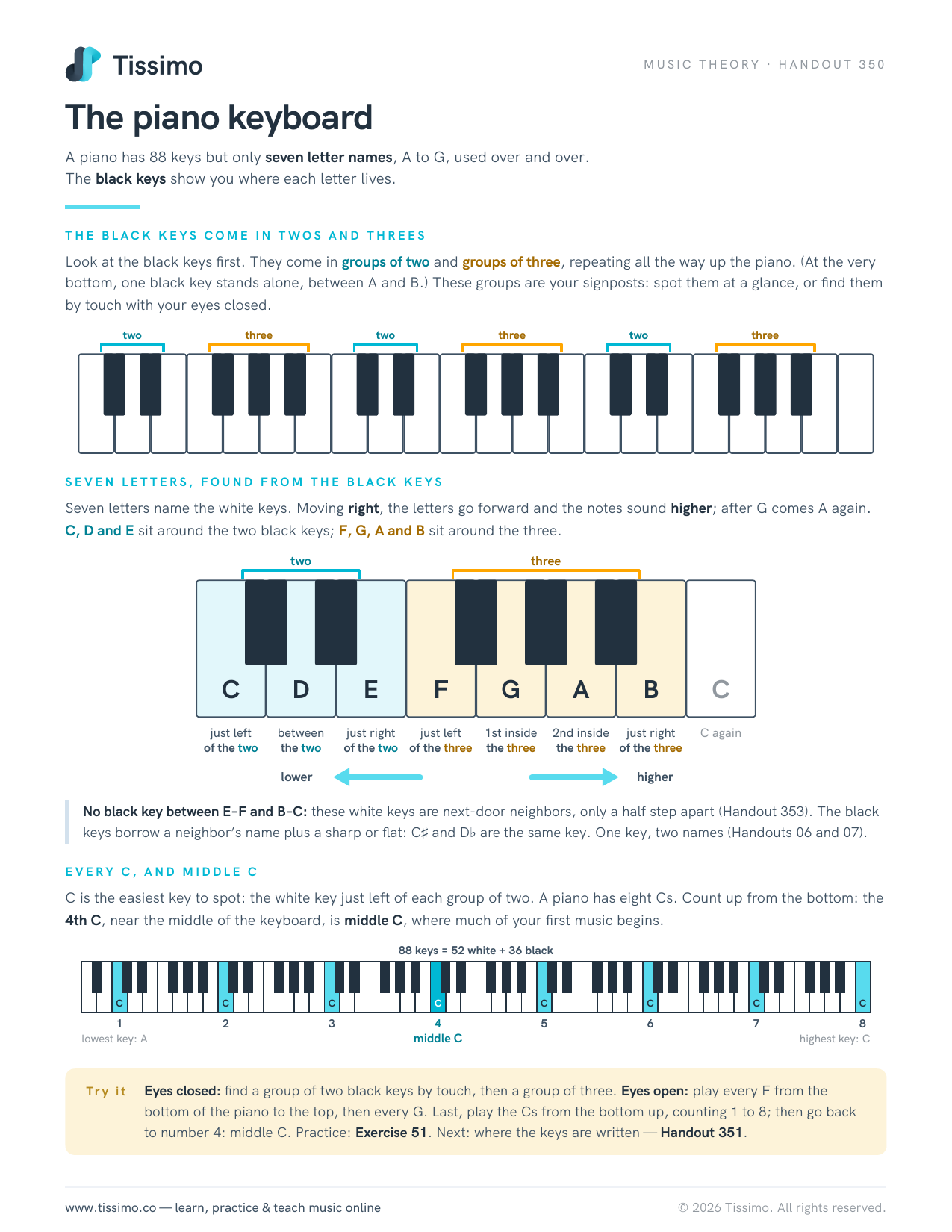 The piano keyboardA piano has 88 keys but only seven letter names, A to G, used over and over. The black keys show you where each letter lives.
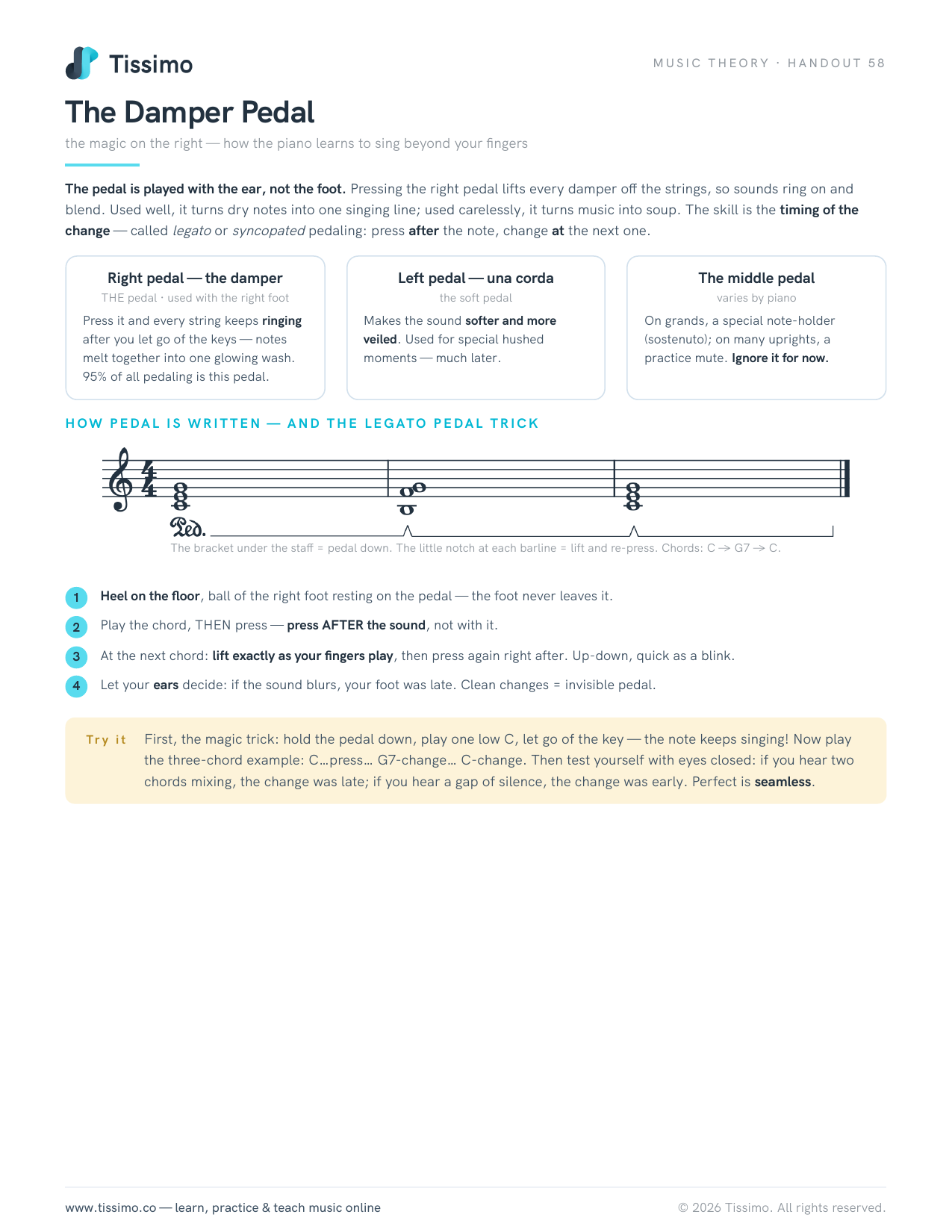 The Damper Pedalthe magic on the right — how the piano learns to sing beyond your fingers
 The Bass Clef & the Grand StaffThe bass staff holds the lower notes, usually played by the left hand. It works just like the treble staff (Handout 351), but its clef names a different line.
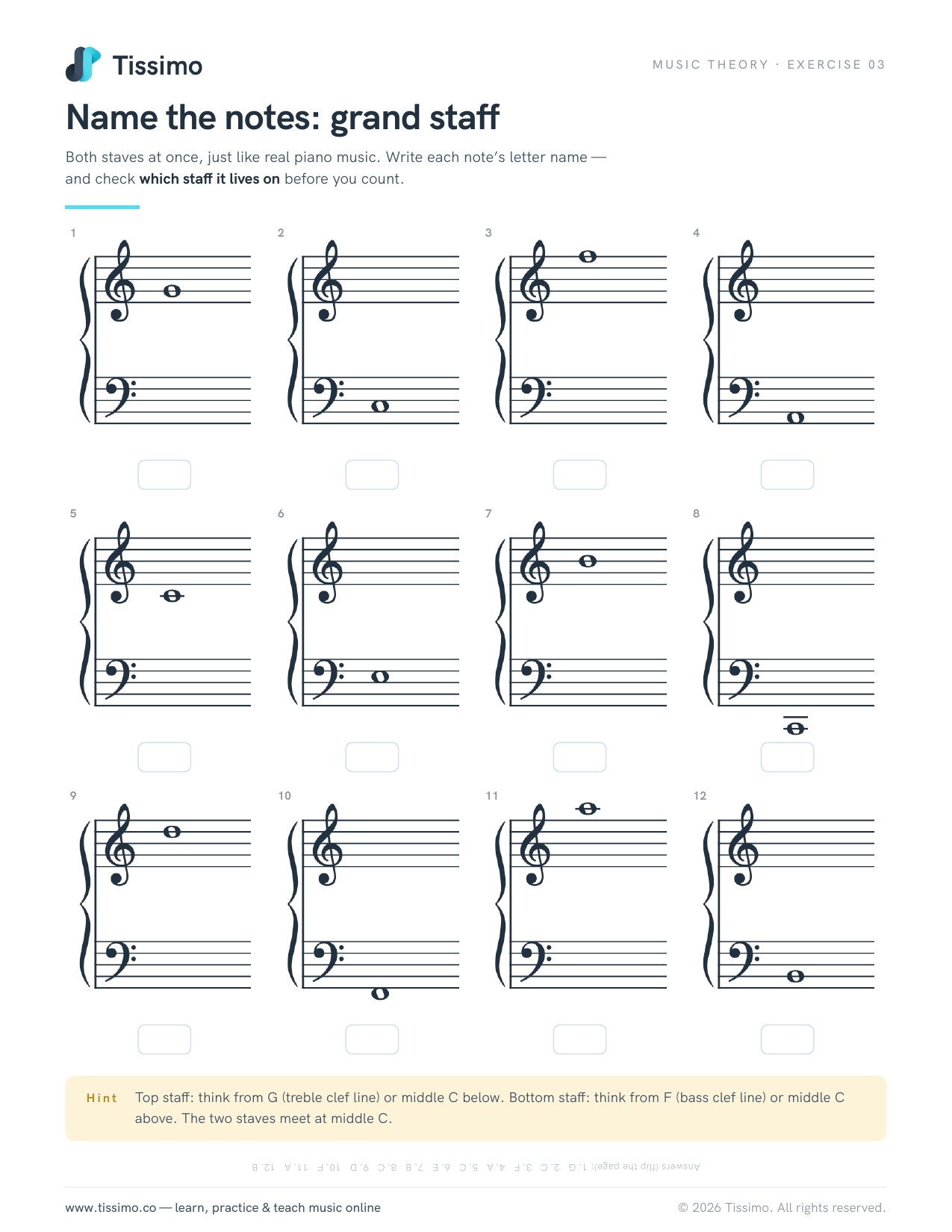 Name the notes: grand staffBoth staves at once, just like real piano music. Write each note’s letter name — and check which staff it lives on before you count.
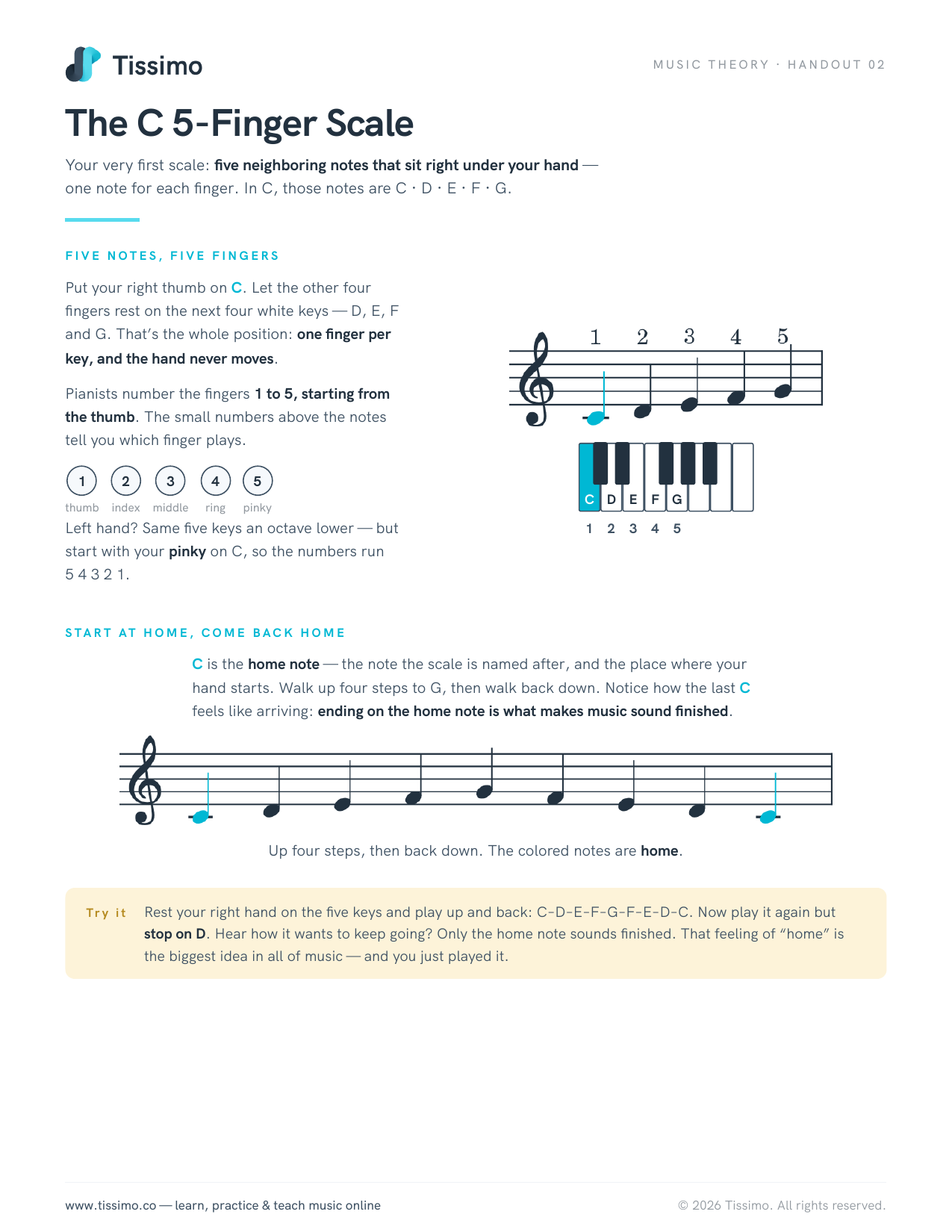 The C 5-Finger ScaleYour very first scale: five neighboring notes that sit right under your hand — one note for each finger. In C, those notes are C · D · E · F · G.