Instruments & Voices
Ukulele
Pronounced yoo-kuh-LAY-lee
The ukulele is a small four-string instrument from Hawaii, most often tuned G–C–E–A with a high G string. It is strummed or plucked, and its music is usually written in treble clef at the pitch it sounds.
The ukulele is a small, guitar-shaped instrument with four nylon strings. It developed in Hawaii in the late nineteenth century from small guitar-like instruments brought by immigrants from Madeira, and it is now a favorite first instrument for children and adults alike: light, inexpensive and quick to make music on.
Sizes
- Soprano: the smallest and most traditional, with a bright, classic sound.
- Concert: a little larger, with more room for the fingers and a fuller tone.
- Tenor: larger again, popular with solo players for its depth and longer neck.
- Baritone: the largest, usually tuned like the top four strings of a guitar (D3, G3, B3, E4).
Soprano, concert and tenor ukuleles share the same standard tuning.
Tuning: the high G
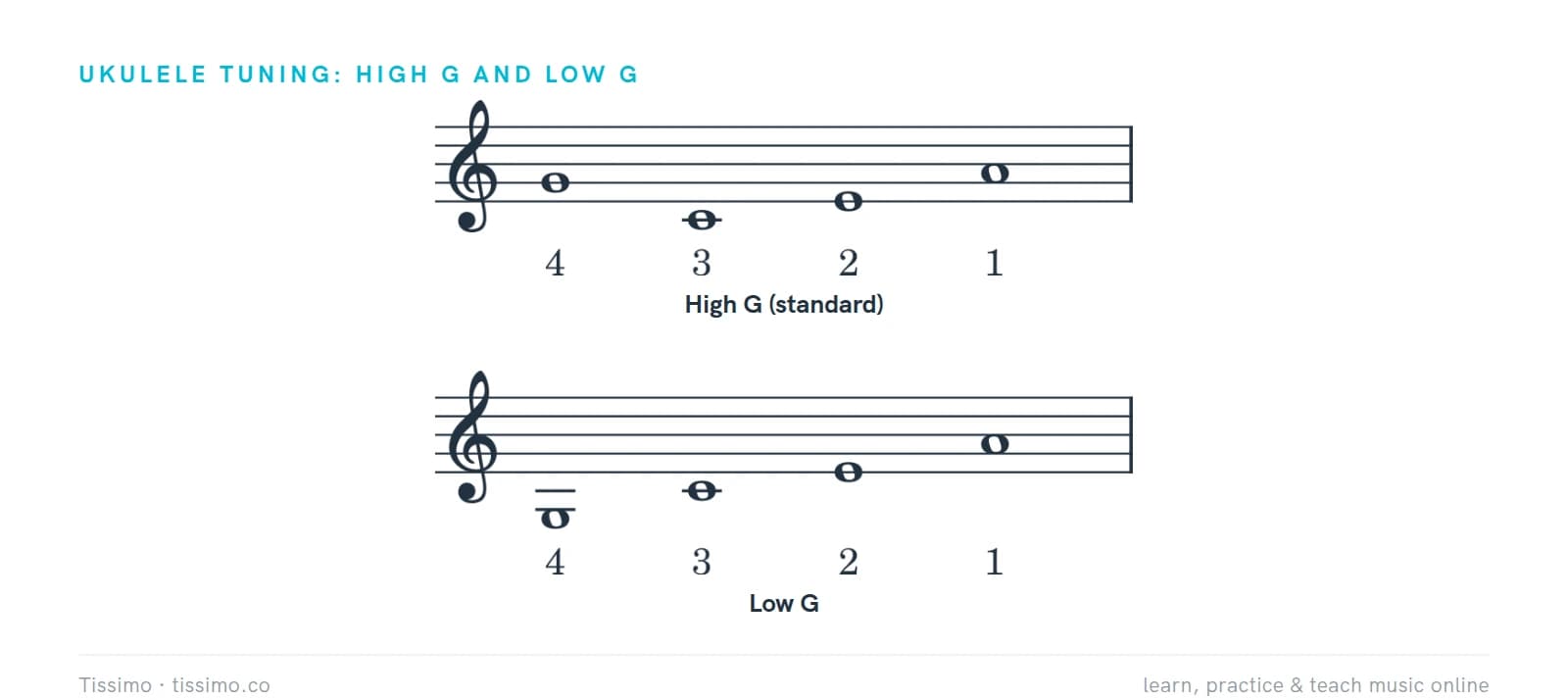
Standard tuning is G4, C4, E4, A4, reading from the string nearest your face (string 4) to the one nearest the floor (string 1). The surprise is the first string you strum: its G is higher than the C next to it. This is called re-entrant tuning, and it gives the ukulele its bright, close-knit chords. Some players, especially on tenor ukuleles, use a low G (G3) for a deeper range.
Range and notation
With high-G tuning, the lowest note is C4, middle C, on the open third string. The top of the range is around A5 on a soprano and a little higher on concert and tenor instruments, which have more frets. Ukulele music is usually written in treble clef at the pitch it sounds, often with chord diagrams above the staff and four-line tablature below it.
Its role
The ukulele is above all an accompaniment instrument for singing: a handful of chords strummed in rhythm covers a huge number of songs. It also has a strong solo tradition, from Hawaiian music to fingerstyle arrangements in which melody notes ring across different strings (campanella style), something the high G makes possible.
Tips for beginners
- Learn C, A minor, F and G7 first: those four chords play many songs in C major.
- Strum mostly from the wrist, with the nail or the pad of your index finger.
- New nylon strings stretch for a week or two, so expect to retune often at first.
- Keep your thumb behind the neck, roughly opposite your middle finger, so your fingers can arch over the strings.
Common questions
What are the ukulele string notes?
In standard tuning, G, C, E, A, from the string nearest your face to the one nearest the floor: G4, C4, E4 and A4. The G is higher than the C, which is called re-entrant tuning. Baritone ukuleles are tuned D, G, B, E instead.
Is the ukulele easier than the guitar?
It is usually quicker to start: four soft nylon strings, a small neck and simple chord shapes mean many beginners play songs within days. Playing it well still takes the same kind of practice as any instrument, and its skills carry over to the guitar.
Practice it: free worksheets
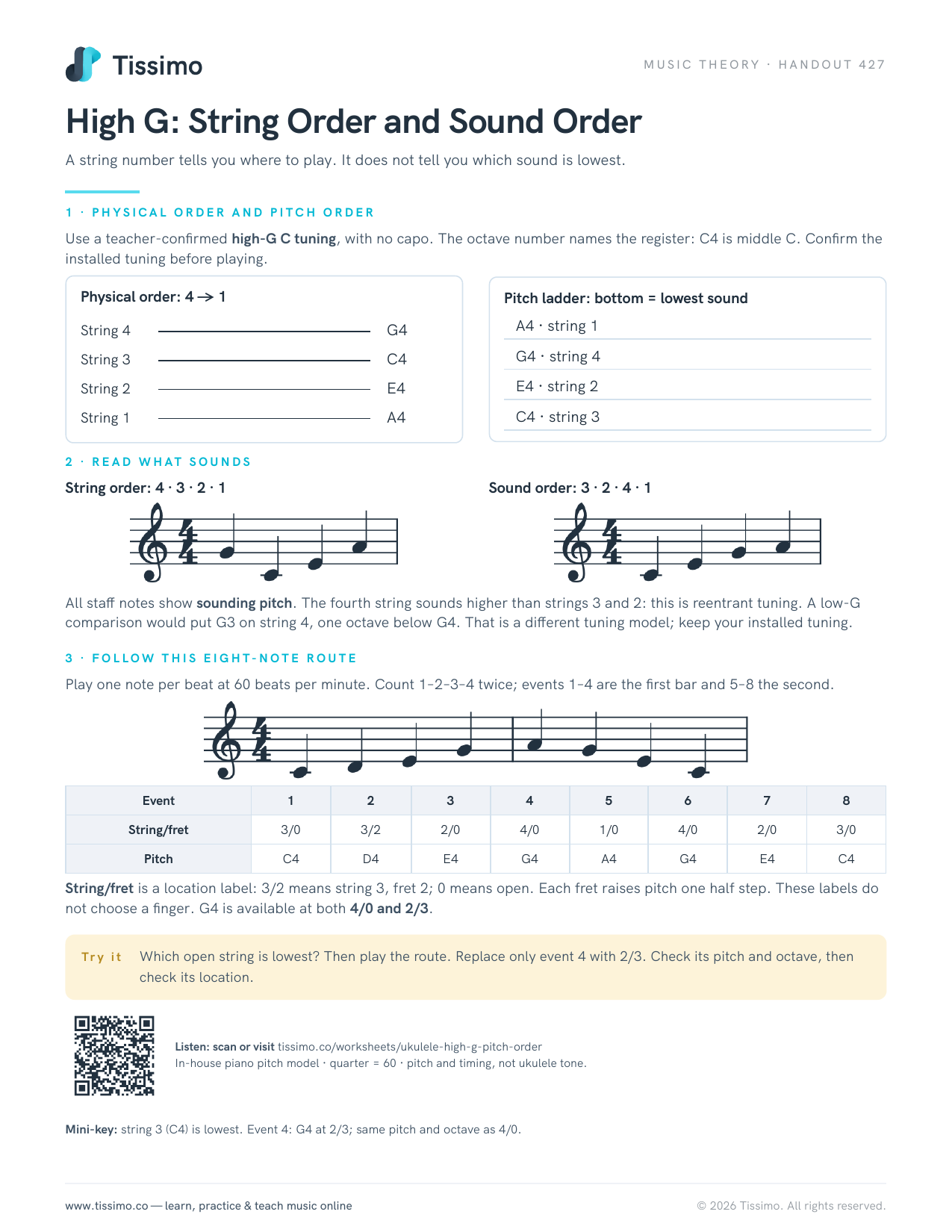 High G: String Order and Sound OrderA string number tells you where to play. It does not tell you which sound is lowest.
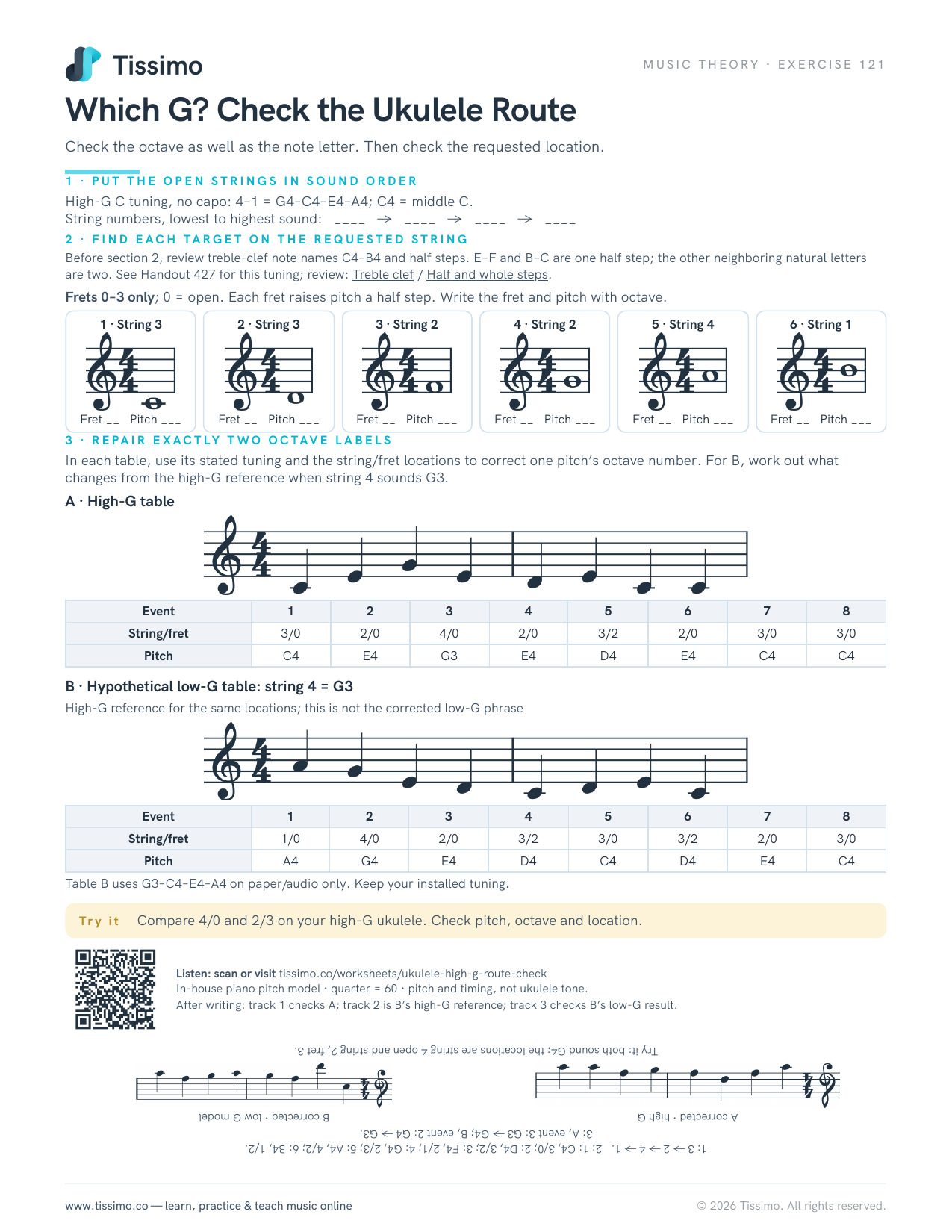 Which G? Check the Ukulele RouteCheck the octave as well as the note letter. Then check the requested location.
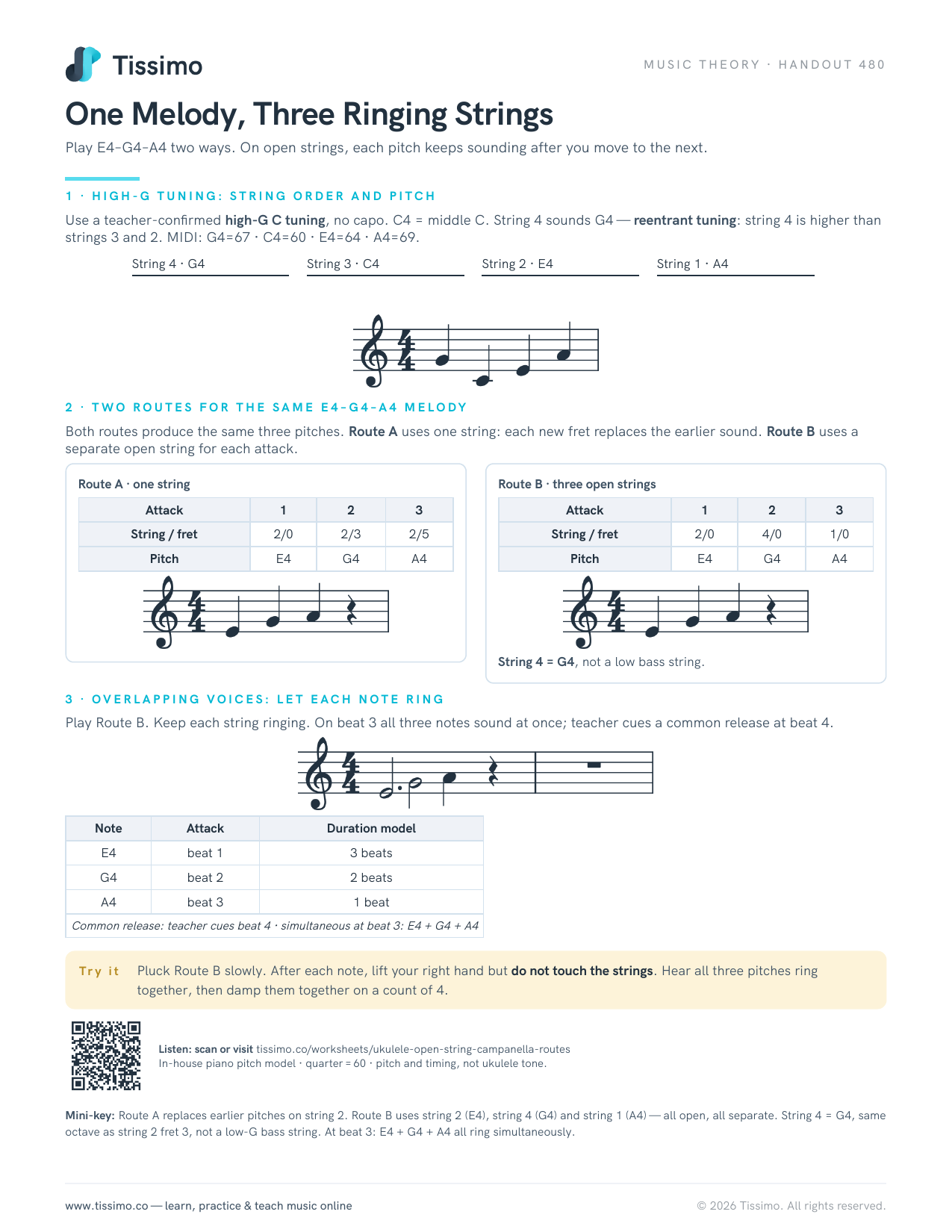 One Melody, Three Ringing StringsPlay E4–G4–A4 two ways. On open strings, each pitch keeps sounding after you move to the next.
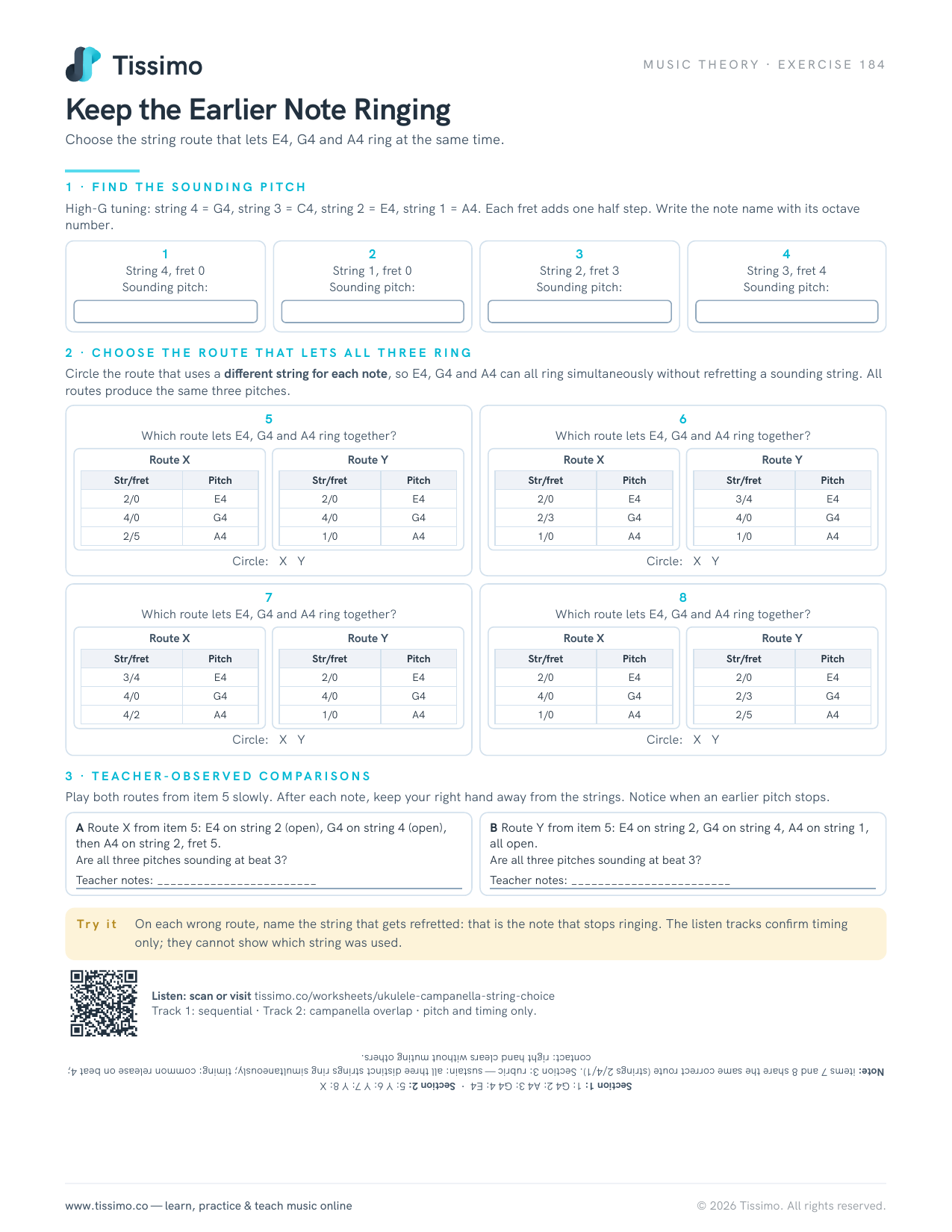 Keep the Earlier Note RingingChoose the string route that lets E4, G4 and A4 ring at the same time.