Notation & Symbols
Tablature (Tab)
Tablature, or tab, is a notation for fretted string instruments that shows where to play rather than which pitch: each line stands for a string and each number for the fret to press, with 0 for an open string.
Tablature writes music as finger positions. Instead of the five lines of a staff, guitar tab has six lines, one for each string, and the numbers on the lines say which fret to press on that string. A 0 means the open string; 3 means the third fret. Tab for the bass guitar and the ukulele has four lines.
Reading guitar tab
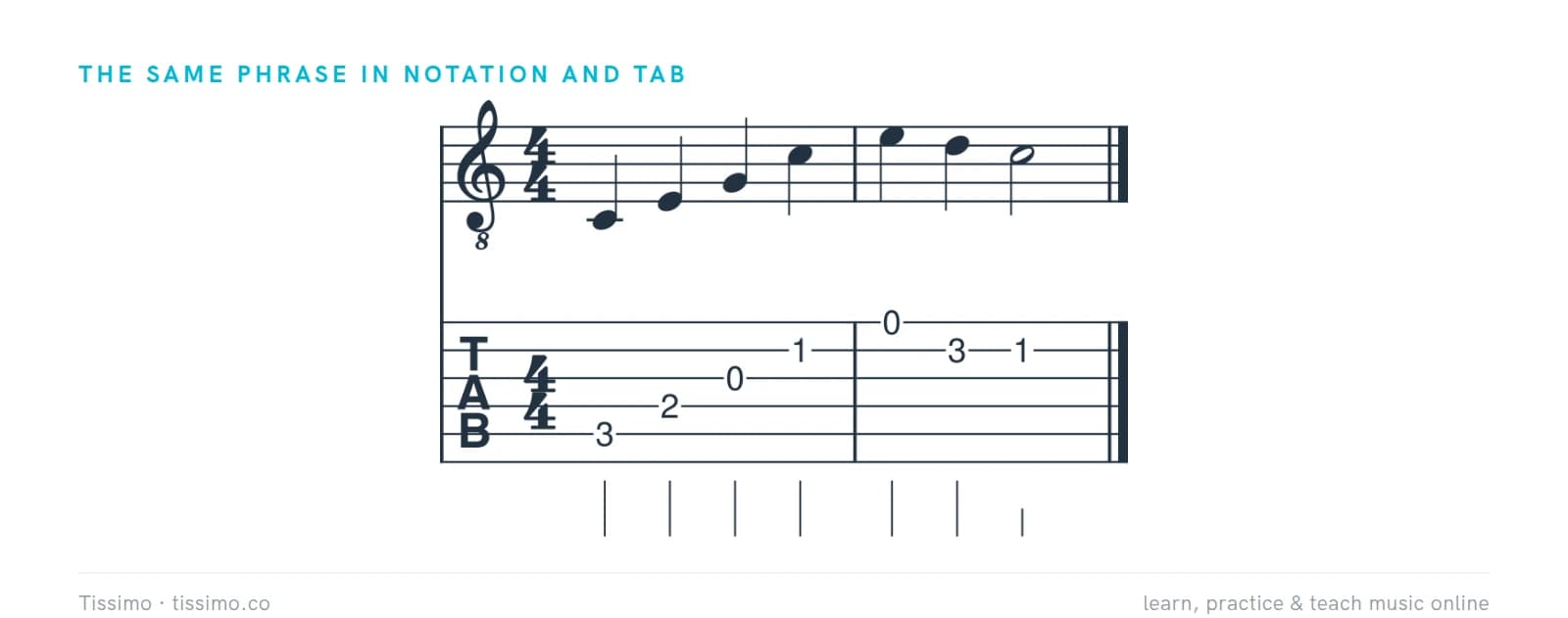
- The top line is the highest-pitched string, the thin high E (string 1). The bottom line is the thick low E (string 6). Many beginners expect it the other way round, because when you look down at the guitar the low string is the one nearest your face.
- Numbers stacked vertically are played together, as a chord.
- Read from left to right, as in standard notation.
- Standard tuning, E A D G B E from the lowest string to the highest, is assumed unless the tab says otherwise.
What tab shows, and what it leaves out
Tab shows exactly where on the neck to play, which standard notation does not: the same pitch can often be played on two or three different strings. But plain tab often leaves out rhythm, so you need to know how the song goes. That is why published guitar music often prints the tab under a standard staff, as in the example: the staff gives the pitches and the rhythm, the tab gives the string and fret.
Tab also has its own signs for guitar techniques, such as h (hammer-on), p (pull-off), / and \ (slides), b (bend) and x (a muted note). The exact signs vary a little between publishers, so check the key at the start of a book.
Tab is old
Tablature is much older than the guitar tabs on the internet. Much of the lute music of the 1500s was written in tablature, with letters for the frets in French and English sources and numbers in Italian and Spanish ones.
Guitar music in standard notation is written in treble clef an octave higher than it sounds. Tab sidesteps that question, because it shows strings and frets, not pitches.
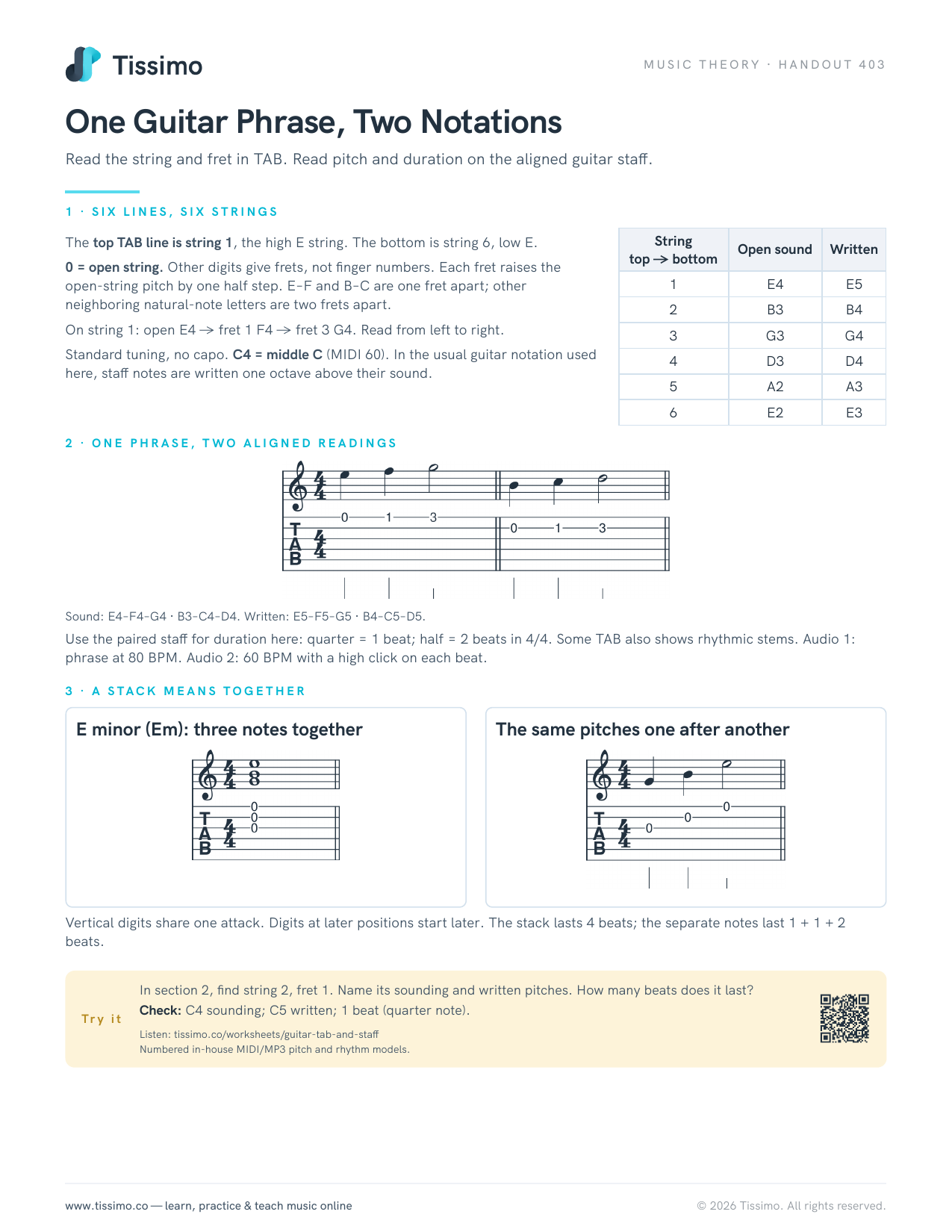
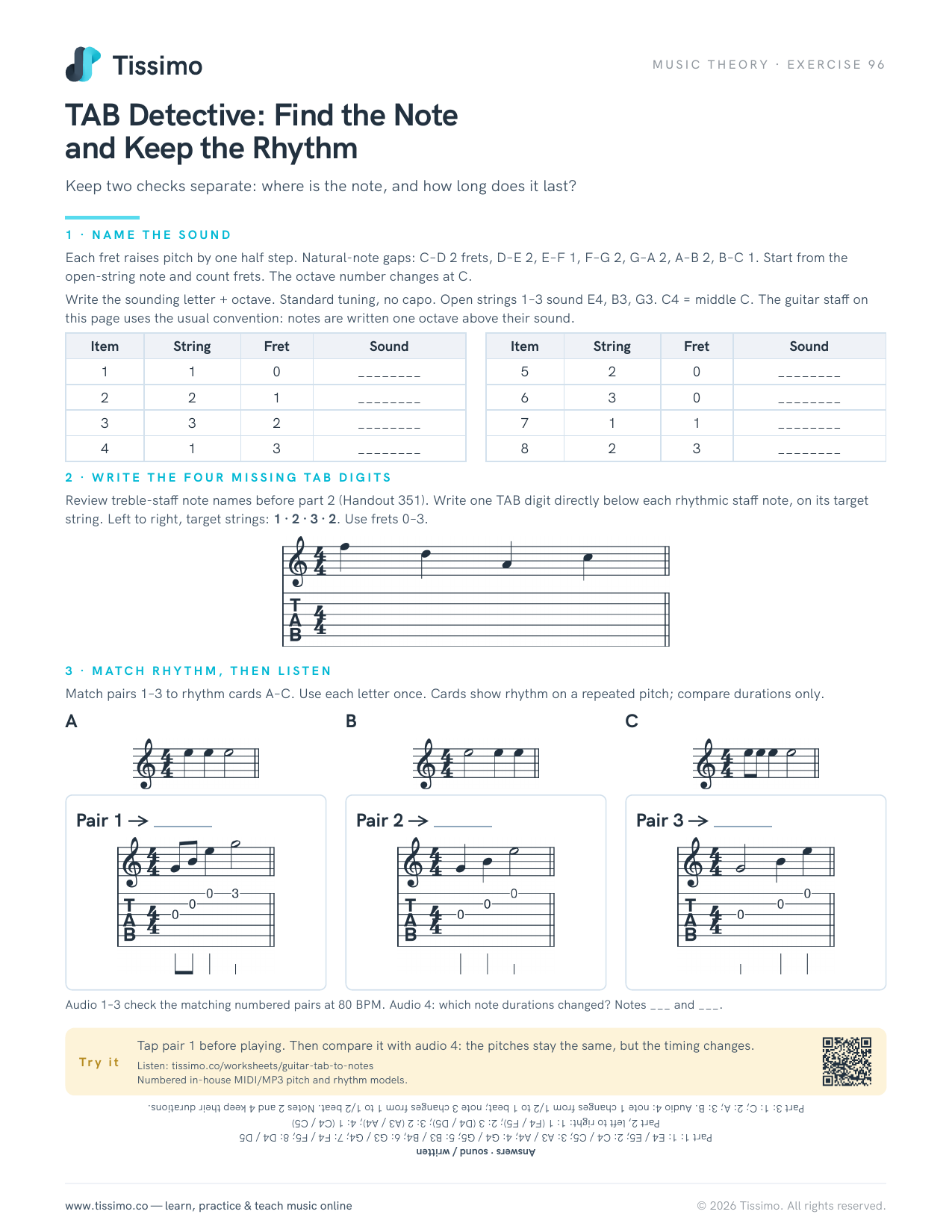
Read both notations side by side in One Guitar Phrase, Two Notations, then try TAB Detective: Find the Note and Keep the Rhythm.
Common questions
Which string is the top line in guitar tab?
The high E string, the thinnest one (string 1). The bottom line is the low E string (string 6).
Does tab show rhythm?
Plain tab often does not, so you need to know how the song goes. Many published arrangements add stems to the tab or print a standard staff above it to show the rhythm.