Notation & Symbols
Chord Symbol
A chord symbol is a short label, such as C, Am7 or G/B, written above the staff to name a chord. The letter gives the root; what follows gives the chord's quality, any added notes and, after a slash, the bass note.
A chord symbol names a chord in a few characters, so a player can build it on the spot. Read it from left to right:
- The root: a capital letter, with a sharp or flat if needed (C, F♯, B♭). This is the note the chord is built on (see root).
- The quality: nothing for major; m (or min, or −) for minor; dim or ° for diminished; aug or + for augmented; sus2 or sus4 for a suspended chord.
- Added notes: numbers such as 6, 7, maj7 or 9, sometimes with a sharp or flat (C7♭9).
- A bass note, after a slash: C/E is a C major chord with E in the bass, a slash chord.
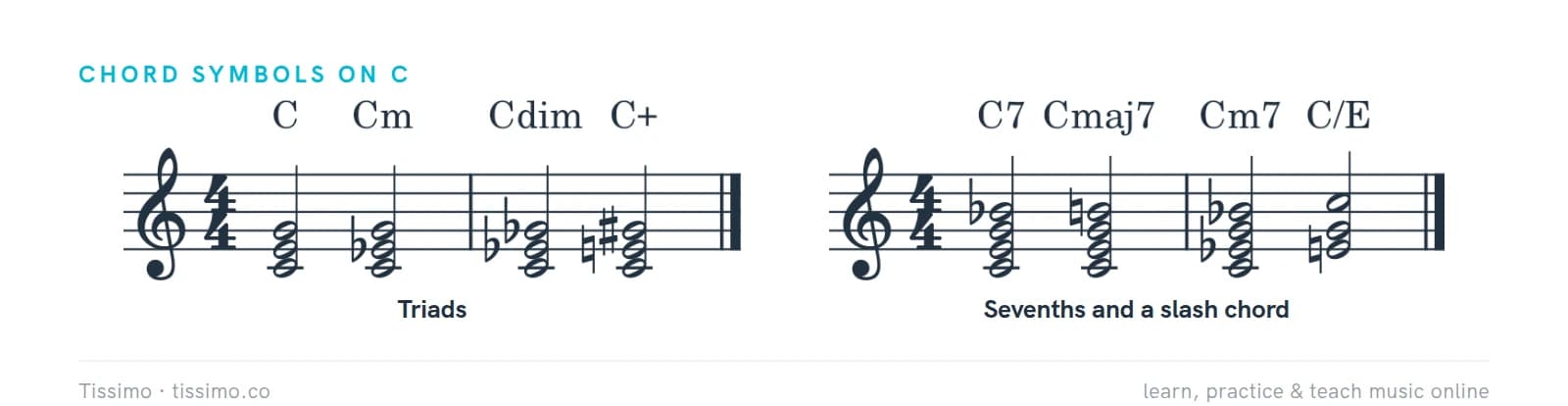
Common chord symbols on C
- C: major triad (C, E, G)
- Cm: minor triad (C, E♭, G)
- Cdim or C°: diminished triad (C, E♭, G♭)
- C+ or Caug: augmented triad (C, E, G♯)
- Csus4: suspended fourth (C, F, G)
- C7: dominant seventh (C, E, G, B♭)
- Cmaj7 (also CΔ7): major seventh (C, E, G, B)
- Cm7: minor seventh (C, E♭, G, B♭)
- Cm7♭5 (also Cø7): half-diminished seventh (C, E♭, G♭, B♭)
Watch the most common trap: a plain 7 means the seventh a whole step below the octave (B♭ over C), as in a dominant seventh chord. For the seventh a half step below the octave you need maj7.
What a chord symbol does not tell you
A chord symbol names the notes, not how to arrange them. It leaves open the voicing (which octave each note goes in, which notes to double or leave out), the rhythm and the style. Unless there is a slash, the bass usually plays the root, but the upper notes can come in any order. That freedom is the point: the same symbol can become a strummed guitar chord, a jazz piano voicing or a walking bass line.
Chord symbols and Roman numerals
Chord symbols name chords by their letters (G7), so they change when a song changes key. Roman numerals name chords by their place in the key (V7), so they describe the same progression in any key. Lead sheets use chord symbols; harmony and analysis often use Roman numerals.
See every symbol built on C in Chord symbols, then use them in Reading a lead sheet.
Common questions
What does the m mean in a chord symbol?
Minor: Am is an A minor chord. Major is shown by the letter alone (A), or by maj when a seventh is added (Amaj7).
What is the difference between C7 and Cmaj7?
C7 is a dominant seventh chord: C, E, G, B♭. Cmaj7 is a major seventh chord: C, E, G, B. A plain 7 means the lower of the two sevenths.
Practice it: free worksheets
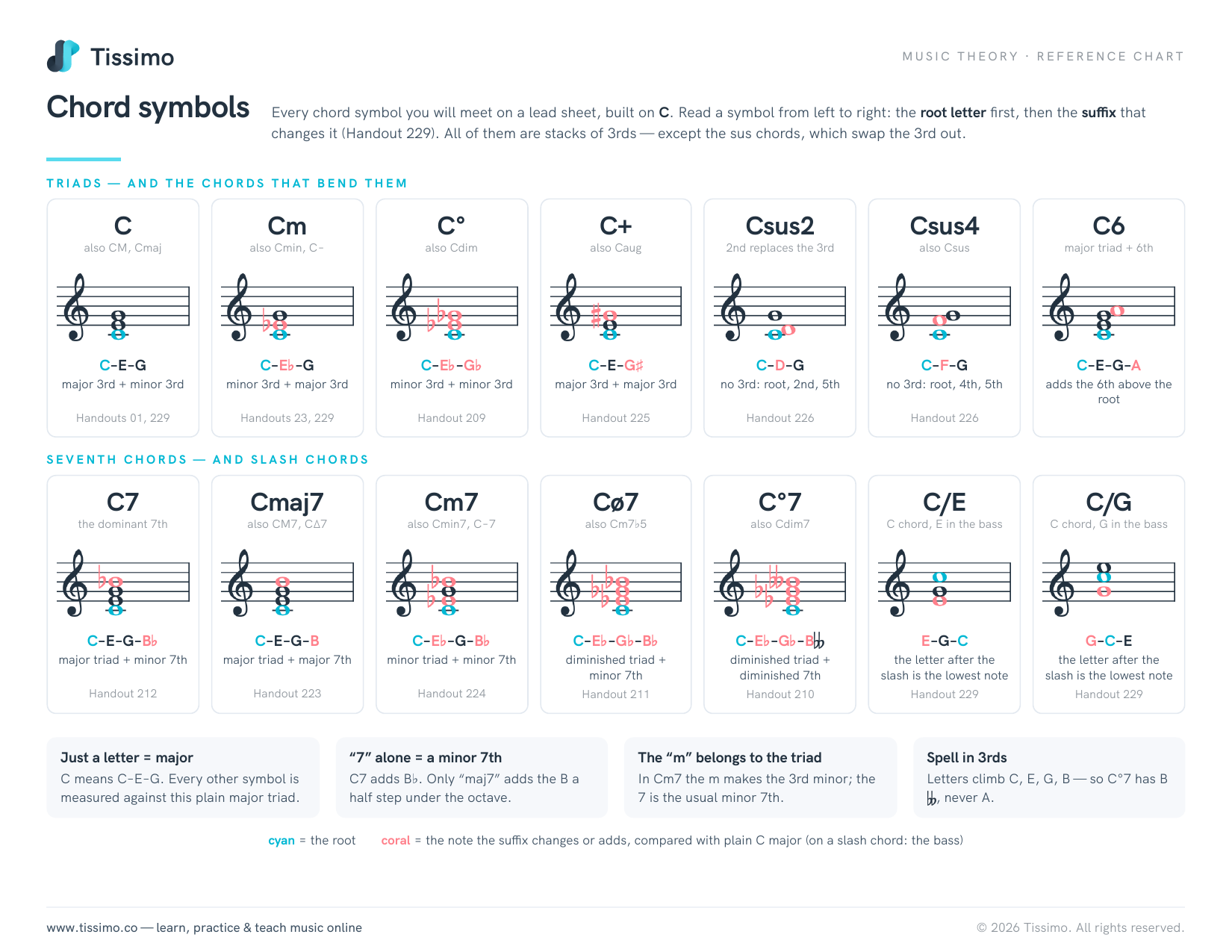 Chord symbolsEvery chord symbol you will meet on a lead sheet, built on C. Read a symbol from left to right: the root letter first, then the suffix that changes it (Handout 229). All of them are stacks of 3rds — except the sus chords, which swap the 3rd out.
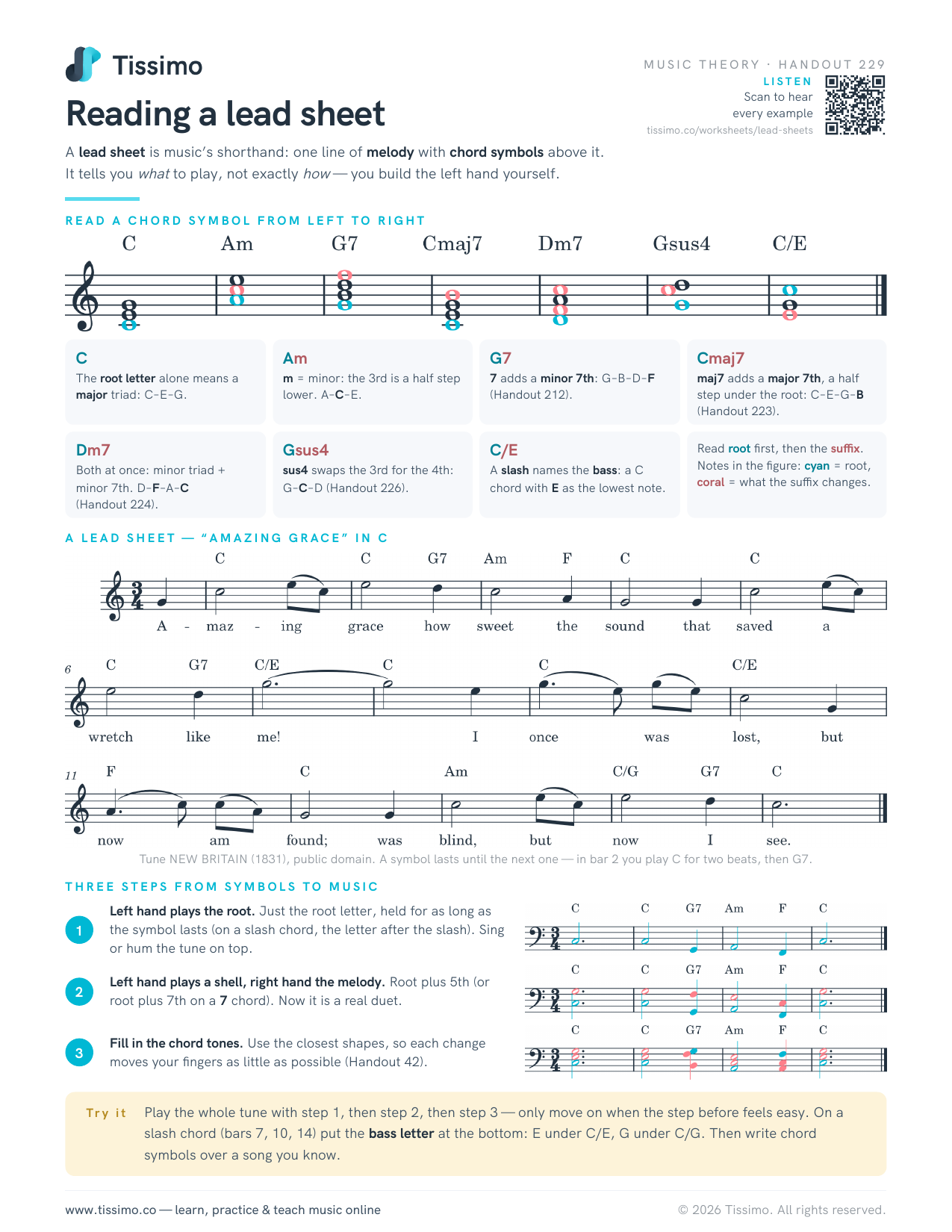 Reading a lead sheetA lead sheet is music’s shorthand: one line of melody with chord symbols above it. It tells you what to play, not exactly how — you build the left hand yourself.
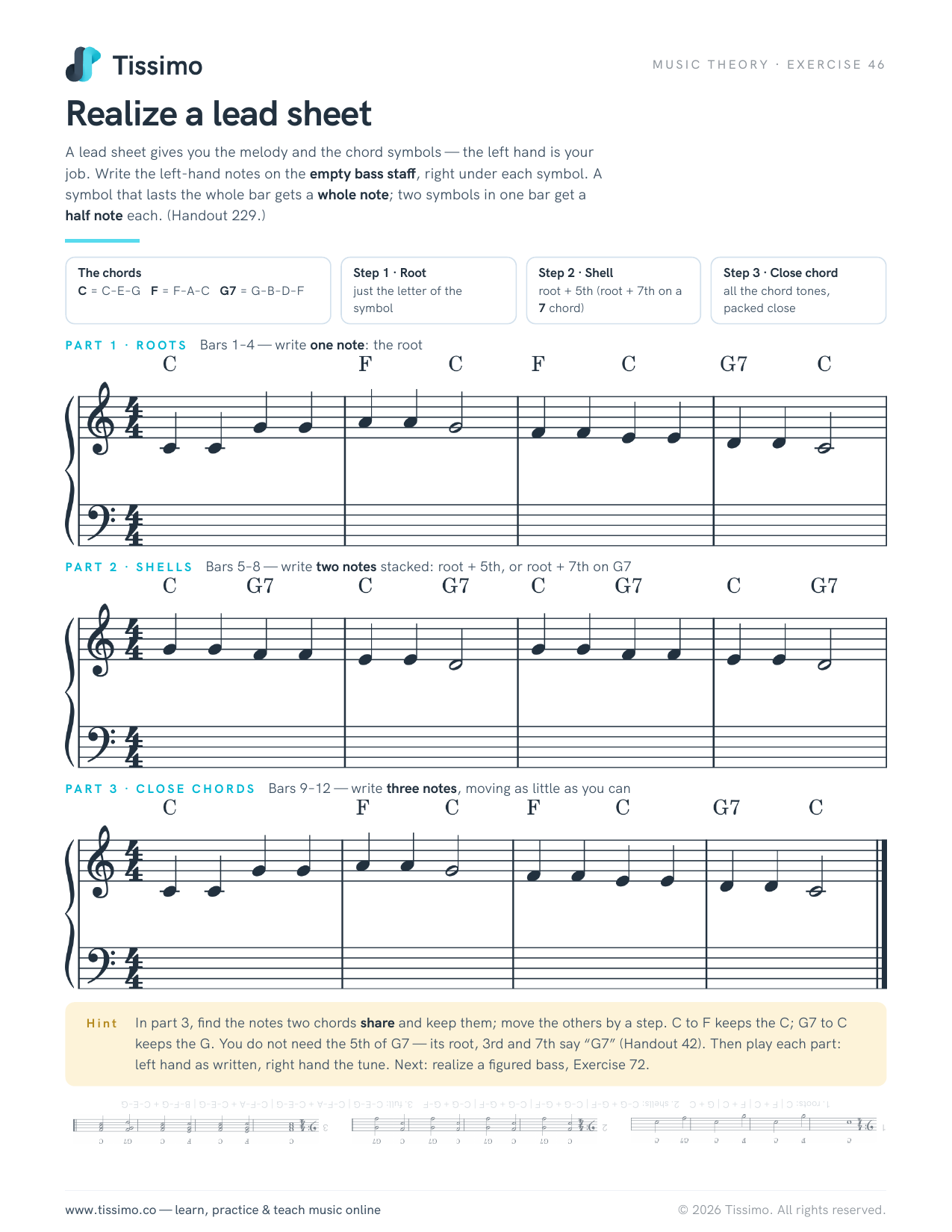 Realize a lead sheetA lead sheet gives you the melody and the chord symbols — the left hand is your job. Write the left-hand notes on the empty bass staff, right under each symbol. A symbol that lasts the whole bar gets a whole note; two symbols in one bar get a half note each. (Handout 229.)
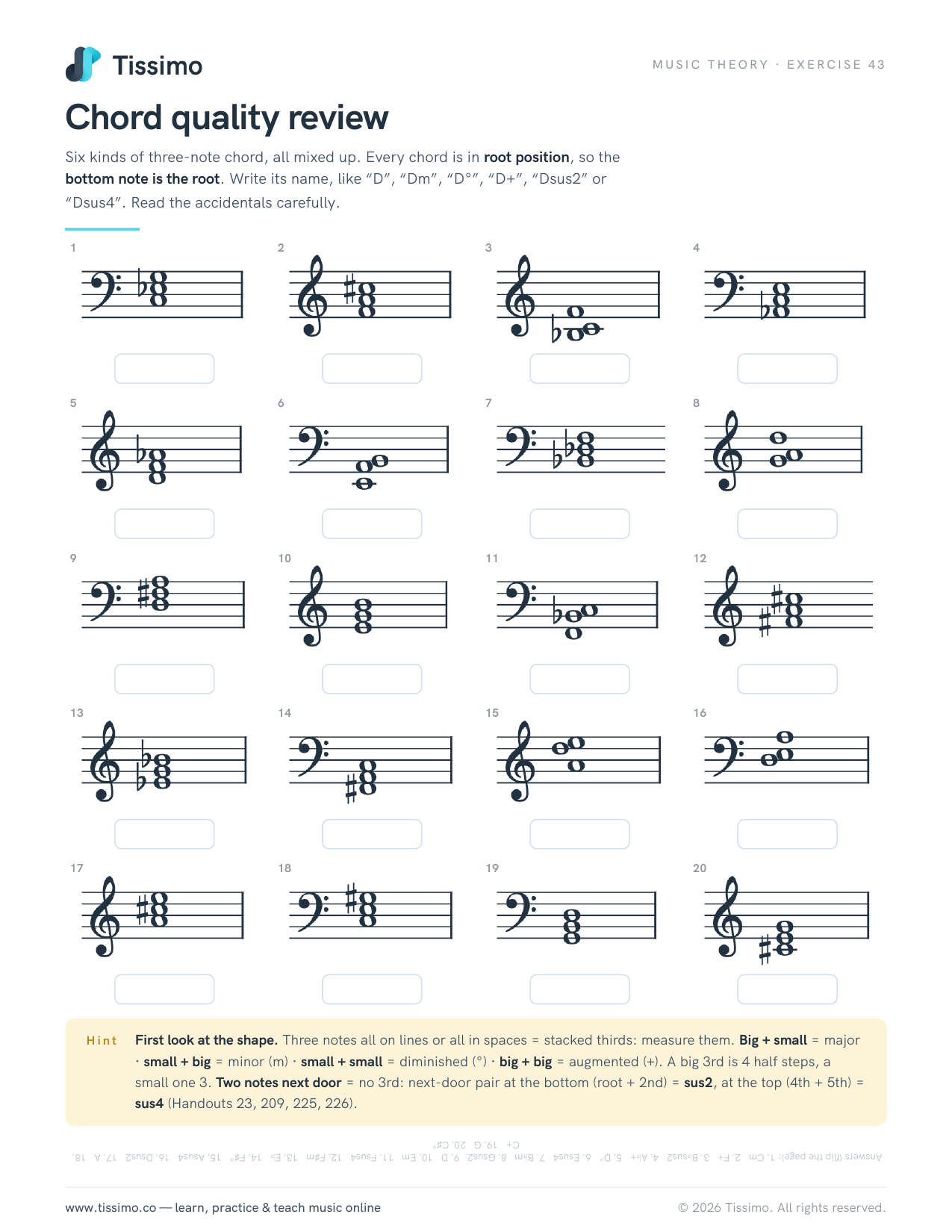 Chord quality reviewSix kinds of three-note chord, all mixed up. Every chord is in root position, so the bottom note is the root. Write its name, like “D”, “Dm”, “D°”, “D+”, “Dsus2” or “Dsus4”. Read the accidentals carefully.