Chords & Harmony
Root (of a Chord)
The root of a chord is the note the chord is built on and named after: C in a C major chord, G in G7. When the chord's notes are stacked in thirds, the root is at the bottom of the stack.
The root of a chord is the note the chord is built on and named after. In C major (C–E–G) the root is C; in A minor (A–C–E) it is A; in G7 (G–B–D–F) it is G. When the notes are stacked in thirds, the root is the bottom of the stack, and the other notes are named by their distance above it: the third, the fifth, the seventh.
The root is not always the lowest note
The note you hear at the bottom is the bass. In root position the bass and the root are the same note. In an inversion they are not: in C/E, E is in the bass, but C is still the root, because the chord is still C–E–G.
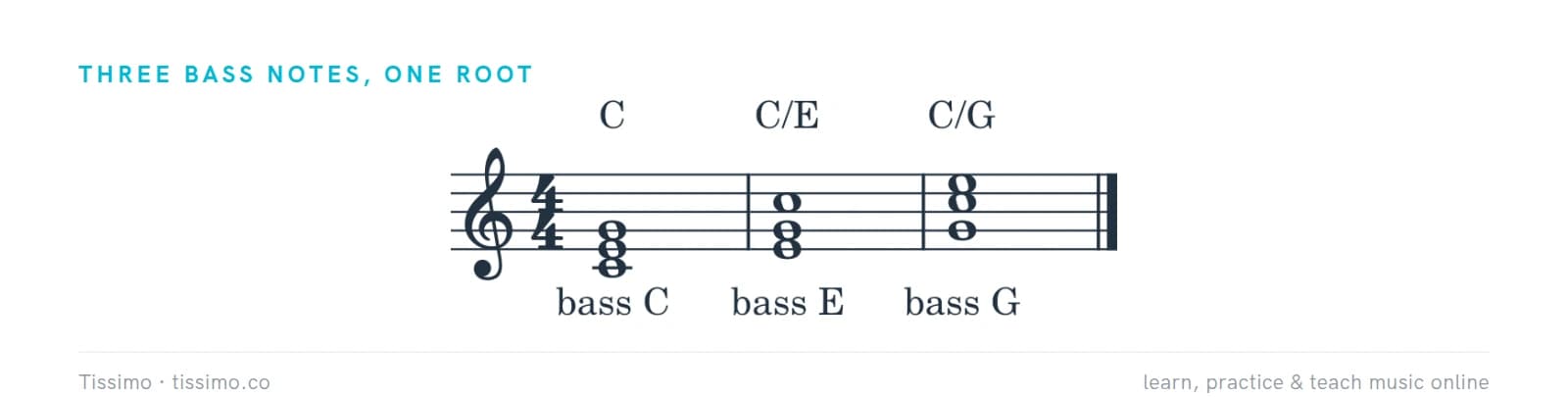
How to find the root
- Write down the letter names and drop any repeats: G–C–E–C becomes G, C, E.
- Rearrange them into a stack of thirds, every other letter: C–E–G.
- The bottom note of that stack, C, is the root.
On the staff, a stack of thirds looks like a snowman: all lines or all spaces. A complete close-position triad in inversion has a fourth between two neighboring notes; the upper note of that fourth is the root. This shortcut does not apply to every three-note chord or to arbitrary open voicings.
Why the root matters
- Chord symbols start with the root: the A in Am, the G in G7/B.
- Roman numerals count the root's place in the key. In C major, the diatonic G major triad is V, whether its bass is G, B or D. Chord quality still matters: a borrowed G minor triad would be v.
- Bass lines very often play chord roots, especially on strong beats. Build a bassline from chord roots shows how.
- Root movement shapes how a progression feels. Roots that fall by a fifth (G to C, D to G) give an especially strong sense of motion.
Root, tonic and bass
The root belongs to a chord; the tonic belongs to a key. In C major the G chord has root G, but the key's tonic is still C. The bass is simply whichever note is lowest at that moment.
Common questions
Is the root of a chord always the lowest note?
No. It is the lowest note only in root position. In an inversion another chord tone is in the bass, but the root, and so the chord's name, stays the same.
Is the root the same as the tonic?
No. The root is the naming note of one chord; the tonic is the home note of the whole key. The tonic triad has the tonic as its root, but other chords can share that root: C major, C minor and C7 all have root C.
Practice it: free worksheets
 Hear the Bass of the TriadHear the lowest note of a known chord. Decide whether it is the root, third or fifth.
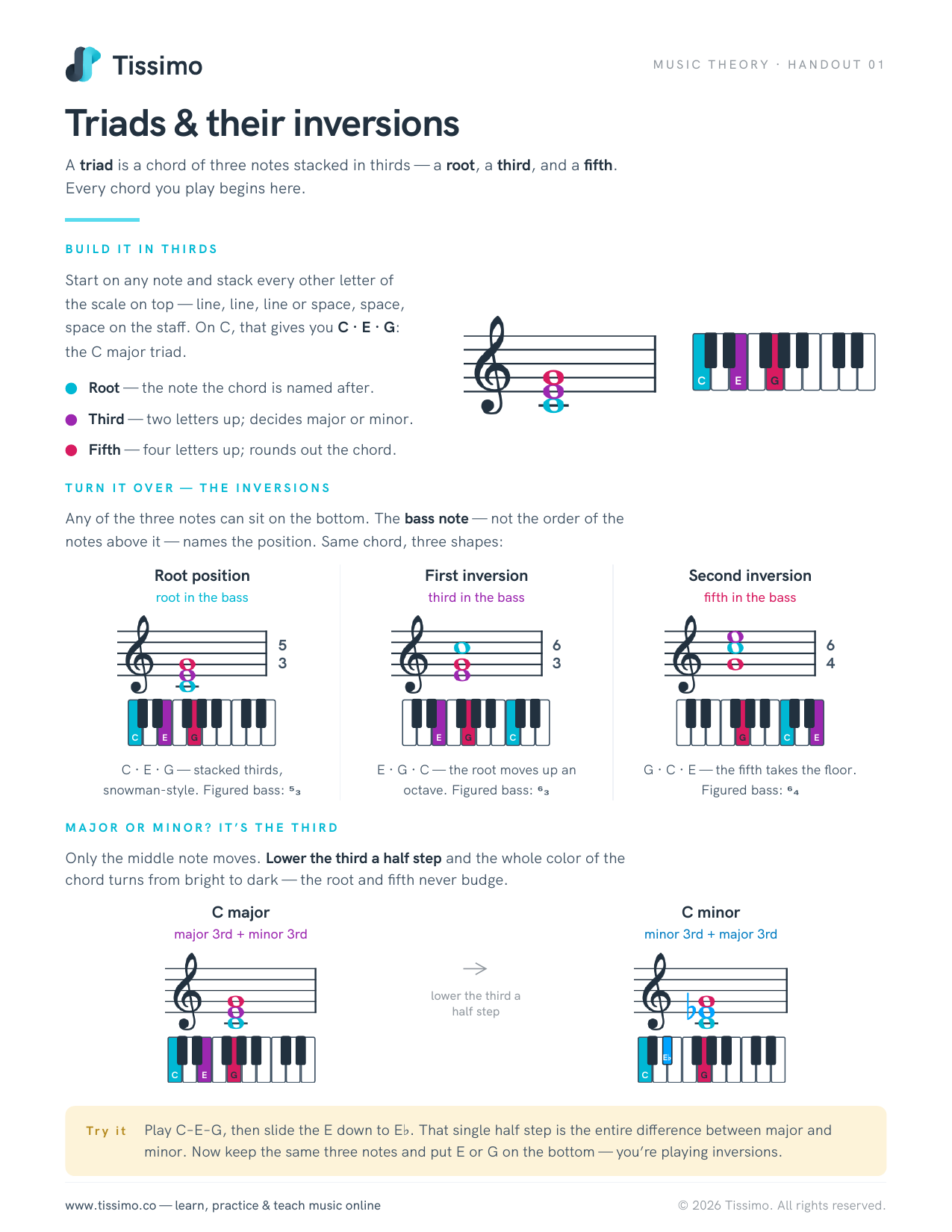 Triads & their inversionsA triad is a chord of three notes stacked in thirds — a root, a third, and a fifth. Every chord you play begins here.
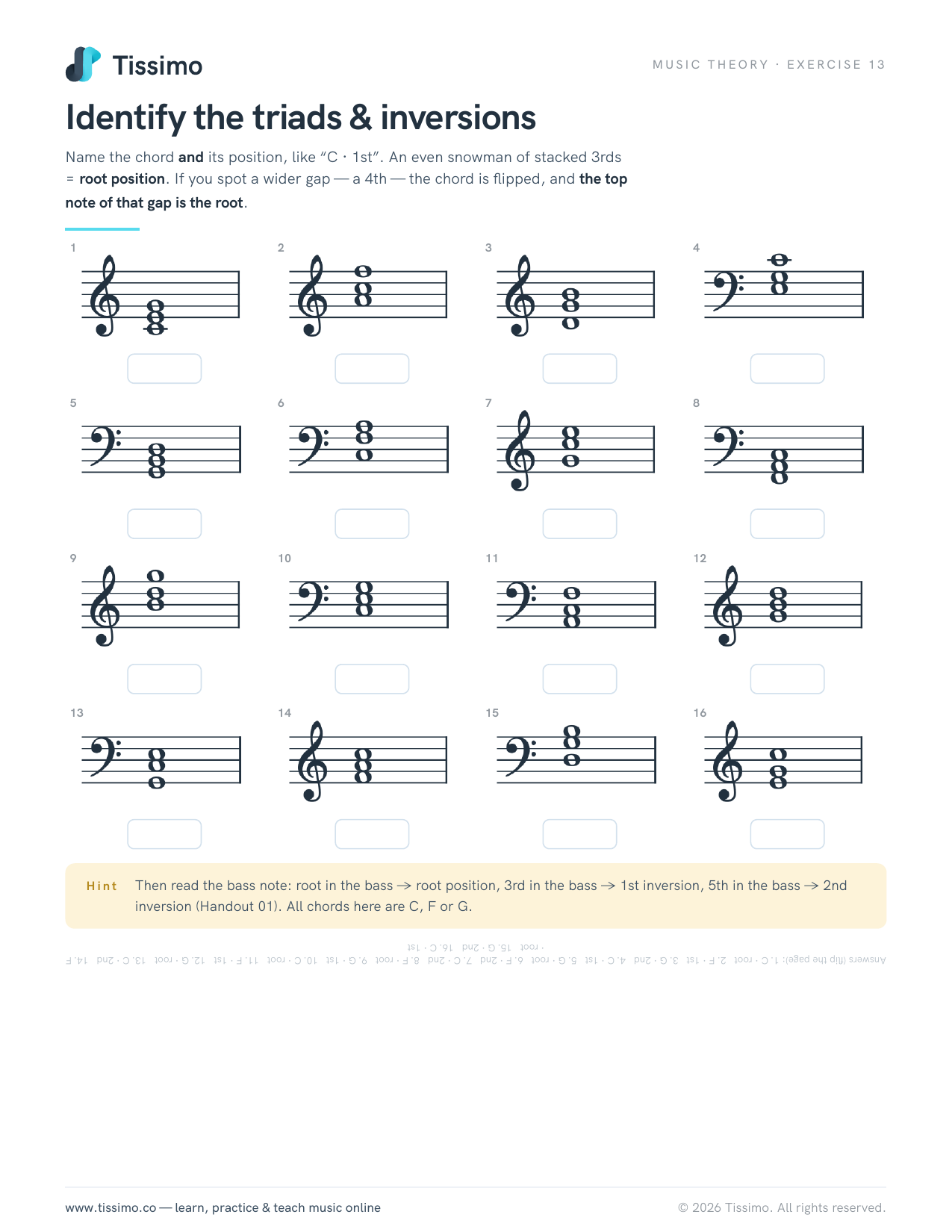 Identify the triads & inversionsName the chord and its position, like “C · 1st”. An even snowman of stacked 3rds = root position. If you spot a wider gap — a 4th — the chord is flipped, and the top note of that gap is the root.
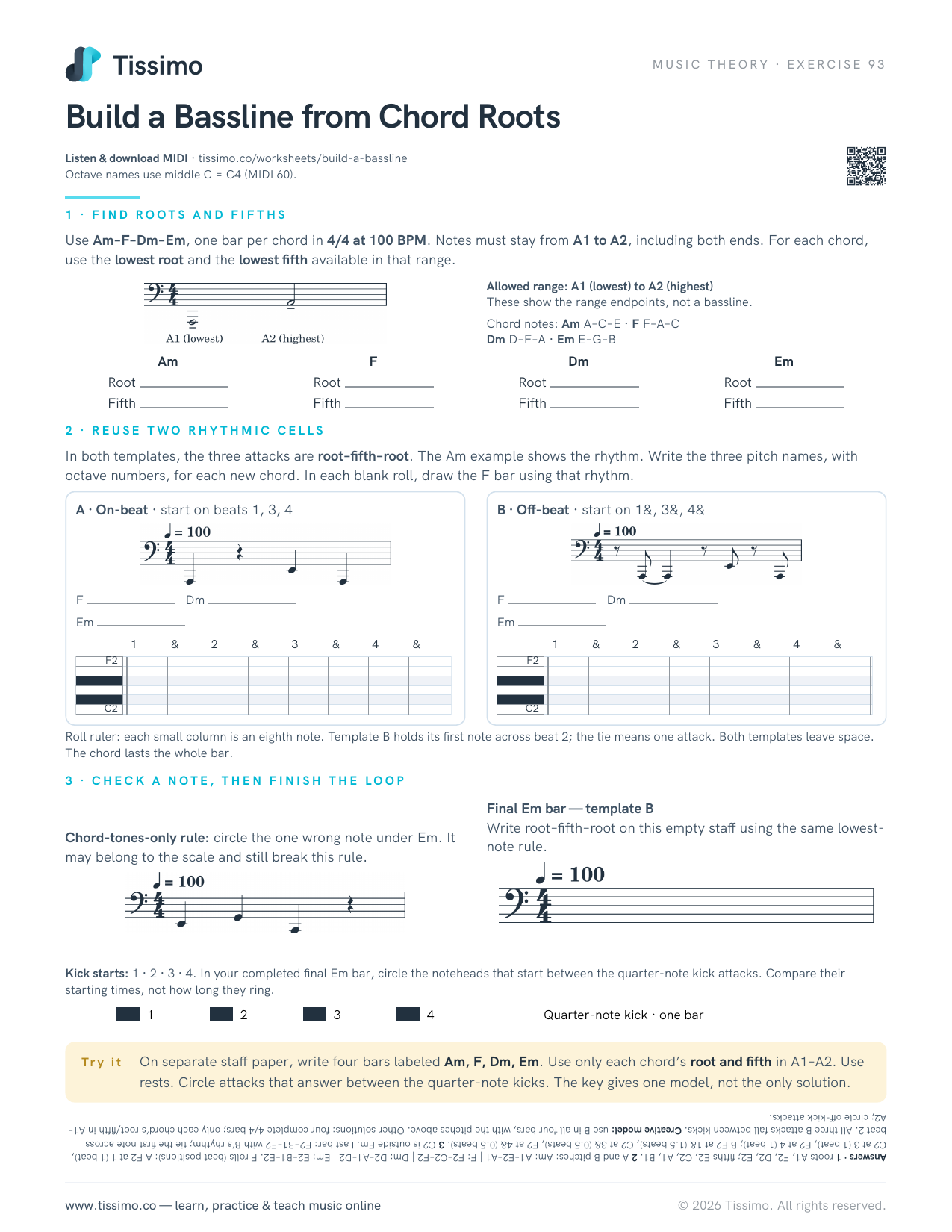 Build a Bassline from Chord Roots