Chords & Harmony
Seventh Chord
A seventh chord is a four-note chord: a triad with one more third stacked on top, so the highest note is a seventh above the root. G–B–D–F (G7) and C–E–G–B (Cmaj7) are seventh chords.
A seventh chord is a triad with one more note stacked a third above its fifth. That new note is a seventh above the root, which gives the chord its name. G–B–D–F is a seventh chord on G (G7); C–E–G–B is one on C (Cmaj7). With four notes instead of three, seventh chords sound richer than triads, and most of them carry a little tension that wants to move on.
The five common types
Each type combines a triad quality with a seventh of a particular size. Counting half steps from the bottom:
- Major seventh (Cmaj7, C–E–G–B): major triad + major seventh. 4 + 3 + 4.
- Dominant seventh (C7, C–E–G–B♭): major triad + minor seventh. 4 + 3 + 3.
- Minor seventh (Cm7, C–E♭–G–B♭): minor triad + minor seventh. 3 + 4 + 3.
- Half-diminished seventh (Cø7 or Cm7♭5, C–E♭–G♭–B♭): diminished triad + minor seventh. 3 + 3 + 4.
- Diminished seventh (C°7, C–E♭–G♭–B𝄫): diminished triad + diminished seventh. 3 + 3 + 3.
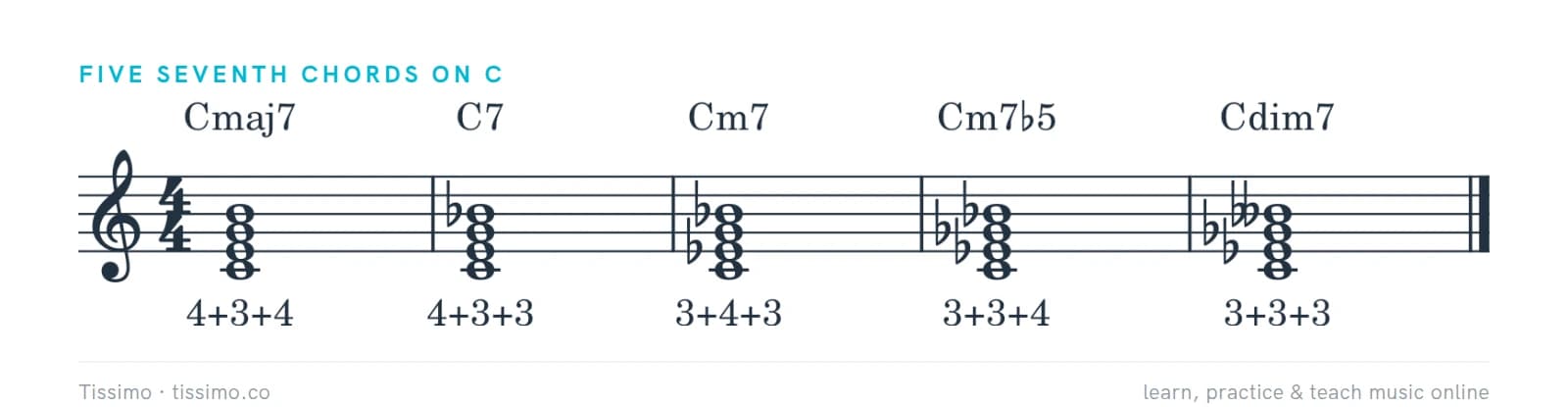
Notice the double flat in the last chord. The seventh has to be some kind of B so that the chord stays a stack of thirds; B𝄫 is played on the same key as A.
Seventh chords in a major key
Add the scale's own seventh to each triad of a major key and you get a fixed pattern: major sevenths on I and IV, minor sevenths on ii, iii and vi, a dominant seventh on V and a half-diminished seventh on vii. In C major that gives Cmaj7, Dm7, Em7, Fmaj7, G7, Am7 and Bø7. Only one chord in the key is a dominant seventh, the one on the dominant, which is how that type got its name.
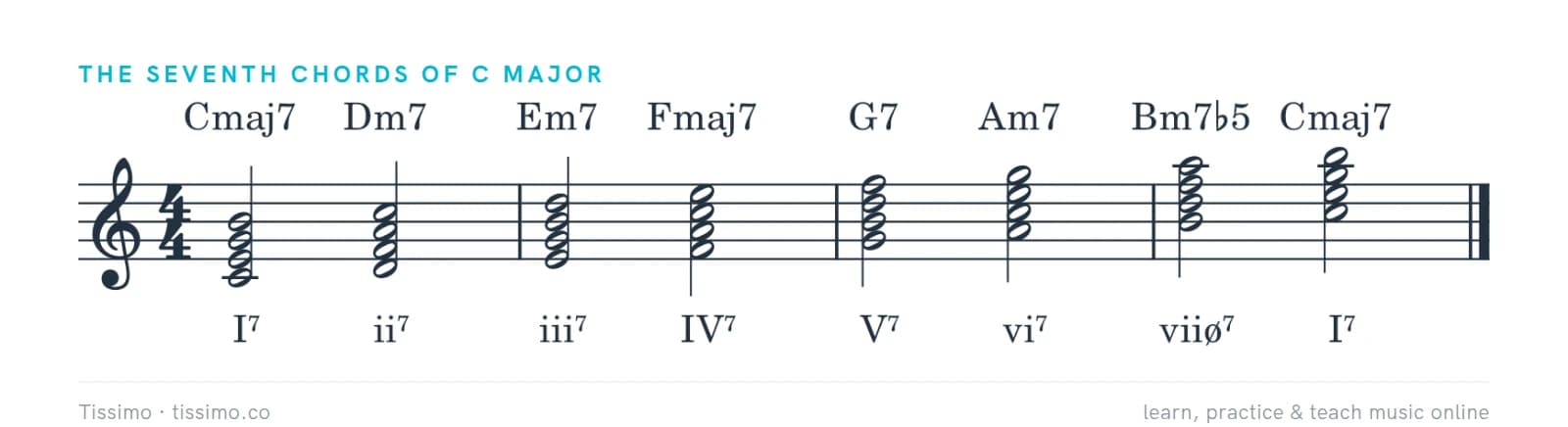
In Roman numerals the 7 simply means "seventh chord"; the quality comes from the key. So I7 in C major is Cmaj7, not C7.
How seventh chords are used
In classical harmony the seventh is a dissonance that usually resolves down by step: when G7 moves to C, F falls to E. The dominant seventh chord is by far the most common; ii7 and the seventh chords on the leading tone are also frequent. In jazz, seventh chords are the basic vocabulary, and the ii–V–I progression (Dm7–G7–Cmaj7) is its most familiar progression. Because they have four notes, seventh chords have three inversions.
Practice naming them with Name the seventh chords, and hear the difference with Hear the Seventh Chord: maj7, 7 or m7?
Common questions
How many types of seventh chords are there?
Five are common: major seventh, dominant seventh, minor seventh, half-diminished seventh and diminished seventh. Rarer types include the minor-major seventh, Cm(maj7), and the augmented seventh, C+7.
What is the difference between C7 and Cmaj7?
C7 is a dominant seventh chord: C–E–G–B♭, with a minor seventh on top. Cmaj7 is a major seventh chord: C–E–G–B, with a major seventh one half step higher.
Practice it: free worksheets
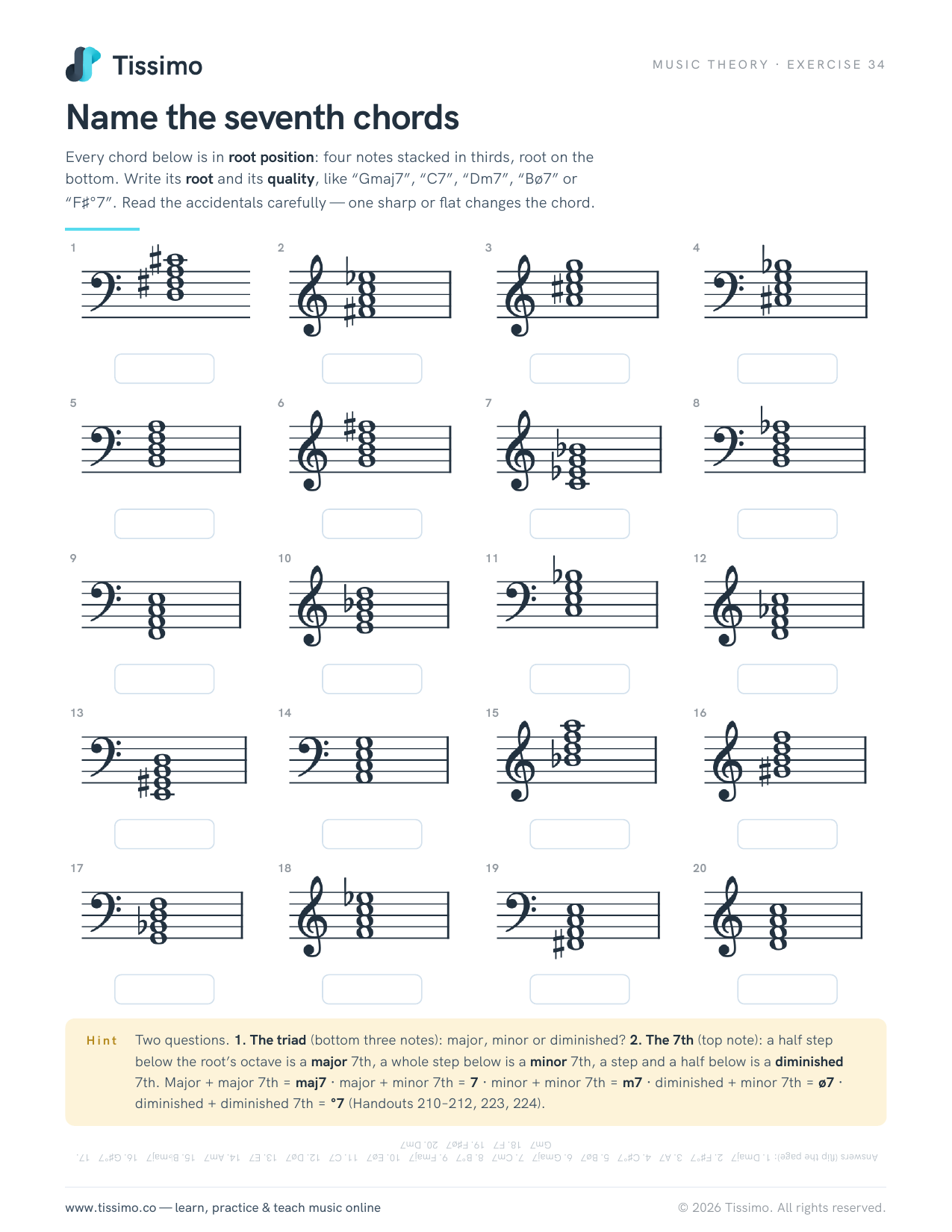 Name the seventh chordsEvery chord below is in root position: four notes stacked in thirds, root on the bottom. Write its root and its quality, like “Gmaj7”, “C7”, “Dm7”, “Bø7” or “F♯°7”. Read the accidentals carefully — one sharp or flat changes the chord.
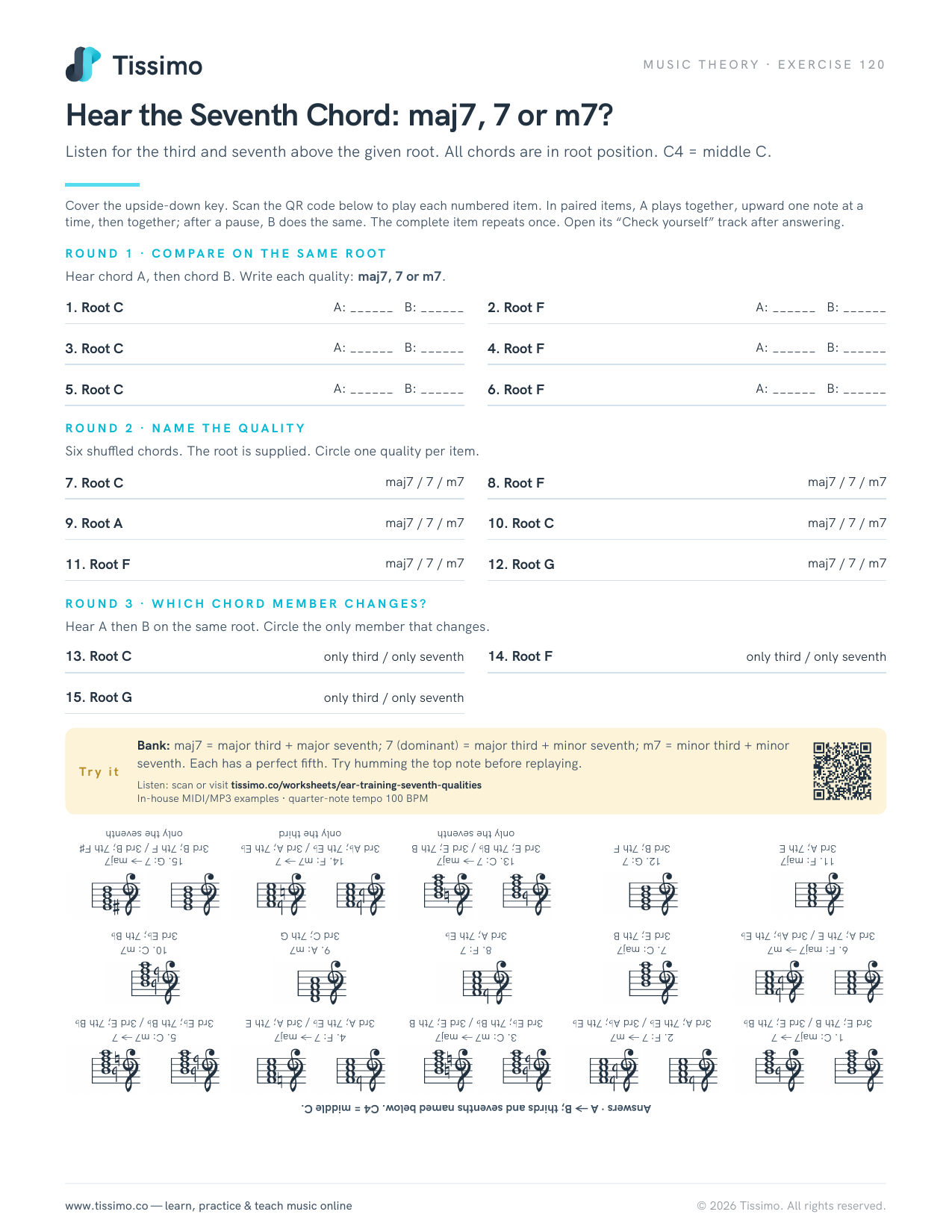 Hear the Seventh Chord: maj7, 7 or m7?Listen for the third and seventh above the given root. All chords are in root position. C4 = middle C.
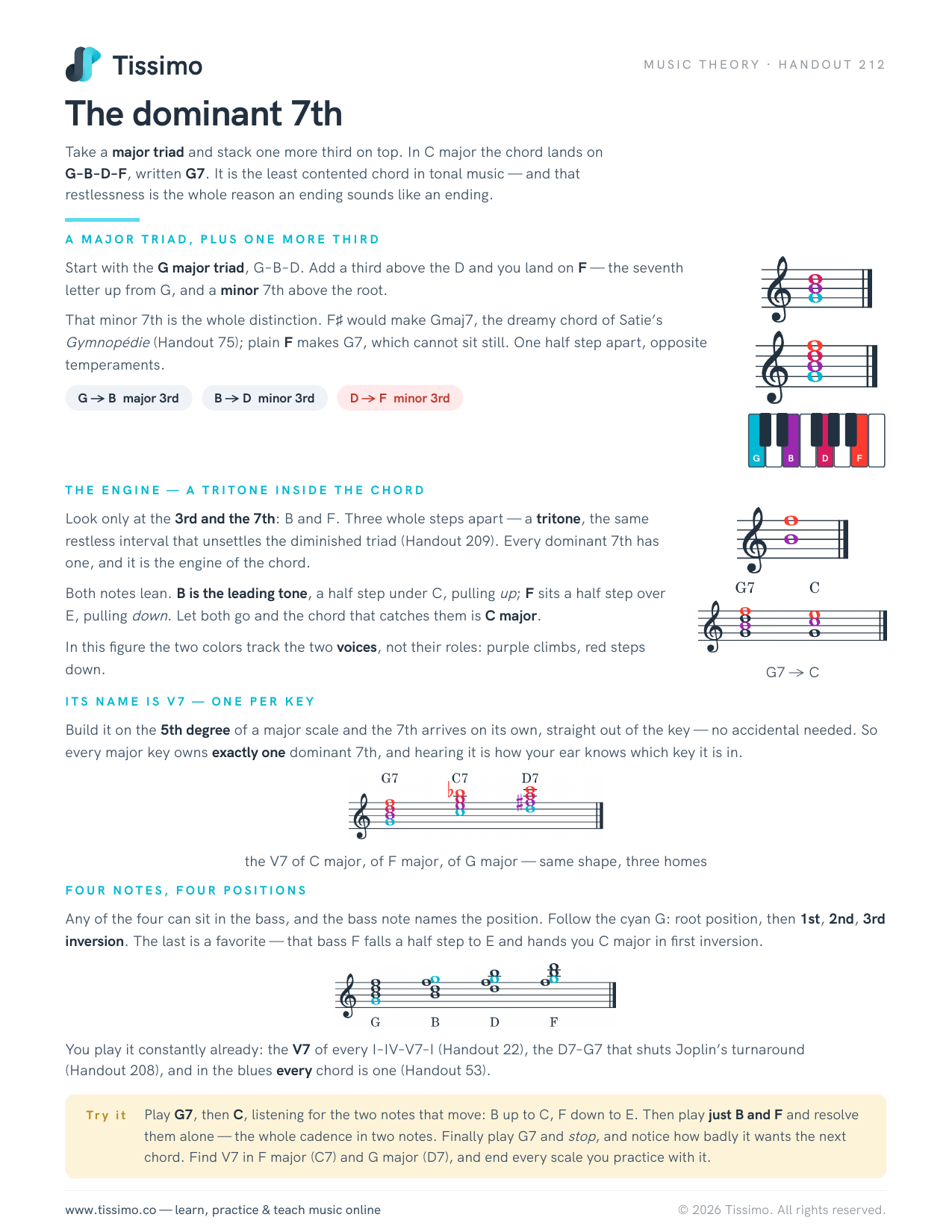 The dominant 7thTake a major triad and stack one more third on top. In C major the chord lands on G–B–D–F, written G7. It is the least contented chord in tonal music — and that restlessness is the whole reason an ending sounds like an ending.
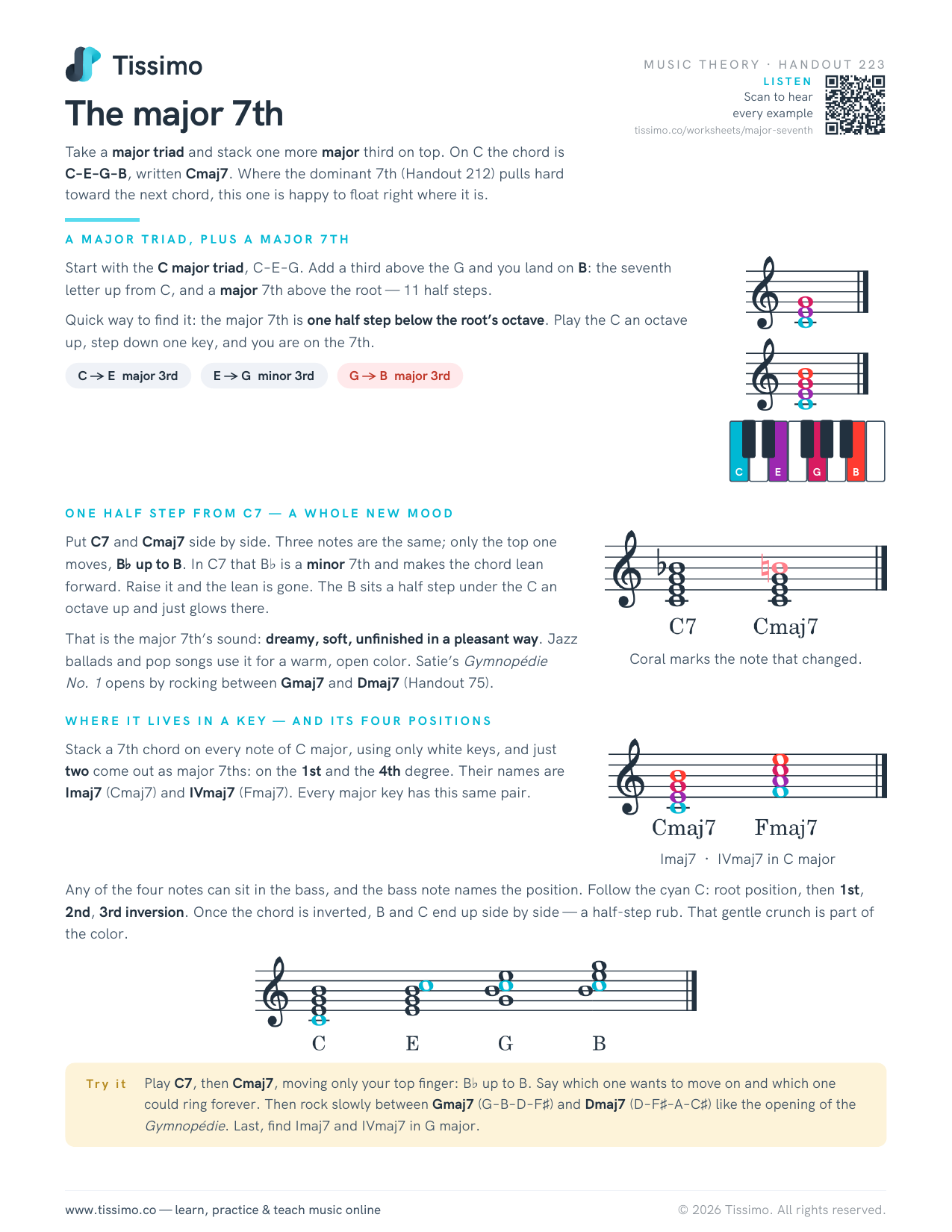 The major 7thTake a major triad and stack one more major third on top. On C the chord is C–E–G–B, written Cmaj7. Where the dominant 7th (Handout 212) pulls hard toward the next chord, this one is happy to float right where it is.
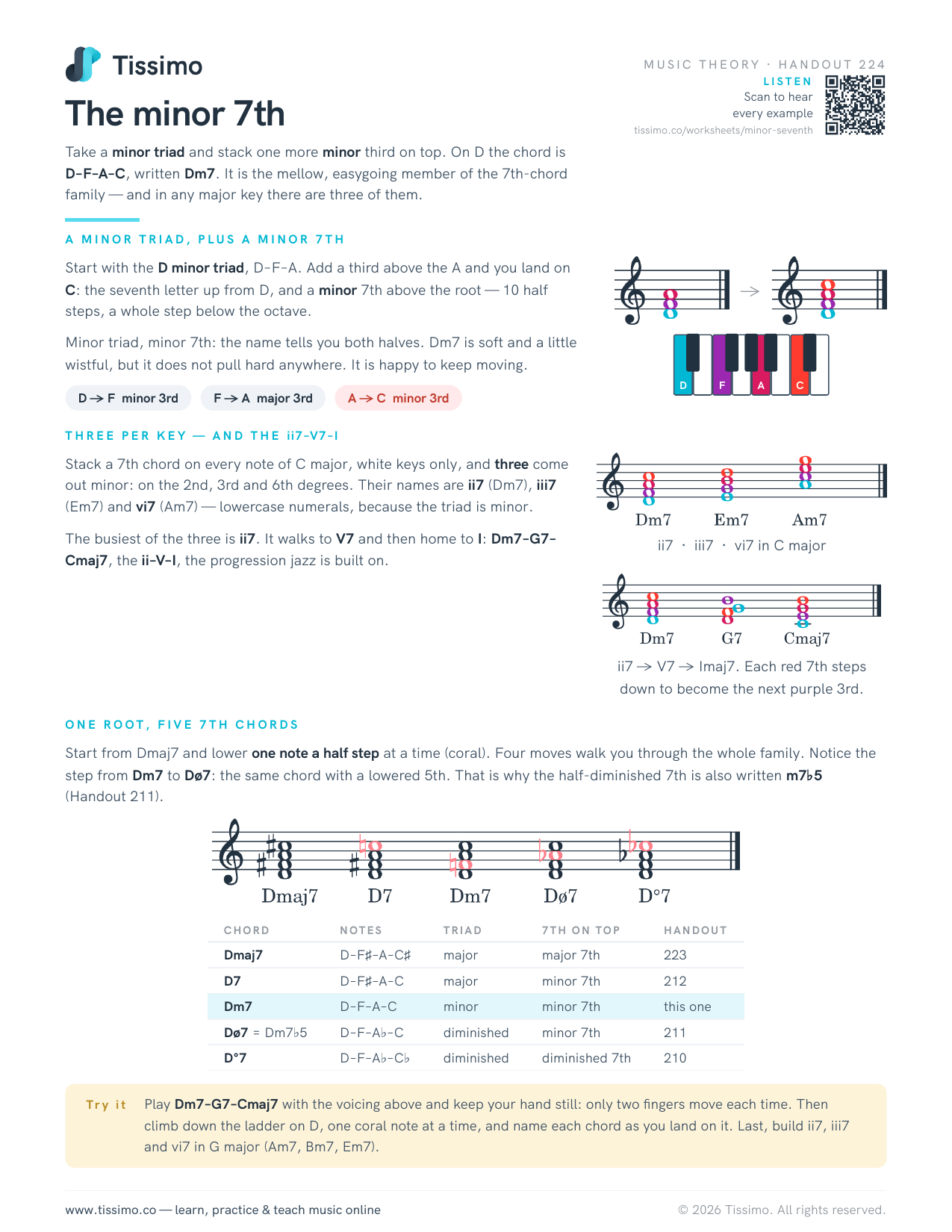 The minor 7thTake a minor triad and stack one more minor third on top. On D the chord is D–F–A–C, written Dm7. It is the mellow, easygoing member of the 7th-chord family — and in any major key there are three of them.
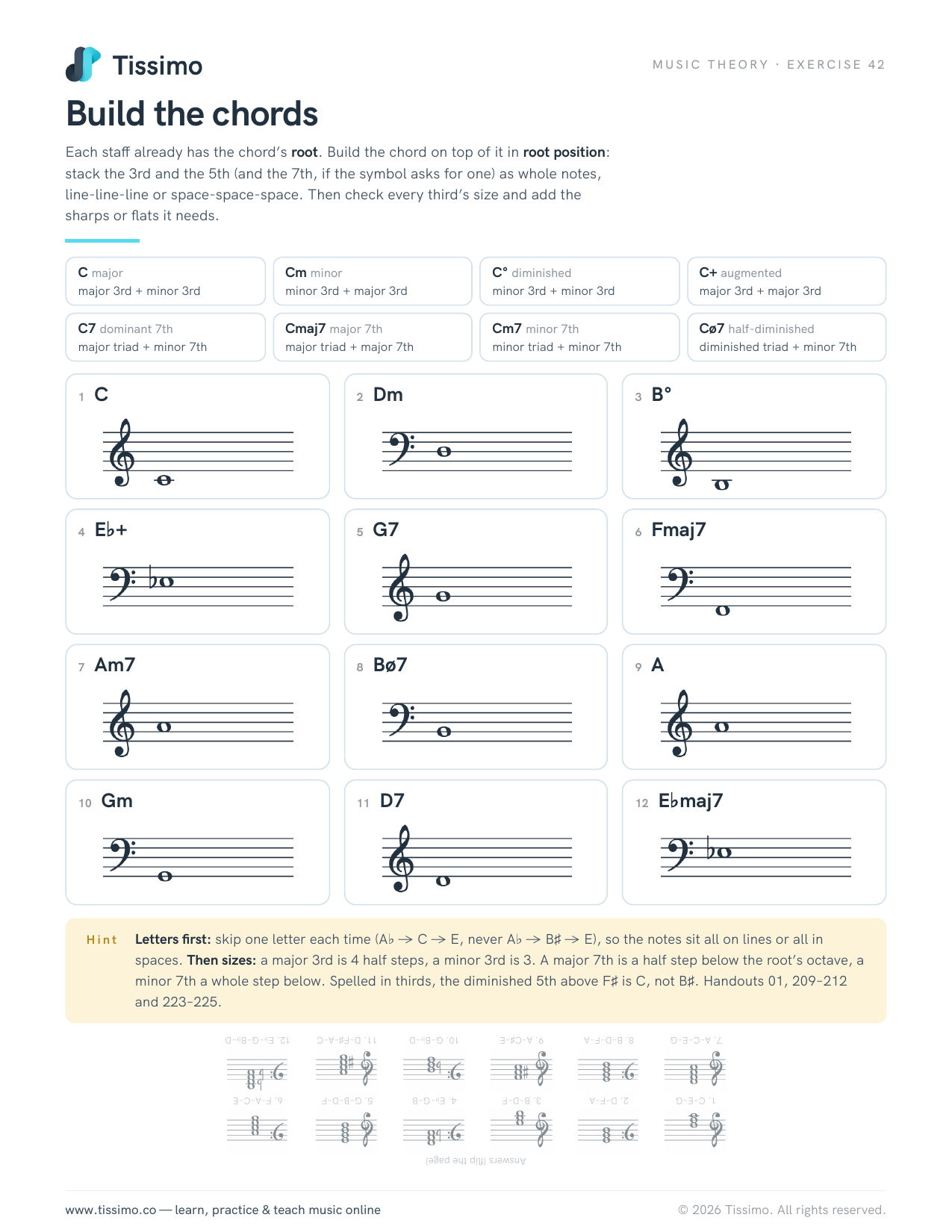 Build the chordsEach staff already has the chord’s root. Build the chord on top of it in root position: stack the 3rd and the 5th (and the 7th, if the symbol asks for one) as whole notes, line-line-line or space-space-space. Then check every third’s size and add the sharps or flats it needs.