Styles, Genres & Eras
Serialism (Twelve-Tone Music)
Serialism is a method of composing in which a fixed series, most often a row of all twelve pitch classes, is the basis of the whole piece. Arnold Schoenberg developed twelve-tone technique in the early 1920s.
Serialism is a way of organizing music around a series: a fixed ordering of musical elements that the composer uses throughout a piece. Its first and best-known form is twelve-tone technique, developed by Arnold Schoenberg in the early 1920s as a way to give structure to atonal music, which no longer relied on a home key.
The tone row
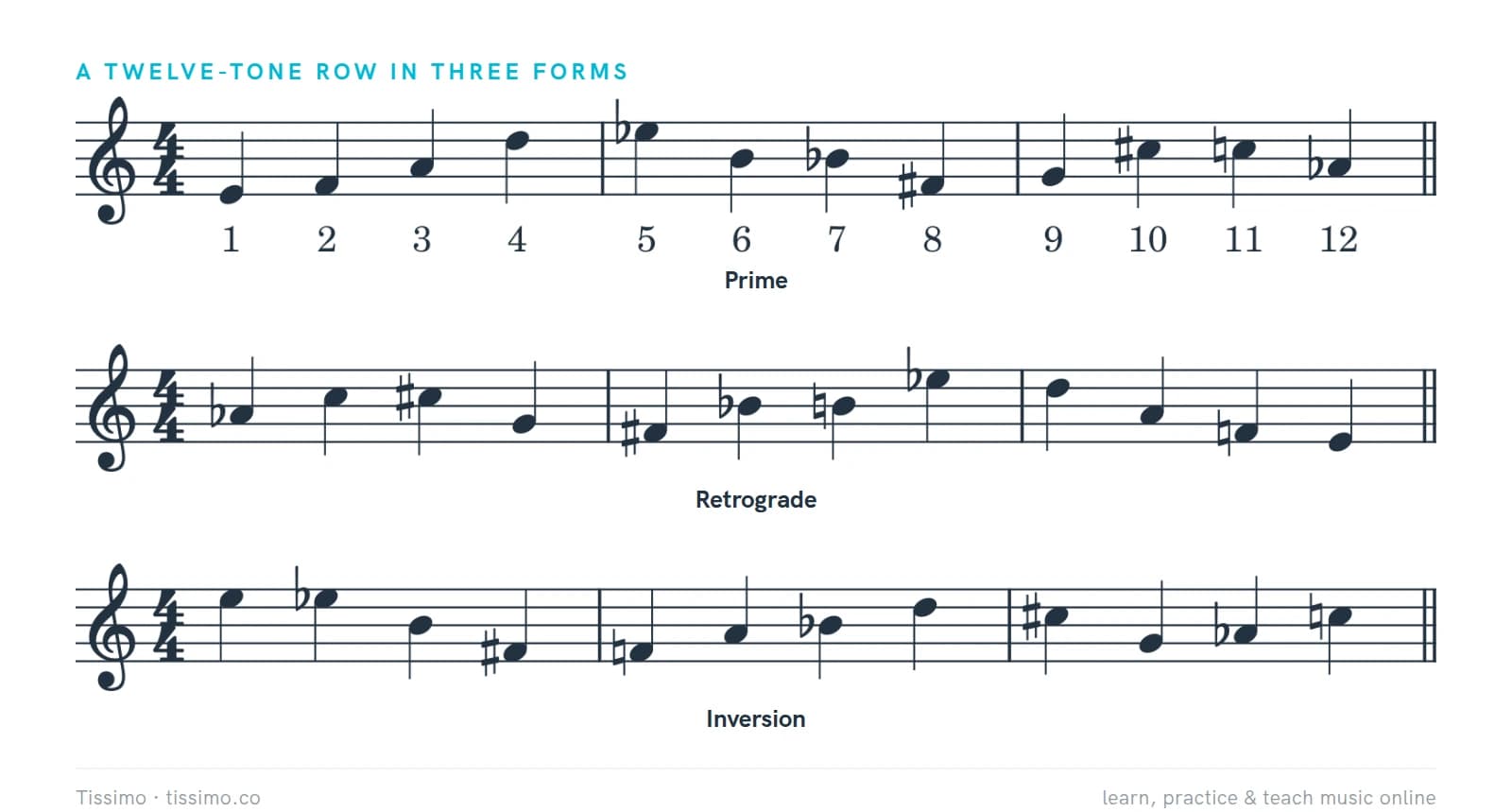
The composer arranges all twelve pitch classes of the chromatic scale (C, C♯, D … B) in a particular order, called the row or series. Each pitch class occurs once in the row itself. In an actual piece, notes may be repeated or sustained, row forms may overlap, and the row may be divided between voices or chords; it is not a blanket ban on hearing a pitch again before all twelve have sounded. The method was developed to organize music without relying on a traditional tonic, but a row can still contain tonal references. Octave doesn't matter: the row's E can appear in any register.
The row can be used in four forms:
- Prime (P): the original order.
- Retrograde (R): the prime backwards.
- Inversion (I): every interval turned upside down; a rising minor second becomes a falling minor second.
- Retrograde inversion (RI): the inversion backwards.
Each form can start on any of the twelve pitches, giving up to 48 distinct versions of one row. Symmetrical rows can produce duplicate forms. Composers often lay them out in a 12 × 12 grid, the twelve-tone matrix.
Composers
Schoenberg and his students Alban Berg and Anton Webern, known together as the Second Viennese School, were the leading early twelve-tone composers. Berg used rows that contain major and minor triads, as in his Violin Concerto, so his music can sound almost tonal; Webern wrote extremely concise, transparent pieces. After 1950, even Stravinsky adopted twelve-tone methods.
Total serialism
After World War II, composers such as Olivier Messiaen, Pierre Boulez, Karlheinz Stockhausen and Milton Babbitt applied series not only to pitch but also to rhythm, dynamics and articulation. This is called integral or total serialism.
How to listen
The row is usually not something you hear as a tune; it works more like the scale of a tonal piece, the raw material. Listen instead for motifs, rhythms, textures and the shape of each phrase, as you would in any music. The Chromatic Scale worksheet covers the twelve notes a row is made from.
Common questions
Who invented twelve-tone music?
Arnold Schoenberg developed the twelve-tone method in the early 1920s. Josef Matthias Hauer worked out a different twelve-tone system at about the same time.
What is the difference between atonality and serialism?
Atonal music lacks a governing home key. Serialism organizes musical elements with an ordered series, such as a twelve-tone row. Many serial works are atonal, but the concepts are not identical: serial methods can include tonal references and can organize elements other than pitch.
Practice it: free worksheets
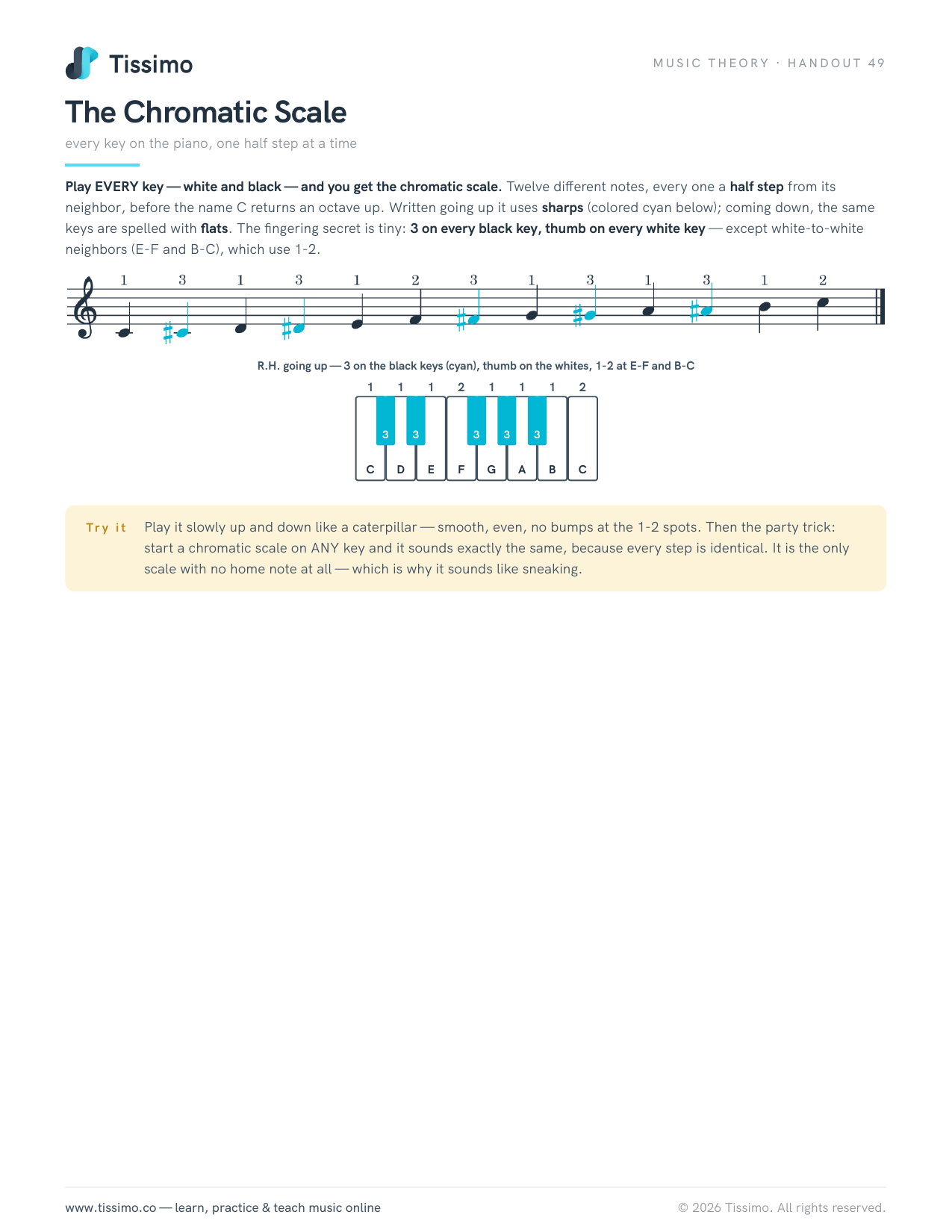 The Chromatic Scaleevery key on the piano, one half step at a time
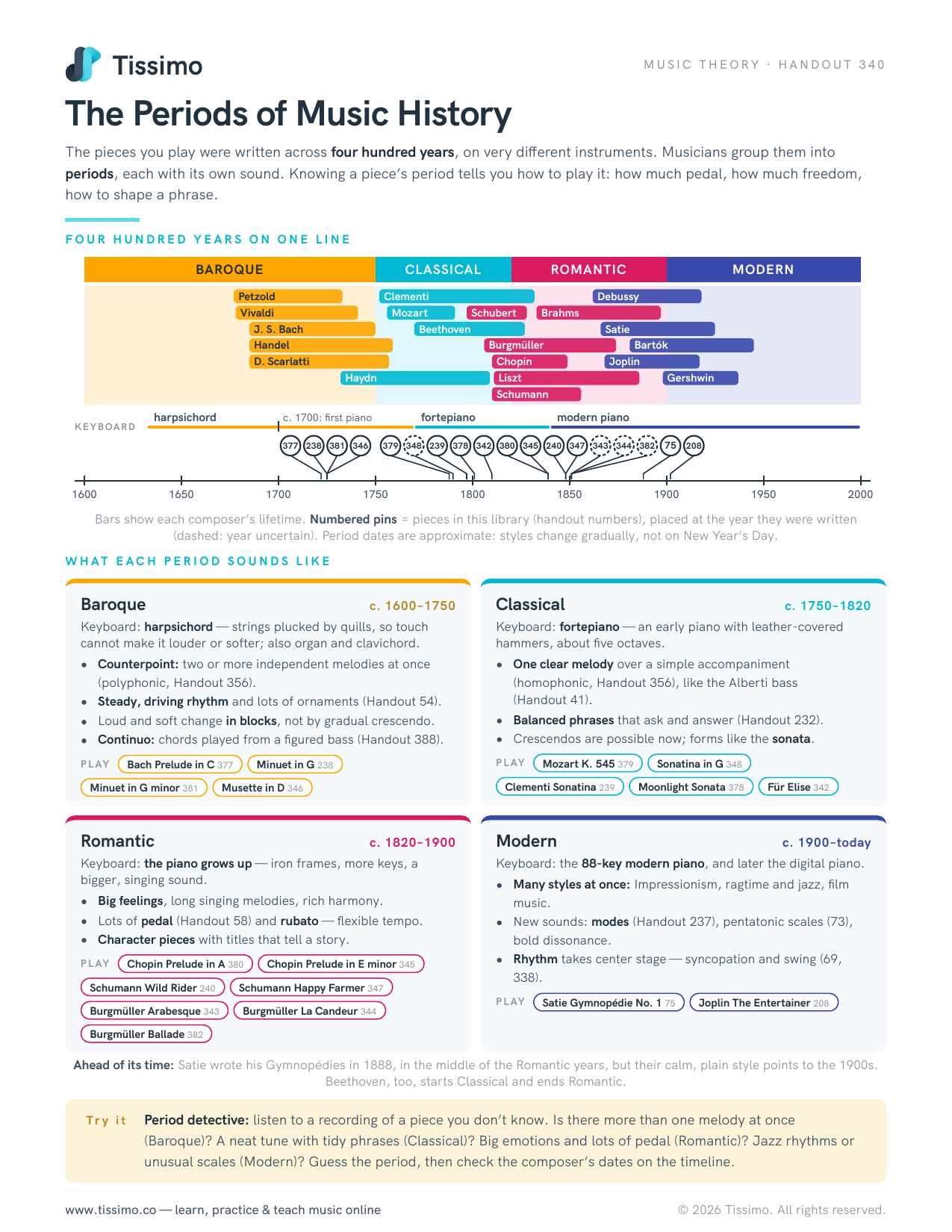 The Periods of Music HistoryThe pieces you play were written across four hundred years, on very different instruments. Musicians group them into periods, each with its own sound. Knowing a piece’s period tells you how to play it: how much pedal, how much freedom, how to shape a phrase.