Scales, Keys & Modes
Atonality
Pronounced ay-toh-NAL-ih-tee
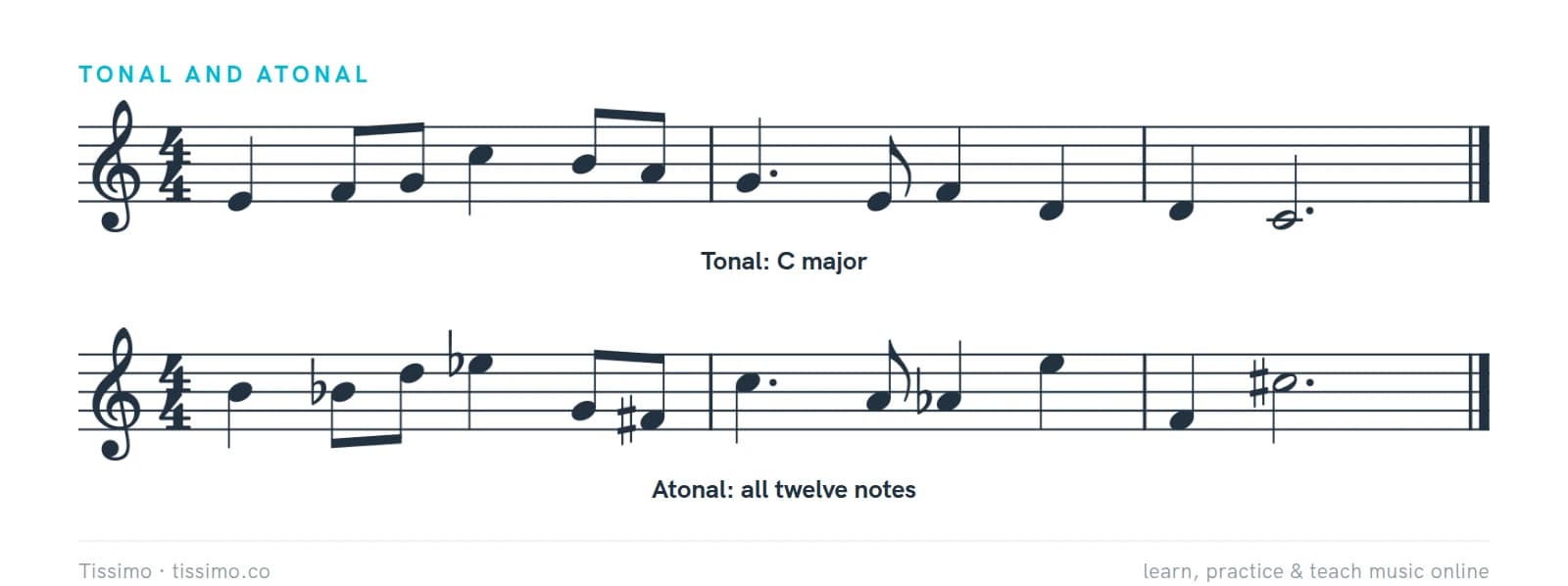
Atonality is music without a tonal center: no note or chord acts as home, so the music avoids major and minor keys. It developed in the early 20th century, above all with Arnold Schoenberg and his students.
Atonal music avoids a tonic. In a tonal piece, one note and its chord feel like home and the rest of the music leans toward them; in an atonal piece, no note is given that special status. The music does not organize its pitches around the usual hierarchy of a major or minor key. It may contain unequal emphasis, repeated notes or even triads without establishing a lasting tonic.
Where it came from
Late Romantic composers such as Wagner stretched tonality with more and more chromatic harmony, until the key of a passage could be hard to pin down. Around 1908–1909, Arnold Schoenberg took the next step and wrote music that gave up a tonal center altogether. His students Alban Berg and Anton Webern followed, and the three are often called the Second Viennese School. Schoenberg himself disliked the word "atonal", but it stuck.
Free atonality and twelve-tone music
The first atonal pieces, often described as free atonality, followed no fixed system. In the early 1920s Schoenberg devised the twelve-tone technique: the composer arranges all twelve notes in a fixed order, a tone row, and builds the piece from that row and its transformations (played backward, upside down, or both, and transposed). Each pitch class occurs once in the row itself, but a composition can repeat, sustain and combine notes and row forms. A row does not automatically prevent tonal references; the composer's choices determine how strongly any note or harmony stands out. Later composers extended the idea to rhythm, dynamics and other elements, an approach called total serialism.
How to listen to it
Atonal music asks you to listen for other things than a home key: the shape of a line, the rhythm, the color of the instruments, motives that come back, and the way the music tightens and relaxes its dissonance. Short pieces are a good place to start, because you can hear a whole shape at once.
Atonality today
Atonal techniques became a central language of concert music in the mid-20th century, and they remain common in film and television scores, where they suit suspense, fear and strangeness. Most of the music people hear every day, from folk to pop to jazz, is still tonal.
A common mix-up
Atonal does not mean random or out of tune. Atonal pieces are usually carefully organized; they simply organize pitch in ways other than around a key. Nor does a dissonant passage make a piece atonal: tension that resolves back to a home key is tonality at work.
Common questions
Who invented atonal music?
No single person, but Arnold Schoenberg is the composer most closely associated with it. Around 1908–1909 he began writing music without a tonal center, his students Alban Berg and Anton Webern followed, and in the early 1920s he developed the twelve-tone technique to organize it.
Is atonal music the same as twelve-tone music?
No. Twelve-tone music is one way of writing atonal music, using a fixed ordering of all twelve notes. Much atonal music, including Schoenberg's earliest, follows no such system.