Scales, Keys & Modes
Melodic Minor Scale
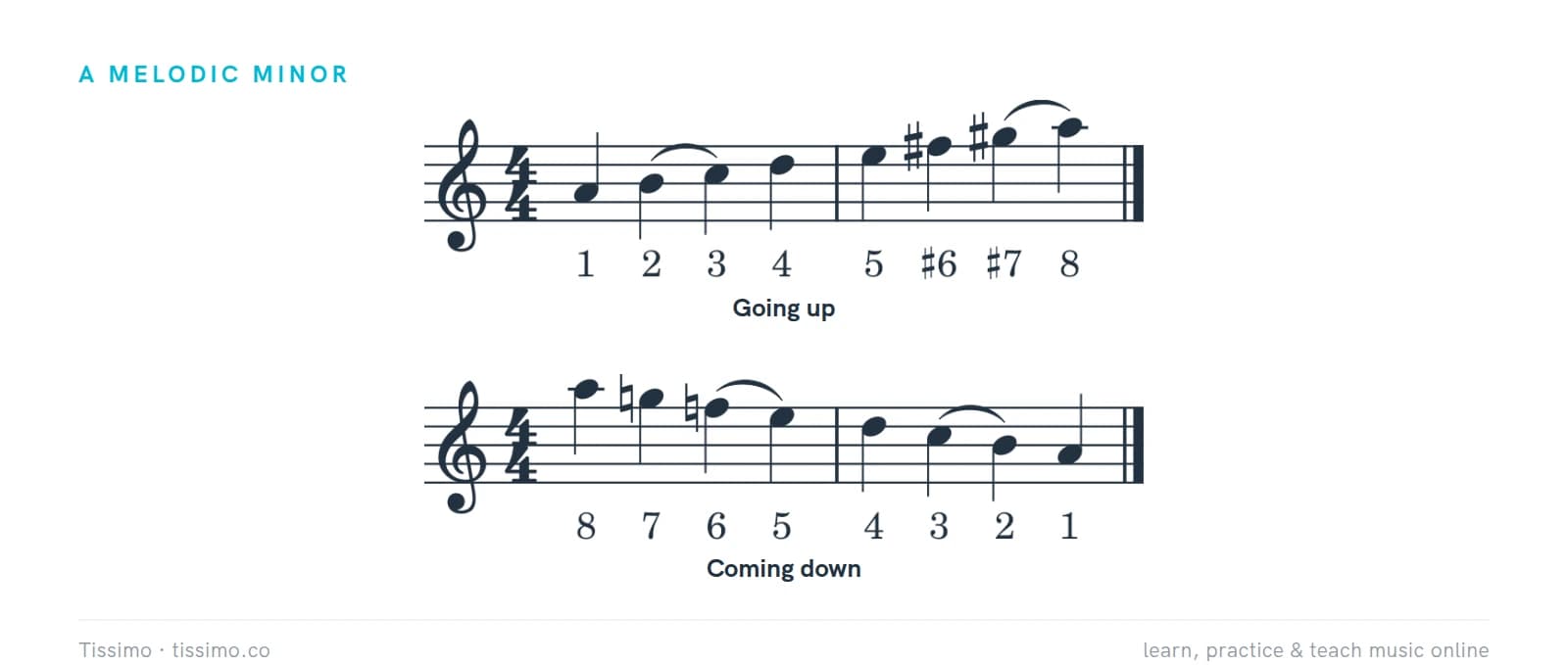
The melodic minor scale raises the 6th and 7th degrees of natural minor on the way up and returns to natural minor on the way down. In A minor it climbs with F♯ and G♯ and falls with G and F.
The melodic minor scale is the one form of minor that changes with direction. Going up, it raises both the 6th and the 7th degrees a half step; coming down, it lowers them again and becomes the natural minor scale. In A minor:
- Up: A B C D E F♯ G♯ A
- Down: A G F E D C B A
Why two directions?
Composers wanted a minor-key melody to climb smoothly to the tonic. The raised 7th of the harmonic minor scale gives that pull, a leading tone a half step below home, but it leaves an awkward three-half-step gap between the 6th and 7th degrees (F to G♯). Raising the 6th as well, to F♯, closes the gap, so every step on the way up is a whole step or a half step.
Coming down there is no need for a leading tone: the melody is moving away from the tonic, toward the 5th degree. So the 6th and 7th return to their natural-minor form, and the falling line keeps a clearly minor color.
Major with a minor 3rd
Look at the rising form again. Compared with the A major scale (A B C♯ D E F♯ G♯ A), only one note is different: the 3rd, C instead of C♯. That is why the rising form sounds bright near the top, and why the lowered 3rd alone keeps it minor. Its step pattern going up is:
W – H – W – W – W – W – H
Writing it
Melodic minor uses the key signature of natural minor, so the raised notes take accidentals going up, and the notes coming down are often printed with naturals as a reminder (courtesy accidentals). In flat keys the raised notes can be naturals: C melodic minor rises with A♮ and B♮.
Jazz melodic minor
Jazz musicians usually play the rising form in both directions and call it the jazz minor scale, or simply melodic minor. Several jazz chord-scales come from its modes, so in a jazz lesson "melodic minor" almost always means this one-way version.
In real classical pieces, composers do not apply the up-and-down rule mechanically: a falling line can keep the raised notes over a dominant chord, and a rising line can use the natural ones. Treat the textbook form as a guide to the usual behavior, and let the harmony decide.
The three minors compares all three forms, and the minor-key pages of Scales in Every Key include the melodic form.
Common questions
Why is melodic minor different going up and down?
Going up, the raised 6th and 7th give a smooth climb to the tonic, with a leading tone a half step below it. Coming down, the line no longer needs that pull, so it returns to natural minor and keeps a darker, clearly minor sound.
What is the jazz melodic minor scale?
It is the rising form of melodic minor (in A: A B C D E F♯ G♯ A) used in both directions. Jazz players also build chord-scales from its modes.
Practice it: free worksheets
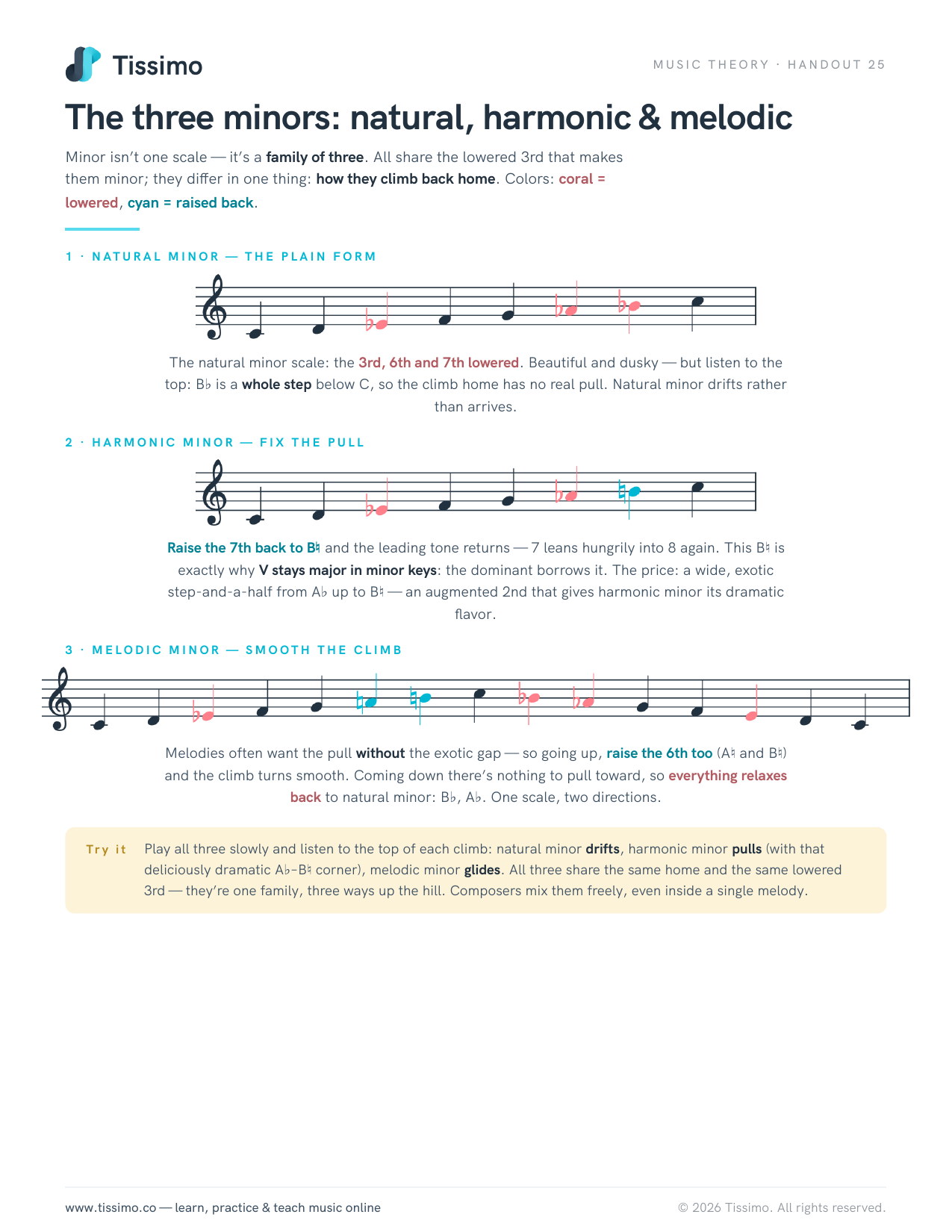 The three minors: natural, harmonic & melodicMinor isn’t one scale — it’s a family of three. All share the lowered 3rd that makes them minor; they differ in one thing: how they climb back home. Colors: coral = lowered, cyan = raised back.
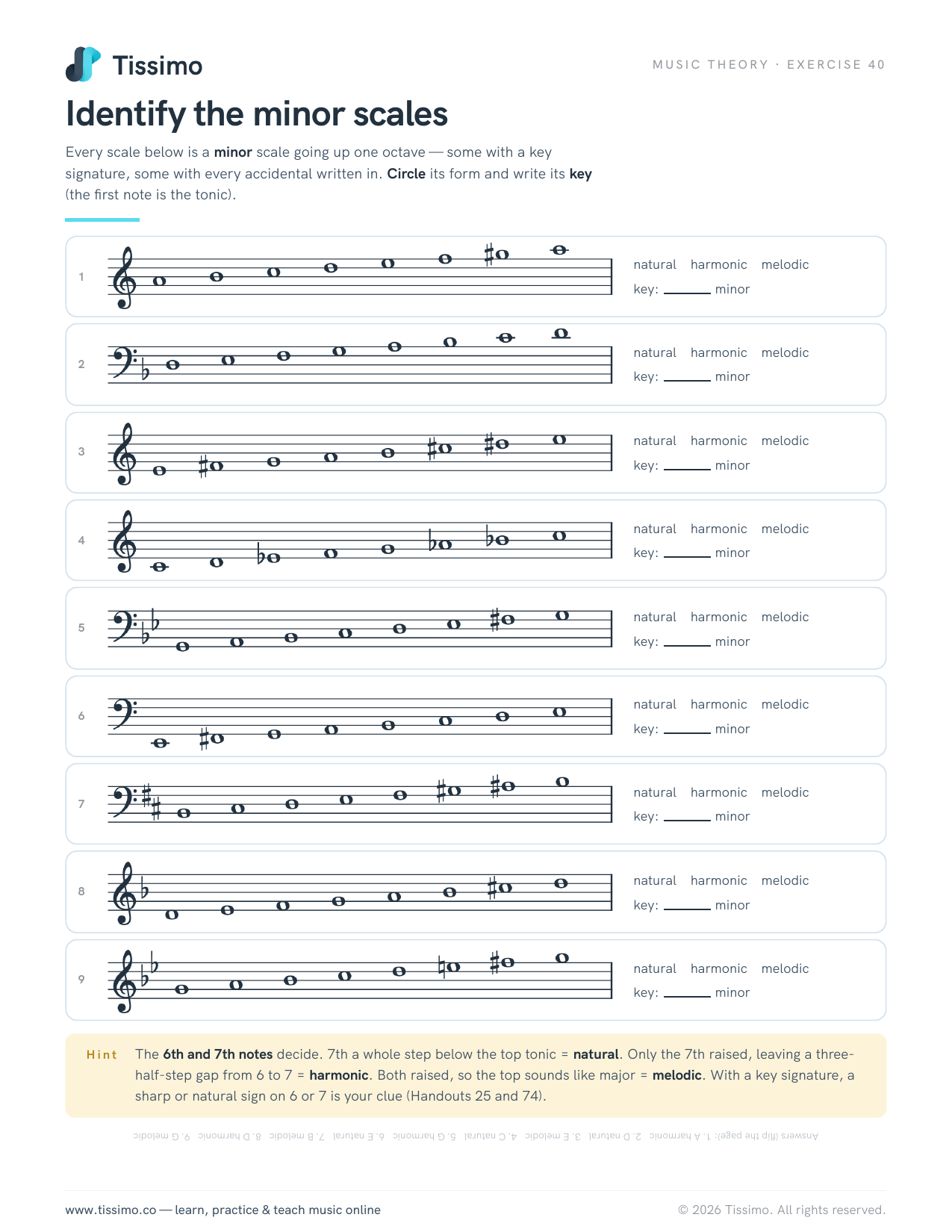 Identify the minor scalesEvery scale below is a minor scale going up one octave — some with a key signature, some with every accidental written in. Circle its form and write its key (the first note is the tonic).
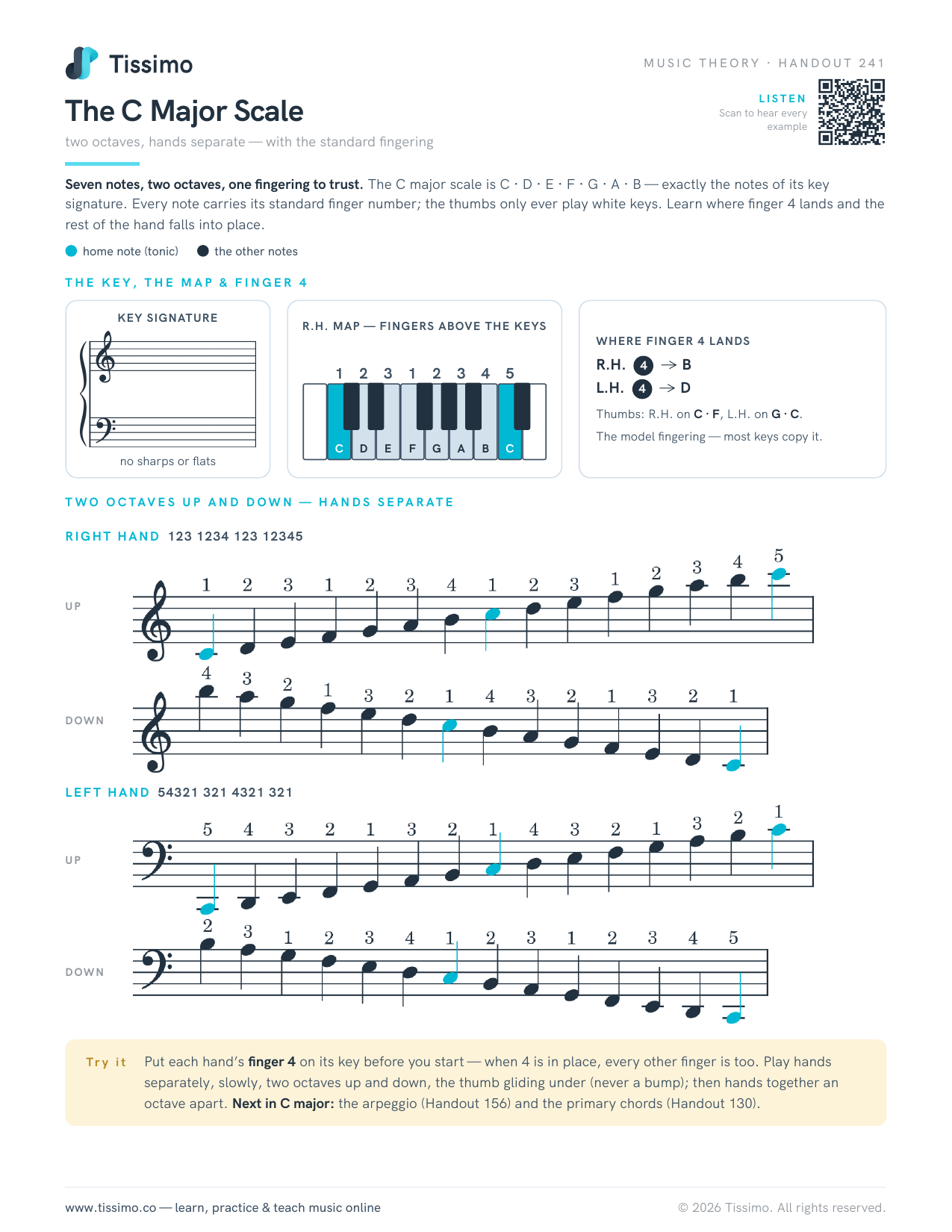 Scales in Every KeyTwo octaves up and down with the standard fingering on every note, in all 24 keys.
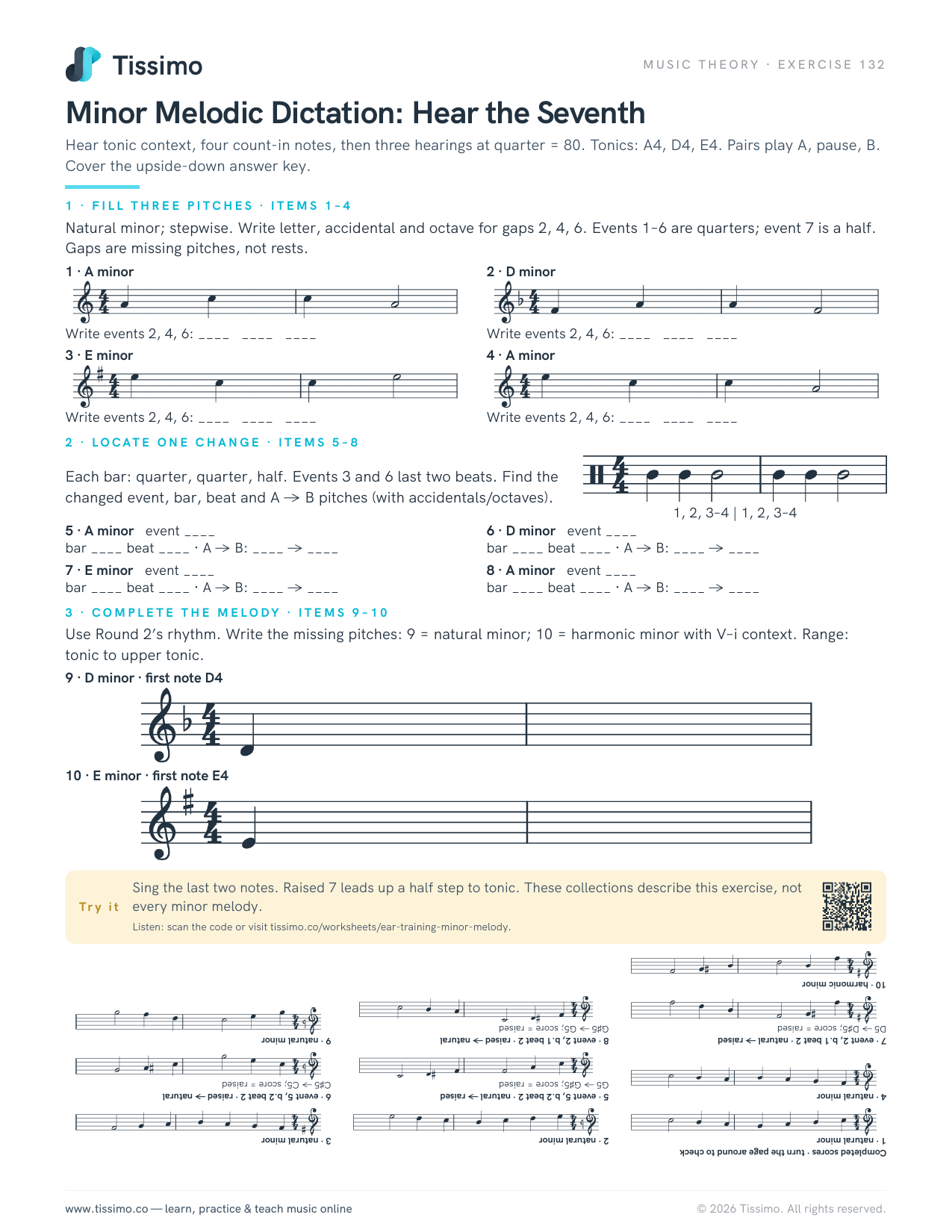 Minor Melodic Dictation: Hear the SeventhHear tonic context, four count-in notes, then three hearings at quarter = 80. Tonics: A4, D4, E4. Pairs play A, pause, B. Cover the upside-down answer key.
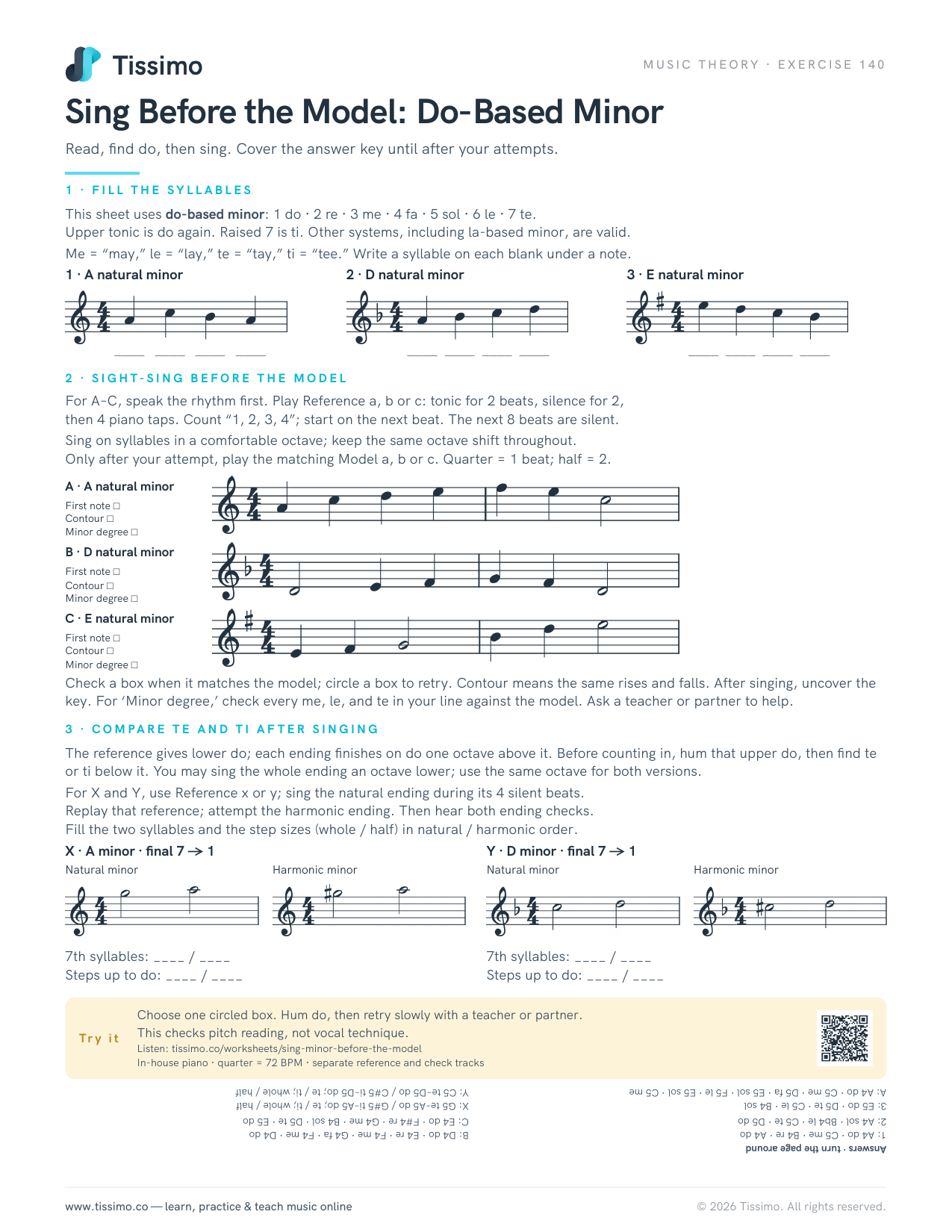 Sing Before the Model: Do-Based MinorRead, find do, then sing. Cover the answer key until after your attempts.