Scales, Keys & Modes
Harmonic Minor Scale
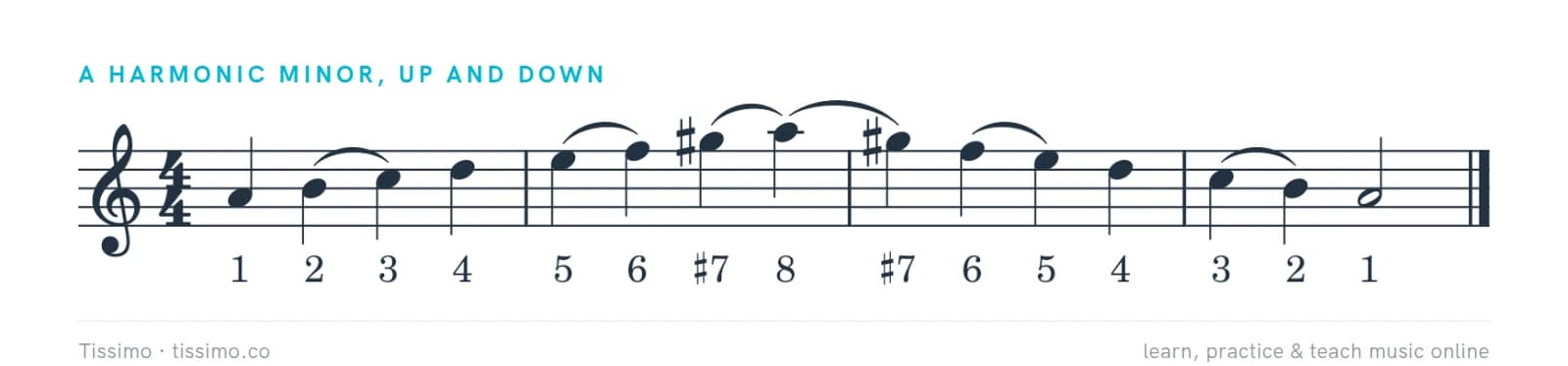
The harmonic minor scale is a natural minor scale with its 7th degree raised a half step, so it leads strongly back to the tonic. In A minor that turns G into G♯.
The harmonic minor scale is the natural minor scale with one change: the 7th note is raised a half step. In A minor, G becomes G♯, and the scale reads A B C D E F G♯ A.
Why raise the 7th?
In natural minor, the 7th degree sits a whole step below the tonic (G to A), so it has little pull toward home. Raising it to G♯ makes it a leading tone, a half step below the tonic, just as B is in C major. The scale now ends with the same "almost there, and home" feeling that the major scale has.
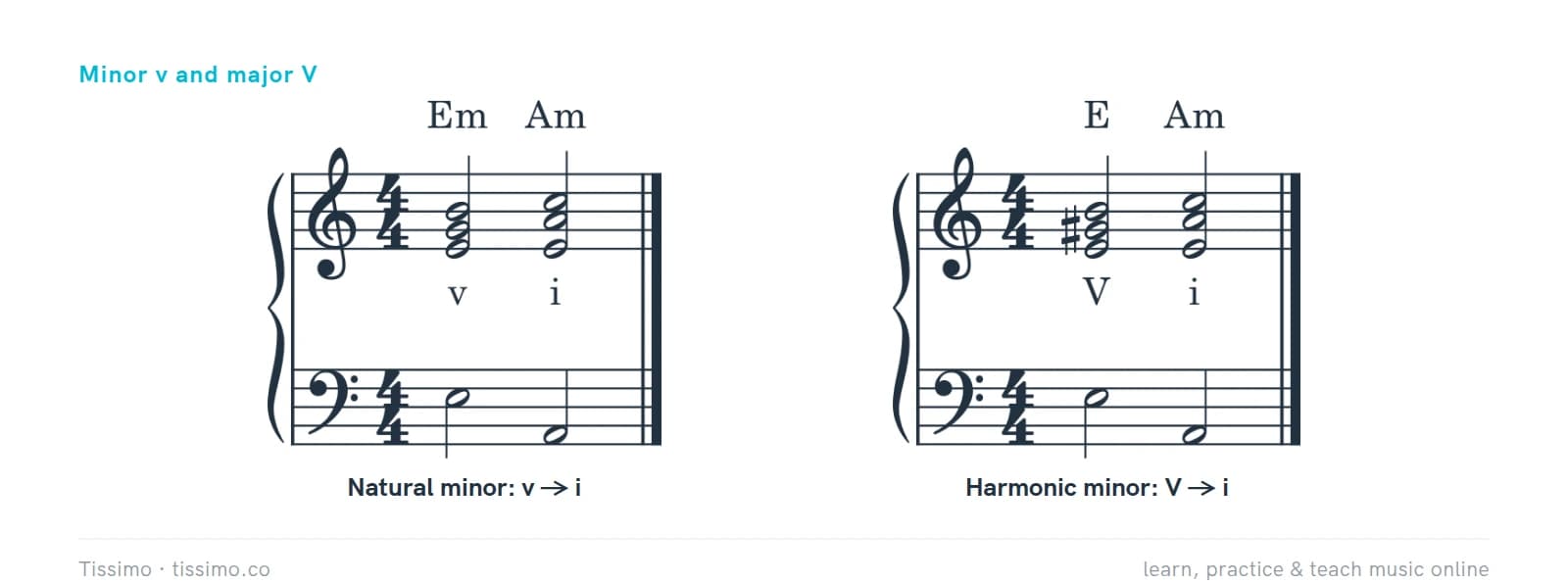
The name comes from harmony. Build a triad on the 5th degree of A natural minor and you get E G B, an E minor chord. Raise the G and the chord becomes E G♯ B, E major: a true dominant chord that pulls firmly to A minor. That major V chord, and the dominant seventh chord E G♯ B D, is what composers want at cadences in a minor key, and harmonic minor is the scale that supplies it.
The augmented second
Raising the 7th opens a wide gap between the 6th and 7th degrees: F to G♯ in A minor. That step is three half steps wide, an augmented second, and it gives the scale its distinctive, slightly exotic sound. The full step pattern is:
W – H – W – W – H – (W+H) – H
Melody writers in the Classical style often avoided that leap, which is one reason the melodic minor scale exists. Elsewhere the interval is a feature: it is prominent in klezmer and in some Middle Eastern and Balkan music, though those traditions organize their scales in their own ways.
Writing it with a key signature
Harmonic minor shares its key signature with natural minor, so the raised 7th is written as an accidental each time it appears: G♯ in A minor, D♯ in E minor, C♯ in D minor. In flat keys the raised note can be a natural: in C minor (three flats) the 7th is B♮. That accidental is often your first clue that a piece is in a minor key rather than its relative major.
Playing it
Harmonic minor uses the same notes going up and coming down. Many piano teachers give it as the first minor scale to learn in each key, and the minor-key pages of Scales in Every Key and Contrary-Motion Scales are built on it. In A minor the fingering is the same as for the natural form; only the augmented second feels new under the hand, so take it slowly at first.
Common questions
Why is it called the harmonic minor scale?
Because it comes from harmony. Raising the 7th degree turns the chord on the 5th degree into a major chord (E major in A minor), which gives a minor key a strong dominant-to-tonic cadence. The scale collects the notes those chords use.
Is harmonic minor the same going up and down?
Yes. Unlike the melodic minor scale, harmonic minor keeps the raised 7th in both directions: A B C D E F G♯ A going up, and A G♯ F E D C B A coming down.
Practice it: free worksheets
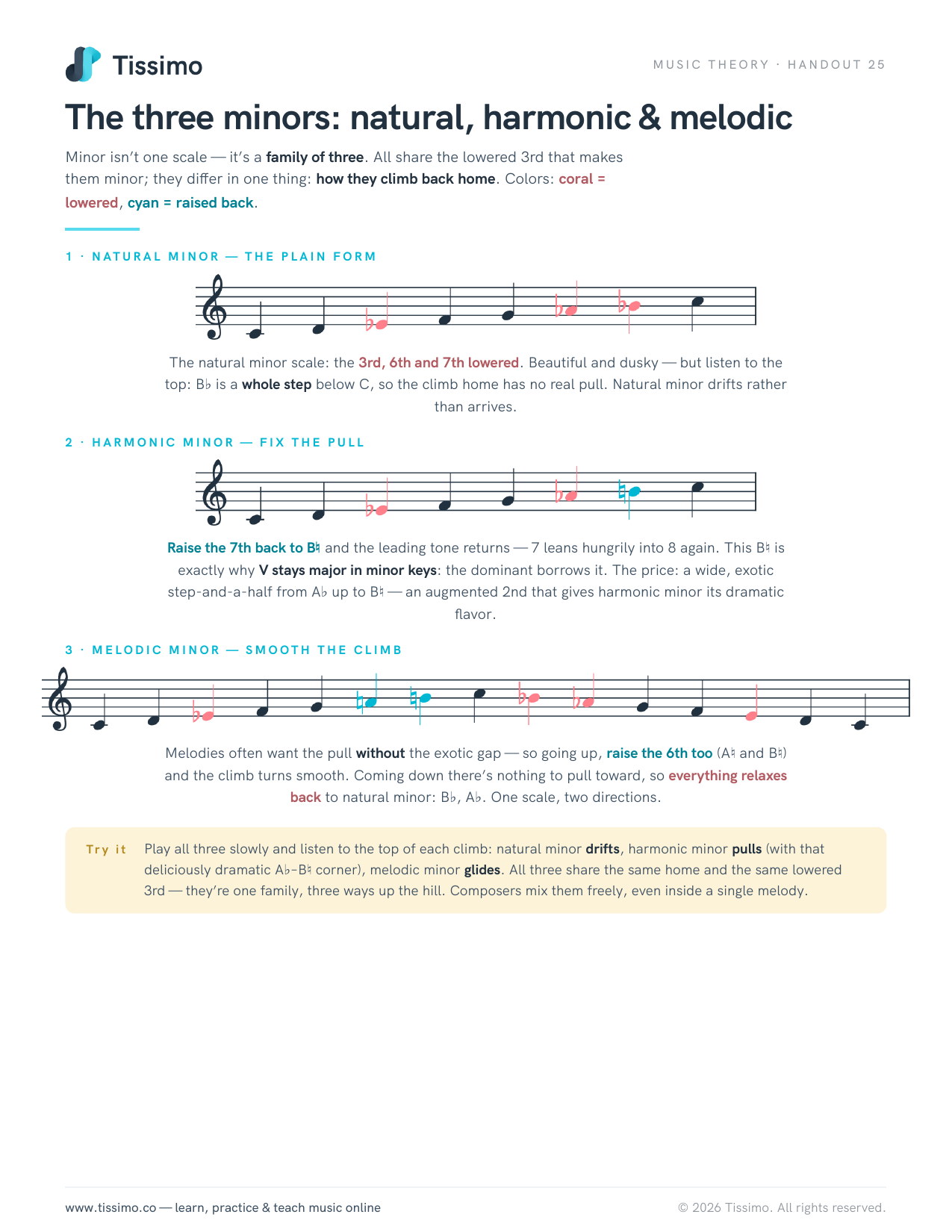 The three minors: natural, harmonic & melodicMinor isn’t one scale — it’s a family of three. All share the lowered 3rd that makes them minor; they differ in one thing: how they climb back home. Colors: coral = lowered, cyan = raised back.
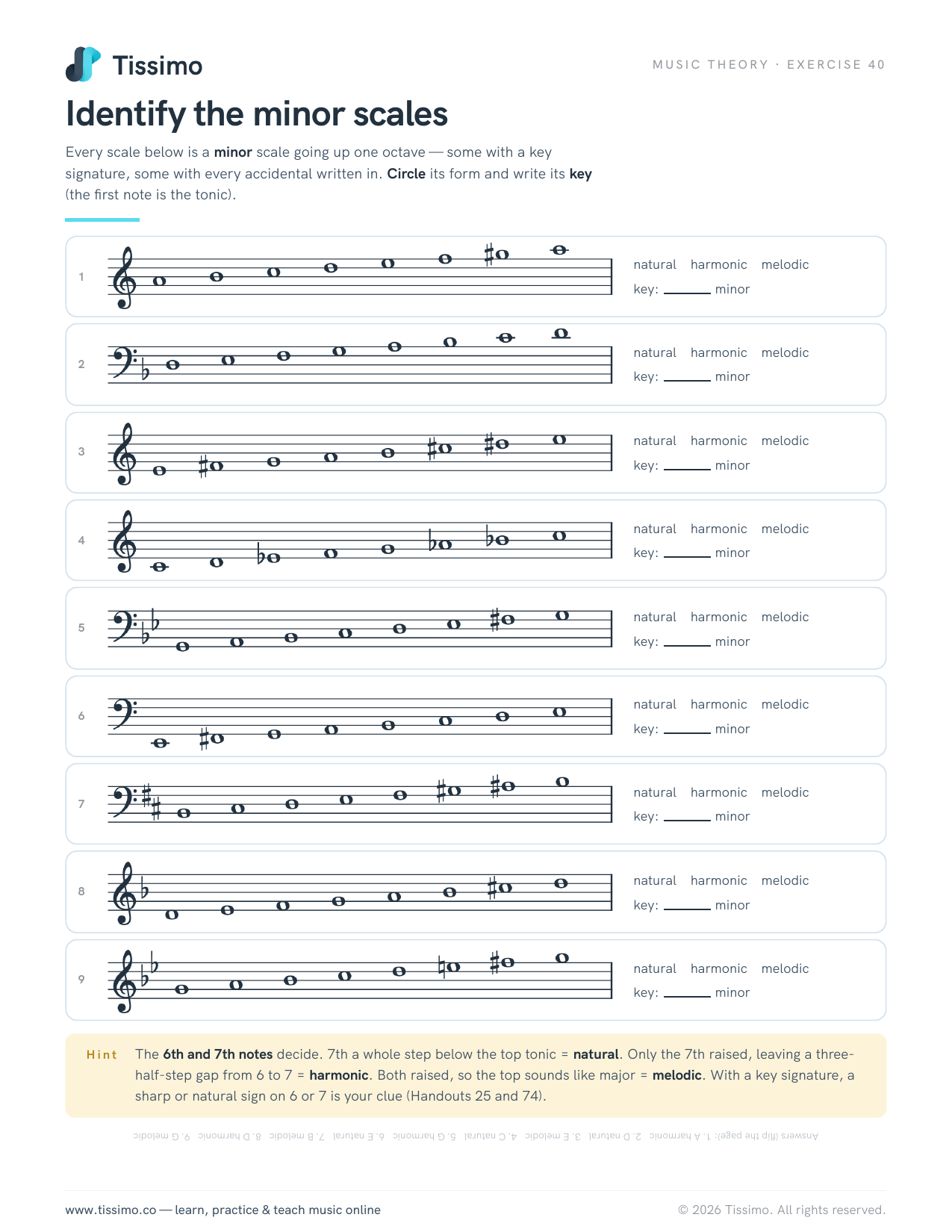 Identify the minor scalesEvery scale below is a minor scale going up one octave — some with a key signature, some with every accidental written in. Circle its form and write its key (the first note is the tonic).
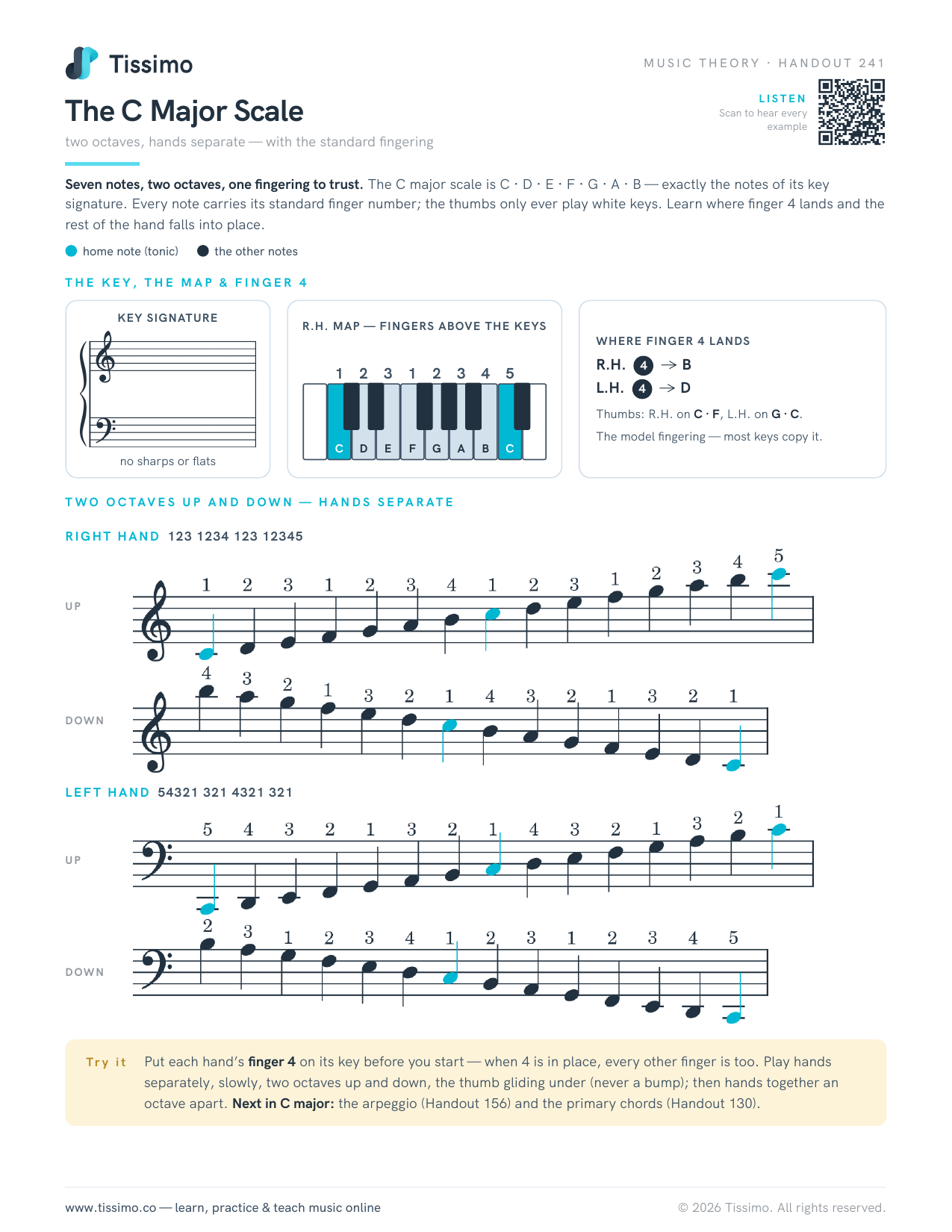 Scales in Every KeyTwo octaves up and down with the standard fingering on every note, in all 24 keys.
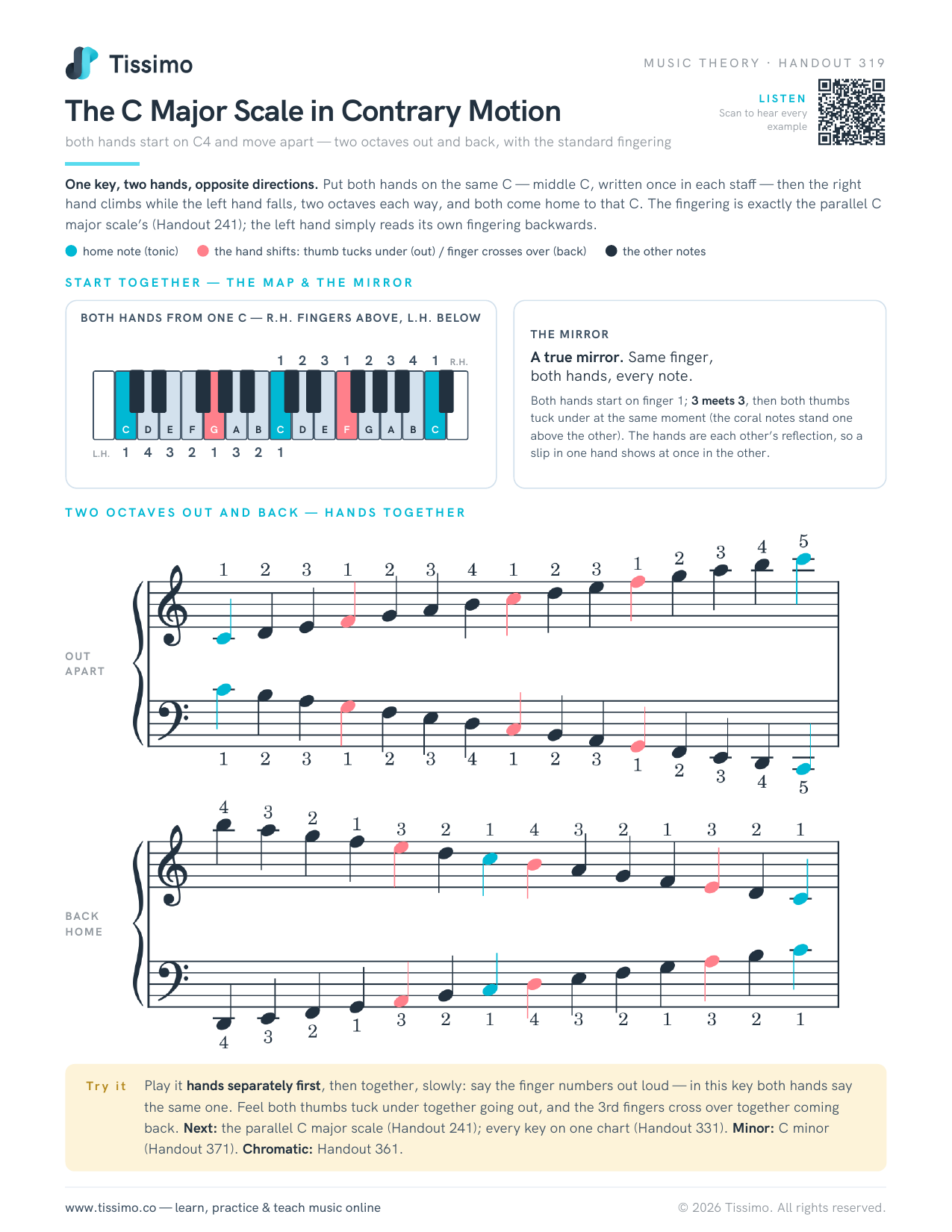 Contrary-Motion ScalesBoth hands start on one note and move apart two octaves and back, in all 12 major and 12 harmonic minor keys.
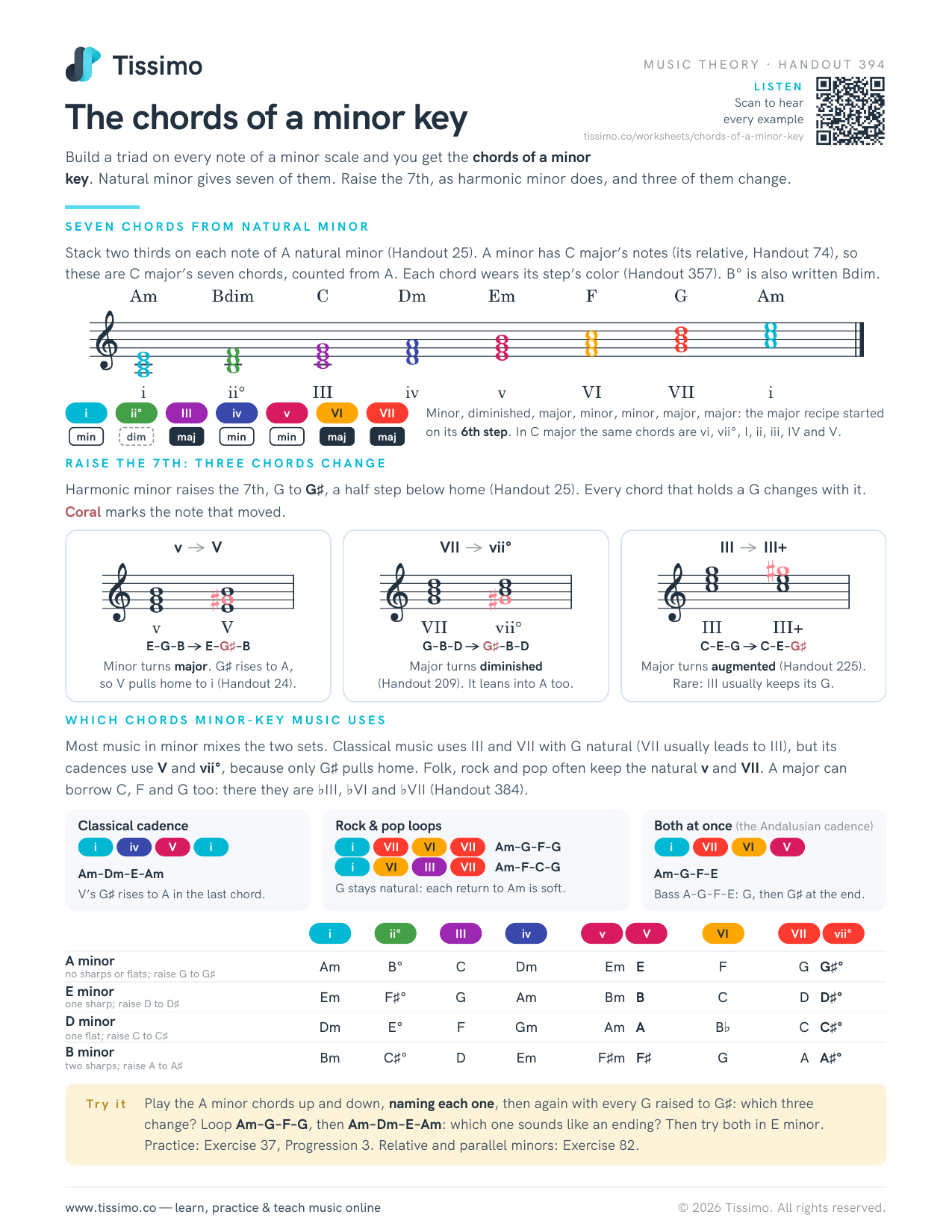 The chords of a minor keyBuild a triad on every note of a minor scale and you get the chords of a minor key. Natural minor gives seven of them. Raise the 7th, as harmonic minor does, and three of them change.
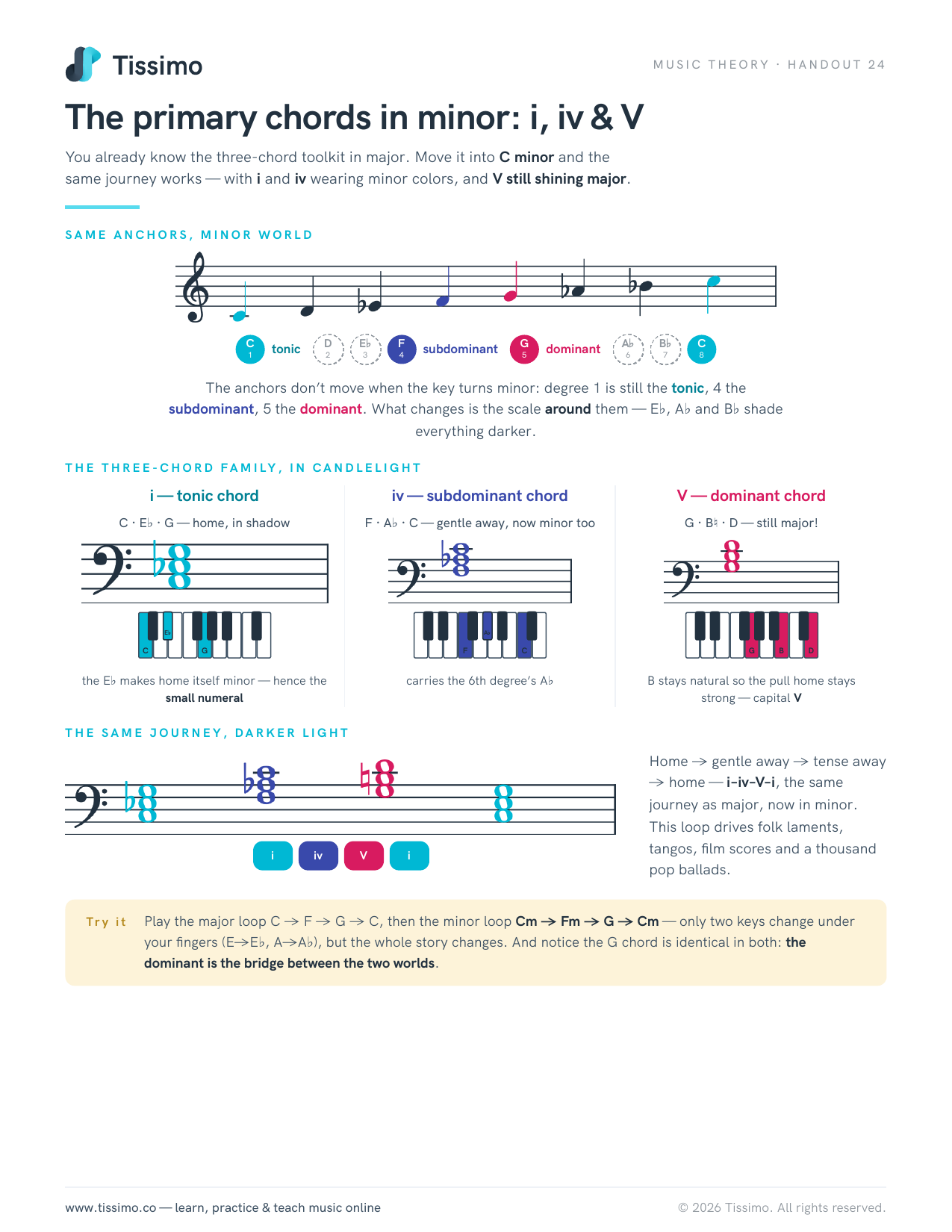 The primary chords in minor: i, iv & VYou already know the three-chord toolkit in major. Move it into C minor and the same journey works — with i and iv wearing minor colors, and V still shining major.