Chords & Harmony
Harmonic Function
Harmonic function is the role a chord plays in a key: tonic (stable home), predominant or subdominant (moving away), or dominant (tension that leads home). Chords with the same function can often replace one another.
Harmonic function is the job a chord does in a key. Tonal music gives its chords three basic roles:
- Tonic (T): stability, home. Chiefly I, and sometimes vi or iii.
- Predominant (PD), also called subdominant (S): movement away from home that prepares the dominant. IV and ii, with their seventh chords and inversions.
- Dominant (D): tension that wants to resolve to the tonic. V, V7, vii° and vii°7.
The basic cycle
A typical phrase moves T → PD → D → T: it starts at home, leaves, builds tension and resolves. I – IV – V7 – I is the plainest version. Chords that share a function can stand in for one another, so vi – ii6 – vii°6 – I follows the same path with different chords:
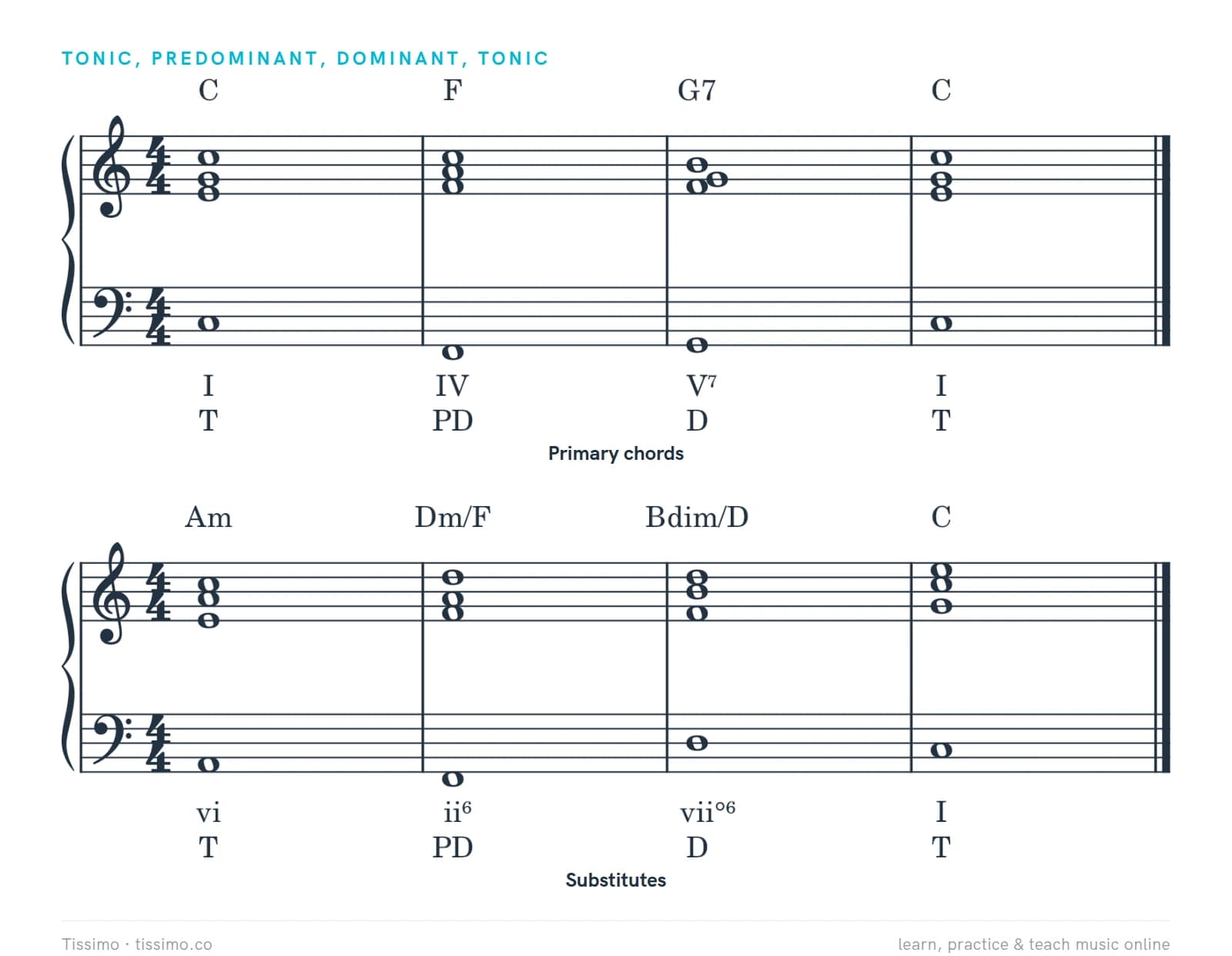
Why chords share a function
Chords with the same function share notes. ii (D–F–A) and IV (F–A–C) have F and A in common, and both contain the fourth scale degree, F, which leans toward the dominant. vii° (B–D–F) is V7 (G–B–D–F) without its root, so it carries the same two tendency tones, B and F. vi (A–C–E) shares C and E with I (C–E–G), which is why it can replace I in a deceptive cadence.
Using function
- Analysis: label a progression T, PD and D to see the shape of a phrase at a glance.
- Harmonizing: when IV sounds too plain, try ii; when a cadence should surprise, replace I with vi.
- Composing and improvising: knowing a chord's job lets you change the chord without changing the direction. In jazz the ii–V–I progression is PD – D – T, and a tritone substitution swaps one dominant chord for another.
Where the idea comes from
The term "function" for these roles is usually credited to the German theorist Hugo Riemann, writing in the late 19th century. Textbooks still differ on the details: some call the middle group "subdominant", others "predominant", and they disagree about where iii and vi belong.
Practice with Tonic & dominant harmonies, The primary chords: I, IV & V and Harmonize a melody 2.
Common questions
What are the three harmonic functions?
Tonic (stable, home), predominant or subdominant (moving away and preparing the dominant), and dominant (tension that pulls back to the tonic).
Is vi a tonic or a predominant chord?
Both views appear in textbooks. vi shares two notes with I and often replaces it, as in a deceptive cadence. When it moves on to IV or ii it also starts the move away from home, so some theorists treat it as a bridge between tonic and predominant.
Practice it: free worksheets
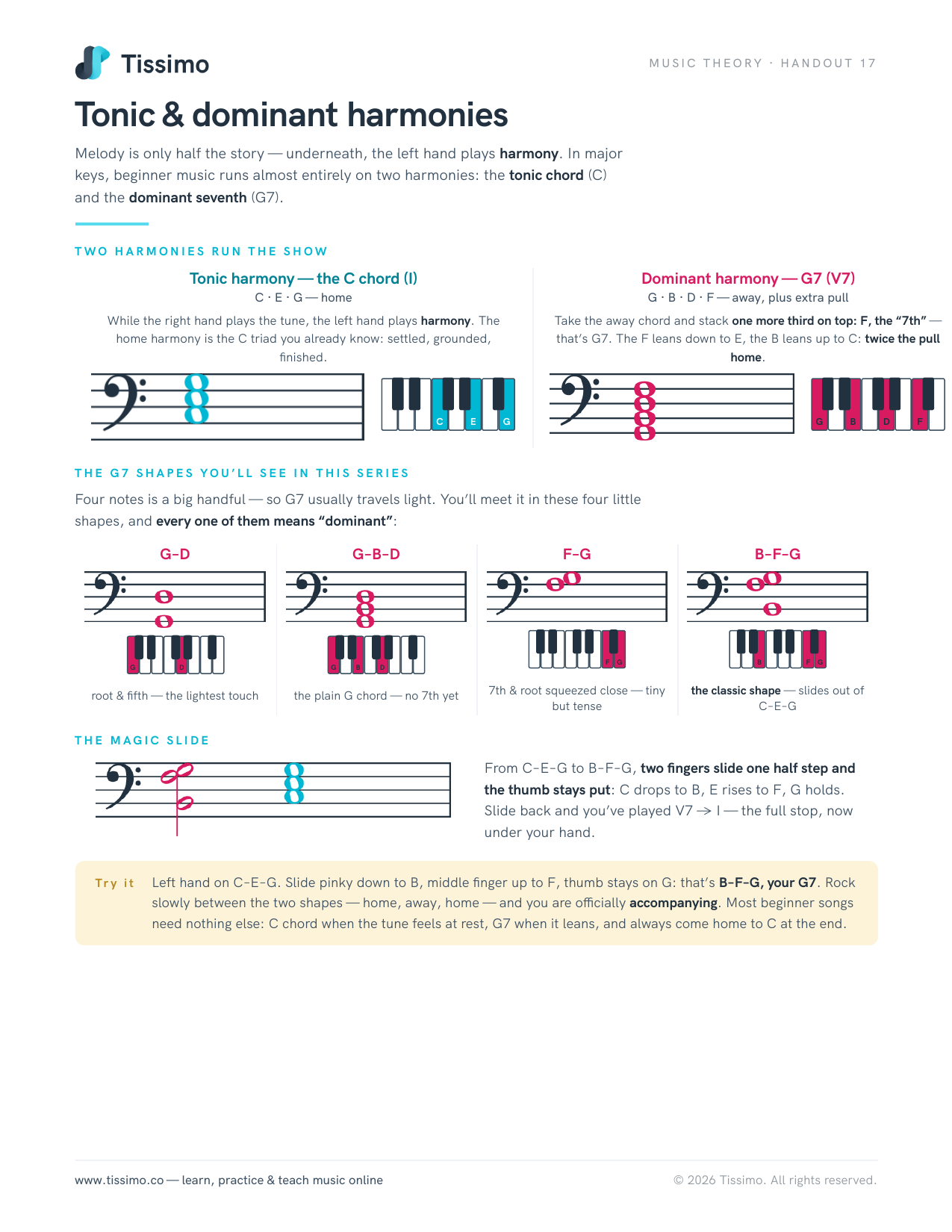 Tonic & dominant harmoniesMelody is only half the story — underneath, the left hand plays harmony. In major keys, beginner music runs almost entirely on two harmonies: the tonic chord (C) and the dominant seventh (G7).
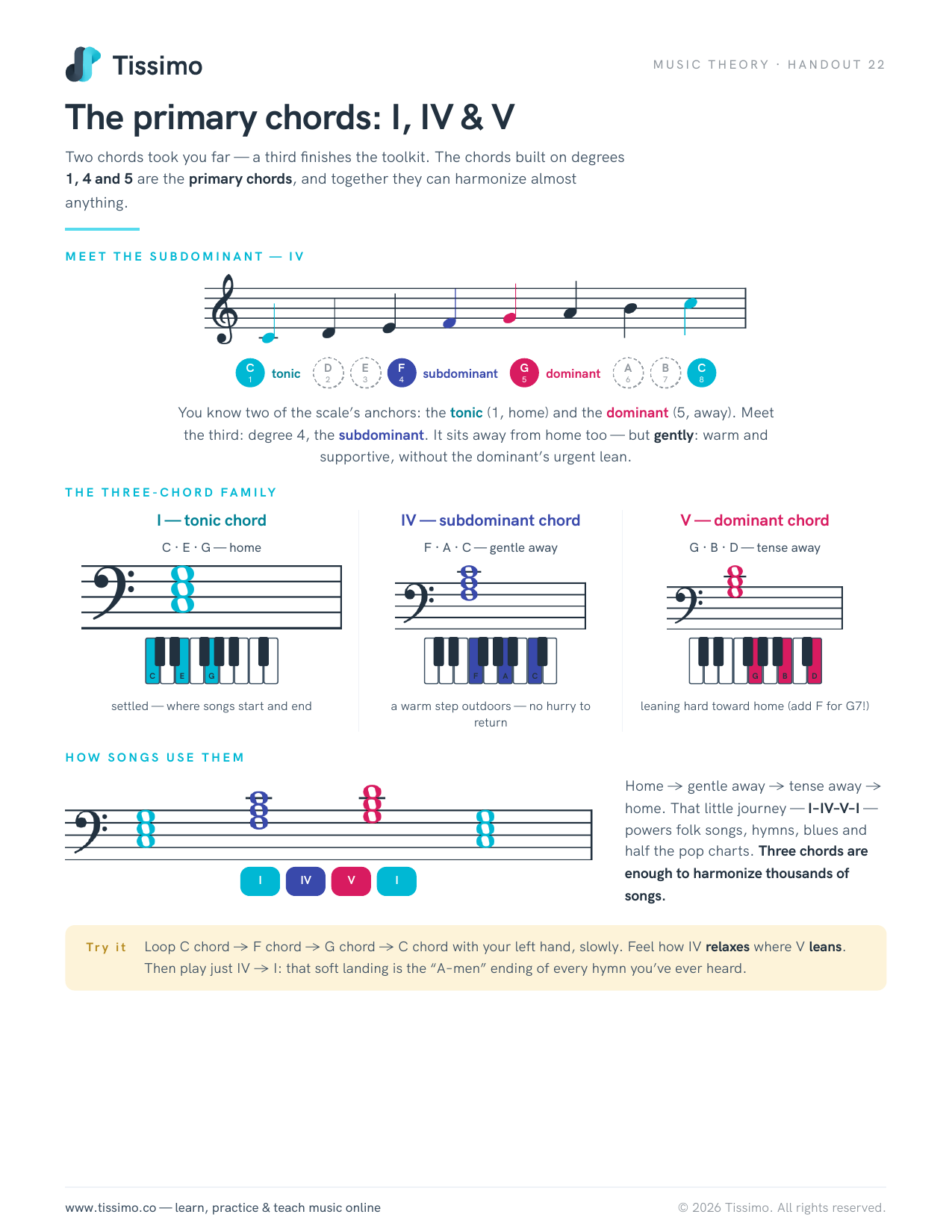 The primary chords: I, IV & VTwo chords took you far — a third finishes the toolkit. The chords built on degrees 1, 4 and 5 are the primary chords, and together they can harmonize almost anything.
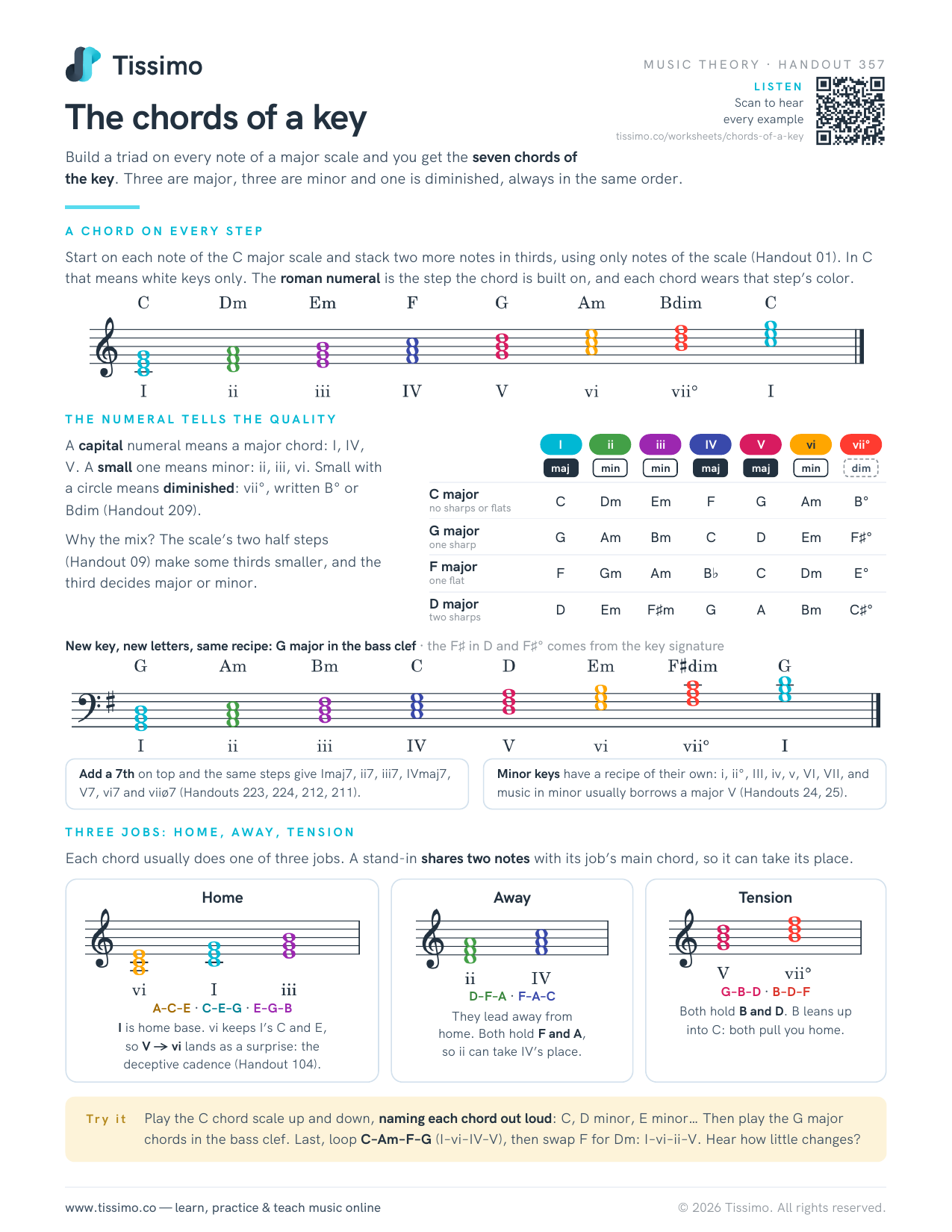 The chords of a keyBuild a triad on every note of a major scale and you get the seven chords of the key. Three are major, three are minor and one is diminished, always in the same order.
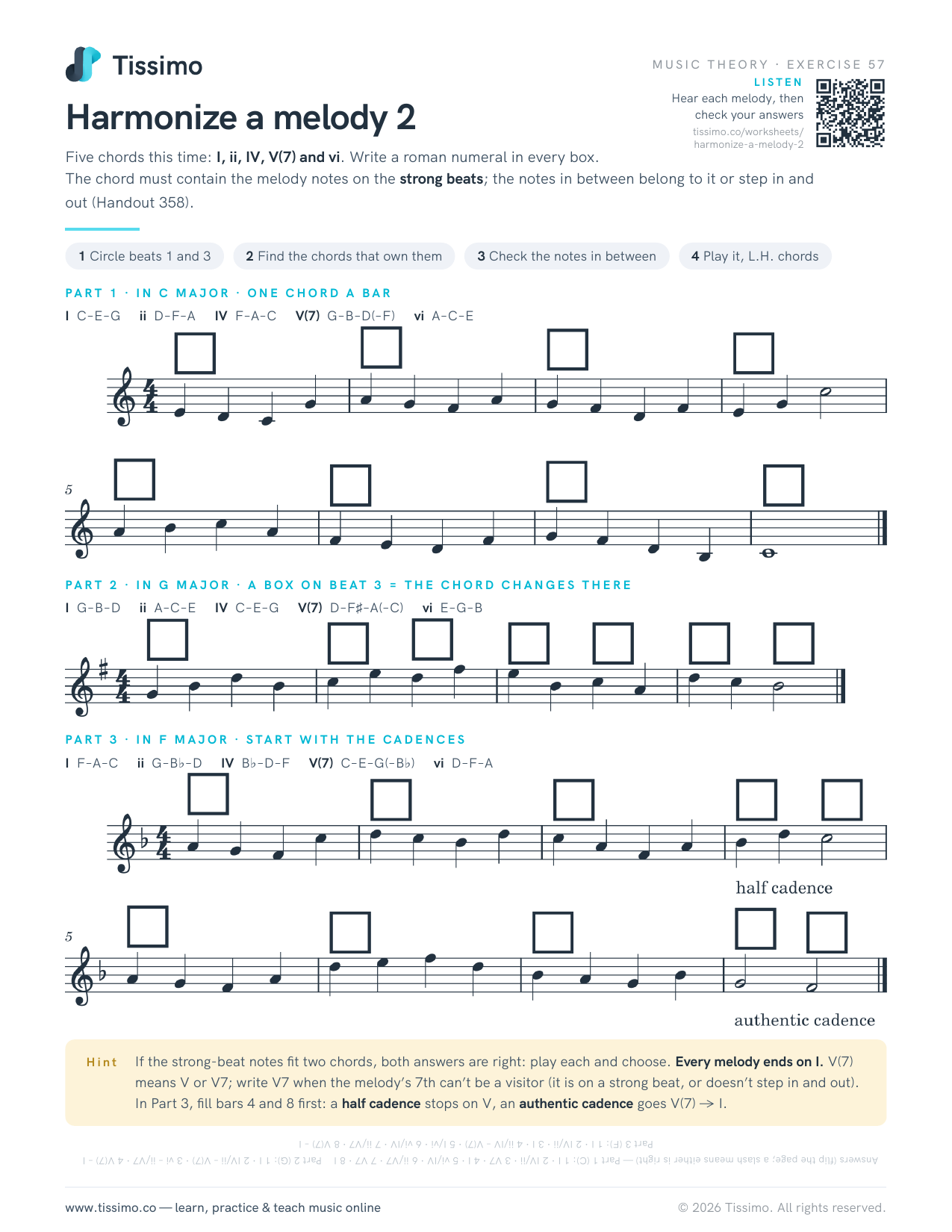 Harmonize a melody 2Five chords this time: I, ii, IV, V(7) and vi. Write a roman numeral in every box. The chord must contain the melody notes on the strong beats; the notes in between belong to it or step in and out (Handout 358).
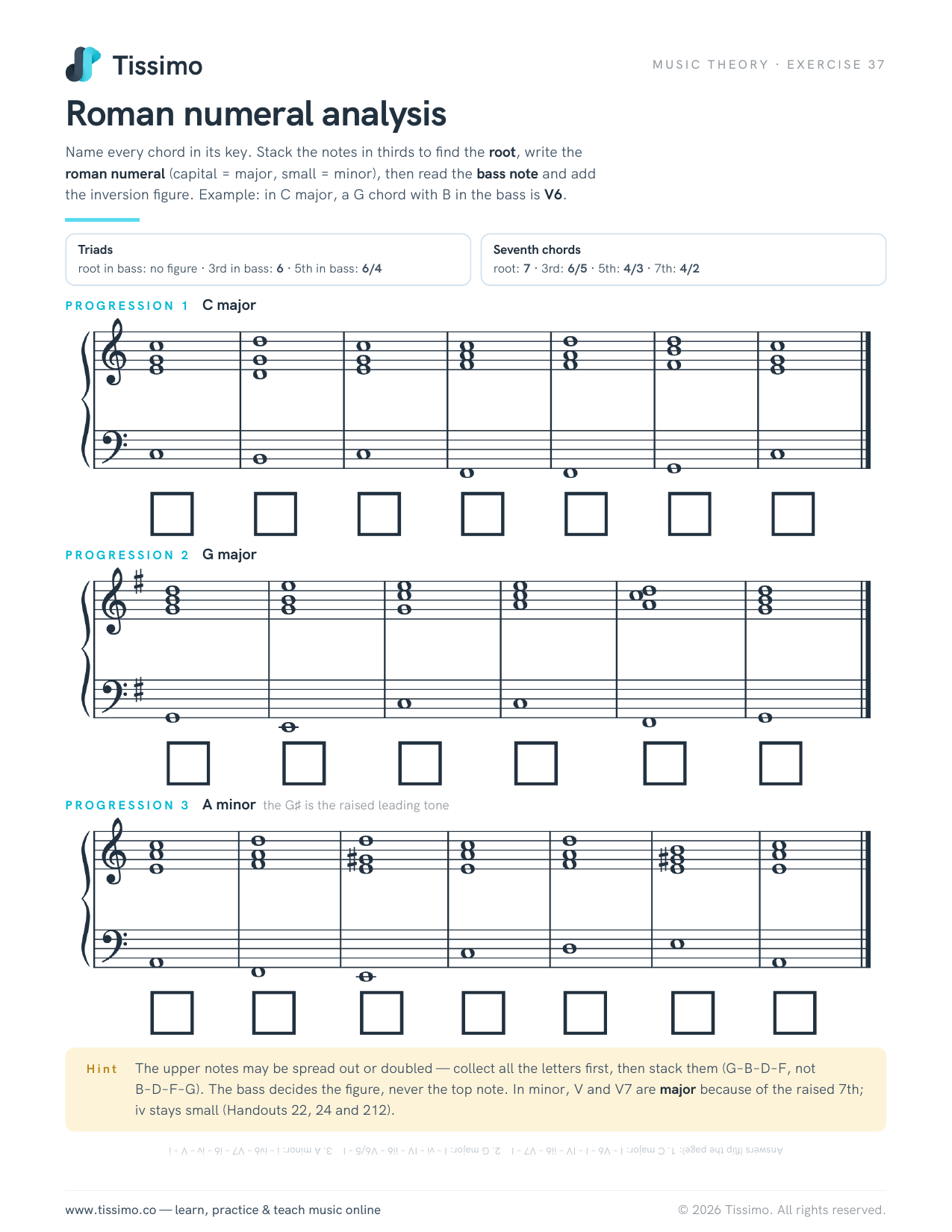 Roman numeral analysisName every chord in its key. Stack the notes in thirds to find the root, write the roman numeral (capital = major, small = minor), then read the bass note and add the inversion figure. Example: in C major, a G chord with B in the bass is V6.
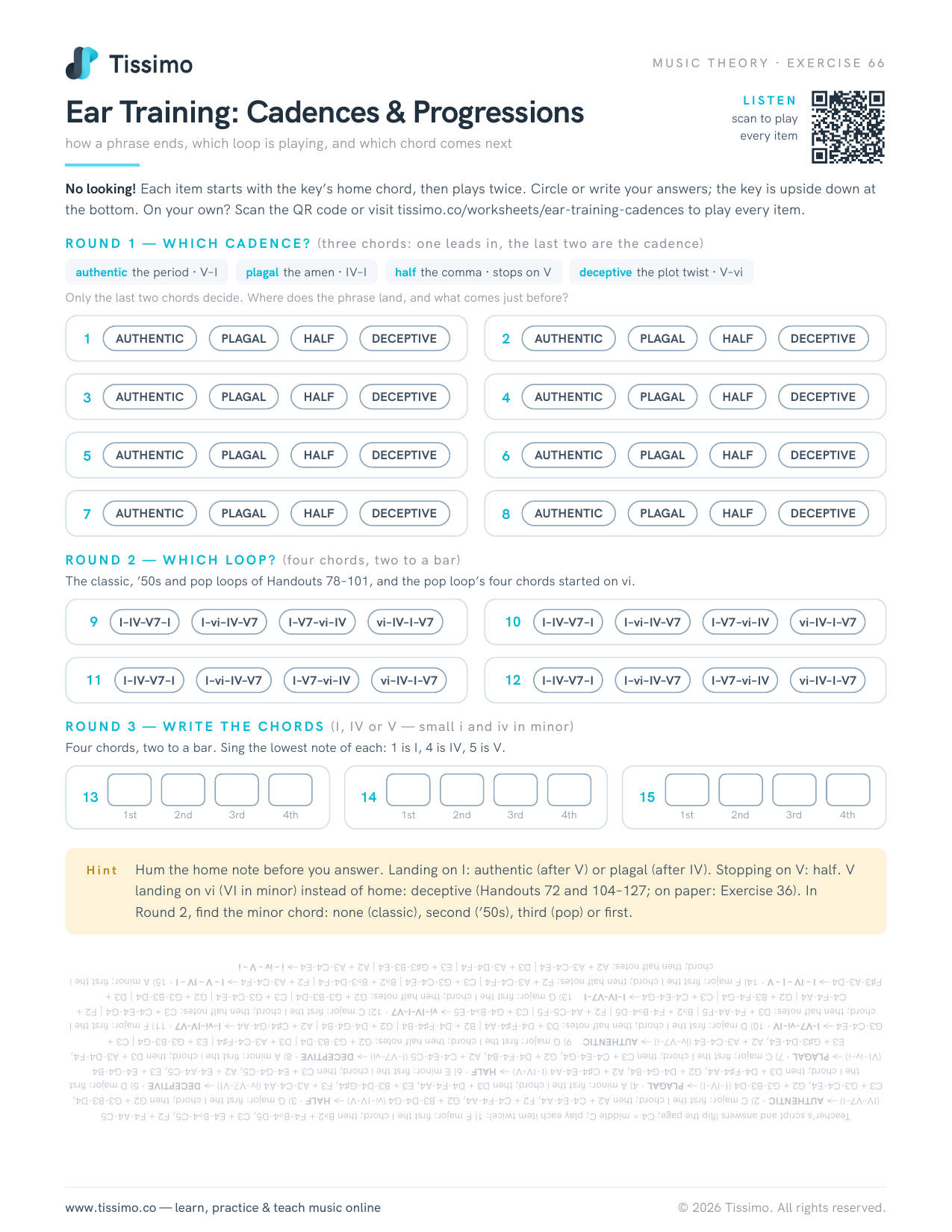 Ear Training: Cadences & Progressionshow a phrase ends, which loop is playing, and which chord comes next