Chords & Harmony
Deceptive Cadence
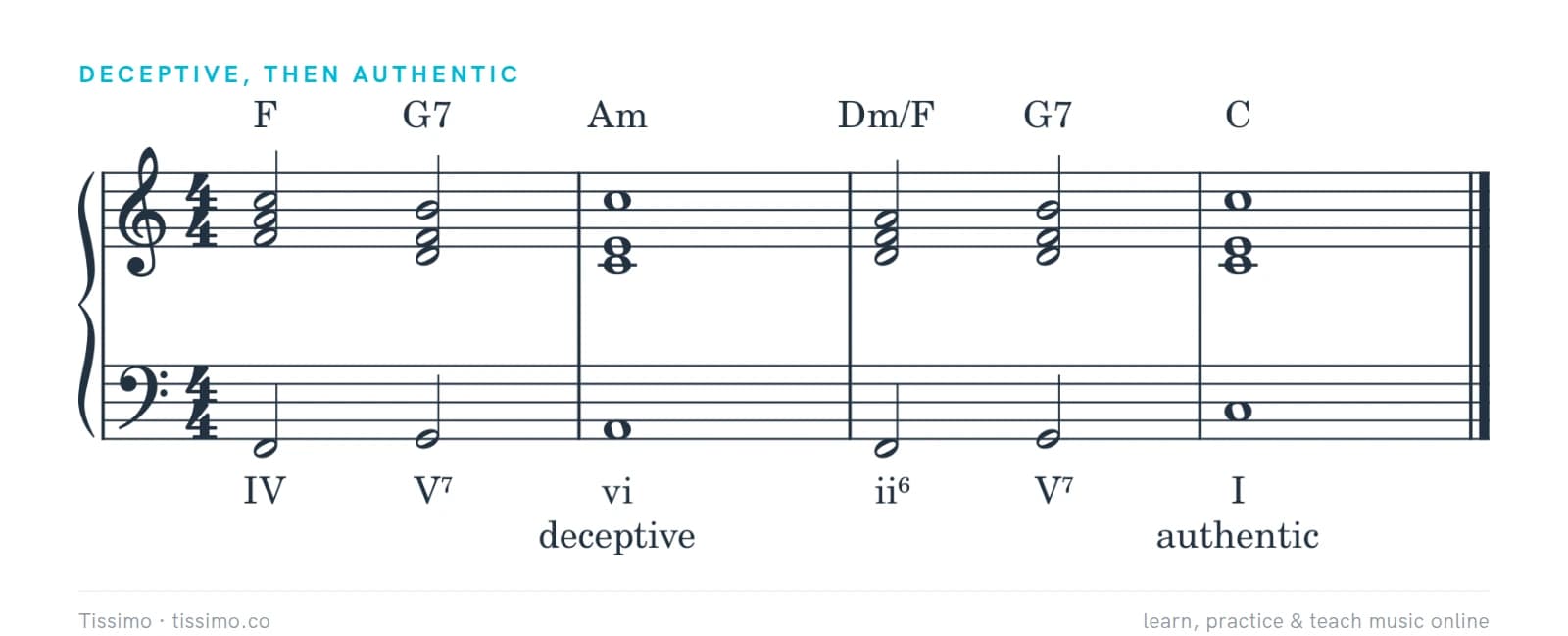
A deceptive cadence is a progression in which the dominant (V) moves to a chord other than the expected tonic, most often vi, as in G to A minor in C major. It postpones the ending of the phrase.
A deceptive cadence is a progression in which the dominant chord moves somewhere other than the expected tonic. By far the most common version is V–vi: in C major, G (or G7) to A minor. The ear hears the dominant, expects C, and gets A minor instead. The phrase cannot end there, so the music has to continue, usually to a stronger cadence a few bars later.
Why V–vi works
vi (A–C–E) shares two notes with I (C–E–G), so it can stand in for the tonic without sounding wrong. The leading tone still rises to C, and the seventh of V7 still falls to E, exactly as in an authentic cadence. Only the bass changes course: instead of moving to C, it rises a step to A. In four-part writing the third of vi (C) is usually doubled, because both the leading tone and another voice move to it.
What it is for
- Extending a phrase. A deceptive cadence pushes the ending further away, so the final authentic cadence feels even more welcome.
- Surprise and color. A sudden turn to the minor vi can sound tender, sad or dramatic, depending on the music around it.
- Keeping a song moving. In popular music, V–vi can lead into the next section or keep a loop going instead of closing it.
Other deceptive resolutions
Any unexpected chord after V can play the same role, such as IV6 or, in a major key, the borrowed ♭VI (A♭ major in C major), which gives a darker, more dramatic surprise. In a minor key the usual deceptive cadence is V–VI (E to F major in A minor). See borrowed chord and harmonic function.
Practice with Cadences, Identify the cadences and Ear Training: Cadences & Progressions.
Common questions
Why is it called a deceptive cadence?
Because the dominant leads the listener to expect the tonic chord and the music moves somewhere else. British books call it an interrupted cadence.
Is V–vi always a deceptive cadence?
Only at the end of a phrase, where the tonic is expected. In the middle of a phrase, V–vi is just a progression.
Practice it: free worksheets
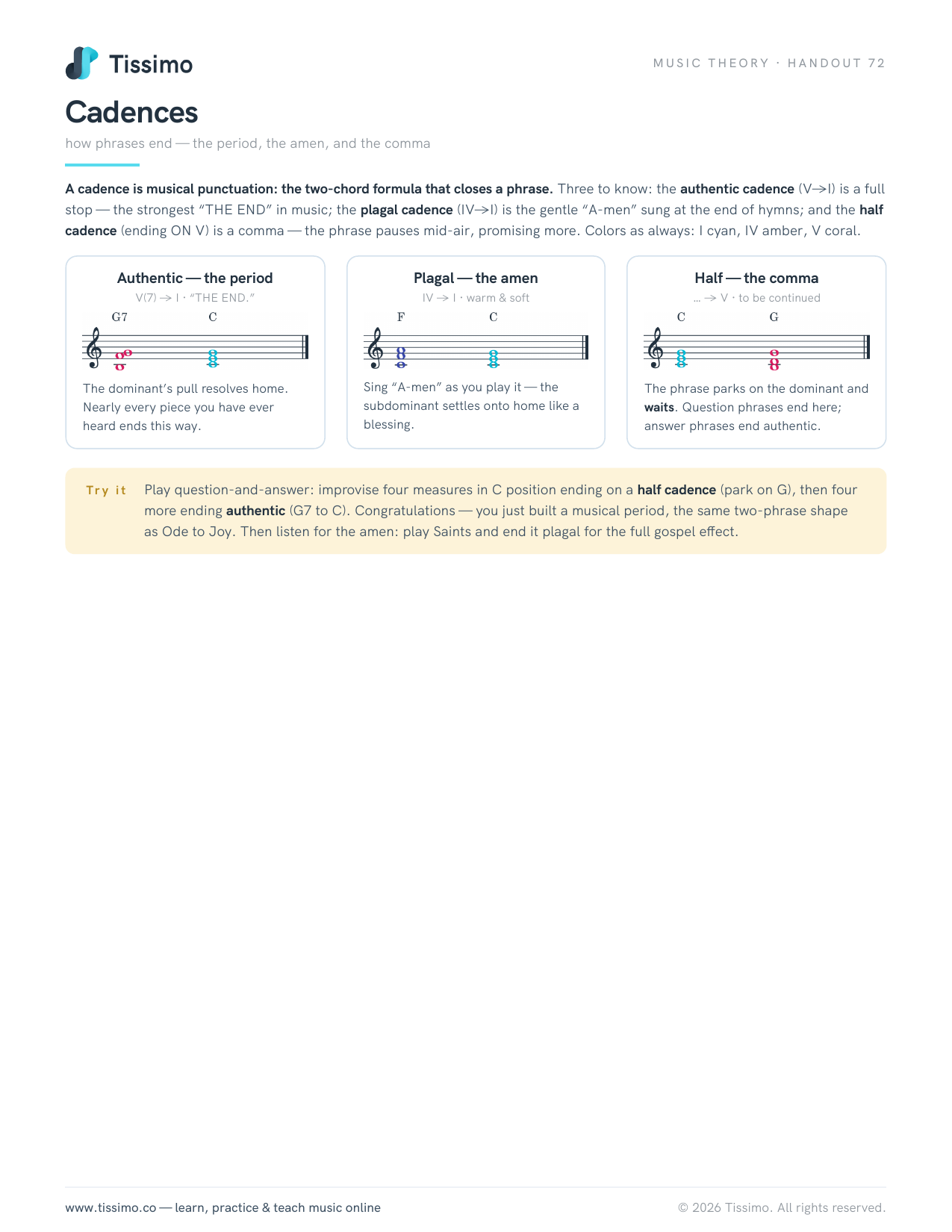 Cadenceshow phrases end — the period, the amen, and the comma
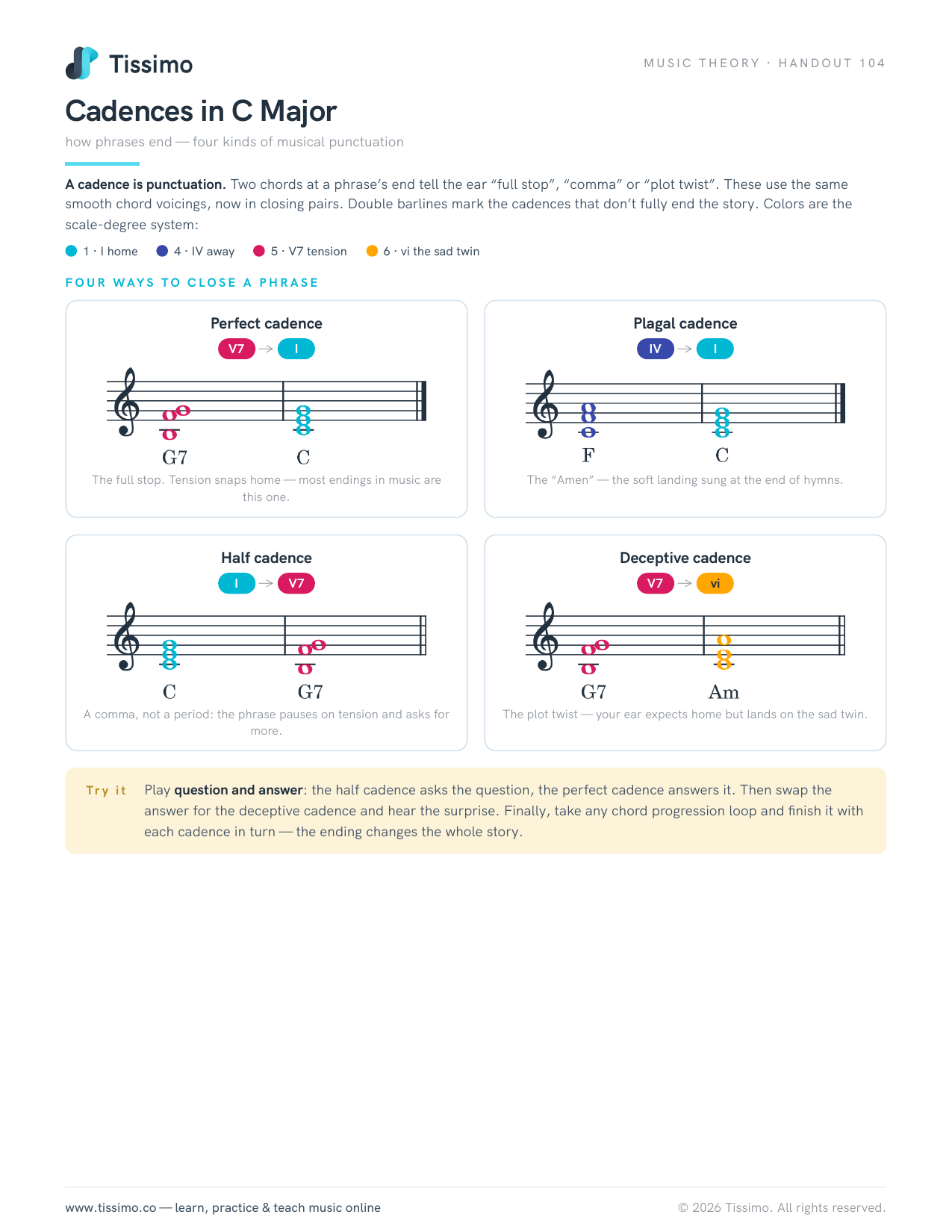 Cadences in Every KeyHow phrases end — the four kinds of musical punctuation, written out in all 24 keys.
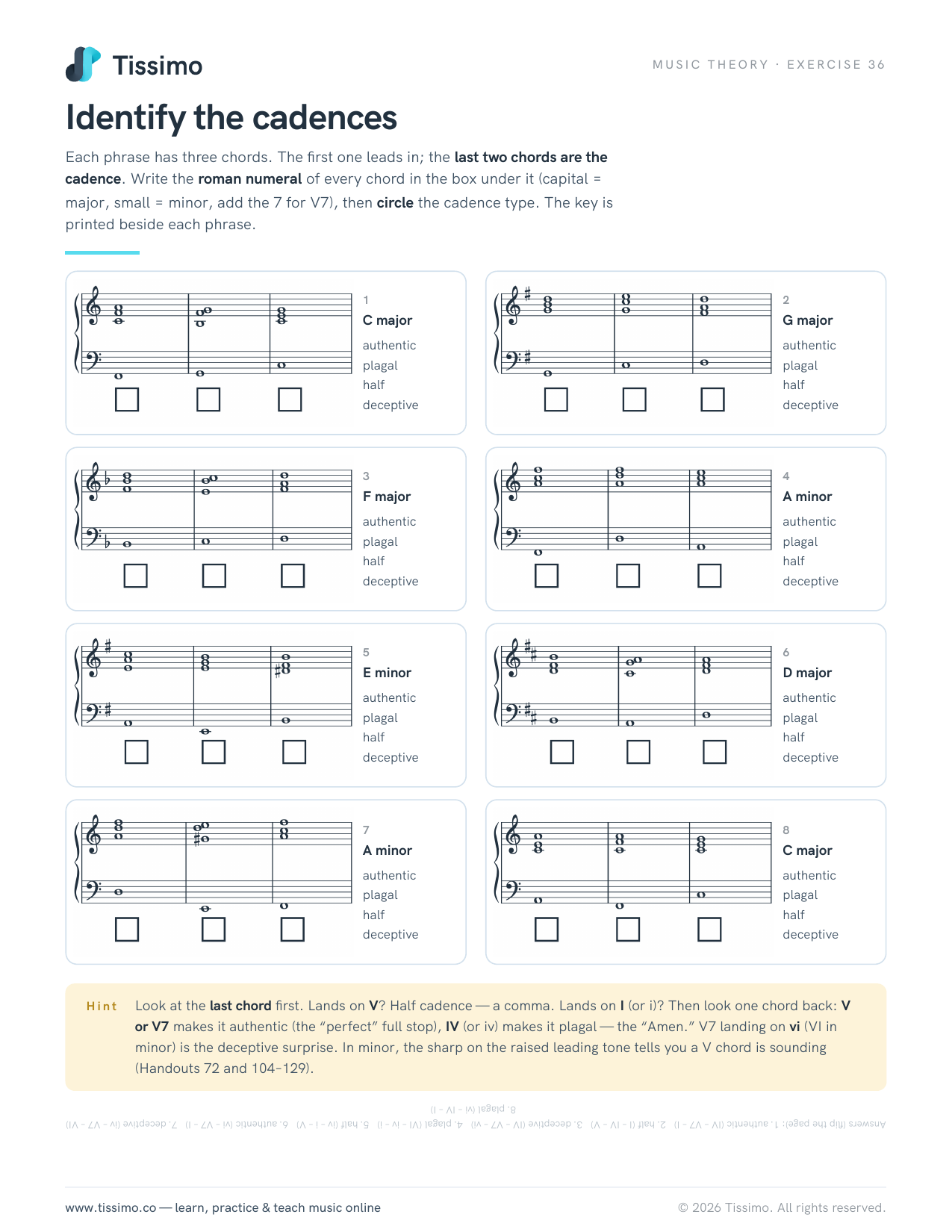 Identify the cadencesEach phrase has three chords. The first one leads in; the last two chords are the cadence. Write the roman numeral of every chord in the box under it (capital = major, small = minor, add the 7 for V7), then circle the cadence type. The key is printed beside each phrase.
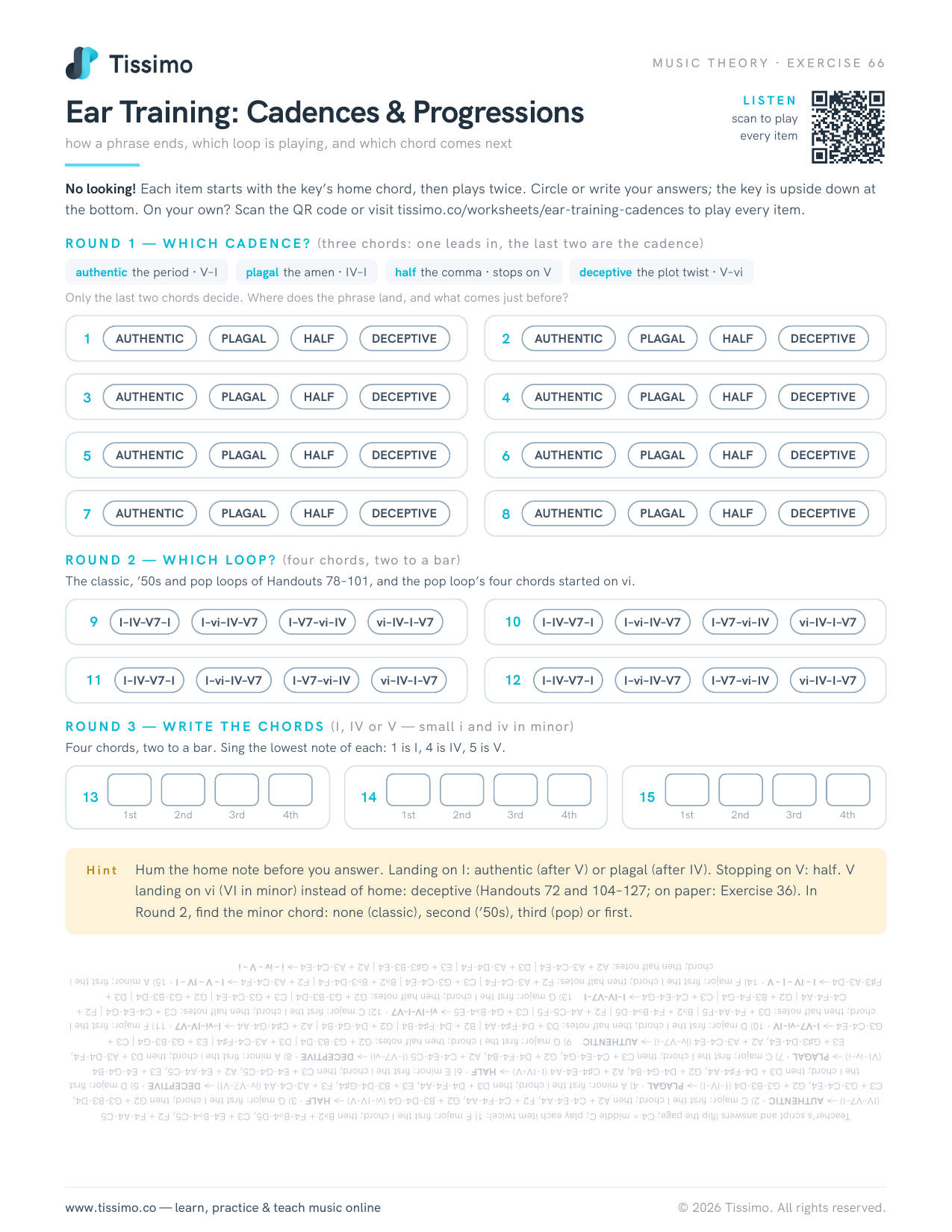 Ear Training: Cadences & Progressionshow a phrase ends, which loop is playing, and which chord comes next