Melody, Texture & Counterpoint
Phrase
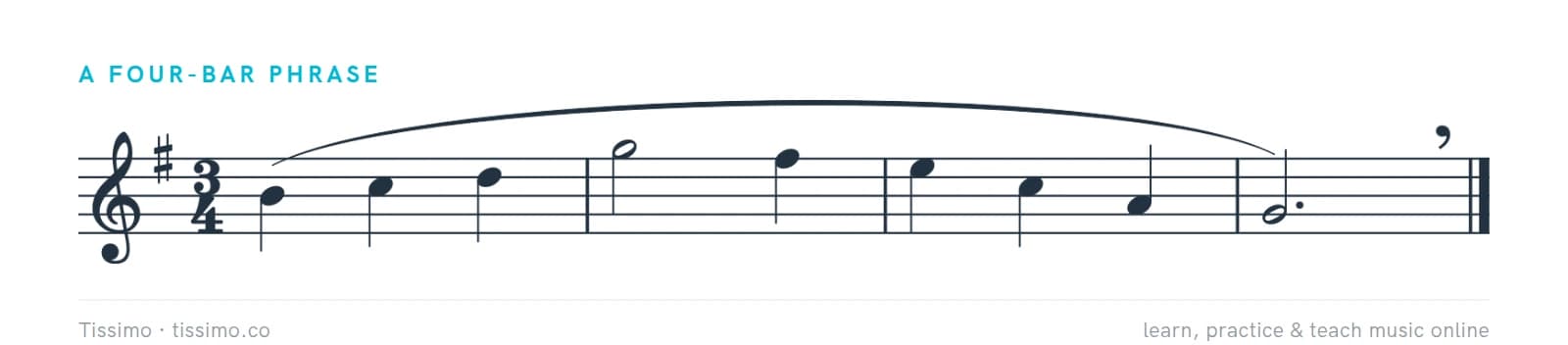
A phrase is a musical sentence: a passage, often four bars long, that makes sense on its own and ends with a point of rest called a cadence.
A phrase is a musical sentence. Like a sentence in speech, it has a beginning, a middle and an end, makes sense on its own, and finishes with a kind of punctuation: a cadence, a point where the music pauses or comes to rest. In much classical and popular music, phrases are four bars long, though two-, three-, five- and eight-bar phrases are common too.
How to find a phrase
- Listen for the breath. If you sang the melody, where would you naturally breathe? That is usually the end of a phrase.
- Look for the cadence. A longer note, a rest or a familiar harmonic close (V to I, or a stop on V) marks the end.
- Look for the curve. Editions often show a phrase with a long curved line over it, the phrase mark. It looks like a slur but spans the whole sentence.
- Look for repetition. When the opening idea comes back, a new phrase has usually started.
Phrases in pairs
Phrases often come in pairs that answer each other. The first ends with a weaker, open cadence, like a question; the second ends with a strong cadence on the home chord, like an answer. Together they make a period. Tissimo's Question and answer shows this pairing with real cadences.
Playing a phrase
Knowing where a phrase starts and ends changes how you play it. Shape each phrase toward its high point, let it relax into the cadence, and leave a little space before the next one. This shaping is called phrasing: see Phrasing. A common beginner habit is to make a break at every bar line instead; thinking in phrases fixes that.
Learn more in Phrase and period.
Common questions
How many bars is a musical phrase?
Most often four, especially in Classical music, folk songs and pop. Two-bar and eight-bar phrases are common too, and composers sometimes stretch or shorten a phrase for effect.
What is the difference between a phrase mark and a slur?
They look the same. A slur over a few notes asks for legato; a phrase mark is a long curve over a whole musical sentence that shows its shape. Many editions use the long curve for both ideas at once.
Practice it: free worksheets
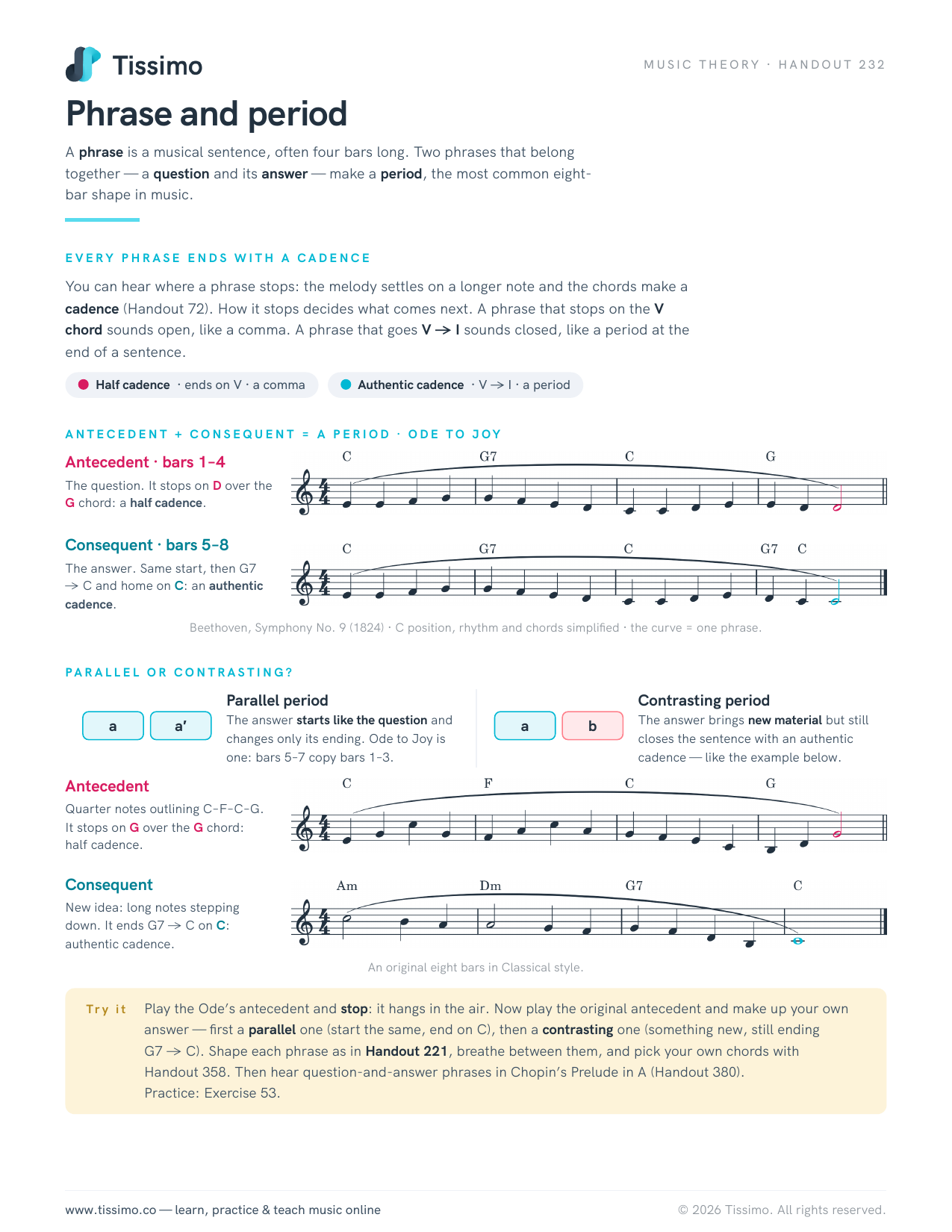 Phrase and periodA phrase is a musical sentence, often four bars long. Two phrases that belong together — a question and its answer — make a period, the most common eight-bar shape in music.
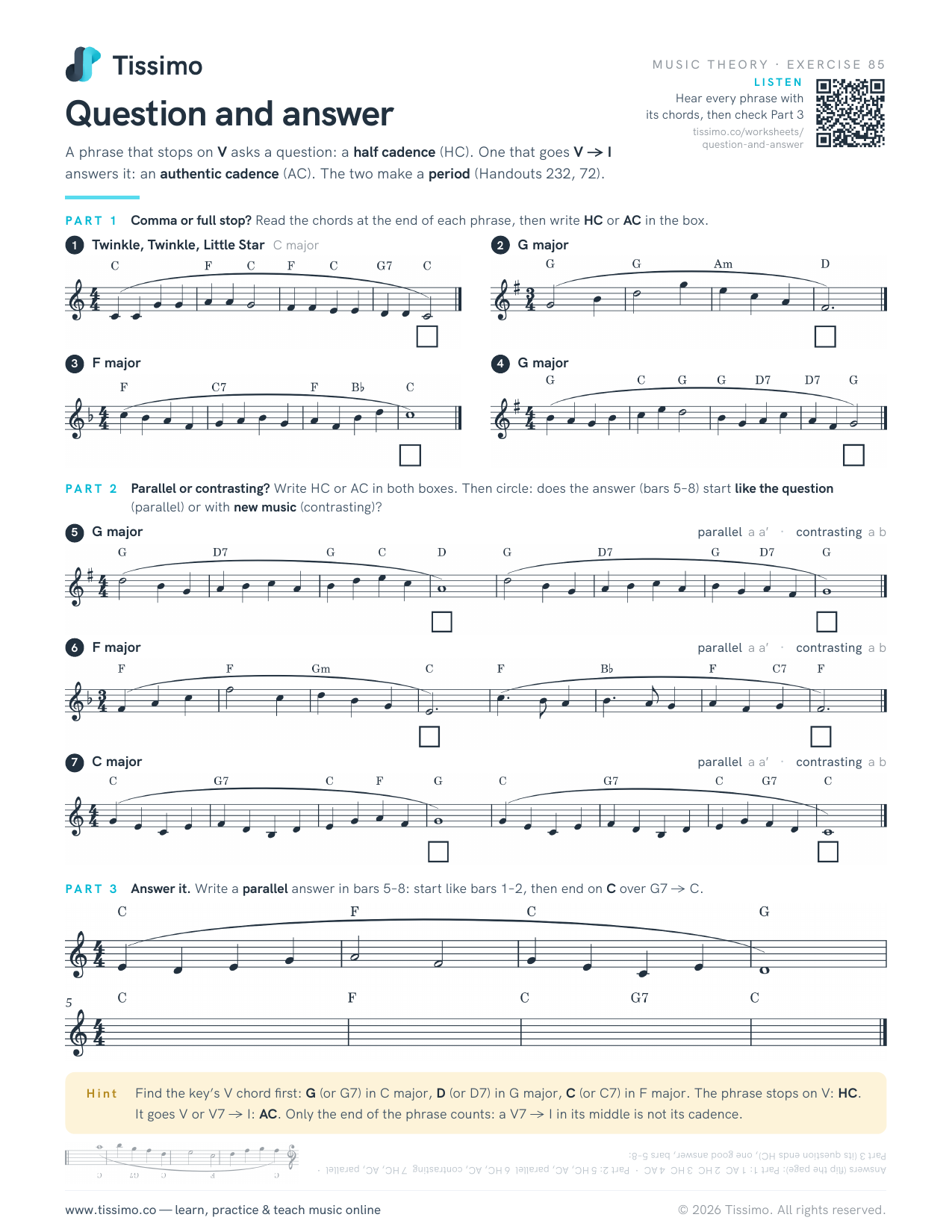 Question and answerA phrase that stops on V asks a question: a half cadence (HC). One that goes V → I answers it: an authentic cadence (AC). The two make a period (Handouts 232, 72).
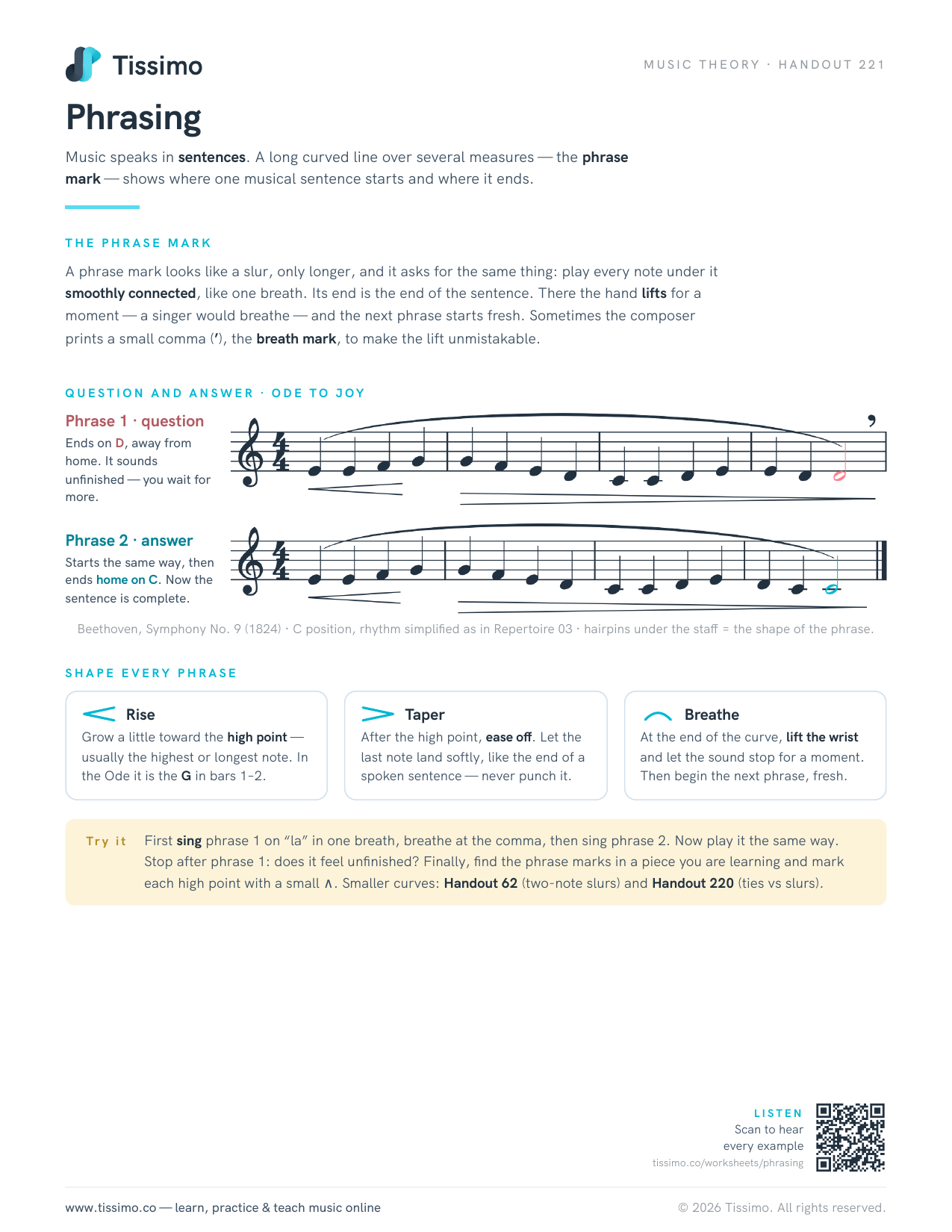 PhrasingMusic speaks in sentences. A long curved line over several measures — the phrase mark — shows where one musical sentence starts and where it ends.
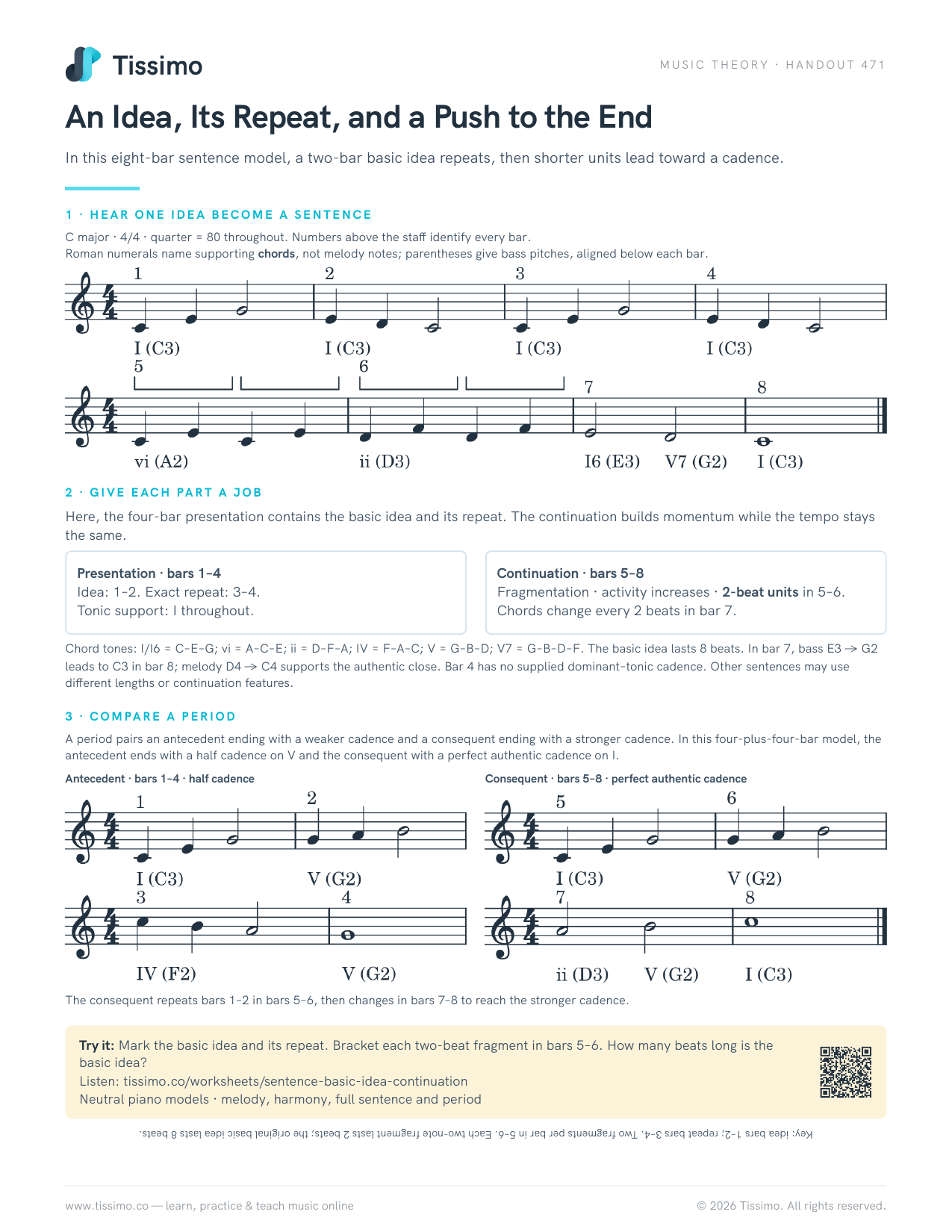 An Idea, Its Repeat, and a Push to the EndIn this eight-bar sentence model, a two-bar basic idea repeats, then shorter units lead toward a cadence.