Melody, Texture & Counterpoint
Sequence
A sequence is the repetition of a short musical idea starting on a higher or lower note, usually two or more times in a row, such as a pattern that steps down the scale.
A sequence is a short musical idea repeated at a different pitch: the same shape, starting a step (or another interval) higher or lower, usually several times in a row. The first statement is called the model; the repeats are the sequence. You hear sequences everywhere, from Baroque concertos to pop choruses, because they give the music a strong sense of direction while staying easy to follow.
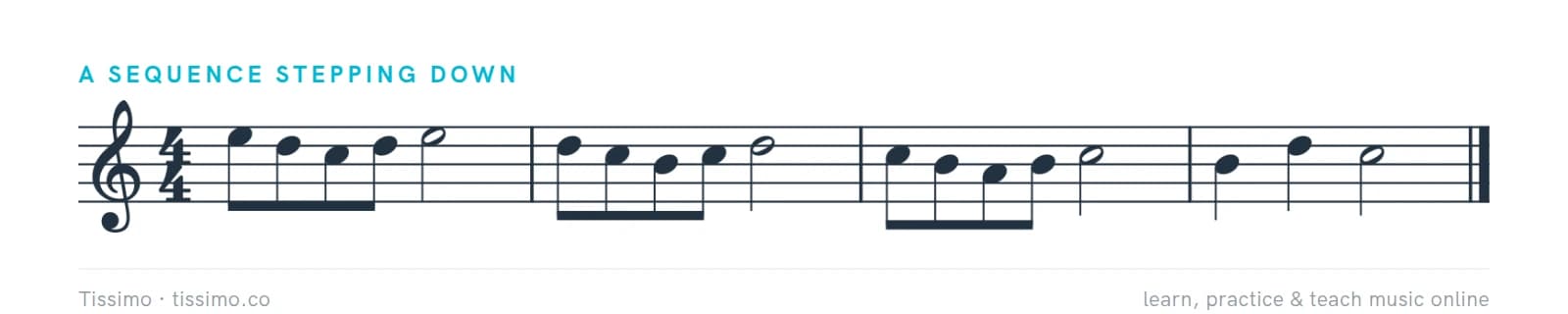
Real and tonal sequences
- In a tonal (diatonic) sequence, the repeats stay inside the key, so some intervals change size: a whole step in the model may become a half step in the copy. In the example, the model's E–D–C is all whole steps, while the copy's D–C–B ends with a half step.
- In a real sequence, every interval is copied exactly, so new sharps or flats appear and the music may drift toward another key.
Most sequences in tonal music are tonal; real sequences are often used to modulate.
Melodic and harmonic sequences
A melodic sequence repeats a tune at new pitches. A harmonic sequence repeats a chord pattern at new pitches. One of the most common harmonic sequences moves through chords whose roots fall by fifths (for example A–D–G–C), the pattern of the circle of fifths. Often melody and harmony move in sequence together.
How long does a sequence last?
Usually two or three statements. Composers tend to break the pattern before it becomes predictable, often with a cadence, as in bar 4 of the example. A sequence that repeats too many times can sound mechanical.
Not the same as a sequencer
In music production a sequencer is a device or program that records and plays back notes. The word comes from the same root, but it has nothing to do with repeating a pattern at a new pitch.
Spot sequences with Motif and sequence and Find the motif and the sequence.
Common questions
What is a sequence in music?
A short idea repeated at a higher or lower pitch, usually two or three times in a row. The repeats keep the shape and rhythm of the first statement.
What is the difference between a real and a tonal sequence?
A real sequence copies every interval exactly, adding new accidentals. A tonal sequence stays in the key, so some intervals change between whole and half steps.
Practice it: free worksheets
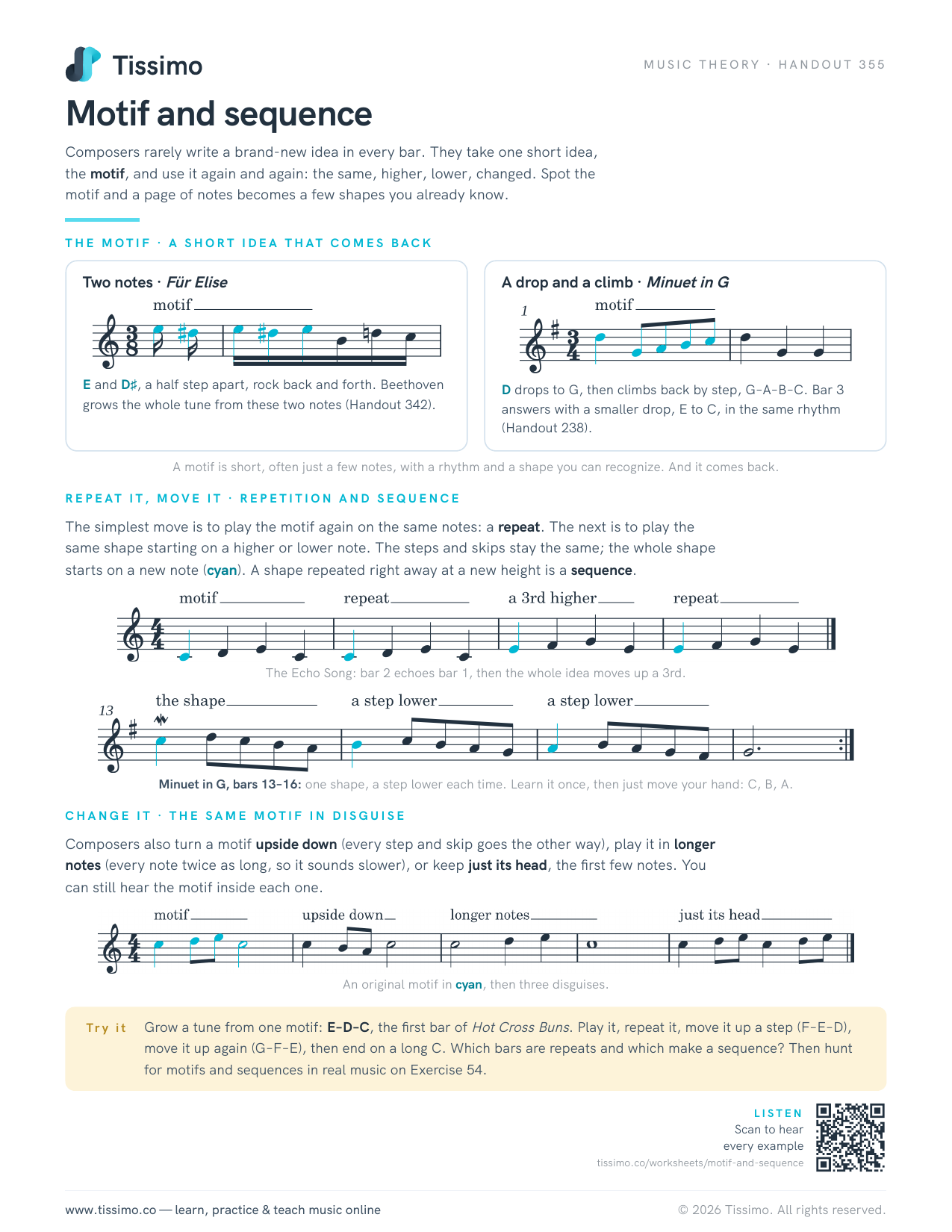 Motif and sequenceComposers rarely write a brand-new idea in every bar. They take one short idea, the motif, and use it again and again: the same, higher, lower, changed. Spot the motif and a page of notes becomes a few shapes you already know.
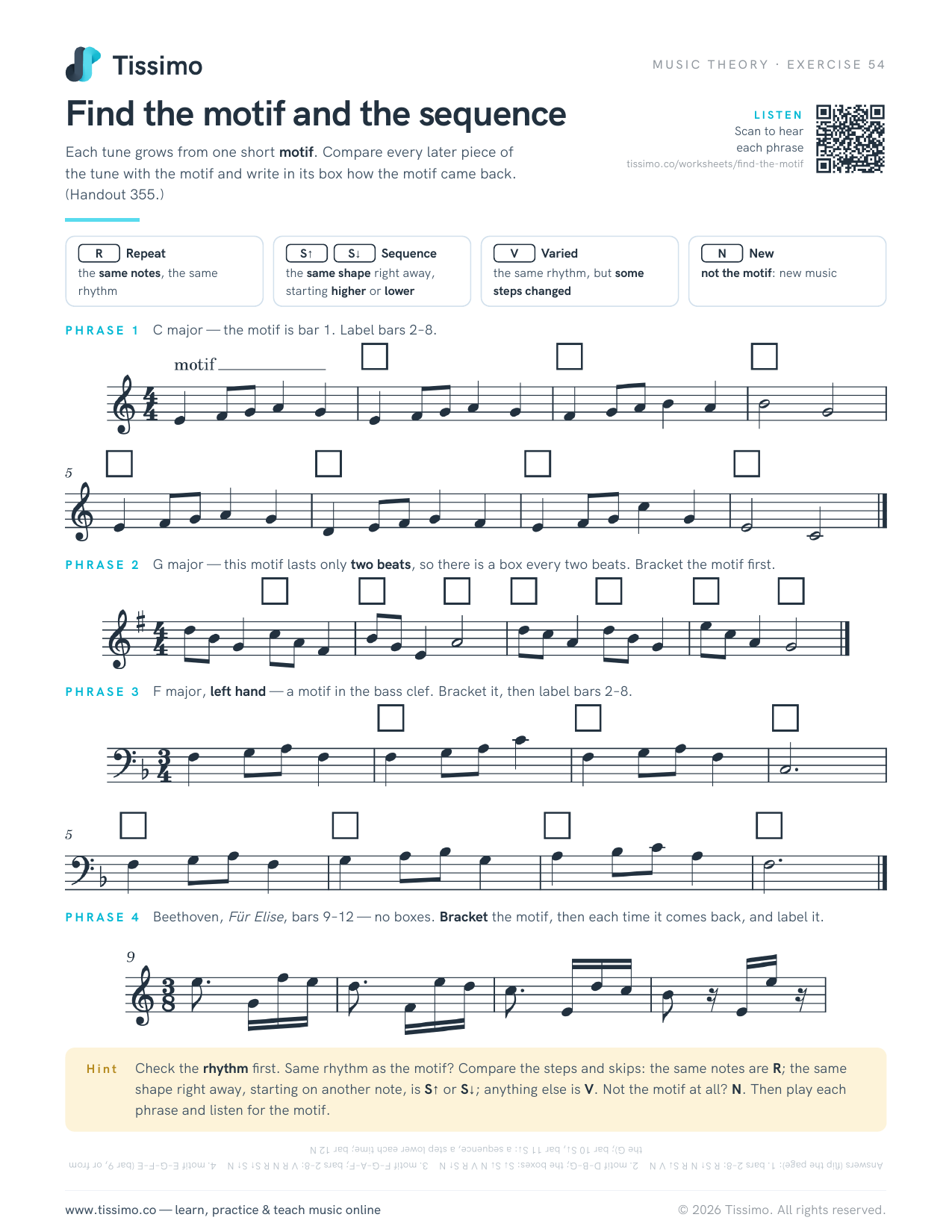 Find the motif and the sequenceEach tune grows from one short motif. Compare every later piece of the tune with the motif and write in its box how the motif came back. (Handout 355.)