Scales, Keys & Modes
Modulation
Pronounced mah-juh-LAY-shun
Modulation is a change of key within a piece of music, when a new note becomes the tonic. It is usually confirmed by a cadence in the new key and often signaled by a new accidental.
A piece does not have to stay in one key. Modulation is the process of moving to a new key in the middle of the music, so that a new note becomes the tonic. Most longer pieces modulate at least once, and leaving home and coming back is one of the main ways tonal music creates shape over time.
How you can tell
Three clues usually appear together:
- A new accidental that keeps coming back. Moving from C major to G major brings in F♯, the new key's leading tone. A single chromatic note can be passing color; one that stays is a sign of a new key.
- A cadence in the new key. The music confirms its new home with a dominant-to-tonic cadence, here D (or D7) to G.
- The music settles there. A brief touch on another key's dominant is a tonicization, not a full modulation. A modulation stays long enough for the new tonic to feel like home.
Pivot-chord modulation
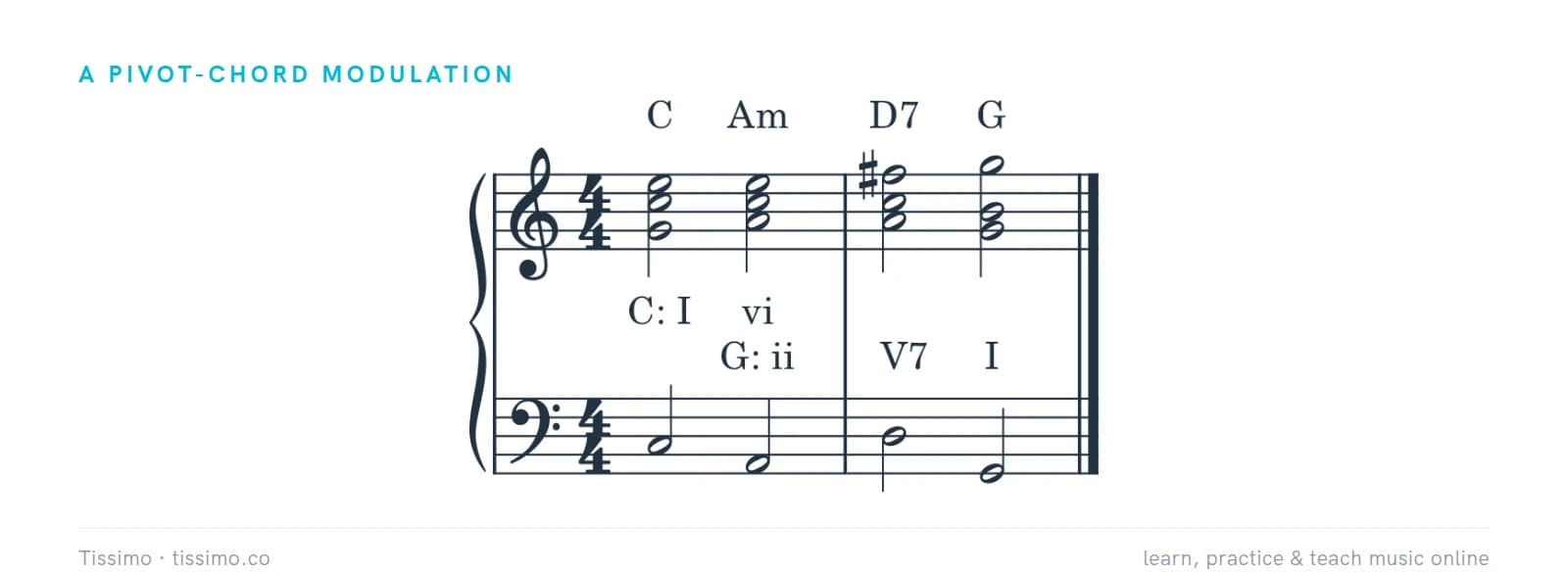
The smoothest way into a new key is through a pivot chord: a chord that belongs to both keys. A minor is vi in C major and ii in G major, so a progression can arrive on A minor as a C major chord and leave it as a G major one. The F♯ that follows, in D7, confirms the change.
Other kinds
- Direct modulation, also called phrase modulation: the music simply starts the next phrase in the new key, with no pivot.
- Chromatic modulation: a note is altered by a half step, F to F♯ for example, to slide into the new key.
- Common-tone modulation: a single held note is shared by the last chord of the old key and the first chord of the new one.
- The "truck driver's" modulation: a pop song lifts its final chorus up a half step or a whole step, abruptly, for a burst of energy.
Where music modulates
Music most often moves to closely related keys: those whose key signatures differ by no more than one sharp or flat. For C major they are G major and F major, plus the relative minors of all three: A minor, E minor and D minor. A major-key piece most commonly goes to its dominant key; a minor-key piece most commonly goes to its relative major. The circle of fifths shows these neighbors at a glance.
Modulation or transposition?
A modulation changes key within a piece, as part of the music. Transposition moves a whole piece or passage to a different key and keeps everything else the same: the music itself does not change key, only the version does.
Common questions
What is the difference between modulation and tonicization?
Length and confirmation. Tonicization briefly treats another chord as a tonic, usually with a secondary dominant, then returns. Modulation establishes a new key with a cadence and stays long enough for it to feel like home.
What is a pivot chord?
A chord that belongs to both the old key and the new one, used as a bridge between them. In a move from C major to G major, A minor (vi in C, ii in G) is a common pivot.
Practice it: free worksheets
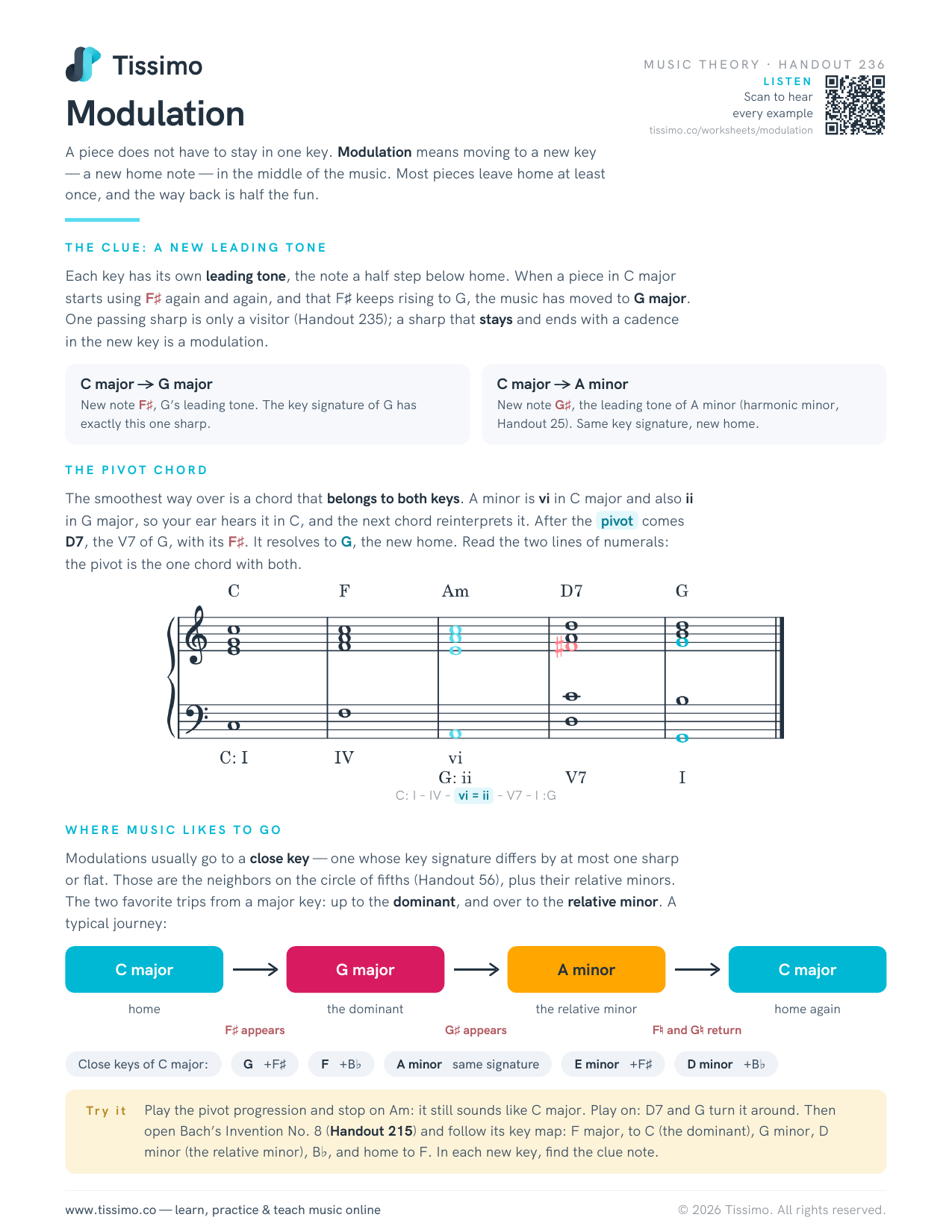 ModulationA piece does not have to stay in one key. Modulation means moving to a new key — a new home note — in the middle of the music. Most pieces leave home at least once, and the way back is half the fun.
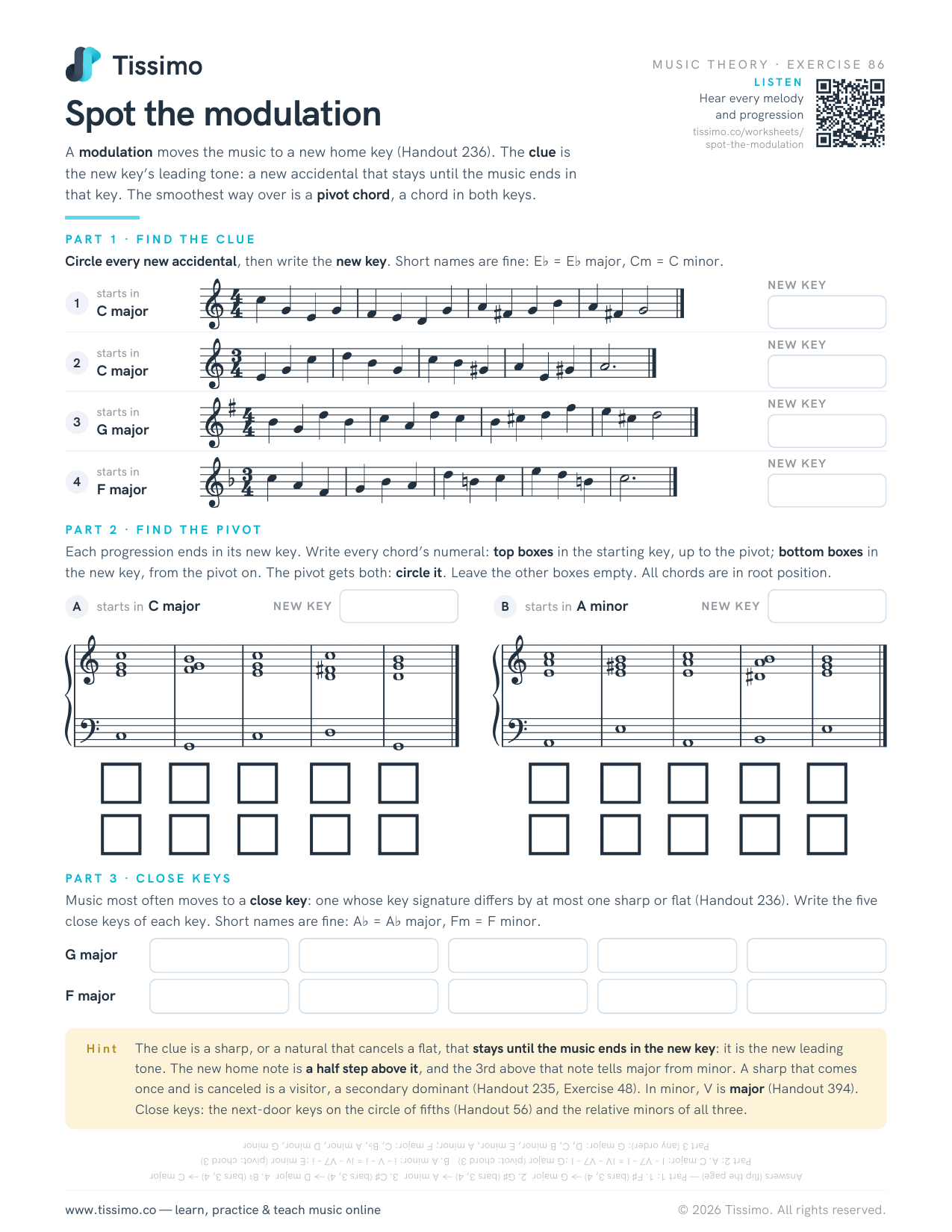 Spot the modulationA modulation moves the music to a new home key (Handout 236). The clue is the new key’s leading tone: a new accidental that stays until the music ends in that key. The smoothest way over is a pivot chord, a chord in both keys.
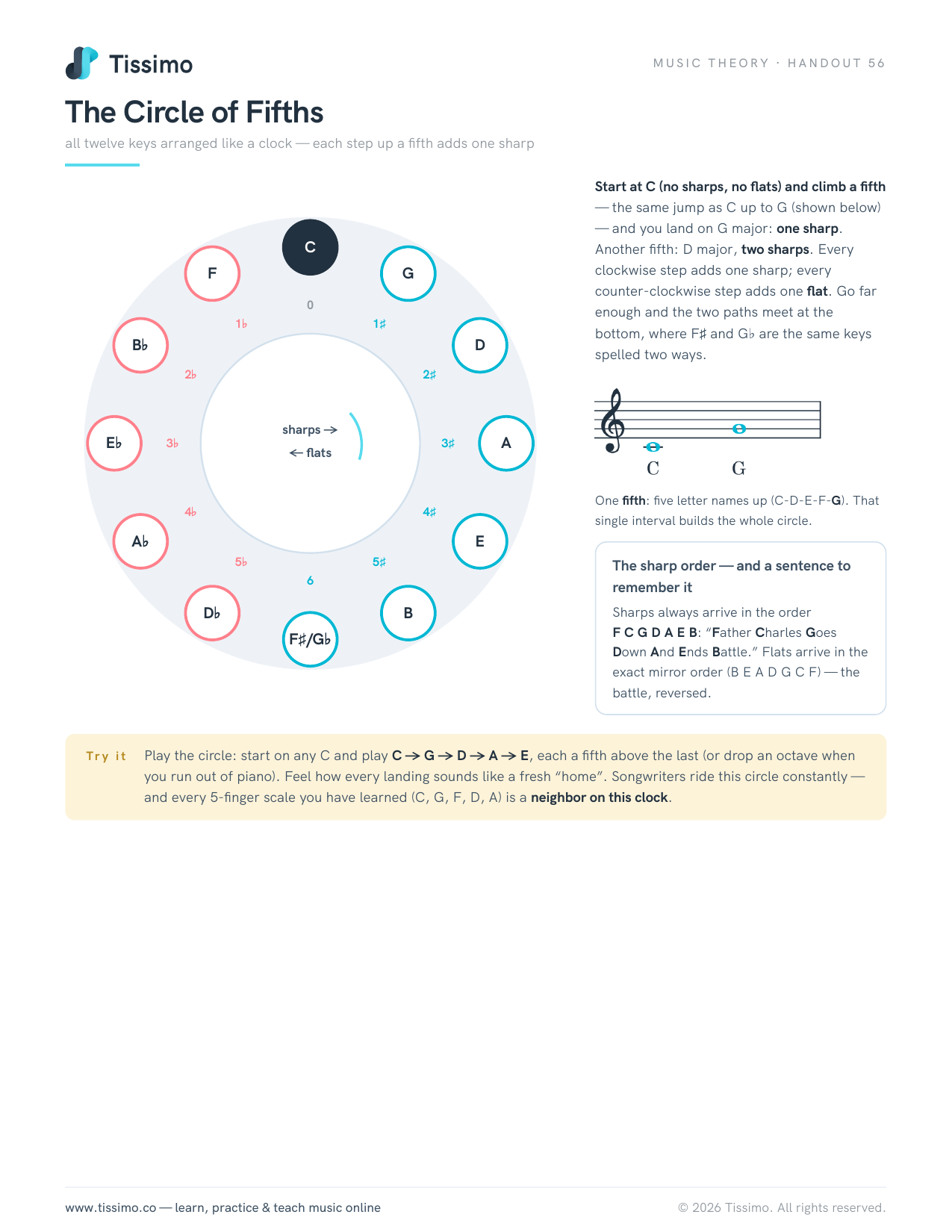 The Circle of Fifthsall twelve keys arranged like a clock — each step up a fifth adds one sharp
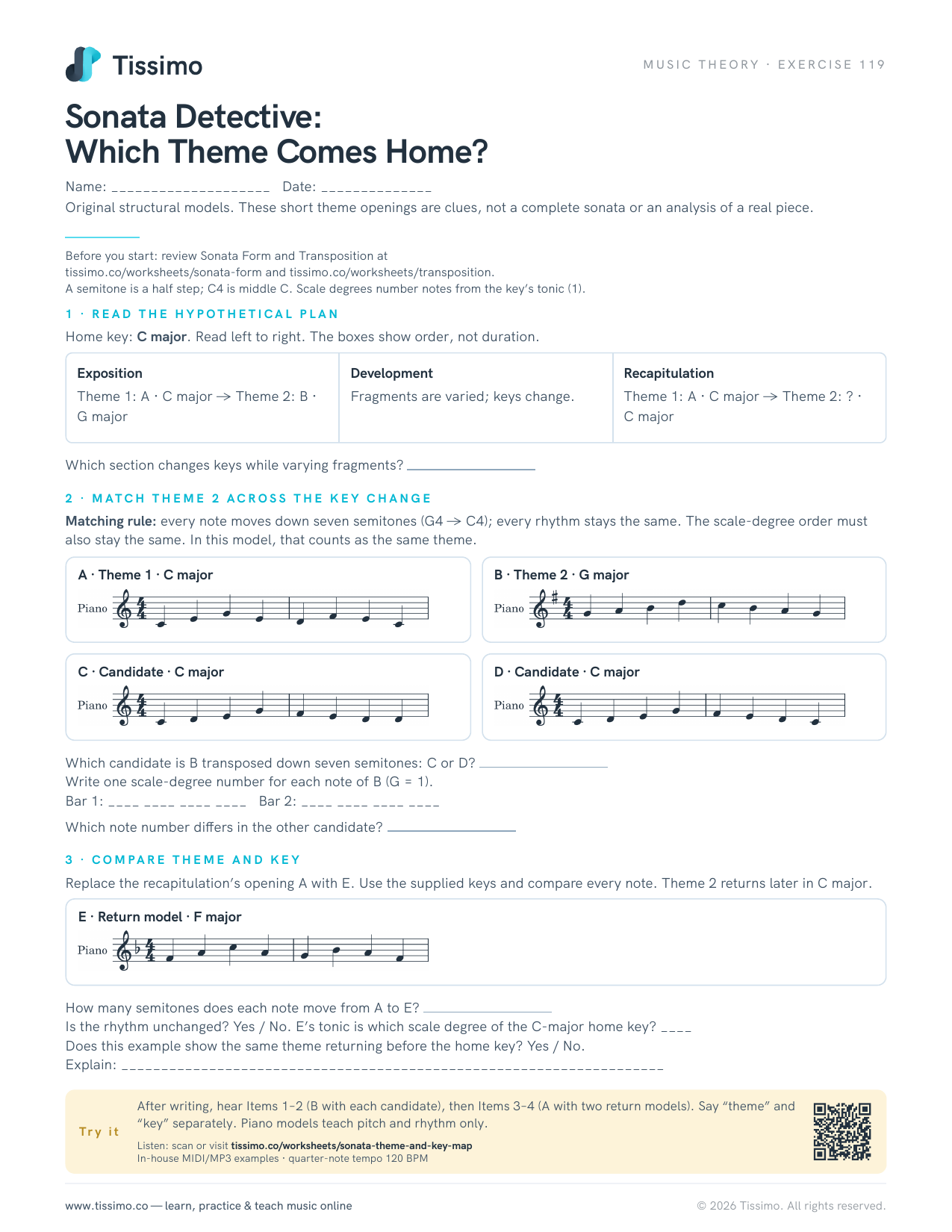 Sonata Detective: Which Theme Comes Home?Name: ____________________ Date: ______________ Original structural models. These short theme openings are clues, not a complete sonata or an analysis of a real piece.
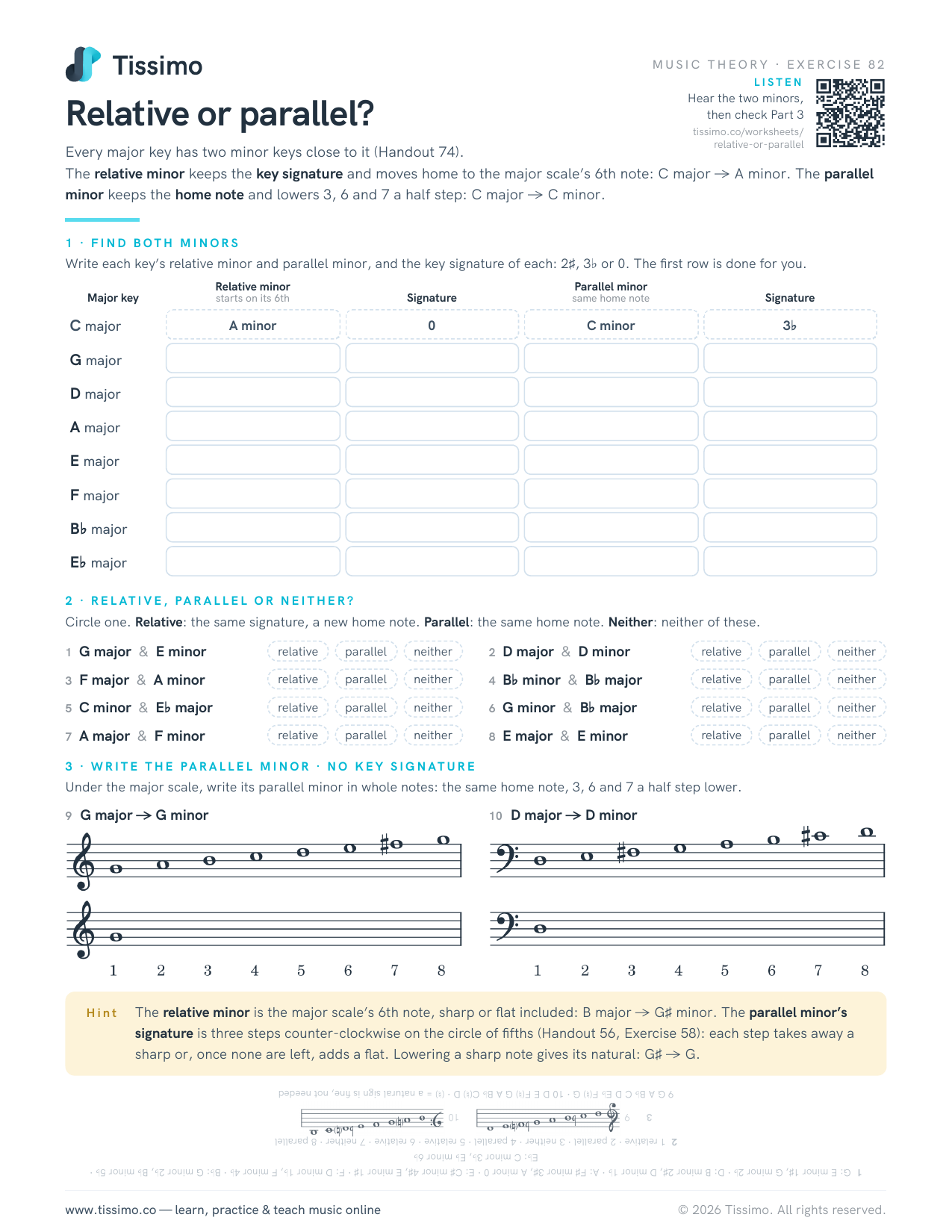 Relative or parallel?Every major key has two minor keys close to it (Handout 74). The relative minor keeps the key signature and moves home to the major scale’s 6th note: C major → A minor. The parallel minor keeps the home note and lowers 3, 6 and 7 a half step: C major → C minor.