Scales, Keys & Modes
Major Scale
The major scale is a seven-note scale built from the step pattern whole, whole, half, whole, whole, whole, half. Its bright, settled sound is the basis of most Western melody and harmony.
The major scale is the scale you sing when you sing do re mi fa sol la ti do. On the piano, the easiest one to find is C major: play the white keys from C up to the next C.
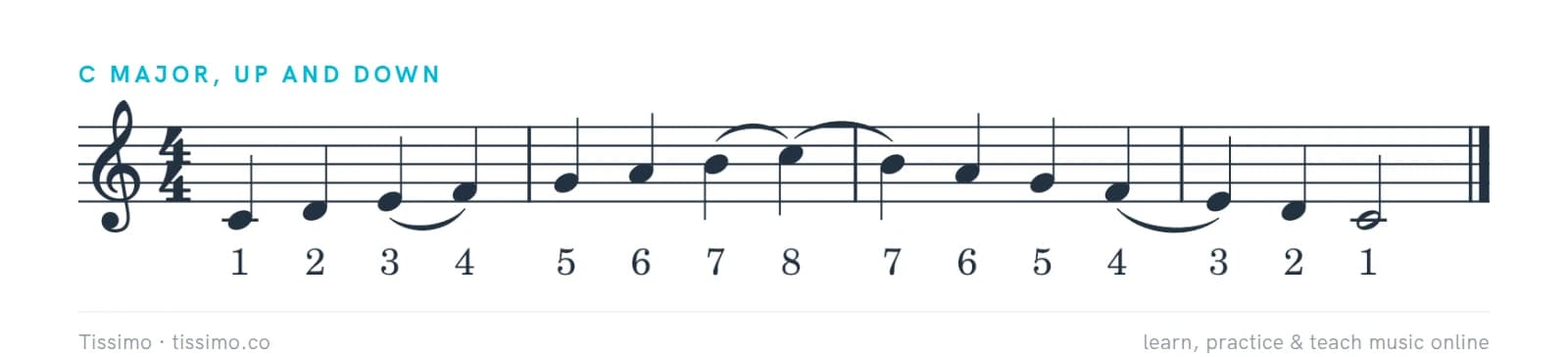
The step pattern: W–W–H–W–W–W–H
Every major scale, in every key, uses the same pattern of whole steps (W) and half steps (H):
W – W – H – W – W – W – H
In C major that gives C–D (W), D–E (W), E–F (H), F–G (W), G–A (W), A–B (W), B–C (H). The two half steps fall between degrees 3 and 4 and between 7 and 8. The keyboard shows why C major needs no black keys: E–F and B–C are the two pairs of white keys with no black key between them.
Major scales in other keys
Start the same pattern on another note and you need sharps or flats to keep it. From G, the step from E up to the 7th note must be a whole step, so F becomes F♯, and F♯ to G is the closing half step. From F, the 4th note must sit a half step above A, so B becomes B♭. Those sharps and flats are collected at the start of each line as the key signature: G major has one sharp, F major has one flat.
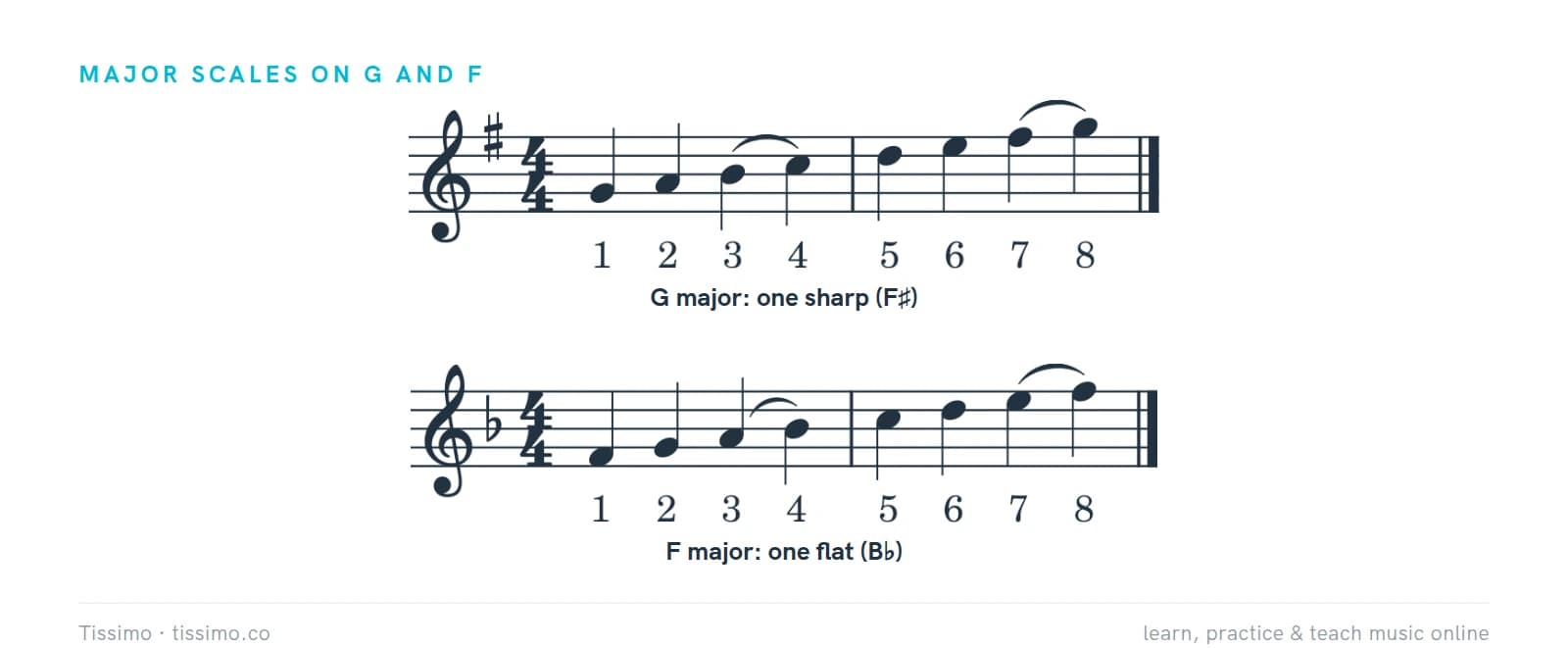
Each letter name appears exactly once in a major scale. That is why the 7th note of G major is written F♯ and not G♭: the letter G is already taken by the tonic.
A useful shortcut: the pattern splits into two identical four-note groups, W–W–H, joined by a whole step. These groups are called tetrachords. The upper tetrachord of C major (G A B C) is the lower tetrachord of G major, which is how neighboring keys link around the circle of fifths.
Degrees and their names
The seven notes are numbered as scale degrees 1 to 7, and each has a name: tonic, supertonic, mediant, subdominant, dominant, submediant and leading tone. The half step from the leading tone up to the tonic gives the major scale its strong pull home.
Playing it on the piano
The usual C major fingering is 1 2 3 1 2 3 4 5 in the right hand going up, with the thumb passing under the third finger after E, and 5 4 3 2 1 3 2 1 in the left hand, with the third finger crossing over the thumb after G. Thumb-Under: the Full Scale walks you through the move, and Scales in Every Key gives the fingering for all twelve major keys.
Common questions
What is the formula for a major scale?
Whole, whole, half, whole, whole, whole, half (W–W–H–W–W–W–H). Start on any note, follow that pattern of whole and half steps, use each letter name once, and you have spelled its major scale.
Why does C major have no sharps or flats?
Because the white keys from C fit the major-scale pattern exactly. The two half steps it needs, E–F and B–C, are the two places where white keys sit side by side with no black key between them.
Practice it: free worksheets
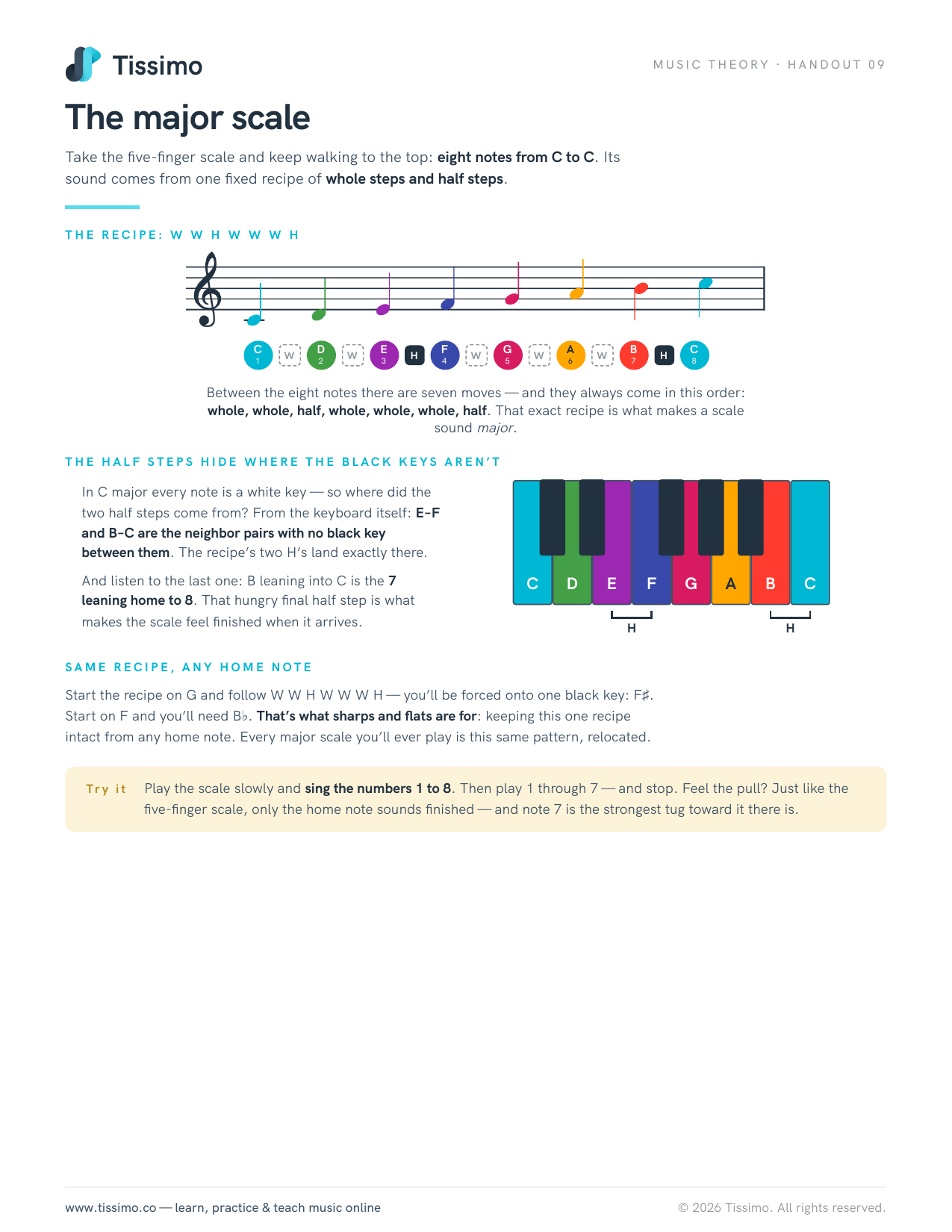 The major scaleTake the five-finger scale and keep walking to the top: eight notes from C to C. Its sound comes from one fixed recipe of whole steps and half steps.
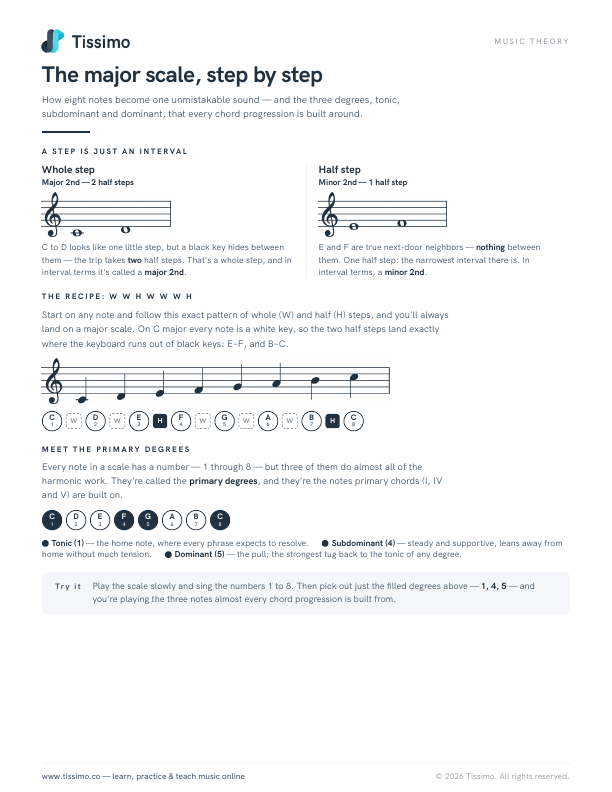 Major Scale Primer
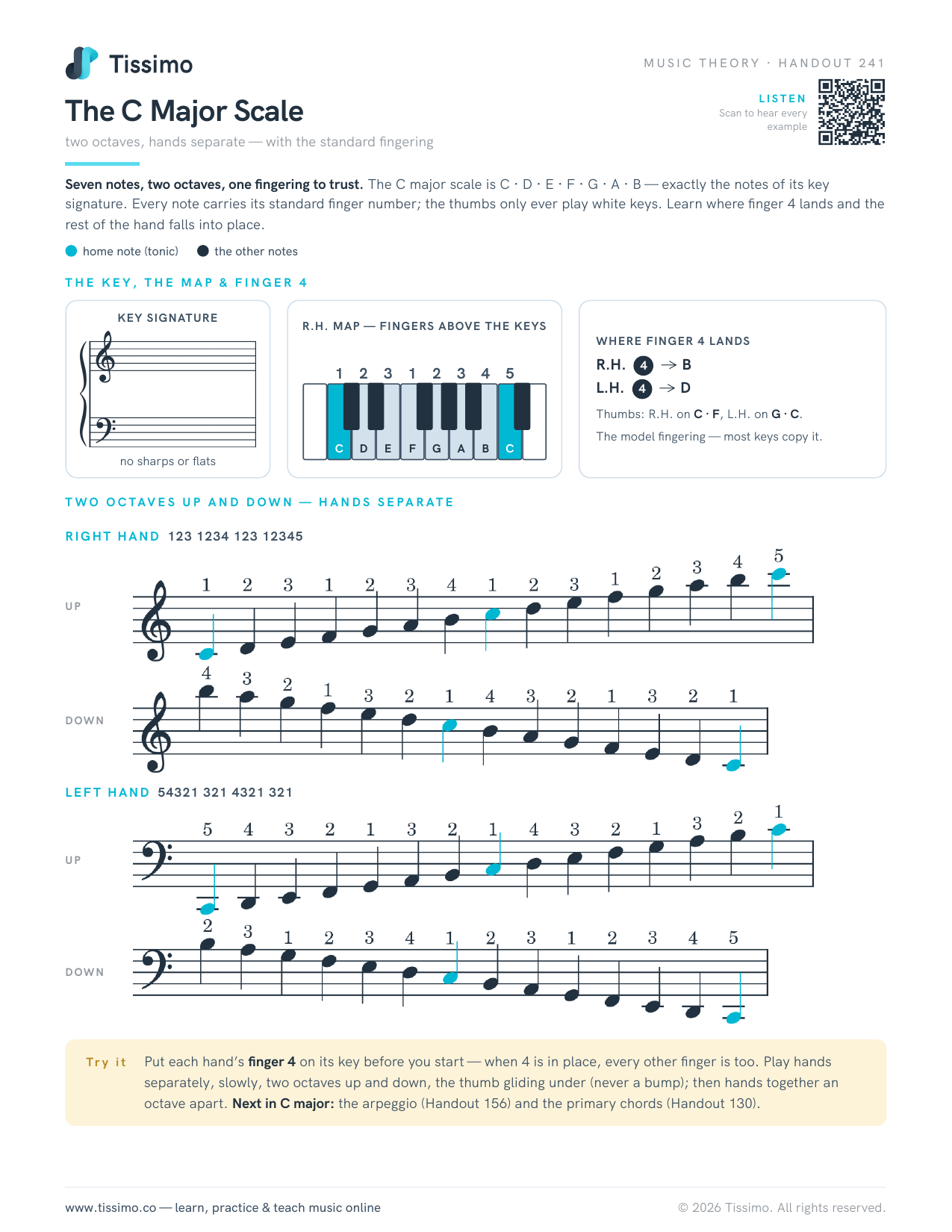 Scales in Every KeyTwo octaves up and down with the standard fingering on every note, in all 24 keys.
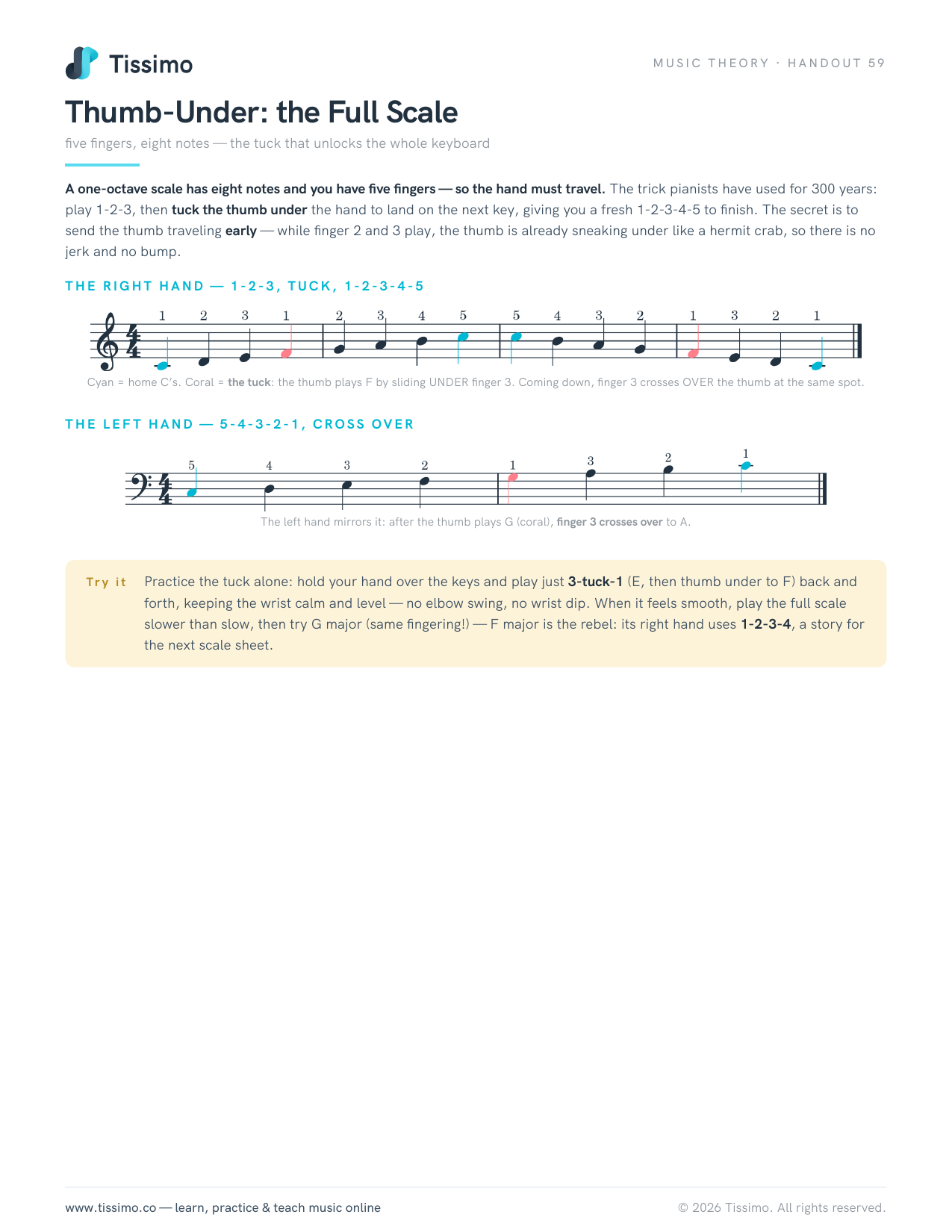 Thumb-Under: the Full Scalefive fingers, eight notes — the tuck that unlocks the whole keyboard
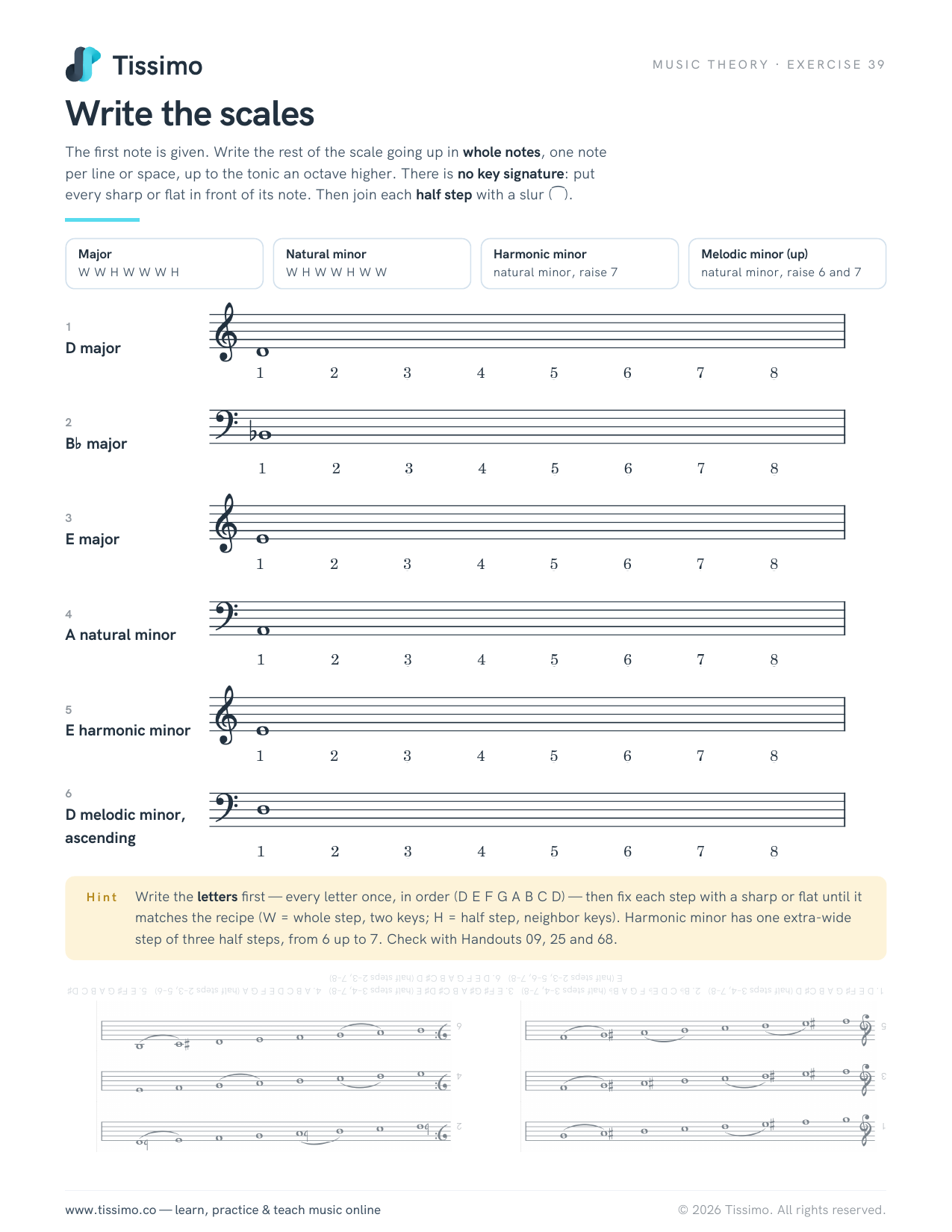 Write the scalesThe first note is given. Write the rest of the scale going up in whole notes, one note per line or space, up to the tonic an octave higher. There is no key signature: put every sharp or flat in front of its note. Then join each half step with a slur (⁀).
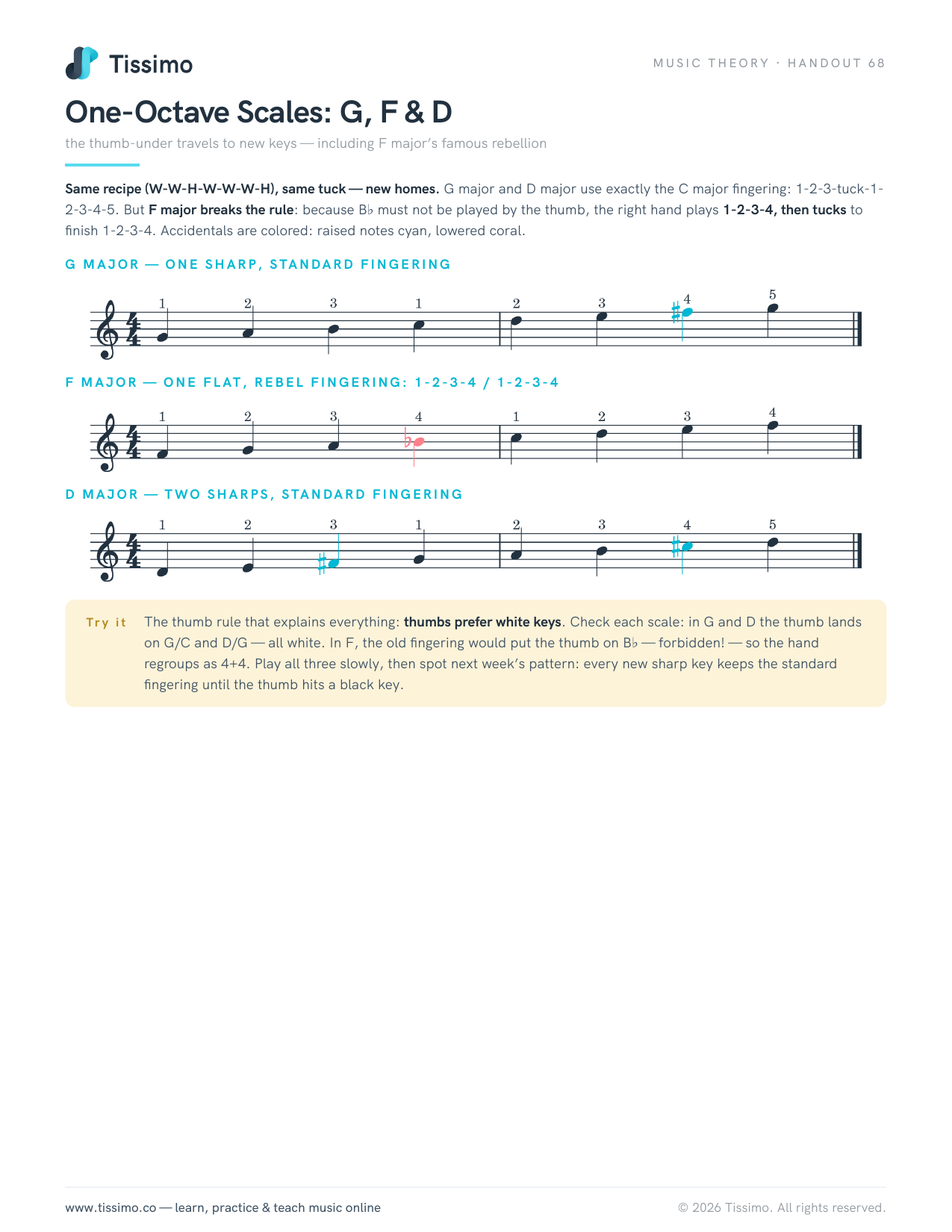 One-Octave Scales: G, F & Dthe thumb-under travels to new keys — including F major’s famous rebellion