Pitch & Intervals
Major Second
Written as M2
A major second (M2) is an interval of two half steps between neighboring letter names, such as C–D, E–F♯ or B♭–C. It is the whole step that most steps of a scale are made of.
A major second is the interval from one note to the next letter name, two half steps away: C up to D, G up to A, E up to F♯, B♭ up to C. Abbreviated M2, it is the same distance as a whole step, and in equal temperament it measures 200 cents.
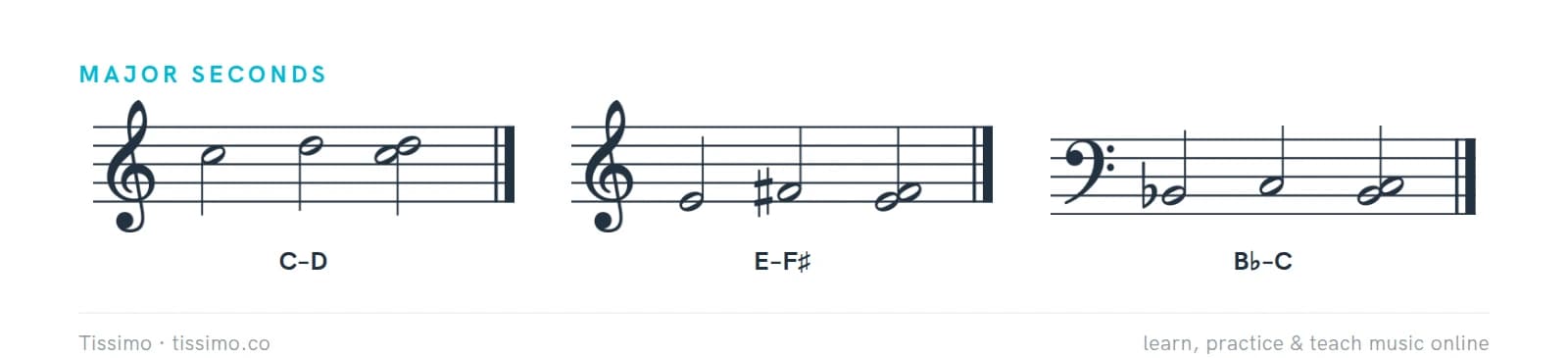
Counting it
The letters are neighbors, so it is a 2nd. Then count half steps: from G, one key up is G♯ (1), the next is A (2). Two half steps make it major; one would make it a minor second.
Where you find it
Five of the seven steps of a major scale are major seconds (W W H W W W H), so this is the interval melodies move by most often. Among the white keys, every pair of neighbors is a major second except E–F and B–C. To build a major second above E or B you need a sharp (E–F♯, B–C♯); to build one below F or C you need a flat (E♭–F, B♭–C).
The step up from "Hap-py" to "Birth-" in "Happy Birthday" is a rising major second, and "Mary Had a Little Lamb" starts with a falling one.
How it sounds
In a melody, a major second is a plain, comfortable step. Played together, the two notes are mildly dissonant: they rub, but far more gently than a minor second. Pop and jazz musicians like that soft friction, which is why the added 2nd or 9th of an added-tone chord and the 2nd of a sus2 chord are so common.
Inversion and look-alikes
Inverted, a major second becomes a minor seventh: C–D becomes D–C, and 2 + 10 = 12 half steps. The same two keys spelled with letters two apart, such as C–E𝄫, form a diminished third: the same sound with a different spelling, and very rare.
Practice with Major & minor 2nds and 3rds and Whole step or half step?.
Common questions
Is a major second the same as a whole step?
Yes, as long as the two notes have neighboring letter names (C–D, E–F♯). Both span two half steps, 200 cents in equal temperament.
What is the difference between a major second and a minor second?
Both join neighboring letter names, but a major second spans two half steps (C–D) and a minor second only one (C–D♭, E–F). On the piano, a minor second has no key in between; a major second has exactly one.
Practice it: free worksheets
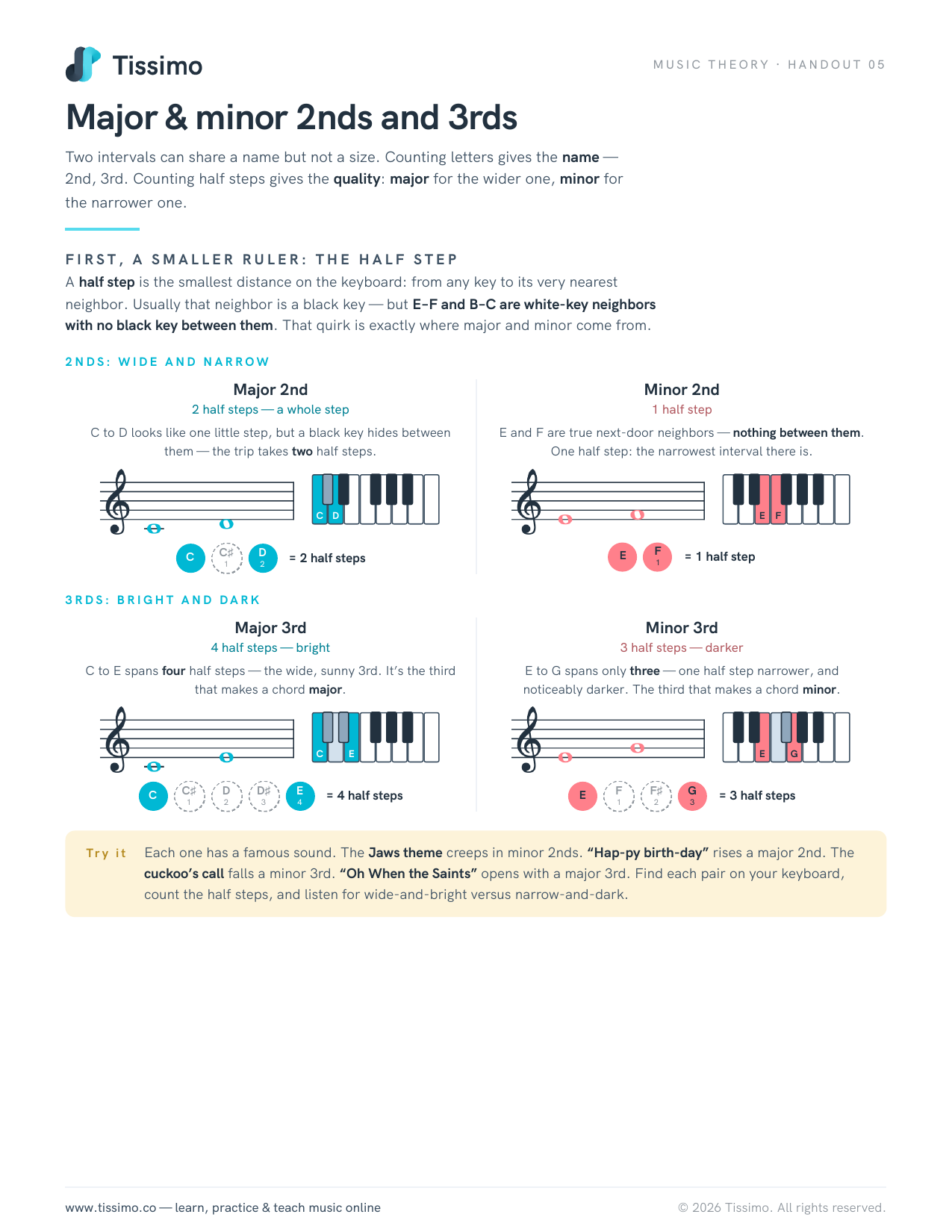 Major & minor 2nds and 3rdsTwo intervals can share a name but not a size. Counting letters gives the name — 2nd, 3rd. Counting half steps gives the quality: major for the wider one, minor for the narrower one.
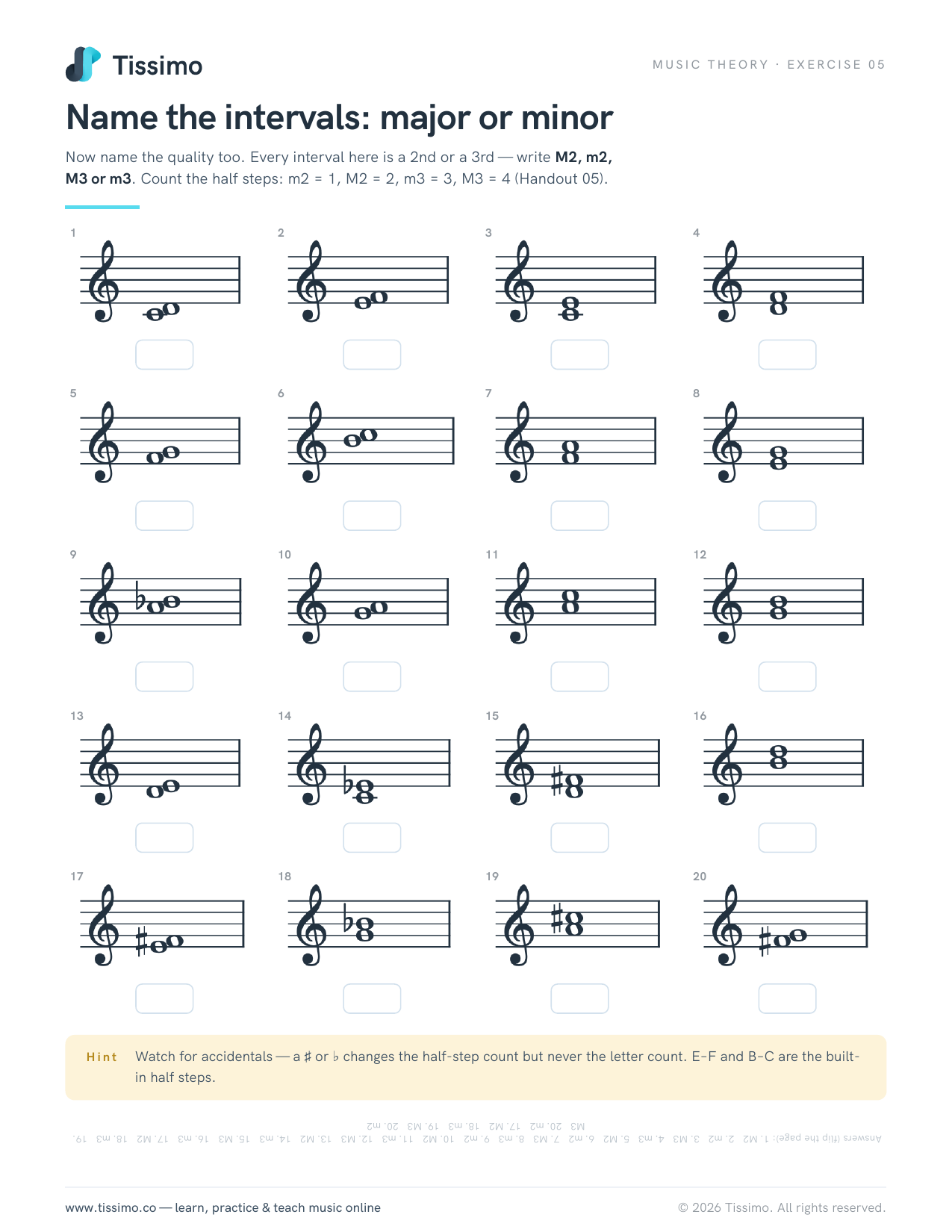 Name the intervals: major or minorNow name the quality too. Every interval here is a 2nd or a 3rd — write M2, m2, M3 or m3. Count the half steps: m2 = 1, M2 = 2, m3 = 3, M3 = 4 (Handout 05). Warm up with Exercise 52.
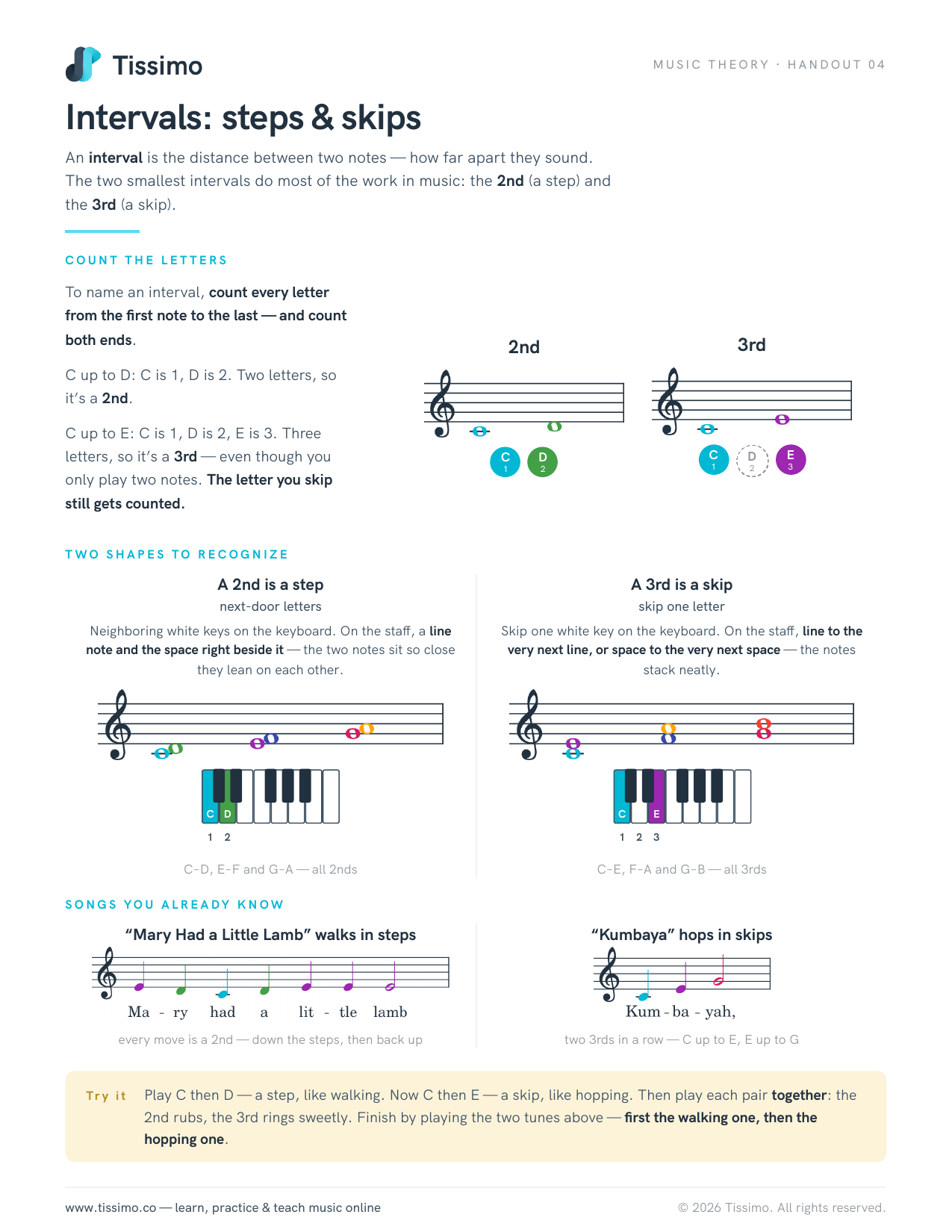 Intervals: steps & skipsAn interval is the distance between two notes — how far apart they sound. Two common melodic movements are the 2nd (a step) and the 3rd (a skip).
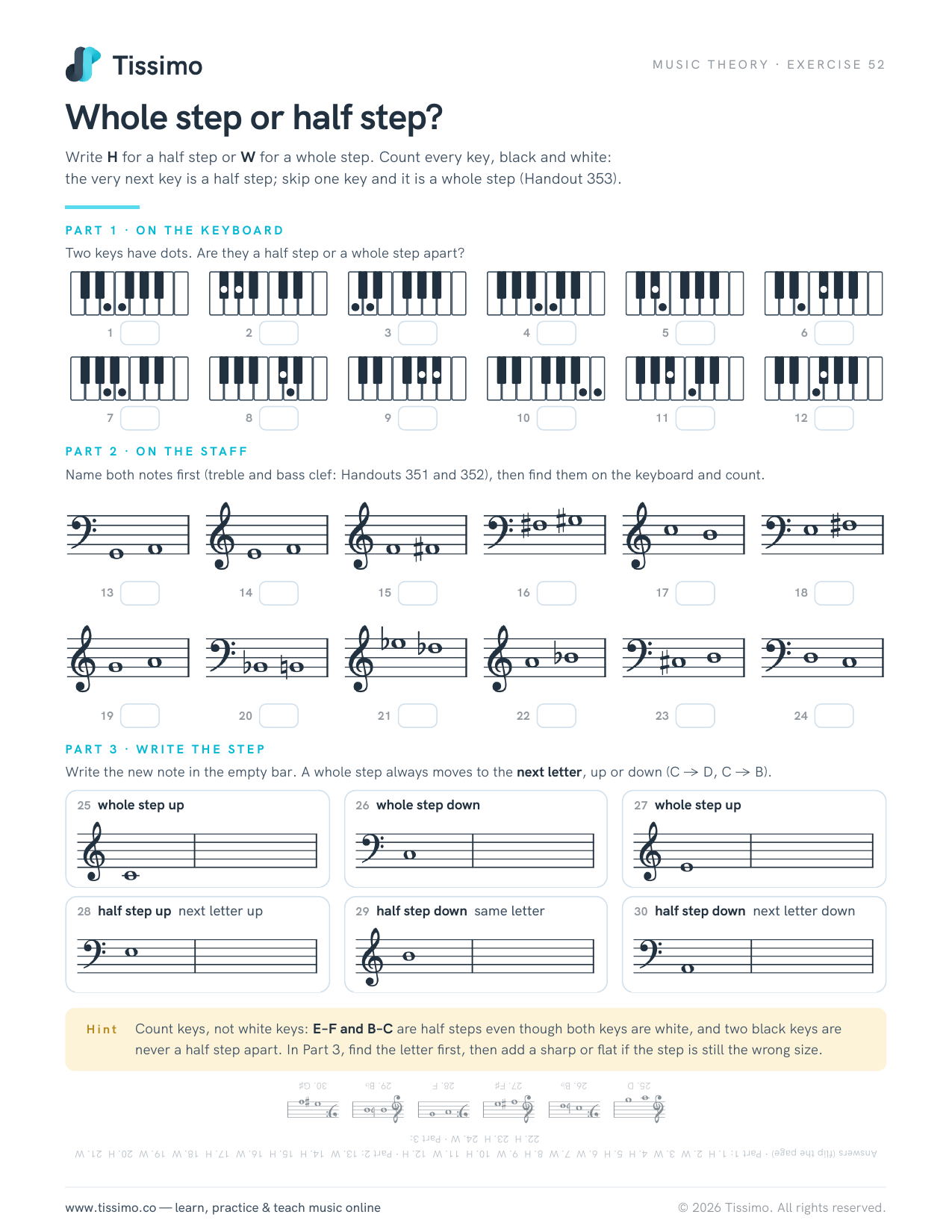 Whole step or half step?Write H for a half step or W for a whole step. Count every key, black and white: the very next key is a half step; skip one key and it is a whole step (Handout 353).
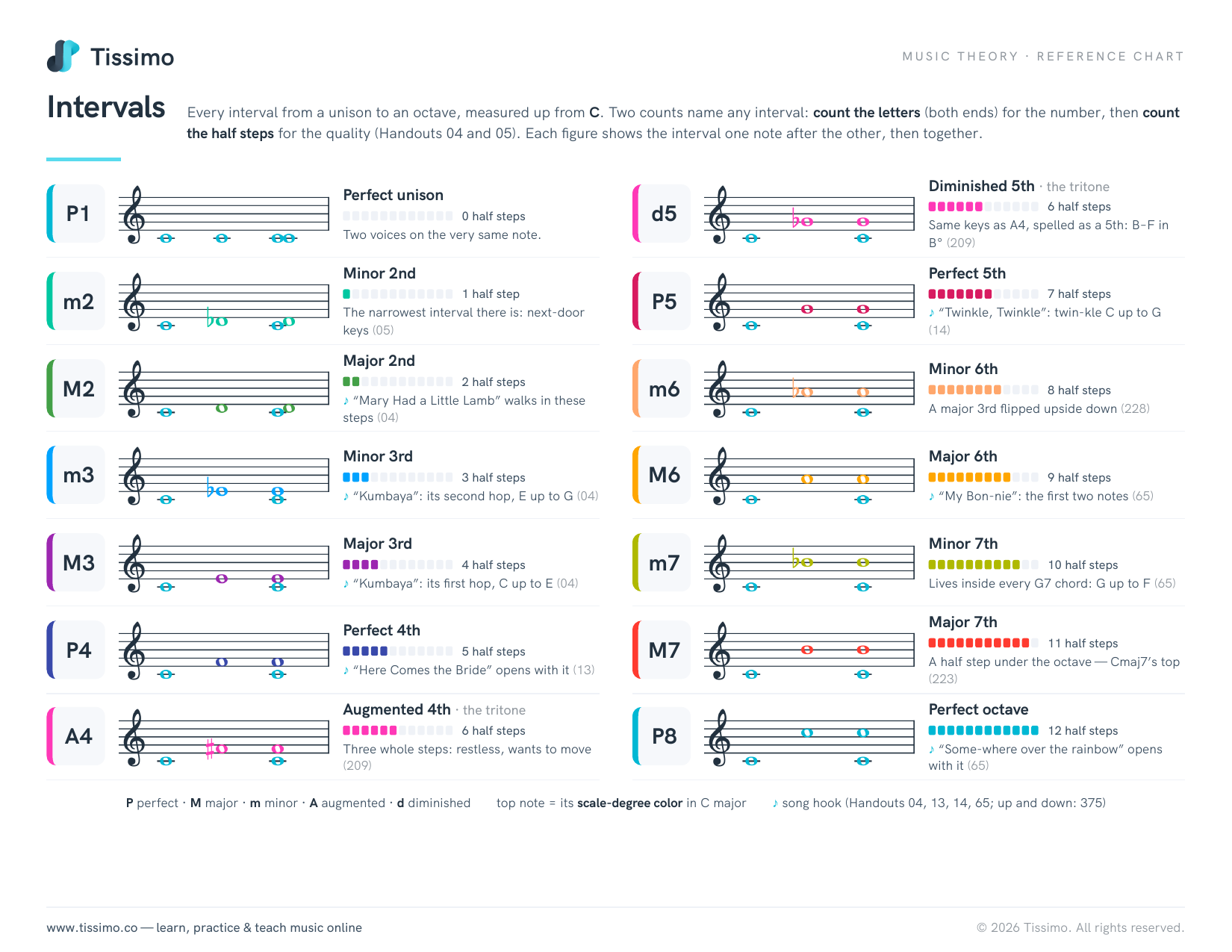 IntervalsEvery interval from a unison to an octave, measured up from C. Two counts name any interval: count the letters (both ends) for the number, then count the half steps for the quality (Handouts 04 and 05). Each figure shows the interval one note after the other, then together.