Pitch & Intervals
Perfect Fourth
Written as P4
A perfect fourth (P4) is an interval of five half steps spanning four letter names, such as C–F, D–G or E–A. It is the inversion of the perfect fifth and has a pure frequency ratio of 4:3.
A perfect fourth spans four letter names and five half steps: C up to F, D up to G, E up to A, G up to C. Abbreviated P4, it measures 500 cents in equal temperament.
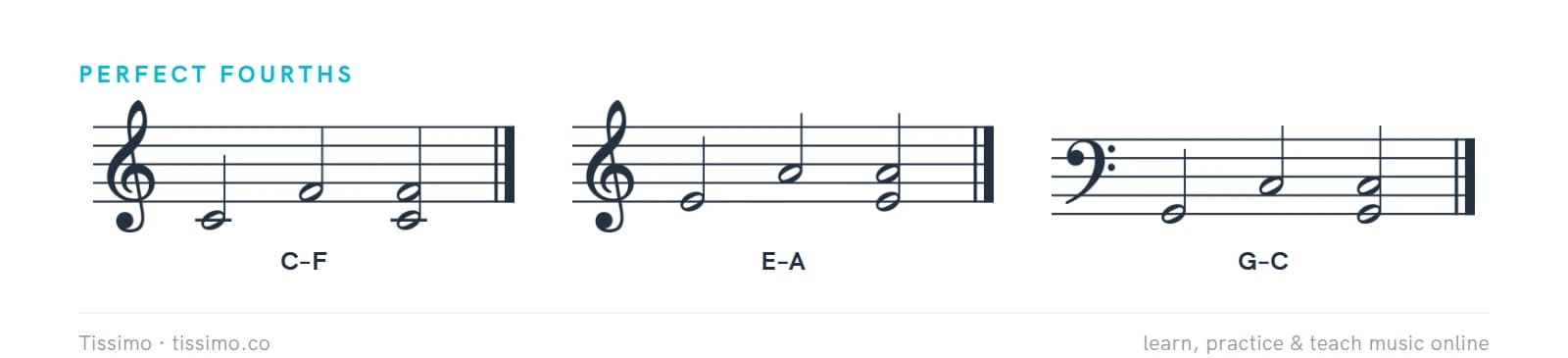
Counting it
C–D–E–F is four letters, so C–F is a 4th. From C, count C♯ (1), D (2), D♯ (3), E (4), F (5): five half steps make it perfect. Fourths and fifths are perfect intervals: they don't come in major and minor sizes, only perfect, augmented (a half step wider) and diminished (a half step narrower).
The one white-key exception
Six of the seven 4ths you can build on white keys are perfect. The exception is F–B: it spans six half steps, so it is an augmented fourth, the tritone. For a perfect fourth up from F, use B♭; for one down from B, use F♯.
Where you hear it
- A rising perfect fourth is one of the most common ways for a melody to begin. It opens "Here Comes the Bride" (Wagner's Bridal Chorus), and "Amazing Grace" rises a fourth on its first two syllables. Often the first note is the dominant and the second the tonic, so the leap lands straight on home.
- Guitars and electric basses are tuned mostly in fourths: E–A, A–D and D–G are perfect fourths. (On a guitar, G–B is a major third, then B–E another fourth.)
- Chords built from stacked fourths, called quartal harmony, give much modern jazz its open, floating sound.
Consonant or dissonant?
The perfect fourth is a curious case. Its frequency ratio is the simple 4:3, and two notes a fourth apart blend smoothly. Yet in classical counterpoint and four-part harmony, a fourth above the bass note is treated as a dissonance that needs to resolve, as in a 4–3 suspension or a cadential six-four chord. Between two upper voices it counts as a consonance.
Inversion
Inverted, a perfect fourth becomes a perfect fifth: C–F becomes F–C, and 5 + 7 = 12. Perfect intervals always invert to perfect intervals.
Learn it on the staff with Intervals: the 4th, then practice every quality with Name the intervals: the full toolkit.
Common questions
How many half steps is a perfect fourth?
Five. From C: C♯, D, D♯, E, F. In equal temperament that is 500 cents.
Why is the fourth called perfect?
Older music theory counted the unison, fourth, fifth and octave as the purest consonances, with the simplest frequency ratios (the fourth is 4:3), and called them perfect. Today perfect also means that the interval has no major or minor form and that it inverts to another perfect interval.
Practice it: free worksheets
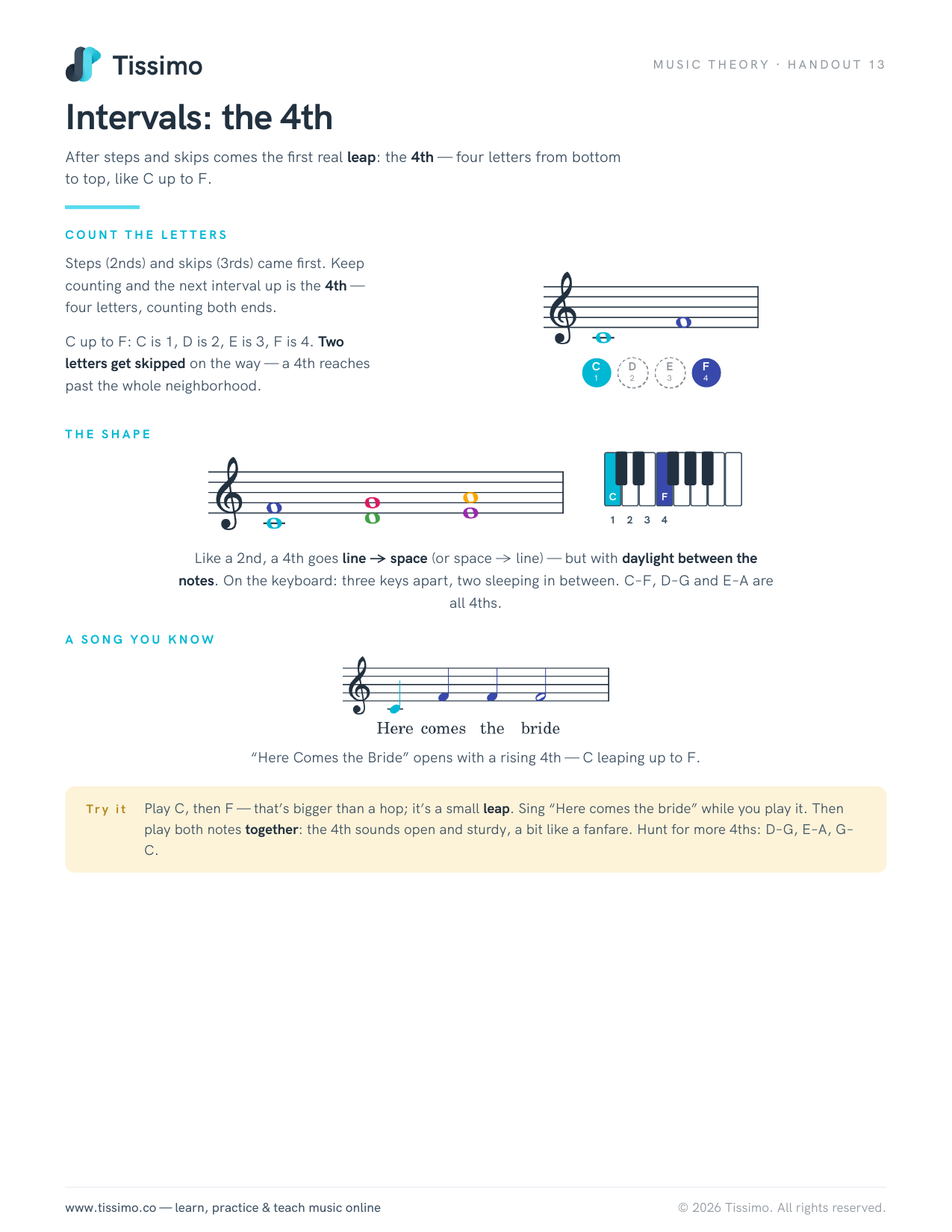 Intervals: the 4thAfter steps and skips comes the first real leap: the 4th — four letters from bottom to top, like C up to F.
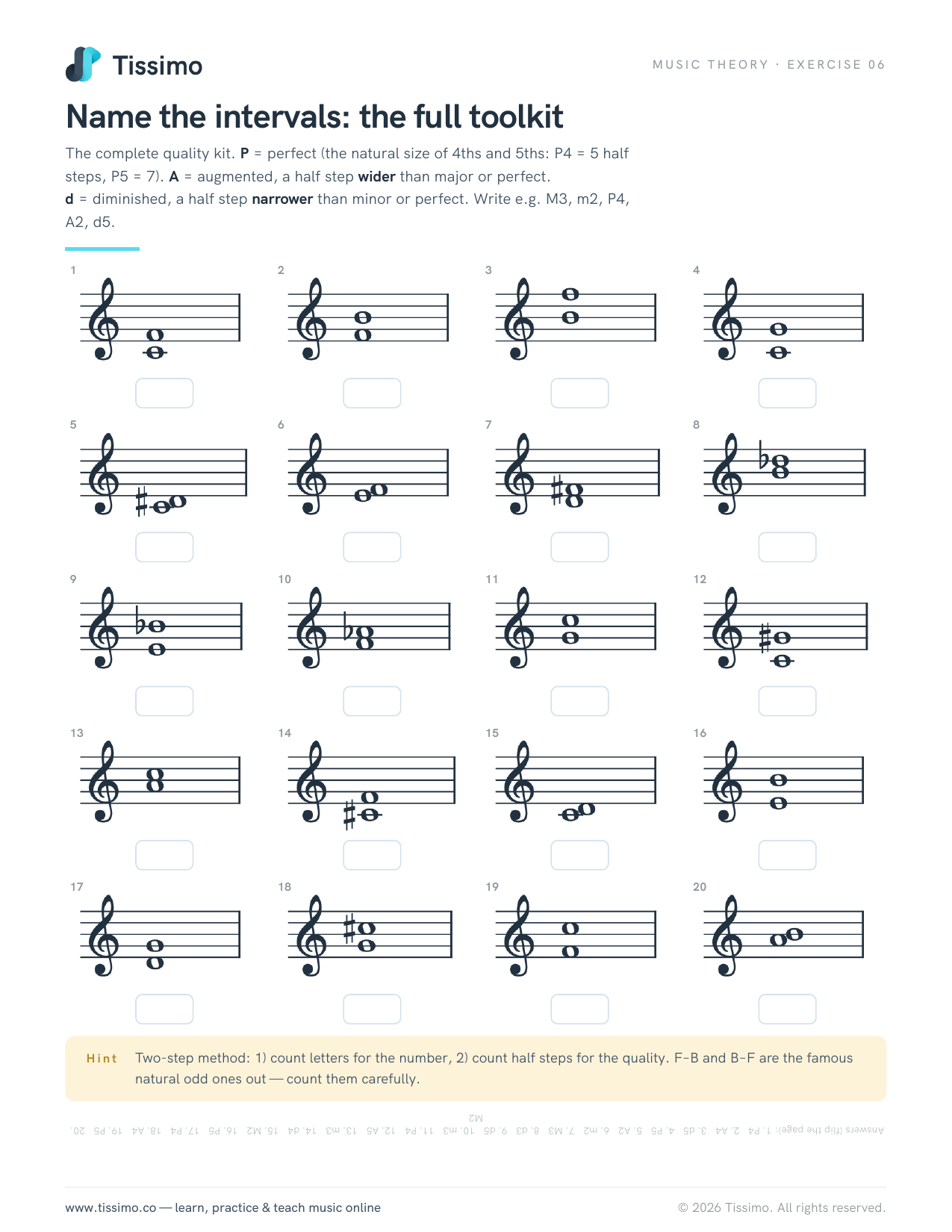 Name the intervals: the full toolkitThe complete quality kit. P = perfect (the natural size of 4ths and 5ths: P4 = 5 half steps, P5 = 7). A = augmented, a half step wider than major or perfect. d = diminished, a half step narrower than minor or perfect. Write e.g. M3, m2, P4, A2, d5.
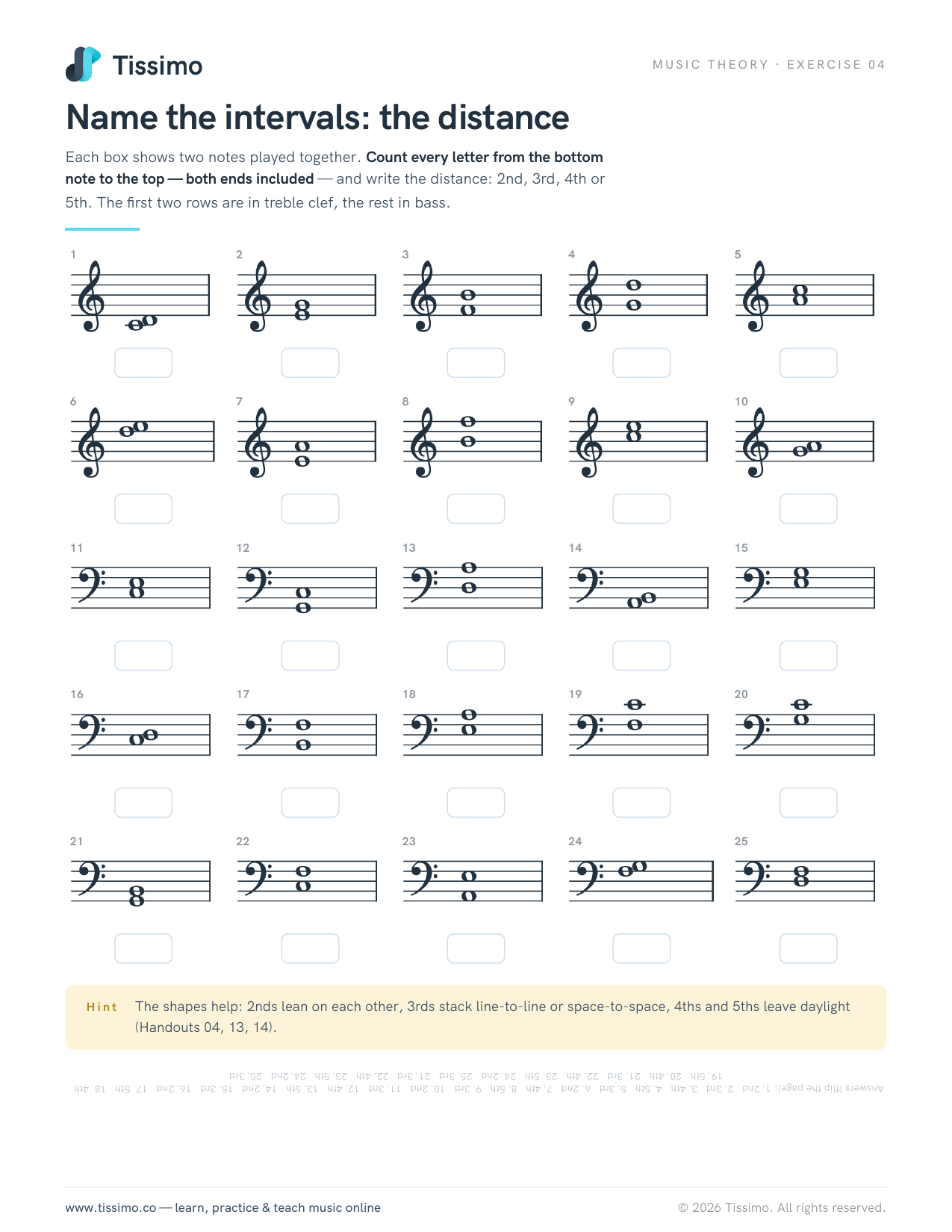 Name the intervals: the distanceEach box shows two notes played together. Count every letter from the bottom note to the top — both ends included — and write the distance: 2nd, 3rd, 4th or 5th. The first two rows are in treble clef, the rest in bass.
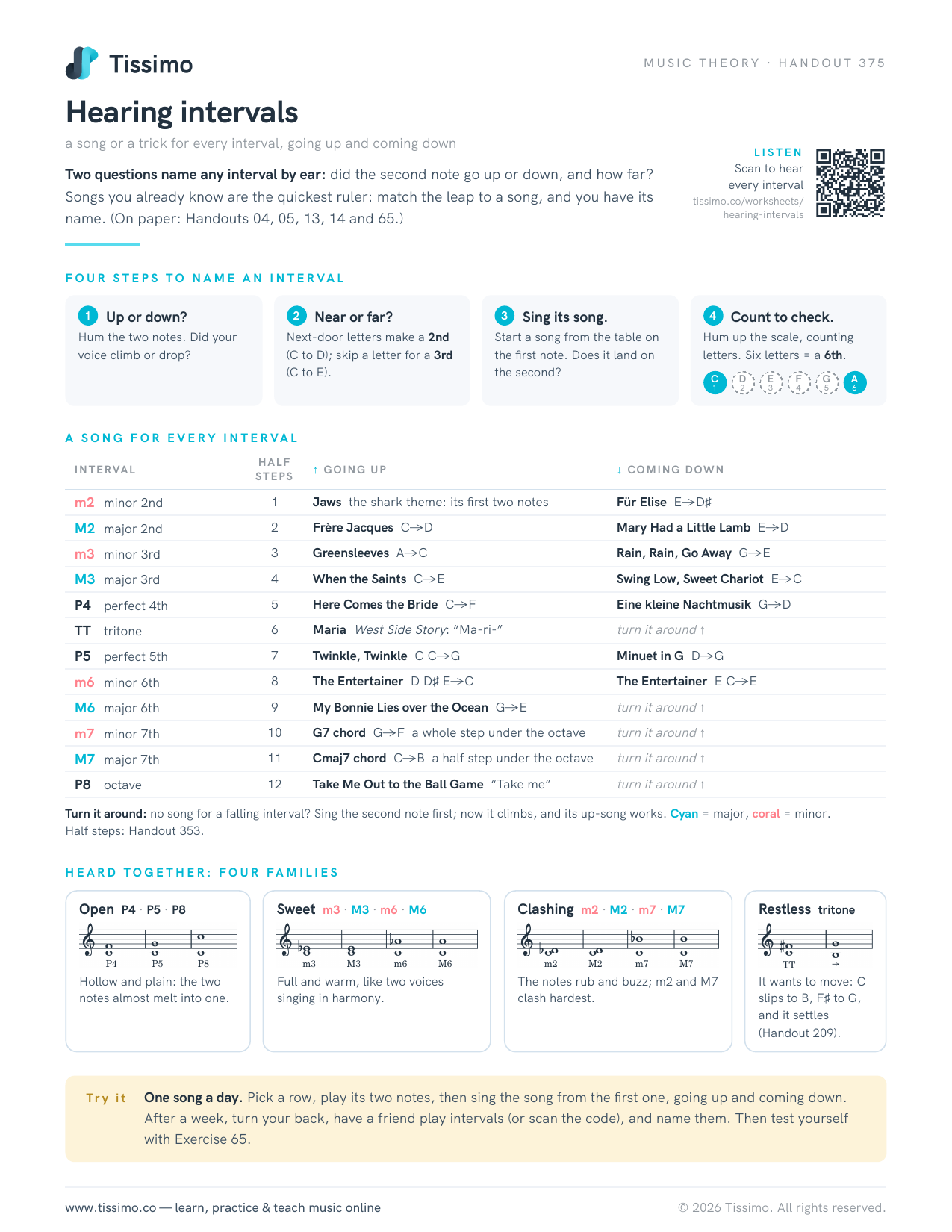 Hearing intervalsa song or a trick for every interval, going up and coming down
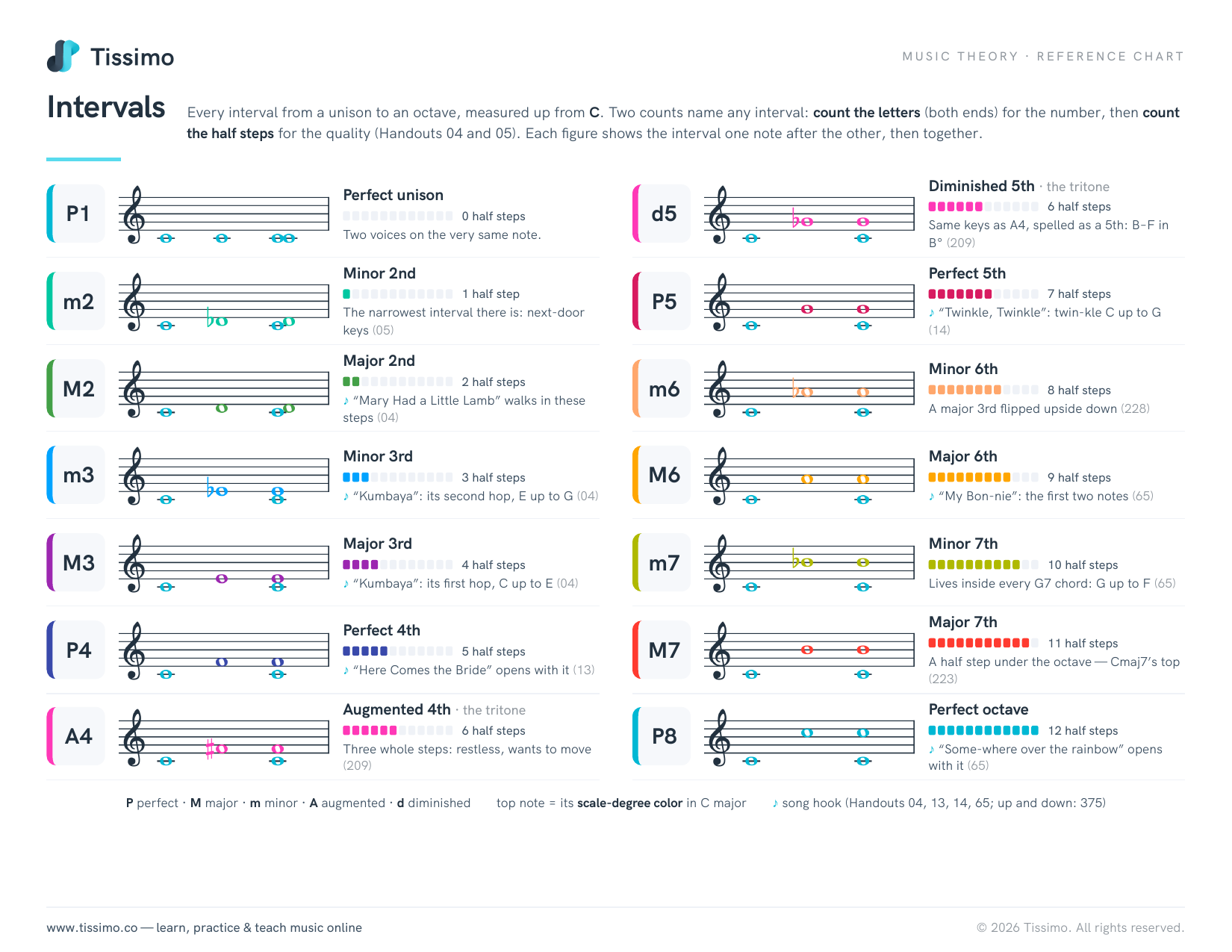 IntervalsEvery interval from a unison to an octave, measured up from C. Two counts name any interval: count the letters (both ends) for the number, then count the half steps for the quality (Handouts 04 and 05). Each figure shows the interval one note after the other, then together.