Pitch & Intervals
Note Names
Note names are the letters A, B, C, D, E, F and G that musicians use for pitches. The seven letters repeat in every octave, and sharps and flats name the notes in between.
Western music names its pitches with just seven letters: A B C D E F G. After G the alphabet starts again at A, so the same seven names repeat up and down the whole range of an instrument. This is often called the musical alphabet.
The white keys
On a piano the white keys carry the seven letter names. The easiest landmark is C: it is the white key just to the left of each group of two black keys. From there the white keys run C, D, E, F, G, A, B, and the next C starts the pattern again. F sits just to the left of each group of three black keys.
The black keys: sharps and flats
The black keys have no letters of their own. Each one is named after a white-key neighbor with an accidental: a sharp (♯) raises a note by a half step, a flat (♭) lowers it by one. The black key between C and D is therefore both C♯ and D♭. Two names for one key are enharmonic equivalent equivalents; which name you use depends on the key and the direction of the music.
Each octave holds 12 different keys: seven white and five black. Two pairs of white keys have no black key between them, E–F and B–C, so those pairs are only a half step apart.
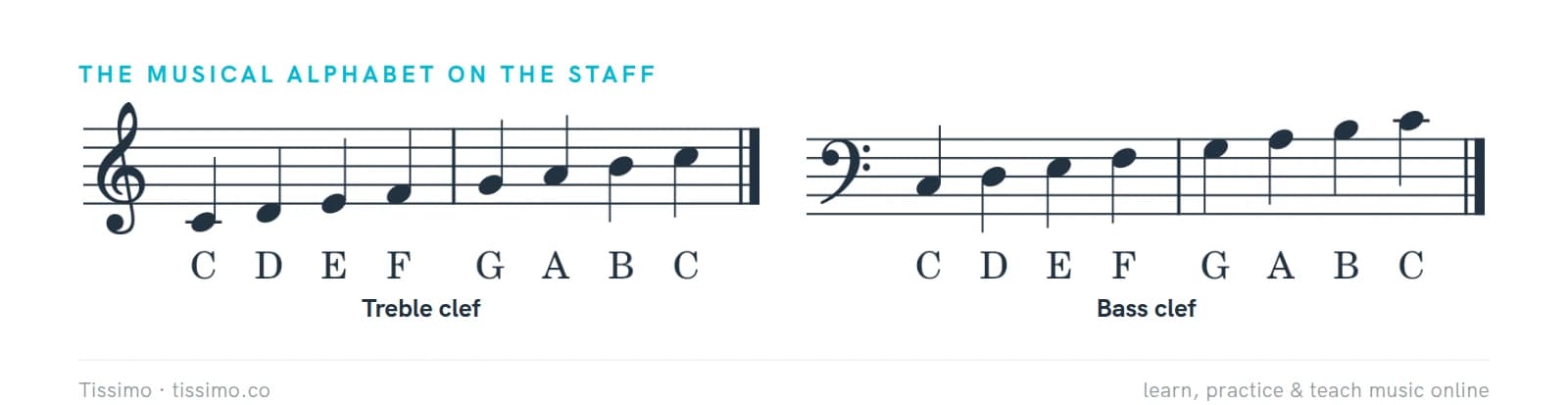
Note names on the staff
On the staff, each line and each space stands for one letter, and the letters climb in alphabetical order: line, space, line, space. The clef fixes which letter goes where. In the treble clef the second line from the bottom is G; in the bass clef the fourth line from the bottom is F.
Other naming systems
- In German-speaking countries, H means B natural and B means B♭. That is how the letters B–A–C–H can be played as notes (B♭, A, C, B♮), a motif Bach and many later composers used.
- In France, Italy, Spain, Latin America and elsewhere, musicians usually name C D E F G A B with the syllables do, re, mi, fa, sol, la, si (fixed do, see solfège).
- To say which C you mean, add an octave number: middle C is C4 in scientific pitch notation.
Practice with Name the notes: treble clef, Name the notes: bass clef and The piano keyboard.
Common questions
Why does the musical alphabet stop at G?
Seven letters are enough. Major and minor scales have seven different notes before the pattern repeats at the octave, and a note an octave higher sounds so similar that it keeps the same name. So after G the letters simply start again at A.
What note is between E and F?
None. E and F are a half step apart with no black key between them, and so are B and C. E♯ is another name for the F key, and F♭ another name for the E key.
Practice it: free worksheets
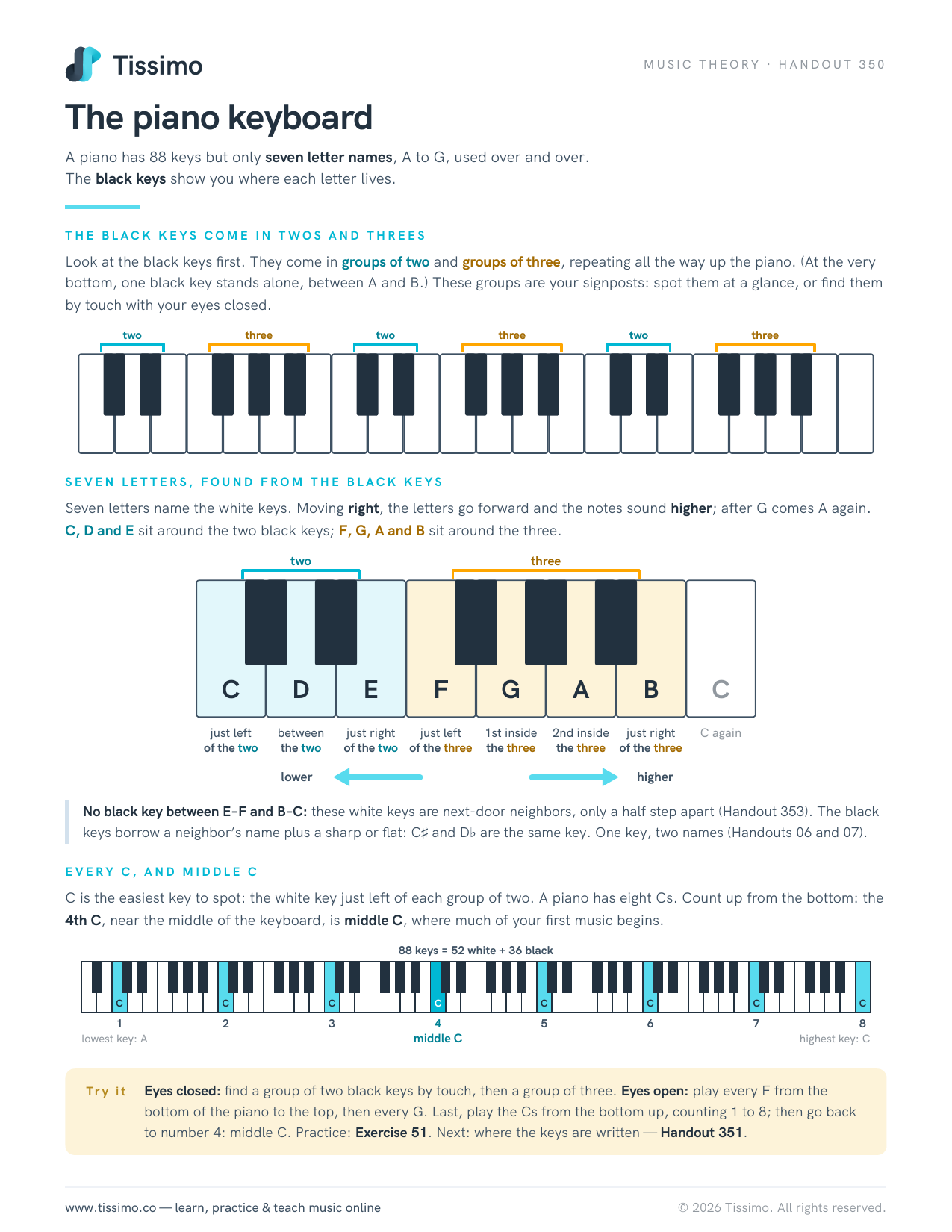 The piano keyboardA piano has 88 keys but only seven letter names, A to G, used over and over. The black keys show you where each letter lives.
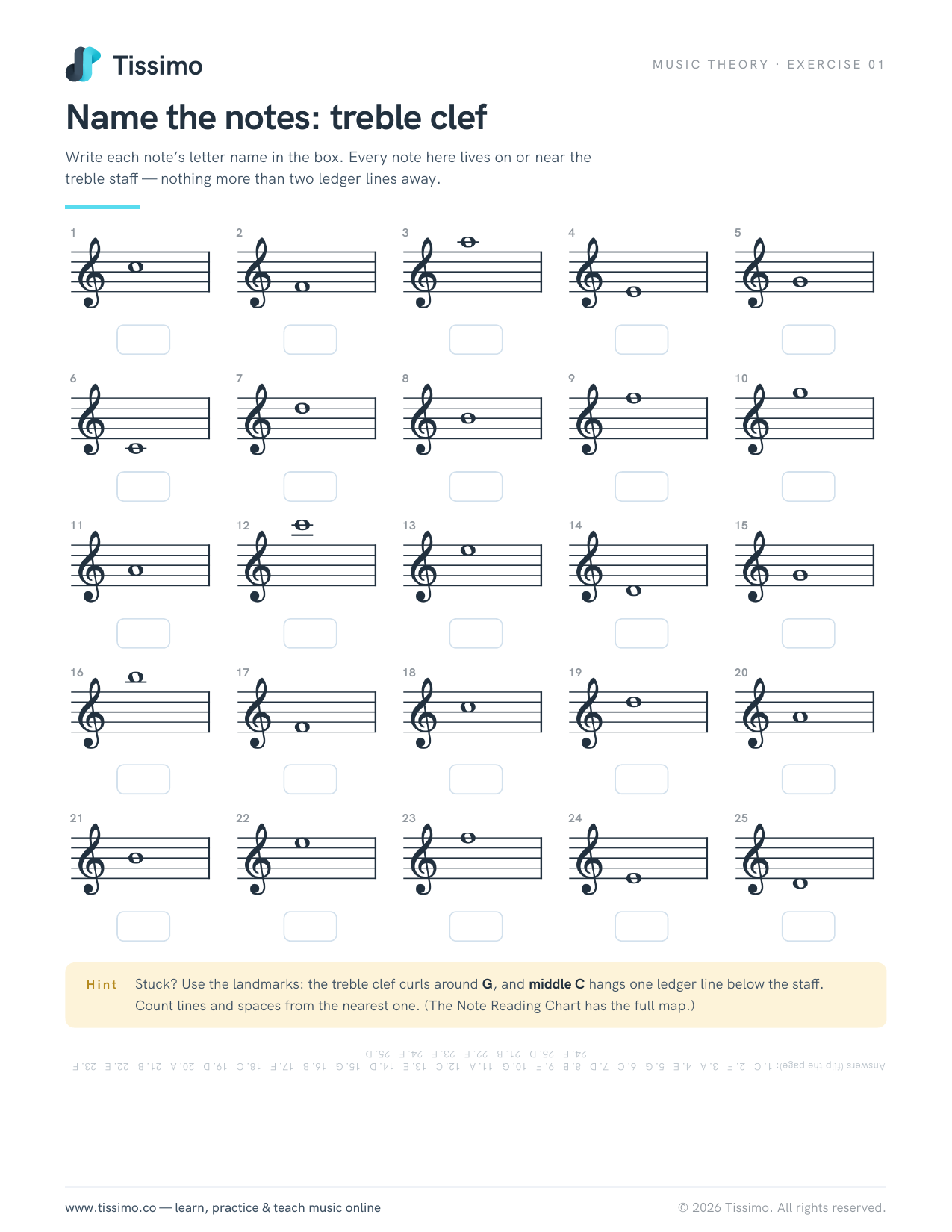 Name the notes: treble clefWrite each note’s letter name in the box. Every note here lives on or near the treble staff — nothing more than two ledger lines away.
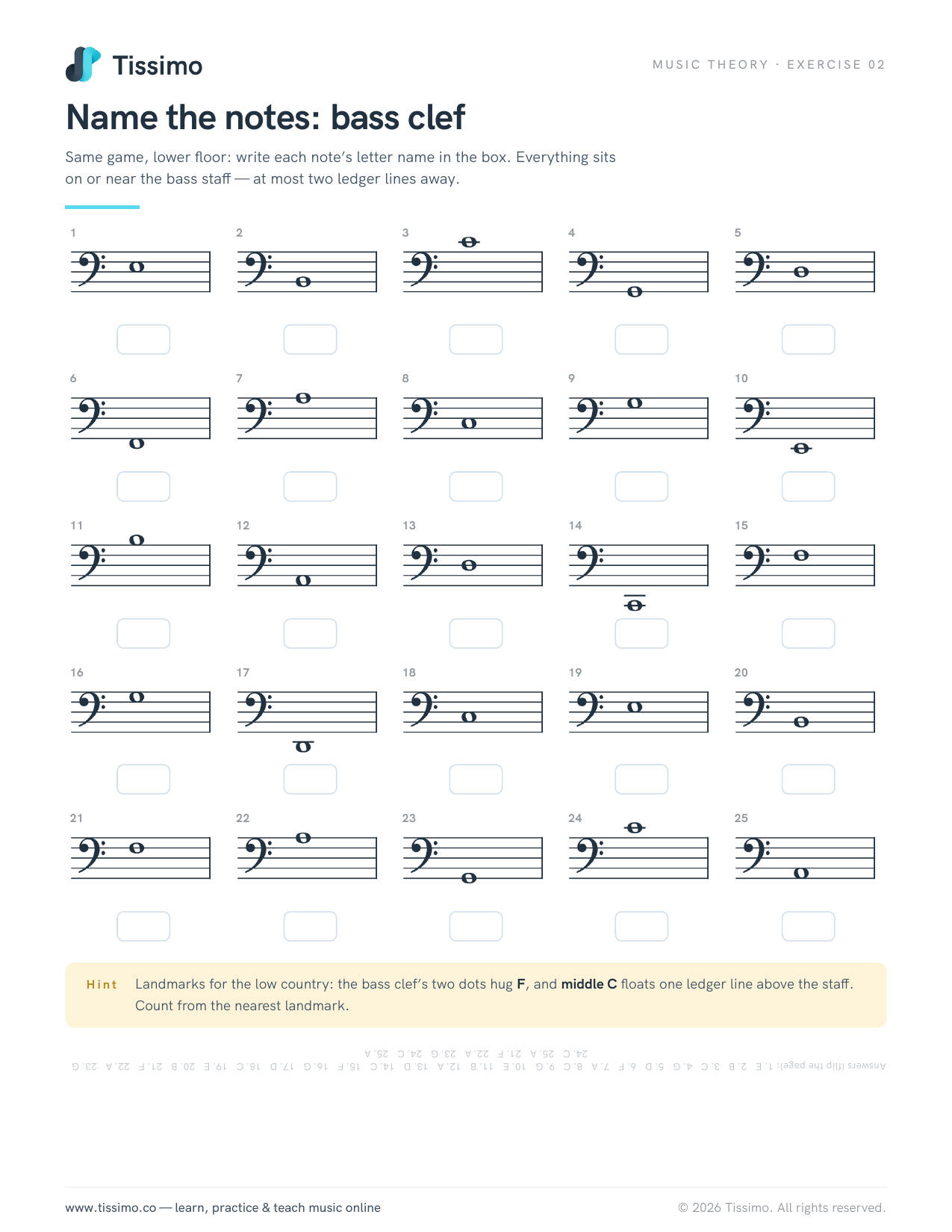 Name the notes: bass clefSame game, lower floor: write each note’s letter name in the box. Everything sits on or near the bass staff — at most two ledger lines away.
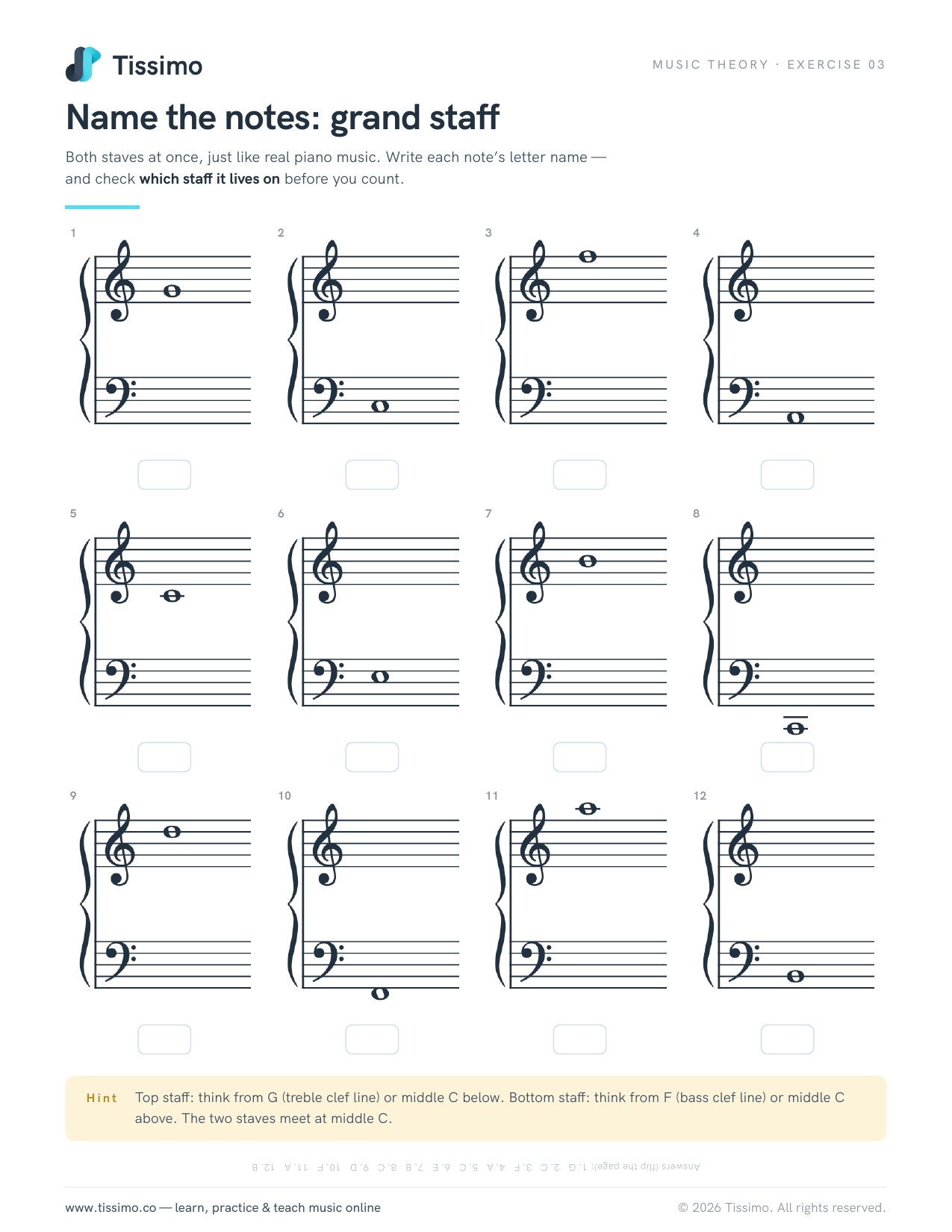 Name the notes: grand staffBoth staves at once, just like real piano music. Write each note’s letter name — and check which staff it lives on before you count.
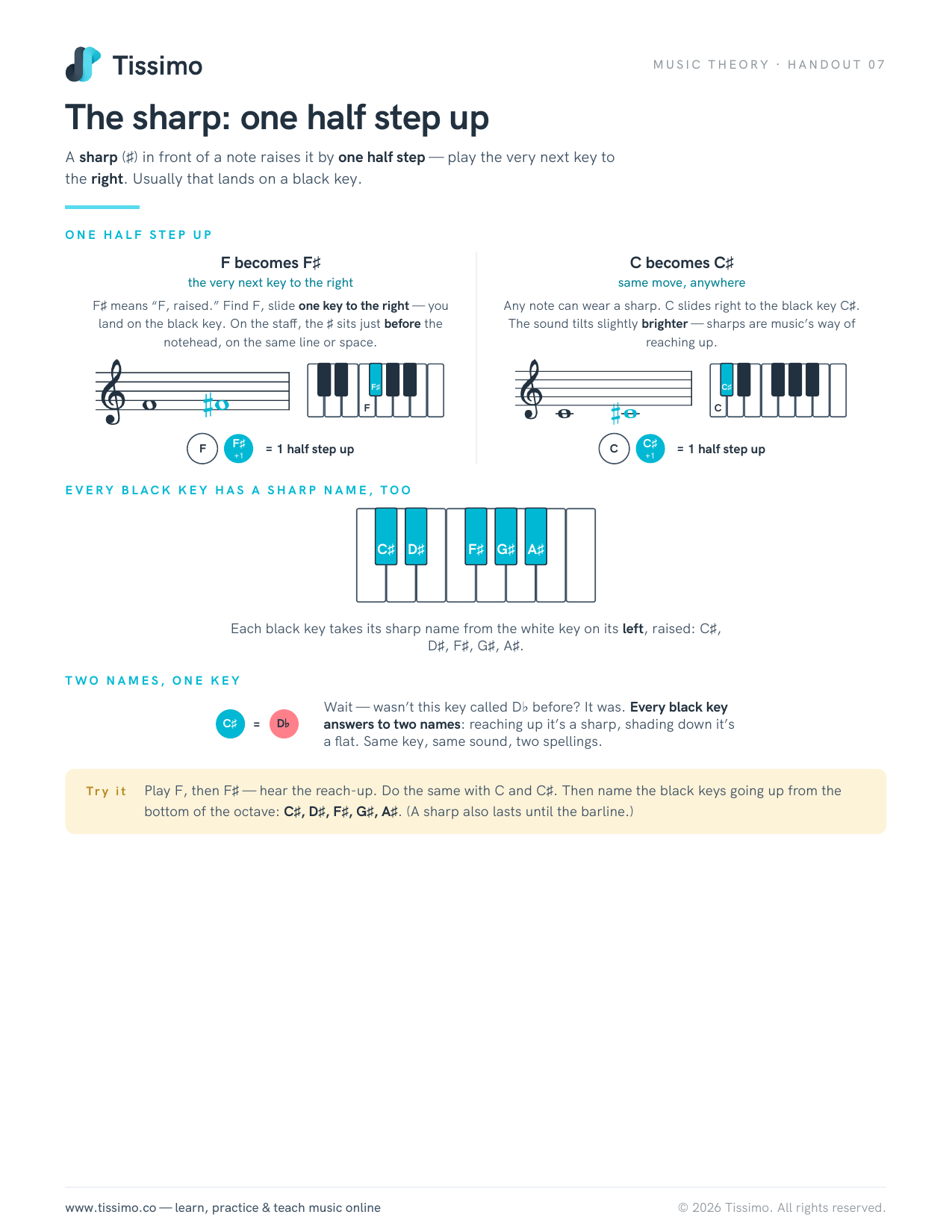 The sharp: one half step upA sharp (♯) in front of a note raises it by one half step (Handout 353) — play the very next key to the right. Usually that lands on a black key.
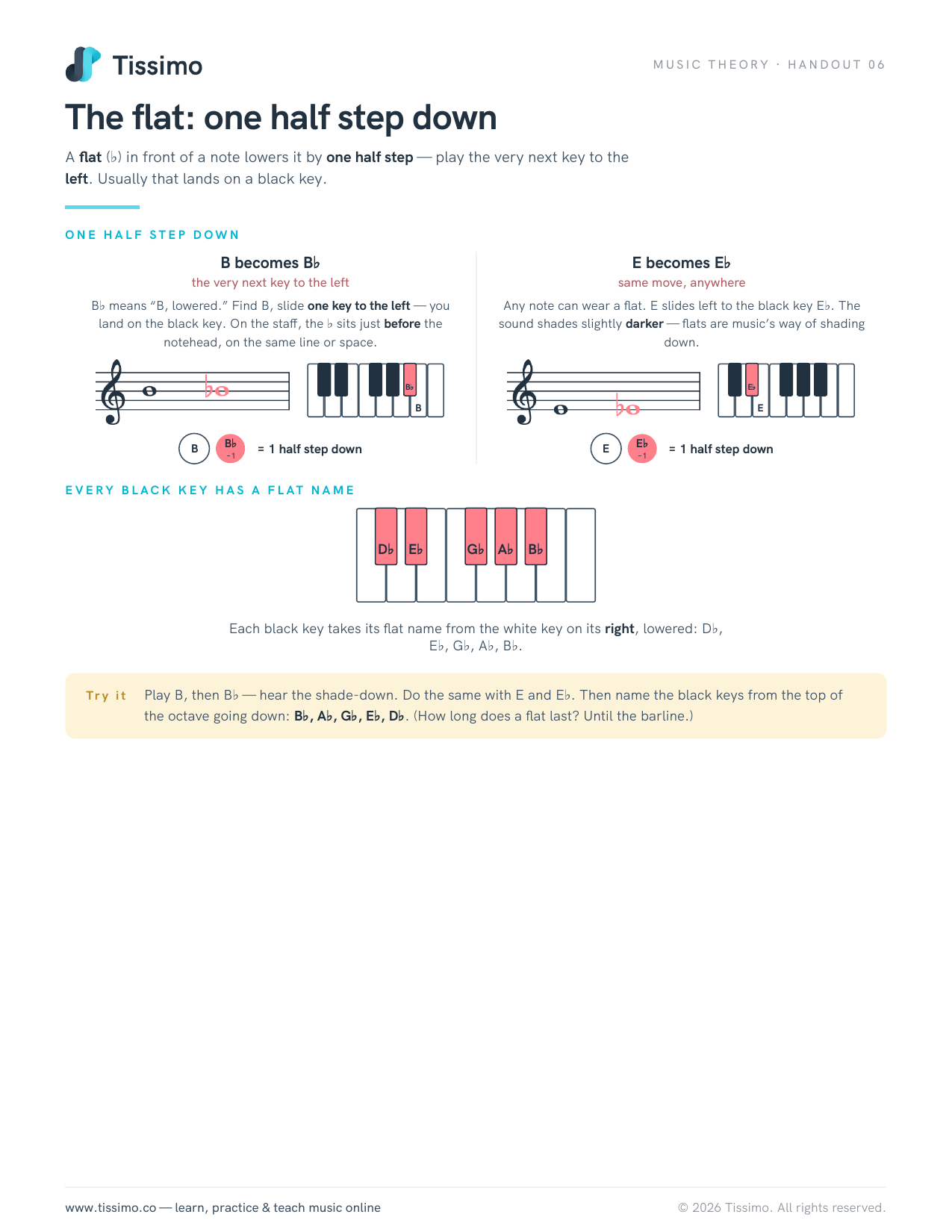 The flat: one half step downA flat (♭) in front of a note lowers it by one half step (Handout 353) — play the very next key to the left. Usually that lands on a black key.