Pitch & Intervals
Minor Second
Written as m2
A minor second (m2) is an interval of one half step between neighboring letter names, such as E–F, B–C or C–D♭. It is the smallest interval in major and minor scales.
A minor second is the interval from one note to the next letter name, one half step away: E up to F, B up to C, F♯ up to G, C up to D♭. Abbreviated m2, it is the smallest interval in major and minor scales, and in equal temperament it measures 100 cents.
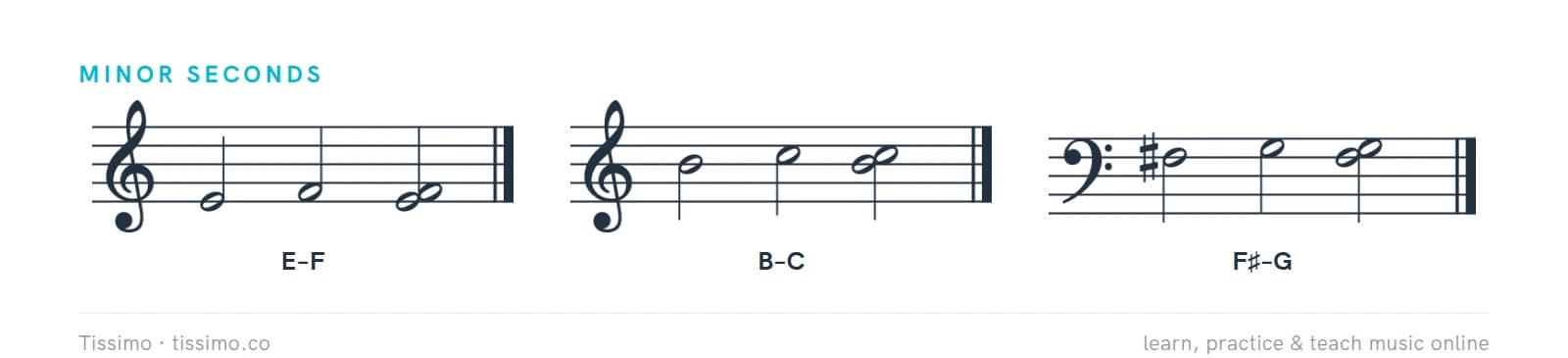
Counting it
Two checks name it. The letters are neighbors, so it is a 2nd. And there is exactly one half step between the notes: no key lies between them on the piano. If you count two half steps instead, you have a major second.
How it sounds
Played one after the other, a minor second is the smallest, most "leaning" step a melody can take. The leading tone of a major key sits a minor second below the tonic (B–C in C major) and pulls up into it. Played together, the two notes grind against each other: the minor second is one of the strongest dissonances. Spread the notes an octave further apart and you get a minor ninth, still tense. Inverting the minor second instead gives a major seventh.
Film composers often use a slowly repeated minor second for menace; the theme from Jaws is the classic example. For a falling minor second, many students think of the first two notes of Beethoven's Für Elise.
Minor second or augmented unison?
C–D♭ and C–C♯ sound exactly the same on a piano. C–D♭ uses two letter names, so it is a minor second (a diatonic half step). C–C♯ uses one letter, so it is an augmented unison (a chromatic half step). Spell it the way the music moves: a line that goes C–D♭–C uses D♭, a line that climbs C–C♯–D uses C♯.
Inversion
Turn a minor second upside down and you get a major seventh: E–F becomes F–E. Their half steps add up to 12 (1 + 11), as every pair of inverted intervals does (see interval inversion).
Practice with Major & minor 2nds and 3rds and Name the intervals: major or minor.
Common questions
How many half steps is a minor second?
One. A minor second is the same distance as a half step: from any piano key to the very next key, as in E–F or C–D♭.
Practice it: free worksheets
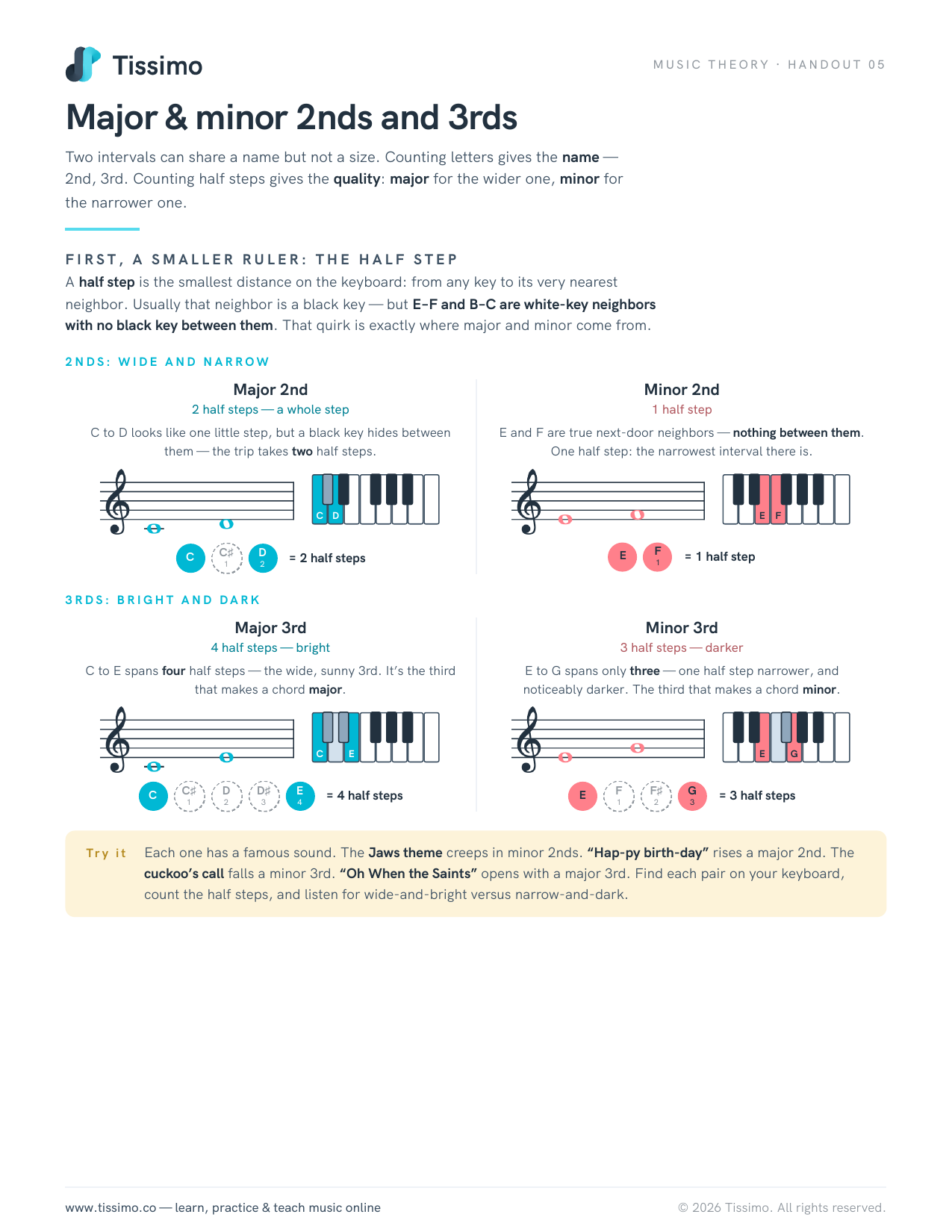 Major & minor 2nds and 3rdsTwo intervals can share a name but not a size. Counting letters gives the name — 2nd, 3rd. Counting half steps gives the quality: major for the wider one, minor for the narrower one.
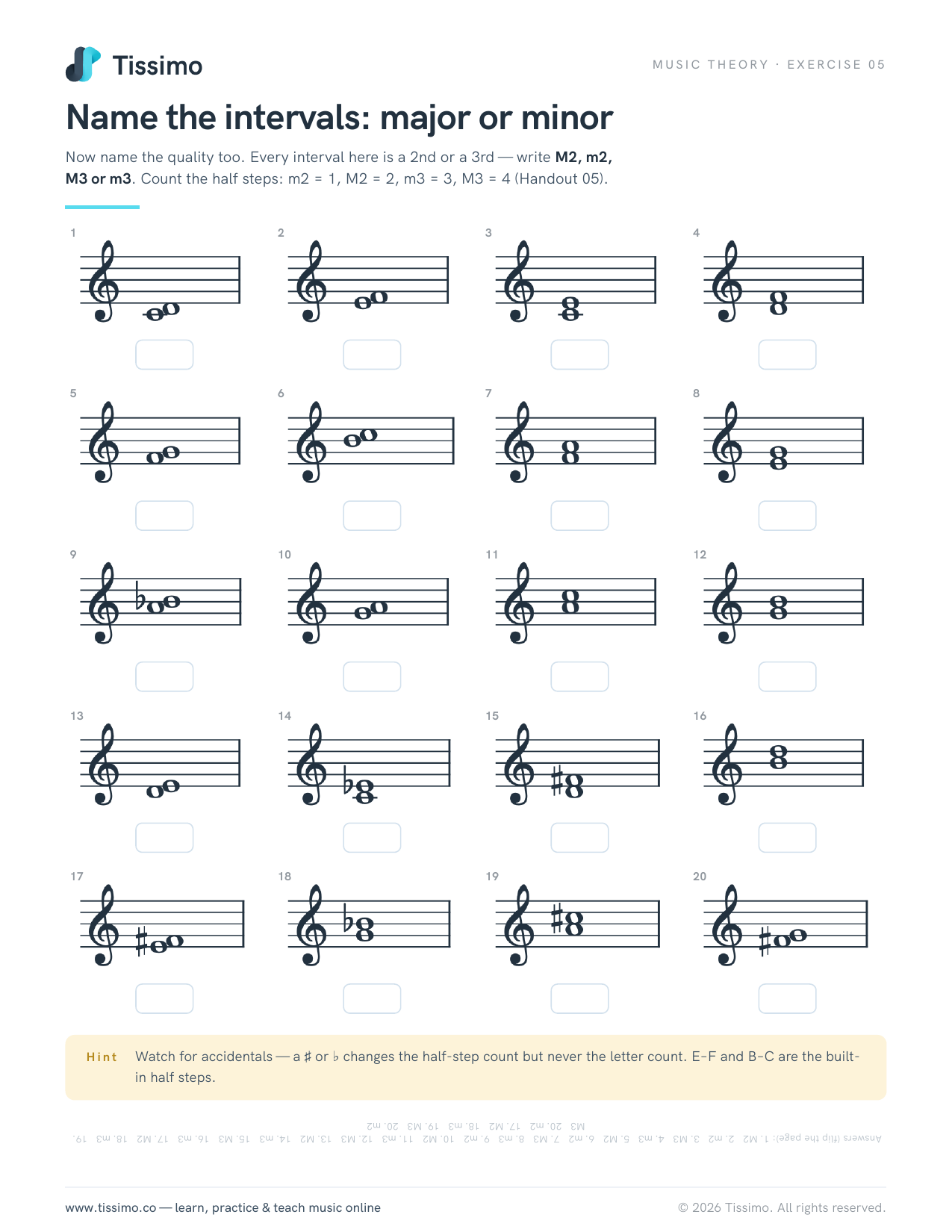 Name the intervals: major or minorNow name the quality too. Every interval here is a 2nd or a 3rd — write M2, m2, M3 or m3. Count the half steps: m2 = 1, M2 = 2, m3 = 3, M3 = 4 (Handout 05). Warm up with Exercise 52.
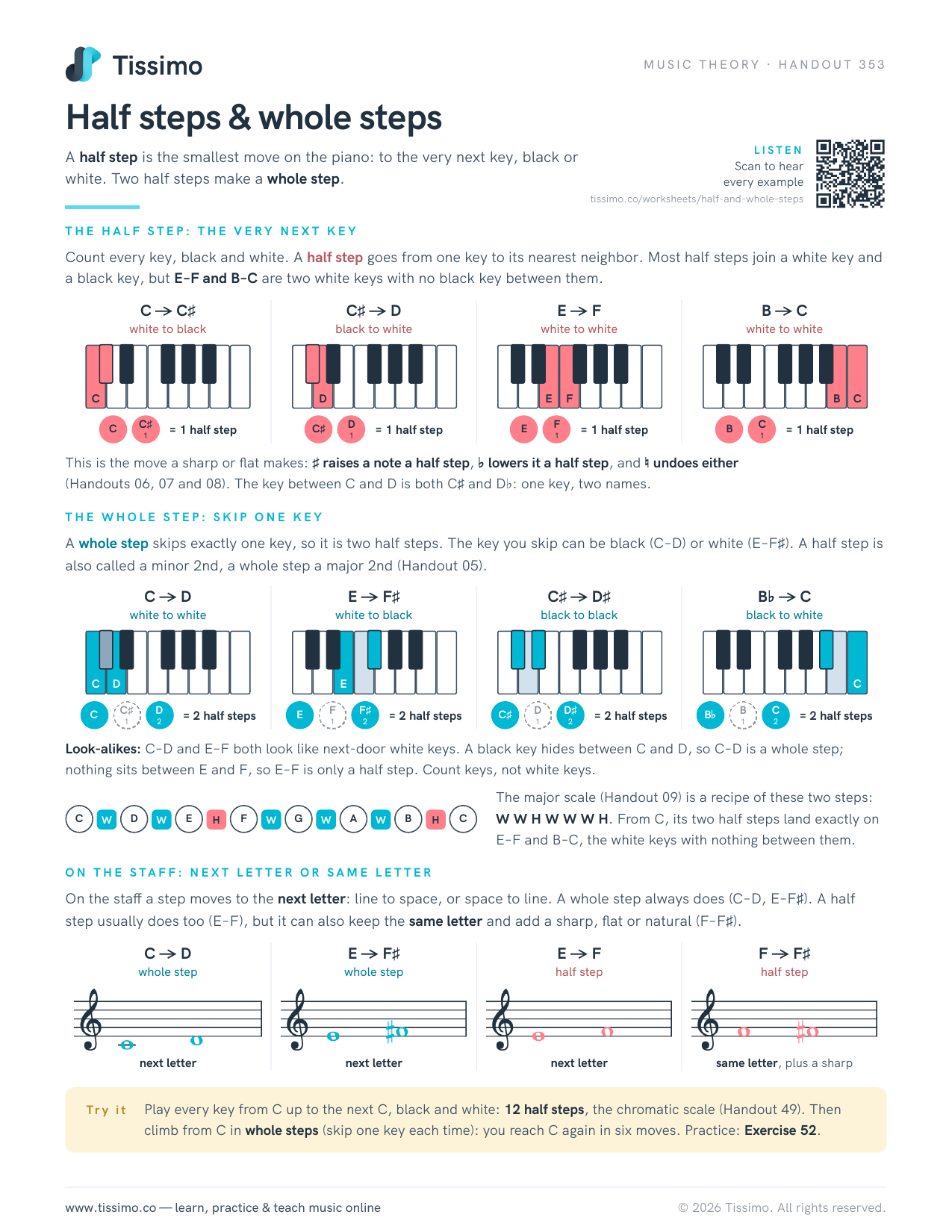 Half steps & whole stepsA half step is the smallest move on the piano: to the very next key, black or white. Two half steps make a whole step.
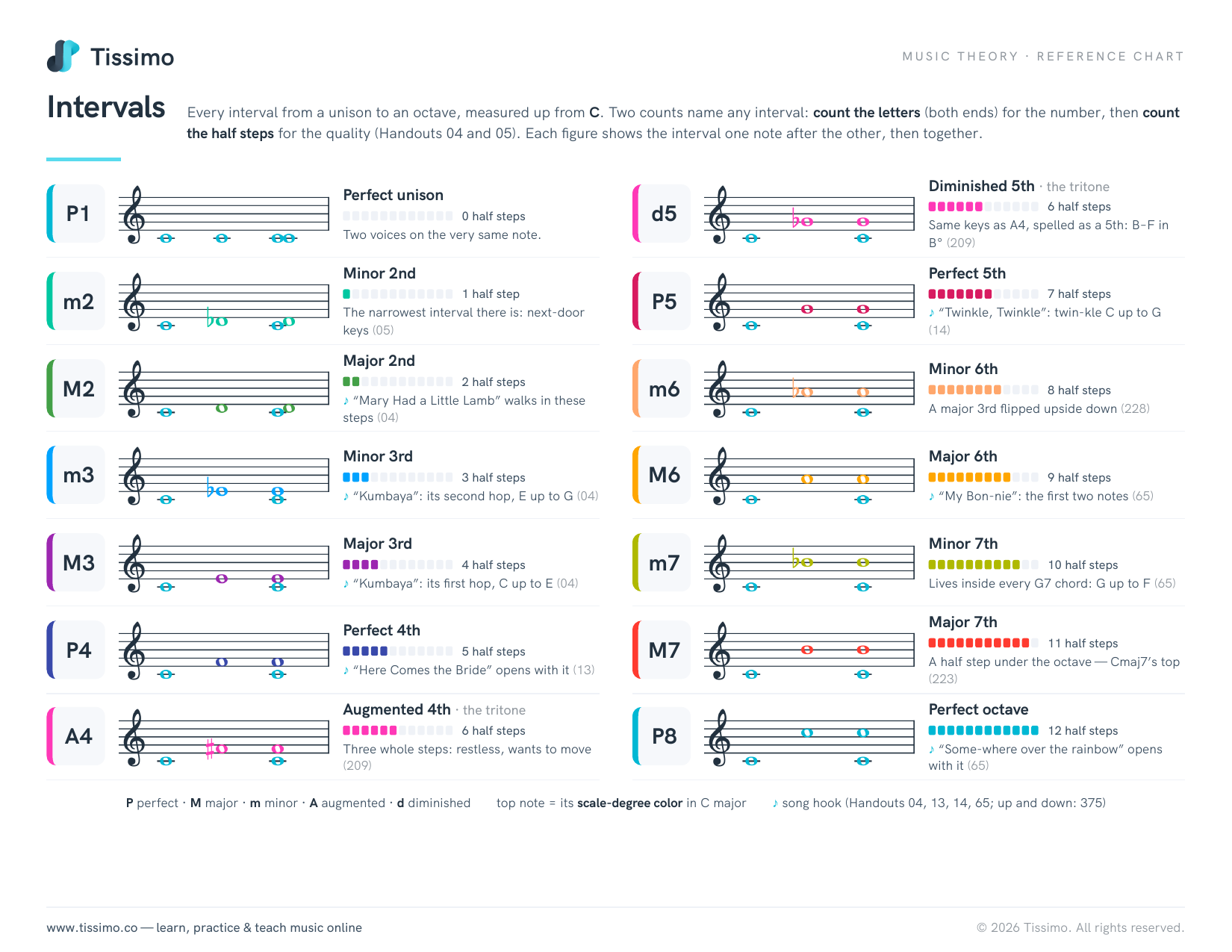 IntervalsEvery interval from a unison to an octave, measured up from C. Two counts name any interval: count the letters (both ends) for the number, then count the half steps for the quality (Handouts 04 and 05). Each figure shows the interval one note after the other, then together.
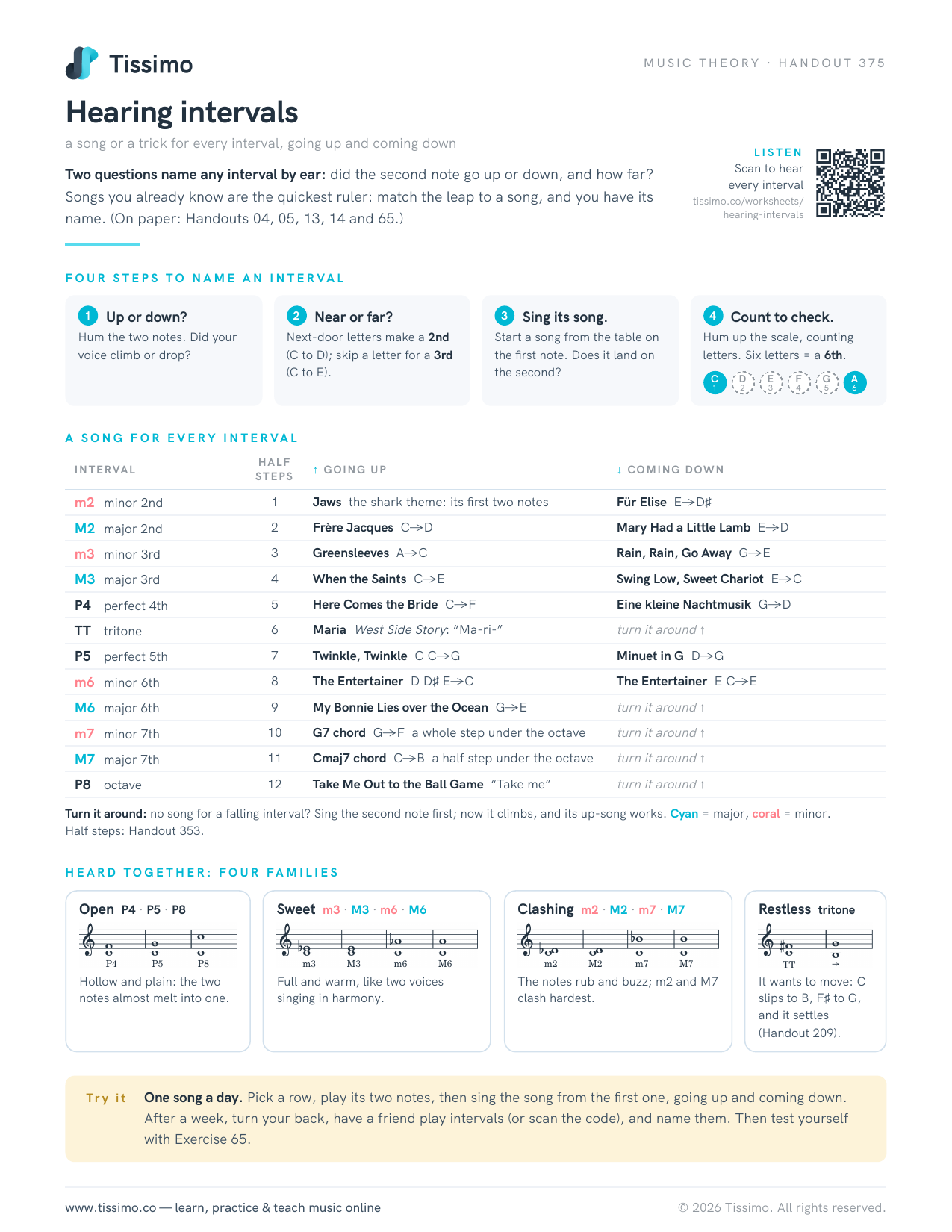 Hearing intervalsa song or a trick for every interval, going up and coming down