Chords & Harmony
Passing Tone
A passing tone is a non-chord tone that connects two different chord tones by step, moving in one direction, such as D between E and C over a C major chord. It is the most common non-chord tone.
A passing tone is a non-chord tone that fills the gap between two chord tones by step. It is approached by step and left by step in the same direction: over a C major chord, the F in G–F–E or the D in E–D–C. It is the most common non-chord tone, and it turns a melody that would otherwise skip from chord tone to chord tone into a smooth line.
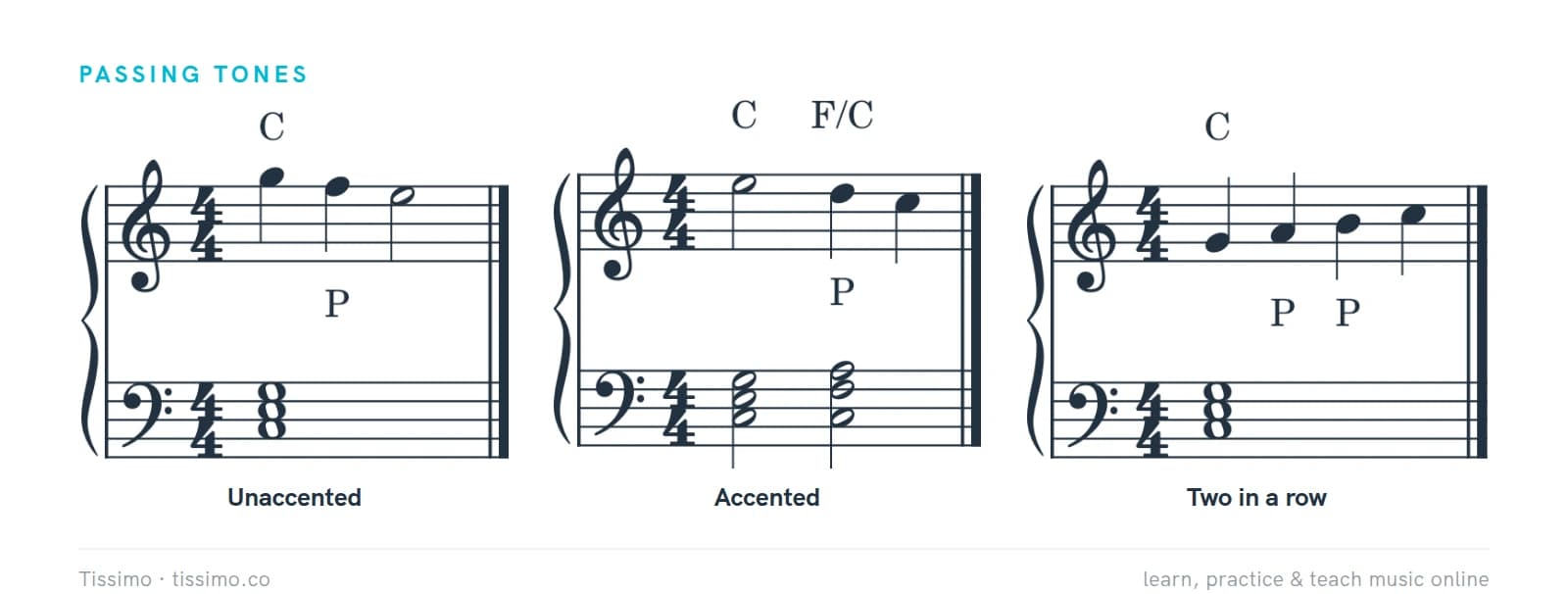
Unaccented and accented
Most passing tones are unaccented: they fall on a weak beat or between beats, and the ear hears them as motion from one chord tone to the next. An accented passing tone lands on the beat, often just as the chord changes, so it clashes for a moment before stepping on to a note of the new chord. It sounds more pointed and expressive.
Filling bigger gaps
One passing tone fills a third (E–D–C). Two in a row fill a fourth: G–A–B–C over a C chord, where A and B are both passing tones. A chromatic passing tone splits a whole step into two half steps, as in C–C♯–D.
How to recognize one
- Find the chord under the note. If the note belongs to it, it is not a passing tone.
- Check the notes on either side. If both are a step away and the line keeps going in the same direction, it is a passing tone.
- If the line steps away and comes back to the same note instead, it is a neighbor tone.
Passing motion in harmony
Whole chords can pass too. A passing six-four chord (I – V6/4 – I6) lets the bass walk C–D–E between two positions of the tonic chord, and the middle chord works much like a passing tone in the bass. See six-four chord.
Practice with Non-chord tones and Label the non-chord tones, and listen for passing tones with Hear the Visitor: Continue or Return?
Common questions
What is the difference between a passing tone and a neighbor tone?
A passing tone keeps going in the same direction (E–D–C). A neighbor tone steps away and comes back to where it started (E–F–E).
Can a passing tone fall on a strong beat?
Yes. That is an accented passing tone. It clashes more strongly with the chord than an unaccented one, then steps on to a chord tone.
Practice it: free worksheets
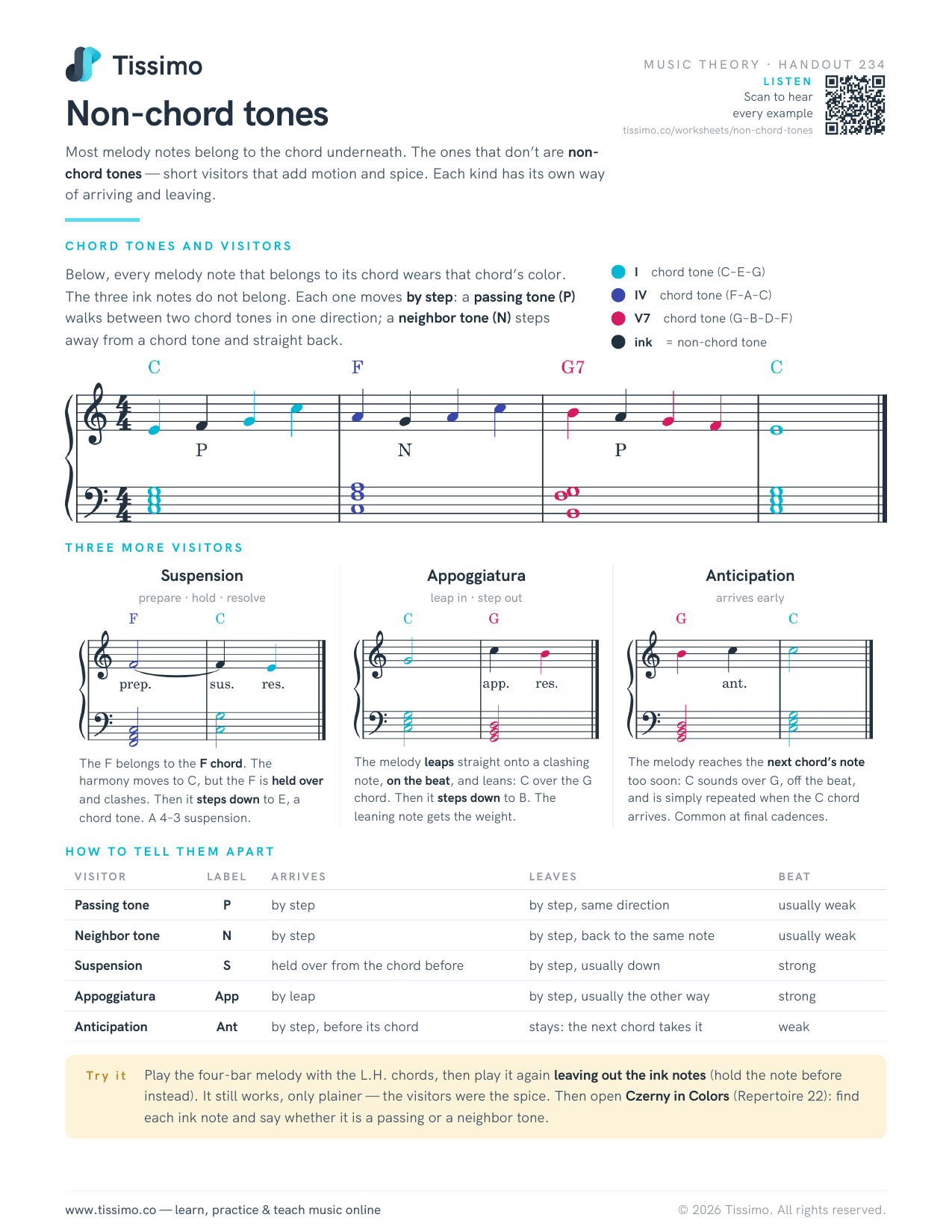 Non-chord tonesMost melody notes belong to the chord underneath. The ones that don’t are non-chord tones — short visitors that add motion and spice. Each kind has its own way of arriving and leaving.
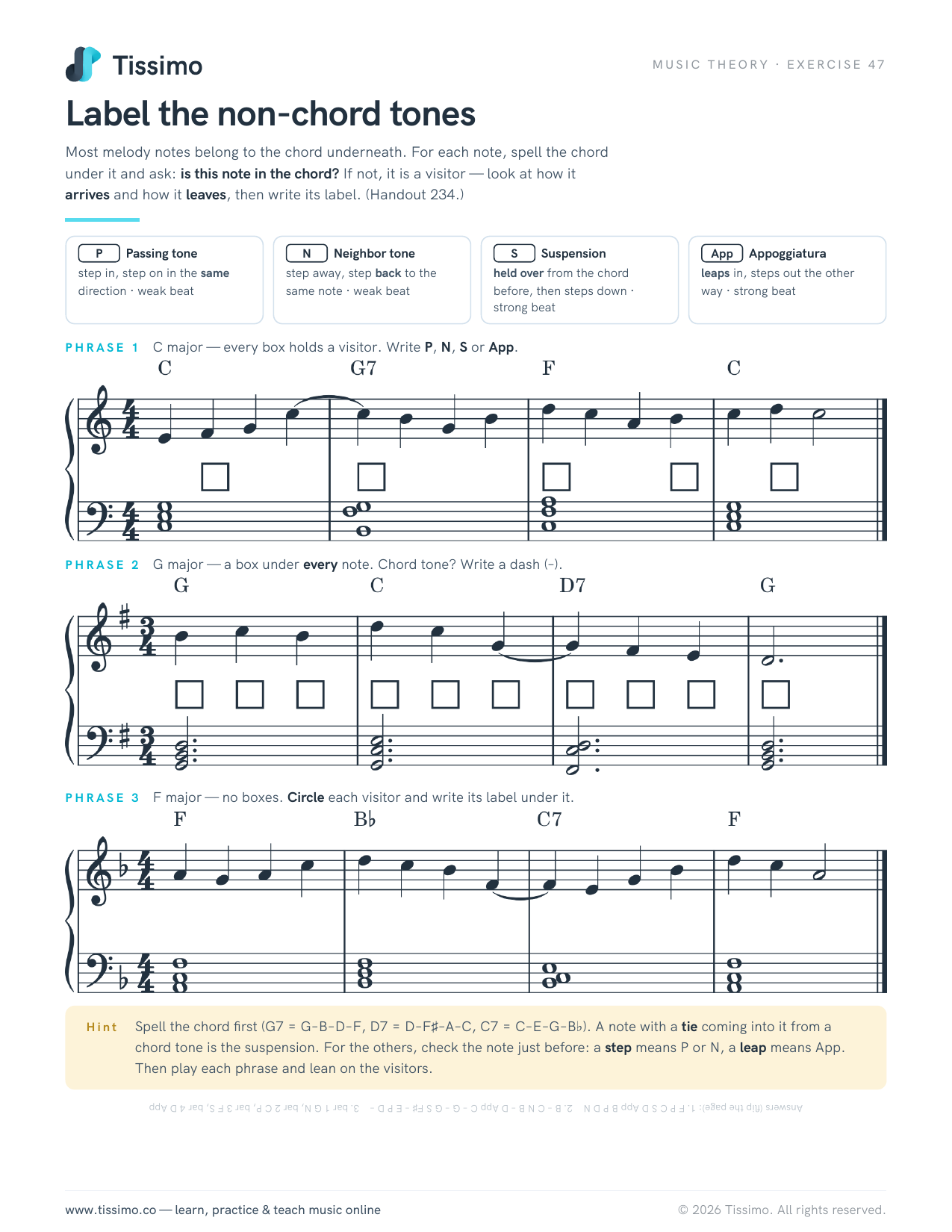 Label the non-chord tonesMost melody notes belong to the chord underneath. For each note, spell the chord under it and ask: is this note in the chord? If not, it is a visitor — look at how it arrives and how it leaves, then write its label. (Handout 234.)
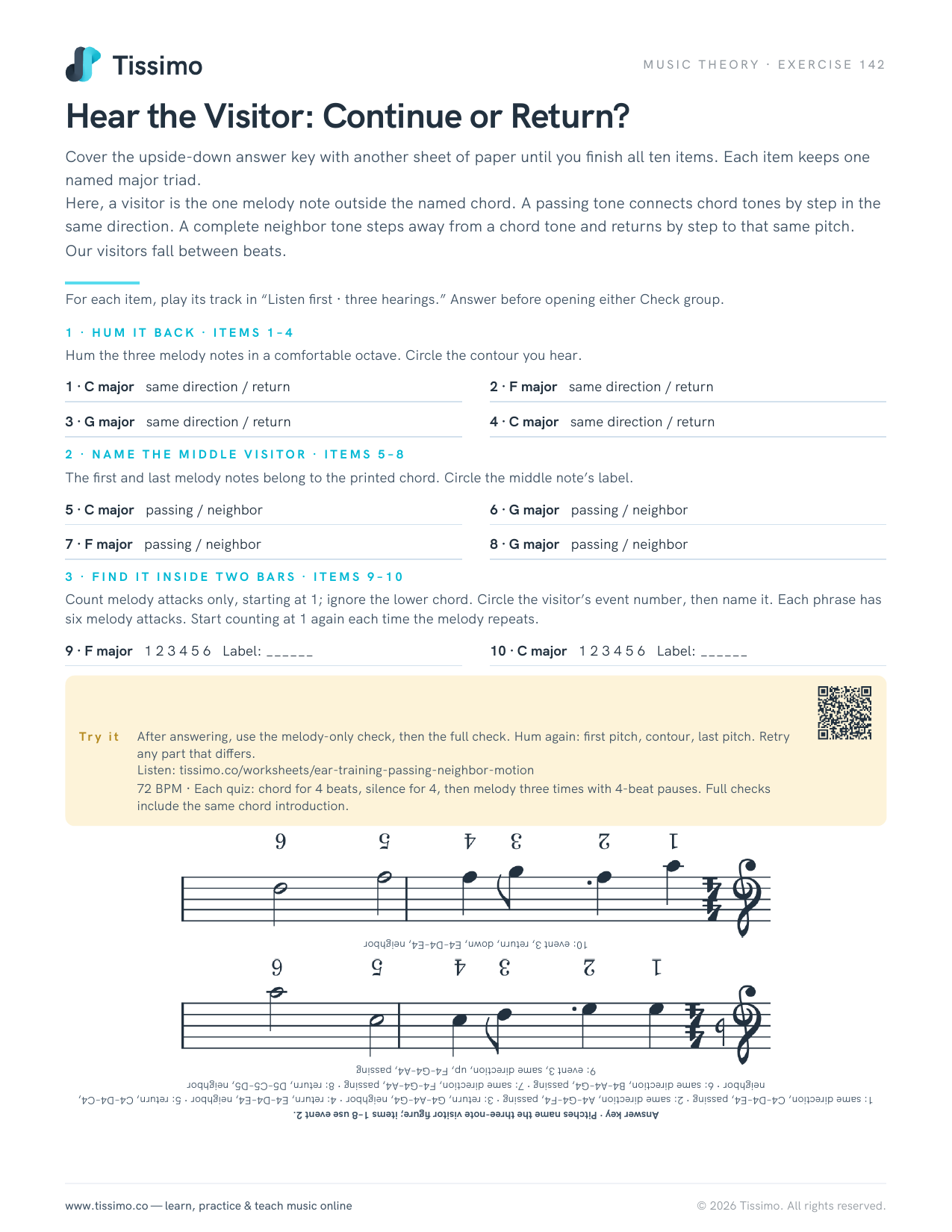 Hear the Visitor: Continue or Return?Cover the upside-down answer key with another sheet of paper until you finish all ten items. Each item keeps one named major triad. Here, a visitor is the one melody note outside the named chord. A passing tone connects chord tones by step in the same direction. A complete neighbor tone steps away from a chord tone and returns by step to that same pitch. Our visitors fall between beats.