Chords & Harmony
Chord
A chord is a group of different notes, usually three or more, sounded together and typically built by stacking thirds. Chords supply the harmony under a melody and are named by their root and quality, such as C major or G7.
A chord is usually three or more different notes sounding at the same time. Two notes together make an interval; add a third, different note and you have a chord. Most chords in Western music are built by stacking notes a third apart, which is why the same few shapes turn up in hymns, pop songs, jazz standards and piano sonatas alike.
What a chord is made of
Pick a starting note, the root, and stack notes a third apart above it. Three notes give a triad: C–E–G is a C major chord. A fourth note on top gives a seventh chord (G–B–D–F is G7), and going further gives extended chords with 9ths, 11ths and 13ths. A few common chords break the pattern on purpose: a suspended chord swaps the third for a 2nd or a 4th, and a power chord leaves the third out altogether, so it has only two different notes, root and fifth, yet guitarists still call it a chord.
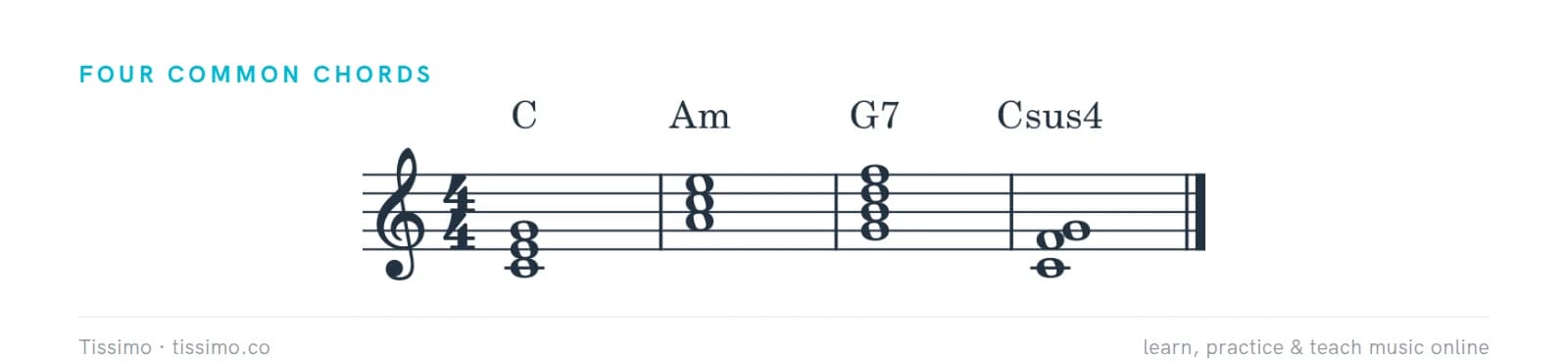
Doubling a note in another octave does not make a new chord. C–E–G–C is still a C major triad: the letter names are what count, not the number of keys you press.
How chords are named
Every chord has a root and a quality. The root gives the letter name; the quality (major, minor, diminished, augmented, dominant seventh and so on) describes the sizes of the intervals above it. On a lead sheet chords appear as chord symbols such as C, Am or G7. In theory classes they are also written as Roman numerals (I, vi, V7) that show where the root sits in the key; see roman numeral analysis.
Playing a chord
You can play the notes together as a block chord, or one after another as a broken chord or arpeggio. Either way your ear groups them into one harmony. On the piano, C major is a good first shape: thumb on C, middle finger on E, fifth finger on G.
Chords in a key
Build a triad on each note of a major scale and you get the seven chords of that key: three major (I, IV, V), three minor (ii, iii, vi) and one diminished (vii°). Most songs take their chord progression from that set. The chords of a key walks through all seven, and Build the chords gives you practice spelling them on the staff.
Common questions
How many notes do you need to make a chord?
In most definitions, at least three different notes. Two notes make an interval. The power chord (a root and a fifth) is a popular exception that guitarists still call a chord.
What is the difference between a chord and harmony?
A chord is one group of notes heard together. Harmony is the broader idea: how notes combine, and how chords follow one another through a piece.
Practice it: free worksheets
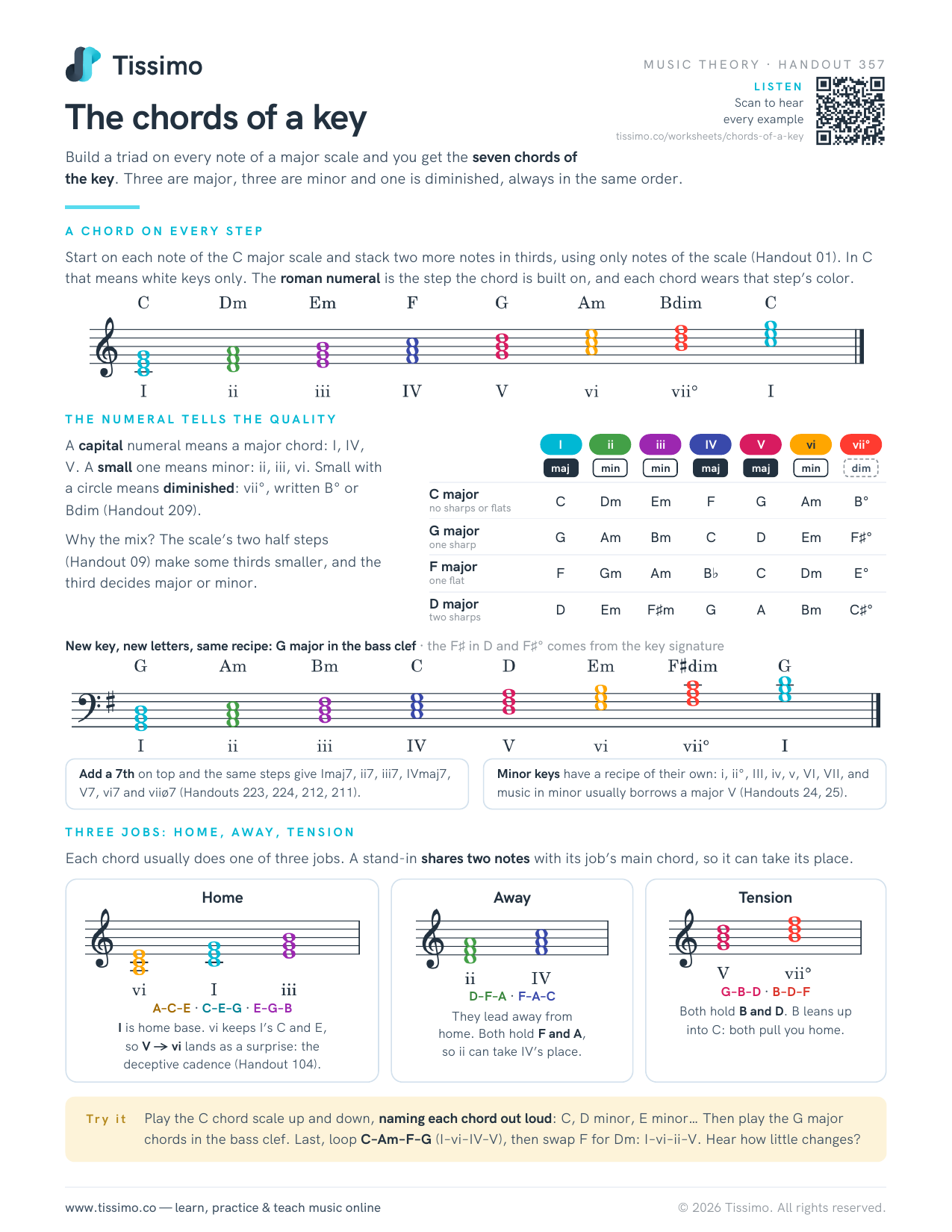 The chords of a keyBuild a triad on every note of a major scale and you get the seven chords of the key. Three are major, three are minor and one is diminished, always in the same order.
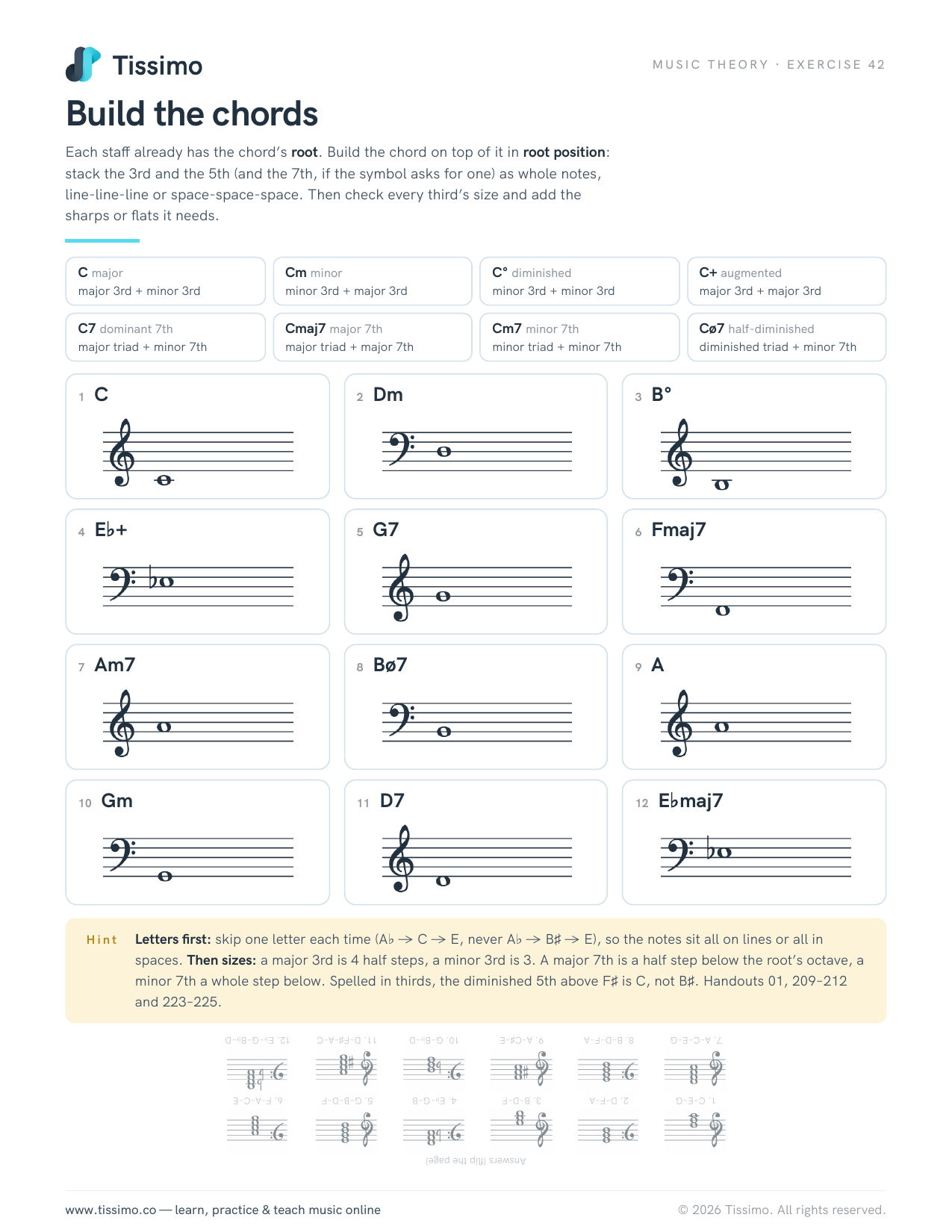 Build the chordsEach staff already has the chord’s root. Build the chord on top of it in root position: stack the 3rd and the 5th (and the 7th, if the symbol asks for one) as whole notes, line-line-line or space-space-space. Then check every third’s size and add the sharps or flats it needs.
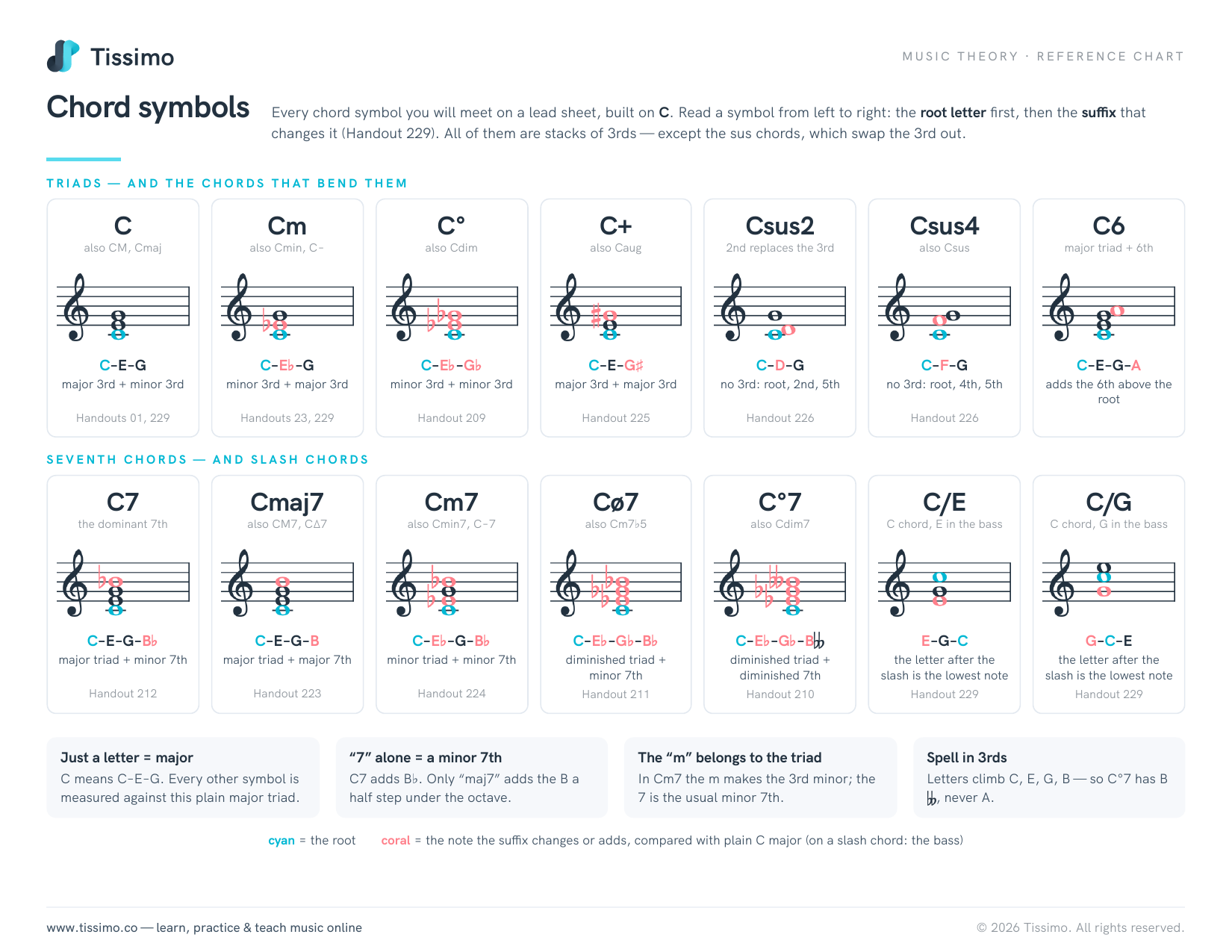 Chord symbolsEvery chord symbol you will meet on a lead sheet, built on C. Read a symbol from left to right: the root letter first, then the suffix that changes it (Handout 229). All of them are stacks of 3rds — except the sus chords, which swap the 3rd out.
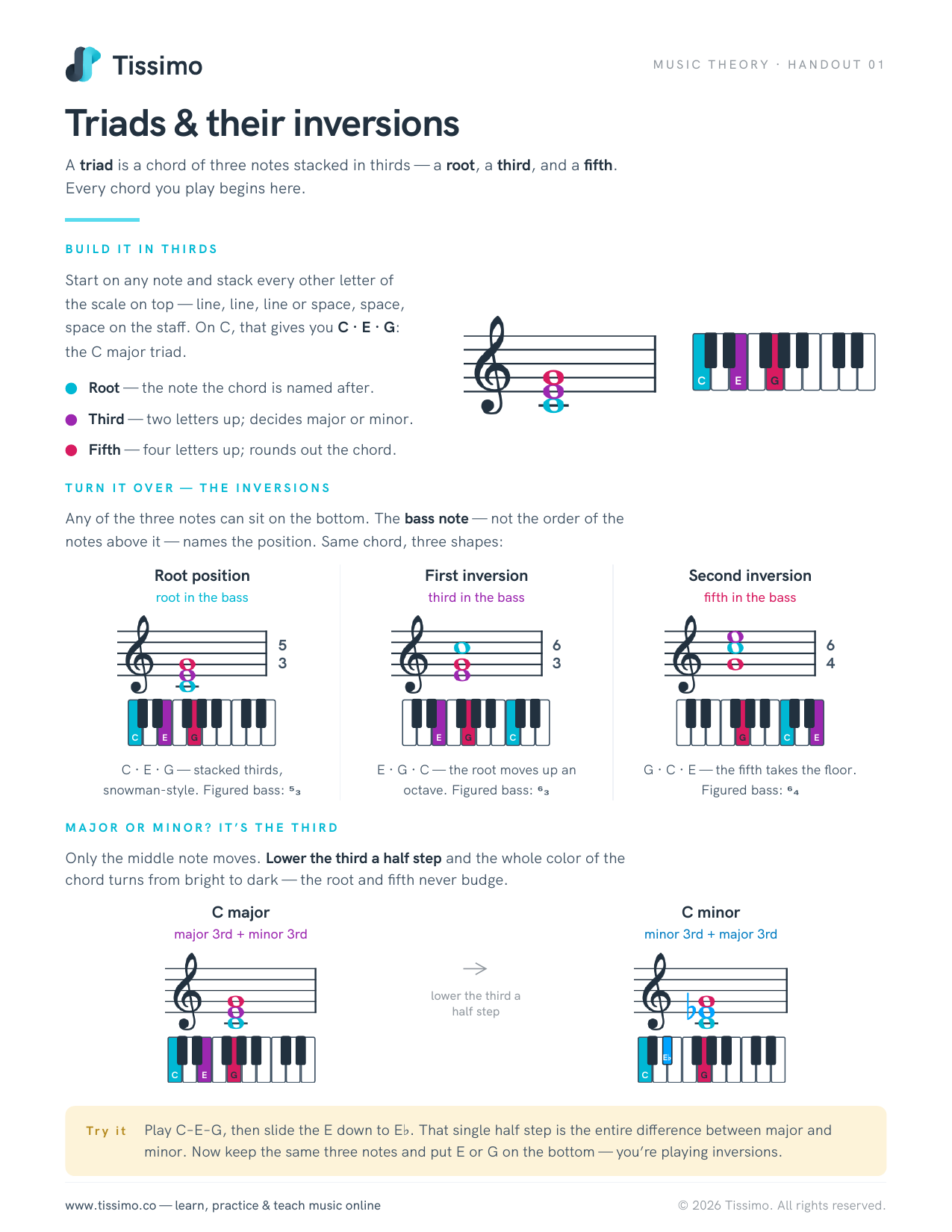 Triads & their inversionsA triad is a chord of three notes stacked in thirds — a root, a third, and a fifth. Every chord you play begins here.
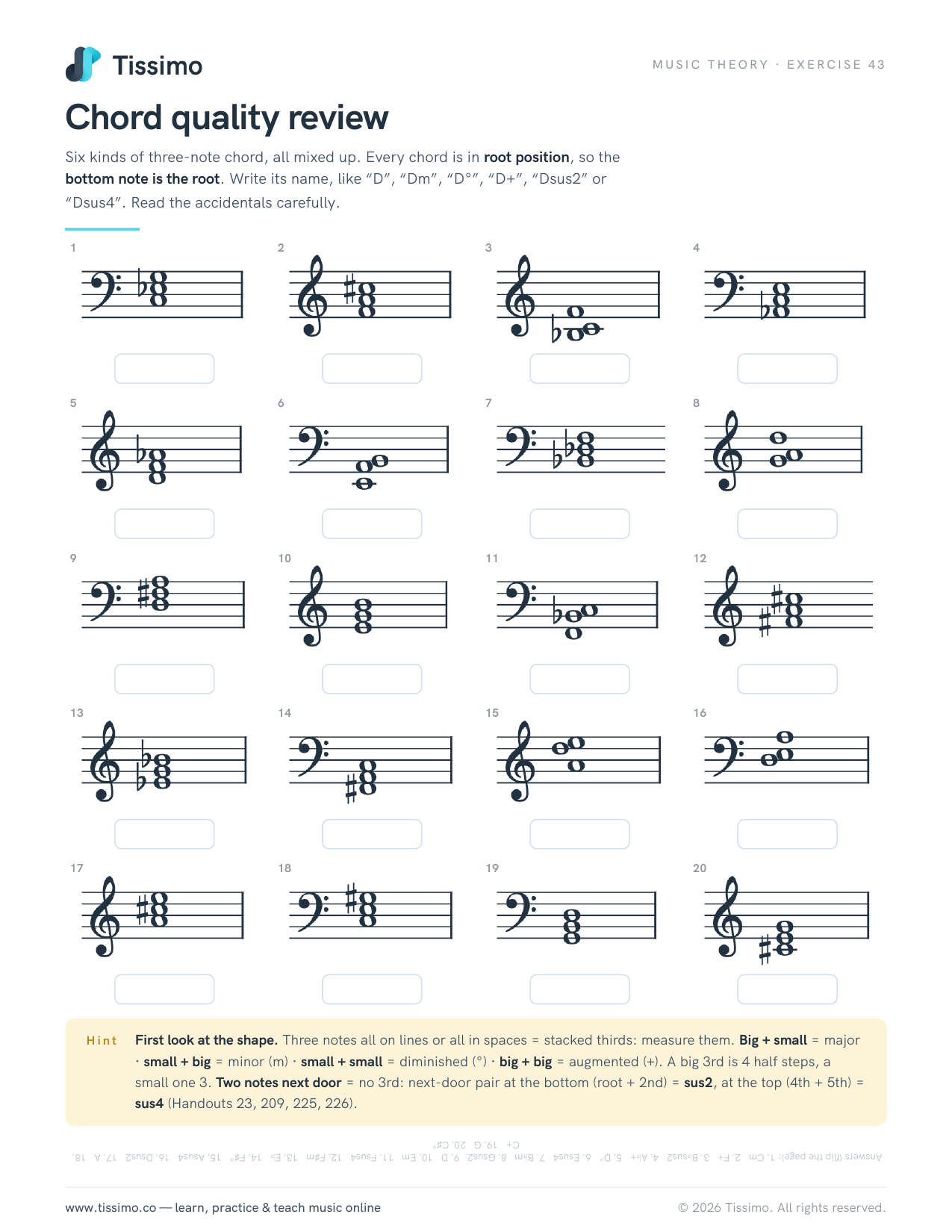 Chord quality reviewSix kinds of three-note chord, all mixed up. Every chord is in root position, so the bottom note is the root. Write its name, like “D”, “Dm”, “D°”, “D+”, “Dsus2” or “Dsus4”. Read the accidentals carefully.