Chords & Harmony
Block Chord
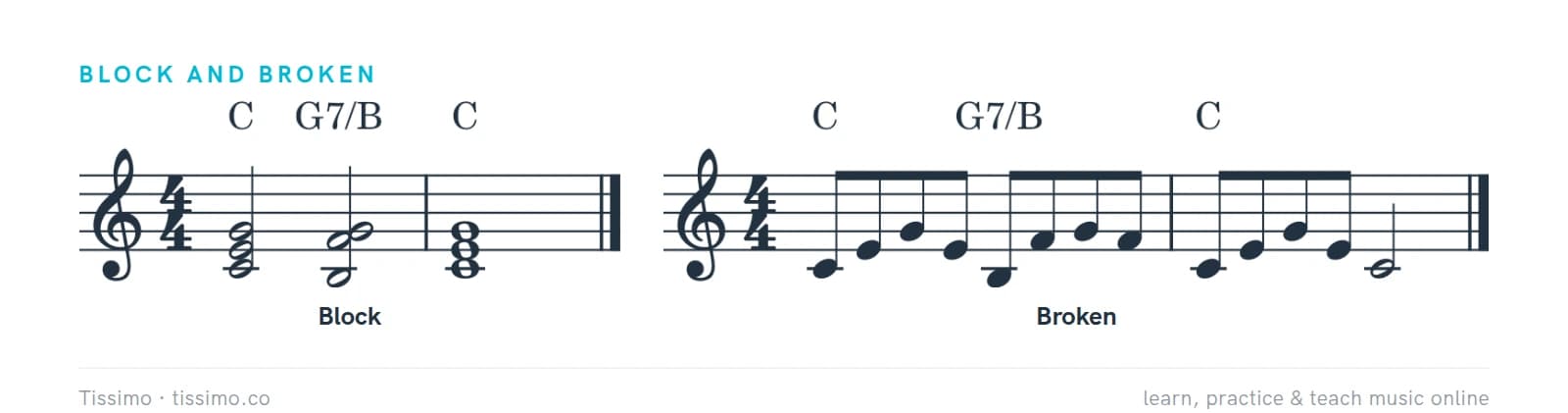
A block chord is a chord whose notes are all played at the same moment, as one solid sound. It is the opposite of a broken chord, in which the notes are played one after another.
A block chord is a chord whose notes are all played at exactly the same moment, so you hear them as one solid sound. On the staff its notes are stacked on a single stem (or, for whole notes, directly above one another). Some teachers call it a solid chord. Its opposite is the broken chord, whose notes are played one after another.
Where you hear them
- Hymns and chorales move in block chords, one chord for each melody note (four-part harmony).
- Pop and rock piano parts often play block chords in a steady rhythm, and a strummed guitar does much the same.
- Beginner piano books use block chords in the left hand because they are the clearest way to learn chord shapes, such as I, IV and V7 in their closest positions (primary chords).
- Jazz pianists have a "block chord" style, also called locked hands, in which both hands move together in close harmony under the melody.
Playing block chords well
- Land all the notes together. Drop the hand from a little height with a relaxed wrist rather than pressing each finger separately.
- Balance the notes. Let the top note, often the melody, sound a little stronger than the others; see voicing.
- Release together, unless the music asks for one note to be held.
- Move to the nearest position for the next chord, so the hand changes as little as possible (see voicing and voice leading).
Block chords as a learning tool
Even when a piece breaks its chords up, playing them as blocks first is one of the fastest ways to learn it. You see the harmony, your hand learns the shapes, and you can practice the changes before adding the rhythm. Primary Chord Patterns gives you the basic block-chord changes, and Block & Broken Chords shows both styles side by side.
Common questions
What is the difference between a block chord and a broken chord?
A block chord sounds all its notes at once. A broken chord plays them one after another, in a pattern such as C–E–G–E.
Is a strummed guitar chord a block chord?
Close to it. A strum sounds the strings in very quick succession, but so fast that the ear hears one chord. A slow, deliberate strum starts to sound like a rolled chord.
Practice it: free worksheets
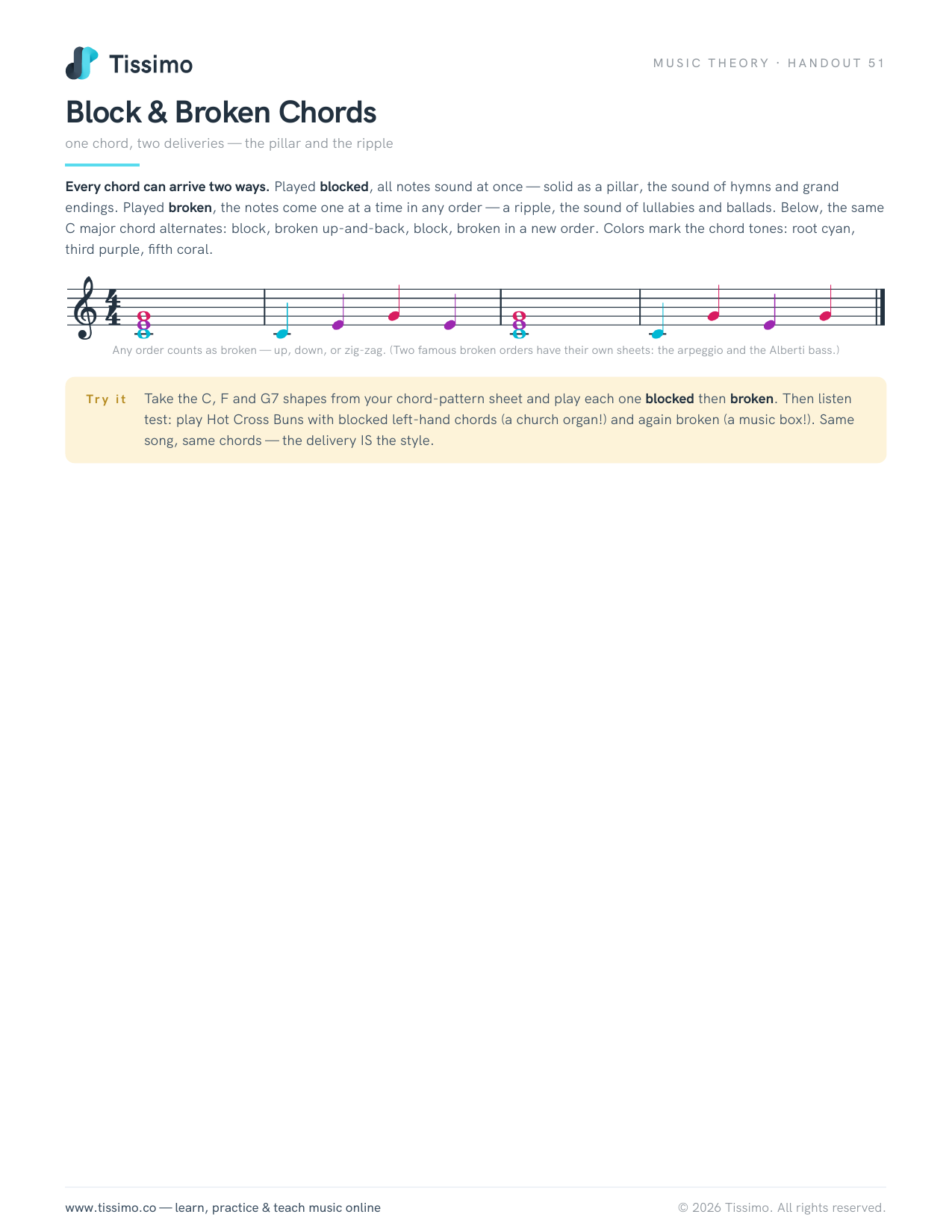 Block & Broken Chordsone chord, two deliveries — the pillar and the ripple
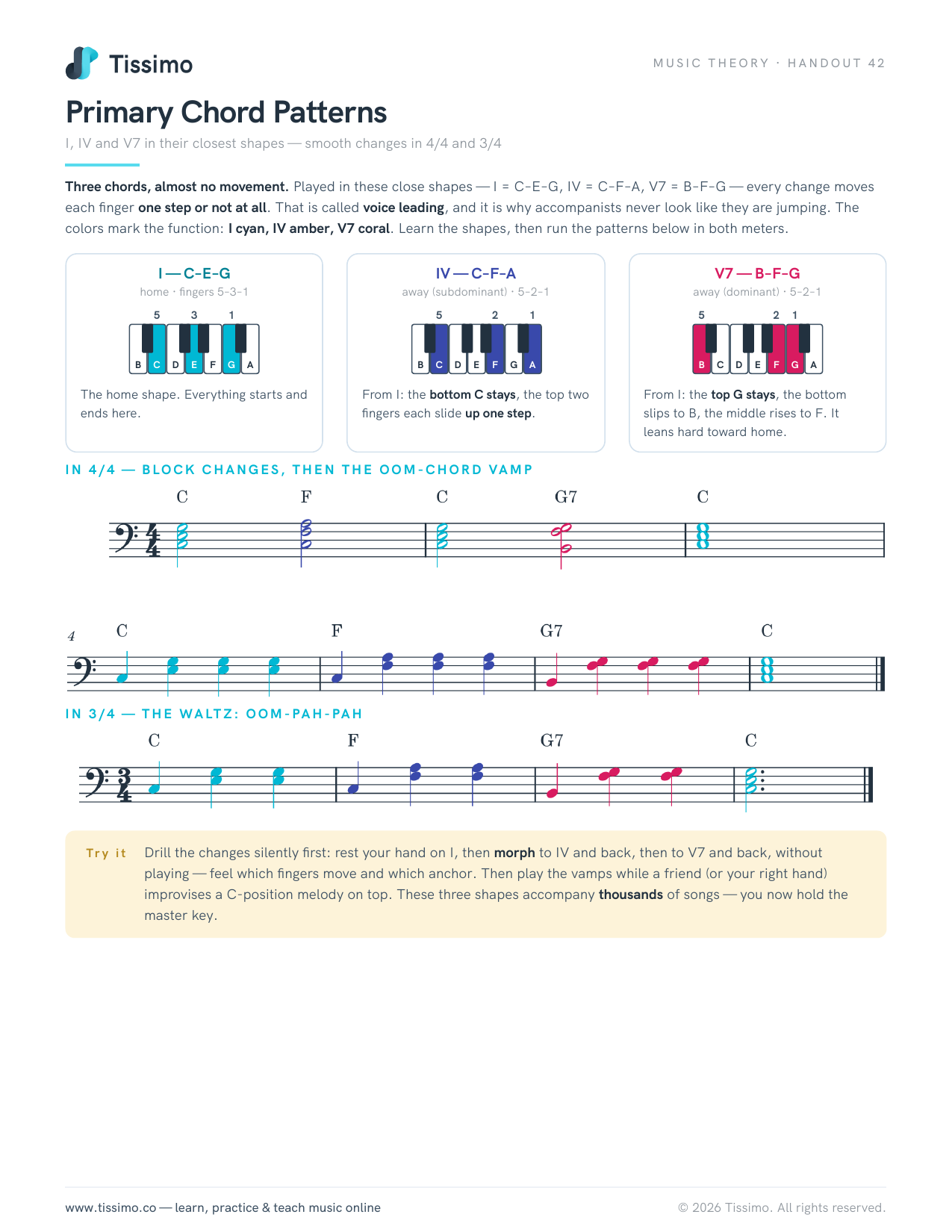 Primary Chord PatternsI, IV and V7 in their closest shapes — smooth changes in 4/4 and 3/4
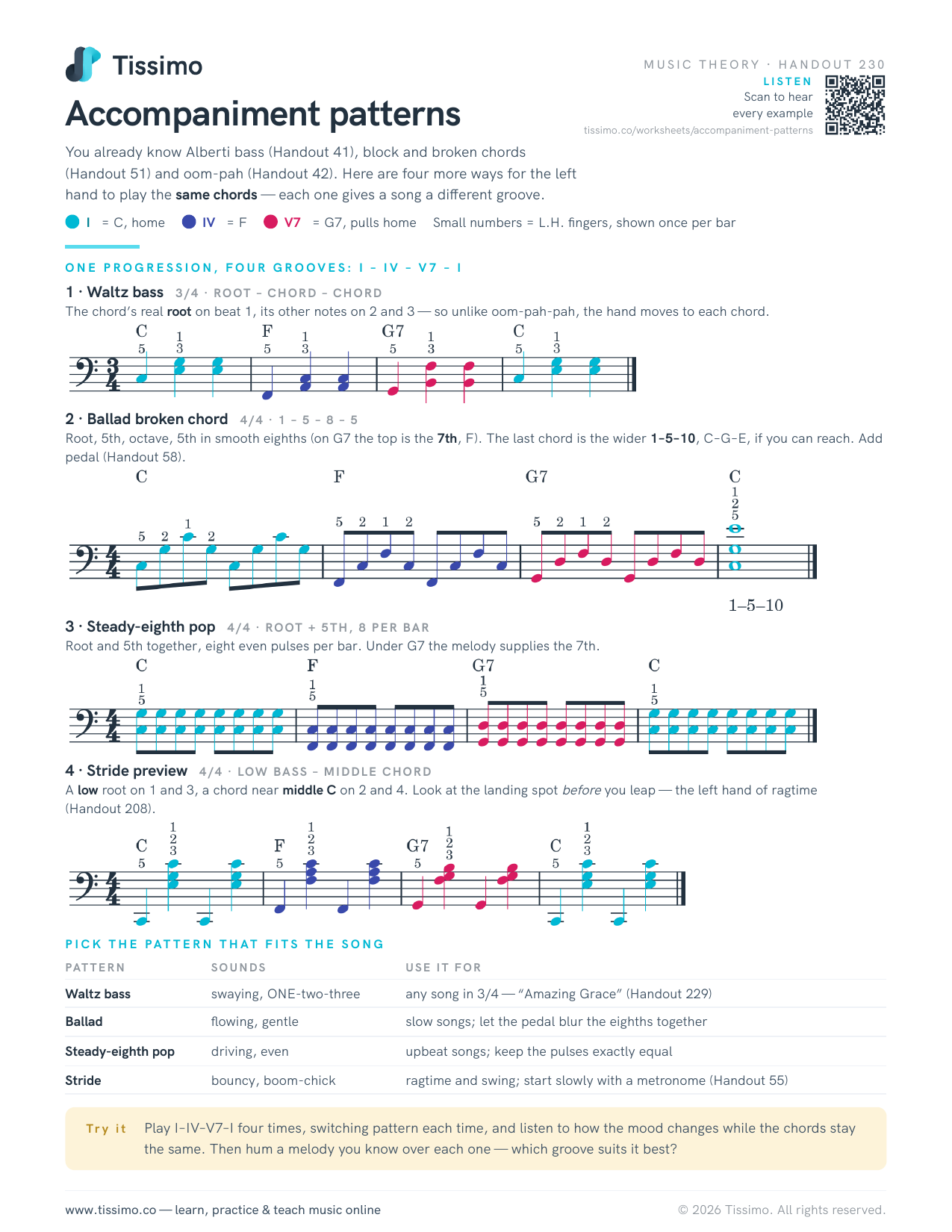 Accompaniment patternsYou already know Alberti bass (Handout 41), block and broken chords (Handout 51) and oom-pah (Handout 42). Here are four more ways for the left hand to play the same chords — each one gives a song a different groove.
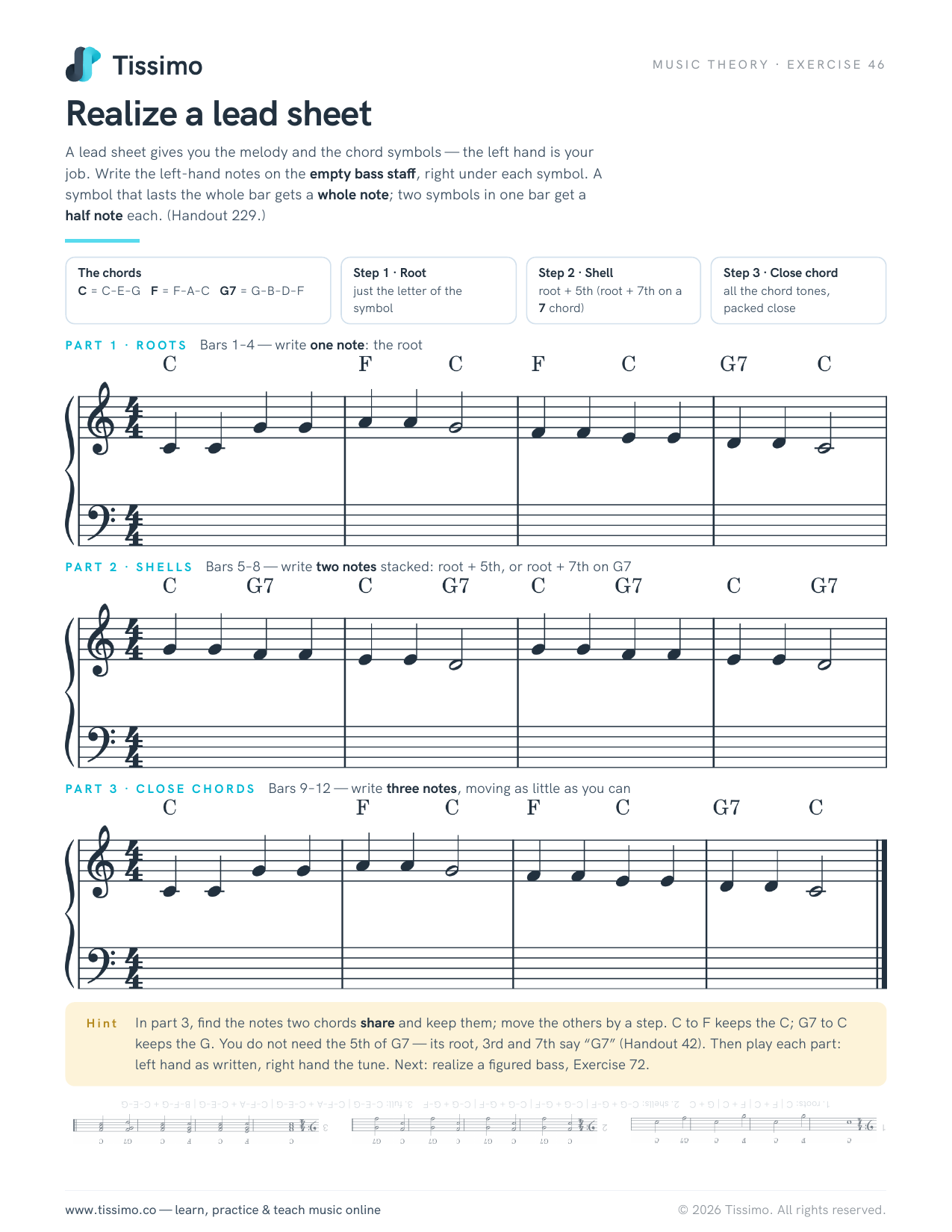 Realize a lead sheetA lead sheet gives you the melody and the chord symbols — the left hand is your job. Write the left-hand notes on the empty bass staff, right under each symbol. A symbol that lasts the whole bar gets a whole note; two symbols in one bar get a half note each. (Handout 229.)