Chords & Harmony
Voice Leading
Voice leading is the way each note of a chord moves to the next chord, treating harmony as several melodic lines at once. Good voice leading keeps those lines smooth and independent, mostly by step or common tone.
Voice leading is the way each note of a chord moves to a note of the next chord. Instead of treating harmony as a series of separate blocks, it treats it as several melodies, or voices, sounding at once: in a hymn, the soprano, alto, tenor and bass lines. Good voice leading keeps each of those lines smooth and singable while the chords change.
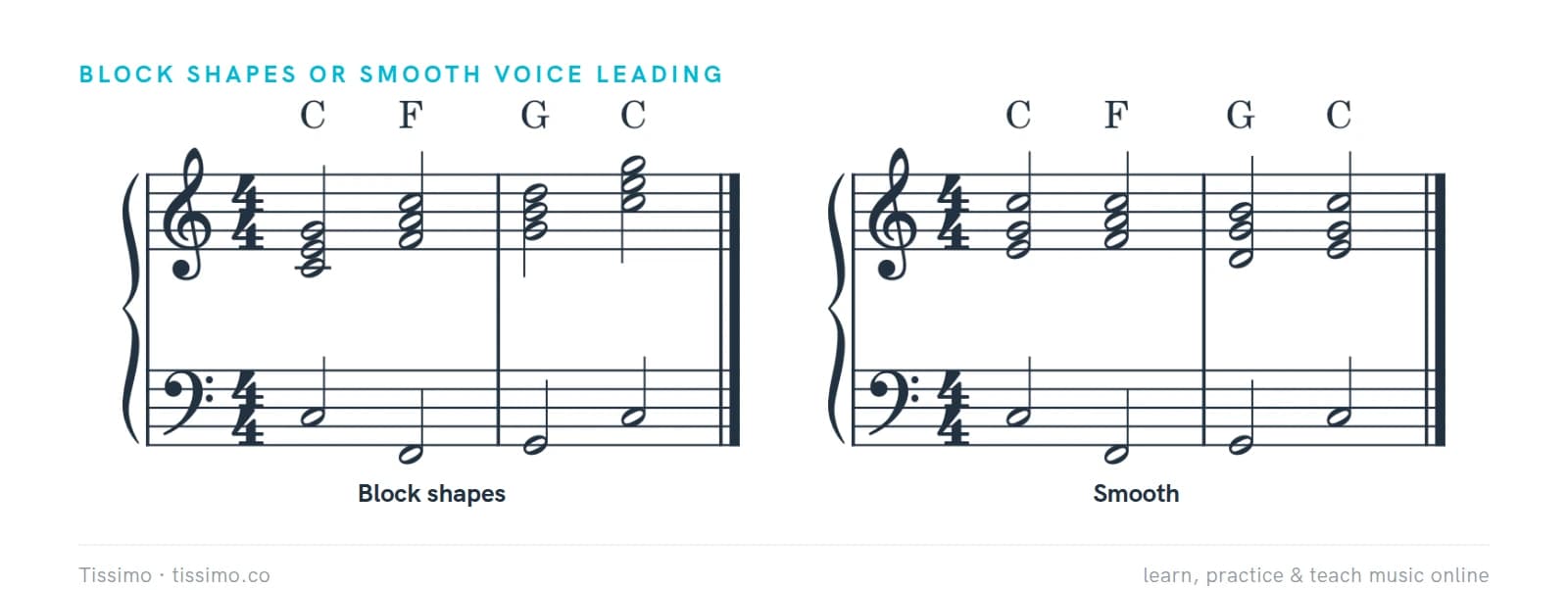
The basic principles
- Keep common tones. If a note belongs to both chords, hold it in the same voice.
- Move by the smallest step. Let the other voices move to the nearest available note of the next chord.
- Resolve tendency tones. The leading tone usually rises to the tonic; the seventh of a chord usually falls by step.
- Use contrary motion between the outer voices. When the bass goes up, let the top voice go down, and the other way around (see contrary motion).
- Avoid parallel fifths and octaves. Two voices a perfect fifth or an octave apart should not move in the same direction to another fifth or octave; see parallel fifths and octaves.
- Keep voices in their own space. Don't let a lower voice cross above a higher one, and keep neighboring upper voices within an octave of each other.
Why it matters
Smooth voice leading makes harmony sound connected rather than chopped up, and it makes parts easier to sing and play. At the keyboard it also means less hand movement: in the smooth version above, the right hand never leaves one small area. The same thinking lies behind jazz piano voicings, where the third and seventh of each chord, the "guide tones", move by half or whole step through a ii–V–I progression.
Where the rules come from
The traditional rules grew out of Renaissance counterpoint and were codified in teaching from the 18th century on, with Bach's four-part chorales as a favorite model. They describe a style, not laws of nature: much rock music happily slides chord shapes in parallel, and Debussy often moved whole chords in parallel on purpose. When you want lines that are smooth and independent, though, these principles still work. Four-part harmony is where most students practice them.
Practice with Four-part harmony, Find the voice-leading errors and Primary Chord Patterns.
Common questions
What are the basic rules of voice leading?
Keep common tones, move the other voices by step, resolve the leading tone up and chord sevenths down, prefer contrary motion between the bass and the melody, and avoid parallel fifths and octaves.
Do voice-leading rules apply to pop and jazz?
Not as strict rules; pop and rock often move chord shapes in parallel on purpose. But smooth movement between chords matters in any style, especially for piano and guitar voicings and for vocal harmony.
Practice it: free worksheets
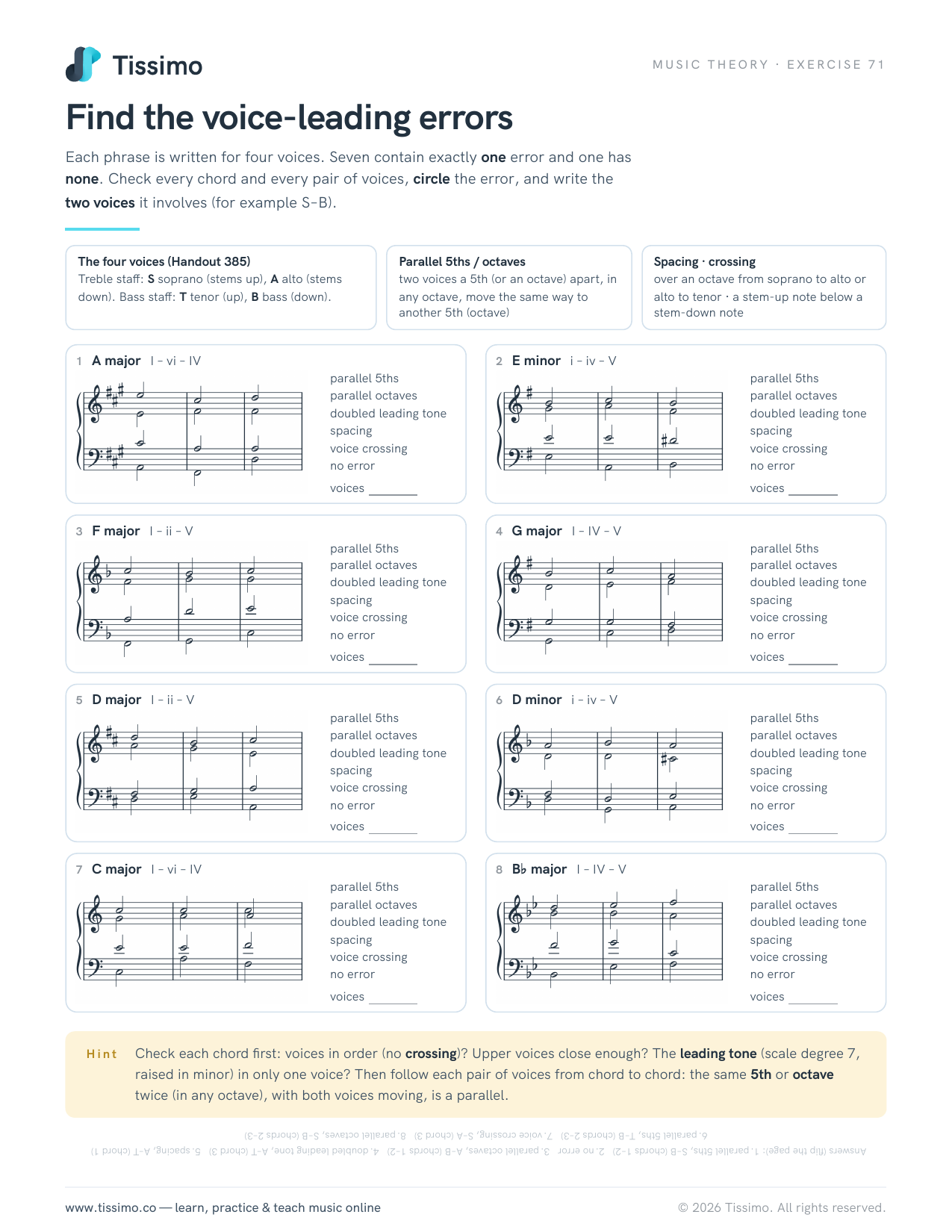 Find the voice-leading errorsEach phrase is written for four voices. Seven contain exactly one error and one has none. Check every chord and every pair of voices, circle the error, and write the two voices it involves (for example S–B).
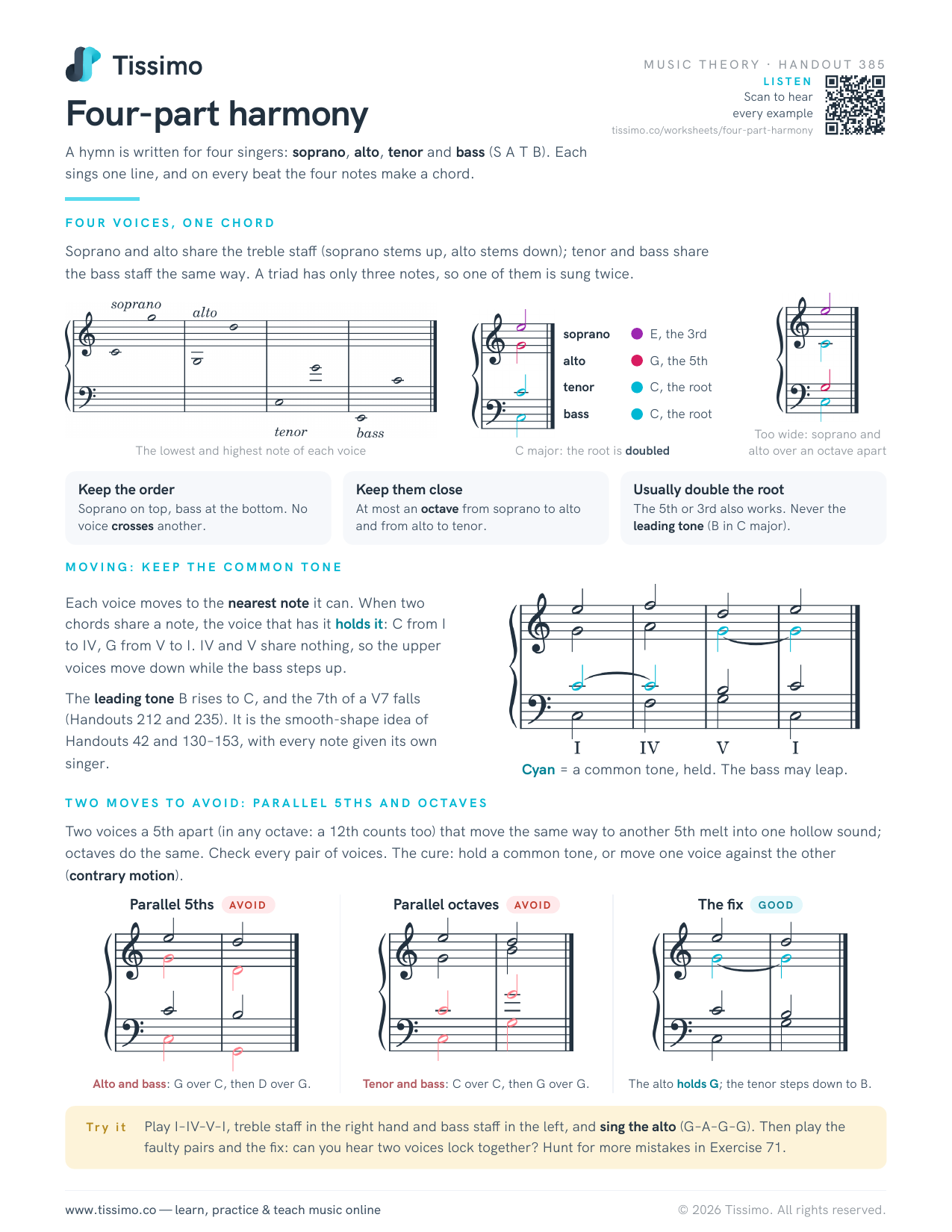 Four-part harmonyA hymn is written for four singers: soprano, alto, tenor and bass (S A T B). Each sings one line, and on every beat the four notes make a chord.
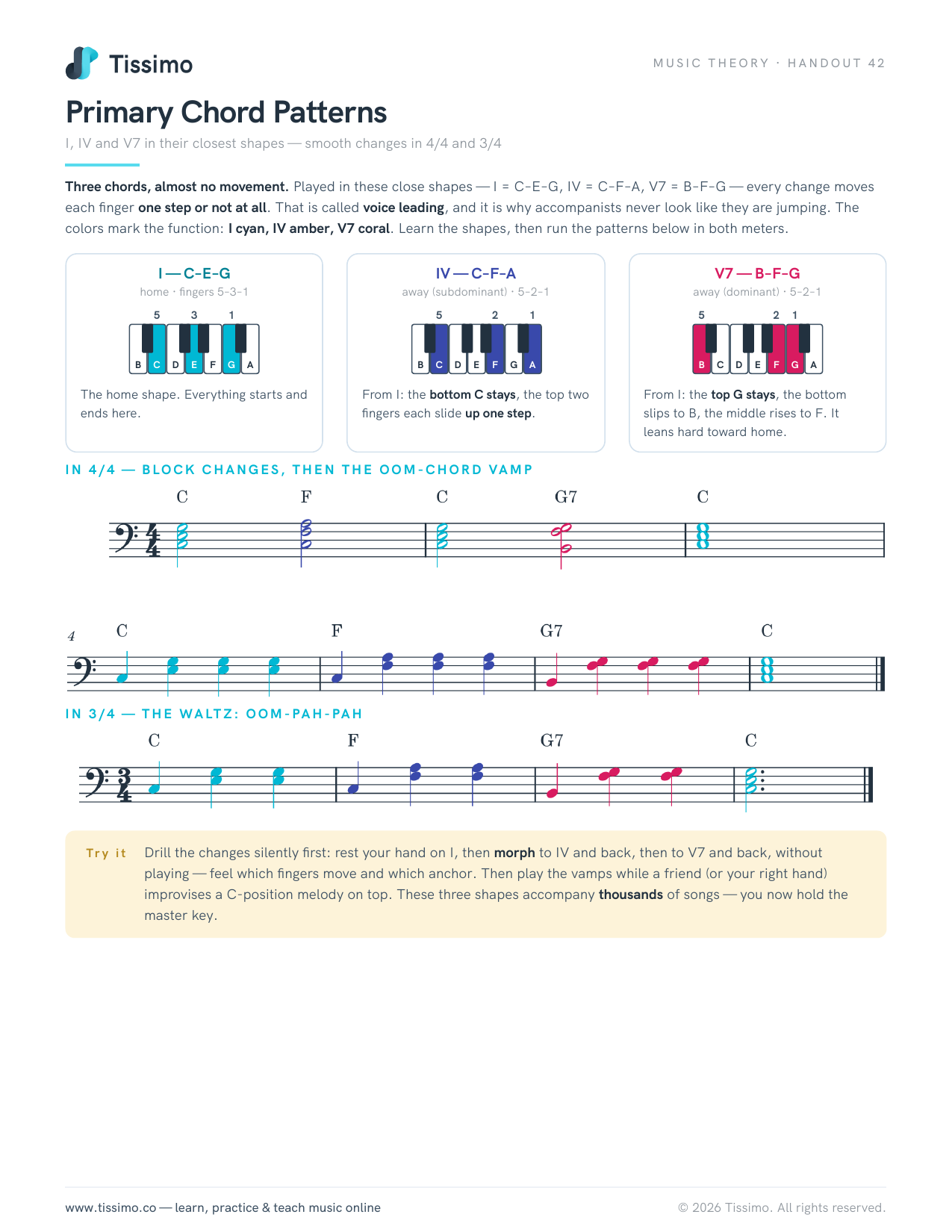 Primary Chord PatternsI, IV and V7 in their closest shapes — smooth changes in 4/4 and 3/4
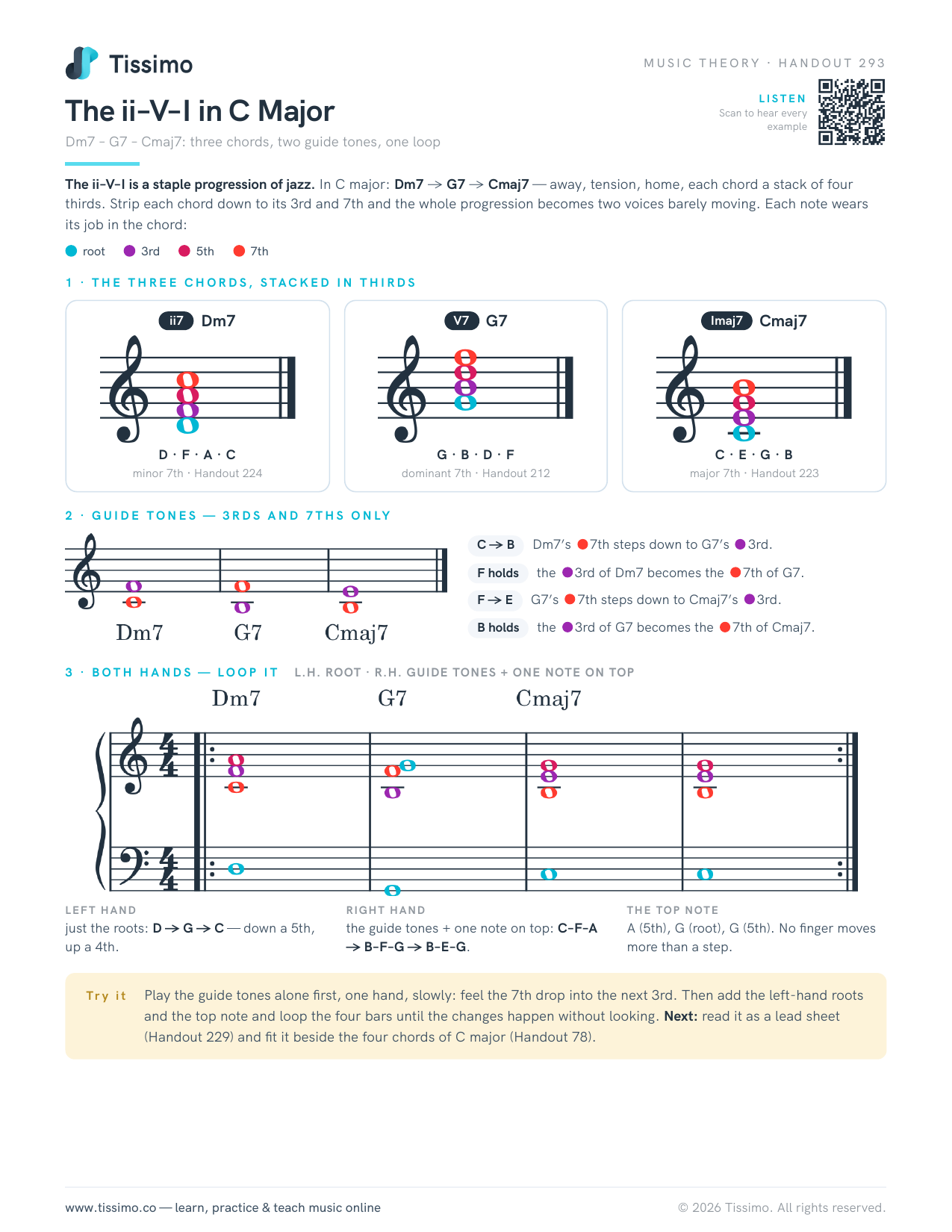 The ii–V–I in Every KeyThe most-played progression in jazz: three chords, two guide tones, one loop, in all 24 keys.