Chords & Harmony
Parallel Fifths and Octaves
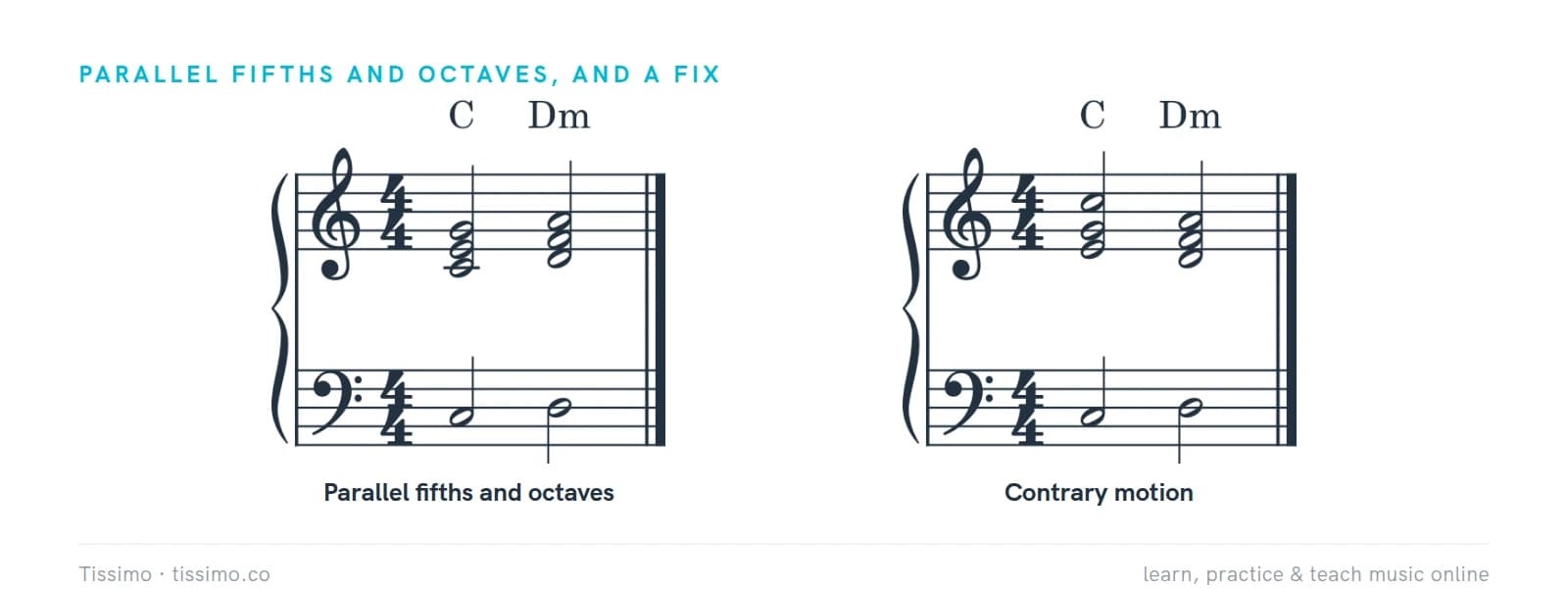
Parallel fifths and octaves occur when two voices a perfect fifth or an octave apart both move in the same direction to another perfect fifth or octave. Traditional part writing avoids them because the two lines lose their independence.
Parallel fifths happen when two voices a perfect fifth apart both move in the same direction to another perfect fifth: C and G moving up to D and A, for example. Parallel octaves are the same thing with octaves (or unisons): C and C moving to D and D. Traditional part writing avoids both, and spotting them is one of the first skills harmony students learn.
Why they are avoided
Perfect fifths and octaves are the most blended intervals: in an octave the two notes almost merge into one, and a fifth comes close. When two voices move in parallel through these intervals, the ear stops hearing two independent lines and hears one thickened line instead. In four-part harmony that leaves only three real parts. Avoiding them keeps every voice independent, which is the whole point of counterpoint and careful voice leading.
The rule covers compound intervals too (a twelfth moving to a twelfth counts as parallel fifths). Strict style also avoids consecutive fifths or octaves reached by contrary motion, where the two voices move in opposite directions but still land a fifth or an octave apart again.
How to fix them
- Move one of the voices the other way: contrary motion is the most reliable cure.
- Keep a common tone in one voice instead of moving both.
- Re-voice the chord so the two voices are no longer a fifth or an octave apart.
- Use an inversion, which changes the bass and every interval above it.
When they are fine
The prohibition belongs to a style, not to all music. In medieval organum, voices moved in parallel fifths and octaves on purpose. Doubling a whole melody in octaves, as orchestras do all the time, is not an error, because it is one line reinforced rather than two lines merging. Rock guitarists slide power chords in parallel fifths, and Debussy and other Impressionist composers moved whole chords in parallel for their color. Outside strict four-part writing, judge parallels by ear.
Hidden fifths and octaves
A related, milder fault: when two voices move in the same direction into a fifth or an octave, the result is called hidden (or direct) fifths or octaves. Many textbooks object only when it happens between the outer voices with a leap in the top voice, and allow it in inner voices or when the top voice moves by step.
Find them in practice with Find the voice-leading errors, and avoid them in your own writing with Four-part harmony.
Common questions
Why are parallel fifths bad?
They are not bad in themselves. In traditional part writing they are avoided because two voices moving in parallel perfect fifths or octaves blend into one, and the music loses an independent line.
Are parallel fifths allowed in pop and rock?
Yes. Power chords move in parallel fifths by design, and pop arrangements often double lines in octaves. The rule belongs to classical part writing and counterpoint.
Practice it: free worksheets
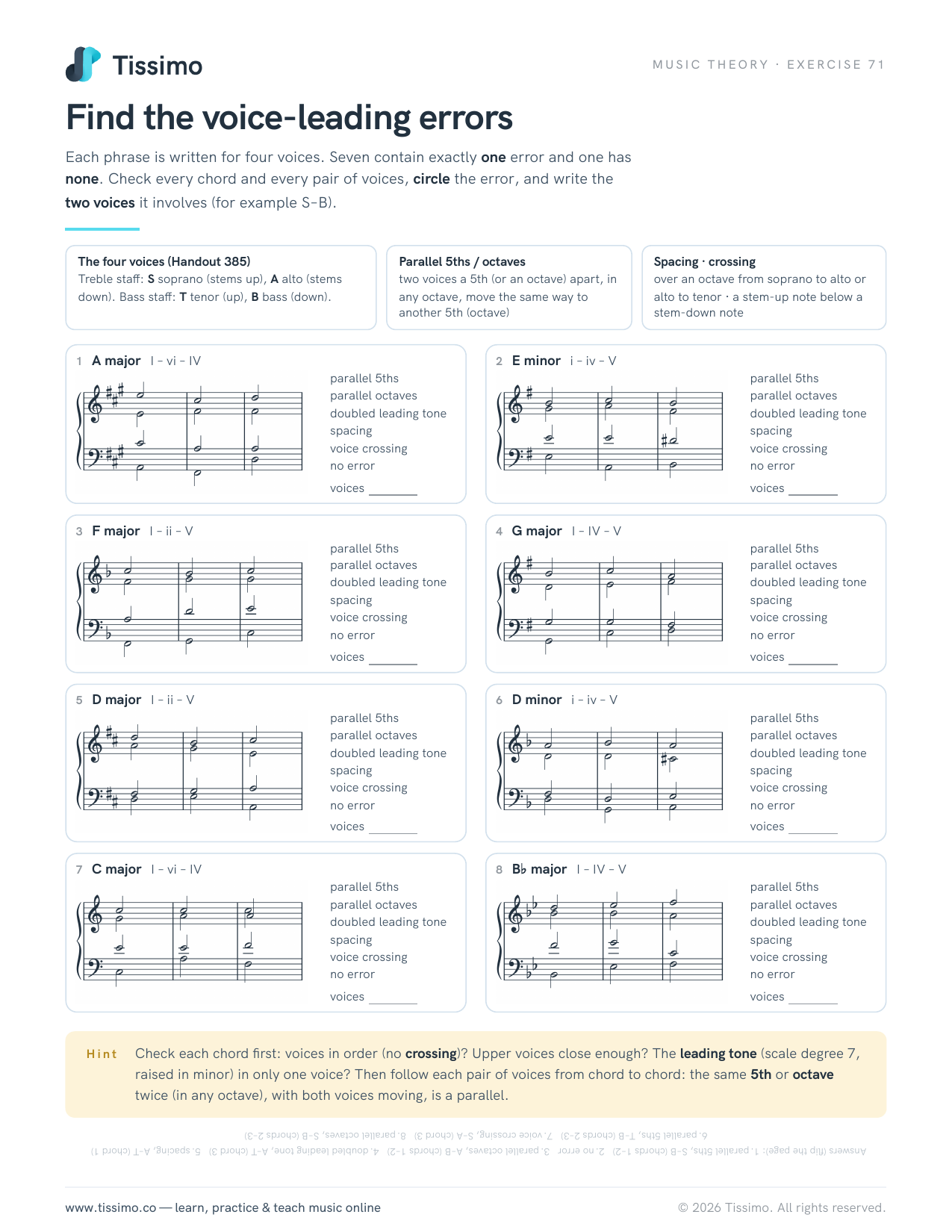 Find the voice-leading errorsEach phrase is written for four voices. Seven contain exactly one error and one has none. Check every chord and every pair of voices, circle the error, and write the two voices it involves (for example S–B).
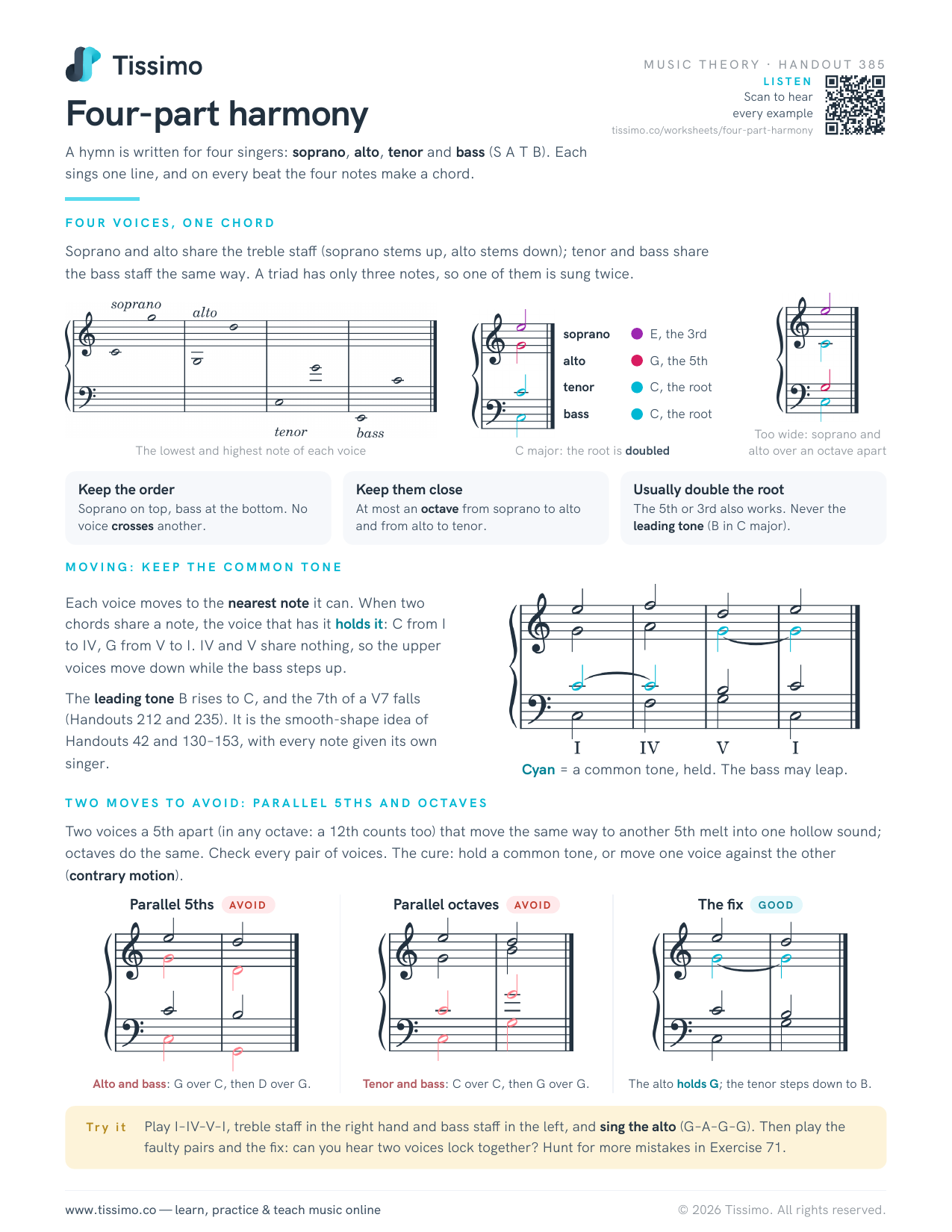 Four-part harmonyA hymn is written for four singers: soprano, alto, tenor and bass (S A T B). Each sings one line, and on every beat the four notes make a chord.
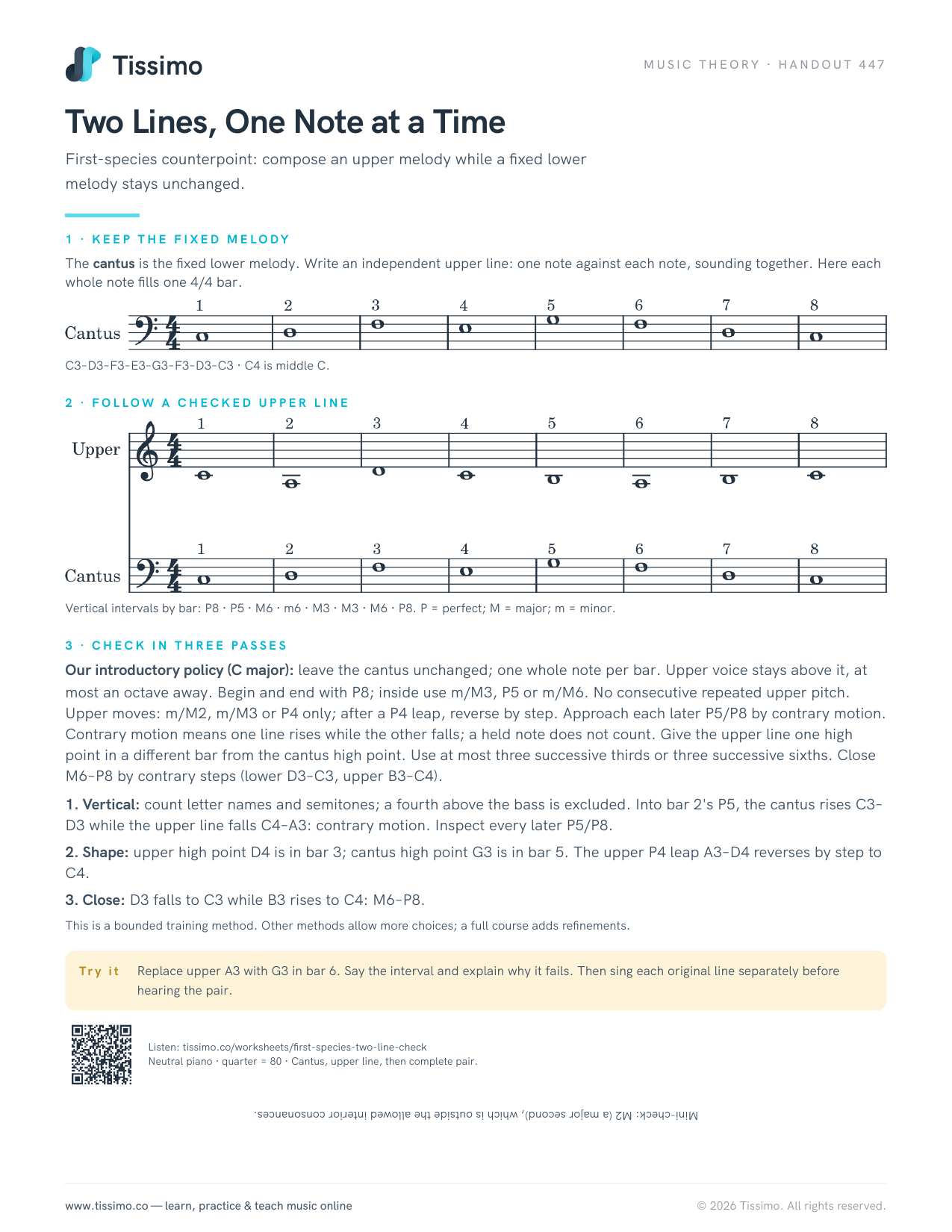 Two Lines, One Note at a TimeFirst-species counterpoint: compose an upper melody while a fixed lower melody stays unchanged.
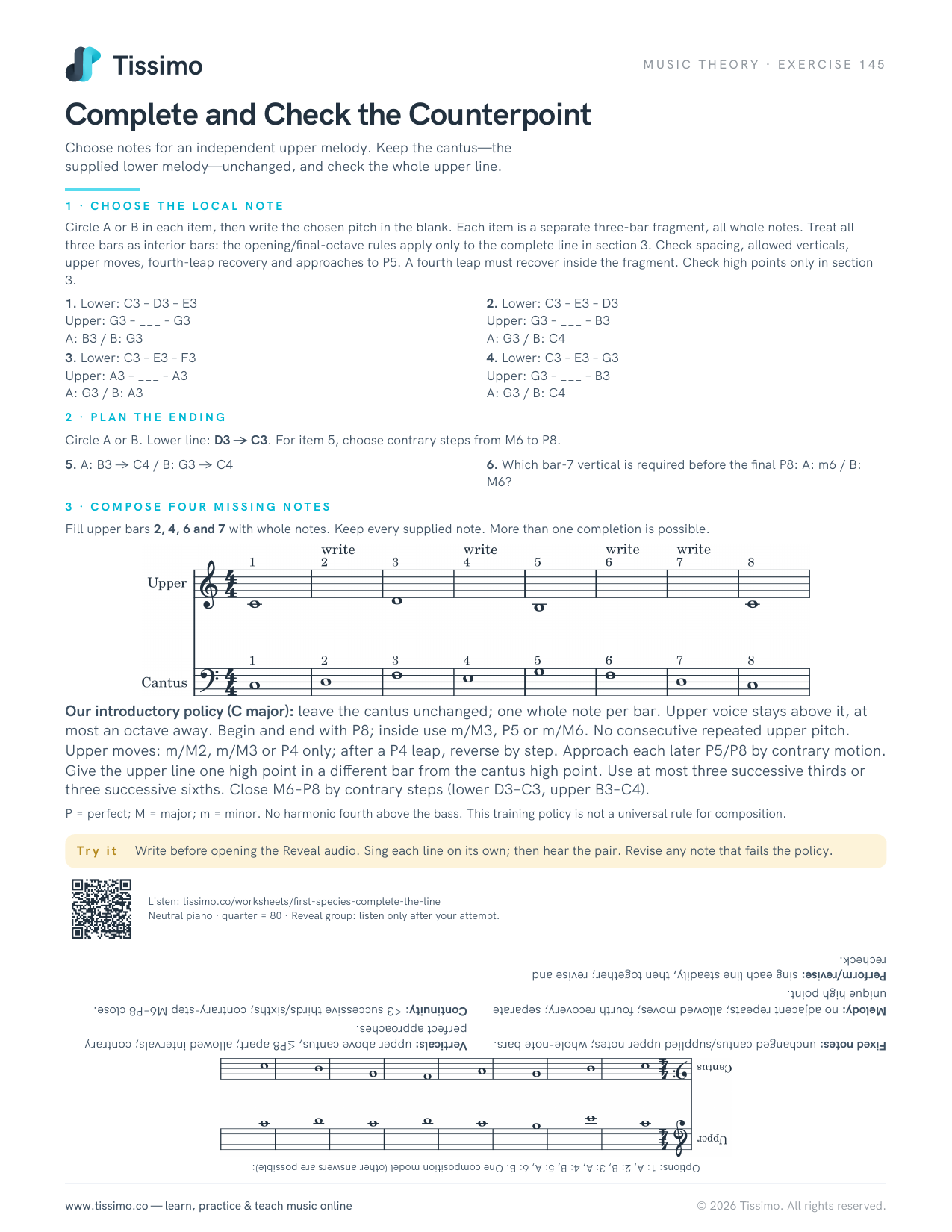 Complete and Check the CounterpointChoose notes for an independent upper melody. Keep the cantus—the supplied lower melody—unchanged, and check the whole upper line.