Chords & Harmony
Triad
A triad is a three-note chord built from a root plus the notes a third and a fifth above it. Its four kinds, major, minor, diminished and augmented, depend on the sizes of those thirds.
A triad is a chord of three different notes stacked in thirds. The bottom note of the stack is the root, the middle note is the third (a third above the root) and the top note is the fifth (a fifth above the root). C–E–G is a triad on C; D–F–A is a triad on D.
On the staff, a triad stacked this way looks like a little snowman: three notes on neighboring lines, or on neighboring spaces.
The four kinds of triad
The letter names stay the same, but the exact sizes of the two thirds decide the triad's quality. Count half steps from the root:
- Major (C–E–G): 4 half steps to the third, then 3 more. A major third with a minor third on top, and a perfect fifth from bottom to top.
- Minor (C–E♭–G): 3, then 4. The minor third is now on the bottom; the fifth is still perfect.
- Diminished (C–E♭–G♭): 3, then 3. Two minor thirds make a diminished fifth of 6 half steps.
- Augmented (C–E–G♯): 4, then 4. Two major thirds make an augmented fifth of 8 half steps.
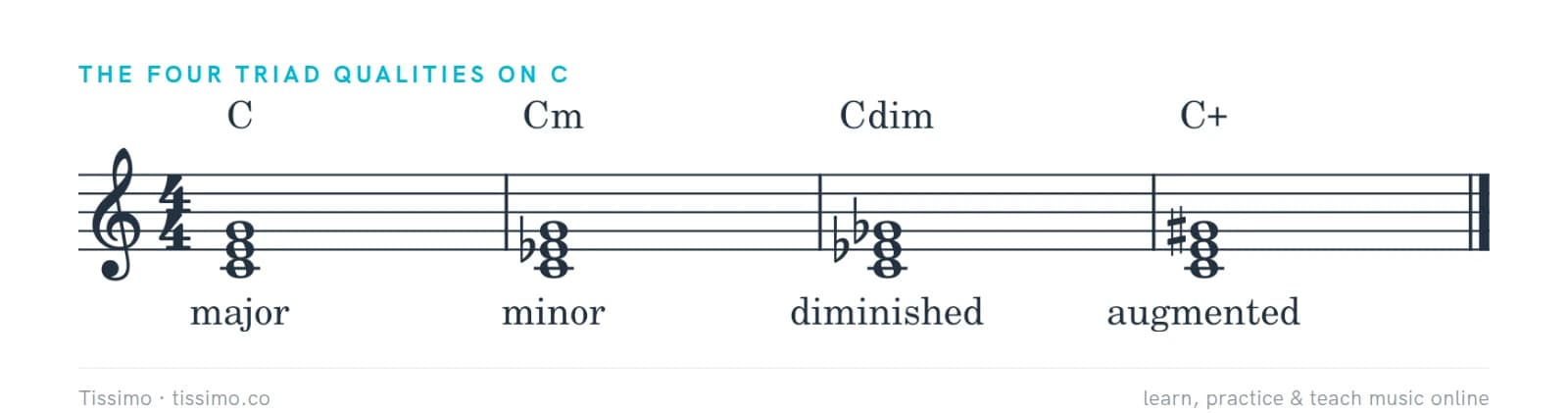
Major and minor triads are by far the most common. Diminished triads occur in every major and minor key, while augmented triads are a rarer, special color.
The triads of a major key
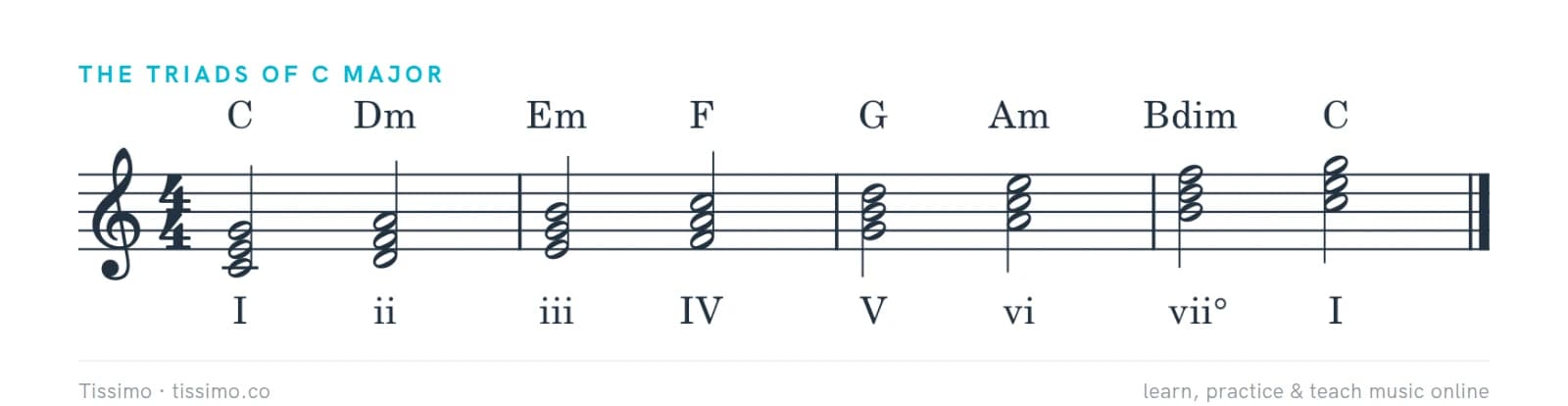
Build a triad on every note of the C major scale, using only white keys, and the qualities fall into a fixed pattern: major on degrees 1, 4 and 5; minor on 2, 3 and 6; diminished on 7. Roman numerals show this with capital letters for major and small letters for minor: I ii iii IV V vi vii°. The same pattern holds in every major key.
Doubled notes and inversions
A triad does not have to be played as a neat stack. You can double any note (C–E–G–C), spread the notes across both hands, or put the third or the fifth in the bass. As long as the same three pitch classes and their spellings are retained, it is the same triad. Putting a note other than the root at the bottom is called inversion.
Triads & their inversions introduces the shapes, and Chord quality review mixes all four qualities for practice.
Common questions
What are the four types of triads?
Major, minor, diminished and augmented. They differ in the sizes of their two stacked thirds: major 4 + 3 half steps, minor 3 + 4, diminished 3 + 3 and augmented 4 + 4.
Is a triad the same as a chord?
A triad is one kind of chord: exactly three different notes stacked in thirds. Chords can also have four or more notes, like seventh chords.
Practice it: free worksheets
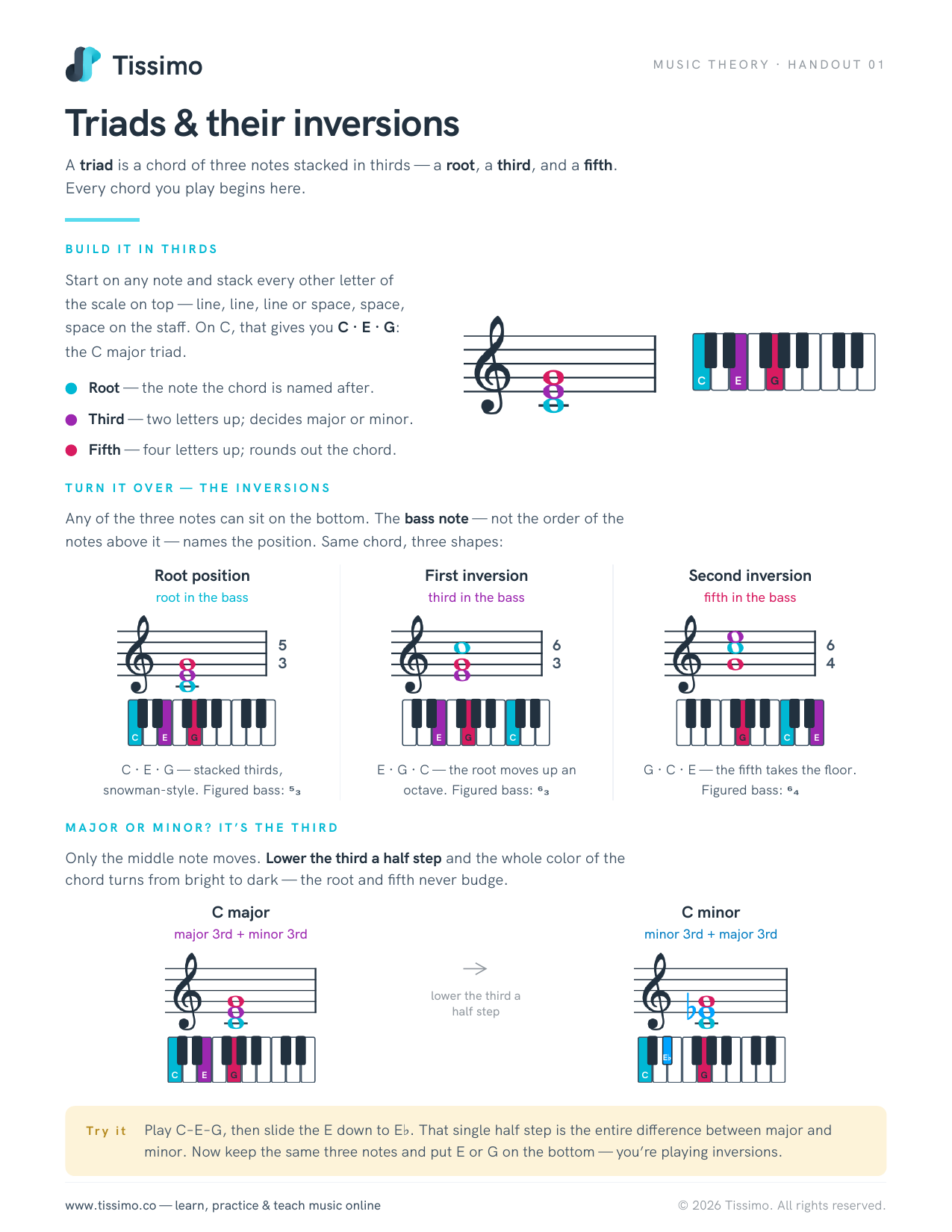 Triads & their inversionsA triad is a chord of three notes stacked in thirds — a root, a third, and a fifth. Every chord you play begins here.
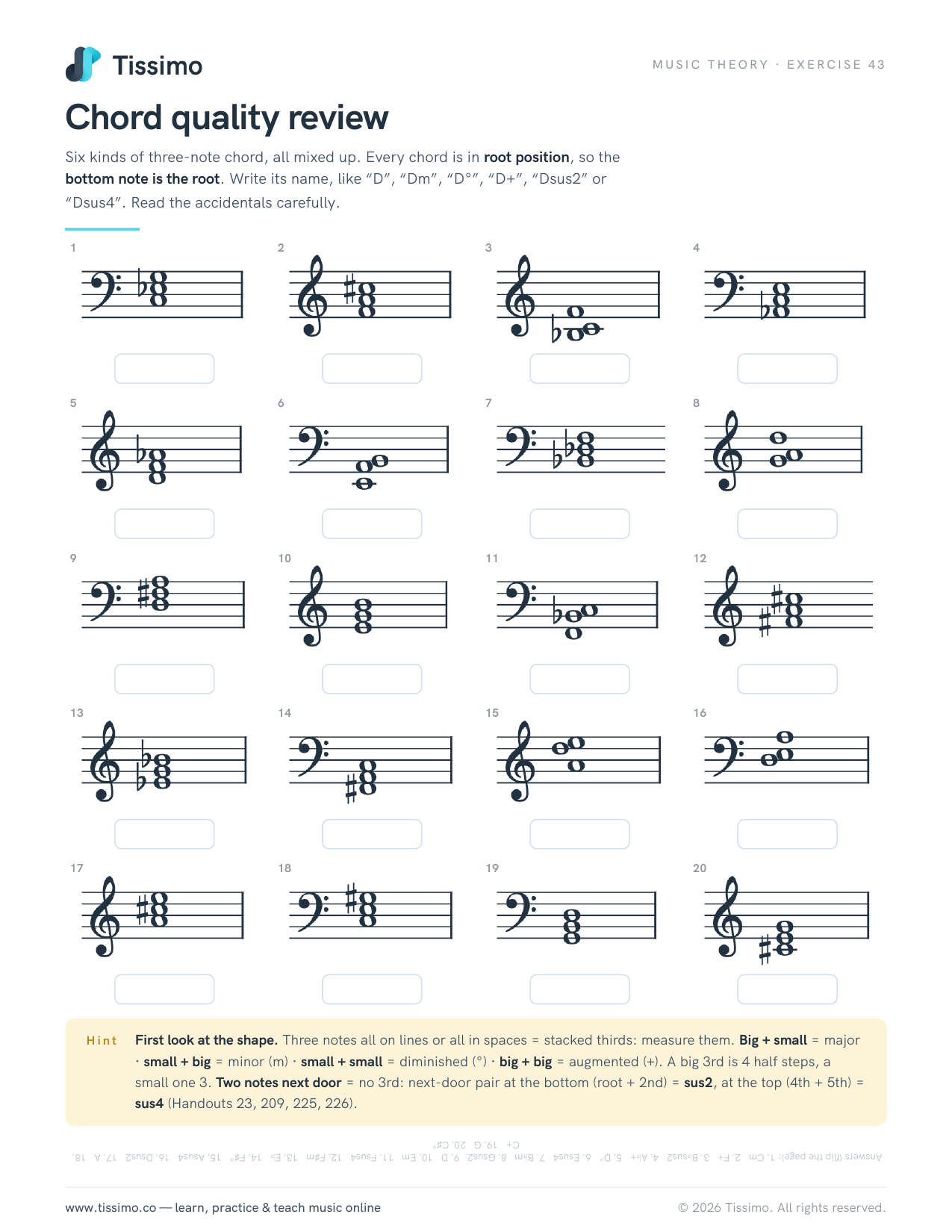 Chord quality reviewSix kinds of three-note chord, all mixed up. Every chord is in root position, so the bottom note is the root. Write its name, like “D”, “Dm”, “D°”, “D+”, “Dsus2” or “Dsus4”. Read the accidentals carefully.
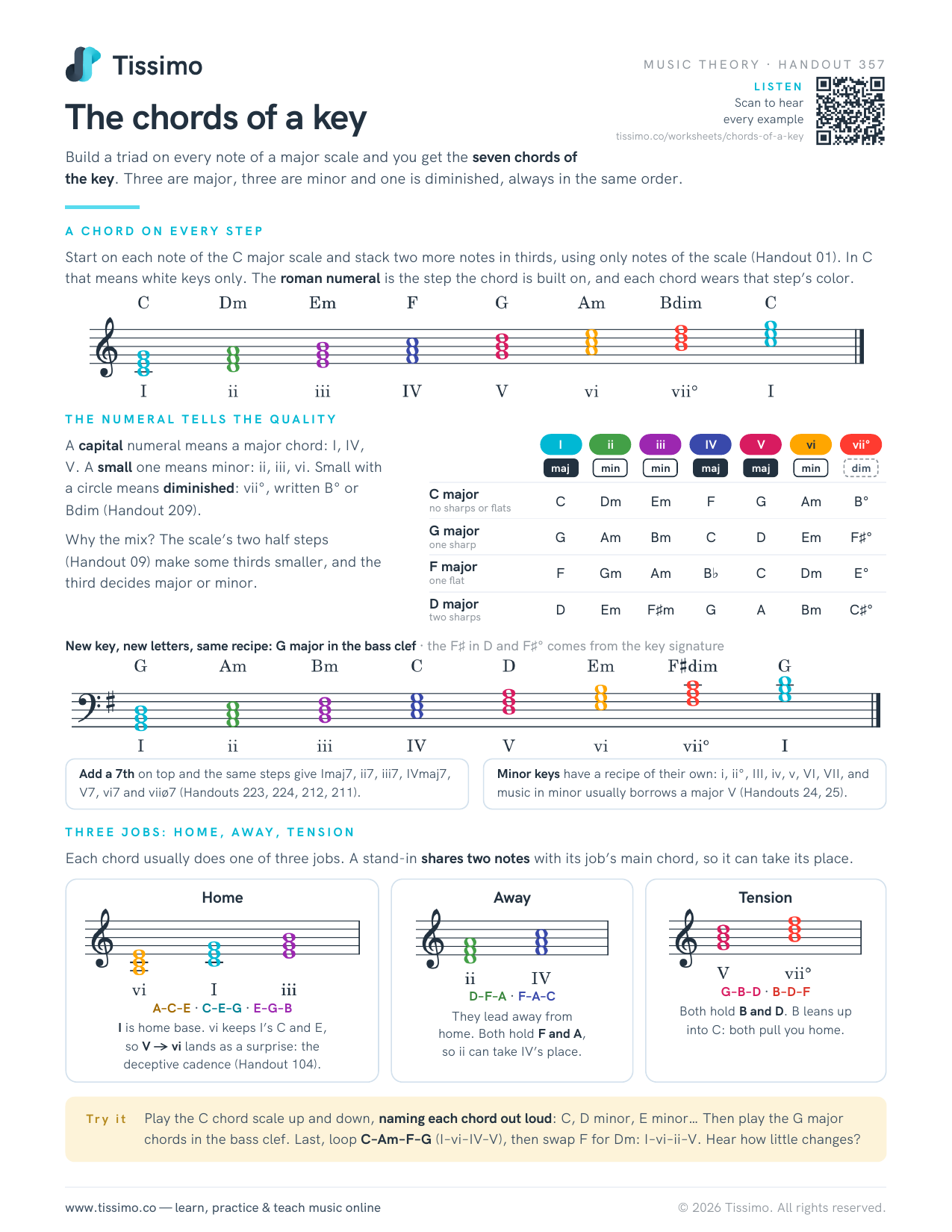 The chords of a keyBuild a triad on every note of a major scale and you get the seven chords of the key. Three are major, three are minor and one is diminished, always in the same order.
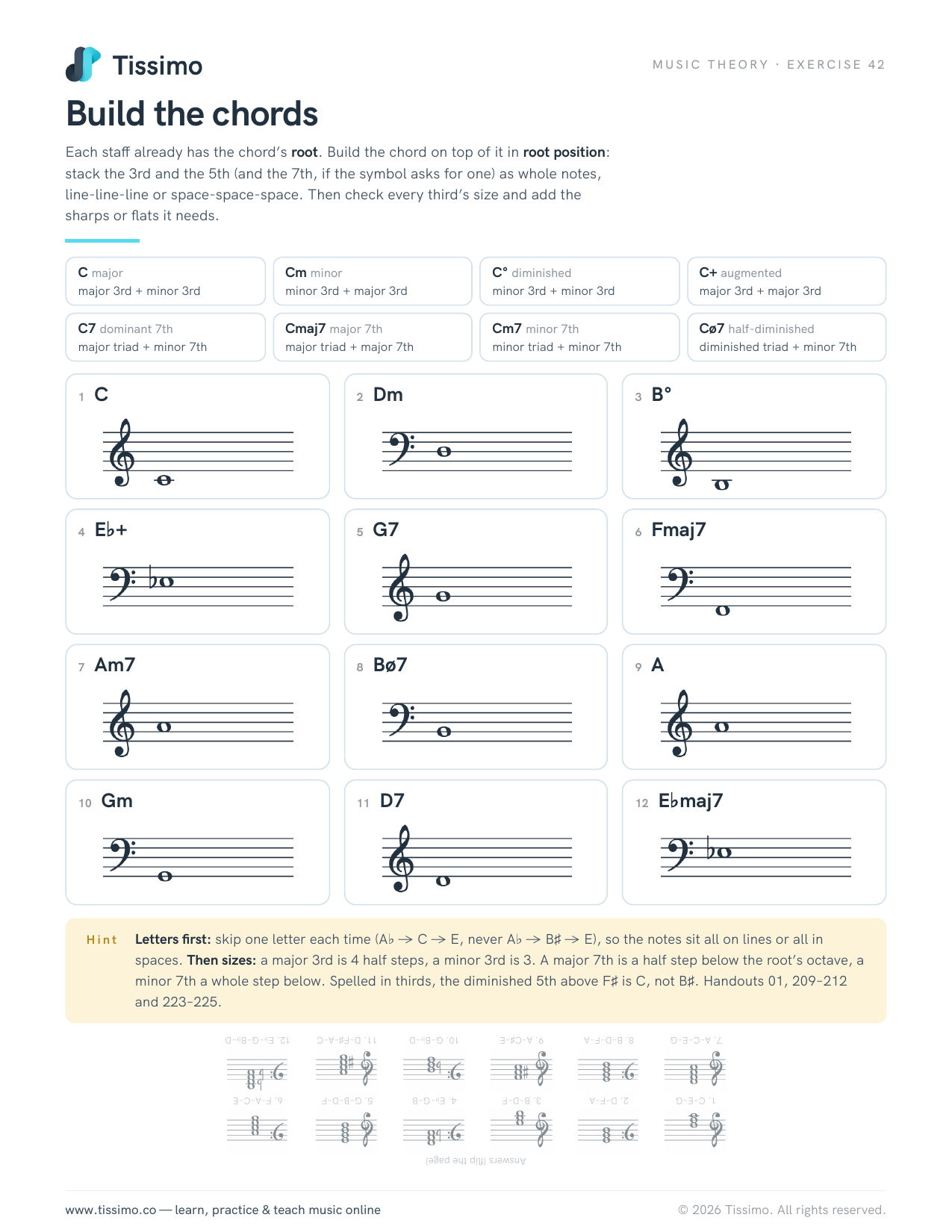 Build the chordsEach staff already has the chord’s root. Build the chord on top of it in root position: stack the 3rd and the 5th (and the 7th, if the symbol asks for one) as whole notes, line-line-line or space-space-space. Then check every third’s size and add the sharps or flats it needs.
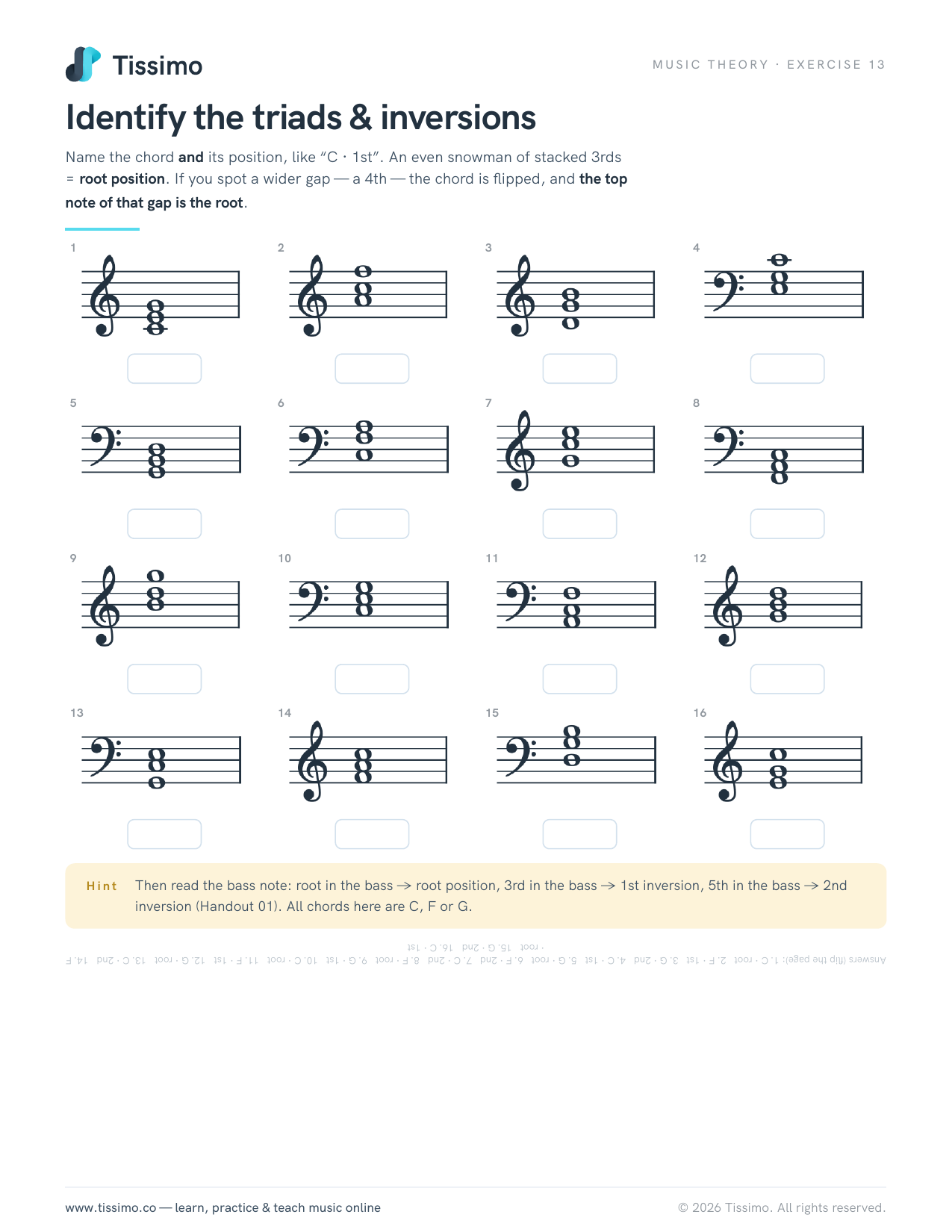 Identify the triads & inversionsName the chord and its position, like “C · 1st”. An even snowman of stacked 3rds = root position. If you spot a wider gap — a 4th — the chord is flipped, and the top note of that gap is the root.
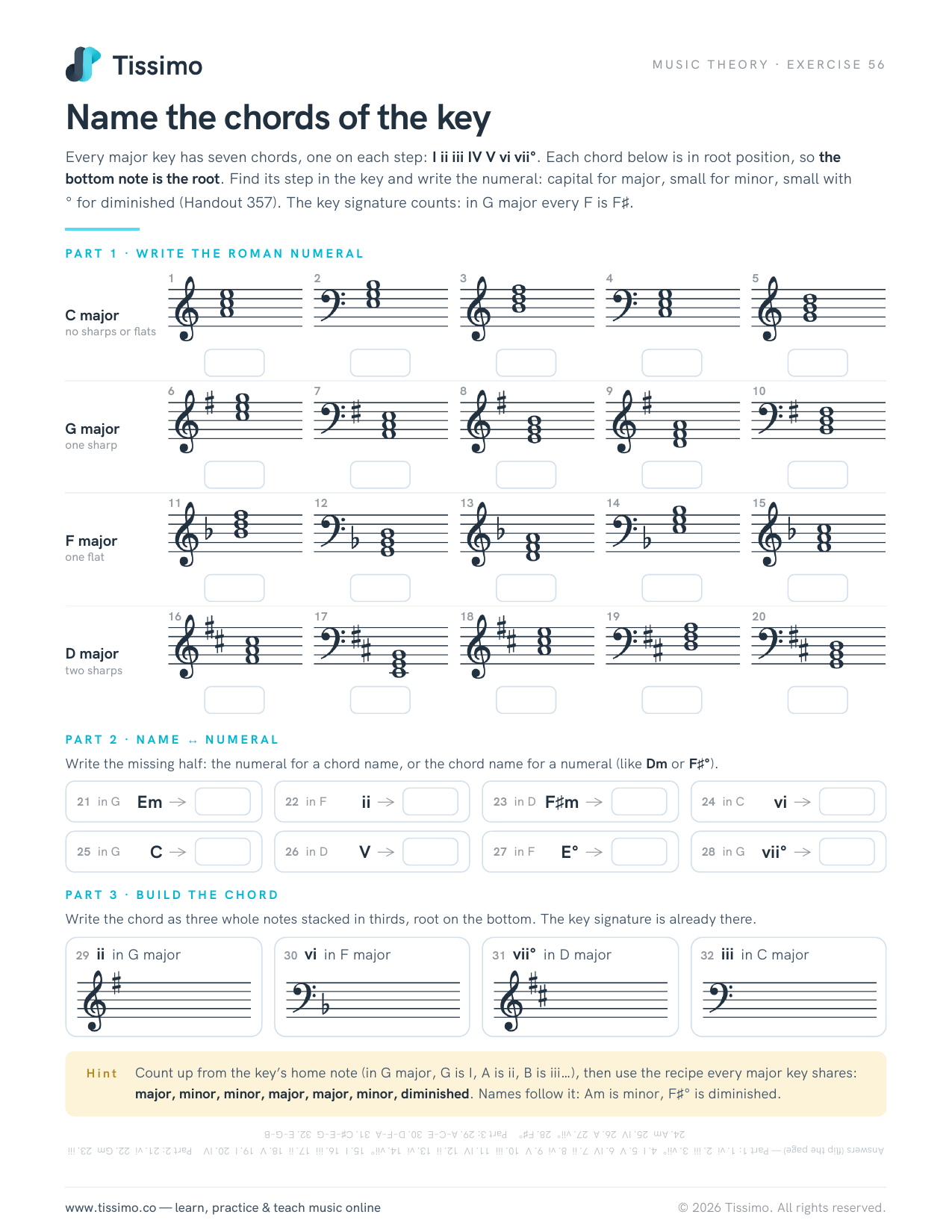 Name the chords of the keyEvery major key has seven chords, one on each step: I ii iii IV V vi vii°. Each chord below is in root position, so the bottom note is the root. Find its step in the key and write the numeral: capital for major, small for minor, small with ° for diminished (Handout 357). The key signature counts: in G major every F is F♯.