Articulation & Ornaments
Trill
Written as tr
A trill is an ornament in which you alternate rapidly between the written note and the note above it. It is shown by tr above the note, often followed by a wavy line.
A trill is a rapid, even alternation between the written note and the note just above it. It is marked tr above the note, often followed by a wavy line that shows how long the trill lasts. Older English books call it a shake.
The upper note is the next note of the scale, following the key signature. If the composer wants it raised or lowered, a small sharp, flat or natural is printed above the tr.
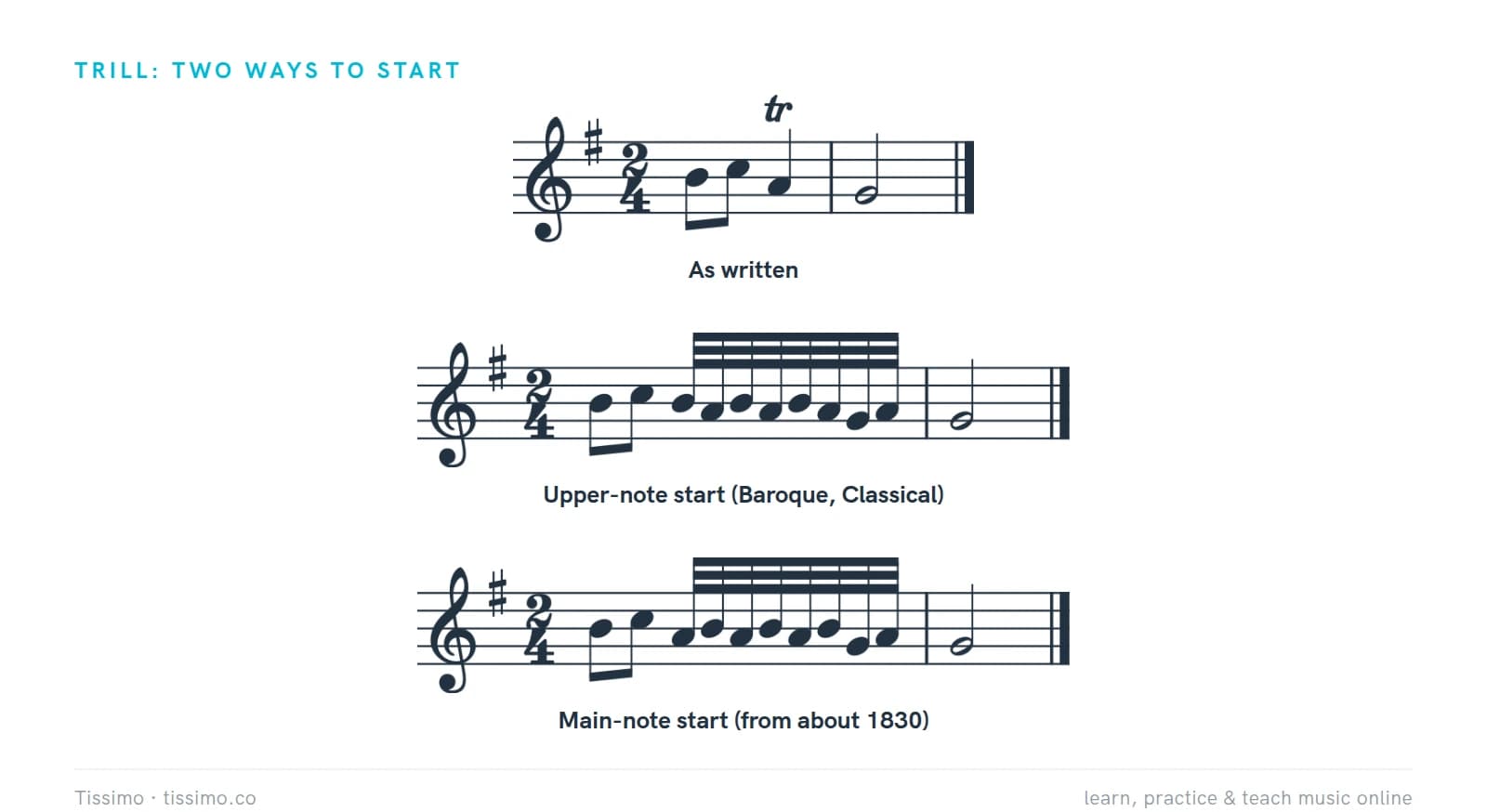
Which note comes first?
That depends on when the music was written.
- Baroque and much Classical music (Bach, Handel, and usually Mozart and Haydn): start on the note above, on the beat. At a cadence that first upper note can be held a little longer, which makes the trill lean expressively into the main note.
- From about 1830 (Schumann, Brahms and most later composers): start on the written note. The pianist Johann Nepomuk Hummel taught this in his piano method of 1828, and it became the usual rule. Chopin is a well-known exception: his pupil Karol Mikuli recalled that he mostly began trills on the upper note.
- Beethoven's time sits in between, and scholars still disagree about many of his trills.
If a small note is printed just before the trill, it shows you which note to start on, in any period. Players also avoid striking the same key twice in a row: if the note before the trill is already the upper note, they usually hold it over into the trill instead of playing it again.
How a trill ends
Many trills finish with a small turn: the note below, then the main note, leading into the next note. Composers often print this ending as two small notes after the trill, and at a cadence players often add it even when it is not printed, as in the realizations above.
How fast should it be?
Even matters more than fast. You do not count the exact number of notes in a trill; you fit an even stream into the time of the written note. Practice it slowly in a fixed rhythm (sixteenths, then triplets, then thirty-seconds) before letting it go free. On the piano, try several finger pairs, such as 2–3, 1–3 or 2–4, and choose the one that stays relaxed.
Trill or tremolo?
A trill alternates two neighboring notes, a half step or whole step apart. A tremolo repeats one note very fast, or alternates two notes that are further apart.
Hear each period's version in Ornaments through the eras, then find the trill in bar 25 of Mozart's Sonata in C, K. 545.
Common questions
Does a trill start on the upper note or the main note?
In Baroque music, and usually in Mozart and Haydn, it starts on the upper note. From about 1830 the main-note start became the rule. Beethoven's trills are debated. A small note printed before the trill overrides both rules.
How many notes are in a trill?
There is no fixed number. Fit an even alternation into the length of the written note at a speed that sounds relaxed, and add the turned ending if the music calls for it.
Practice it: free worksheets
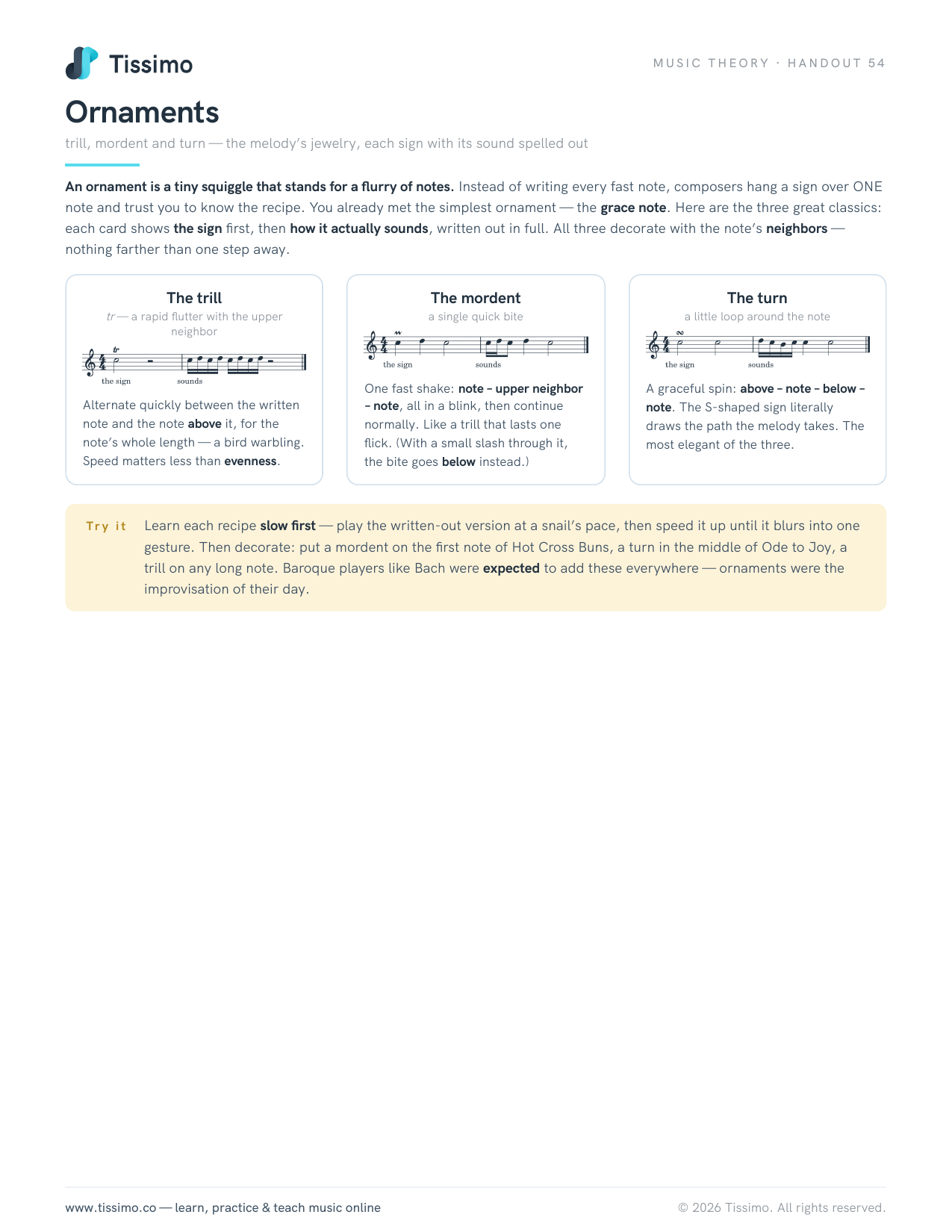 Ornamentstrill, short trill and turn — the melody’s jewelry, each sign with its sound spelled out
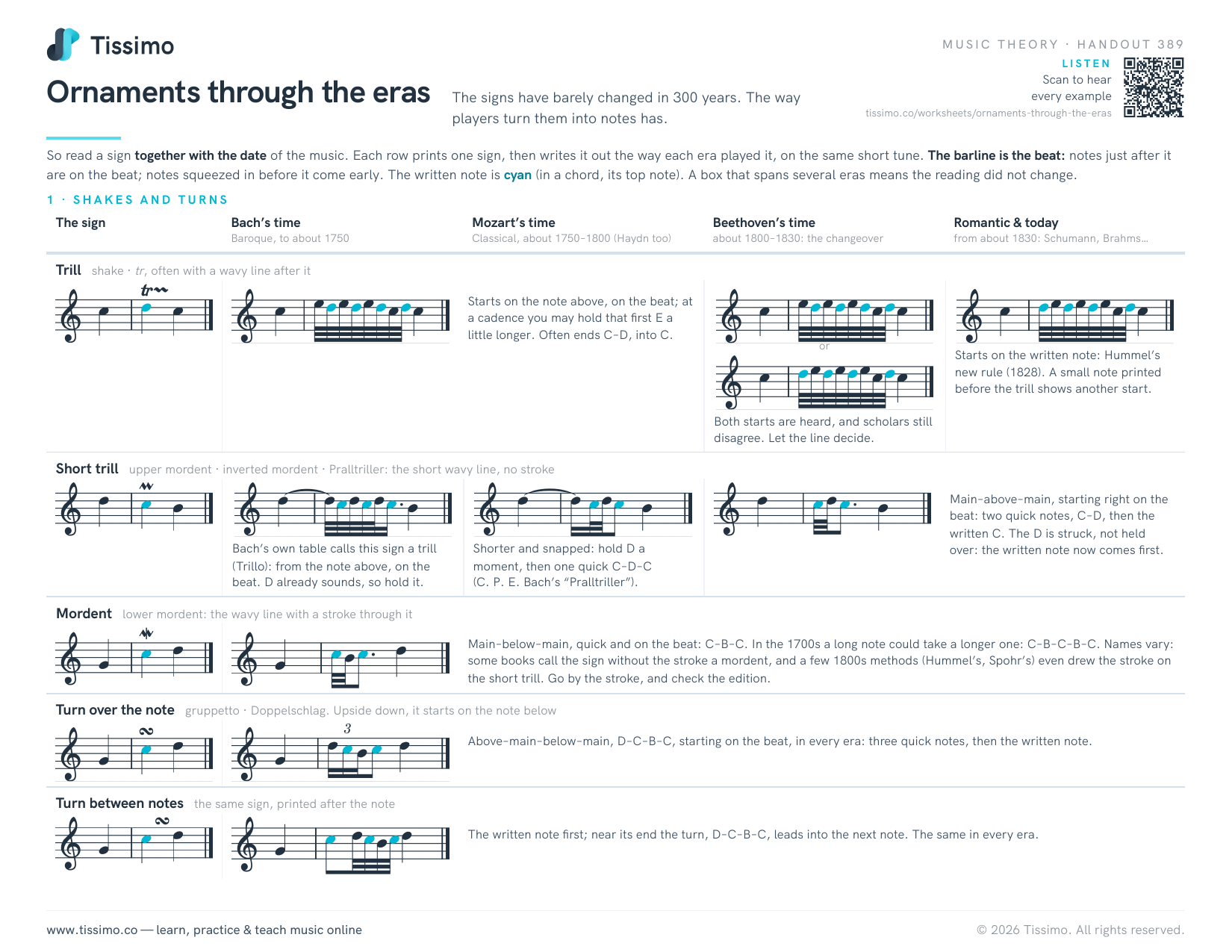 Ornaments through the erasThe signs have barely changed in 300 years. The way players turn them into notes has.
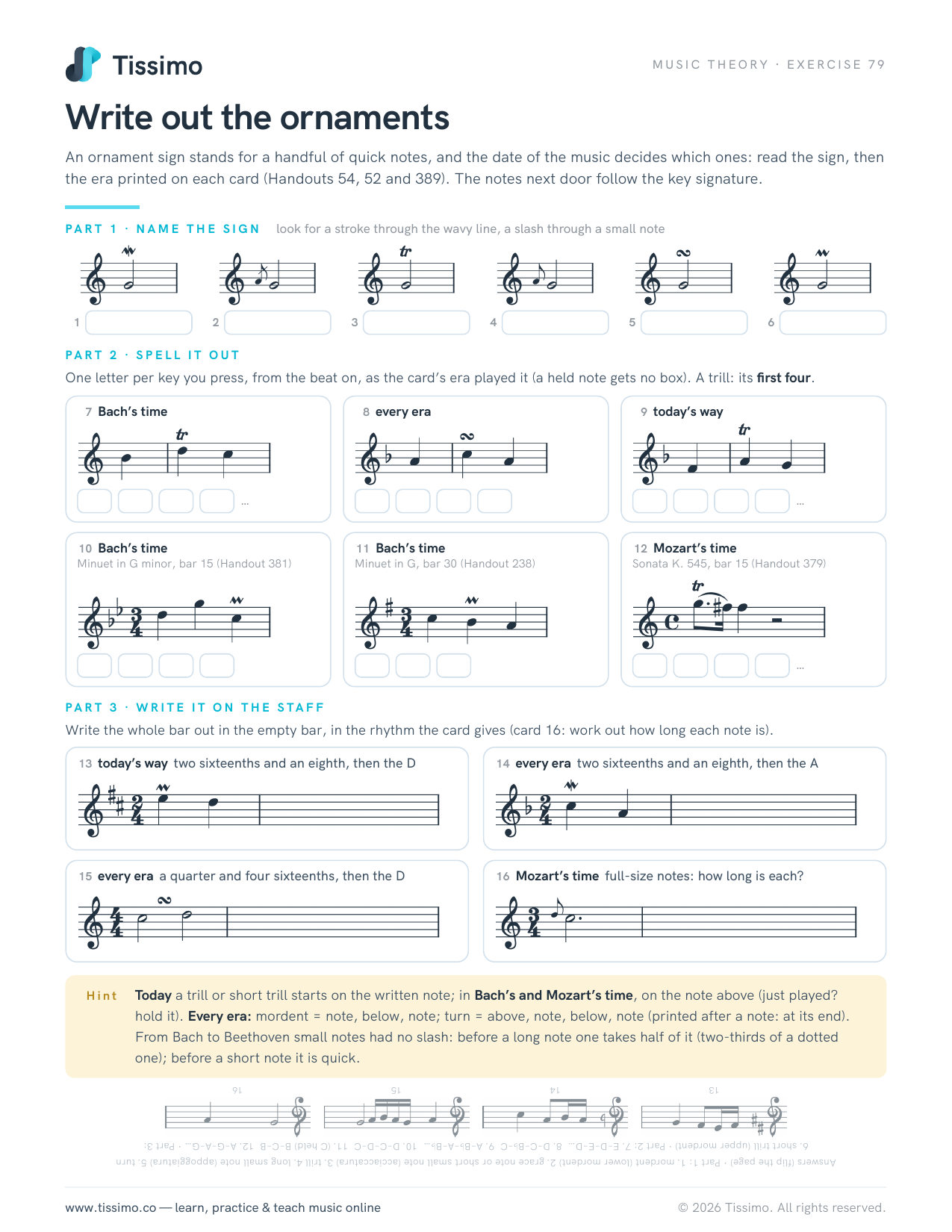 Write out the ornamentsAn ornament sign stands for a handful of quick notes, and the date of the music decides which ones: read the sign, then the era printed on each card (Handouts 54, 52 and 389). The notes next door follow the key signature.
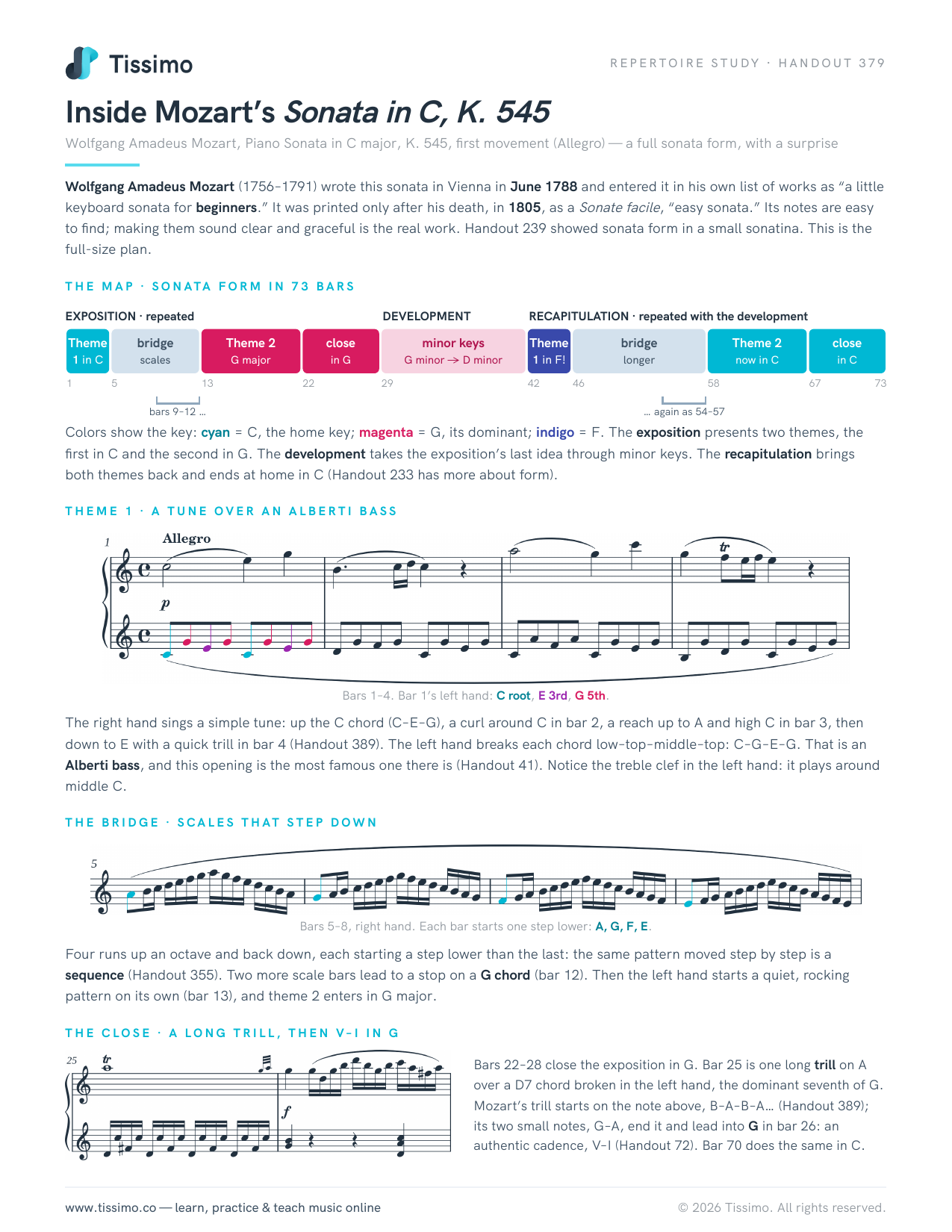 Inside Mozart’s Sonata in C, K. 545Wolfgang Amadeus Mozart, Piano Sonata in C major, K. 545, first movement (Allegro) — a full sonata form, with a surprise