Articulation & Ornaments
Staccato
Pronounced stah-KAH-tohWritten as stacc.
Staccato means detached: the note is played shorter than its written value, so a little silence separates it from the next note. It is shown by a dot above or below the notehead, or by the word staccato.
Staccato means "detached." A note marked staccato is played shorter than its written value, so a small silence separates it from the next note. The sign is a dot placed just above or below the notehead, on the side away from the stem. For a whole passage, the word staccato (or stacc., or sempre staccato, "always staccato") can be written once instead of dotting every note.
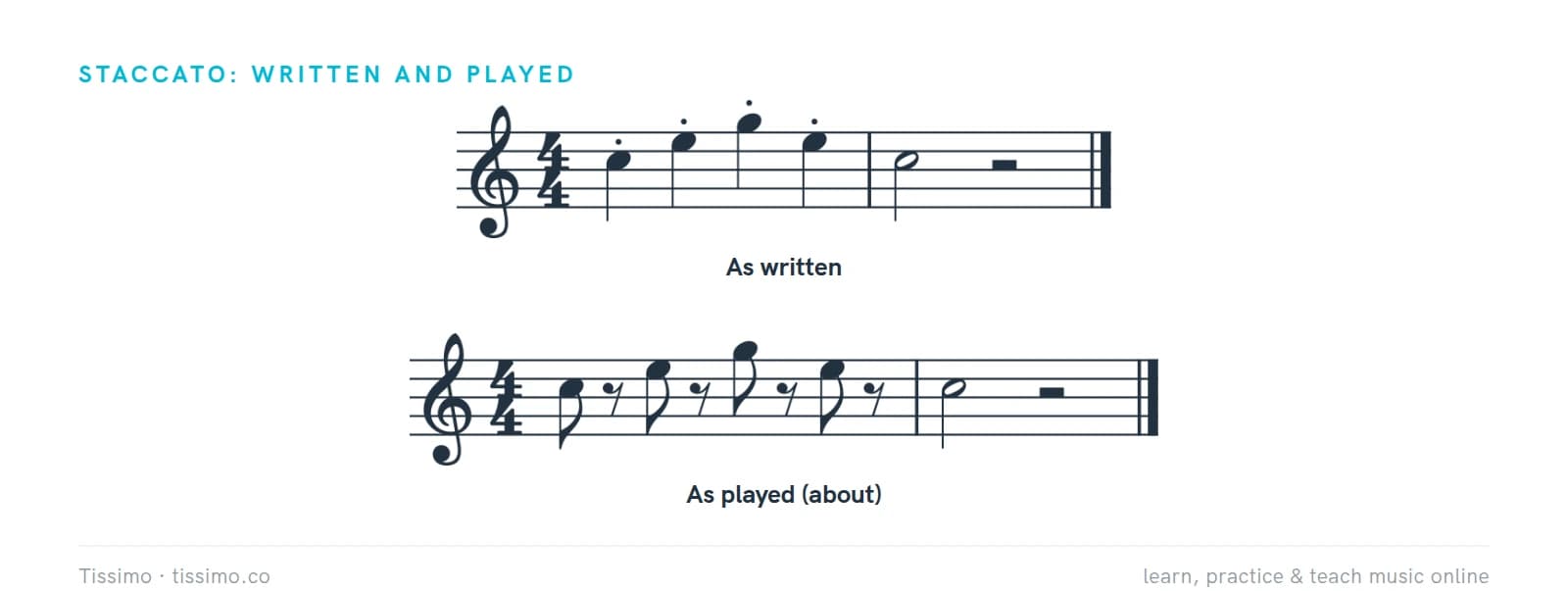
How short is staccato?
The page does not say exactly. A common starting point is to sound the note for about half its written value and let the other half be silence, as in the "As played" panel above. In a fast, playful piece the notes may be shorter and crisper; in a slow, singing piece a staccato can be quite gentle, just a slight lift between notes.
The beat never moves. In 4/4, a staccato quarter note still fills a whole beat: it simply spends part of that beat as silence. Staccato is also not the same as soft or fast. You can play staccato at any dynamic, and the tempo stays where it was.
How to play staccato
- Piano: let the key come up quickly after you play it. Light notes can come from a small finger movement; louder notes and chords from a bounce of the wrist. Keep the sustain pedal up, or it will join the notes together again.
- Strings: separate bow strokes, either stopped on the string or bounced lightly off it.
- Winds and brass: start each note with a light "tu" of the tongue and let the sound stop briefly before the next one.
- Voice: a light, separate start on each note, often practiced on "ha" or "ta".
Staccato dot or dotted note?
Both are dots, but they do opposite jobs. A staccato dot sits above or below the notehead and makes the sound shorter. A dot to the right of the notehead is a dotted note and makes the note longer by half its value.
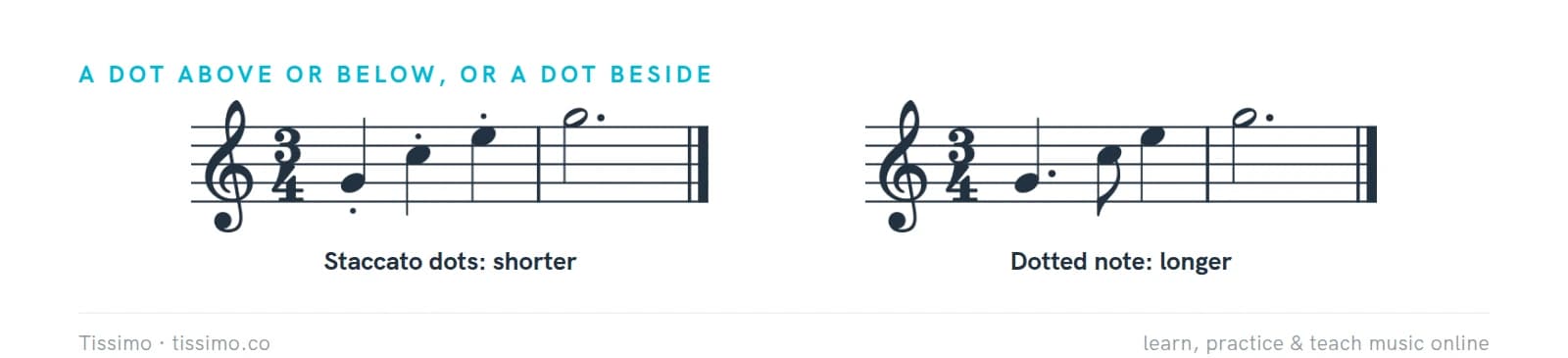
Staccato is the opposite of legato. Shorter still is staccatissimo; a gentler separation, with dots under a slur, is portato. Practice telling them apart with Legato or Staccato?.
Common questions
How long should a staccato note be?
About half its written value is a good starting point, but the style and tempo decide. Fast, light music takes shorter staccatos; slow, lyrical music takes gentler ones. The note always starts on time and the beat keeps its full length.
Does staccato mean play faster or louder?
No. Staccato changes only how long each note sounds. The tempo and the dynamic stay exactly as marked.
Practice it: free worksheets
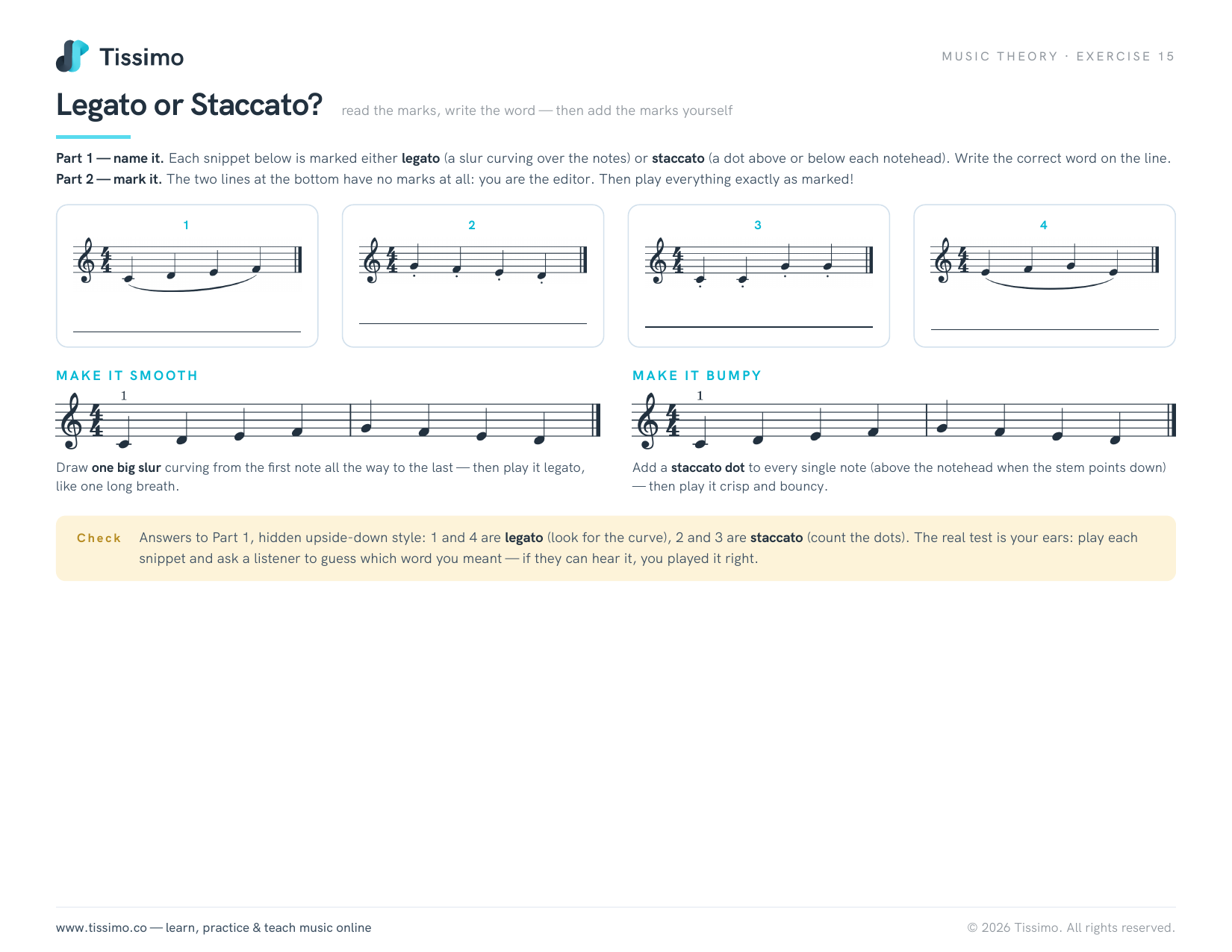 Legato or Staccato?read the marks, write the word — then add the marks yourself
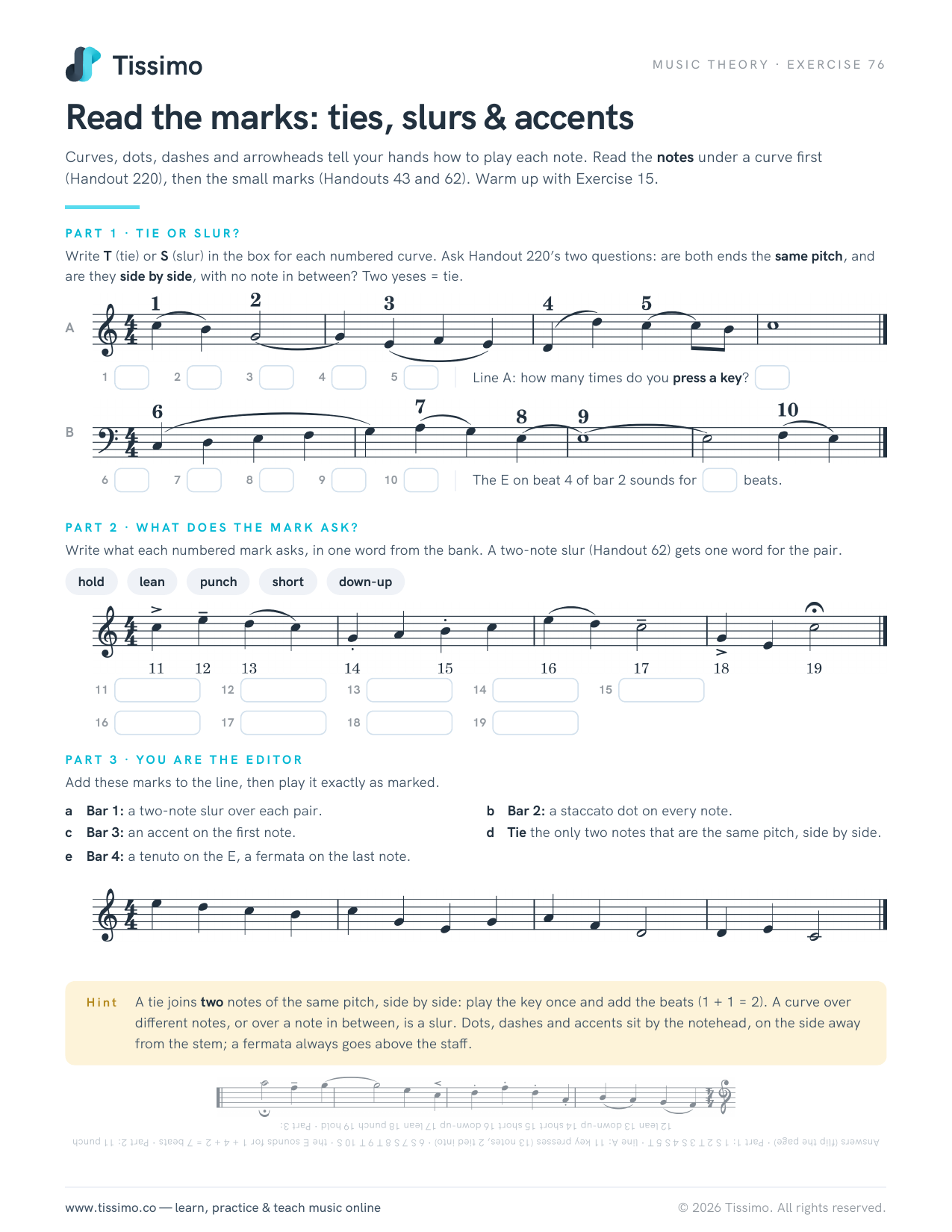 Read the marks: ties, slurs & accentsCurves, dots, dashes and arrowheads tell your hands how to play each note. Read the notes under a curve first (Handout 220), then the small marks (Handouts 43 and 62). Warm up with Exercise 15.
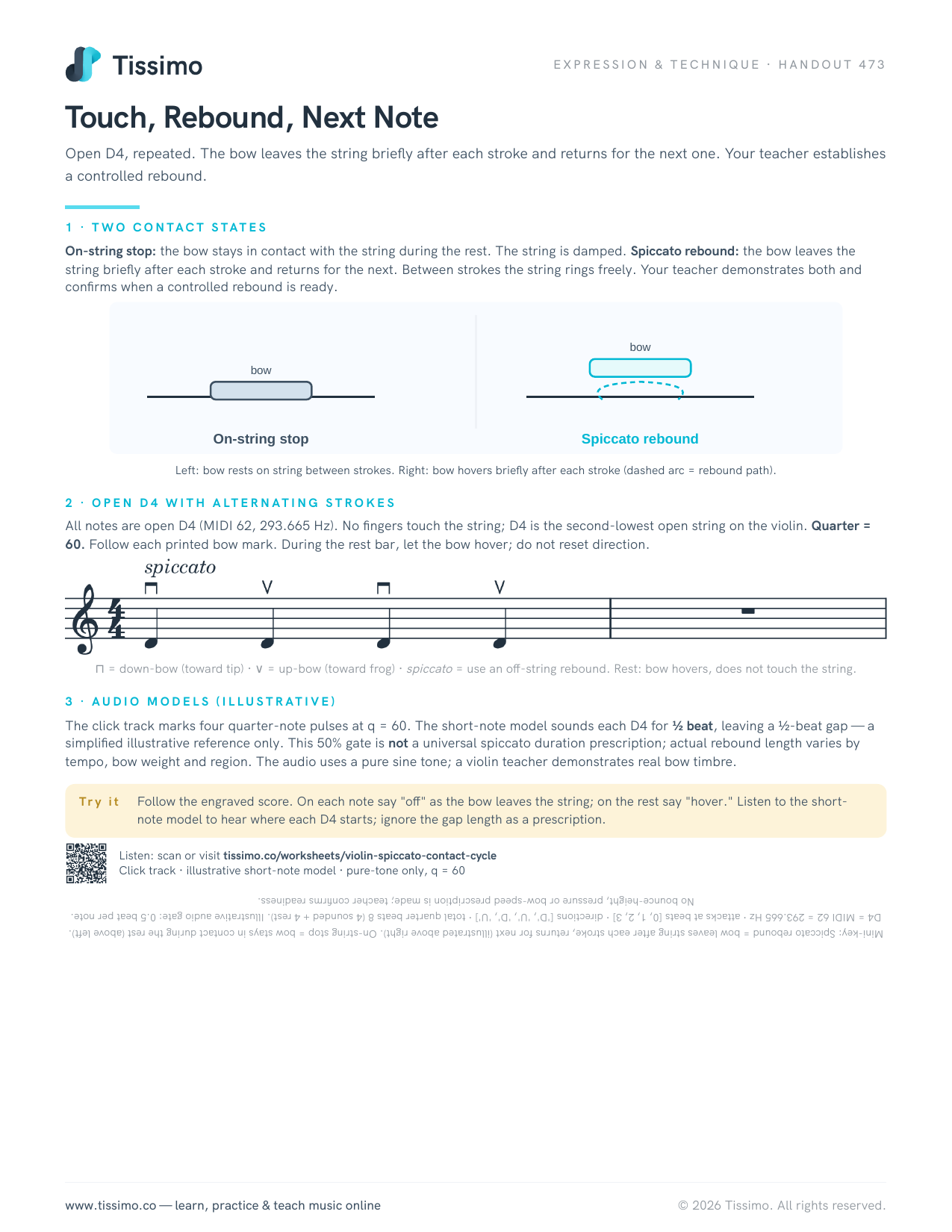 Touch, Rebound, Next NoteOpen D4, repeated. The bow leaves the string briefly after each stroke and returns for the next one. Your teacher establishes a controlled rebound.
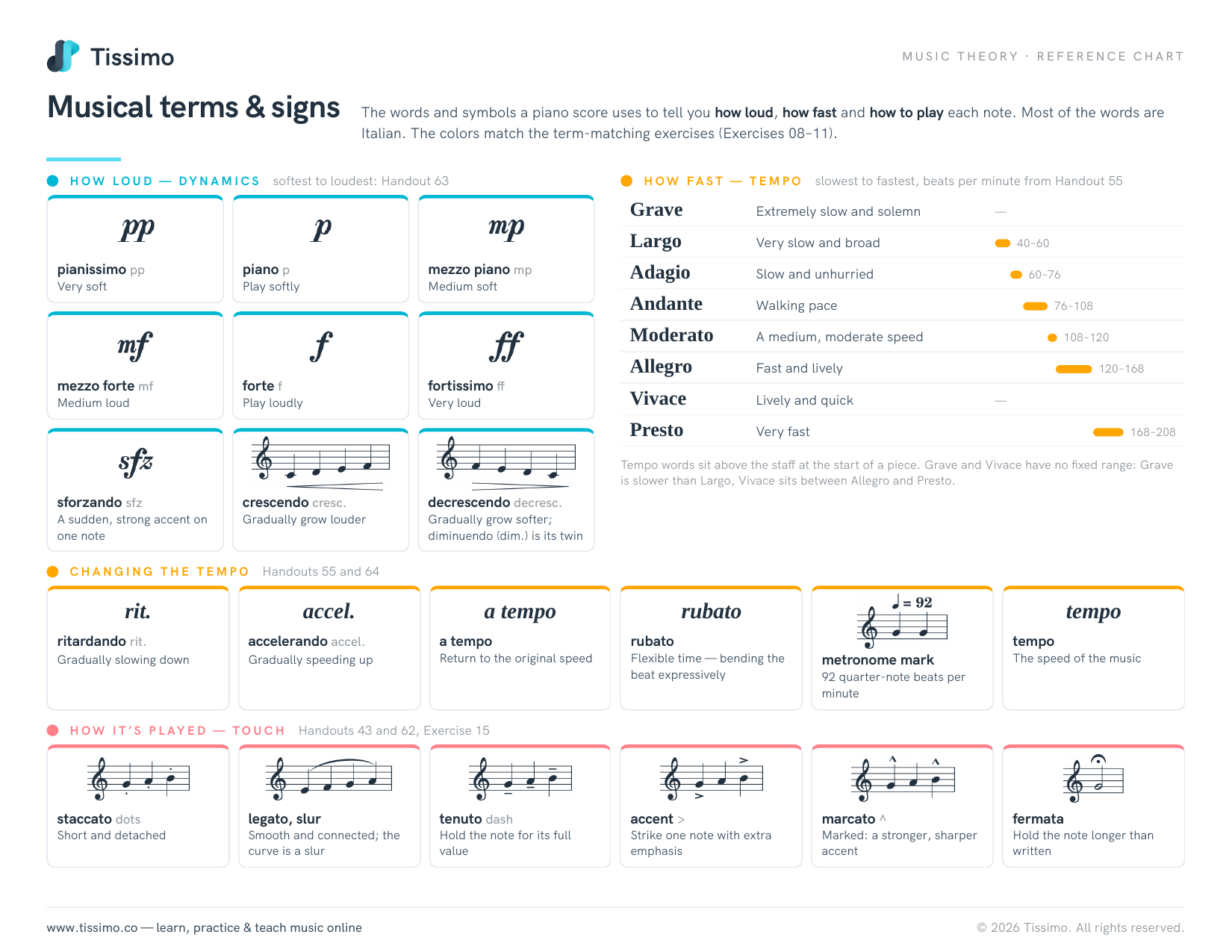 Musical terms & signsThe words and symbols a piano score uses to tell you how loud, how fast and how to play each note. Most of the words are Italian. The colors match the term-matching exercises (Exercises 08–11, 74 and 75).