Articulation & Ornaments
Staccatissimo
Pronounced stah-kah-TEES-see-moh
Staccatissimo means very detached: the note is played even shorter and sharper than a staccato. It is usually shown by a small wedge above or below the notehead.
Staccatissimo is the Italian superlative of staccato: "very detached." The note is played as short as sounds musical, shorter than an ordinary staccato and usually with a crisper, more pointed start. Its sign is a small solid wedge, sometimes drawn as a teardrop or a narrow spike, placed above or below the notehead on the side away from the stem.
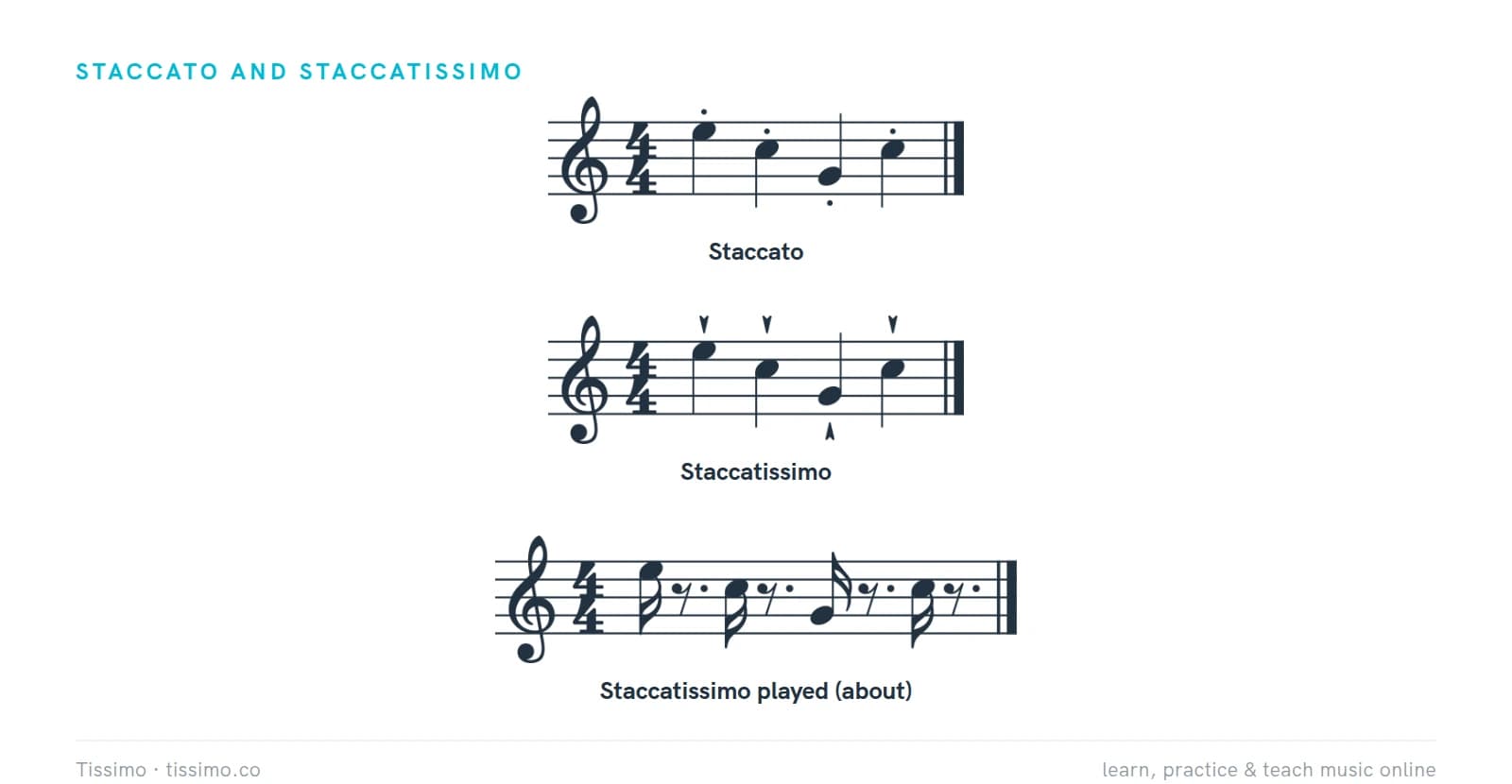
How it differs from staccato
A staccato quarter note is often played for about half its value. A staccatissimo is shorter: at a moderate tempo, something like a sixteenth note followed by silence, as in the third panel. The bigger silence makes each note pop out of the texture, so staccatissimo passages tend to sound brittle, sparkling or sharply rhythmic.
Like staccato, it changes the length of the sound, not the beat: the next note still arrives exactly on time.
How to play it
- Piano: a quick, light release from a relaxed hand, as if the fingertip were bouncing off a hot surface. Tension makes the notes harsh and uneven, so keep the wrist loose.
- Strings: a short, crisp stroke, often off the string.
- Winds and brass: a very short, clean tongue stroke with the air kept steady behind it.
Strokes and wedges in older music
In 18th-century music, composers wrote both dots and short strokes or wedges over notes, and it is still debated whether they meant different things. In some places the stroke seems to mean an ordinary staccato, in others a sharper or slightly accented one, and modern editions print these signs in different ways. When you play Mozart or Haydn, read your edition's preface and ask your teacher how the stroke is meant there. In most later music, and in today's notation, the wedge means staccatissimo.
Do not confuse it with
- the marcato sign (^), a little roof shape that means a strong accent;
- the accent (>), a sideways wedge that stresses the note without shortening it.
Practice reading short marks with Legato or Staccato?.
Common questions
What is the difference between staccato and staccatissimo?
Both shorten the note. Staccato (a dot) is often about half the written value; staccatissimo (a wedge) is shorter and crisper still. Neither one changes the beat.
Practice it: free worksheets
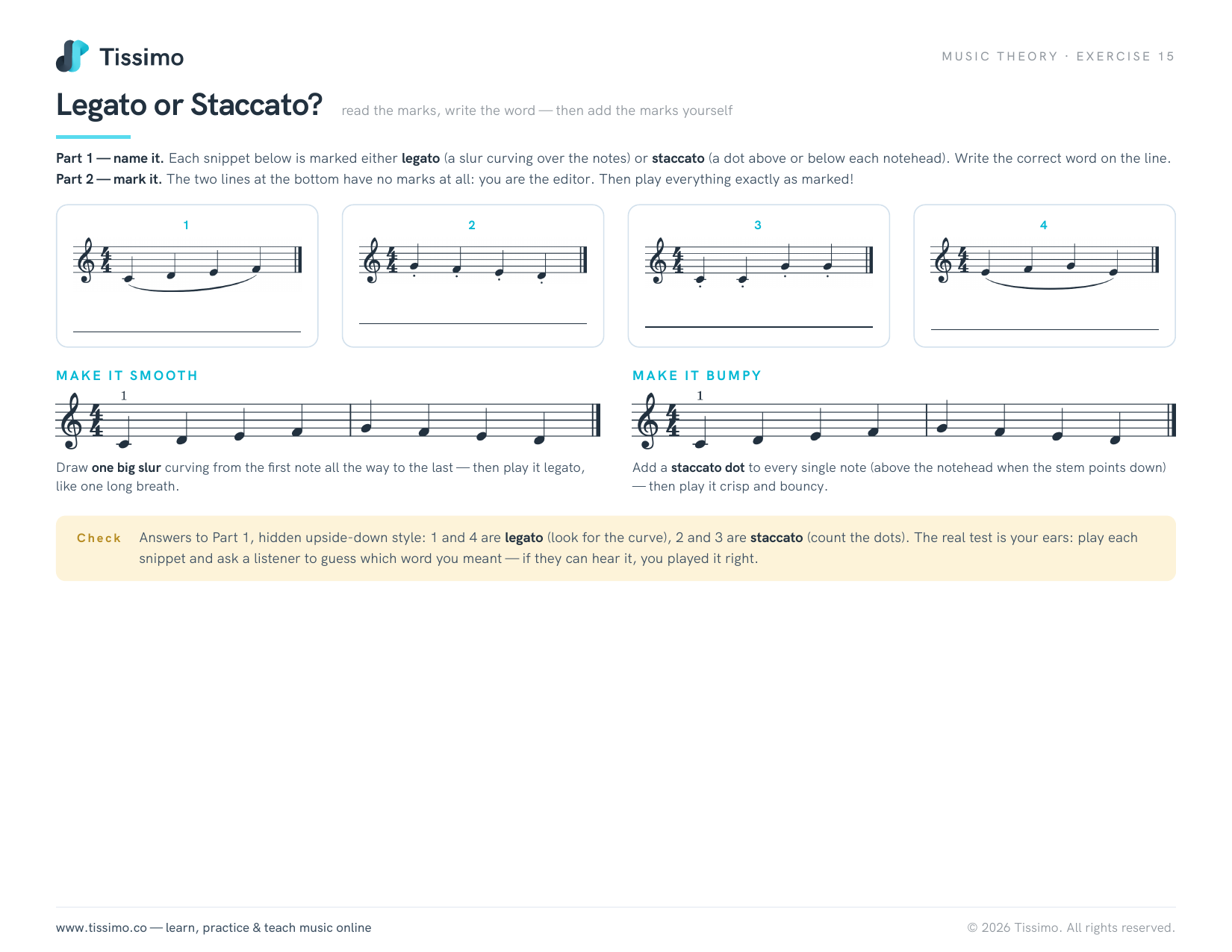 Legato or Staccato?read the marks, write the word — then add the marks yourself
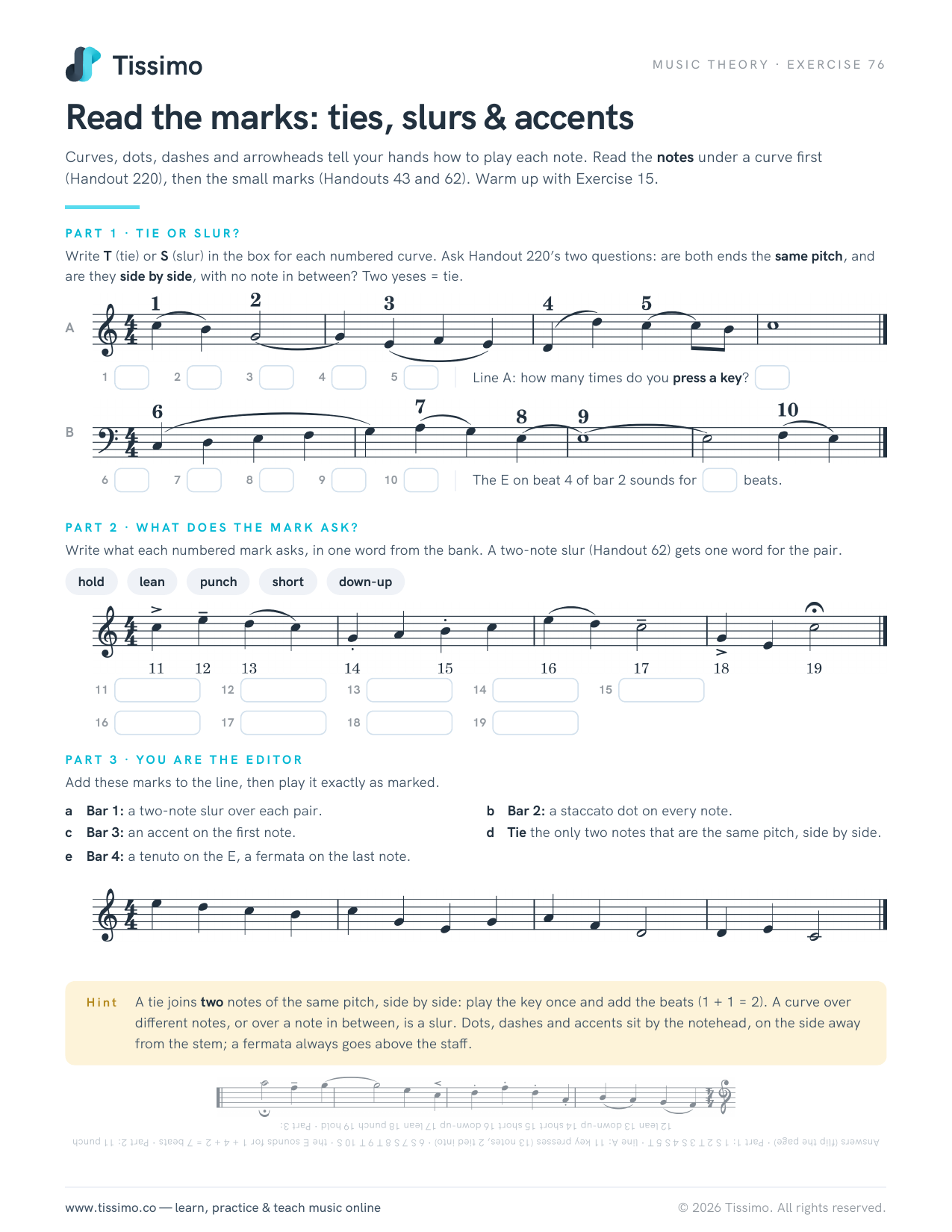 Read the marks: ties, slurs & accentsCurves, dots, dashes and arrowheads tell your hands how to play each note. Read the notes under a curve first (Handout 220), then the small marks (Handouts 43 and 62). Warm up with Exercise 15.