Articulation & Ornaments
Marcato
Pronounced mar-KAH-tohWritten as ^
Marcato means marked: play the note with a strong, heavy accent. Its sign is a small upright wedge (^), and the word marcato over a passage asks for every note to be clearly emphasized.
Marcato is Italian for "marked." As a sign, it is an upright wedge shaped like a little roof (^), usually printed above the staff. It asks for a strong accent: heavier and more emphatic than an ordinary accent (>). As a word written over a passage, marcato (or ben marcato, "well marked") asks you to play every note there in a clear, emphatic, slightly separated way.
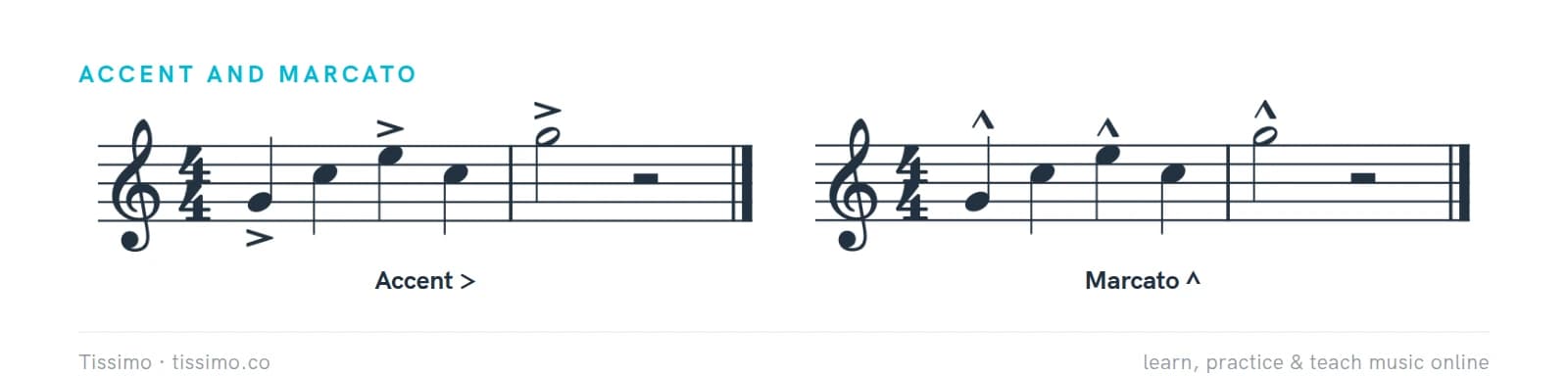
How to play marcato
Give the note a firm, decisive start and a full, solid tone. Where an accent is a quick push at the start of a note, marcato puts weight behind the whole attack. On the piano that usually means using the weight of the arm rather than just the finger; on strings, a heavy stroke with a clear bite; on winds and brass, a strong tongue and a solid column of air.
How long the note lasts depends on the style. Marcato notes are very often slightly detached. In jazz and big-band charts the ^, which players nickname the "rooftop" or "housetop" accent, is usually played short and strong. In a slow orchestral or choral passage, a marcato note may be held for nearly its whole value, just with more weight. When it also carries a staccato dot, play it both short and strong.
Marcato, accent or staccatissimo?
- > sideways wedge: accent, a stressed start.
- ^ upright wedge: marcato, a heavier stress.
- A small solid wedge right at the notehead: staccatissimo, very short but not necessarily loud.
If the wedge looks like a roof over the note, it is marcato.
The word marcato in a piece
You will often find the word on a melody that has to cut through a busy accompaniment, or on a bass line that drives the rhythm. A direction such as marcato il basso ("the bass marked") points the emphasis at one part only, so the other lines stay lighter.
Common questions
What does the ^ symbol mean in music?
It is a marcato, or strong accent: play the note with a heavy, decisive stress, stronger than an ordinary accent (>). In jazz and big-band music it is usually played short as well.
Practice it: free worksheets
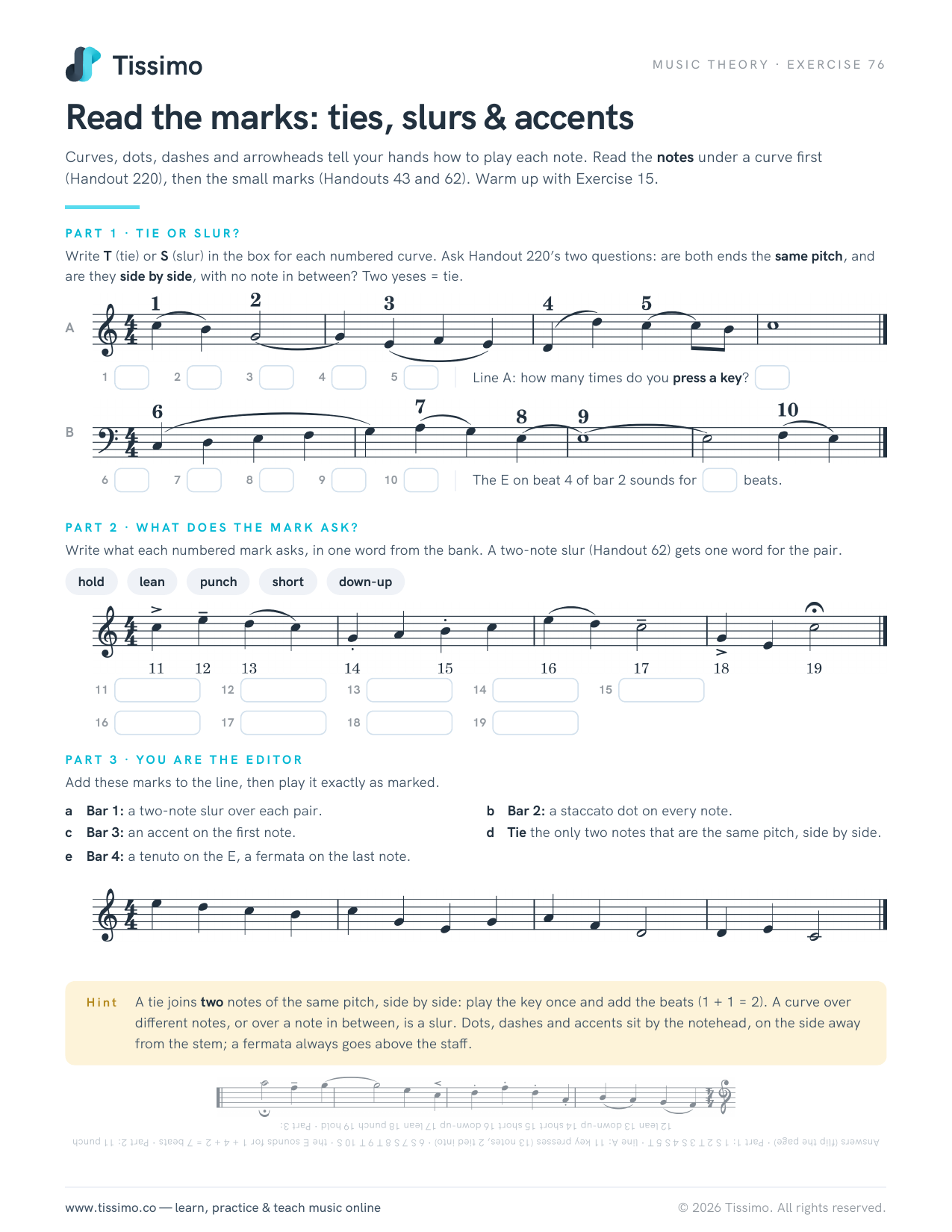 Read the marks: ties, slurs & accentsCurves, dots, dashes and arrowheads tell your hands how to play each note. Read the notes under a curve first (Handout 220), then the small marks (Handouts 43 and 62). Warm up with Exercise 15.
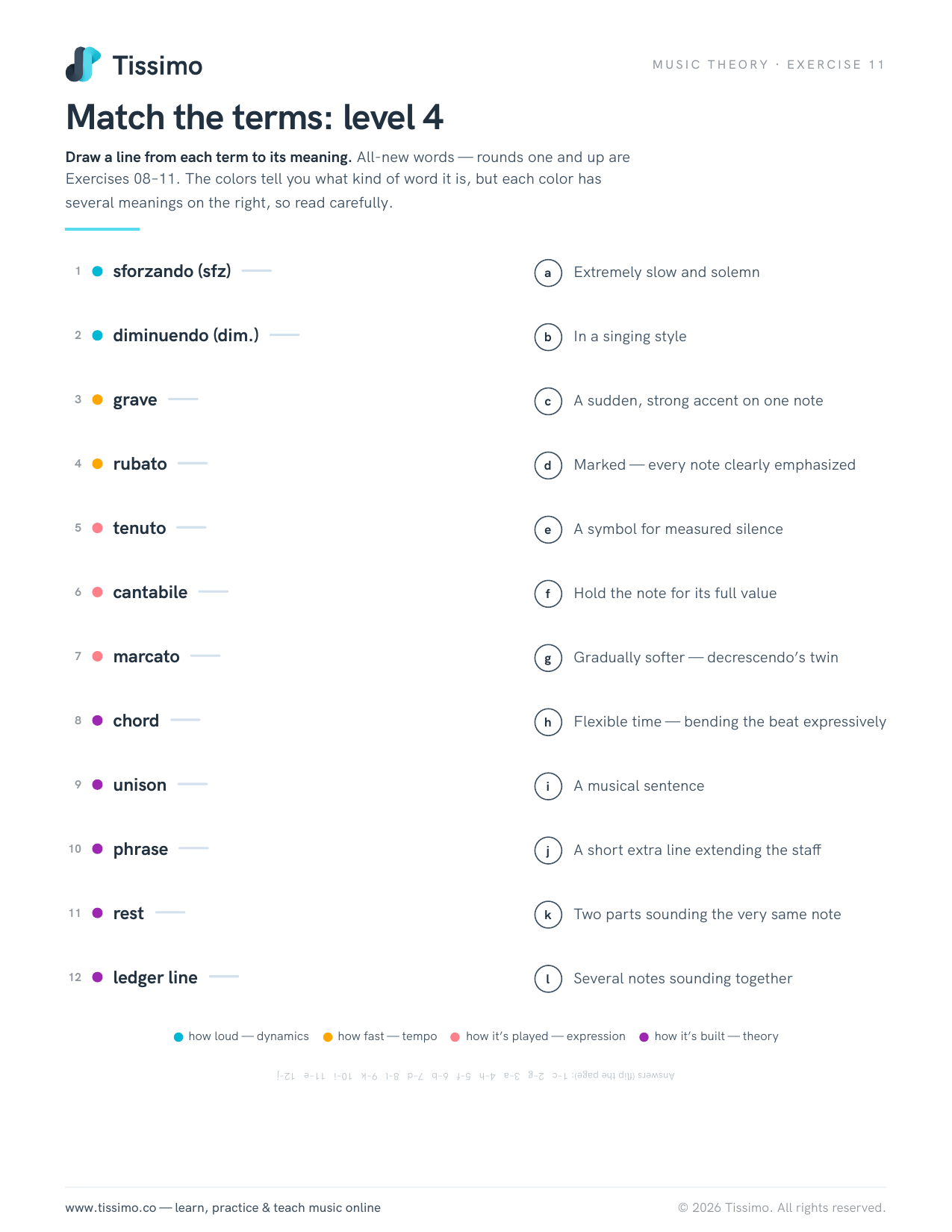 Match the terms: level 4Draw a line from each term to its meaning. All-new words — rounds one and up are Exercises 08–11. The colors tell you what kind of word it is, but each color has several meanings on the right, so read carefully.
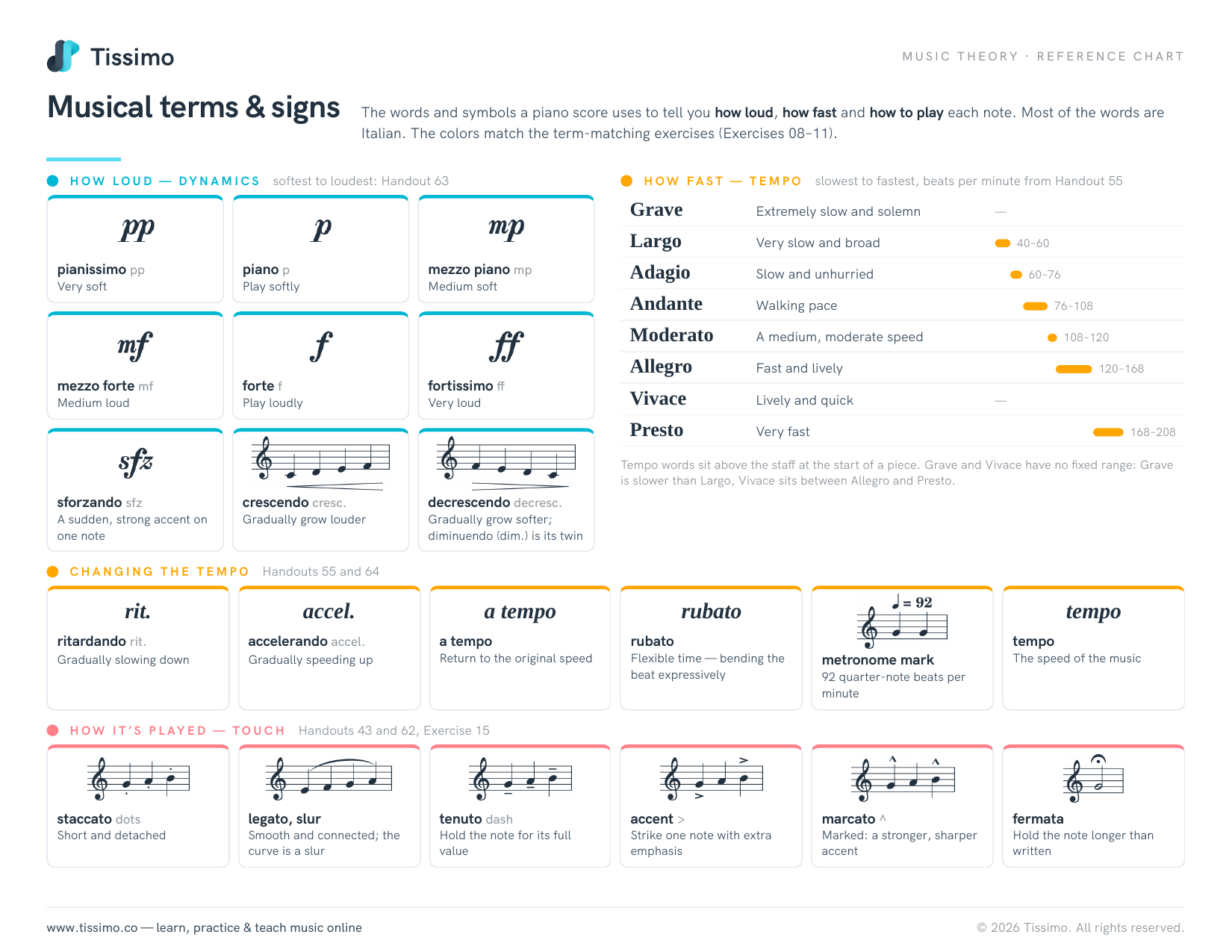 Musical terms & signsThe words and symbols a piano score uses to tell you how loud, how fast and how to play each note. Most of the words are Italian. The colors match the term-matching exercises (Exercises 08–11, 74 and 75).