Articulation & Ornaments
Accent
Written as >
An accent is a sign, usually a sideways wedge (>), that tells you to stress a note by playing its start more strongly than the notes around it. The word also means any emphasis a note receives.
An accent tells you to give a note extra emphasis, so it stands out from the notes around it. The usual sign is a sideways wedge (>) written above or below the notehead. Many musicians simply call it an "accent mark."
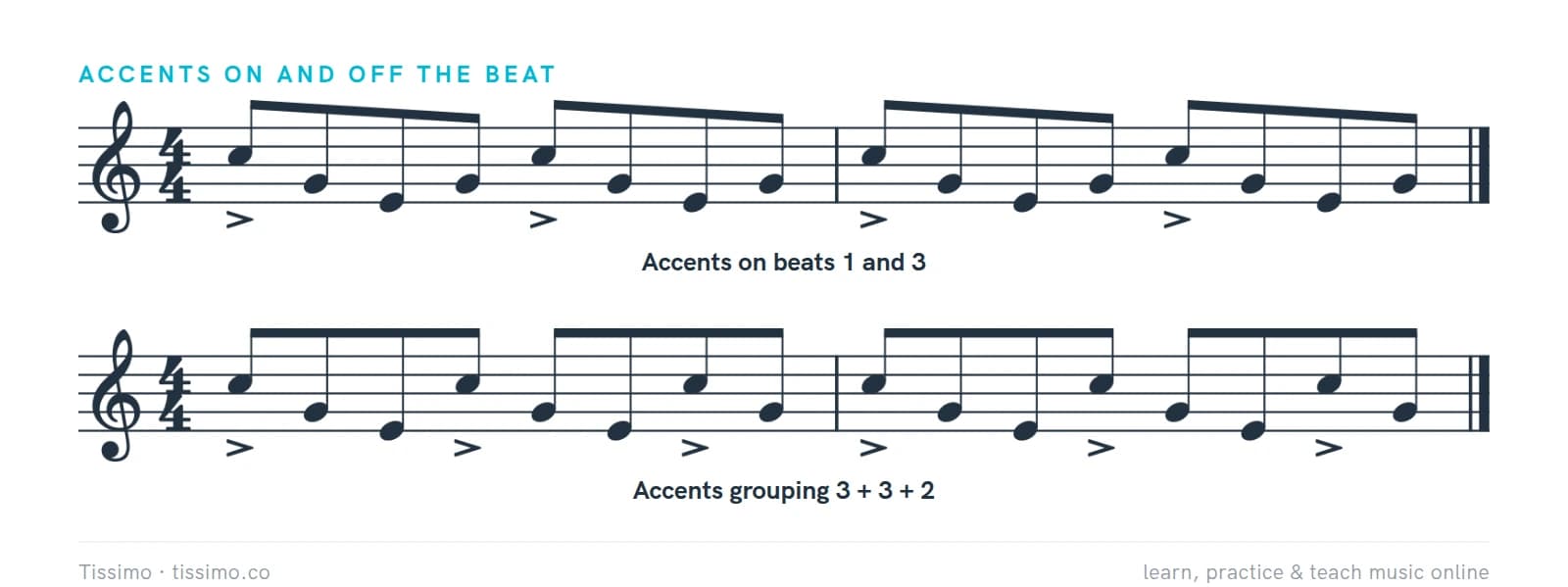
How to play an accent
Make the start of the note stronger than its neighbors: on the piano, a quicker, firmer key stroke; on a string instrument, more bow speed and weight at the beginning of the stroke; on a wind instrument, a firmer tongue and a push of air. Then let the note settle back into the line.
An accent is relative. In a quiet passage an accented note is only a little louder than the others; in a loud one it can be much bigger. An accent also does not make a note shorter. If the composer wants it short as well, there will be a staccato dot too.
Accents that move the beat
When accents fall on the strong beats, as in the first panel, they simply underline the meter. When they fall somewhere else, they can make the music feel as if it has a new shape. In the second panel, eight even eighth notes are grouped 3 + 3 + 2 by the accents, a syncopated pattern heard in many styles, from Latin American dance music to rock and pop.
Other kinds of accent
Musicians use the word for more than the sign:
- Dynamic accent: a note made louder, by the > sign or by markings such as sforzando (sfz).
- Metric accent: the natural stress of the strong beats, like beat 1 in a bar of 4/4 (see downbeat).
- Agogic accent: emphasis made by length, when a note is longer than those around it or arrives a fraction late.
- Strong accent: the marcato sign (^), heavier than an ordinary accent.
Accent or hairpin?
An accent is a small wedge on one note. A decrescendo hairpin looks similar but is longer and stretches across several notes, telling you to get gradually softer. If the wedge covers just one notehead, it is an accent.
Practice the marks with Fermata, Tenuto & Accent and Read the marks: ties, slurs & accents.
Common questions
What does the > symbol mean in music?
It is an accent: play that note with more emphasis than the notes around it, mainly by making its start stronger. It does not change the note's length.
What is the difference between an accent and marcato?
Both stress the note. The marcato sign (^) asks for a heavier, more emphatic accent, and in many styles the note is also a little shorter.
Practice it: free worksheets
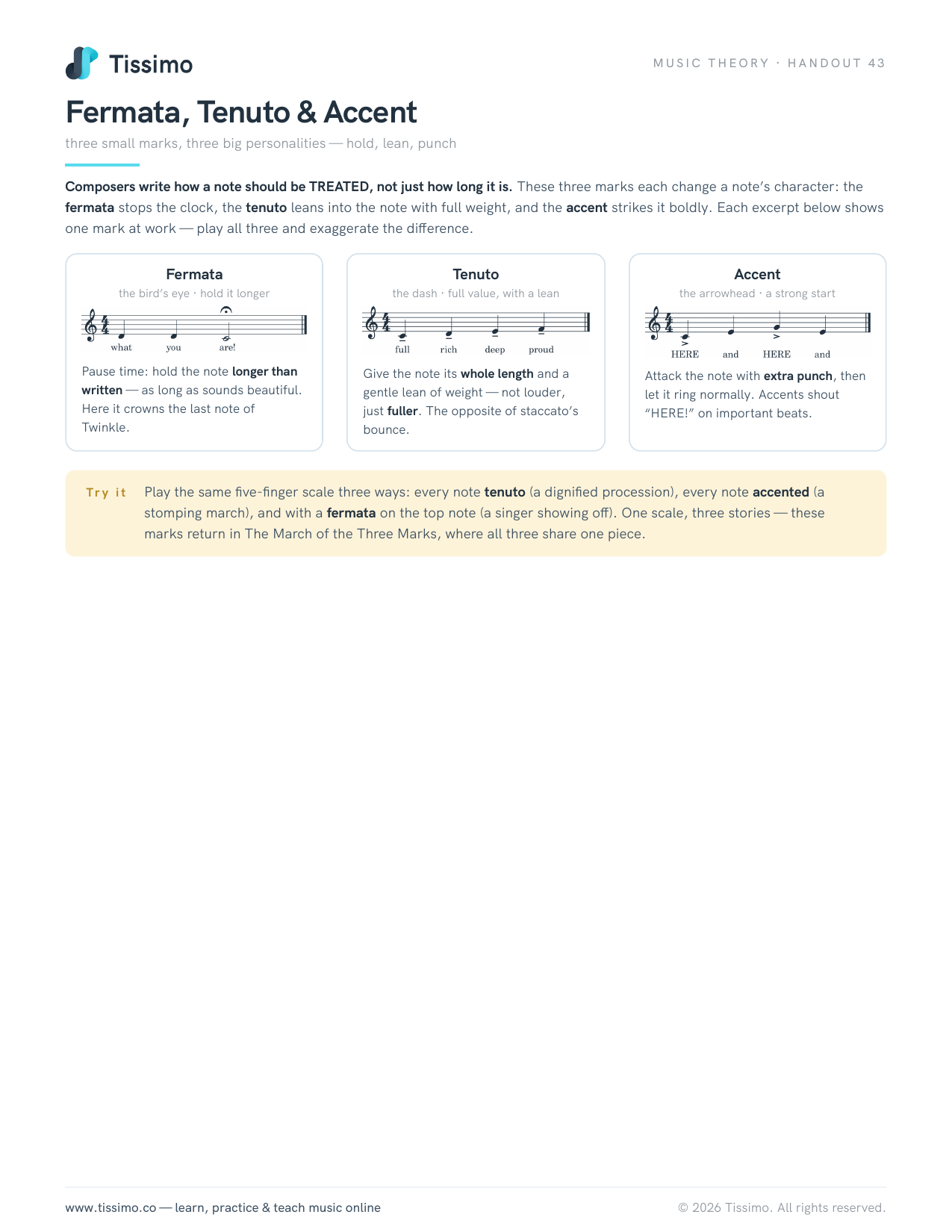 Fermata, Tenuto & Accentthree small marks, three big personalities — hold, lean, punch
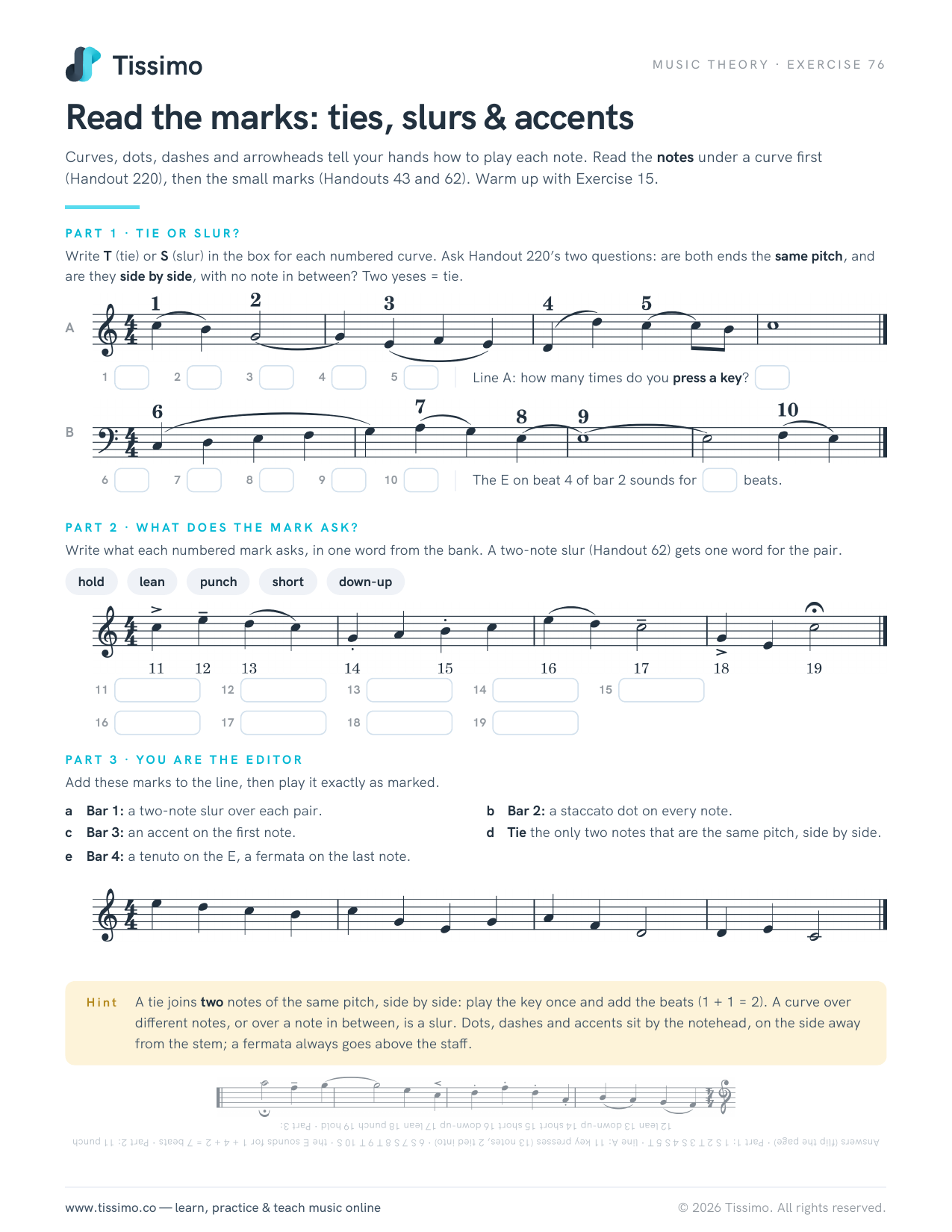 Read the marks: ties, slurs & accentsCurves, dots, dashes and arrowheads tell your hands how to play each note. Read the notes under a curve first (Handout 220), then the small marks (Handouts 43 and 62). Warm up with Exercise 15.
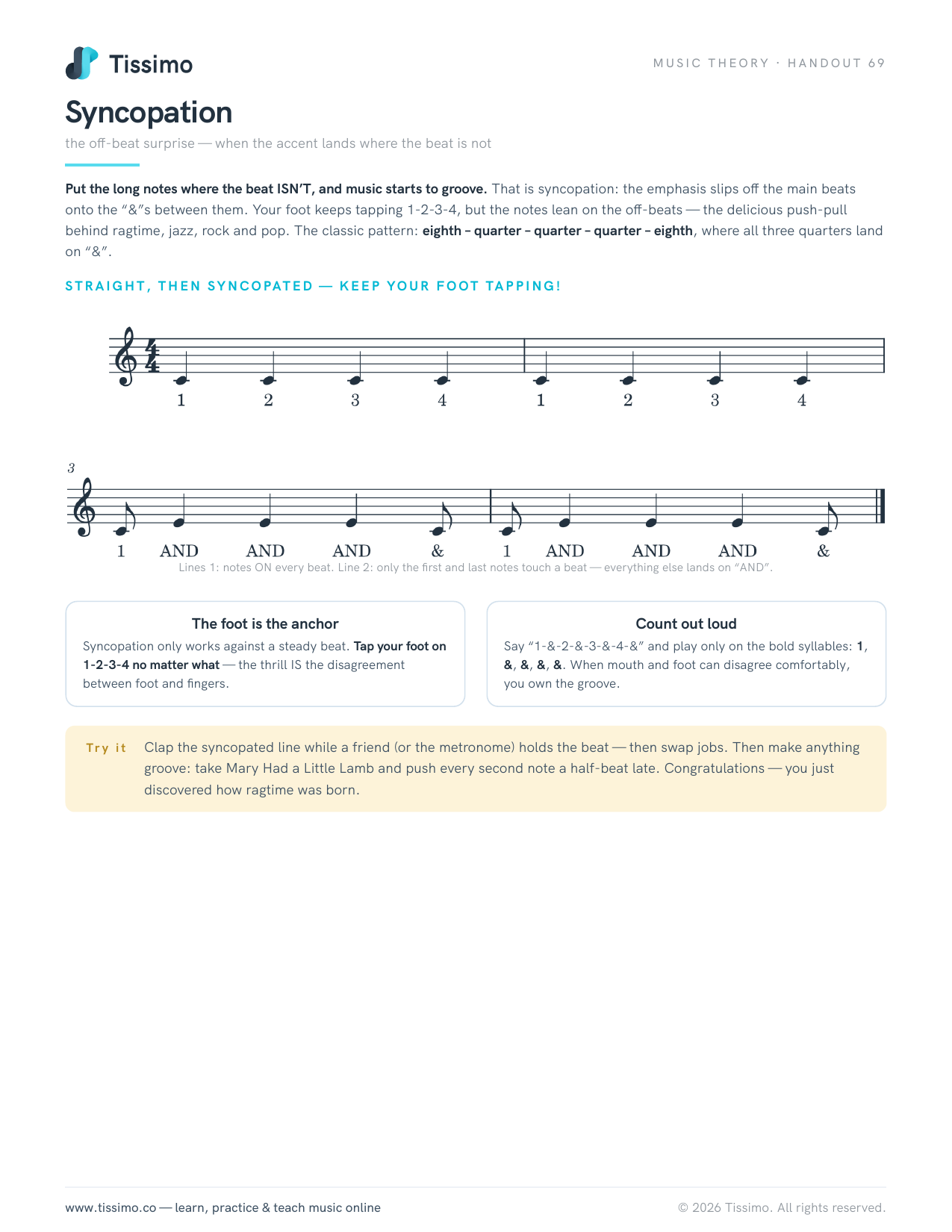 Syncopationthe off-beat surprise — when the accent lands where the beat is not
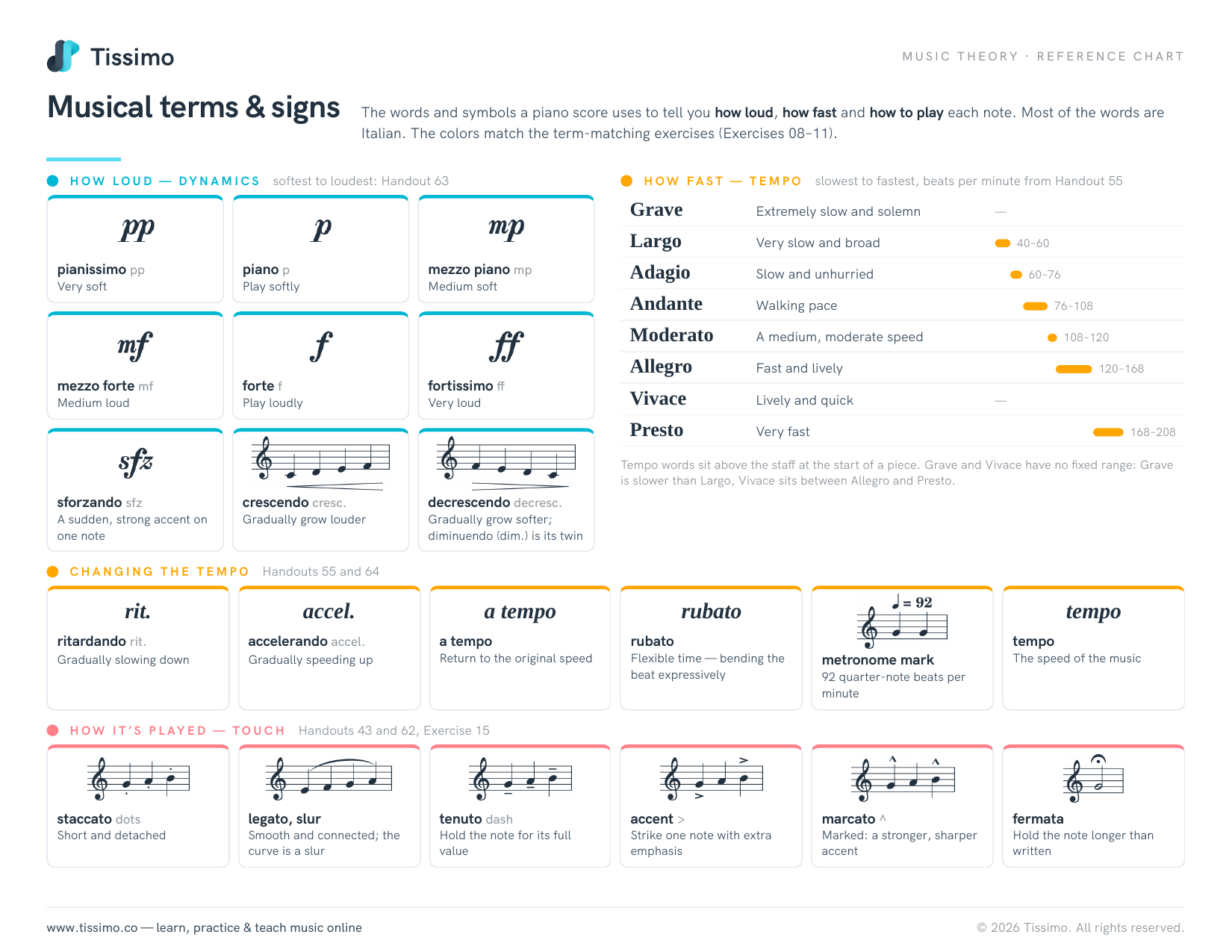 Musical terms & signsThe words and symbols a piano score uses to tell you how loud, how fast and how to play each note. Most of the words are Italian. The colors match the term-matching exercises (Exercises 08–11, 74 and 75).