Articulation & Ornaments
Articulation
Articulation is the way each note starts, how long it really lasts and how it joins the next one: smooth (legato), short (staccato), stressed (accent) and so on. Slurs and small marks show it on the page.
Two players can play exactly the same notes at the same speed and still sound completely different. Very often the difference is articulation: how each note begins, how long it actually sounds, and whether it flows straight into the next note or leaves a little air before it. Words such as legato and staccato describe it, and a small family of marks shows it on the page.
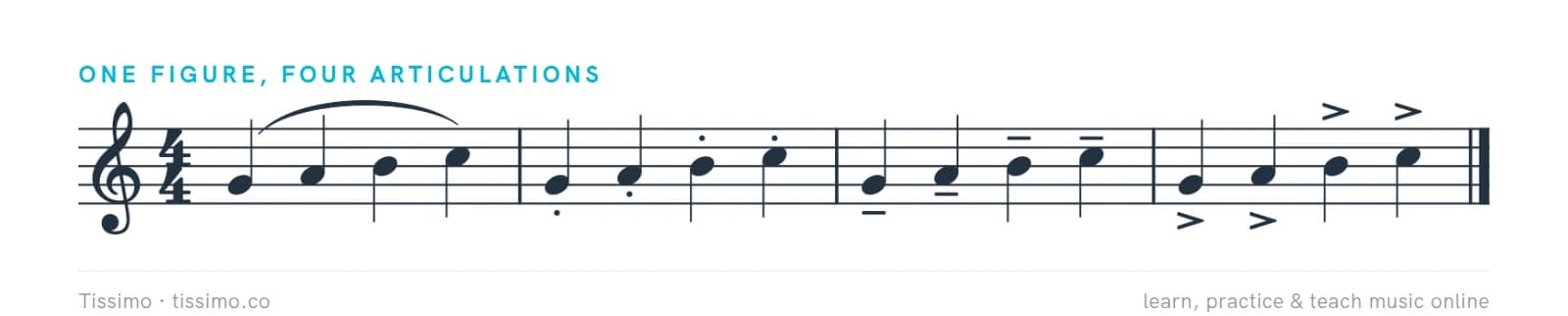
The main articulation marks
- Slur (a curved line grouping notes, which may include repeated pitches): usually legato, smoothly connected, or a shared bow stroke or other instrument-specific articulation.
- Dot over or under the notehead: staccato, short and detached.
- Wedge or small stroke: staccatissimo, shorter still.
- Short horizontal line: tenuto, hold the note for its full value, often with a little weight.
- >: an accent, a stronger start to the note.
- ^: marcato, a heavier, more emphatic accent.
- Dots or lines under a slur: portato, gently separated notes, halfway between legato and staccato.
The dot, the line and the wedge sit right by the notehead, on the side away from the stem. Marks can also combine: a dot with an accent asks for a note that is both short and stressed.
How different instruments articulate
- Piano: through the speed of the key stroke and, above all, the moment you let the key up.
- Strings: through the bow. Notes under one slur share one bow stroke; separate notes get separate strokes, on or off the string (see bowing).
- Winds and brass: through the tongue. A slurred group is tongued only on its first note; detached notes each get a light "tu" or "du".
- Voice: through consonants and breath, since a singer cannot "lift" a key.
Notes with no mark
Plenty of notes carry no articulation mark at all, and then the style decides. Many players separate unmarked notes slightly in Baroque keyboard music, while an unmarked melody in a Romantic piece usually sings in a connected line. When you are unsure, ask your teacher or listen to a few recordings of the piece.
Articulation and phrasing
Articulation works on single notes and small groups. Phrasing shapes whole musical sentences. The two overlap: a long curved line over several bars is often a phrase mark rather than an instruction to slur every note.
Practice reading the marks with Legato or Staccato? and Read the marks: ties, slurs & accents.
Common questions
What is the difference between articulation and dynamics?
Dynamics tell you how loud the music is overall. Articulation tells you how each note starts, how long it lasts and how it connects to the next. The two meet in the accent, which is a small, local change of loudness at the start of one note.
What does a note with no articulation mark mean?
Nothing special is asked for, so the style of the piece decides. In a singing Romantic melody plain notes are usually connected; in much Baroque keyboard music players often separate them slightly.
Practice it: free worksheets
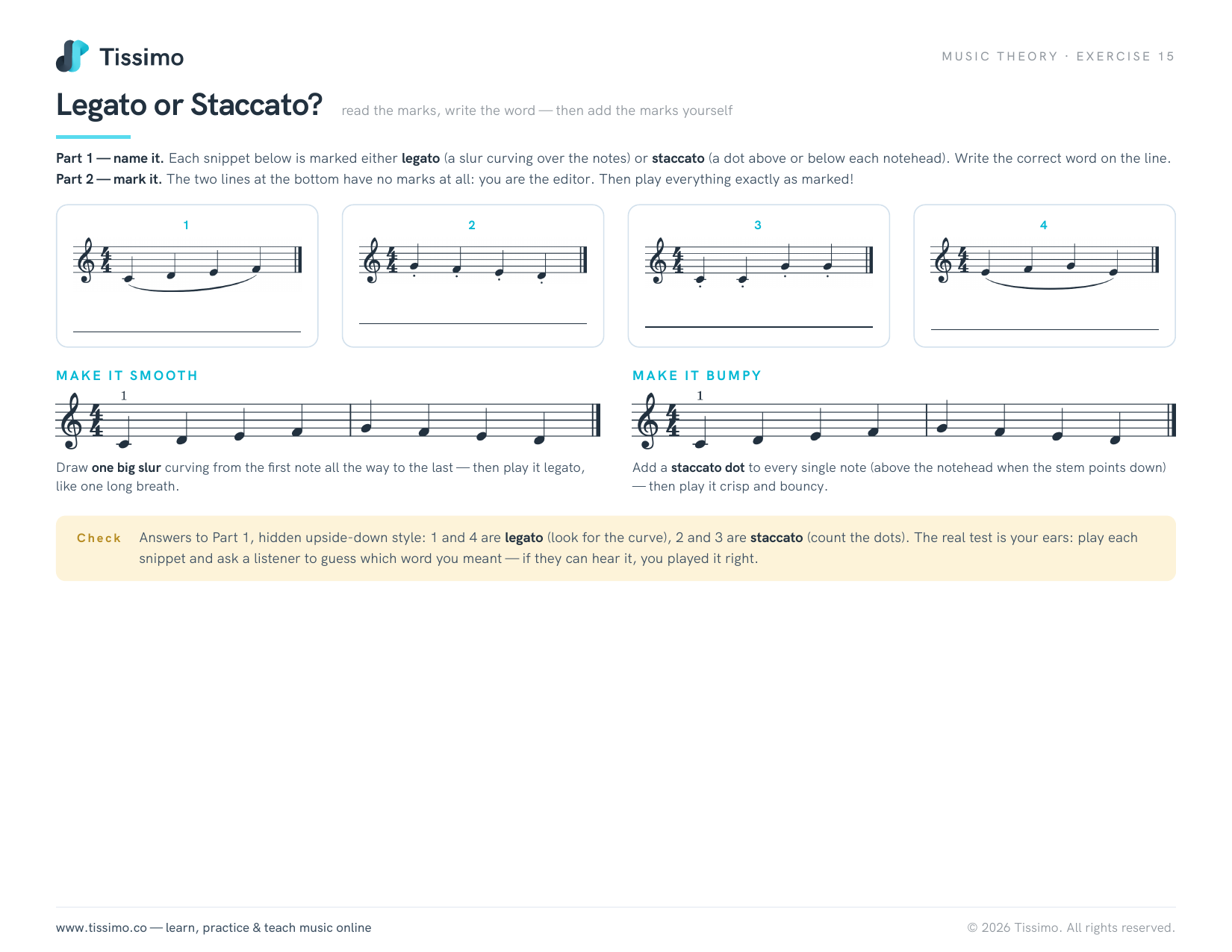 Legato or Staccato?read the marks, write the word — then add the marks yourself
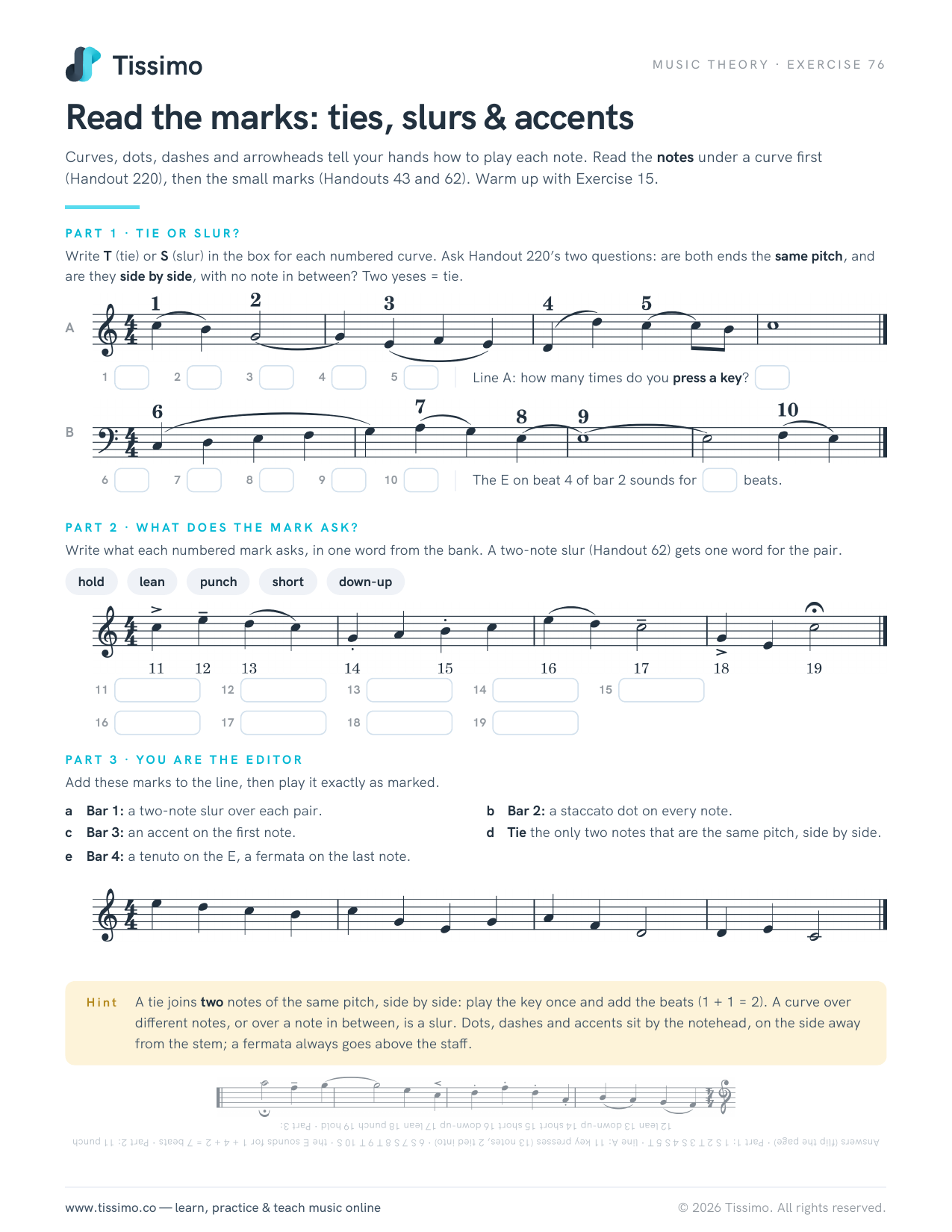 Read the marks: ties, slurs & accentsCurves, dots, dashes and arrowheads tell your hands how to play each note. Read the notes under a curve first (Handout 220), then the small marks (Handouts 43 and 62). Warm up with Exercise 15.
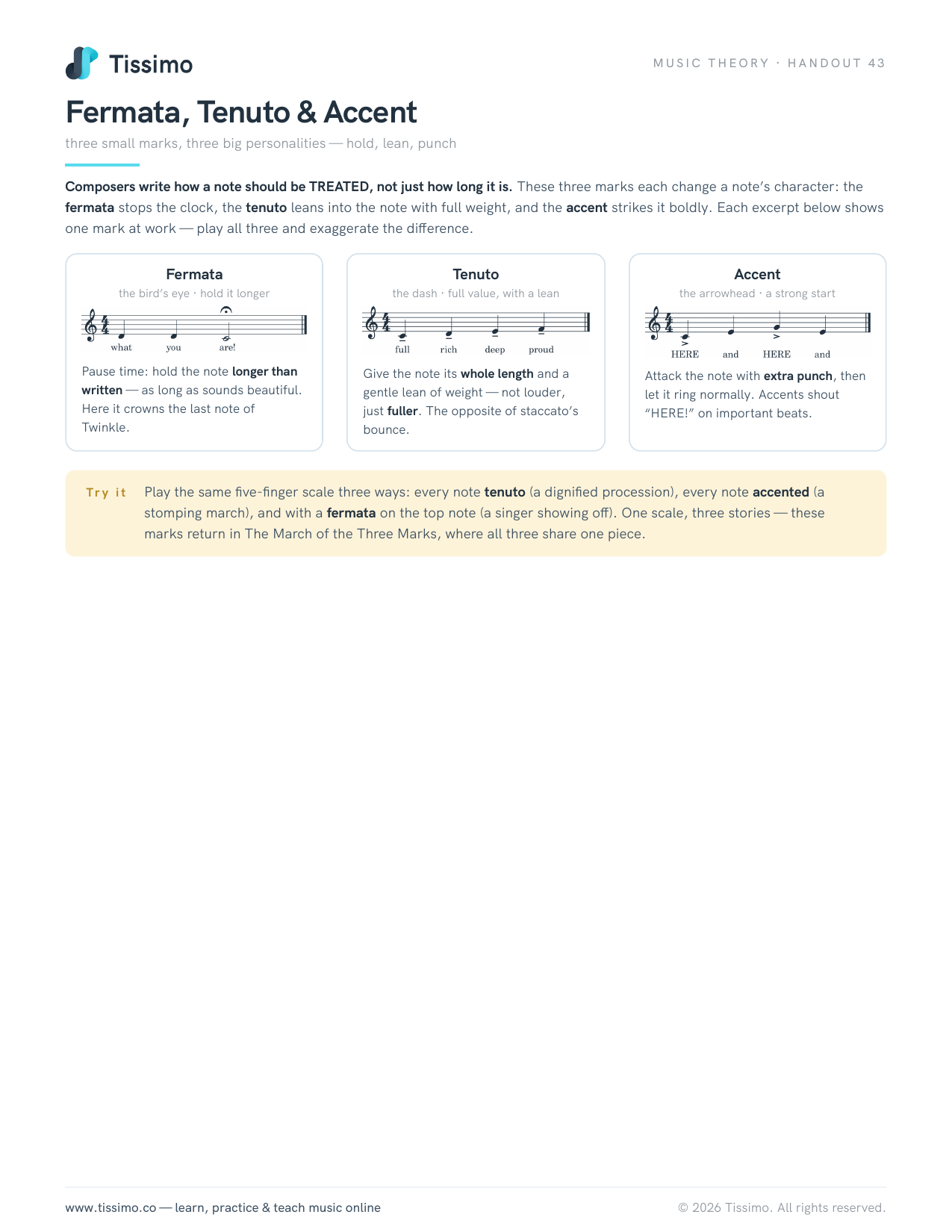 Fermata, Tenuto & Accentthree small marks, three big personalities — hold, lean, punch
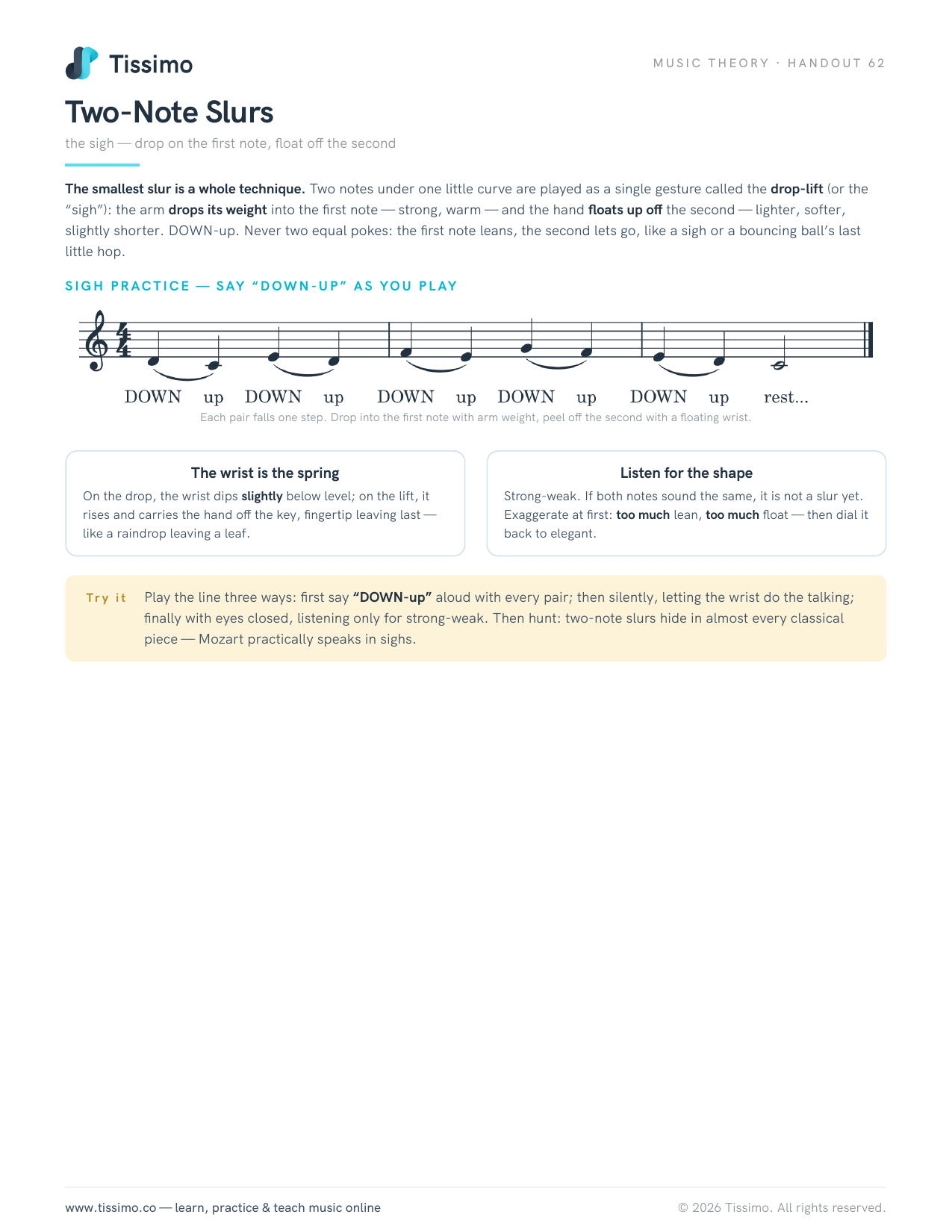 Two-Note Slursthe sigh — drop on the first note, float off the second
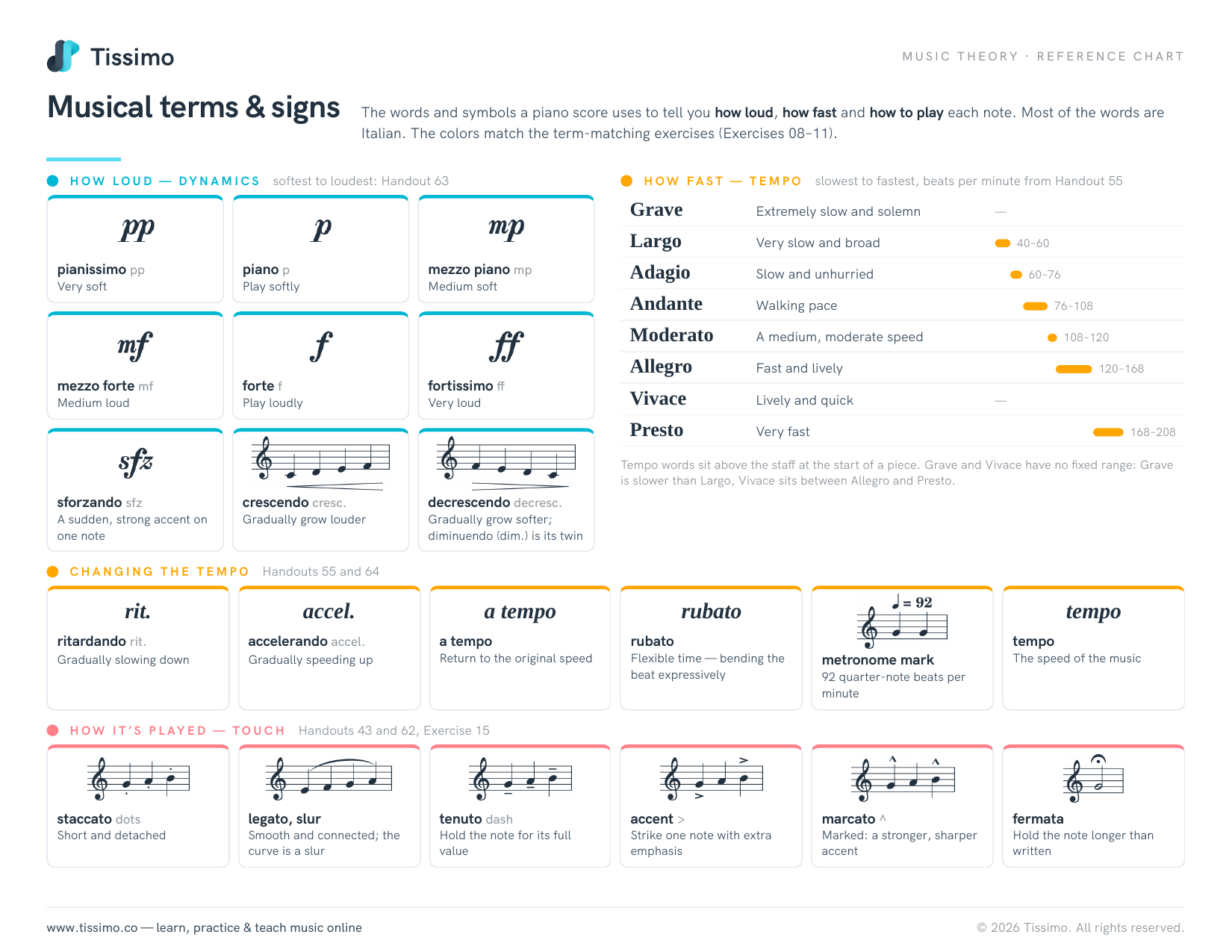 Musical terms & signsThe words and symbols a piano score uses to tell you how loud, how fast and how to play each note. Most of the words are Italian. The colors match the term-matching exercises (Exercises 08–11, 74 and 75).