Free Music Worksheets
Printable one-page handouts from Tissimo teachers — view them here, download the PDF, or print a stack for your next lesson.

Notes & Rhythm
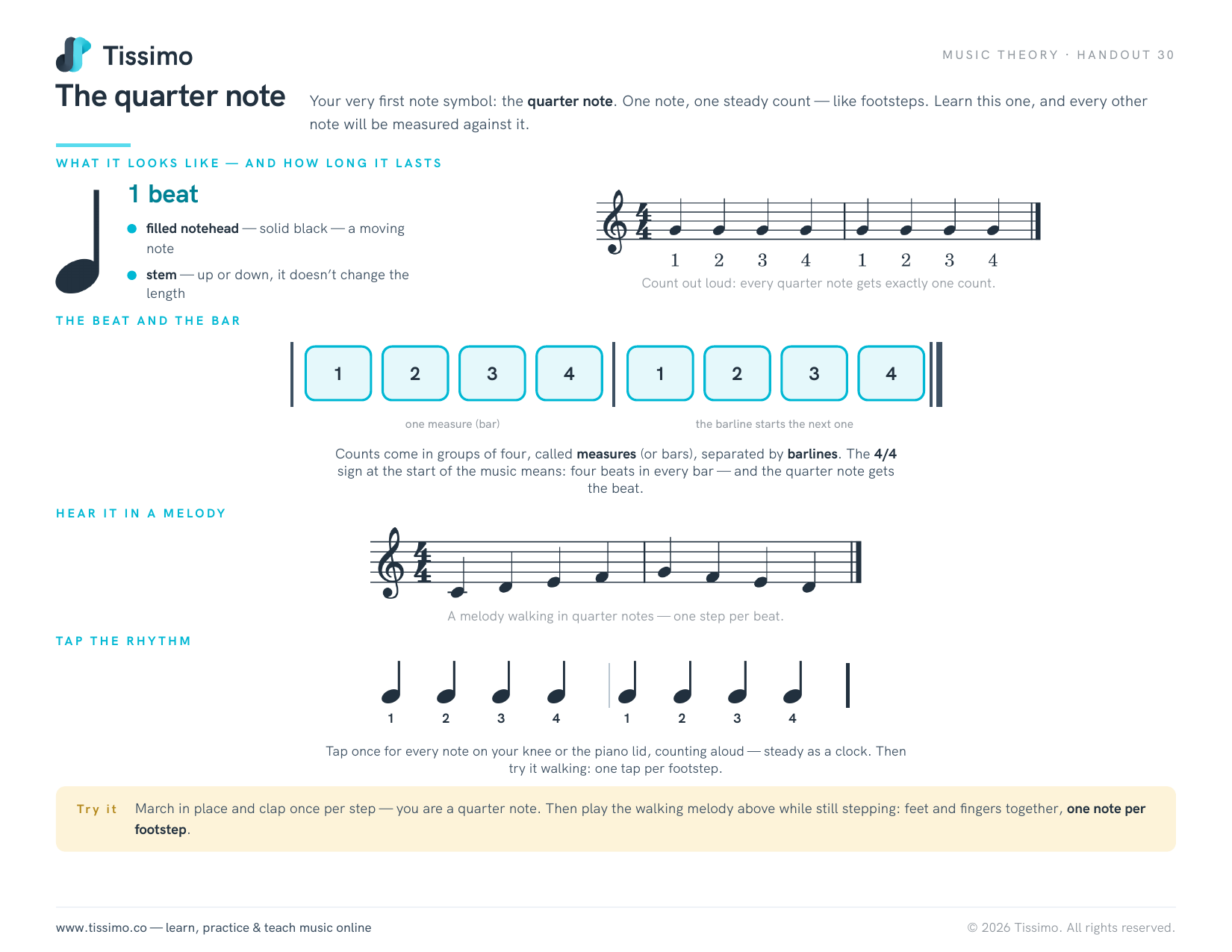
The quarter note
Your very first note symbol: the quarter note. One note, one steady count — like footsteps. Learn this one, and every other note will be measured against it.
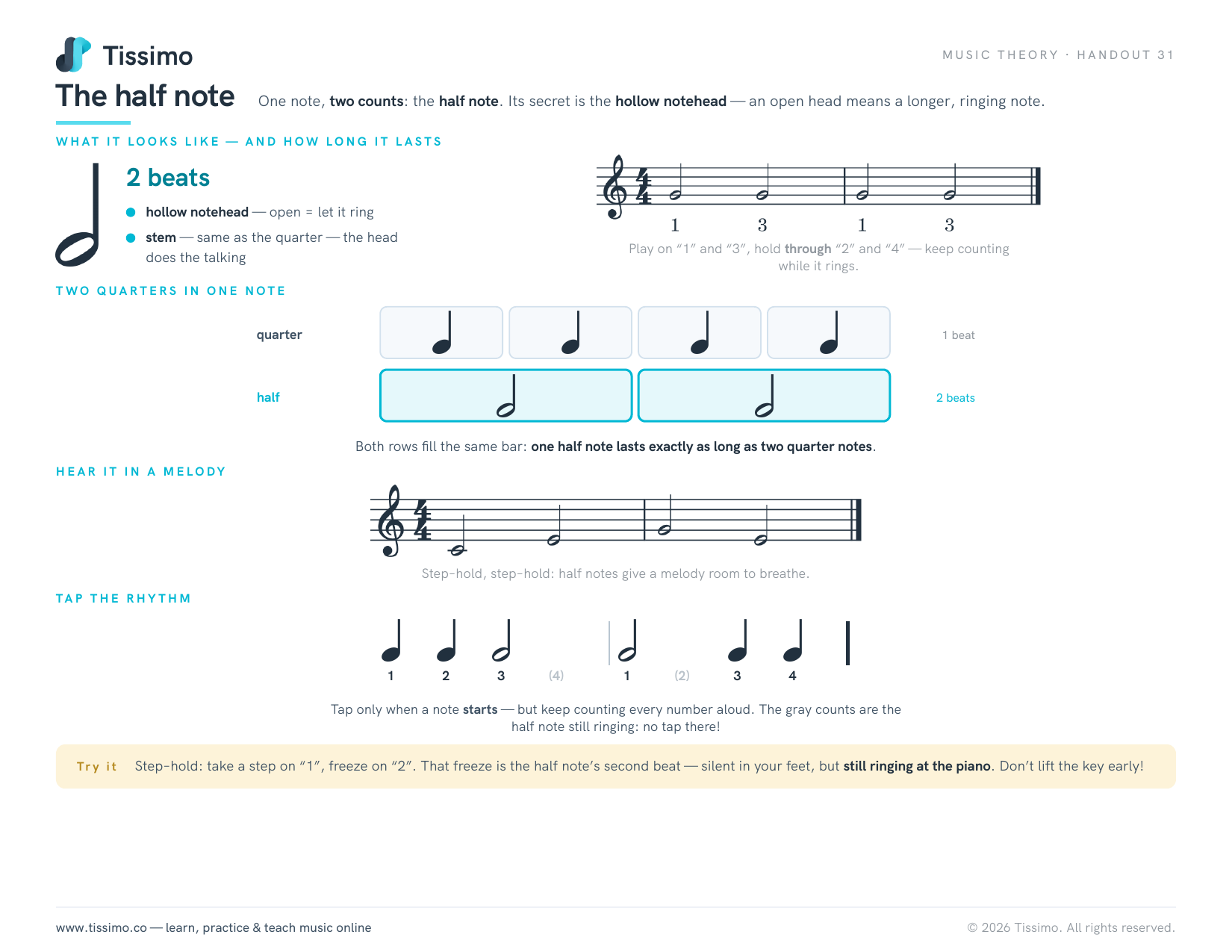
The half note
One note, two counts: the half note. Its secret is the hollow notehead — an open head means a longer, ringing note.
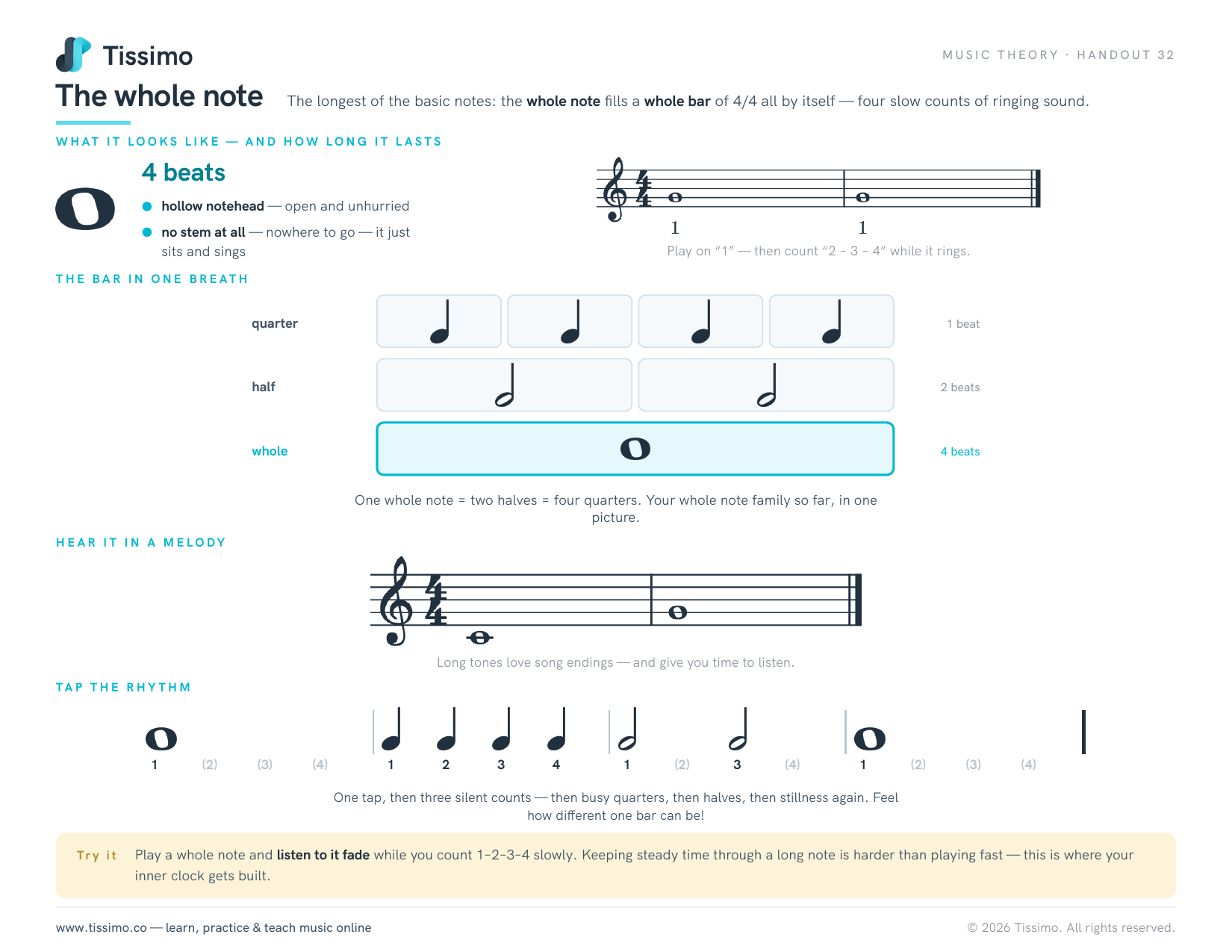
The whole note
The longest of the basic notes: the whole note fills a whole bar of 4/4 all by itself — four slow counts of ringing sound.
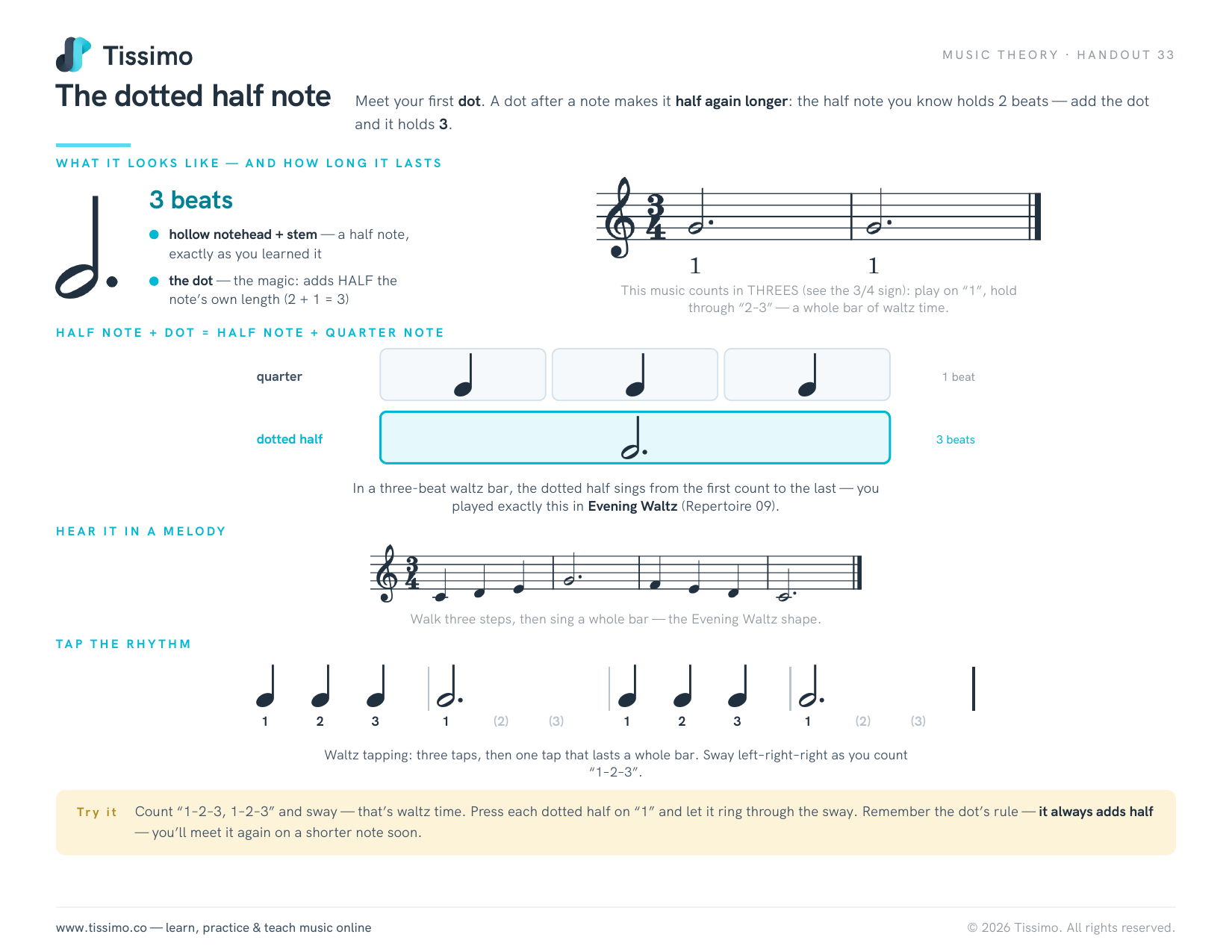
The dotted half note
Meet your first dot. A dot after a note makes it half again longer: the half note you know holds 2 beats — add the dot and it holds 3.
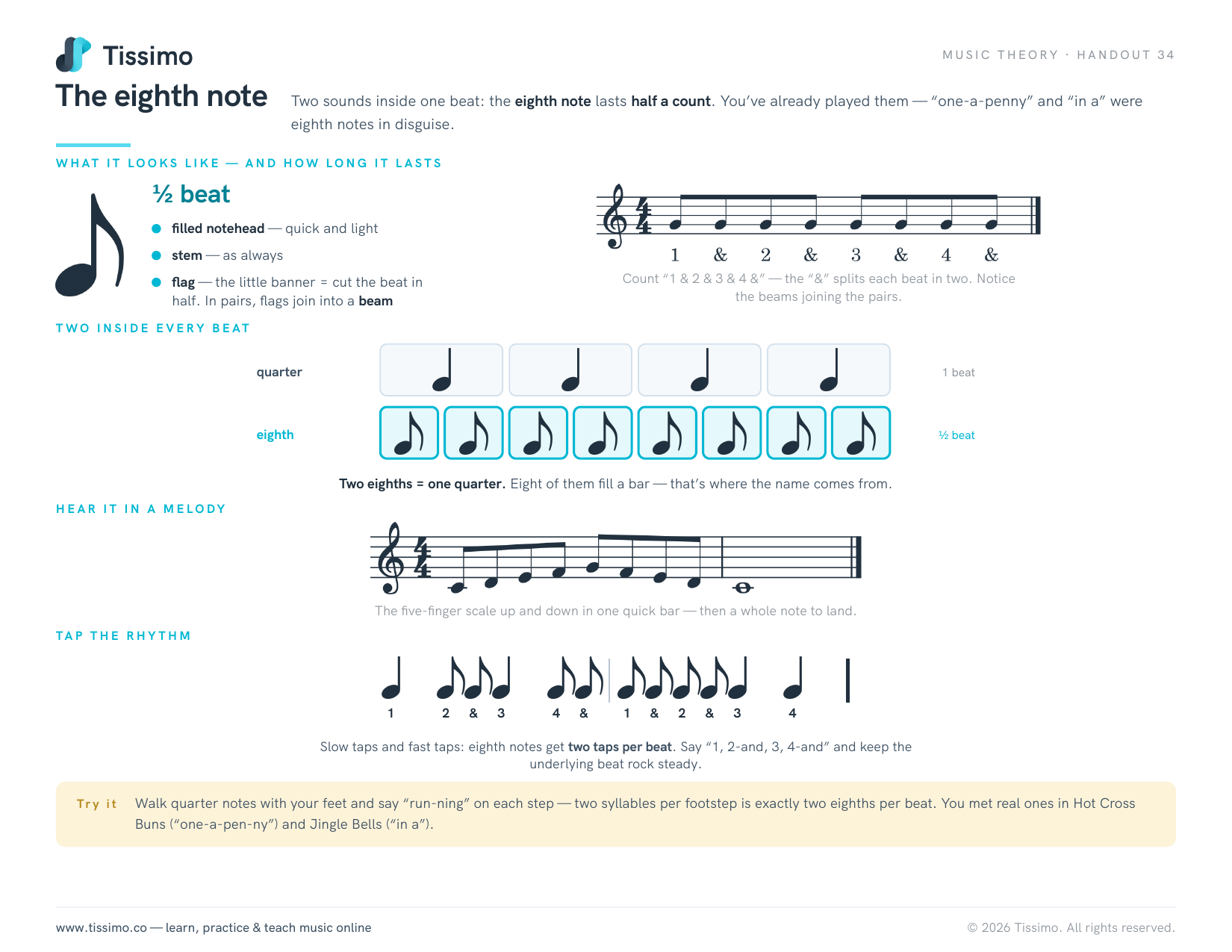
The eighth note
Two sounds inside one beat: the eighth note lasts half a count. You’ve already played them — “one-a-penny” and “in a” were eighth notes in disguise.
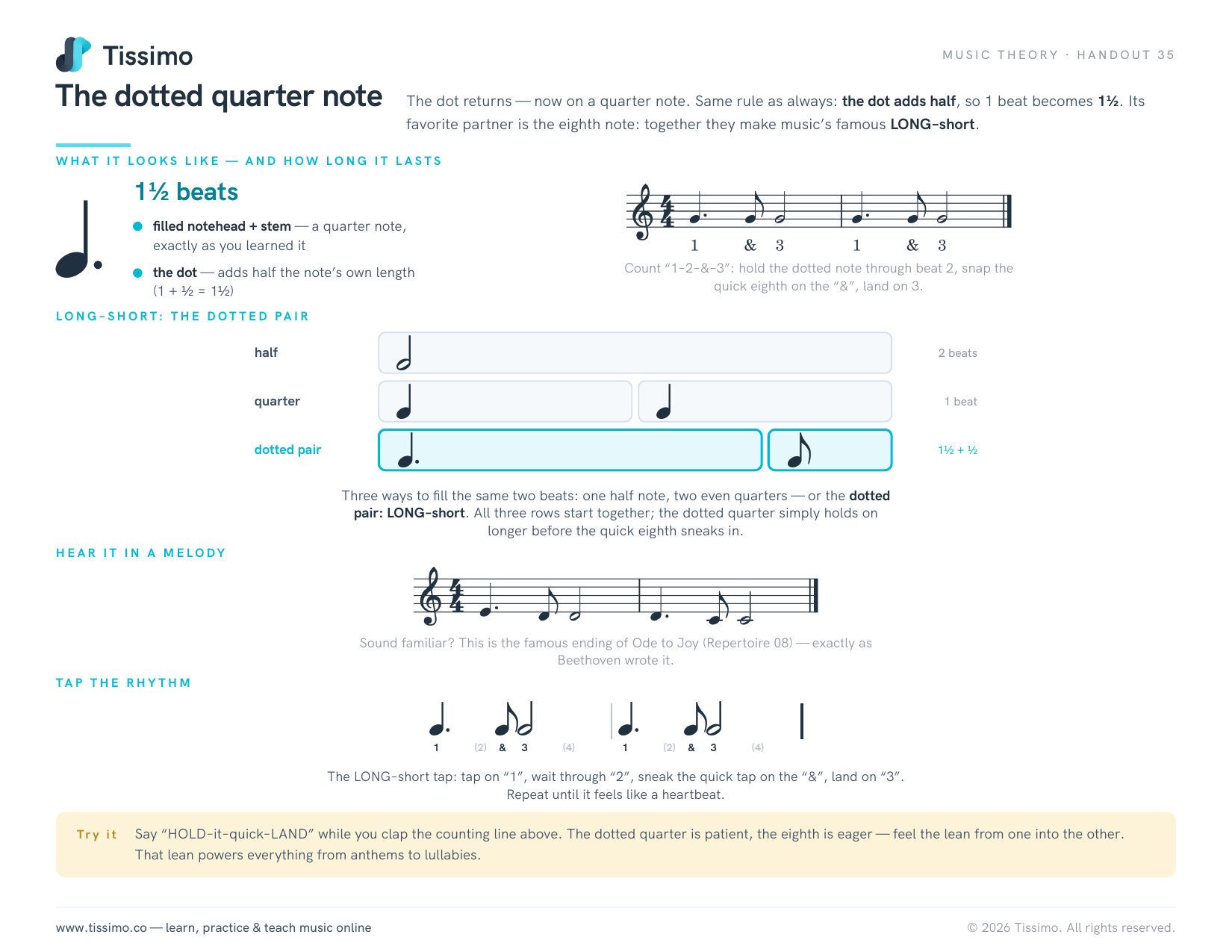
The dotted quarter note
The dot returns — now on a quarter note. Same rule as always: the dot adds half, so 1 beat becomes 1½. Its favorite partner is the eighth note: together they make music’s famous LONG–short.
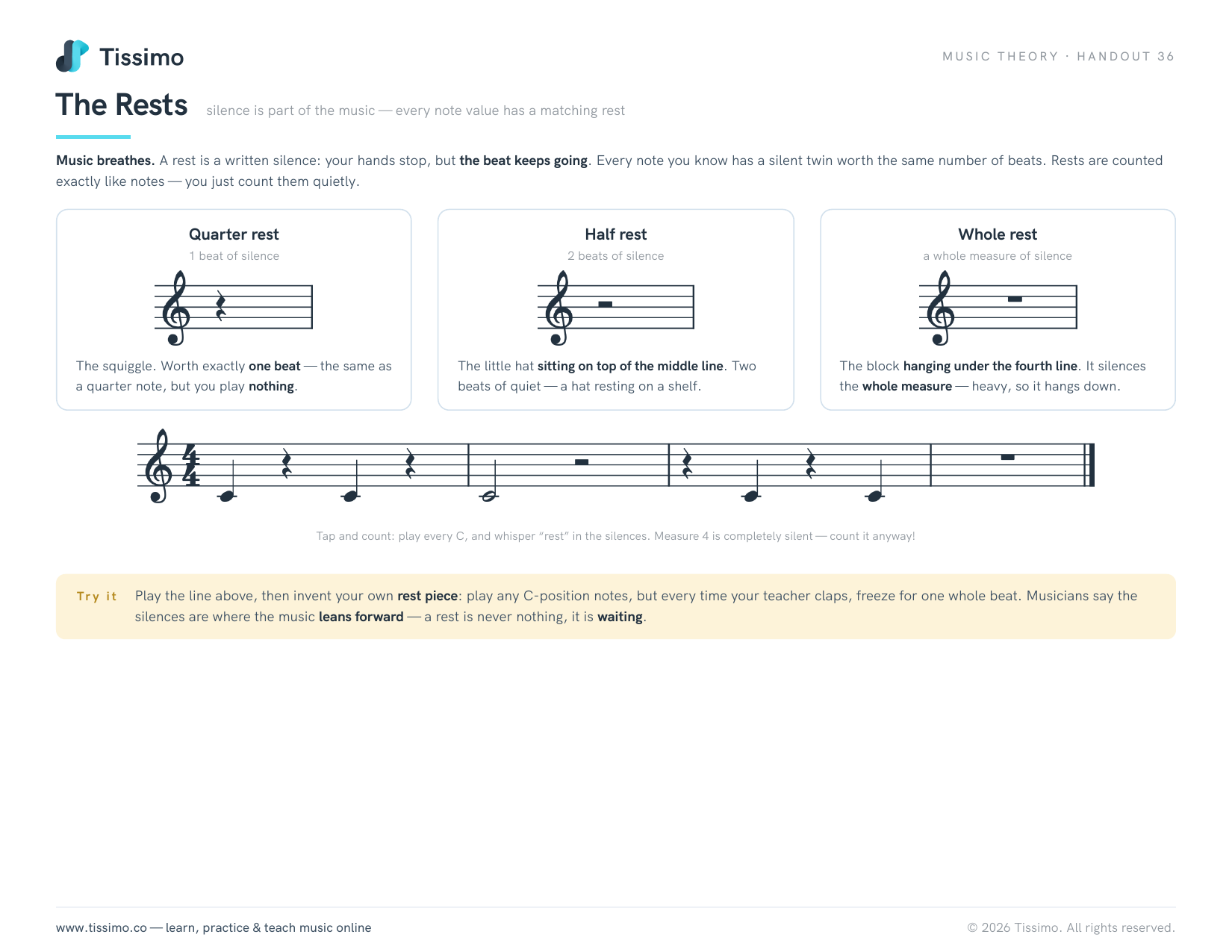
The Rests
silence is part of the music — every note value has a matching rest
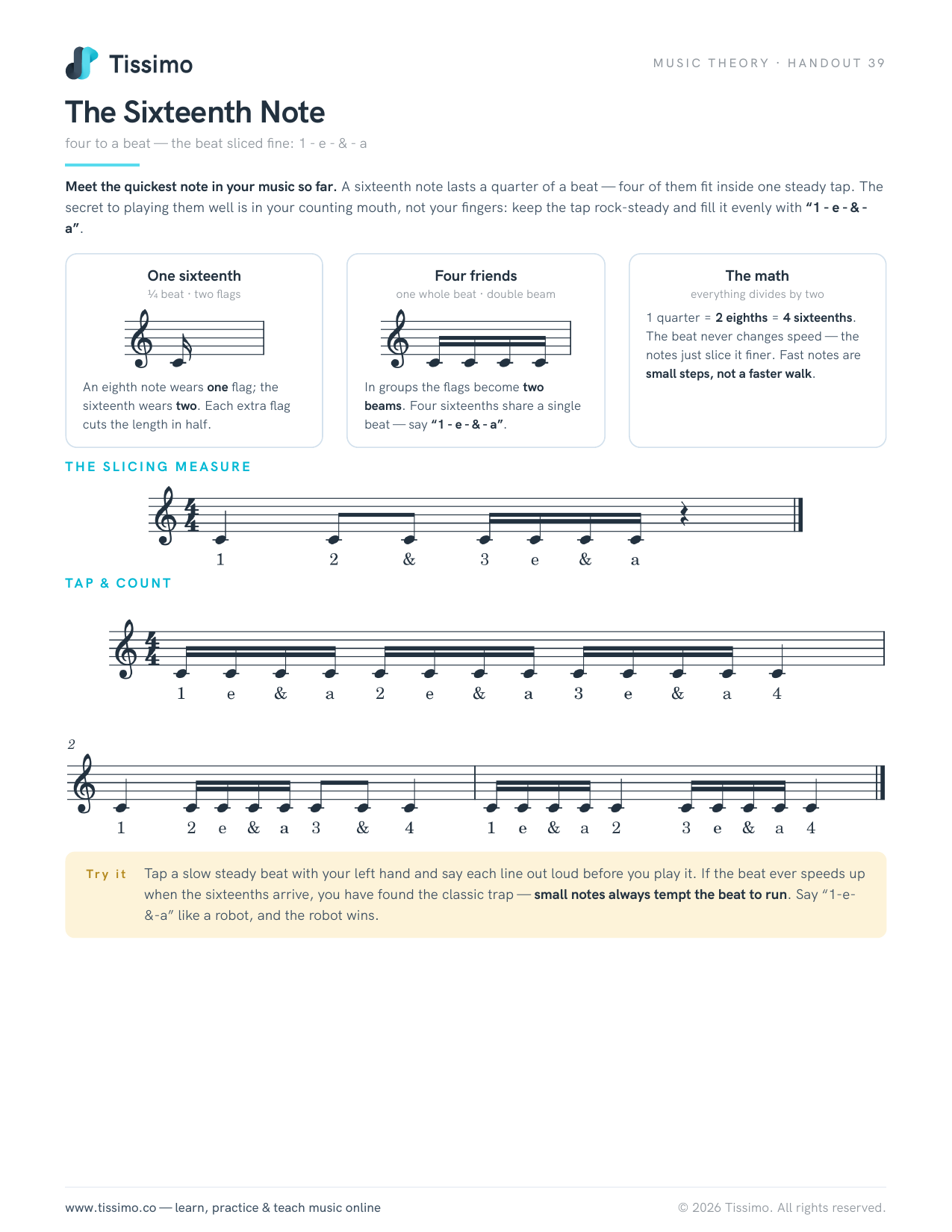
The Sixteenth Note
four to a beat — the beat sliced fine: 1 - e - & - a

The Rest Family
every note has a silent twin — all five rests, whole to sixteenth
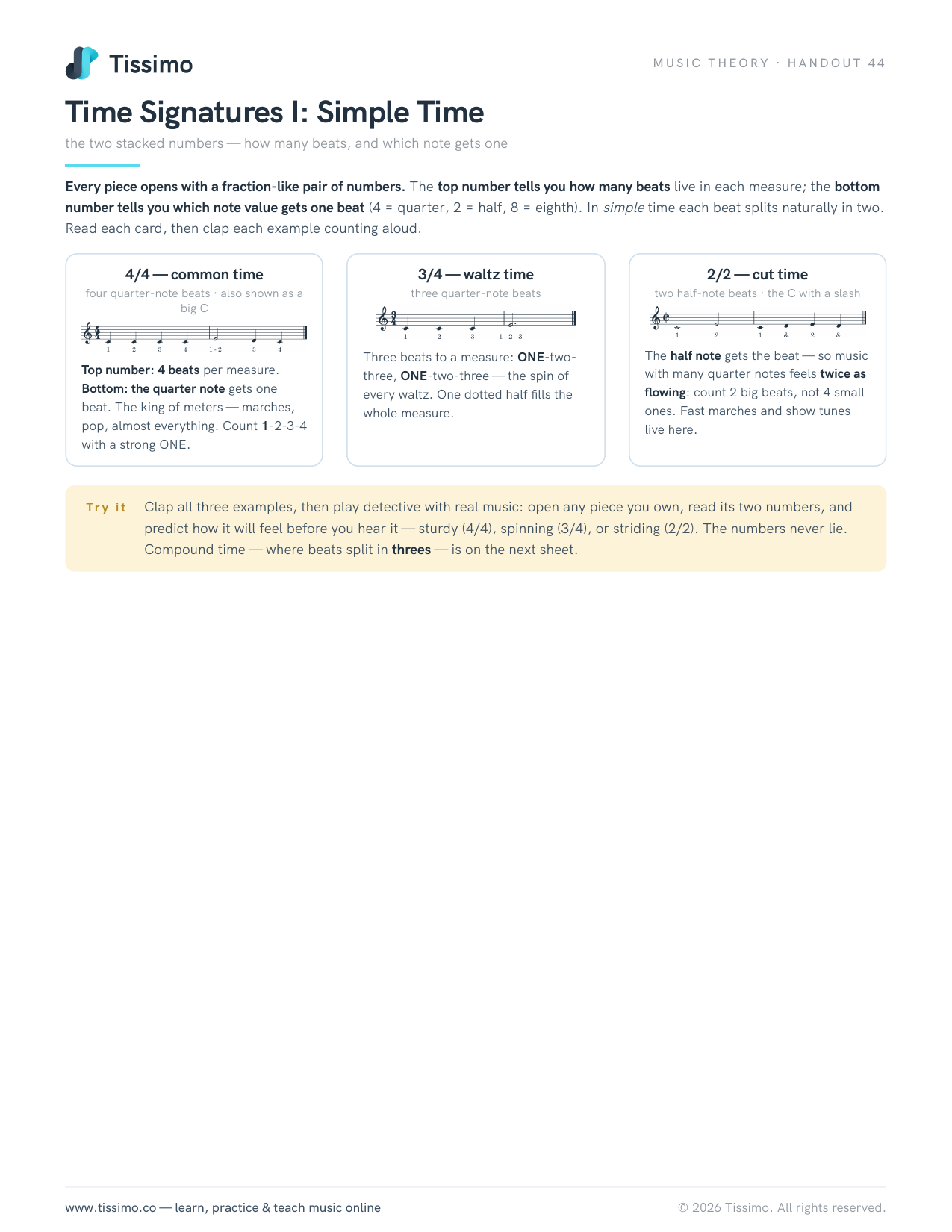
Time Signatures I: Simple Time
the two stacked numbers — how many beats, and which note gets one
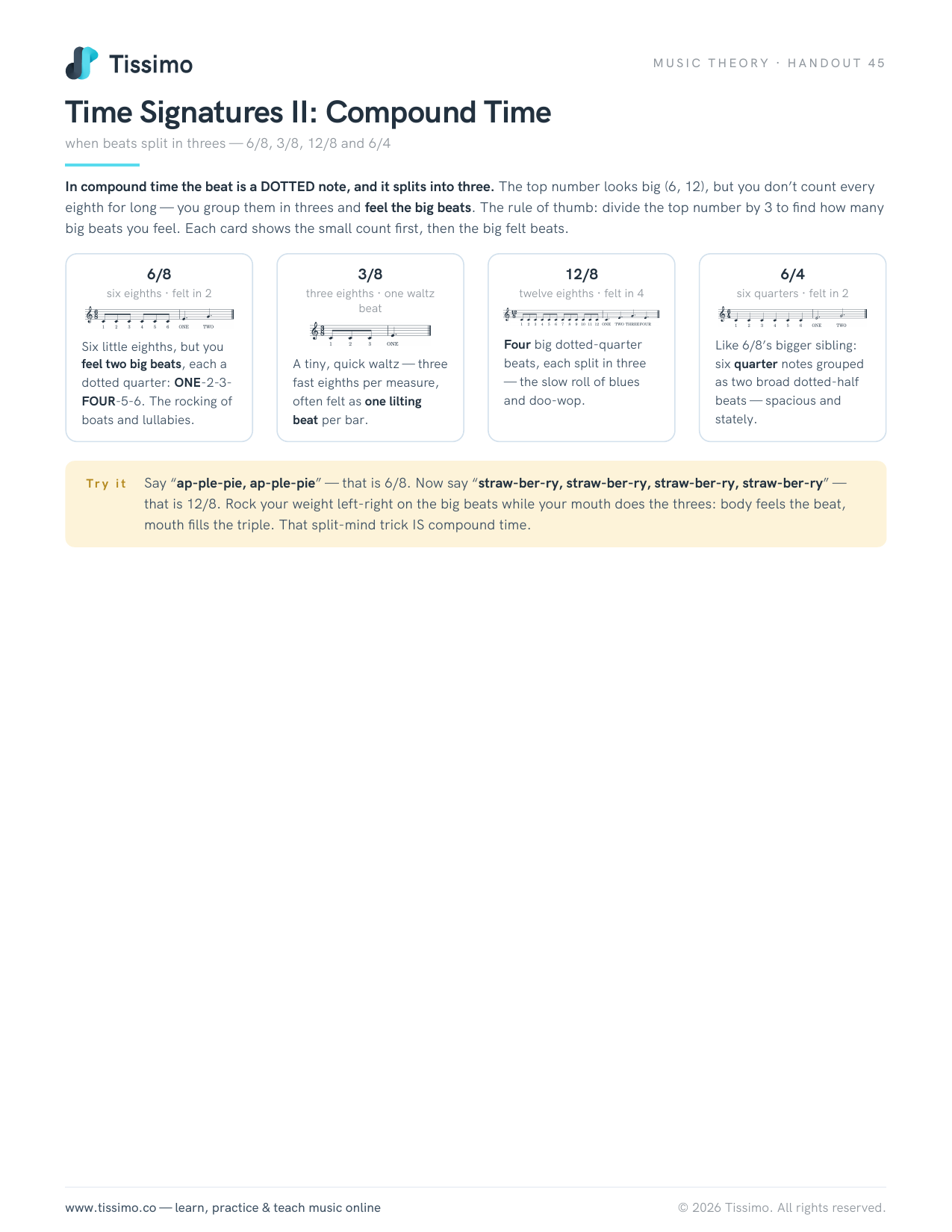
Time Signatures II: Compound Time
when beats split in threes — 6/8, 9/8, 12/8 and 6/4
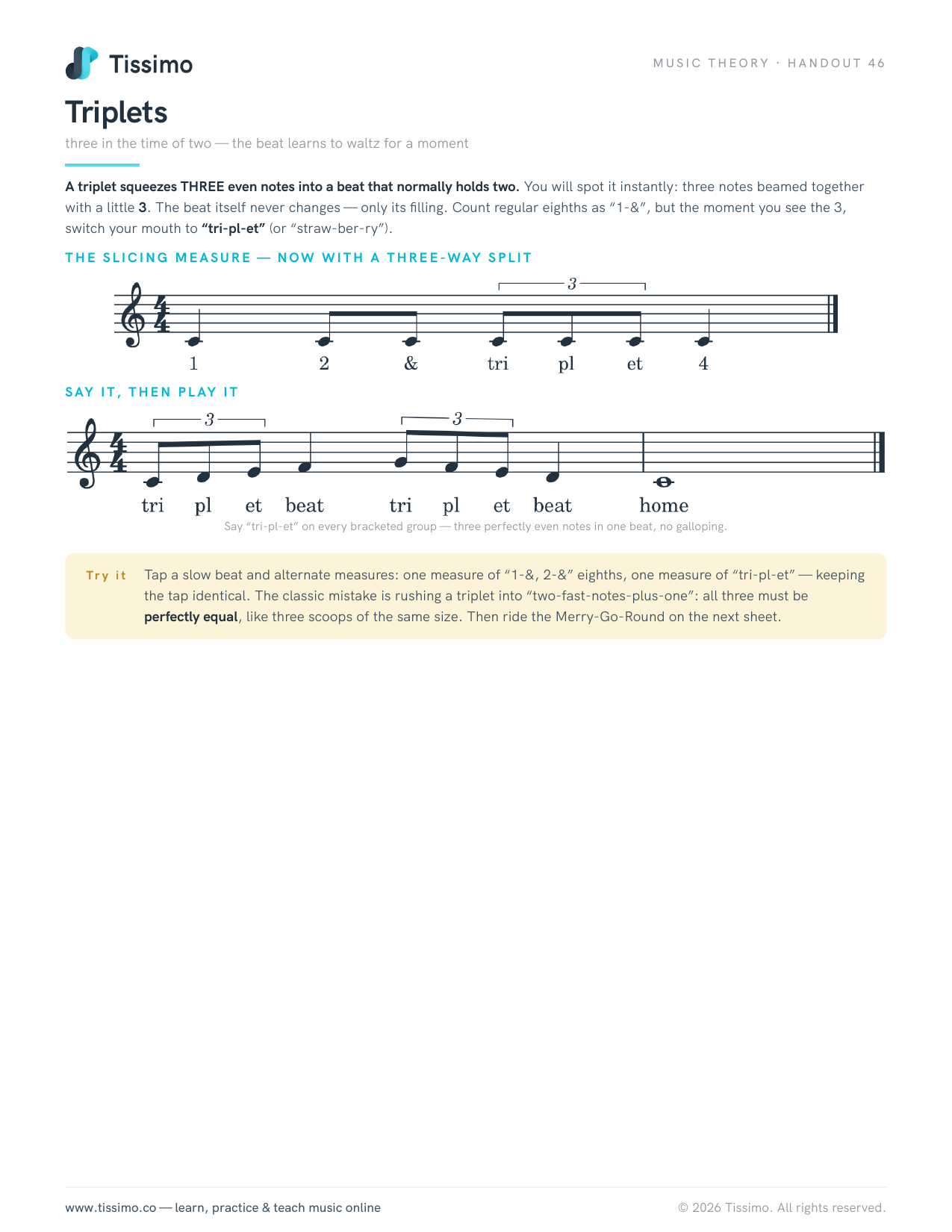
Triplets
three in the time of two — the beat learns to waltz for a moment
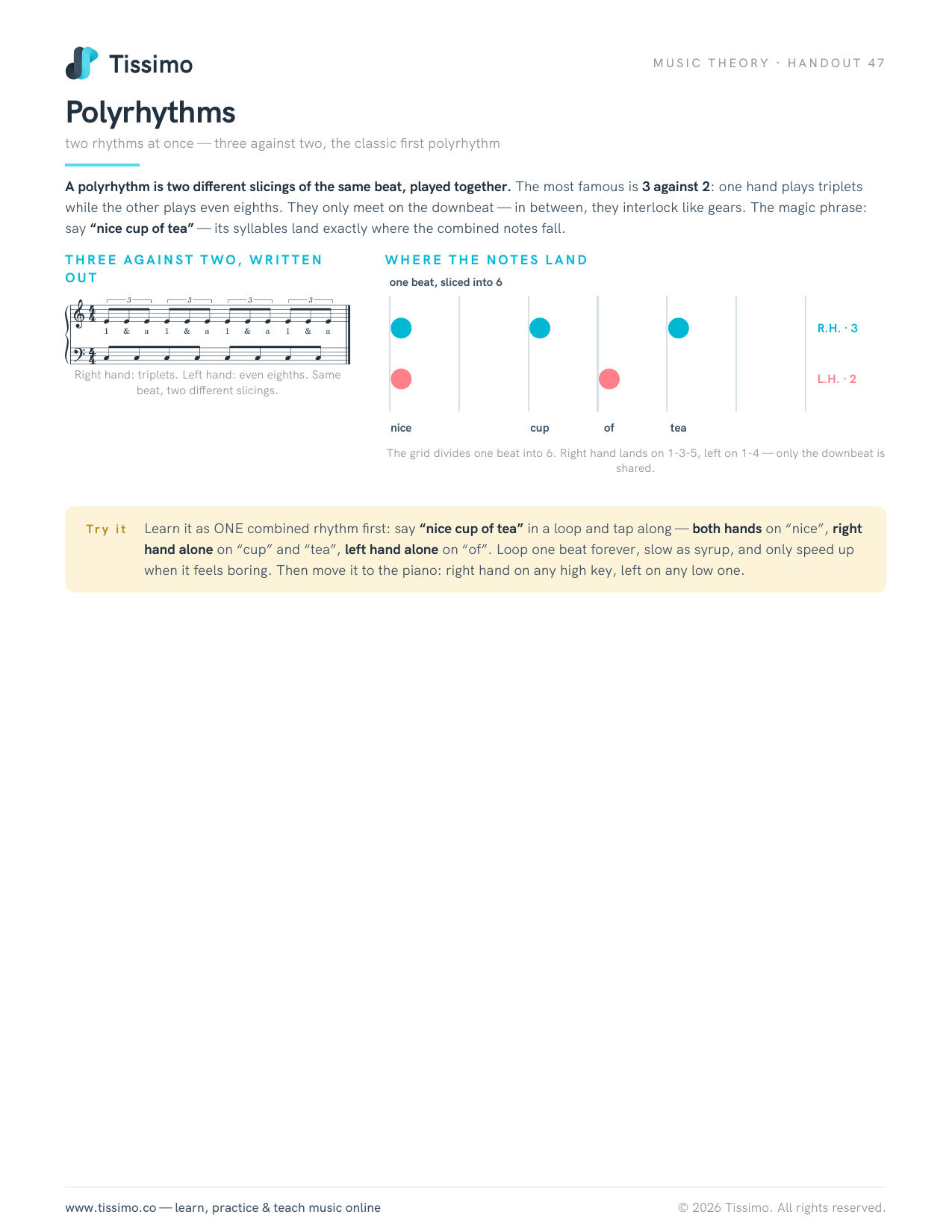
Polyrhythms
two rhythms at once — three against two, the classic first polyrhythm
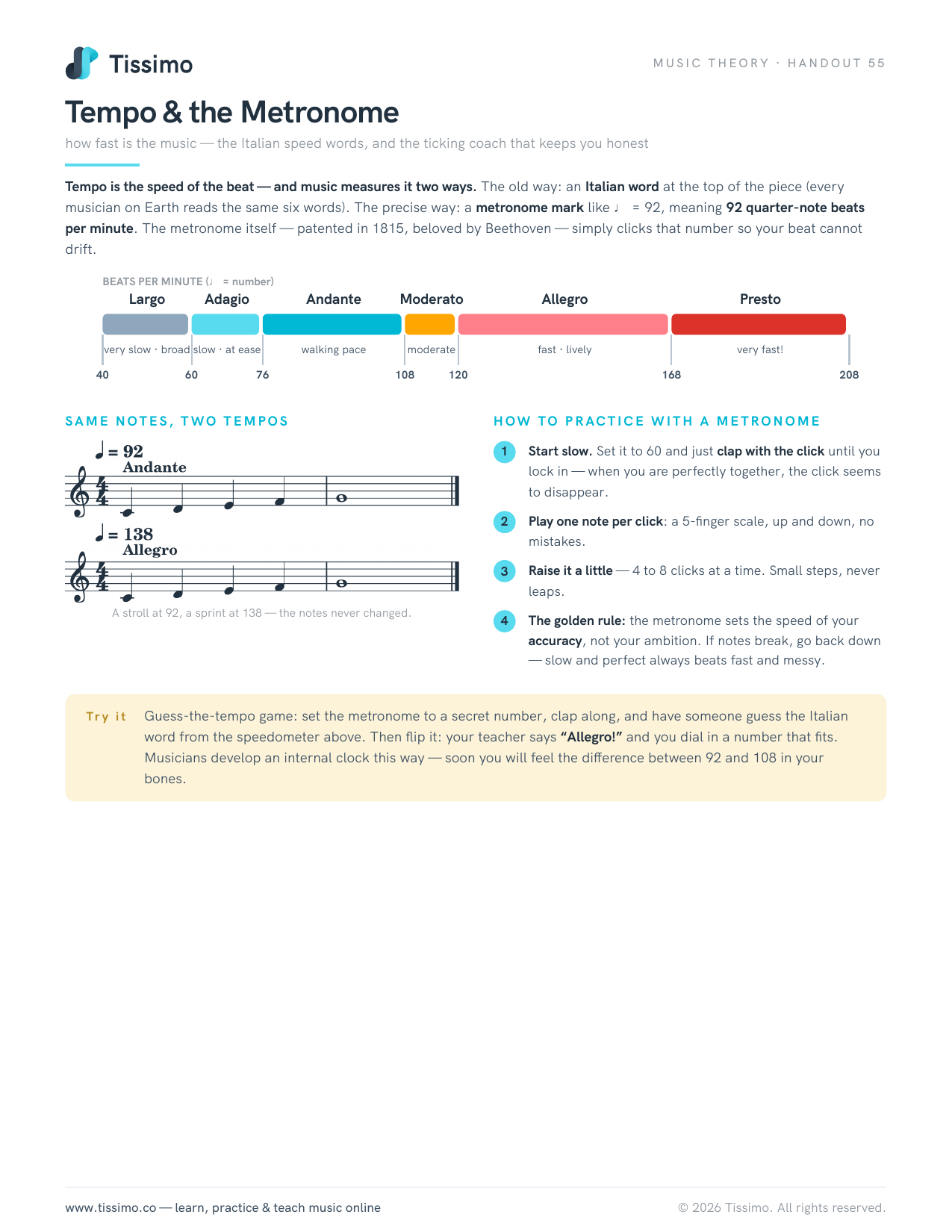
Tempo & the Metronome
how fast is the music — the Italian speed words, and the ticking coach that keeps you honest
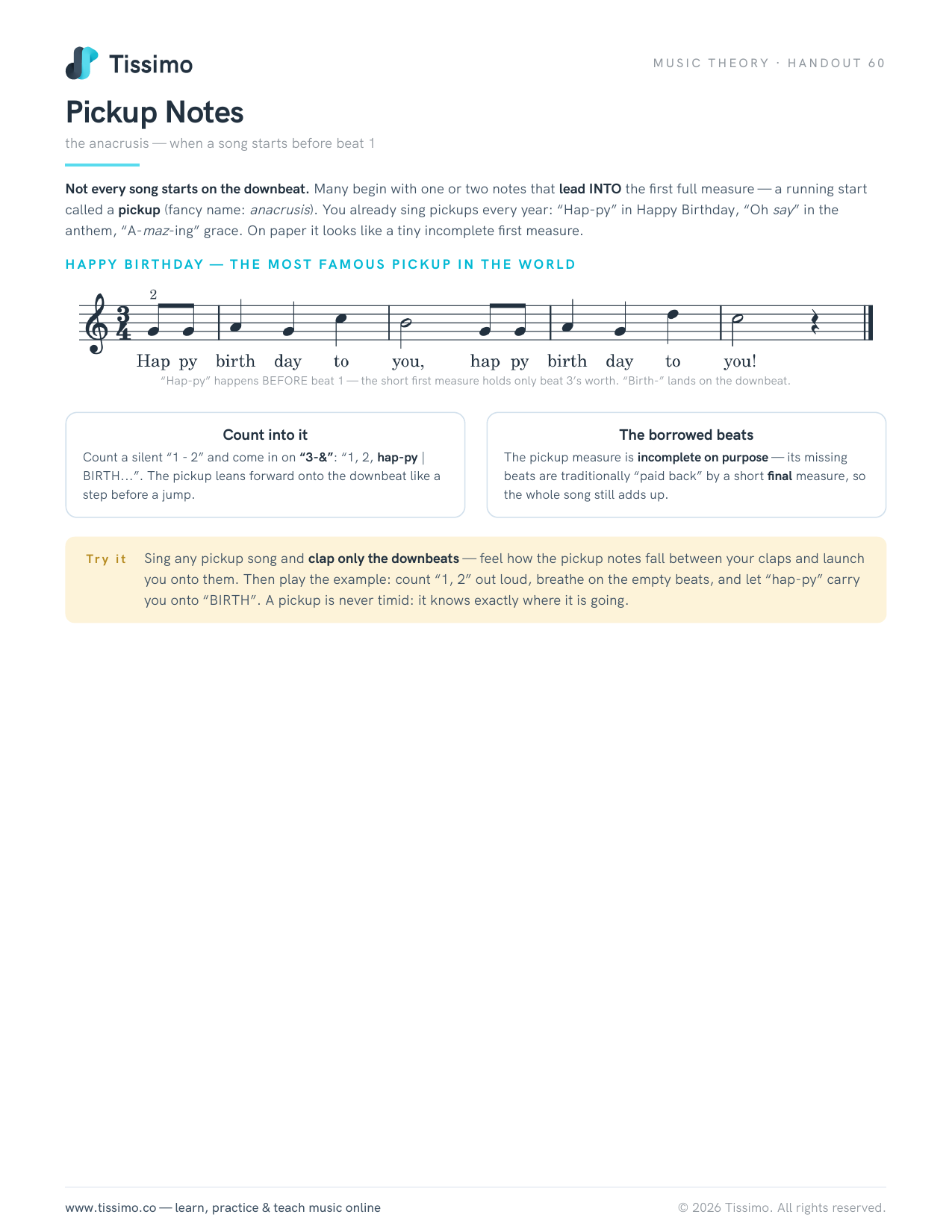
Pickup Notes
the anacrusis — when a song starts before beat 1
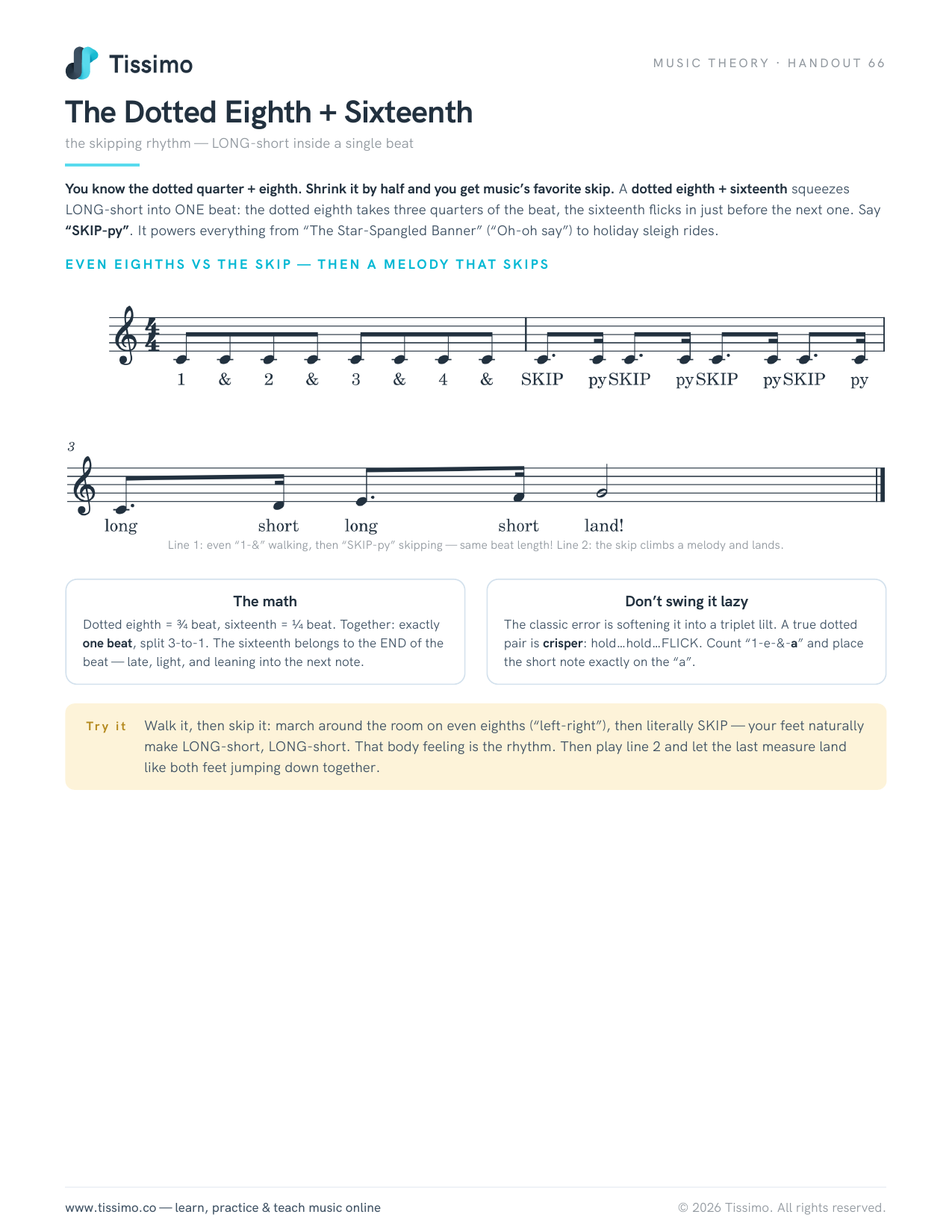
The Dotted Eighth + Sixteenth
the skipping rhythm — LONG-short inside a single beat
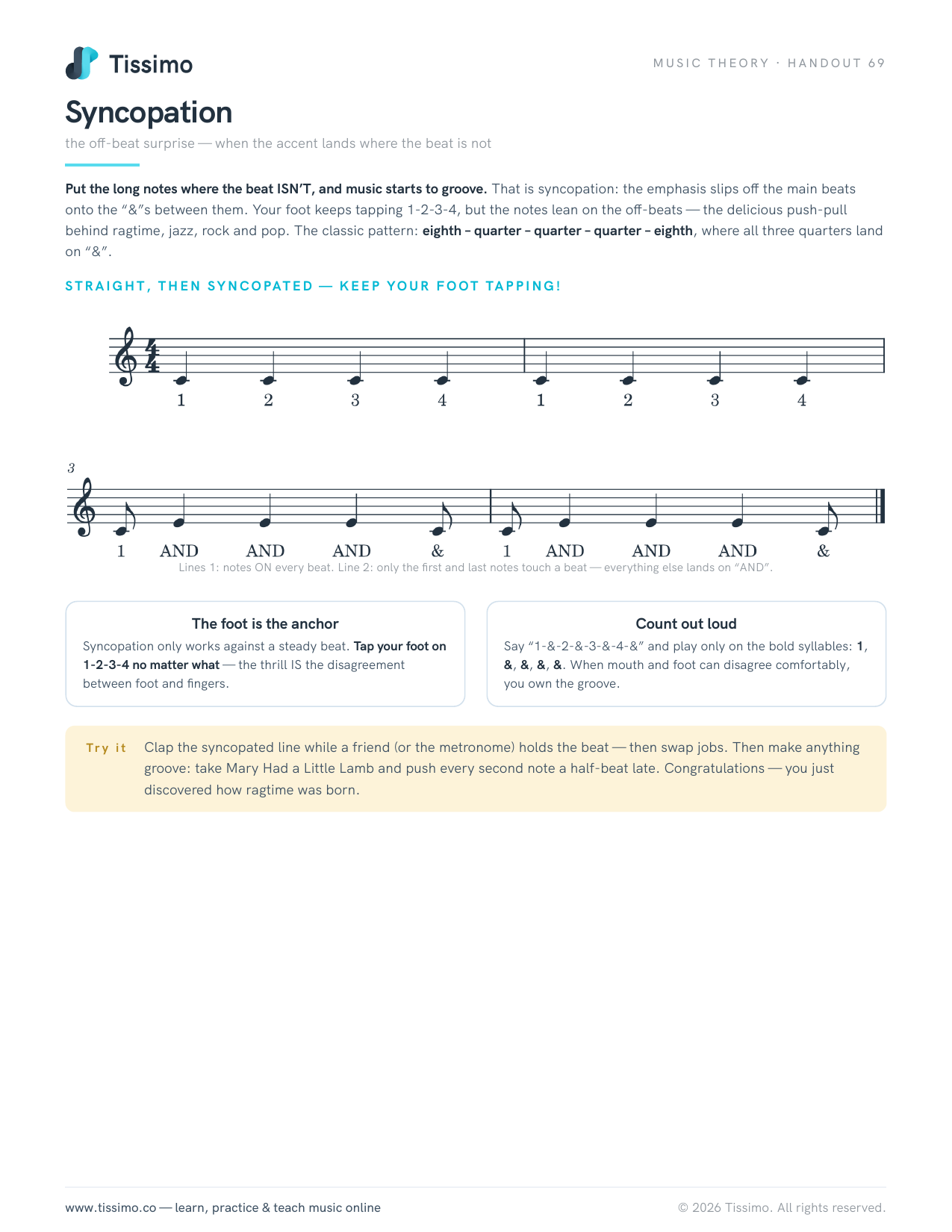
Syncopation
the off-beat surprise — when the accent lands where the beat is not
Swing Eighths
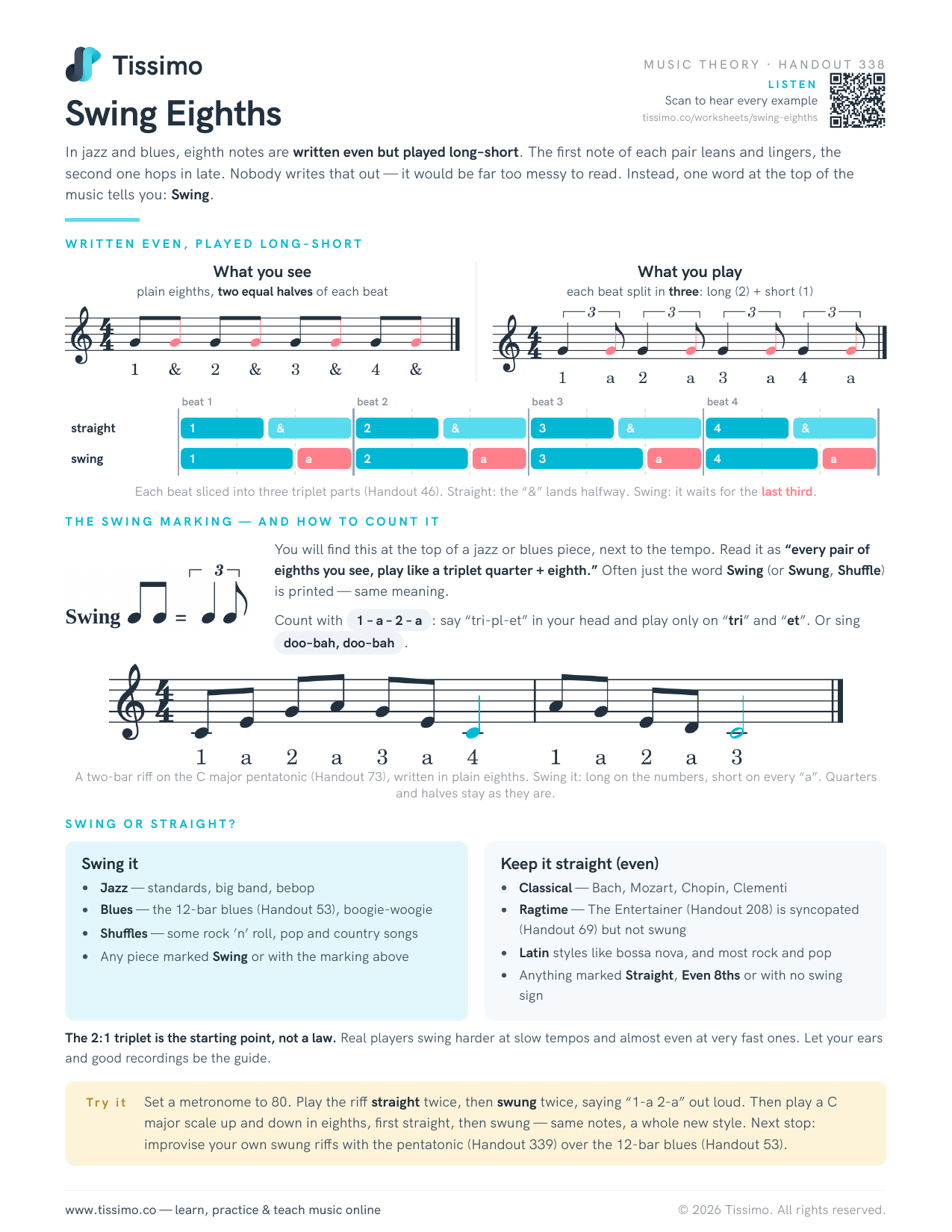
In jazz and blues, eighth notes are written even but played long–short. The first note of each pair leans and lingers, the second one hops in late. Nobody writes that out — it would be far too messy to read. Instead, one word at the top of the music tells you: Swing.
Two Beats in a Bar: 2/4 & Cut Time
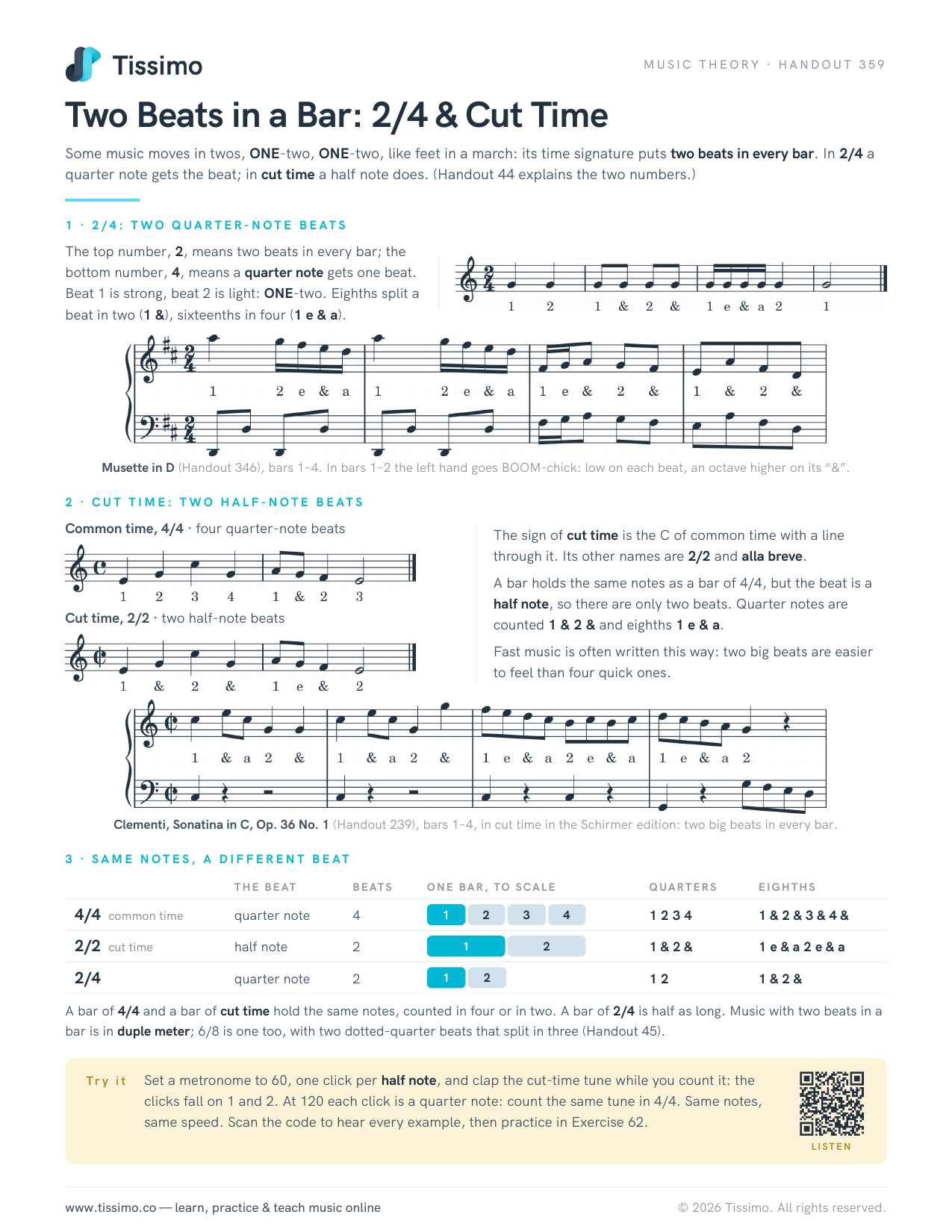
Some music moves in twos, ONE-two, ONE-two, like feet in a march: its time signature puts two beats in every bar. In 2/4 a quarter note gets the beat; in cut time a half note does. (Handout 44 explains the two numbers.)
Pitch & Notation
The flat: one half step down
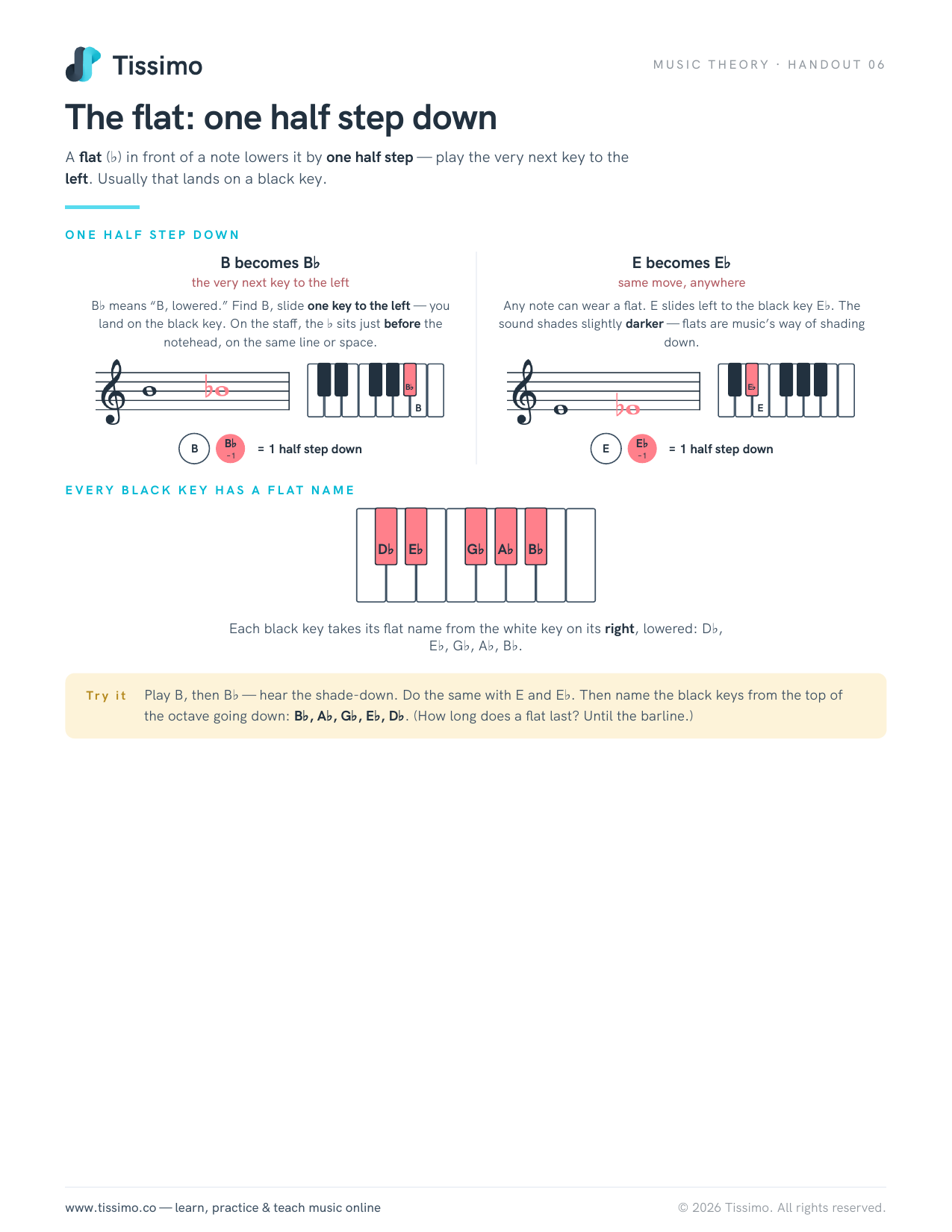
A flat (♭) in front of a note lowers it by one half step (Handout 353) — play the very next key to the left. Usually that lands on a black key.
The sharp: one half step up
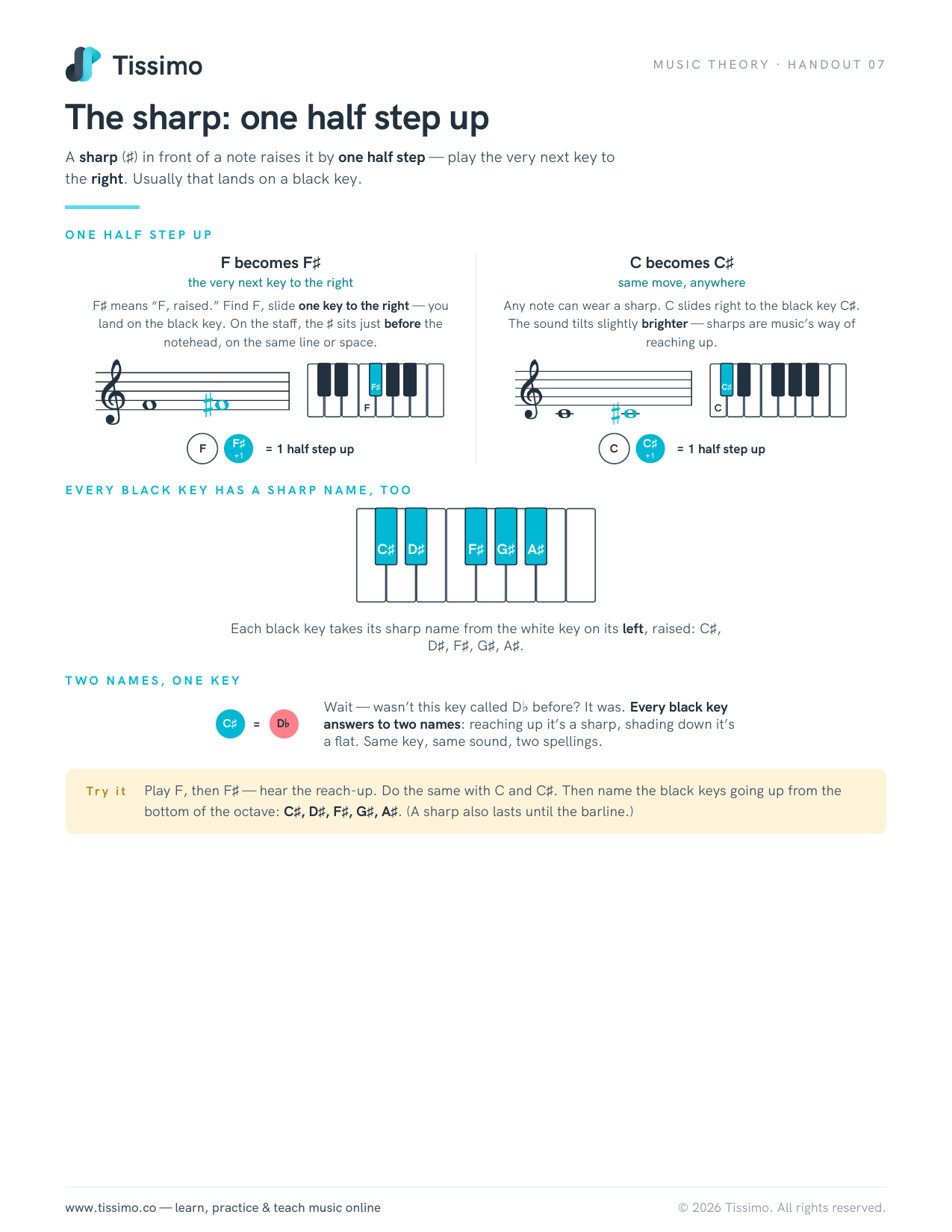
A sharp (♯) in front of a note raises it by one half step (Handout 353) — play the very next key to the right. Usually that lands on a black key.
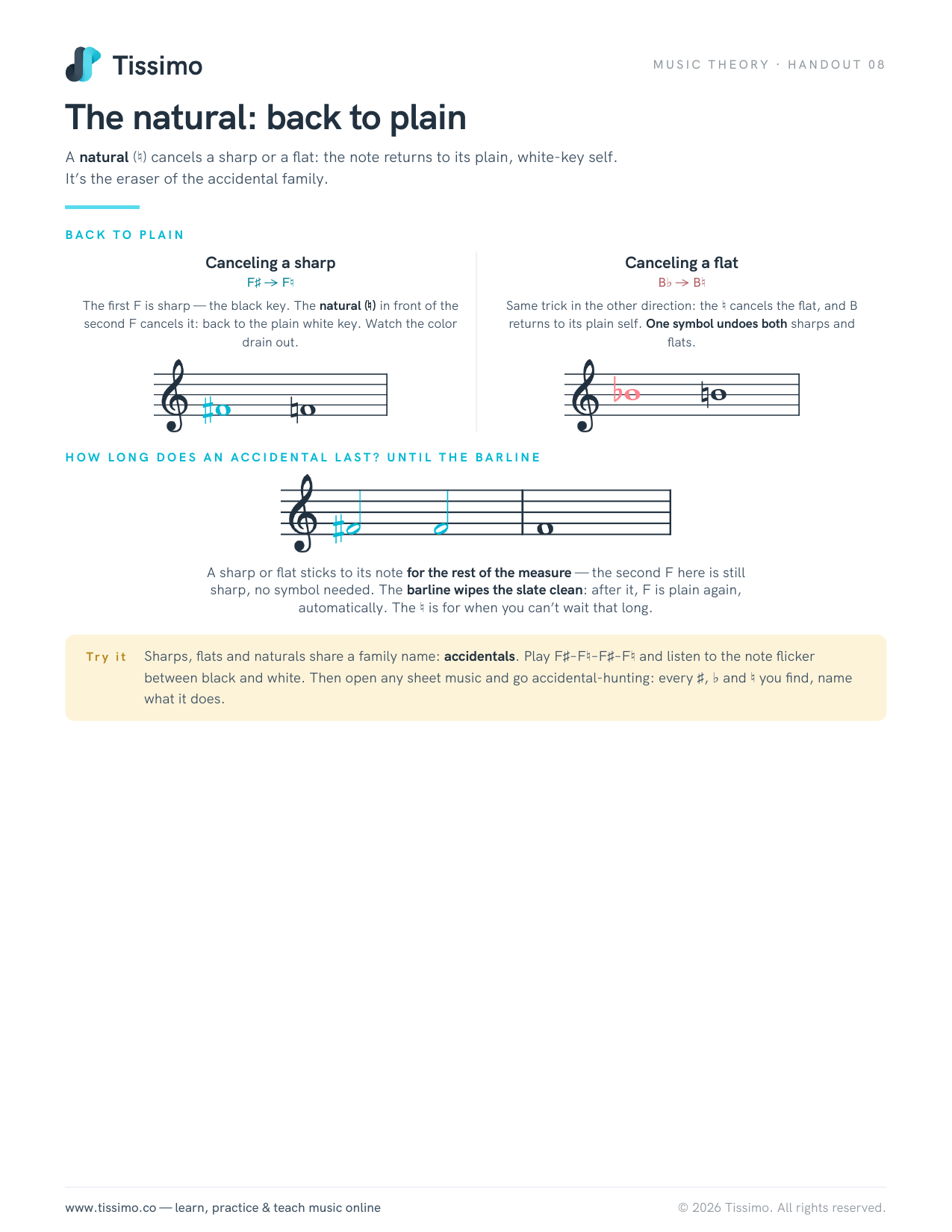
The natural: back to plain
A natural (♮) cancels a sharp or a flat: the note returns to its plain, white-key self. It’s the eraser of the accidental family.
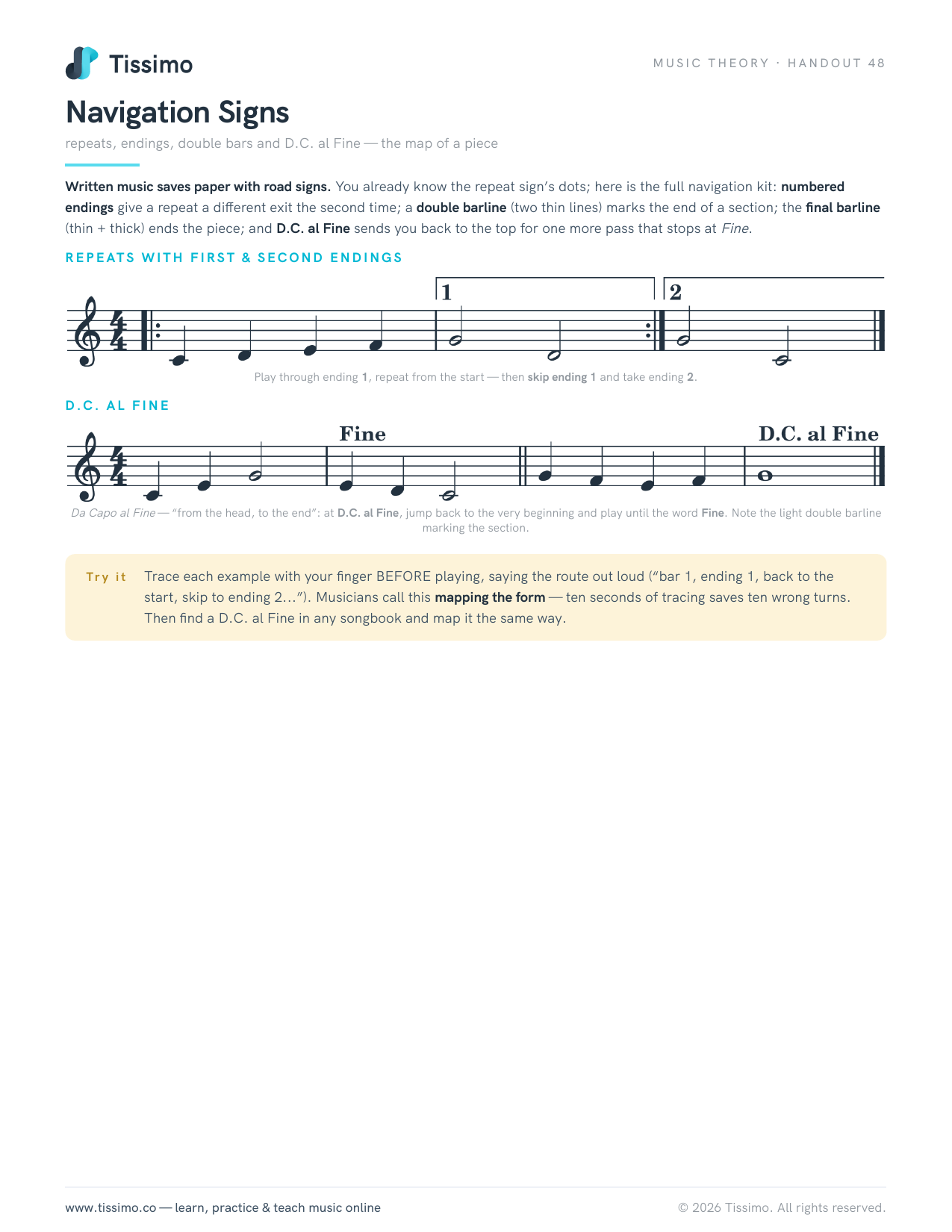
Navigation Signs
repeats, endings, double bars and D.C. al Fine — the map of a piece
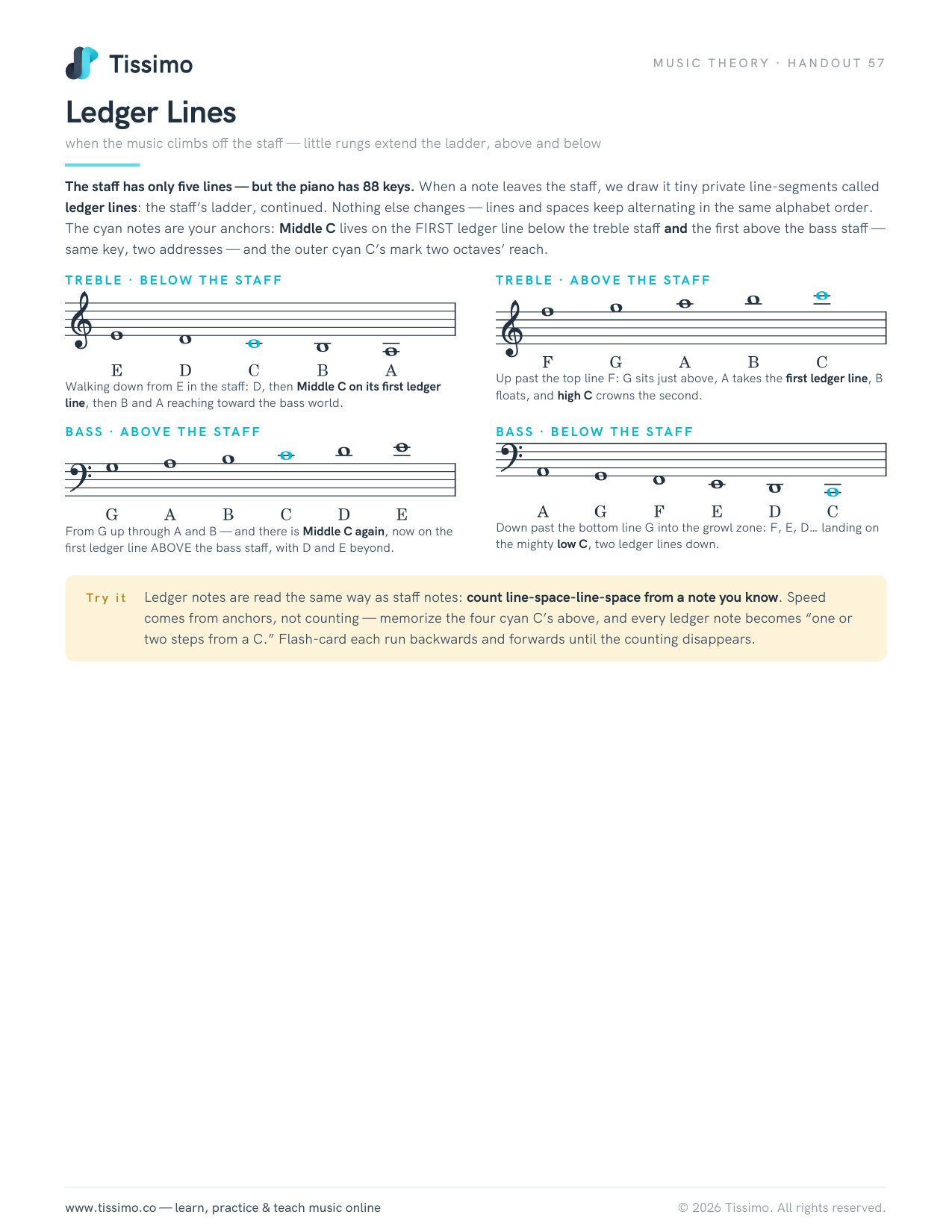
Ledger Lines
when the music climbs off the staff — little rungs extend the ladder, above and below
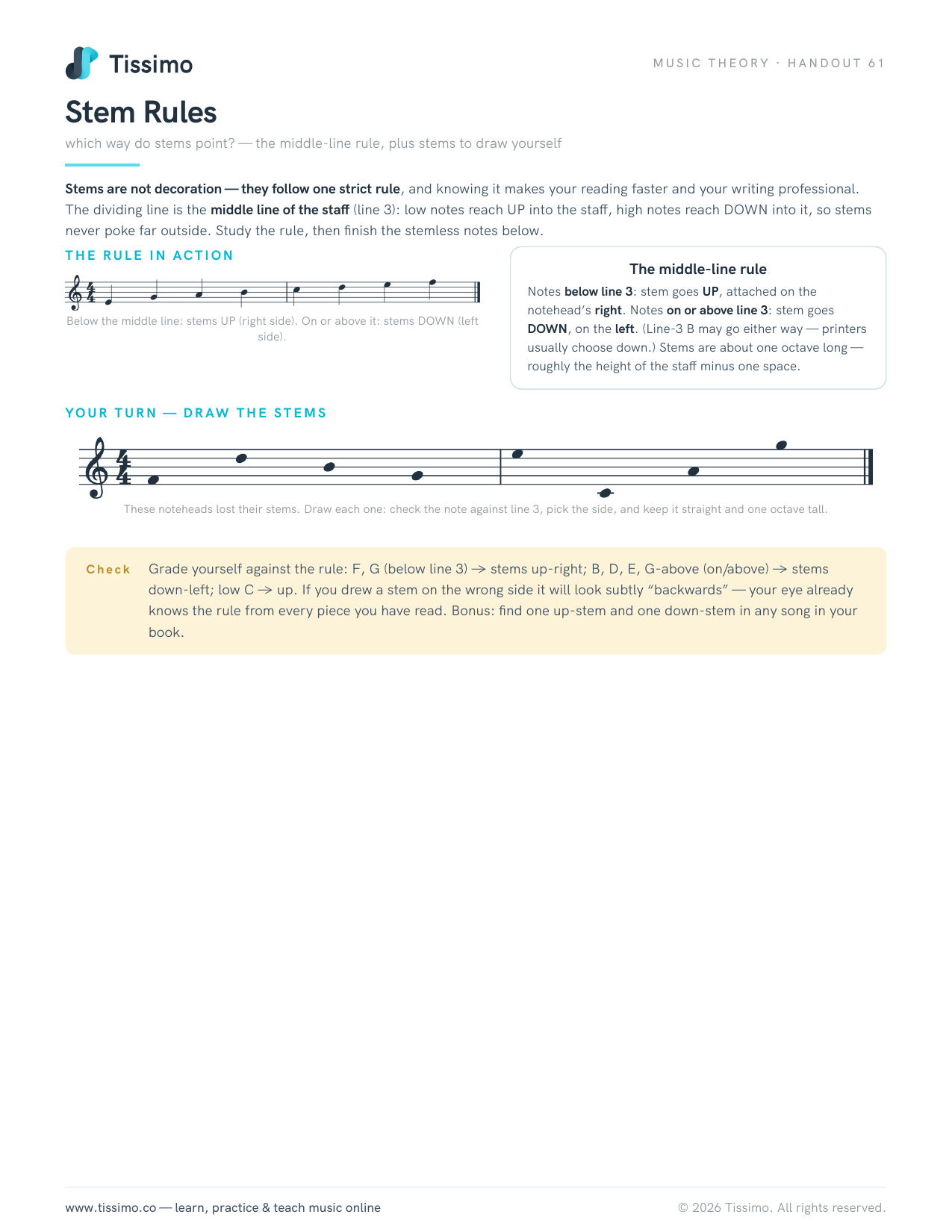
Stem Rules
which way do stems point? — the middle-line rule, plus stems to draw yourself
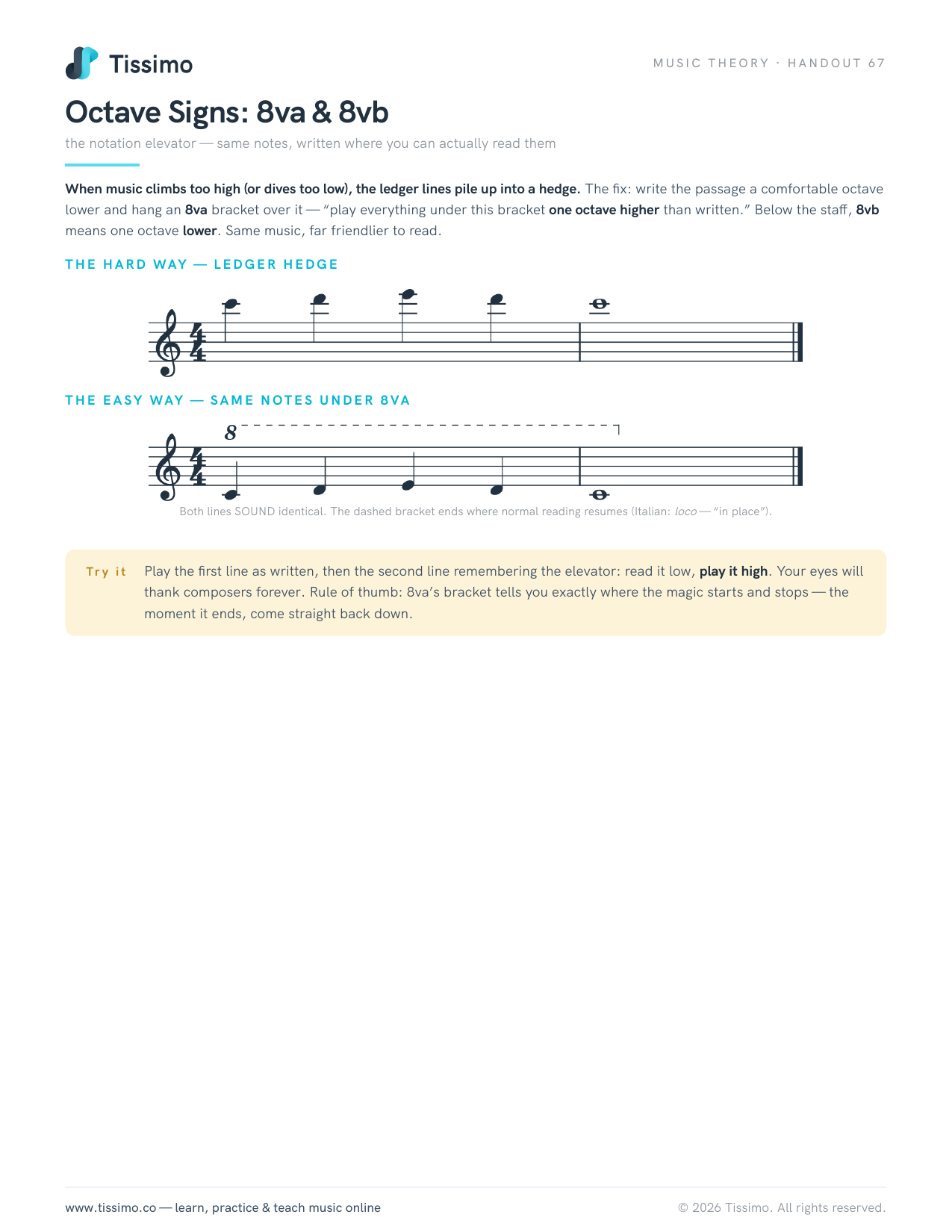
Octave Signs: 8va & 8vb
the notation elevator — same notes, written where you can actually read them
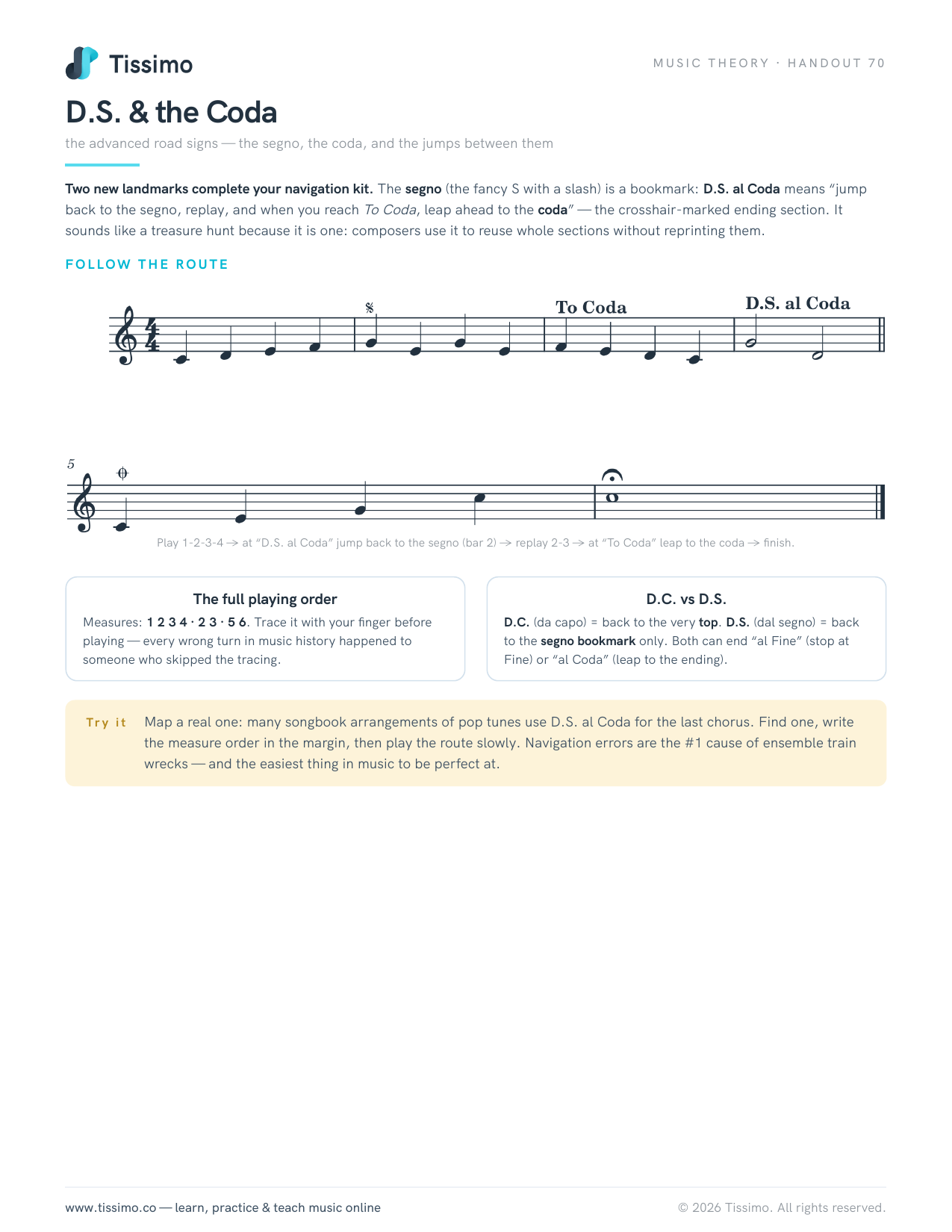
D.S. & the Coda
the advanced road signs — the segno, the coda, and the jumps between them
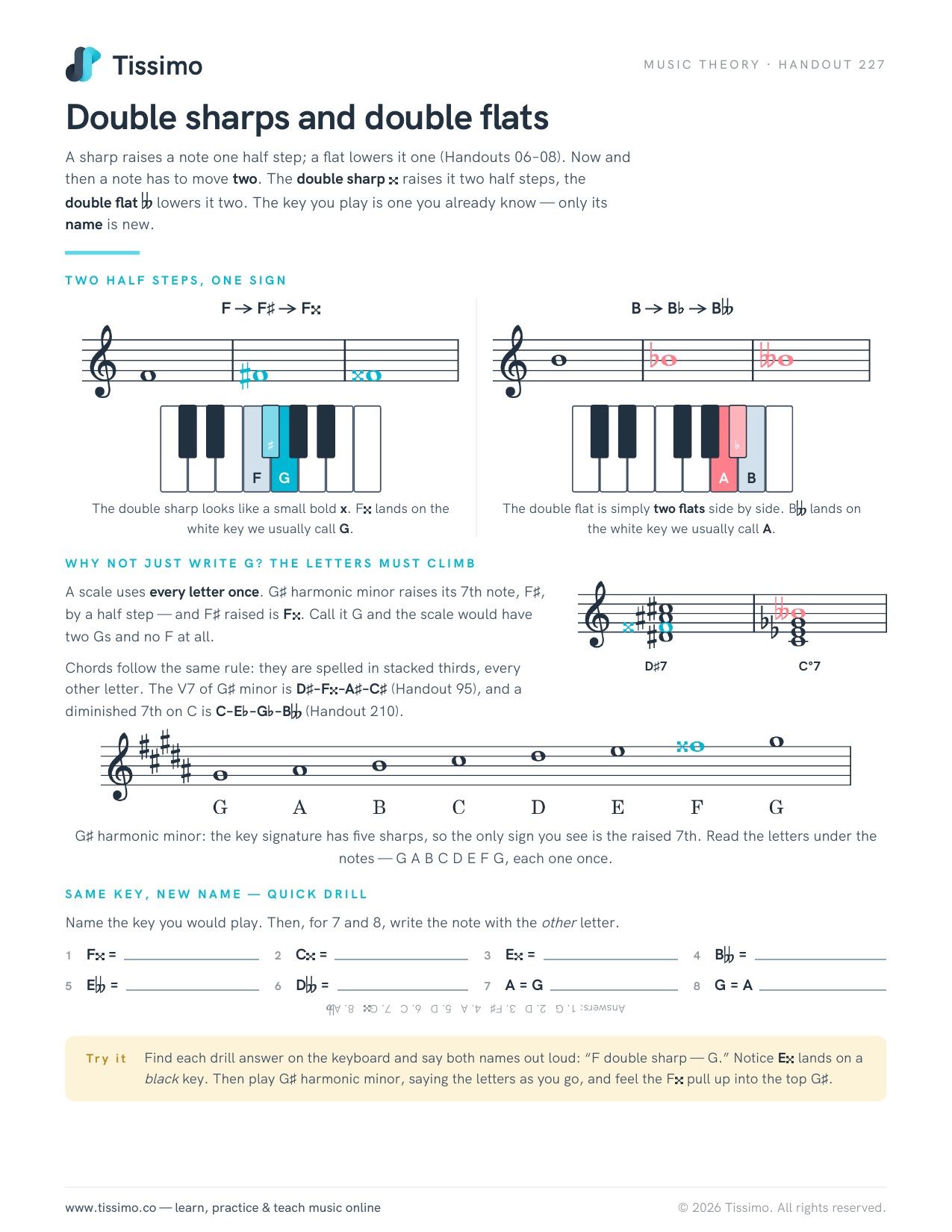
Double sharps and double flats
A sharp raises a note one half step; a flat lowers it one (Handouts 06–08). Now and then a note has to move two. The double sharp raises it two half steps, the double flat lowers it two. The key you play is one you already know — only its name is new.
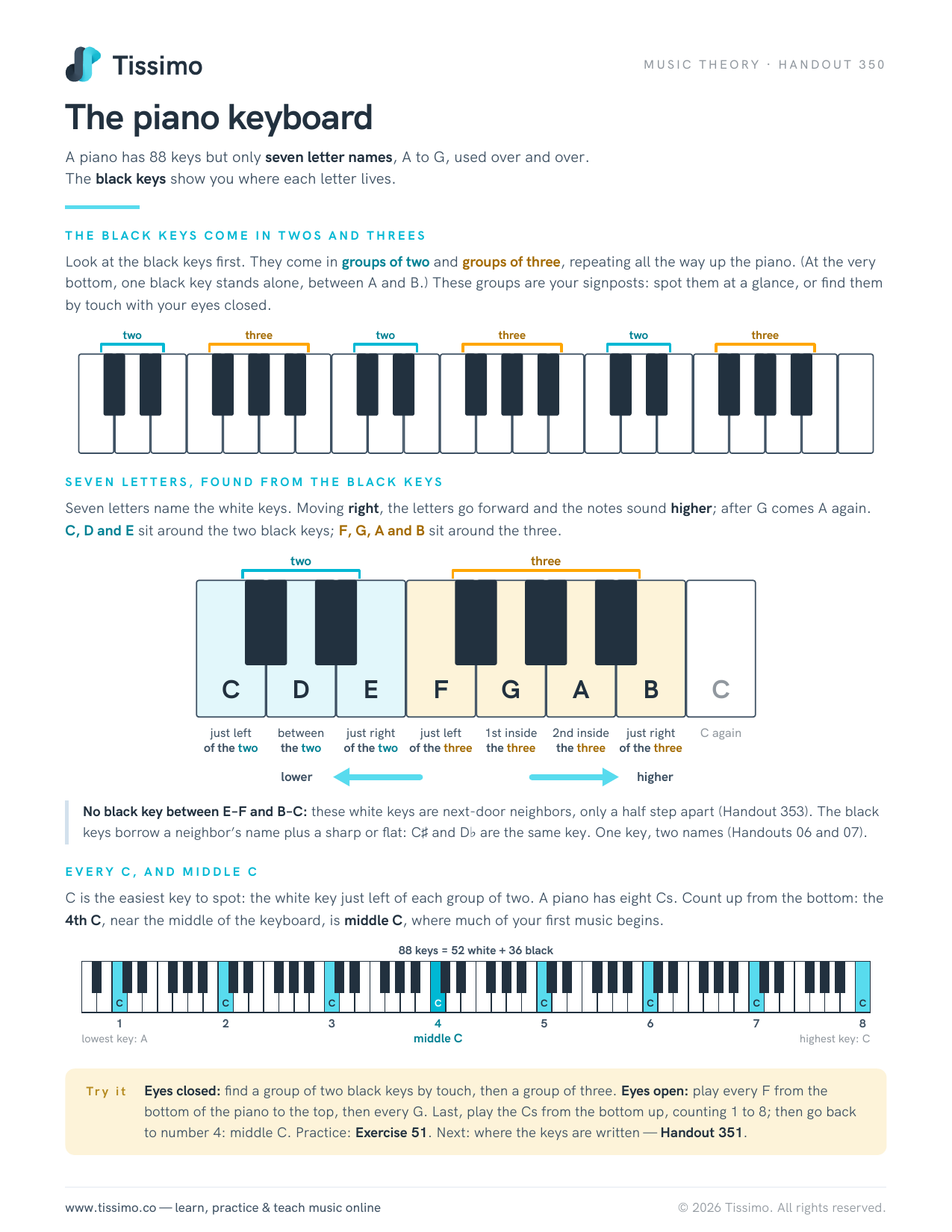
The piano keyboard
A piano has 88 keys but only seven letter names, A to G, used over and over. The black keys show you where each letter lives.
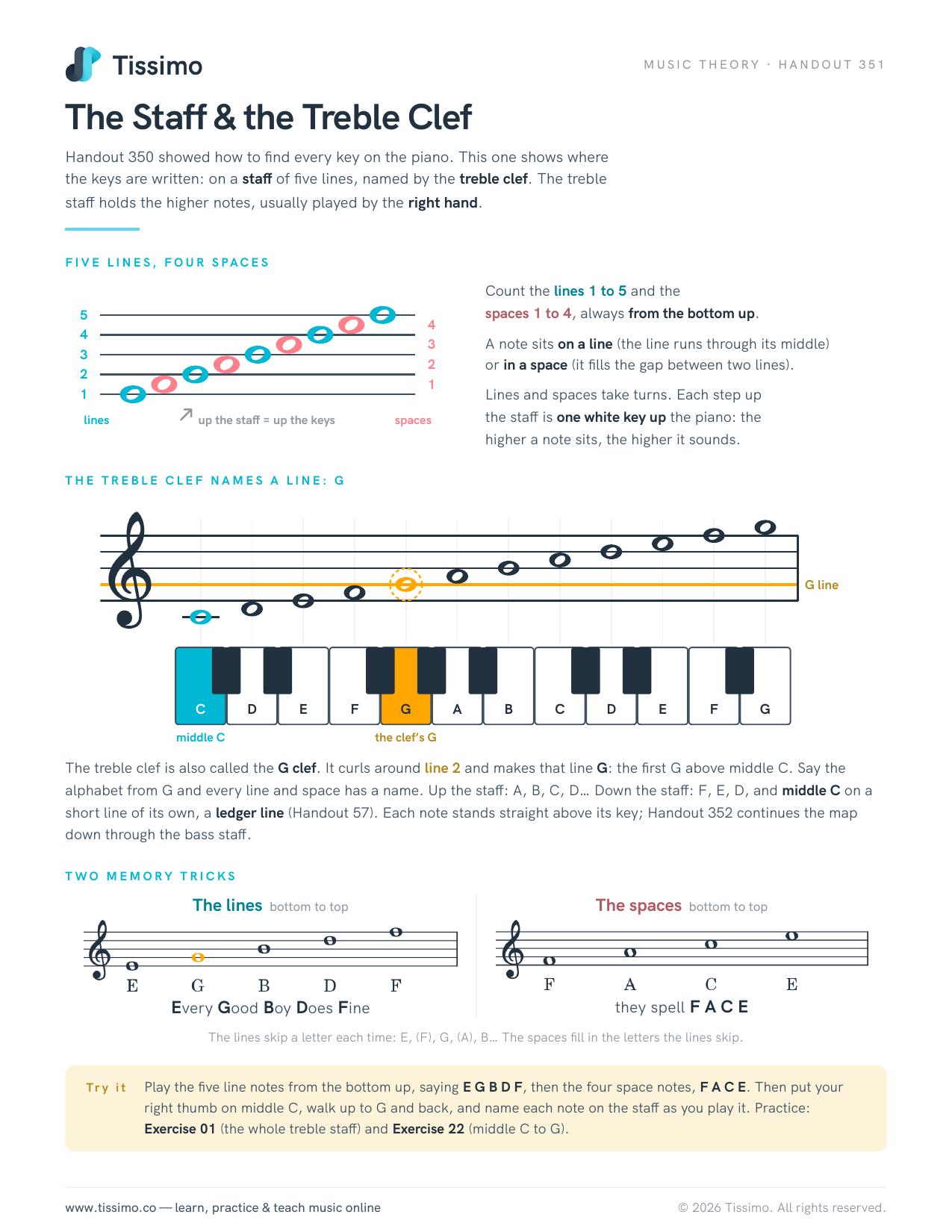
The Staff & the Treble Clef
Handout 350 showed how to find every key on the piano. This one shows where the keys are written: on a staff of five lines, named by the treble clef. The treble staff holds the higher notes, usually played by the right hand.

The Bass Clef & the Grand Staff
The bass staff holds the lower notes, usually played by the left hand. It works just like the treble staff (Handout 351), but its clef names a different line.
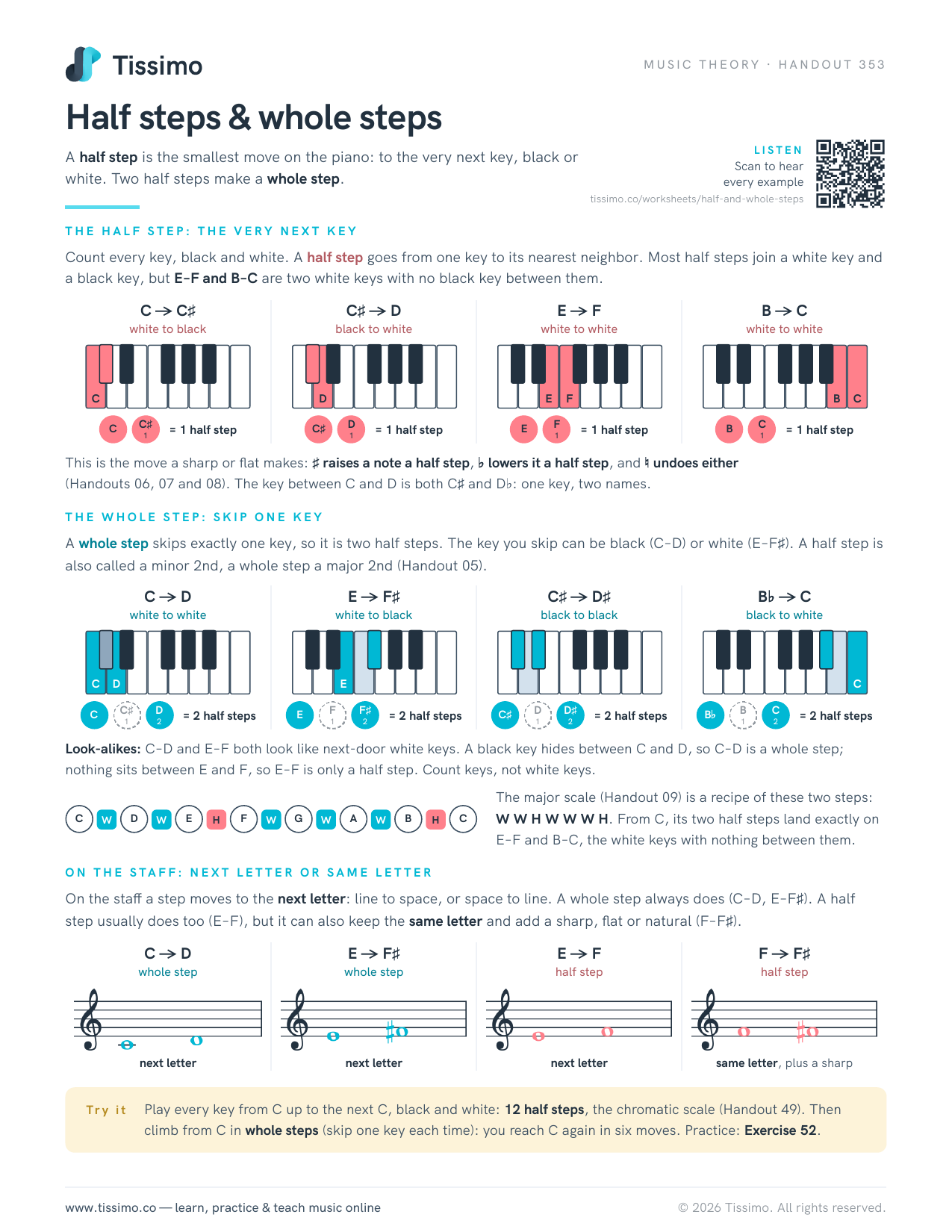
Half steps & whole steps
A half step is the smallest move on the piano: to the very next key, black or white. Two half steps make a whole step.
Intervals
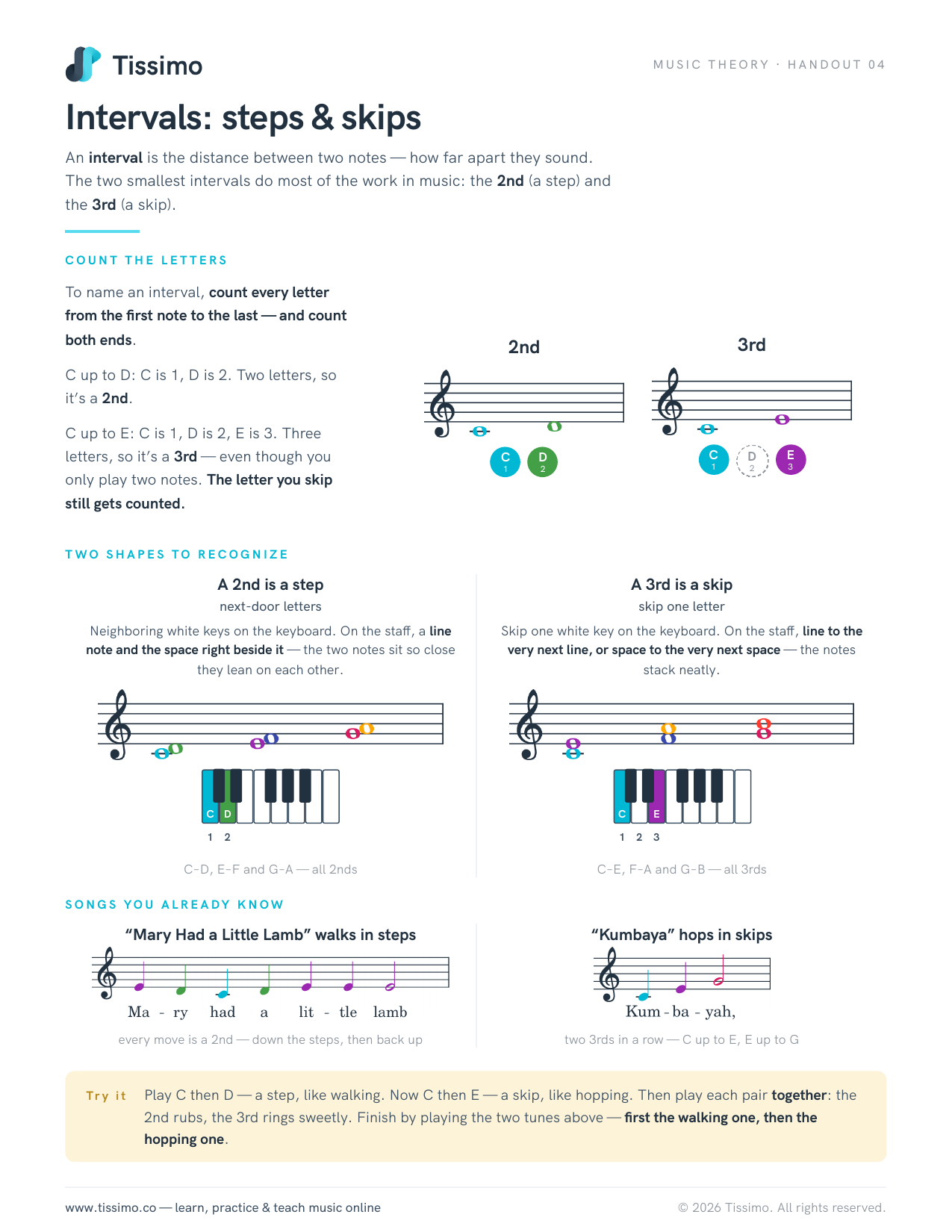
Intervals: steps & skips
An interval is the distance between two notes — how far apart they sound. Two common melodic movements are the 2nd (a step) and the 3rd (a skip).
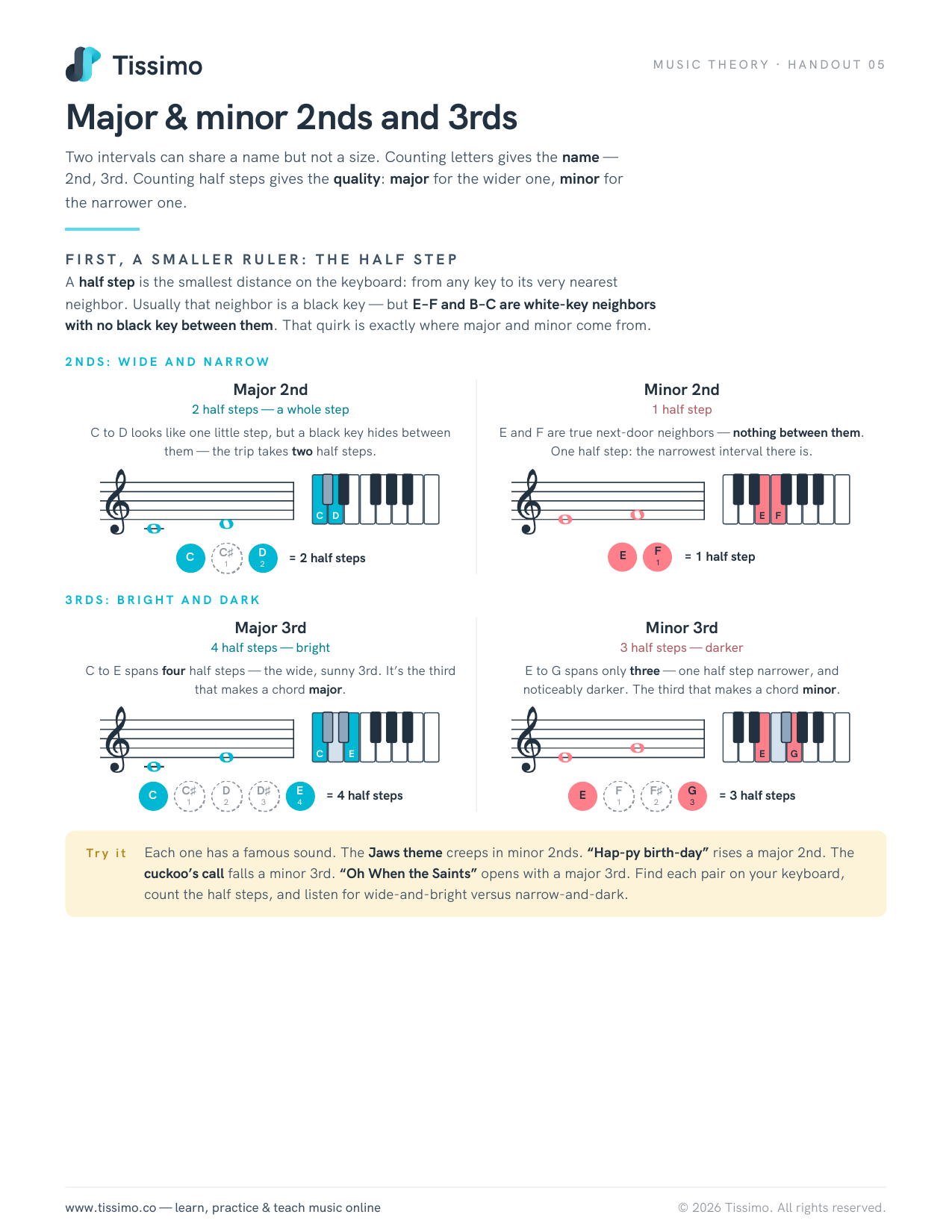
Major & minor 2nds and 3rds
Two intervals can share a name but not a size. Counting letters gives the name — 2nd, 3rd. Counting half steps gives the quality: major for the wider one, minor for the narrower one.
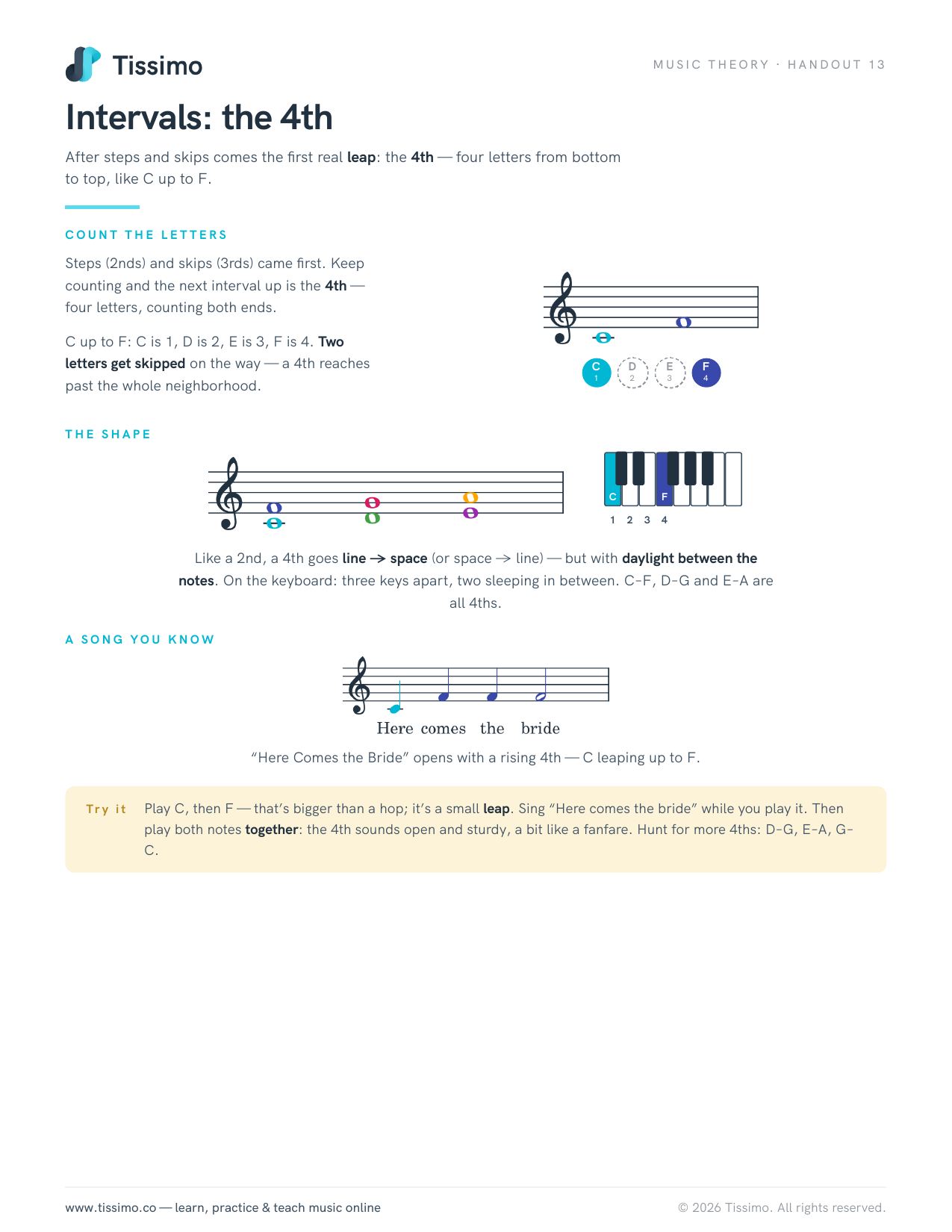
Intervals: the 4th
After steps and skips comes the first real leap: the 4th — four letters from bottom to top, like C up to F.
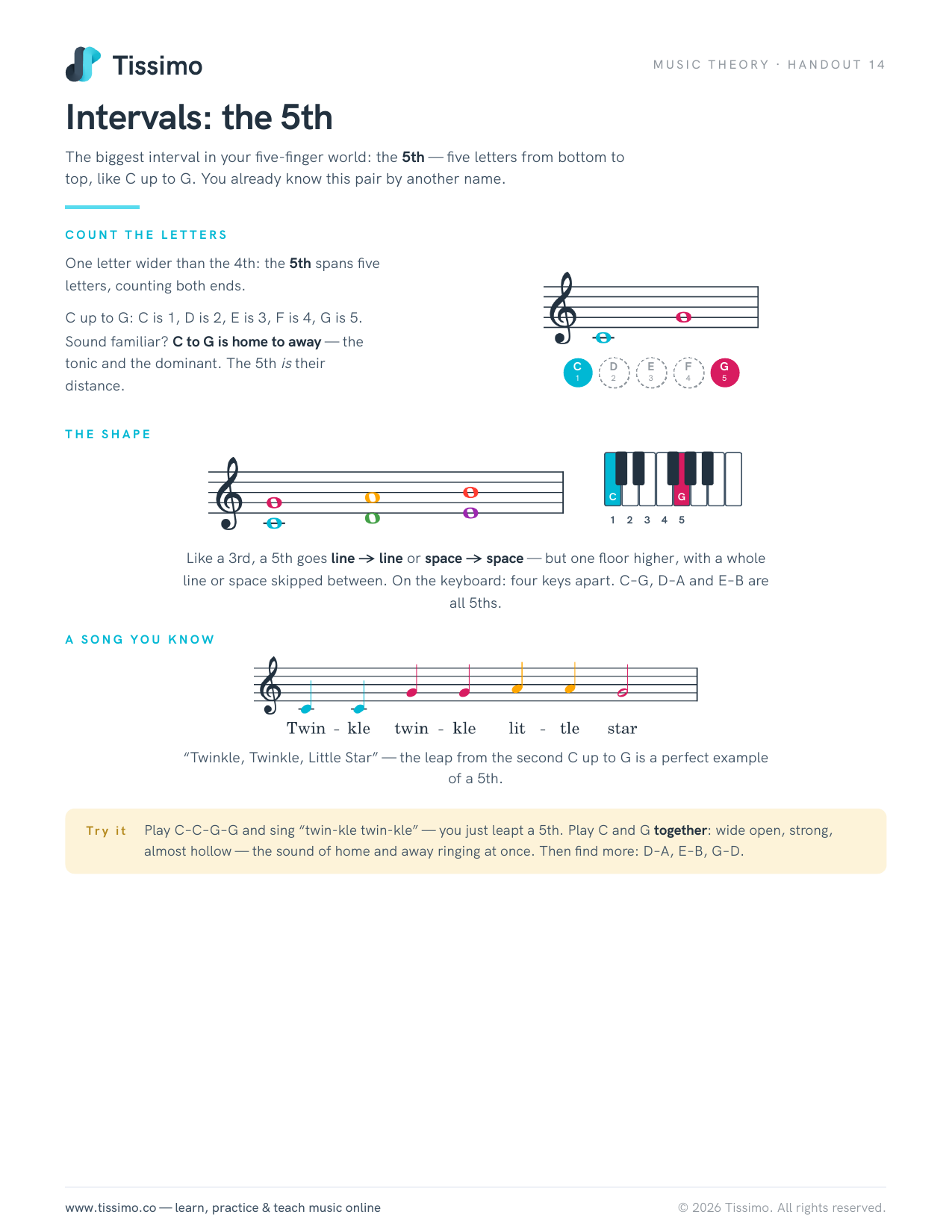
Intervals: the 5th
The biggest interval in your five-finger world: the 5th — five letters from bottom to top, like C up to G. You already know this pair by another name.
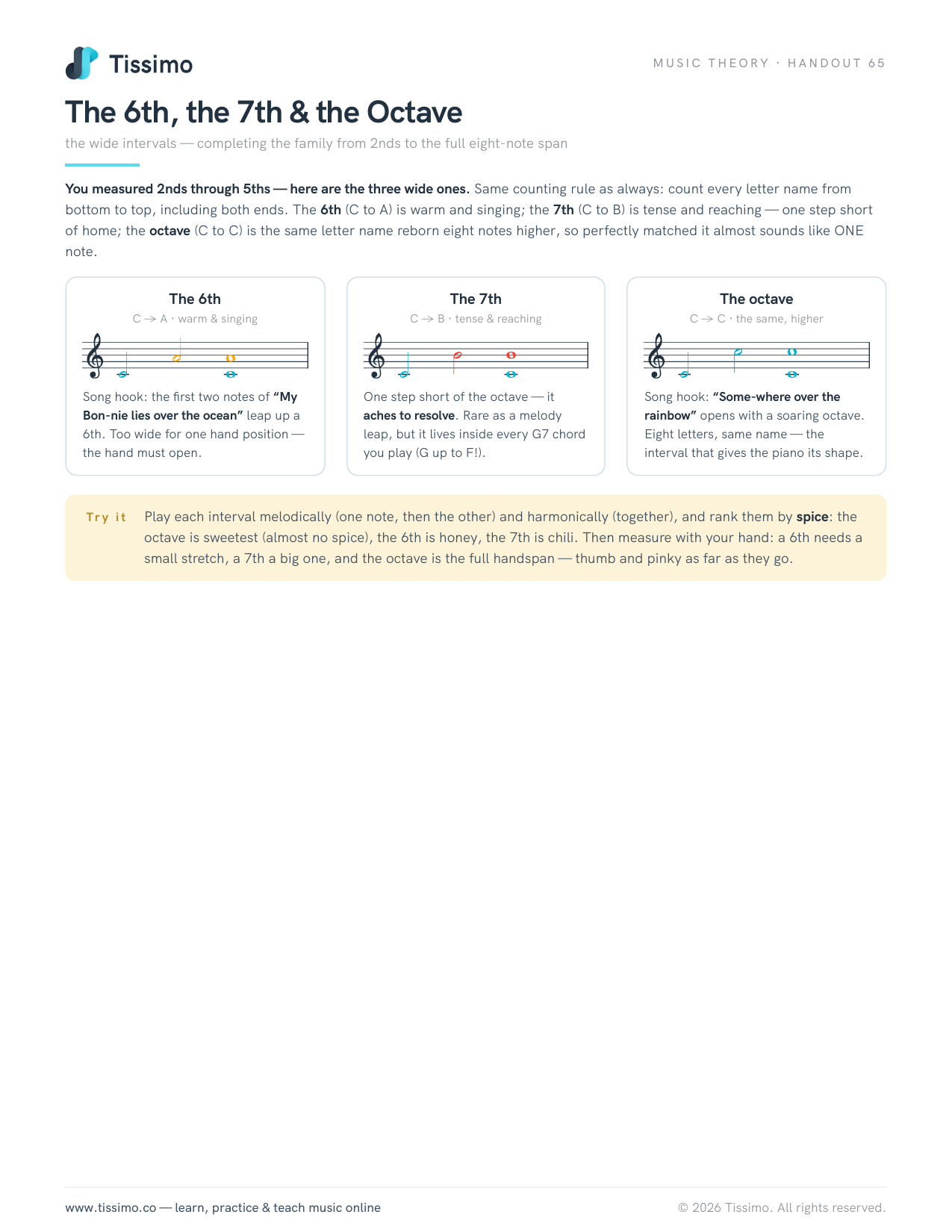
The 6th, the 7th & the Octave
the wide intervals — completing the family from 2nds to the full eight-note span
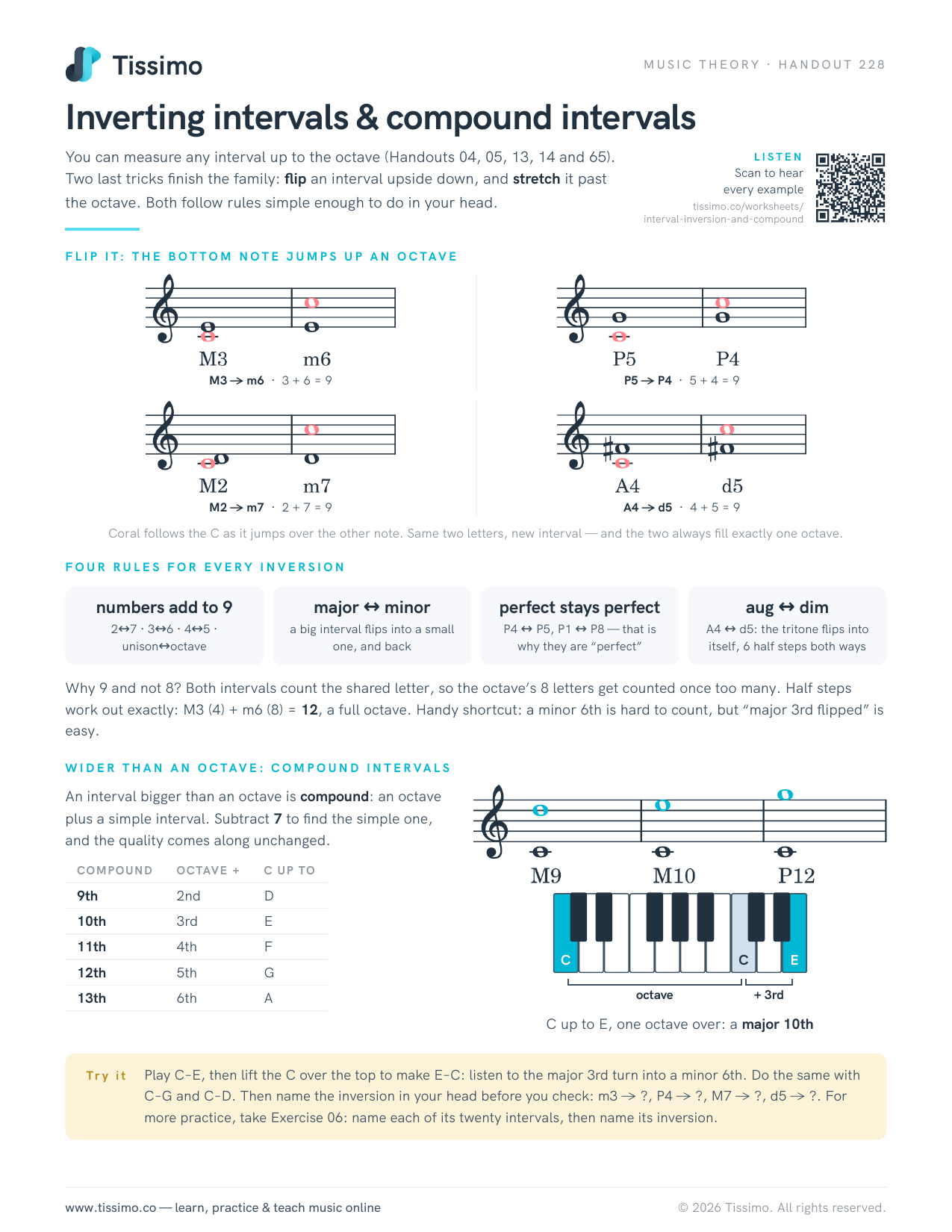
Inverting intervals & compound intervals
You can measure any interval up to the octave (Handouts 04, 05, 13, 14 and 65). Two last tricks finish the family: flip an interval upside down, and stretch it past the octave. Both follow rules simple enough to do in your head.
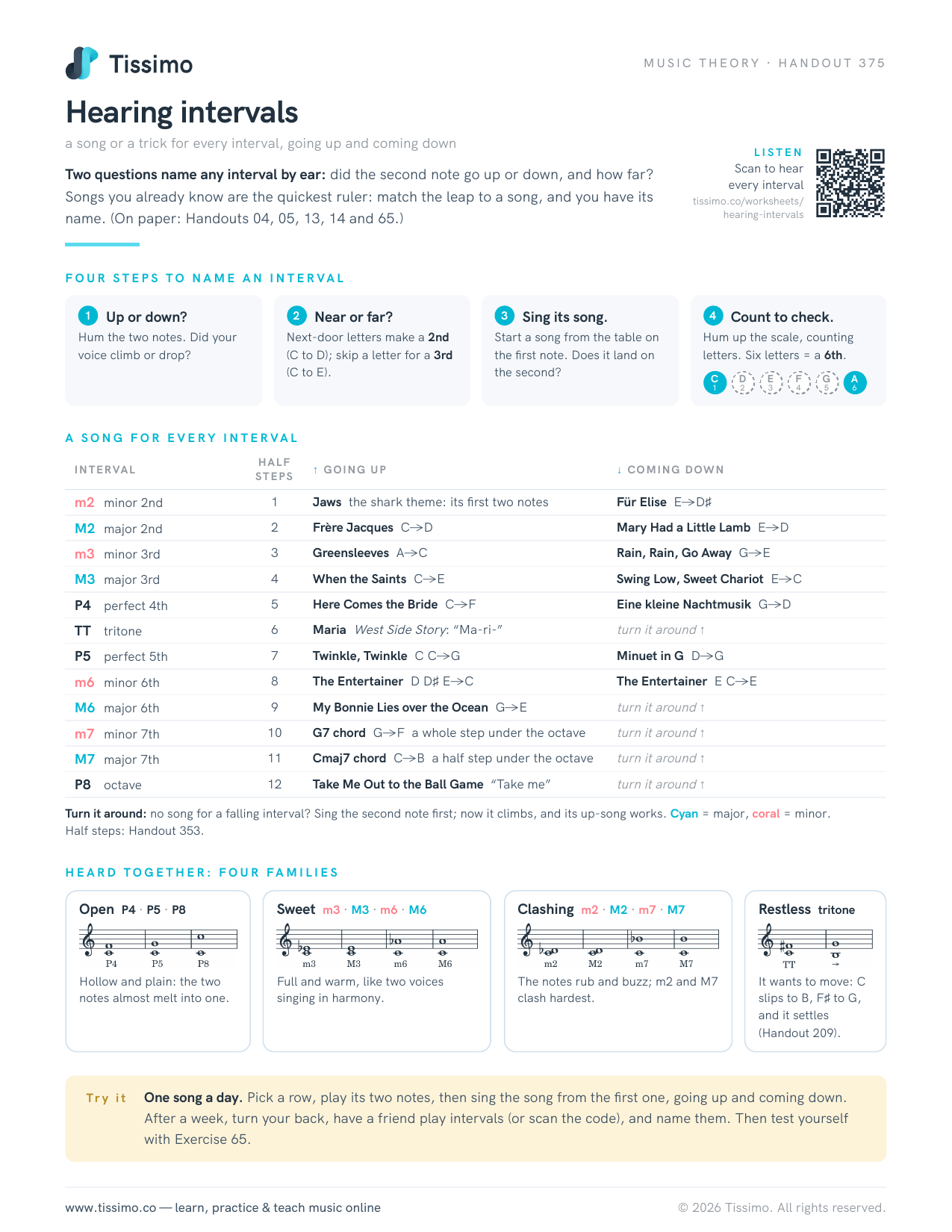
Hearing intervals
a song or a trick for every interval, going up and coming down
Scales & Keys
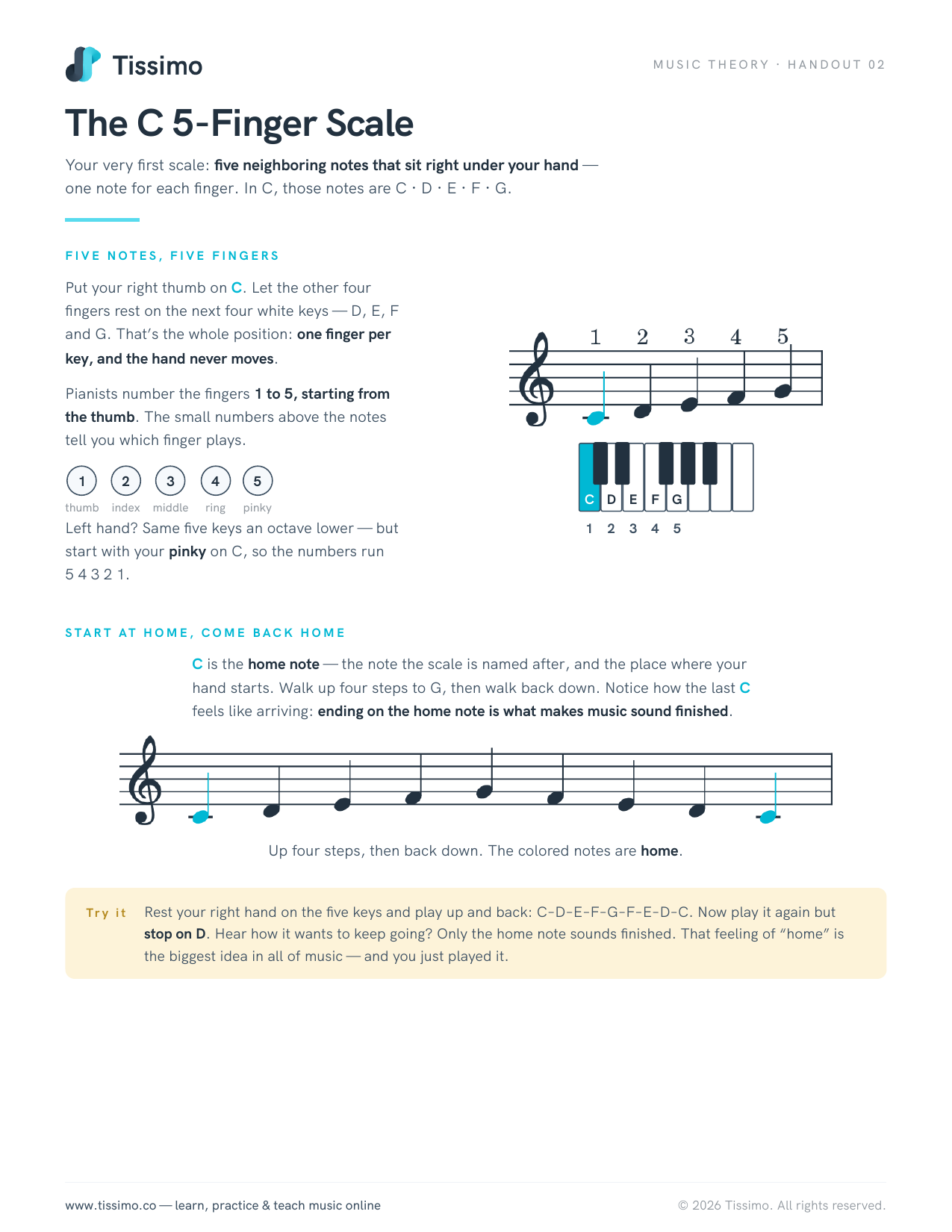
The C 5-Finger Scale
Your very first scale: five neighboring notes that sit right under your hand — one note for each finger. In C, those notes are C · D · E · F · G.
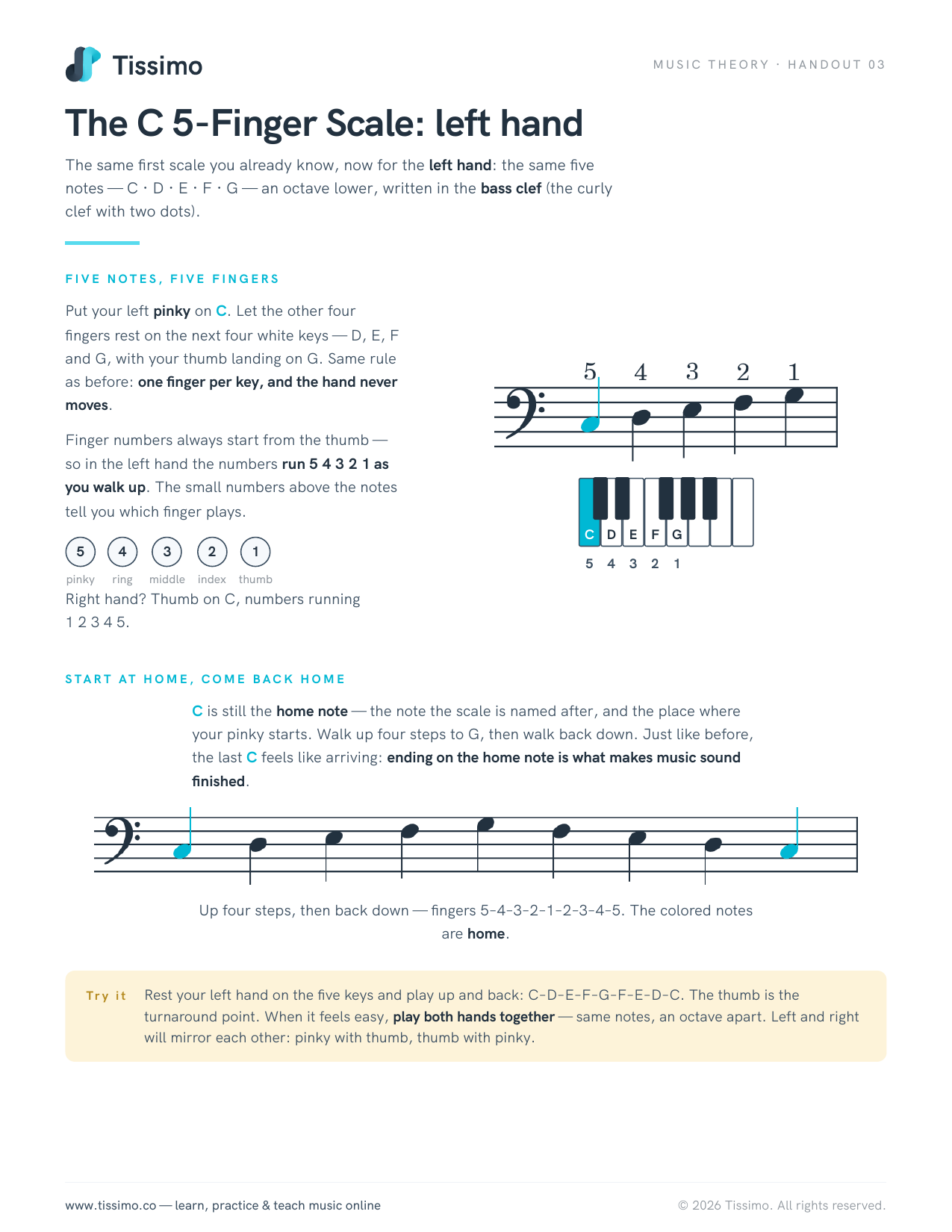
The C 5-Finger Scale: left hand
The same first scale you already know, now for the left hand: the same five notes — C · D · E · F · G — an octave lower, written in the bass clef (the curly clef with two dots, Handout 352).
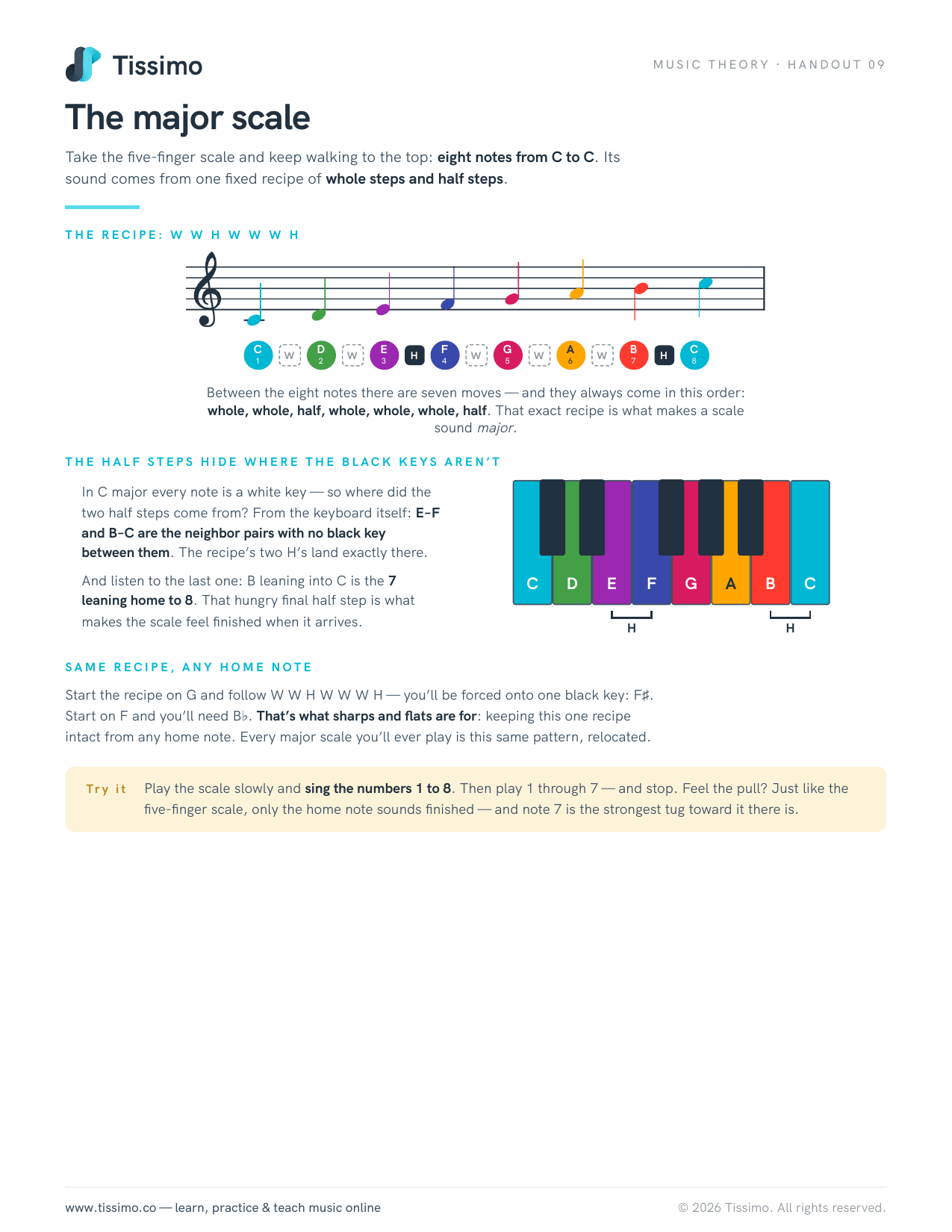
The major scale
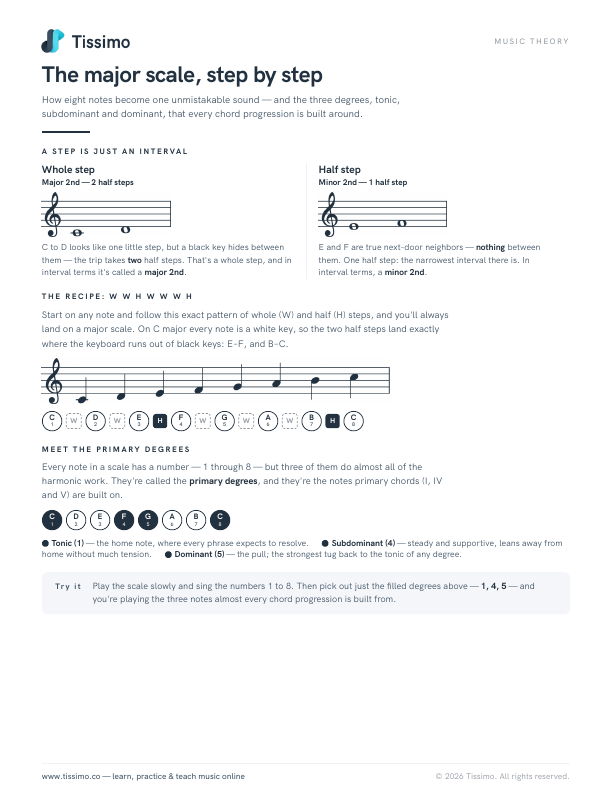
Take the five-finger scale and keep walking to the top: eight notes from C to C. Its sound comes from one fixed recipe of whole steps and half steps.
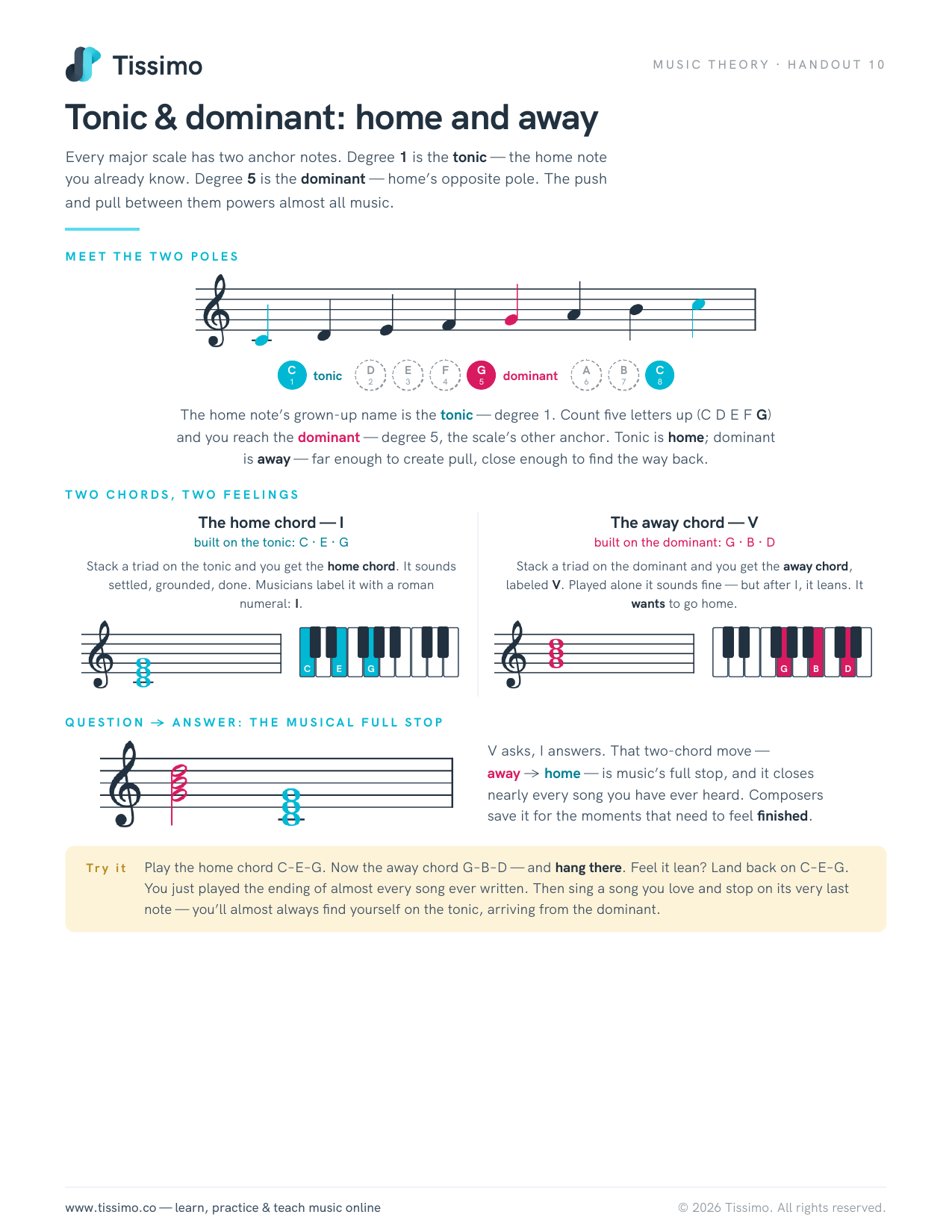
Tonic & dominant: home and away
Every major scale has two anchor notes. Degree 1 is the tonic — the home note you already know. Degree 5 is the dominant — home’s opposite pole. The push and pull between them powers almost all music.
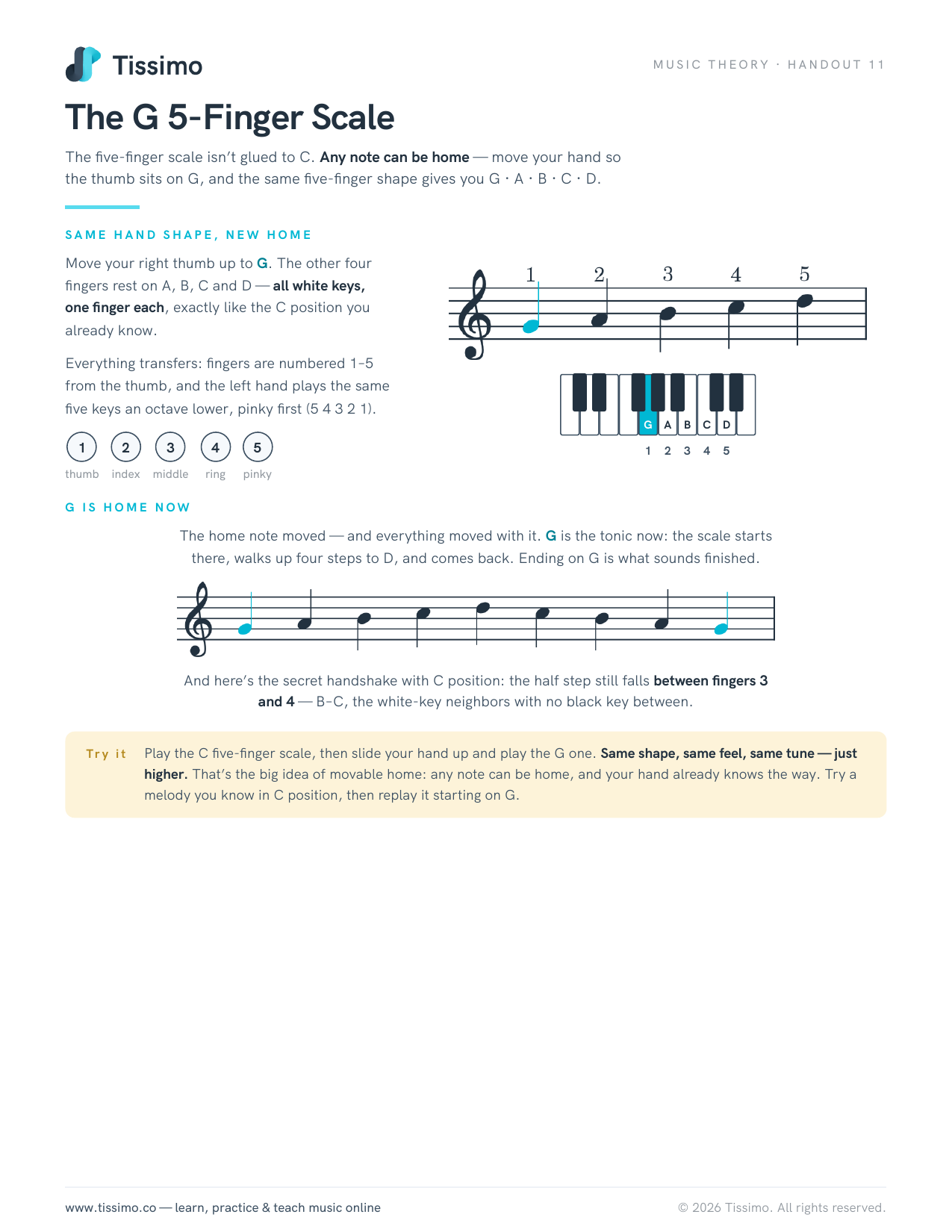
The G 5-Finger Scale
The five-finger scale isn’t glued to C. Any note can be home — move your hand so the thumb sits on G, and the same five-finger shape gives you G · A · B · C · D.
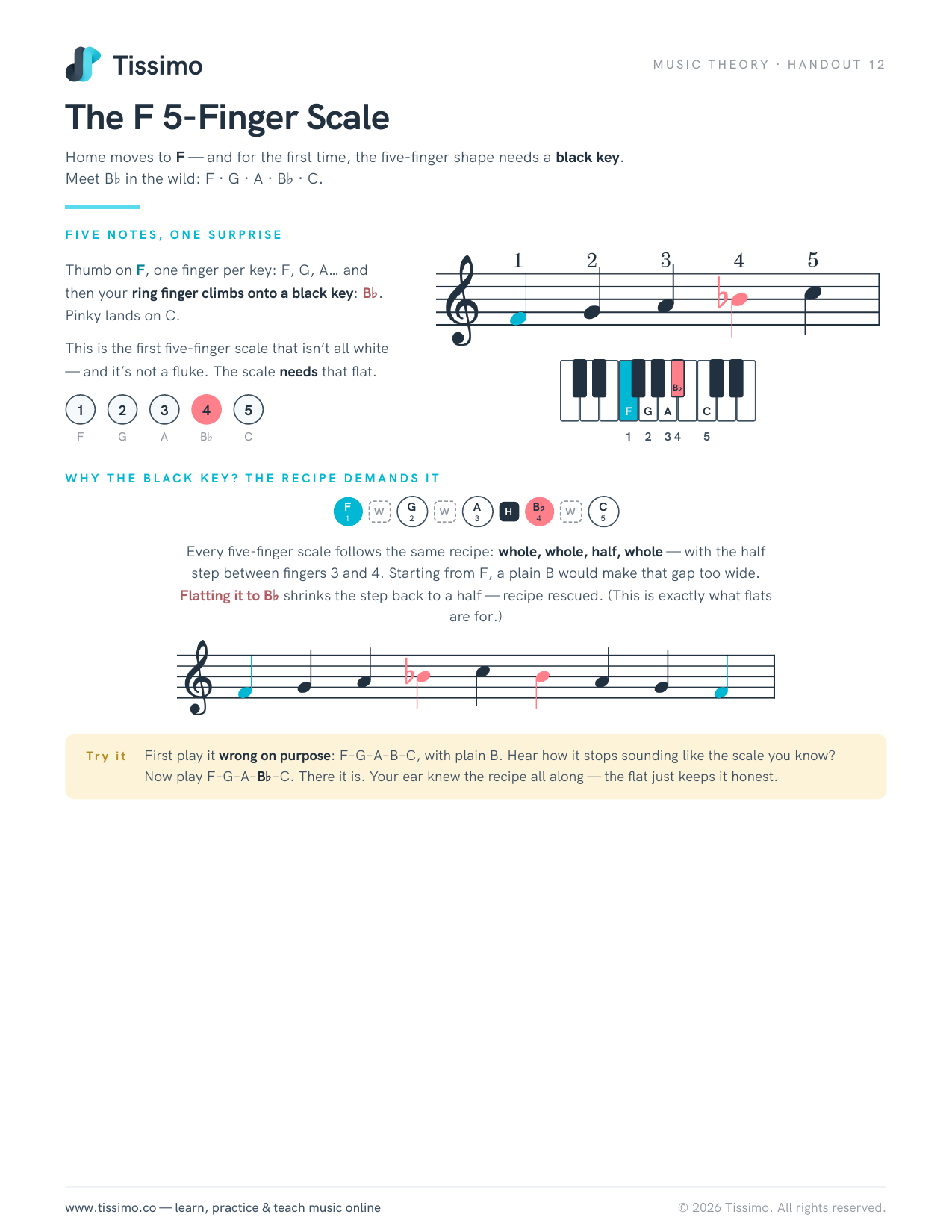
The F 5-Finger Scale
Home moves to F — and for the first time, the five-finger shape needs a black key. Meet B♭ in the wild: F · G · A · B♭ · C.
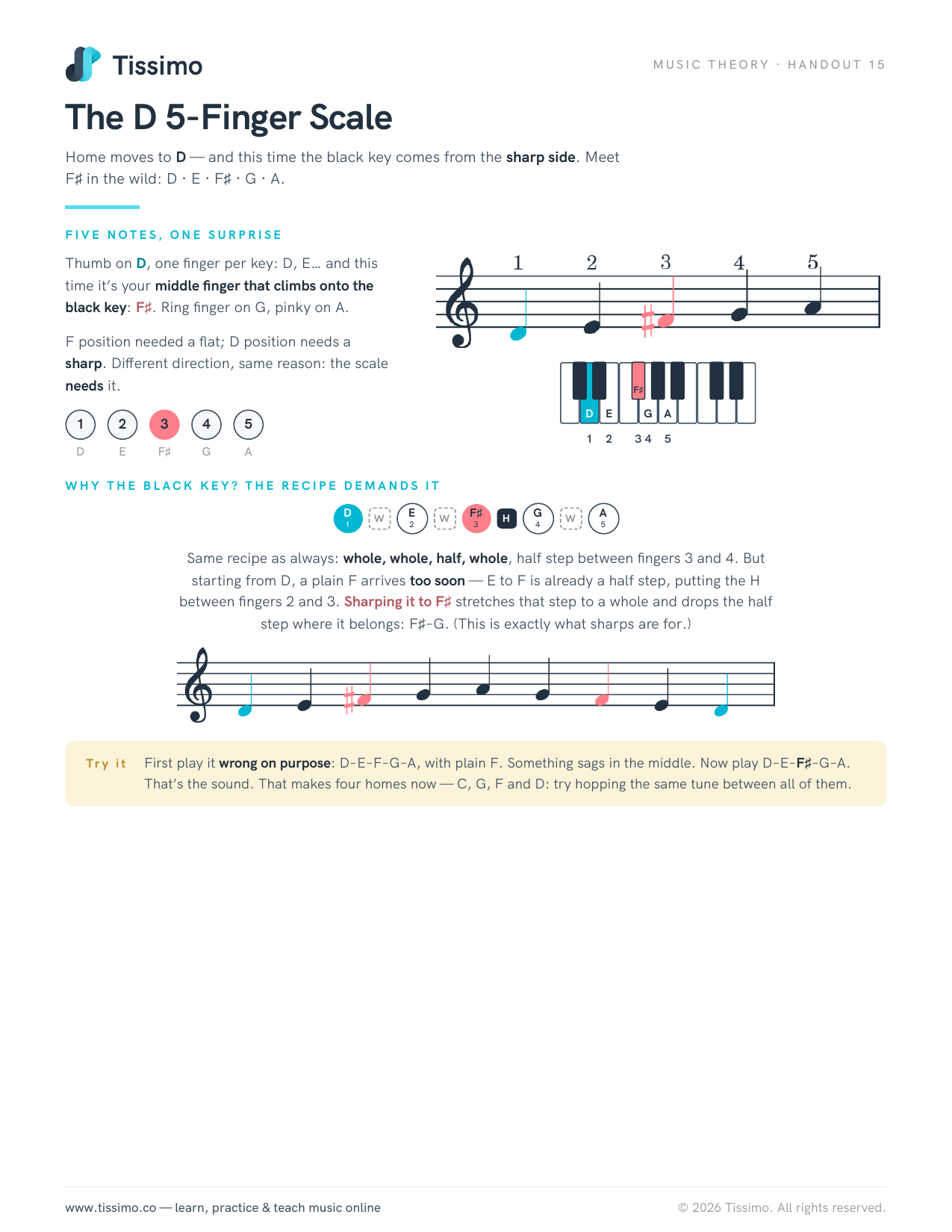
The D 5-Finger Scale
Home moves to D — and this time the black key comes from the sharp side. Meet F♯ in the wild: D · E · F♯ · G · A.
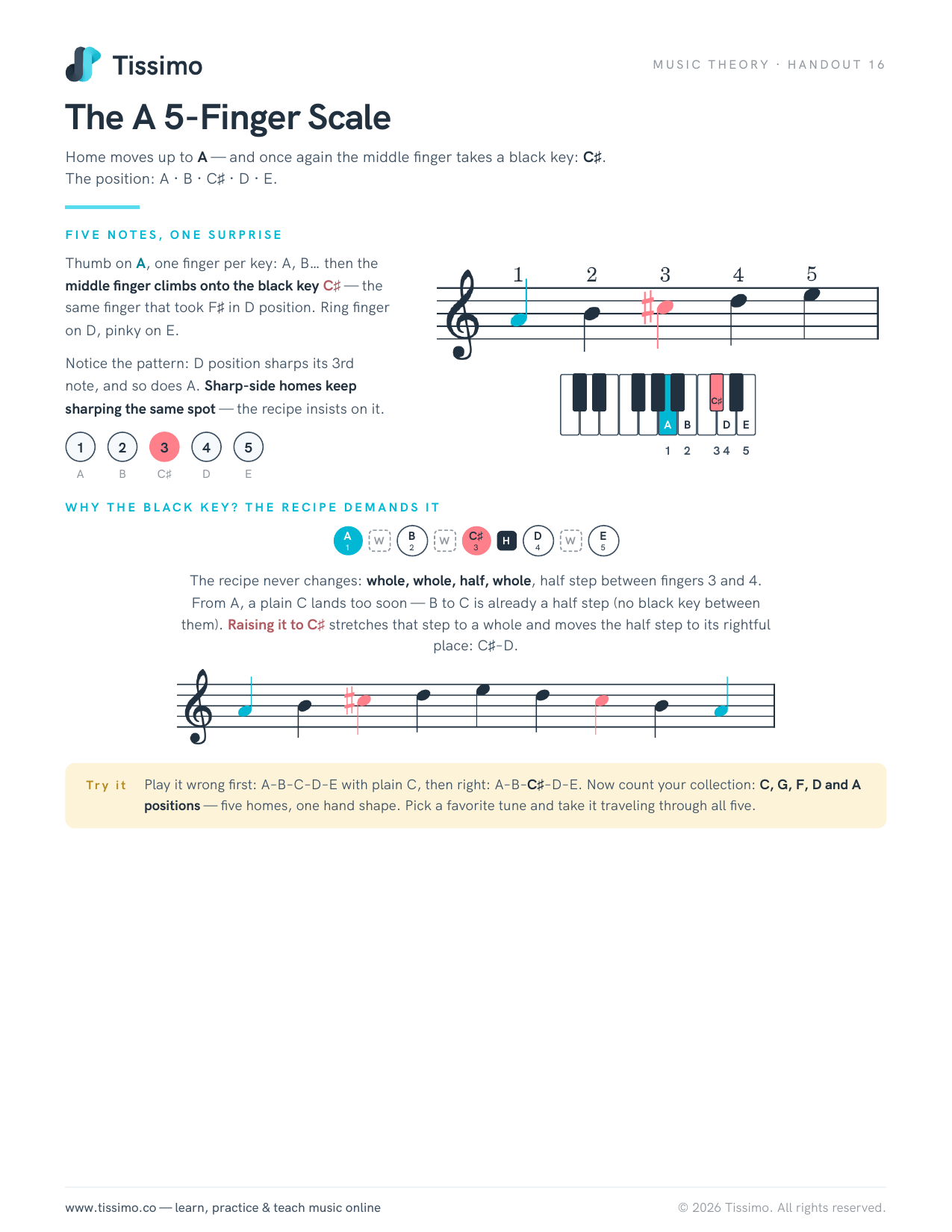
The A 5-Finger Scale
Home moves up to A — and once again the middle finger takes a black key: C♯. The position: A · B · C♯ · D · E.
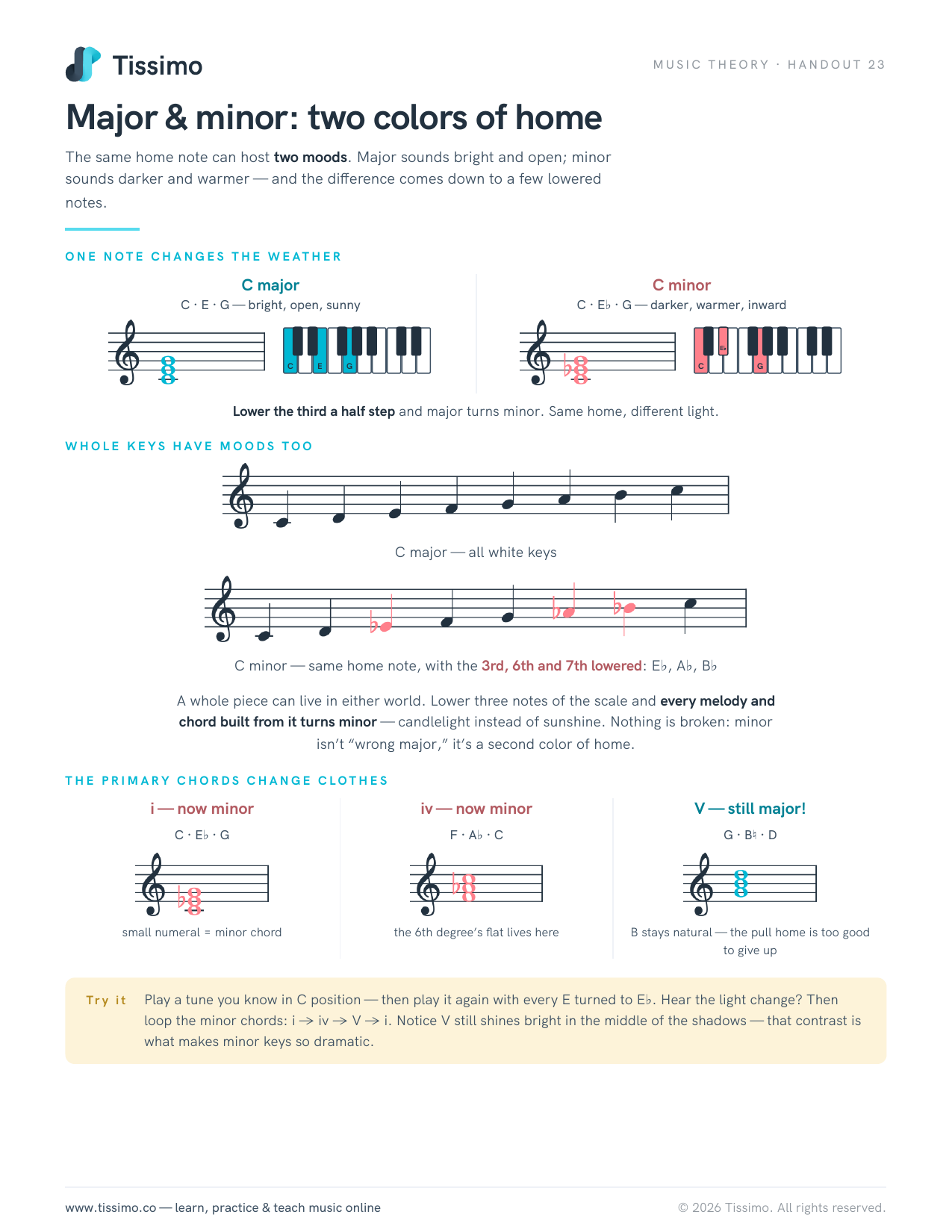
Major & minor: two colors of home
The same home note can host two moods. Major sounds bright and open; minor sounds darker and warmer — and the difference comes down to a few lowered notes.
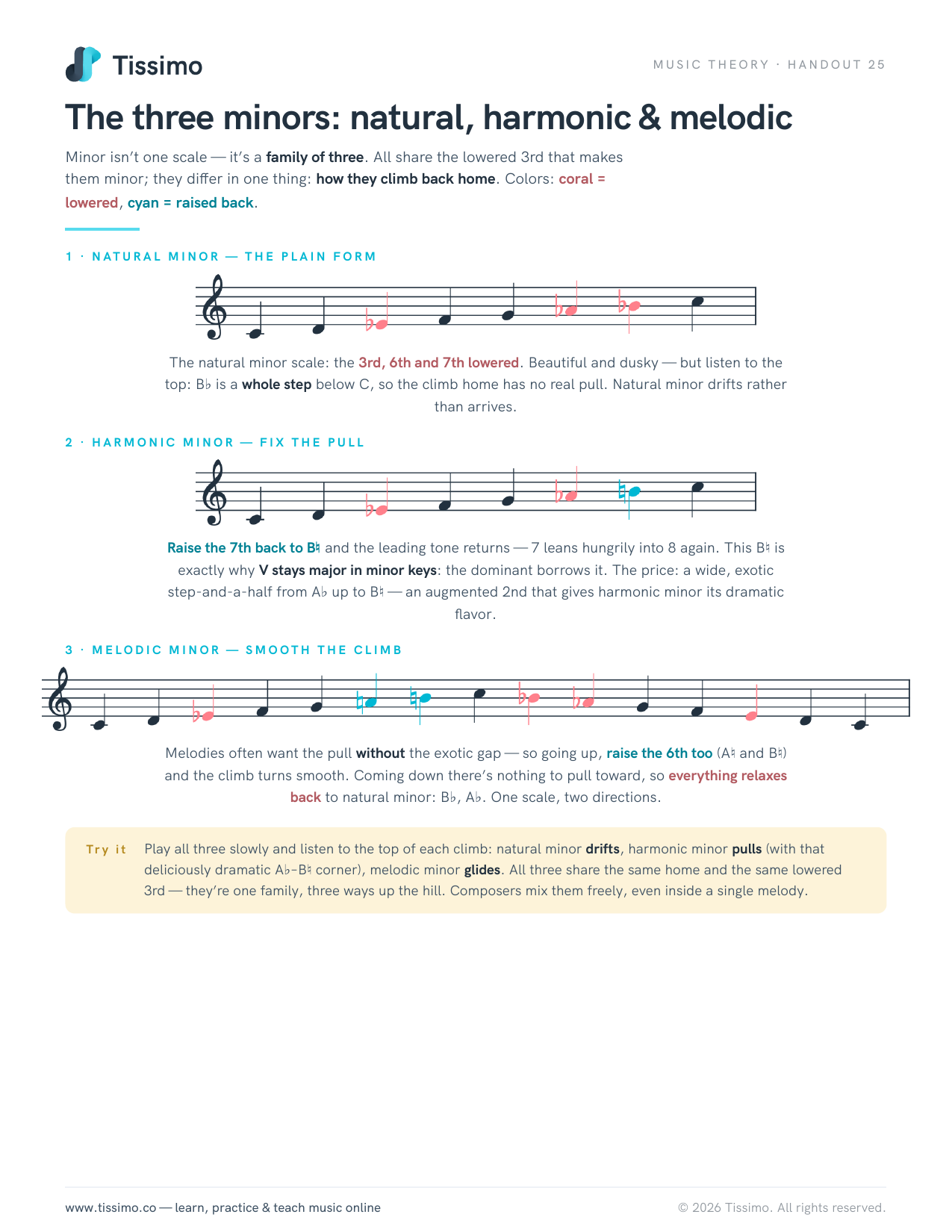
The three minors: natural, harmonic & melodic
Minor isn’t one scale — it’s a family of three. All share the lowered 3rd that makes them minor; they differ in one thing: how they climb back home. Colors: coral = lowered, cyan = raised back.
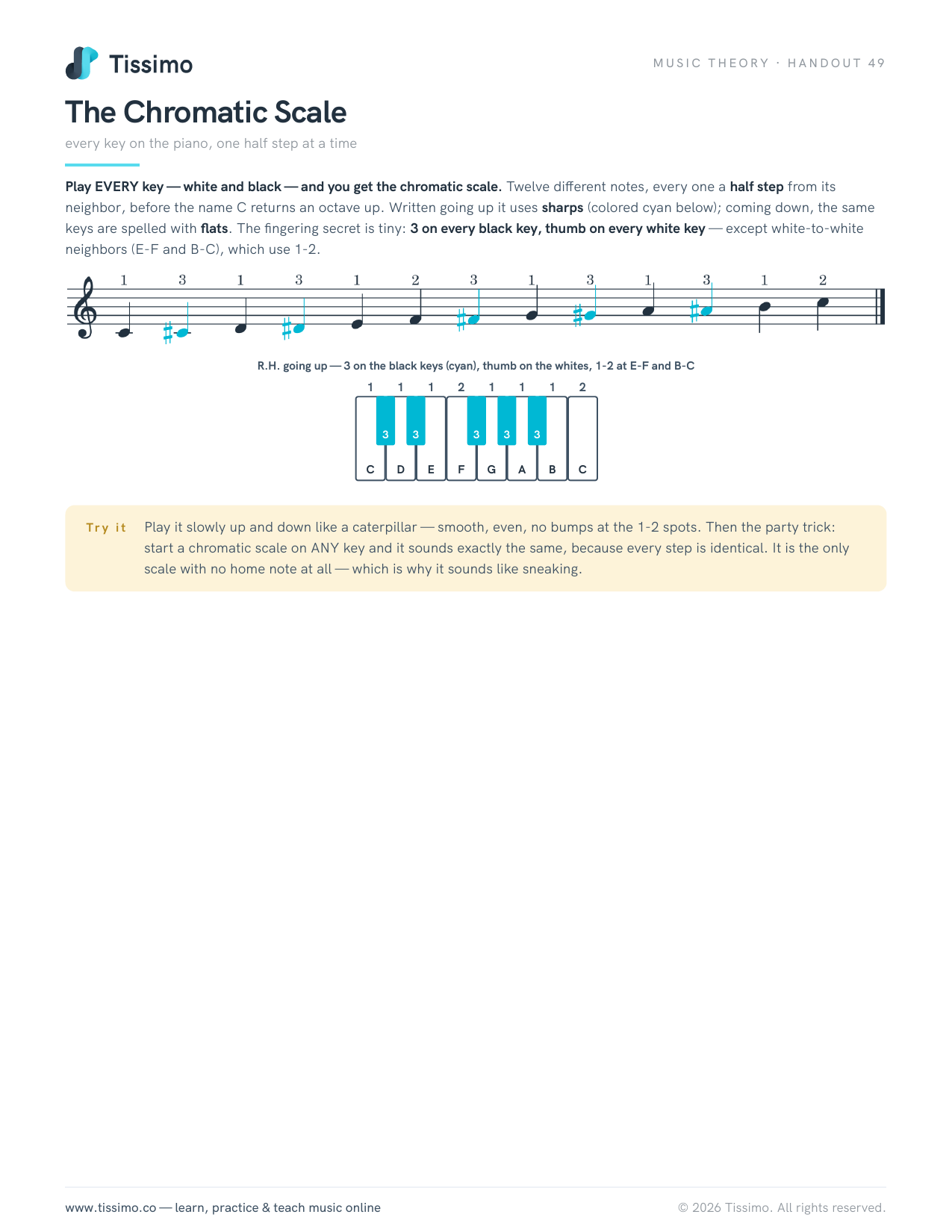
The Chromatic Scale
every key on the piano, one half step at a time
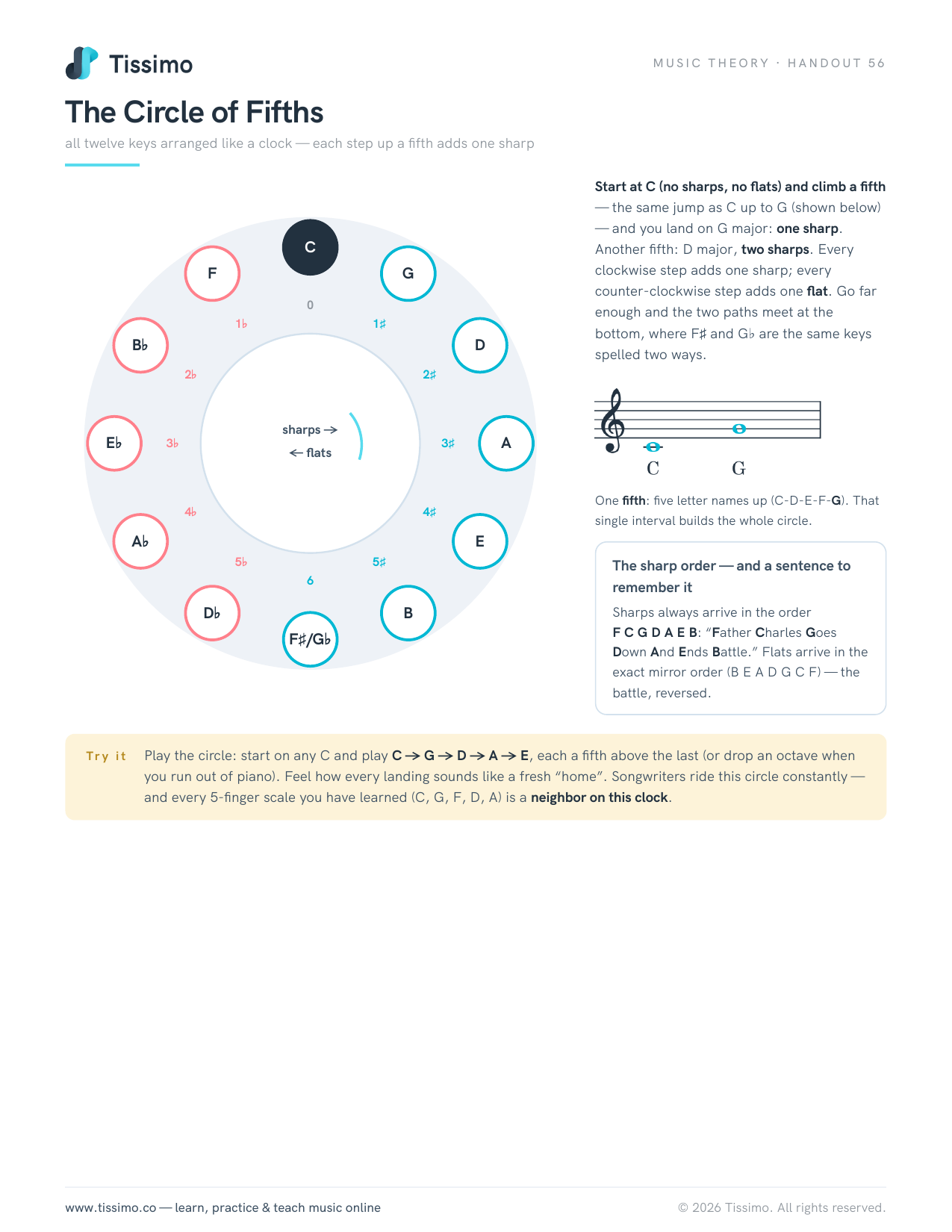
The Circle of Fifths
all twelve keys arranged like a clock — each step up a fifth adds one sharp
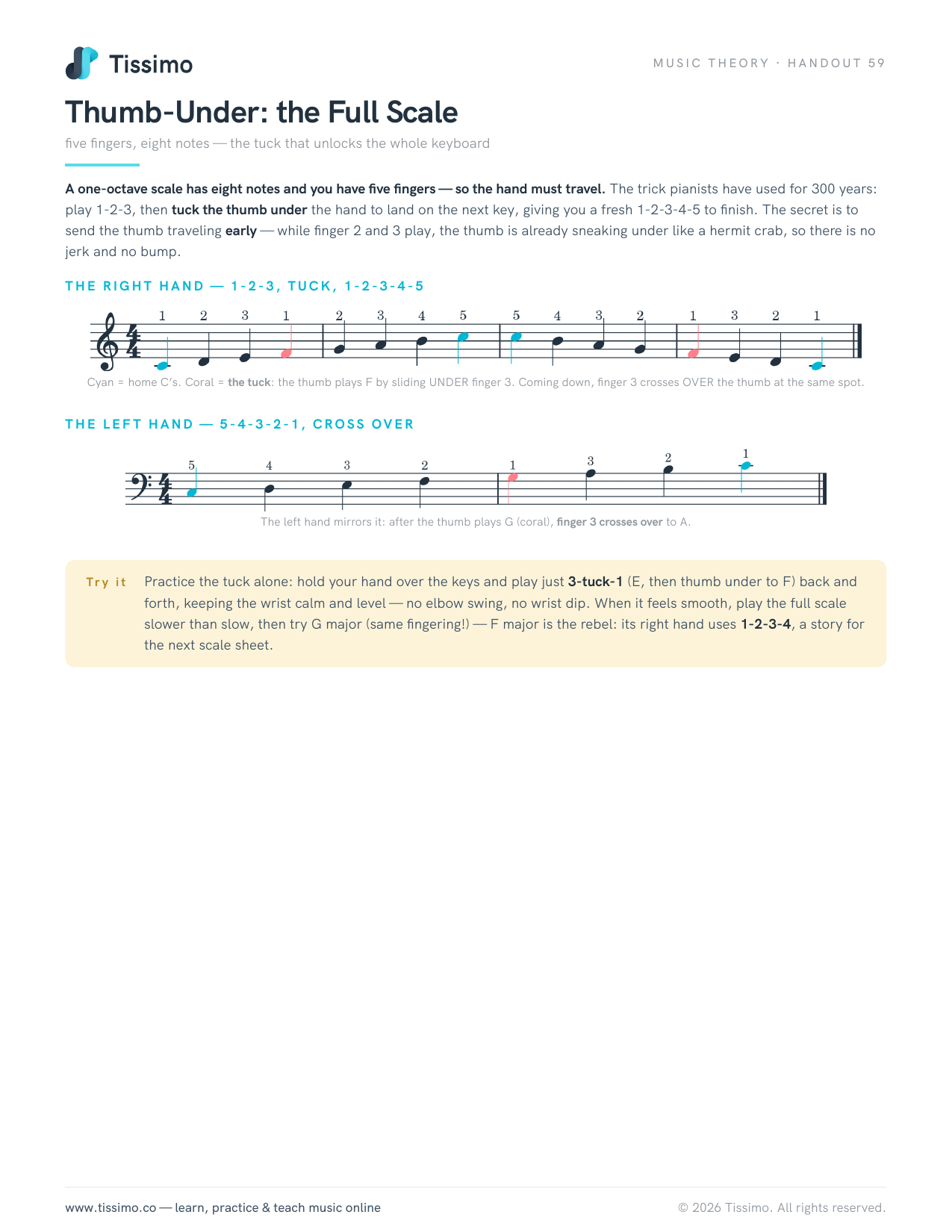
Thumb-Under: the Full Scale
five fingers, eight notes — the tuck that unlocks the whole keyboard
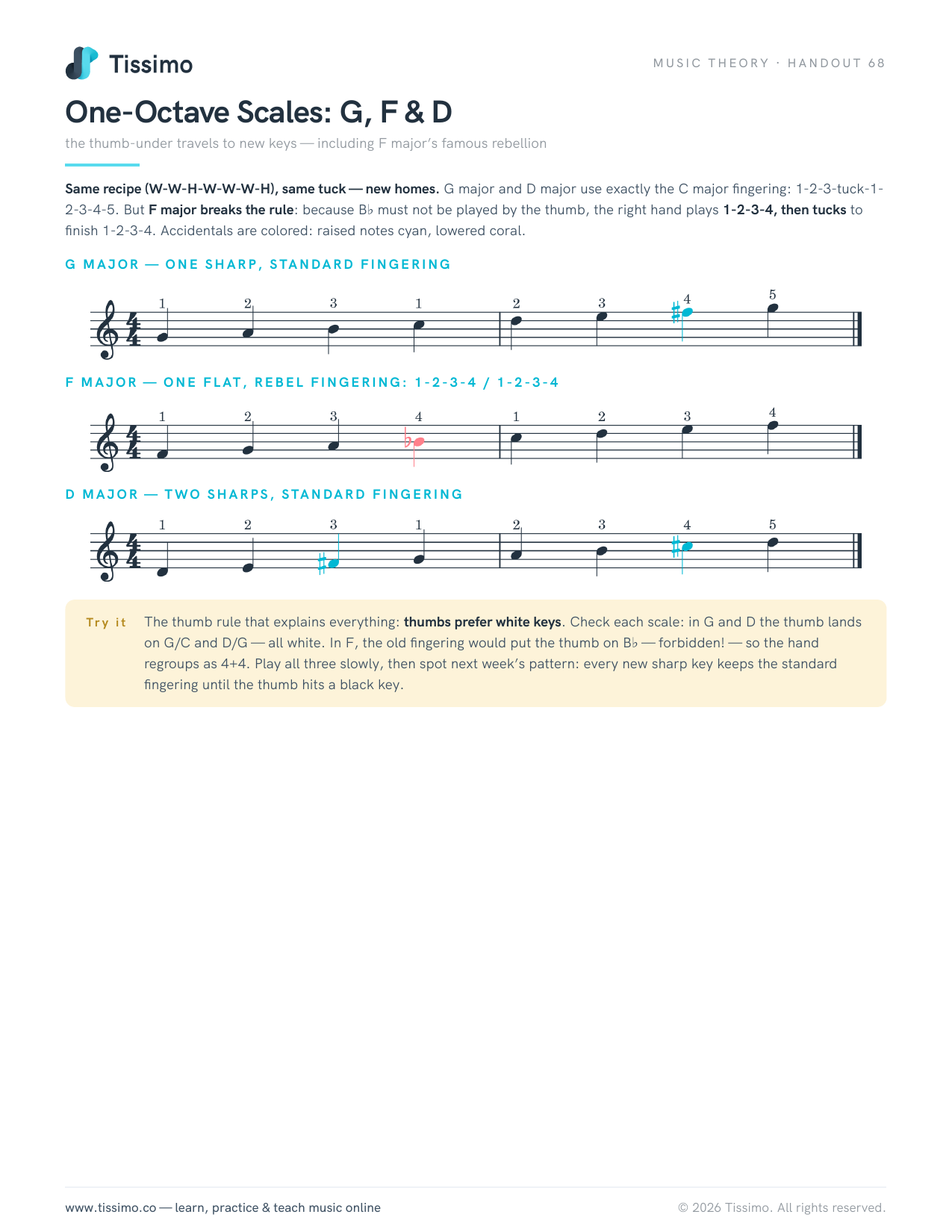
One-Octave Scales: G, F & D
the thumb-under travels to new keys — including F major’s famous rebellion
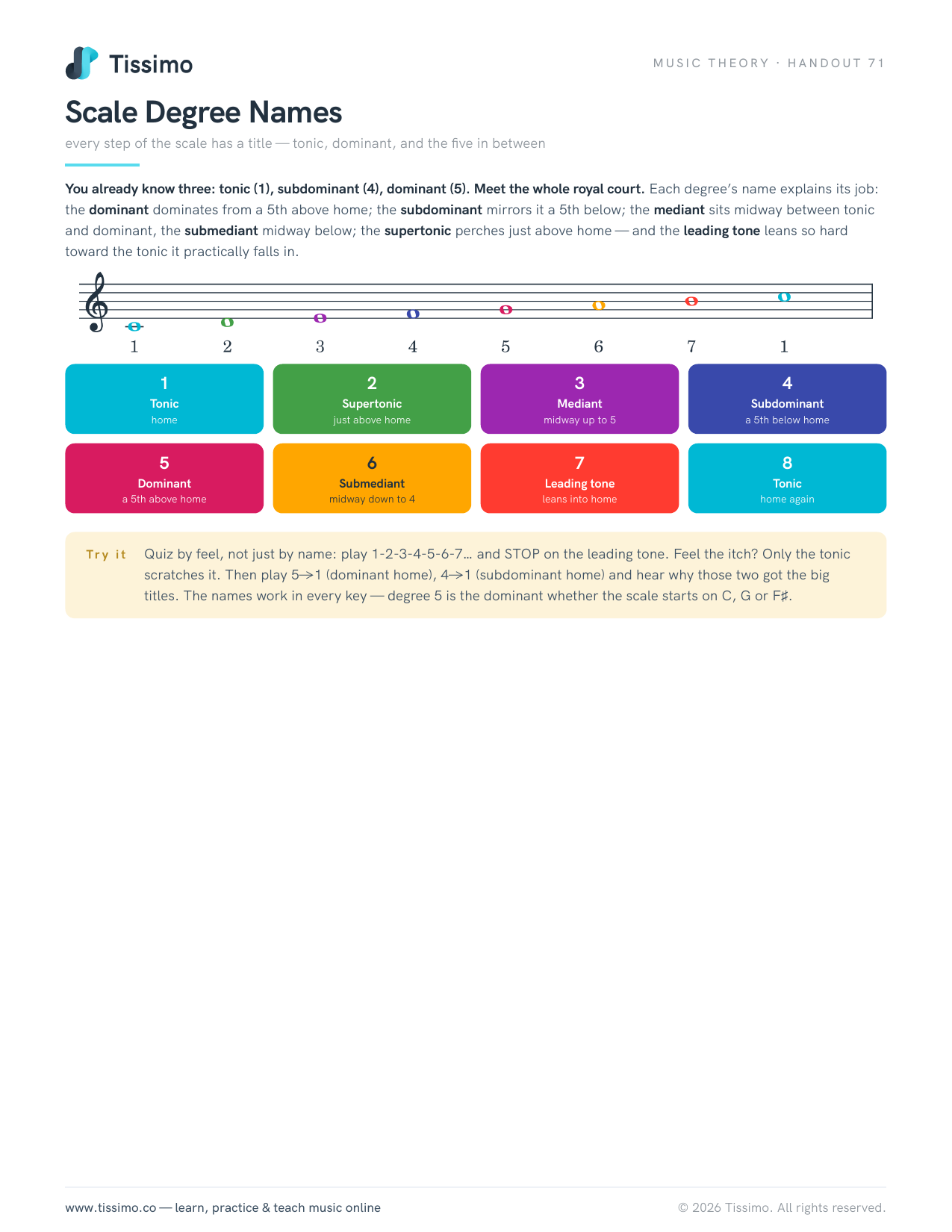
Scale Degree Names
every step of the scale has a title — tonic, dominant, and the five in between
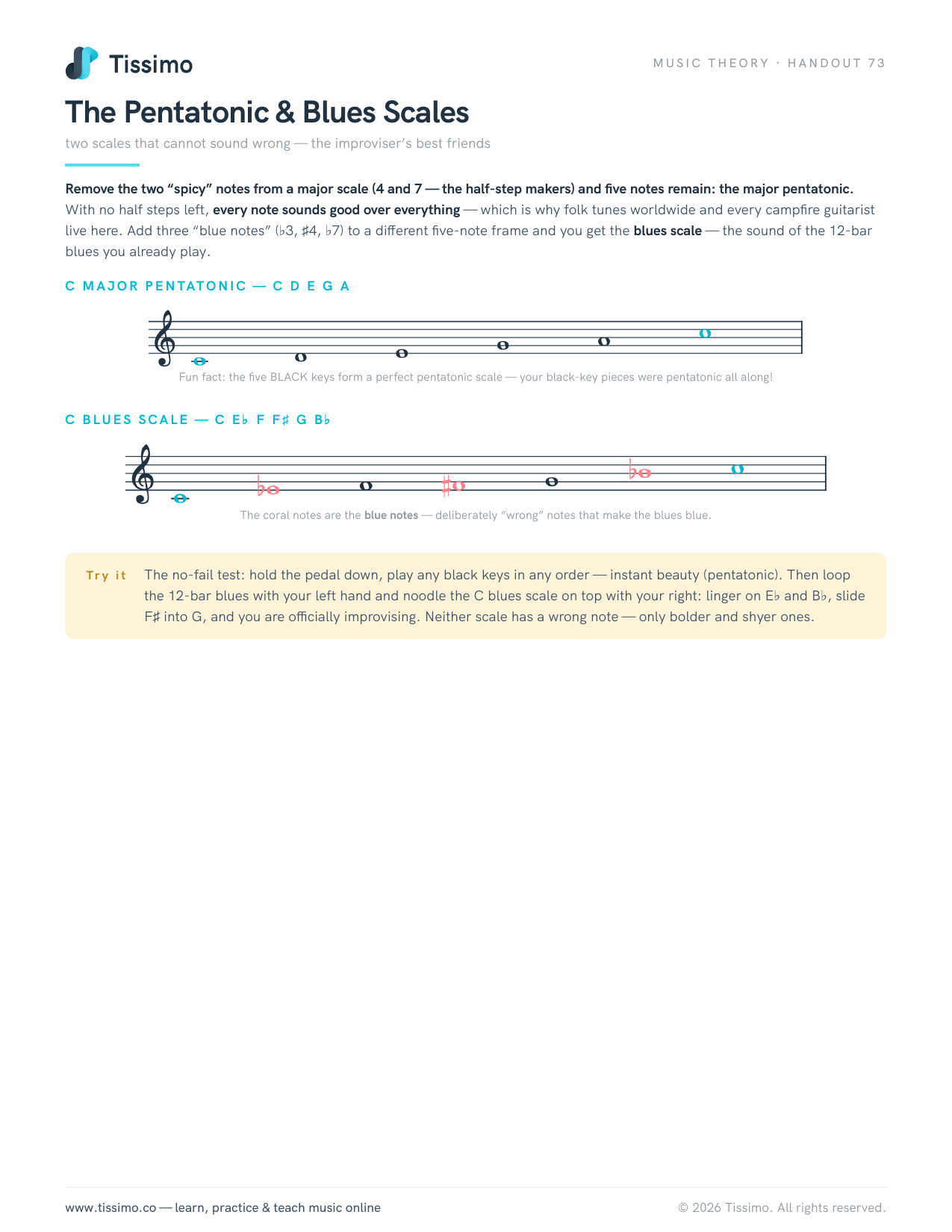
The Pentatonic & Blues Scales
two scales that cannot sound wrong — the improviser’s best friends
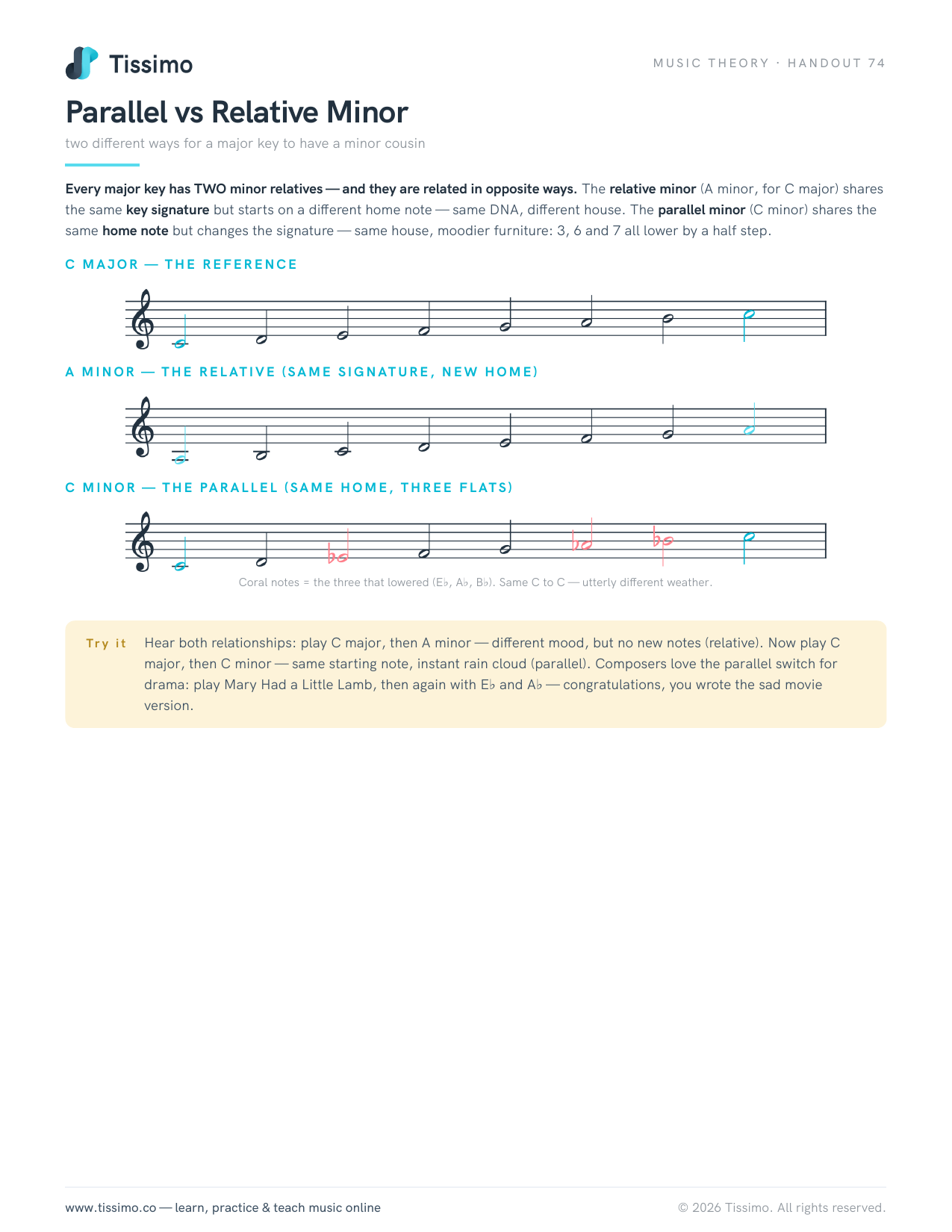
Parallel vs Relative Minor
two different ways for a major key to have a minor cousin
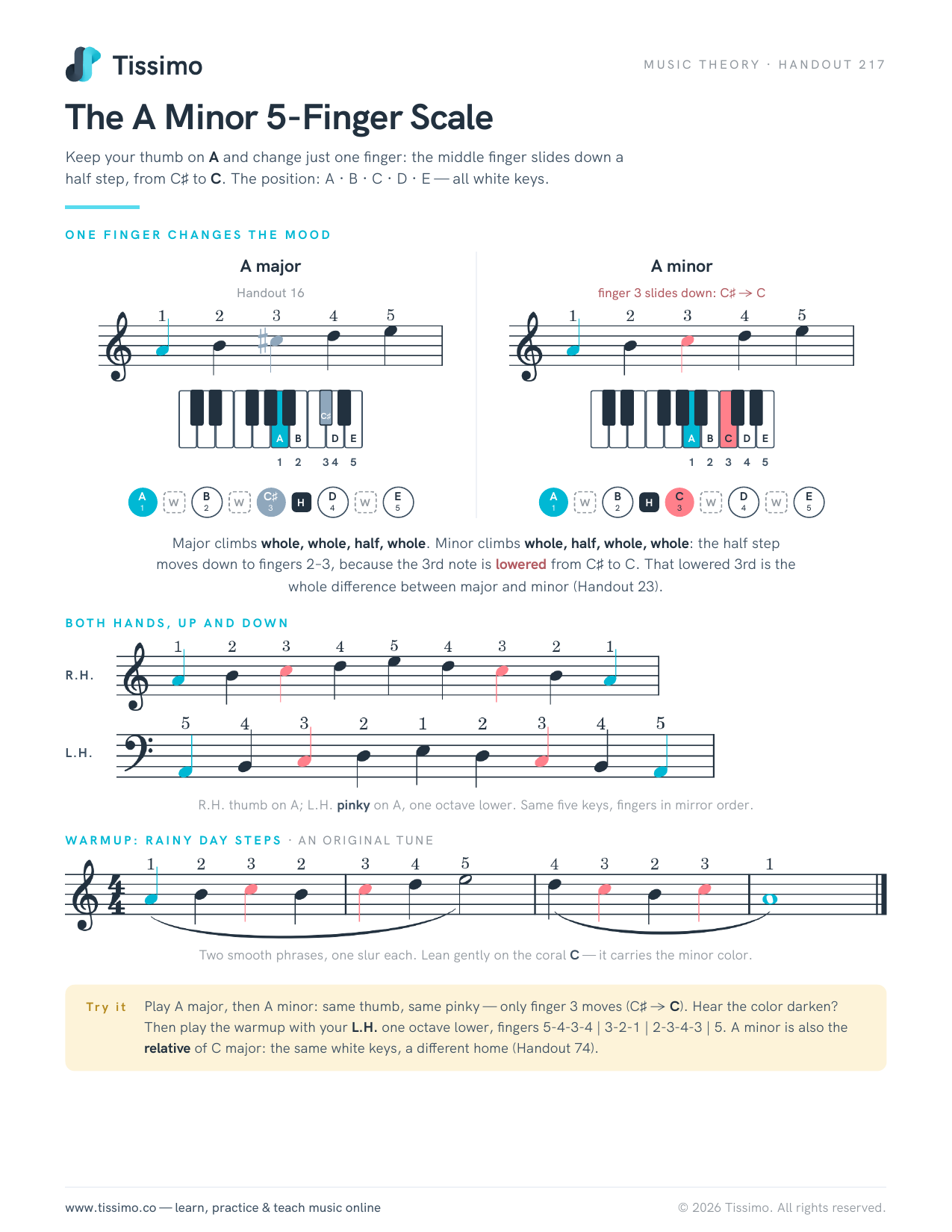
The A Minor 5-Finger Scale
Keep your thumb on A and change just one finger: the middle finger slides down a half step, from C♯ to C. The position: A · B · C · D · E — all white keys.
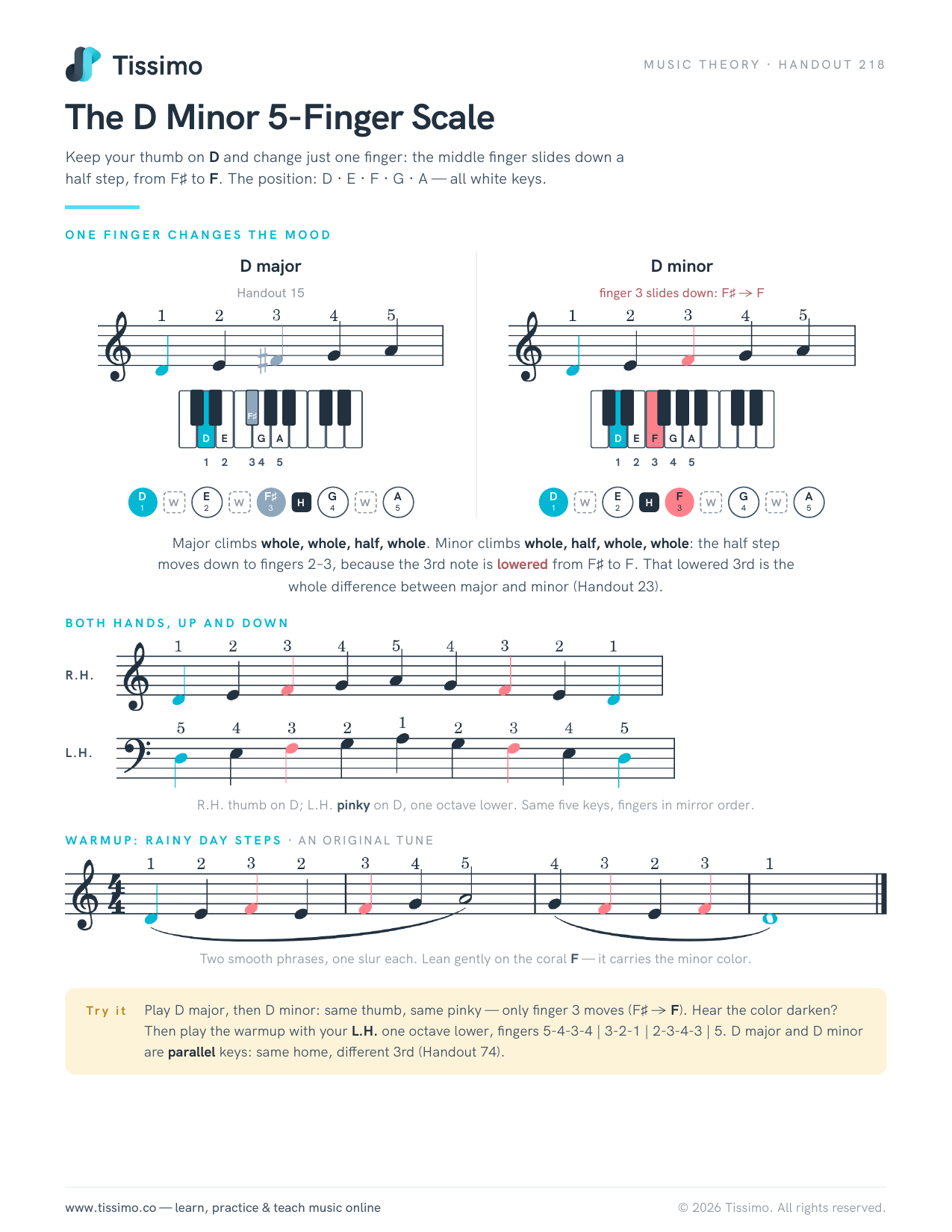
The D Minor 5-Finger Scale
Keep your thumb on D and change just one finger: the middle finger slides down a half step, from F♯ to F. The position: D · E · F · G · A — all white keys.
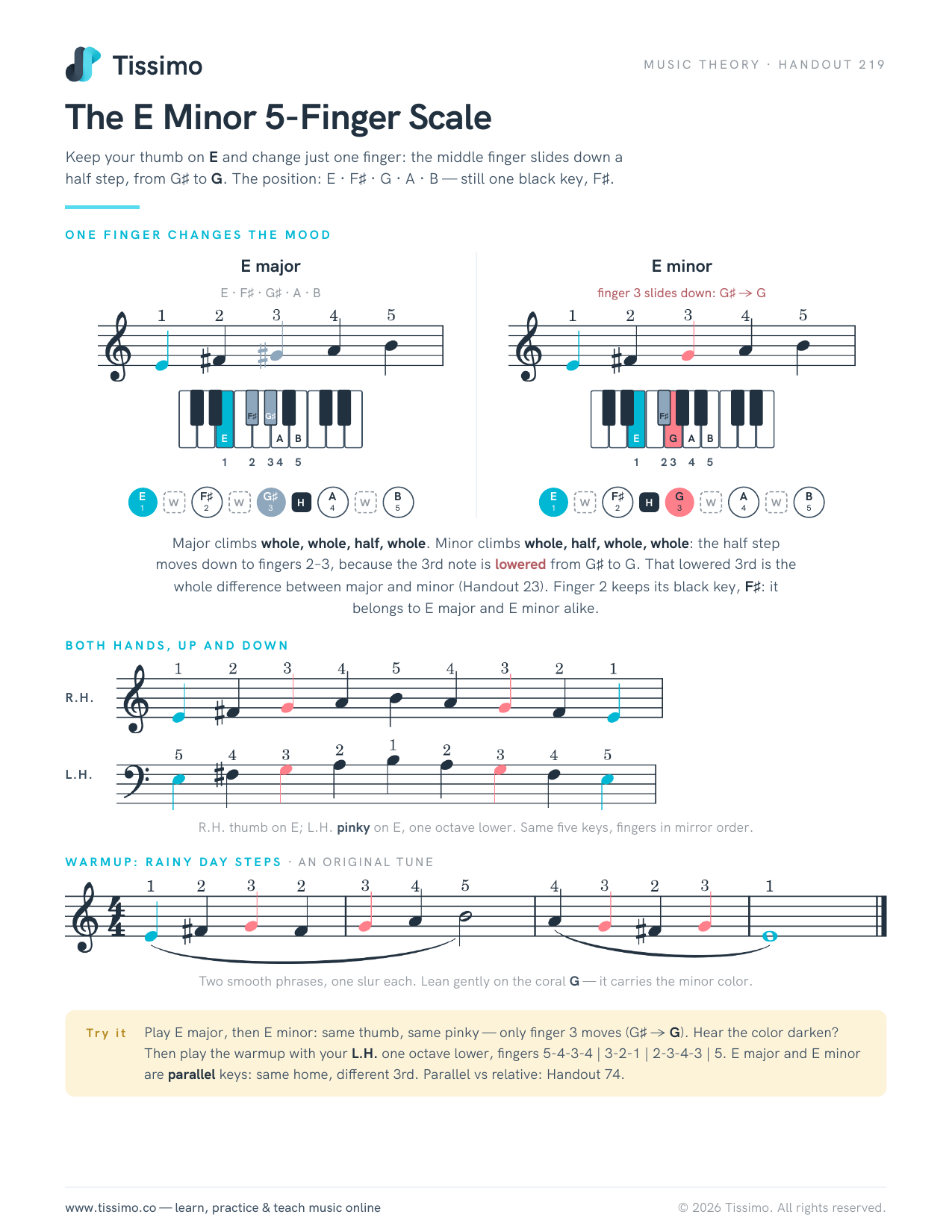
The E Minor 5-Finger Scale
Keep your thumb on E and change just one finger: the middle finger slides down a half step, from G♯ to G. The position: E · F♯ · G · A · B — still one black key, F♯.
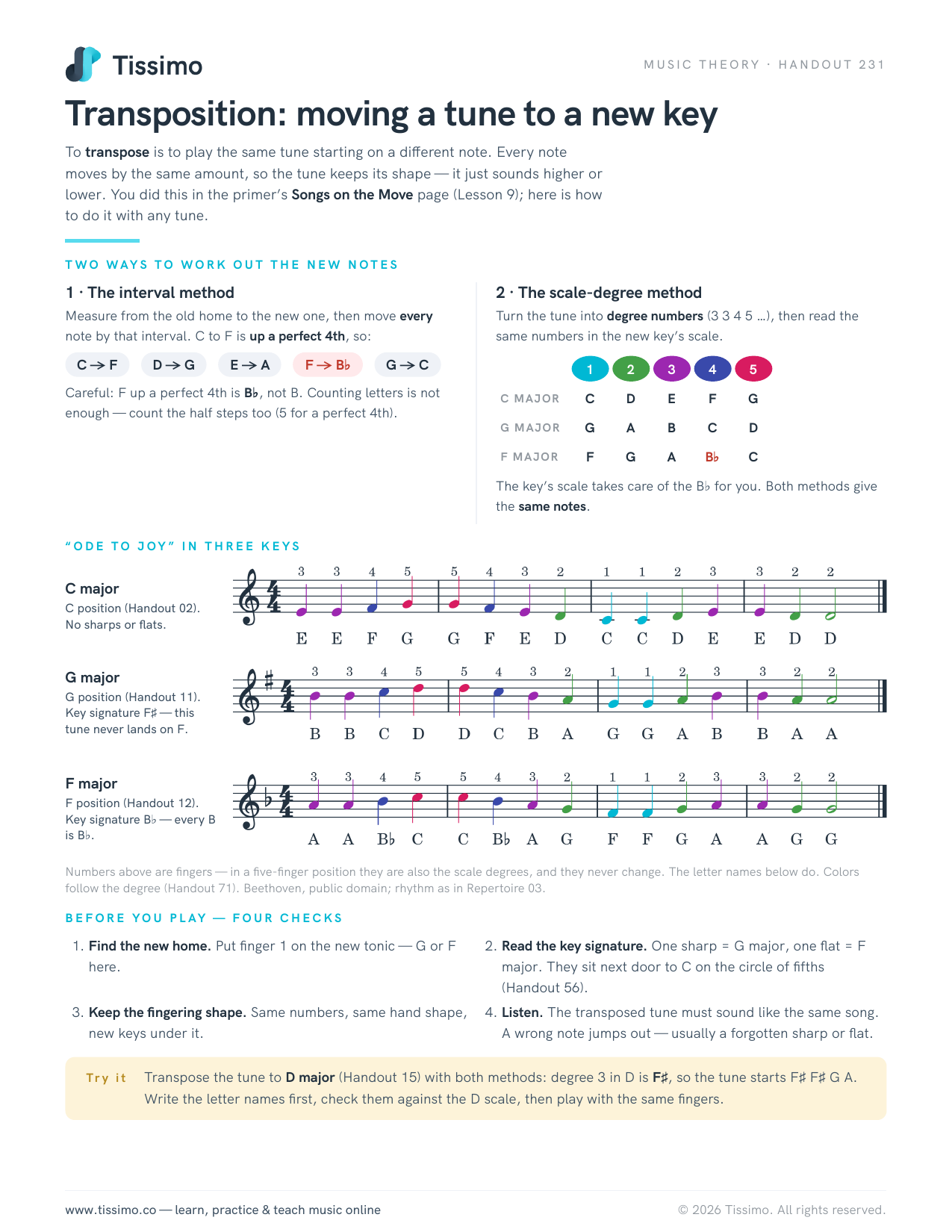
Transposition: moving a tune to a new key
To transpose is to play the same tune starting on a different note. Every note moves by the same amount, so the tune keeps its shape — it just sounds higher or lower. Here is how to do it with any tune.
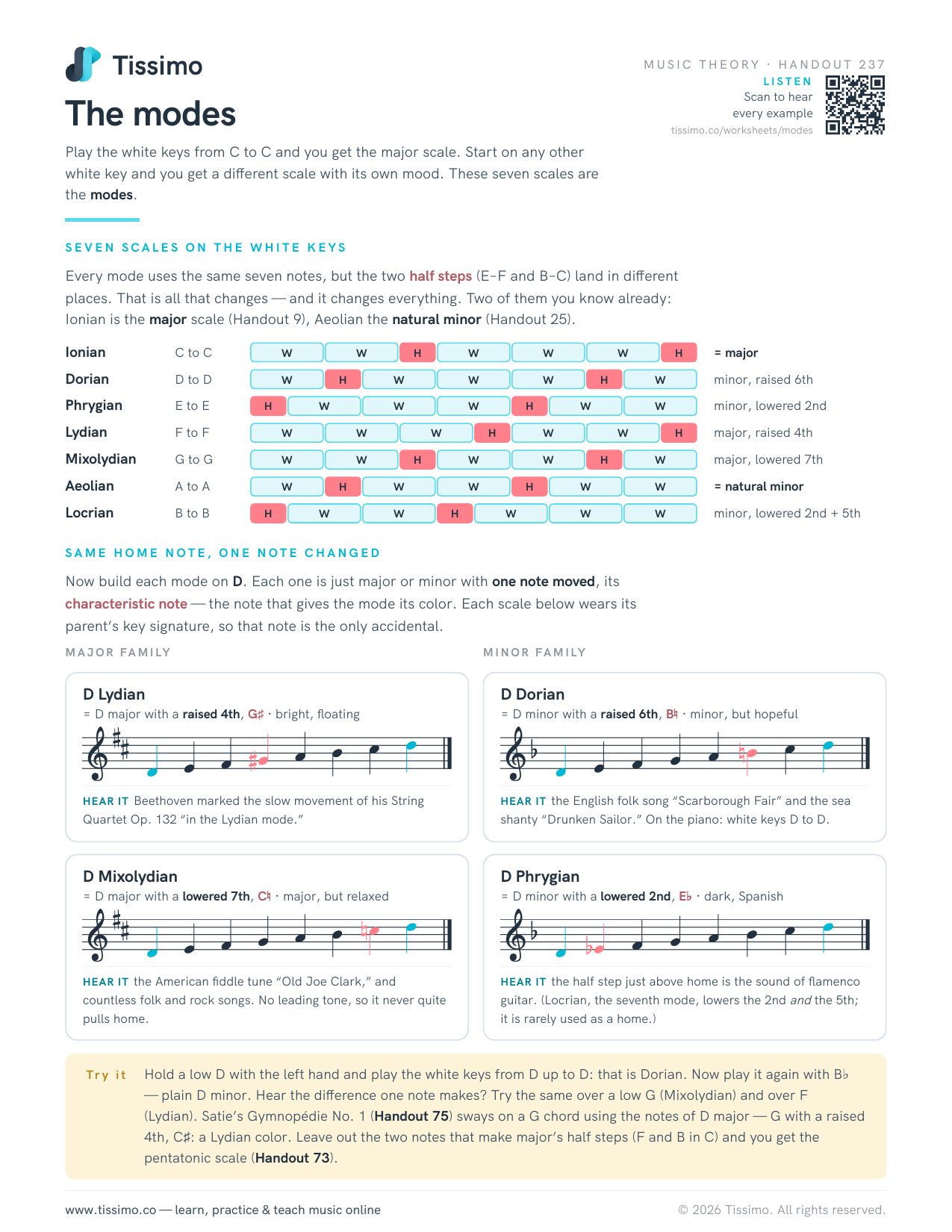
The modes
Play the white keys from C to C and you get the major scale. Start on any other white key and you get a different scale with its own mood. These seven scales are the modes.
Scales in Every Key
Two octaves up and down with the standard fingering on every note, in all 24 keys.
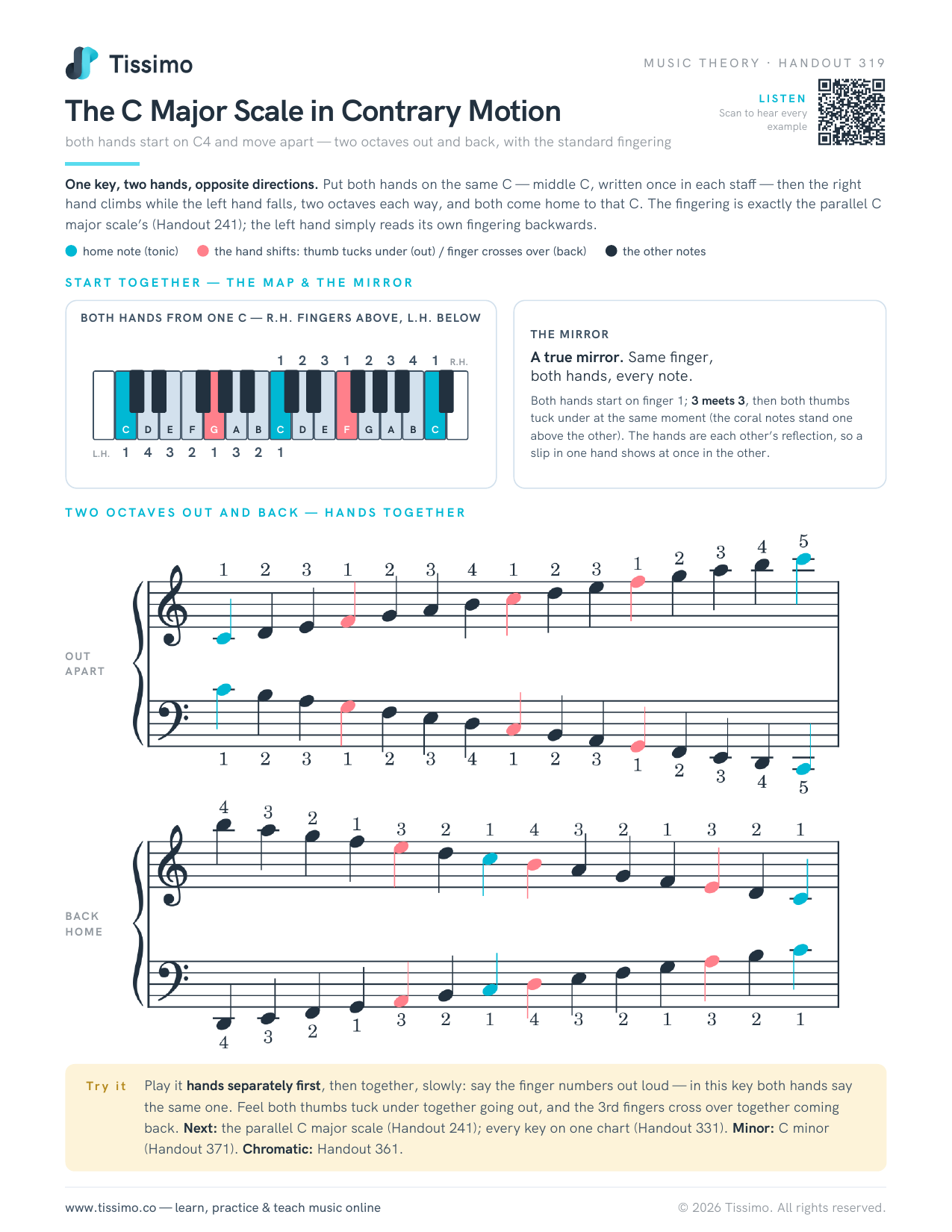
Contrary-Motion Scales
Both hands start on one note and move apart two octaves and back, in all 12 major and 12 harmonic minor keys.
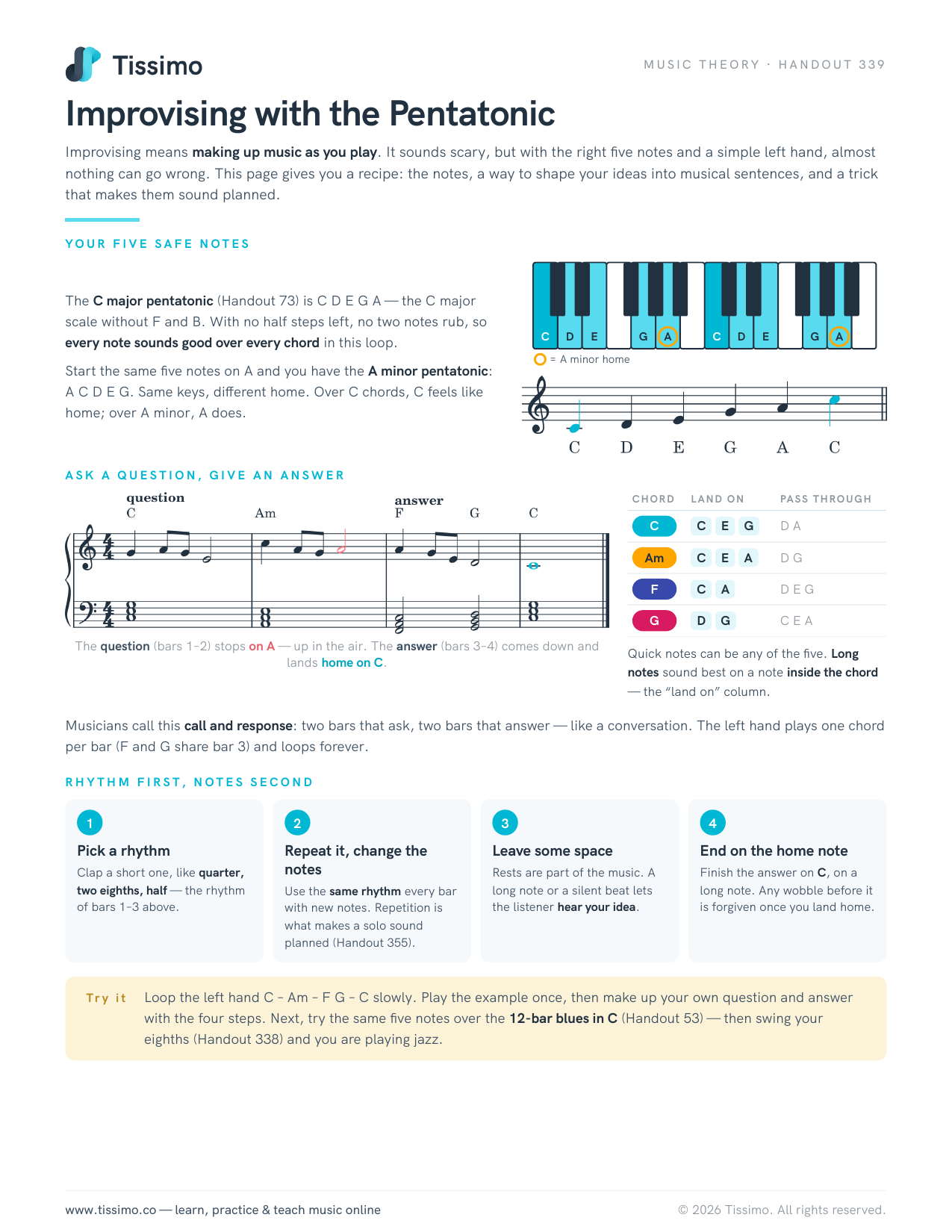
Improvising with the Pentatonic
Improvising means making up music as you play. It sounds scary, but with the right five notes and a simple left hand, almost nothing can go wrong. This page gives you a recipe: the notes, a way to shape your ideas into musical sentences, and a trick that makes them sound planned.
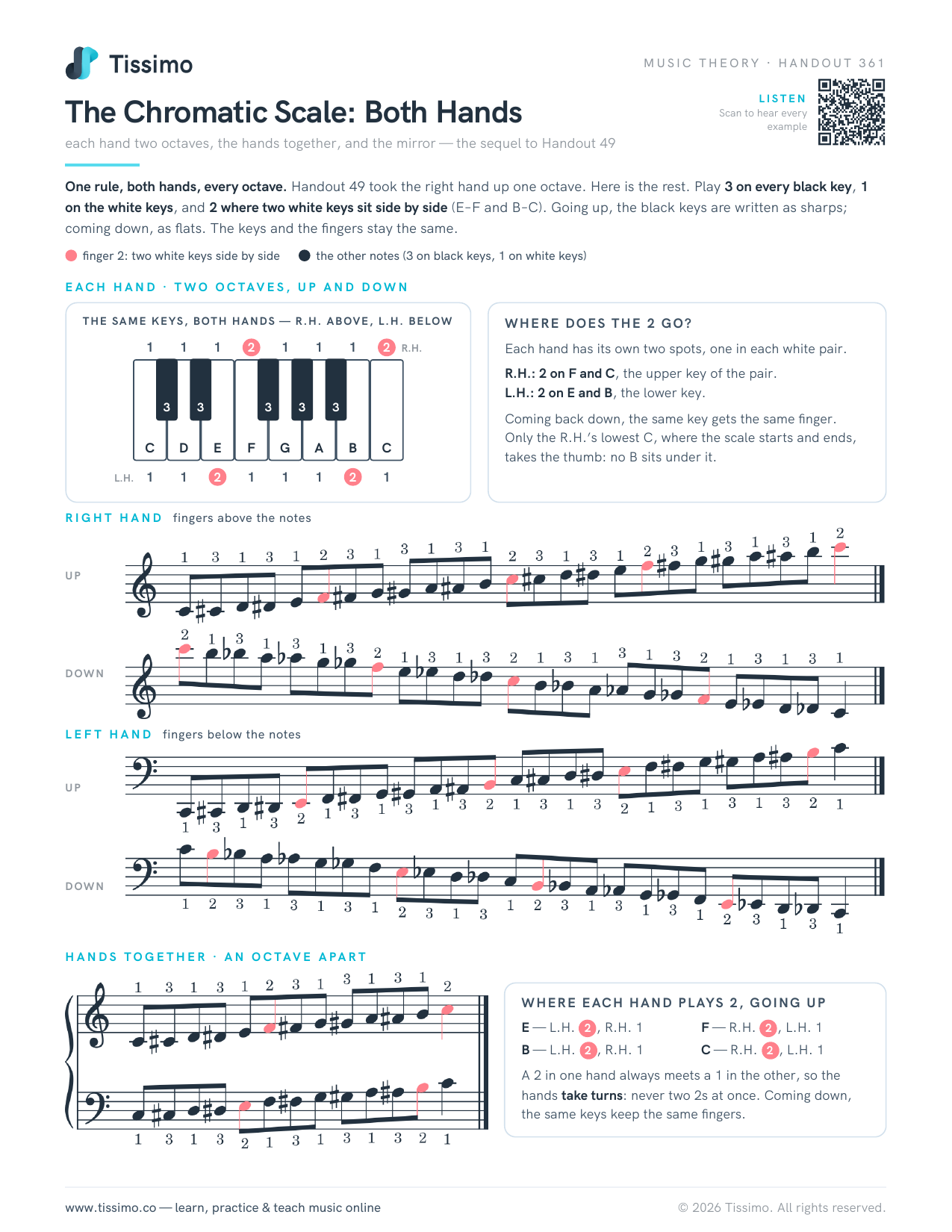
The Chromatic Scale: Both Hands
each hand two octaves, the hands together, and the mirror — the sequel to Handout 49
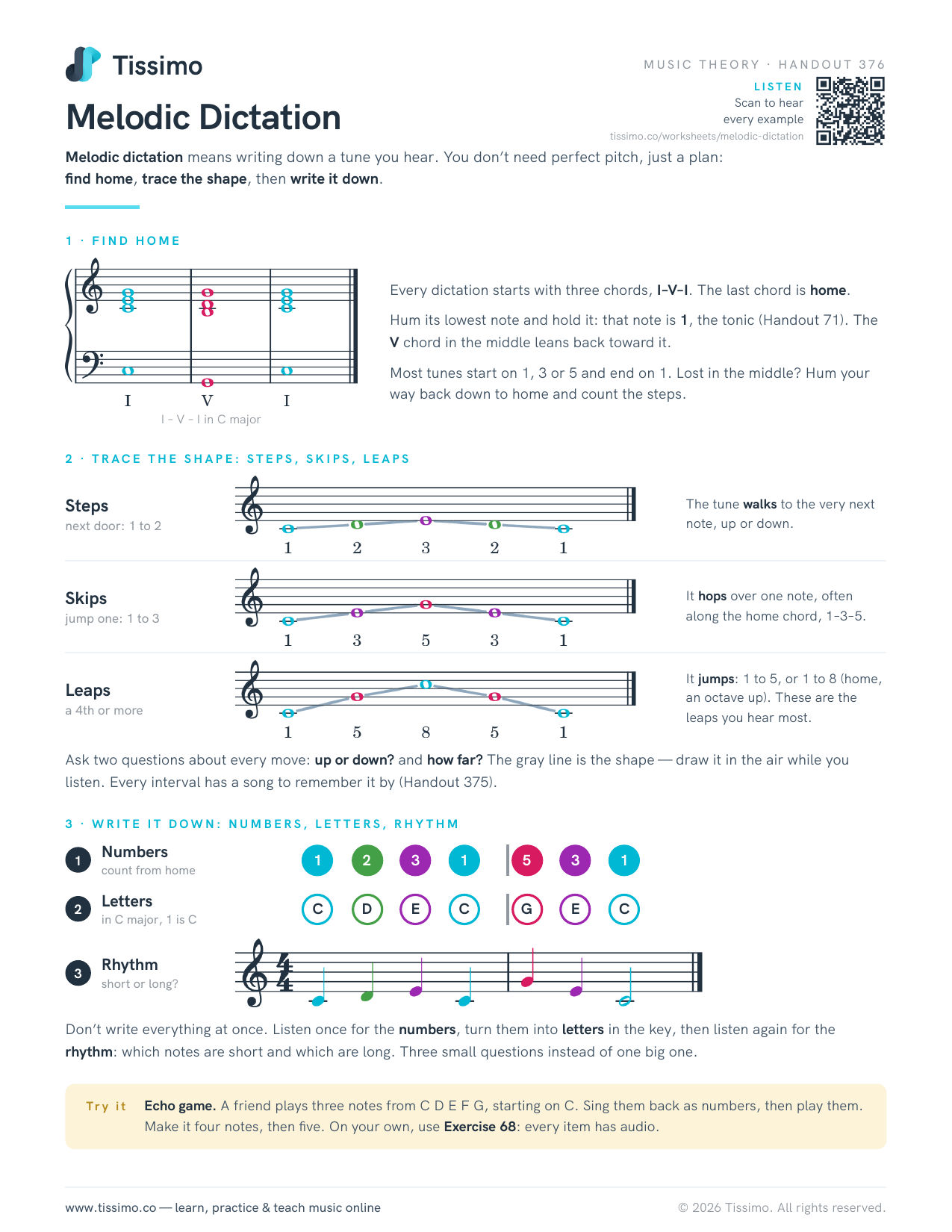
Melodic Dictation
Melodic dictation means writing down a tune you hear. You don’t need perfect pitch, just a plan: find home, trace the shape, then write it down.
Major Scale Primer
Chords & Harmony
Triads & their inversions
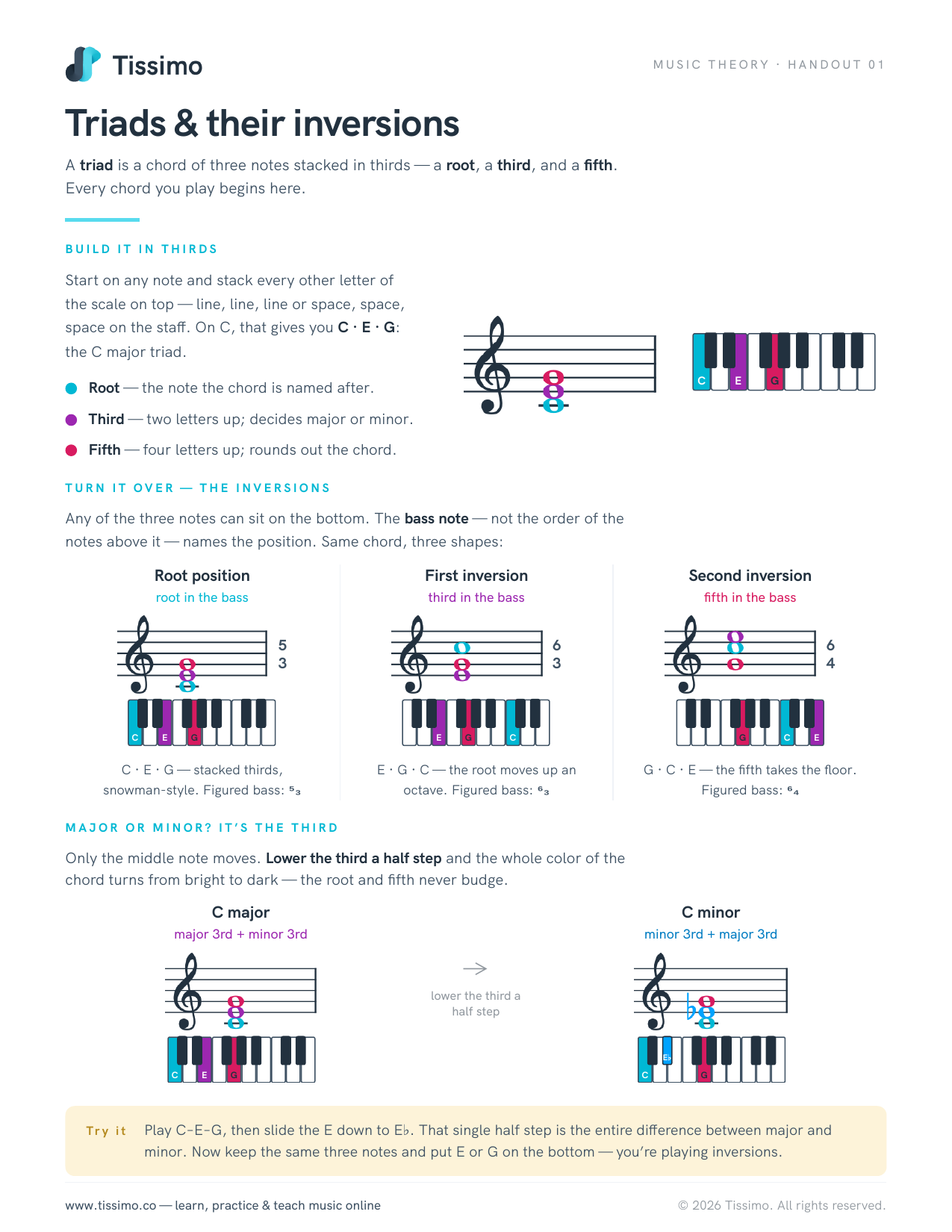
A triad is a chord of three notes stacked in thirds — a root, a third, and a fifth. Every chord you play begins here.
Tonic & dominant harmonies
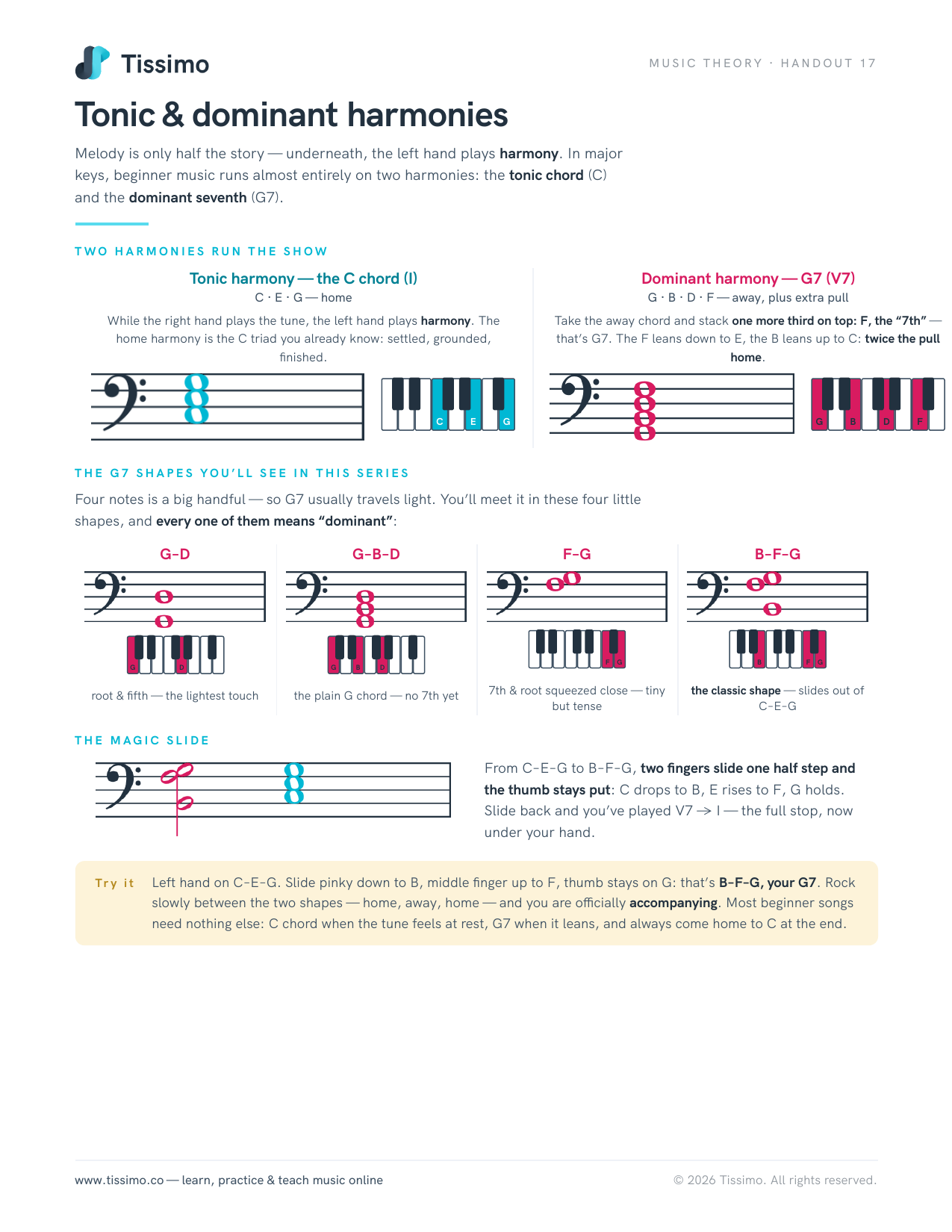
Melody is only half the story — underneath, the left hand plays harmony. In major keys, beginner music runs almost entirely on two harmonies: the tonic chord (C) and the dominant seventh (G7).
Tonic & dominant in G major
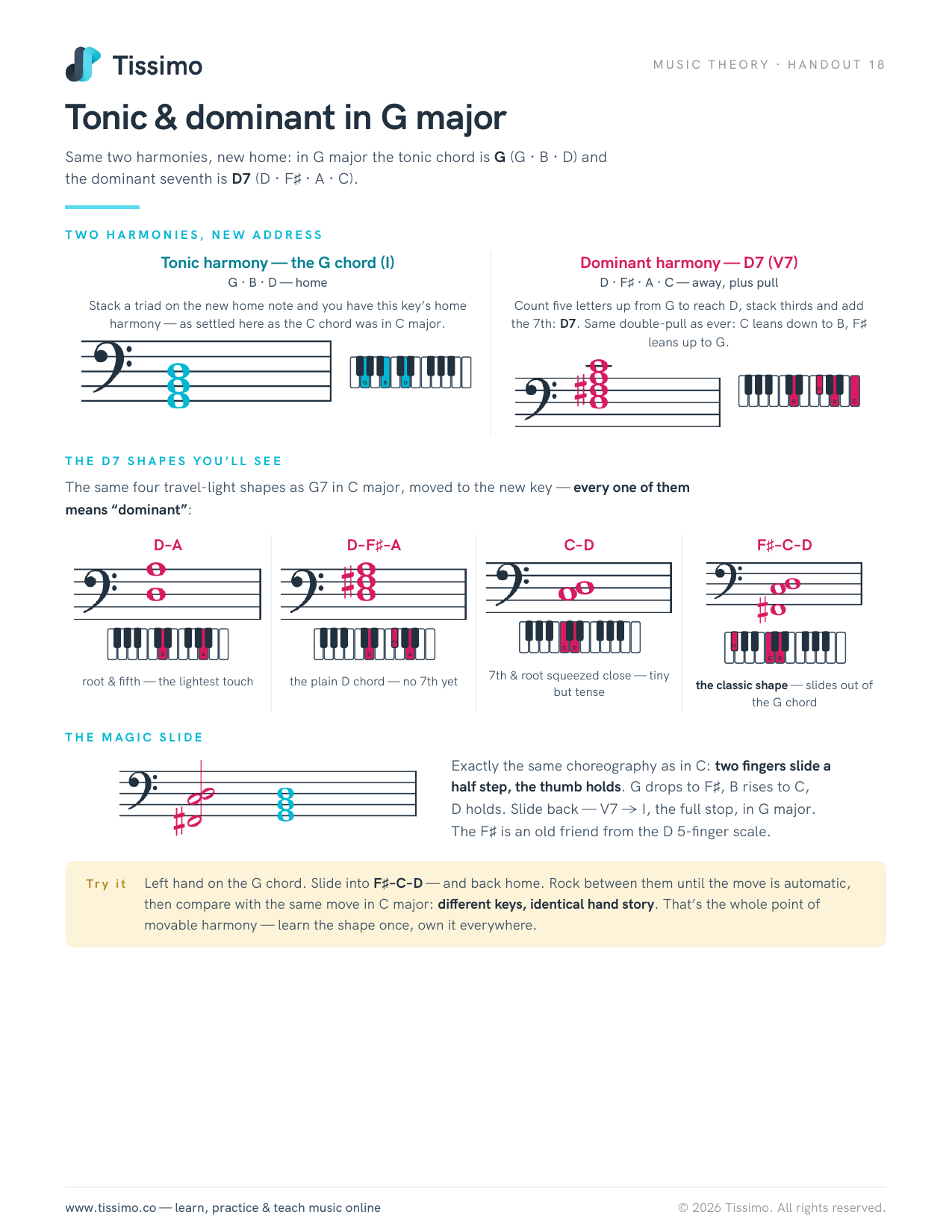
Same two harmonies, new home: in G major the tonic chord is G (G · B · D) and the dominant seventh is D7 (D · F♯ · A · C).
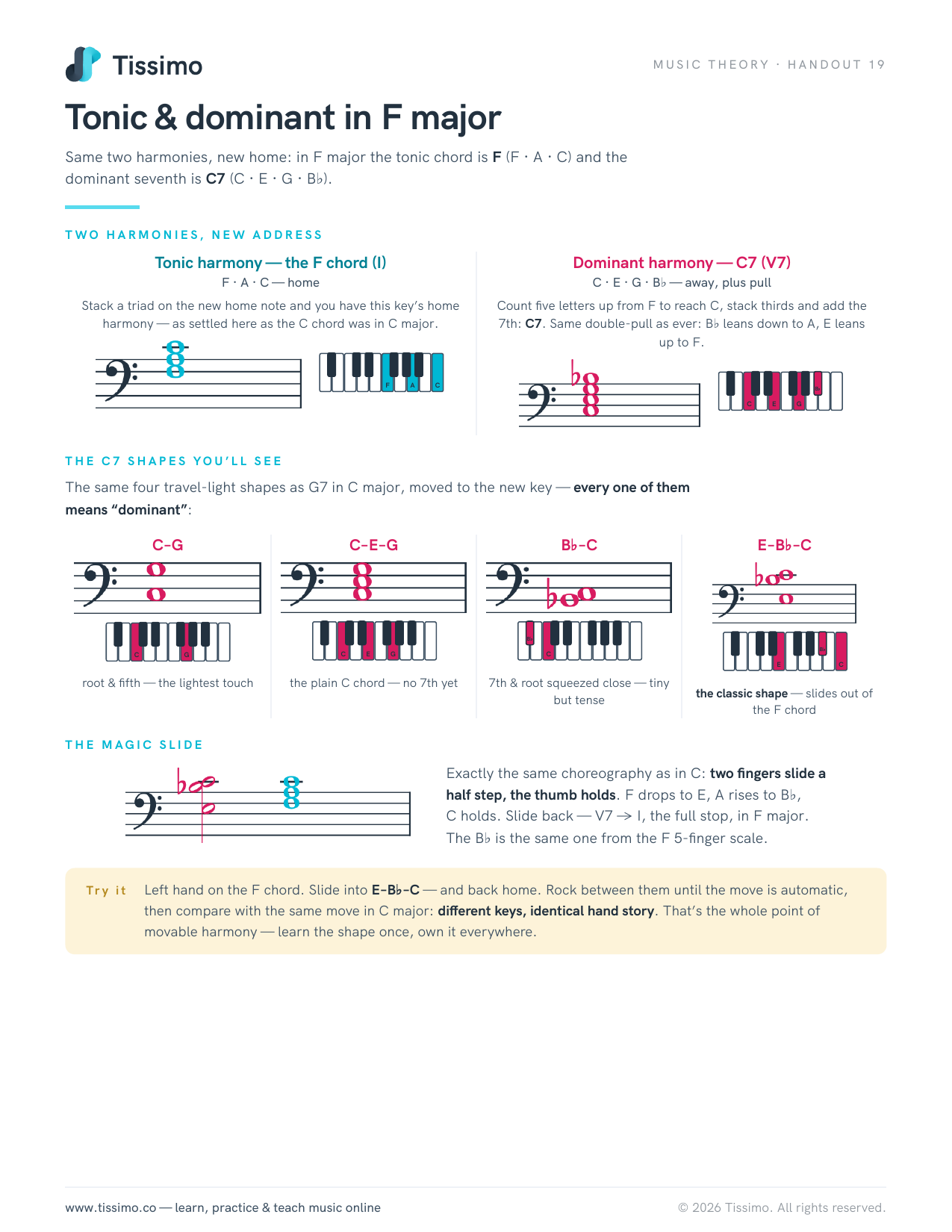
Tonic & dominant in F major
Same two harmonies, new home: in F major the tonic chord is F (F · A · C) and the dominant seventh is C7 (C · E · G · B♭).
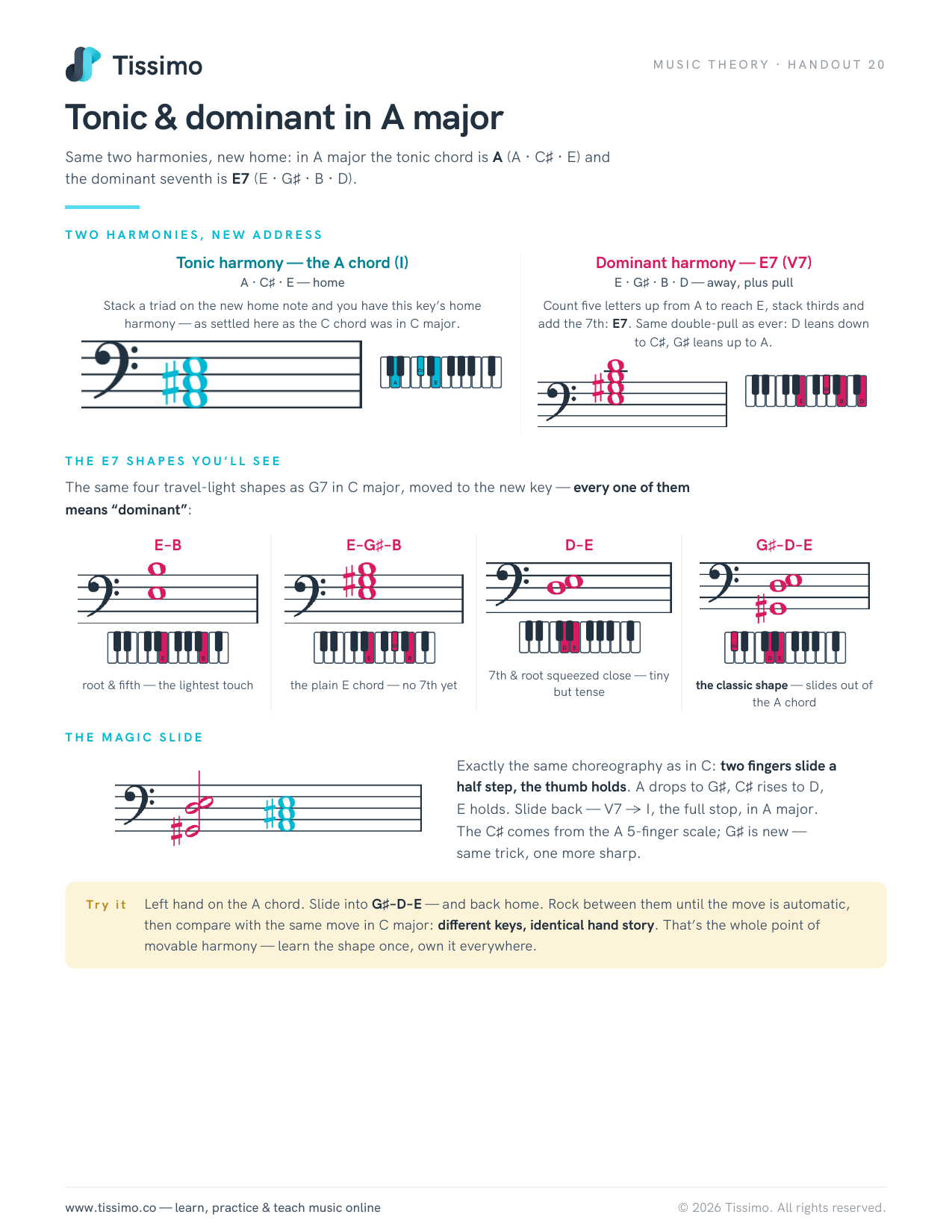
Tonic & dominant in A major
Same two harmonies, new home: in A major the tonic chord is A (A · C♯ · E) and the dominant seventh is E7 (E · G♯ · B · D).
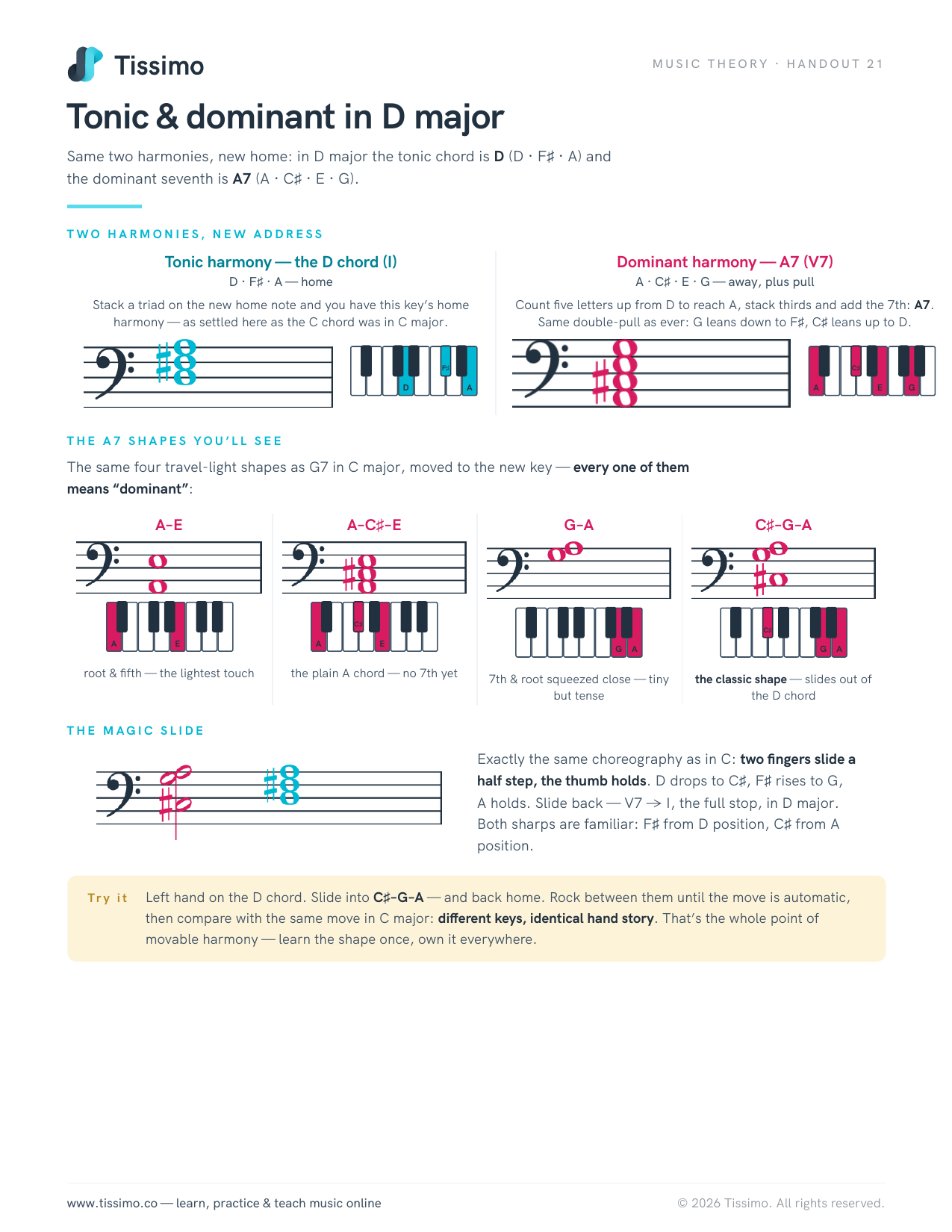
Tonic & dominant in D major
Same two harmonies, new home: in D major the tonic chord is D (D · F♯ · A) and the dominant seventh is A7 (A · C♯ · E · G).
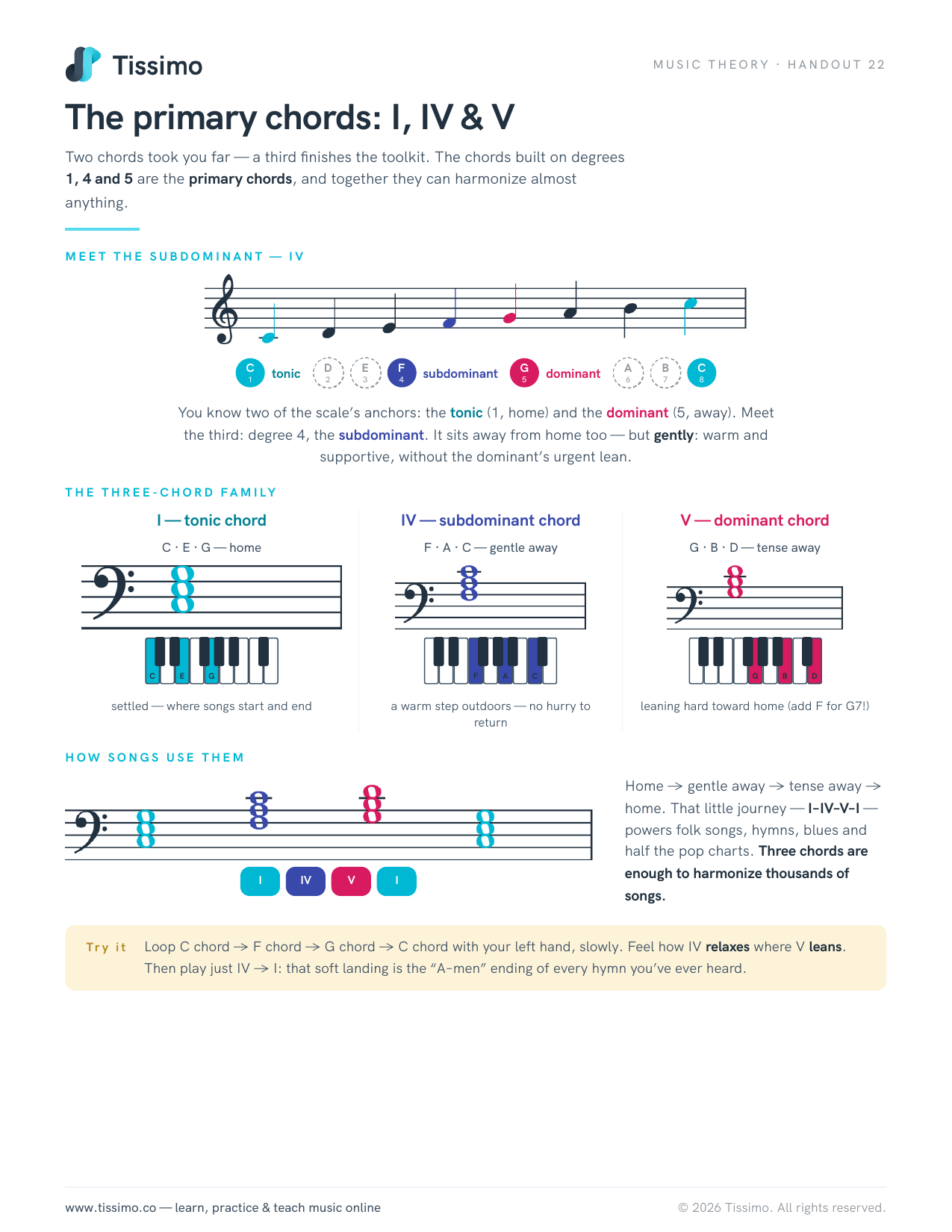
The primary chords: I, IV & V
Two chords took you far — a third finishes the toolkit. The chords built on degrees 1, 4 and 5 are the primary chords, and together they can harmonize almost anything.
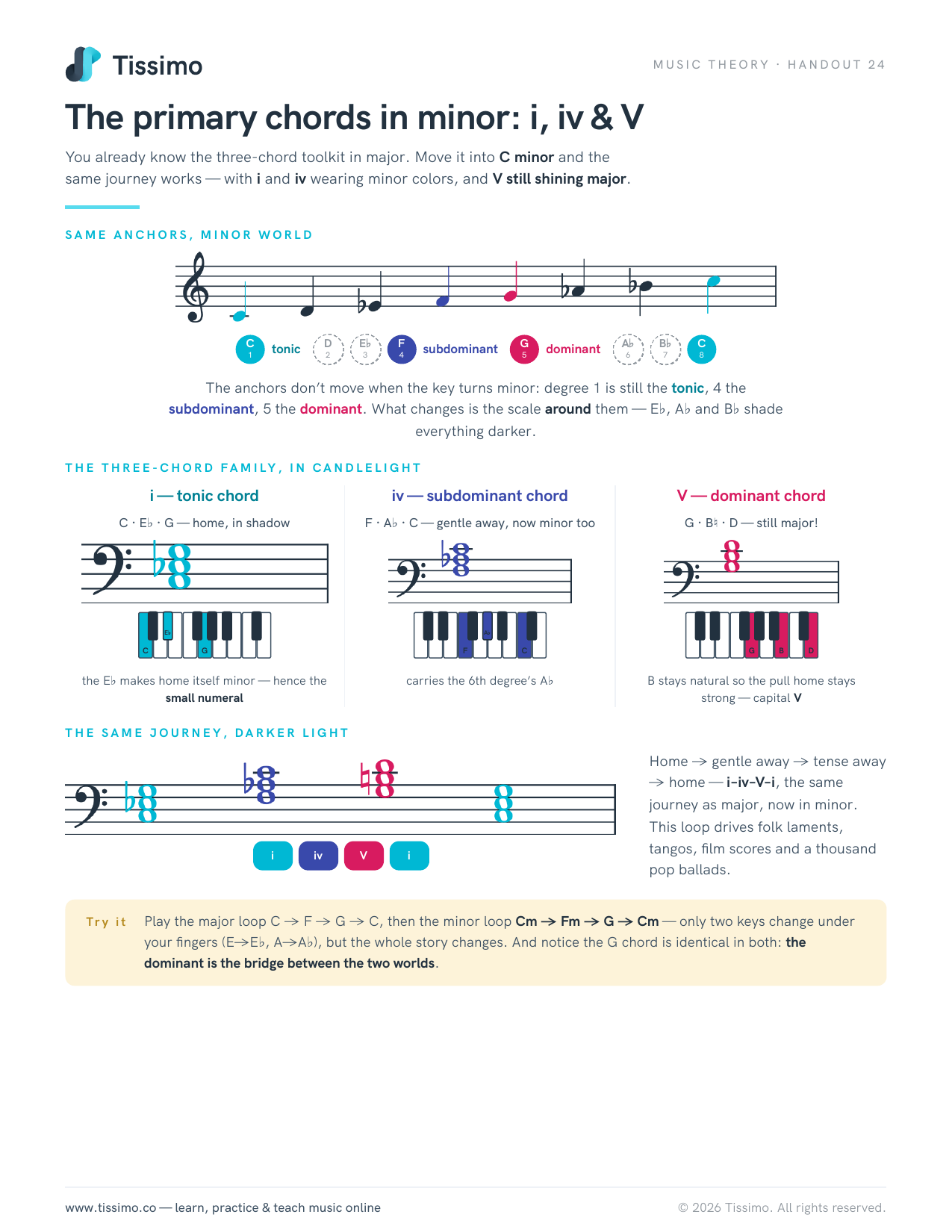
The primary chords in minor: i, iv & V
You already know the three-chord toolkit in major. Move it into C minor and the same journey works — with i and iv wearing minor colors, and V still shining major.
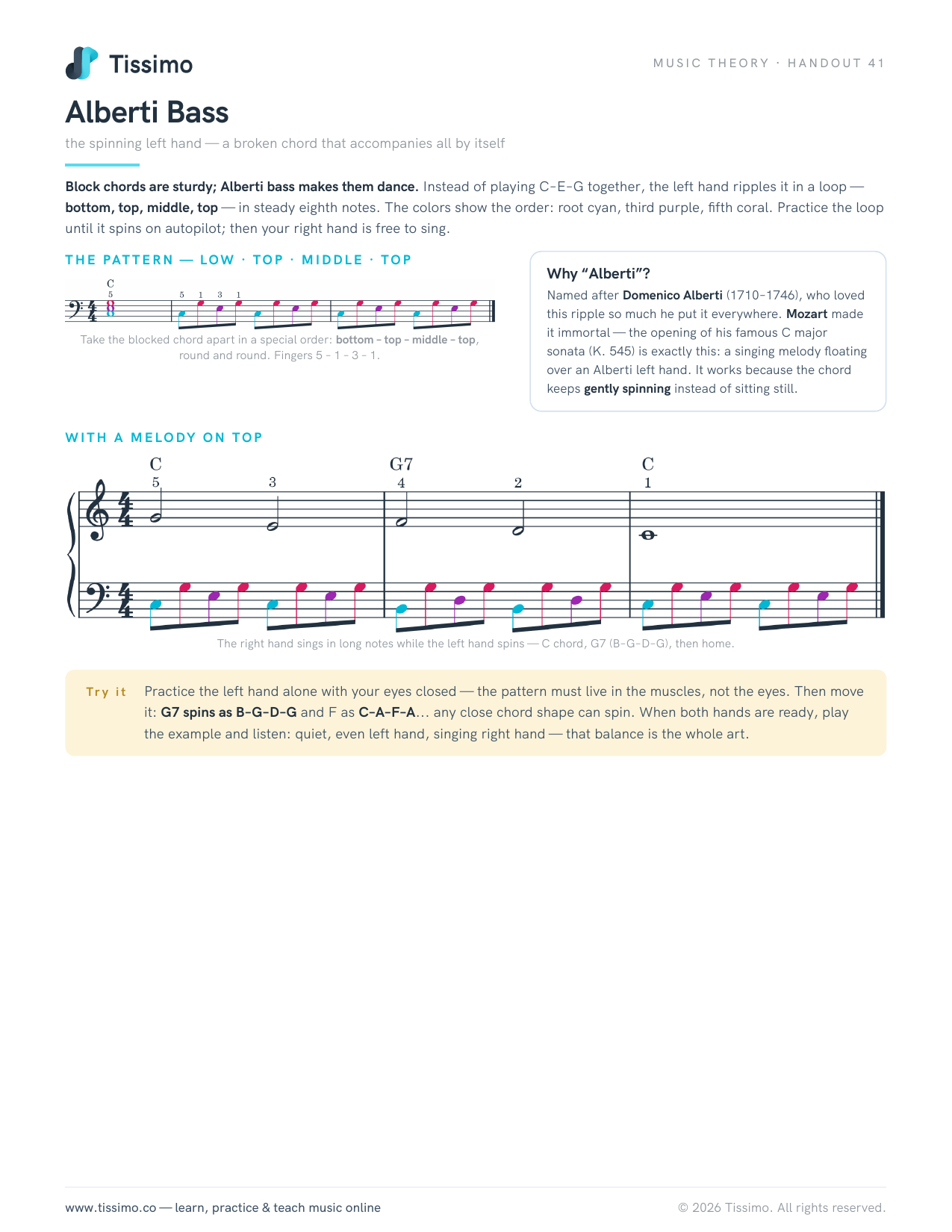
Alberti Bass
the spinning left hand — a broken chord that accompanies all by itself
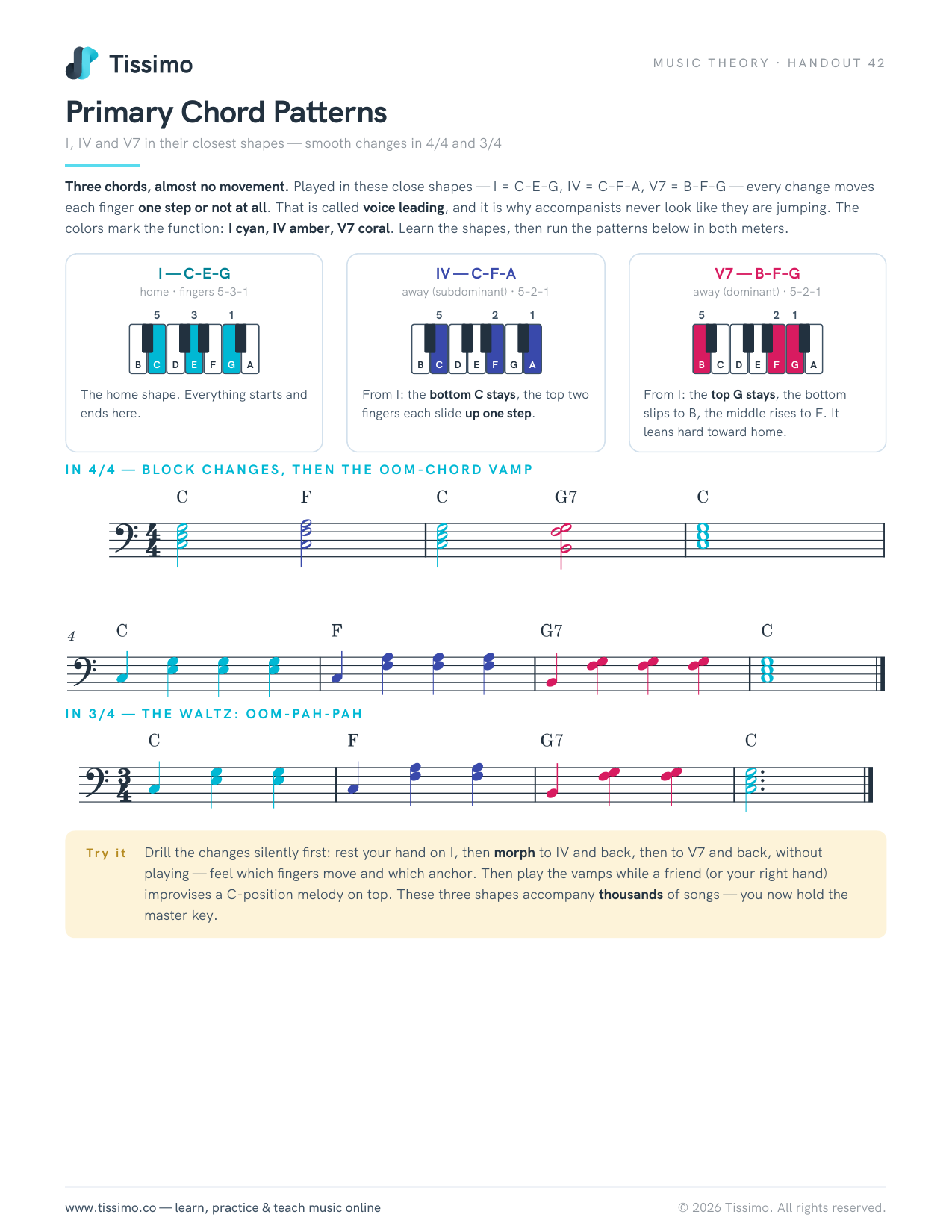
Primary Chord Patterns
I, IV and V7 in their closest shapes — smooth changes in 4/4 and 3/4
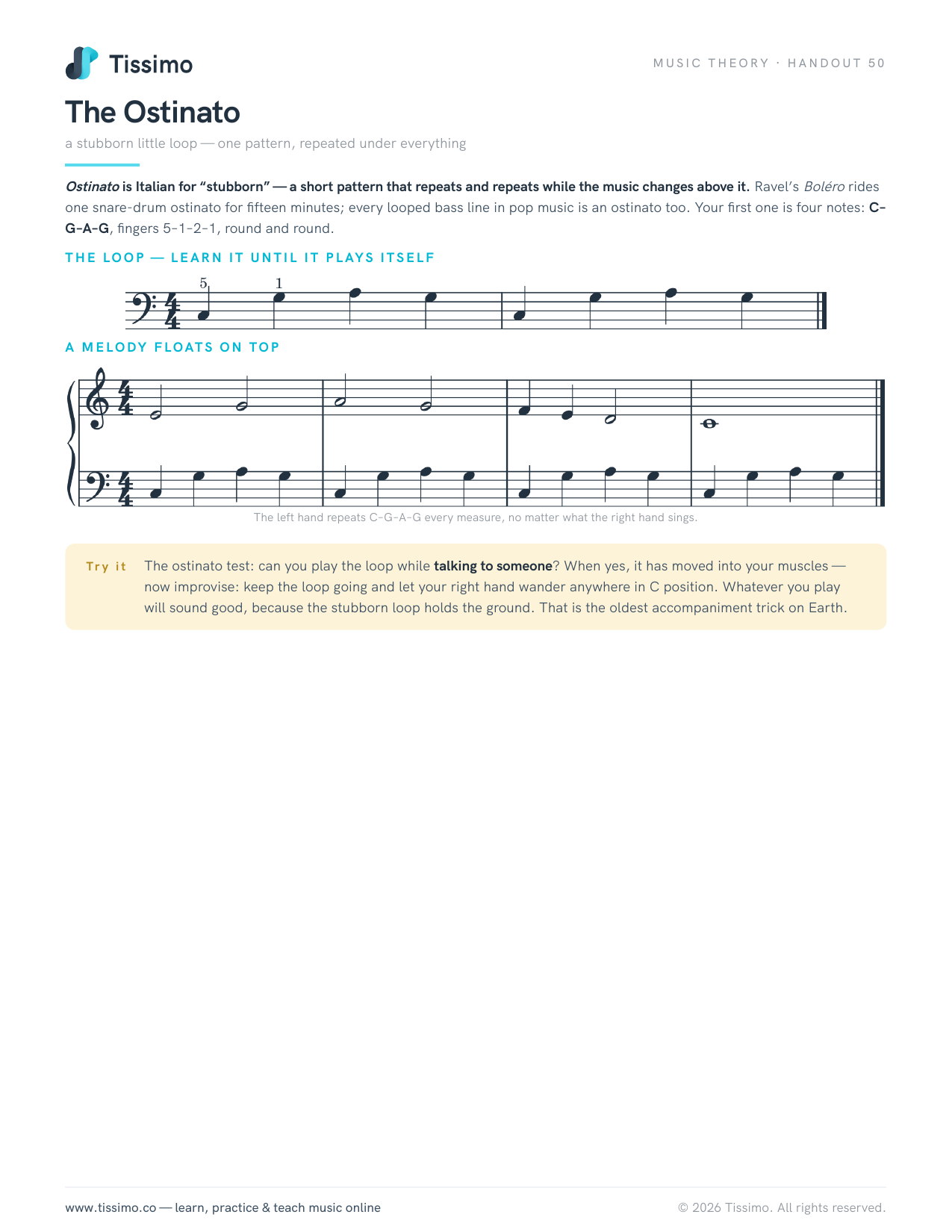
The Ostinato
a stubborn little loop — one pattern, repeated under everything
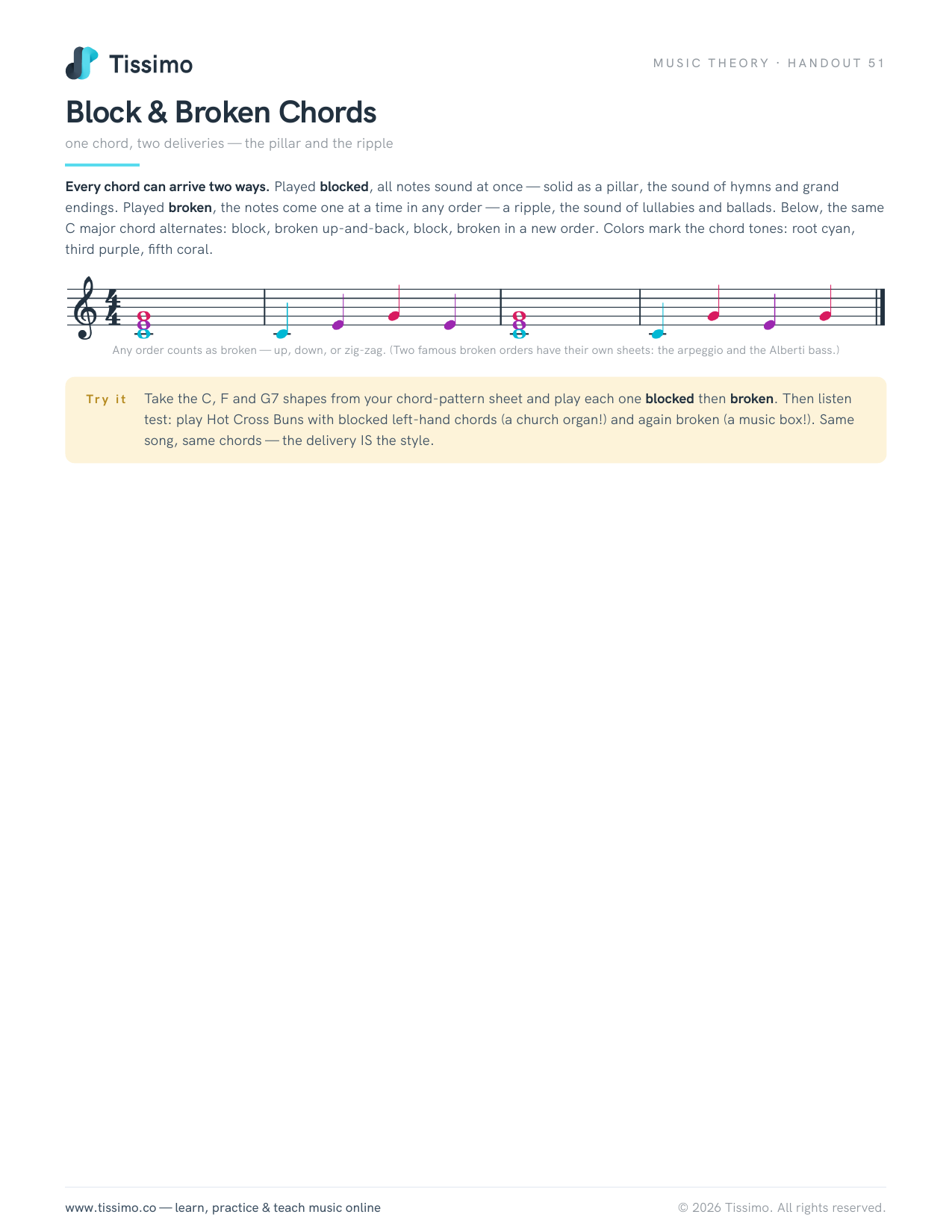
Block & Broken Chords
one chord, two deliveries — the pillar and the ripple
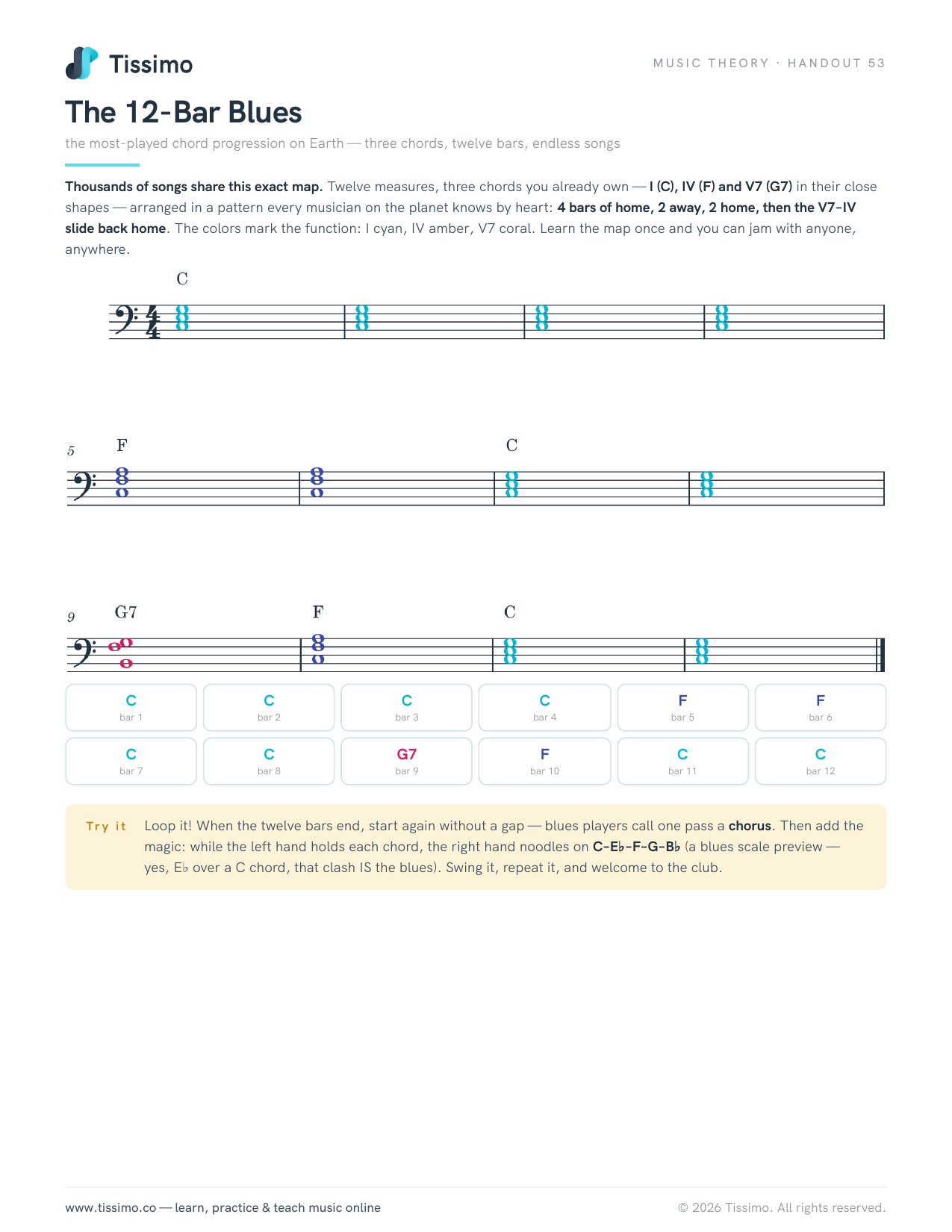
The 12-Bar Blues
one of the best-known chord progressions — three chords, twelve bars, endless songs
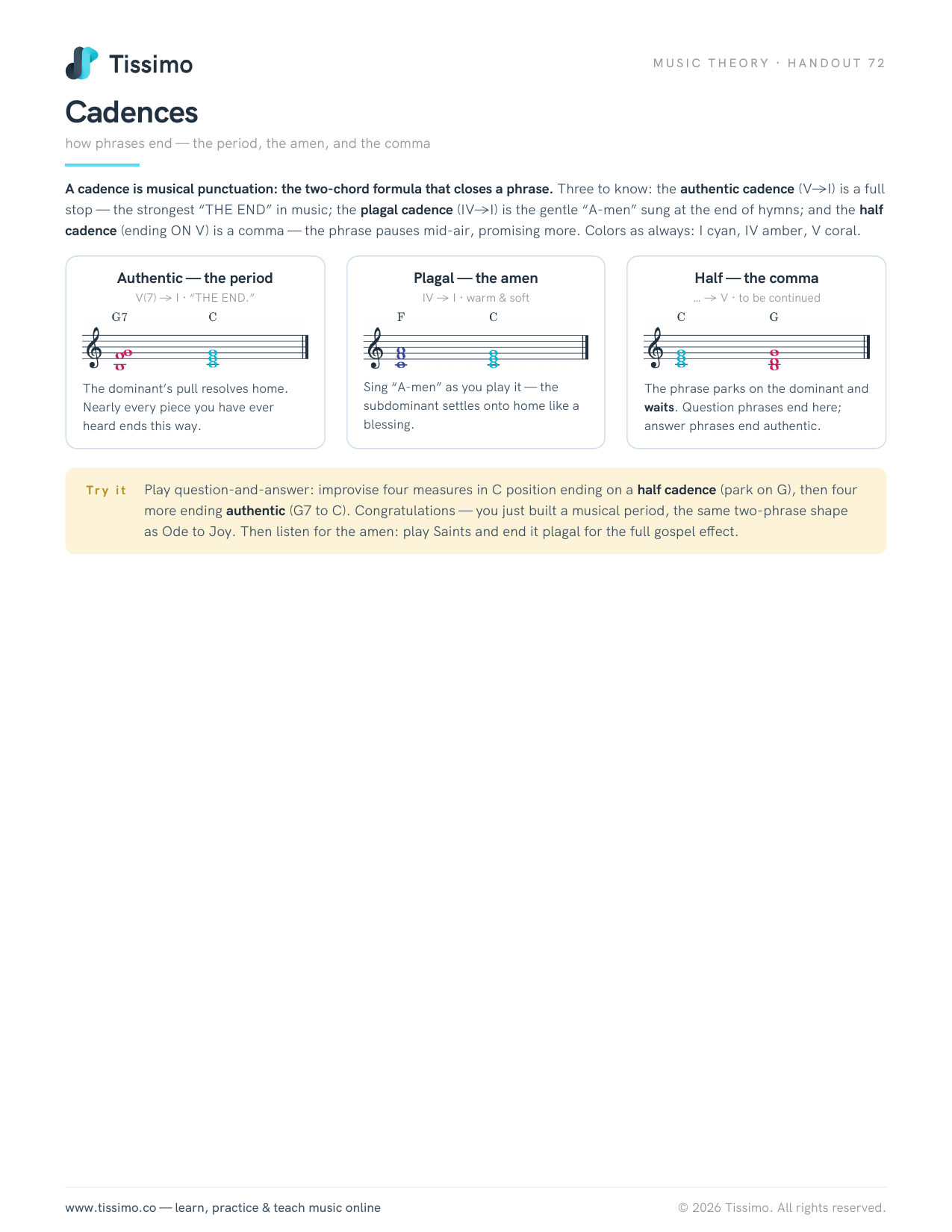
Cadences
how phrases end — the period, the amen, and the comma
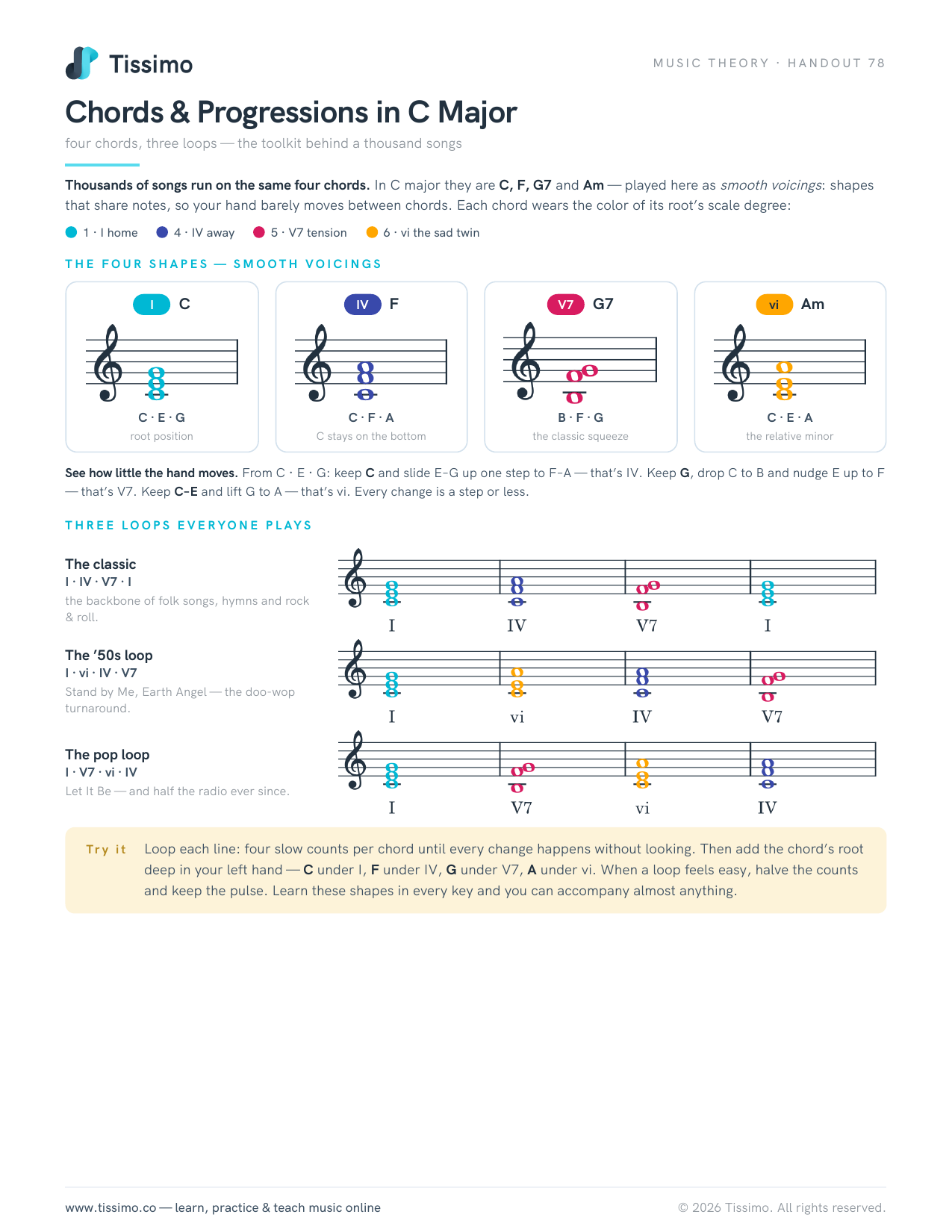
Chords & Progressions in Every Key
Four chords, three loops — the toolkit behind a thousand songs, in all 24 keys.
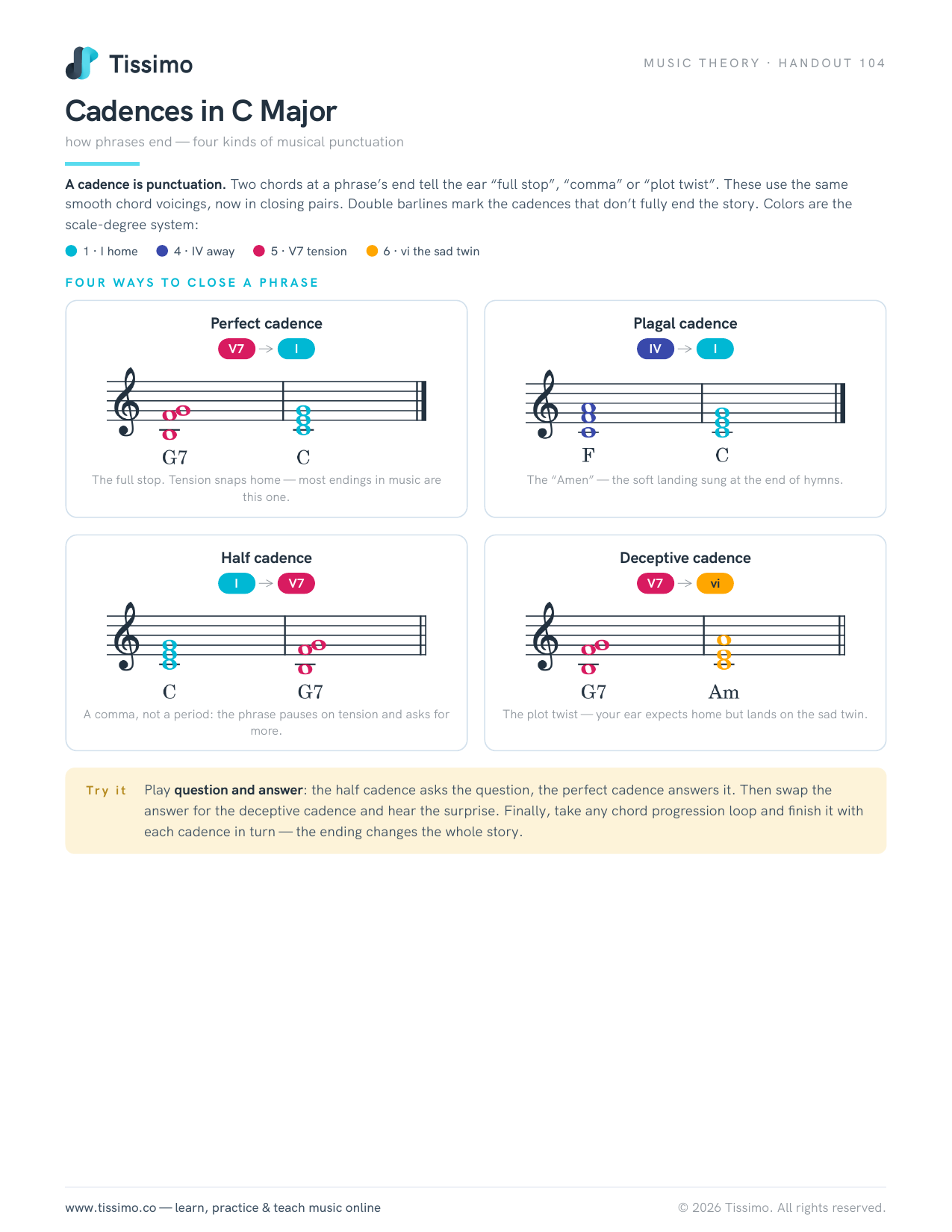
Cadences in Every Key
How phrases end — the four kinds of musical punctuation, written out in all 24 keys.
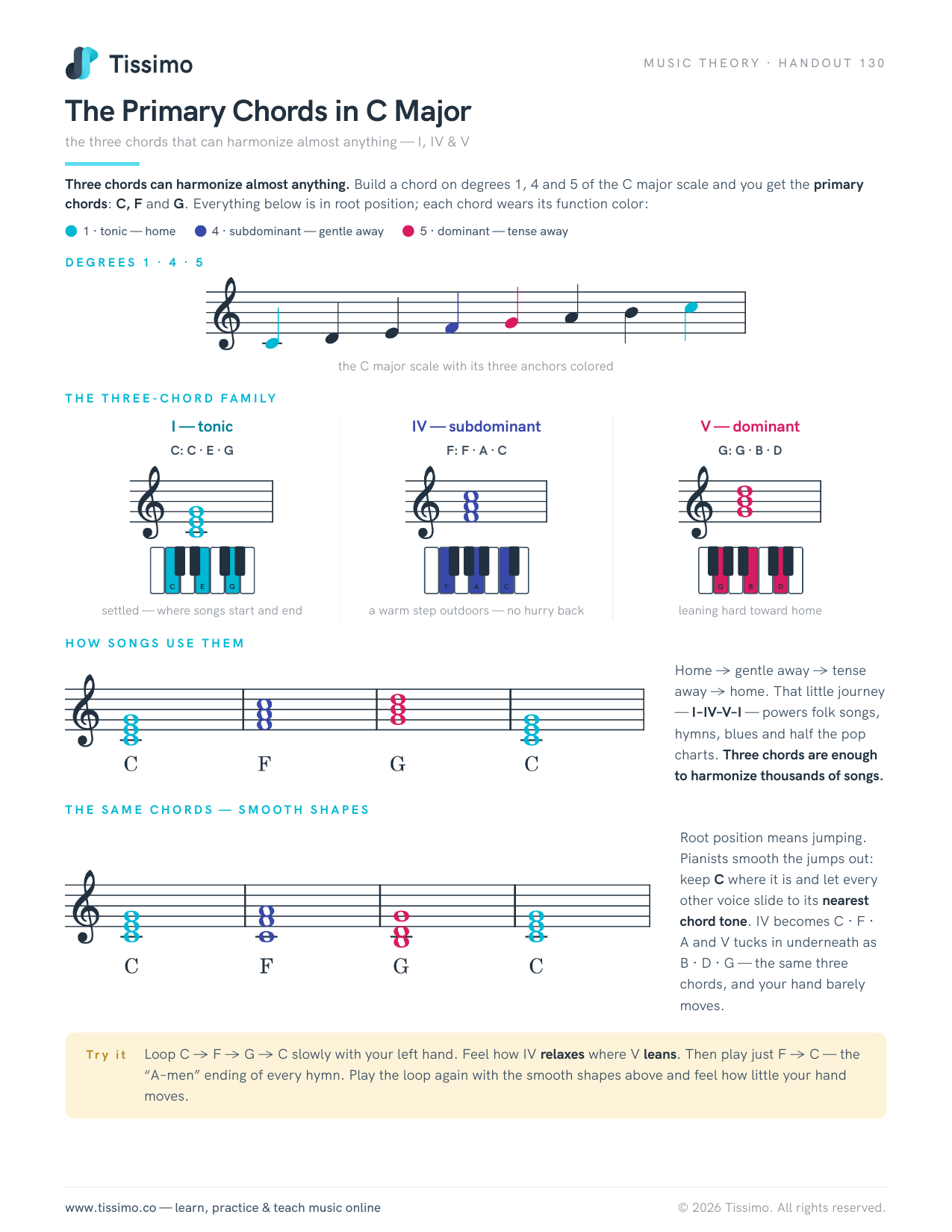
The Primary Chords in Every Key
I, IV and V — the three chords that can harmonize almost anything, in all 24 keys.
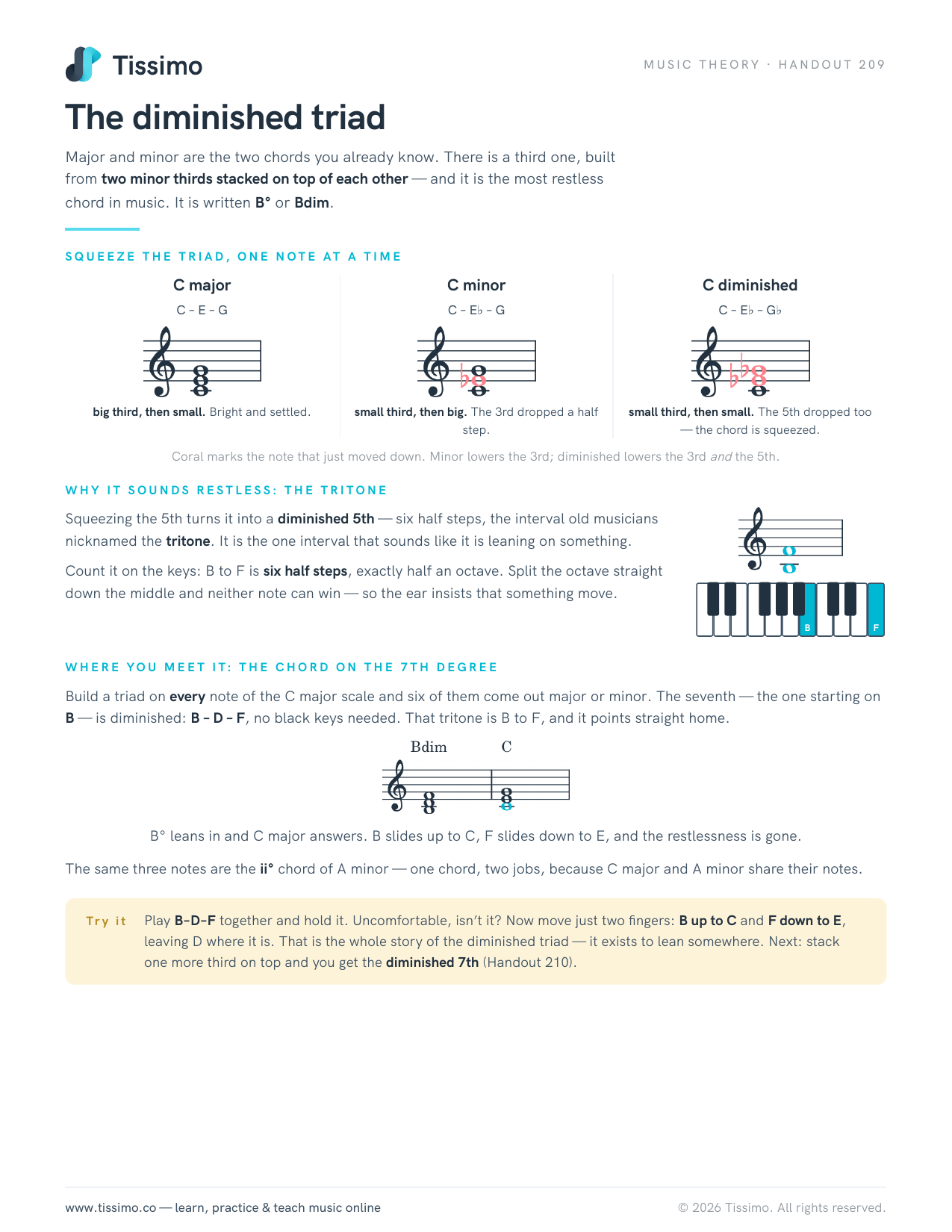
The diminished triad
Major and minor are the two chords you already know. There is a third one, built from two minor thirds stacked on top of each other — and it is the most restless chord in music. It is written B° or Bdim.
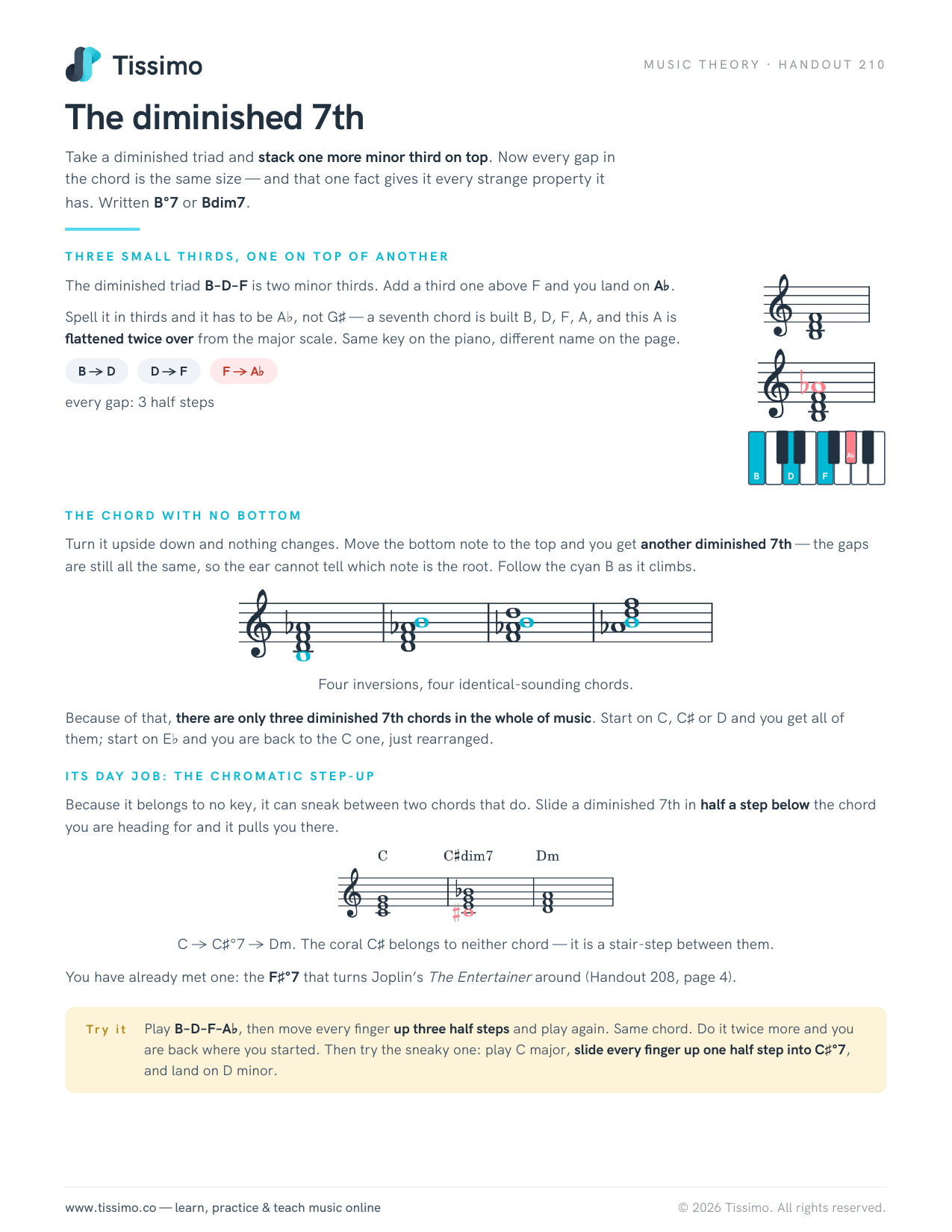
The diminished 7th
Take a diminished triad and stack one more minor third on top. Now every gap in the chord is the same size — and that one fact gives it every strange property it has. Written B°7 or Bdim7.
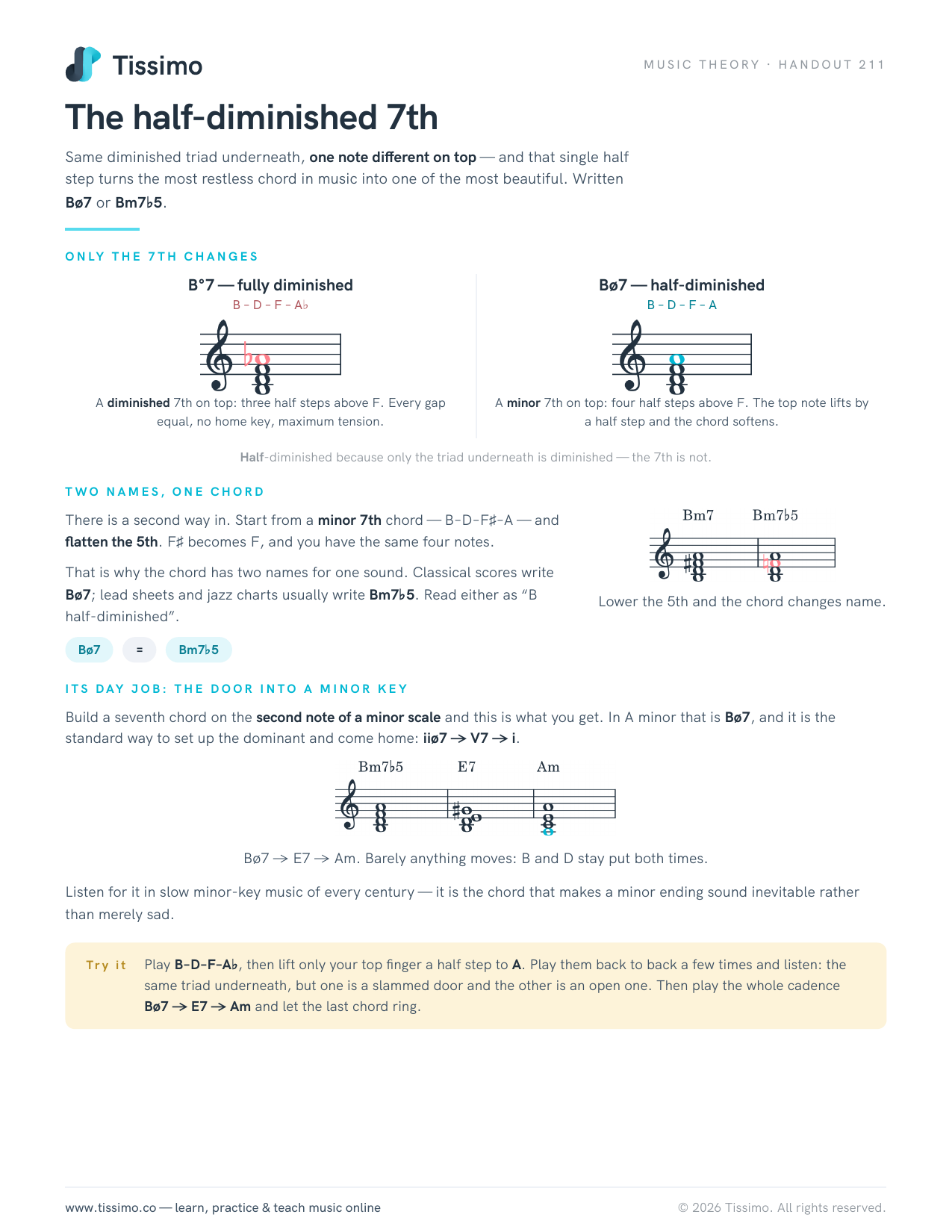
The half-diminished 7th
Same diminished triad underneath, one note different on top — and that single half step turns the most restless chord in music into one of the most beautiful. Written Bø7 or Bm7♭5.
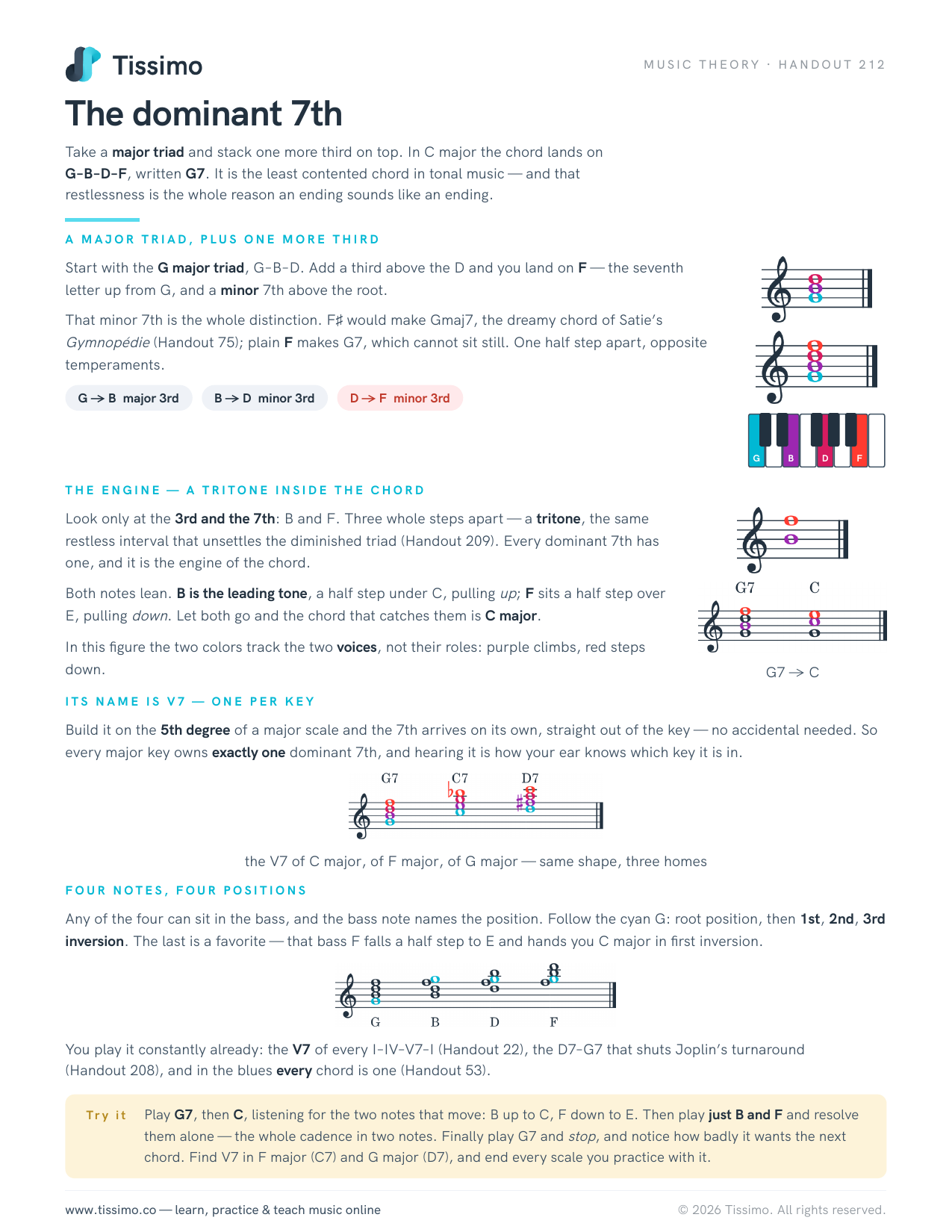
The dominant 7th
Take a major triad and stack one more third on top. In C major the chord lands on G–B–D–F, written G7. It is the least contented chord in tonal music — and that restlessness is the whole reason an ending sounds like an ending.
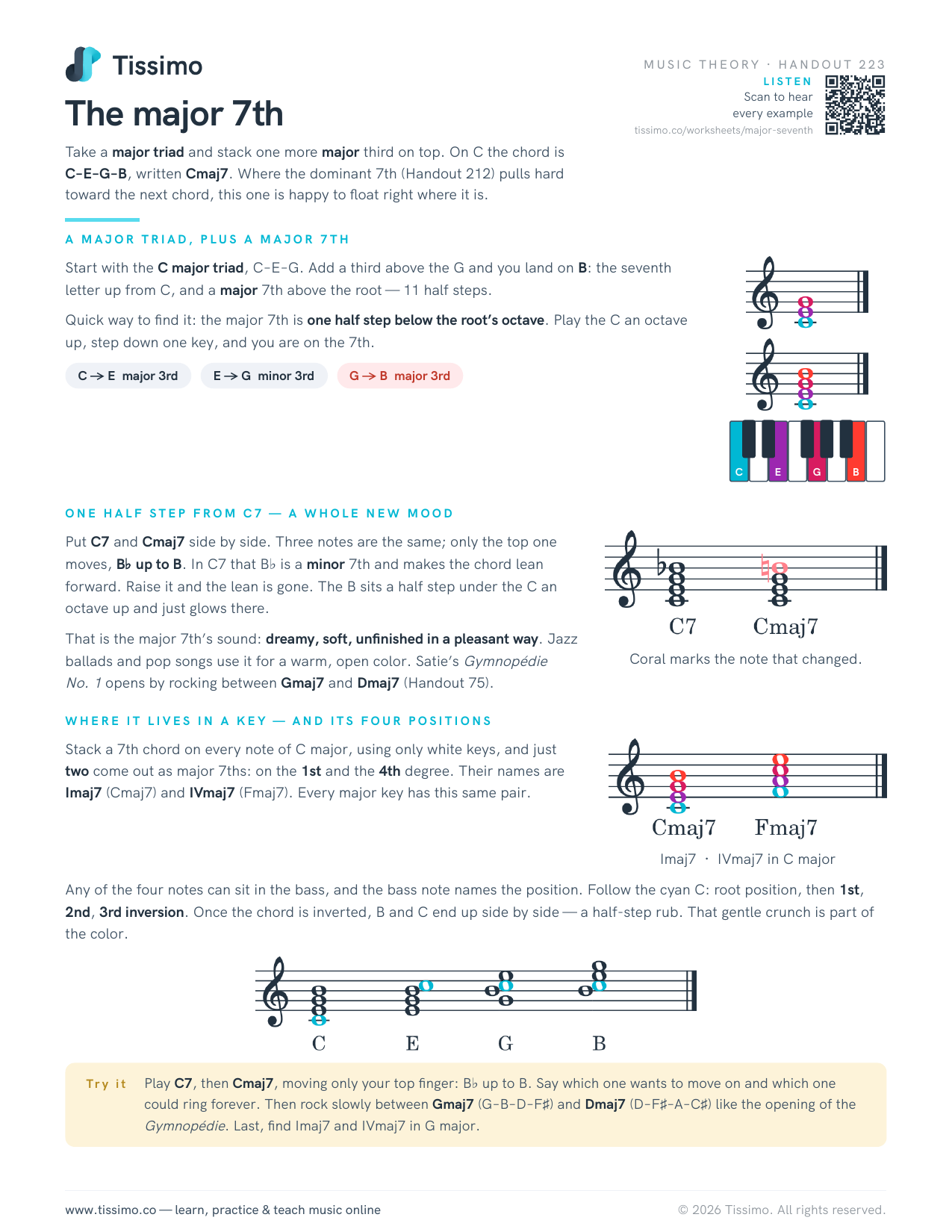
The major 7th
Take a major triad and stack one more major third on top. On C the chord is C–E–G–B, written Cmaj7. Where the dominant 7th (Handout 212) pulls hard toward the next chord, this one is happy to float right where it is.
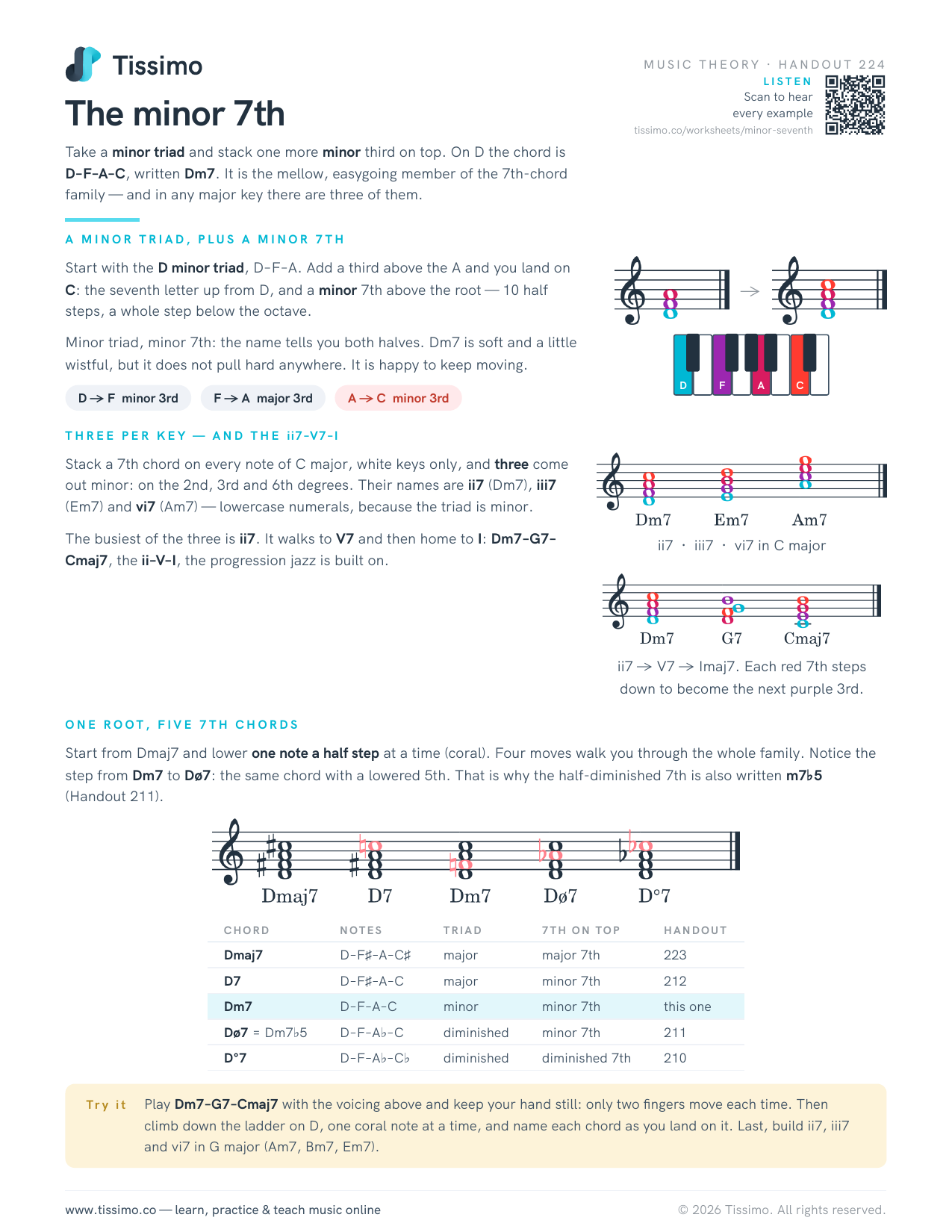
The minor 7th
Take a minor triad and stack one more minor third on top. On D the chord is D–F–A–C, written Dm7. It is the mellow, easygoing member of the 7th-chord family — and in any major key there are three of them.
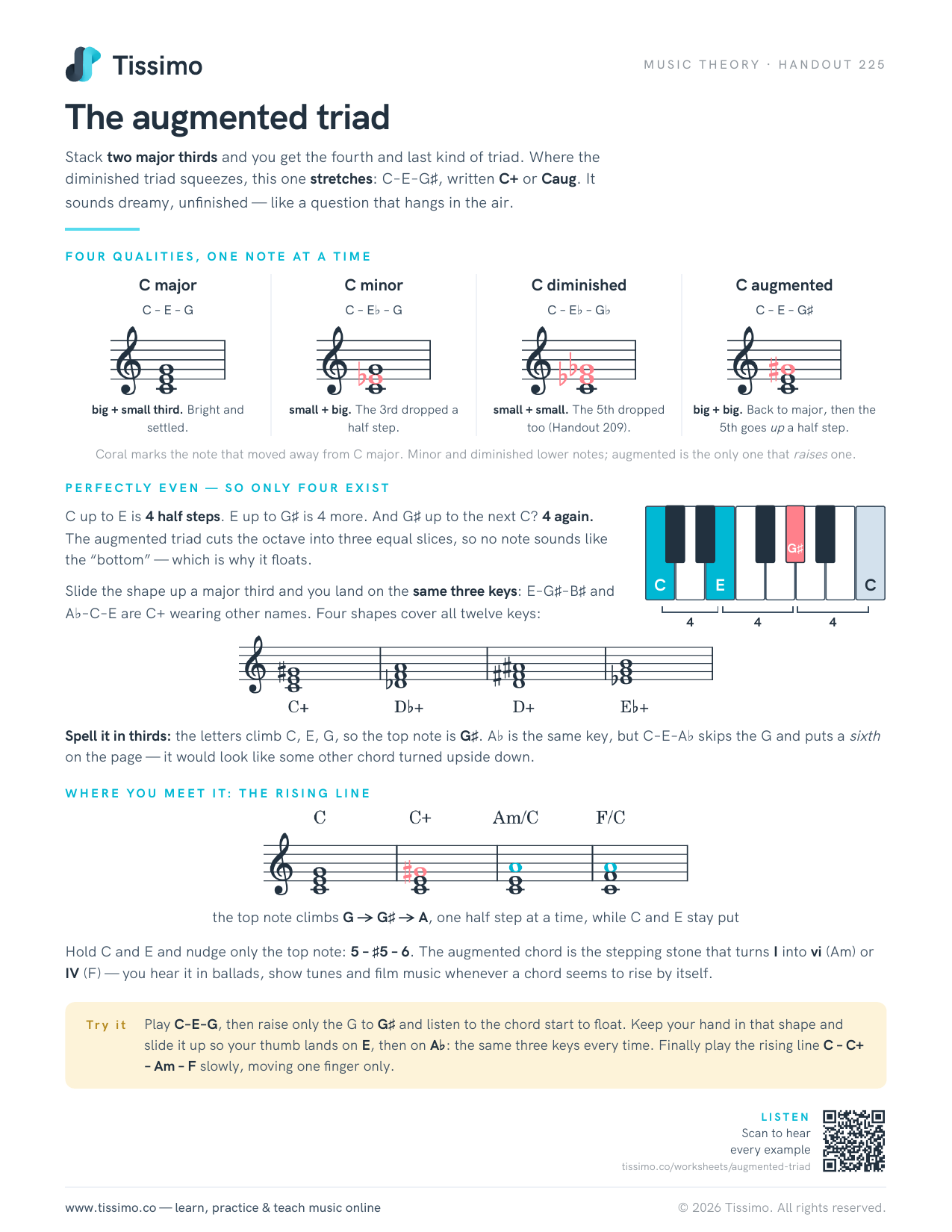
The augmented triad
Stack two major thirds and you get the fourth and last kind of triad. Where the diminished triad squeezes, this one stretches: C–E–G♯, written C+ or Caug. It sounds dreamy, unfinished — like a question that hangs in the air.
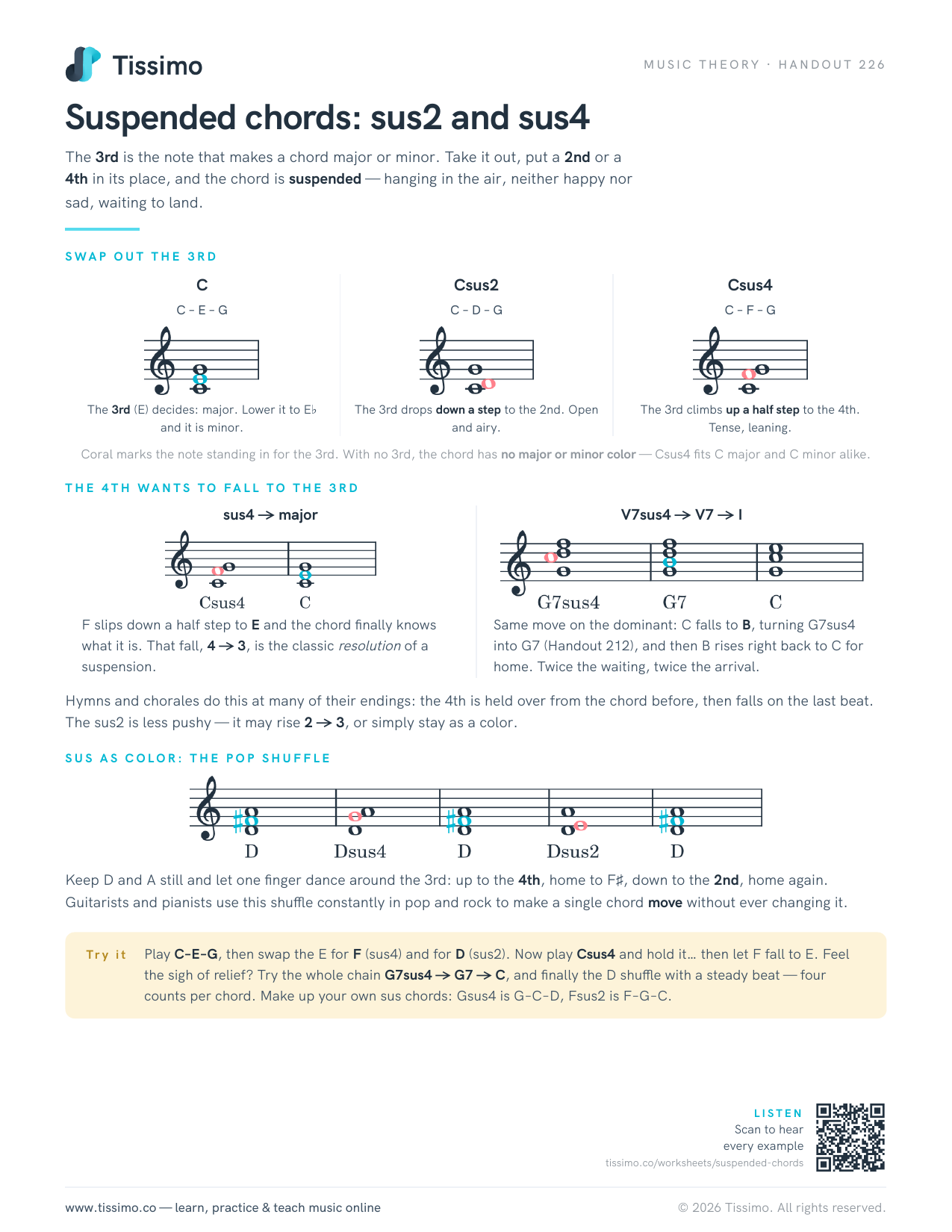
Suspended chords: sus2 and sus4
The 3rd is the note that makes a chord major or minor. Take it out, put a 2nd or a 4th in its place, and the chord is suspended — hanging in the air, neither happy nor sad, waiting to land.
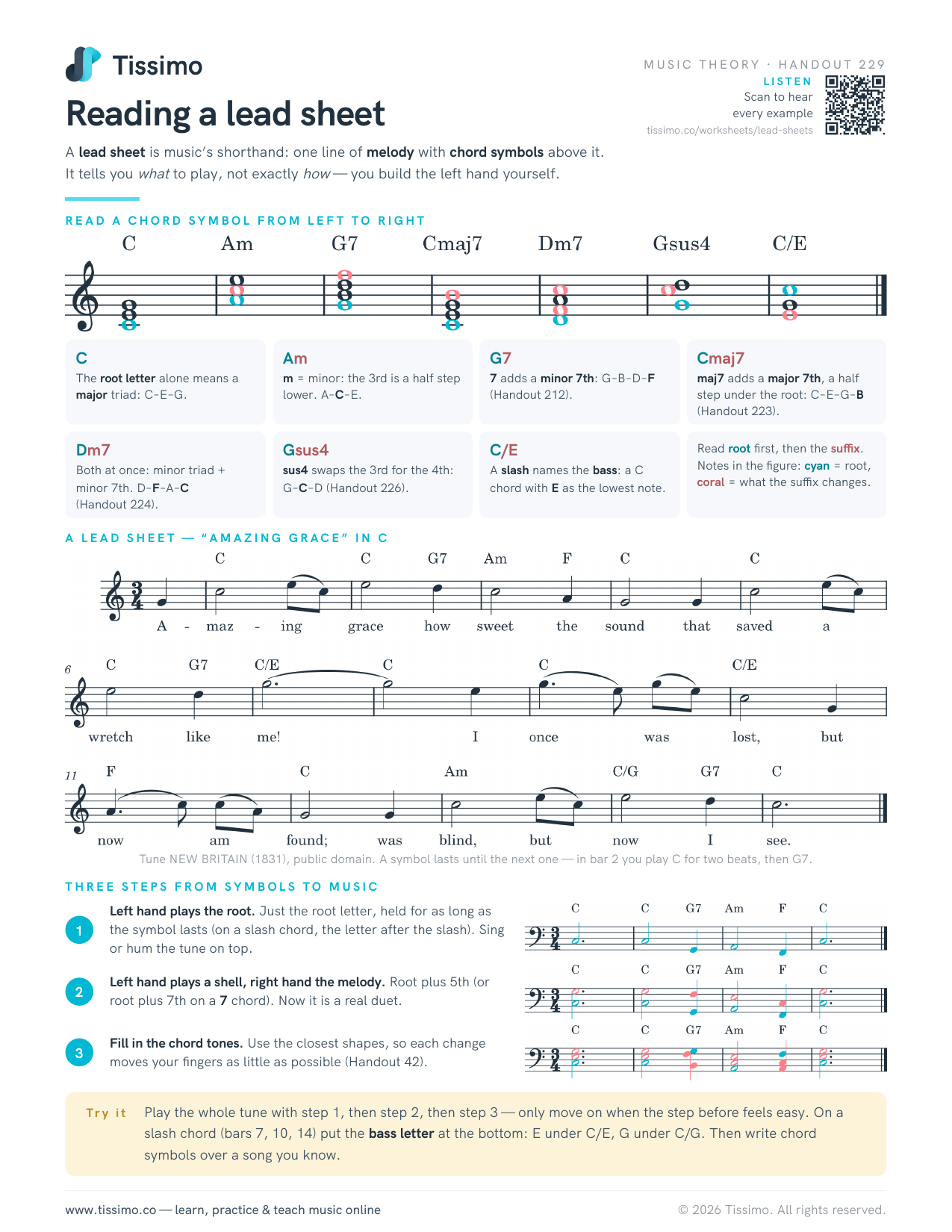
Reading a lead sheet
A lead sheet is music’s shorthand: one line of melody with chord symbols above it. It tells you what to play, not exactly how — you build the left hand yourself.
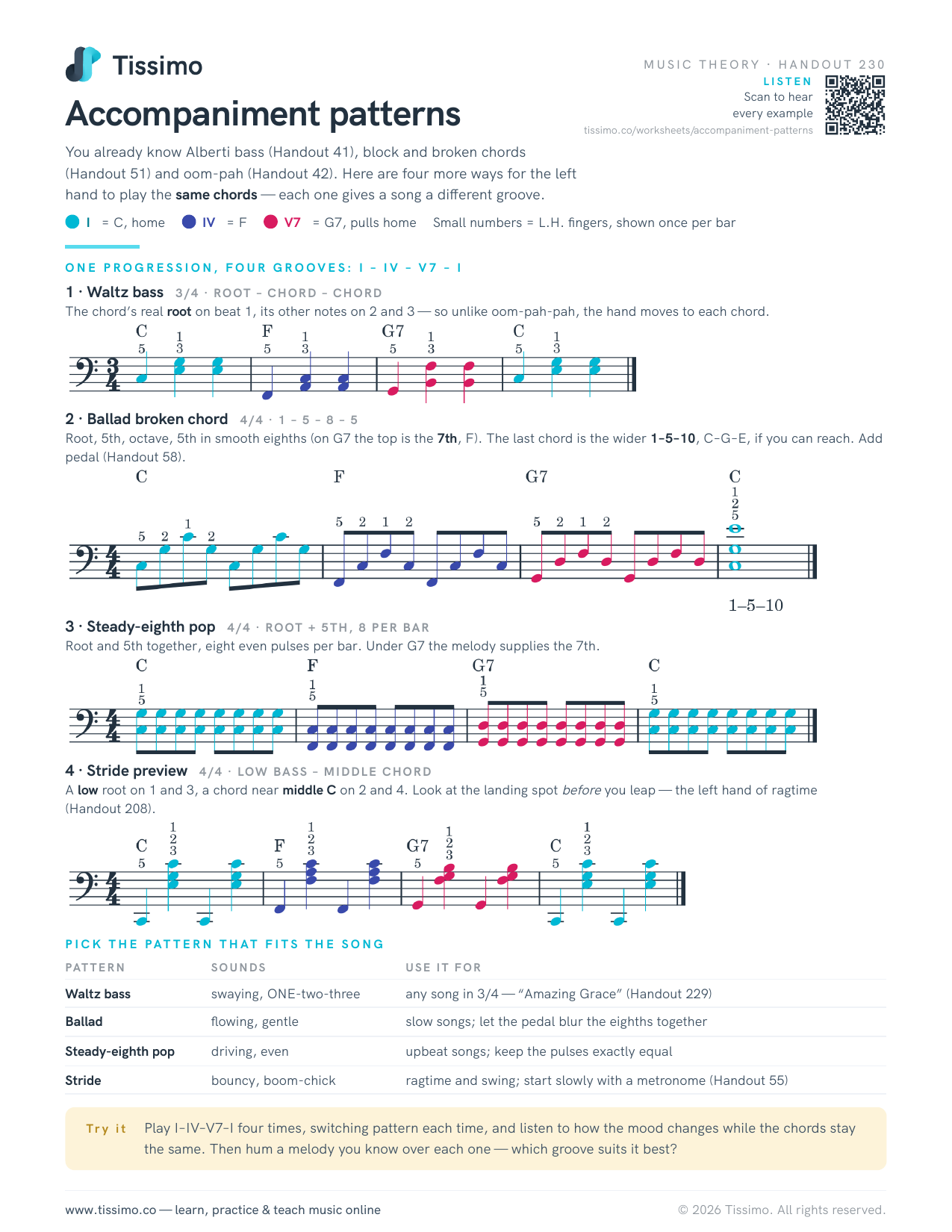
Accompaniment patterns
You already know Alberti bass (Handout 41), block and broken chords (Handout 51) and oom-pah (Handout 42). Here are four more ways for the left hand to play the same chords — each one gives a song a different groove.
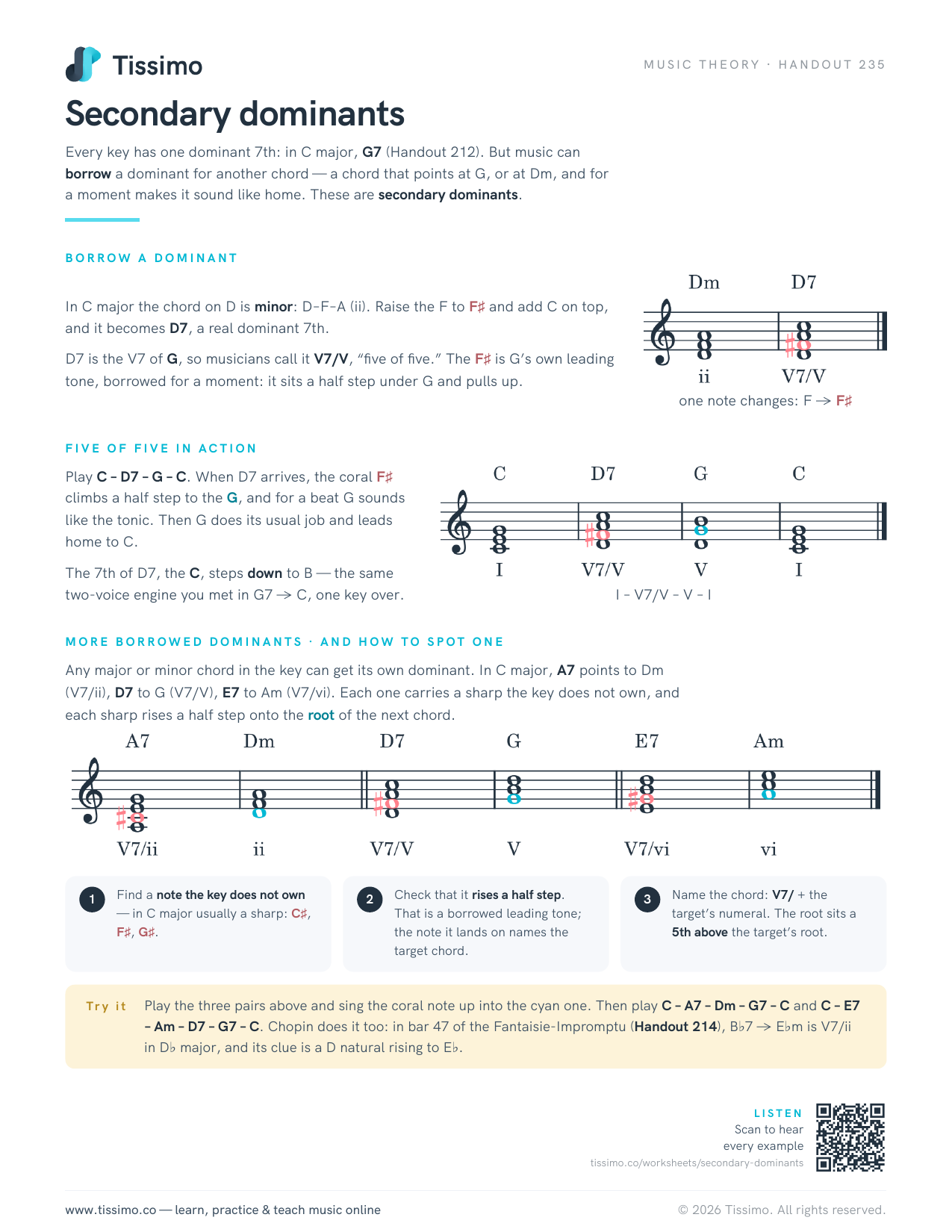
Secondary dominants
Every key has one dominant 7th: in C major, G7 (Handout 212). But music can borrow a dominant for another chord — a chord that points at G, or at Dm, and for a moment makes it sound like home. These are secondary dominants. (Borrowing a chord from the parallel minor is different: Handout 384.)
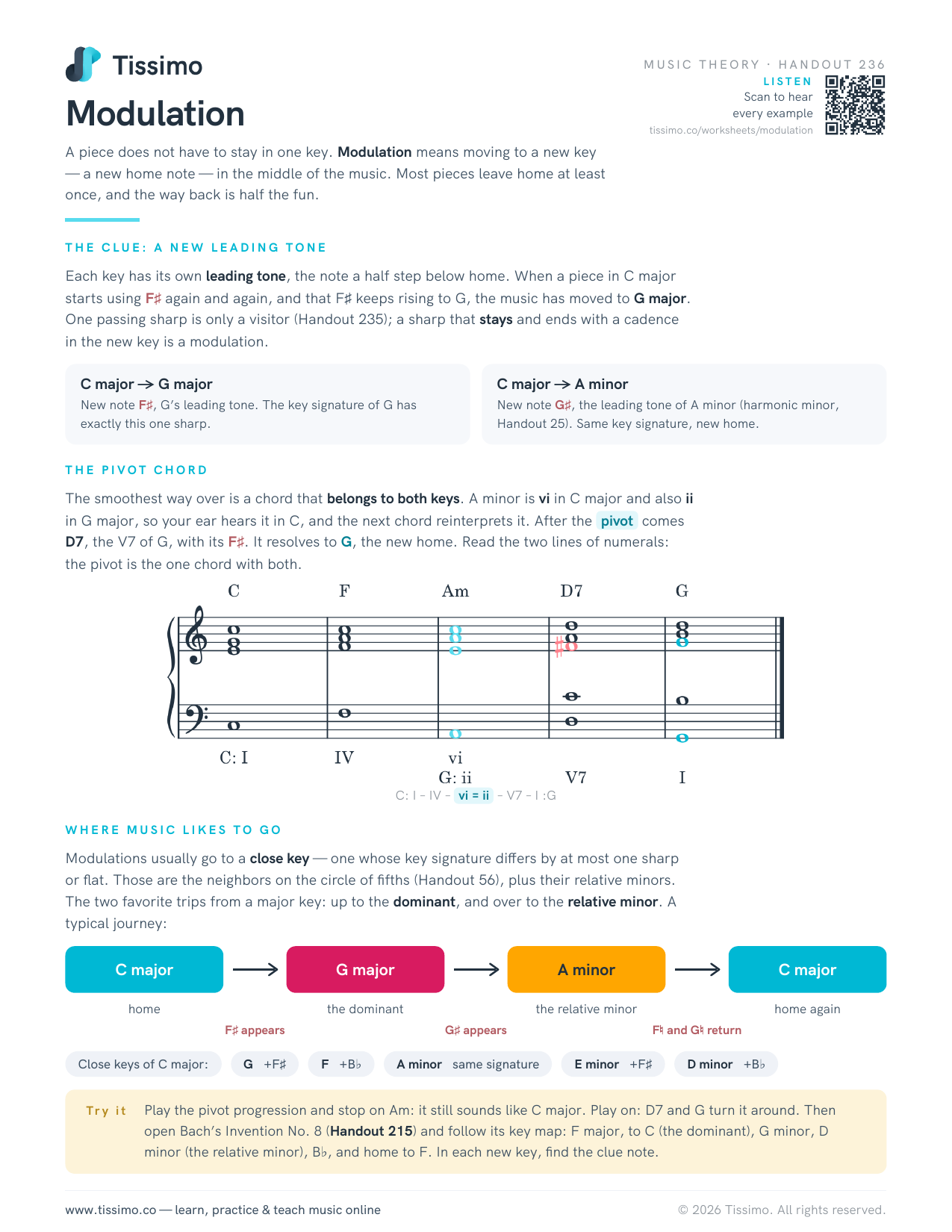
Modulation
A piece does not have to stay in one key. Modulation means moving to a new key — a new home note — in the middle of the music. Most pieces leave home at least once, and the way back is half the fun.
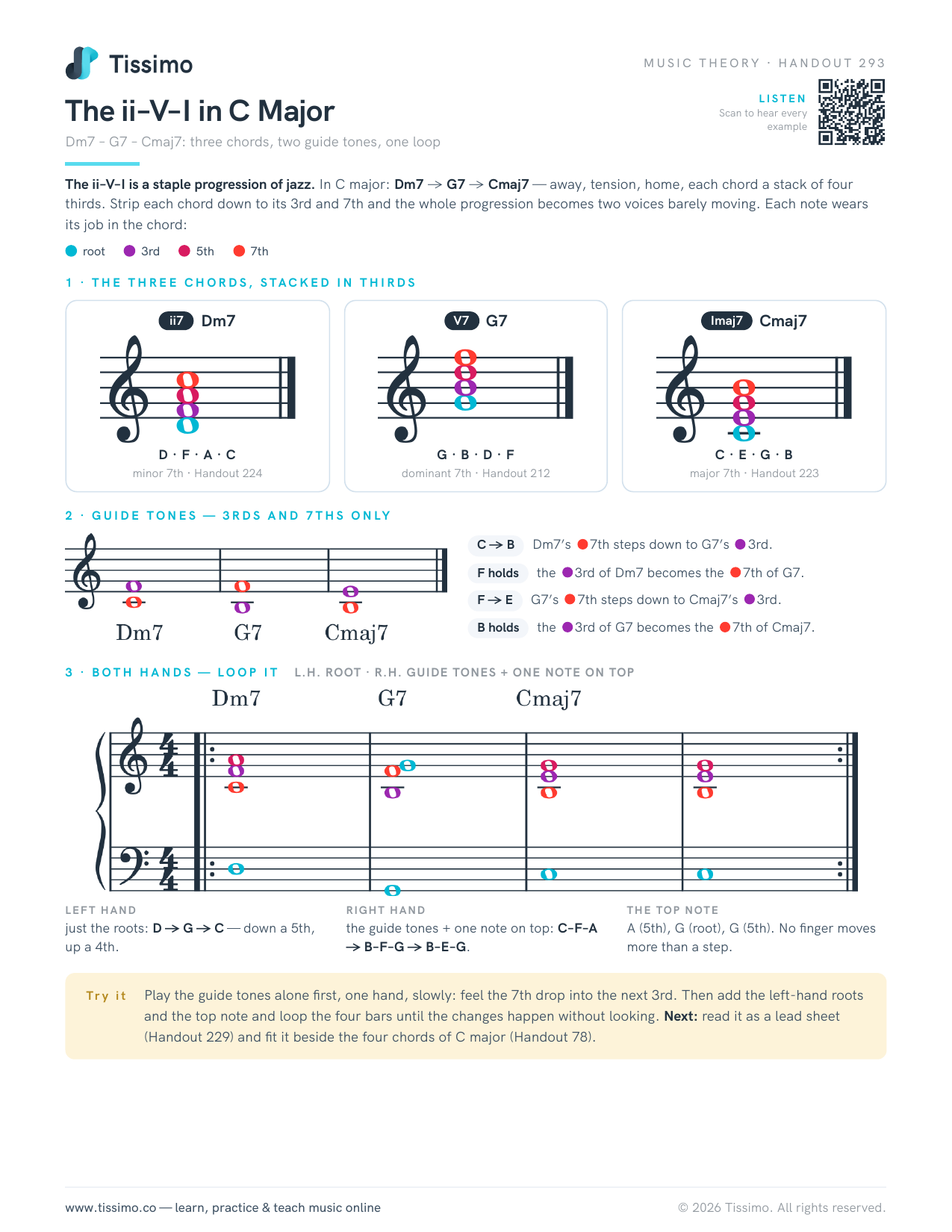
The ii–V–I in Every Key
The most-played progression in jazz: three chords, two guide tones, one loop, in all 24 keys.
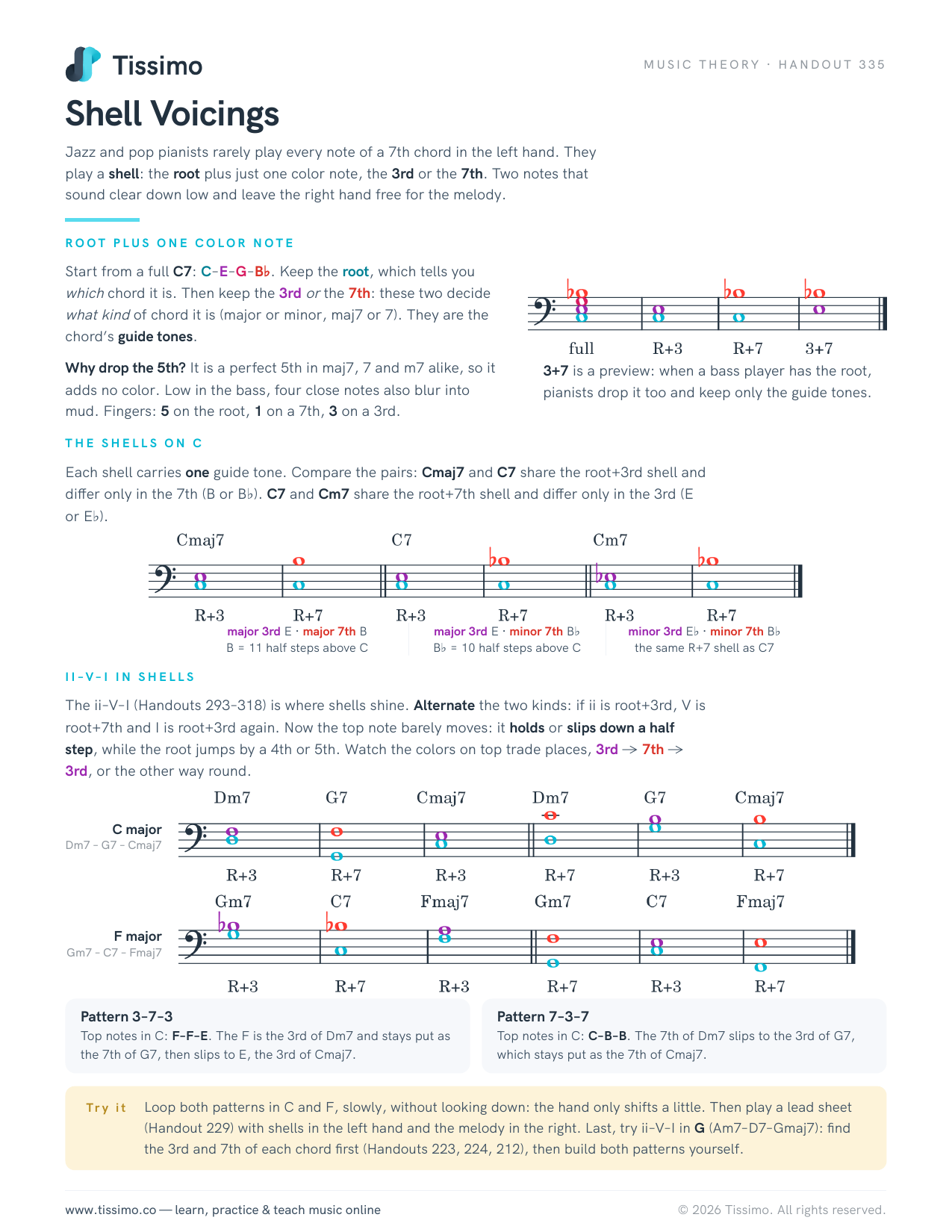
Shell Voicings
Jazz and pop pianists rarely play every note of a 7th chord in the left hand. They play a shell: the root plus just one color note, the 3rd or the 7th. Two notes that sound clear down low and leave the right hand free for the melody.
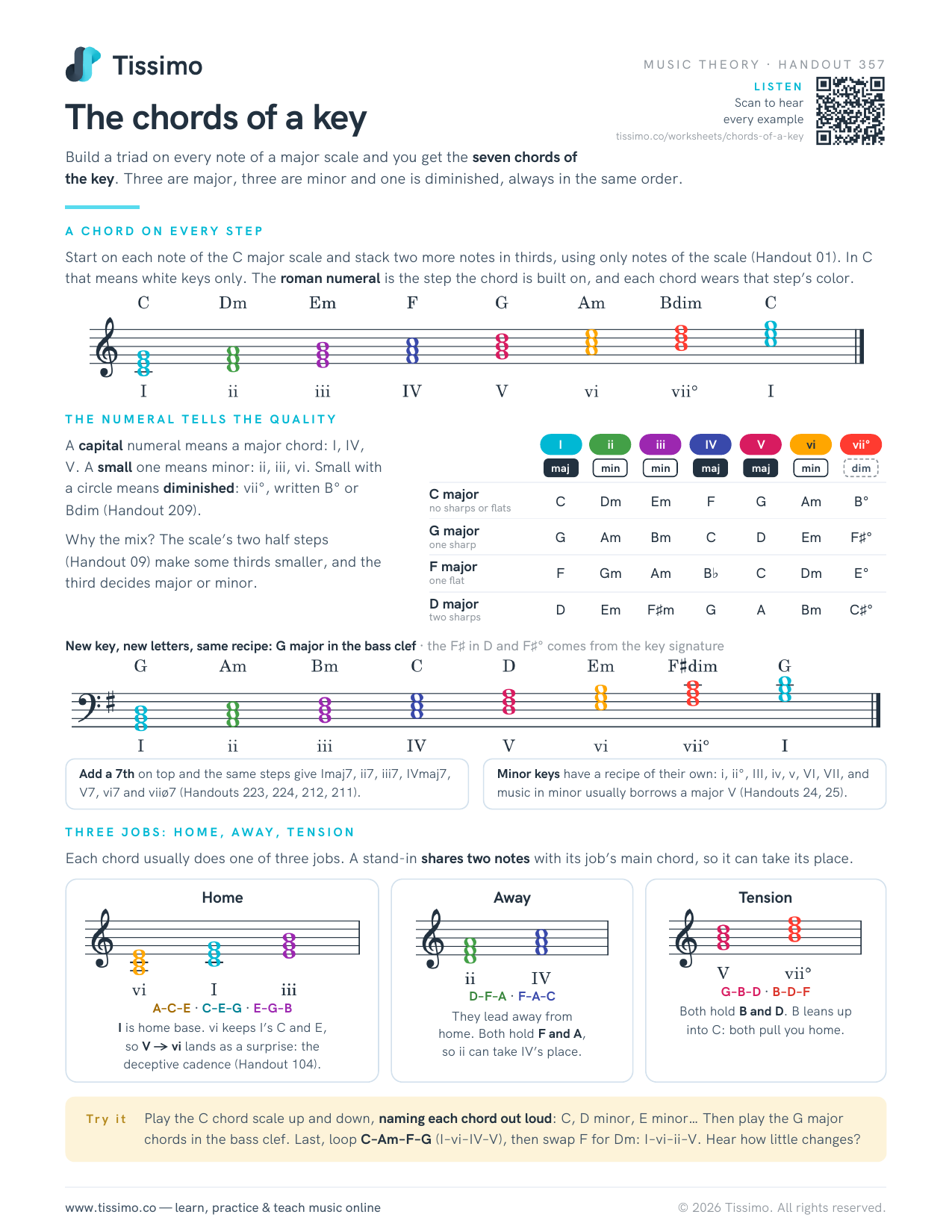
The chords of a key
Build a triad on every note of a major scale and you get the seven chords of the key. Three are major, three are minor and one is diminished, always in the same order.
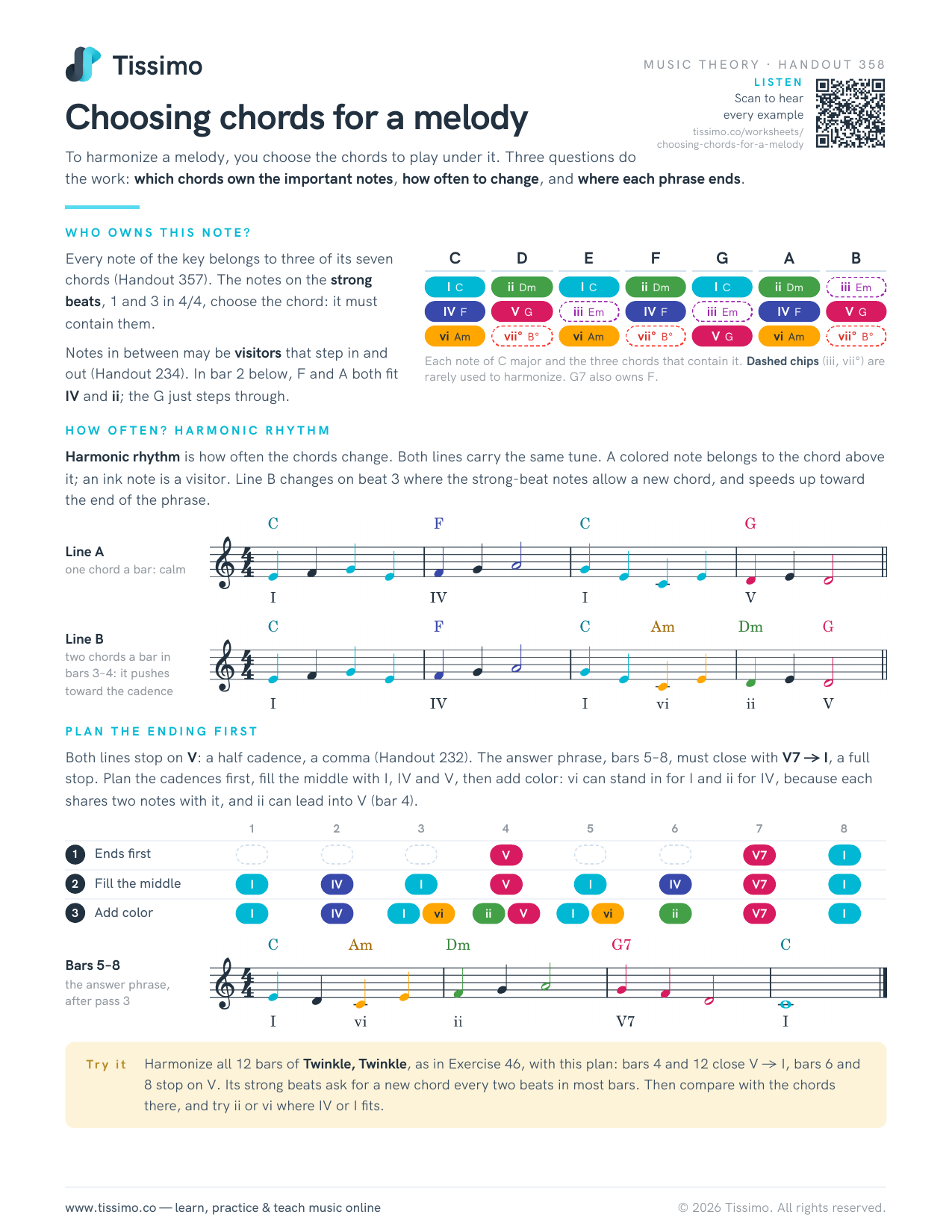
Choosing chords for a melody
To harmonize a melody, you choose the chords to play under it. Three questions do the work: which chords own the important notes, how often to change, and where each phrase ends.
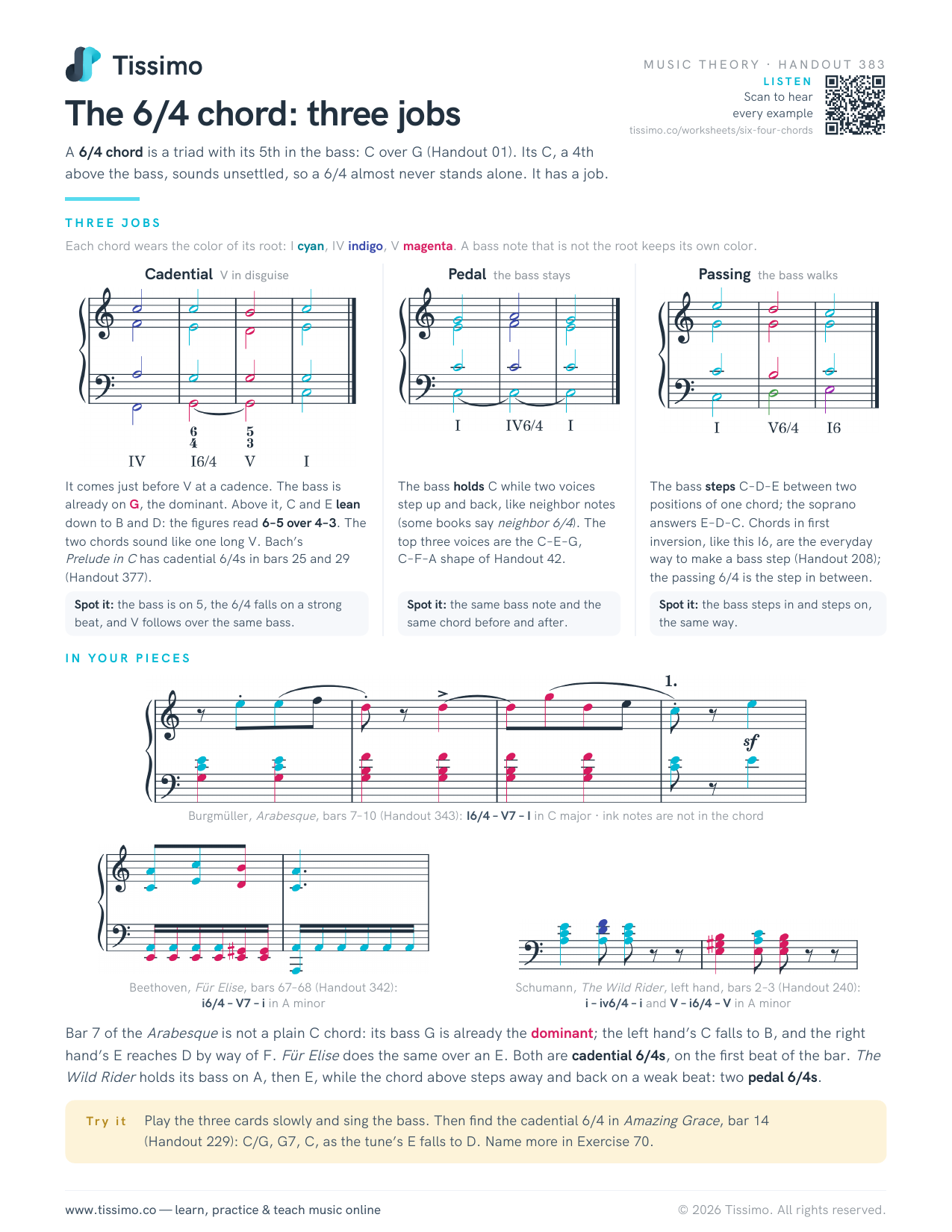
The 6/4 chord: three jobs
A 6/4 chord is a triad with its 5th in the bass: C over G (Handout 01). Its C, a 4th above the bass, sounds unsettled, so a 6/4 almost never stands alone. It has a job.
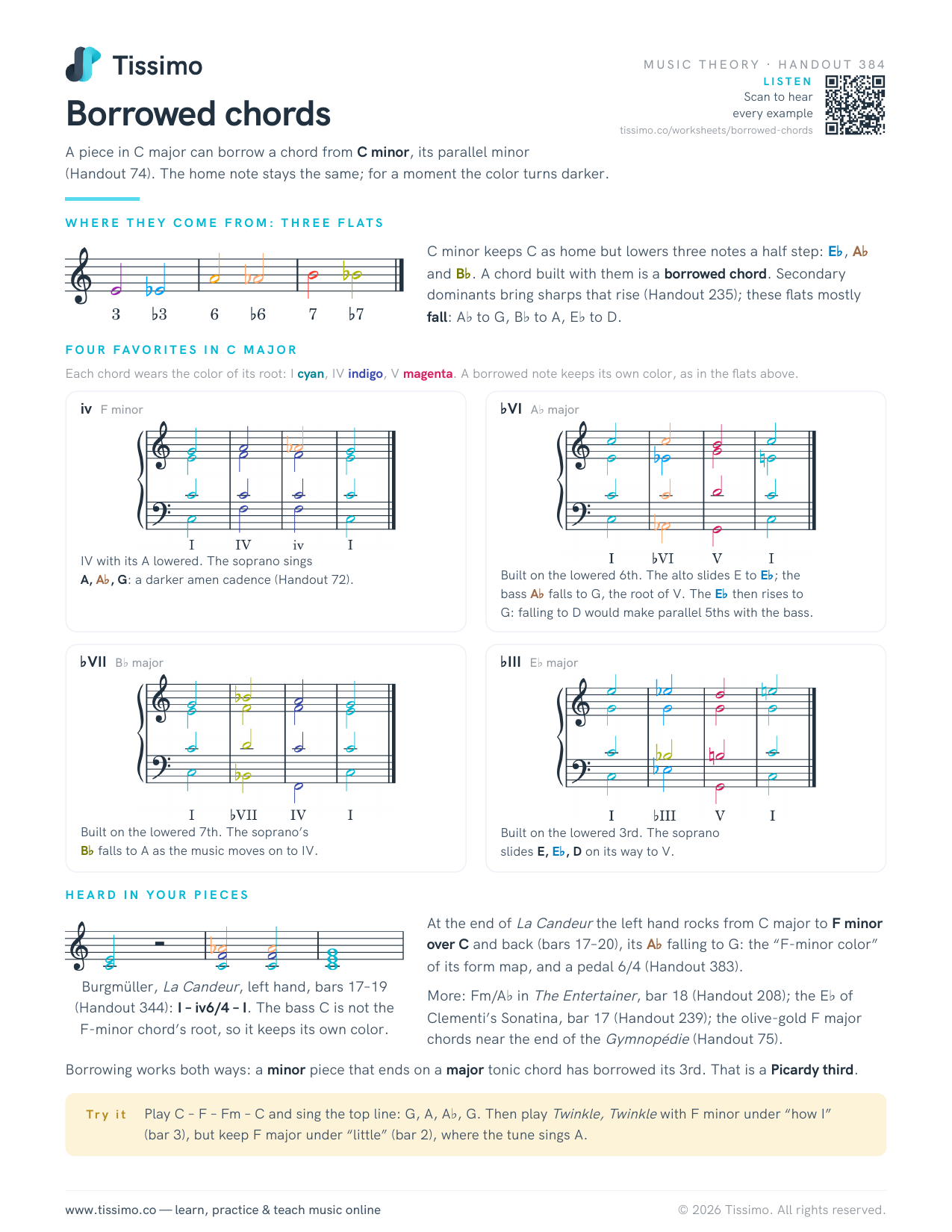
Borrowed chords
A piece in C major can borrow a chord from C minor, its parallel minor (Handout 74). The home note stays the same; for a moment the color turns darker.
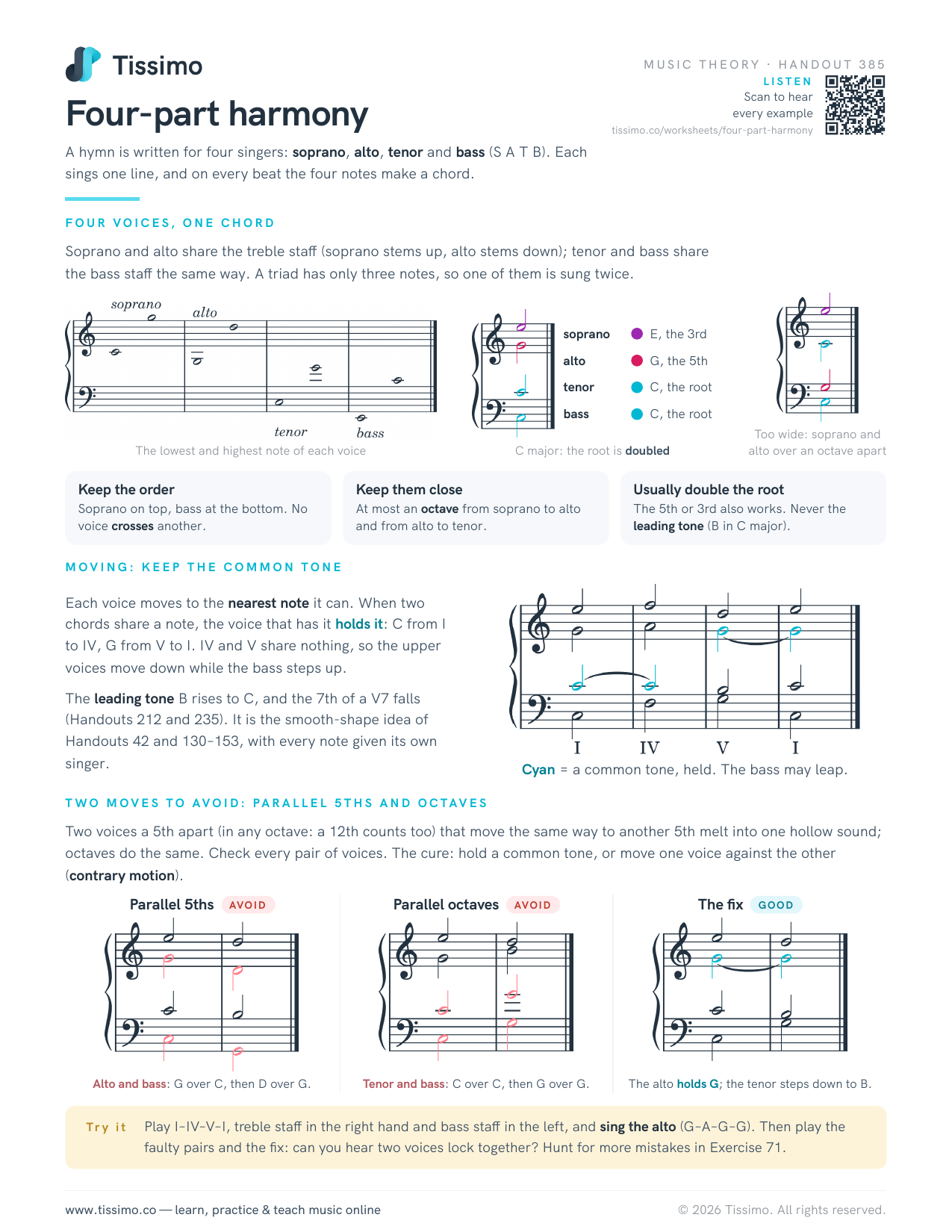
Four-part harmony
A hymn is written for four singers: soprano, alto, tenor and bass (S A T B). Each sings one line, and on every beat the four notes make a chord.
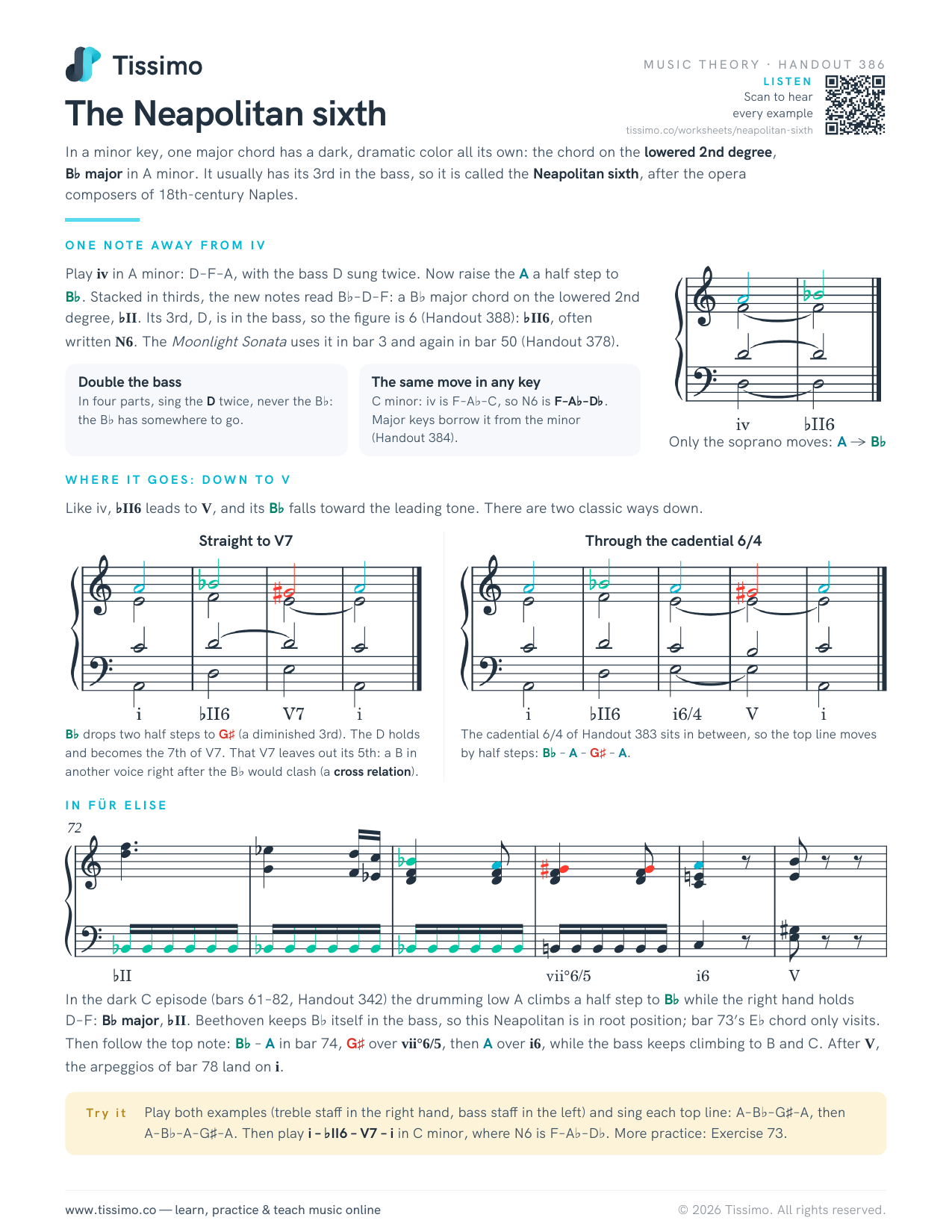
The Neapolitan sixth
In a minor key, one major chord has a dark, dramatic color all its own: the chord on the lowered 2nd degree, B♭ major in A minor. It usually has its 3rd in the bass, so it is called the Neapolitan sixth, after the opera composers of 18th-century Naples.
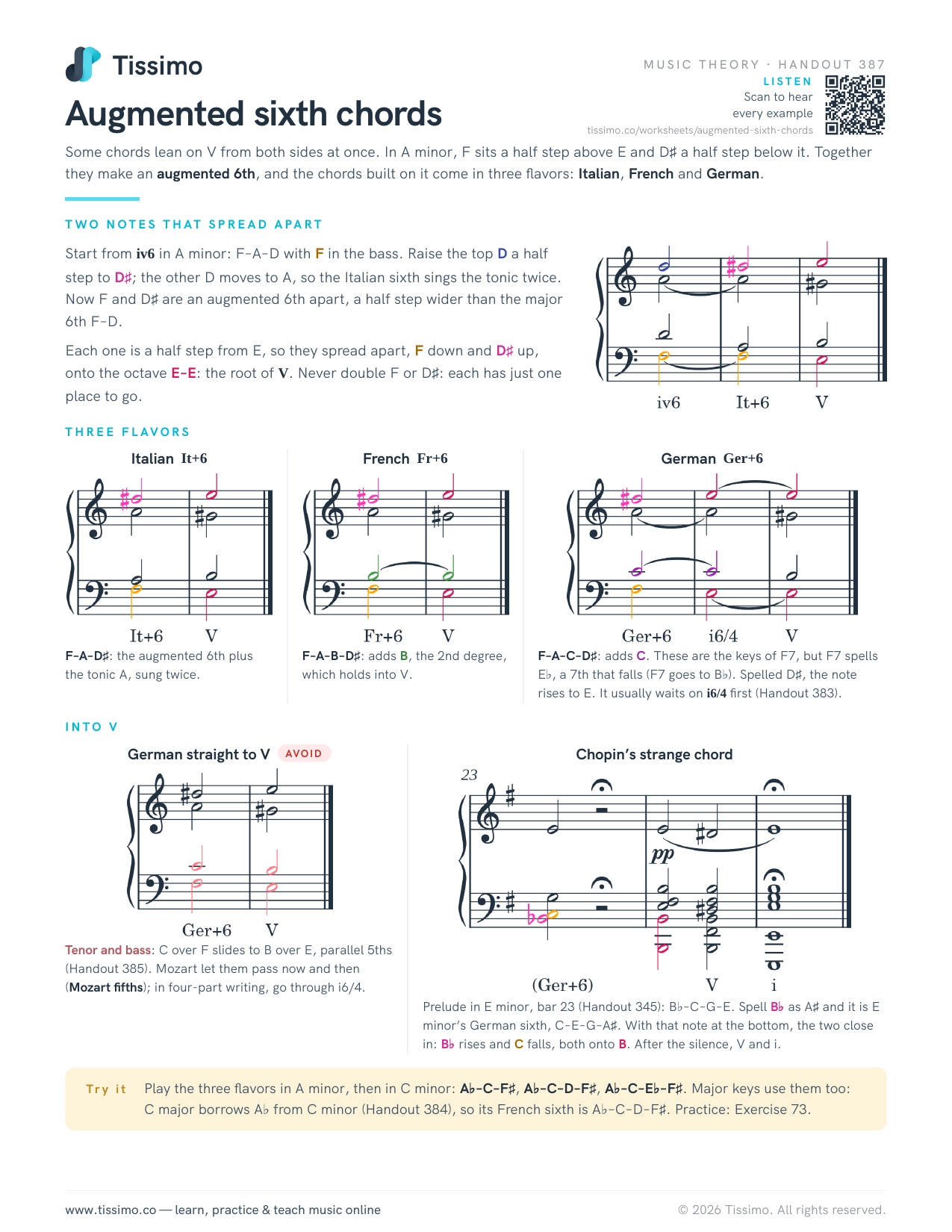
Augmented sixth chords
Some chords lean on V from both sides at once. In A minor, F sits a half step above E and D♯ a half step below it. Together they make an augmented 6th, and the chords built on it come in three flavors: Italian, French and German.
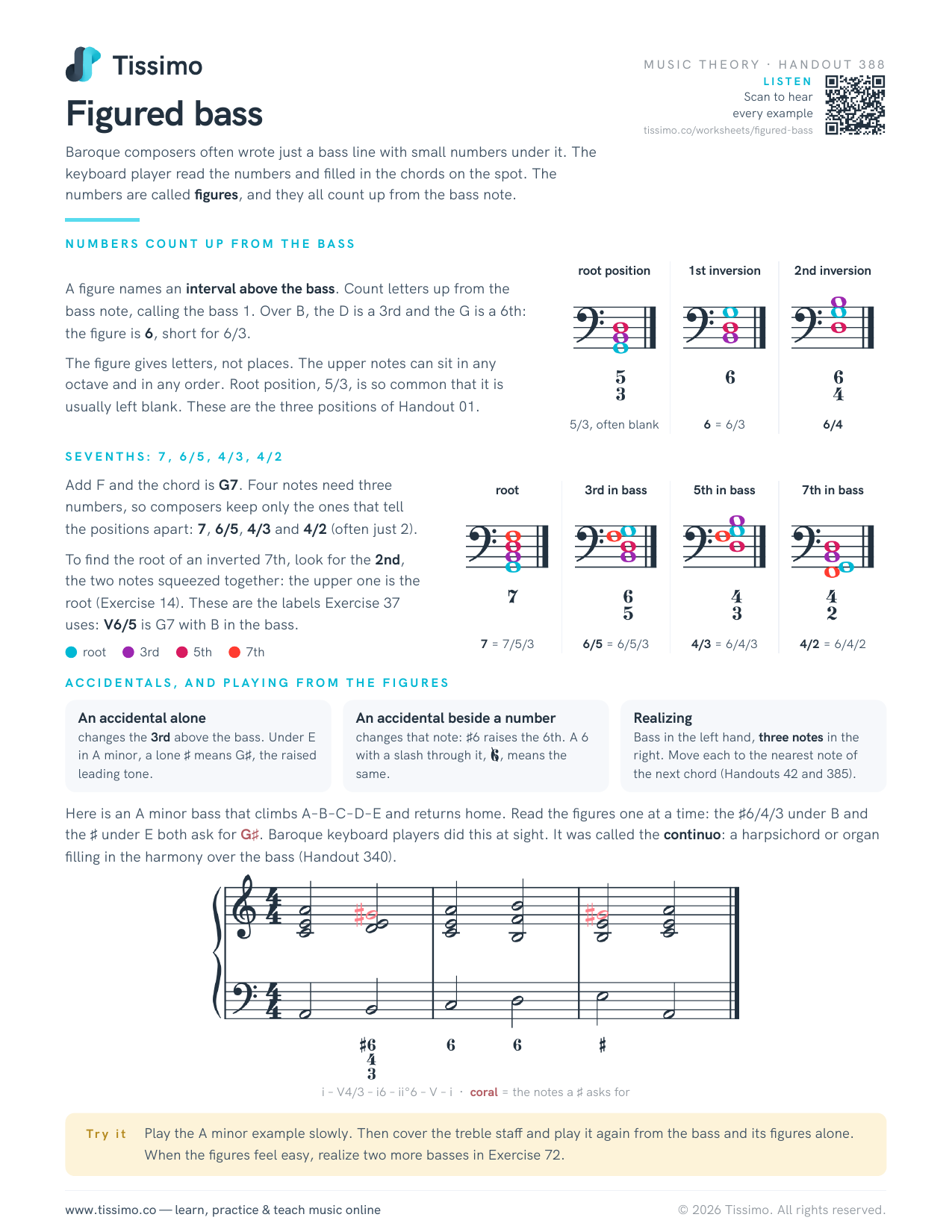
Figured bass
Baroque composers often wrote just a bass line with small numbers under it. The keyboard player read the numbers and filled in the chords on the spot. The numbers are called figures, and they all count up from the bass note.
Form & Analysis
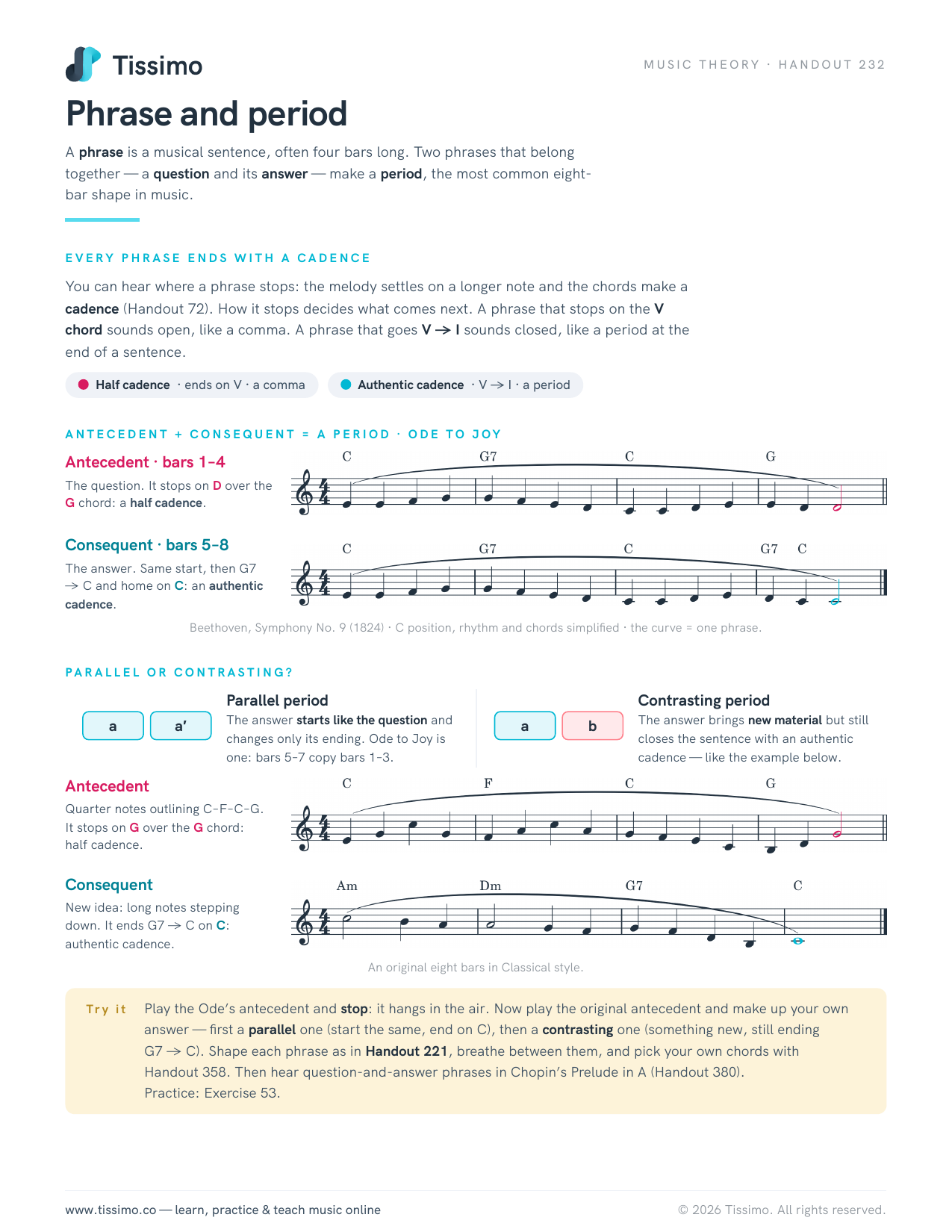
Phrase and period
A phrase is a musical sentence, often four bars long. Two phrases that belong together — a question and its answer — make a period, the most common eight-bar shape in music.
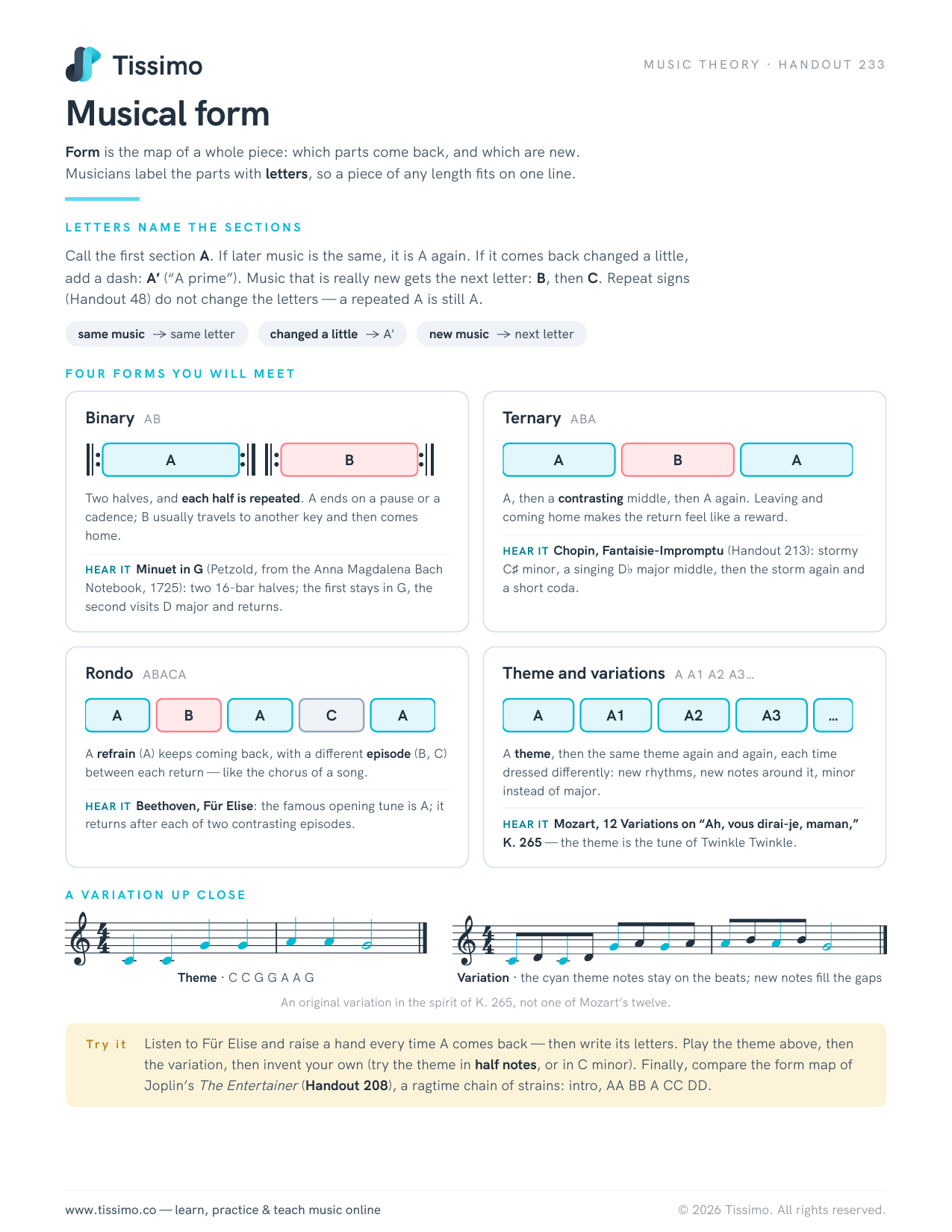
Musical form
Form is the map of a whole piece: which parts come back, and which are new. Musicians label the parts with letters, so a piece of any length fits on one line.
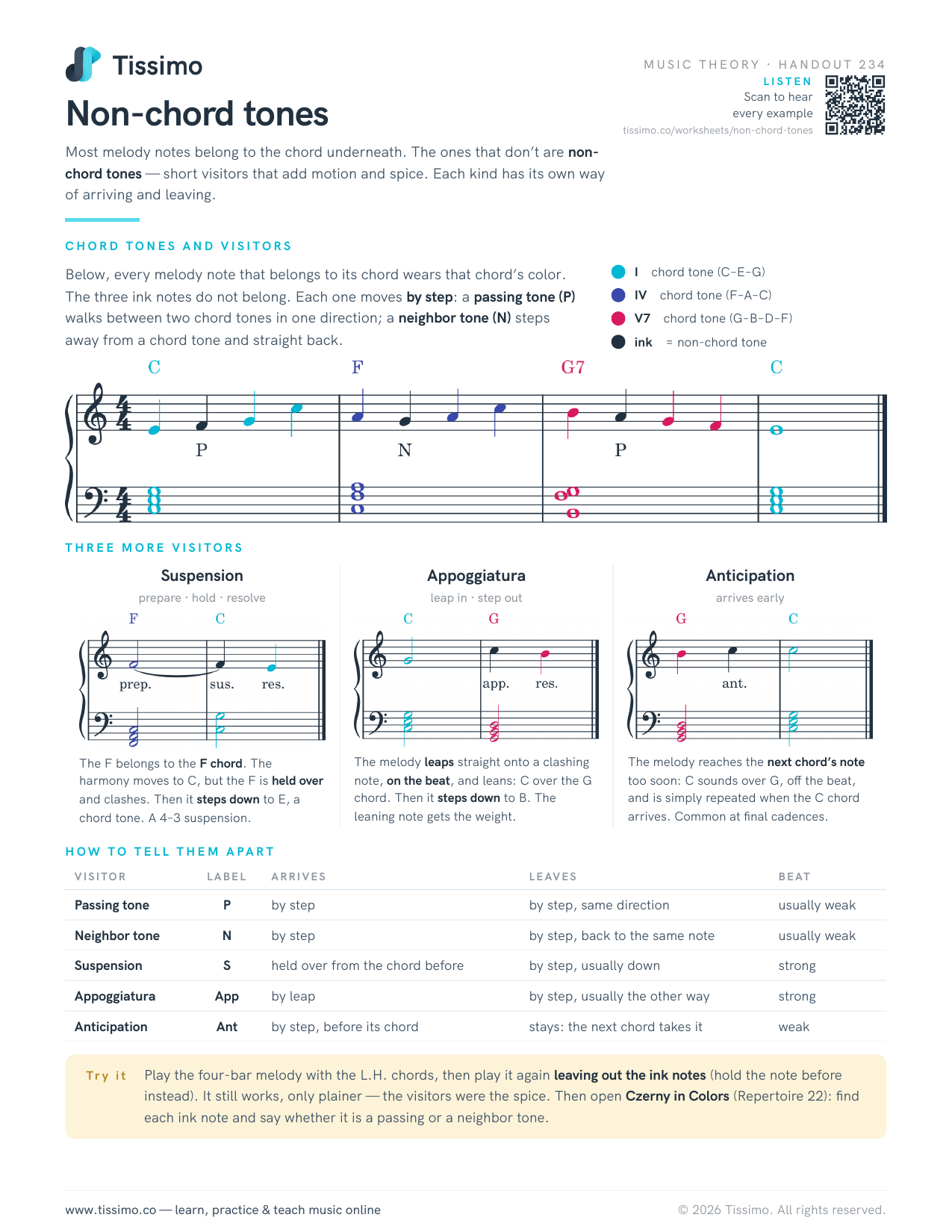
Non-chord tones
Most melody notes belong to the chord underneath. The ones that don’t are non-chord tones — short visitors that add motion and spice. Each kind has its own way of arriving and leaving.
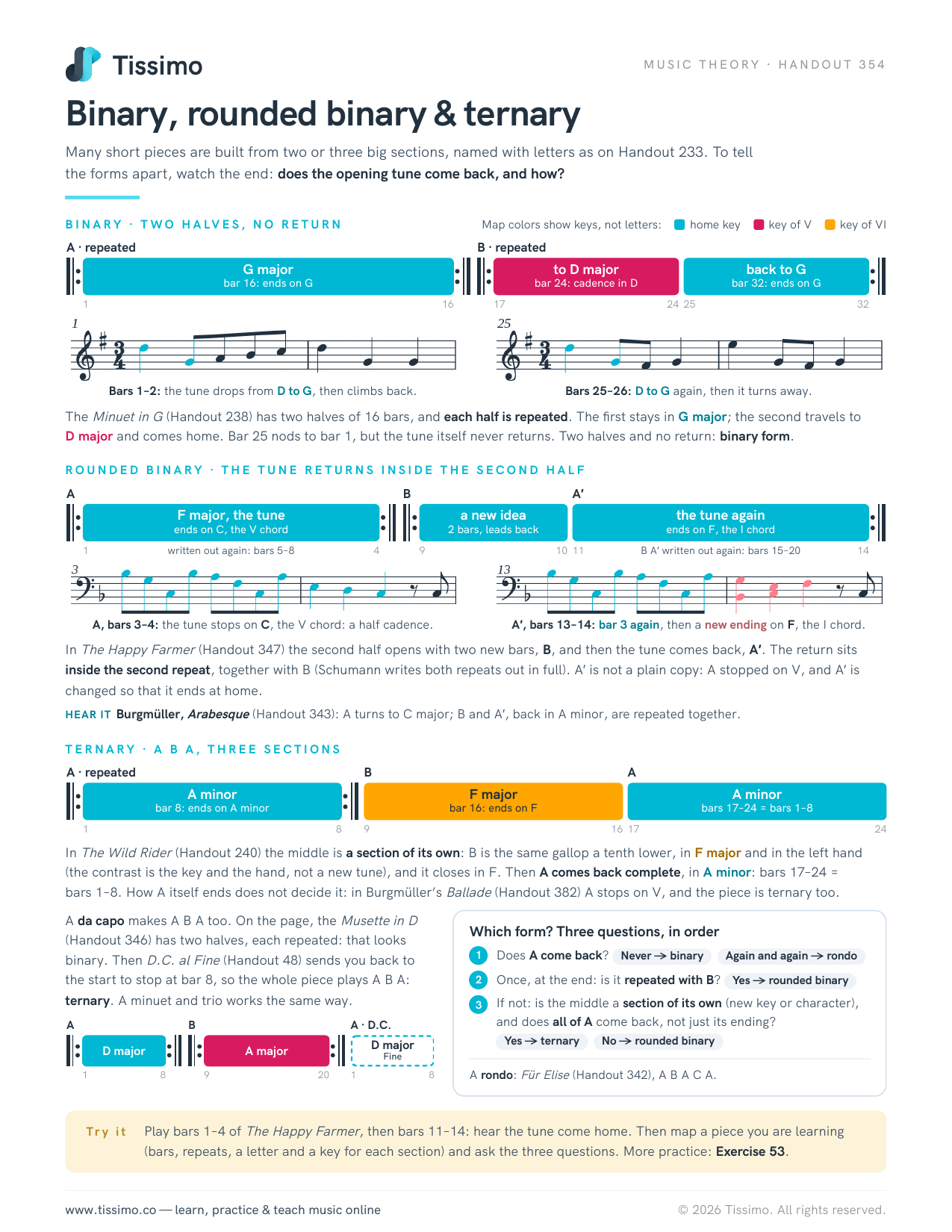
Binary, rounded binary & ternary
Many short pieces are built from two or three big sections, named with letters as on Handout 233. To tell the forms apart, watch the end: does the opening tune come back, and how?
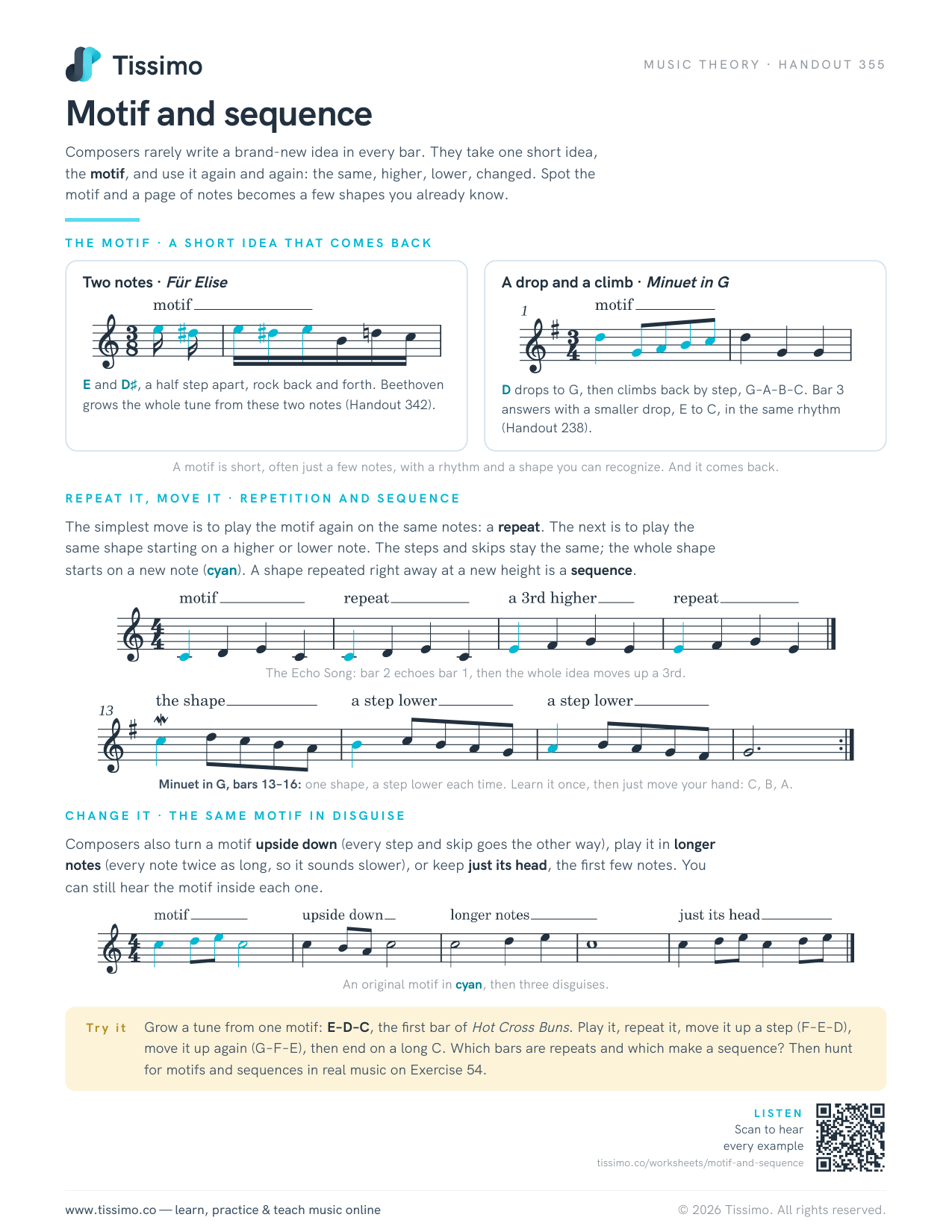
Motif and sequence
Composers rarely write a brand-new idea in every bar. They take one short idea, the motif, and use it again and again: the same, higher, lower, changed. Spot the motif and a page of notes becomes a few shapes you already know.
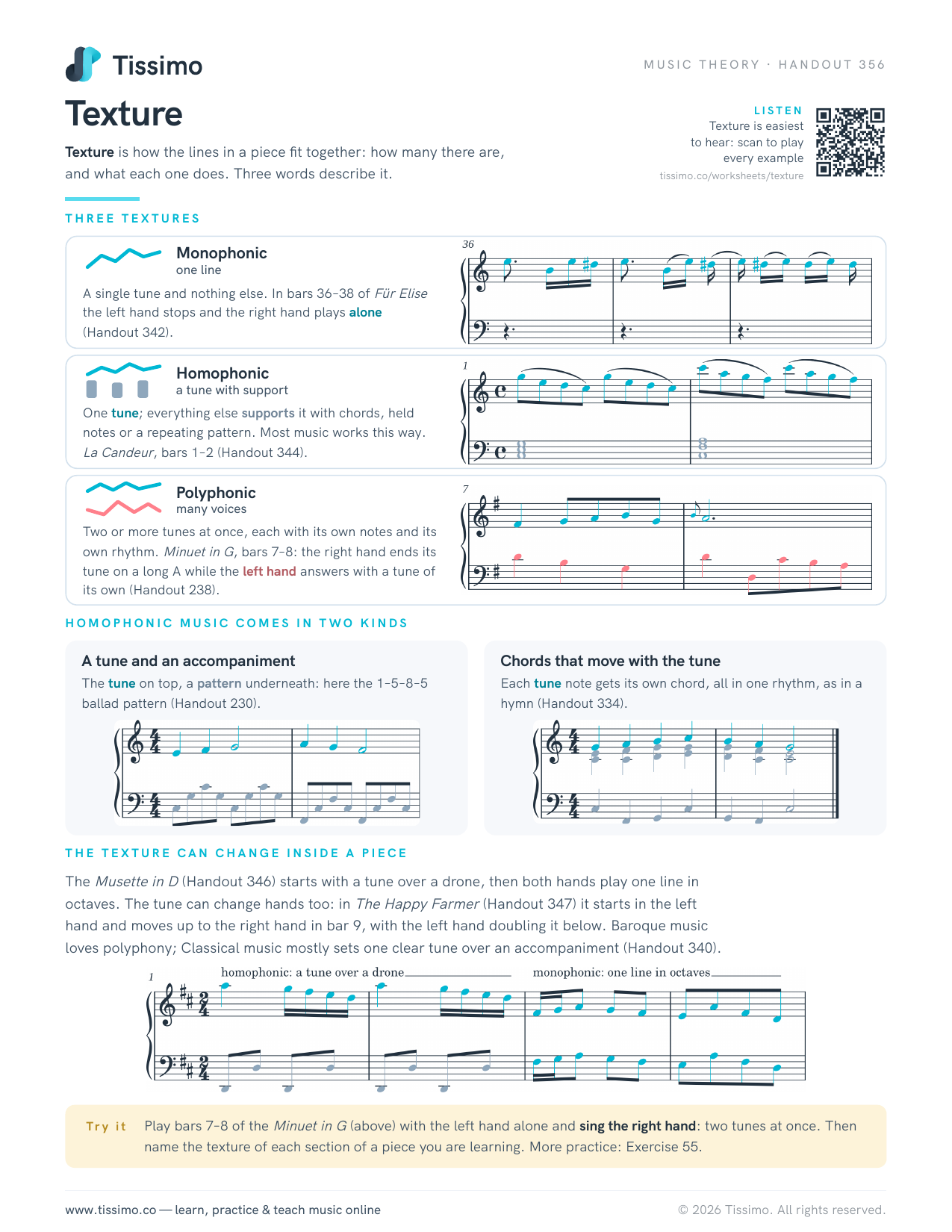
Texture
Texture is how the lines in a piece fit together: how many there are, and what each one does. Three words describe it.
Arpeggios
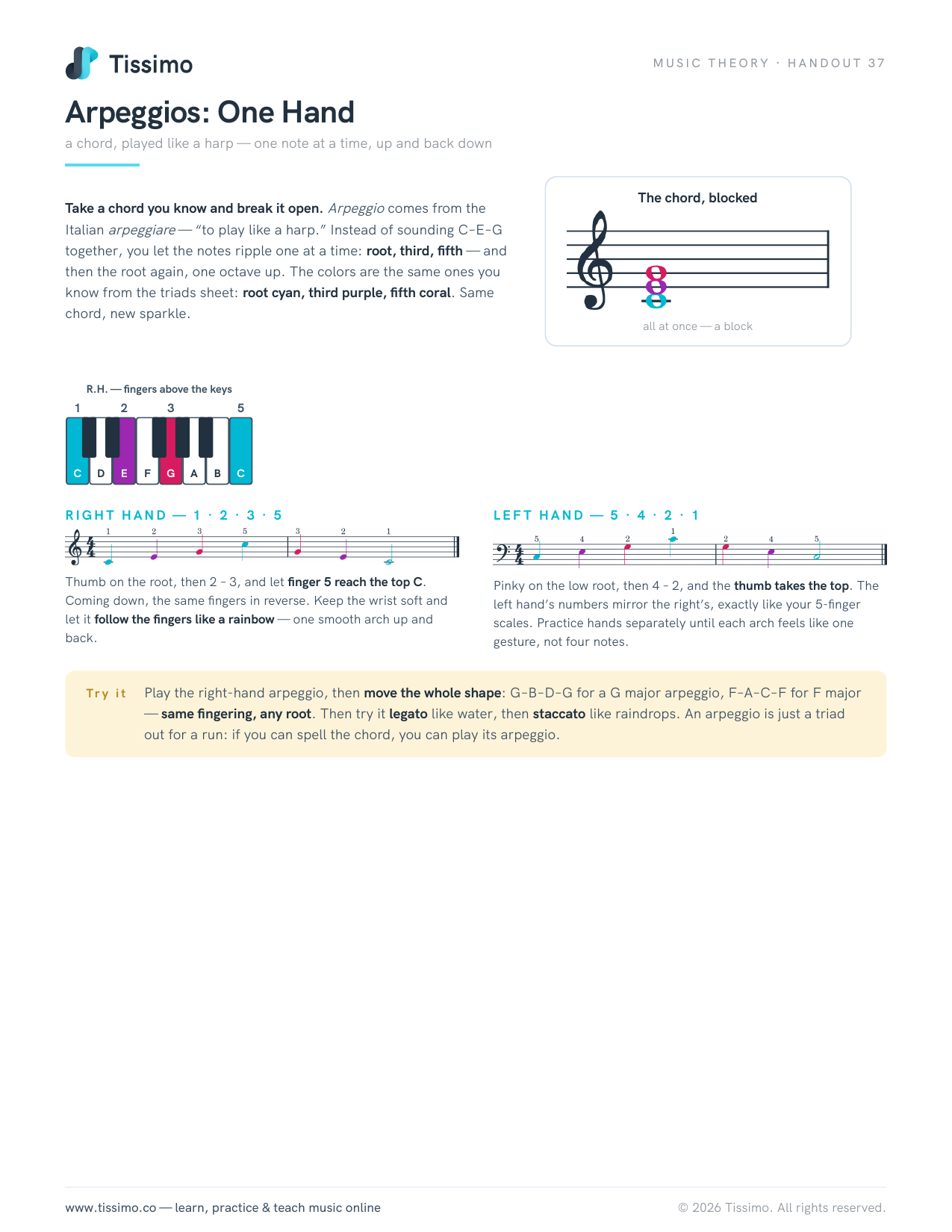
Arpeggios: One Hand
a chord, played like a harp — one note at a time, up and back down
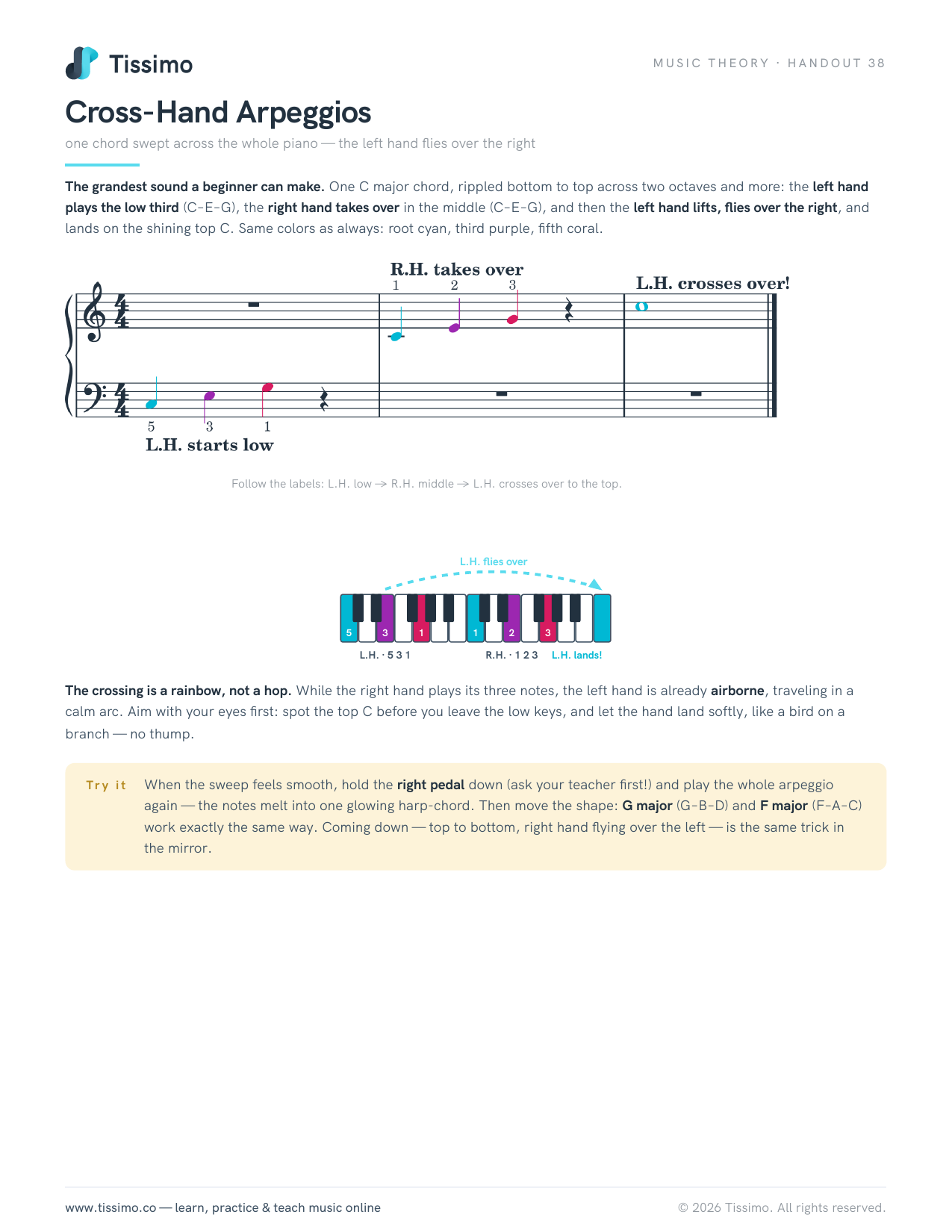
Cross-Hand Arpeggios
one chord swept across the whole piano — the left hand flies over the right
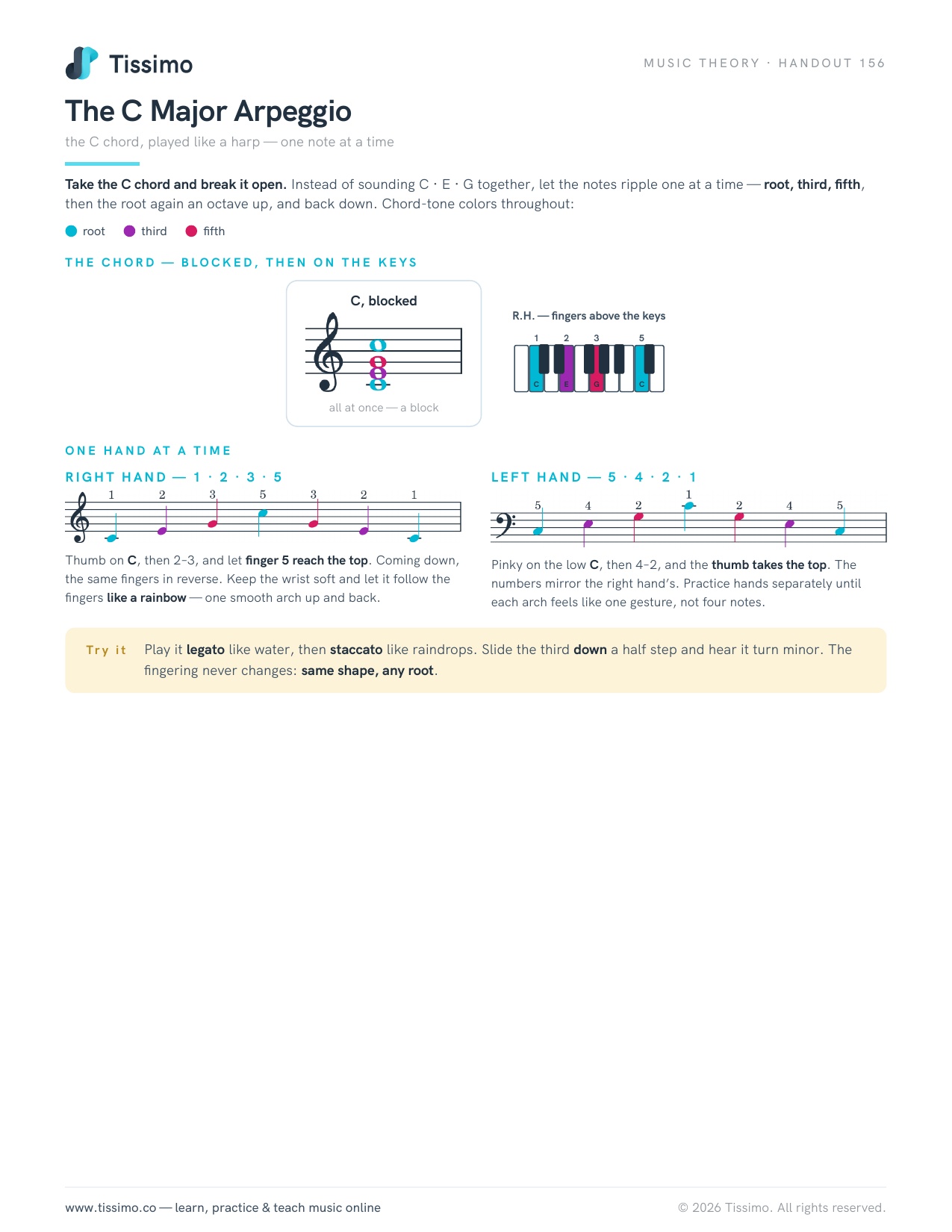
Arpeggios in Every Key
The chord played like a harp — one note at a time, up and back down, in all 24 keys.
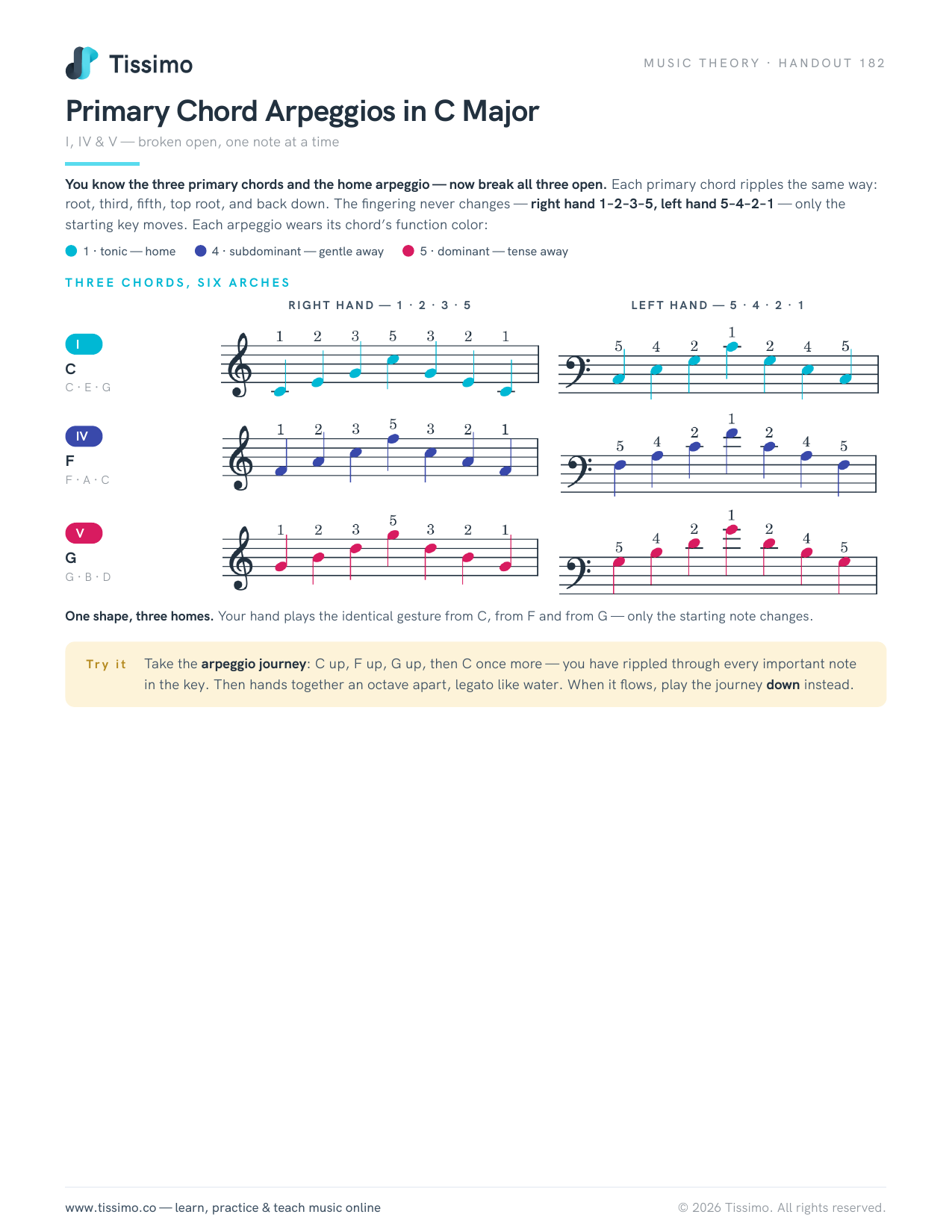
Primary Chord Arpeggios in Every Key
I, IV and V broken open, one note at a time, in all 24 keys.
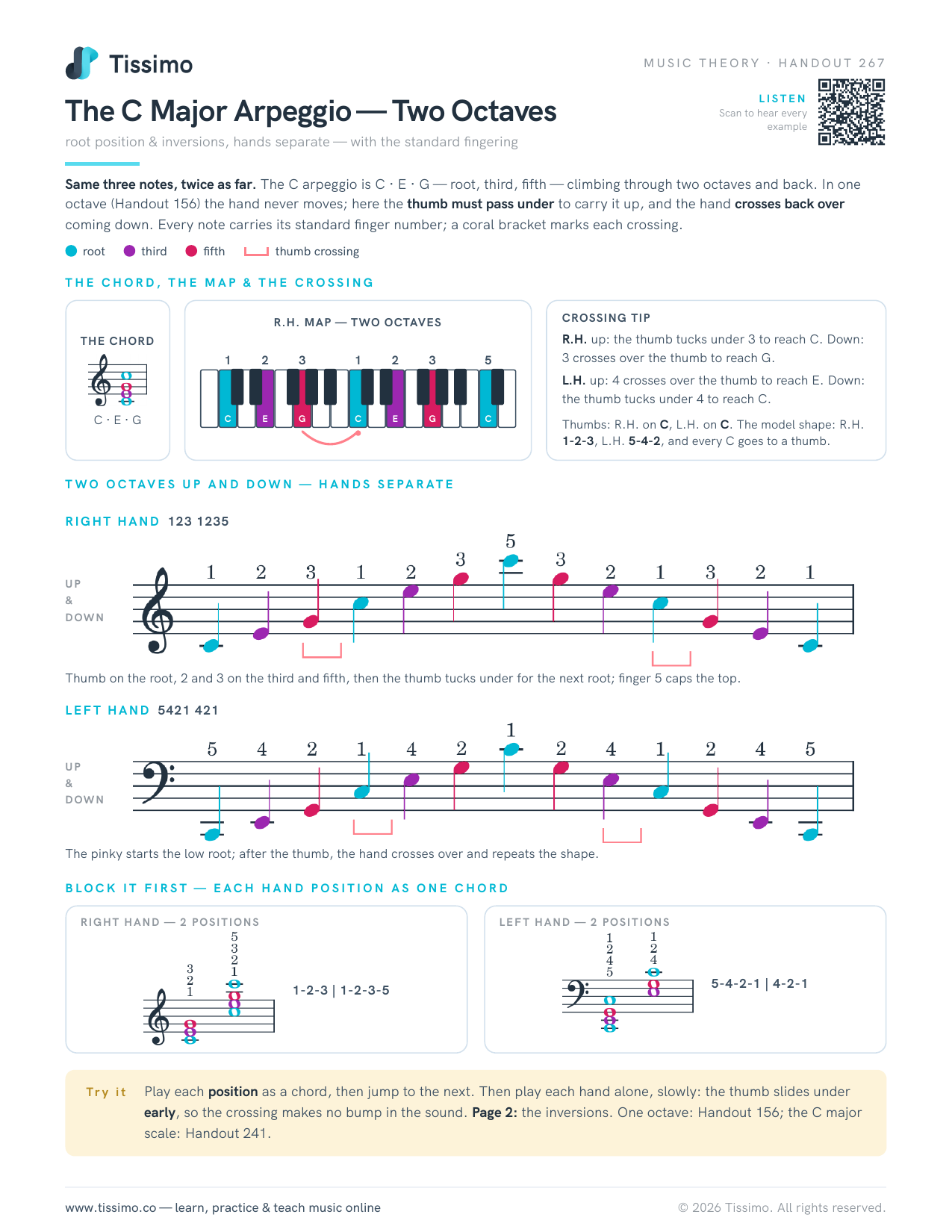
Two-Octave Arpeggios in Every Key
Two octaves up and down with the thumb crossings marked and every note fingered, in all 24 keys.
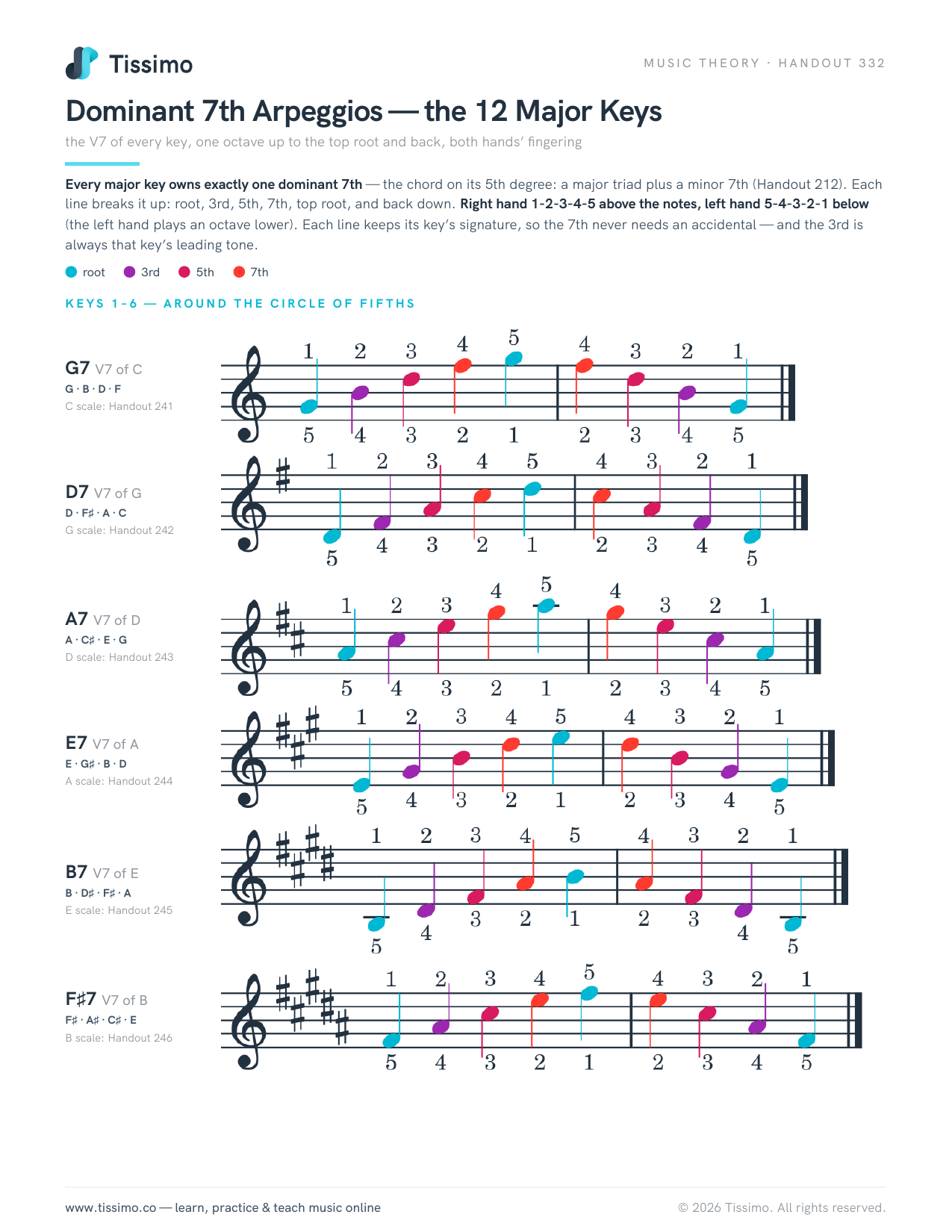
Dominant 7th Arpeggios — the 12 Major Keys
the V7 of every key, one octave up to the top root and back, both hands’ fingering
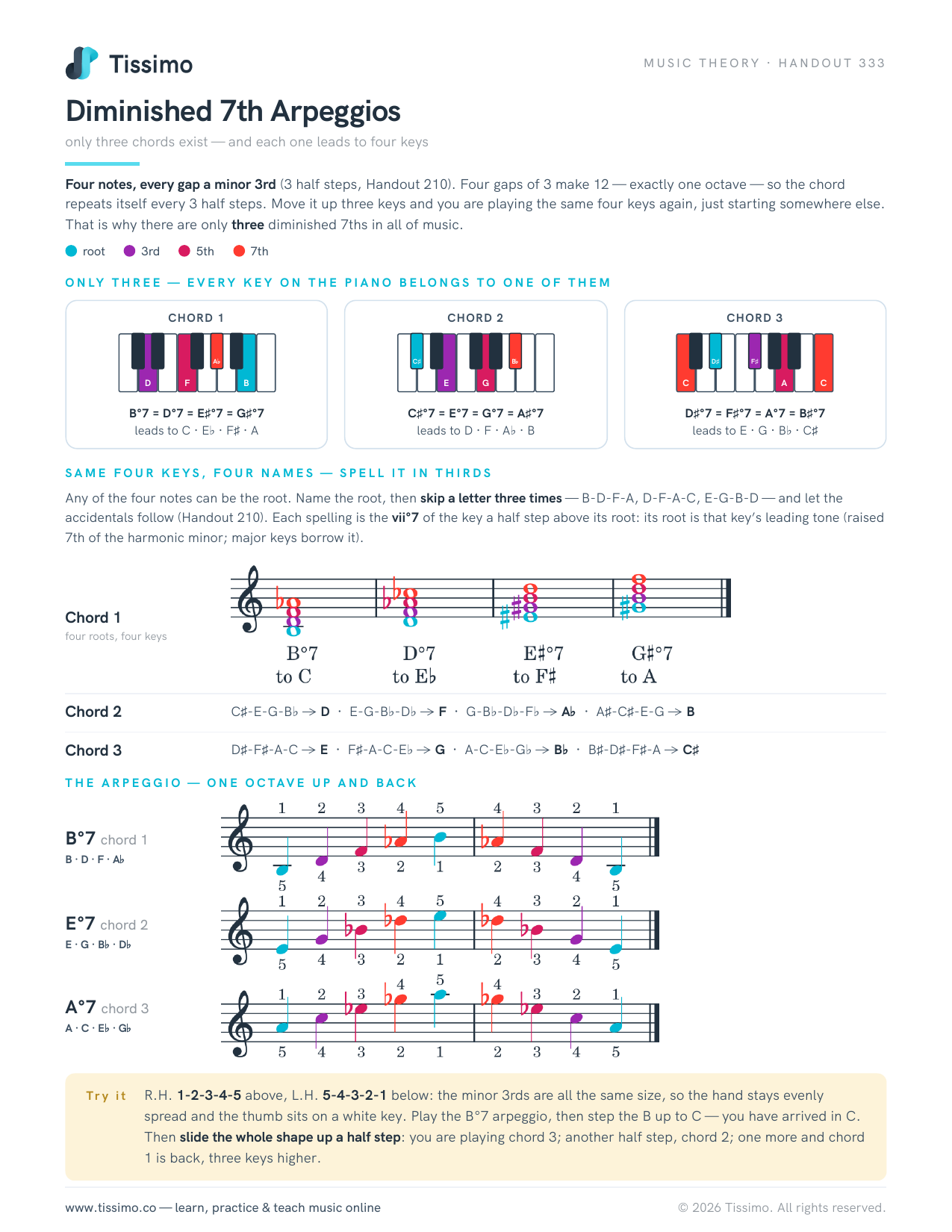
Diminished 7th Arpeggios
only three chords exist — and each one leads to four keys
Expression & Technique
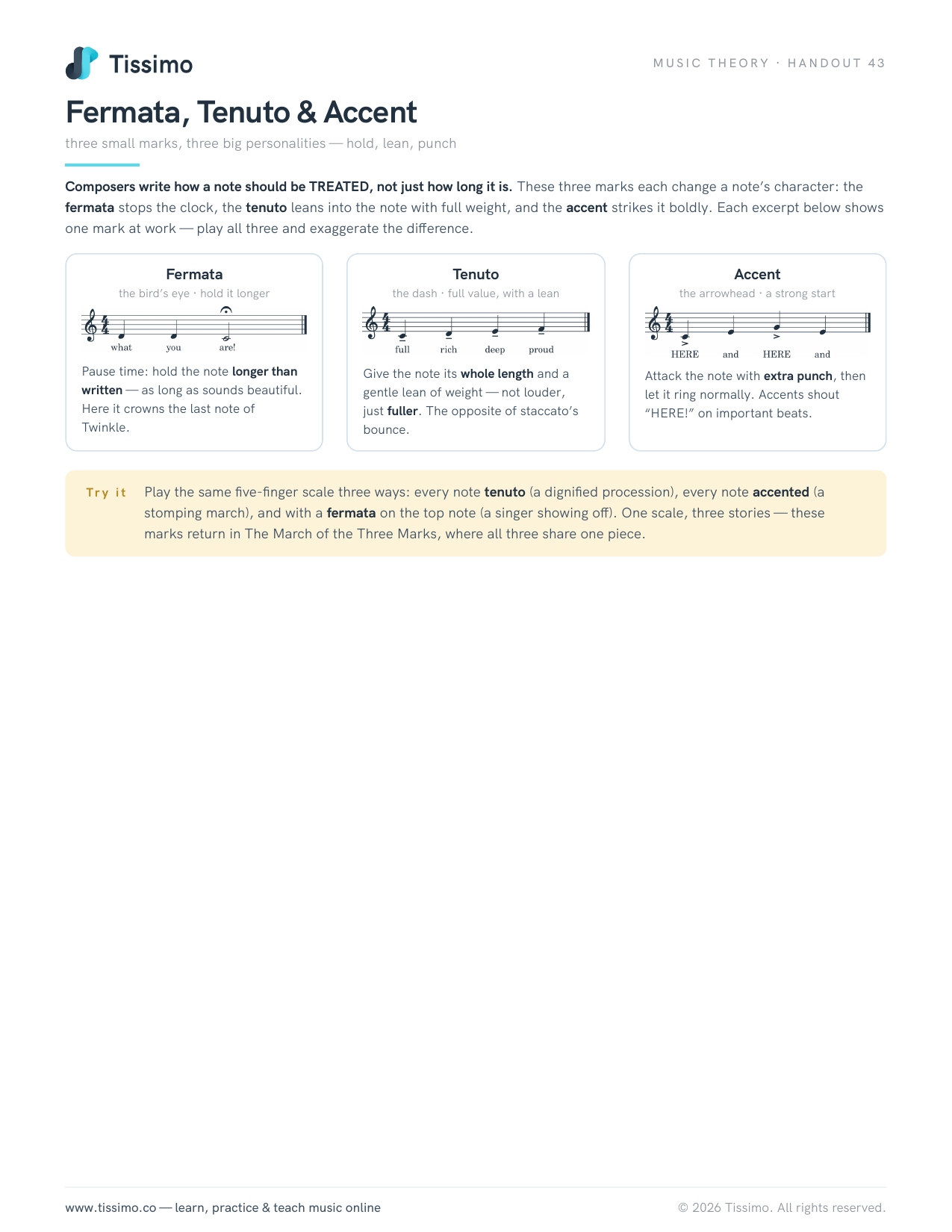
Fermata, Tenuto & Accent
three small marks, three big personalities — hold, lean, punch
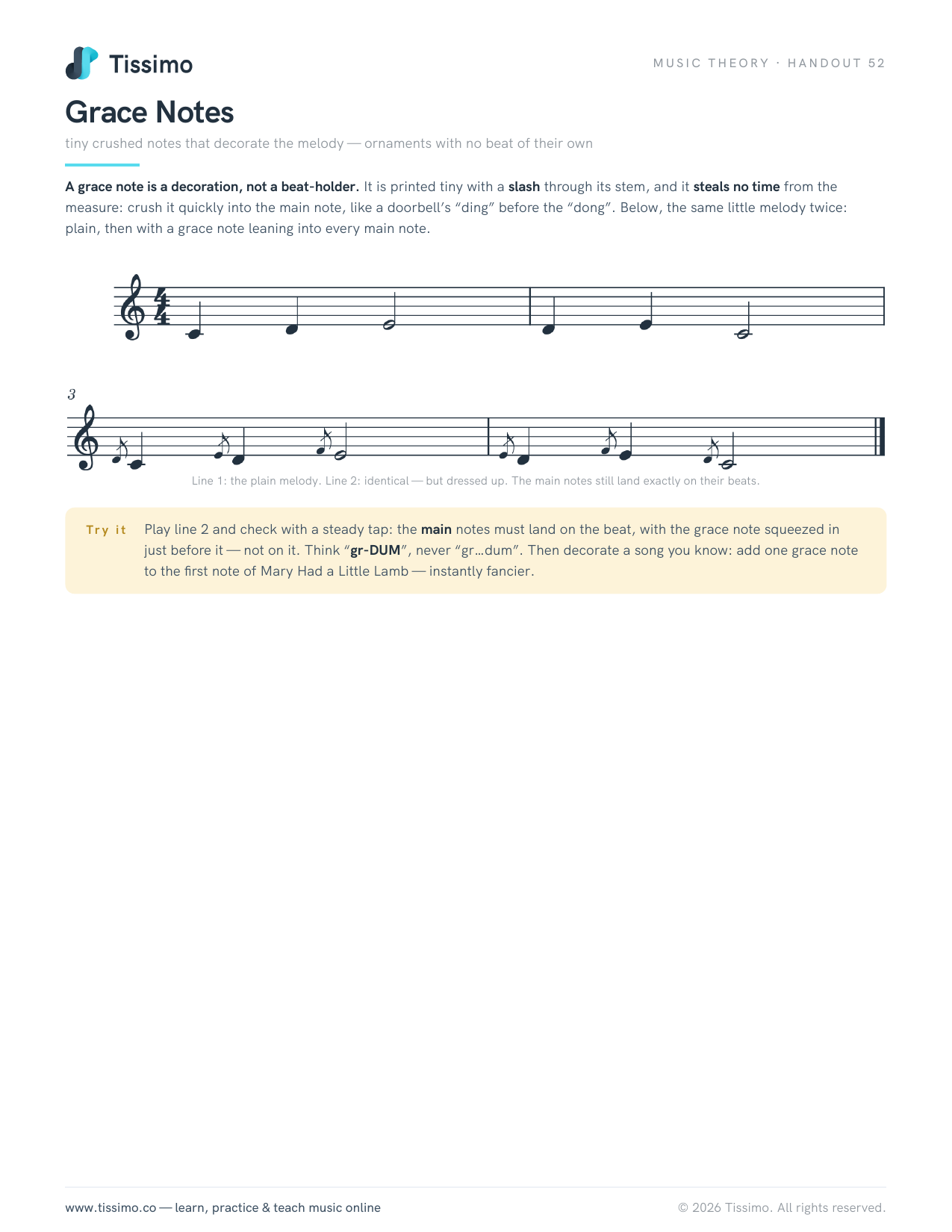
Grace Notes
tiny crushed notes that decorate the melody — ornaments with no beat of their own
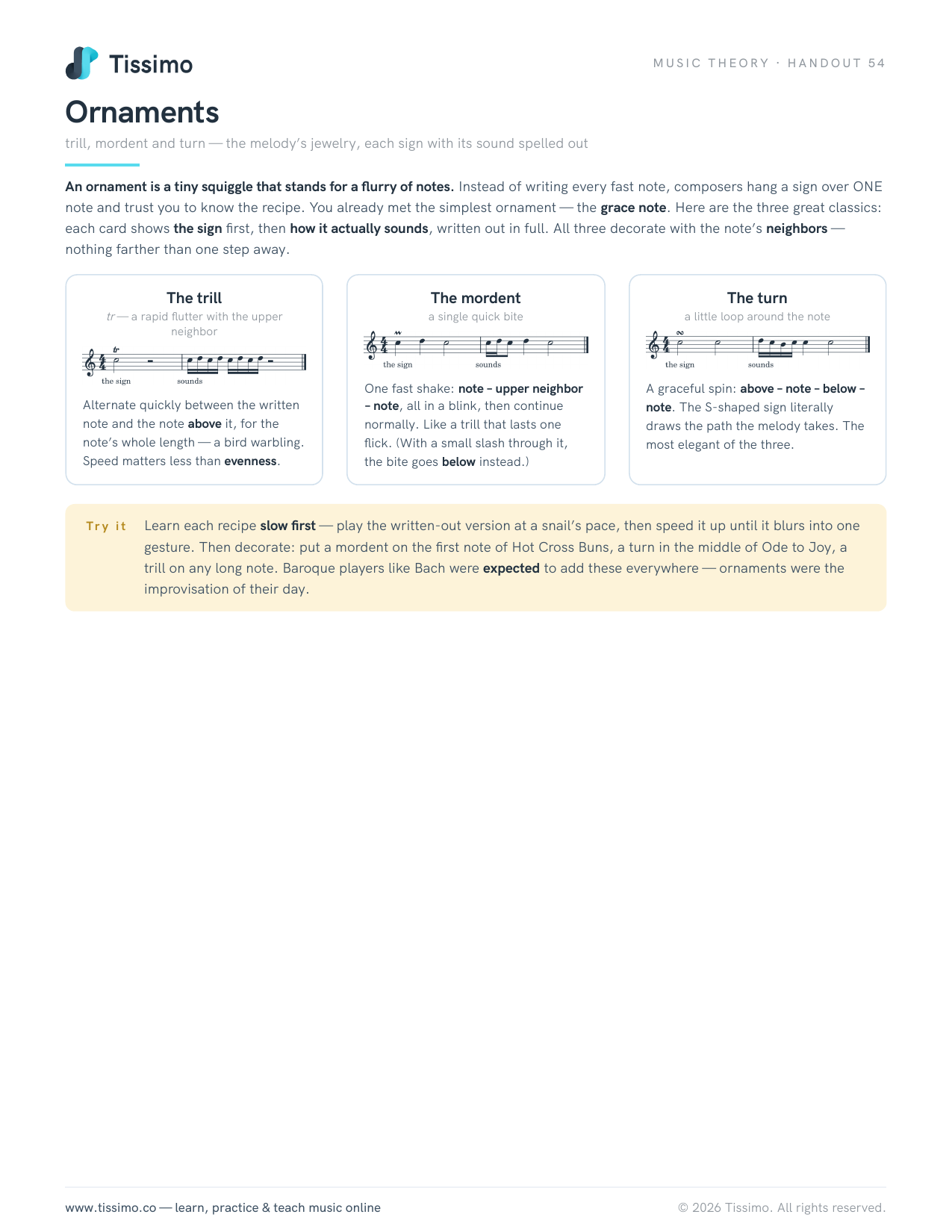
Ornaments
trill, short trill and turn — the melody’s jewelry, each sign with its sound spelled out
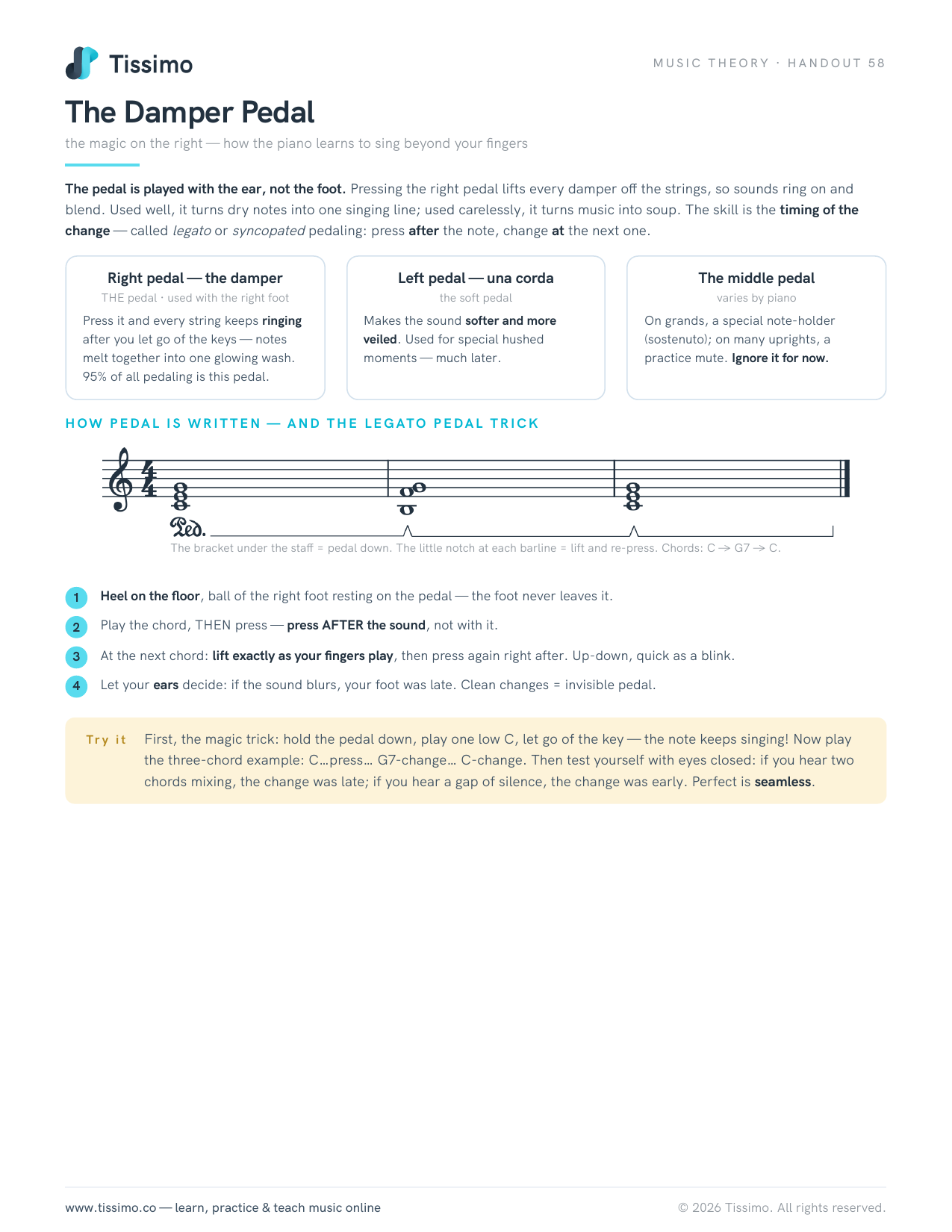
The Damper Pedal
the magic on the right — how the piano learns to sing beyond your fingers
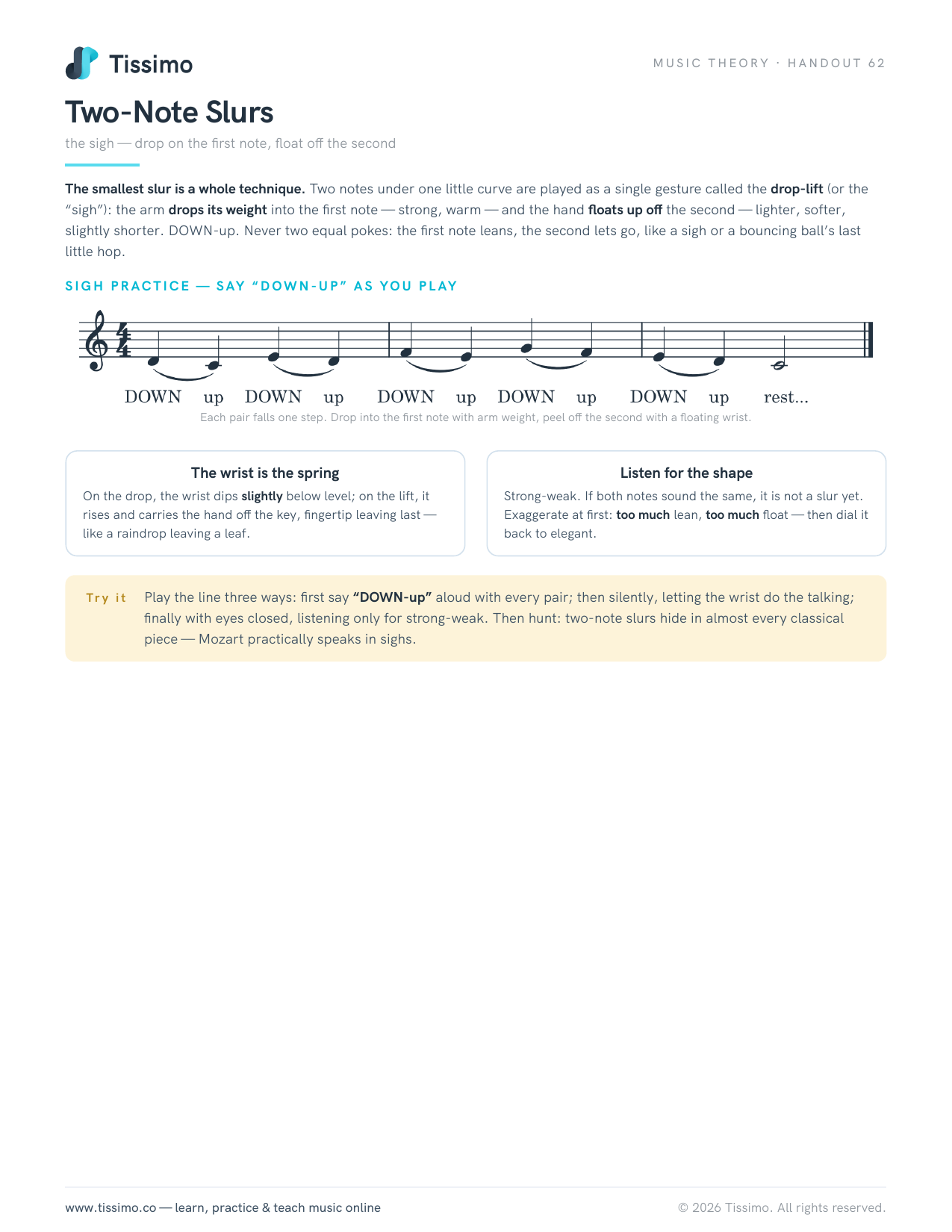
Two-Note Slurs
the sigh — drop on the first note, float off the second
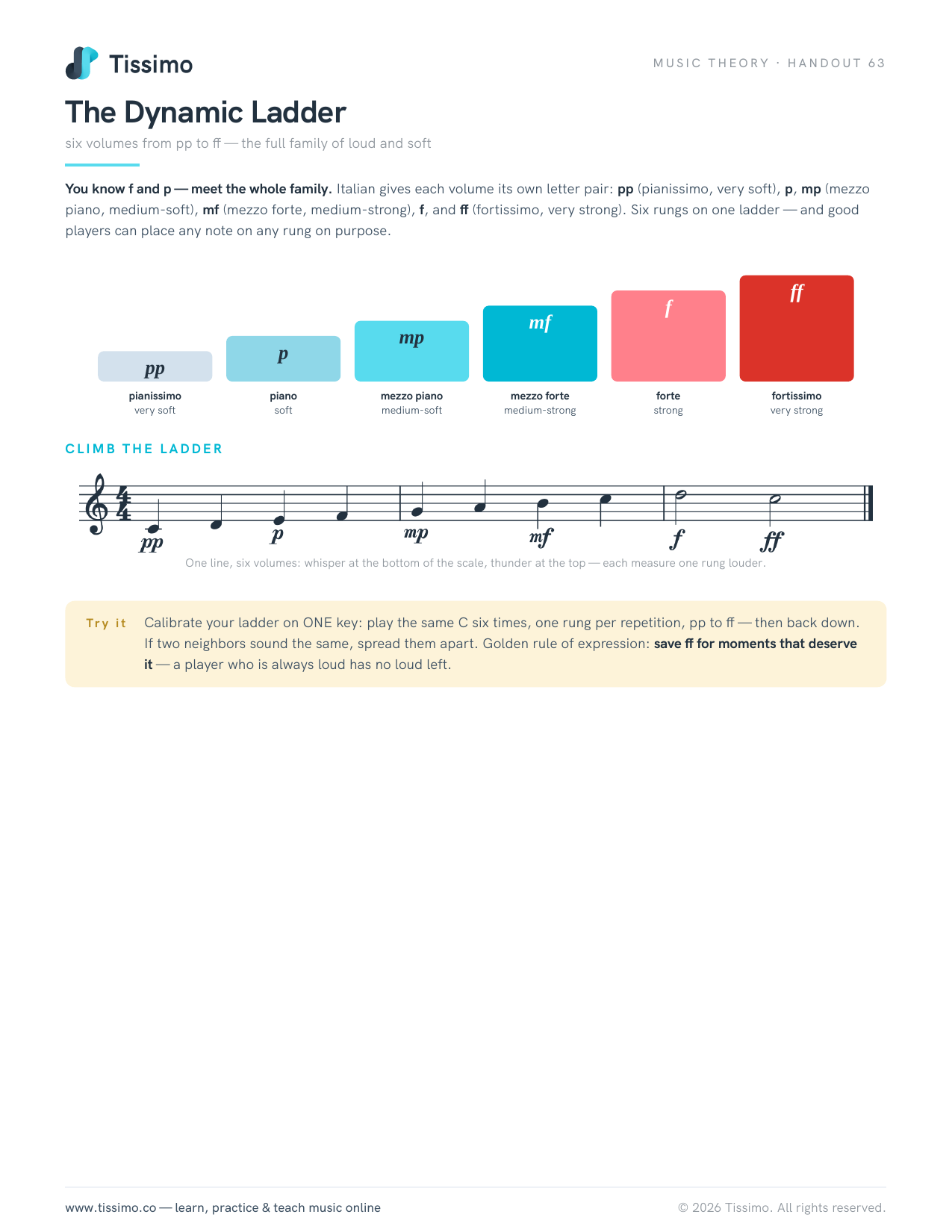
The Dynamic Ladder
six volumes from pp to ff — the full family of loud and soft
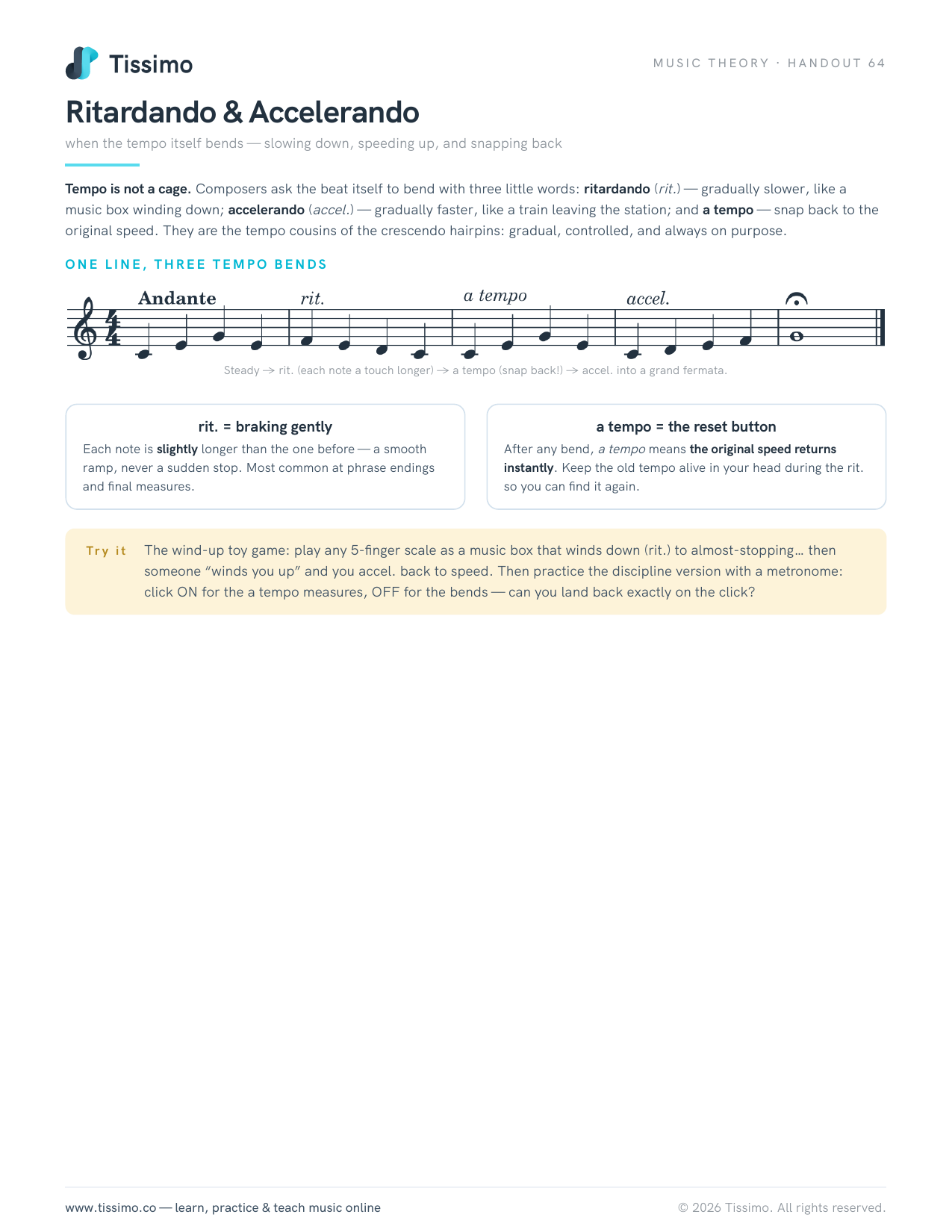
Ritardando & Accelerando
when the tempo itself bends — slowing down, speeding up, and snapping back
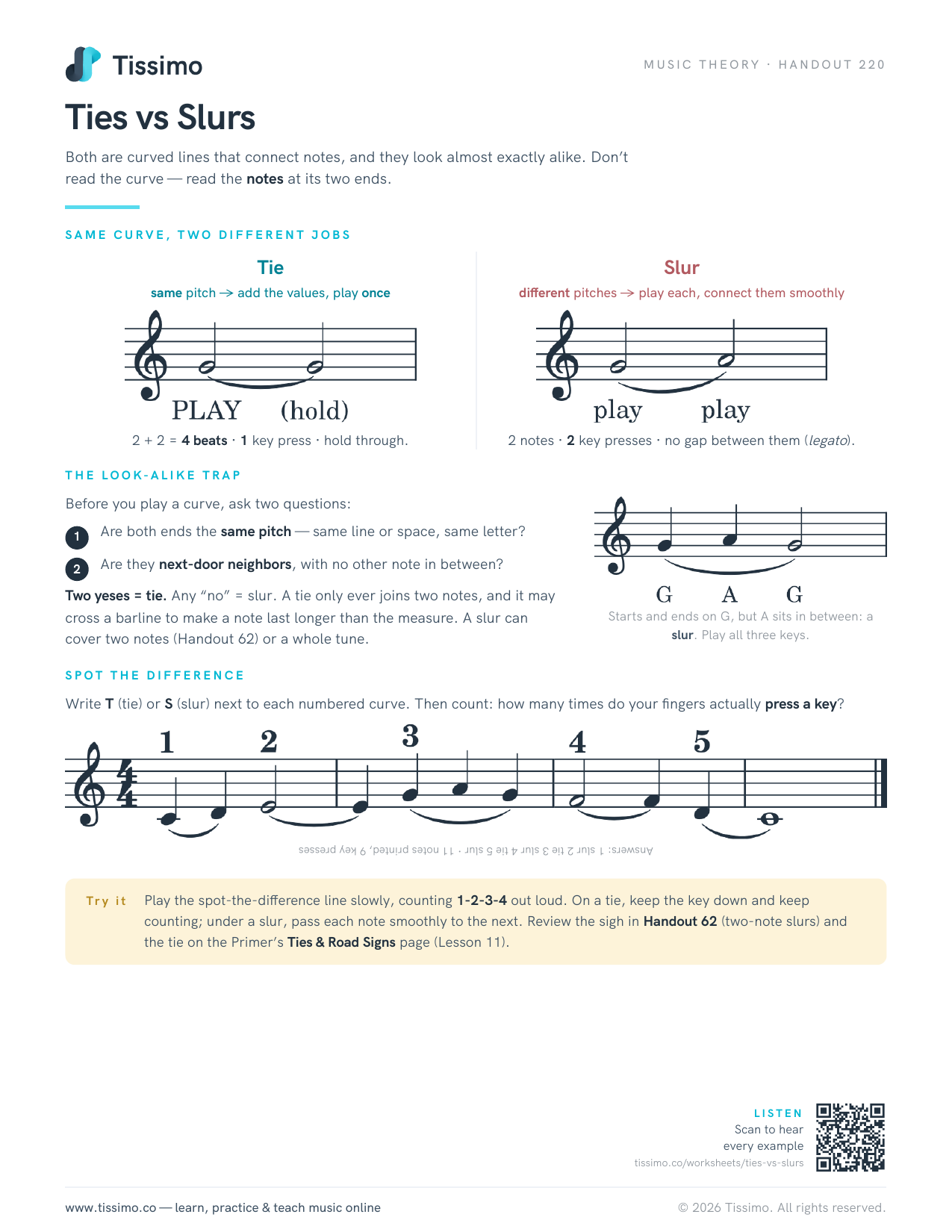
Ties vs Slurs
Both are curved lines that connect notes, and they look almost exactly alike. Don’t read the curve — read the notes at its two ends.
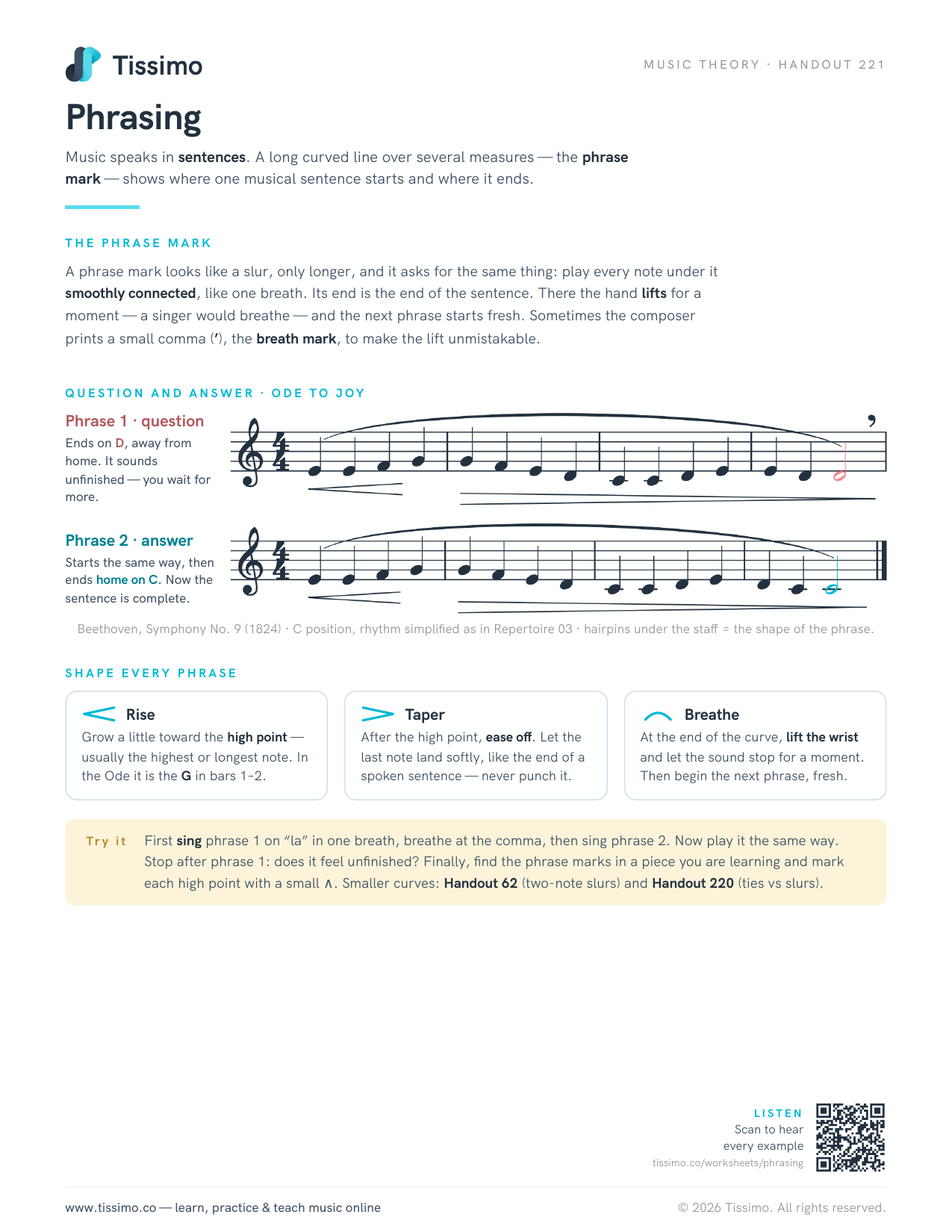
Phrasing
Music speaks in sentences. A long curved line over several measures — the phrase mark — shows where one musical sentence starts and where it ends.
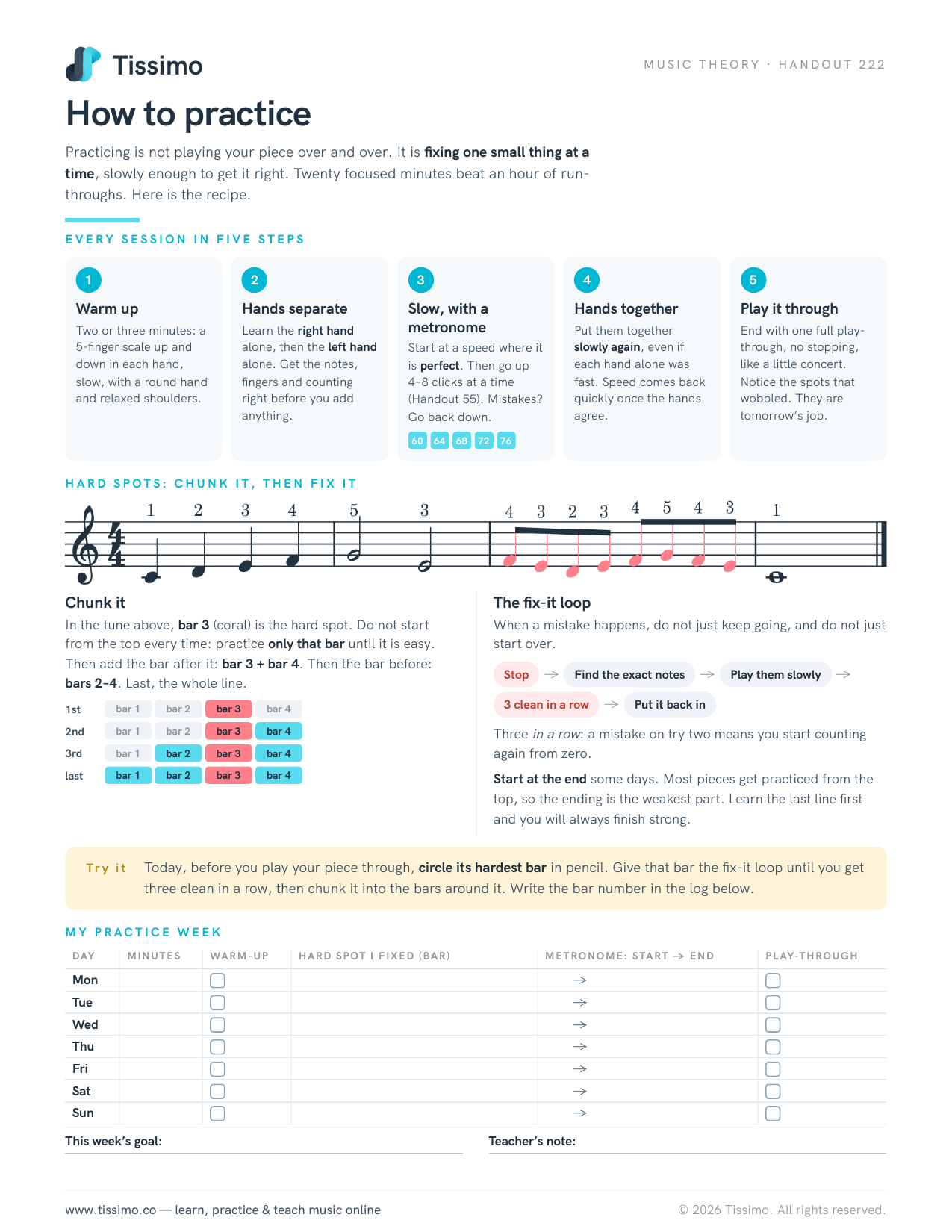
How to practice
Practicing is not playing your piece over and over. It is fixing one small thing at a time, slowly enough to get it right. Aim for short, focused sessions, not hour-long run-throughs. Here is the recipe.
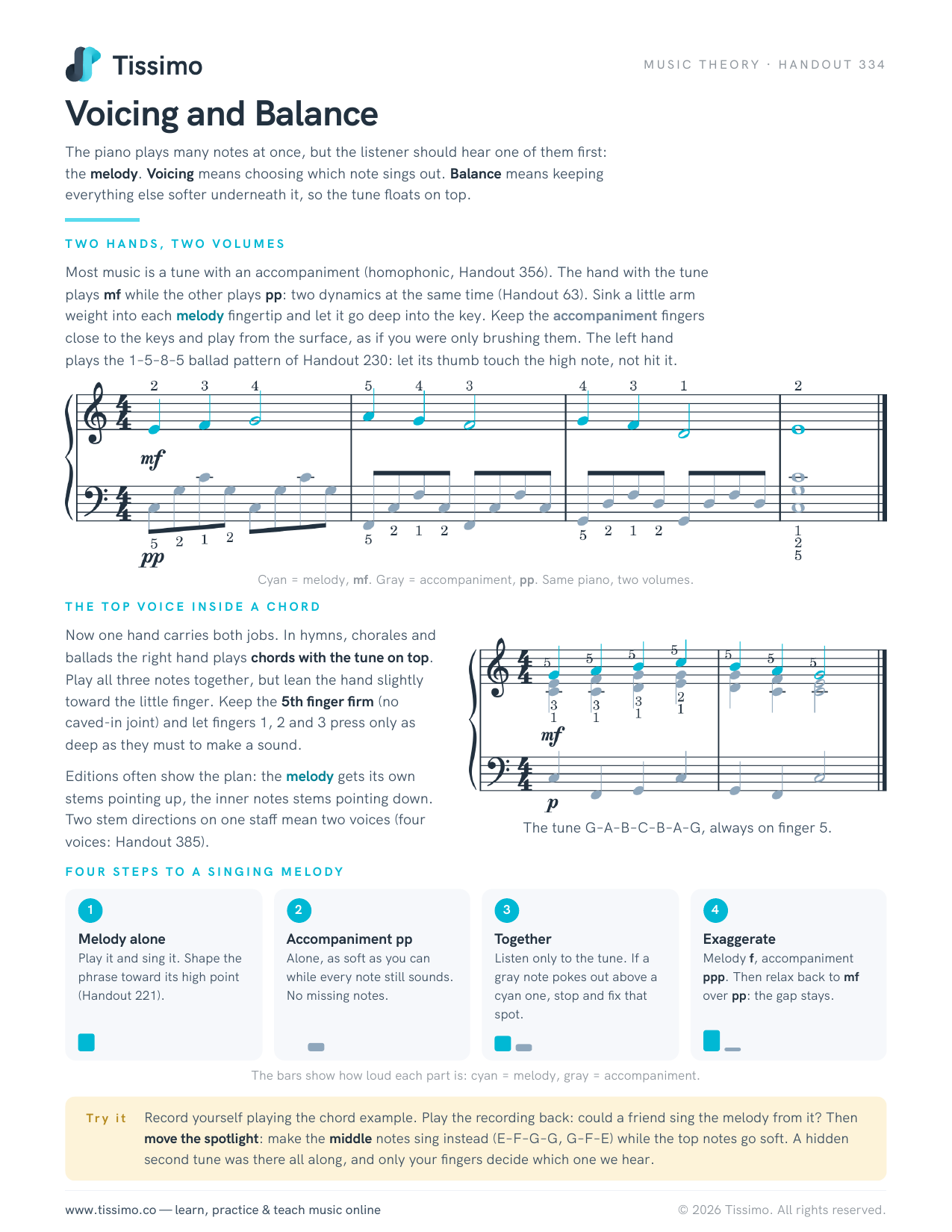
Voicing and Balance
The piano plays many notes at once, but the listener should hear one of them first: the melody. Voicing means choosing which note sings out. Balance means keeping everything else softer underneath it, so the tune floats on top.
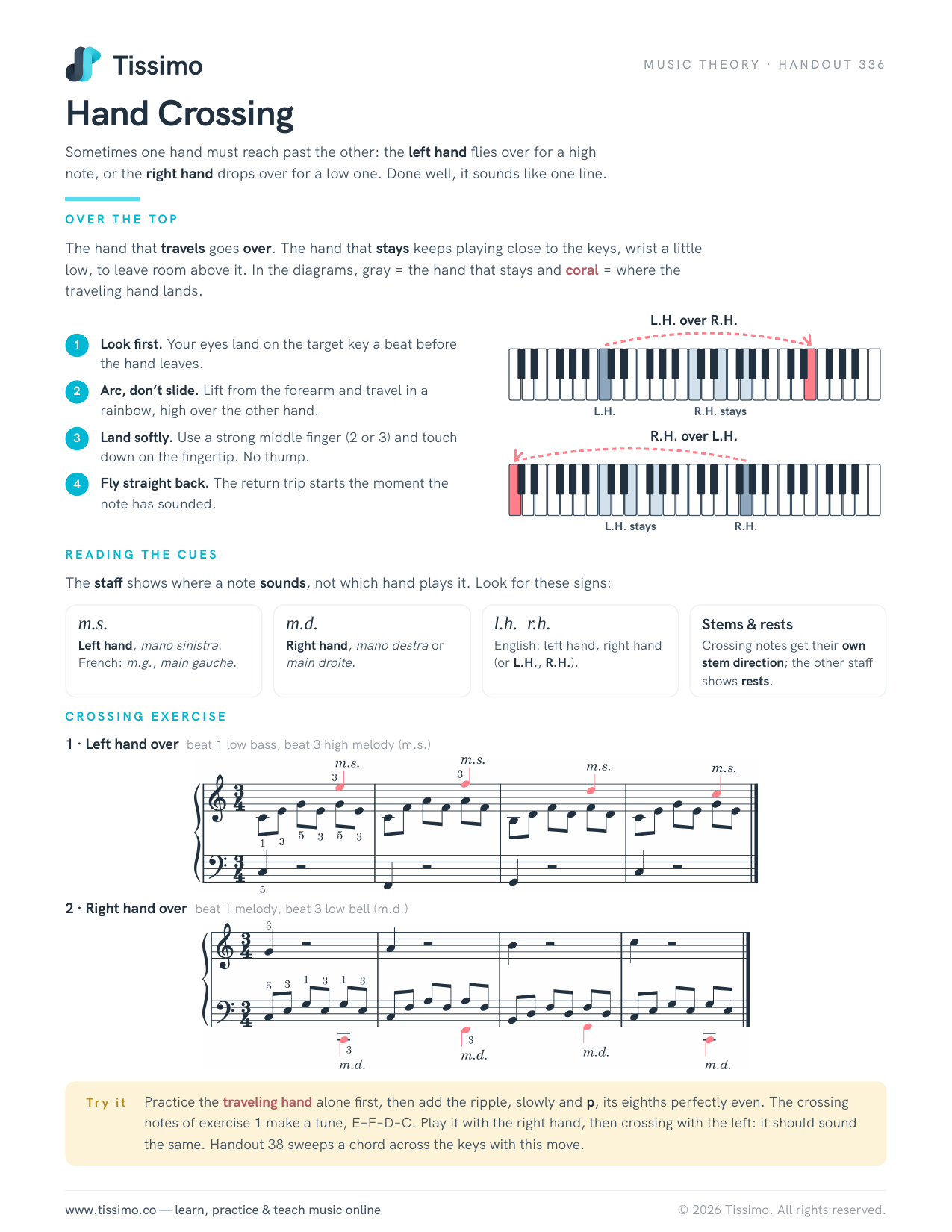
Hand Crossing
Sometimes one hand must reach past the other: the left hand flies over for a high note, or the right hand drops over for a low one. Done well, it sounds like one line.
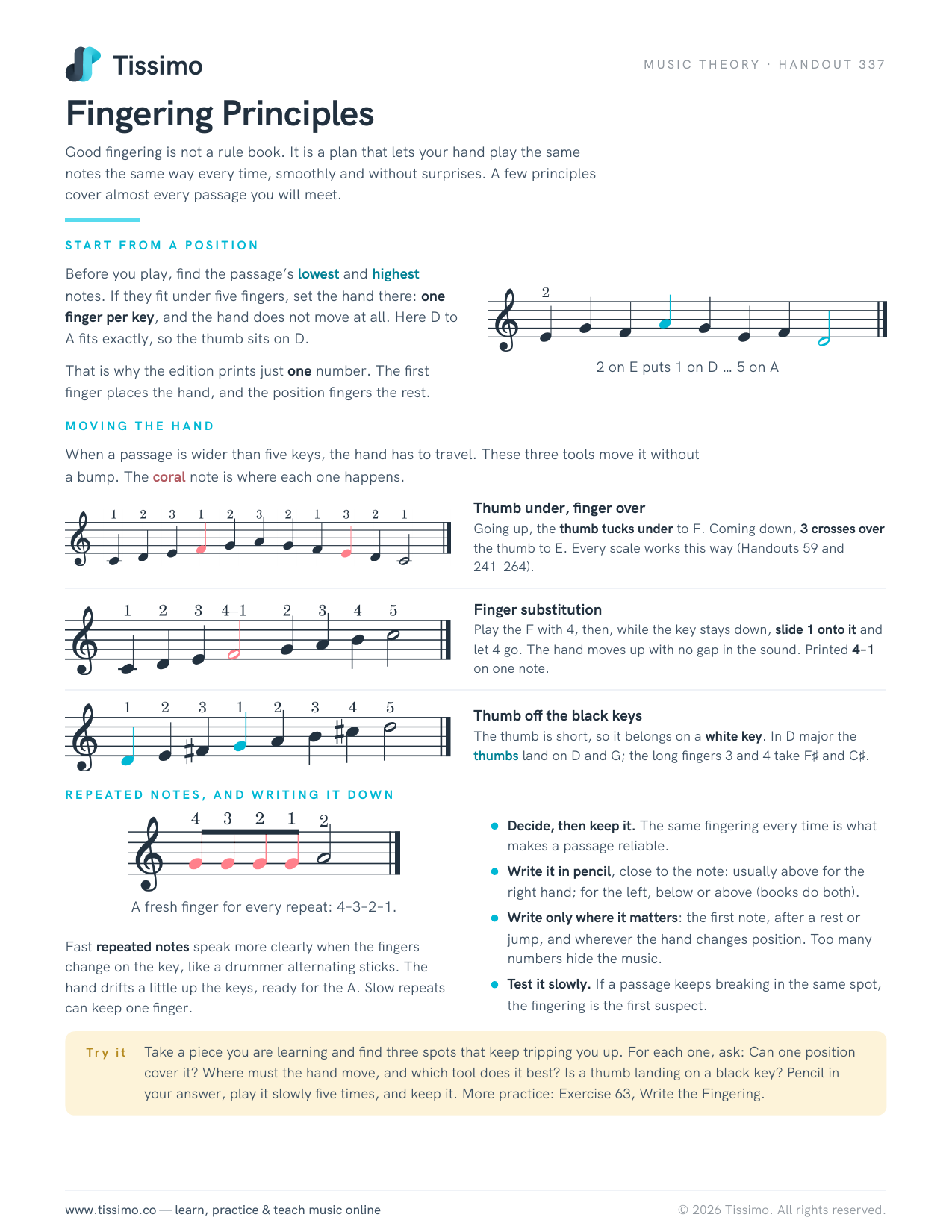
Fingering Principles
Good fingering is not a rule book. It is a plan that lets your hand play the same notes the same way every time, smoothly and without surprises. A few principles cover almost every passage you will meet.
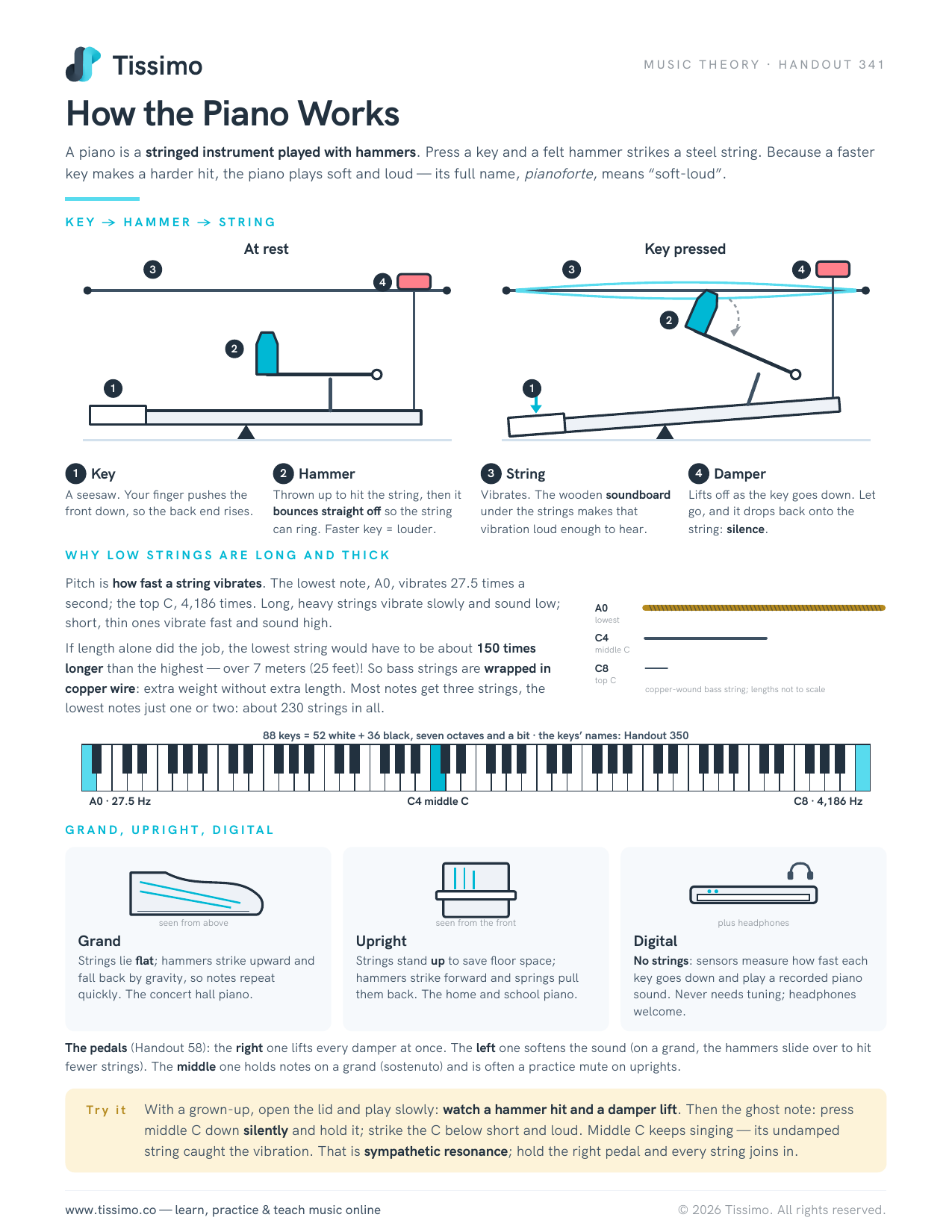
How the Piano Works
A piano is a stringed instrument played with hammers. Press a key and a felt hammer strikes a steel string. Because a faster key makes a harder hit, the piano plays soft and loud — its full name, pianoforte, means “soft-loud”.
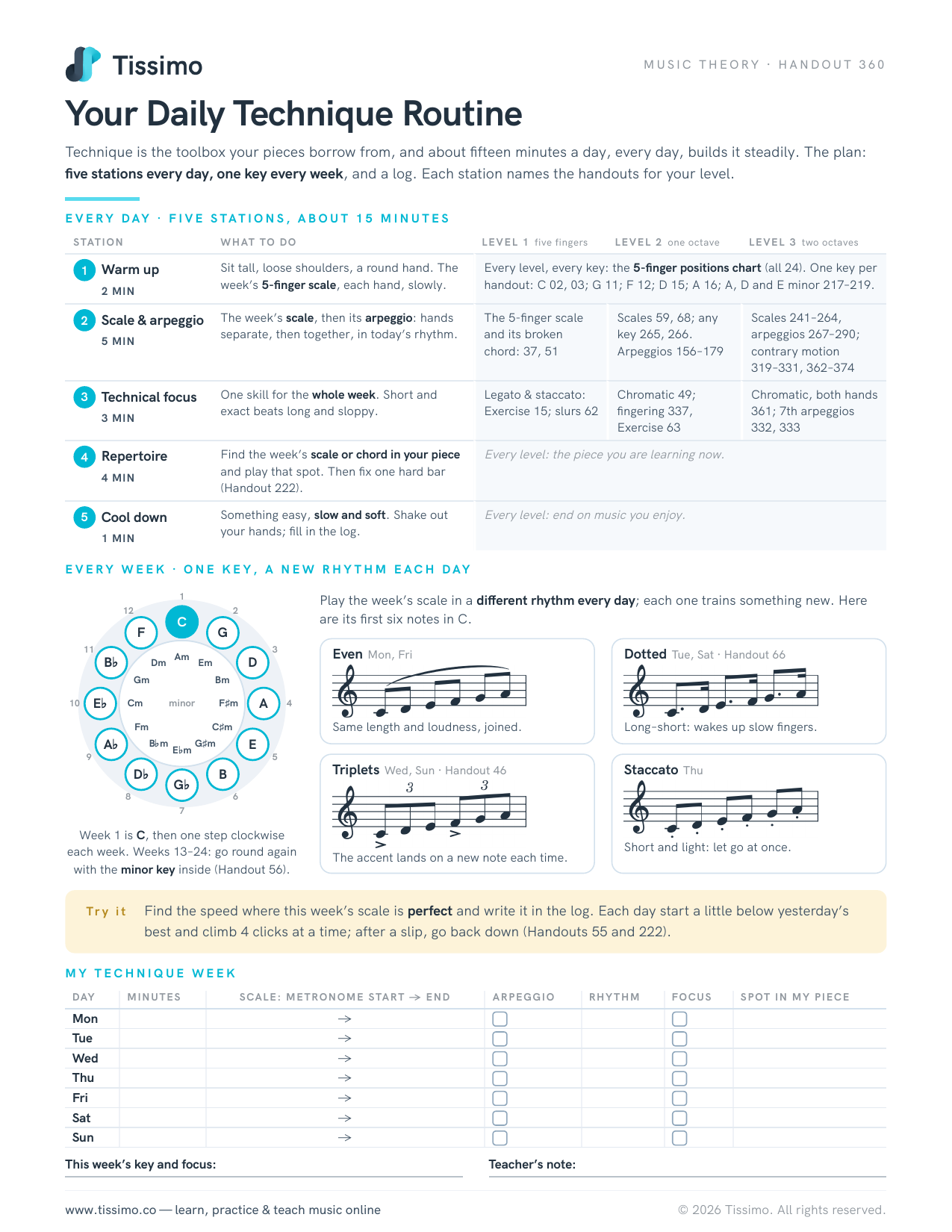
Your Daily Technique Routine
Technique is the toolbox your pieces borrow from, and about fifteen minutes a day, every day, builds it steadily. The plan: five stations every day, one key every week, and a log. Each station names the handouts for your level.
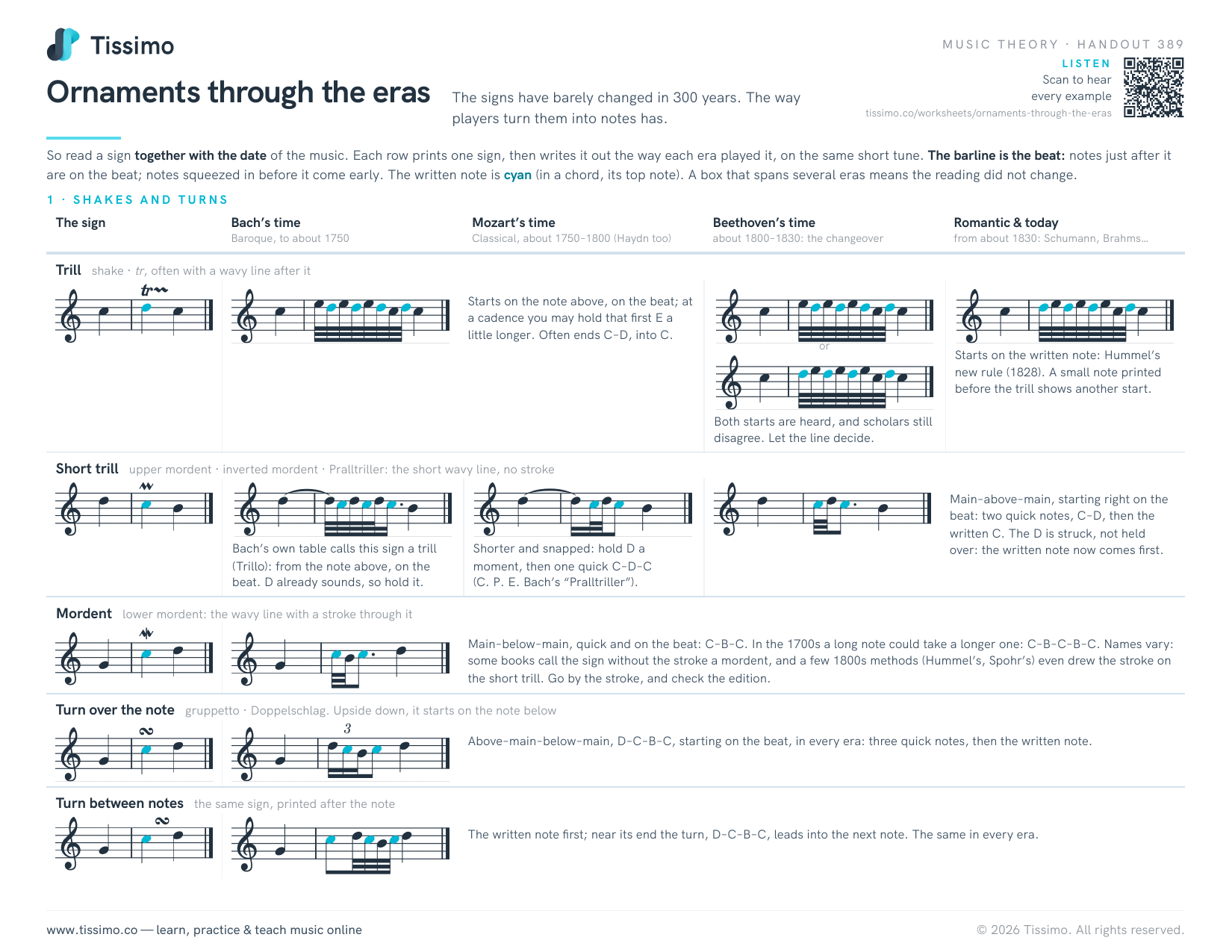
Ornaments through the eras
The signs have barely changed in 300 years. The way players turn them into notes has.
Repertoire
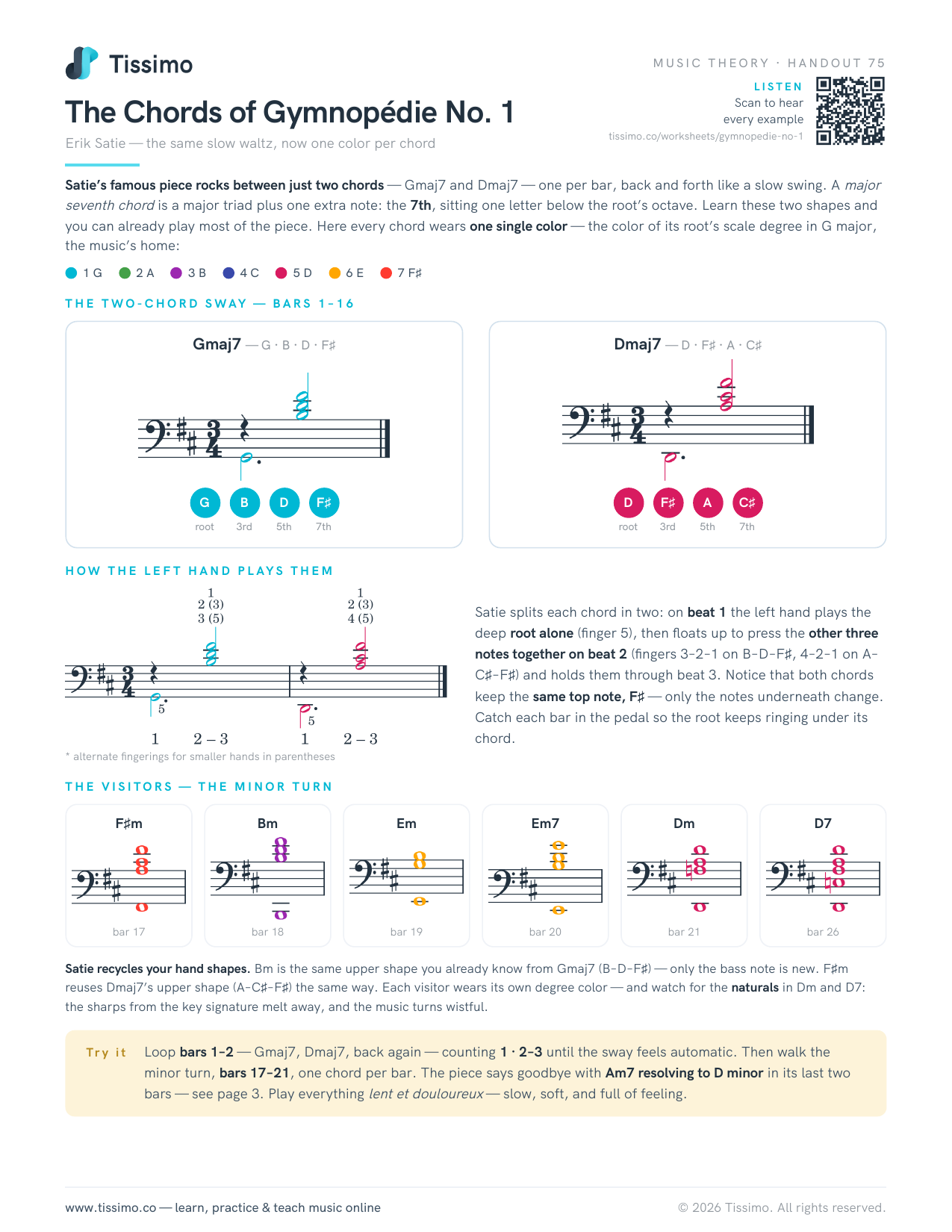
The Chords of Gymnopédie No. 1
Erik Satie — the same slow waltz, now one color per chord
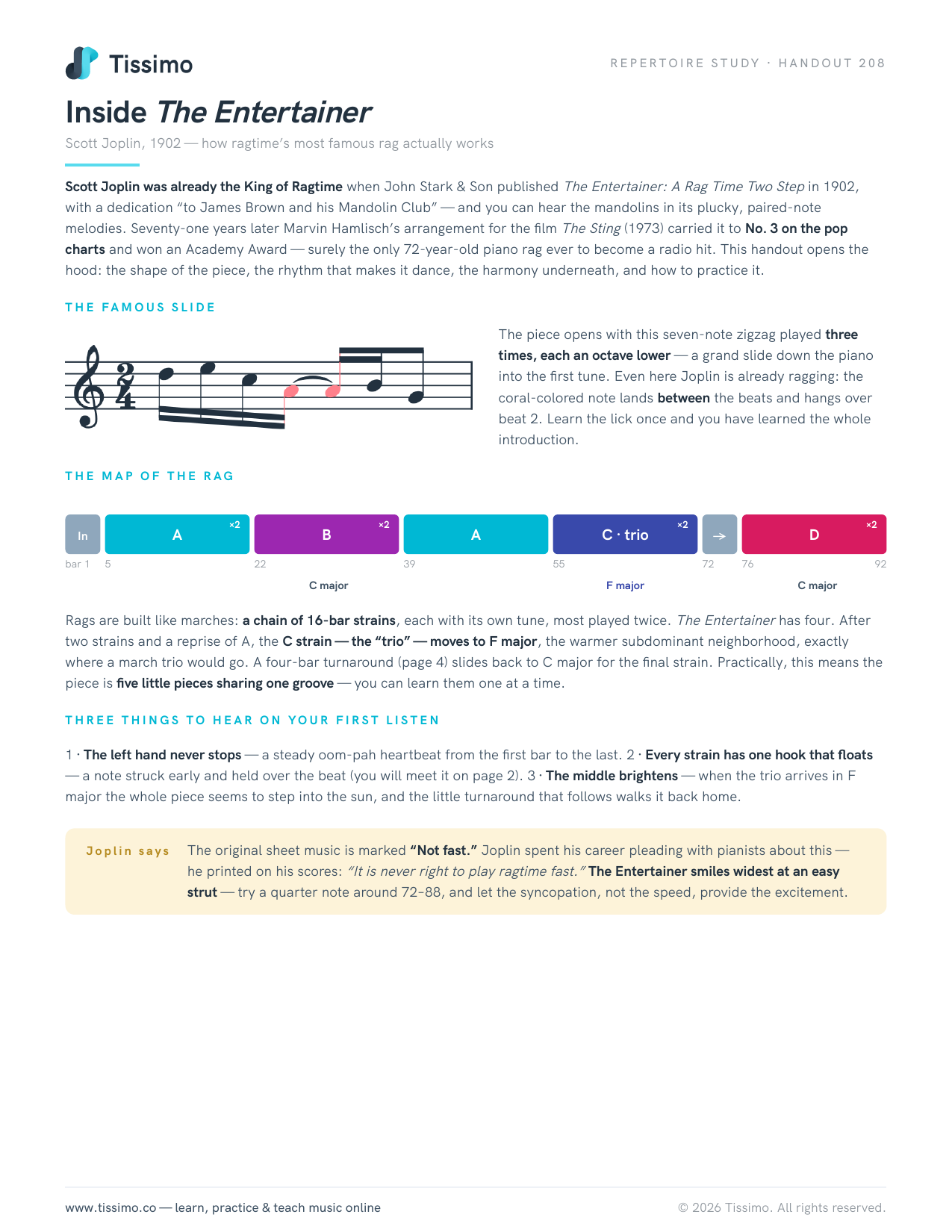
Inside The Entertainer
Scott Joplin, 1902 — how ragtime’s most famous rag actually works
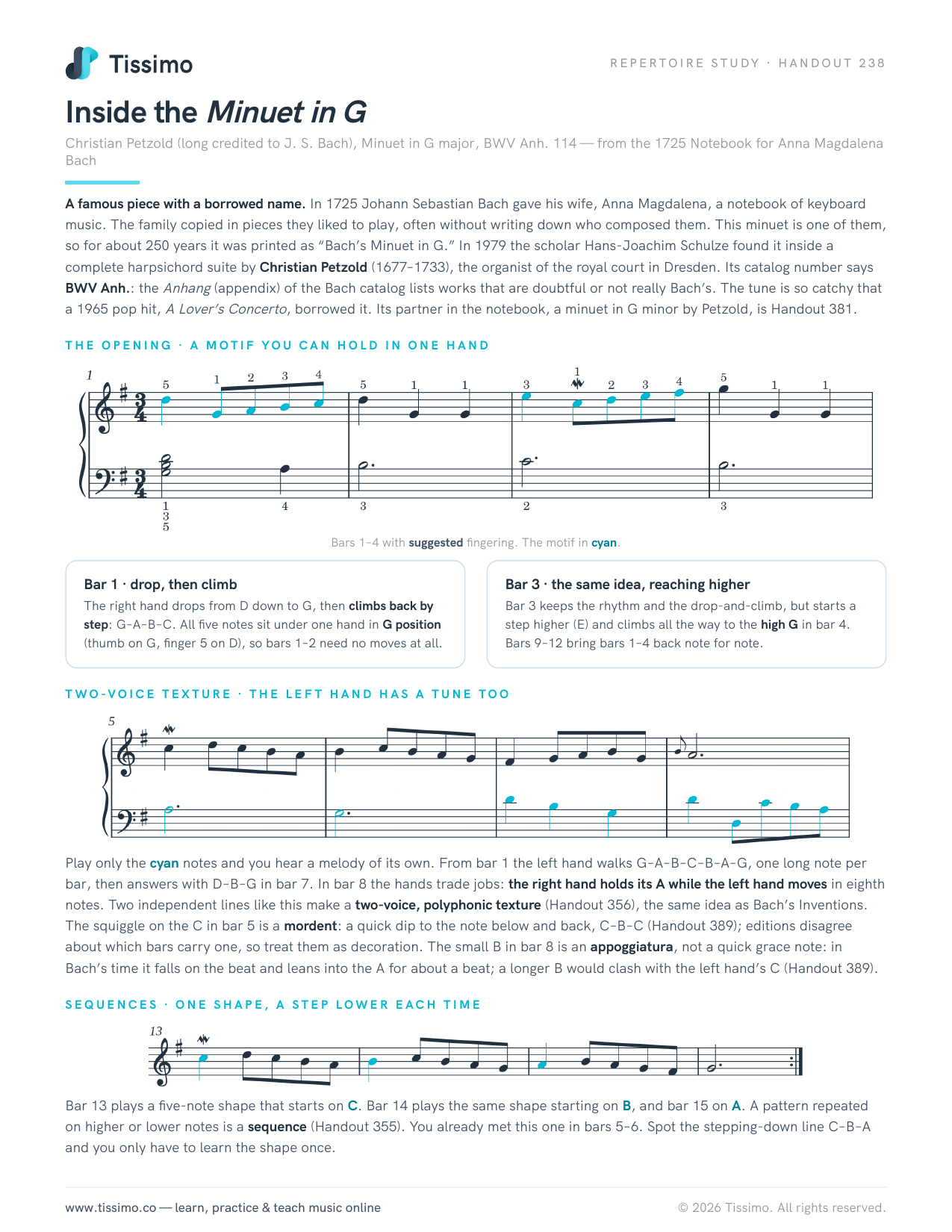
Inside the Minuet in G
Christian Petzold (long credited to J. S. Bach), Minuet in G major, BWV Anh. 114 — from the 1725 Notebook for Anna Magdalena Bach
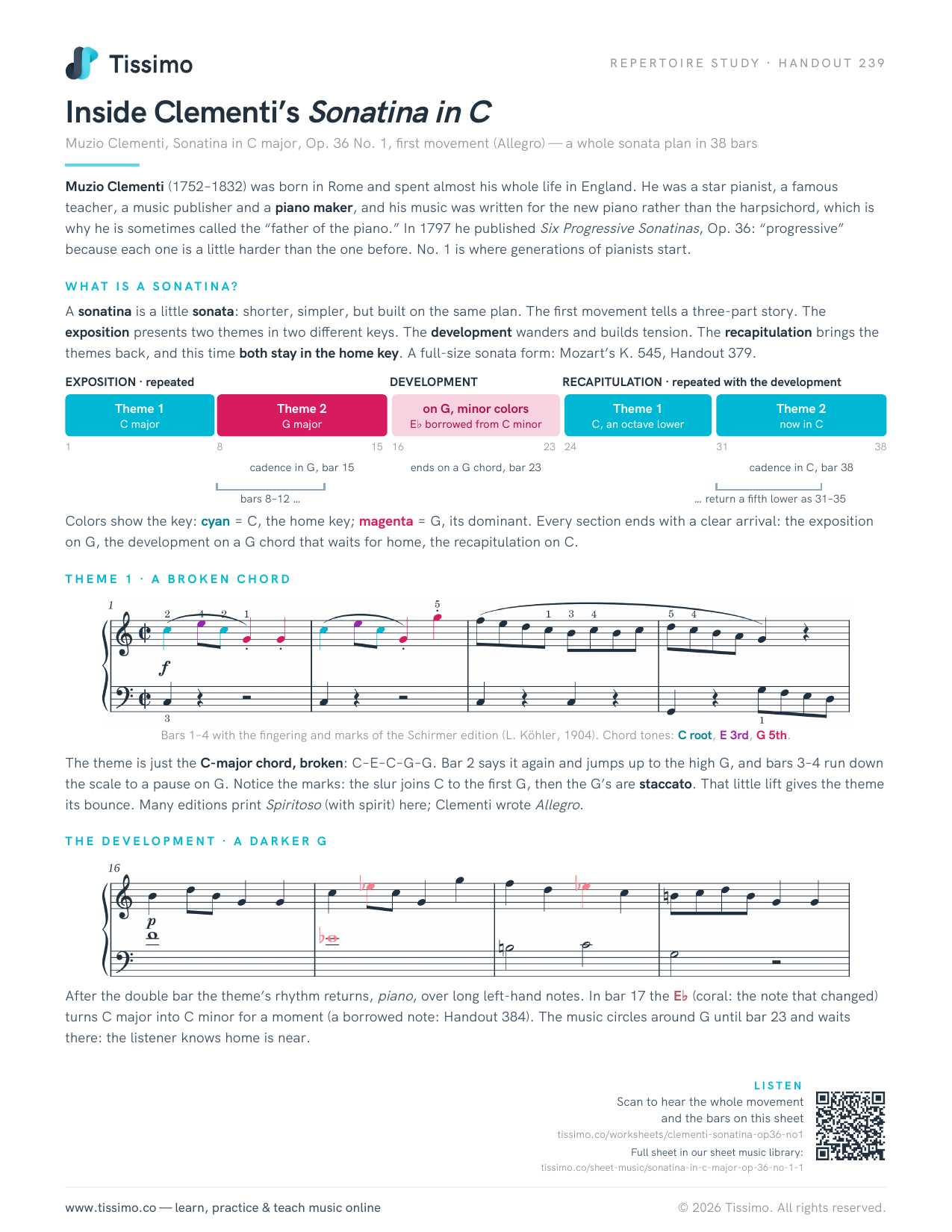
Inside Clementi’s Sonatina in C
Muzio Clementi, Sonatina in C major, Op. 36 No. 1, first movement (Allegro) — a whole sonata plan in 38 bars
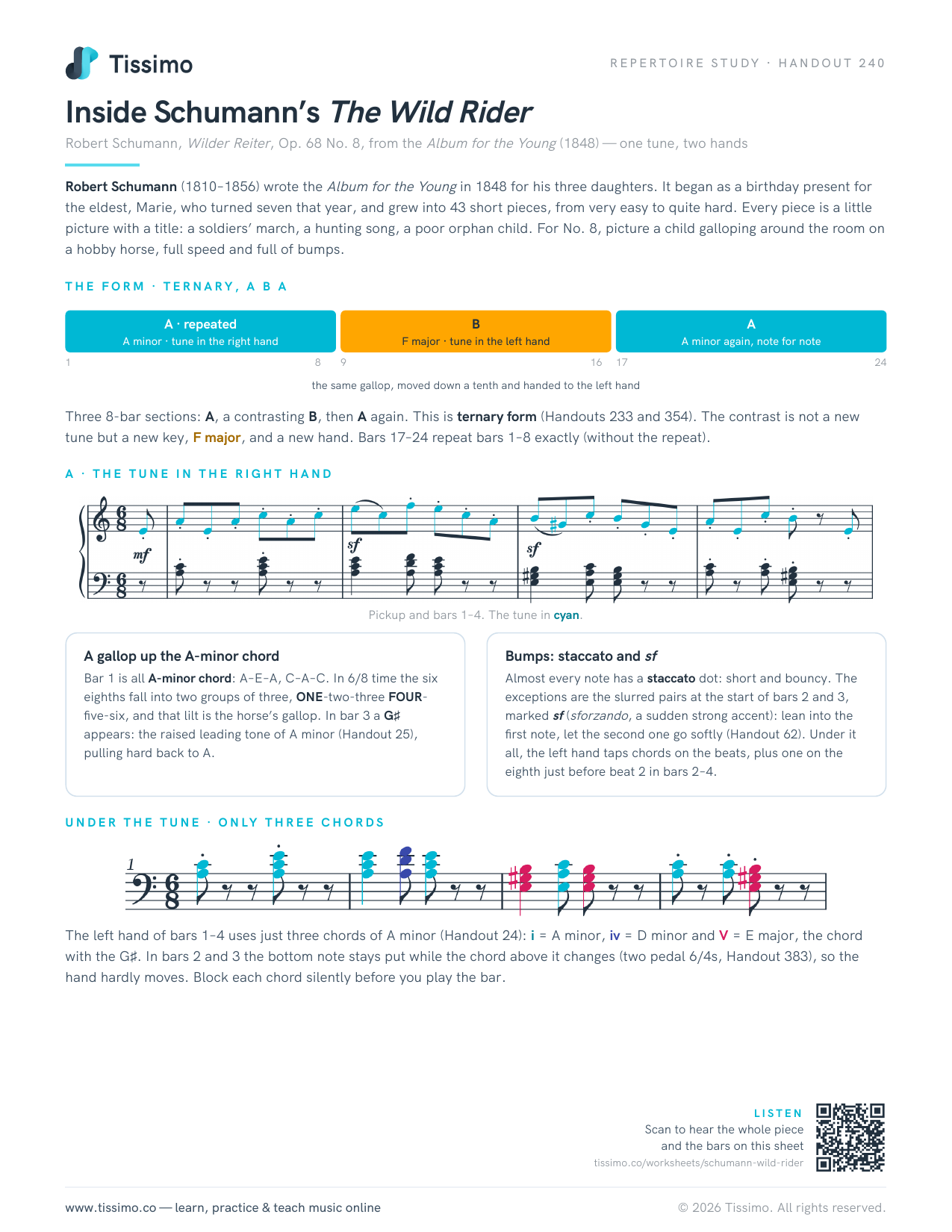
Inside Schumann’s The Wild Rider
Robert Schumann, Wilder Reiter, Op. 68 No. 8, from the Album for the Young (1848) — one tune, two hands
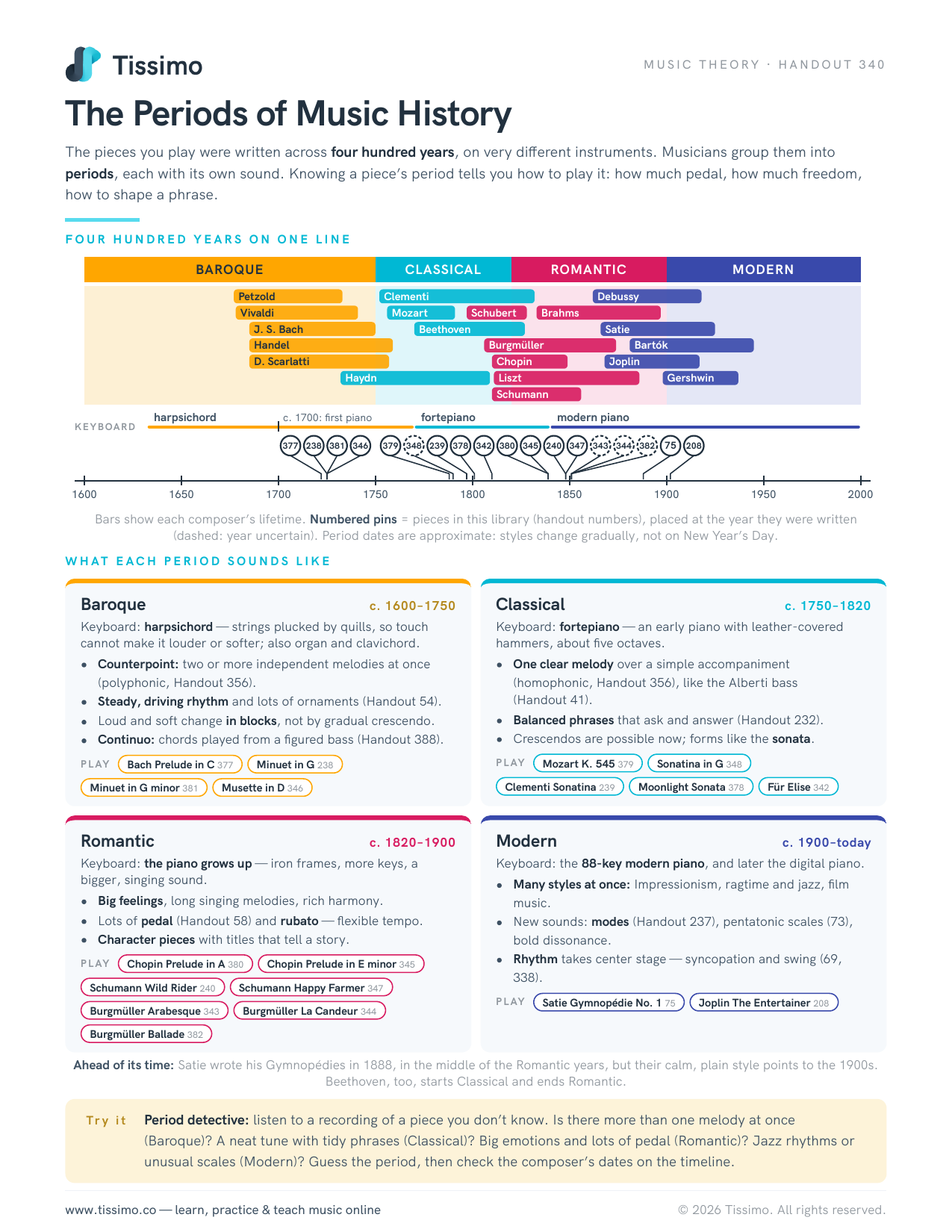
The Periods of Music History
The pieces you play were written across four hundred years, on very different instruments. Musicians group them into periods, each with its own sound. Knowing a piece’s period tells you how to play it: how much pedal, how much freedom, how to shape a phrase.
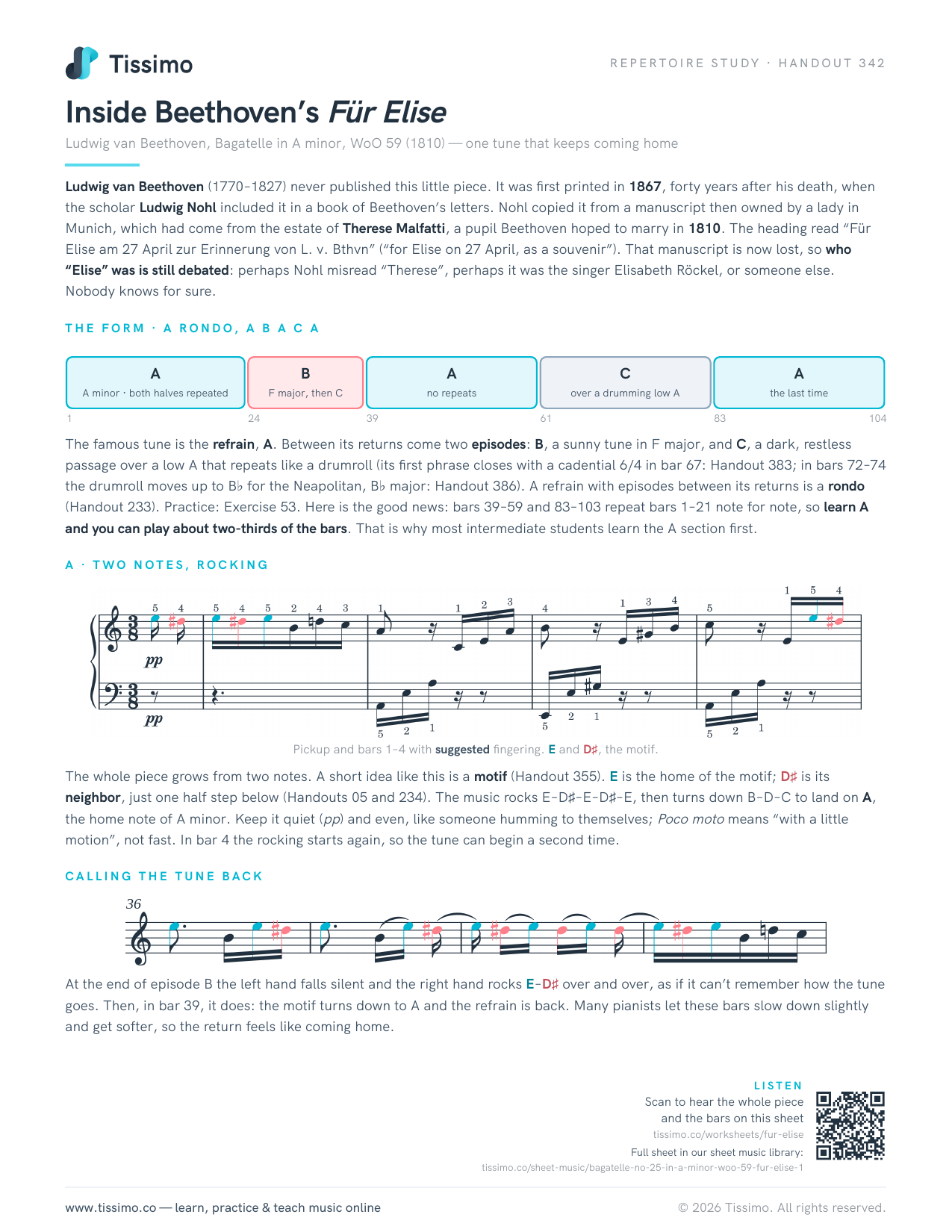
Inside Beethoven’s Für Elise
Ludwig van Beethoven, Bagatelle in A minor, WoO 59 (1810) — one tune that keeps coming home
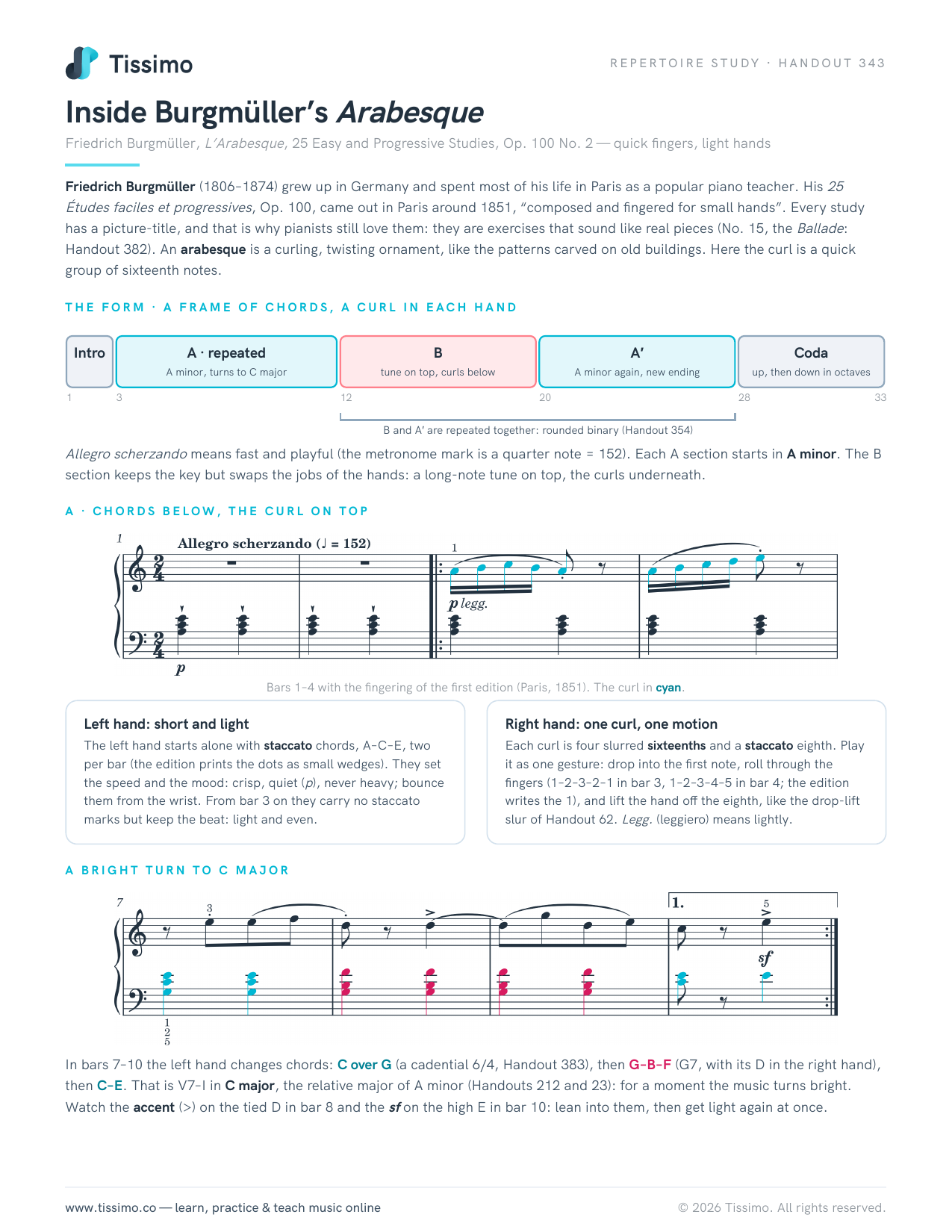
Inside Burgmüller’s Arabesque
Friedrich Burgmüller, L’Arabesque, 25 Easy and Progressive Studies, Op. 100 No. 2 — quick fingers, light hands
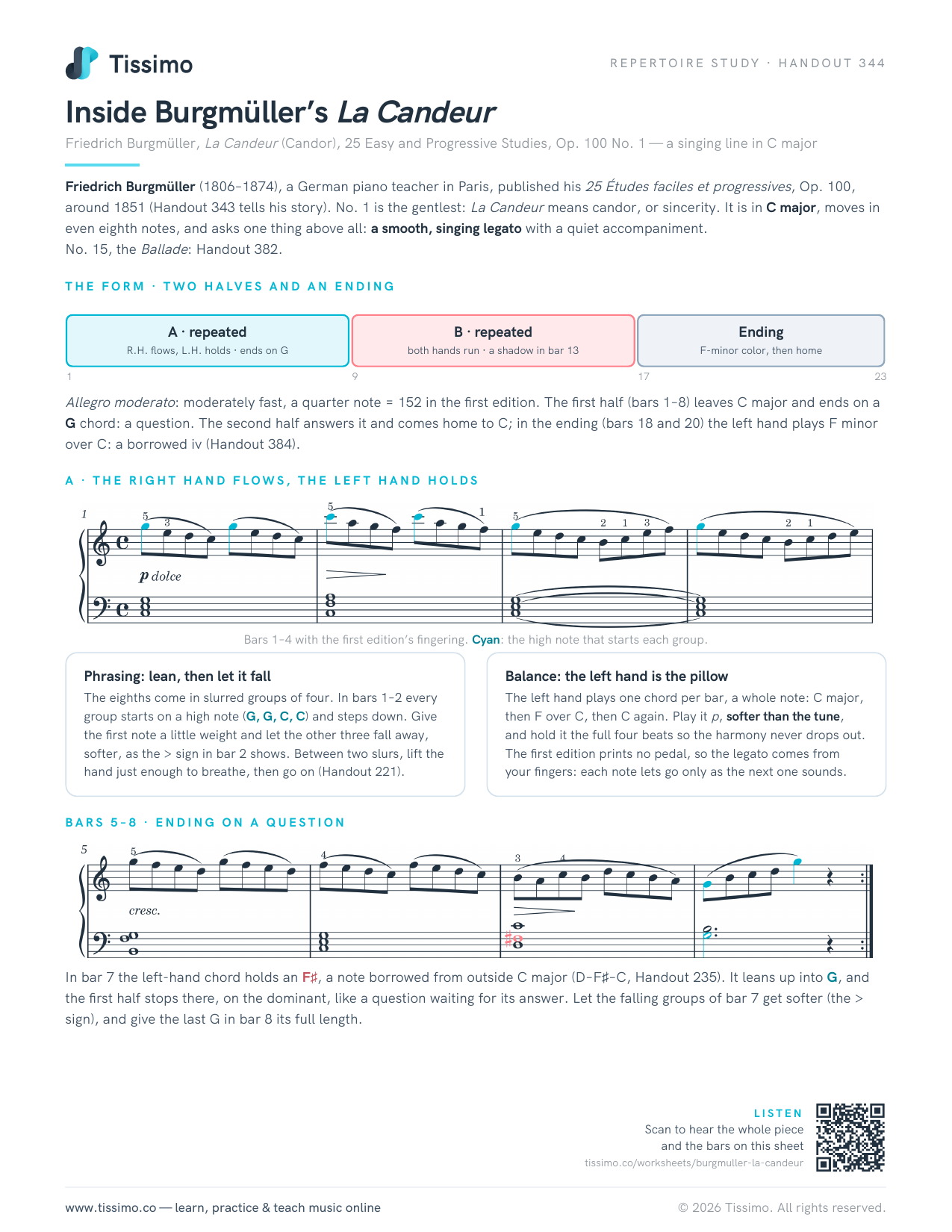
Inside Burgmüller’s La Candeur
Friedrich Burgmüller, La Candeur (Candor), 25 Easy and Progressive Studies, Op. 100 No. 1 — a singing line in C major
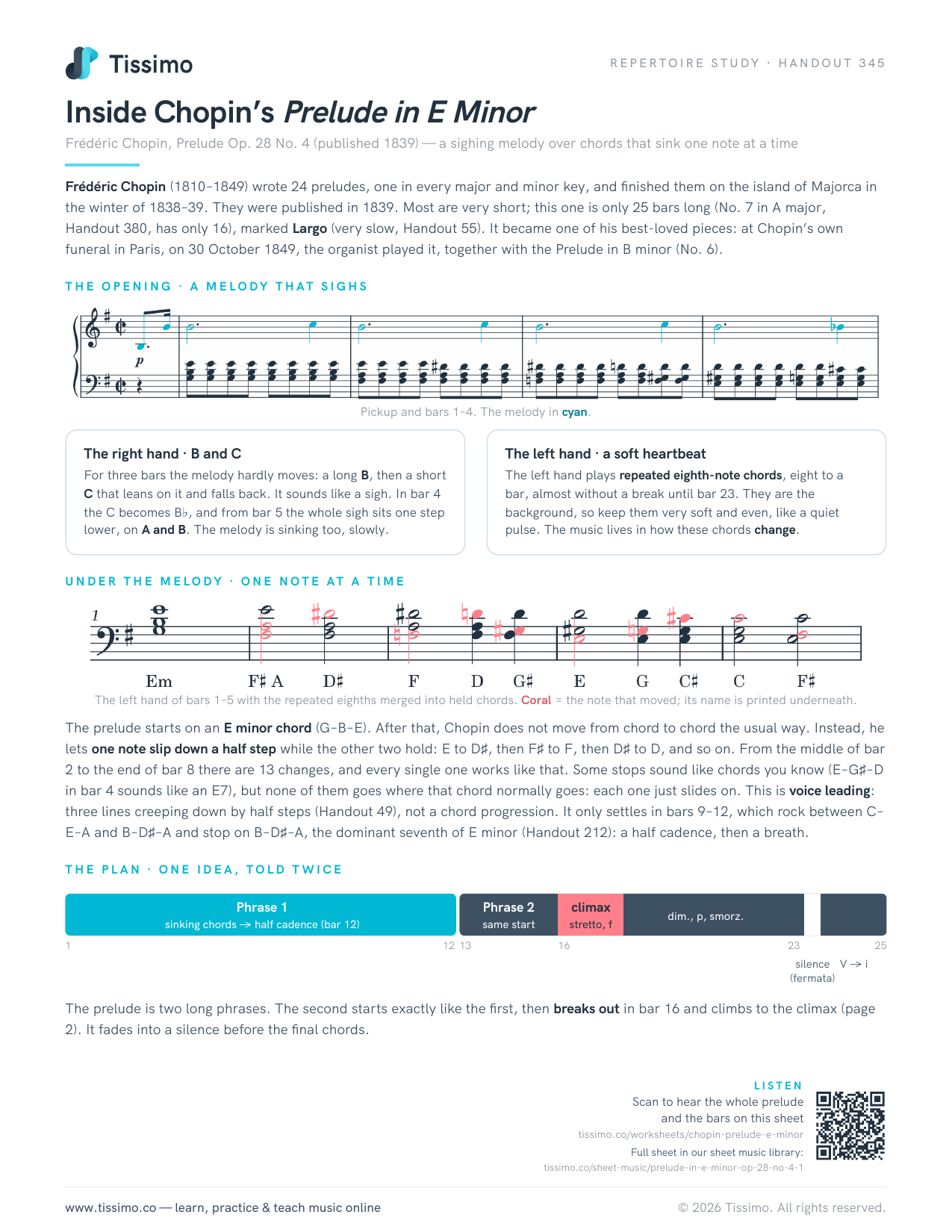
Inside Chopin’s Prelude in E Minor
Frédéric Chopin, Prelude Op. 28 No. 4 (published 1839) — a sighing melody over chords that sink one note at a time
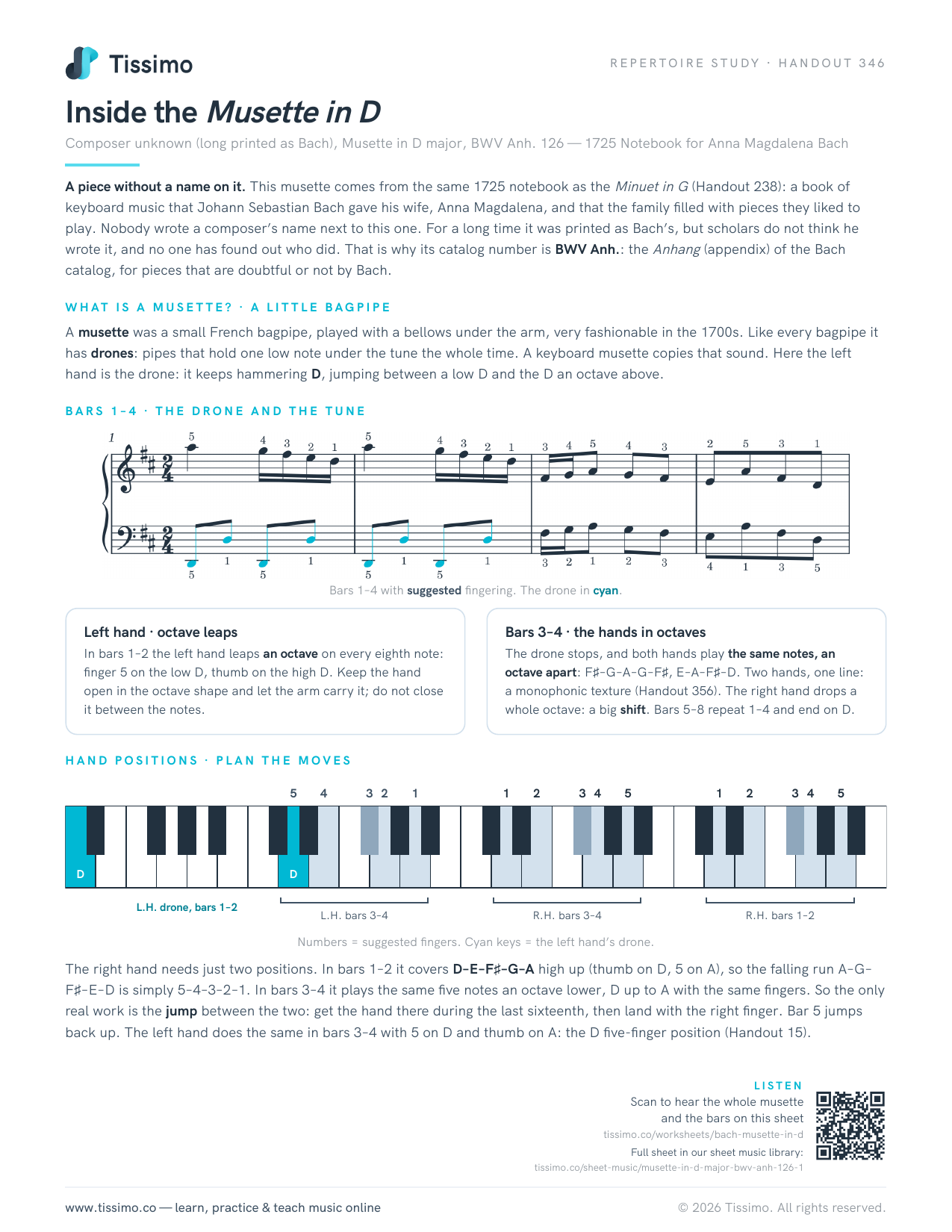
Inside the Musette in D
Composer unknown (long printed as Bach), Musette in D major, BWV Anh. 126 — 1725 Notebook for Anna Magdalena Bach
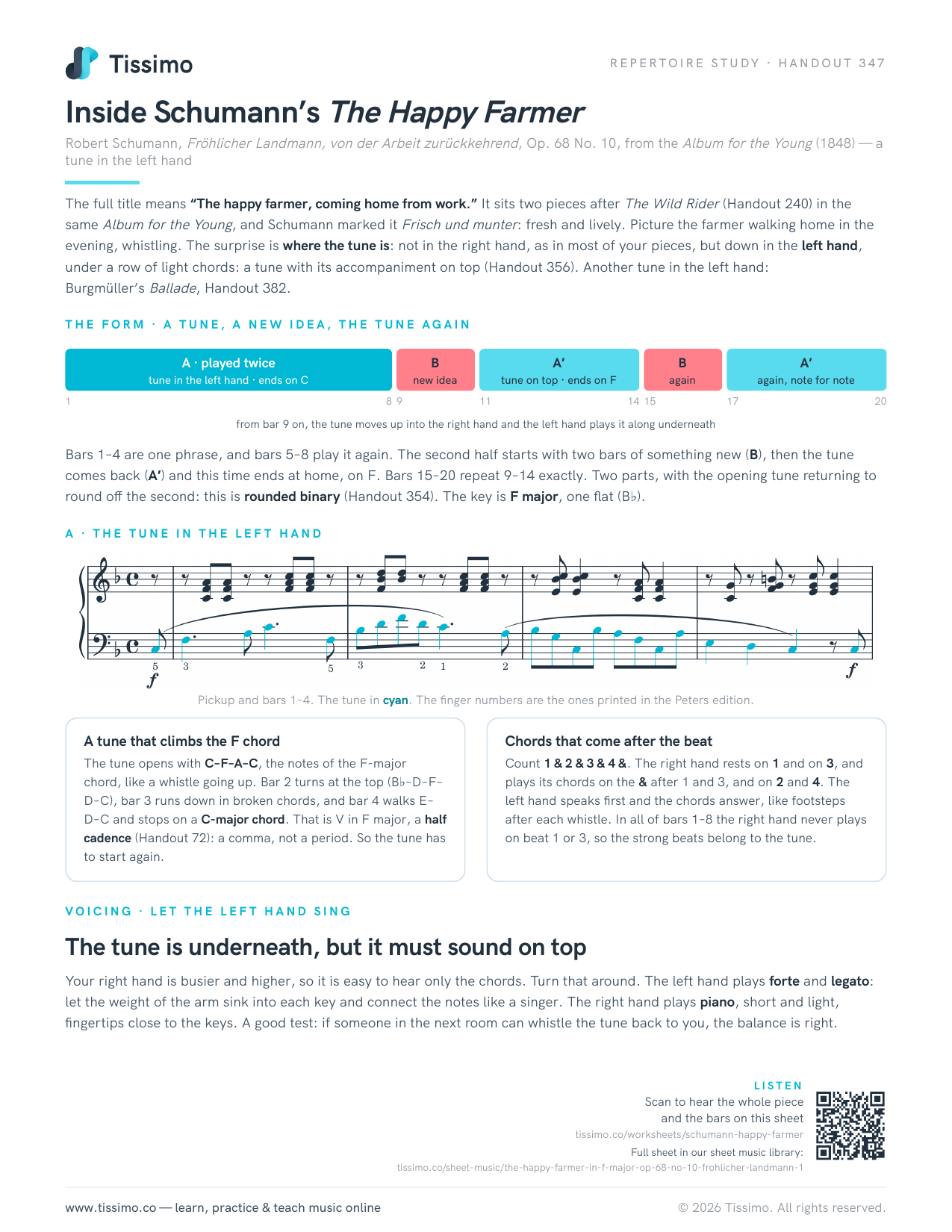
Inside Schumann’s The Happy Farmer
Robert Schumann, Fröhlicher Landmann, von der Arbeit zurückkehrend, Op. 68 No. 10, from the Album for the Young (1848) — a tune in the left hand
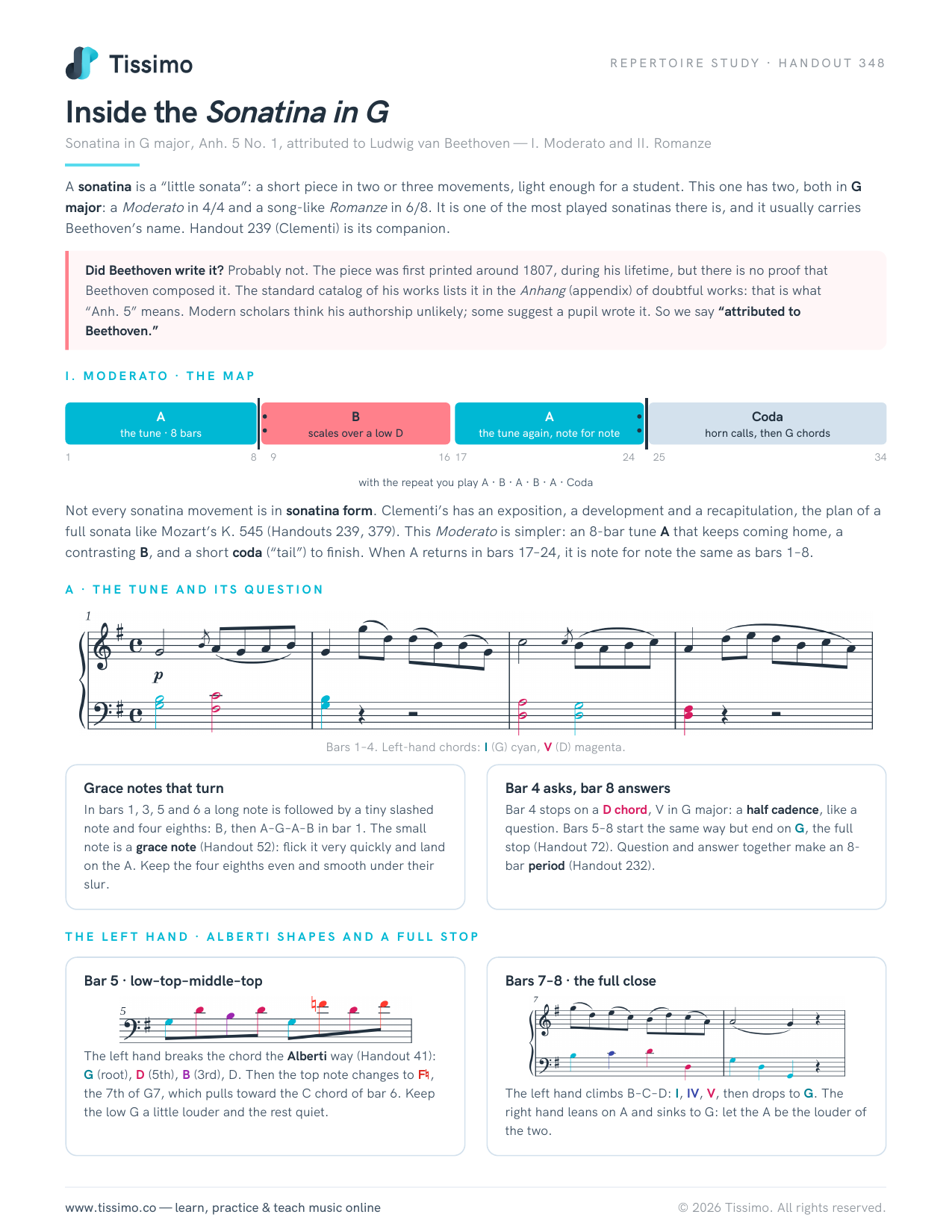
Inside the Sonatina in G
Sonatina in G major, Anh. 5 No. 1, attributed to Ludwig van Beethoven — I. Moderato and II. Romanze
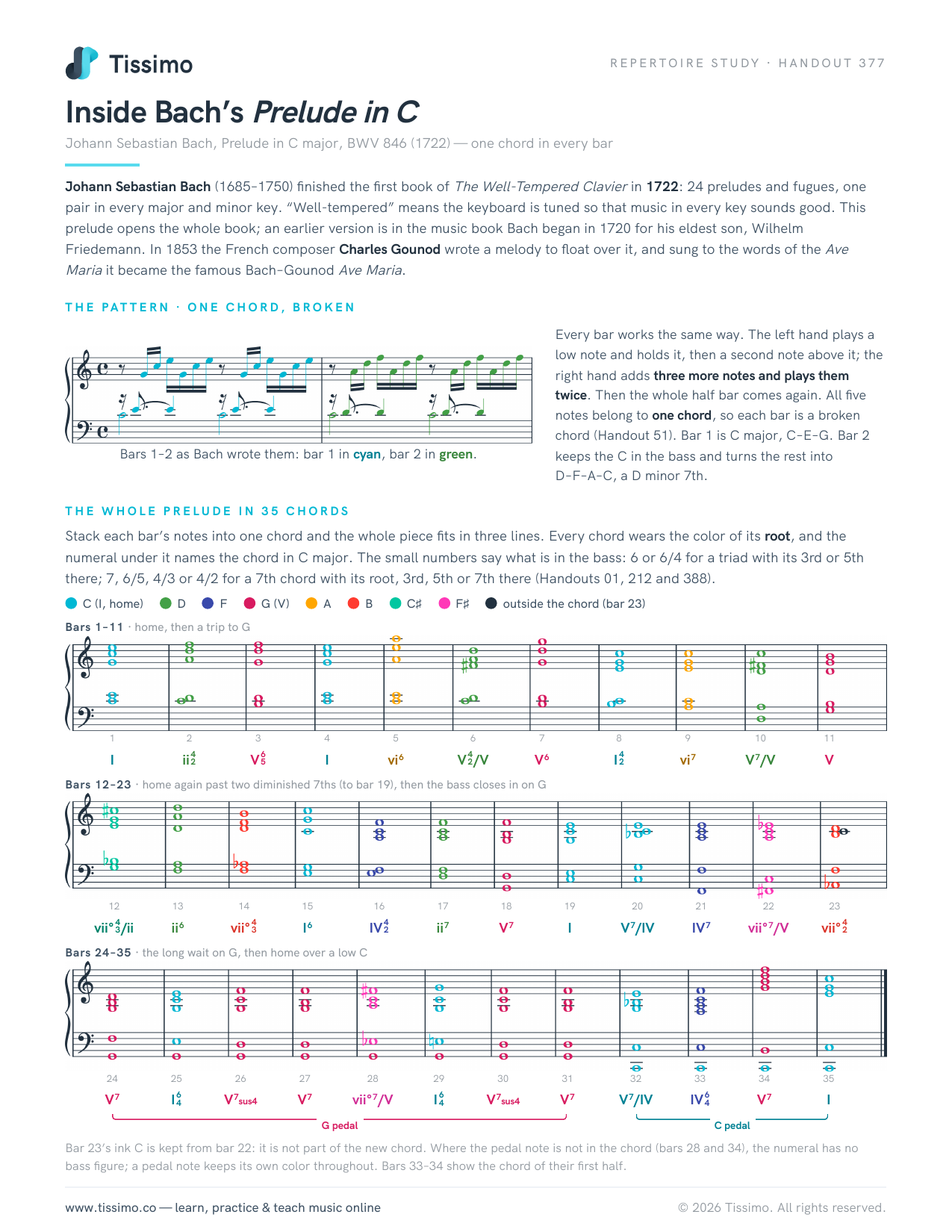
Inside Bach’s Prelude in C
Johann Sebastian Bach, Prelude in C major, BWV 846 (1722) — one chord in every bar
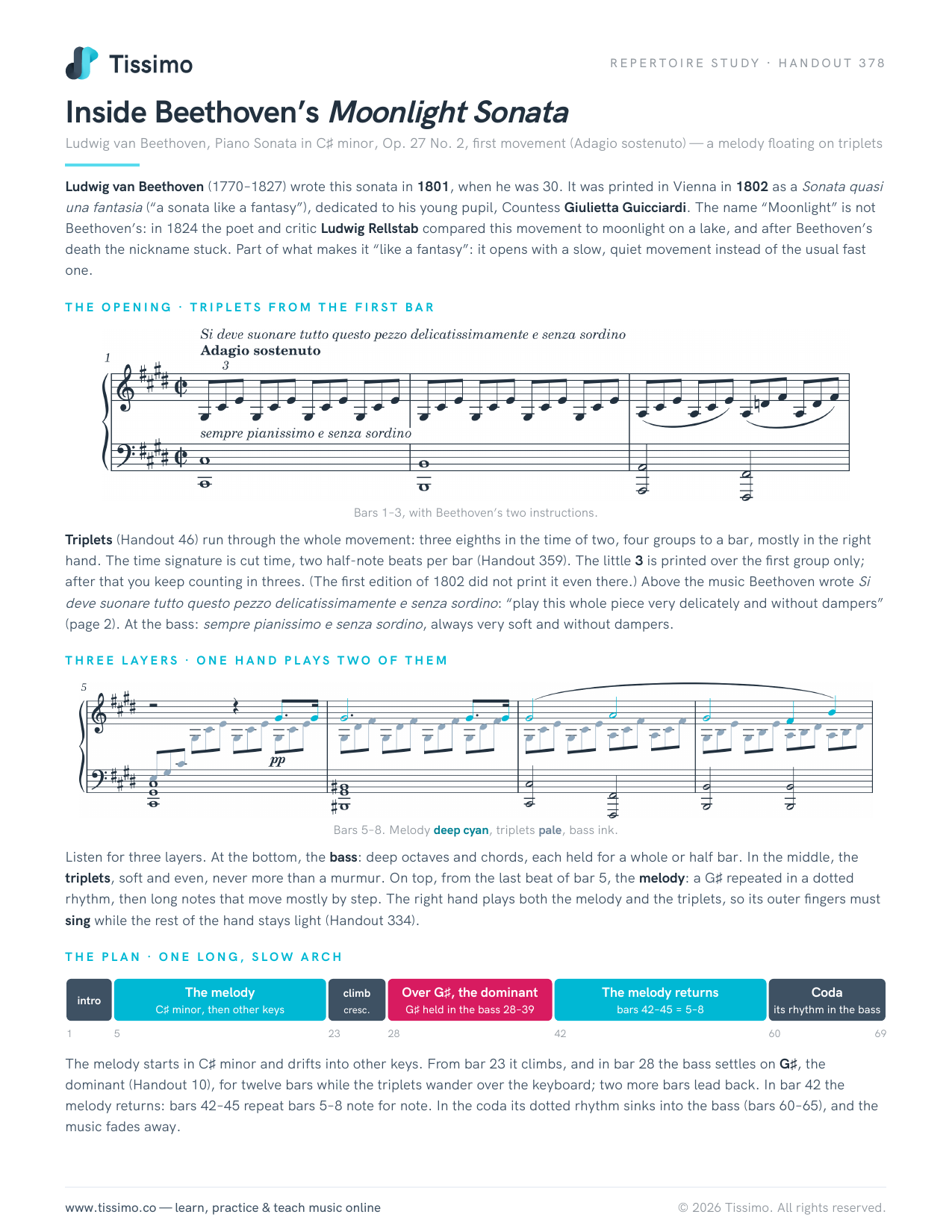
Inside Beethoven’s Moonlight Sonata
Ludwig van Beethoven, Piano Sonata in C♯ minor, Op. 27 No. 2, first movement (Adagio sostenuto) — a melody floating on triplets
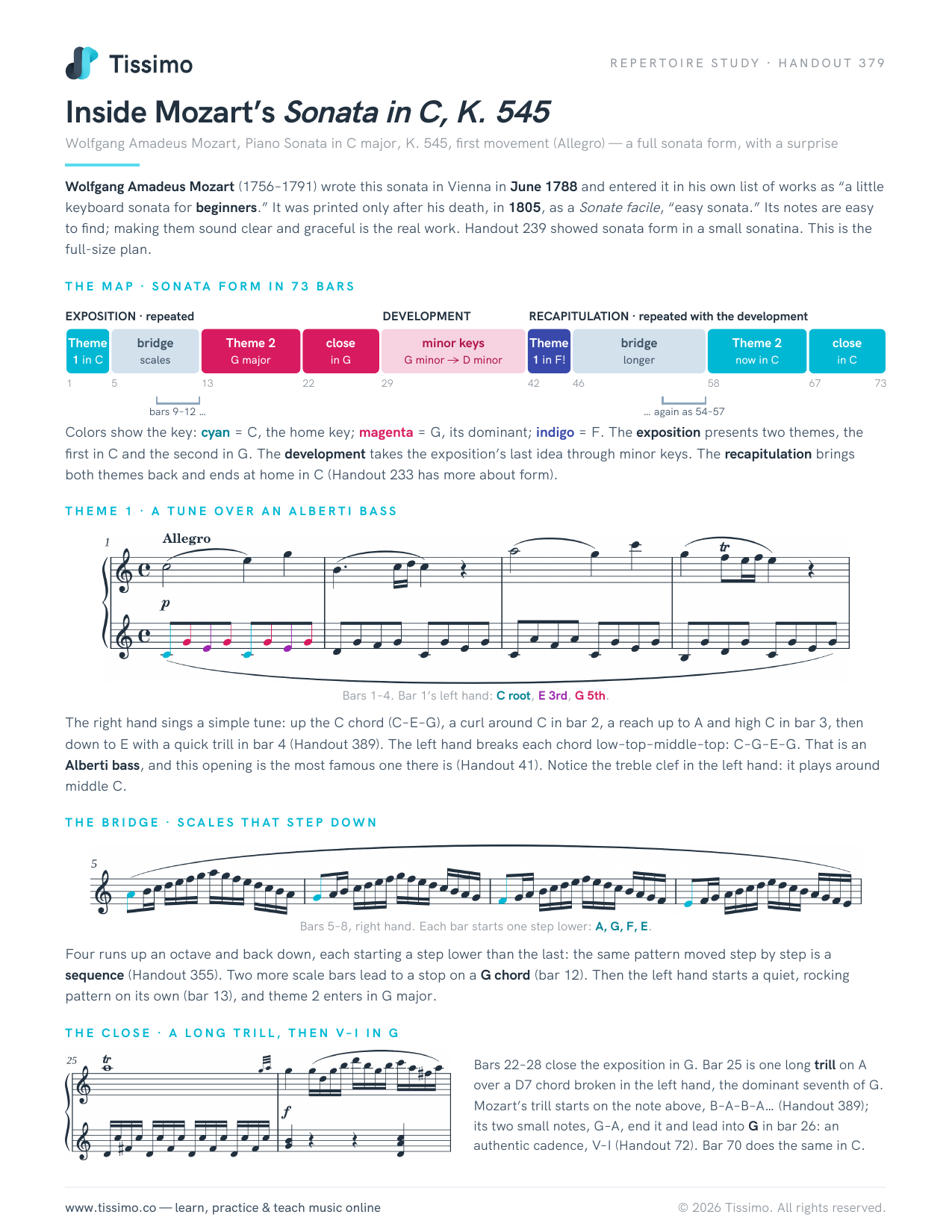
Inside Mozart’s Sonata in C, K. 545
Wolfgang Amadeus Mozart, Piano Sonata in C major, K. 545, first movement (Allegro) — a full sonata form, with a surprise
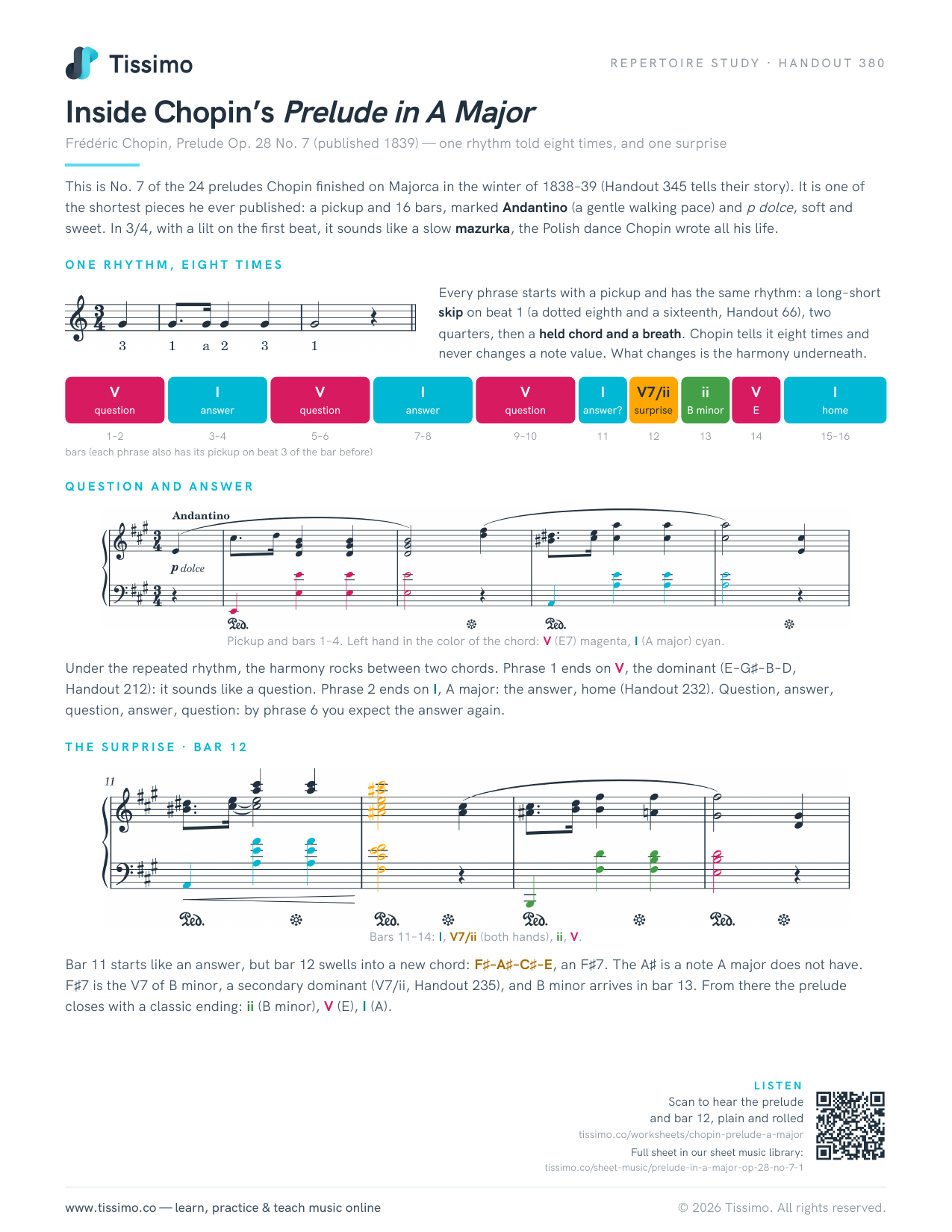
Inside Chopin’s Prelude in A Major
Frédéric Chopin, Prelude Op. 28 No. 7 (published 1839) — one rhythm told eight times, and one surprise
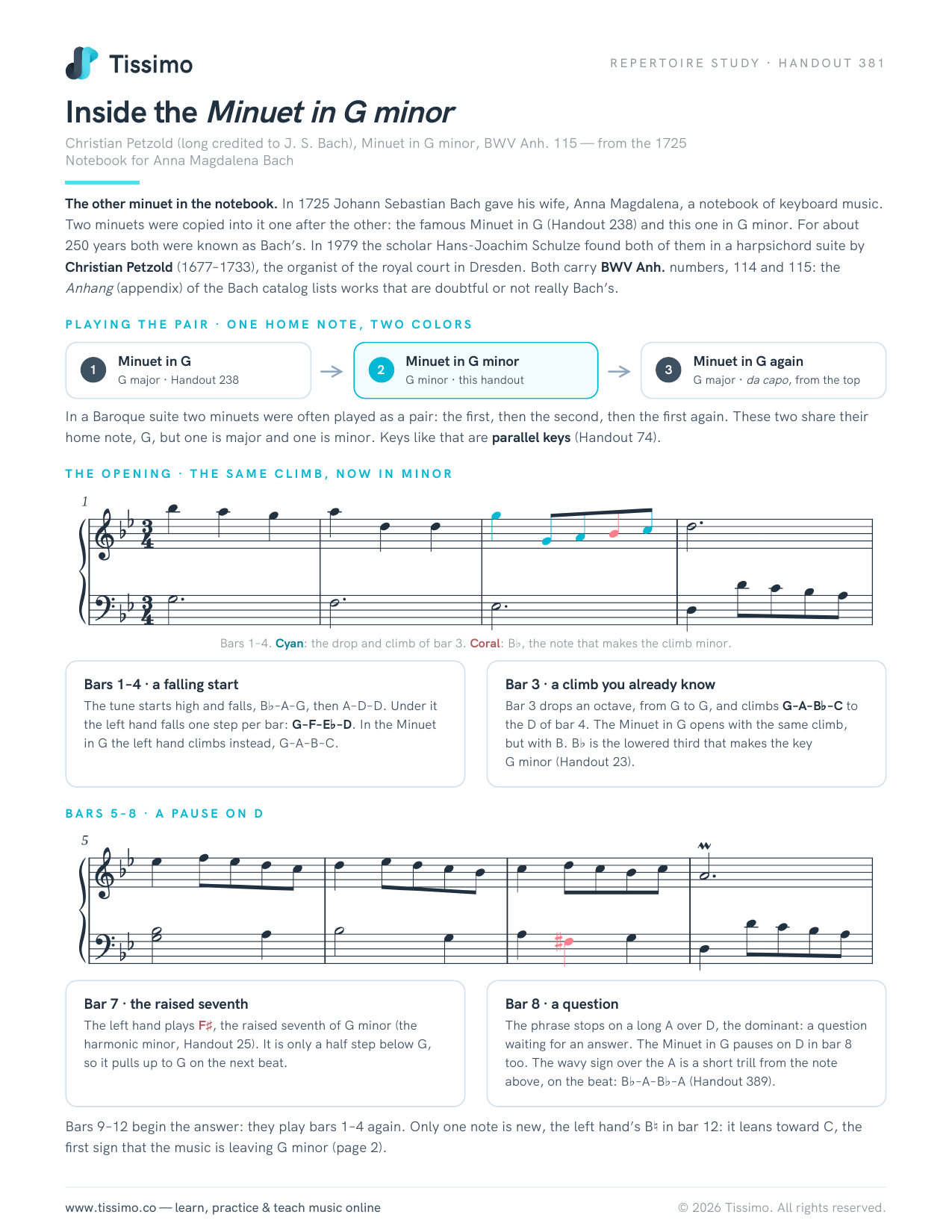
Inside the Minuet in G minor
Christian Petzold (long credited to J. S. Bach), Minuet in G minor, BWV Anh. 115 — from the 1725 Notebook for Anna Magdalena Bach
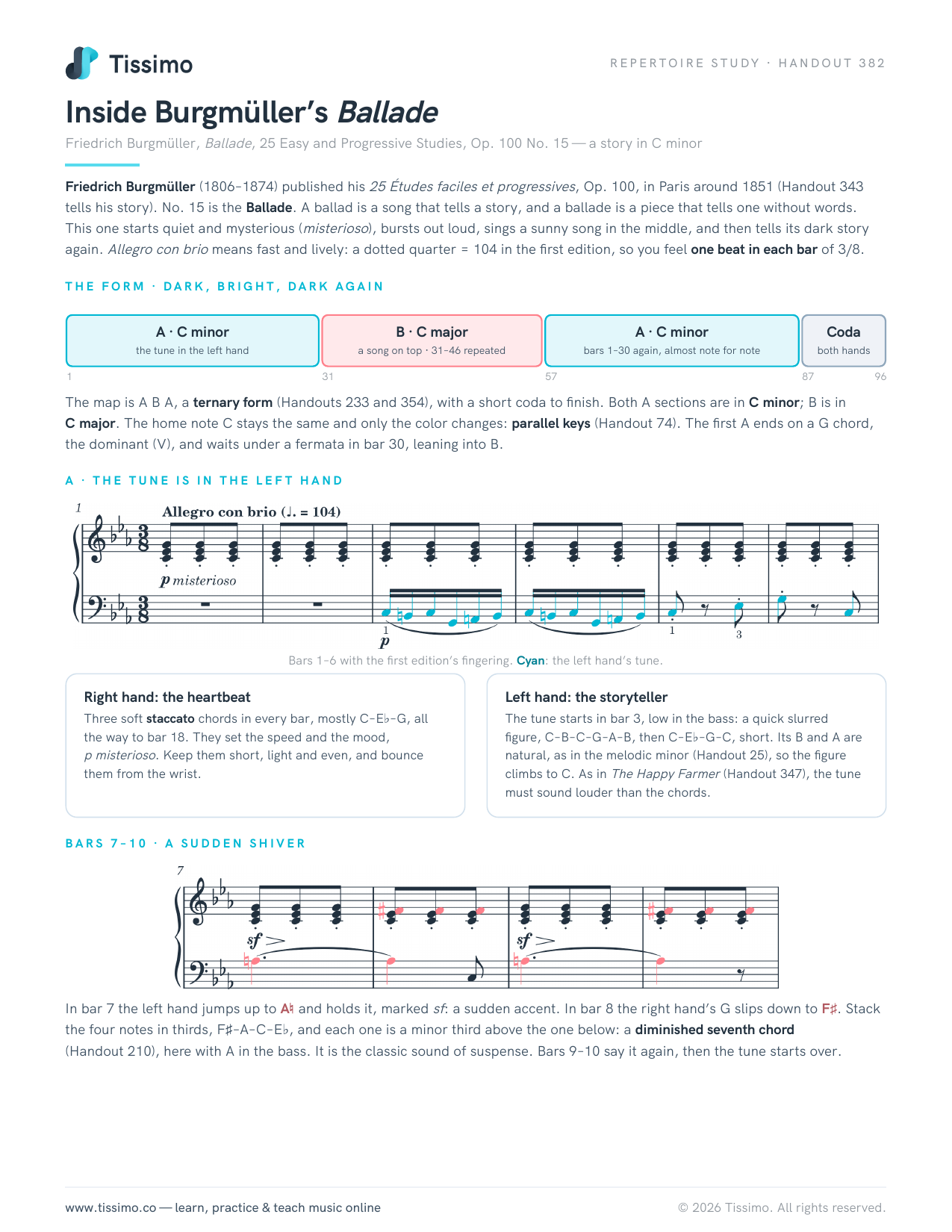
Inside Burgmüller’s Ballade
Friedrich Burgmüller, Ballade, 25 Easy and Progressive Studies, Op. 100 No. 15 — a story in C minor
Reference
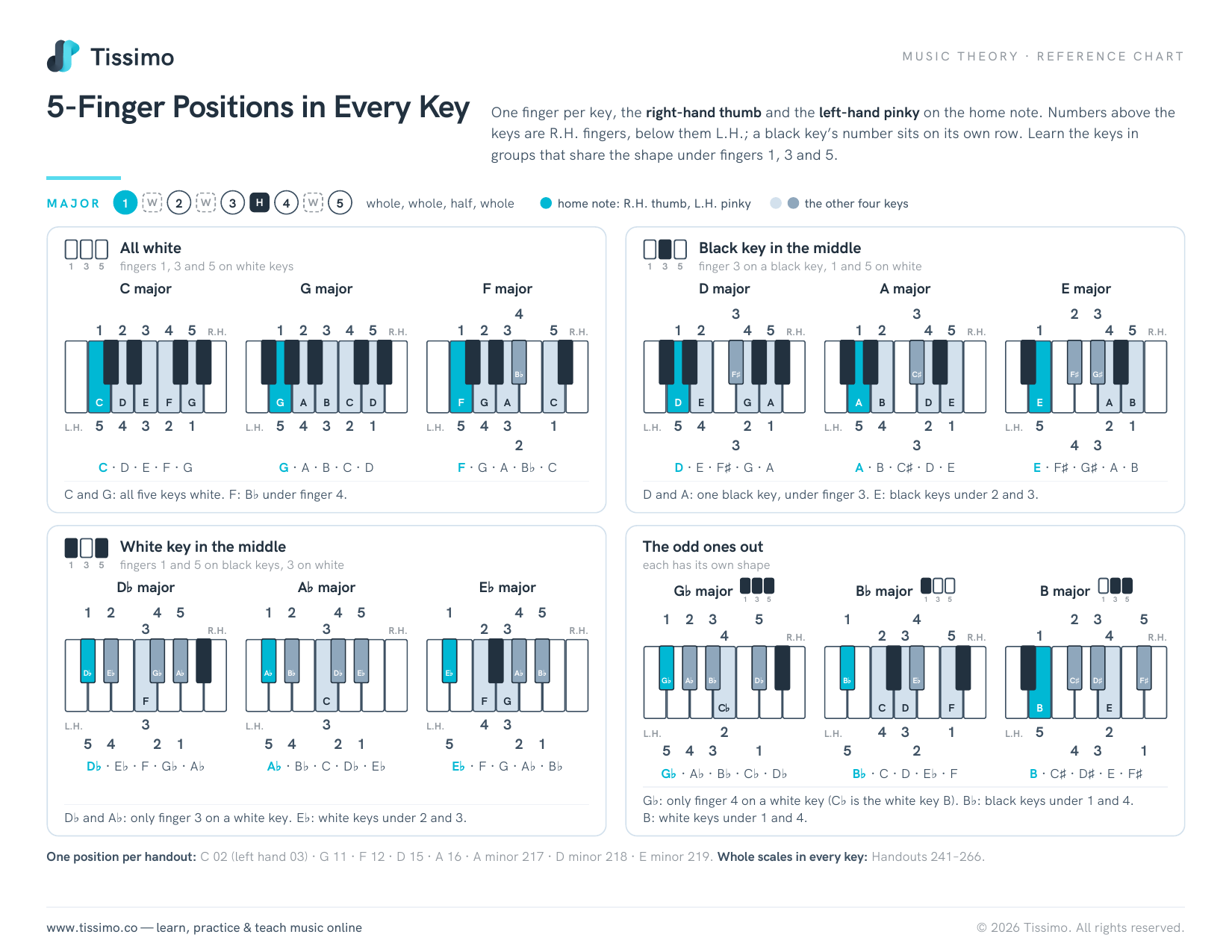
5-Finger Positions in Every Key
One finger per key, the right-hand thumb and the left-hand pinky on the home note. Numbers above the keys are R.H. fingers, below them L.H.; a black key’s number sits on its own row. Learn the keys in groups that share the shape under fingers 1, 3 and 5.
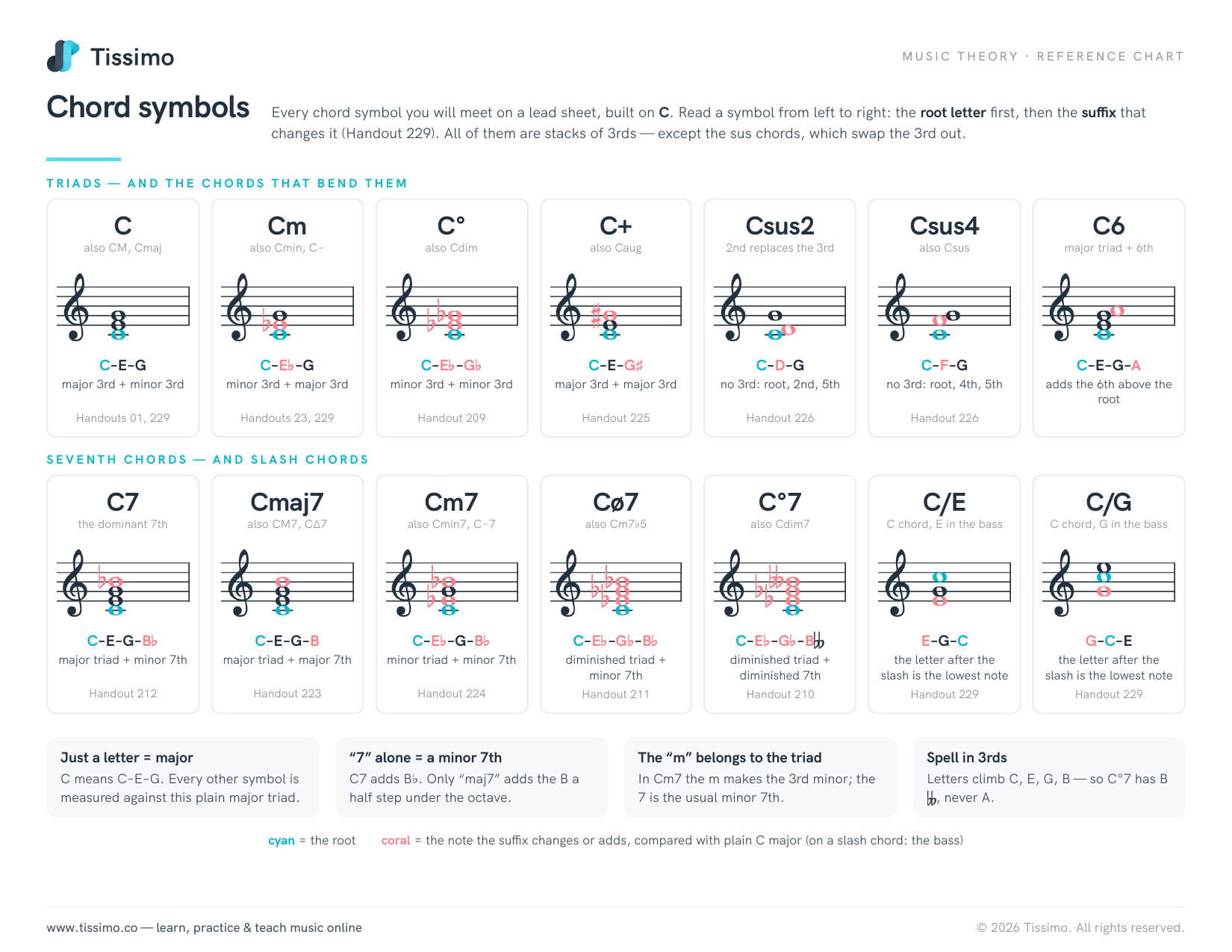
Chord symbols
Every chord symbol you will meet on a lead sheet, built on C. Read a symbol from left to right: the root letter first, then the suffix that changes it (Handout 229). All of them are stacks of 3rds — except the sus chords, which swap the 3rd out.
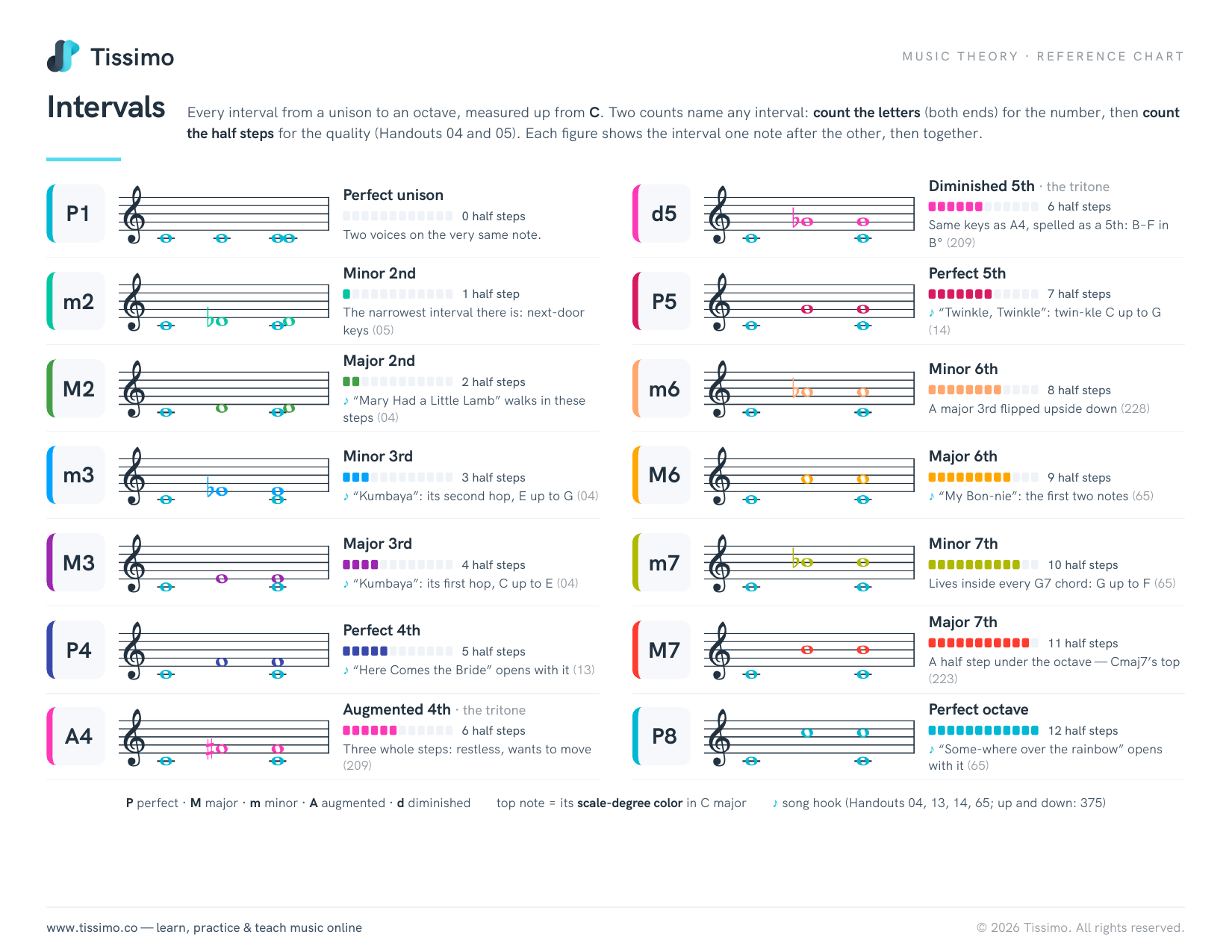
Intervals
Every interval from a unison to an octave, measured up from C. Two counts name any interval: count the letters (both ends) for the number, then count the half steps for the quality (Handouts 04 and 05). Each figure shows the interval one note after the other, then together.
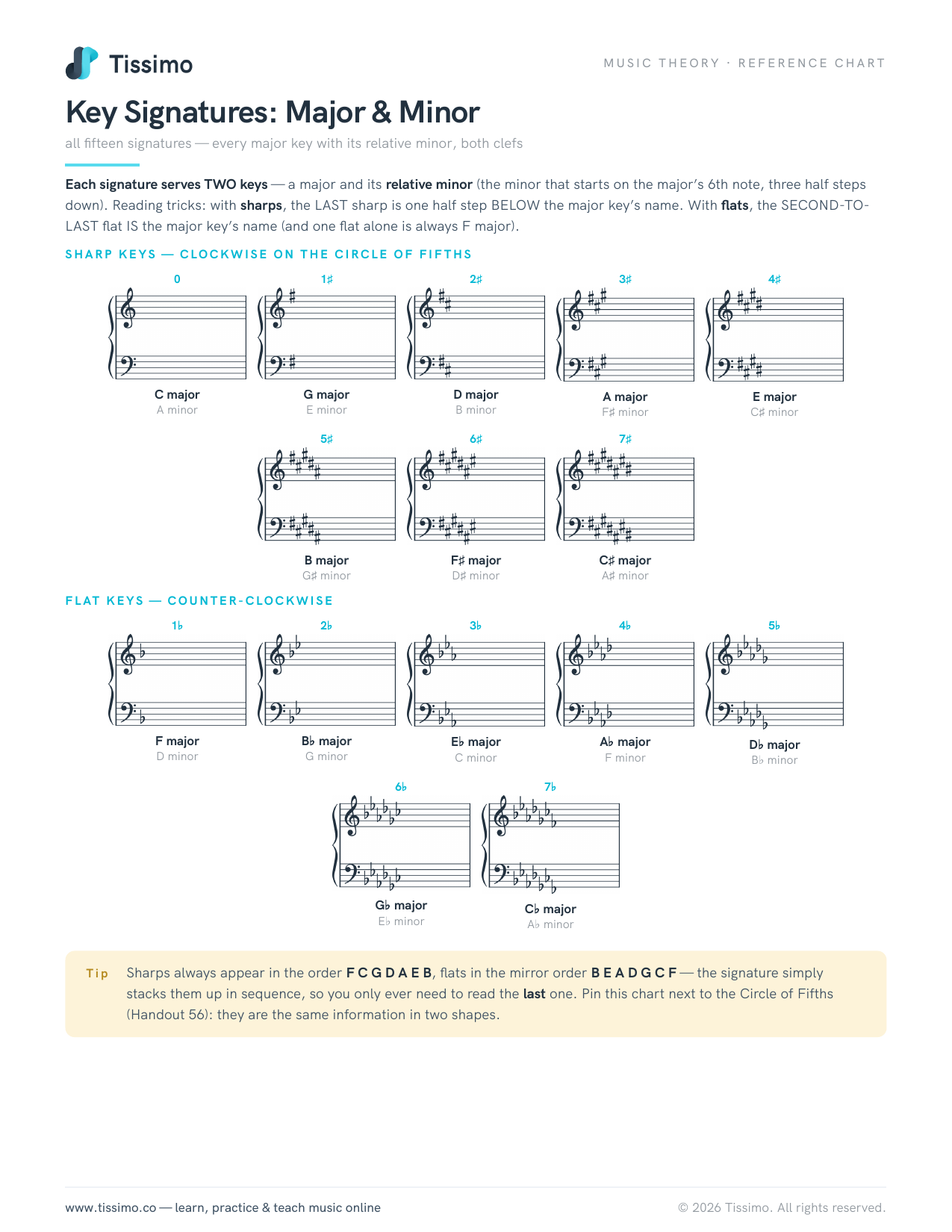
Key Signatures: Major & Minor
all fifteen signatures — every major key with its relative minor, both clefs
Manuscript Paper
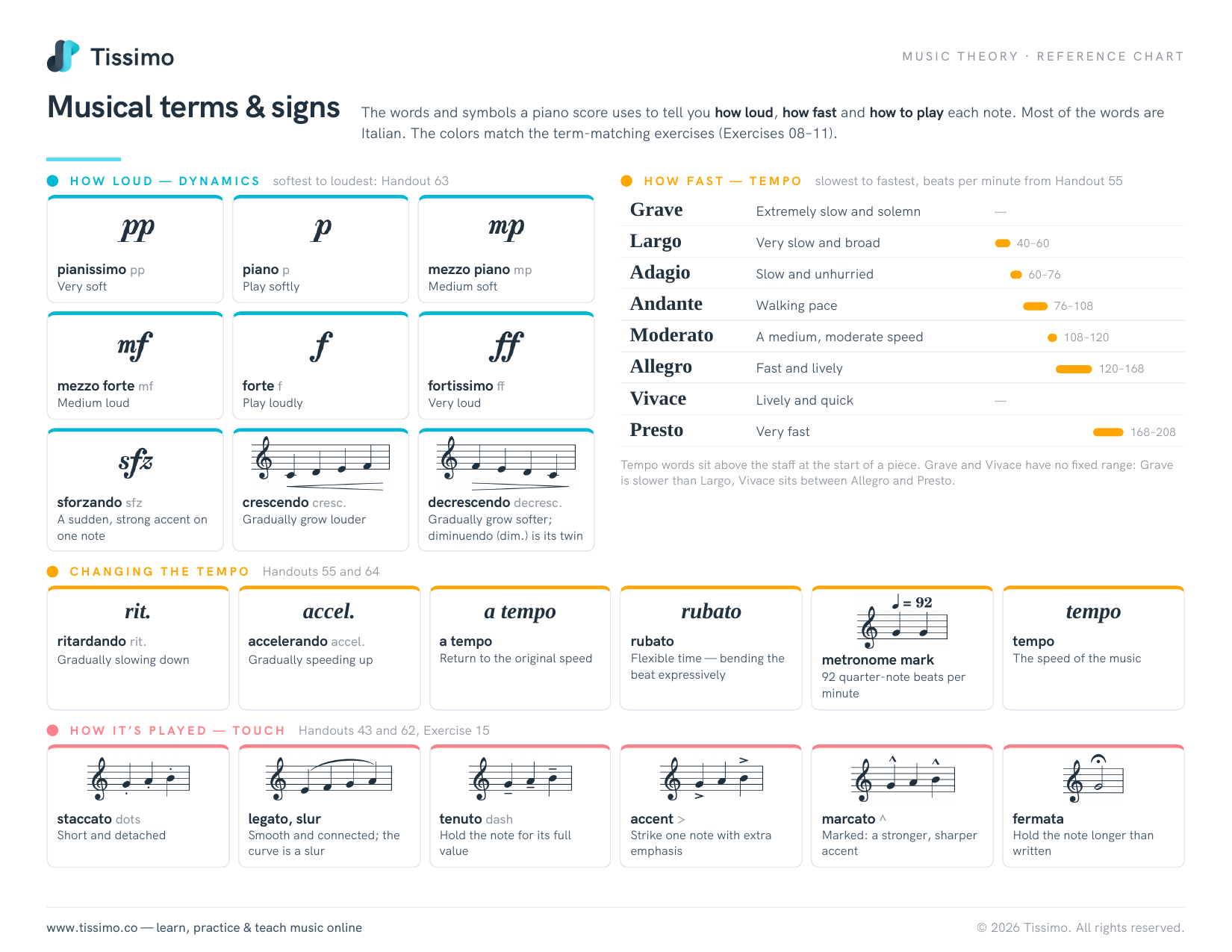
Musical terms & signs
The words and symbols a piano score uses to tell you how loud, how fast and how to play each note. Most of the words are Italian. The colors match the term-matching exercises (Exercises 08–11).
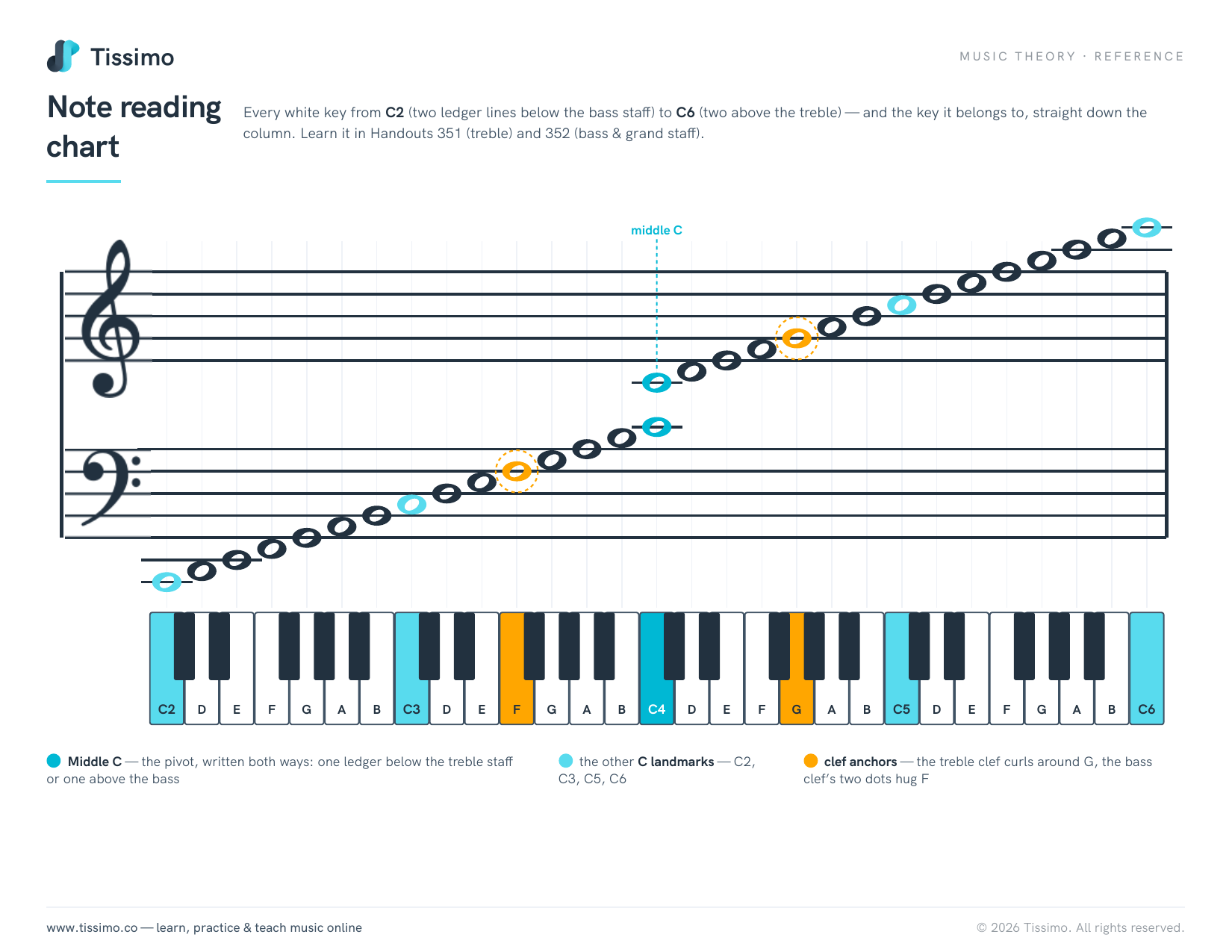
Note reading chart
Every white key from C2 (two ledger lines below the bass staff) to C6 (two above the treble) — and the key it belongs to, straight down the column. Learn it in Handouts 351 (treble) and 352 (bass & grand staff).
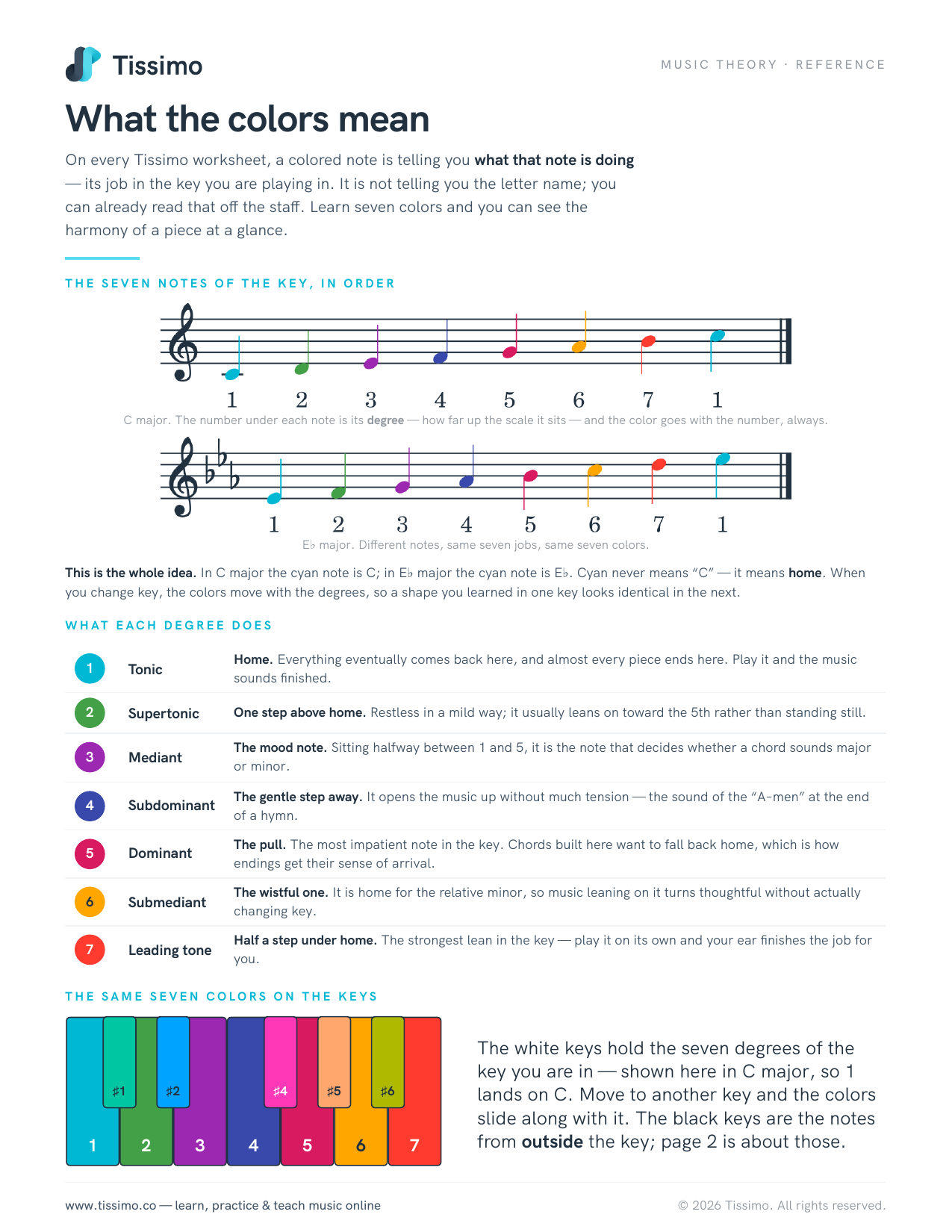
What the colors mean
On every Tissimo worksheet, a colored note is telling you what that note is doing — its job in the key you are playing in. It is not telling you the letter name; you can already read that off the staff. Learn seven colors and you can see the harmony of a piece at a glance.
Exercises
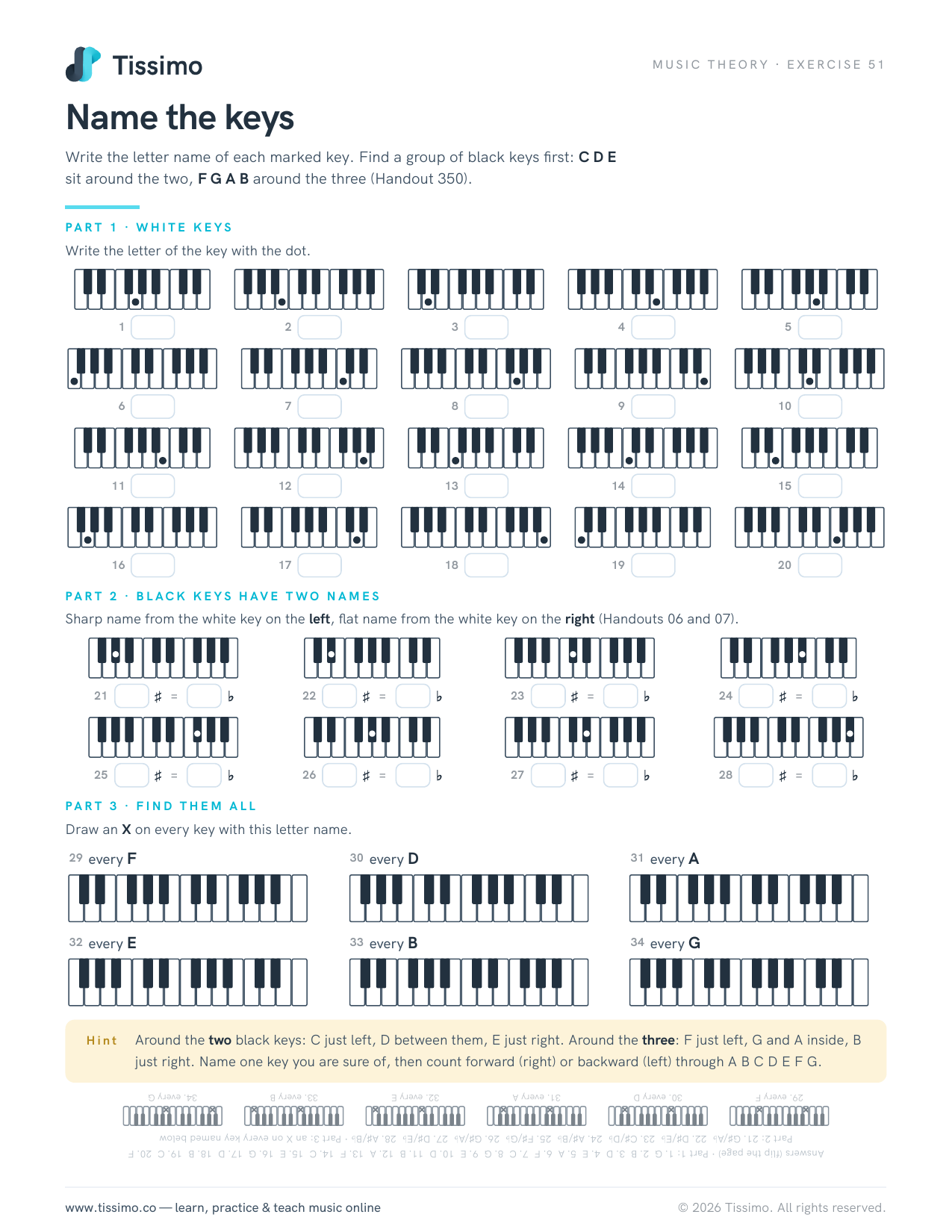
Name the keys
Write the letter name of each marked key. Find a group of black keys first: C D E sit around the two, F G A B around the three (Handout 350).
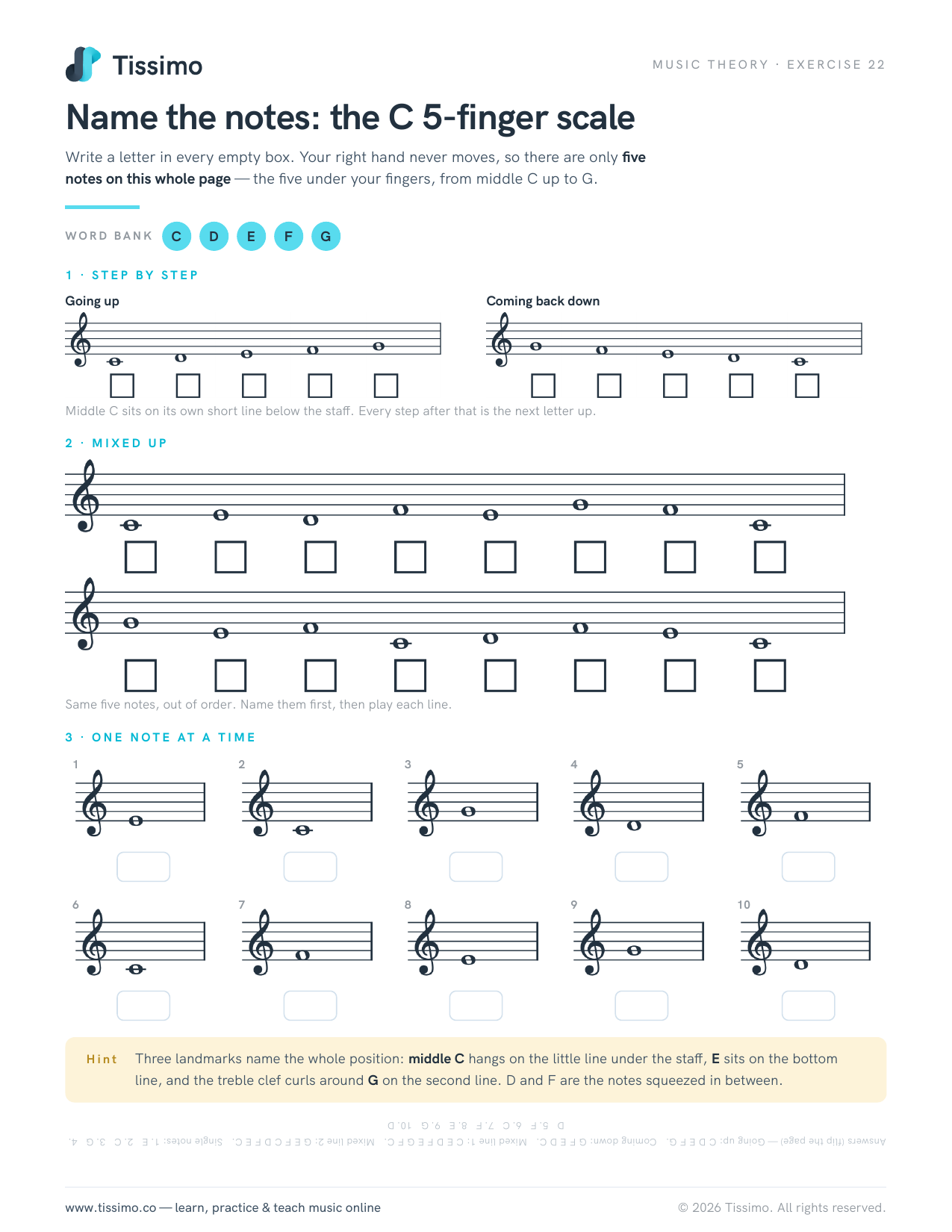
Name the notes: the C 5-finger scale
Write a letter in every empty box. Your right hand never moves, so there are only five notes on this whole page — the five under your fingers, from middle C up to G.
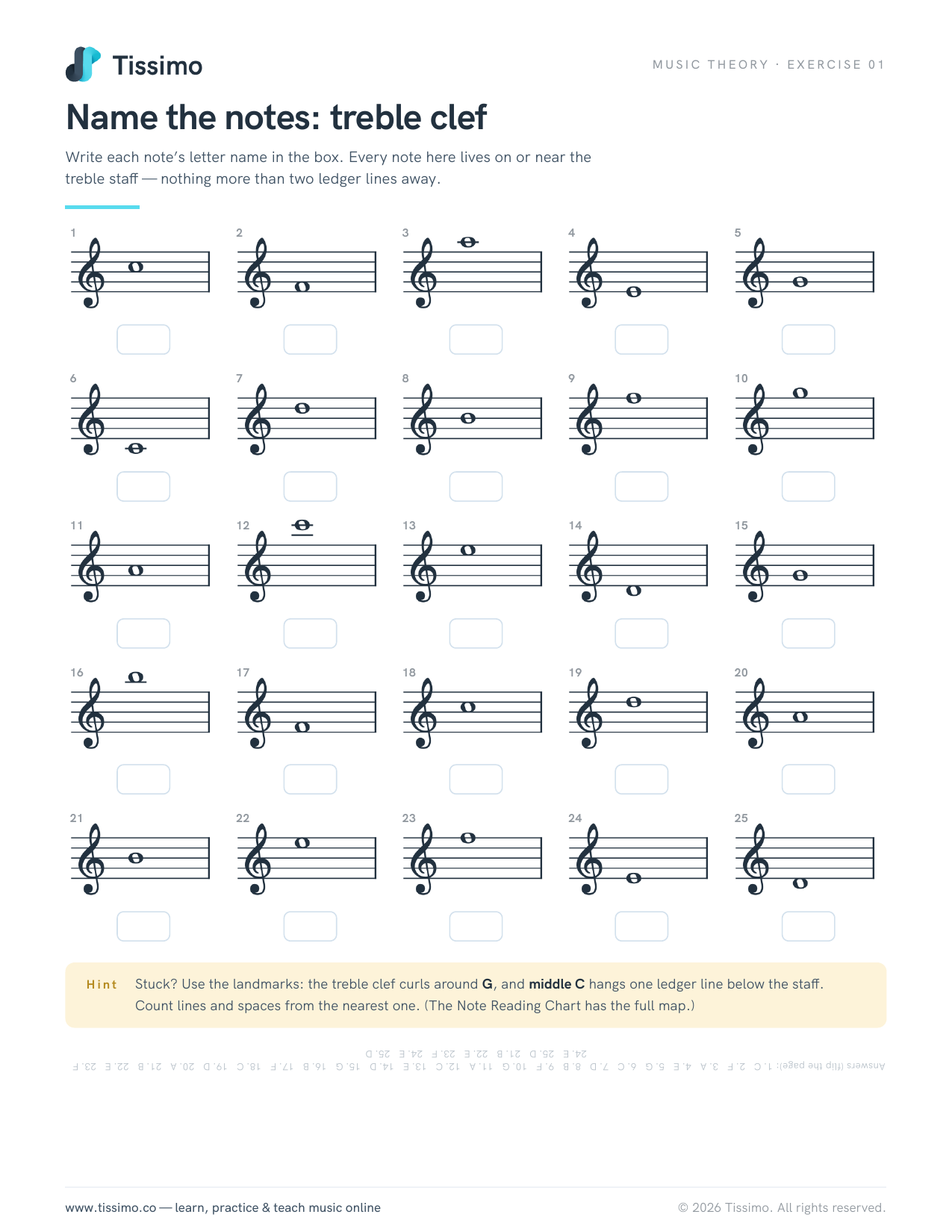
Name the notes: treble clef
Write each note’s letter name in the box. Every note here lives on or near the treble staff — nothing more than two ledger lines away.
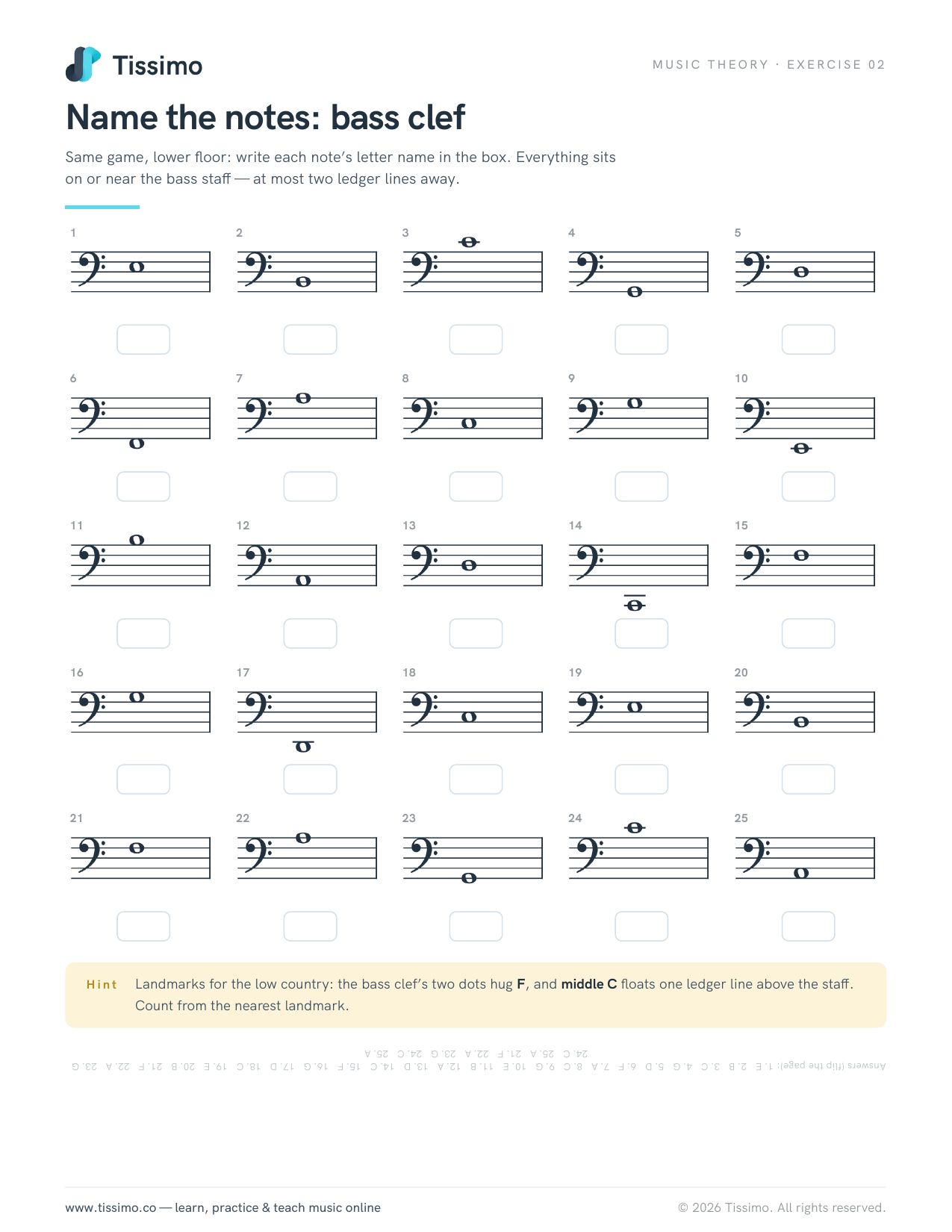
Name the notes: bass clef
Same game, lower floor: write each note’s letter name in the box. Everything sits on or near the bass staff — at most two ledger lines away.
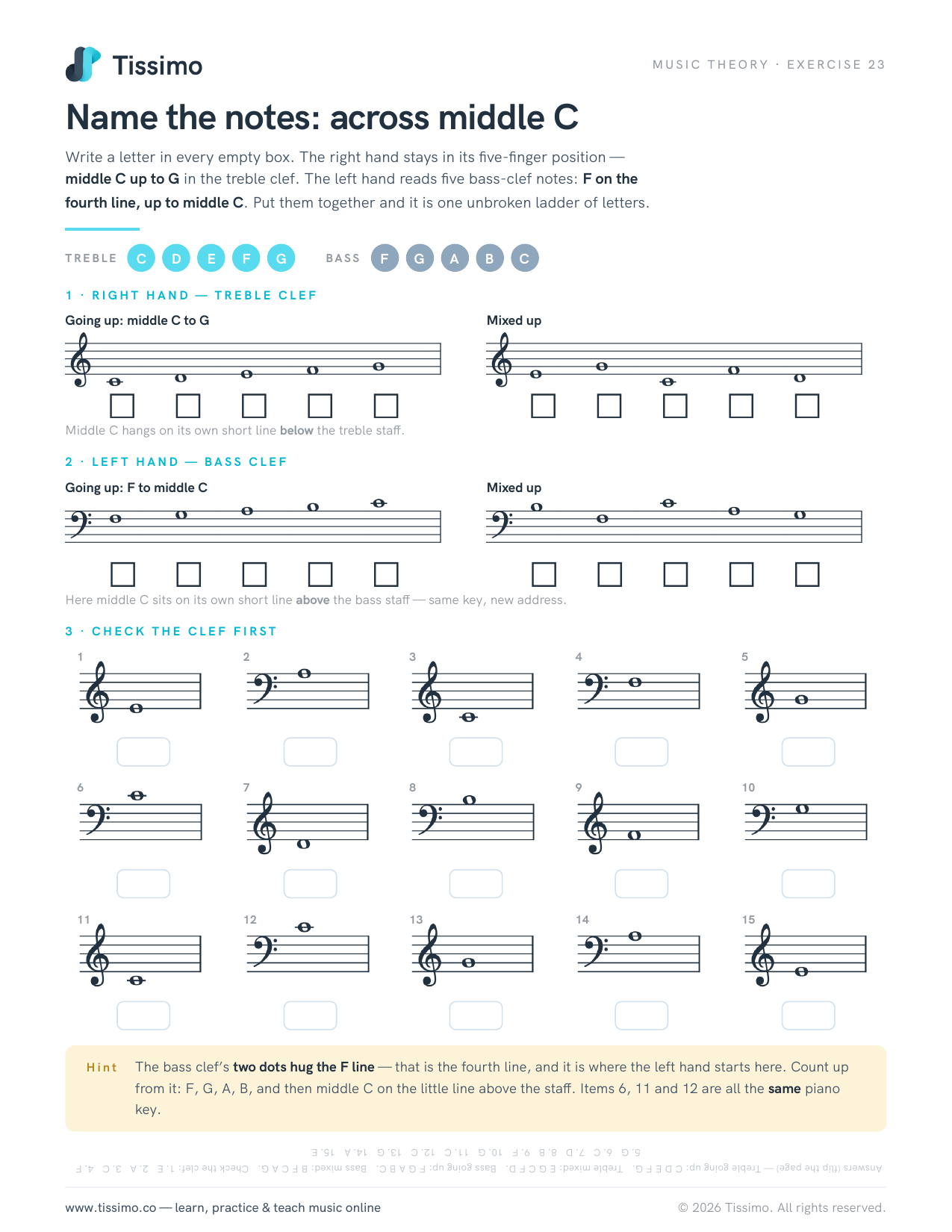
Name the notes: across middle C
Write a letter in every empty box. The right hand stays in its five-finger position — middle C up to G in the treble clef. The left hand reads five bass-clef notes: F on the fourth line, up to middle C. Put them together and it is one unbroken ladder of letters.
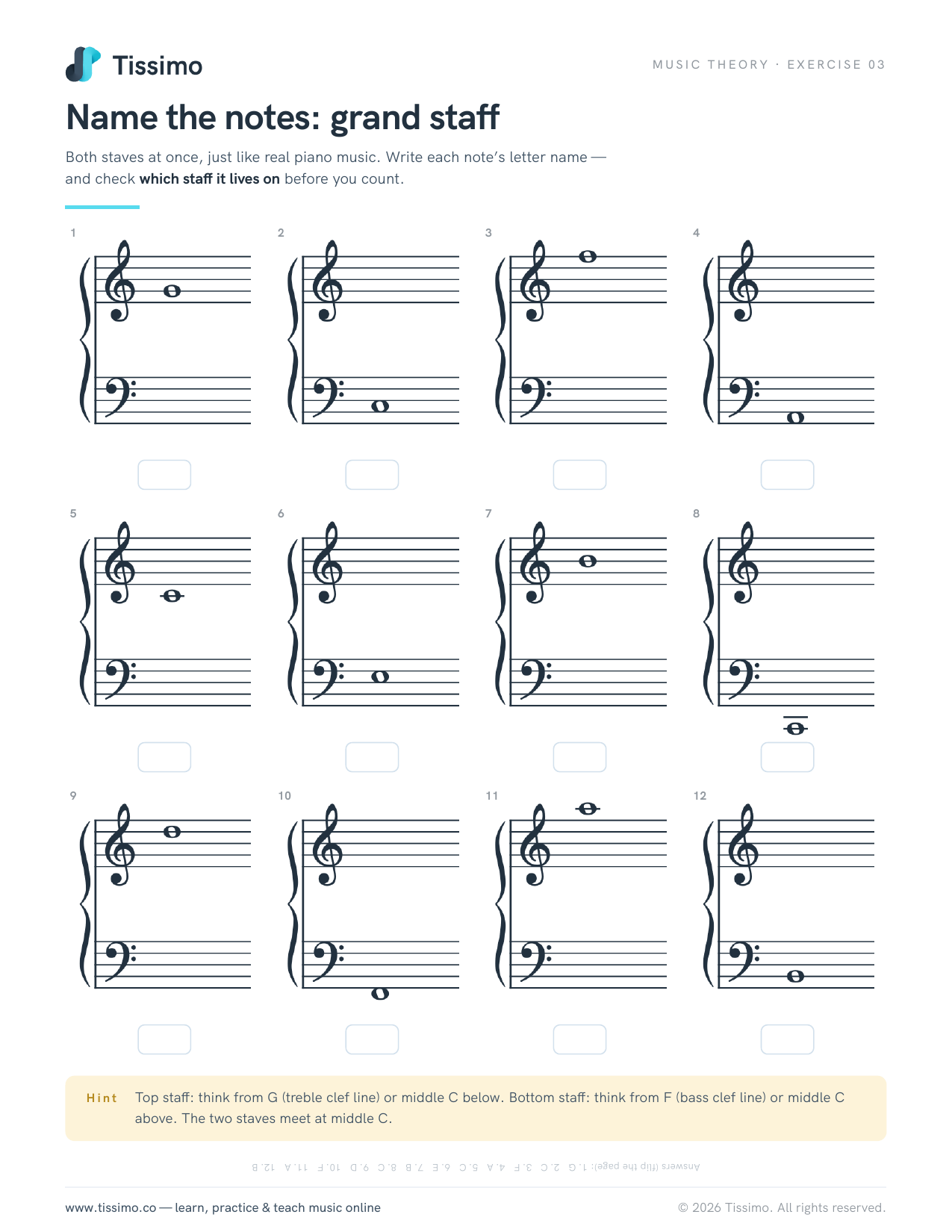
Name the notes: grand staff
Both staves at once, just like real piano music. Write each note’s letter name — and check which staff it lives on before you count.
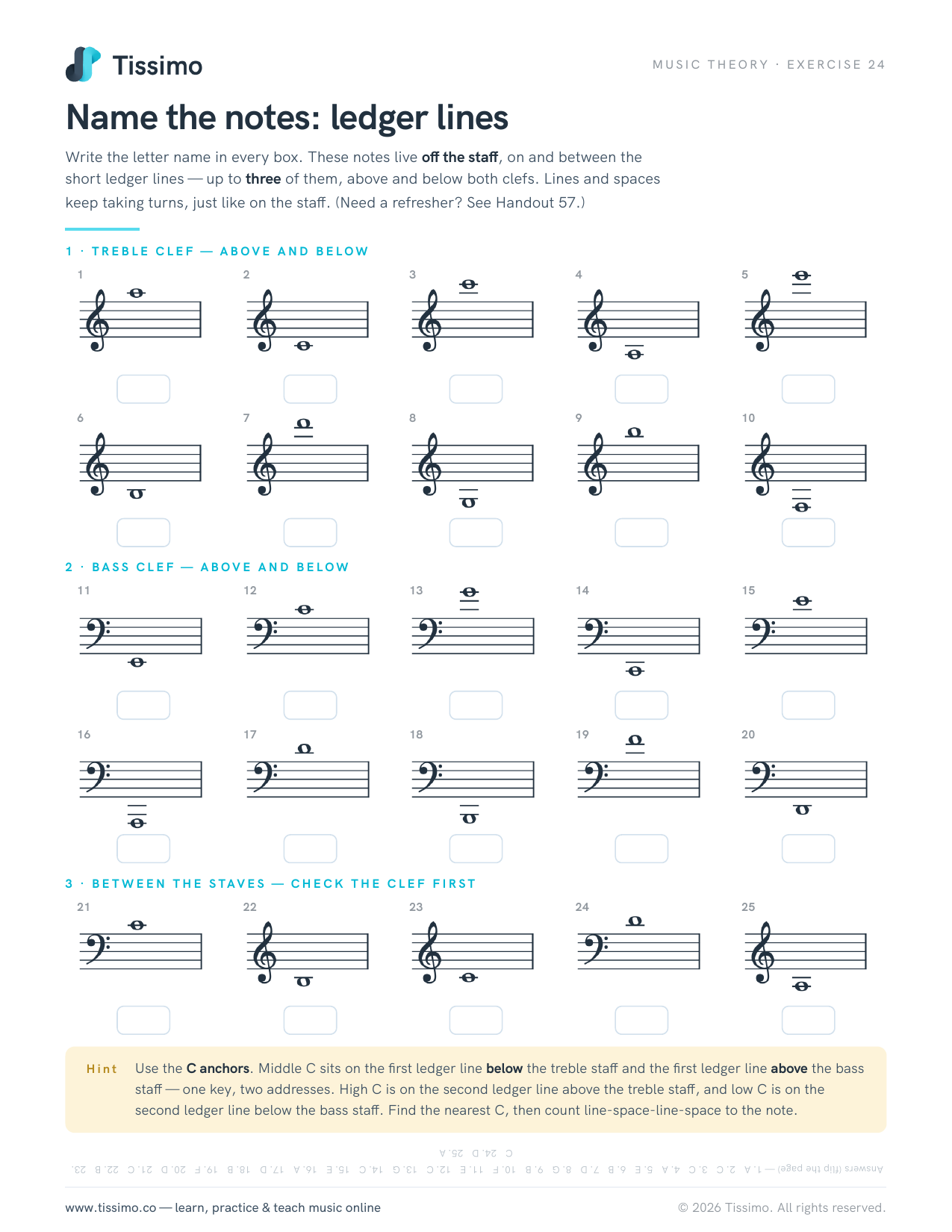
Name the notes: ledger lines
Write the letter name in every box. These notes live off the staff, on and between the short ledger lines — up to three of them, above and below both clefs. Lines and spaces keep taking turns, just like on the staff. (Need a refresher? See Handout 57.)
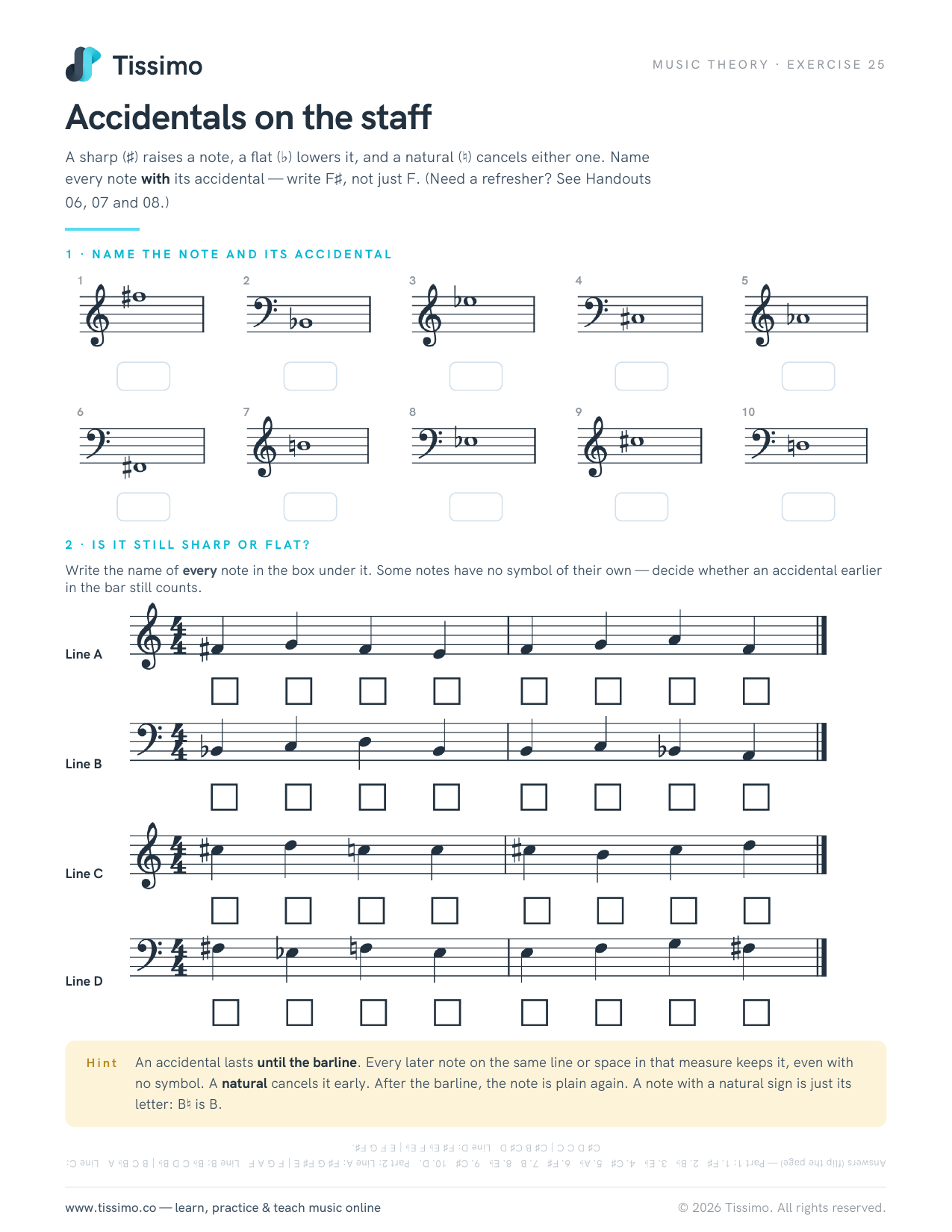
Accidentals on the staff
A sharp (♯) raises a note, a flat (♭) lowers it, and a natural (♮) cancels either one. Name every note with its accidental — write F♯, not just F. (Need a refresher? See Handouts 06, 07 and 08.)
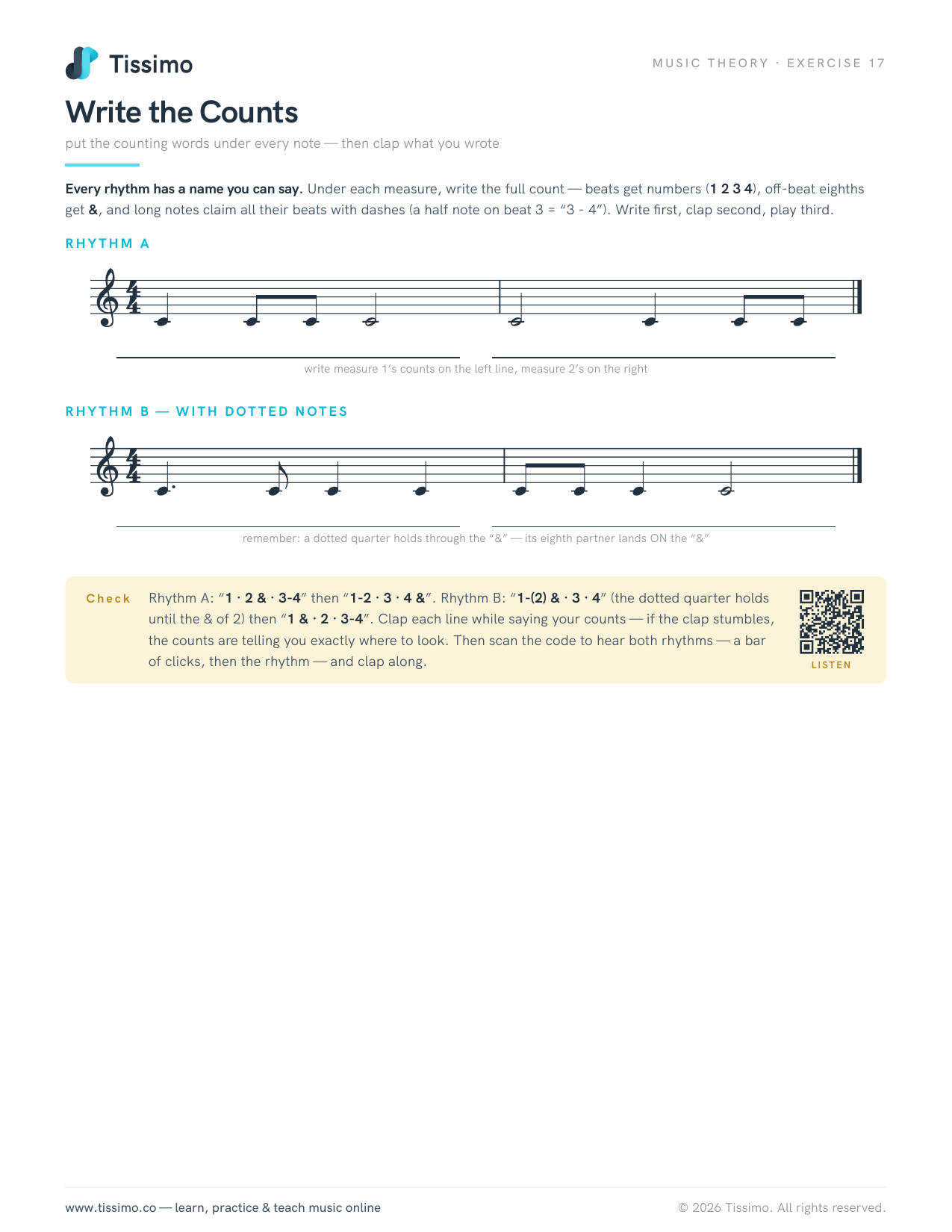
Write the Counts
put the counting words under every note — then clap what you wrote
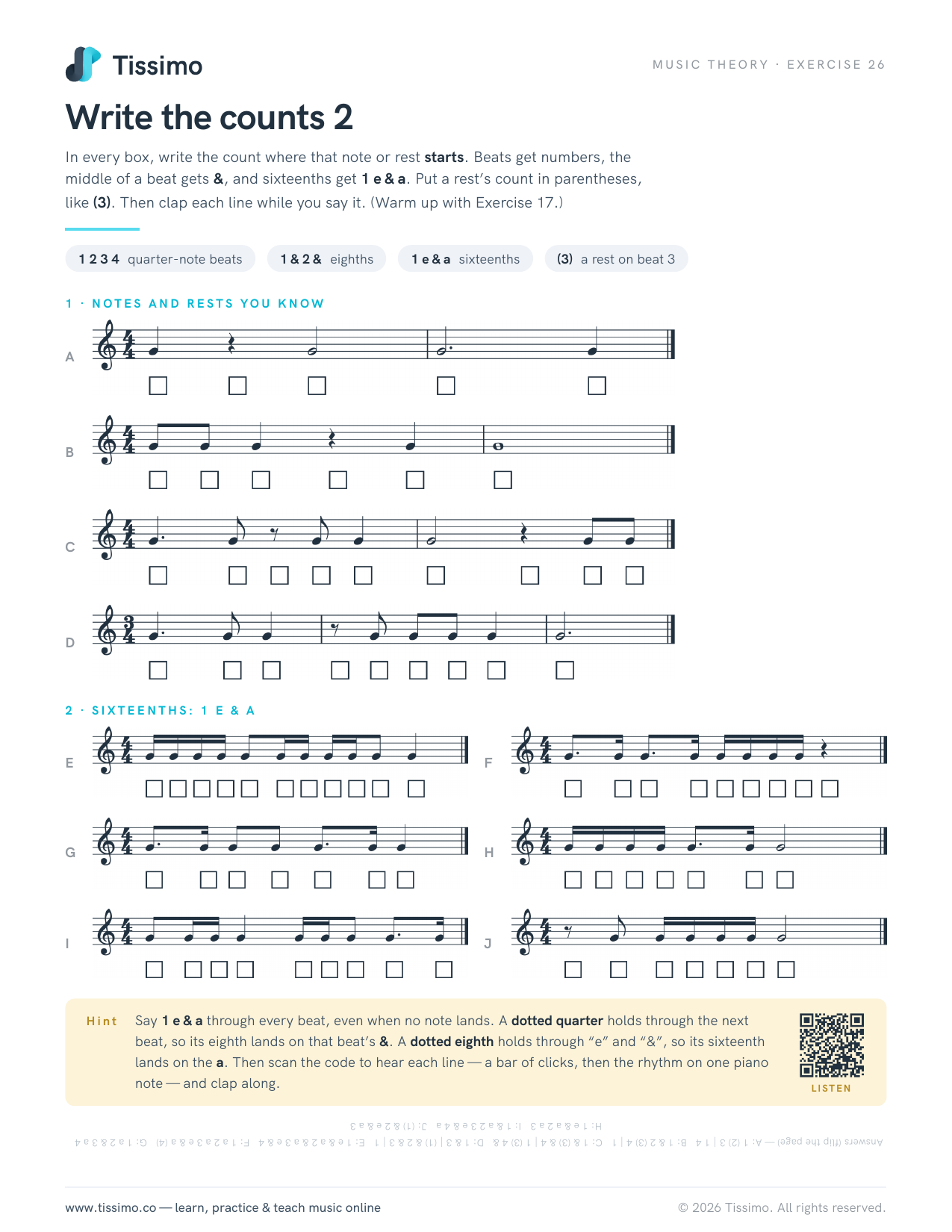
Write the counts 2
In every box, write the count where that note or rest starts. Beats get numbers, the middle of a beat gets &, and sixteenths get 1 e & a. Put a rest’s count in parentheses, like (3). Then clap each line while you say it. (Warm up with Exercise 17.)
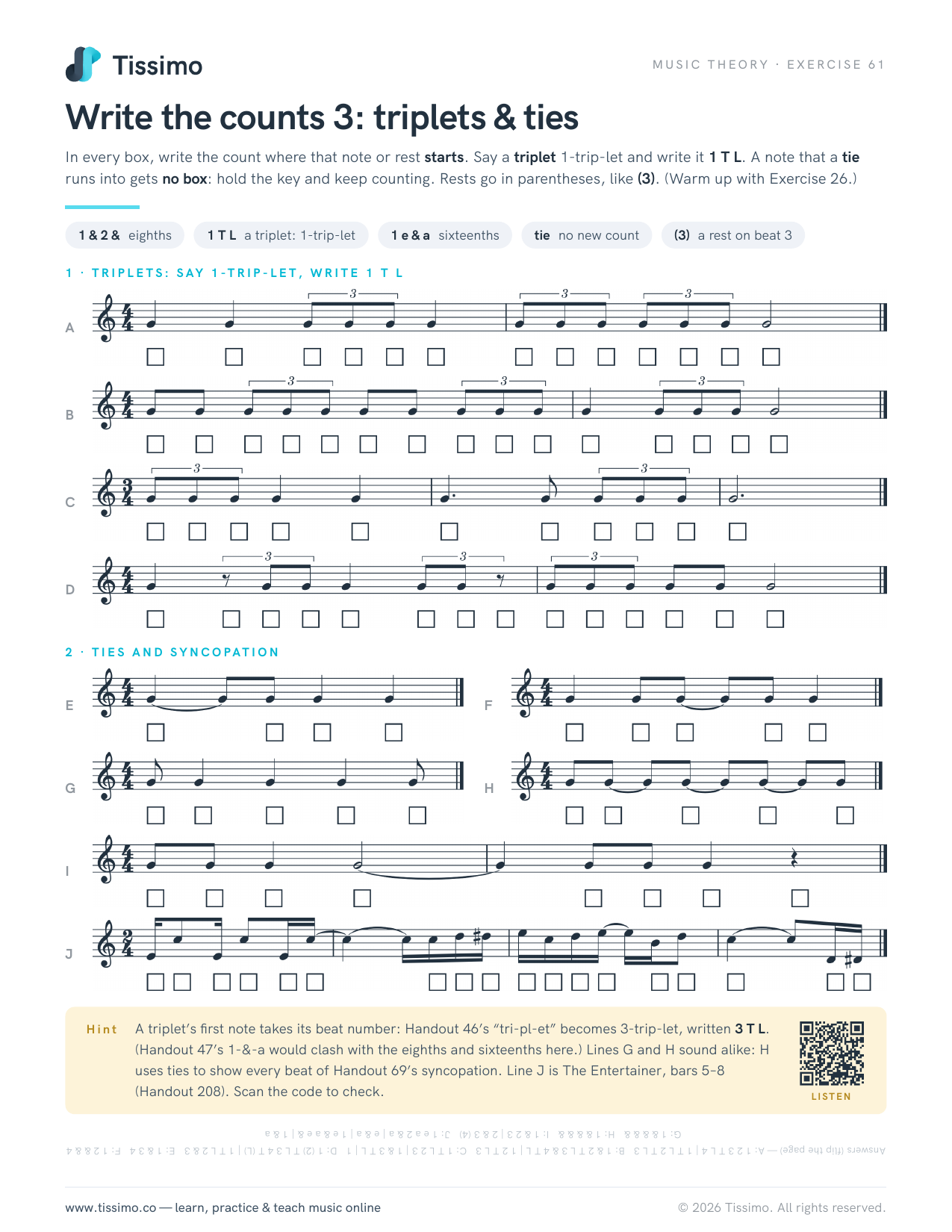
Write the counts 3: triplets & ties
In every box, write the count where that note or rest starts. Say a triplet 1-trip-let and write it 1 T L. A note that a tie runs into gets no box: hold the key and keep counting. Rests go in parentheses, like (3). (Warm up with Exercise 26.)
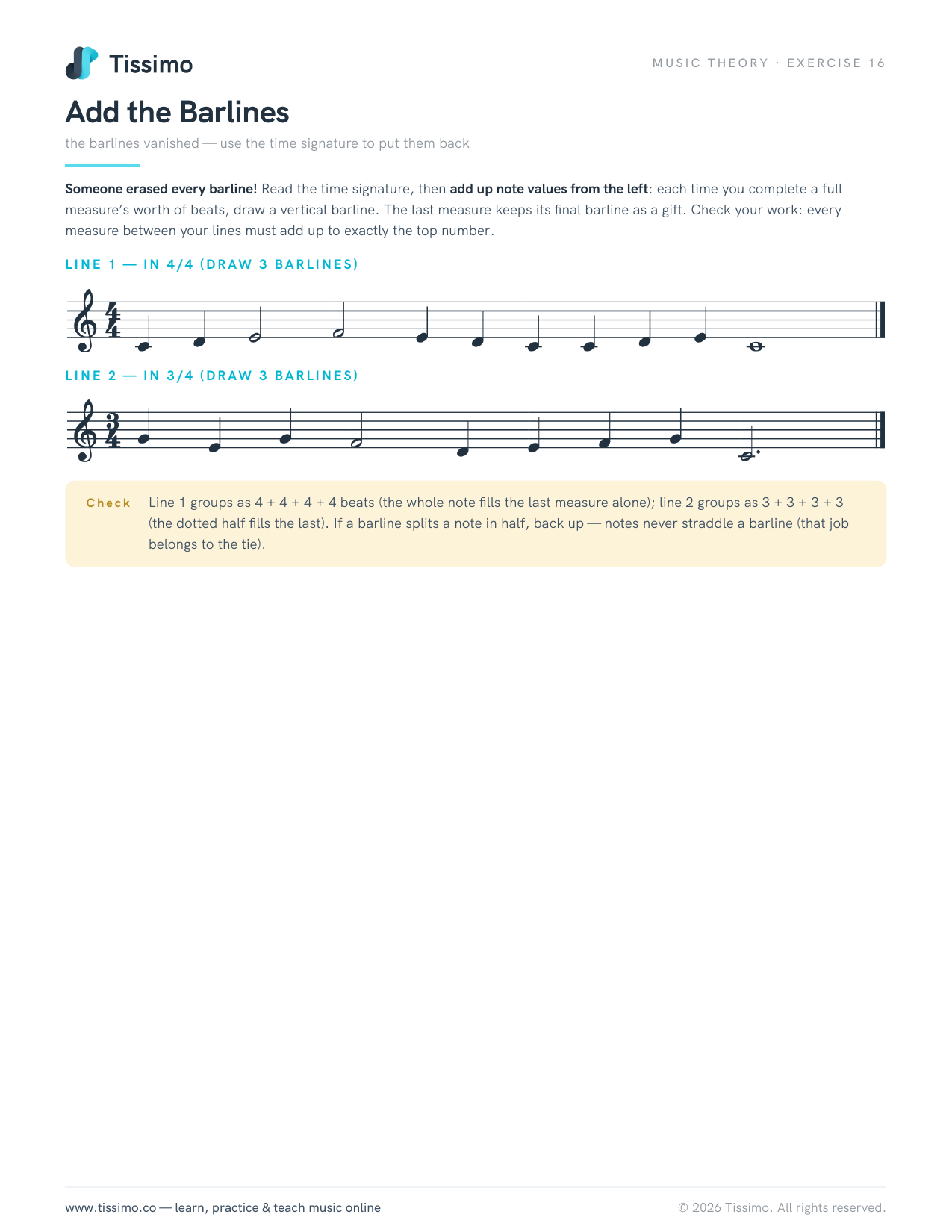
Add the Barlines
the barlines vanished — use the time signature to put them back
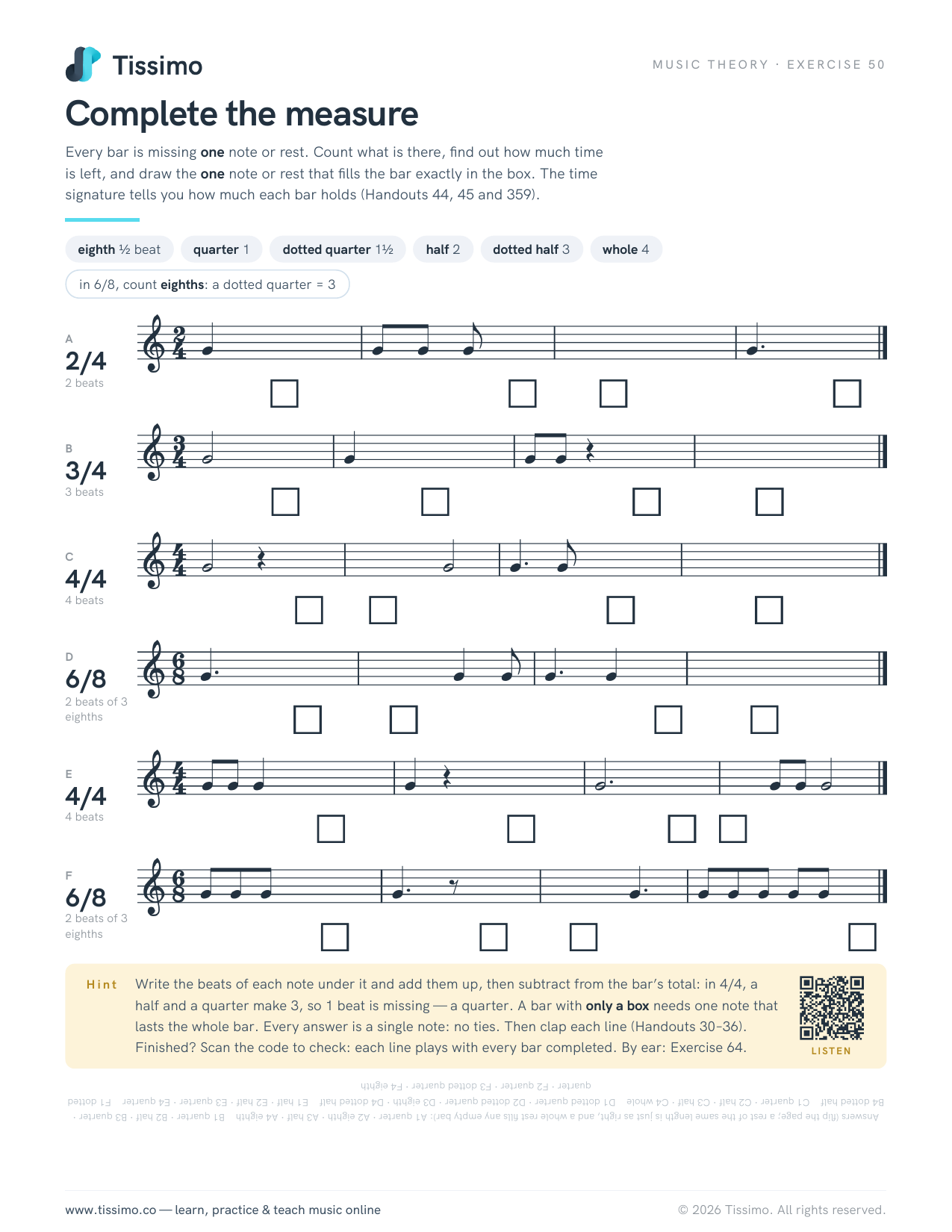
Complete the measure
Every bar is missing one note or rest. Count what is there, find out how much time is left, and draw the one note or rest that fills the bar exactly in the box. The time signature tells you how much each bar holds (Handouts 44, 45 and 359).
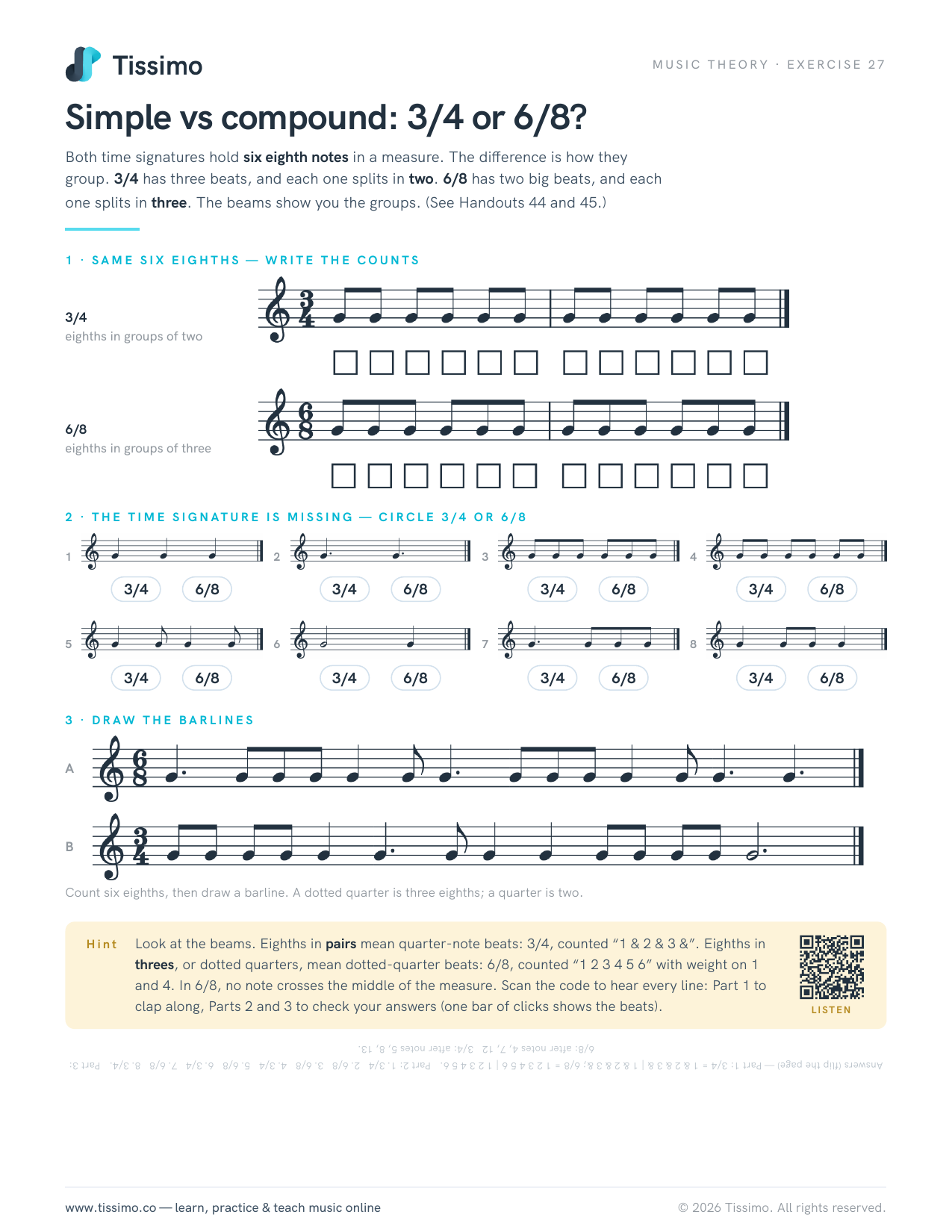
Simple vs compound: 3/4 or 6/8?
Both time signatures hold six eighth notes in a measure. The difference is how they group. 3/4 has three beats, and each one splits in two. 6/8 has two big beats, and each one splits in three. The beams show you the groups. (See Handouts 44 and 45.)
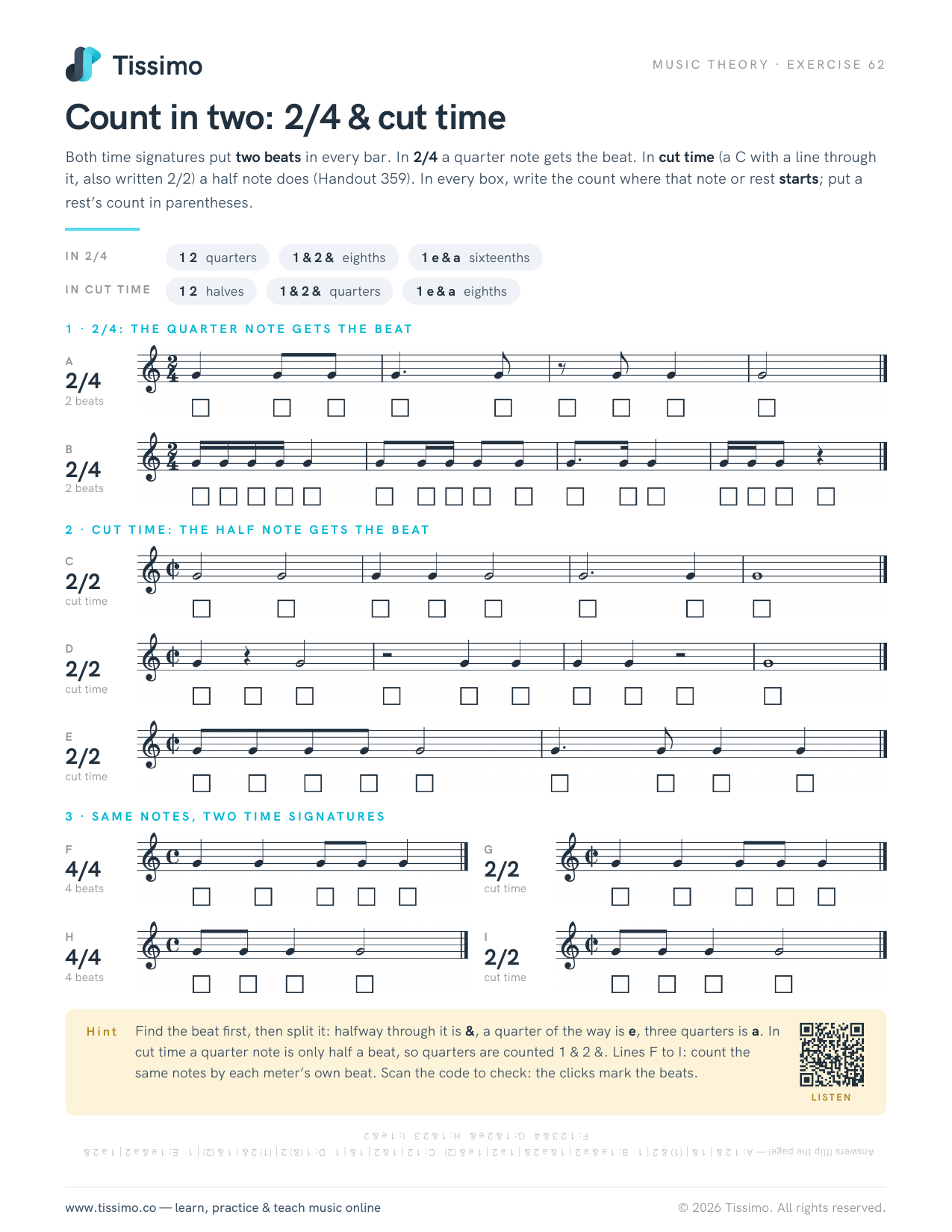
Count in two: 2/4 & cut time
Both time signatures put two beats in every bar. In 2/4 a quarter note gets the beat. In cut time (a C with a line through it, also written 2/2) a half note does (Handout 359). In every box, write the count where that note or rest starts; put a rest’s count in parentheses.
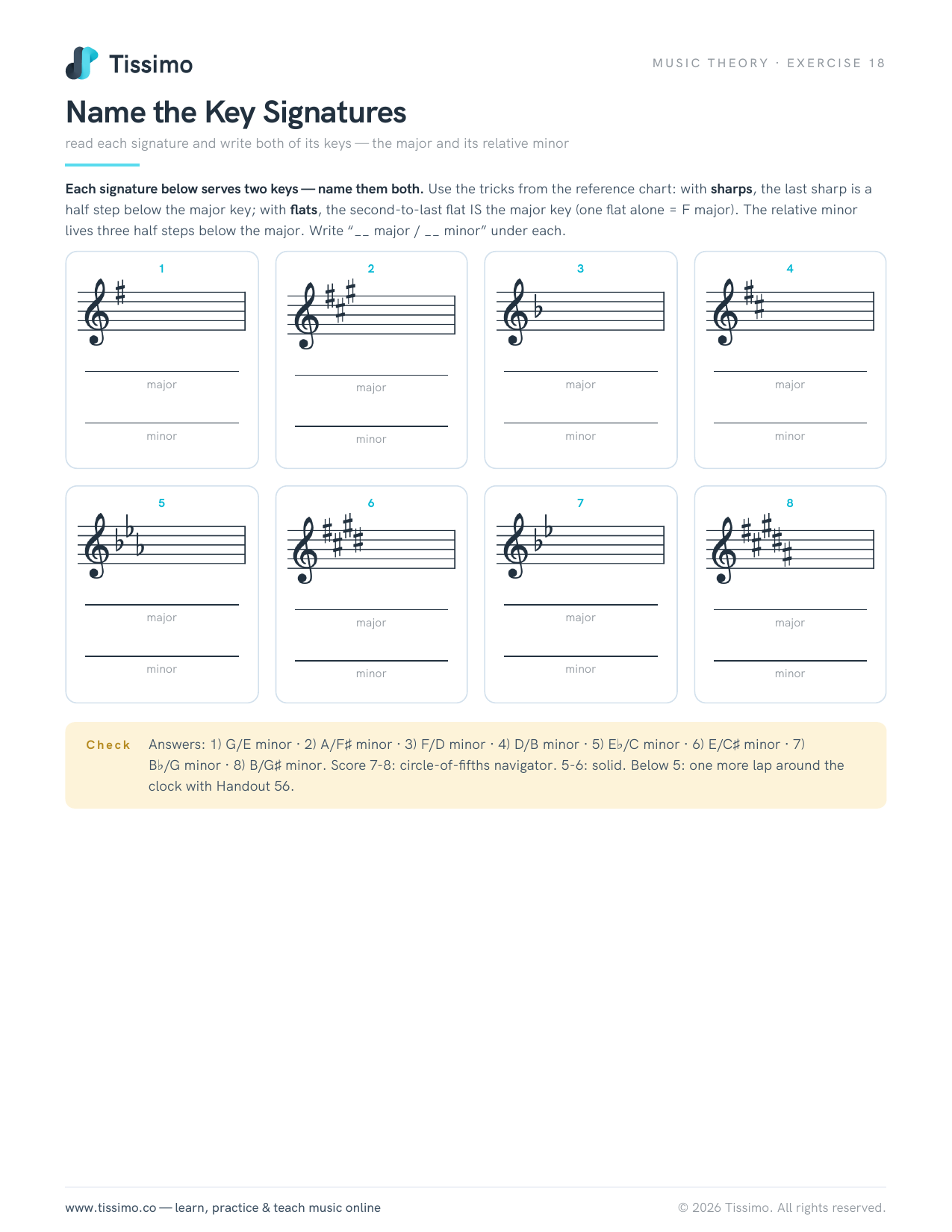
Name the Key Signatures
read each signature and write both of its keys — the major and its relative minor
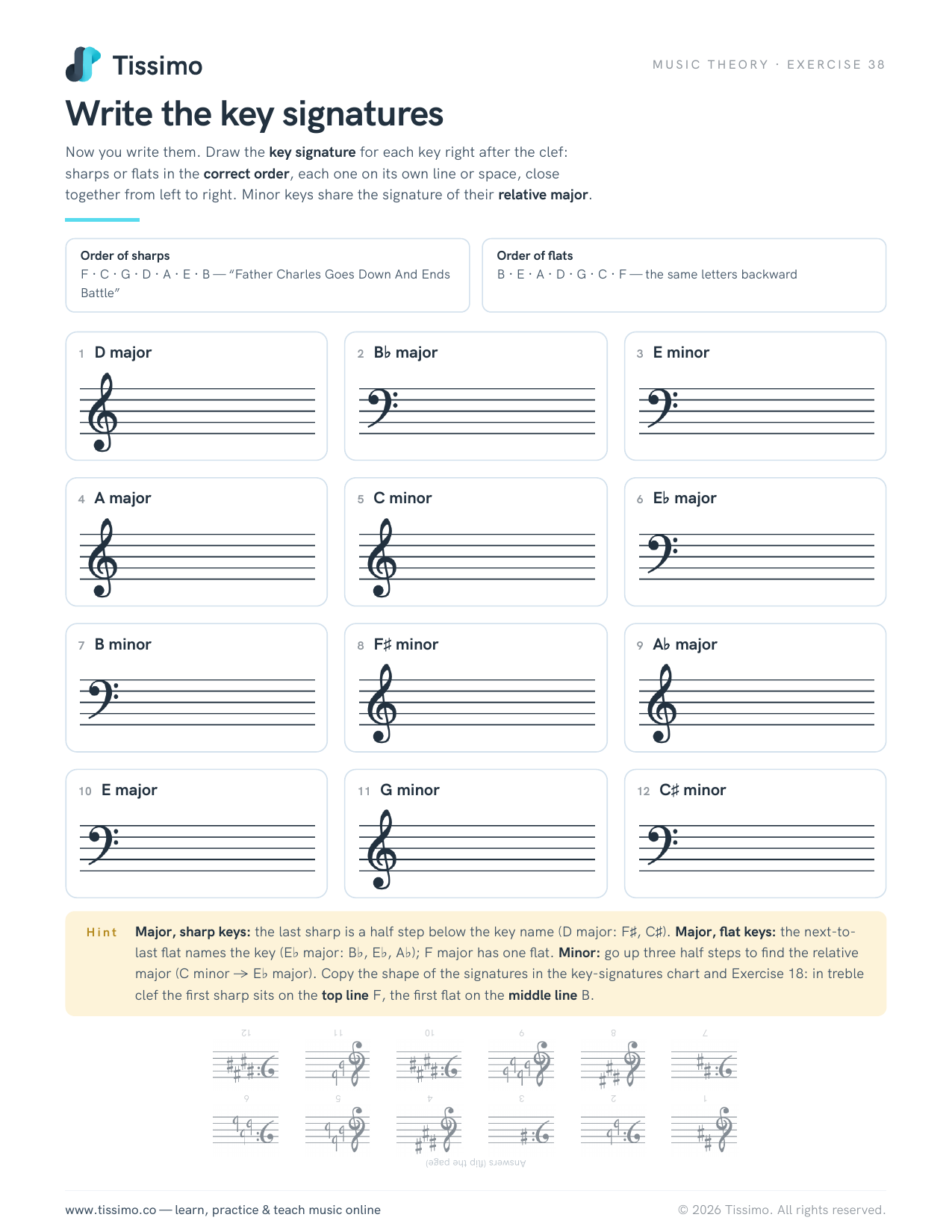
Write the key signatures
Now you write them. Draw the key signature for each key right after the clef: sharps or flats in the correct order, each one on its own line or space, close together from left to right. Minor keys share the signature of their relative major.
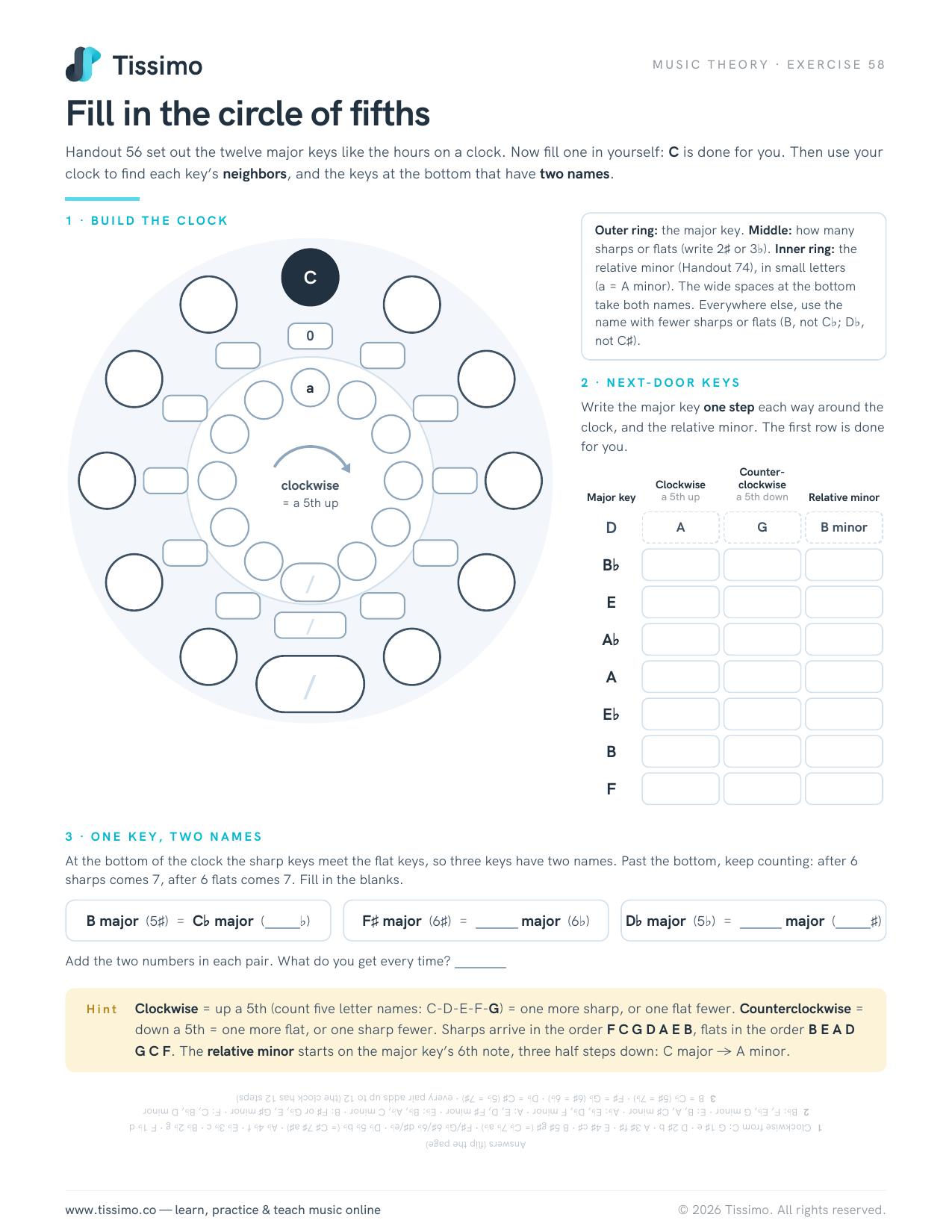
Fill in the circle of fifths
Handout 56 set out the twelve major keys like the hours on a clock. Now fill one in yourself: C is done for you. Then use your clock to find each key’s neighbors, and the keys at the bottom that have two names.
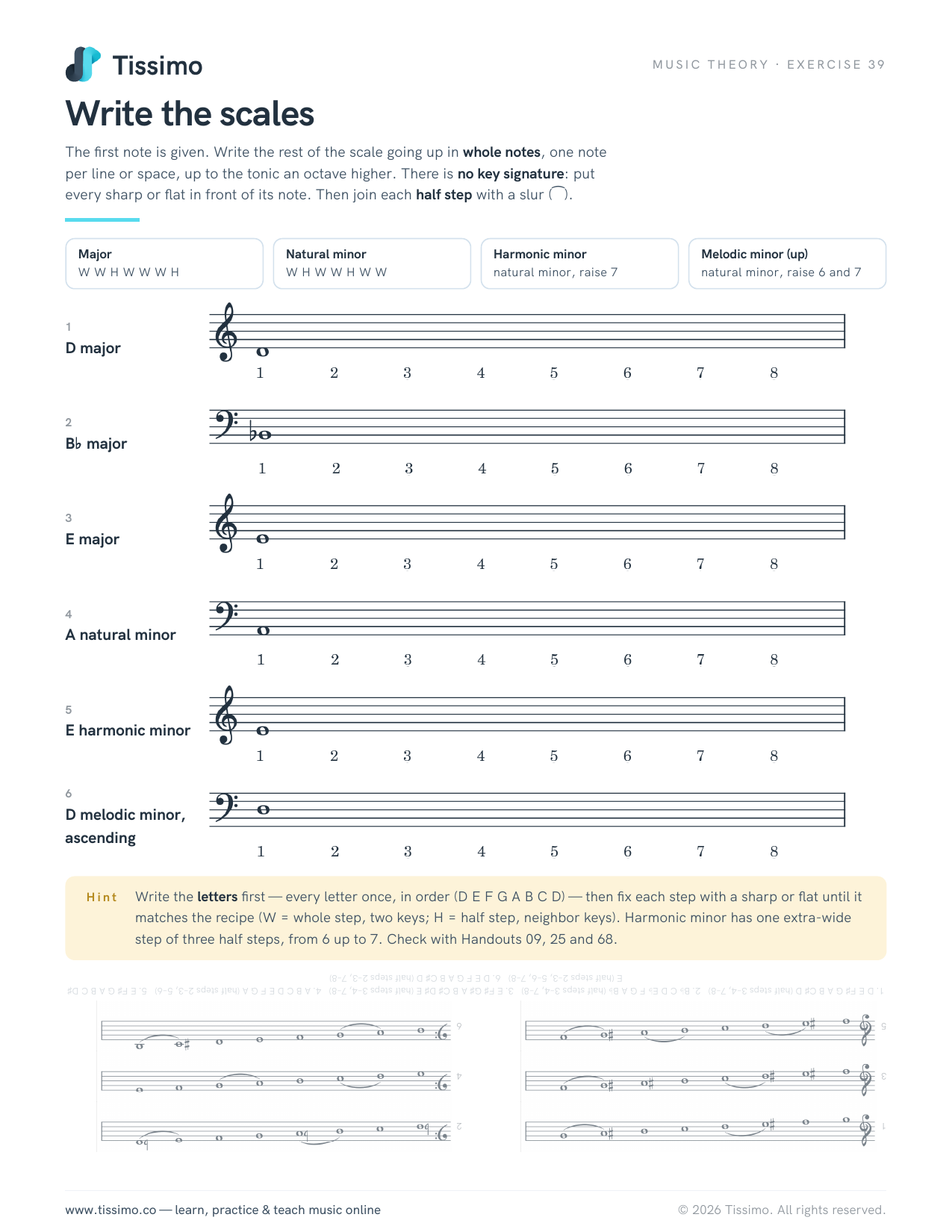
Write the scales
The first note is given. Write the rest of the scale going up in whole notes, one note per line or space, up to the tonic an octave higher. There is no key signature: put every sharp or flat in front of its note. Then join each half step with a slur (⁀).
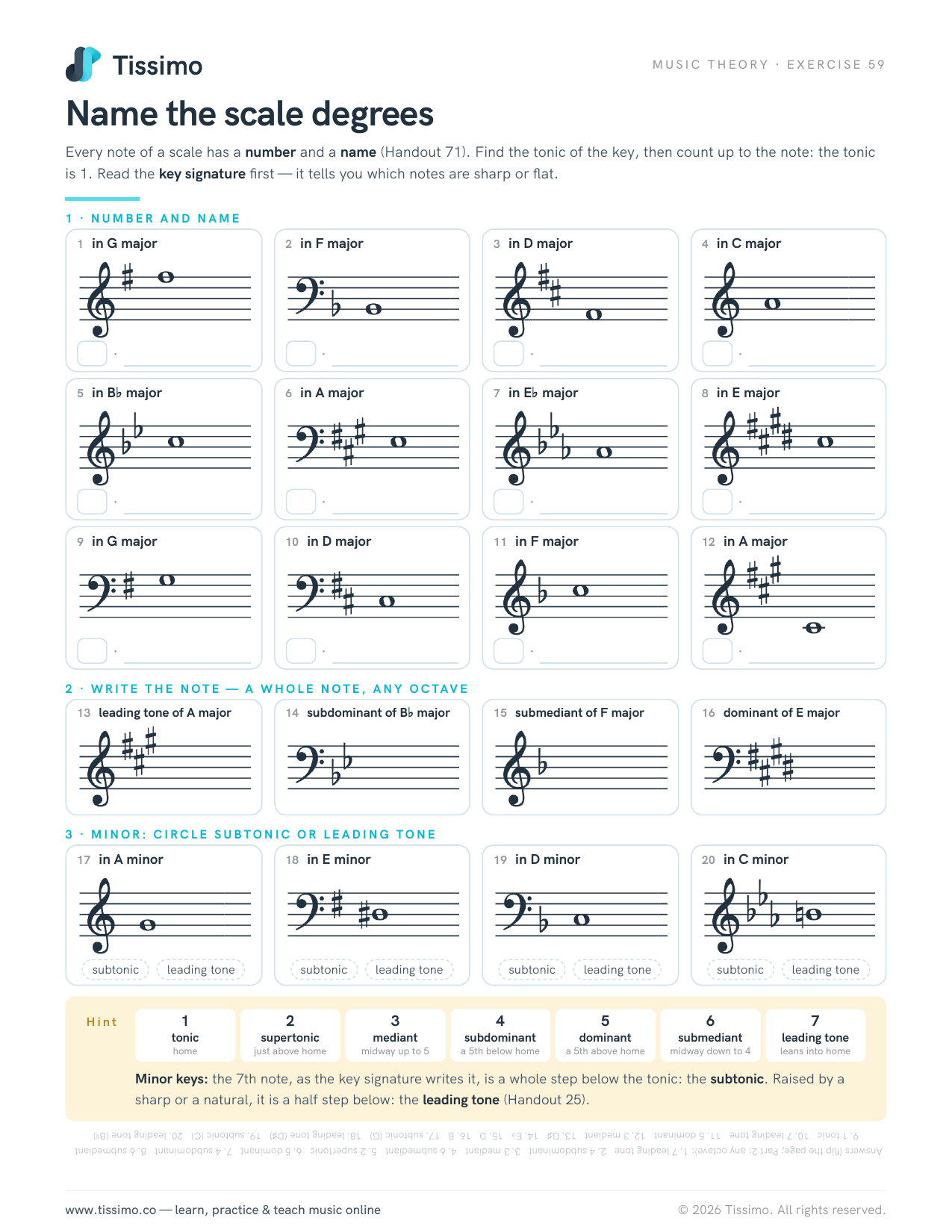
Name the scale degrees
Every note of a scale has a number and a name (Handout 71). Find the tonic of the key, then count up to the note: the tonic is 1. Read the key signature first — it tells you which notes are sharp or flat.
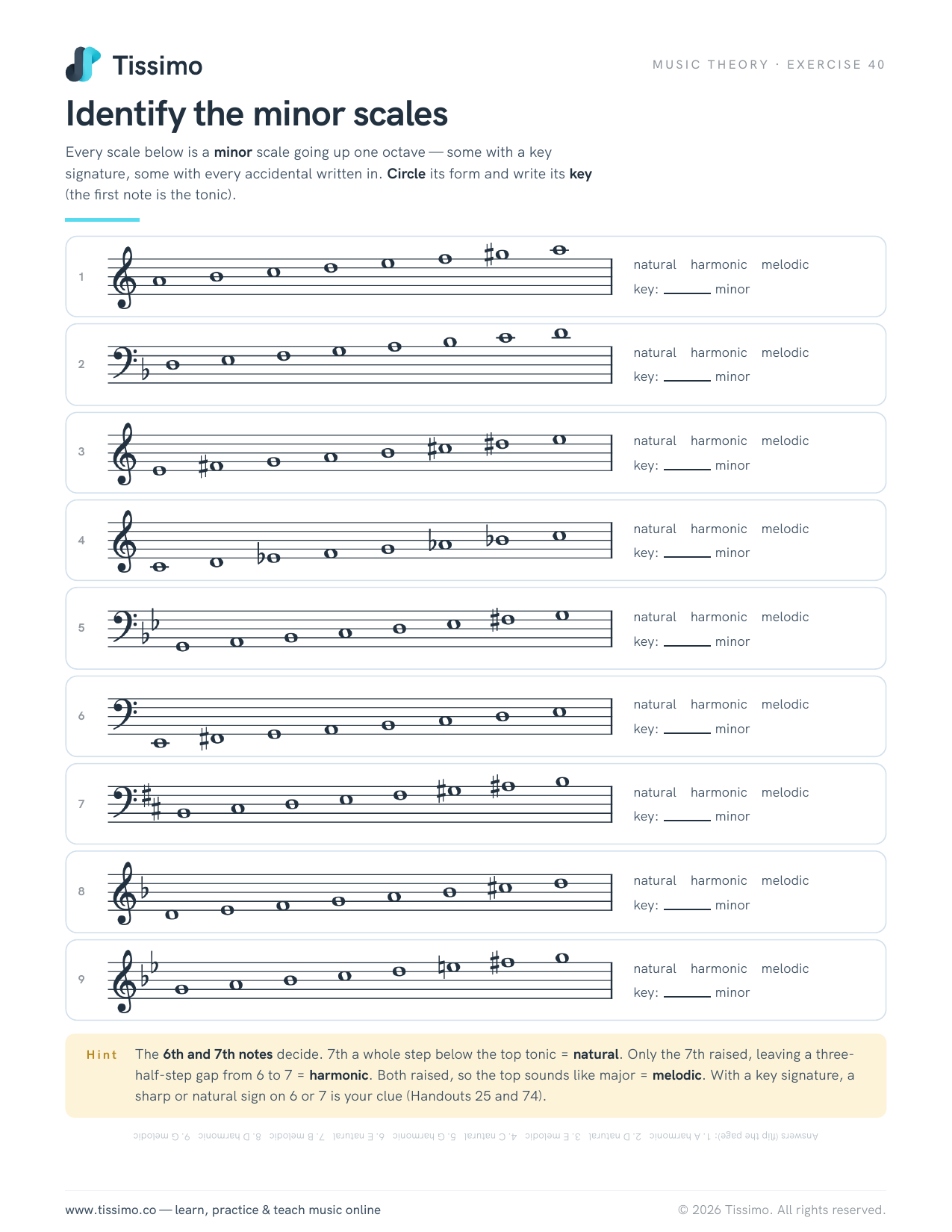
Identify the minor scales
Every scale below is a minor scale going up one octave — some with a key signature, some with every accidental written in. Circle its form and write its key (the first note is the tonic).
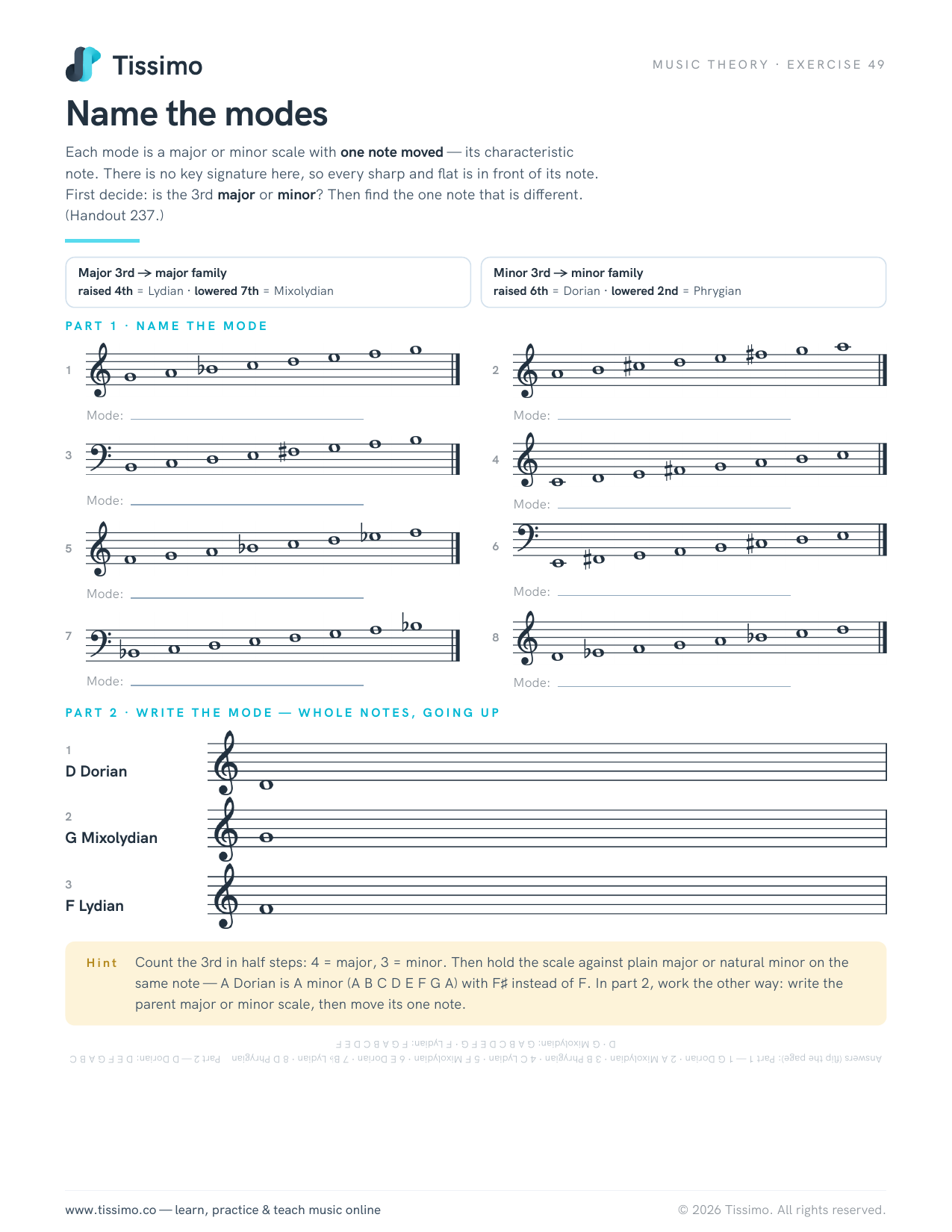
Name the modes
Each mode is a major or minor scale with one note moved — its characteristic note. There is no key signature here, so every sharp and flat is in front of its note. First decide: is the 3rd major or minor? Then find the one note that is different. (Handout 237.)
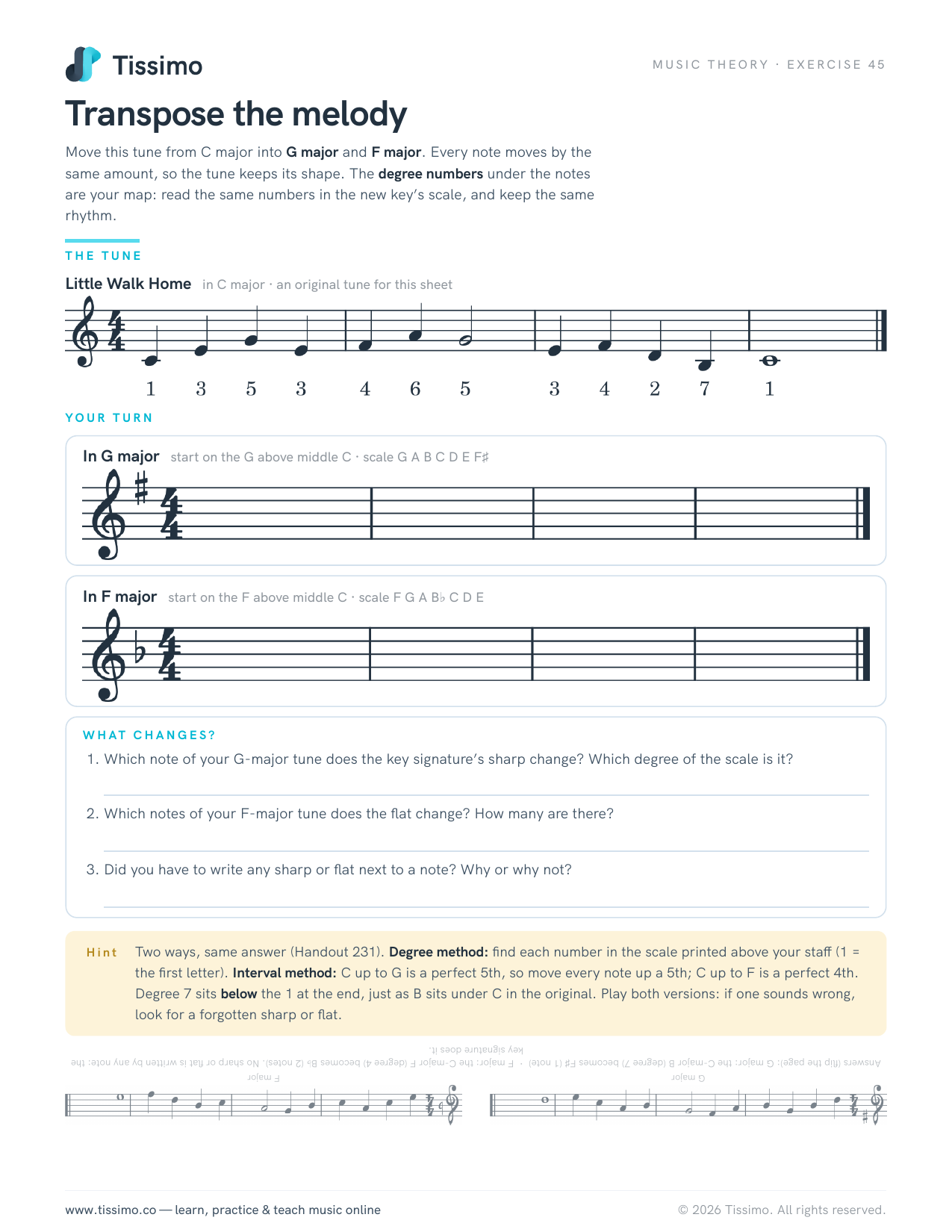
Transpose the melody
Move this tune from C major into G major and F major. Every note moves by the same amount, so the tune keeps its shape. The degree numbers under the notes are your map: read the same numbers in the new key’s scale, and keep the same rhythm.
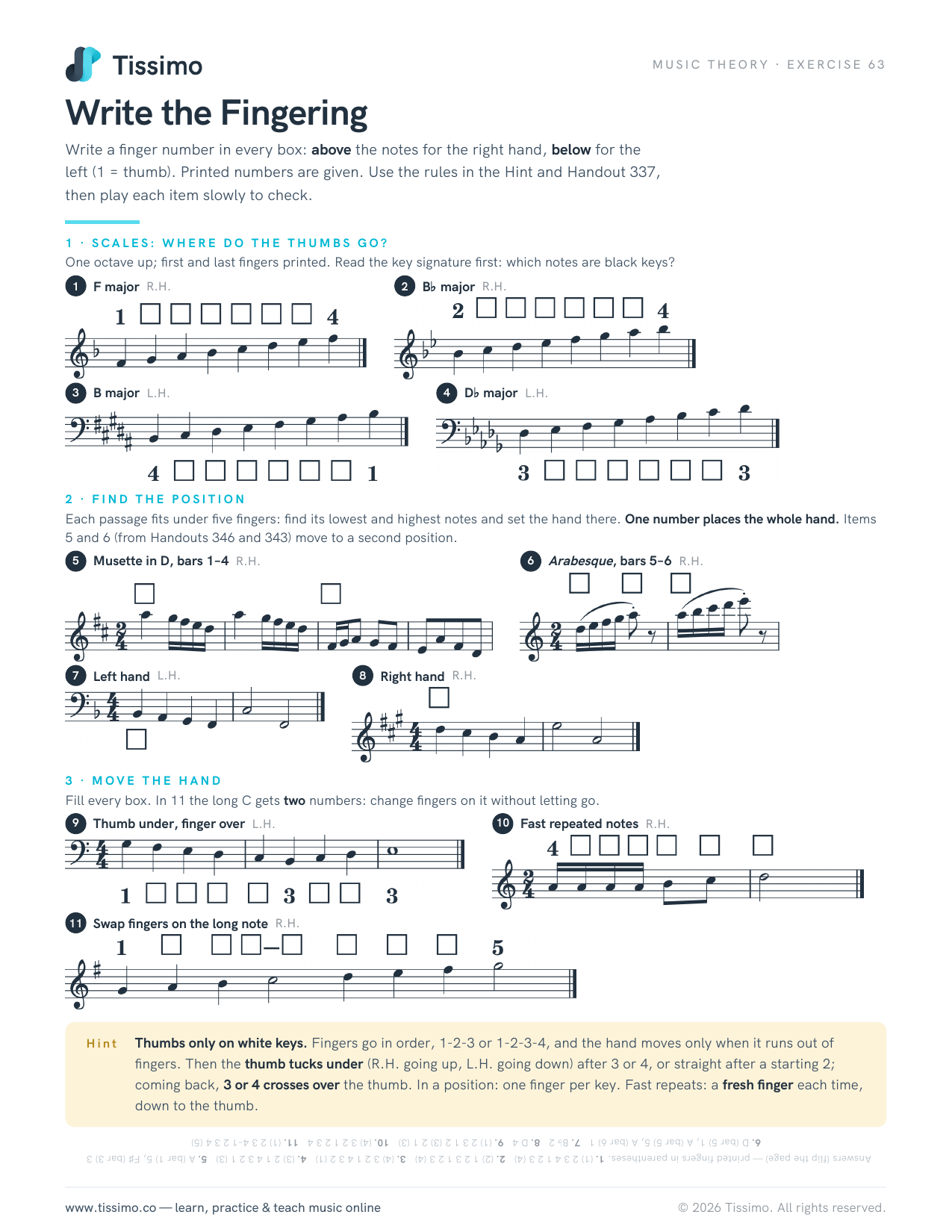
Write the Fingering
Write a finger number in every box: above the notes for the right hand, below for the left (1 = thumb). Printed numbers are given. Use the rules in the Hint and Handout 337, then play each item slowly to check.
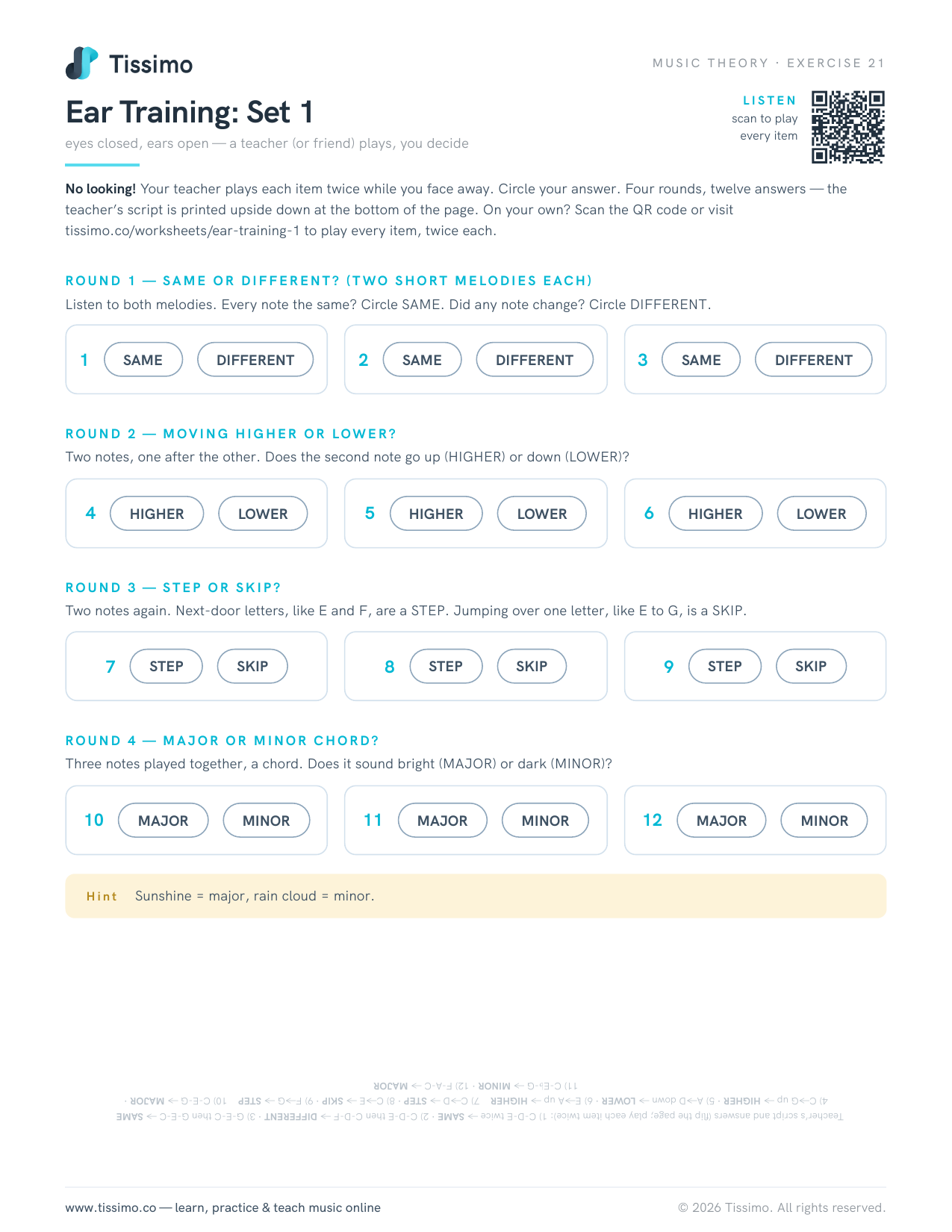
Ear Training: Set 1
eyes closed, ears open — a teacher (or friend) plays, you decide
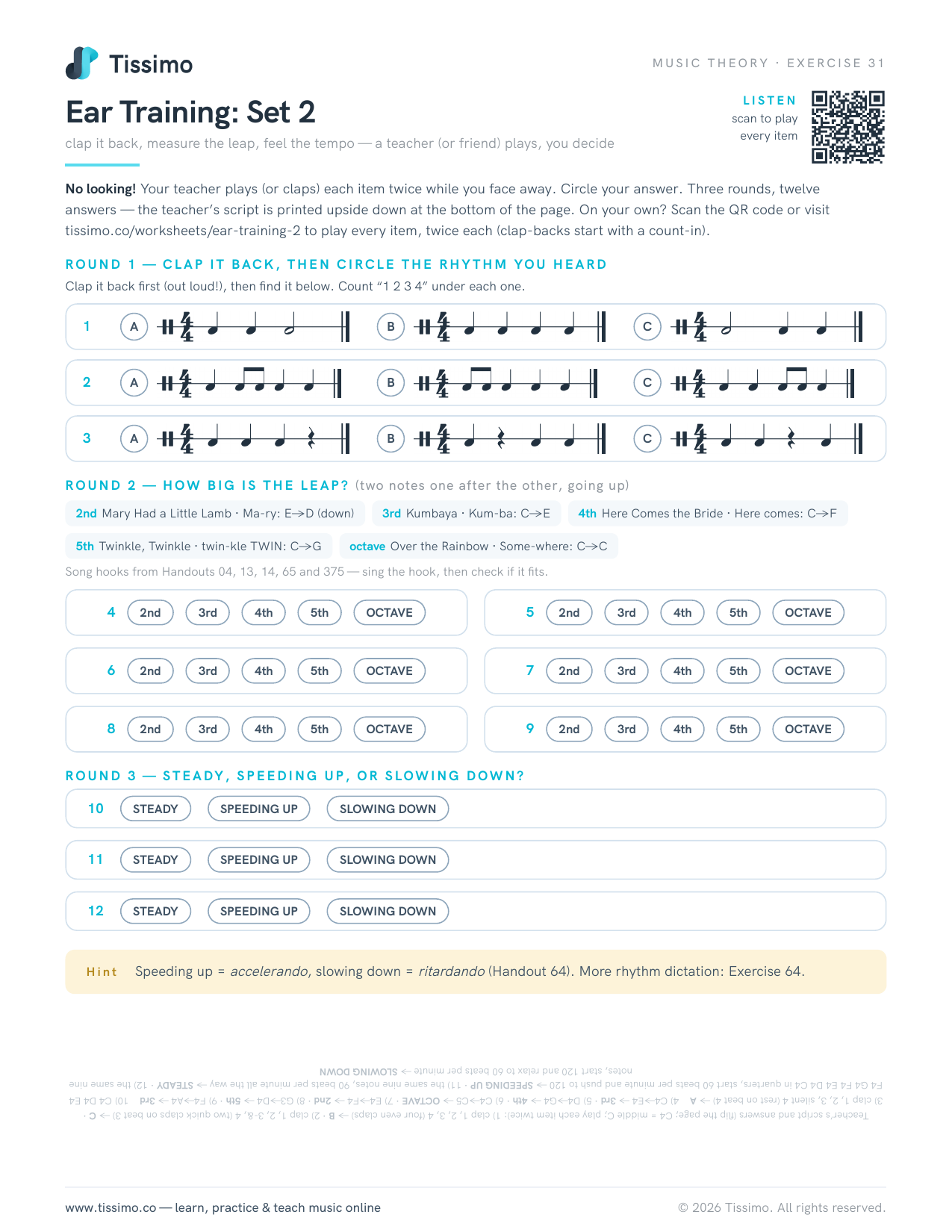
Ear Training: Set 2
clap it back, measure the leap, feel the tempo — a teacher (or friend) plays, you decide
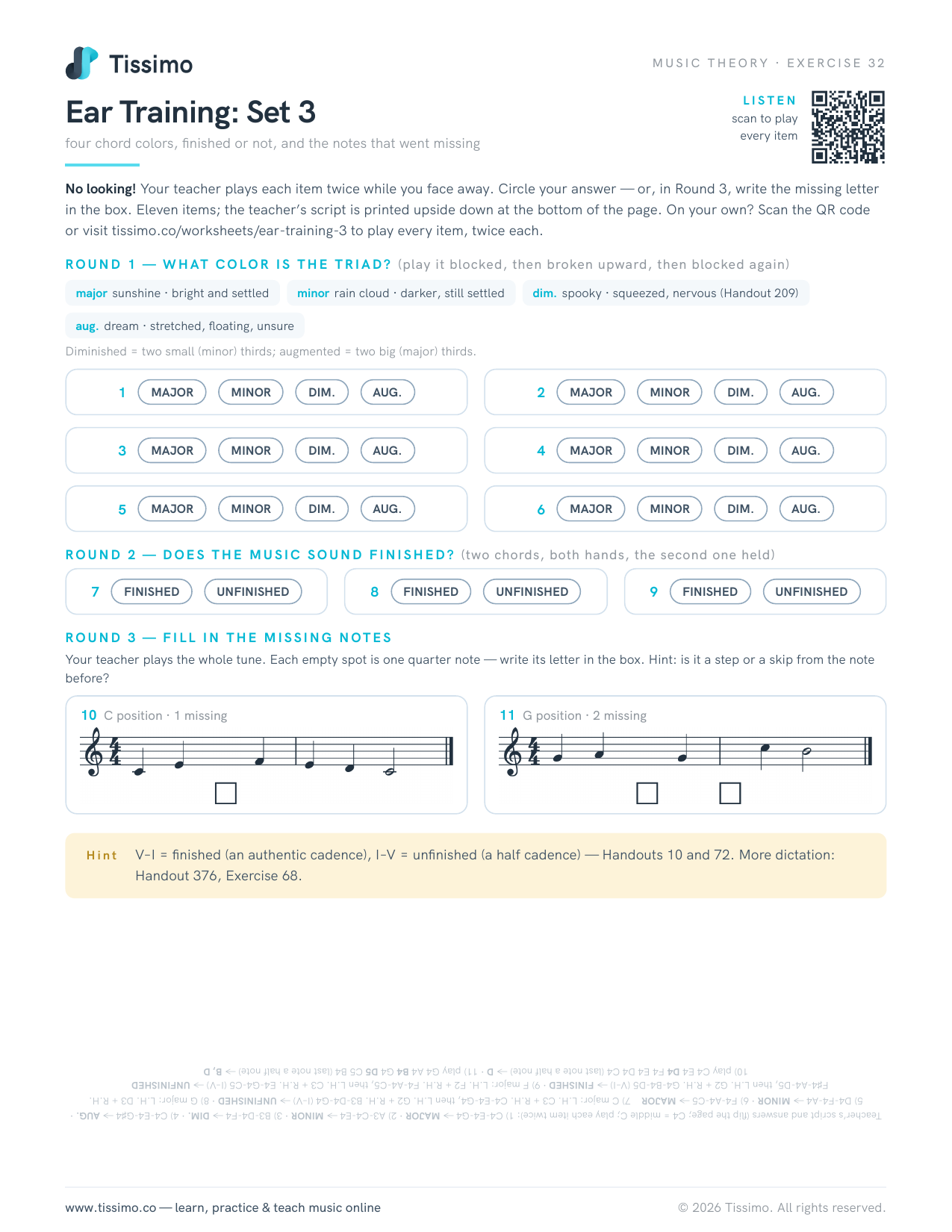
Ear Training: Set 3
four chord colors, finished or not, and the notes that went missing
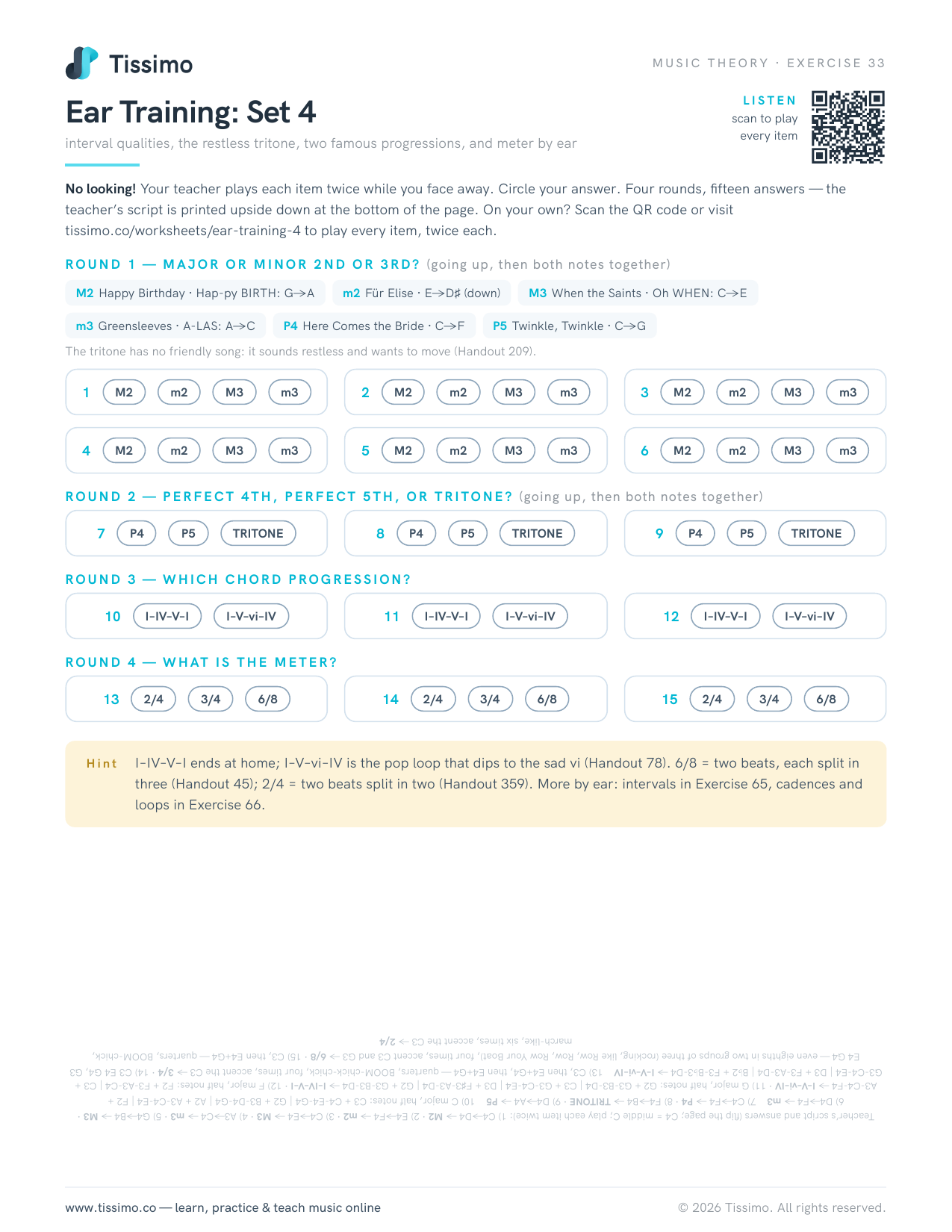
Ear Training: Set 4
interval qualities, the restless tritone, two famous progressions, and meter by ear
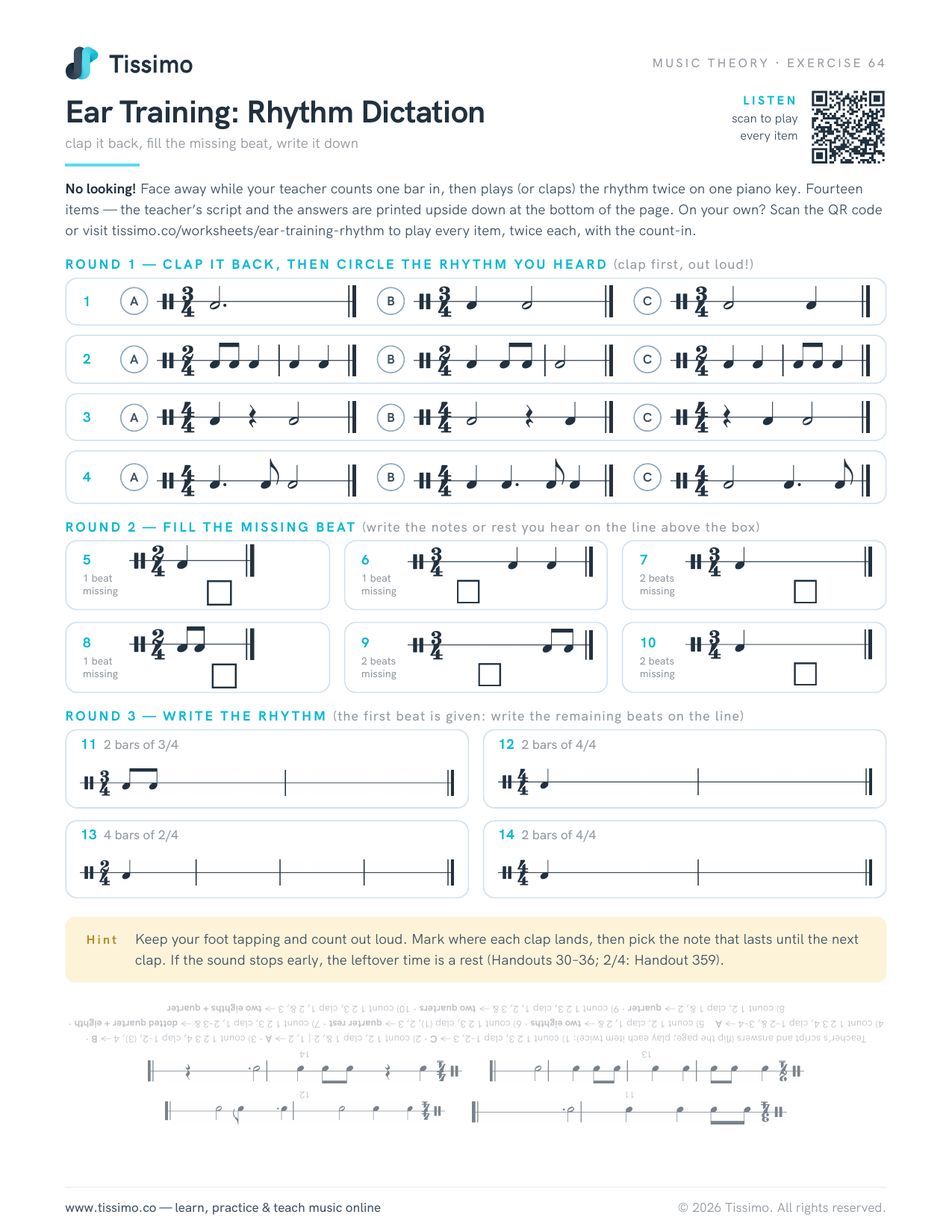
Ear Training: Rhythm Dictation
clap it back, fill the missing beat, write it down
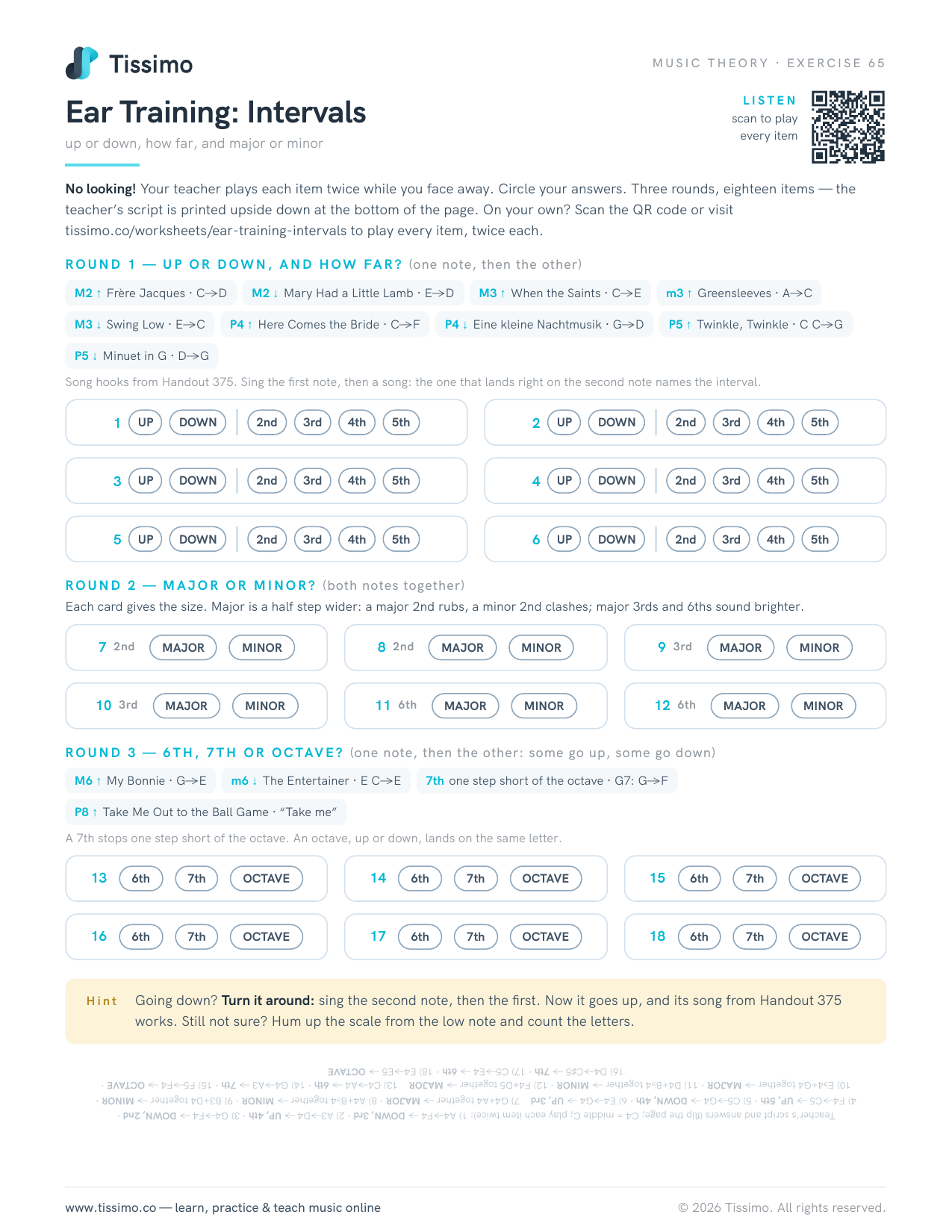
Ear Training: Intervals
up or down, how far, and major or minor
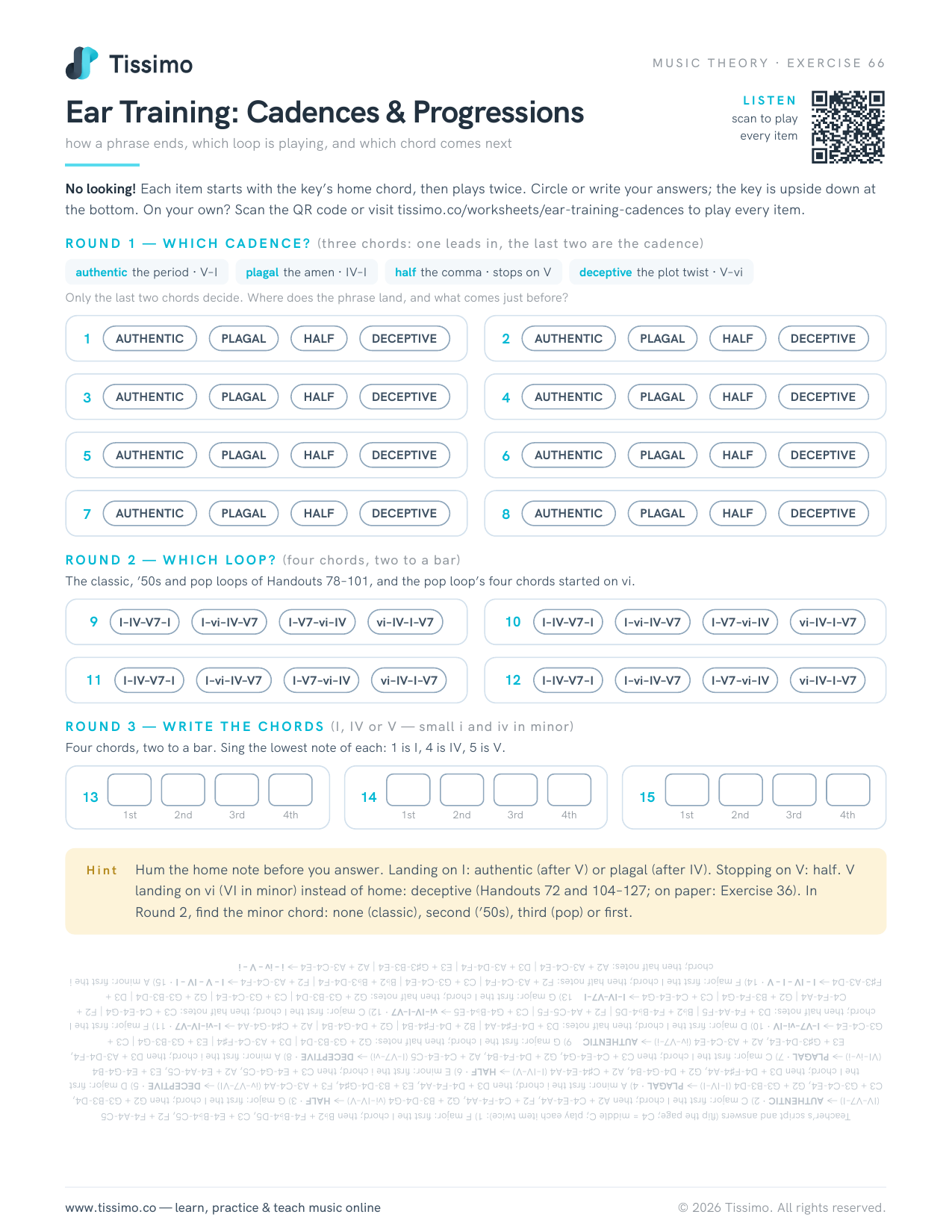
Ear Training: Cadences & Progressions
how a phrase ends, which loop is playing, and which chord comes next
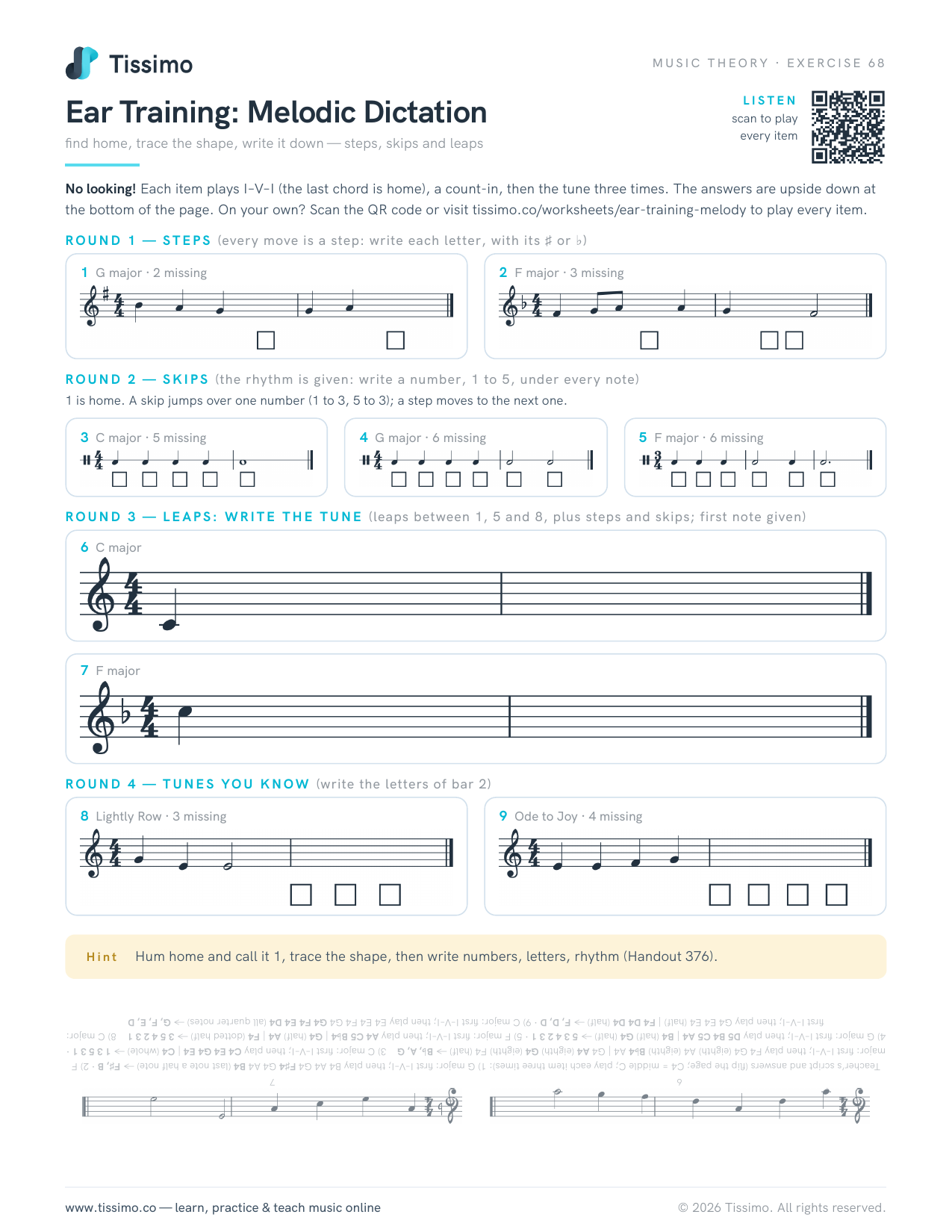
Ear Training: Melodic Dictation
find home, trace the shape, write it down — steps, skips and leaps
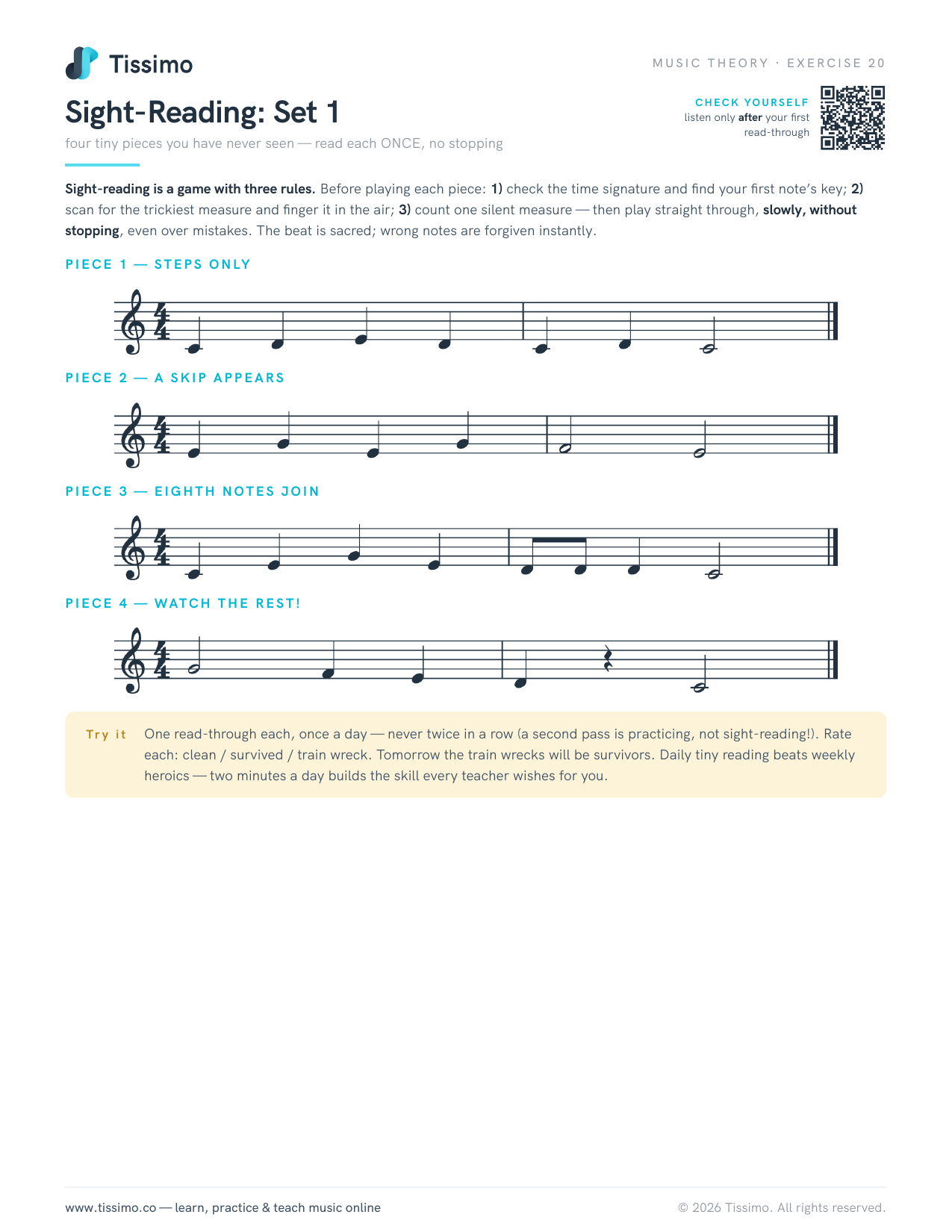
Sight-Reading: Set 1
four tiny pieces you have never seen — read each ONCE, no stopping
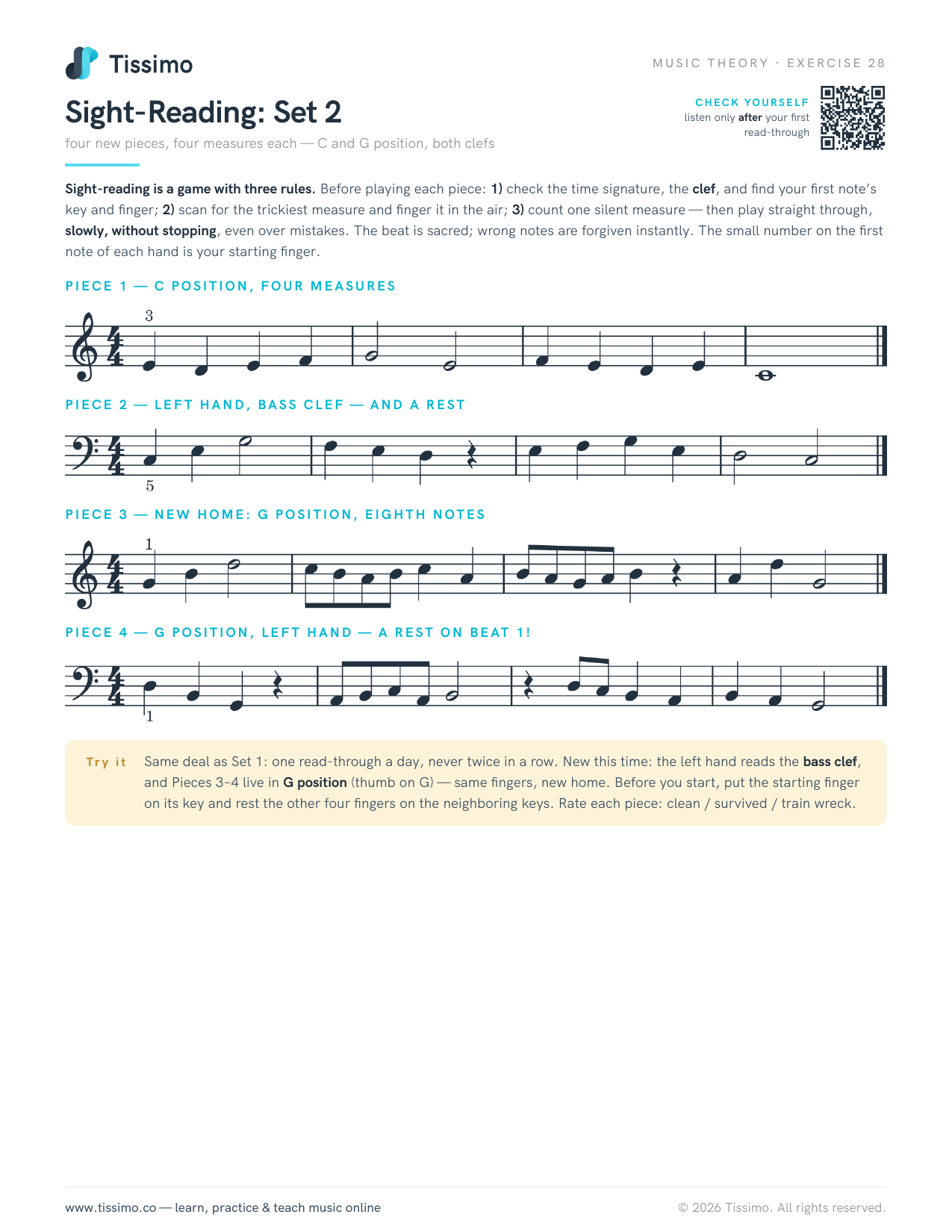
Sight-Reading: Set 2
four new pieces, four measures each — C and G position, both clefs
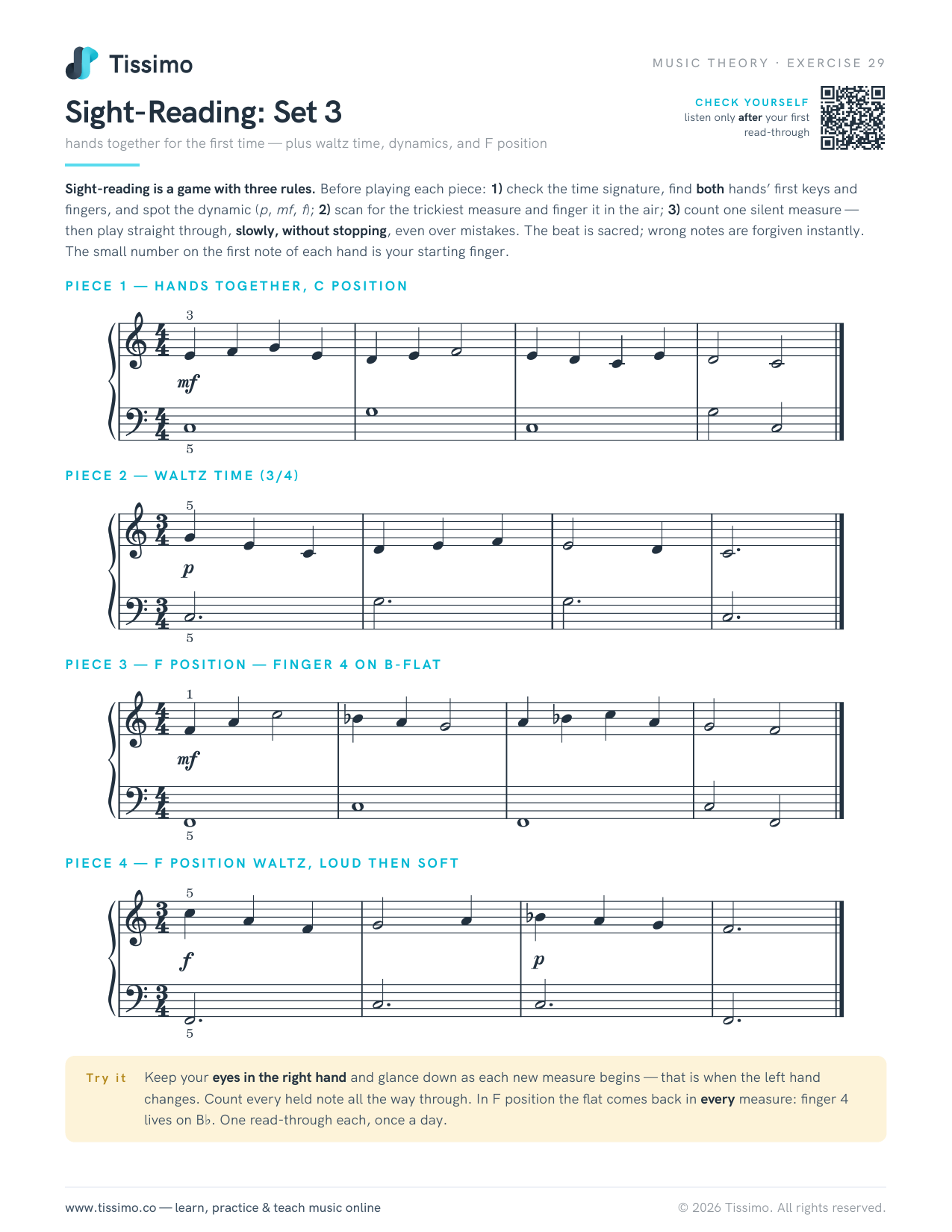
Sight-Reading: Set 3
hands together for the first time — plus waltz time, dynamics, and F position
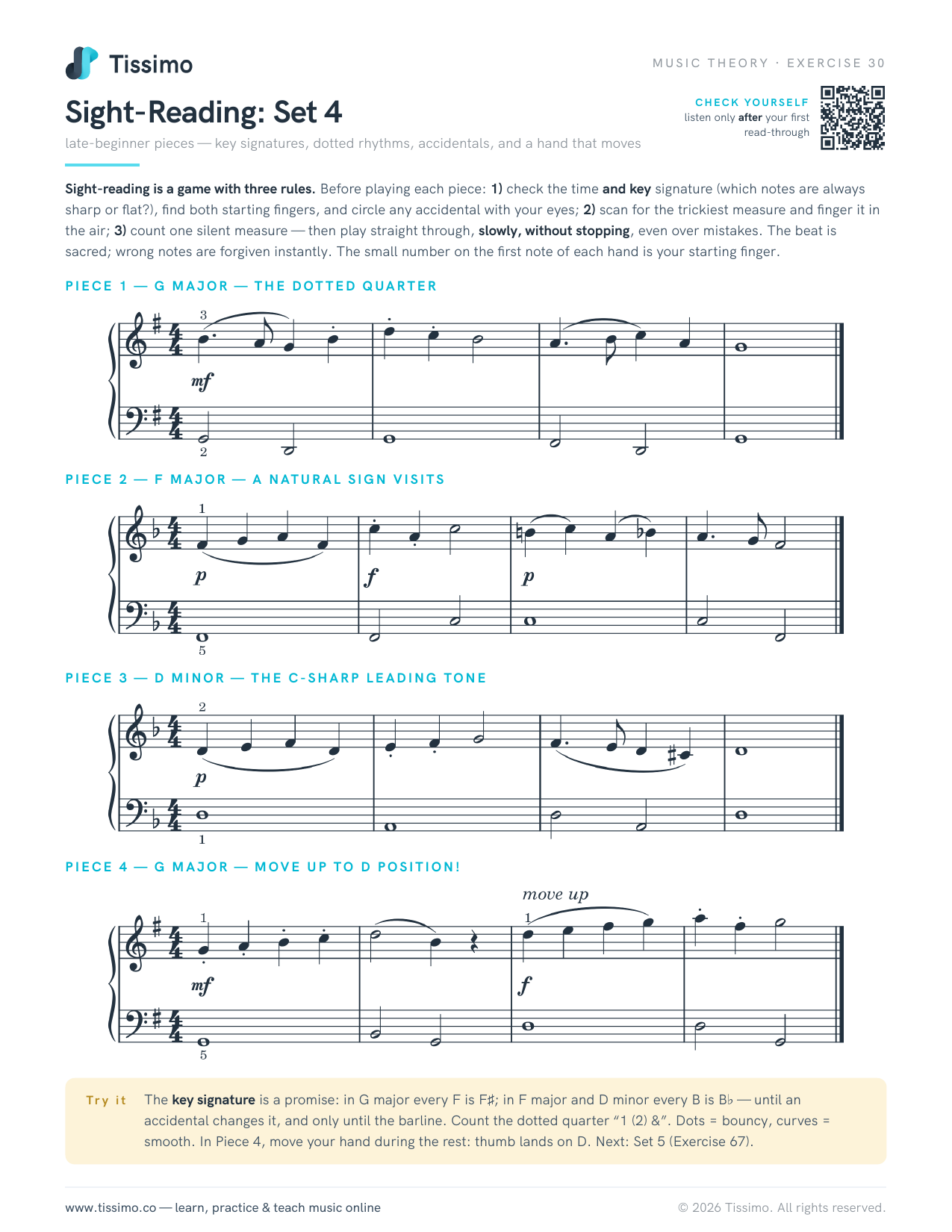
Sight-Reading: Set 4
late-beginner pieces — key signatures, dotted rhythms, accidentals, and a hand that moves
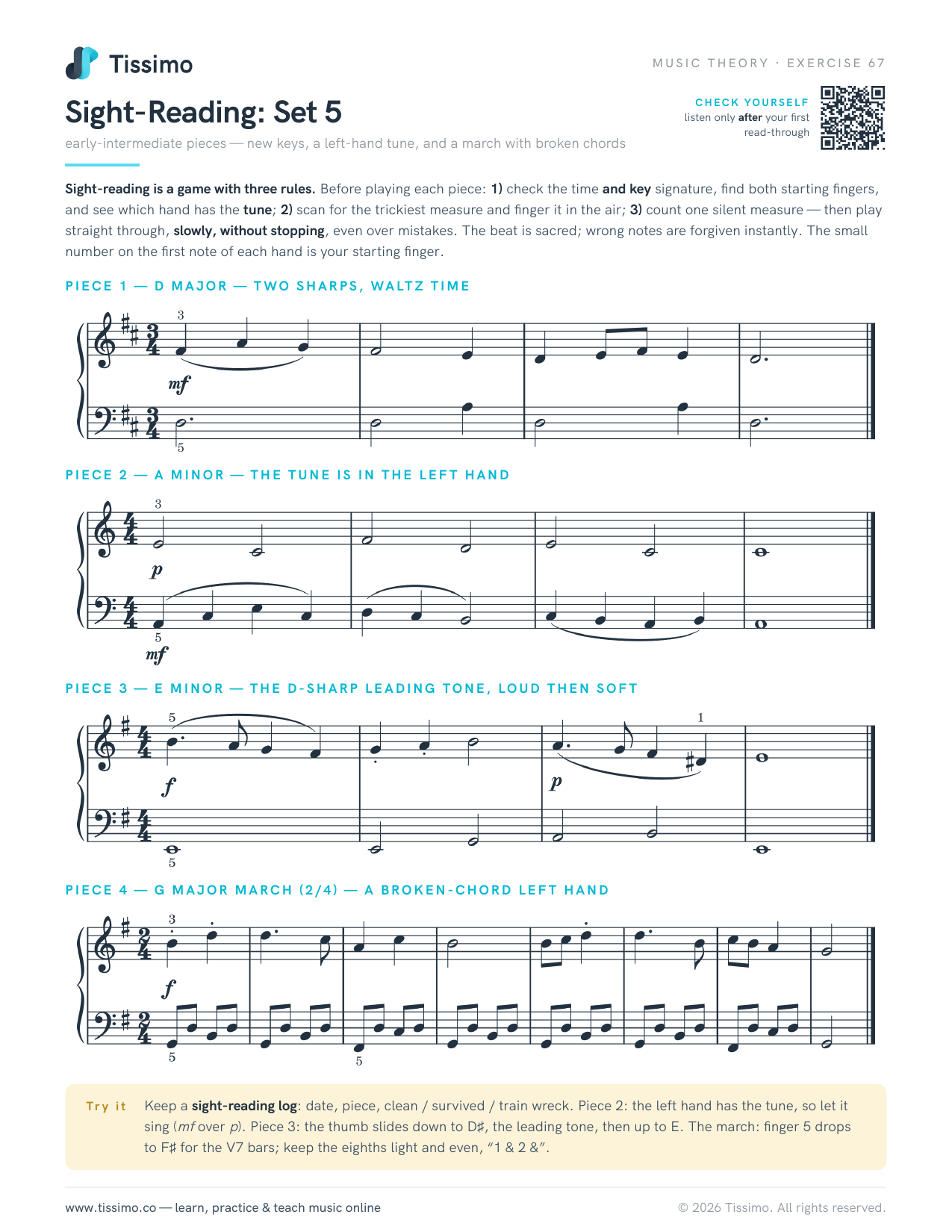
Sight-Reading: Set 5
early-intermediate pieces — new keys, a left-hand tune, and a march with broken chords
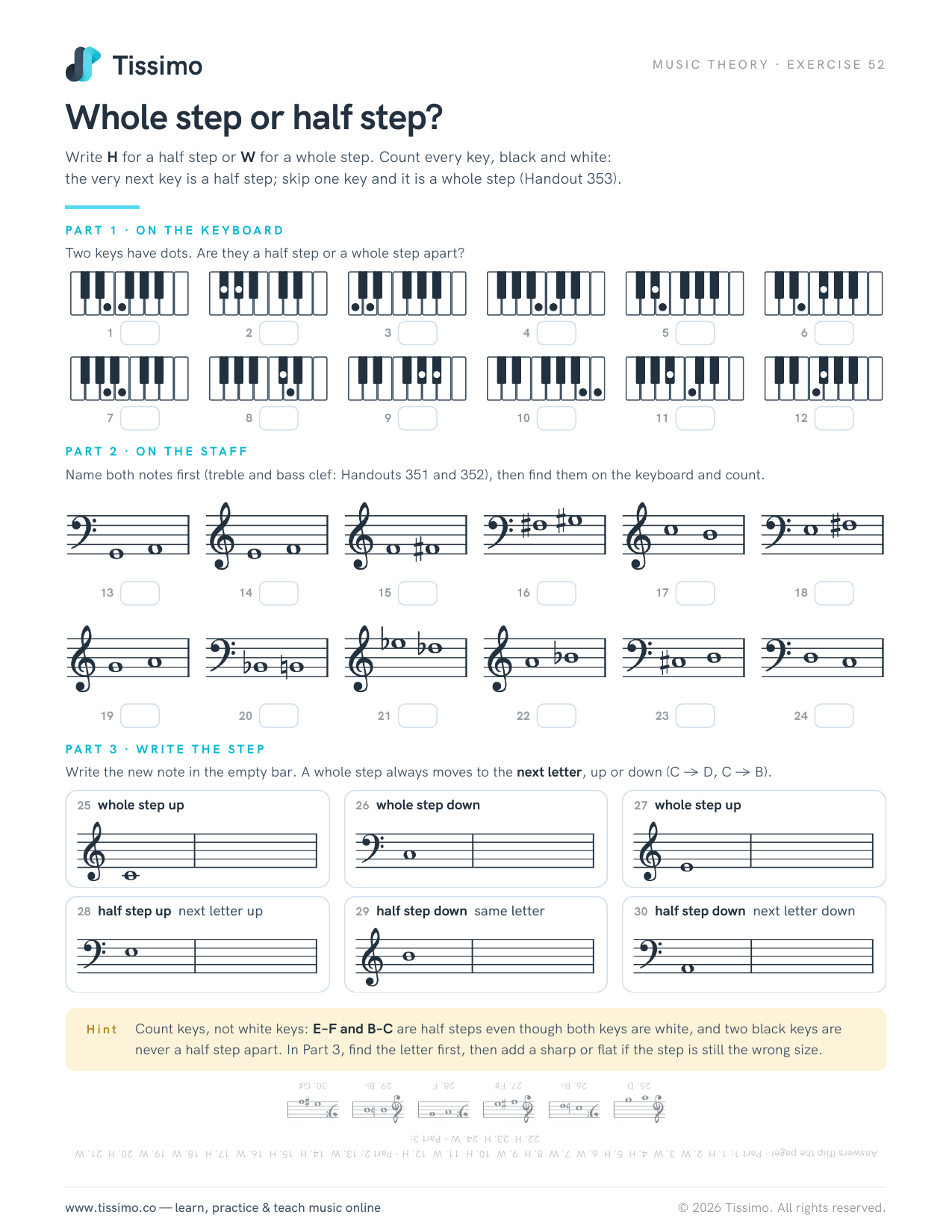
Whole step or half step?
Write H for a half step or W for a whole step. Count every key, black and white: the very next key is a half step; skip one key and it is a whole step (Handout 353).
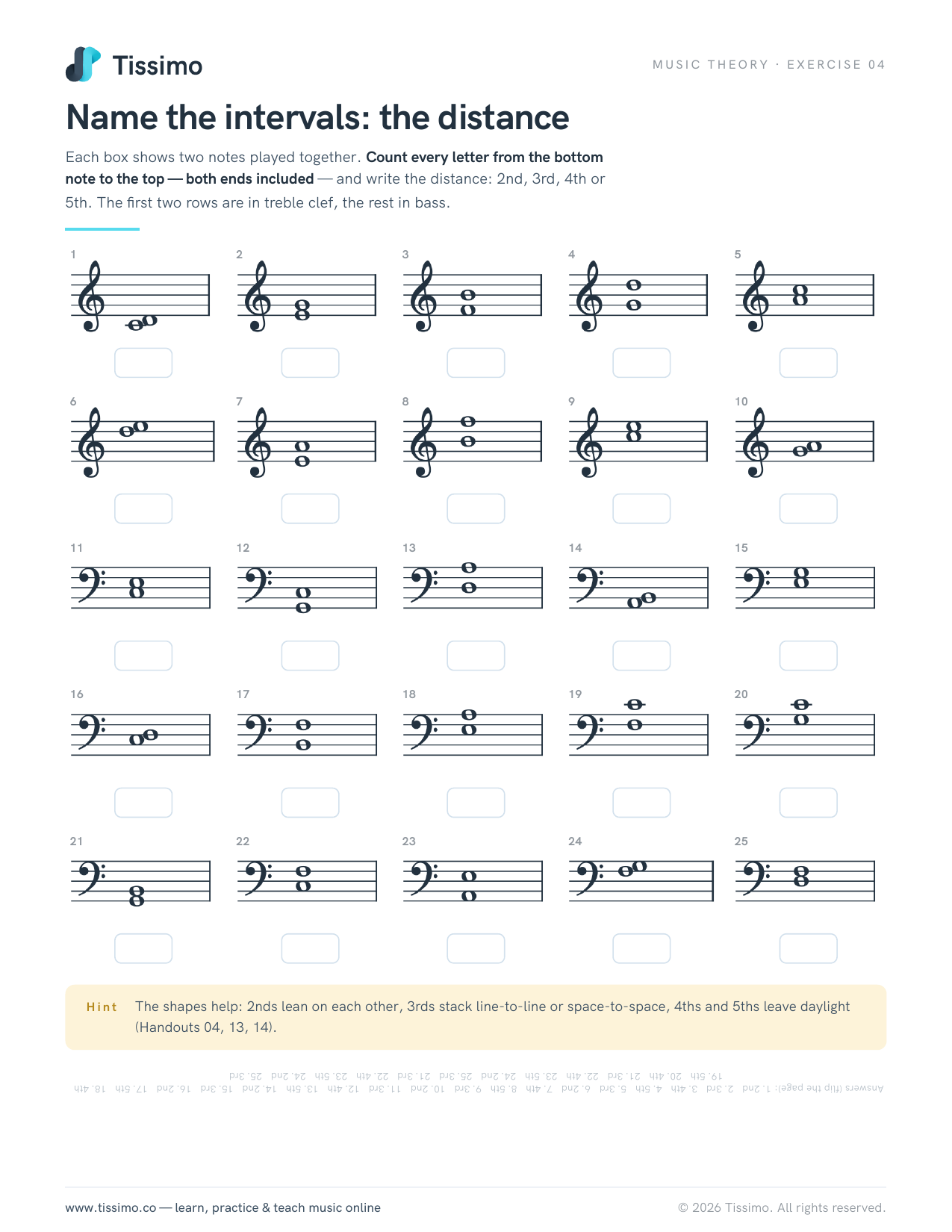
Name the intervals: the distance
Each box shows two notes played together. Count every letter from the bottom note to the top — both ends included — and write the distance: 2nd, 3rd, 4th or 5th. The first two rows are in treble clef, the rest in bass.
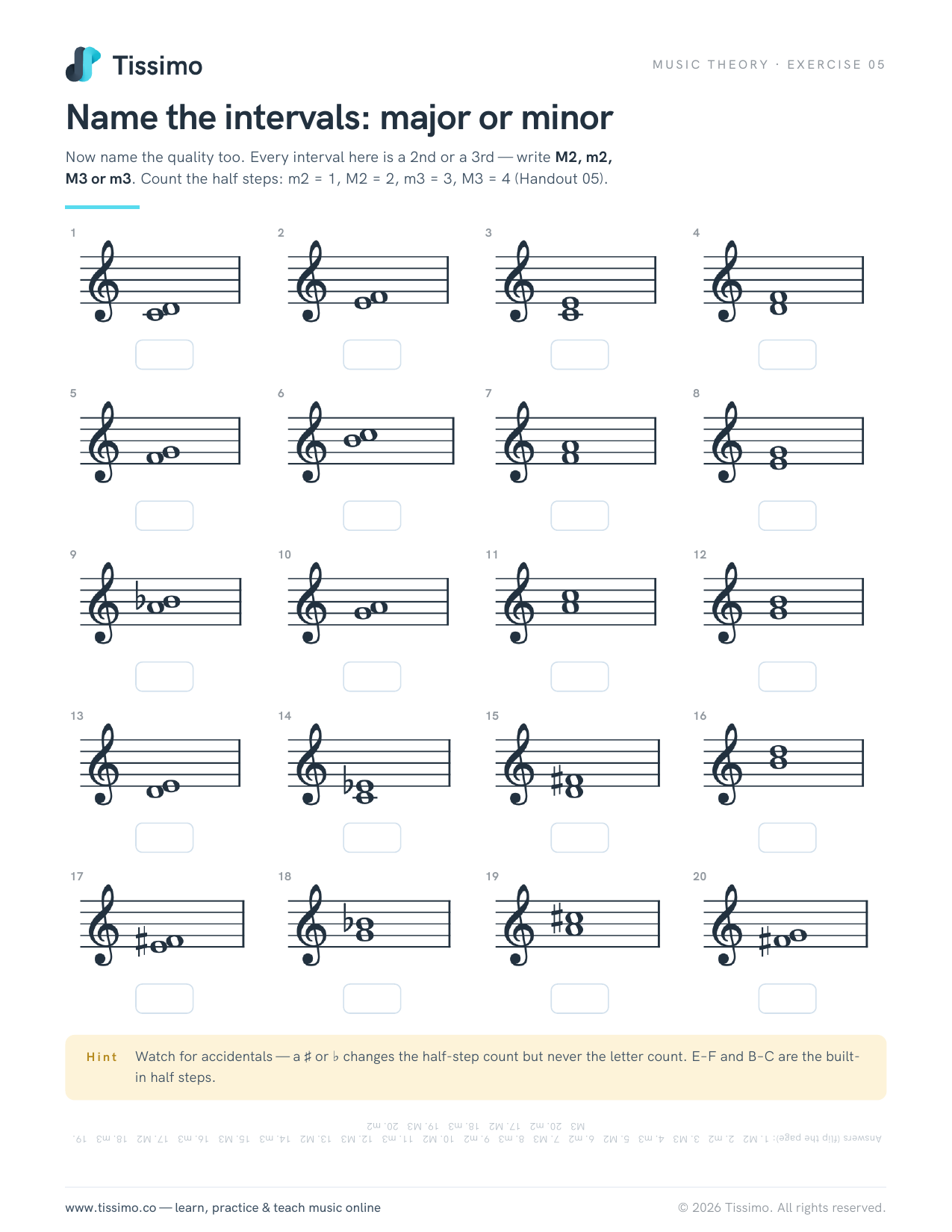
Name the intervals: major or minor
Now name the quality too. Every interval here is a 2nd or a 3rd — write M2, m2, M3 or m3. Count the half steps: m2 = 1, M2 = 2, m3 = 3, M3 = 4 (Handout 05). Warm up with Exercise 52.
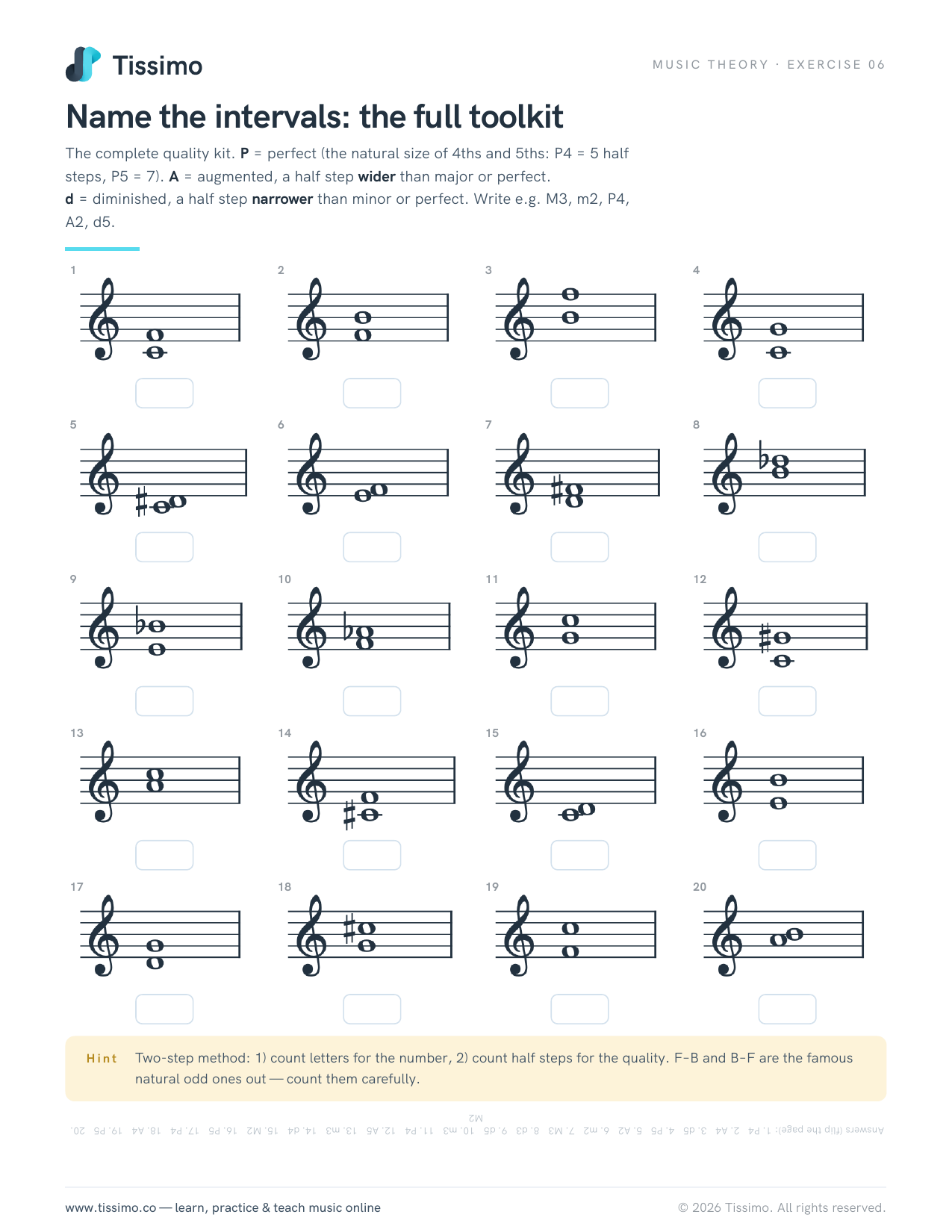
Name the intervals: the full toolkit
The complete quality kit. P = perfect (the natural size of 4ths and 5ths: P4 = 5 half steps, P5 = 7). A = augmented, a half step wider than major or perfect. d = diminished, a half step narrower than minor or perfect. Write e.g. M3, m2, P4, A2, d5.
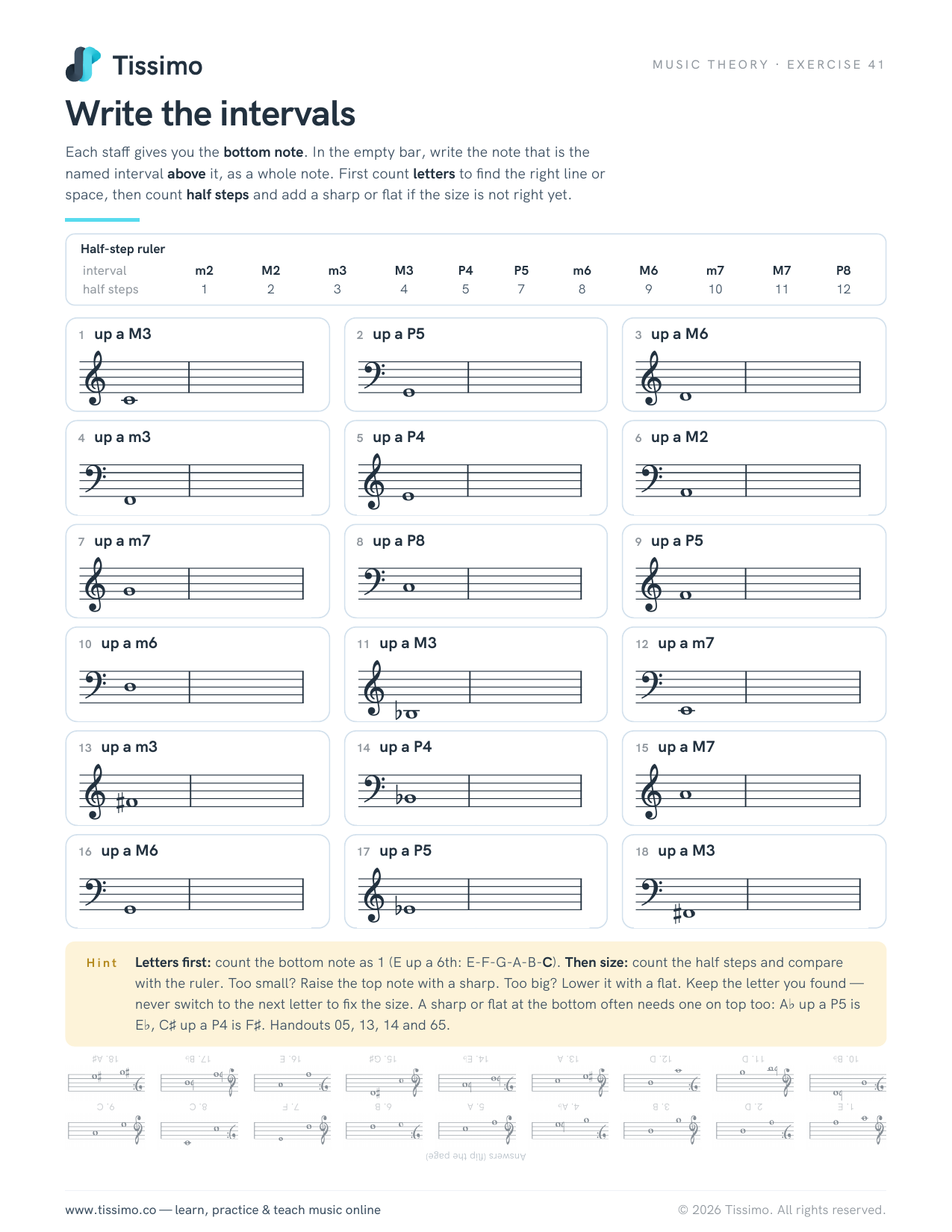
Write the intervals
Each staff gives you the bottom note. In the empty bar, write the note that is the named interval above it, as a whole note. First count letters to find the right line or space, then count half steps and add a sharp or flat if the size is not right yet.
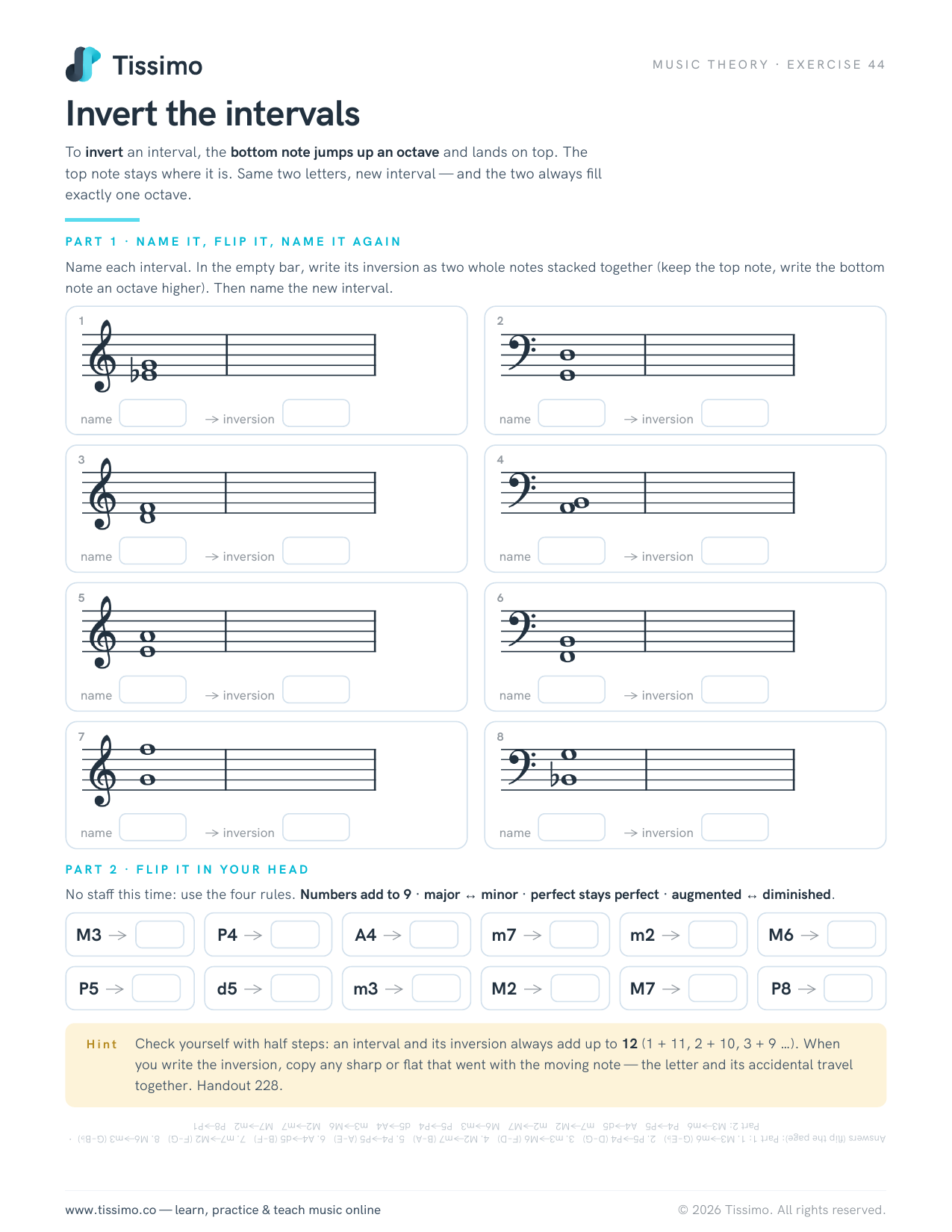
Invert the intervals
To invert an interval, the bottom note jumps up an octave and lands on top. The top note stays where it is. Same two letters, new interval — and the two always fill exactly one octave.
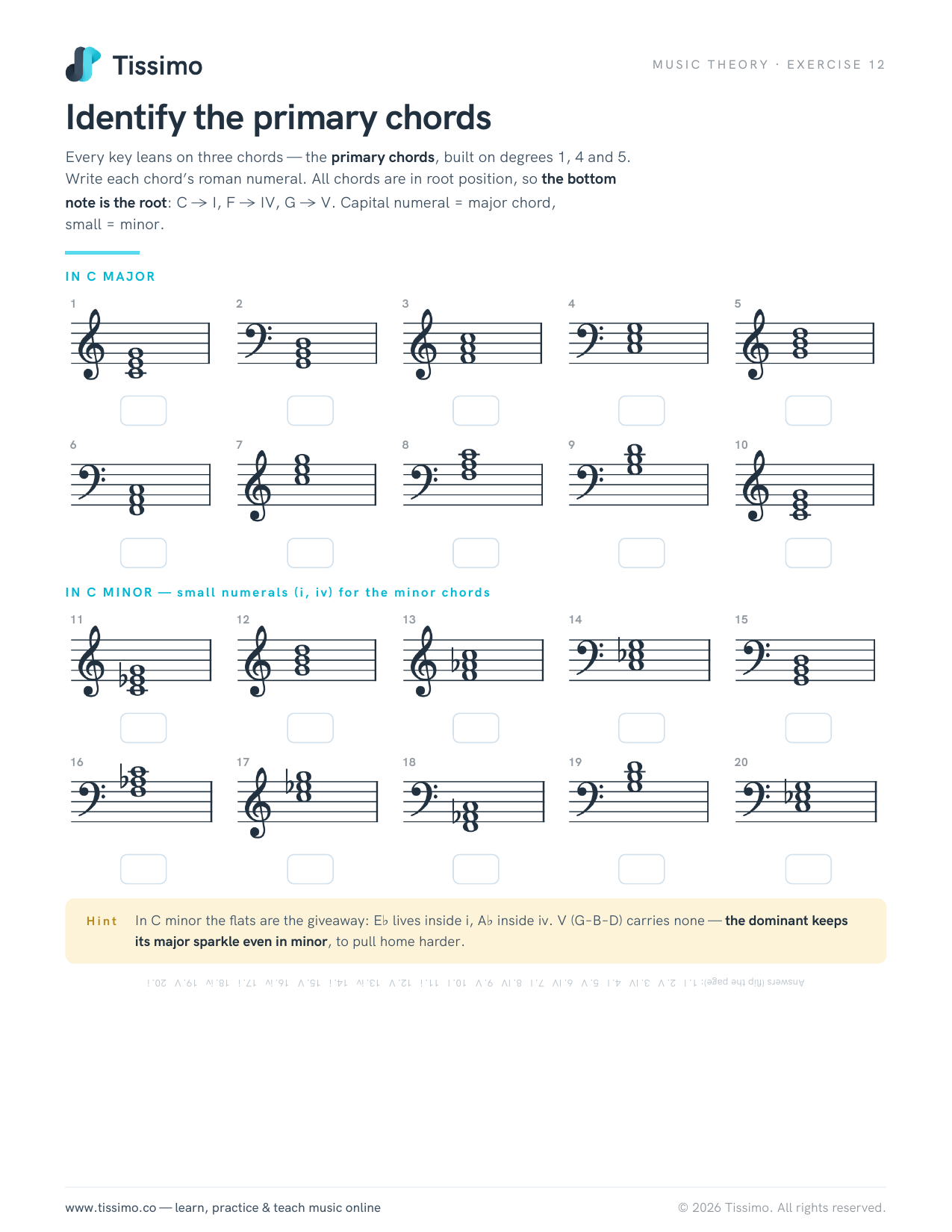
Identify the primary chords
Every key leans on three chords — the primary chords, built on degrees 1, 4 and 5. Write each chord’s roman numeral. All chords are in root position, so the bottom note is the root: C → I, F → IV, G → V. Capital numeral = major chord, small = minor.
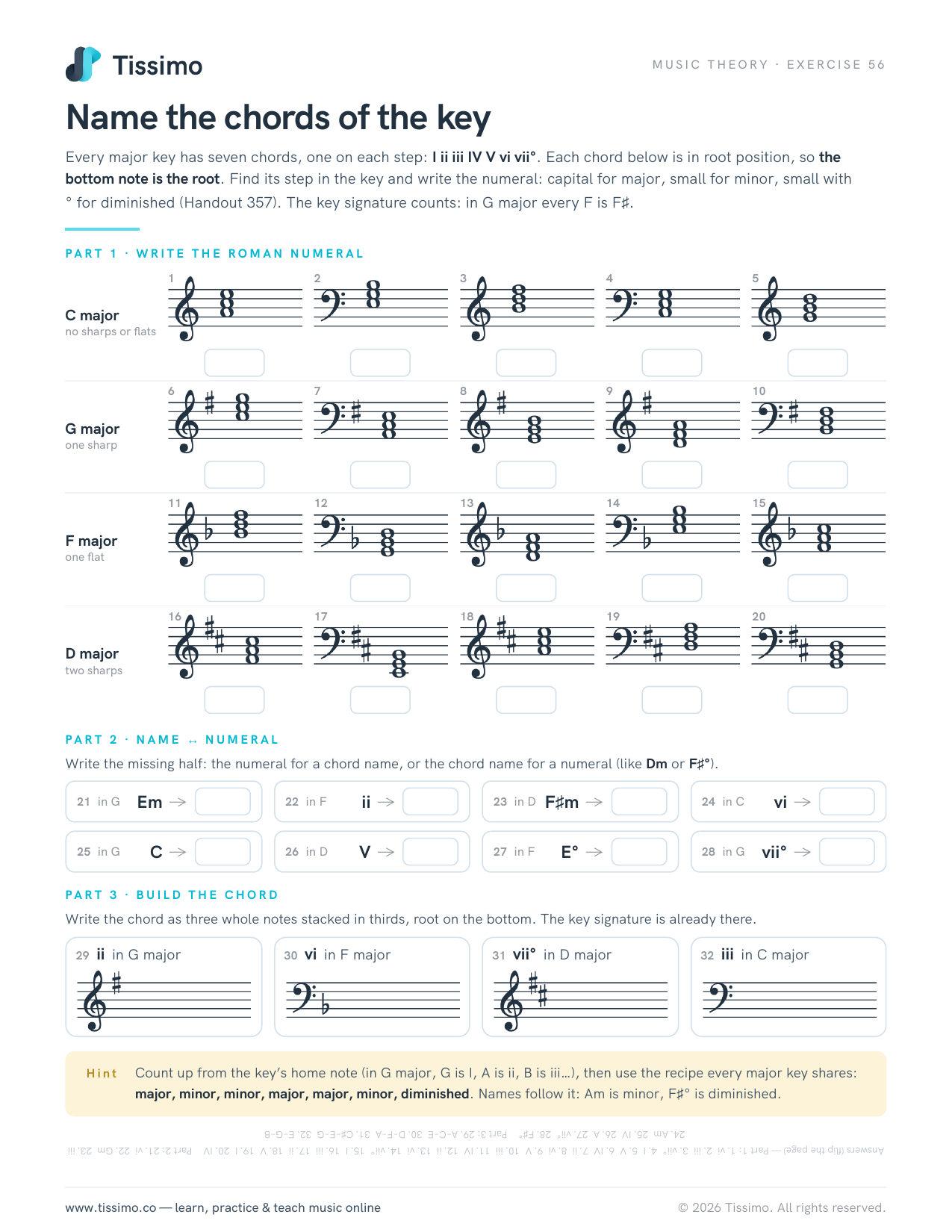
Name the chords of the key
Every major key has seven chords, one on each step: I ii iii IV V vi vii°. Each chord below is in root position, so the bottom note is the root. Find its step in the key and write the numeral: capital for major, small for minor, small with ° for diminished (Handout 357). The key signature counts: in G major every F is F♯.
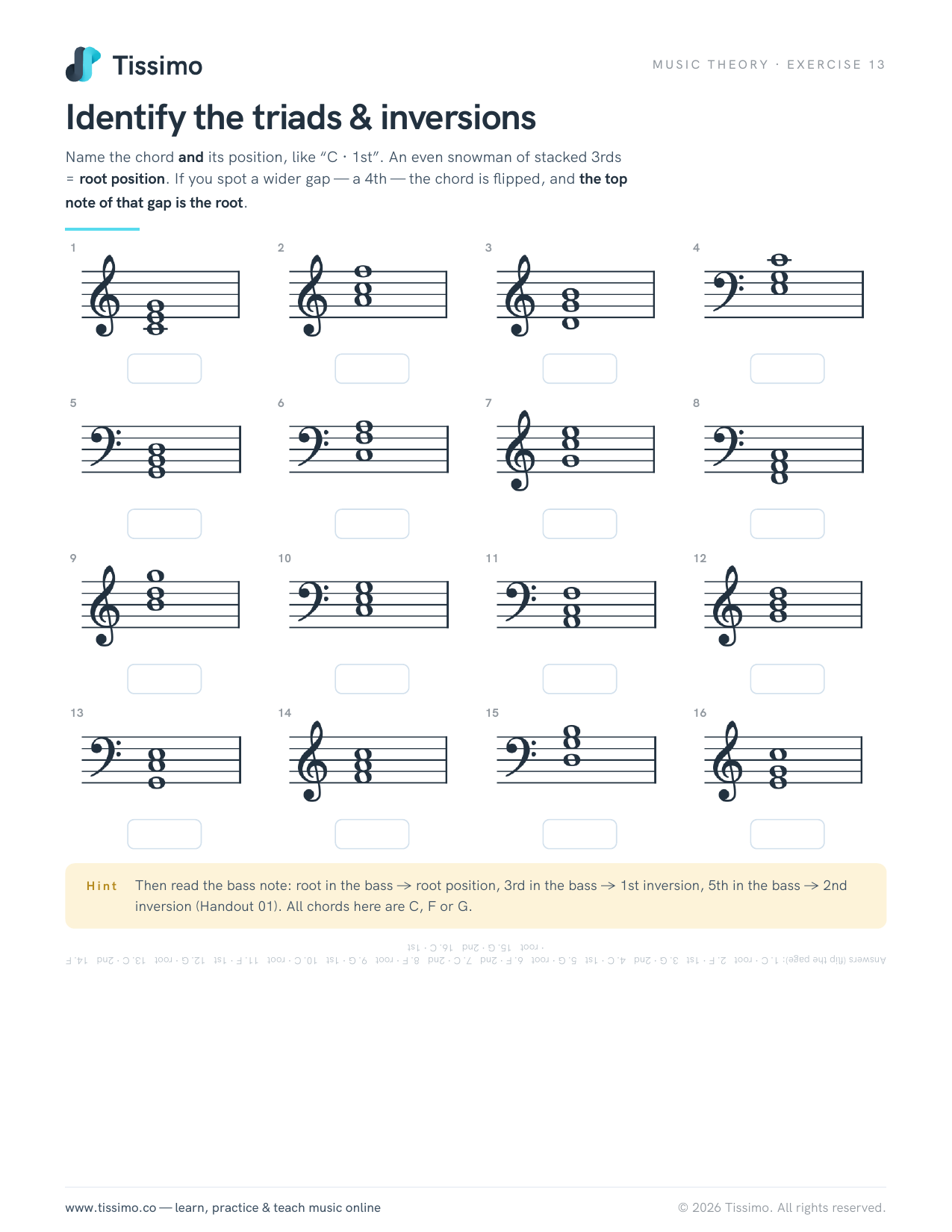
Identify the triads & inversions
Name the chord and its position, like “C · 1st”. An even snowman of stacked 3rds = root position. If you spot a wider gap — a 4th — the chord is flipped, and the top note of that gap is the root.
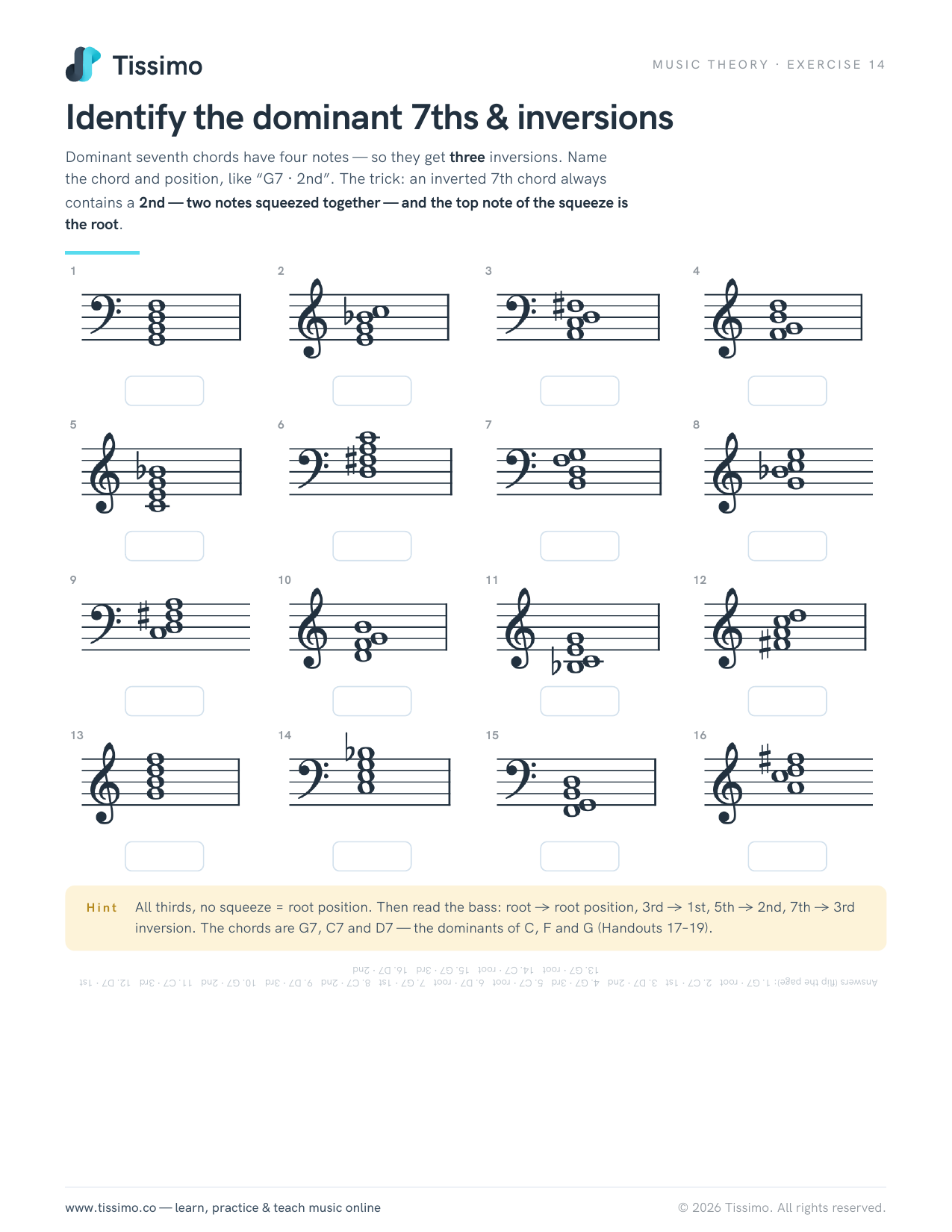
Identify the dominant 7ths & inversions
Dominant seventh chords have four notes — so they get three inversions. Name the chord and position, like “G7 · 2nd”. The trick: an inverted 7th chord always contains a 2nd — two notes squeezed together — and the top note of the squeeze is the root.
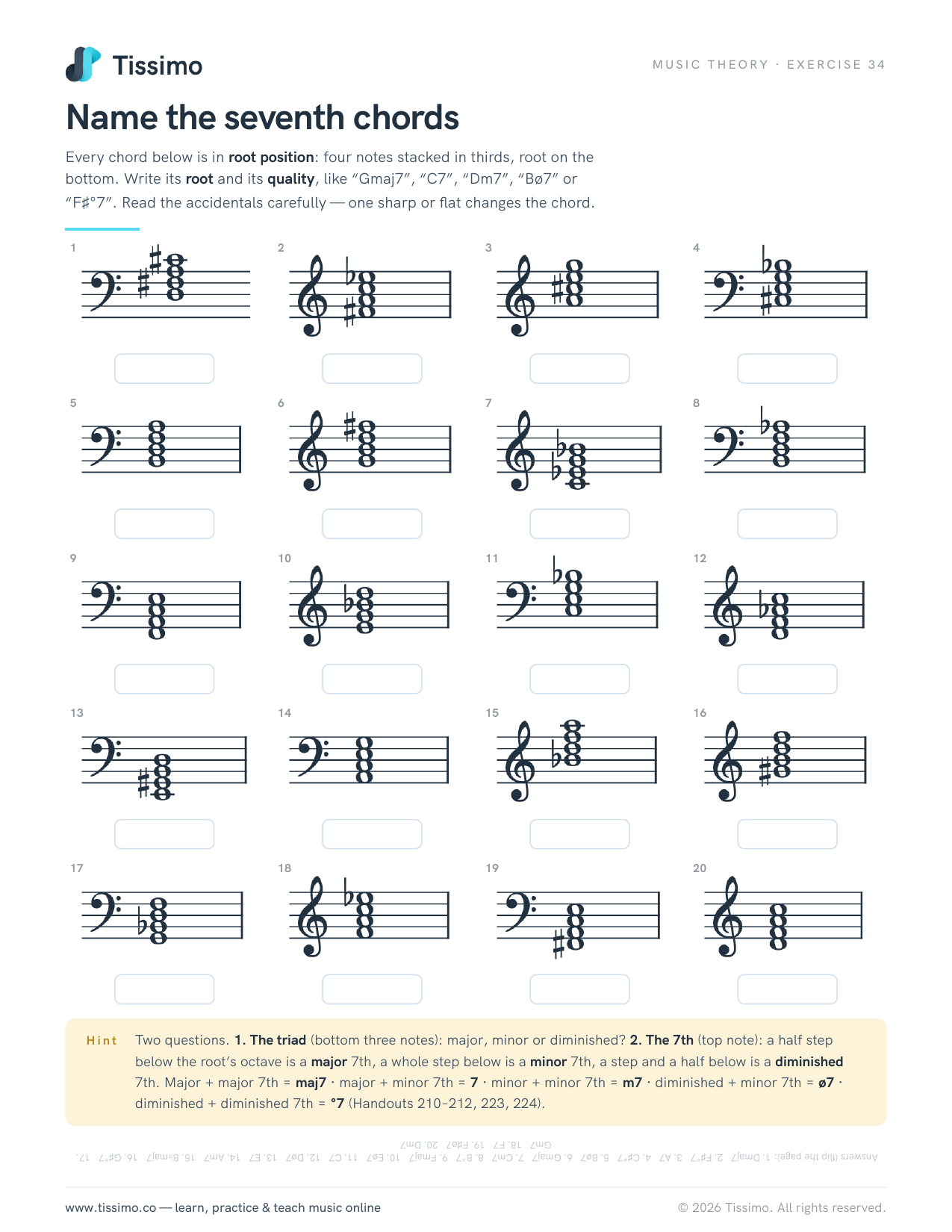
Name the seventh chords
Every chord below is in root position: four notes stacked in thirds, root on the bottom. Write its root and its quality, like “Gmaj7”, “C7”, “Dm7”, “Bø7” or “F♯°7”. Read the accidentals carefully — one sharp or flat changes the chord.
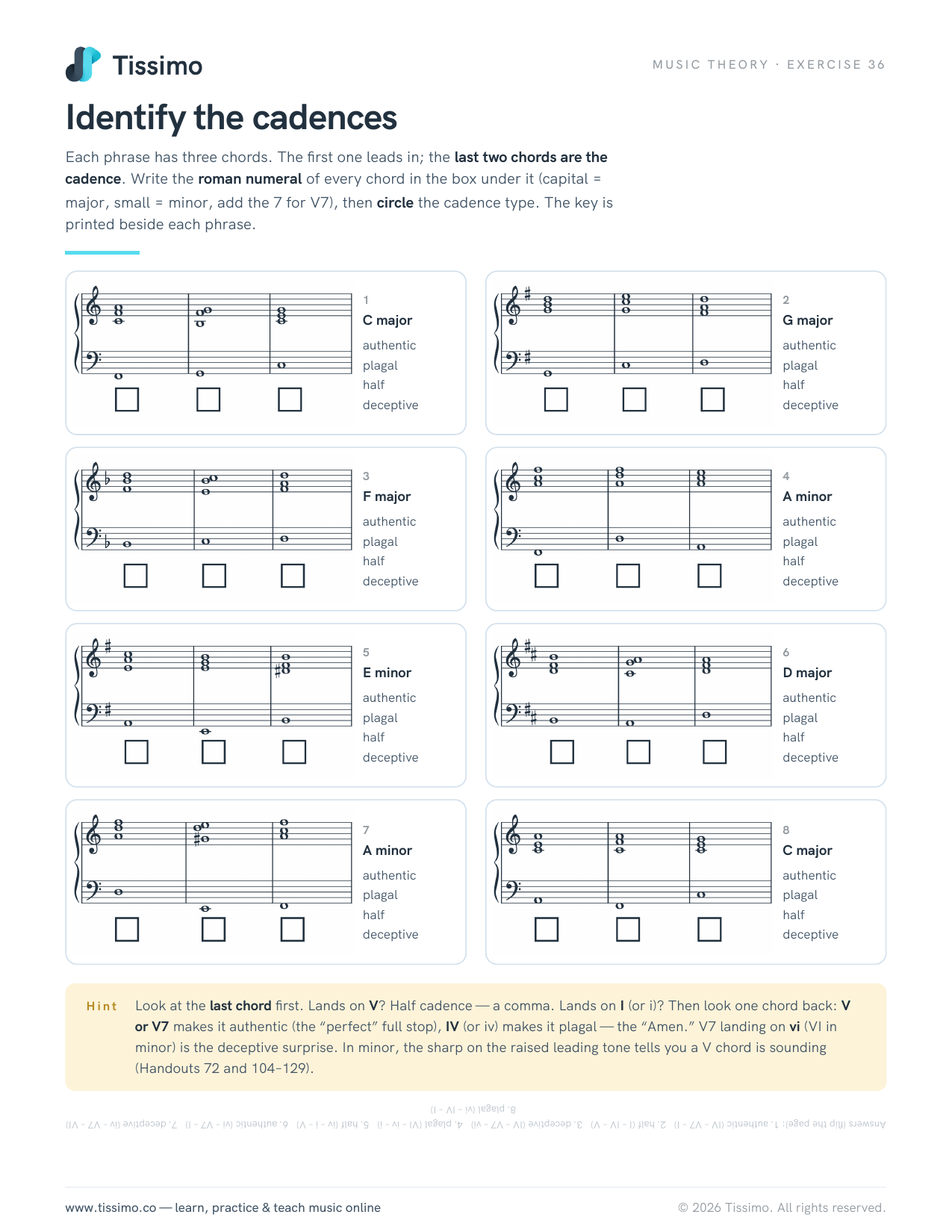
Identify the cadences
Each phrase has three chords. The first one leads in; the last two chords are the cadence. Write the roman numeral of every chord in the box under it (capital = major, small = minor, add the 7 for V7), then circle the cadence type. The key is printed beside each phrase.
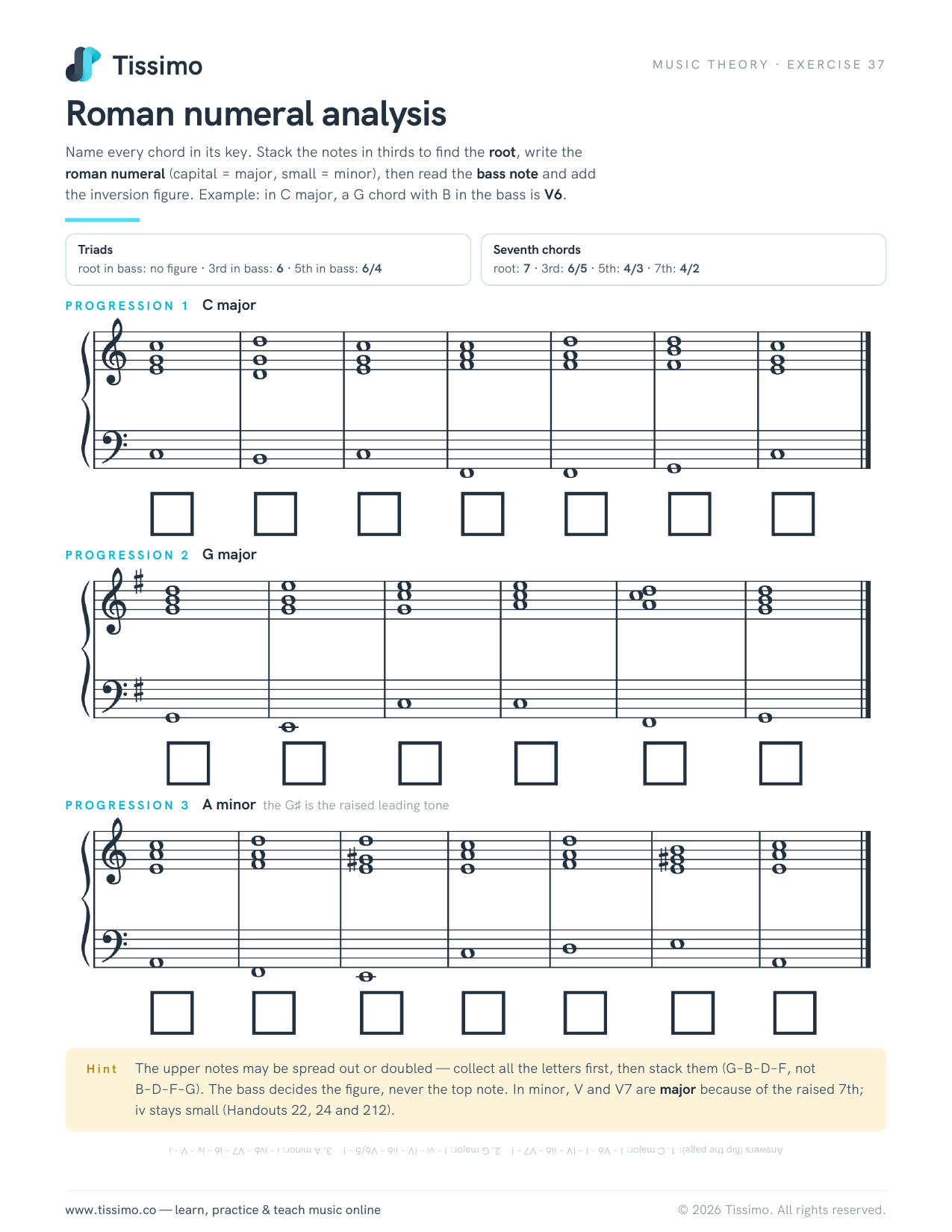
Roman numeral analysis
Name every chord in its key. Stack the notes in thirds to find the root, write the roman numeral (capital = major, small = minor), then read the bass note and add the inversion figure. Example: in C major, a G chord with B in the bass is V6.
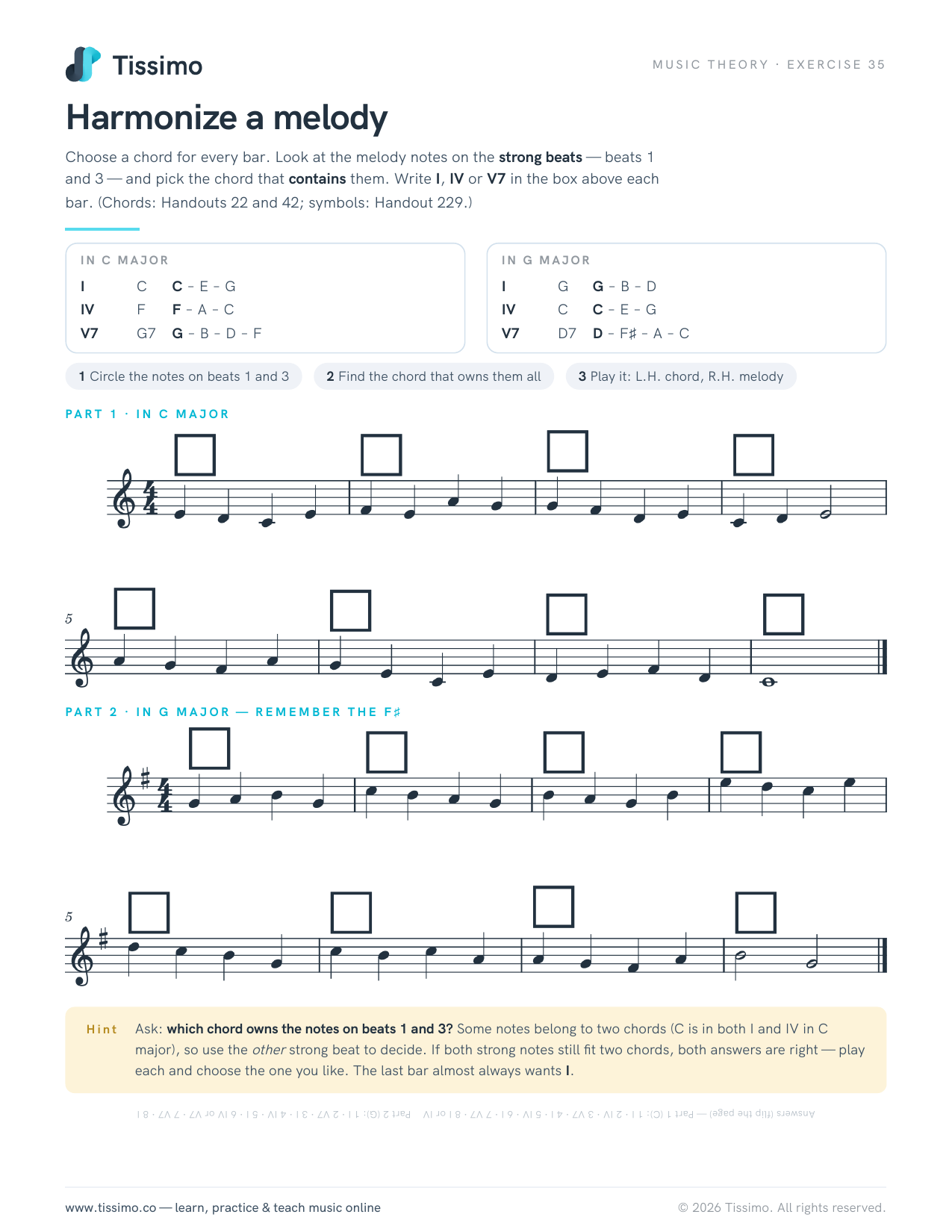
Harmonize a melody
Choose a chord for every bar. Look at the melody notes on the strong beats — beats 1 and 3 — and pick the chord that contains them. Write I, IV or V7 in the box above each bar. (Chords: Handouts 22 and 42; symbols: Handout 229; how to choose: Handout 358.) Next: Exercise 57 adds ii and vi.
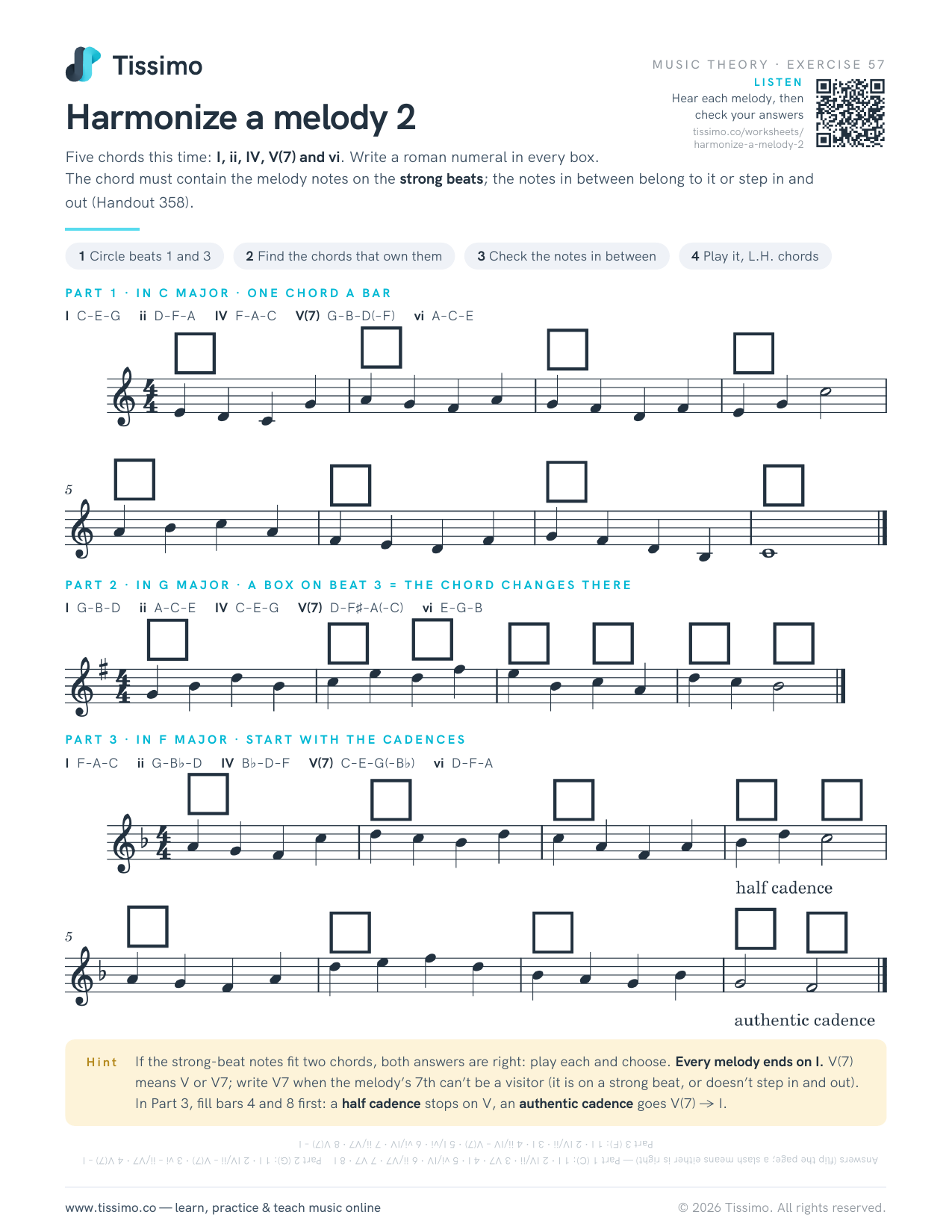
Harmonize a melody 2
Five chords this time: I, ii, IV, V(7) and vi. Write a roman numeral in every box. The chord must contain the melody notes on the strong beats; the notes in between belong to it or step in and out (Handout 358).
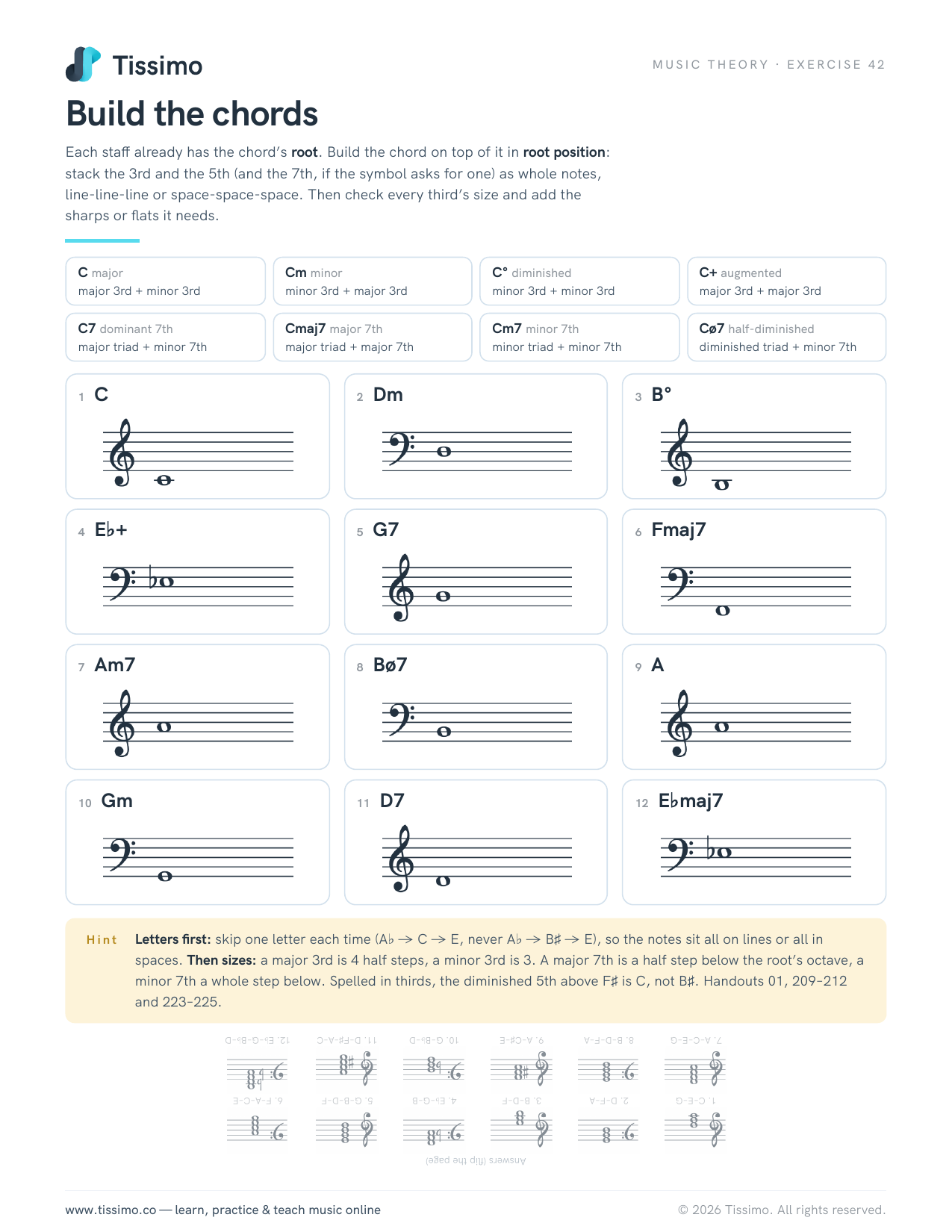
Build the chords
Each staff already has the chord’s root. Build the chord on top of it in root position: stack the 3rd and the 5th (and the 7th, if the symbol asks for one) as whole notes, line-line-line or space-space-space. Then check every third’s size and add the sharps or flats it needs.
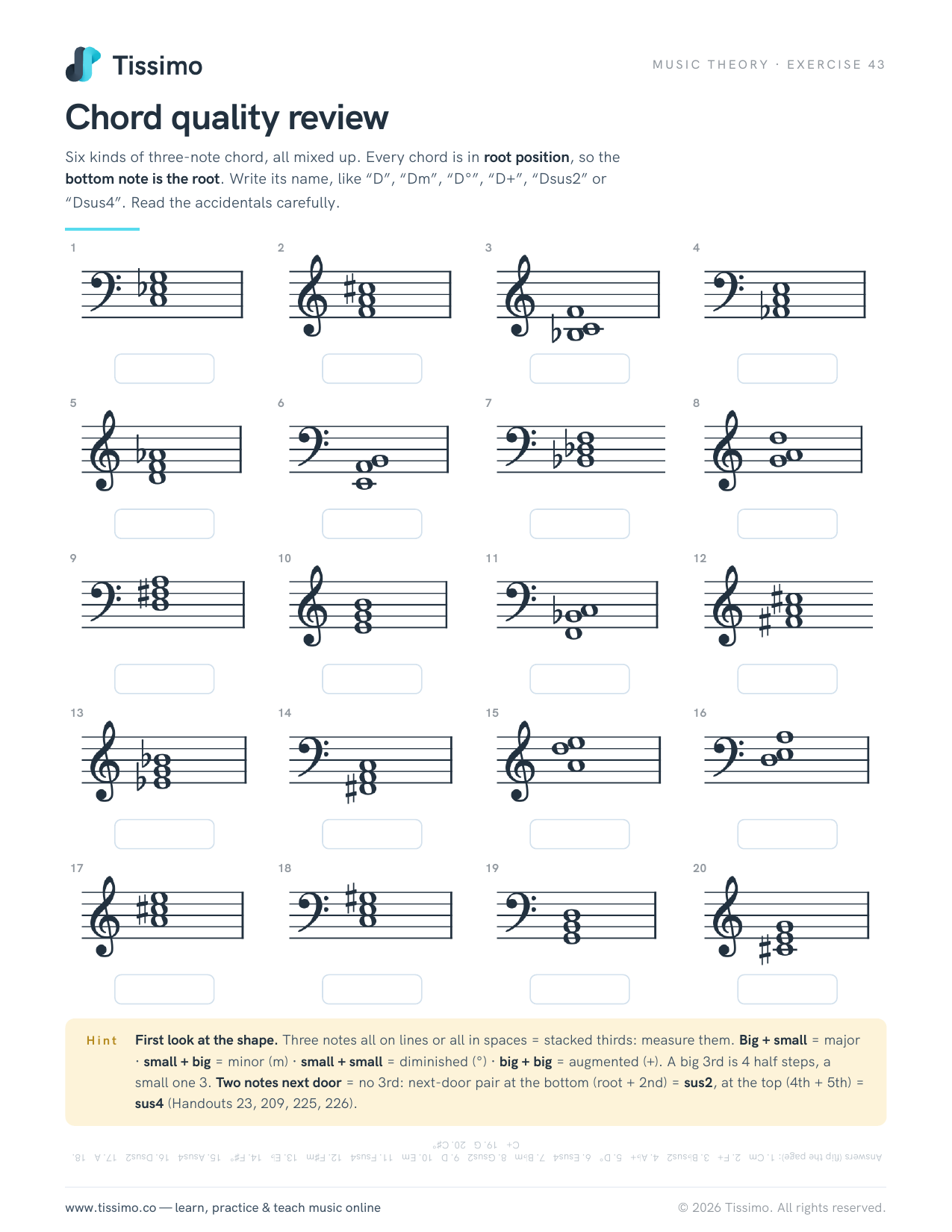
Chord quality review
Six kinds of three-note chord, all mixed up. Every chord is in root position, so the bottom note is the root. Write its name, like “D”, “Dm”, “D°”, “D+”, “Dsus2” or “Dsus4”. Read the accidentals carefully.
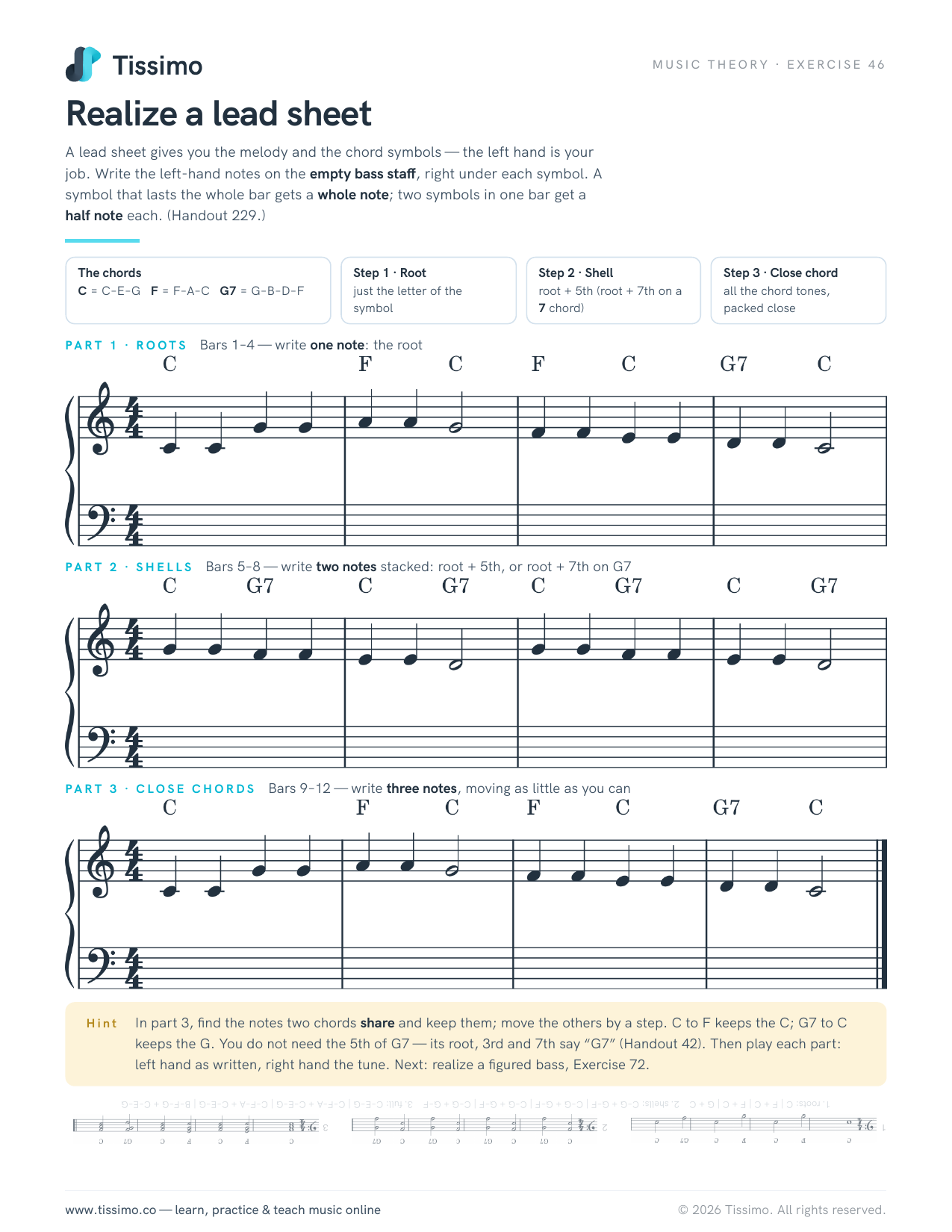
Realize a lead sheet
A lead sheet gives you the melody and the chord symbols — the left hand is your job. Write the left-hand notes on the empty bass staff, right under each symbol. A symbol that lasts the whole bar gets a whole note; two symbols in one bar get a half note each. (Handout 229.)
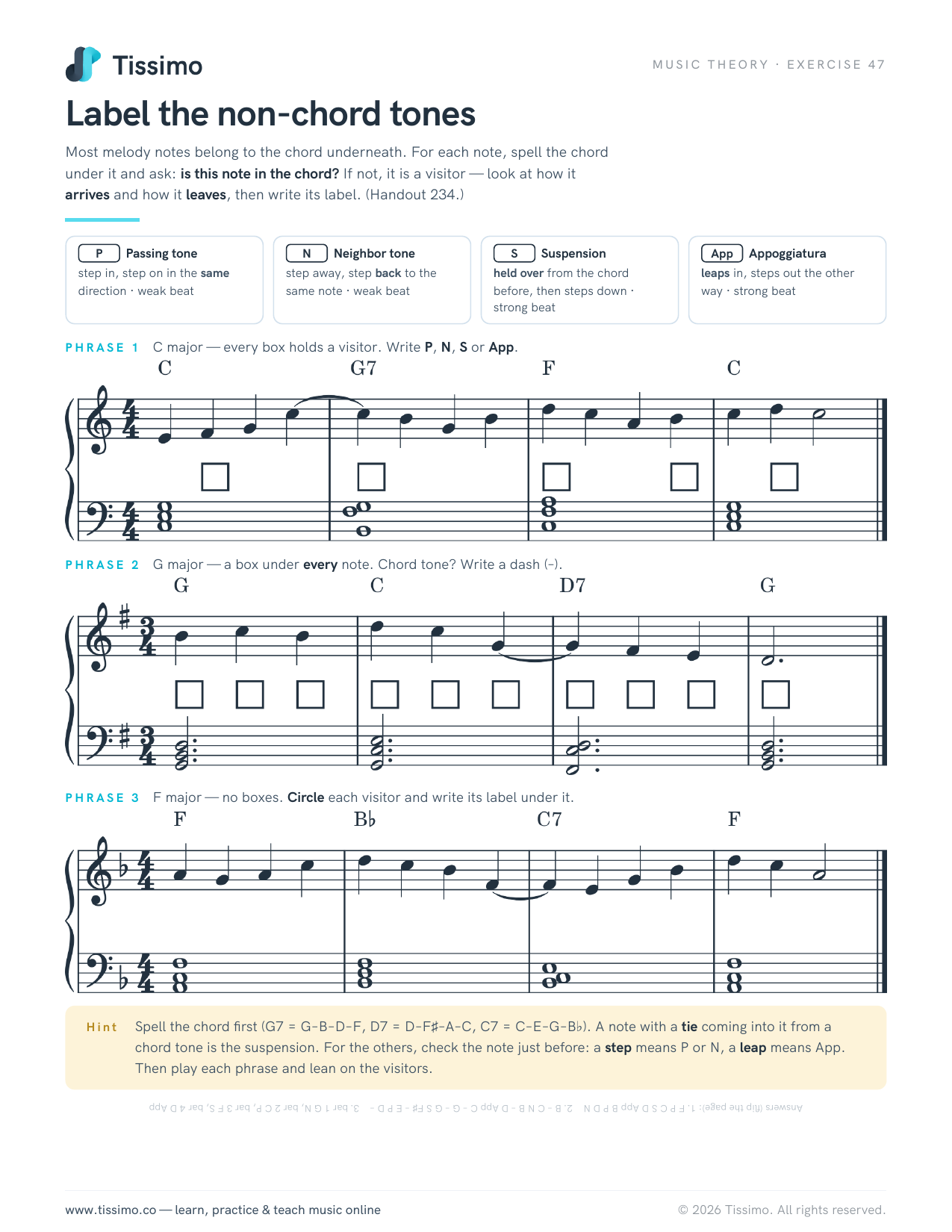
Label the non-chord tones
Most melody notes belong to the chord underneath. For each note, spell the chord under it and ask: is this note in the chord? If not, it is a visitor — look at how it arrives and how it leaves, then write its label. (Handout 234.)
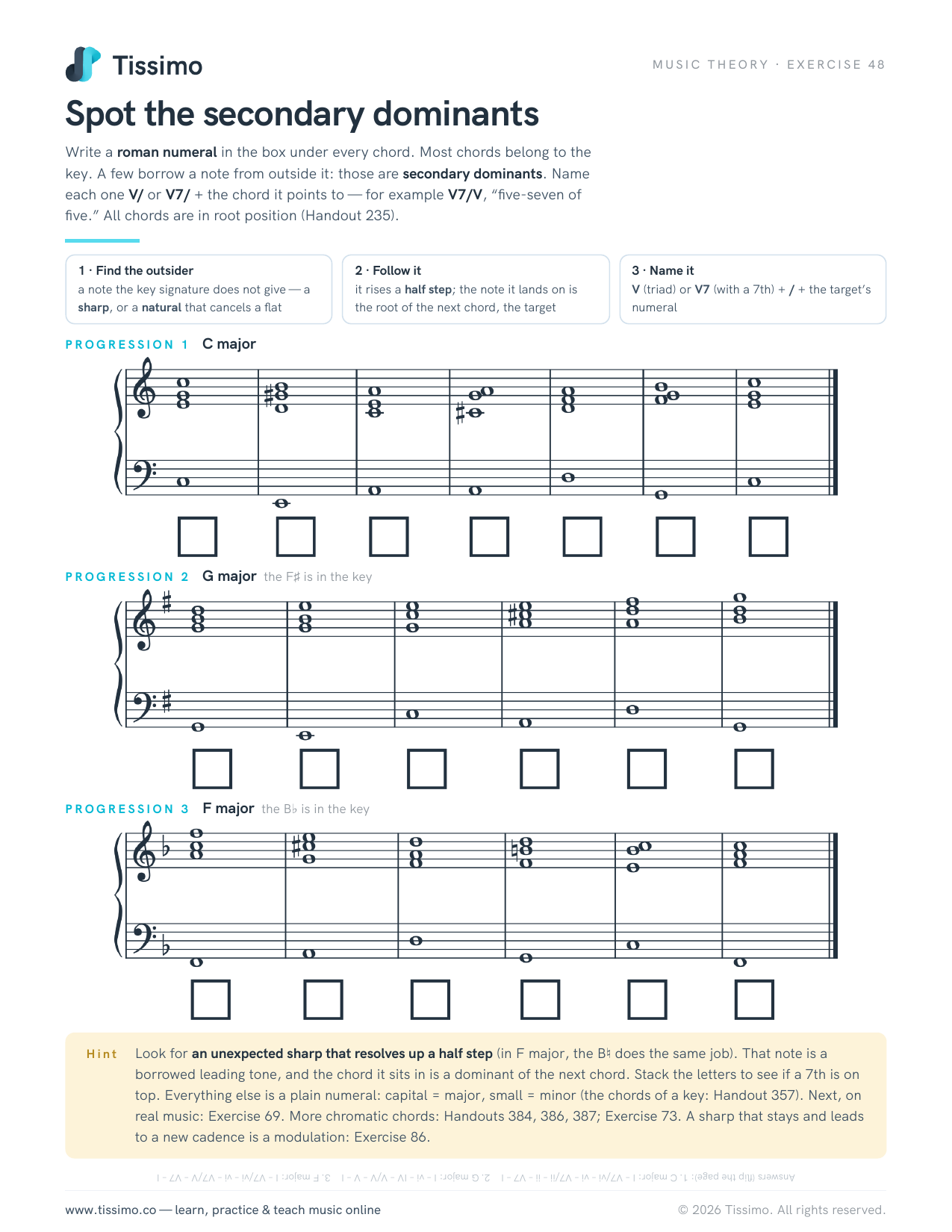
Spot the secondary dominants
Write a roman numeral in the box under every chord. Most chords belong to the key. A few borrow a note from outside it: those are secondary dominants. Name each one V/ or V7/ + the chord it points to — for example V7/V, “five-seven of five.” All chords are in root position (Handout 235).
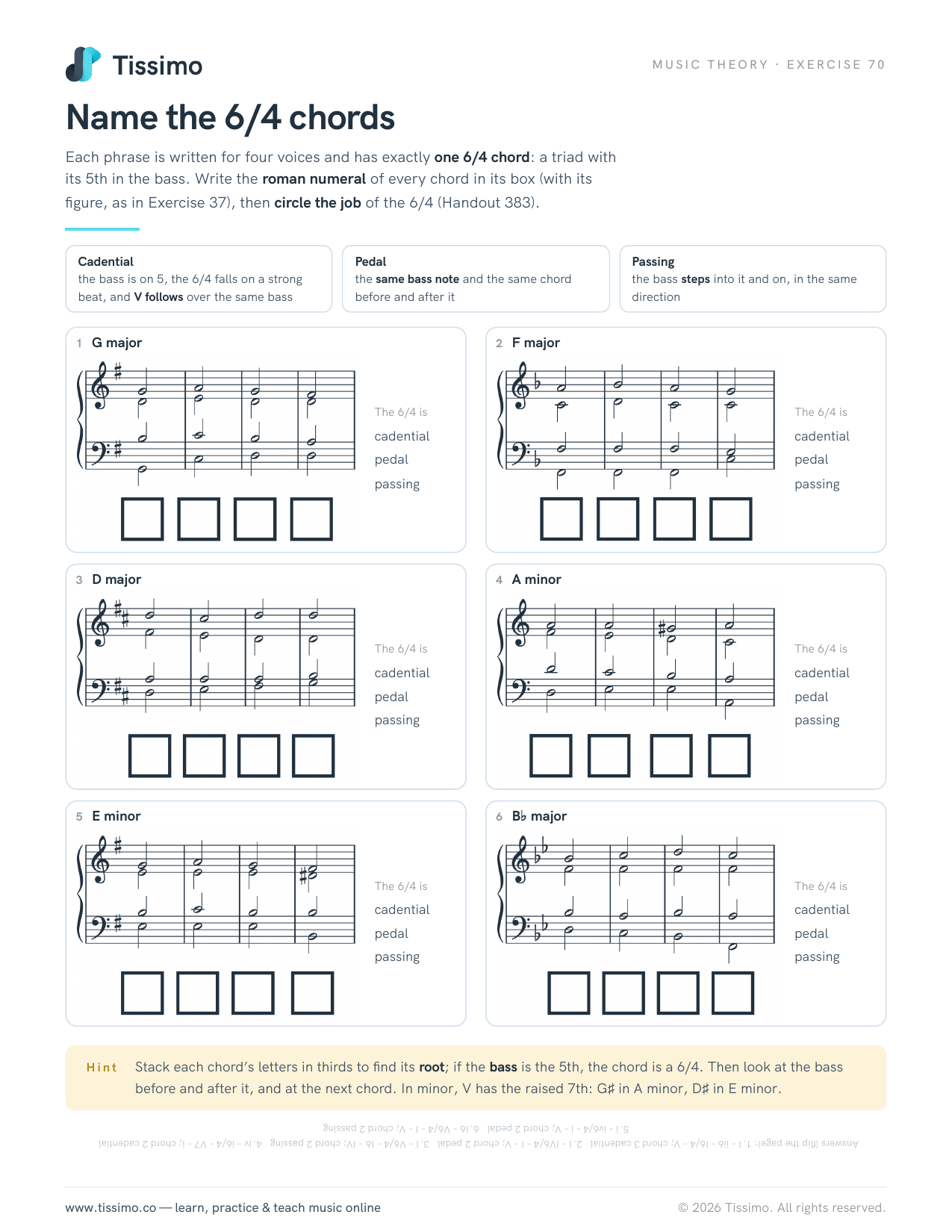
Name the 6/4 chords
Each phrase is written for four voices and has exactly one 6/4 chord: a triad with its 5th in the bass. Write the roman numeral of every chord in its box (with its figure, as in Exercise 37), then circle the job of the 6/4 (Handout 383).
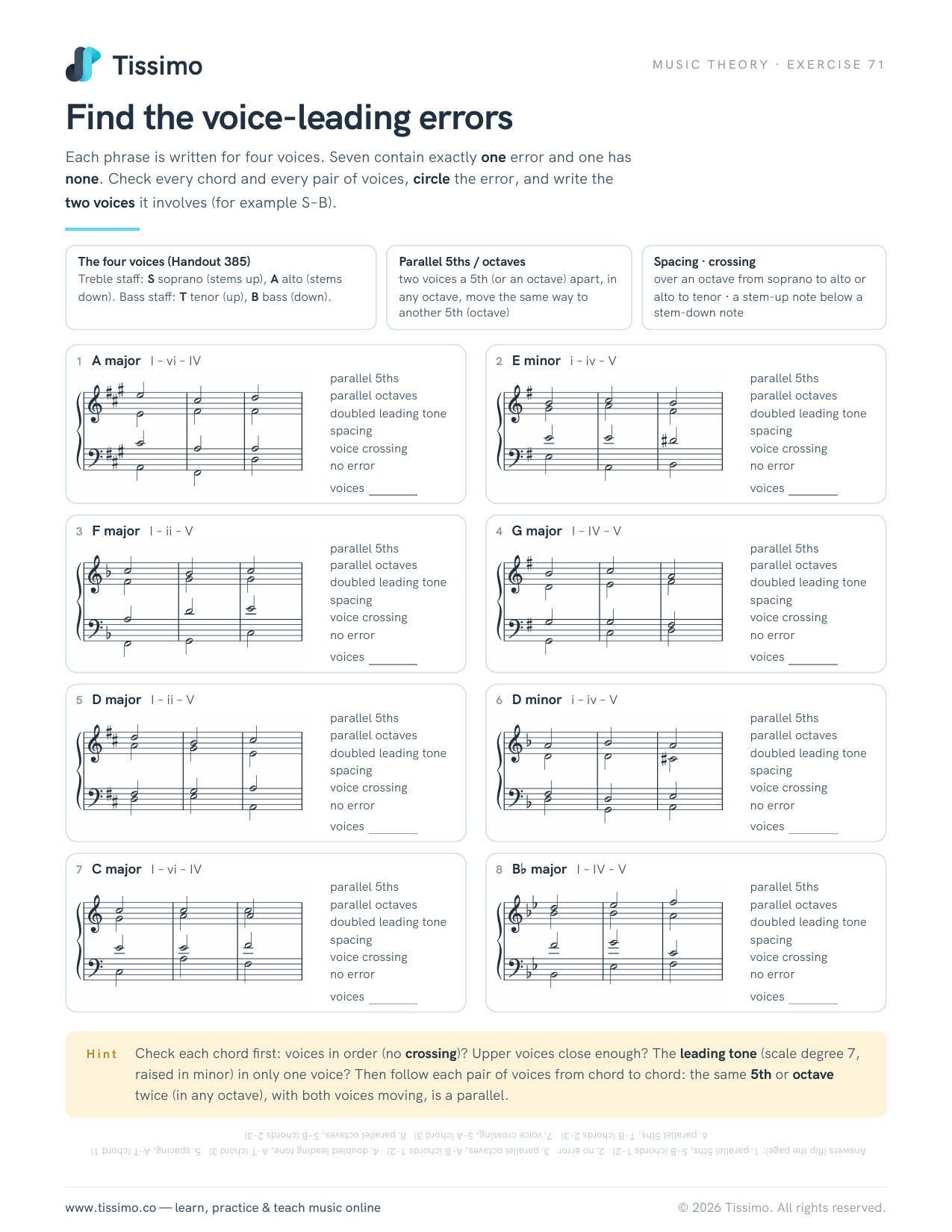
Find the voice-leading errors
Each phrase is written for four voices. Seven contain exactly one error and one has none. Check every chord and every pair of voices, circle the error, and write the two voices it involves (for example S–B).
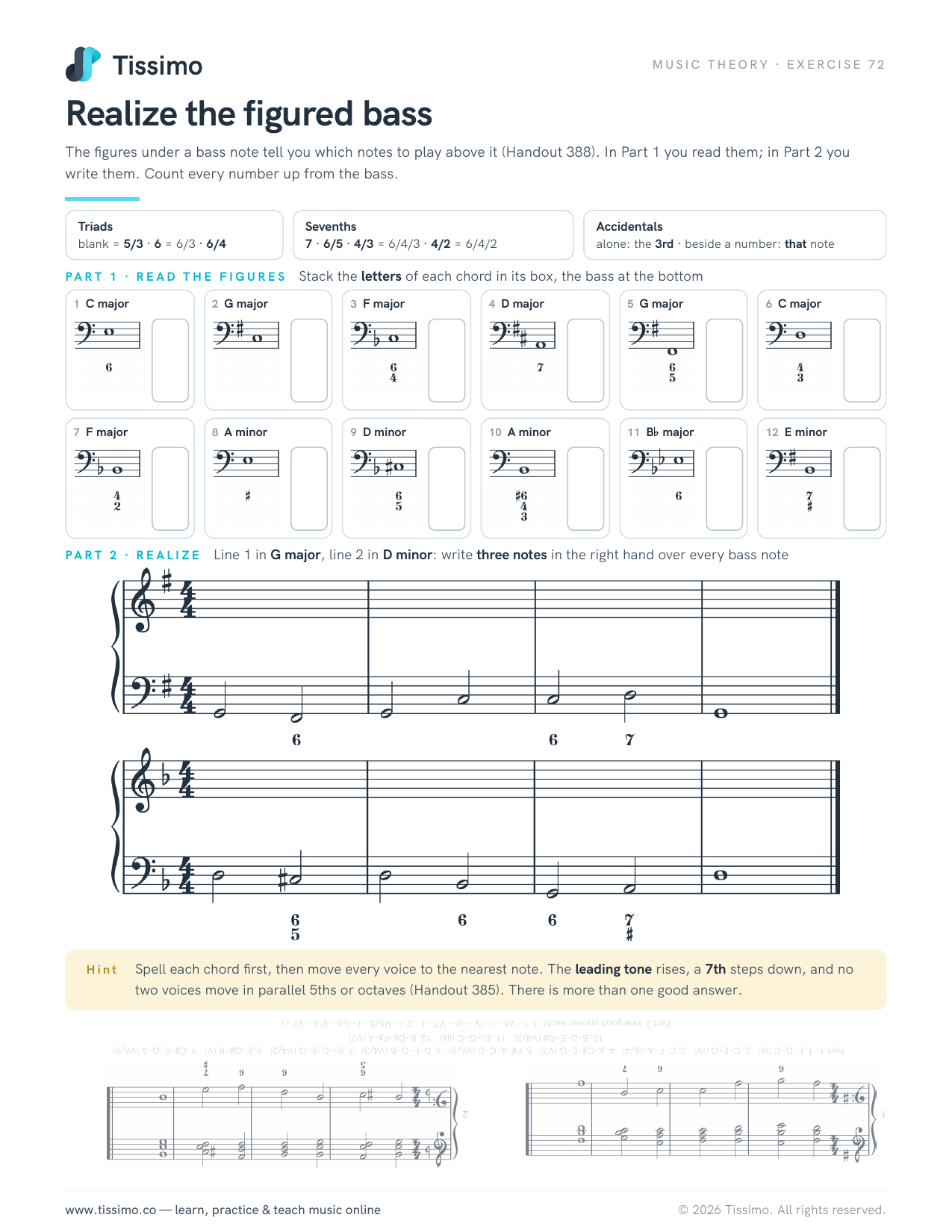
Realize the figured bass
The figures under a bass note tell you which notes to play above it (Handout 388). In Part 1 you read them; in Part 2 you write them. Count every number up from the bass.
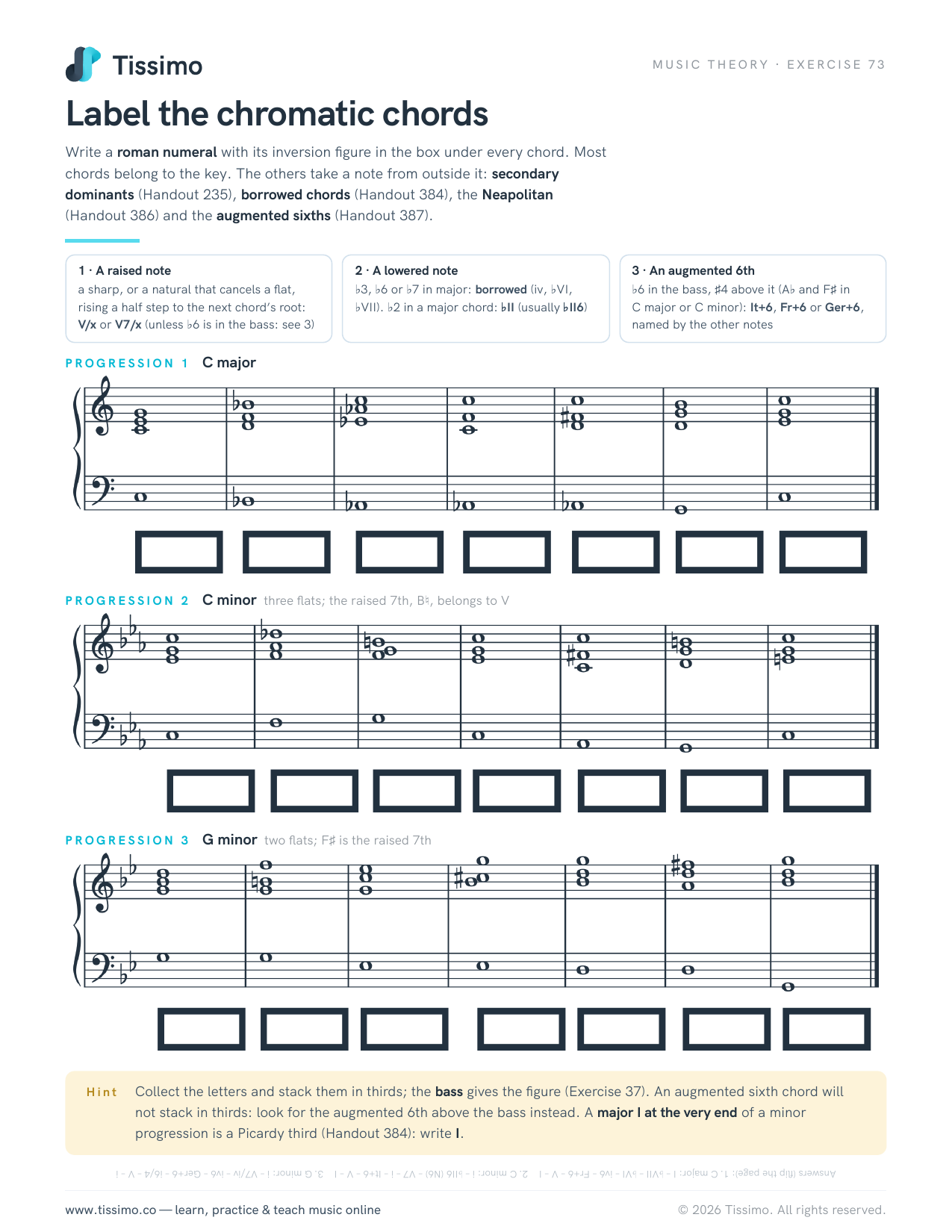
Label the chromatic chords
Write a roman numeral with its inversion figure in the box under every chord. Most chords belong to the key. The others take a note from outside it: secondary dominants (Handout 235), borrowed chords (Handout 384), the Neapolitan (Handout 386) and the augmented sixths (Handout 387).
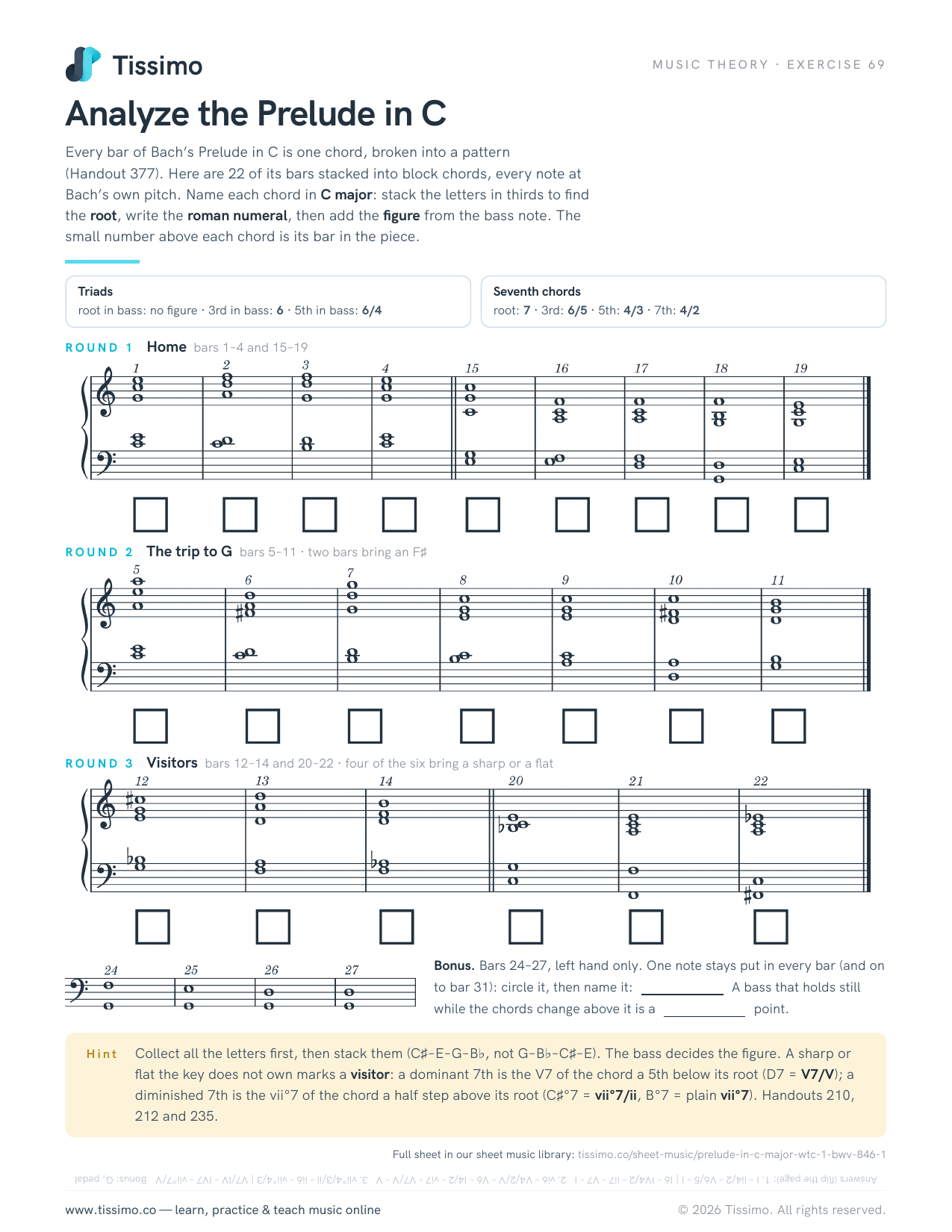
Analyze the Prelude in C
Every bar of Bach’s Prelude in C is one chord, broken into a pattern (Handout 377). Here are 22 of its bars stacked into block chords, every note at Bach’s own pitch. Name each chord in C major: stack the letters in thirds to find the root, write the roman numeral, then add the figure from the bass note. The small number above each chord is its bar in the piece.
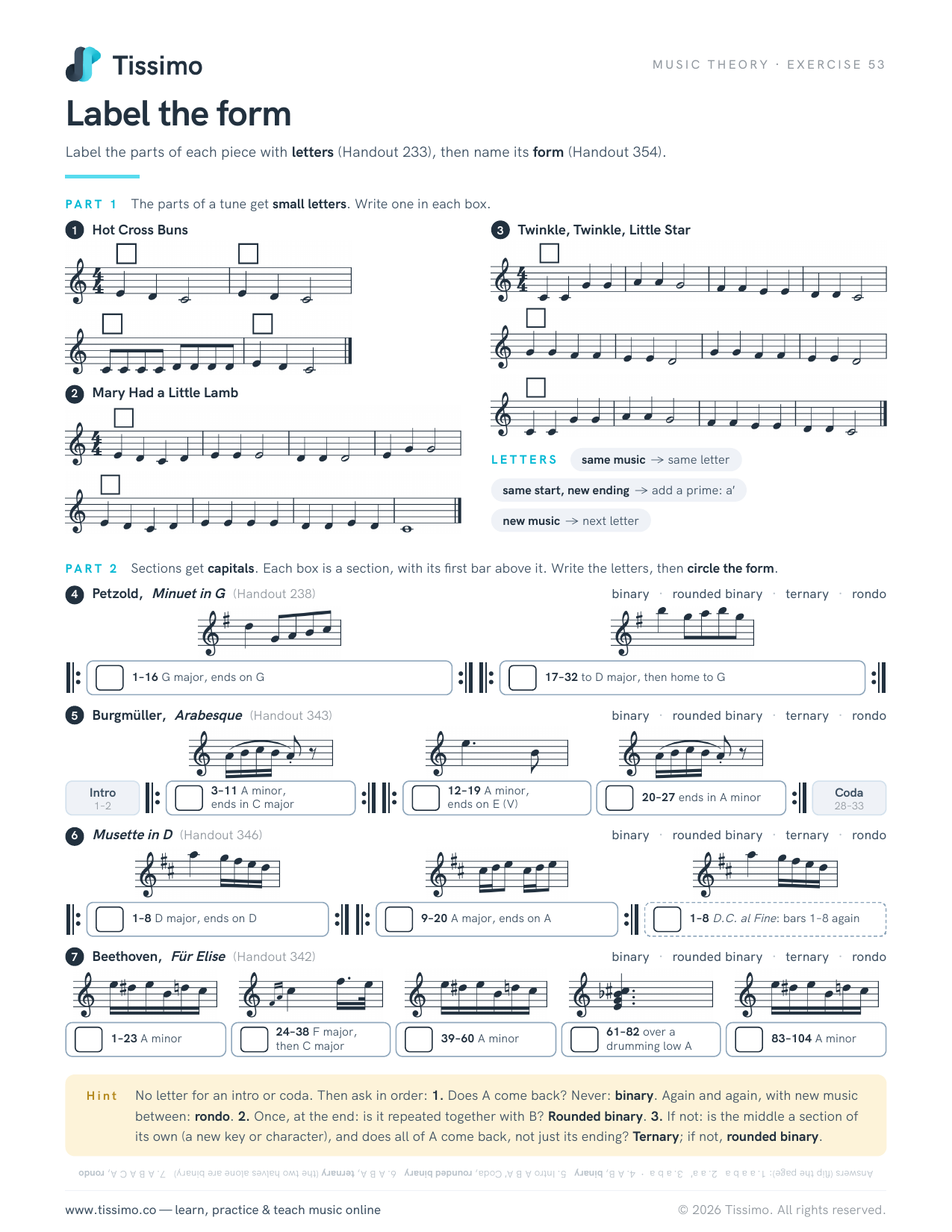
Label the form
Label the parts of each piece with letters (Handout 233), then name its form (Handout 354).
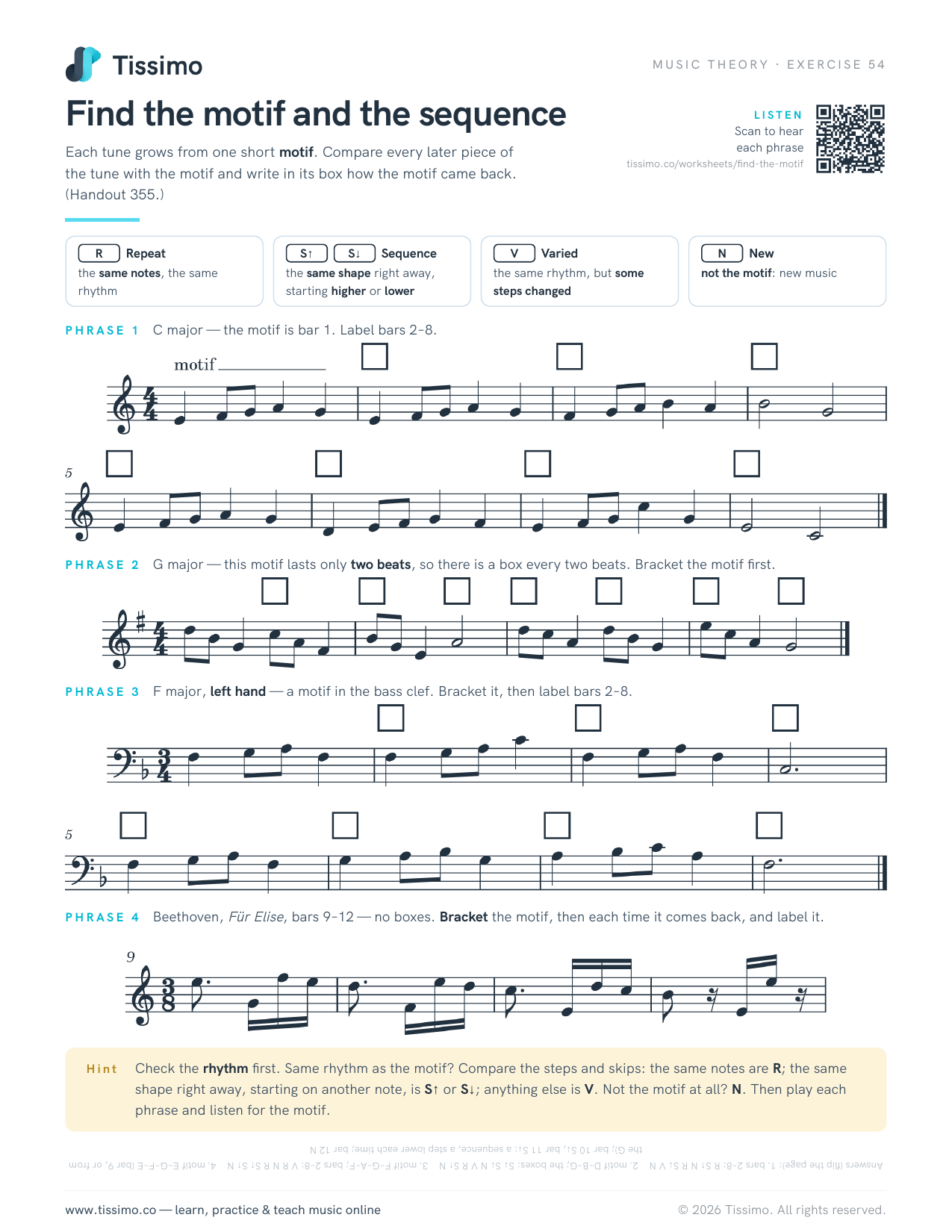
Find the motif and the sequence
Each tune grows from one short motif. Compare every later piece of the tune with the motif and write in its box how the motif came back. (Handout 355.)
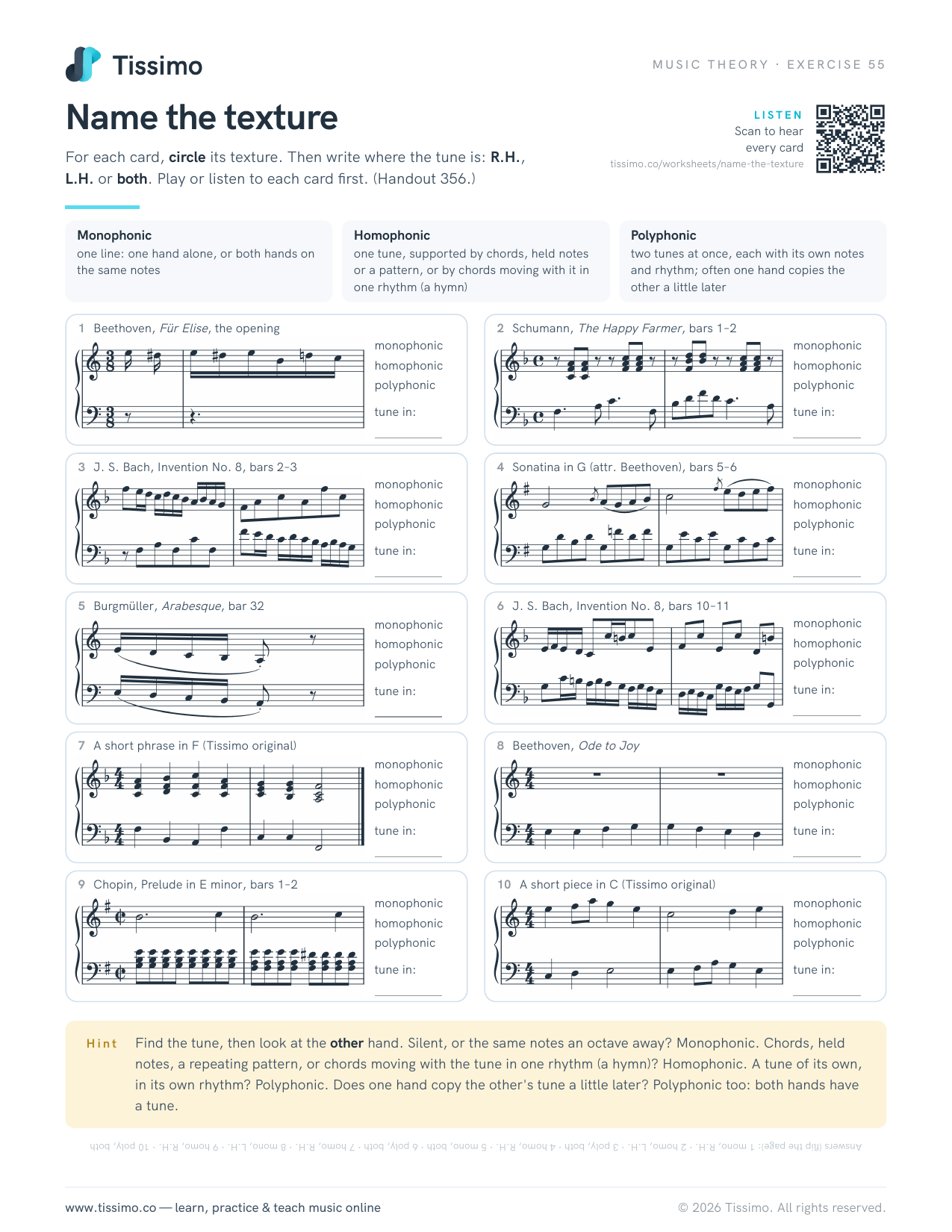
Name the texture
For each card, circle its texture. Then write where the tune is: R.H., L.H. or both. Play or listen to each card first. (Handout 356.)
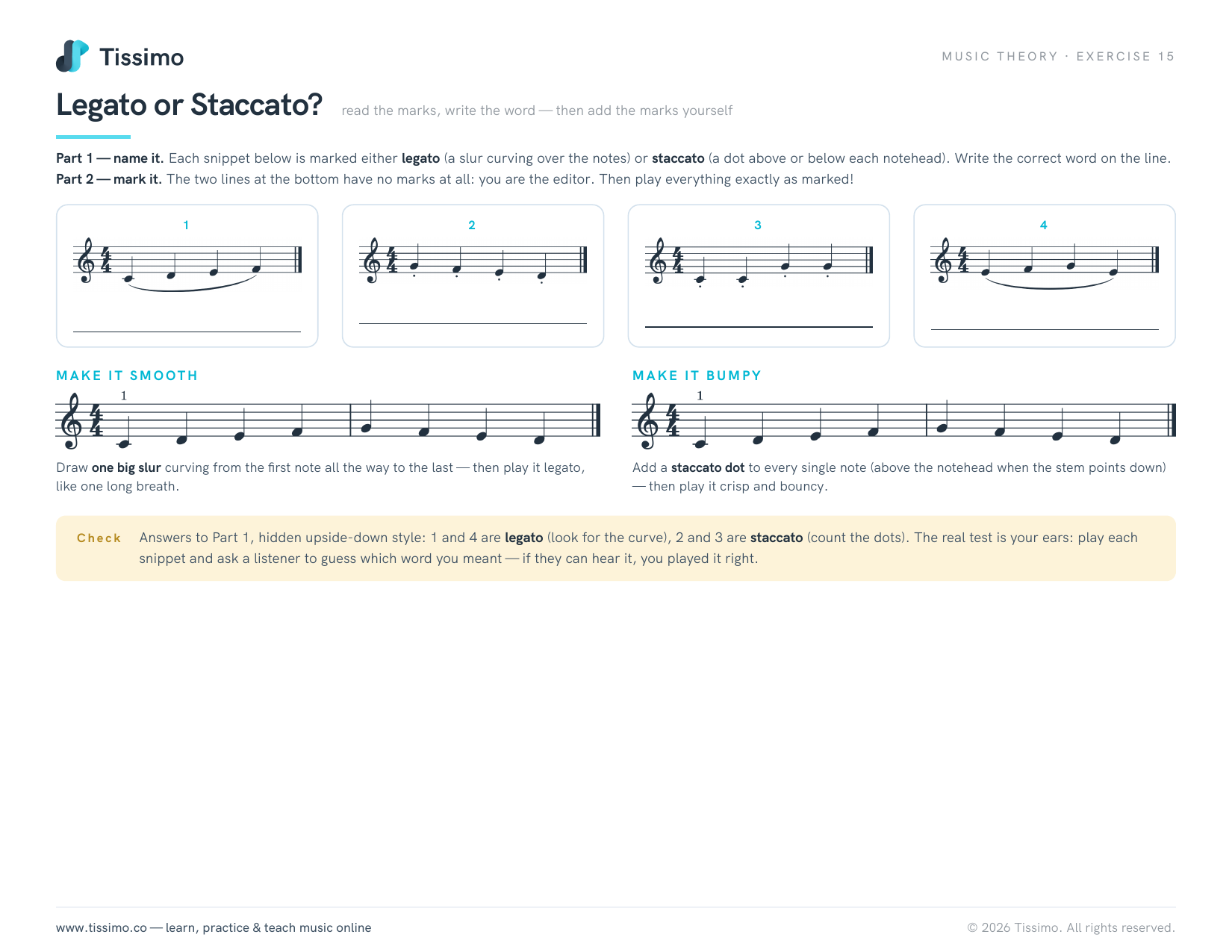
Legato or Staccato?
read the marks, write the word — then add the marks yourself
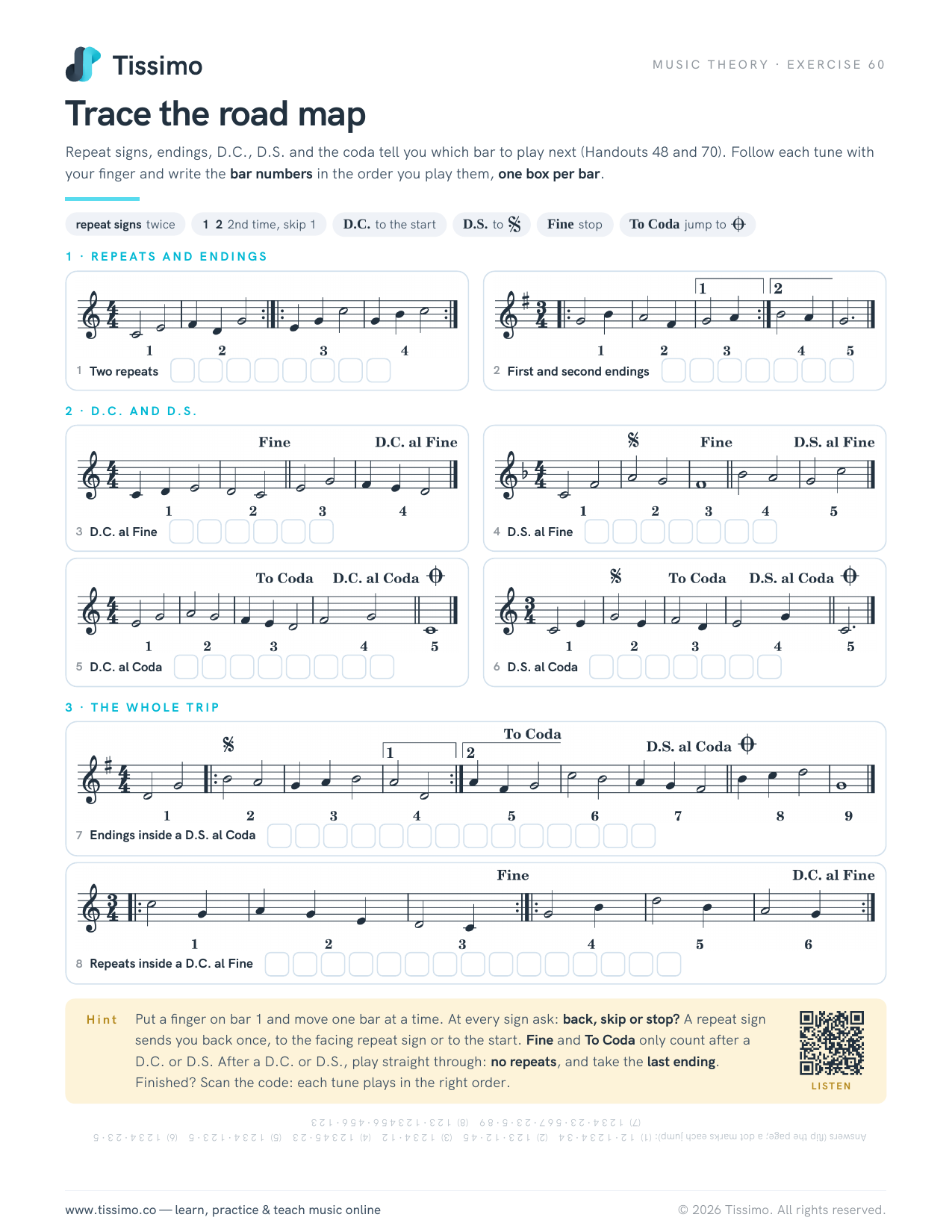
Trace the road map
Repeat signs, endings, D.C., D.S. and the coda tell you which bar to play next (Handouts 48 and 70). Follow each tune with your finger and write the bar numbers in the order you play them, one box per bar.
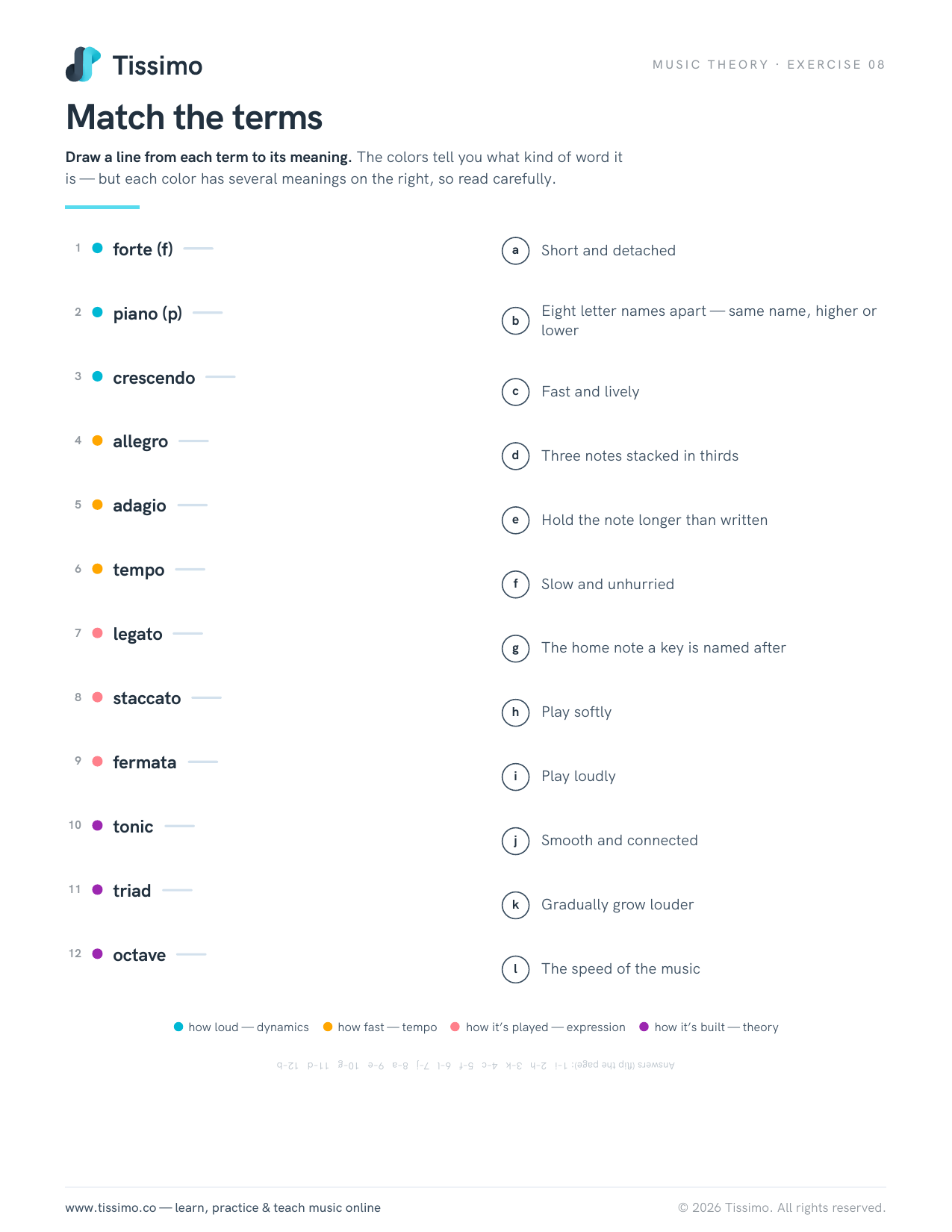
Match the terms
Draw a line from each term to its meaning. The colors tell you what kind of word it is — but each color has several meanings on the right, so read carefully.
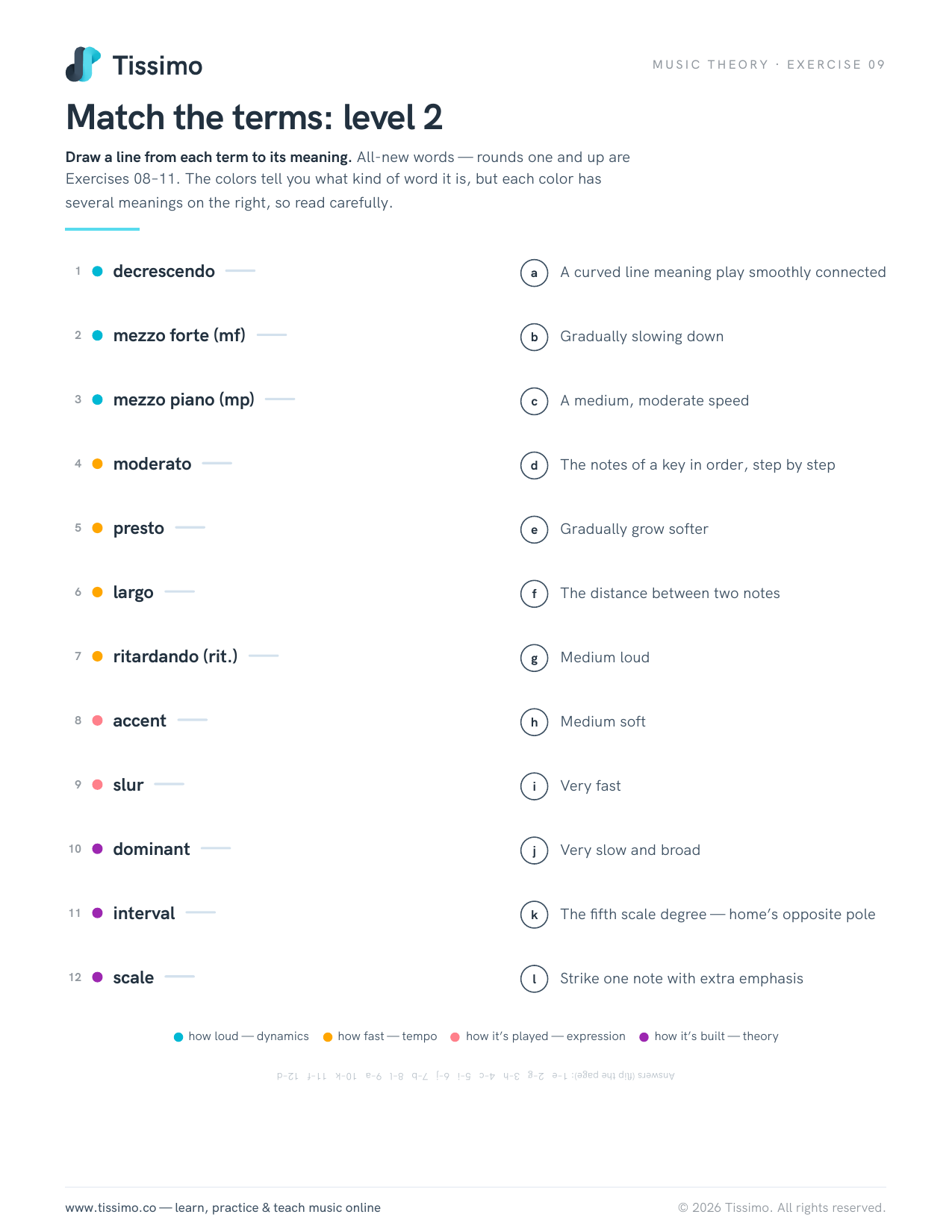
Match the terms: level 2
Draw a line from each term to its meaning. All-new words — rounds one and up are Exercises 08–11. The colors tell you what kind of word it is, but each color has several meanings on the right, so read carefully.
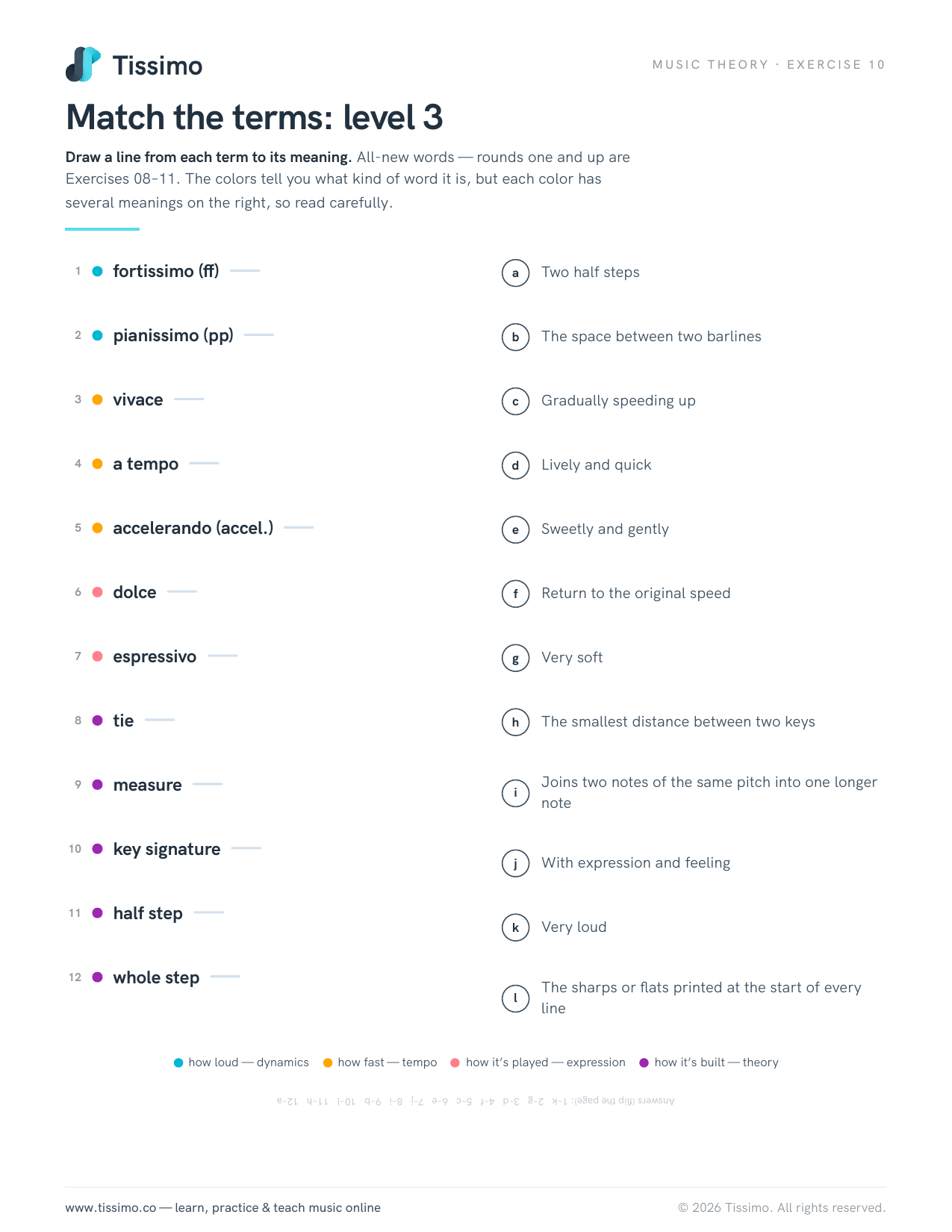
Match the terms: level 3
Draw a line from each term to its meaning. All-new words — rounds one and up are Exercises 08–11. The colors tell you what kind of word it is, but each color has several meanings on the right, so read carefully.
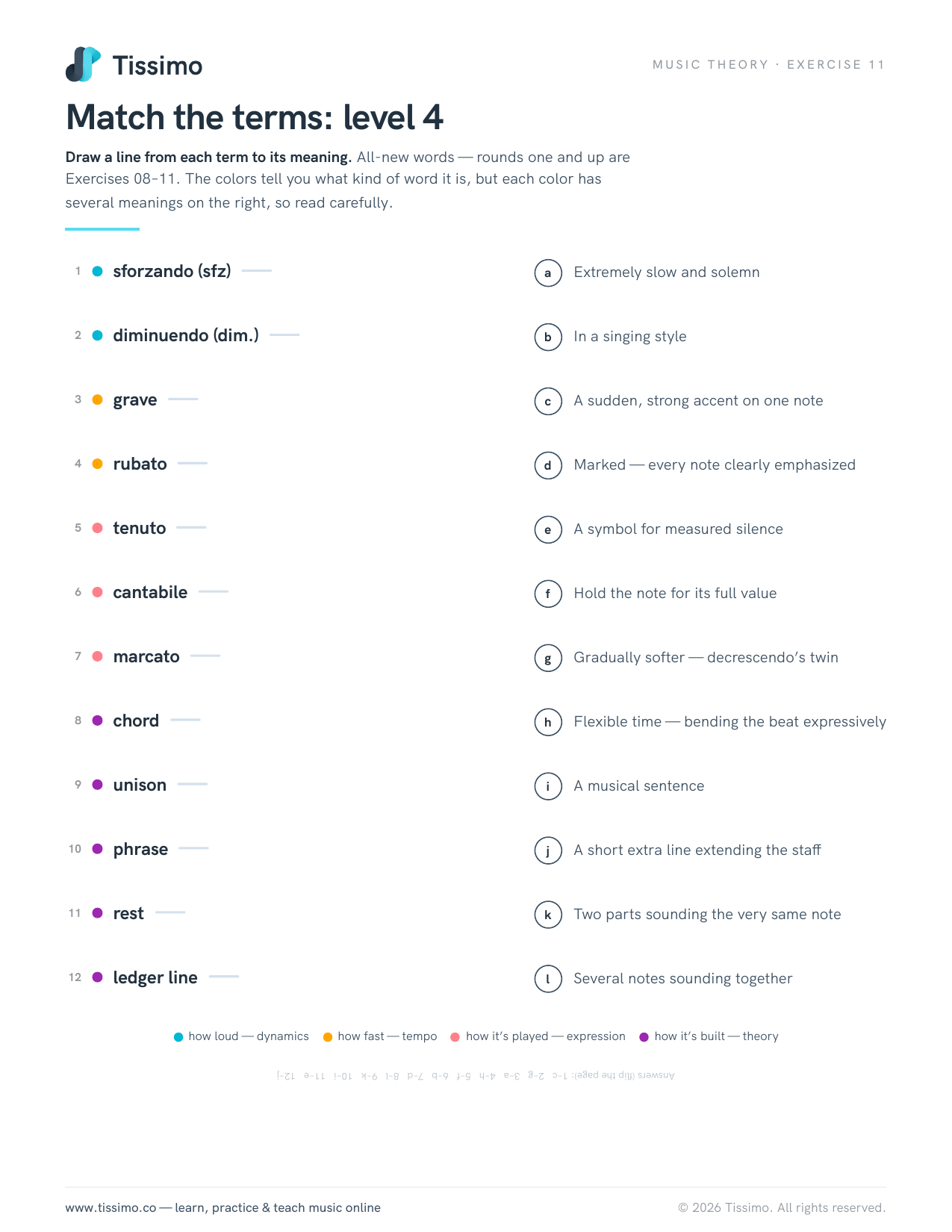
Match the terms: level 4
Draw a line from each term to its meaning. All-new words — rounds one and up are Exercises 08–11. The colors tell you what kind of word it is, but each color has several meanings on the right, so read carefully.
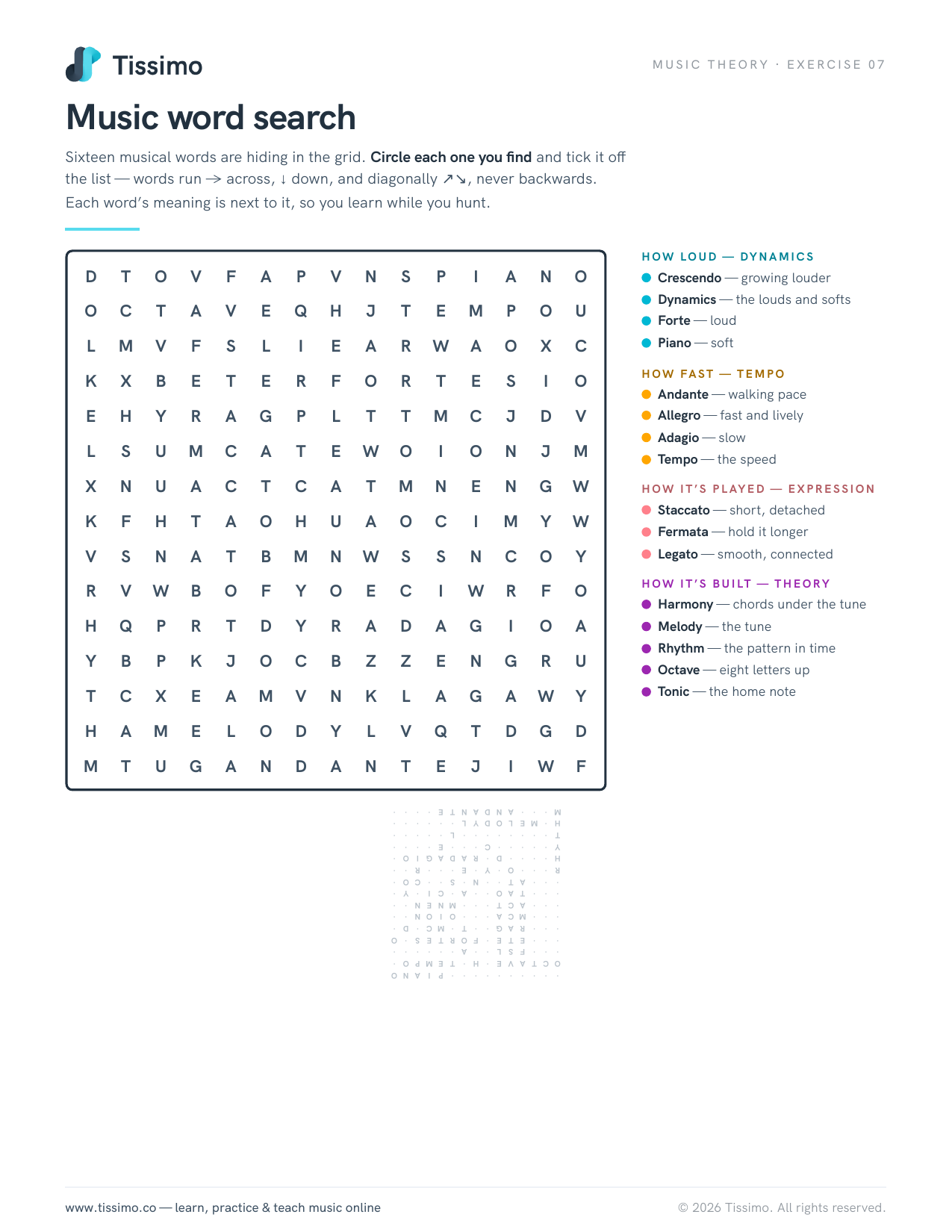
Music word search
Sixteen musical words are hiding in the grid. Circle each one you find and tick it off the list — words run → across, ↓ down, and diagonally ↗↘, never backwards. Each word’s meaning is next to it, so you learn while you hunt.