Kostenlose Musik-Arbeitsblätter
Bedruckbare einseitige Arbeitsblätter von Tissimo-Lehrkräften — hier ansehen, als PDF herunterladen oder für die nächste Unterrichtsstunde ausdrucken.

Noten & Rhythmus
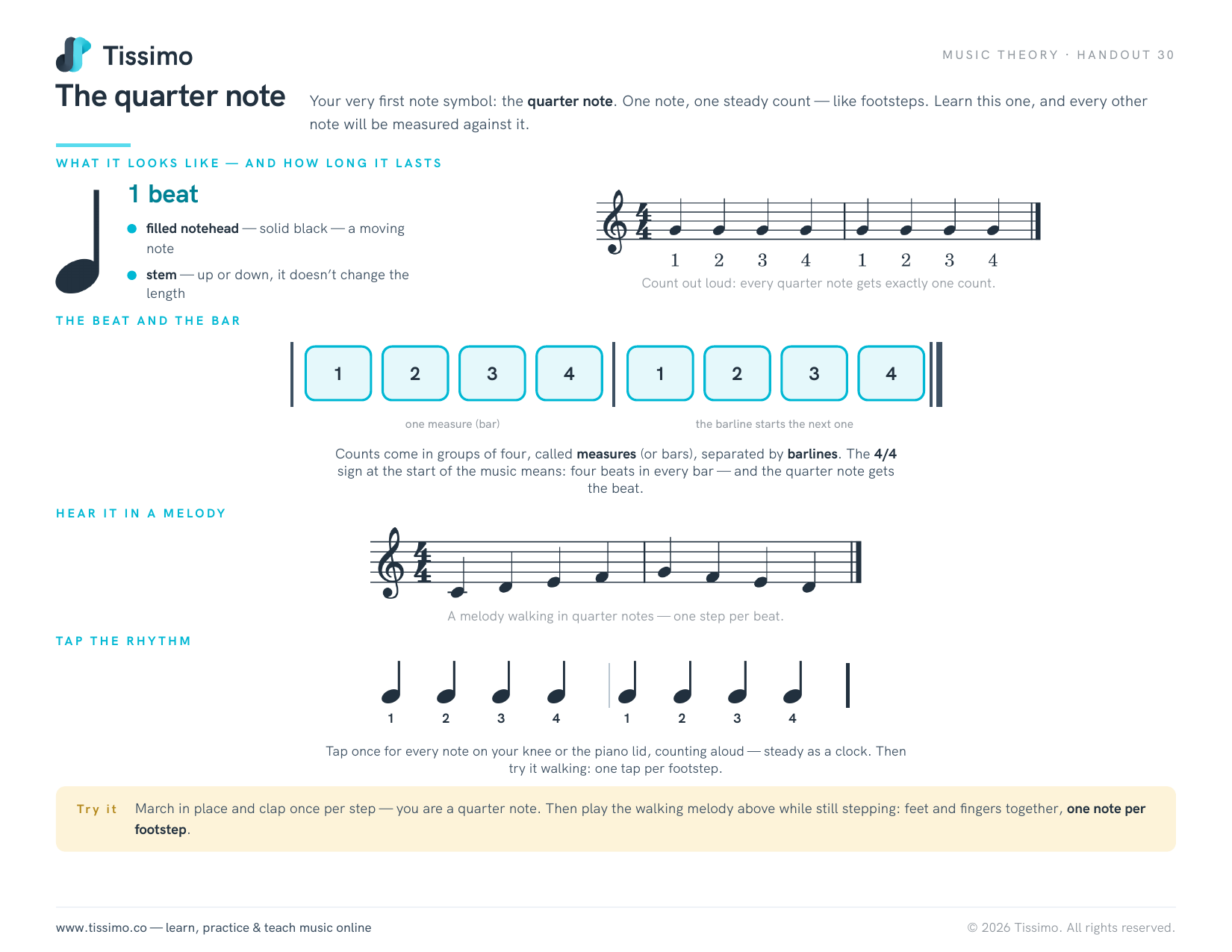
Die Viertelnote
Dein allererstes Notenzeichen: die Viertelnote. Eine Note, ein gleichmäßiger Schlag — wie Schritte beim Gehen. Lerne diese, und jede andere Note wird an ihr gemessen.
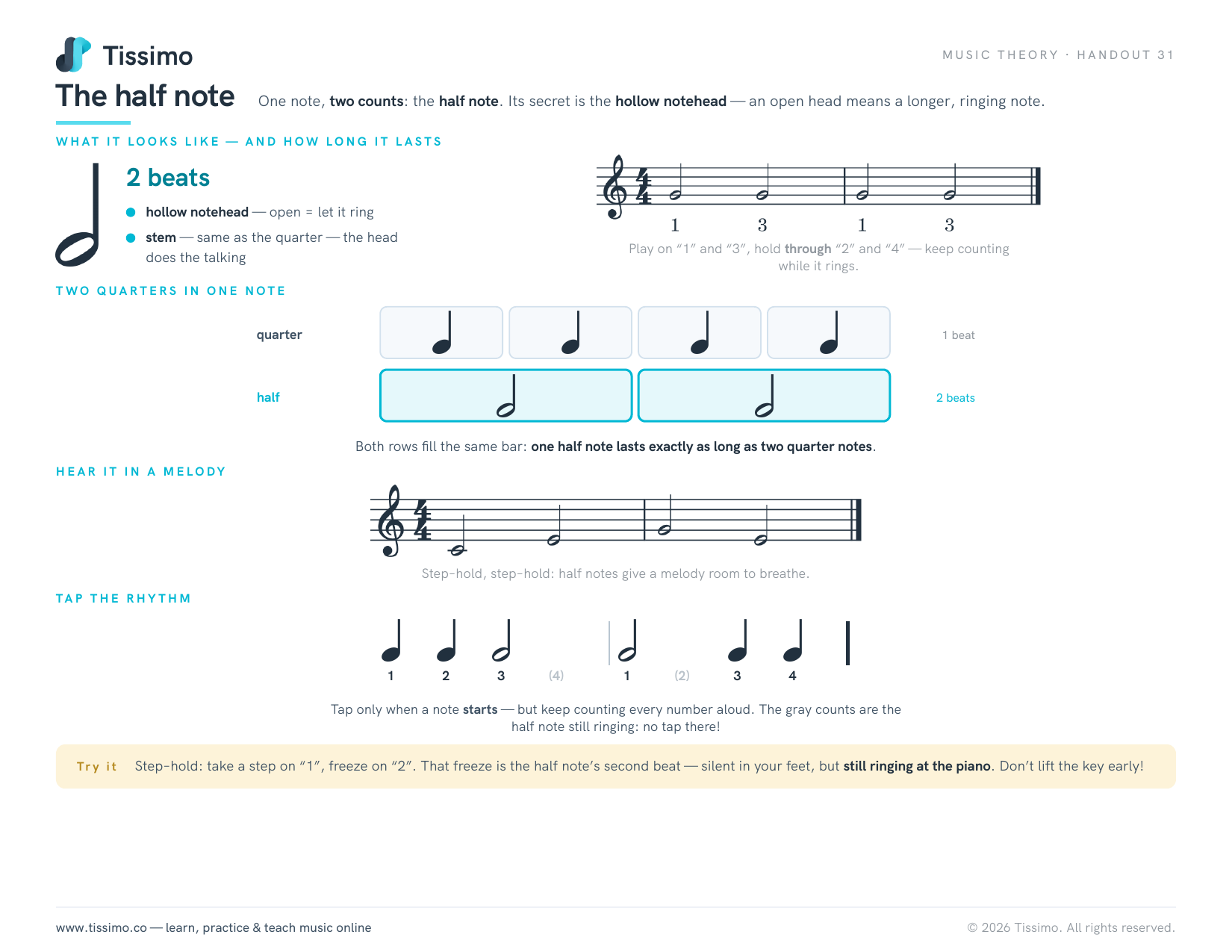
Die Halbe Note
Eine Note, zwei Schläge: die Halbe. Ihr Geheimnis ist der hohle Notenkopf — ein offener Kopf bedeutet eine längere, klingende Note.
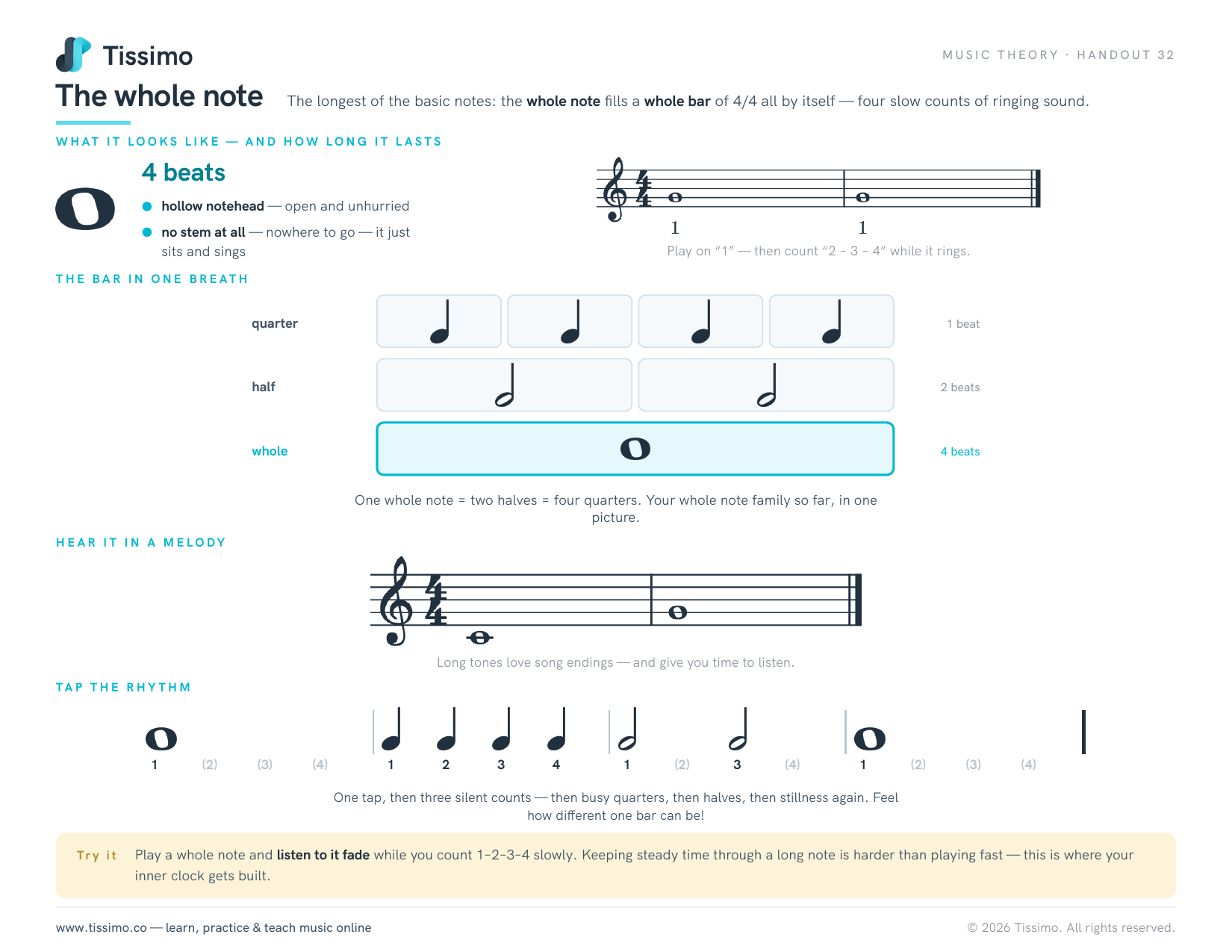
Die Ganze Note
Die längste der Grundnoten: Die Ganze füllt allein einen ganzen 4/4-Takt — vier langsame, klingende Schläge.
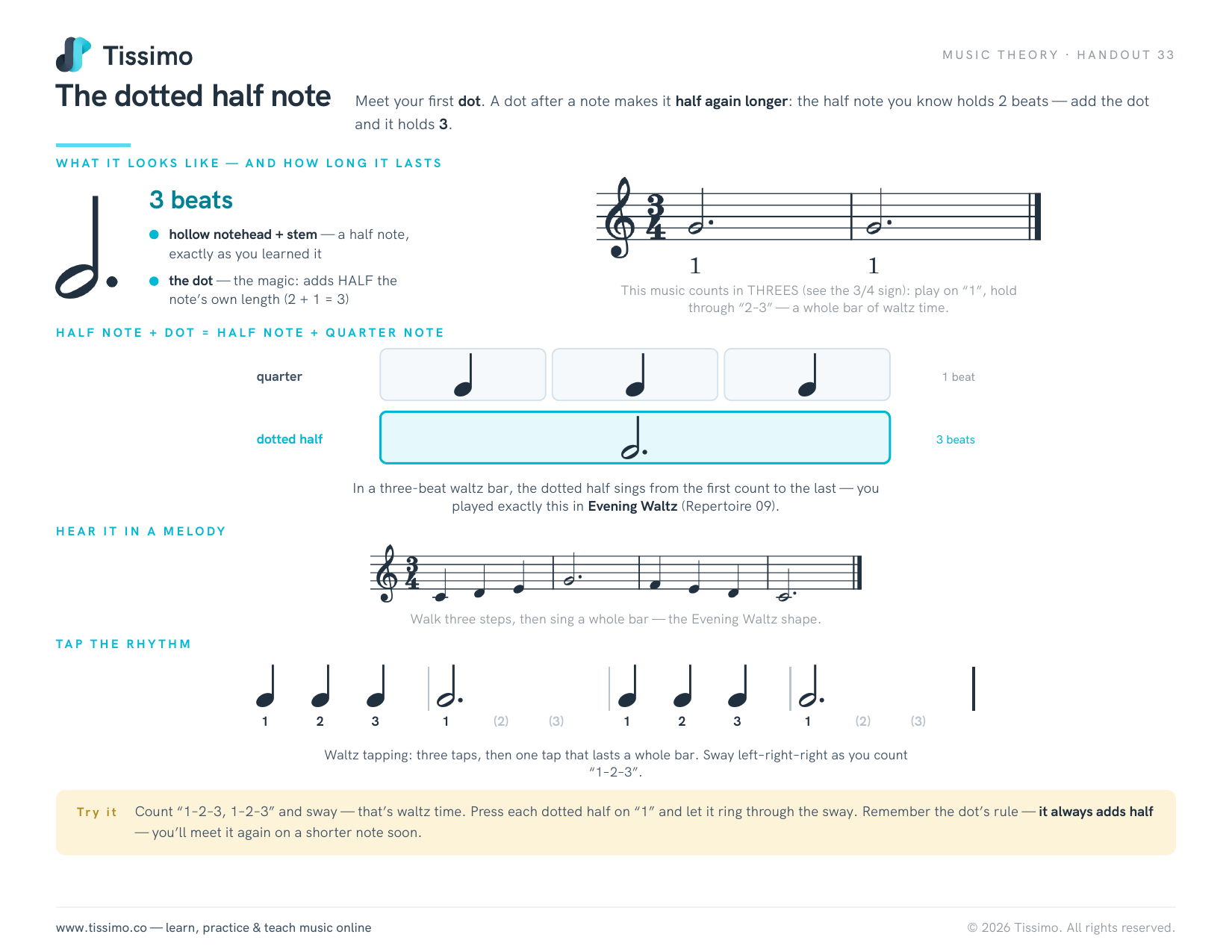
Die punktierte Halbe
Lerne deinen ersten Punkt kennen. Ein Punkt hinter einer Note verlängert sie um die Hälfte ihres Wertes: Die Halbe, die du kennst, dauert 2 Schläge — mit Punkt dauert sie 3.
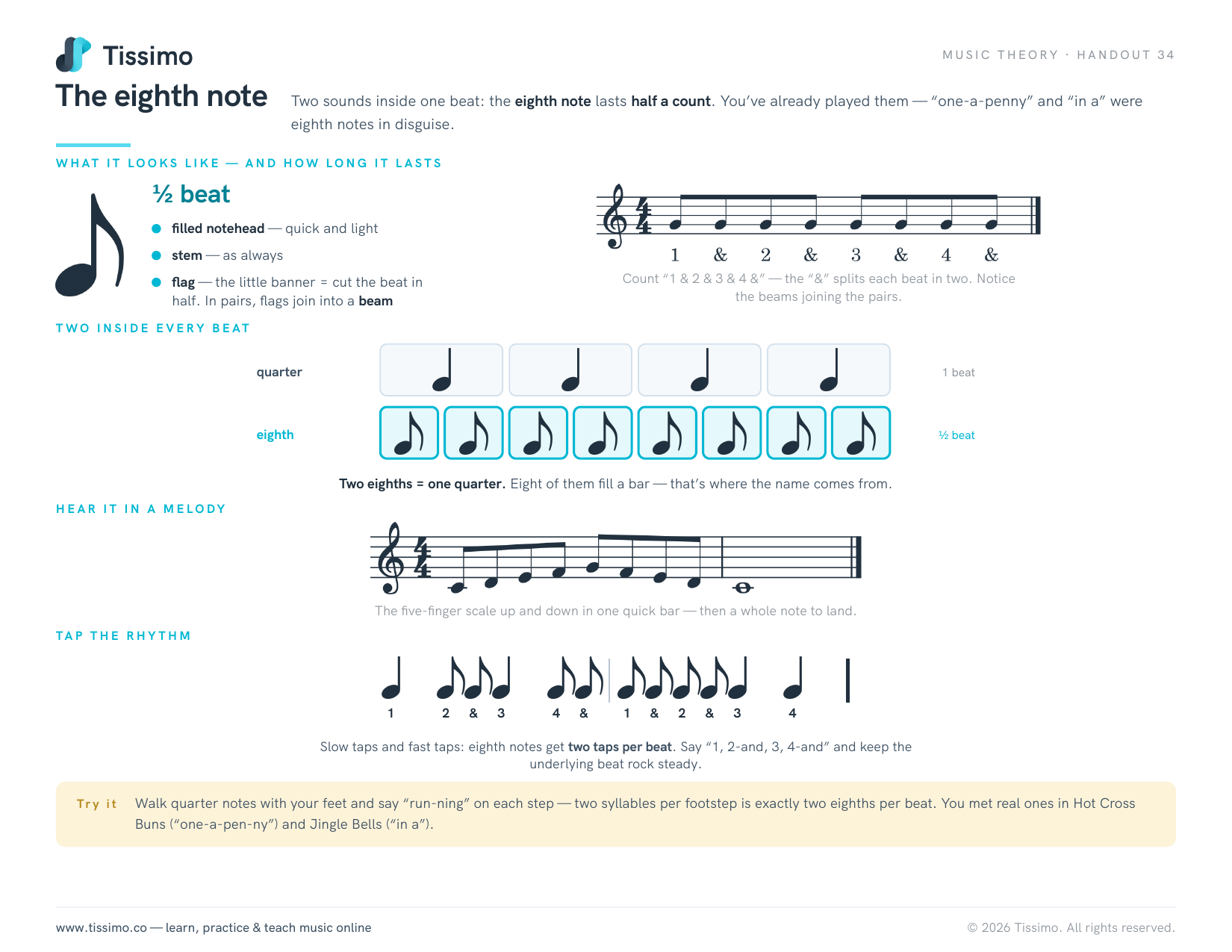
Die Achtelnote
Zwei Töne in einem Schlag: die Achtelnote dauert einen halben Schlag. Du hast sie schon gespielt, ohne es zu wissen — jedes „Ti-ti“ auf einem Schlag war eine versteckte Achtelnote.
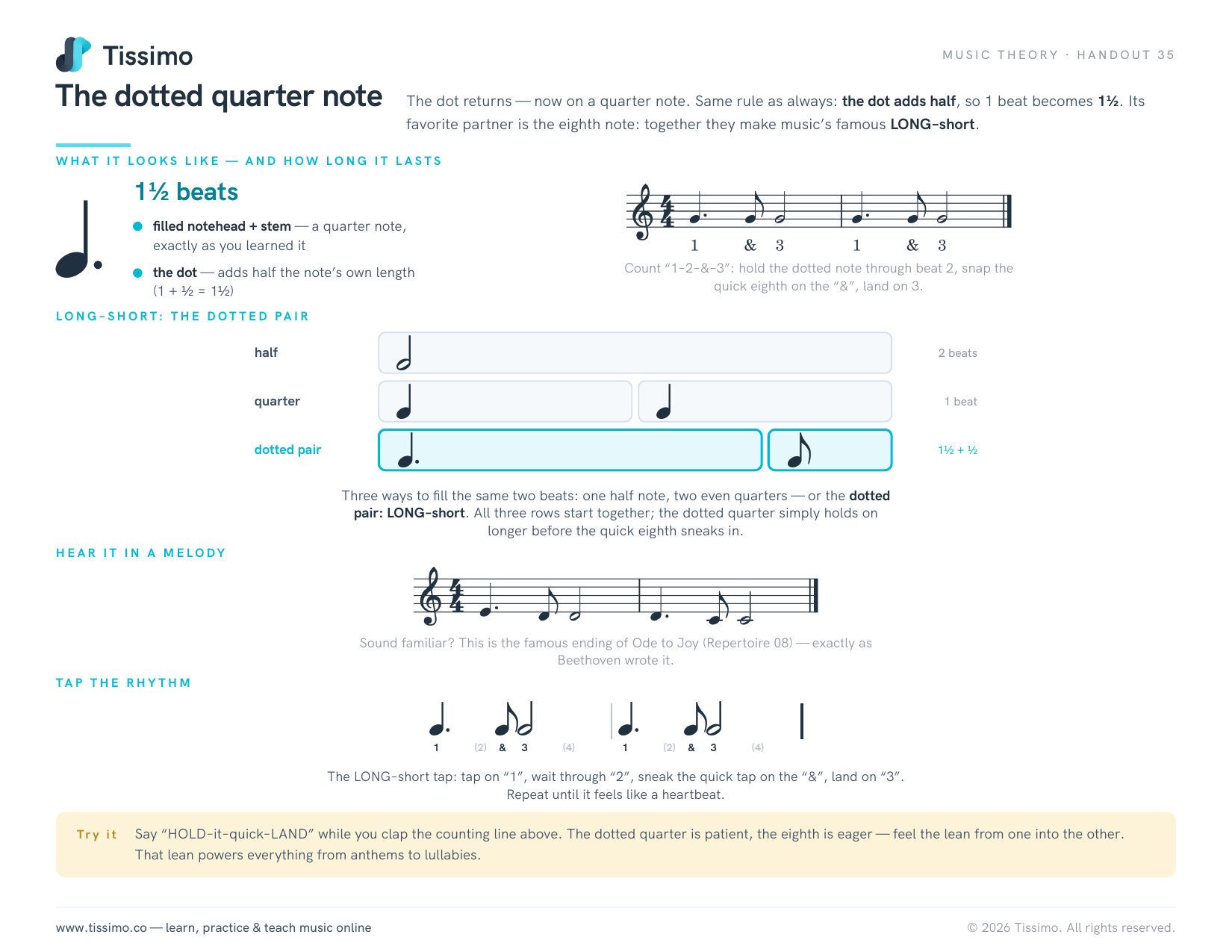
Die punktierte Viertelnote
Der Punkt kehrt zurück — diesmal bei einer Viertelnote. Die gleiche Regel wie immer: Der Punkt fügt die Hälfte hinzu, aus 1 Schlag werden also 1½. Ihr liebster Partner ist die Achtelnote: Zusammen ergeben sie das berühmte LANG-kurz.
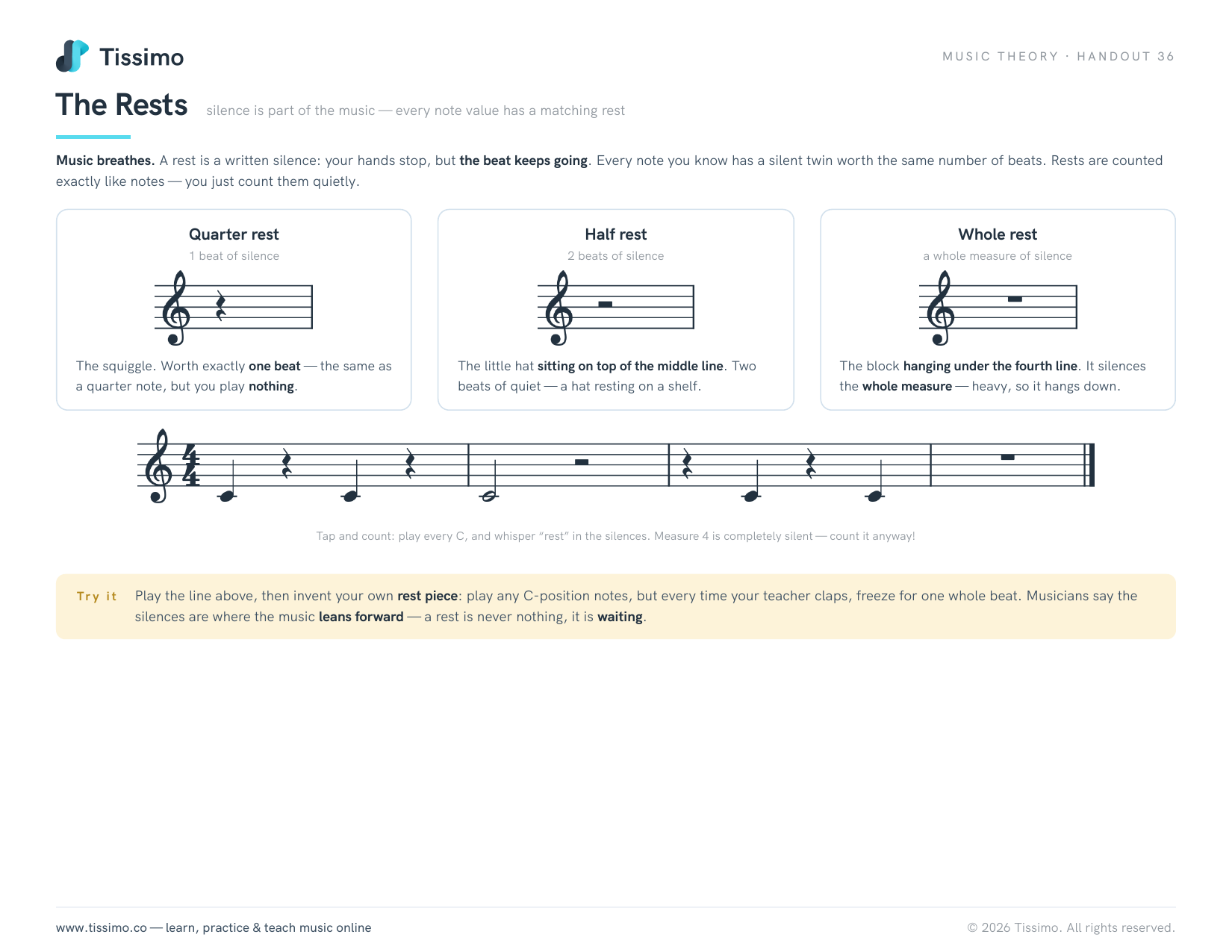
Die Pausen
Stille ist Teil der Musik — zu jedem Notenwert gibt es eine passende Pause
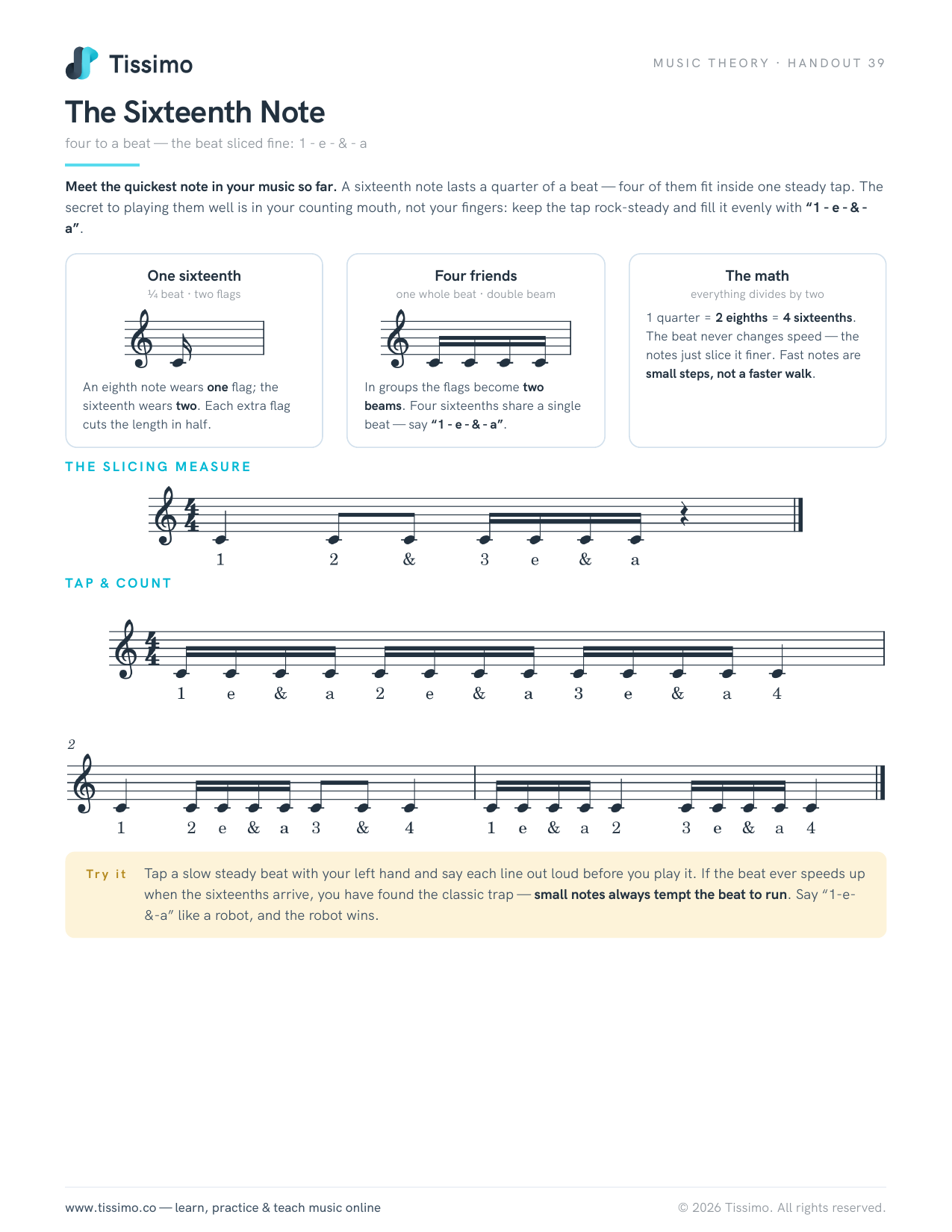
Die Sechzehntelnote
vier auf einen Schlag — der Schlag fein unterteilt: 1 - e - und - a

Die Pausenfamilie
jede Note hat einen stillen Zwilling — alle fünf Pausen, von der Ganzen bis zur Sechzehntel
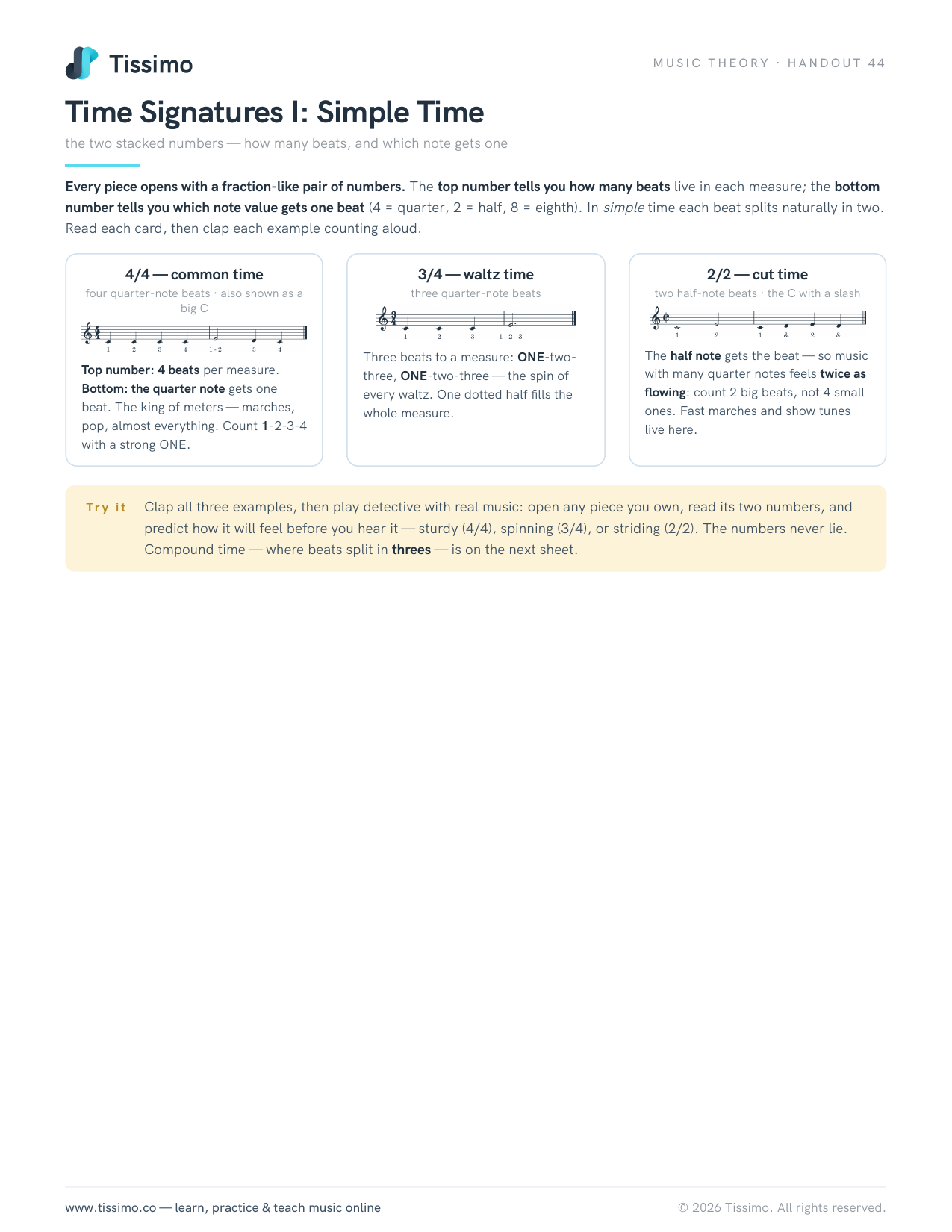
Taktarten I: Einfache Taktart
die zwei übereinanderstehenden Zahlen — wie viele Schläge, und welche Note einen Schlag bekommt
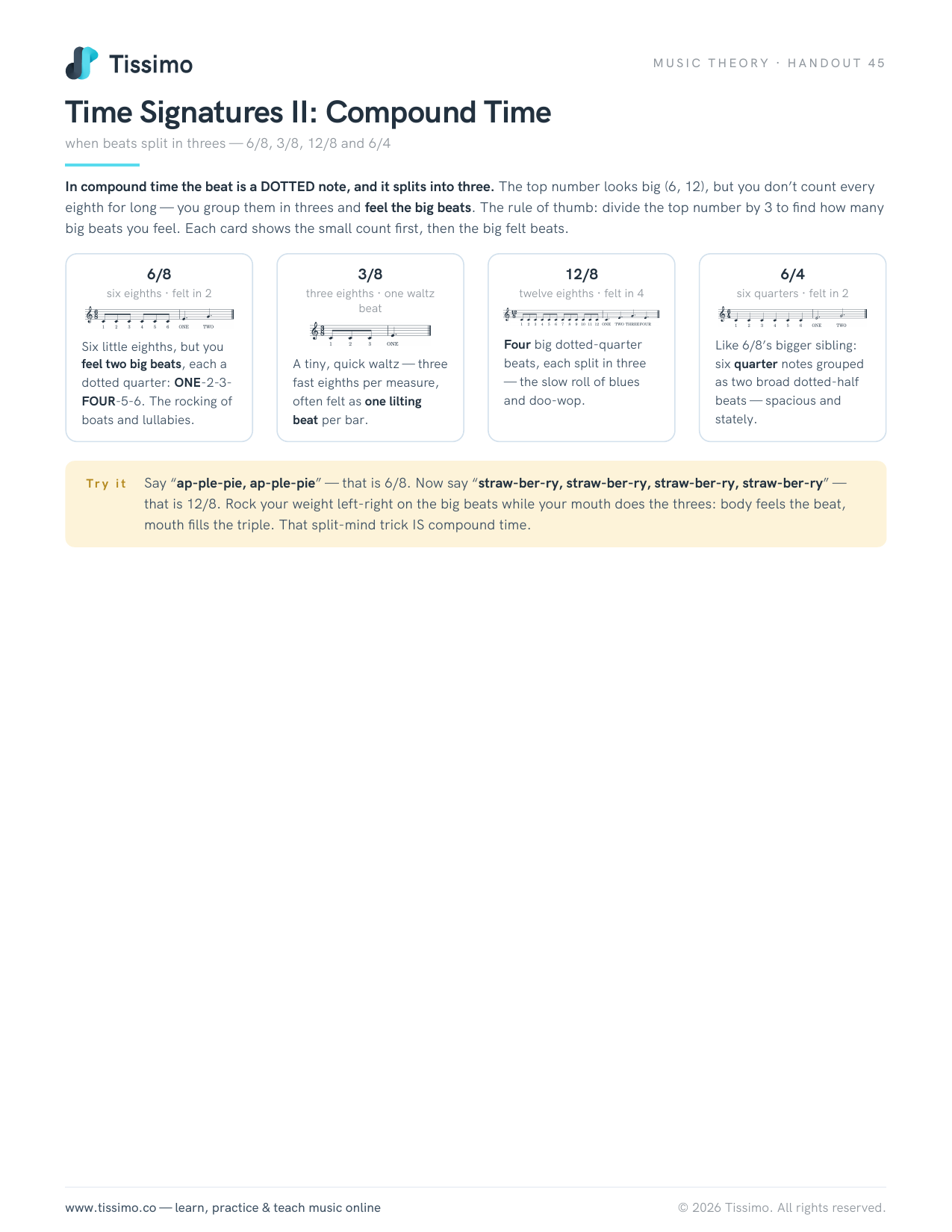
Taktarten II: Zusammengesetzte Taktart
wenn sich Schläge in drei teilen — 6/8, 3/8, 12/8 und 6/4
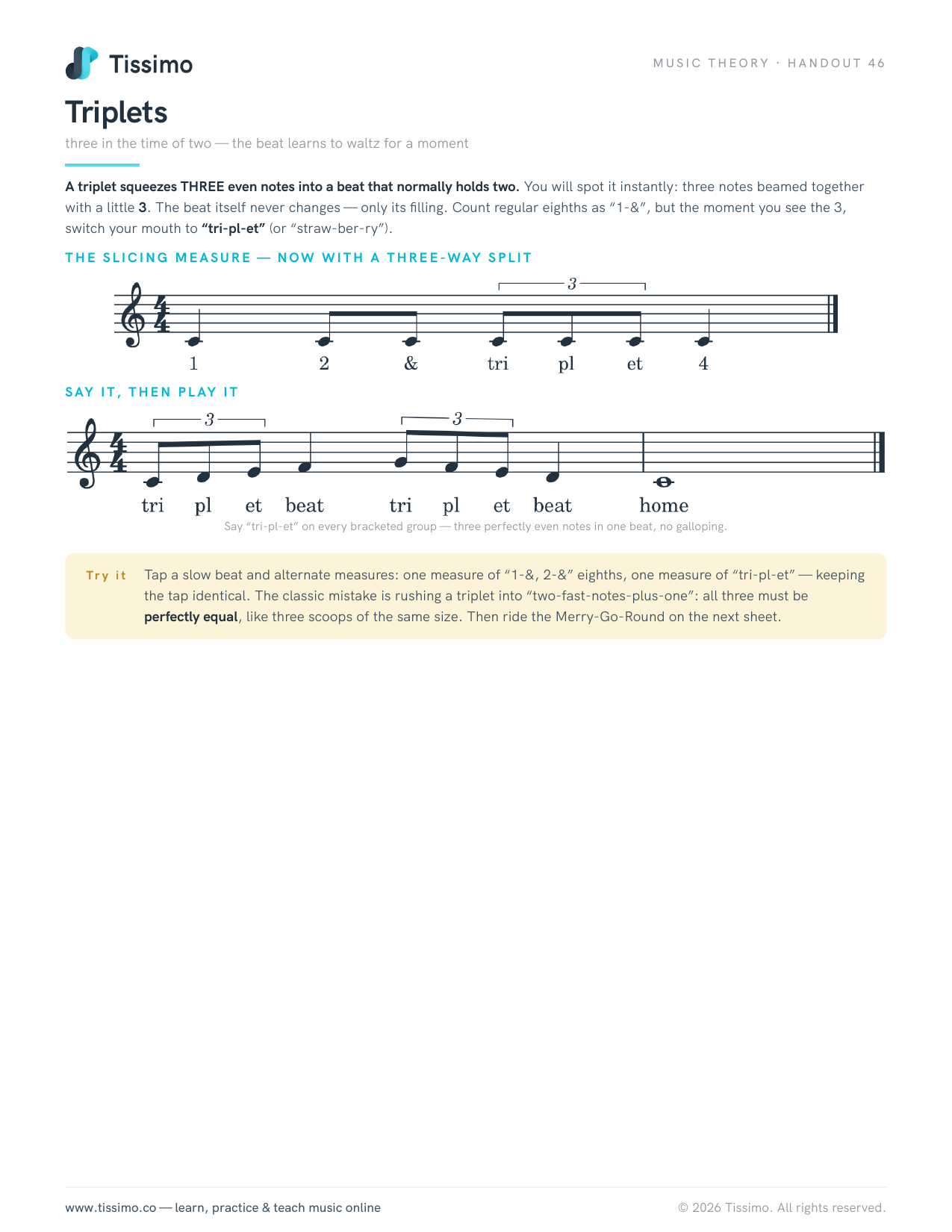
Triolen
drei in der Zeit von zwei — der Schlag lernt für einen Moment das Walzertanzen
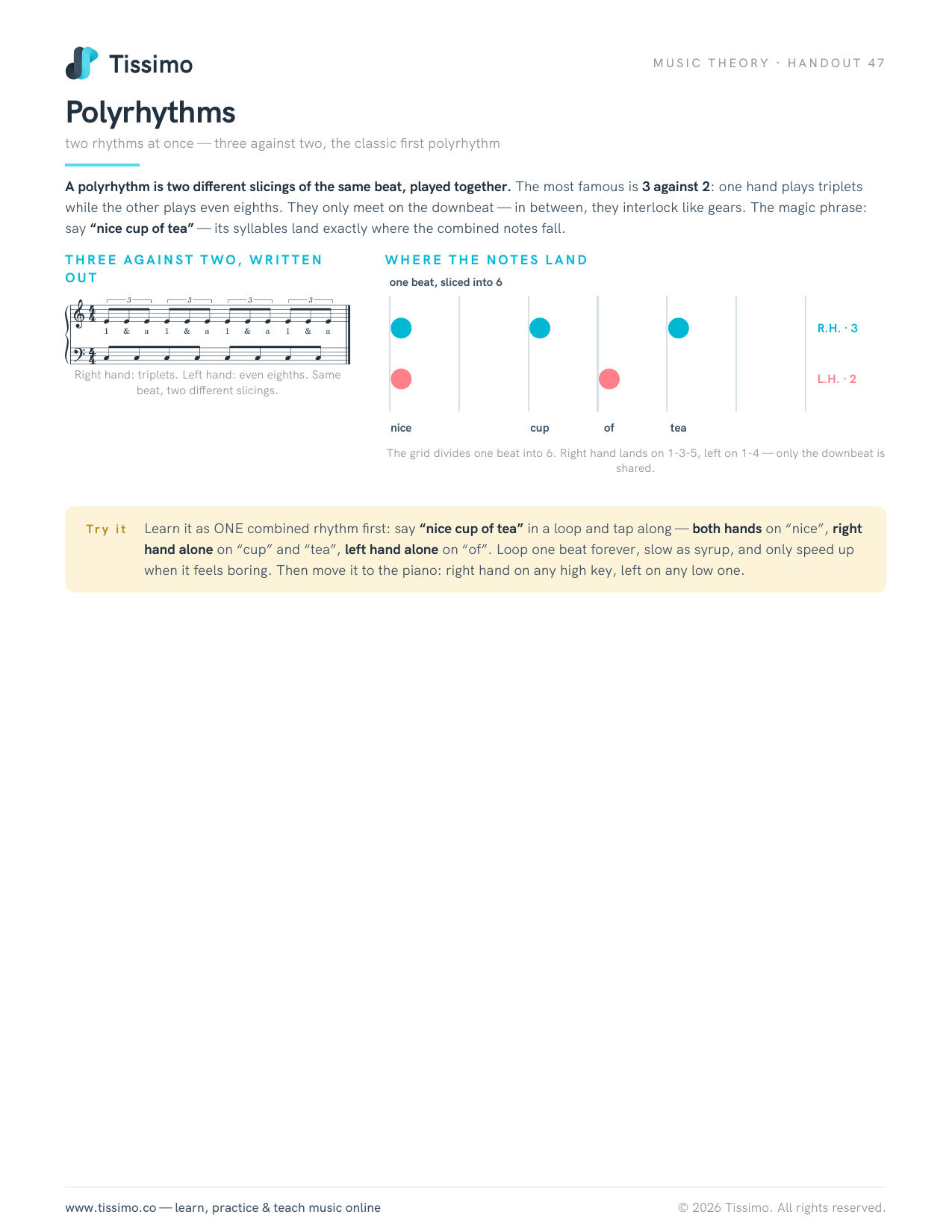
Polyrhythmen
zwei Rhythmen gleichzeitig — drei gegen zwei, der klassische erste Polyrhythmus
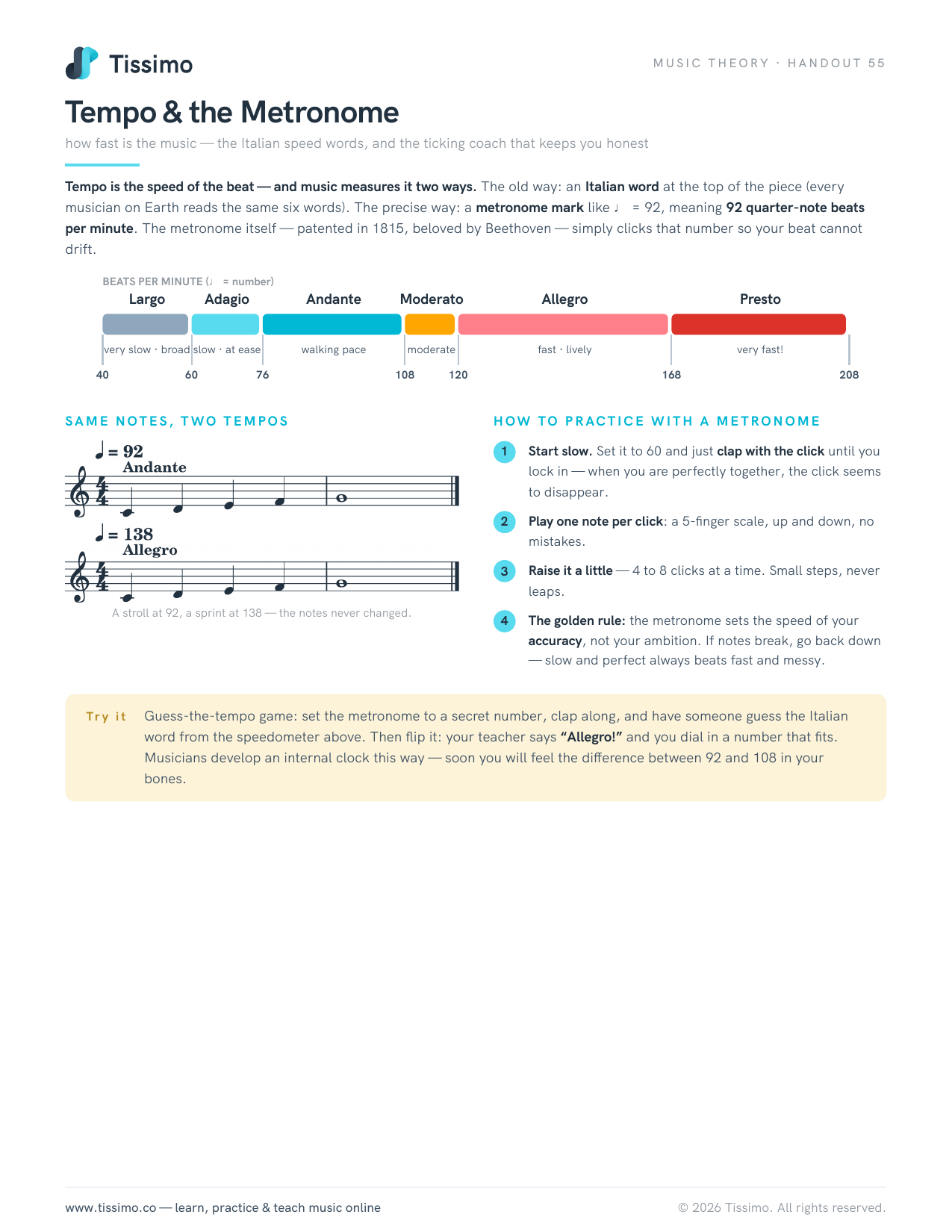
Tempo & Metronom
wie schnell die Musik ist — die italienischen Tempobezeichnungen, und der tickende Coach, der dich ehrlich hält
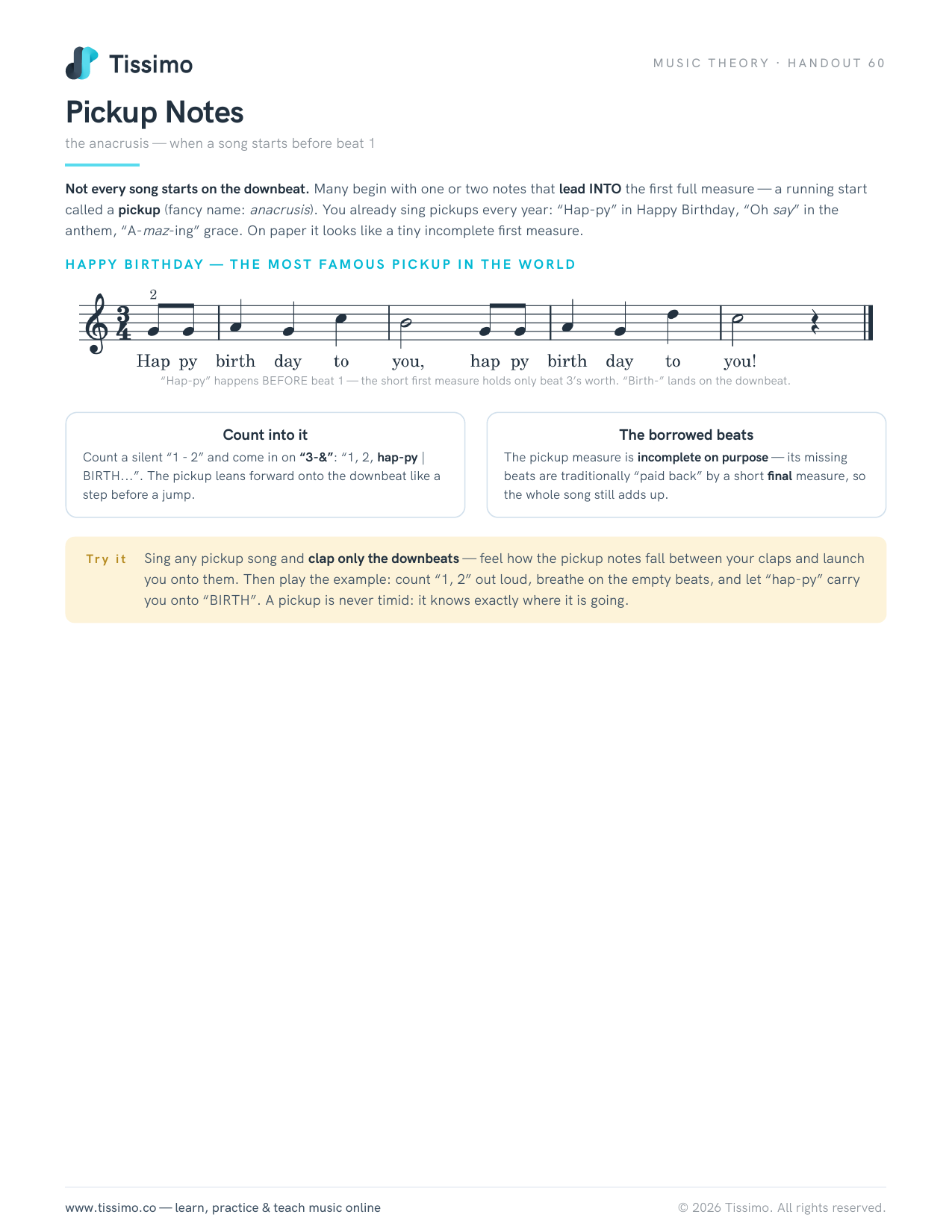
Auftakt
der Auftakt — wenn ein Lied vor dem ersten Schlag beginnt
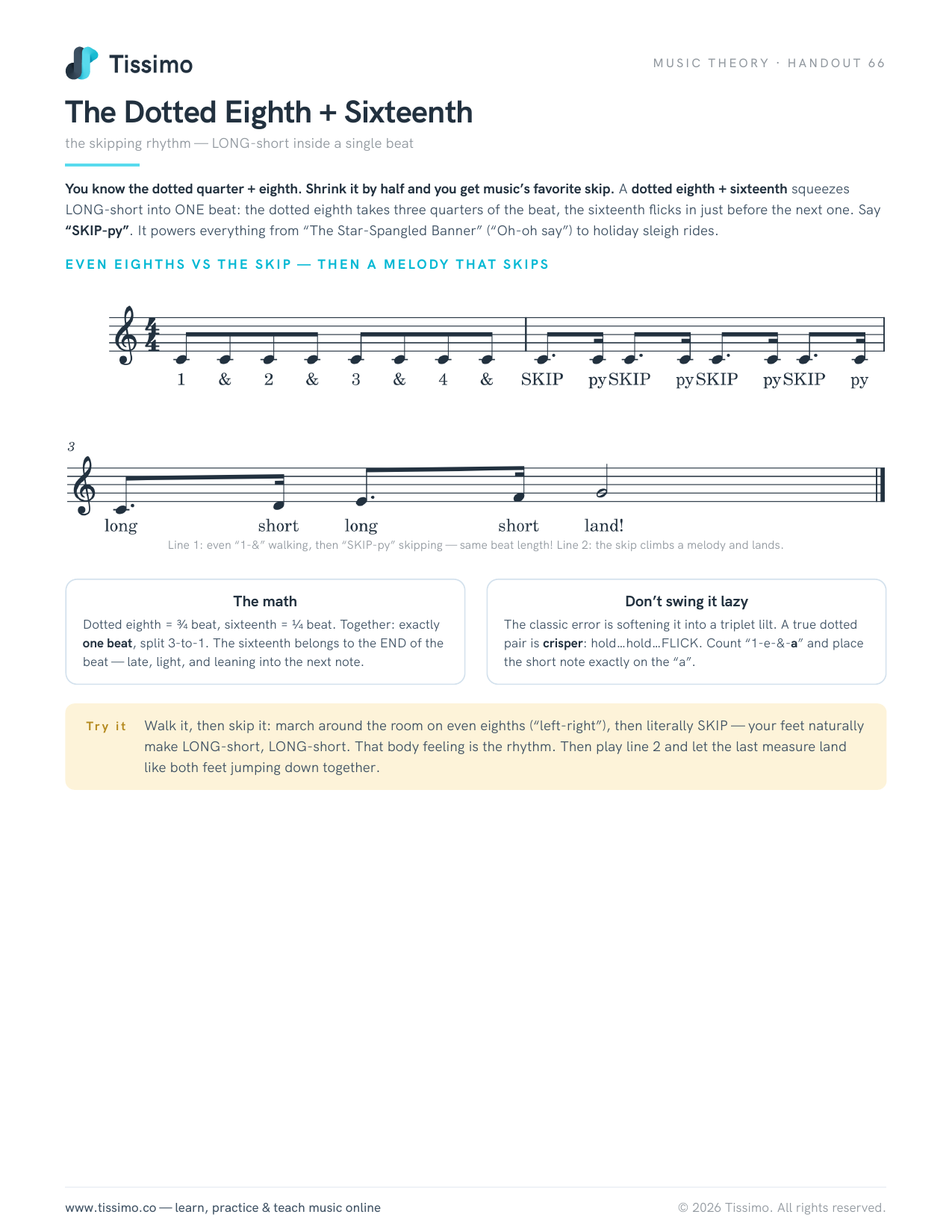
Punktierte Achtel + Sechzehntel
der hüpfende Rhythmus — LANG-kurz innerhalb eines einzigen Schlags
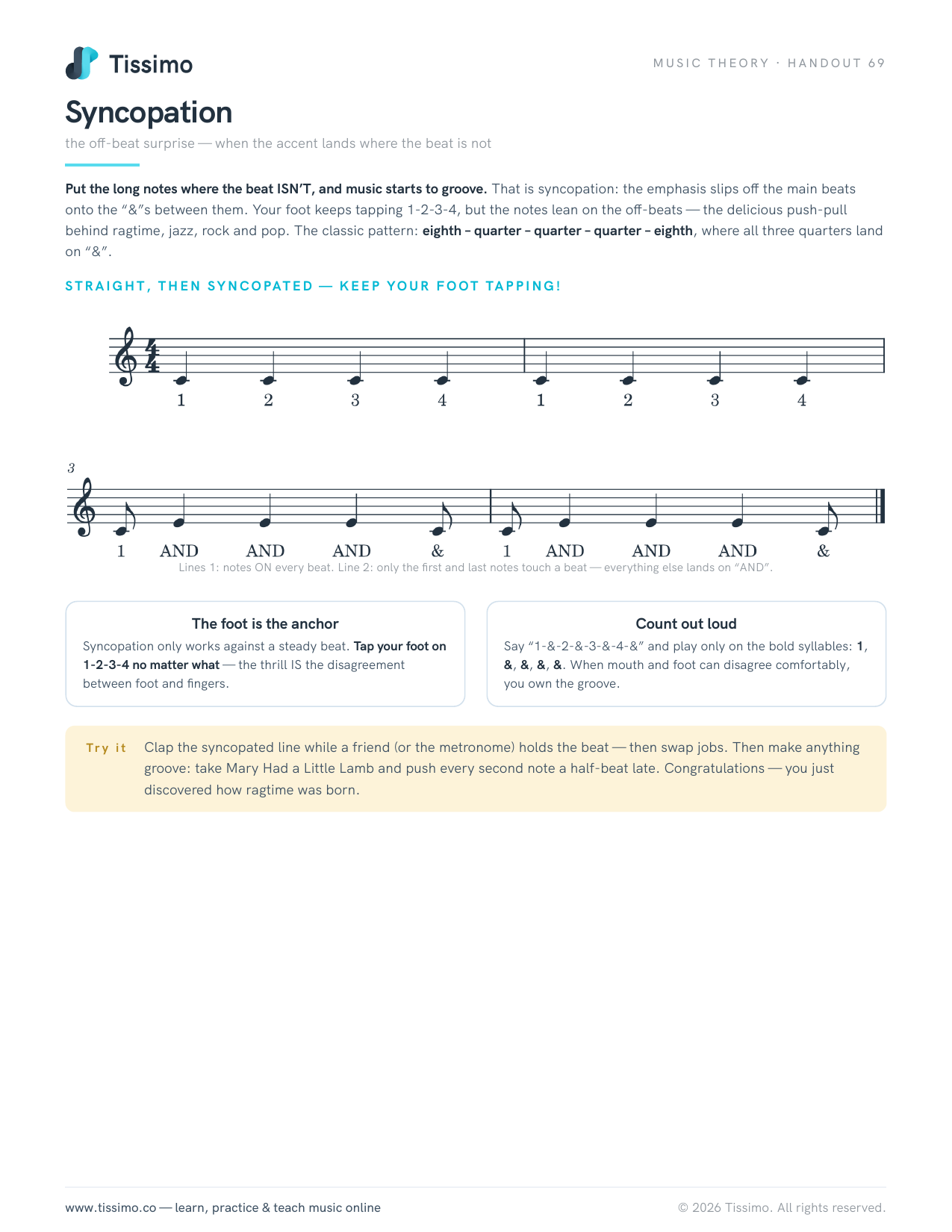
Synkopen
die Überraschung im Off-Beat — wenn die Betonung dort landet, wo kein Schlag ist
Tonhöhe & Notation
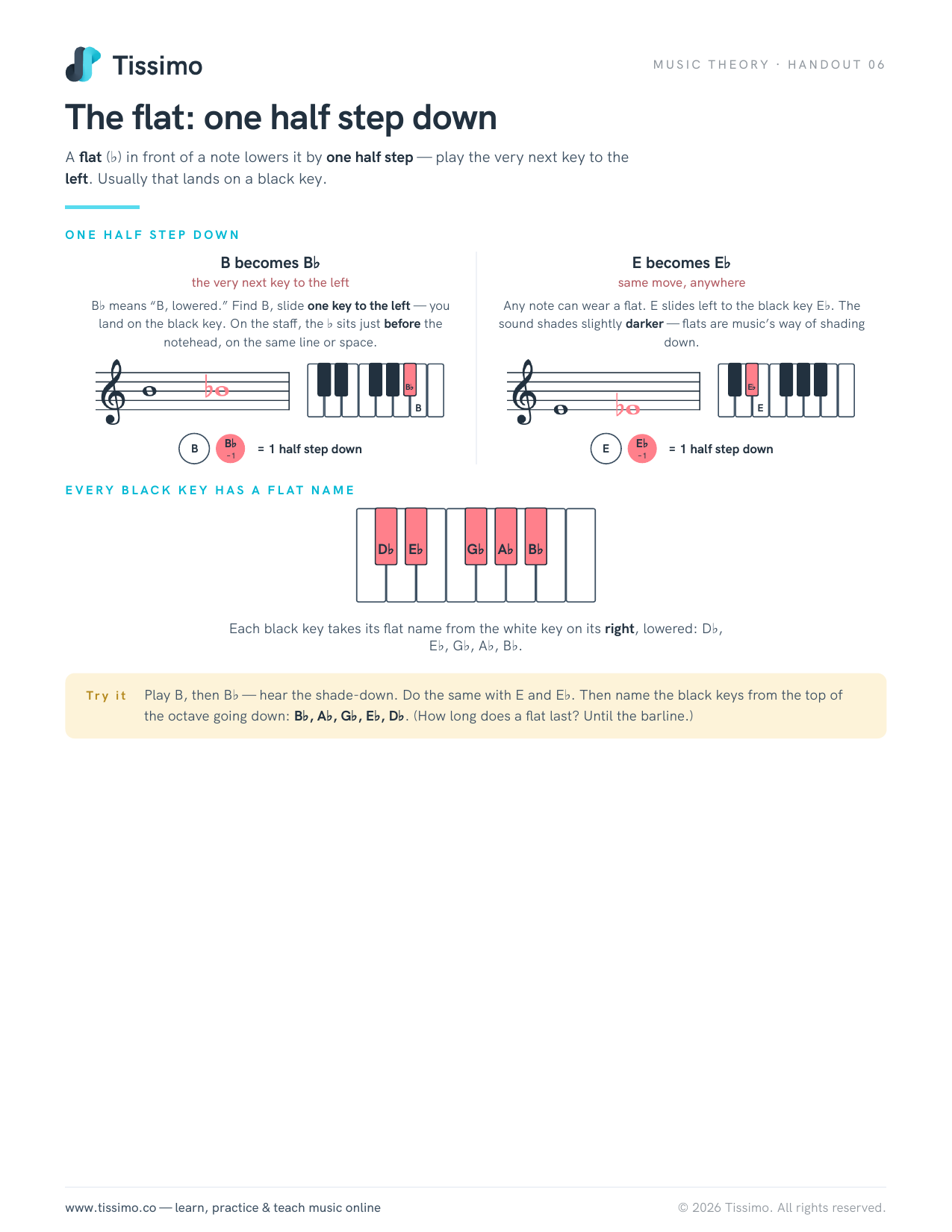
Das B (Erniedrigungszeichen): einen Halbton tiefer
Ein Vorzeichen ♭ vor einer Note senkt sie um einen Halbton — spiele die nächste Taste links davon. Meist ist das eine schwarze Taste.
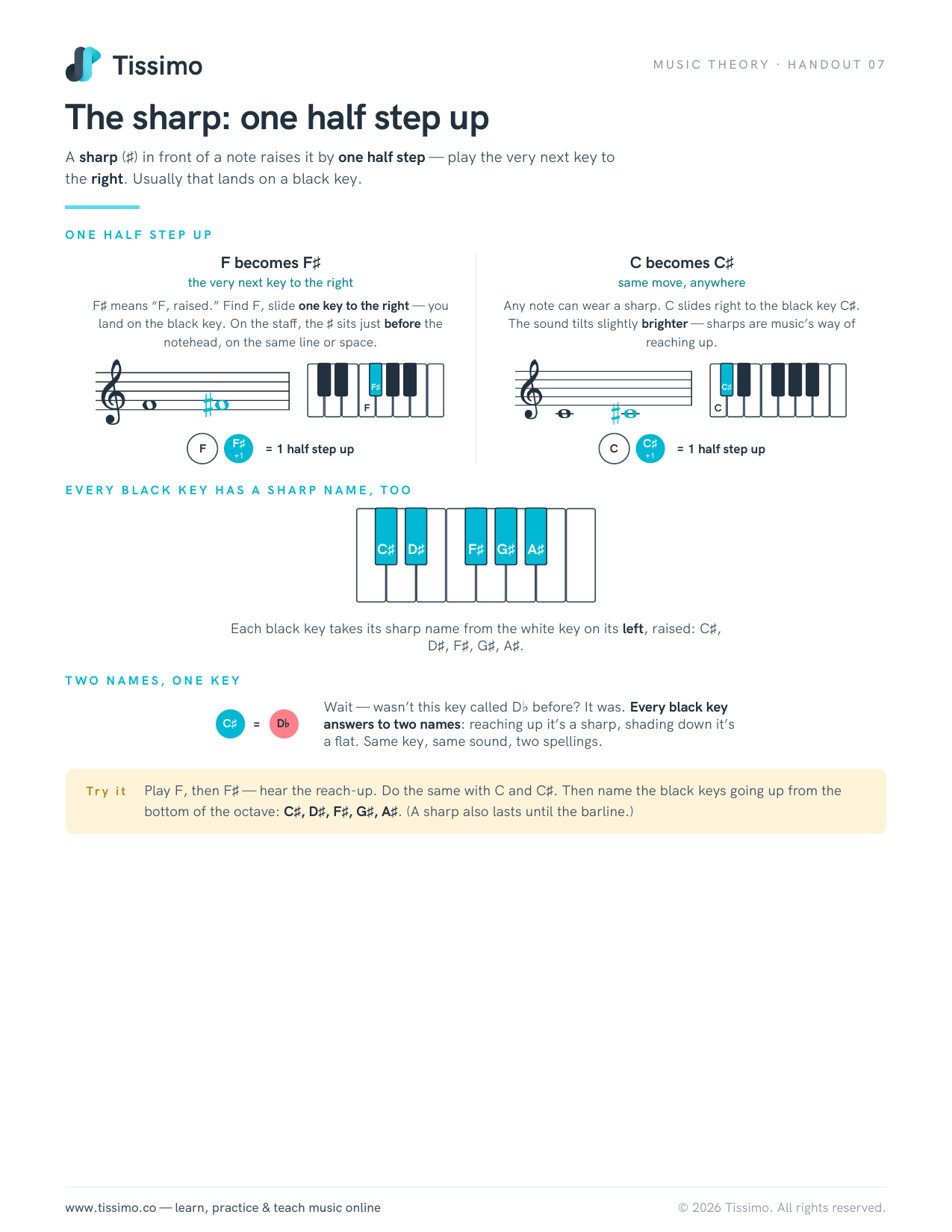
Das Kreuz: einen Halbton höher
Ein Kreuz (♯) vor einer Note erhöht sie um einen Halbton — spiele die nächste Taste rechts davon. Meist ist das eine schwarze Taste.
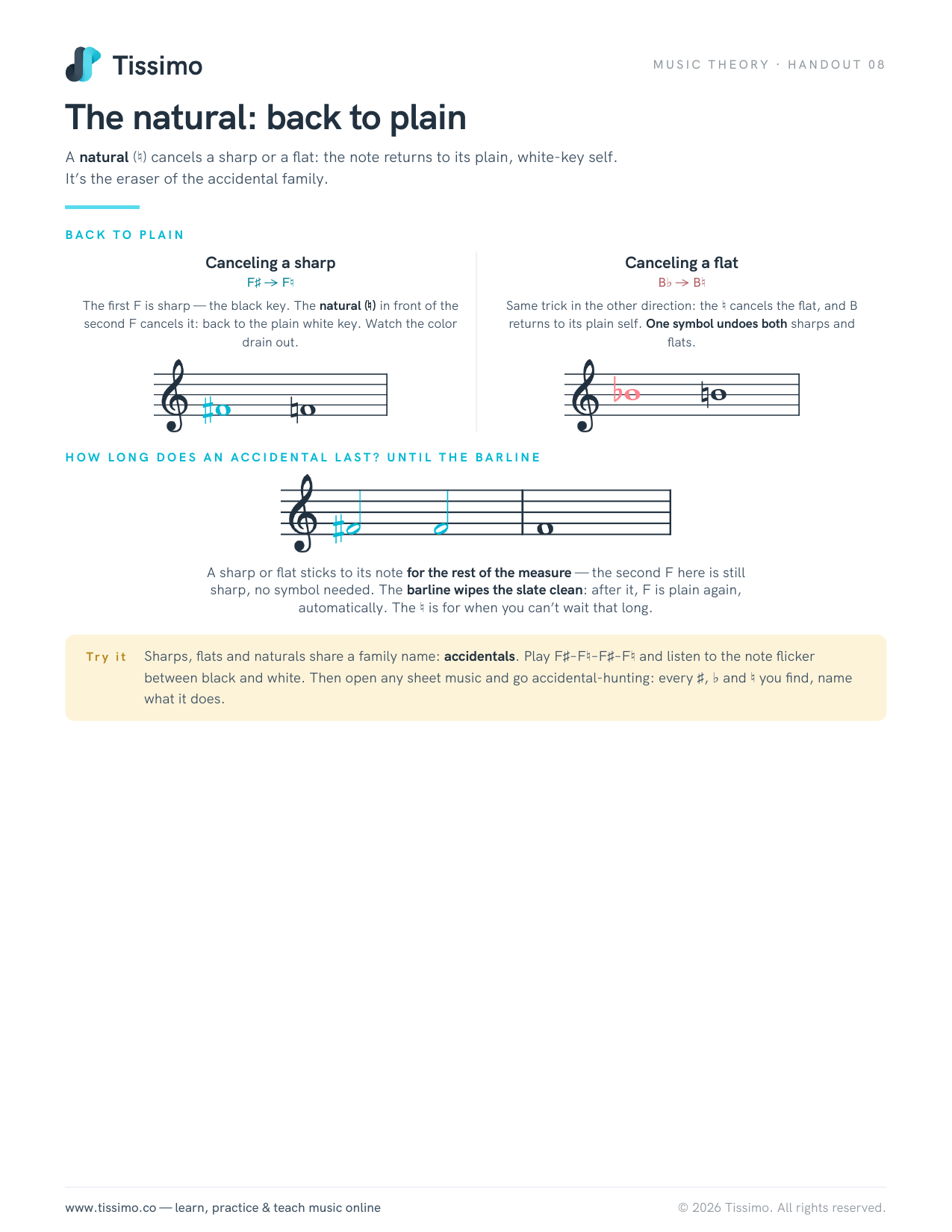
Das Auflösungszeichen: zurück zur Stammnote
Ein Auflösungszeichen (♮) hebt ein Kreuz oder ein B auf: Die Note kehrt zu ihrer schlichten weißen Taste zurück. Es ist der Radiergummi der Vorzeichen-Familie.
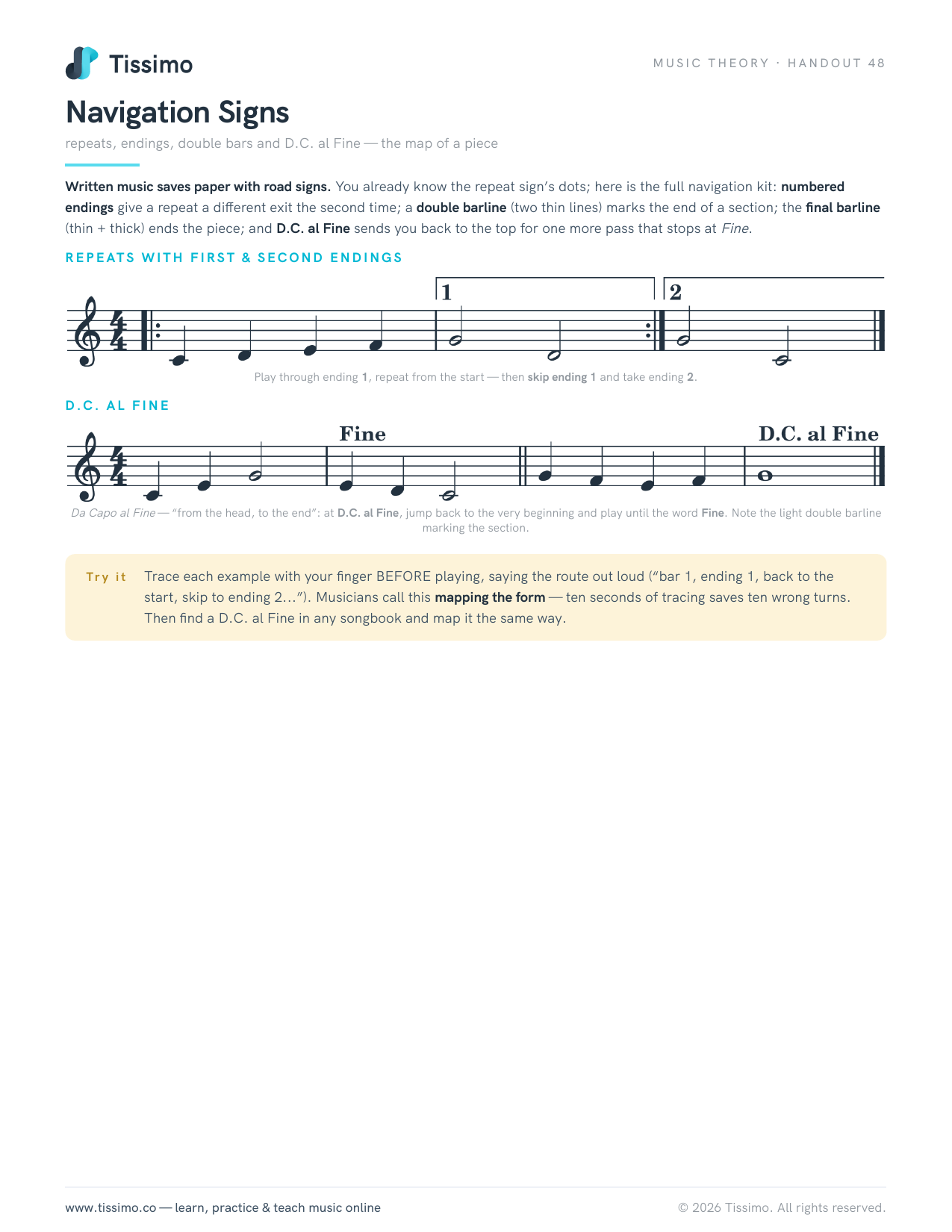
Wiederholungs- und Navigationszeichen
Wiederholungen, Voltas, Doppelstriche und D.C. al Fine — die Landkarte eines Stücks
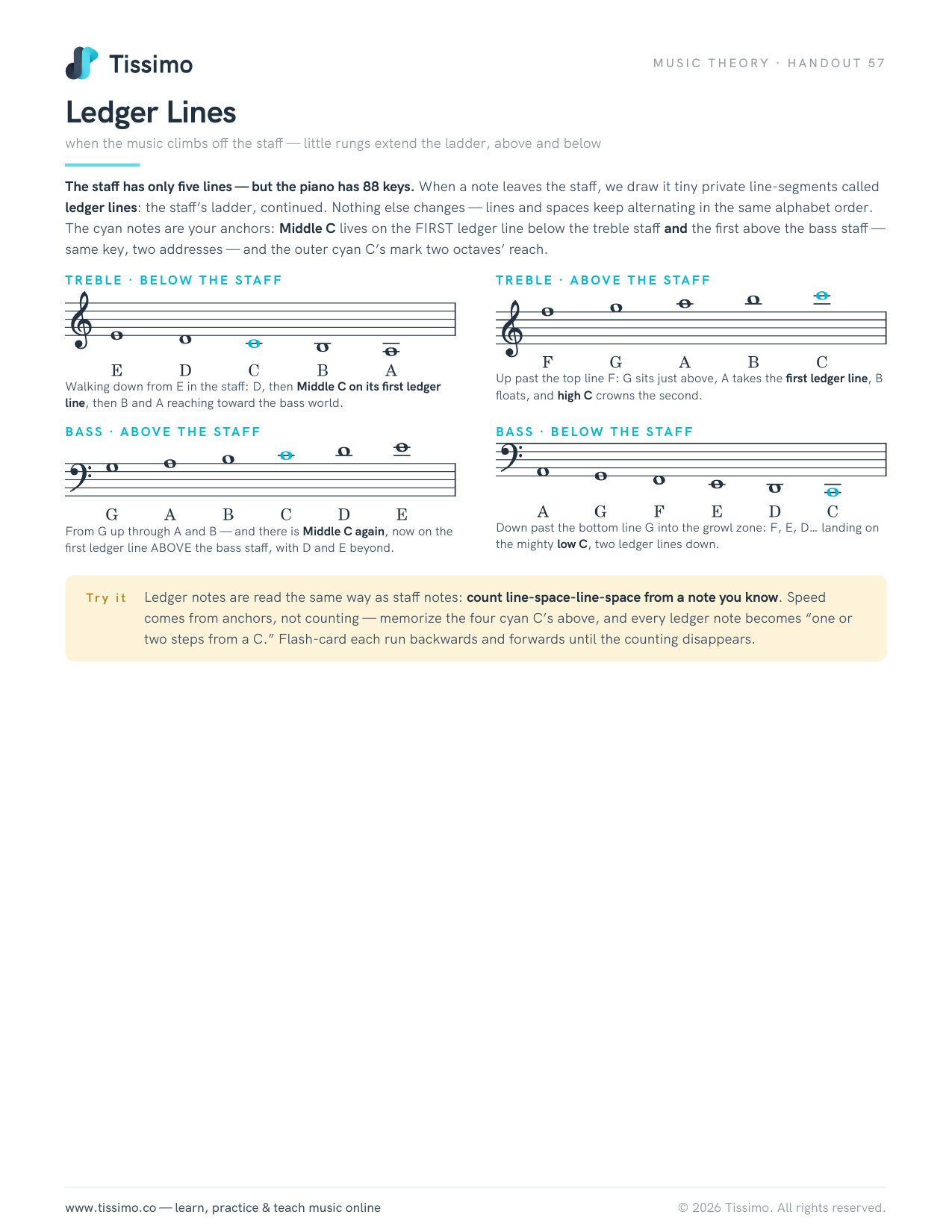
Hilfslinien
wenn die Musik das Notensystem verlässt — kleine Sprossen verlängern die Leiter, nach oben und unten
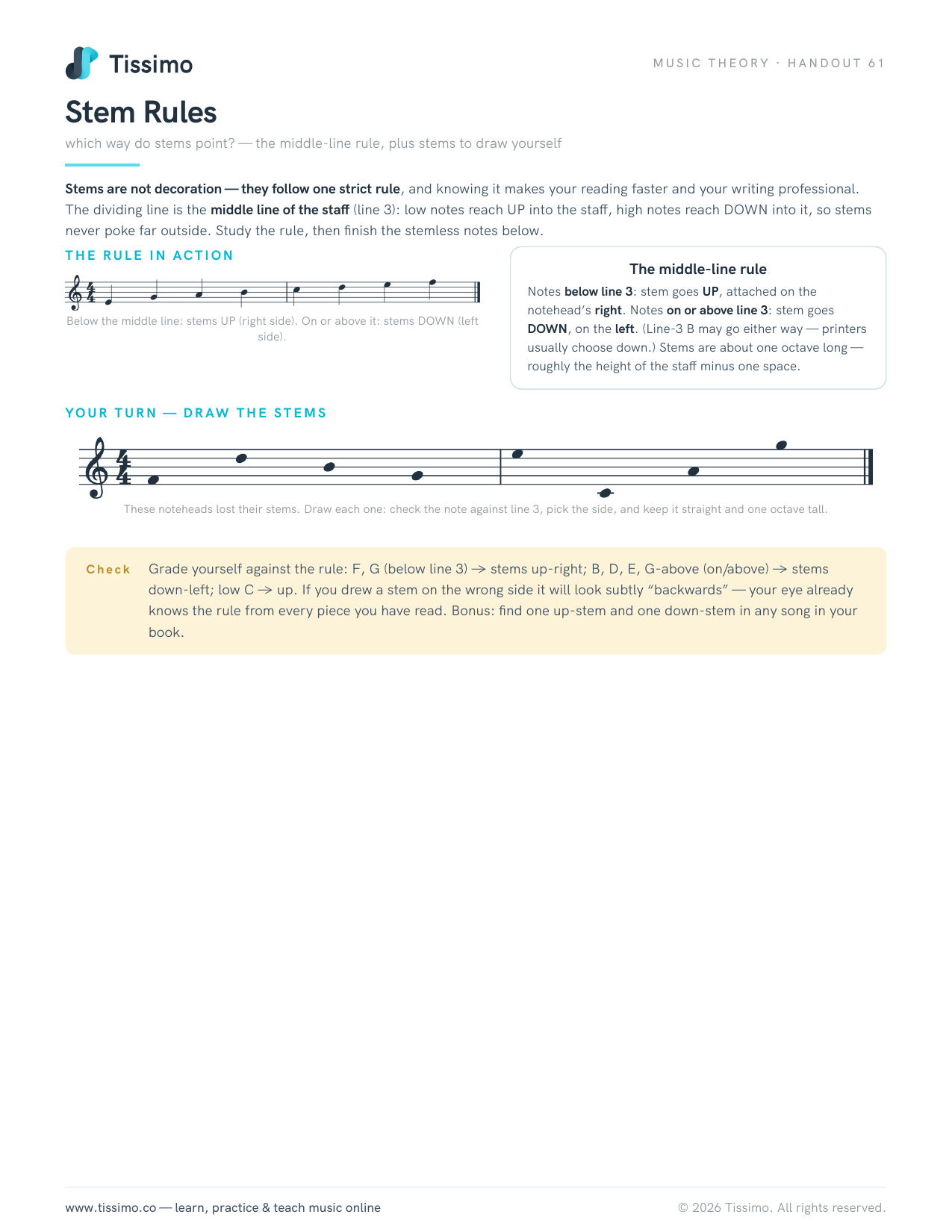
Notenhals-Regeln
in welche Richtung zeigt der Notenhals? — die Regel der mittleren Linie, plus Hälse zum Selbstzeichnen
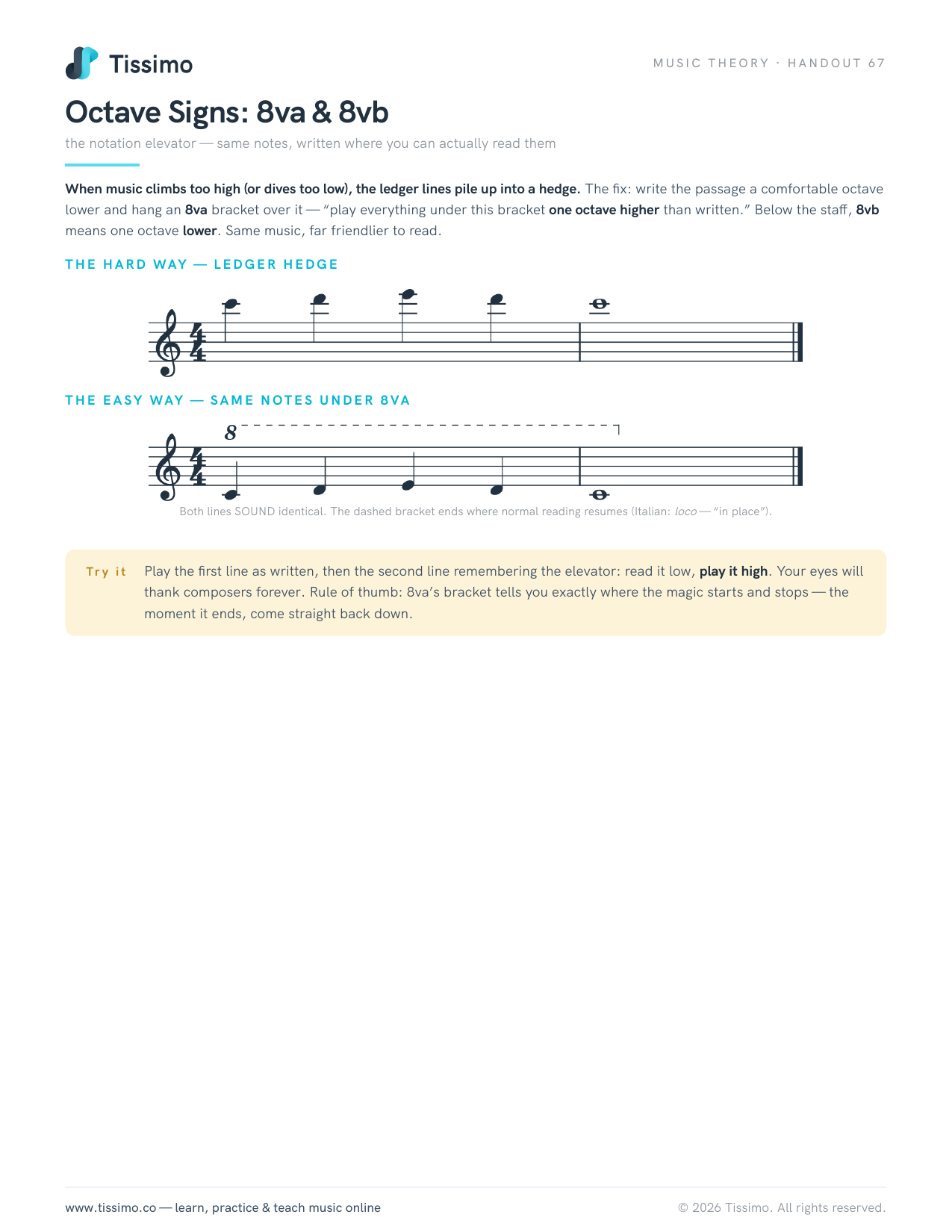
Oktavzeichen: 8va & 8vb
der Notations-Aufzug — dieselben Noten, geschrieben dort, wo du sie tatsächlich lesen kannst
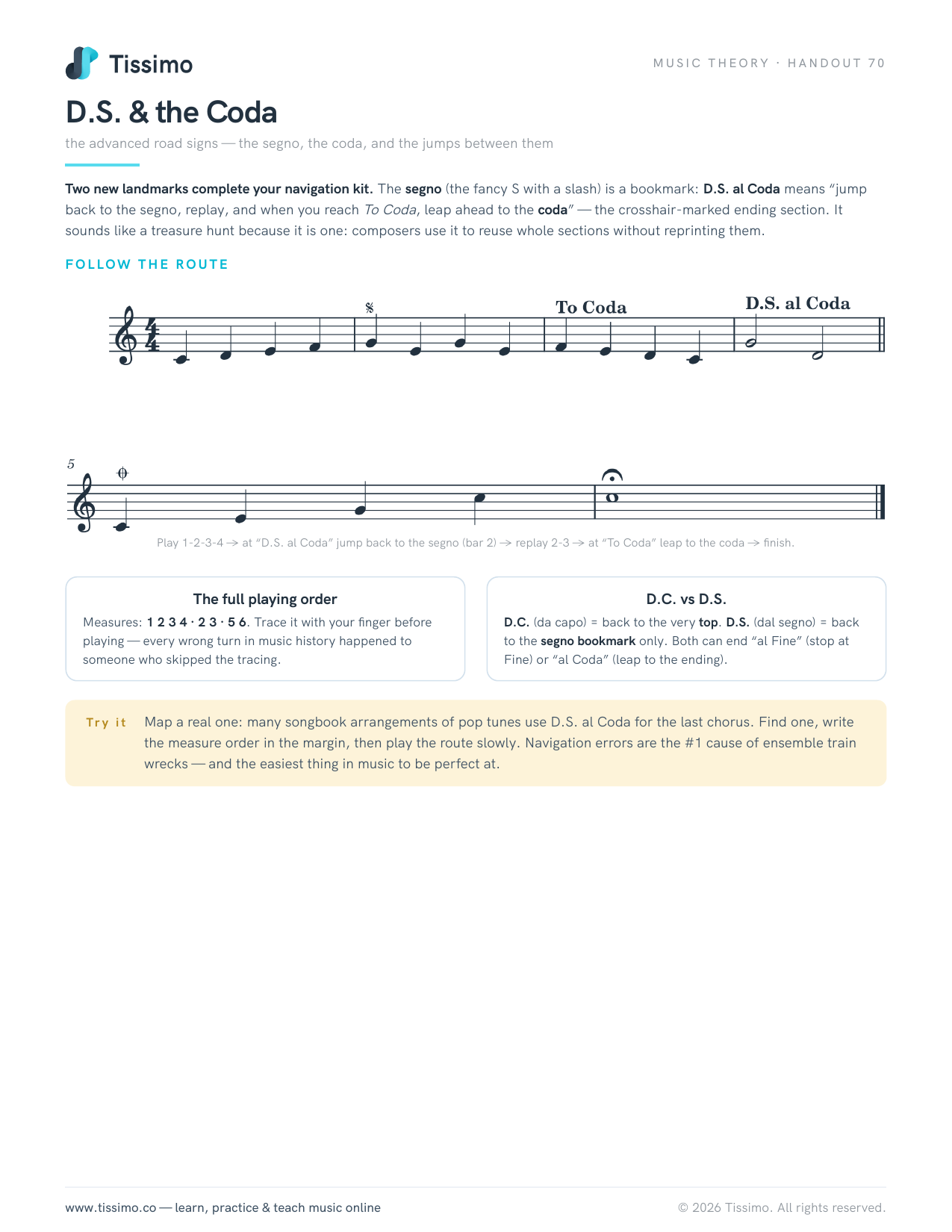
D.S. und die Coda
die fortgeschrittenen Wegweiser — das Segno, die Coda, und die Sprünge dazwischen
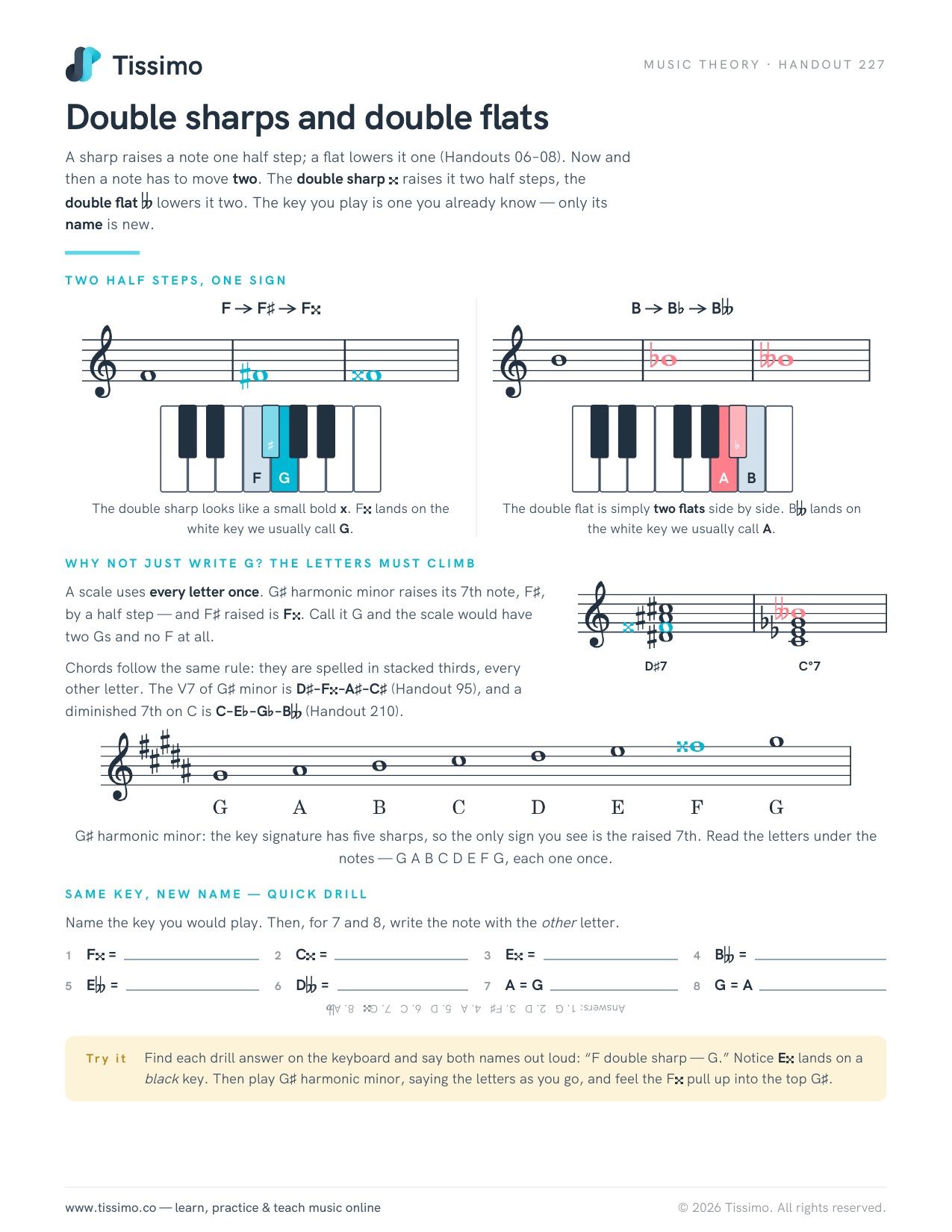
Double sharps and double flats
A sharp raises a note one half step; a flat lowers it one (Handouts 06–08). Now and then a note has to move two. The double sharp raises it two half steps, the double flat lowers it two. The key you play is one you already know — only its name is new.
Intervalle
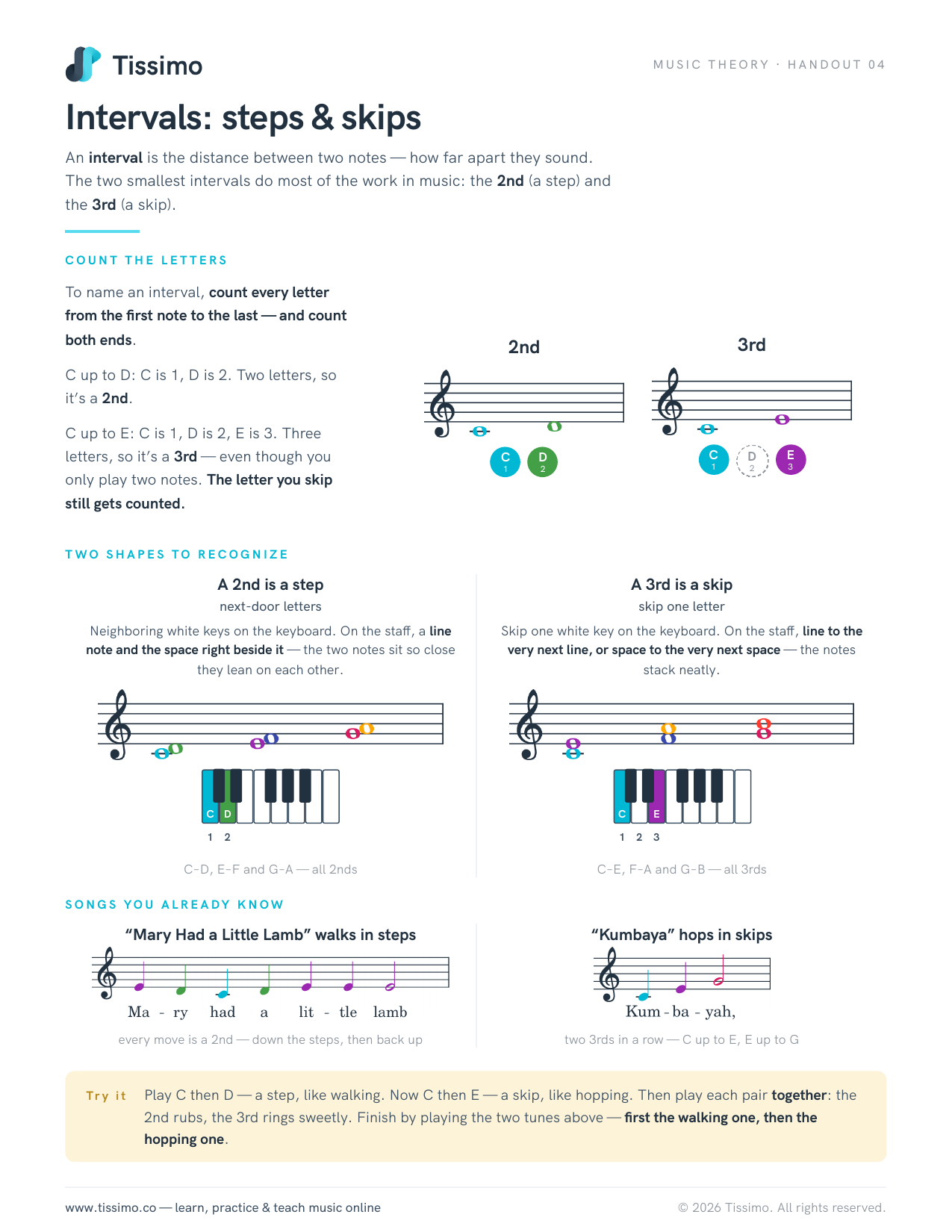
Intervalle: Sekundschritte & Terzsprünge
Ein Intervall ist der Abstand zwischen zwei Tönen — wie weit sie voneinander entfernt klingen. Die zwei kleinsten Intervalle leisten den Großteil der Arbeit in der Musik: die Sekunde (ein Schritt) und die Terz (ein Sprung).
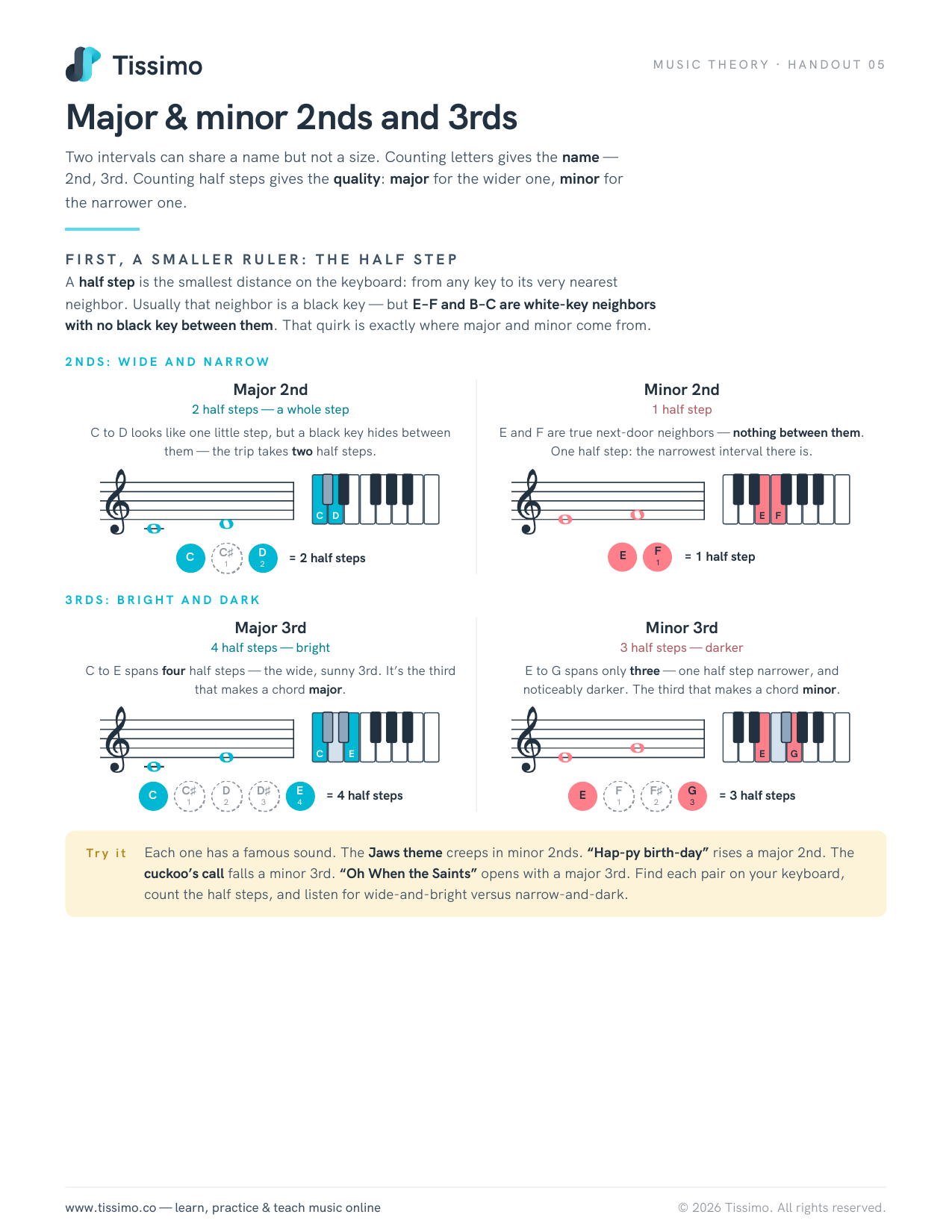
Große & kleine Sekunden und Terzen
Zwei Intervalle können denselben Namen haben, aber nicht dieselbe Größe. Buchstaben zählen ergibt den Namen — Sekunde, Terz. Halbtöne zählen ergibt die Qualität: groß für das weitere, klein für das engere.
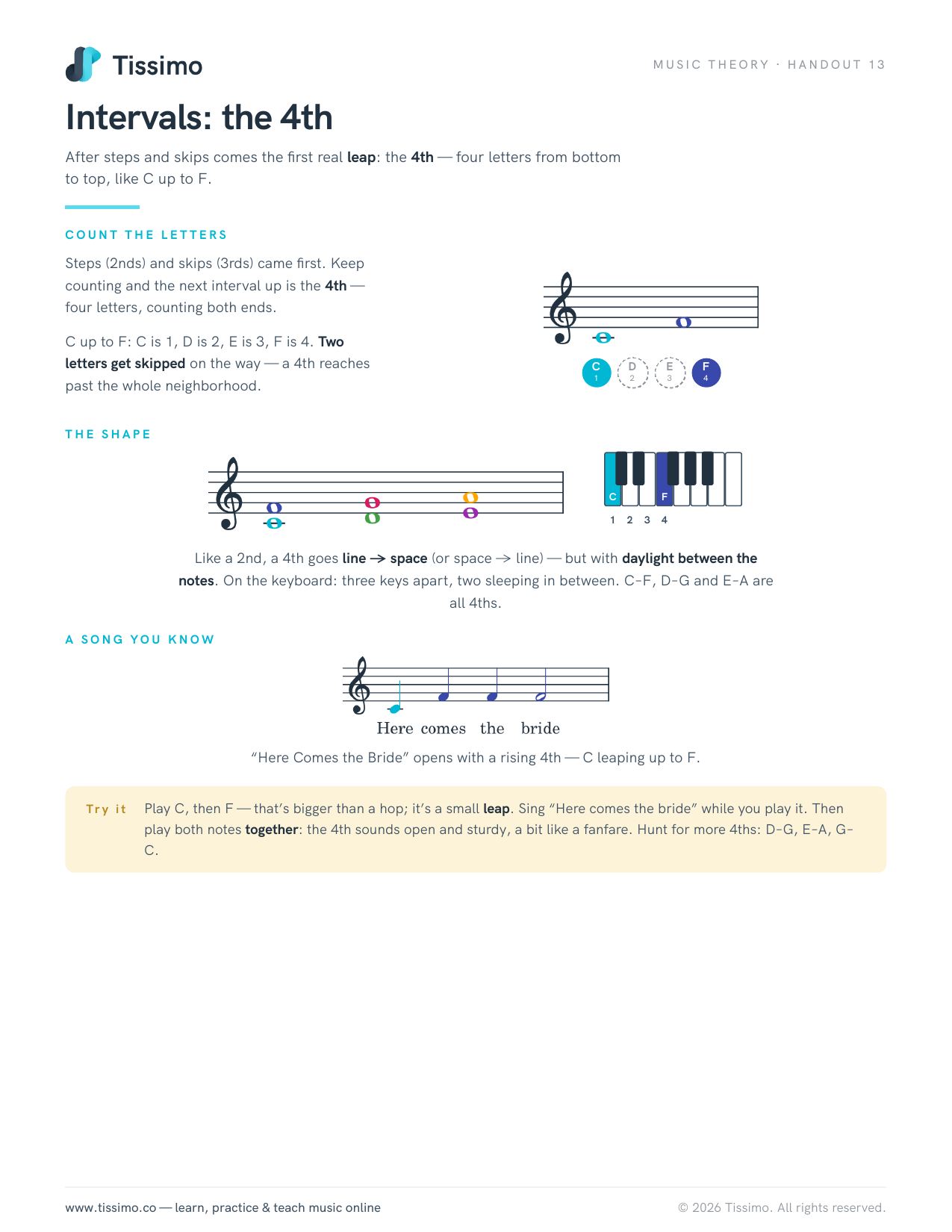
Intervalle: die Quarte
Nach Schritten und Sprüngen kommt der erste richtige Satz: die Quarte — vier Buchstaben von unten nach oben, wie von C zu F.
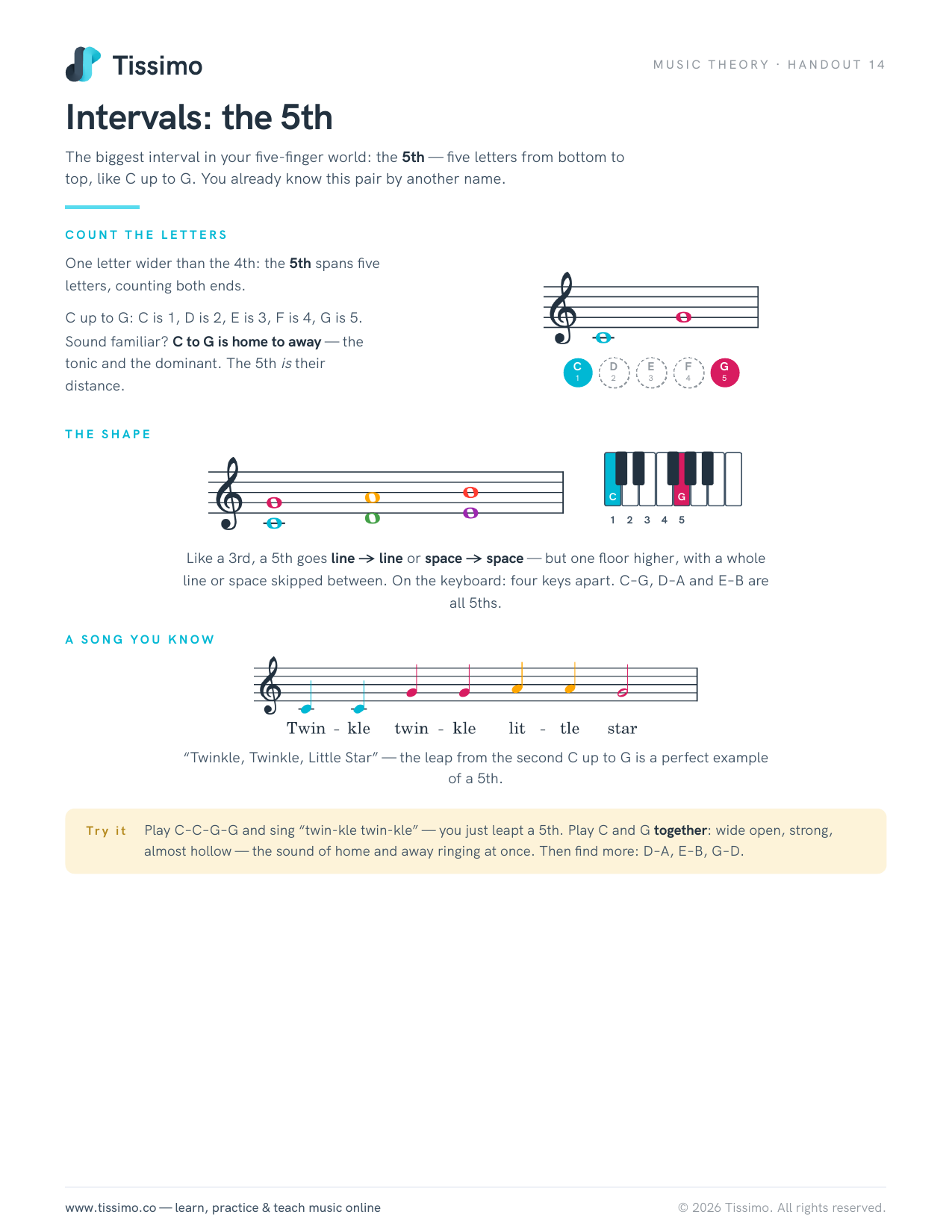
Intervalle: die Quinte
Das größte Intervall in deiner Fünf-Finger-Welt: die Quinte — fünf Buchstaben von unten nach oben, wie von C zu G. Dieses Paar kennst du bereits unter einem anderen Namen.
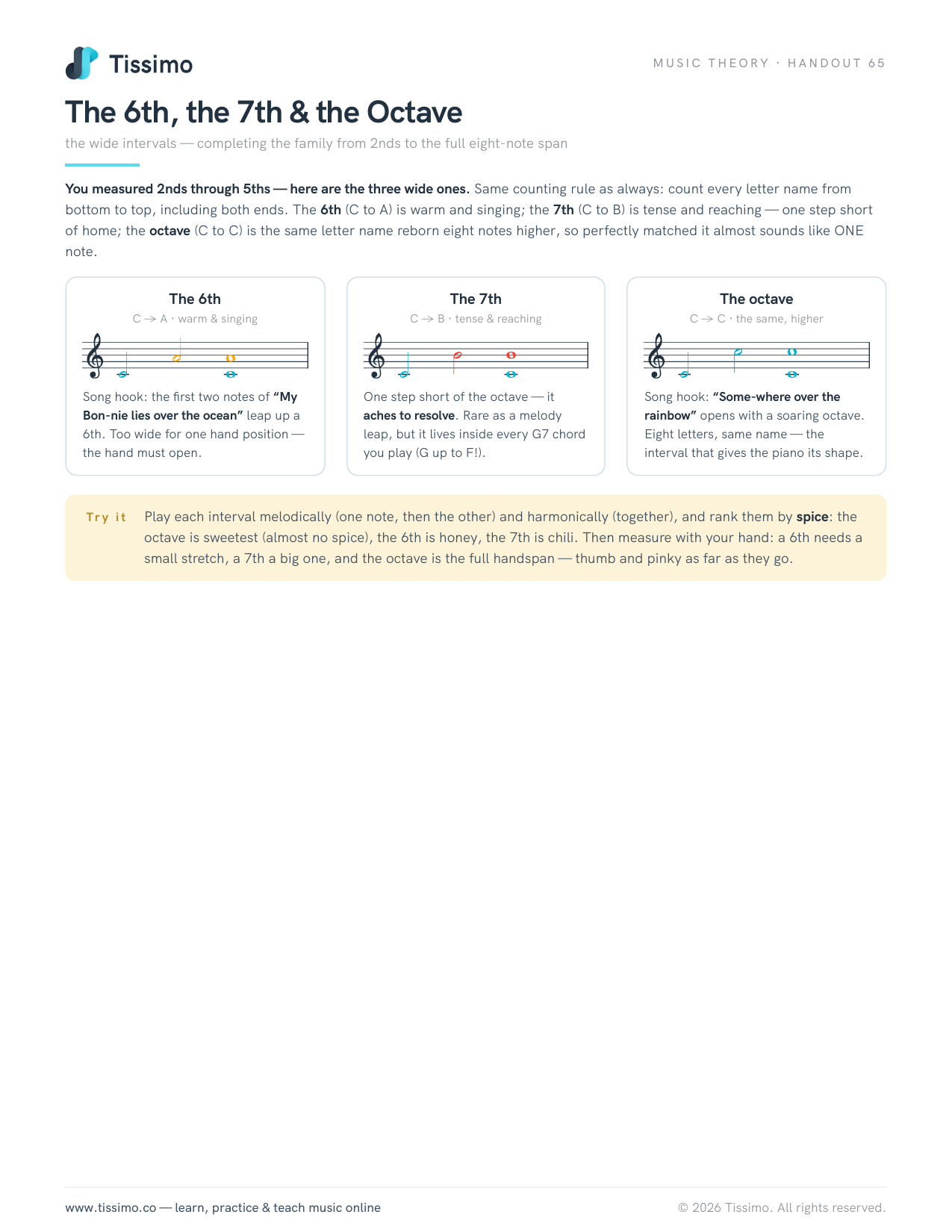
Die Sexte, die Septime & die Oktave
die weiten Intervalle — sie vervollständigen die Familie von der Sekunde bis zum vollen Achttonschritt
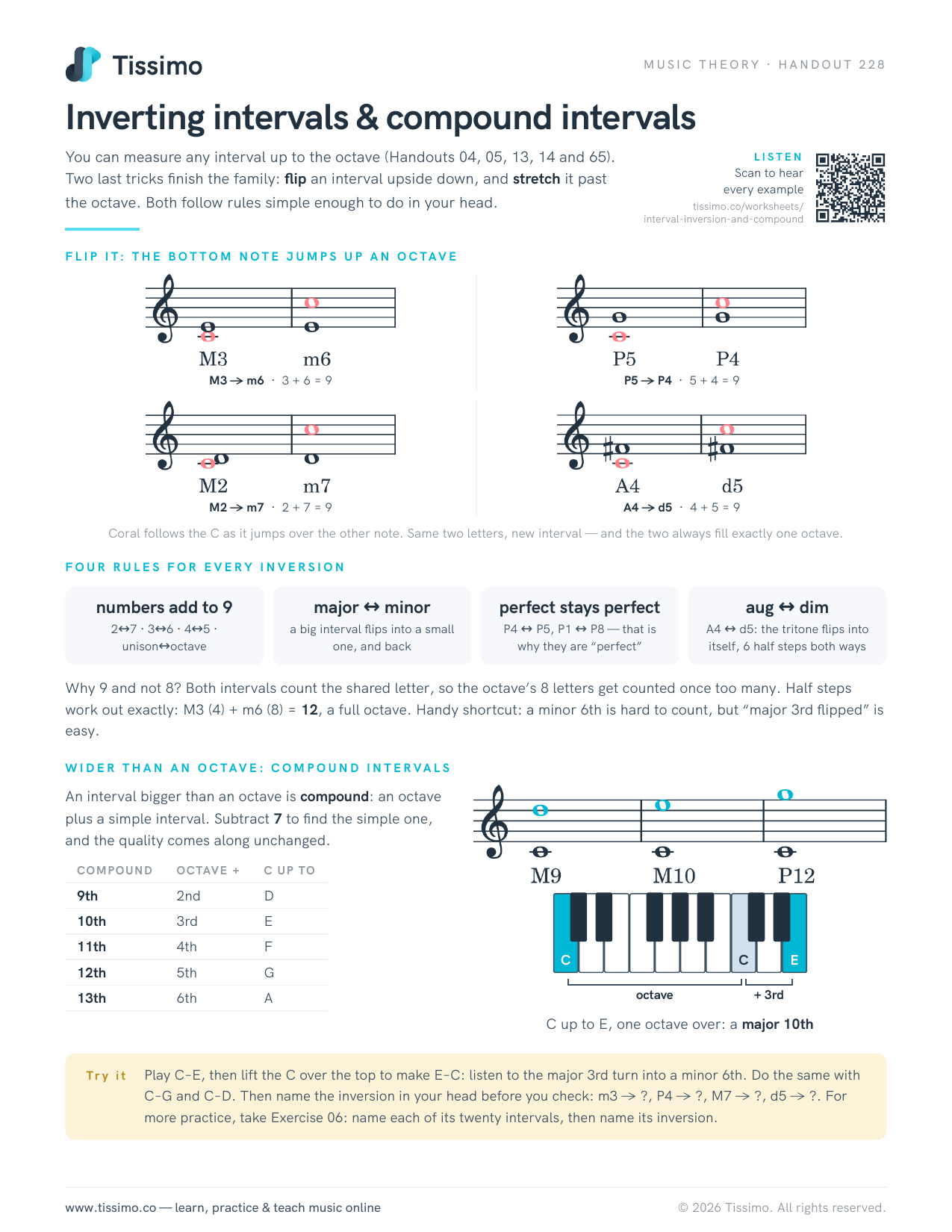
Inverting intervals & compound intervals
You can measure any interval up to the octave (Handouts 04, 05, 13, 14 and 65). Two last tricks finish the family: flip an interval upside down, and stretch it past the octave. Both follow rules simple enough to do in your head.
Tonleitern & Tonarten
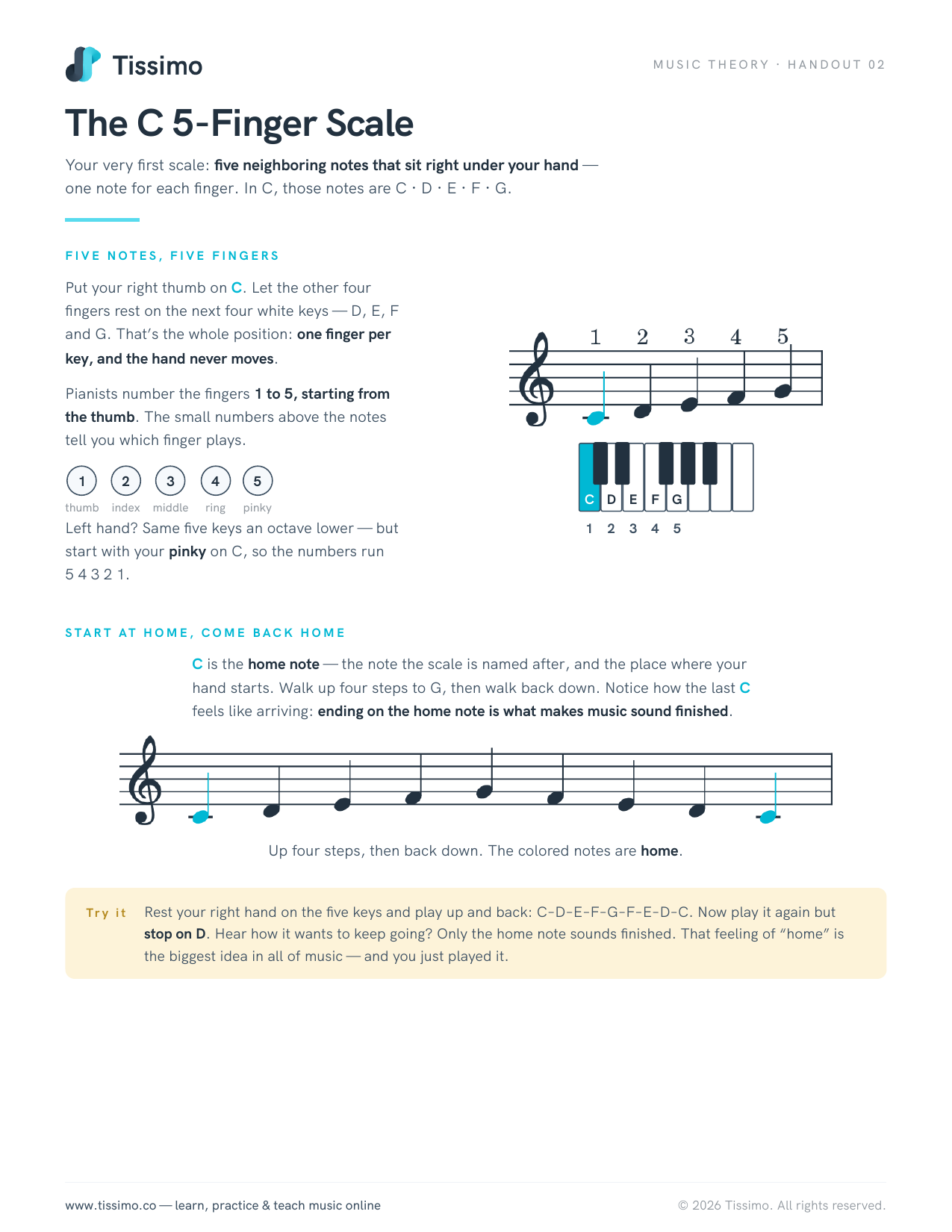
Die C-Fünf-Finger-Tonleiter
Deine allererste Tonleiter: fünf benachbarte Töne, die genau unter deiner Hand liegen — ein Ton pro Finger. In C sind das die Töne C · D · E · F · G.
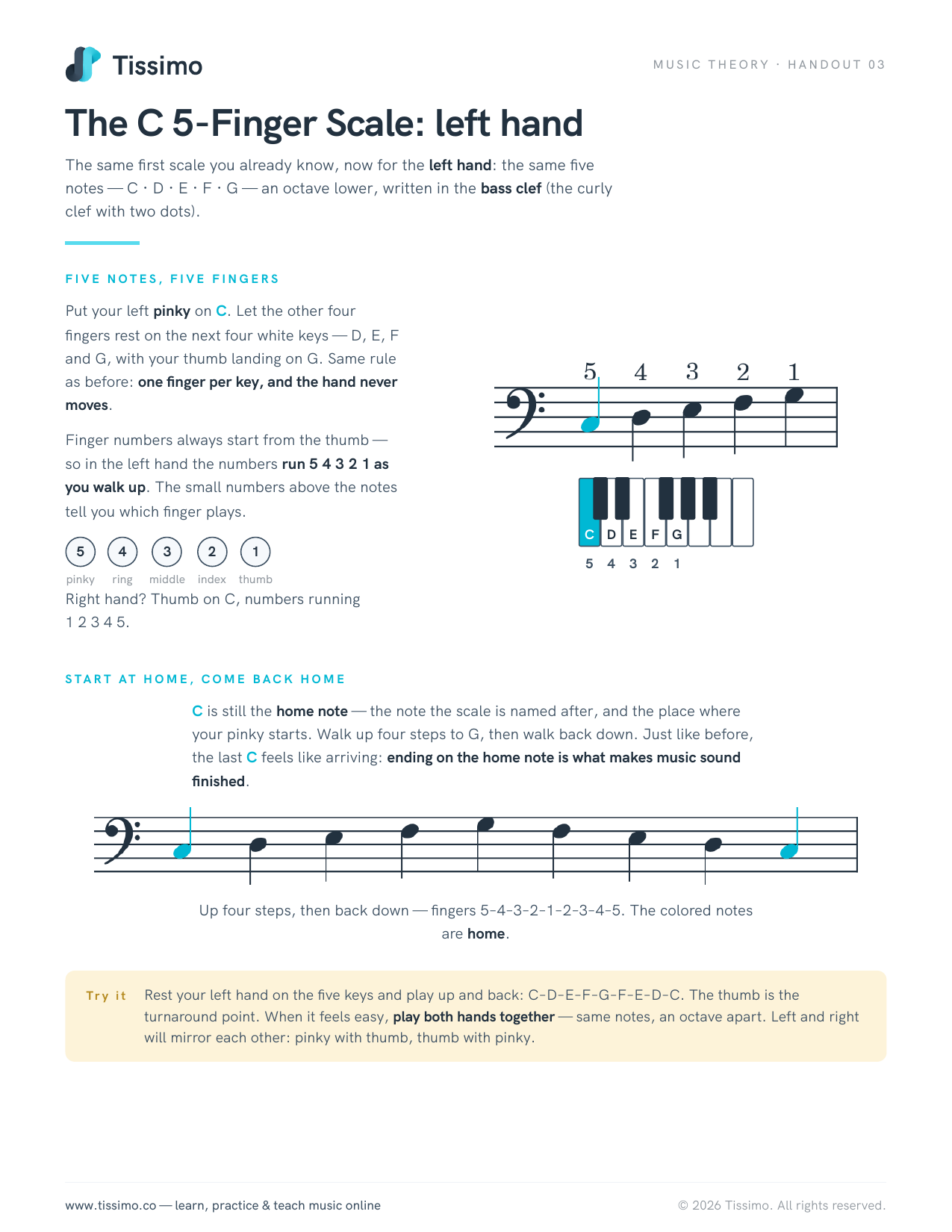
Die C-Fünf-Finger-Tonleiter: linke Hand
Dieselbe erste Tonleiter, die du schon kennst, jetzt für die linke Hand: dieselben fünf Töne — C · D · E · F · G — eine Oktave tiefer, notiert im Bassschlüssel (dem geschwungenen Schlüssel mit den zwei Punkten).
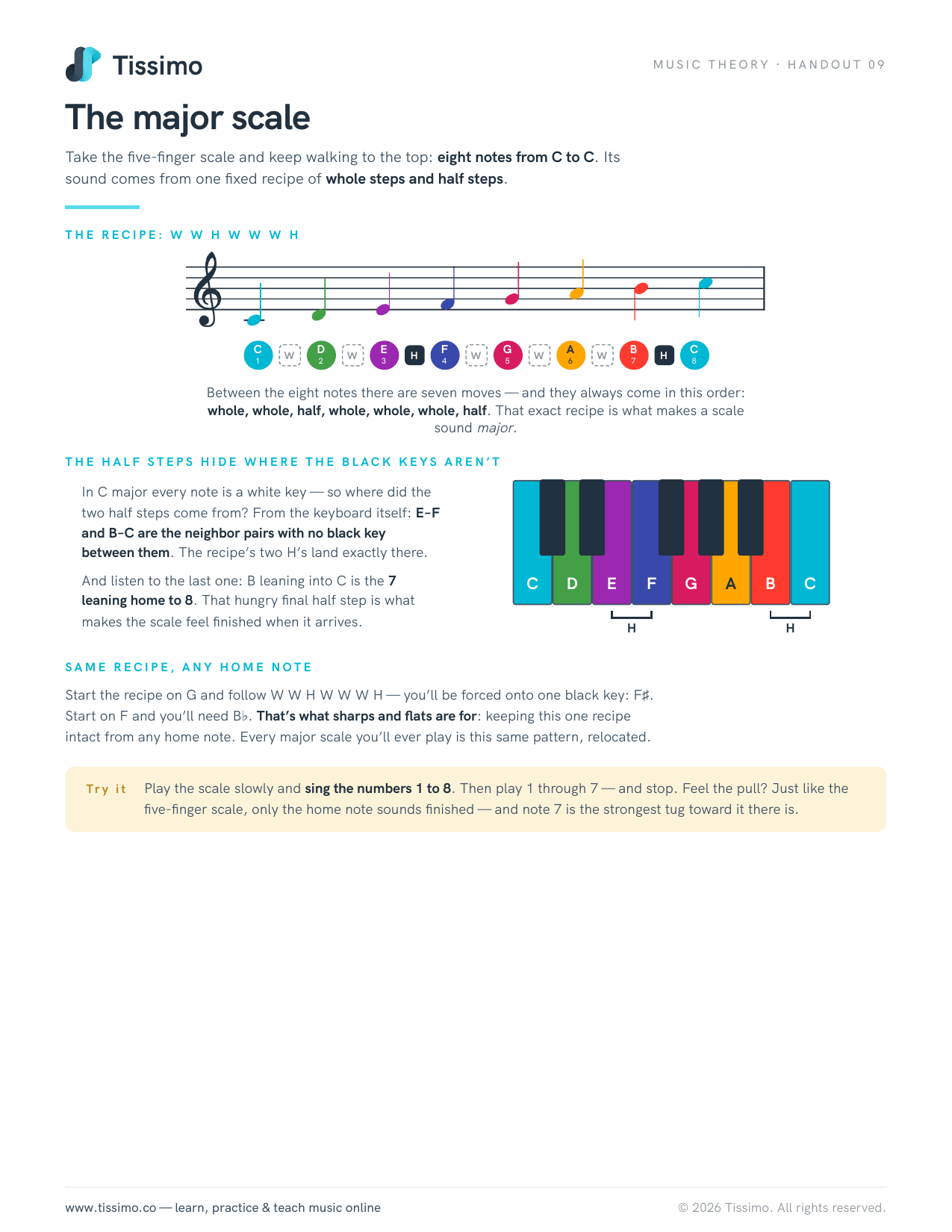
Die Durtonleiter
Nimm die Fünf-Finger-Tonleiter und geh weiter bis nach oben: acht Töne von C zu C. Ihr Klang entsteht aus einem festen Rezept aus Ganz- und Halbtonschritten.
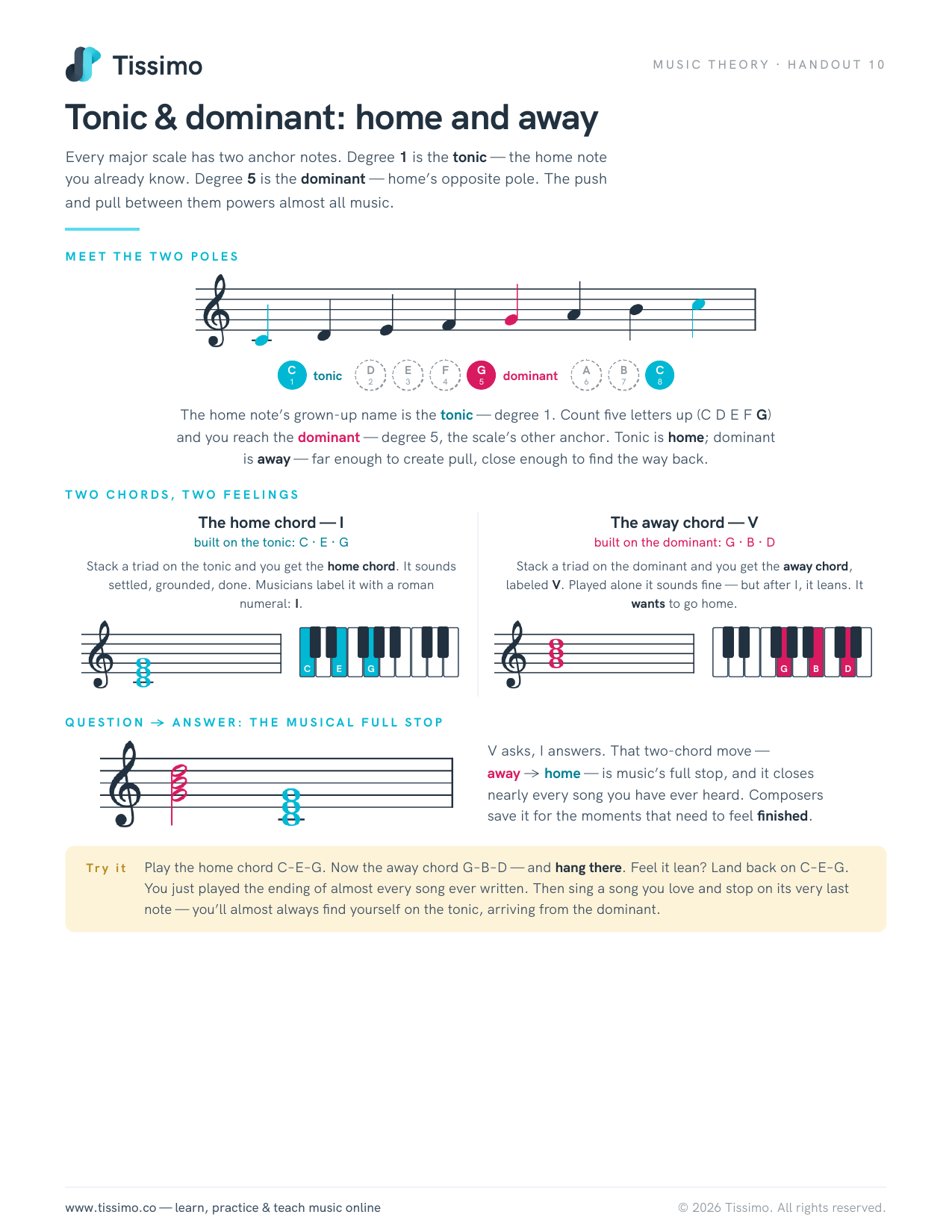
Tonika & Dominante: Zuhause und Fremde
Jede Durtonleiter hat zwei Ankertöne. Stufe 1 ist die Tonika — der Grundton, den du schon kennst. Stufe 5 ist die Dominante — der Gegenpol zum Zuhause. Das Hin und Her zwischen beiden treibt fast die gesamte Musik an.
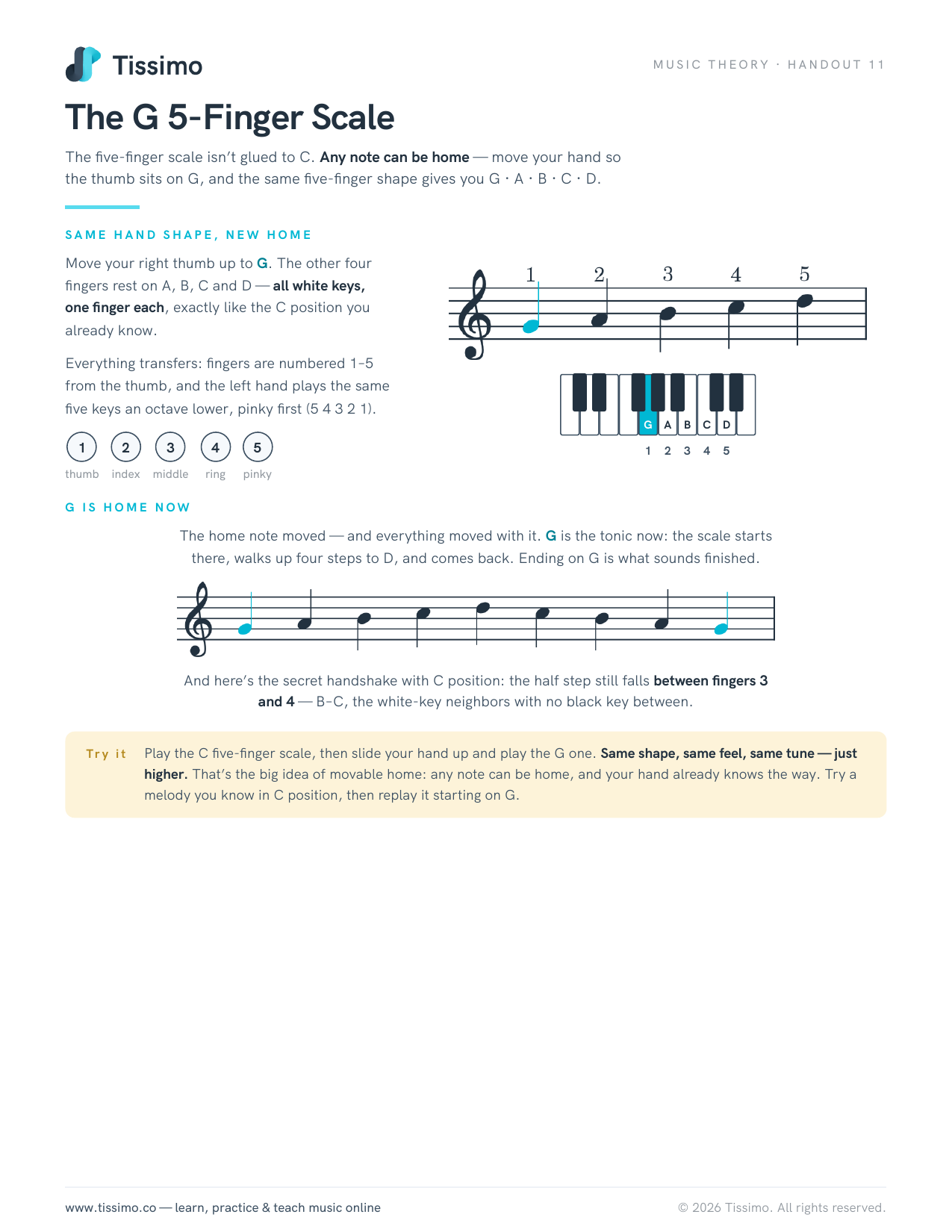
Die G-Fünf-Finger-Tonleiter
Die Fünf-Finger-Tonleiter ist nicht an C gebunden. Jede Note kann Zuhause sein — verschiebe deine Hand, sodass der Daumen auf G liegt, und dieselbe Fünf-Finger-Form ergibt dir G · A · H · C · D.
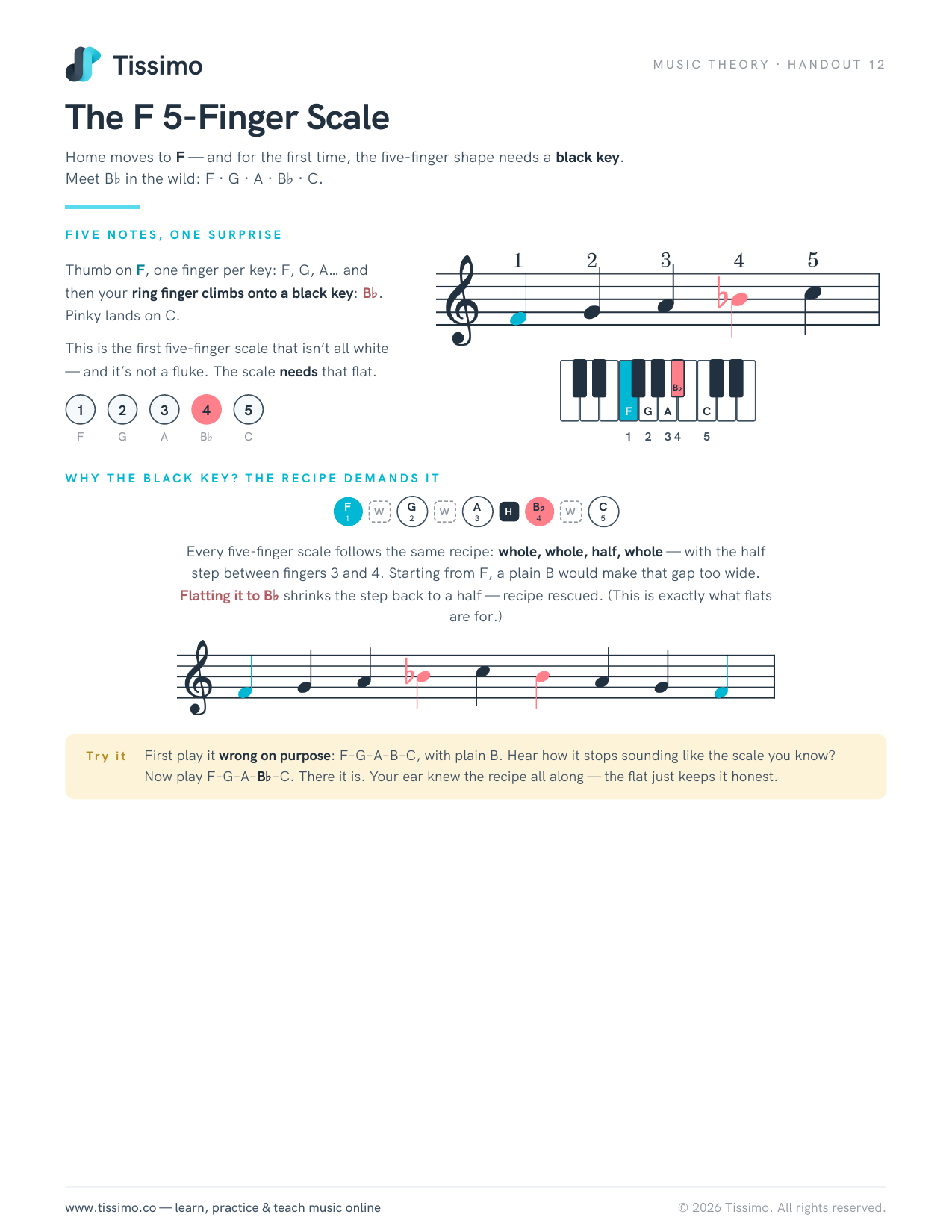
Die F-Fünf-Finger-Tonleiter
Zuhause zieht nach F um — und zum ersten Mal braucht die Fünf-Finger-Form eine schwarze Taste. Begegnung mit dem B in freier Wildbahn: F · G · A · B · C.
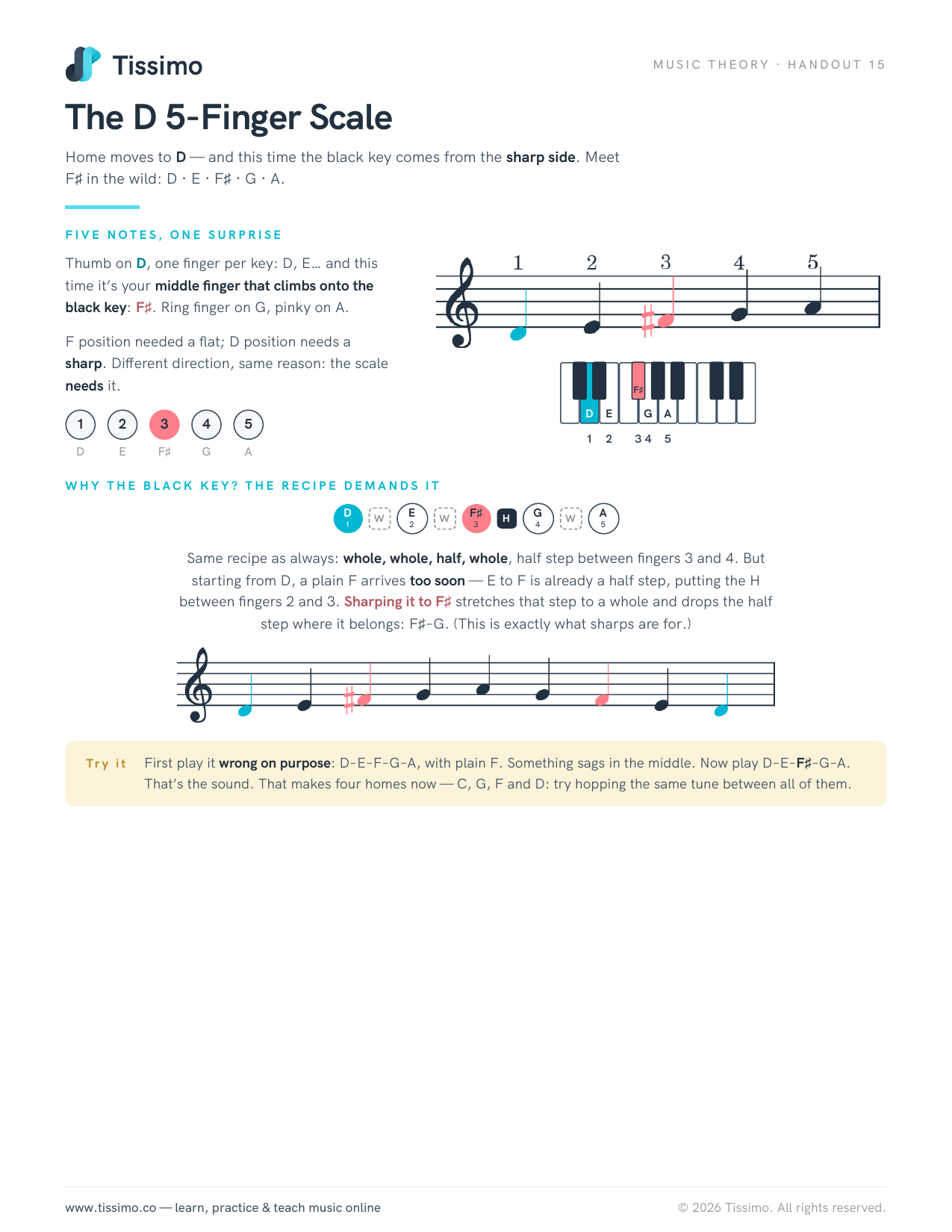
Die D-Fünf-Finger-Tonleiter
Zuhause zieht nach D um — und diesmal kommt die schwarze Taste von der Kreuz-Seite. Begegnung mit dem Fis in freier Wildbahn: D · E · Fis · G · A.
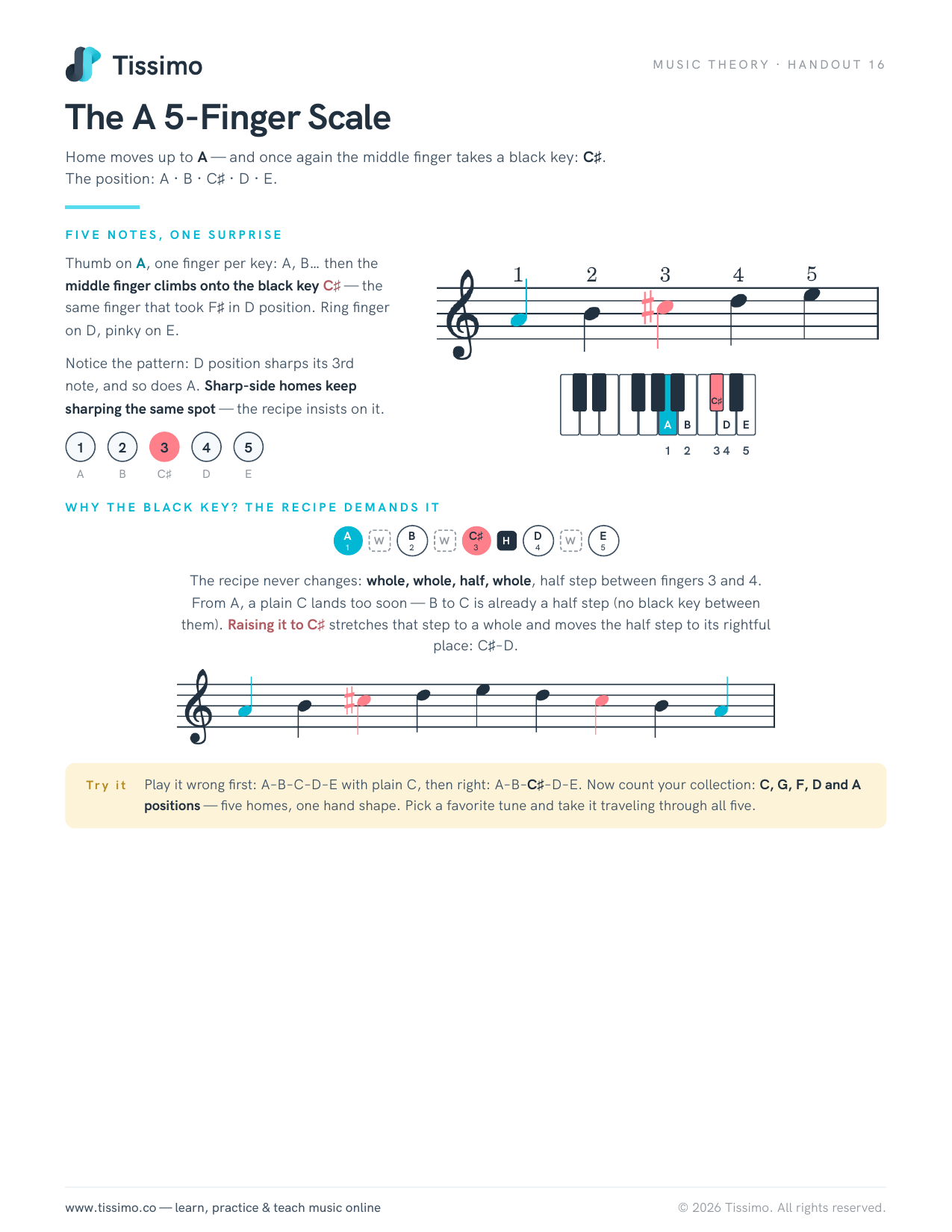
Die A-Fünf-Finger-Tonleiter
Zuhause zieht hinauf nach A — und wieder übernimmt der Mittelfinger eine schwarze Taste: Cis. Die Lage: A · H · Cis · D · E.
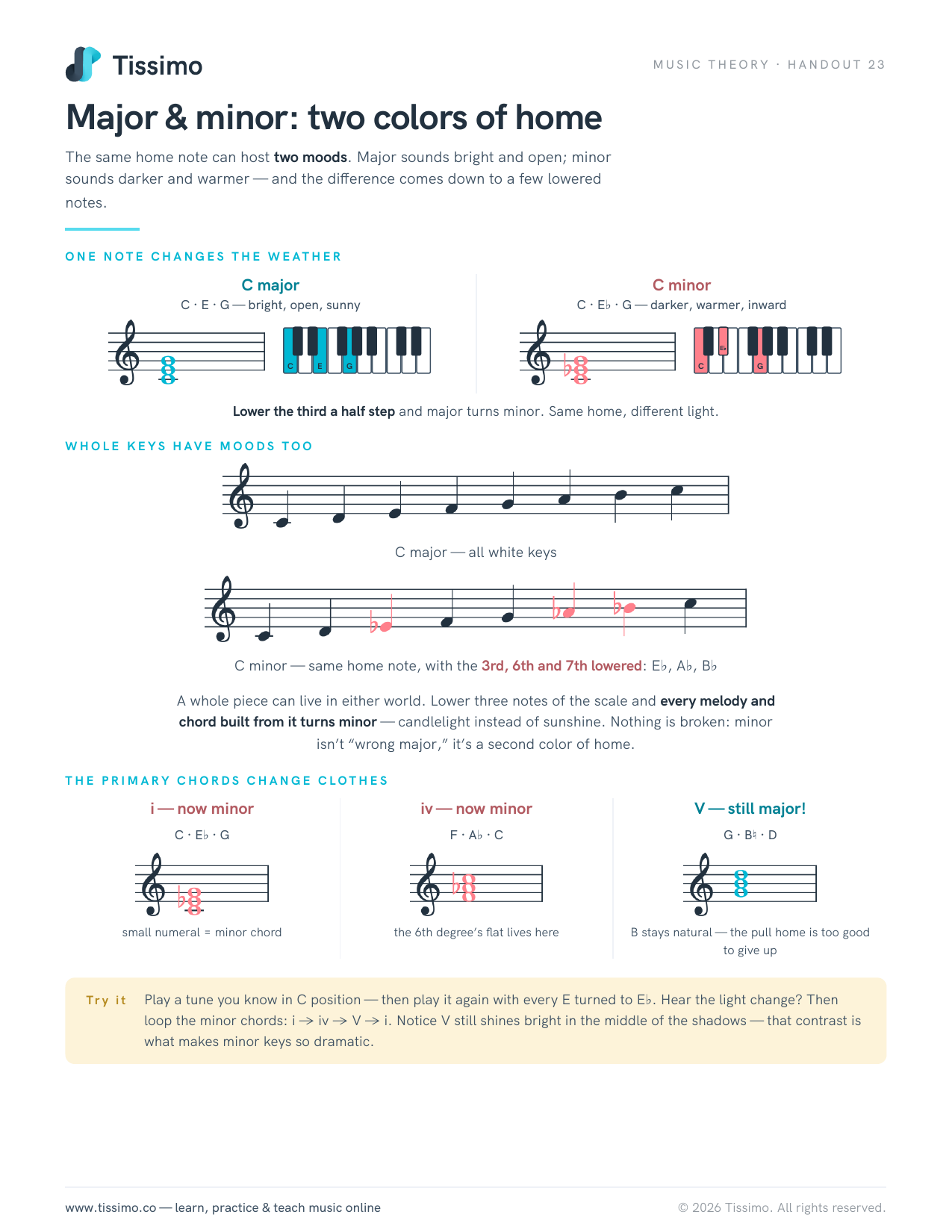
Dur & Moll: zwei Farben desselben Zuhauses
Derselbe Grundton kann zwei Stimmungen tragen. Dur klingt hell und offen; Moll klingt dunkler und wärmer — und der Unterschied liegt an ein paar erniedrigten Tönen.
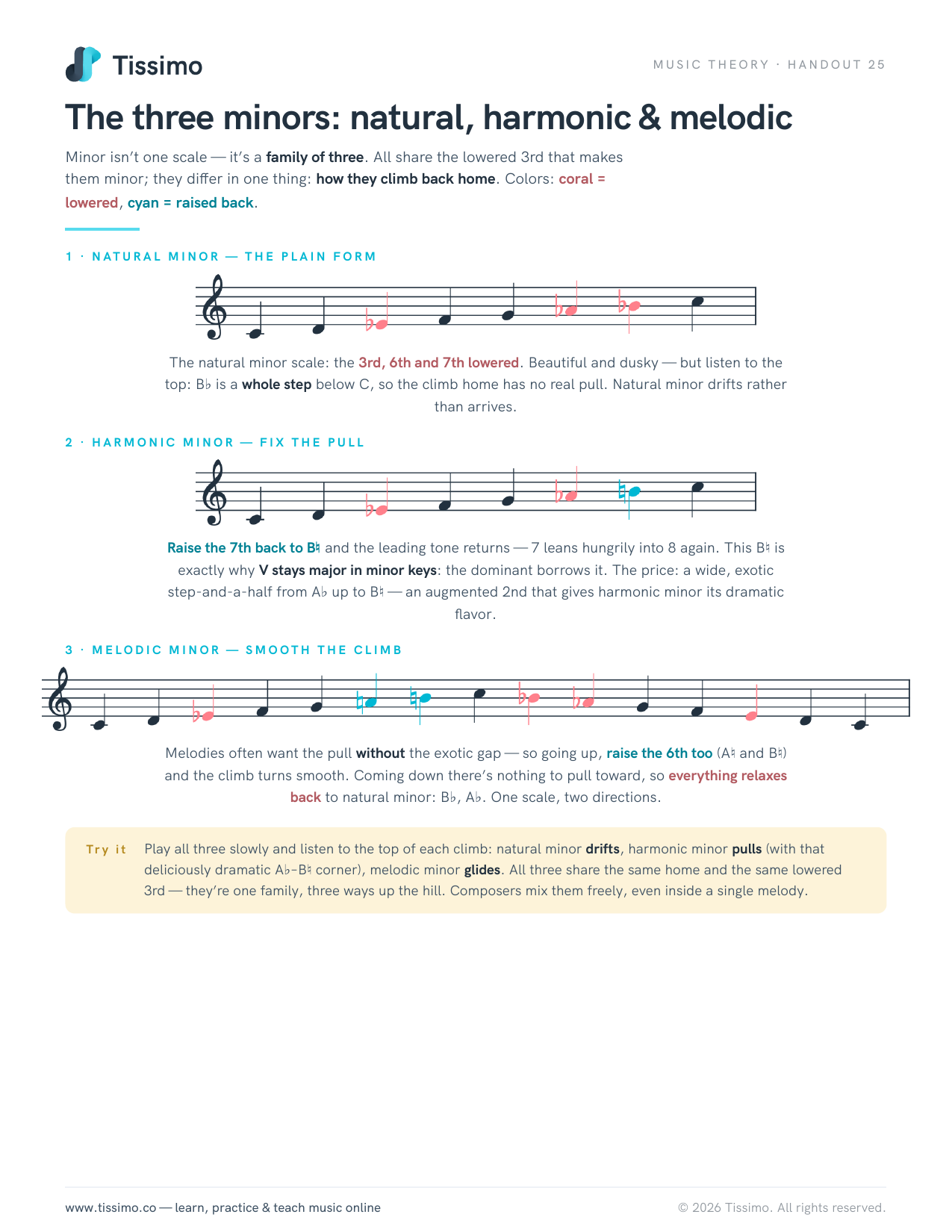
Die drei Molltonleitern: natürlich, harmonisch & melodisch
Moll ist keine einzelne Tonleiter — es ist eine Familie von dreien. Alle teilen die erniedrigte Terz, die sie zu Moll macht; sie unterscheiden sich in einem: wie sie zurück nach Hause steigen. Farben: Koralle = erniedrigt, Cyan = wieder erhöht.
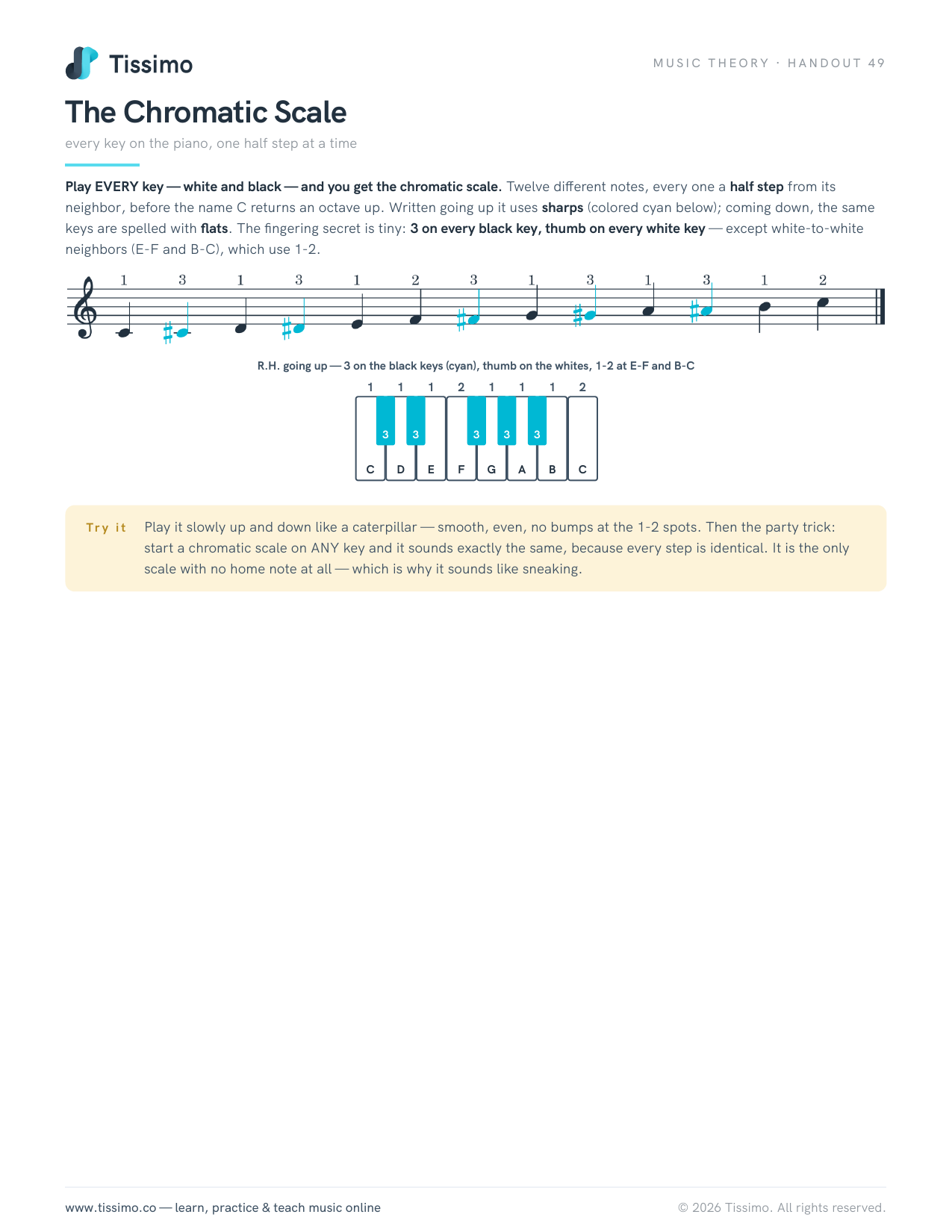
Die chromatische Tonleiter
jede Taste des Klaviers, ein Halbton nach dem anderen
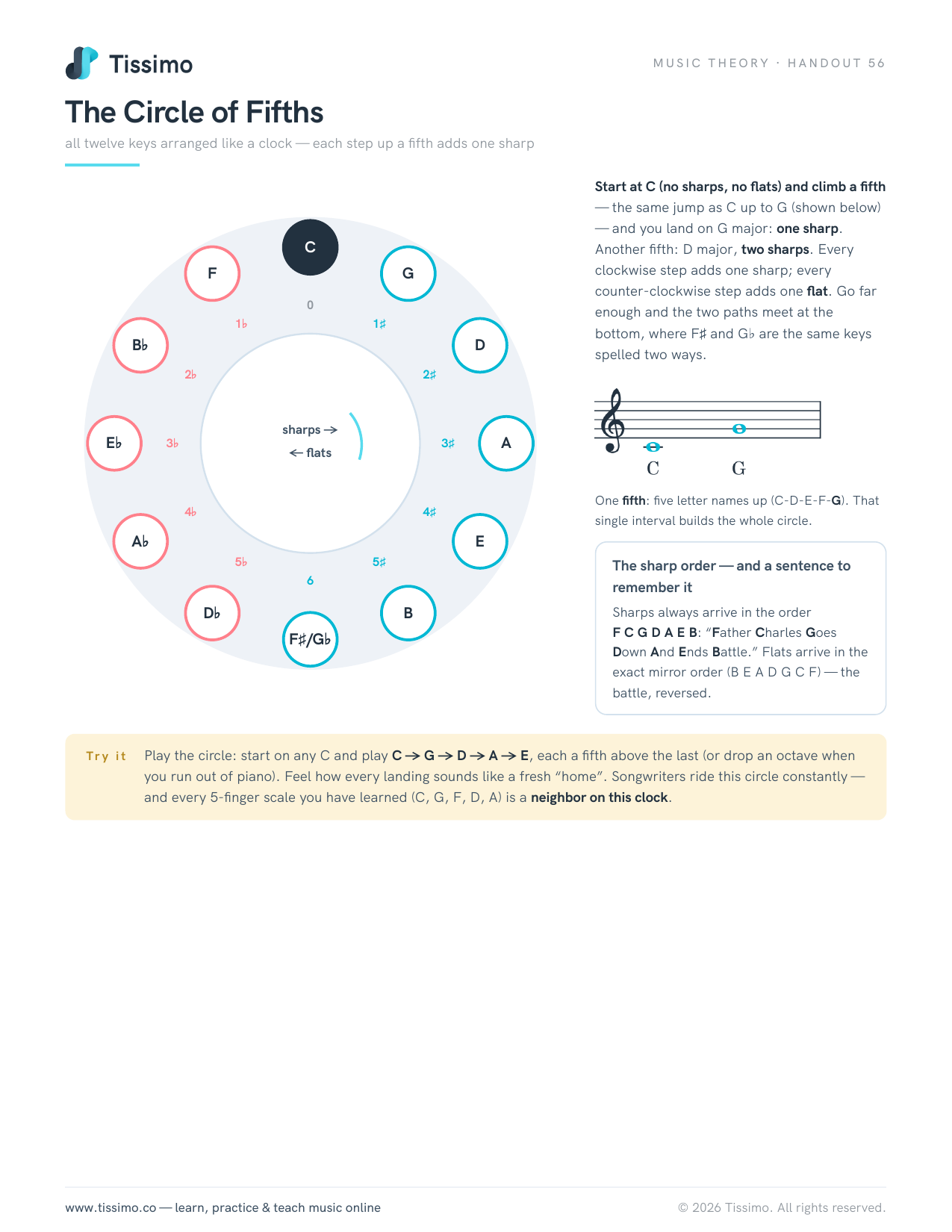
Der Quintenzirkel
alle zwölf Tonarten wie eine Uhr angeordnet — jeder Schritt um eine Quinte nach oben fügt ein Kreuz hinzu
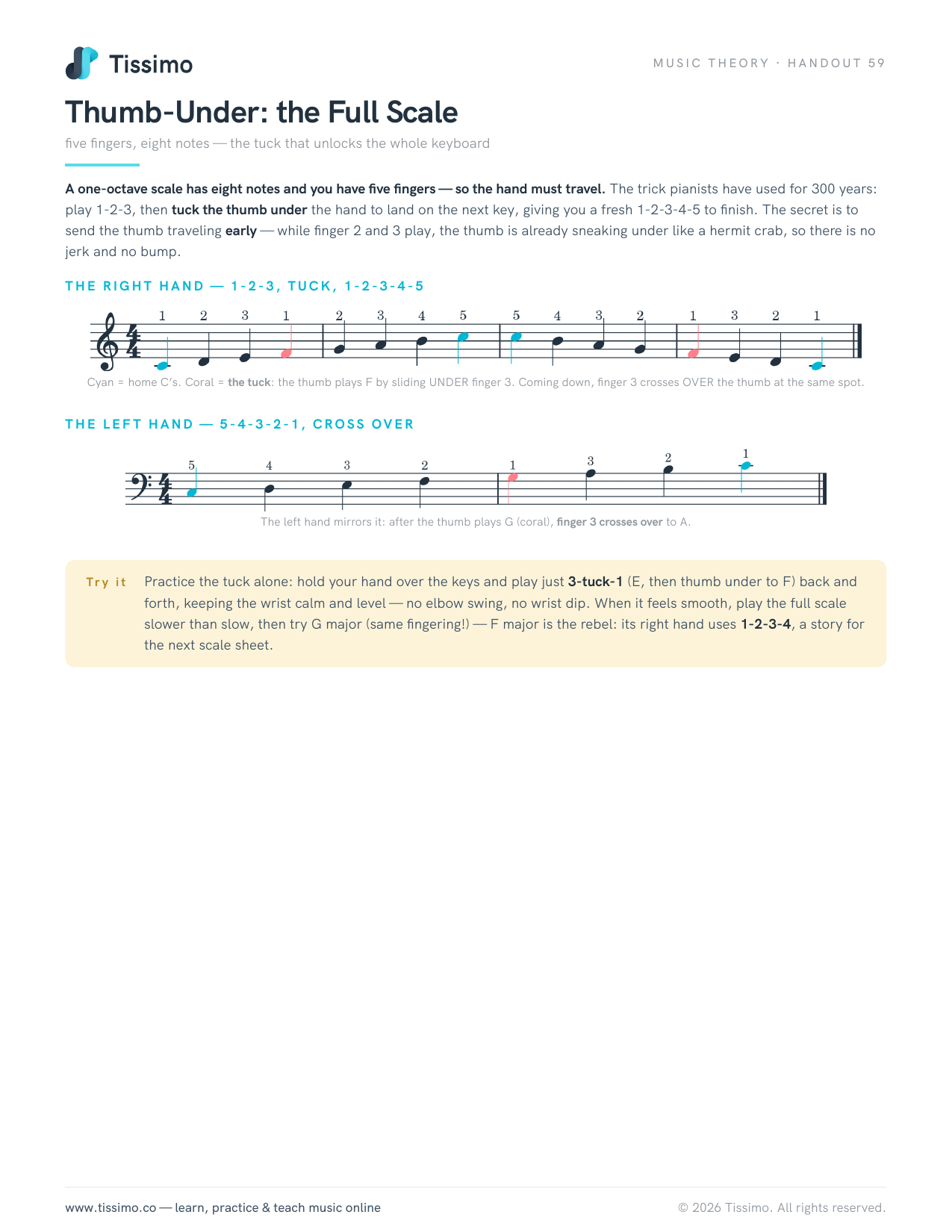
Daumenuntersatz: die vollständige Tonleiter
fünf Finger, acht Töne — der Untersatz, der die ganze Tastatur erschließt
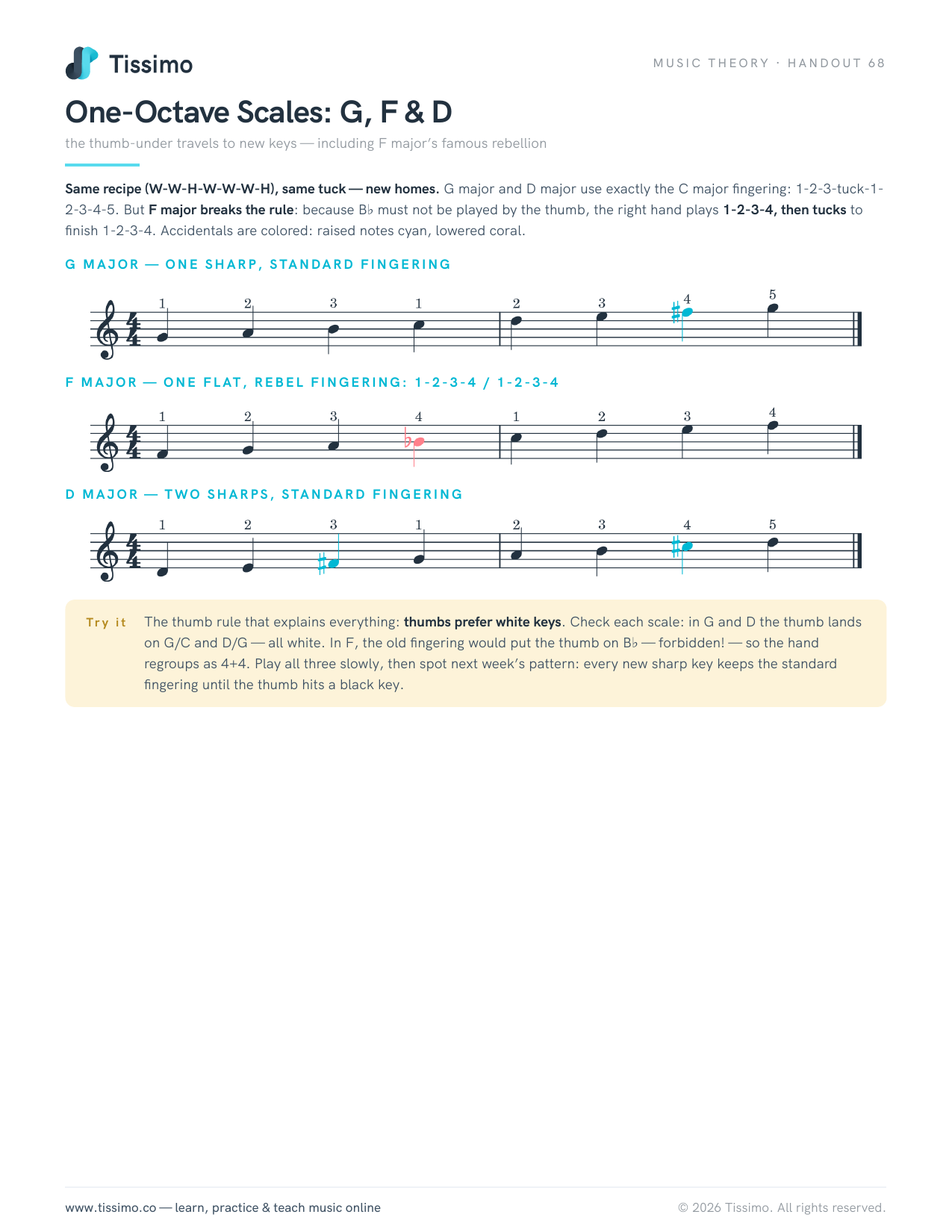
Einoktavige Tonleitern: G, F & D
der Daumenuntersatz reist zu neuen Tonarten — einschließlich der berühmten Rebellion von F-Dur
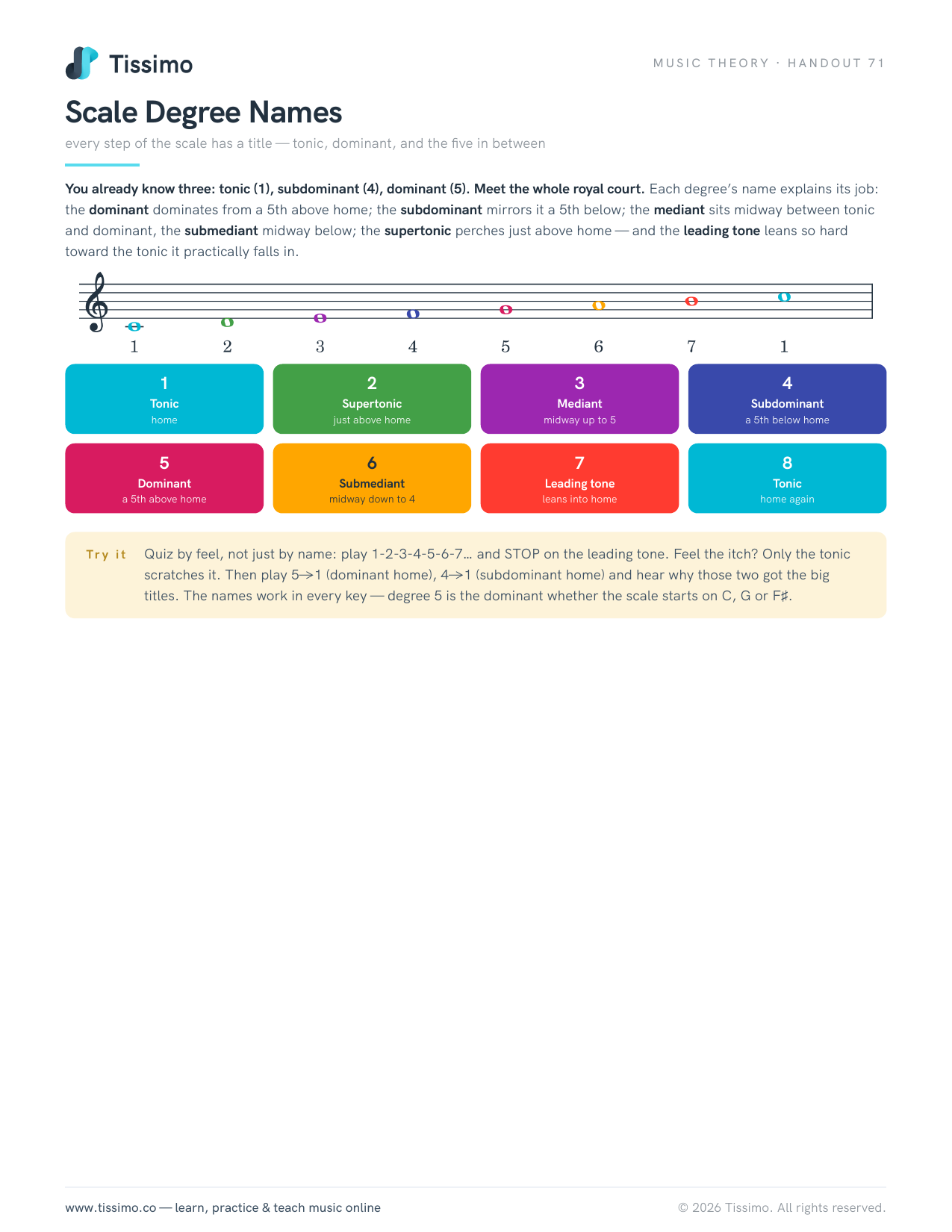
Namen der Tonleiterstufen
jede Stufe der Tonleiter hat einen Titel — Tonika, Dominante, und die fünf dazwischen
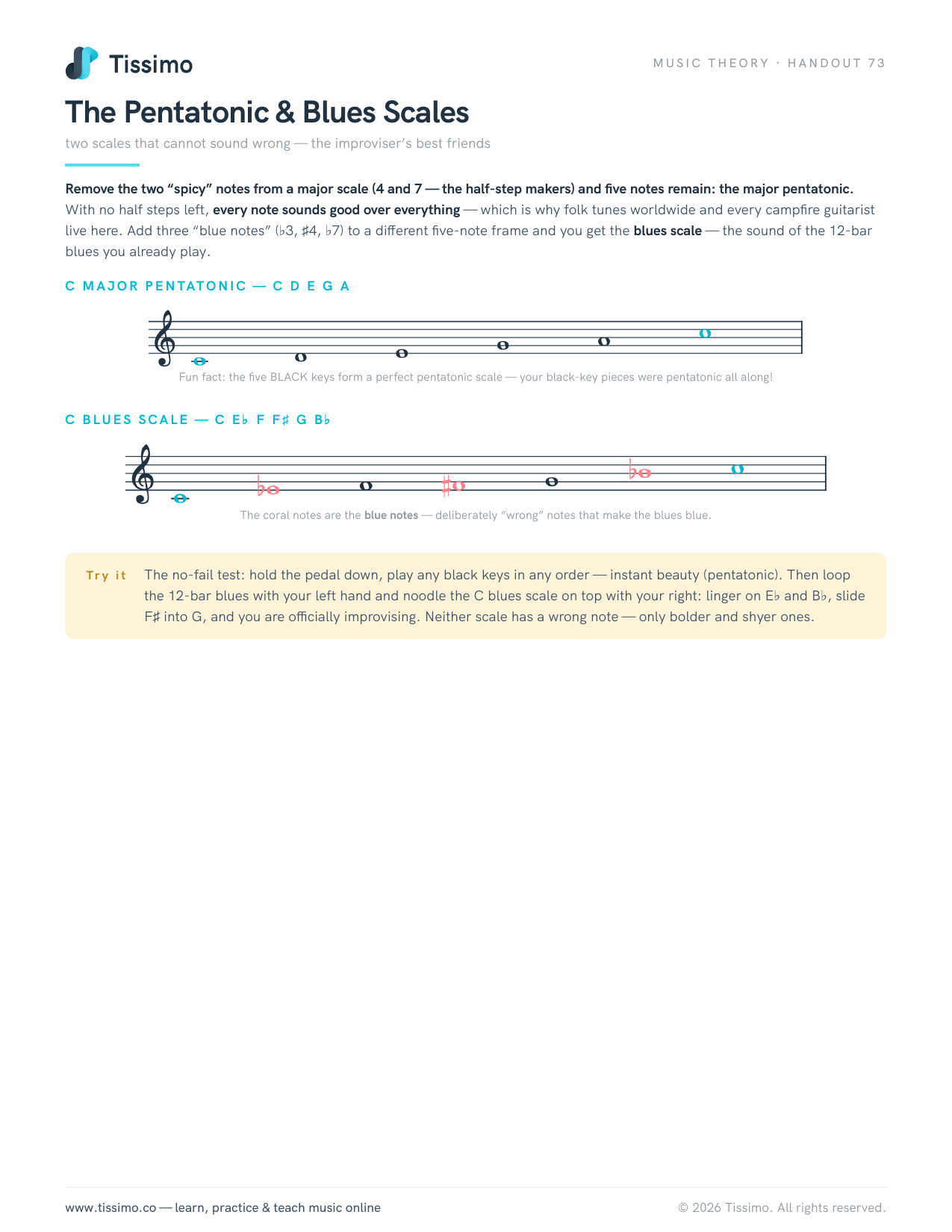
Die pentatonische Skala & die Blues-Skala
zwei Tonleitern, die einfach nicht falsch klingen können — die besten Freunde des Improvisierenden
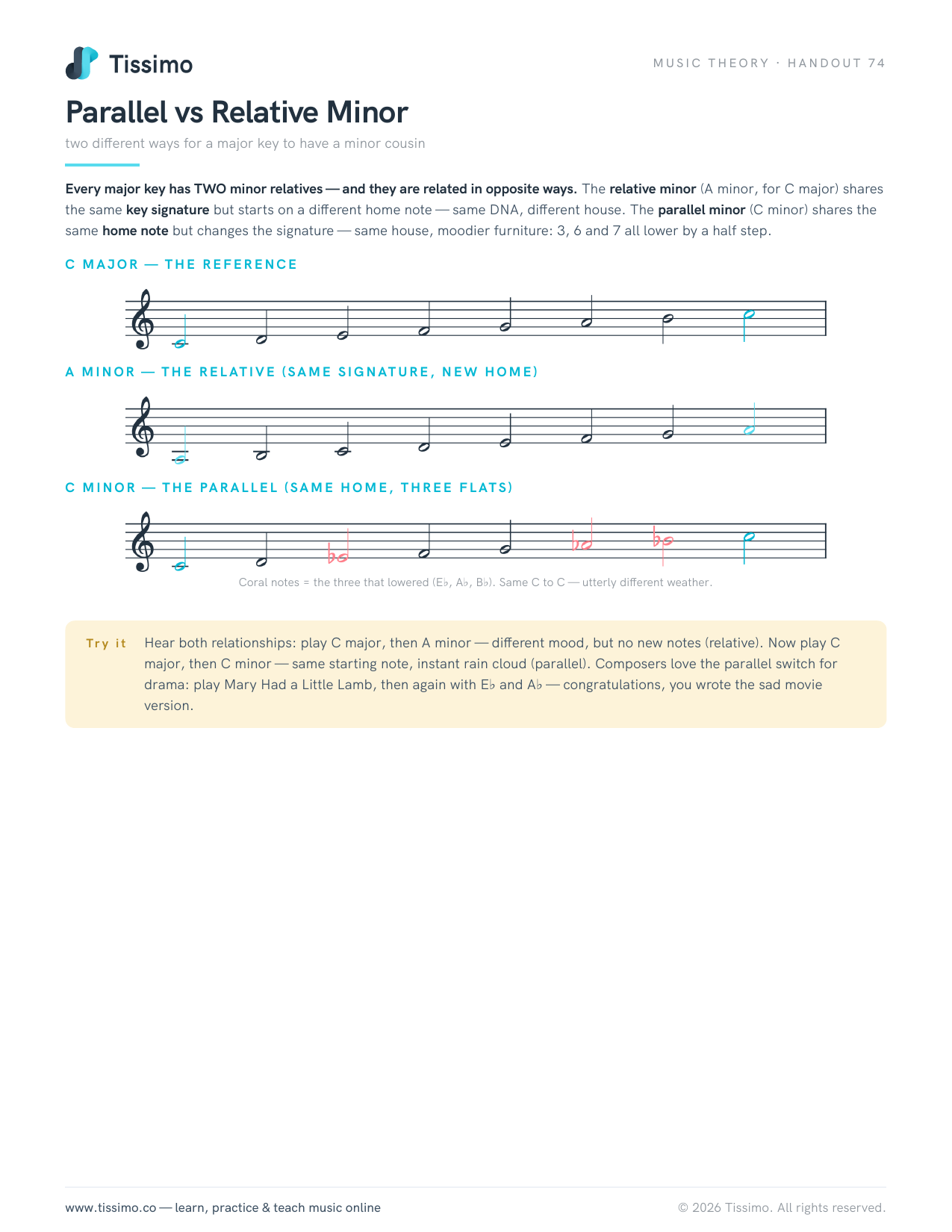
Paralleltonart vs. Varianttonart (Moll)
zwei verschiedene Arten, wie eine Durtonart einen Moll-Verwandten haben kann
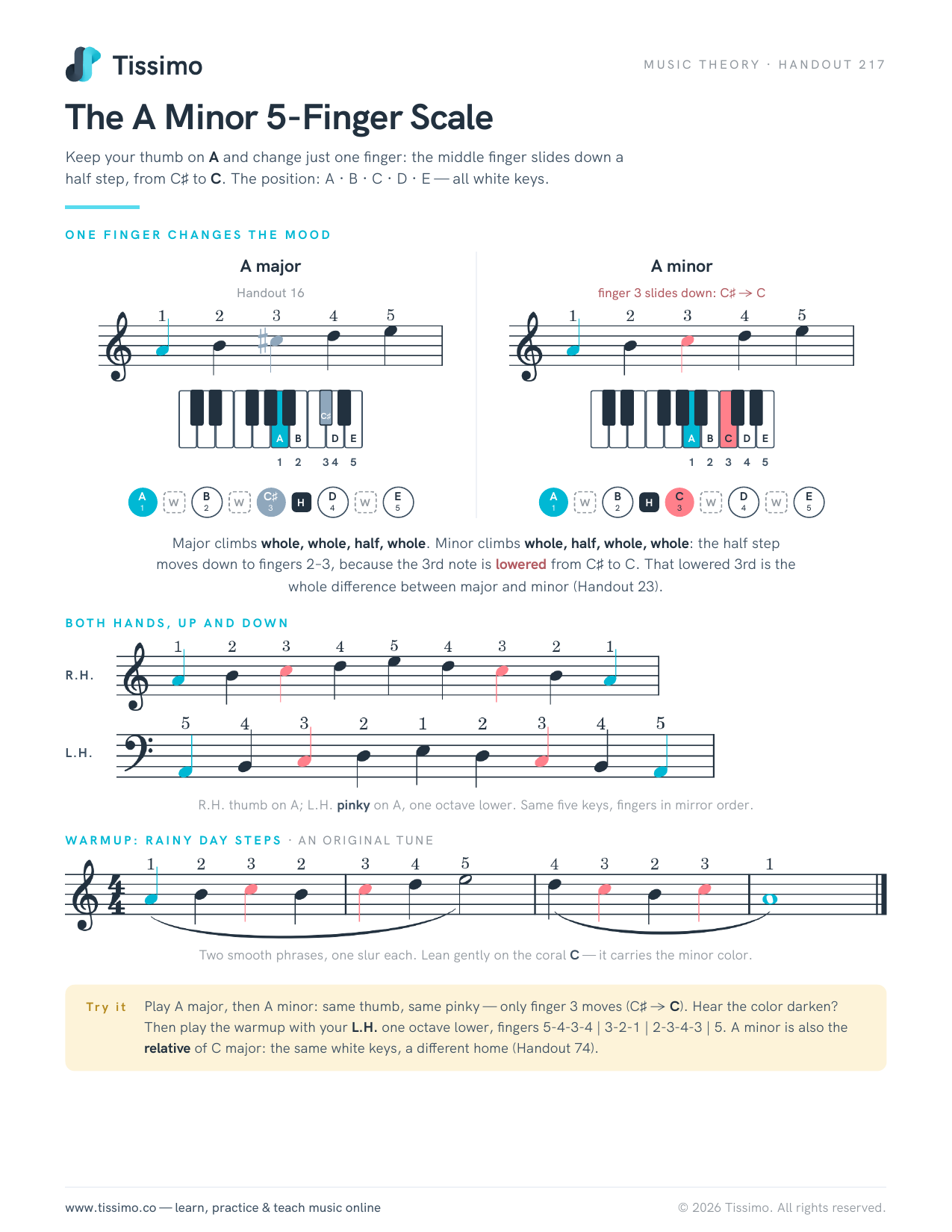
The A Minor 5-Finger Scale
Keep your thumb on A and change just one finger: the middle finger slides down a half step, from C♯ to C. The position: A · B · C · D · E — all white keys.
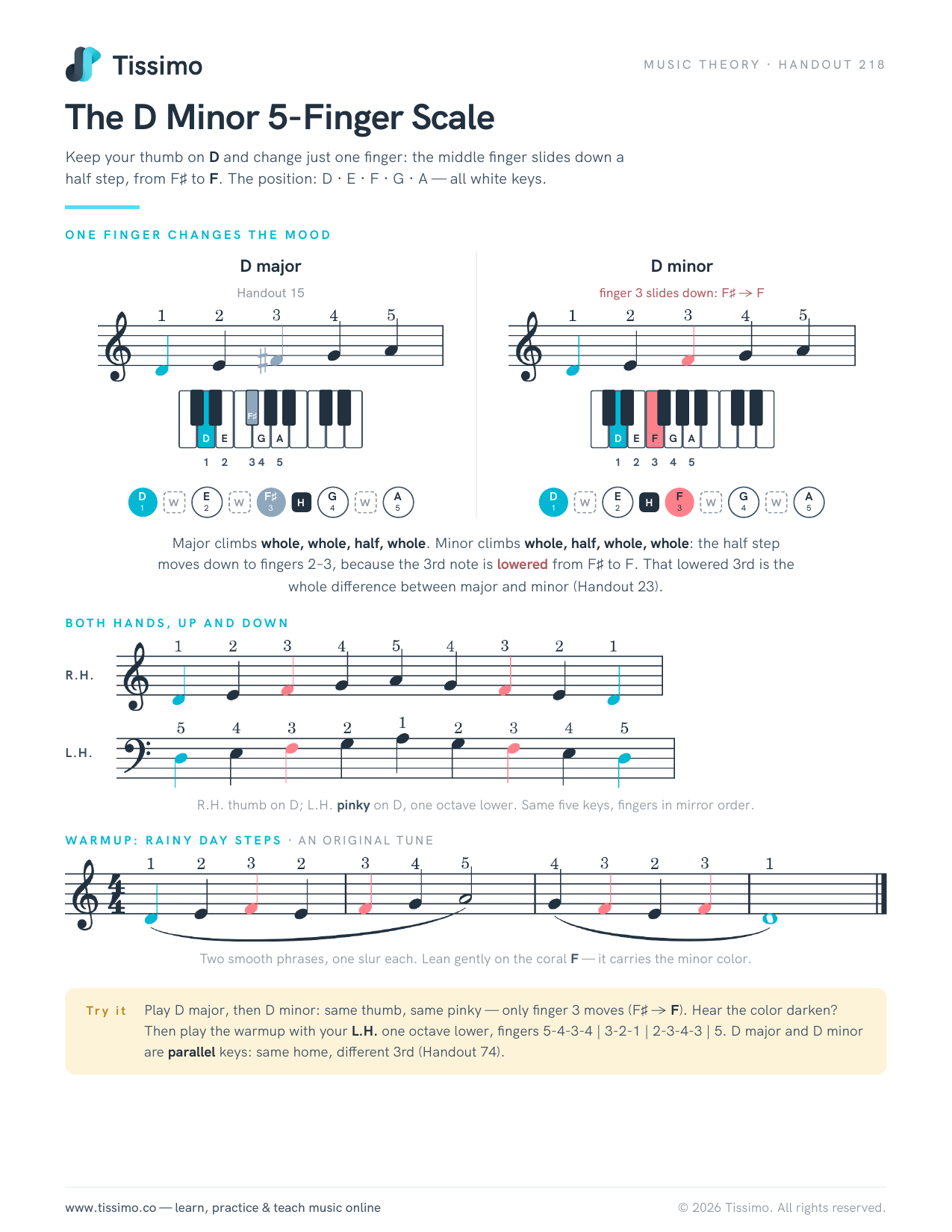
The D Minor 5-Finger Scale
Keep your thumb on D and change just one finger: the middle finger slides down a half step, from F♯ to F. The position: D · E · F · G · A — all white keys.
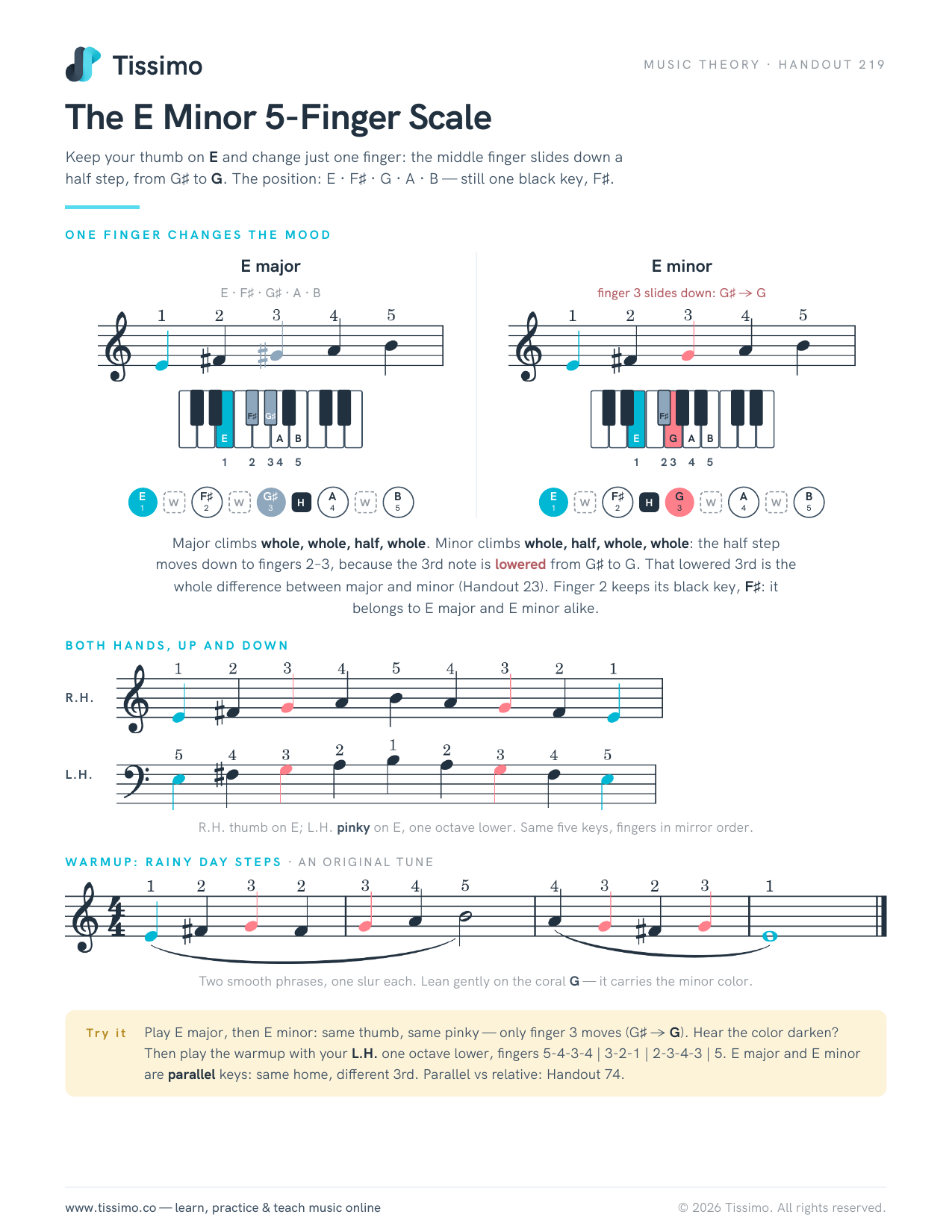
The E Minor 5-Finger Scale
Keep your thumb on E and change just one finger: the middle finger slides down a half step, from G♯ to G. The position: E · F♯ · G · A · B — still one black key, F♯.
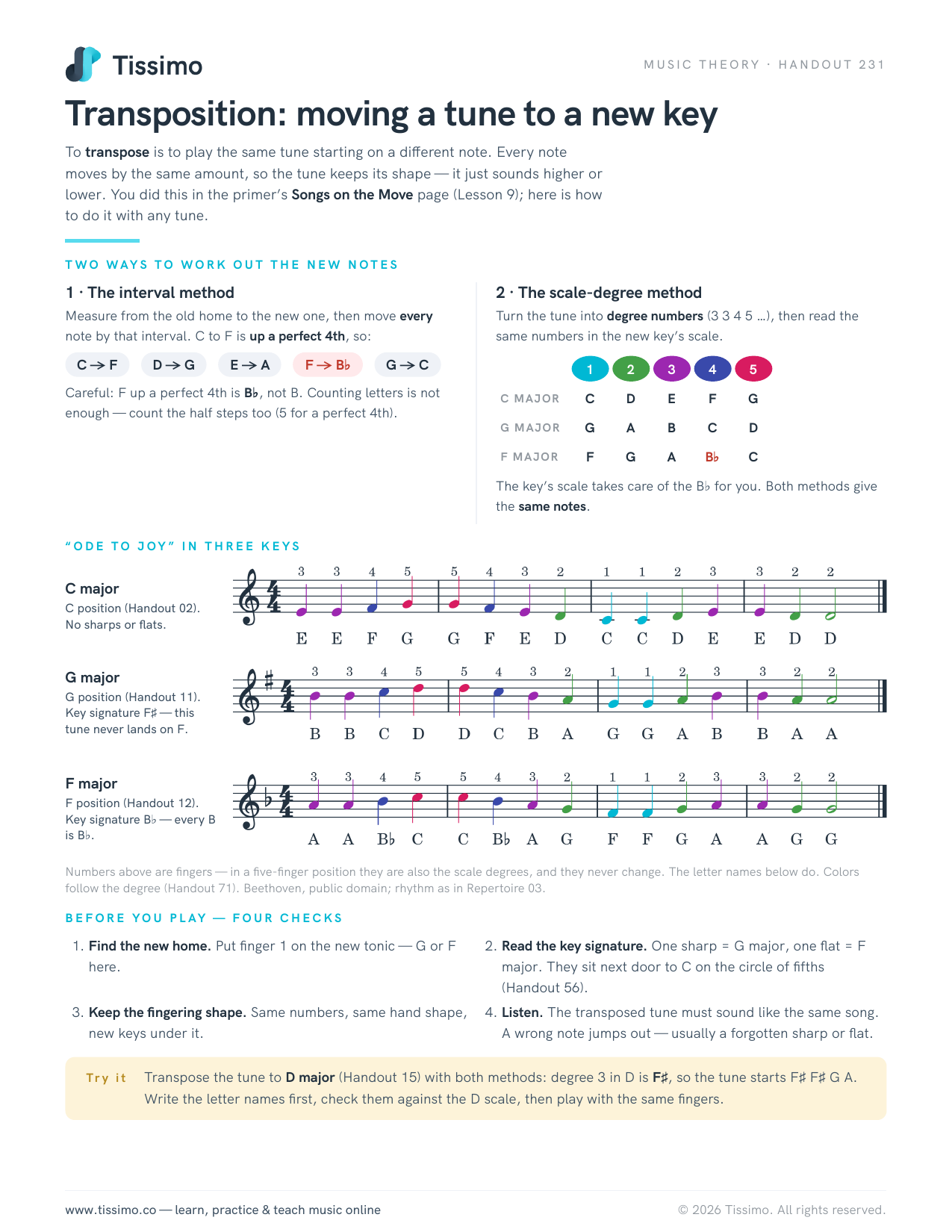
Transposition: moving a tune to a new key
To transpose is to play the same tune starting on a different note. Every note moves by the same amount, so the tune keeps its shape — it just sounds higher or lower. You did this in the primer’s Songs on the Move page (Lesson 9); here is how to do it with any tune.
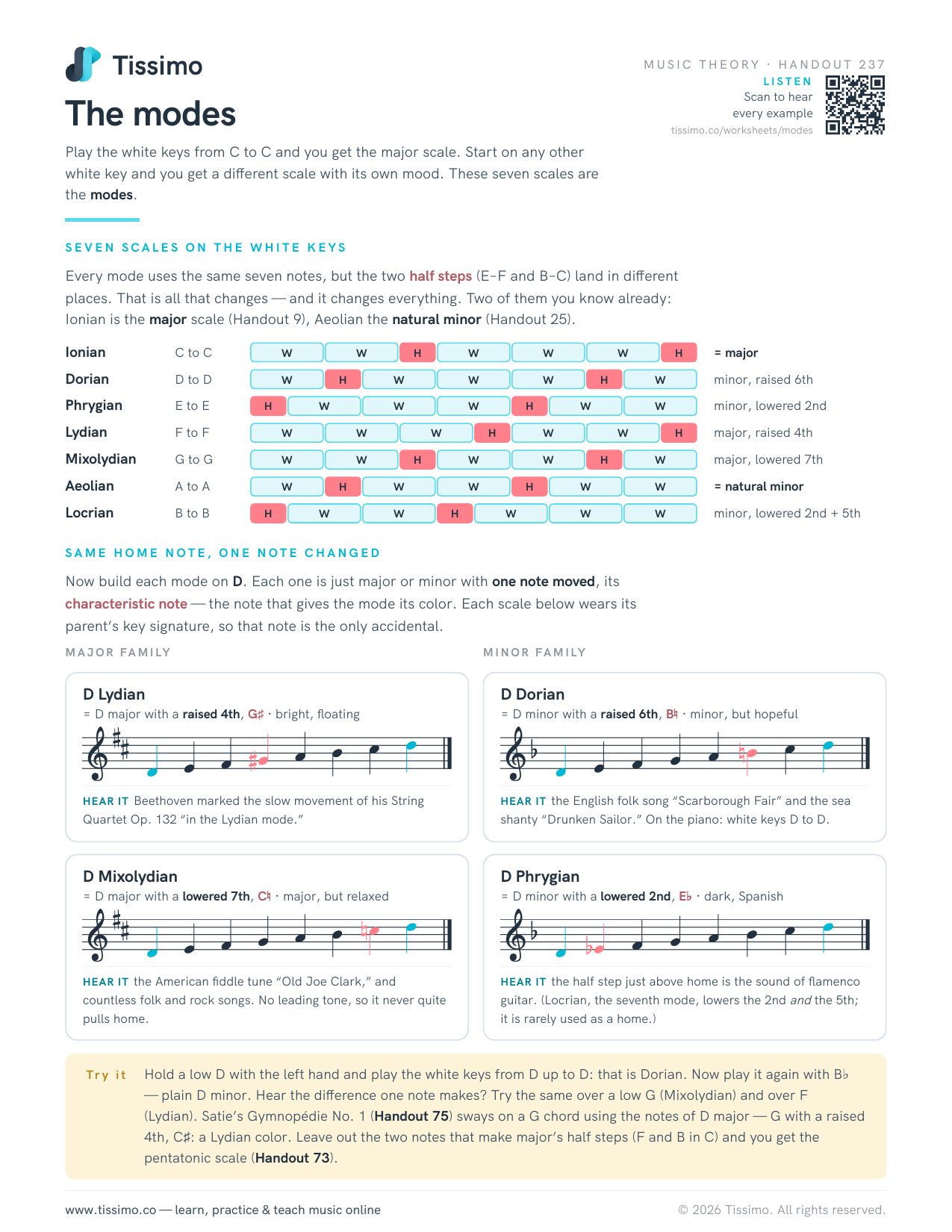
The modes
Play the white keys from C to C and you get the major scale. Start on any other white key and you get a different scale with its own mood. These seven scales are the modes.
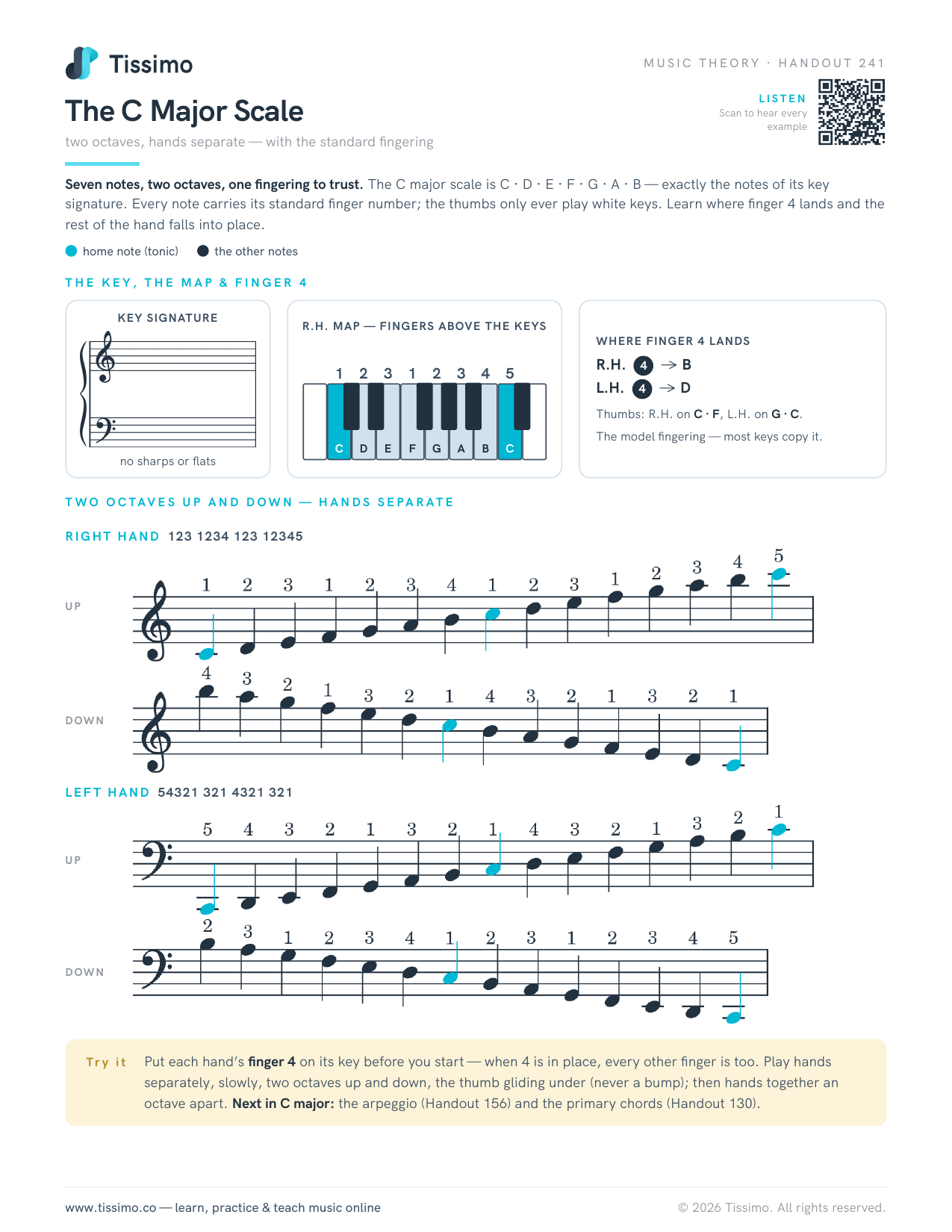
Scales in Every Key
Two octaves up and down with the standard fingering on every note, in all 24 keys.
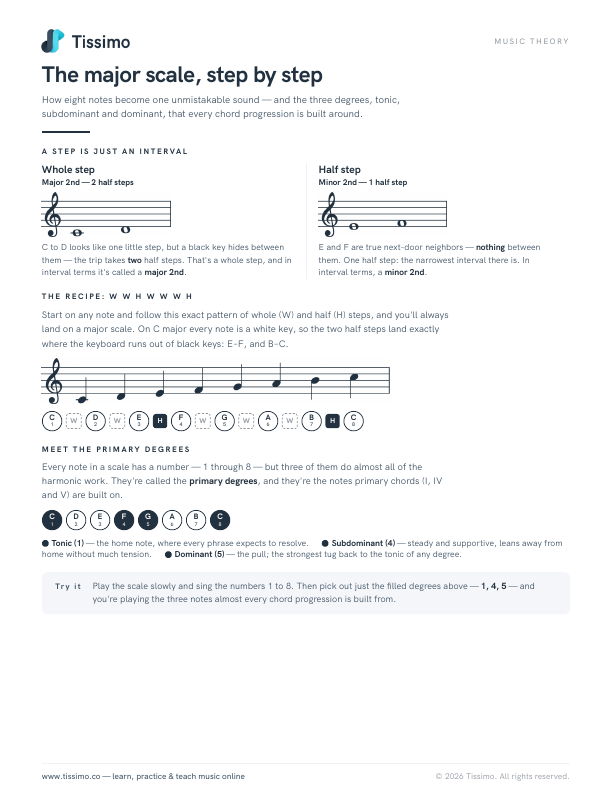
Einführung in die Durtonleiter
Akkorde & Harmonielehre
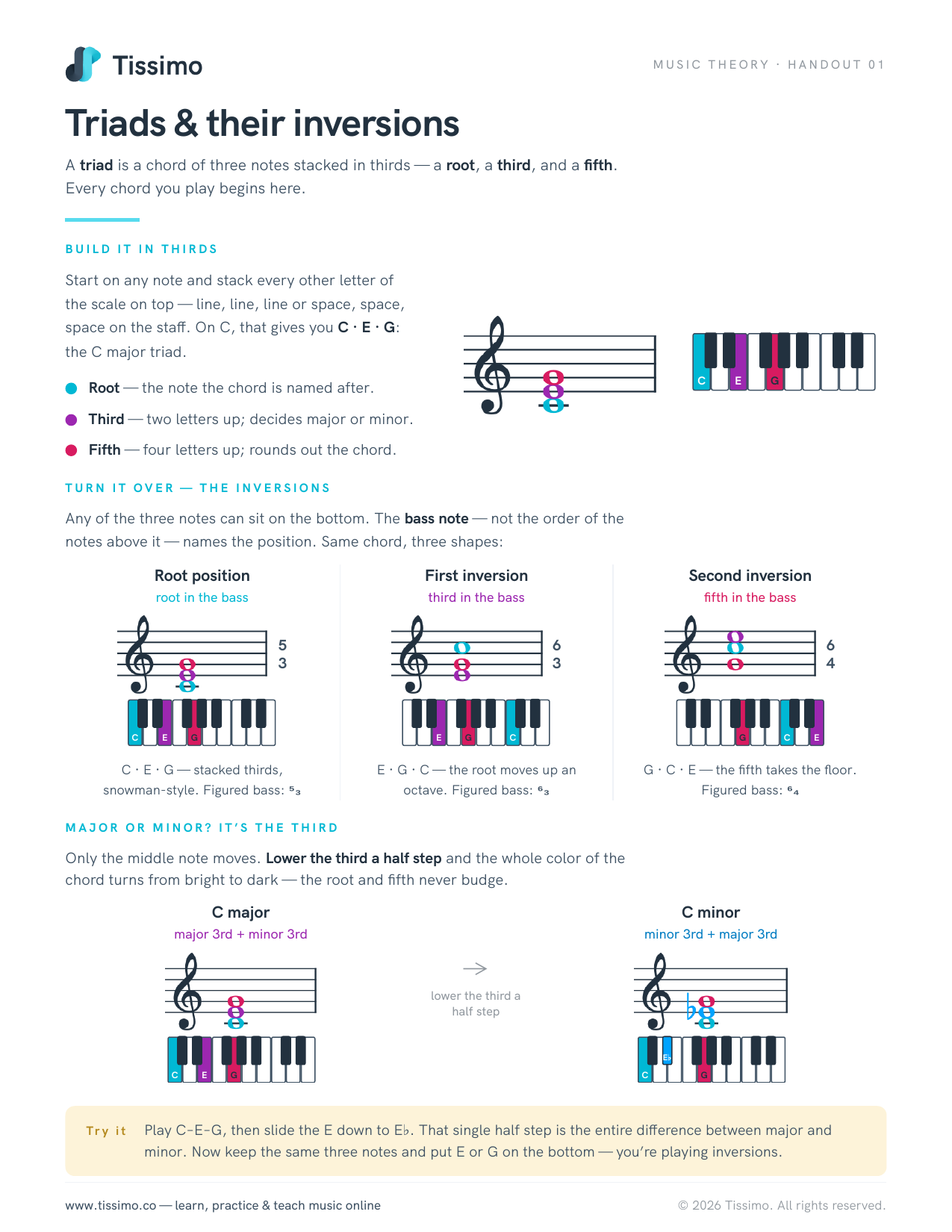
Dreiklänge und ihre Umkehrungen
Ein Dreiklang ist ein Akkord aus drei in Terzen gestapelten Tönen — Grundton, Terz und Quinte. Jeder Akkord, den du spielst, beginnt hier.
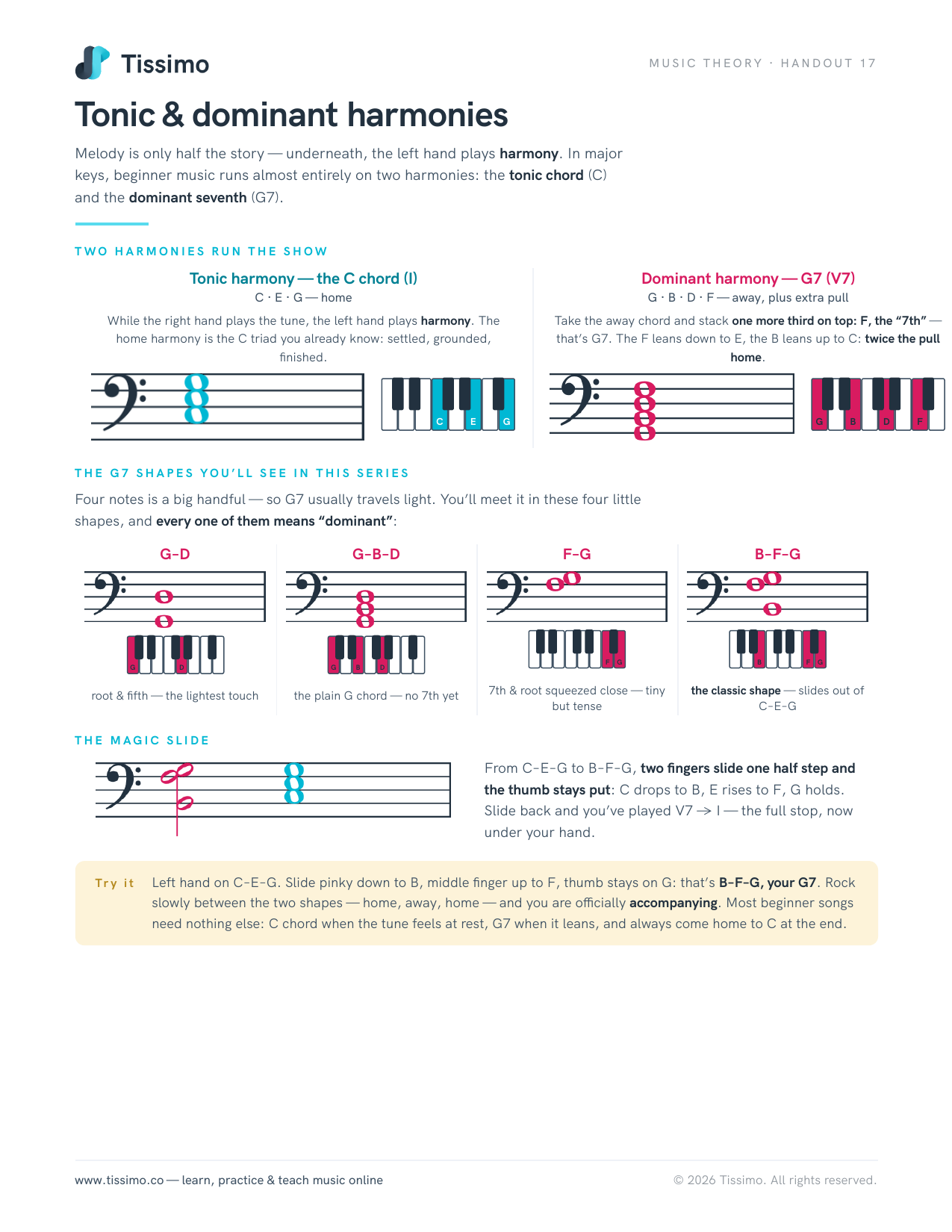
Tonika- und Dominantharmonien
Die Melodie ist nur die halbe Geschichte — darunter spielt die linke Hand die Harmonie. In Dur-Tonarten läuft Anfängermusik fast ausschließlich auf zwei Harmonien: dem Tonika-Akkord (C) und dem Dominantseptakkord (G7).
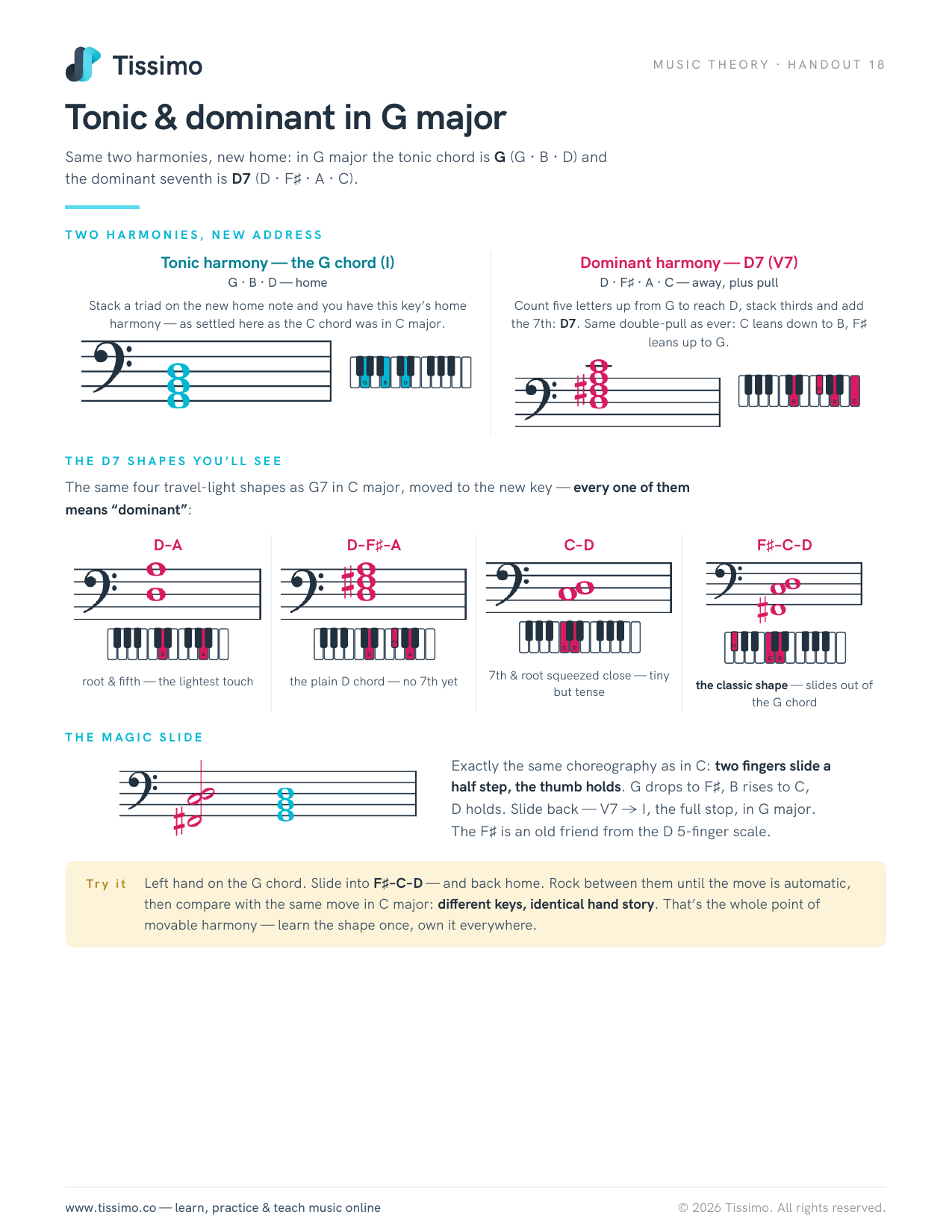
Tonika und Dominante in G-Dur
Dieselben zwei Harmonien, neues Zuhause: In G-Dur ist der Tonika-Akkord G (G · H · D) und der Dominantseptakkord D7 (D · Fis · A · C).
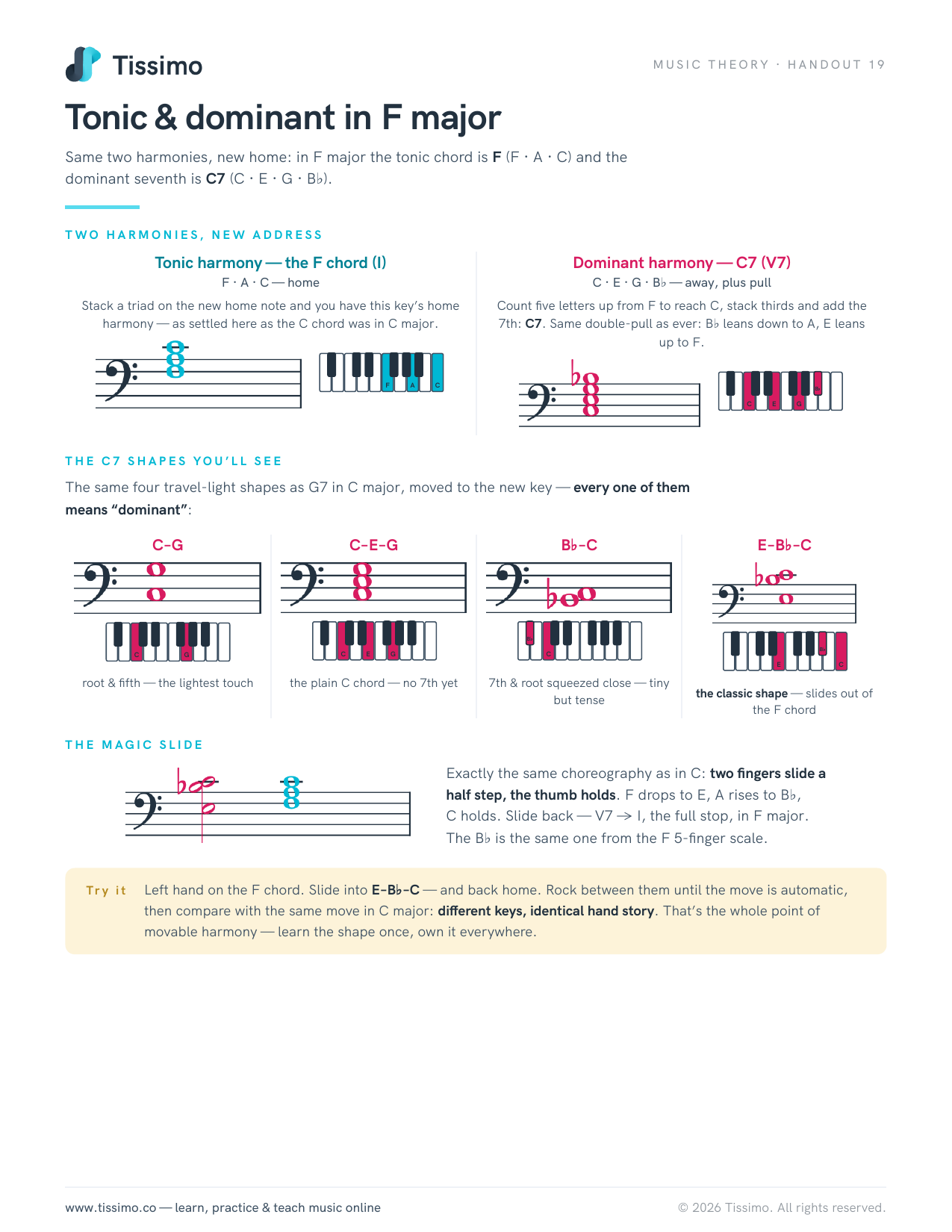
Tonika und Dominante in F-Dur
Dieselben zwei Harmonien, neues Zuhause: In F-Dur ist der Tonika-Akkord F (F · A · C) und der Dominantseptakkord C7 (C · E · G · B).
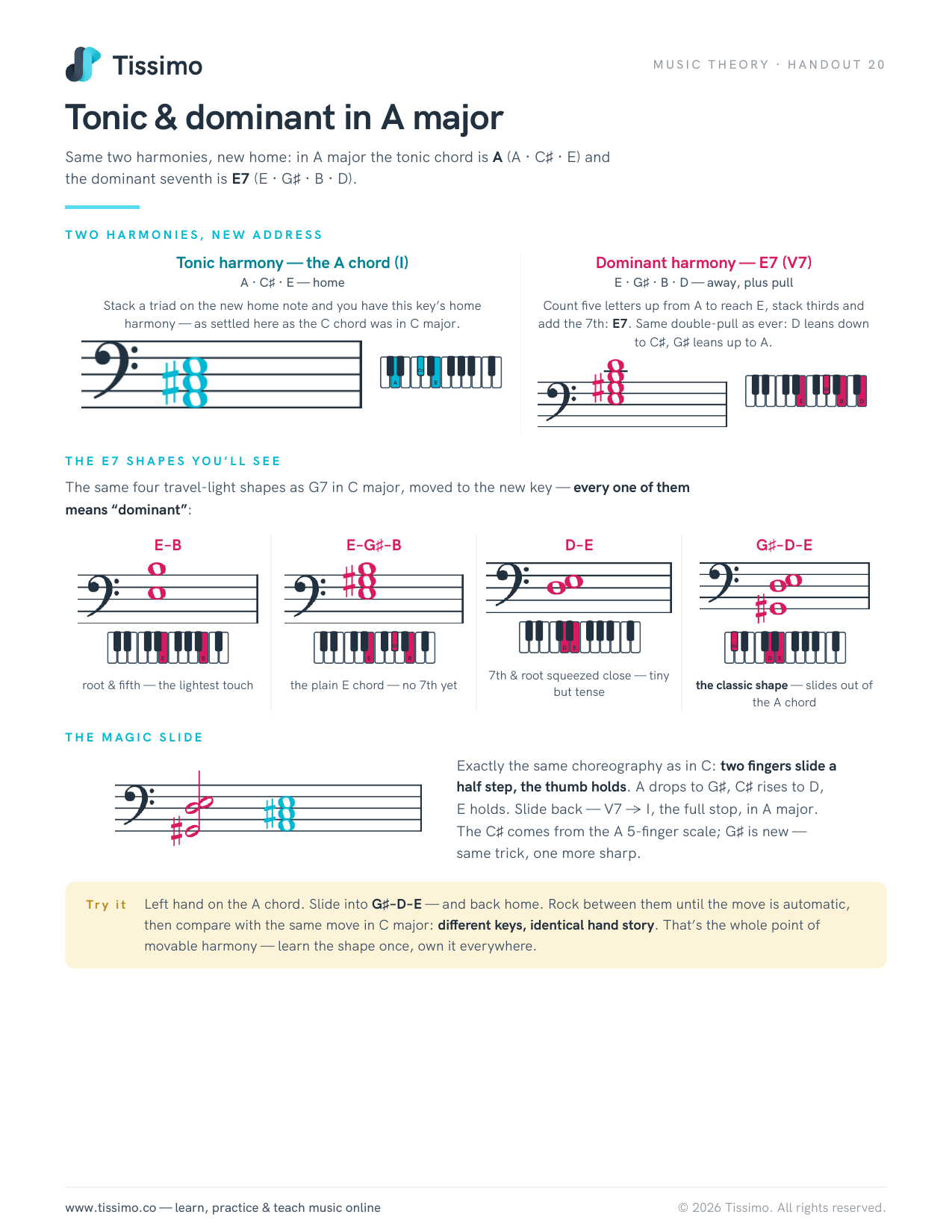
Tonika und Dominante in A-Dur
Dieselben zwei Harmonien, neues Zuhause: In A-Dur ist der Tonika-Akkord A (A · Cis · E) und der Dominantseptakkord E7 (E · Gis · H · D).
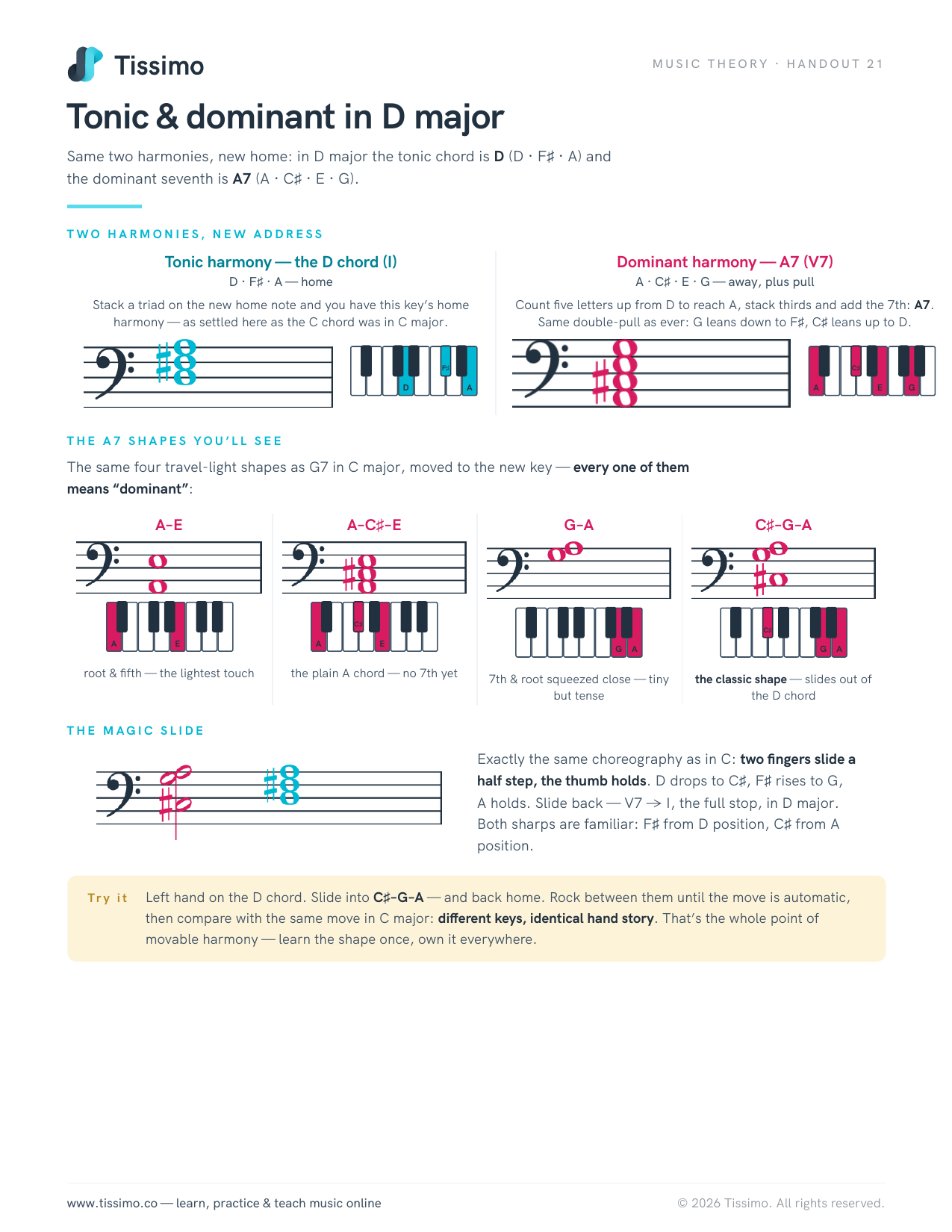
Tonika und Dominante in D-Dur
Dieselben zwei Harmonien, neues Zuhause: In D-Dur ist der Tonika-Akkord D (D · Fis · A) und der Dominantseptakkord A7 (A · Cis · E · G).
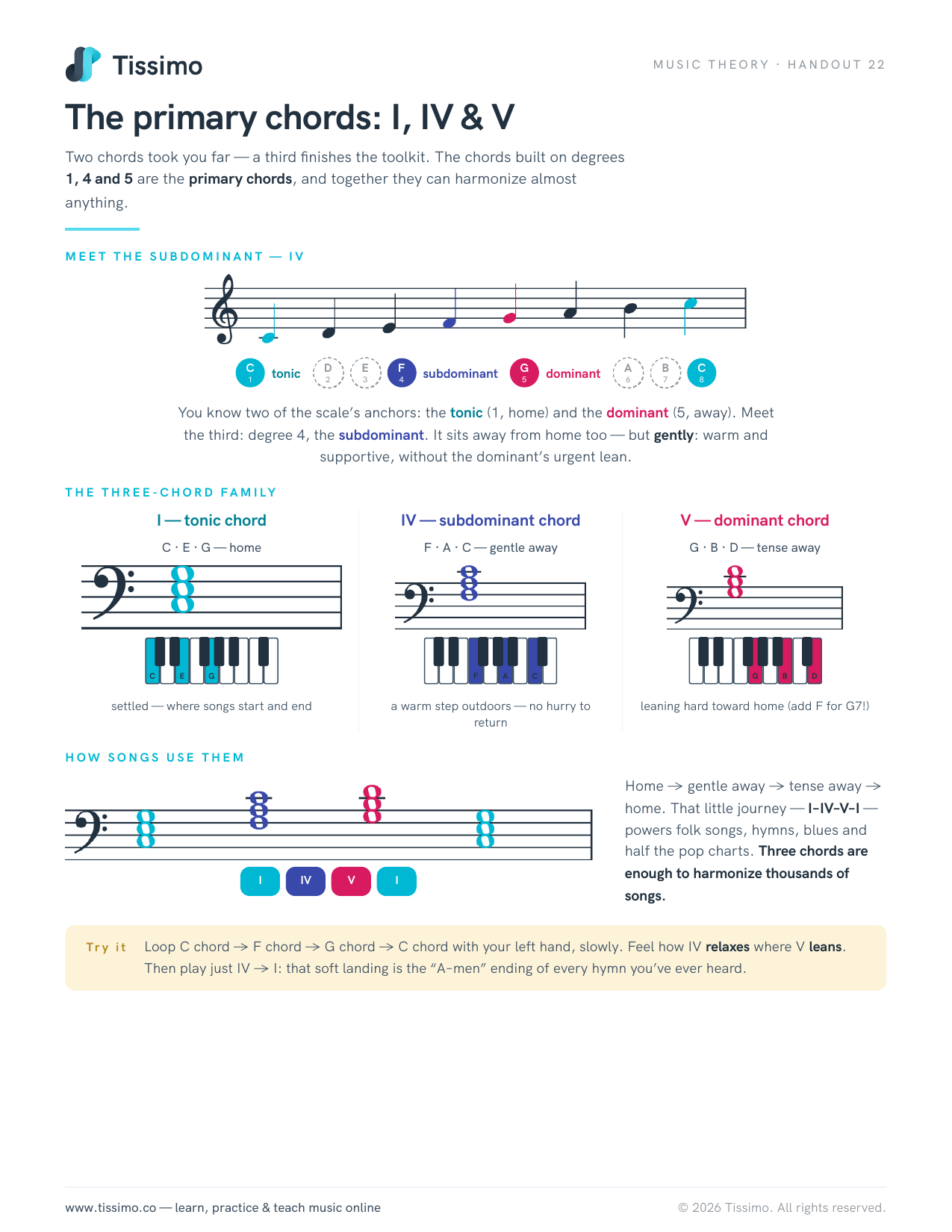
Die Hauptdreiklänge: I, IV & V
Zwei Akkorde haben dich weit gebracht — ein dritter vervollständigt das Werkzeug. Die auf den Stufen 1, 4 und 5 aufgebauten Akkorde sind die Hauptdreiklänge, und zusammen können sie fast alles harmonisieren.
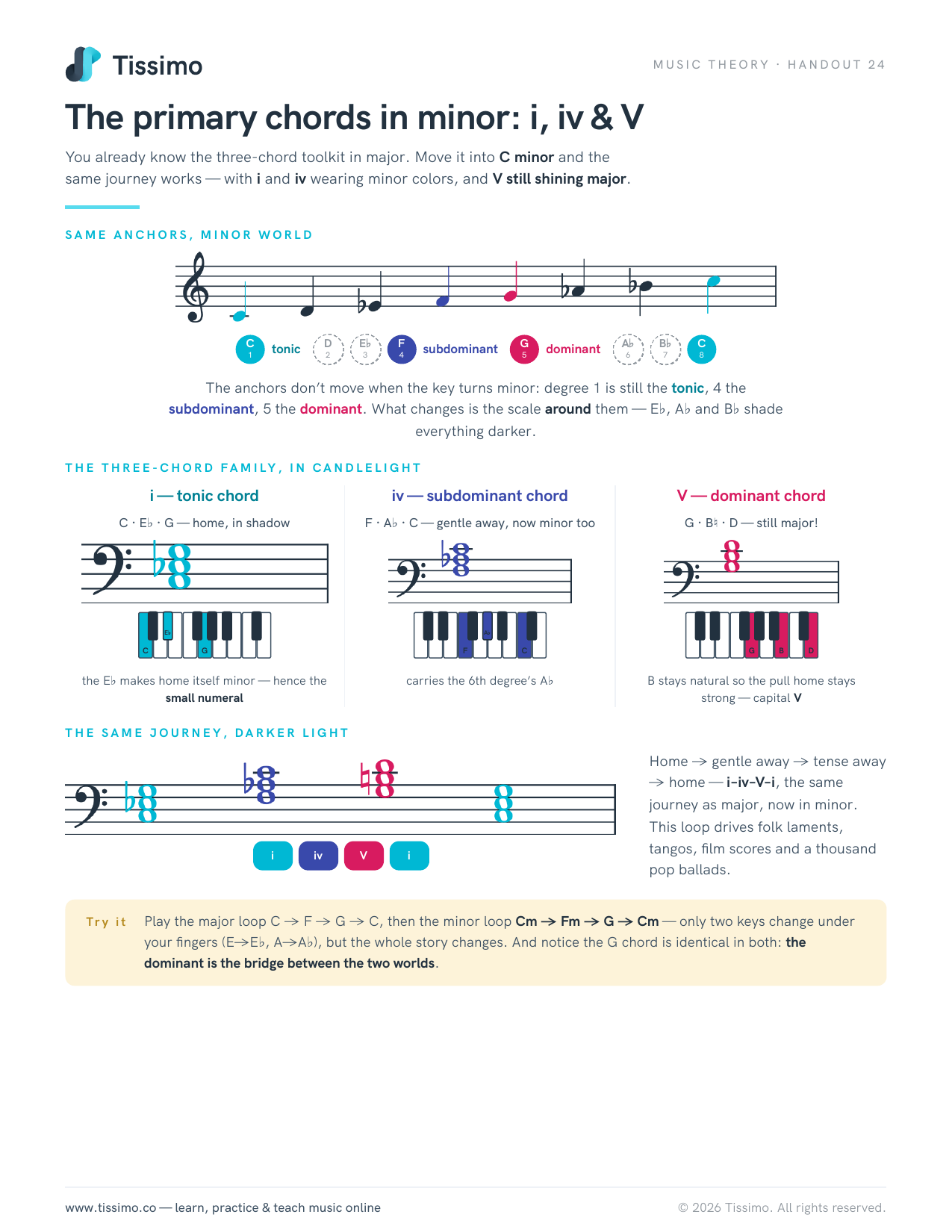
Die Hauptdreiklänge in Moll: i, iv & V
Du kennst das Drei-Akkord-Werkzeug bereits in Dur. Übertrage es nach c-Moll, und derselbe Weg funktioniert — mit i und iv in Moll-Farben, während V weiterhin in Dur erstrahlt.
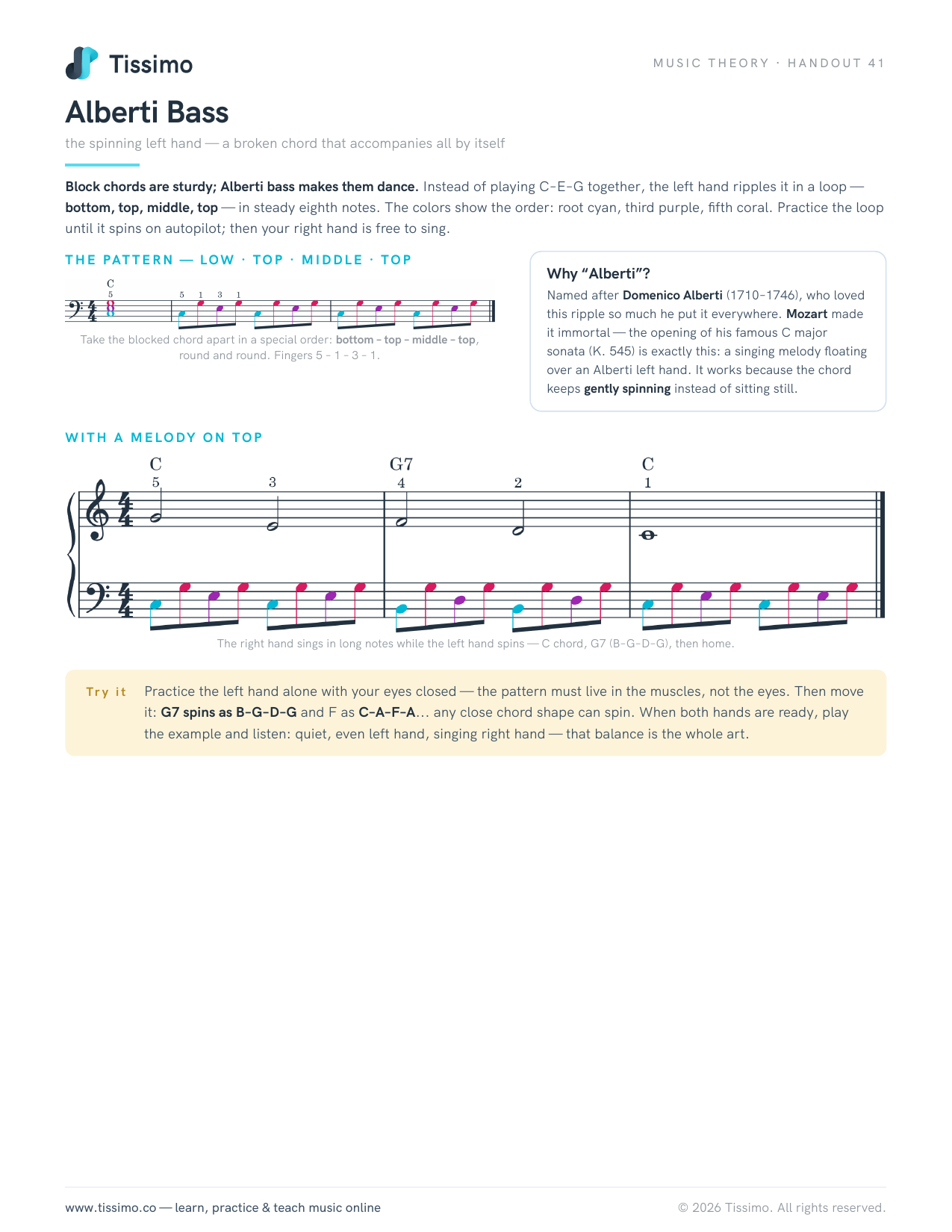
Albertibass
die kreisende linke Hand — ein gebrochener Akkord, der ganz allein begleitet
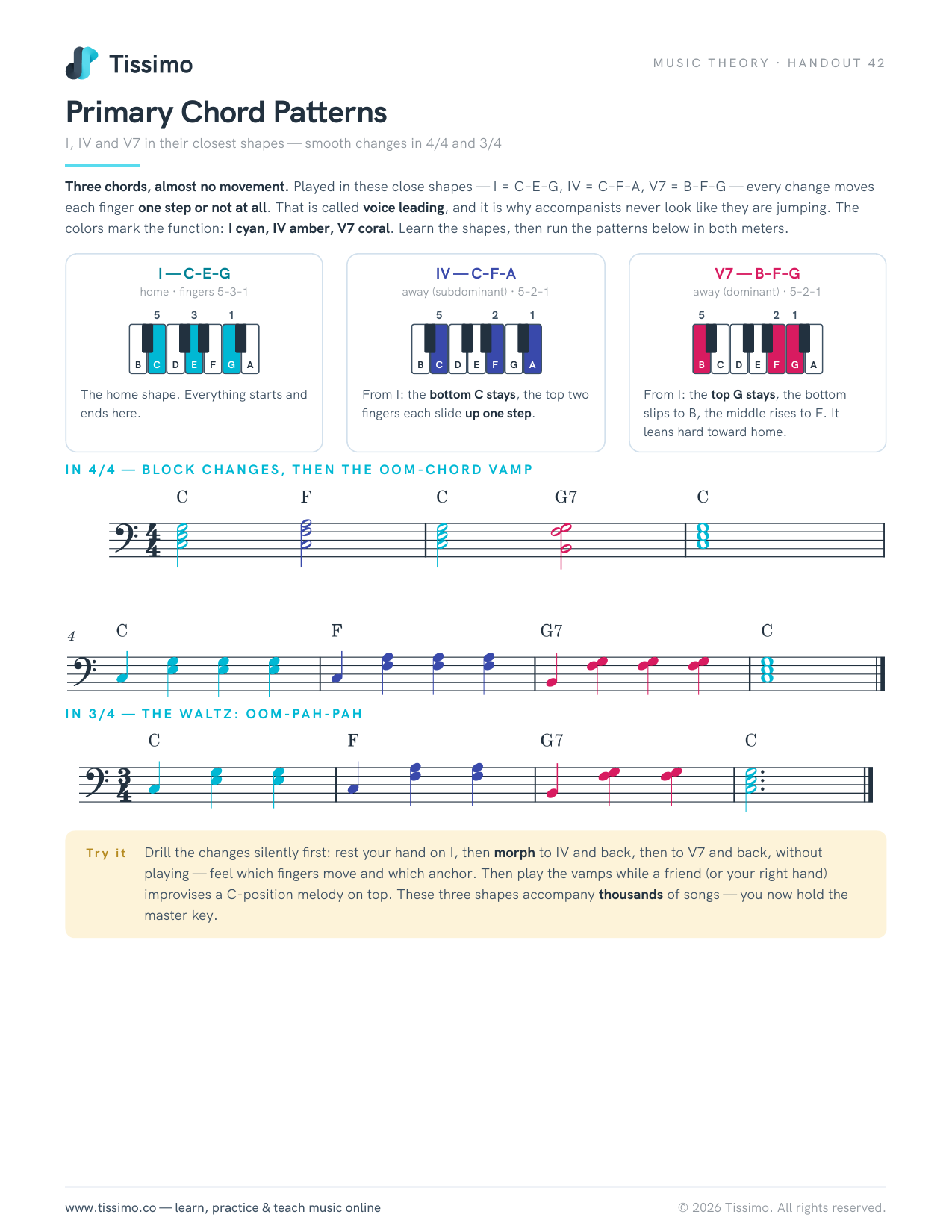
Hauptakkord-Muster
I, IV und V7 in ihren nächstliegenden Lagen — sanfte Wechsel in 4/4 und 3/4
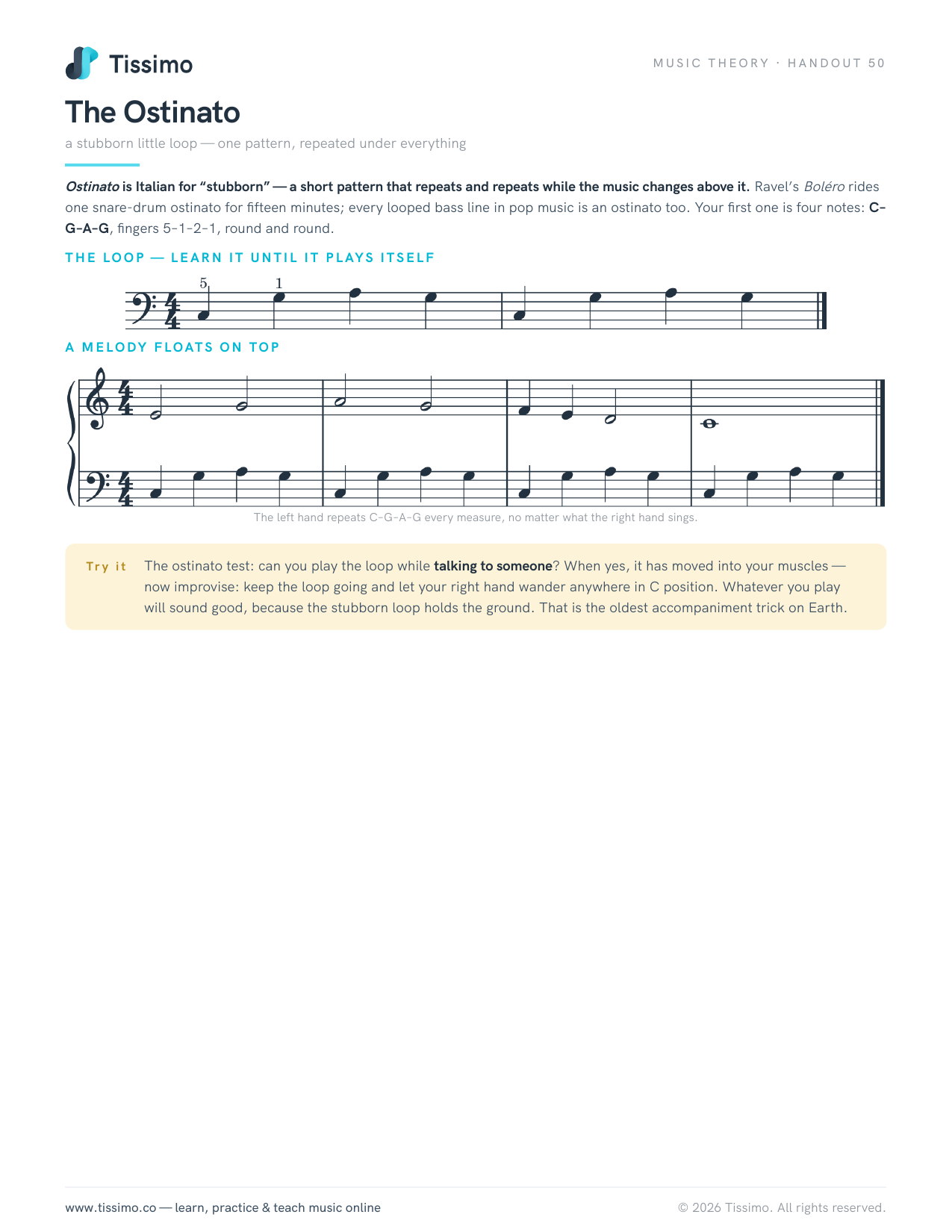
Das Ostinato
eine hartnäckige kleine Schleife — ein Muster, das unter allem wiederholt wird
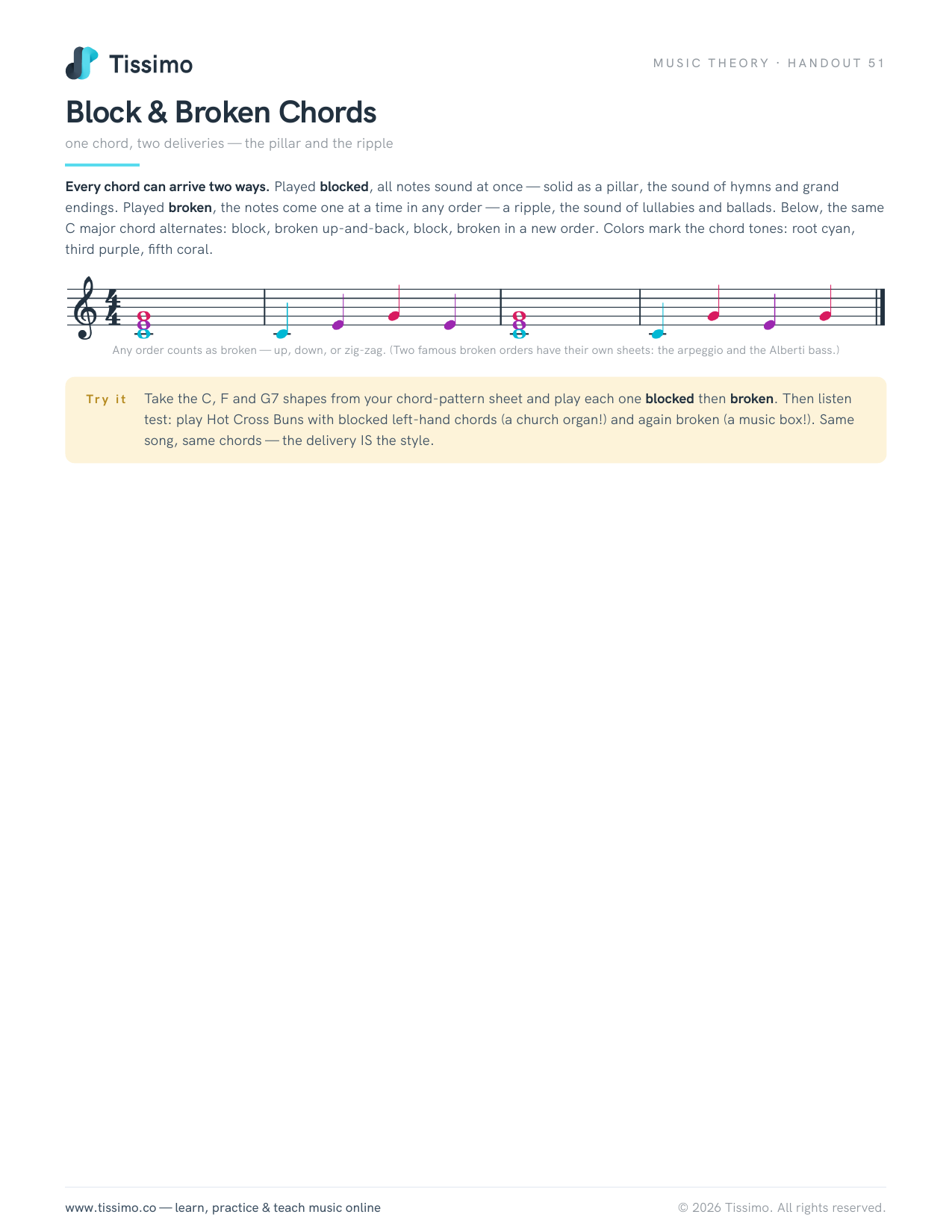
Block- & gebrochene Akkorde
ein Akkord, zwei Spielweisen — die Säule und die Welle
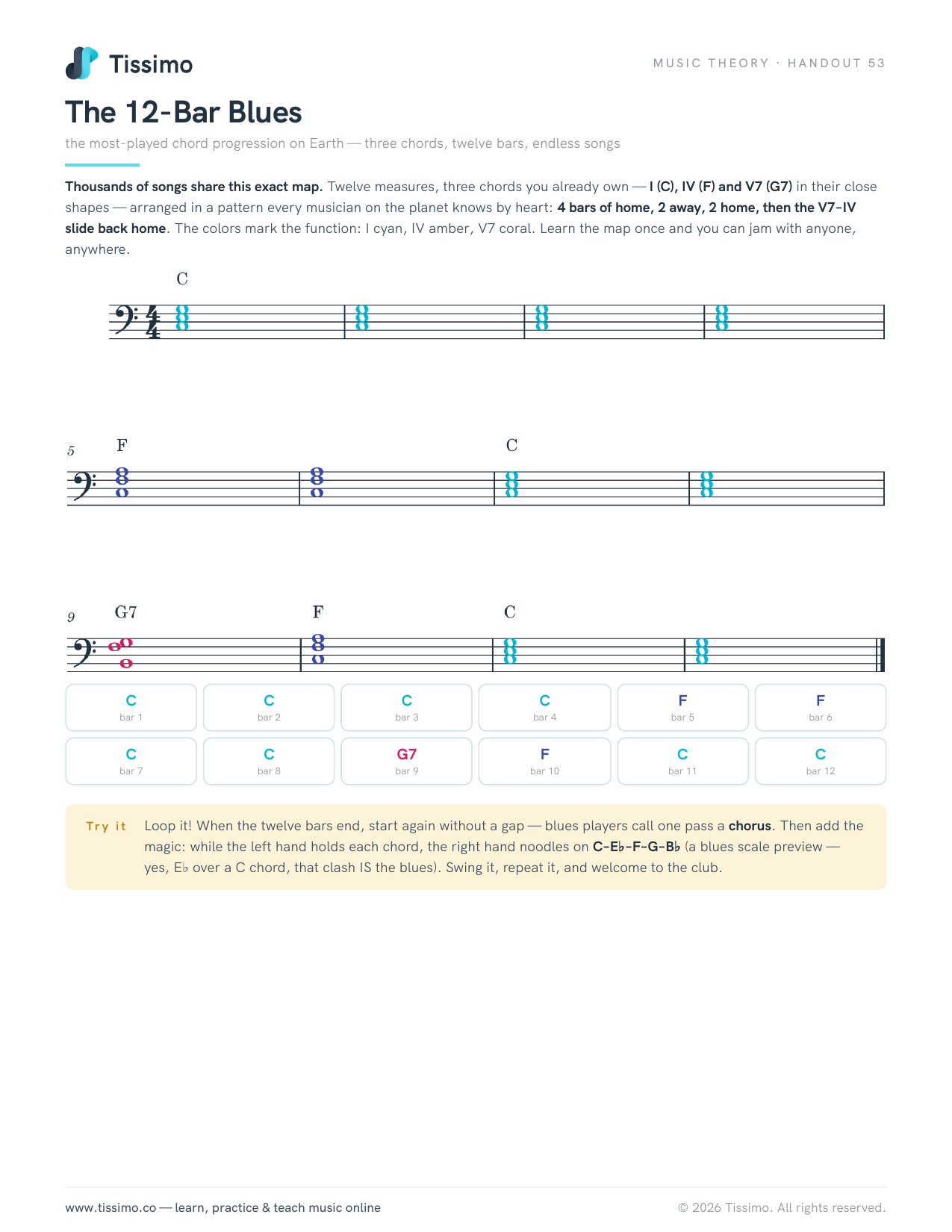
Der 12-Takt-Blues
die meistgespielte Akkordfolge der Welt — drei Akkorde, zwölf Takte, endlose Songs
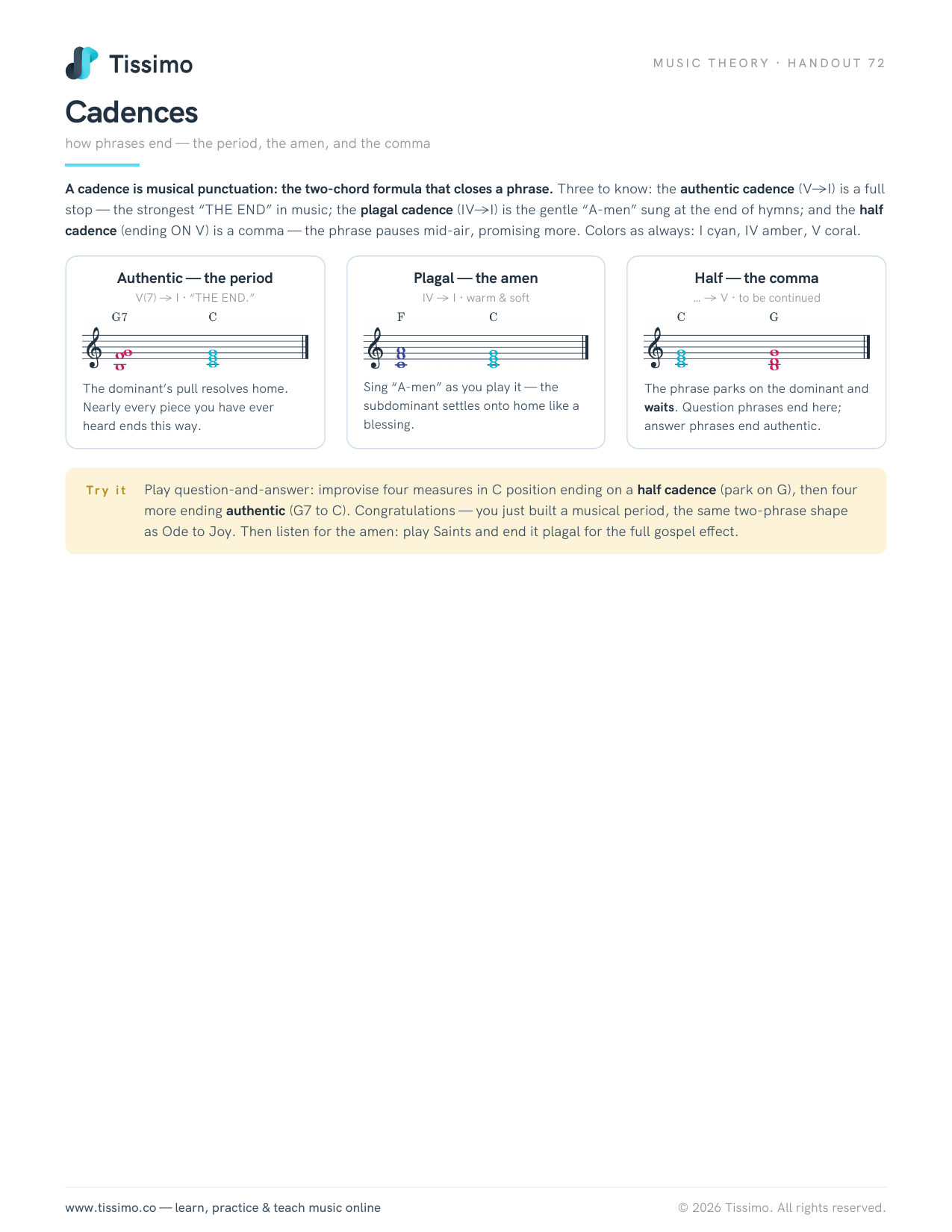
Kadenzen
wie Phrasen enden — der Punkt, das Amen und das Komma
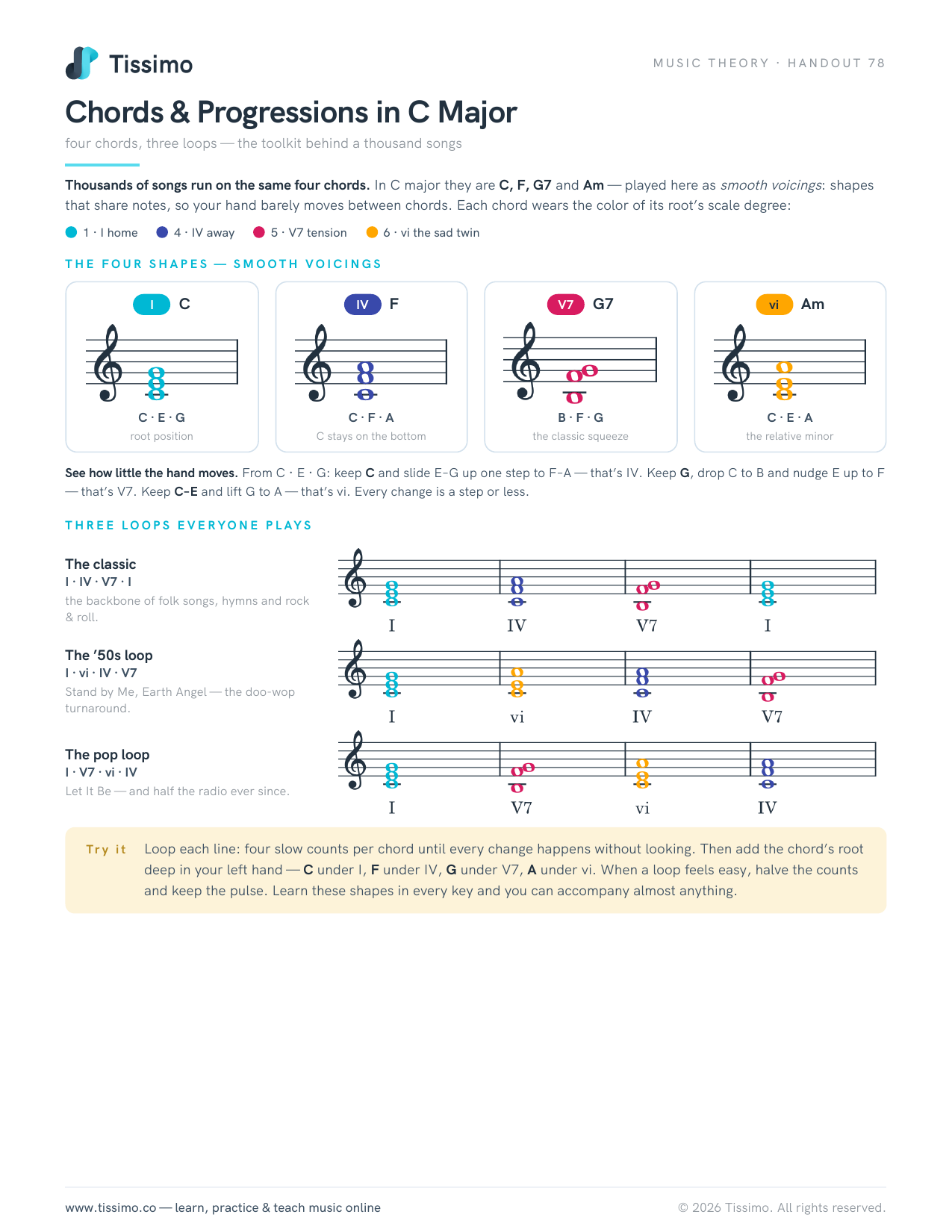
Akkorde & Progressionen in jeder Tonart
Vier Akkorde, drei Schleifen — das Werkzeug hinter tausend Songs, in allen 24 Tonarten.
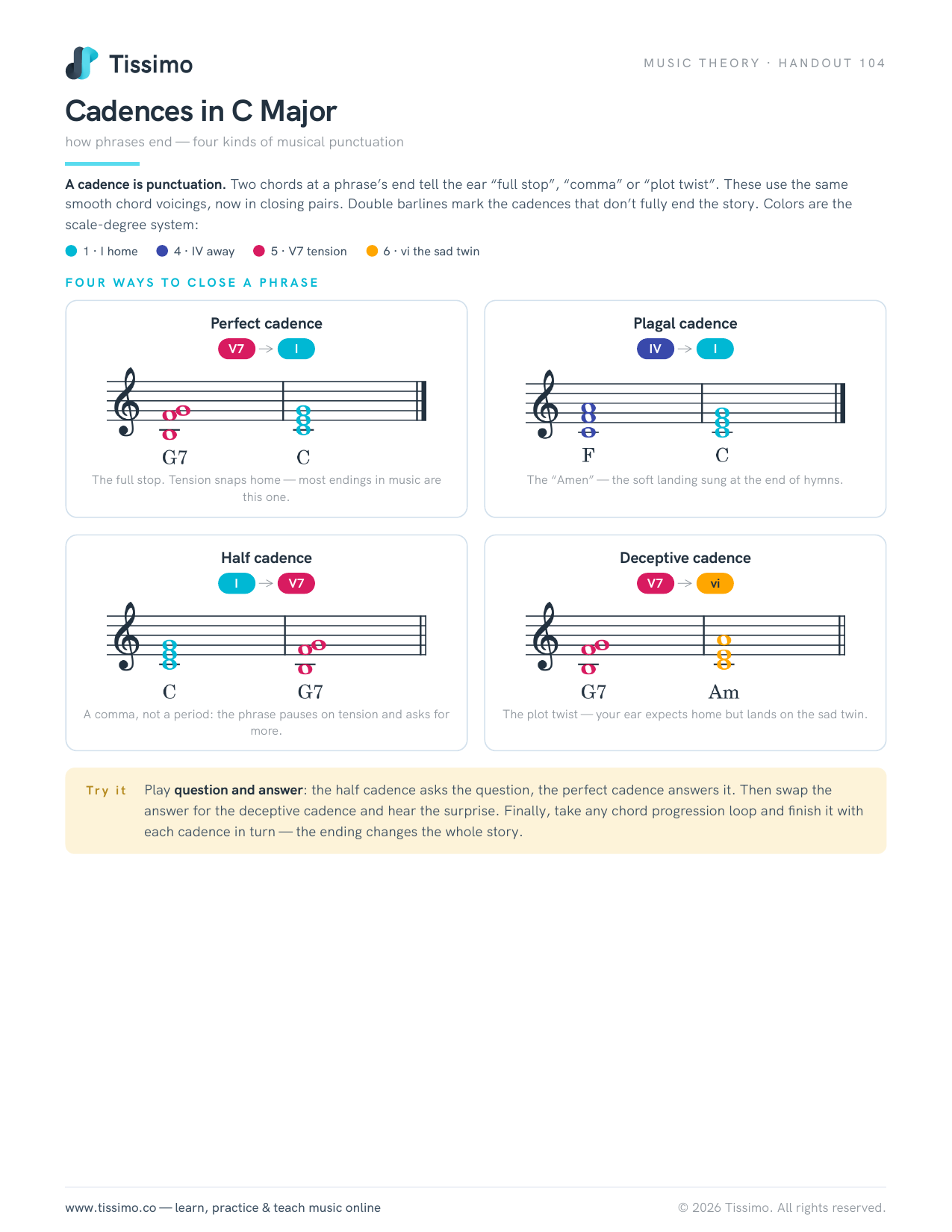
Kadenzen in jeder Tonart
Wie Phrasen enden — die vier Arten musikalischer Satzzeichen, ausgeschrieben in allen 24 Tonarten.
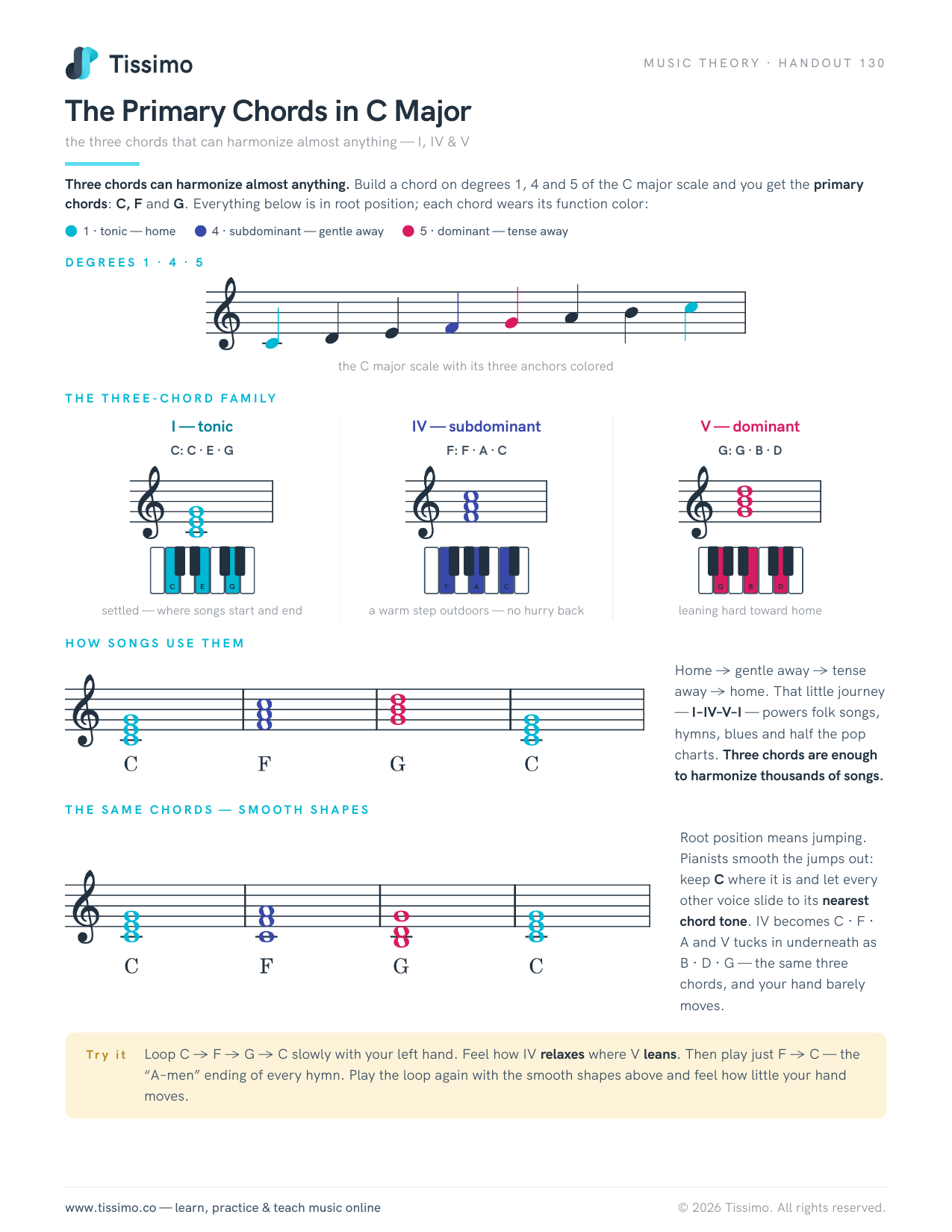
Die Hauptdreiklänge in jeder Tonart
I, IV und V — die drei Akkorde, die fast alles harmonisieren können, in allen 24 Tonarten.
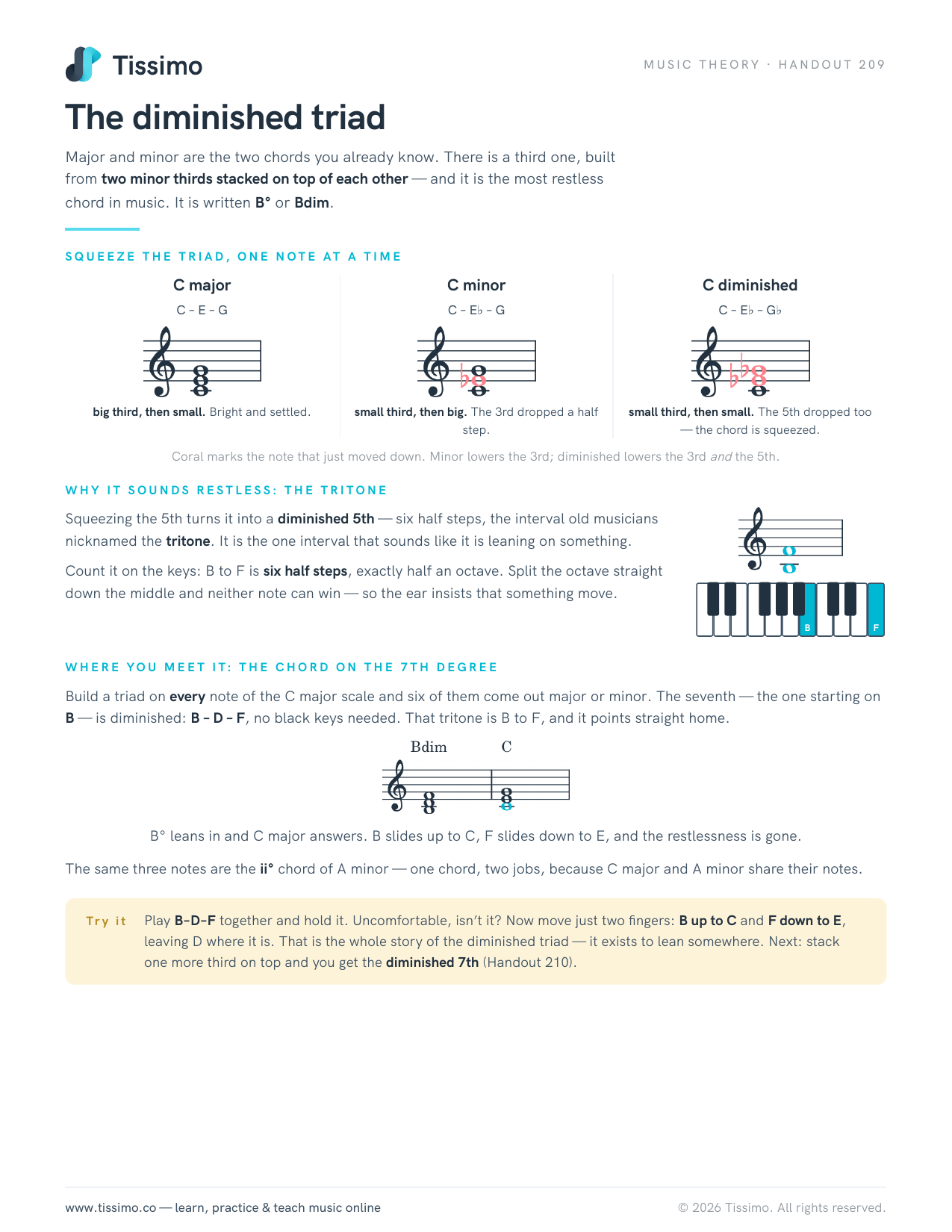
Der verminderte Dreiklang
Dur und Moll sind die zwei Akkorde, die du schon kennst. Es gibt einen dritten, aus zwei übereinandergestapelten kleinen Terzen gebildet — und er ist der ruhelosste Akkord der Musik. Geschrieben als B° oder Bdim.
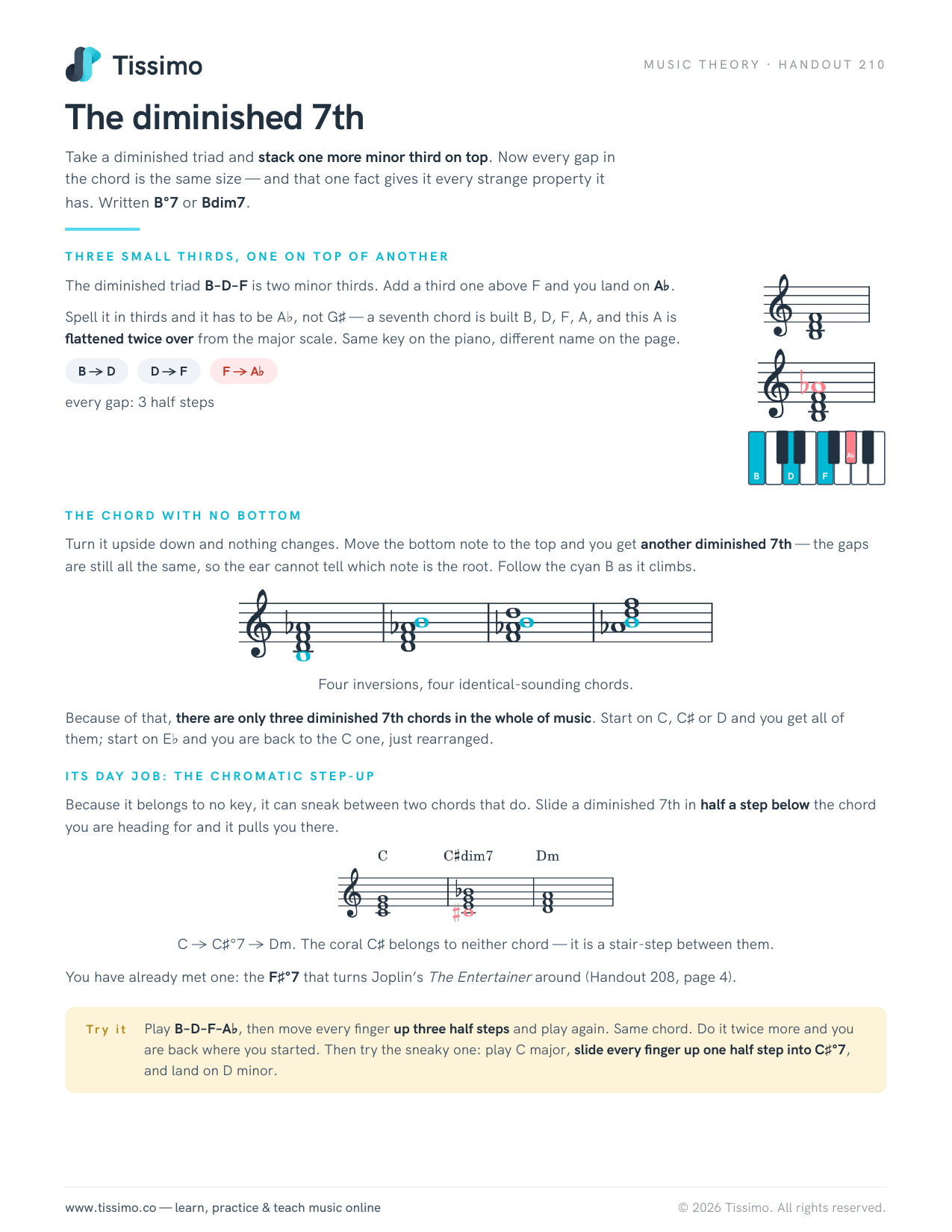
Der verminderte Septakkord
Nimm einen verminderten Dreiklang und stapel eine weitere kleine Terz obendrauf. Jetzt ist jeder Abstand im Akkord gleich groß — und allein diese Tatsache verleiht ihm all seine merkwürdigen Eigenschaften. Geschrieben als B°7 oder Bdim7.
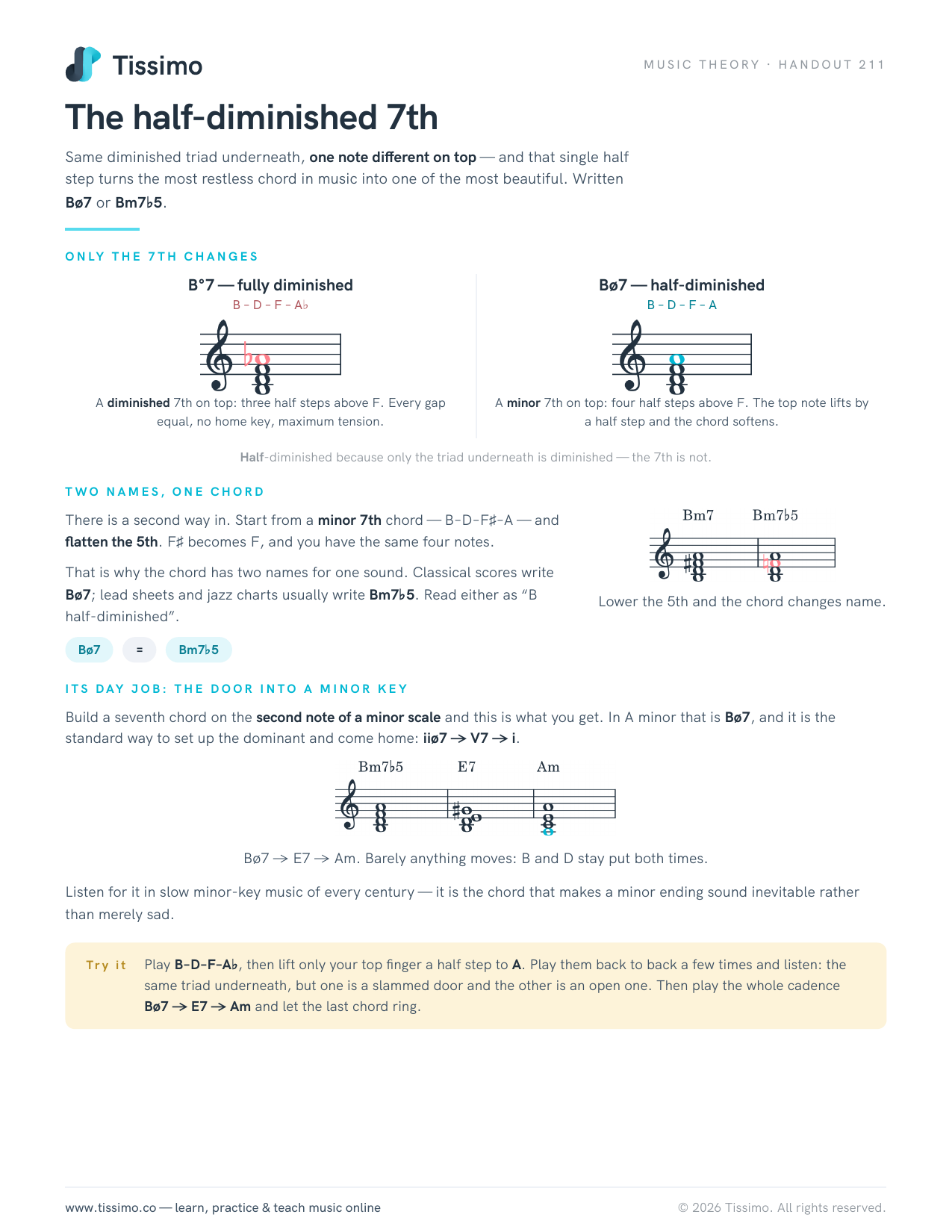
Der halbverminderte Septakkord
Derselbe verminderte Dreiklang darunter, ein anderer Ton obendrauf — und dieser einzige Halbtonschritt verwandelt den ruhelosesten Akkord der Musik in einen der schönsten. Geschrieben als Bø7 oder Bm7♭5.
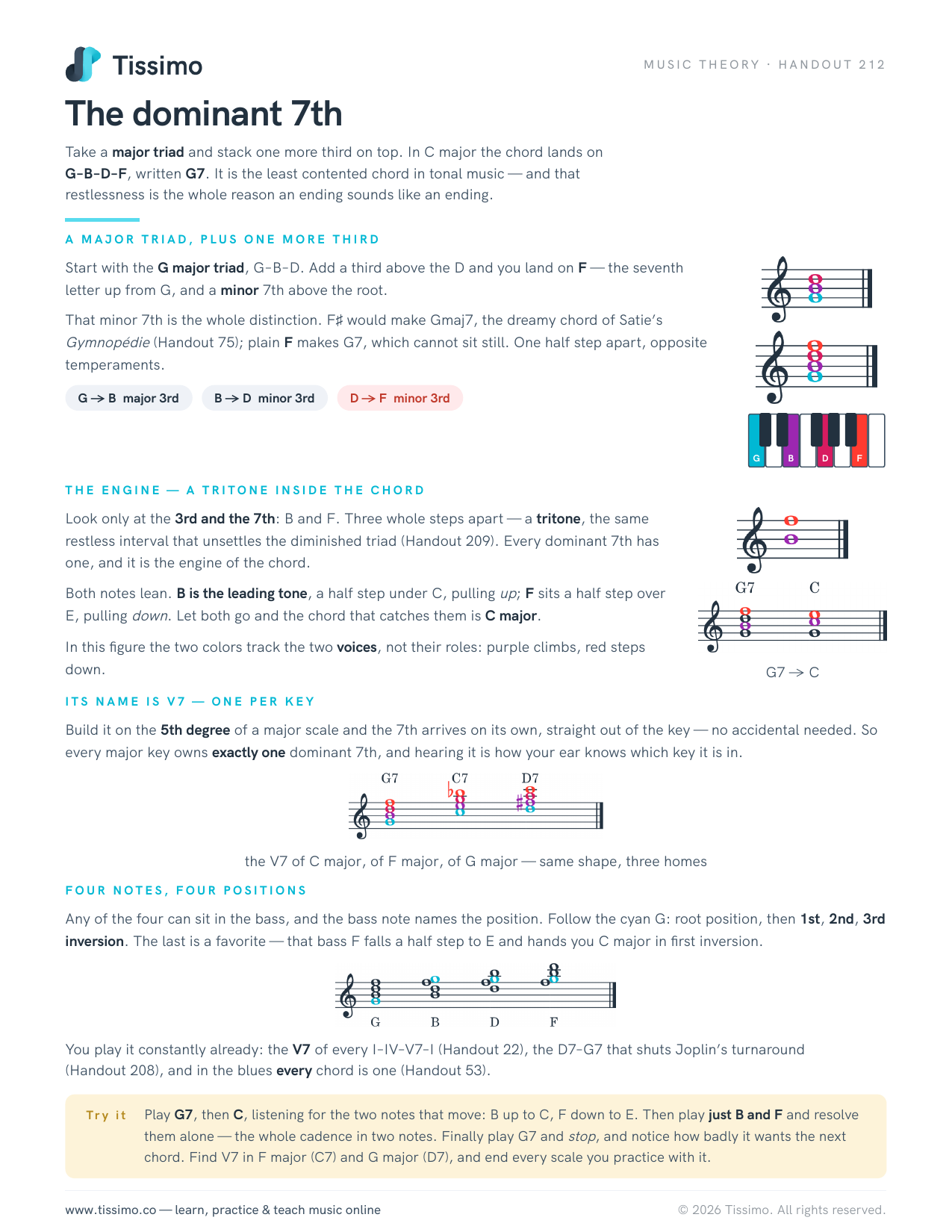
Der Dominantseptakkord
Nimm einen Durdreiklang und stapel eine weitere Terz obendrauf. In C-Dur landet der Akkord auf G–H–D–F, geschrieben G7. Es ist der unzufriedenste Akkord der tonalen Musik — und genau diese Unruhe ist der Grund, warum ein Schluss wie ein Schluss klingt.
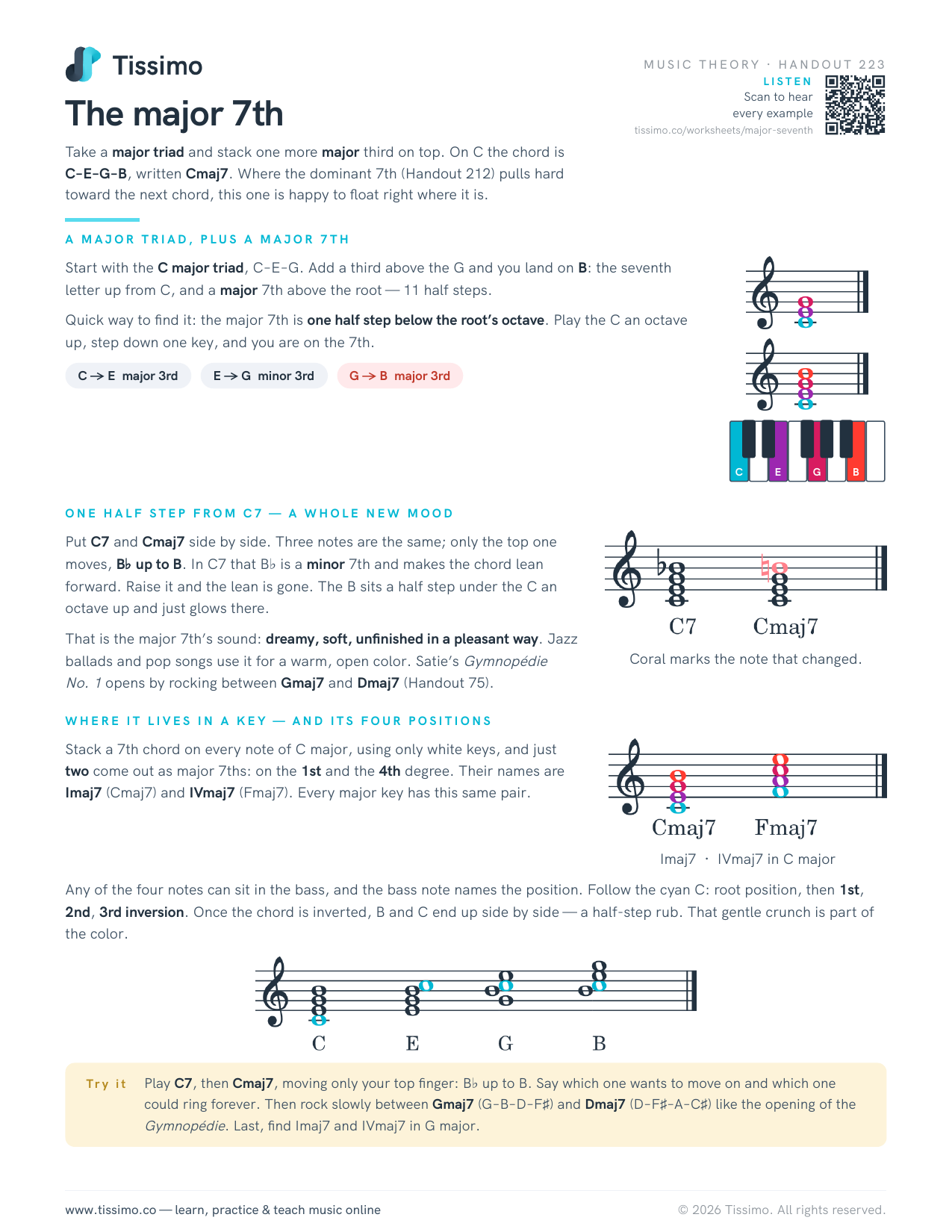
The major 7th
Take a major triad and stack one more major third on top. On C the chord is C–E–G–B, written Cmaj7. Where the dominant 7th (Handout 212) pulls hard toward the next chord, this one is happy to float right where it is.
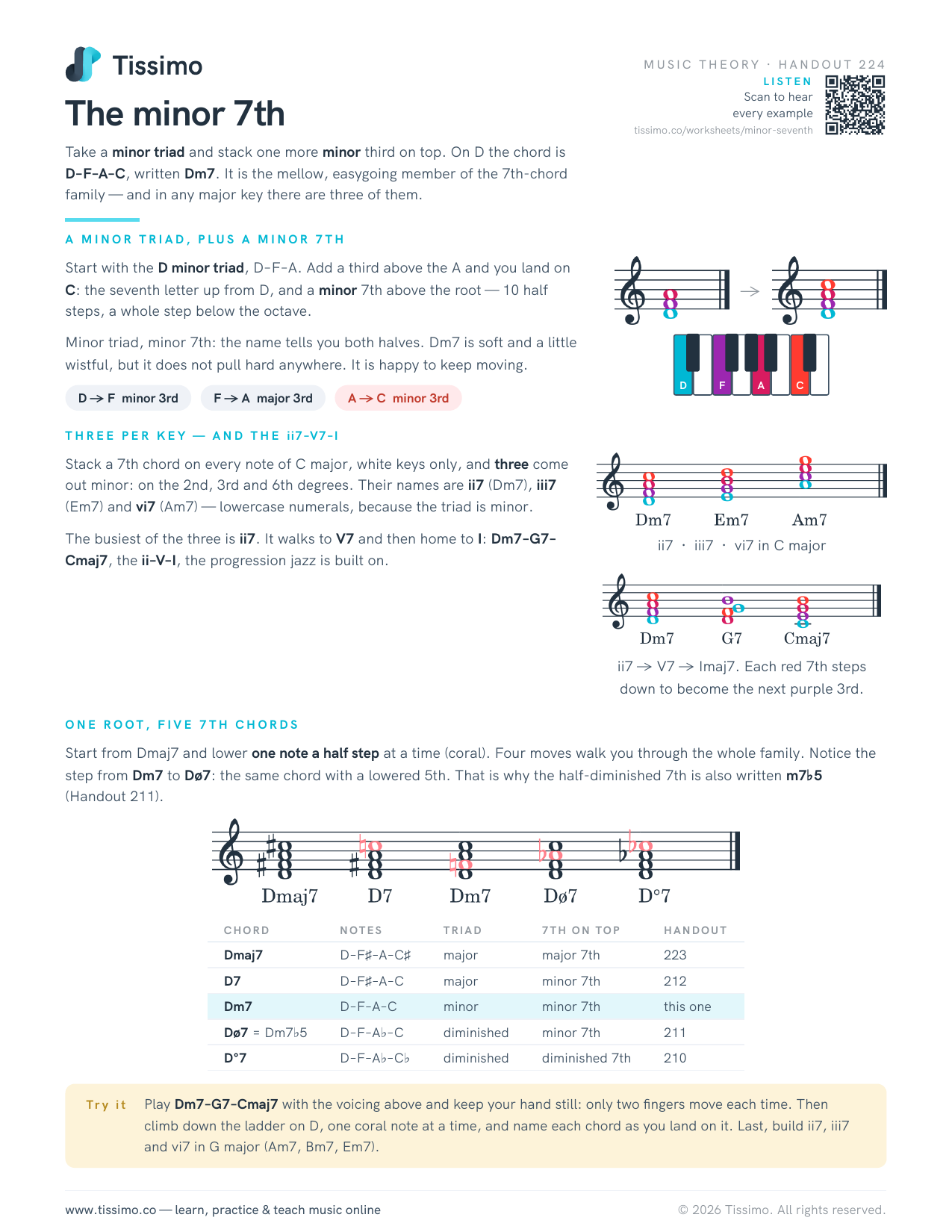
The minor 7th
Take a minor triad and stack one more minor third on top. On D the chord is D–F–A–C, written Dm7. It is the mellow, easygoing member of the 7th-chord family — and in any major key there are three of them.
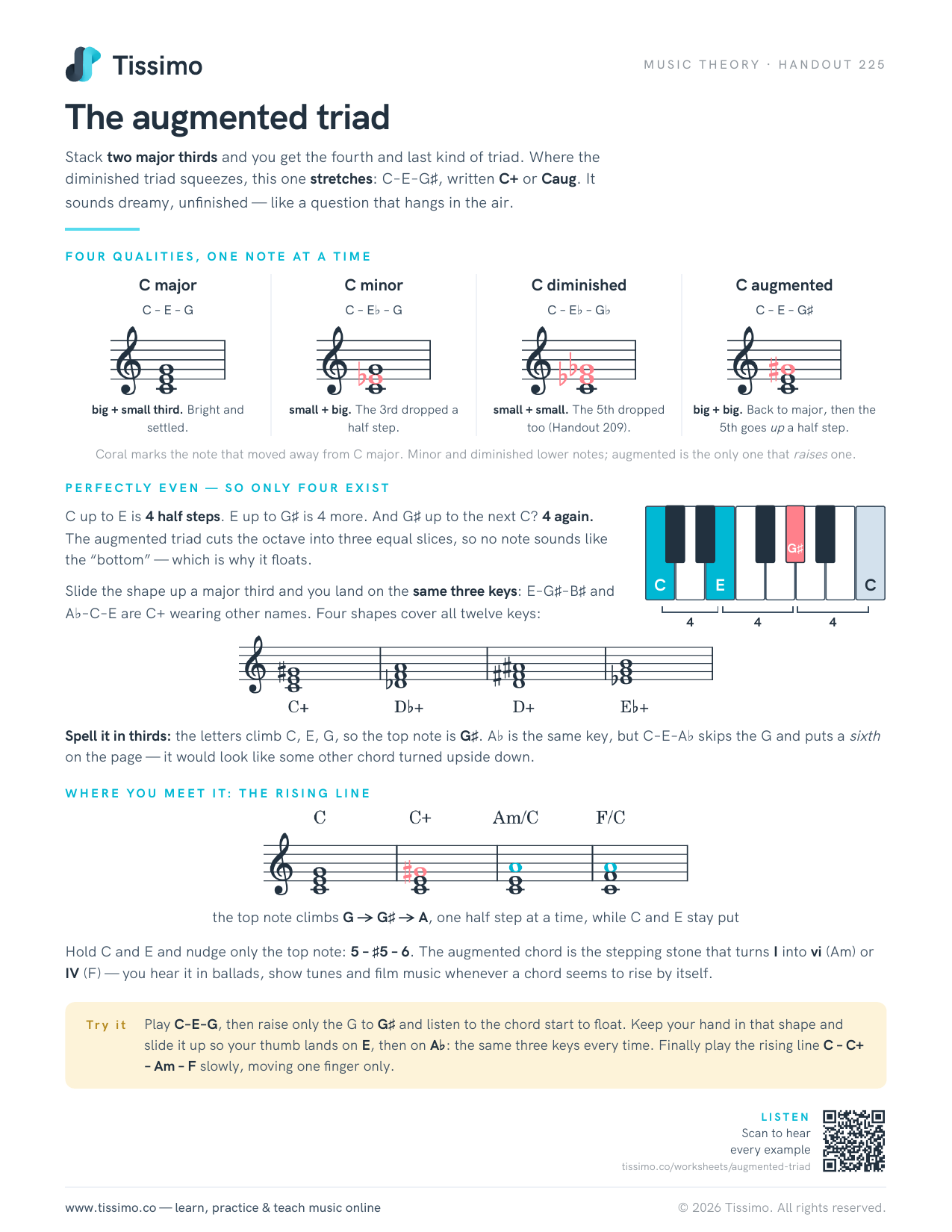
The augmented triad
Stack two major thirds and you get the fourth and last kind of triad. Where the diminished triad squeezes, this one stretches: C–E–G♯, written C+ or Caug. It sounds dreamy, unfinished — like a question that hangs in the air.
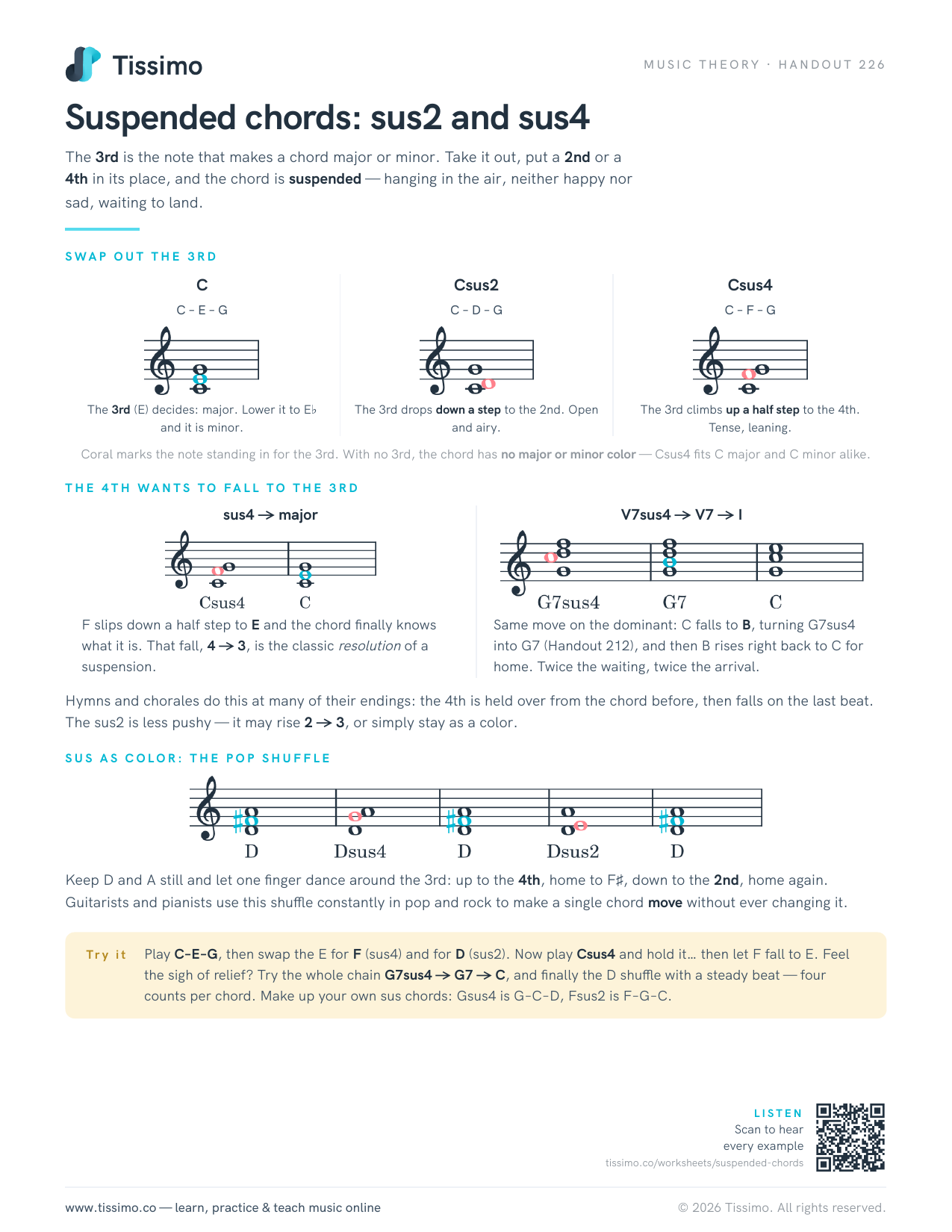
Suspended chords: sus2 and sus4
The 3rd is the note that makes a chord major or minor. Take it out, put a 2nd or a 4th in its place, and the chord is suspended — hanging in the air, neither happy nor sad, waiting to land.
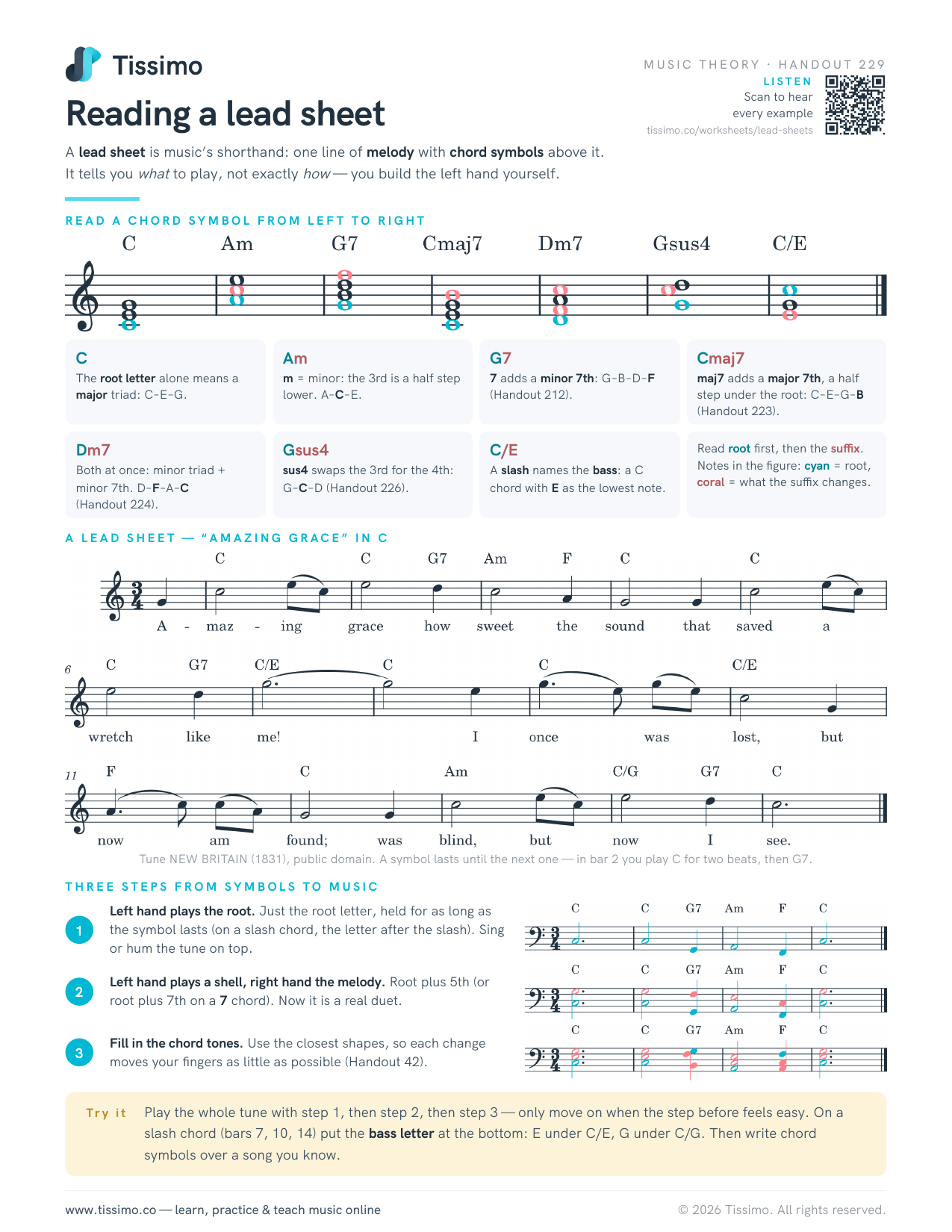
Reading a lead sheet
A lead sheet is music’s shorthand: one line of melody with chord symbols above it. It tells you what to play, not exactly how — you build the left hand yourself.
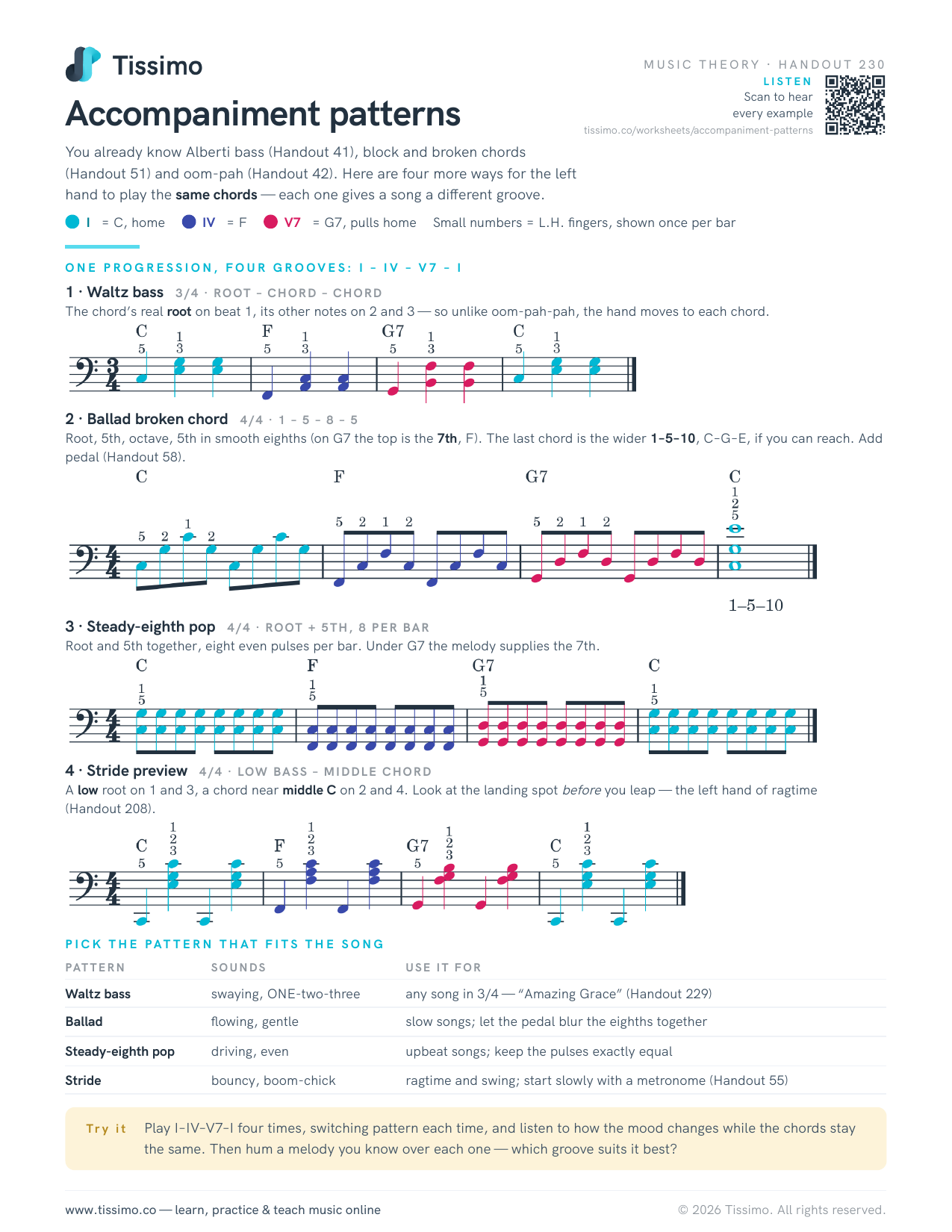
Accompaniment patterns
You already know Alberti bass (Handout 41), block and broken chords (Handout 51) and oom-pah (Handout 42). Here are four more ways for the left hand to play the same chords — each one gives a song a different groove.
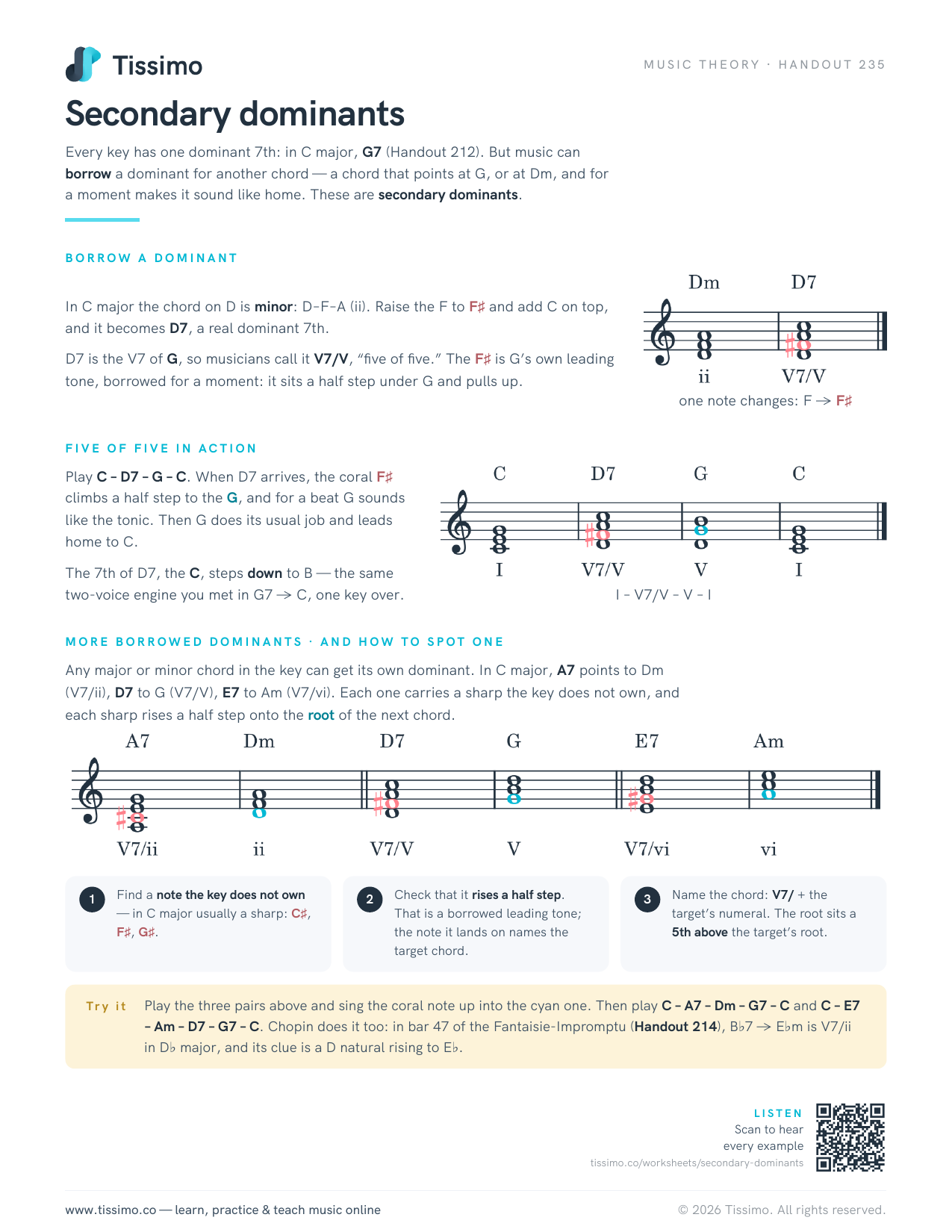
Secondary dominants
Every key has one dominant 7th: in C major, G7 (Handout 212). But music can borrow a dominant for another chord — a chord that points at G, or at Dm, and for a moment makes it sound like home. These are secondary dominants.
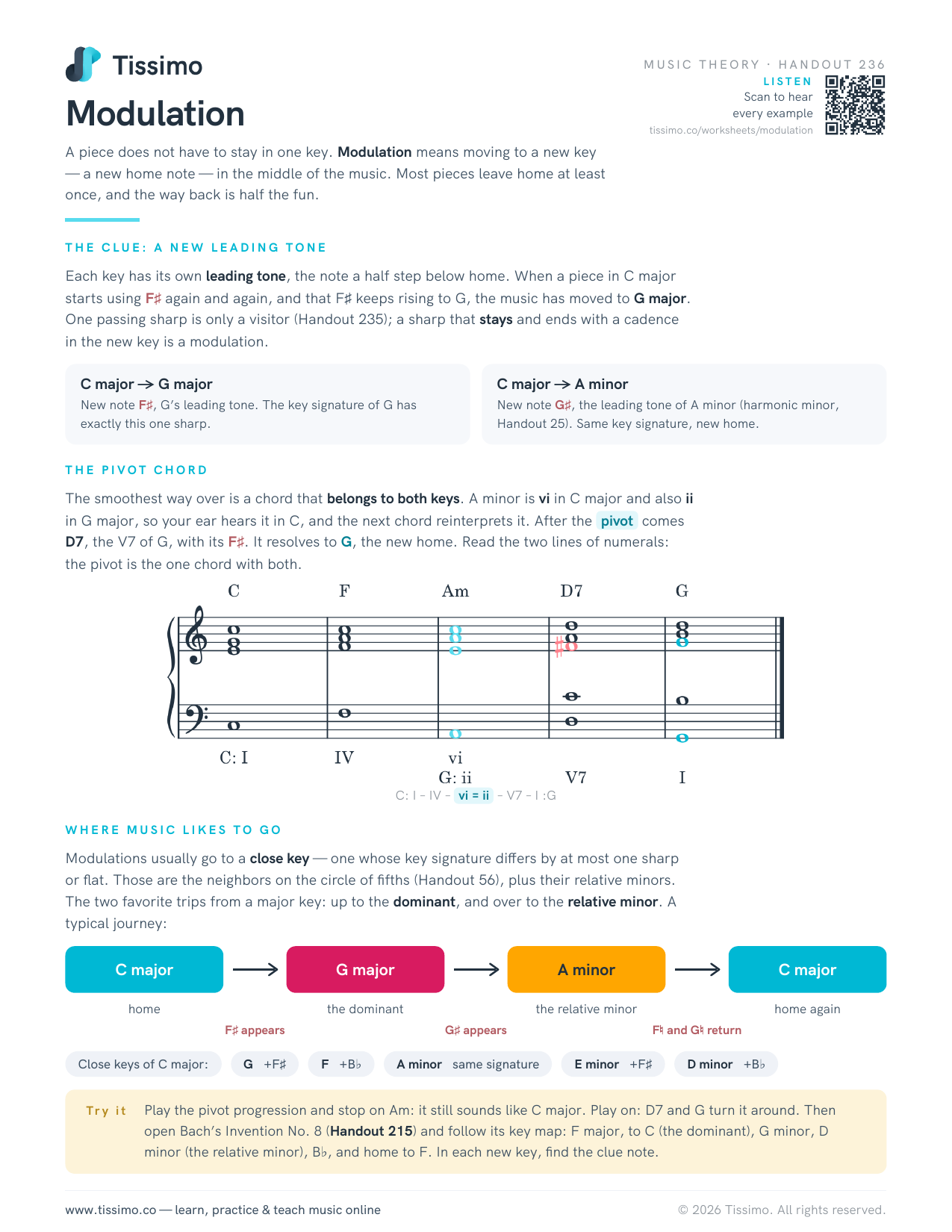
Modulation
A piece does not have to stay in one key. Modulation means moving to a new key — a new home note — in the middle of the music. Most pieces leave home at least once, and the way back is half the fun.
Form & Analysis
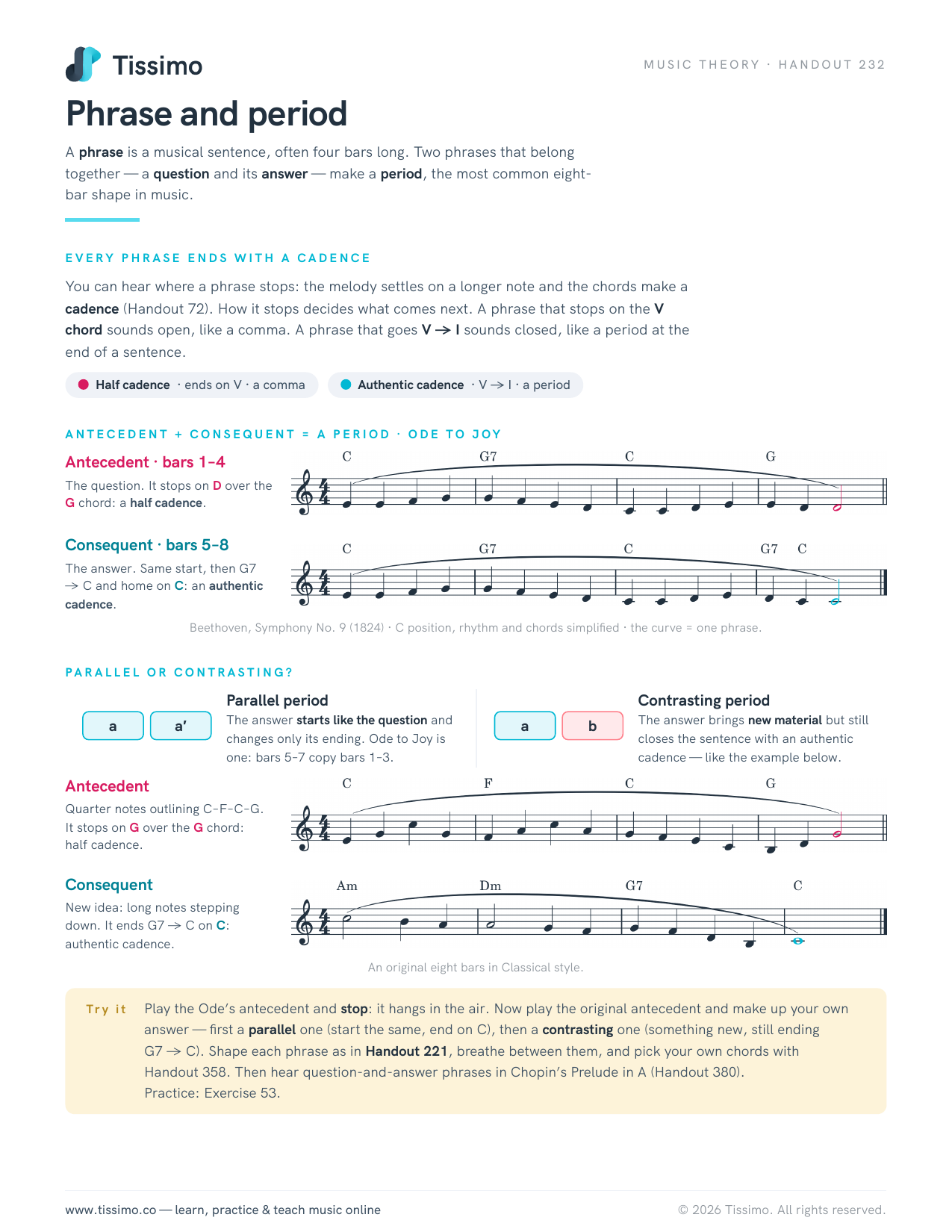
Phrase and period
A phrase is a musical sentence, often four bars long. Two phrases that belong together — a question and its answer — make a period, the most common eight-bar shape in music.
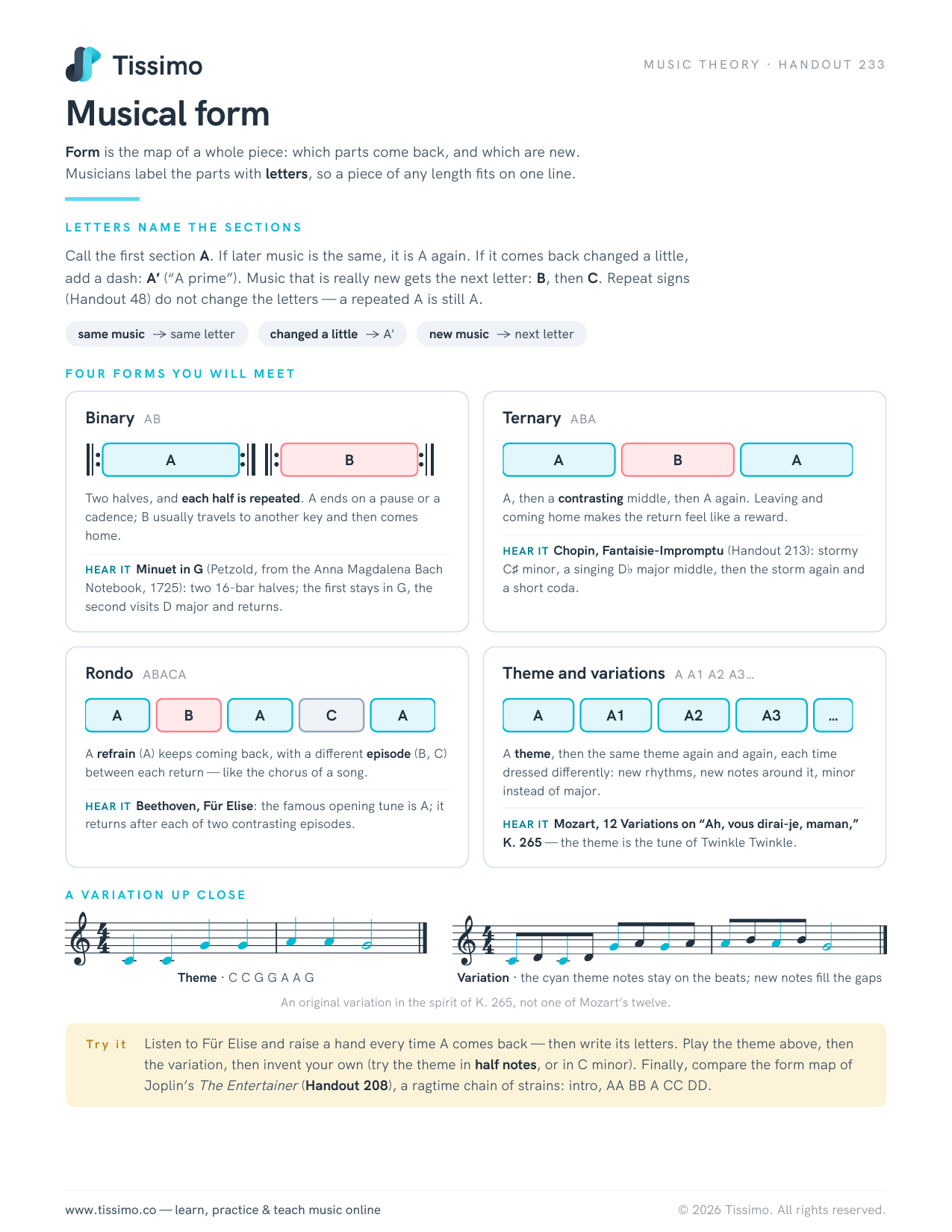
Musical form
Form is the map of a whole piece: which parts come back, and which are new. Musicians label the parts with letters, so a piece of any length fits on one line.
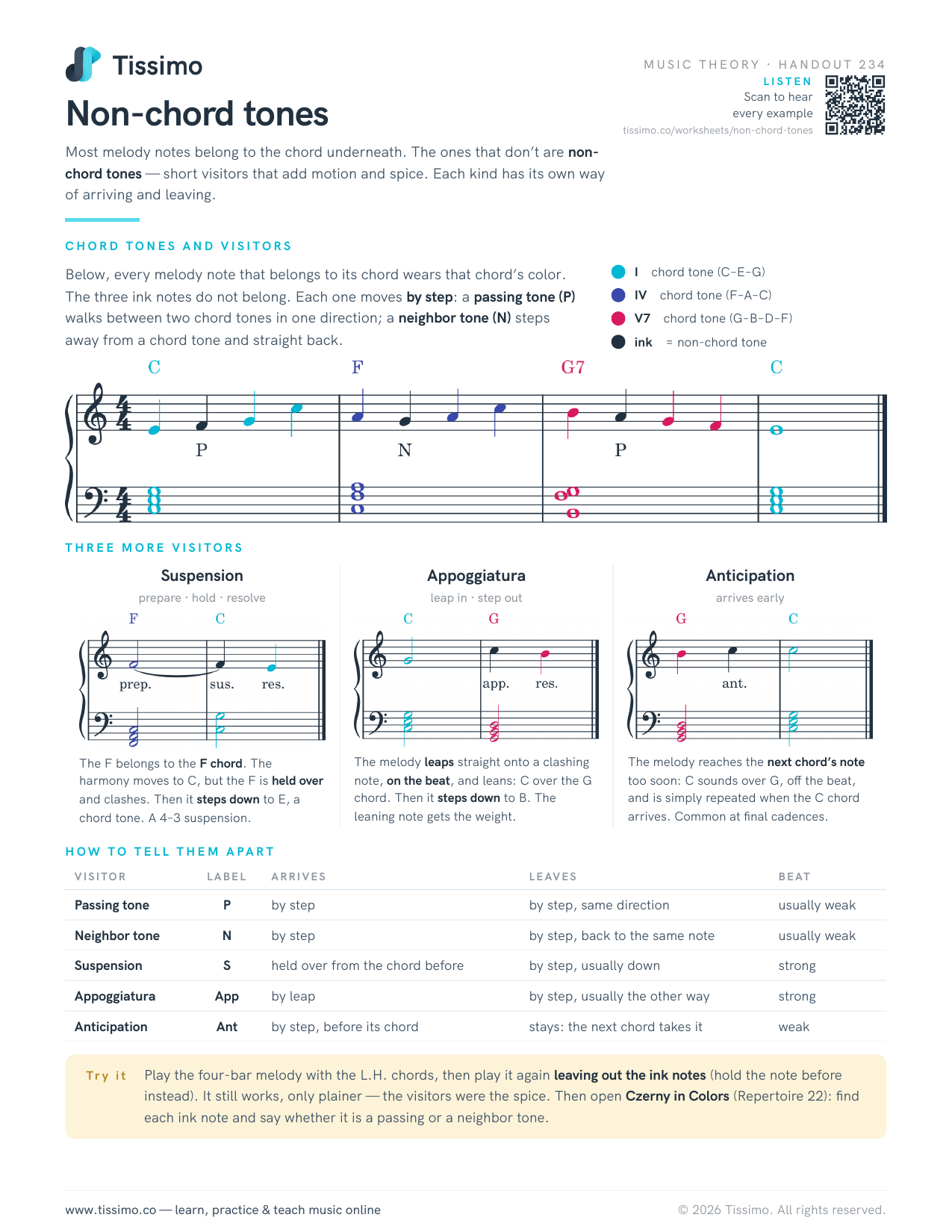
Non-chord tones
Most melody notes belong to the chord underneath. The ones that don’t are non-chord tones — short visitors that add motion and spice. Each kind has its own way of arriving and leaving.
Arpeggien
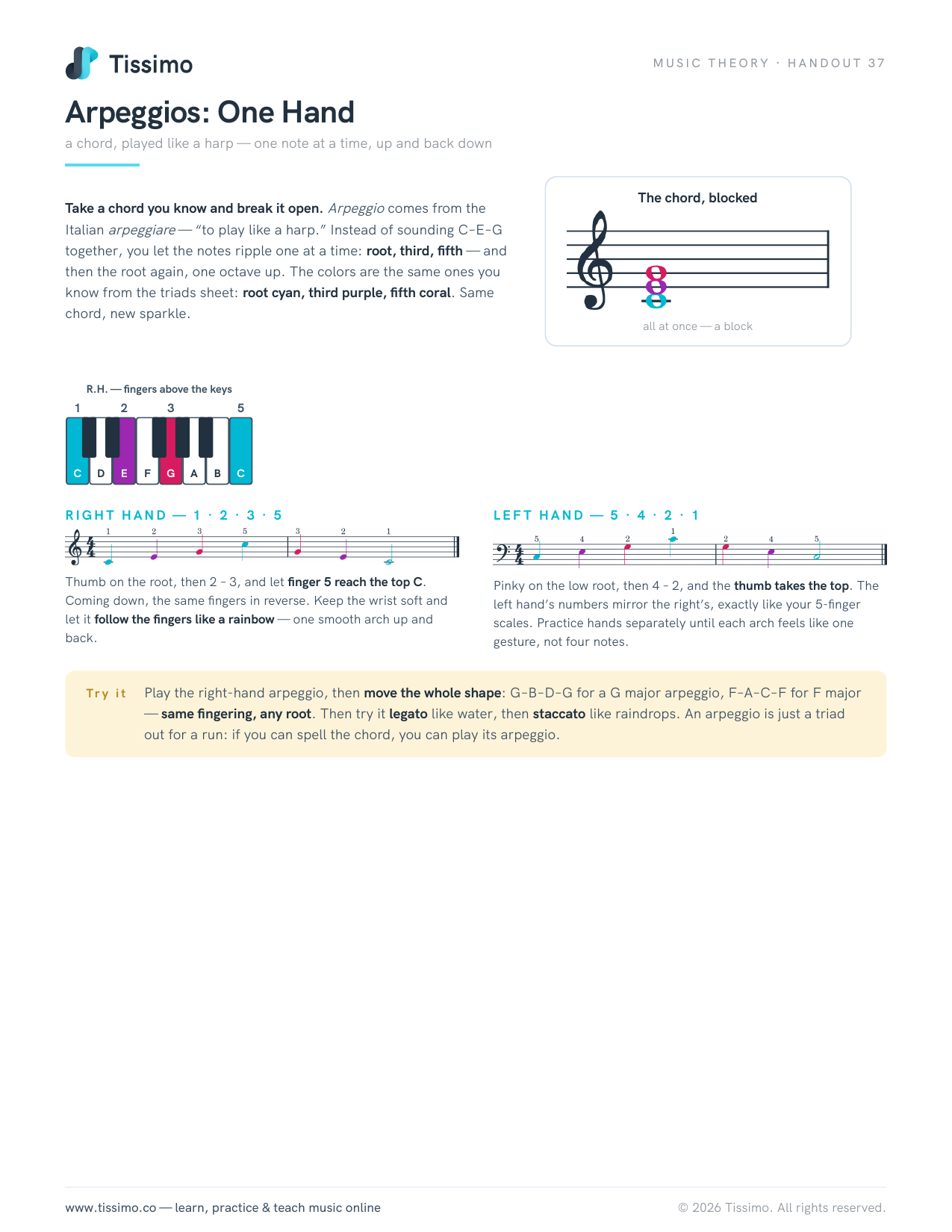
Arpeggien: eine Hand
ein Akkord, gespielt wie auf einer Harfe — Ton für Ton, auf und ab
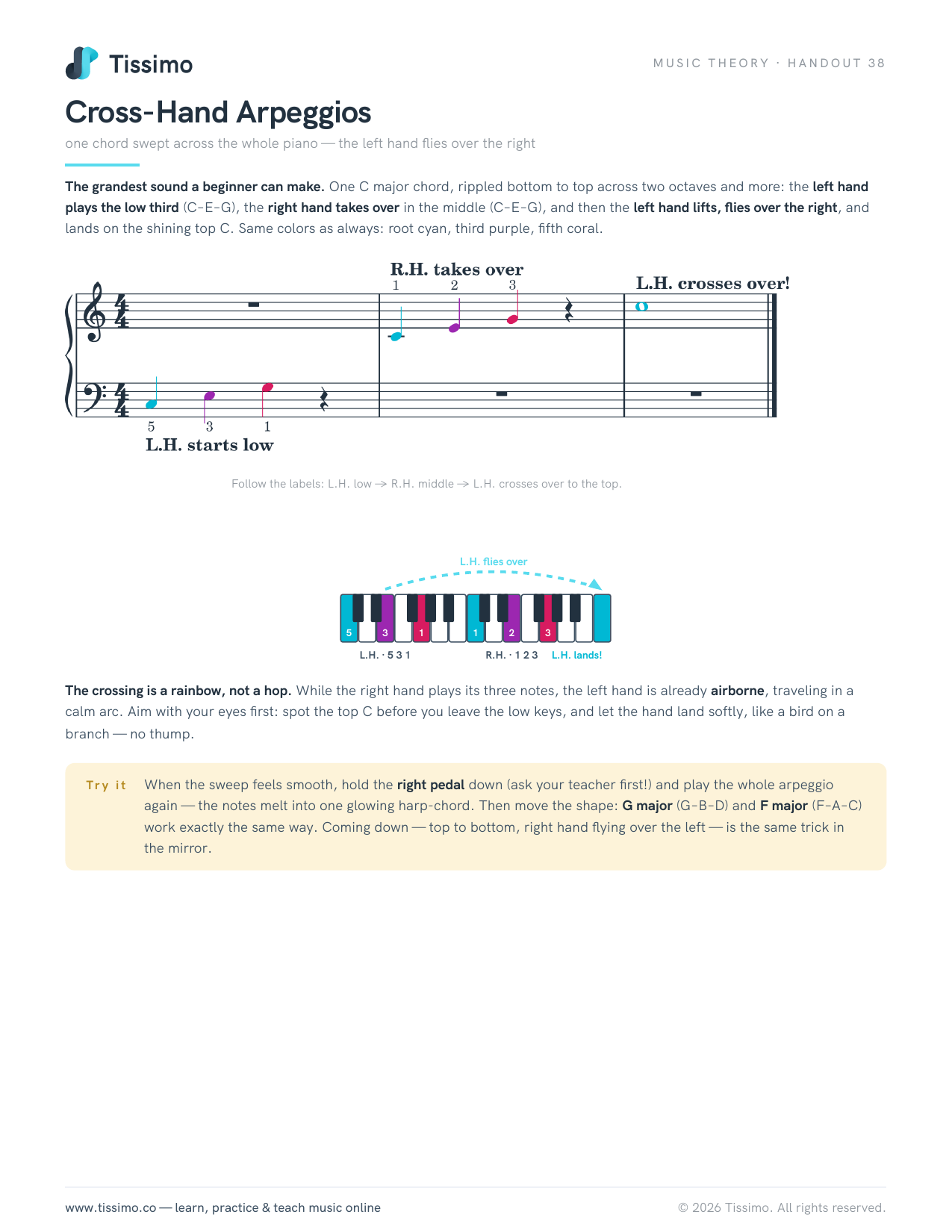
Überkreuz-Arpeggien
ein Akkord, über das ganze Klavier gefegt — die linke Hand fliegt über die rechte
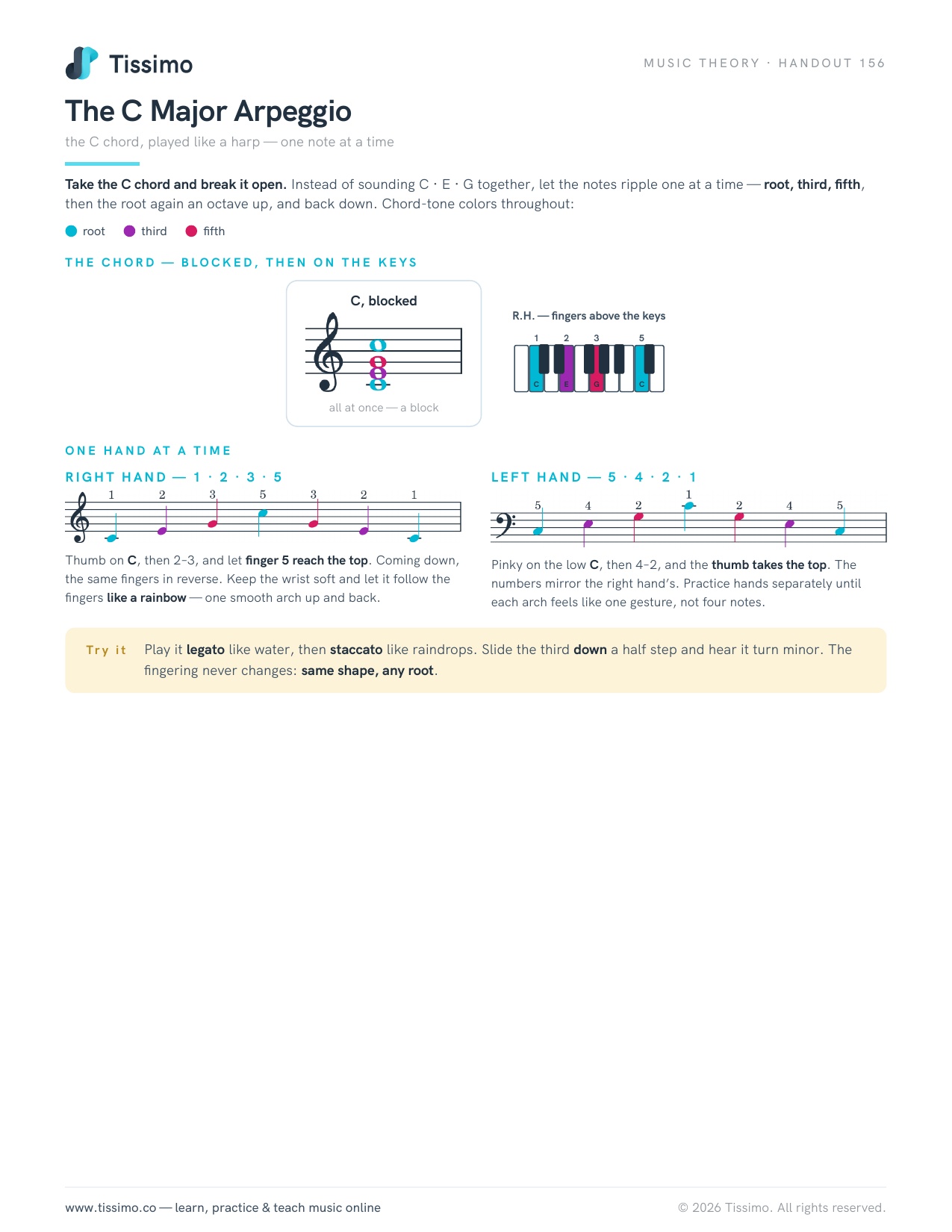
Arpeggien in jeder Tonart
Der Akkord wie auf einer Harfe gespielt — Ton für Ton, auf und ab, in allen 24 Tonarten.
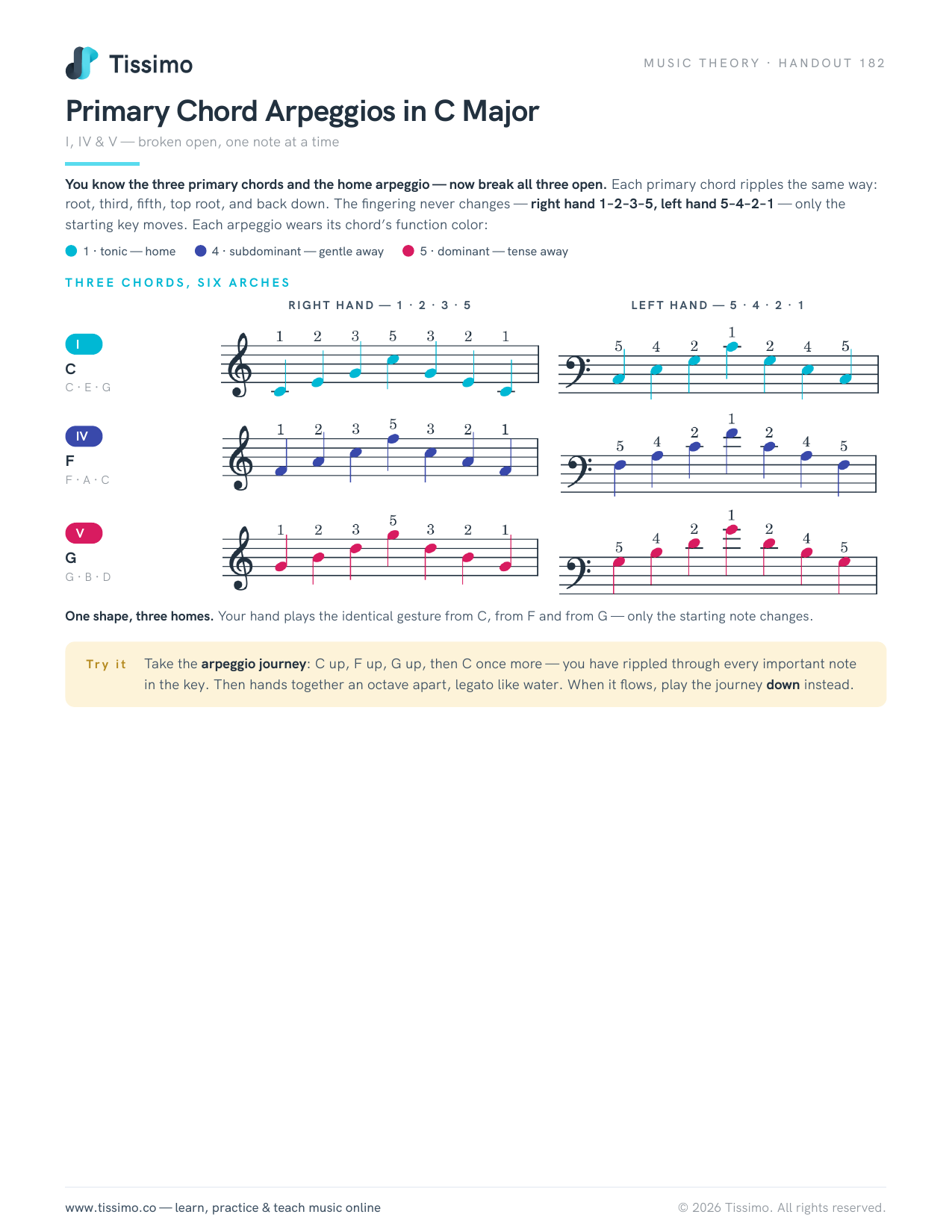
Arpeggien der Hauptdreiklänge in jeder Tonart
I, IV und V aufgebrochen, Ton für Ton, in allen 24 Tonarten.
Ausdruck & Technik
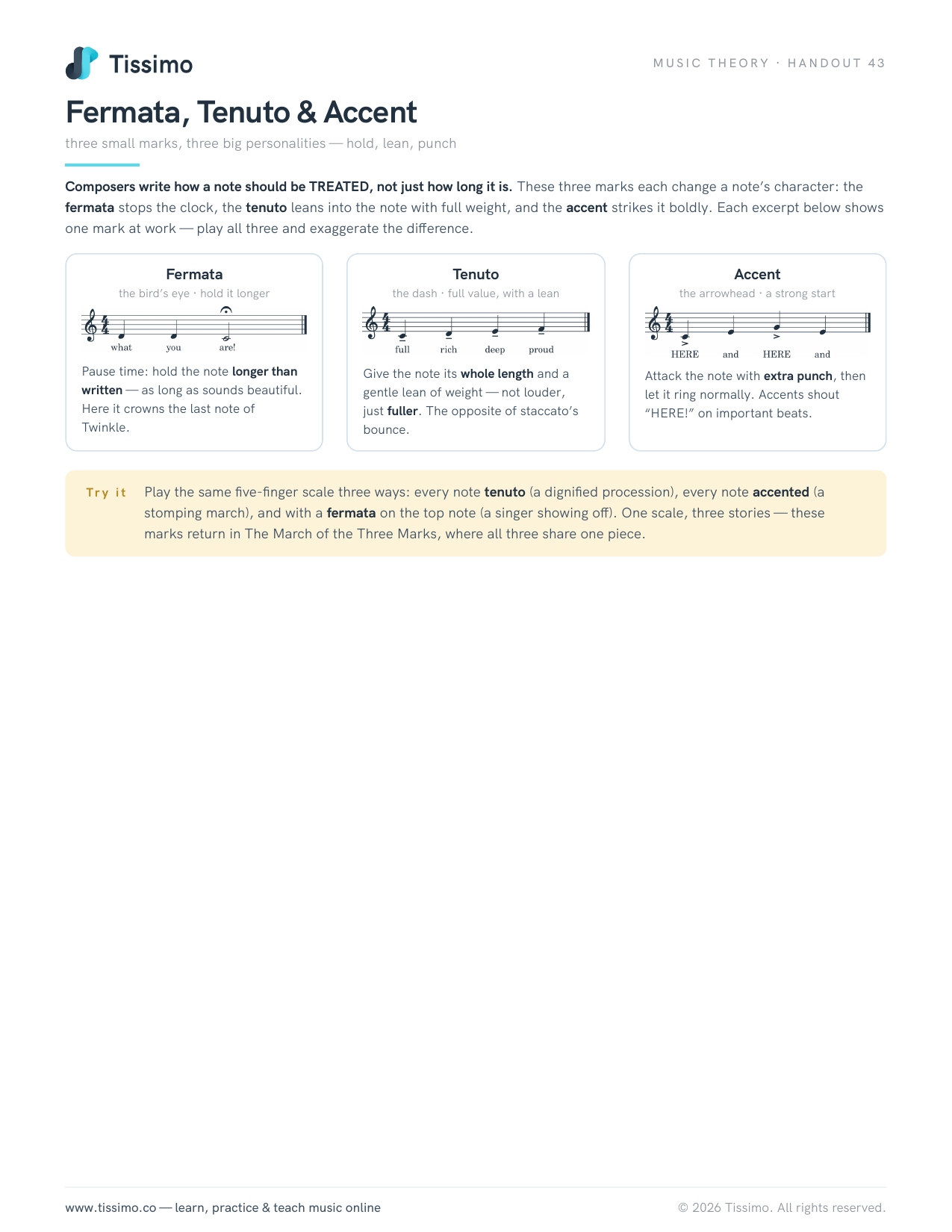
Fermate, Tenuto & Akzent
drei kleine Zeichen, drei große Persönlichkeiten — halten, betonen, stoßen
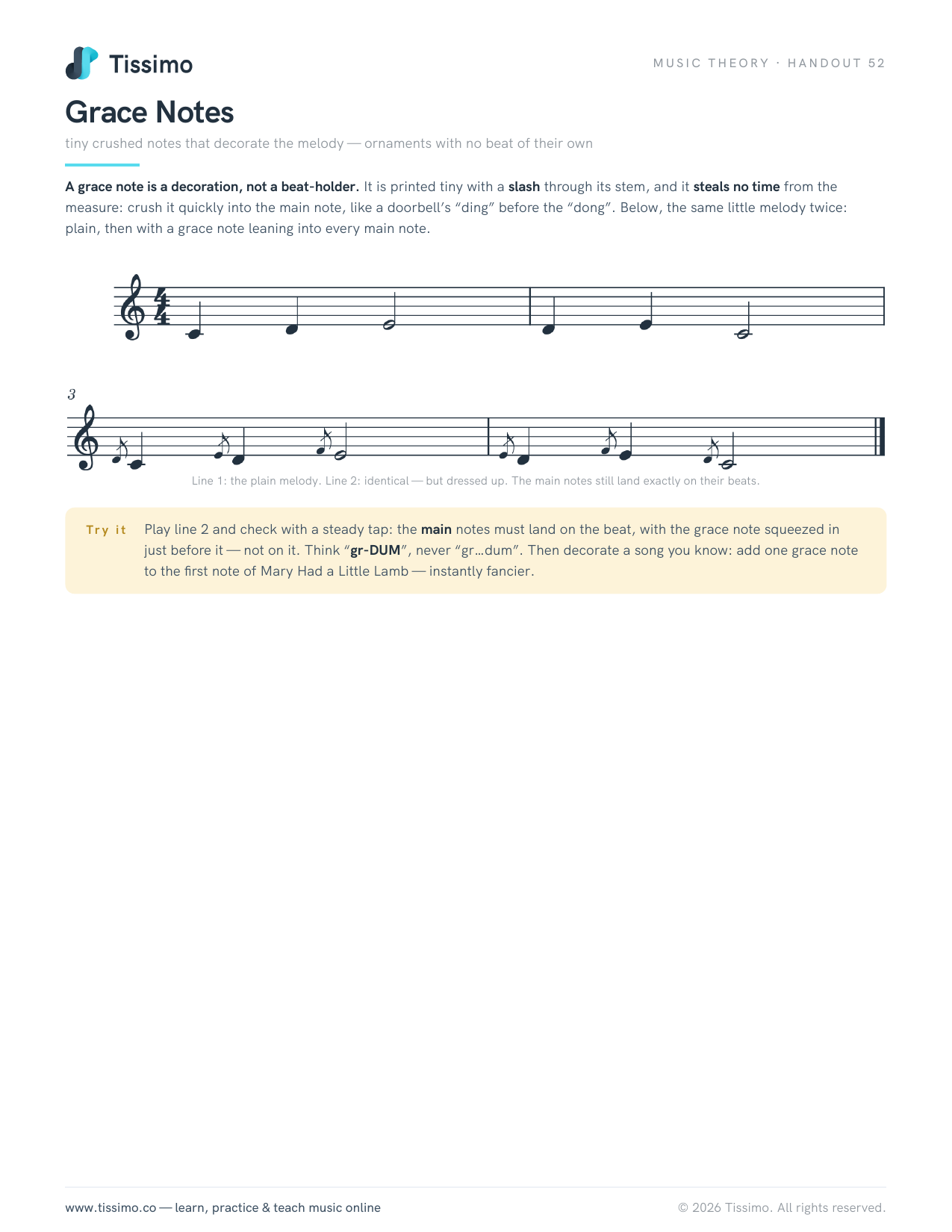
Vorschläge (Verzierungsnoten)
winzige, gequetschte Töne, die die Melodie schmücken — Verzierungen ohne eigenen Zeitwert
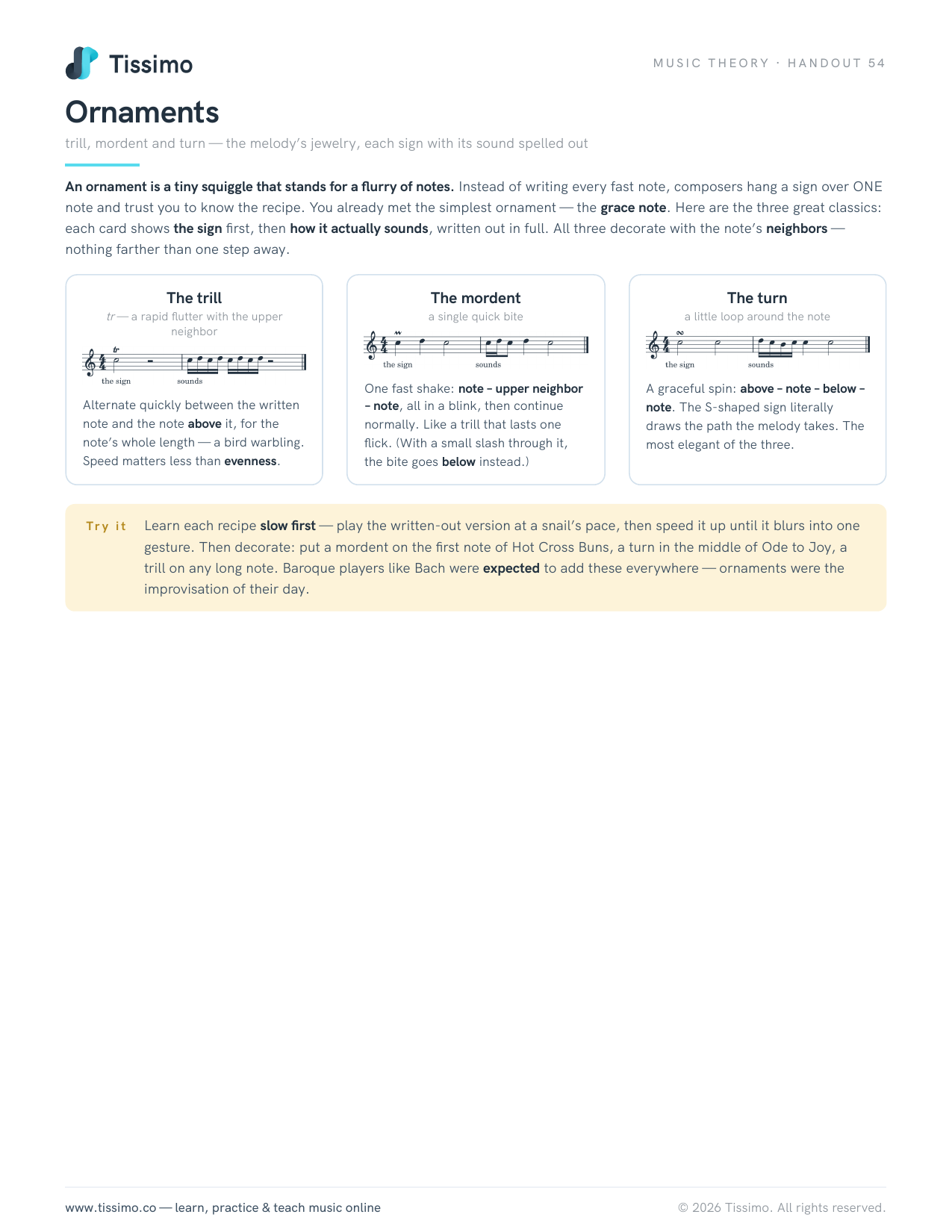
Verzierungen
Triller, Mordent und Doppelschlag — der Schmuck der Melodie, jedes Zeichen mit seinem Klang erklärt
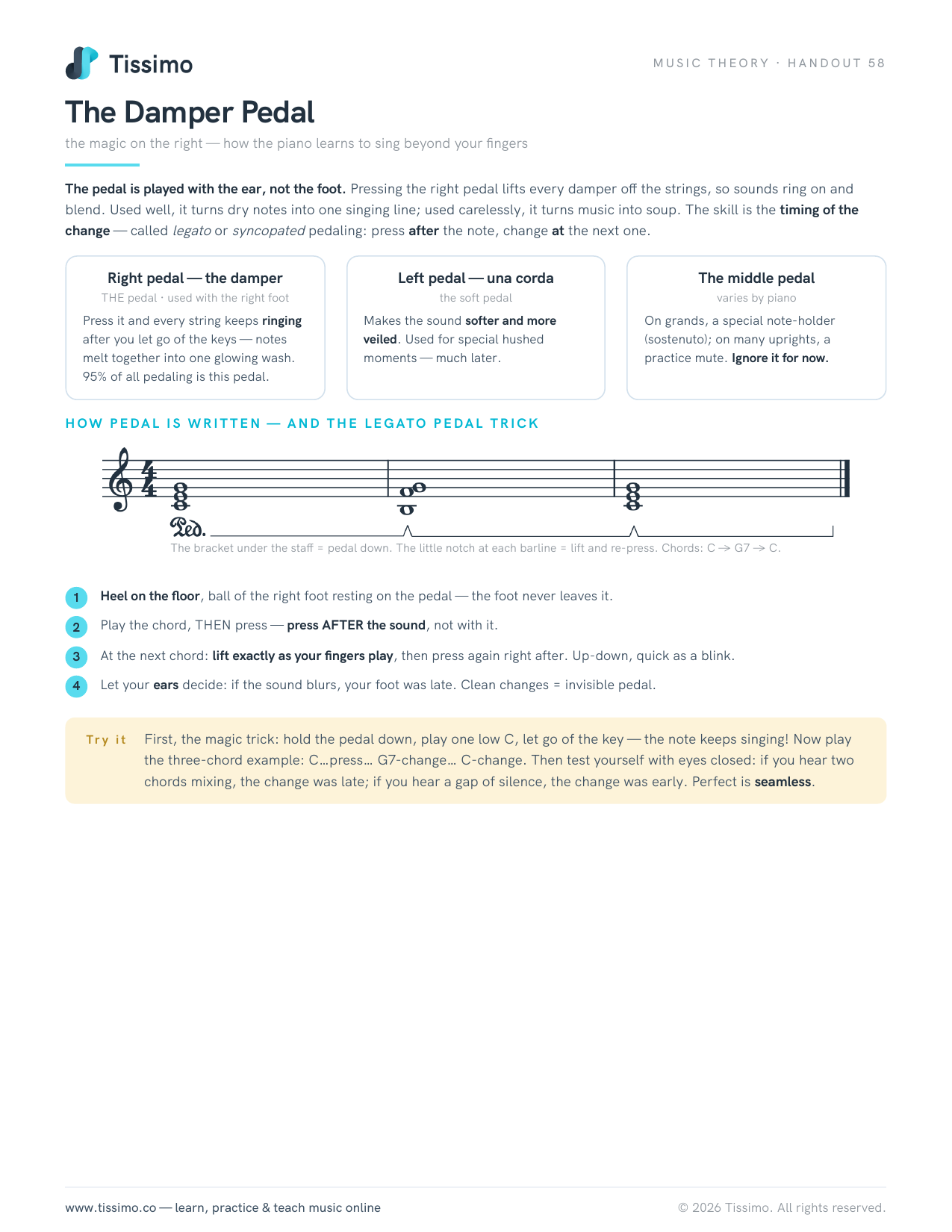
Das Haltepedal
die Magie auf der rechten Seite — wie das Klavier lernt, über deine Finger hinaus zu singen
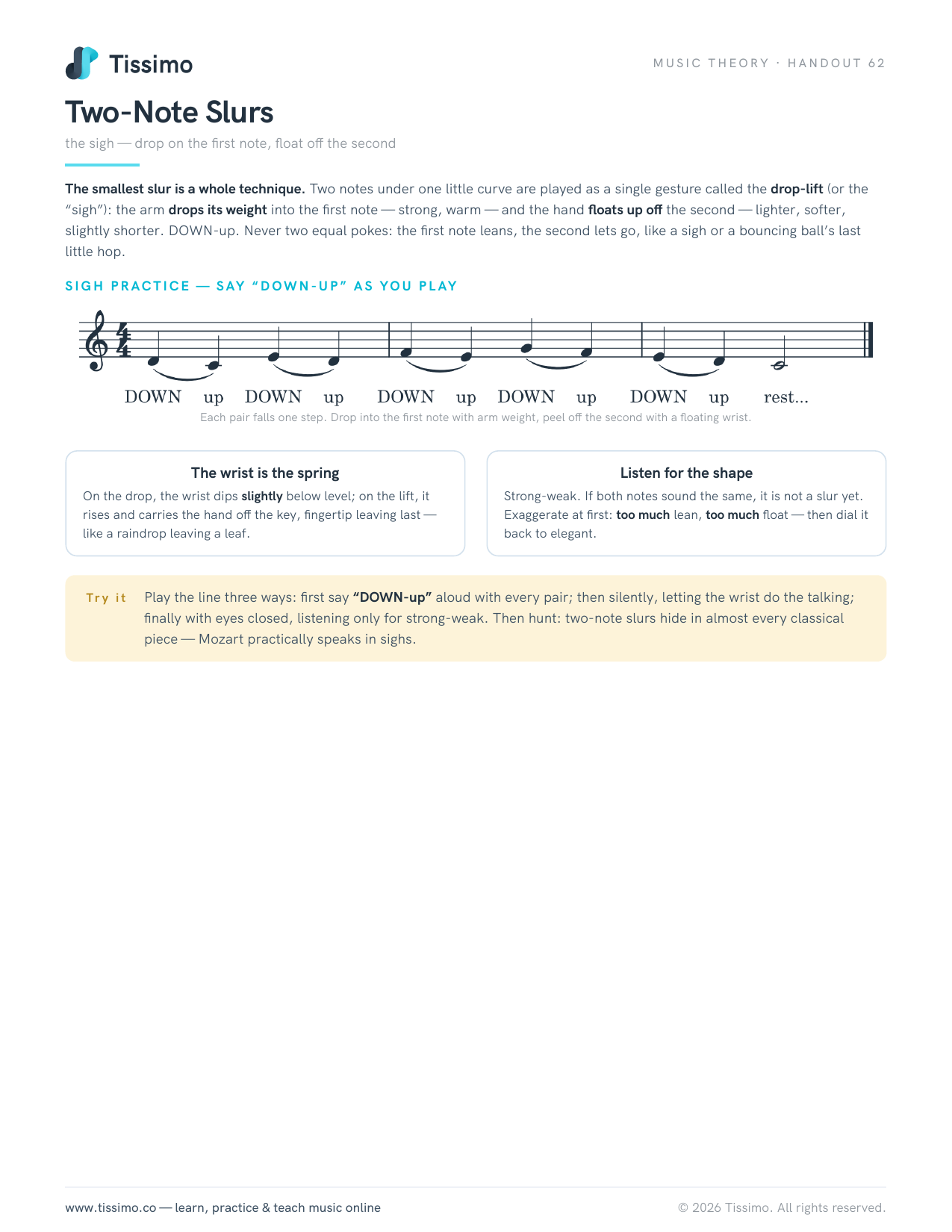
Zweitonbindungen
der Seufzer — fällt auf die erste Note, schwebt bei der zweiten davon
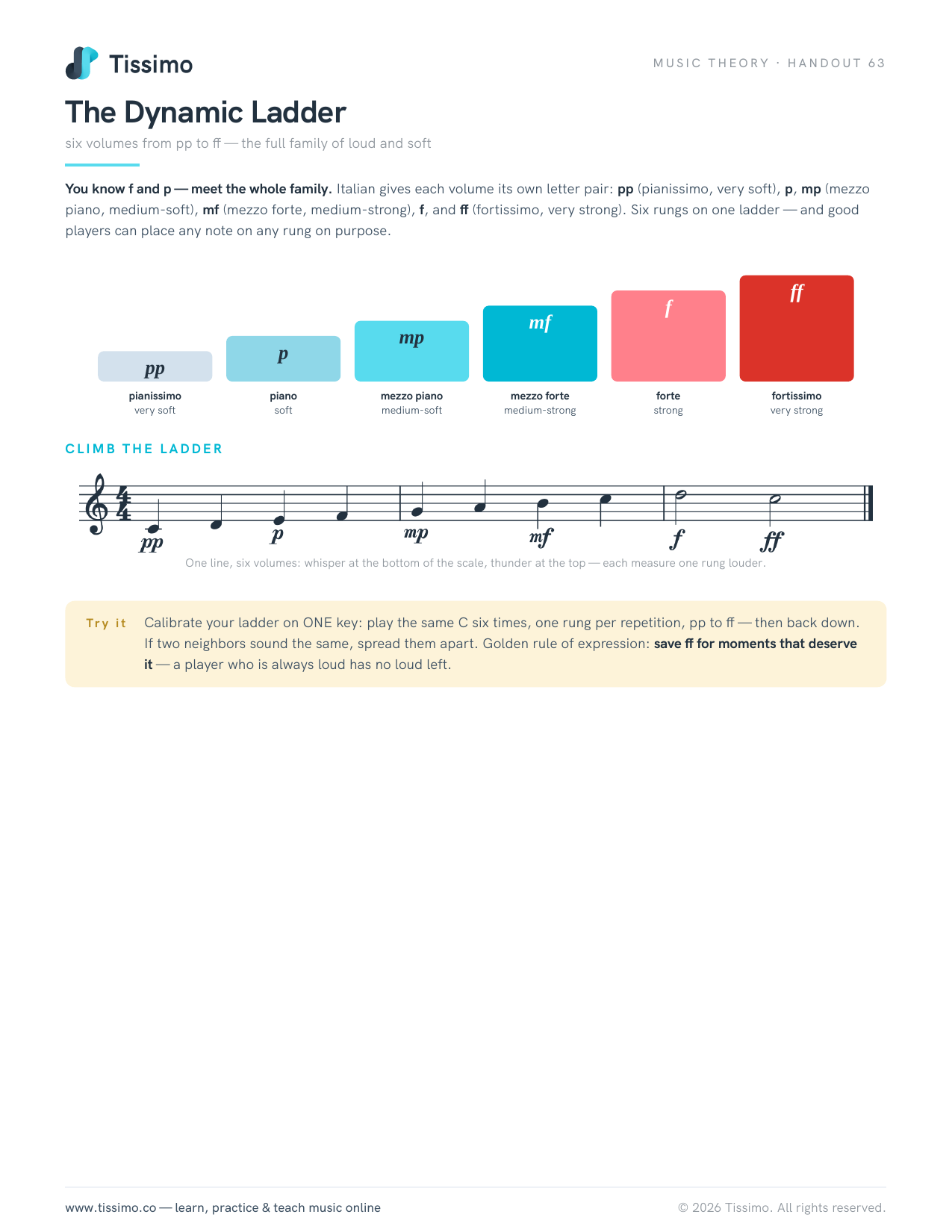
Die Dynamik-Leiter
sechs Lautstärken von pp bis ff — die ganze Familie von laut und leise
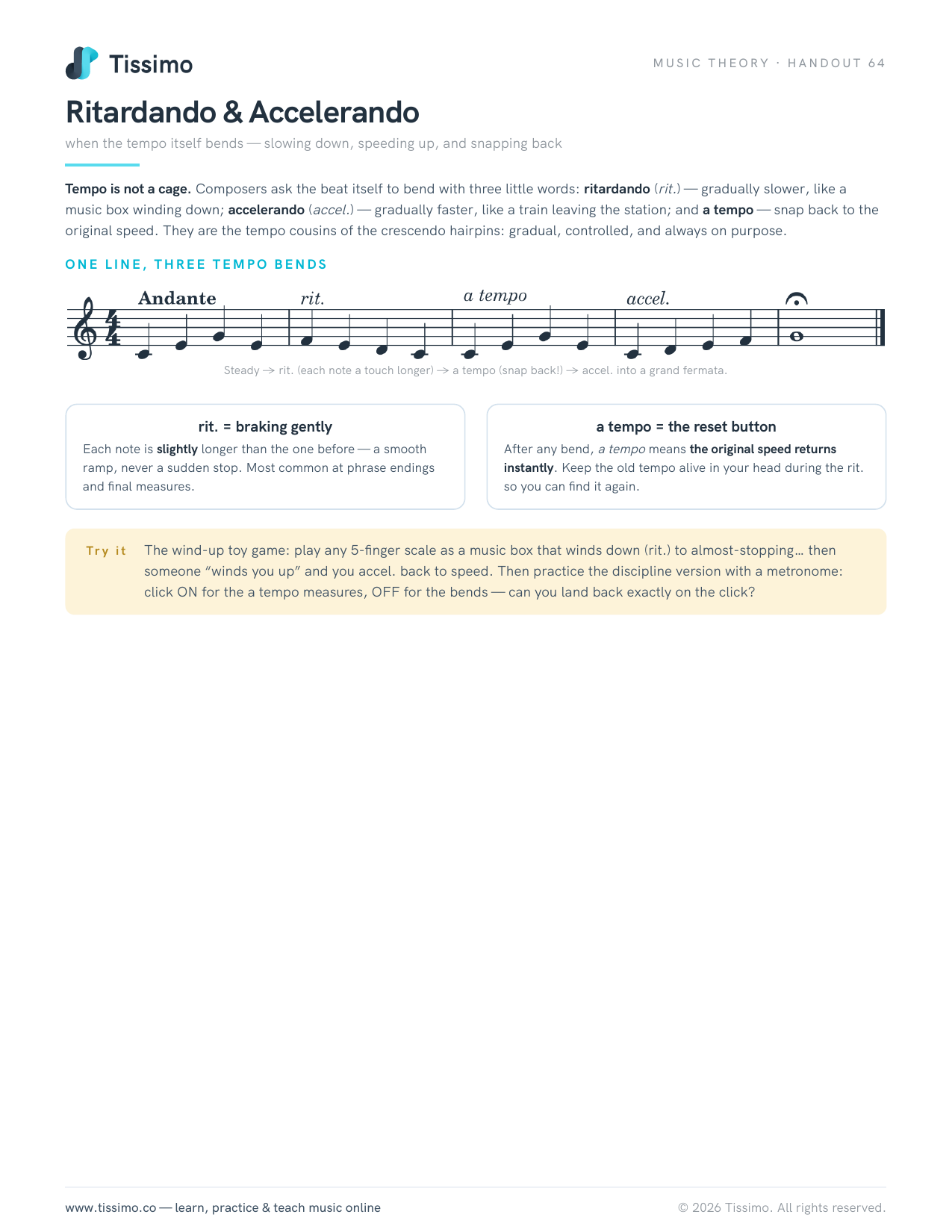
Ritardando & Accelerando
wenn sich das Tempo selbst verbiegt — langsamer werden, schneller werden, und zurückschnappen
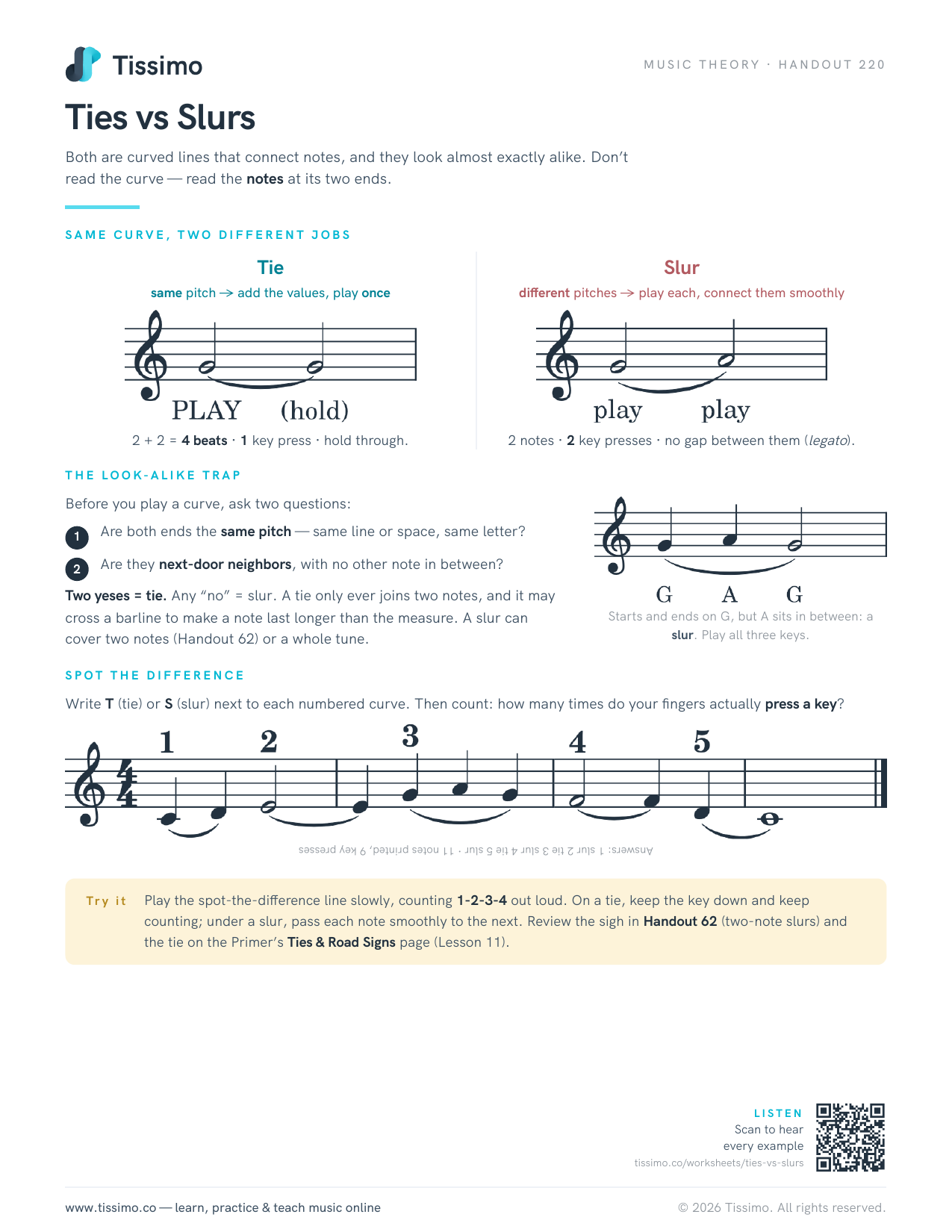
Ties vs Slurs
Both are curved lines that connect notes, and they look almost exactly alike. Don’t read the curve — read the notes at its two ends.
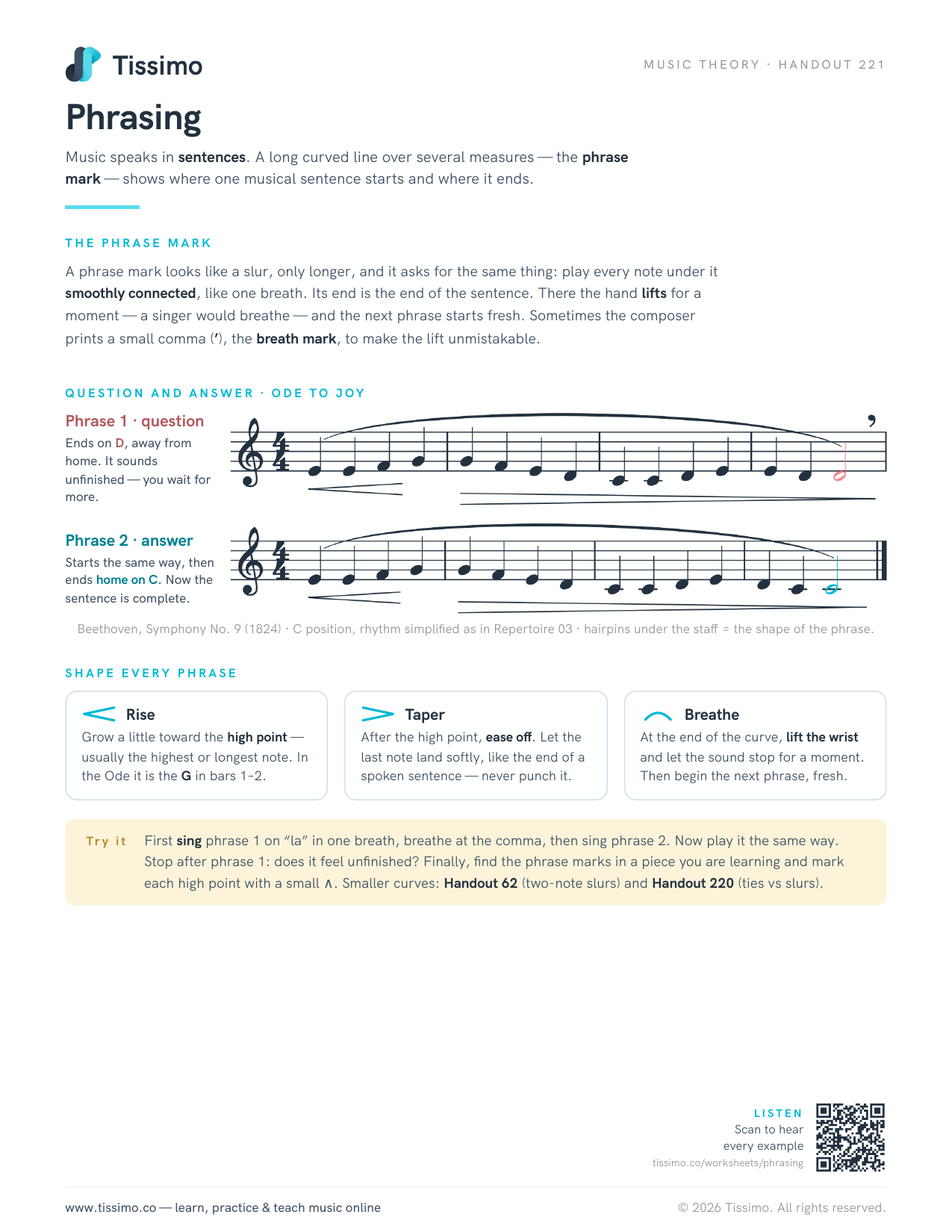
Phrasing
Music speaks in sentences. A long curved line over several measures — the phrase mark — shows where one musical sentence starts and where it ends.
How to practice
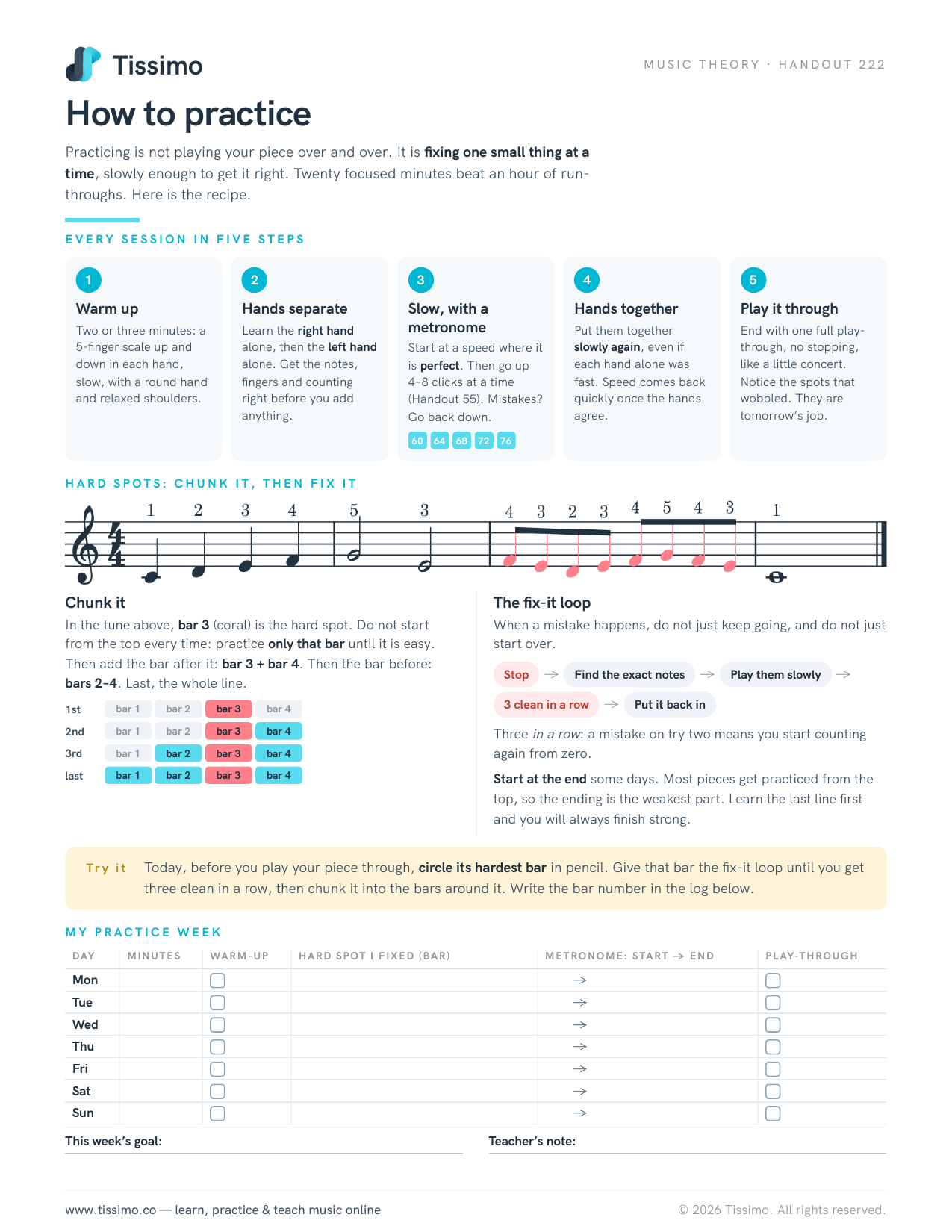
Practicing is not playing your piece over and over. It is fixing one small thing at a time, slowly enough to get it right. Twenty focused minutes beat an hour of run-throughs. Here is the recipe.
Repertoire
Exercises
Name the notes: the C 5-finger scale
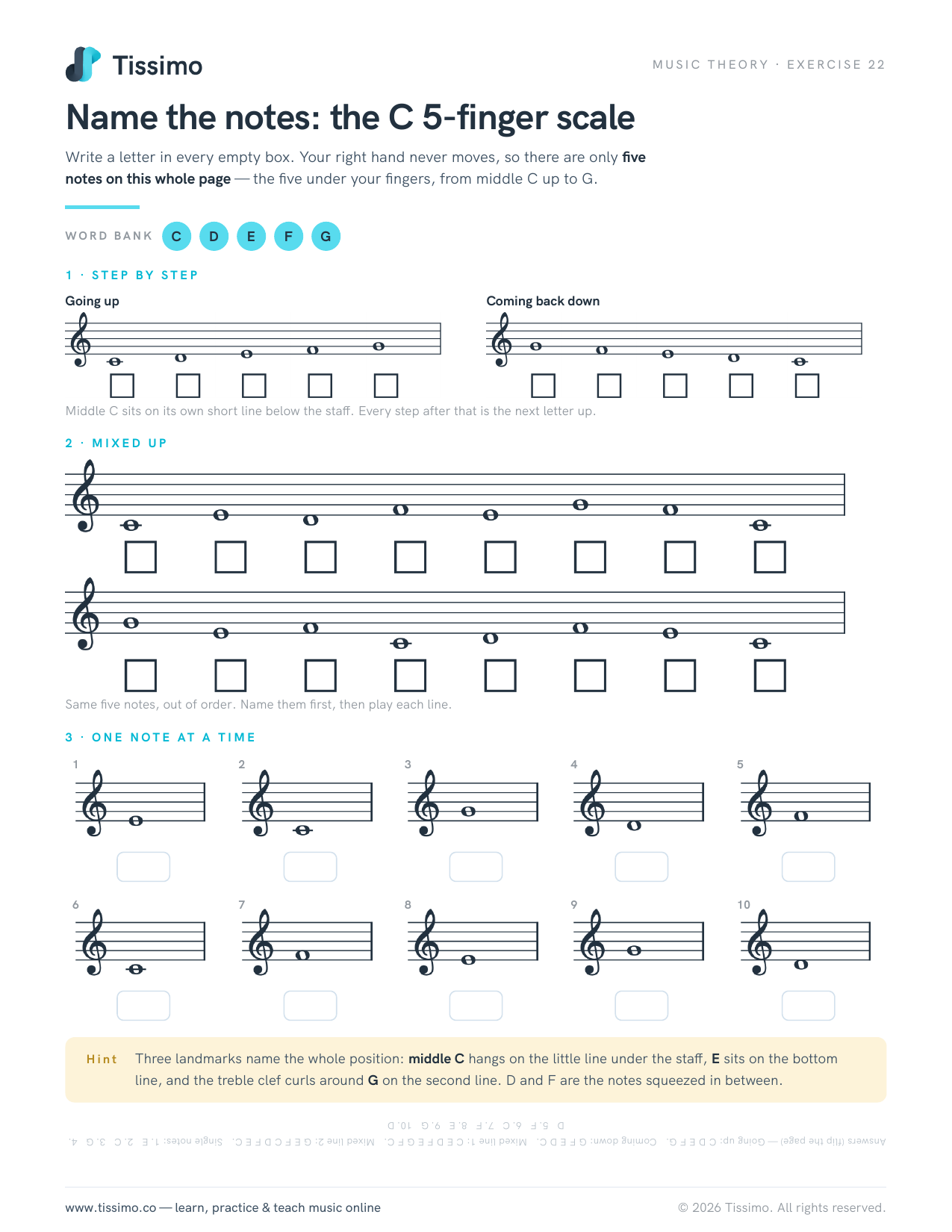
Write a letter in every empty box. Your right hand never moves, so there are only five notes on this whole page — the five under your fingers, from middle C up to G.
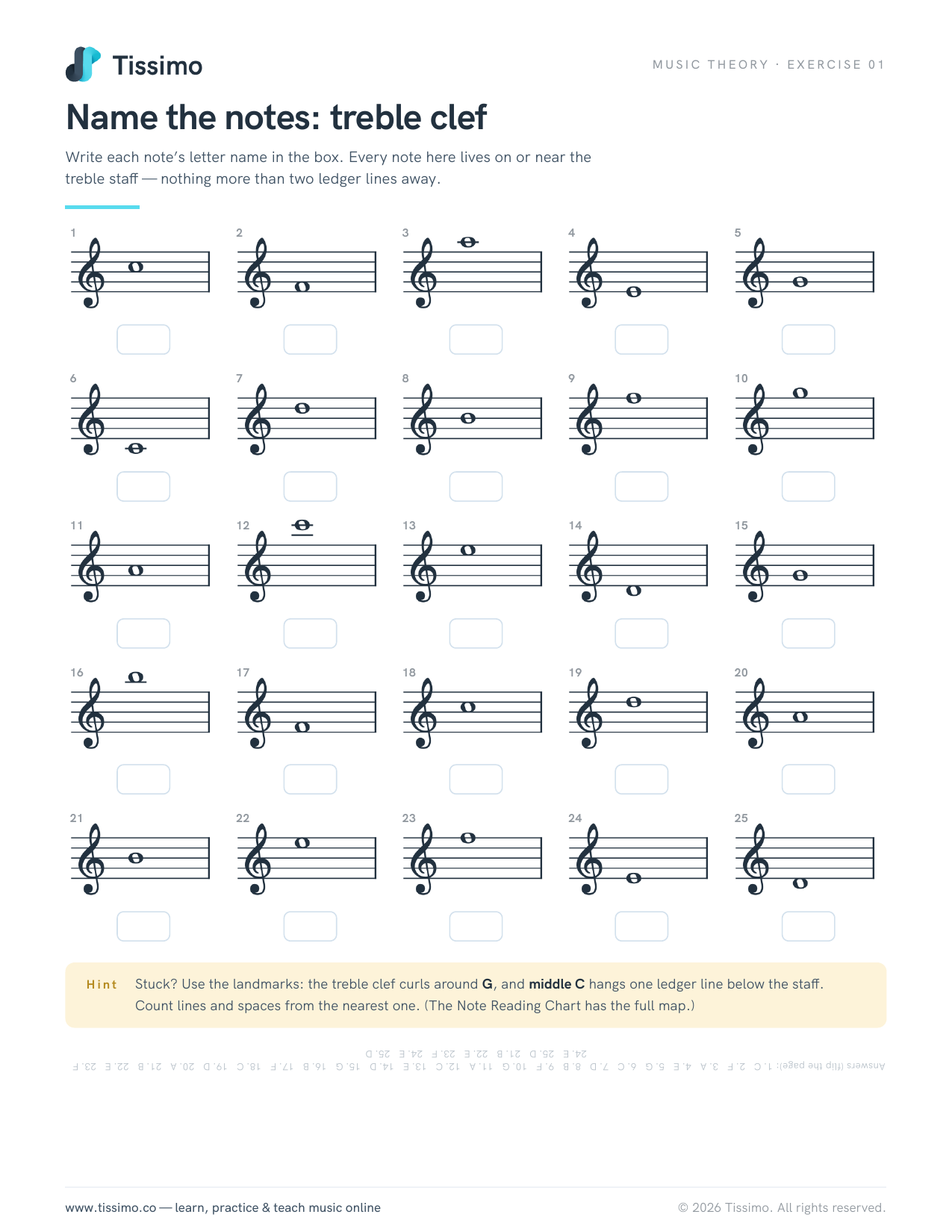
Name the notes: treble clef
Write each note’s letter name in the box. Every note here lives on or near the treble staff — nothing more than two ledger lines away.
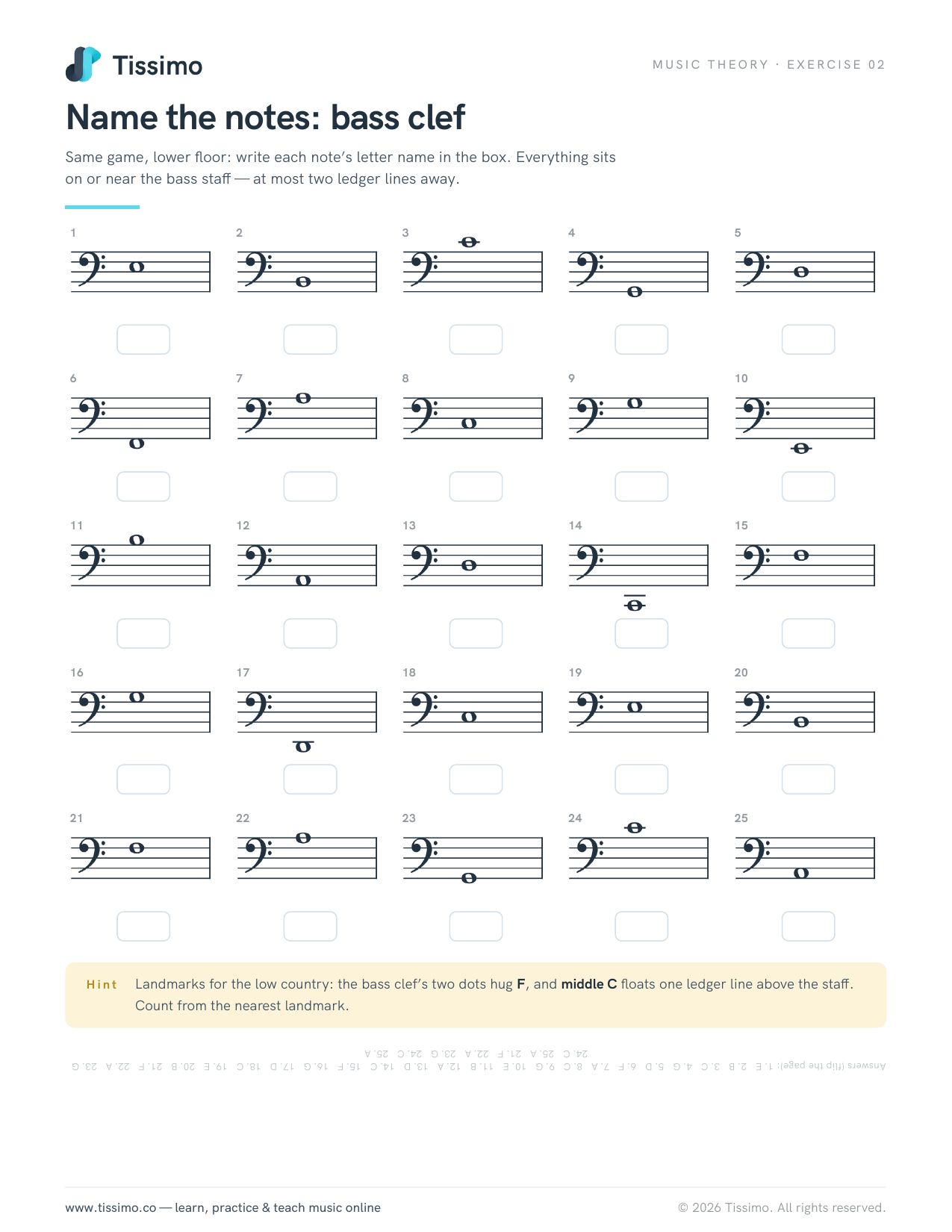
Name the notes: bass clef
Same game, lower floor: write each note’s letter name in the box. Everything sits on or near the bass staff — at most two ledger lines away.
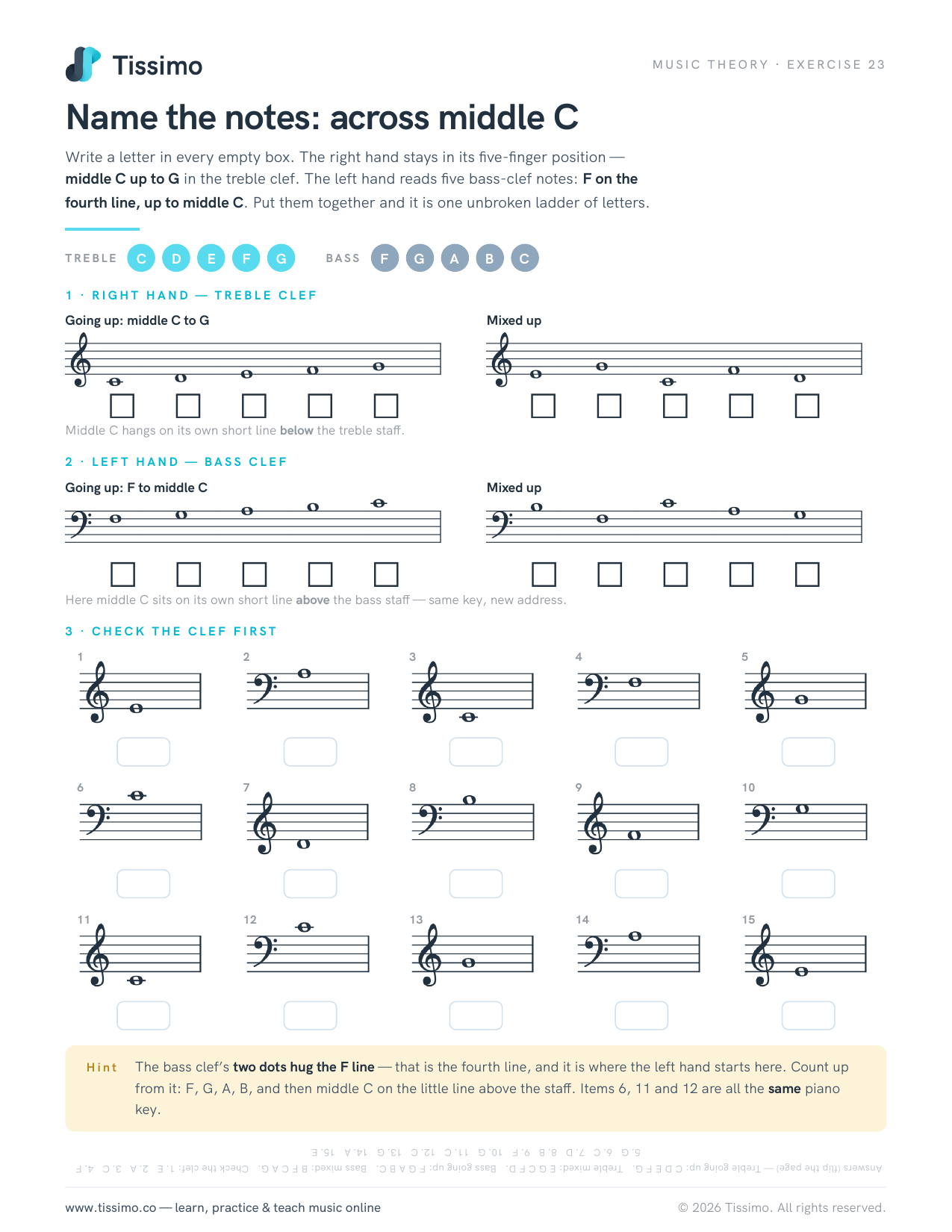
Name the notes: across middle C
Write a letter in every empty box. The right hand stays in its five-finger position — middle C up to G in the treble clef. The left hand reads five bass-clef notes: F on the fourth line, up to middle C. Put them together and it is one unbroken ladder of letters.
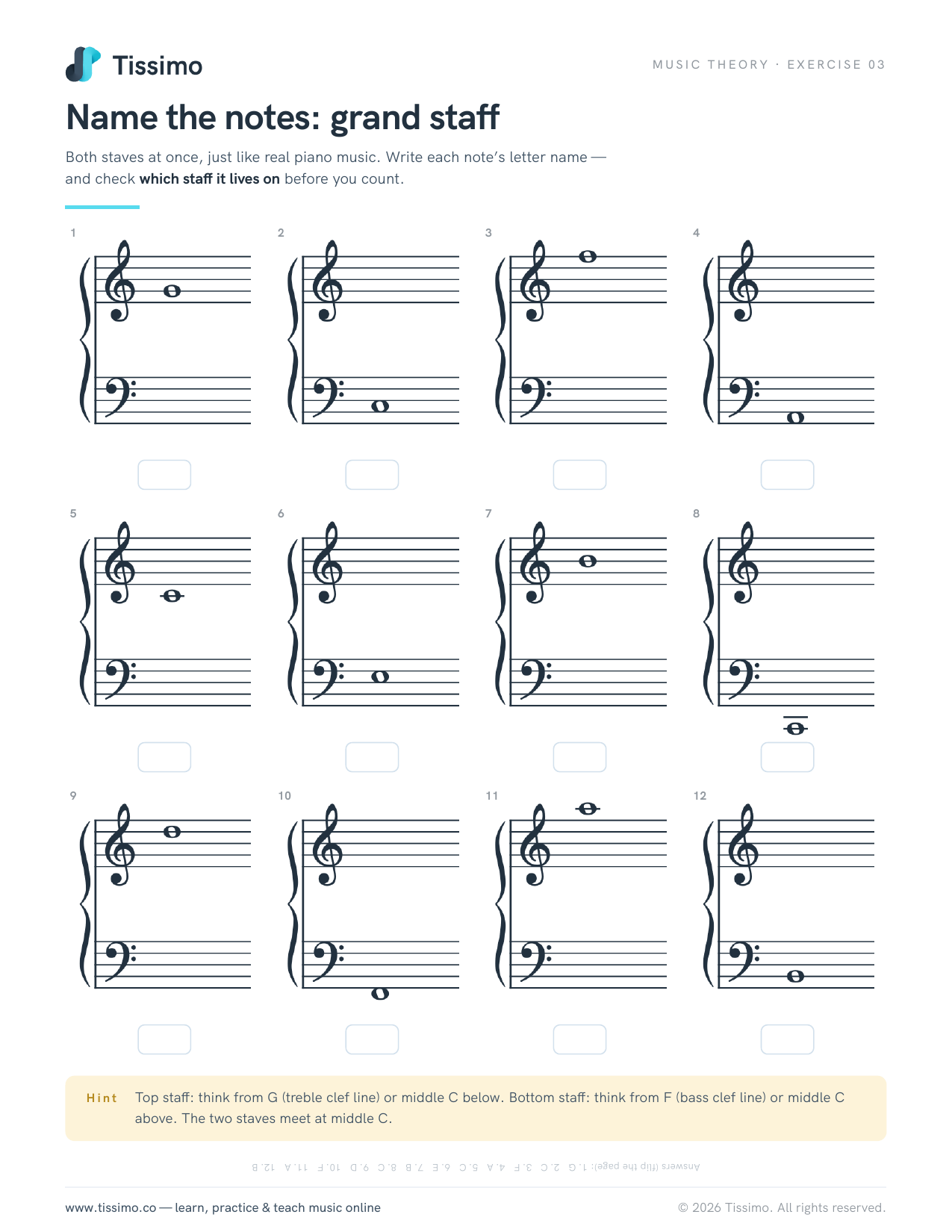
Name the notes: grand staff
Both staves at once, just like real piano music. Write each note’s letter name — and check which staff it lives on before you count.
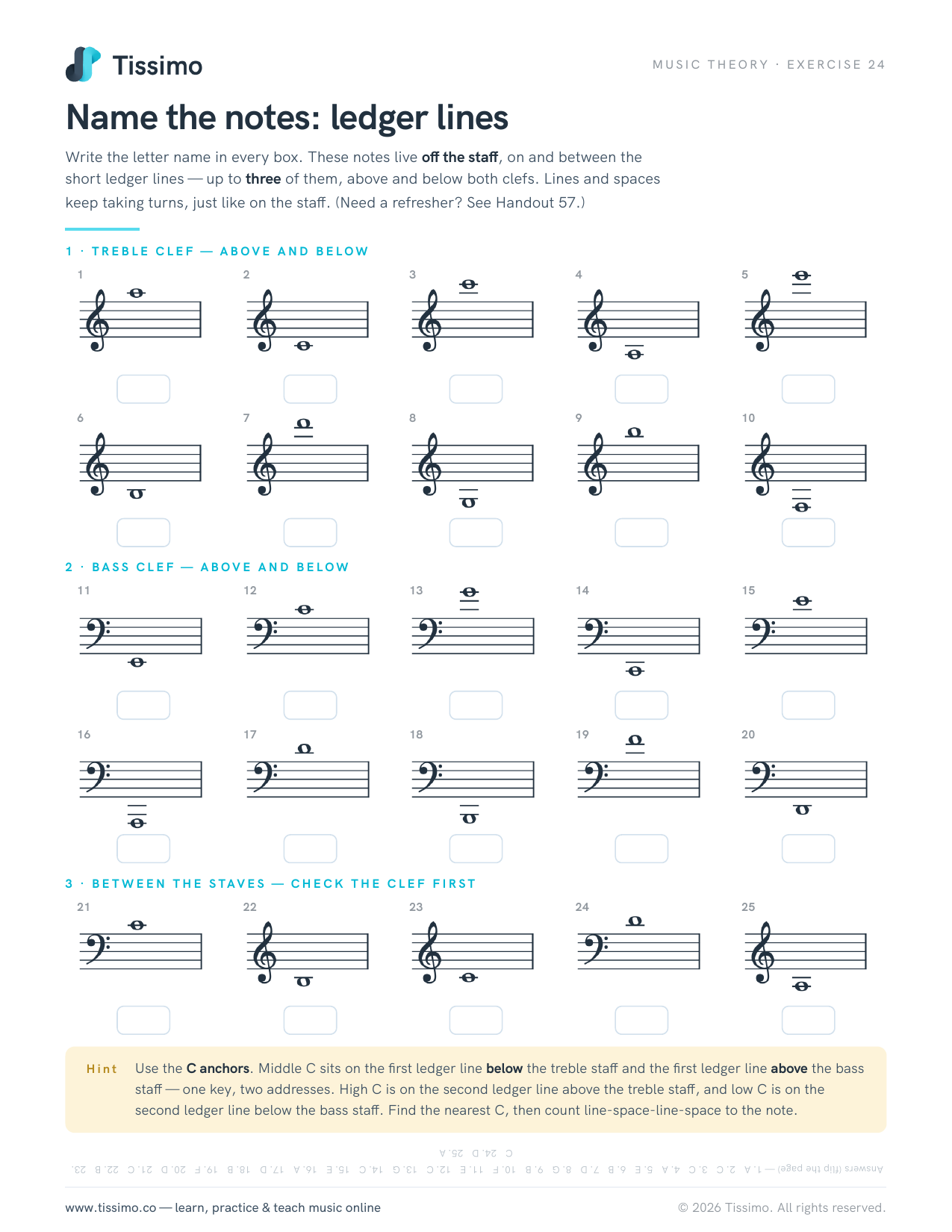
Name the notes: ledger lines
Write the letter name in every box. These notes live off the staff, on and between the short ledger lines — up to three of them, above and below both clefs. Lines and spaces keep taking turns, just like on the staff. (Need a refresher? See Handout 57.)
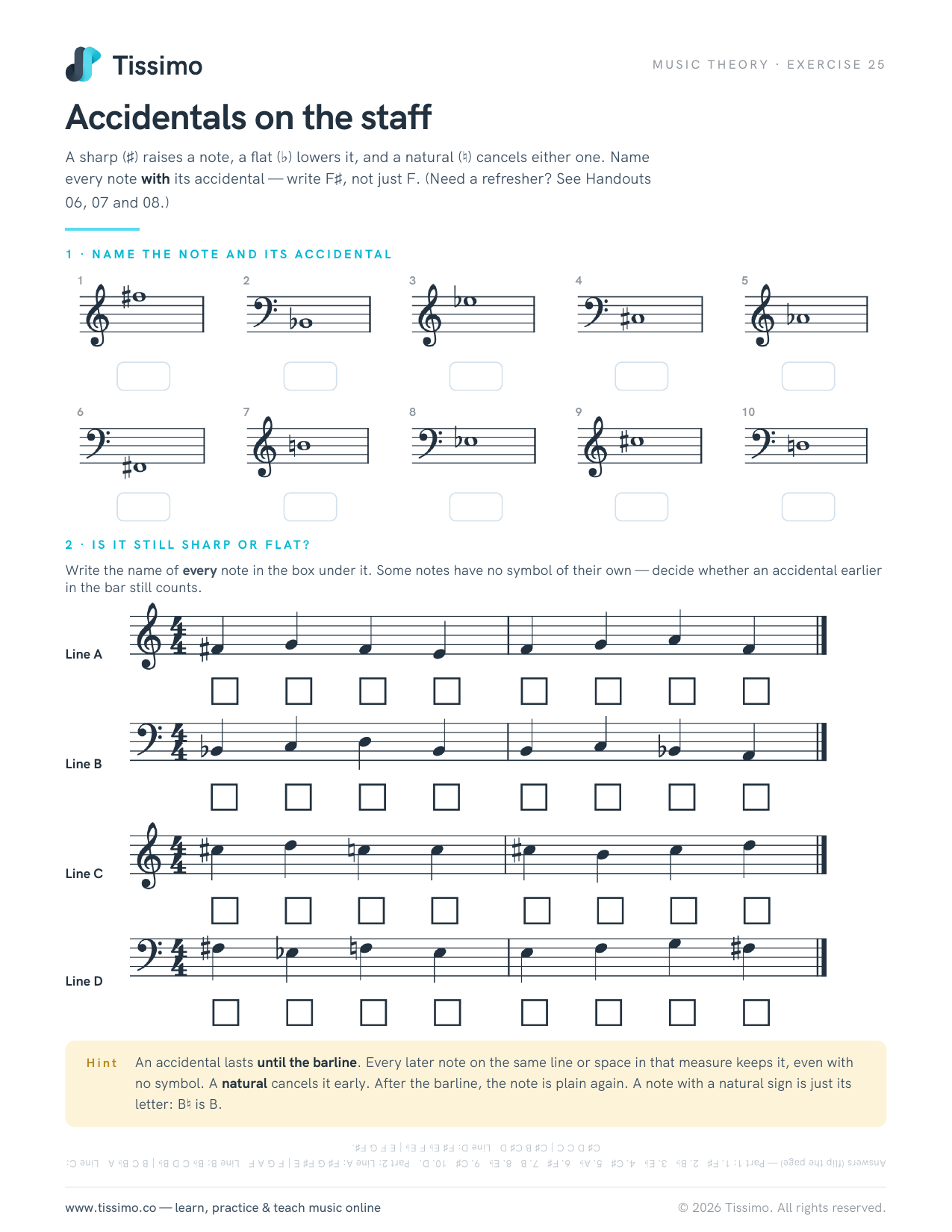
Accidentals on the staff
A sharp (♯) raises a note, a flat (♭) lowers it, and a natural (♮) cancels either one. Name every note with its accidental — write F♯, not just F. (Need a refresher? See Handouts 06, 07 and 08.)
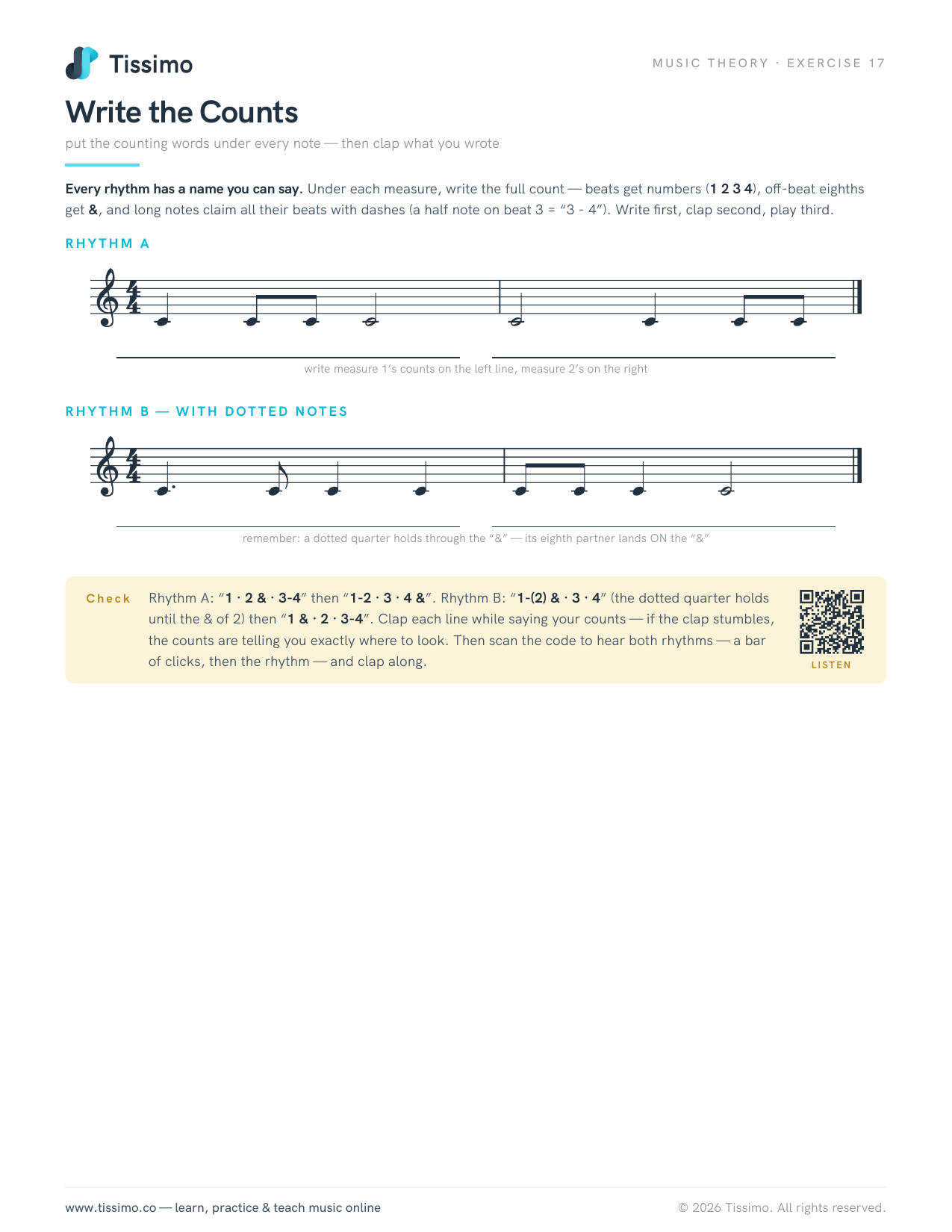
Write the Counts
put the counting words under every note — then clap what you wrote
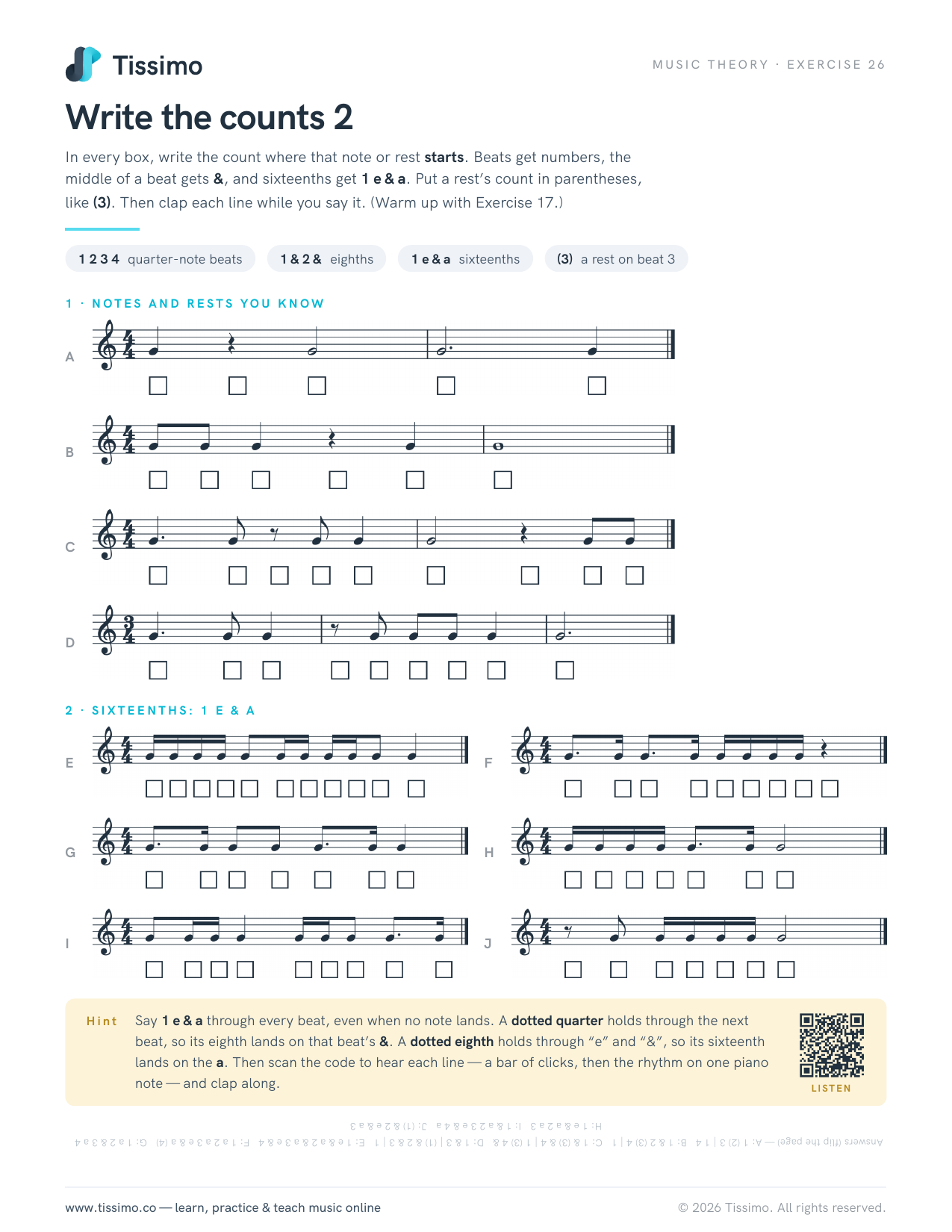
Write the counts 2
In every box, write the count where that note or rest starts. Beats get numbers, the middle of a beat gets &, and sixteenths get 1 e & a. Put a rest’s count in parentheses, like (3). Then clap each line while you say it. (Warm up with Exercise 17.)
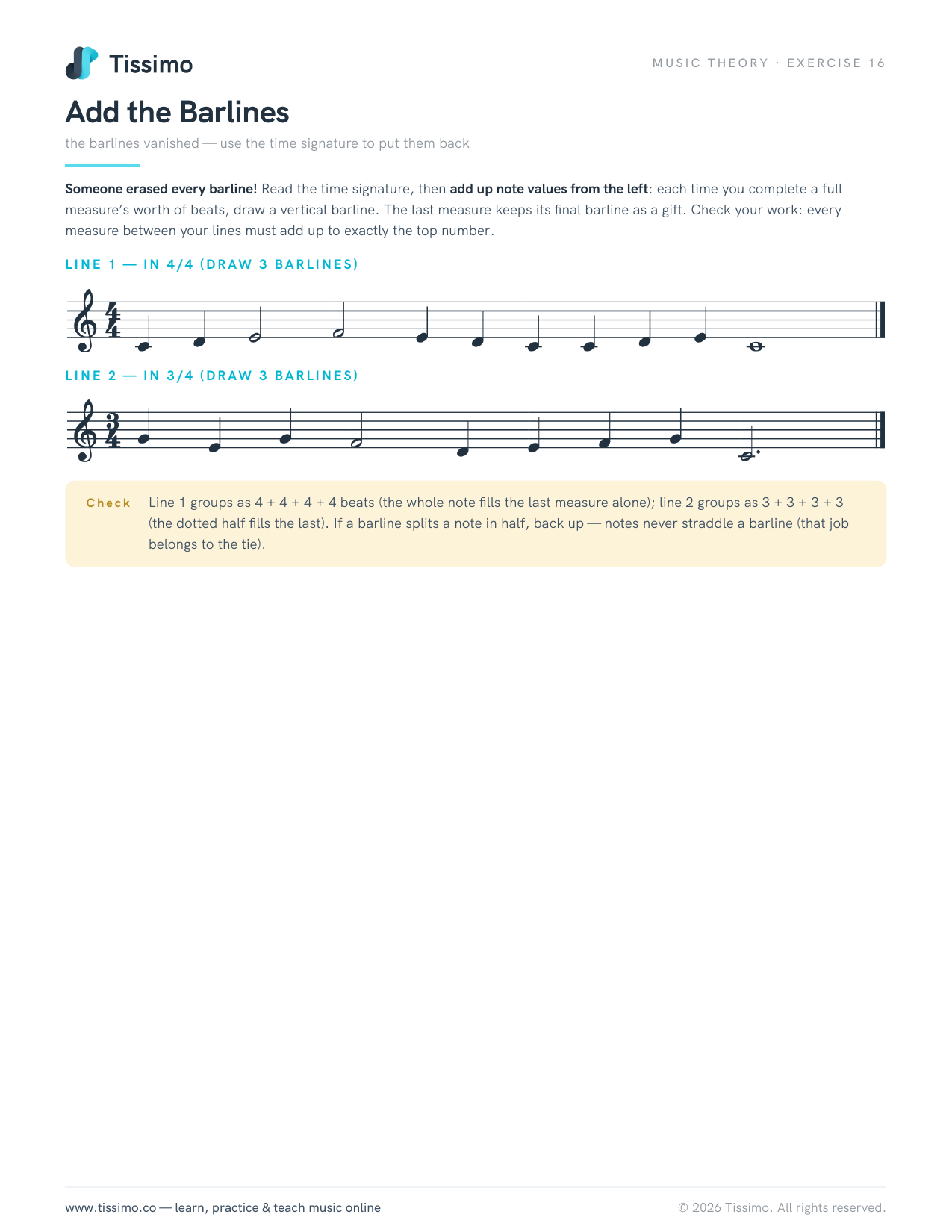
Add the Barlines
the barlines vanished — use the time signature to put them back
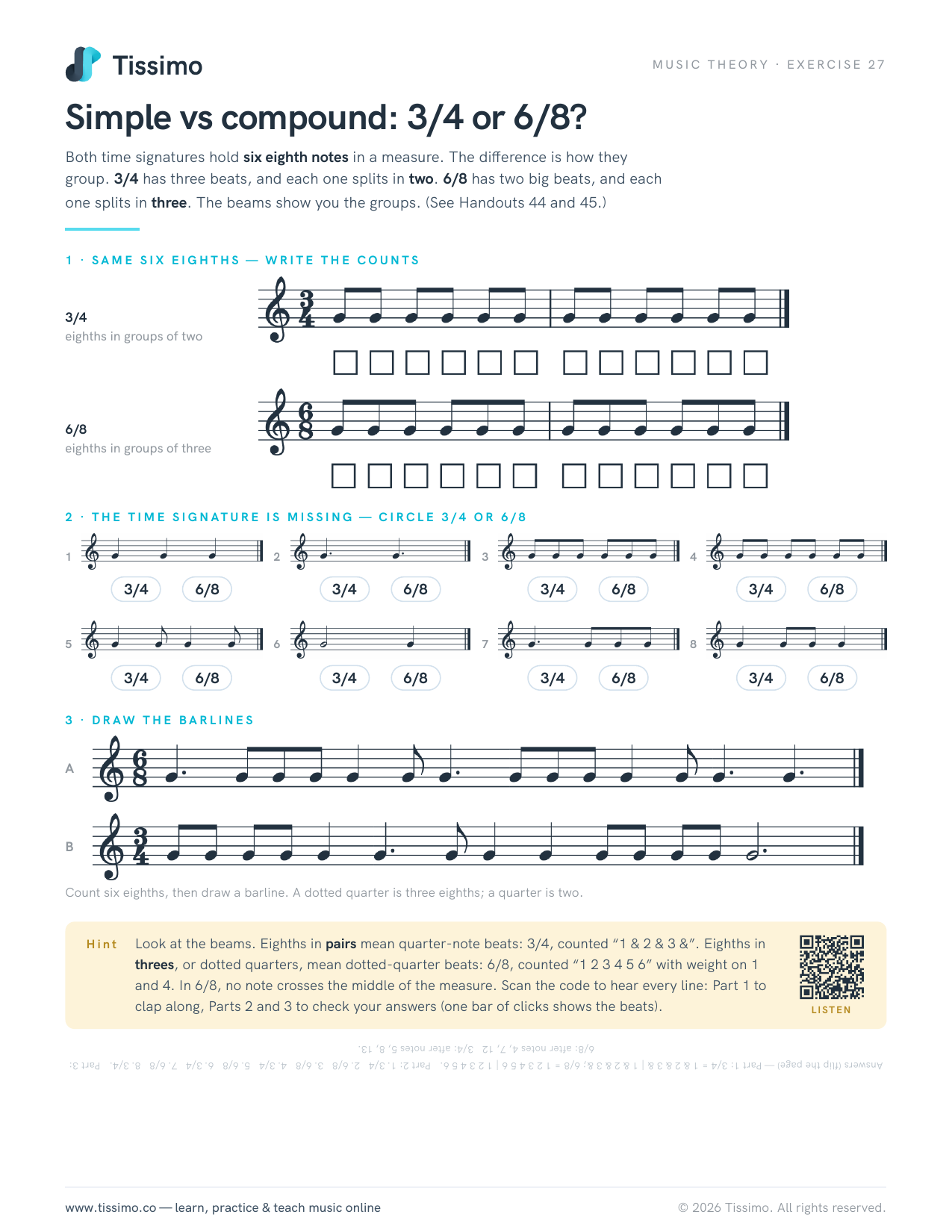
Simple vs compound: 3/4 or 6/8?
Both time signatures hold six eighth notes in a measure. The difference is how they group. 3/4 has three beats, and each one splits in two. 6/8 has two big beats, and each one splits in three. The beams show you the groups. (See Handouts 44 and 45.)
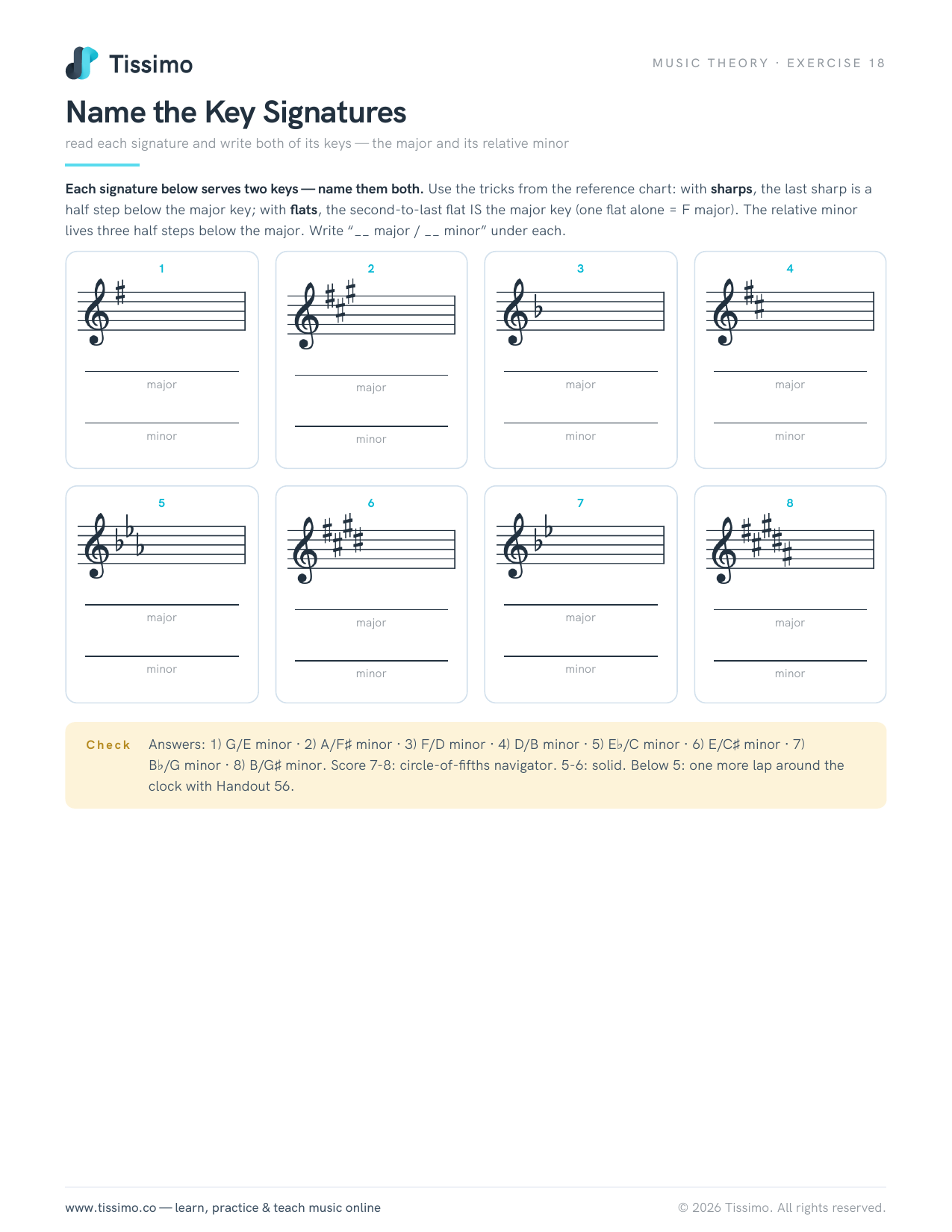
Name the Key Signatures
read each signature and write both of its keys — the major and its relative minor
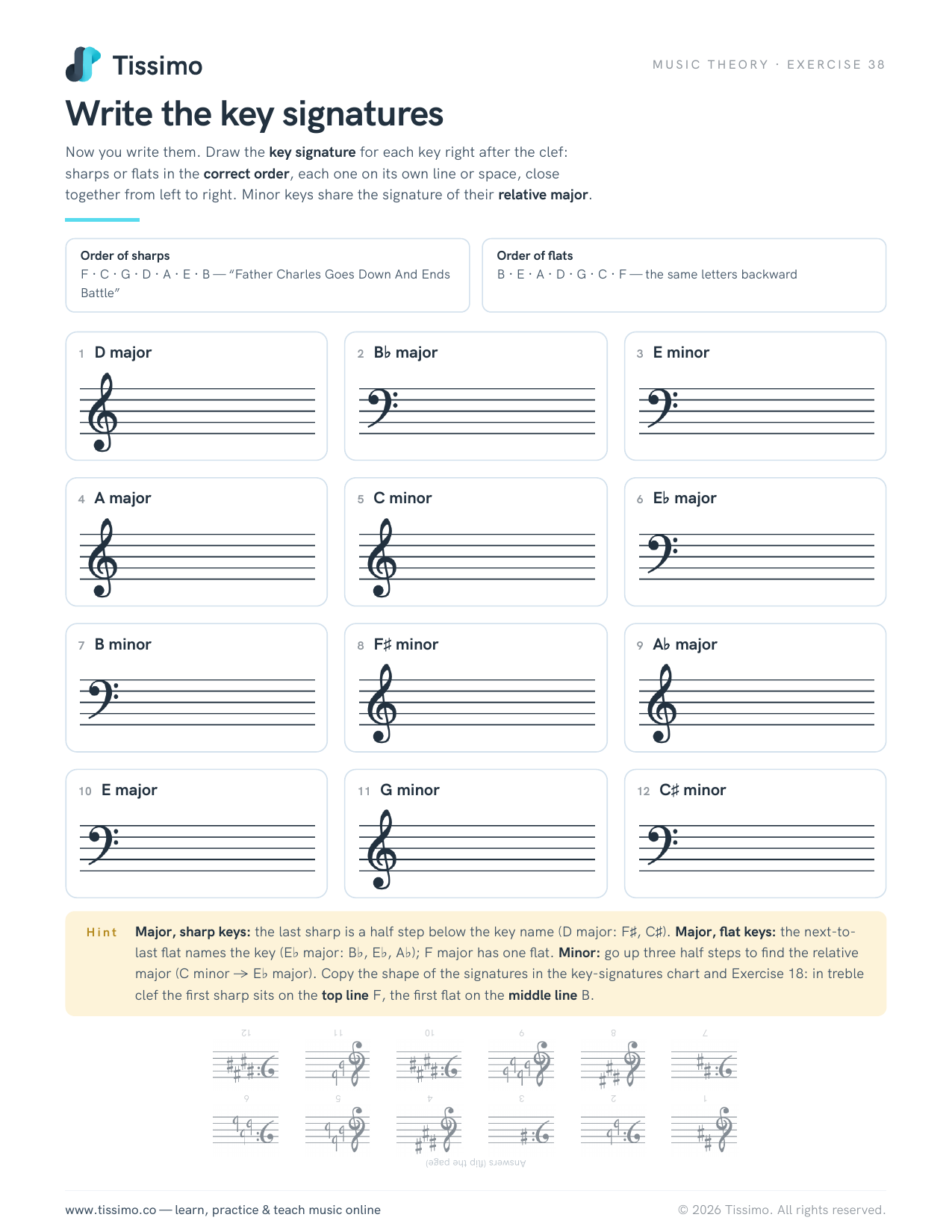
Write the key signatures
Now you write them. Draw the key signature for each key right after the clef: sharps or flats in the correct order, each one on its own line or space, close together from left to right. Minor keys share the signature of their relative major.
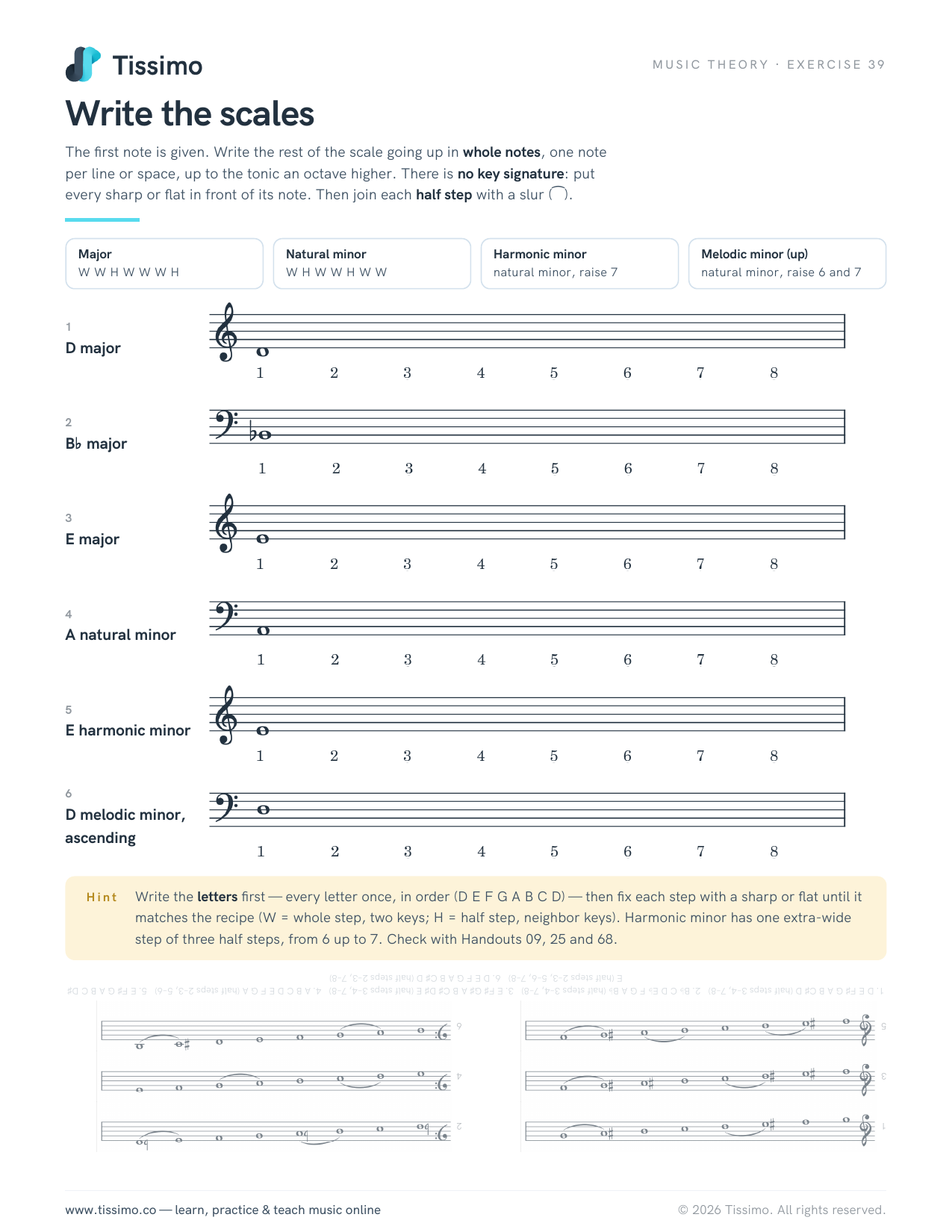
Write the scales
The first note is given. Write the rest of the scale going up in whole notes, one note per line or space, up to the tonic an octave higher. There is no key signature: put every sharp or flat in front of its note. Then join each half step with a slur (⁀).
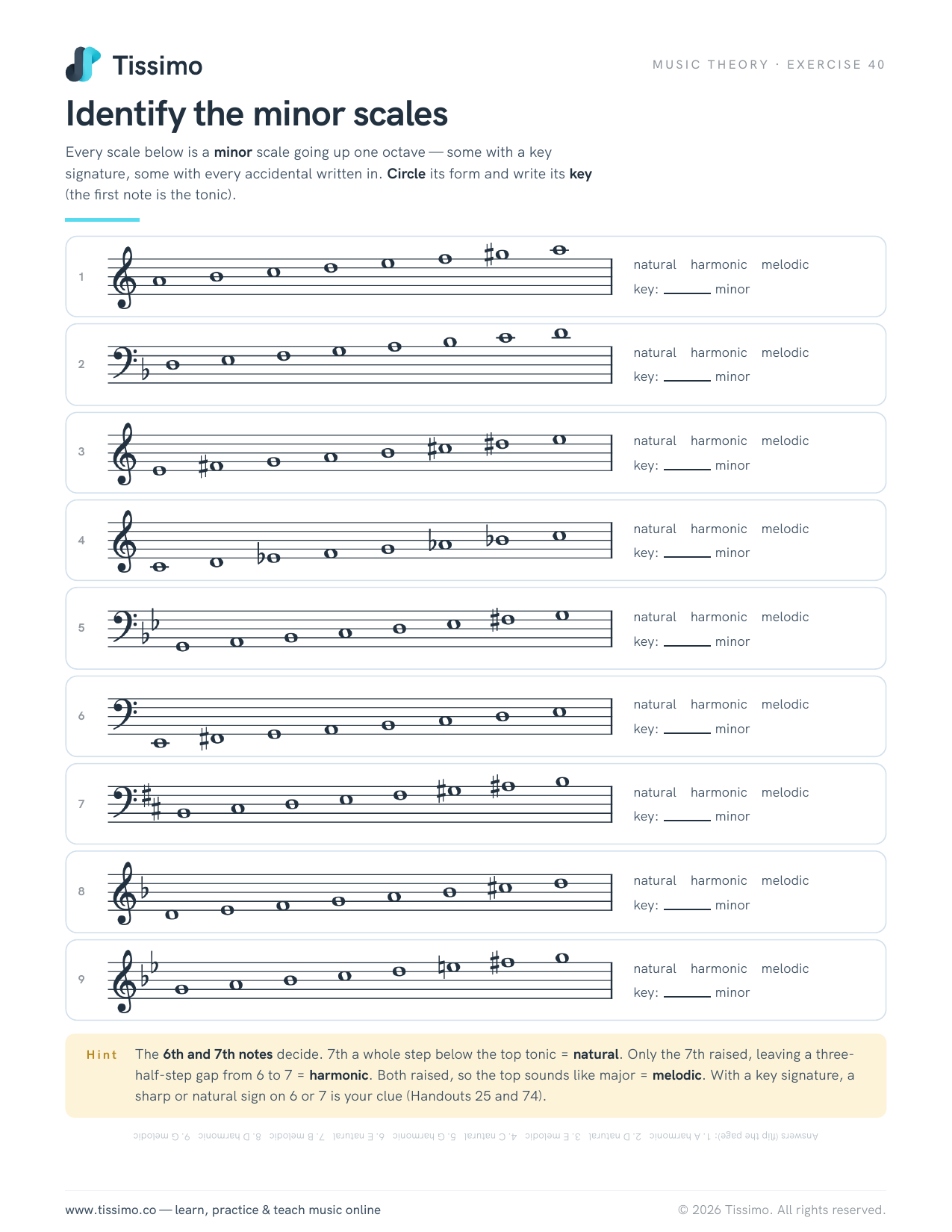
Identify the minor scales
Every scale below is a minor scale going up one octave — some with a key signature, some with every accidental written in. Circle its form and write its key (the first note is the tonic).
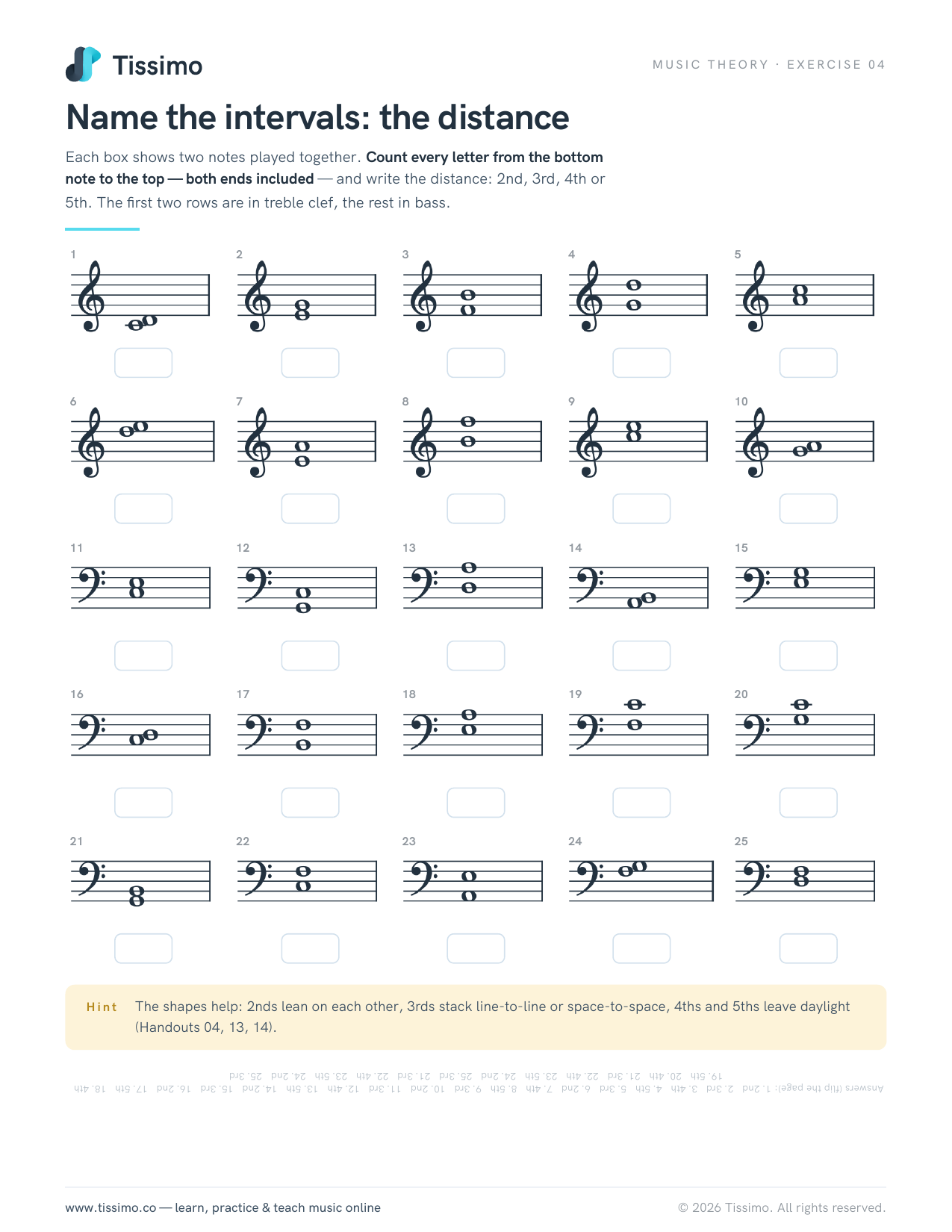
Name the intervals: the distance
Each box shows two notes played together. Count every letter from the bottom note to the top — both ends included — and write the distance: 2nd, 3rd, 4th or 5th. The first two rows are in treble clef, the rest in bass.
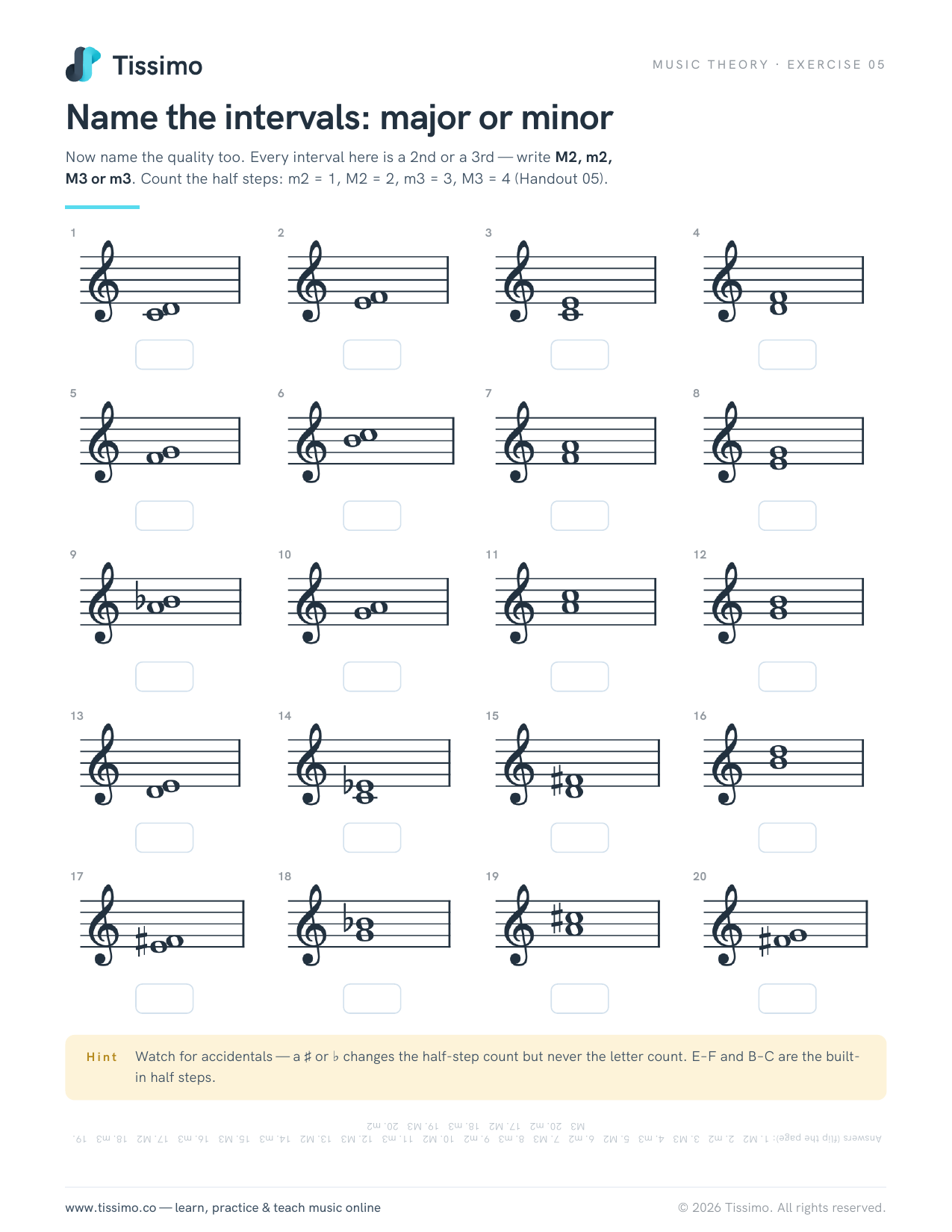
Name the intervals: major or minor
Now name the quality too. Every interval here is a 2nd or a 3rd — write M2, m2, M3 or m3. Count the half steps: m2 = 1, M2 = 2, m3 = 3, M3 = 4 (Handout 05).
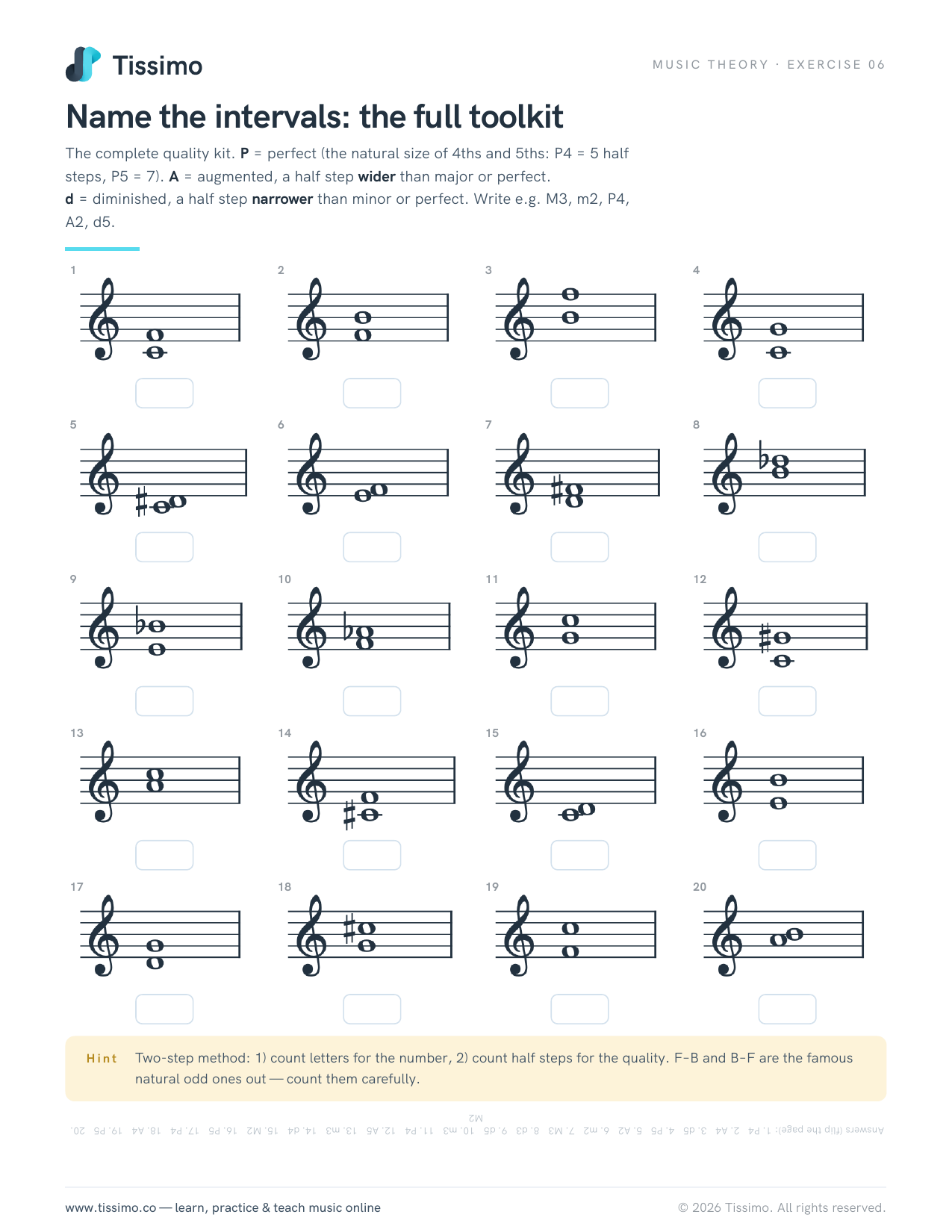
Name the intervals: the full toolkit
The complete quality kit. P = perfect (the natural size of 4ths and 5ths: P4 = 5 half steps, P5 = 7). A = augmented, a half step wider than major or perfect. d = diminished, a half step narrower than minor or perfect. Write e.g. M3, m2, P4, A2, d5.
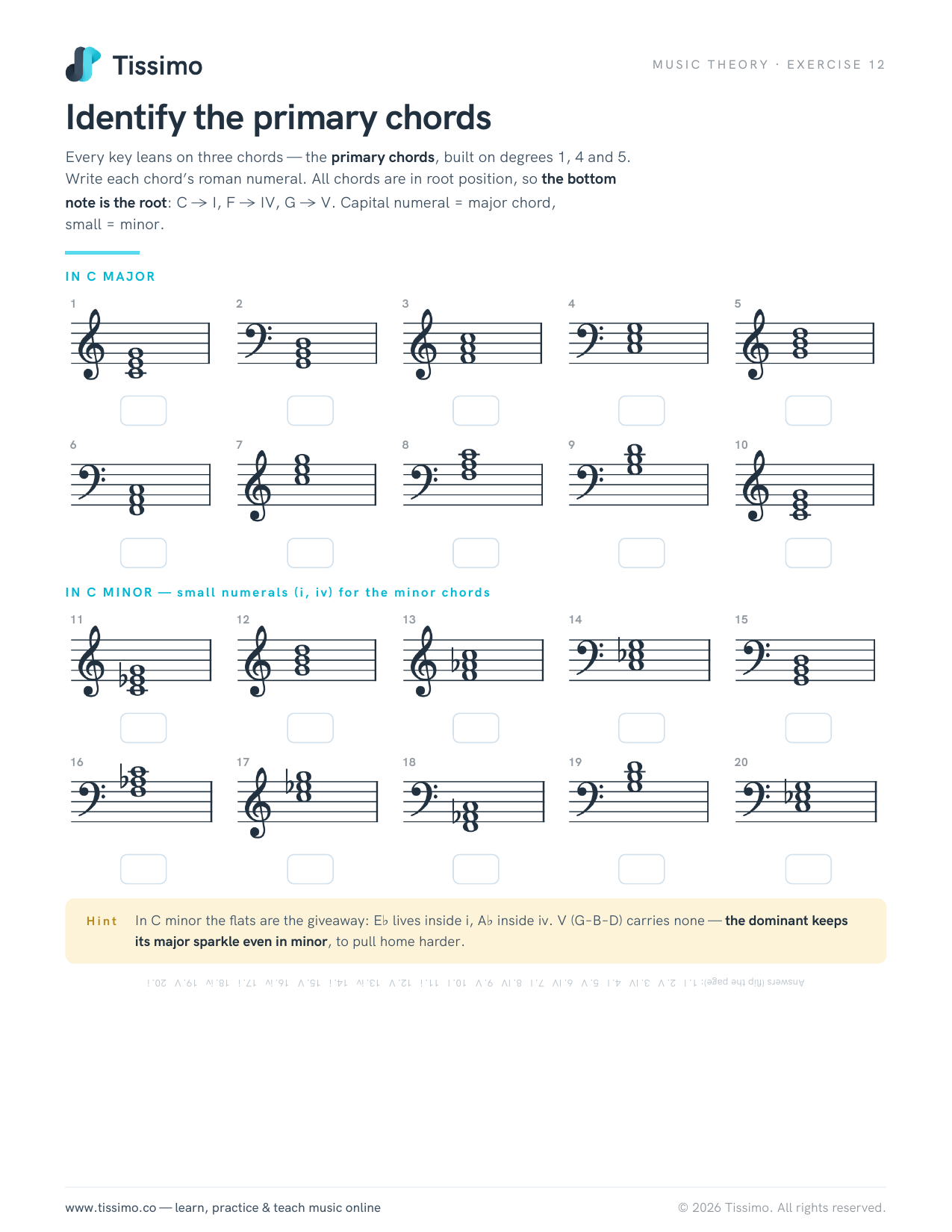
Identify the primary chords
Every key leans on three chords — the primary chords, built on degrees 1, 4 and 5. Write each chord’s roman numeral. All chords are in root position, so the bottom note is the root: C → I, F → IV, G → V. Capital numeral = major chord, small = minor.
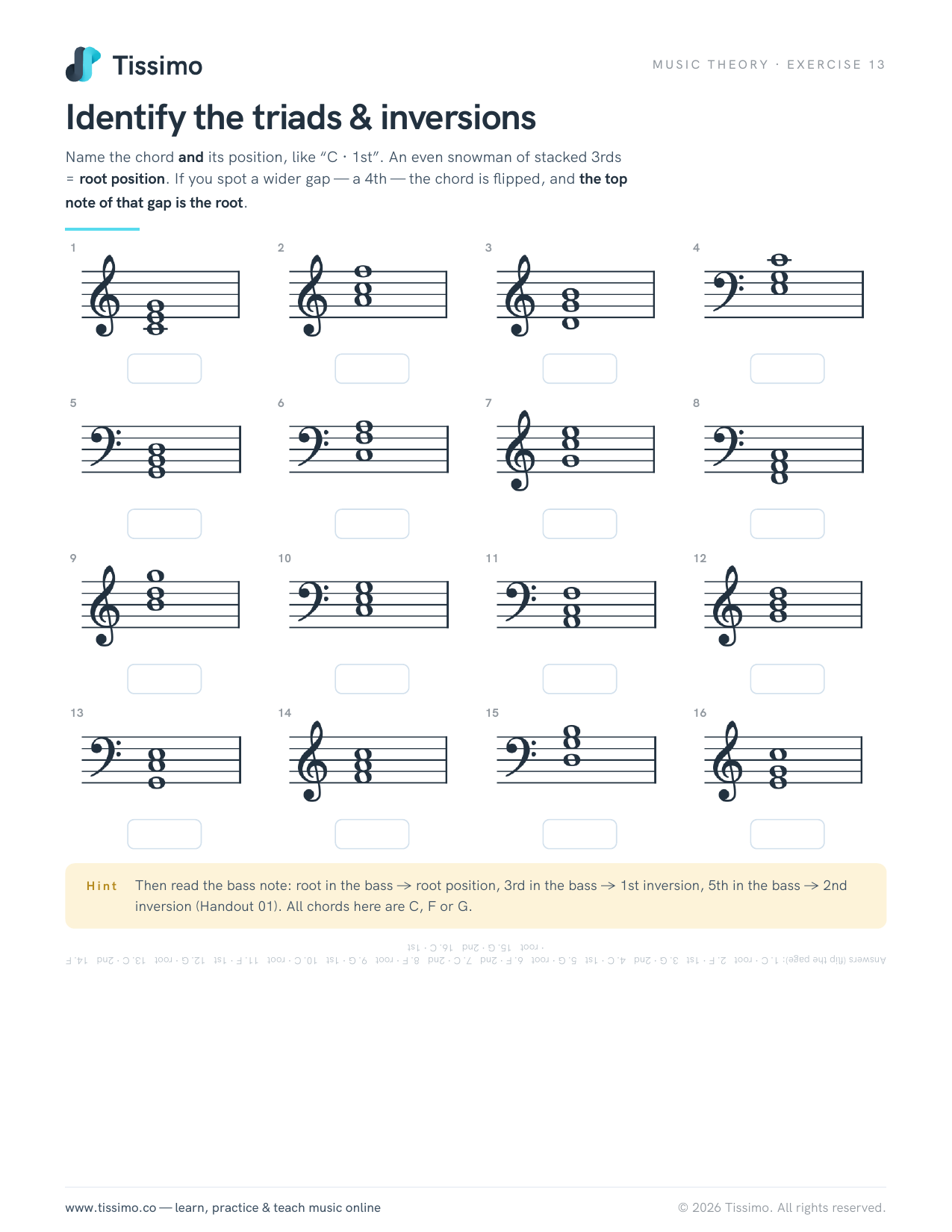
Identify the triads & inversions
Name the chord and its position, like “C · 1st”. An even snowman of stacked 3rds = root position. If you spot a wider gap — a 4th — the chord is flipped, and the top note of that gap is the root.
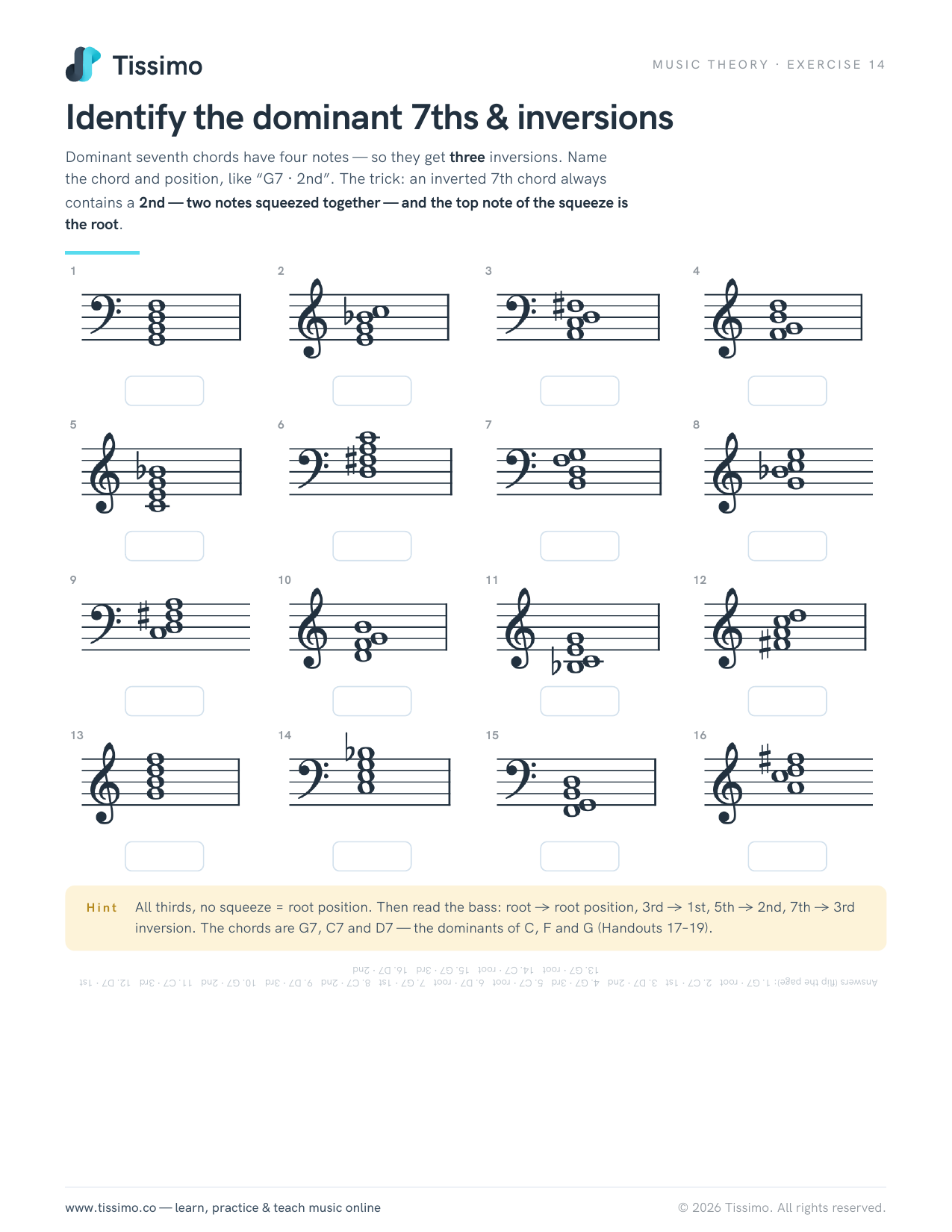
Identify the dominant 7ths & inversions
Dominant seventh chords have four notes — so they get three inversions. Name the chord and position, like “G7 · 2nd”. The trick: an inverted 7th chord always contains a 2nd — two notes squeezed together — and the top note of the squeeze is the root.
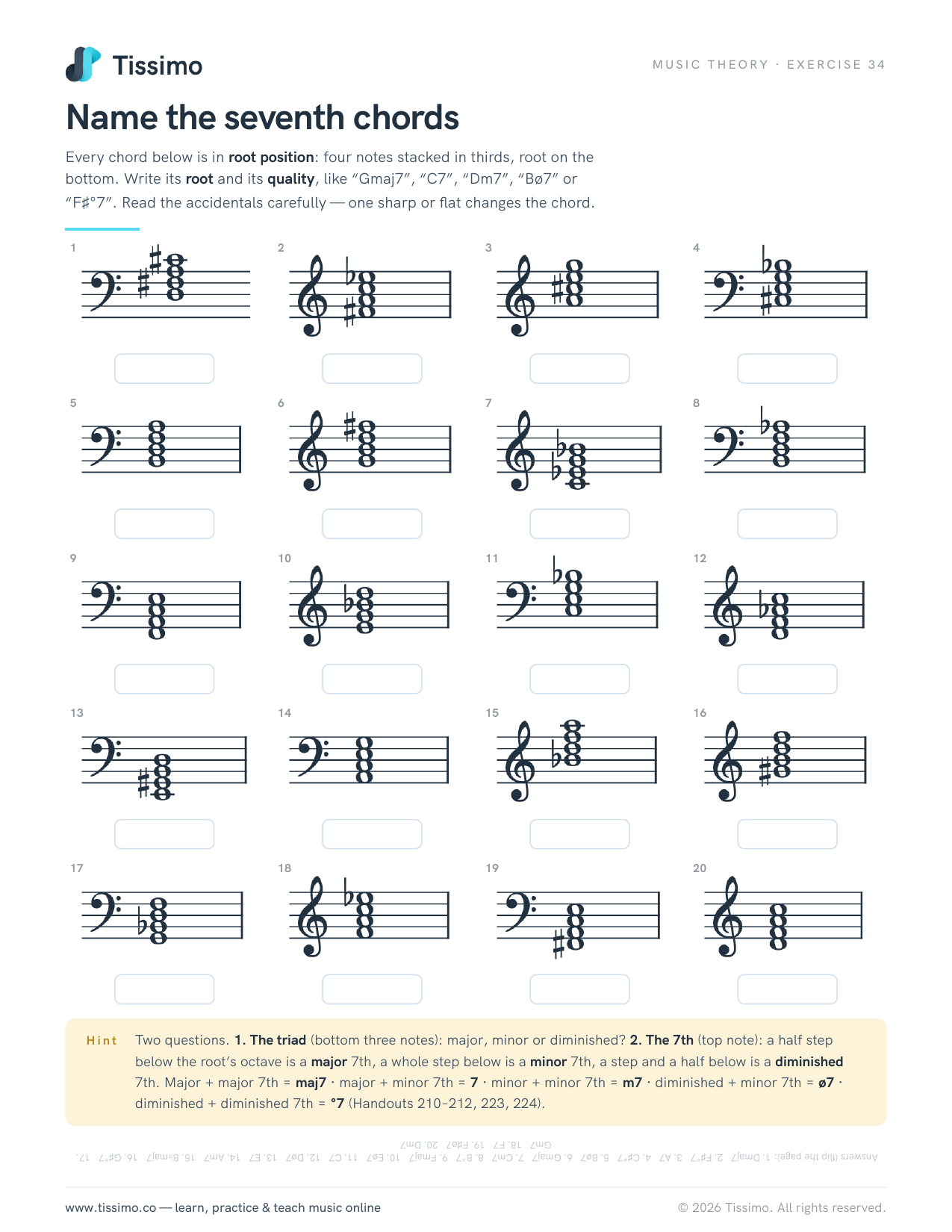
Name the seventh chords
Every chord below is in root position: four notes stacked in thirds, root on the bottom. Write its root and its quality, like “Gmaj7”, “C7”, “Dm7”, “Bø7” or “F♯°7”. Read the accidentals carefully — one sharp or flat changes the chord.
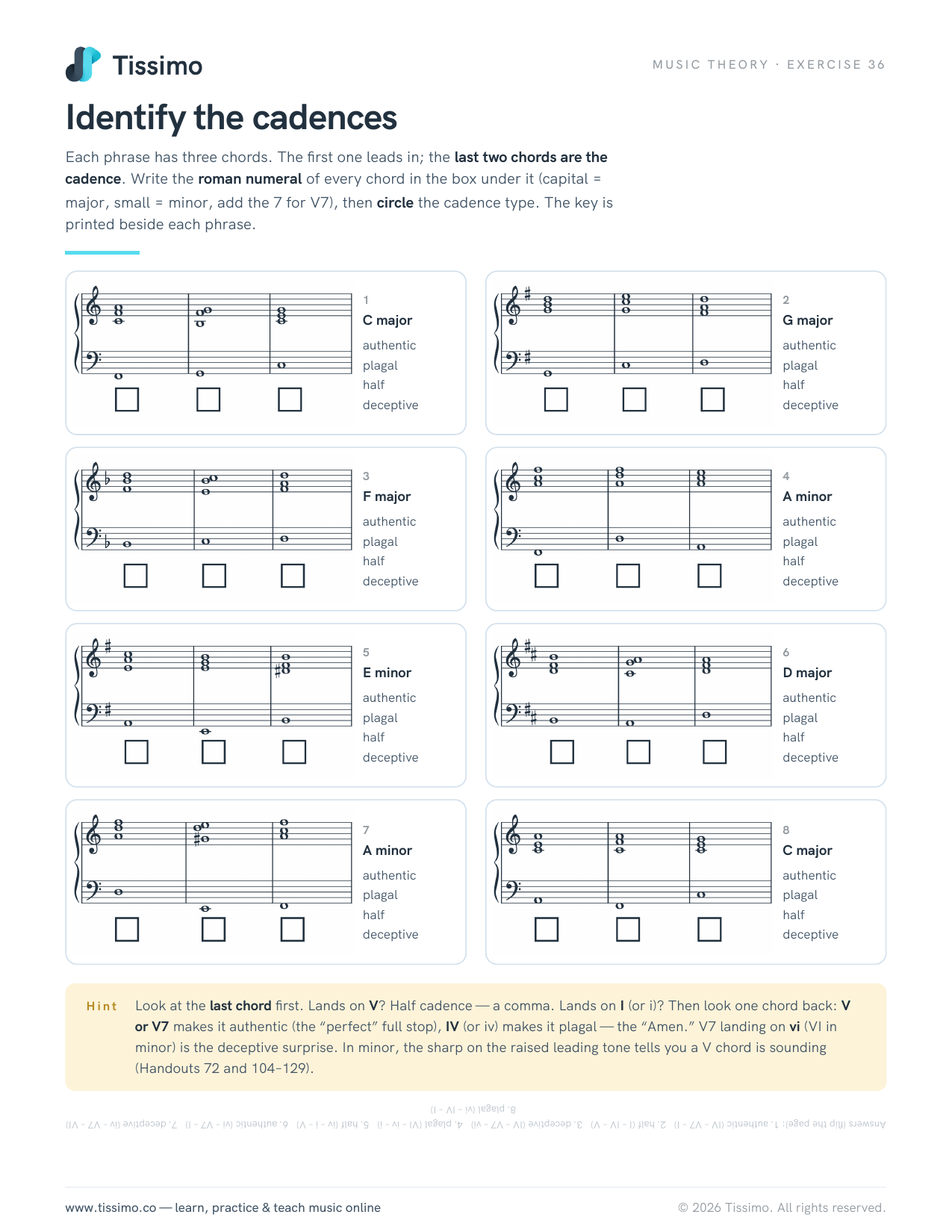
Identify the cadences
Each phrase has three chords. The first one leads in; the last two chords are the cadence. Write the roman numeral of every chord in the box under it (capital = major, small = minor, add the 7 for V7), then circle the cadence type. The key is printed beside each phrase.
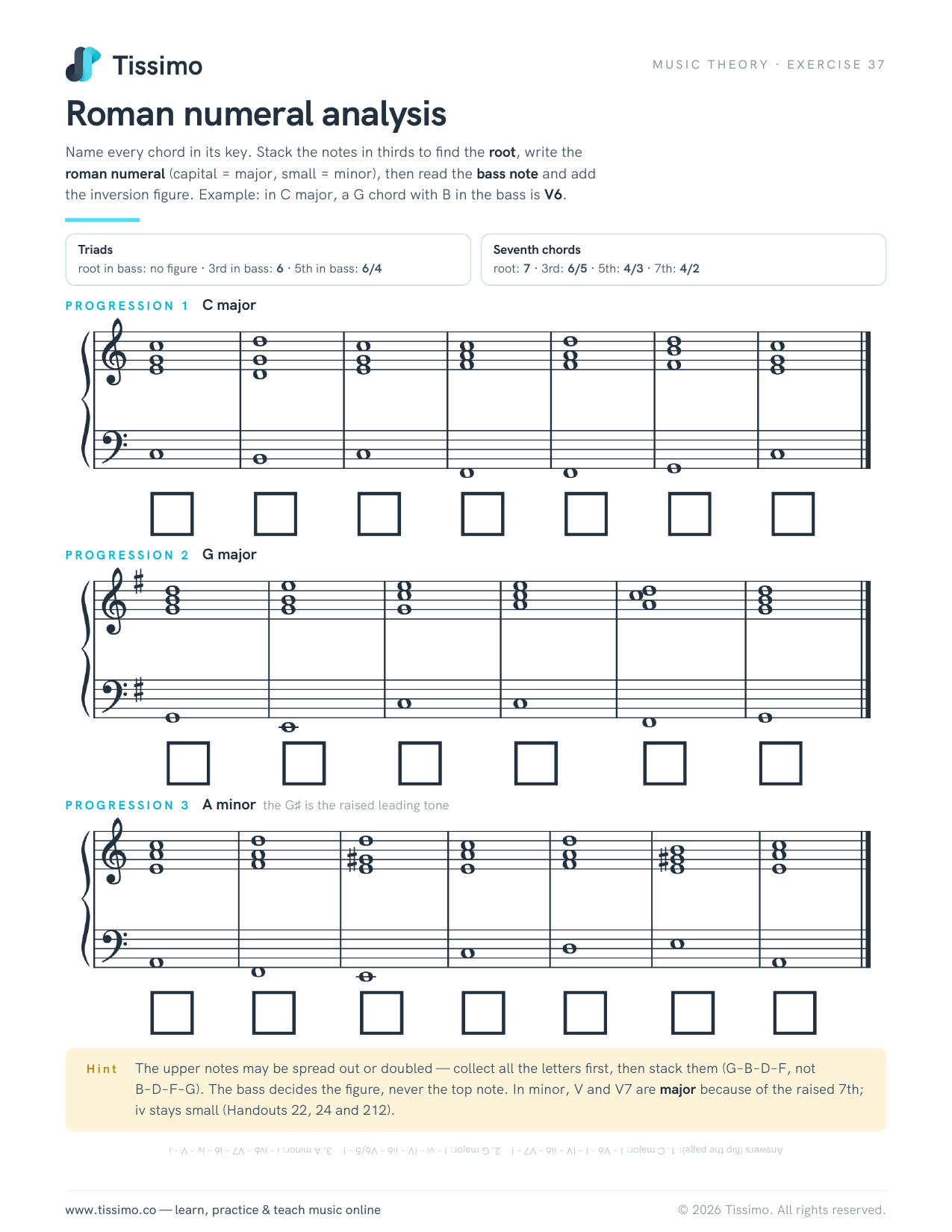
Roman numeral analysis
Name every chord in its key. Stack the notes in thirds to find the root, write the roman numeral (capital = major, small = minor), then read the bass note and add the inversion figure. Example: in C major, a G chord with B in the bass is V6.
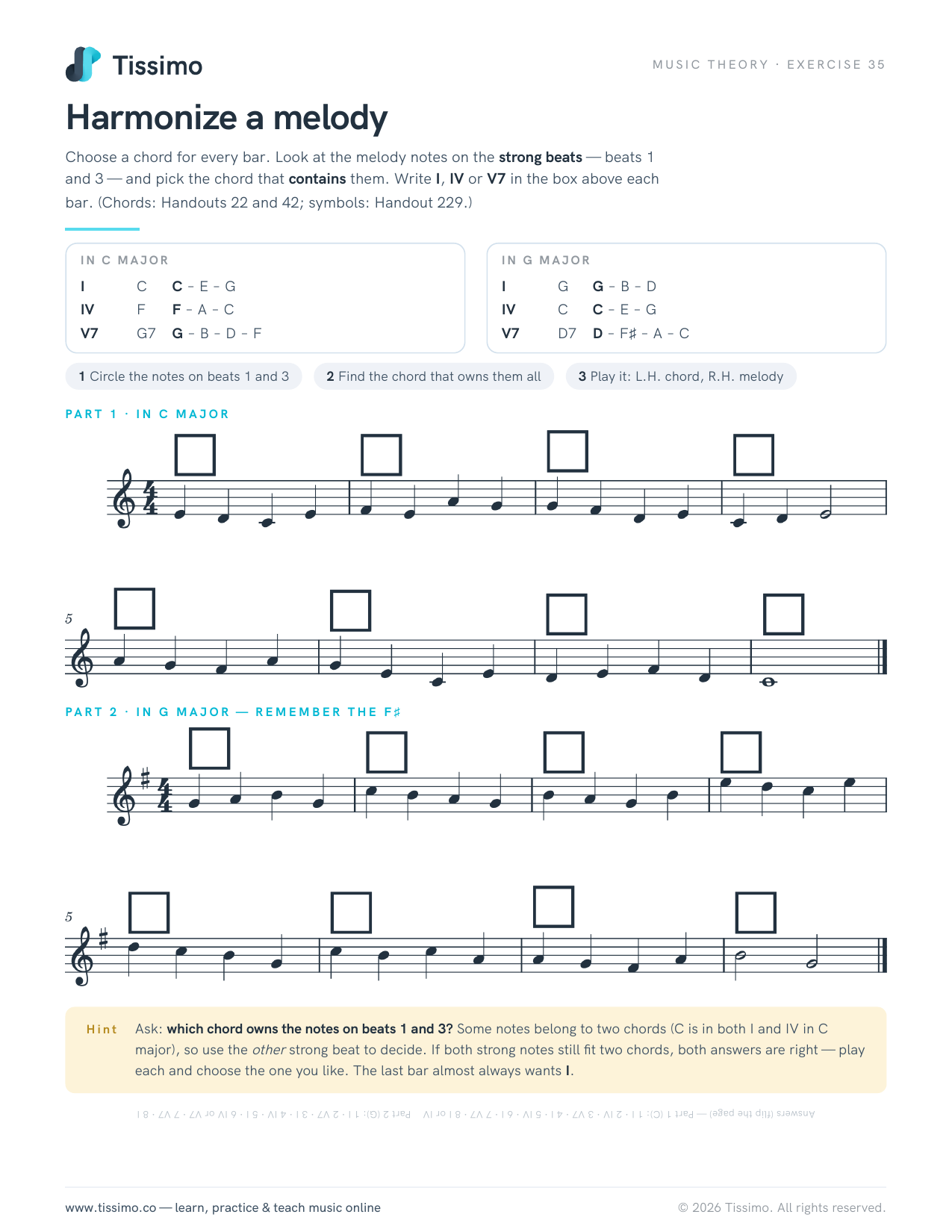
Harmonize a melody
Choose a chord for every bar. Look at the melody notes on the strong beats — beats 1 and 3 — and pick the chord that contains them. Write I, IV or V7 in the box above each bar. (Chords: Handouts 22 and 42; symbols: Handout 229.)
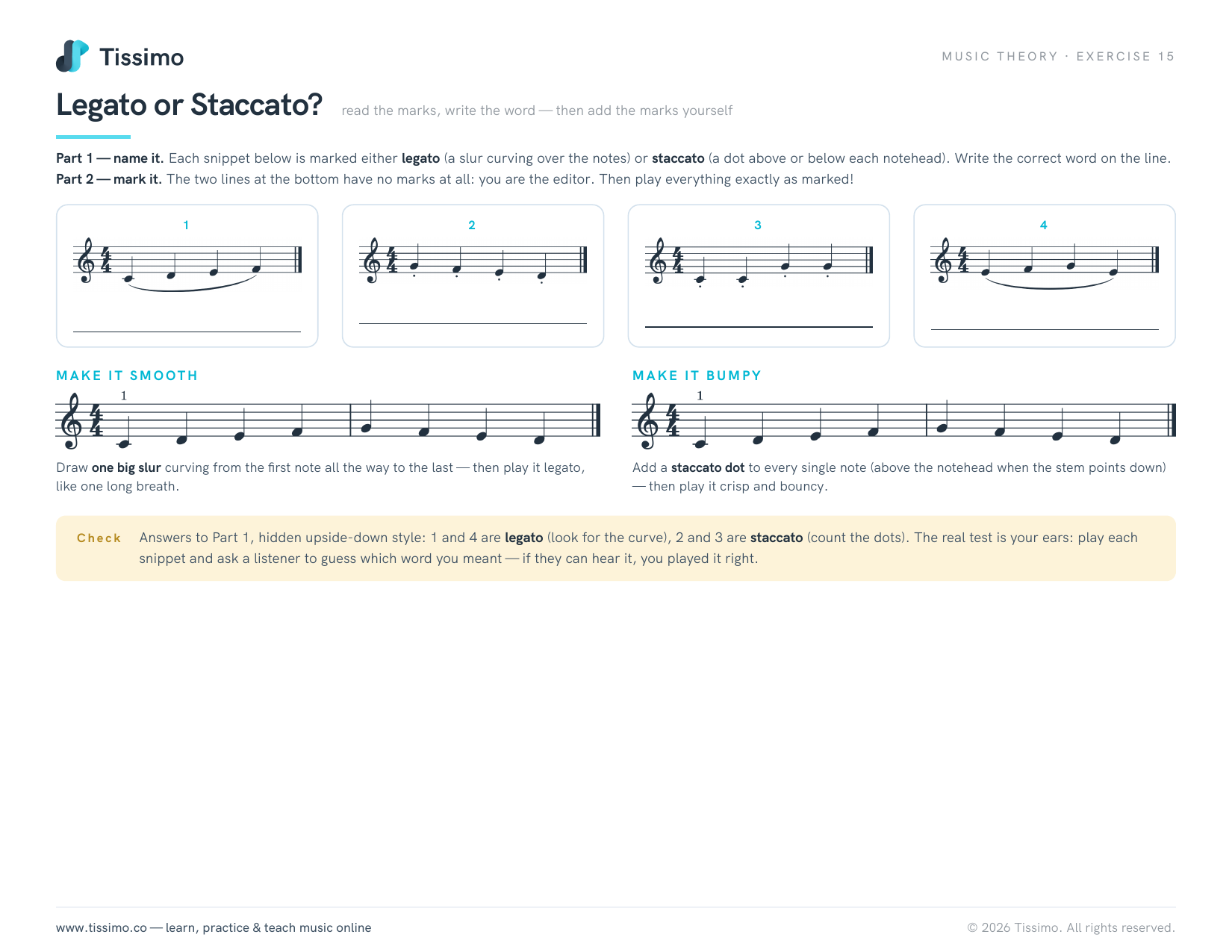
Legato or Staccato?
read the marks, write the word — then add the marks yourself
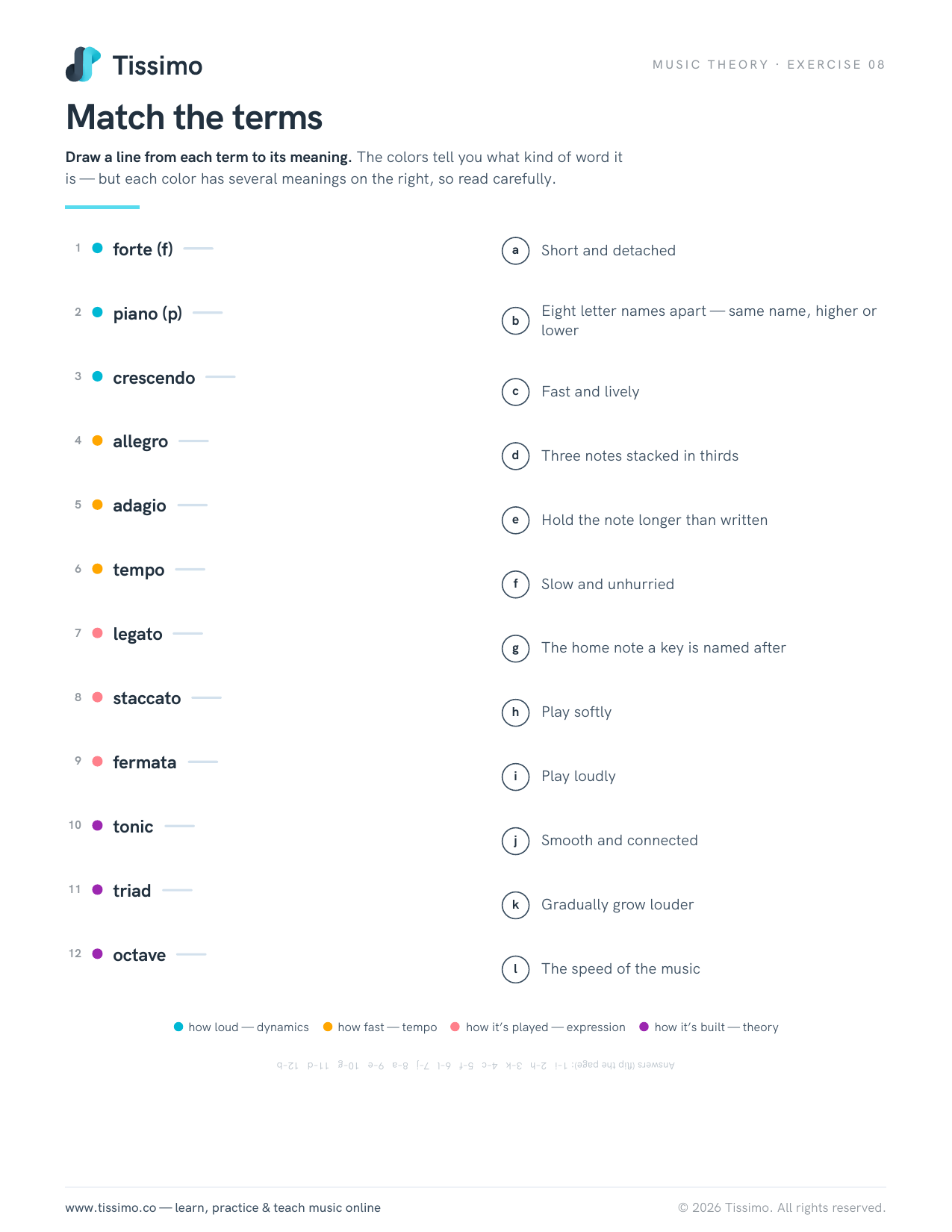
Match the terms
Draw a line from each term to its meaning. The colors tell you what kind of word it is — but each color has several meanings on the right, so read carefully.
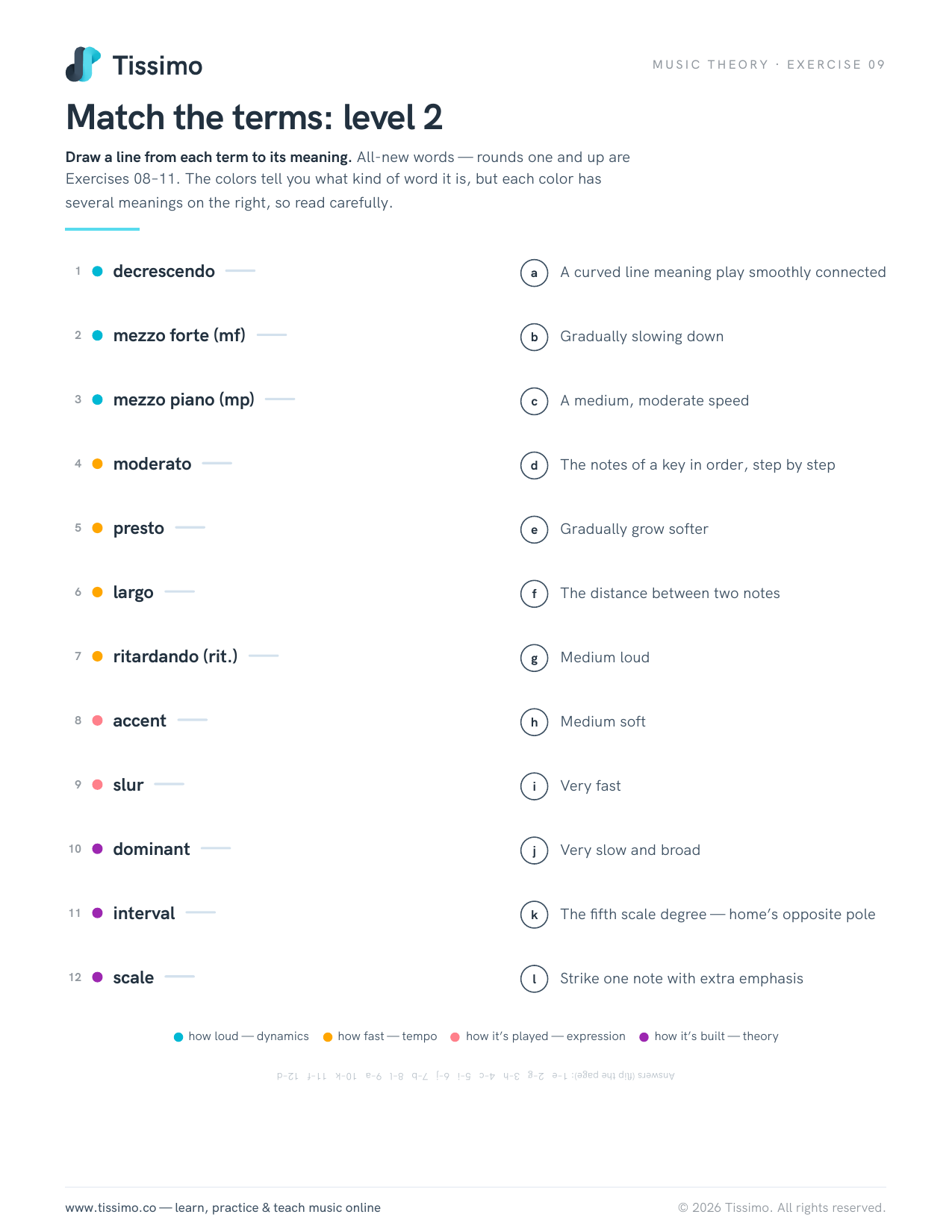
Match the terms: level 2
Draw a line from each term to its meaning. All-new words — rounds one and up are Exercises 08–11. The colors tell you what kind of word it is, but each color has several meanings on the right, so read carefully.
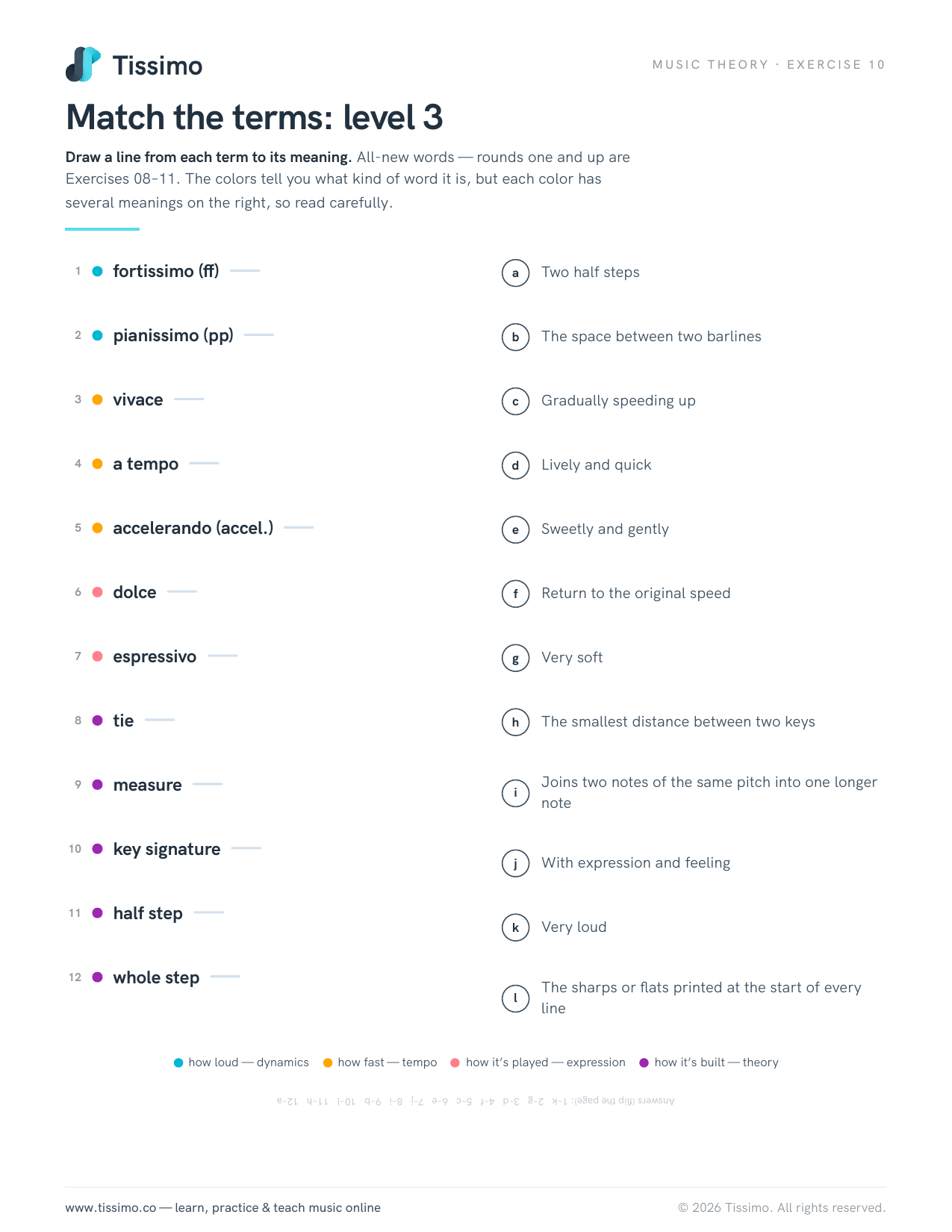
Match the terms: level 3
Draw a line from each term to its meaning. All-new words — rounds one and up are Exercises 08–11. The colors tell you what kind of word it is, but each color has several meanings on the right, so read carefully.
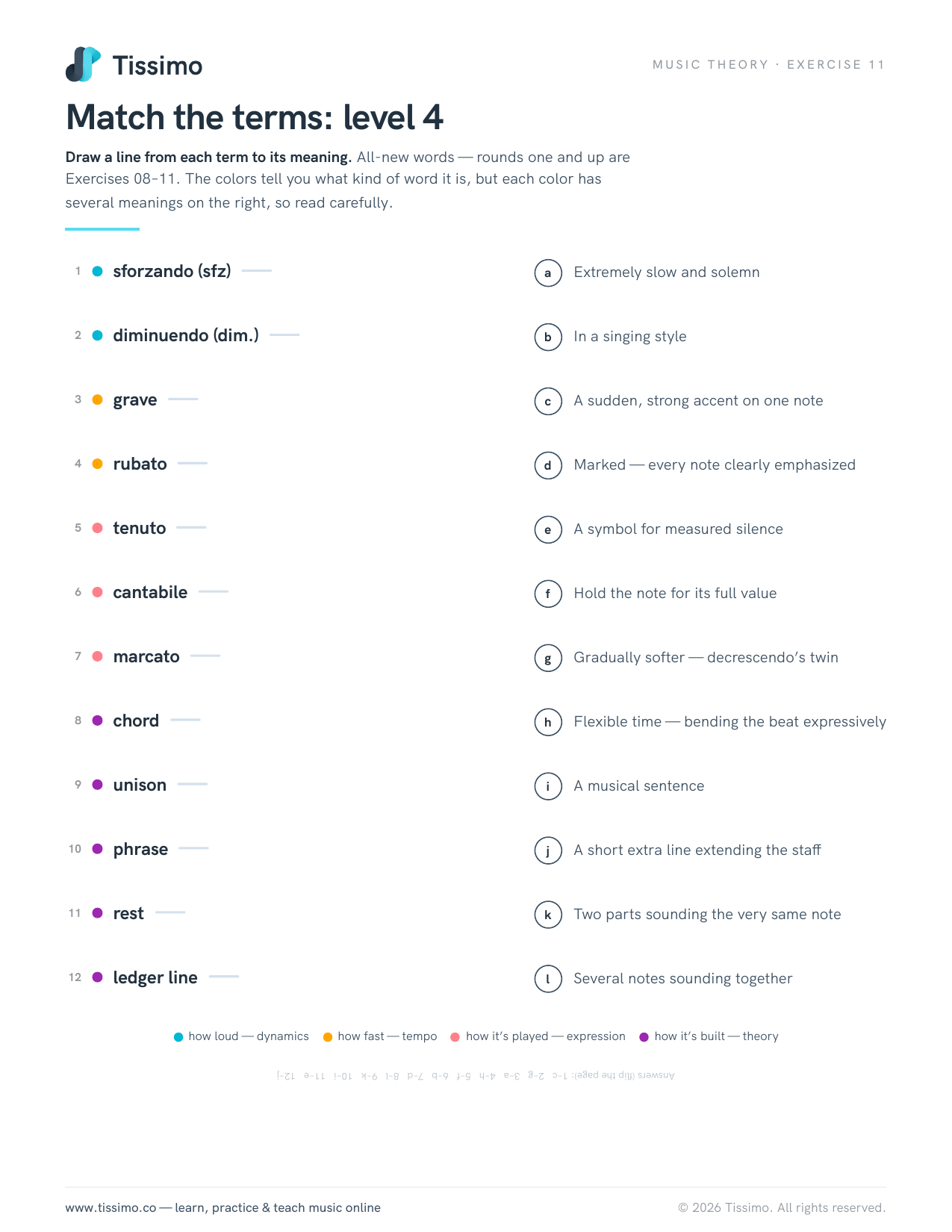
Match the terms: level 4
Draw a line from each term to its meaning. All-new words — rounds one and up are Exercises 08–11. The colors tell you what kind of word it is, but each color has several meanings on the right, so read carefully.
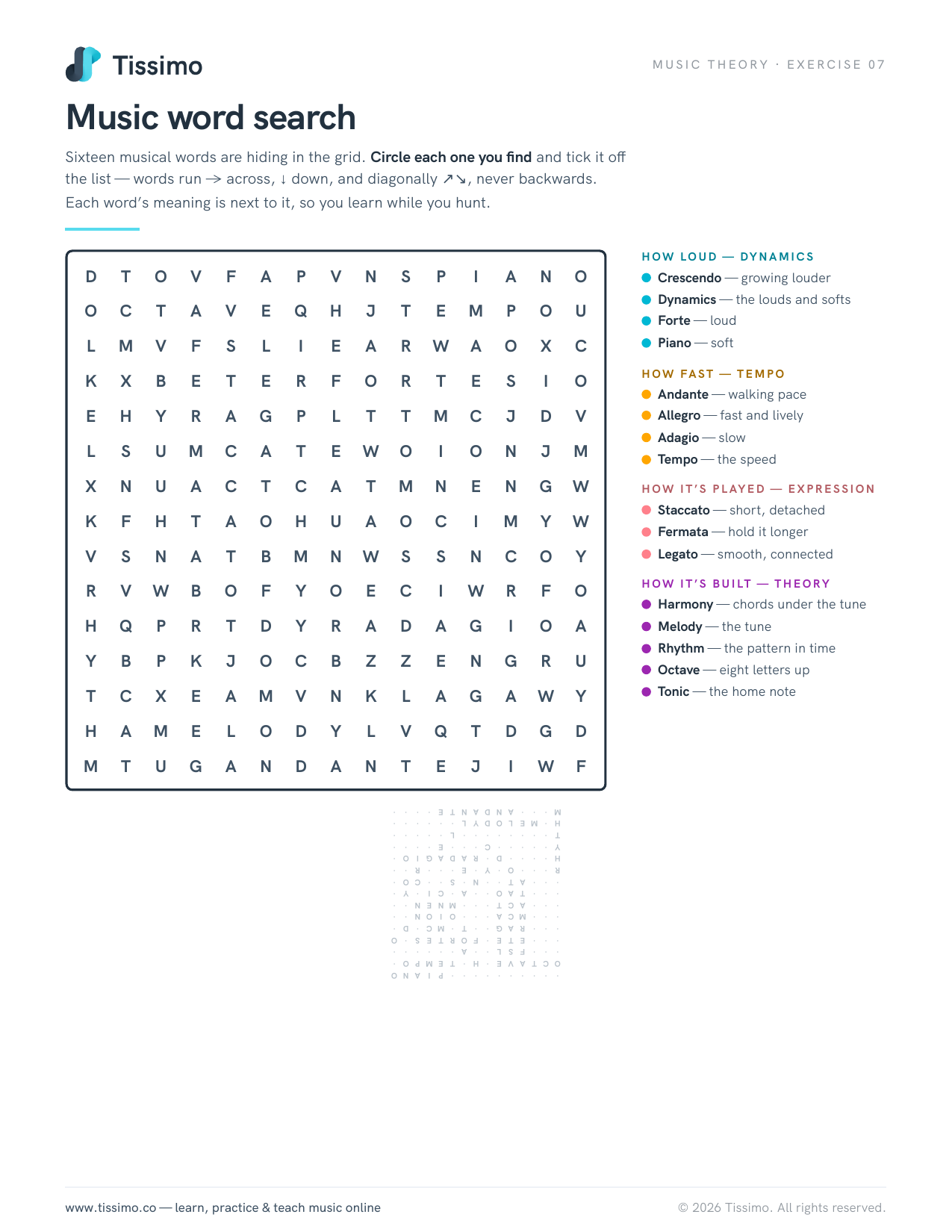
Music word search
Sixteen musical words are hiding in the grid. Circle each one you find and tick it off the list — words run → across, ↓ down, and diagonally ↗↘, never backwards. Each word’s meaning is next to it, so you learn while you hunt.