Fichas de ejercicios de música gratis
Fichas imprimibles de una página, creadas por los profesores de Tissimo — míralas aquí, descarga el PDF o imprime varias para tu próxima clase.

Notas y ritmo
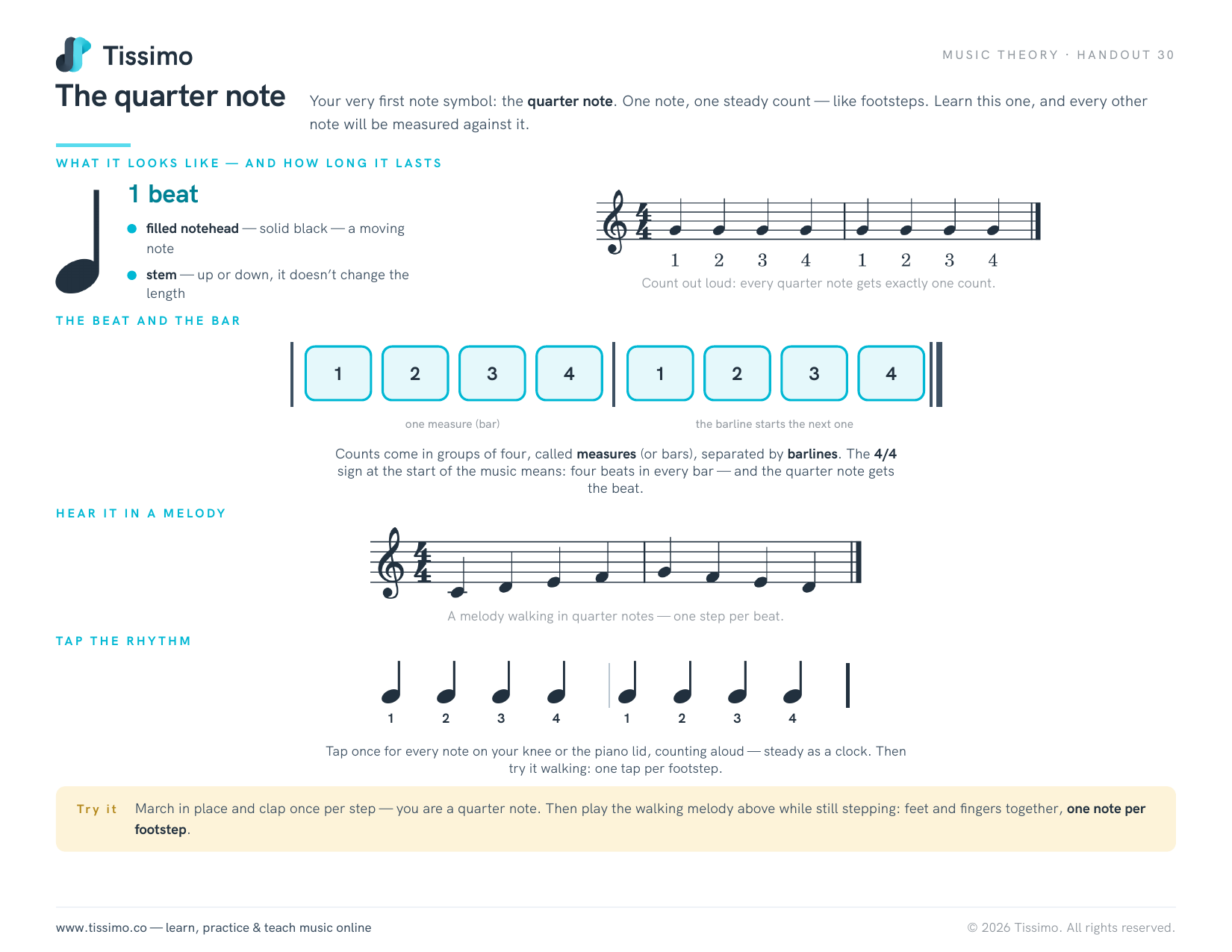
La negra
Tu primer símbolo de nota: la negra. Una nota, un pulso constante — como pasos al caminar. Aprende esta y todas las demás notas se medirán a partir de ella.
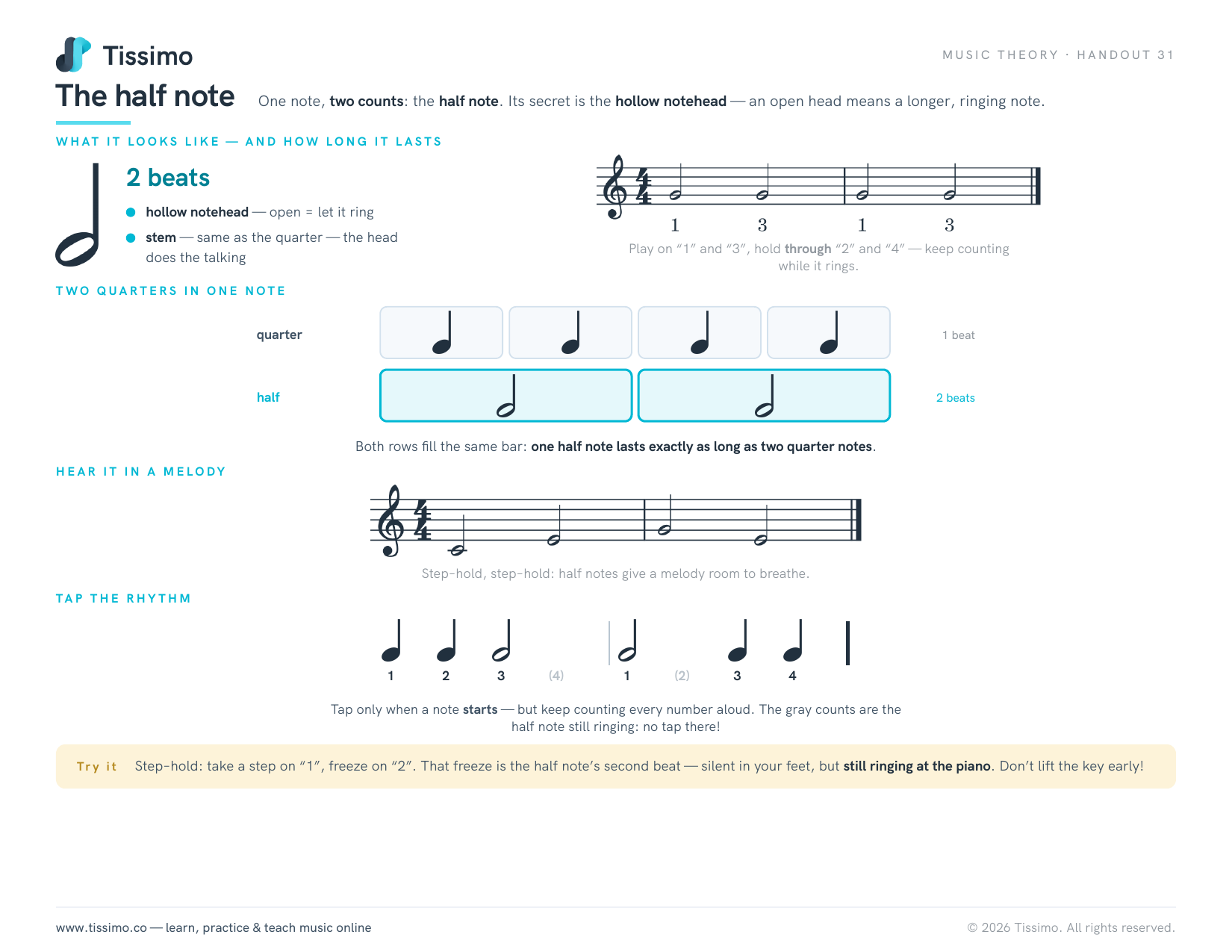
La blanca
Una nota, dos tiempos: la blanca. Su secreto está en la cabeza hueca — una cabeza abierta significa una nota más larga y resonante.
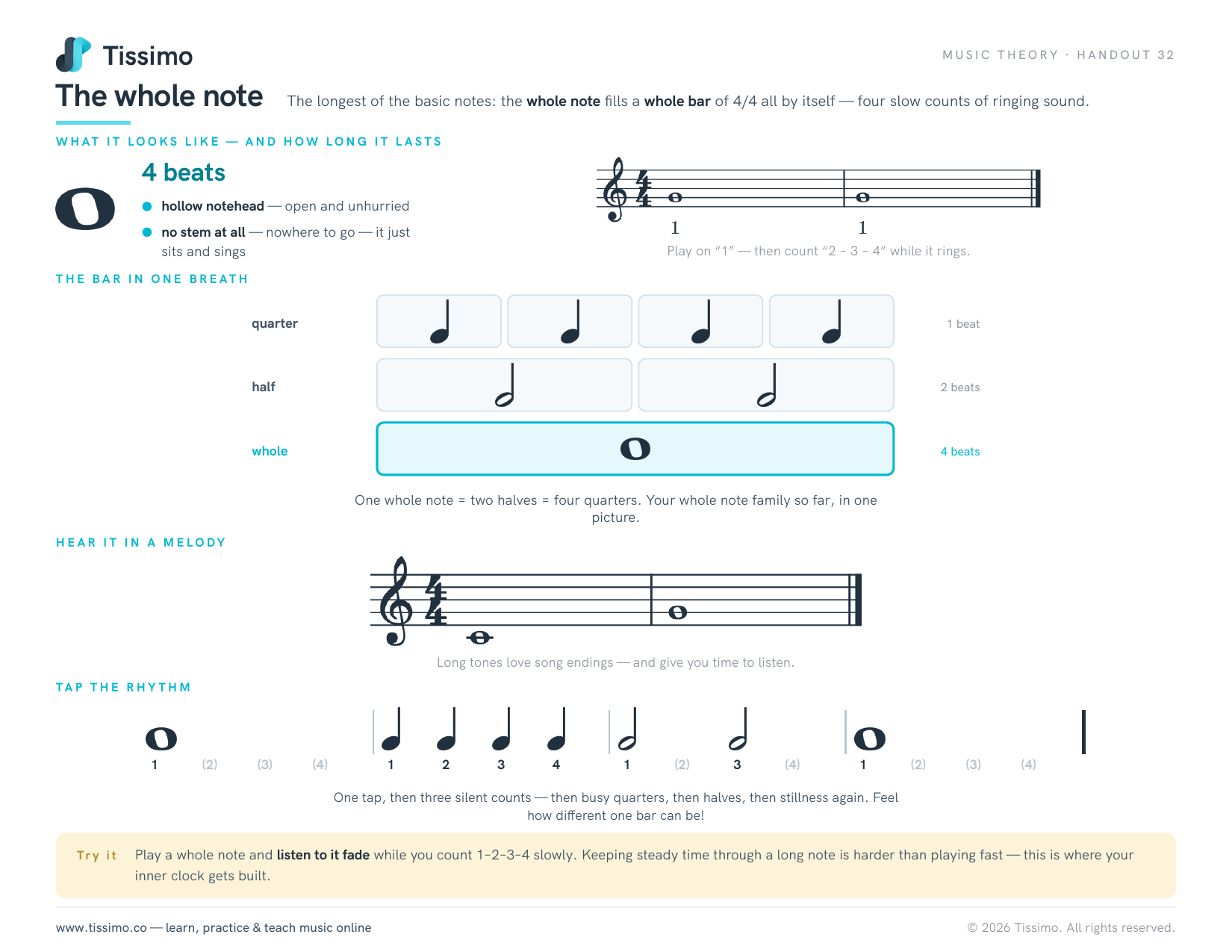
La redonda
La más larga de las notas básicas: la redonda llena por sí sola todo un compás de 4/4 — cuatro tiempos lentos de sonido resonante.
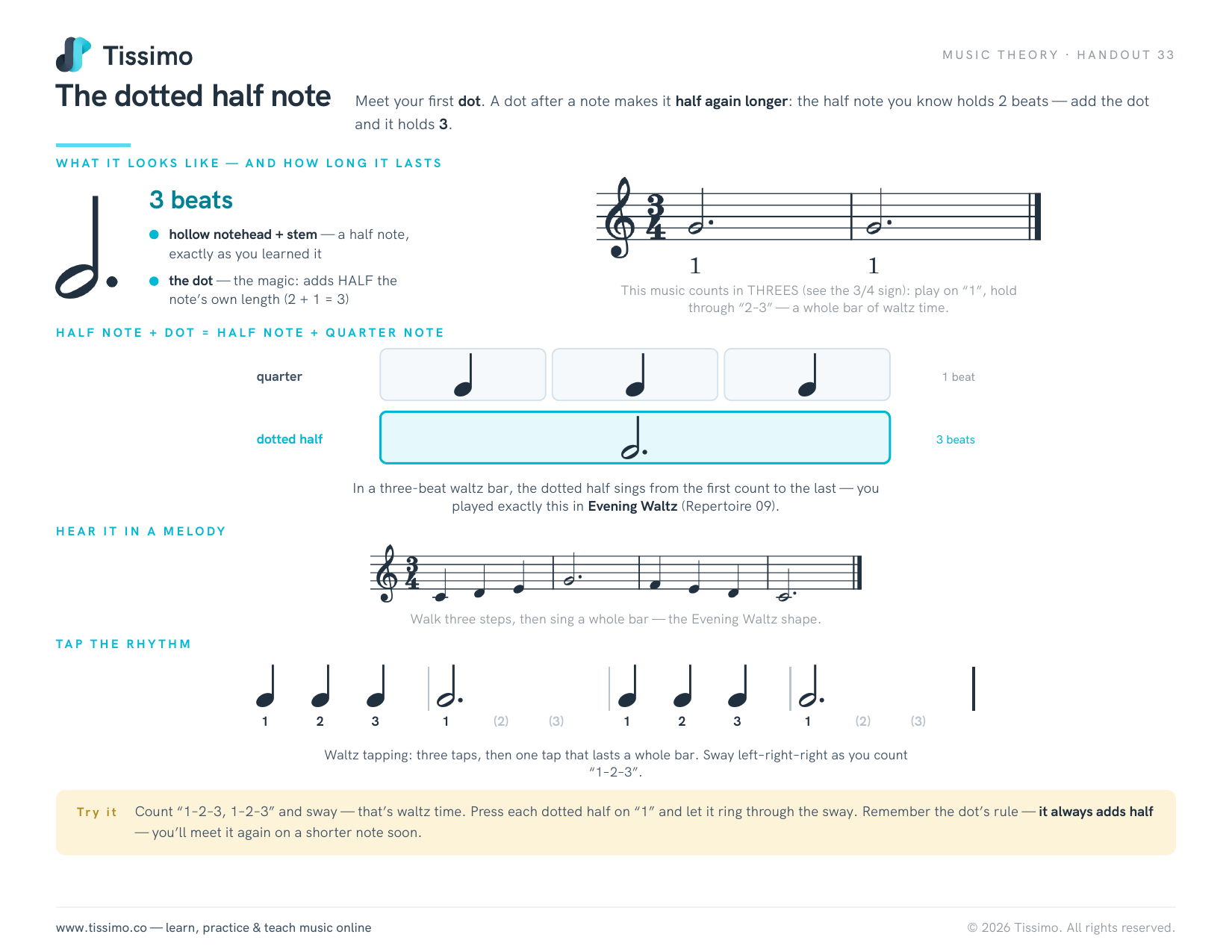
La blanca con puntillo
Conoce tu primer puntillo. Un puntillo después de una nota la alarga la mitad de su valor: la blanca que ya conoces dura 2 tiempos — con el puntillo, dura 3.
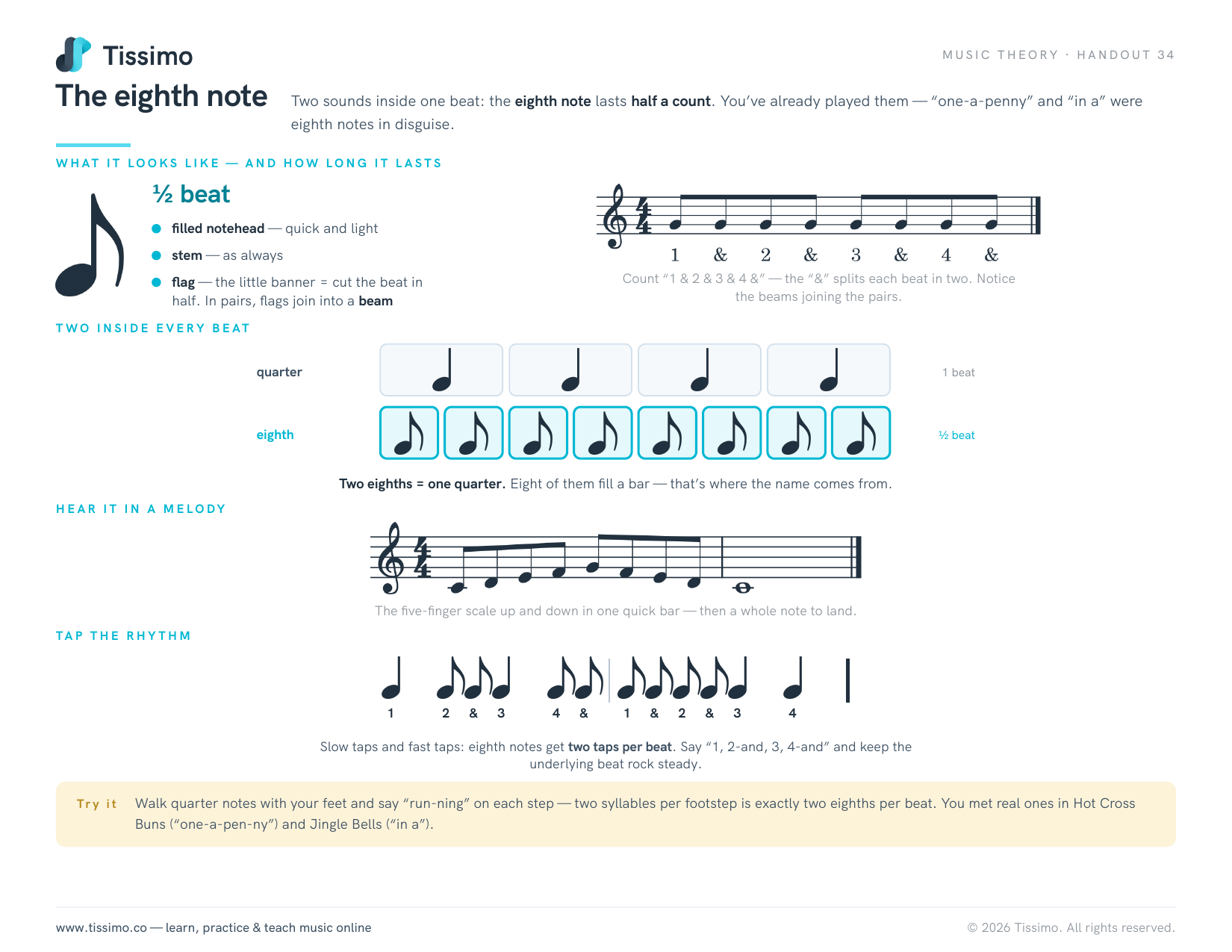
La corchea
Dos sonidos en un solo tiempo: la corchea dura medio tiempo. Ya las has tocado sin saberlo — cualquier ritmo que digas como “ta-ti” en un tiempo son corcheas disfrazadas.
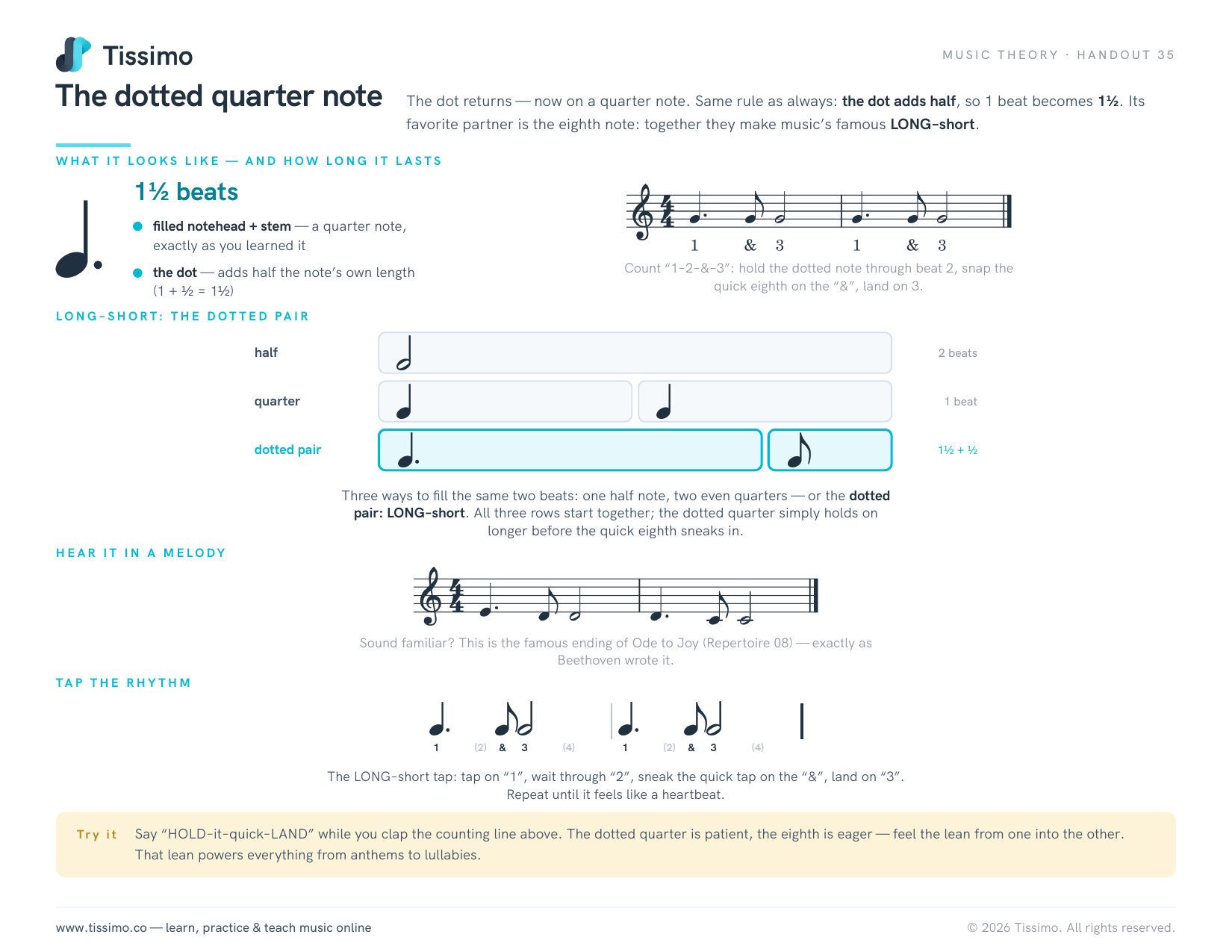
La negra con puntillo
El puntillo regresa — ahora sobre una negra. La misma regla de siempre: el puntillo añade la mitad, así que 1 tiempo se convierte en 1½. Su compañera favorita es la corchea: juntas forman el famoso ritmo LARGO-corto.
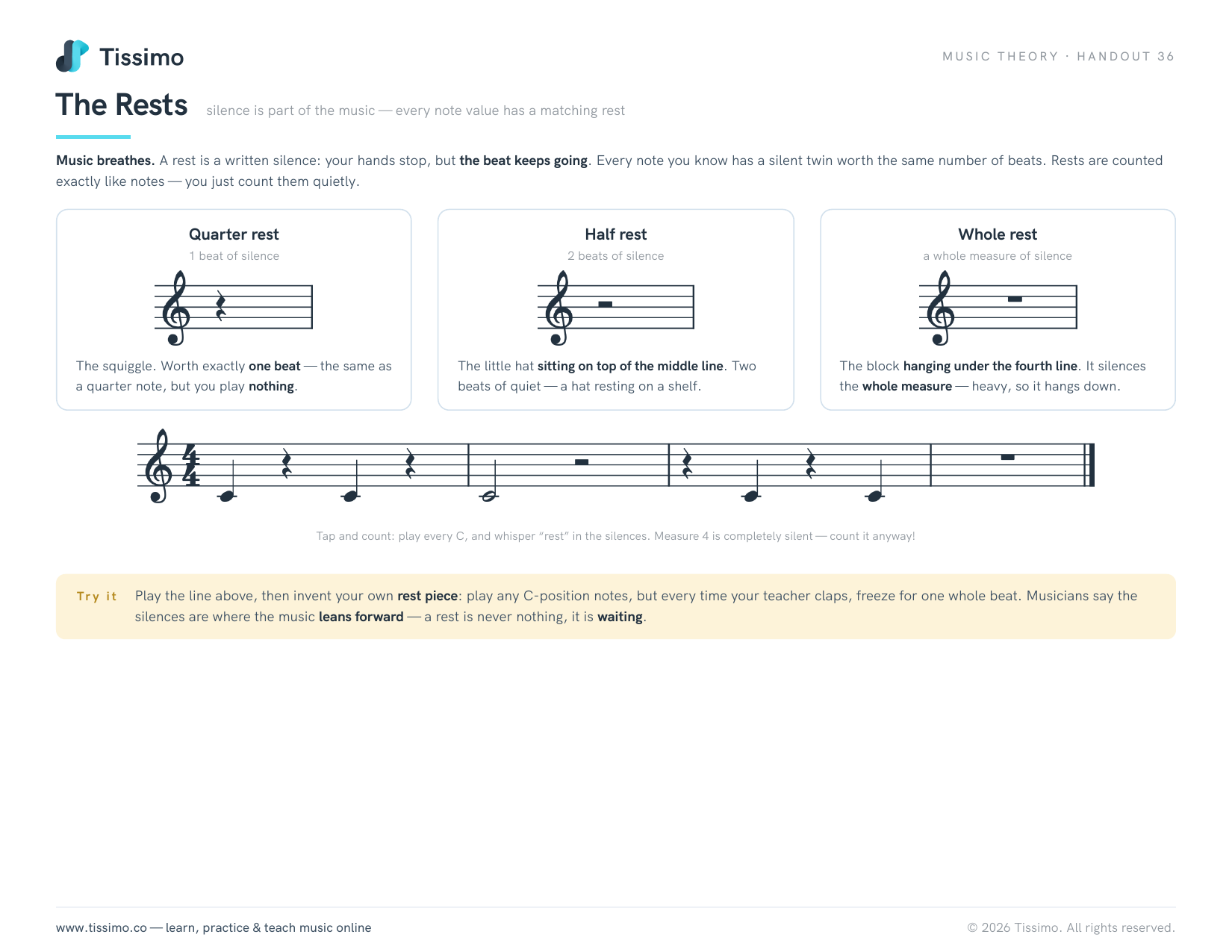
Los silencios
el silencio también es música — cada valor de nota tiene su silencio correspondiente
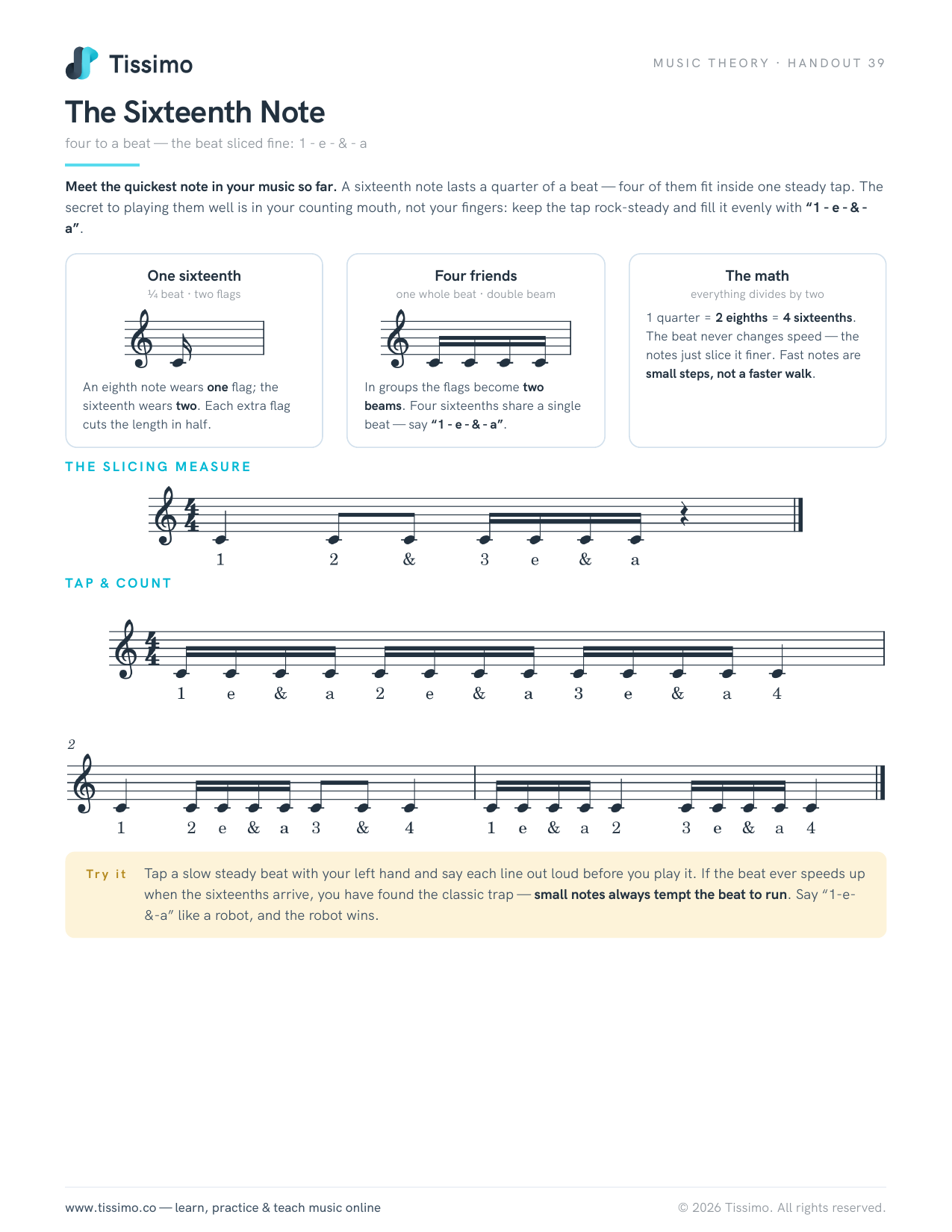
La semicorchea
cuatro por tiempo — el pulso dividido en partes finas: 1 - e - y - a

La familia de los silencios
cada nota tiene un gemelo silencioso — los cinco silencios, de la redonda a la semicorchea
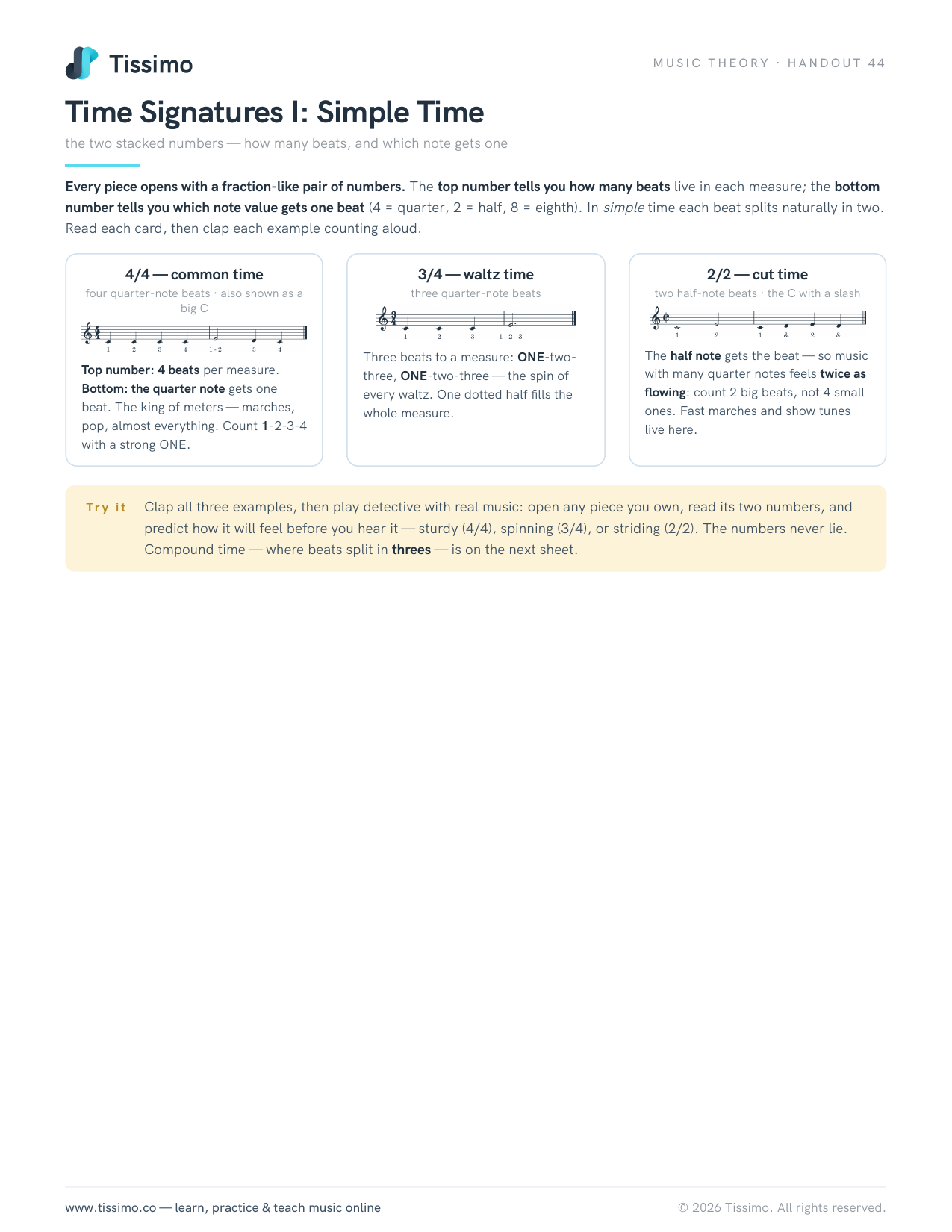
Compases I: el compás simple
los dos números apilados — cuántos tiempos hay, y qué nota vale uno
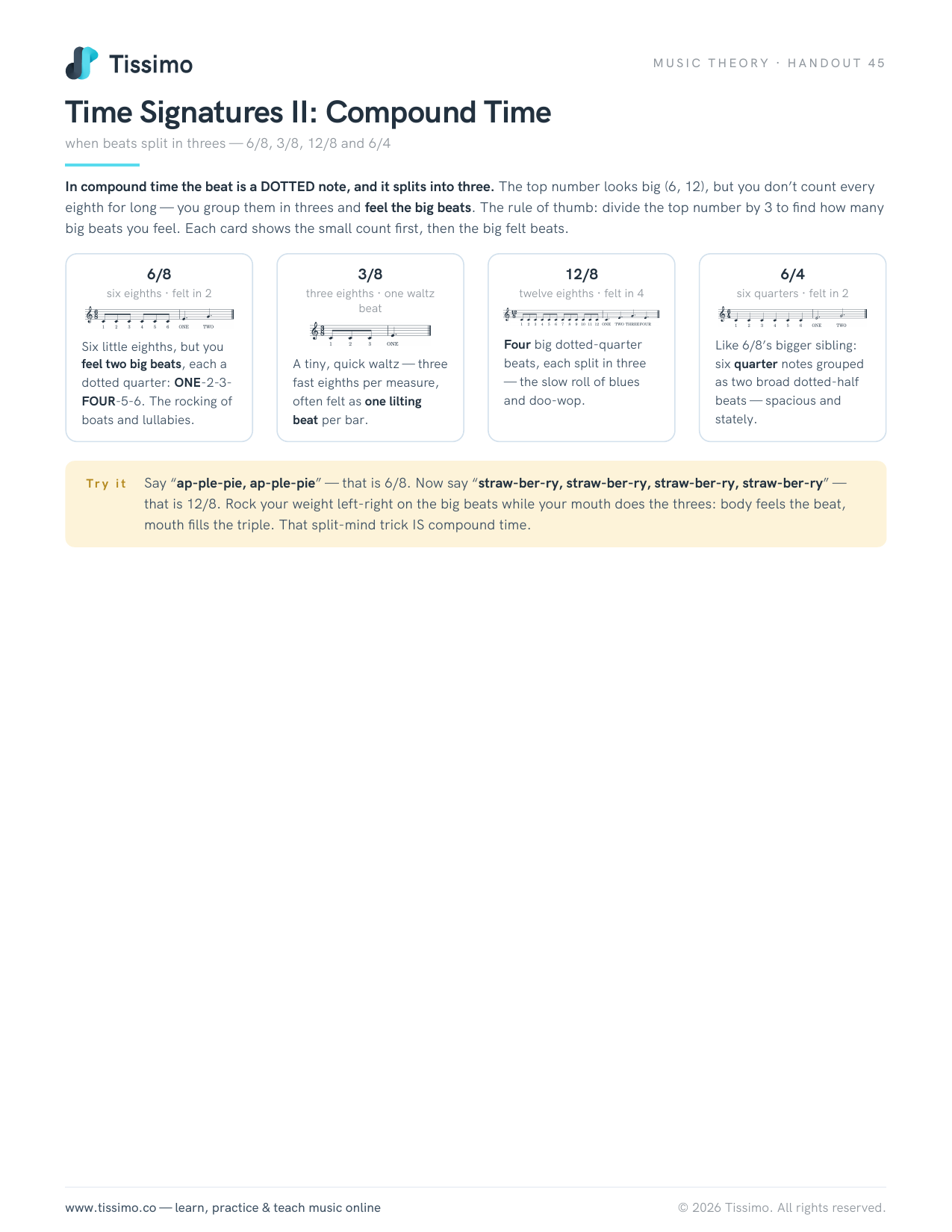
Compases II: el compás compuesto
cuando los tiempos se dividen en tres — 6/8, 3/8, 12/8 y 6/4
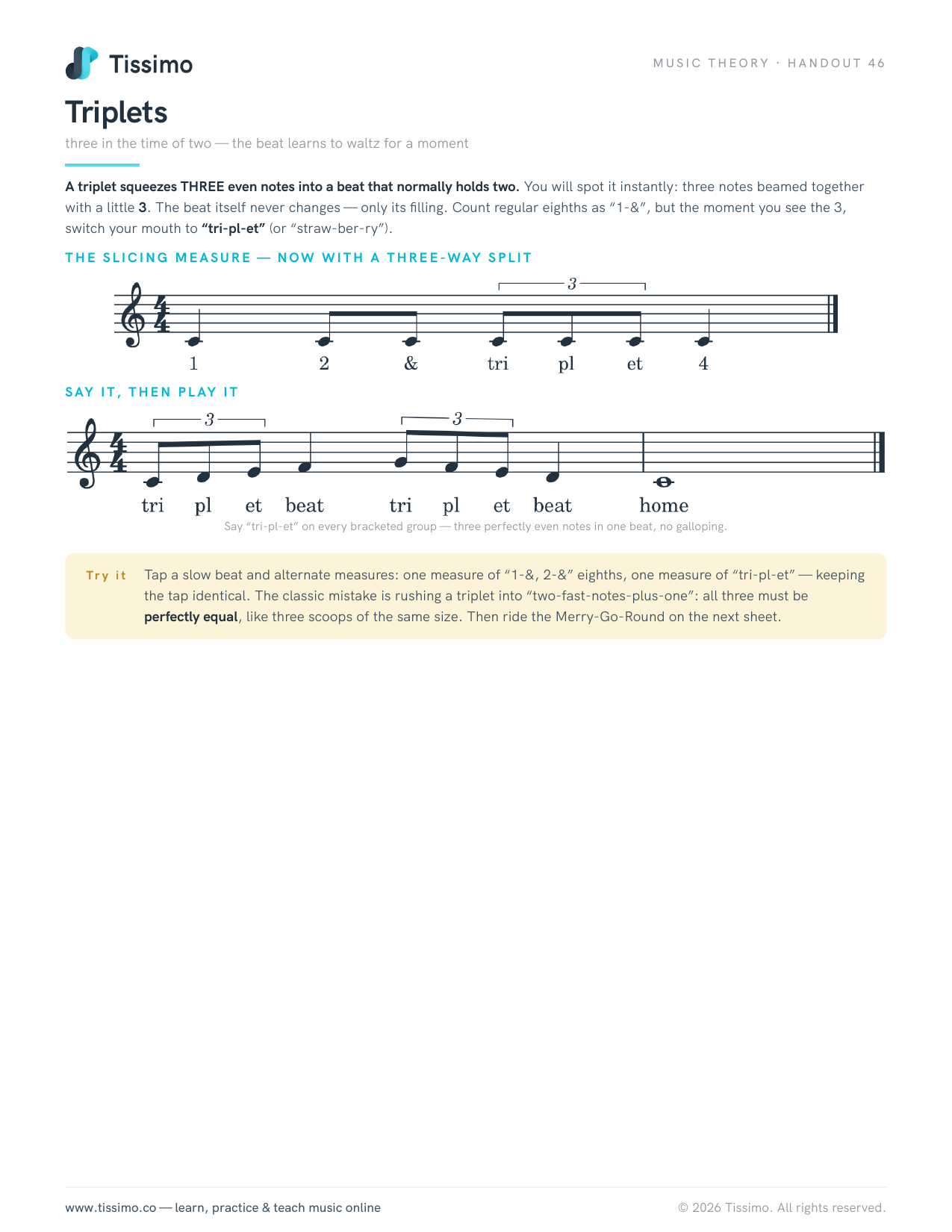
Los tresillos
tres notas en el tiempo de dos — el pulso aprende a bailar un vals por un instante
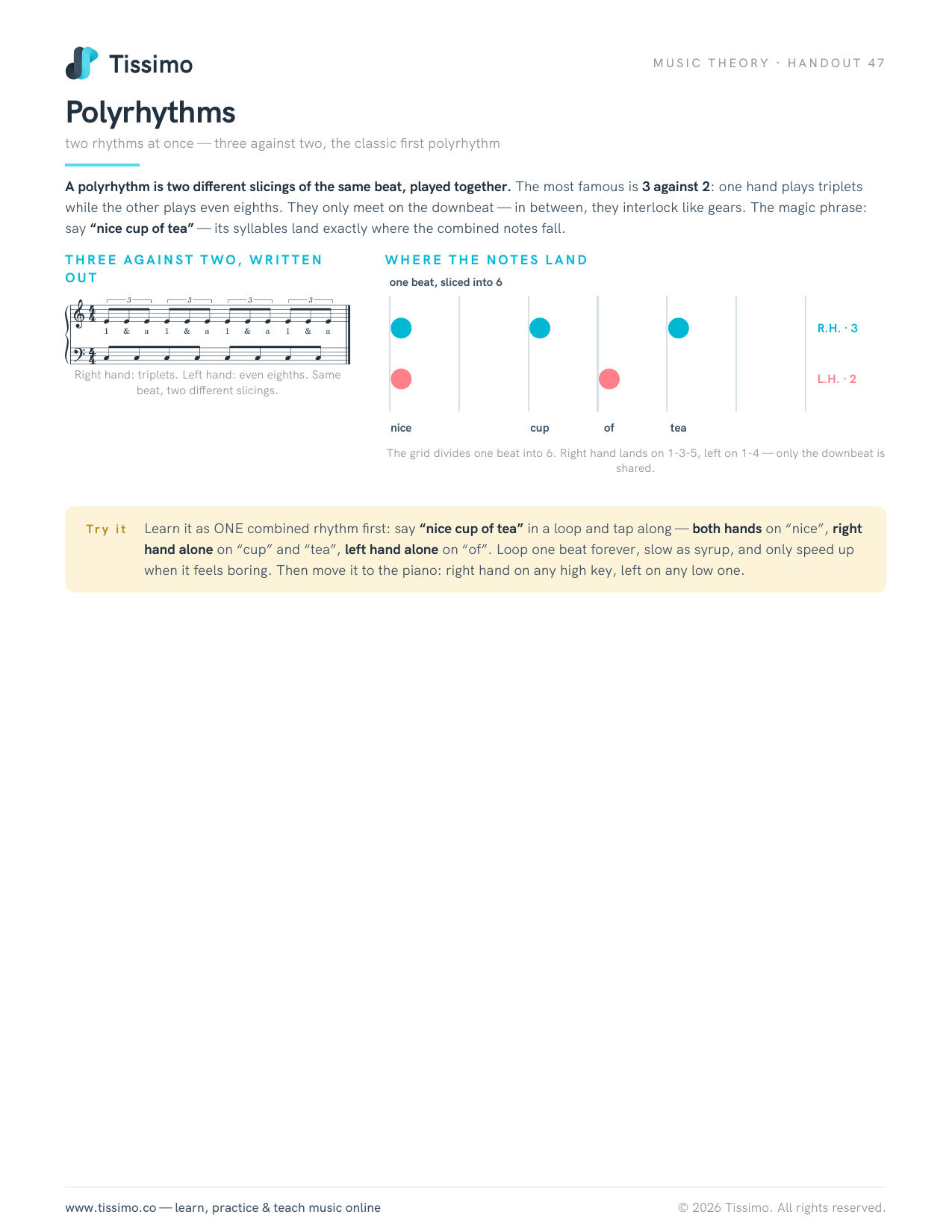
Los poliritmos
dos ritmos a la vez — tres contra dos, el clásico primer poliritmo
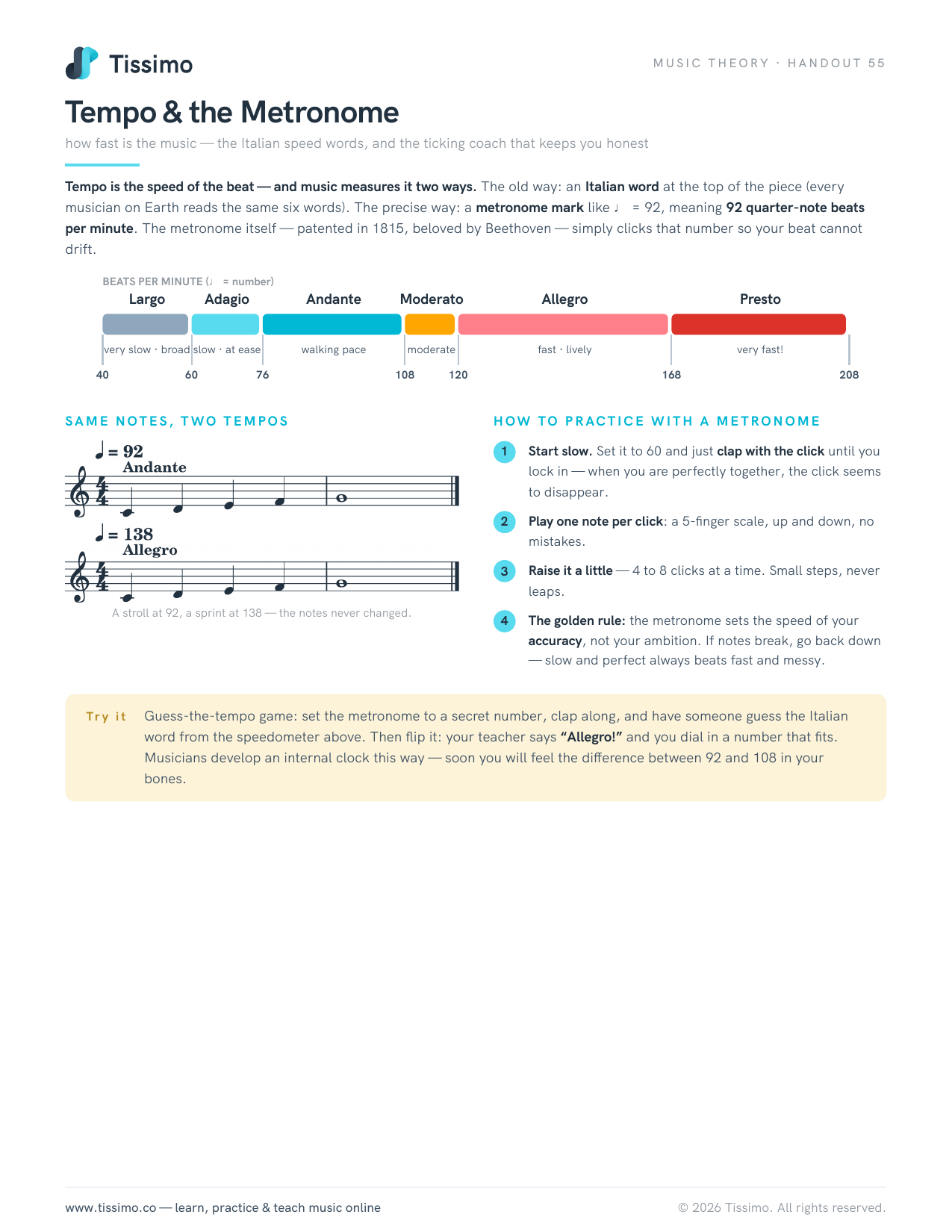
El tempo y el metrónomo
qué tan rápido es la música — las palabras italianas de velocidad, y el entrenador que marca el pulso con precisión
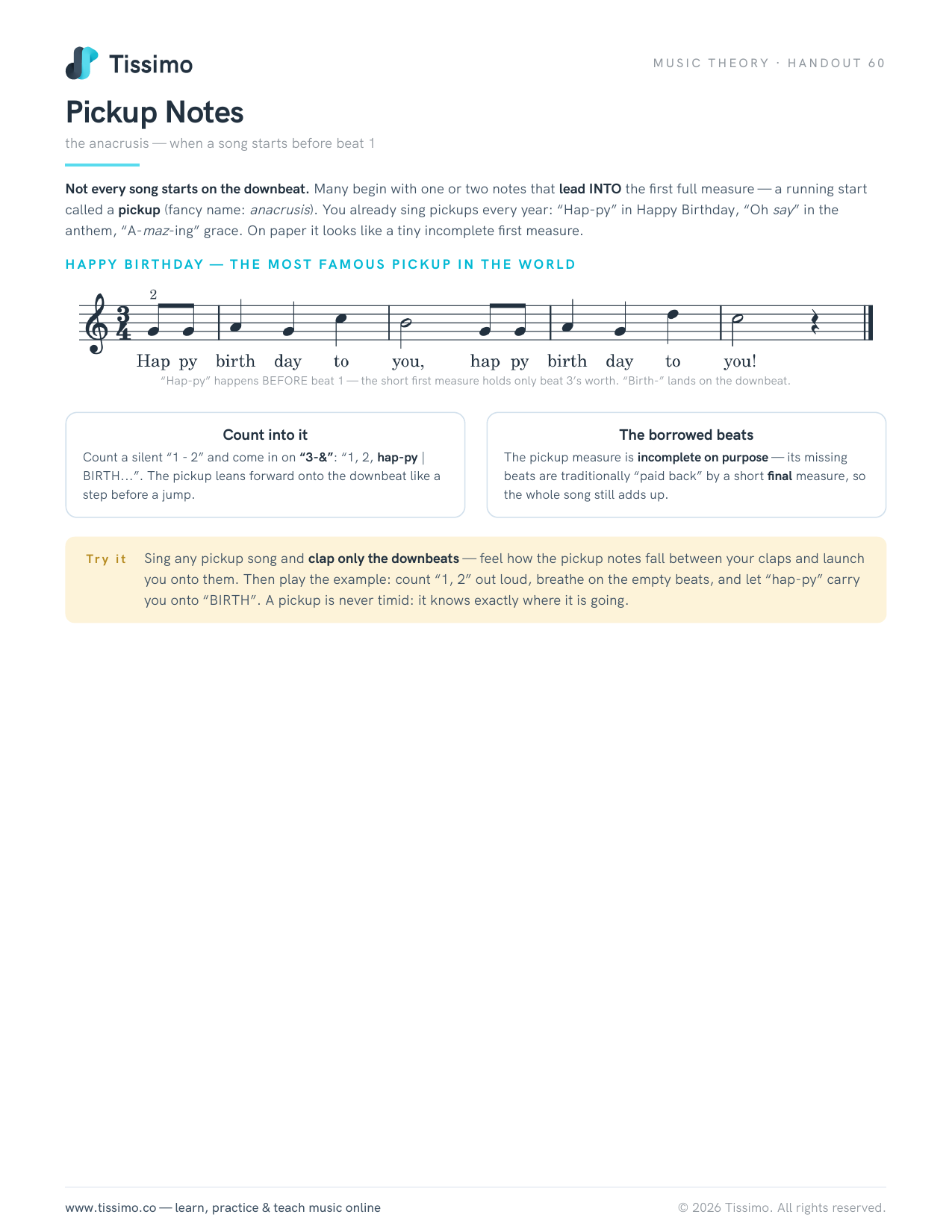
El anacrusis (notas de anacrusa)
la anacrusa — cuando una canción empieza antes del primer tiempo
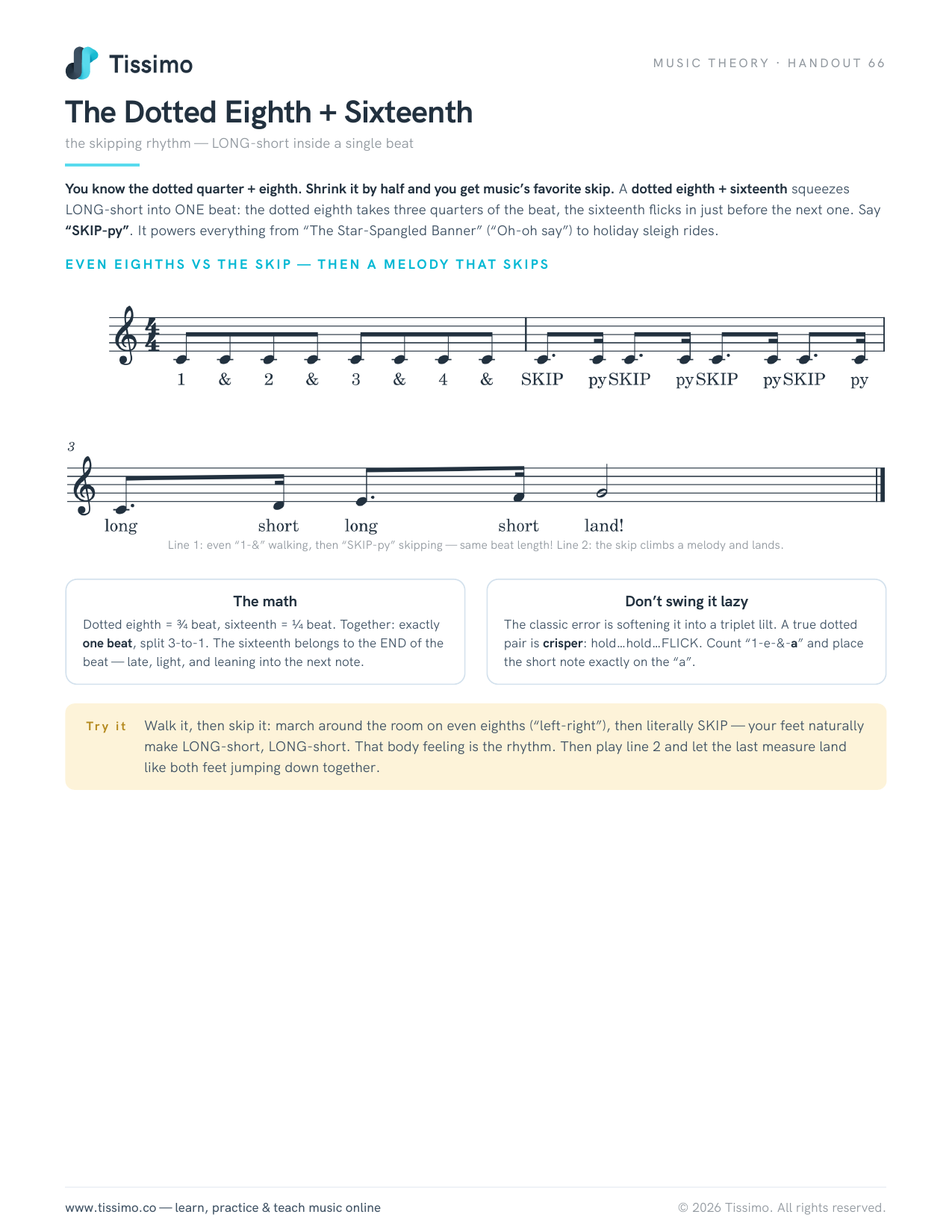
La corchea con puntillo + semicorchea
el ritmo saltarín — LARGO-corto dentro de un solo tiempo
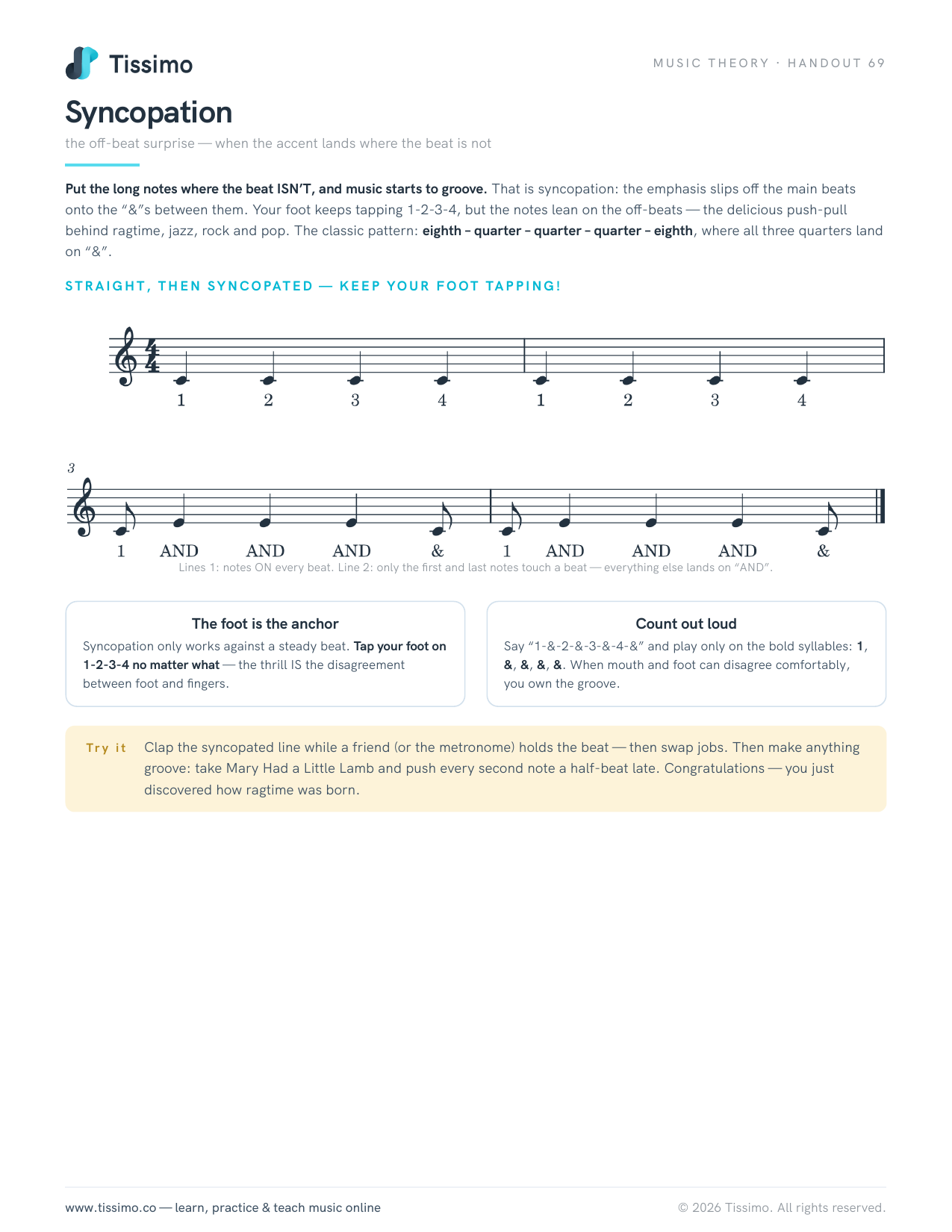
La síncopa
la sorpresa a contratiempo — cuando el acento cae donde no se espera el pulso
Altura y notación
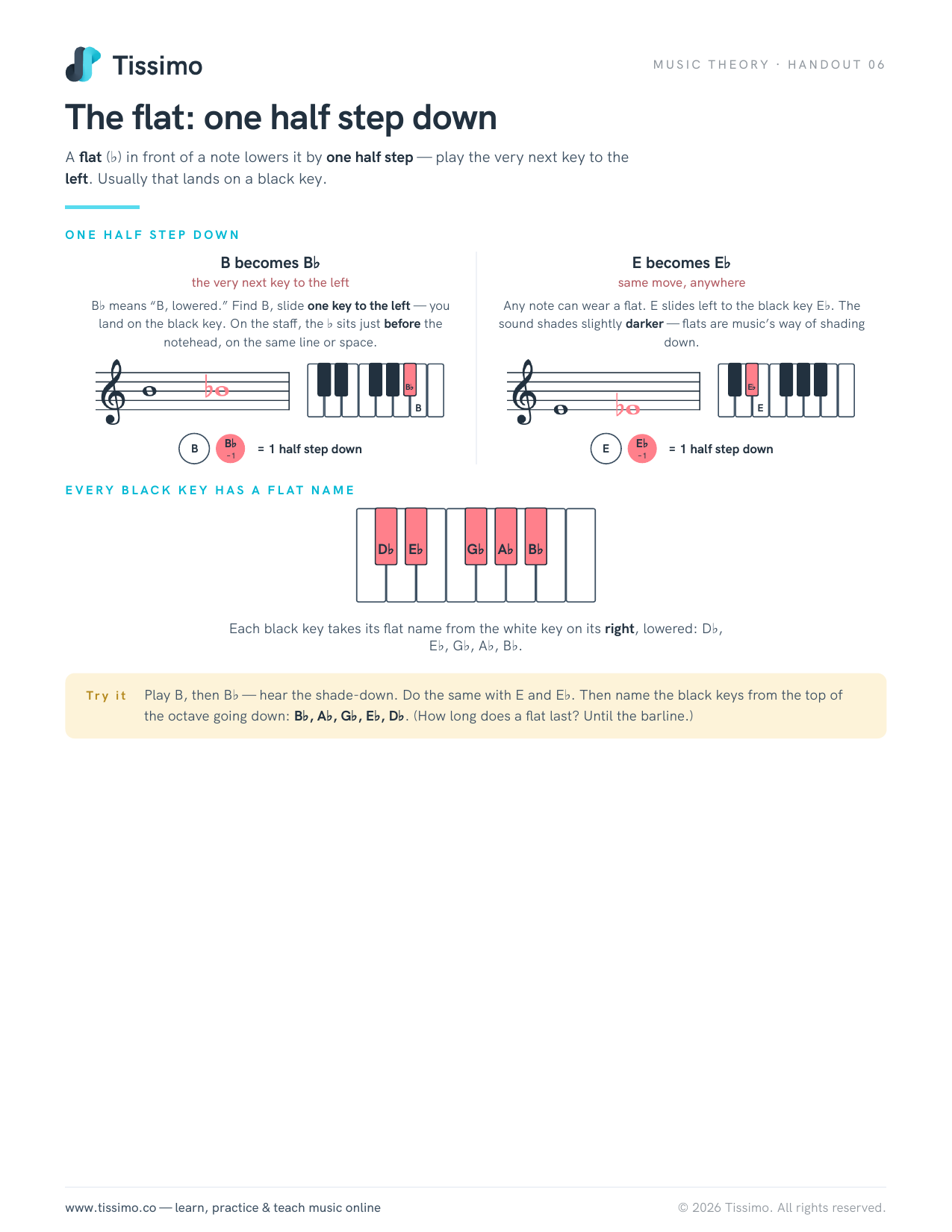
El bemol: un semitono más abajo
Un bemol (♭) delante de una nota la baja un semitono — toca la tecla inmediatamente a la izquierda. Normalmente cae en una tecla negra.
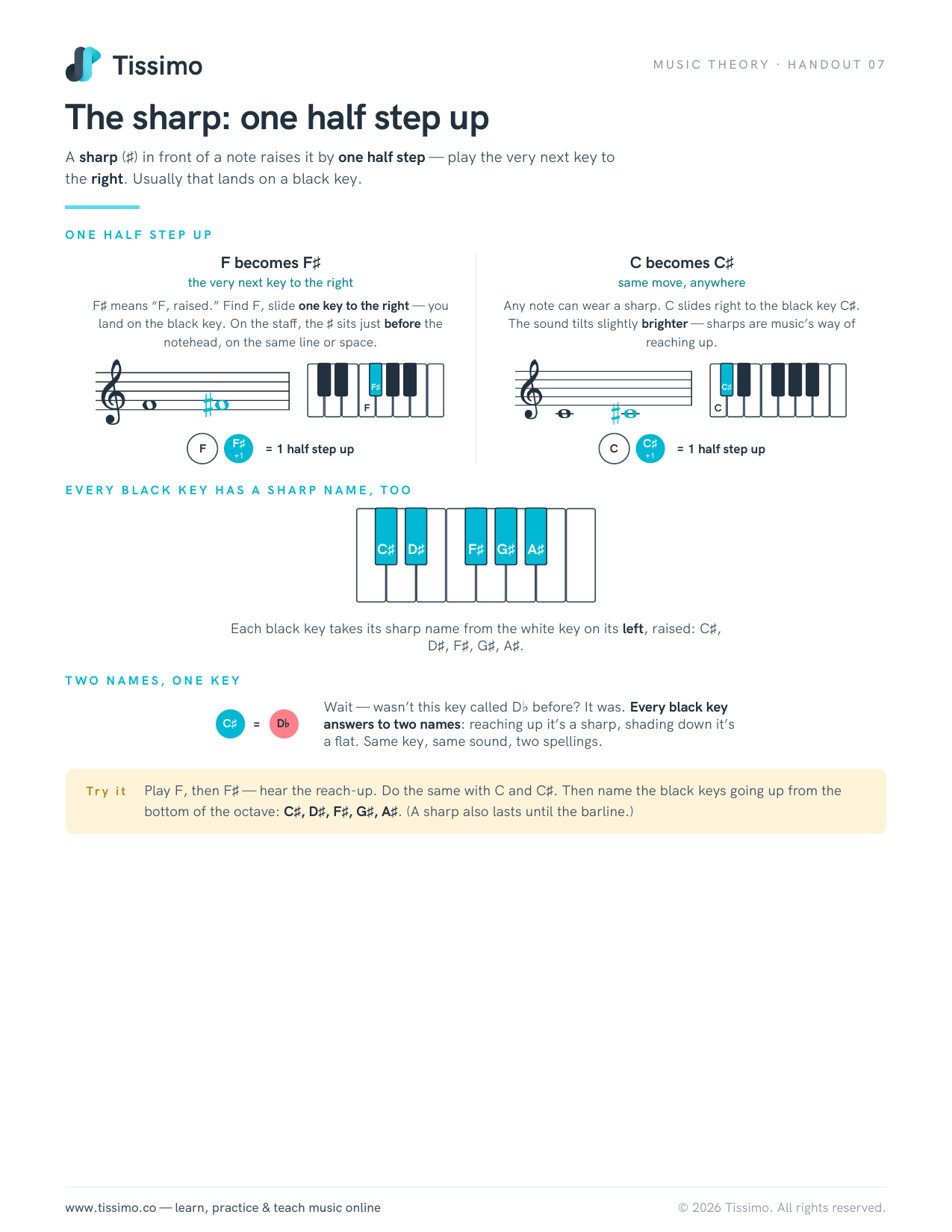
El sostenido: un semitono más arriba
Un sostenido (♯) delante de una nota la sube un semitono — toca la tecla inmediatamente a la derecha. Normalmente cae en una tecla negra.
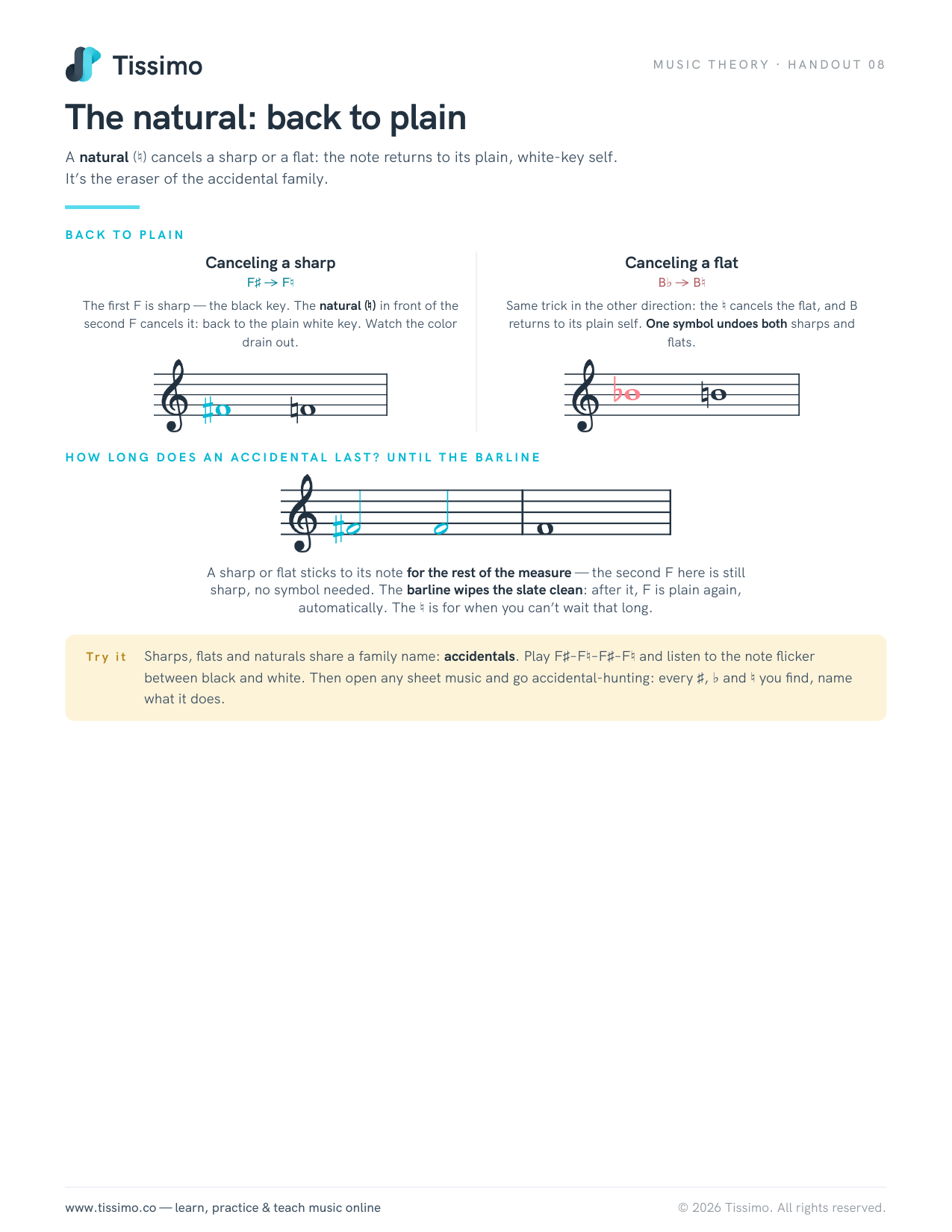
El becuadro: de vuelta a lo natural
Un becuadro (♮) cancela un sostenido o un bemol: la nota vuelve a ser ella misma, en su tecla blanca. Es el borrador de la familia de las alteraciones.
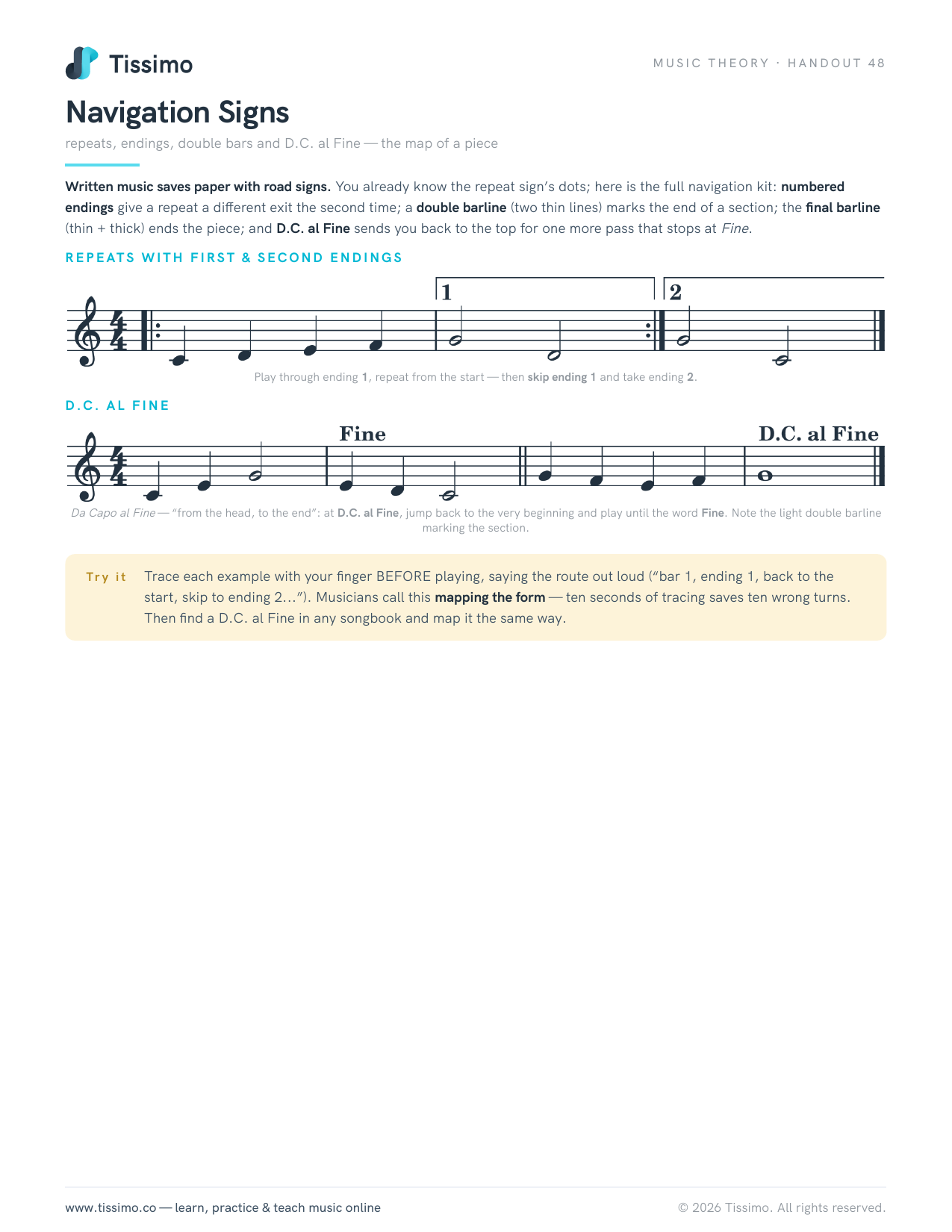
Signos de navegación
repeticiones, finales, dobles barras y D.C. al Fine — el mapa de una pieza
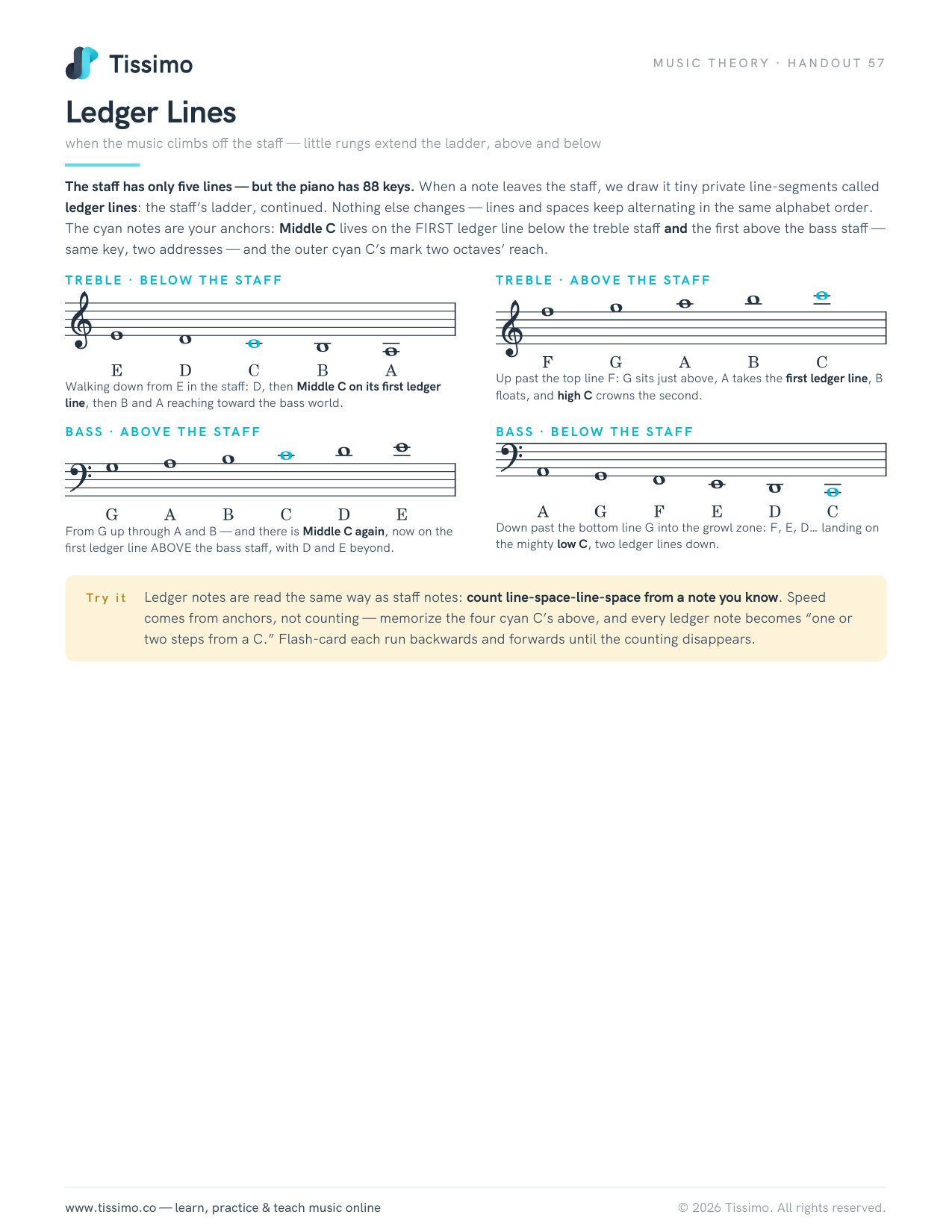
Las líneas adicionales
cuando la música se sale del pentagrama — pequeños peldaños extienden la escalera, arriba y abajo
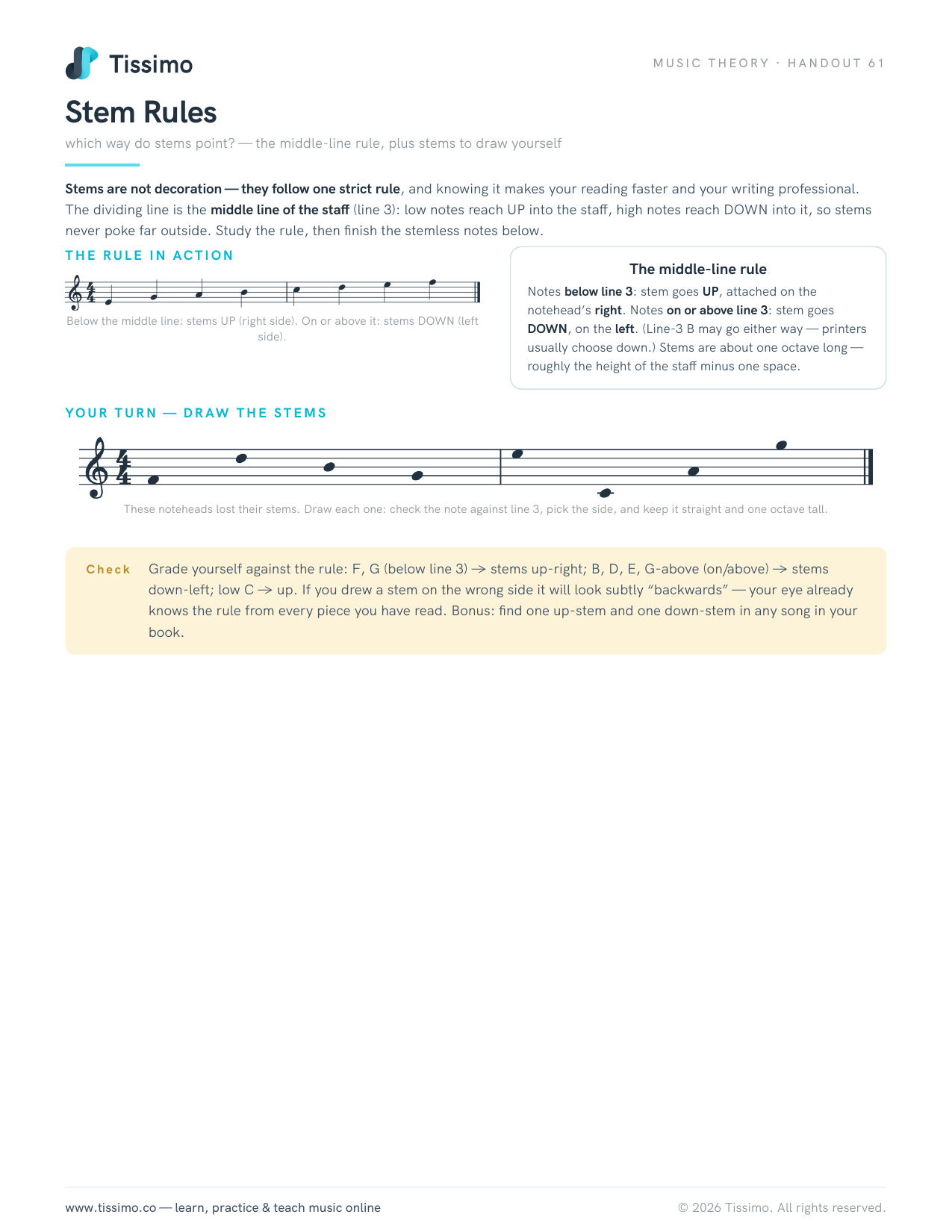
Reglas de las plicas
¿hacia dónde apuntan las plicas? — la regla de la línea central, más plicas para dibujar tú mismo
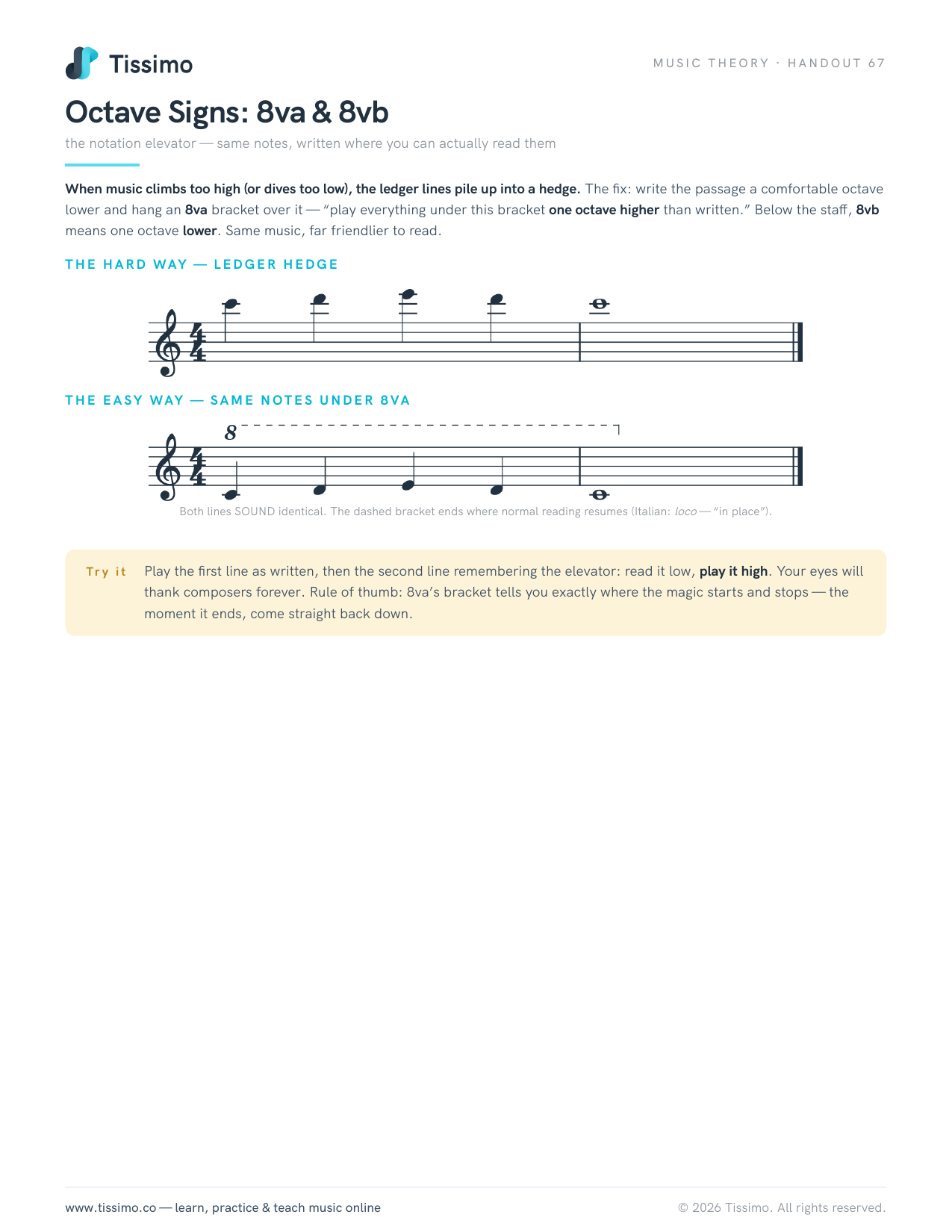
Signos de octava: 8va y 8vb
el ascensor de la notación — las mismas notas, escritas donde realmente puedes leerlas
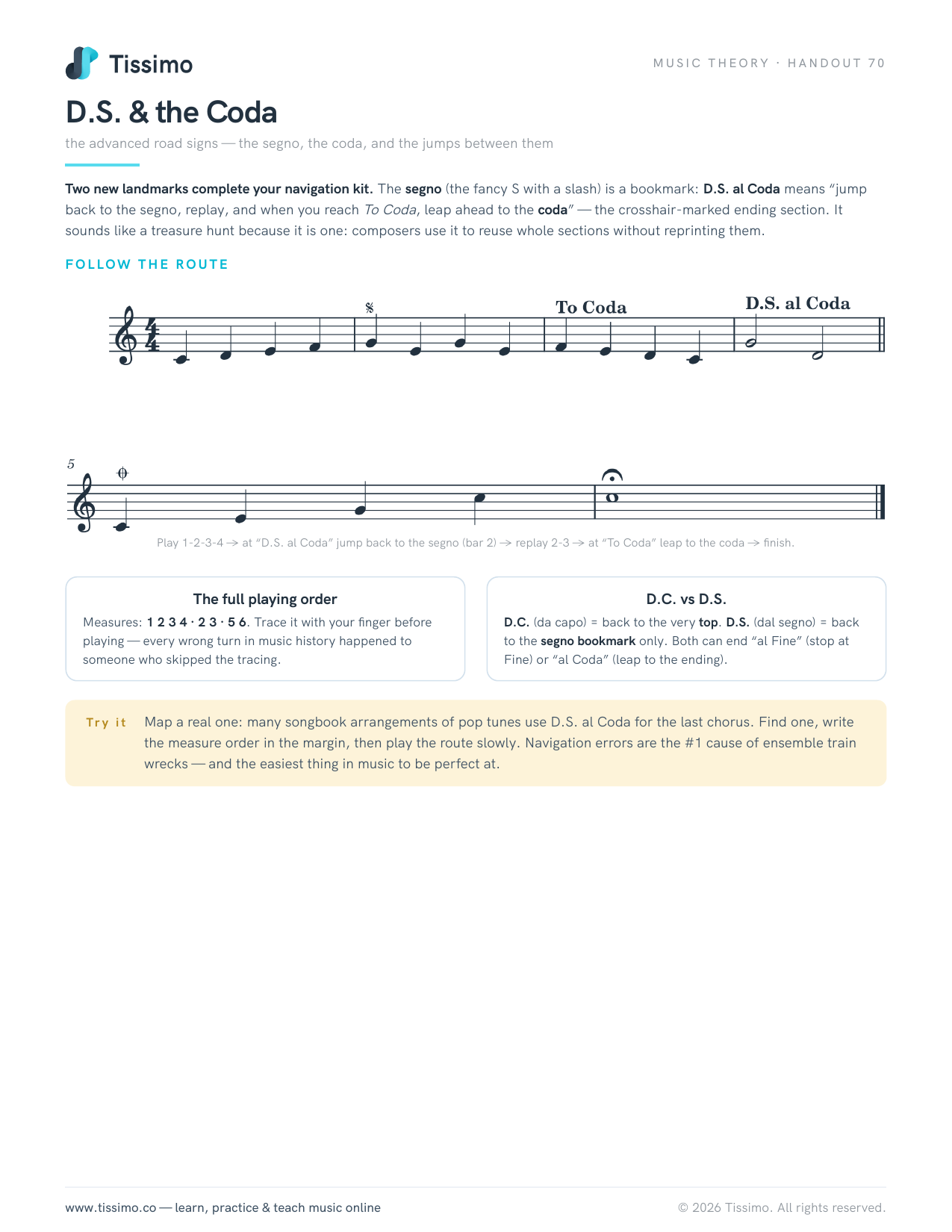
El D.S. y la coda
las señales de tránsito avanzadas — el segno, la coda, y los saltos entre ellos
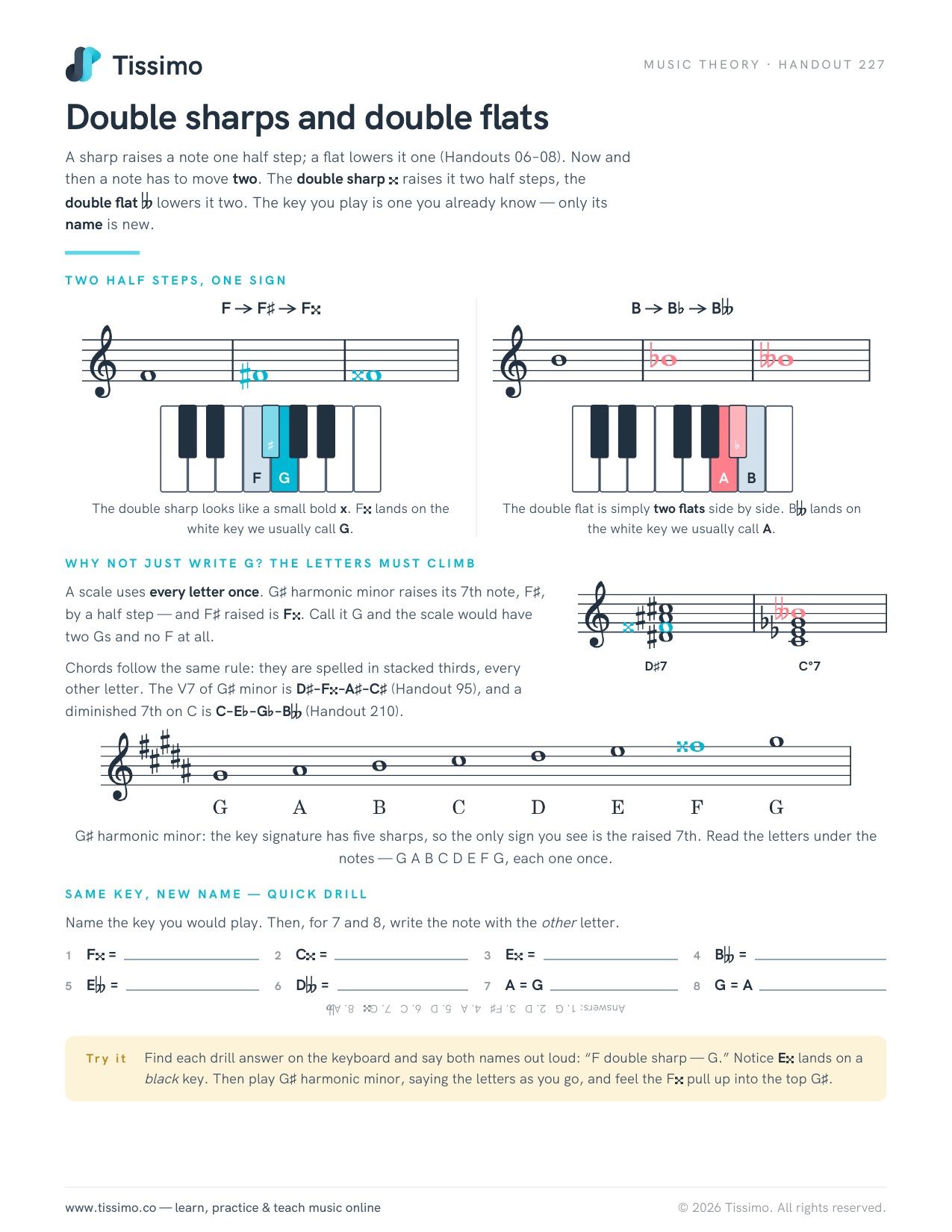
Double sharps and double flats
A sharp raises a note one half step; a flat lowers it one (Handouts 06–08). Now and then a note has to move two. The double sharp raises it two half steps, the double flat lowers it two. The key you play is one you already know — only its name is new.
Intervalos
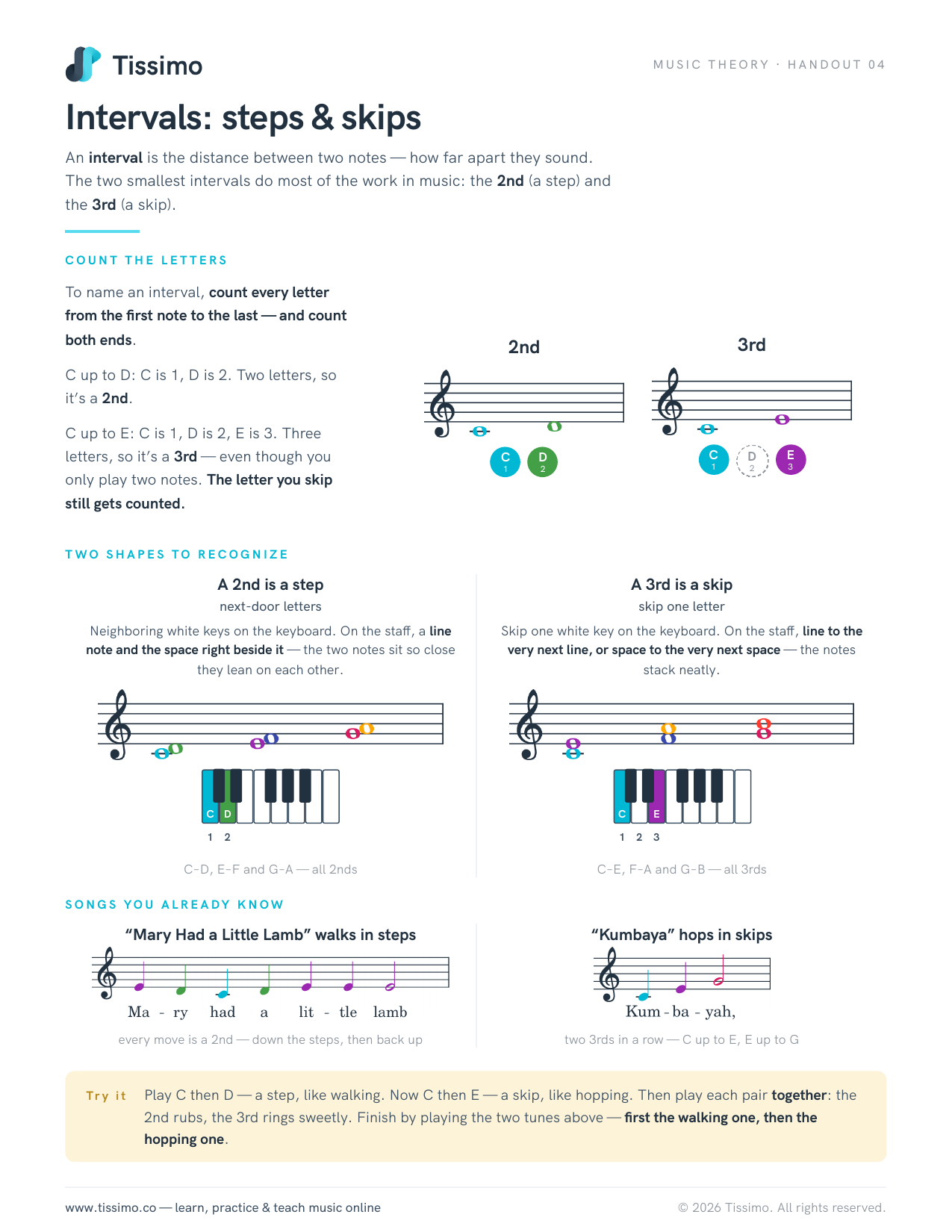
Intervalos: pasos y saltos
Un intervalo es la distancia entre dos notas — qué tan separadas suenan. Los dos intervalos más pequeños hacen la mayor parte del trabajo en la música: la 2ª (un paso) y la 3ª (un salto).
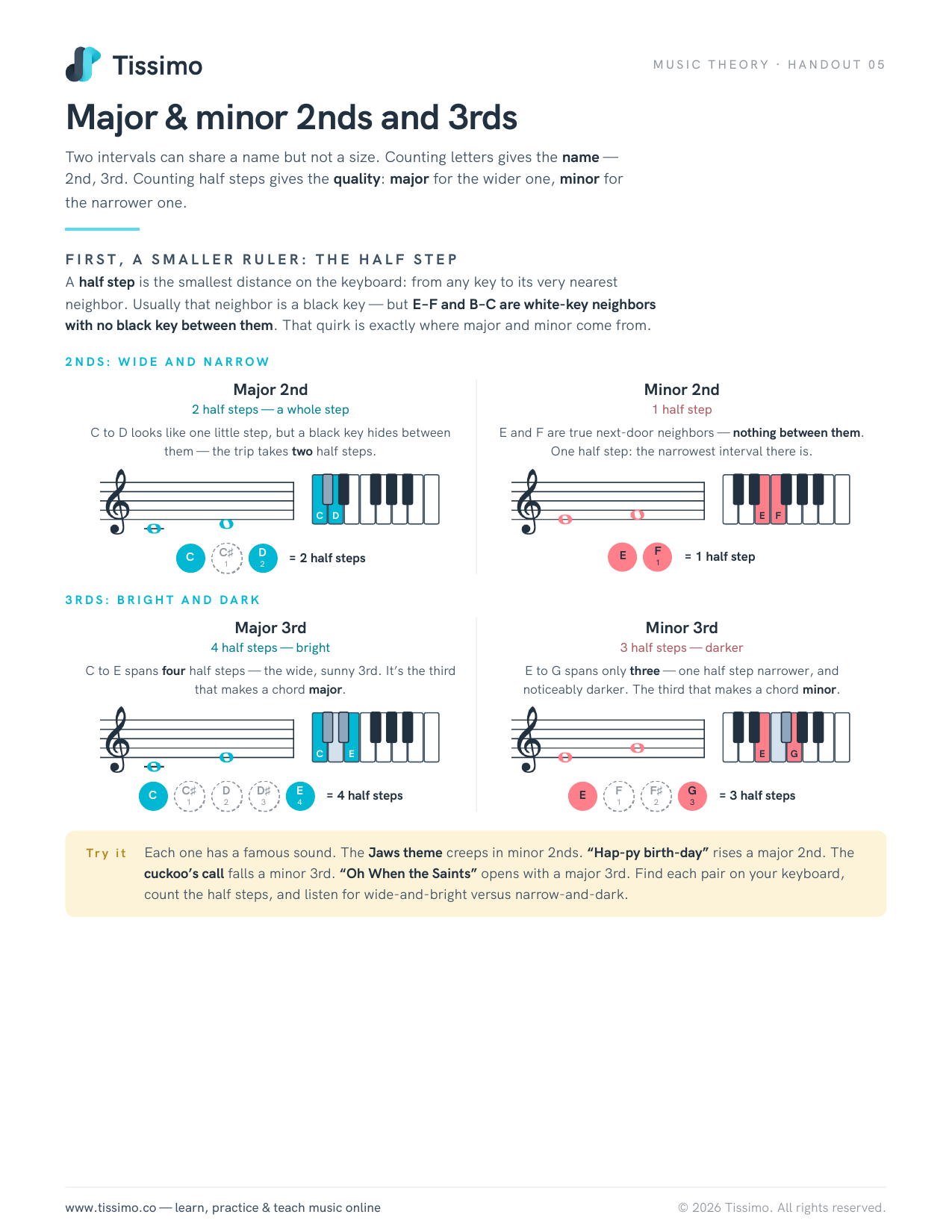
2ª y 3ª mayores y menores
Dos intervalos pueden compartir nombre pero no tamaño. Contar letras da el nombre — 2ª, 3ª. Contar semitonos da la calidad: mayor para el más ancho, menor para el más estrecho.
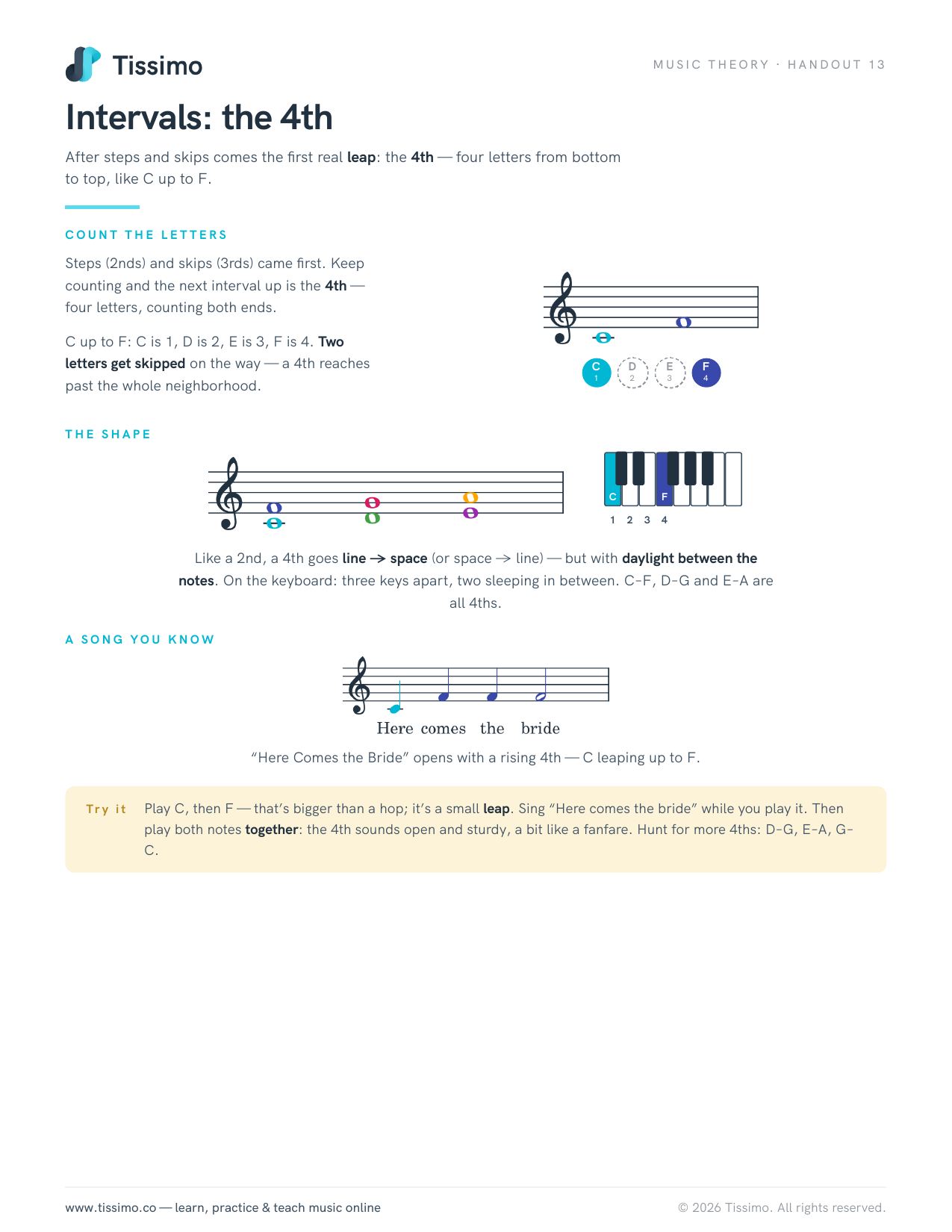
Intervalos: la 4ª
Después de los pasos y los saltos llega el primer verdadero brinco: la 4ª — cuatro letras de abajo hacia arriba, como de Do a Fa.
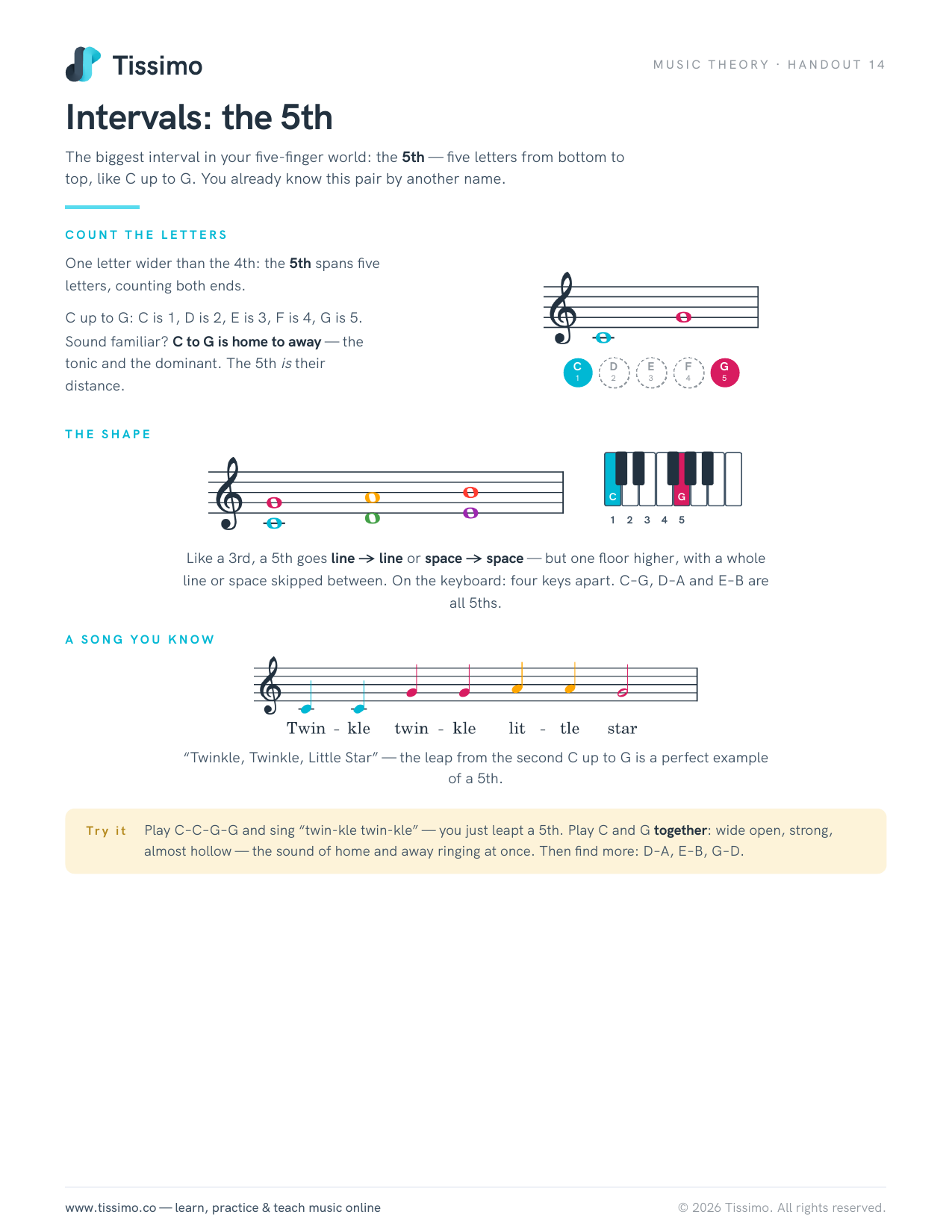
Intervalos: la 5ª
El intervalo más grande de tu mundo de cinco dedos: la 5ª — cinco letras de abajo hacia arriba, como de Do a Sol. Ya conoces este par por otro nombre.
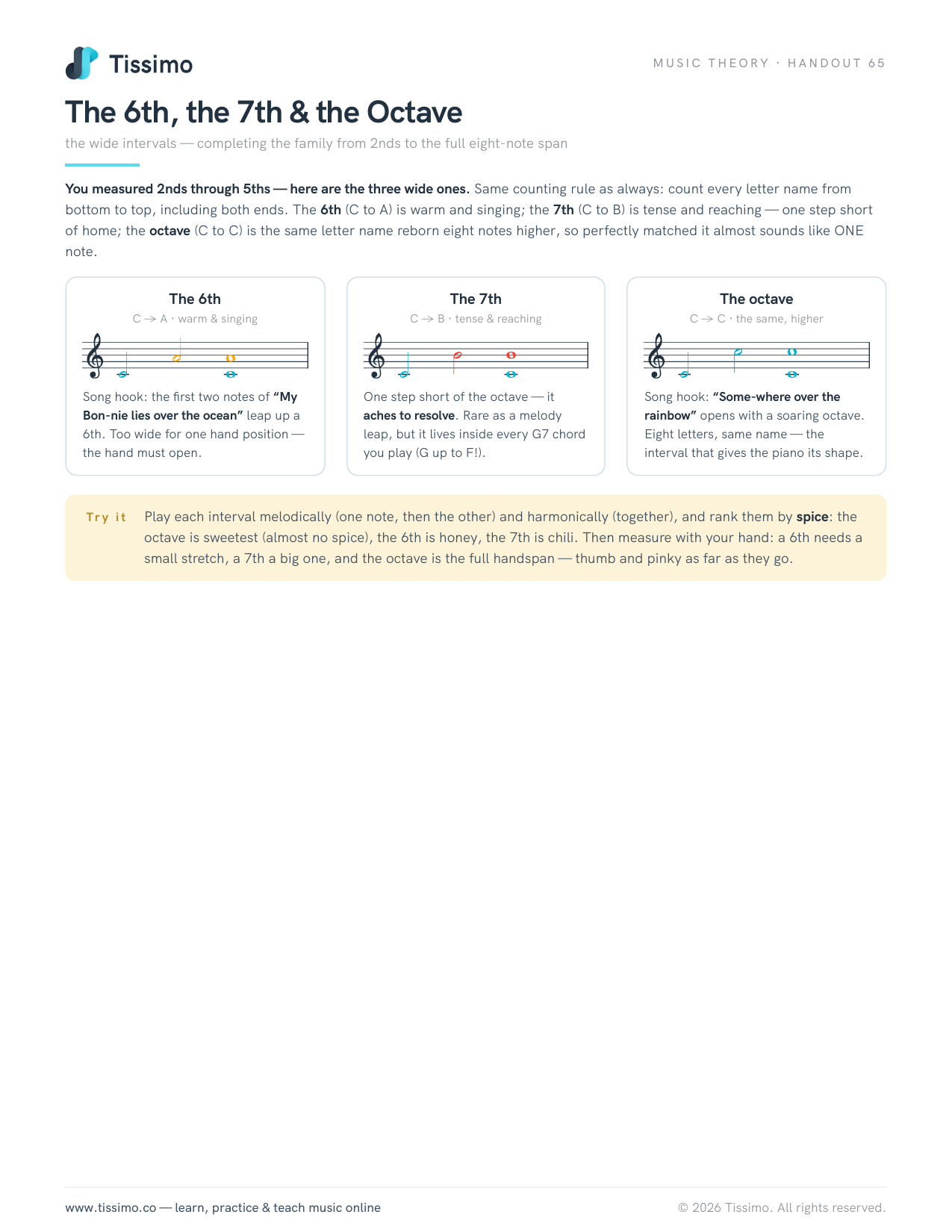
La 6ª, la 7ª y la octava
los intervalos amplios — completando la familia desde la 2ª hasta el salto completo de ocho notas
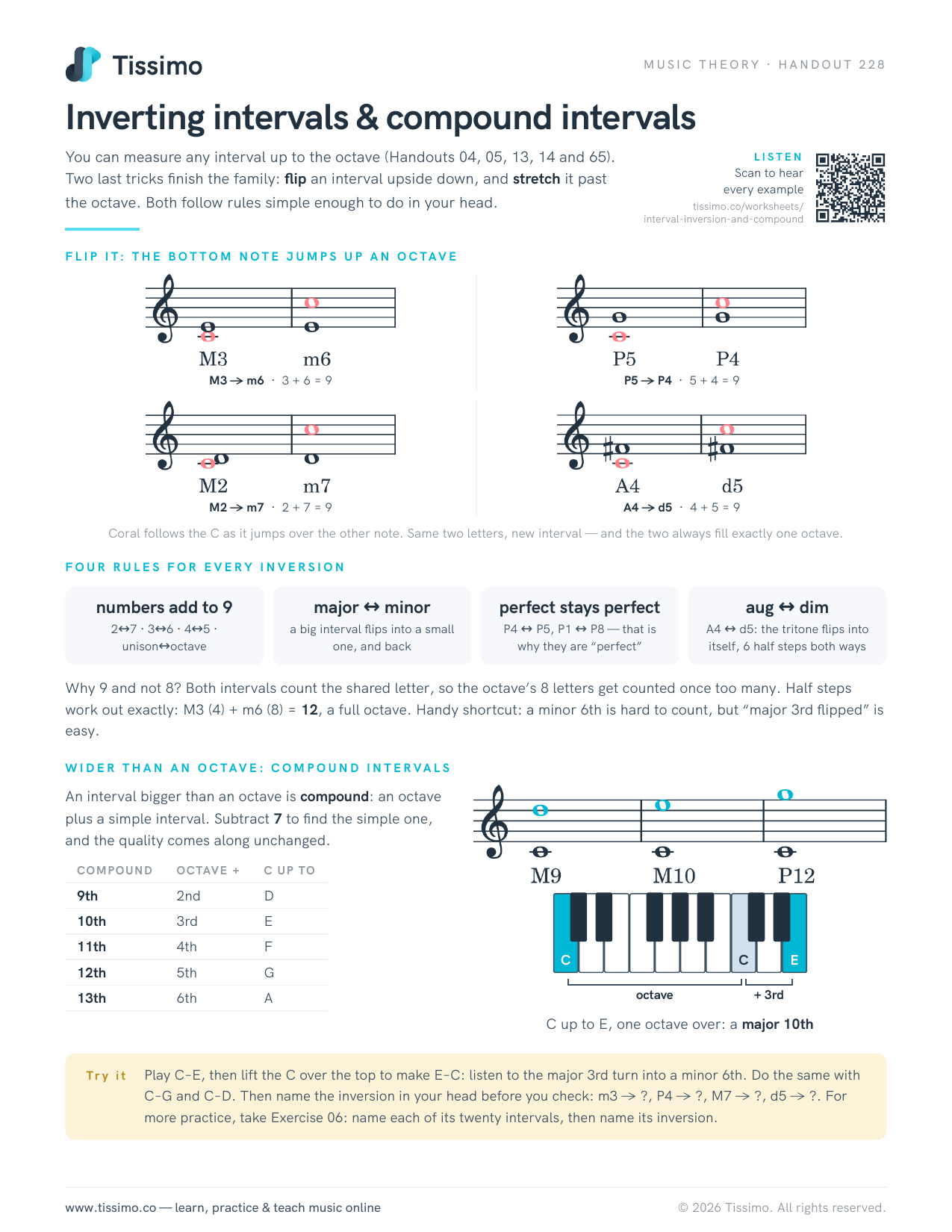
Inverting intervals & compound intervals
You can measure any interval up to the octave (Handouts 04, 05, 13, 14 and 65). Two last tricks finish the family: flip an interval upside down, and stretch it past the octave. Both follow rules simple enough to do in your head.
Escalas y tonalidades
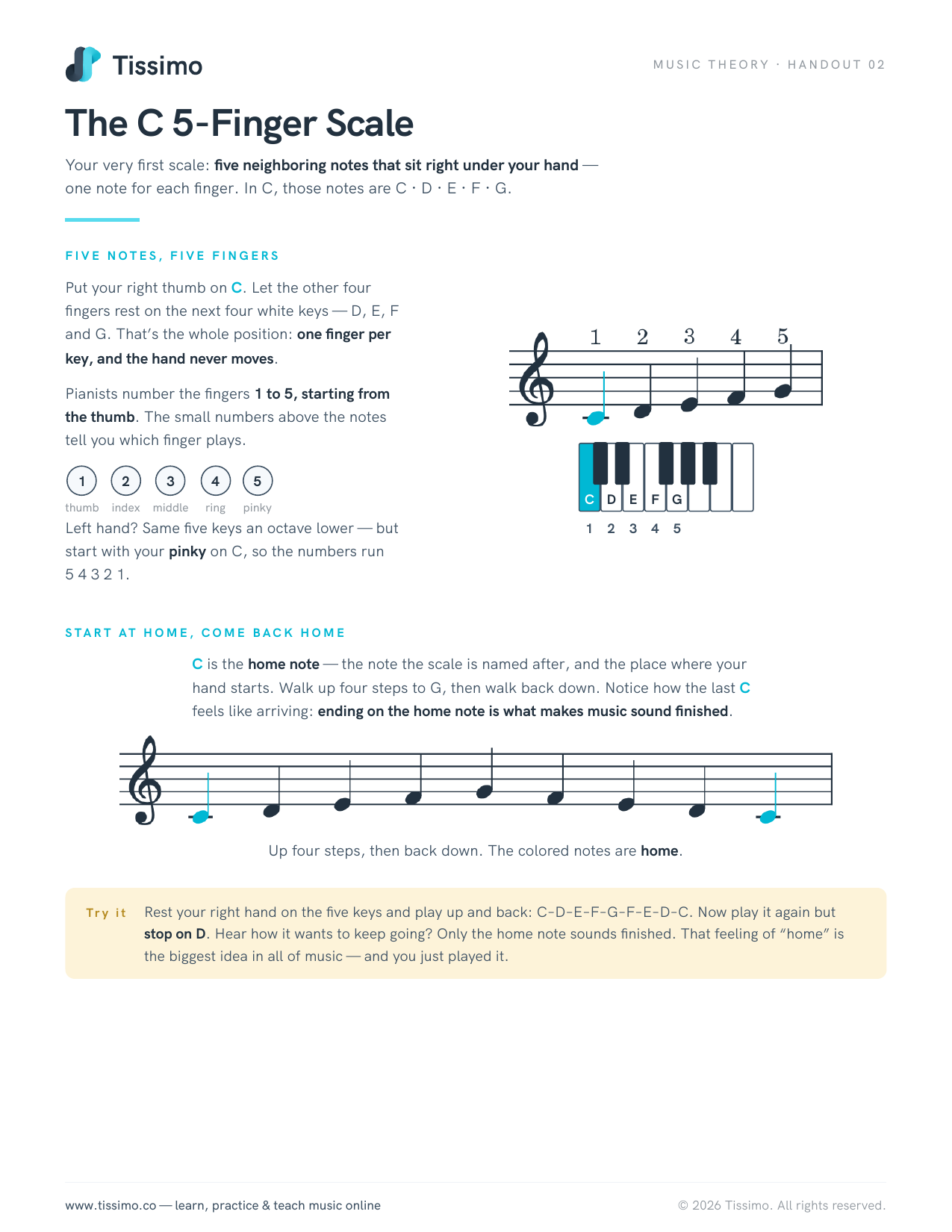
La escala de 5 dedos en Do
Tu primerísima escala: cinco notas vecinas que quedan justo debajo de tu mano — una nota para cada dedo. En Do, esas notas son Do · Re · Mi · Fa · Sol.
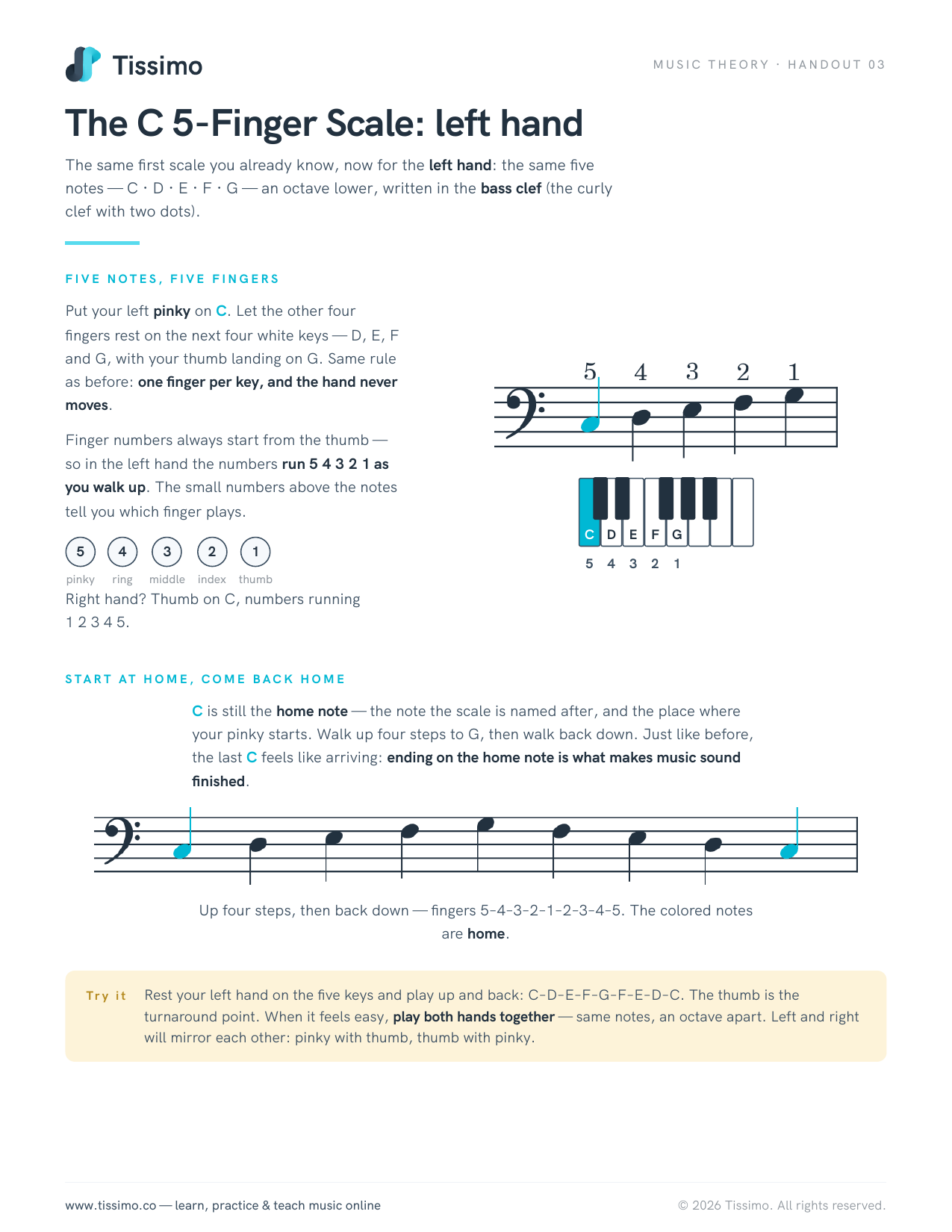
La escala de 5 dedos en Do: mano izquierda
La misma primera escala que ya conoces, ahora para la mano izquierda: las mismas cinco notas — Do · Re · Mi · Fa · Sol — una octava más abajo, escritas en clave de Fa (la clave curva con dos puntos).
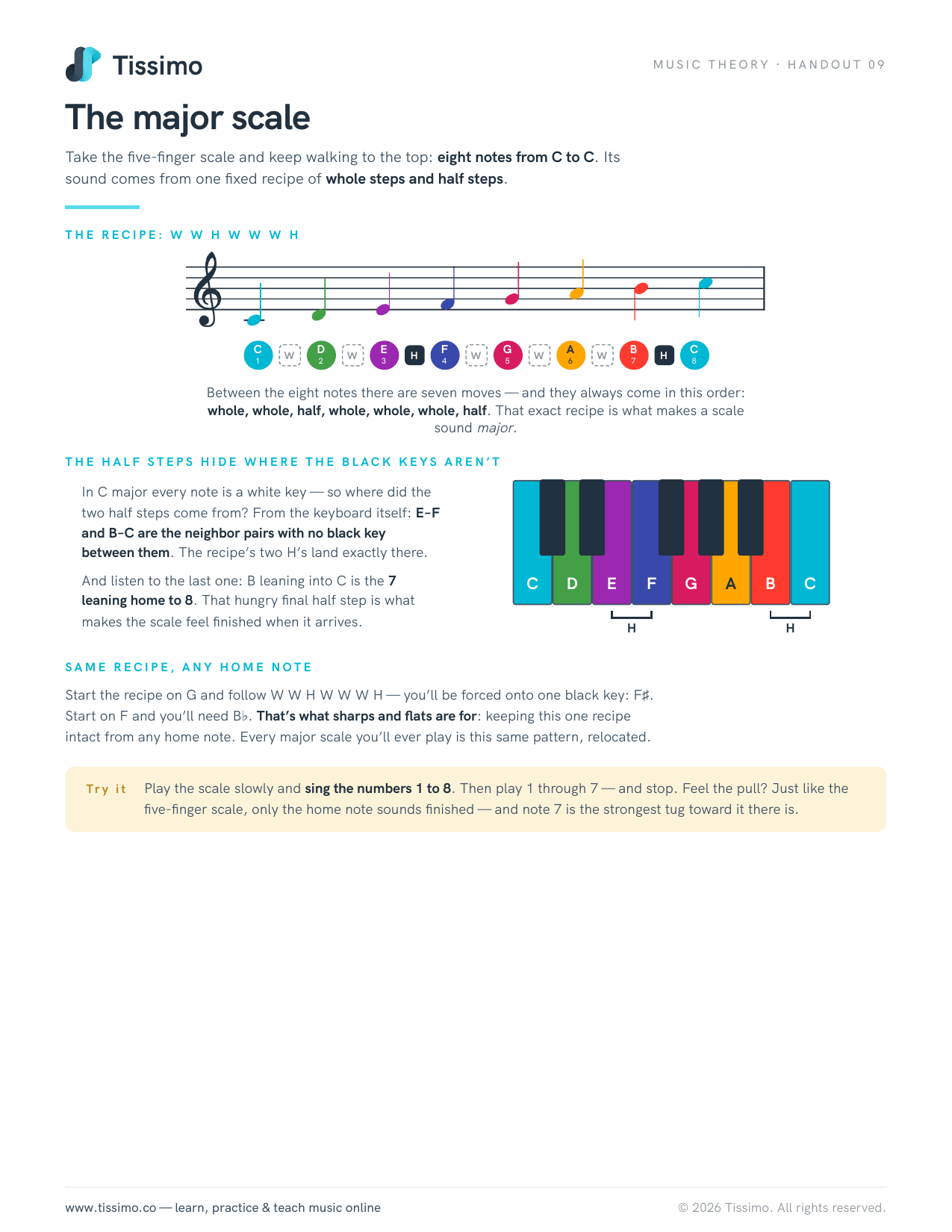
La escala mayor
Toma la escala de 5 dedos y sigue caminando hasta arriba: ocho notas de Do a Do. Su sonido viene de una receta fija de tonos y semitonos.
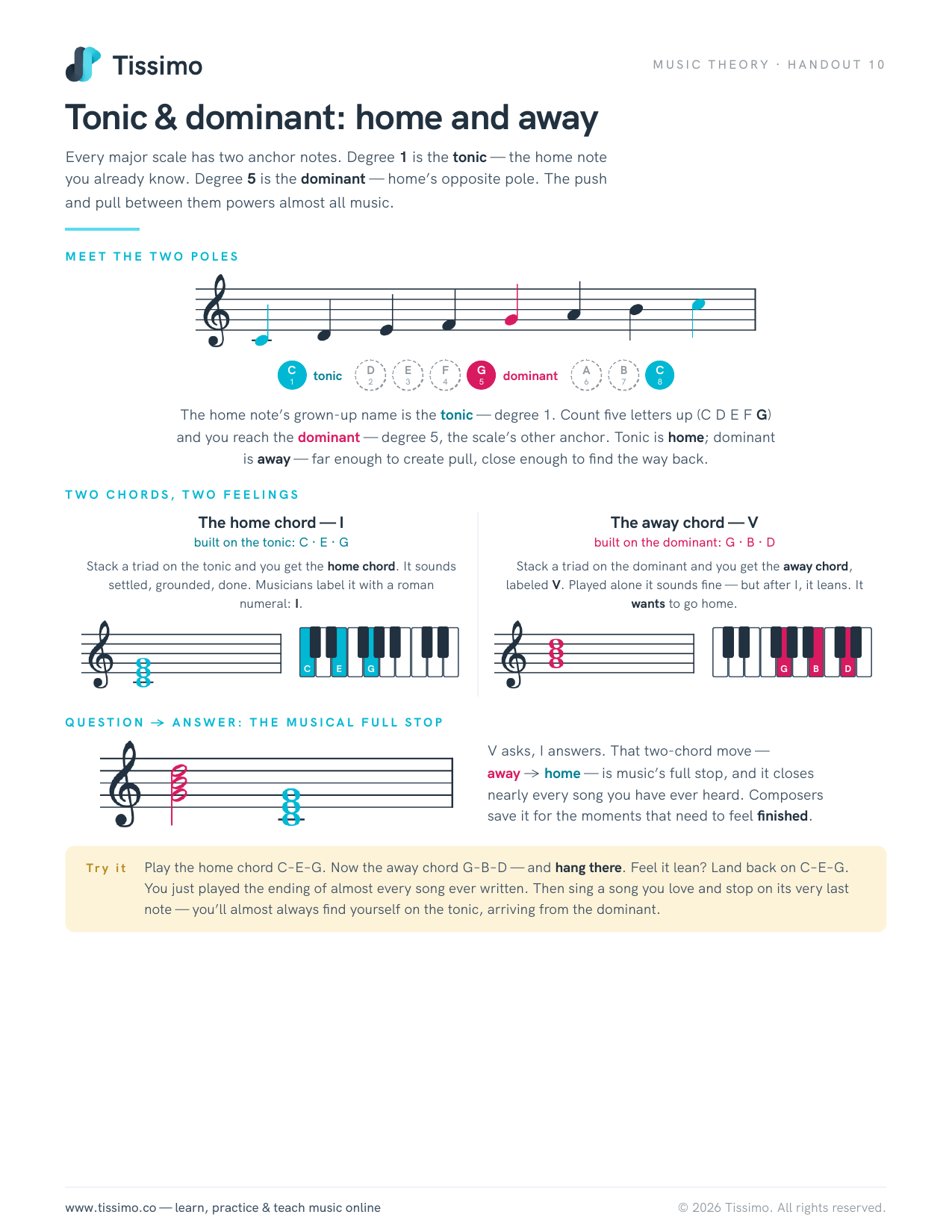
Tónica y dominante: hogar y contraste
Toda escala mayor tiene dos notas ancla. El grado 1 es la tónica — la nota de hogar que ya conoces. El grado 5 es la dominante — el polo opuesto al hogar. El tira y afloja entre ambas impulsa casi toda la música.
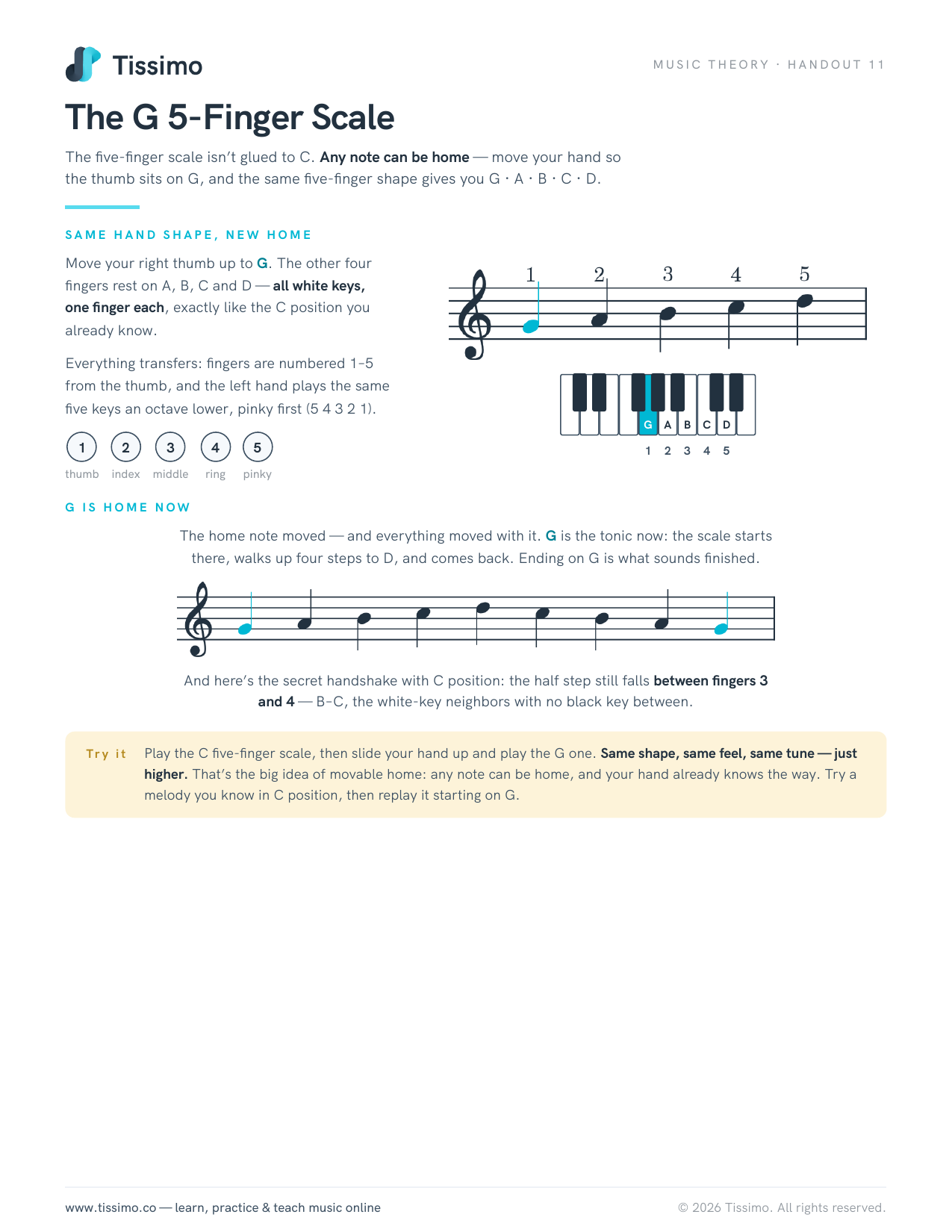
La escala de 5 dedos en Sol
La escala de 5 dedos no está pegada a Do. Cualquier nota puede ser el hogar — mueve tu mano para que el pulgar quede sobre Sol, y la misma forma de 5 dedos te da Sol · La · Si · Do · Re.
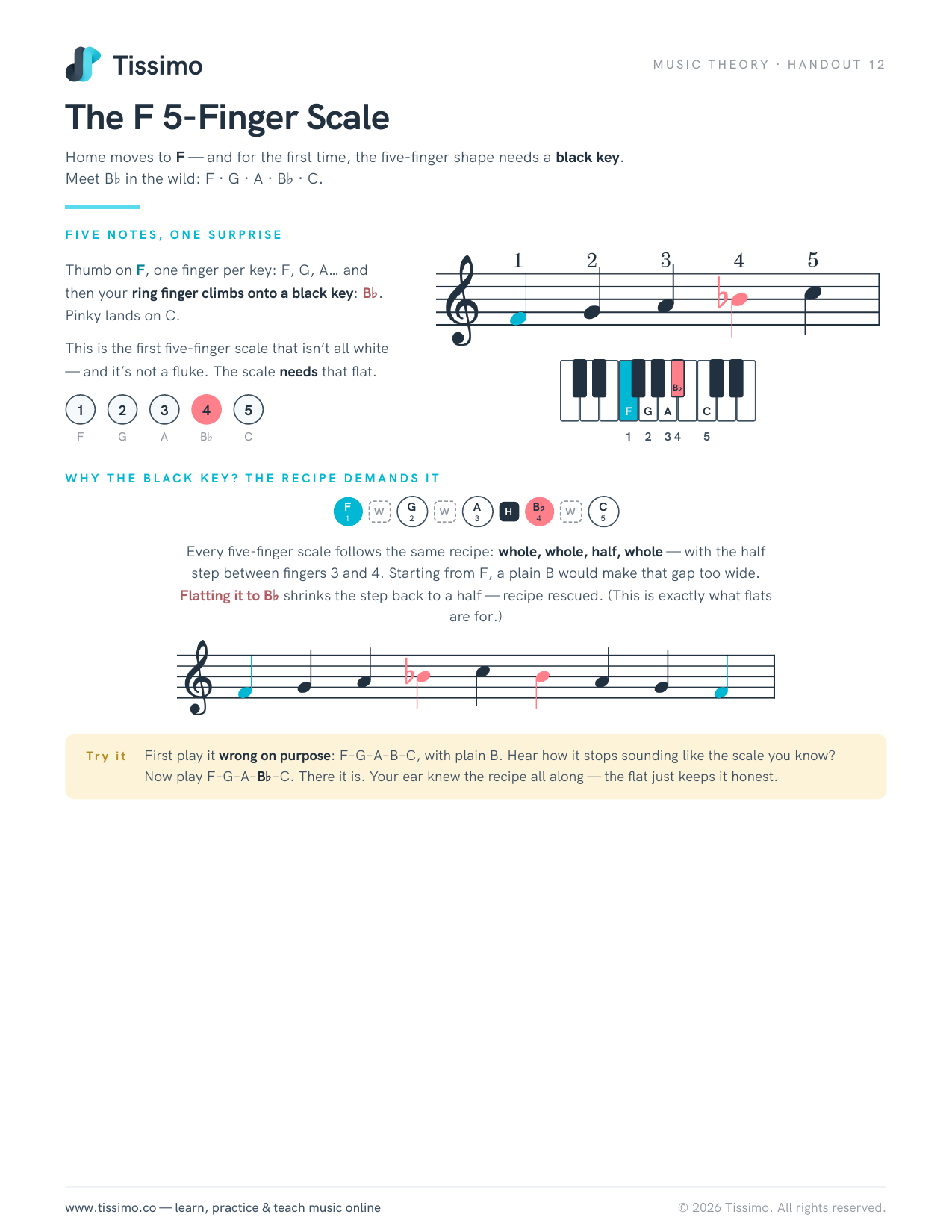
La escala de 5 dedos en Fa
El hogar se muda a Fa — y por primera vez, la forma de 5 dedos necesita una tecla negra. Conoce al Si♭ en su hábitat natural: Fa · Sol · La · Si♭ · Do.
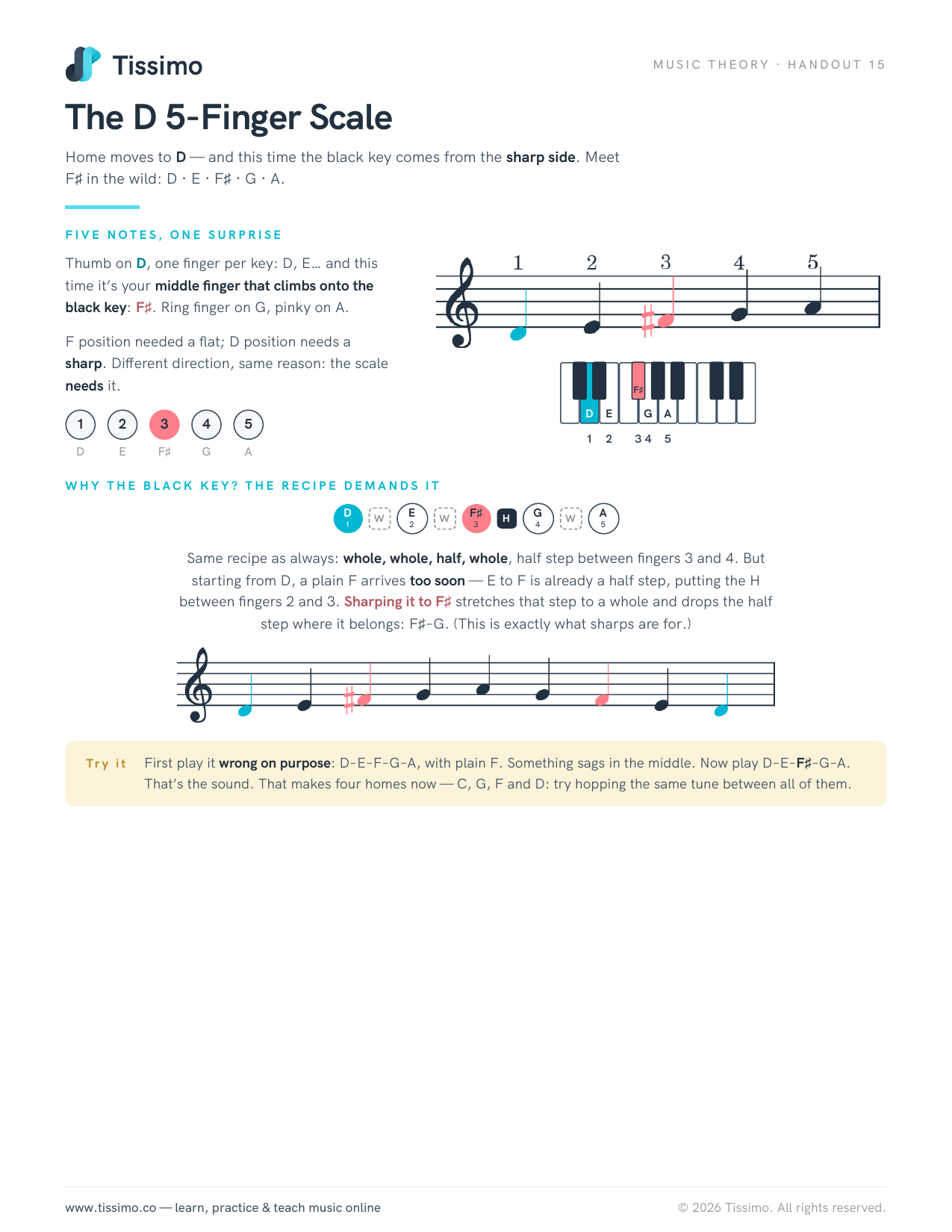
La escala de 5 dedos en Re
El hogar se muda a Re — y esta vez la tecla negra viene del lado de los sostenidos. Conoce al Fa♯ en su hábitat natural: Re · Mi · Fa♯ · Sol · La.
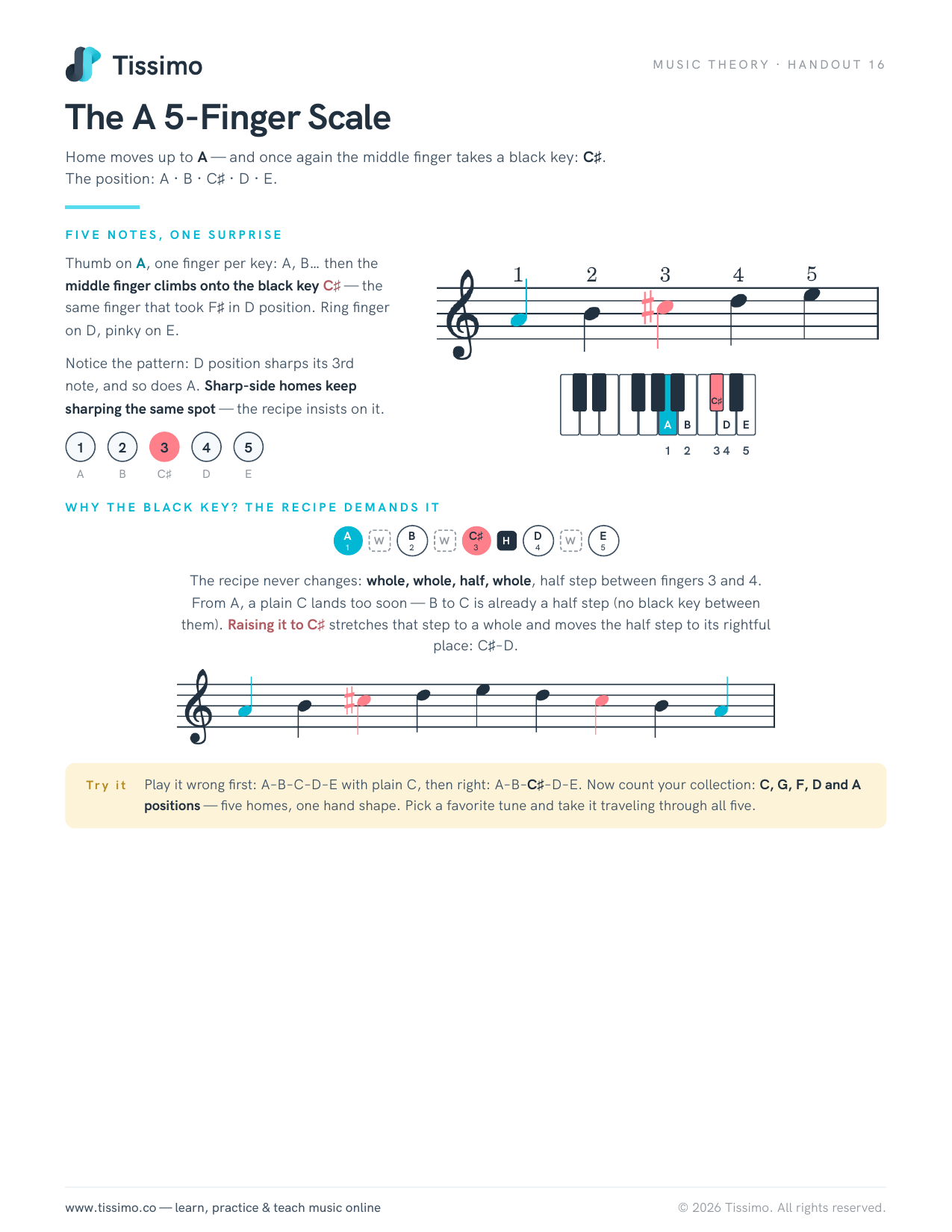
La escala de 5 dedos en La
El hogar sube hasta La — y una vez más el dedo medio toma una tecla negra: Do♯. La posición: La · Si · Do♯ · Re · Mi.
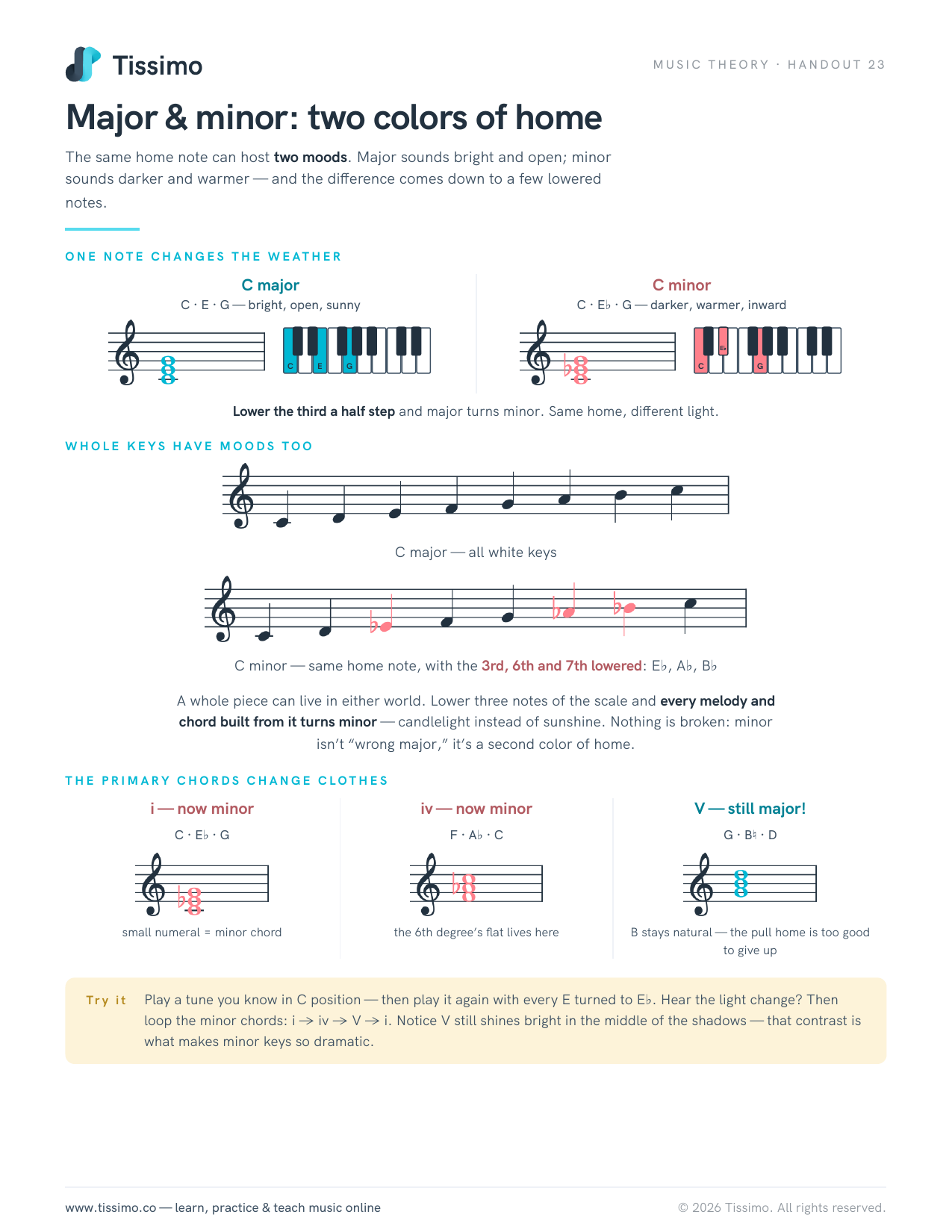
Mayor y menor: dos colores de un mismo hogar
La misma nota de hogar puede tener dos estados de ánimo. El mayor suena brillante y abierto; el menor suena más oscuro y cálido — y la diferencia se reduce a unas pocas notas bajadas.
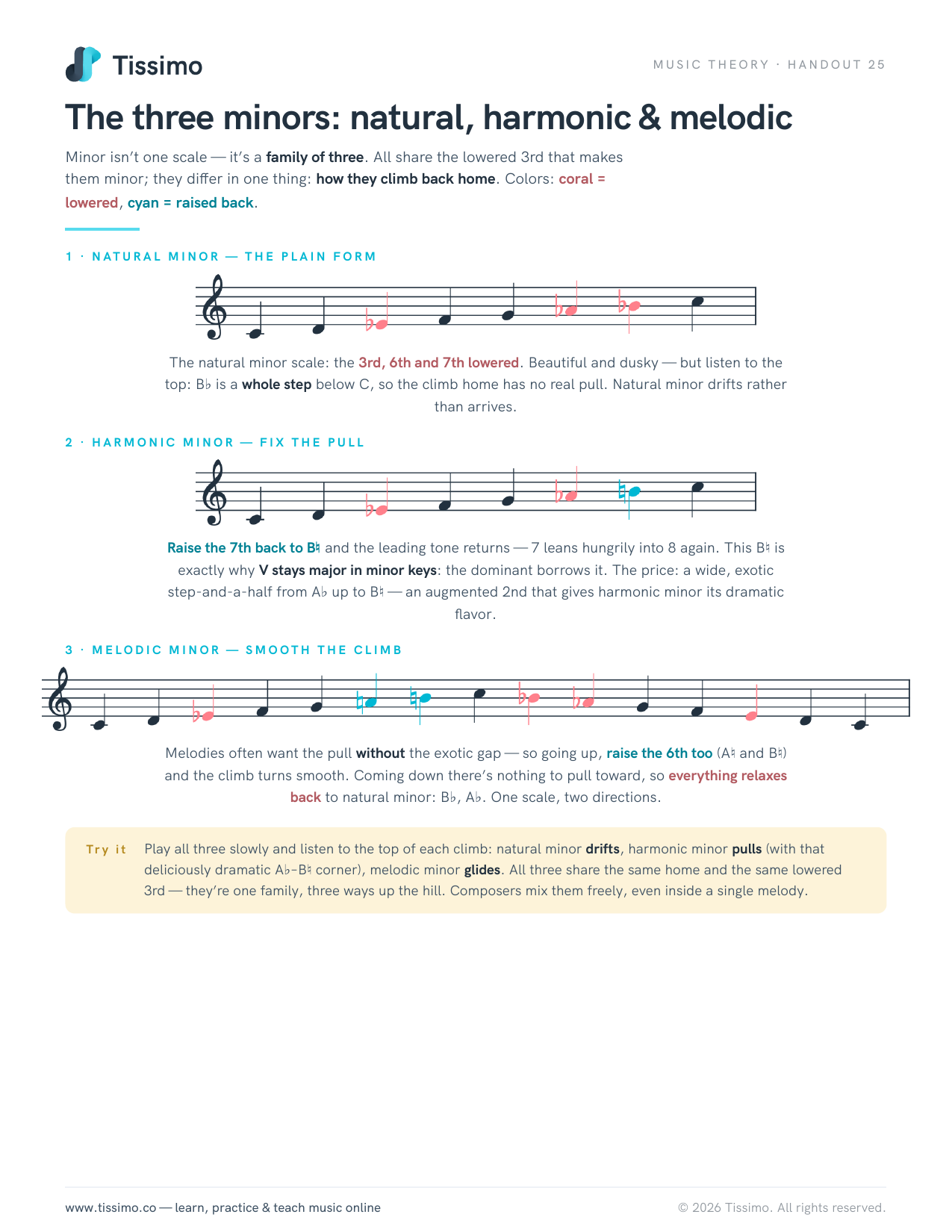
Los tres menores: natural, armónica y melódica
El menor no es una sola escala — es una familia de tres. Todas comparten la 3ª bajada que las hace menores; se diferencian en una cosa: cómo suben de regreso a casa. Colores: coral = bajada, cian = subida de nuevo.
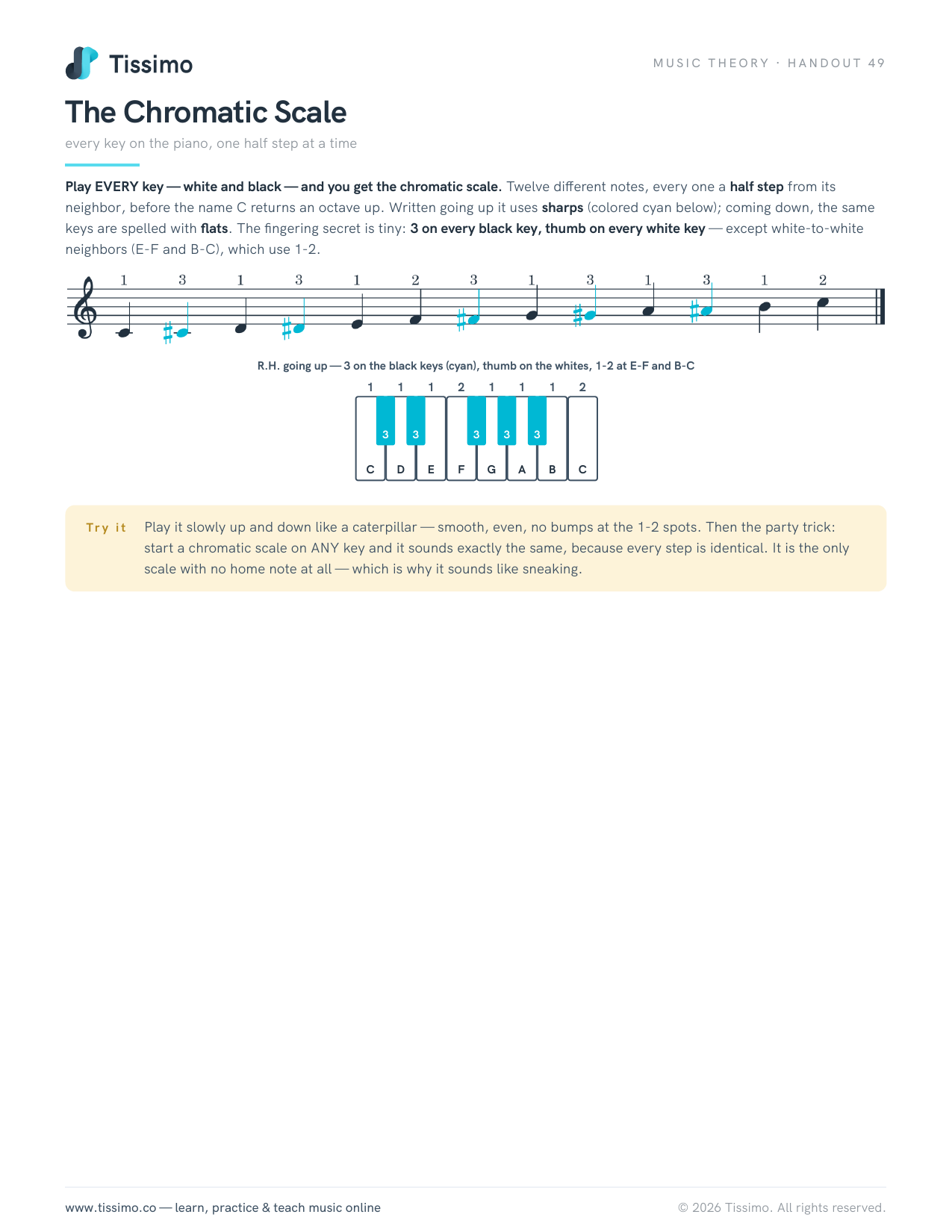
La escala cromática
todas las teclas del piano, un semitono a la vez
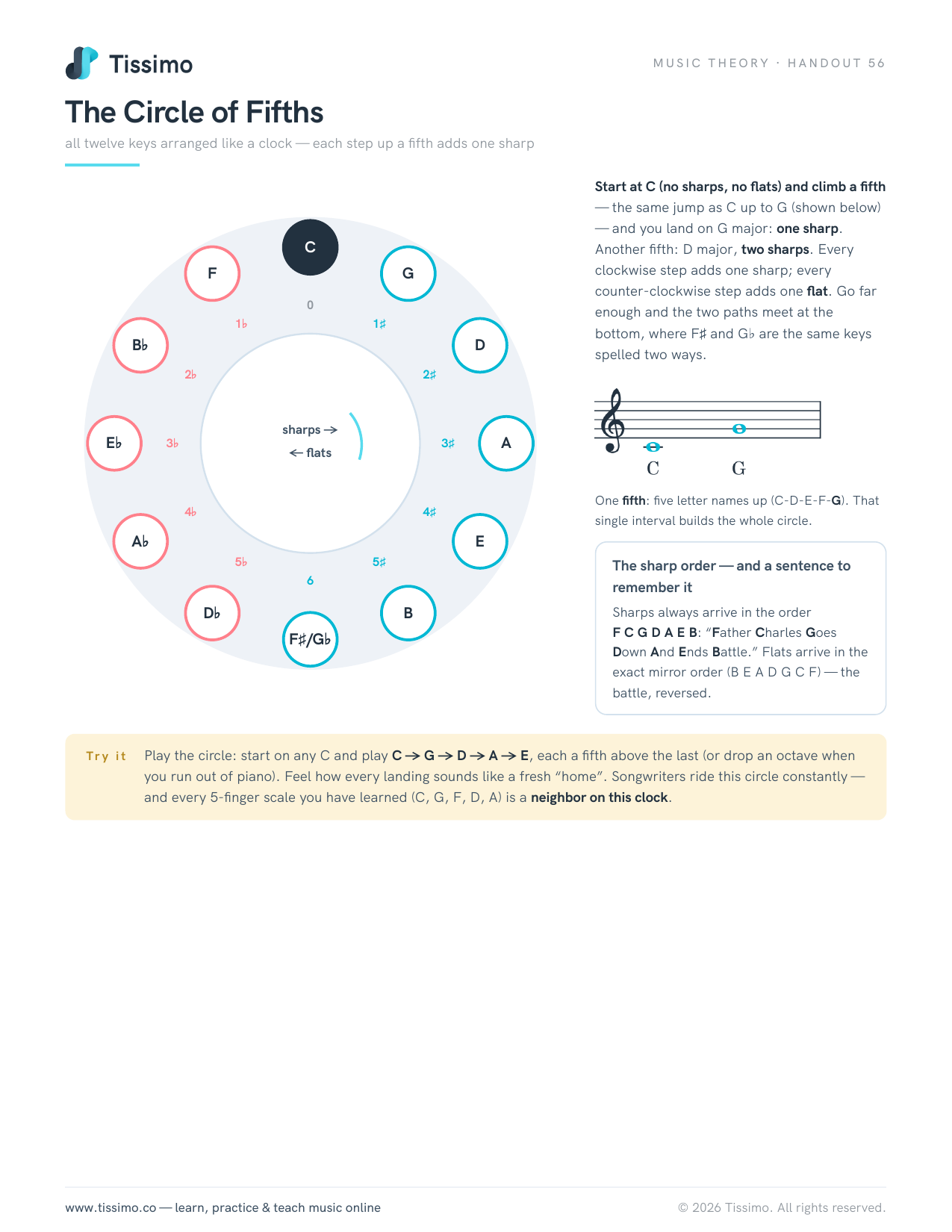
El círculo de quintas
las doce tonalidades organizadas como un reloj — cada paso de una quinta hacia arriba añade un sostenido
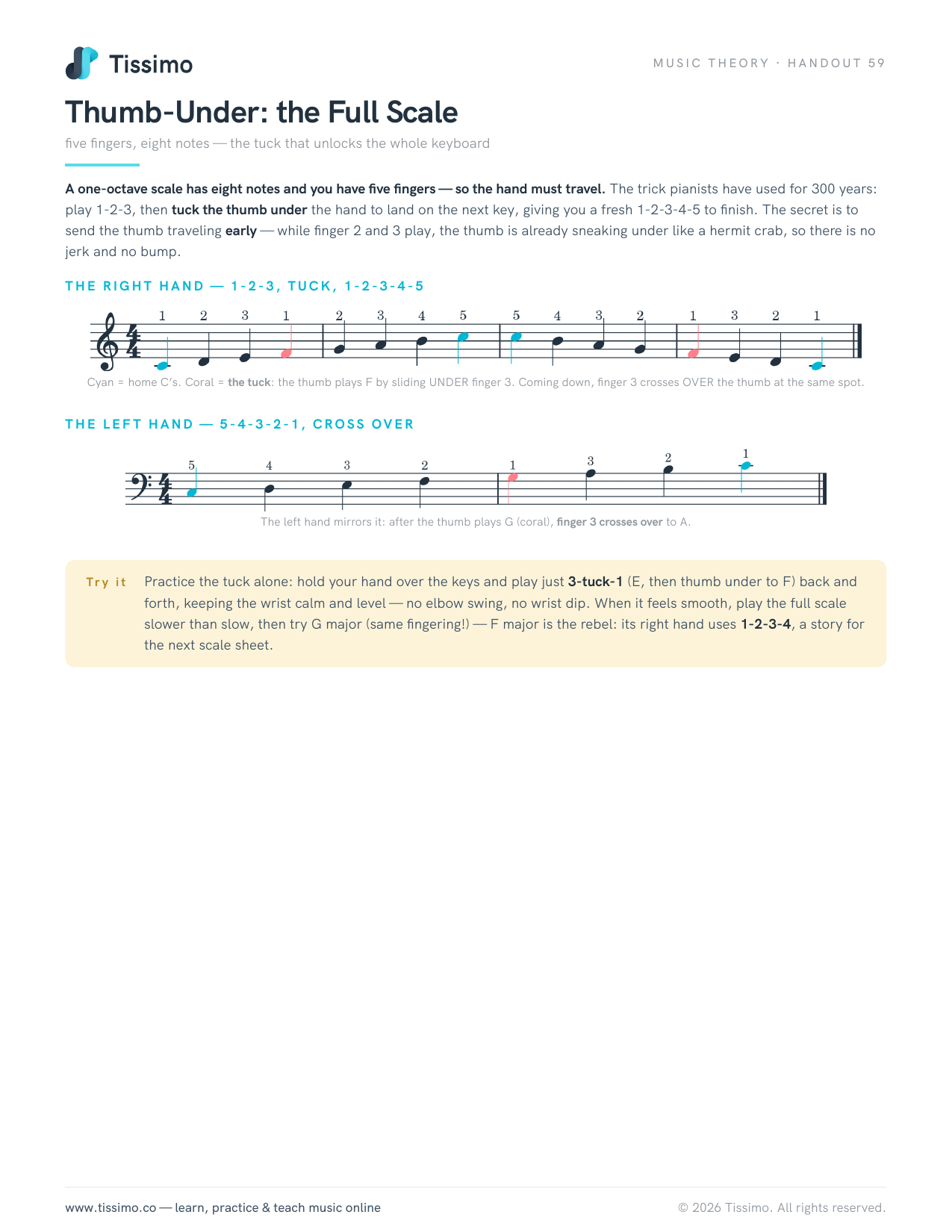
Paso del pulgar: la escala completa
cinco dedos, ocho notas — el paso del pulgar que abre todo el teclado
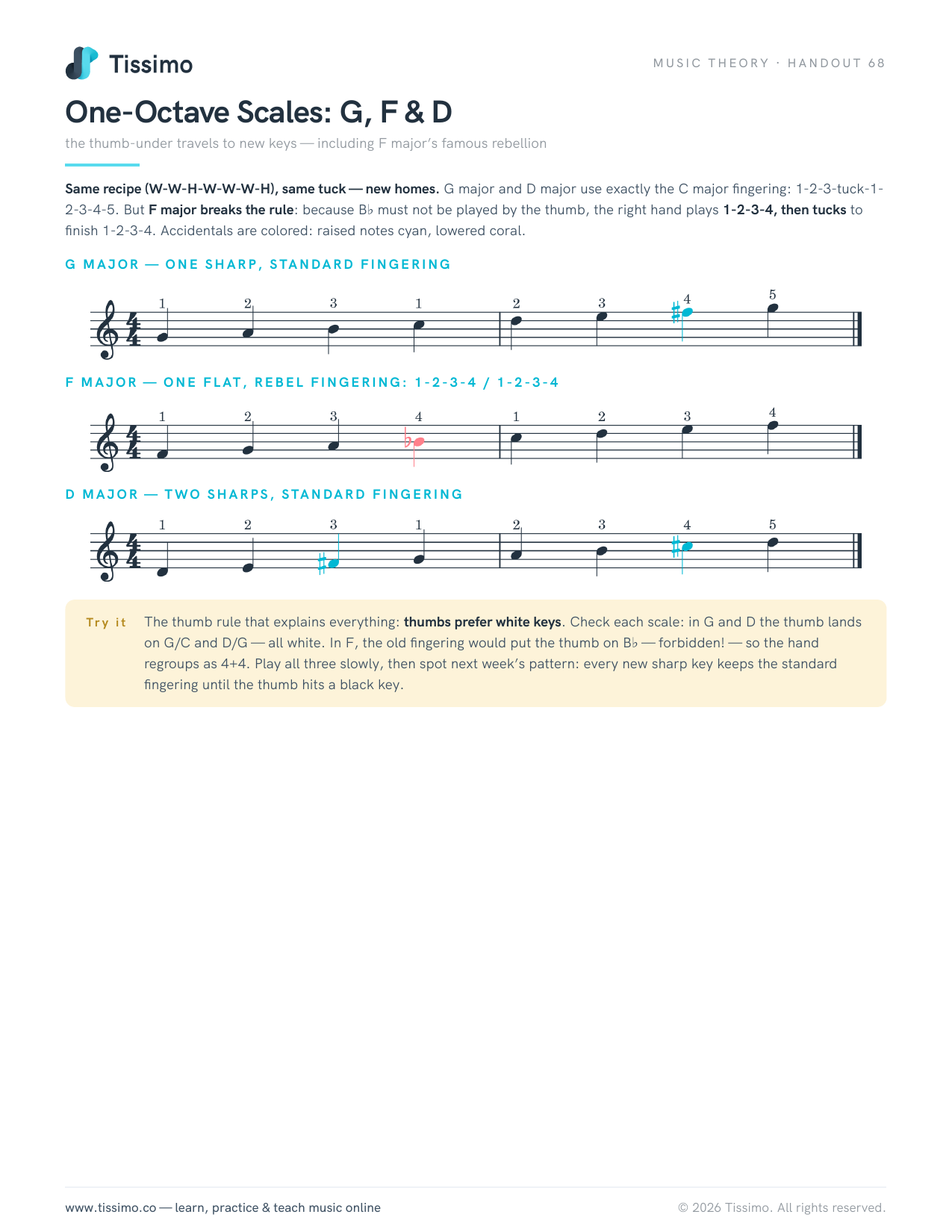
Escalas de una octava: Sol, Fa y Re
el paso del pulgar viaja a nuevas tonalidades — incluyendo la famosa rebeldía de Fa mayor
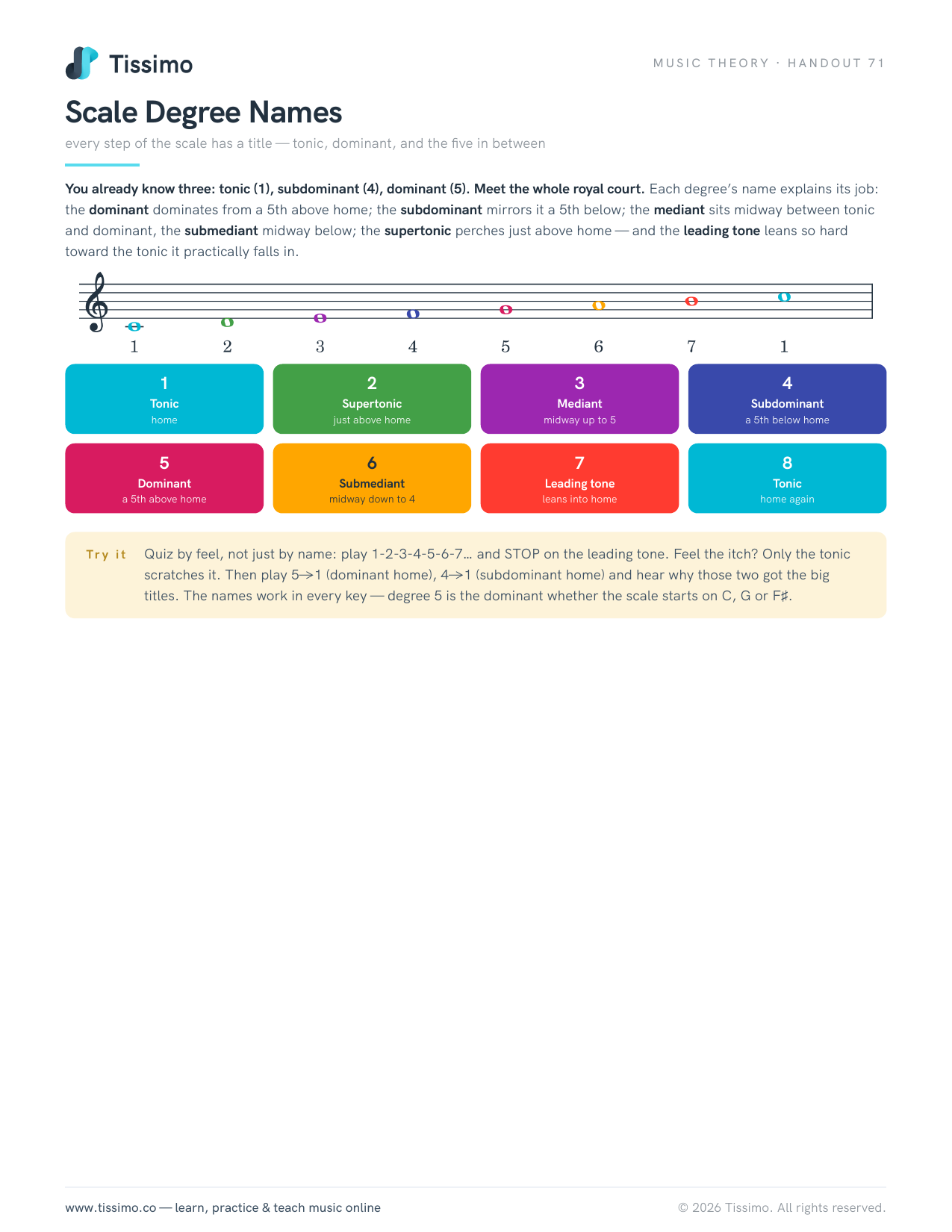
Nombres de los grados de la escala
cada grado de la escala tiene un título — tónica, dominante, y los cinco intermedios
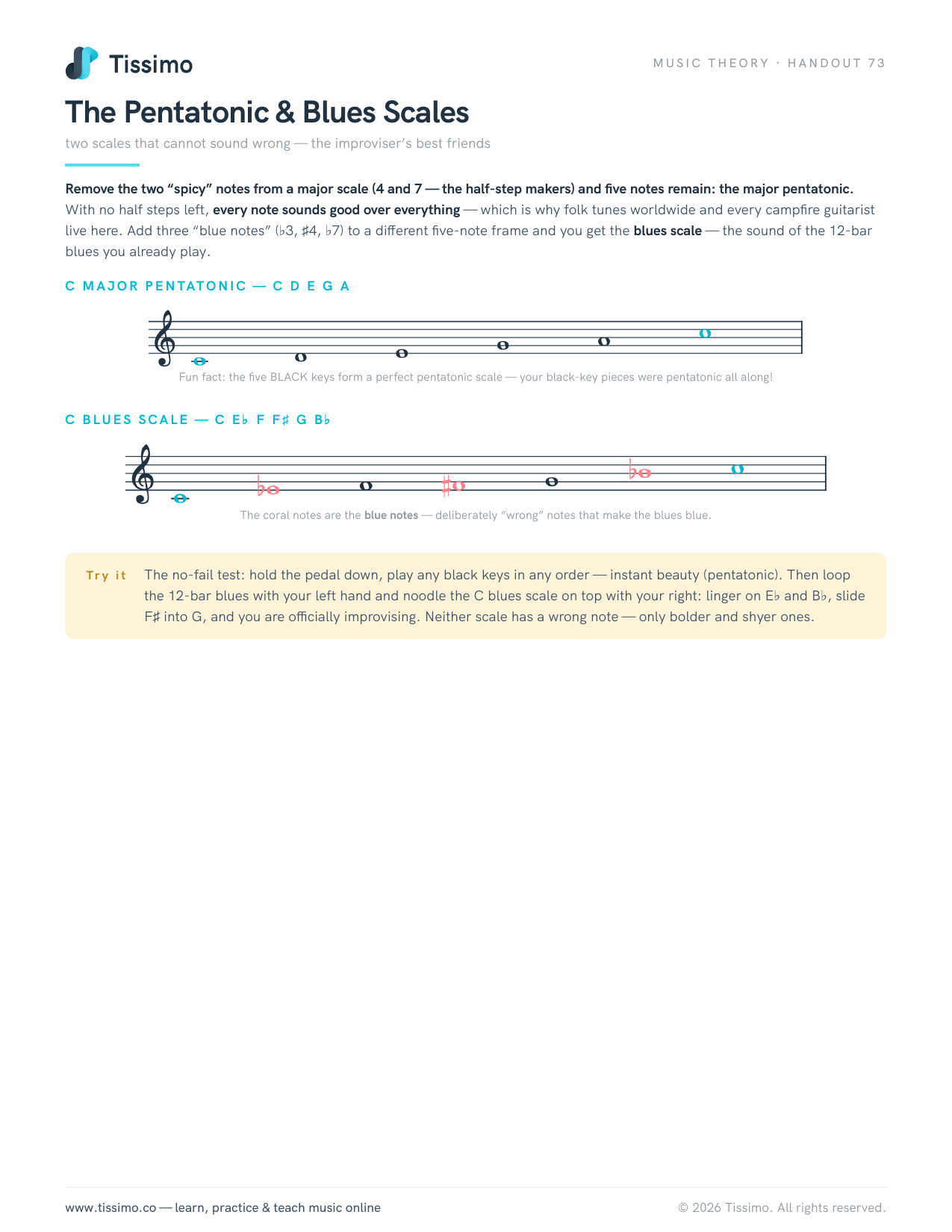
Las escalas pentatónica y de blues
dos escalas que nunca suenan mal — las mejores amigas del improvisador
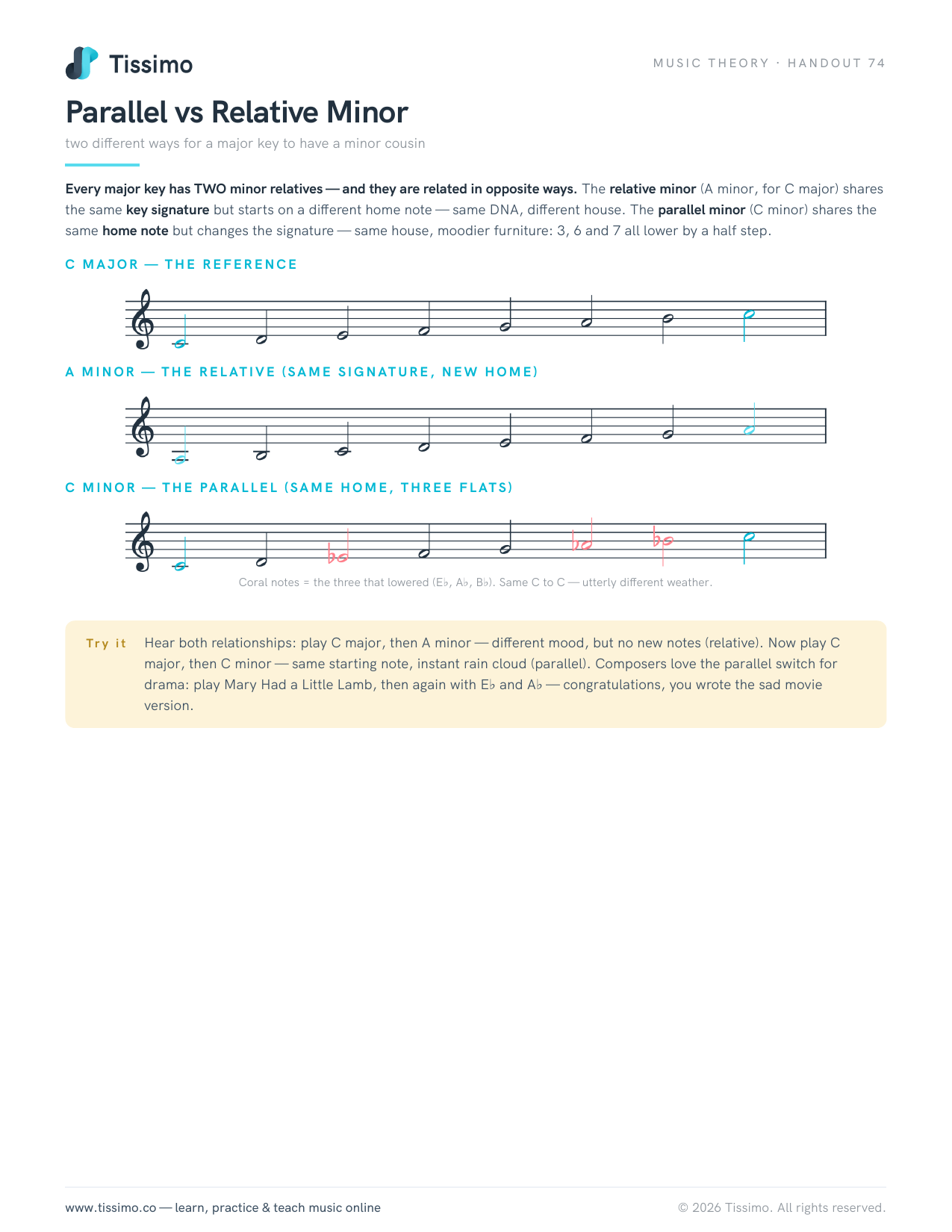
Menor paralela vs. menor relativa
dos formas distintas en que una tonalidad mayor puede tener un primo menor
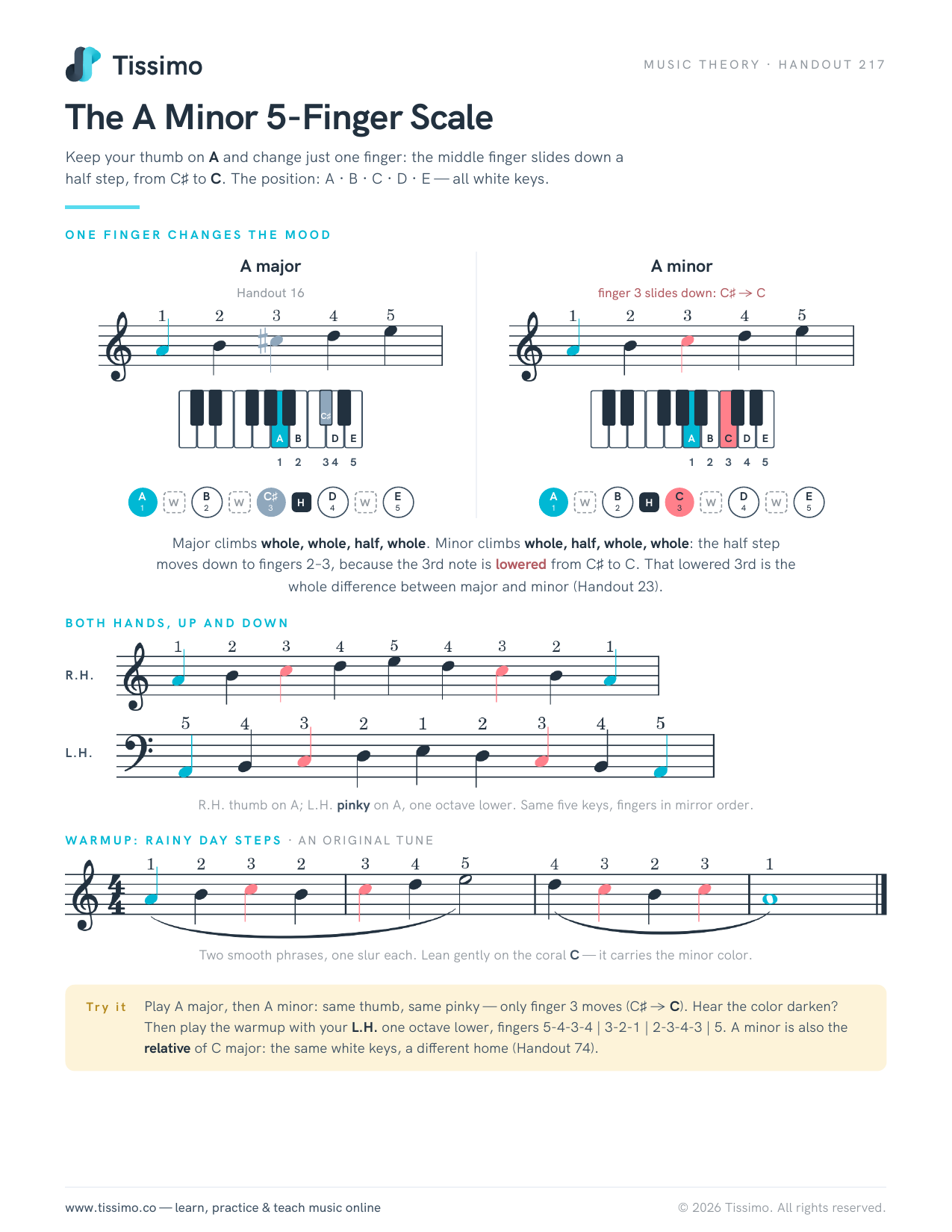
The A Minor 5-Finger Scale
Keep your thumb on A and change just one finger: the middle finger slides down a half step, from C♯ to C. The position: A · B · C · D · E — all white keys.
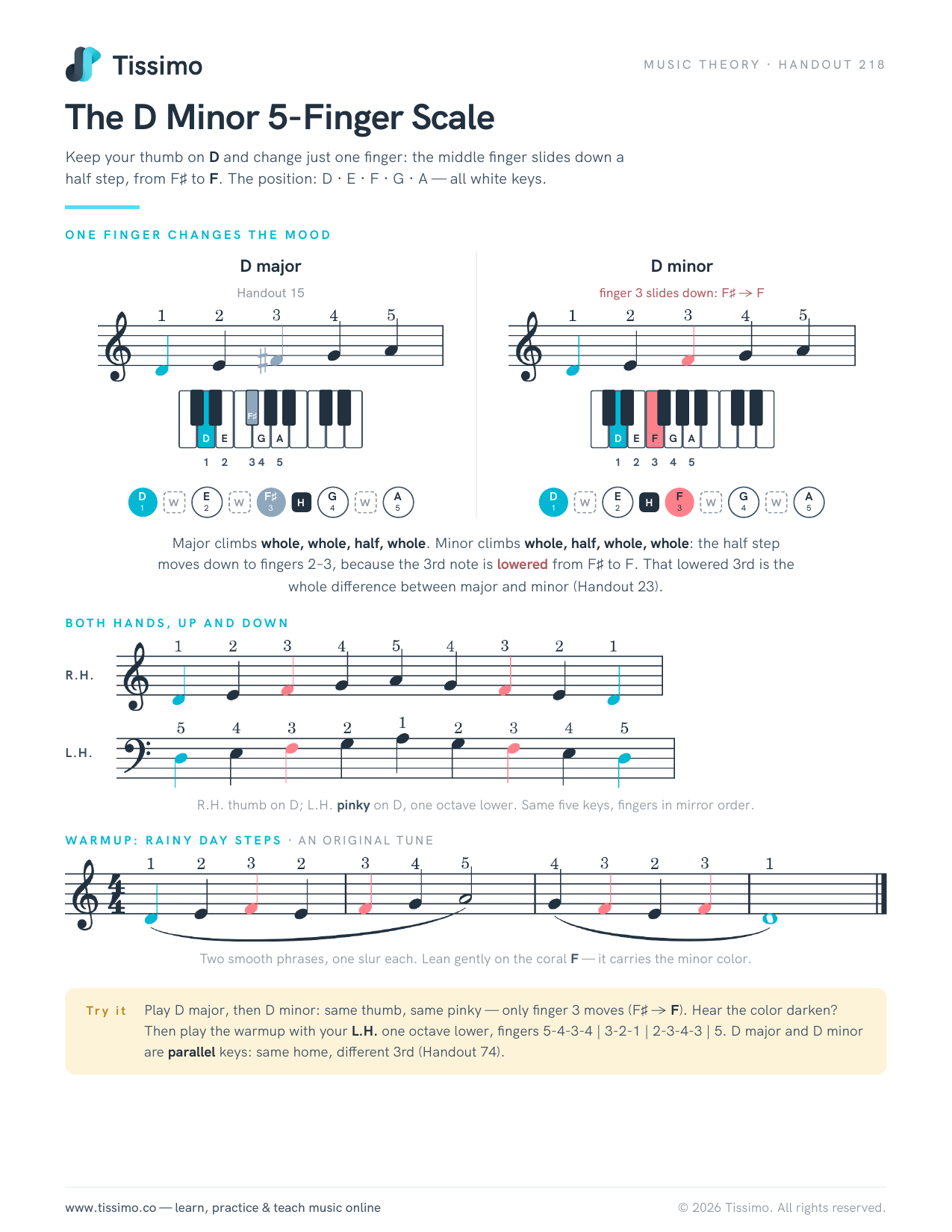
The D Minor 5-Finger Scale
Keep your thumb on D and change just one finger: the middle finger slides down a half step, from F♯ to F. The position: D · E · F · G · A — all white keys.
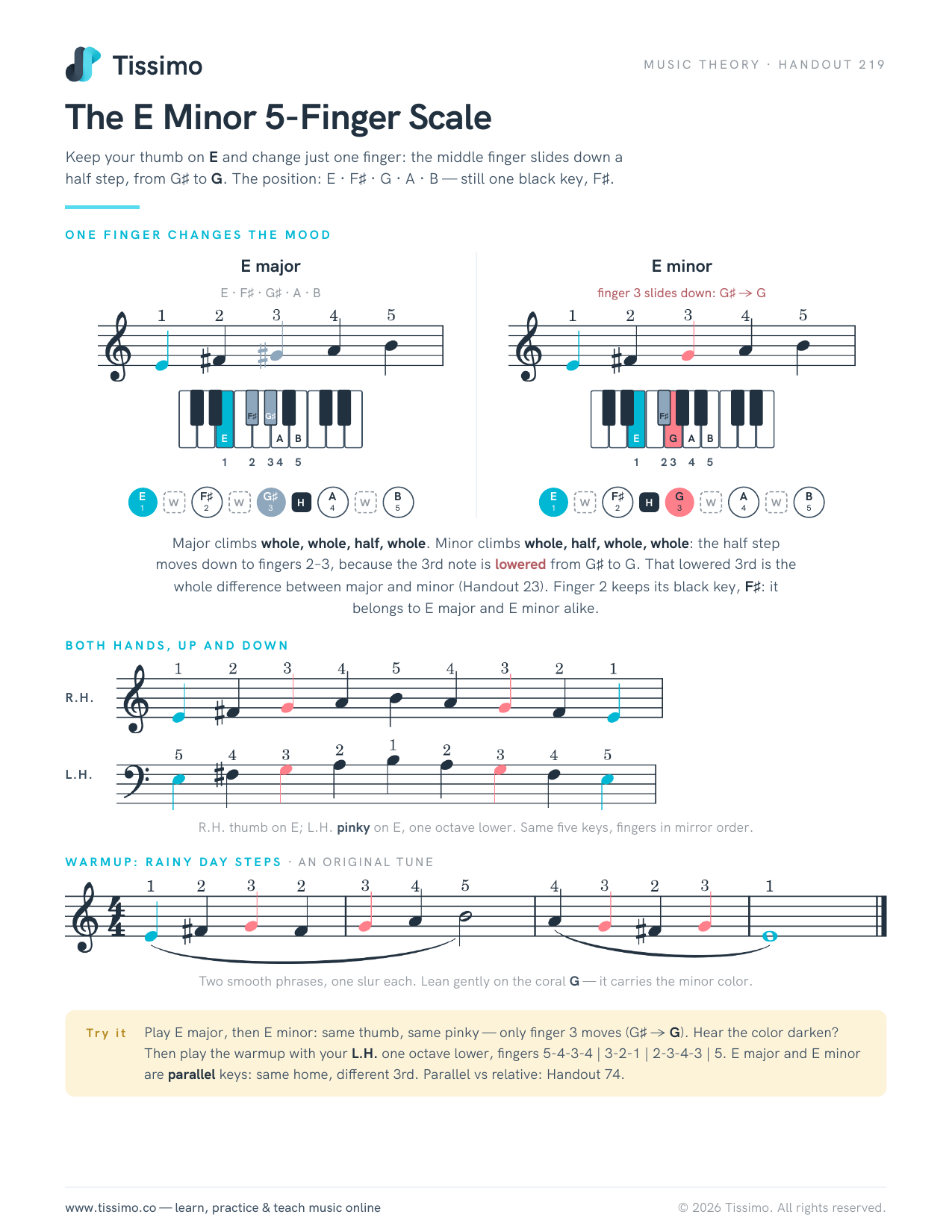
The E Minor 5-Finger Scale
Keep your thumb on E and change just one finger: the middle finger slides down a half step, from G♯ to G. The position: E · F♯ · G · A · B — still one black key, F♯.
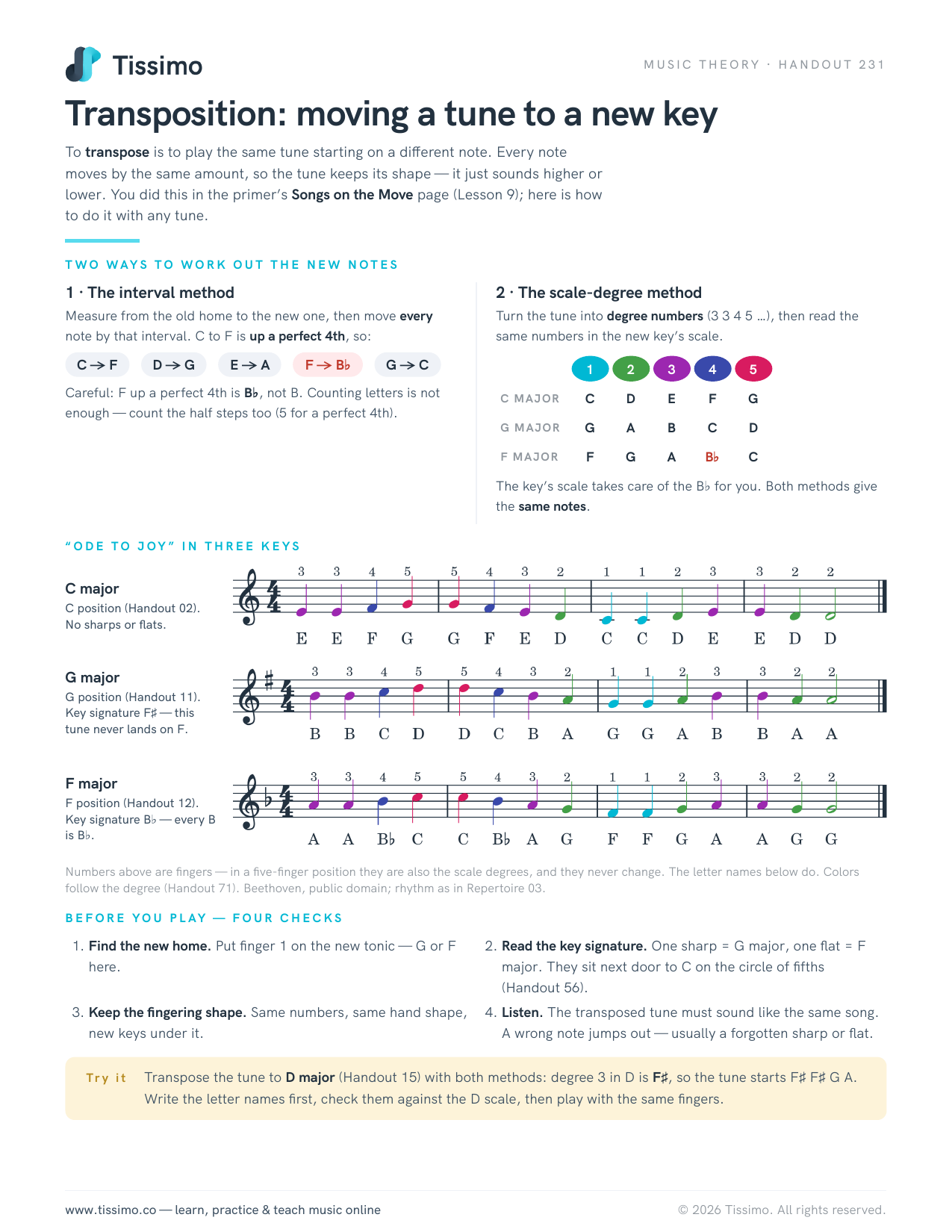
Transposition: moving a tune to a new key
To transpose is to play the same tune starting on a different note. Every note moves by the same amount, so the tune keeps its shape — it just sounds higher or lower. You did this in the primer’s Songs on the Move page (Lesson 9); here is how to do it with any tune.
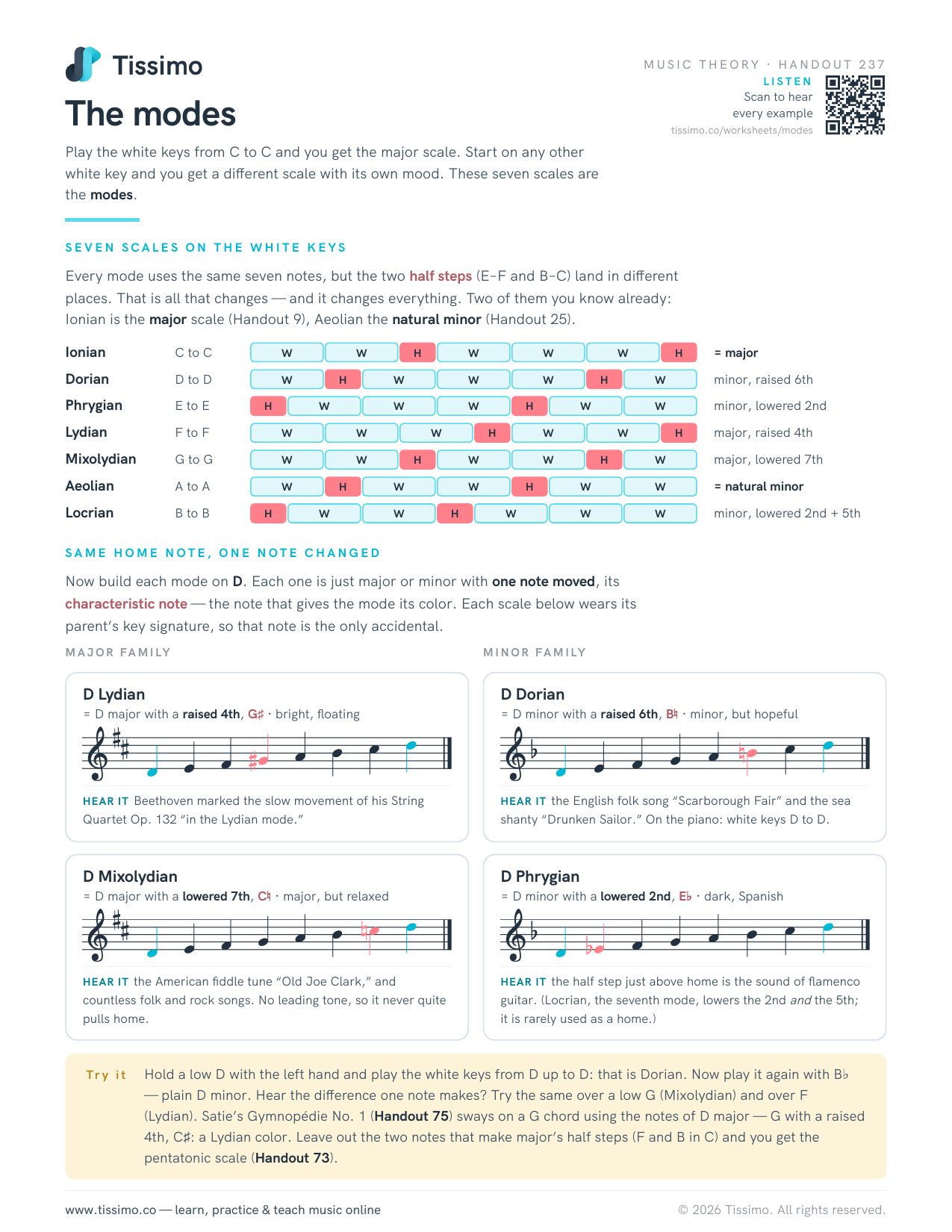
The modes
Play the white keys from C to C and you get the major scale. Start on any other white key and you get a different scale with its own mood. These seven scales are the modes.
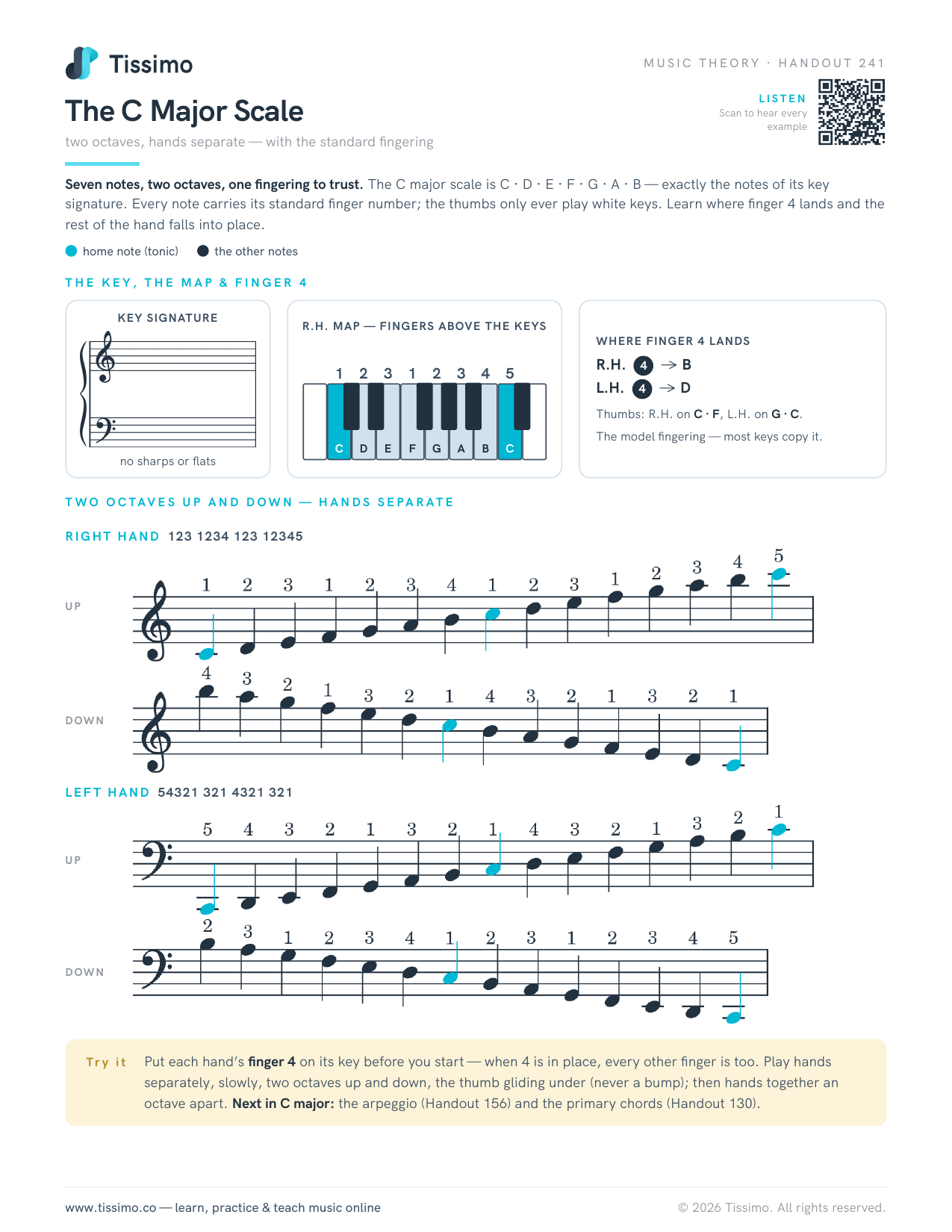
Scales in Every Key
Two octaves up and down with the standard fingering on every note, in all 24 keys.
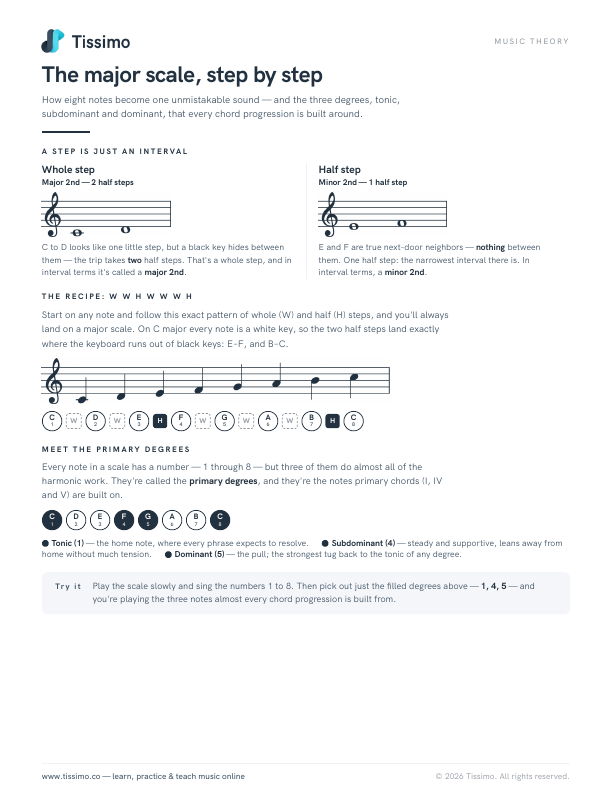
Introducción a la escala mayor
Acordes y armonía
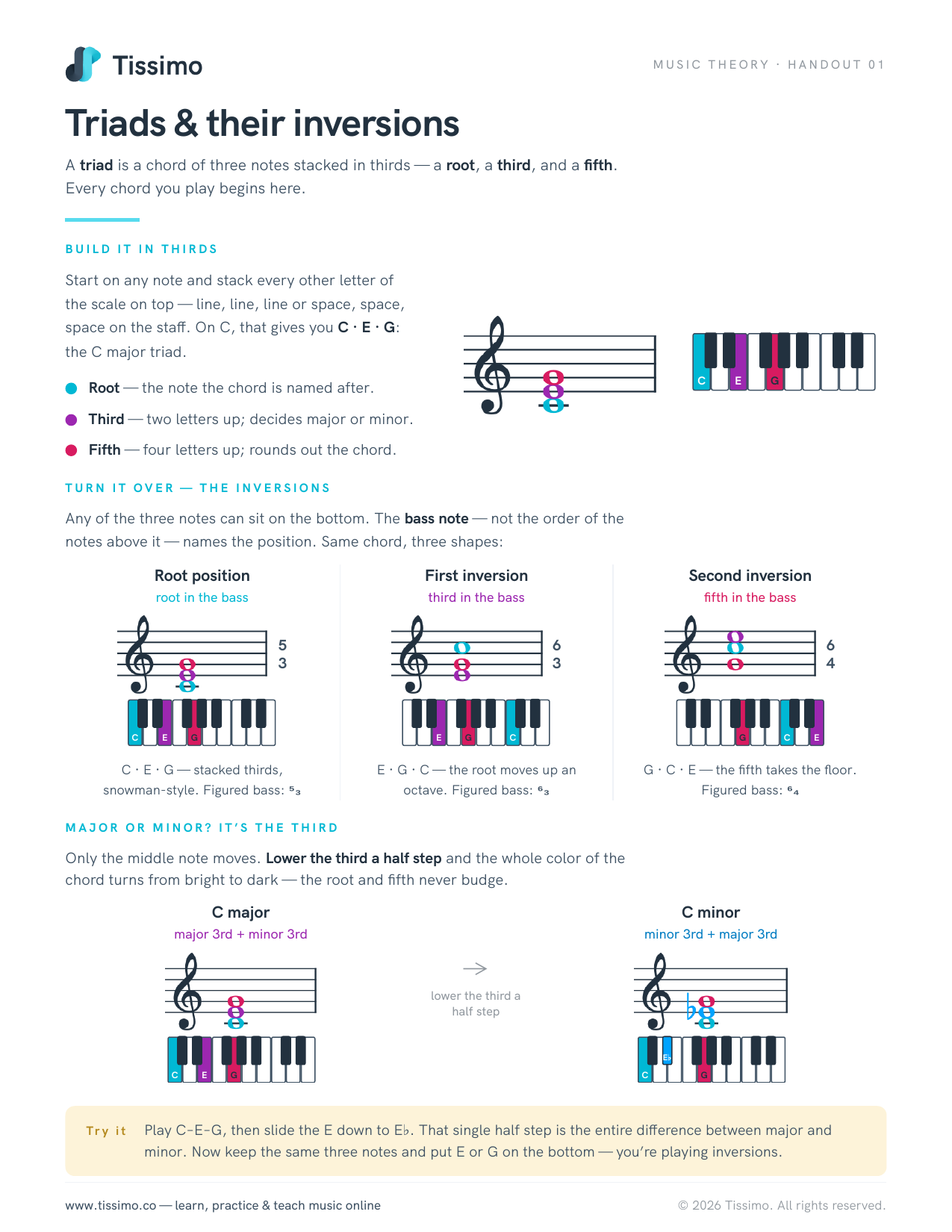
Las tríadas y sus inversiones
Una tríada es un acorde de tres notas apiladas en terceras — una fundamental, una tercera y una quinta. Todo acorde que toques empieza aquí.
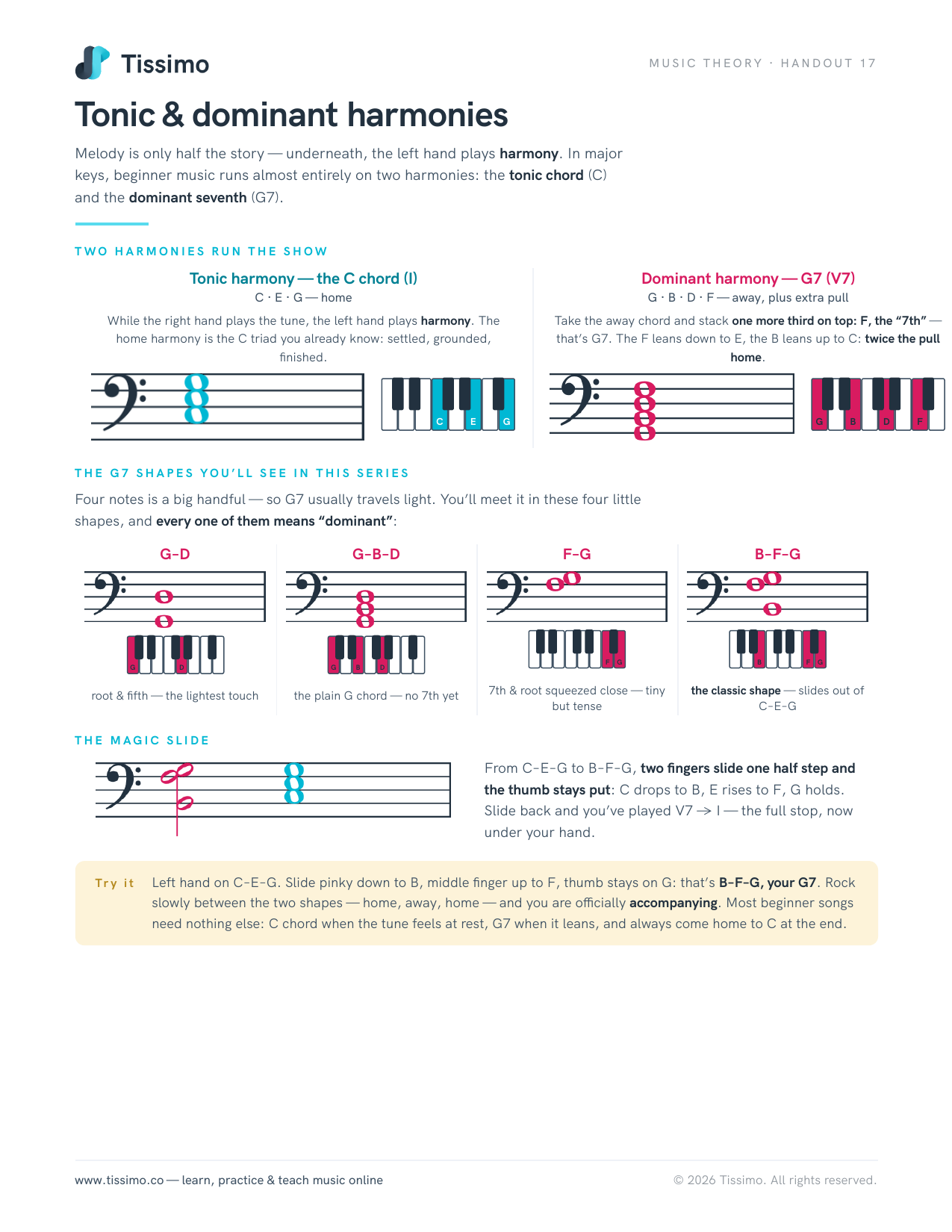
Armonías de tónica y dominante
La melodía es solo la mitad de la historia — debajo, la mano izquierda toca la armonía. En las tonalidades mayores, la música para principiantes funciona casi por completo con dos armonías: el acorde de tónica (C) y el de dominante séptima (G7).
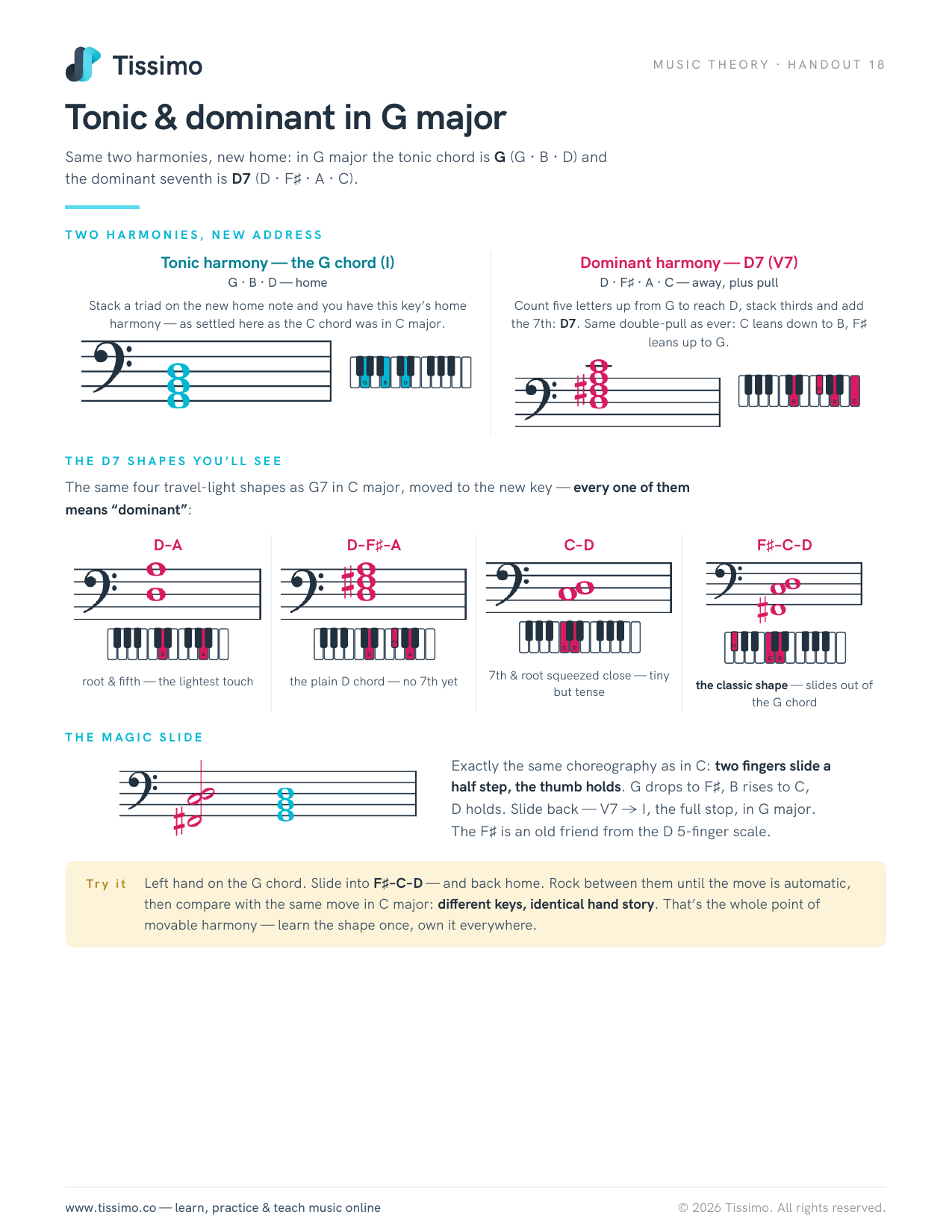
Tónica y dominante en Sol mayor
Las mismas dos armonías, nuevo hogar: en Sol mayor, el acorde de tónica es Sol (Sol · Si · Re) y la dominante séptima es Re7 (Re · Fa♯ · La · Do).
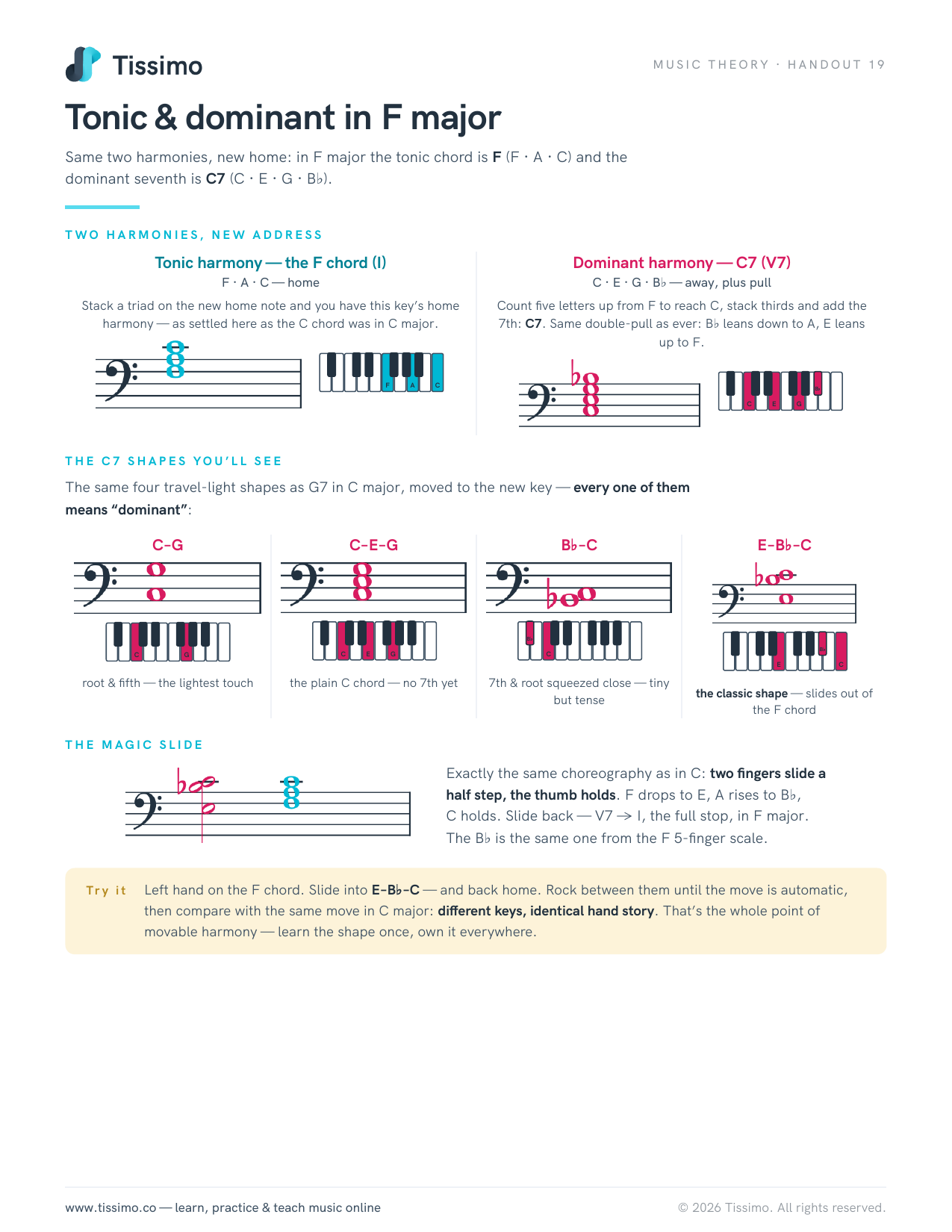
Tónica y dominante en Fa mayor
Las mismas dos armonías, nuevo hogar: en Fa mayor, el acorde de tónica es Fa (Fa · La · Do) y la dominante séptima es Do7 (Do · Mi · Sol · Si♭).
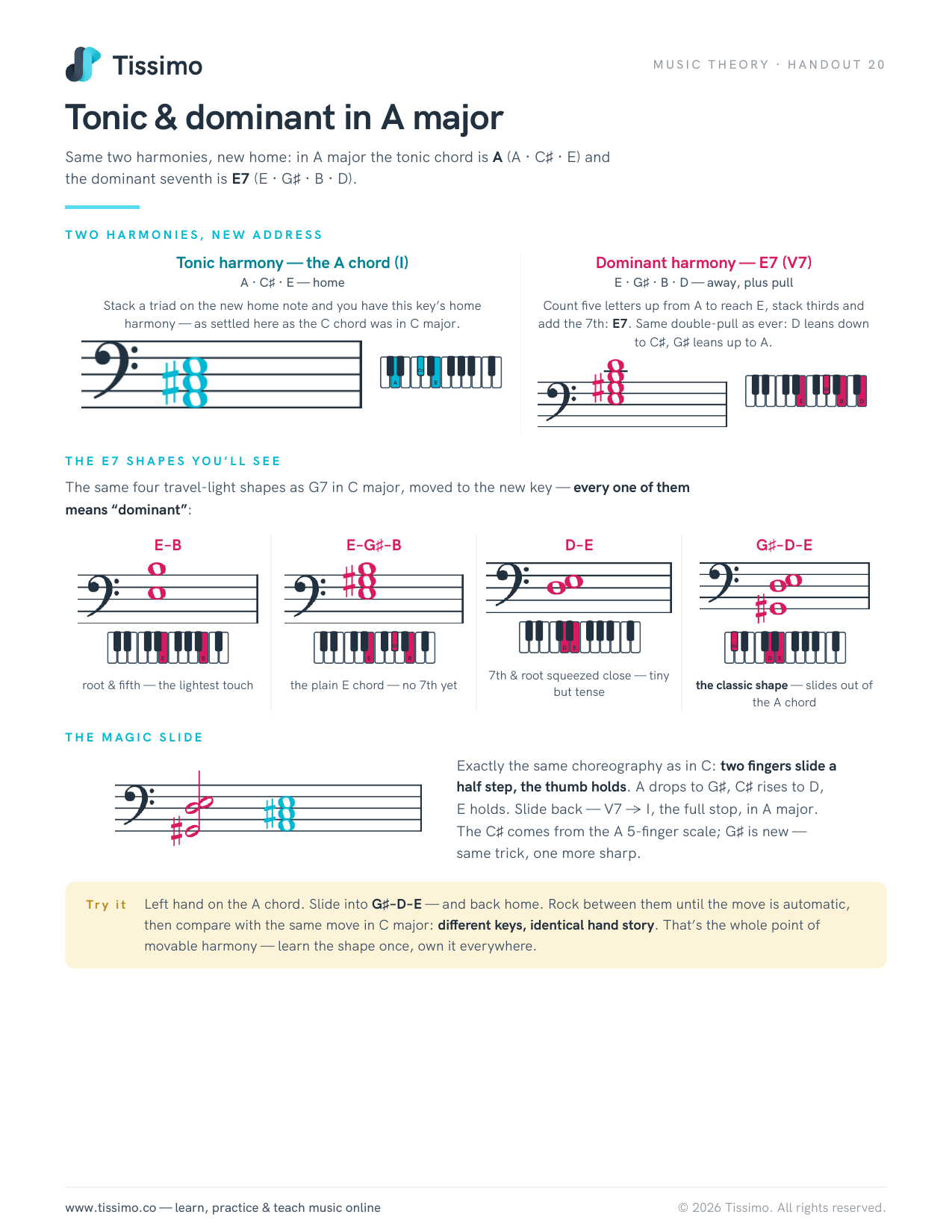
Tónica y dominante en La mayor
Las mismas dos armonías, nuevo hogar: en La mayor, el acorde de tónica es La (La · Do♯ · Mi) y la dominante séptima es Mi7 (Mi · Sol♯ · Si · Re).
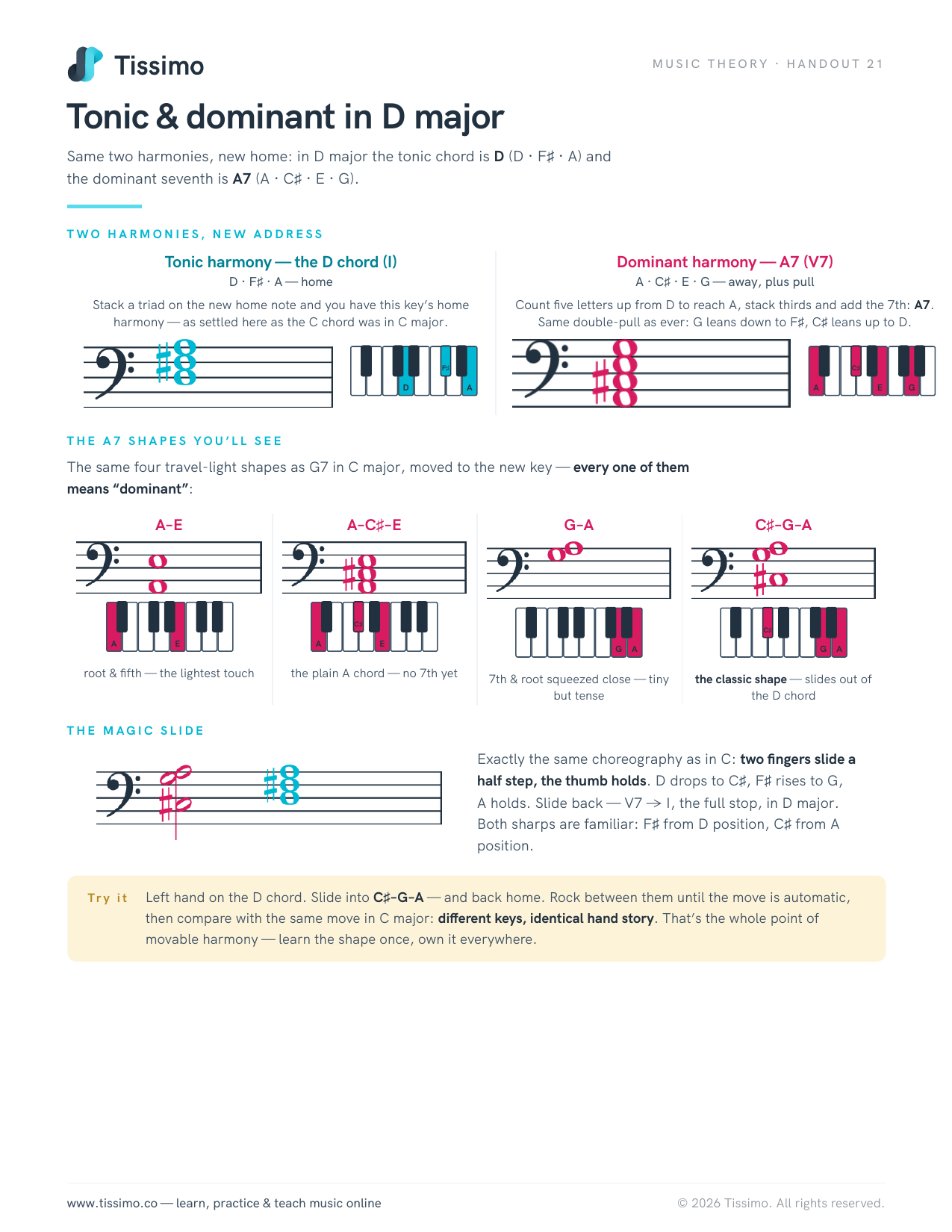
Tónica y dominante en Re mayor
Las mismas dos armonías, nuevo hogar: en Re mayor, el acorde de tónica es Re (Re · Fa♯ · La) y la dominante séptima es La7 (La · Do♯ · Mi · Sol).
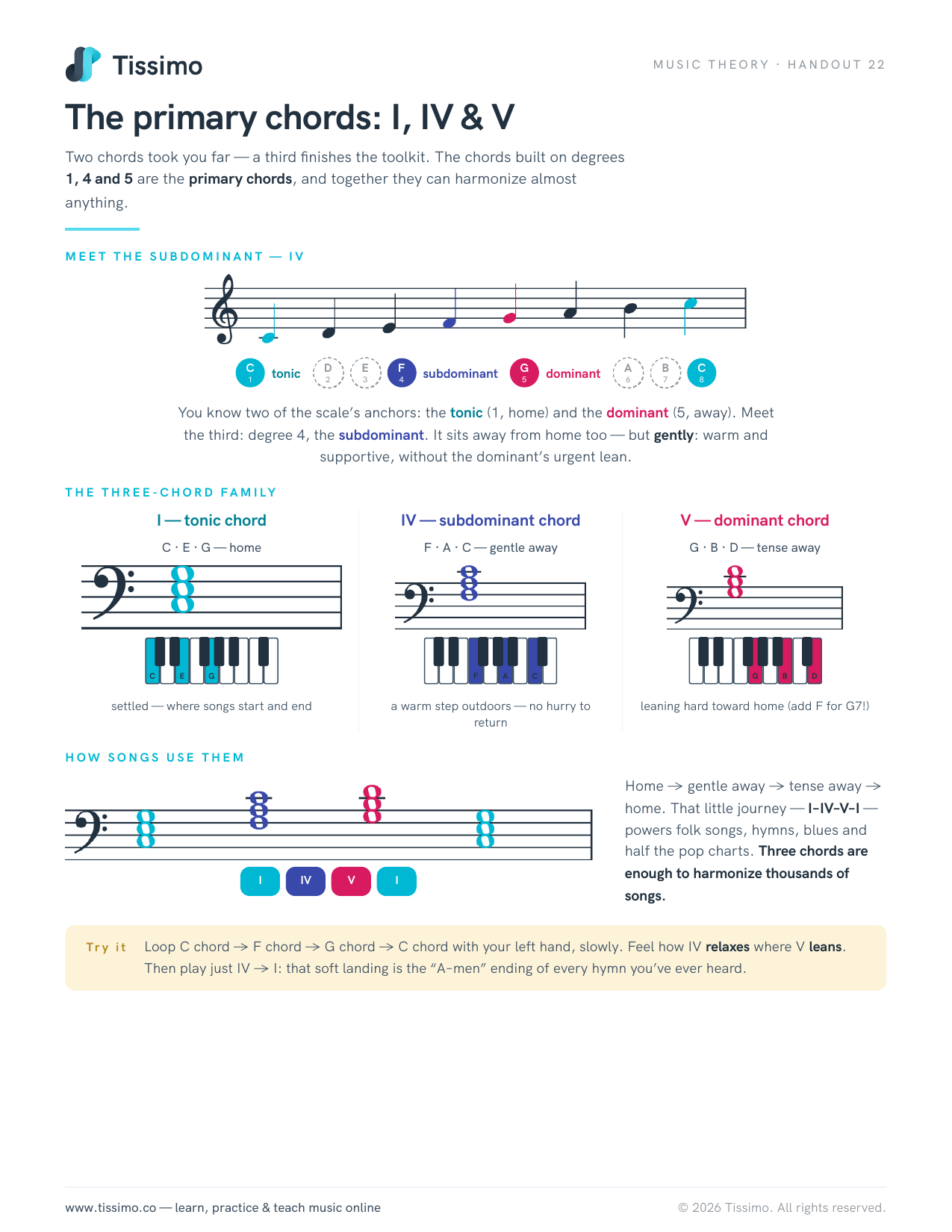
Los acordes primarios: I, IV y V
Dos acordes te llevaron lejos — un tercero completa el kit de herramientas. Los acordes construidos sobre los grados 1, 4 y 5 son los acordes primarios, y juntos pueden armonizar casi cualquier cosa.
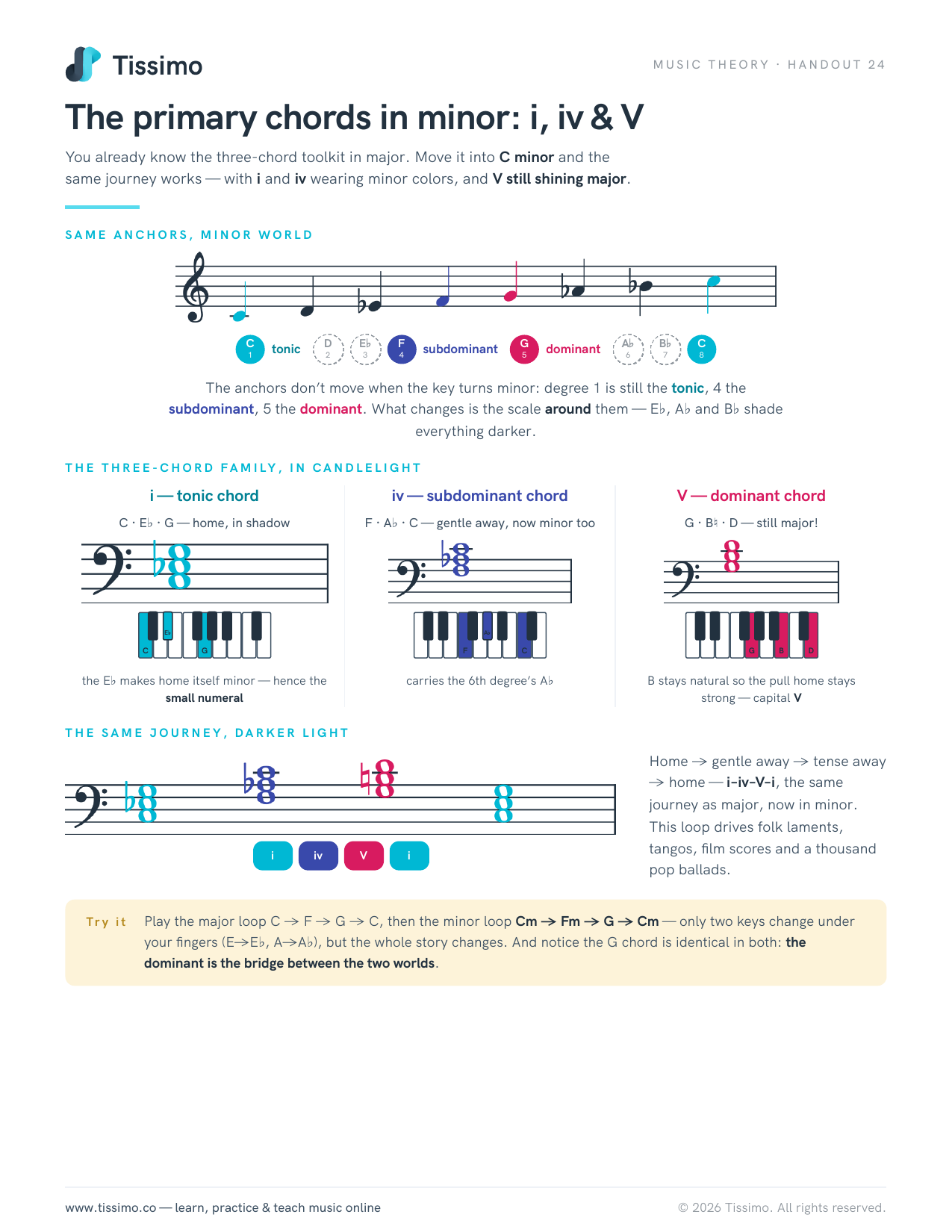
Los acordes primarios en menor: i, iv y V
Ya conoces el kit de tres acordes en mayor. Llévalo a Do menor y el mismo recorrido funciona — con i y iv vistiendo colores menores, y V brillando aún en mayor.
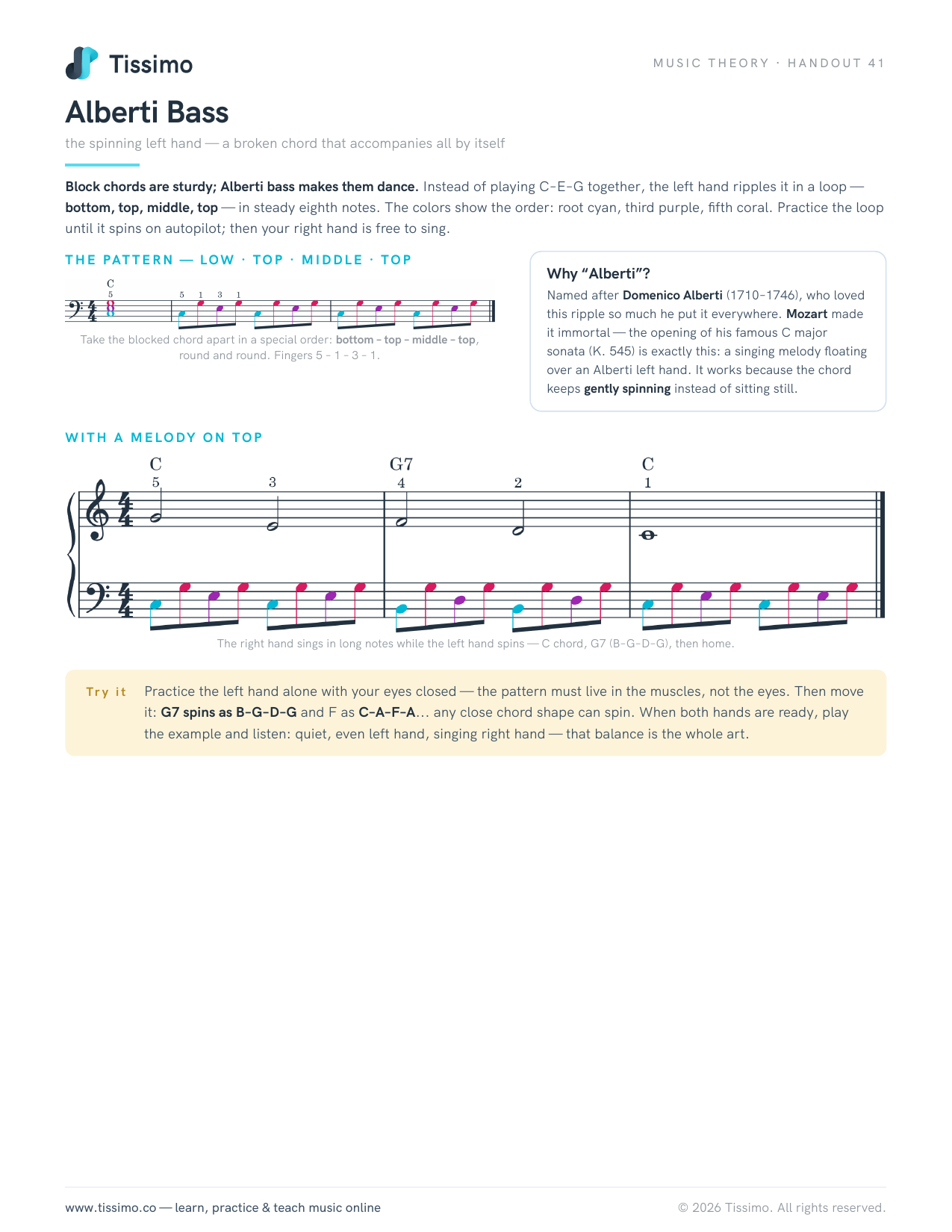
El bajo Alberti
la mano izquierda giratoria — un acorde quebrado que acompaña por sí solo
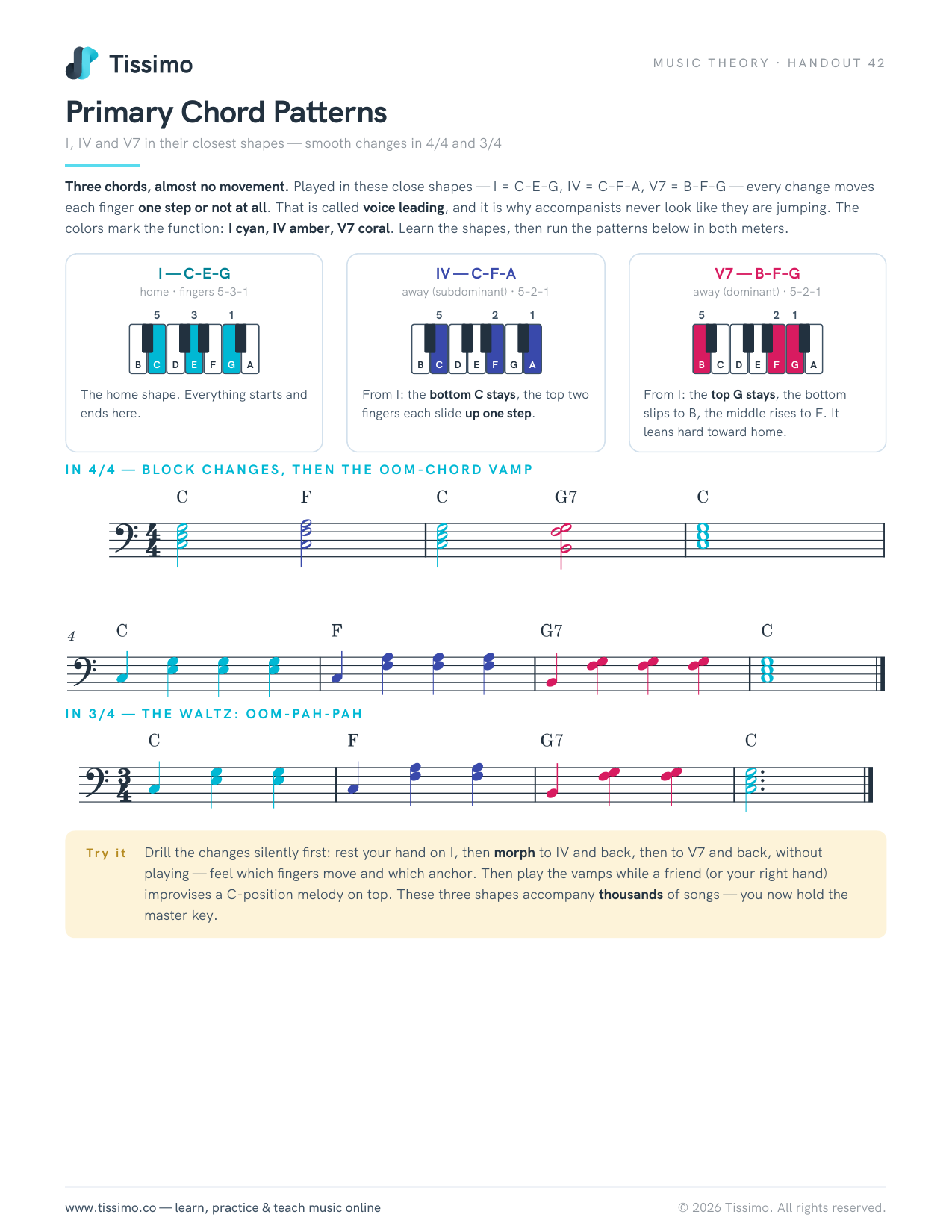
Patrones de acordes primarios
I, IV y V7 en sus posiciones más cercanas — cambios suaves en 4/4 y 3/4
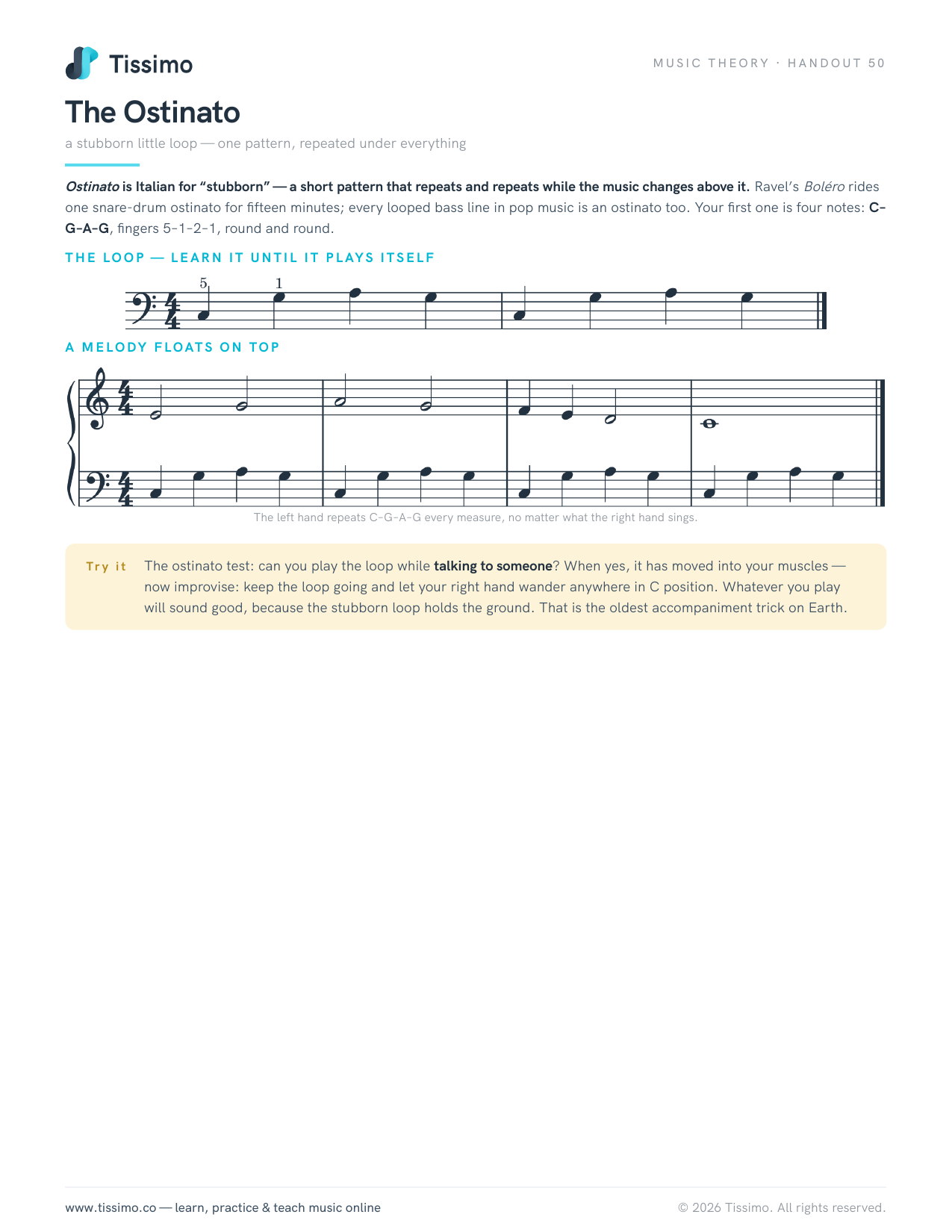
El ostinato
un pequeño bucle obstinado — un patrón, repetido bajo todo lo demás
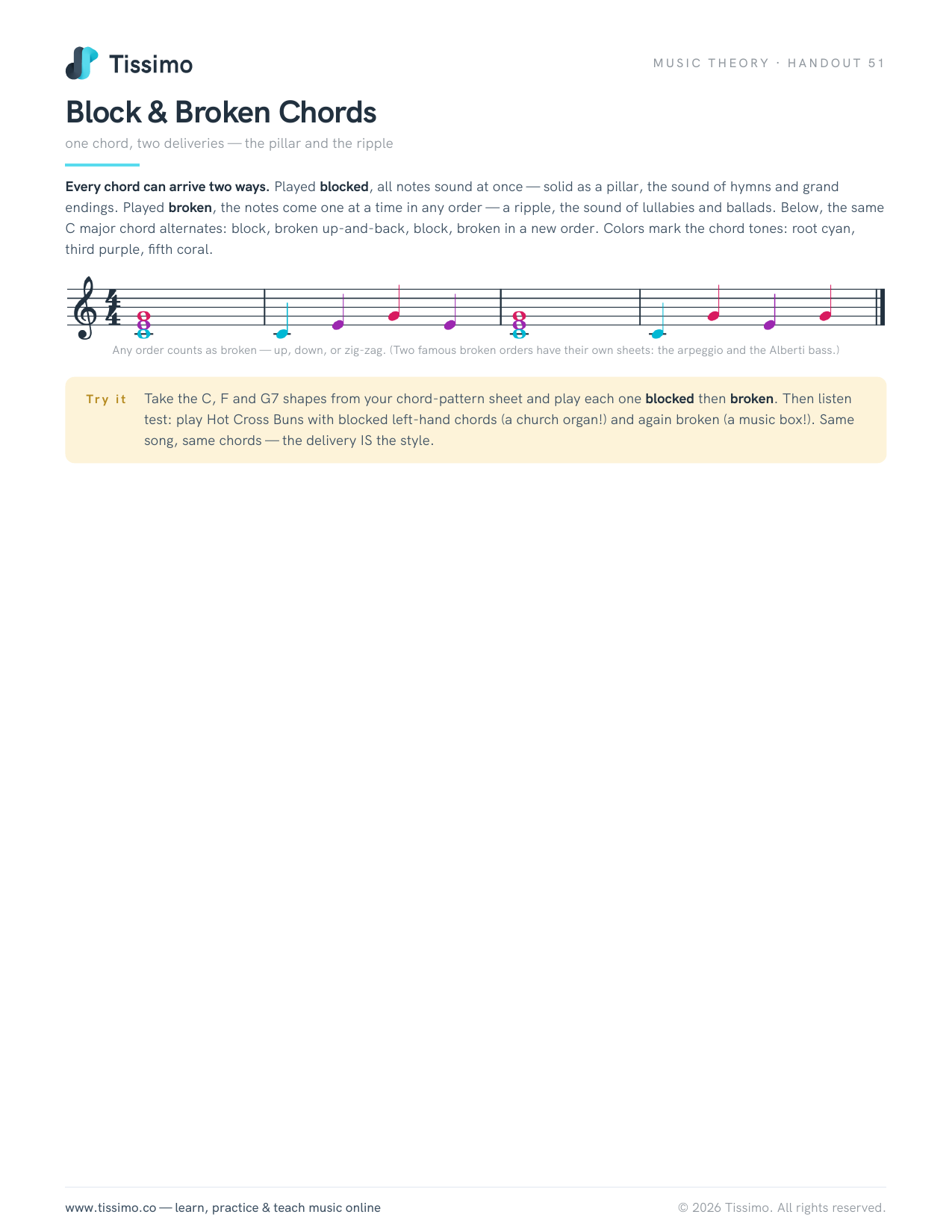
Acordes en bloque y quebrados
un acorde, dos formas de tocarlo — el pilar y la ondulación
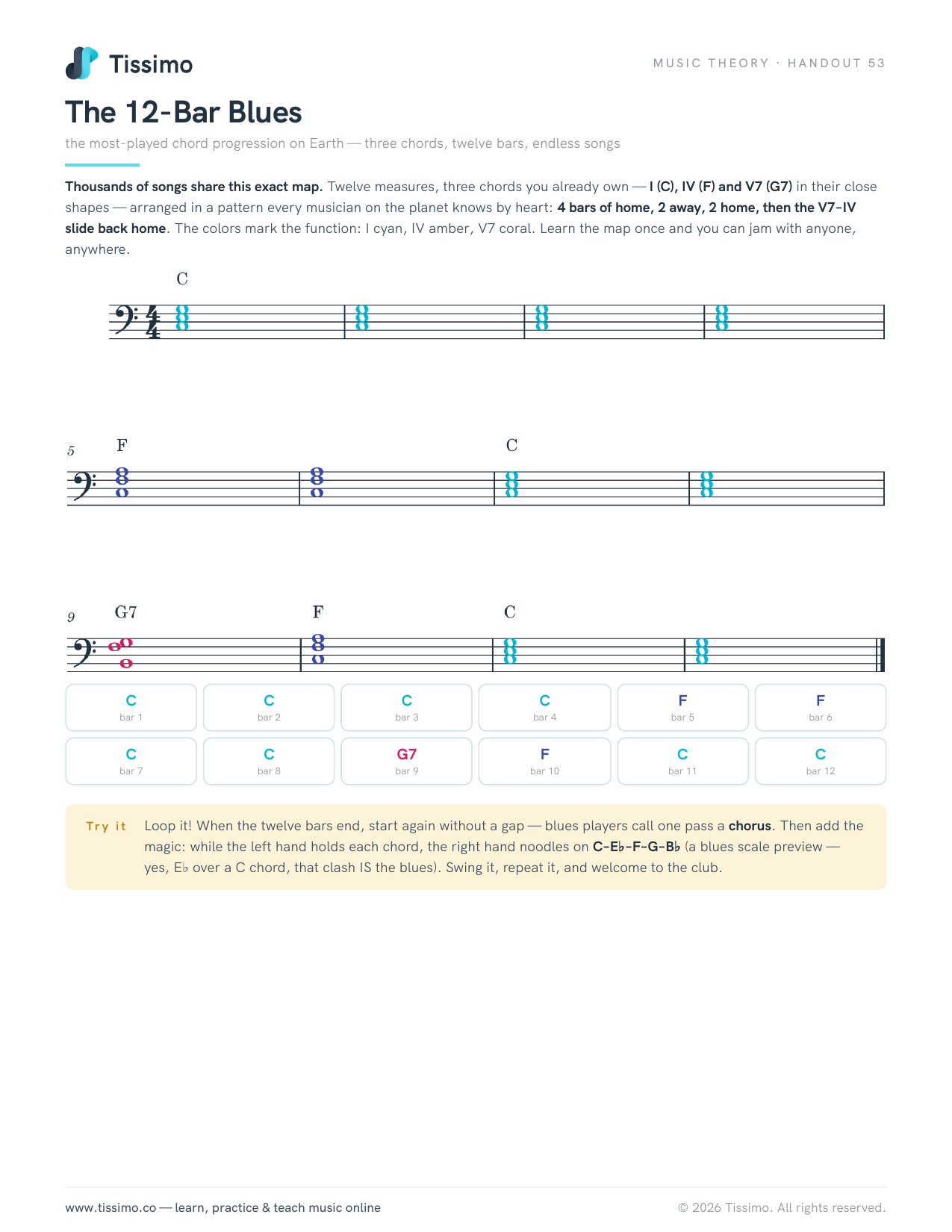
El blues de 12 compases
la progresión de acordes más tocada del mundo — tres acordes, doce compases, canciones infinitas
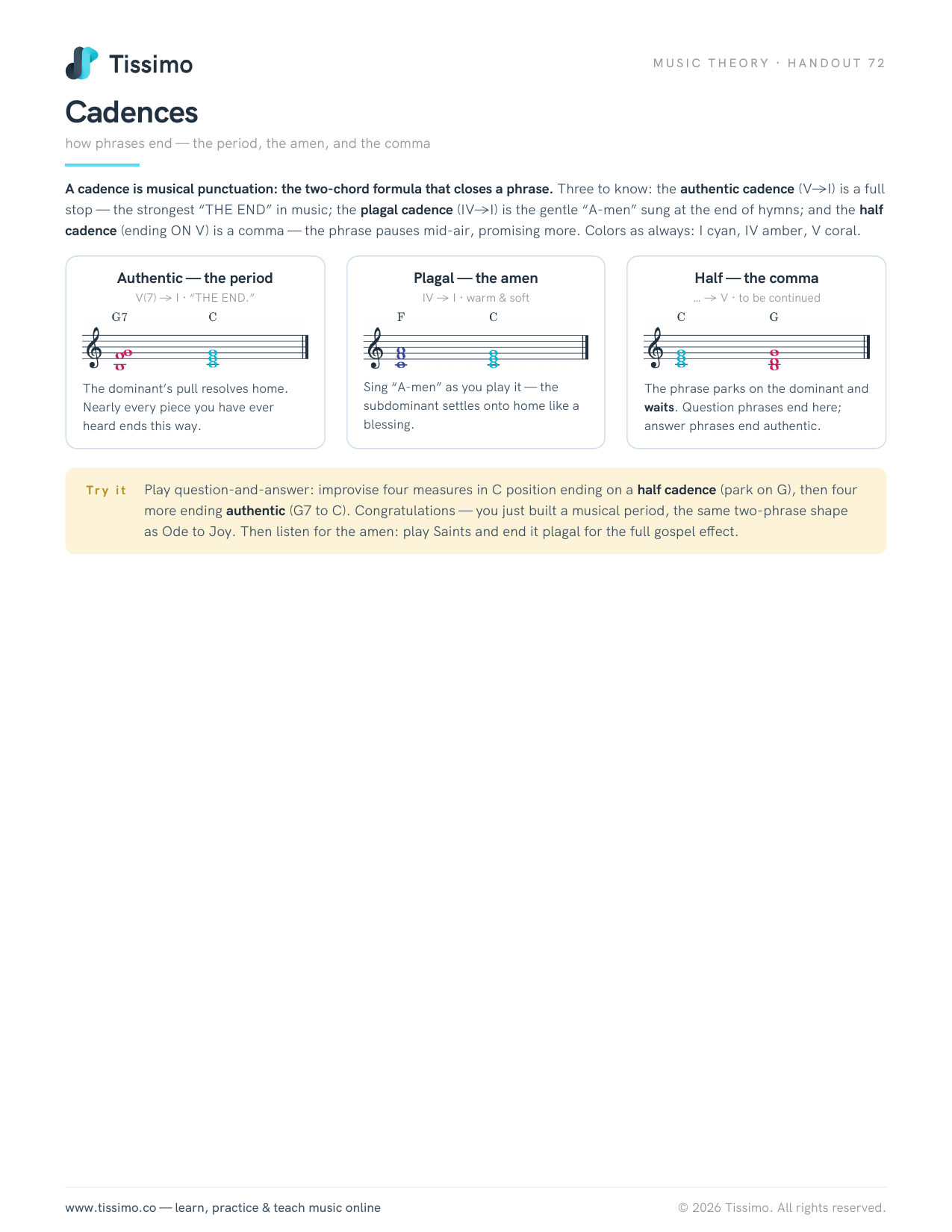
Las cadencias
cómo terminan las frases — el punto, el amén y la coma
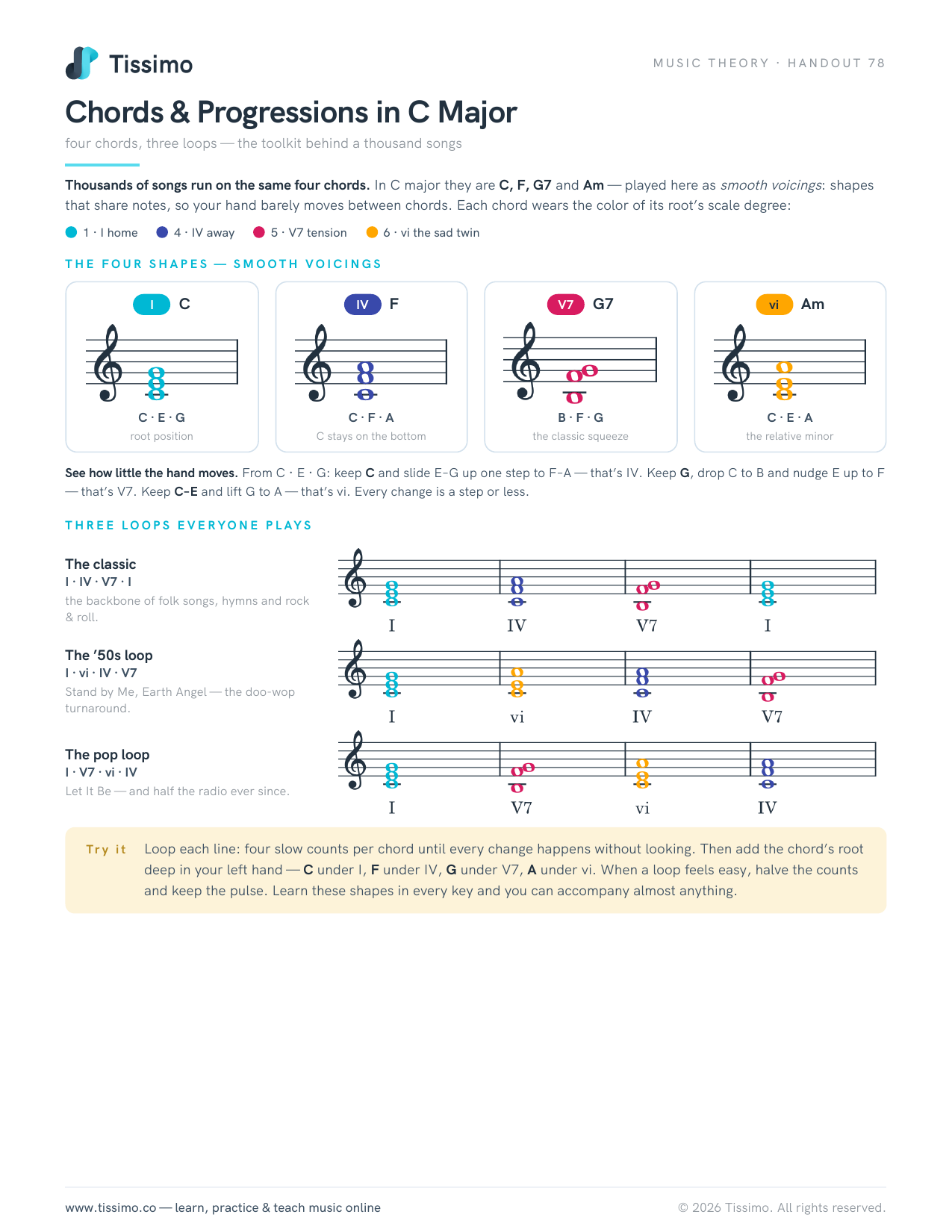
Acordes y progresiones en todas las tonalidades
Cuatro acordes, tres bucles — el kit de herramientas detrás de mil canciones, en las 24 tonalidades.
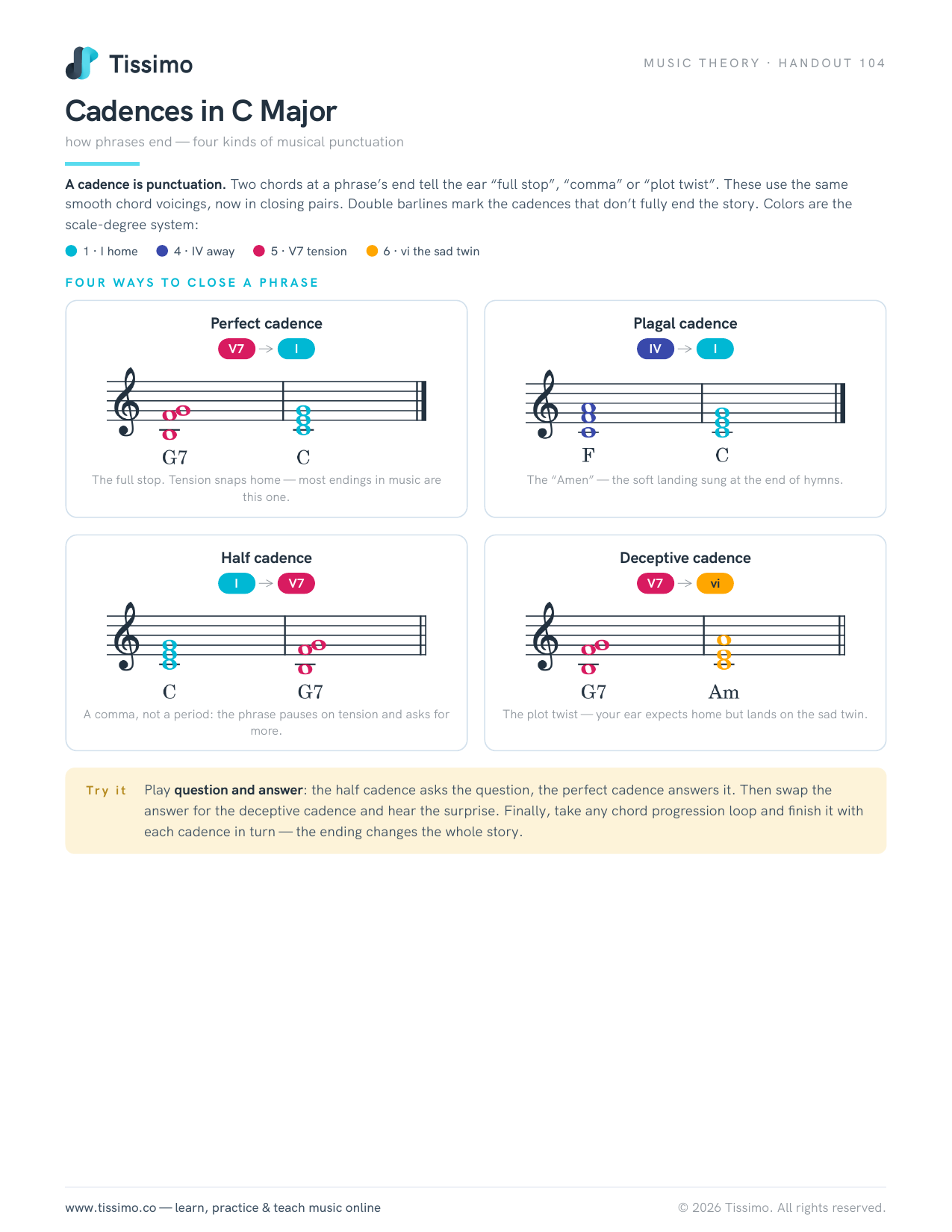
Cadencias en todas las tonalidades
Cómo terminan las frases — los cuatro tipos de puntuación musical, escritos en las 24 tonalidades.
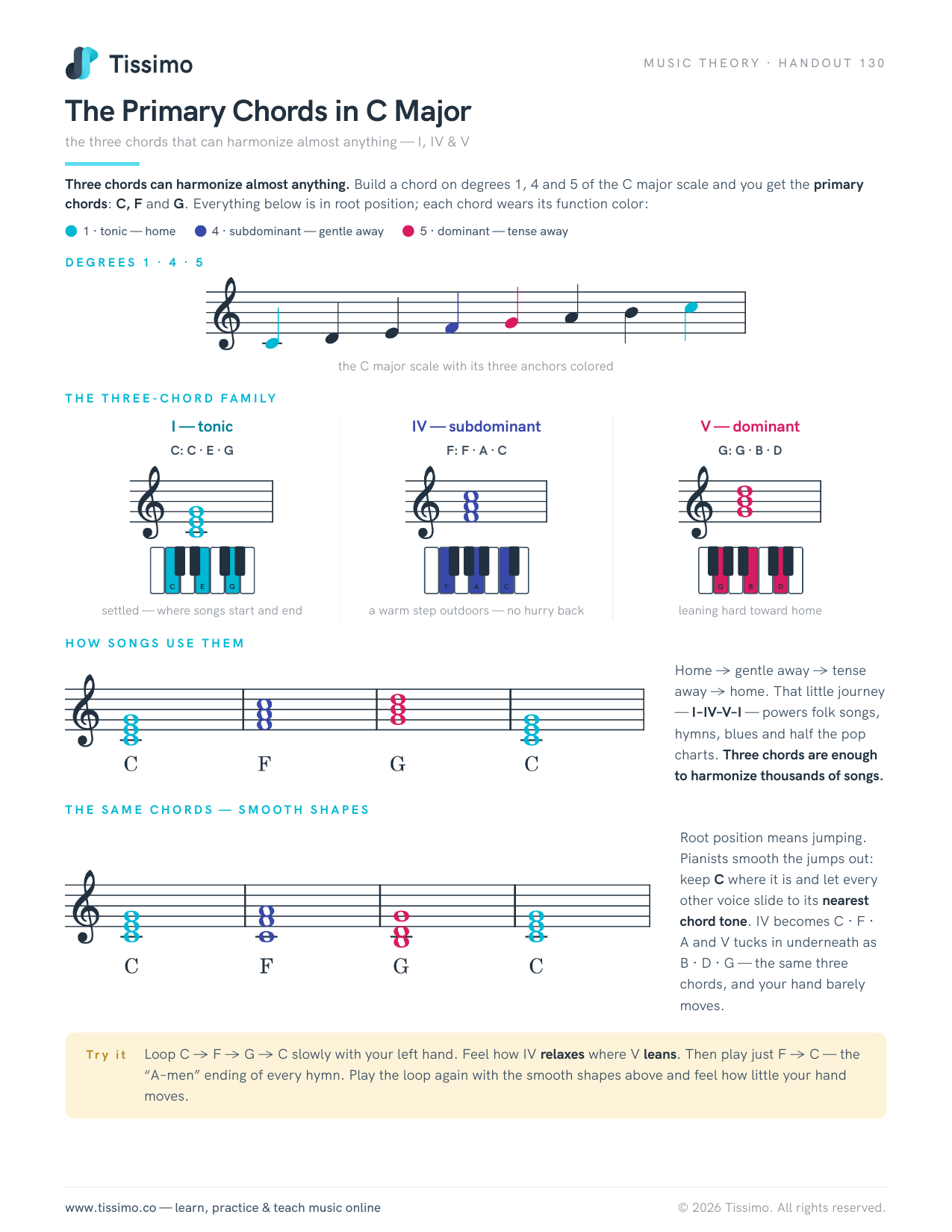
Los acordes primarios en todas las tonalidades
I, IV y V — los tres acordes que pueden armonizar casi cualquier cosa, en las 24 tonalidades.
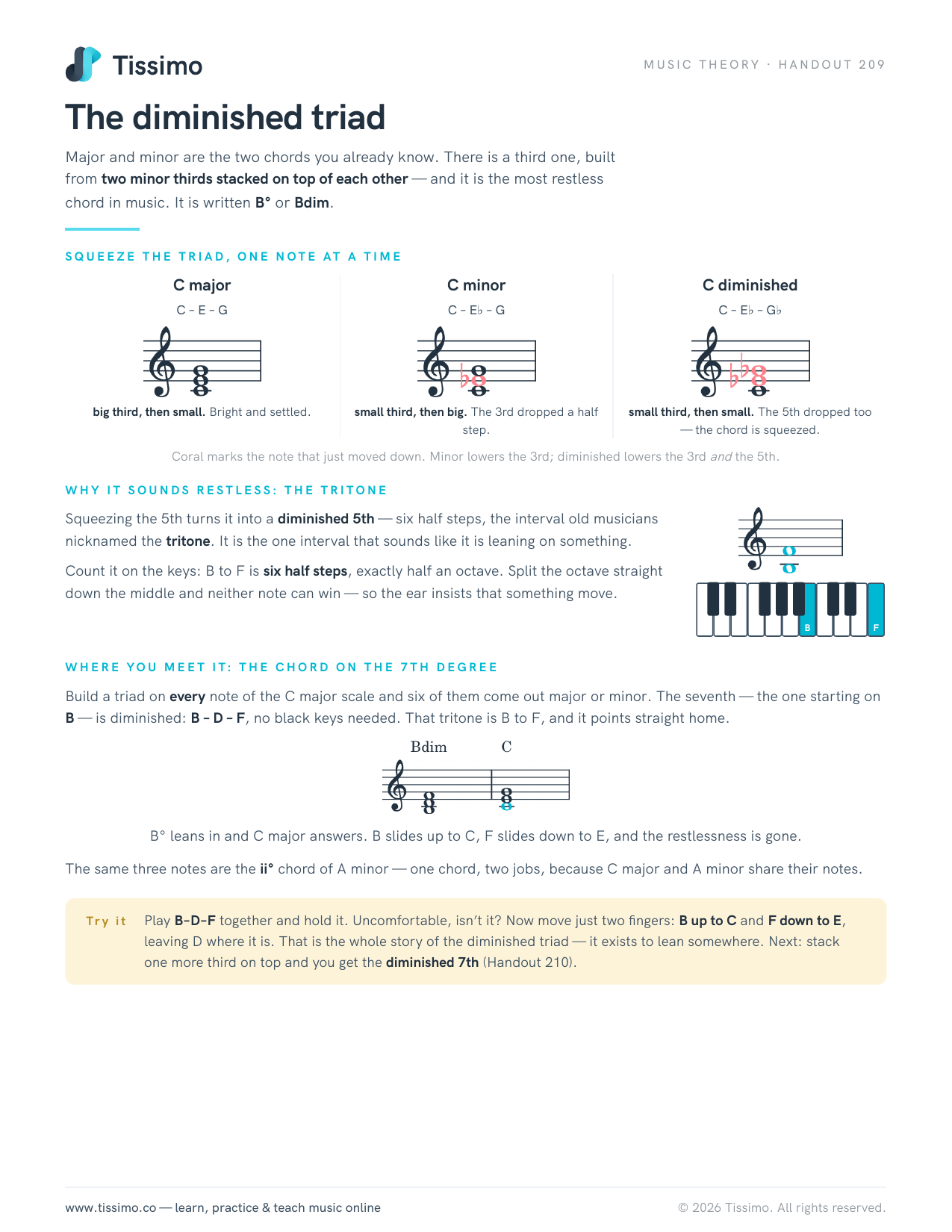
La tríada disminuida
Mayor y menor son los dos acordes que ya conoces. Hay un tercero, construido con dos terceras menores apiladas una sobre otra — y es el acorde más inquieto de la música. Se escribe B° o Bdim.
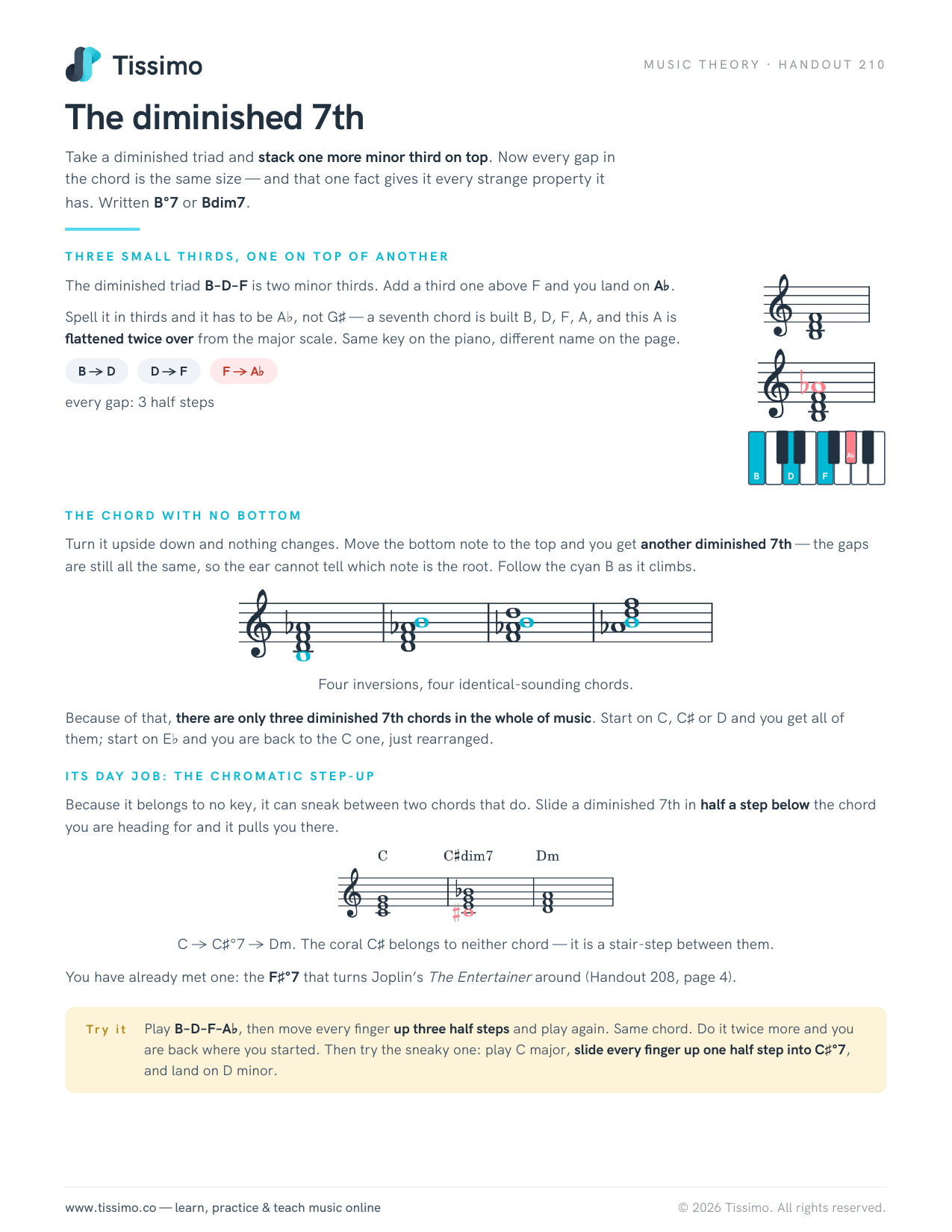
La séptima disminuida
Toma una tríada disminuida y apila una tercera menor más encima. Ahora cada intervalo del acorde tiene el mismo tamaño — y ese solo hecho le da todas sus propiedades extrañas. Se escribe B°7 o Bdim7.
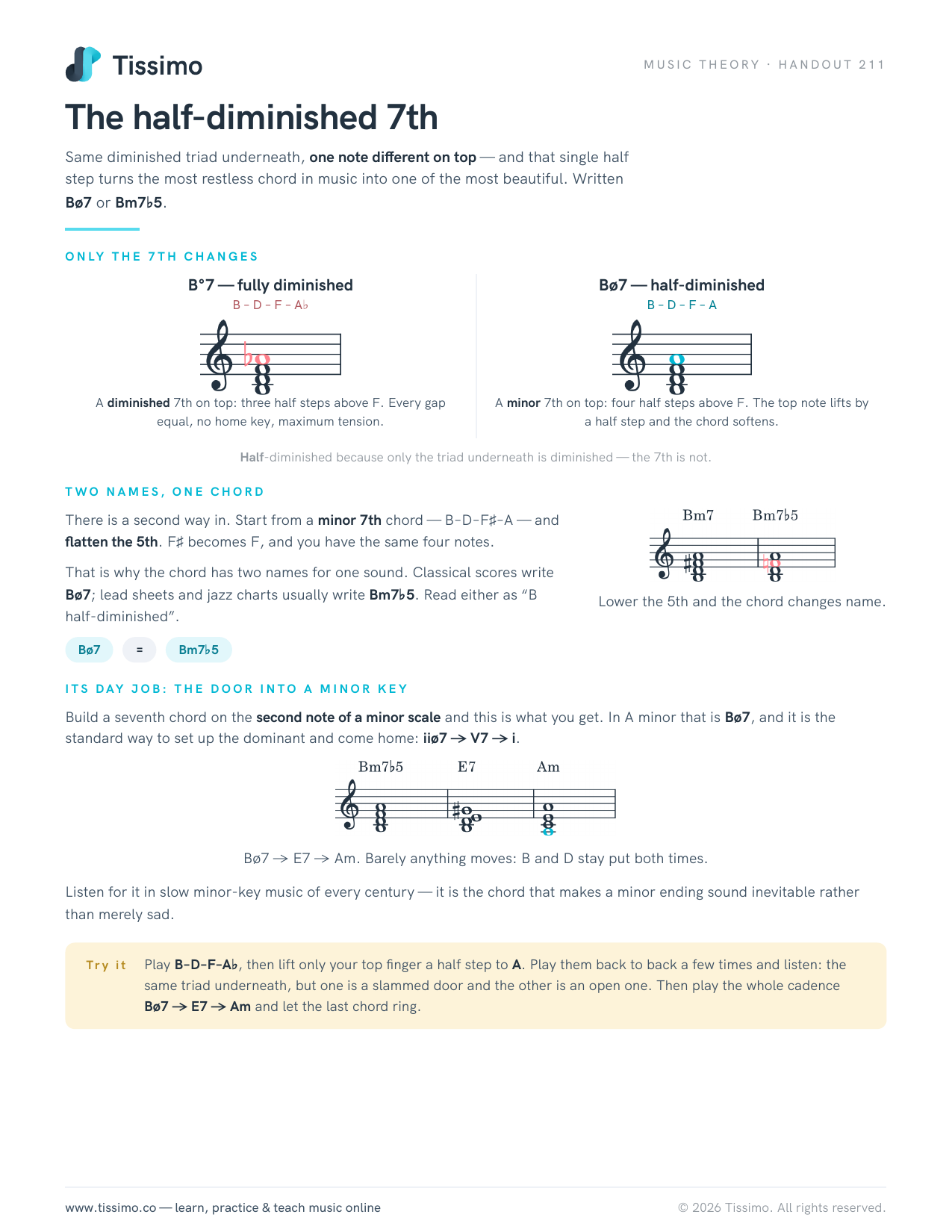
La media disminuida (semidisminuida)
La misma tríada disminuida por debajo, una nota diferente arriba — y ese único semitono convierte al acorde más inquieto de la música en uno de los más hermosos. Se escribe Bø7 o Bm7♭5.
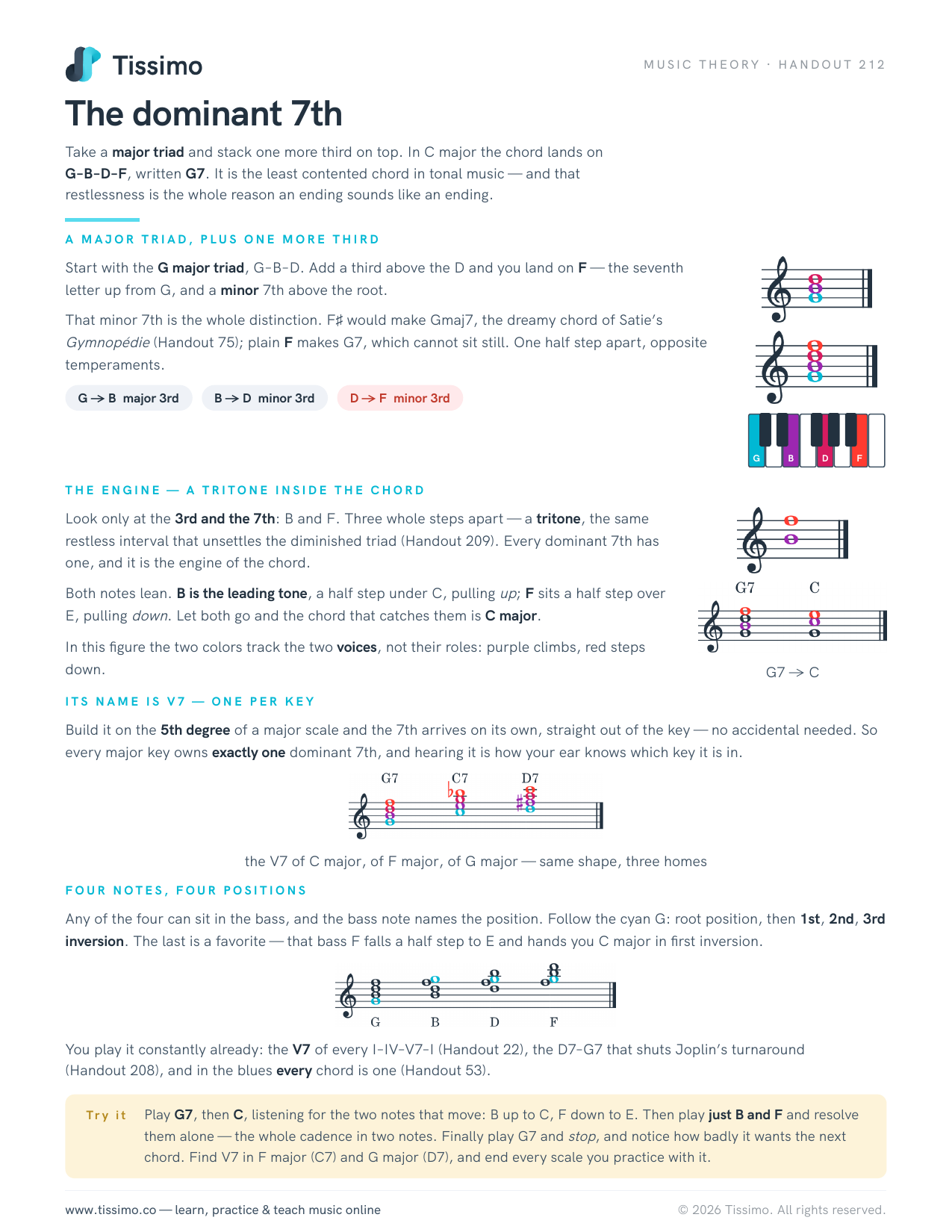
La séptima de dominante
Toma una tríada mayor y apila una tercera más encima. En Do mayor, el acorde cae en Sol–Si–Re–Fa, escrito G7. Es el acorde menos conforme de la música tonal — y esa inquietud es la razón por la que un final suena como un final.
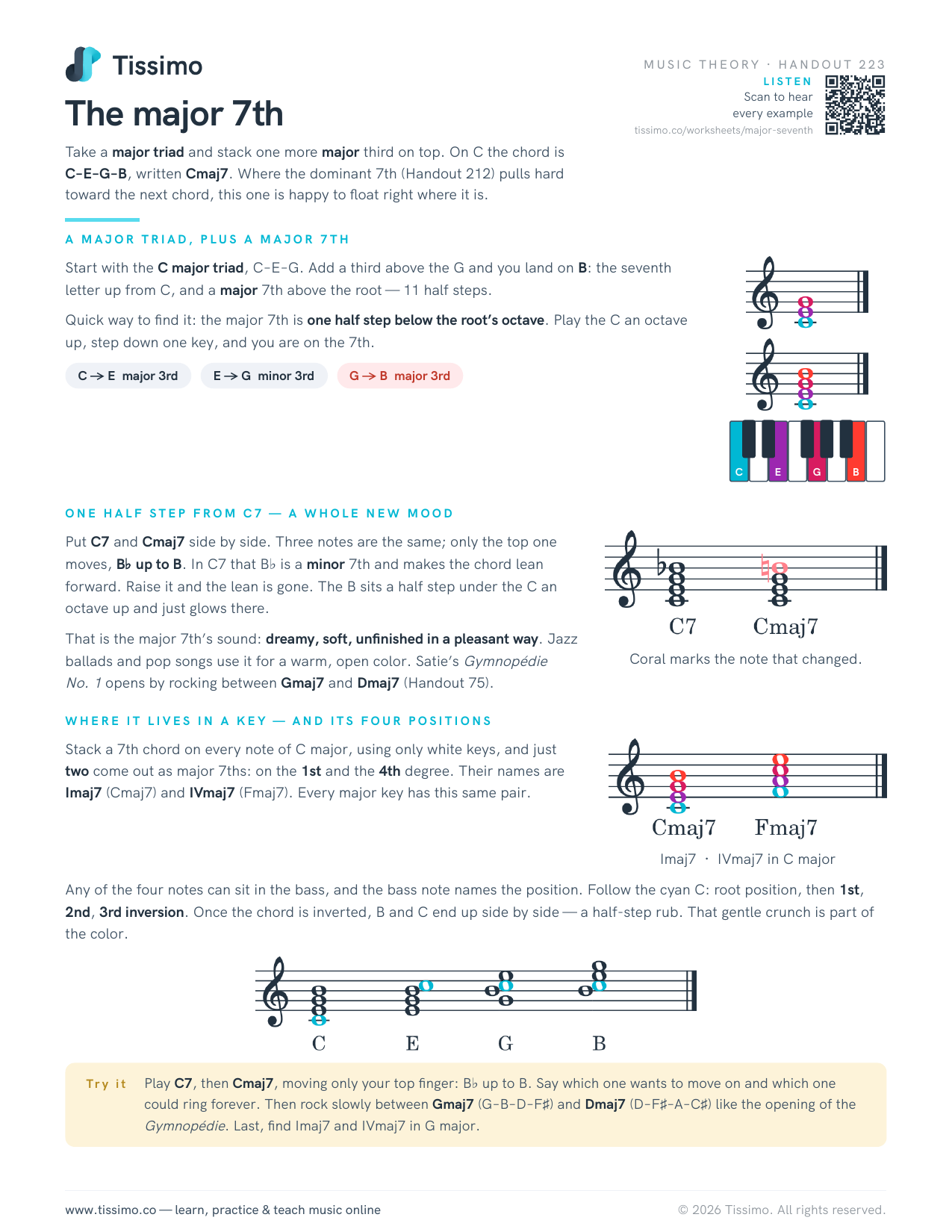
The major 7th
Take a major triad and stack one more major third on top. On C the chord is C–E–G–B, written Cmaj7. Where the dominant 7th (Handout 212) pulls hard toward the next chord, this one is happy to float right where it is.
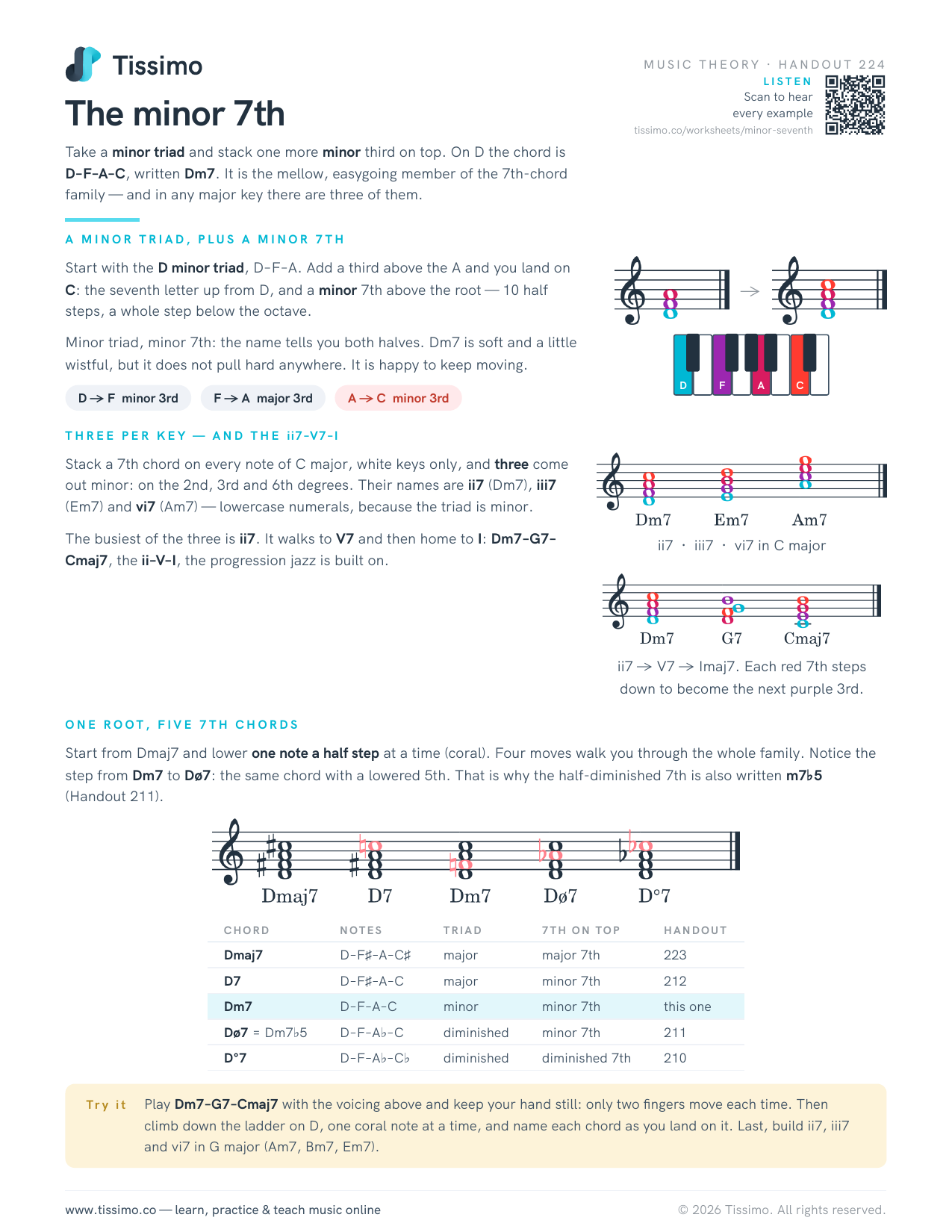
The minor 7th
Take a minor triad and stack one more minor third on top. On D the chord is D–F–A–C, written Dm7. It is the mellow, easygoing member of the 7th-chord family — and in any major key there are three of them.
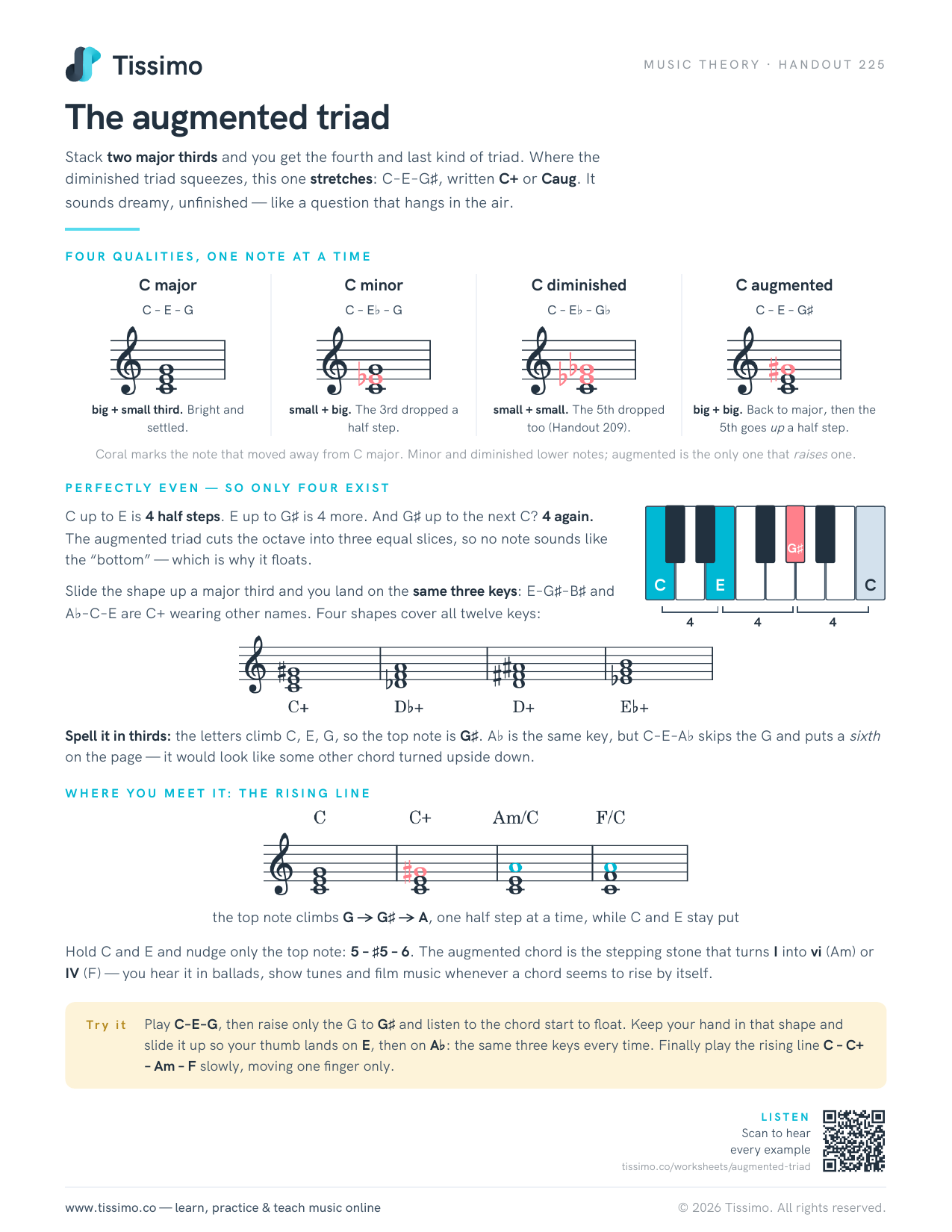
The augmented triad
Stack two major thirds and you get the fourth and last kind of triad. Where the diminished triad squeezes, this one stretches: C–E–G♯, written C+ or Caug. It sounds dreamy, unfinished — like a question that hangs in the air.
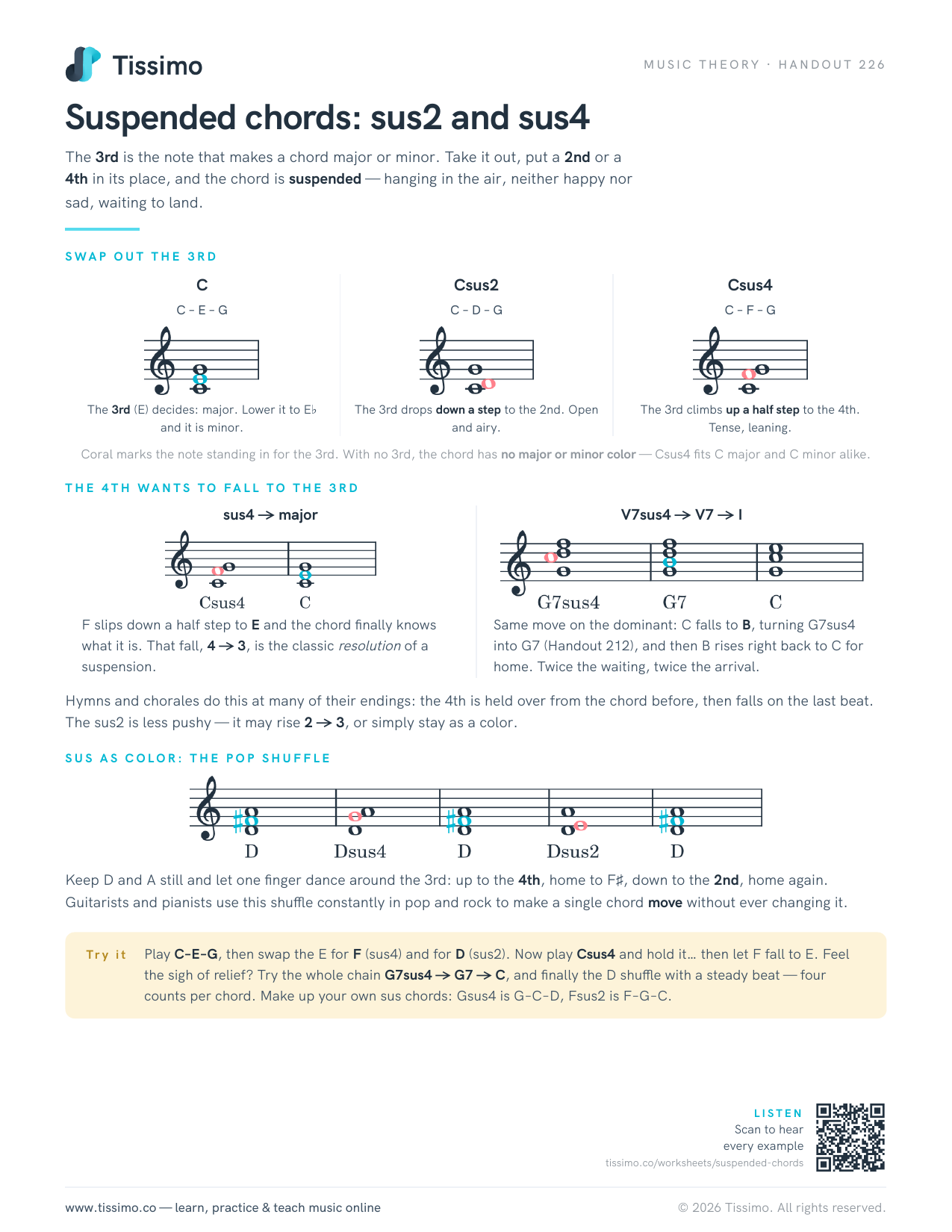
Suspended chords: sus2 and sus4
The 3rd is the note that makes a chord major or minor. Take it out, put a 2nd or a 4th in its place, and the chord is suspended — hanging in the air, neither happy nor sad, waiting to land.
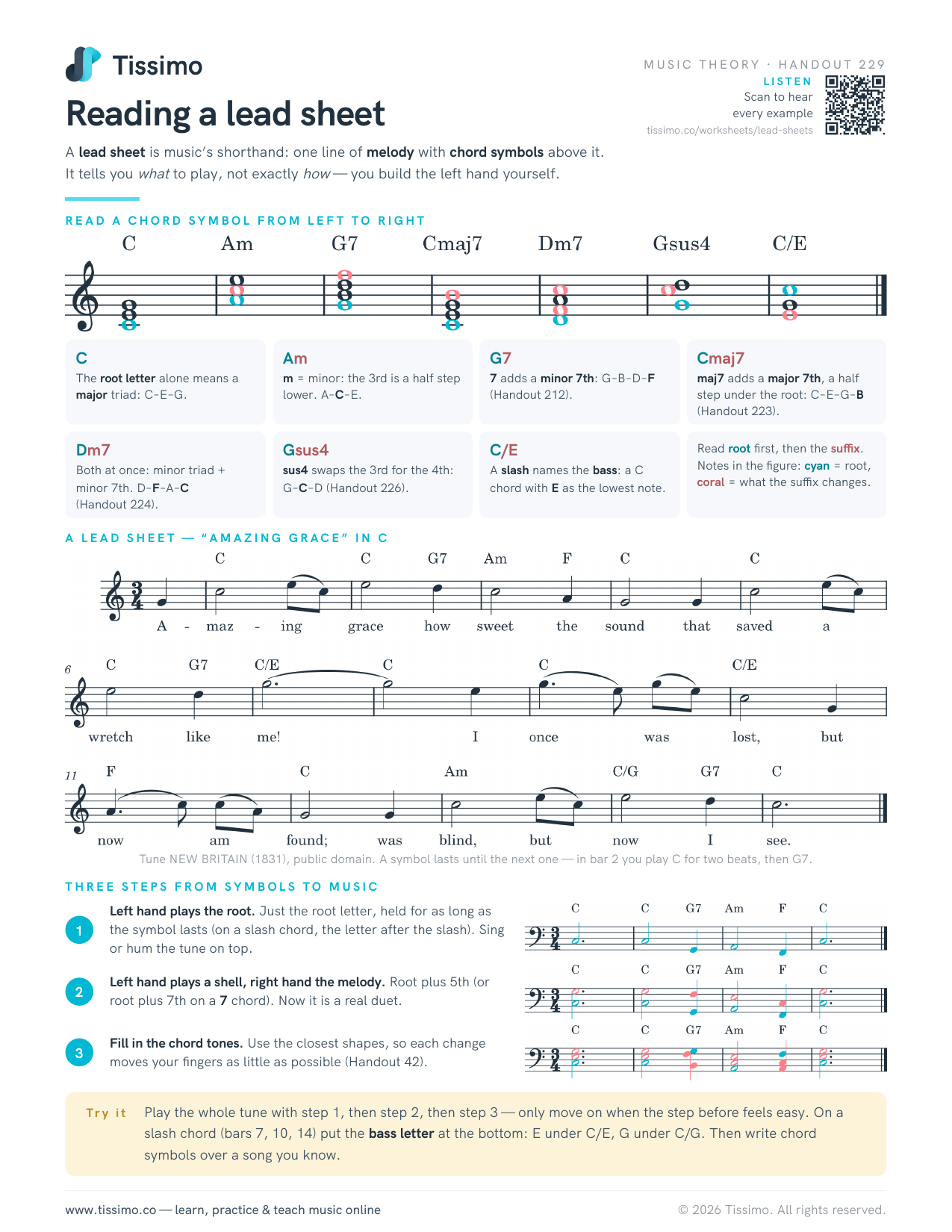
Reading a lead sheet
A lead sheet is music’s shorthand: one line of melody with chord symbols above it. It tells you what to play, not exactly how — you build the left hand yourself.
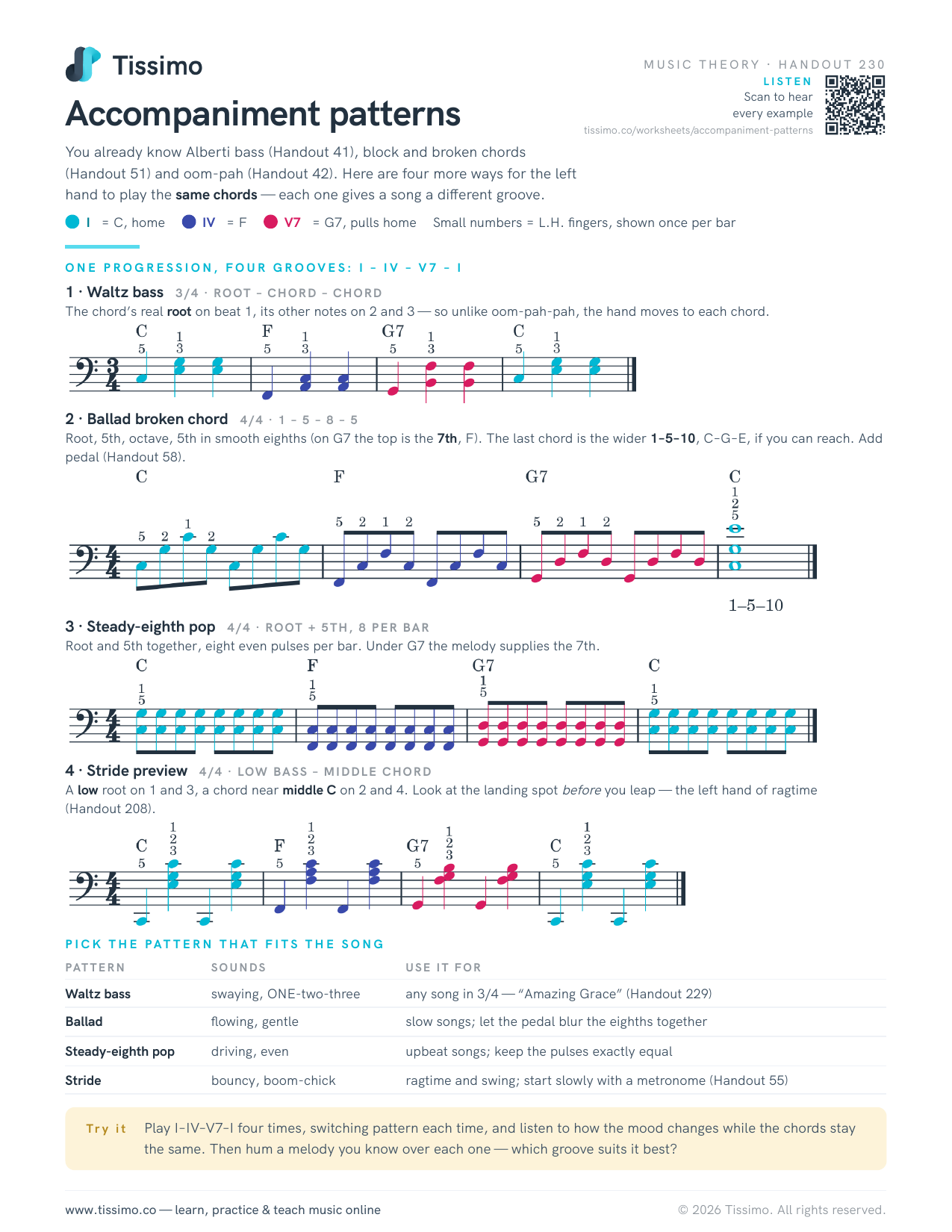
Accompaniment patterns
You already know Alberti bass (Handout 41), block and broken chords (Handout 51) and oom-pah (Handout 42). Here are four more ways for the left hand to play the same chords — each one gives a song a different groove.
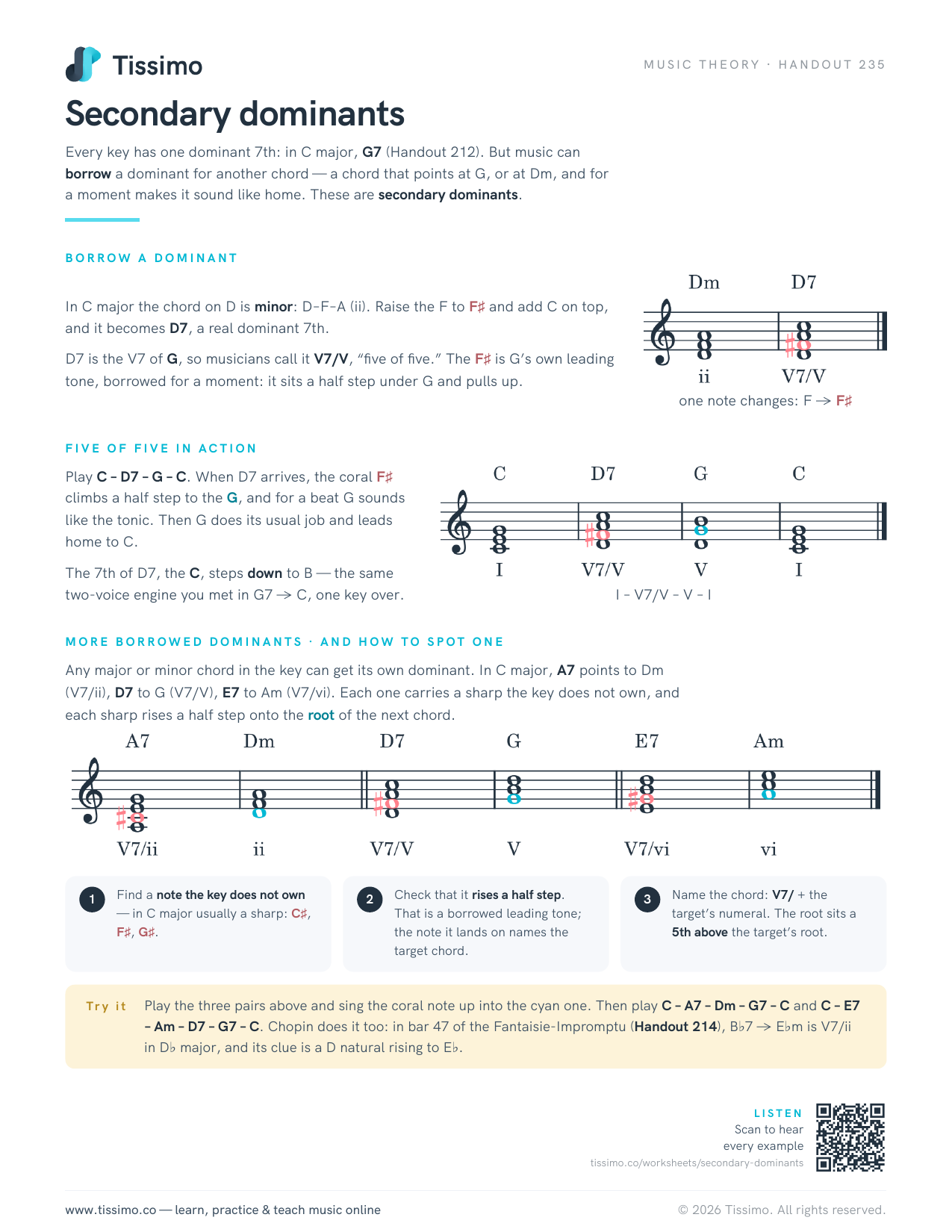
Secondary dominants
Every key has one dominant 7th: in C major, G7 (Handout 212). But music can borrow a dominant for another chord — a chord that points at G, or at Dm, and for a moment makes it sound like home. These are secondary dominants.
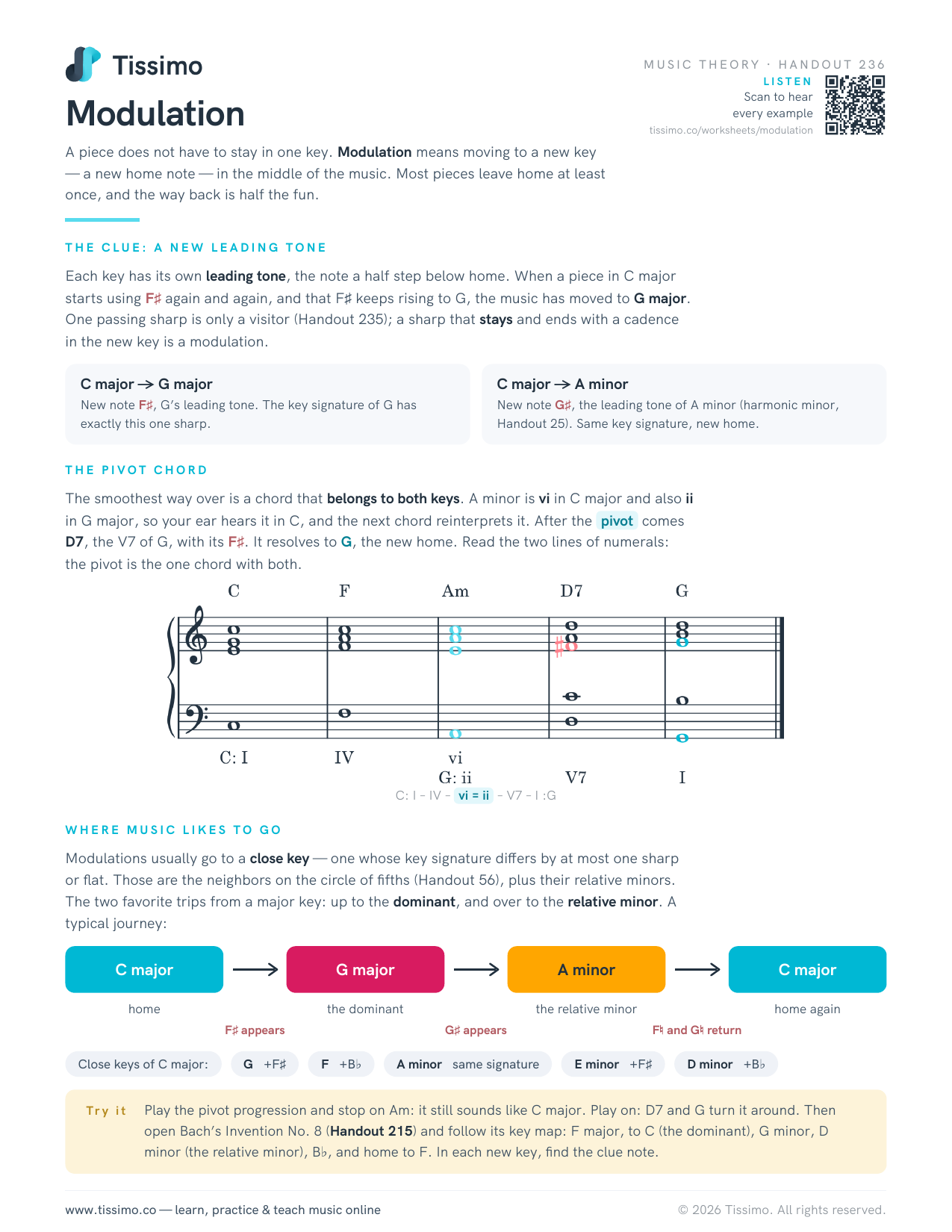
Modulation
A piece does not have to stay in one key. Modulation means moving to a new key — a new home note — in the middle of the music. Most pieces leave home at least once, and the way back is half the fun.
Form & Analysis
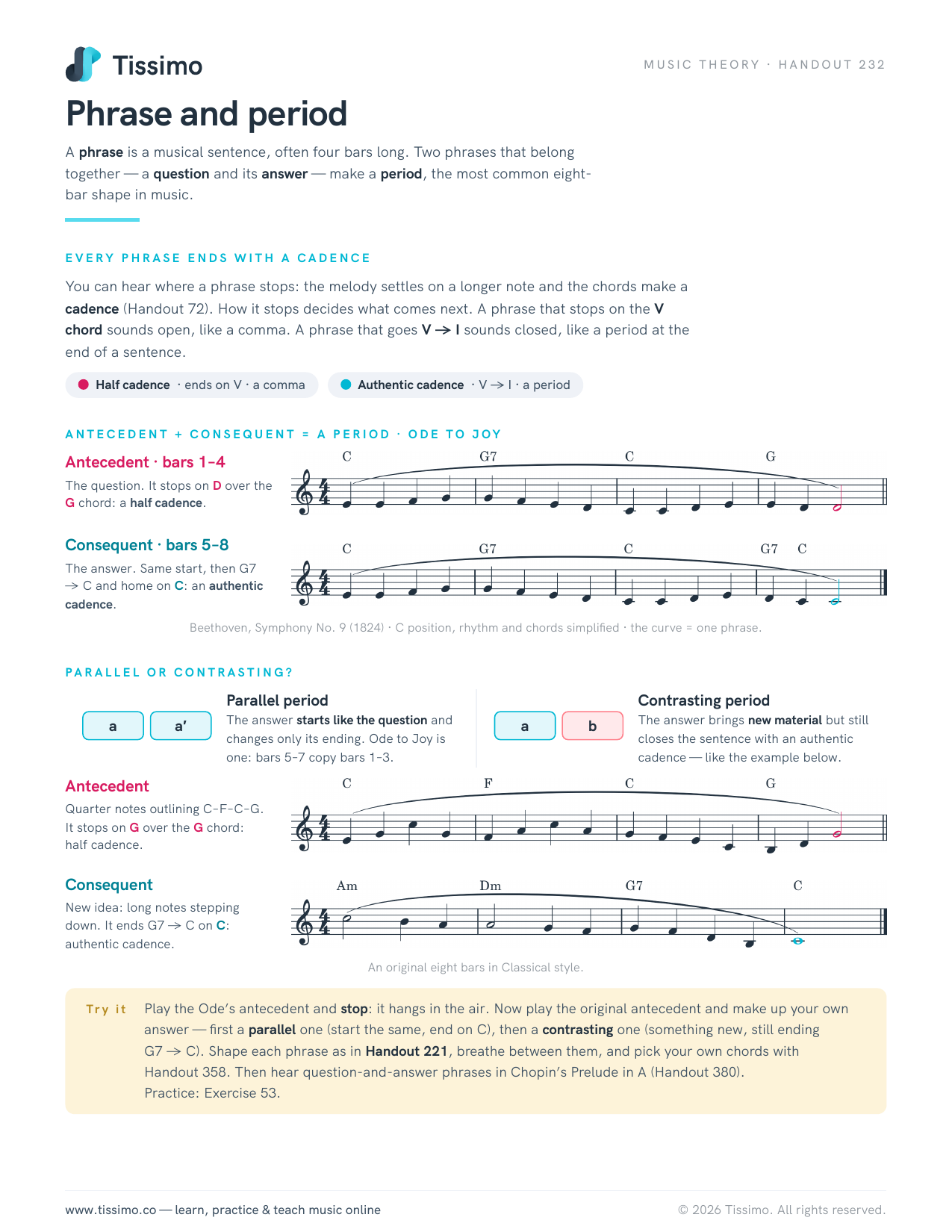
Phrase and period
A phrase is a musical sentence, often four bars long. Two phrases that belong together — a question and its answer — make a period, the most common eight-bar shape in music.
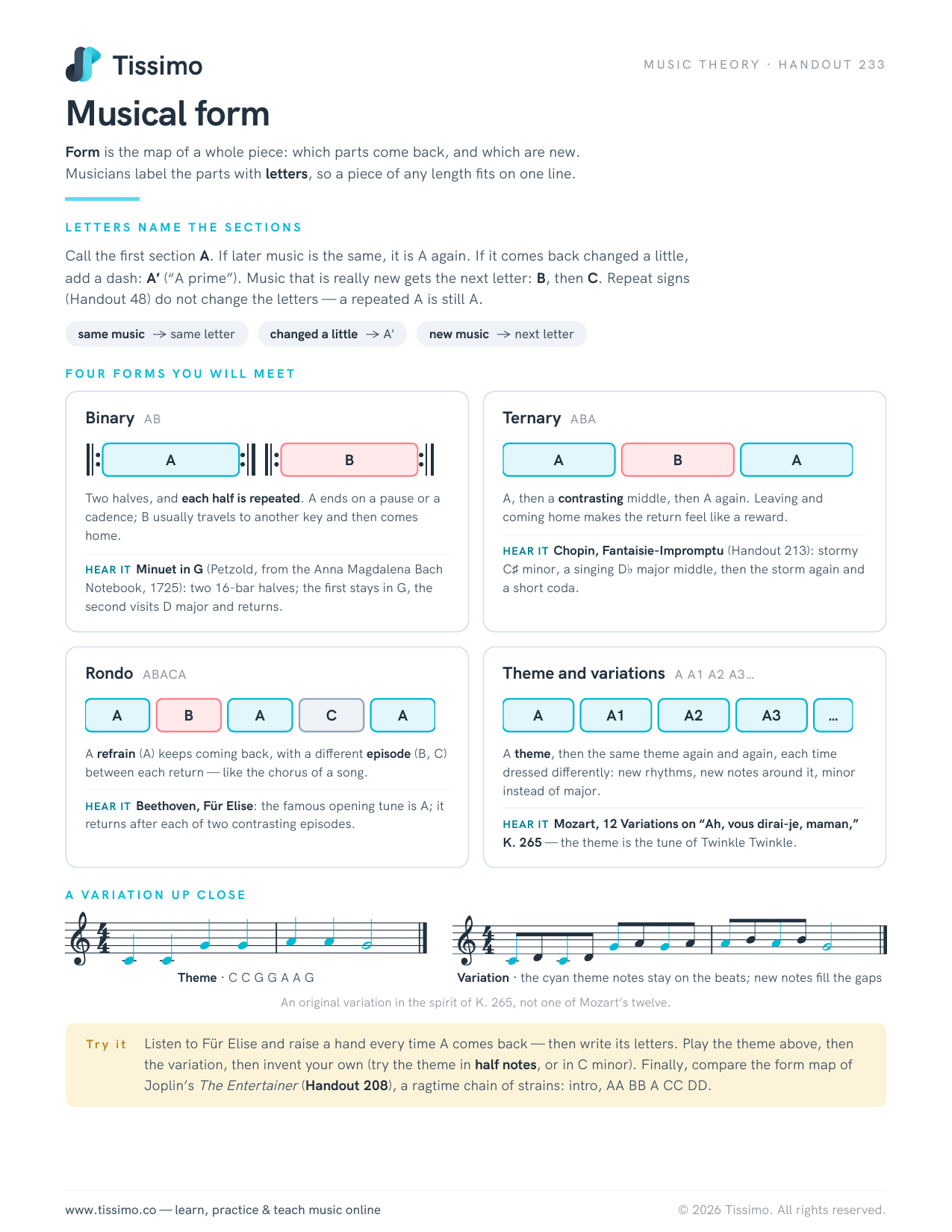
Musical form
Form is the map of a whole piece: which parts come back, and which are new. Musicians label the parts with letters, so a piece of any length fits on one line.
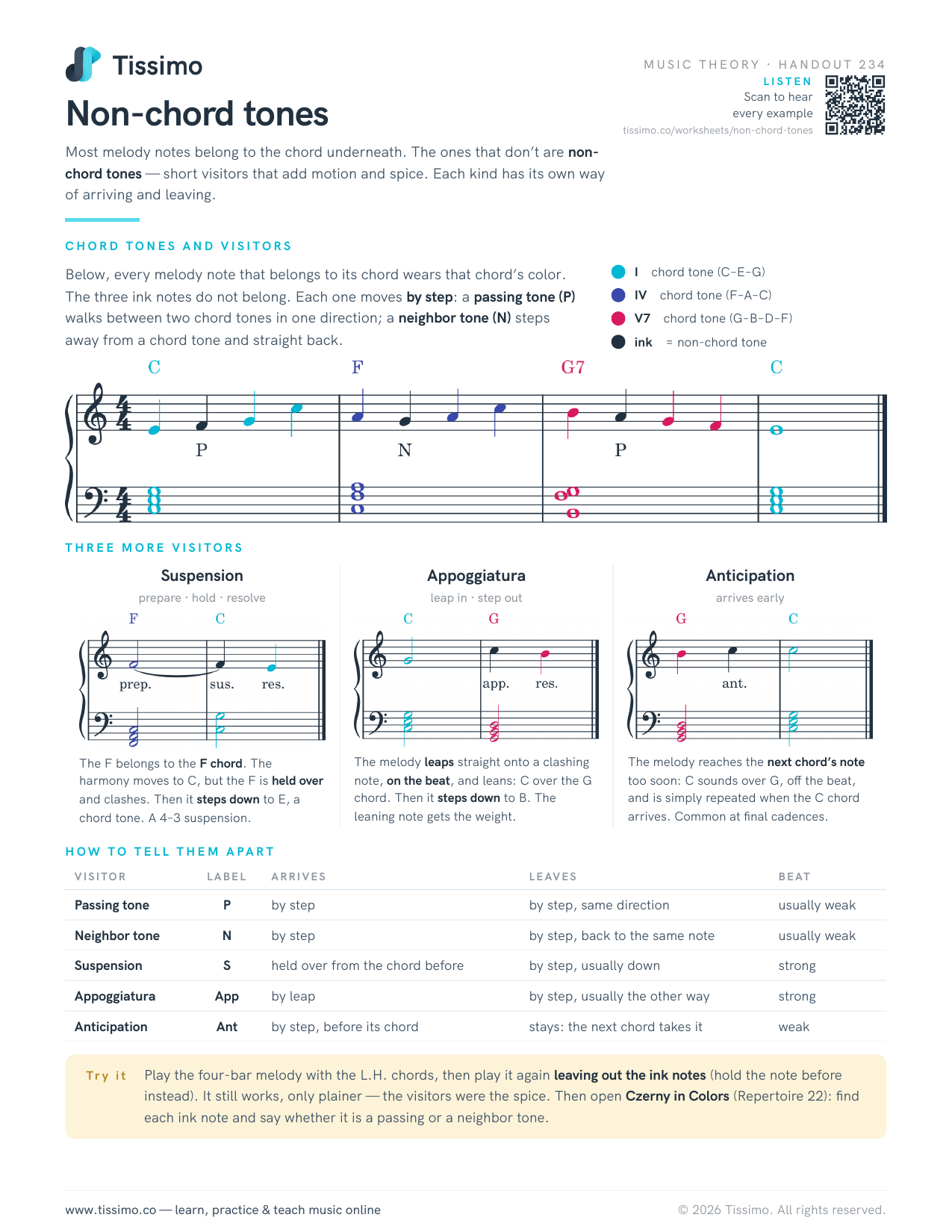
Non-chord tones
Most melody notes belong to the chord underneath. The ones that don’t are non-chord tones — short visitors that add motion and spice. Each kind has its own way of arriving and leaving.
Arpegios
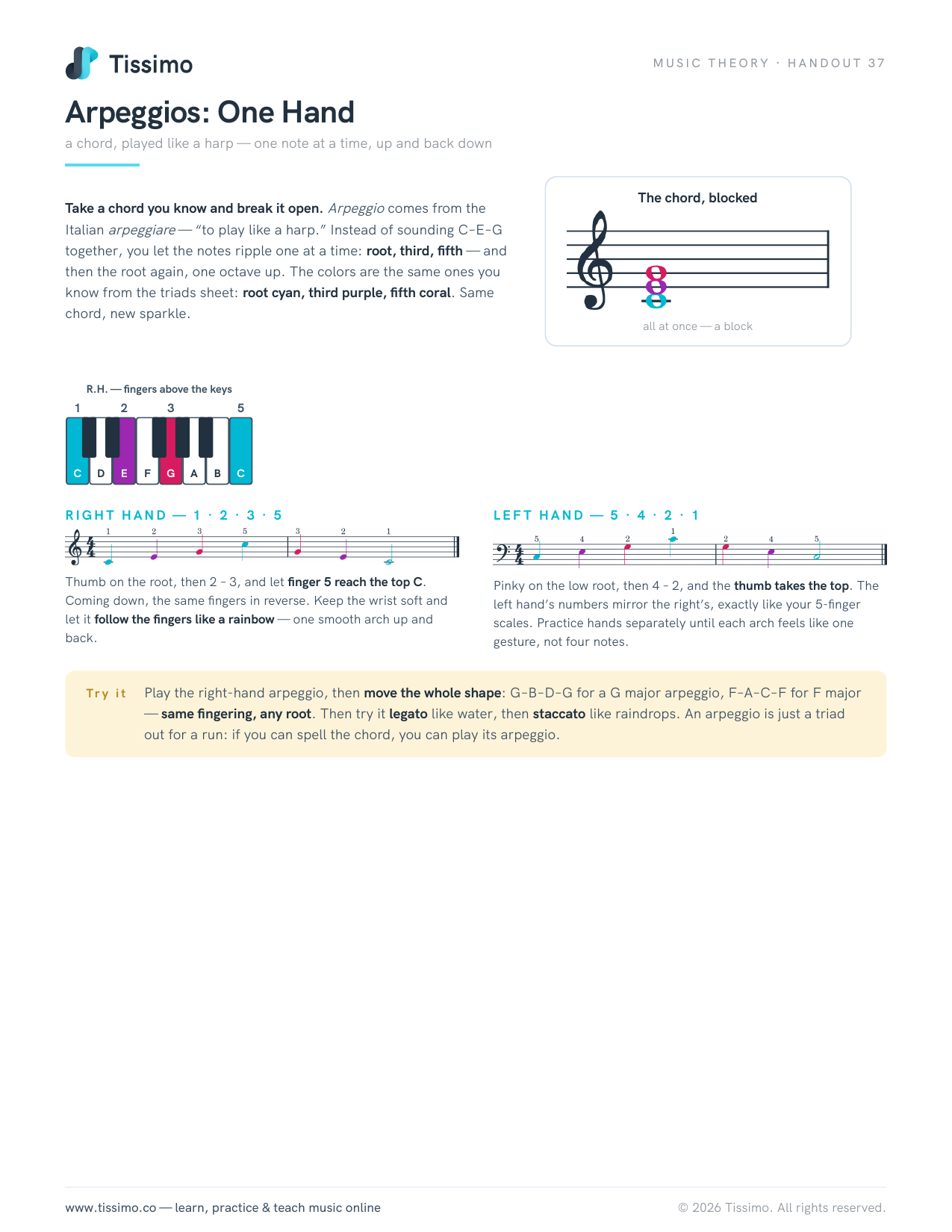
Arpegios: una mano
un acorde, tocado como en un arpa — nota a nota, subiendo y bajando
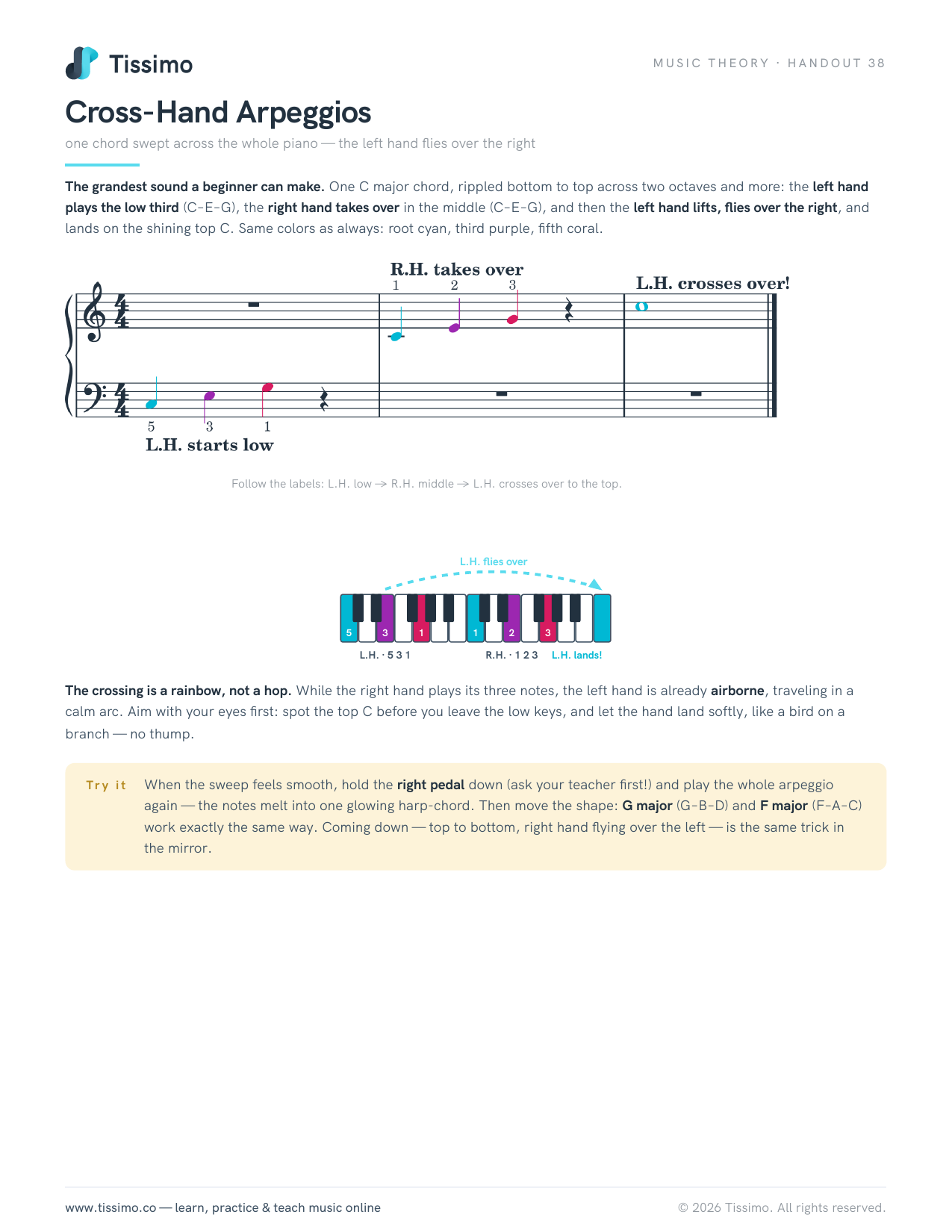
Arpegios con cruce de manos
un acorde barrido por todo el piano — la mano izquierda vuela sobre la derecha
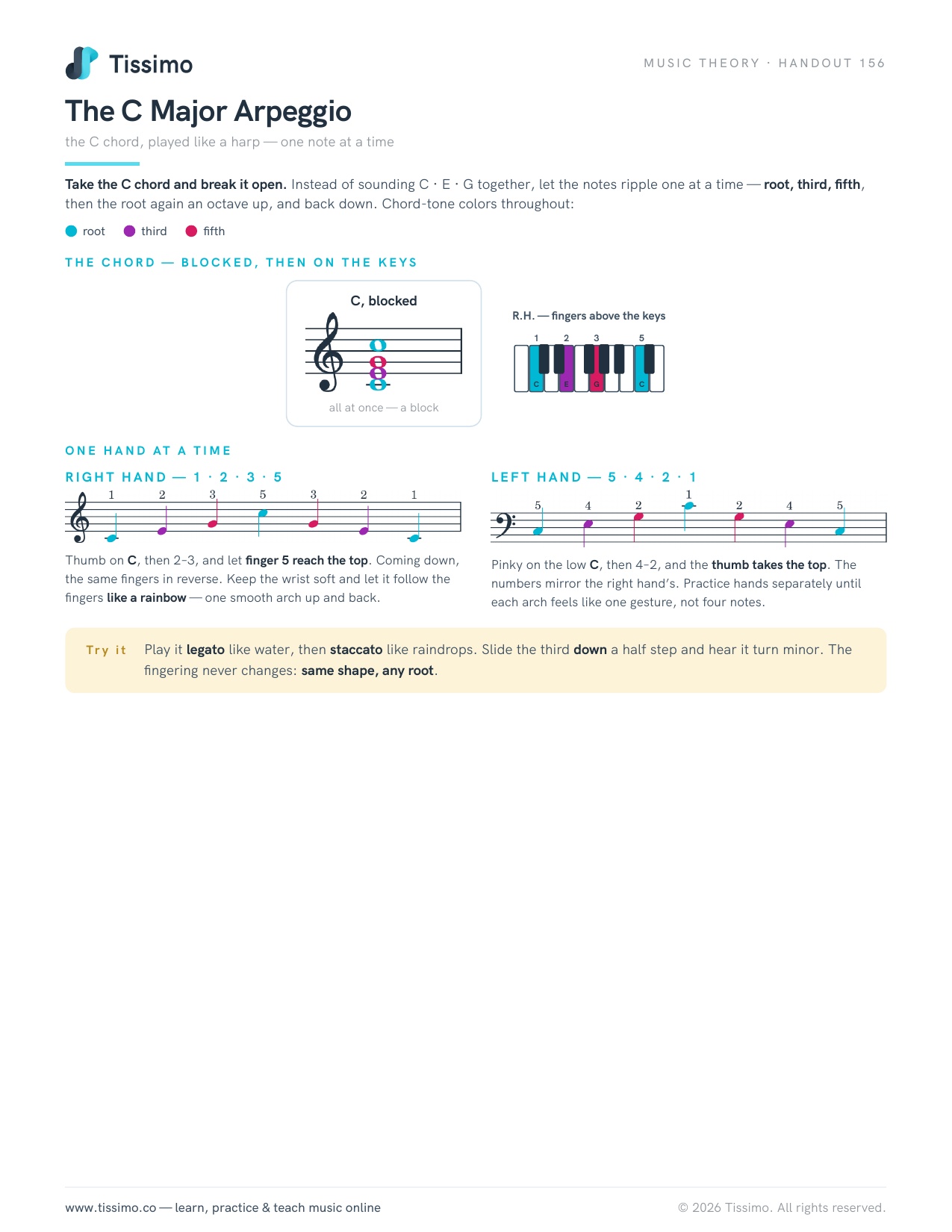
Arpegios en todas las tonalidades
El acorde tocado como en un arpa — nota a nota, subiendo y bajando, en las 24 tonalidades.
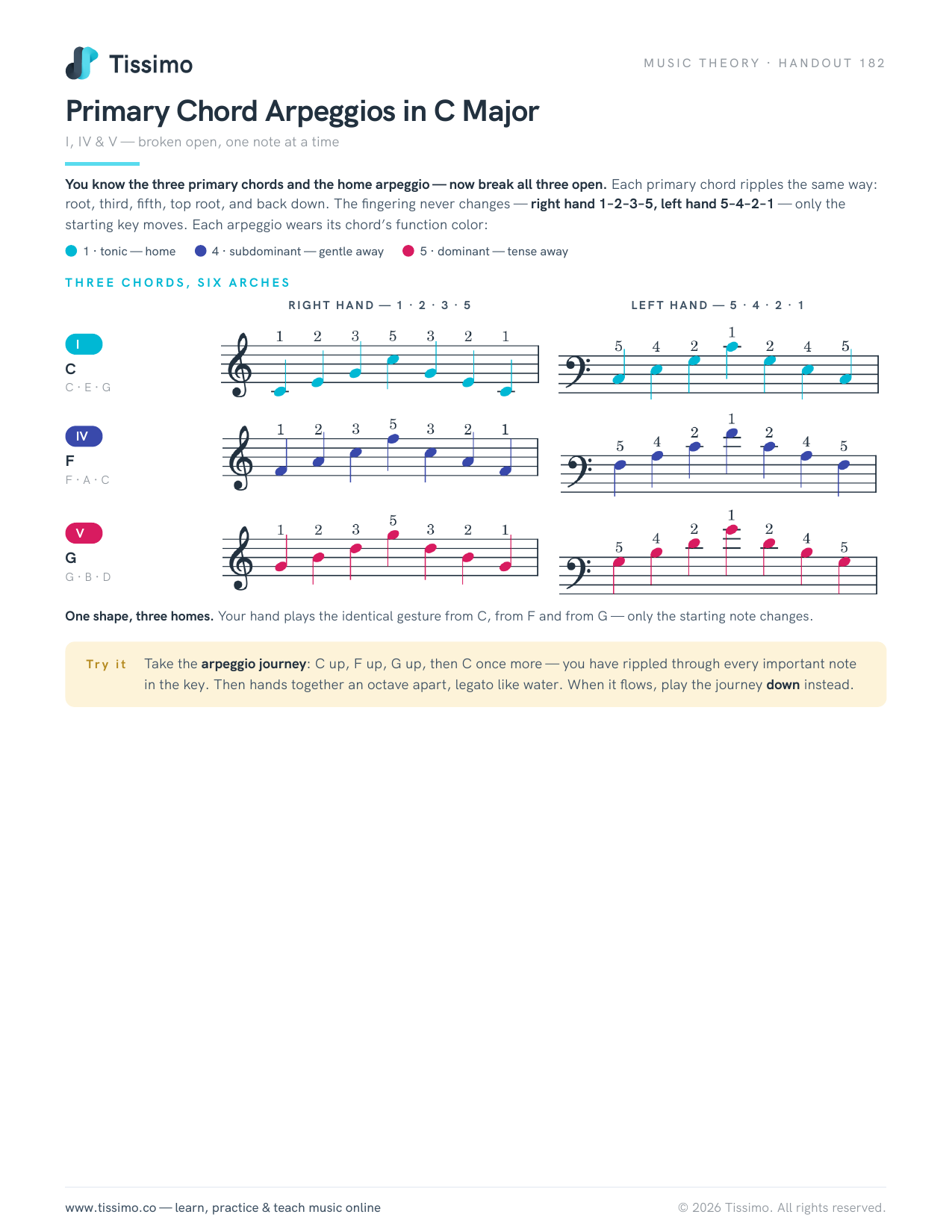
Arpegios de acordes primarios en todas las tonalidades
I, IV y V abiertos nota a nota, en las 24 tonalidades.
Expresión y técnica
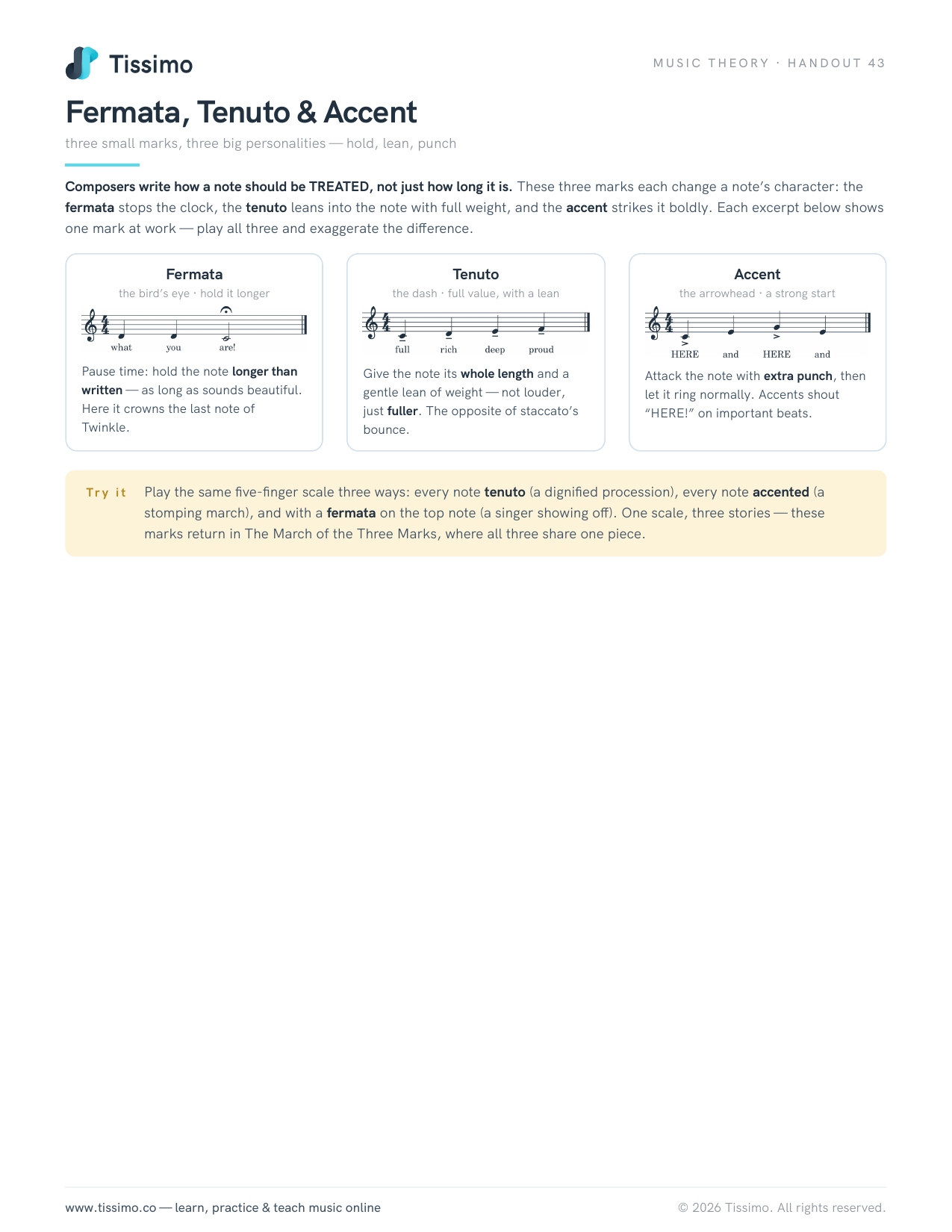
Calderón, tenuto y acento
tres pequeños signos, tres grandes personalidades — sostener, apoyar, golpear
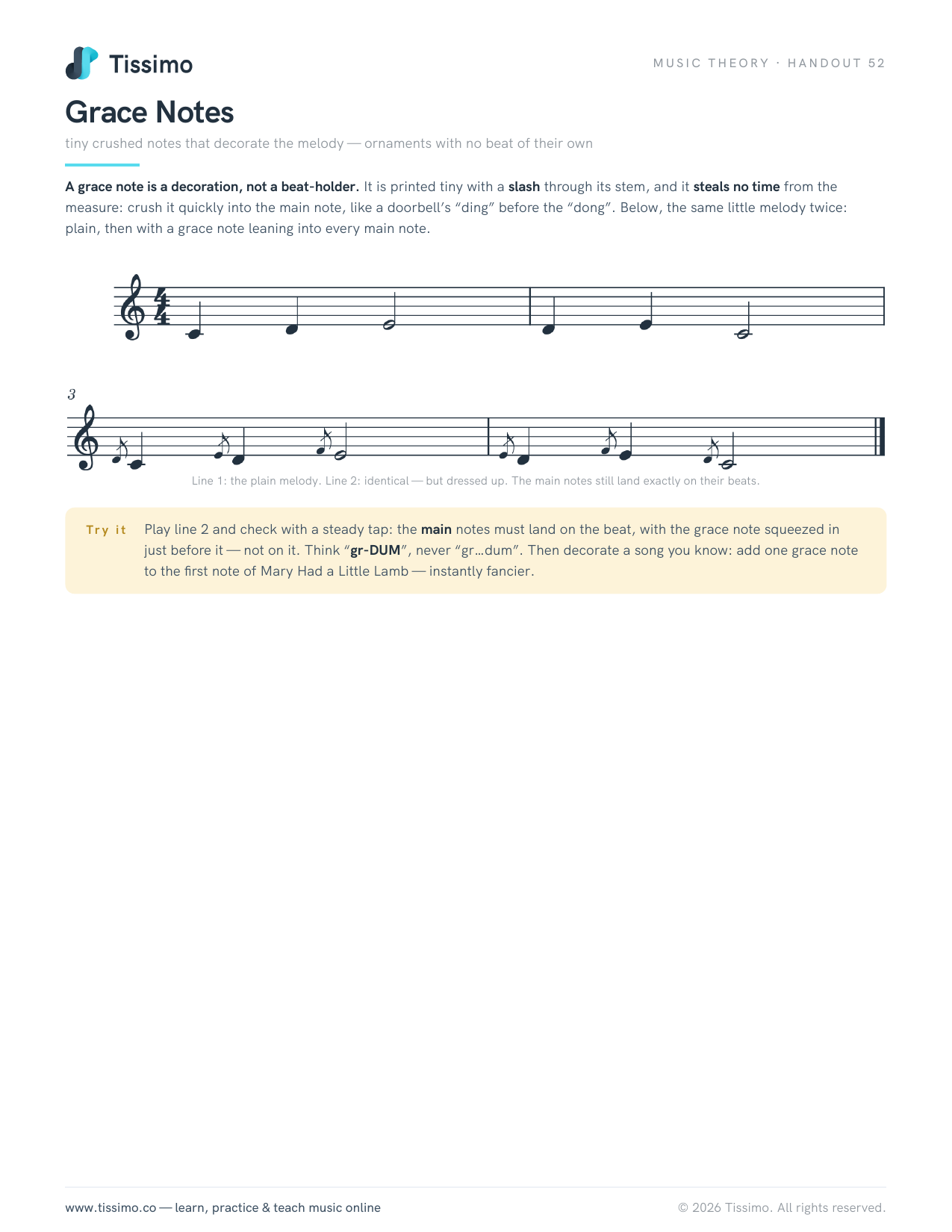
Las notas de adorno (apoyaturas breves)
pequeñas notas aplastadas que decoran la melodía — adornos sin tiempo propio
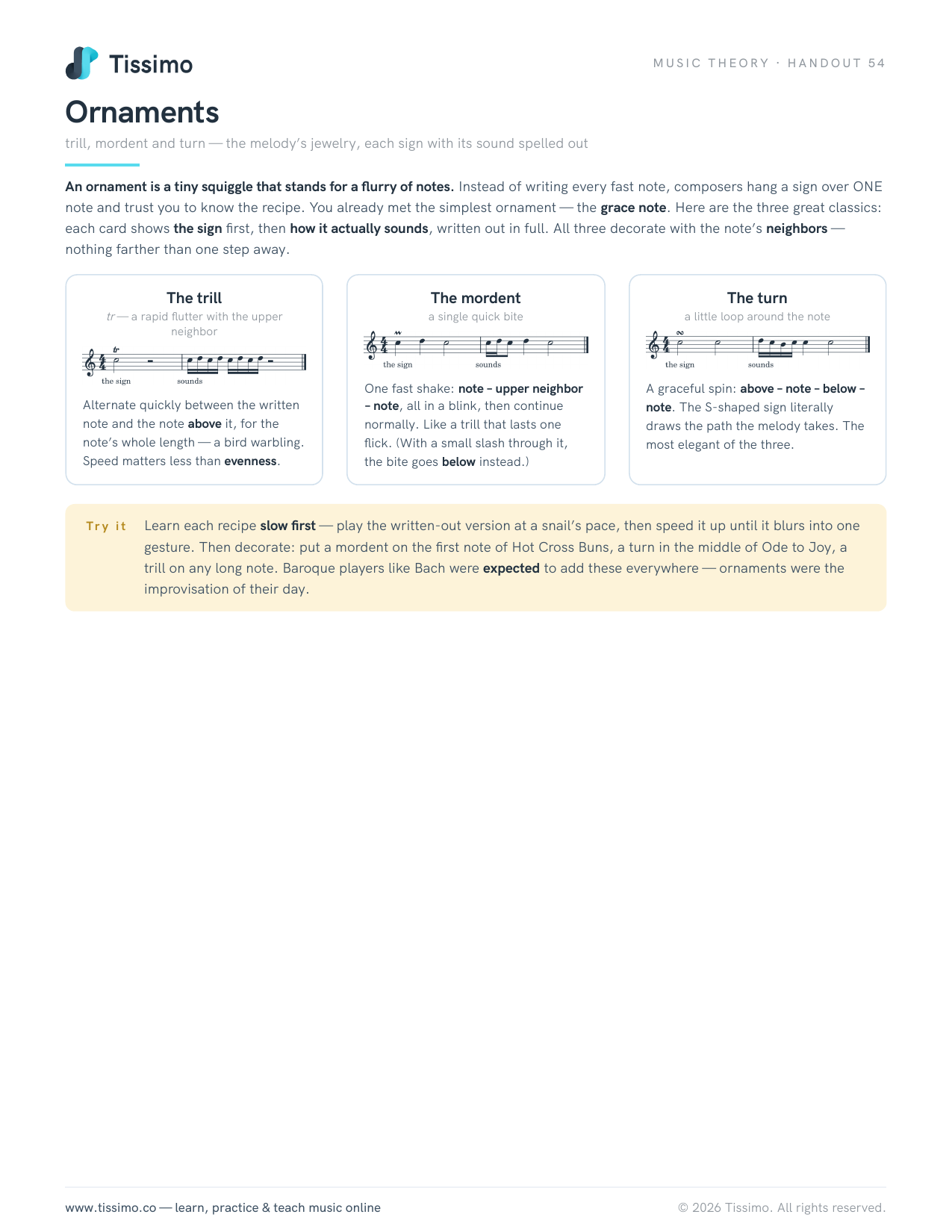
Los adornos
trino, mordente y grupeto — las joyas de la melodía, cada signo con su sonido explicado
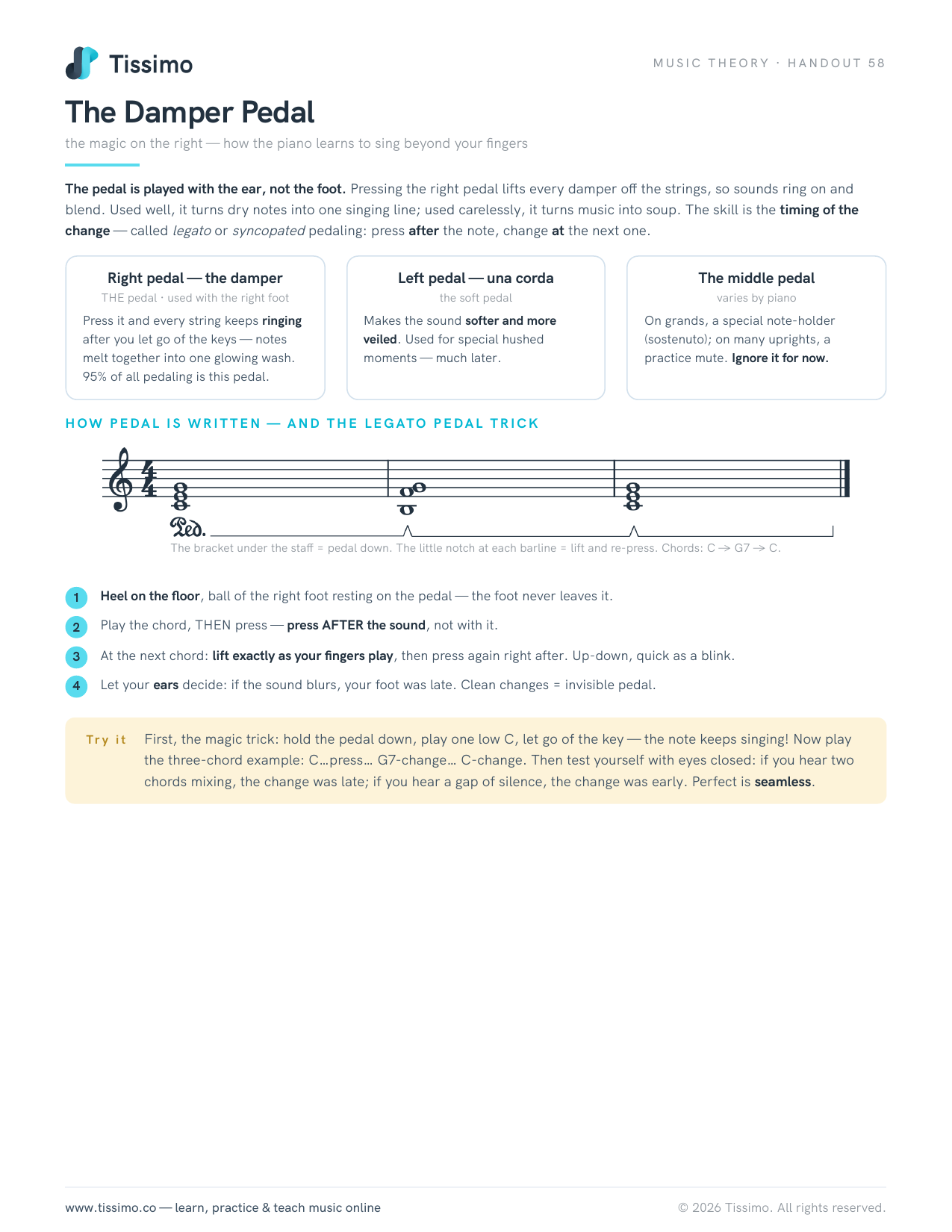
El pedal de resonancia (damper)
la magia de la derecha — cómo el piano aprende a cantar más allá de tus dedos
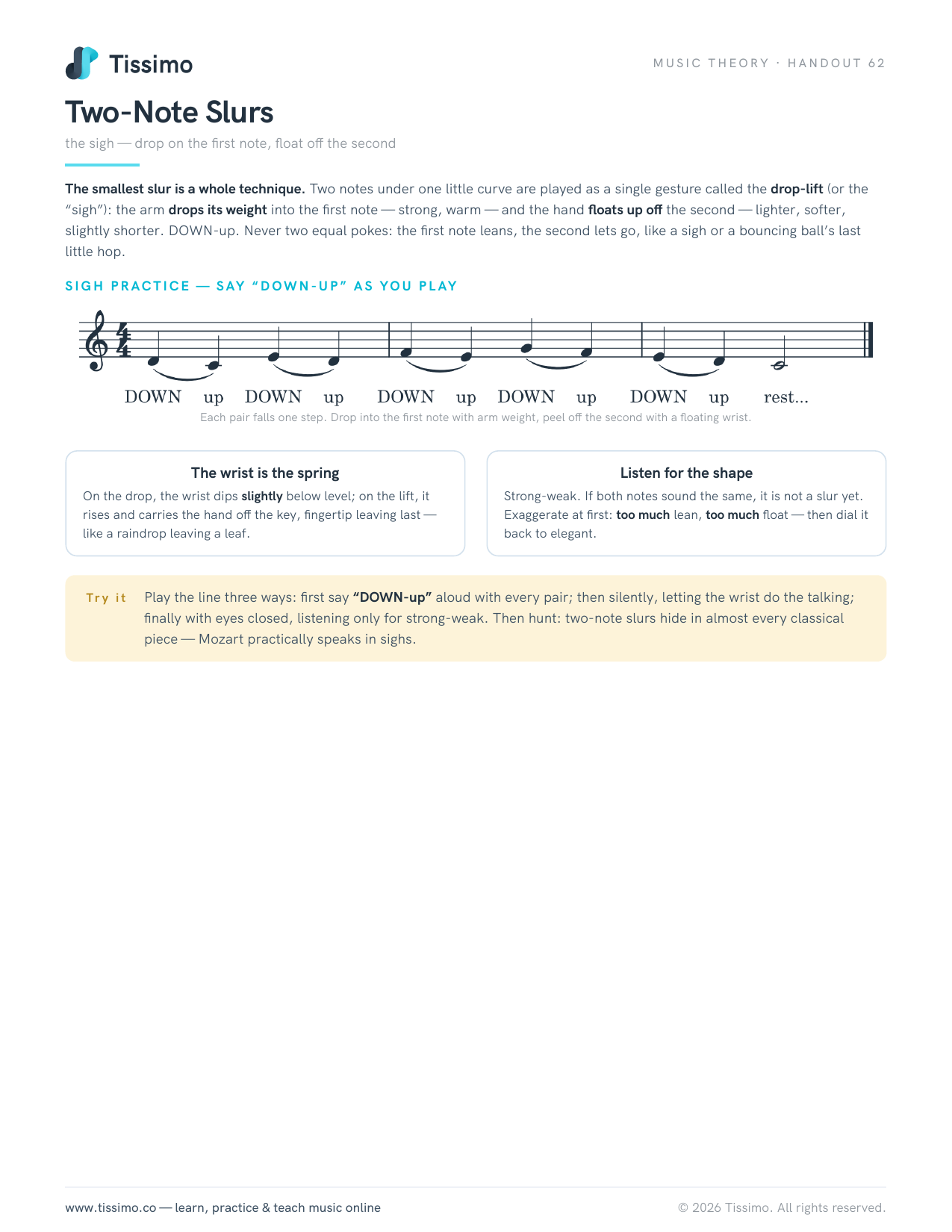
Las ligaduras de dos notas
el suspiro — cae en la primera nota, se aleja suavemente en la segunda
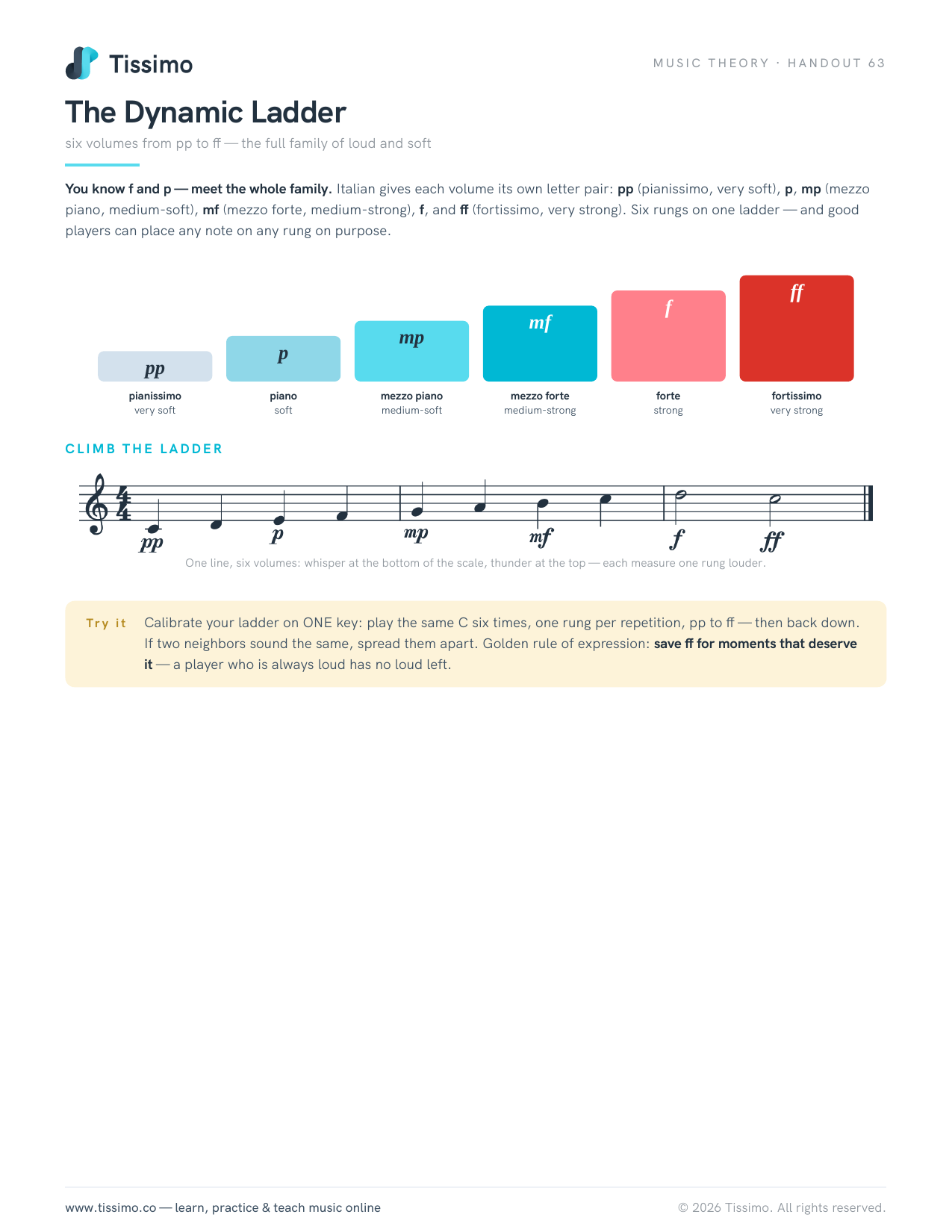
La escalera de dinámicas
seis volúmenes de pp a ff — toda la familia de lo fuerte y lo suave
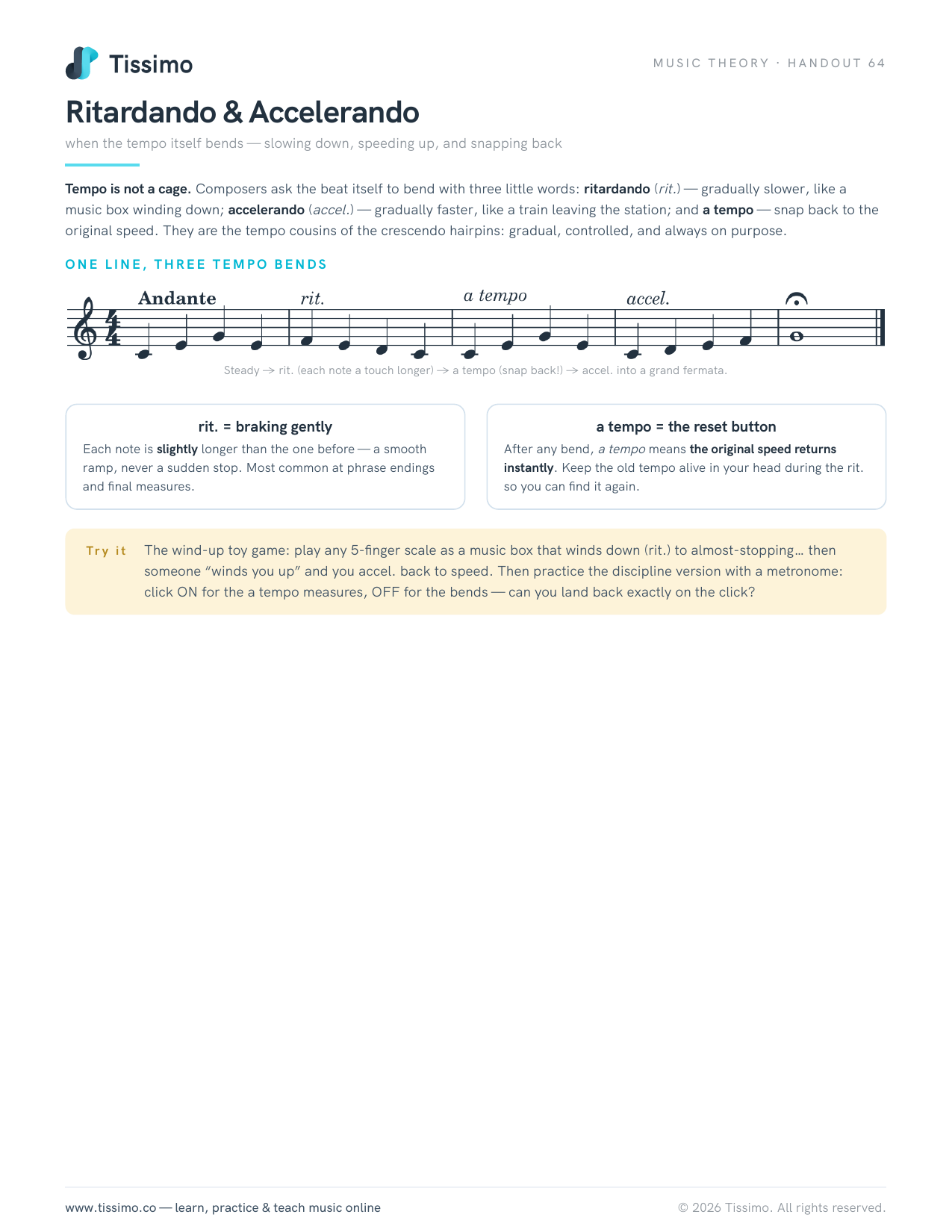
Ritardando y accelerando
cuando el tempo mismo se dobla — desacelerar, acelerar, y volver de golpe
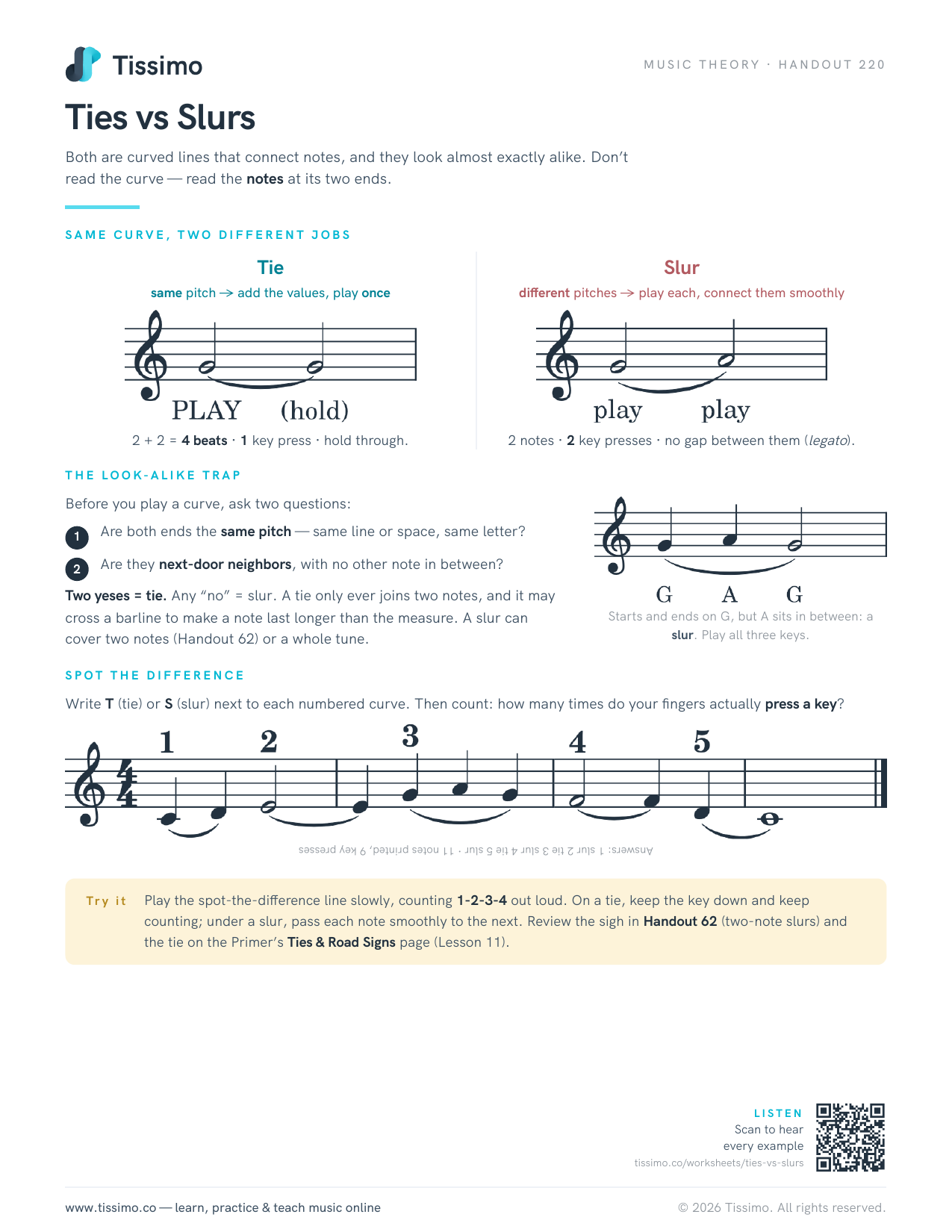
Ties vs Slurs
Both are curved lines that connect notes, and they look almost exactly alike. Don’t read the curve — read the notes at its two ends.
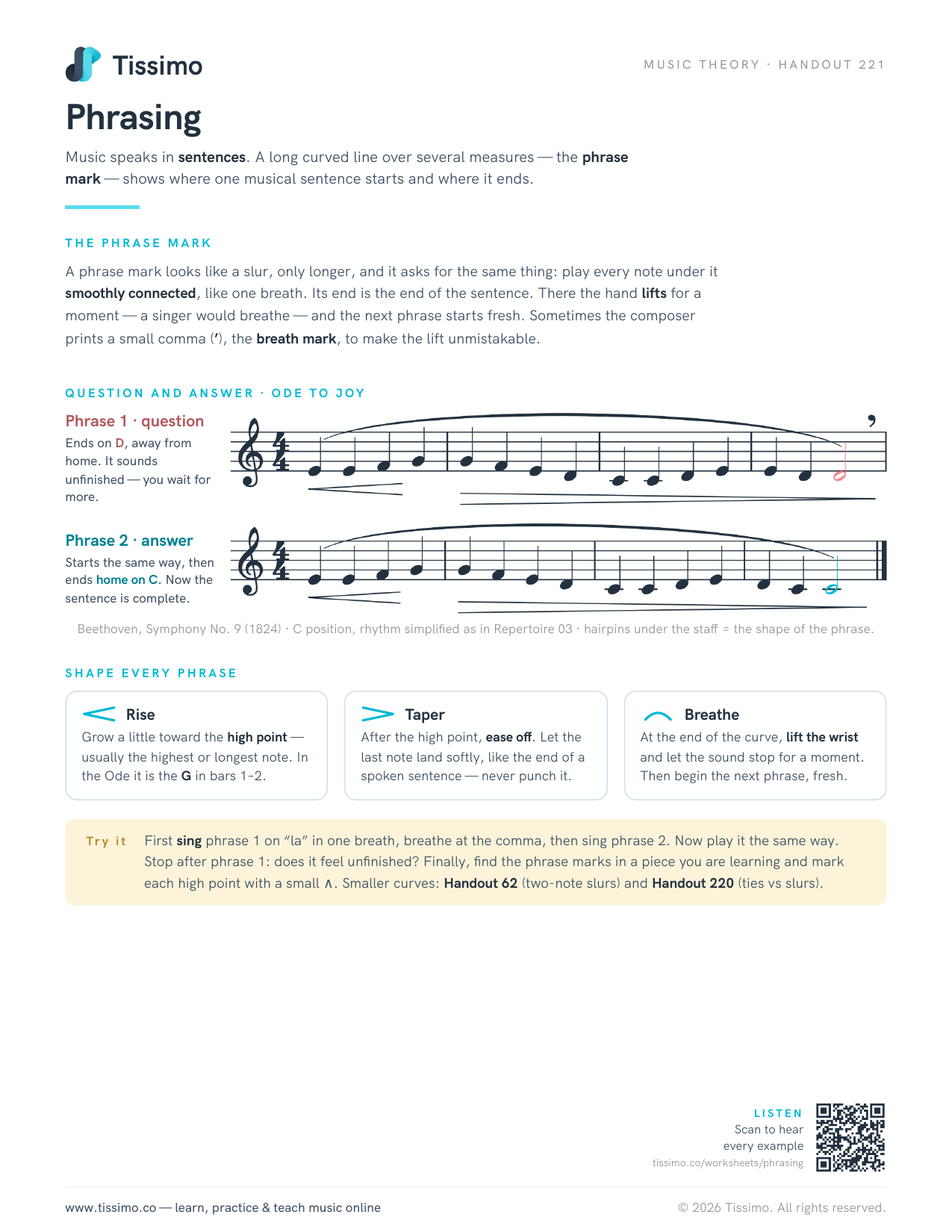
Phrasing
Music speaks in sentences. A long curved line over several measures — the phrase mark — shows where one musical sentence starts and where it ends.
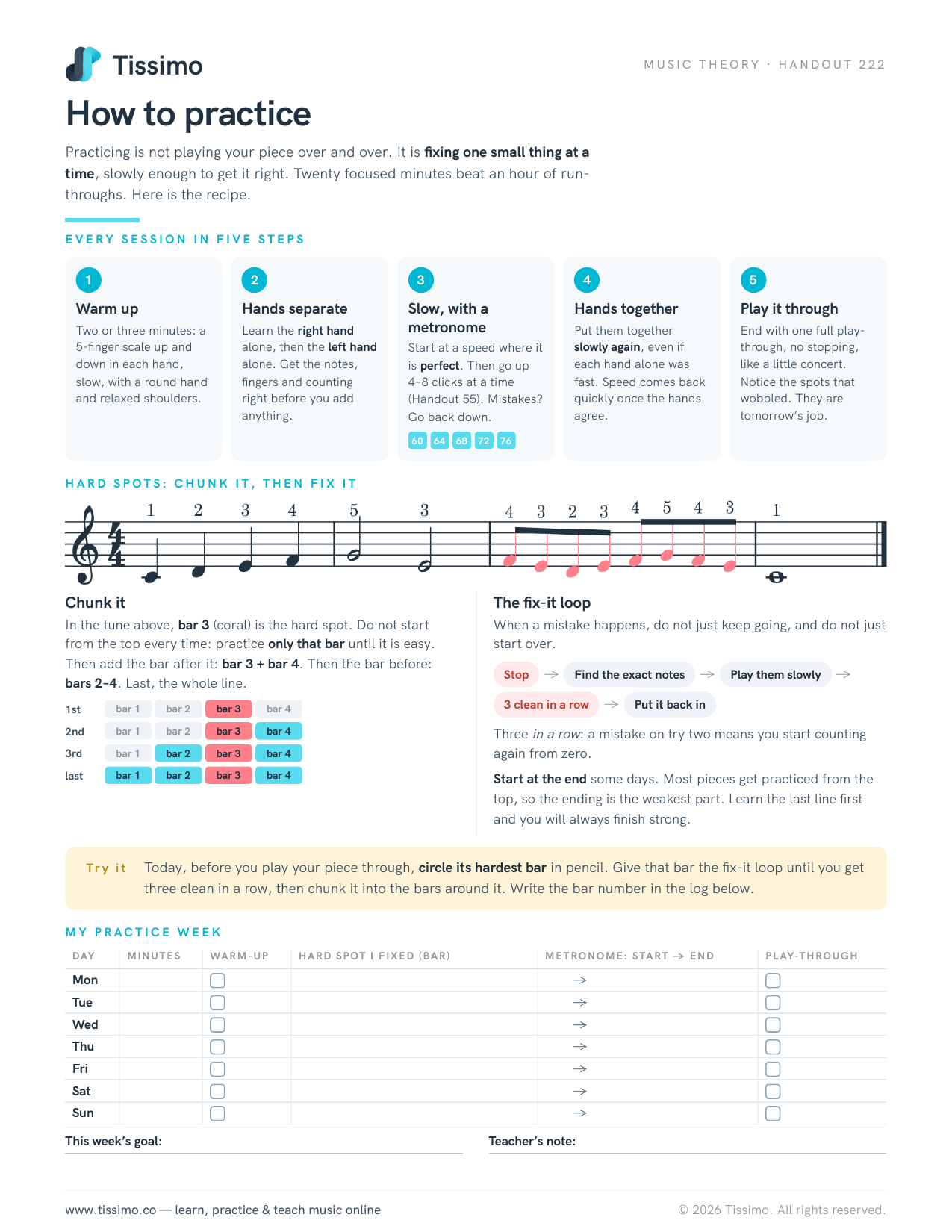
How to practice
Practicing is not playing your piece over and over. It is fixing one small thing at a time, slowly enough to get it right. Twenty focused minutes beat an hour of run-throughs. Here is the recipe.
Repertorio
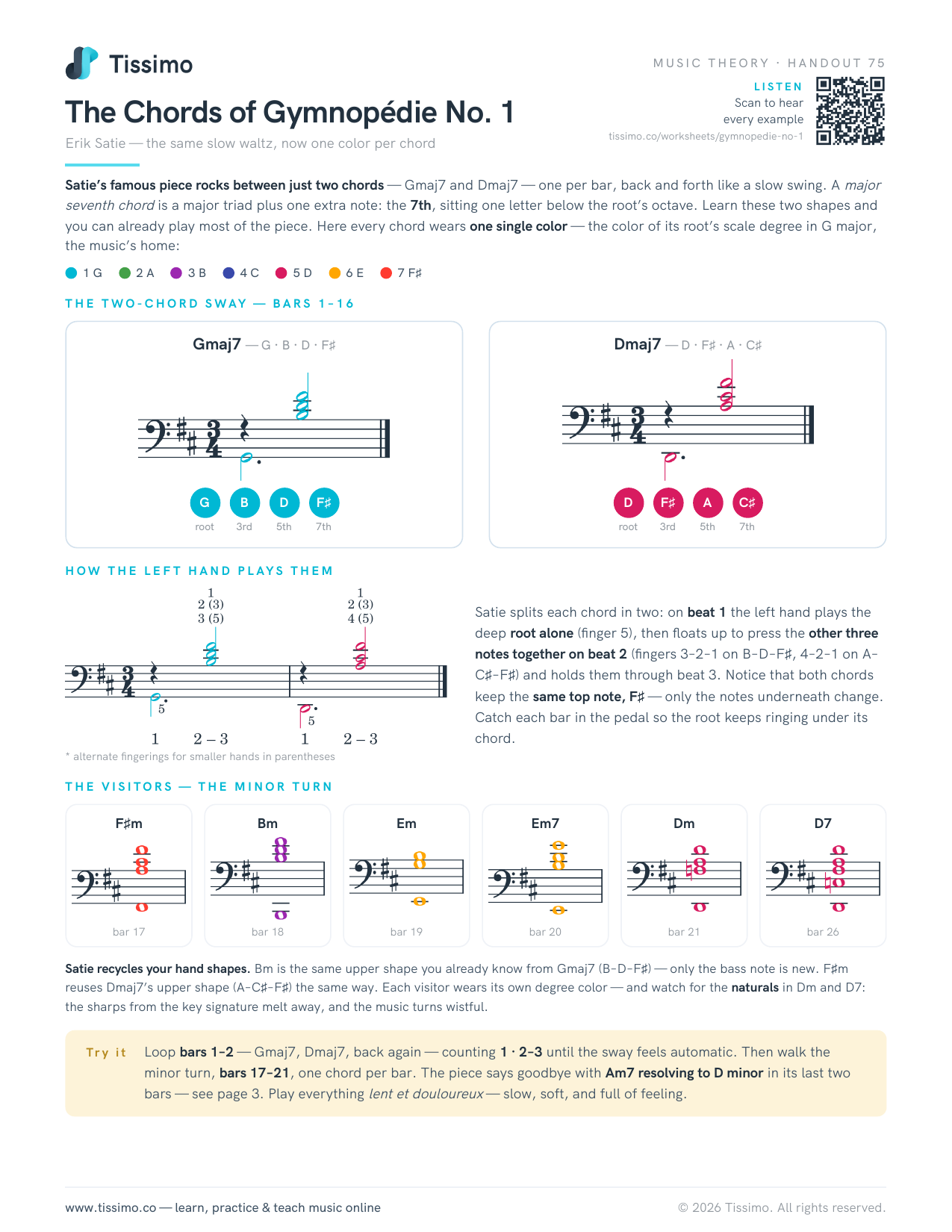
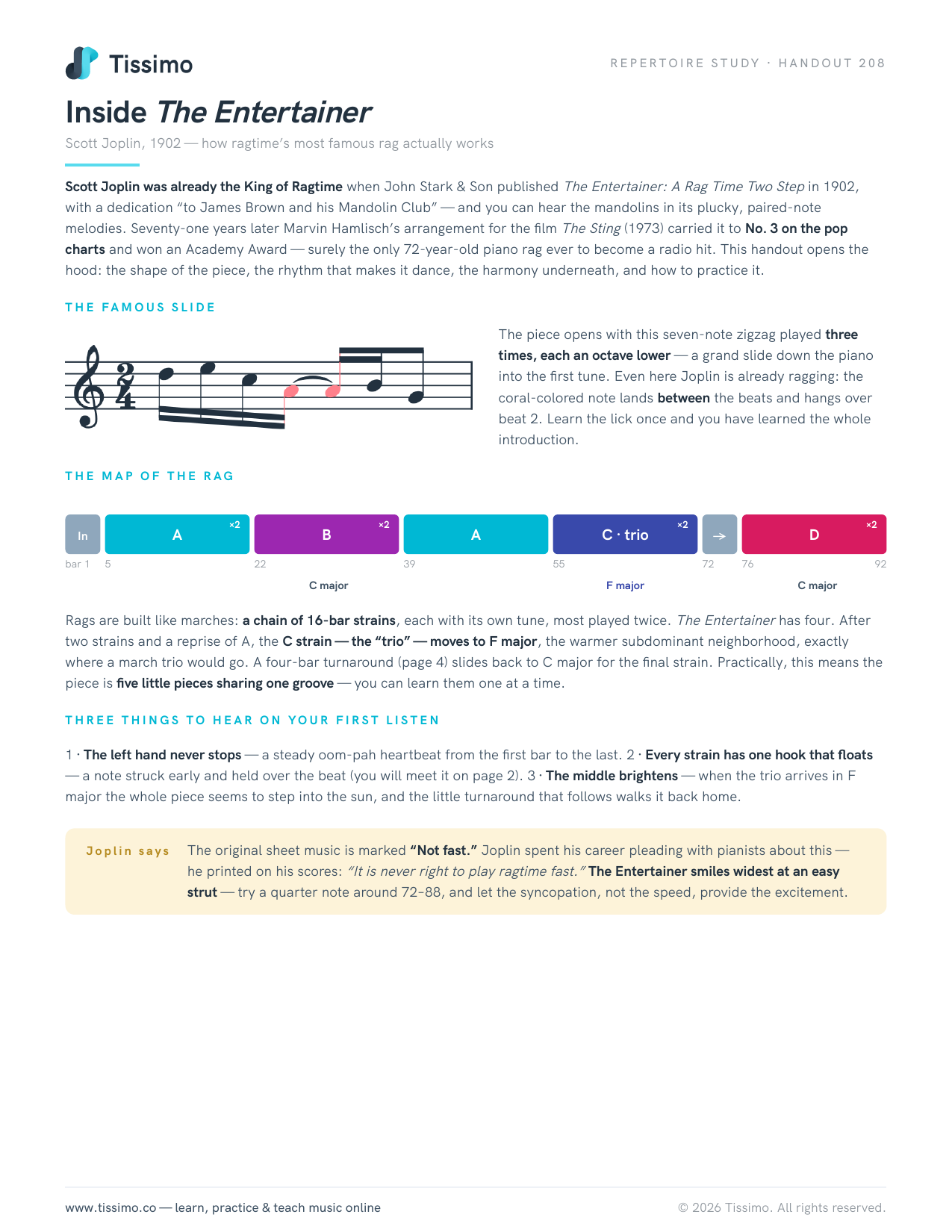
Exercises
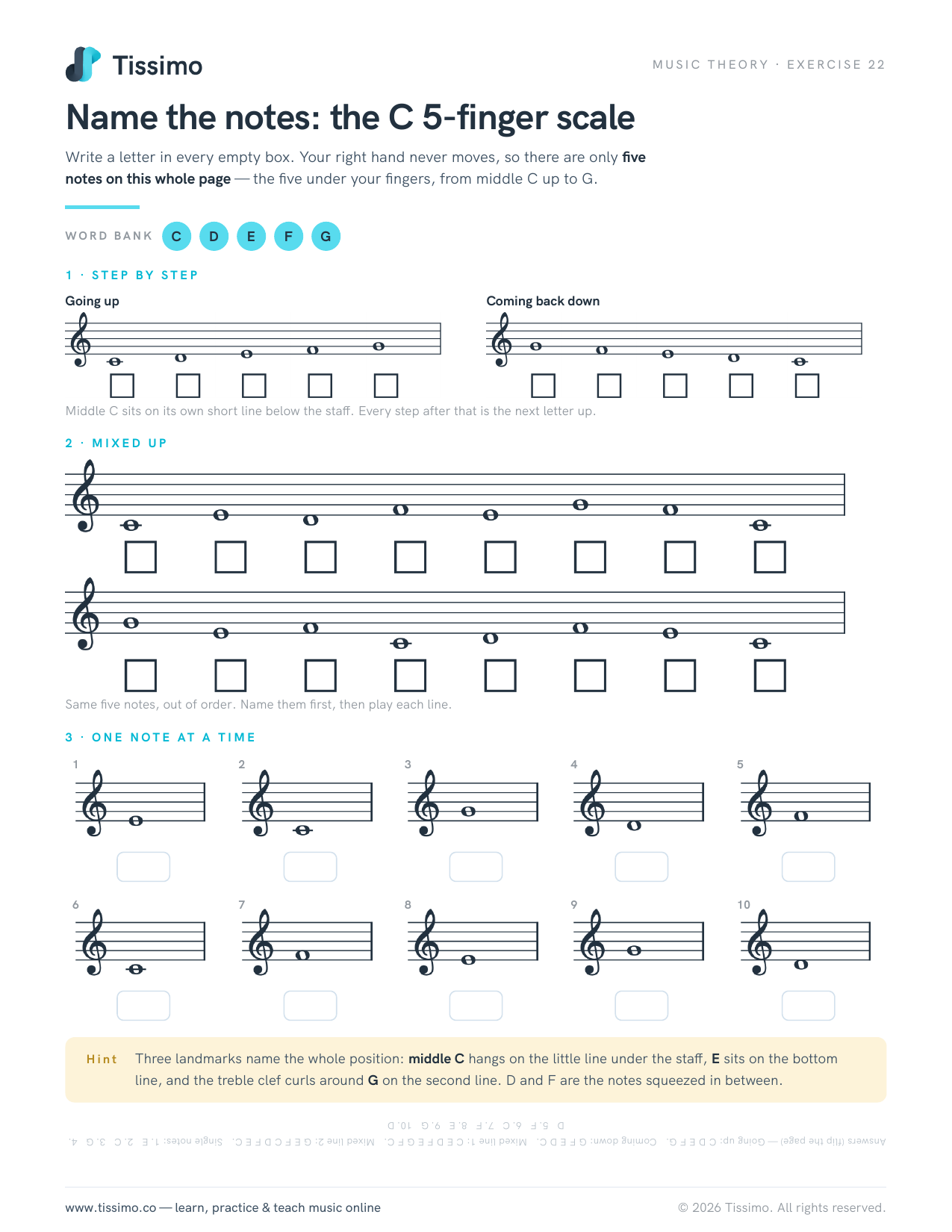
Name the notes: the C 5-finger scale
Write a letter in every empty box. Your right hand never moves, so there are only five notes on this whole page — the five under your fingers, from middle C up to G.
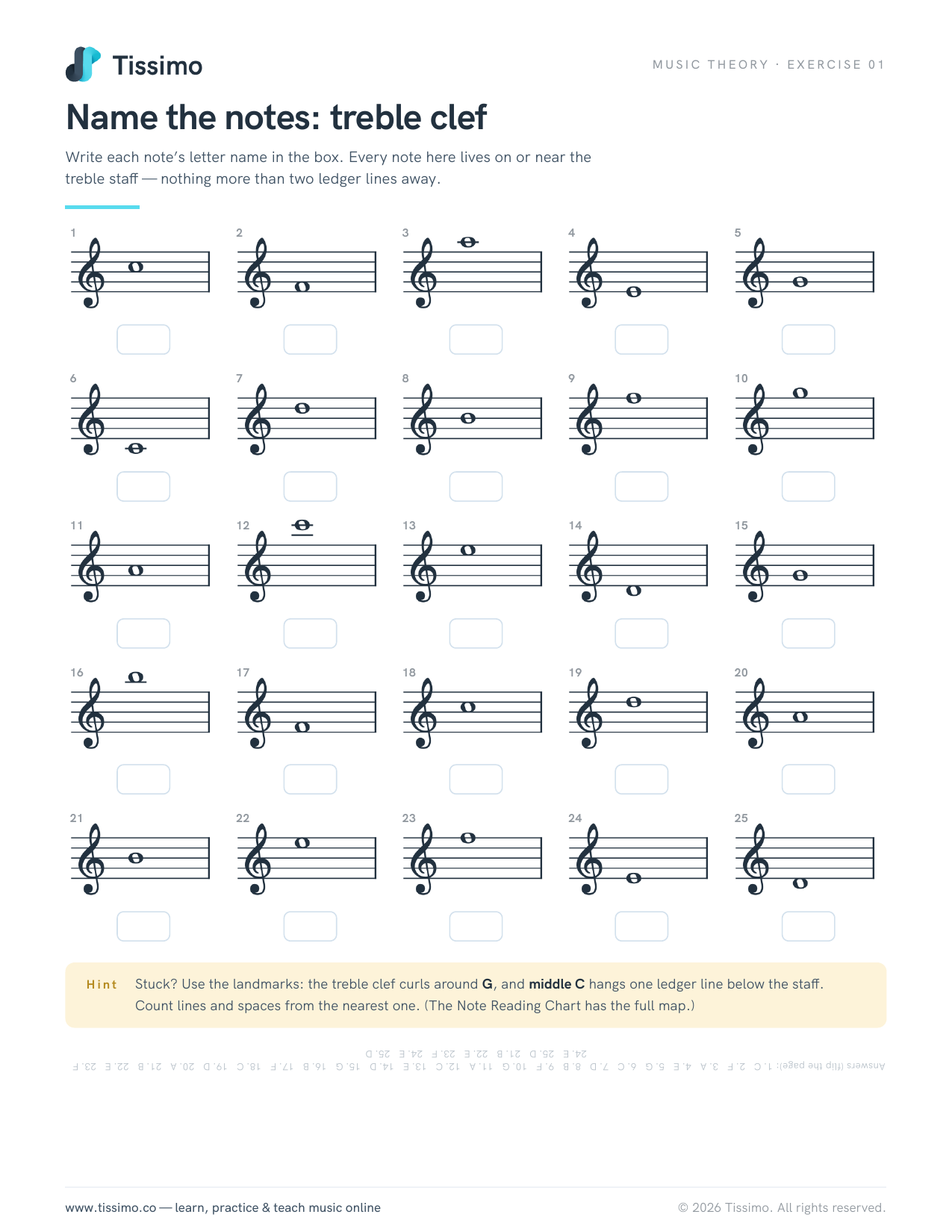
Name the notes: treble clef
Write each note’s letter name in the box. Every note here lives on or near the treble staff — nothing more than two ledger lines away.
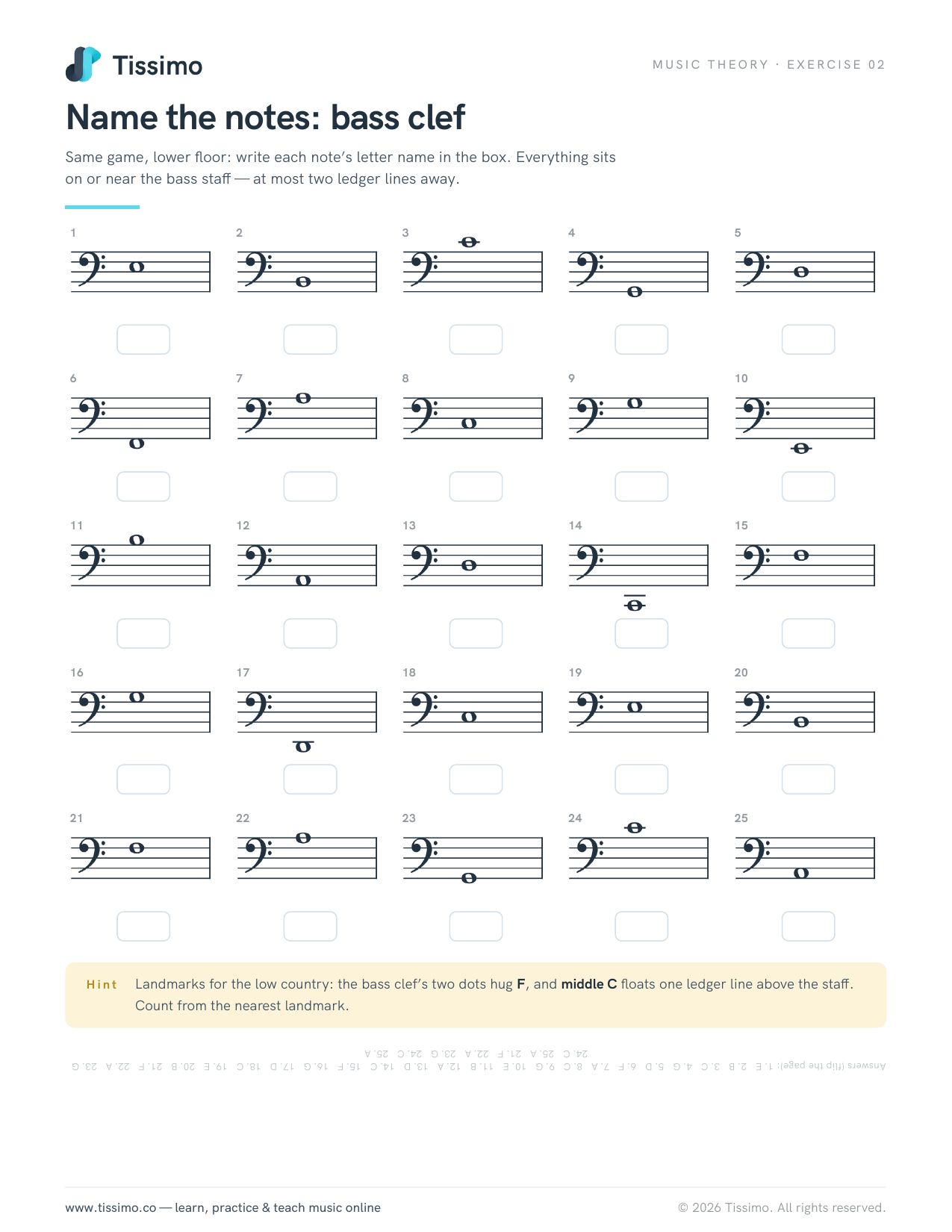
Name the notes: bass clef
Same game, lower floor: write each note’s letter name in the box. Everything sits on or near the bass staff — at most two ledger lines away.
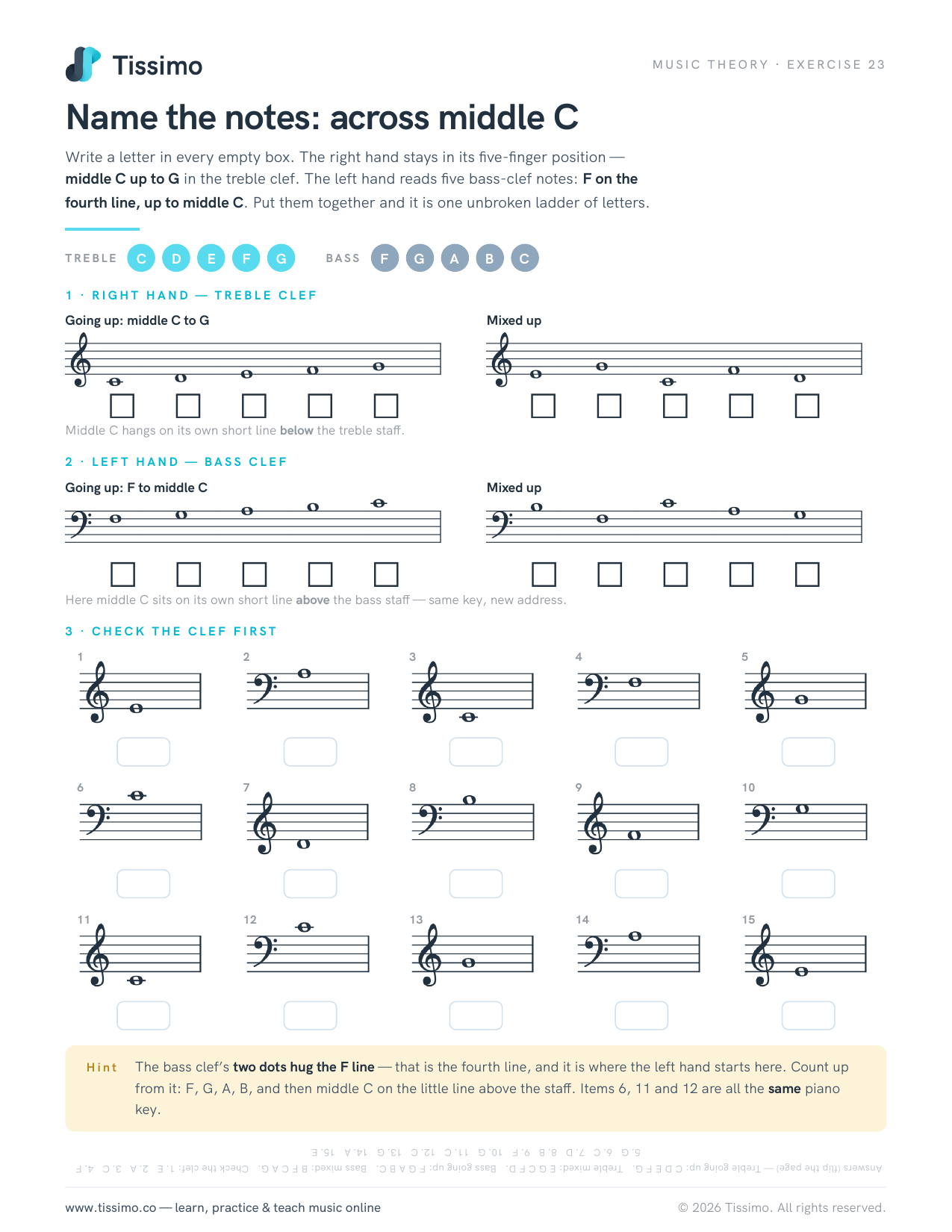
Name the notes: across middle C
Write a letter in every empty box. The right hand stays in its five-finger position — middle C up to G in the treble clef. The left hand reads five bass-clef notes: F on the fourth line, up to middle C. Put them together and it is one unbroken ladder of letters.
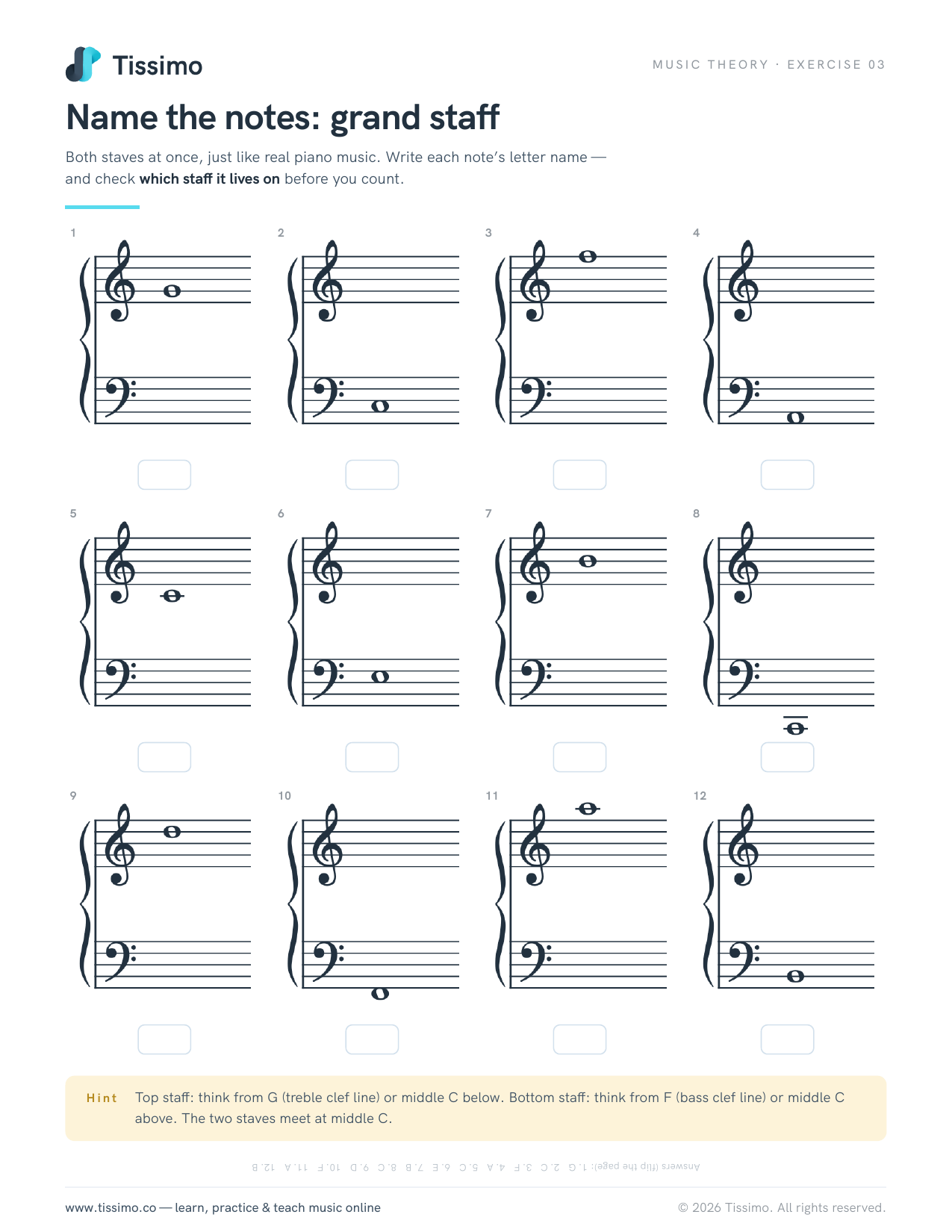
Name the notes: grand staff
Both staves at once, just like real piano music. Write each note’s letter name — and check which staff it lives on before you count.
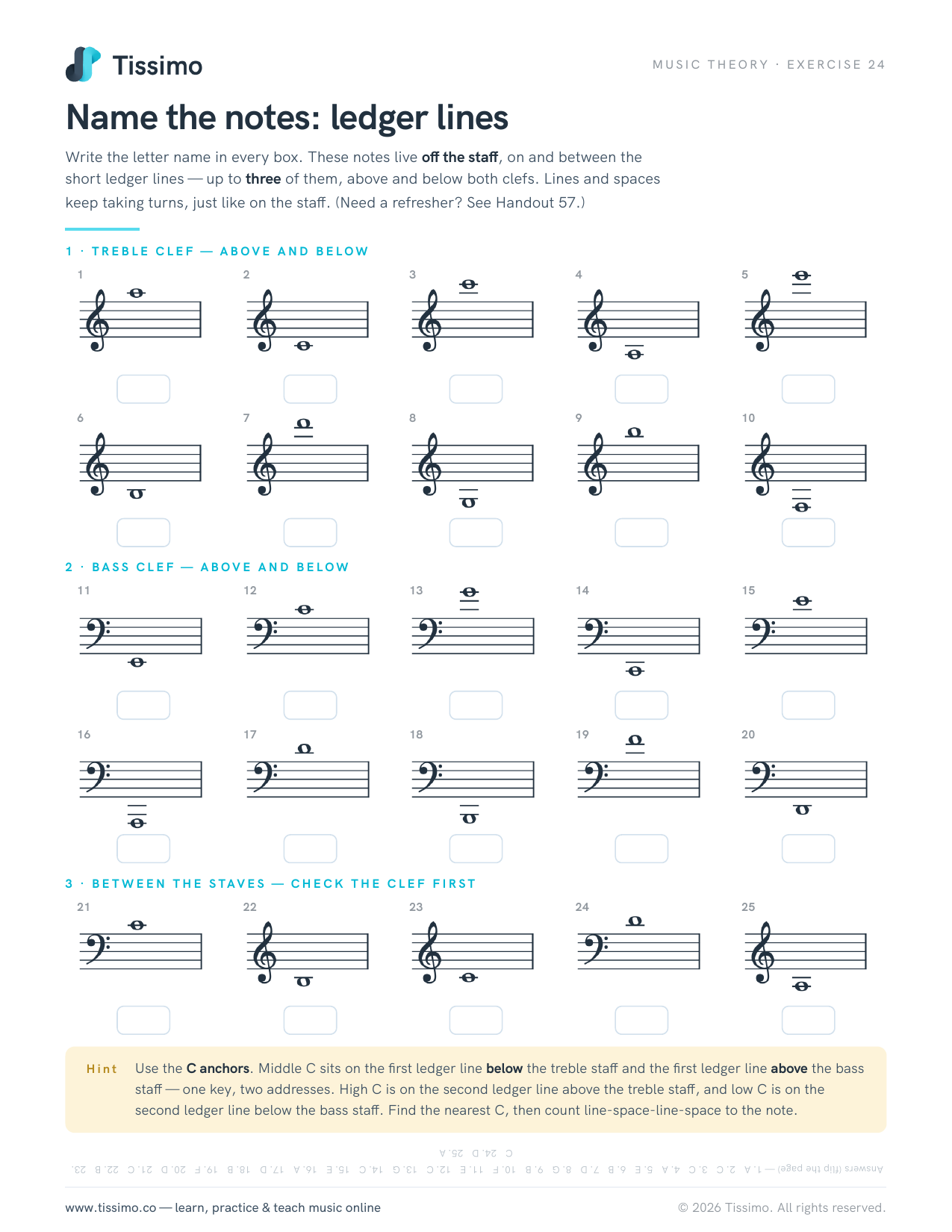
Name the notes: ledger lines
Write the letter name in every box. These notes live off the staff, on and between the short ledger lines — up to three of them, above and below both clefs. Lines and spaces keep taking turns, just like on the staff. (Need a refresher? See Handout 57.)
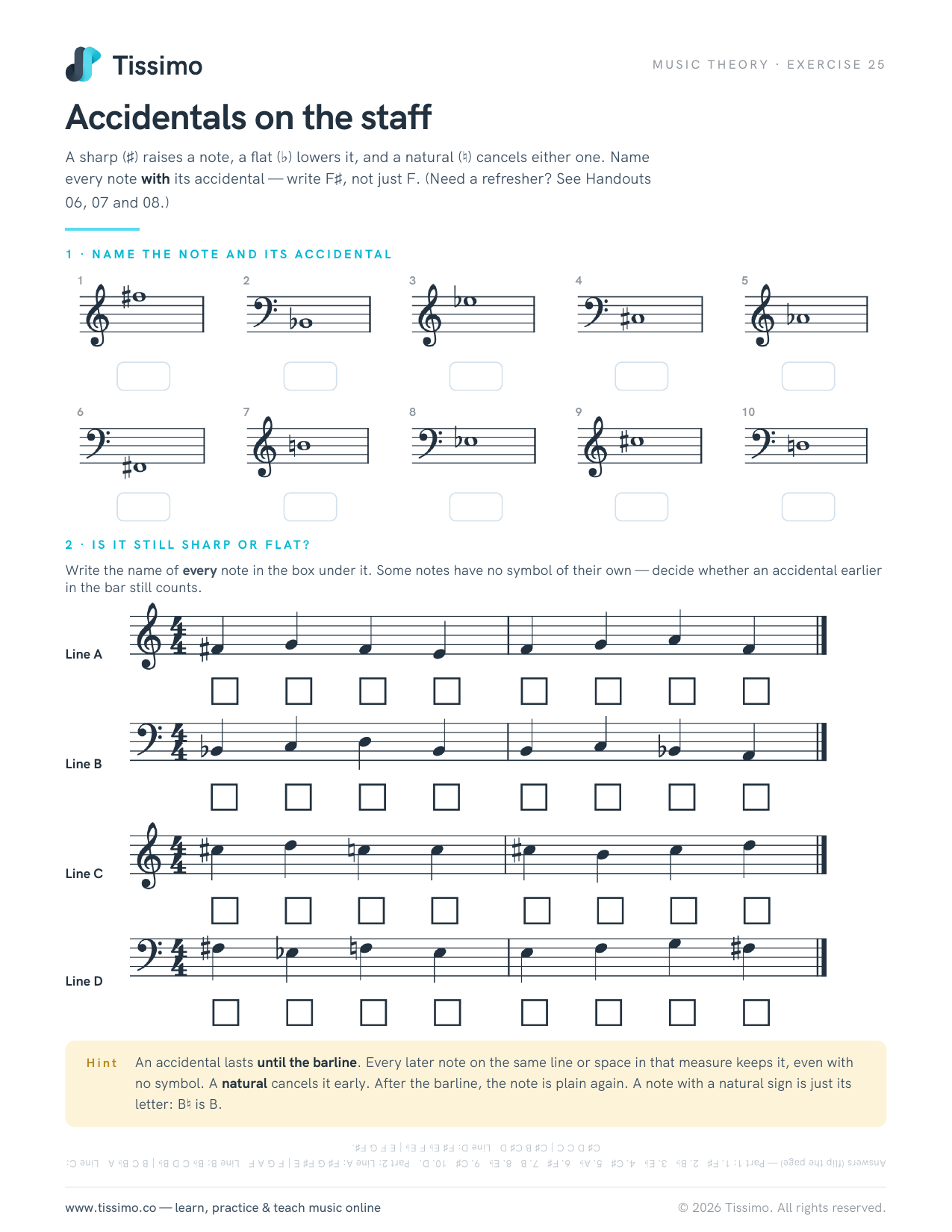
Accidentals on the staff
A sharp (♯) raises a note, a flat (♭) lowers it, and a natural (♮) cancels either one. Name every note with its accidental — write F♯, not just F. (Need a refresher? See Handouts 06, 07 and 08.)
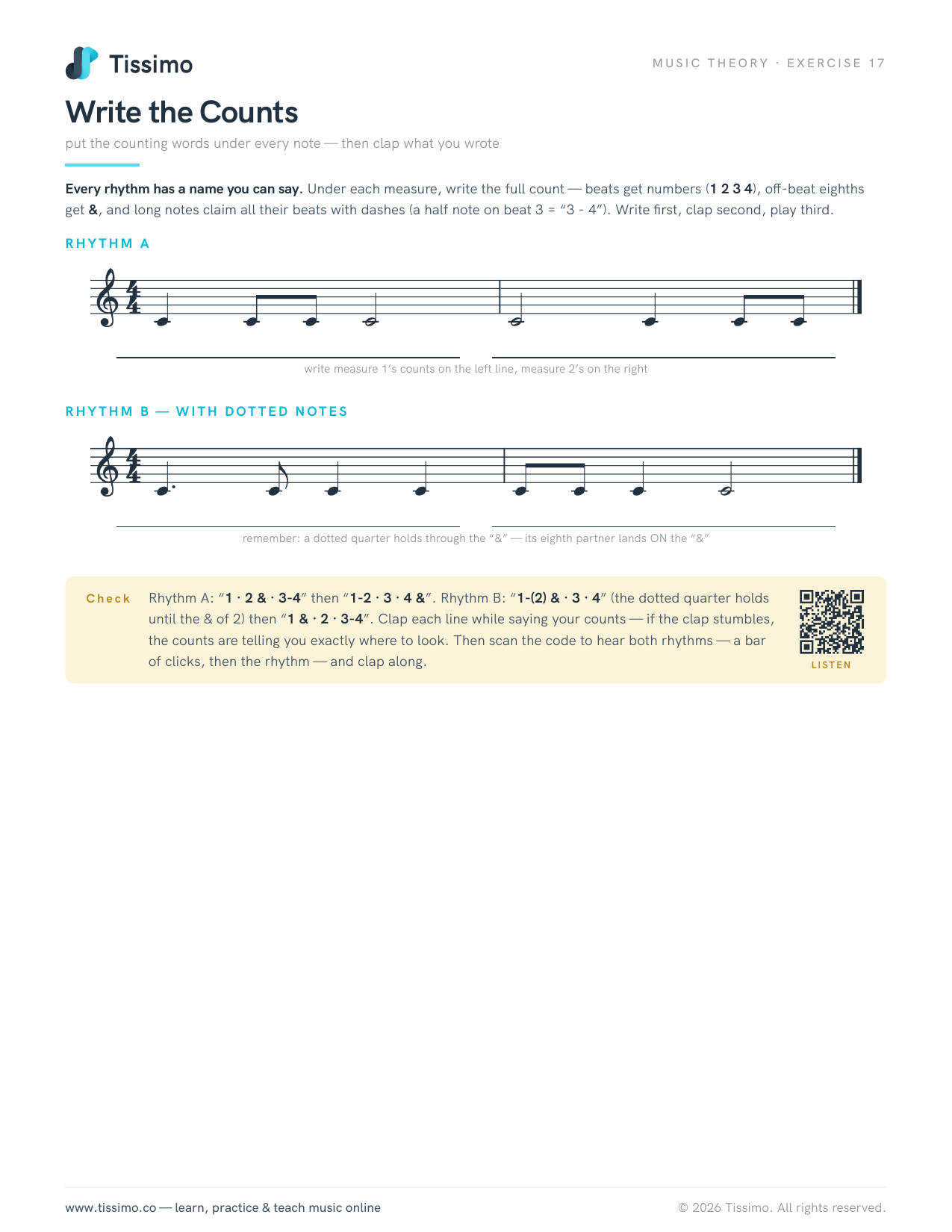
Write the Counts
put the counting words under every note — then clap what you wrote
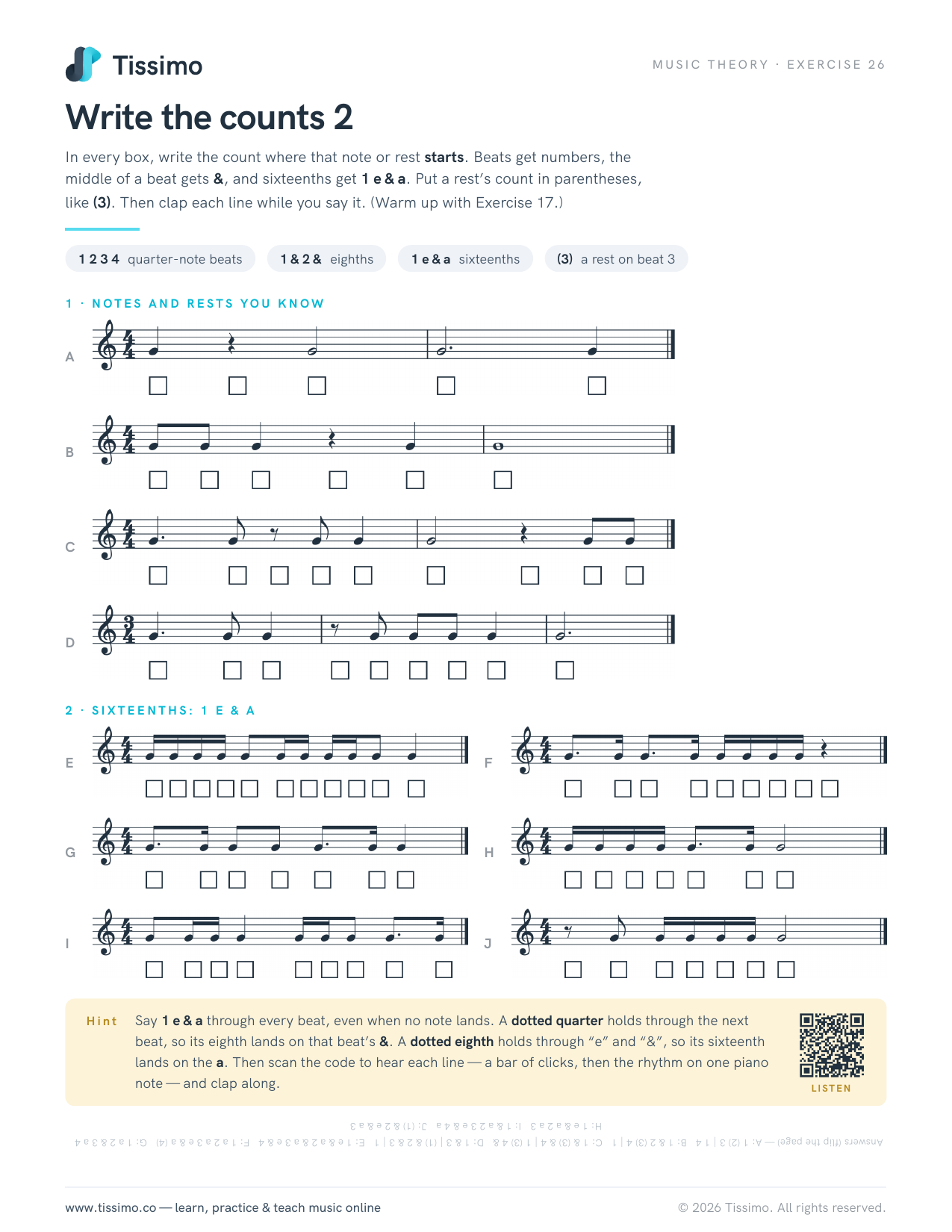
Write the counts 2
In every box, write the count where that note or rest starts. Beats get numbers, the middle of a beat gets &, and sixteenths get 1 e & a. Put a rest’s count in parentheses, like (3). Then clap each line while you say it. (Warm up with Exercise 17.)
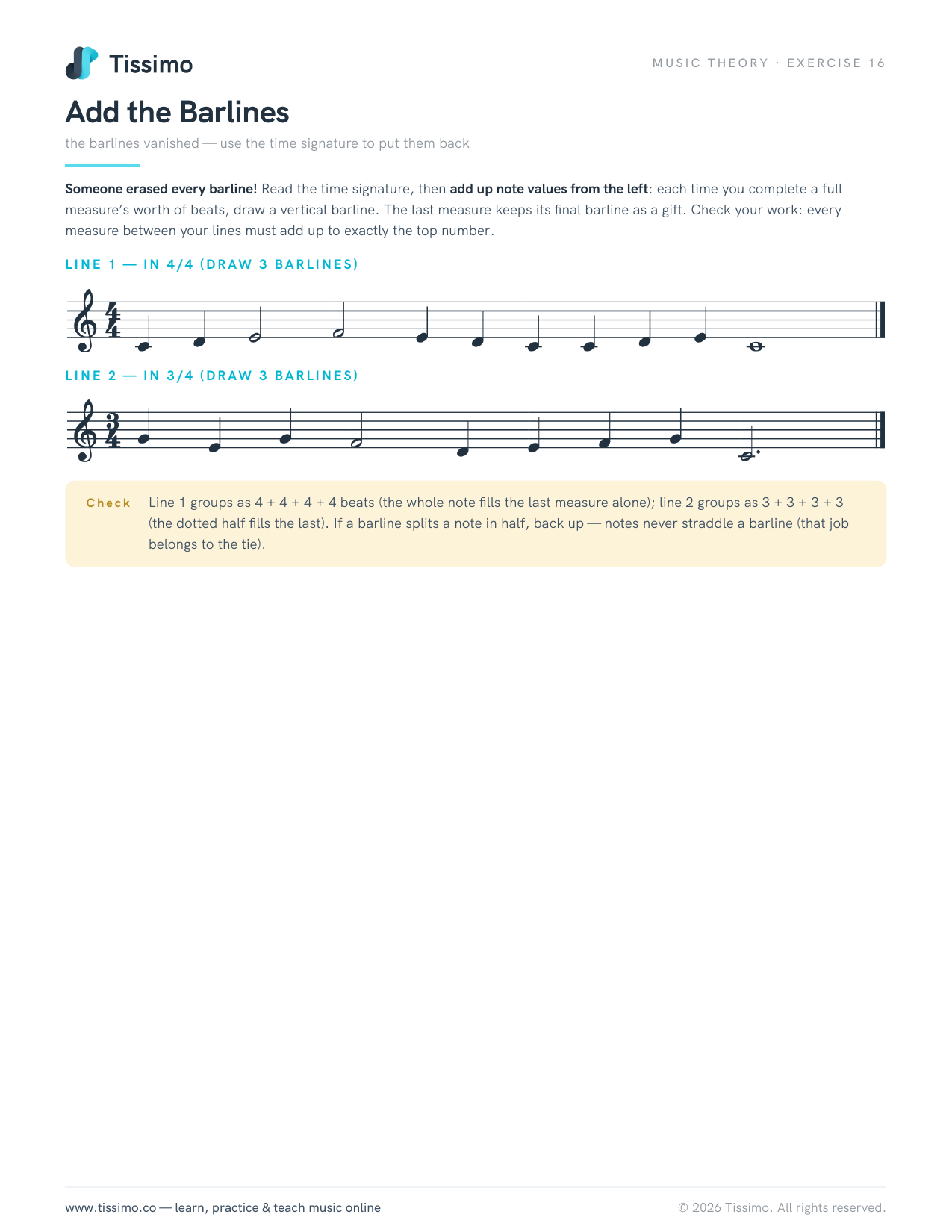
Add the Barlines
the barlines vanished — use the time signature to put them back
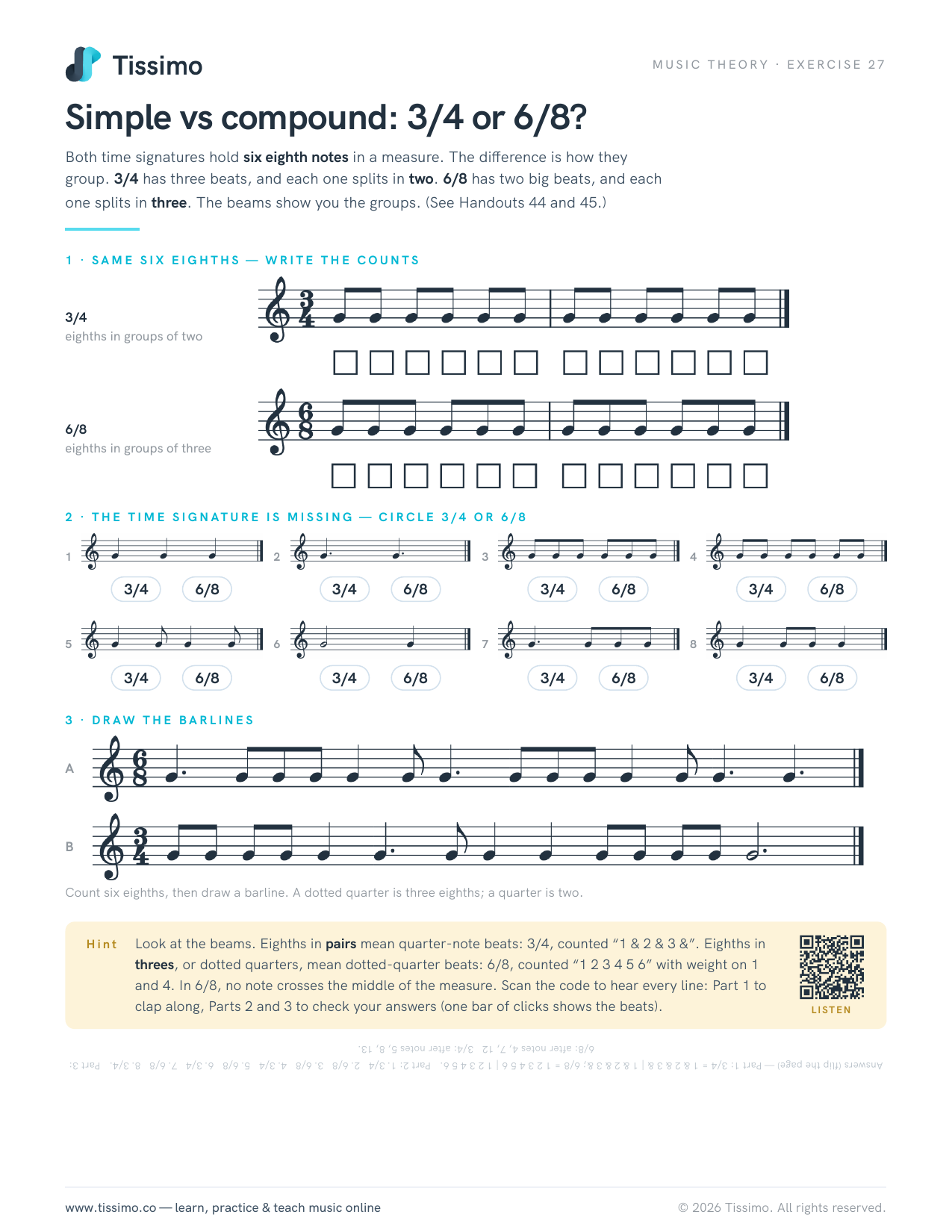
Simple vs compound: 3/4 or 6/8?
Both time signatures hold six eighth notes in a measure. The difference is how they group. 3/4 has three beats, and each one splits in two. 6/8 has two big beats, and each one splits in three. The beams show you the groups. (See Handouts 44 and 45.)
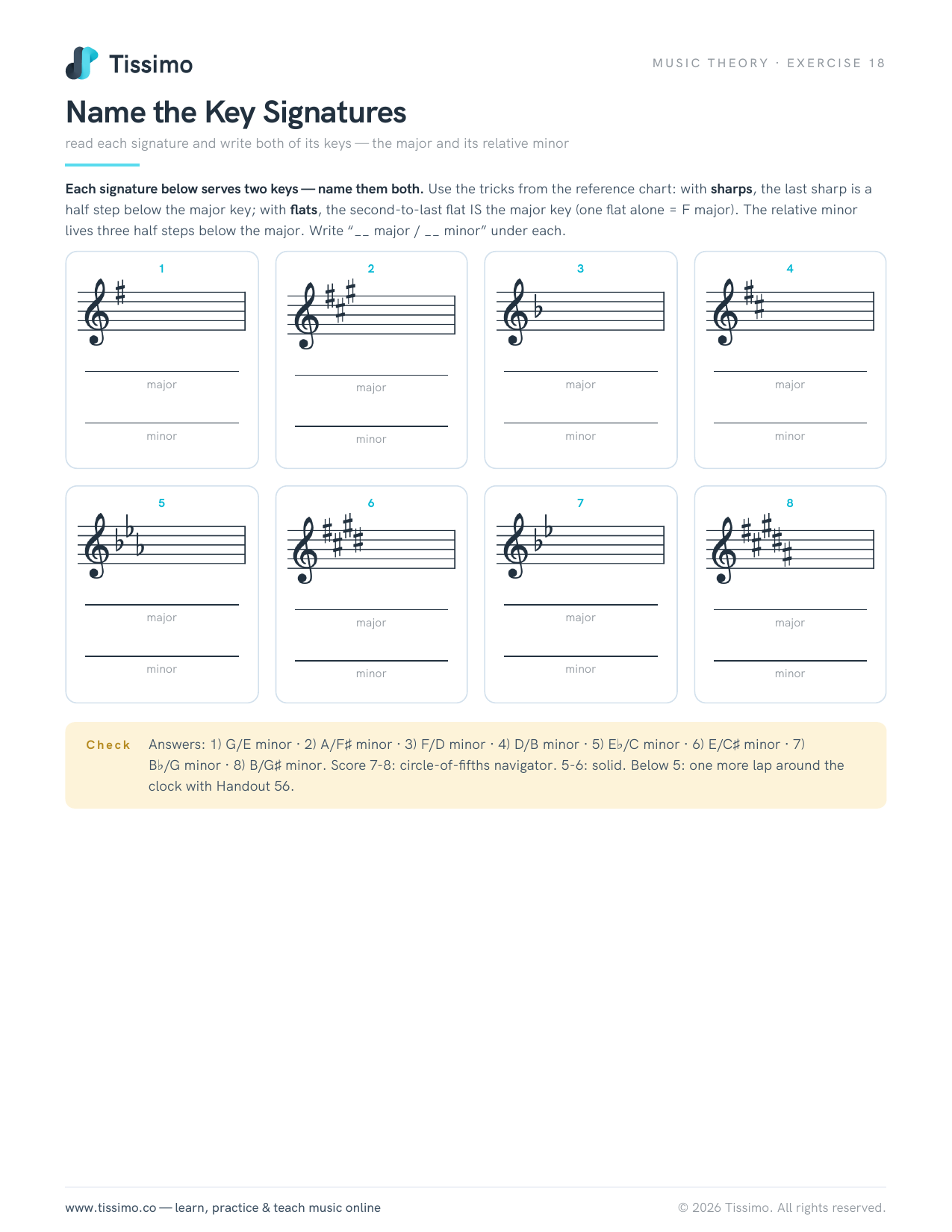
Name the Key Signatures
read each signature and write both of its keys — the major and its relative minor
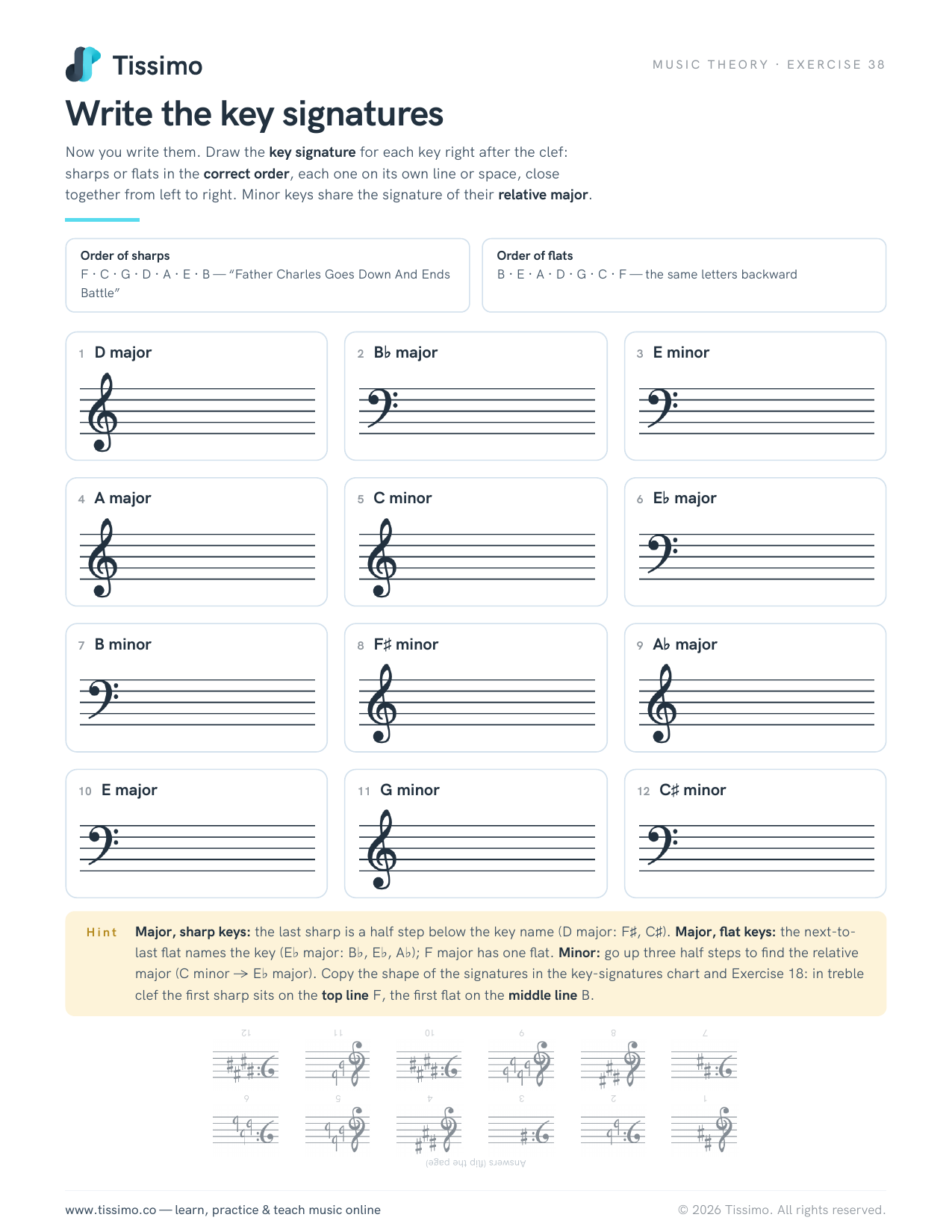
Write the key signatures
Now you write them. Draw the key signature for each key right after the clef: sharps or flats in the correct order, each one on its own line or space, close together from left to right. Minor keys share the signature of their relative major.
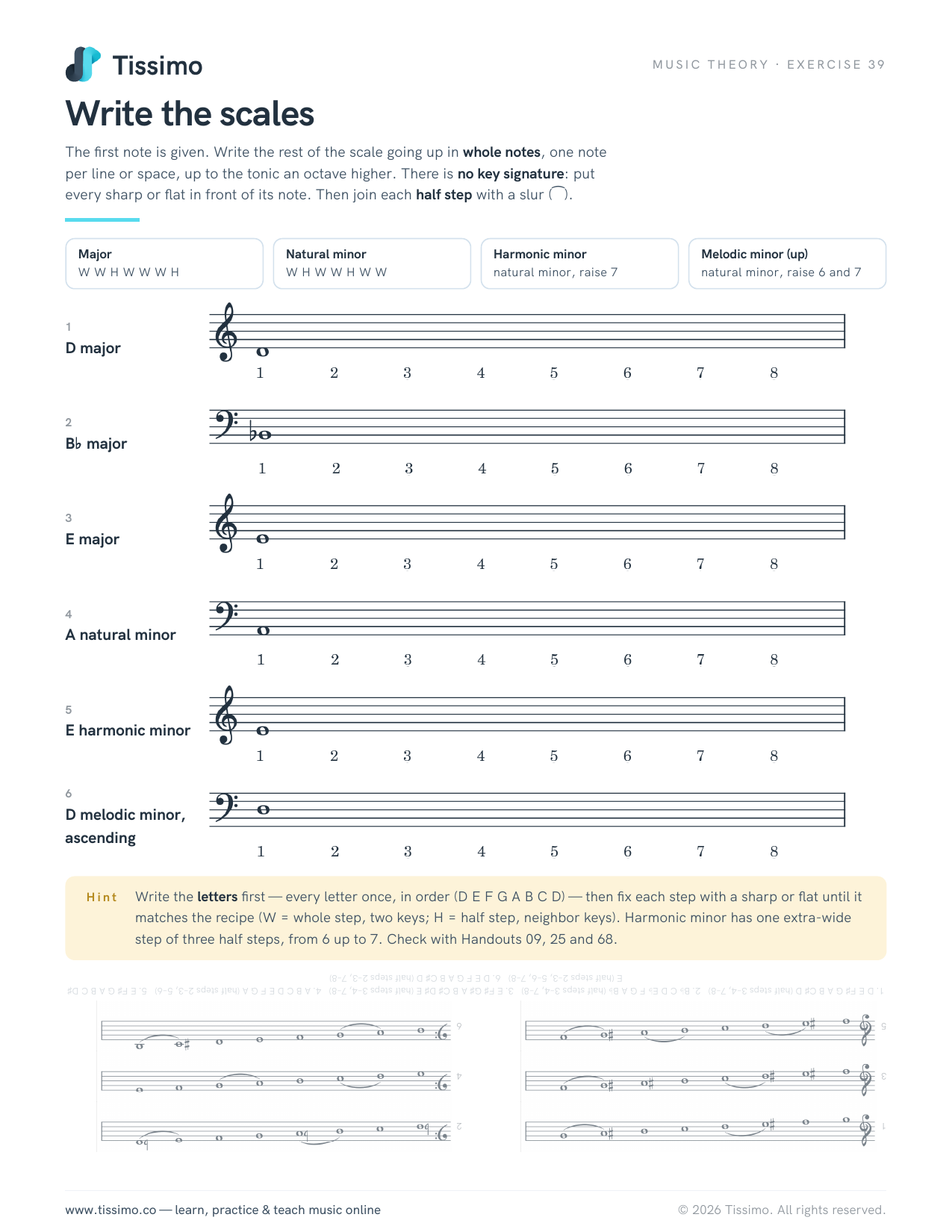
Write the scales
The first note is given. Write the rest of the scale going up in whole notes, one note per line or space, up to the tonic an octave higher. There is no key signature: put every sharp or flat in front of its note. Then join each half step with a slur (⁀).
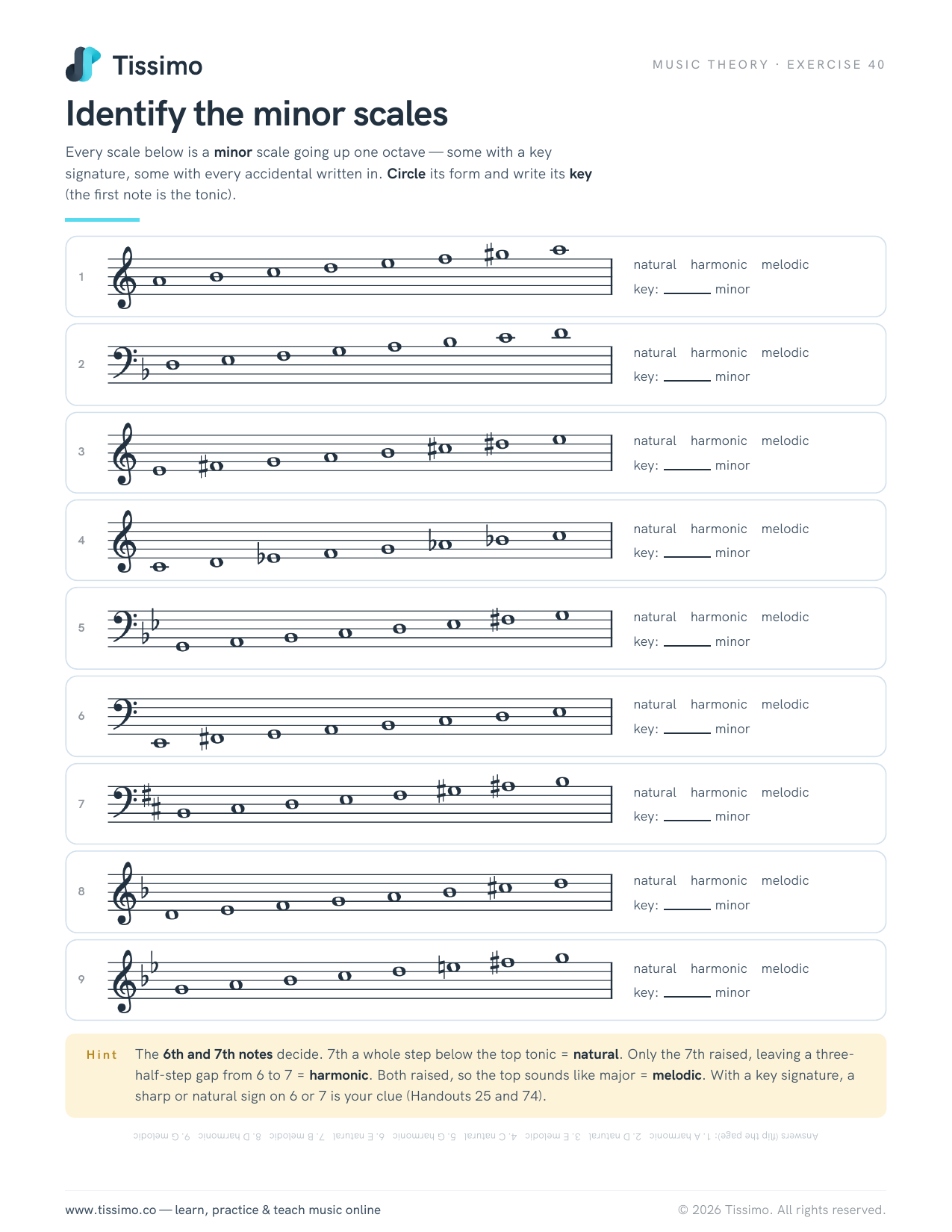
Identify the minor scales
Every scale below is a minor scale going up one octave — some with a key signature, some with every accidental written in. Circle its form and write its key (the first note is the tonic).
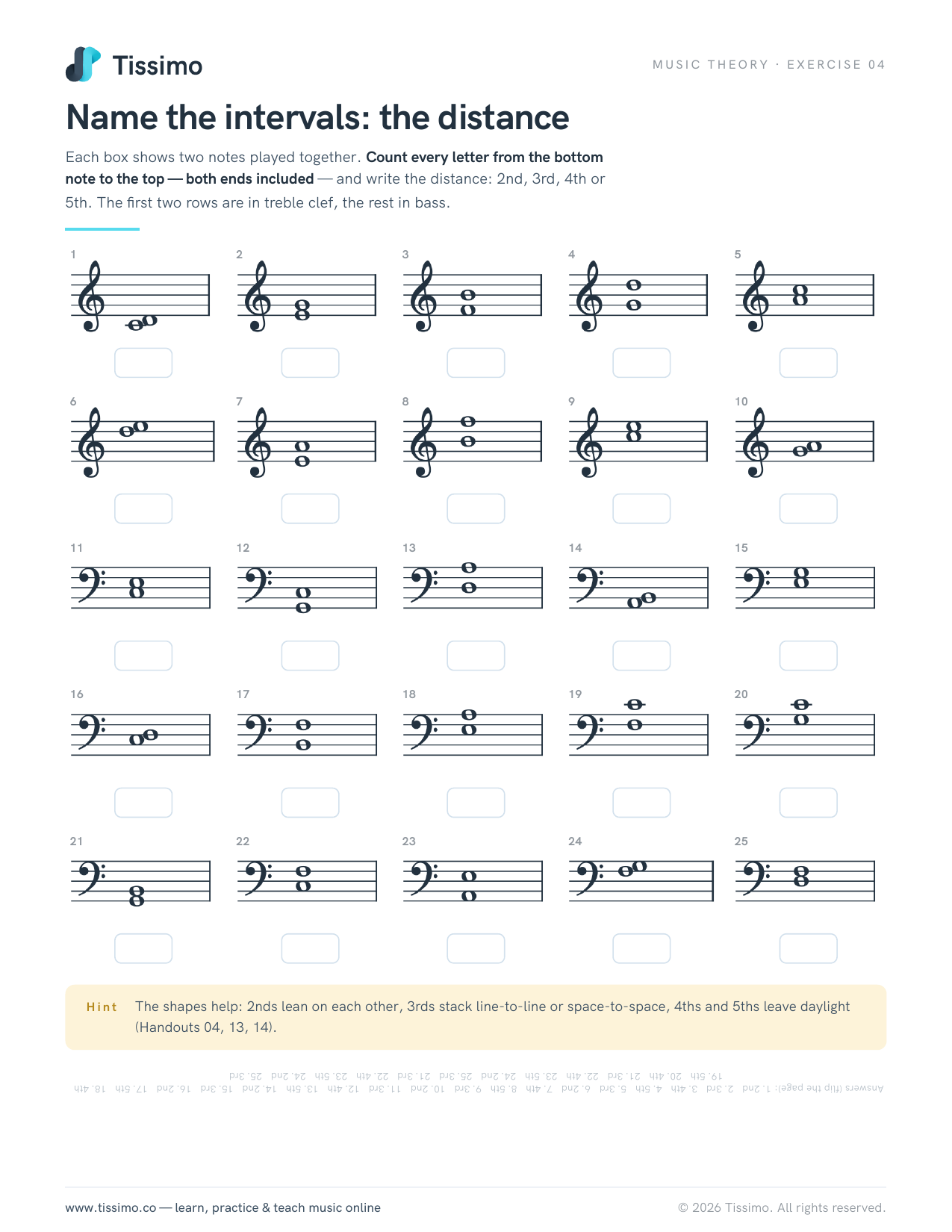
Name the intervals: the distance
Each box shows two notes played together. Count every letter from the bottom note to the top — both ends included — and write the distance: 2nd, 3rd, 4th or 5th. The first two rows are in treble clef, the rest in bass.
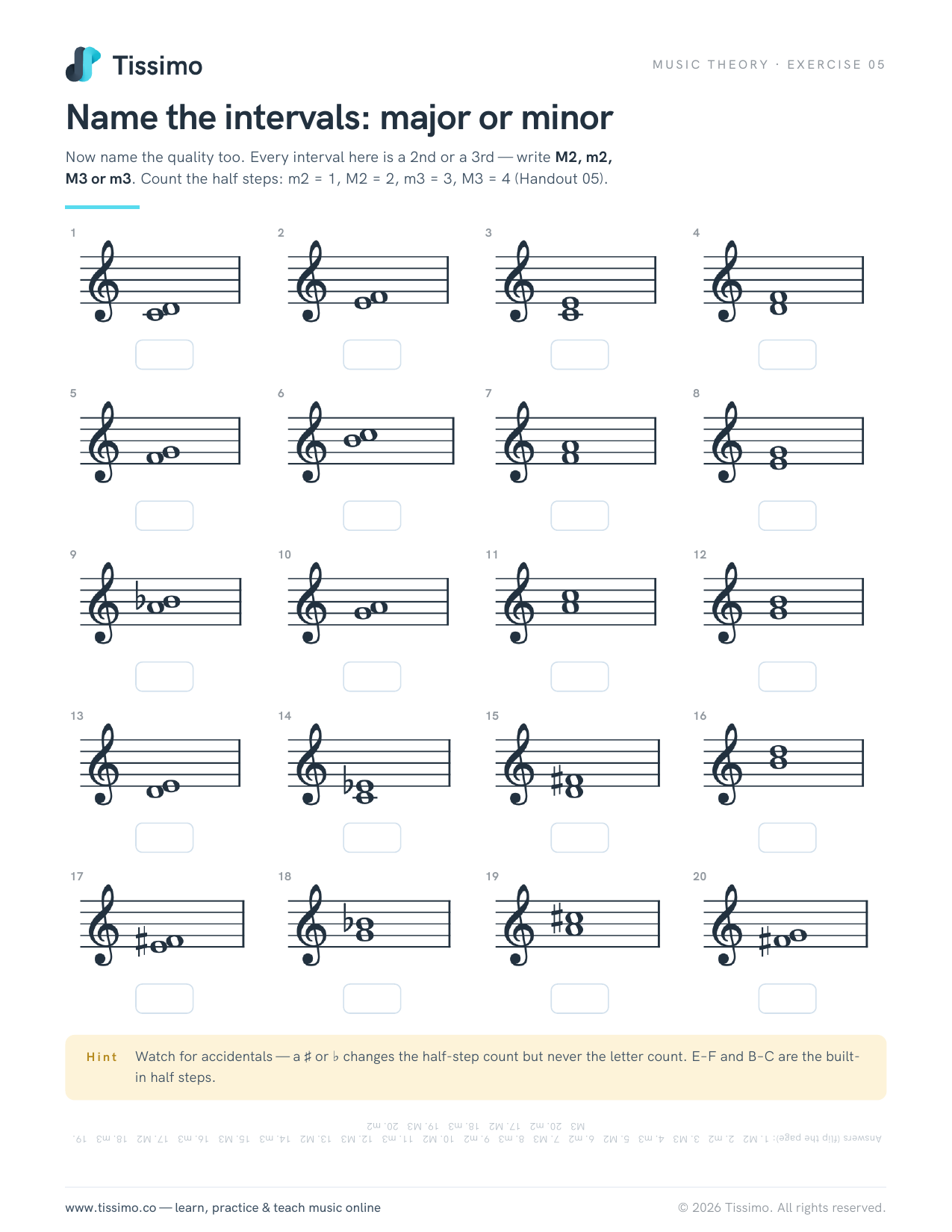
Name the intervals: major or minor
Now name the quality too. Every interval here is a 2nd or a 3rd — write M2, m2, M3 or m3. Count the half steps: m2 = 1, M2 = 2, m3 = 3, M3 = 4 (Handout 05).
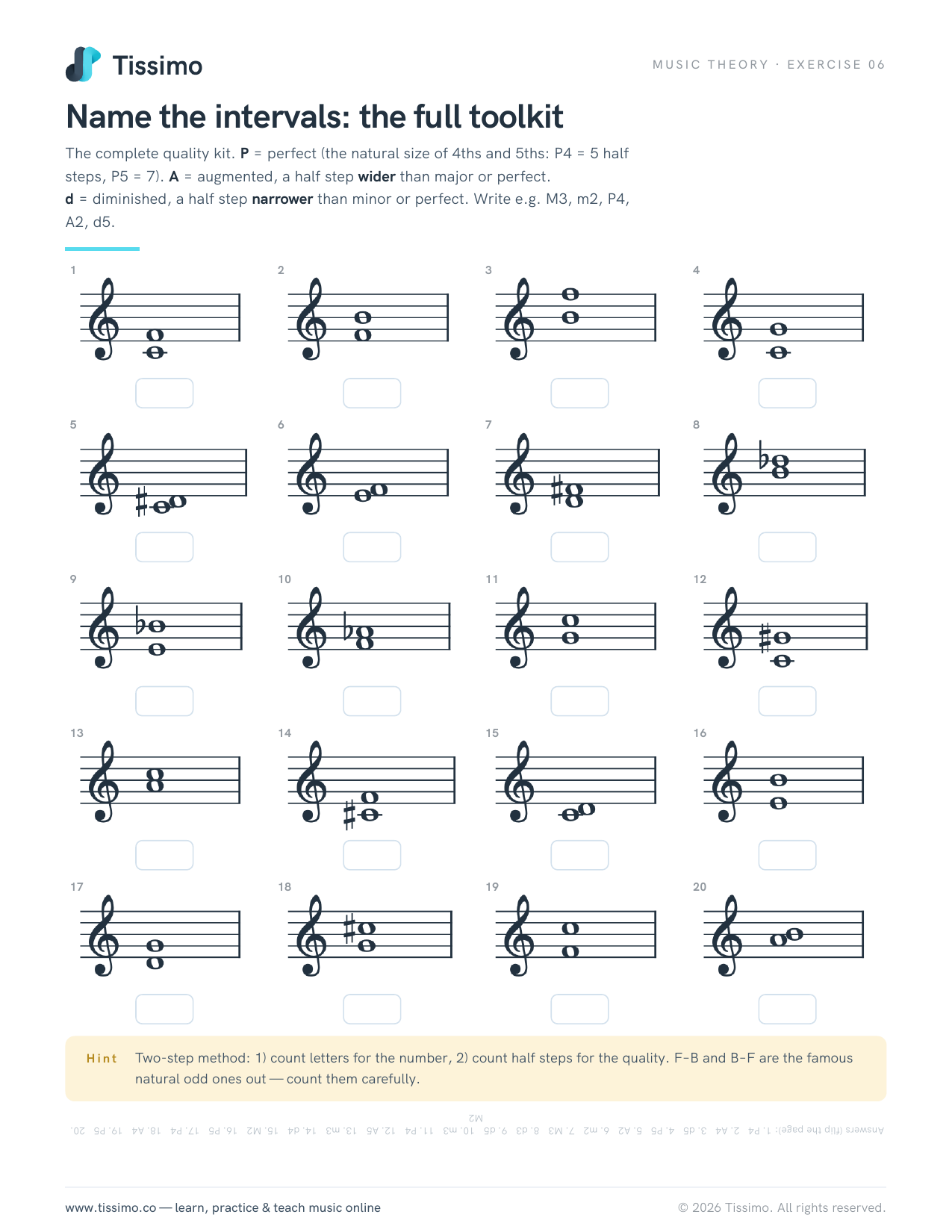
Name the intervals: the full toolkit
The complete quality kit. P = perfect (the natural size of 4ths and 5ths: P4 = 5 half steps, P5 = 7). A = augmented, a half step wider than major or perfect. d = diminished, a half step narrower than minor or perfect. Write e.g. M3, m2, P4, A2, d5.
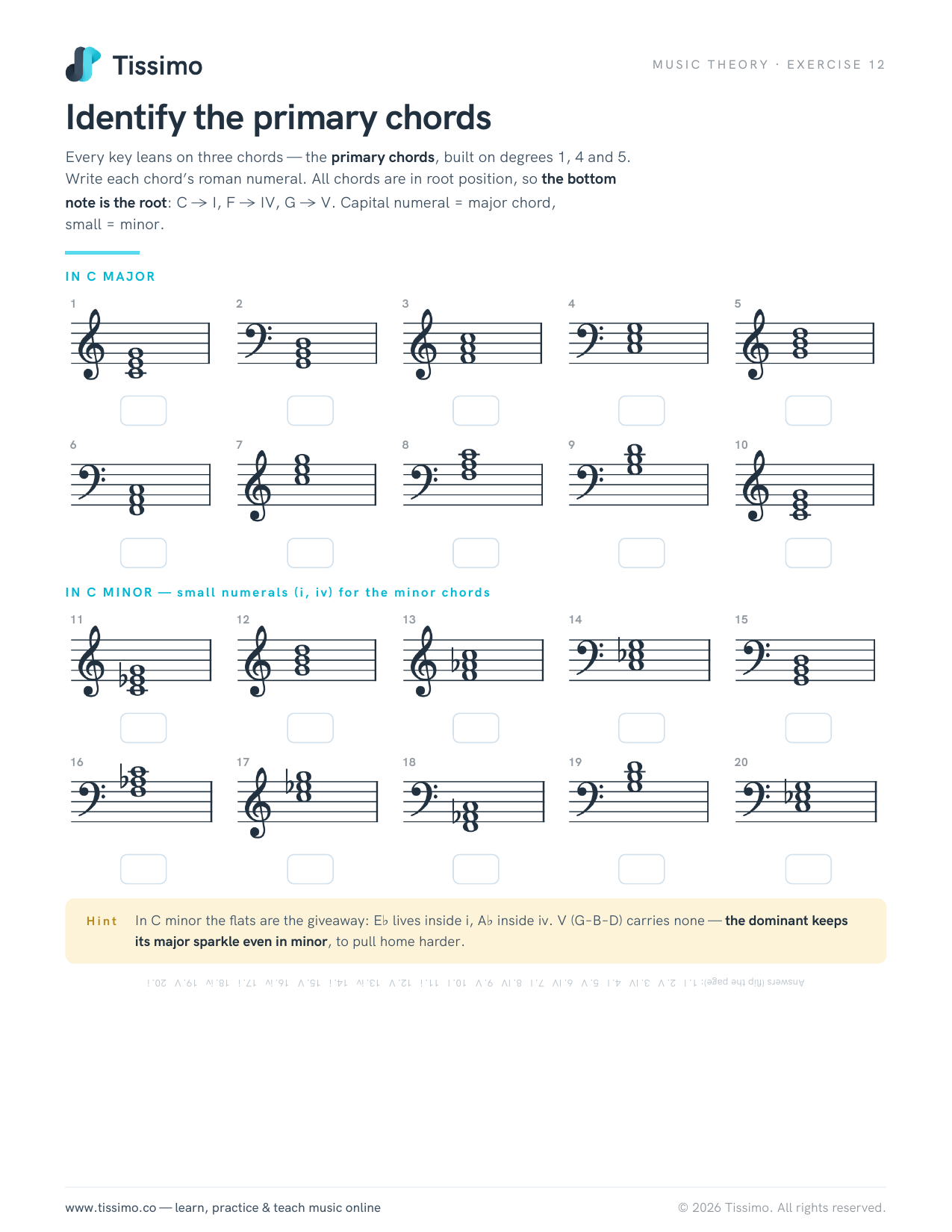
Identify the primary chords
Every key leans on three chords — the primary chords, built on degrees 1, 4 and 5. Write each chord’s roman numeral. All chords are in root position, so the bottom note is the root: C → I, F → IV, G → V. Capital numeral = major chord, small = minor.
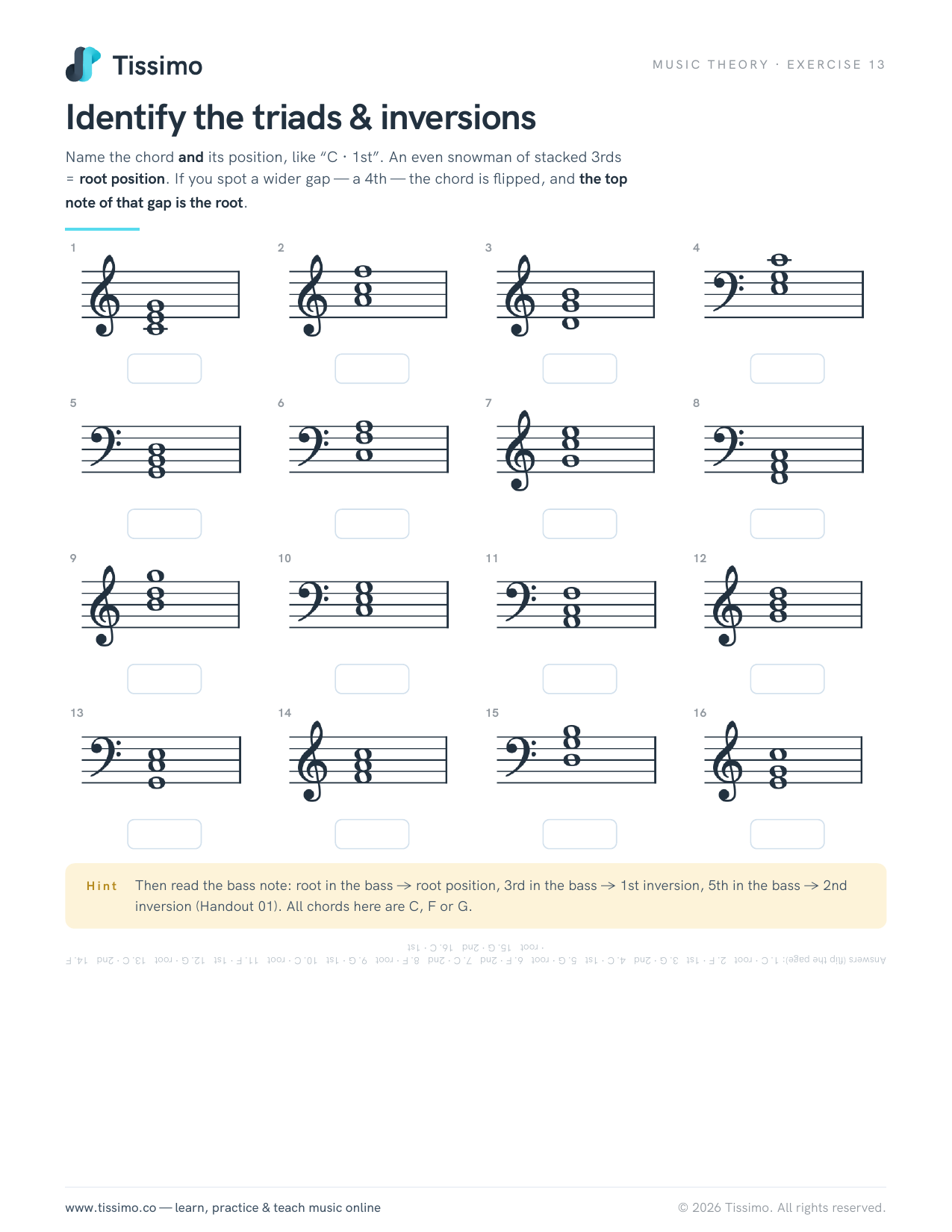
Identify the triads & inversions
Name the chord and its position, like “C · 1st”. An even snowman of stacked 3rds = root position. If you spot a wider gap — a 4th — the chord is flipped, and the top note of that gap is the root.
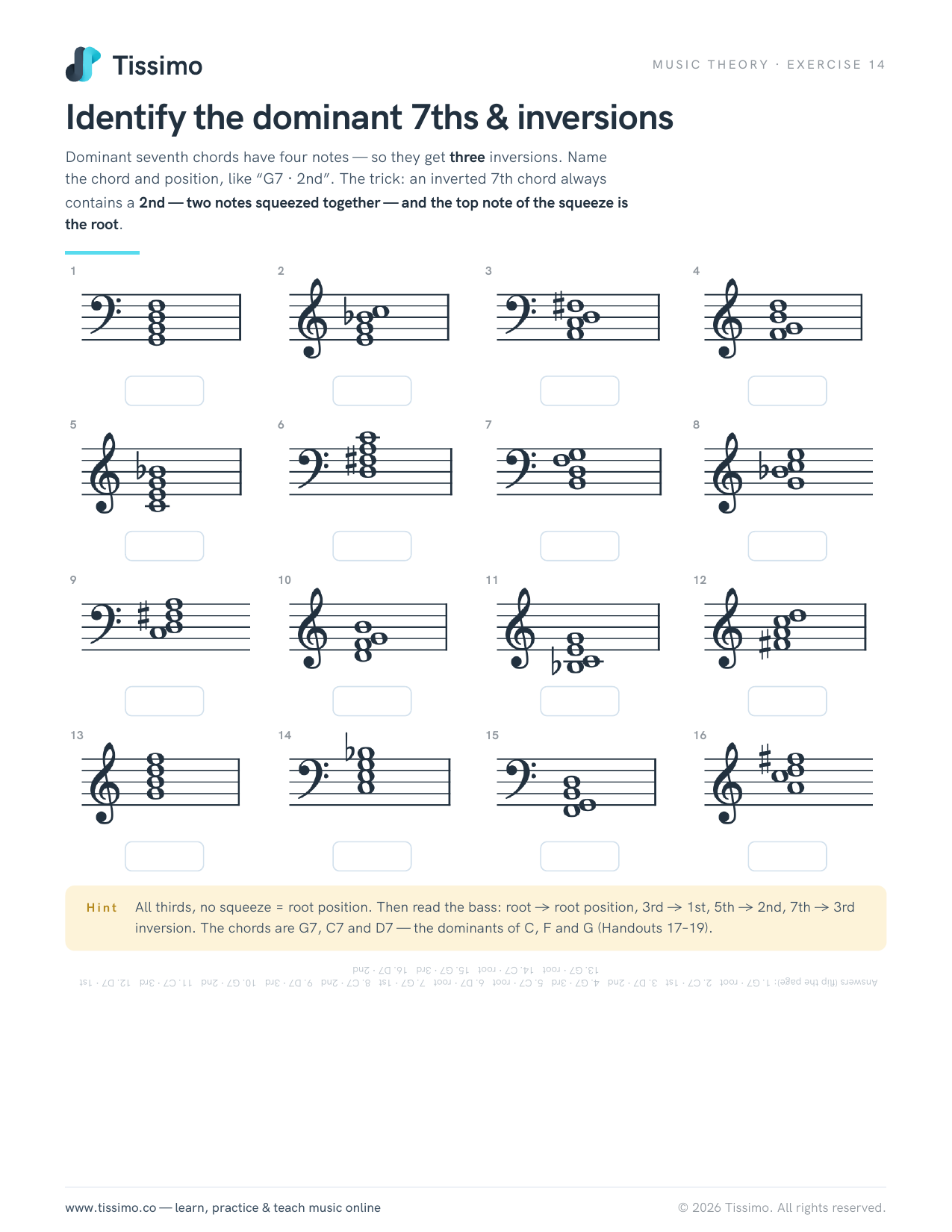
Identify the dominant 7ths & inversions
Dominant seventh chords have four notes — so they get three inversions. Name the chord and position, like “G7 · 2nd”. The trick: an inverted 7th chord always contains a 2nd — two notes squeezed together — and the top note of the squeeze is the root.
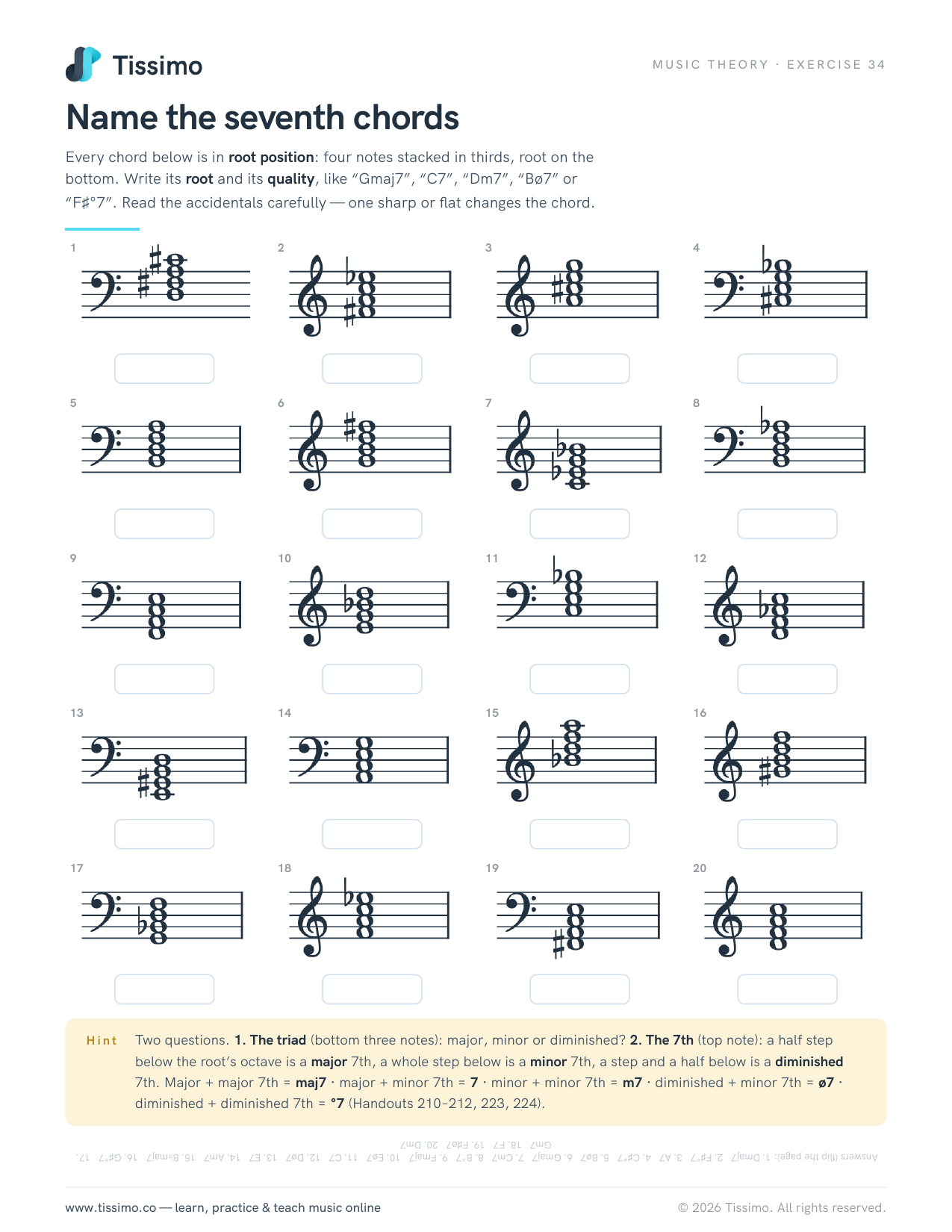
Name the seventh chords
Every chord below is in root position: four notes stacked in thirds, root on the bottom. Write its root and its quality, like “Gmaj7”, “C7”, “Dm7”, “Bø7” or “F♯°7”. Read the accidentals carefully — one sharp or flat changes the chord.
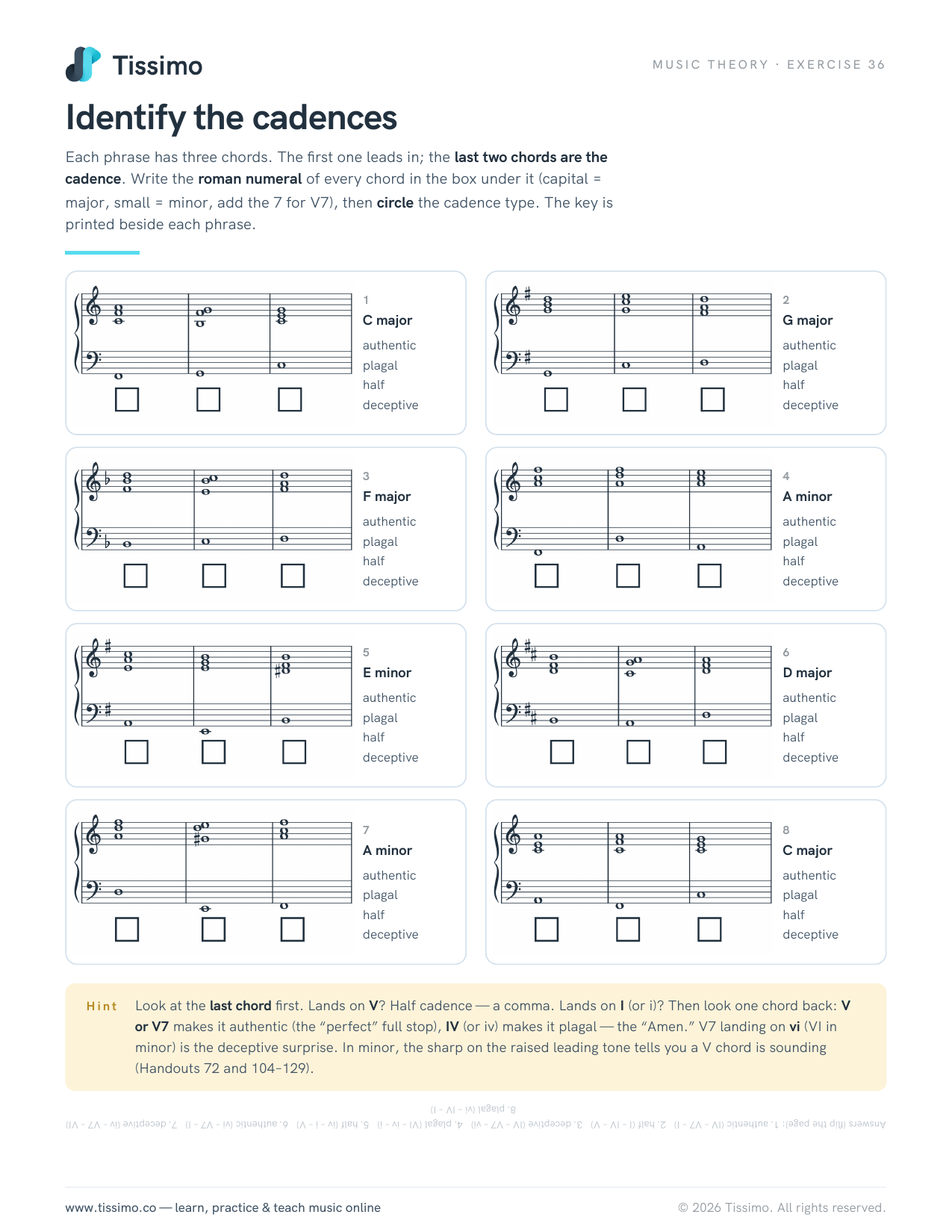
Identify the cadences
Each phrase has three chords. The first one leads in; the last two chords are the cadence. Write the roman numeral of every chord in the box under it (capital = major, small = minor, add the 7 for V7), then circle the cadence type. The key is printed beside each phrase.
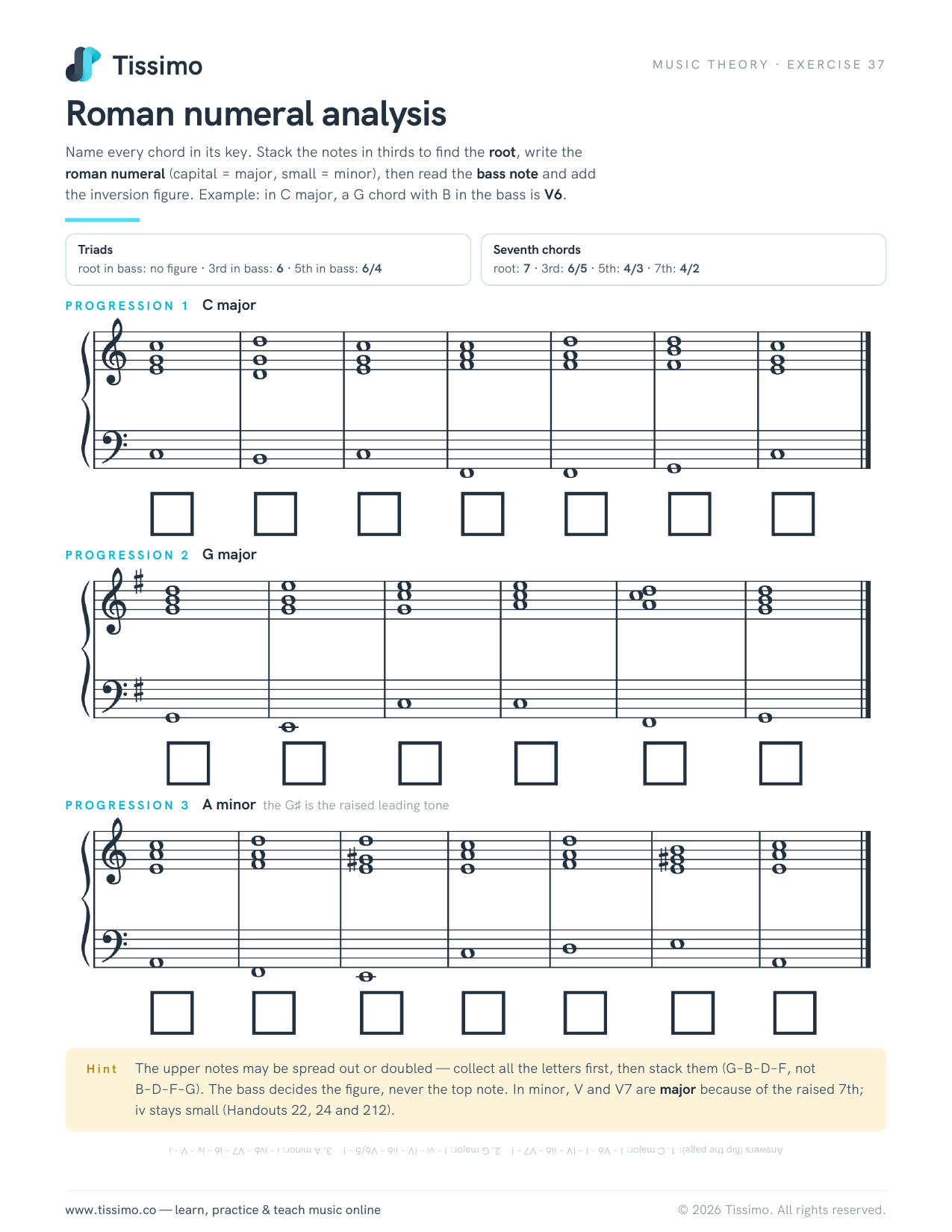
Roman numeral analysis
Name every chord in its key. Stack the notes in thirds to find the root, write the roman numeral (capital = major, small = minor), then read the bass note and add the inversion figure. Example: in C major, a G chord with B in the bass is V6.
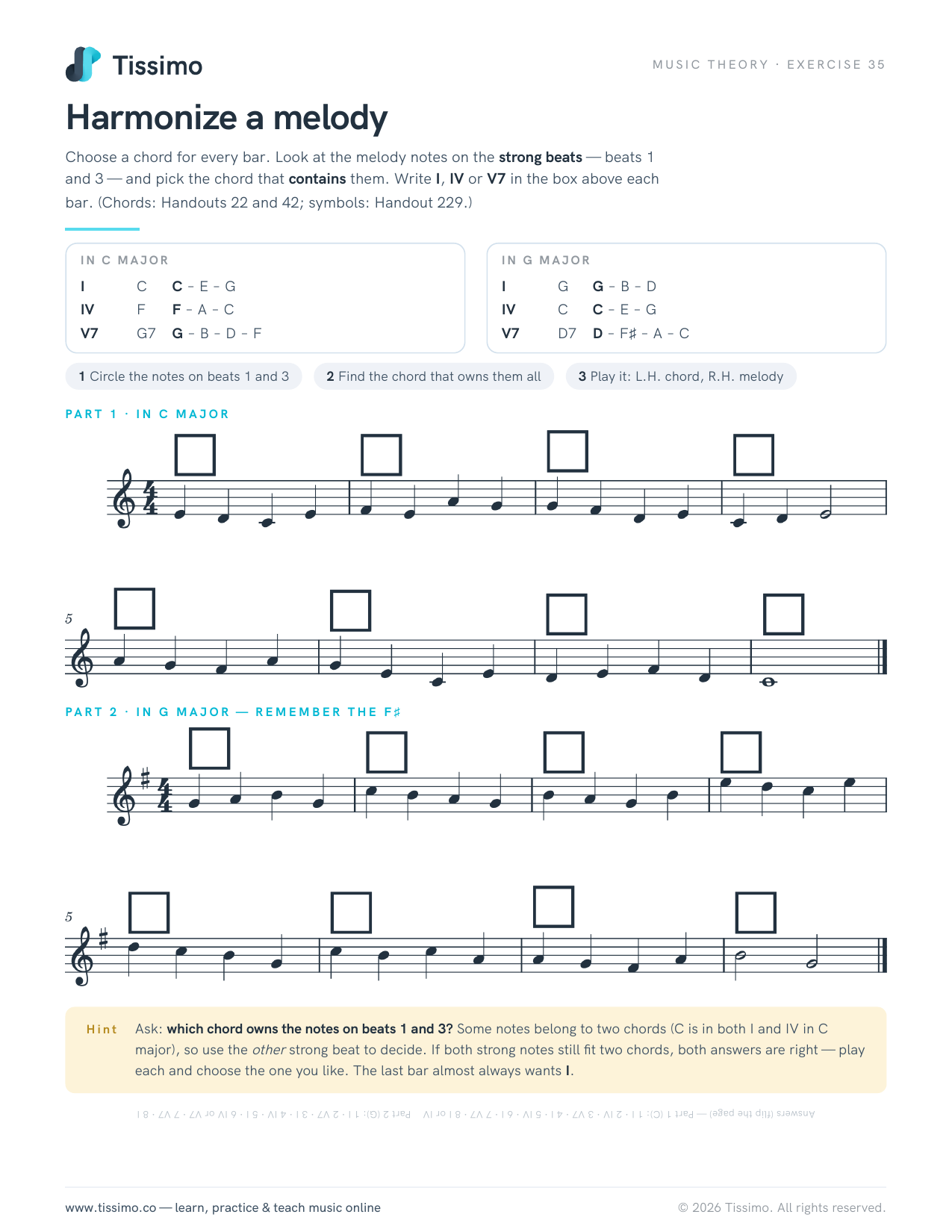
Harmonize a melody
Choose a chord for every bar. Look at the melody notes on the strong beats — beats 1 and 3 — and pick the chord that contains them. Write I, IV or V7 in the box above each bar. (Chords: Handouts 22 and 42; symbols: Handout 229.)
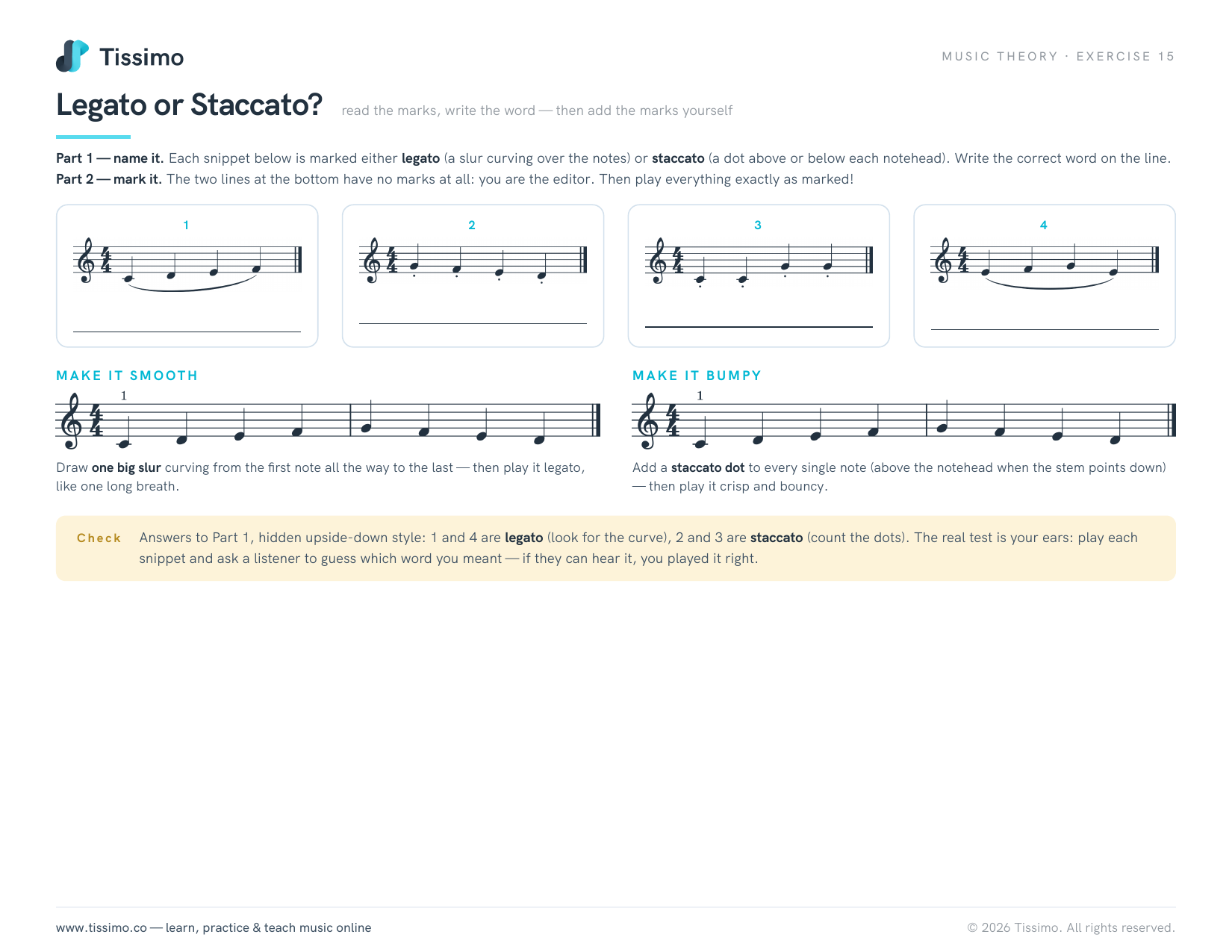
Legato or Staccato?
read the marks, write the word — then add the marks yourself
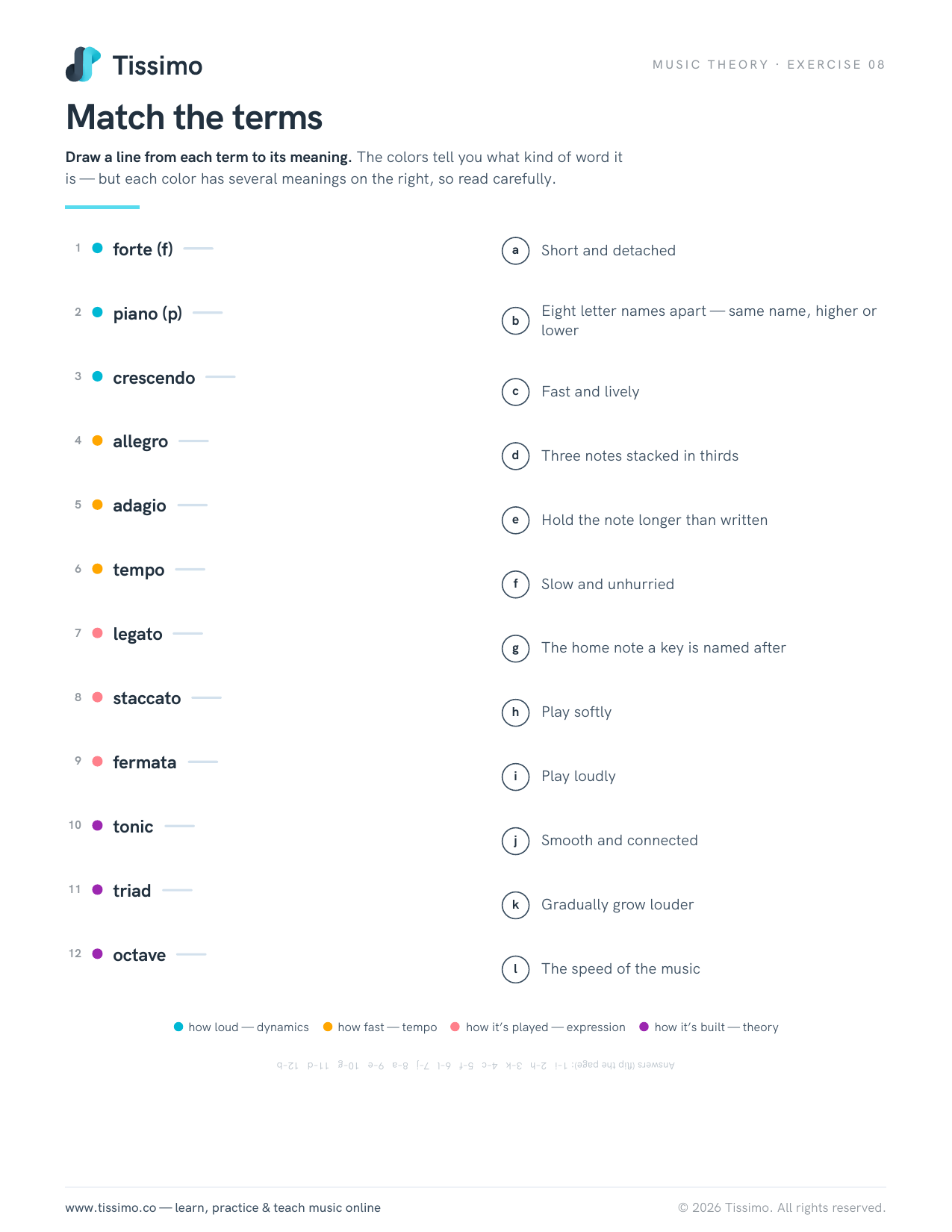
Match the terms
Draw a line from each term to its meaning. The colors tell you what kind of word it is — but each color has several meanings on the right, so read carefully.
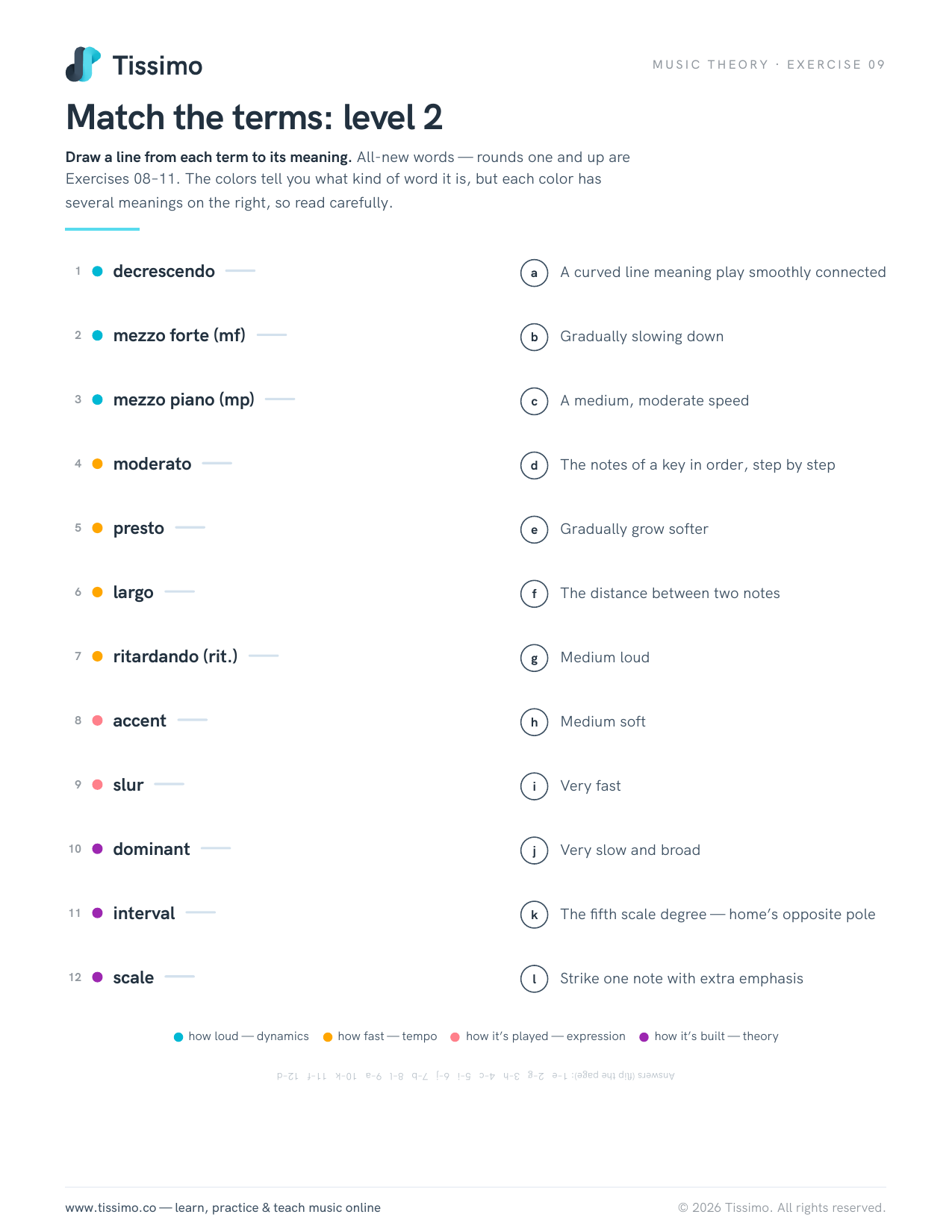
Match the terms: level 2
Draw a line from each term to its meaning. All-new words — rounds one and up are Exercises 08–11. The colors tell you what kind of word it is, but each color has several meanings on the right, so read carefully.
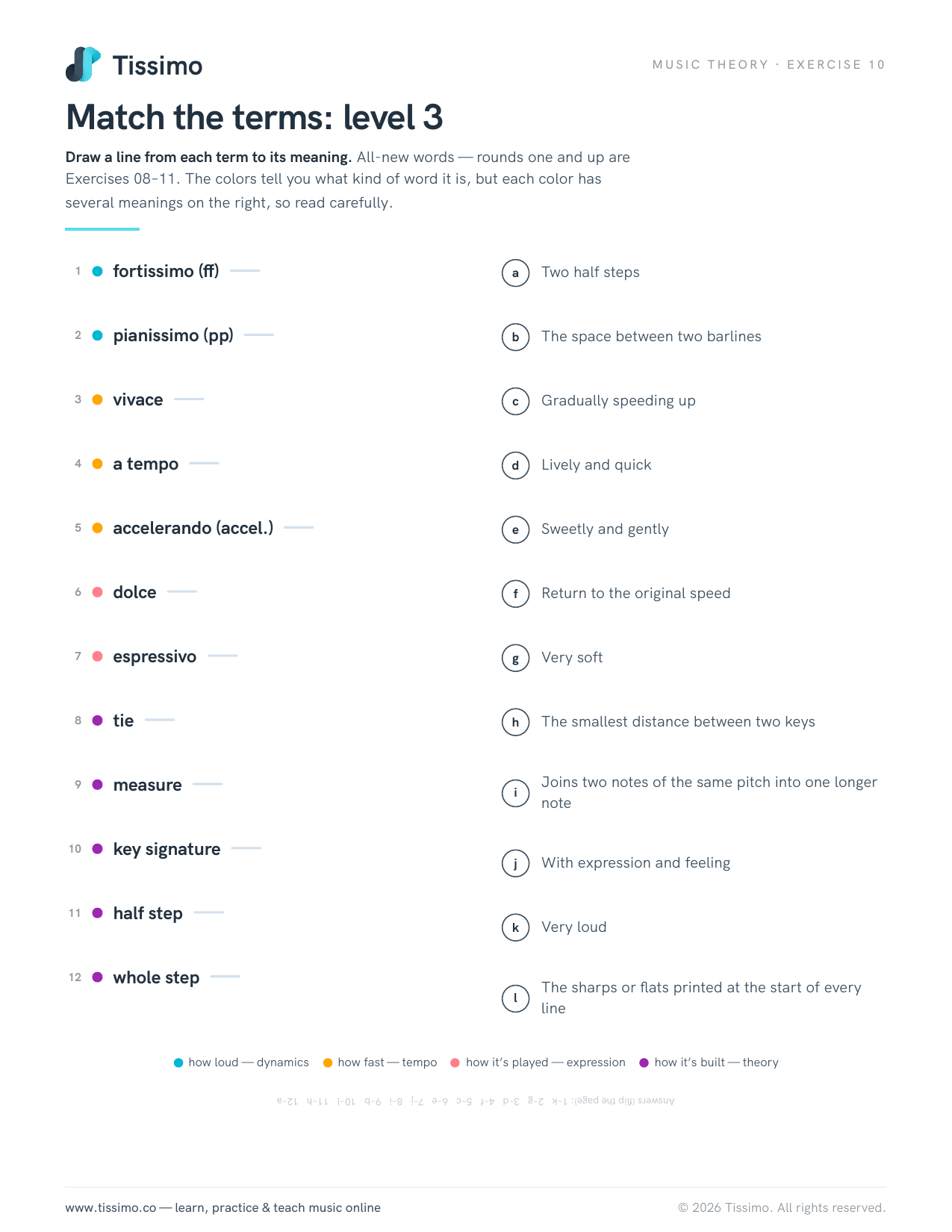
Match the terms: level 3
Draw a line from each term to its meaning. All-new words — rounds one and up are Exercises 08–11. The colors tell you what kind of word it is, but each color has several meanings on the right, so read carefully.
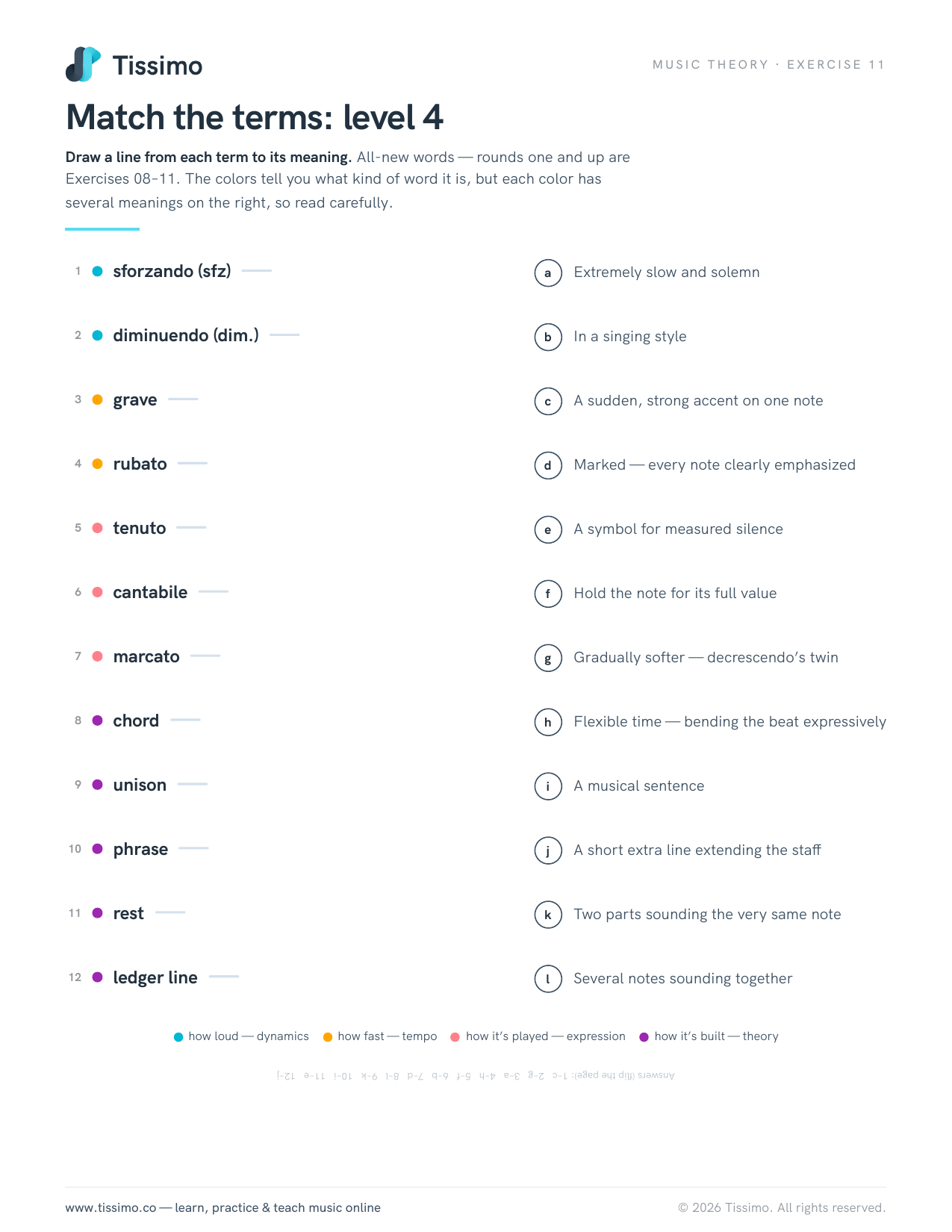
Match the terms: level 4
Draw a line from each term to its meaning. All-new words — rounds one and up are Exercises 08–11. The colors tell you what kind of word it is, but each color has several meanings on the right, so read carefully.
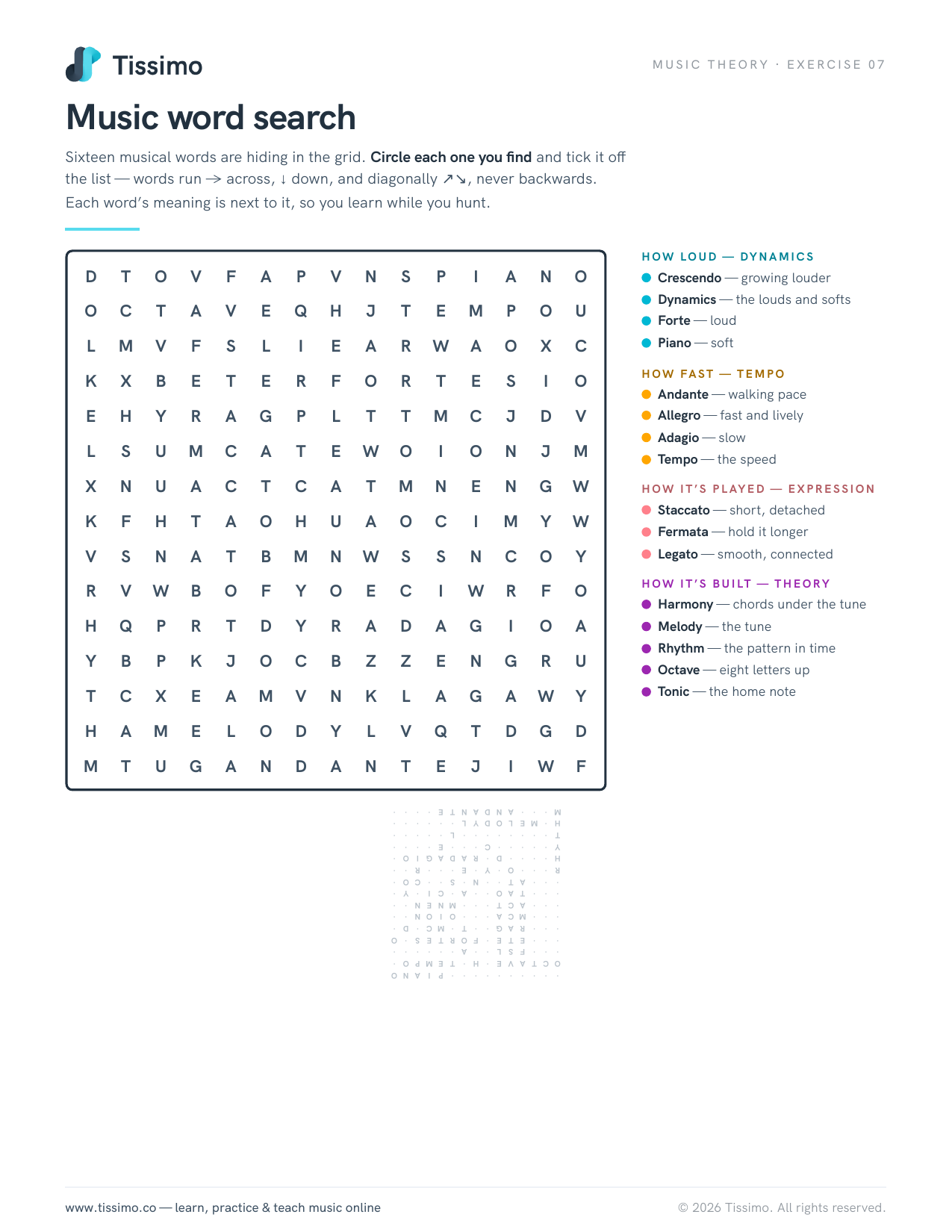
Music word search
Sixteen musical words are hiding in the grid. Circle each one you find and tick it off the list — words run → across, ↓ down, and diagonally ↗↘, never backwards. Each word’s meaning is next to it, so you learn while you hunt.