無料の音楽ワークシート
Tissimoの講師が作成した、1ページで完結する印刷用ワークシートです——ここで見る、PDFをダウンロードする、次のレッスン用にまとめて印刷することができます。

音符とリズム
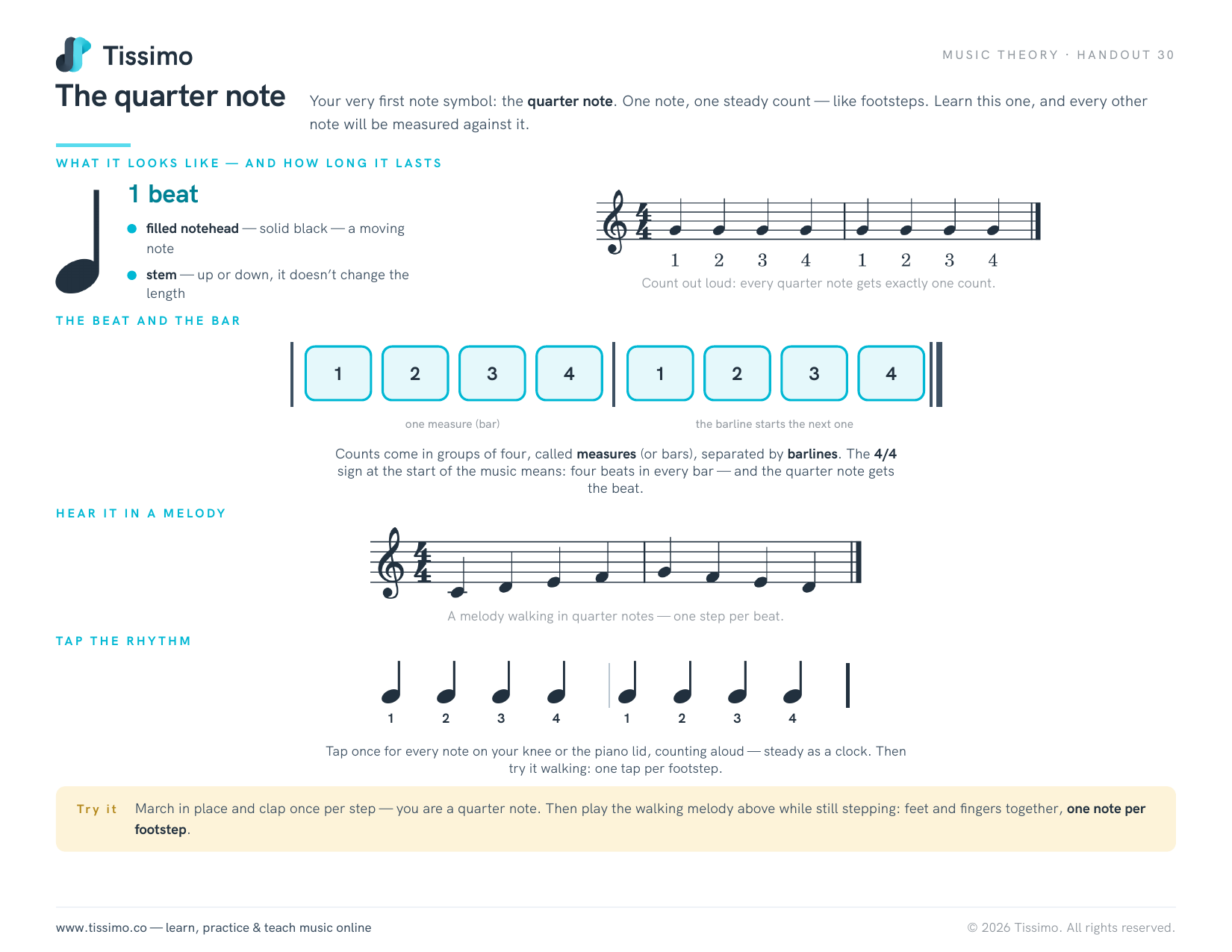
四分音符
最初に覚える音符記号、四分音符。1つの音、一定の拍——足音のように。これを覚えれば、他のすべての音符はこれを基準に測られます。
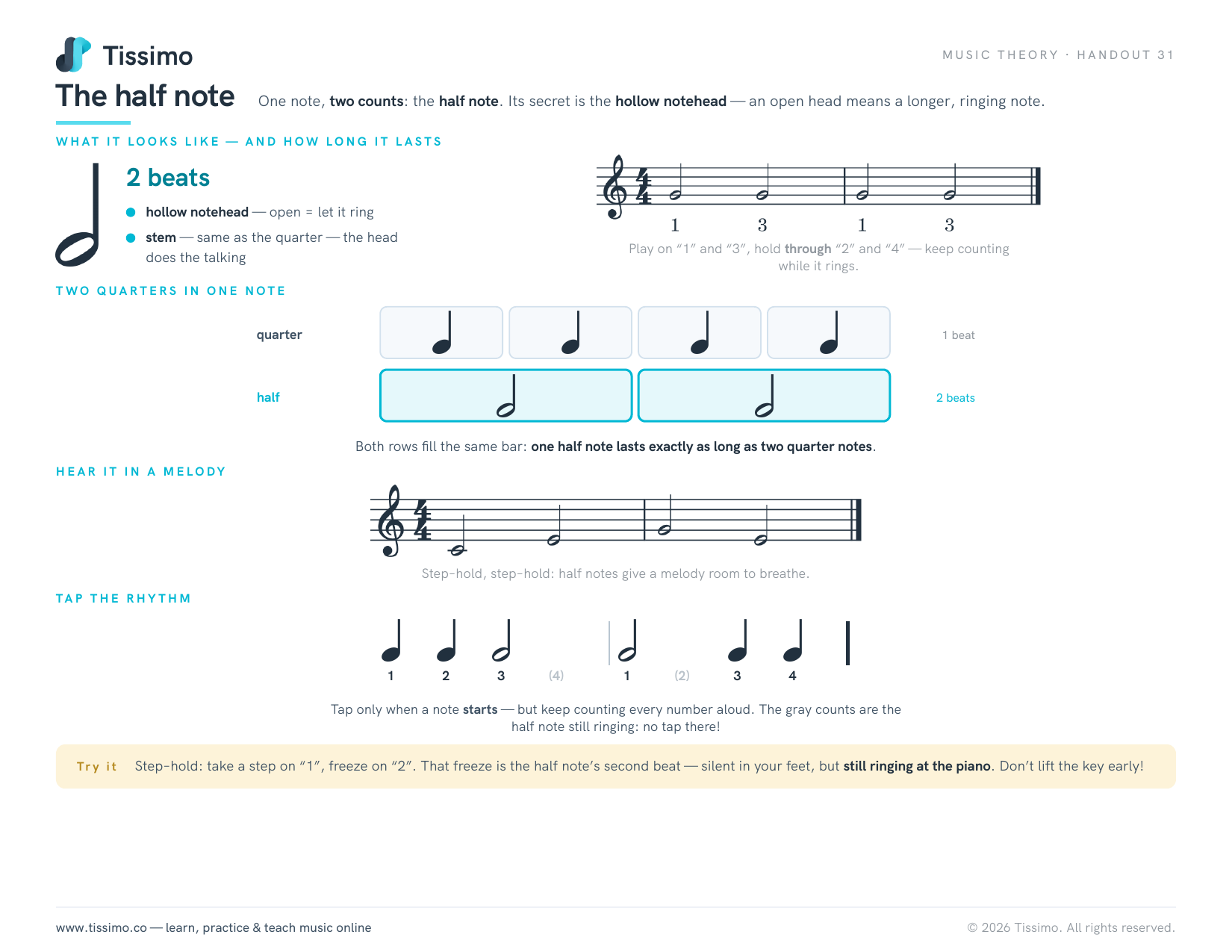
二分音符
1つの音、2拍分——二分音符。秘密は中が空いた符頭にあります。中抜きの符頭は、長く響く音を意味します。
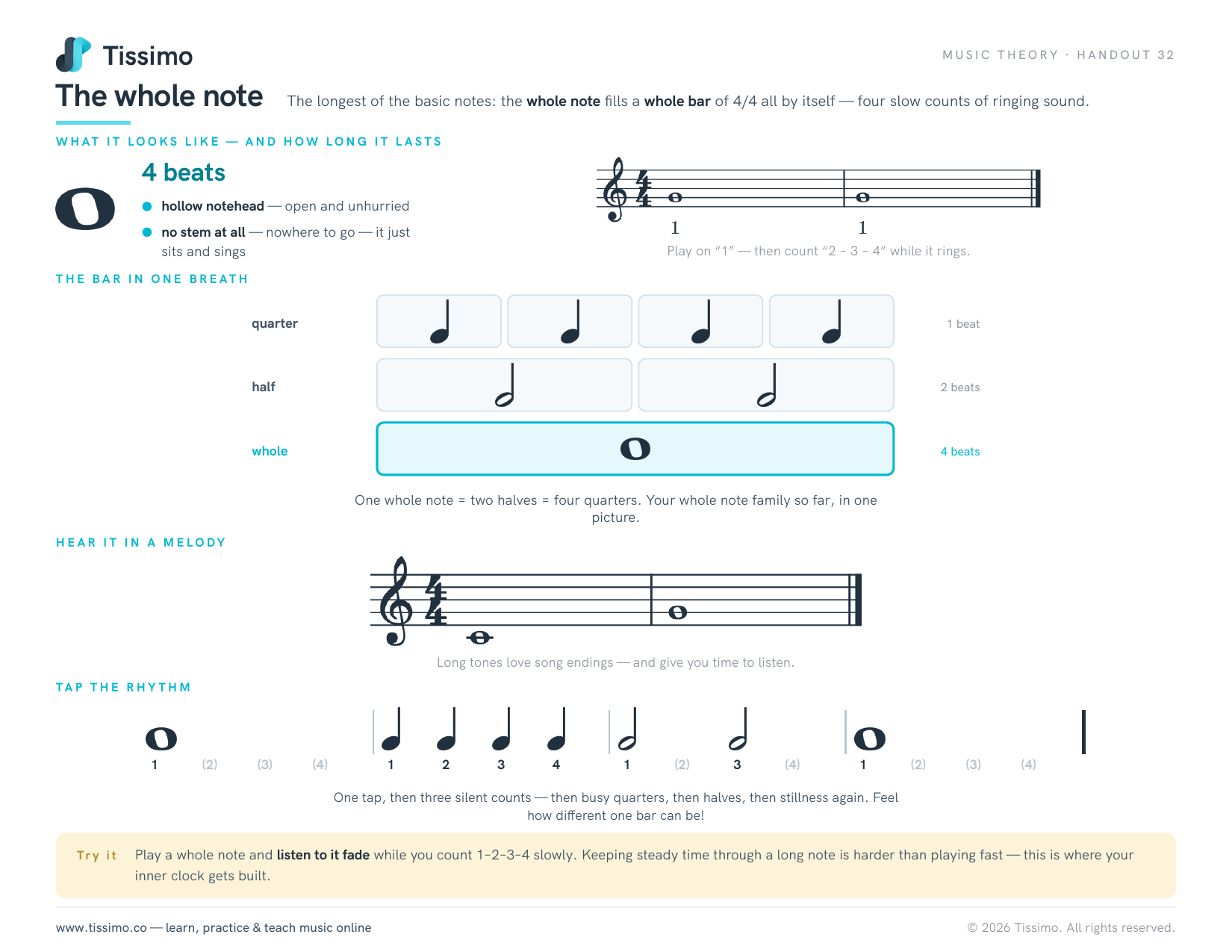
全音符
基本の音符の中で最も長い全音符は、4/4拍子の1小節をひとつで満たします——ゆったりと響く4拍分の音。
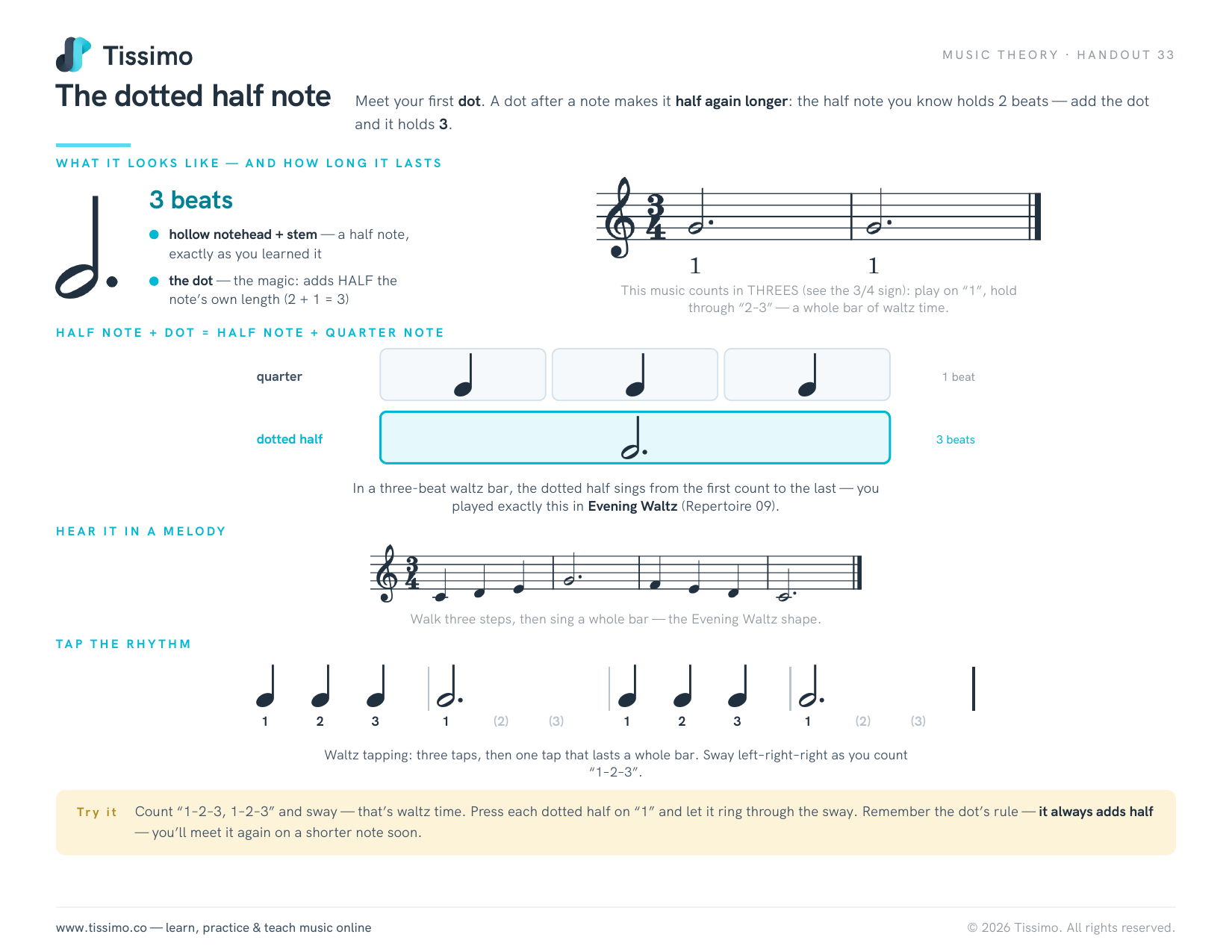
付点二分音符
はじめての付点との出会いです。音符の後ろに付く点は、その音符の半分の長さを足します。二分音符は2拍でしたが、付点が付くと3拍になります。
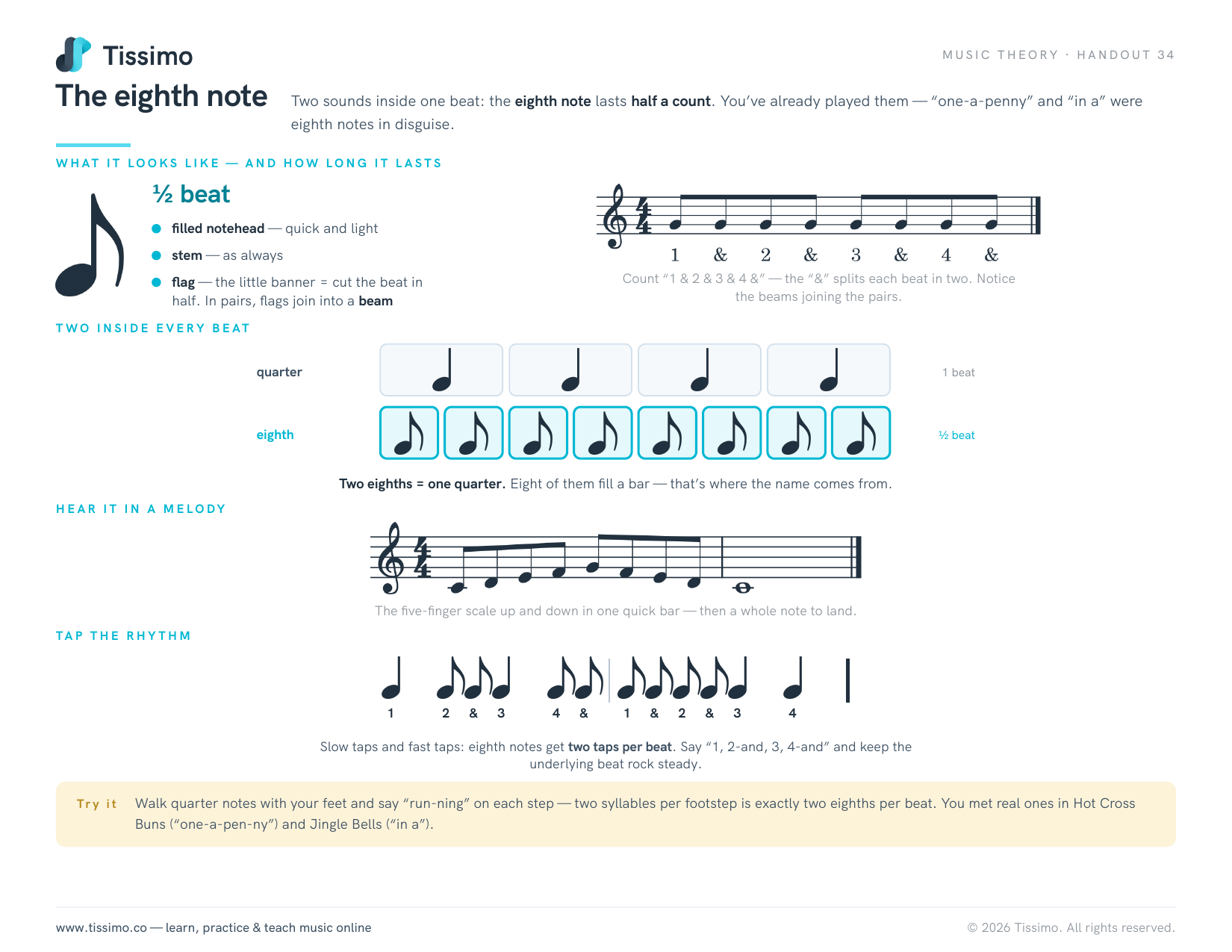
八分音符
1拍の中に2つの音——八分音符は半拍の長さです。知らないうちにもう弾いています。1拍を「タ・タ」と刻むリズムは、実は八分音符でした。
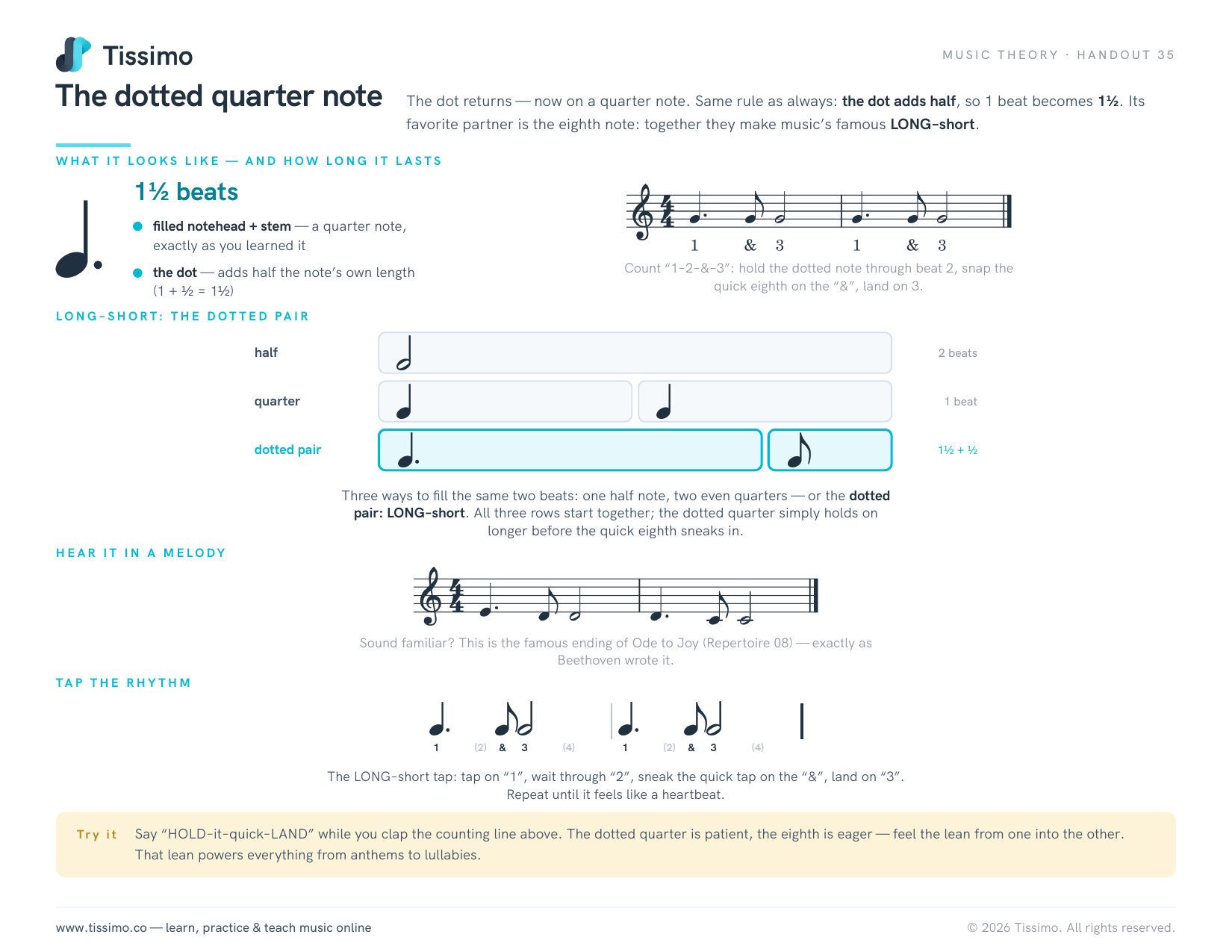
付点四分音符
付点が再登場——今度は四分音符です。ルールはいつも同じ:付点は半分の長さを足すので、1拍が1拍半になります。相棒は八分音符。二つが組むと、音楽で有名な「長ー短」のリズムになります。
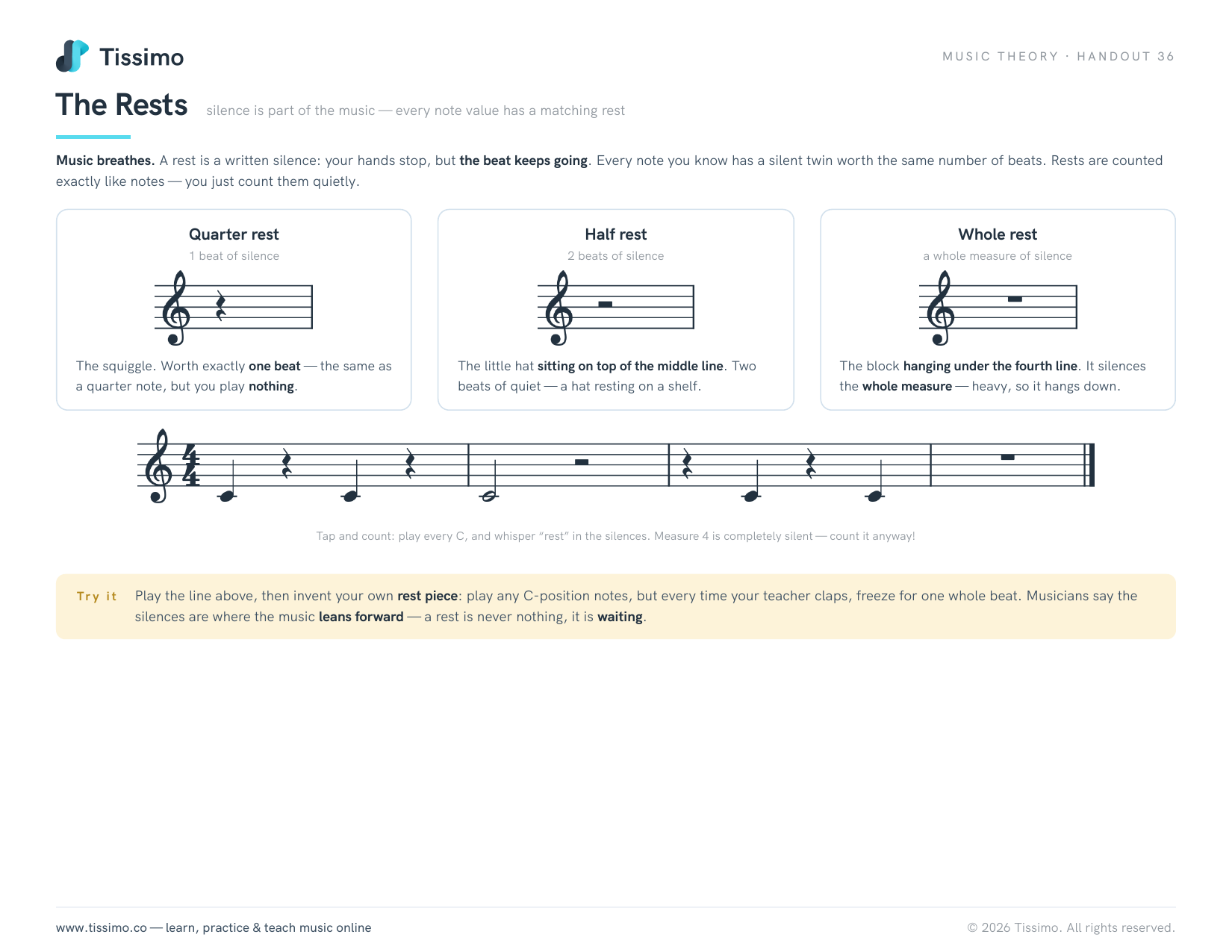
休符
沈黙も音楽の一部——どの音符の長さにも、対応する休符があります
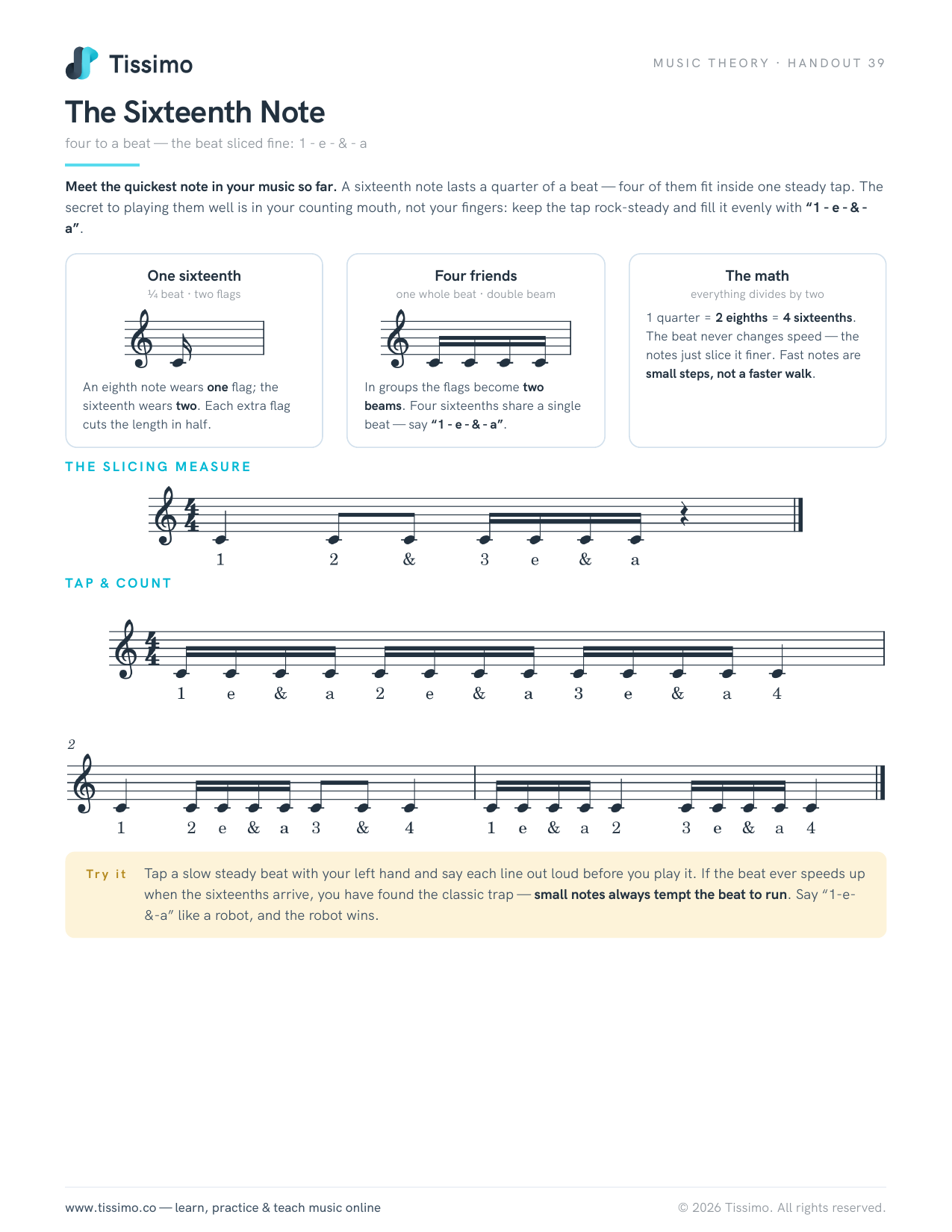
十六分音符
1拍に4つ——拍を細かく刻む:1 - e - & - a

休符ファミリー
どの音符にも沈黙の双子がいる——全音符から十六分音符まで、5種類の休符
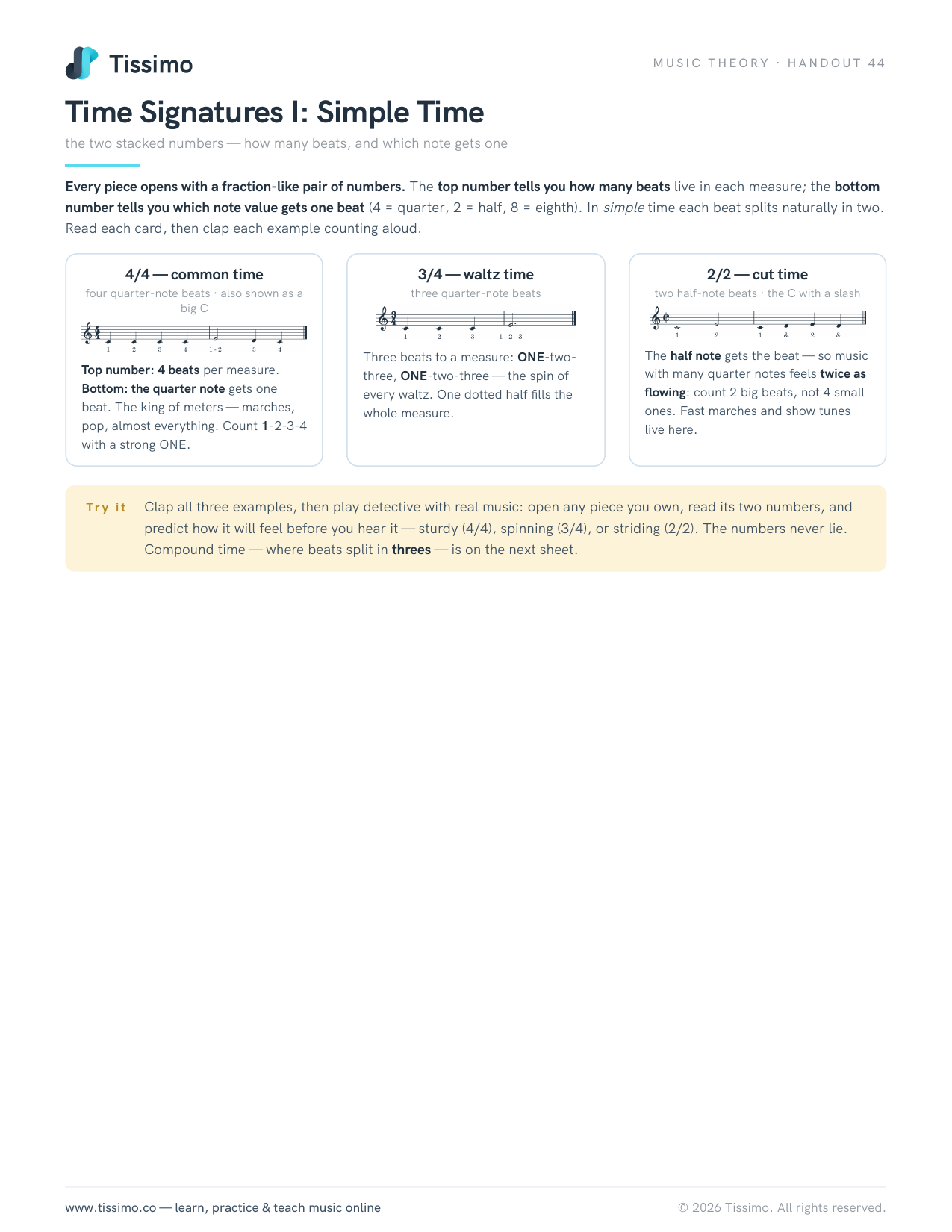
拍子記号 I:単純拍子
縦に並んだ2つの数字——拍の数と、どの音符が1拍になるか
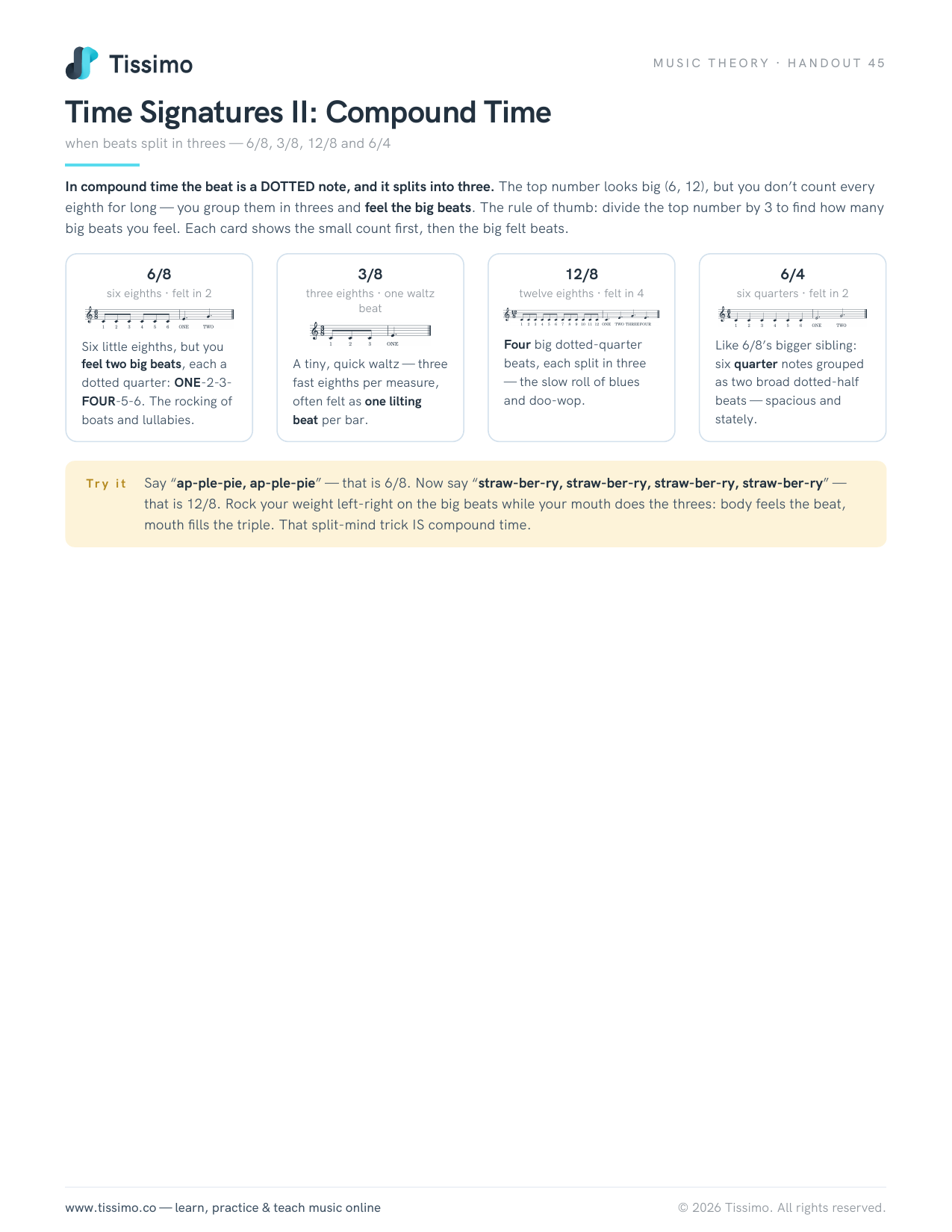
拍子記号 II:複合拍子
拍が3つに分かれるとき——6/8, 3/8, 12/8, 6/4
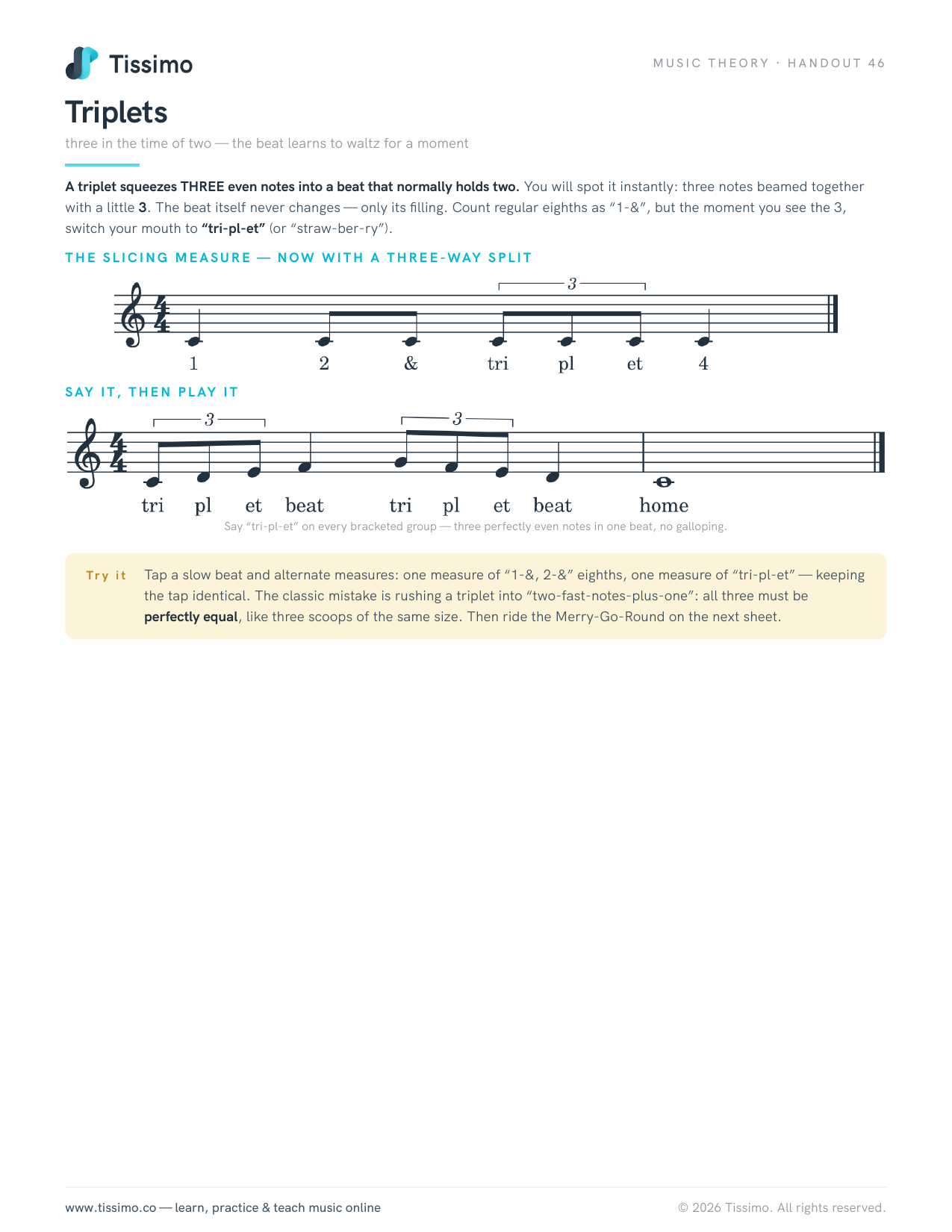
三連符
2拍分の時間に3つの音——一瞬だけ拍がワルツを踊る
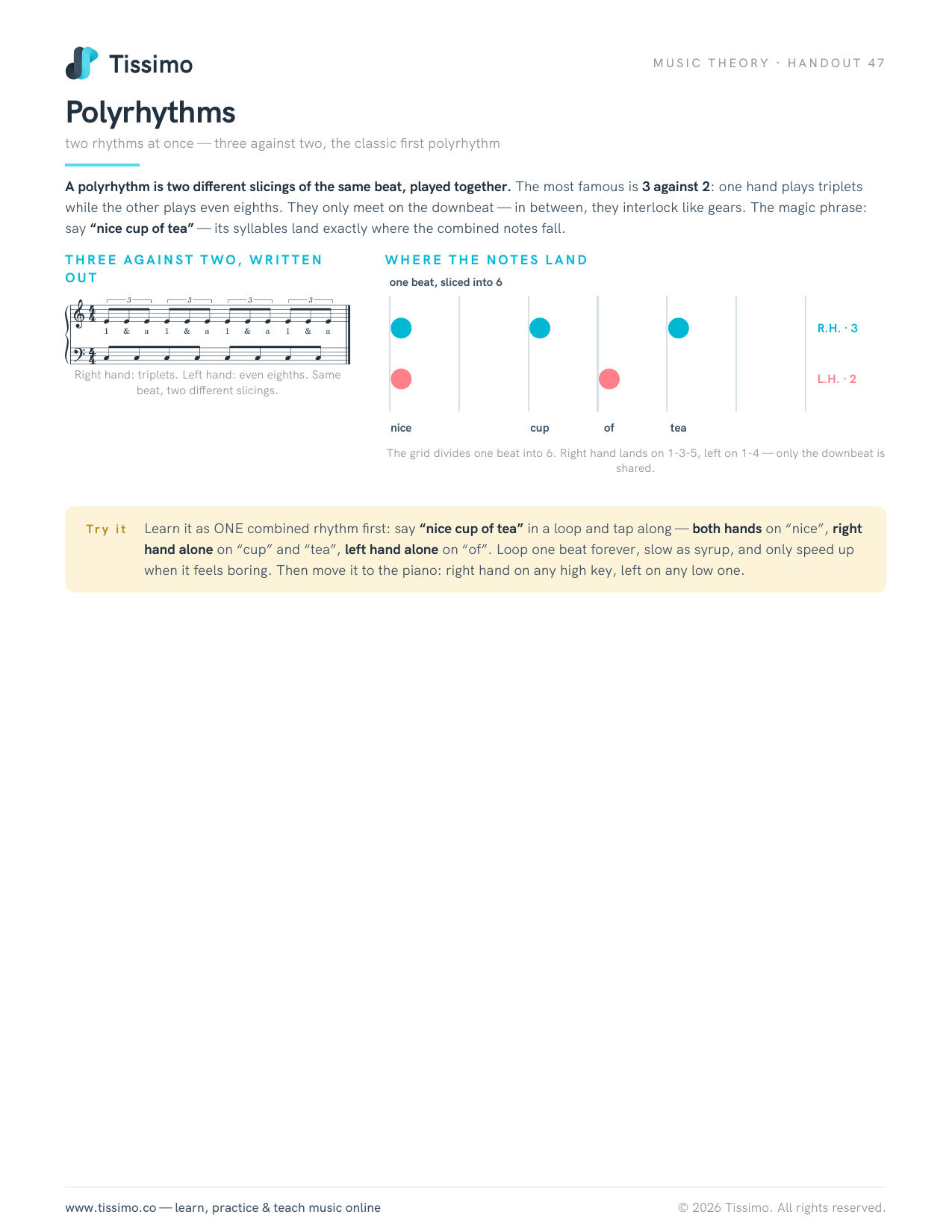
ポリリズム
同時に鳴る2つのリズム——3対2、はじめてのポリリズムの定番
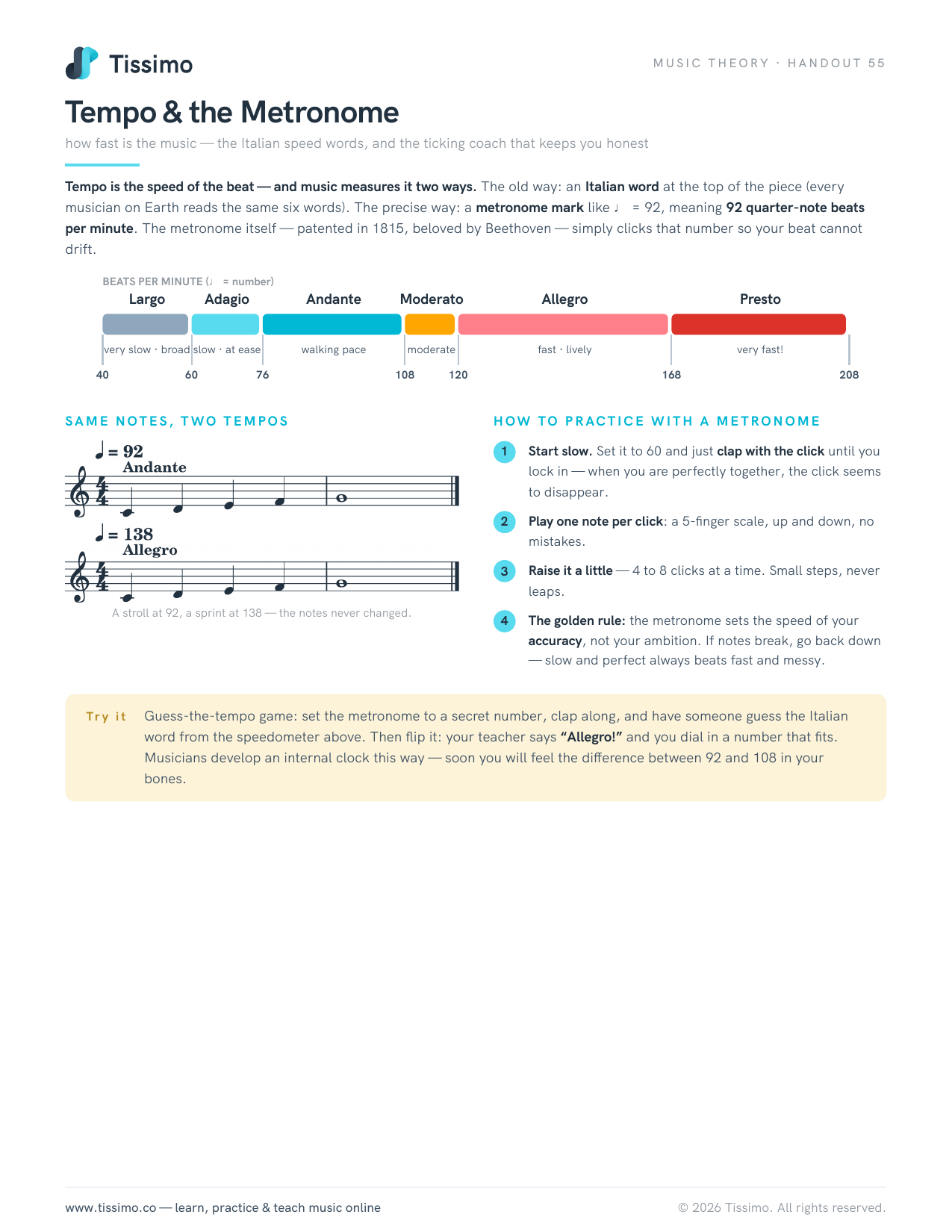
テンポとメトロノーム
音楽の速さを表す——イタリア語の速度用語と、正確なテンポを保つカチカチ鳴るコーチ
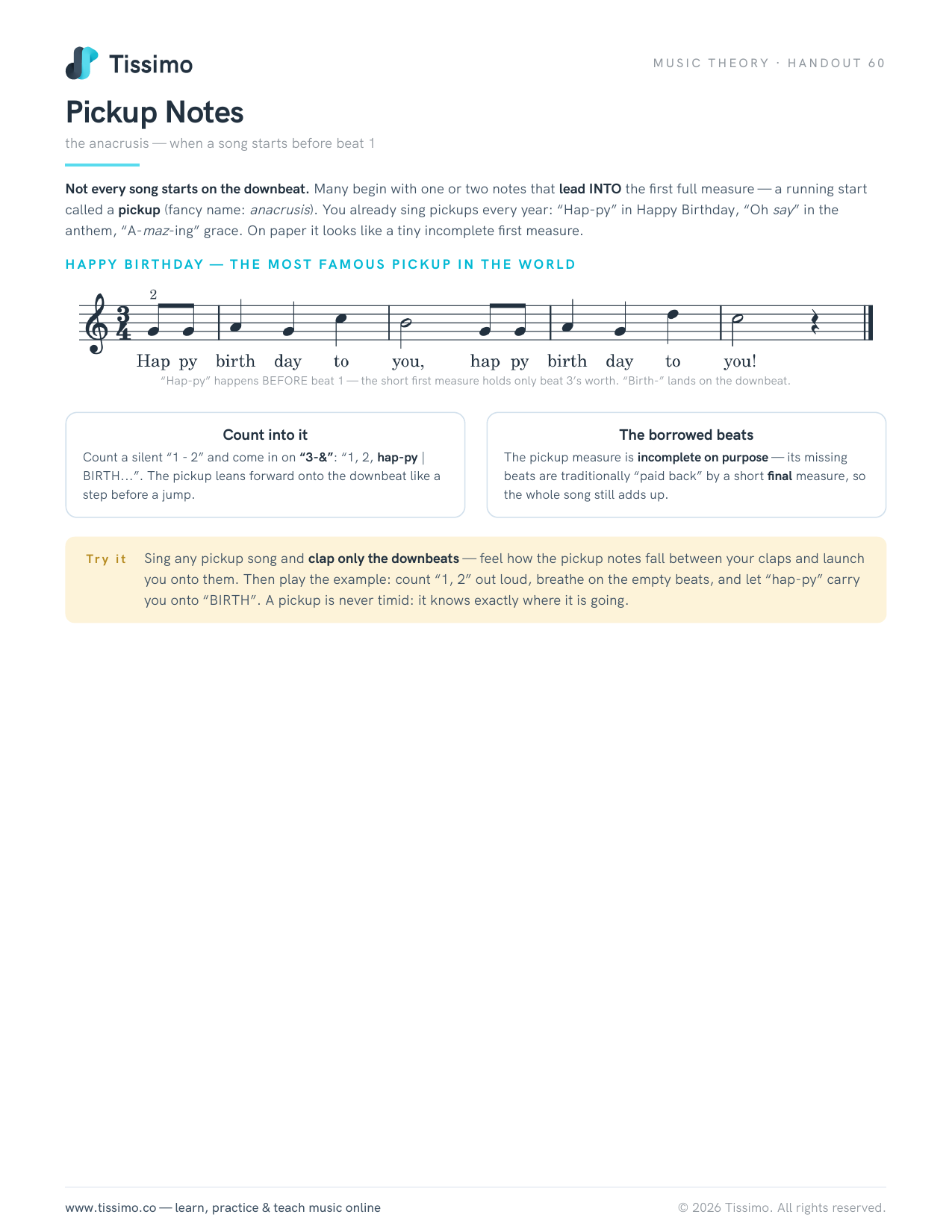
アウフタクト(弱起)
アナクルーシス——曲が1拍目より前に始まるとき
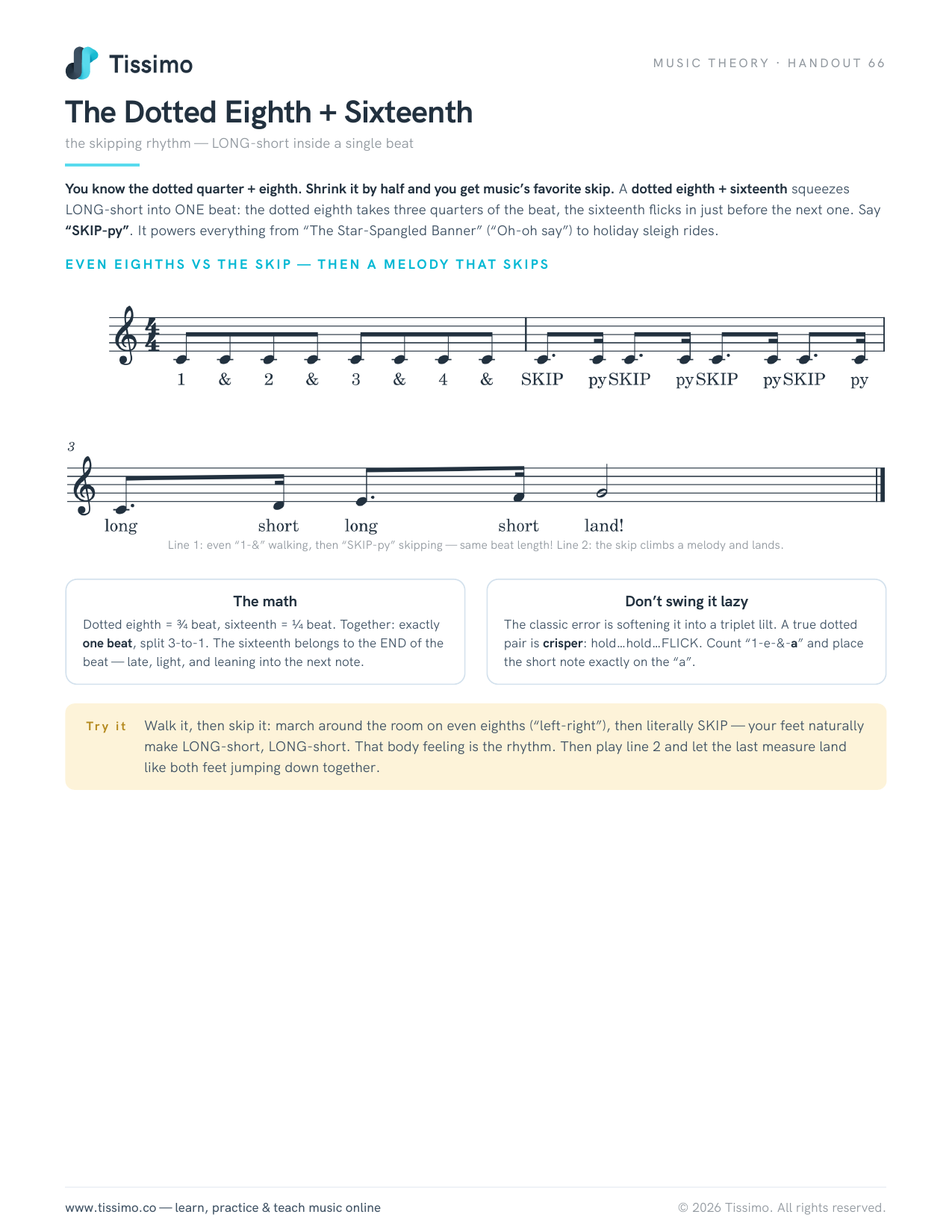
付点八分音符+十六分音符
スキップするリズム——1拍の中の「長ー短」
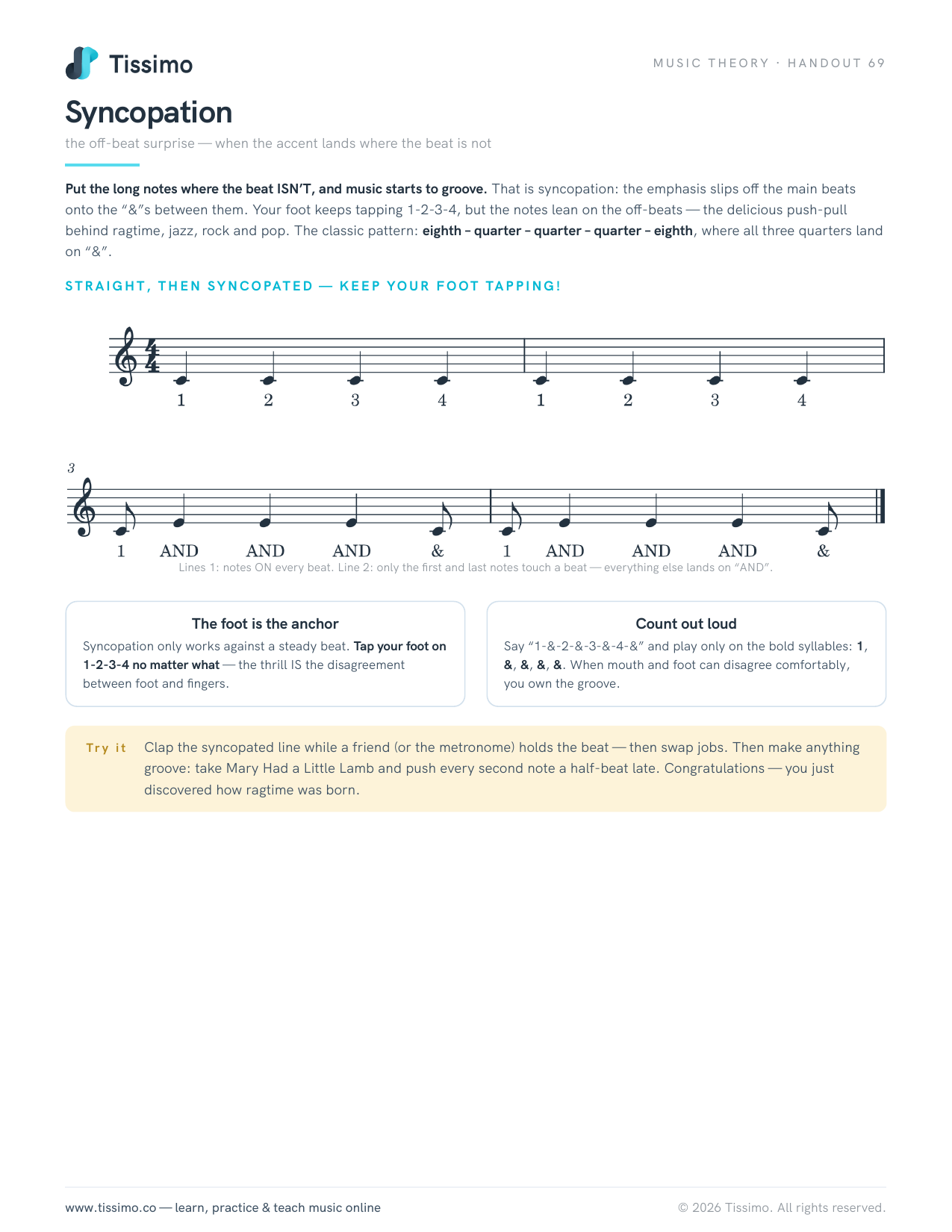
シンコペーション
裏拍のサプライズ——拍のないところにアクセントが来るとき
音高と記譜法
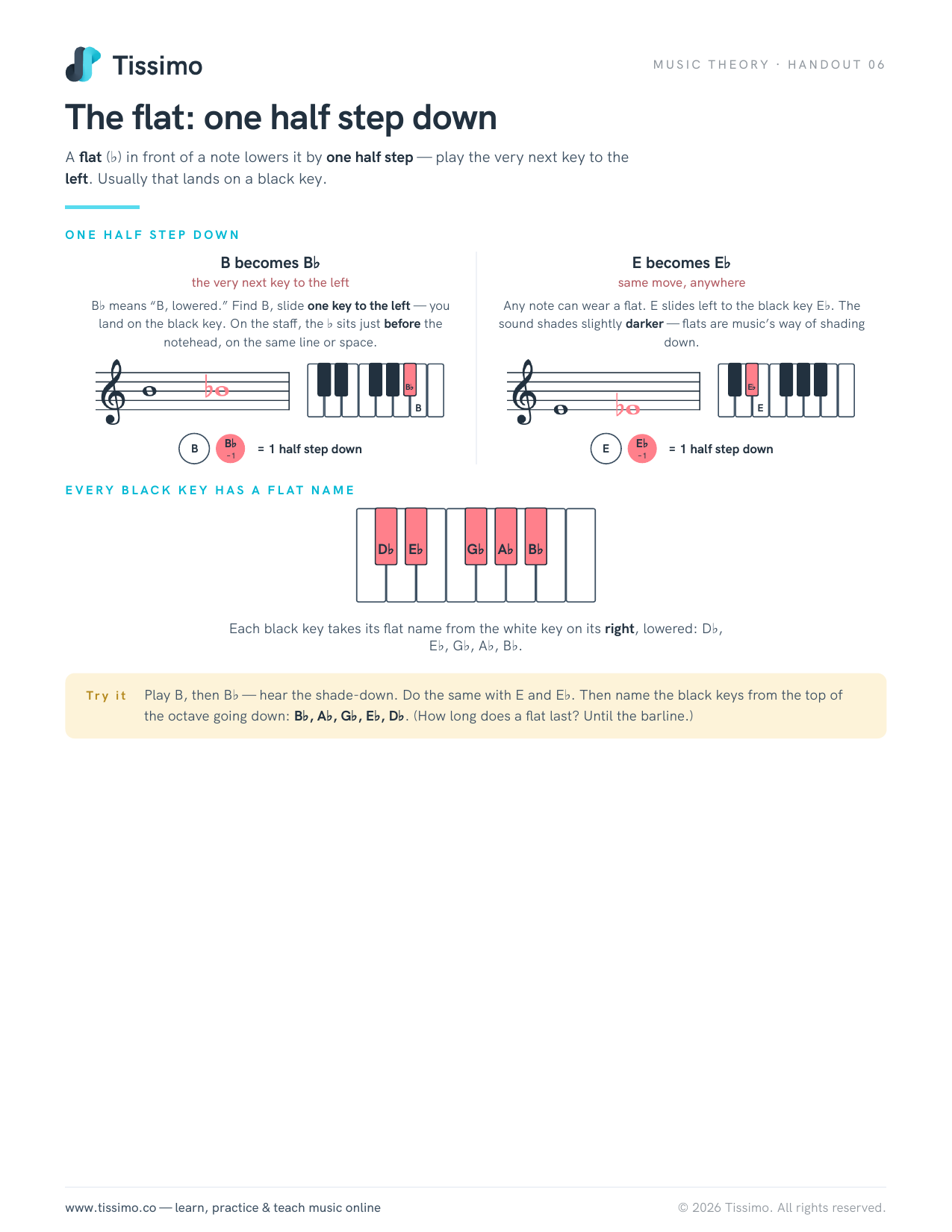
フラット(♭):半音下げる
音符の前につくフラット(♭)は音を半音下げます——すぐ左隣の鍵盤を弾きましょう。多くの場合、それは黒鍵になります。
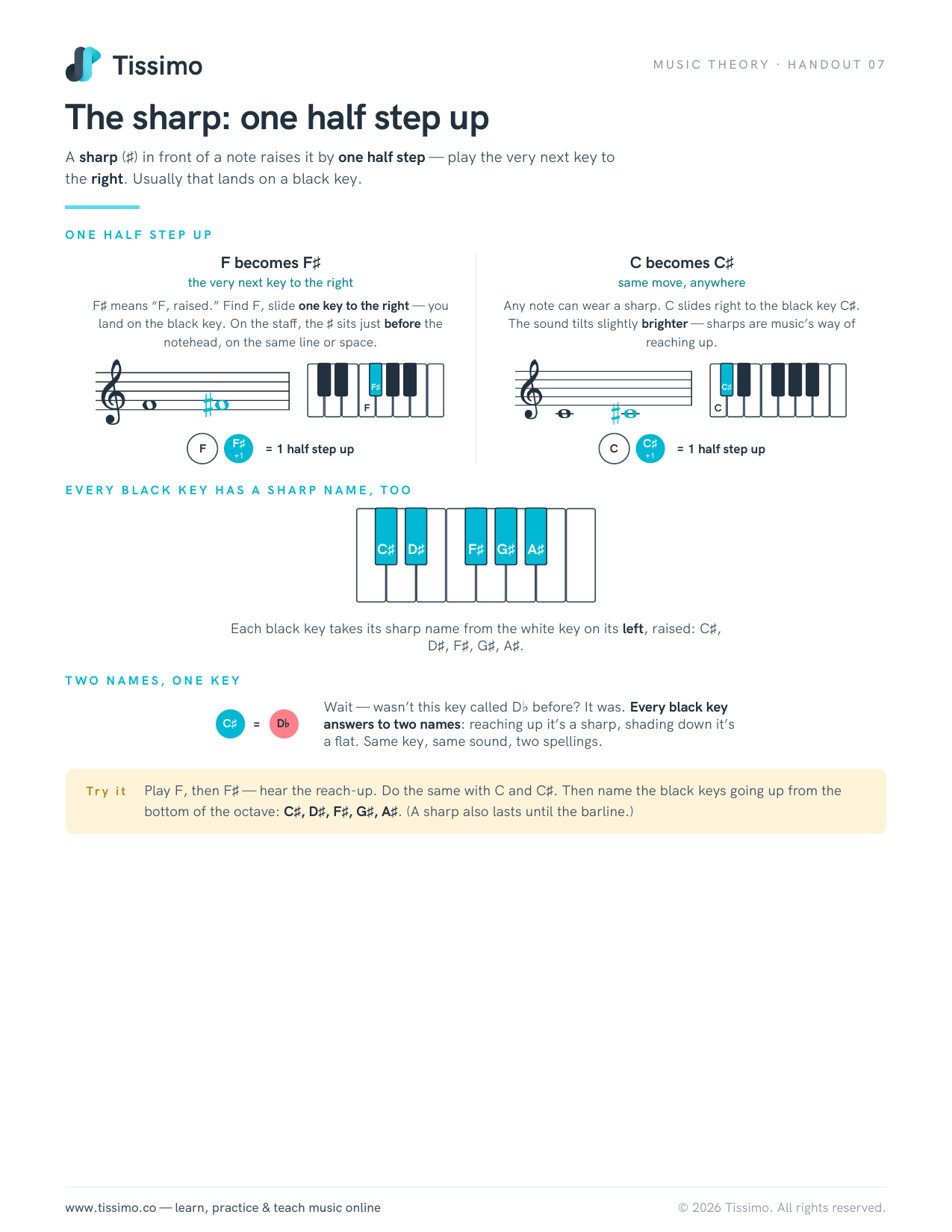
シャープ(♯):半音上げる
音符の前につくシャープ(♯)は音を半音上げます——すぐ右隣の鍵盤を弾きましょう。多くの場合、それは黒鍵になります。
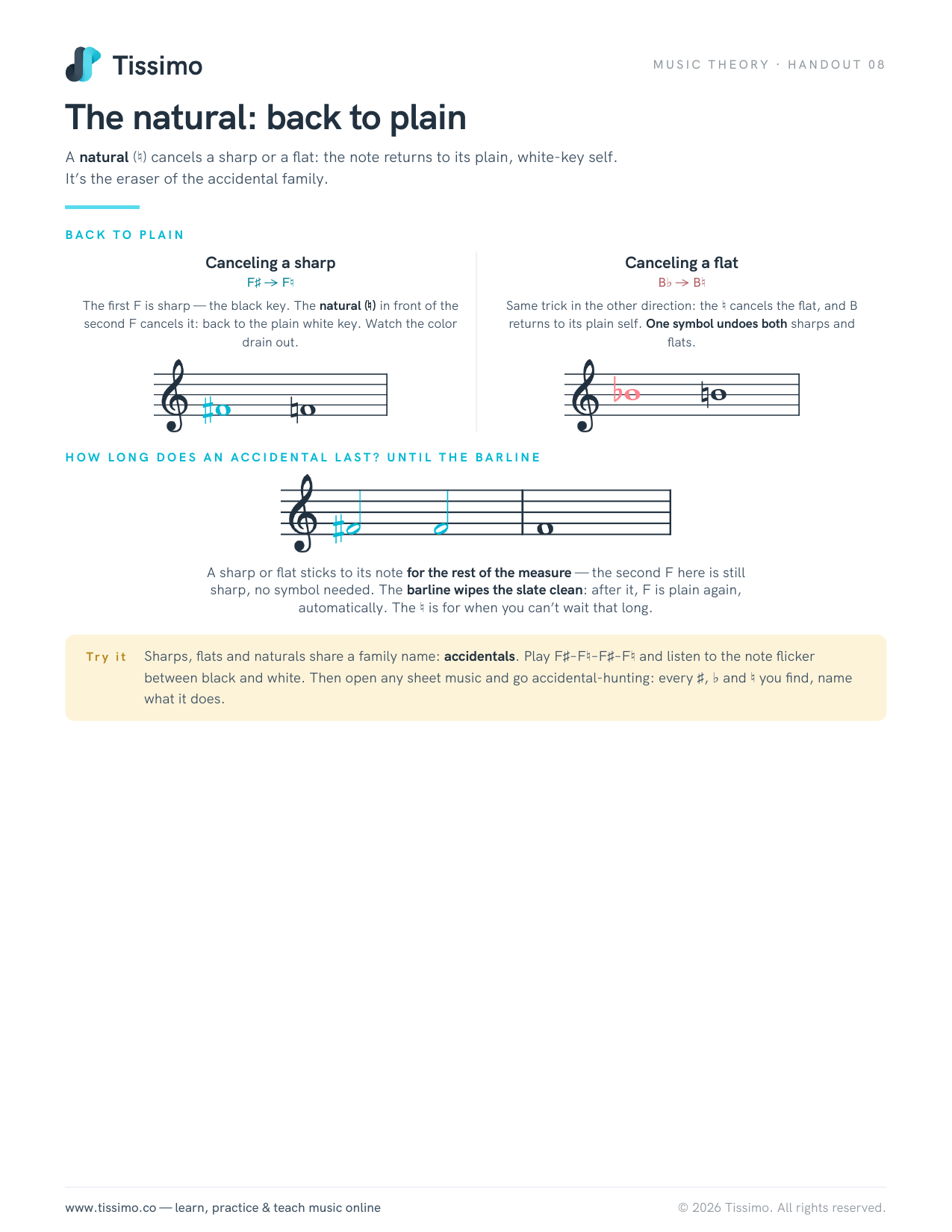
ナチュラル(♮):もとの音に戻す
ナチュラル(♮)はシャープやフラットを打ち消し、音符を元の白鍵の音に戻します。変化記号ファミリーの「消しゴム」のような存在です。
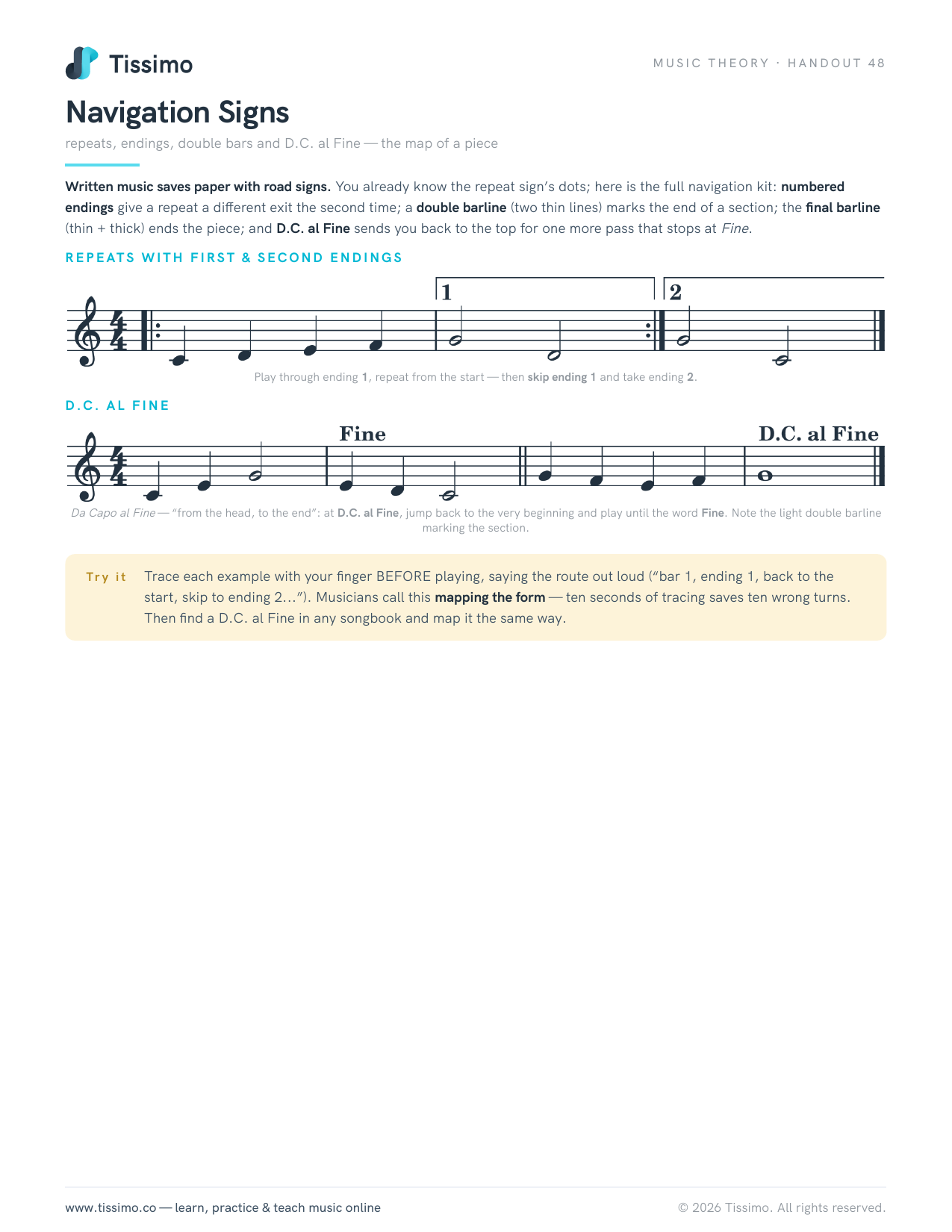
反復記号(ナビゲーション記号)
リピート記号、括弧、複縦線、D.C. al Fine——楽曲の地図
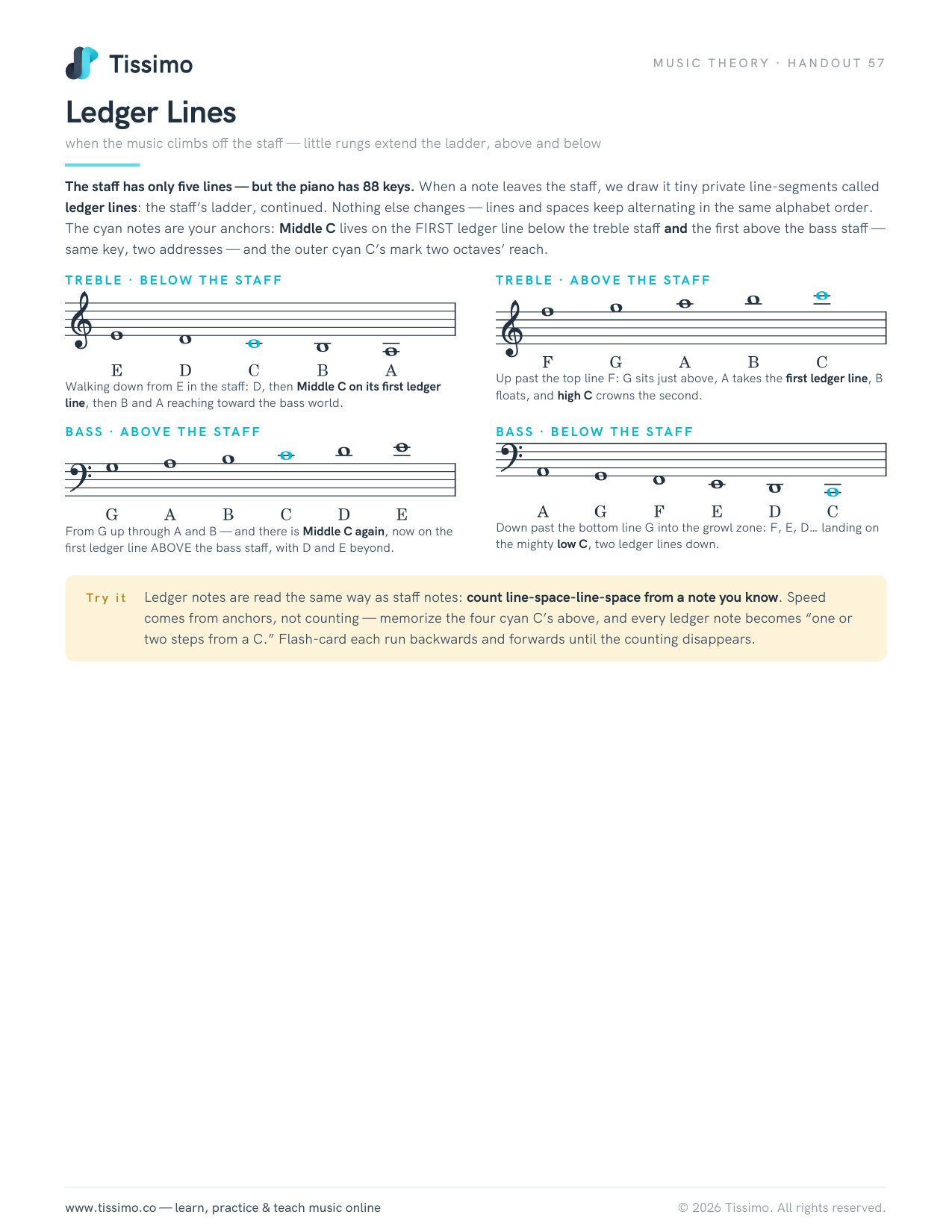
加線
音楽が五線からはみ出すとき——小さな段が上にも下にもはしごを伸ばします
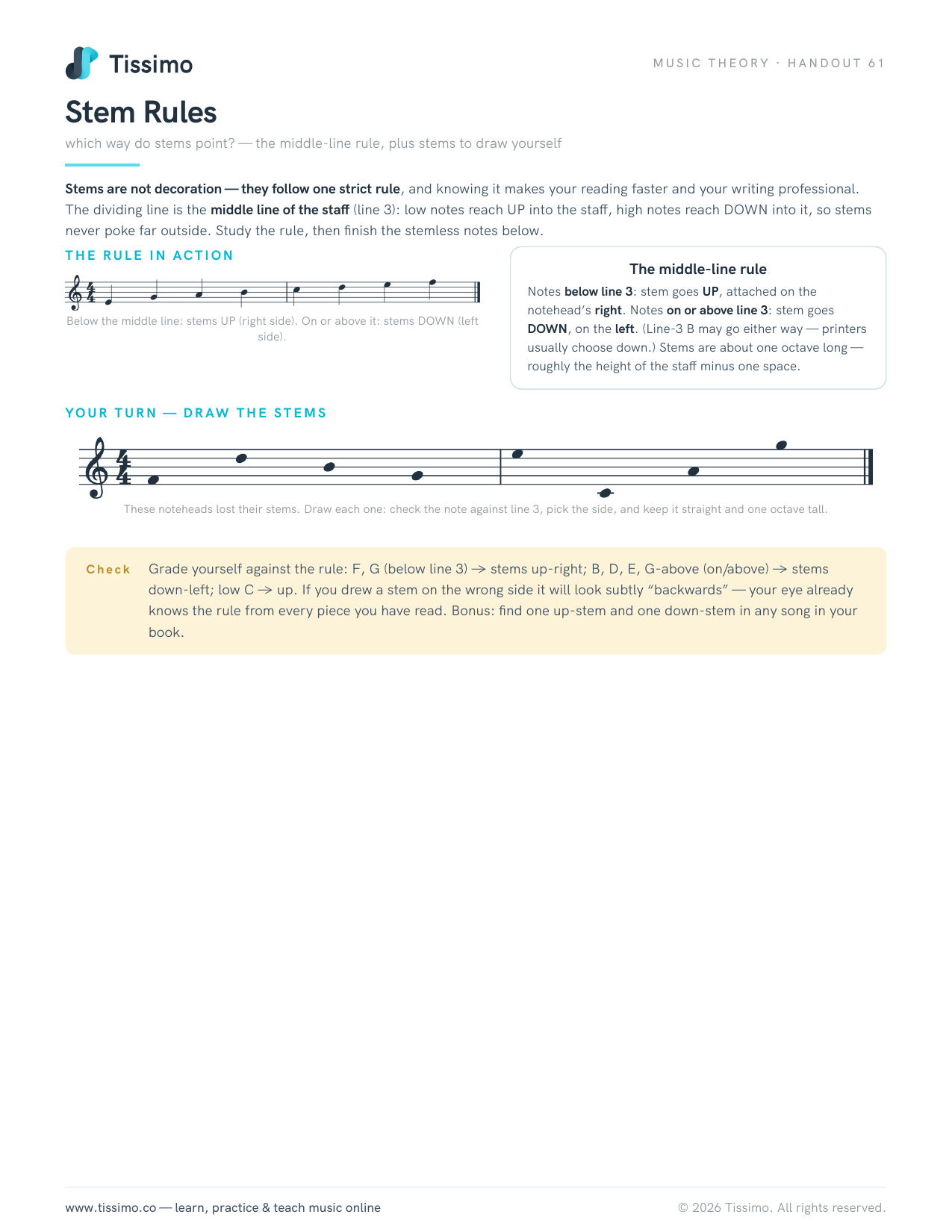
符幹(ふかん)のルール
符幹はどちらを向く?——真ん中の線のルールと、自分で描いてみる練習
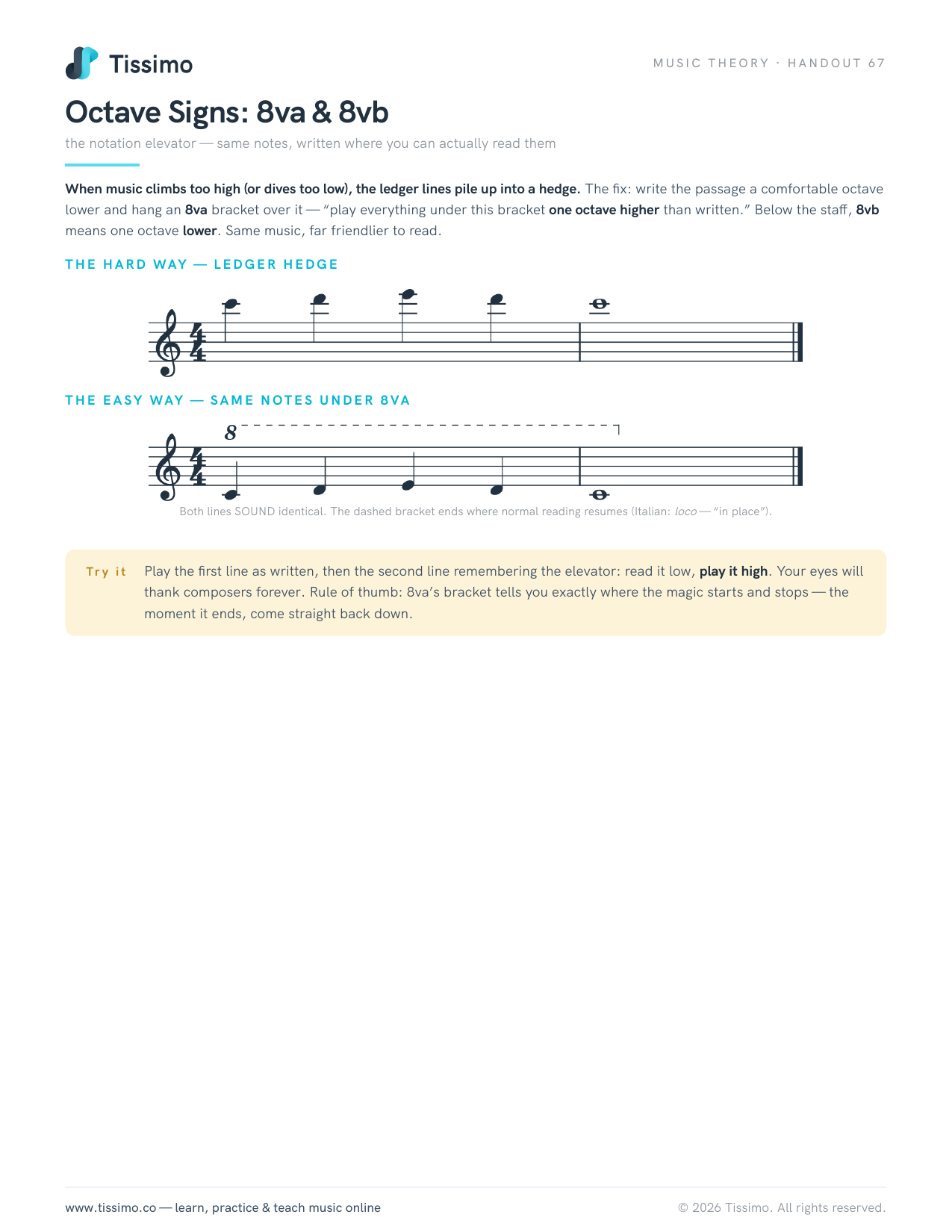
オクターブ記号:8va と 8vb
記譜のエレベーター——同じ音を、実際に読みやすい位置に書き直す記号
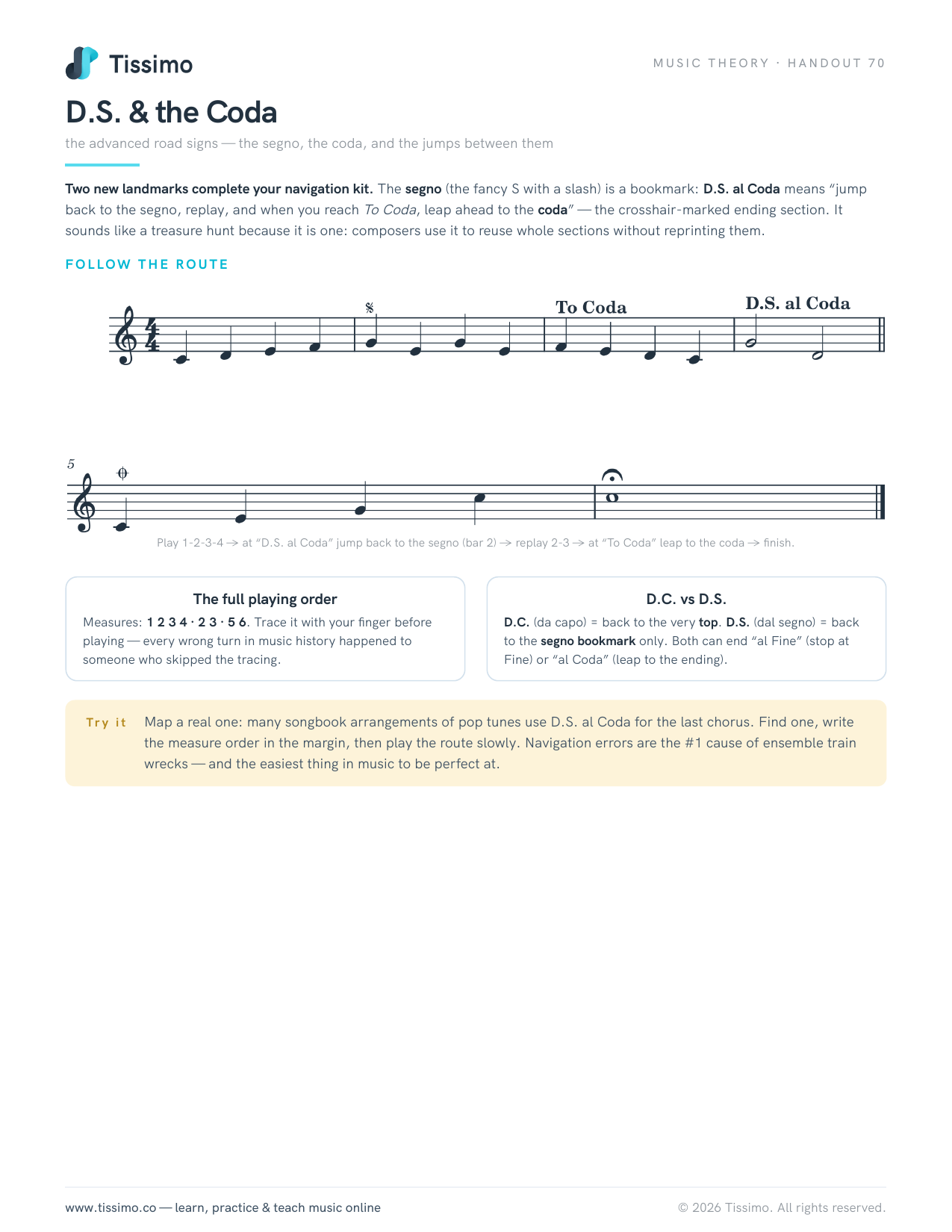
D.S.(ダル・セーニョ)とコーダ
上級の道しるべ——セーニョ、コーダ、そしてそれらの間を飛ぶジャンプ
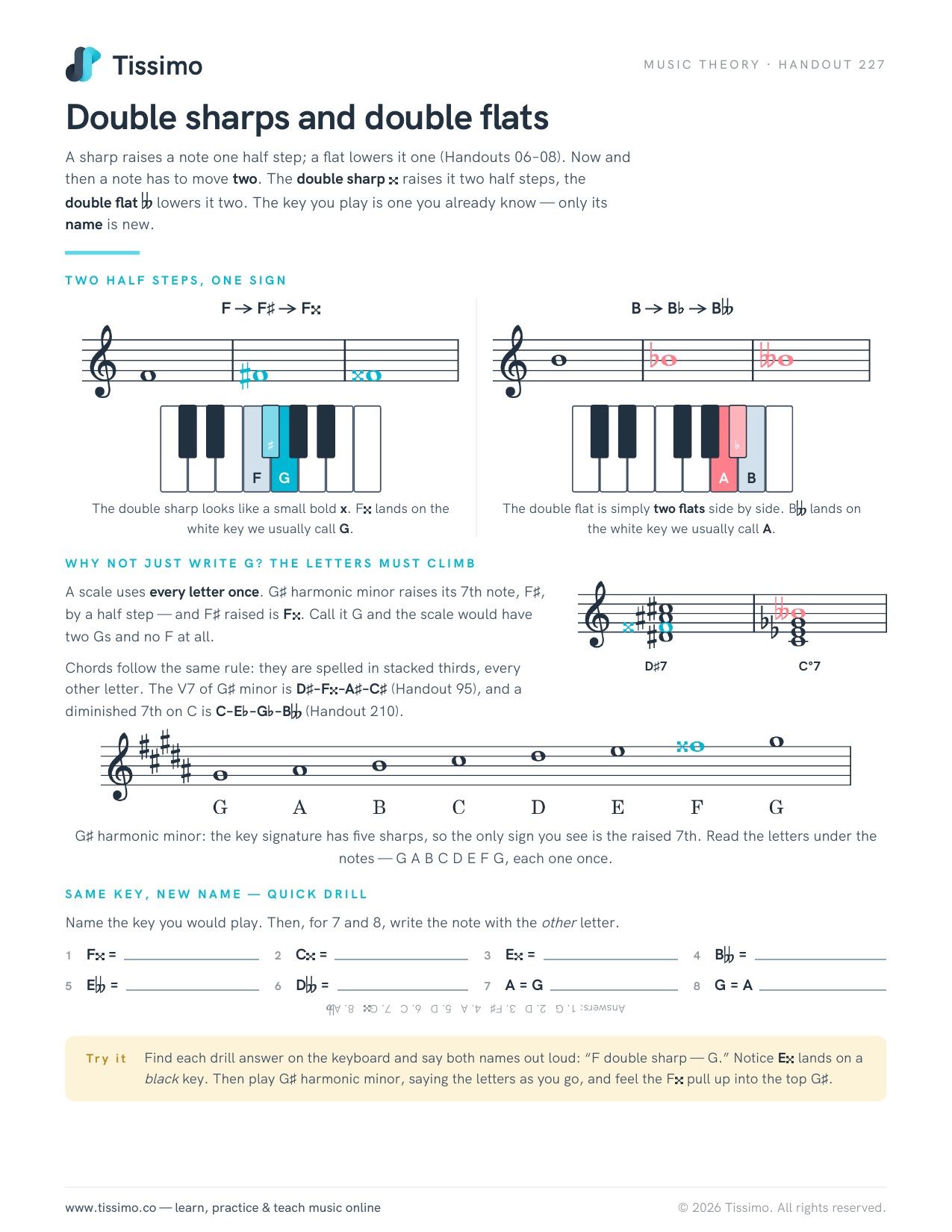
Double sharps and double flats
A sharp raises a note one half step; a flat lowers it one (Handouts 06–08). Now and then a note has to move two. The double sharp raises it two half steps, the double flat lowers it two. The key you play is one you already know — only its name is new.
音程
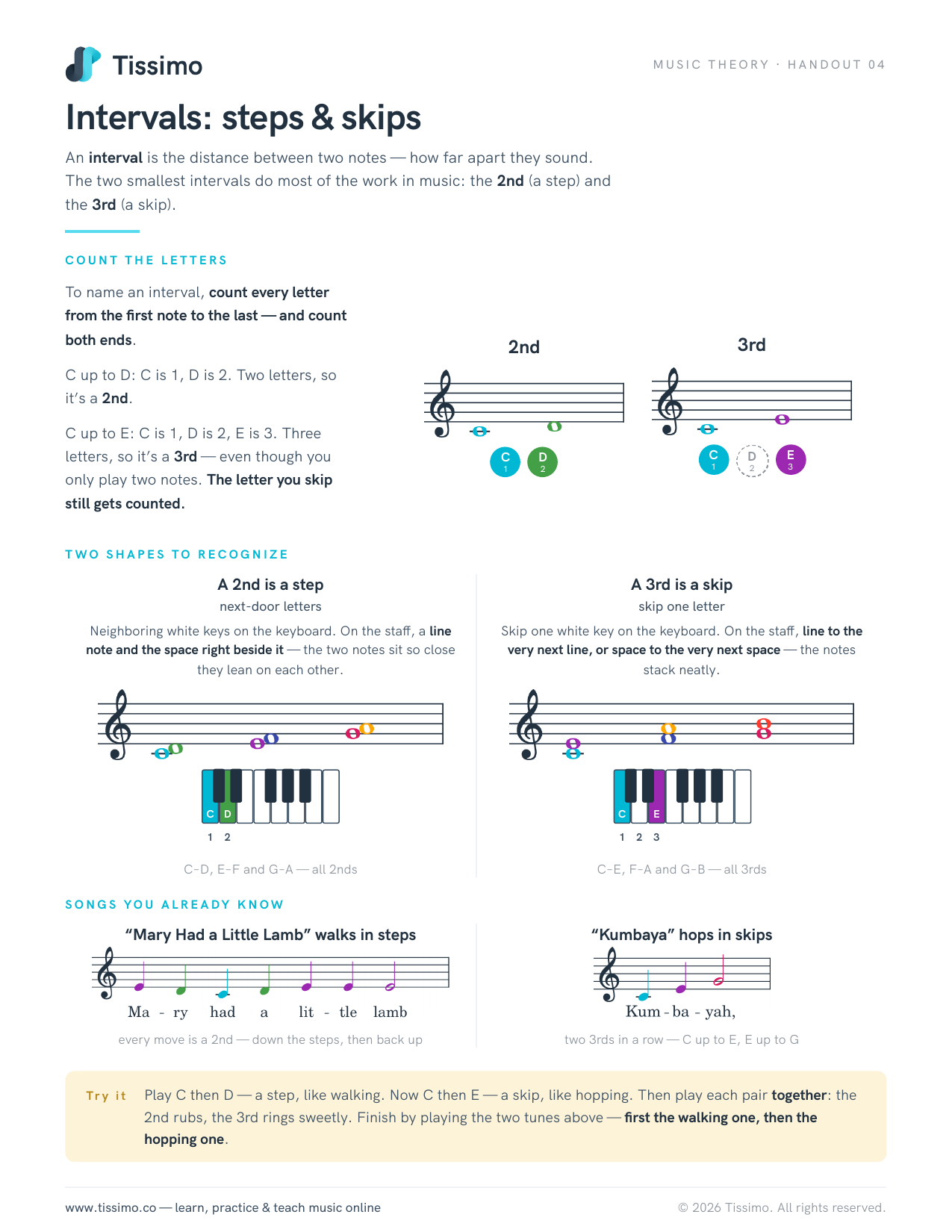
音程:ステップとスキップ
音程とは2つの音の間の距離——どれだけ離れて聞こえるかです。音楽で最もよく使われるのは、2つの小さな音程:2度(隣の音)と3度(一つ飛ばし)です。
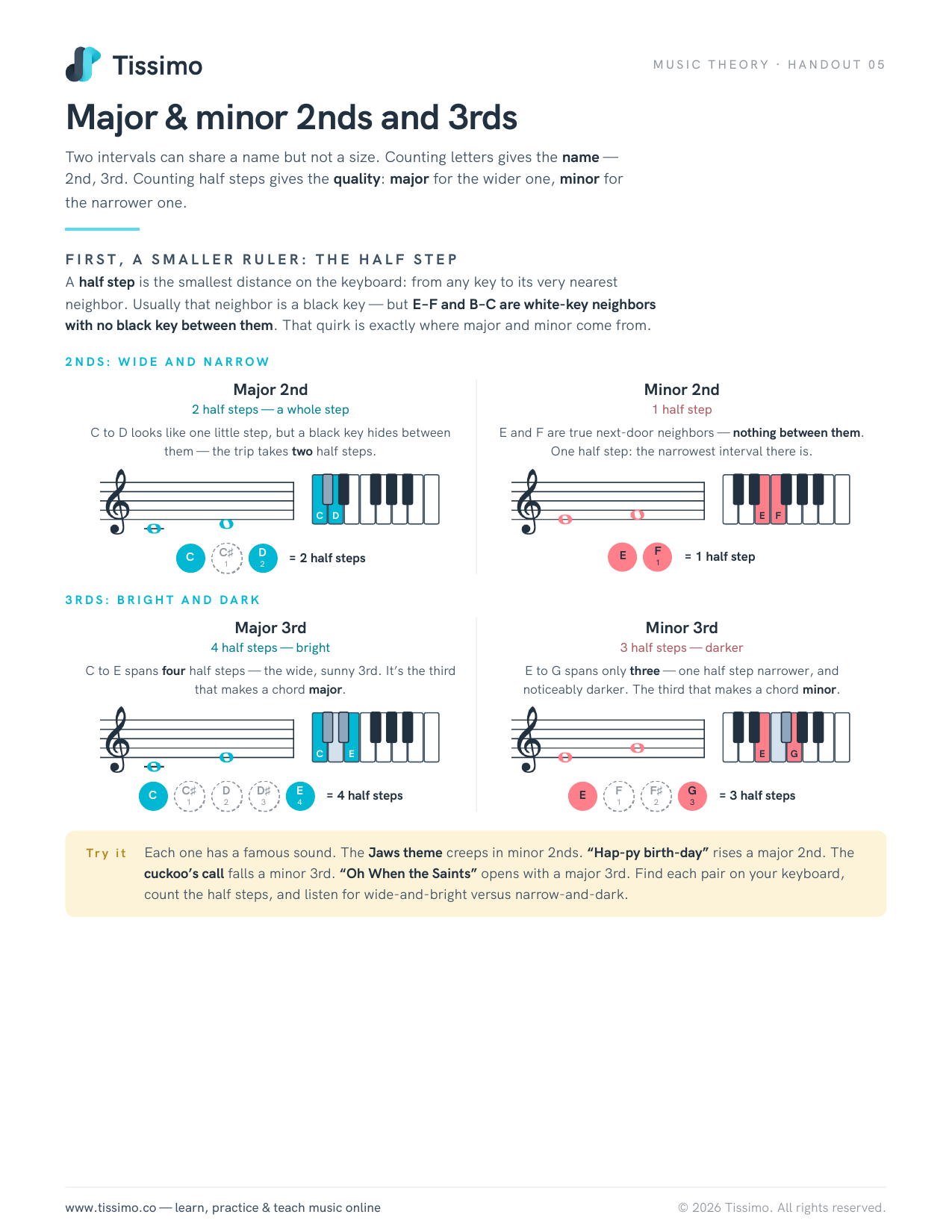
長・短の2度と3度
2つの音程は同じ名前でも大きさが違うことがあります。音名を数えると名前が決まります——2度、3度。半音の数を数えると「長」か「短」かが決まります:広いほうが長、狭いほうが短です。
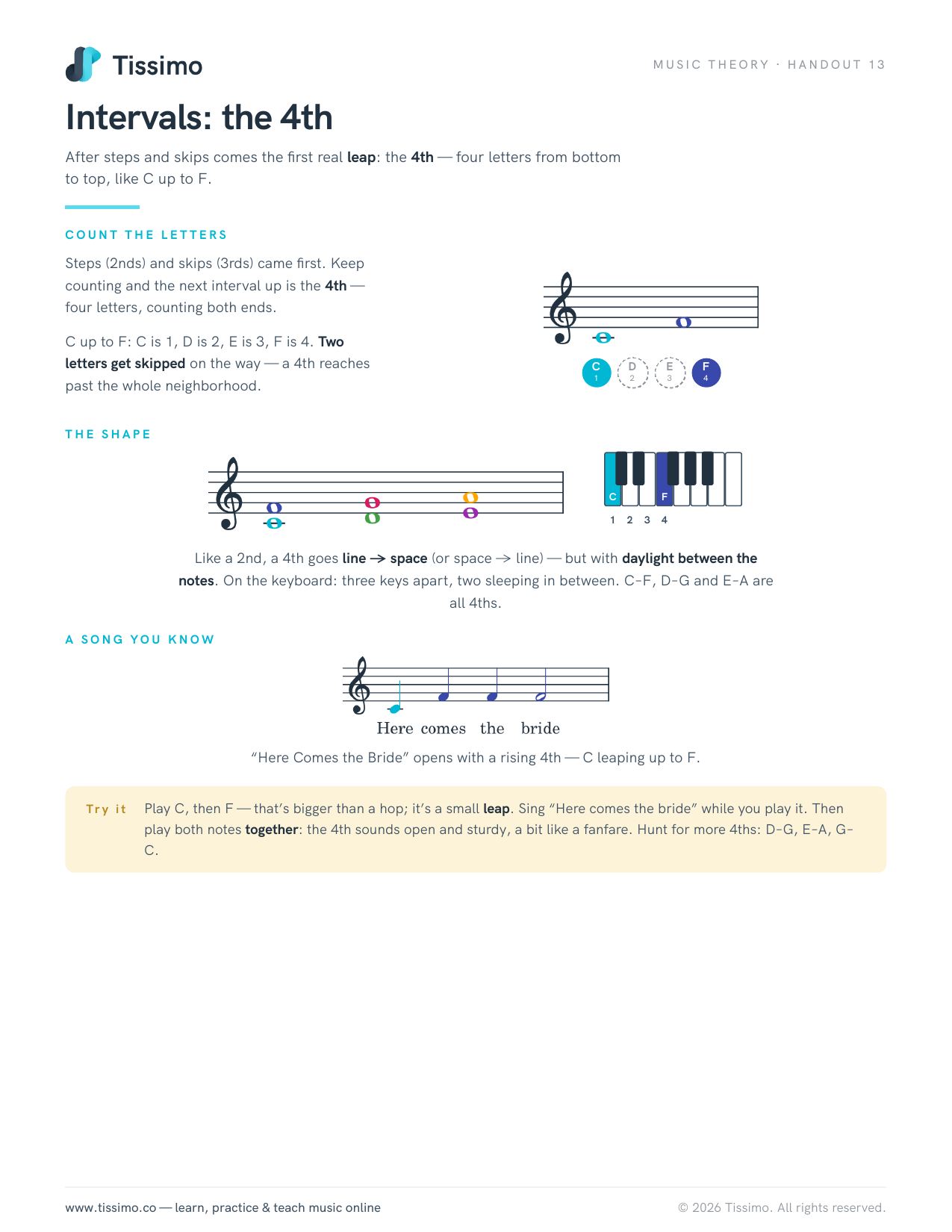
音程:4度
ステップとスキップの次に来るのは、最初の本格的なジャンプ:4度です——下から上まで4つの音名、たとえばドからファまで。
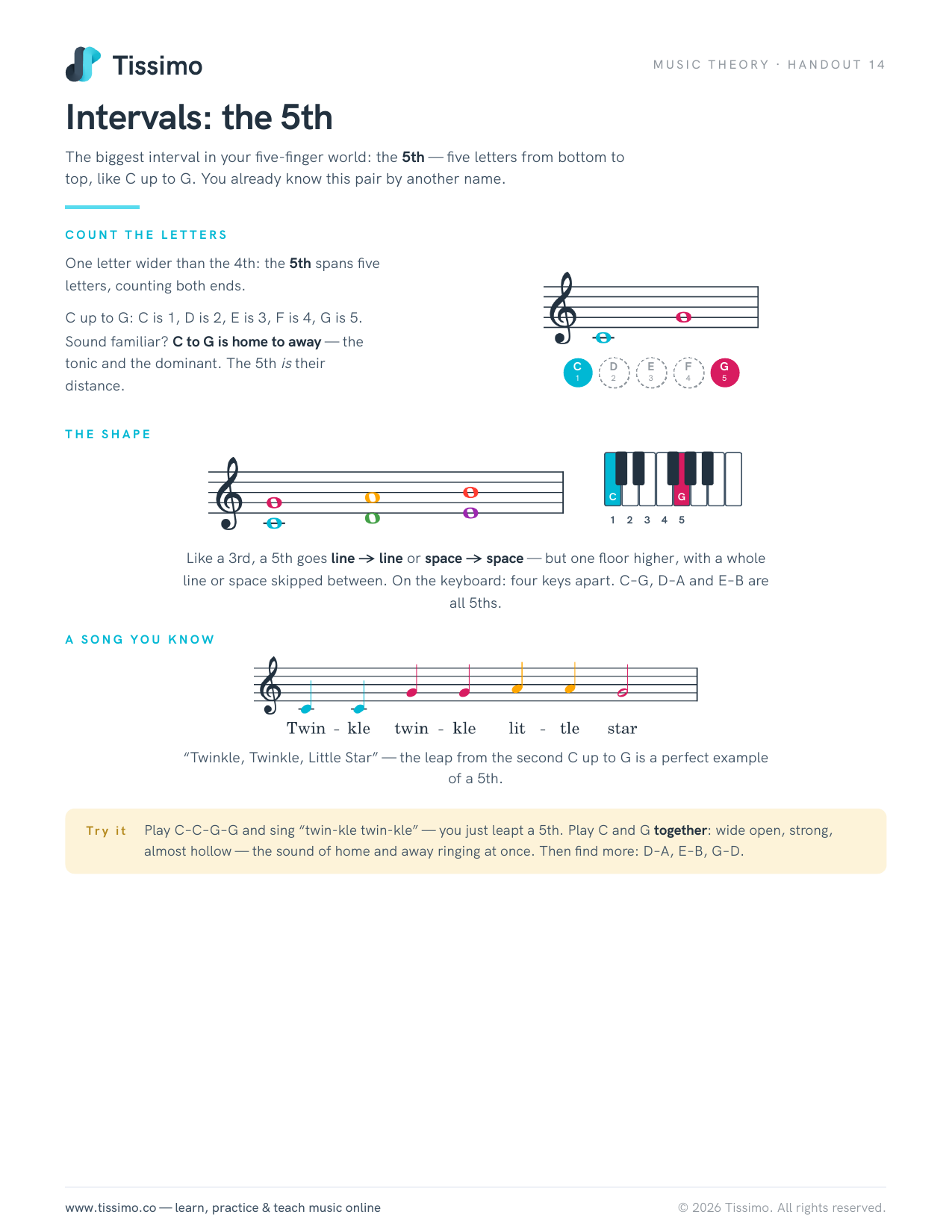
音程:5度
5本指のポジションの中で最も大きな音程:5度です——下から上まで5つの音名、たとえばドからソまで。実はこのペア、別の名前ですでに知っています。
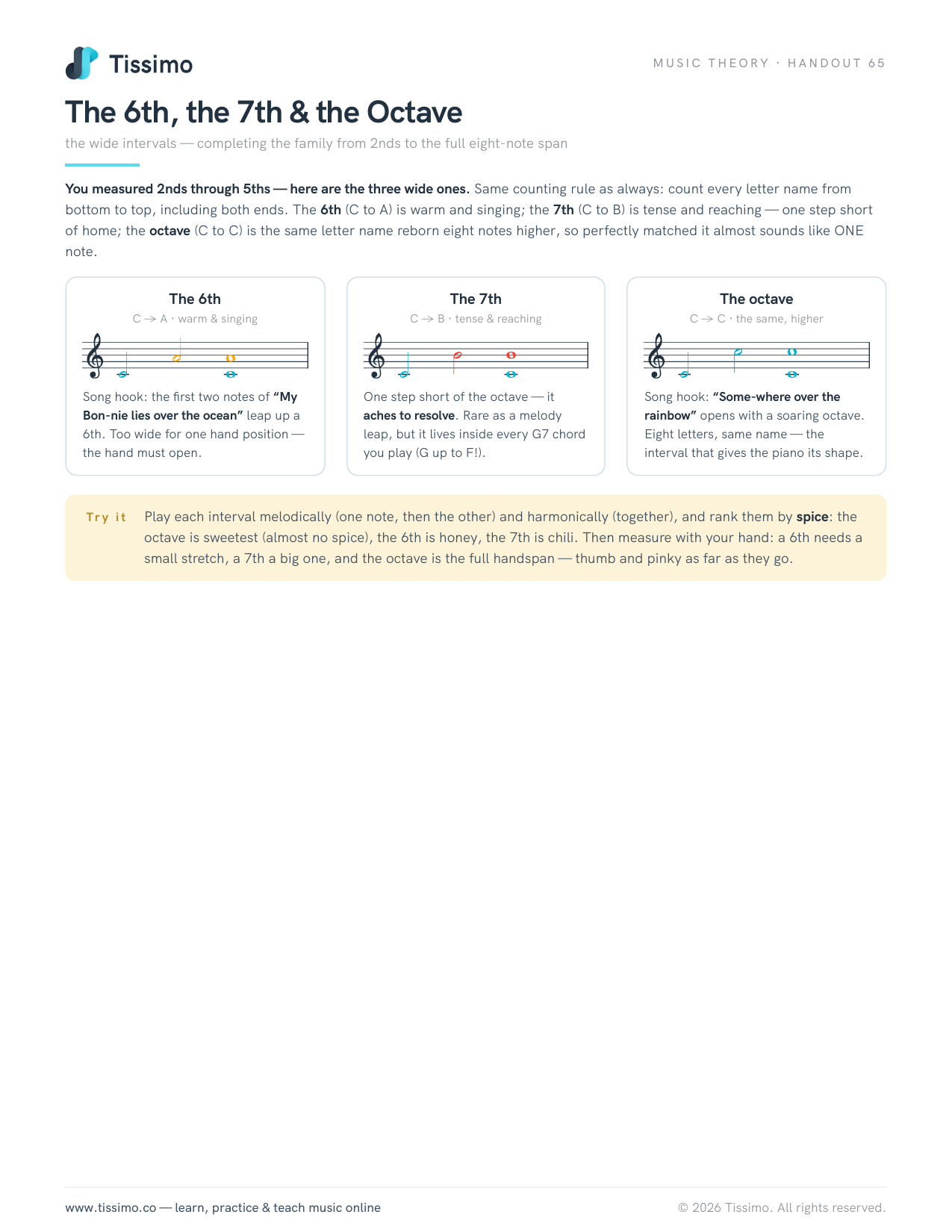
6度、7度、オクターブ
広い音程たち——2度から始まる音程ファミリーを、8音分の完全な広がりまで完成させます
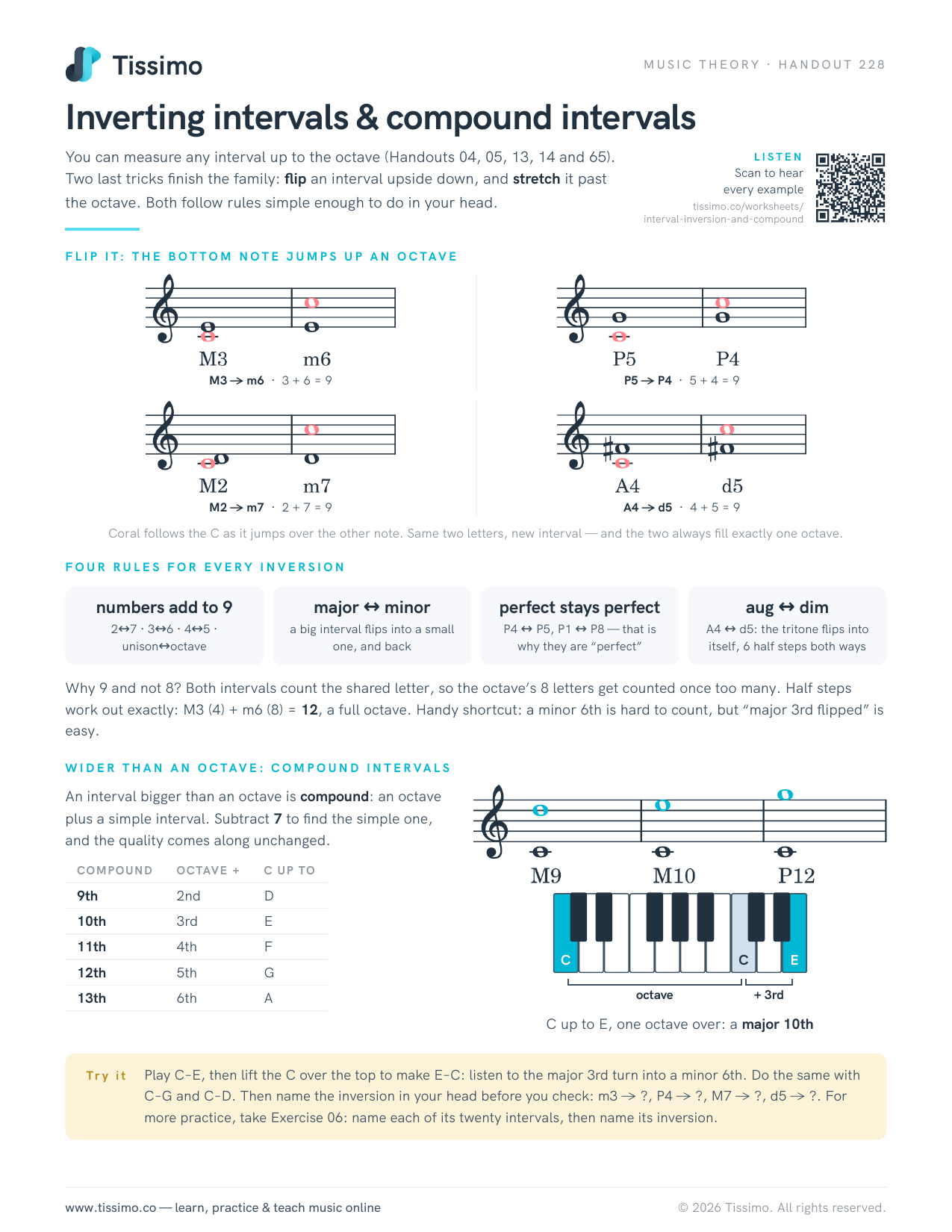
Inverting intervals & compound intervals
You can measure any interval up to the octave (Handouts 04, 05, 13, 14 and 65). Two last tricks finish the family: flip an interval upside down, and stretch it past the octave. Both follow rules simple enough to do in your head.
音階と調
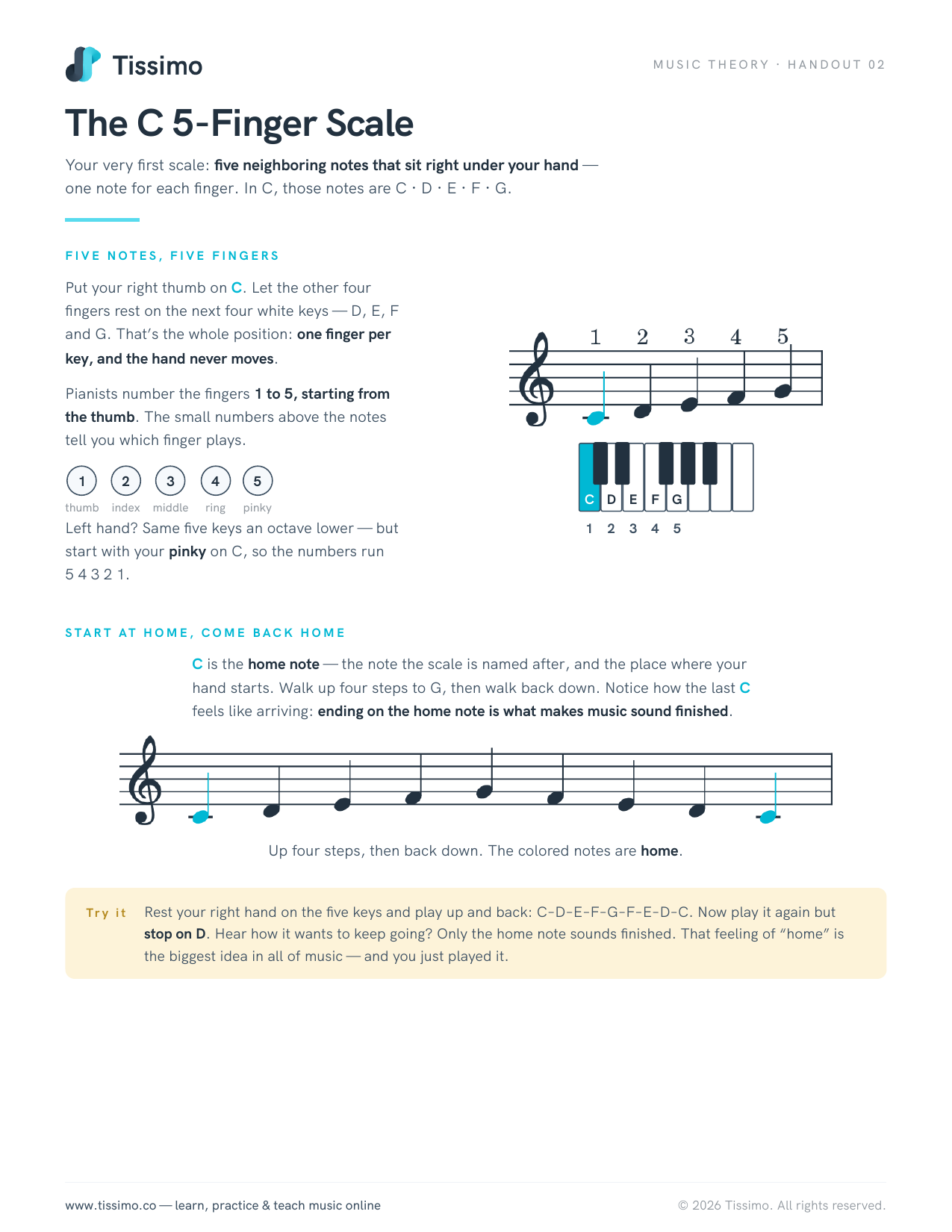
ハ調の5指ポジション音階
はじめての音階:手の下にぴったり収まる、隣り合った5つの音——指1本につき1音。ハ長調では、その音はド・レ・ミ・ファ・ソです。
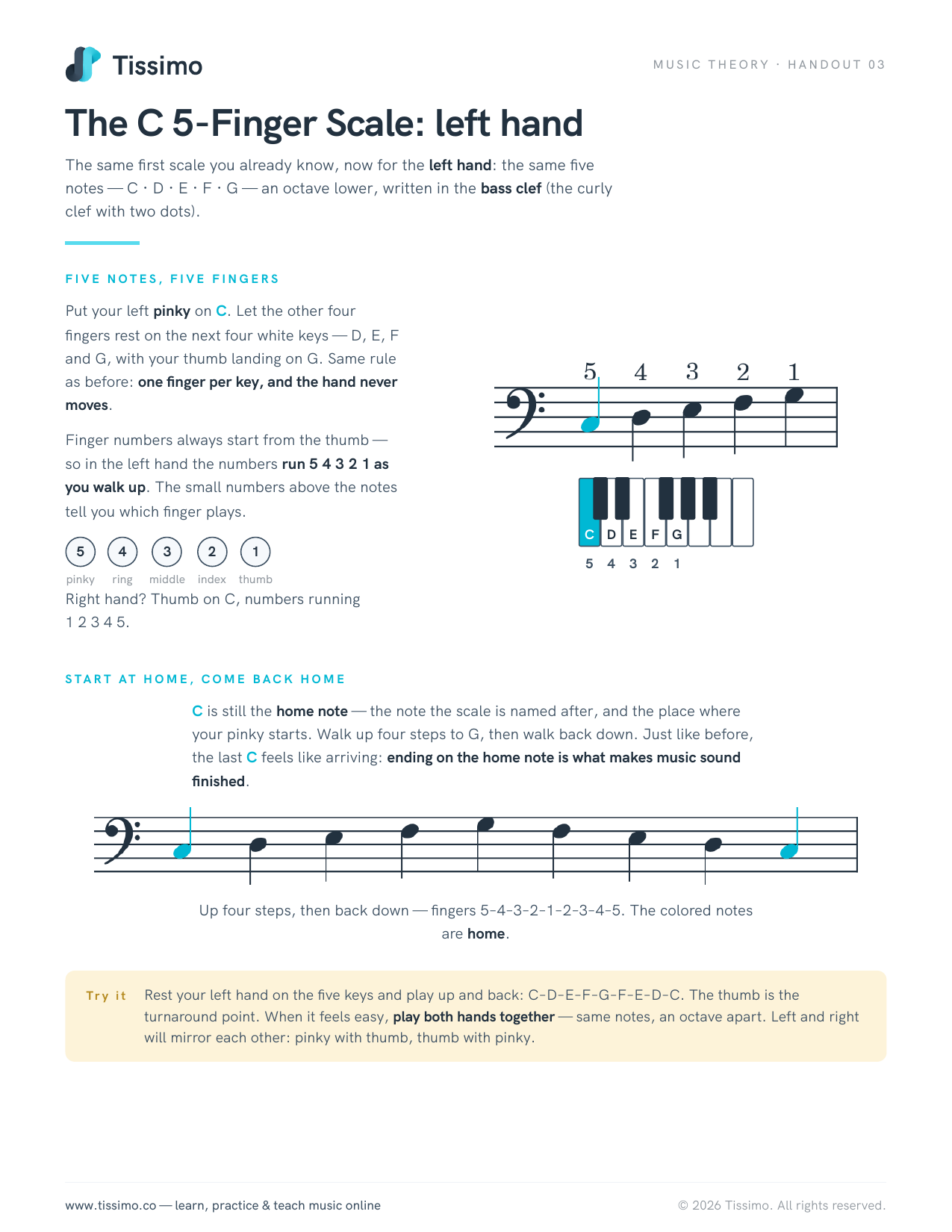
ハ調の5指ポジション音階:左手
すでに知っている最初の音階を、今度は左手で。同じ5つの音——ド・レ・ミ・ファ・ソ——を1オクターブ下げ、ヘ音記号(2つの点がある丸い記号)で書いたものです。
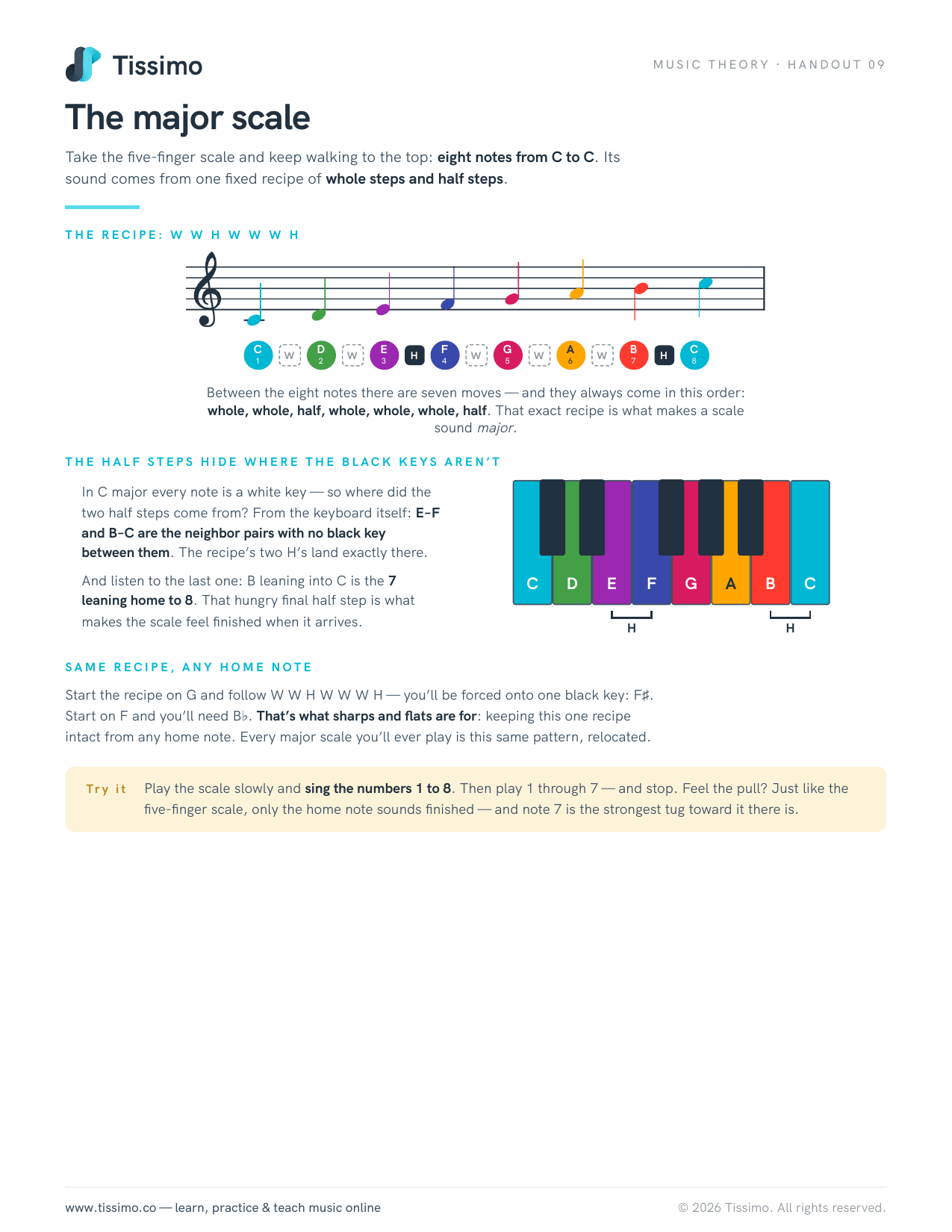
長音階
5指の音階をそのまま上まで歩き続けると、ドからドまでの8つの音になります。その響きは、全音と半音の決まったレシピから生まれます。
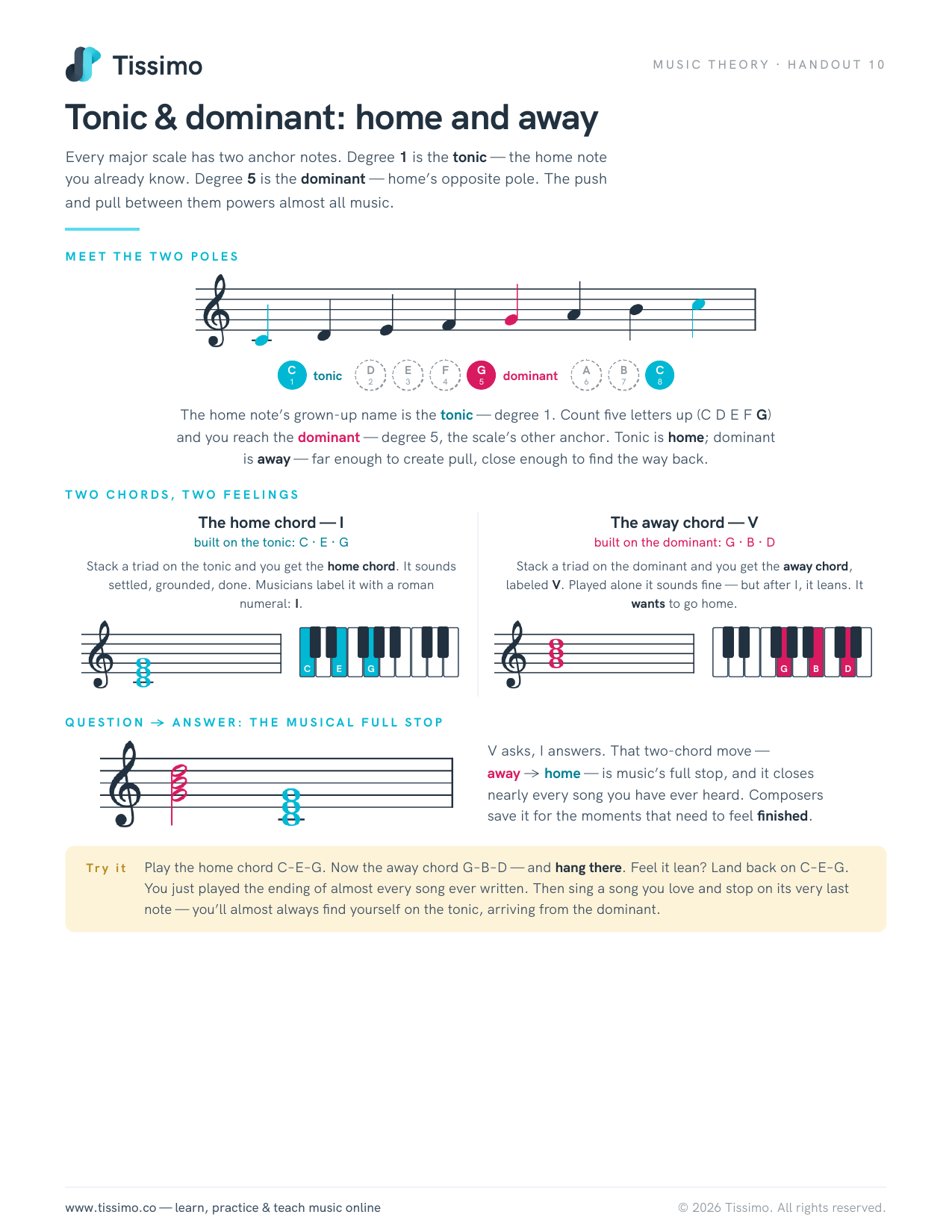
主音と属音:家と旅先
すべての長音階には2つの基準となる音があります。第1音は主音——すでに知っている「家」の音です。第5音は属音——家の正反対の極です。この2つの間の引っ張り合いが、ほぼすべての音楽を動かしています。
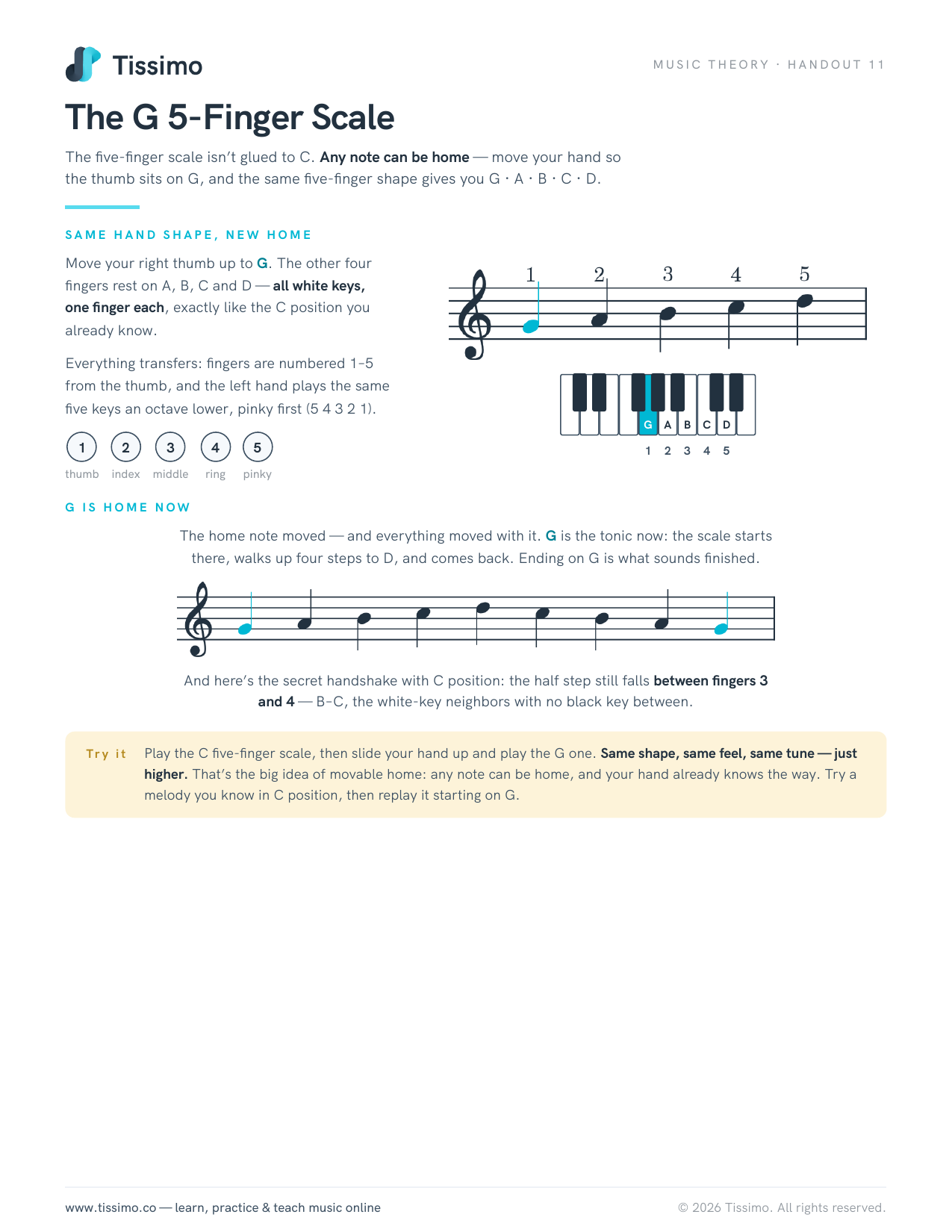
ト調の5指ポジション音階
5指の音階はドに固定されているわけではありません。どの音も「家」になれます——親指をソの上に置くように手を動かせば、同じ5指の形でソ・ラ・シ・ド・レが得られます。
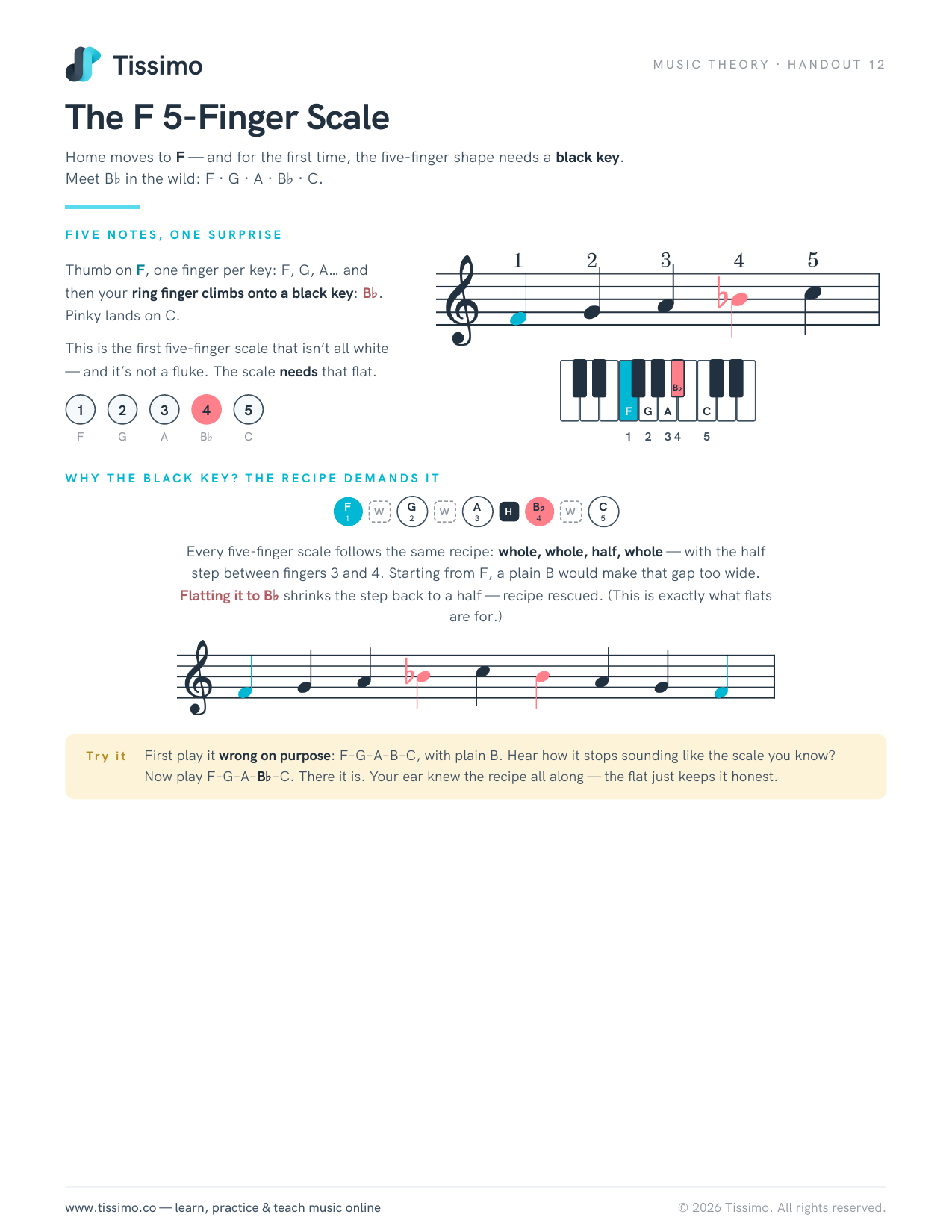
ヘ調の5指ポジション音階
家がファに引っ越します——そして初めて、5指の形に黒鍵が必要になります。B♭(変ロ)に初対面:ファ・ソ・ラ・シ♭・ド。
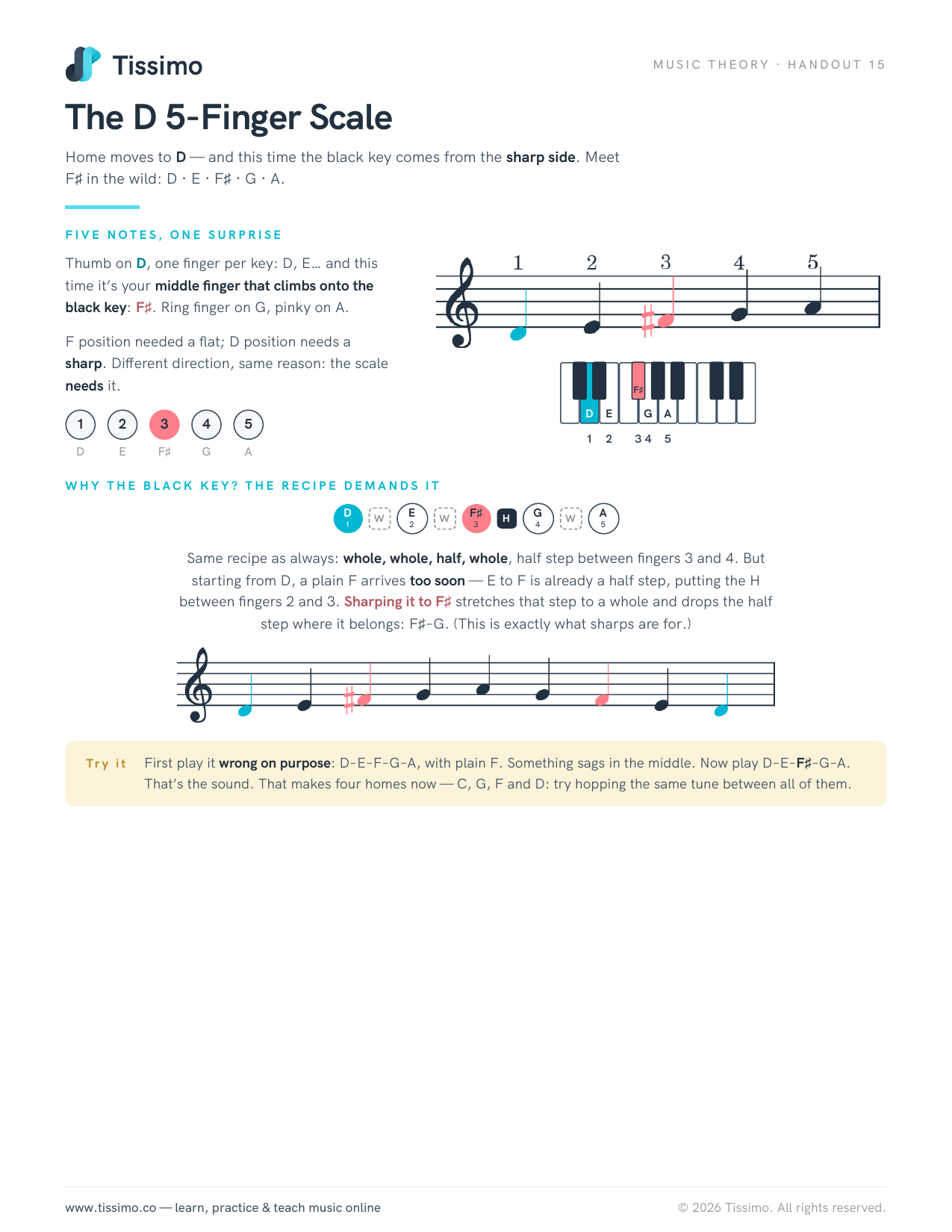
ニ調の5指ポジション音階
家がレに引っ越します——今度は黒鍵がシャープ側から登場します。F♯(嬰ヘ)に初対面:レ・ミ・ファ♯・ソ・ラ。
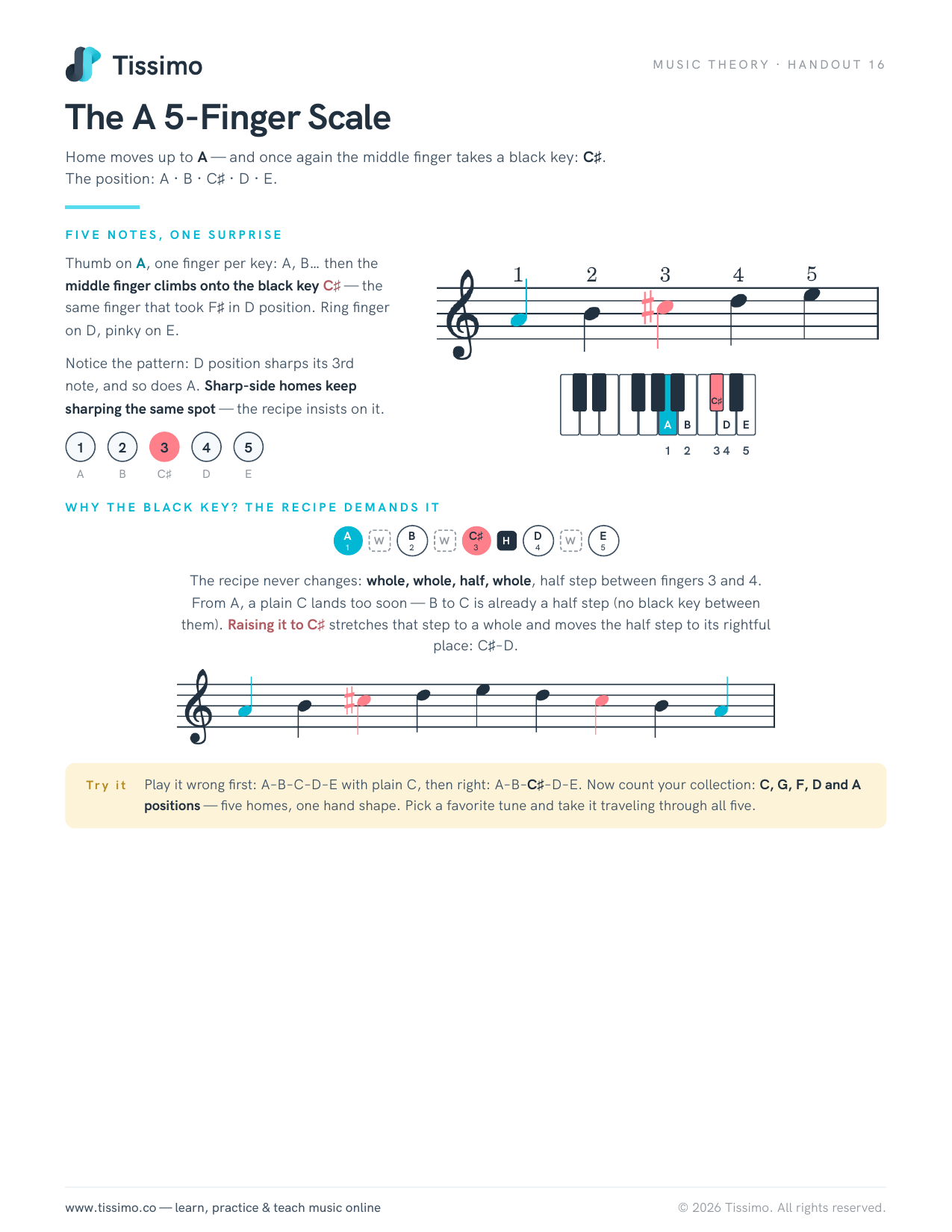
イ調の5指ポジション音階
家がラへ上がります——ここでも中指が黒鍵を担当:C♯(嬰ハ)です。ポジション:ラ・シ・ド♯・レ・ミ。
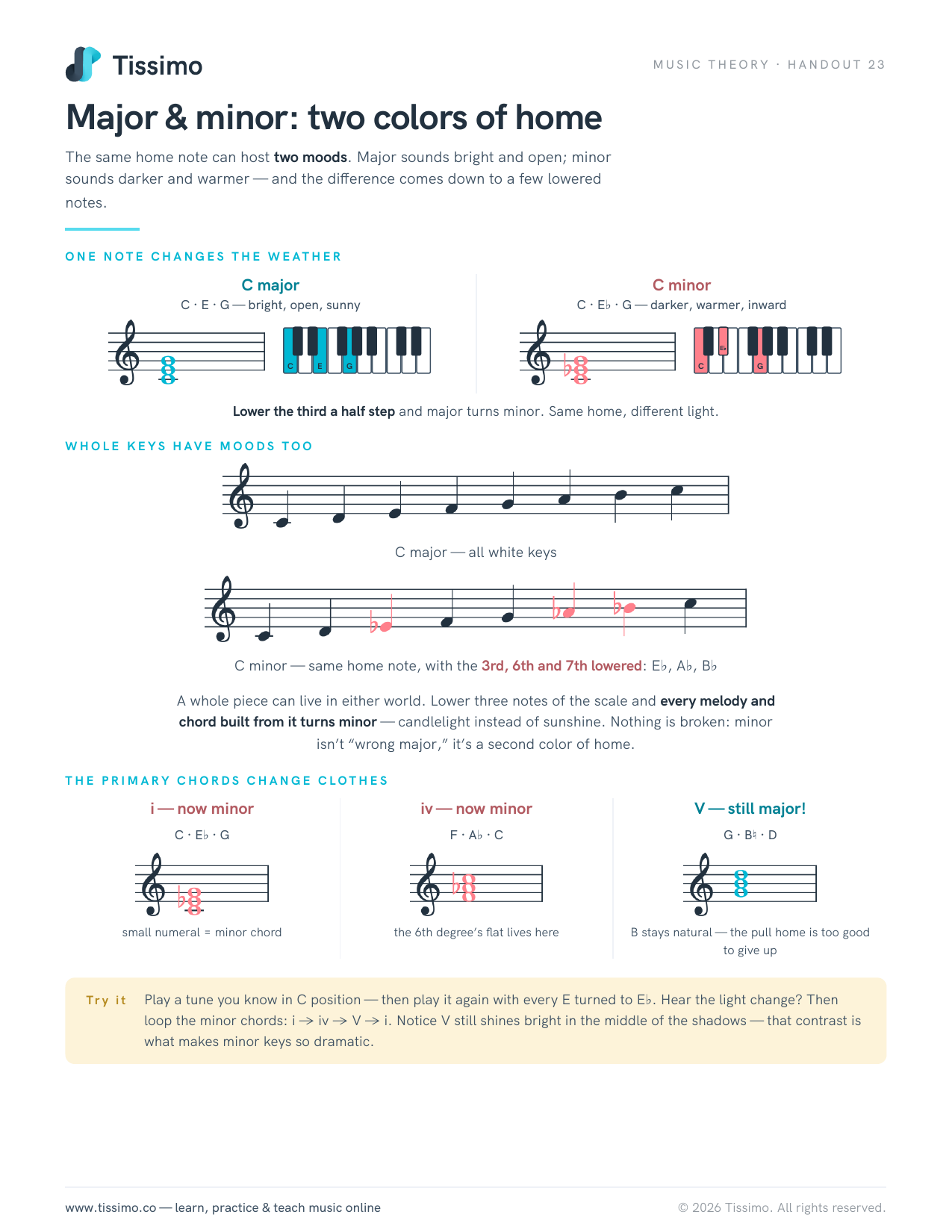
長調と短調:同じ「家」の2つの色
同じ「家」の音でも、2つの雰囲気を持つことができます。長調は明るく開放的に、短調はより暗く温かみのある響きに——その違いは、いくつかの音を下げるだけで生まれます。
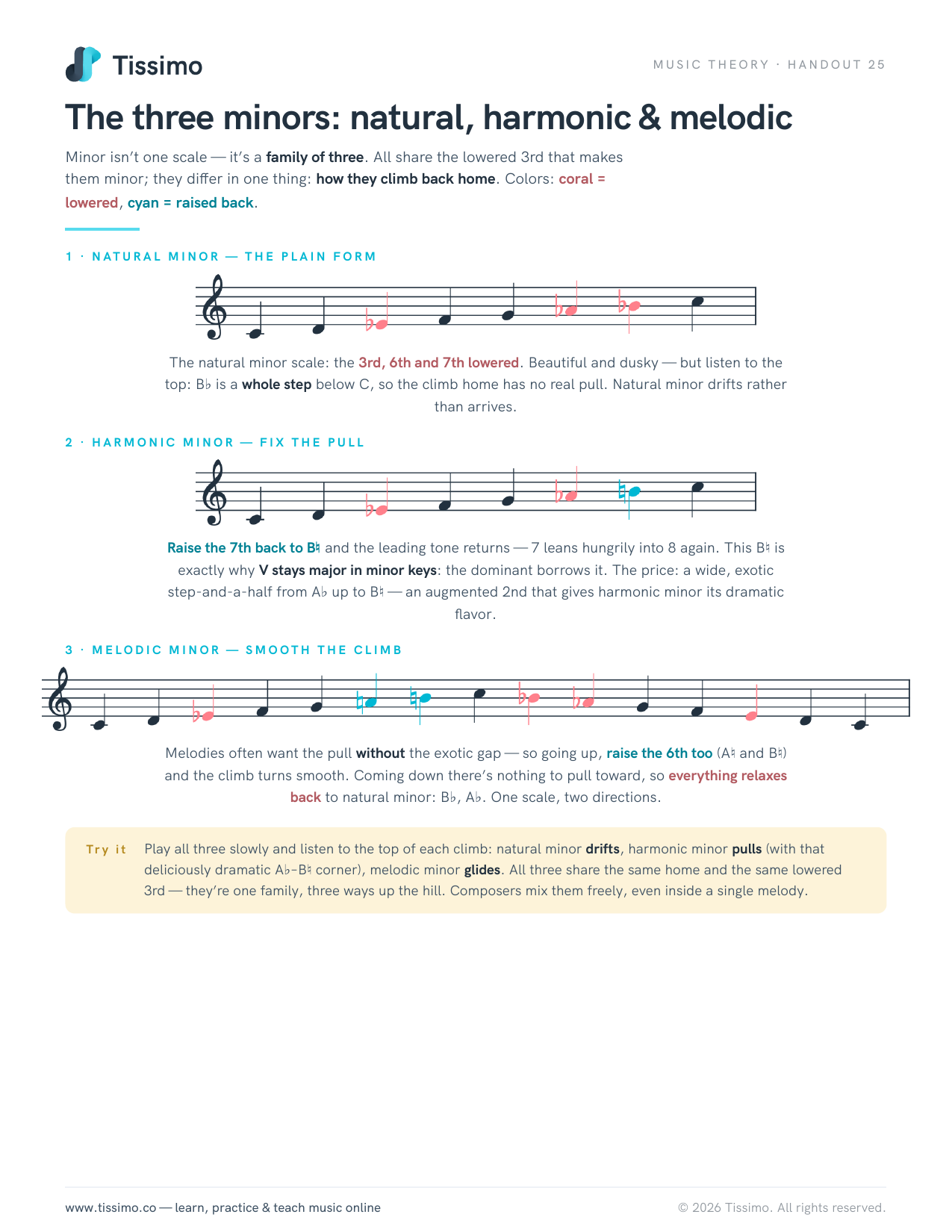
3つの短音階:自然的、和声的、旋律的
短調は1種類ではなく、3つの家族です。どれも「家」を短調にする下げられた3度を共有していますが、違いは1つ:家へ戻る上りかたです。色分け:コーラル=下げた音、シアン=再び上げた音。
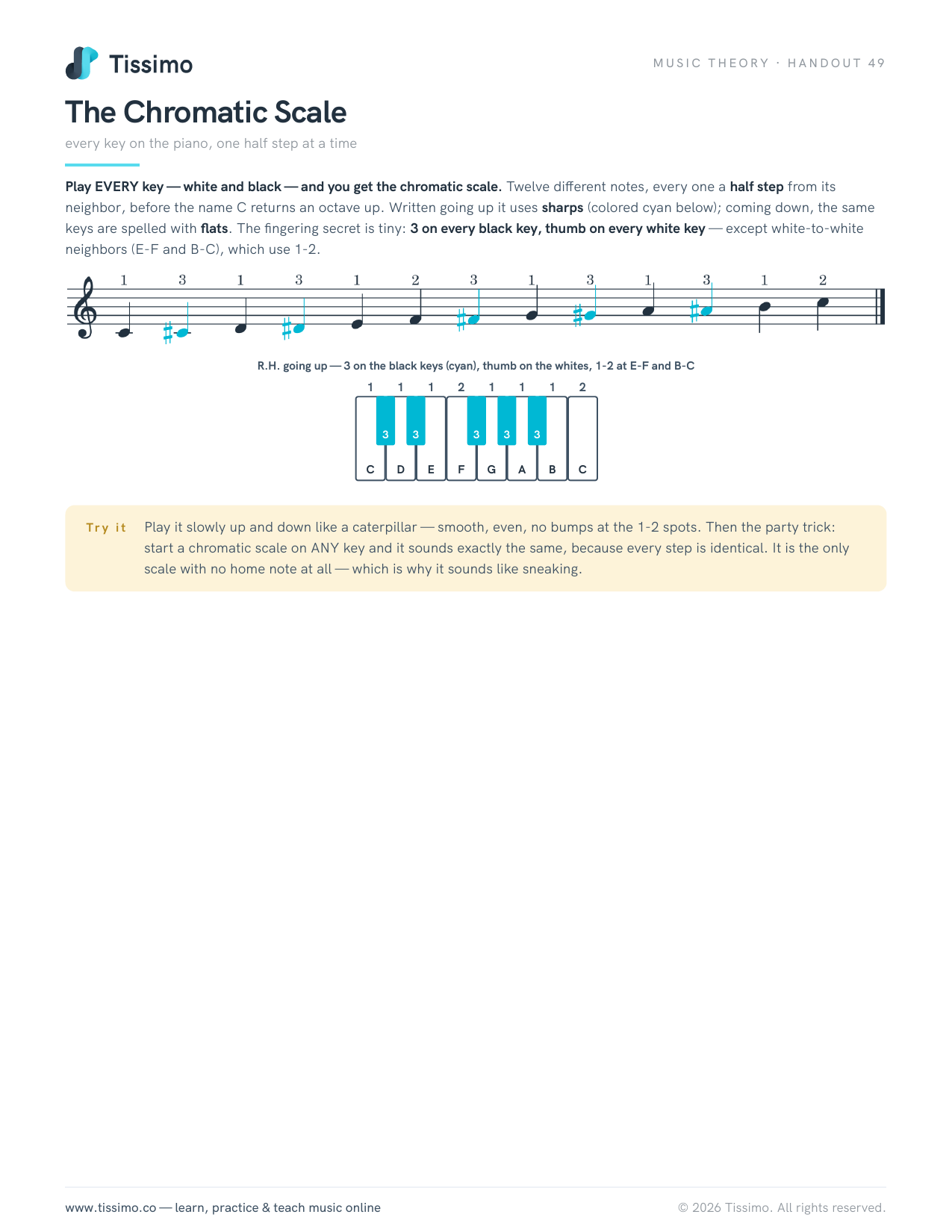
半音階
ピアノのすべての鍵盤を、半音ずつたどる
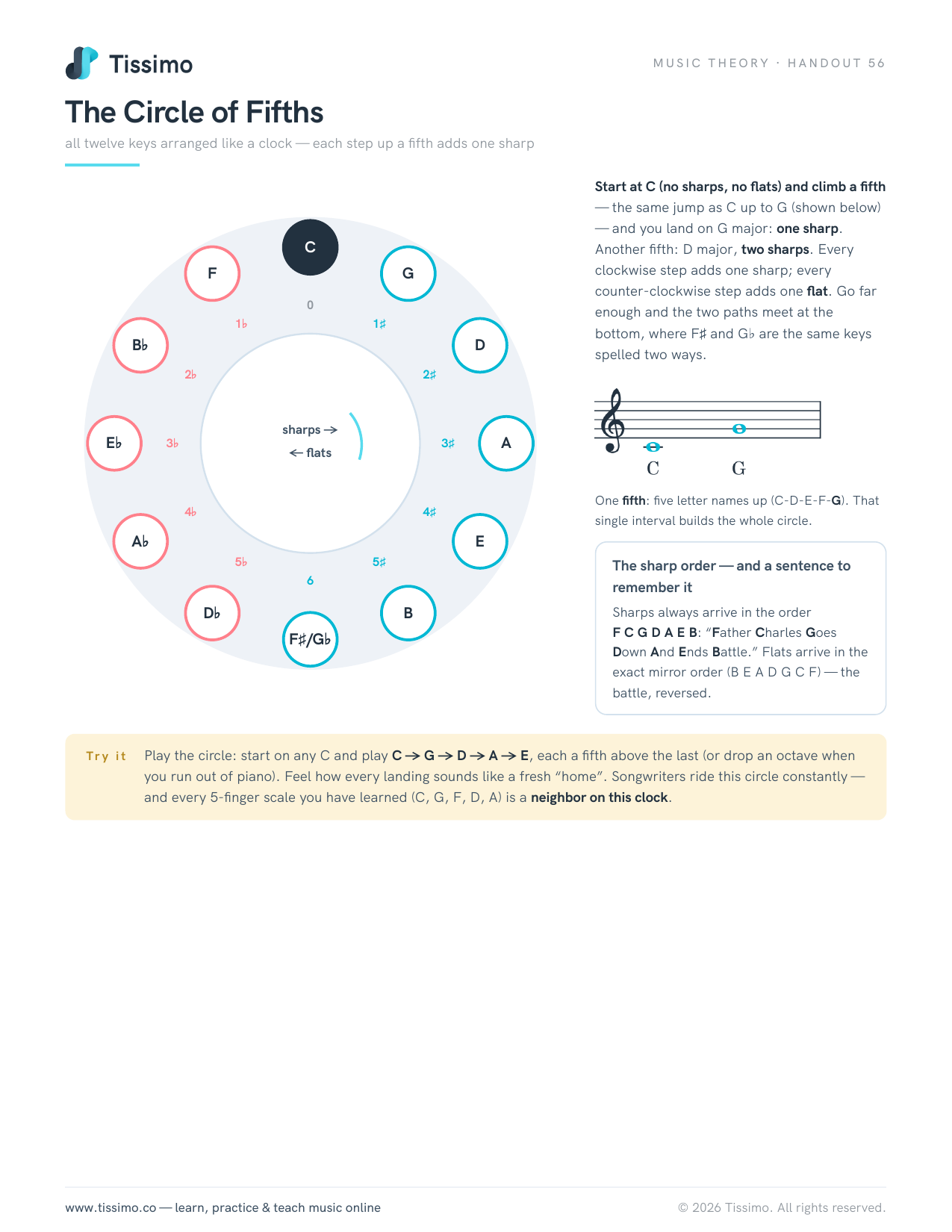
五度圏
12の調が時計のように並んでいる——5度上がるごとにシャープが1つ増える
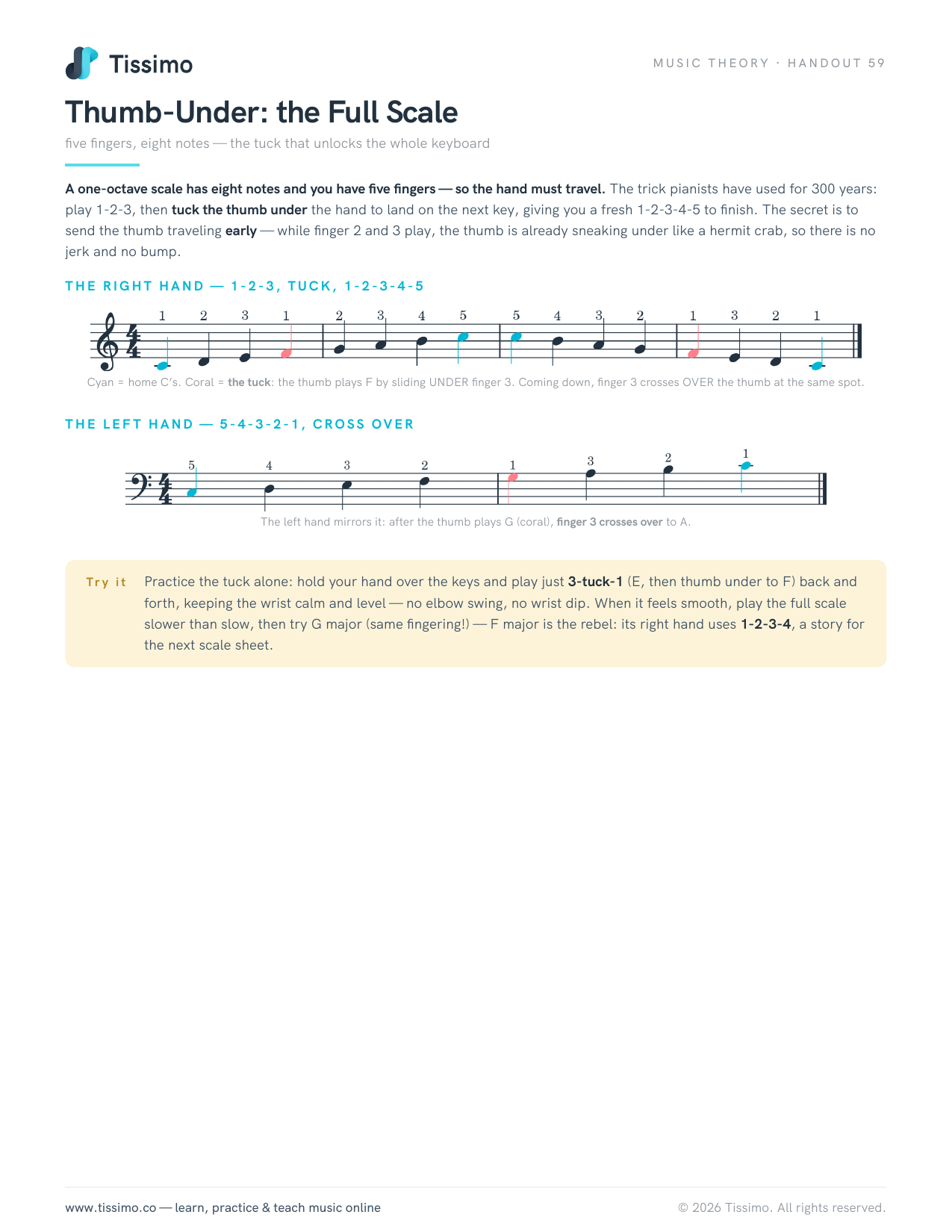
指くぐり:完全な音階
5本の指で8つの音——鍵盤全体を解き放つ「指くぐり」のテクニック
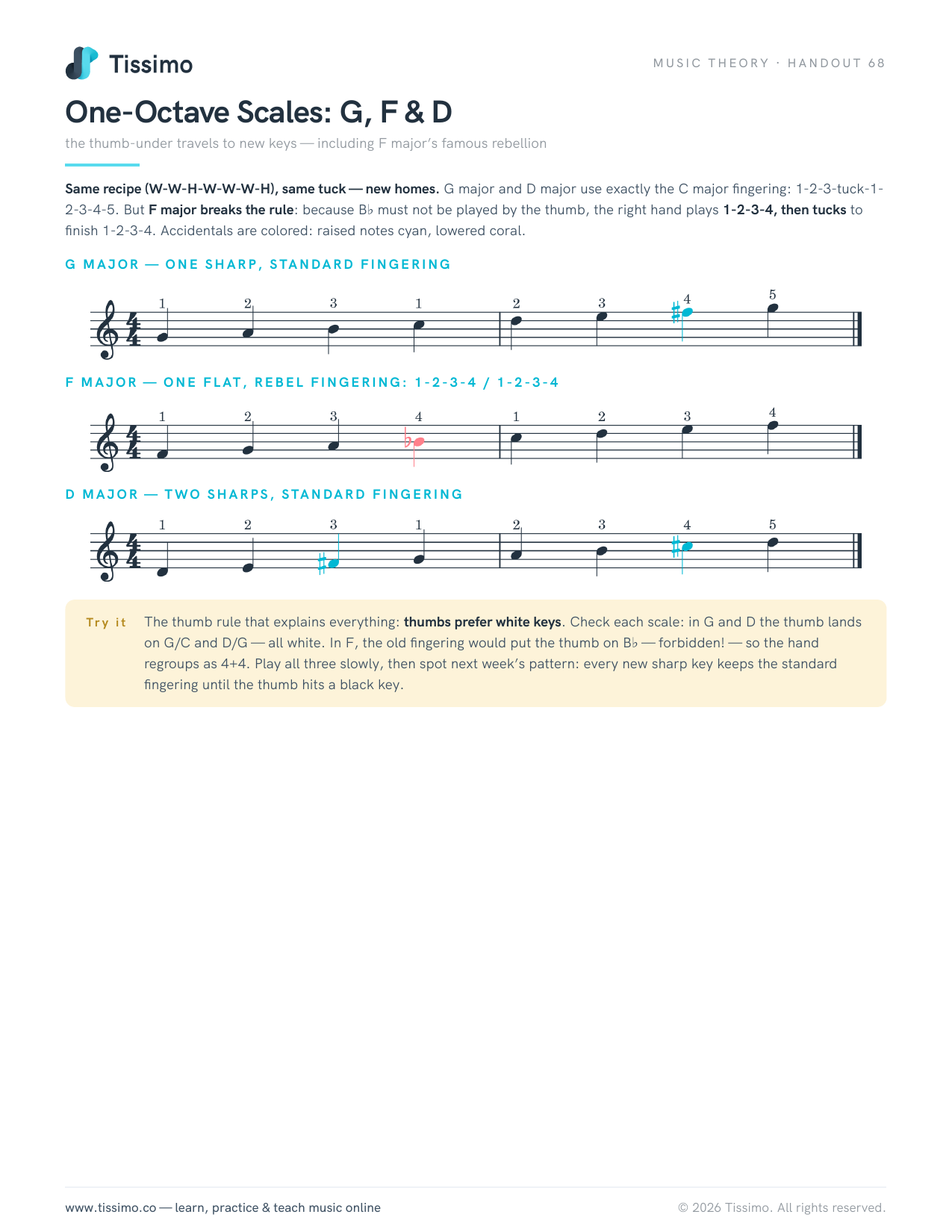
1オクターブ音階:ト調、ヘ調、ニ調
指くぐりが新しい調へ旅する——ヘ長調の有名な「反逆」も含めて
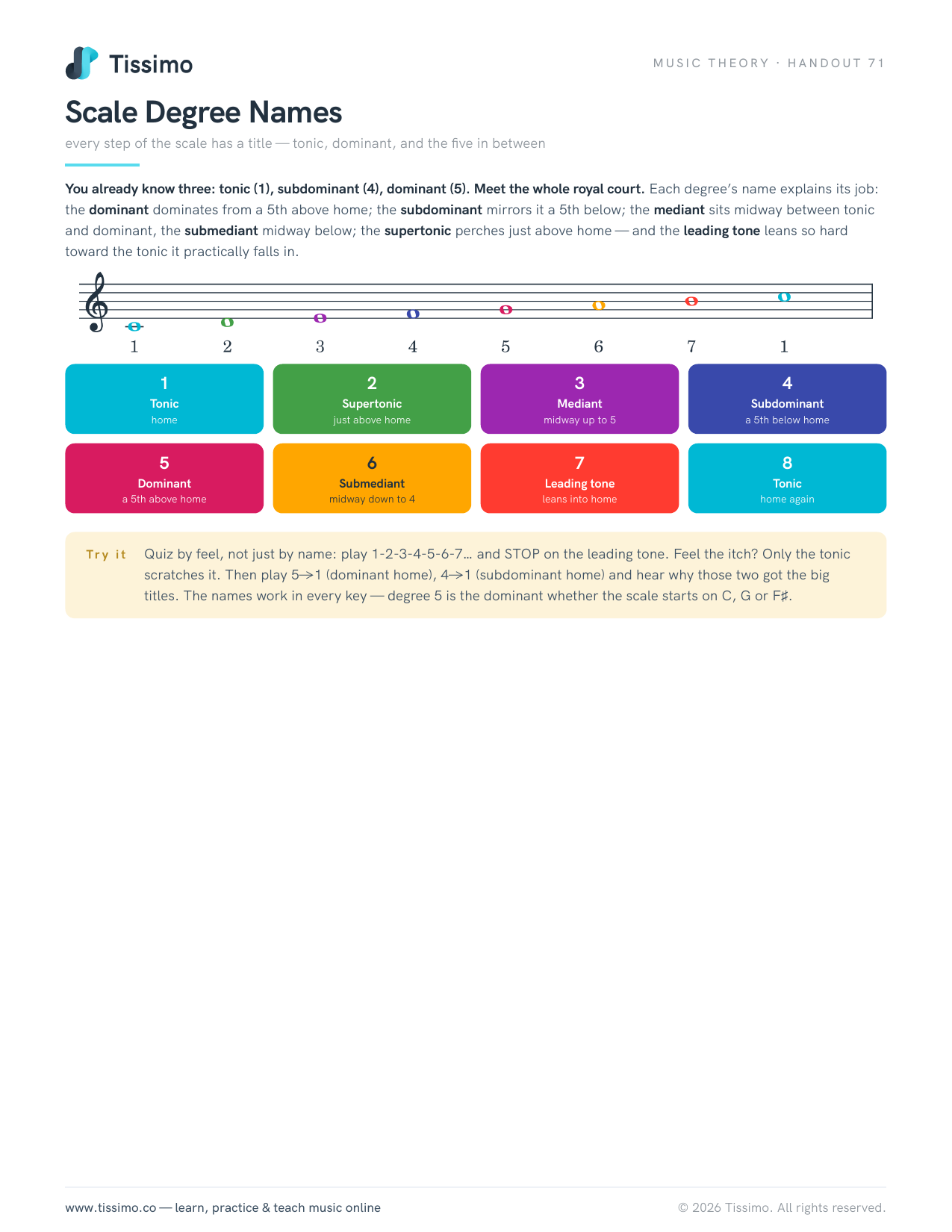
音階の度数名
音階のすべての音には名前がある——主音、属音、そしてその間の5つ
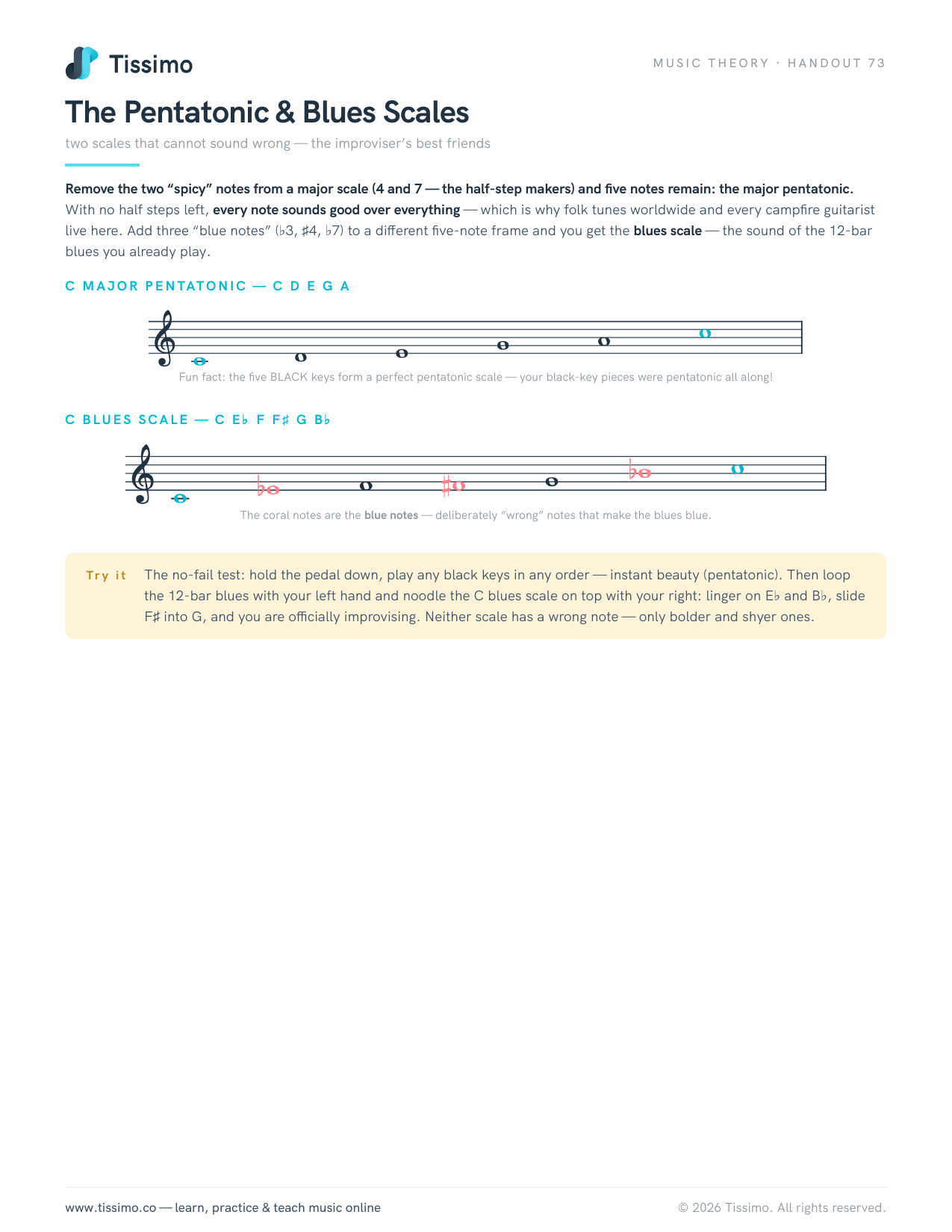
ペンタトニックスケールとブルーススケール
絶対に音を外さない2つのスケール——即興演奏者の最高の相棒
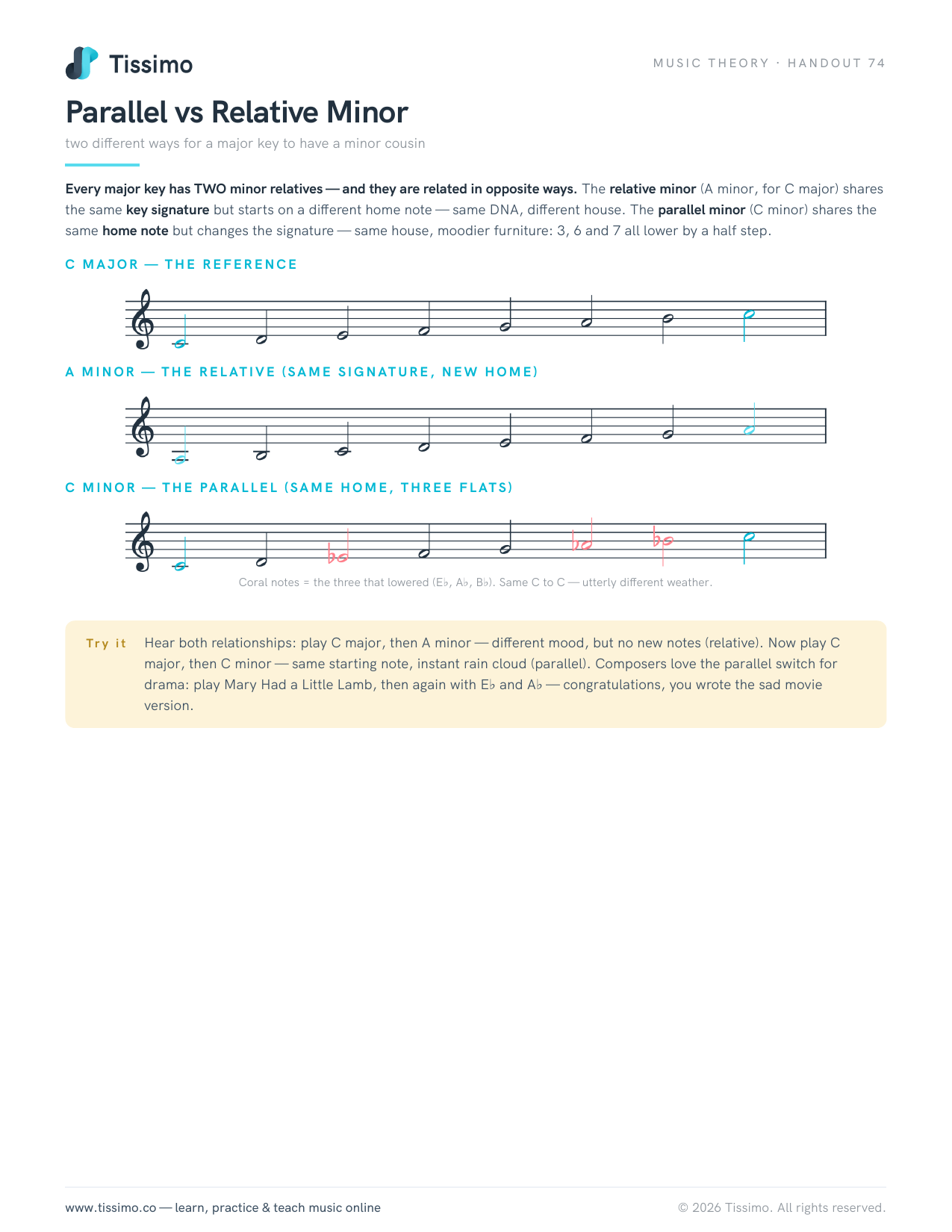
同主調と平行調(短調)
長調に短調の「いとこ」ができる、2つの異なる方法
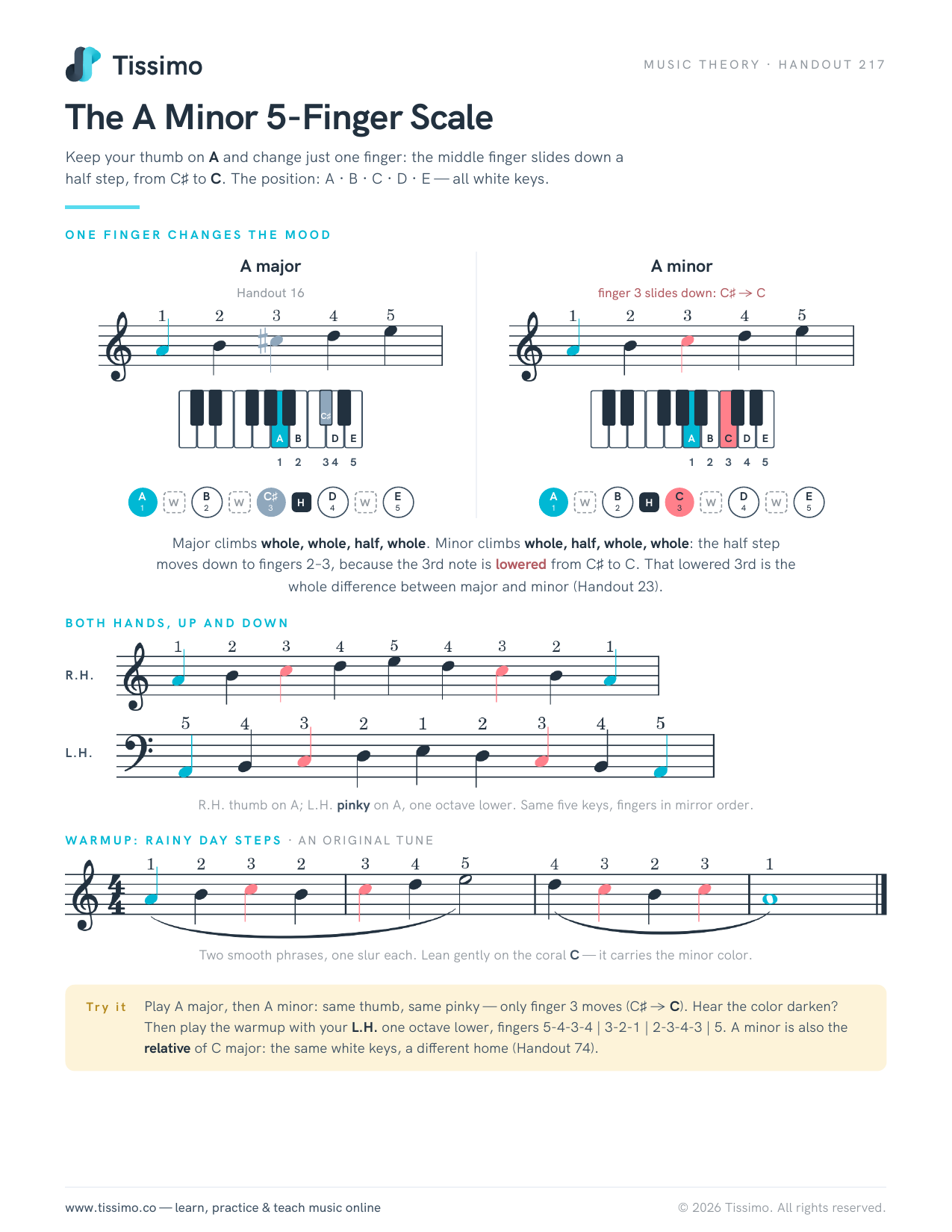
The A Minor 5-Finger Scale
Keep your thumb on A and change just one finger: the middle finger slides down a half step, from C♯ to C. The position: A · B · C · D · E — all white keys.
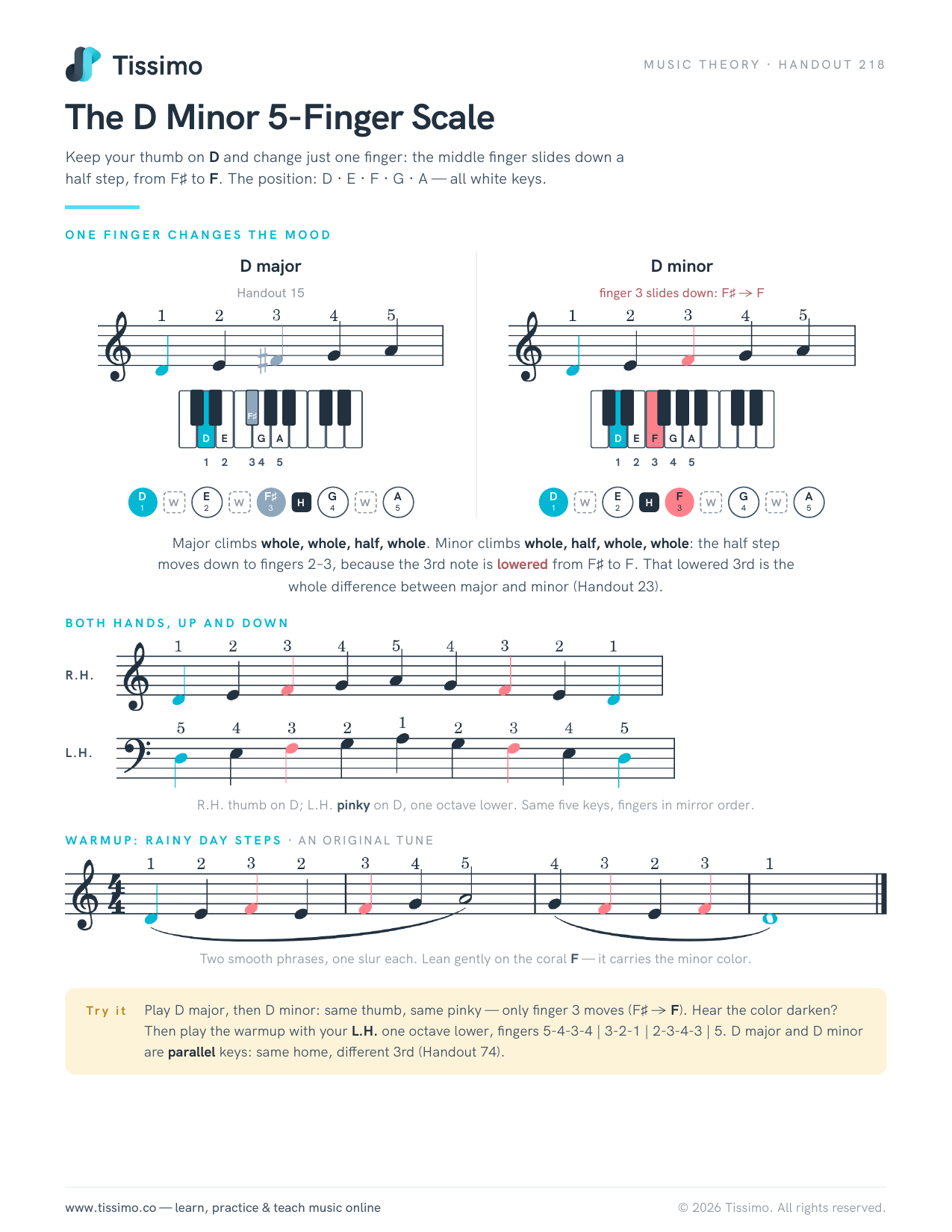
The D Minor 5-Finger Scale
Keep your thumb on D and change just one finger: the middle finger slides down a half step, from F♯ to F. The position: D · E · F · G · A — all white keys.
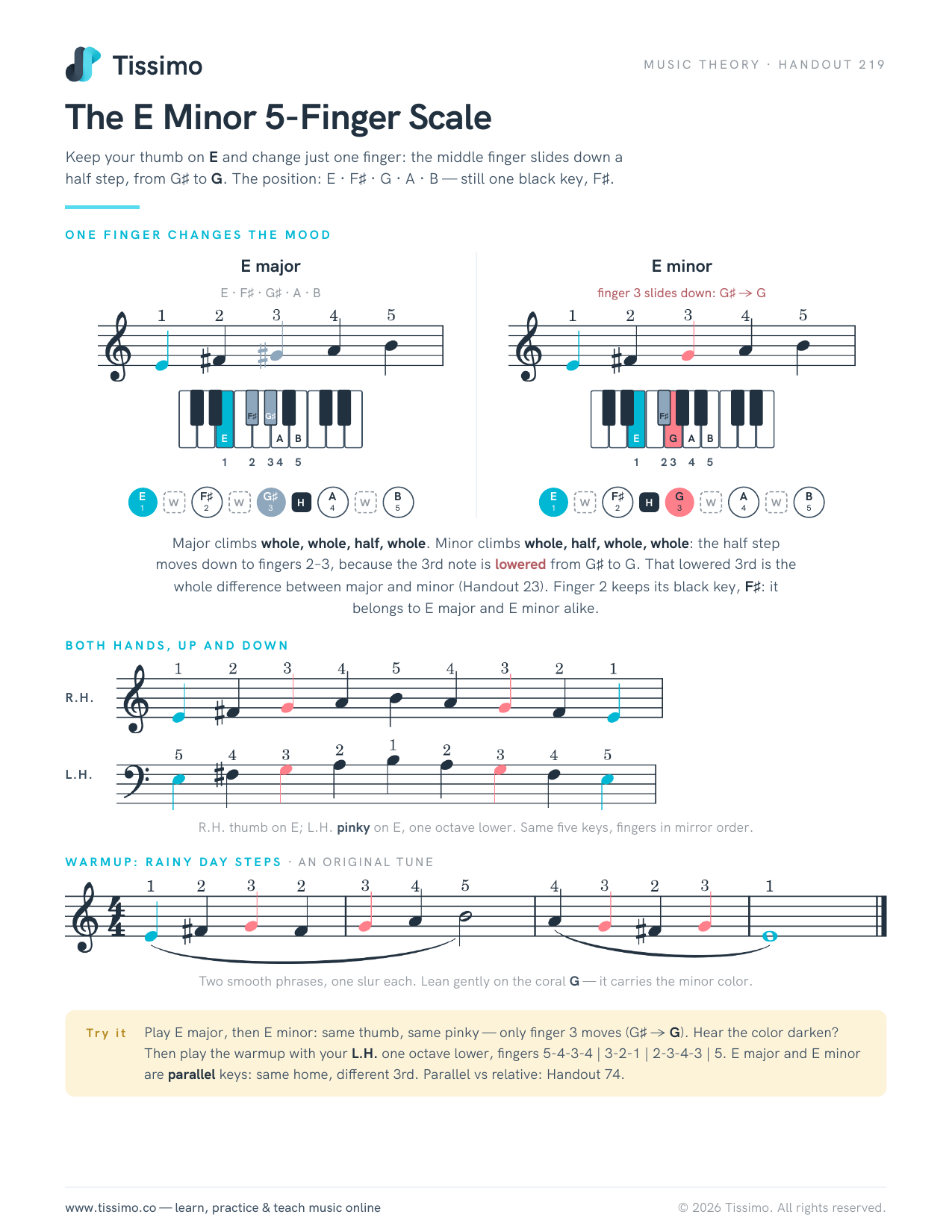
The E Minor 5-Finger Scale
Keep your thumb on E and change just one finger: the middle finger slides down a half step, from G♯ to G. The position: E · F♯ · G · A · B — still one black key, F♯.
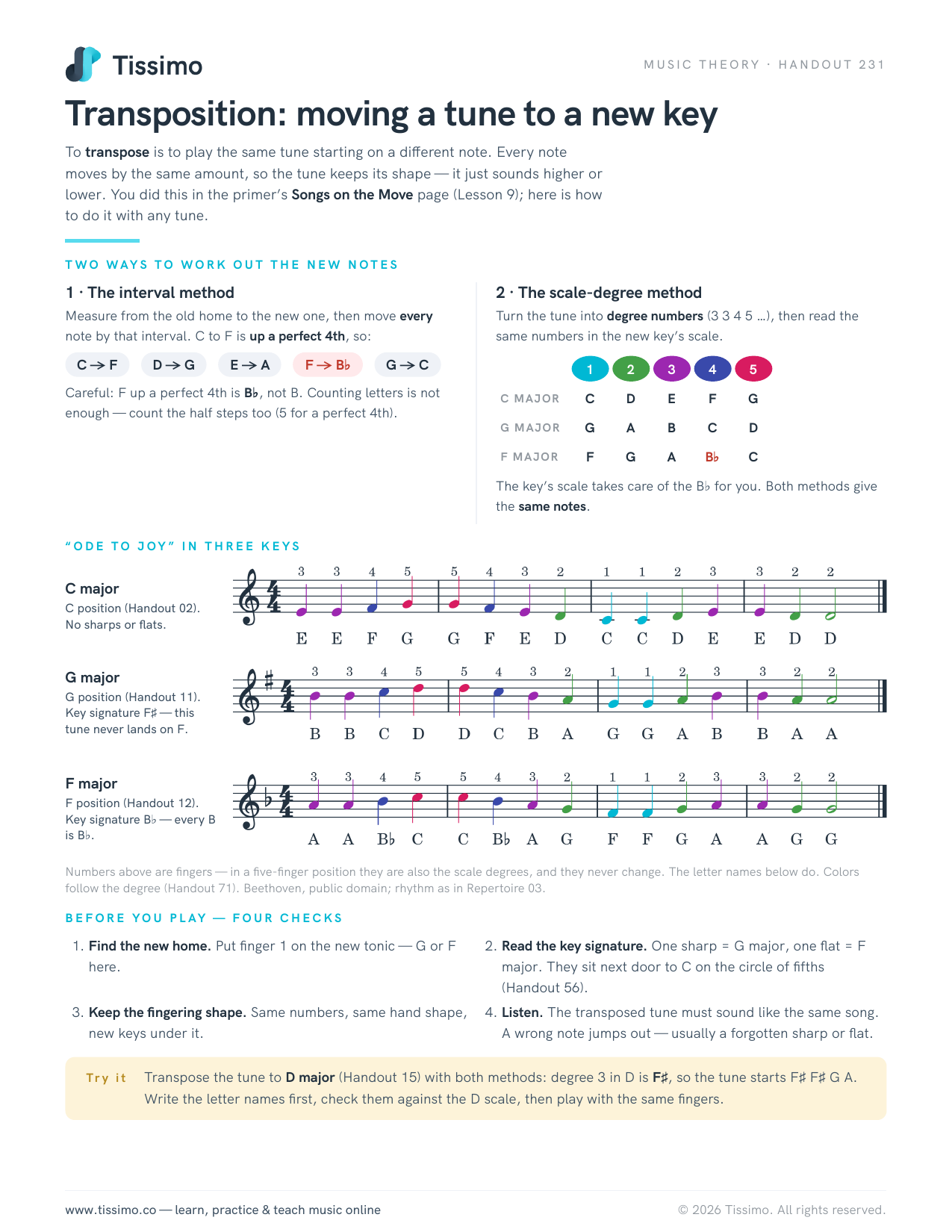
Transposition: moving a tune to a new key
To transpose is to play the same tune starting on a different note. Every note moves by the same amount, so the tune keeps its shape — it just sounds higher or lower. You did this in the primer’s Songs on the Move page (Lesson 9); here is how to do it with any tune.
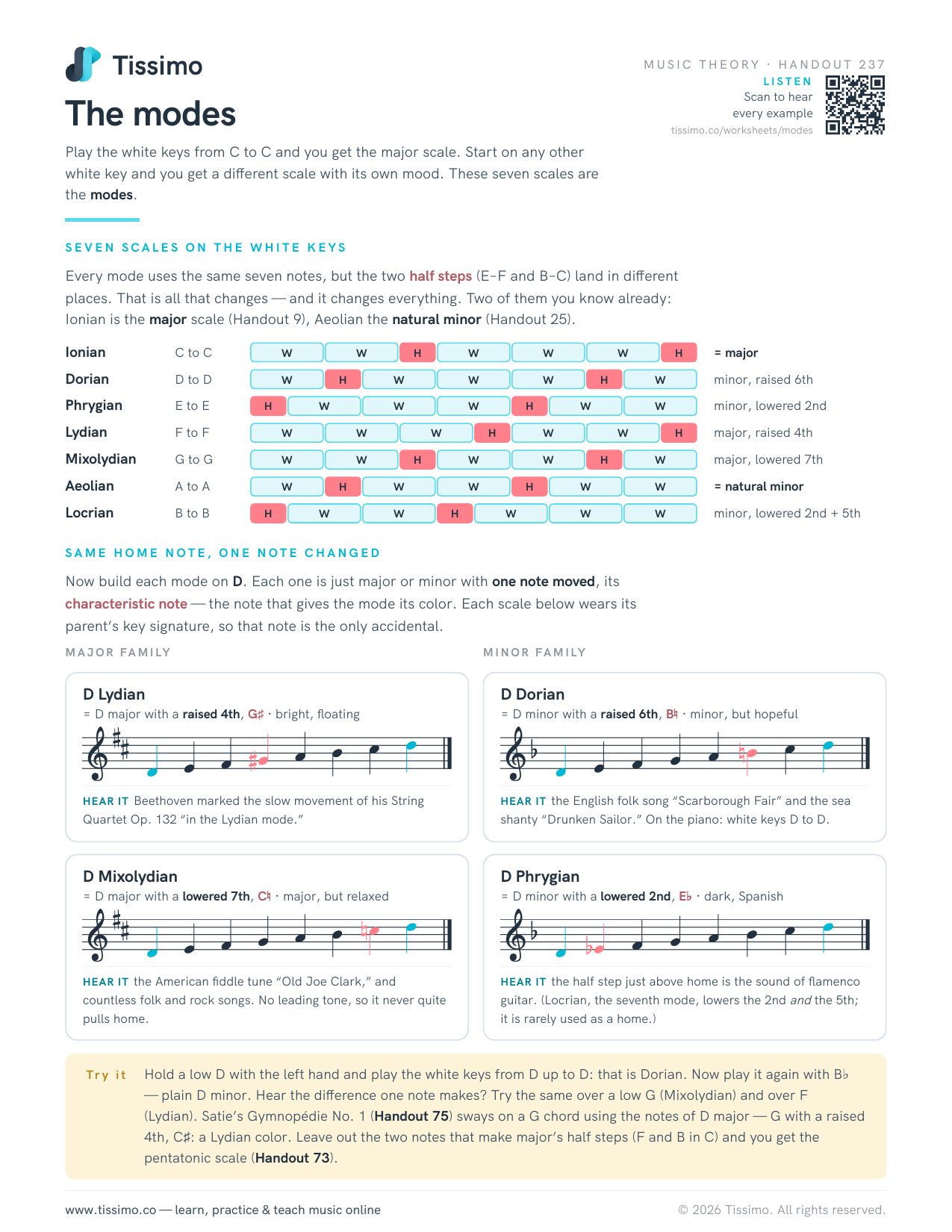
The modes
Play the white keys from C to C and you get the major scale. Start on any other white key and you get a different scale with its own mood. These seven scales are the modes.
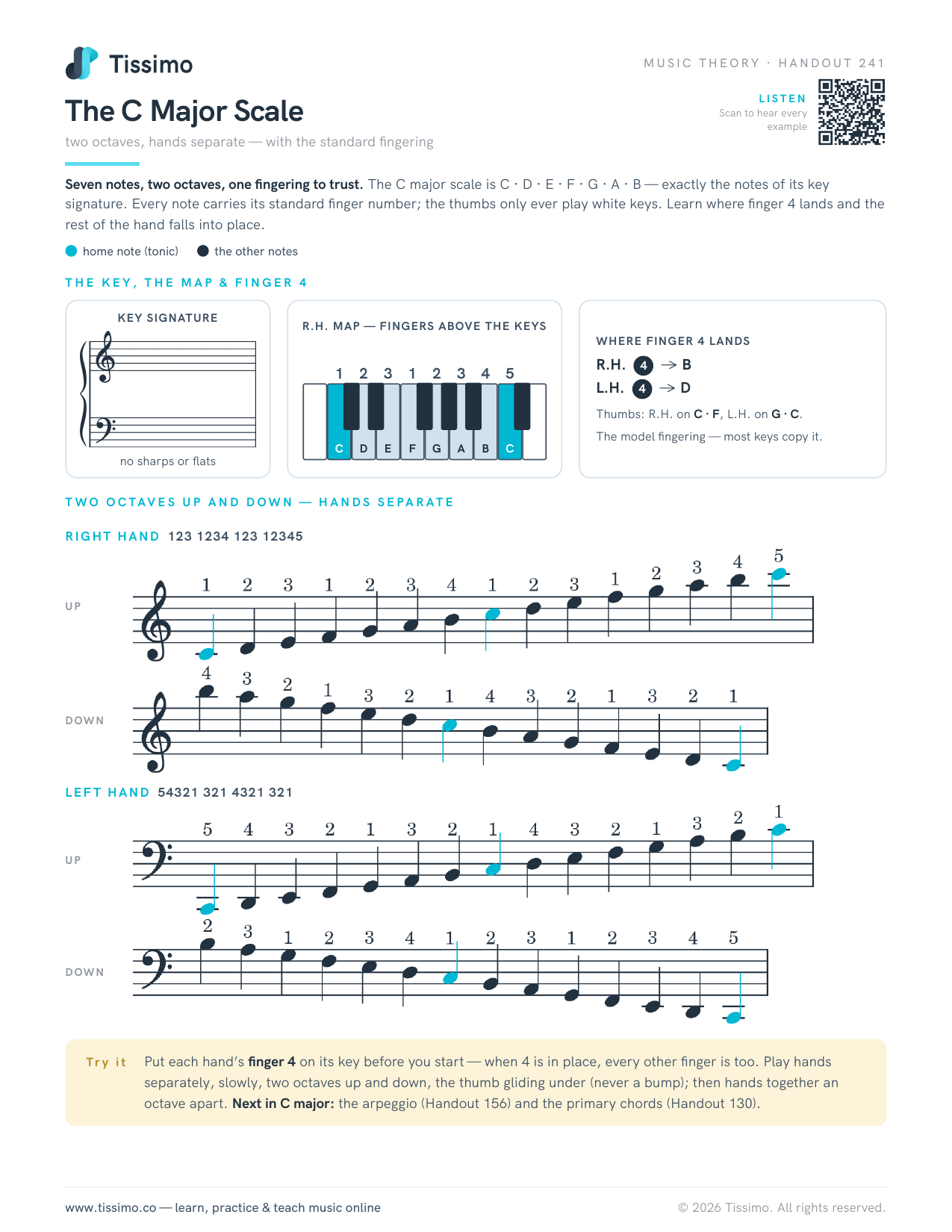
Scales in Every Key
Two octaves up and down with the standard fingering on every note, in all 24 keys.
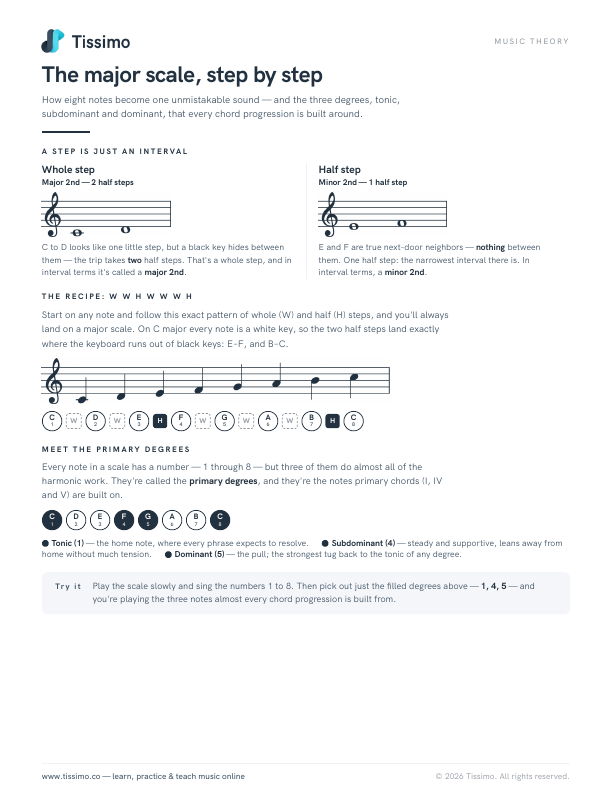
長音階入門
和音とハーモニー
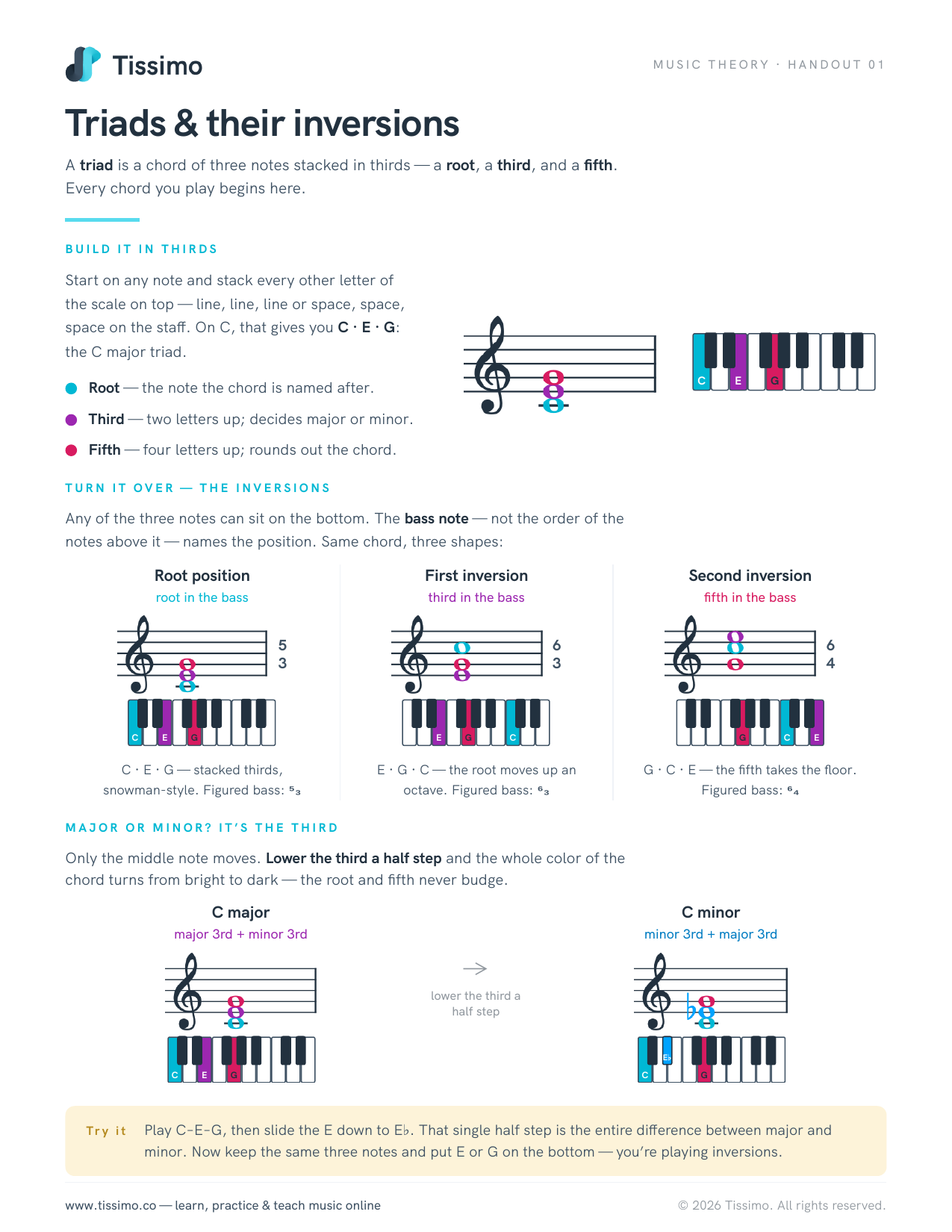
三和音とその転回形
三和音とは、3度ずつ積み重ねた3つの音からなる和音です——根音、3度、5度。あなたが弾くすべての和音はここから始まります。
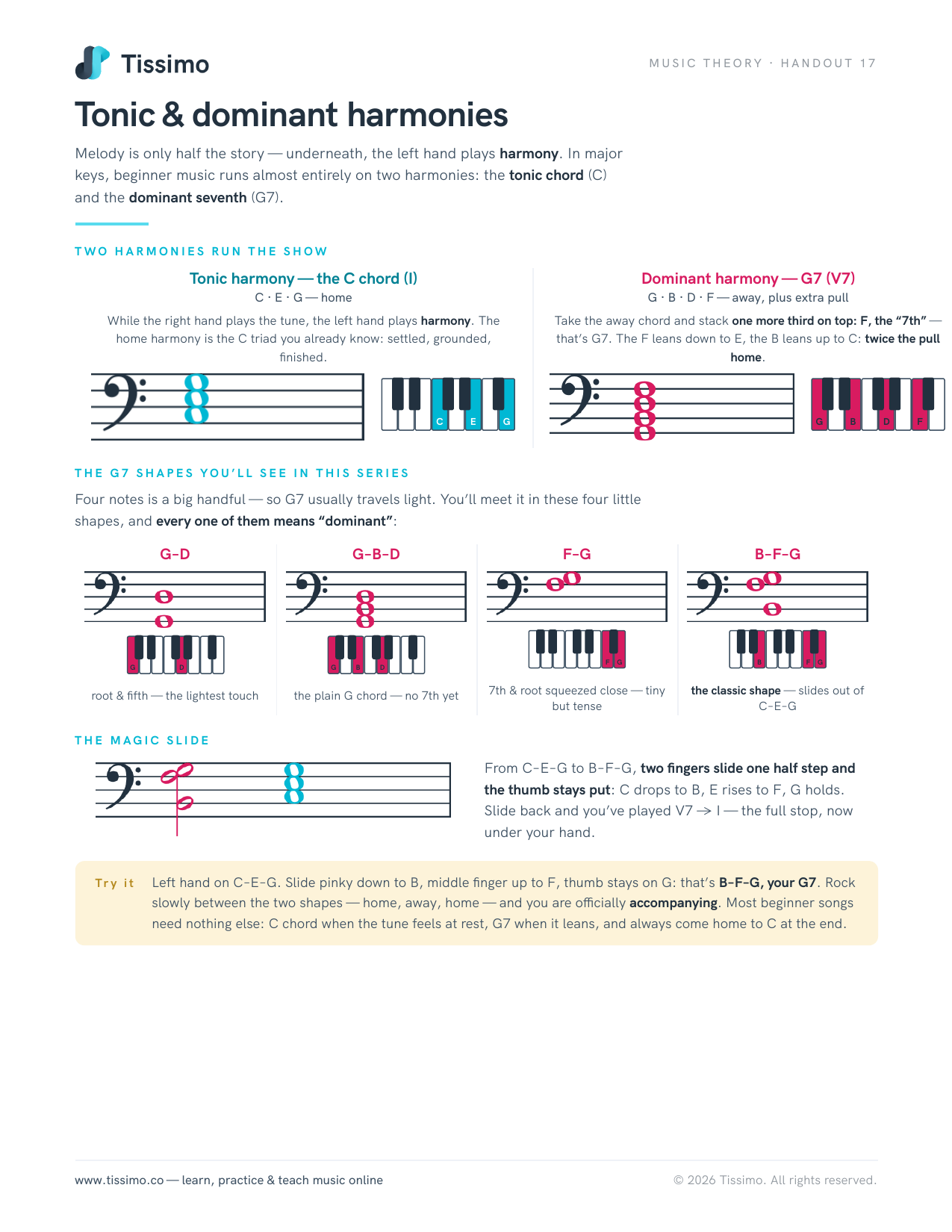
主和音と属和音のハーモニー
メロディーは物語の半分にすぎません——その下で、左手がハーモニーを奏でています。長調では、初心者向けの曲はほぼ2つの和音だけで成り立っています:主和音(C)と属七の和音(G7)です。
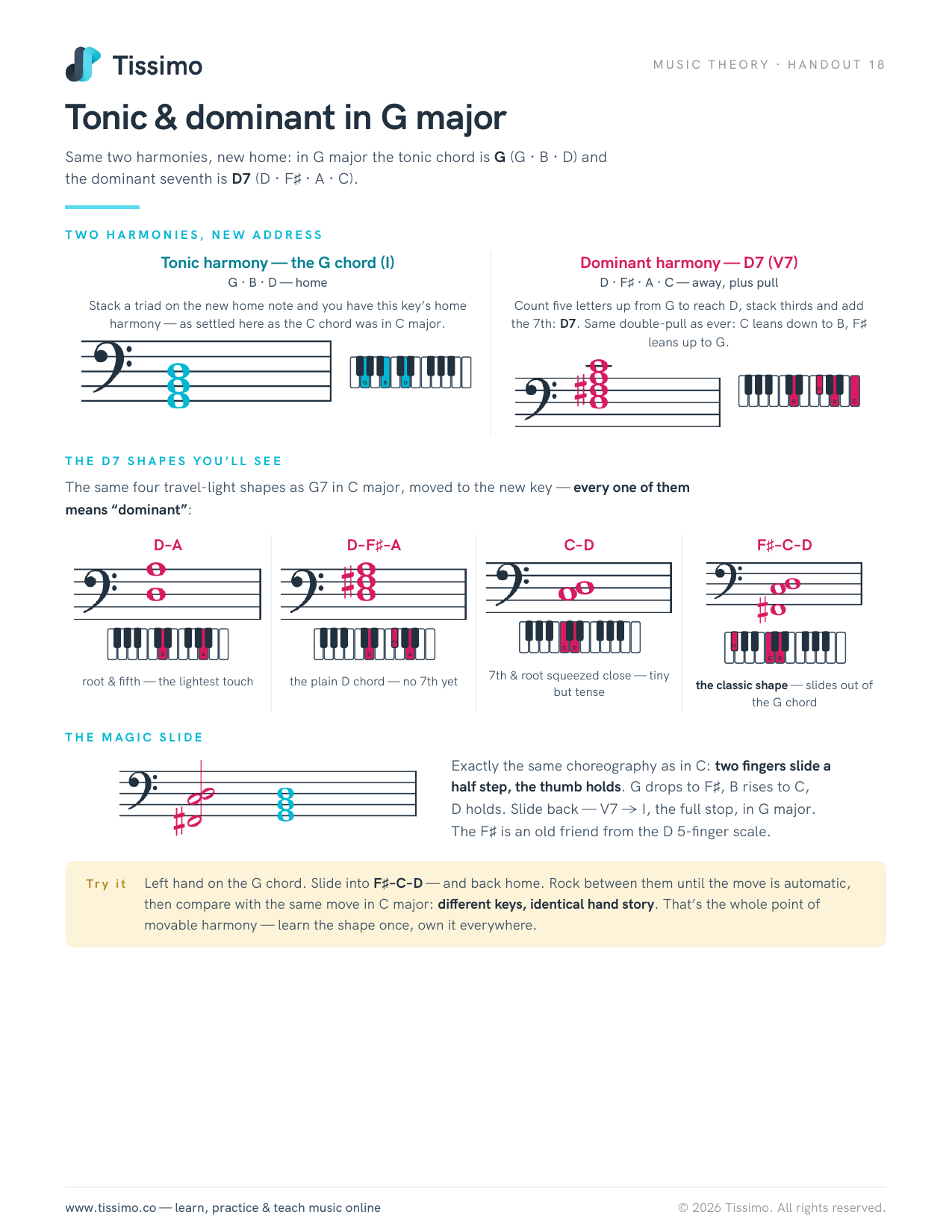
ト長調の主和音と属和音
同じ2つの和音が、新しい調へ:ト長調では主和音はG(ソ・シ・レ)、属七の和音はD7(レ・ファ♯・ラ・ド)です。
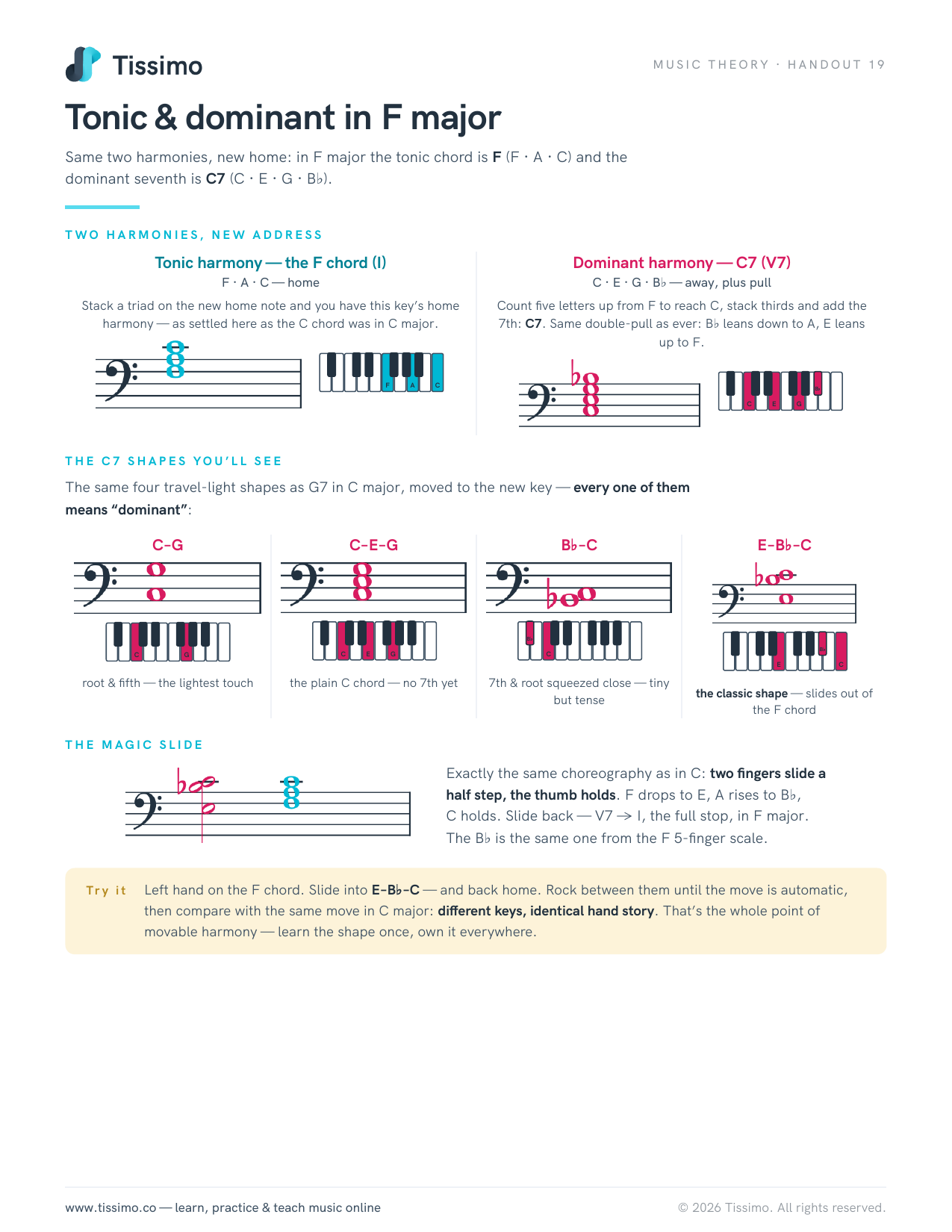
ヘ長調の主和音と属和音
同じ2つの和音が、新しい調へ:ヘ長調では主和音はF(ファ・ラ・ド)、属七の和音はC7(ド・ミ・ソ・シ♭)です。
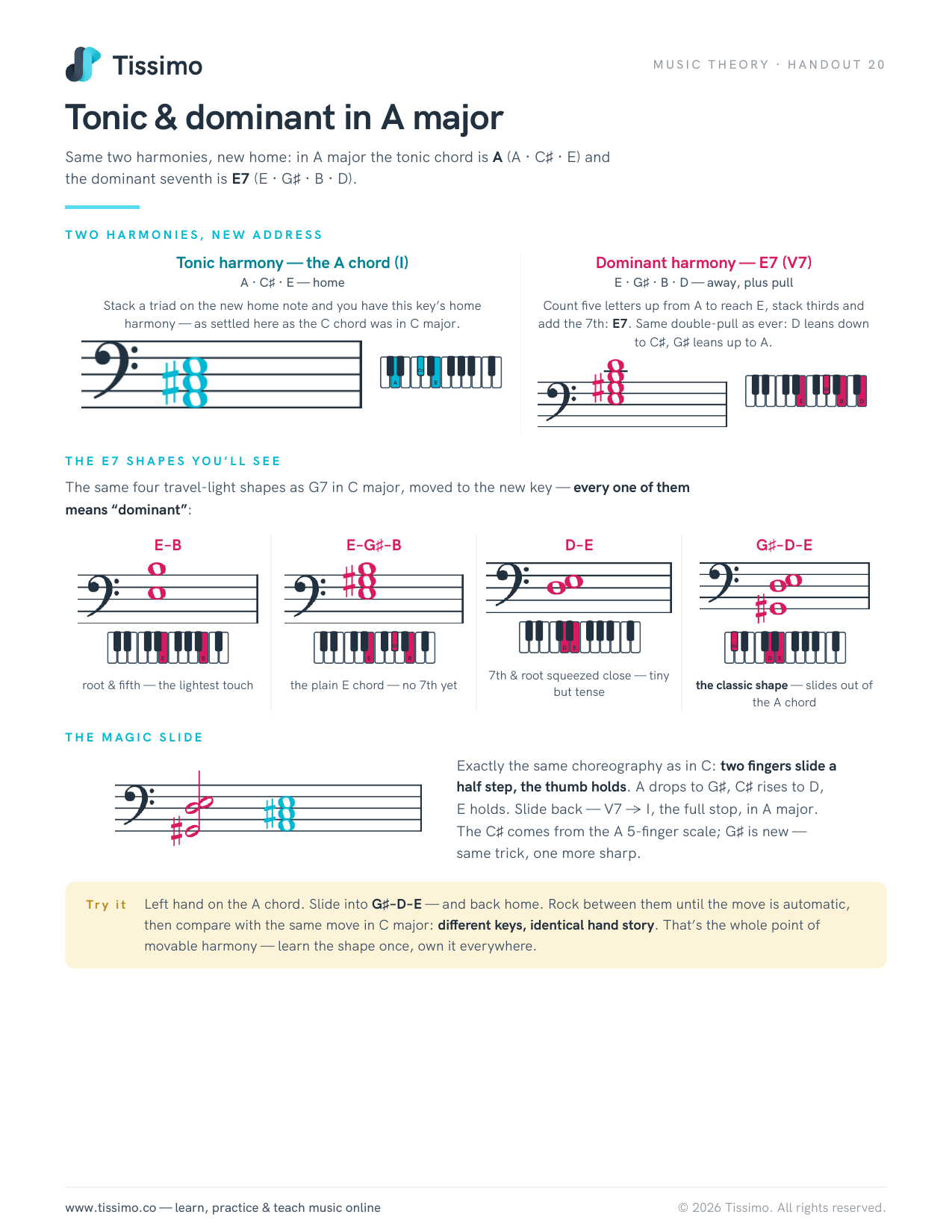
イ長調の主和音と属和音
同じ2つの和音が、新しい調へ:イ長調では主和音はA(ラ・ド♯・ミ)、属七の和音はE7(ミ・ソ♯・シ・レ)です。
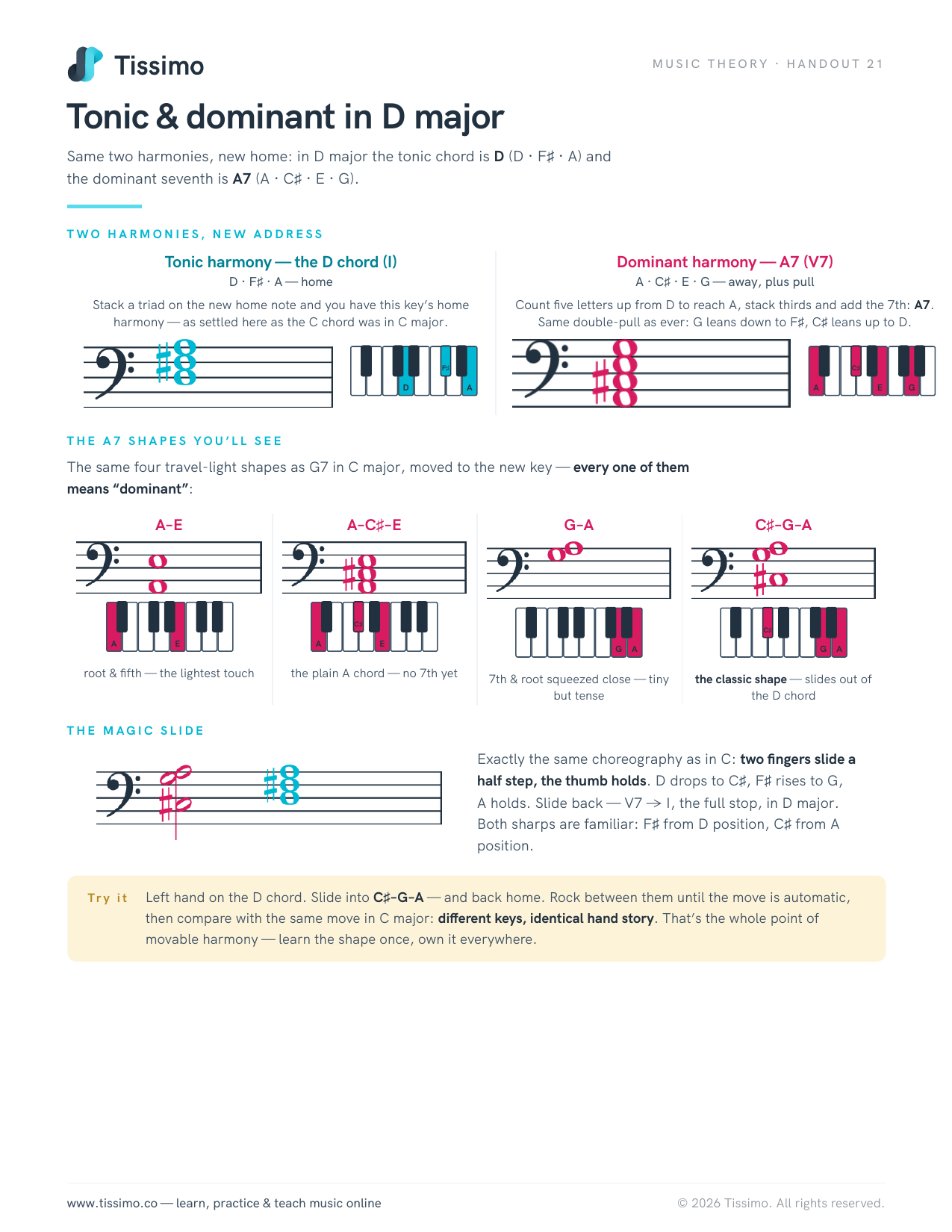
ニ長調の主和音と属和音
同じ2つの和音が、新しい調へ:ニ長調では主和音はD(レ・ファ♯・ラ)、属七の和音はA7(ラ・ド♯・ミ・ソ)です。
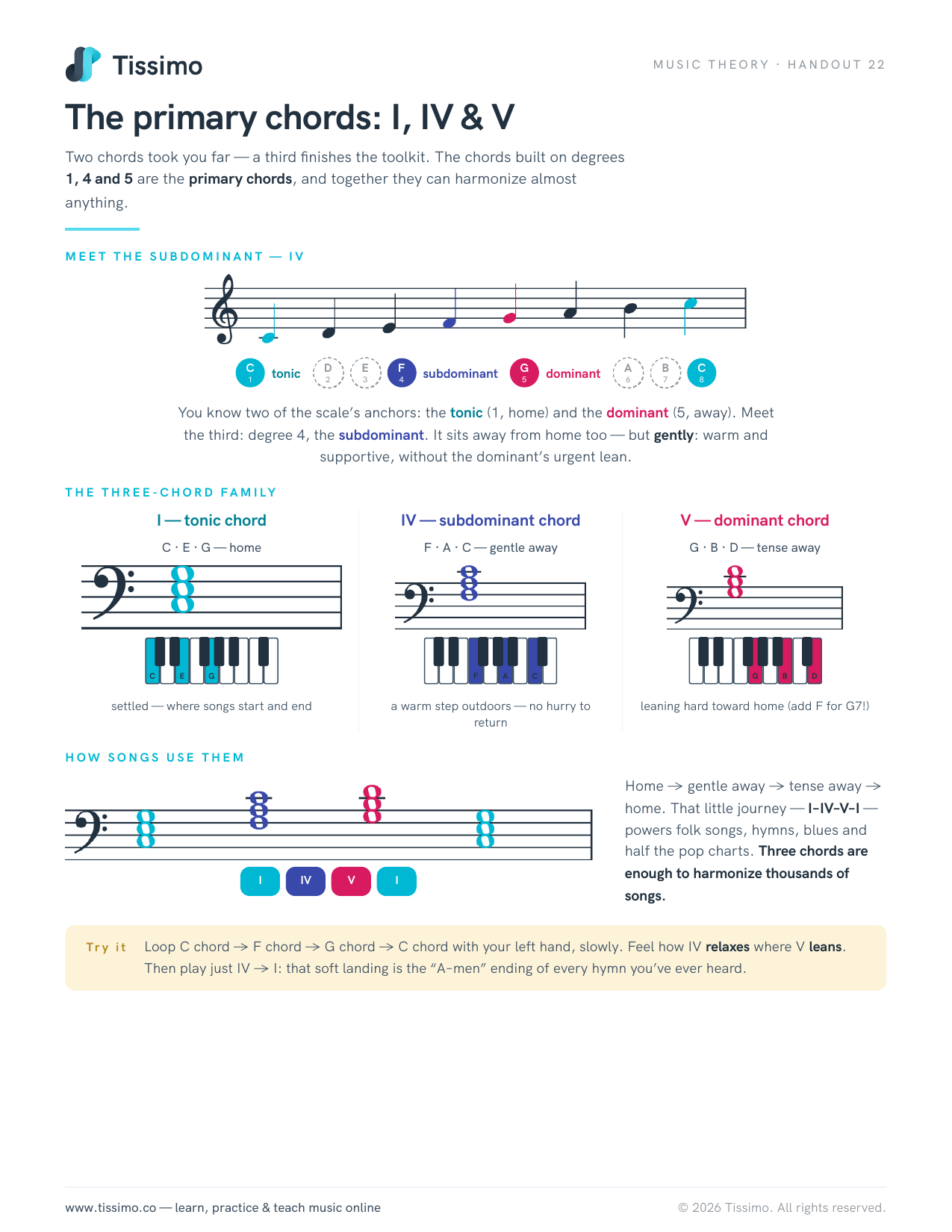
主要三和音:I、IV、V
2つの和音でここまで来ましたが、3つ目でツールキットが完成します。第1、4、5音の上に作られる和音が主要三和音で、これらが揃えばほとんど何でもハーモナイズできます。
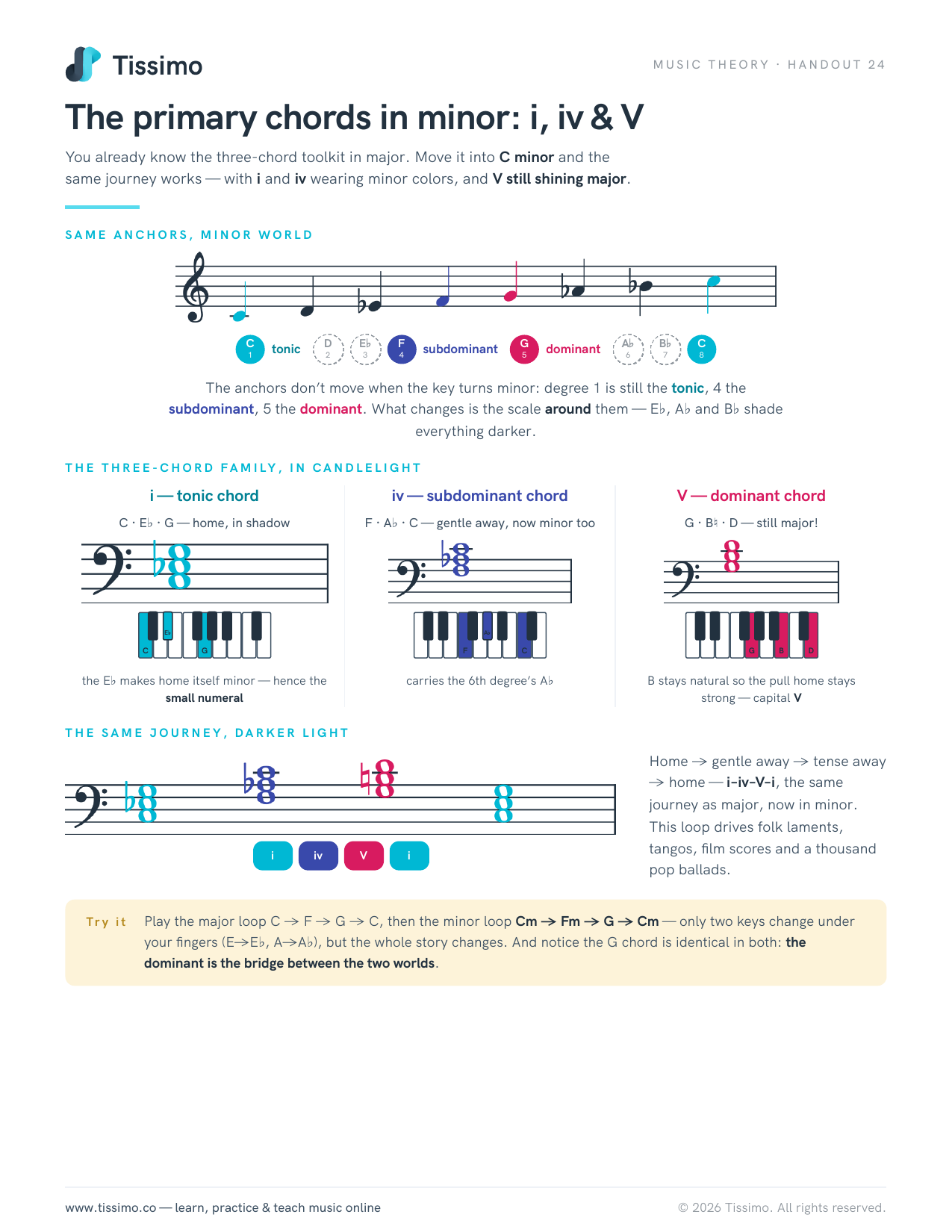
短調の主要三和音:i、iv、V
長調での3和音ツールキットはもう知っていますね。それをハ短調に移しても同じ道のりが成立します——iとivは短調の色をまとい、Vは変わらず長調のまま輝きます。
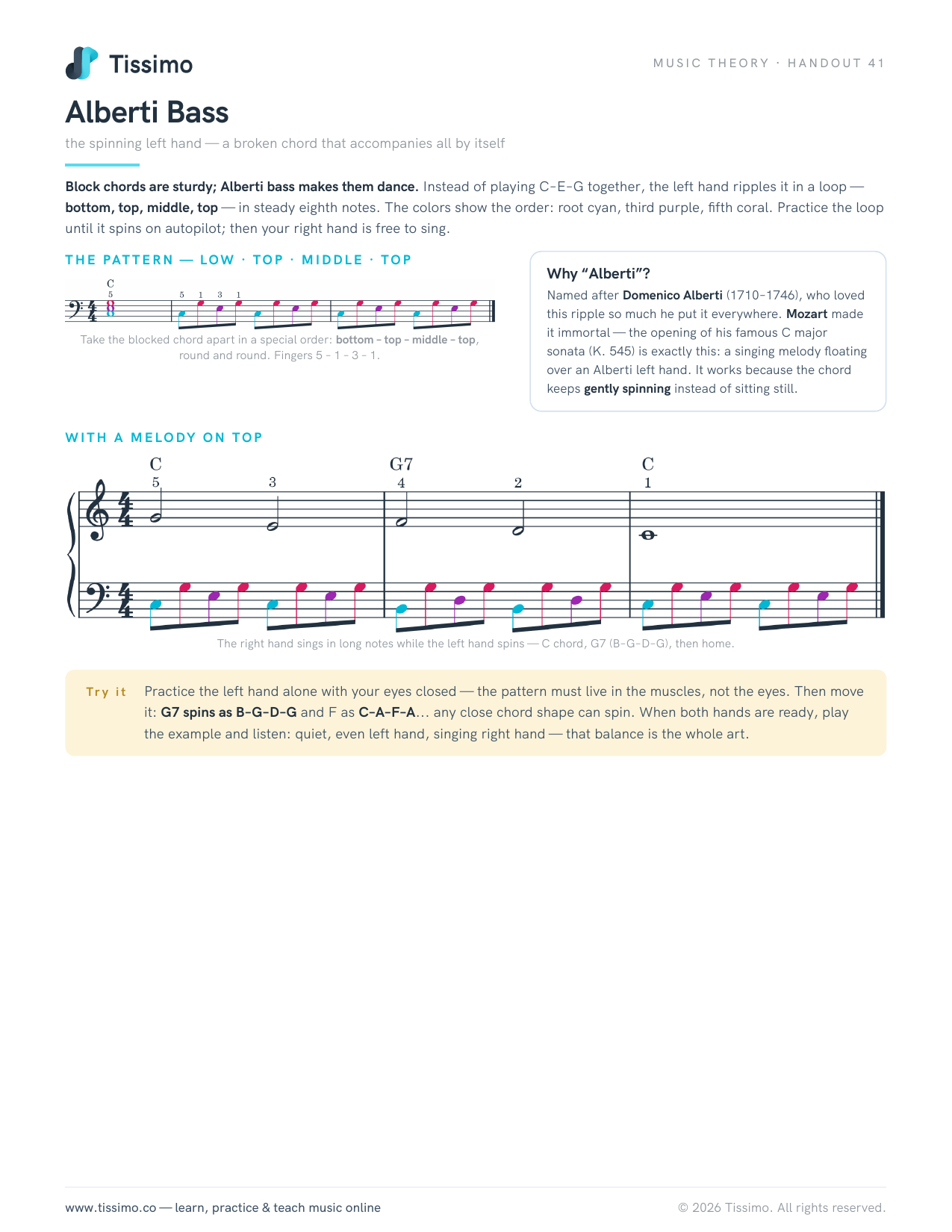
アルベルティ・バス
回転する左手——それだけで伴奏になる分散和音
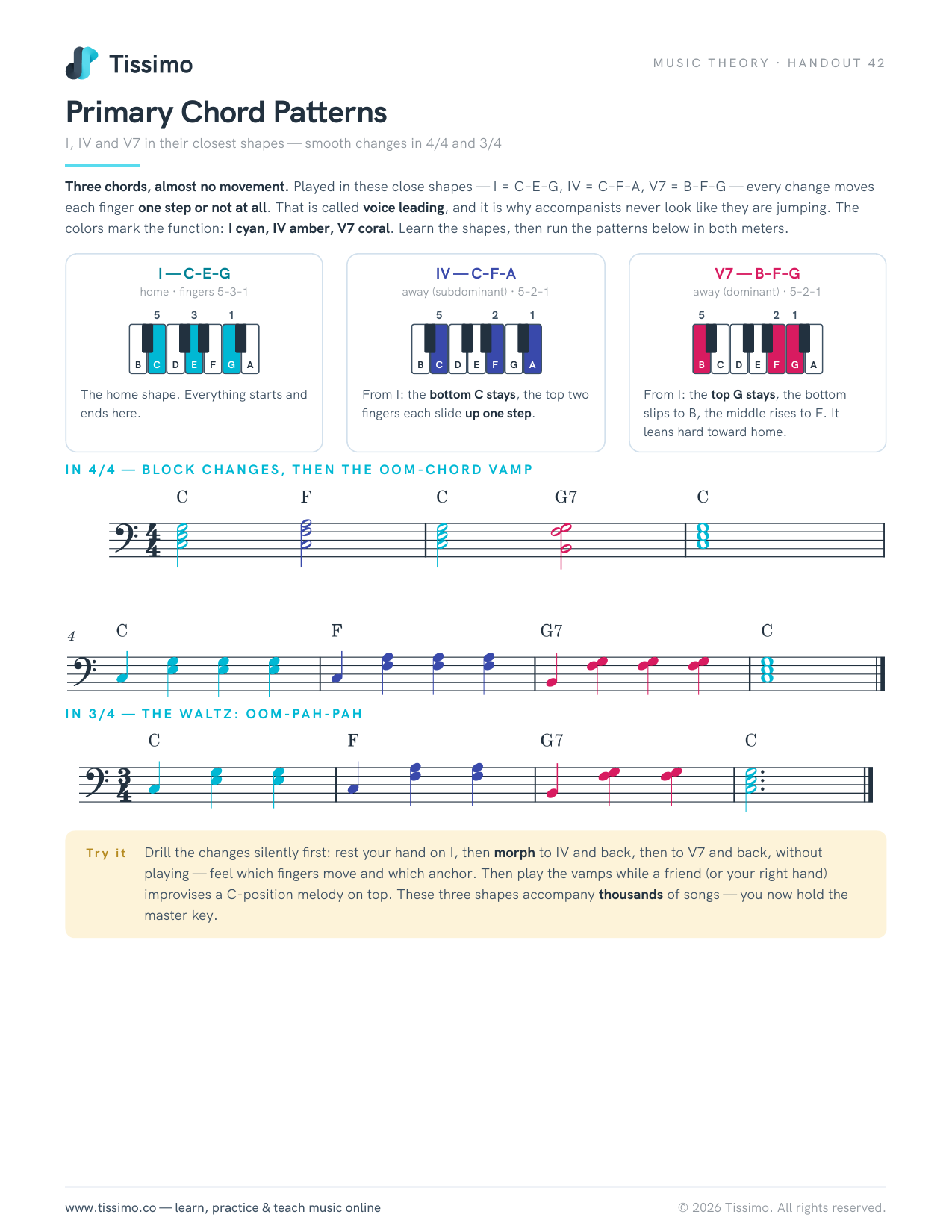
主要和音のパターン
I、IV、V7を最も近い形で——4/4と3/4拍子でのスムーズな和音の移り変わり
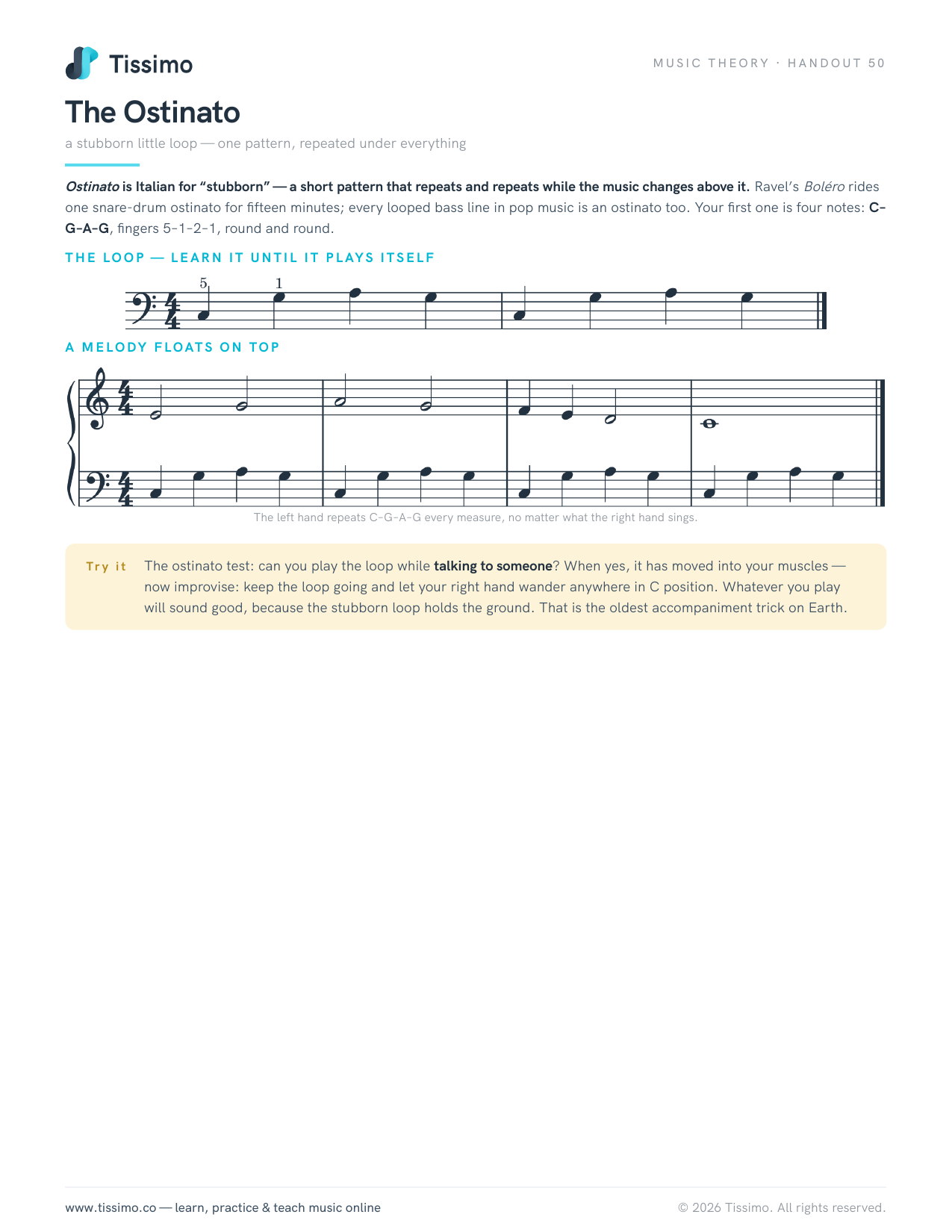
オスティナート
頑固な小さなループ——1つのパターンが、すべての下で繰り返される
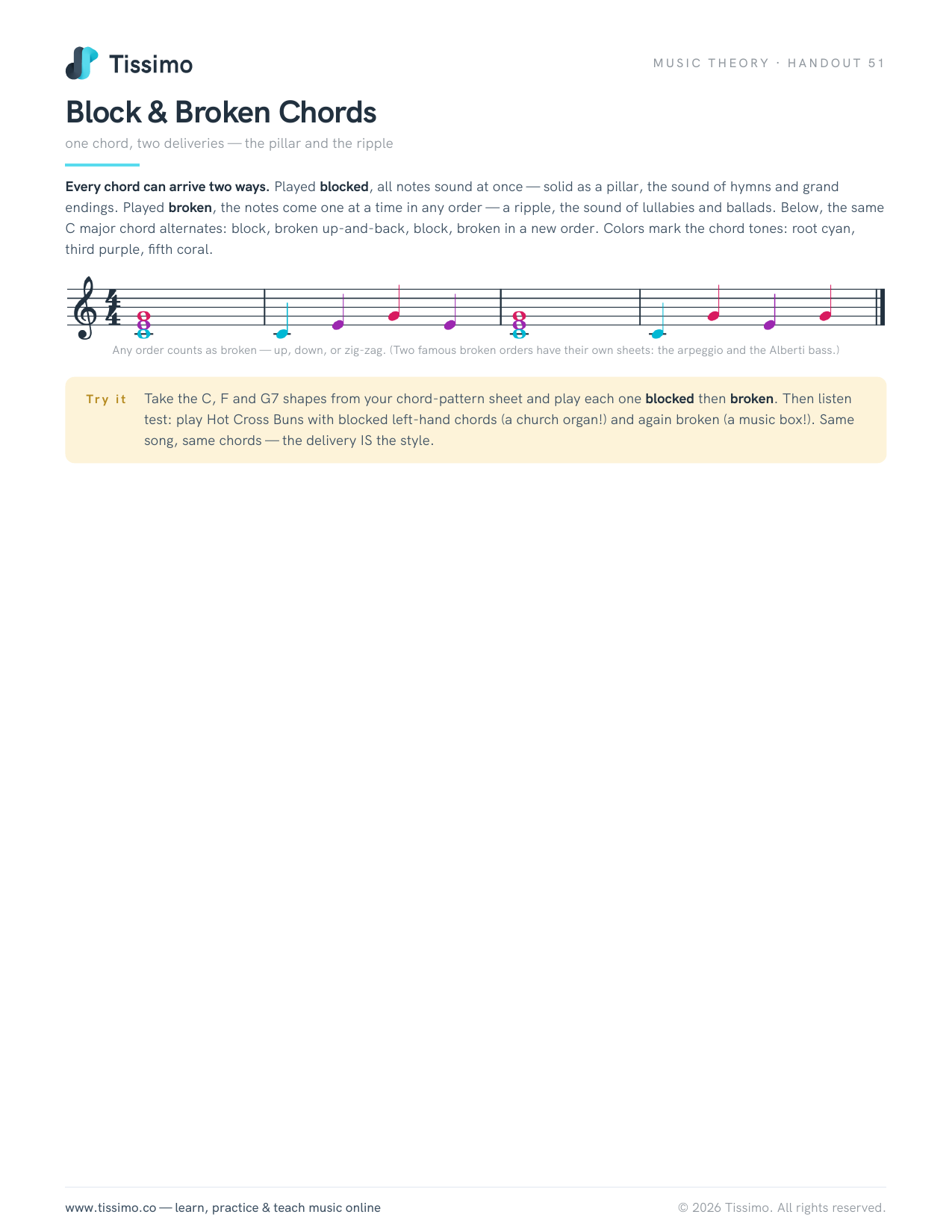
ブロック和音とアルペジオ和音
1つの和音、2つの弾き方——支柱のように、さざ波のように
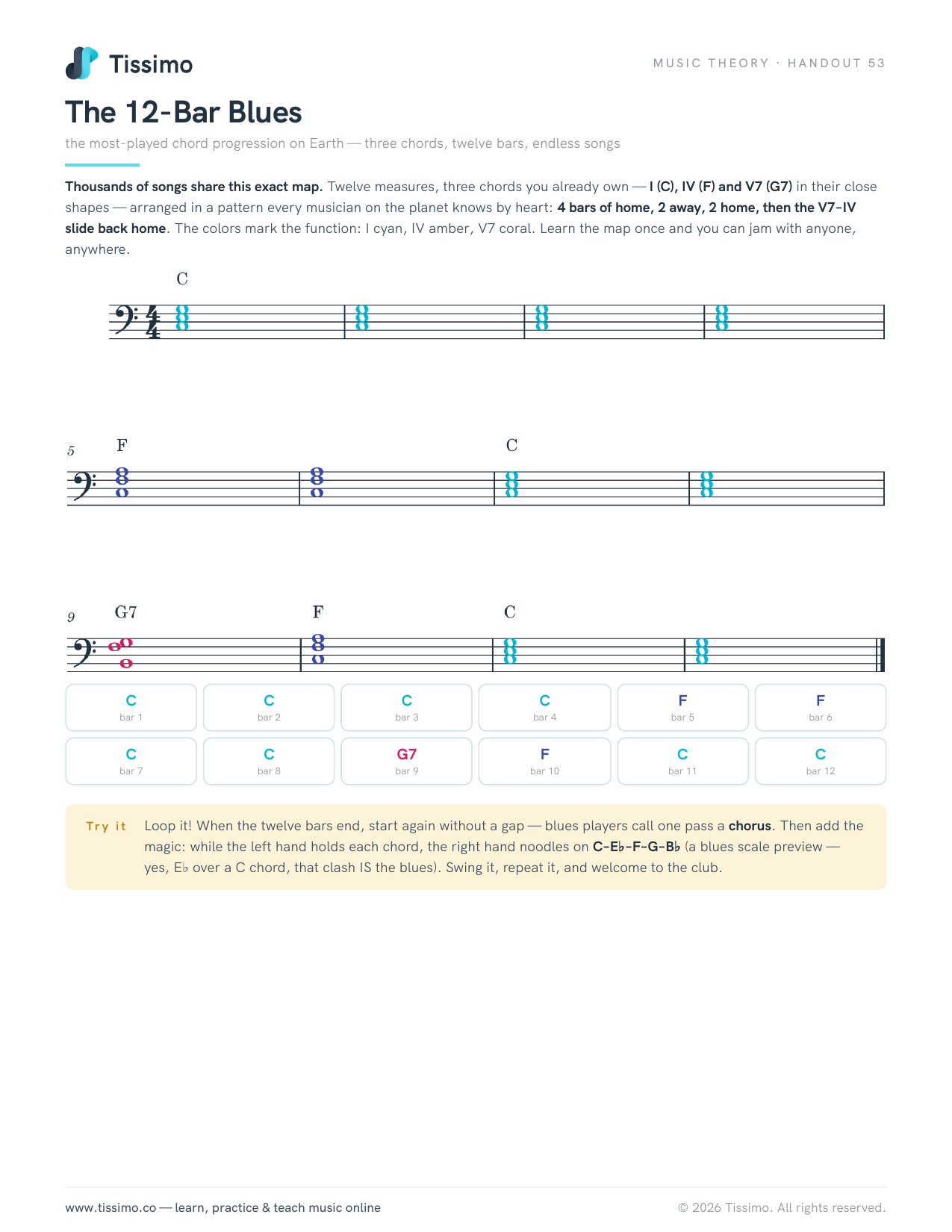
12小節ブルース
地球上で最も演奏されているコード進行——3つの和音、12小節、無限に生まれる曲
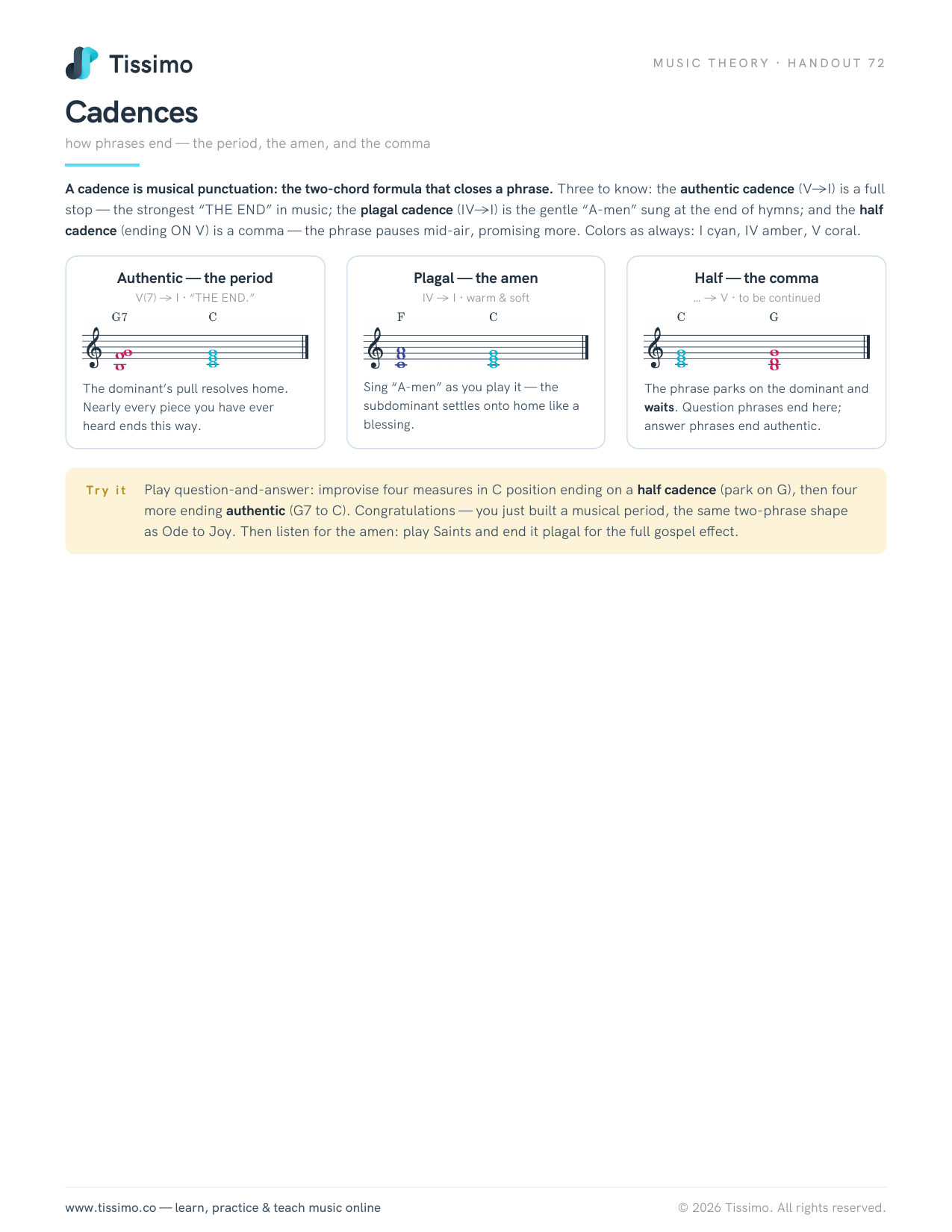
カデンツ(終止形)
フレーズがどう終わるか——句点、アーメン、そして読点
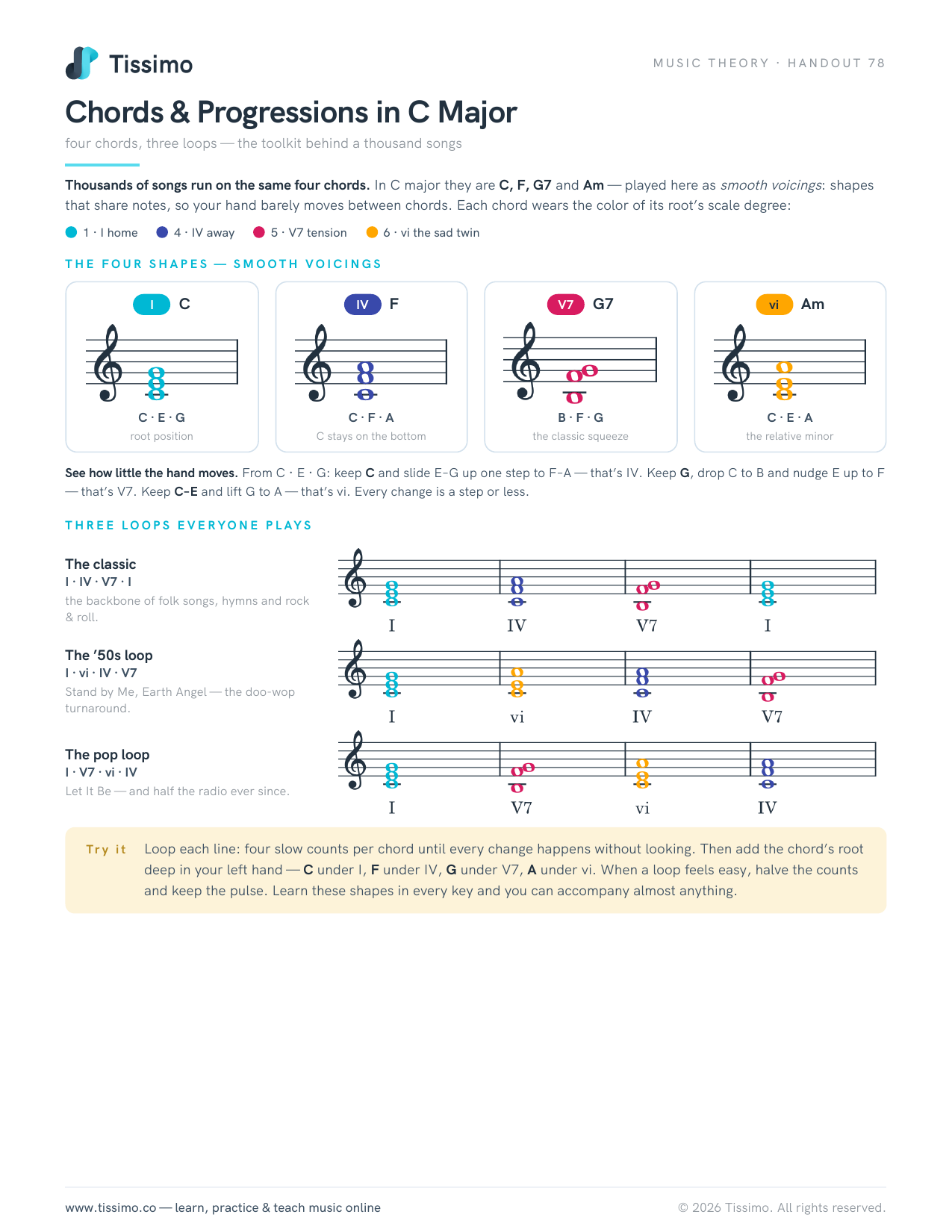
全調のコード進行
4つの和音、3つのループ——何千もの曲を支えるツールキットを、全24調で。
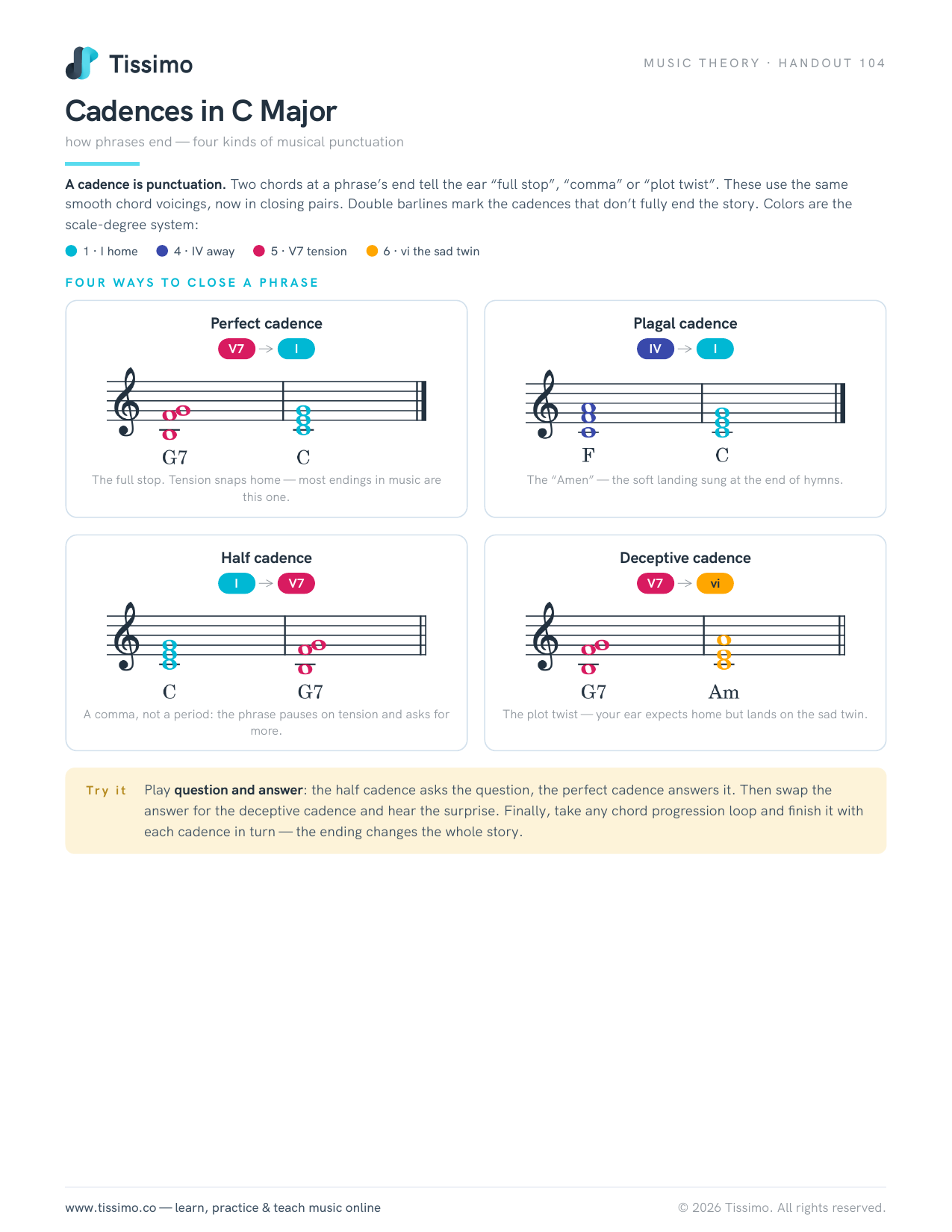
全調のカデンツ
フレーズがどう終わるか——4種類の音楽の句読点を、全24調で。
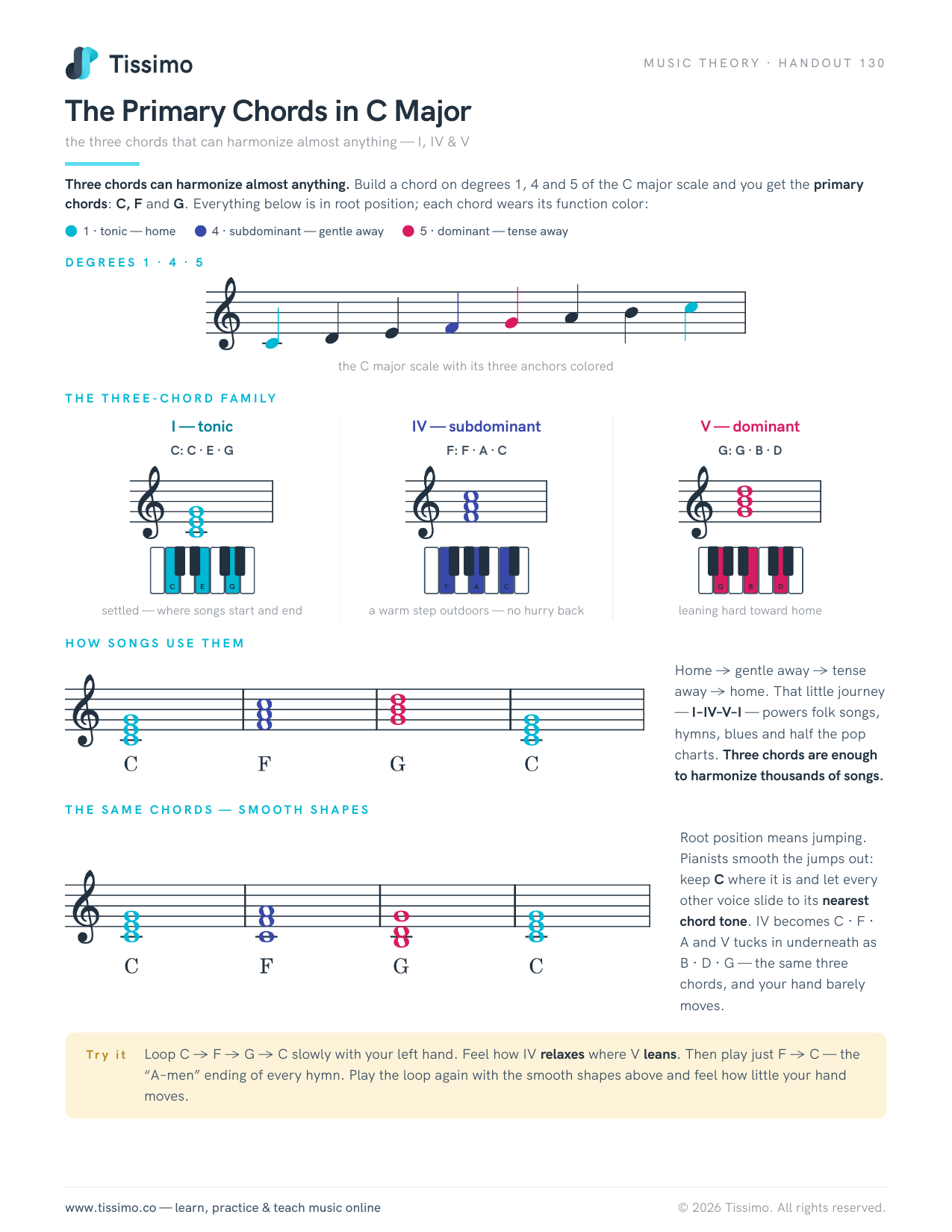
全調の主要三和音
I、IV、V——ほとんど何でも和声づけできる3つの和音を、全24調で。
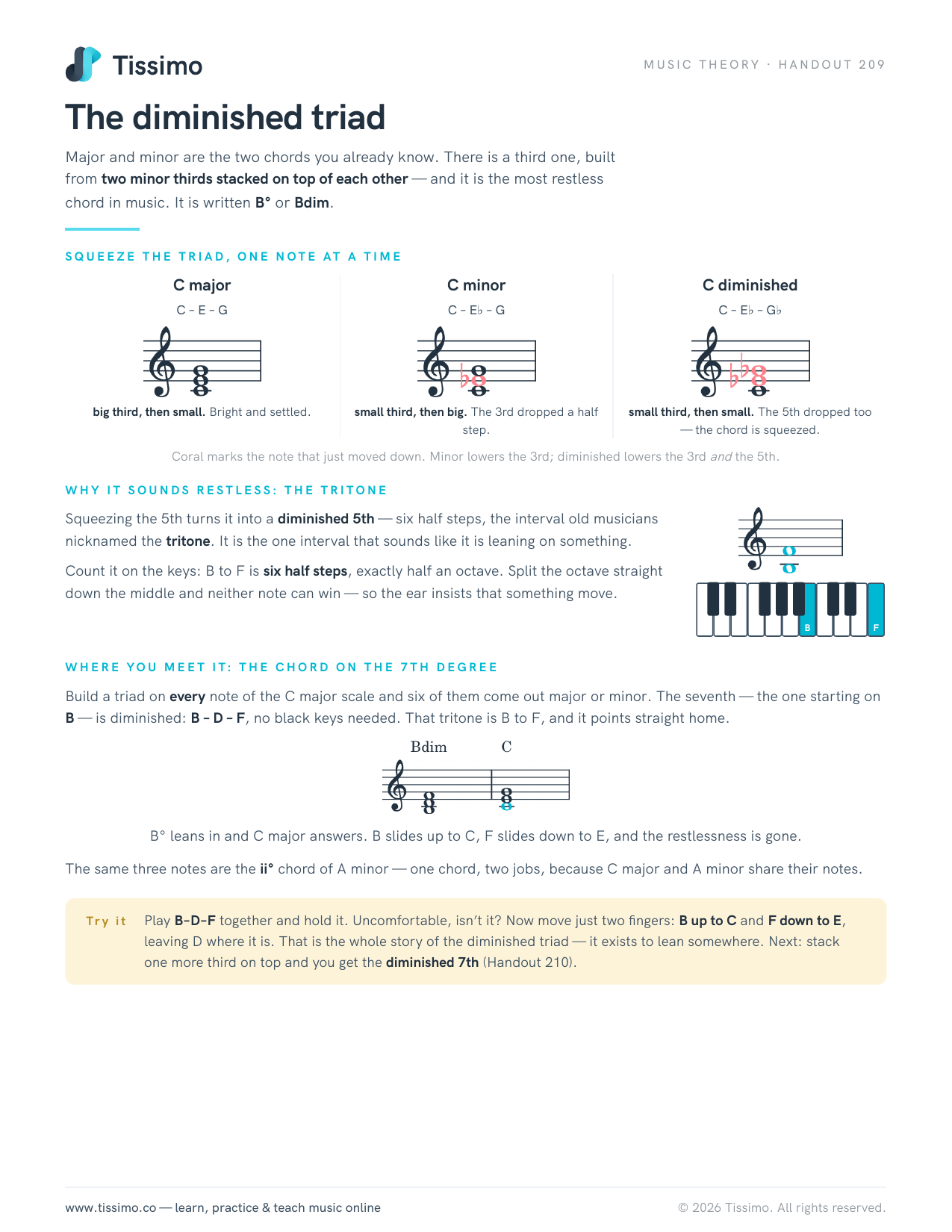
減三和音
長和音と短和音は、すでに知っている2つの和音です。3つ目は、短3度を2つ積み重ねて作られる和音——音楽の中で最も落ち着きのない和音です。B°またはBdimと表記されます。
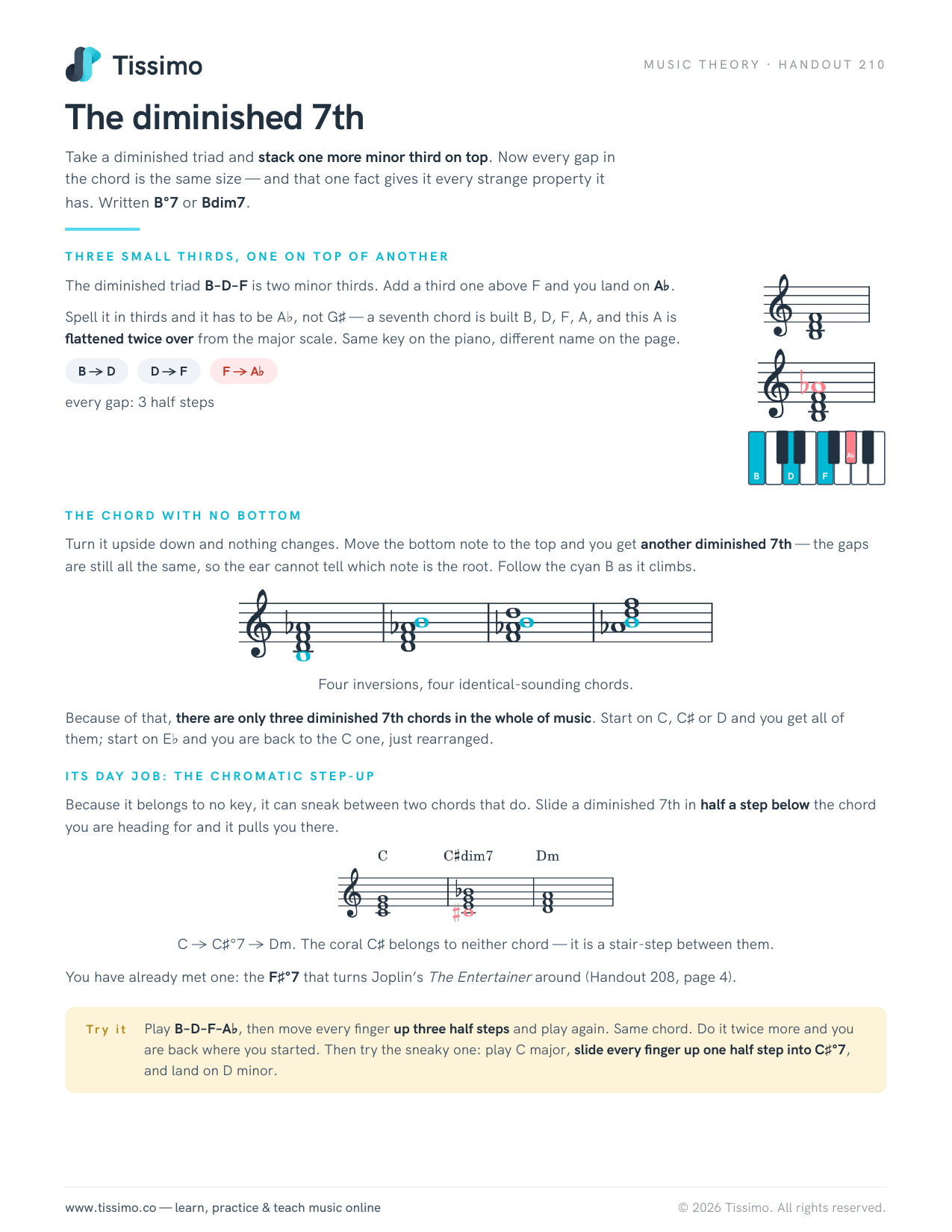
減七の和音
減三和音の上に、さらに短3度を1つ重ねます。すると和音のすべての間隔が同じ大きさになり——このたった1つの事実が、この和音のあらゆる不思議な性質を生み出します。B°7またはBdim7と表記されます。
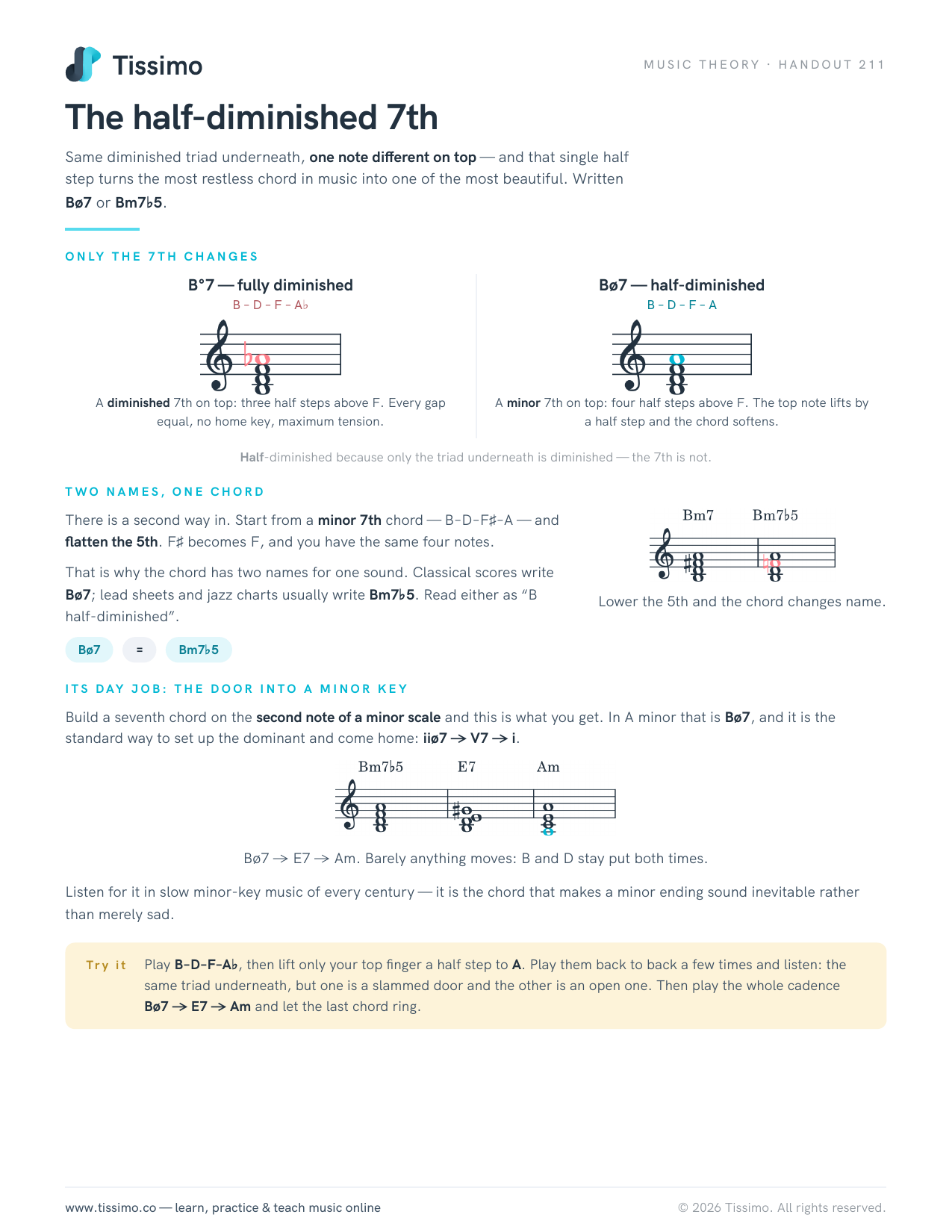
減七短五和音(ハーフディミニッシュ)
土台は同じ減三和音ですが、上の音が1つだけ違います——このたった半音の違いが、音楽で最も落ち着きのない和音を、最も美しい和音のひとつに変えます。Bø7またはBm7♭5と表記されます。
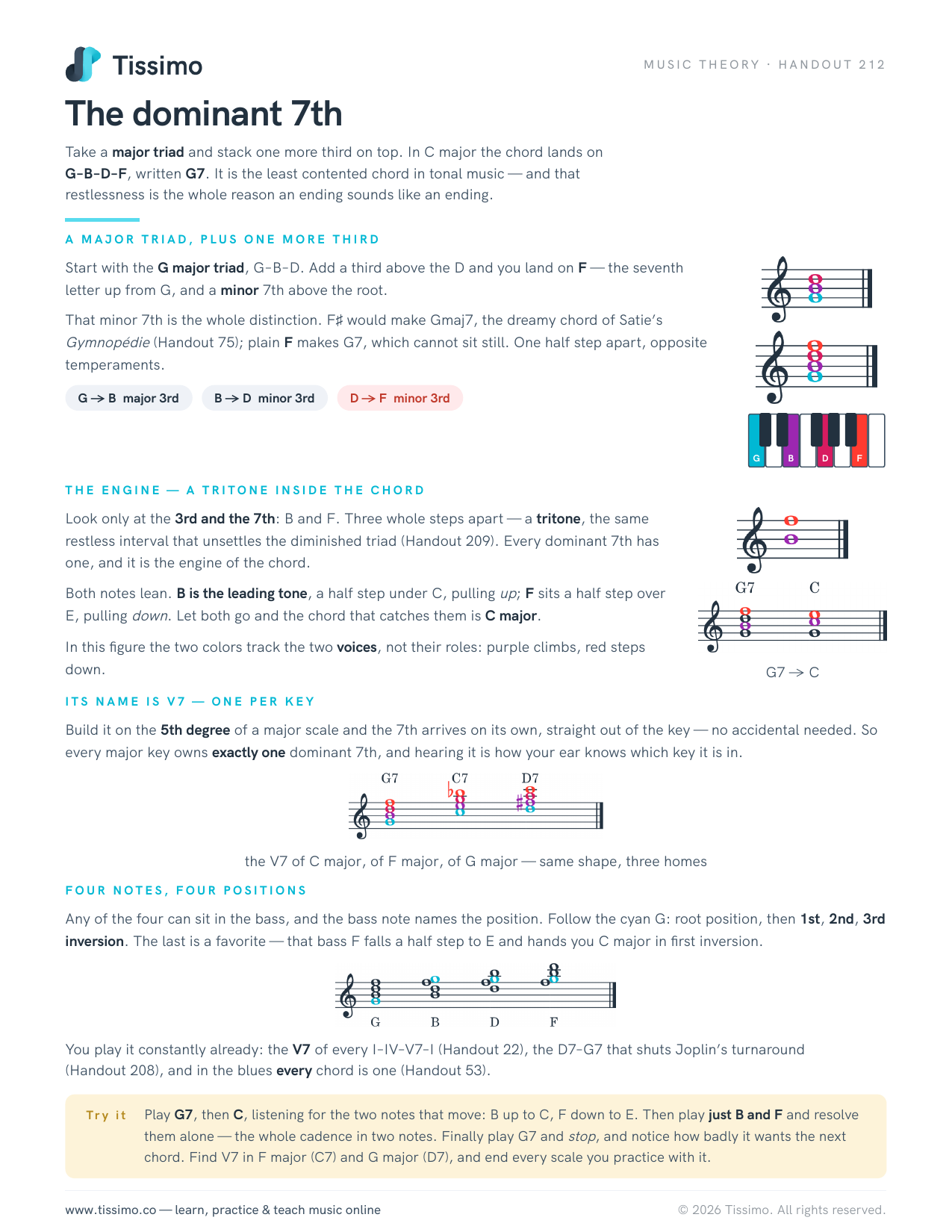
属七の和音
長三和音の上に、さらに3度を1つ重ねます。ハ長調では和音はソ–シ–レ–ファに落ち着き、G7と表記されます。これは調性音楽の中で最も「満たされない」和音——そしてその落ち着きのなさこそが、終止が終止らしく聞こえる理由です。
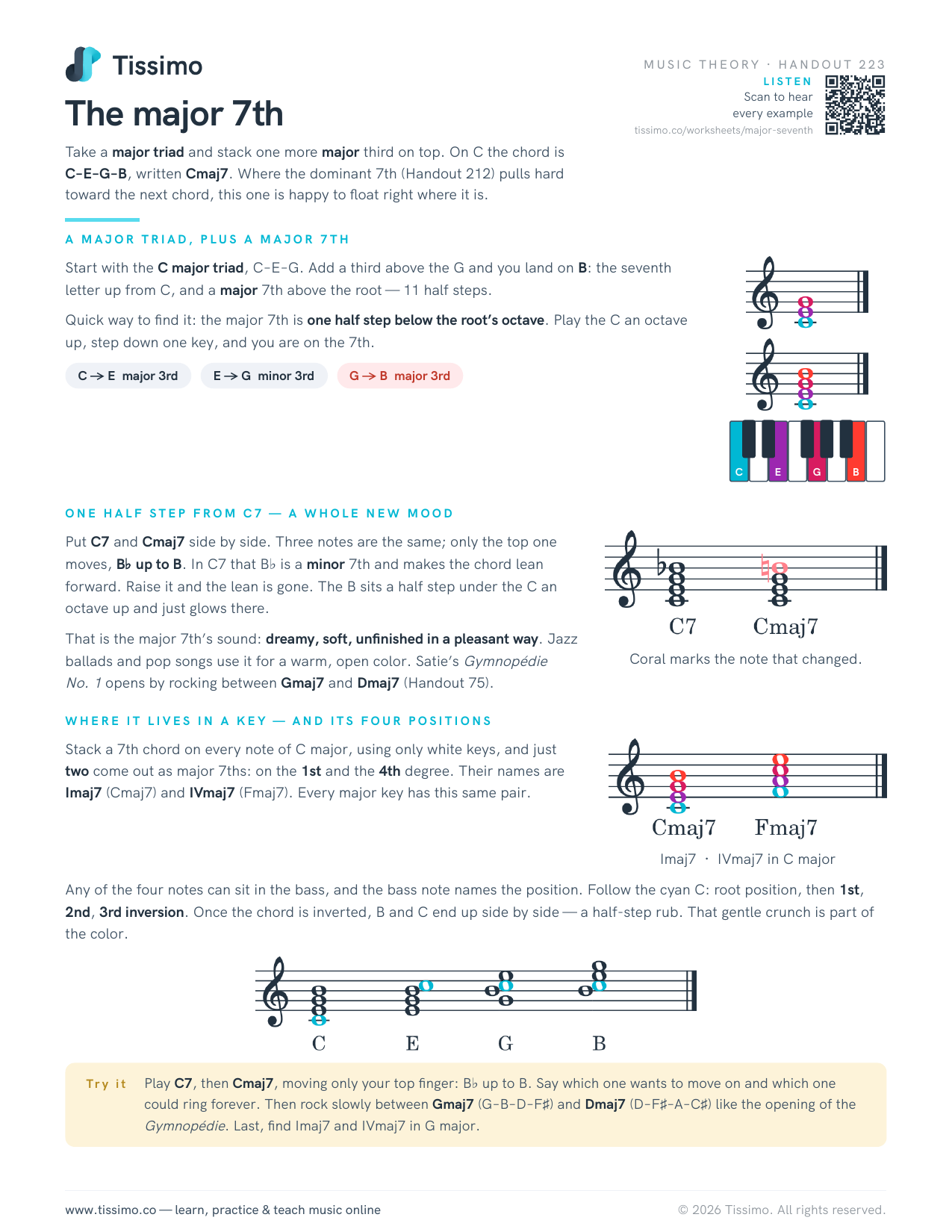
The major 7th
Take a major triad and stack one more major third on top. On C the chord is C–E–G–B, written Cmaj7. Where the dominant 7th (Handout 212) pulls hard toward the next chord, this one is happy to float right where it is.
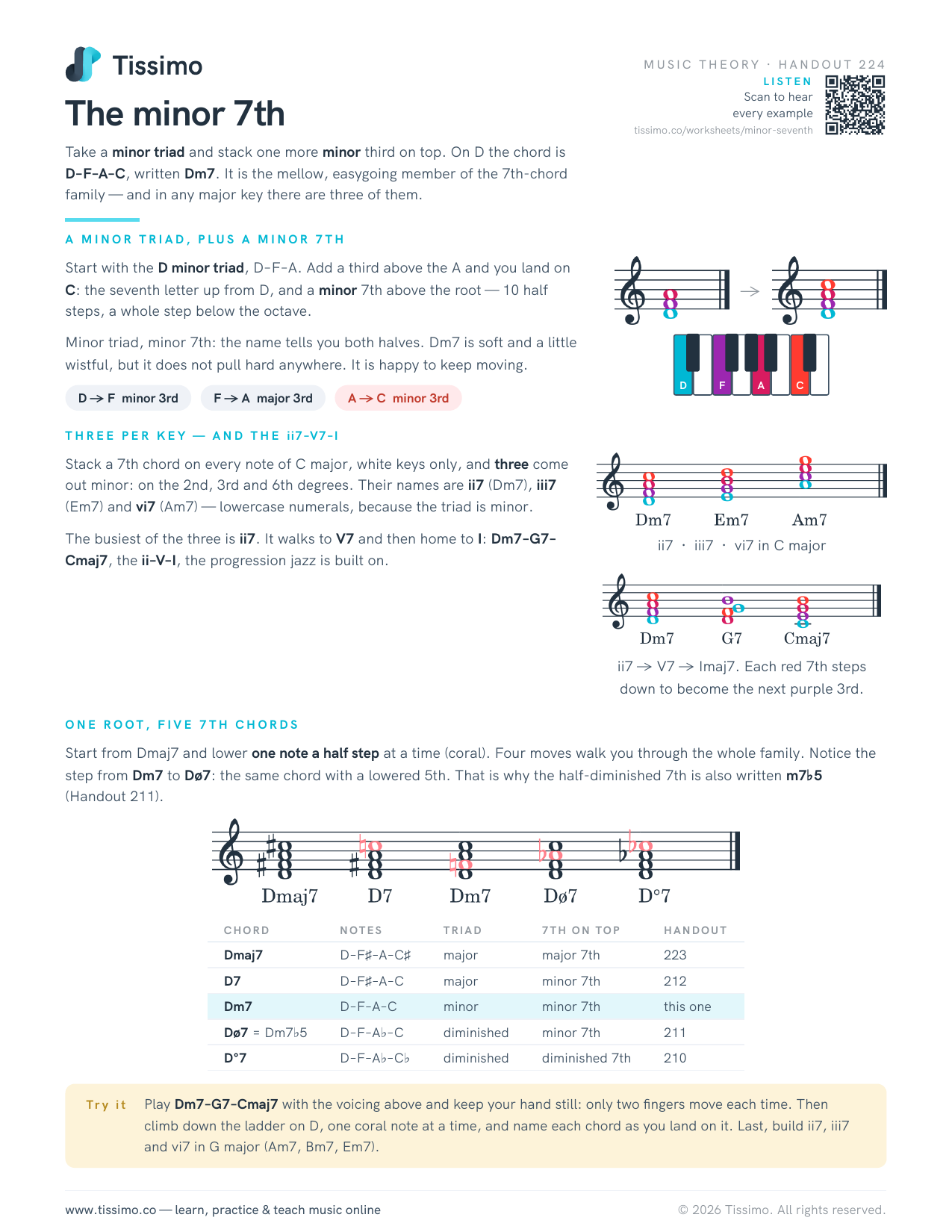
The minor 7th
Take a minor triad and stack one more minor third on top. On D the chord is D–F–A–C, written Dm7. It is the mellow, easygoing member of the 7th-chord family — and in any major key there are three of them.
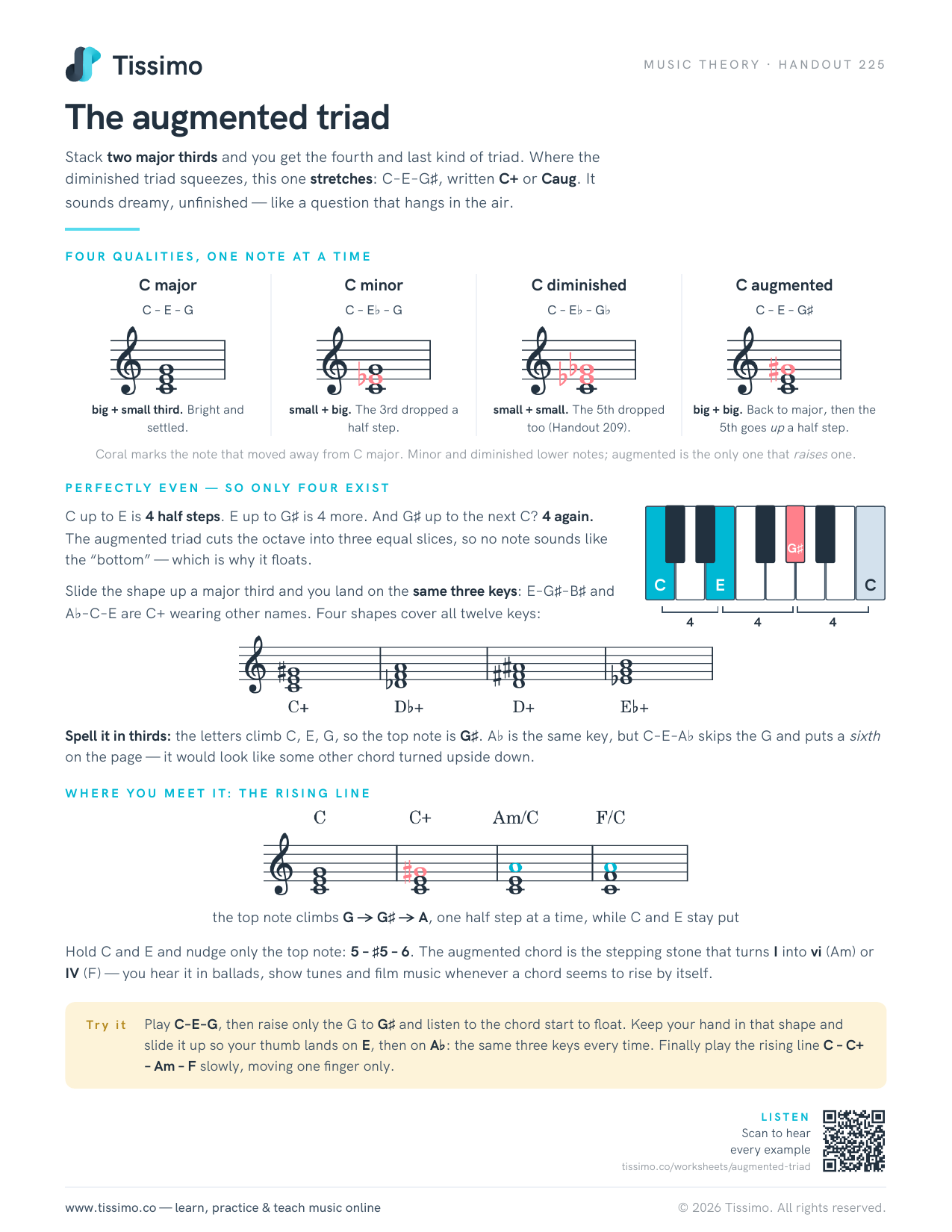
The augmented triad
Stack two major thirds and you get the fourth and last kind of triad. Where the diminished triad squeezes, this one stretches: C–E–G♯, written C+ or Caug. It sounds dreamy, unfinished — like a question that hangs in the air.
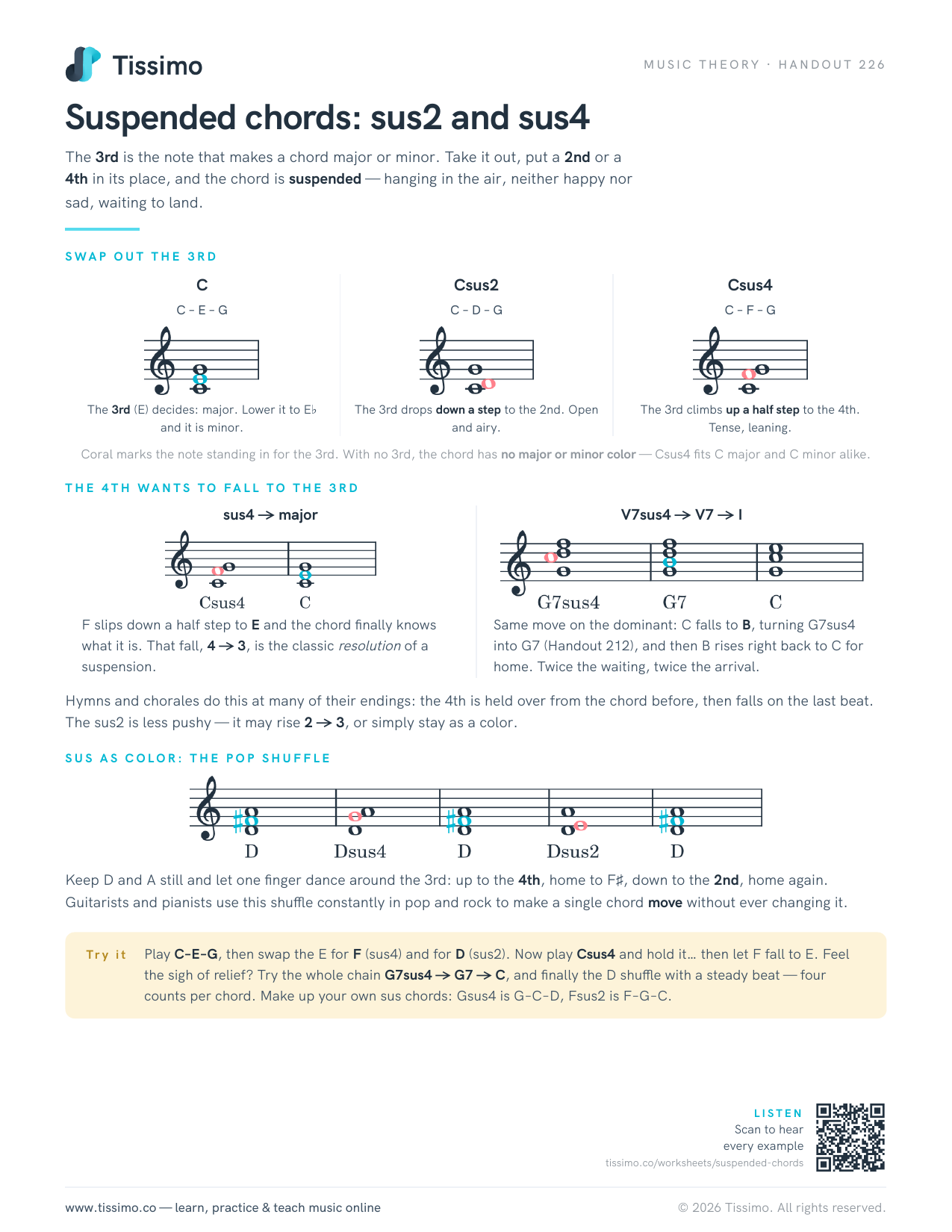
Suspended chords: sus2 and sus4
The 3rd is the note that makes a chord major or minor. Take it out, put a 2nd or a 4th in its place, and the chord is suspended — hanging in the air, neither happy nor sad, waiting to land.
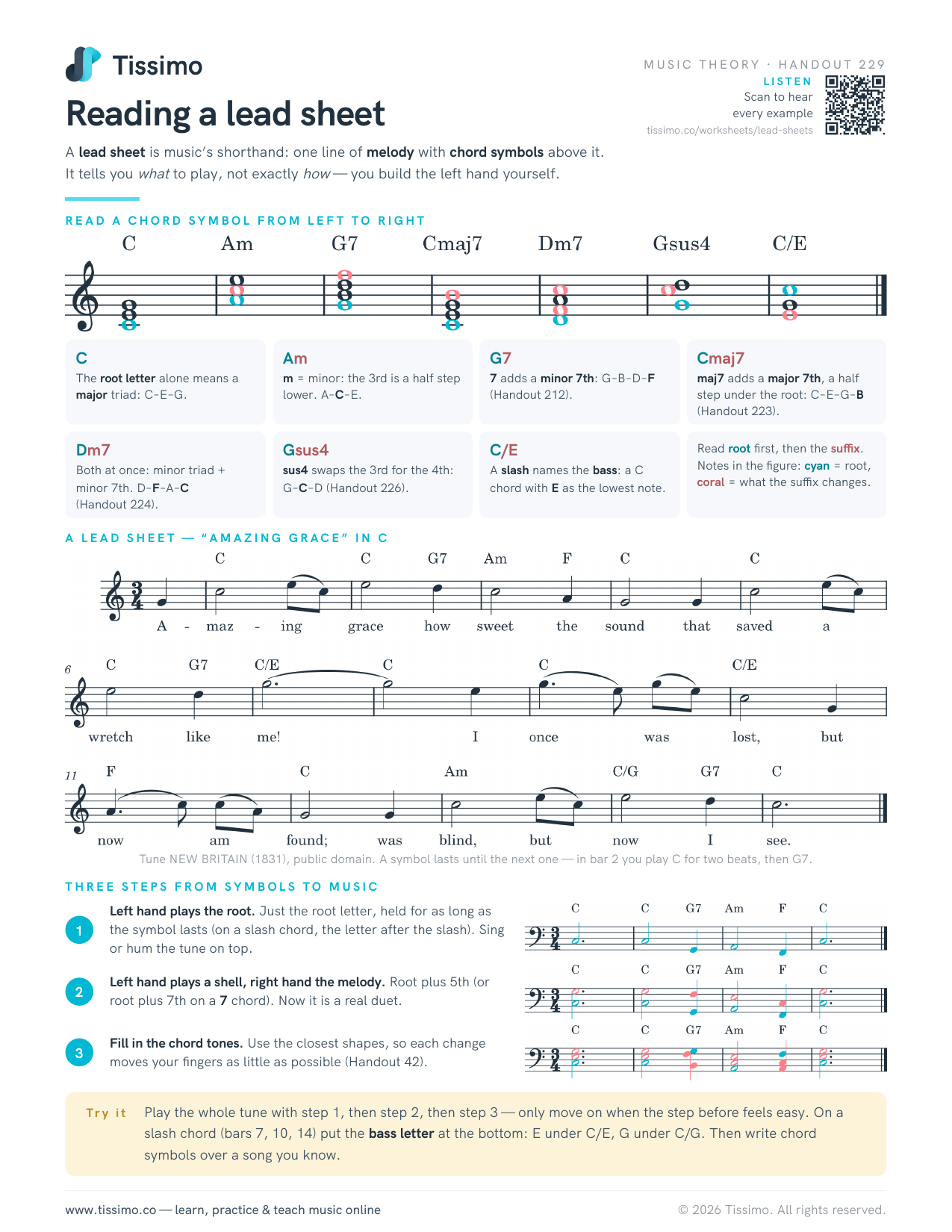
Reading a lead sheet
A lead sheet is music’s shorthand: one line of melody with chord symbols above it. It tells you what to play, not exactly how — you build the left hand yourself.
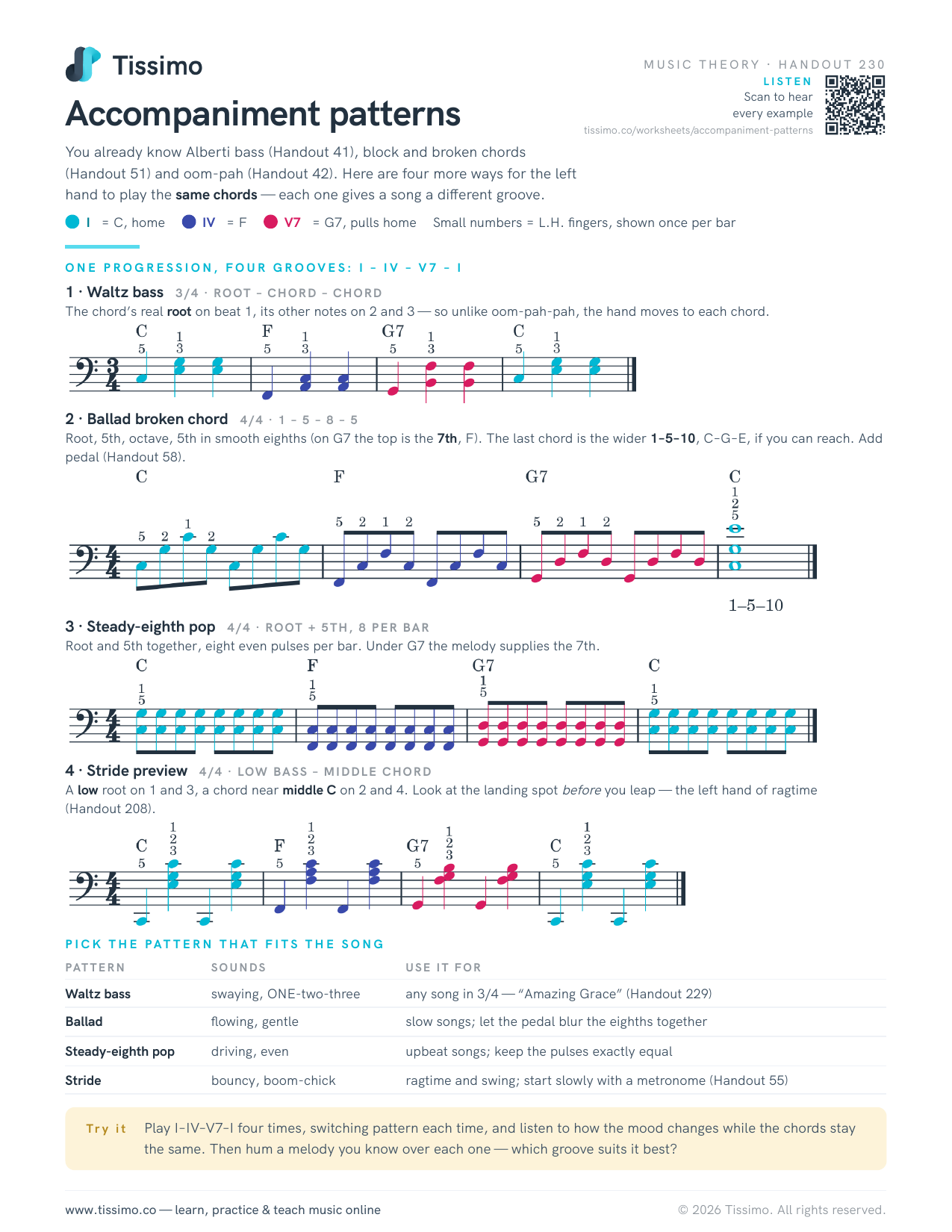
Accompaniment patterns
You already know Alberti bass (Handout 41), block and broken chords (Handout 51) and oom-pah (Handout 42). Here are four more ways for the left hand to play the same chords — each one gives a song a different groove.
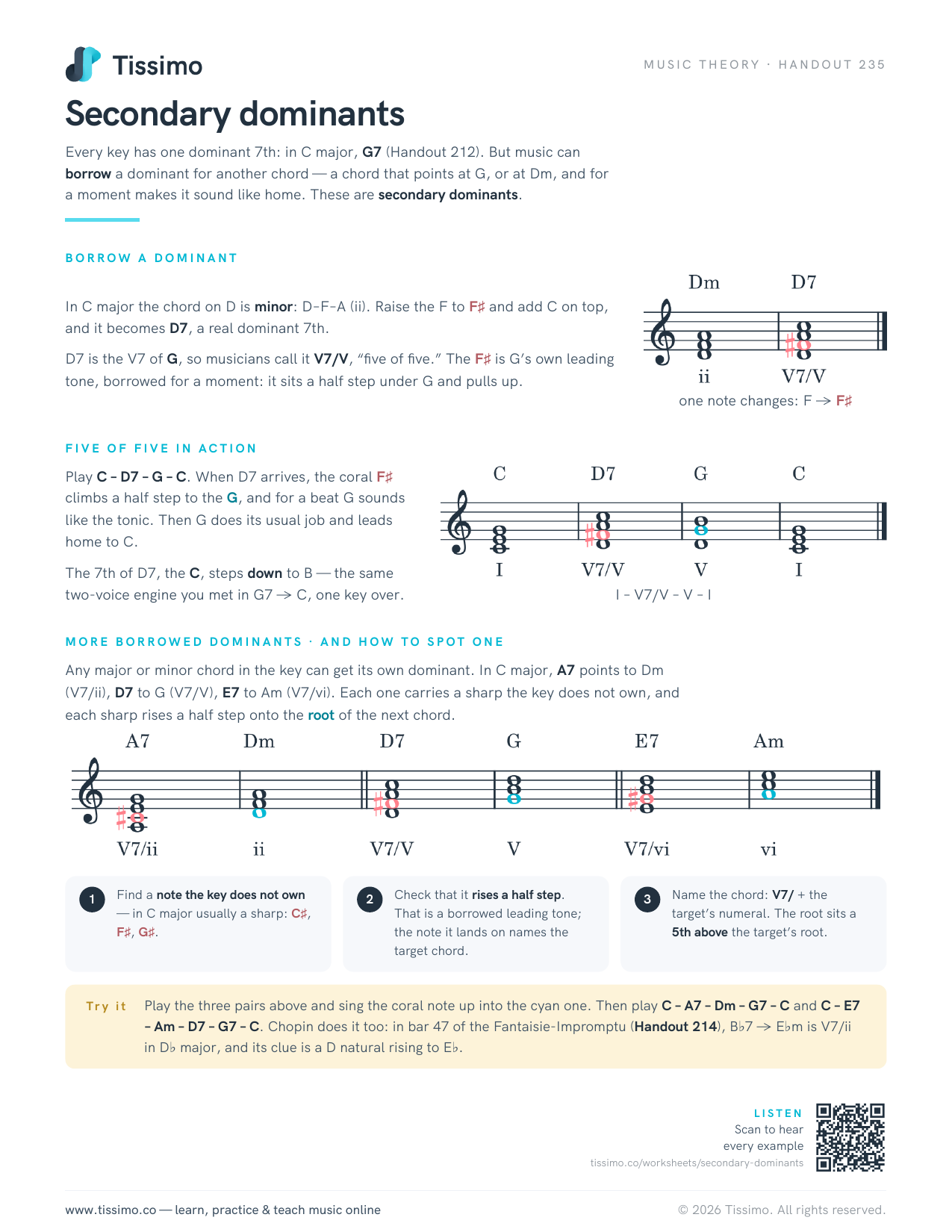
Secondary dominants
Every key has one dominant 7th: in C major, G7 (Handout 212). But music can borrow a dominant for another chord — a chord that points at G, or at Dm, and for a moment makes it sound like home. These are secondary dominants.
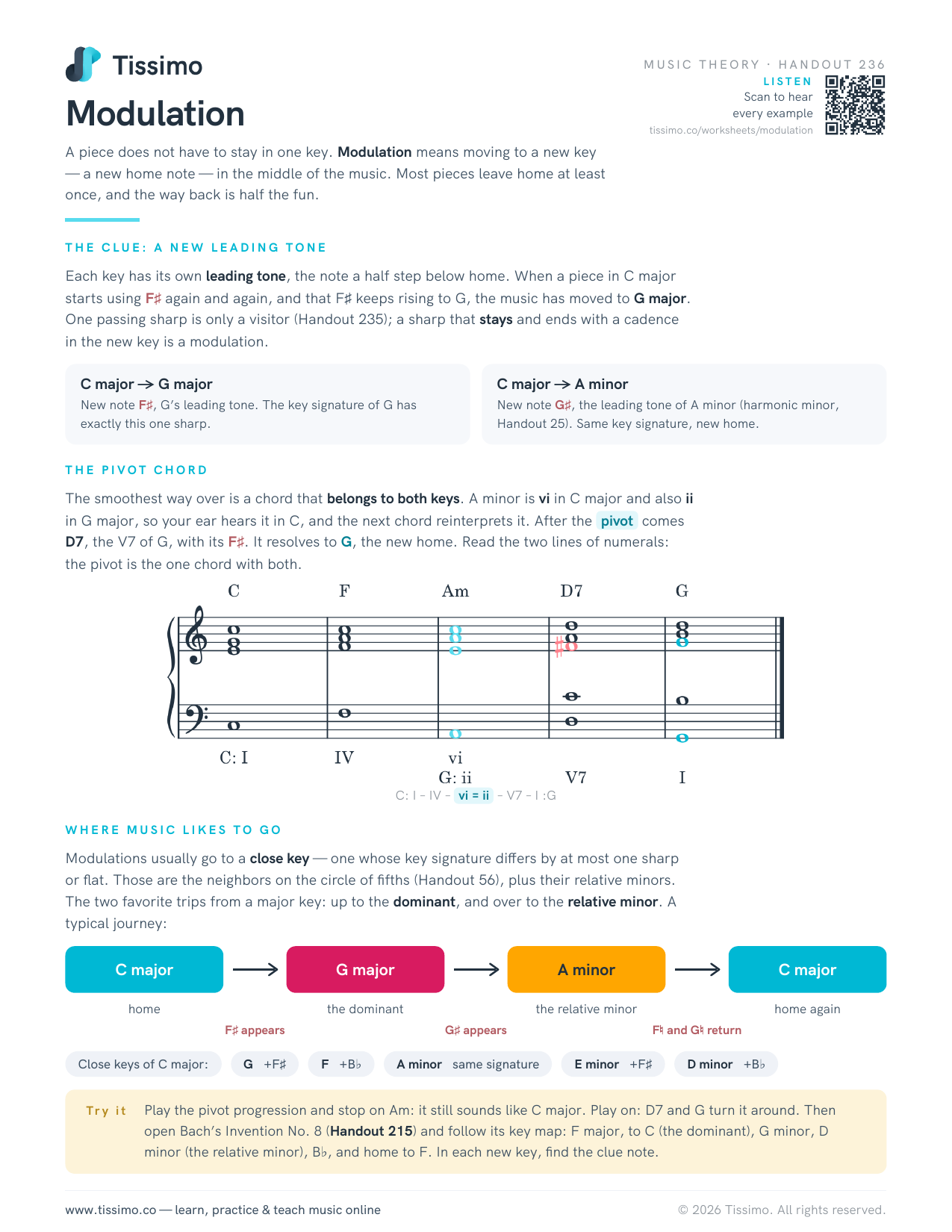
Modulation
A piece does not have to stay in one key. Modulation means moving to a new key — a new home note — in the middle of the music. Most pieces leave home at least once, and the way back is half the fun.
Form & Analysis
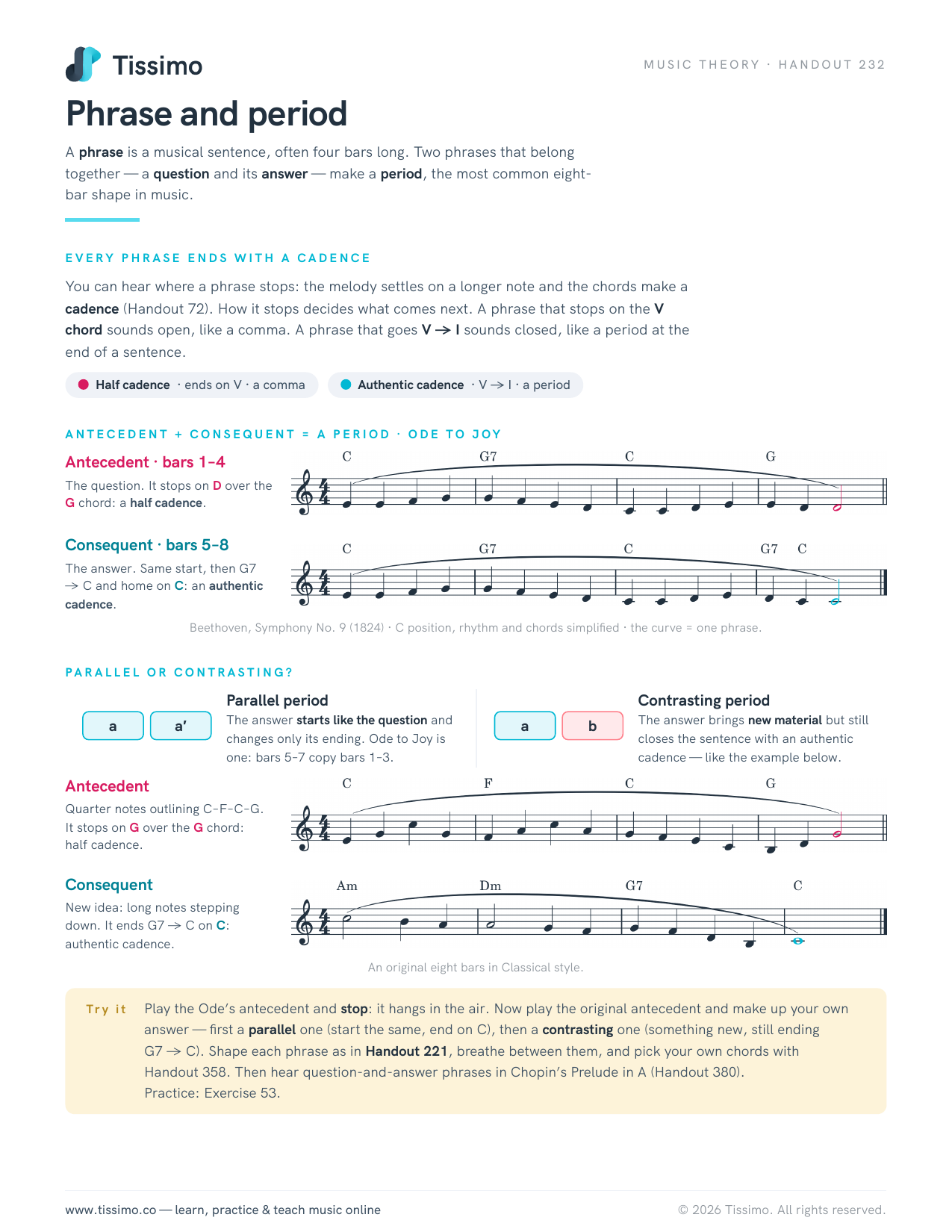
Phrase and period
A phrase is a musical sentence, often four bars long. Two phrases that belong together — a question and its answer — make a period, the most common eight-bar shape in music.
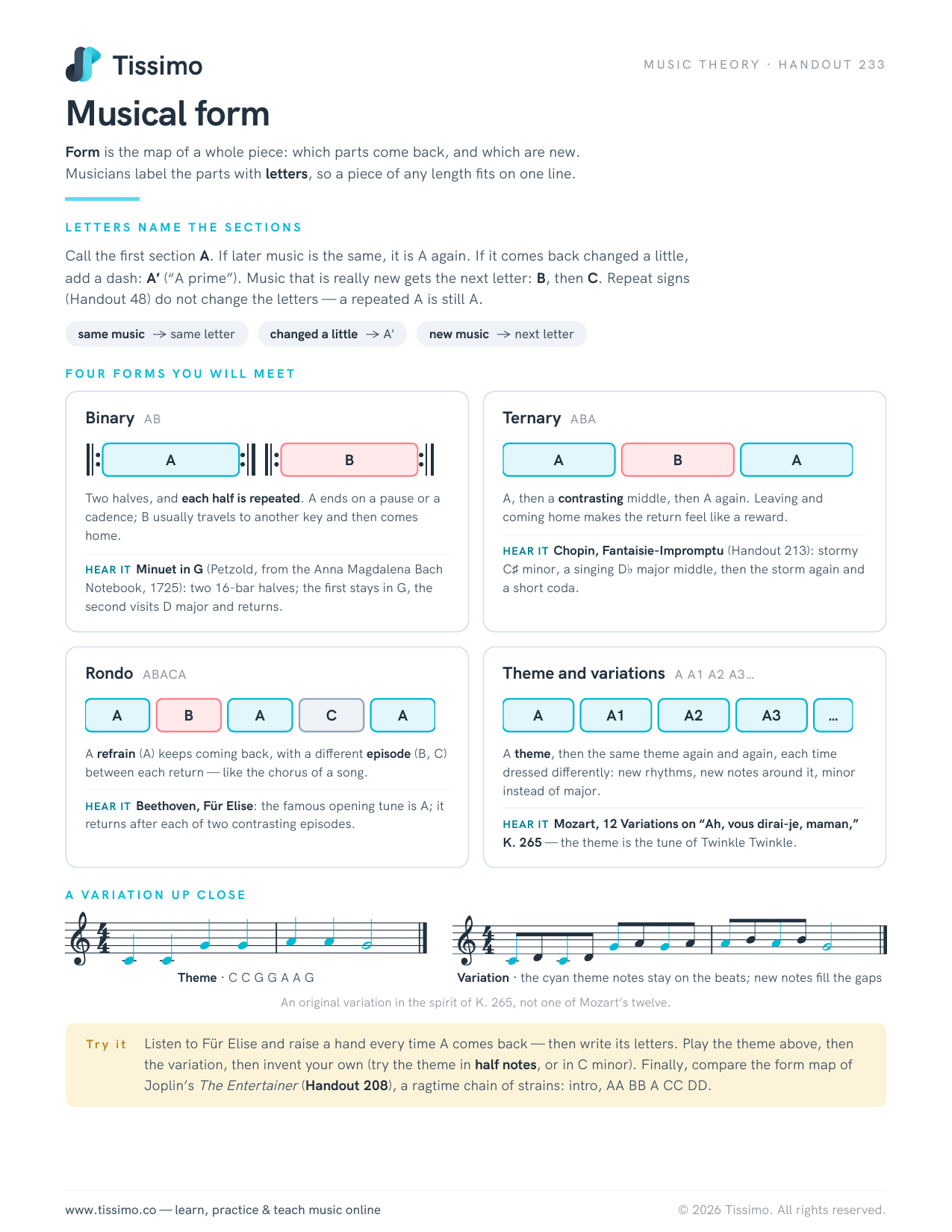
Musical form
Form is the map of a whole piece: which parts come back, and which are new. Musicians label the parts with letters, so a piece of any length fits on one line.
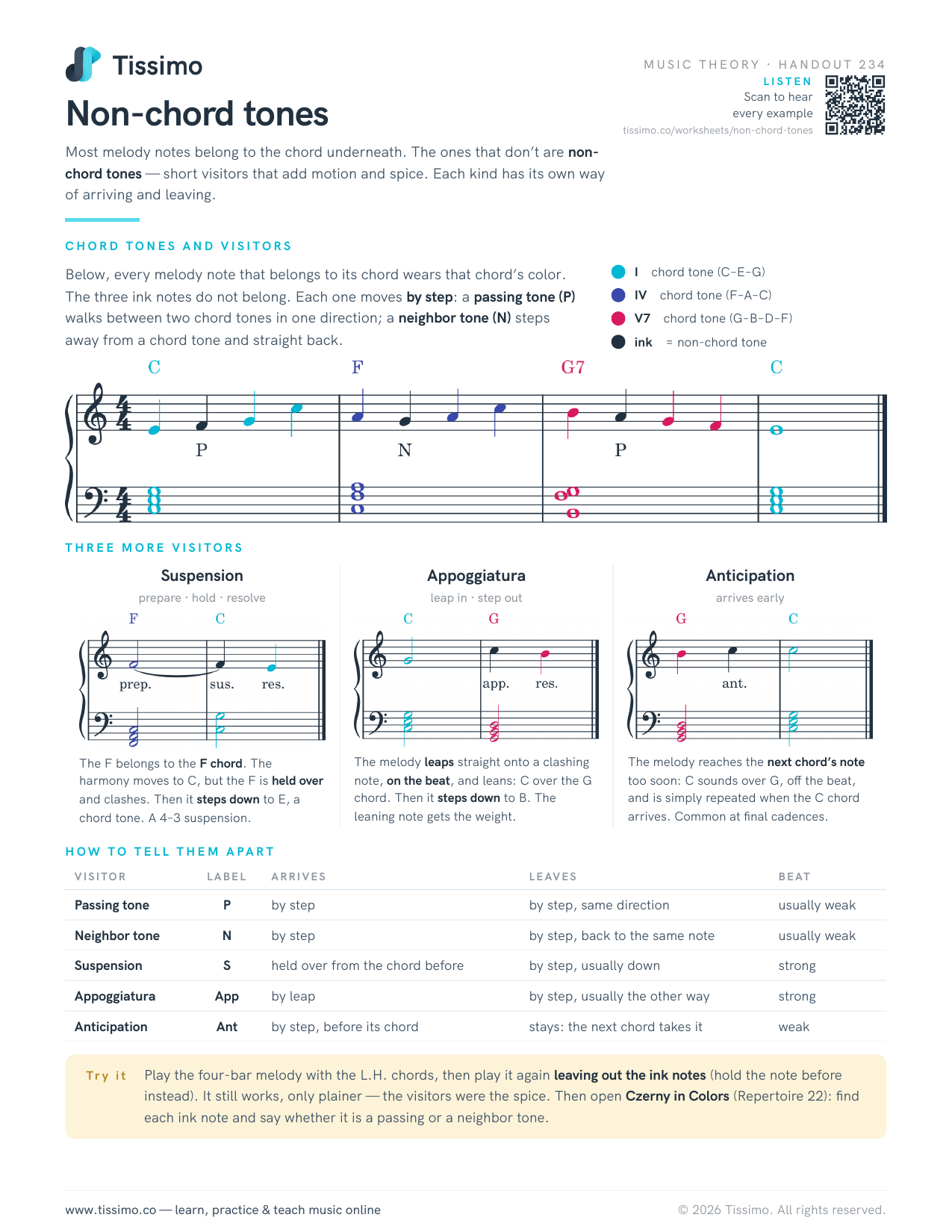
Non-chord tones
Most melody notes belong to the chord underneath. The ones that don’t are non-chord tones — short visitors that add motion and spice. Each kind has its own way of arriving and leaving.
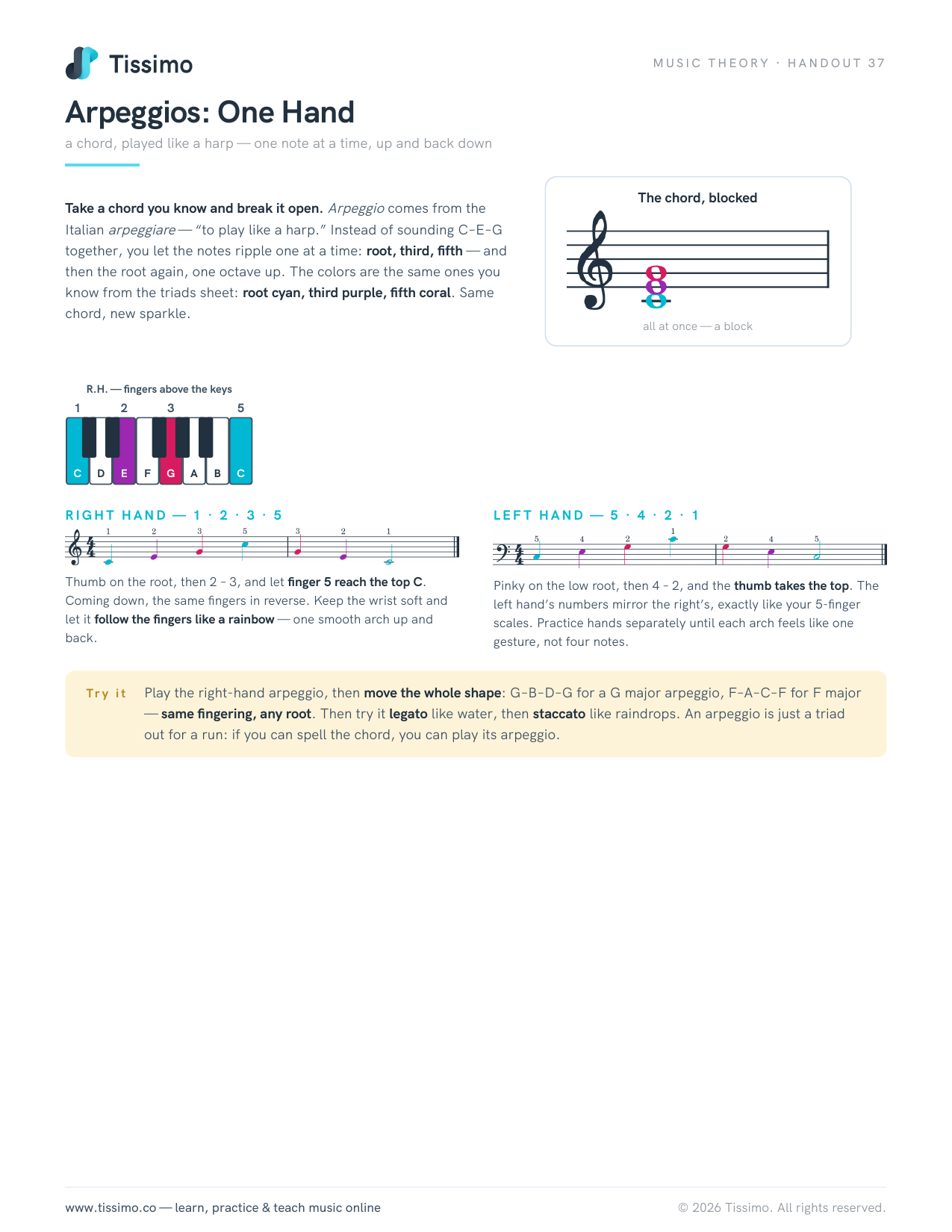
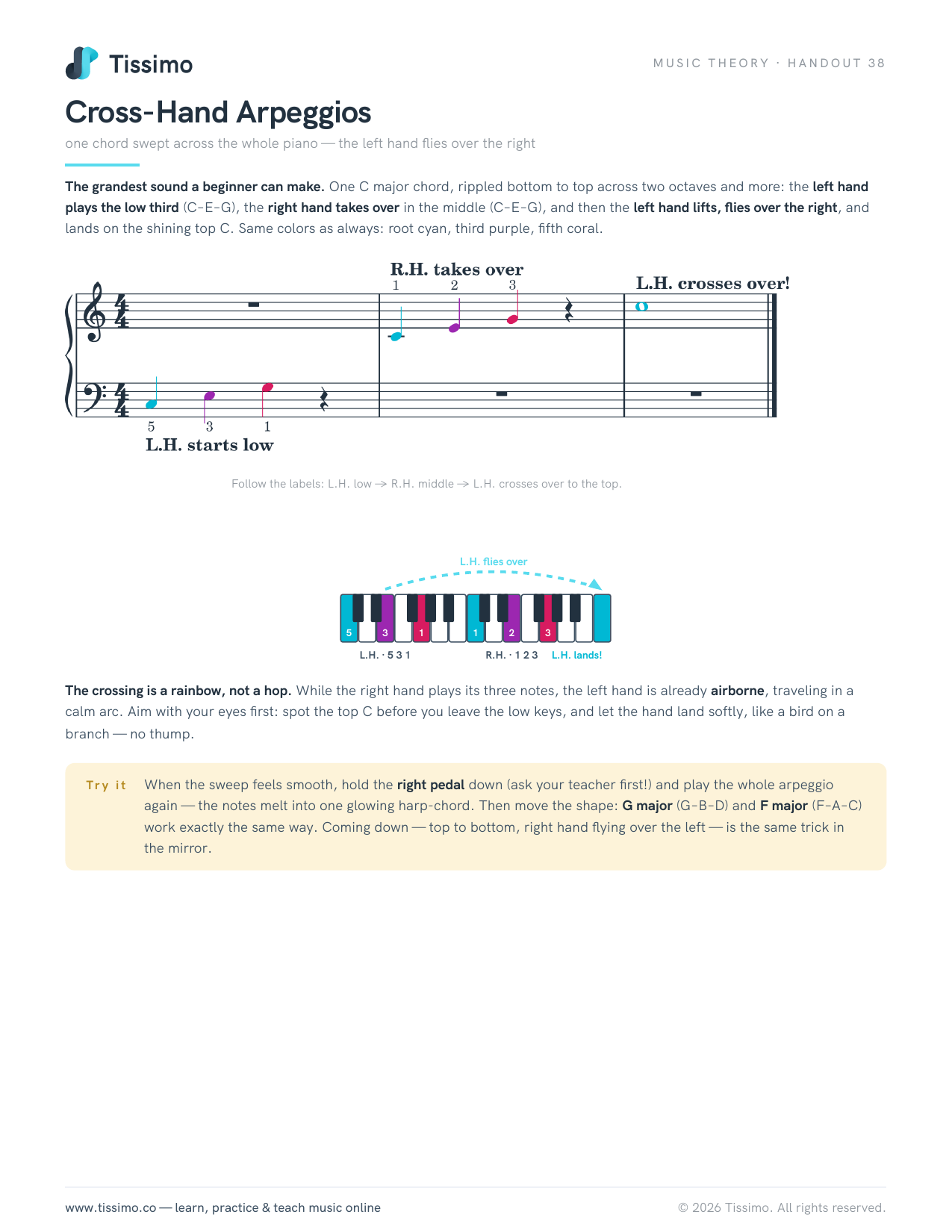
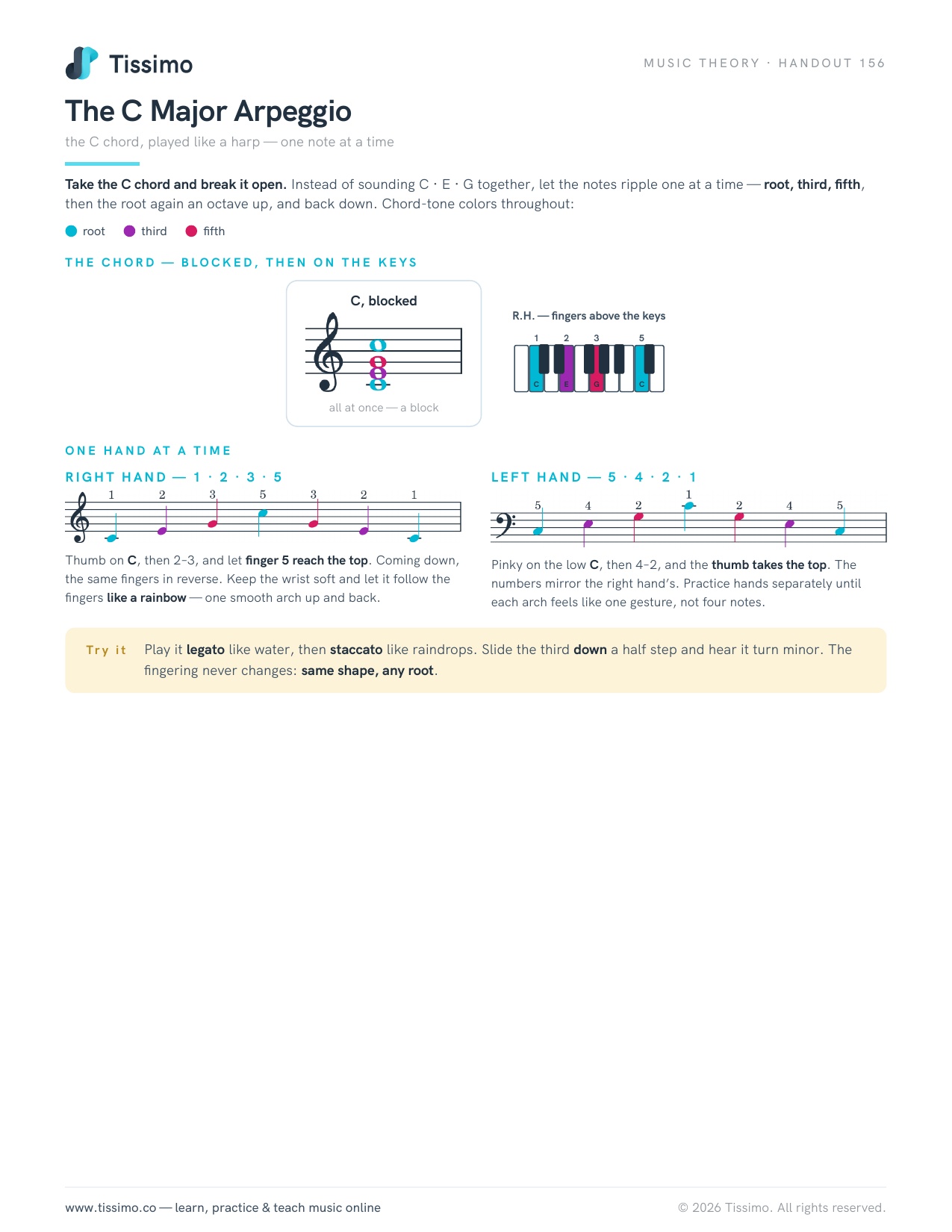
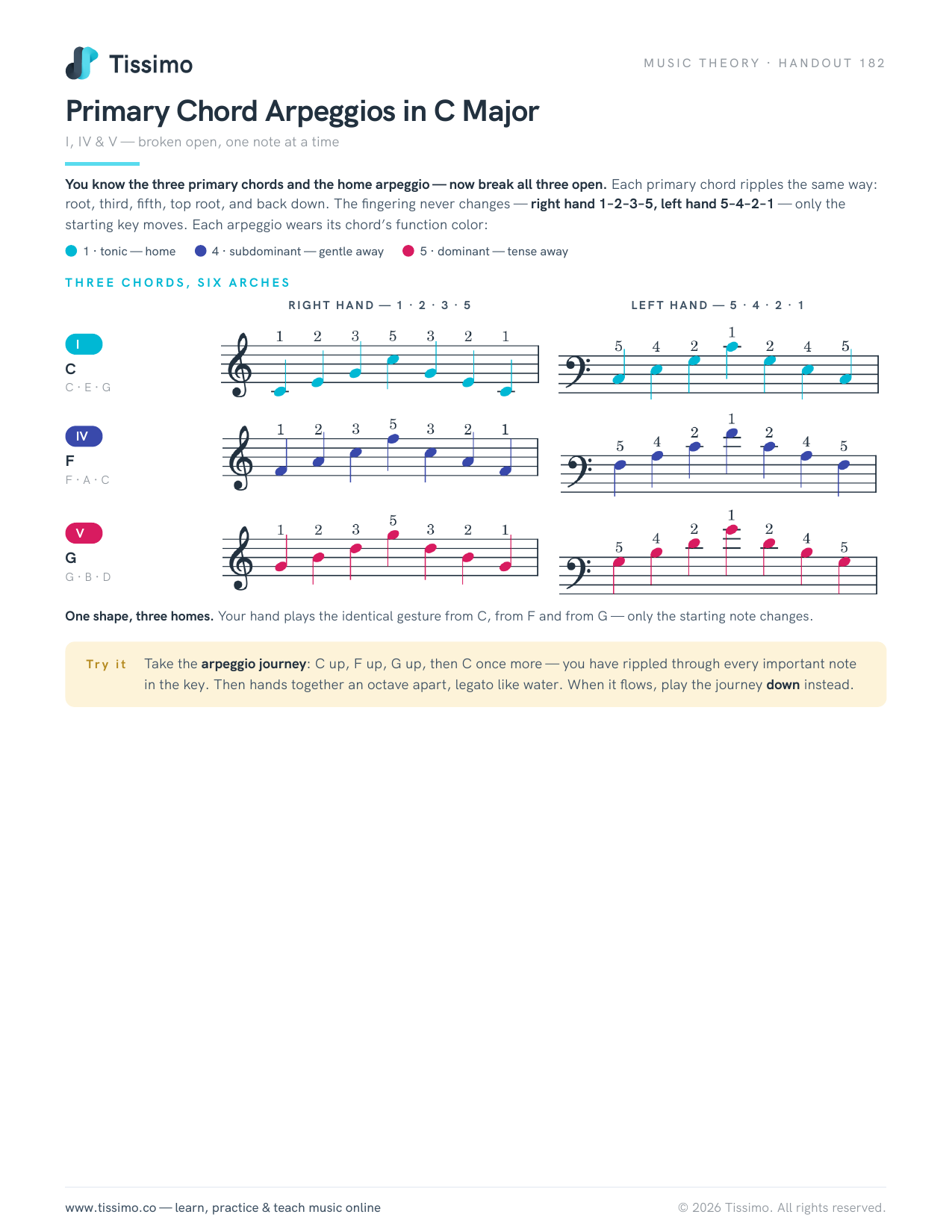
アルペジオ
表現とテクニック
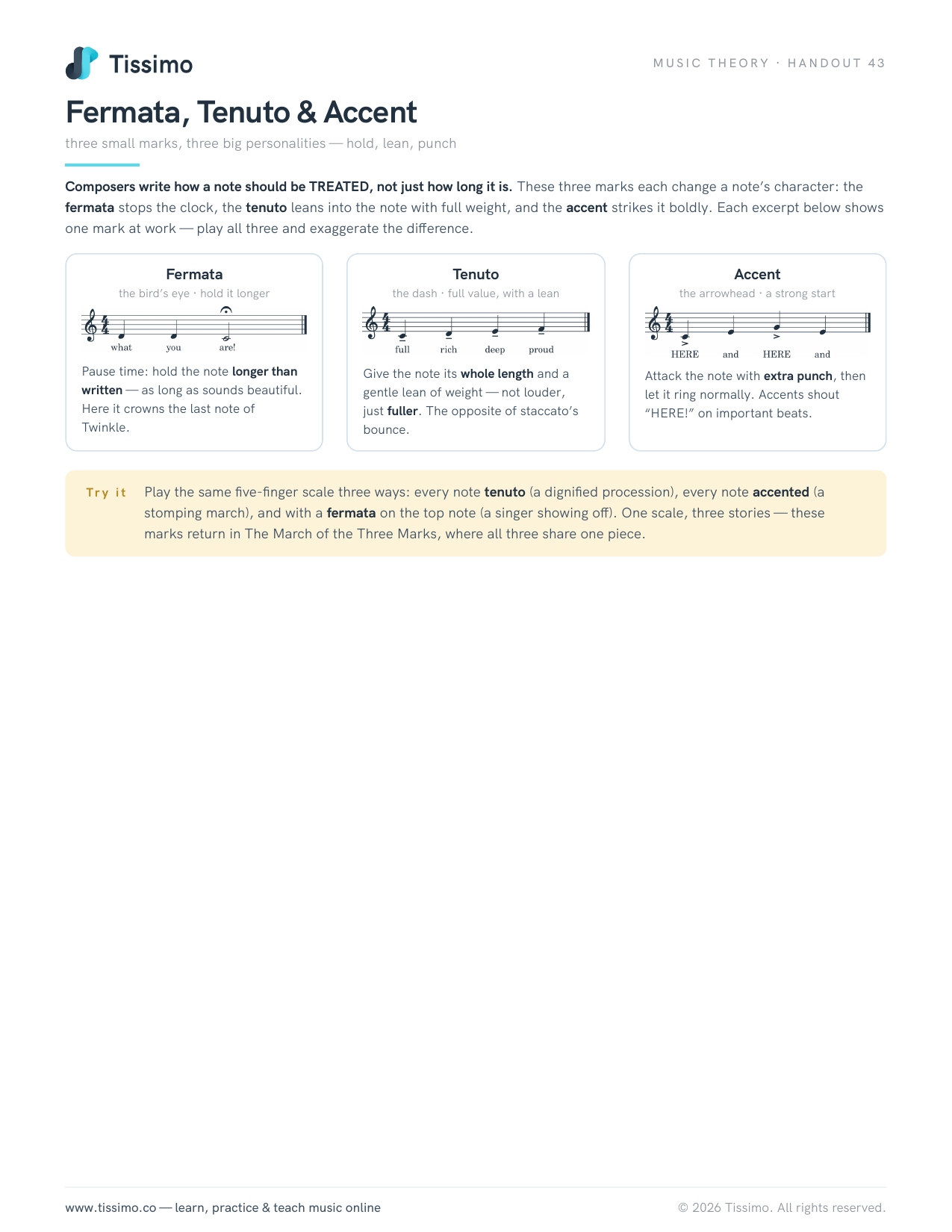
フェルマータ、テヌート、アクセント
3つの小さな記号、3つの大きな個性——伸ばす、寄りかかる、突く
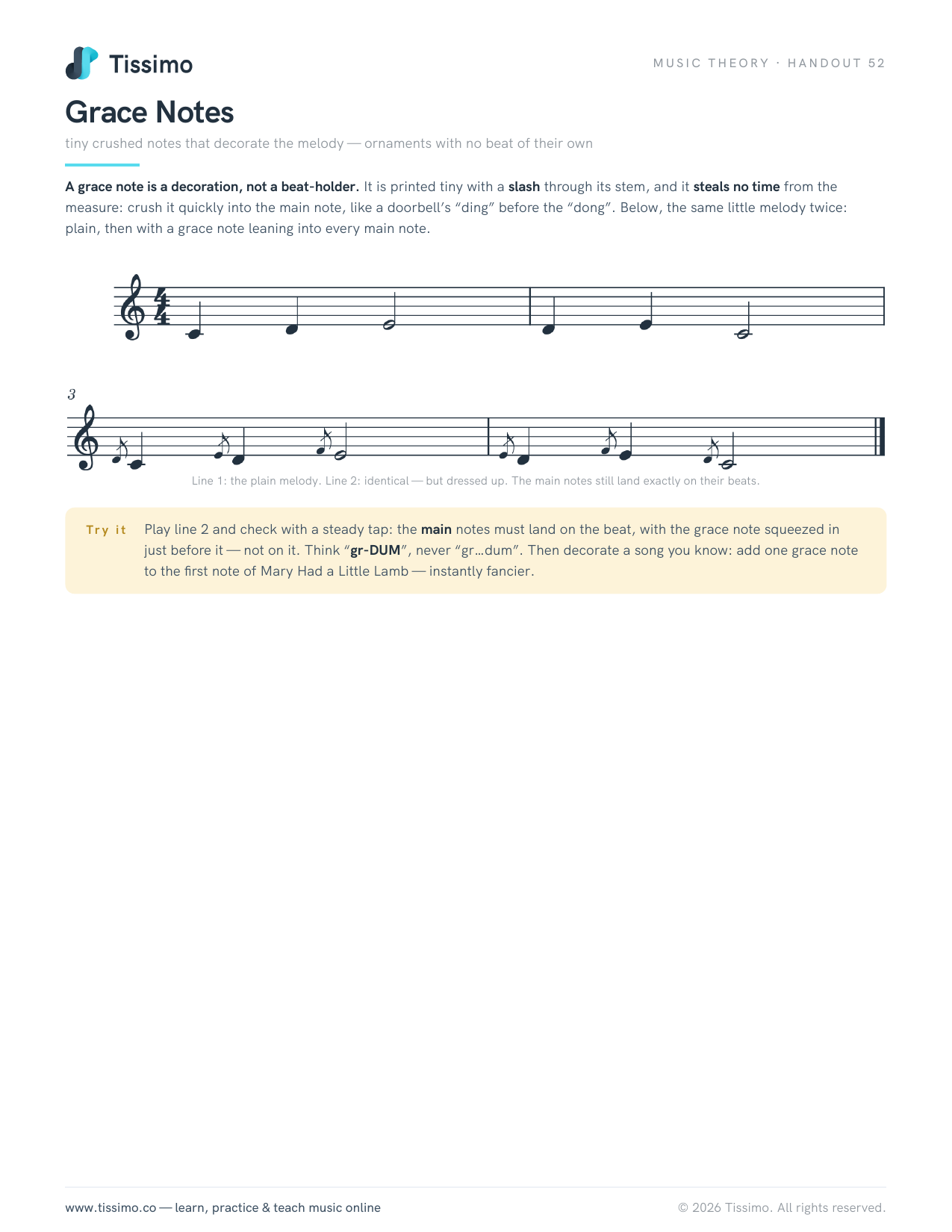
装飾音(グレースノート)
メロディーを彩る、押しつぶされたような小さな音——それ自体には拍を持たない装飾
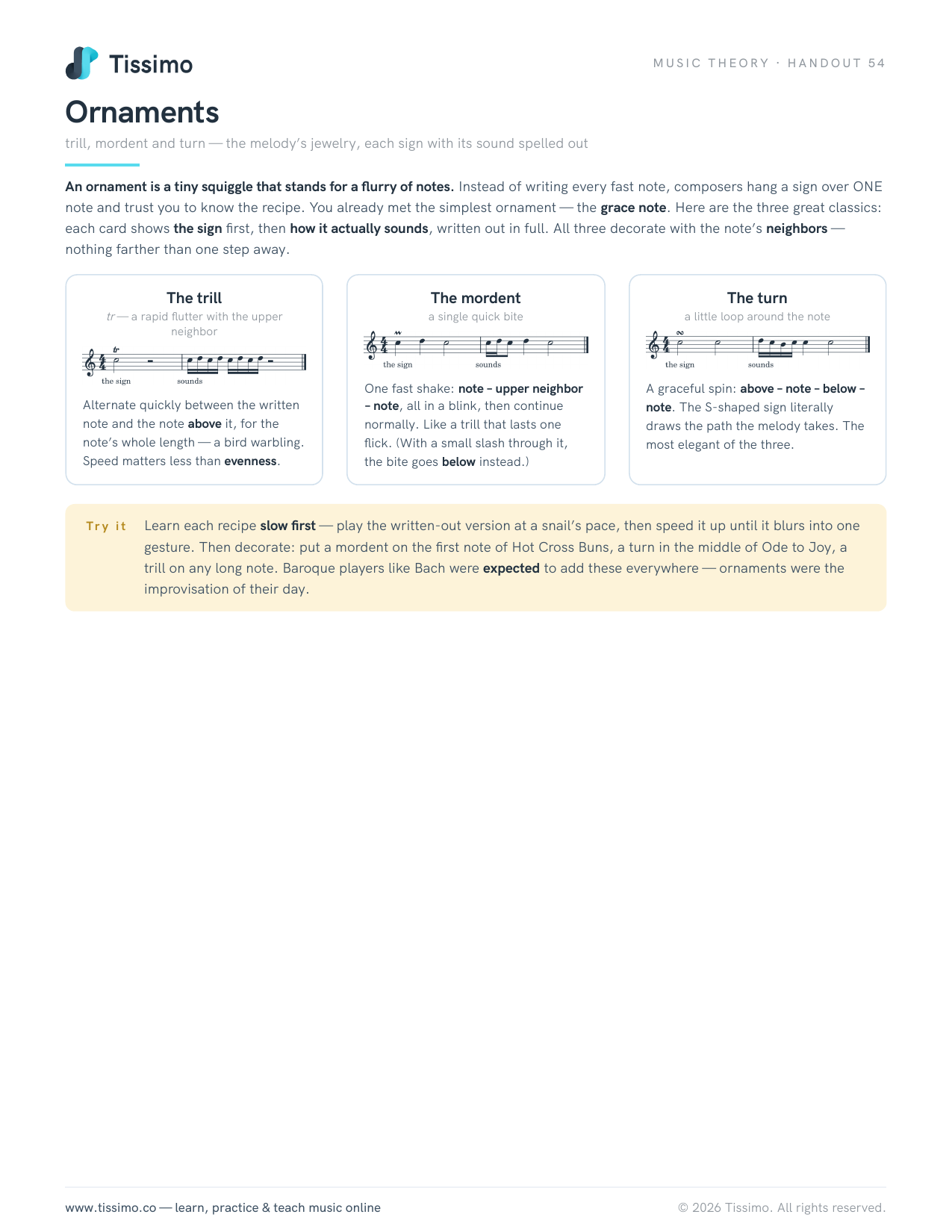
装飾音(オーナメント)
トリル、モルデント、ターン——メロディーの宝飾品。それぞれの記号の音を解説
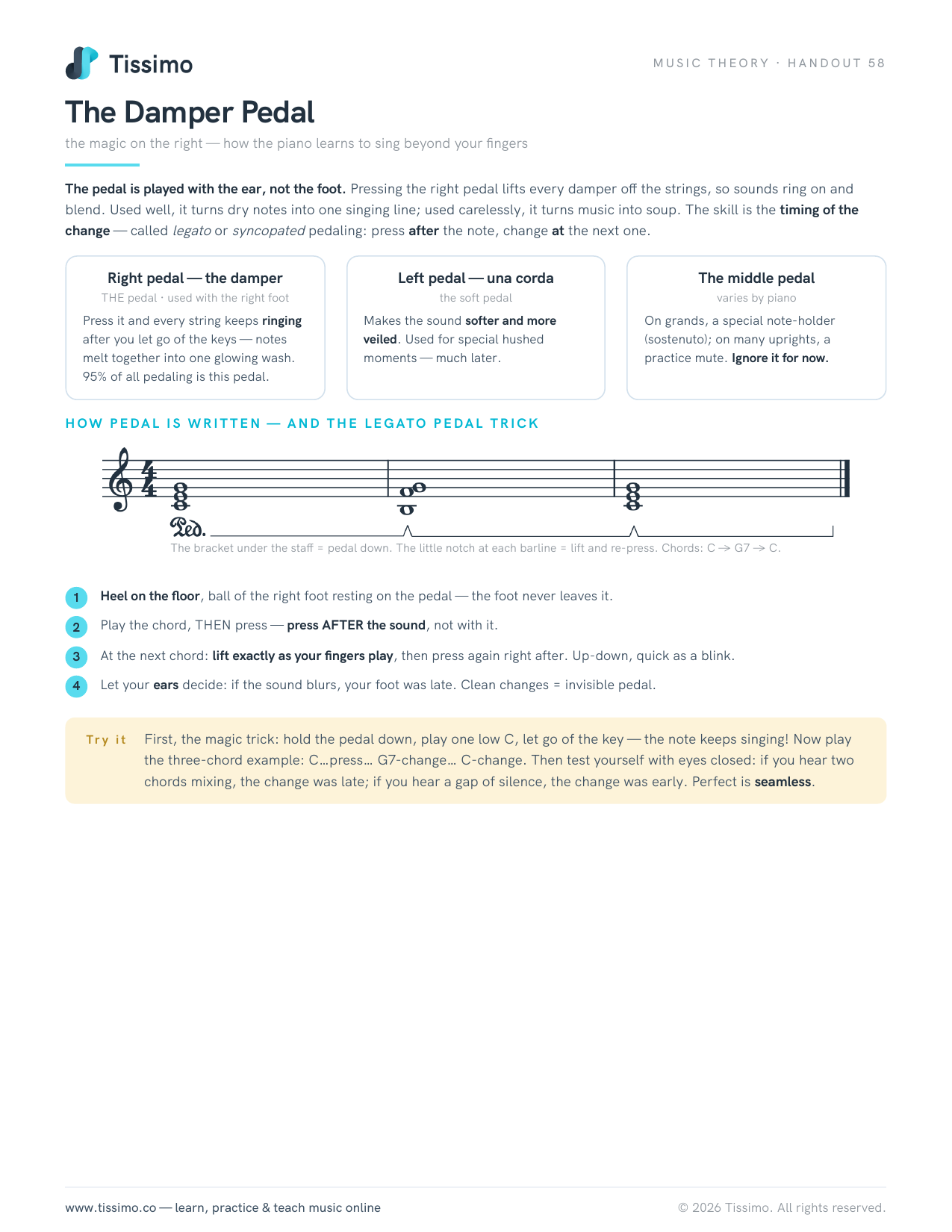
ダンパーペダル
右側の魔法——ピアノが指の外まで歌えるようになる仕組み
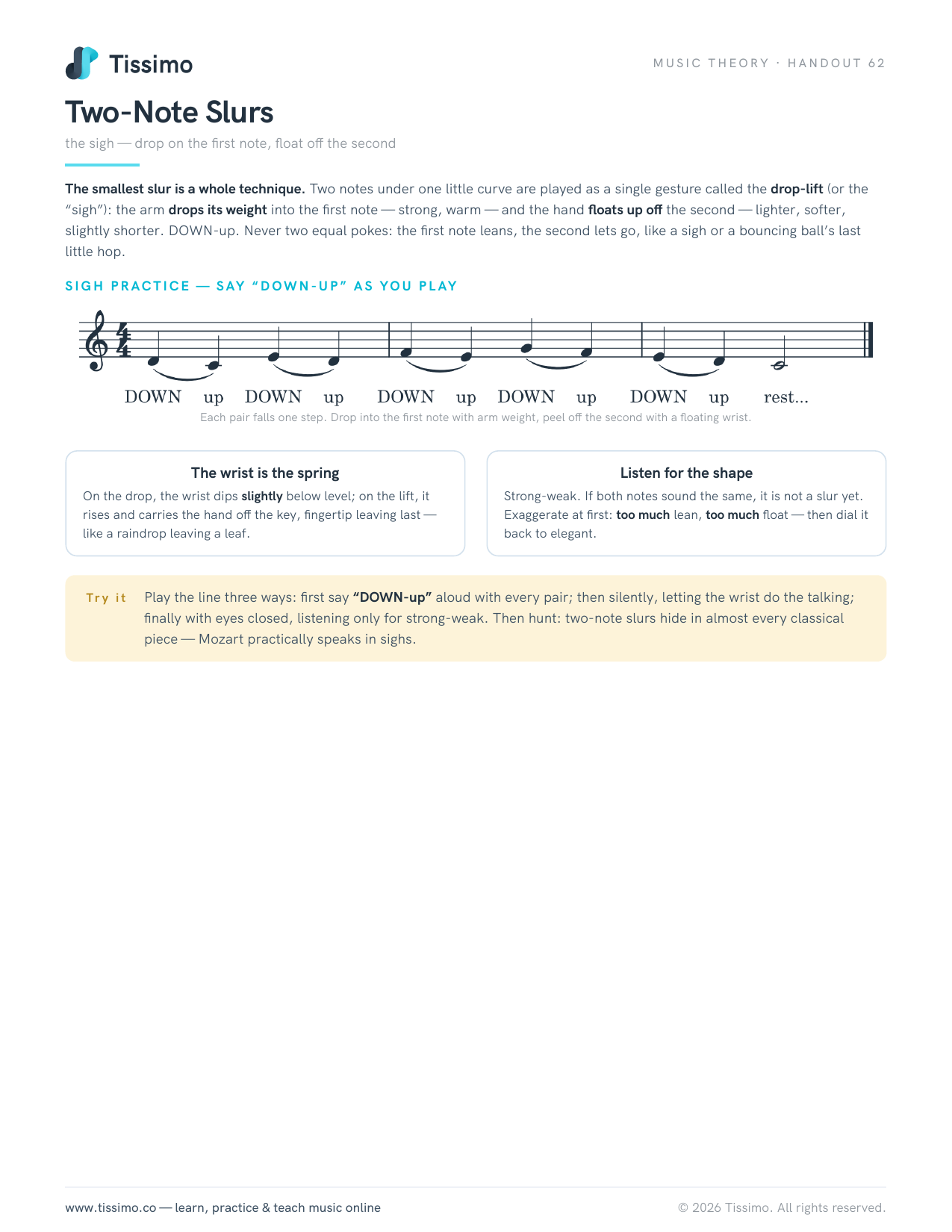
2音のスラー
ため息のように——最初の音に落ち、2番目の音でふわっと離れる
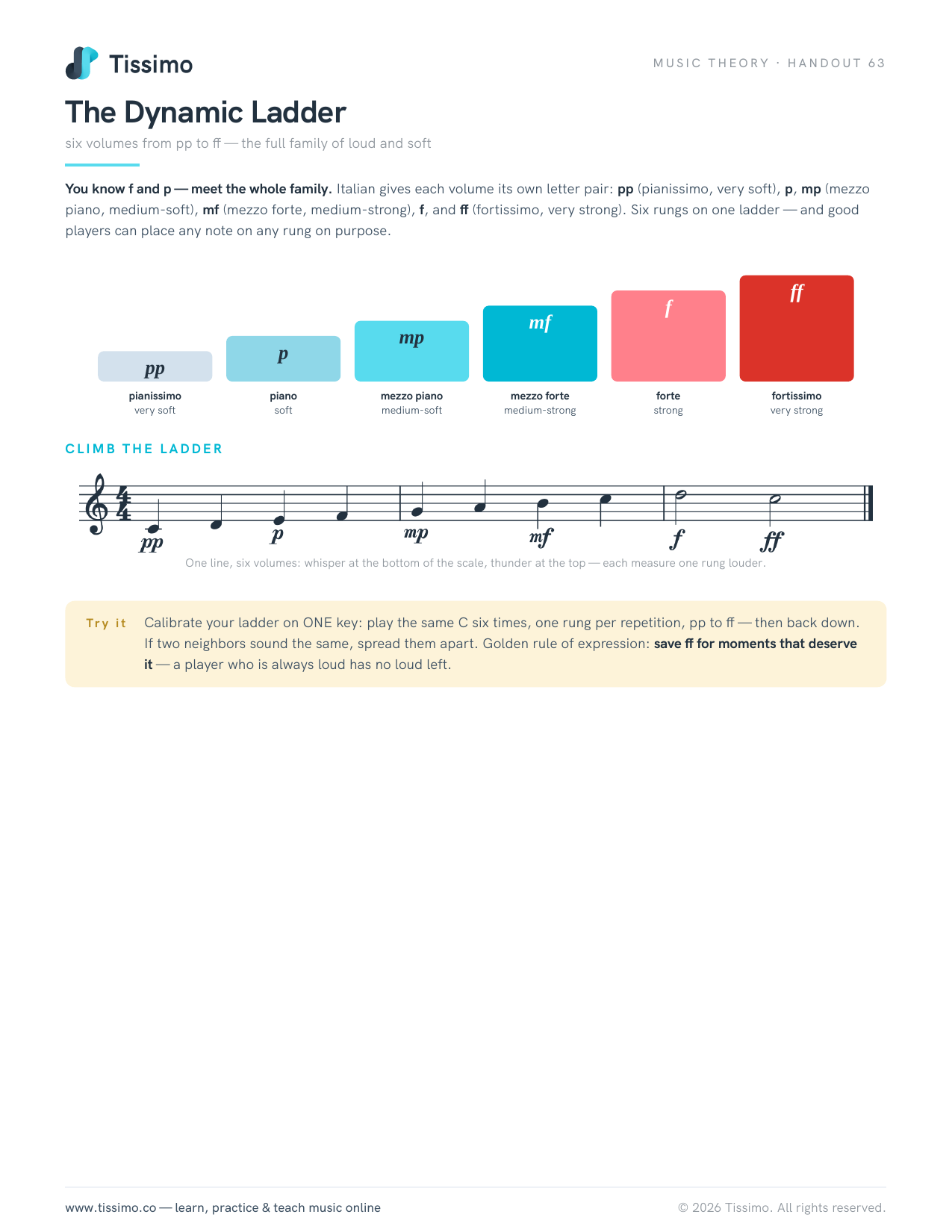
強弱記号のはしご
ppからffまでの6段階の音量——強弱記号の全ファミリー
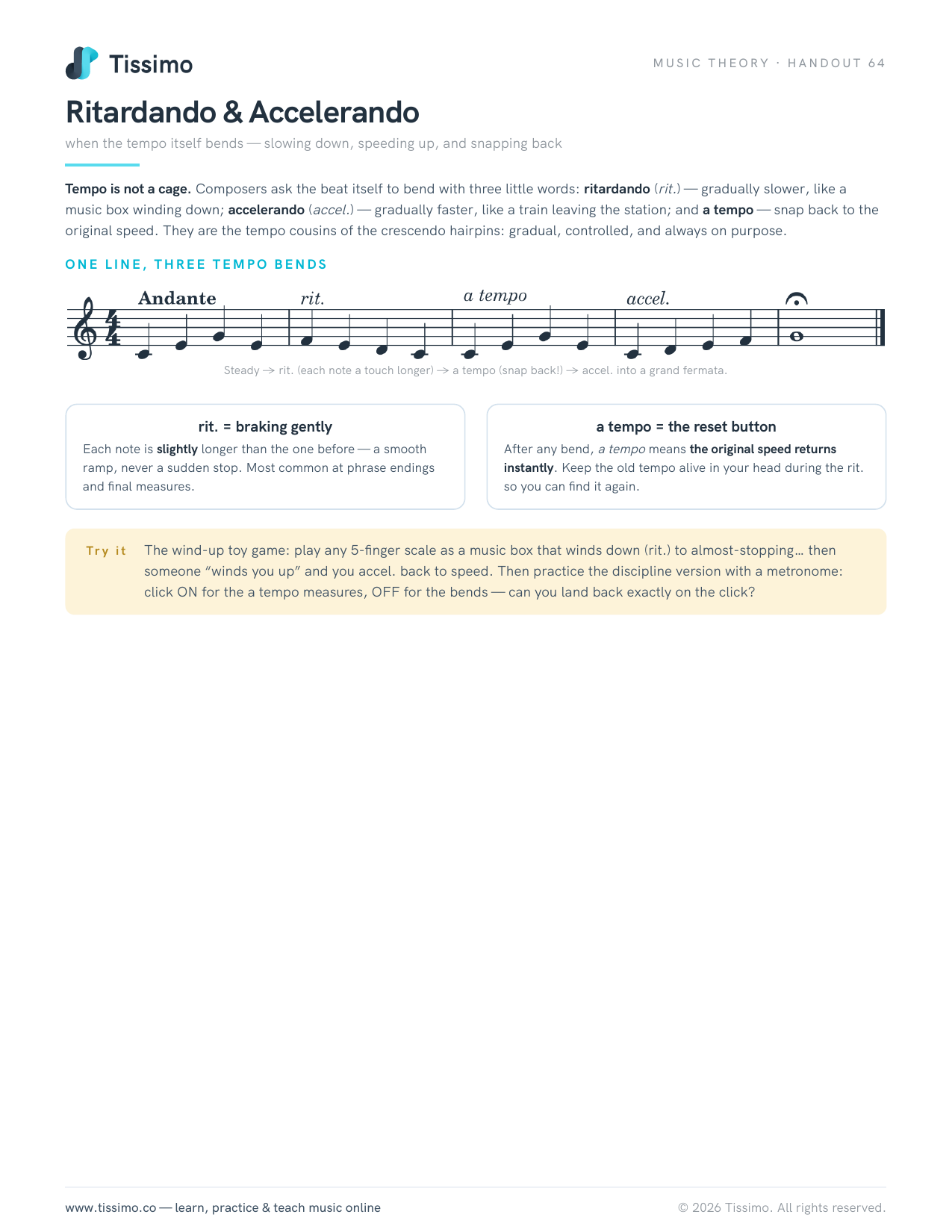
リタルダンドとアッチェレランド
テンポそのものが揺れるとき——遅くなり、速くなり、そして元に戻る
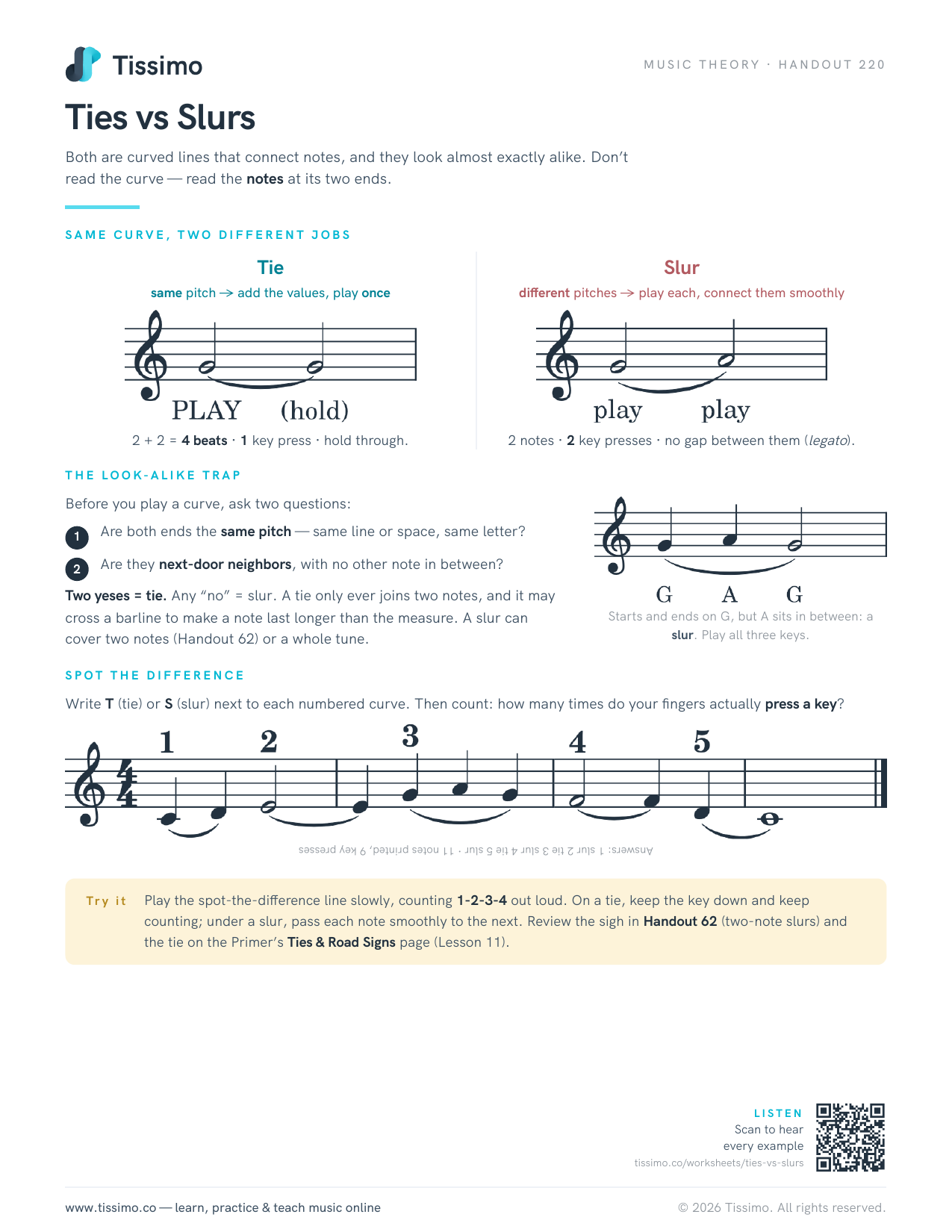
Ties vs Slurs
Both are curved lines that connect notes, and they look almost exactly alike. Don’t read the curve — read the notes at its two ends.
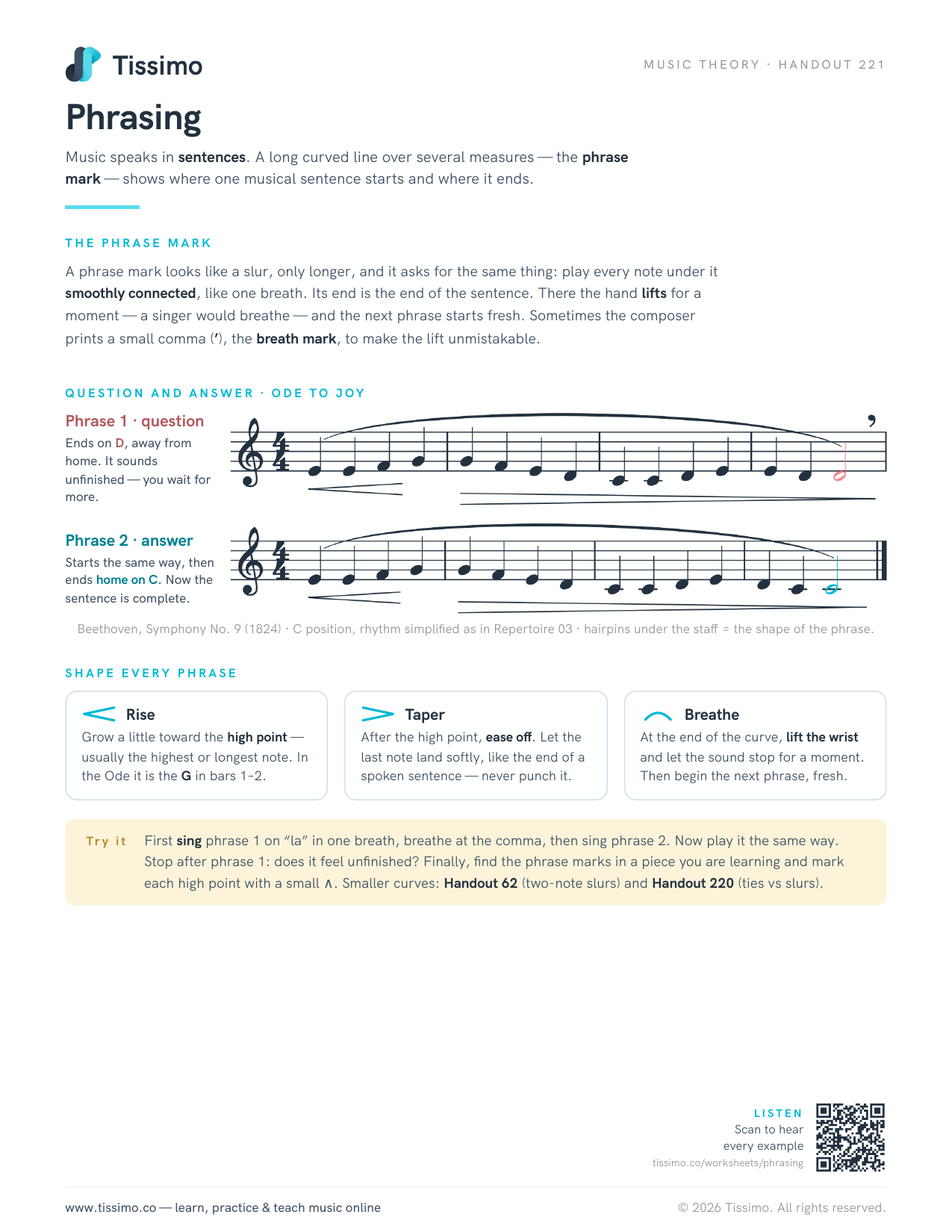
Phrasing
Music speaks in sentences. A long curved line over several measures — the phrase mark — shows where one musical sentence starts and where it ends.
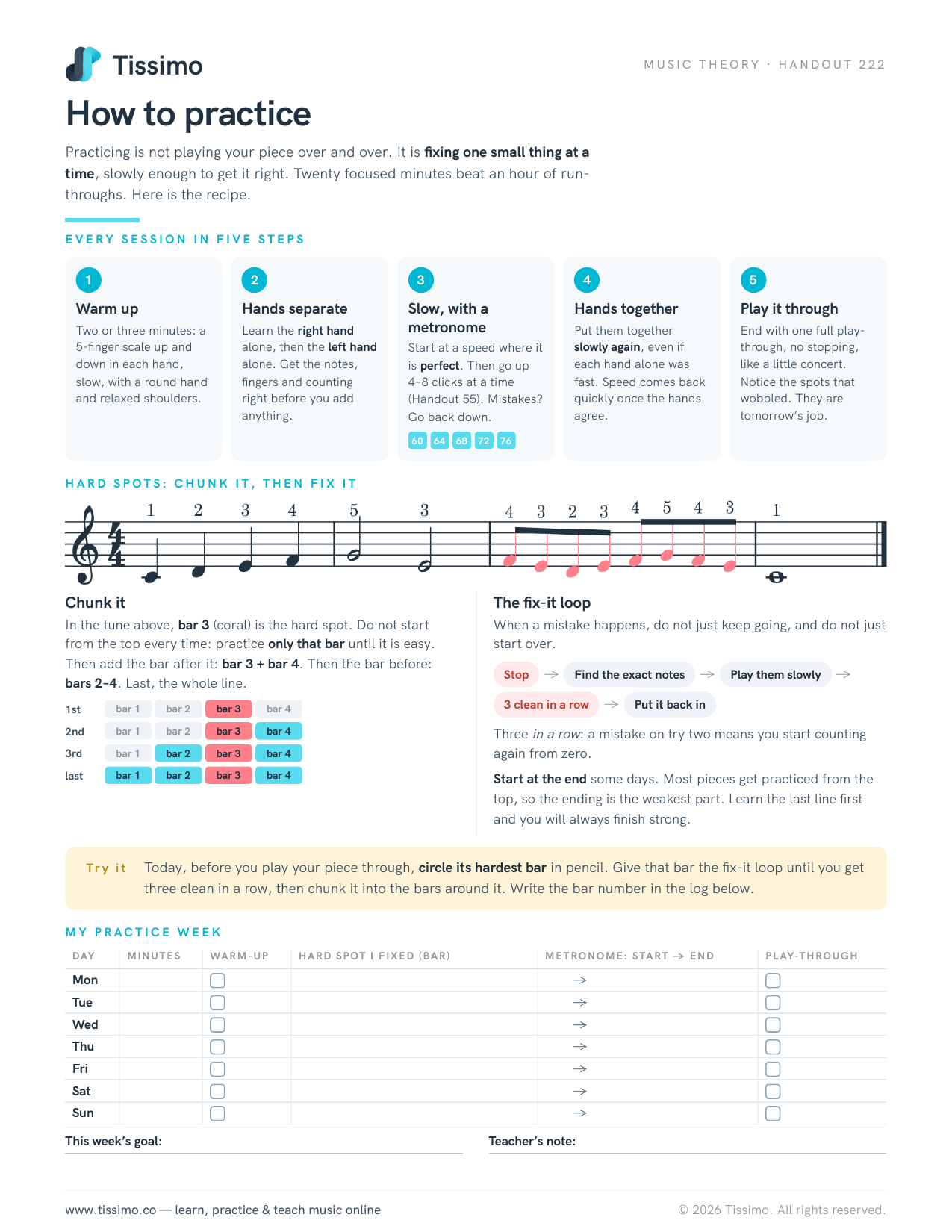
How to practice
Practicing is not playing your piece over and over. It is fixing one small thing at a time, slowly enough to get it right. Twenty focused minutes beat an hour of run-throughs. Here is the recipe.
レパートリー
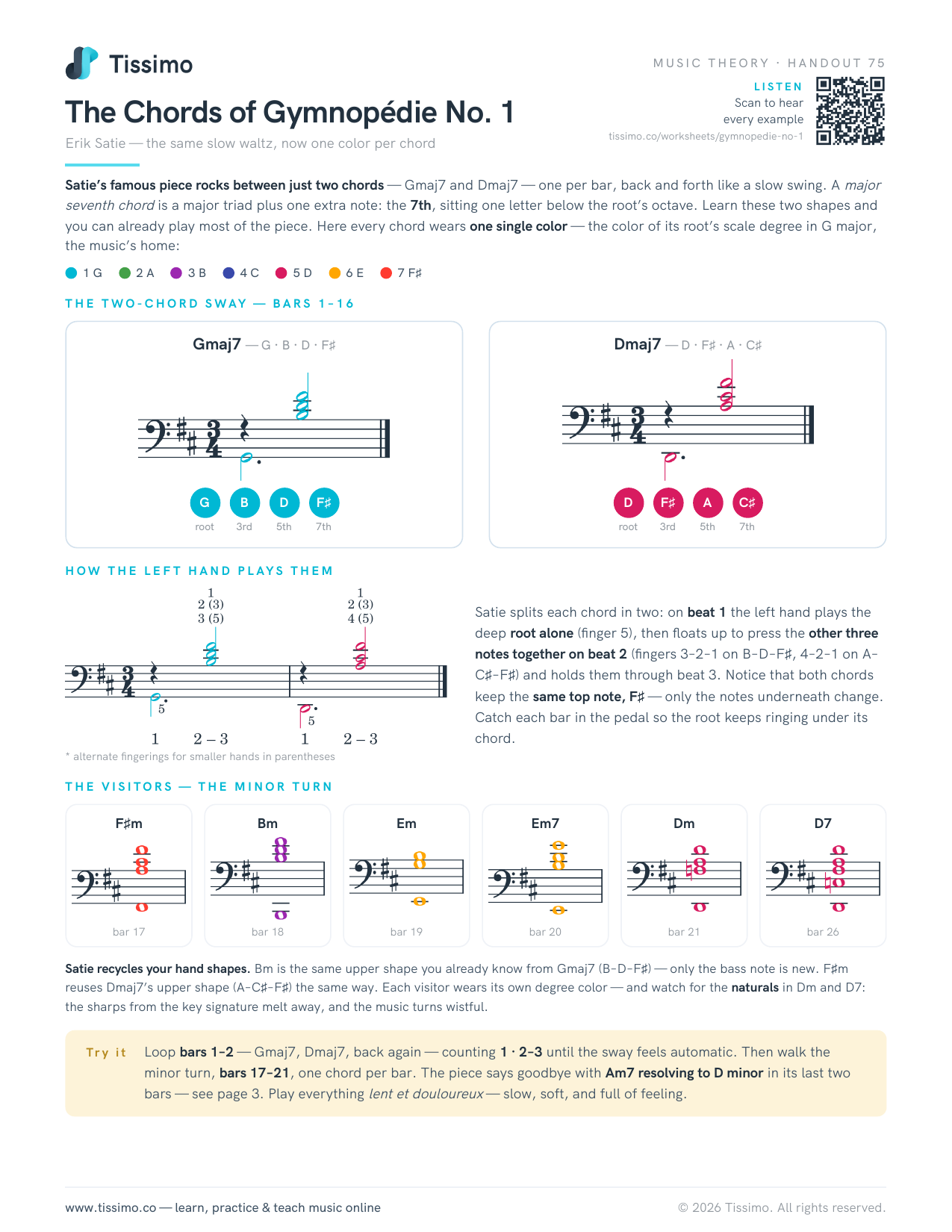
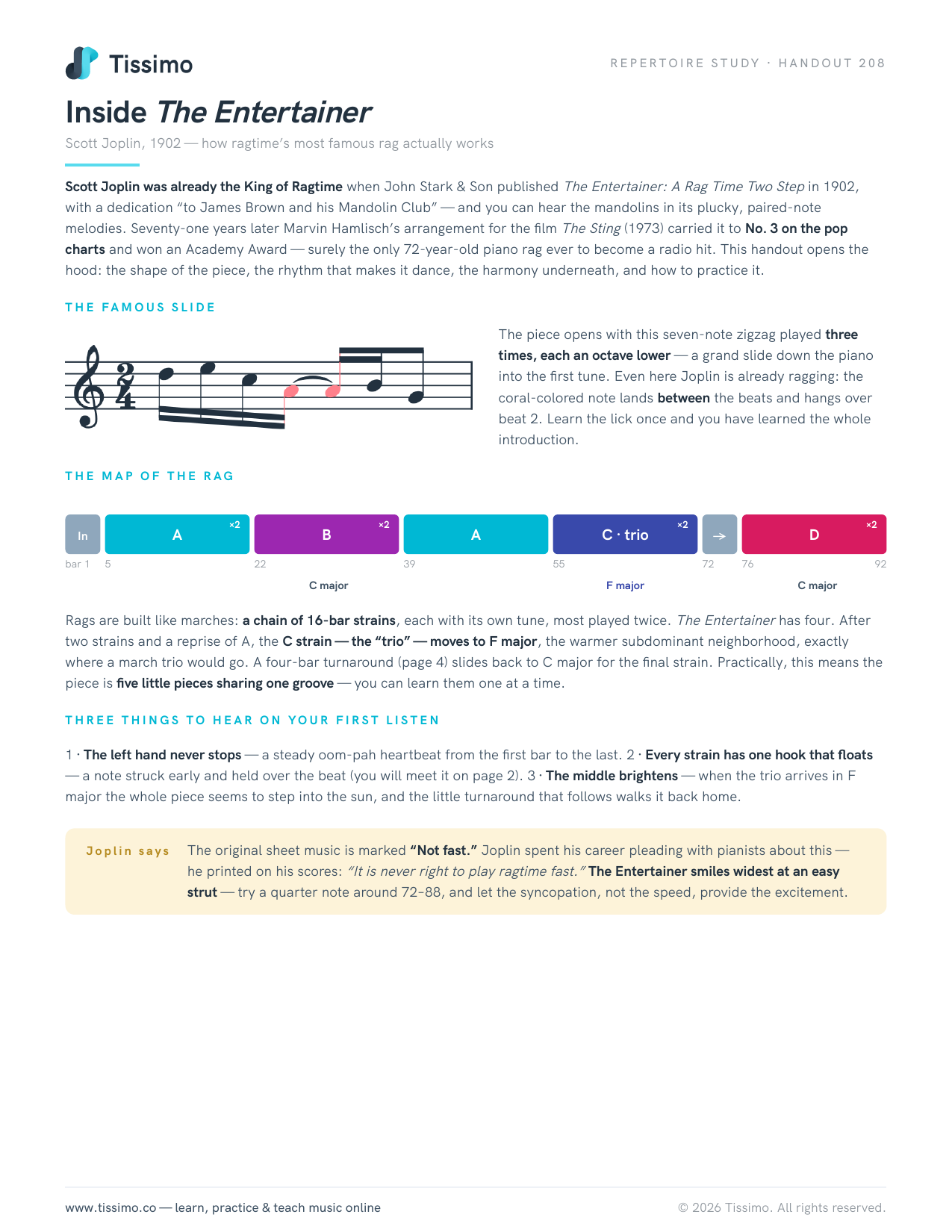
Exercises
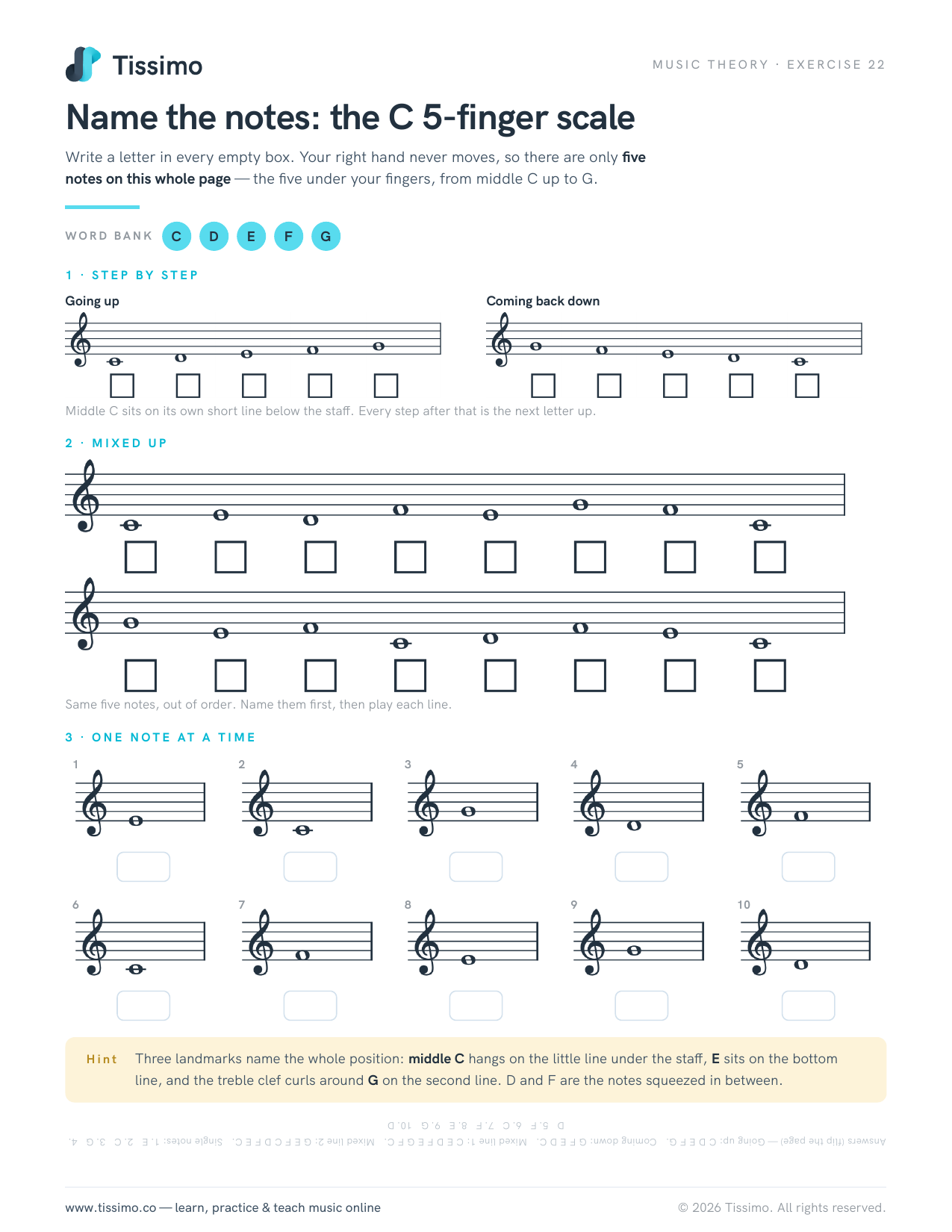
Name the notes: the C 5-finger scale
Write a letter in every empty box. Your right hand never moves, so there are only five notes on this whole page — the five under your fingers, from middle C up to G.
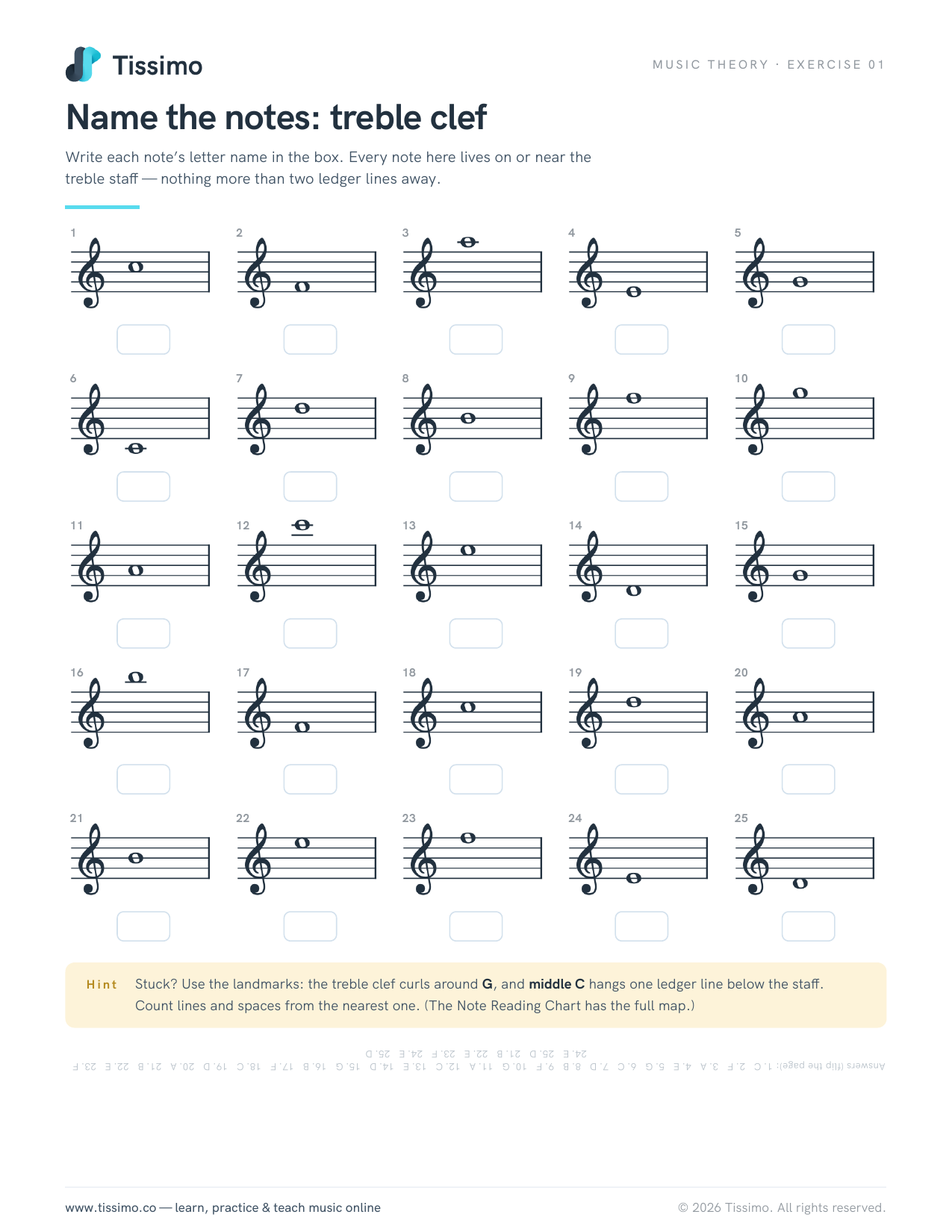
Name the notes: treble clef
Write each note’s letter name in the box. Every note here lives on or near the treble staff — nothing more than two ledger lines away.
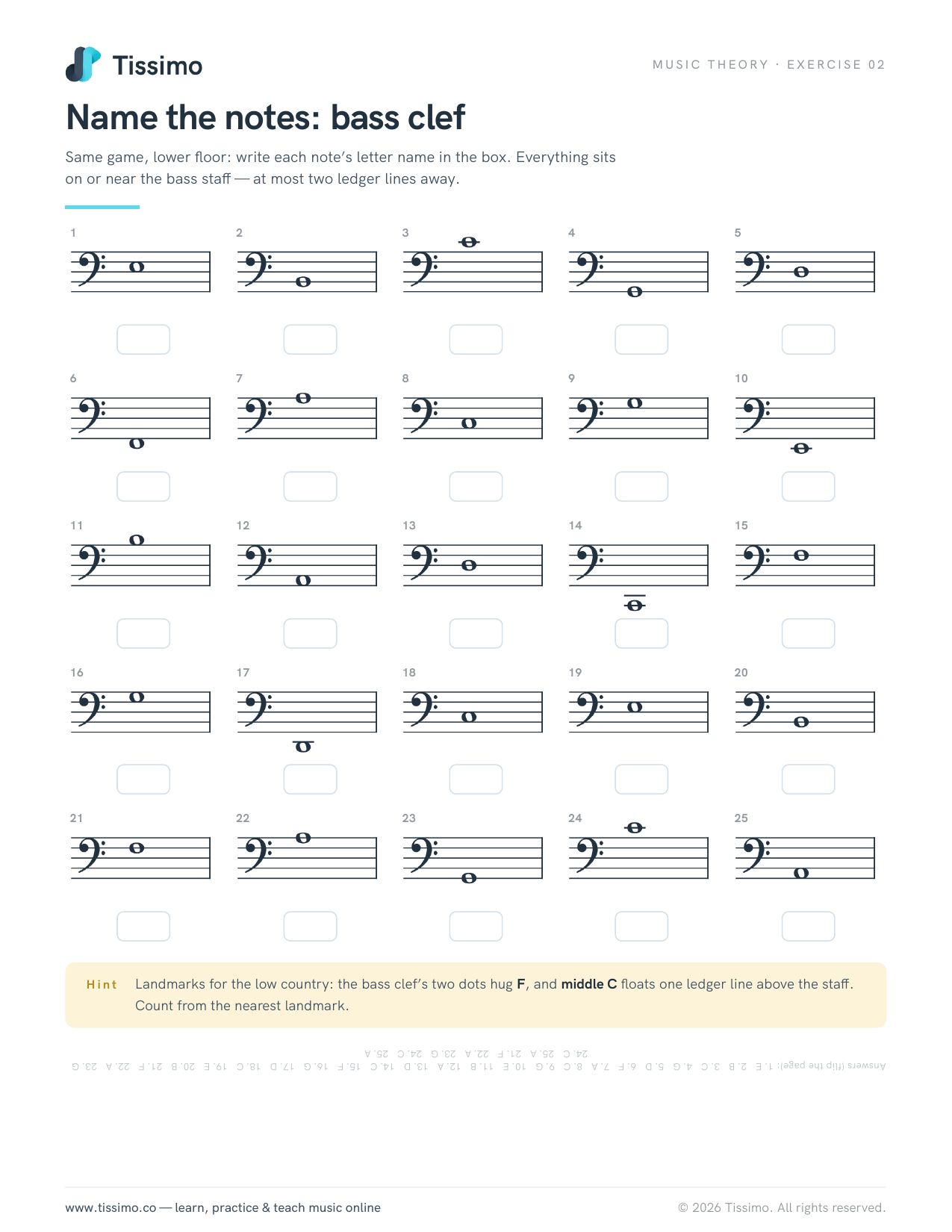
Name the notes: bass clef
Same game, lower floor: write each note’s letter name in the box. Everything sits on or near the bass staff — at most two ledger lines away.
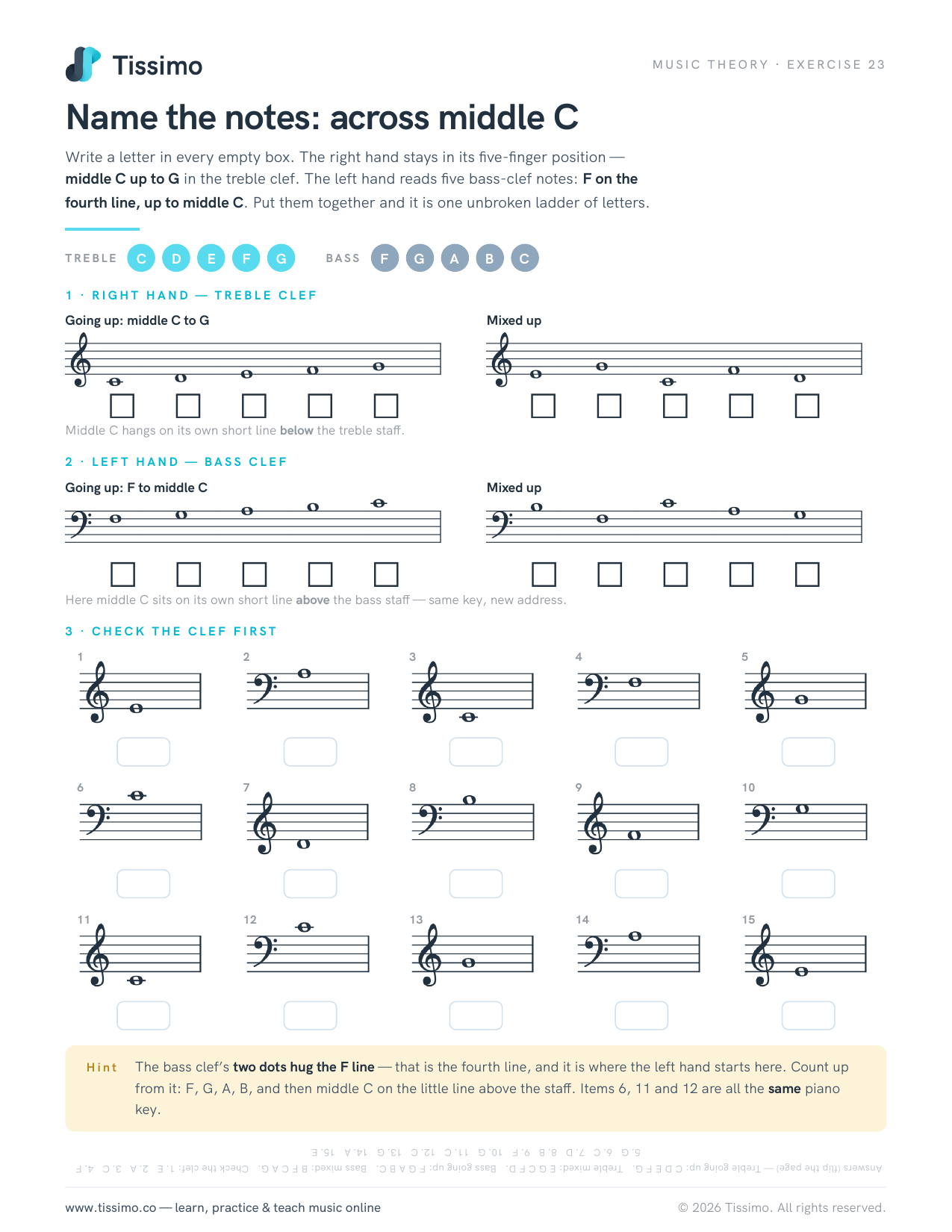
Name the notes: across middle C
Write a letter in every empty box. The right hand stays in its five-finger position — middle C up to G in the treble clef. The left hand reads five bass-clef notes: F on the fourth line, up to middle C. Put them together and it is one unbroken ladder of letters.
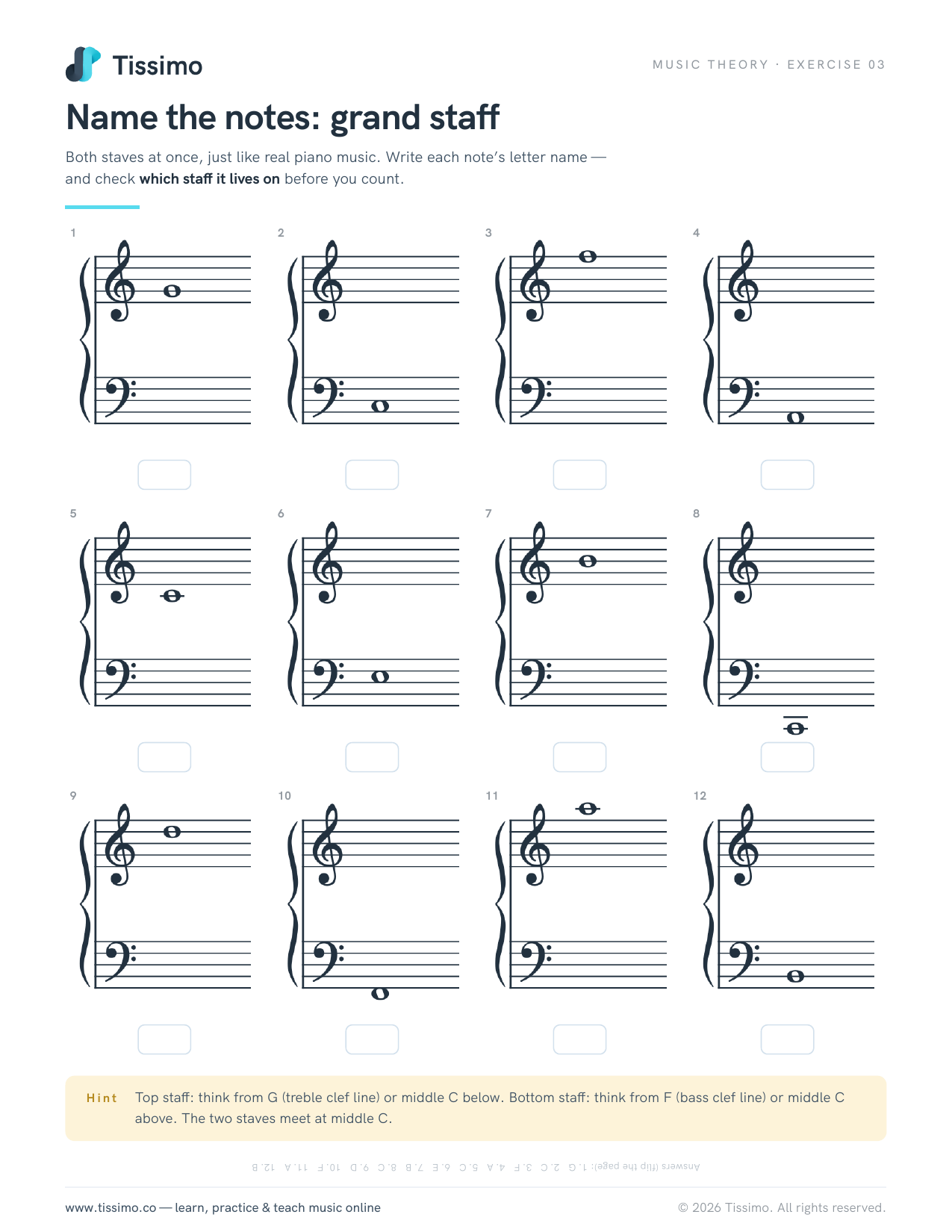
Name the notes: grand staff
Both staves at once, just like real piano music. Write each note’s letter name — and check which staff it lives on before you count.
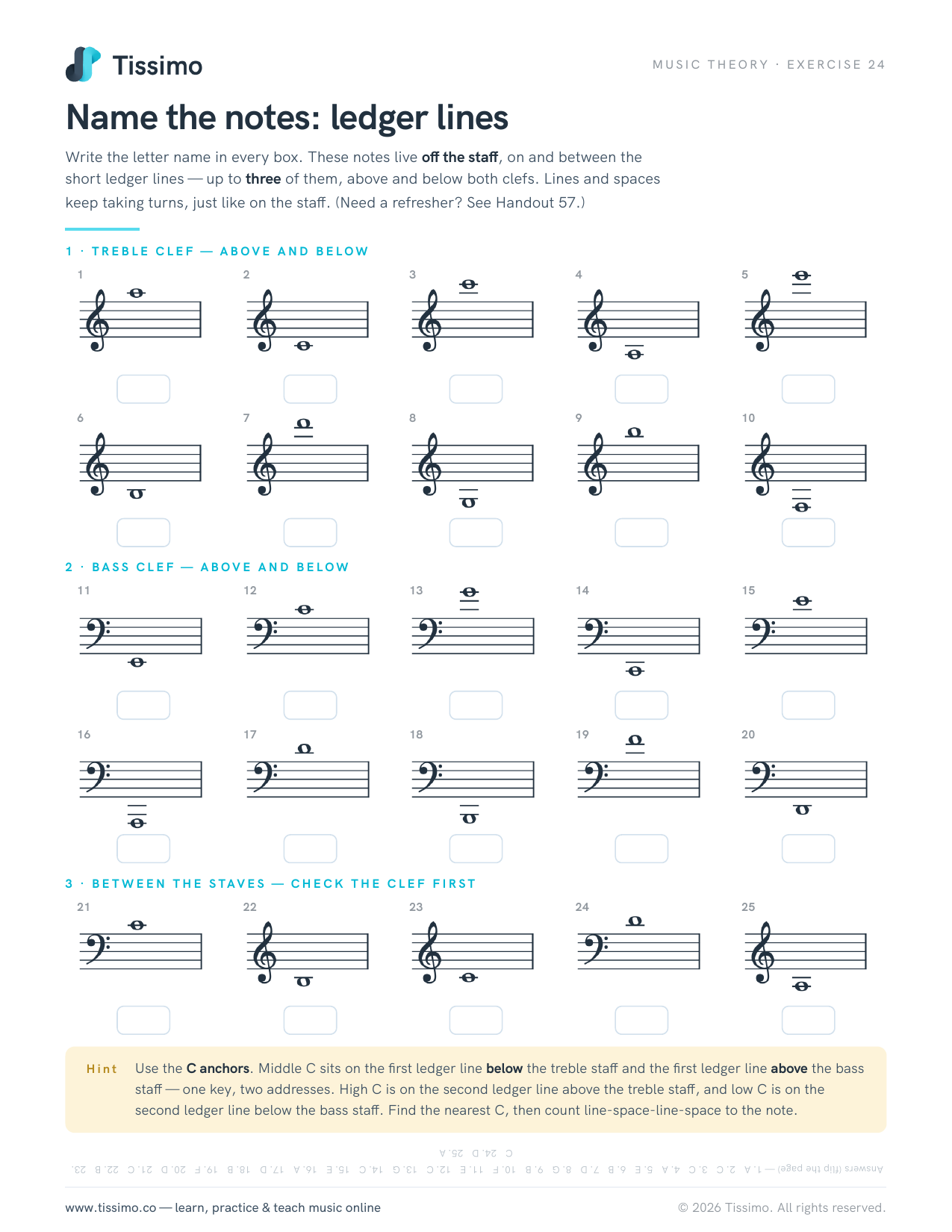
Name the notes: ledger lines
Write the letter name in every box. These notes live off the staff, on and between the short ledger lines — up to three of them, above and below both clefs. Lines and spaces keep taking turns, just like on the staff. (Need a refresher? See Handout 57.)
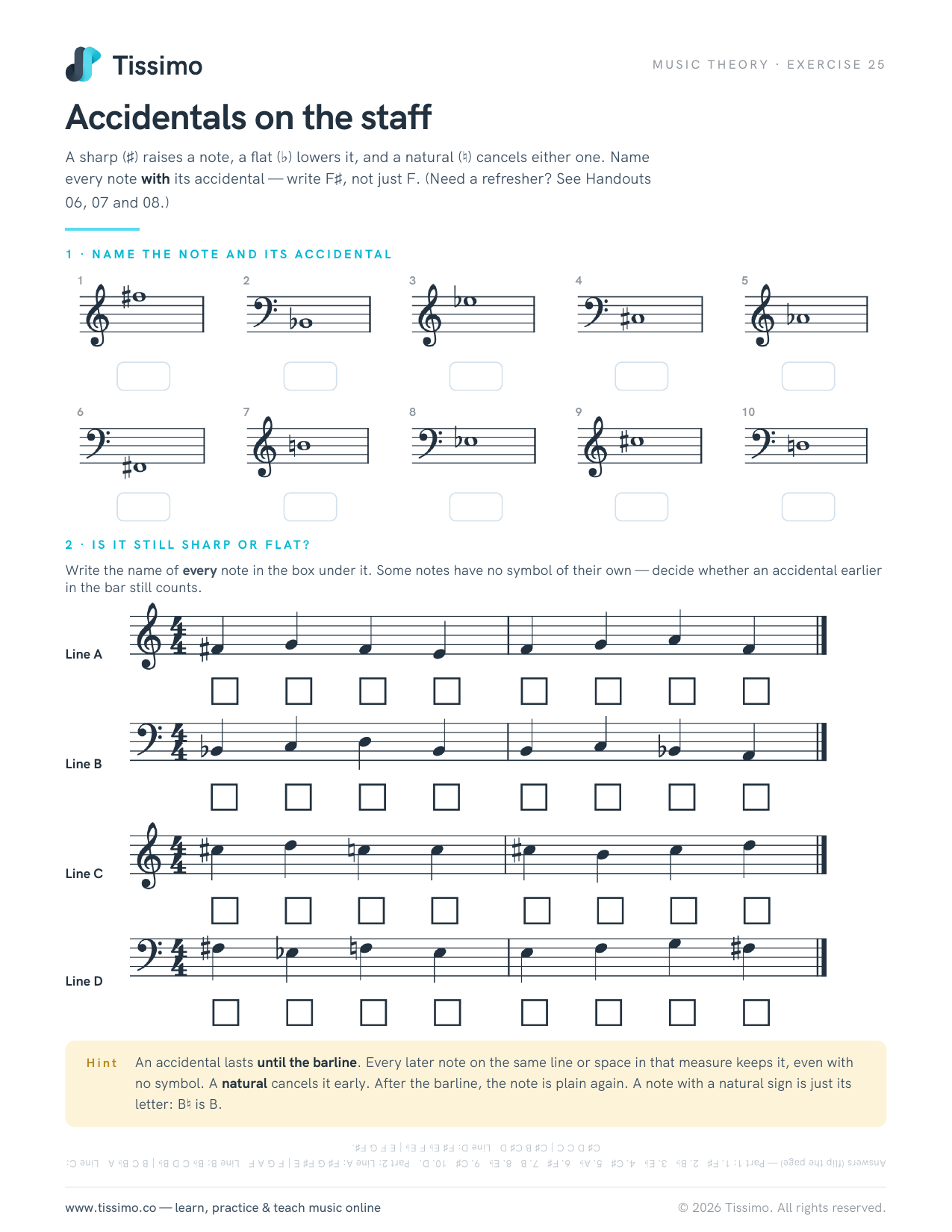
Accidentals on the staff
A sharp (♯) raises a note, a flat (♭) lowers it, and a natural (♮) cancels either one. Name every note with its accidental — write F♯, not just F. (Need a refresher? See Handouts 06, 07 and 08.)
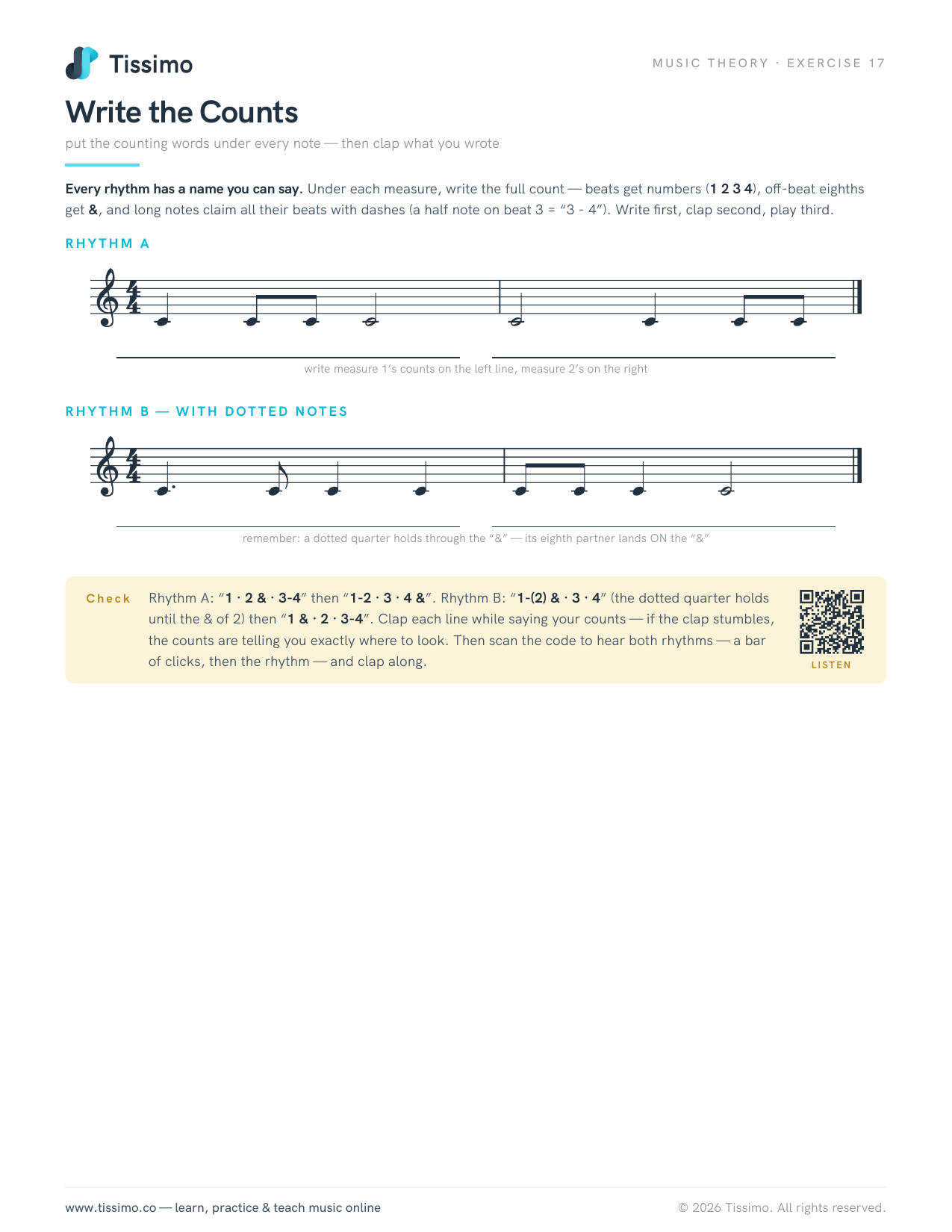
Write the Counts
put the counting words under every note — then clap what you wrote
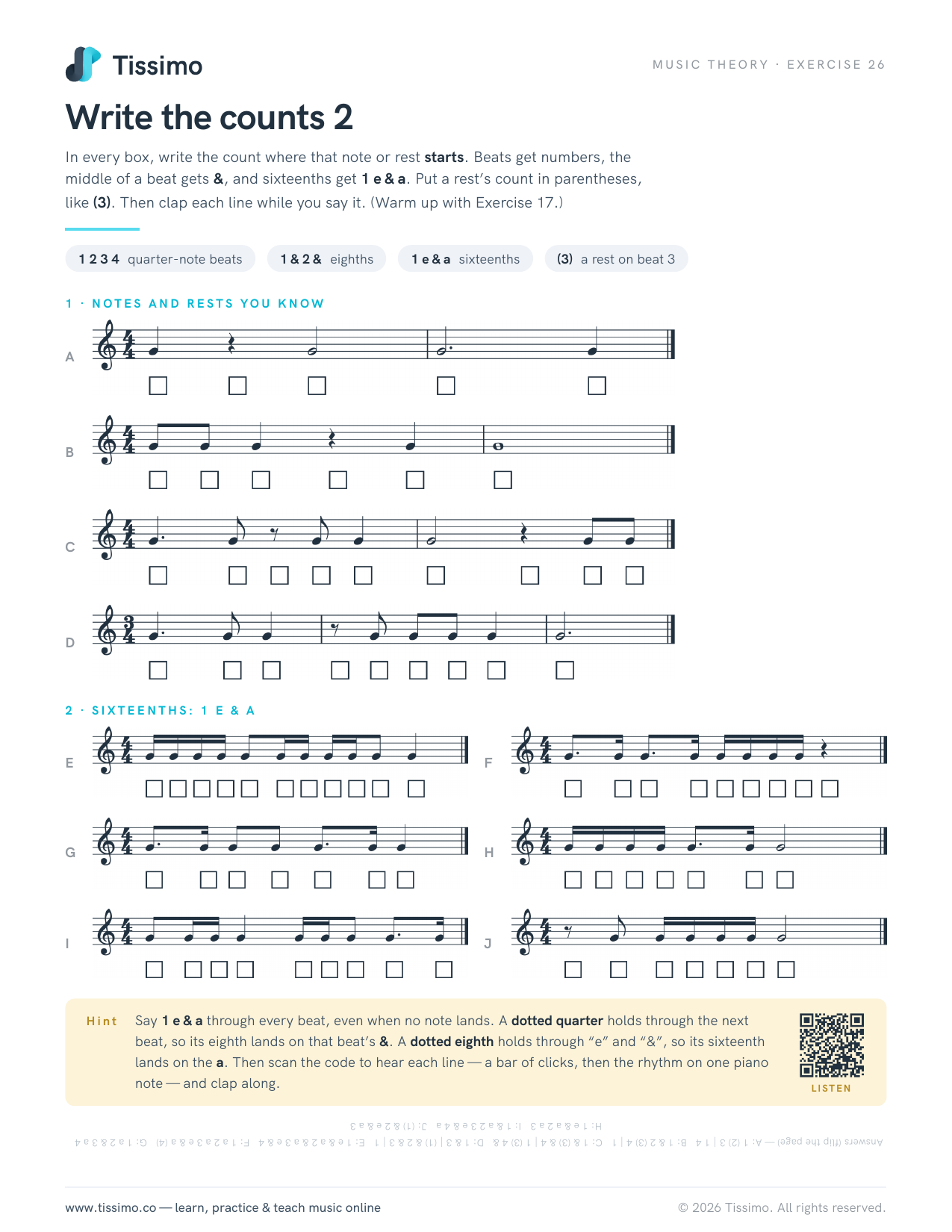
Write the counts 2
In every box, write the count where that note or rest starts. Beats get numbers, the middle of a beat gets &, and sixteenths get 1 e & a. Put a rest’s count in parentheses, like (3). Then clap each line while you say it. (Warm up with Exercise 17.)
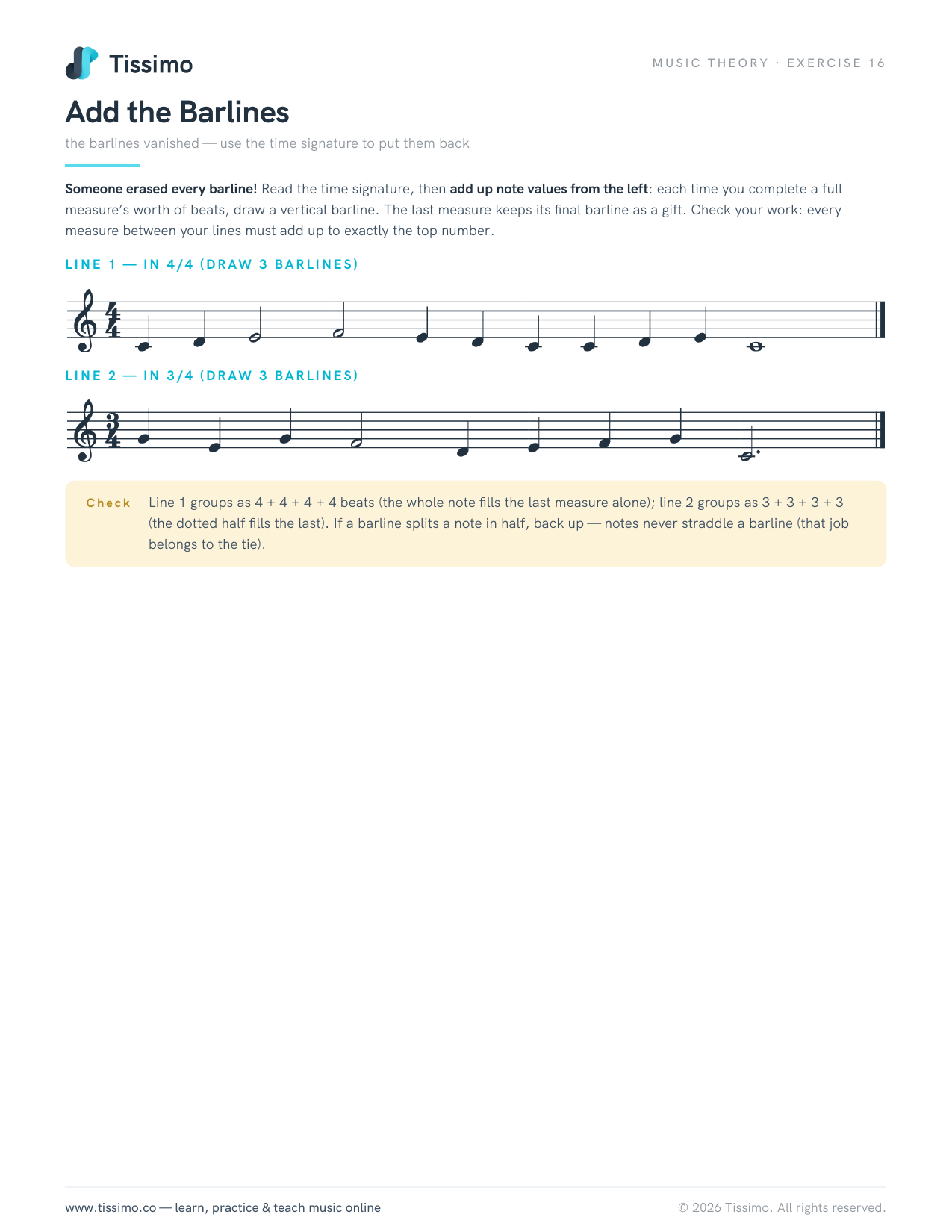
Add the Barlines
the barlines vanished — use the time signature to put them back
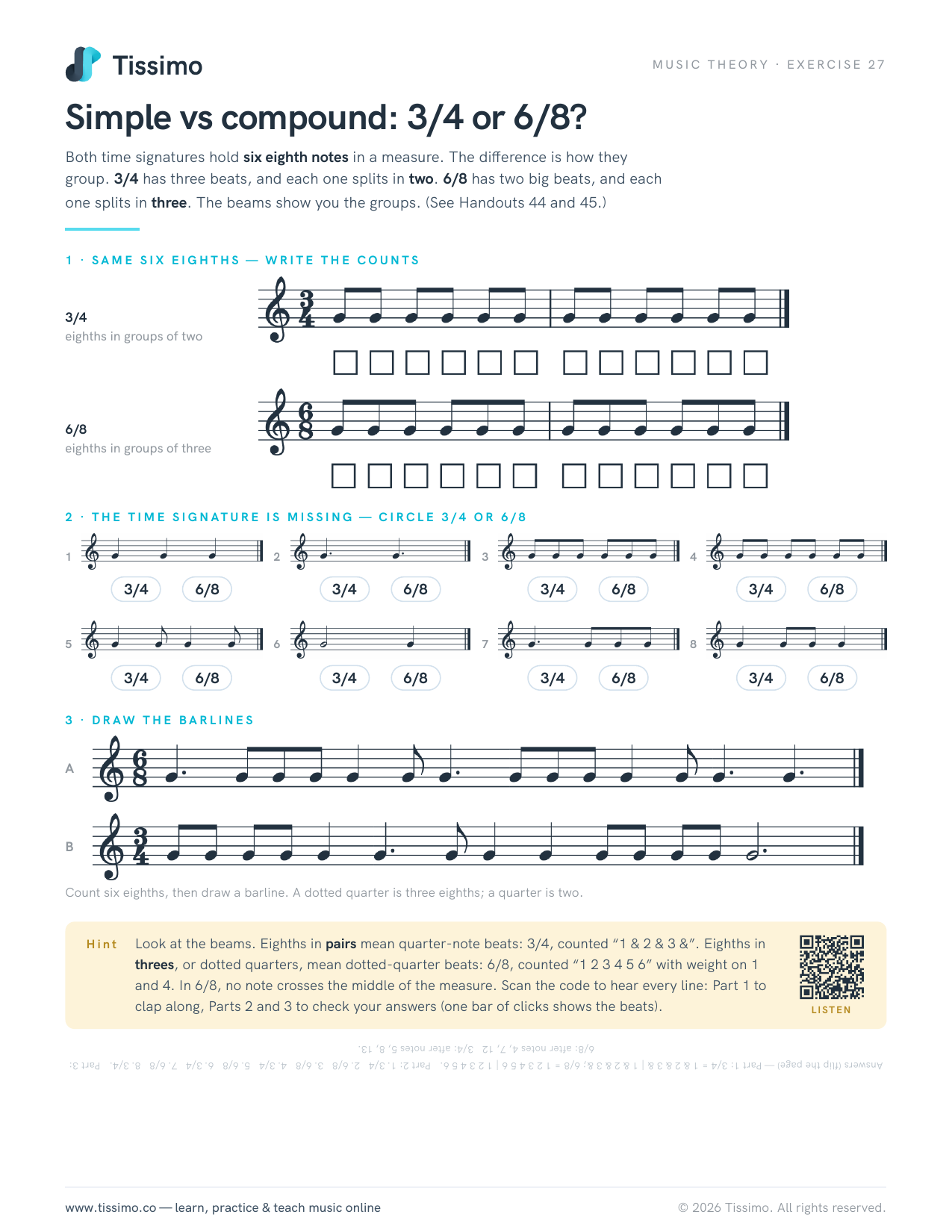
Simple vs compound: 3/4 or 6/8?
Both time signatures hold six eighth notes in a measure. The difference is how they group. 3/4 has three beats, and each one splits in two. 6/8 has two big beats, and each one splits in three. The beams show you the groups. (See Handouts 44 and 45.)
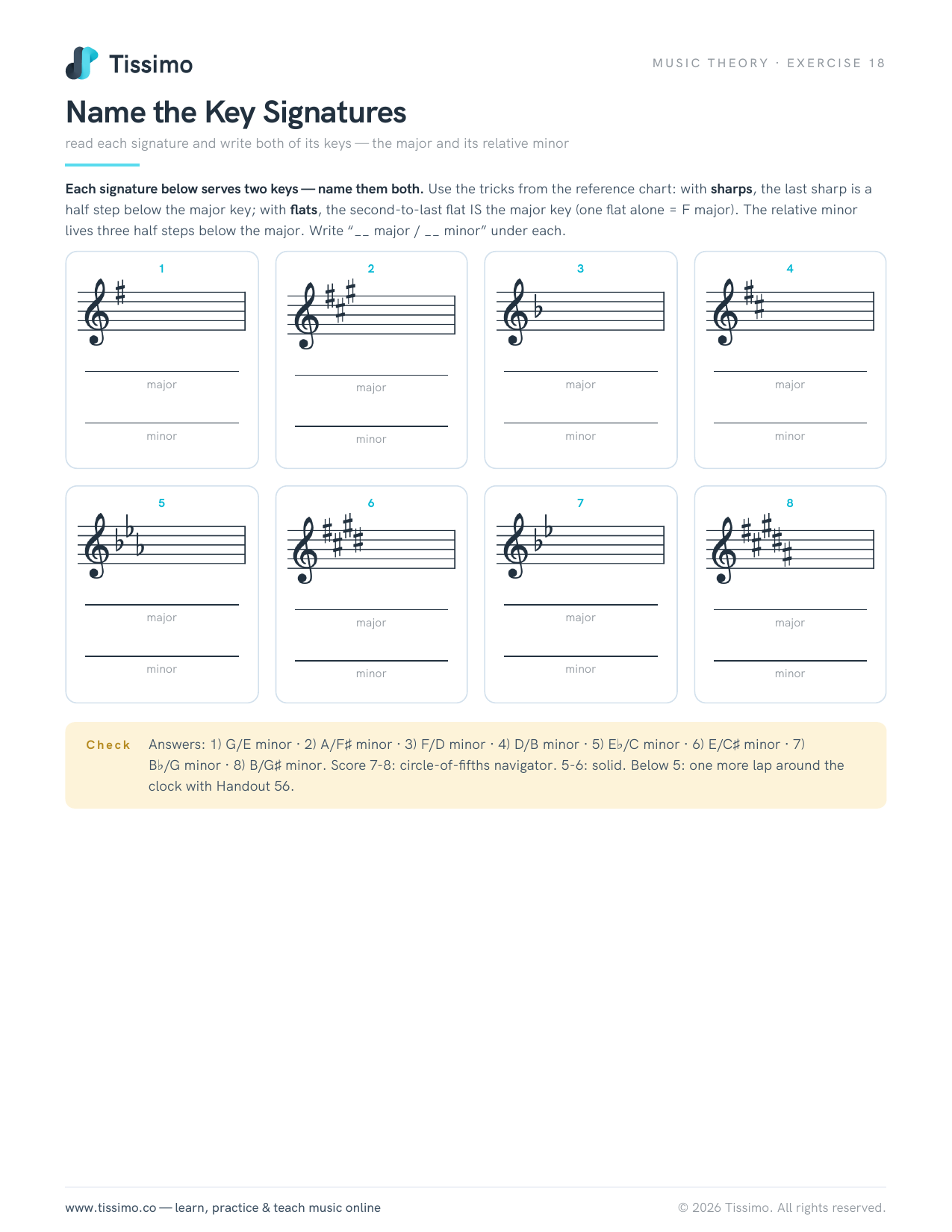
Name the Key Signatures
read each signature and write both of its keys — the major and its relative minor
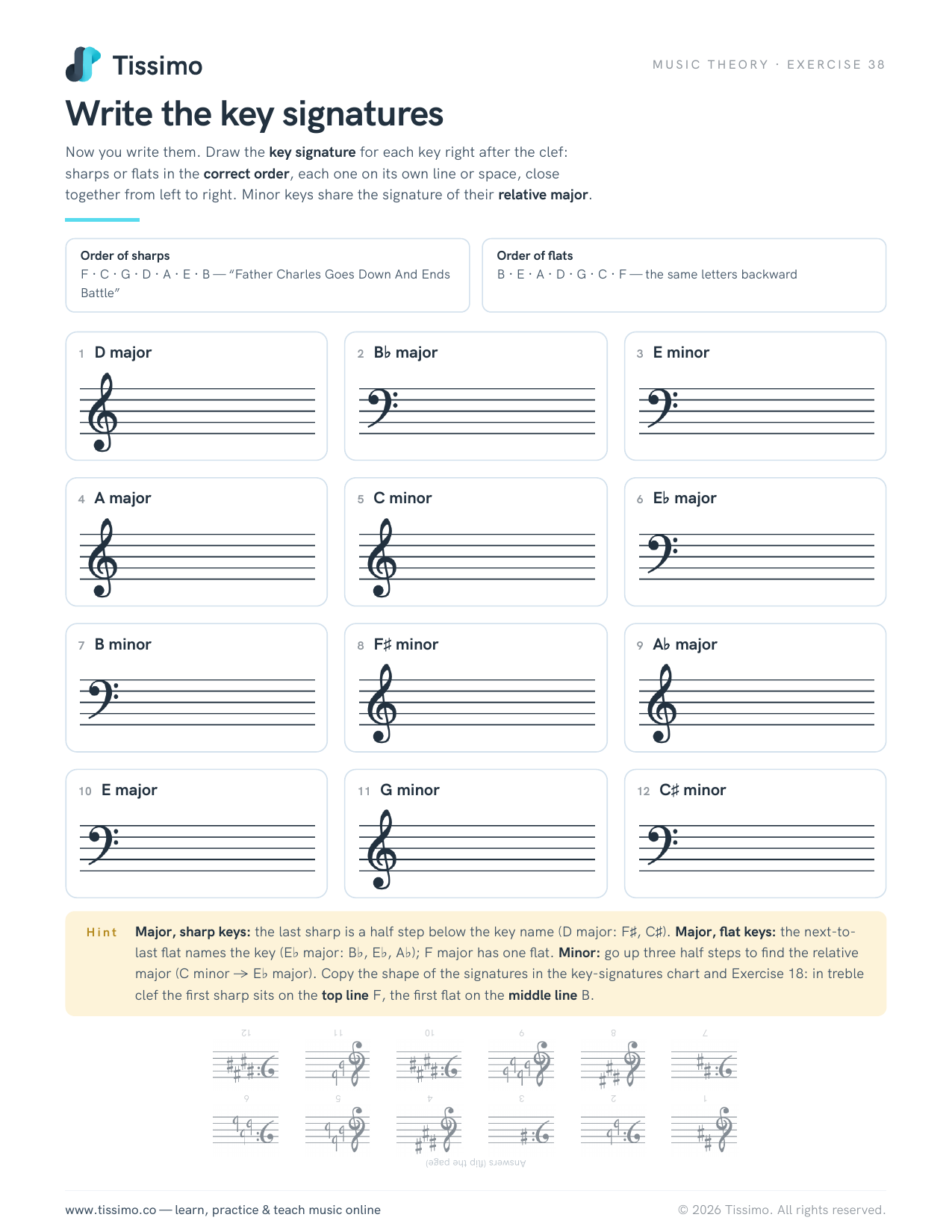
Write the key signatures
Now you write them. Draw the key signature for each key right after the clef: sharps or flats in the correct order, each one on its own line or space, close together from left to right. Minor keys share the signature of their relative major.
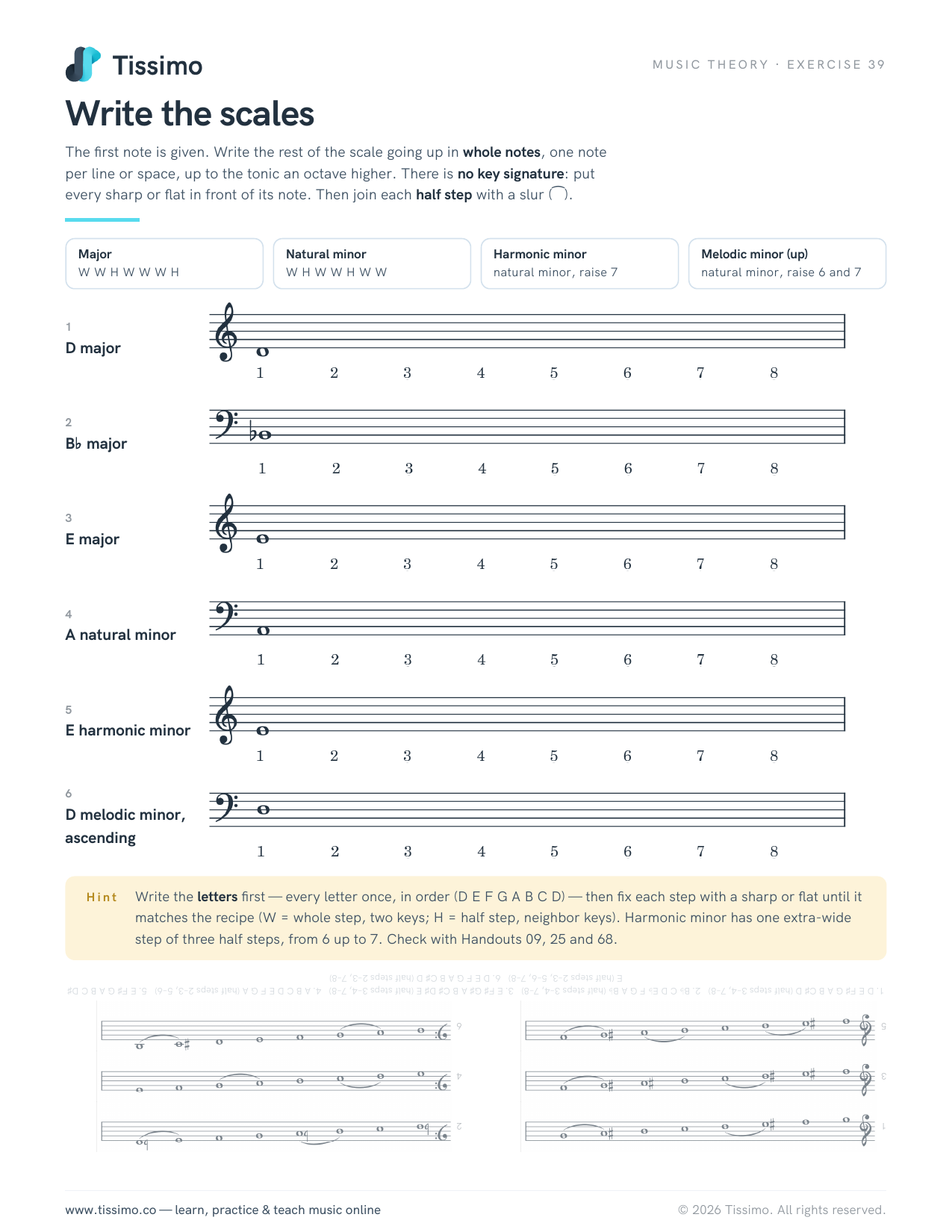
Write the scales
The first note is given. Write the rest of the scale going up in whole notes, one note per line or space, up to the tonic an octave higher. There is no key signature: put every sharp or flat in front of its note. Then join each half step with a slur (⁀).
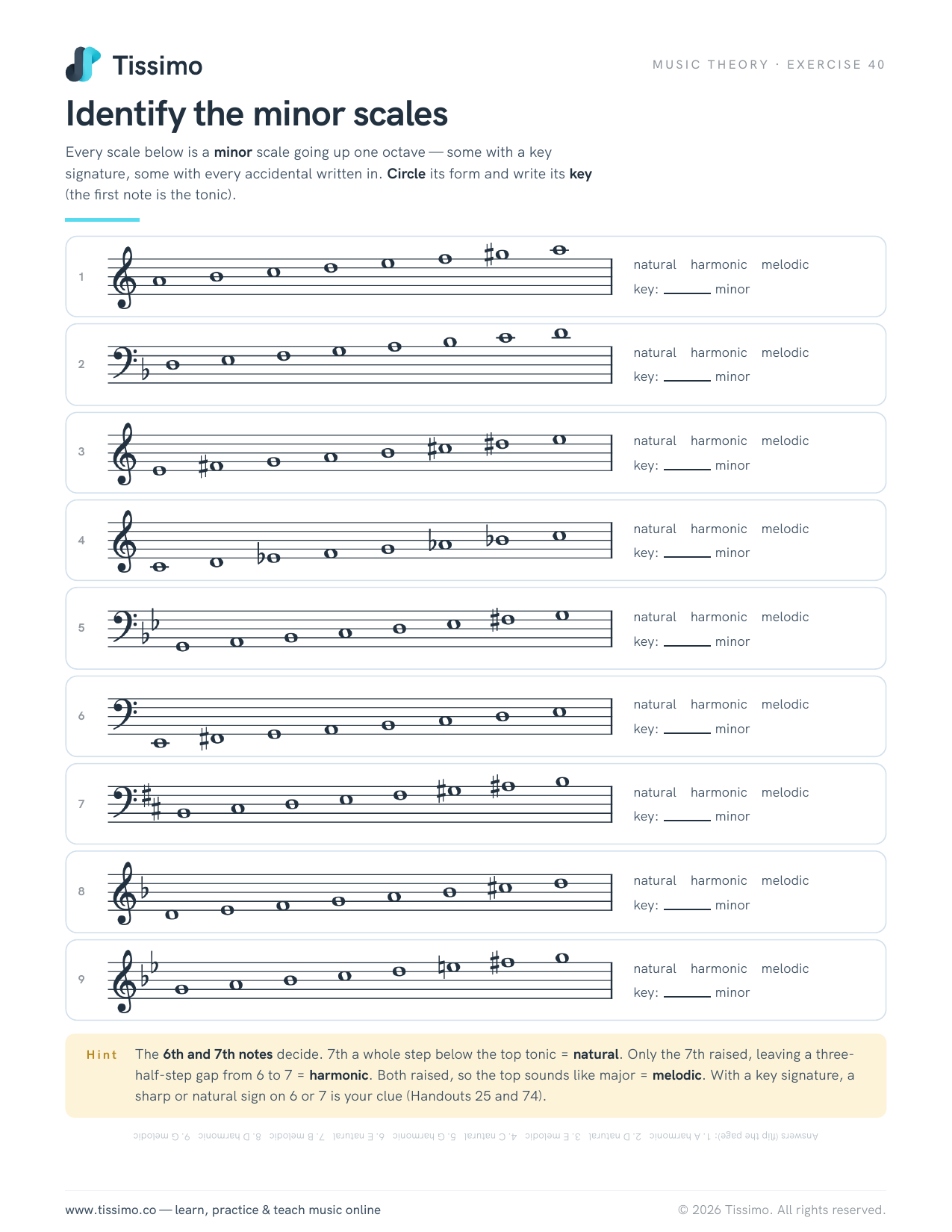
Identify the minor scales
Every scale below is a minor scale going up one octave — some with a key signature, some with every accidental written in. Circle its form and write its key (the first note is the tonic).
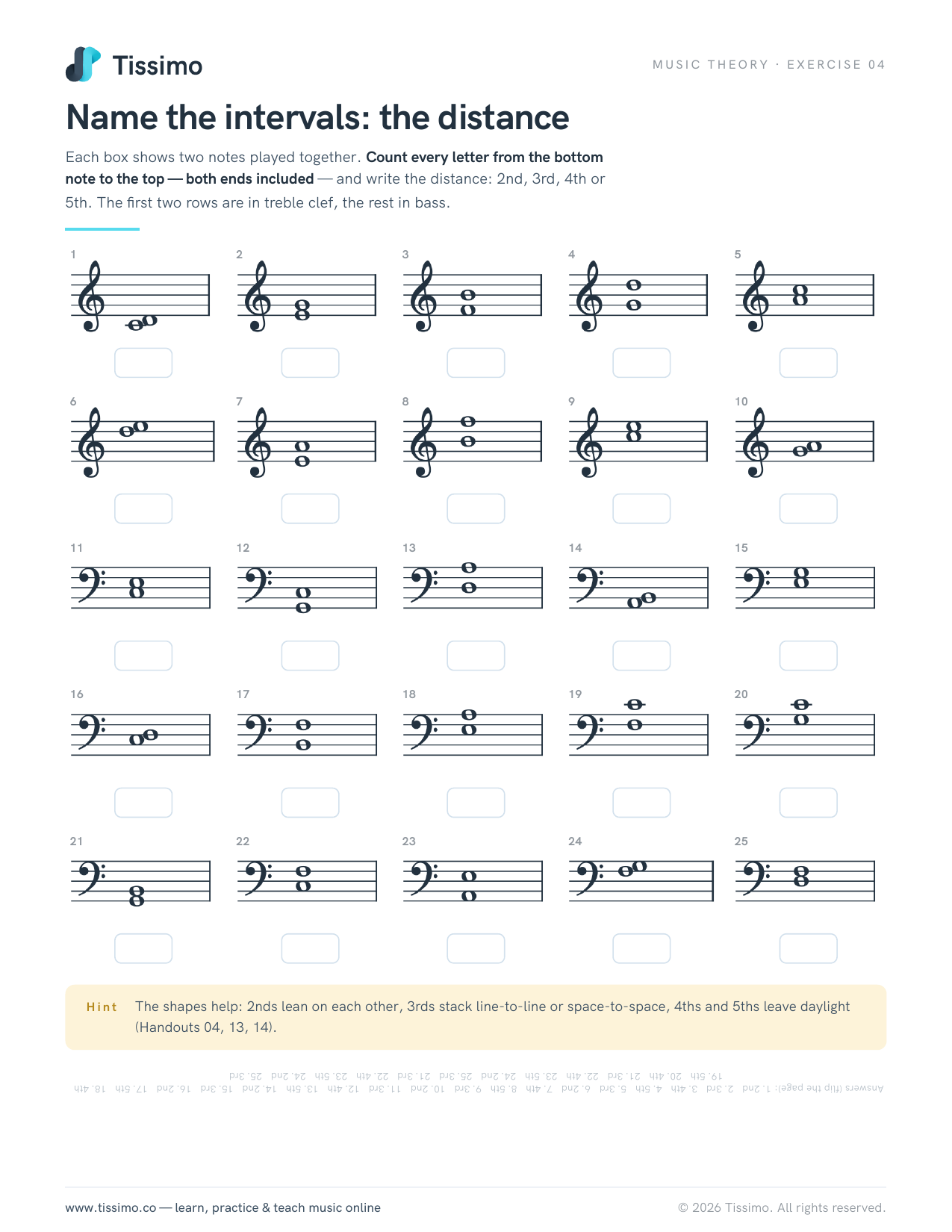
Name the intervals: the distance
Each box shows two notes played together. Count every letter from the bottom note to the top — both ends included — and write the distance: 2nd, 3rd, 4th or 5th. The first two rows are in treble clef, the rest in bass.
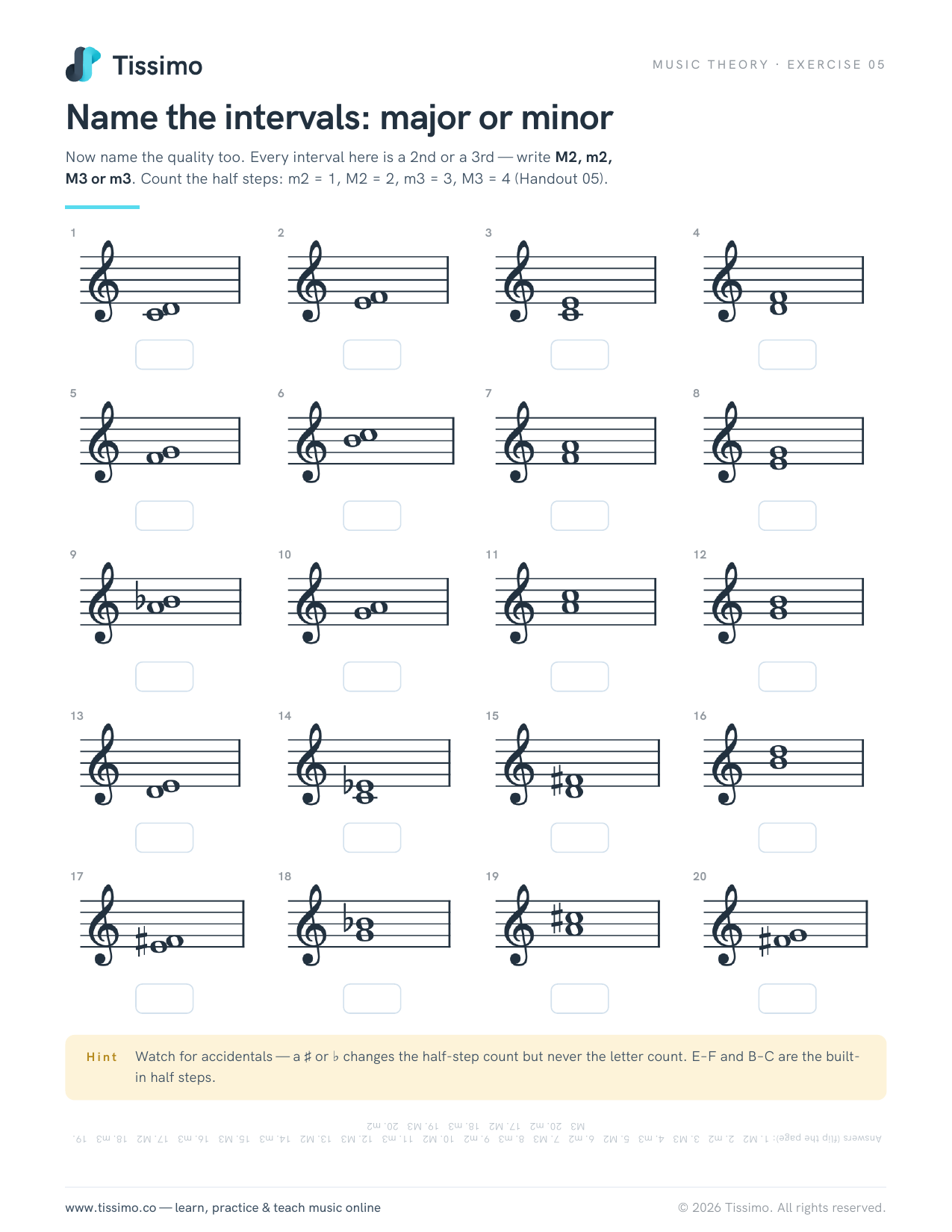
Name the intervals: major or minor
Now name the quality too. Every interval here is a 2nd or a 3rd — write M2, m2, M3 or m3. Count the half steps: m2 = 1, M2 = 2, m3 = 3, M3 = 4 (Handout 05).
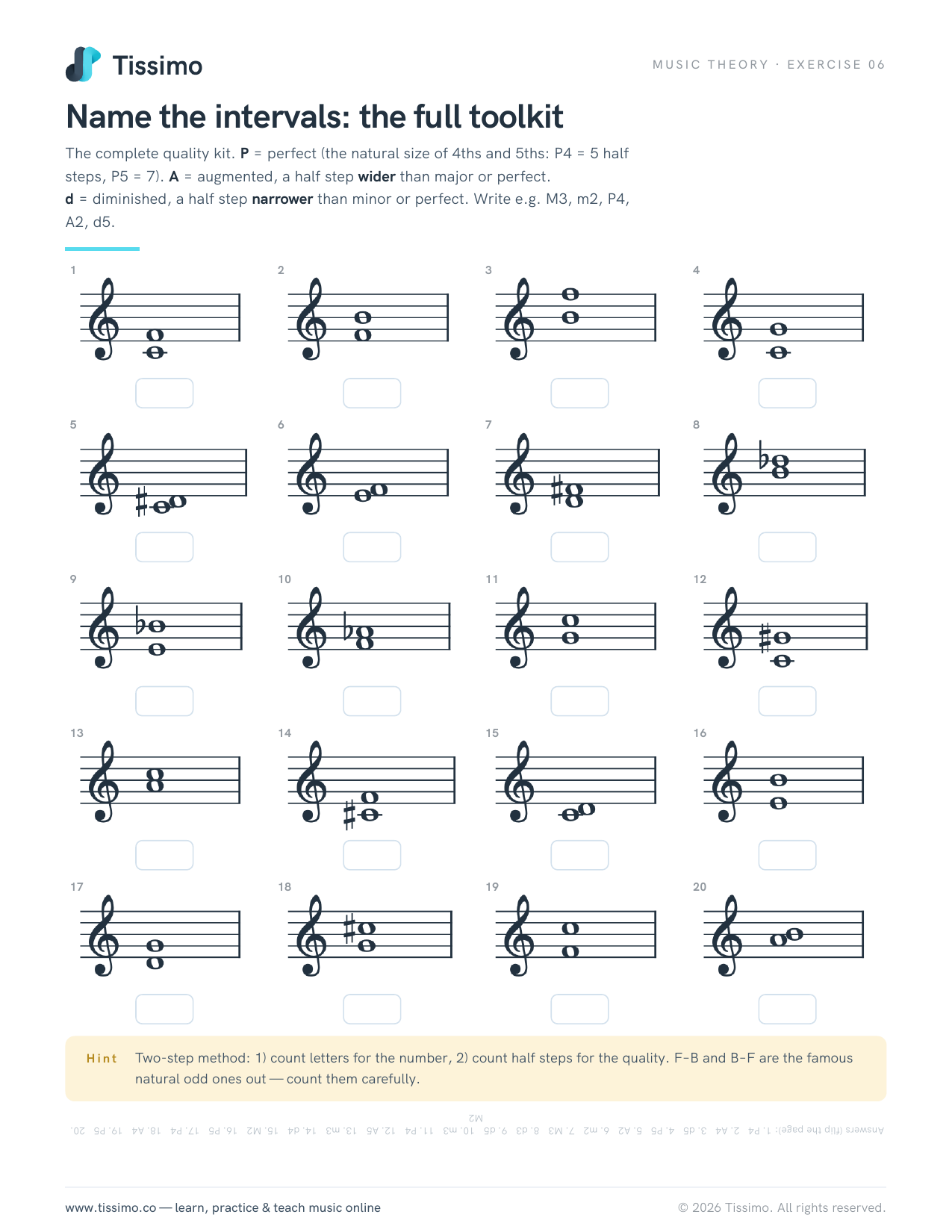
Name the intervals: the full toolkit
The complete quality kit. P = perfect (the natural size of 4ths and 5ths: P4 = 5 half steps, P5 = 7). A = augmented, a half step wider than major or perfect. d = diminished, a half step narrower than minor or perfect. Write e.g. M3, m2, P4, A2, d5.
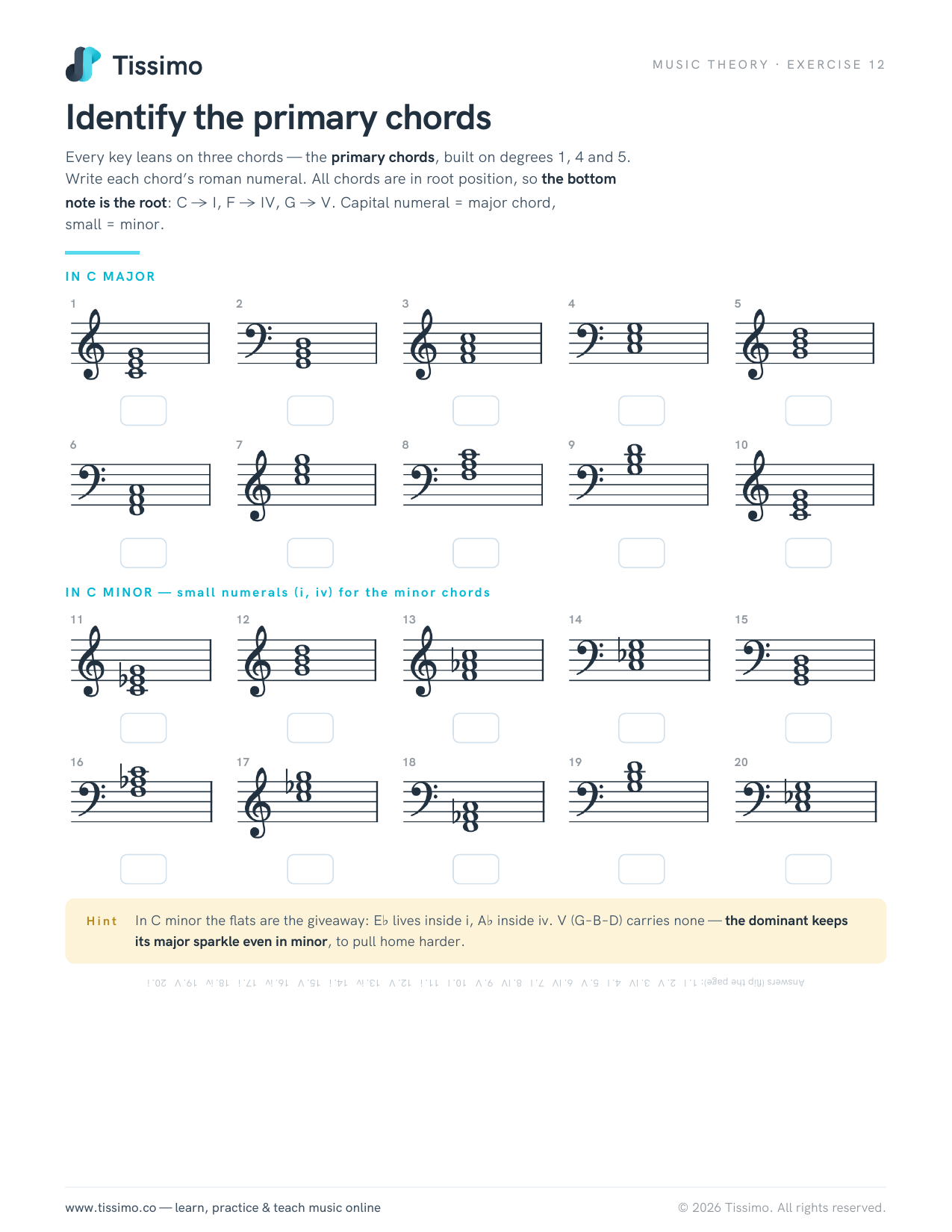
Identify the primary chords
Every key leans on three chords — the primary chords, built on degrees 1, 4 and 5. Write each chord’s roman numeral. All chords are in root position, so the bottom note is the root: C → I, F → IV, G → V. Capital numeral = major chord, small = minor.
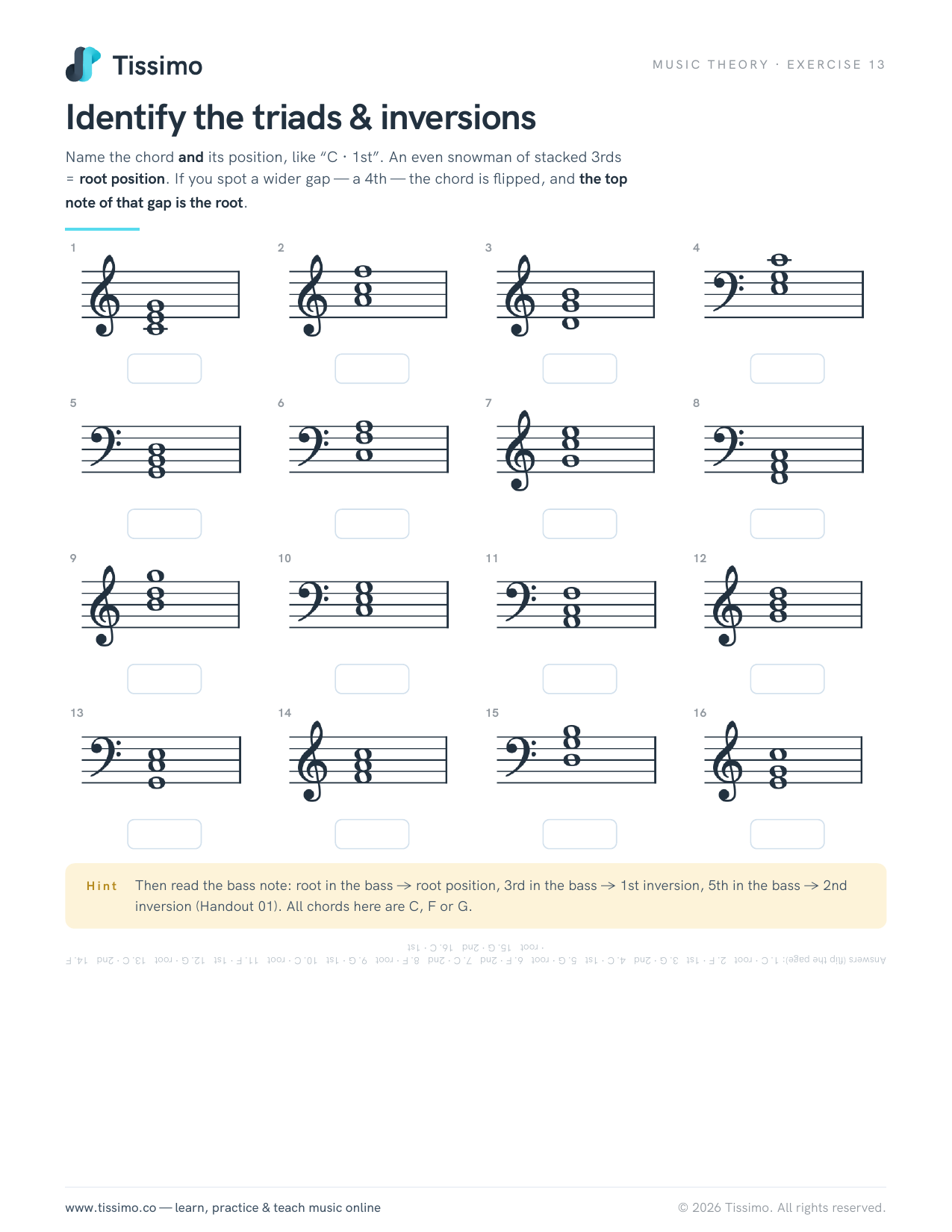
Identify the triads & inversions
Name the chord and its position, like “C · 1st”. An even snowman of stacked 3rds = root position. If you spot a wider gap — a 4th — the chord is flipped, and the top note of that gap is the root.
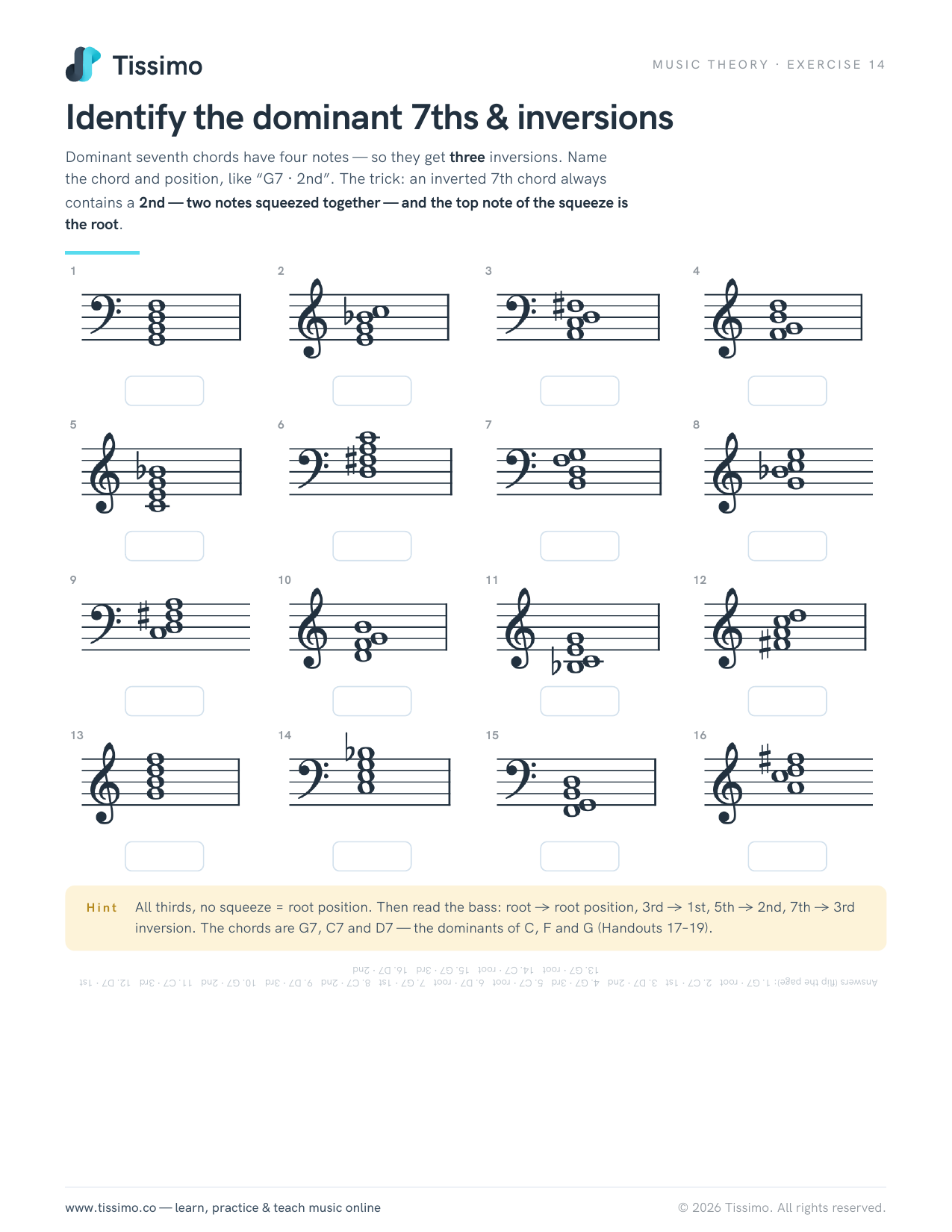
Identify the dominant 7ths & inversions
Dominant seventh chords have four notes — so they get three inversions. Name the chord and position, like “G7 · 2nd”. The trick: an inverted 7th chord always contains a 2nd — two notes squeezed together — and the top note of the squeeze is the root.
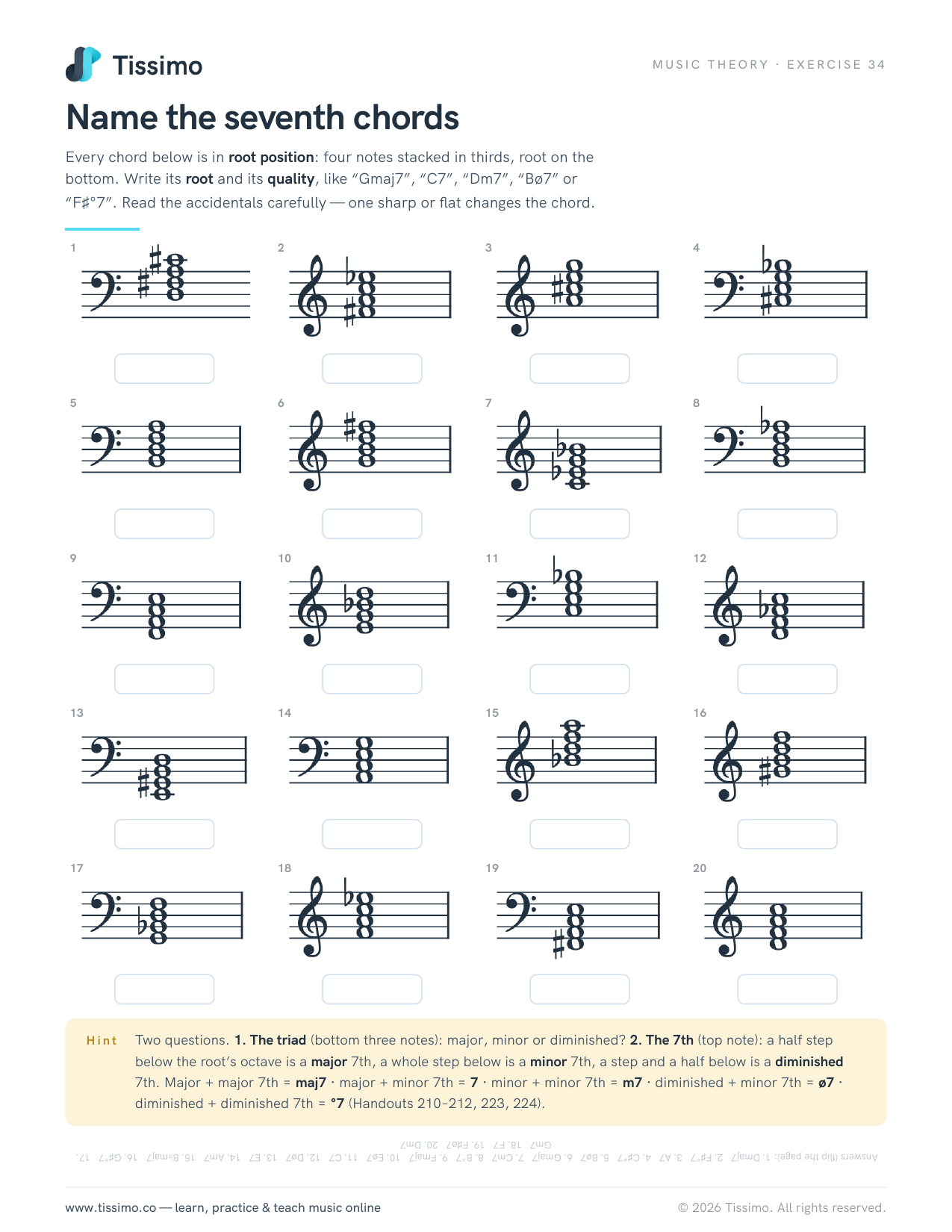
Name the seventh chords
Every chord below is in root position: four notes stacked in thirds, root on the bottom. Write its root and its quality, like “Gmaj7”, “C7”, “Dm7”, “Bø7” or “F♯°7”. Read the accidentals carefully — one sharp or flat changes the chord.
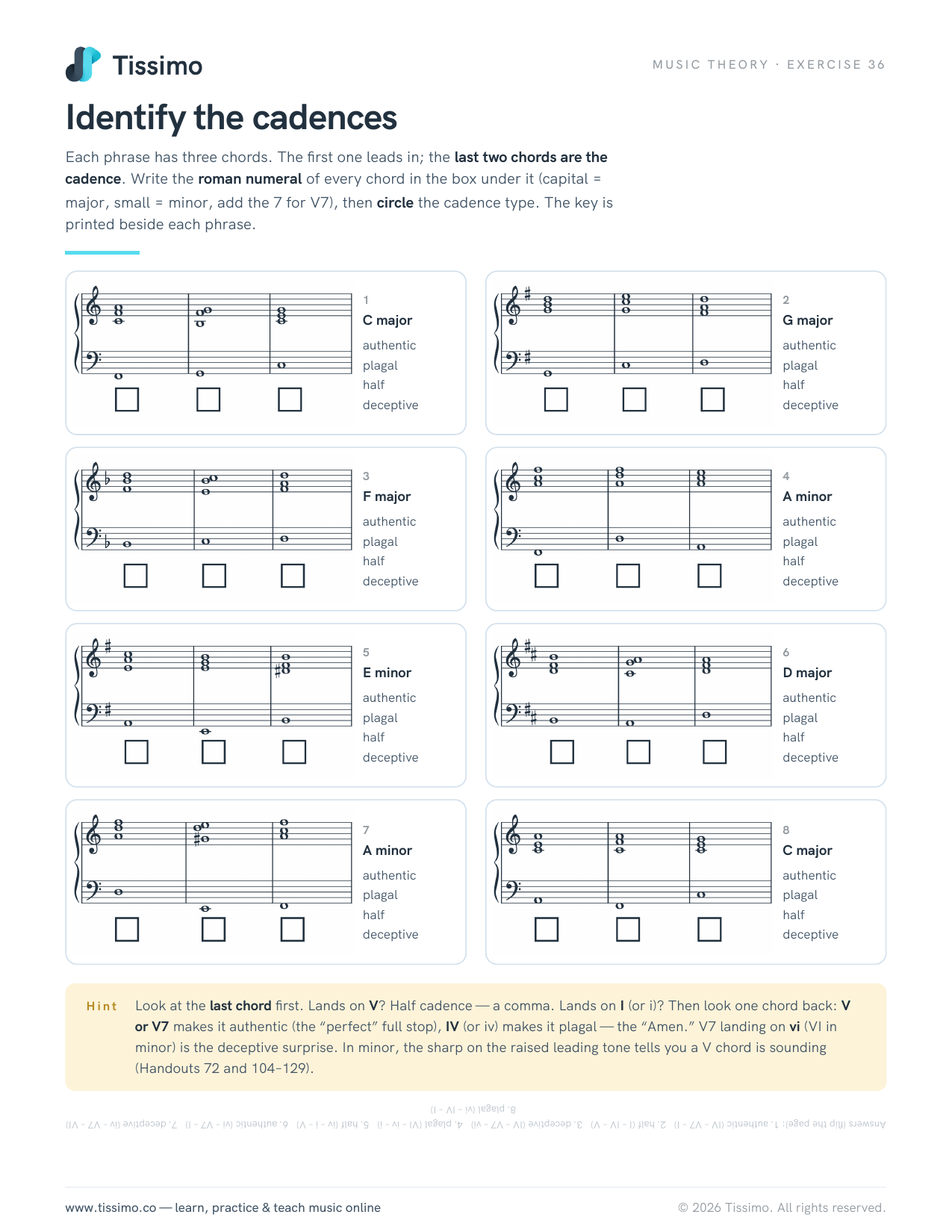
Identify the cadences
Each phrase has three chords. The first one leads in; the last two chords are the cadence. Write the roman numeral of every chord in the box under it (capital = major, small = minor, add the 7 for V7), then circle the cadence type. The key is printed beside each phrase.
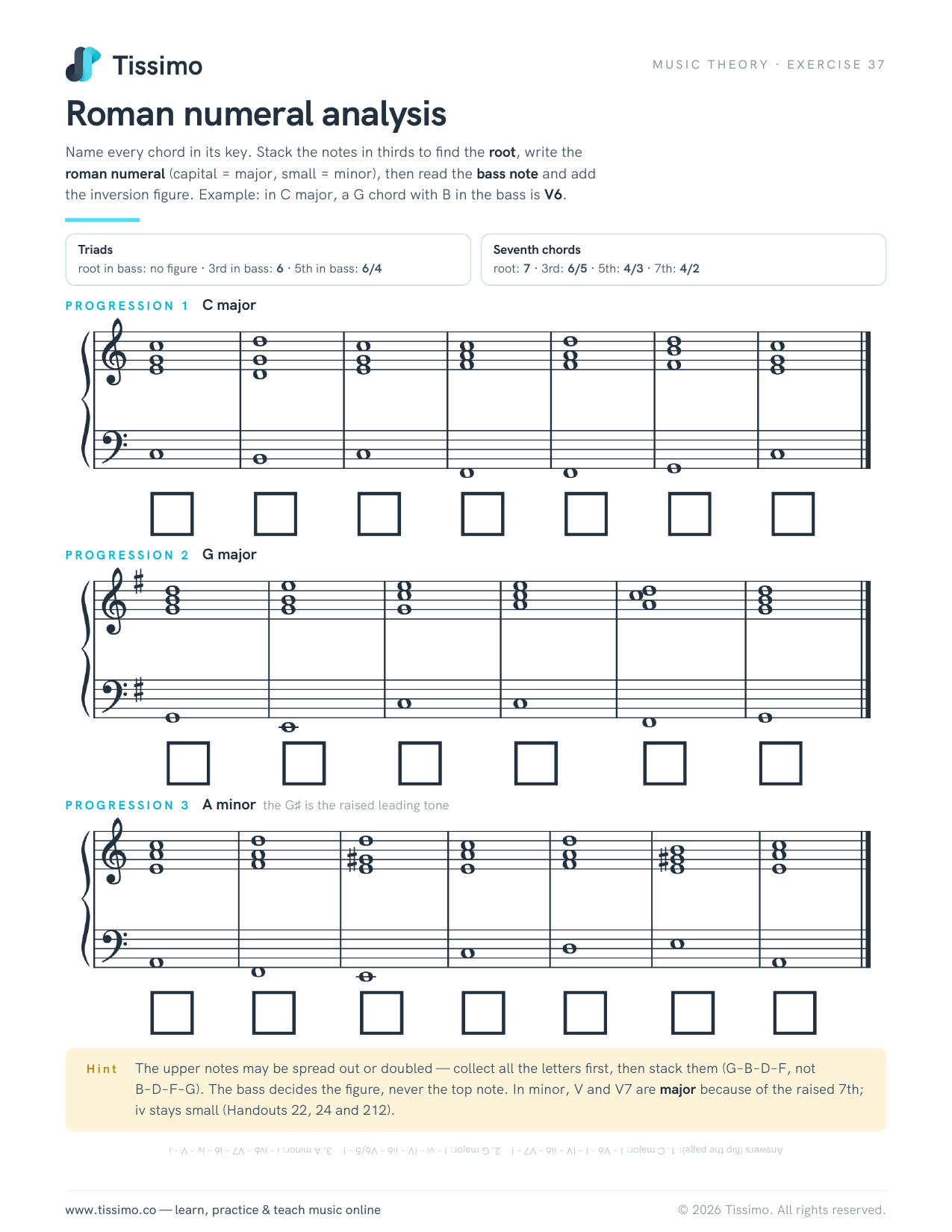
Roman numeral analysis
Name every chord in its key. Stack the notes in thirds to find the root, write the roman numeral (capital = major, small = minor), then read the bass note and add the inversion figure. Example: in C major, a G chord with B in the bass is V6.
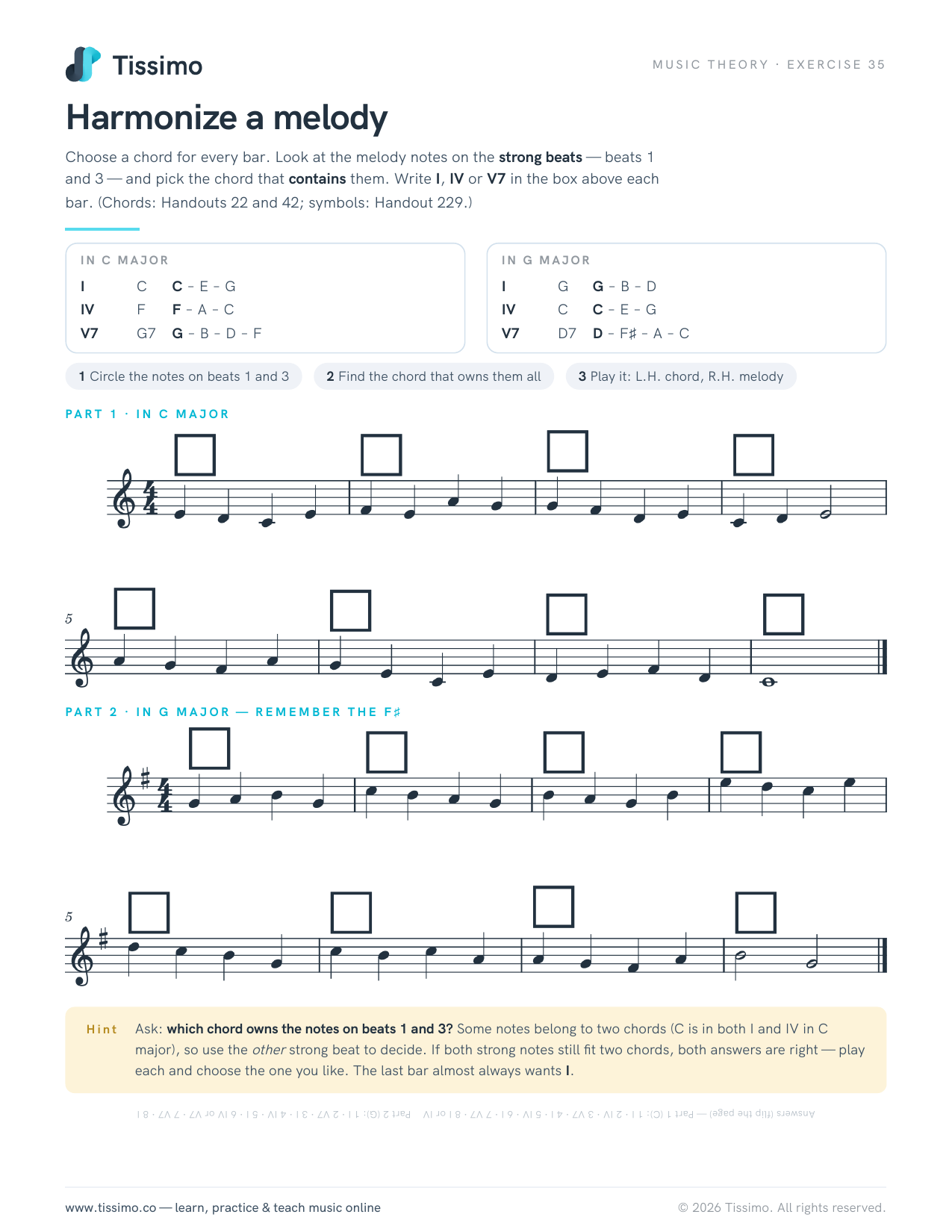
Harmonize a melody
Choose a chord for every bar. Look at the melody notes on the strong beats — beats 1 and 3 — and pick the chord that contains them. Write I, IV or V7 in the box above each bar. (Chords: Handouts 22 and 42; symbols: Handout 229.)
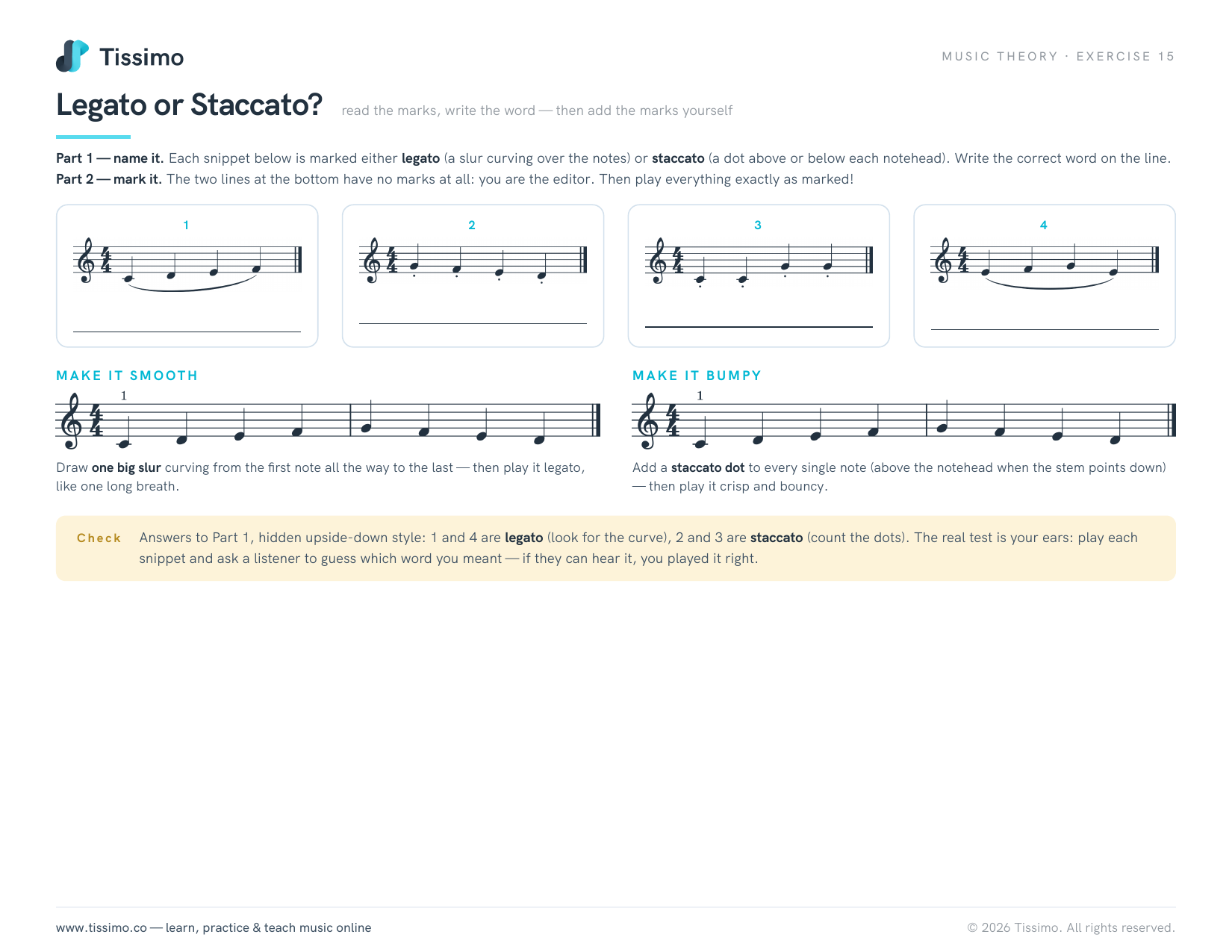
Legato or Staccato?
read the marks, write the word — then add the marks yourself
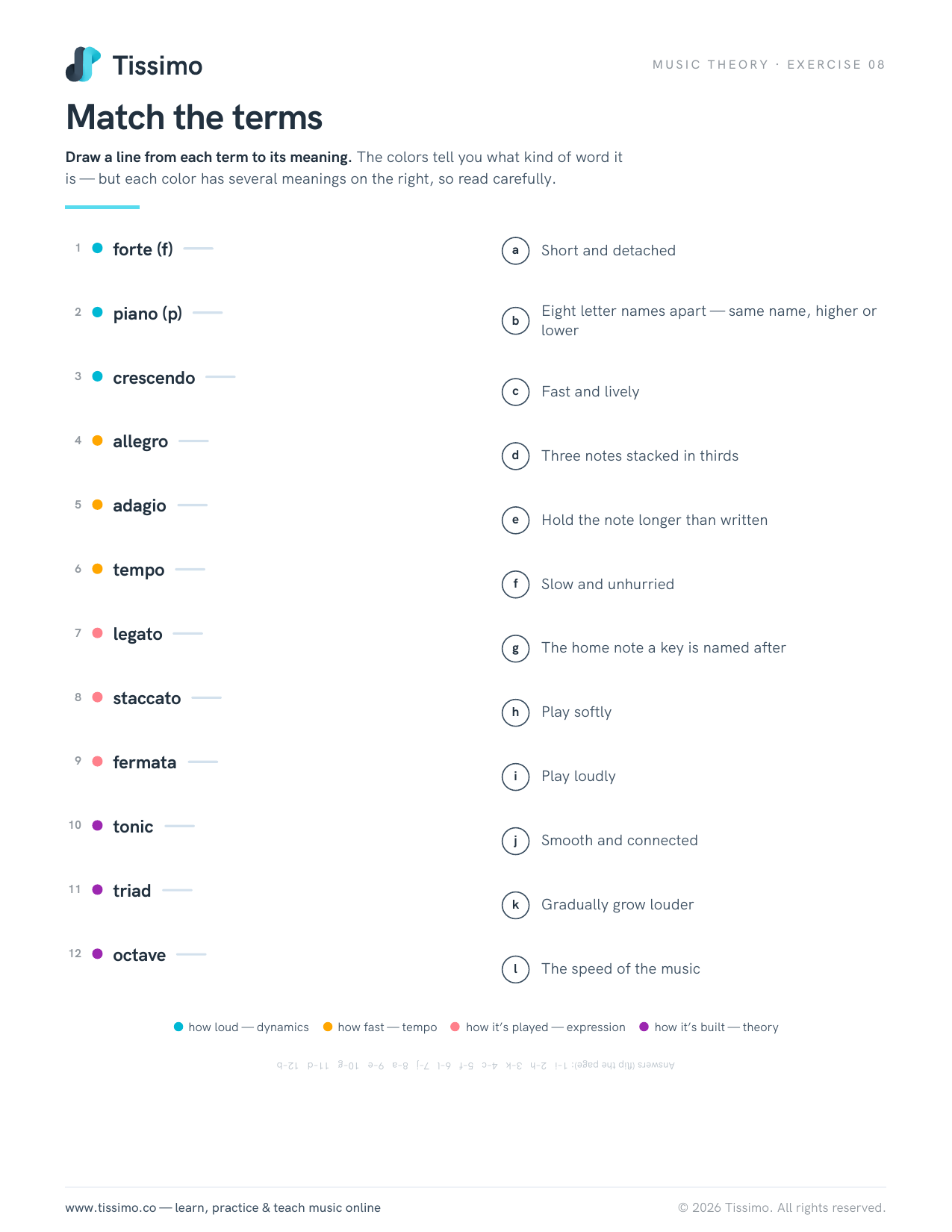
Match the terms
Draw a line from each term to its meaning. The colors tell you what kind of word it is — but each color has several meanings on the right, so read carefully.
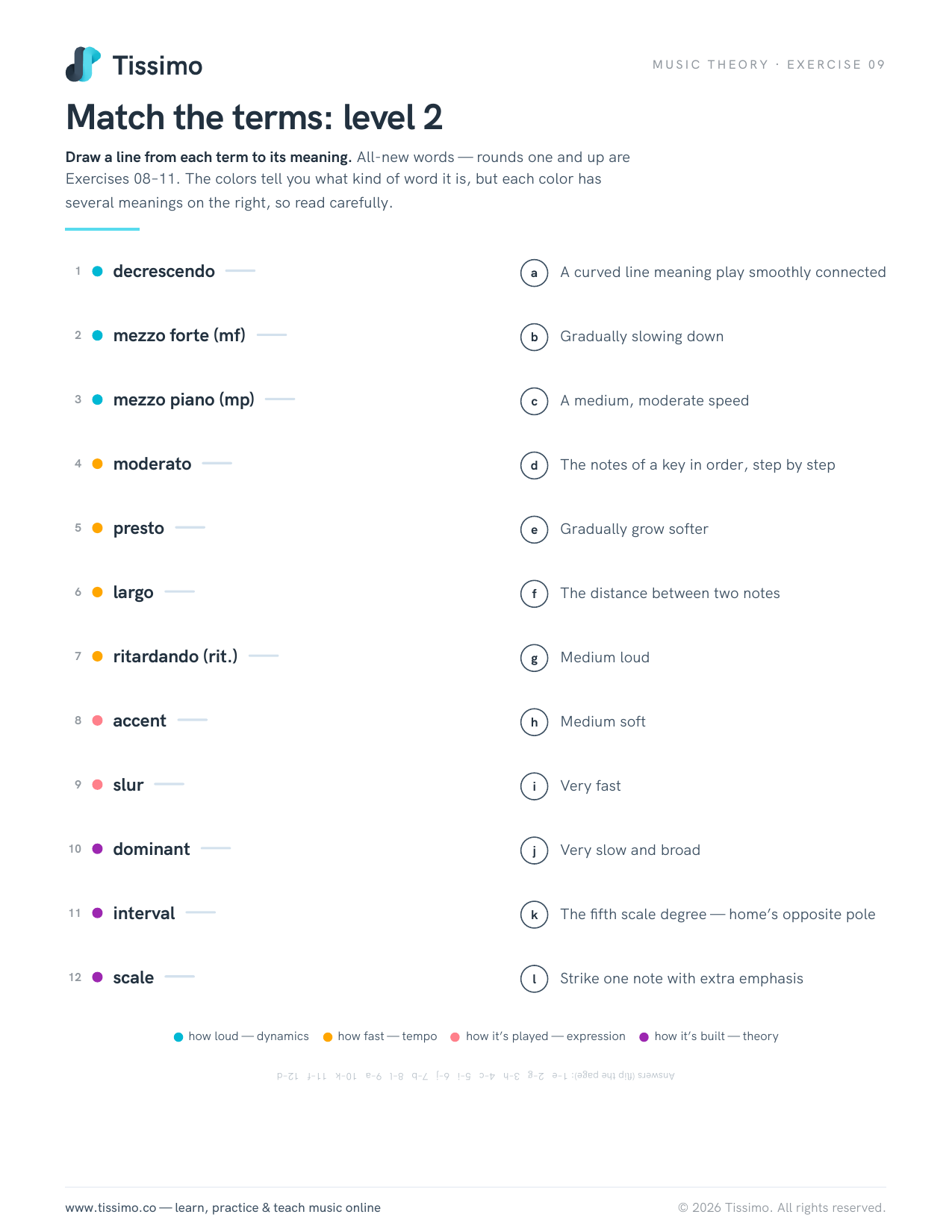
Match the terms: level 2
Draw a line from each term to its meaning. All-new words — rounds one and up are Exercises 08–11. The colors tell you what kind of word it is, but each color has several meanings on the right, so read carefully.
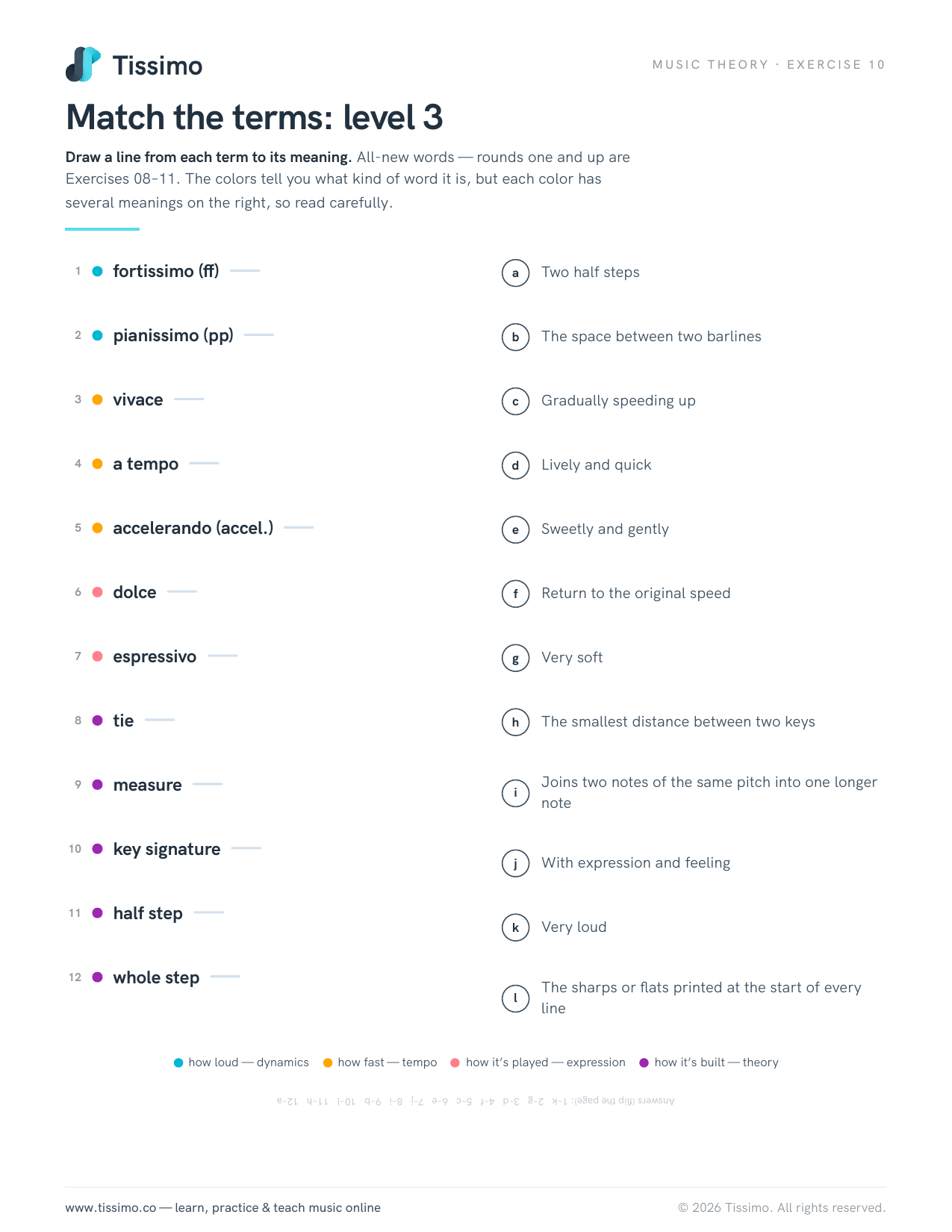
Match the terms: level 3
Draw a line from each term to its meaning. All-new words — rounds one and up are Exercises 08–11. The colors tell you what kind of word it is, but each color has several meanings on the right, so read carefully.
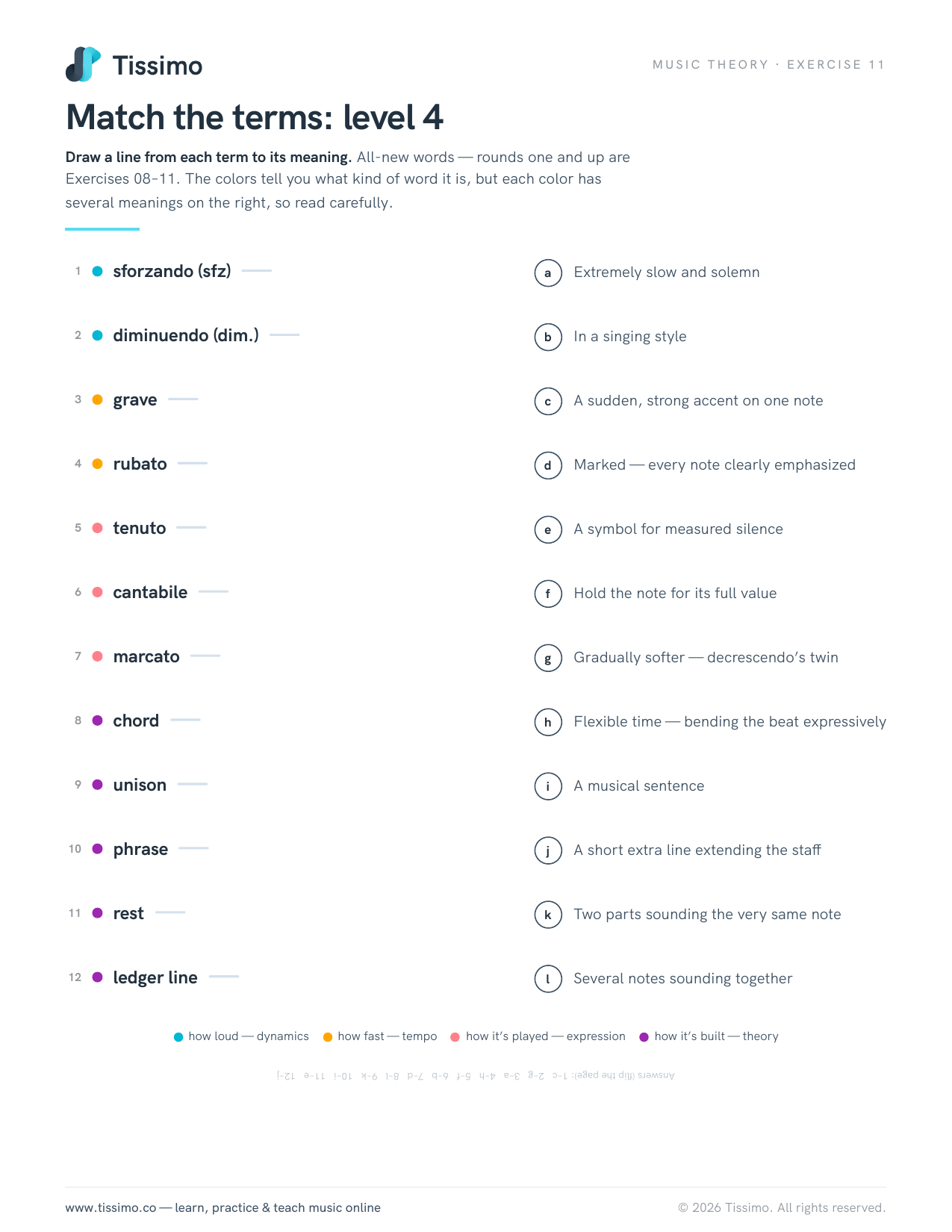
Match the terms: level 4
Draw a line from each term to its meaning. All-new words — rounds one and up are Exercises 08–11. The colors tell you what kind of word it is, but each color has several meanings on the right, so read carefully.
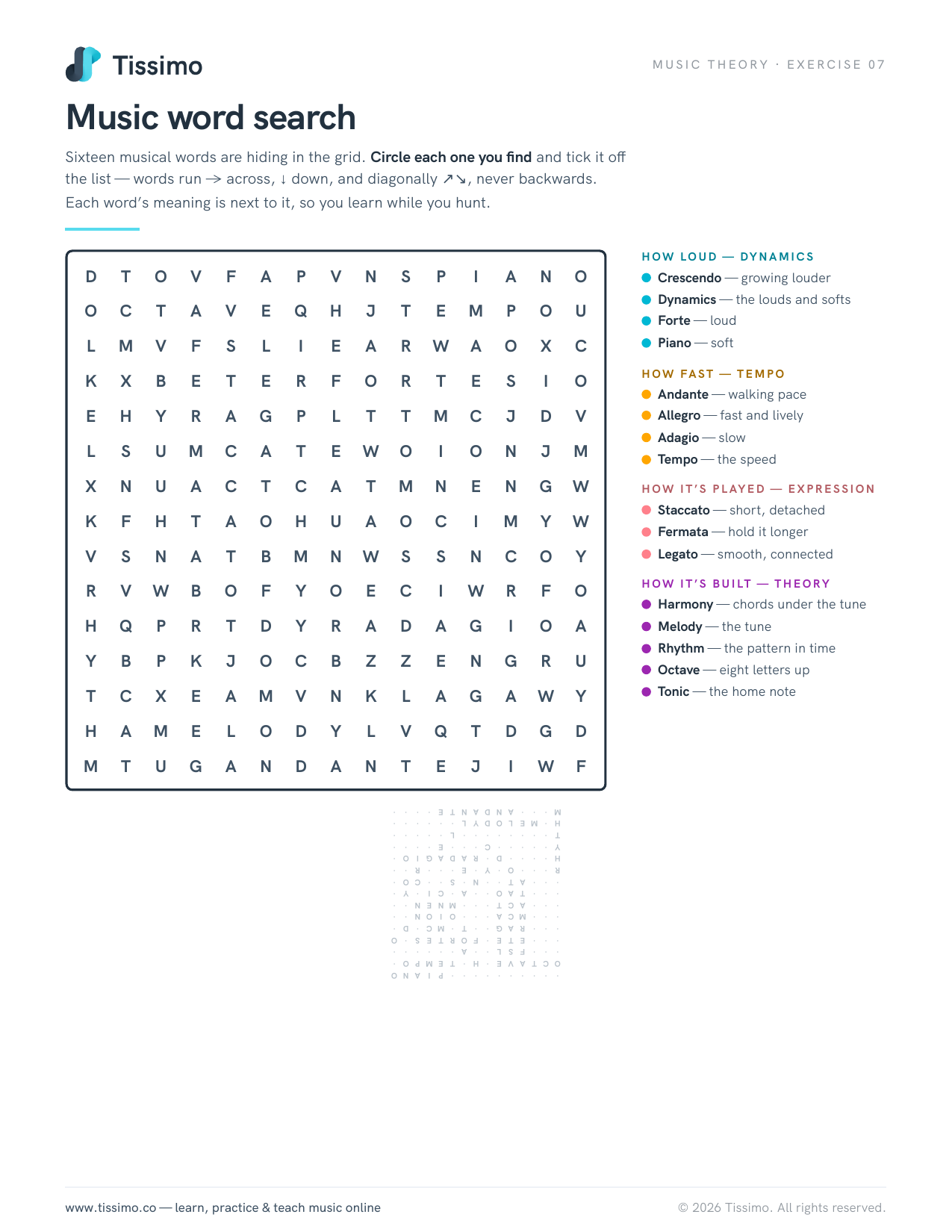
Music word search
Sixteen musical words are hiding in the grid. Circle each one you find and tick it off the list — words run → across, ↓ down, and diagonally ↗↘, never backwards. Each word’s meaning is next to it, so you learn while you hunt.