免费音乐练习单
Tissimo老师制作的单页打印练习单——在这里查看、下载PDF,或打印一叠带去下一堂课。

音符与节奏
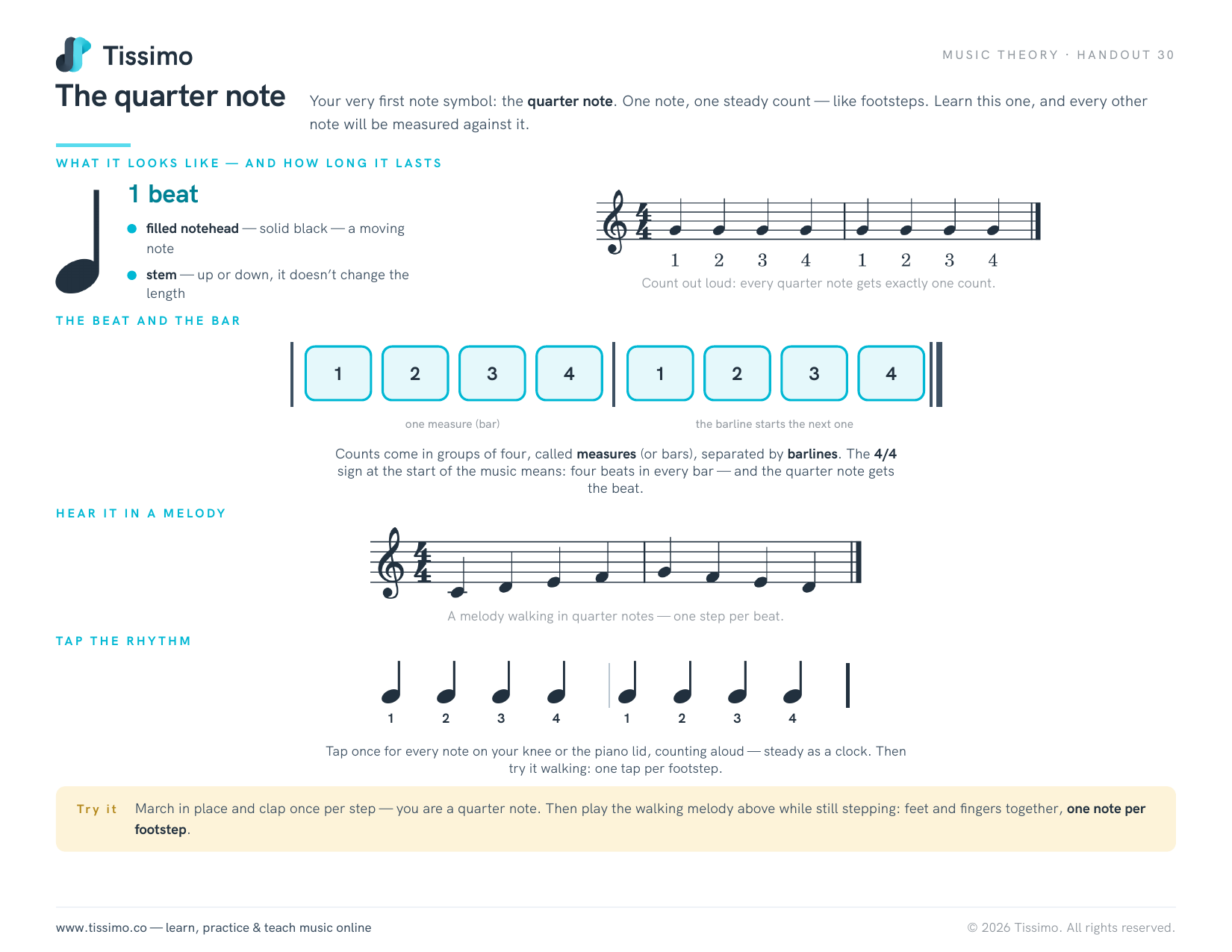
四分音符
你认识的第一个音符符号:四分音符。一个音,一拍稳定的节奏——就像走路的脚步声。学会它,其他所有音符的时值都以它为基准。
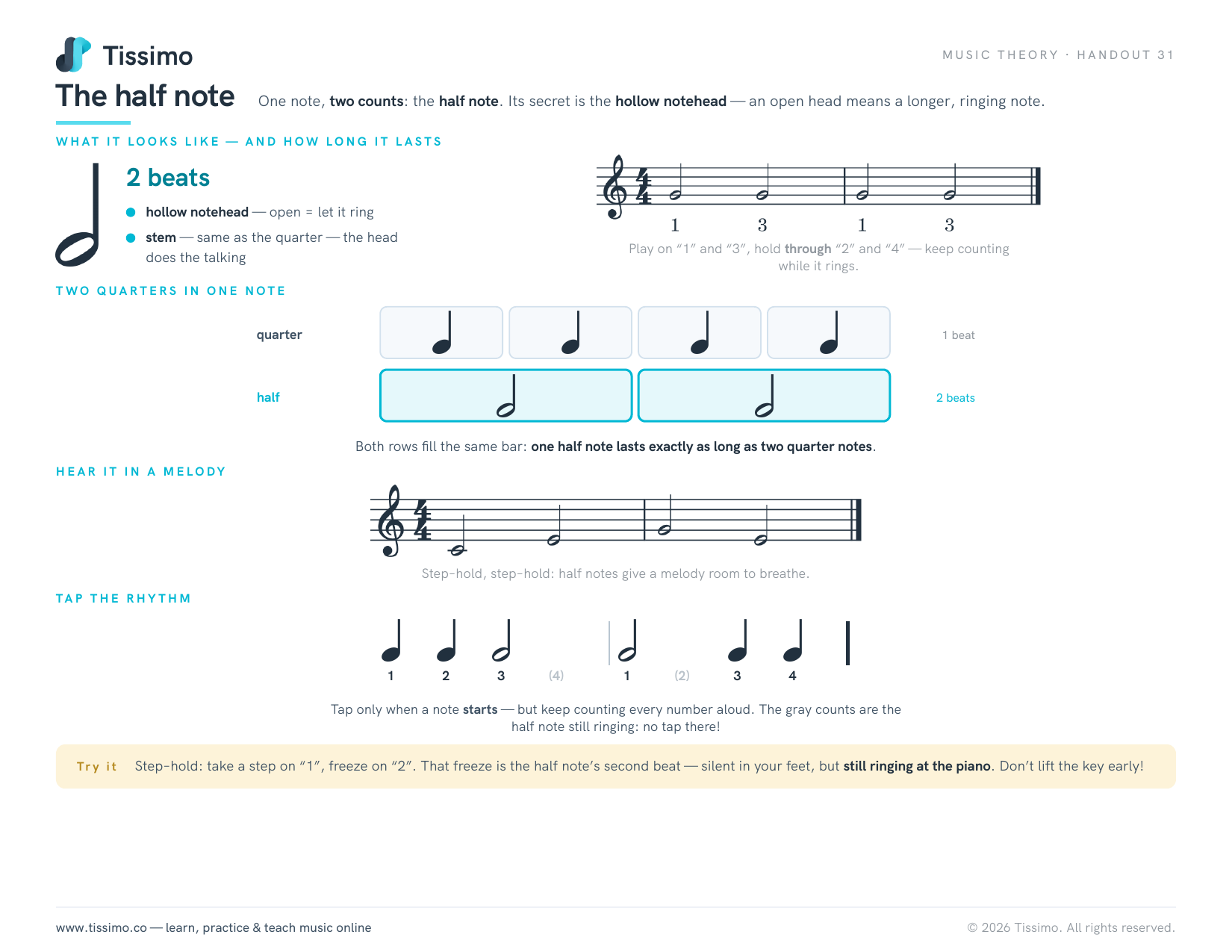
二分音符
一个音,两拍:二分音符。它的秘密在于空心符头——空心的符头代表更长、更持续的音。
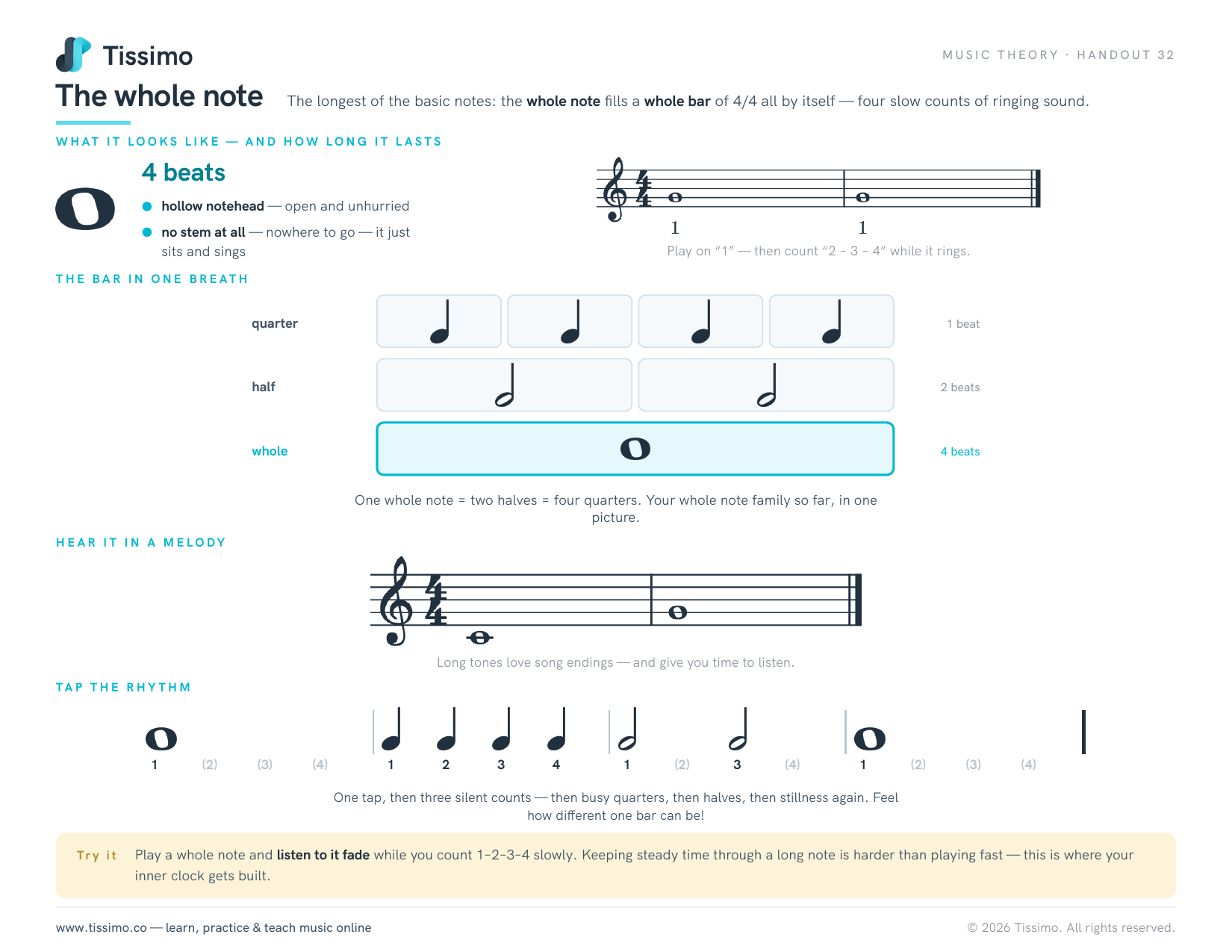
全音符
基本音符中最长的一种:全音符独自填满整个4/4拍小节——四拍缓慢而持续的声音。
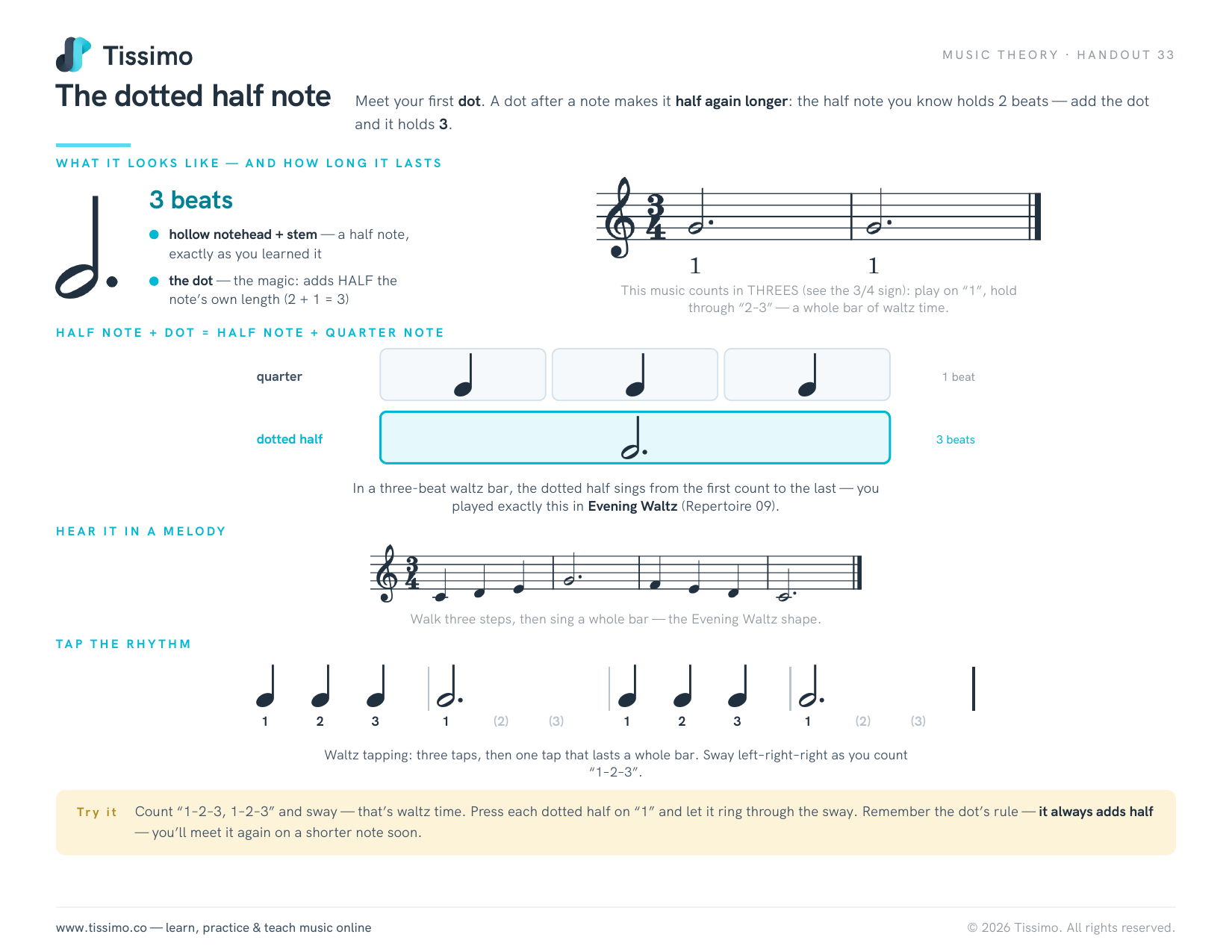
附点二分音符
认识你的第一个附点。音符后面的附点会让它的时值增加一半:你熟悉的二分音符原本是2拍——加上附点后变成3拍。
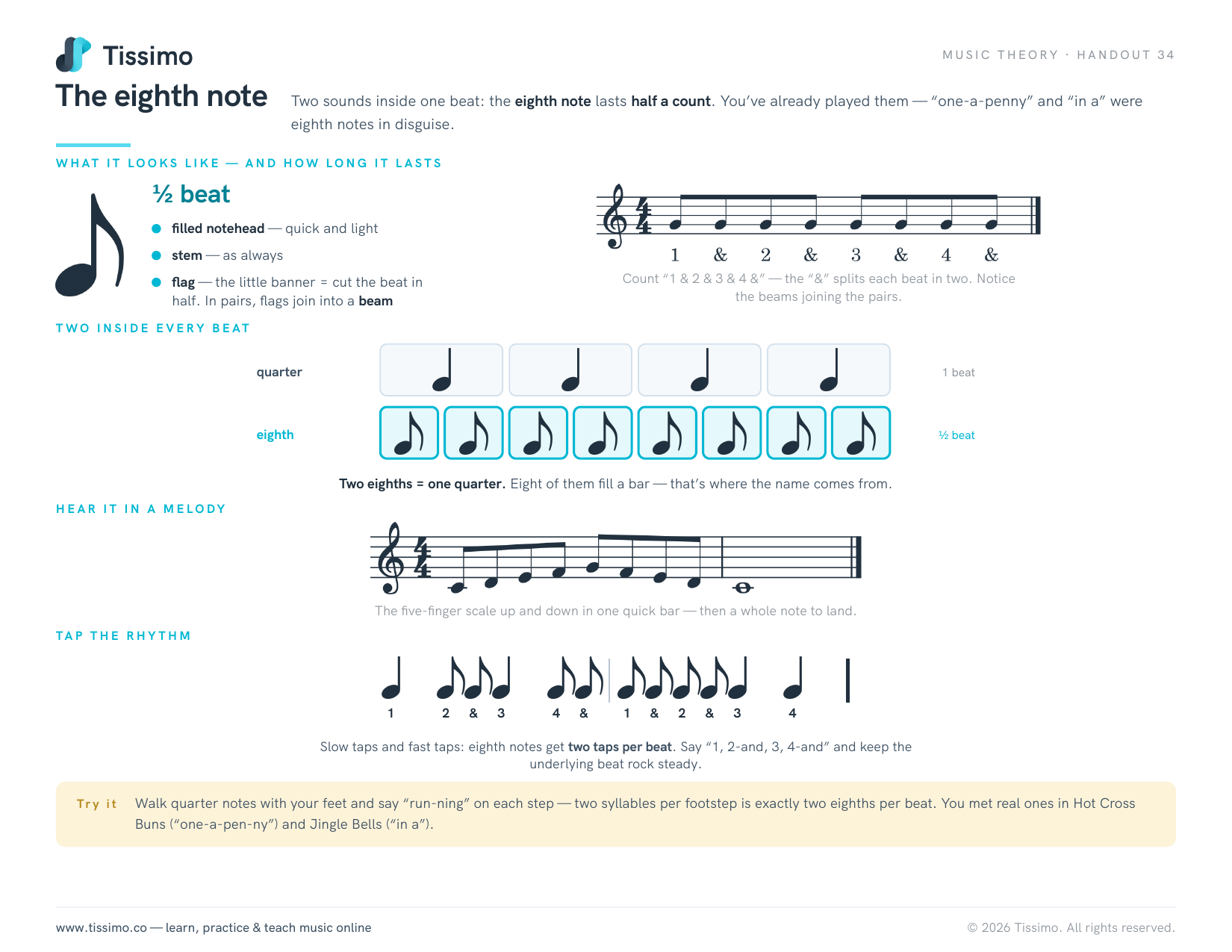
八分音符
一拍里有两个声音:八分音符的时值是半拍。你其实早就弹过它了——任何在一拍里数成“哒-嗒”的节奏,都是八分音符的变身。
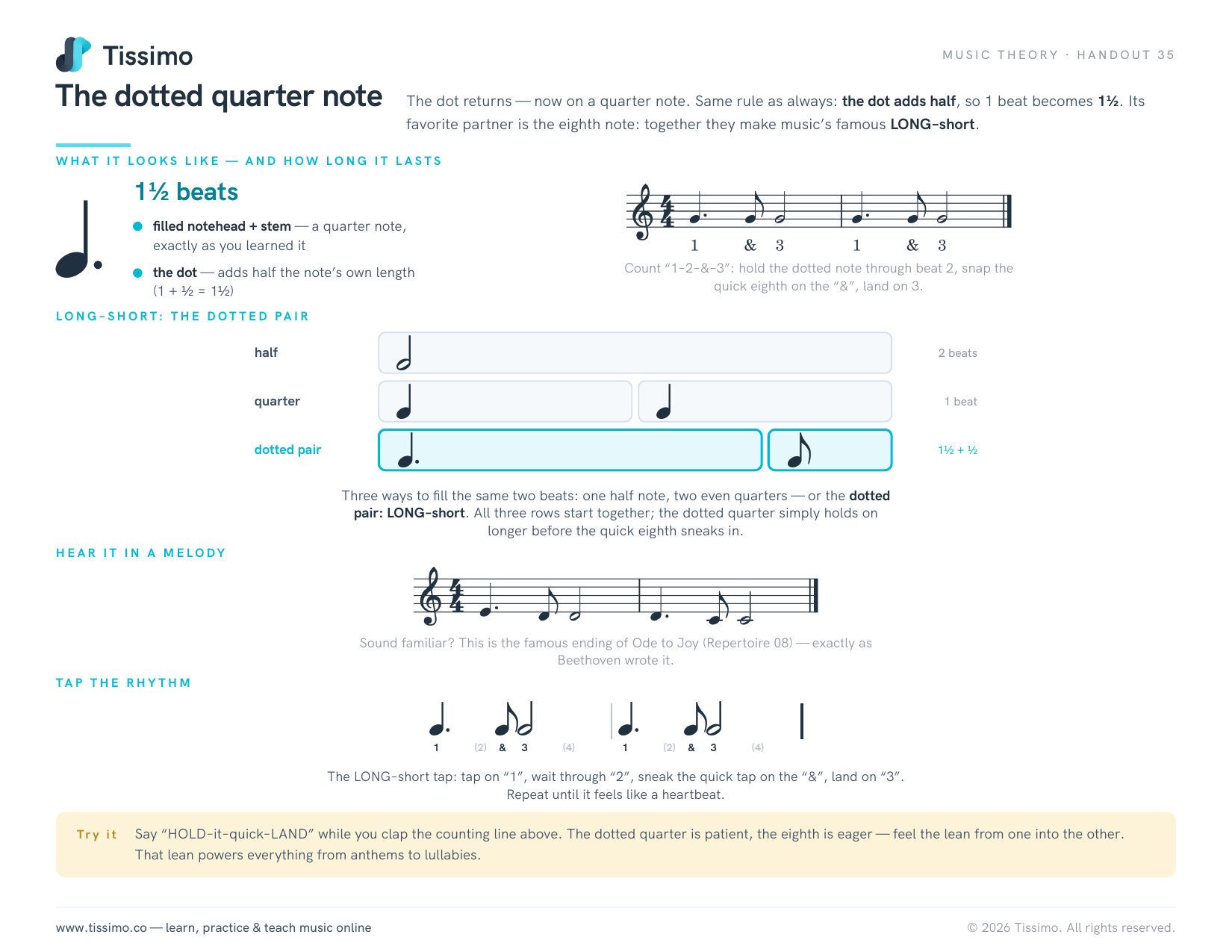
附点四分音符
附点又回来了——这次加在四分音符上。规则不变:附点增加一半的时值,所以1拍变成1拍半。它最好的搭档是八分音符:两者搭配,构成了音乐中著名的“长-短”节奏。
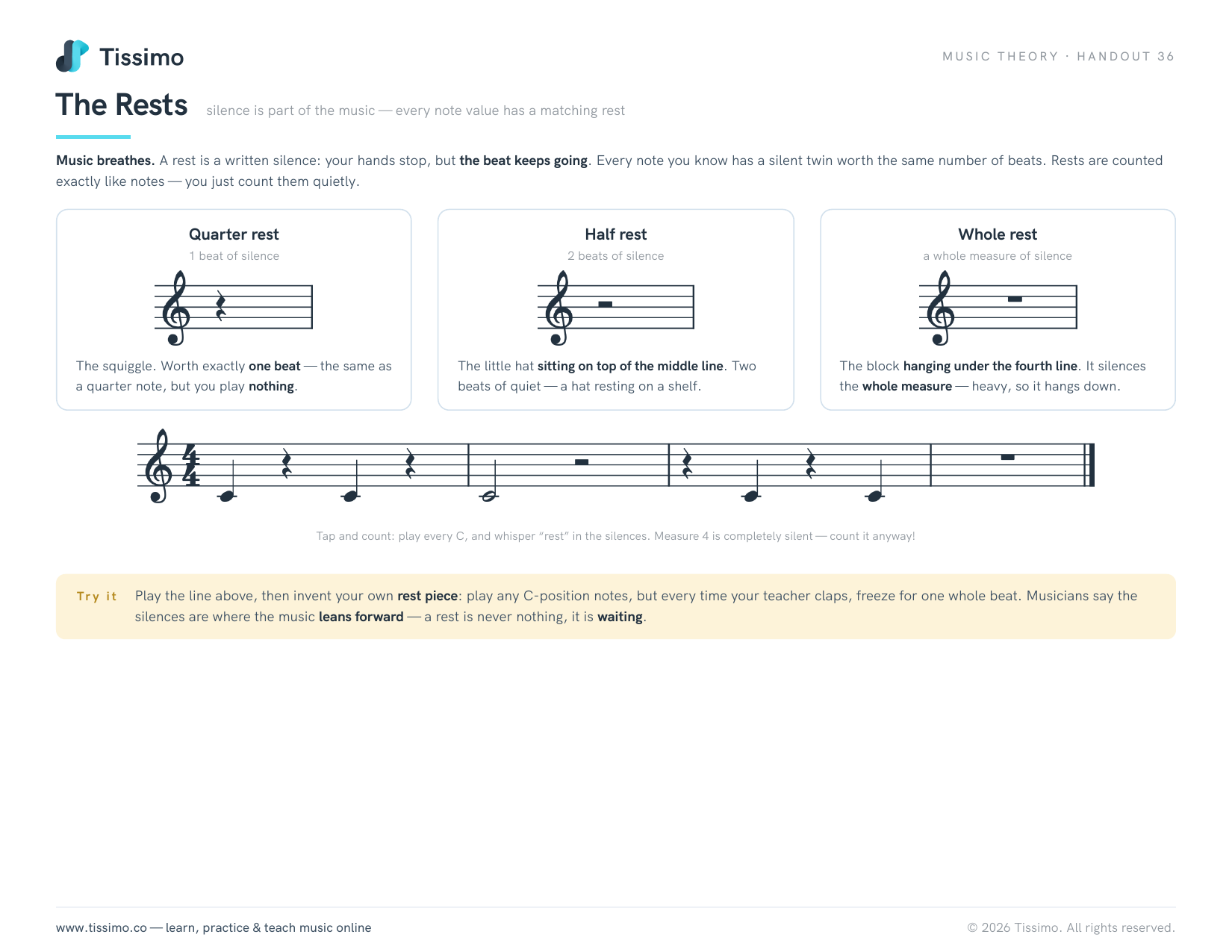
休止符
静默也是音乐的一部分——每种音符时值都有对应的休止符
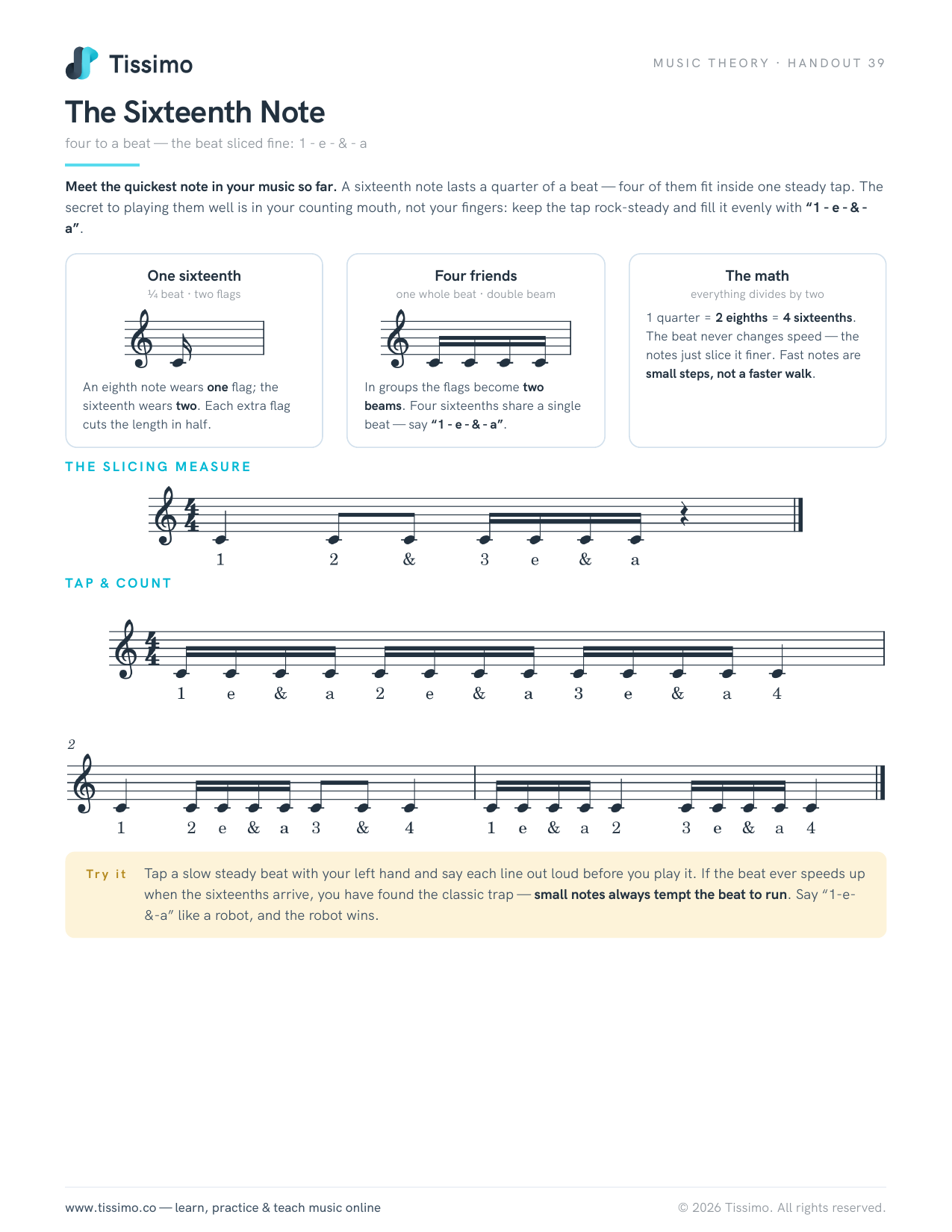
十六分音符
一拍四个音——把拍子精细切分:1 - e - & - a

休止符家族
每个音符都有一个沉默的双胞胎——从全音符到十六分音符,全部五种休止符
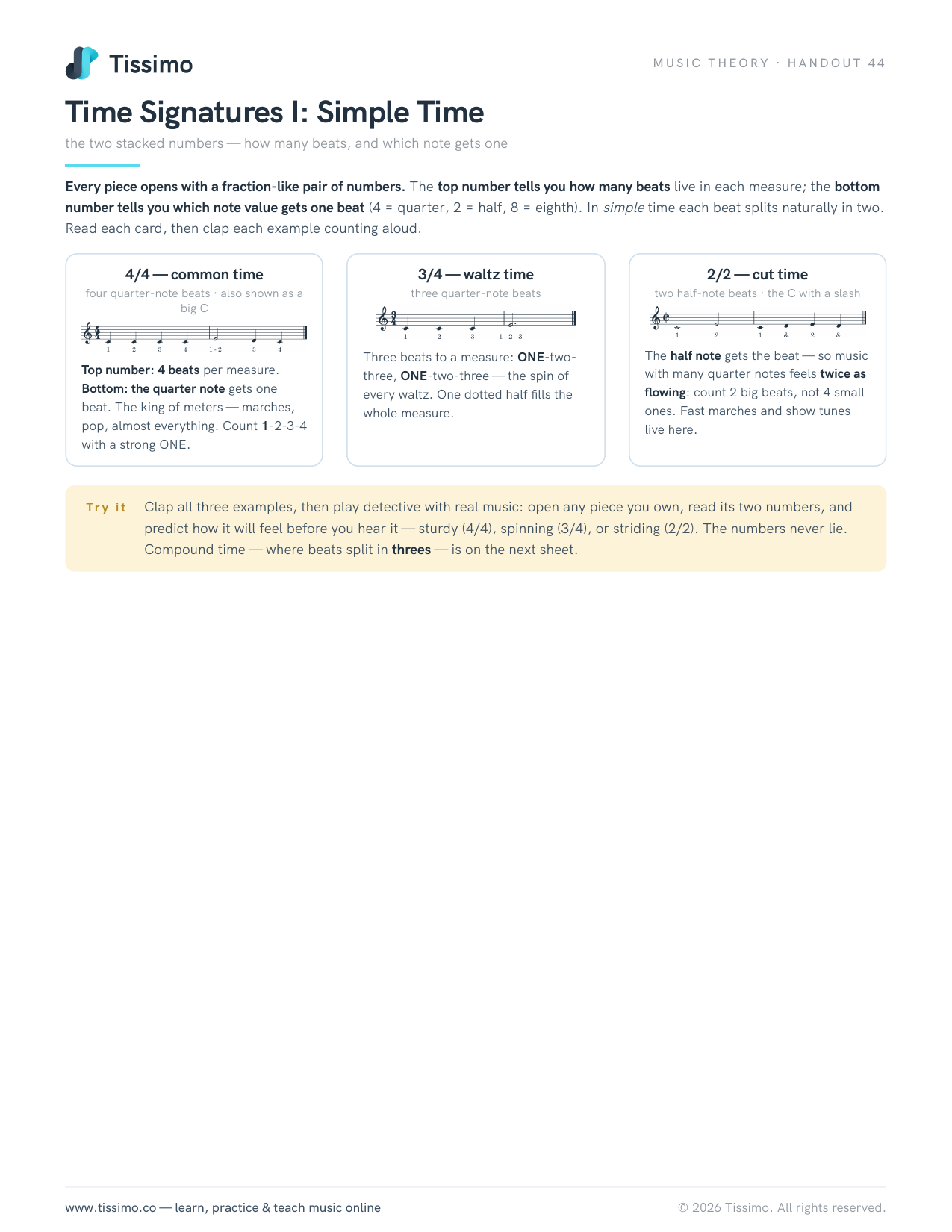
拍号 I:单拍子
上下叠放的两个数字——一小节有几拍,哪种音符算一拍
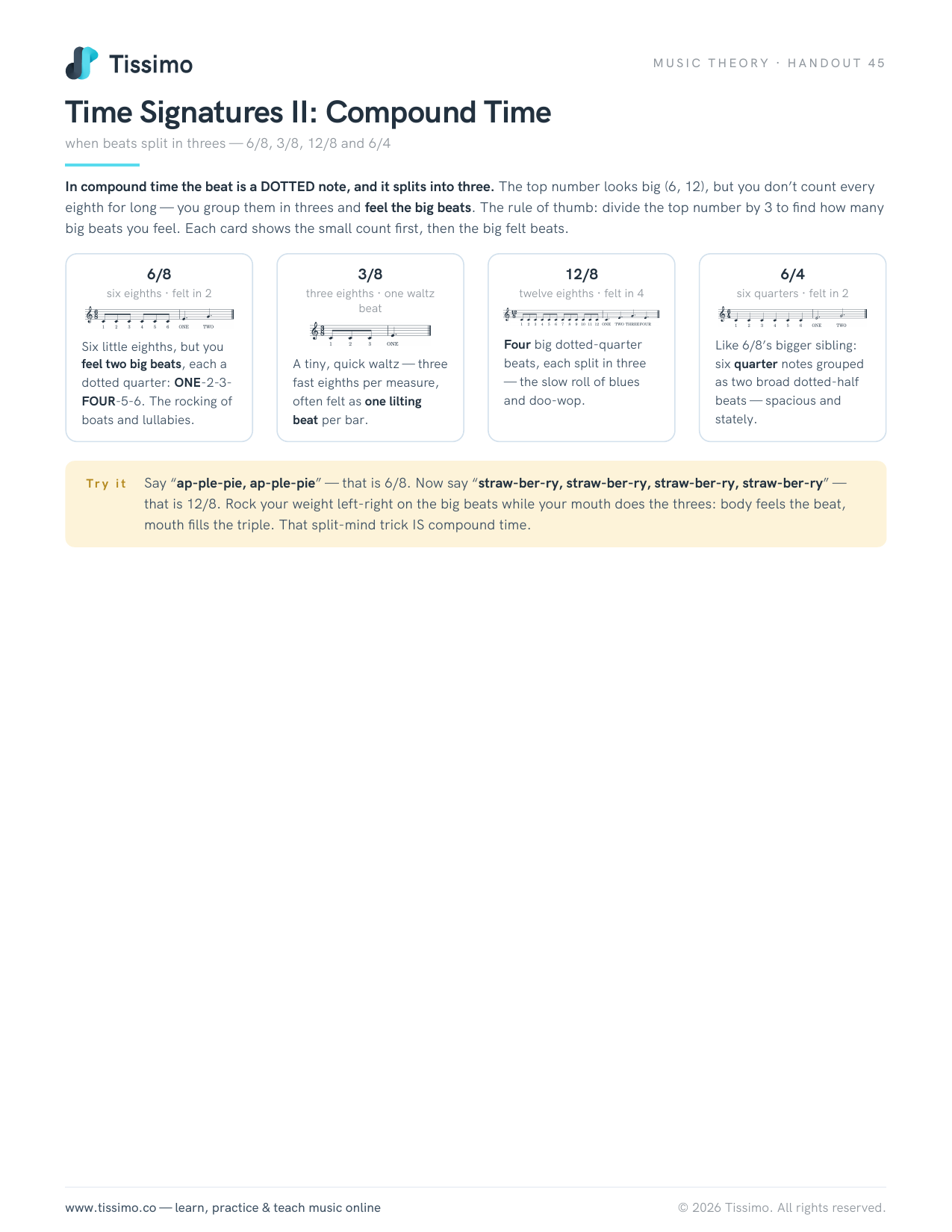
拍号 II:复拍子
当每拍再分成三份时——6/8、3/8、12/8和6/4拍
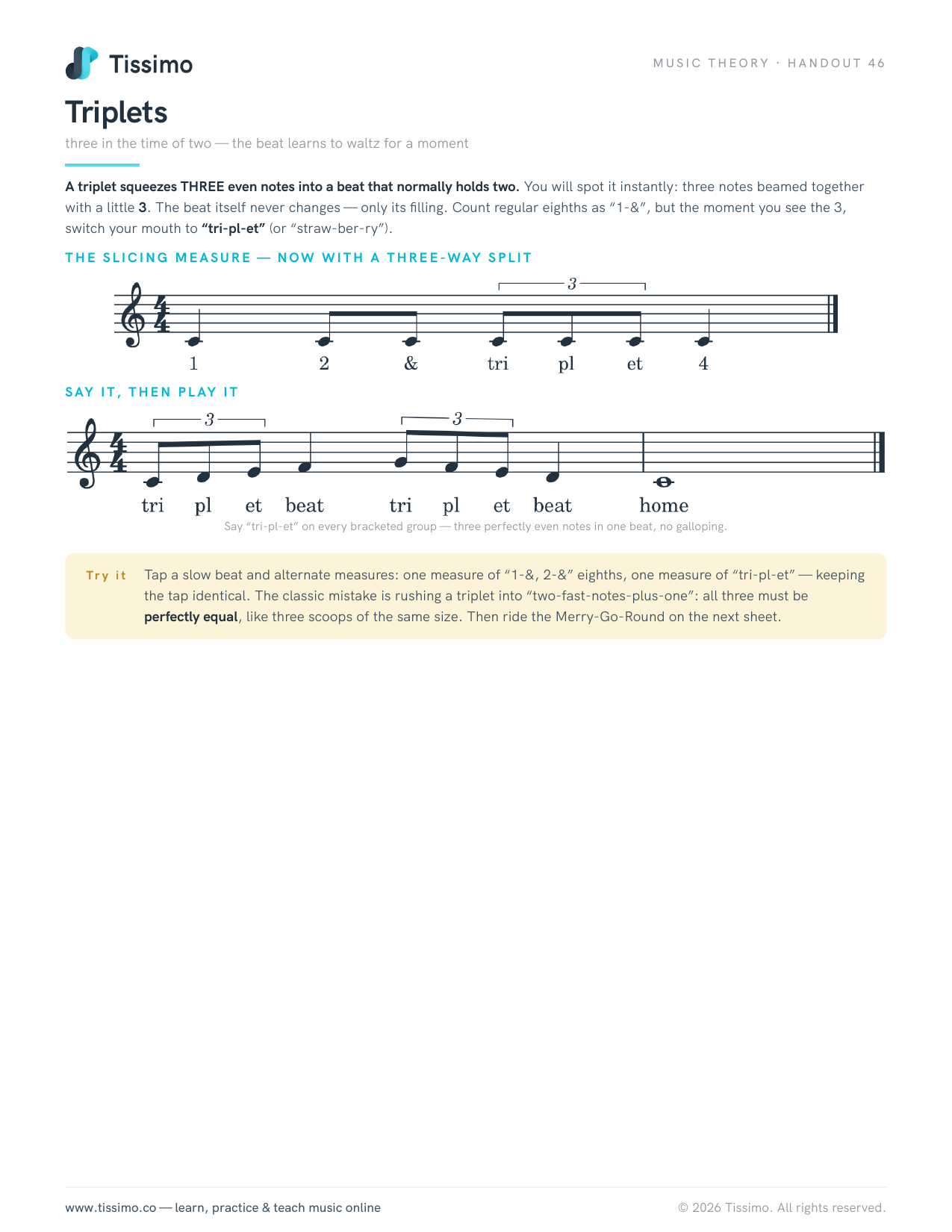
三连音
在两拍的时间里塞进三个音——节拍一瞬间学会了跳华尔兹
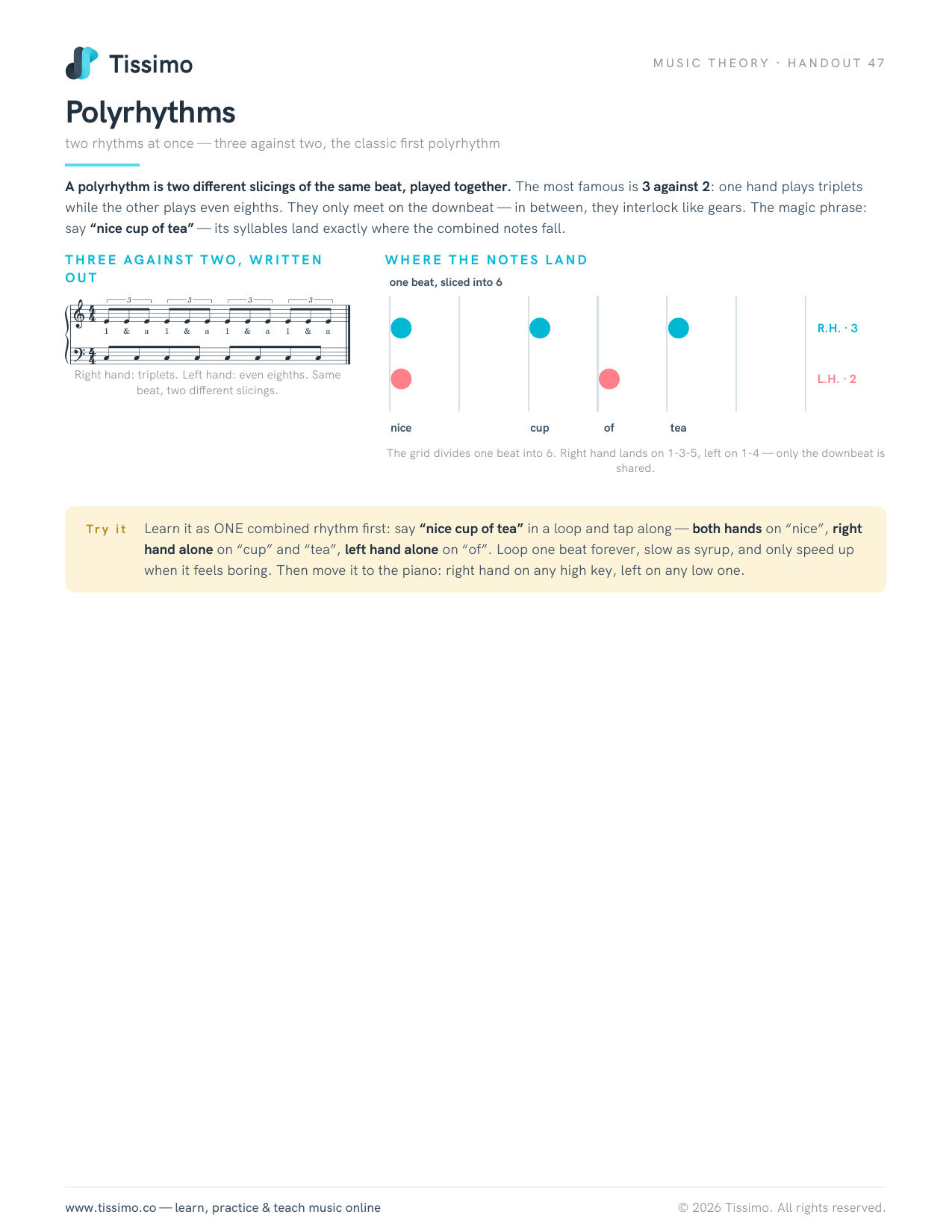
复合节奏(多节奏)
两种节奏同时进行——三对二,最经典的入门多节奏
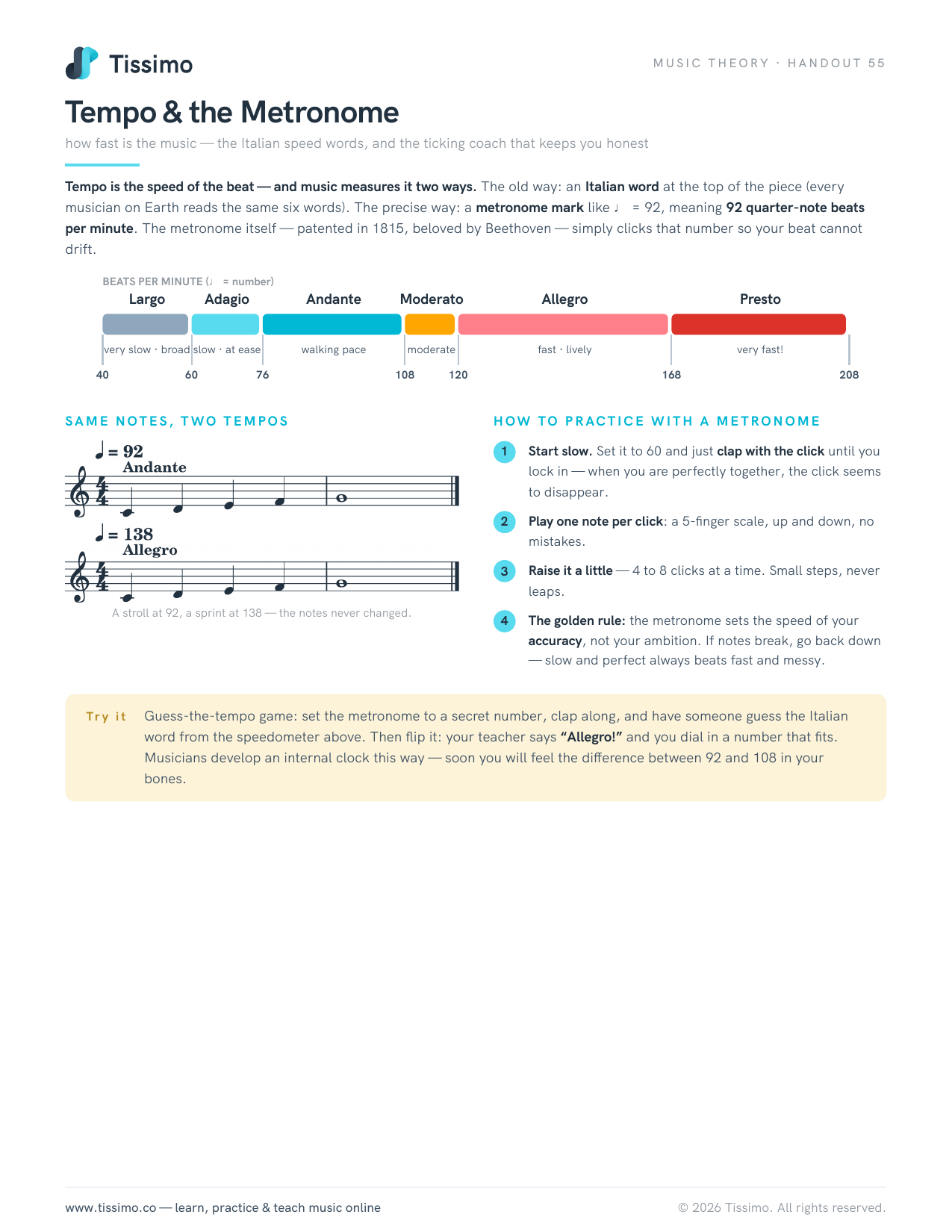
速度与节拍器
音乐有多快——意大利语速度术语,以及那个滴答作响、督促你保持稳定的“教练”
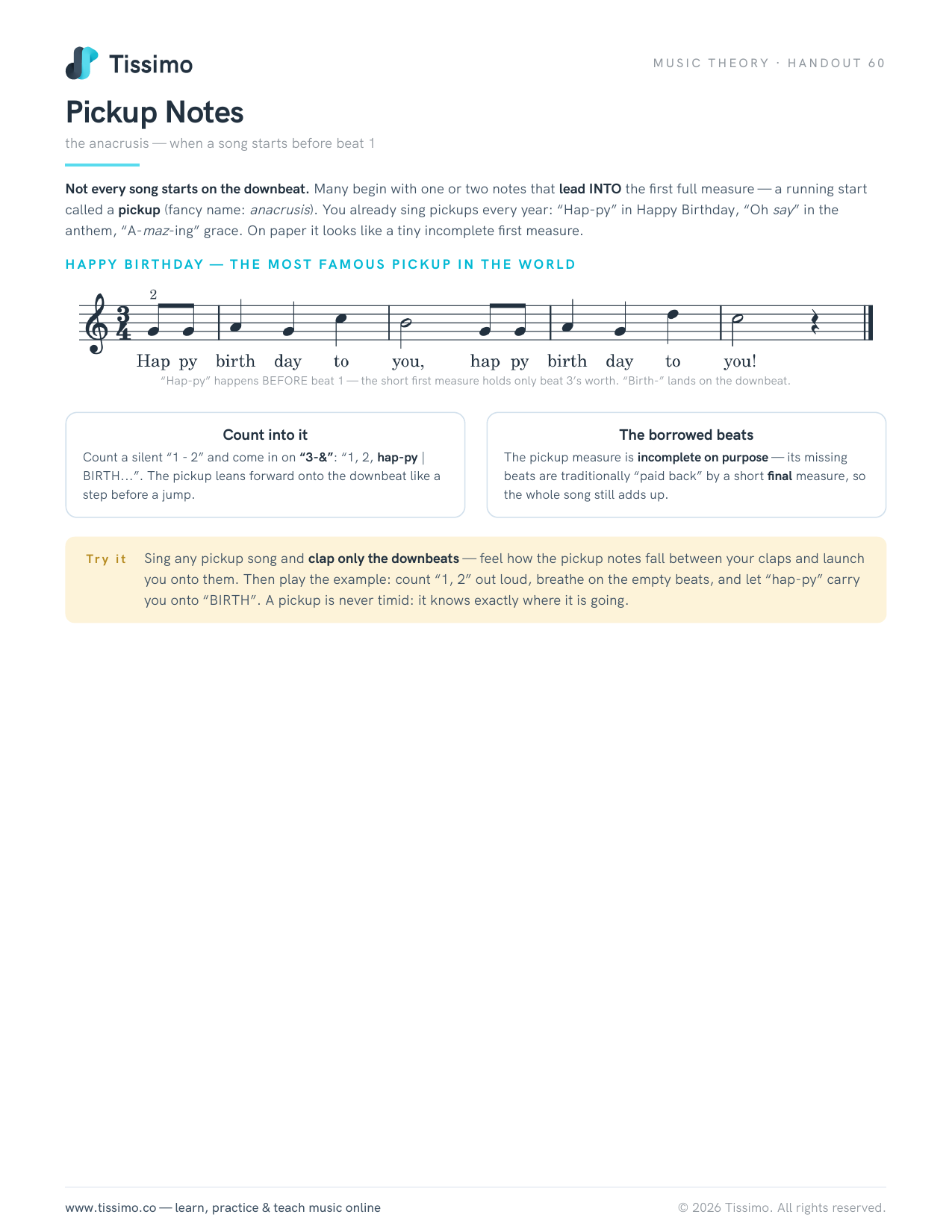
弱起小节(先现音)
弱起——歌曲在第一拍之前就开始了
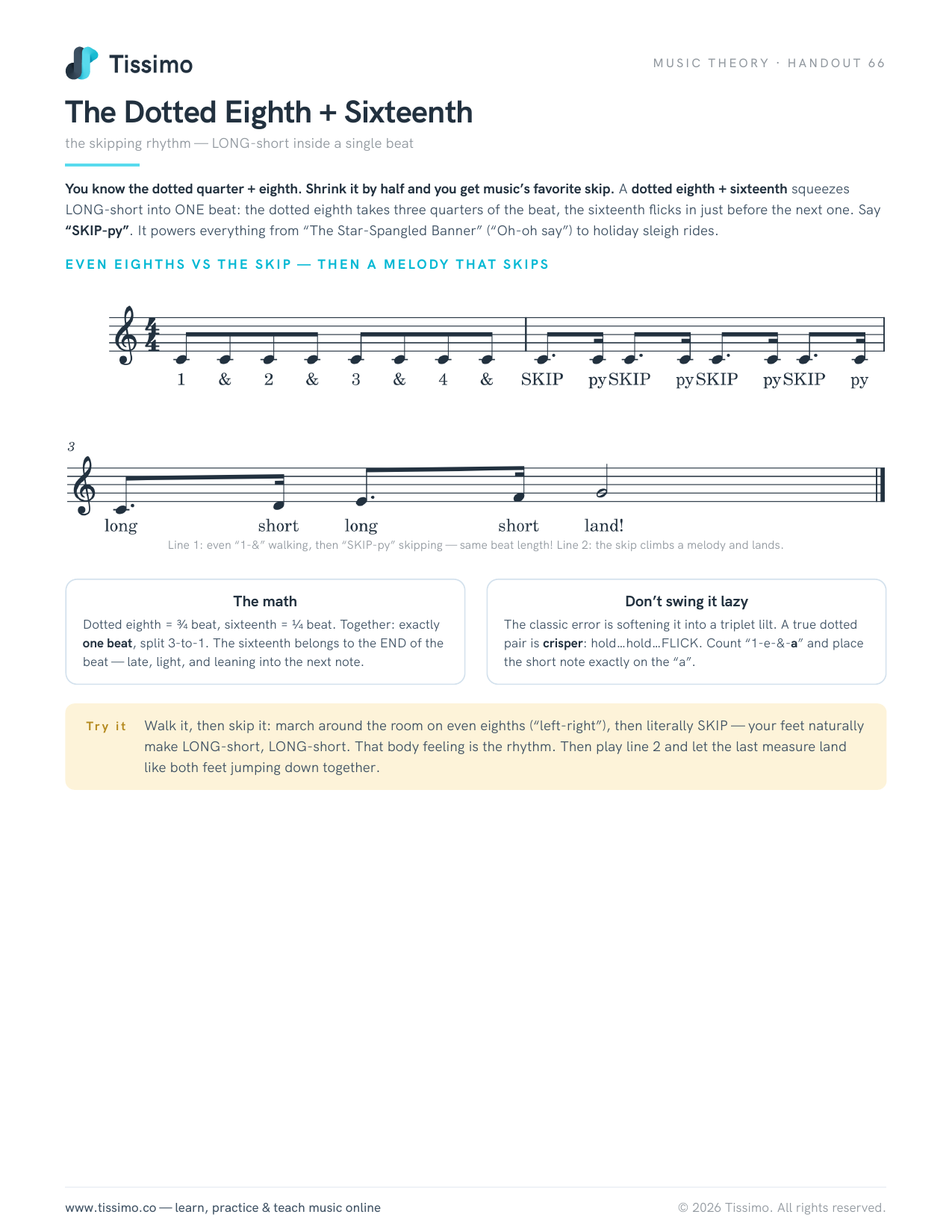
附点八分音符加十六分音符
跳跃感的节奏——在一拍之内呈现“长-短”
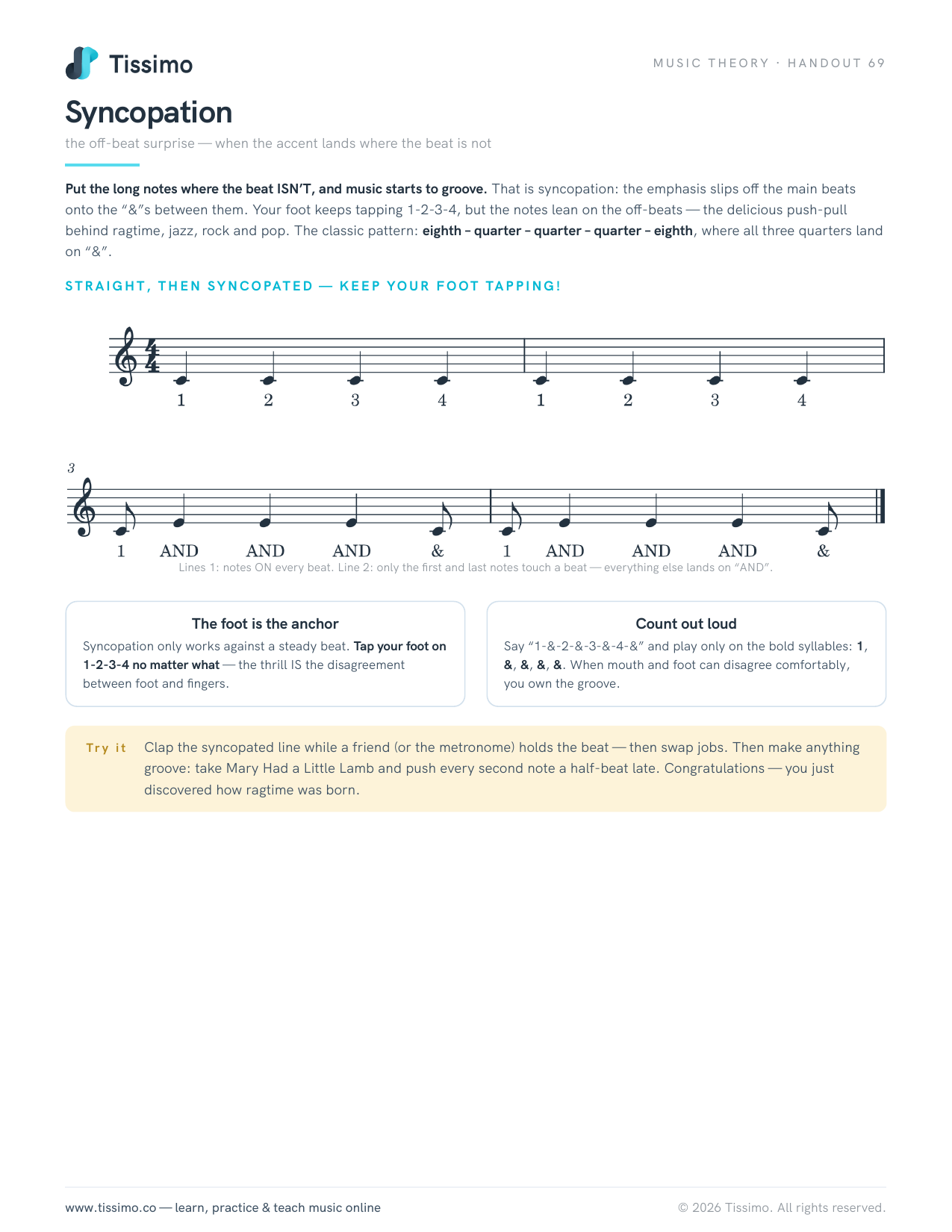
切分音
错拍的惊喜——重音落在本不该有拍点的地方
音高与记谱法
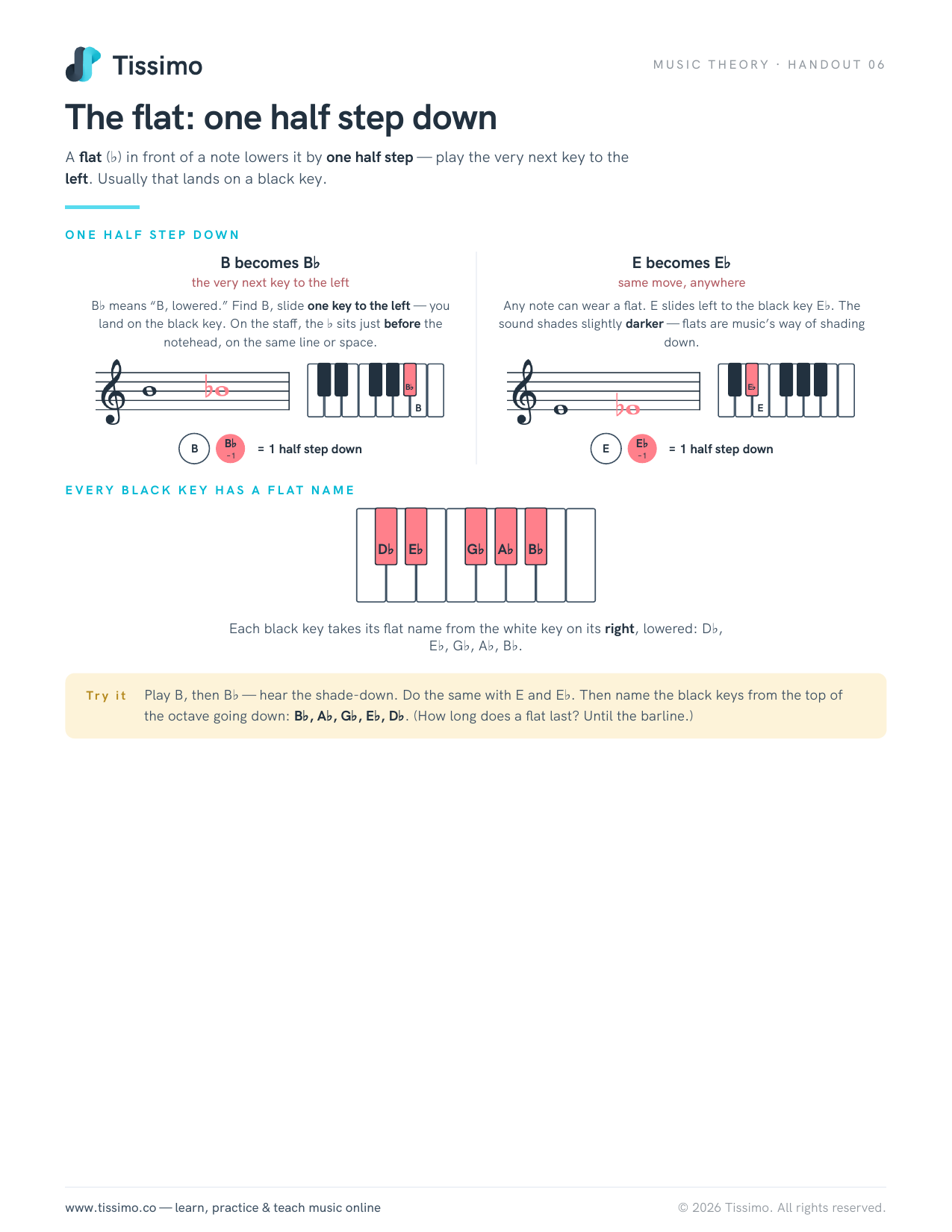
降号:降低半音
音符前的降号(♭)会把这个音降低半音——弹奏它左边紧邻的那个键。通常那是一个黑键。
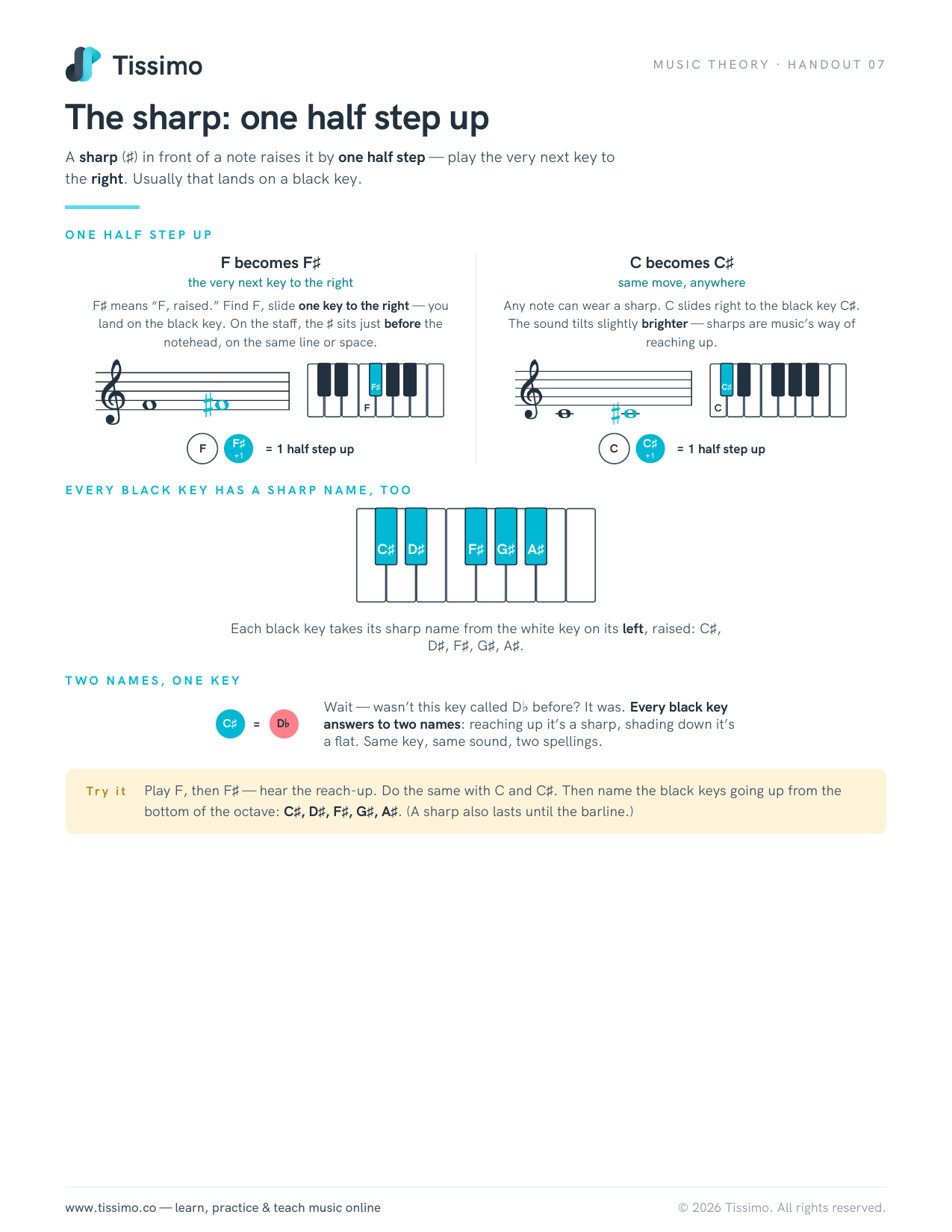
升号:升高半音
音符前的升号(♯)会把这个音升高半音——弹奏它右边紧邻的那个键。通常那是一个黑键。
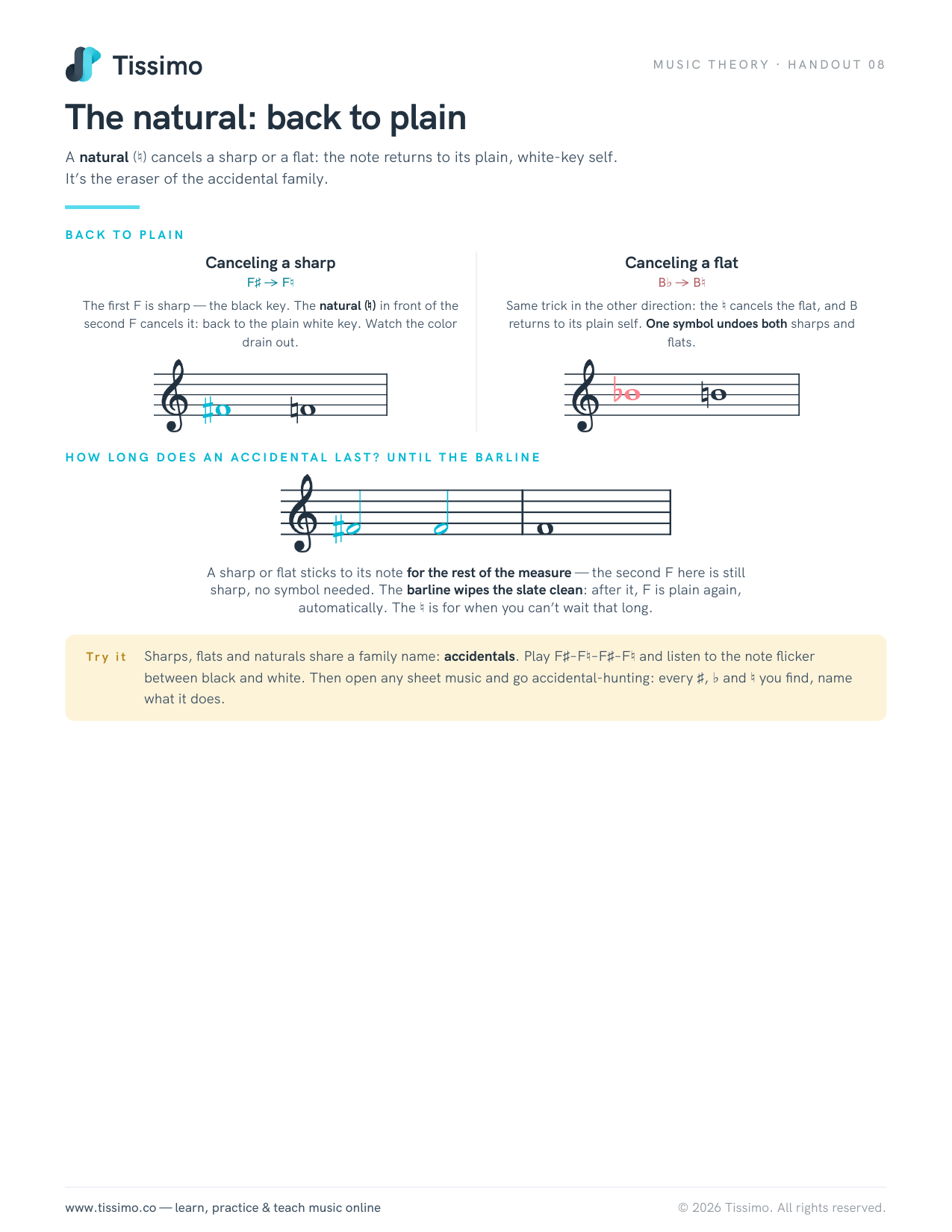
还原号:回到本来的音
还原号(♮)会取消升号或降号的作用,让音符回到原本的白键音。它就像变音记号家族里的橡皮擦。
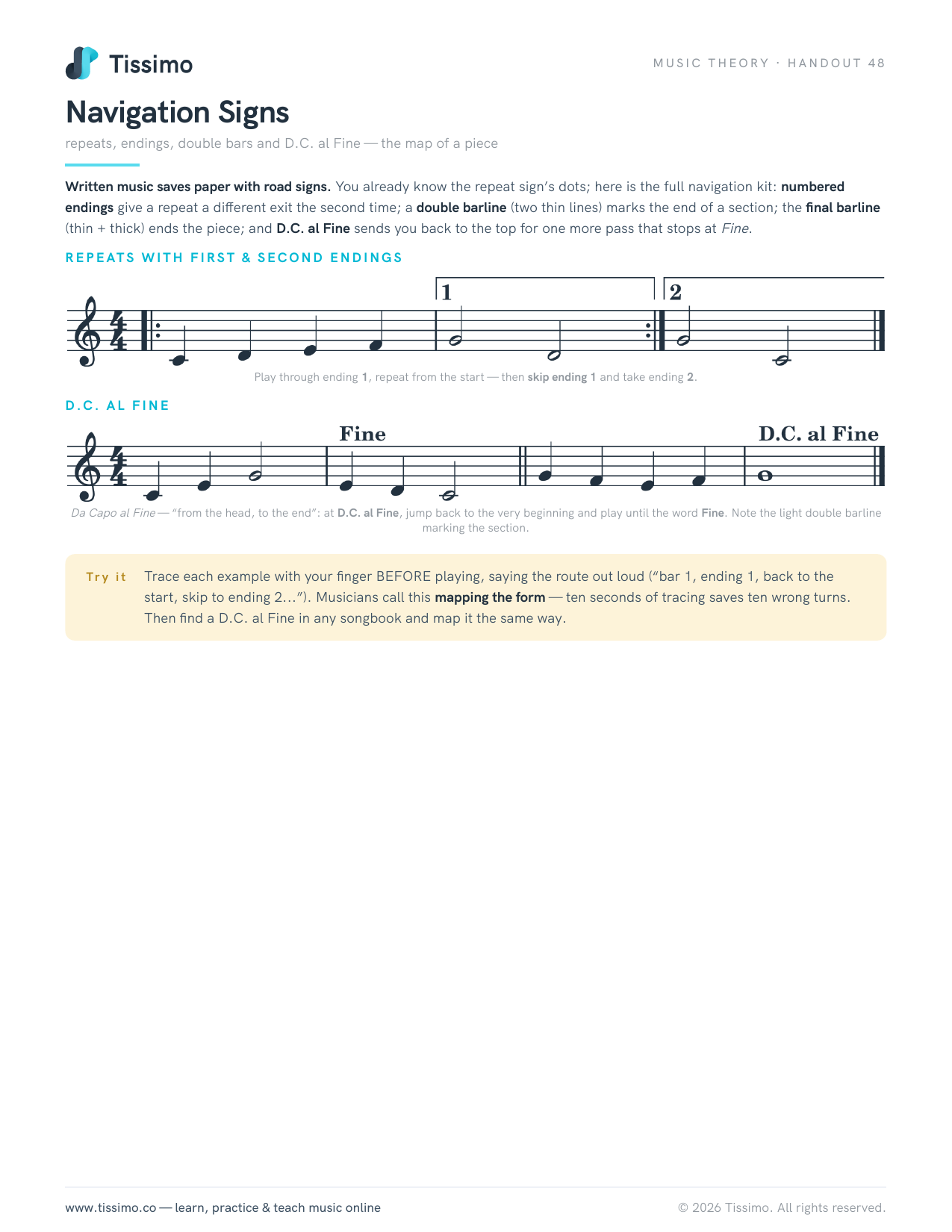
反复记号(导航记号)
反复记号、房子记号、双小节线和D.C. al Fine——一首乐曲的地图
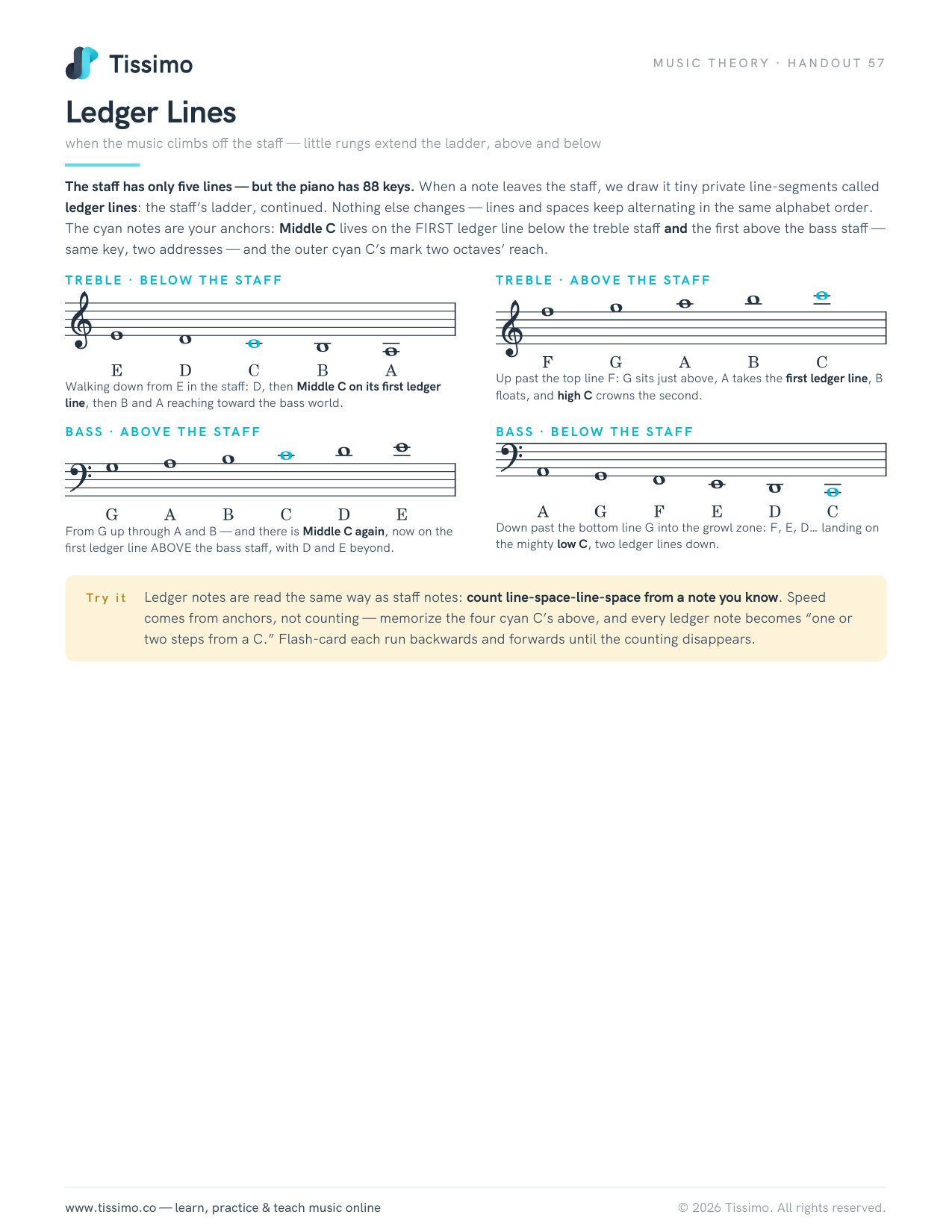
加线
当音符超出五线谱范围时——一根根小小的“梯级”向上、向下延伸
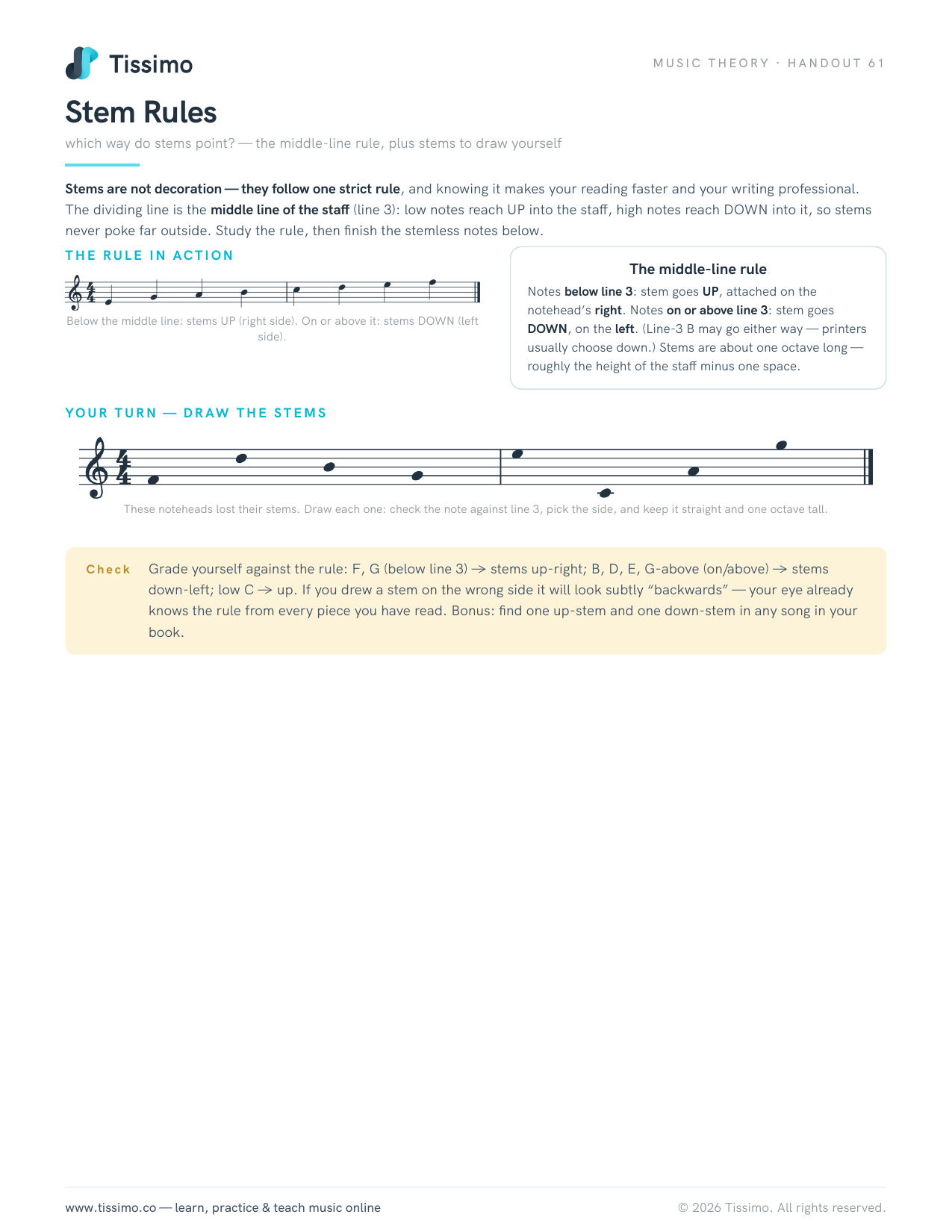
符干方向规则
符干应该朝哪个方向?——中间线规则,还有留给你自己练习画的符干
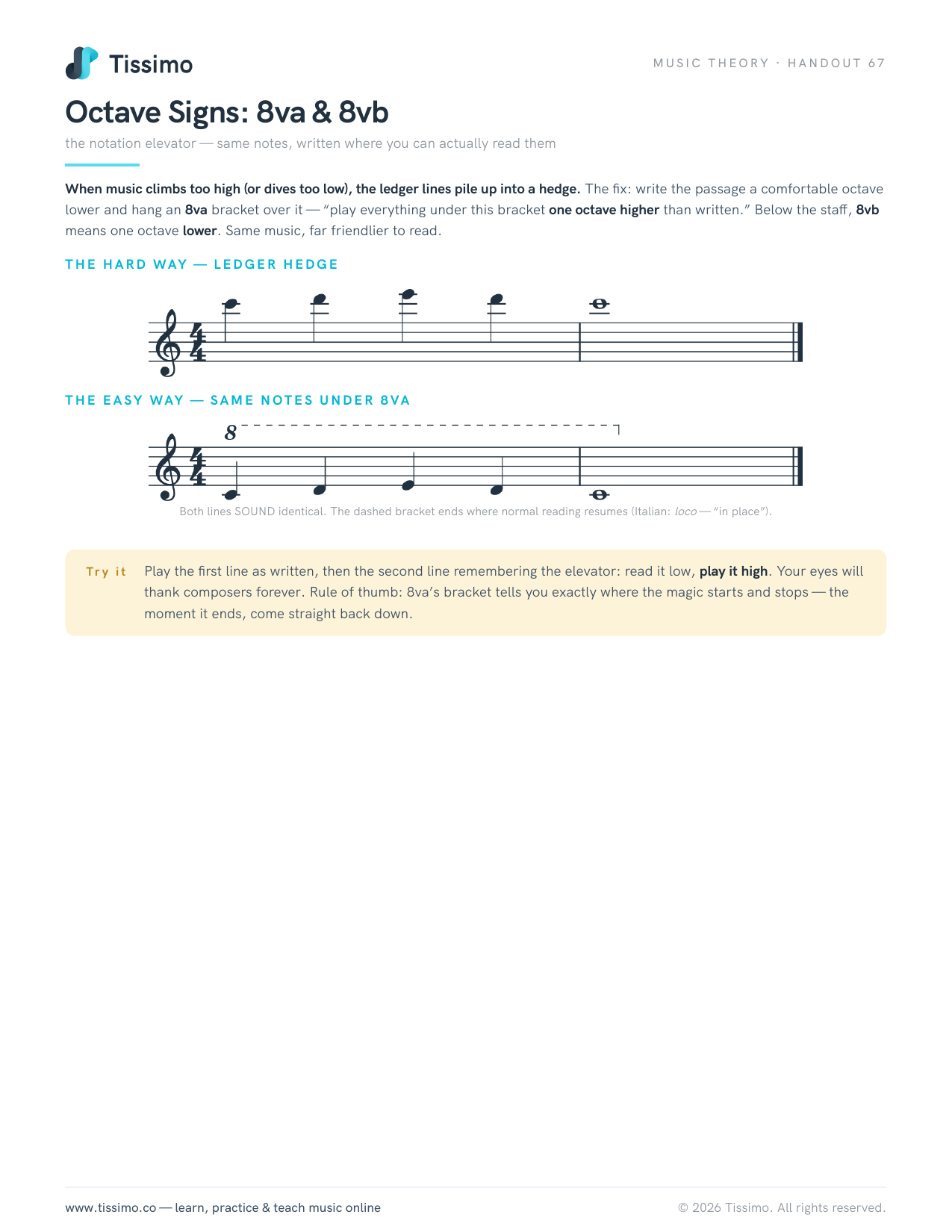
八度记号:8va 和 8vb
记谱法里的“电梯”——同样的音符,写在你真正容易读懂的位置
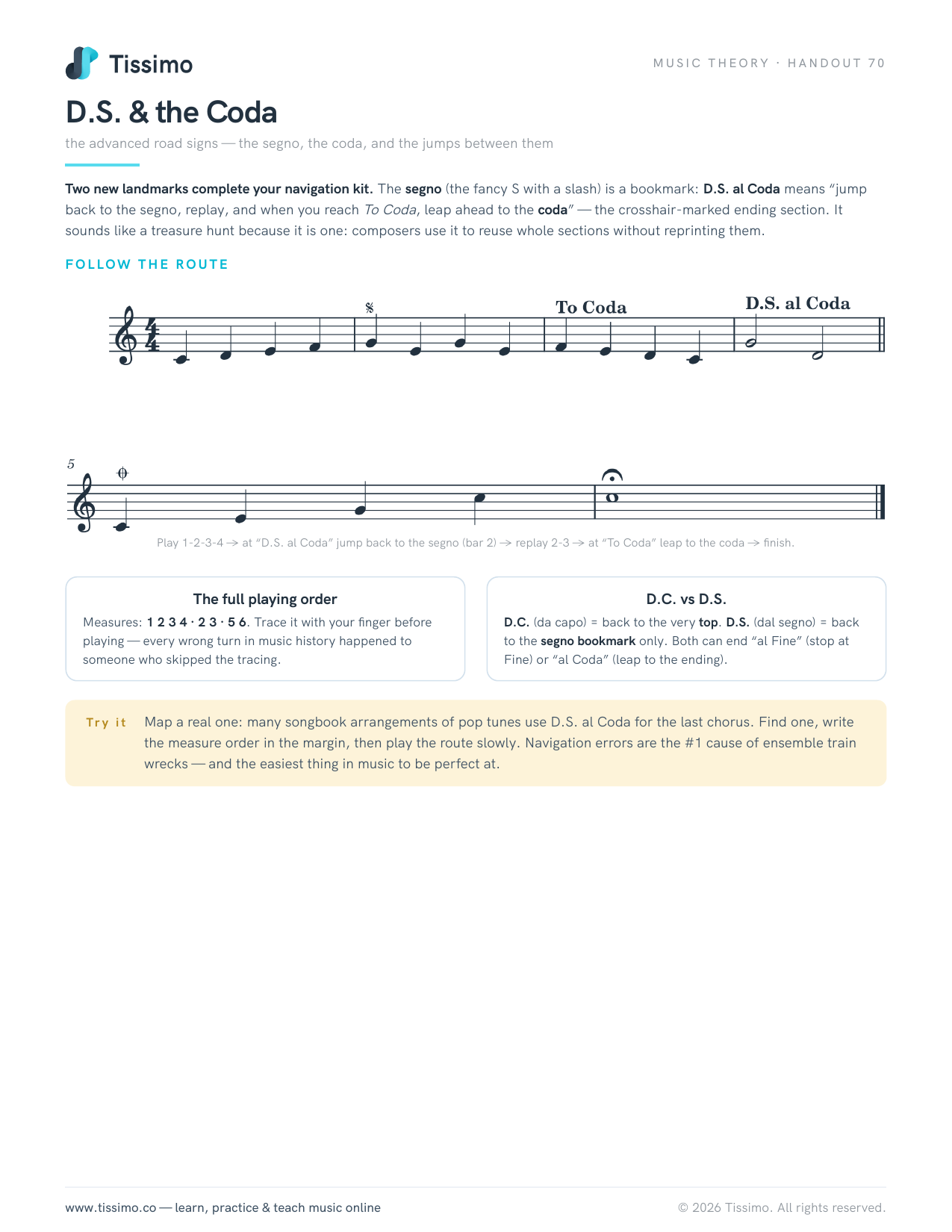
D.S.(反始记号)与尾奏(Coda)
进阶的“路标”符号——反始记号、尾奏记号,以及它们之间的跳转
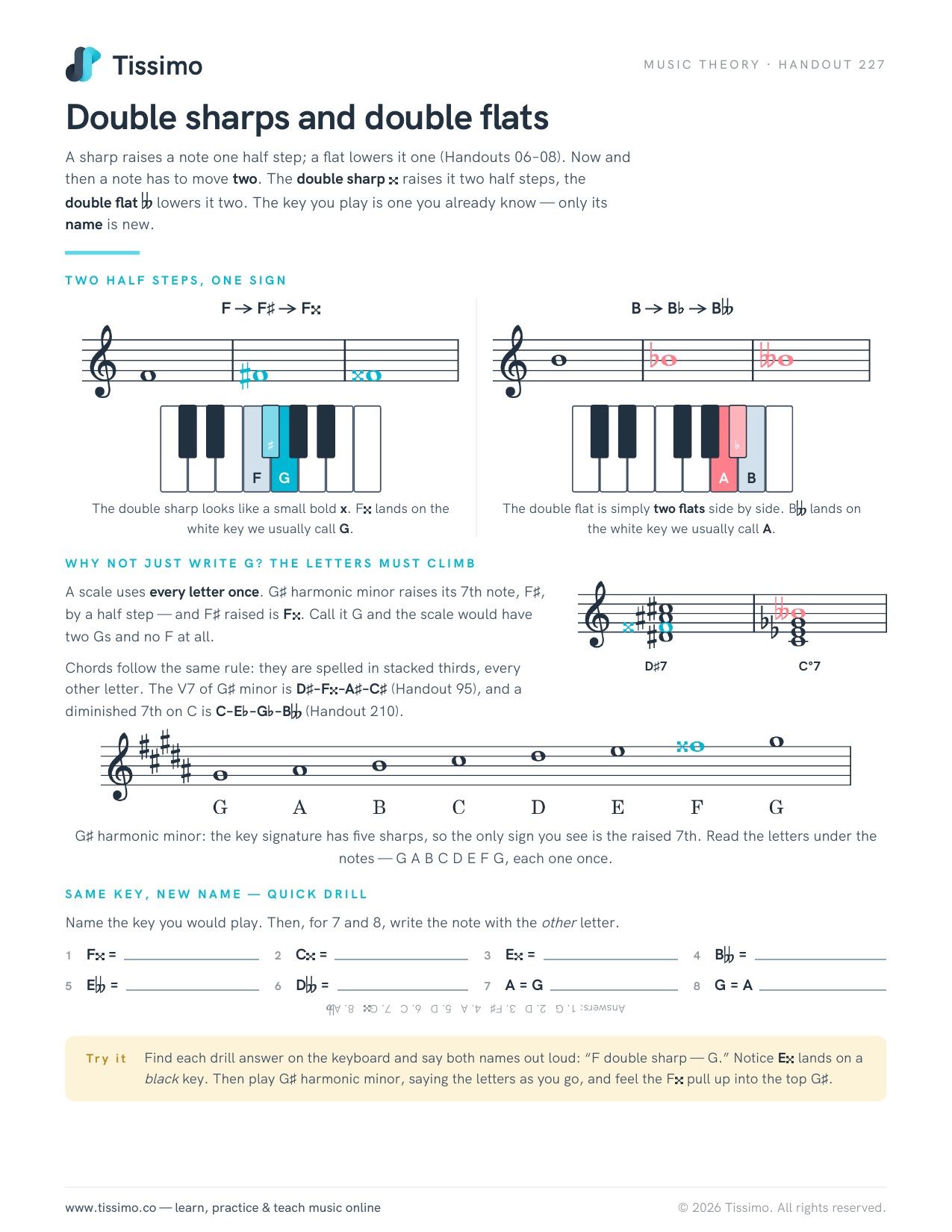
Double sharps and double flats
A sharp raises a note one half step; a flat lowers it one (Handouts 06–08). Now and then a note has to move two. The double sharp raises it two half steps, the double flat lowers it two. The key you play is one you already know — only its name is new.
音程
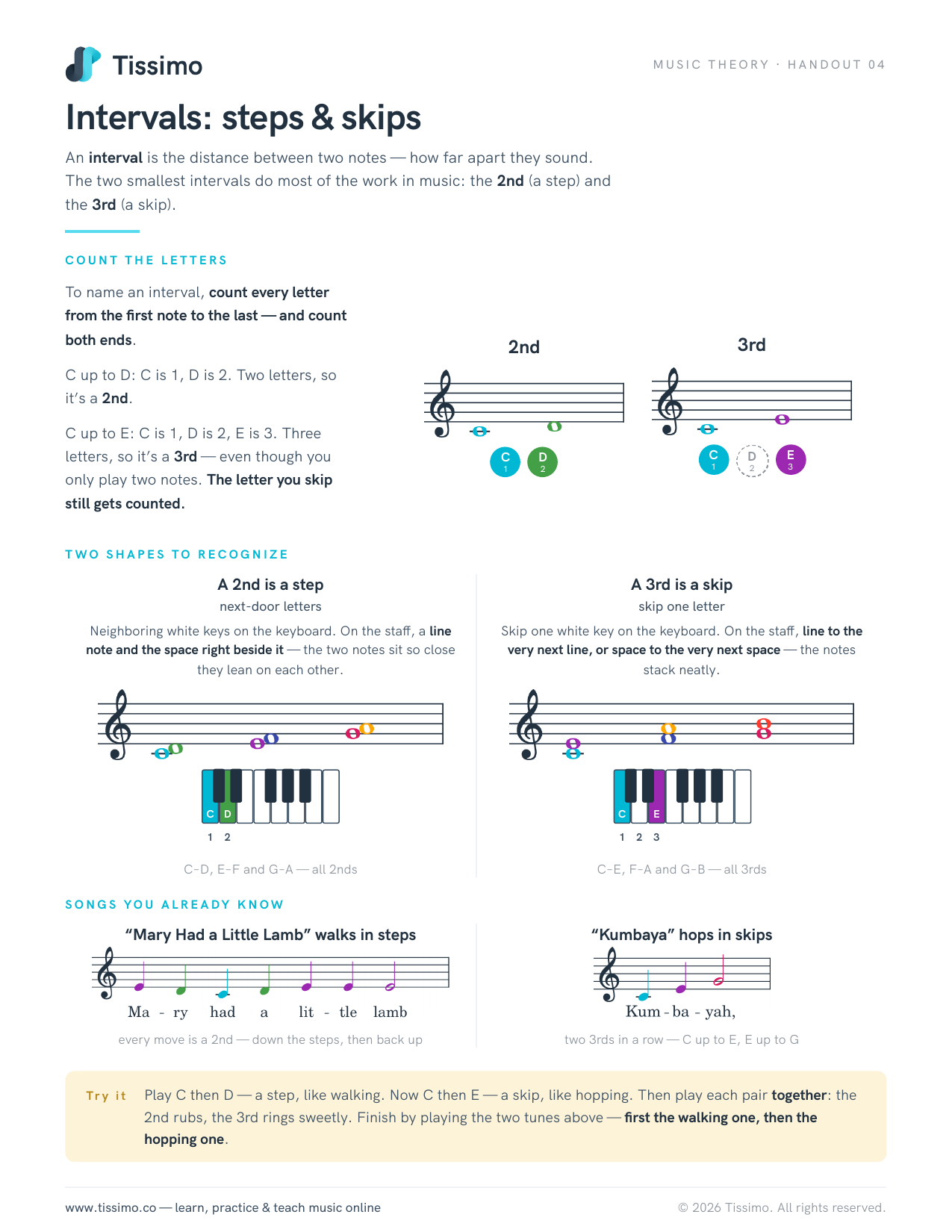
音程:级进与跳进
音程是两个音之间的距离——听起来相差多远。音乐中用得最多的是两个最小的音程:二度(级进)和三度(跳进)。
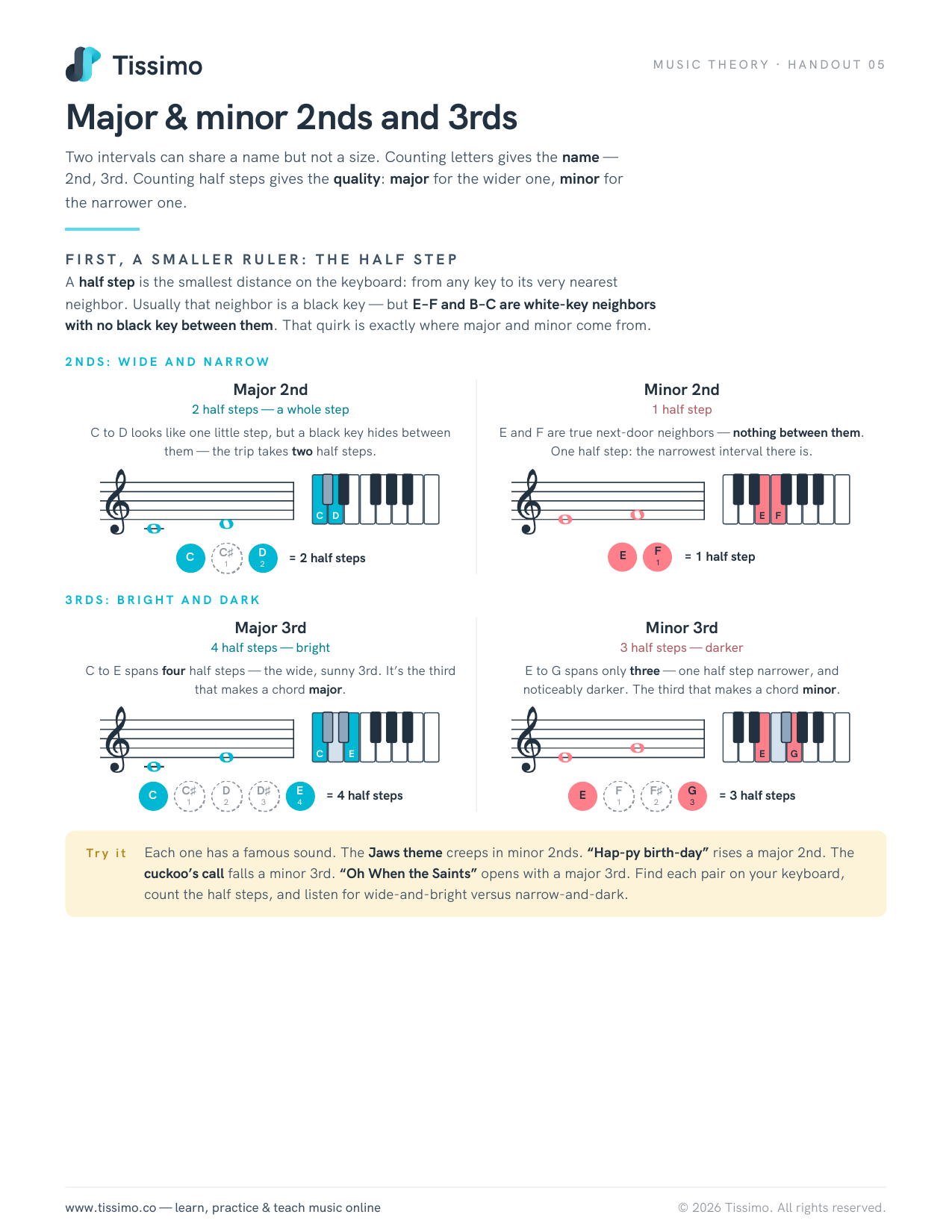
大二度、小二度与大三度、小三度
两个音程可能名字相同,但宽窄不同。数字母(音级)得出名称——二度、三度。数半音数得出性质:更宽的叫大,更窄的叫小。
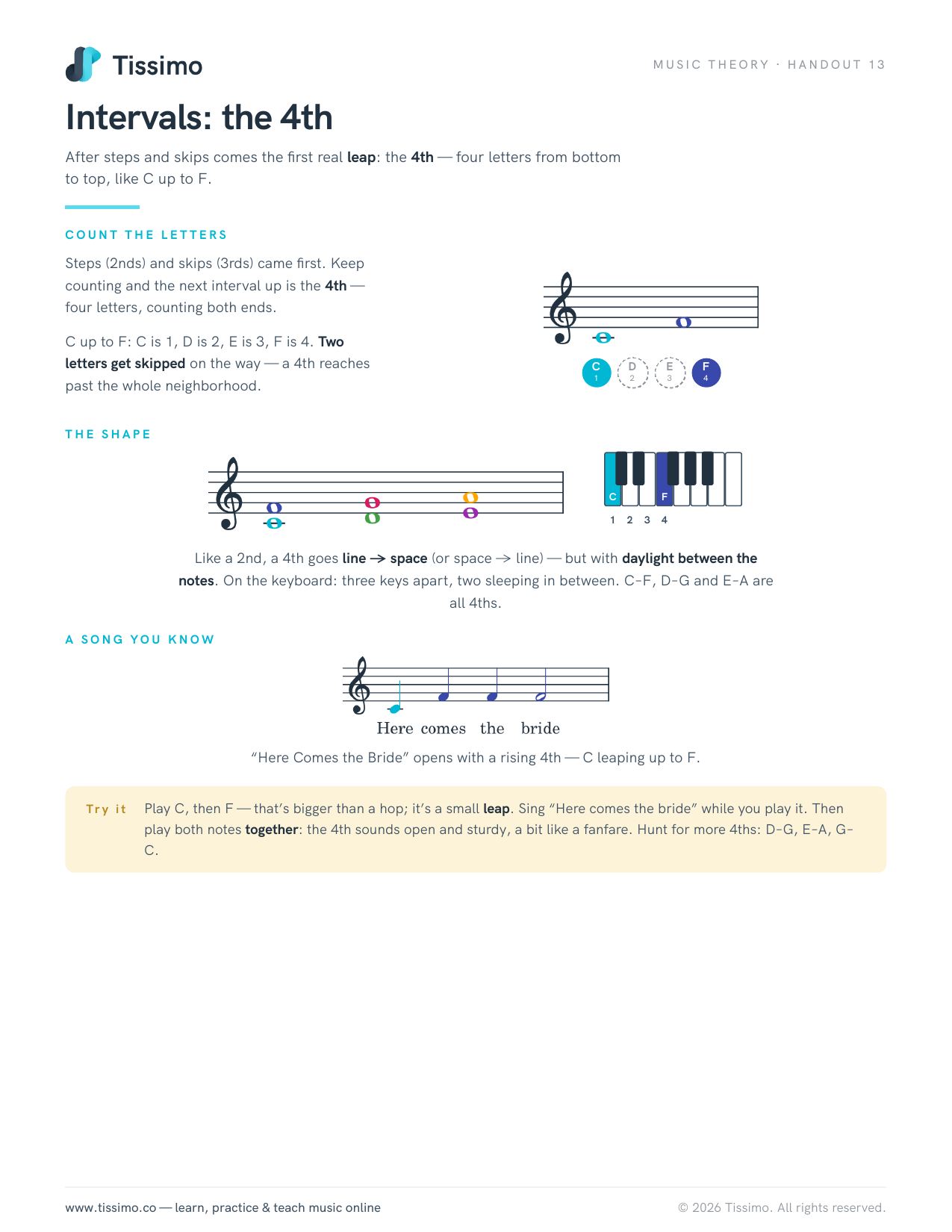
音程:四度
在级进和跳进之后,迎来第一个真正的大跳:四度——从下到上数四个音名,比如从C到F。
音程:五度
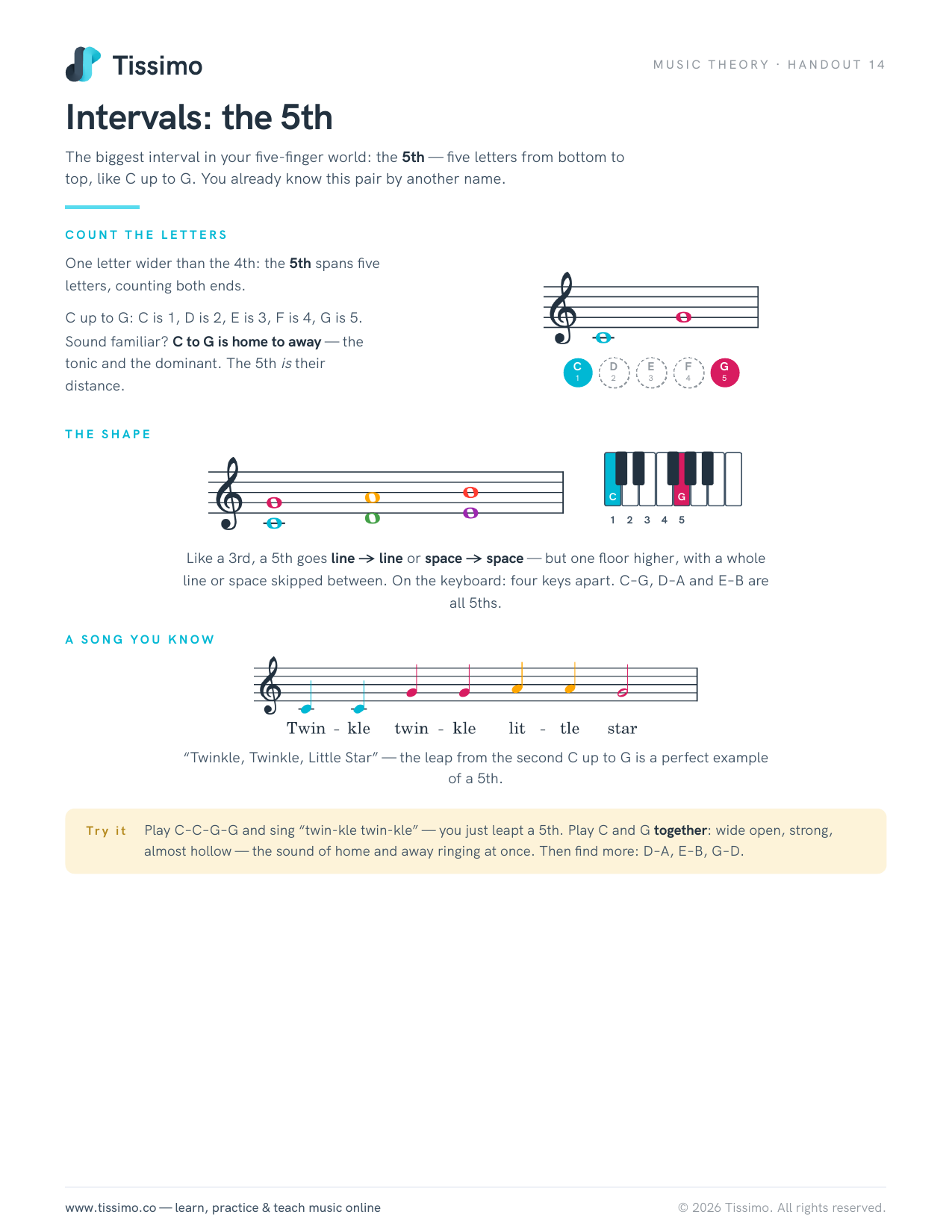
在你的五指音阶世界里,最大的音程就是五度——从下到上数五个音名,比如从C到G。这一对音程你其实早就用另一个名字认识它了。
六度、七度与八度
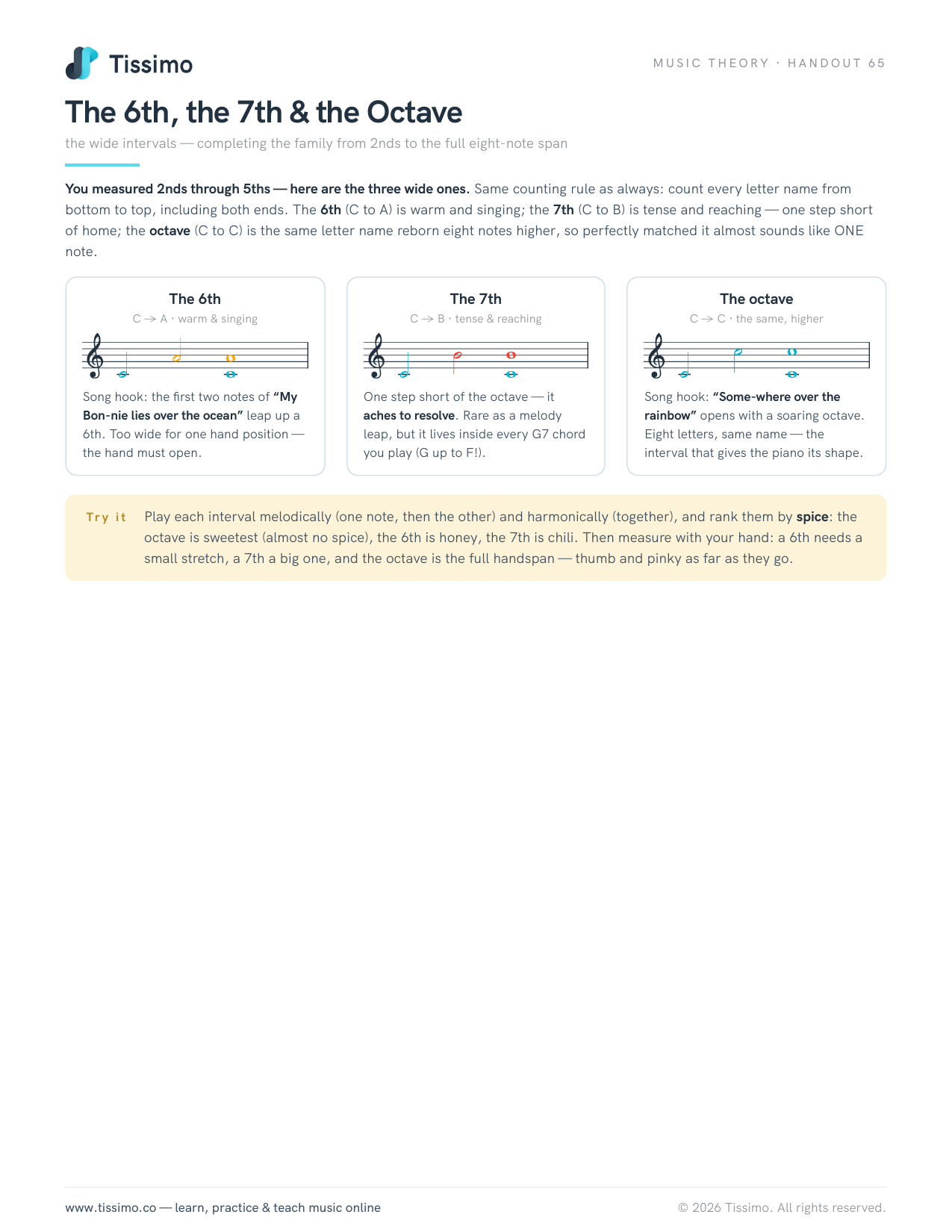
宽广的音程——把从二度开始的音程家族,一直延伸到完整的八音跨度
Inverting intervals & compound intervals
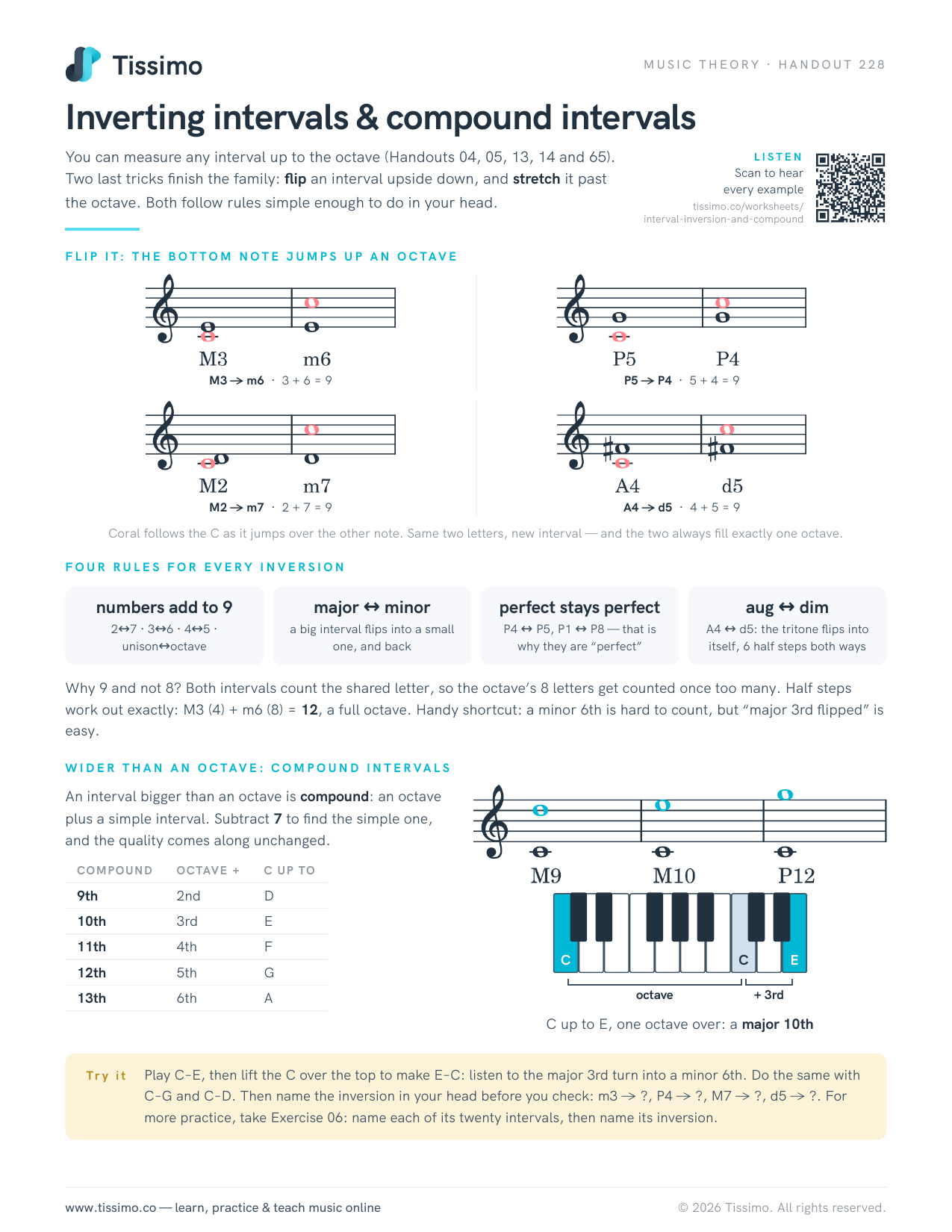
You can measure any interval up to the octave (Handouts 04, 05, 13, 14 and 65). Two last tricks finish the family: flip an interval upside down, and stretch it past the octave. Both follow rules simple enough to do in your head.
音阶与调性
C调五指音阶
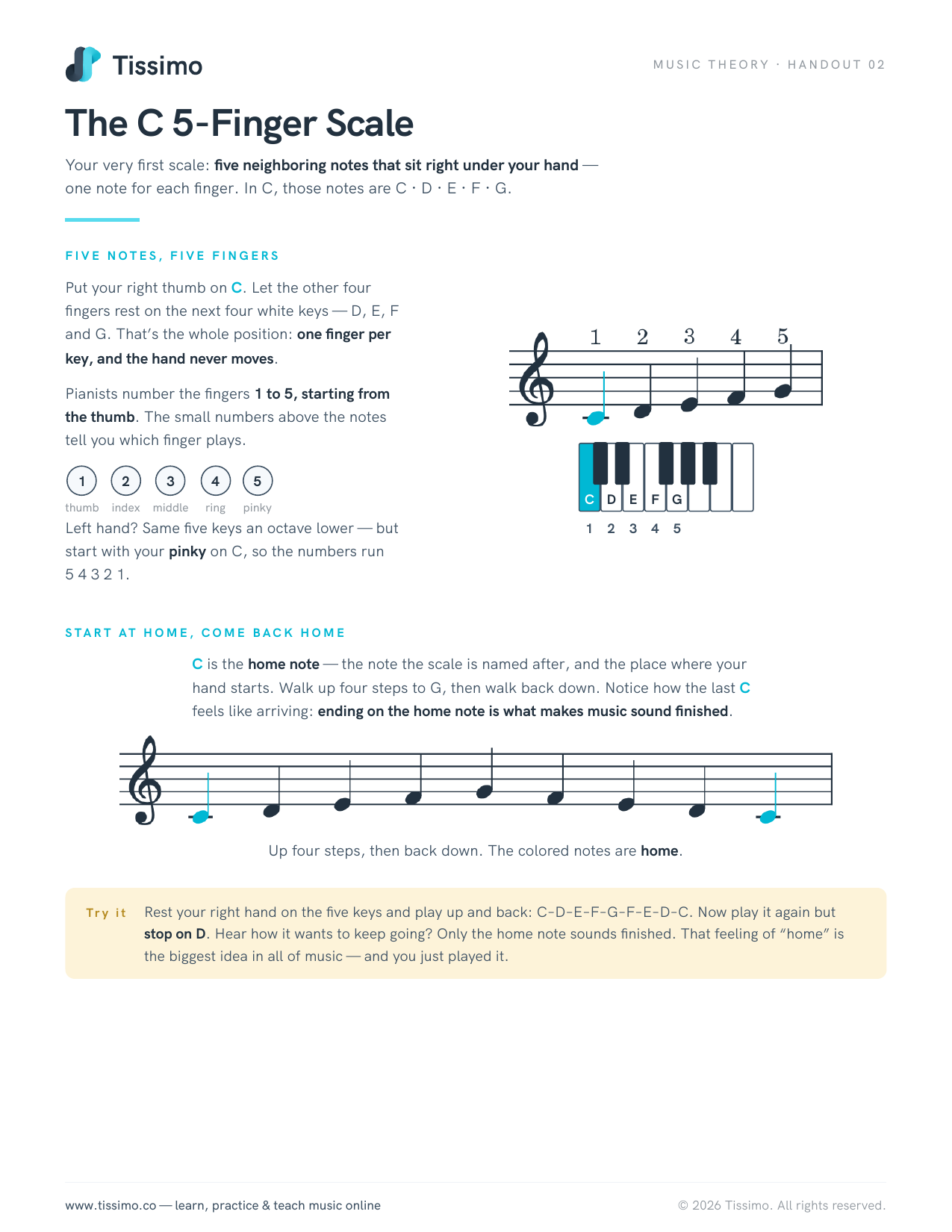
你的第一个音阶:五个相邻的音,正好落在手掌下方——一个手指对应一个音。在C调中,这些音是C·D·E·F·G。
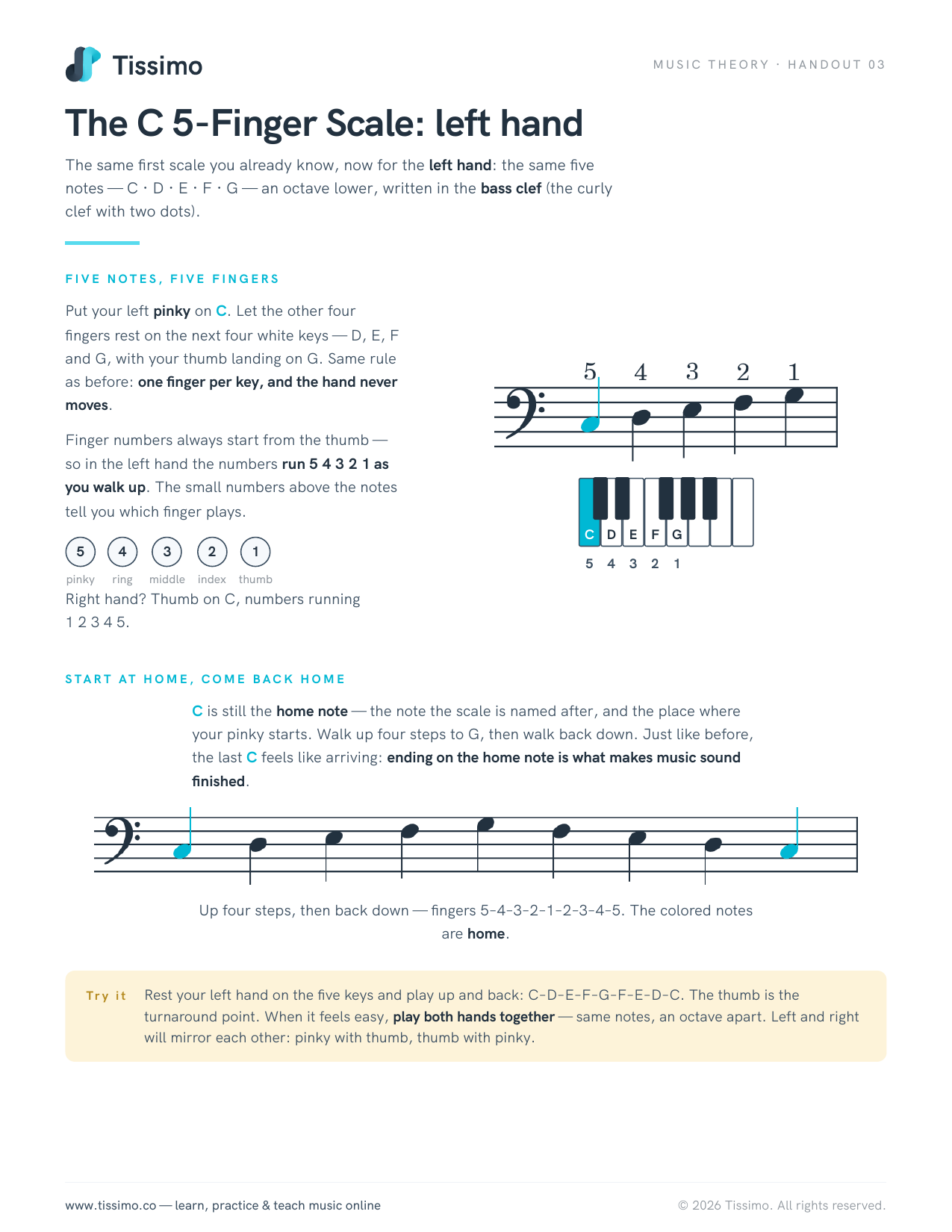
C调五指音阶:左手
还是你已经熟悉的第一个音阶,这次换成左手弹奏:同样的五个音——C·D·E·F·G——低八度,用低音谱号记谱(那个带两个点的弯曲符号)。
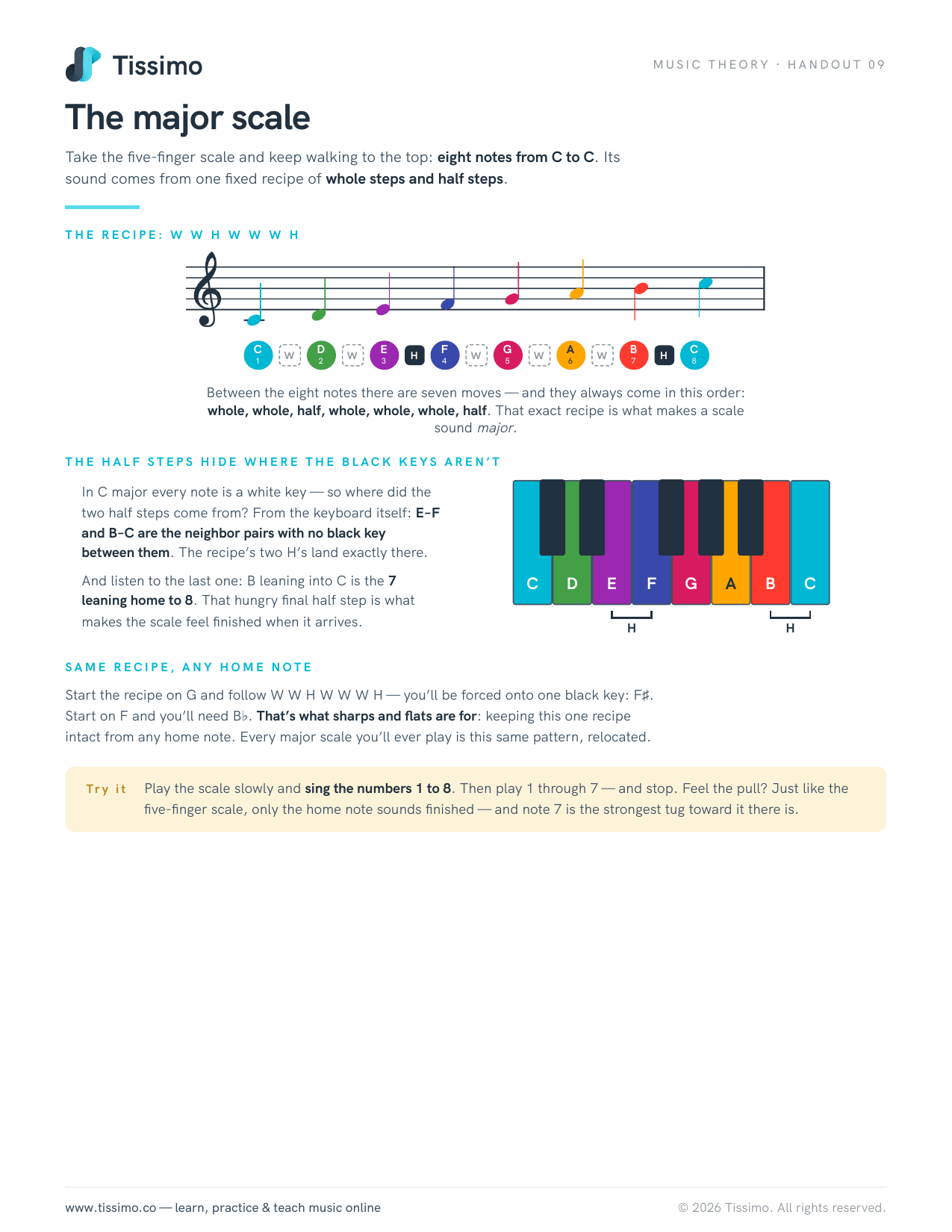
大调音阶
把五指音阶继续往上走到底:从C到C共八个音。它的声音来自一份固定的全音与半音配方。
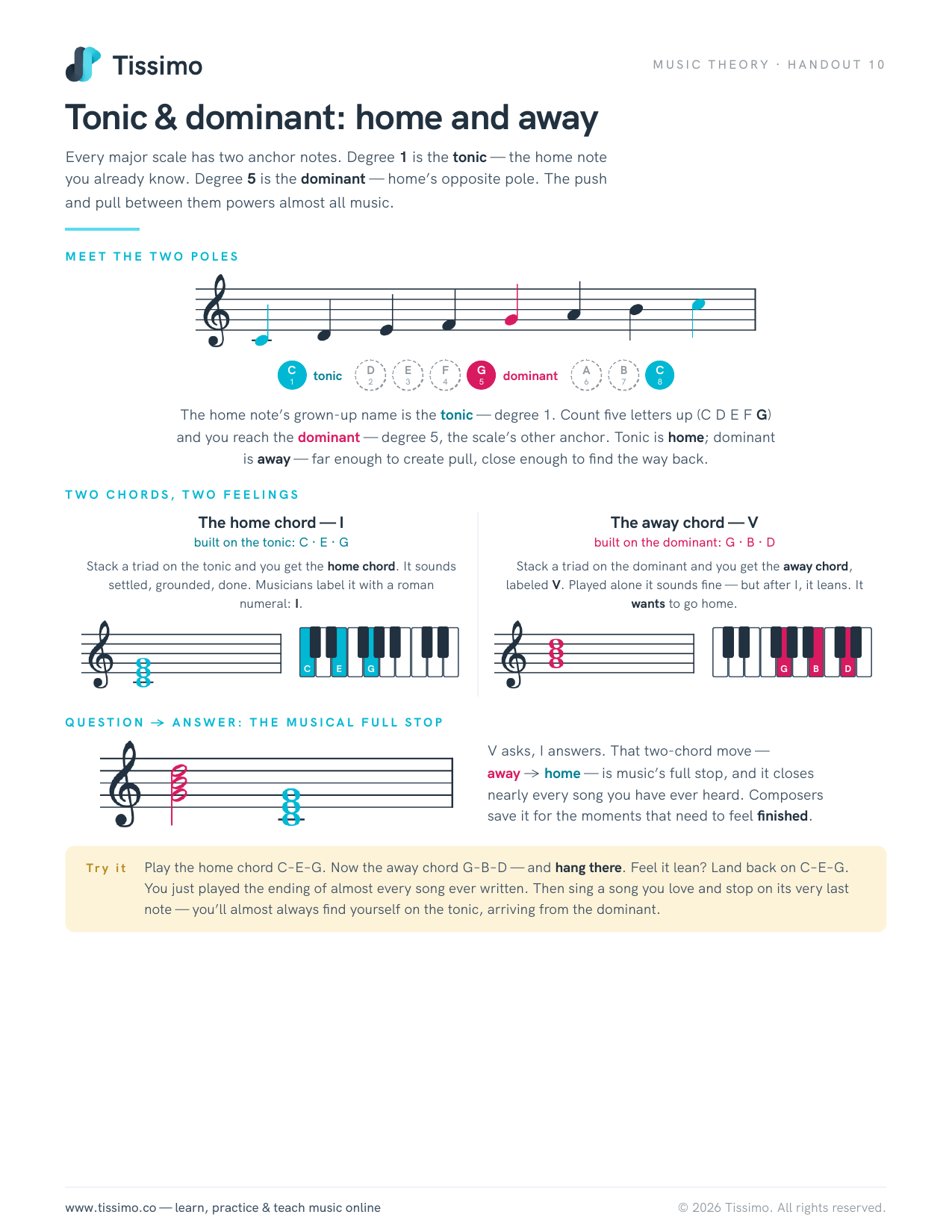
主音与属音:家与远方
每个大调音阶都有两个“锚点”音。第1级是主音——你早已熟悉的“家”音。第5级是属音——与主音相对的另一极。它们之间的拉扯,驱动着几乎所有的音乐。
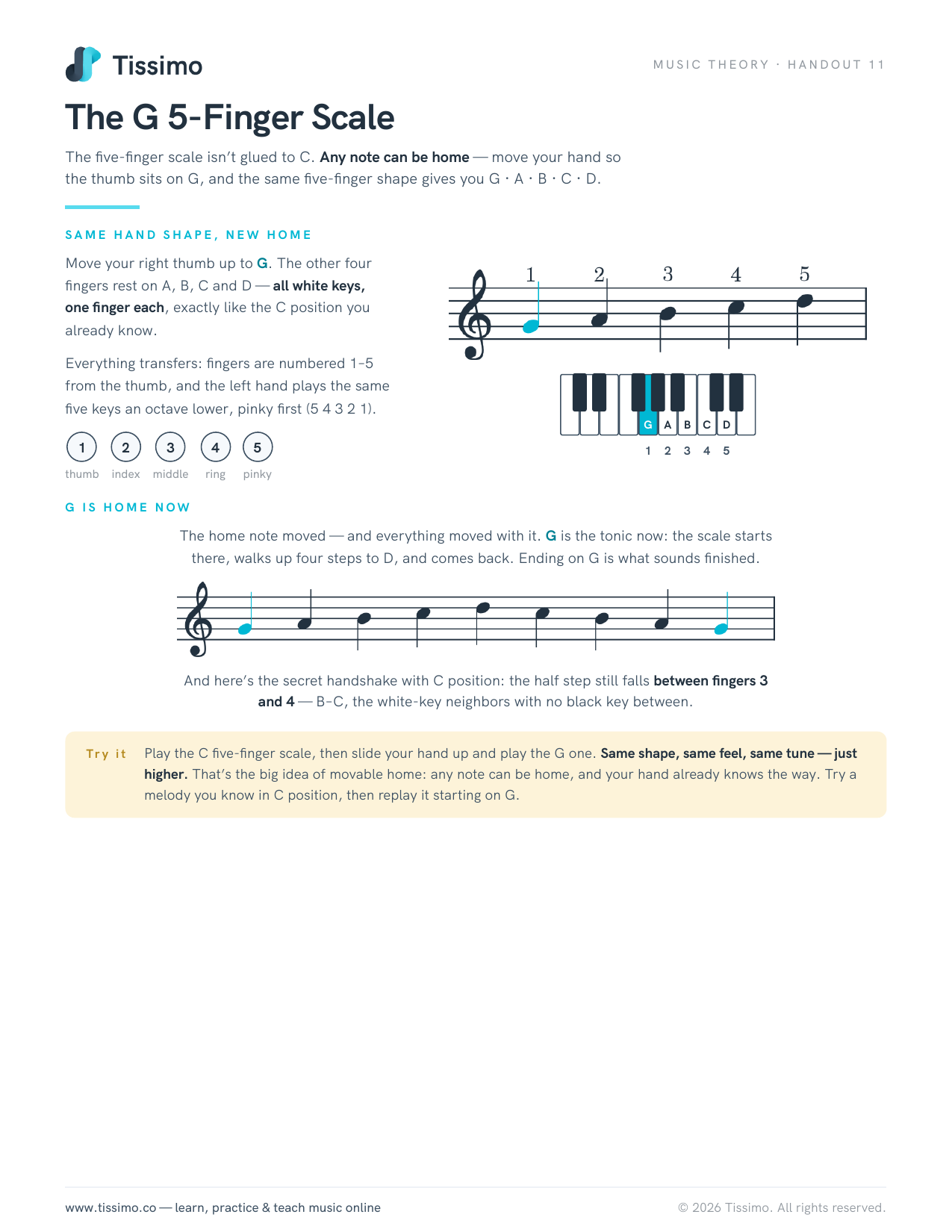
G调五指音阶
五指音阶并不是只能从C开始。任何一个音都可以成为“家”——把手移动到大拇指放在G上,同样的五指手型会给你G·A·B·C·D。
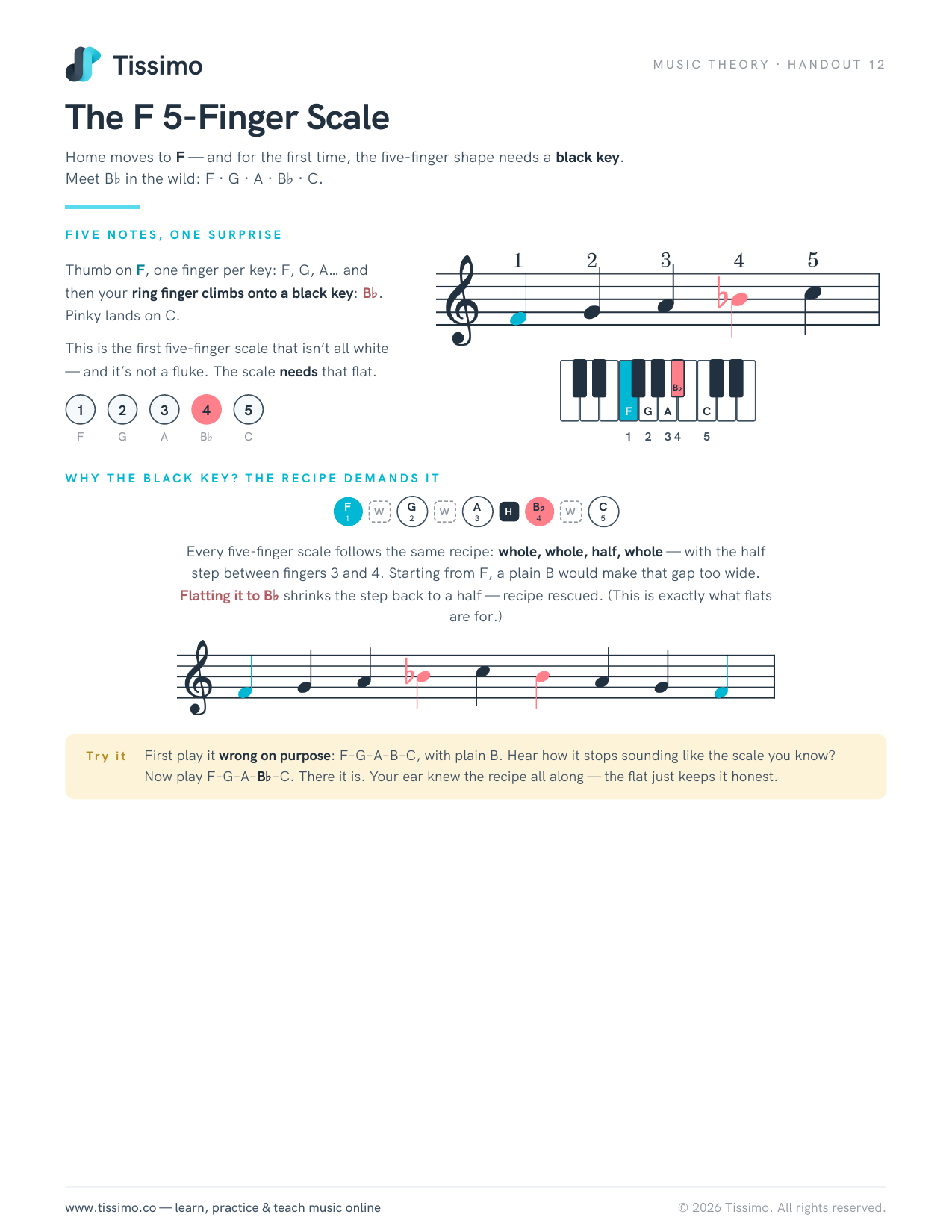
F调五指音阶
「家」搬到了F——五指手型第一次需要用到黑键。认识一下“野外”的B♭:F·G·A·B♭·C。
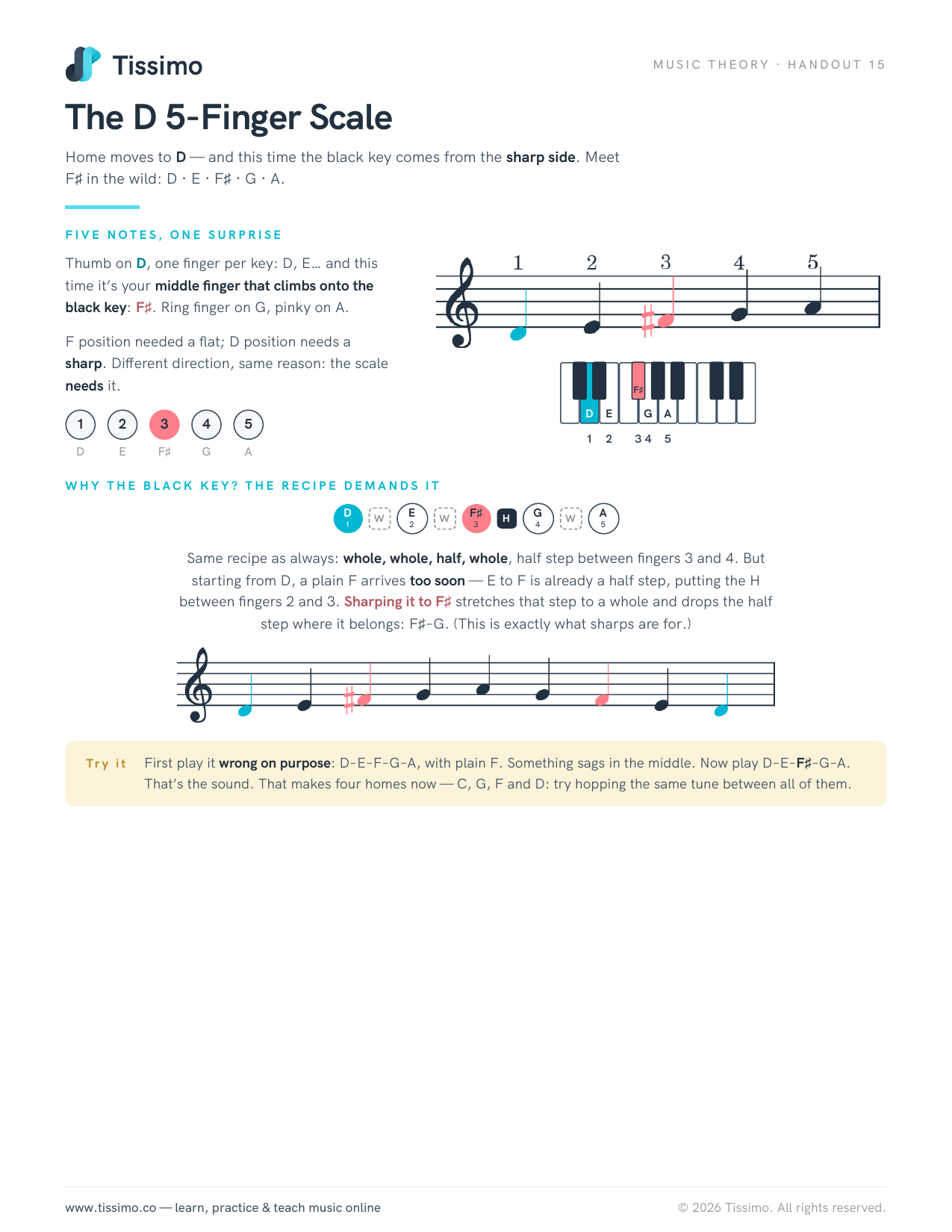
D调五指音阶
「家」搬到了D——这次黑键来自升号那一侧。认识一下“野外”的F♯:D·E·F♯·G·A。
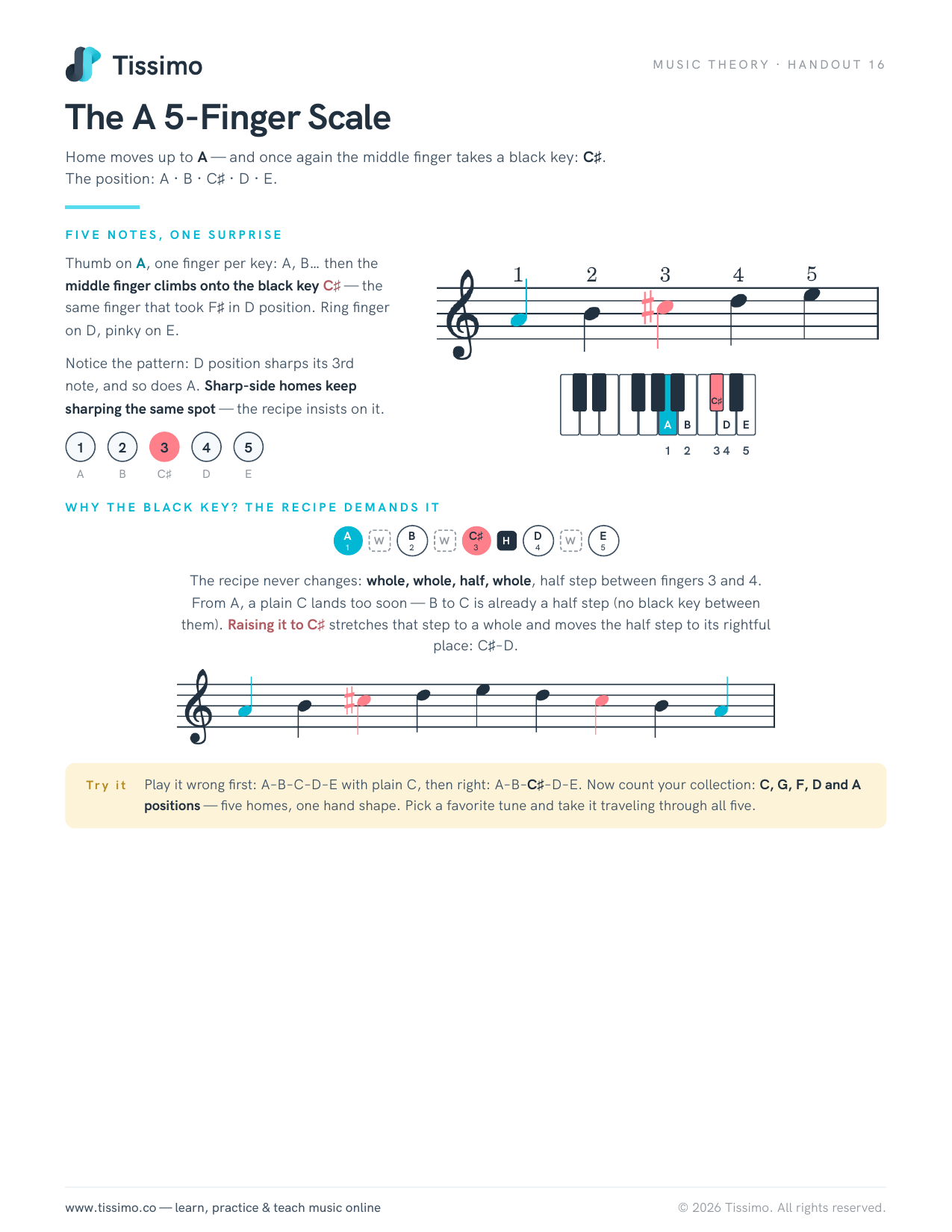
A调五指音阶
「家」升到了A——中指再次弹到黑键:C♯。指法位置:A·B·C♯·D·E。
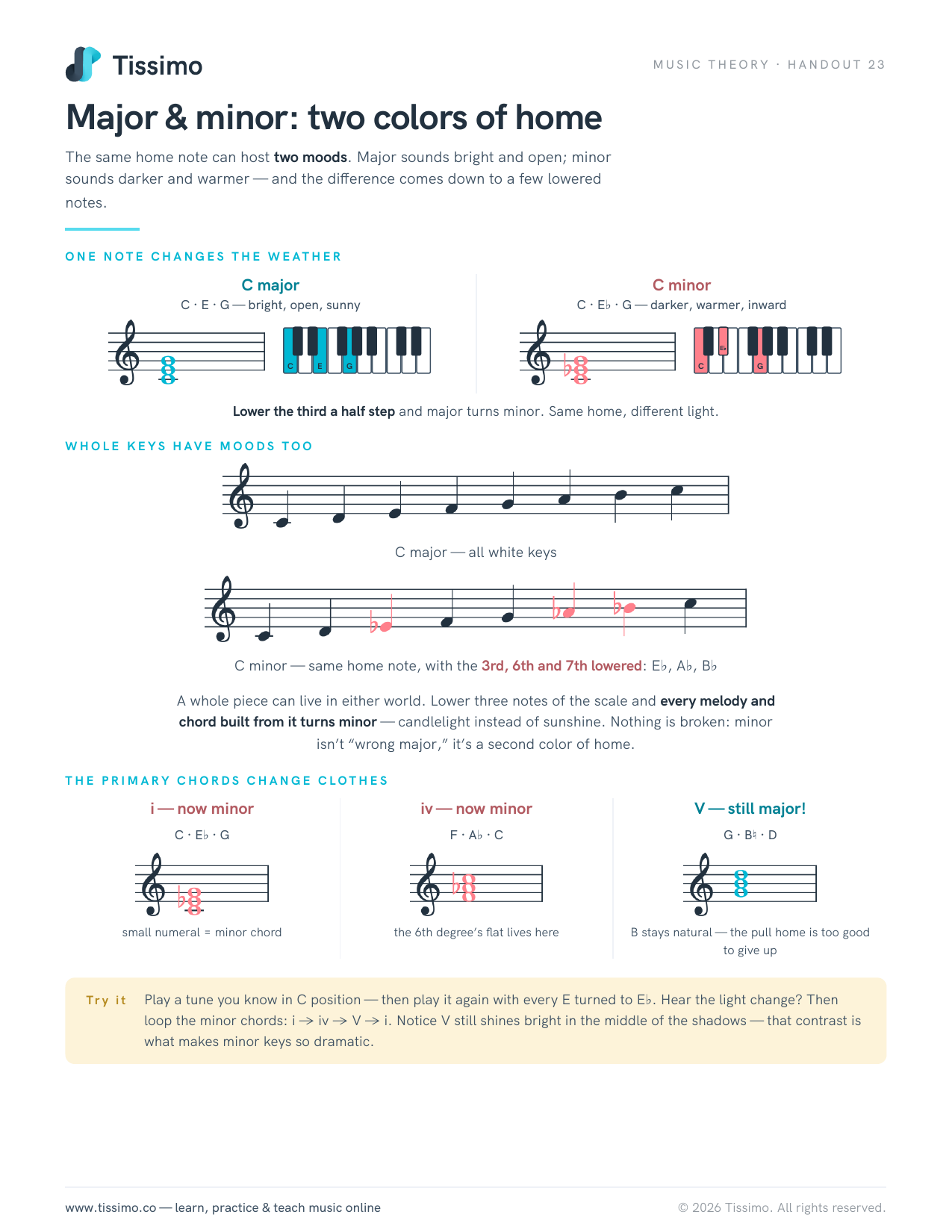
大调与小调:同一个“家”的两种色彩
同一个主音之家,可以呈现两种情绪。大调听起来明亮开阔;小调听起来更暗、更温暖——两者的区别只在于降低了几个音。
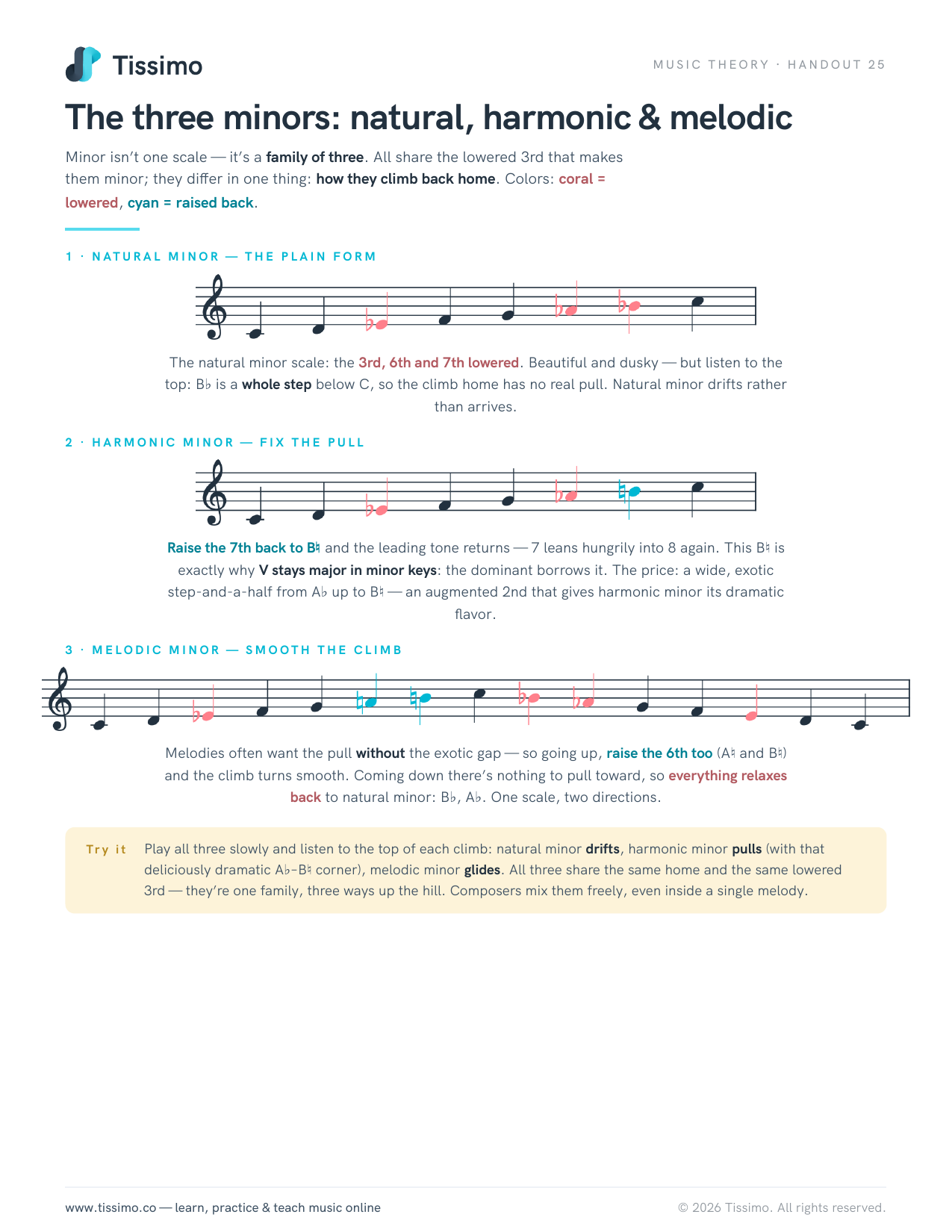
三种小调:自然小调、和声小调与旋律小调
小调不是一个音阶,而是一个由三种组成的家族。它们都有让调式变“小”的降三级音;区别只在一点:如何爬回主音“家”。颜色说明:珊瑚色=降低的音,青色=重新升高的音。
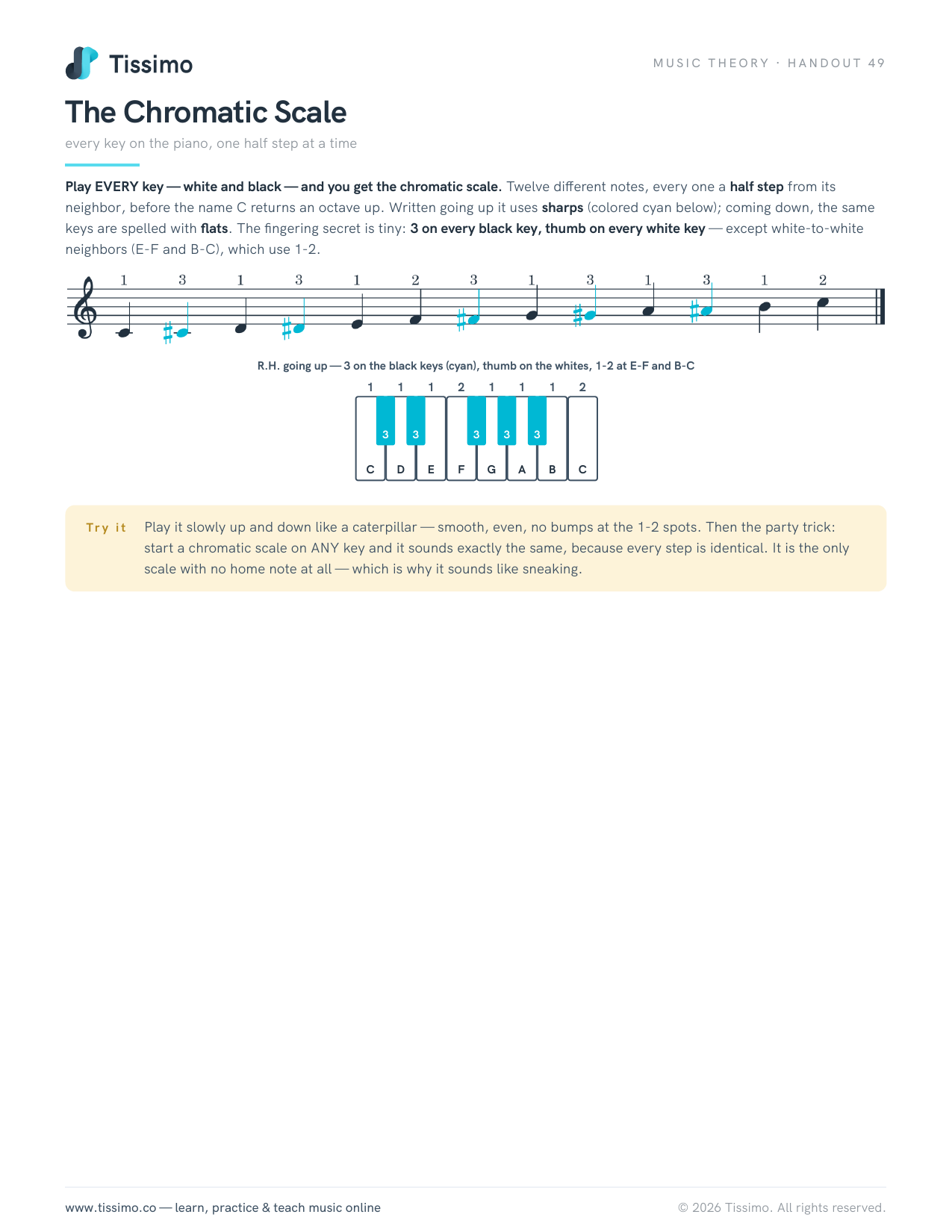
半音阶
钢琴上的每一个键,一个半音接一个半音
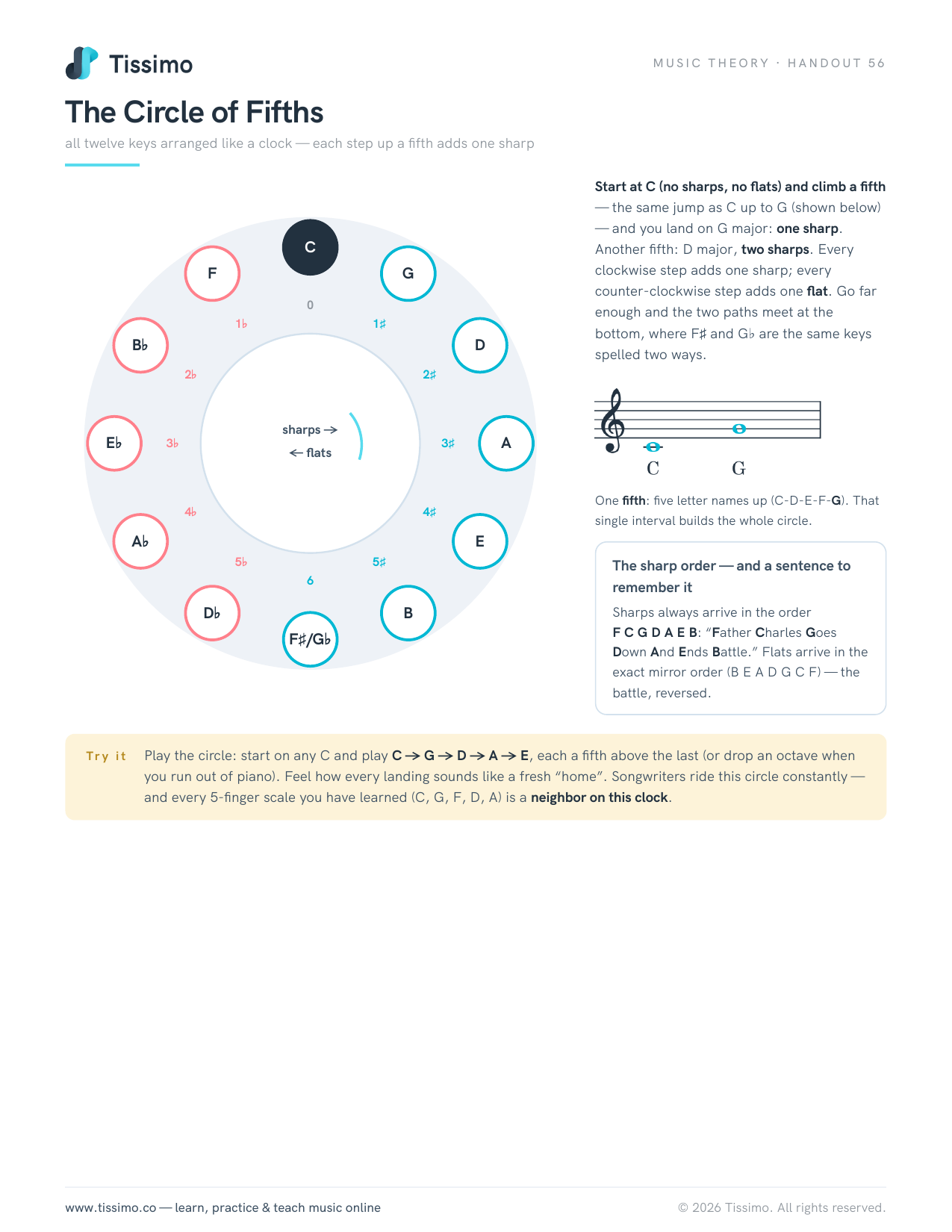
五度圈
十二个调像时钟一样排列——每上升一个五度就多一个升号
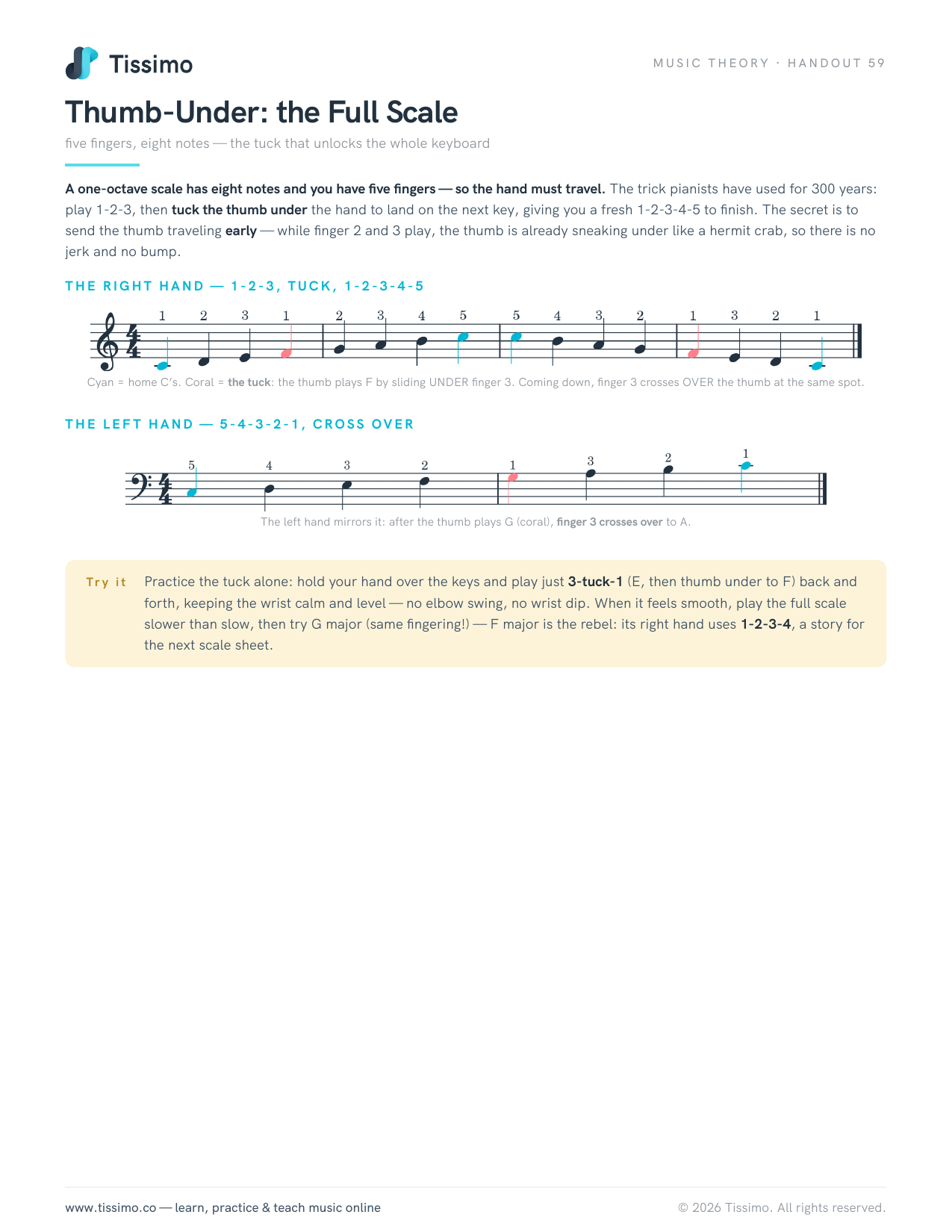
穿指技巧:完整音阶
五根手指,八个音——那个能打开整个键盘的“穿指”
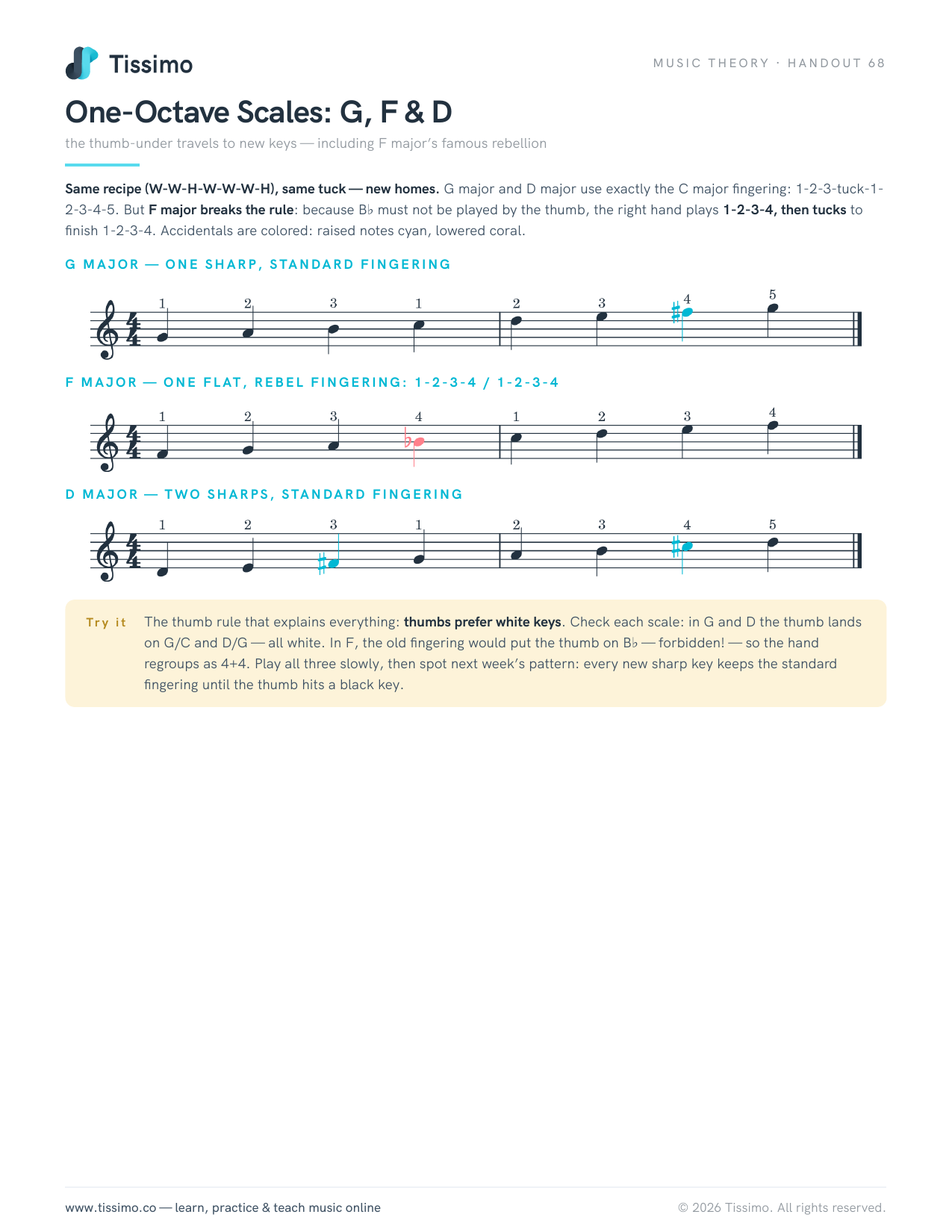
单八度音阶:G调、F调与D调
穿指技巧走进新的调——包括F大调那个著名的“叛逆”指法
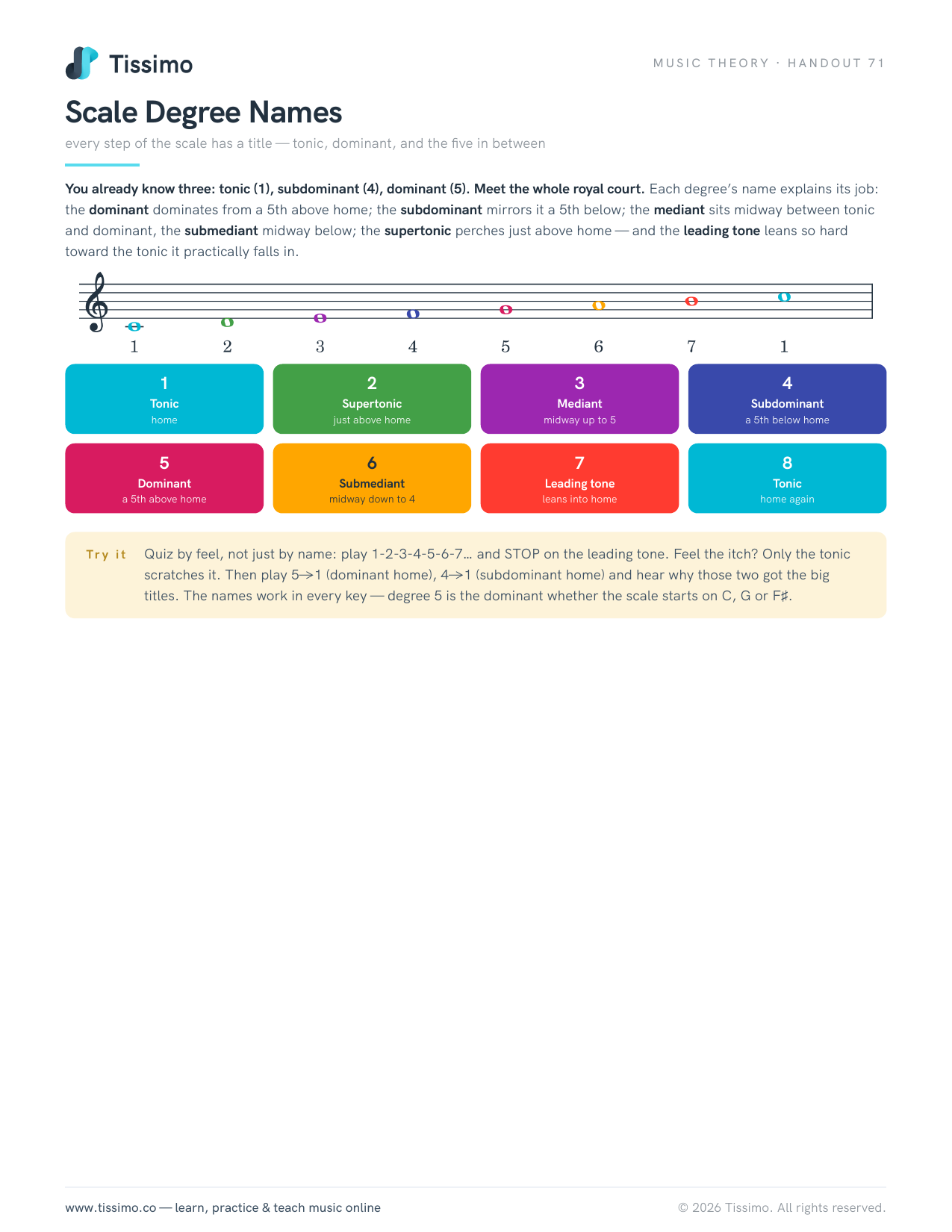
音阶级数名称
音阶的每一级都有自己的名字——主音、属音,以及中间的其余五个
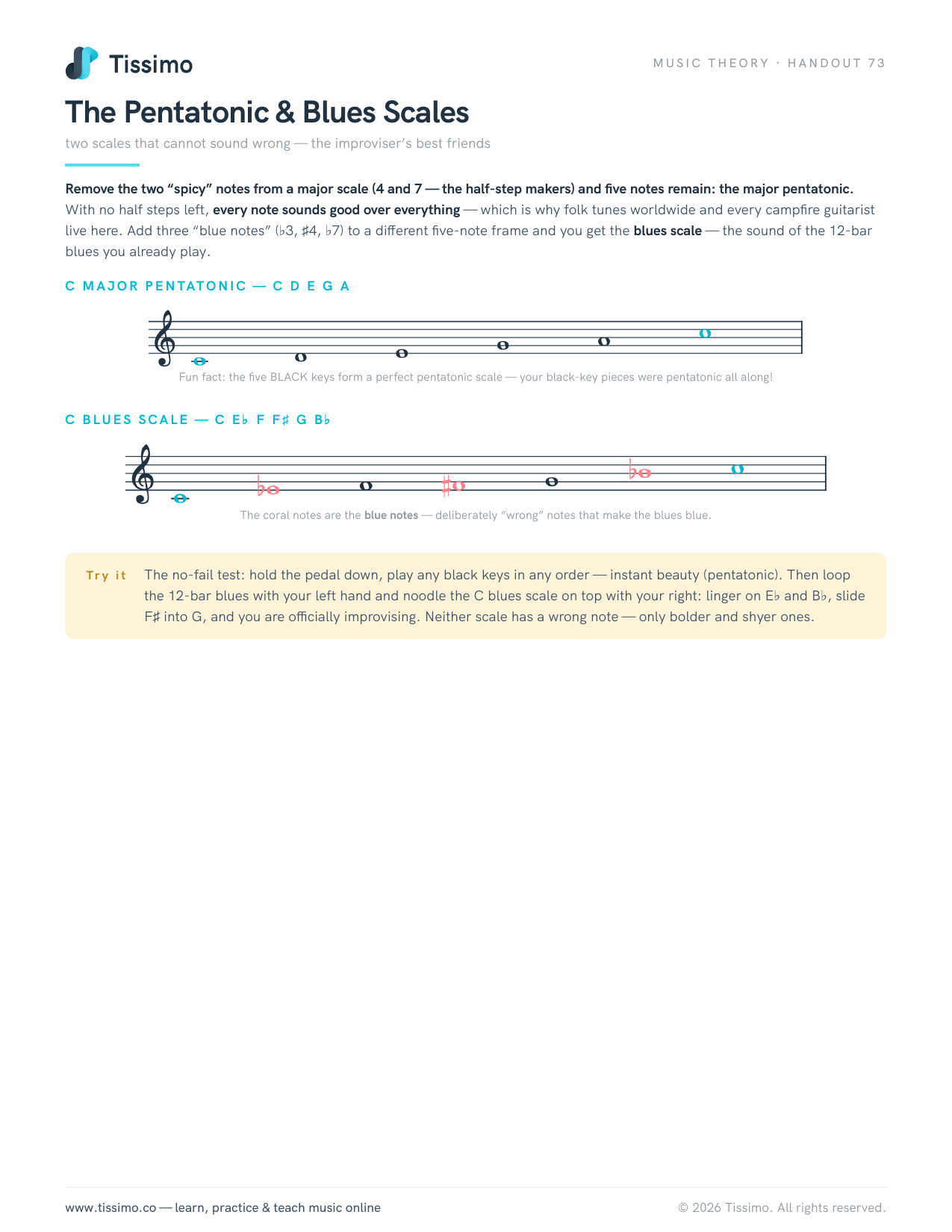
五声音阶与蓝调音阶
两种怎么弹都不会“出错”的音阶——即兴演奏者最好的朋友
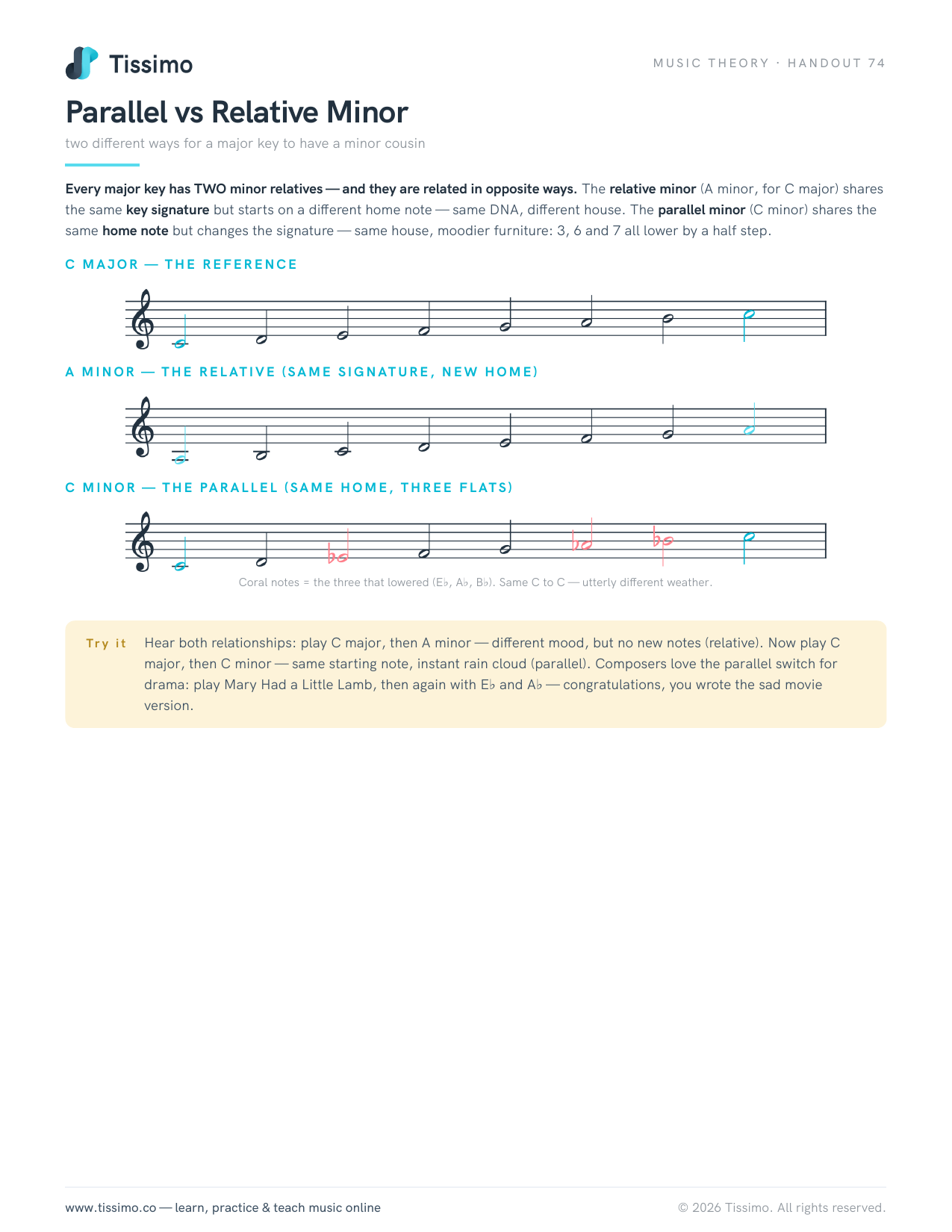
同主小调与关系小调
大调拥有“小调表亲”的两种不同方式
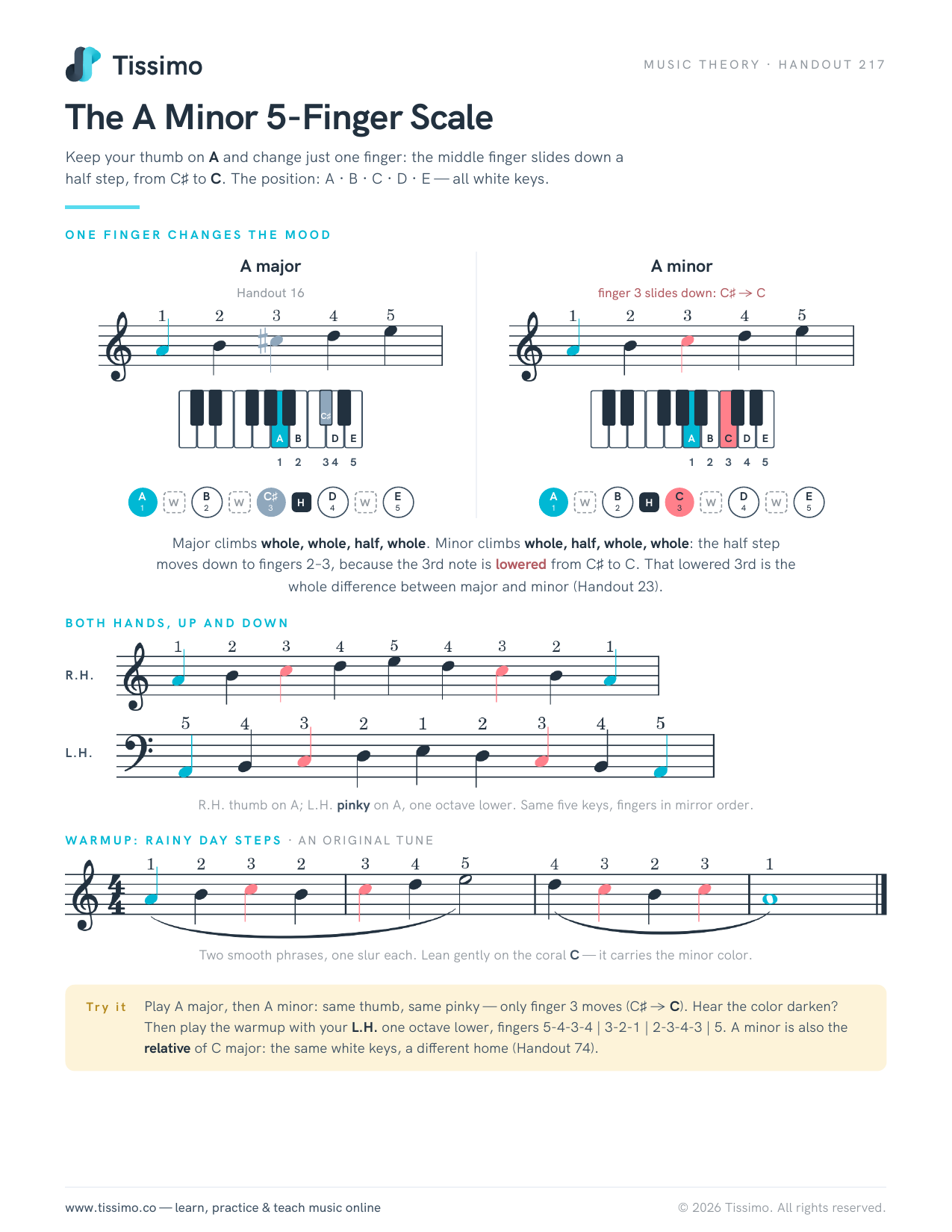
The A Minor 5-Finger Scale
Keep your thumb on A and change just one finger: the middle finger slides down a half step, from C♯ to C. The position: A · B · C · D · E — all white keys.
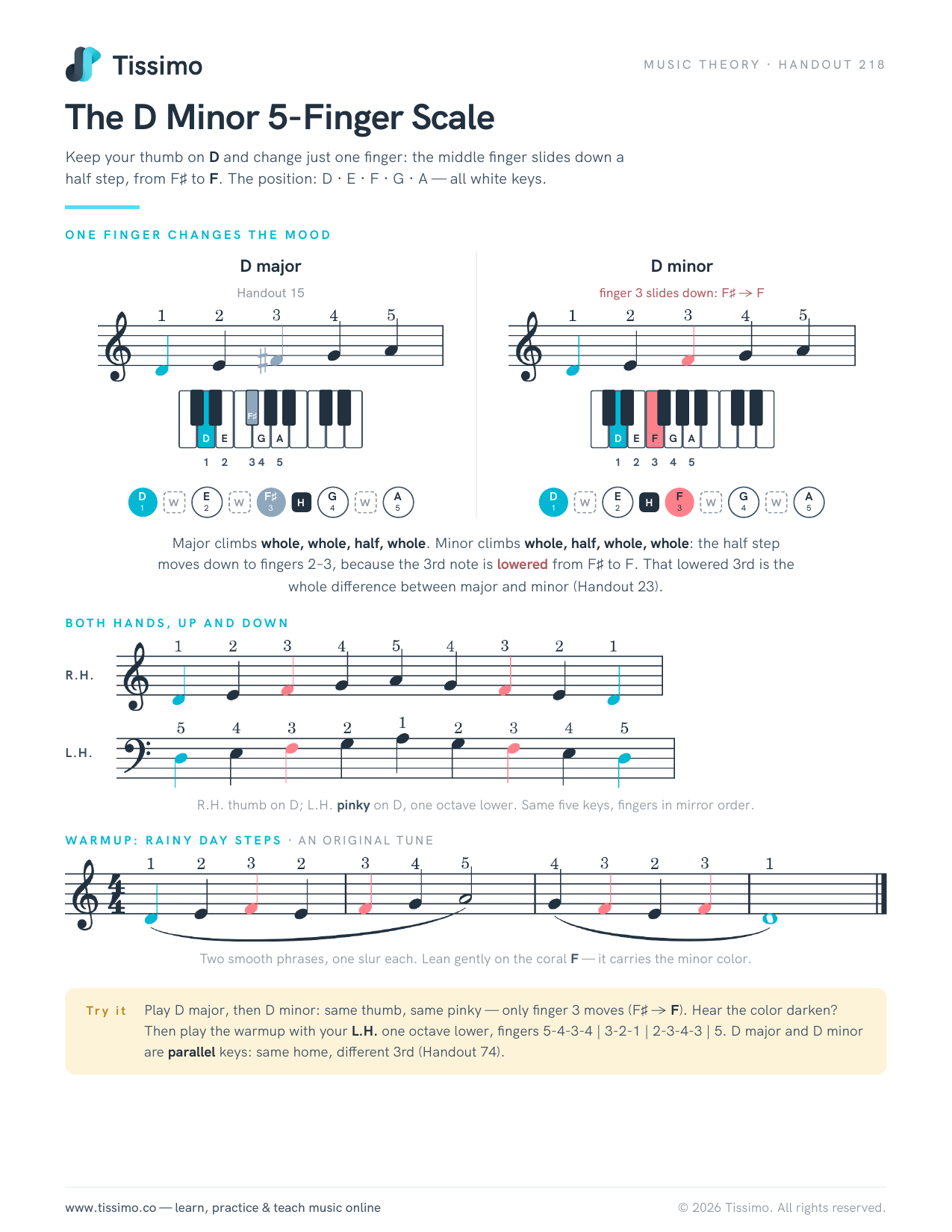
The D Minor 5-Finger Scale
Keep your thumb on D and change just one finger: the middle finger slides down a half step, from F♯ to F. The position: D · E · F · G · A — all white keys.
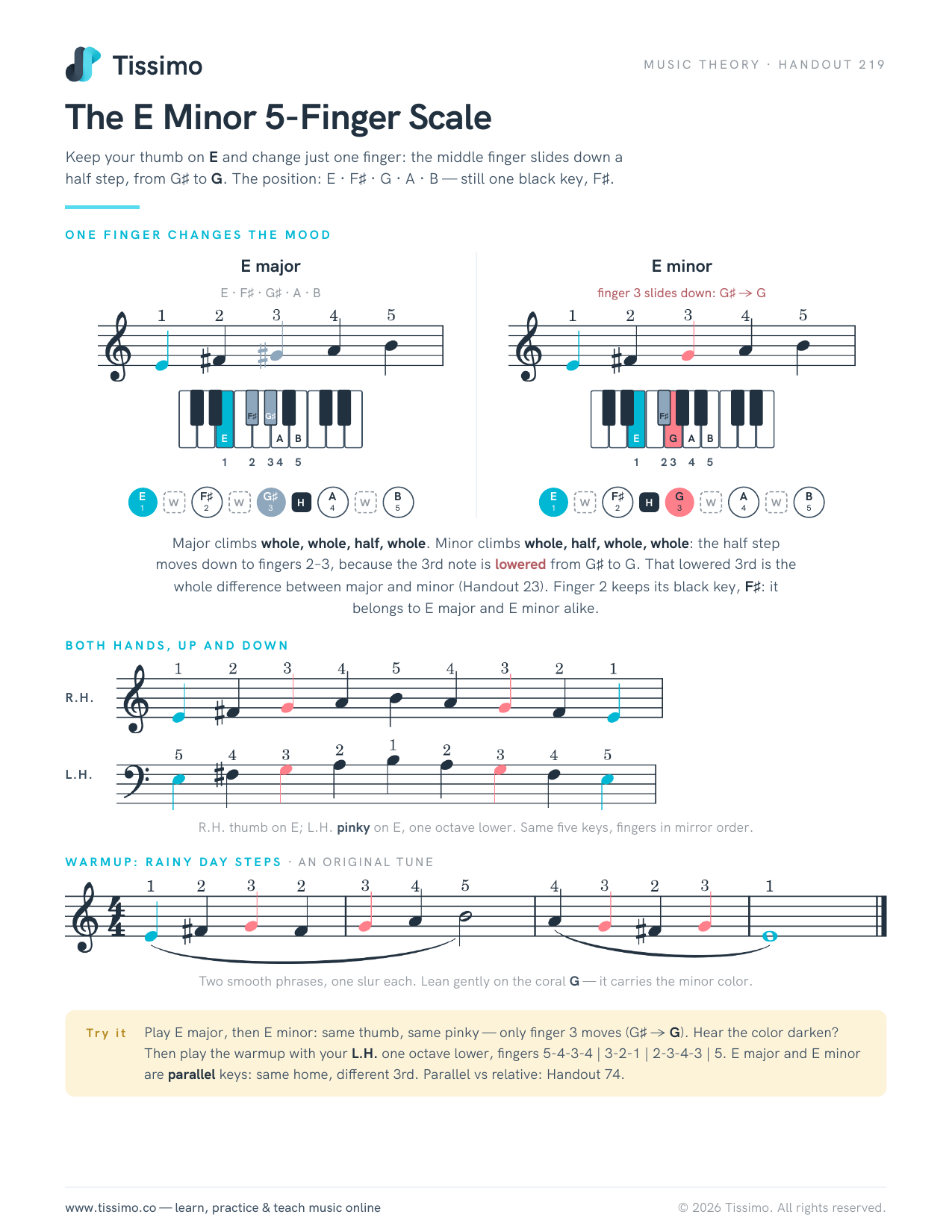
The E Minor 5-Finger Scale
Keep your thumb on E and change just one finger: the middle finger slides down a half step, from G♯ to G. The position: E · F♯ · G · A · B — still one black key, F♯.
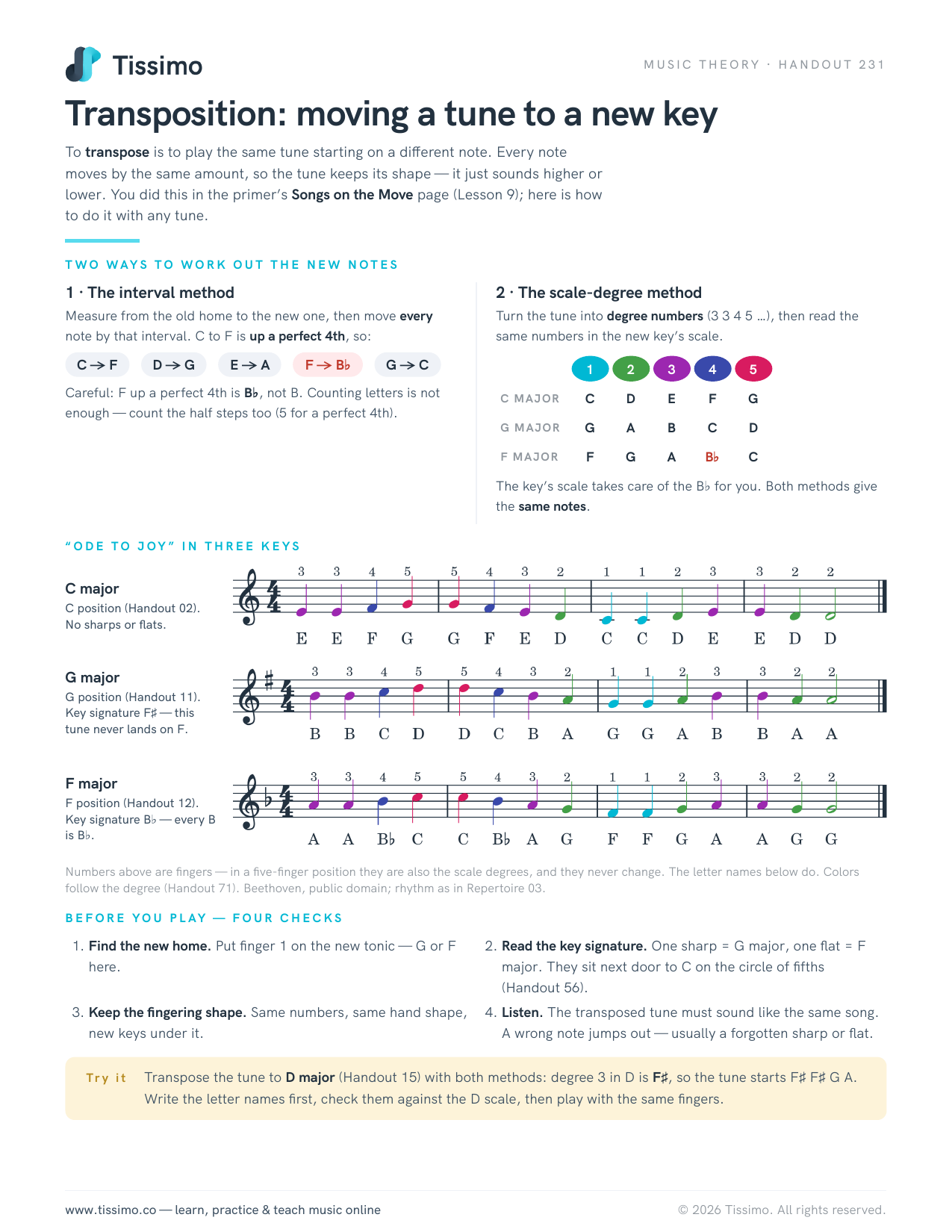
Transposition: moving a tune to a new key
To transpose is to play the same tune starting on a different note. Every note moves by the same amount, so the tune keeps its shape — it just sounds higher or lower. You did this in the primer’s Songs on the Move page (Lesson 9); here is how to do it with any tune.
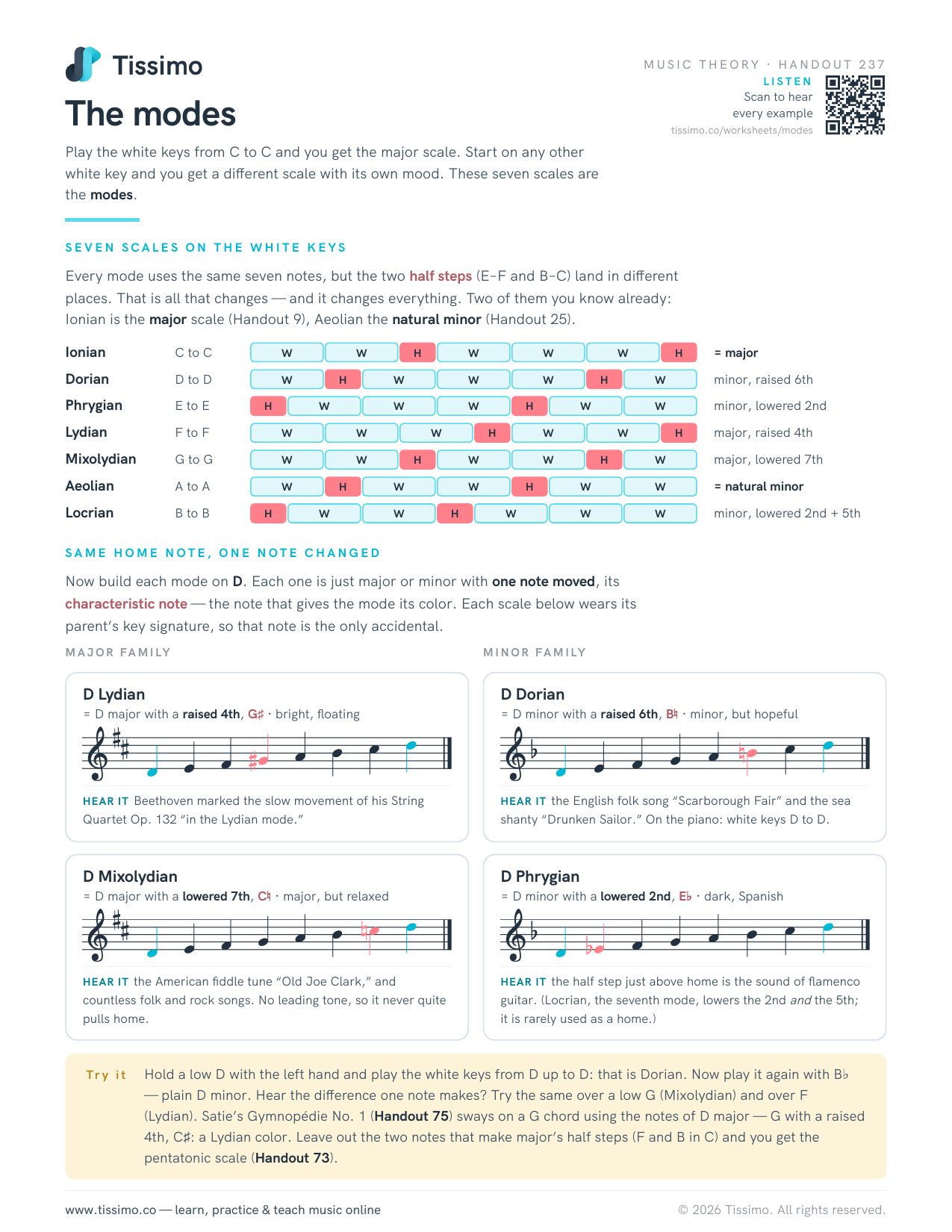
The modes
Play the white keys from C to C and you get the major scale. Start on any other white key and you get a different scale with its own mood. These seven scales are the modes.
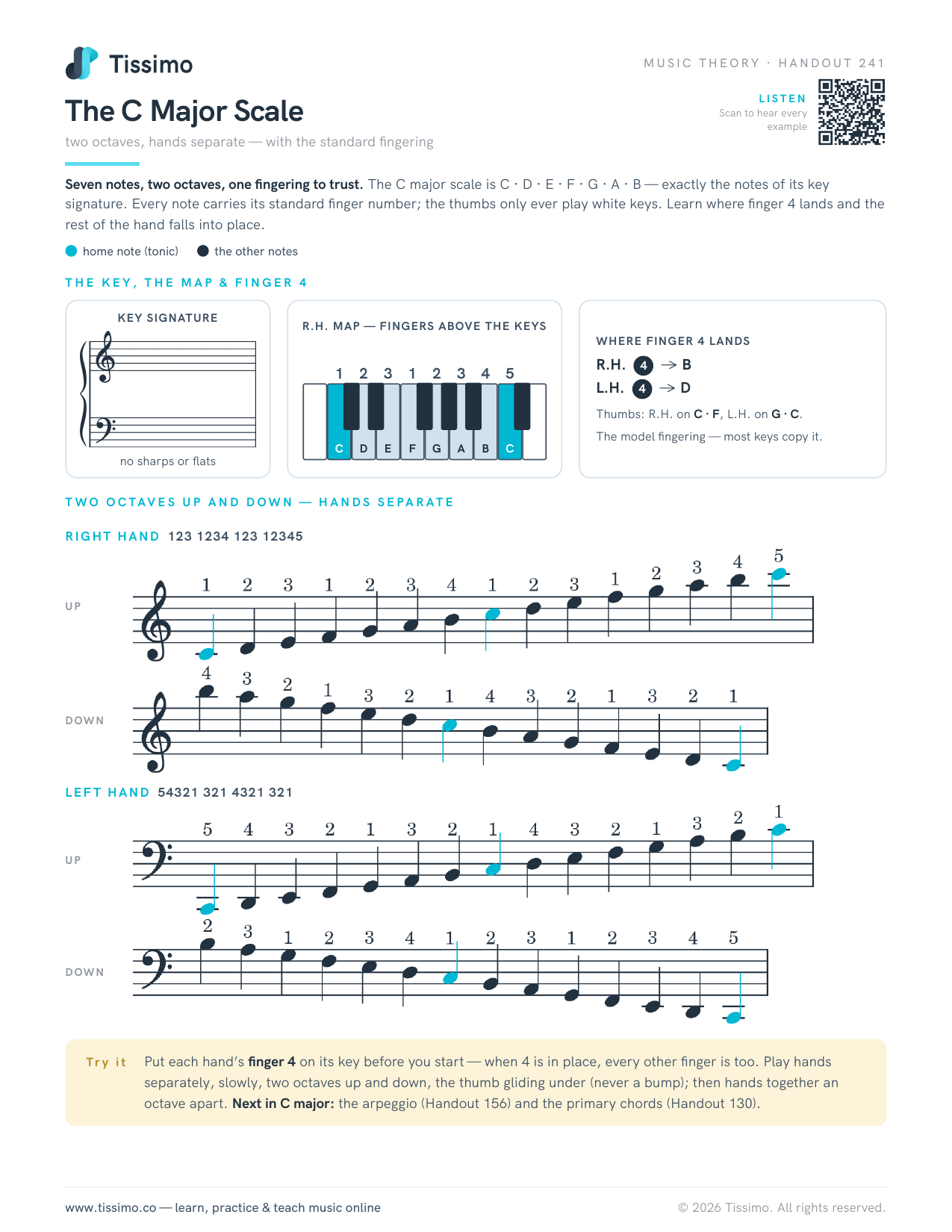
Scales in Every Key
Two octaves up and down with the standard fingering on every note, in all 24 keys.
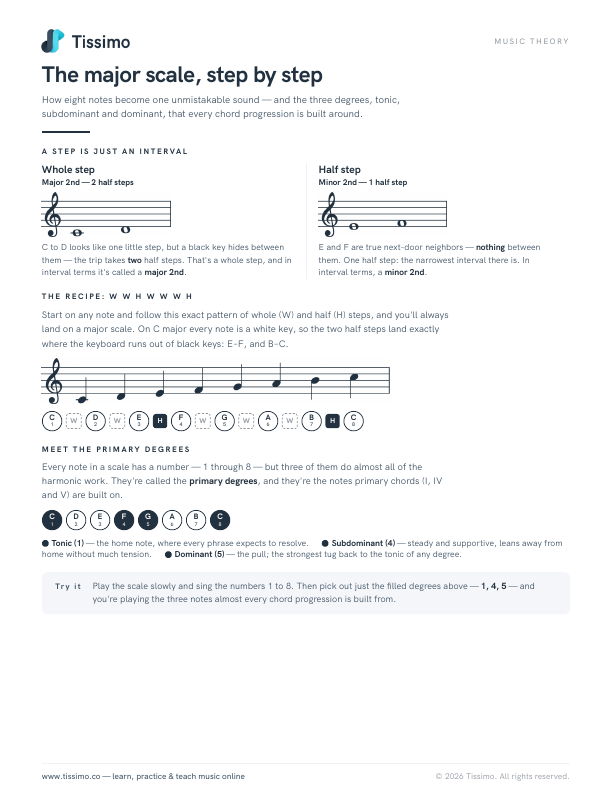
大调音阶入门
和弦与和声
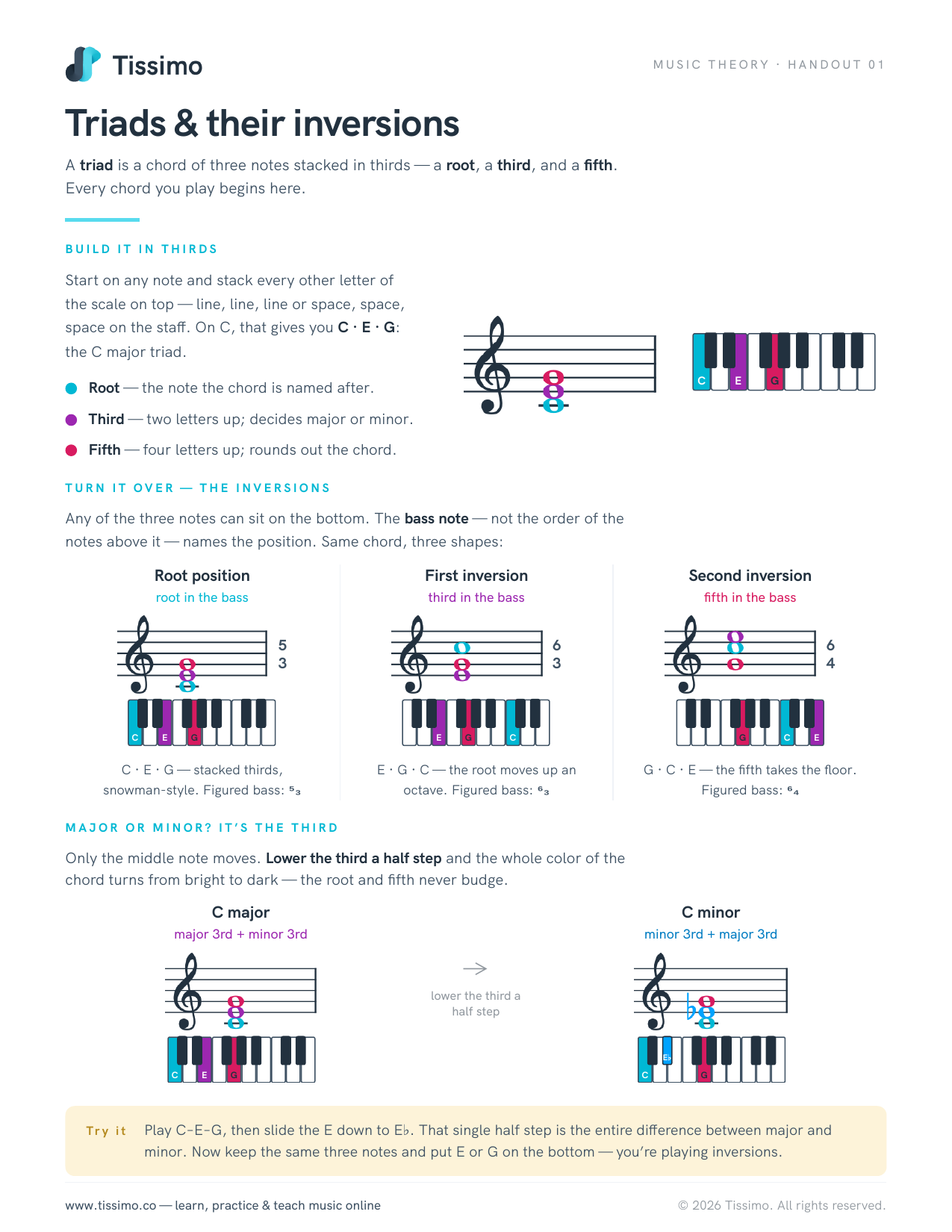
三和弦及其转位
三和弦是由三个音以三度叠加而成的和弦——根音、三音和五音。你弹的每一个和弦都是从这里开始的。
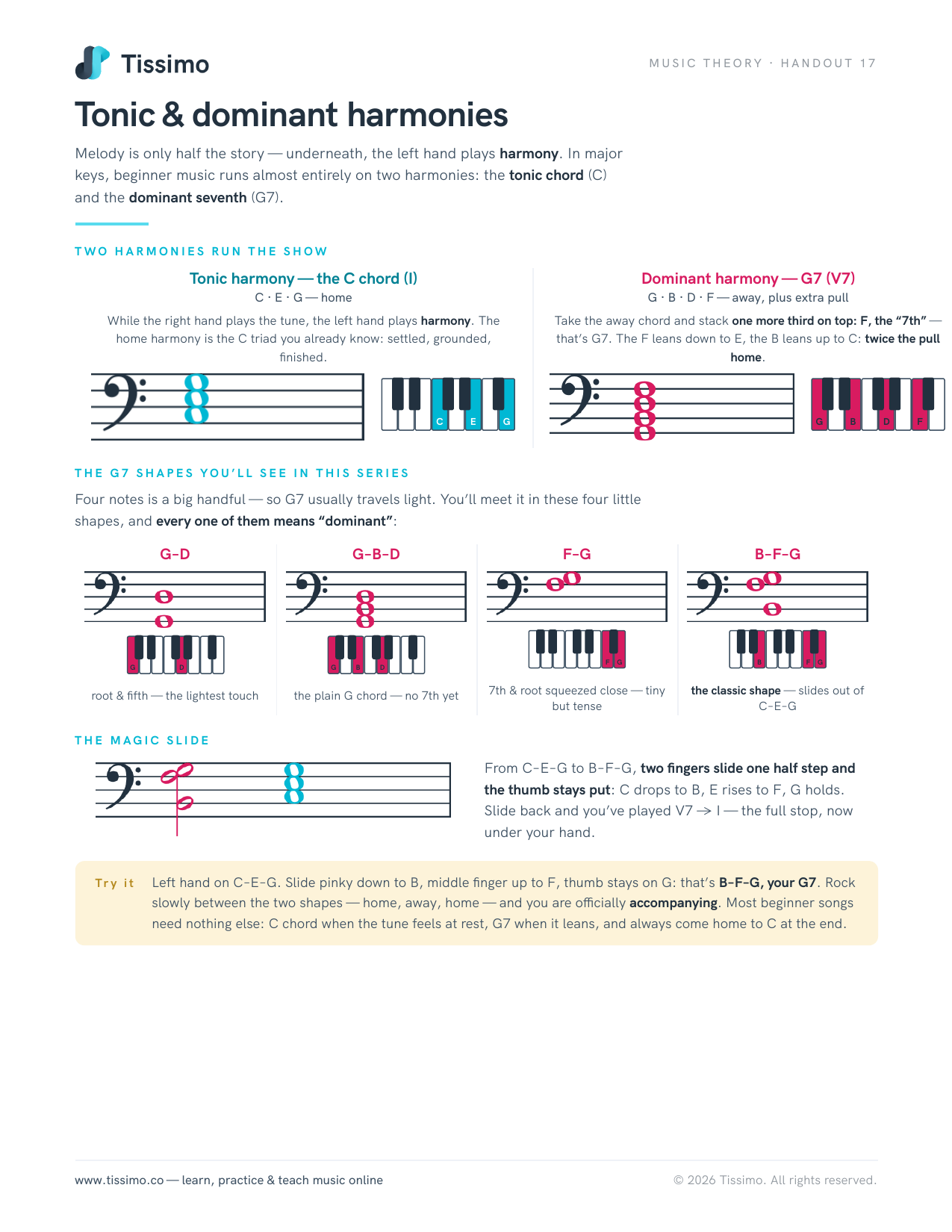
主和弦与属和弦
旋律只是故事的一半——在它下方,左手弹奏着和声。在大调中,初学者的曲子几乎完全建立在两个和弦上:主和弦(C)和属七和弦(G7)。
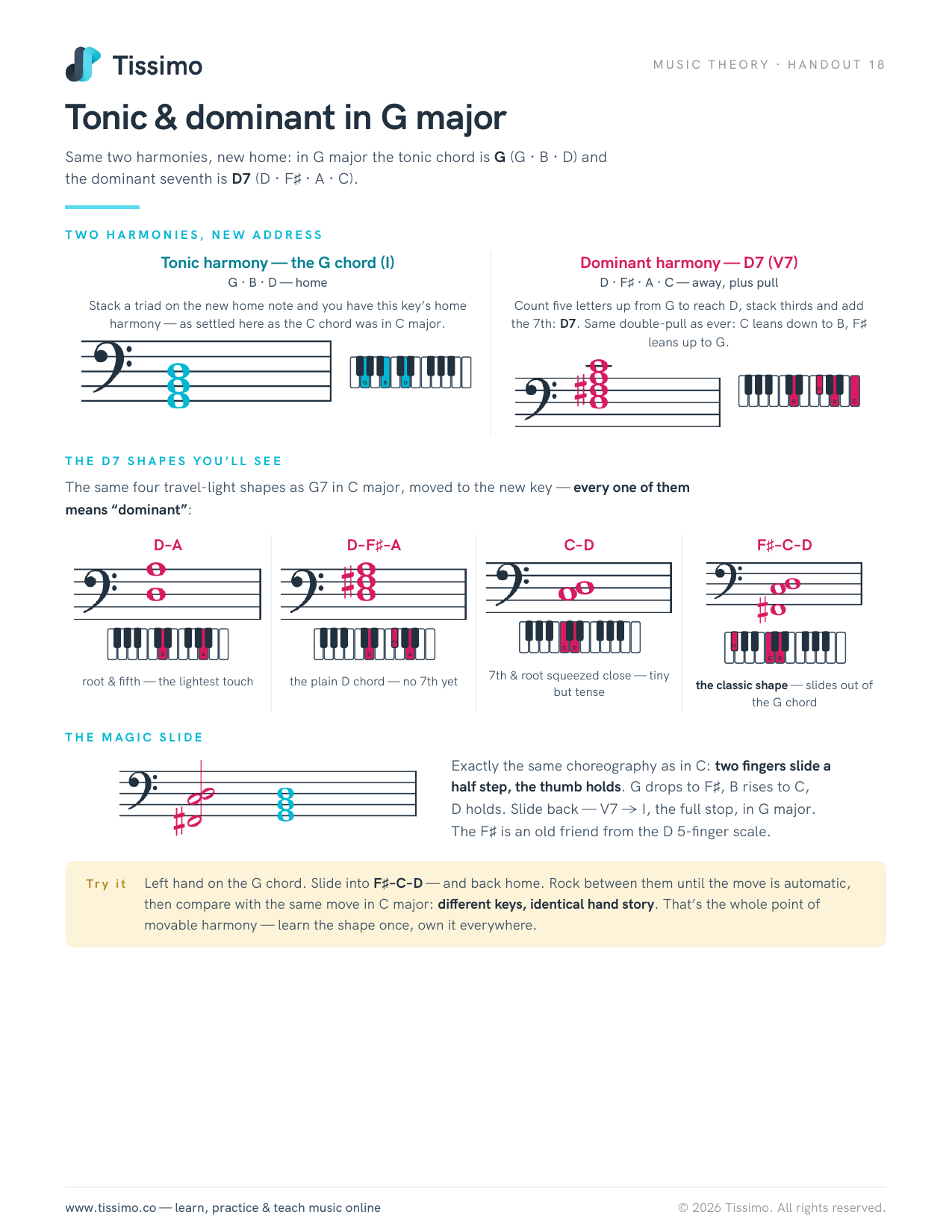
G大调的主和弦与属和弦
同样的两个和弦,换了新的调:在G大调中,主和弦是G(G·B·D),属七和弦是D7(D·F♯·A·C)。
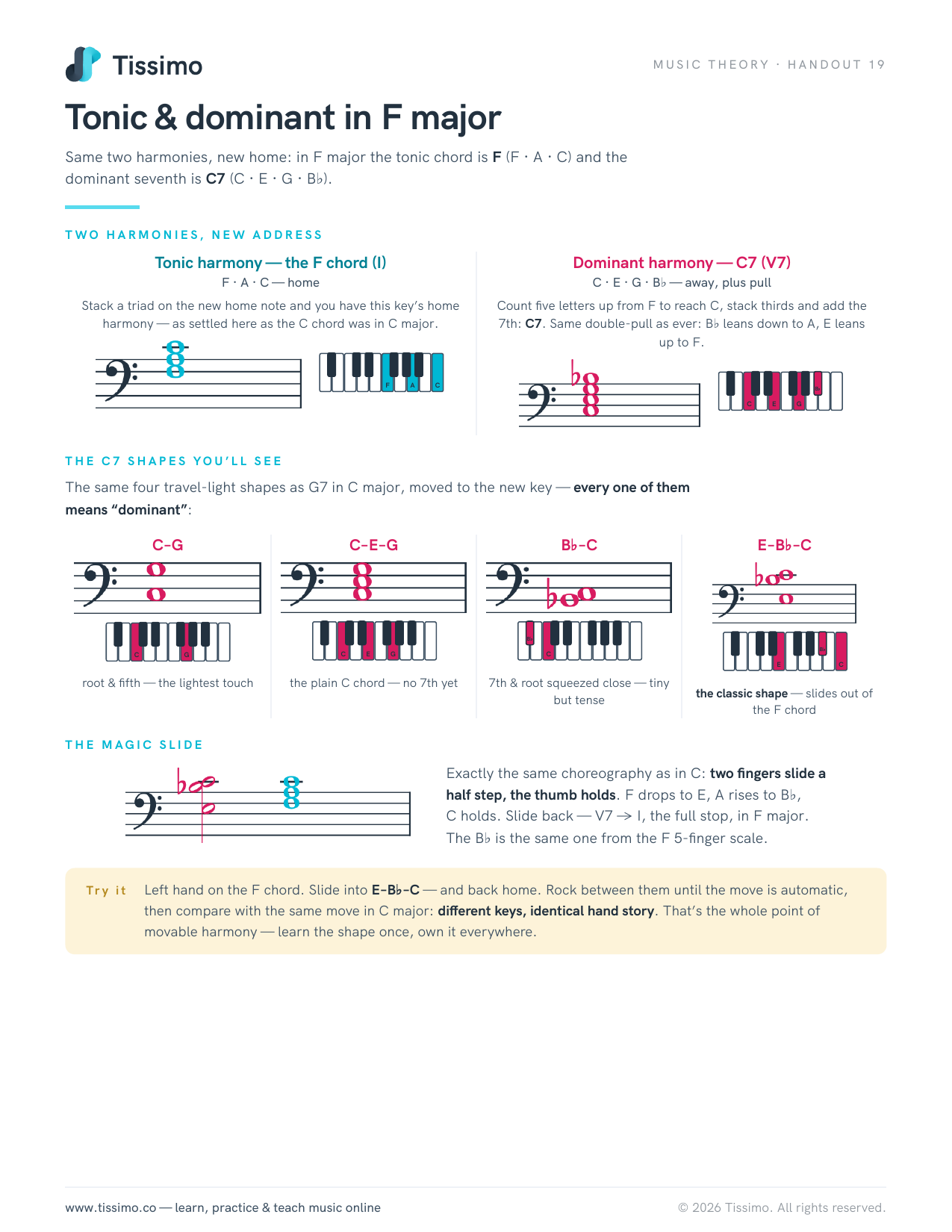
F大调的主和弦与属和弦
同样的两个和弦,换了新的调:在F大调中,主和弦是F(F·A·C),属七和弦是C7(C·E·G·B♭)。
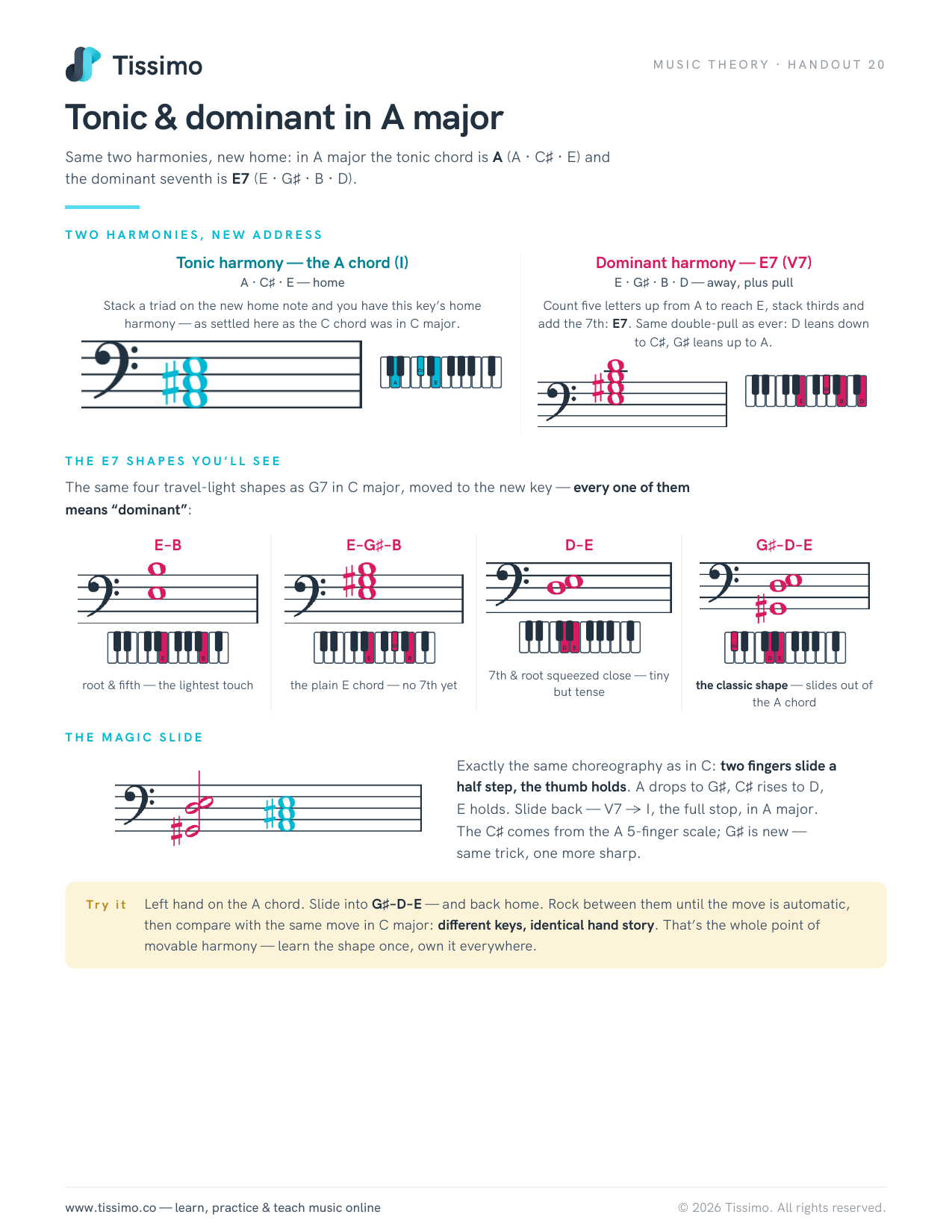
A大调的主和弦与属和弦
同样的两个和弦,换了新的调:在A大调中,主和弦是A(A·C♯·E),属七和弦是E7(E·G♯·B·D)。
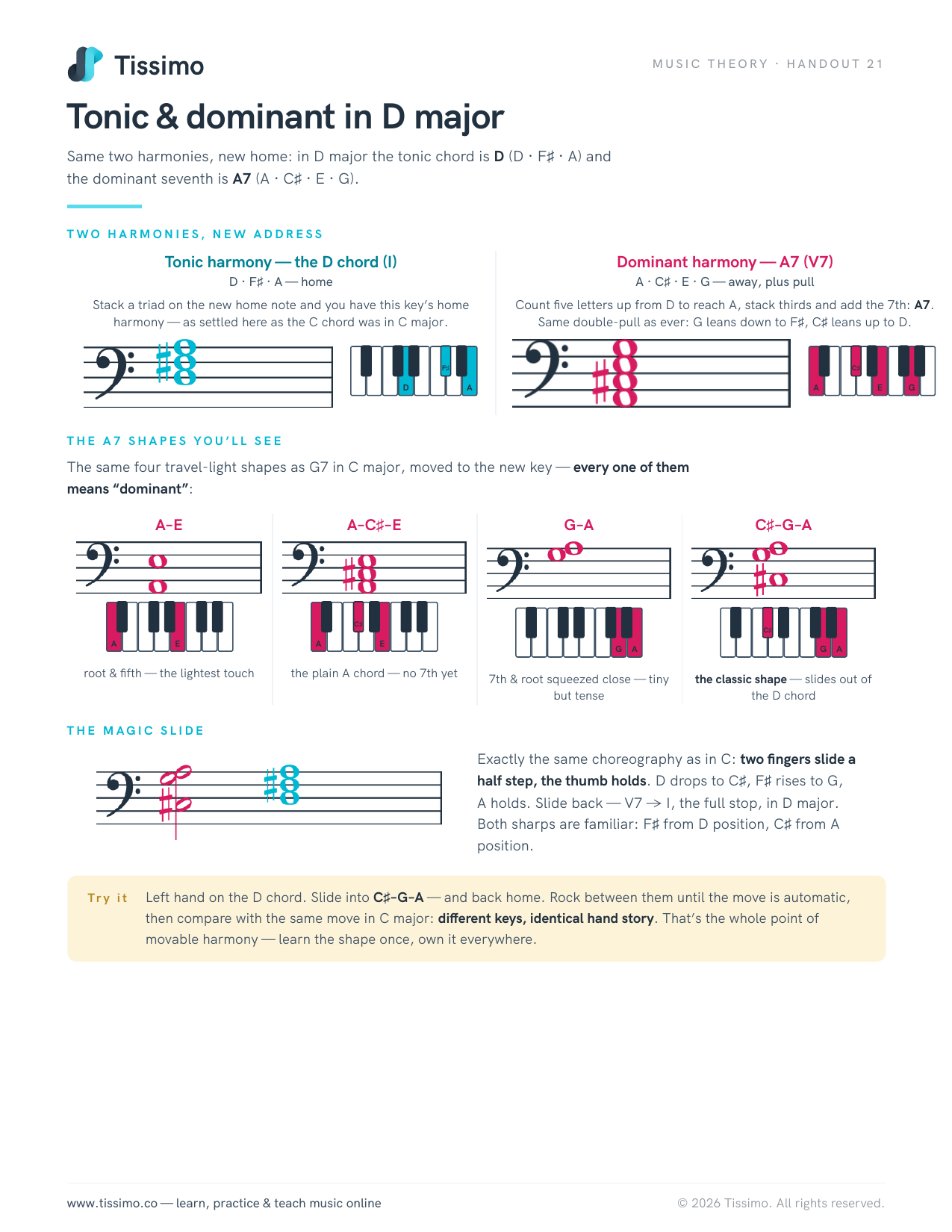
D大调的主和弦与属和弦
同样的两个和弦,换了新的调:在D大调中,主和弦是D(D·F♯·A),属七和弦是A7(A·C♯·E·G)。
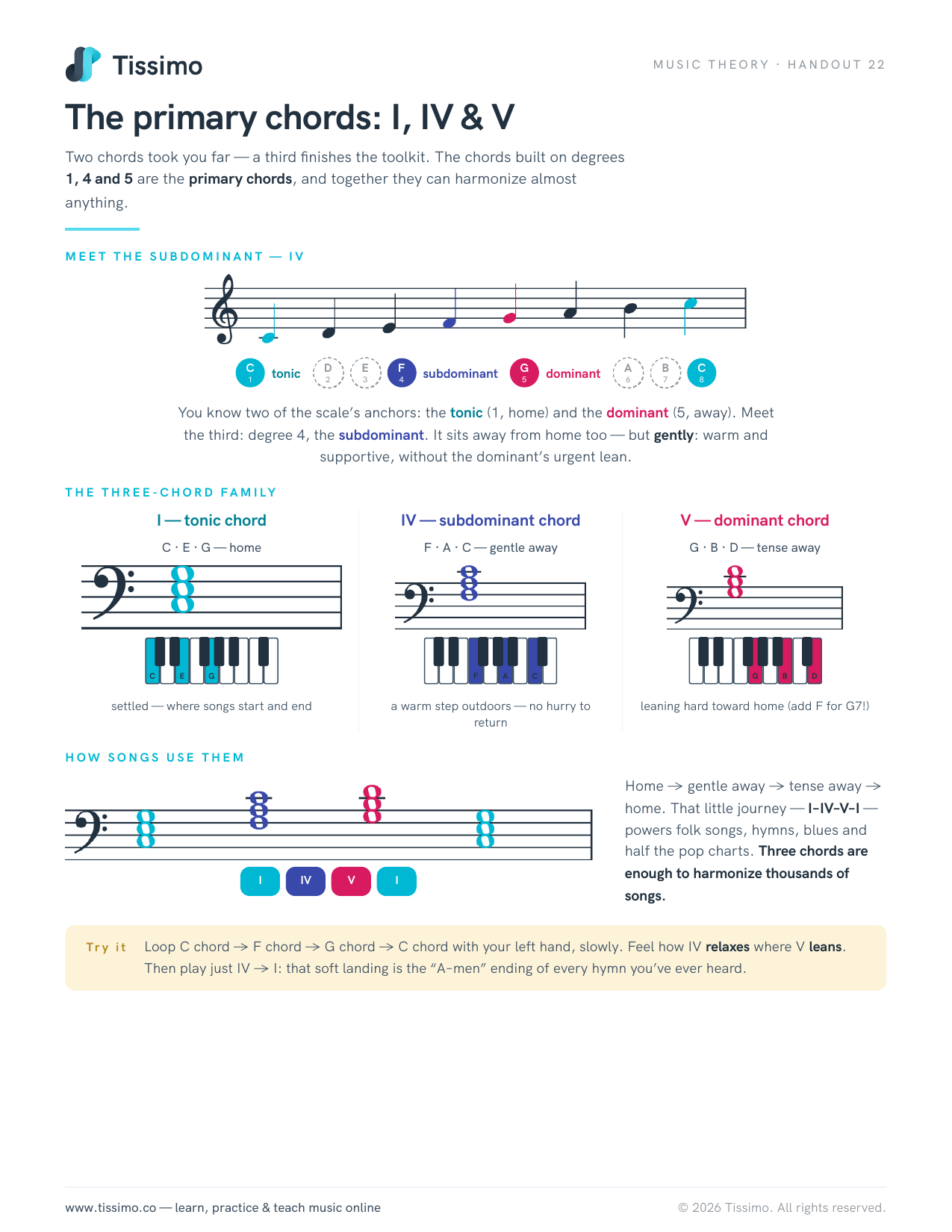
主要三和弦:I、IV与V
两个和弦已经带你走了很远——第三个和弦补全了这套工具。建立在第1、4、5级上的和弦就是主要三和弦,三者合力几乎能为任何旋律配和声。
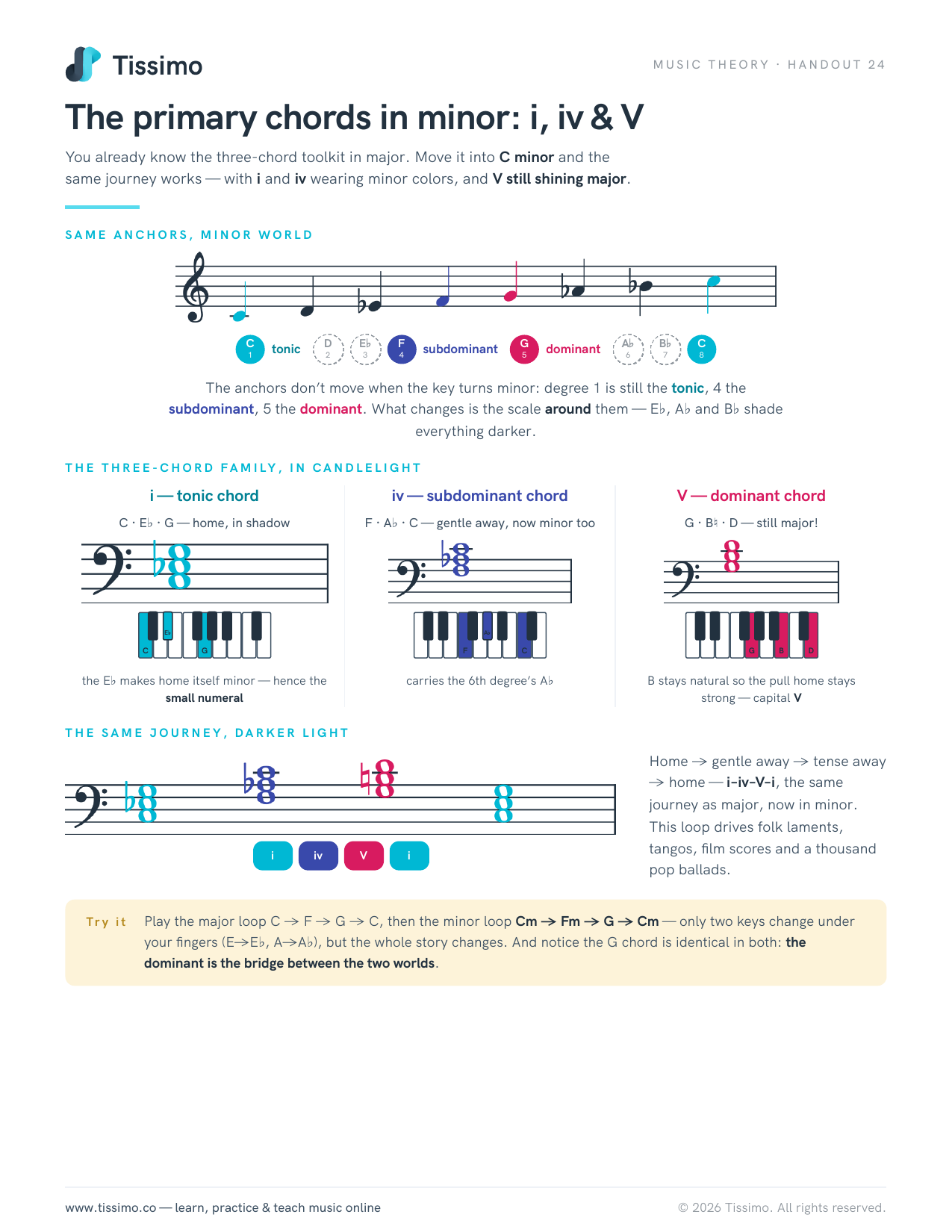
小调的主要三和弦:i、iv与V
你已经掌握了大调里的三和弦工具组。把它搬到C小调,同样的思路依然成立——i和iv披上小调的色彩,而V依旧闪耀着大调的光芒。
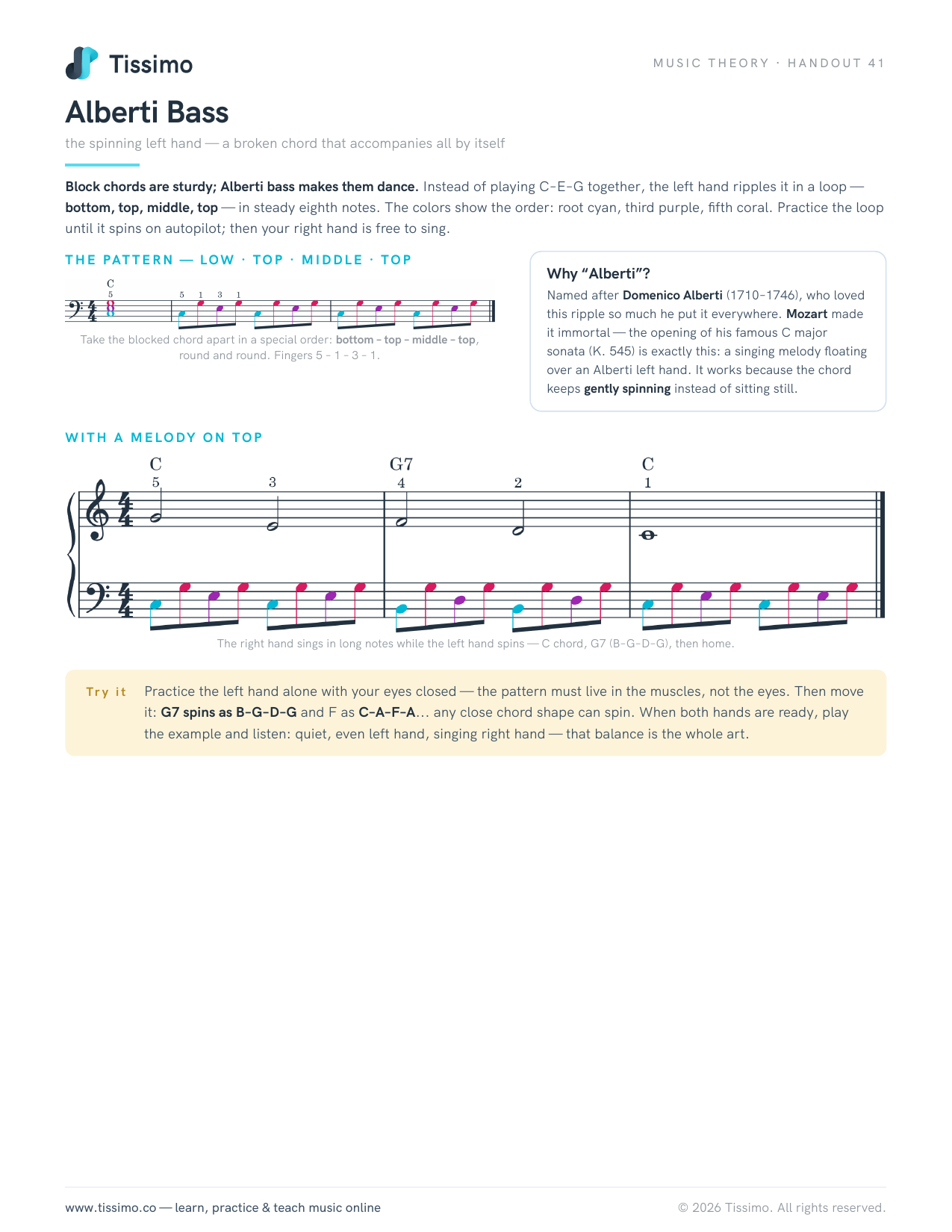
阿尔贝蒂低音
不停打转的左手——一个足以独自伴奏的分解和弦
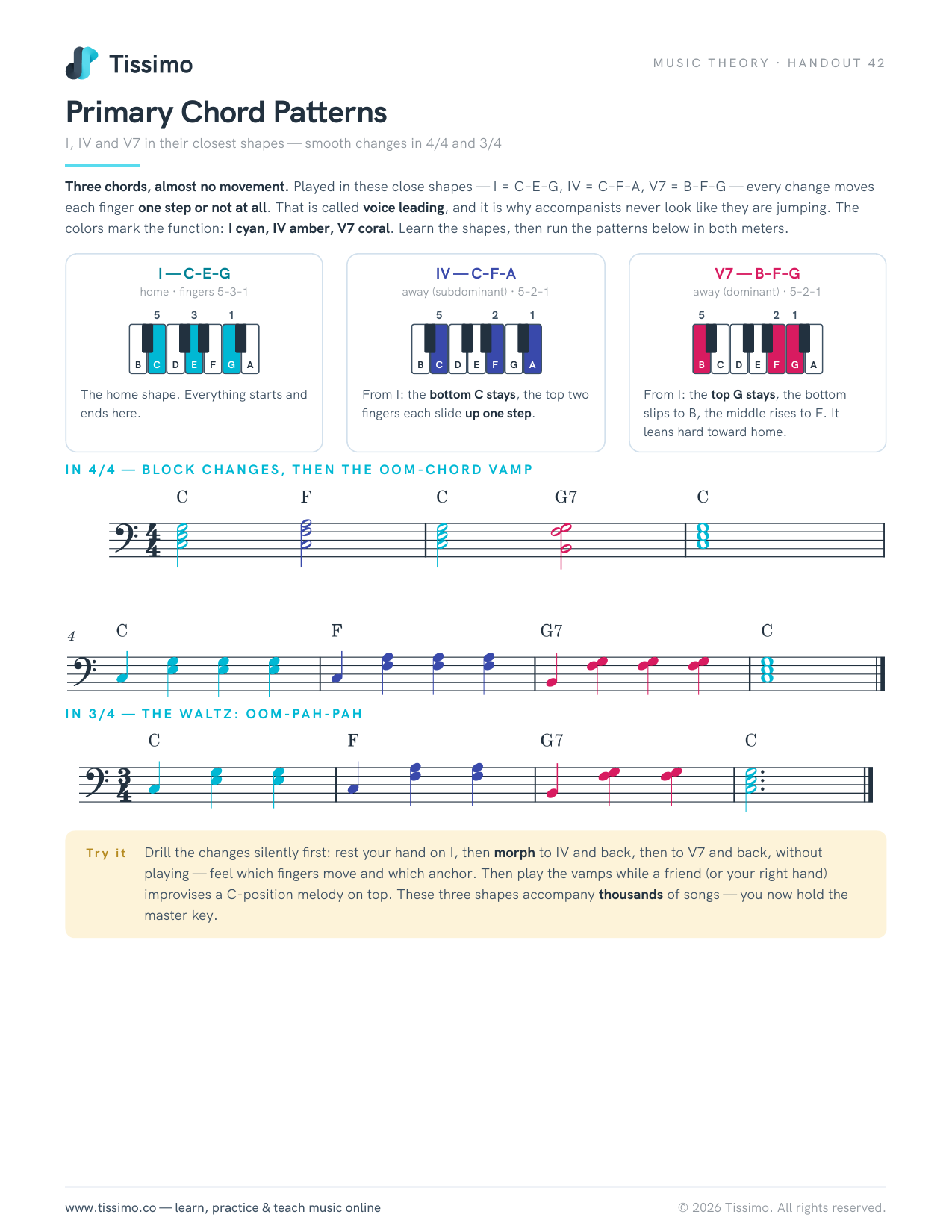
主要和弦进行模式
以最近指法弹奏I、IV和V7——在4/4和3/4拍中平滑转换
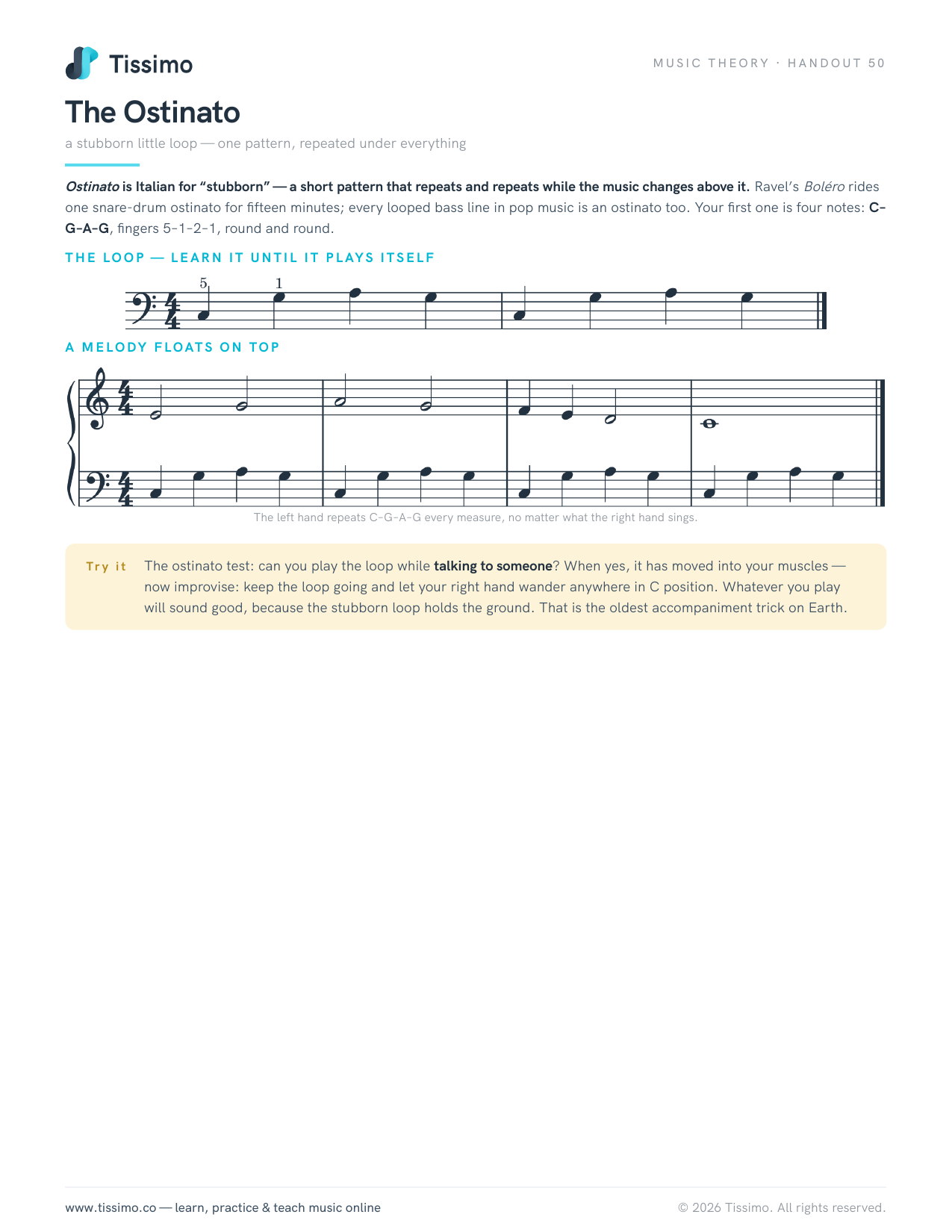
固定音型(奥斯蒂纳托)
一个执着的小循环——同一个音型,在一切之下不断重复
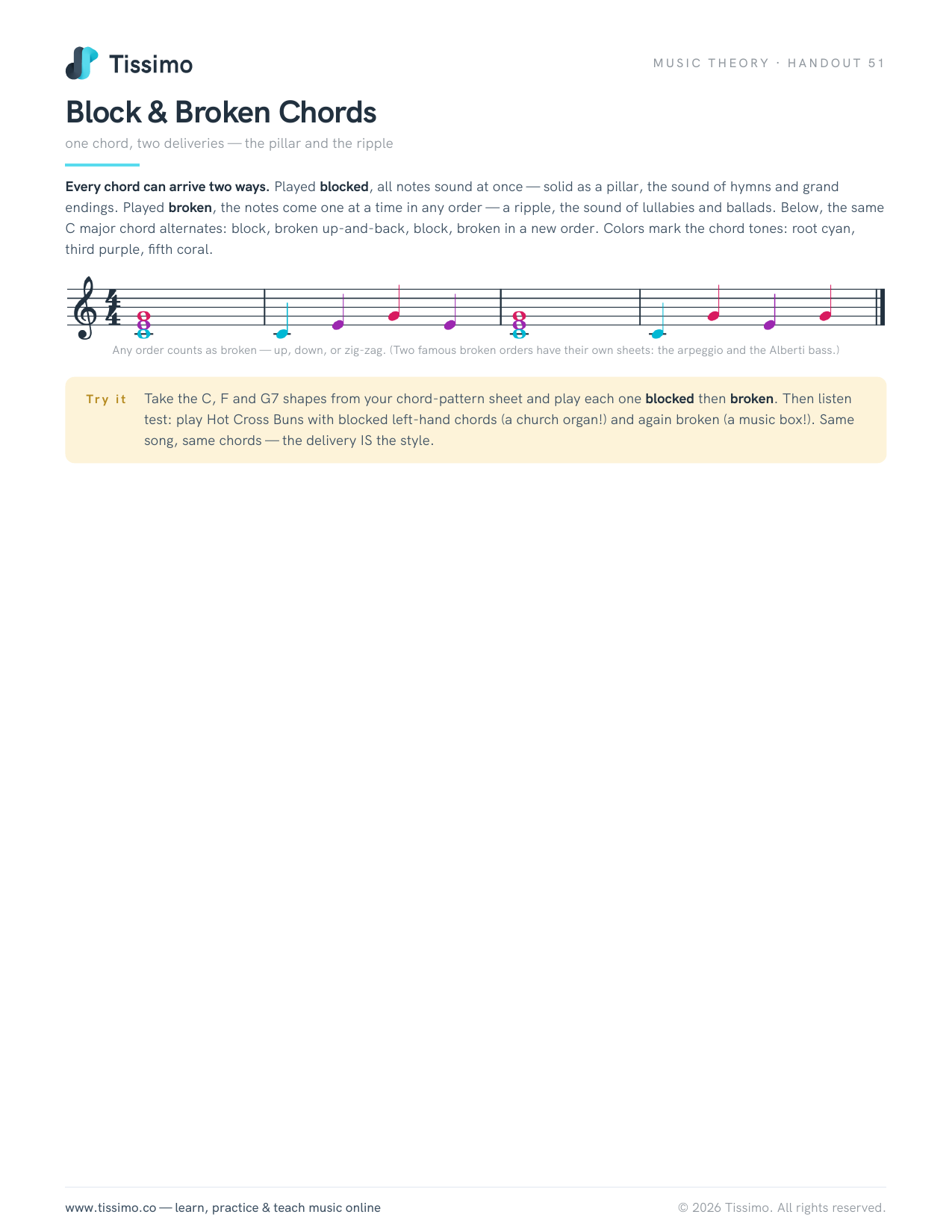
柱式和弦与分解和弦
同一个和弦,两种呈现方式——如柱子般坚实,或如涟漪般流动
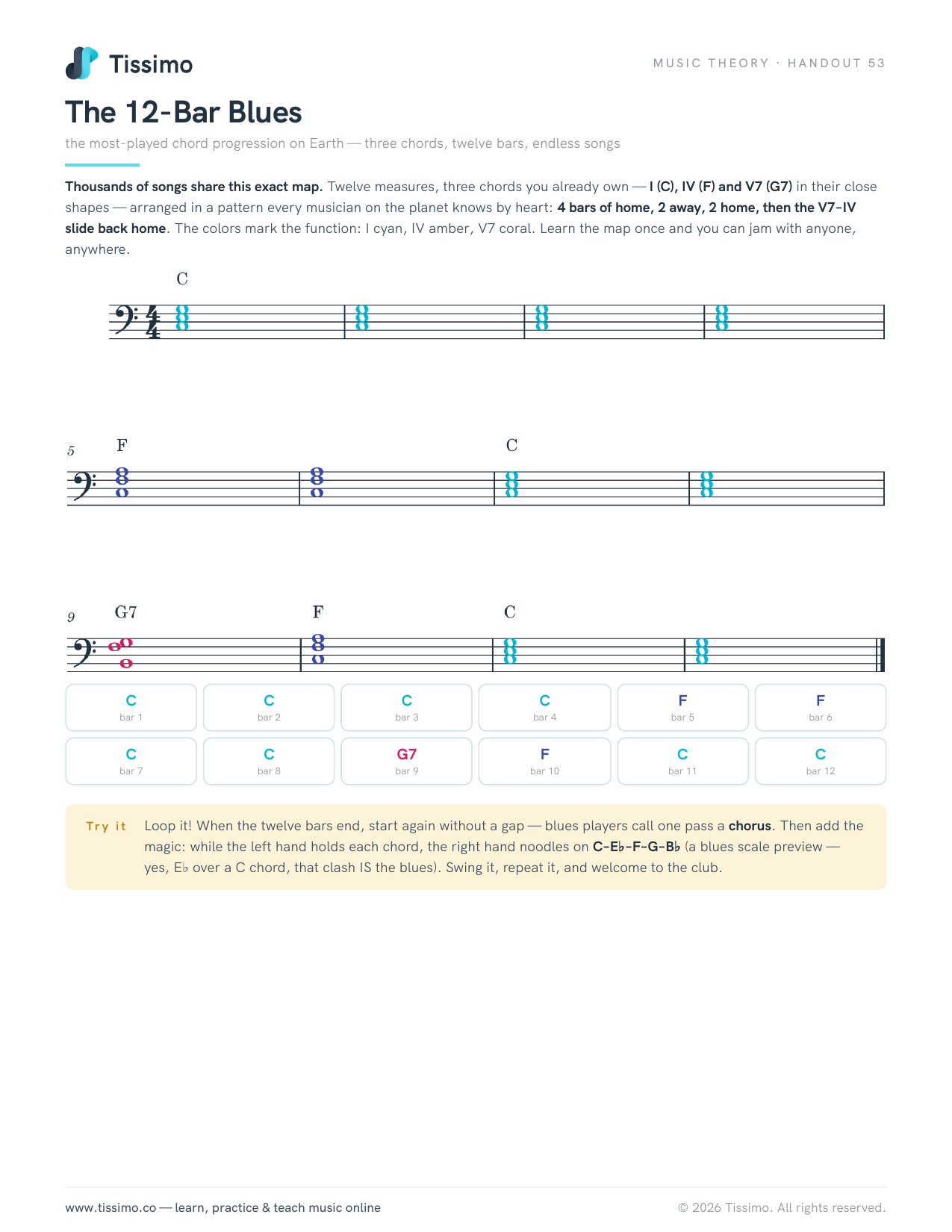
十二小节布鲁斯
地球上被演奏次数最多的和弦进行——三个和弦,十二小节,无穷无尽的歌曲
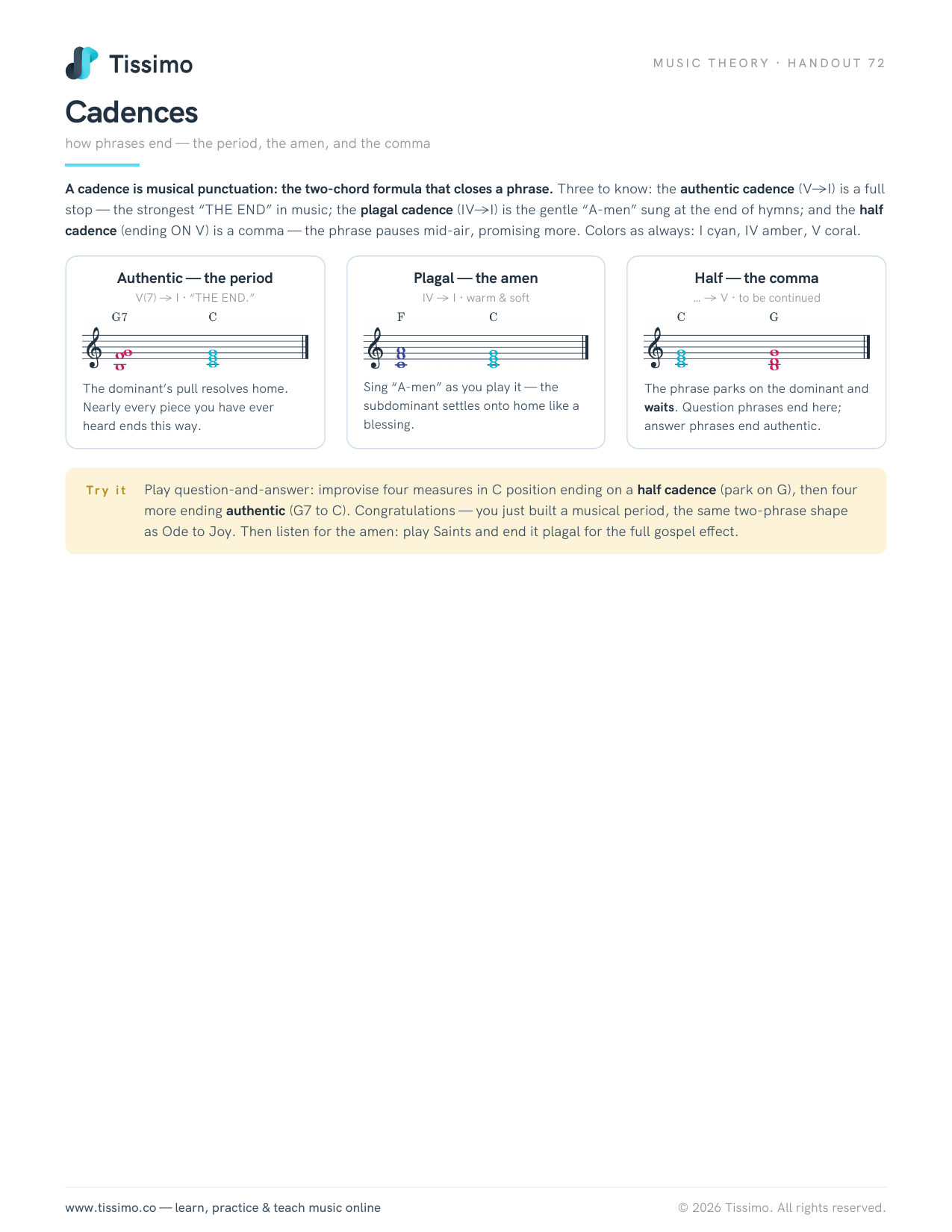
终止式
乐句是如何结束的——句号、“阿门”式终止,以及逗号
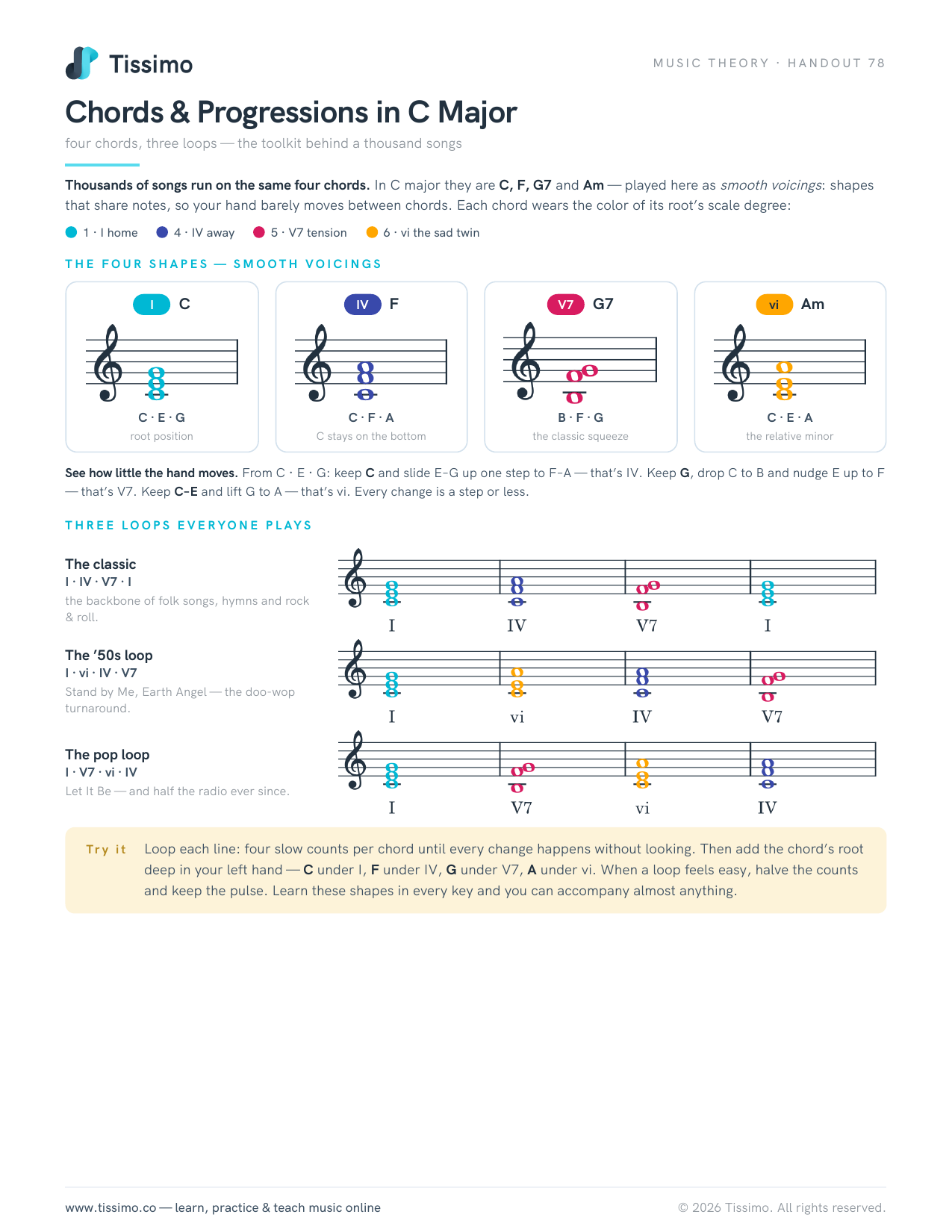
全调和弦进行
四个和弦,三个循环——支撑起千百首歌曲的工具组,涵盖全部24个调。
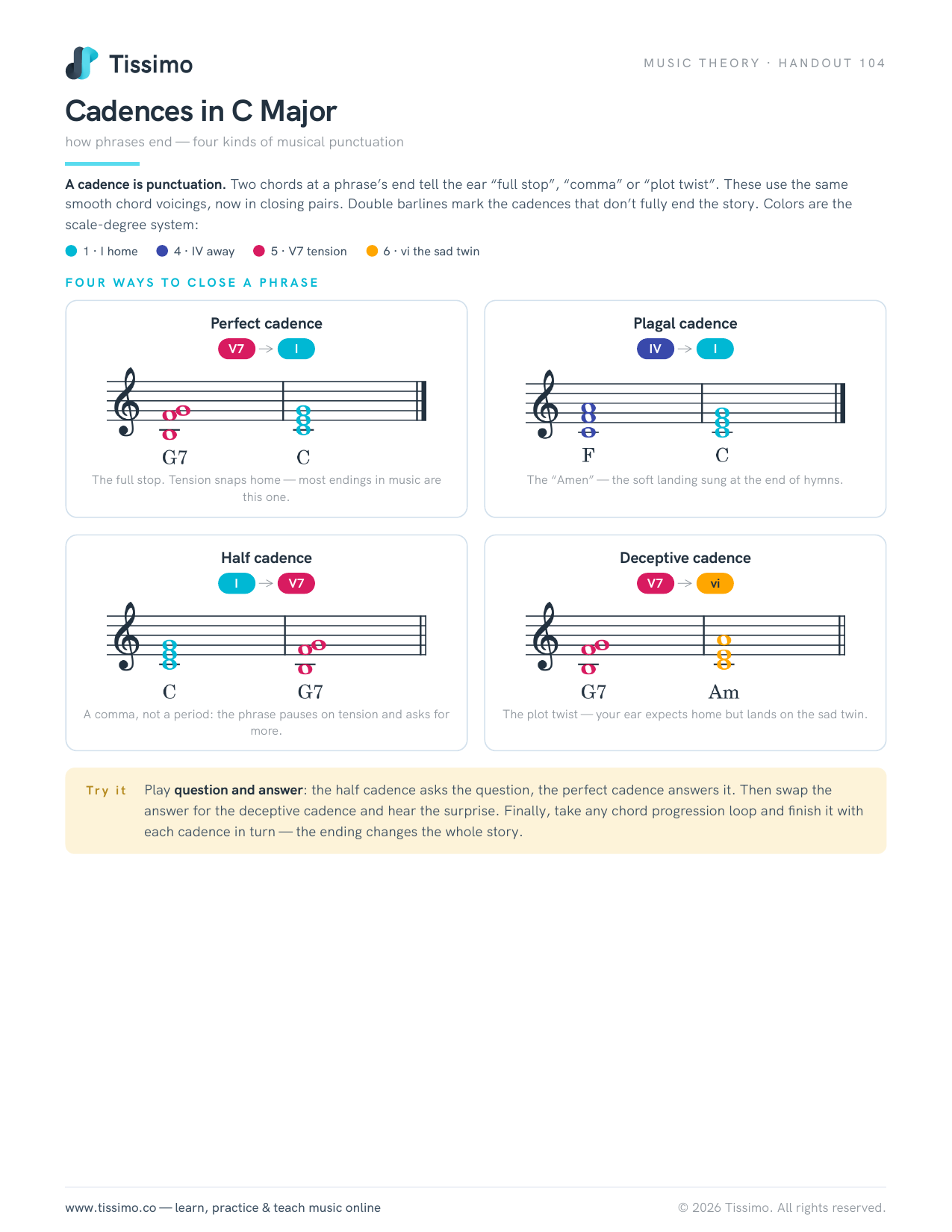
全调终止式
乐句是如何结束的——四种音乐“标点符号”,写遍全部24个调。
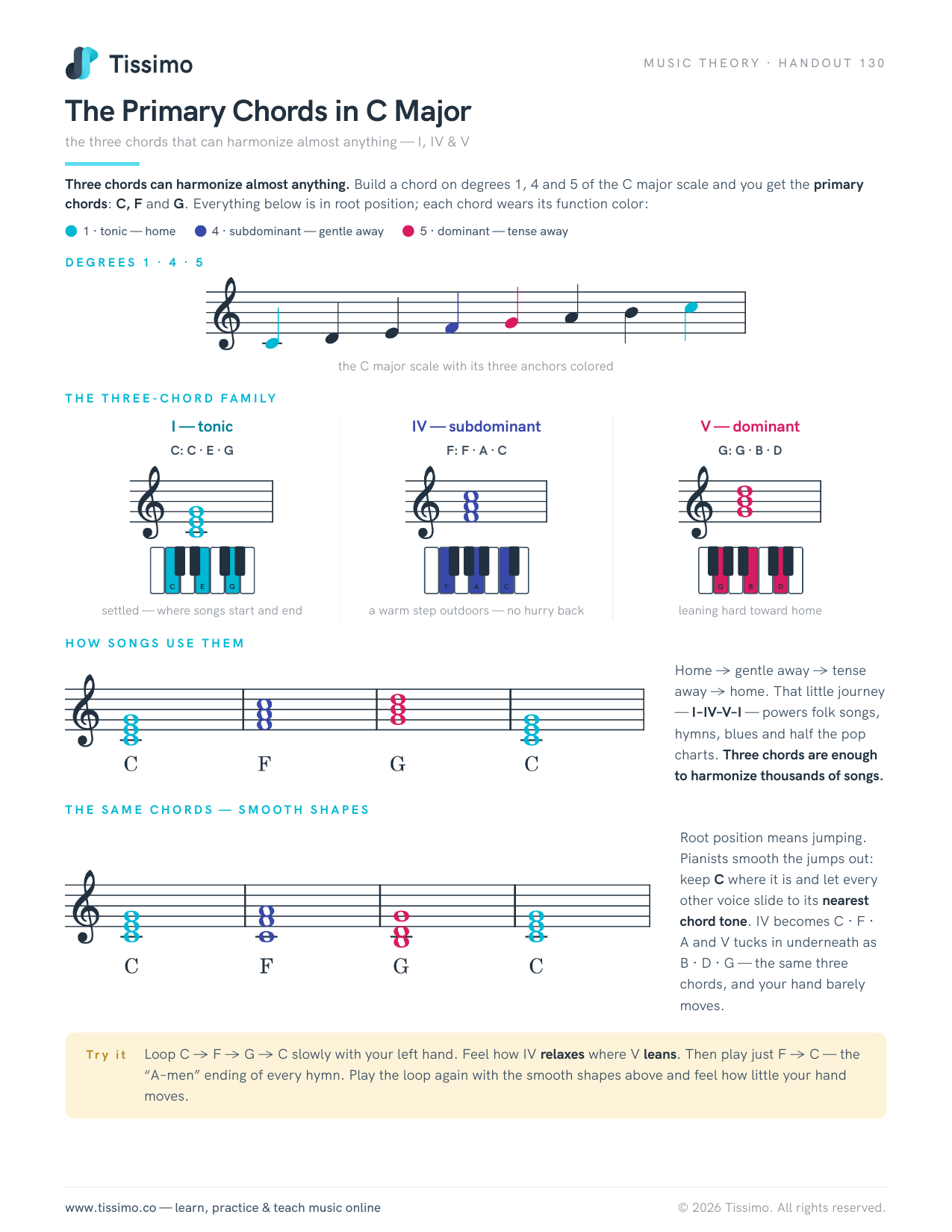
全调主要三和弦
I、IV和V——几乎能为任何旋律配和声的三个和弦,涵盖全部24个调。
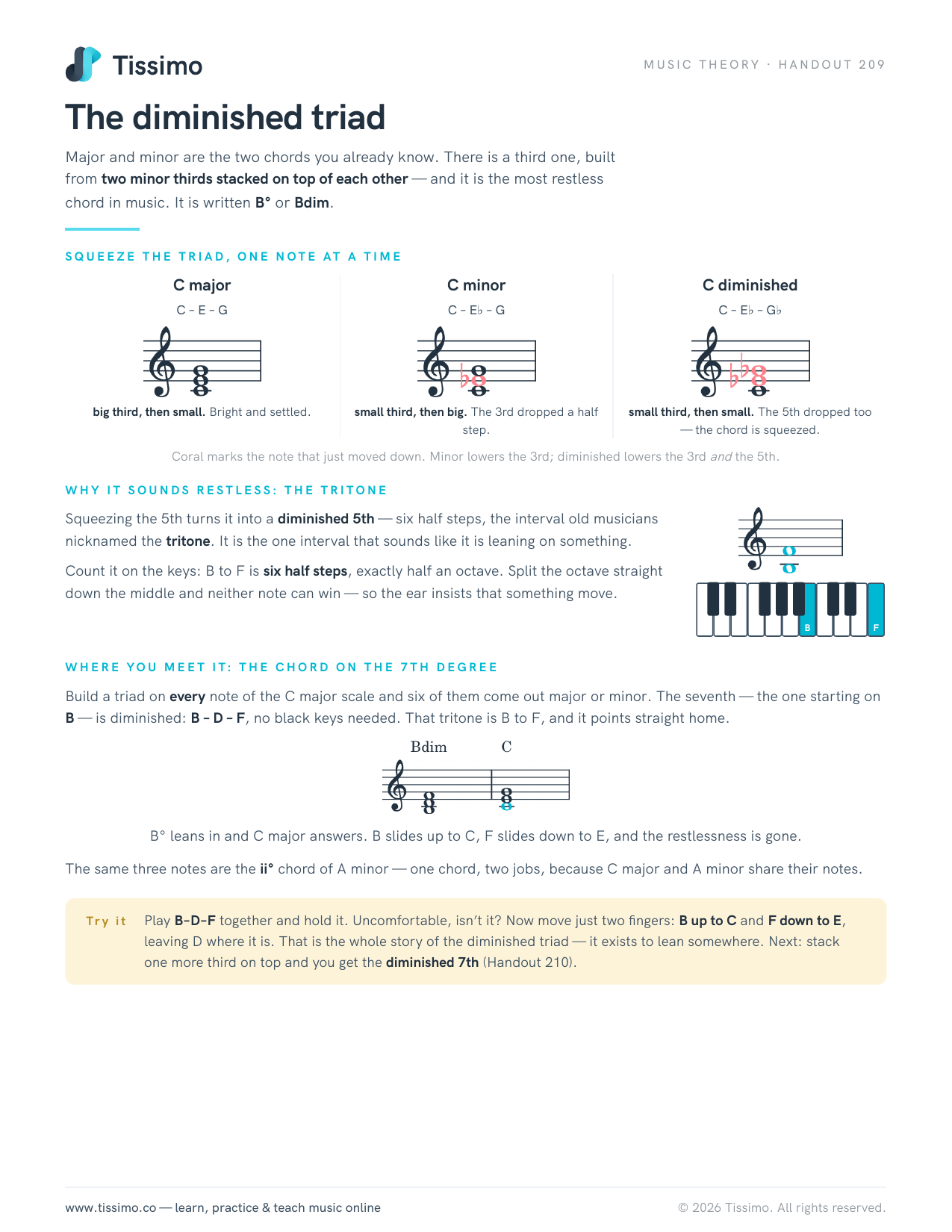
减三和弦
大和弦与小和弦是你已经认识的两种和弦。还有第三种,由两个小三度叠加而成——它是音乐中最“躁动不安”的和弦,记作B°或Bdim。
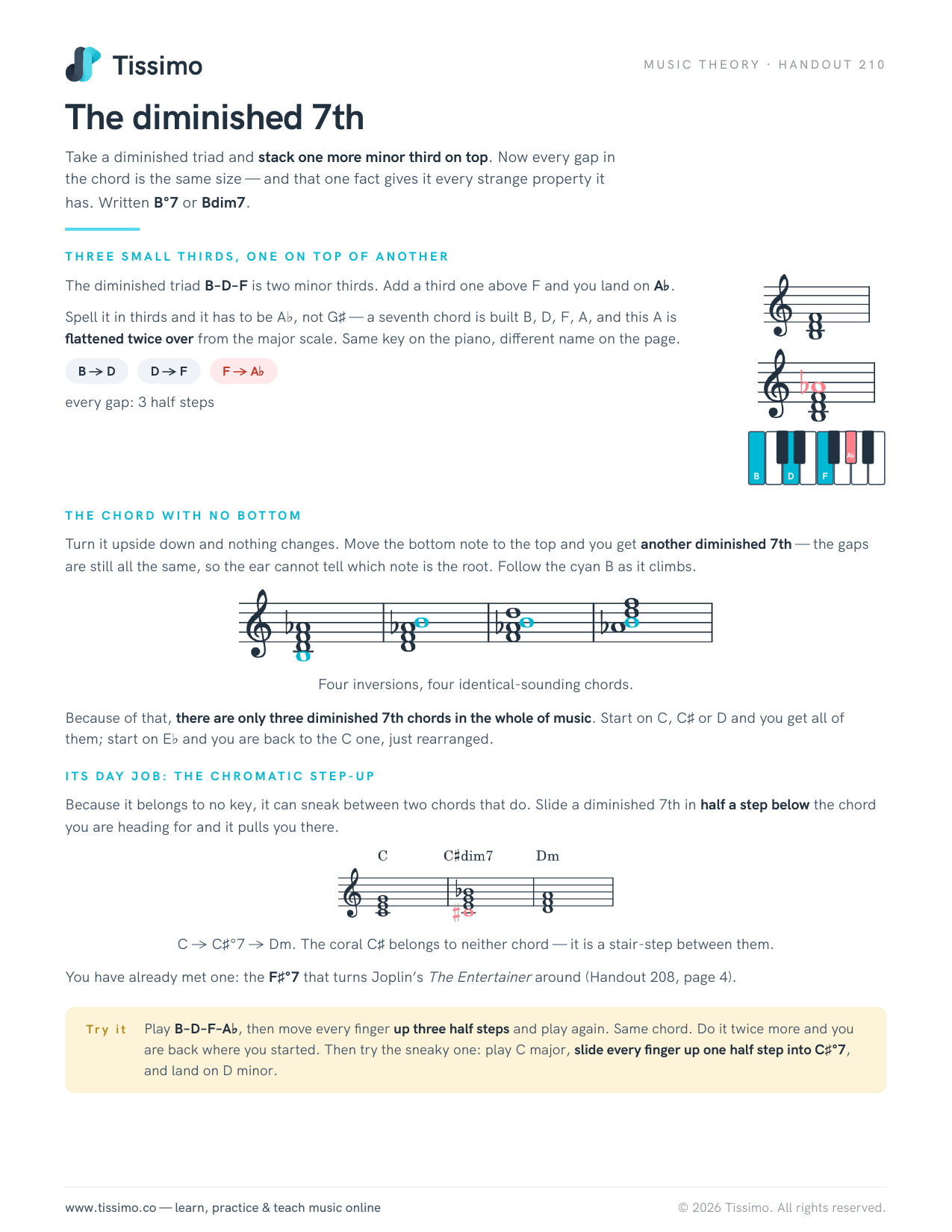
减七和弦
在减三和弦上再叠加一个小三度。这样一来,和弦中每个音程的大小都相同——正是这一点,赋予了它所有奇特的性质。记作B°7或Bdim7。
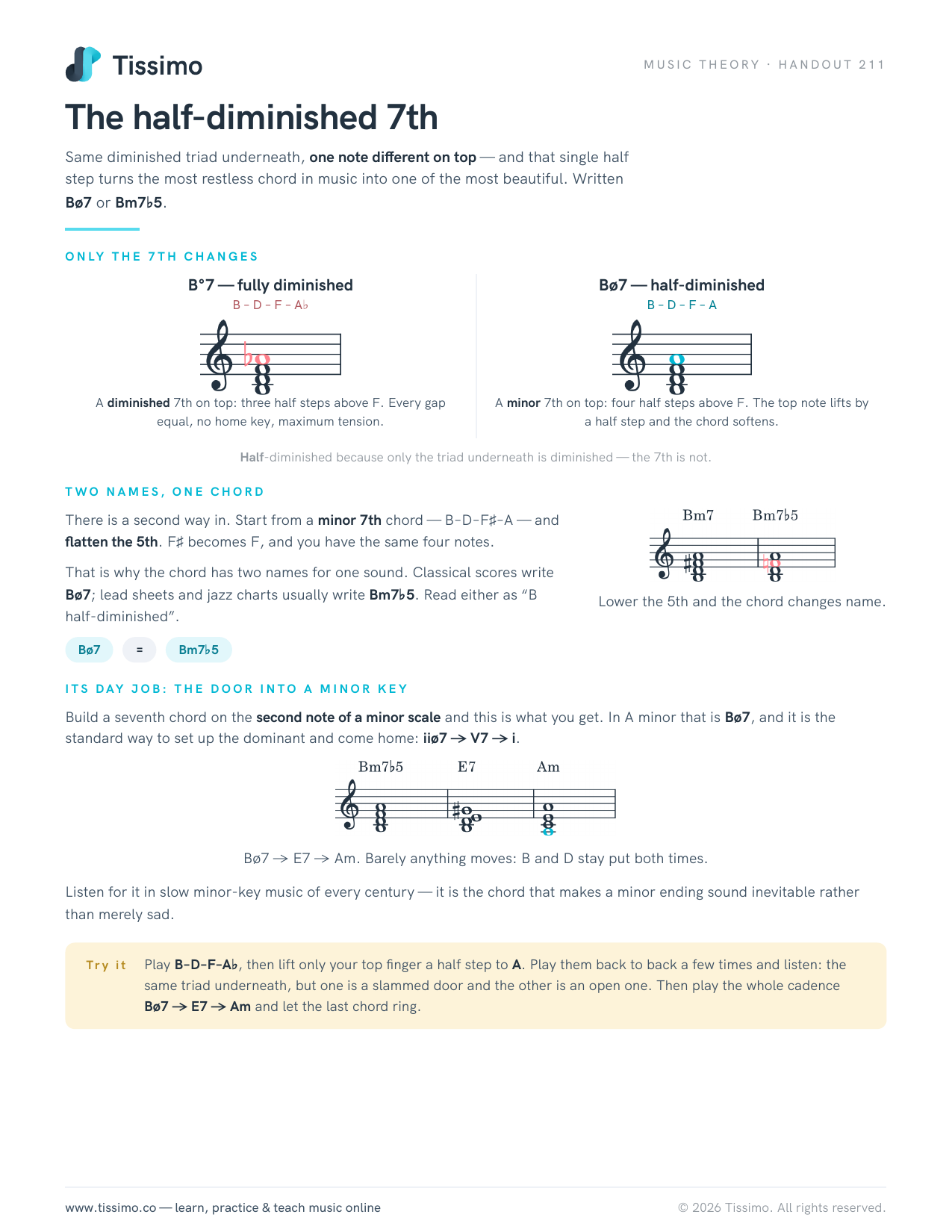
半减七和弦
底层依然是同样的减三和弦,只是最上面的一个音不同——正是这半个音的差别,把音乐中最“躁动”的和弦,变成了最动听的和弦之一。记作Bø7或Bm7♭5。
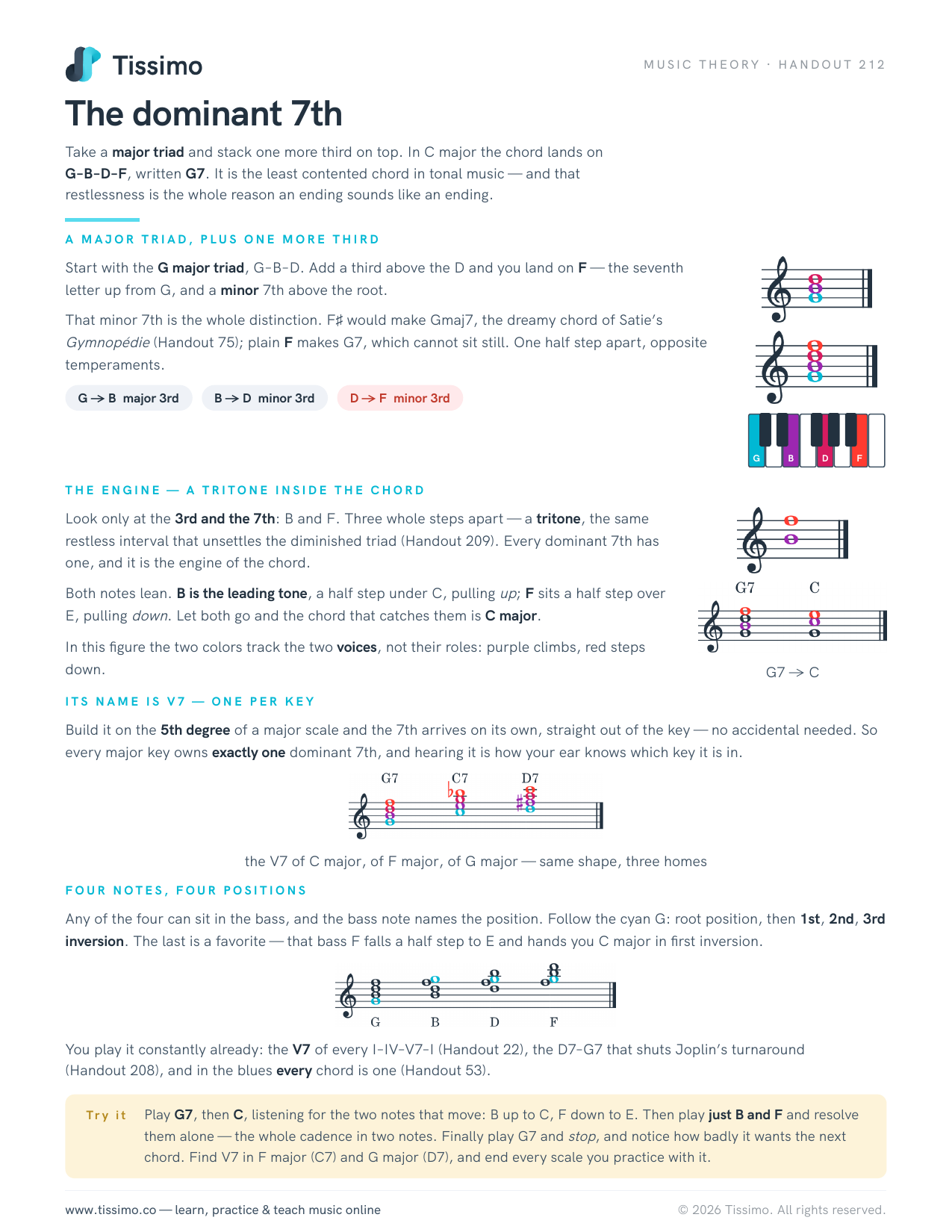
属七和弦
在大三和弦上再叠加一个三度。在C大调中,这个和弦落在G–B–D–F上,记作G7。它是调性音乐中最“不安分”的和弦——正是这种不安定感,让终止听起来真正像一个结束。
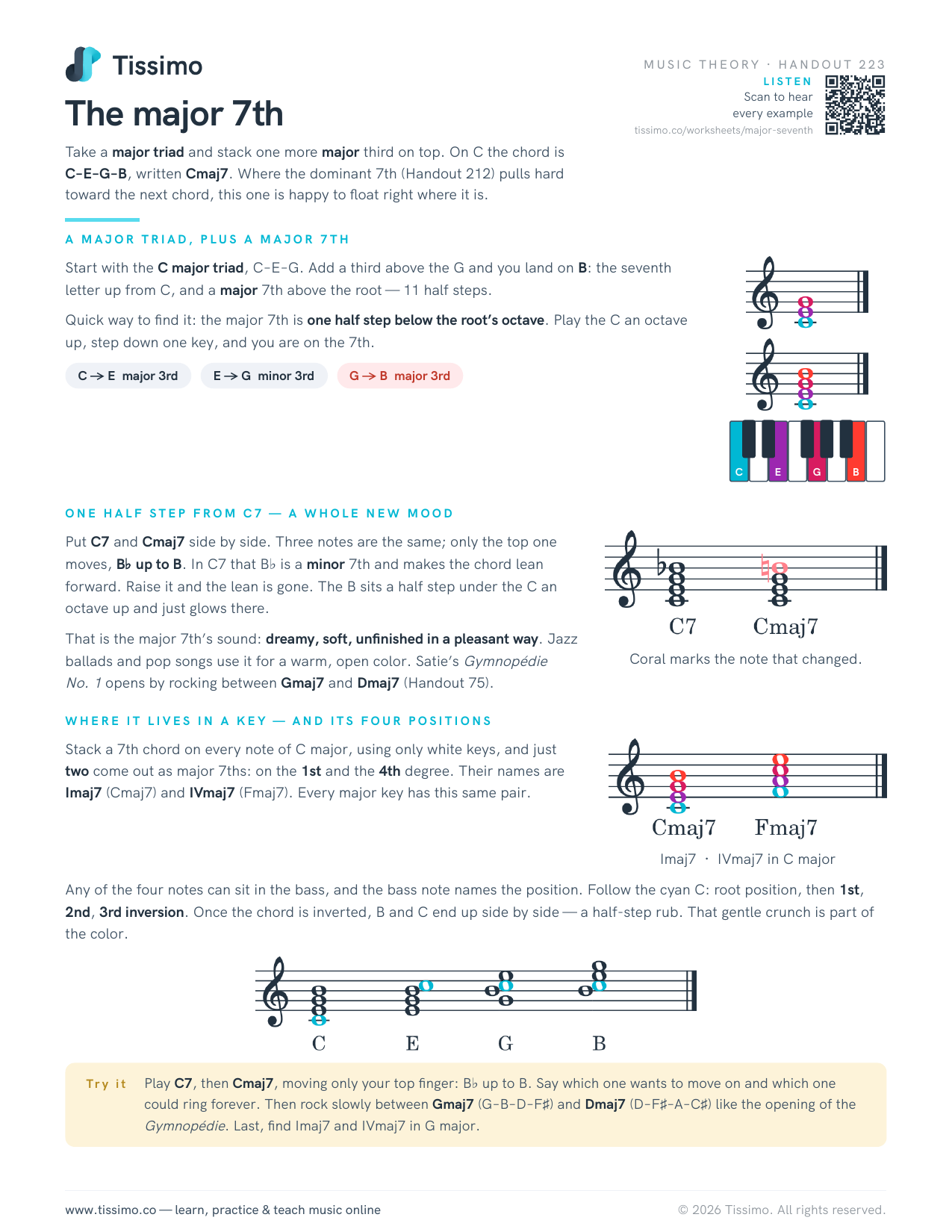
The major 7th
Take a major triad and stack one more major third on top. On C the chord is C–E–G–B, written Cmaj7. Where the dominant 7th (Handout 212) pulls hard toward the next chord, this one is happy to float right where it is.
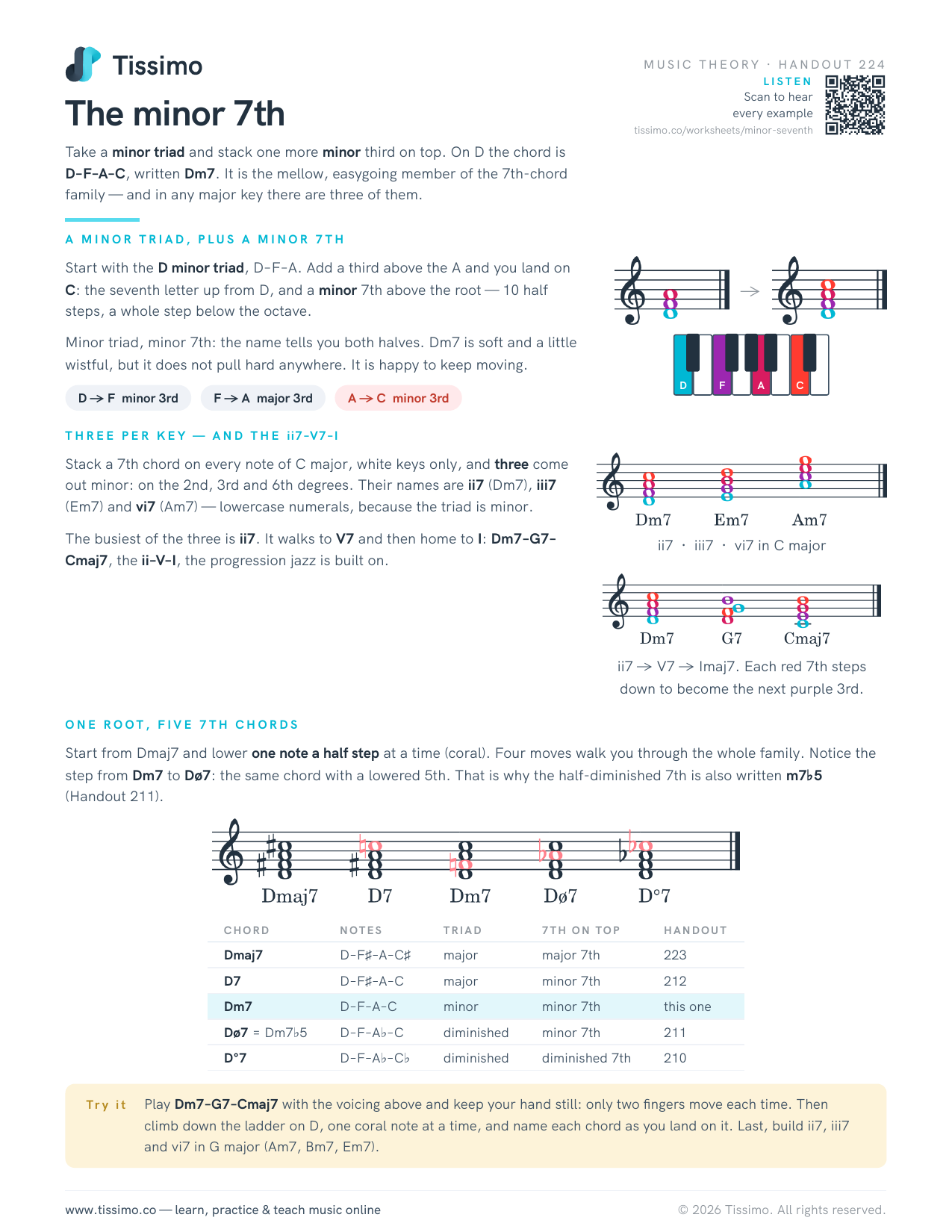
The minor 7th
Take a minor triad and stack one more minor third on top. On D the chord is D–F–A–C, written Dm7. It is the mellow, easygoing member of the 7th-chord family — and in any major key there are three of them.
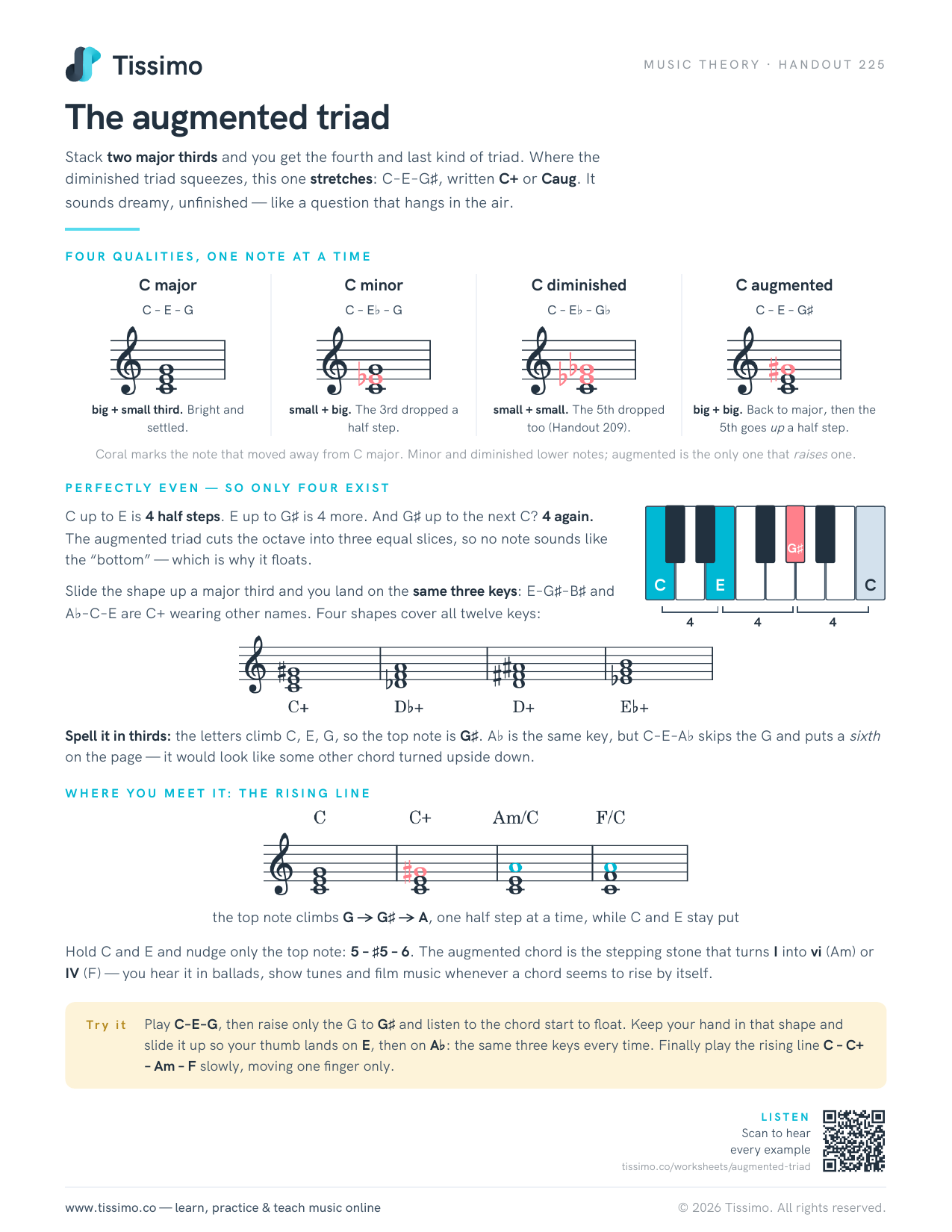
The augmented triad
Stack two major thirds and you get the fourth and last kind of triad. Where the diminished triad squeezes, this one stretches: C–E–G♯, written C+ or Caug. It sounds dreamy, unfinished — like a question that hangs in the air.
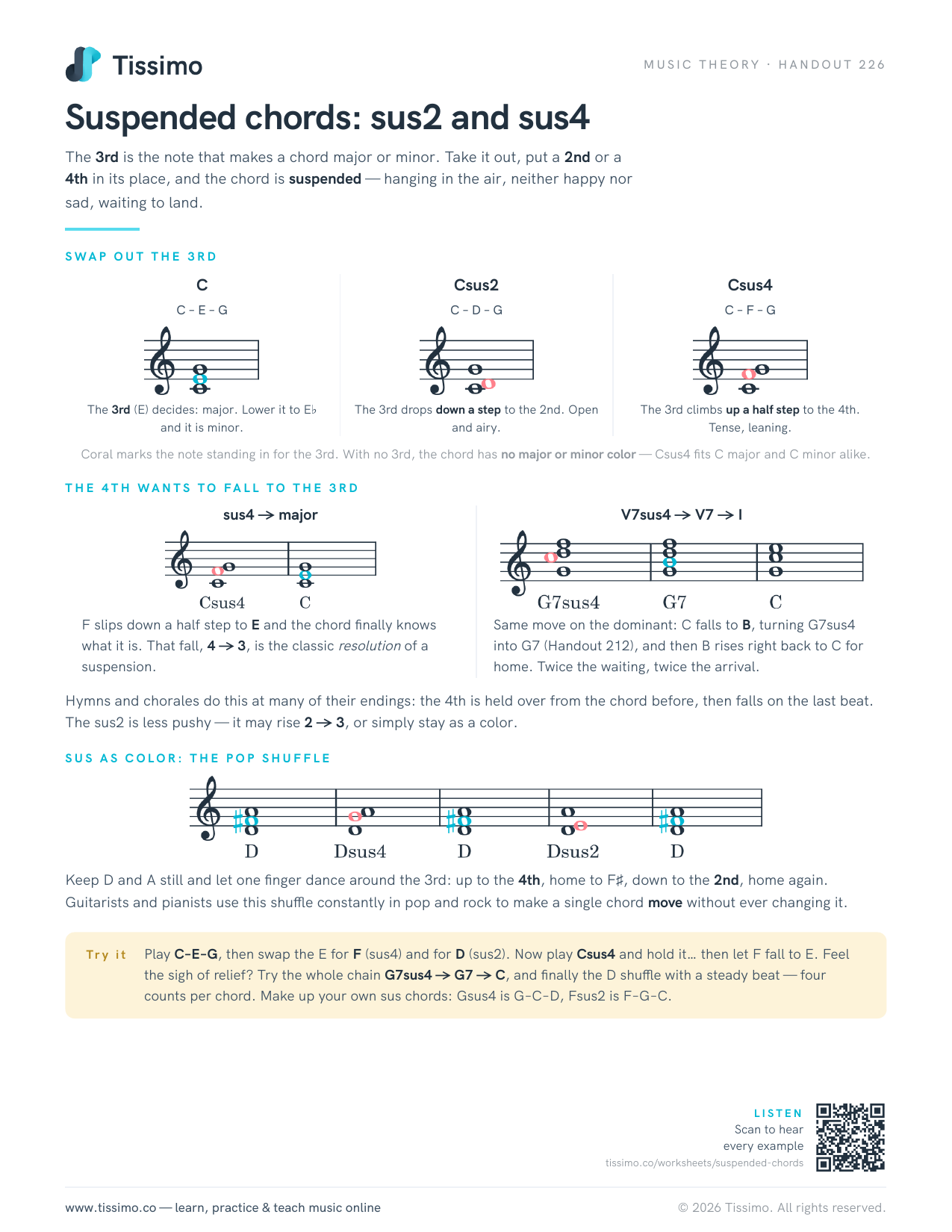
Suspended chords: sus2 and sus4
The 3rd is the note that makes a chord major or minor. Take it out, put a 2nd or a 4th in its place, and the chord is suspended — hanging in the air, neither happy nor sad, waiting to land.
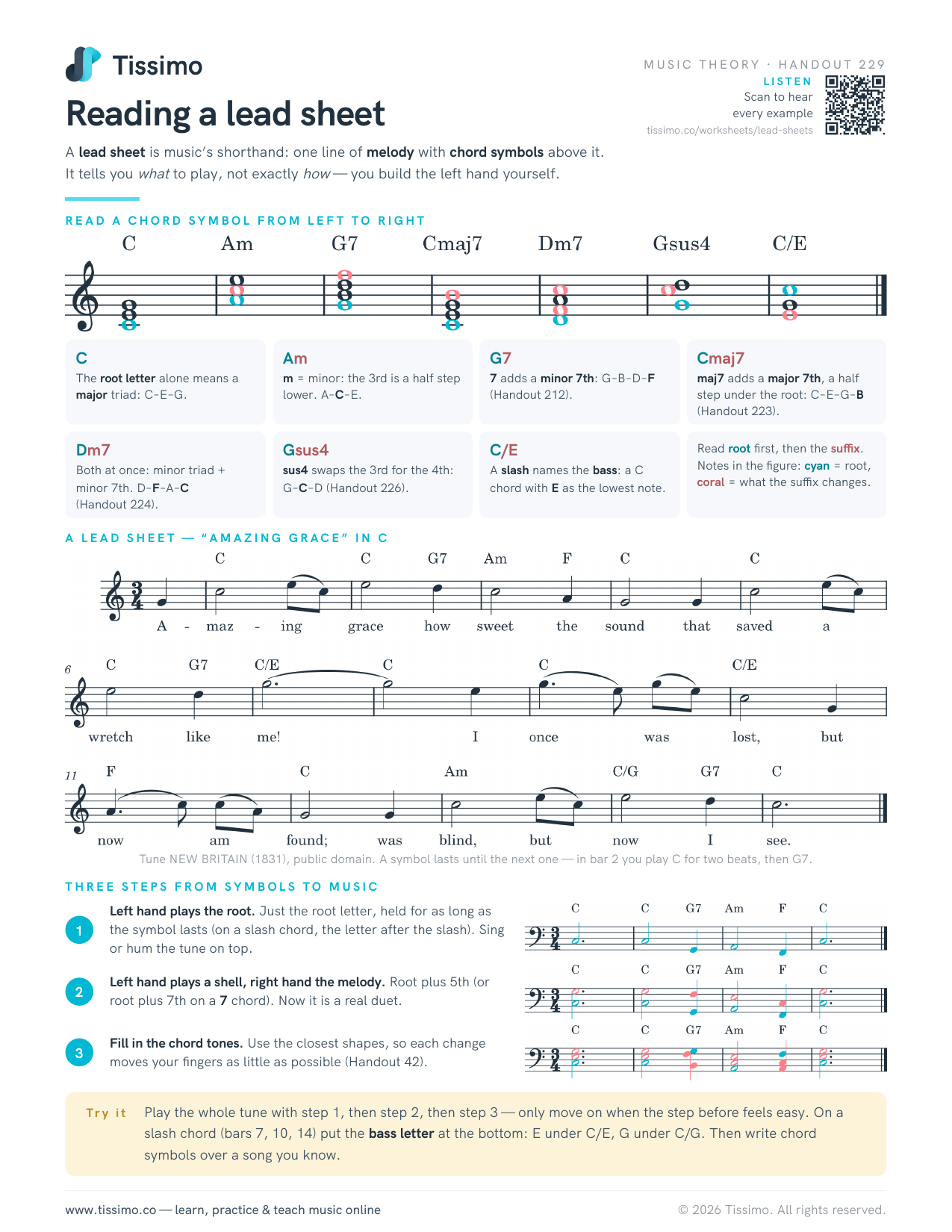
Reading a lead sheet
A lead sheet is music’s shorthand: one line of melody with chord symbols above it. It tells you what to play, not exactly how — you build the left hand yourself.
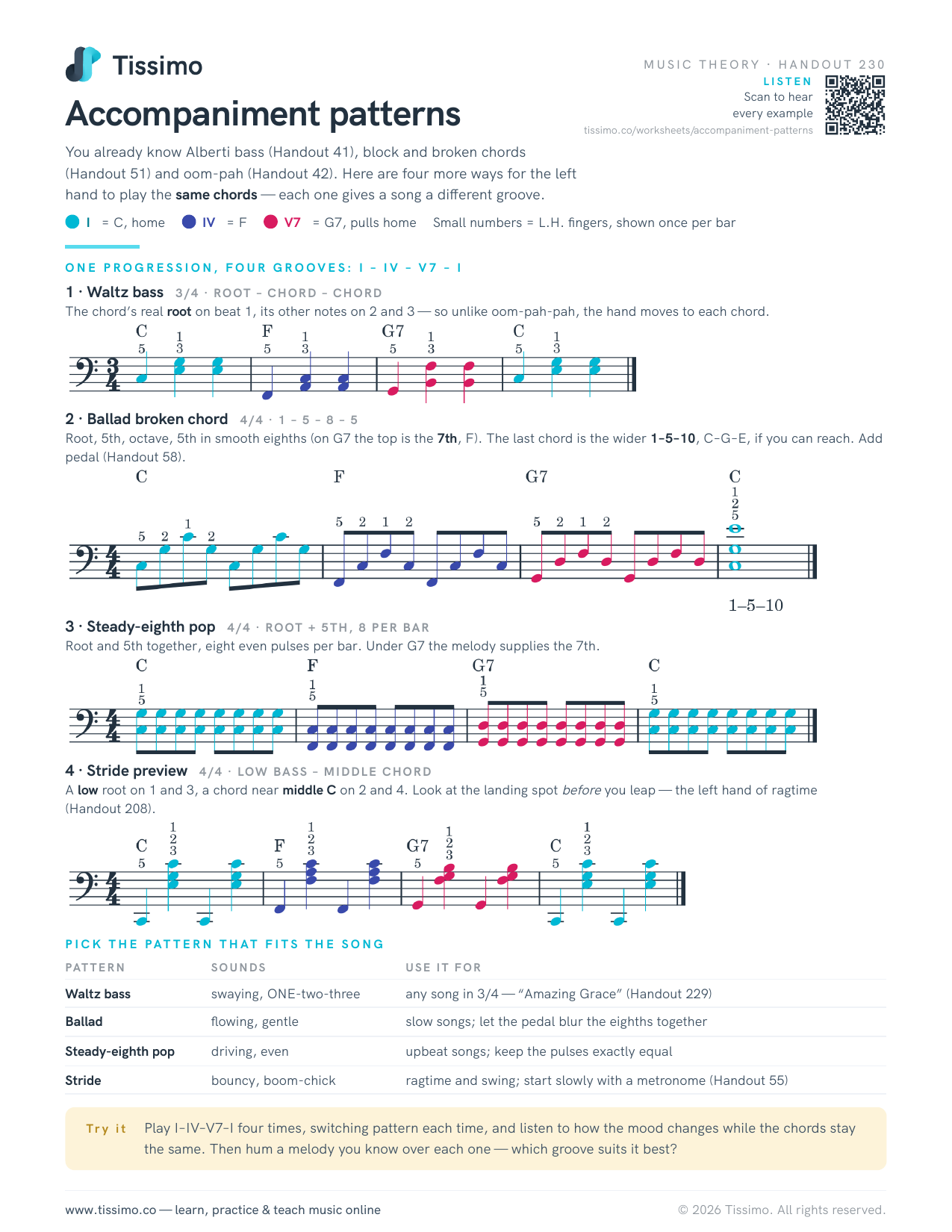
Accompaniment patterns
You already know Alberti bass (Handout 41), block and broken chords (Handout 51) and oom-pah (Handout 42). Here are four more ways for the left hand to play the same chords — each one gives a song a different groove.
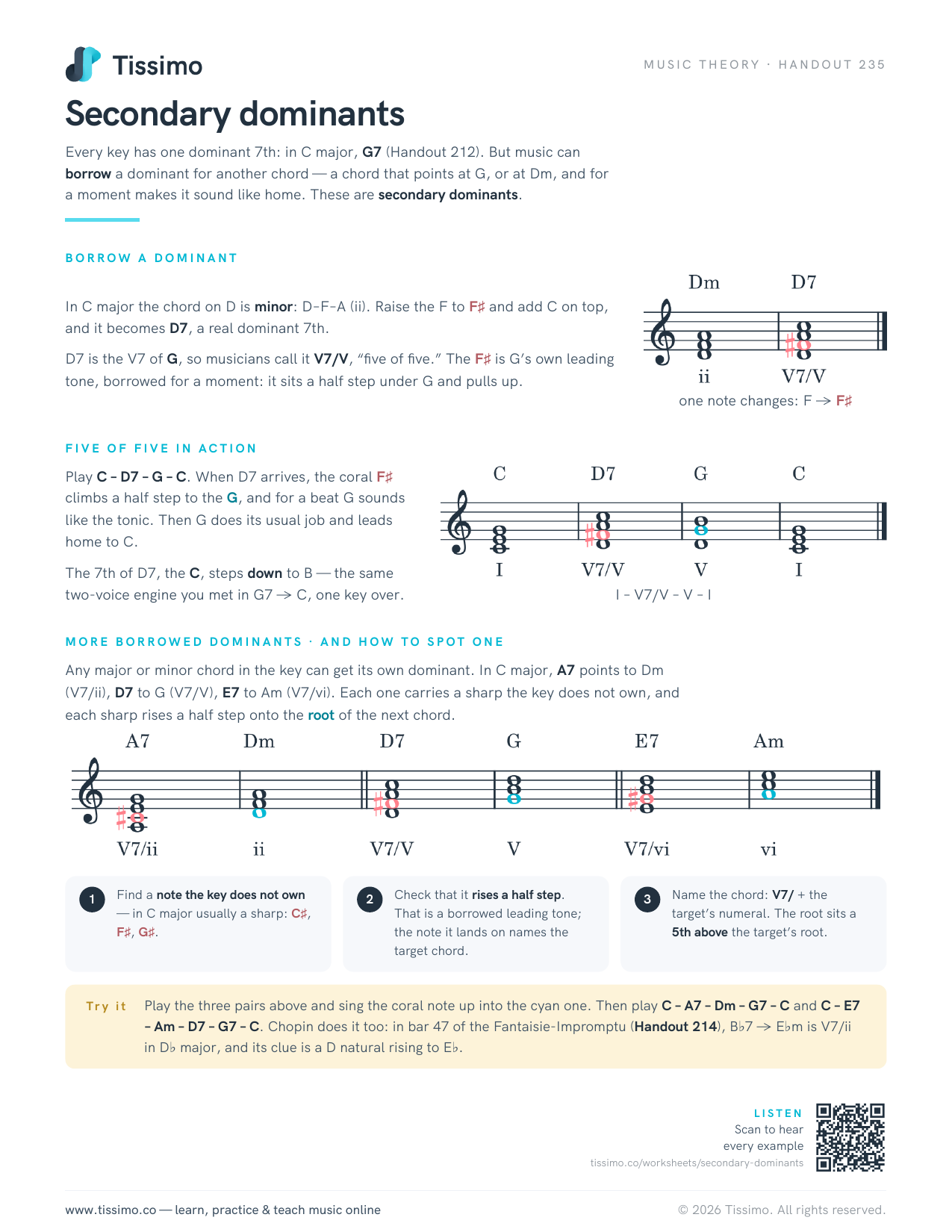
Secondary dominants
Every key has one dominant 7th: in C major, G7 (Handout 212). But music can borrow a dominant for another chord — a chord that points at G, or at Dm, and for a moment makes it sound like home. These are secondary dominants.
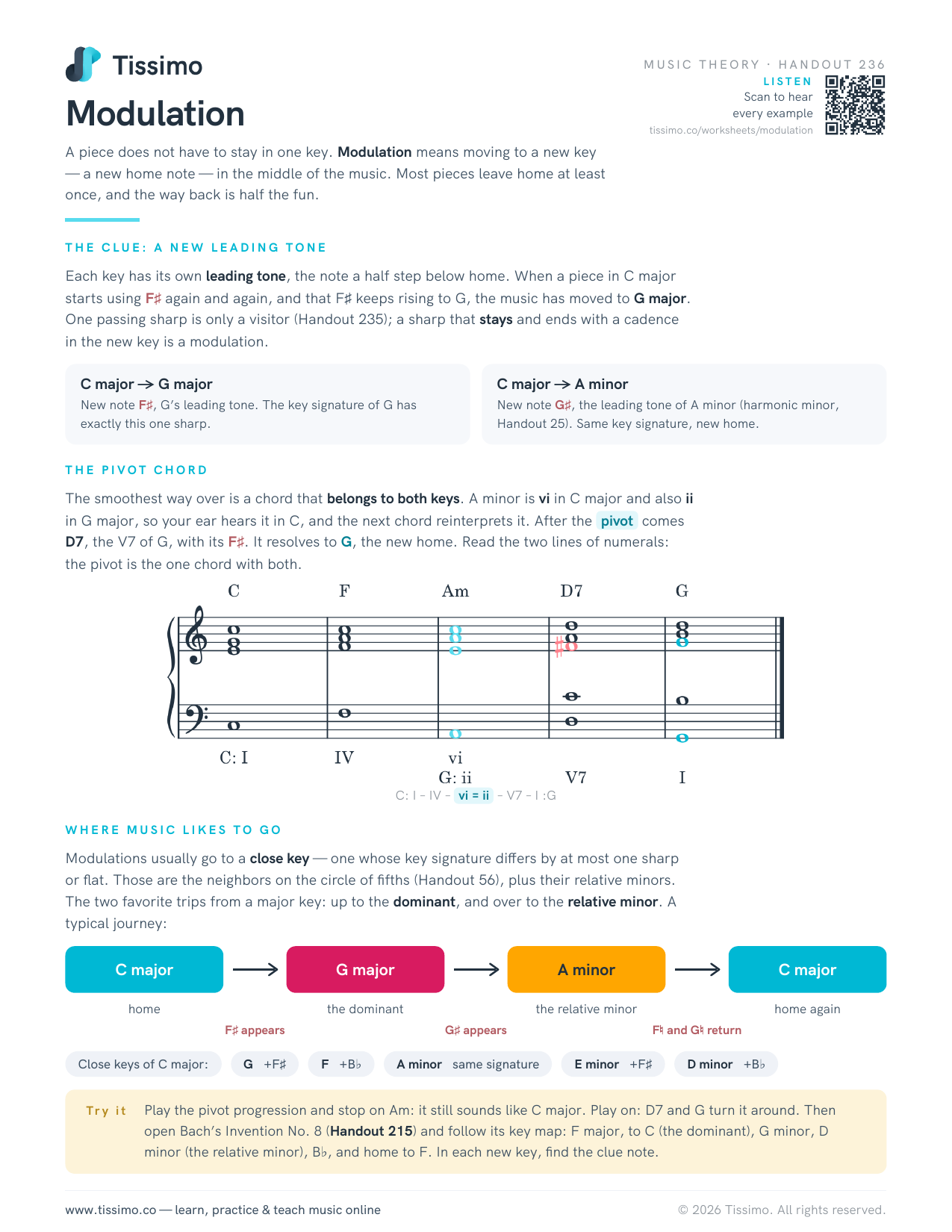
Modulation
A piece does not have to stay in one key. Modulation means moving to a new key — a new home note — in the middle of the music. Most pieces leave home at least once, and the way back is half the fun.
Form & Analysis
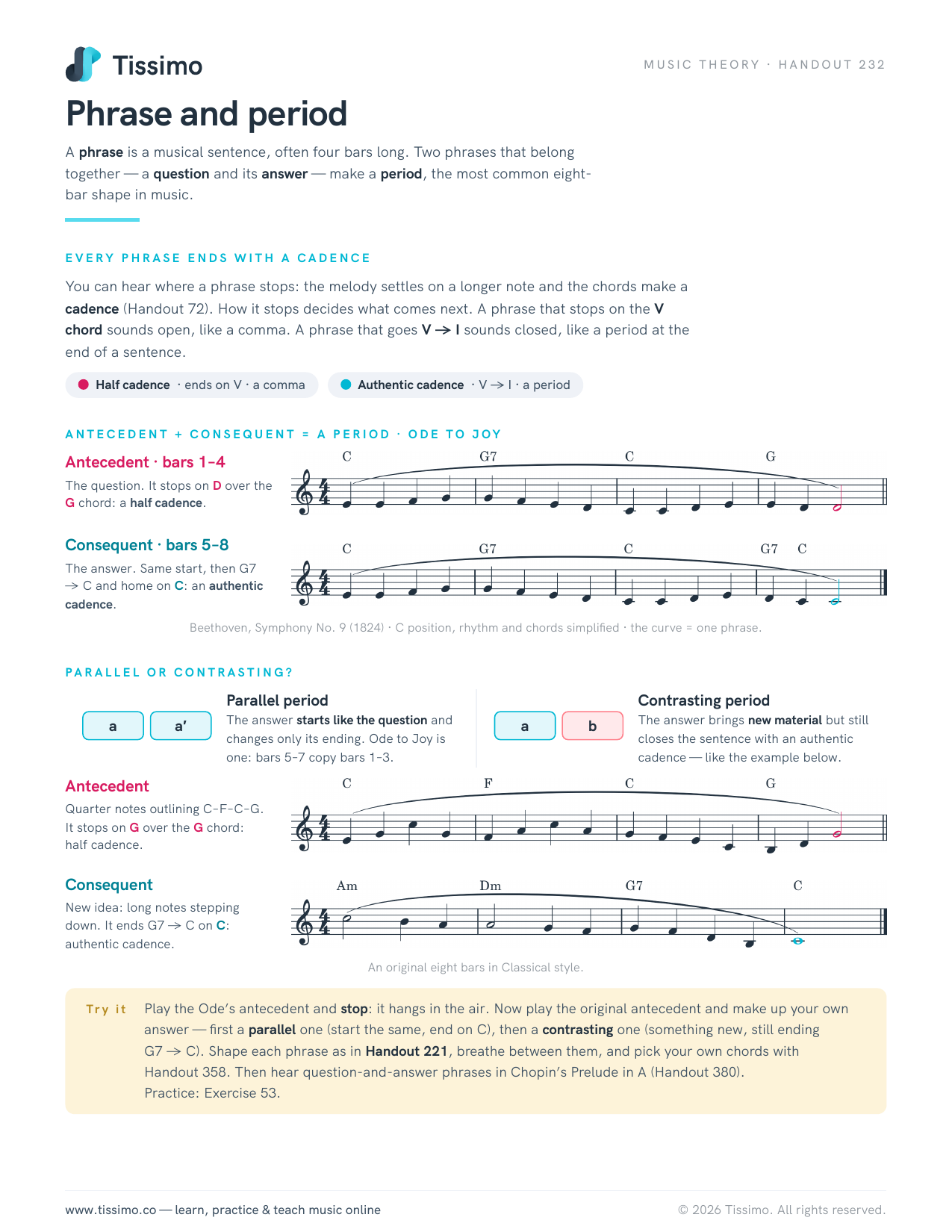
Phrase and period
A phrase is a musical sentence, often four bars long. Two phrases that belong together — a question and its answer — make a period, the most common eight-bar shape in music.
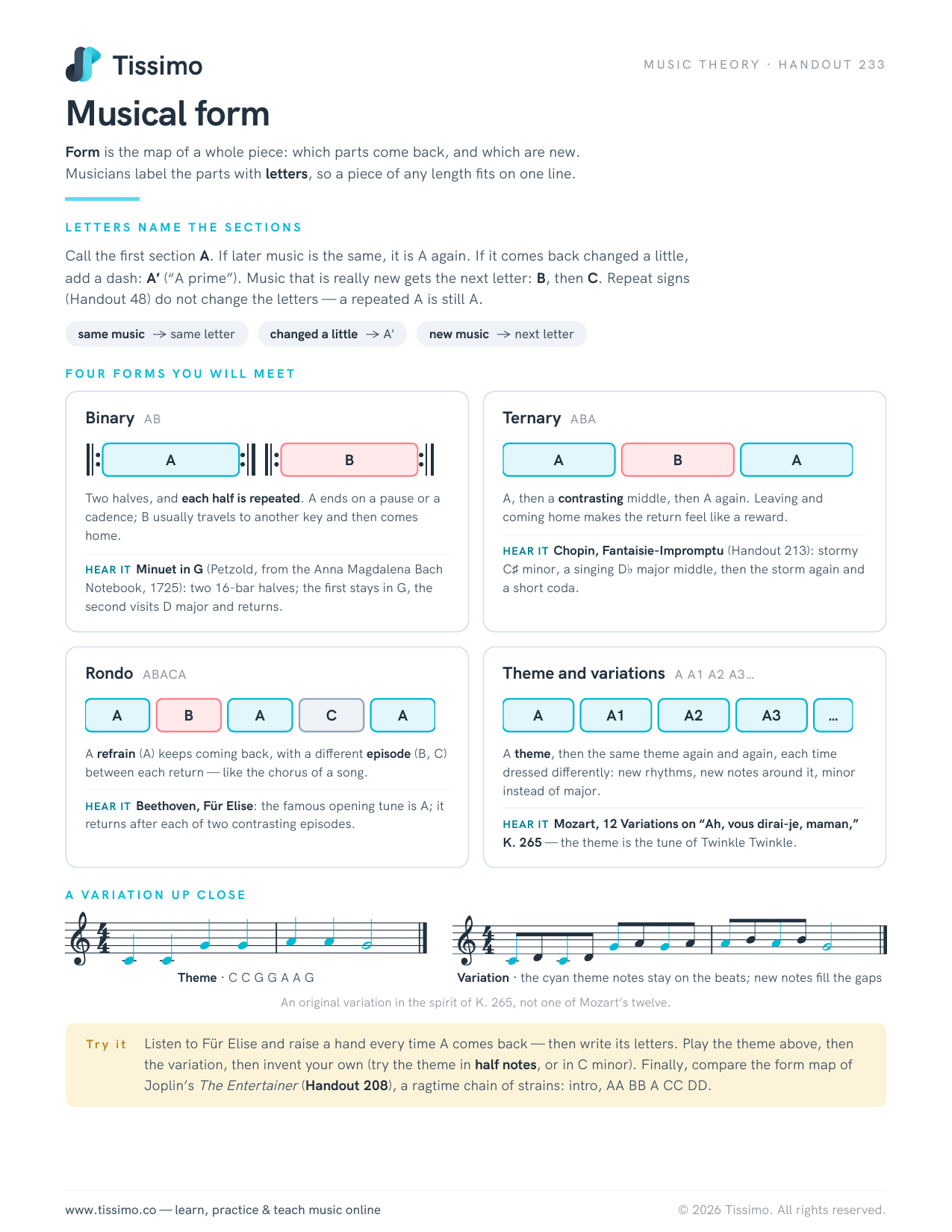
Musical form
Form is the map of a whole piece: which parts come back, and which are new. Musicians label the parts with letters, so a piece of any length fits on one line.
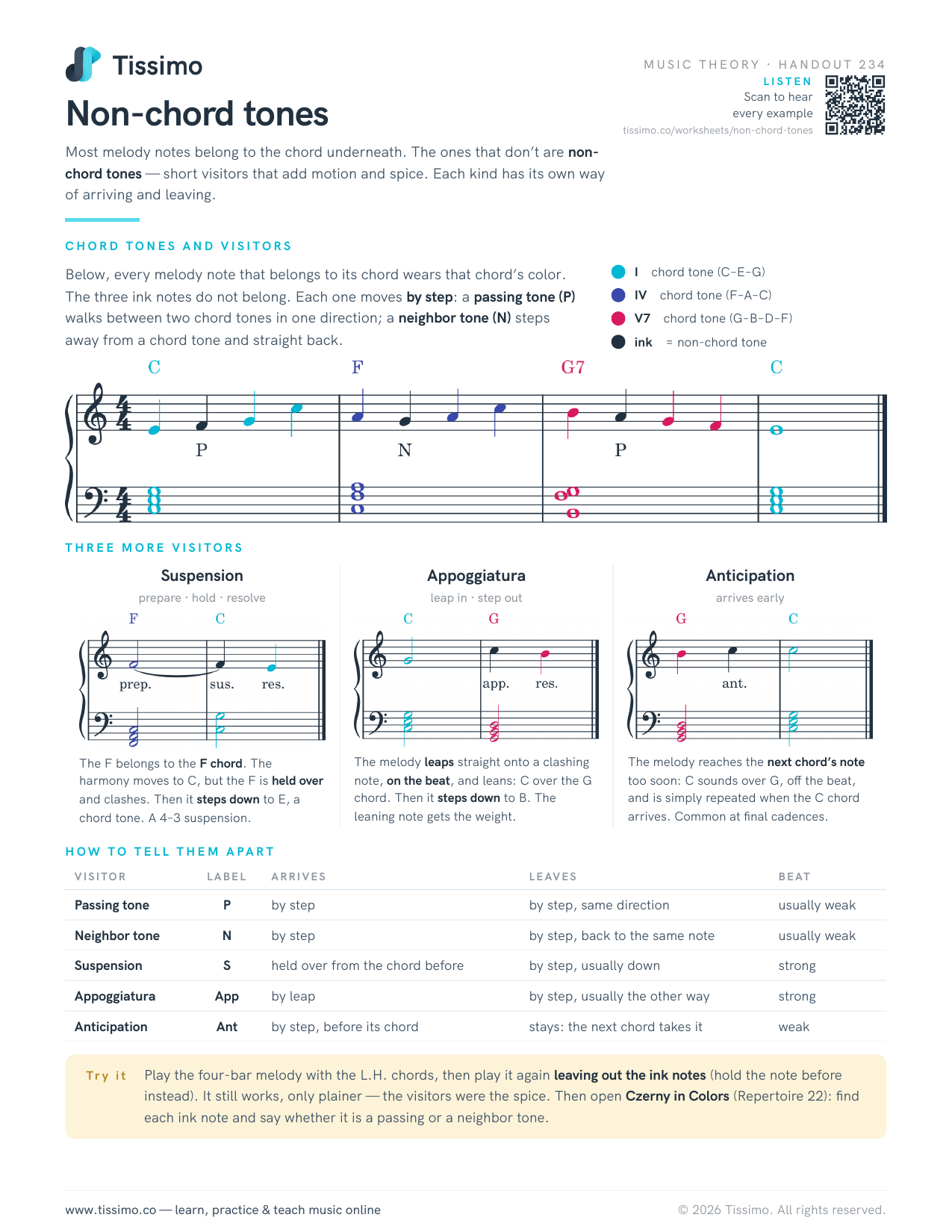
Non-chord tones
Most melody notes belong to the chord underneath. The ones that don’t are non-chord tones — short visitors that add motion and spice. Each kind has its own way of arriving and leaving.
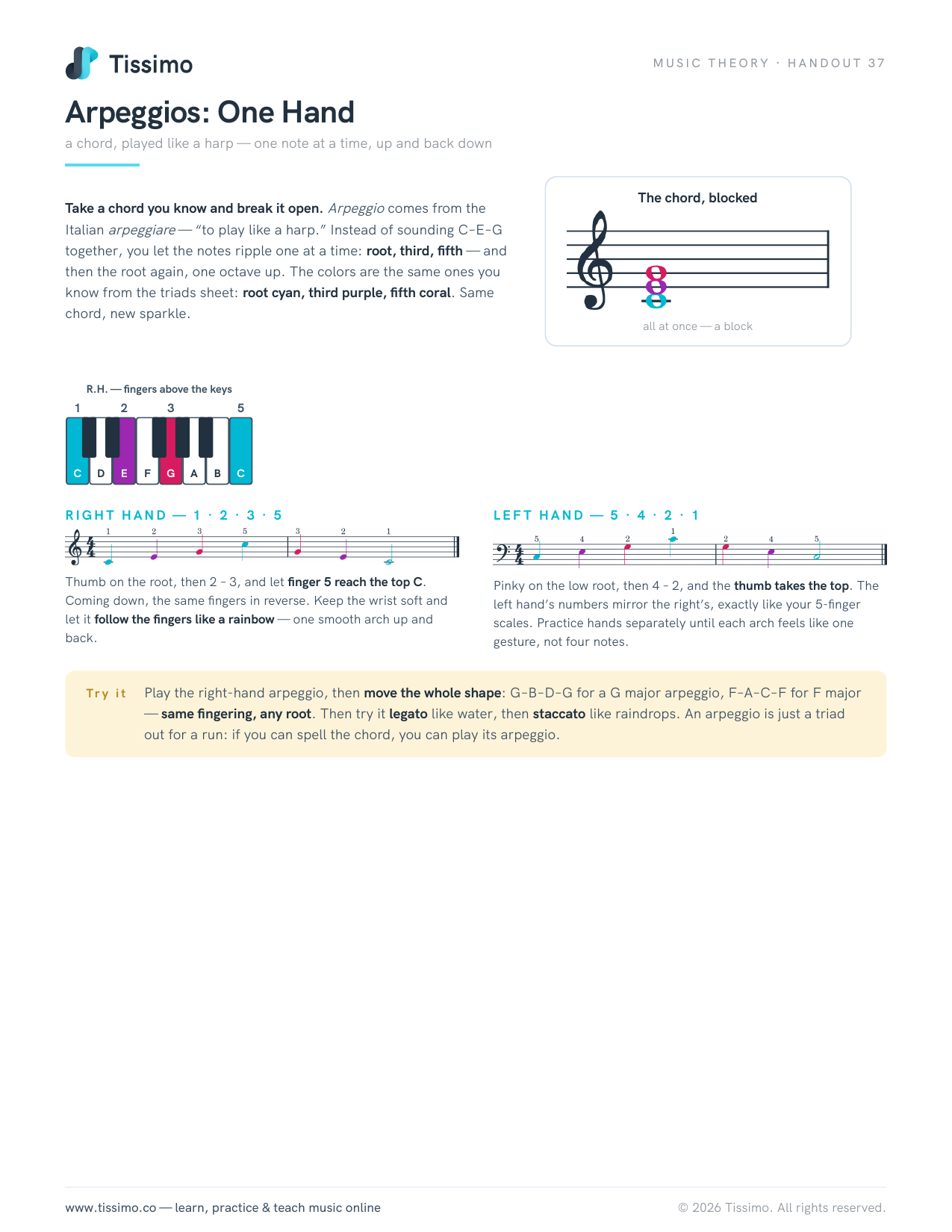
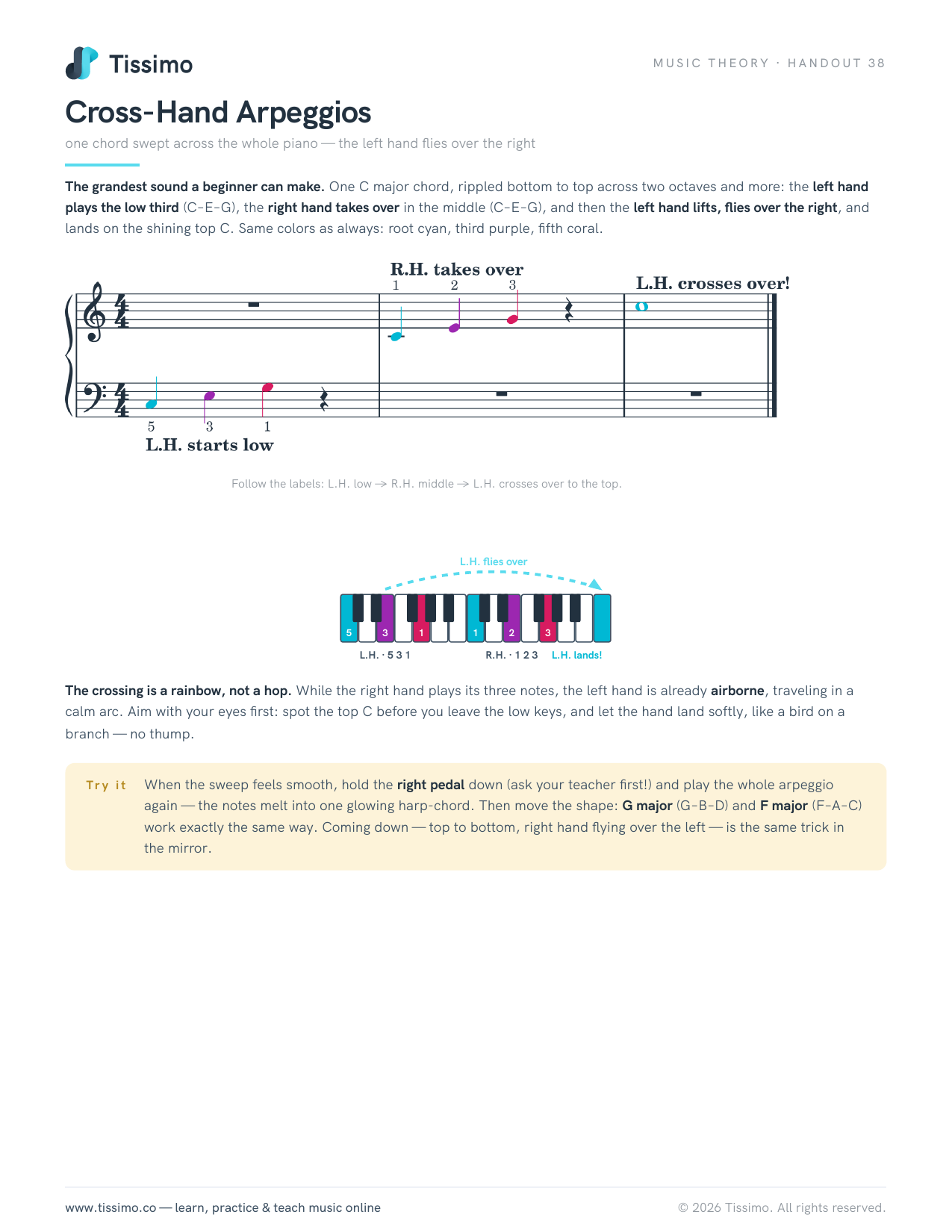
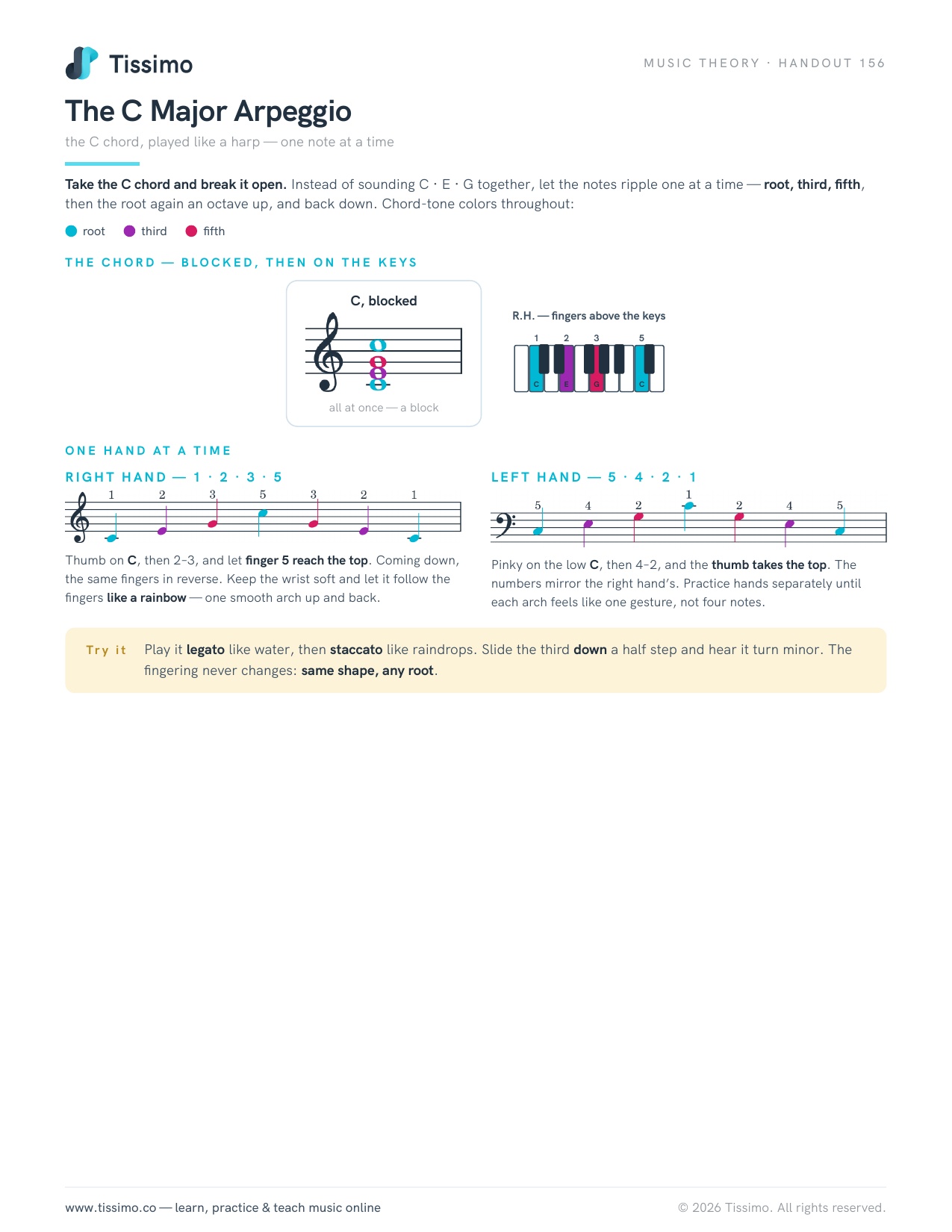
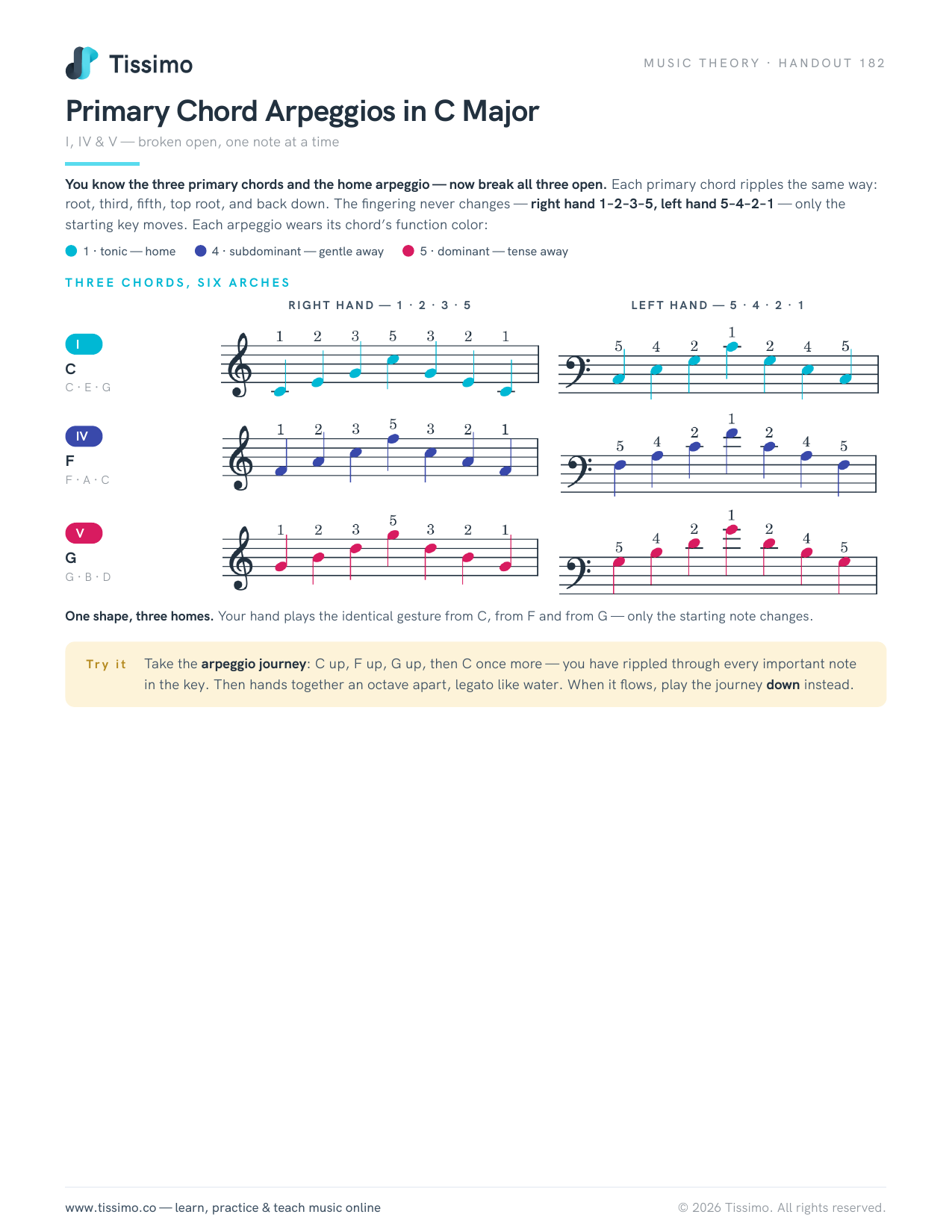
琶音
表现力与技巧
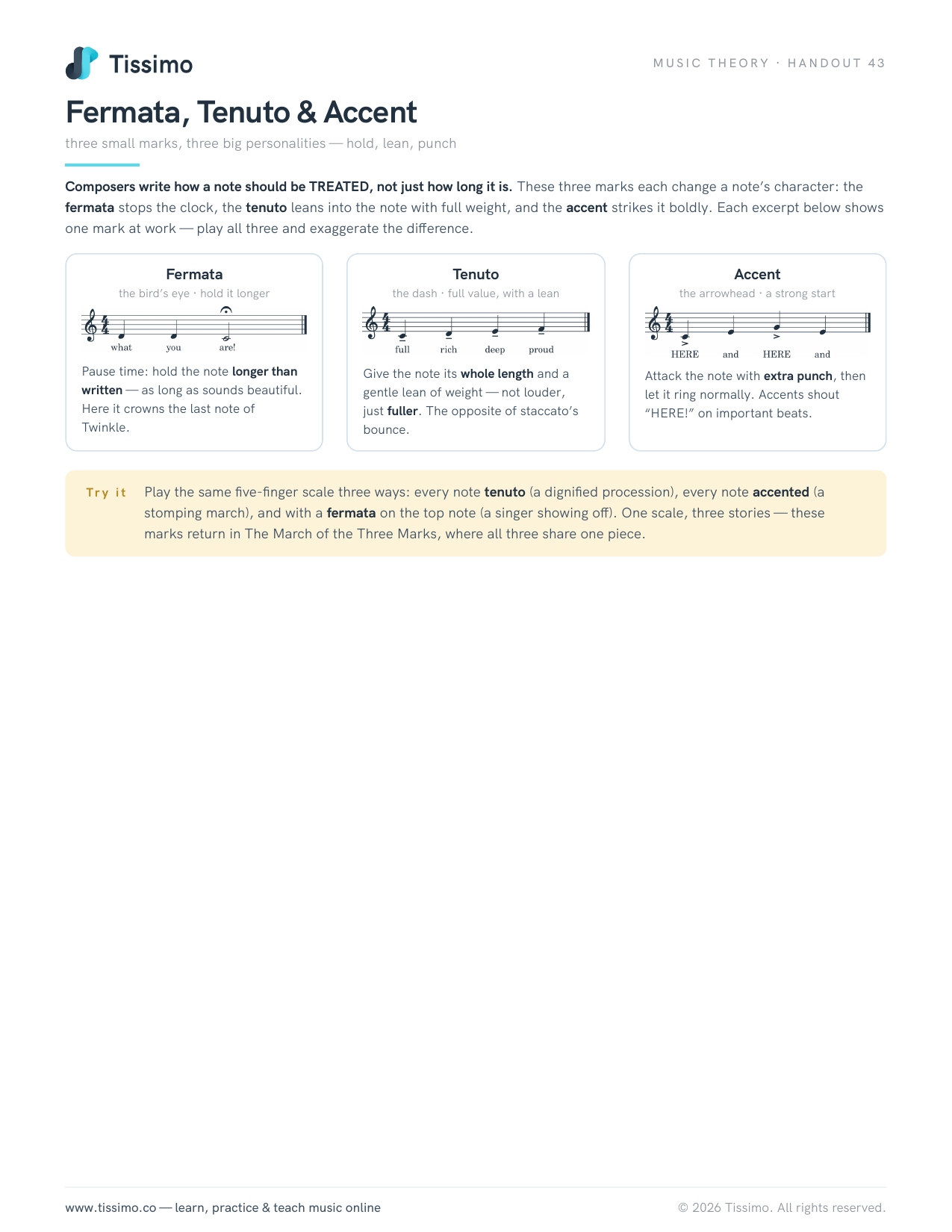
延音记号、保持音与重音
三个小小的记号,三种截然不同的个性——延长、倚靠、重击
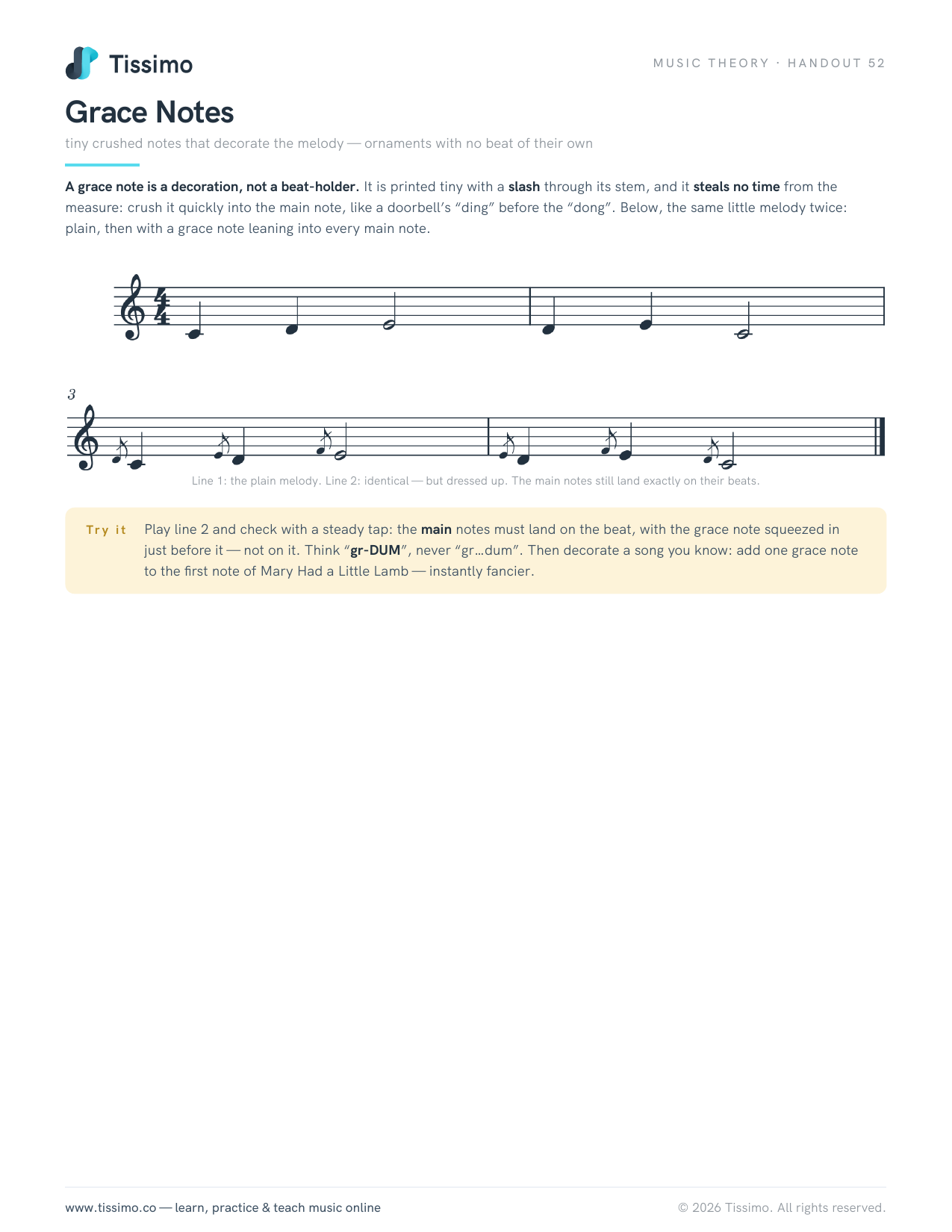
装饰音(倚音)
点缀旋律的极短小音符——本身不占独立节拍的装饰音
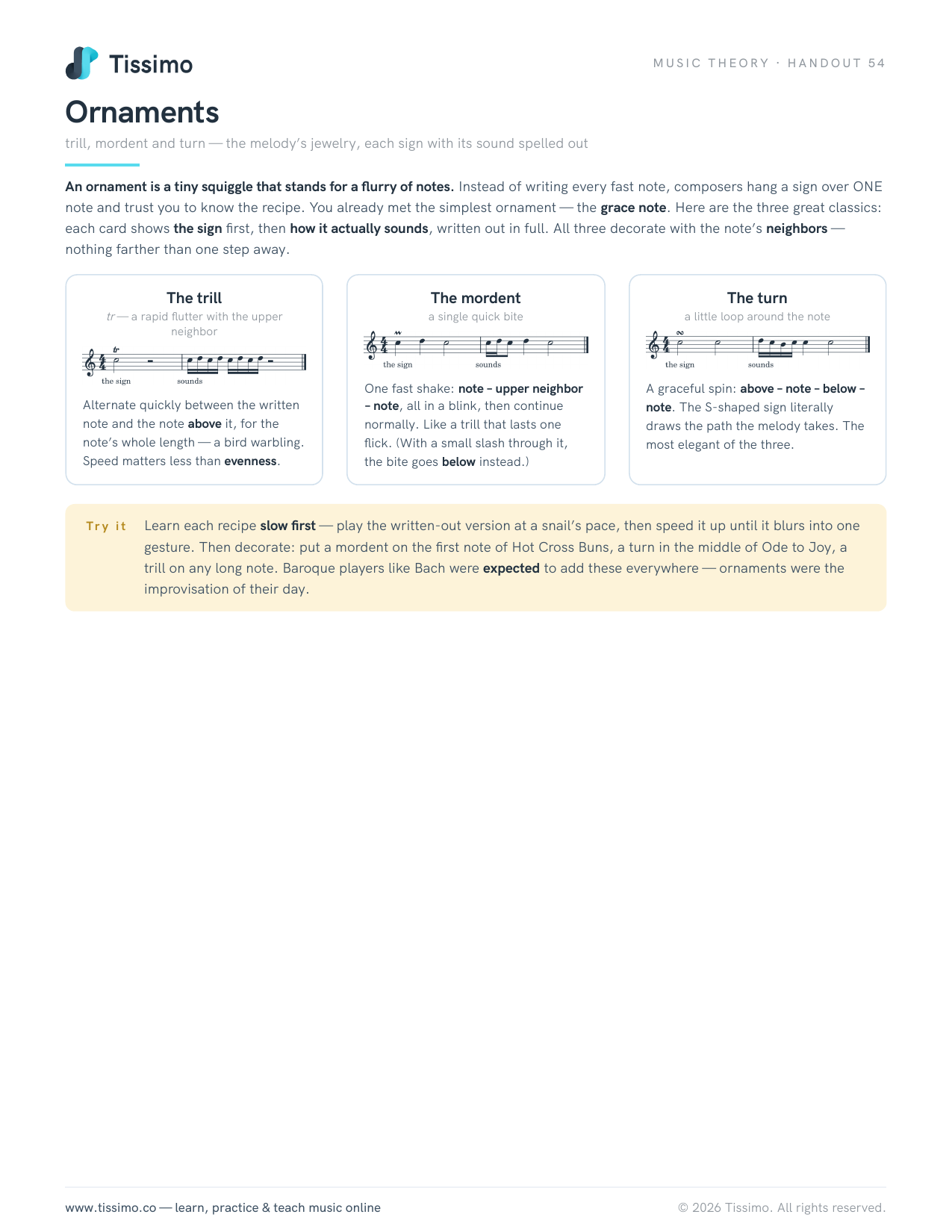
装饰音技法
颤音、波音与回音——旋律的“珠宝”,每个记号都附有实际音响示范
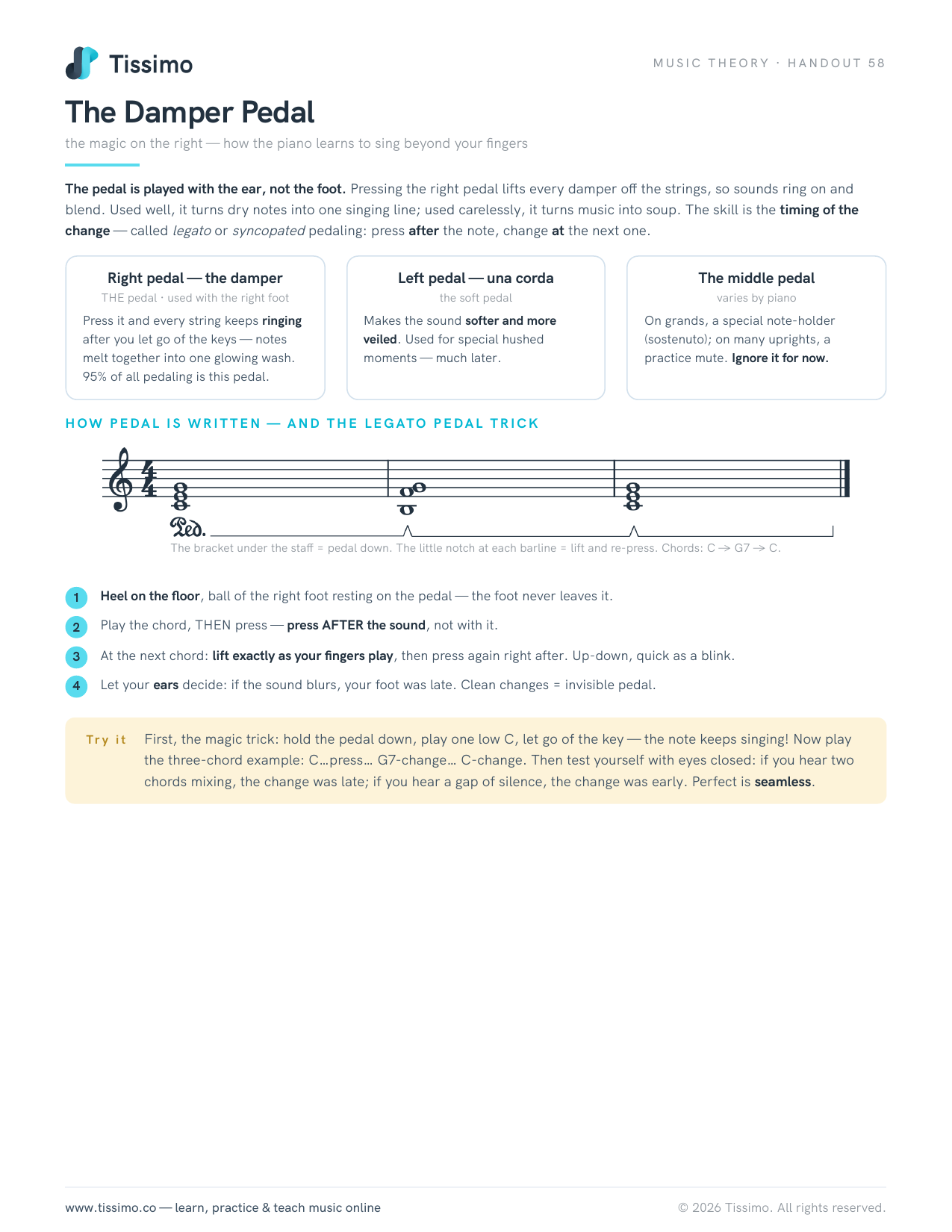
延音踏板
右侧的魔法——钢琴如何学会在你的手指之外继续“歌唱”
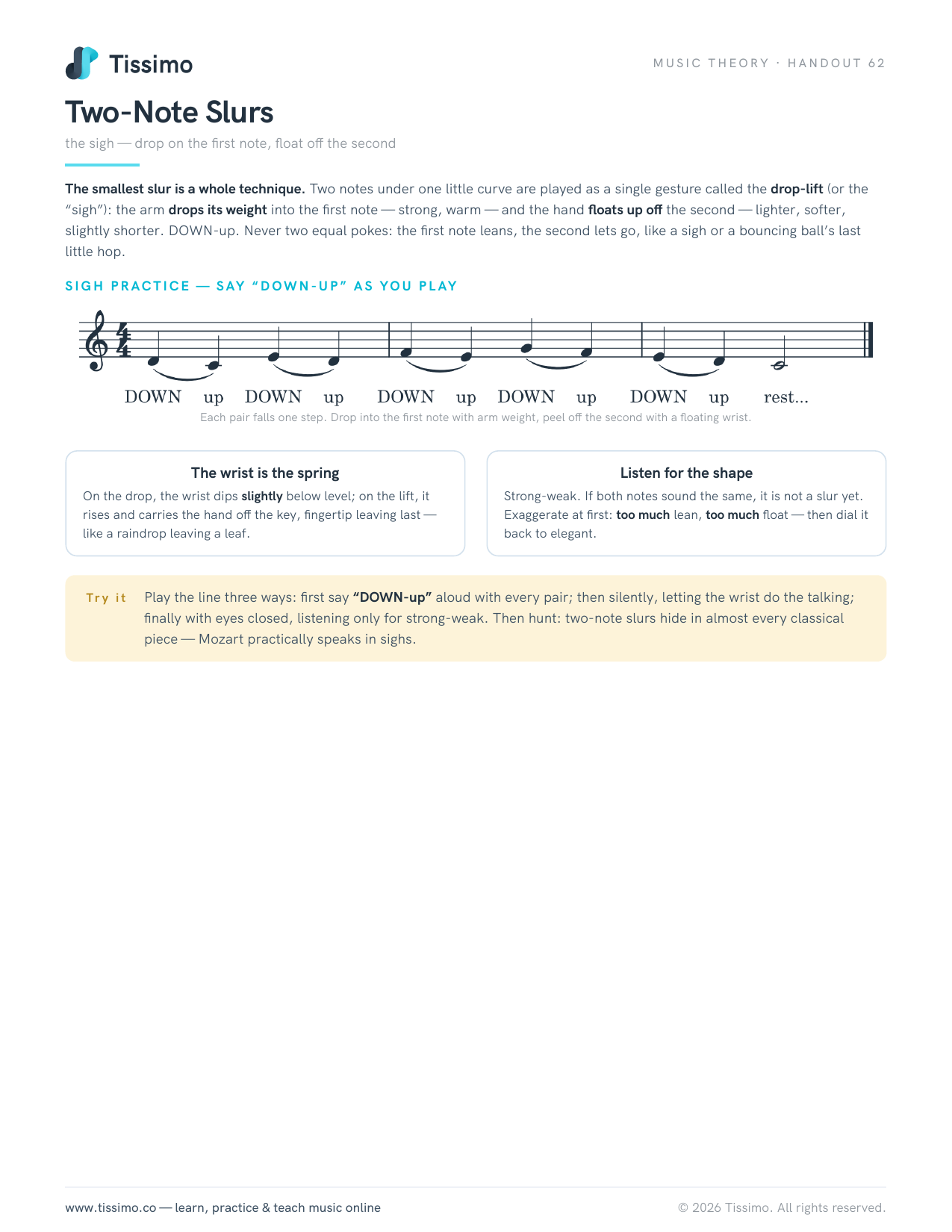
两音连音(叹息奏法)
如同一声叹息——第一个音落下,第二个音轻轻飘起放开
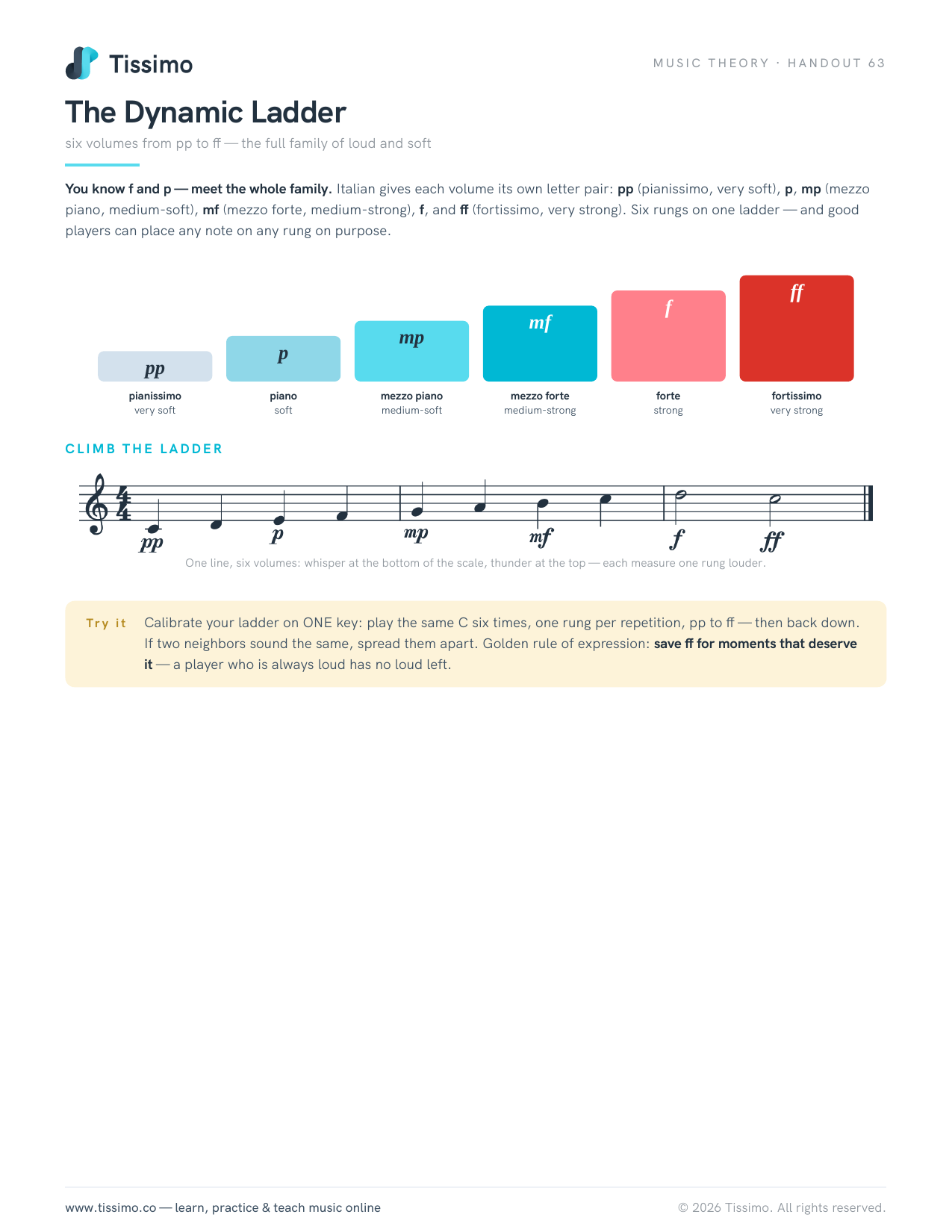
力度阶梯
从pp到ff的六个音量等级——强弱记号的完整家族
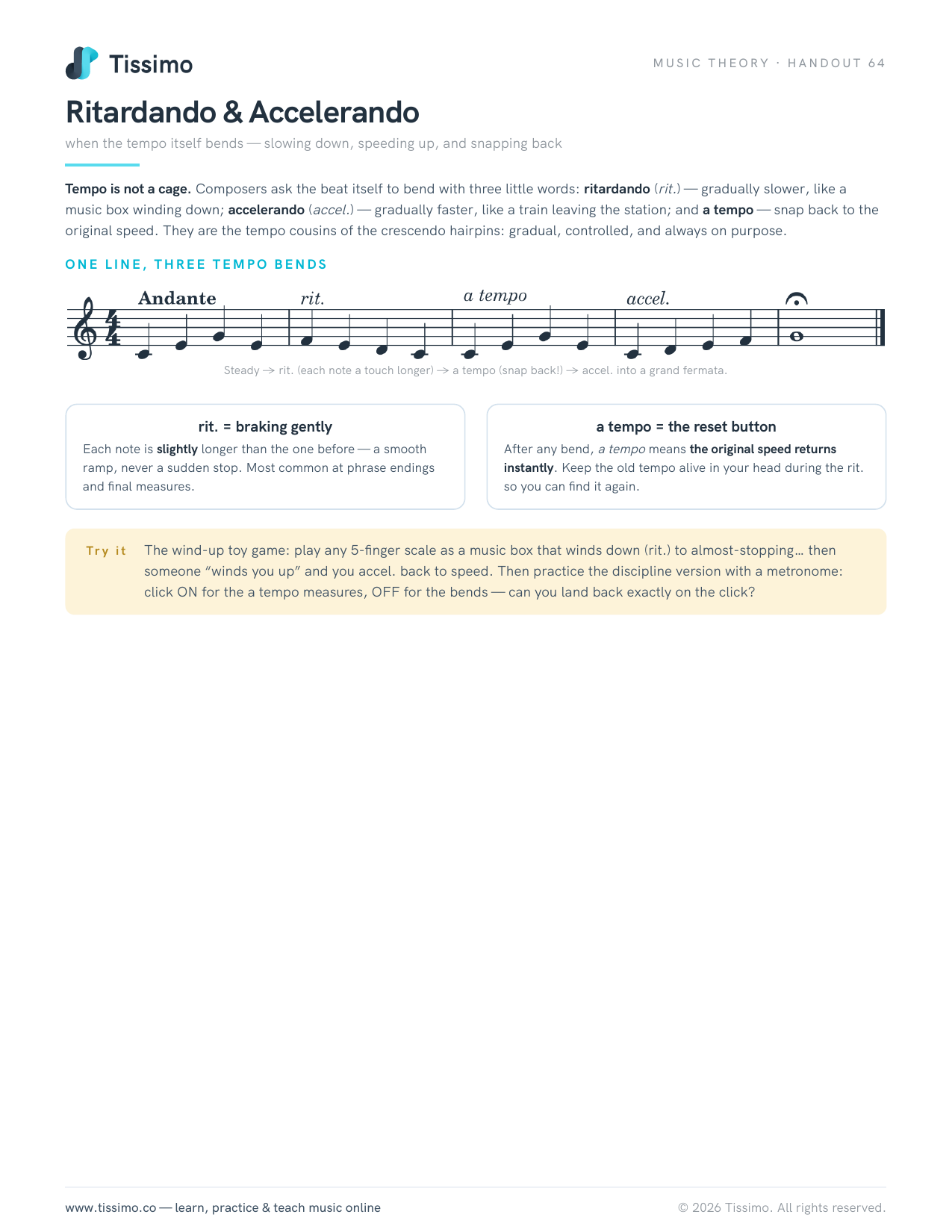
渐慢与渐快
当速度本身发生弯曲时——放慢、加快,然后猛地弹回原速
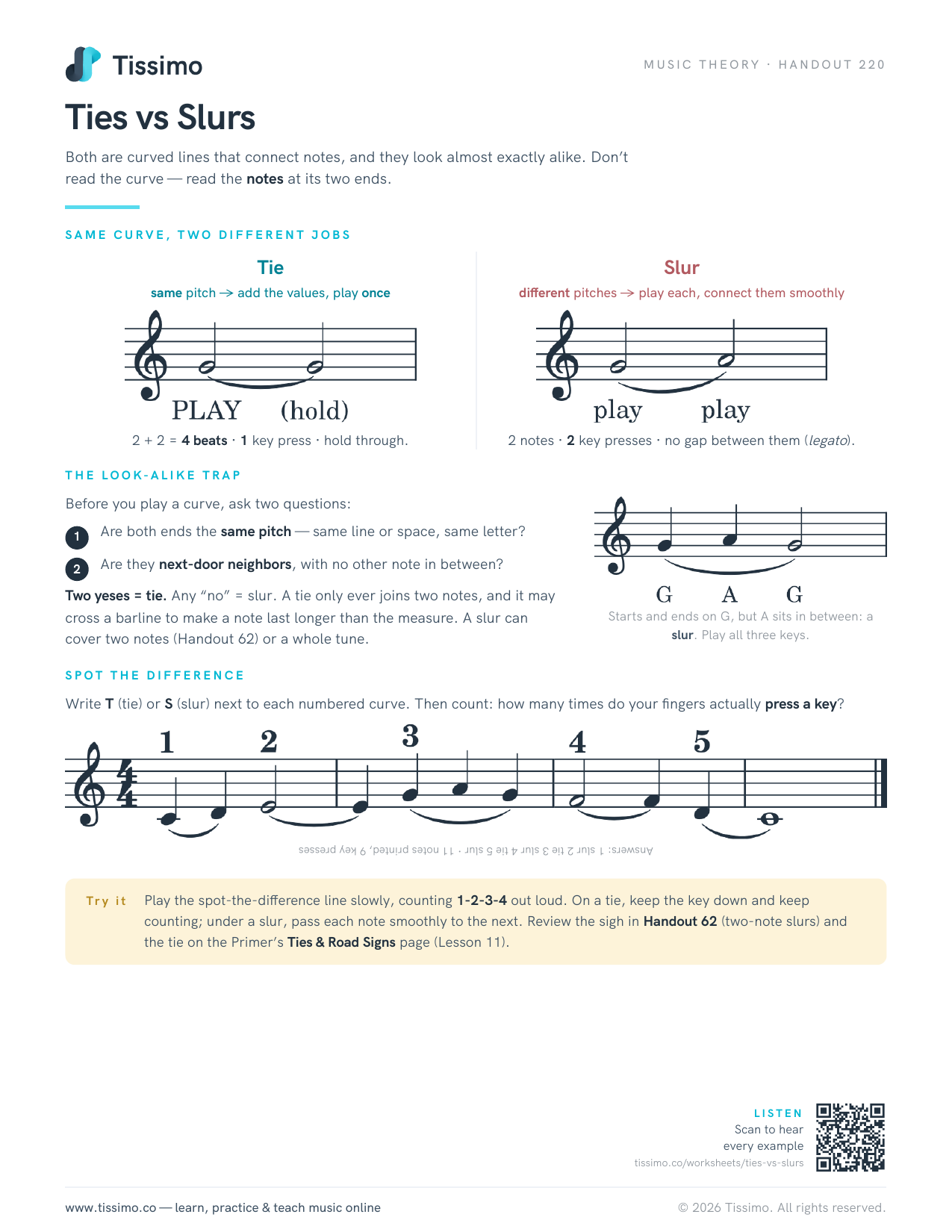
Ties vs Slurs
Both are curved lines that connect notes, and they look almost exactly alike. Don’t read the curve — read the notes at its two ends.
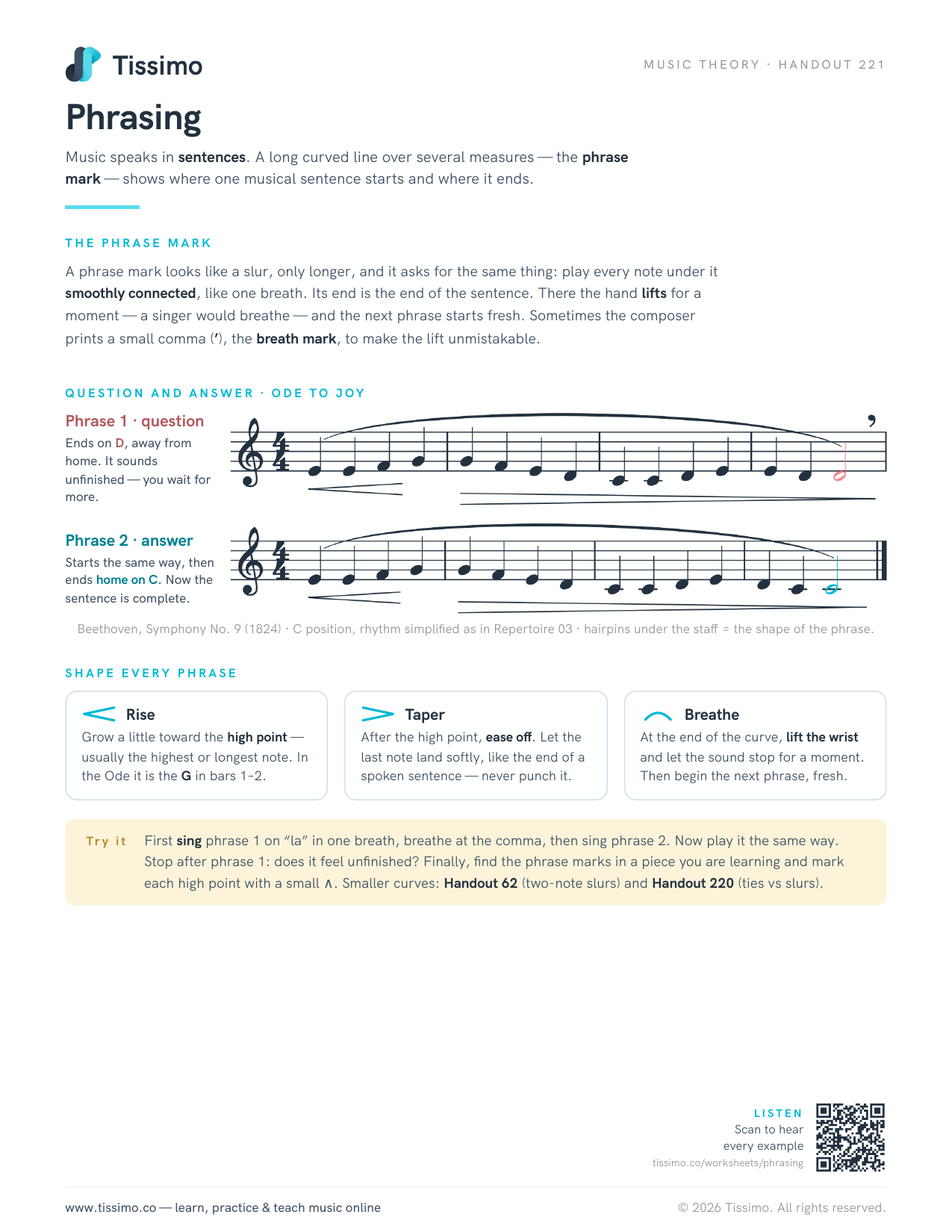
Phrasing
Music speaks in sentences. A long curved line over several measures — the phrase mark — shows where one musical sentence starts and where it ends.
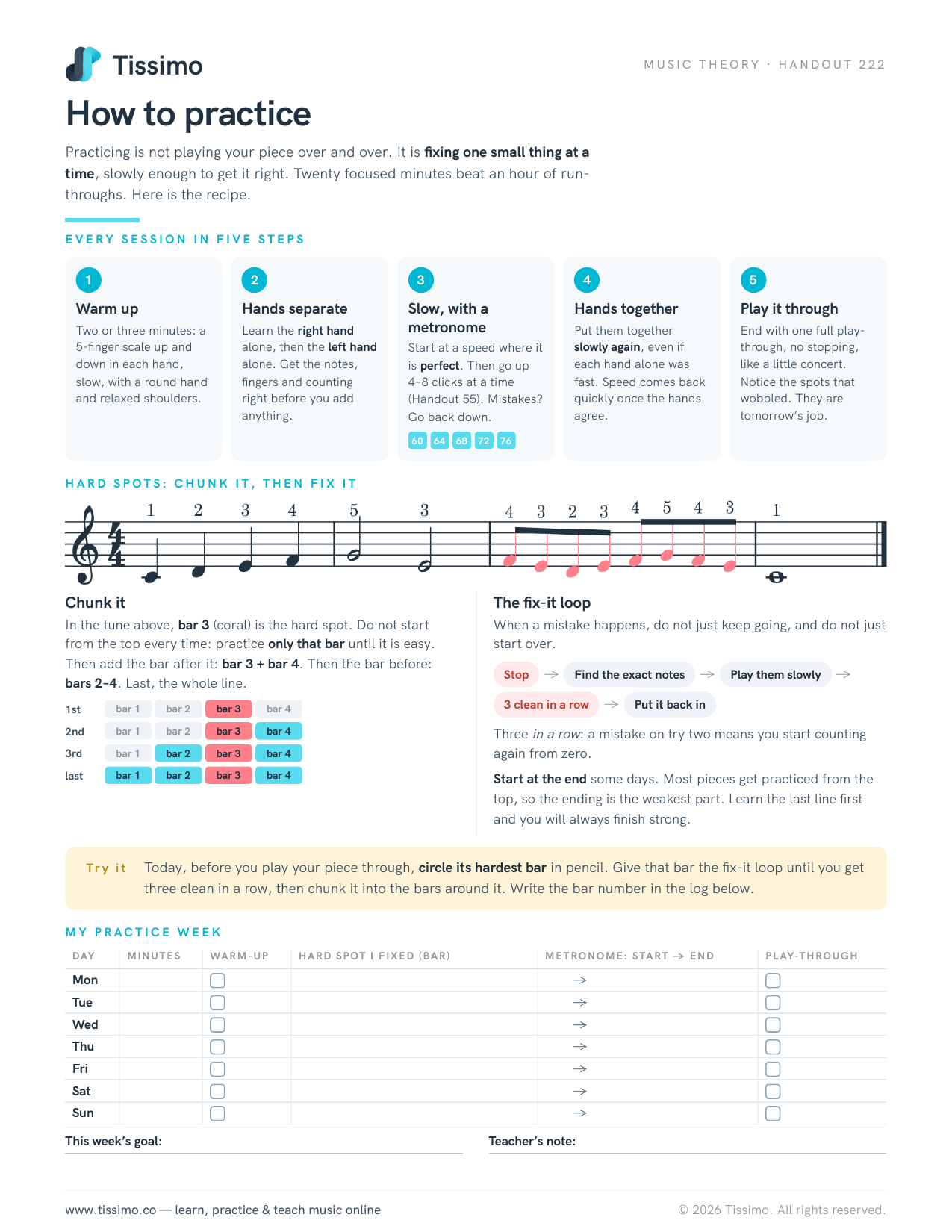
How to practice
Practicing is not playing your piece over and over. It is fixing one small thing at a time, slowly enough to get it right. Twenty focused minutes beat an hour of run-throughs. Here is the recipe.
曲目
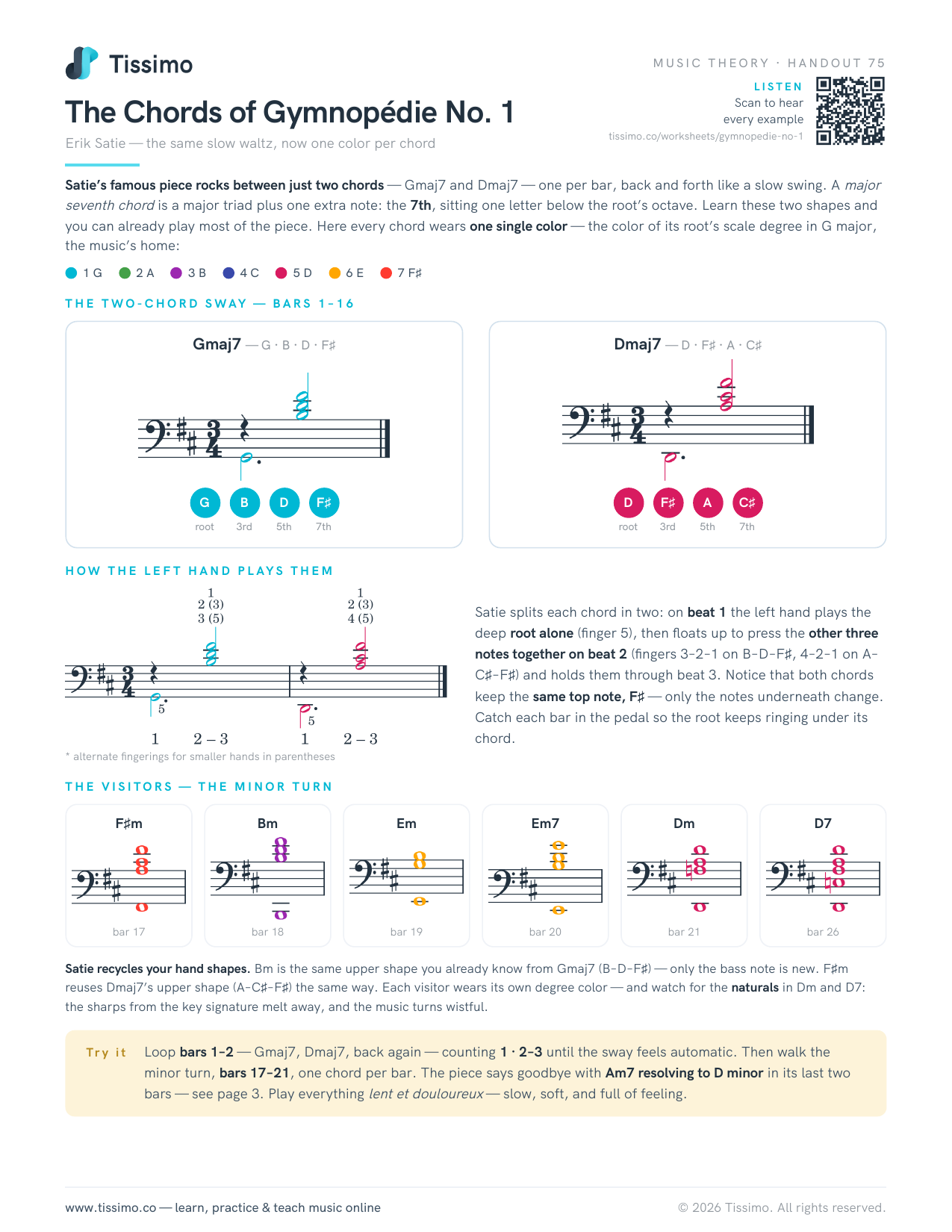
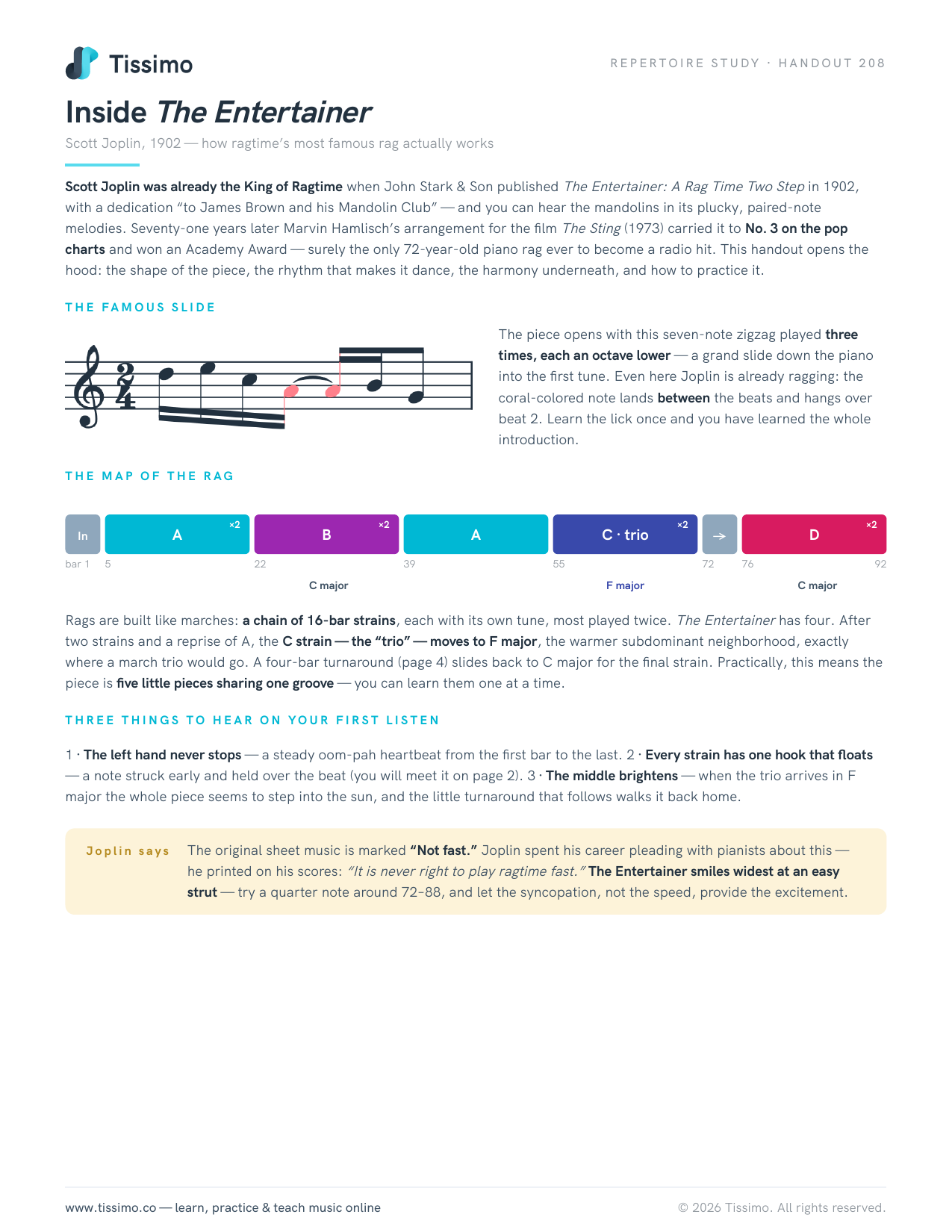
Exercises
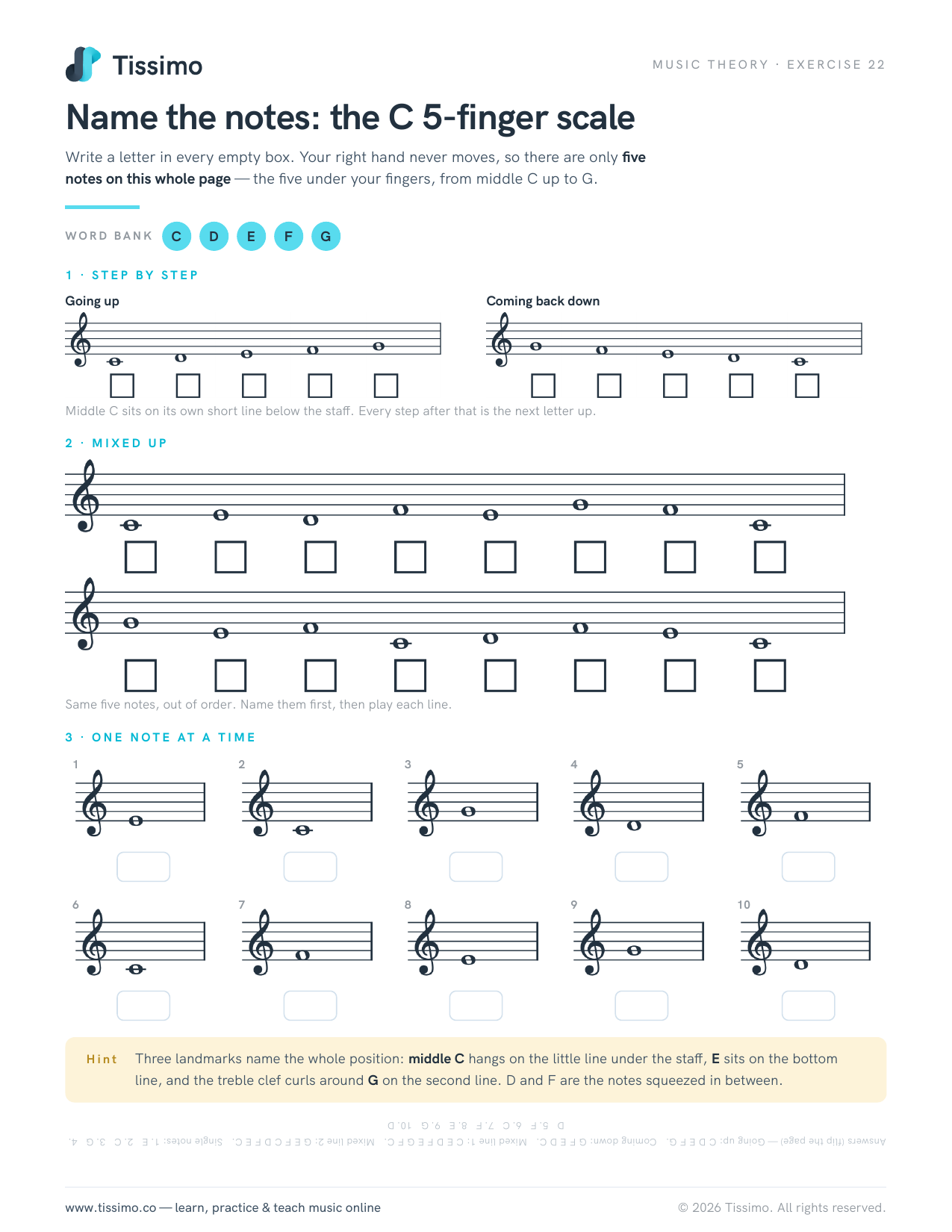
Name the notes: the C 5-finger scale
Write a letter in every empty box. Your right hand never moves, so there are only five notes on this whole page — the five under your fingers, from middle C up to G.
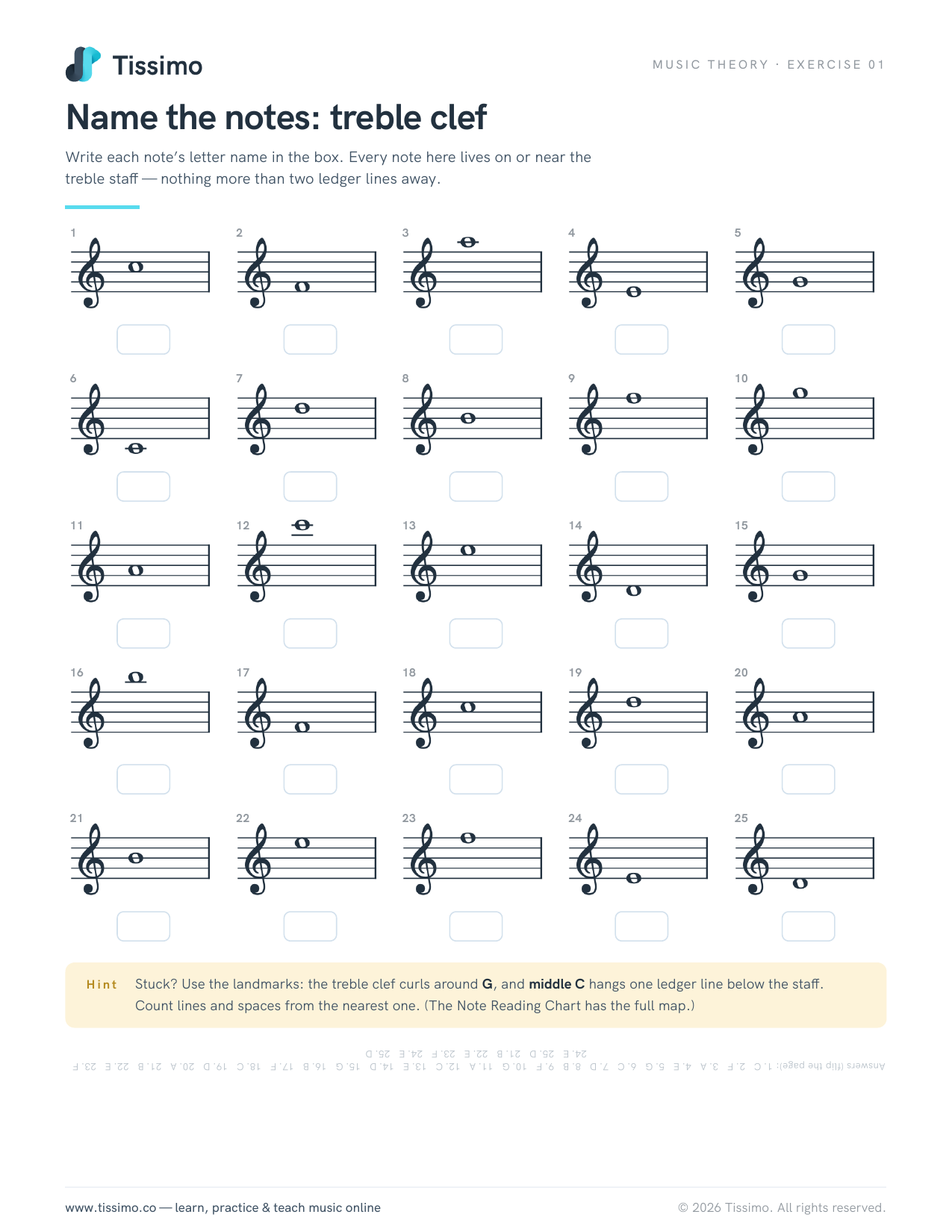
Name the notes: treble clef
Write each note’s letter name in the box. Every note here lives on or near the treble staff — nothing more than two ledger lines away.
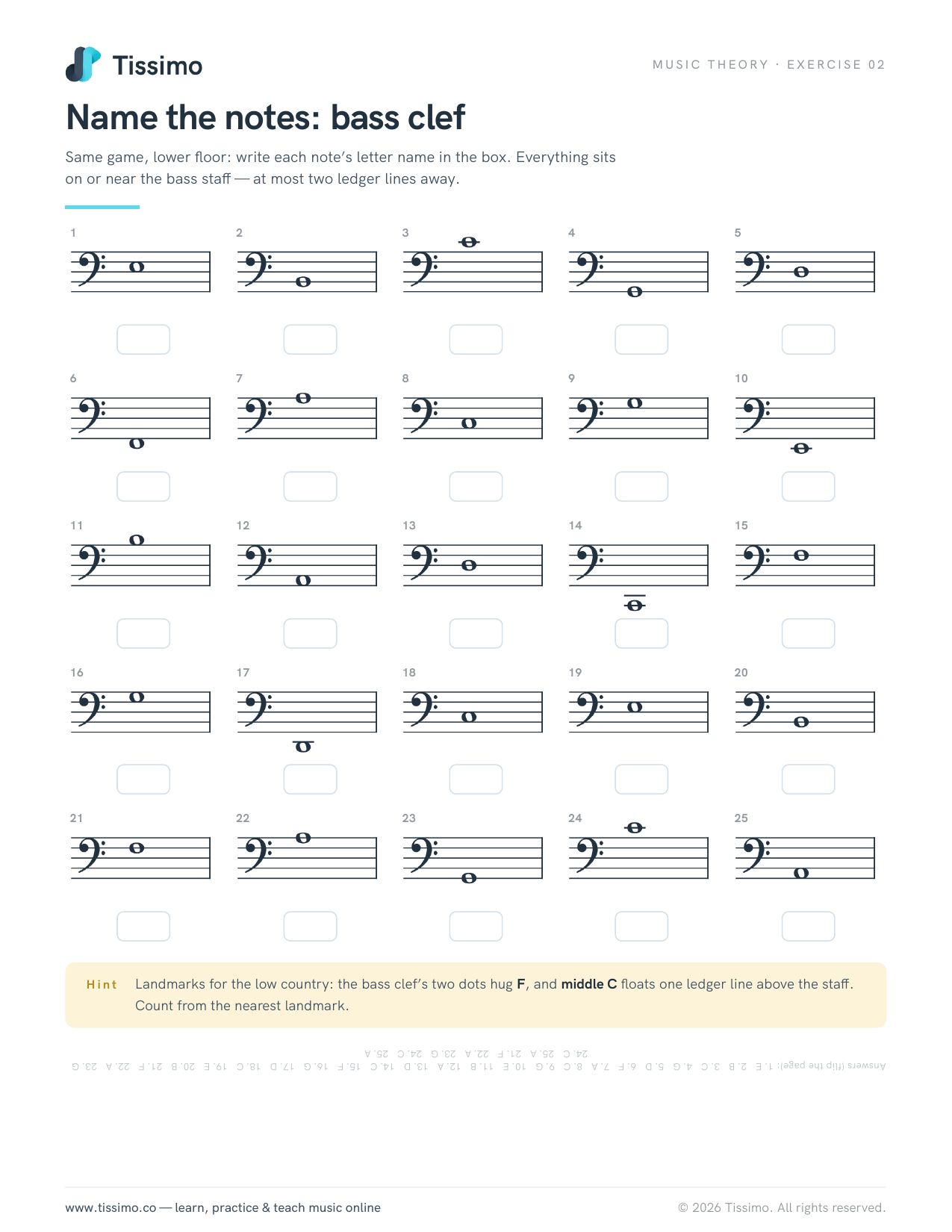
Name the notes: bass clef
Same game, lower floor: write each note’s letter name in the box. Everything sits on or near the bass staff — at most two ledger lines away.
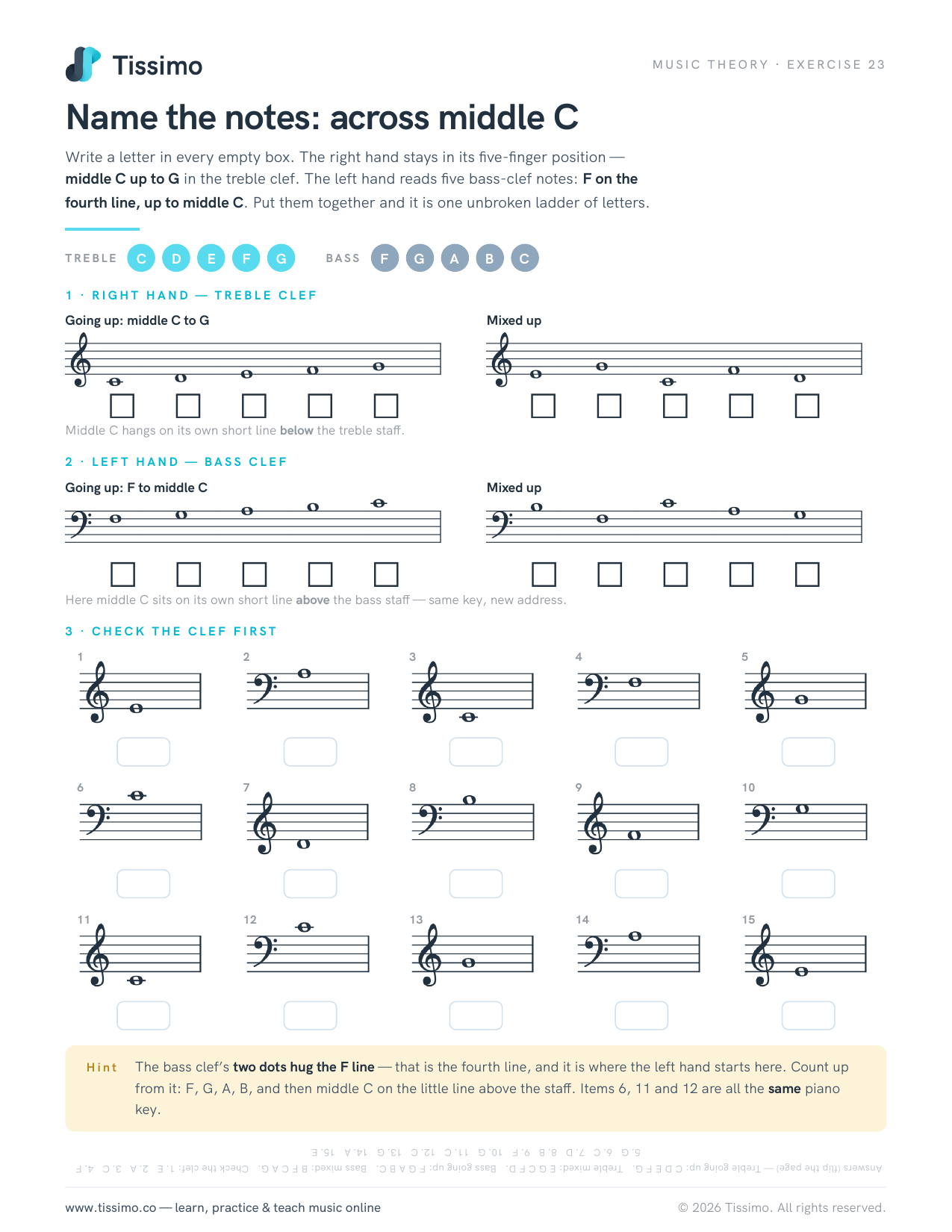
Name the notes: across middle C
Write a letter in every empty box. The right hand stays in its five-finger position — middle C up to G in the treble clef. The left hand reads five bass-clef notes: F on the fourth line, up to middle C. Put them together and it is one unbroken ladder of letters.
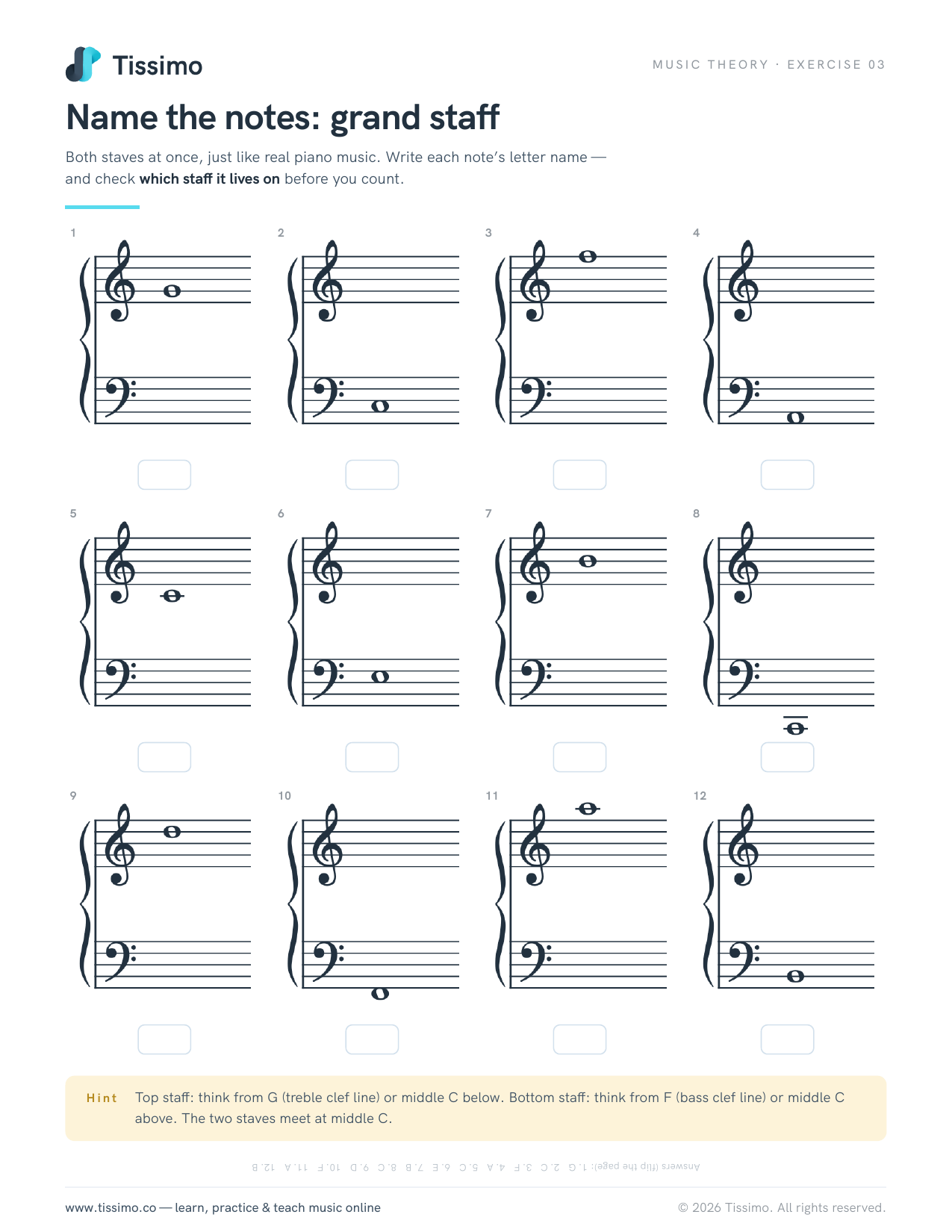
Name the notes: grand staff
Both staves at once, just like real piano music. Write each note’s letter name — and check which staff it lives on before you count.
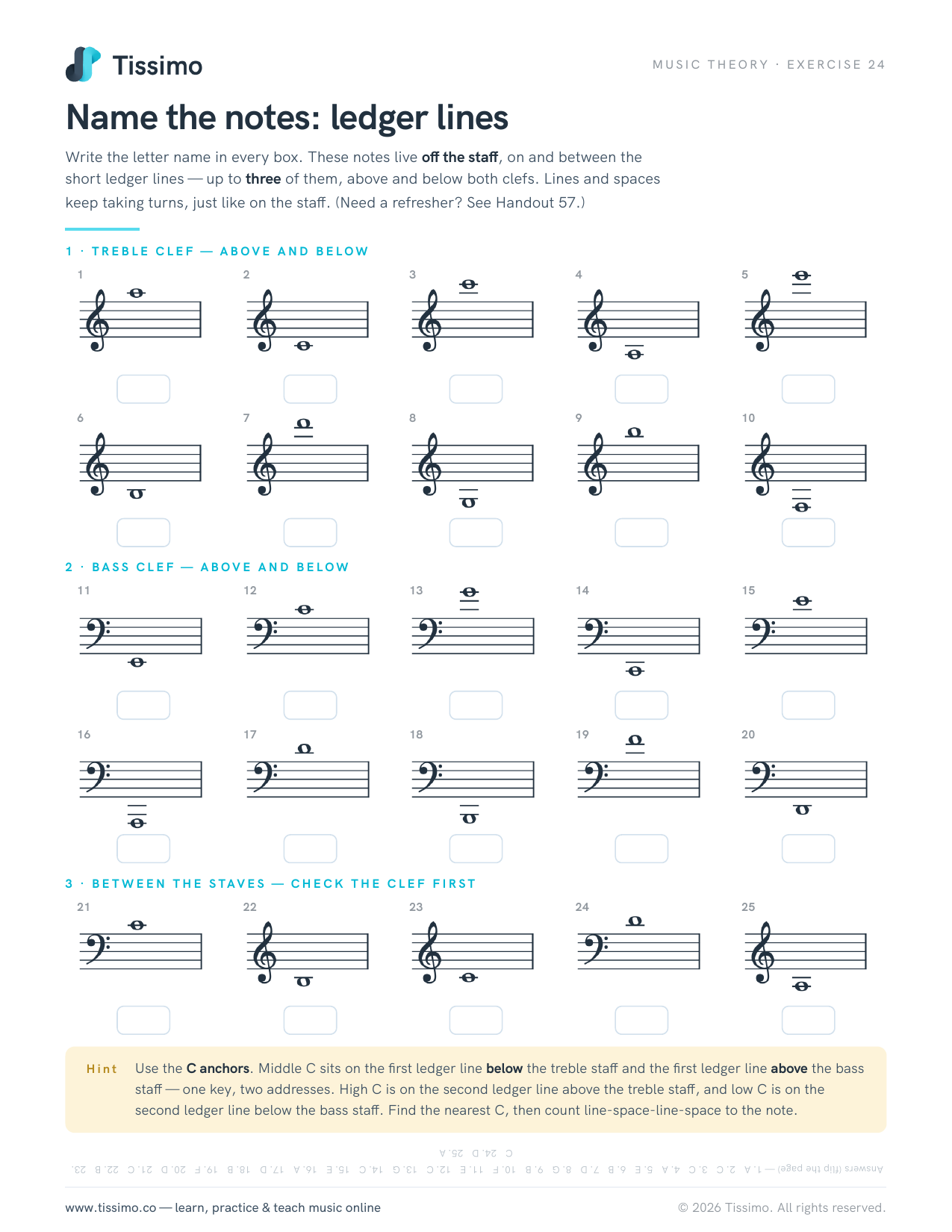
Name the notes: ledger lines
Write the letter name in every box. These notes live off the staff, on and between the short ledger lines — up to three of them, above and below both clefs. Lines and spaces keep taking turns, just like on the staff. (Need a refresher? See Handout 57.)
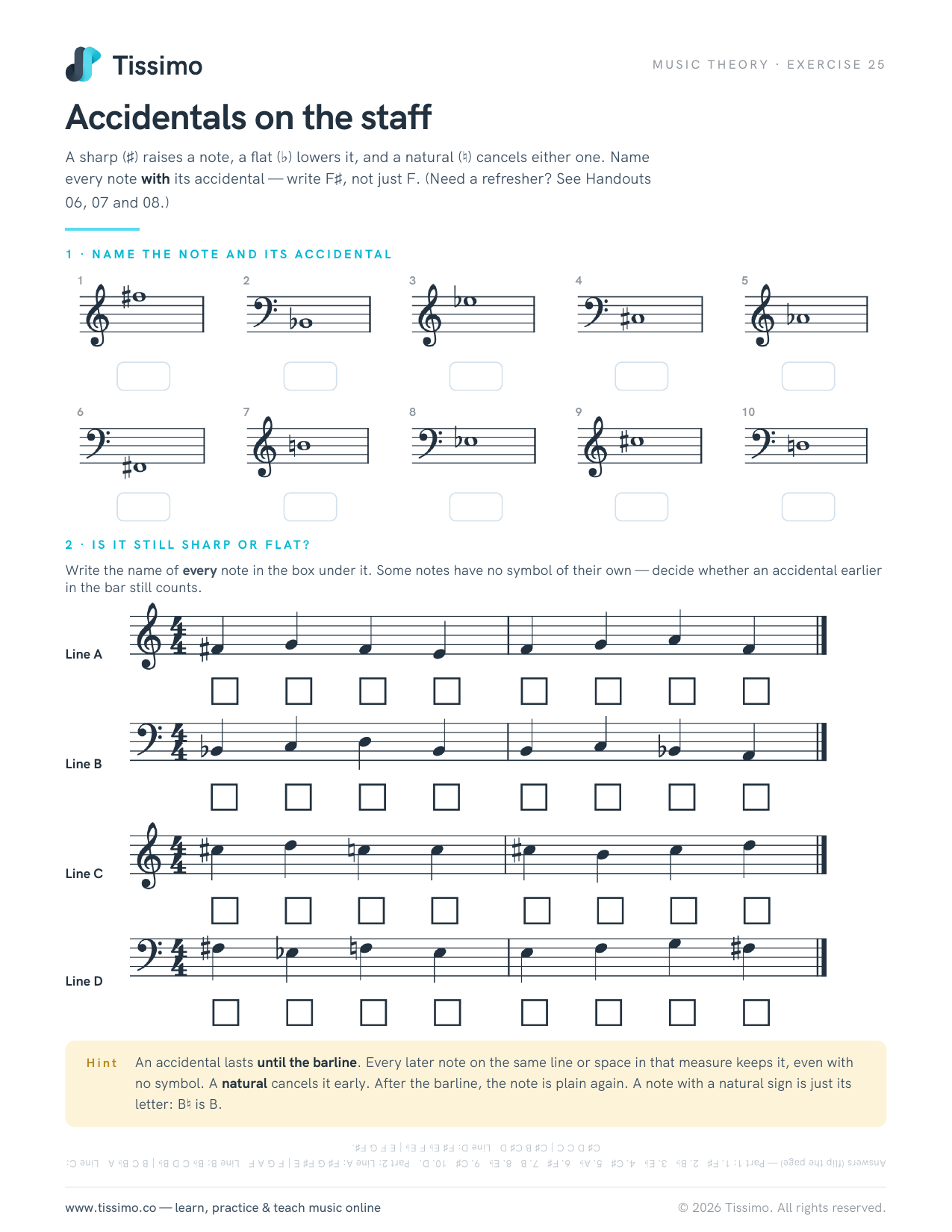
Accidentals on the staff
A sharp (♯) raises a note, a flat (♭) lowers it, and a natural (♮) cancels either one. Name every note with its accidental — write F♯, not just F. (Need a refresher? See Handouts 06, 07 and 08.)
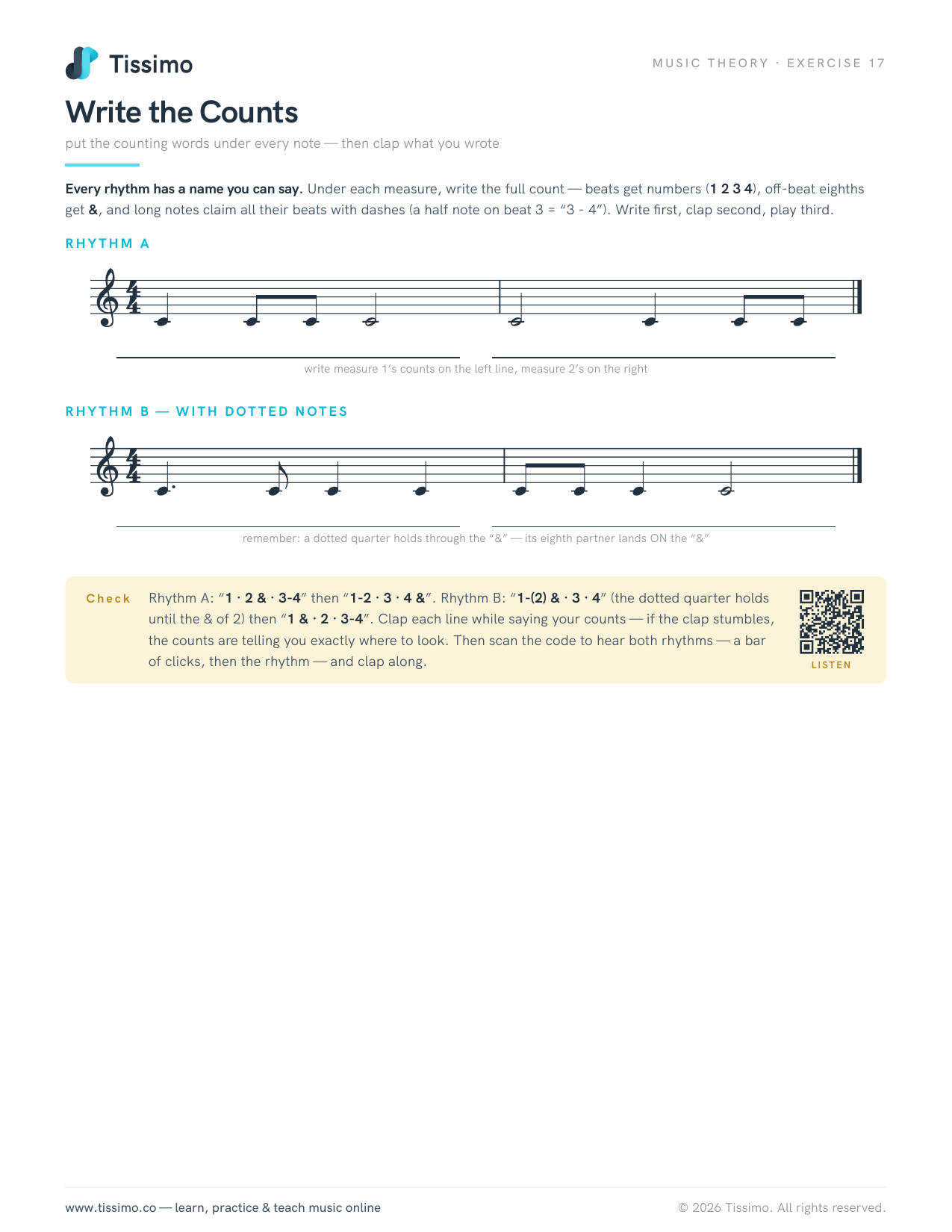
Write the Counts
put the counting words under every note — then clap what you wrote
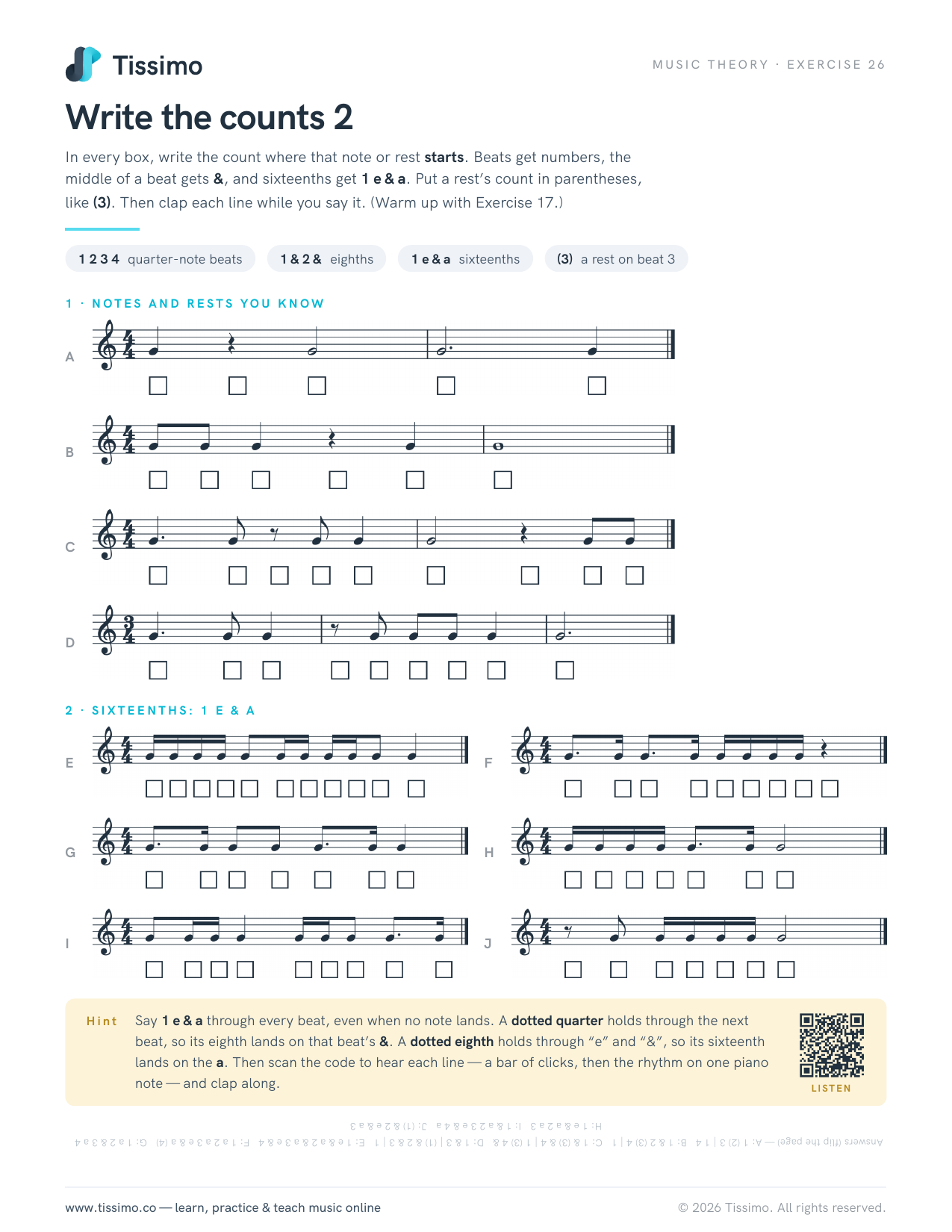
Write the counts 2
In every box, write the count where that note or rest starts. Beats get numbers, the middle of a beat gets &, and sixteenths get 1 e & a. Put a rest’s count in parentheses, like (3). Then clap each line while you say it. (Warm up with Exercise 17.)
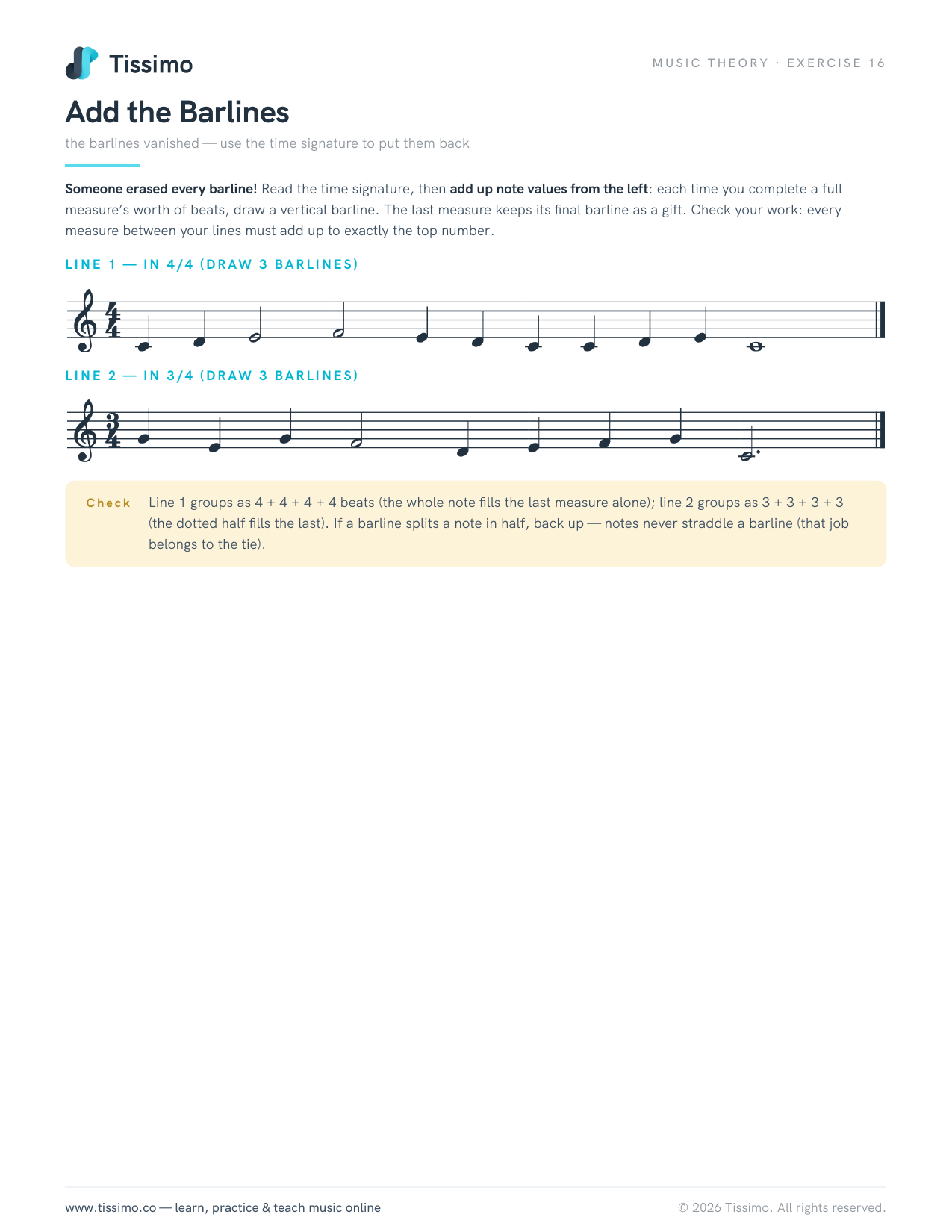
Add the Barlines
the barlines vanished — use the time signature to put them back
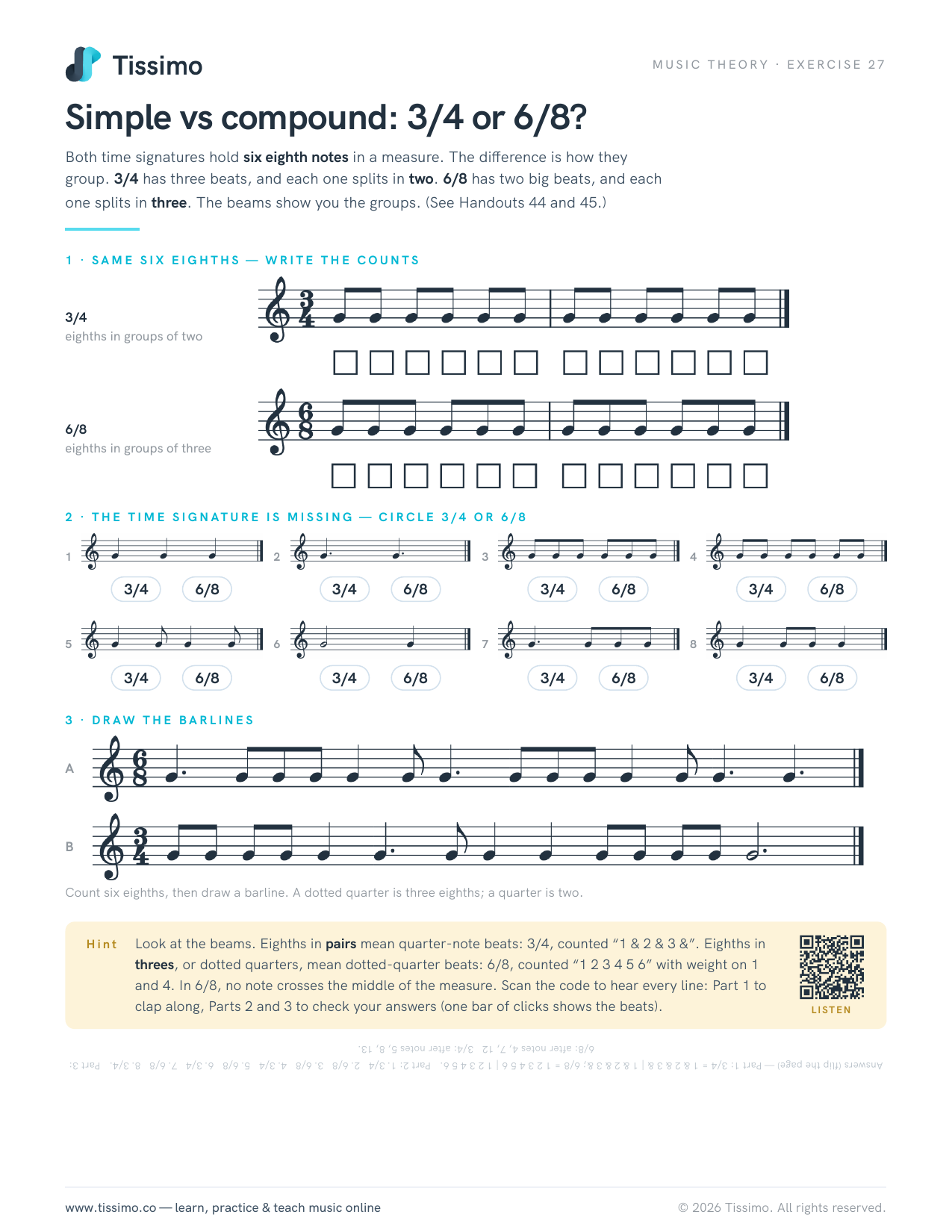
Simple vs compound: 3/4 or 6/8?
Both time signatures hold six eighth notes in a measure. The difference is how they group. 3/4 has three beats, and each one splits in two. 6/8 has two big beats, and each one splits in three. The beams show you the groups. (See Handouts 44 and 45.)
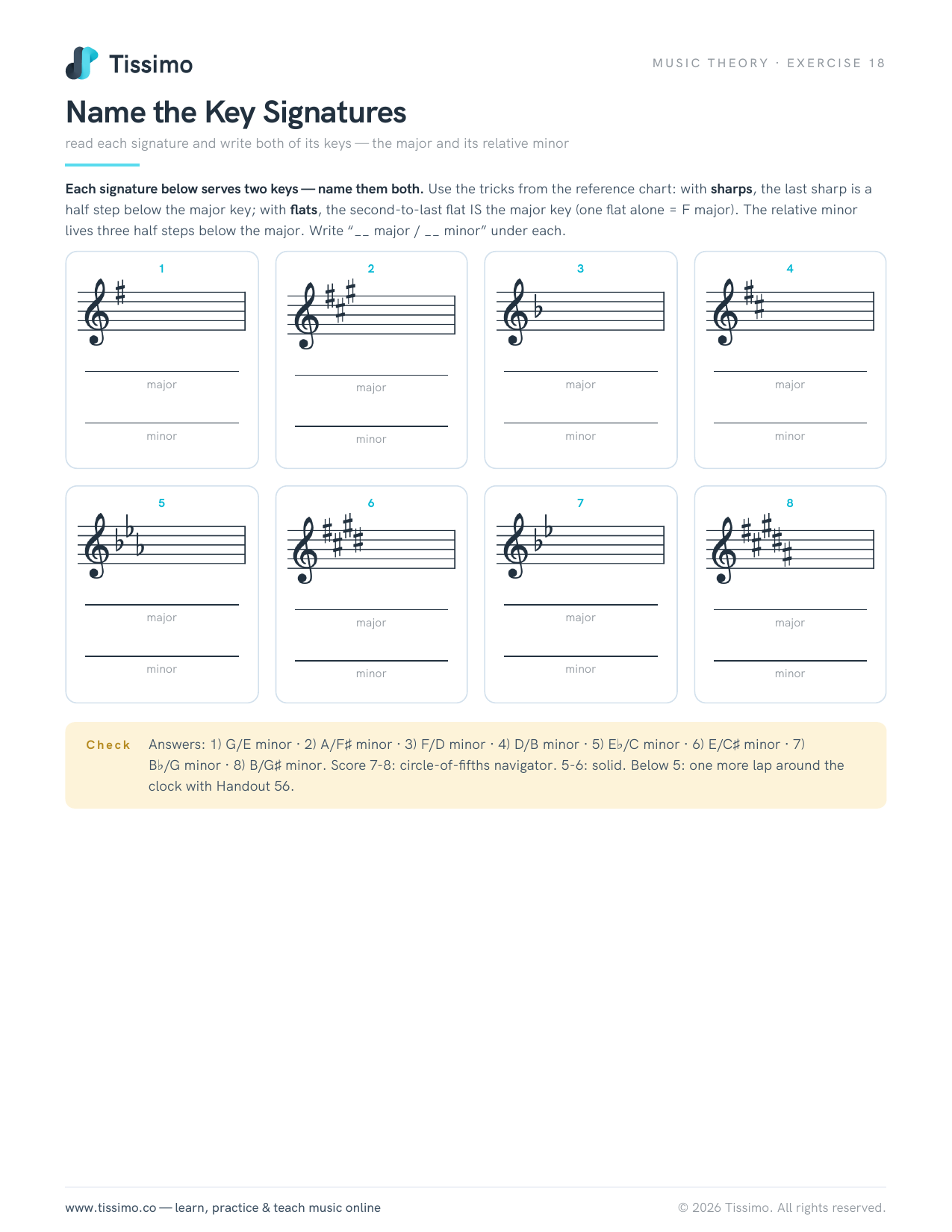
Name the Key Signatures
read each signature and write both of its keys — the major and its relative minor
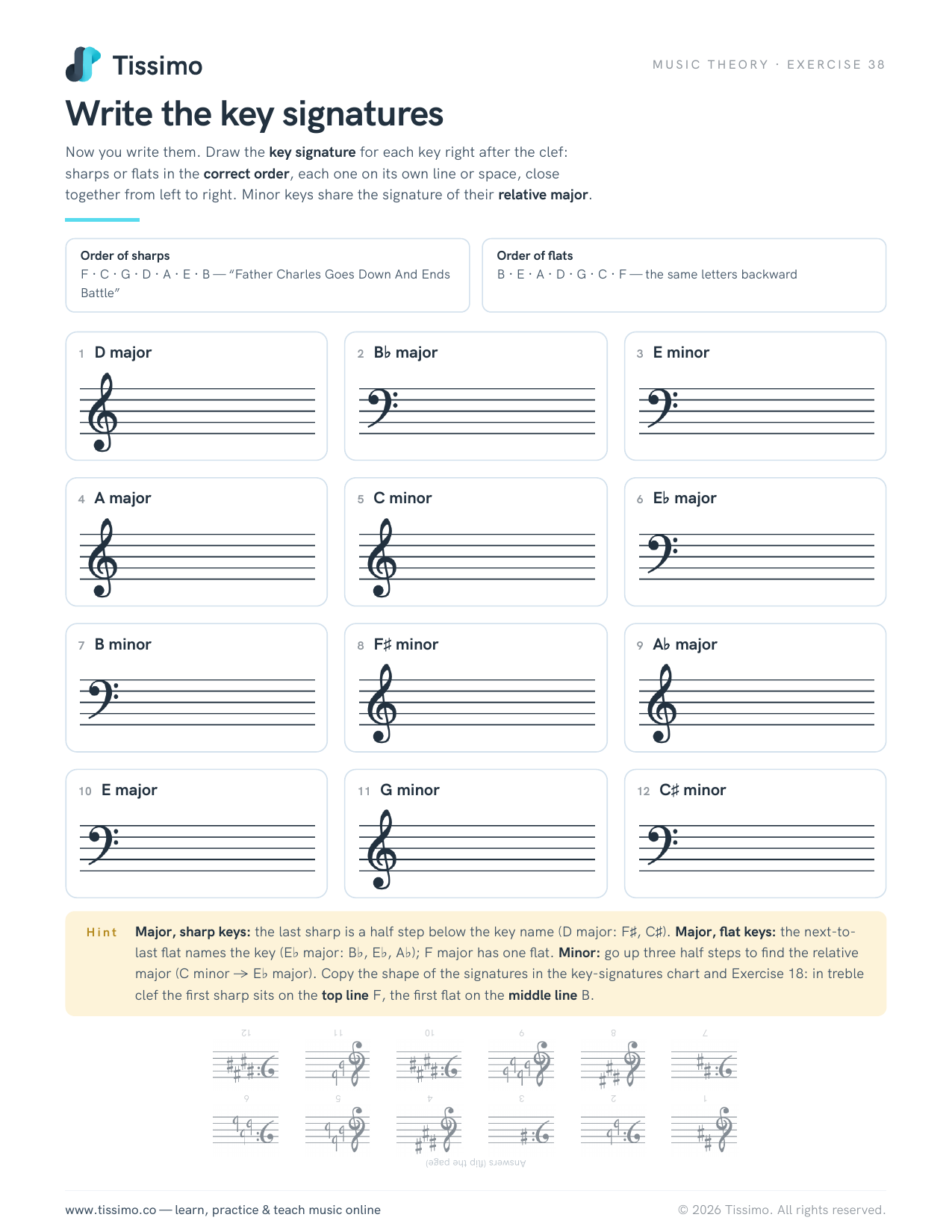
Write the key signatures
Now you write them. Draw the key signature for each key right after the clef: sharps or flats in the correct order, each one on its own line or space, close together from left to right. Minor keys share the signature of their relative major.
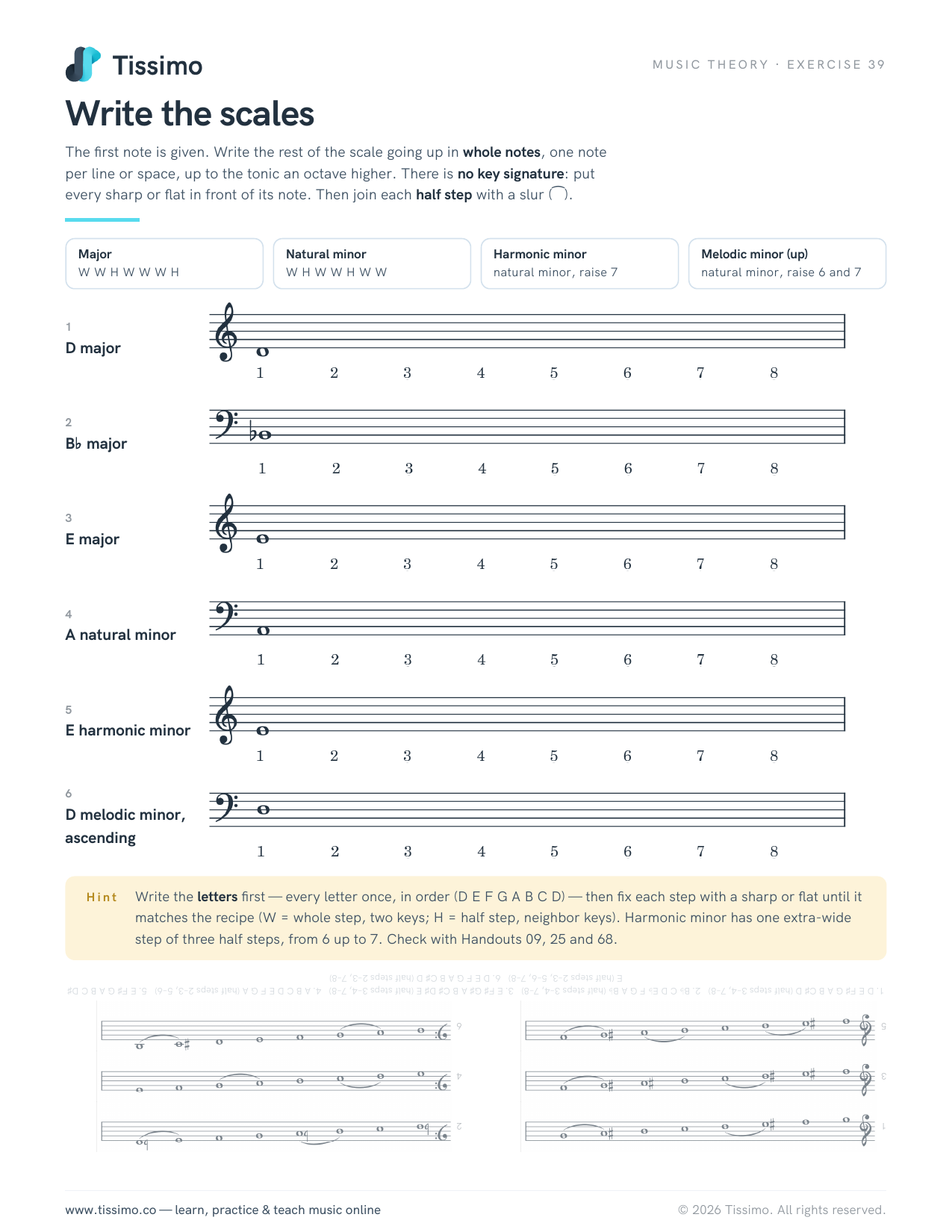
Write the scales
The first note is given. Write the rest of the scale going up in whole notes, one note per line or space, up to the tonic an octave higher. There is no key signature: put every sharp or flat in front of its note. Then join each half step with a slur (⁀).
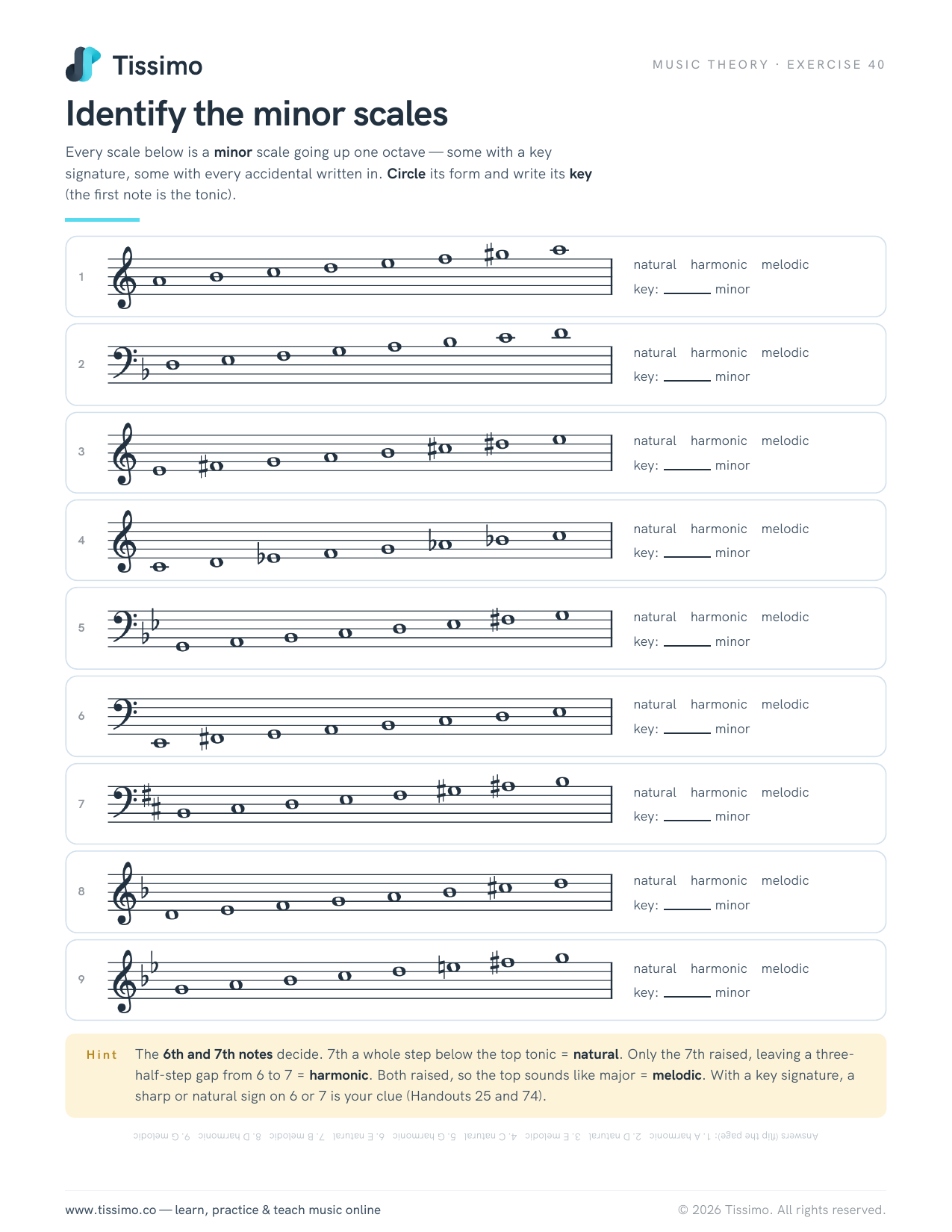
Identify the minor scales
Every scale below is a minor scale going up one octave — some with a key signature, some with every accidental written in. Circle its form and write its key (the first note is the tonic).
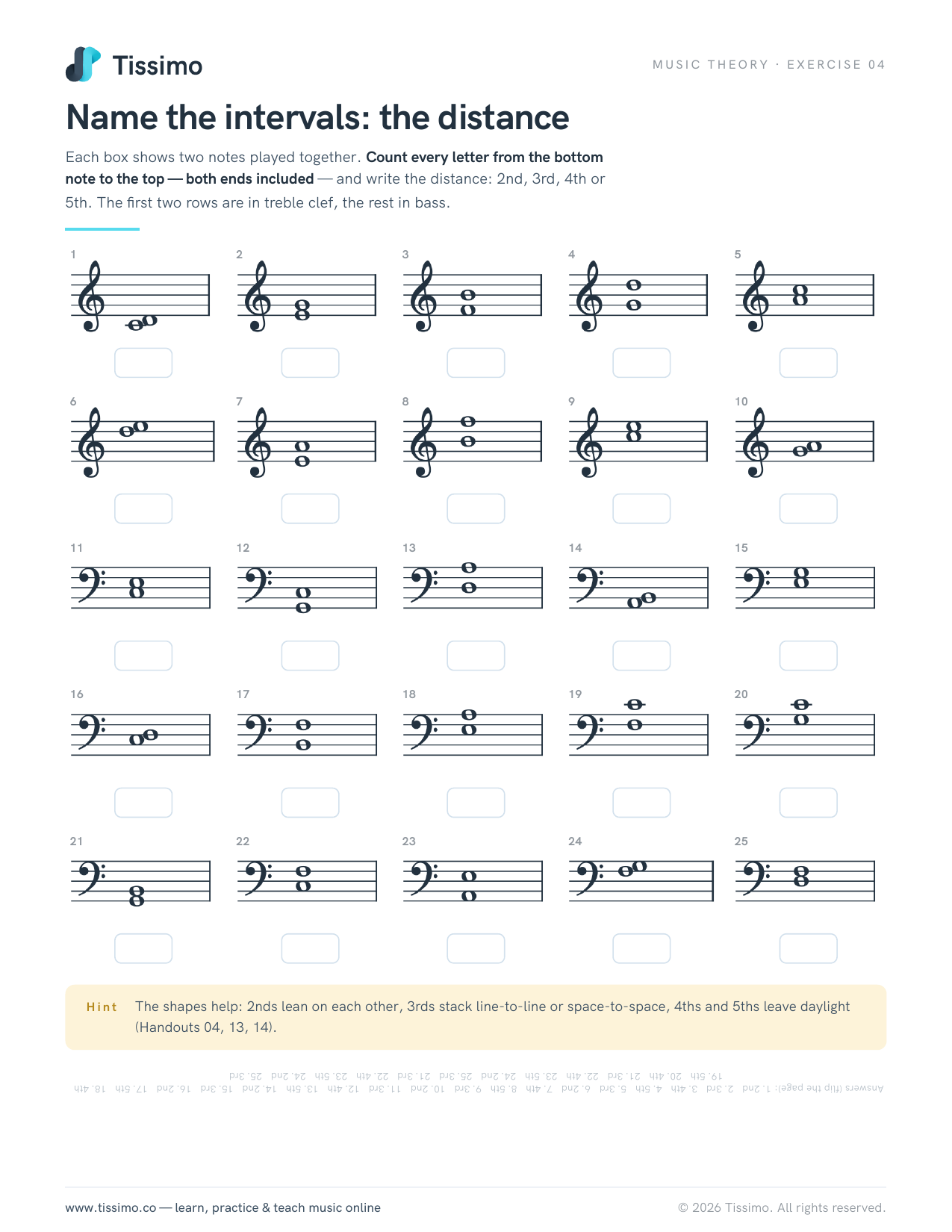
Name the intervals: the distance
Each box shows two notes played together. Count every letter from the bottom note to the top — both ends included — and write the distance: 2nd, 3rd, 4th or 5th. The first two rows are in treble clef, the rest in bass.
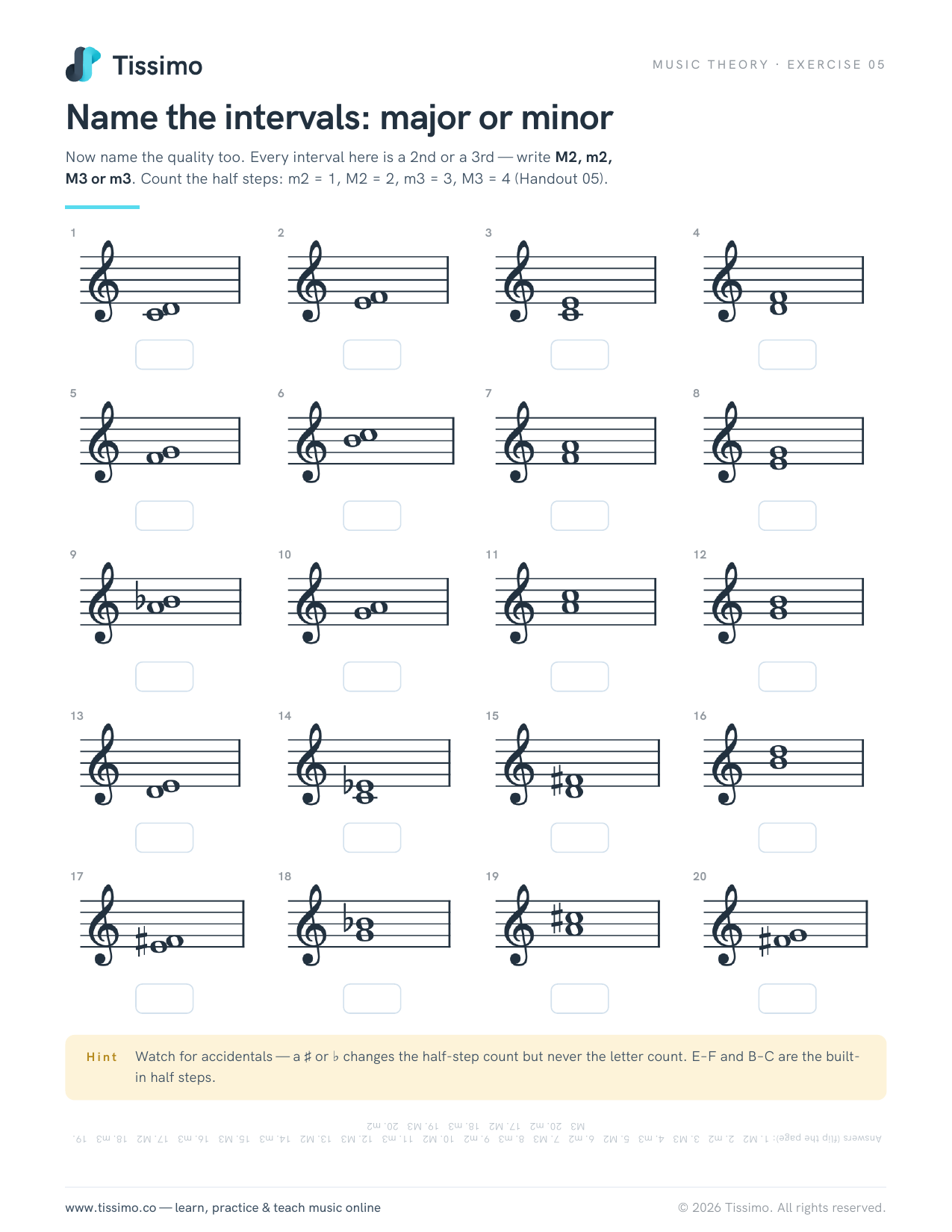
Name the intervals: major or minor
Now name the quality too. Every interval here is a 2nd or a 3rd — write M2, m2, M3 or m3. Count the half steps: m2 = 1, M2 = 2, m3 = 3, M3 = 4 (Handout 05).
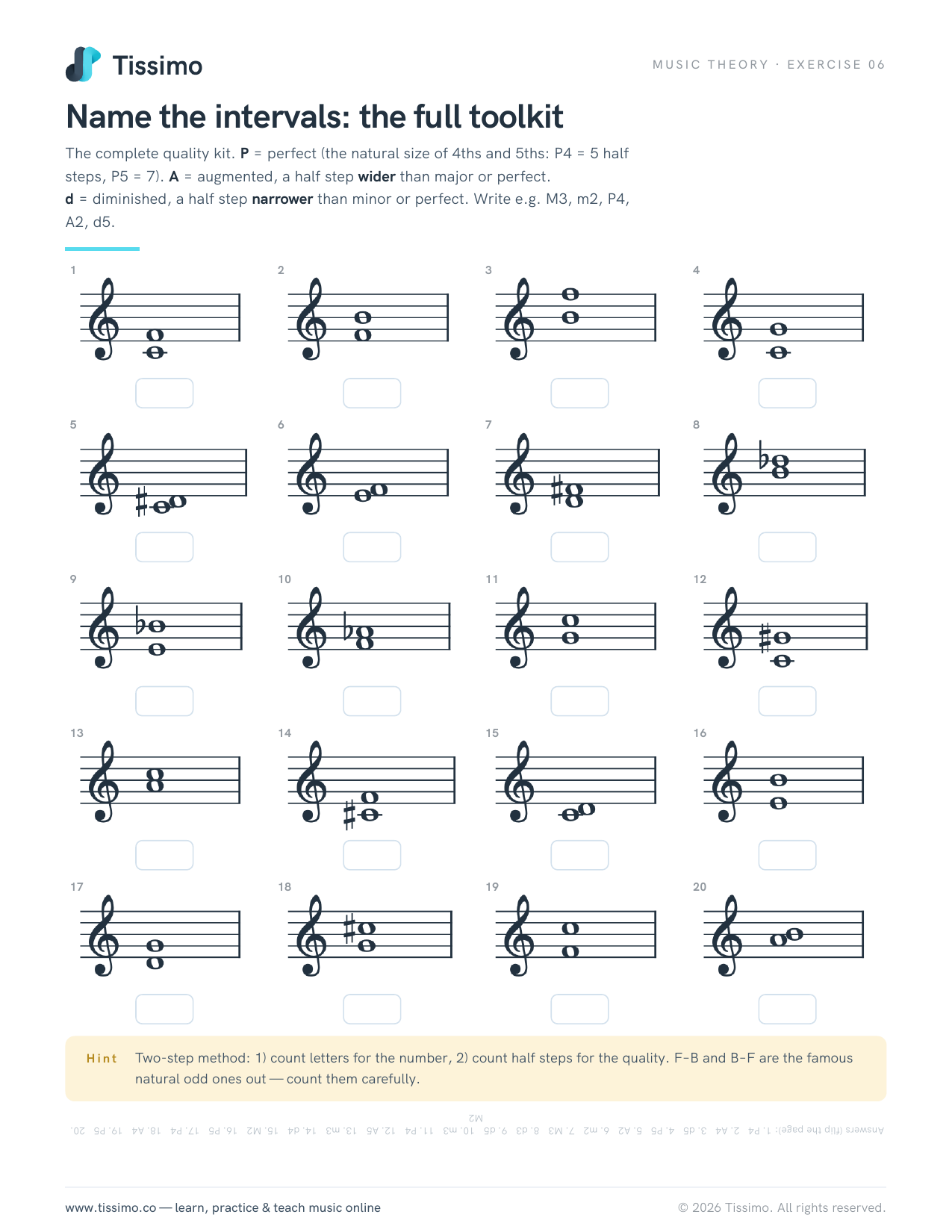
Name the intervals: the full toolkit
The complete quality kit. P = perfect (the natural size of 4ths and 5ths: P4 = 5 half steps, P5 = 7). A = augmented, a half step wider than major or perfect. d = diminished, a half step narrower than minor or perfect. Write e.g. M3, m2, P4, A2, d5.
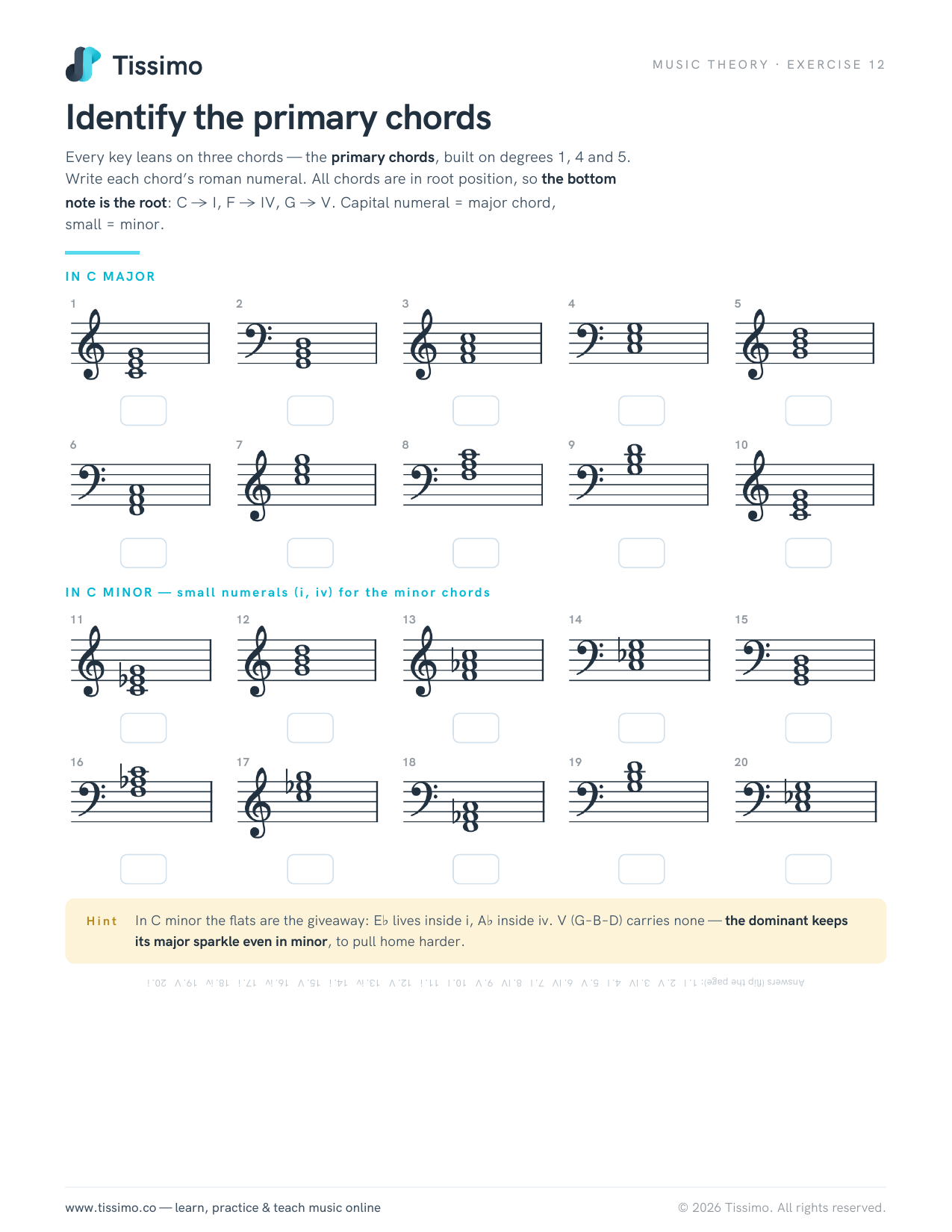
Identify the primary chords
Every key leans on three chords — the primary chords, built on degrees 1, 4 and 5. Write each chord’s roman numeral. All chords are in root position, so the bottom note is the root: C → I, F → IV, G → V. Capital numeral = major chord, small = minor.
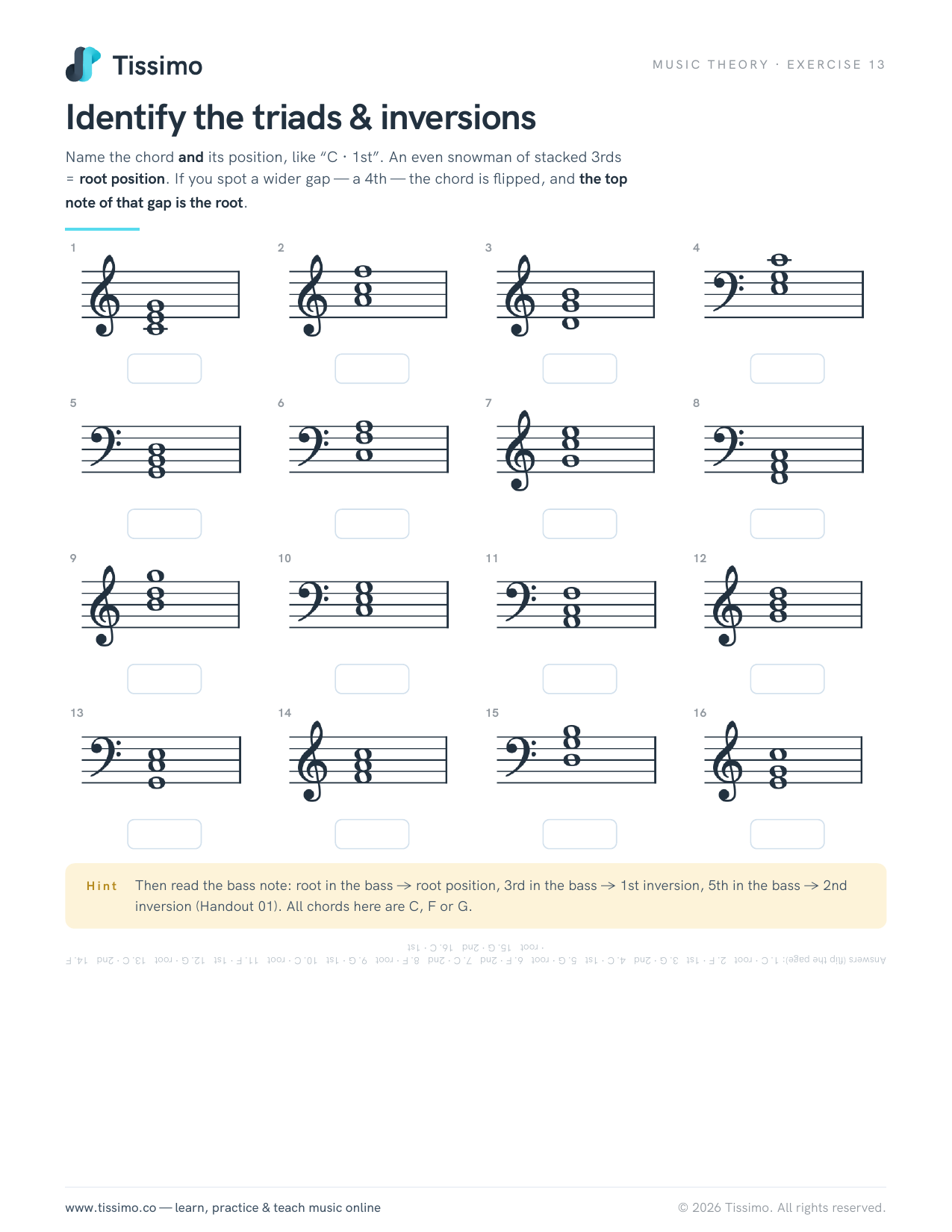
Identify the triads & inversions
Name the chord and its position, like “C · 1st”. An even snowman of stacked 3rds = root position. If you spot a wider gap — a 4th — the chord is flipped, and the top note of that gap is the root.
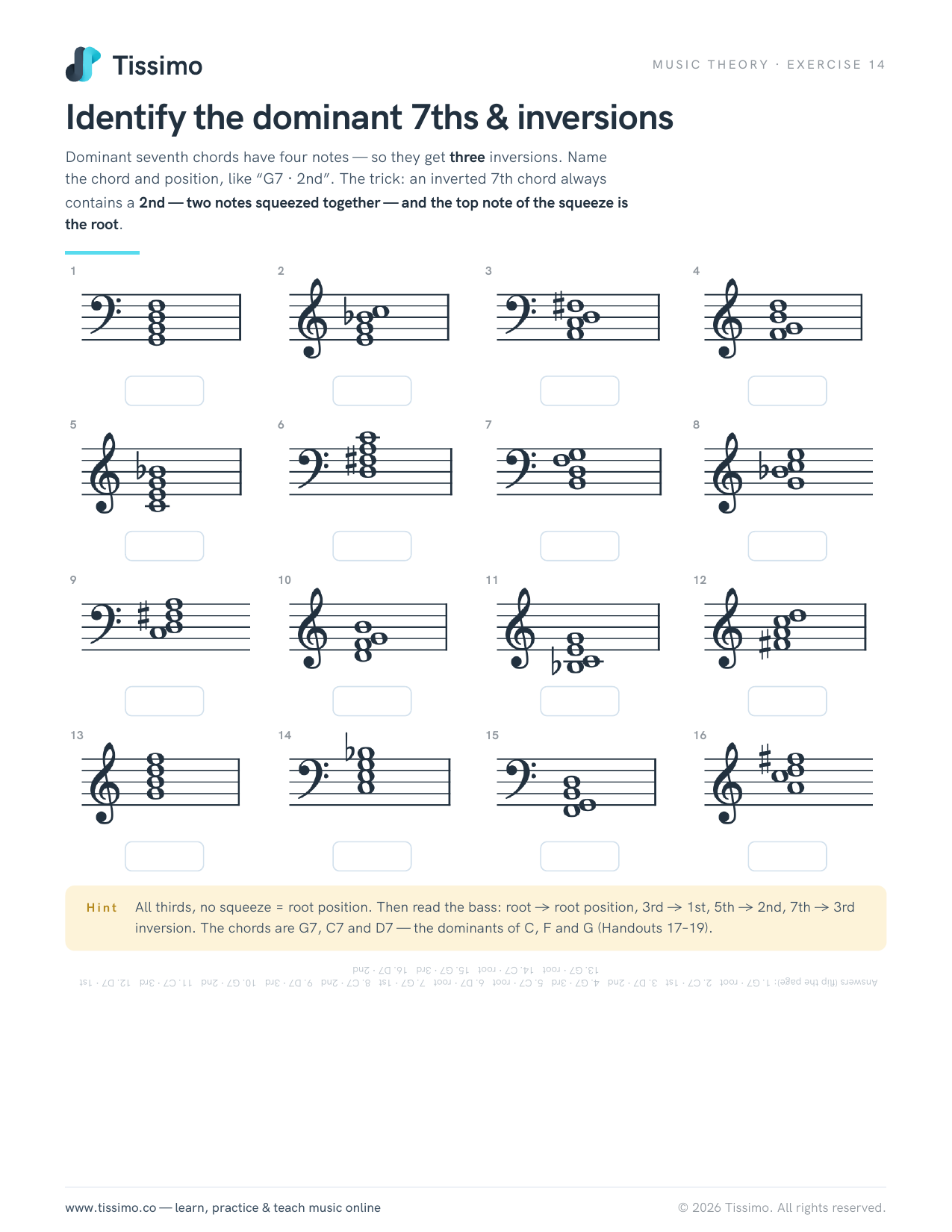
Identify the dominant 7ths & inversions
Dominant seventh chords have four notes — so they get three inversions. Name the chord and position, like “G7 · 2nd”. The trick: an inverted 7th chord always contains a 2nd — two notes squeezed together — and the top note of the squeeze is the root.
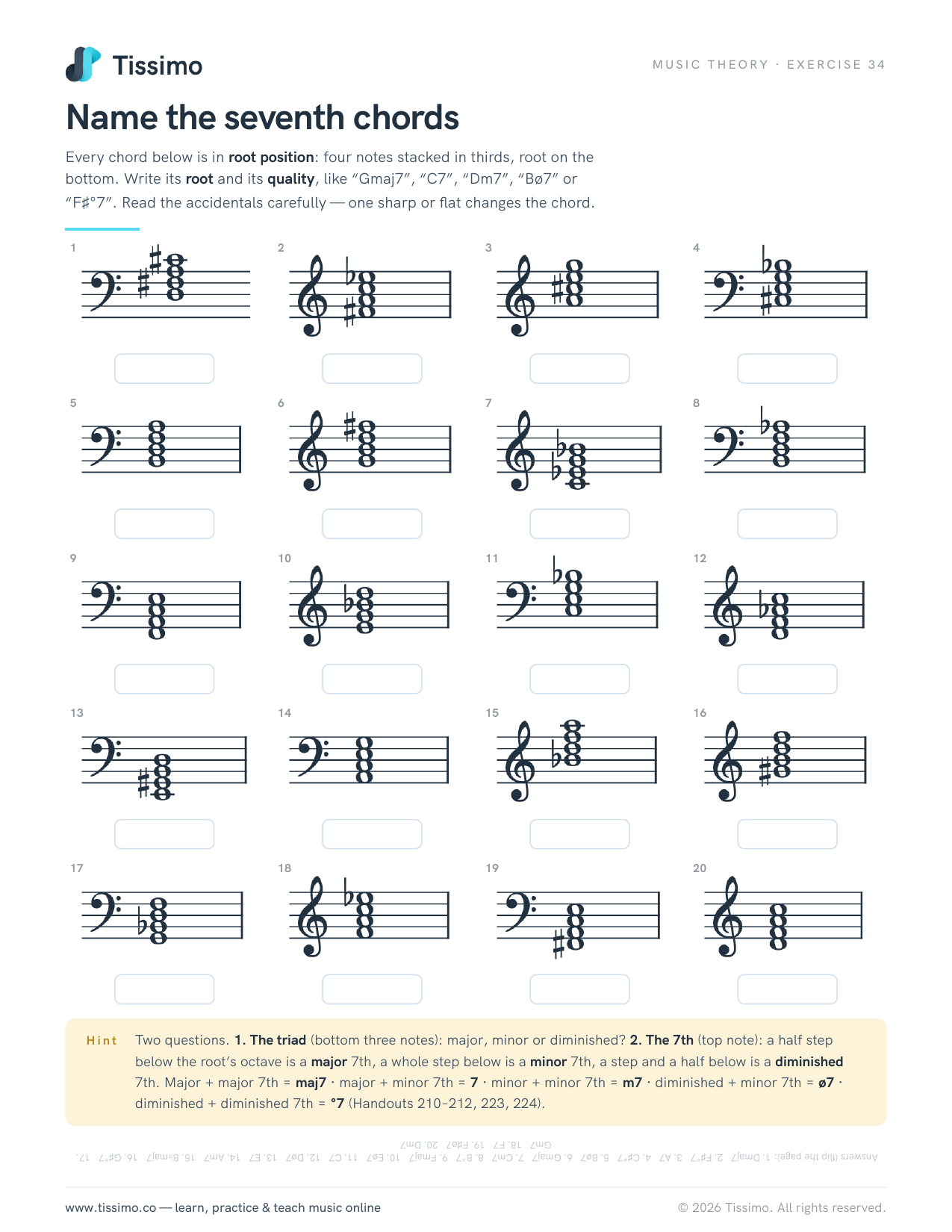
Name the seventh chords
Every chord below is in root position: four notes stacked in thirds, root on the bottom. Write its root and its quality, like “Gmaj7”, “C7”, “Dm7”, “Bø7” or “F♯°7”. Read the accidentals carefully — one sharp or flat changes the chord.
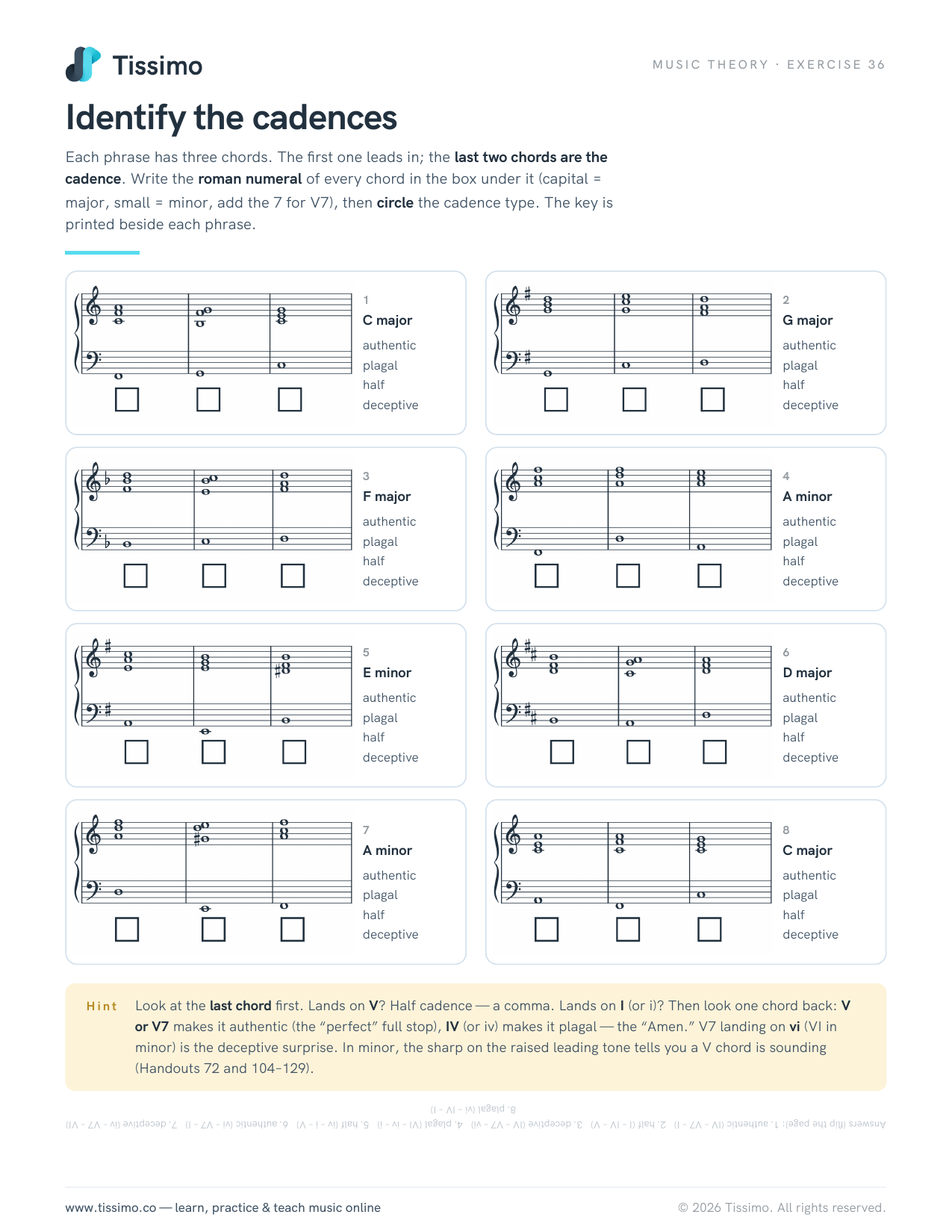
Identify the cadences
Each phrase has three chords. The first one leads in; the last two chords are the cadence. Write the roman numeral of every chord in the box under it (capital = major, small = minor, add the 7 for V7), then circle the cadence type. The key is printed beside each phrase.
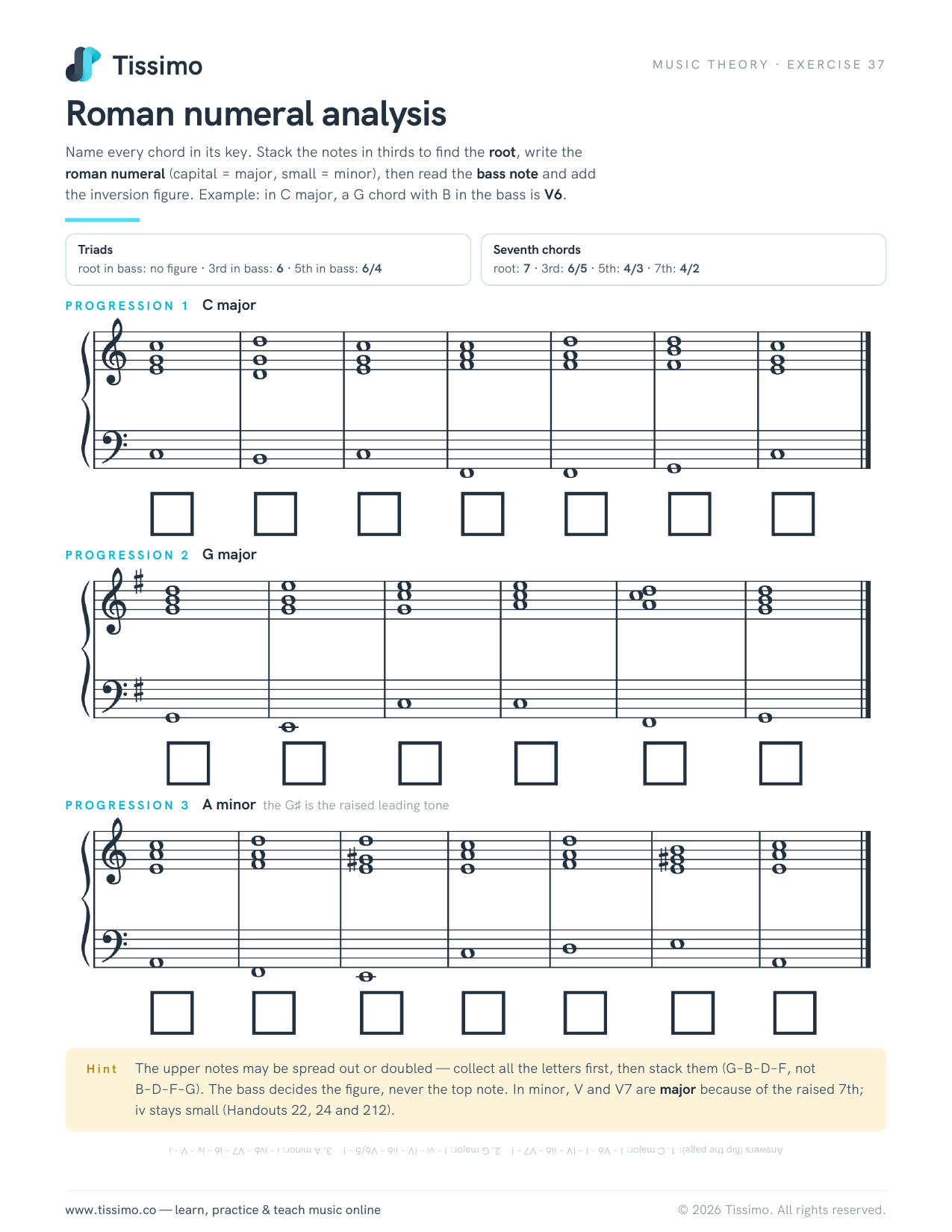
Roman numeral analysis
Name every chord in its key. Stack the notes in thirds to find the root, write the roman numeral (capital = major, small = minor), then read the bass note and add the inversion figure. Example: in C major, a G chord with B in the bass is V6.
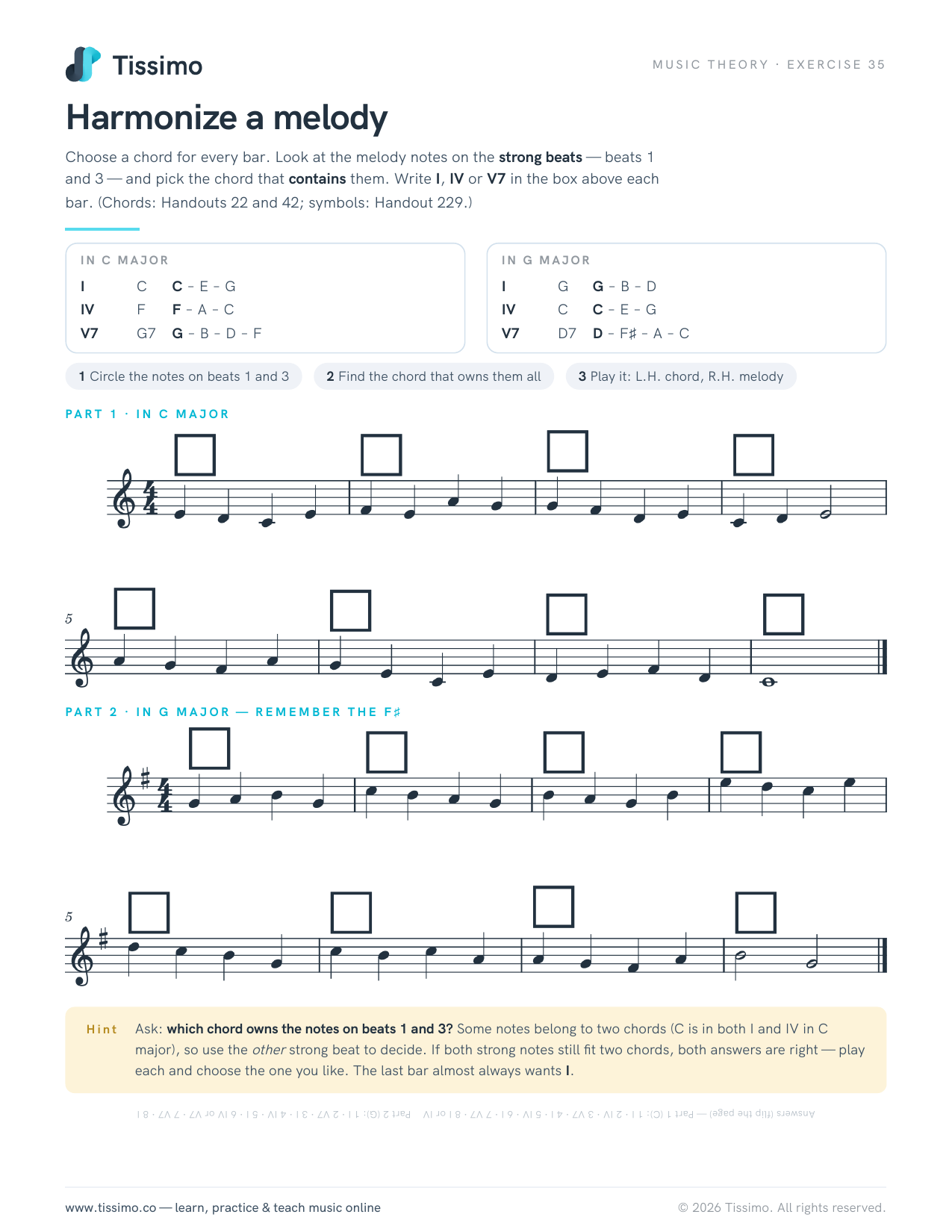
Harmonize a melody
Choose a chord for every bar. Look at the melody notes on the strong beats — beats 1 and 3 — and pick the chord that contains them. Write I, IV or V7 in the box above each bar. (Chords: Handouts 22 and 42; symbols: Handout 229.)
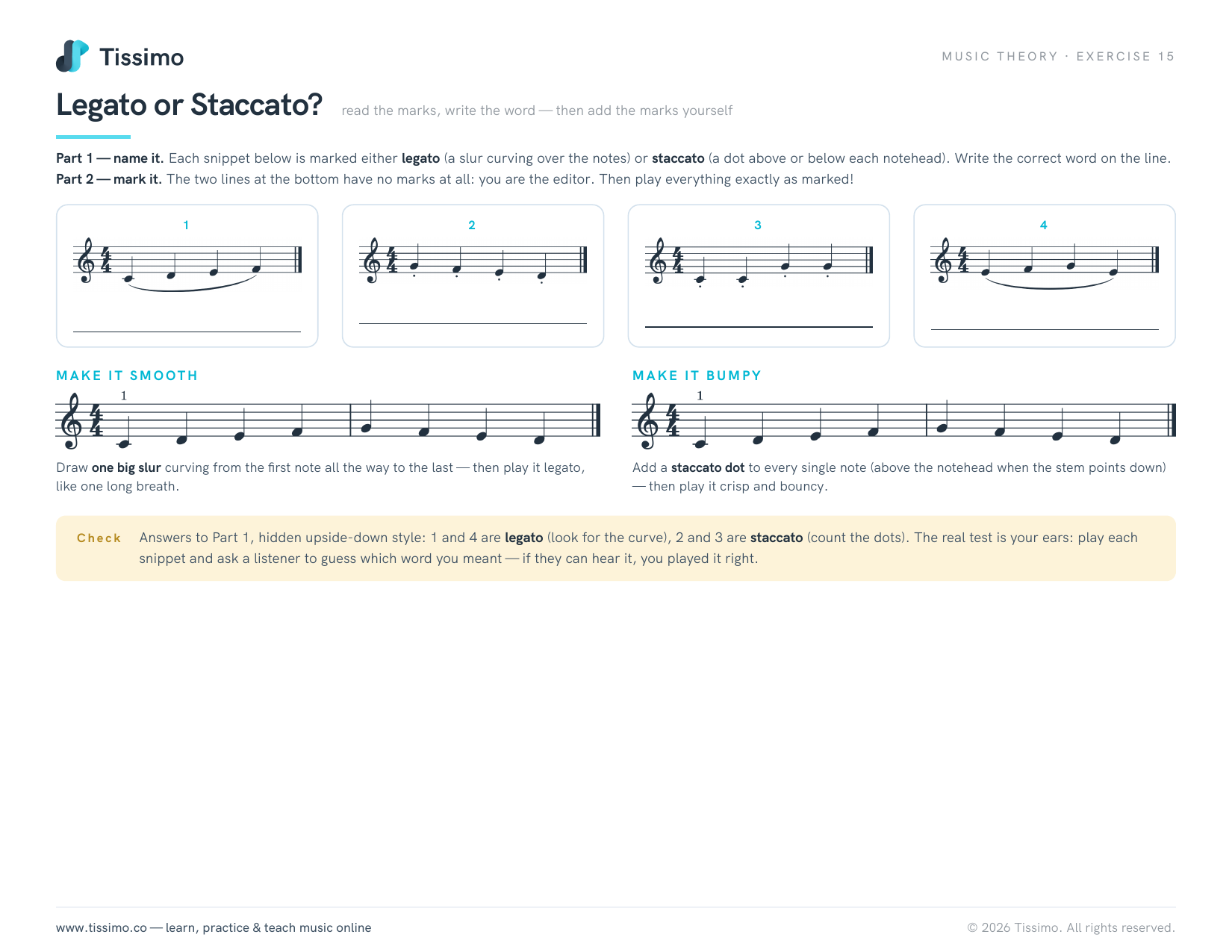
Legato or Staccato?
read the marks, write the word — then add the marks yourself
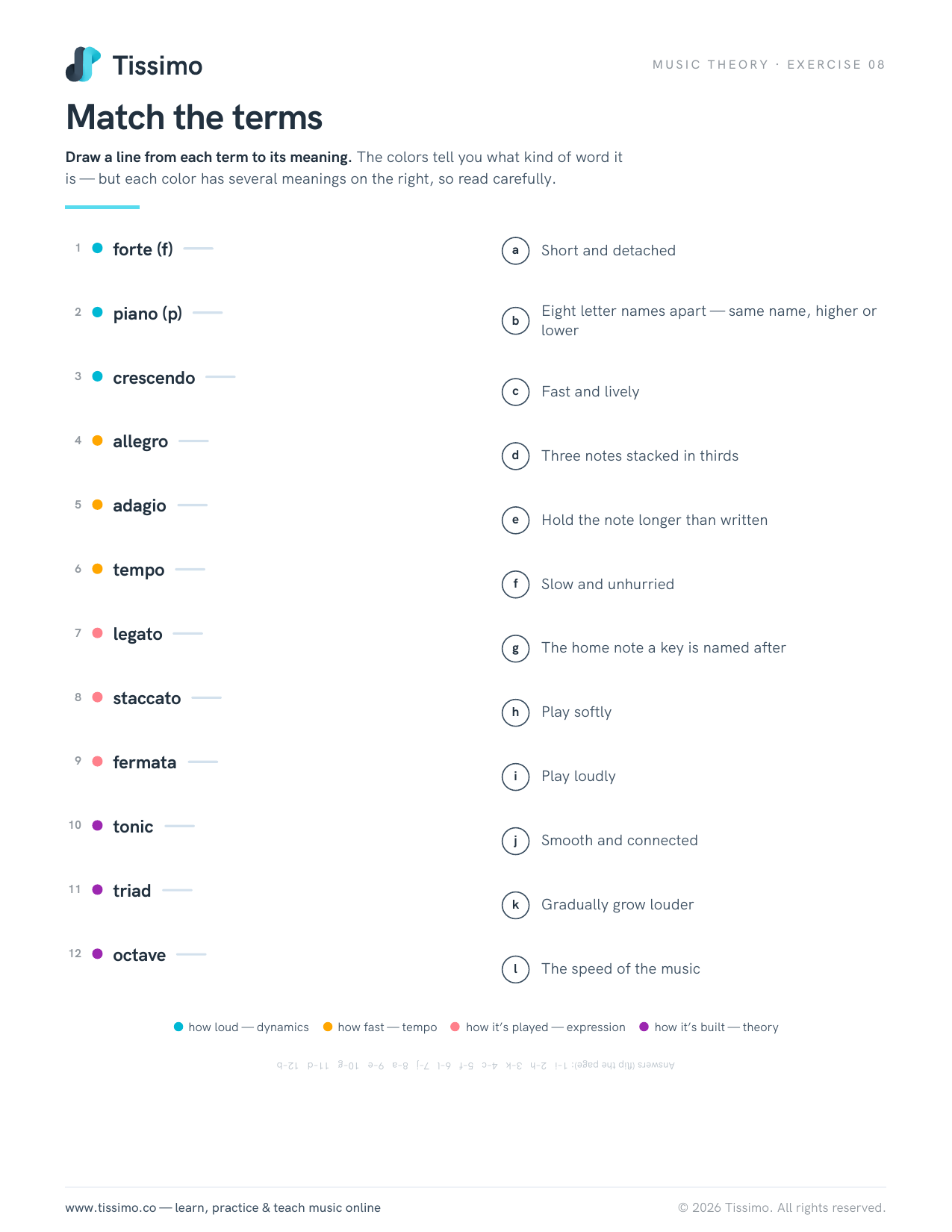
Match the terms
Draw a line from each term to its meaning. The colors tell you what kind of word it is — but each color has several meanings on the right, so read carefully.
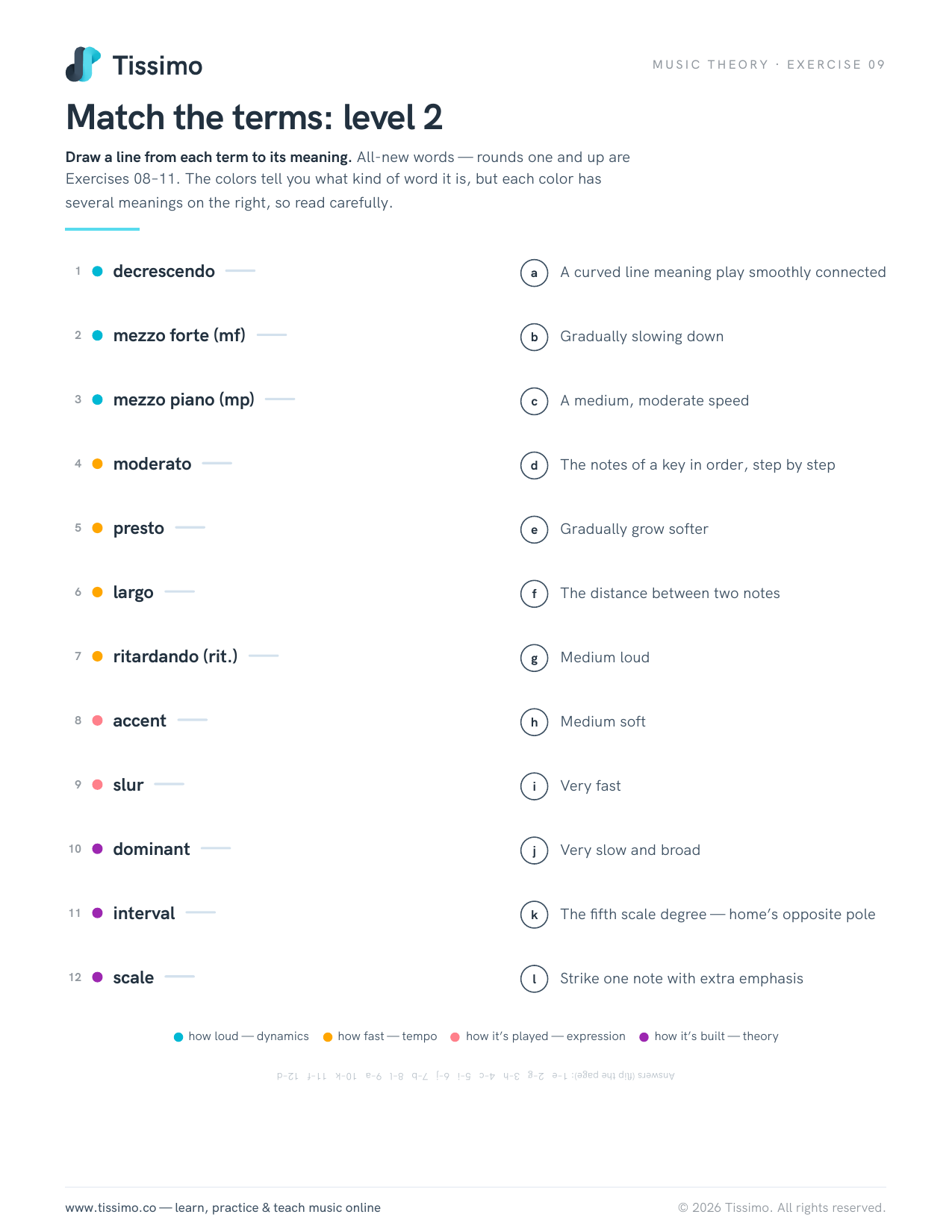
Match the terms: level 2
Draw a line from each term to its meaning. All-new words — rounds one and up are Exercises 08–11. The colors tell you what kind of word it is, but each color has several meanings on the right, so read carefully.
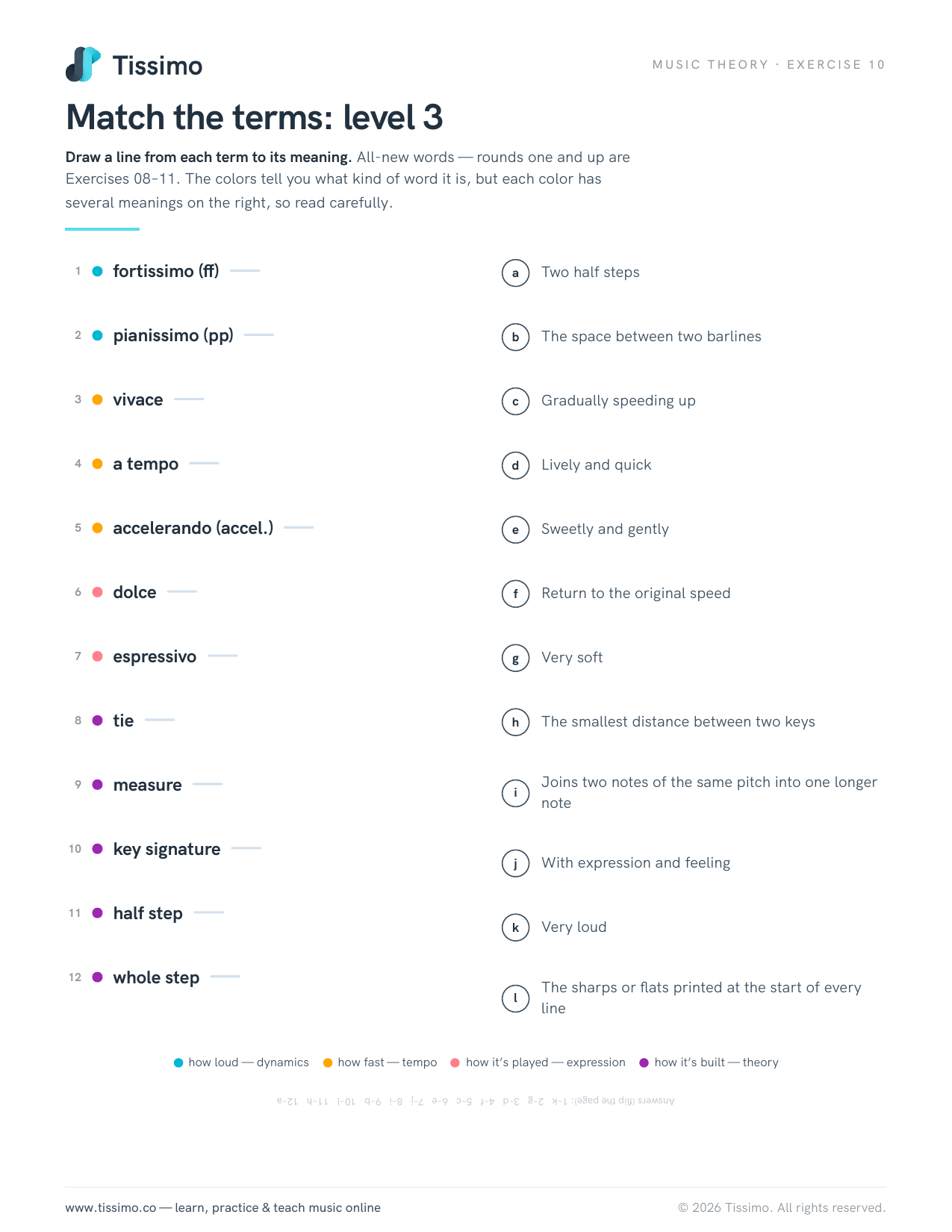
Match the terms: level 3
Draw a line from each term to its meaning. All-new words — rounds one and up are Exercises 08–11. The colors tell you what kind of word it is, but each color has several meanings on the right, so read carefully.
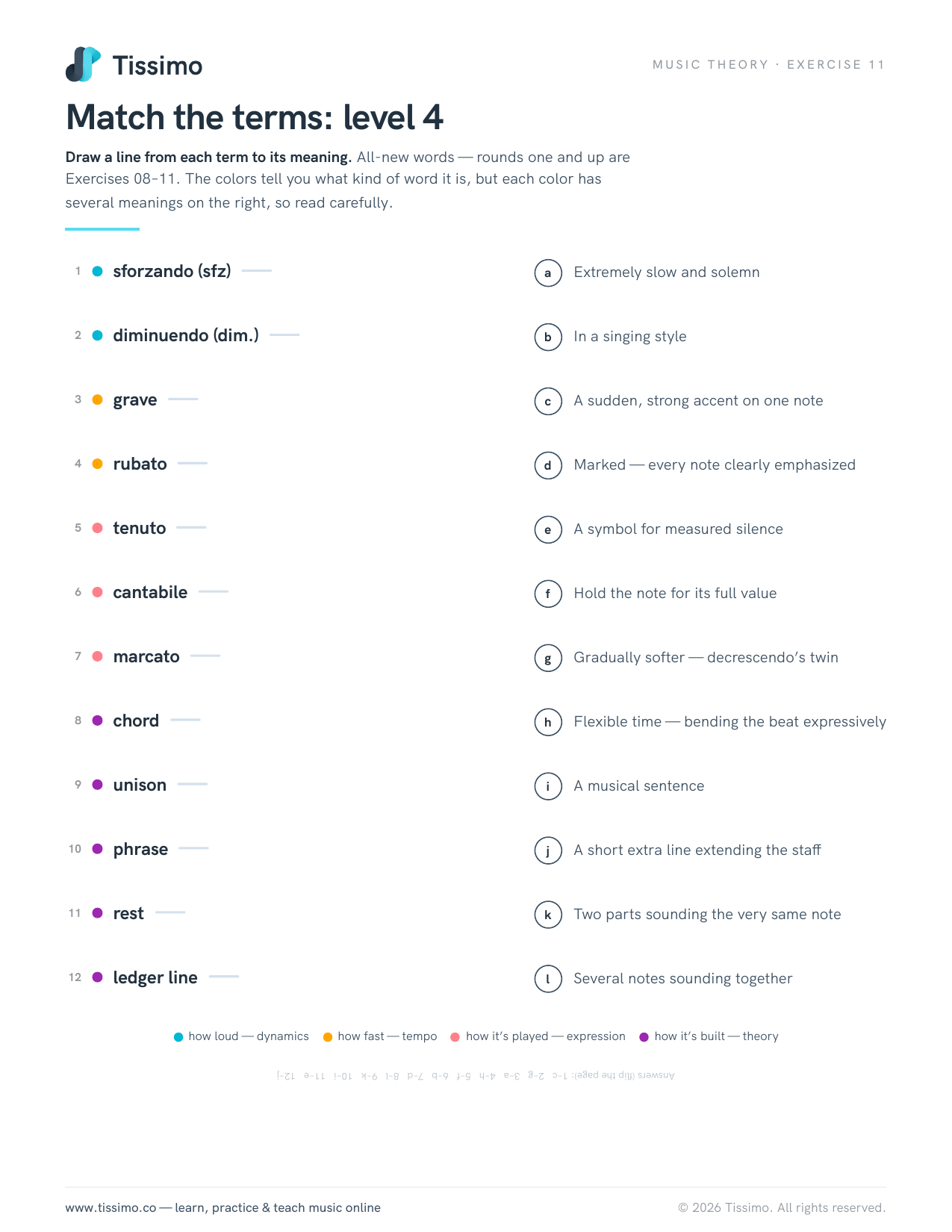
Match the terms: level 4
Draw a line from each term to its meaning. All-new words — rounds one and up are Exercises 08–11. The colors tell you what kind of word it is, but each color has several meanings on the right, so read carefully.
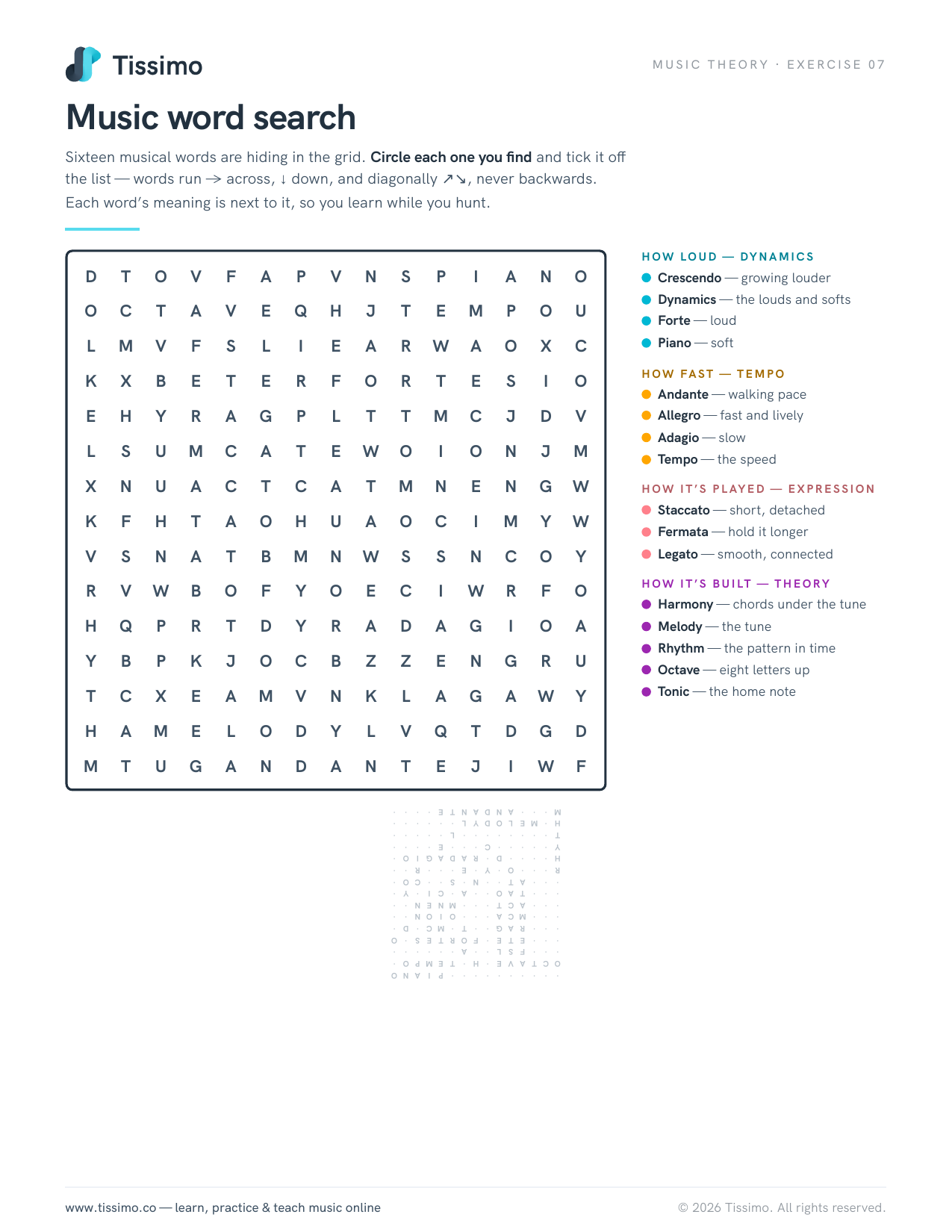
Music word search
Sixteen musical words are hiding in the grid. Circle each one you find and tick it off the list — words run → across, ↓ down, and diagonally ↗↘, never backwards. Each word’s meaning is next to it, so you learn while you hunt.