Articulation & Ornaments
Tenuto
Pronounced teh-NOO-tohWritten as ten.
A tenuto is a short horizontal line above or below a note that asks you to hold it for its full value, often with a little extra weight. The abbreviation ten. means the same thing.
A tenuto is a short horizontal line written just above or below the notehead, on the side away from the stem. Tenuto is Italian for "held": the mark asks you to hold the note for its full written value, and often to give it a little extra weight. The abbreviation ten. means the same thing in words.
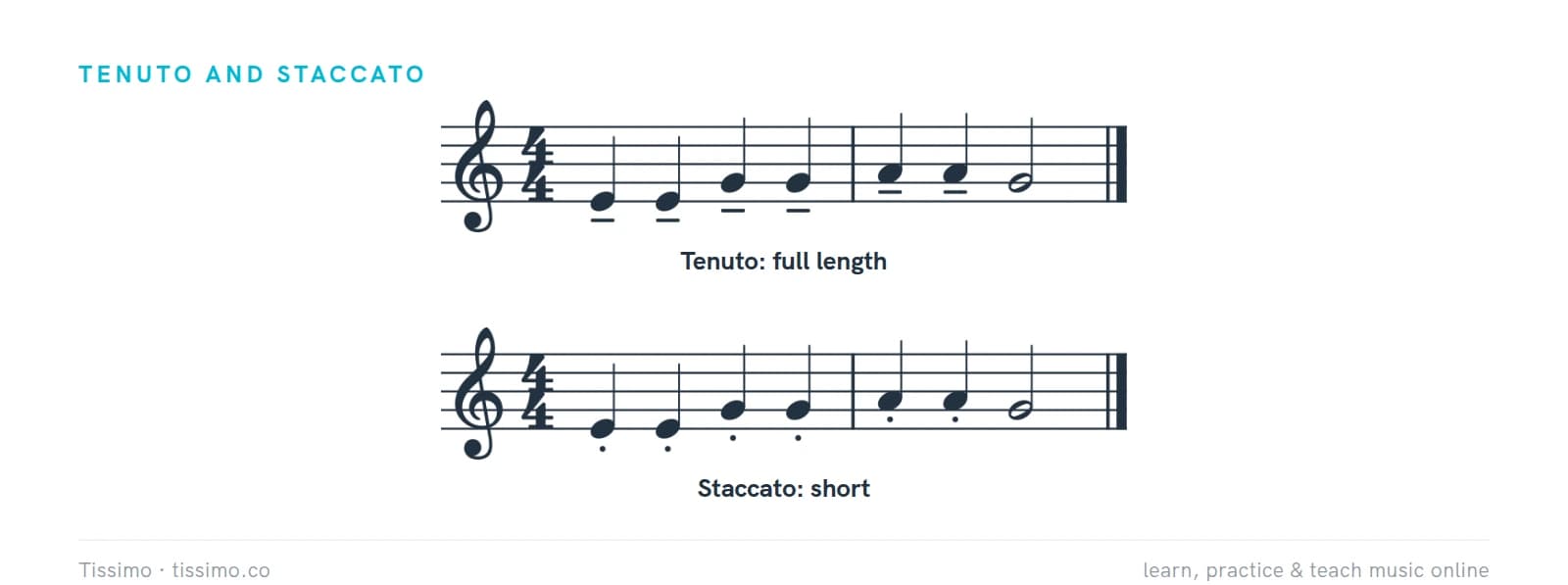
What a tenuto asks for
Two things, and the music decides how much of each:
- Full length. Hold the note right up to the next one. With repeated notes, as in the example, that means releasing only at the very last moment, just long enough to play the key again.
- A little weight. Lean gently into the note, as if pressing it into the keys or the string. It is softer and broader than an accent, which is a sharper attack.
Some players also stretch a tenuto note by a hair, an emphasis made with time rather than volume. That can be lovely on the top note of a phrase, but keep it small, or the beat starts to wobble.
Where you will see it
- On one note the composer wants to stand out gently, such as the peak of a phrase or a dissonant note that resolves.
- Over repeated notes or chords that should not sound clipped.
- Together with a staccato dot, which makes portato: slightly separated, but weighted.
Tenuto, accent and fermata
These three marks are easy to mix up. Tissimo's Fermata, Tenuto & Accent sums them up as hold, lean, punch: a fermata holds the note longer than written, a tenuto leans into it for its full value, and an accent punches the start of it.
Common questions
Does tenuto mean to hold the note longer?
It means hold the note for its full value, with a little weight. Some players add a tiny stretch, but a note held clearly longer than written is a fermata, not a tenuto.
What is the difference between tenuto and accent?
An accent makes the start of the note stronger. A tenuto keeps the note full and gently weighted from start to end. Think of an accent as a punch and a tenuto as a lean.
Practice it: free worksheets
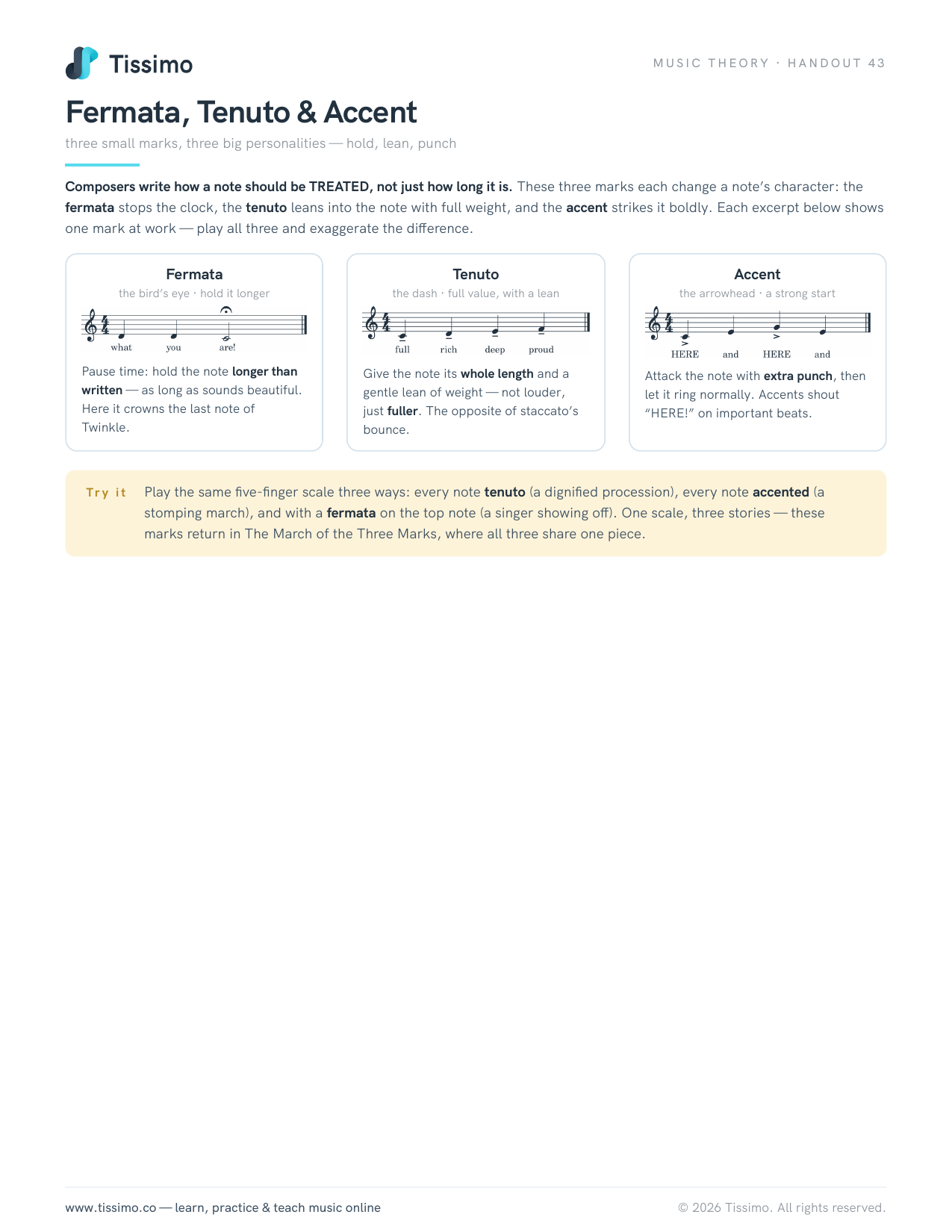 Fermata, Tenuto & Accentthree small marks, three big personalities — hold, lean, punch
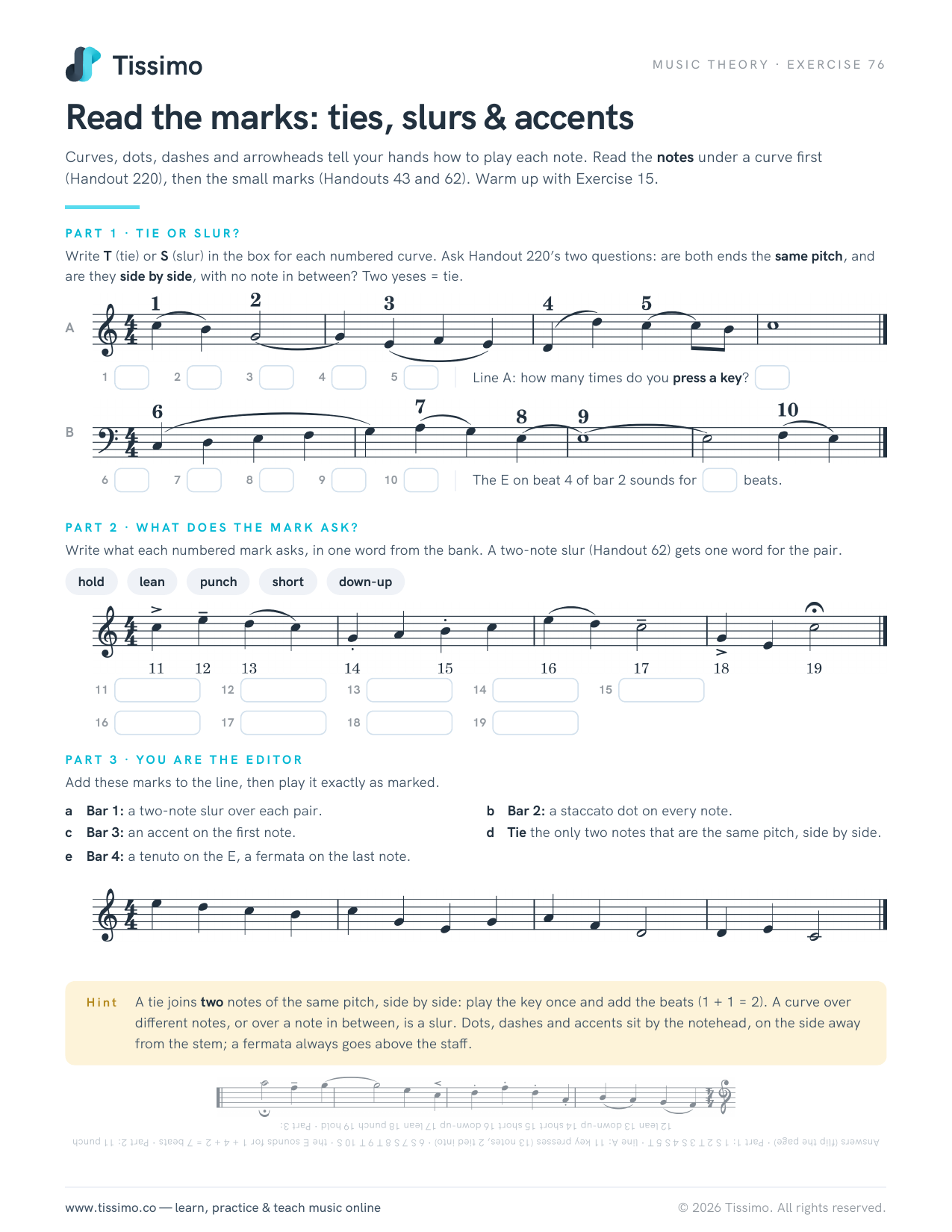 Read the marks: ties, slurs & accentsCurves, dots, dashes and arrowheads tell your hands how to play each note. Read the notes under a curve first (Handout 220), then the small marks (Handouts 43 and 62). Warm up with Exercise 15.
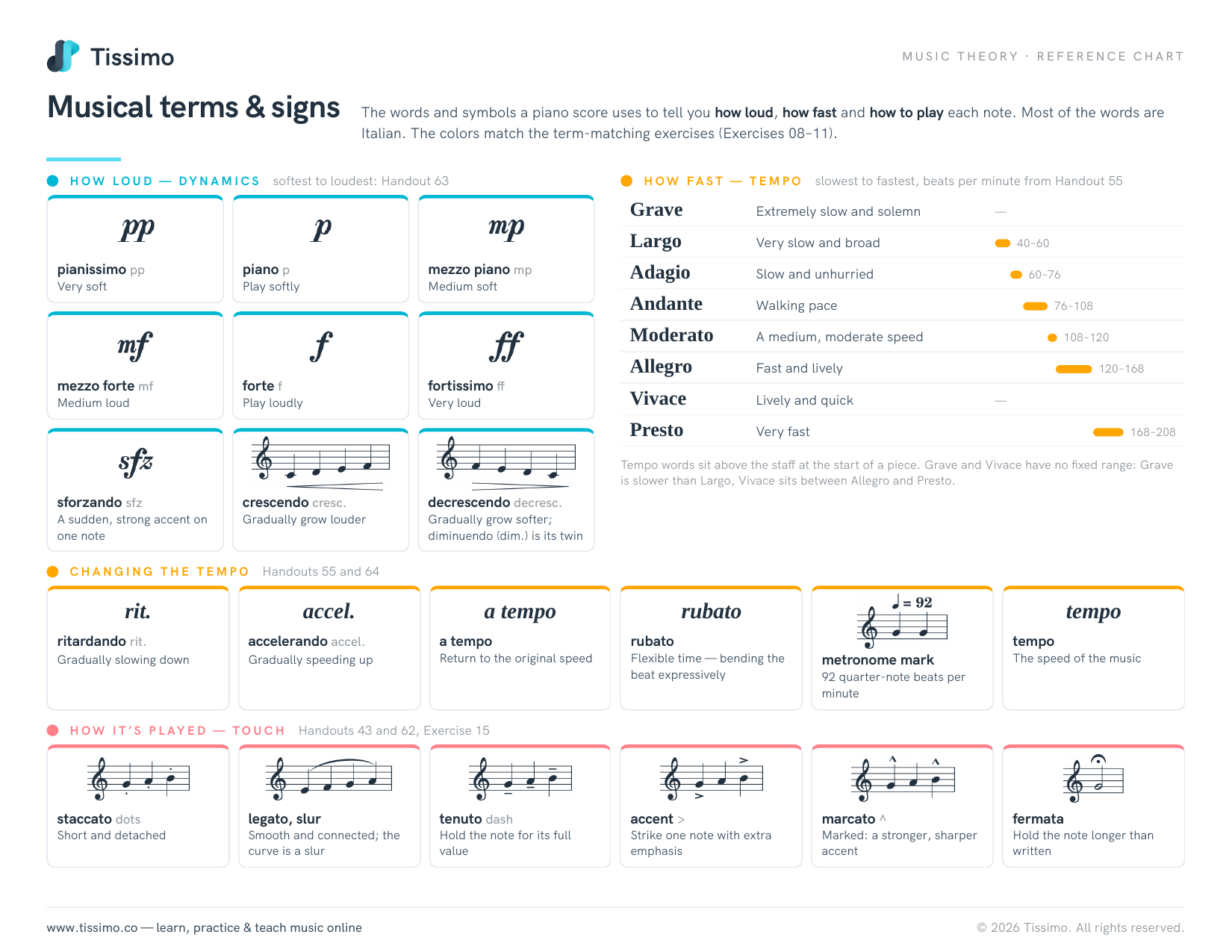 Musical terms & signsThe words and symbols a piano score uses to tell you how loud, how fast and how to play each note. Most of the words are Italian. The colors match the term-matching exercises (Exercises 08–11, 74 and 75).