Notation & Symbols
Fermata
Pronounced fer-MAH-tah
A fermata is an arc over a dot, placed above or below a note, chord or rest, that tells you to hold it longer than its written value.
A fermata is a curved line with a dot under it, written above a note, a chord or a rest. When it sits below the staff it is printed upside down, with the dot above the curve. It means the same thing either way: stop counting for a moment, let the sound (or the silence) last longer than its written value, then carry on.
British musicians usually call it a pause. American musicians say fermata or simply hold, and some teachers nickname the symbol the "bird's eye".
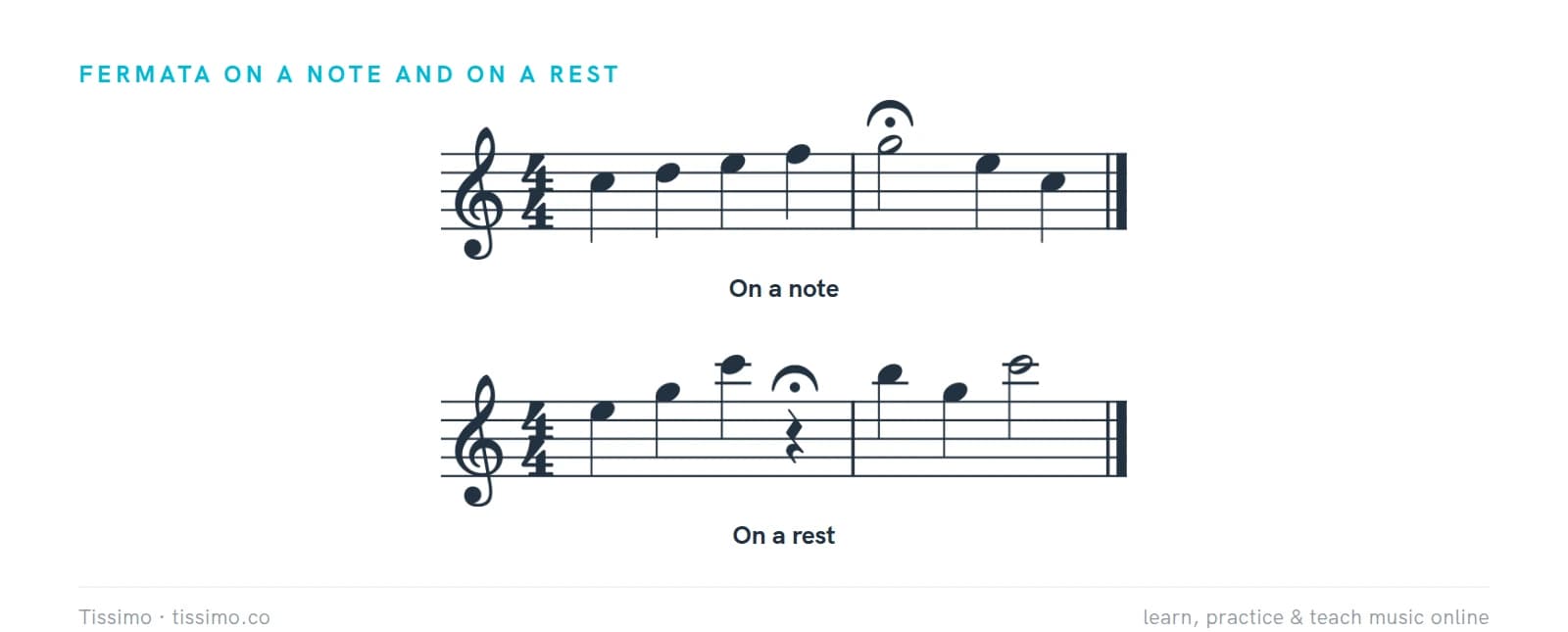
How long do you hold a fermata?
The score does not say, and that is deliberate. The length depends on the tempo, the style and what comes next. A useful starting point is to hold the note for about twice its written value, then adjust: a fermata at the end of a slow, quiet piece can last much longer, while one in the middle of a lively phrase may be only a short breath of extra time.
Two habits help. Keep counting silently through the written value first, so you know where the beat would have been. And decide in advance how the music restarts after the hold: most fermatas are followed by a tiny gap, a breath or a fresh upbeat in the original tempo.
Fermatas on rests and bar lines
A fermata over a rest asks for a held silence. It often appears just before a dramatic entry, when the whole ensemble stops and waits together. Occasionally you will see a fermata over a bar line: it asks for a short pause between two bars rather than a longer note.
Fermatas in different styles
- In Bach's four-part chorales, fermatas mark the end of each line of the hymn text. Performers still argue about how long to hold them; some treat them as a breath rather than a long stop.
- In a Classical concerto, the orchestra stops on a chord marked with a fermata, and the soloist plays a cadenza before the music moves on.
- In a choir or band, the conductor shows the length of the hold and gives a clear cutoff, so everyone releases together.
Fermatas are often taught alongside tenuto and accent, two other marks that change how a single note is played. Compare all three in Fermata, Tenuto & Accent.
Common questions
Does a fermata double the length of a note?
No rule says so. Doubling is a reasonable first guess, but the real length is a musical decision that depends on the tempo, the style and, in an ensemble, on the conductor.
What is the difference between a fermata and a caesura?
A fermata lengthens the note or rest it sits on. A caesura (two slanted lines) is a complete break in the sound after a note, so the music stops and then restarts.
Practice it: free worksheets
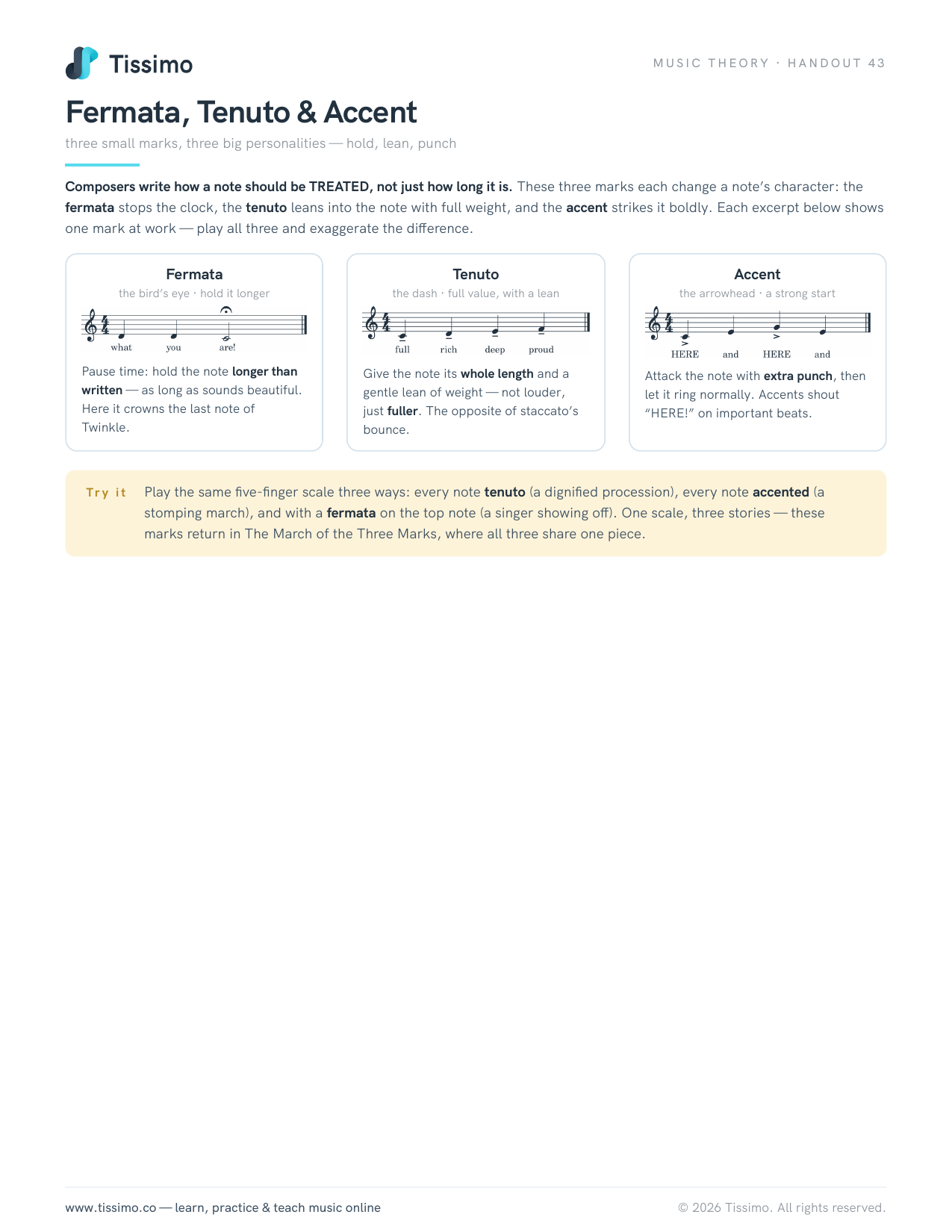 Fermata, Tenuto & Accentthree small marks, three big personalities — hold, lean, punch
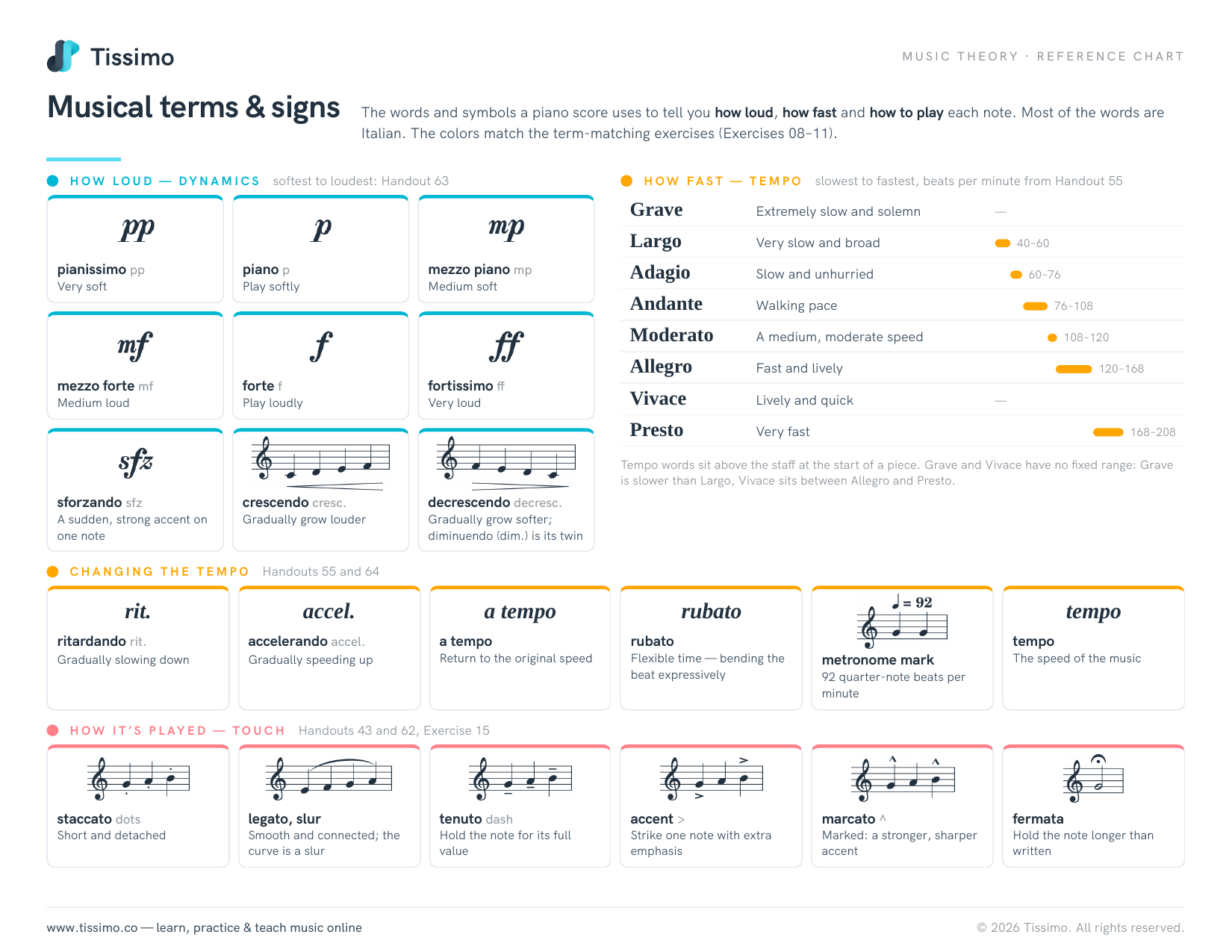 Musical terms & signsThe words and symbols a piano score uses to tell you how loud, how fast and how to play each note. Most of the words are Italian. The colors match the term-matching exercises (Exercises 08–11, 74 and 75).