Tempo Markings
Rubato
Pronounced roo-BAH-toh
Rubato, short for tempo rubato ('stolen time'), is expressive flexibility in tempo: stretching some notes and hurrying others so the beat bends with the phrase while the music keeps its overall pulse.
Rubato means "robbed" or "stolen". Its full name is tempo rubato, "stolen time": you take a little time from some notes and give it to others, so the beat bends and breathes with the music instead of ticking like a metronome.
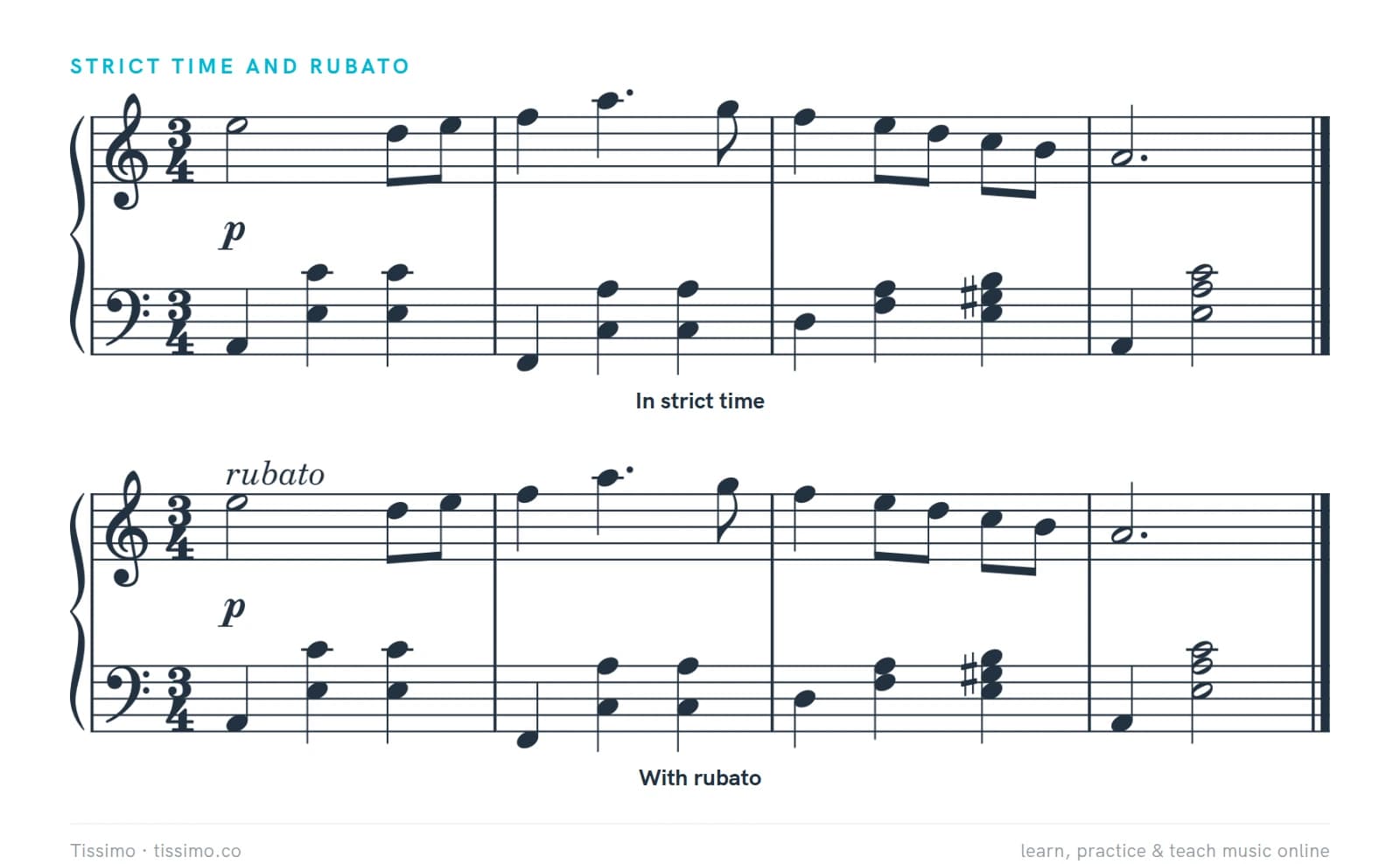
What rubato sounds like
A singer holds the high note of a phrase a fraction longer, then catches up on the way down. A pianist lingers on a surprising chord, then moves on a little faster. That flexibility is rubato. It can be written as rubato or tempo rubato above the staff, but in much Romantic music, Chopin's above all, it is expected even where nothing is written.
Two kinds of rubato
Musicians describe two broad approaches:
- Melodic rubato. The accompaniment keeps a steady beat while the melody pulls slightly ahead or behind it, then realigns. Writers in the 18th and early 19th centuries often meant this kind.
- Whole-texture rubato. Melody and accompaniment stretch and push together. This is what most people mean by rubato today, and it is what the recording above does.
How to play rubato well
- Know the strict version first. Learn the passage in steady time with a metronome. Rubato is a choice you make on top of a secure beat, not a cover for an unsteady one.
- Stretch for a reason. Typical places are the high point of a phrase, an unexpected harmony, a cadence or the start of a new section. Move forward in passages that are building.
- Give the time back, roughly. Over a phrase the push and pull should feel balanced, so the music does not simply keep getting slower.
- Match the style. Romantic music invites generous rubato. Baroque and Classical music usually want a steadier pulse, with flexibility mostly at phrase ends and cadences. Many jazz and pop singers phrase freely over a strict rhythm section, a modern cousin of melodic rubato.
Our Musical terms & signs chart sums rubato up as flexible time, bending the beat expressively, and Match the terms: level 4 tests it alongside other expression words. For shaping the phrases that rubato serves, see Phrasing.
For rubato's written-out cousins, gradual slowing and speeding up, see Ritardando & Accelerando.
Common questions
Is rubato the same as playing out of time?
No. Rubato is controlled flexibility around a beat you could still tap along to. Playing out of time is losing the beat. Good rubato sounds natural precisely because the pulse underneath it is secure.
Does rubato just mean slowing down?
No. It means both stretching and hurrying. Time taken in one place is roughly given back in another, so the phrase keeps moving.
Practice it: free worksheets
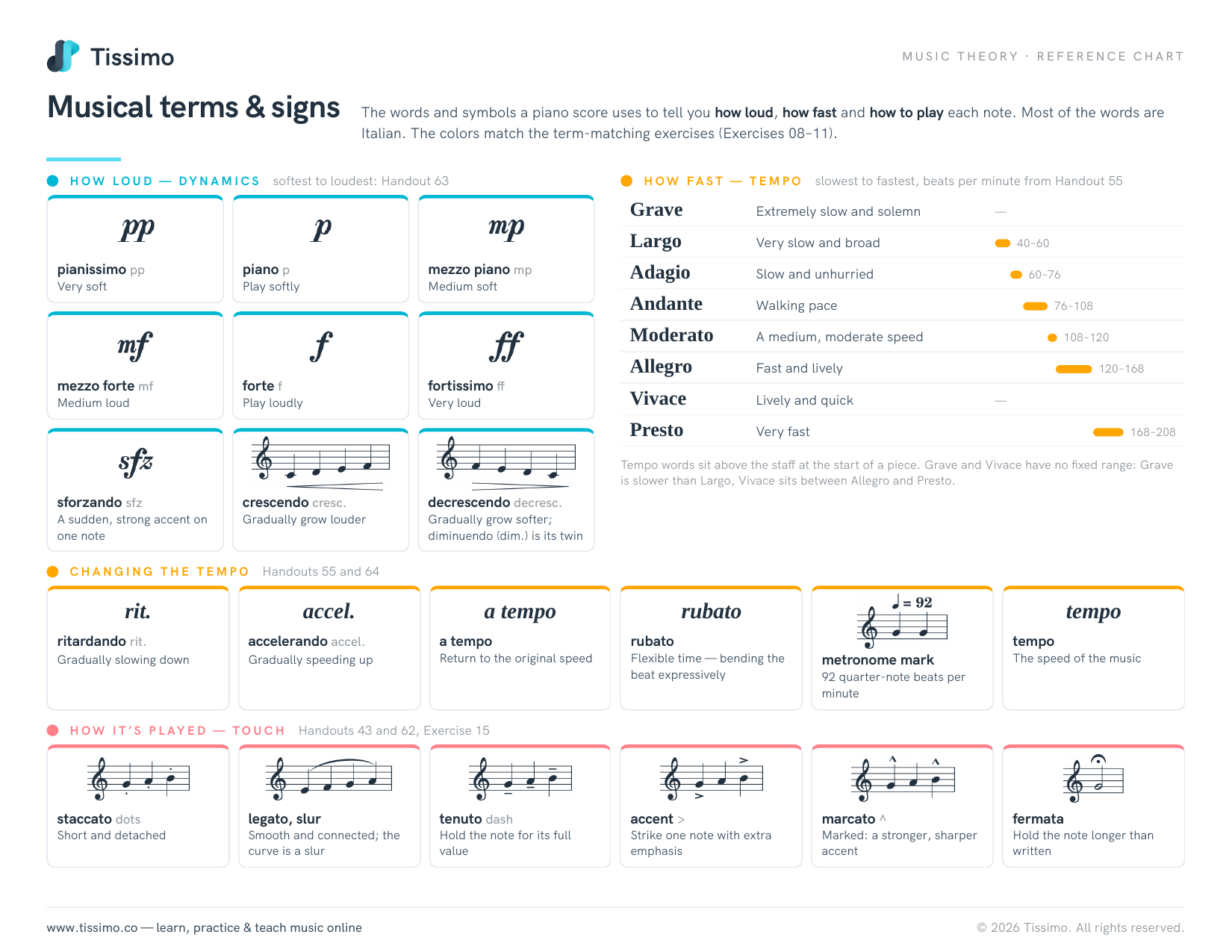 Musical terms & signsThe words and symbols a piano score uses to tell you how loud, how fast and how to play each note. Most of the words are Italian. The colors match the term-matching exercises (Exercises 08–11, 74 and 75).
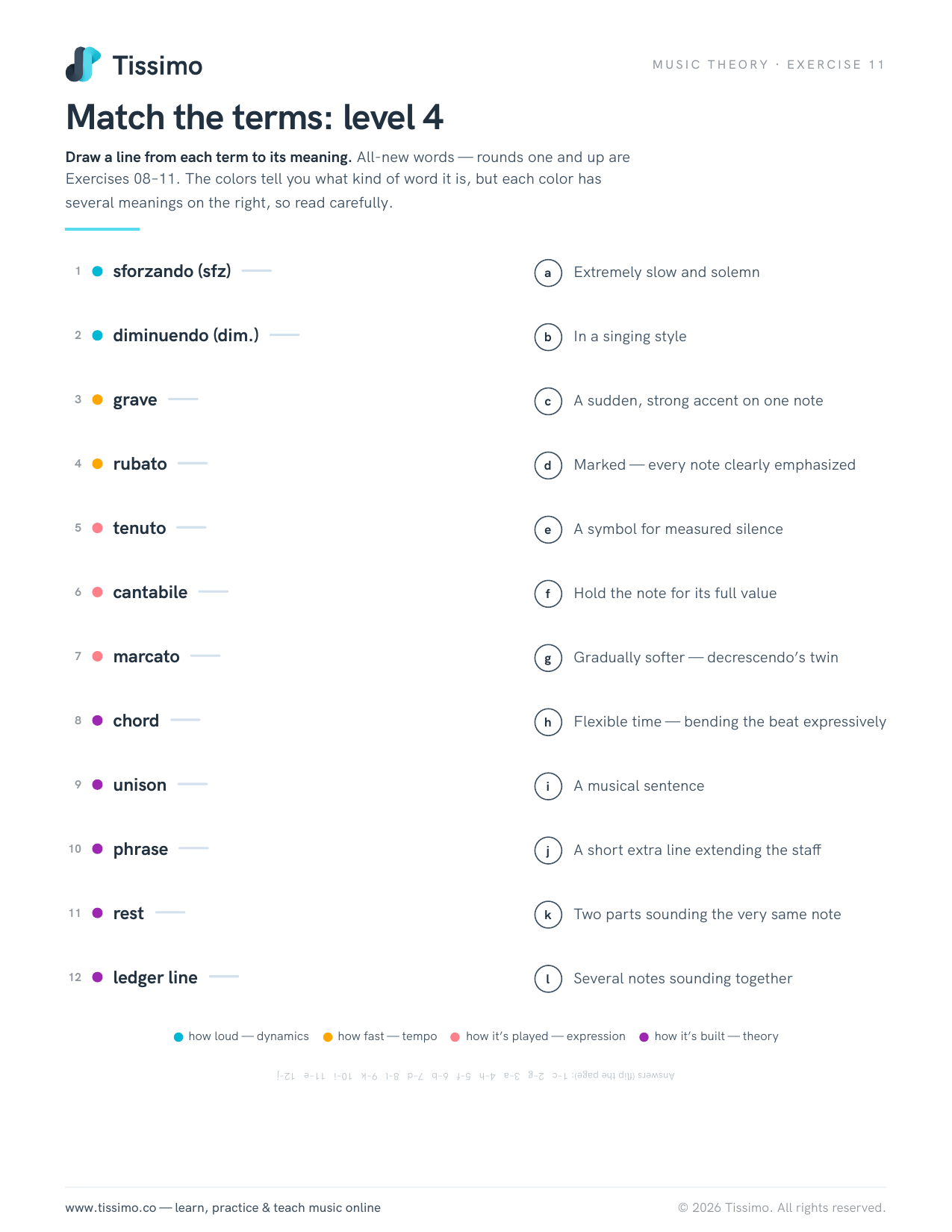 Match the terms: level 4Draw a line from each term to its meaning. All-new words — rounds one and up are Exercises 08–11. The colors tell you what kind of word it is, but each color has several meanings on the right, so read carefully.
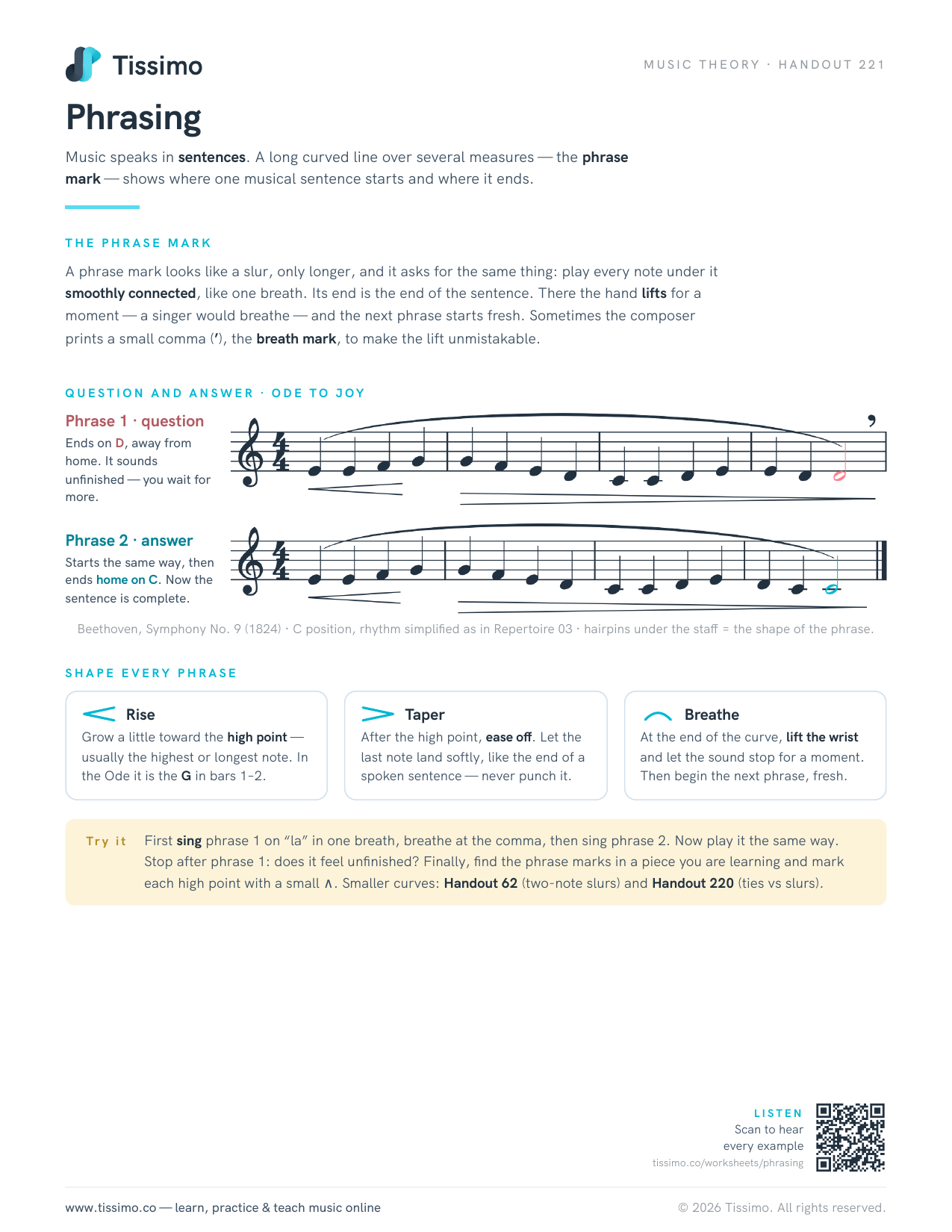 PhrasingMusic speaks in sentences. A long curved line over several measures — the phrase mark — shows where one musical sentence starts and where it ends.
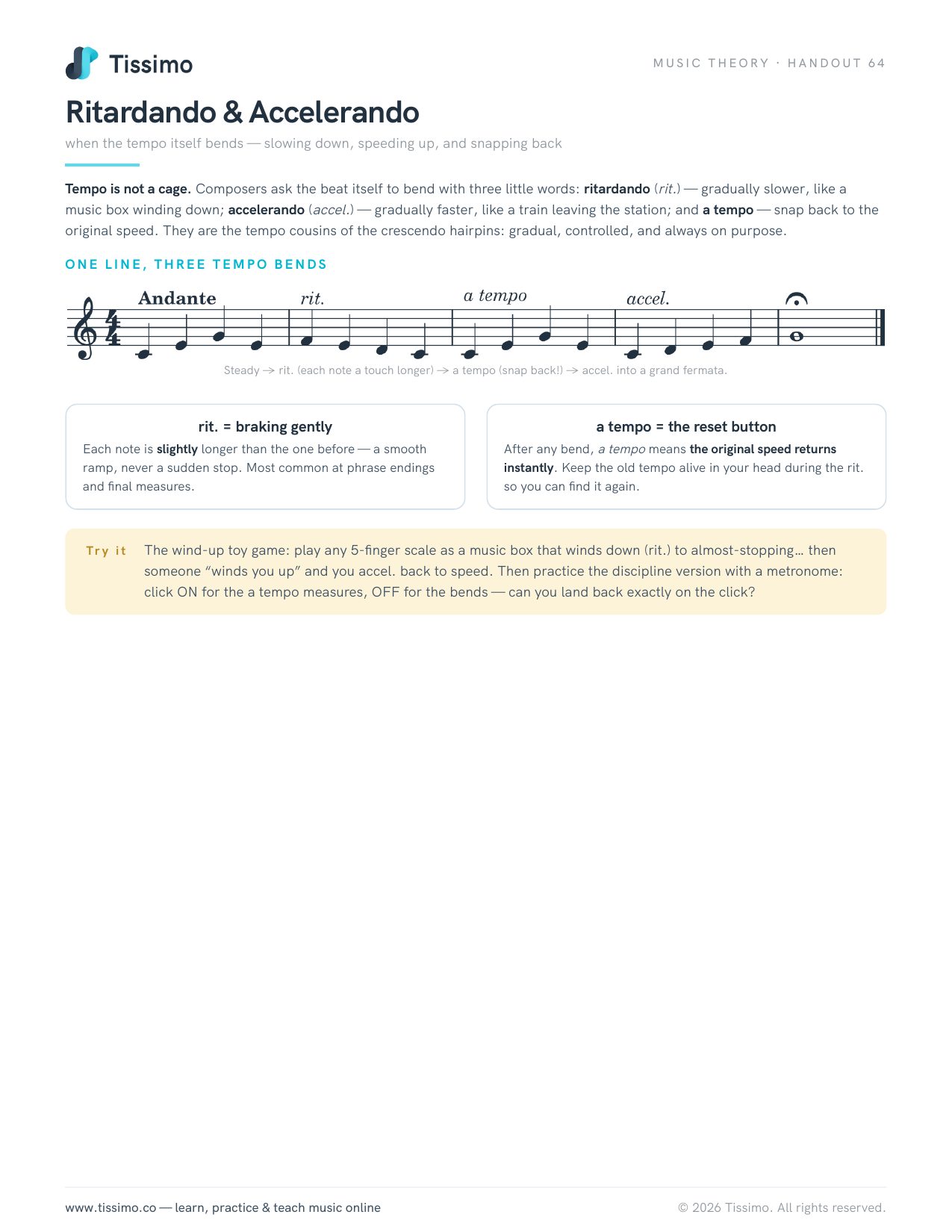 Ritardando & Accelerandowhen the tempo itself bends — slowing down, speeding up, and snapping back