Tempo Markings
Metronome Mark
Written as M.M.
A metronome mark, such as ♩ = 96, names a note value and a number of beats per minute. It gives the exact tempo: here, 96 quarter notes in each minute.
A metronome mark gives the tempo as a number. It is printed above the first bar, often beside the tempo word, and has three parts: a note symbol (the beat unit), an equals sign, and the number of those notes per minute. ♩ = 96 means 96 quarter notes per minute, a speed you can set exactly on a metronome.
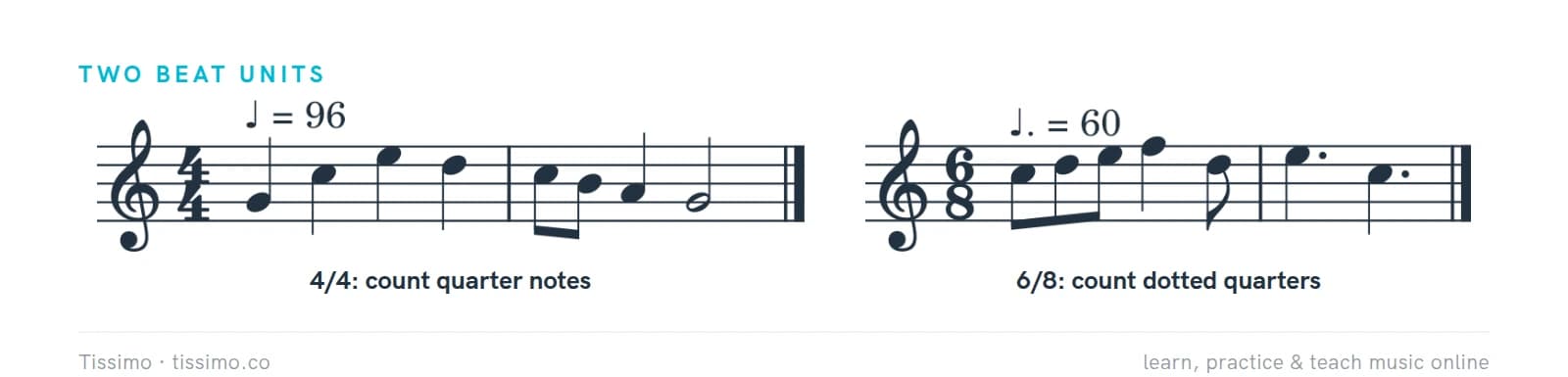
Reading the beat unit
The note symbol tells you which note value the number counts, and it normally matches the beat of the meter:
- ♩ = 96 in 2/4, 3/4 or 4/4: count quarter notes.
- ♩. = 60 in 6/8, 9/8 or 12/8: count dotted quarters, the felt beat of compound meter. Each dotted quarter holds three eighth notes, so here the eighths run at 180 per minute.
- A half note = 72 in cut time: count half notes, two to a bar.
Many editions print the tempo word and the mark together. In the edition used for our Ballade study, Burgmüller's piece opens "Allegro con brio (♩. = 104)": in 3/8 time that is one dotted-quarter beat per bar. His Arabesque appears as "Allegro scherzando (♩ = 152)".
Variations you will meet
- M.M. ♩ = 96: M.M. stands for Maelzel's Metronome, named after Johann Maelzel, who commercialized the mechanical metronome in the early 19th century. The letters add nothing to the number.
- ♩ = c. 96: circa, about 96. The composer is giving a guide, not a law.
- ♩ = 88–96: any speed in that range.
- An equation between two note values, such as eighth note = eighth note, printed where the meter changes. This gives a duration relationship rather than an absolute BPM: the note value on one side lasts as long as the note value on the other. Eighth note = eighth note keeps the eighth notes unchanged, but the main beat can change speed if those eighths are grouped differently. New Meter, Same Eighth practices exactly this.
Who wrote the mark?
Composers have used metronome marks since the early 19th century. Beethoven was one of the first major composers to add them, and some of his marks are so fast that performers still debate them. In many older pieces, though, the mark was added later by an editor, sometimes in brackets. Treat a composer's mark as strong advice and an editor's mark as a suggestion.
Tempo & the Metronome prints engraved metronome marks beside the tempo words, and Dynamics & Tempo Ladders asks you to match six marks to the right word.
Common questions
What does M.M. mean in sheet music?
M.M. stands for Maelzel's Metronome. "M.M. ♩ = 80" simply means 80 quarter-note beats per minute.
Do I have to play exactly at the metronome mark?
Treat it as the composer's or editor's guide. Many performers play a little under or over it to suit the instrument, the room and the music, and while you are learning a piece you should practice well below it.
Practice it: free worksheets
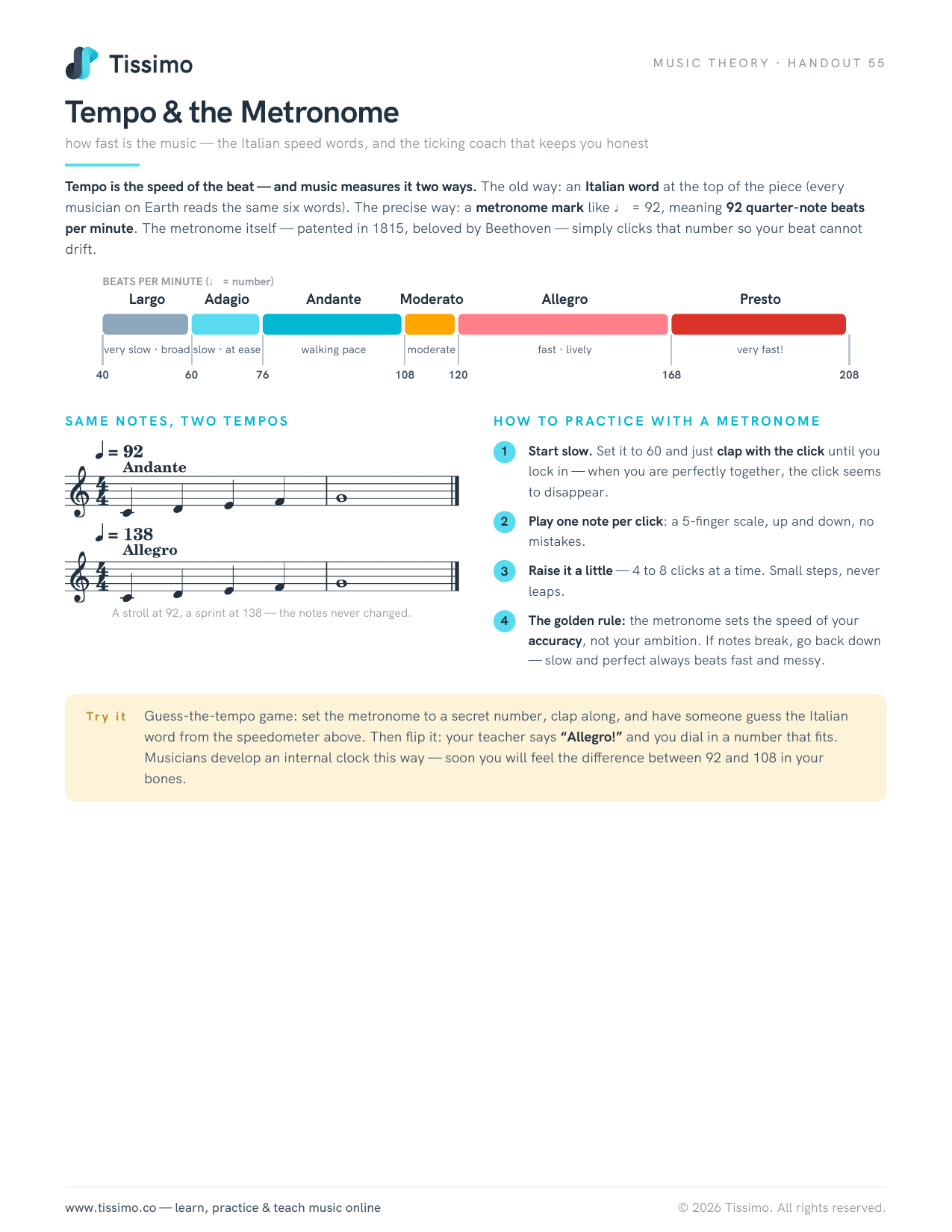 Tempo & the Metronomehow fast is the music — the Italian speed words, and the ticking coach that keeps you honest
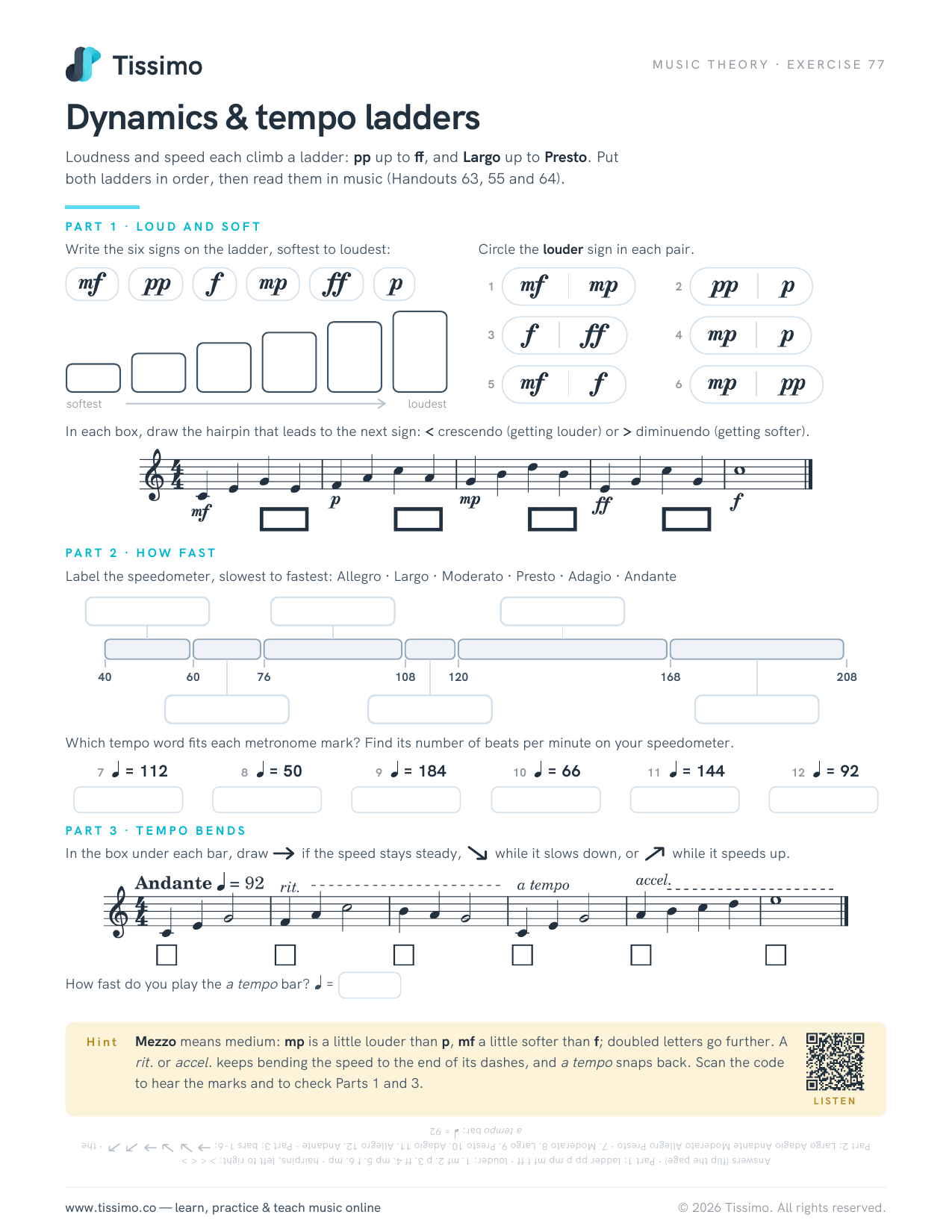 Dynamics & tempo laddersLoudness and speed each climb a ladder: pp up to ff, and Largo up to Presto. Put both ladders in order, then read them in music (Handouts 63, 55 and 64).
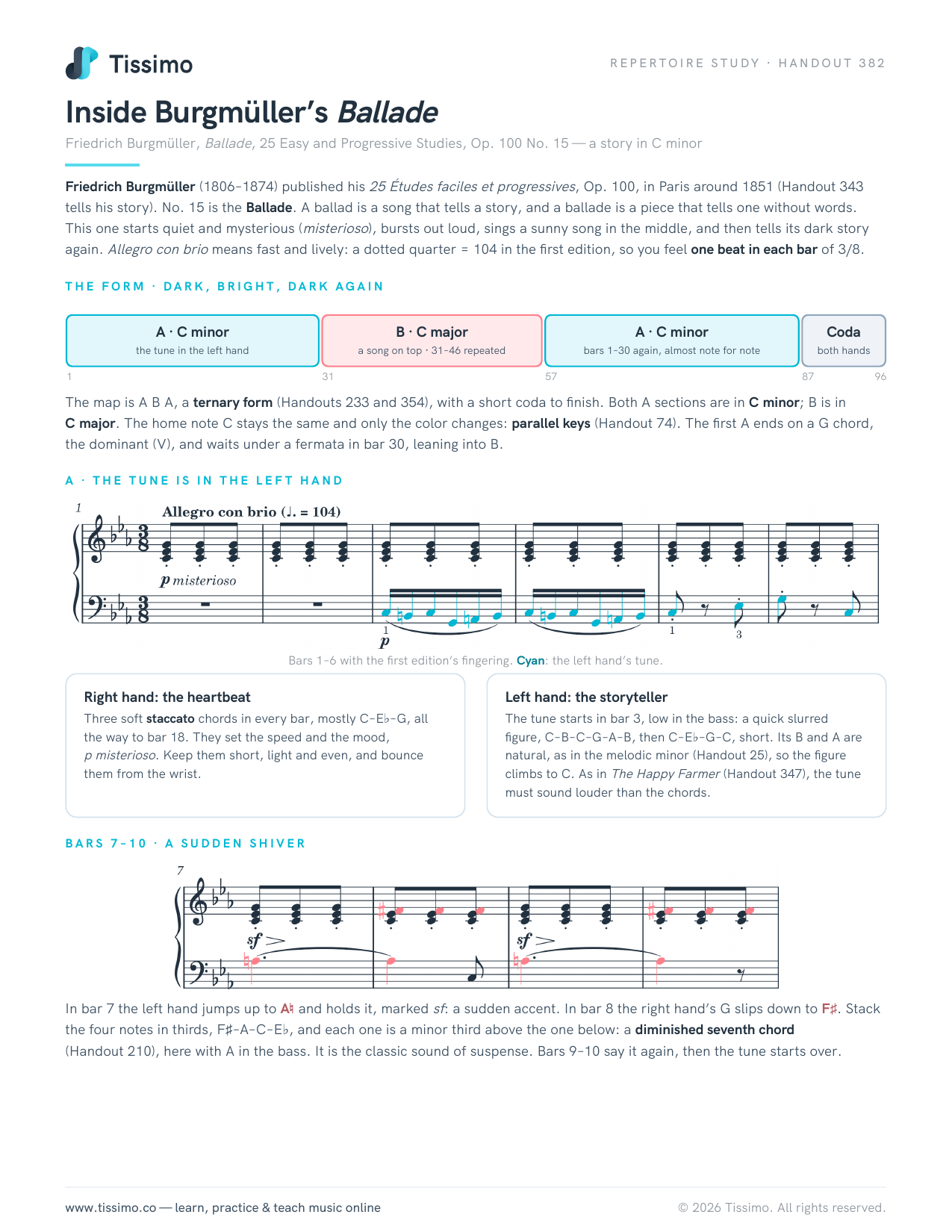 Inside Burgmüller’s BalladeFriedrich Burgmüller, Ballade, 25 Easy and Progressive Studies, Op. 100 No. 15 — a story in C minor
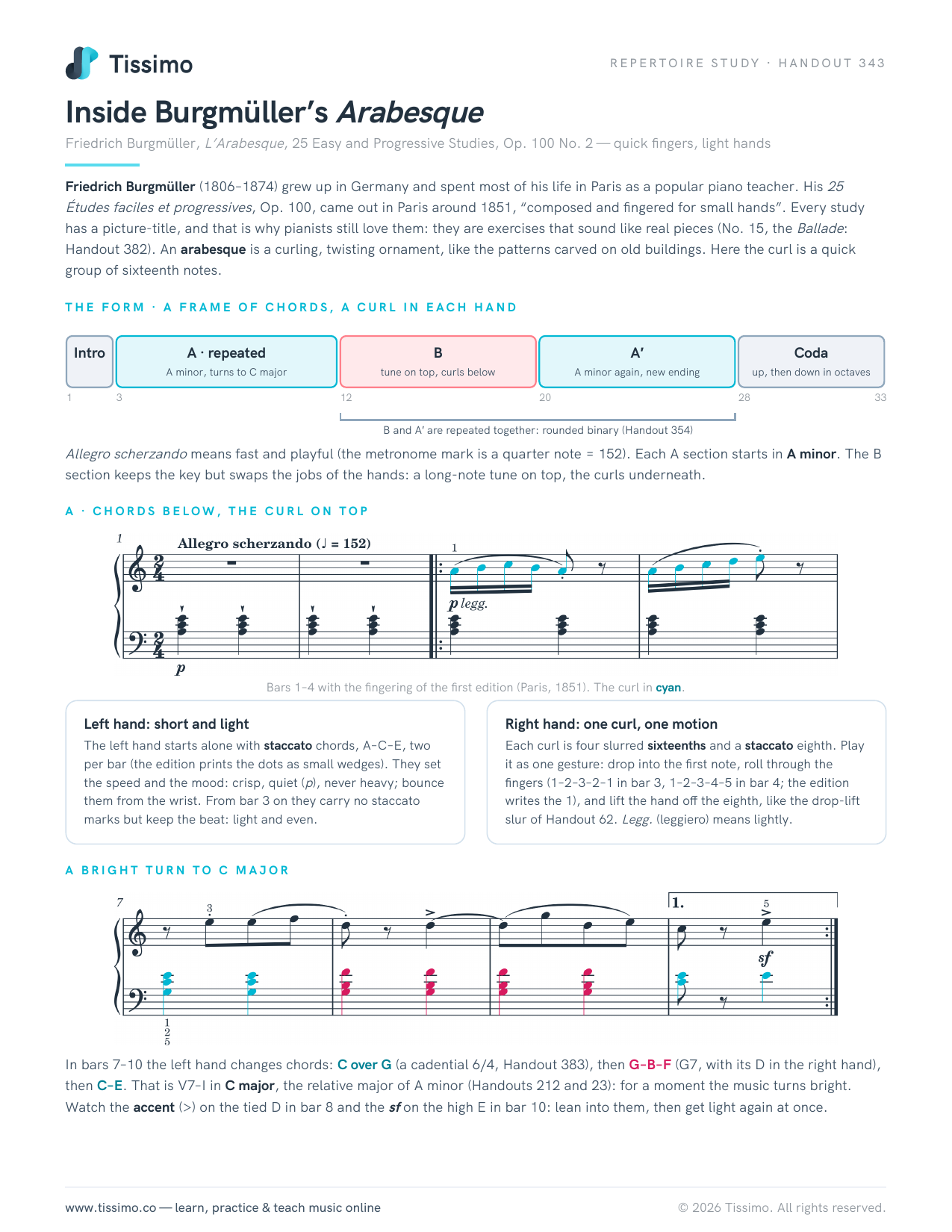 Inside Burgmüller’s ArabesqueFriedrich Burgmüller, L’Arabesque, 25 Easy and Progressive Studies, Op. 100 No. 2 — quick fingers, light hands
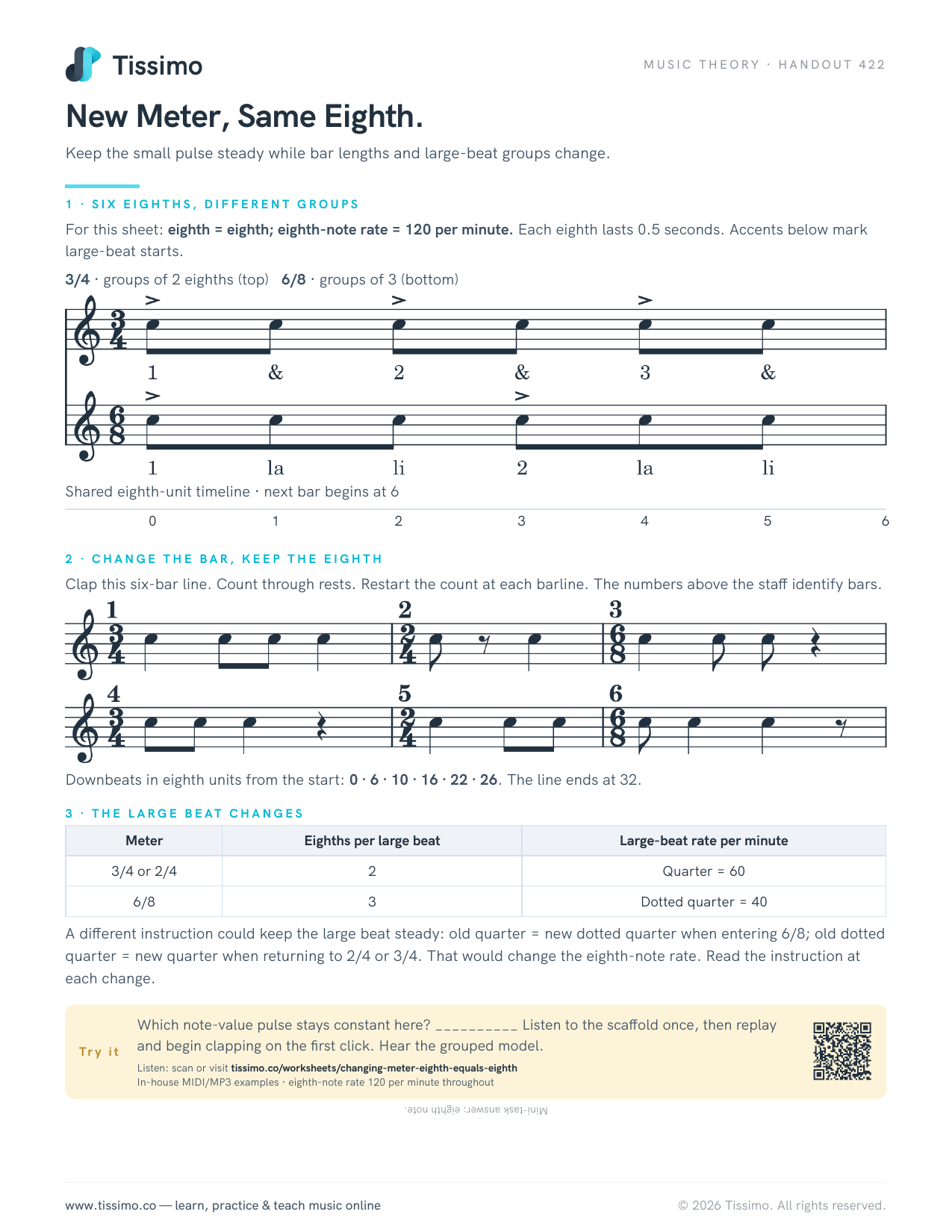 New Meter, Same Eighth.Keep the small pulse steady while bar lengths and large-beat groups change.