Rhythm & Meter
Time Signature
A time signature is the pair of stacked numbers at the start of the music, such as 3/4 or 6/8. It shows how many of which note value fill each bar, and so how the beats are counted.
A time signature is printed at the start of a piece, just after the clef and the key signature. It looks like a fraction without the line: two numbers stacked on top of each other, such as 4/4, 3/4 or 6/8. It tells you how each bar is measured, and from that you can work out how to count.
Reading the two numbers
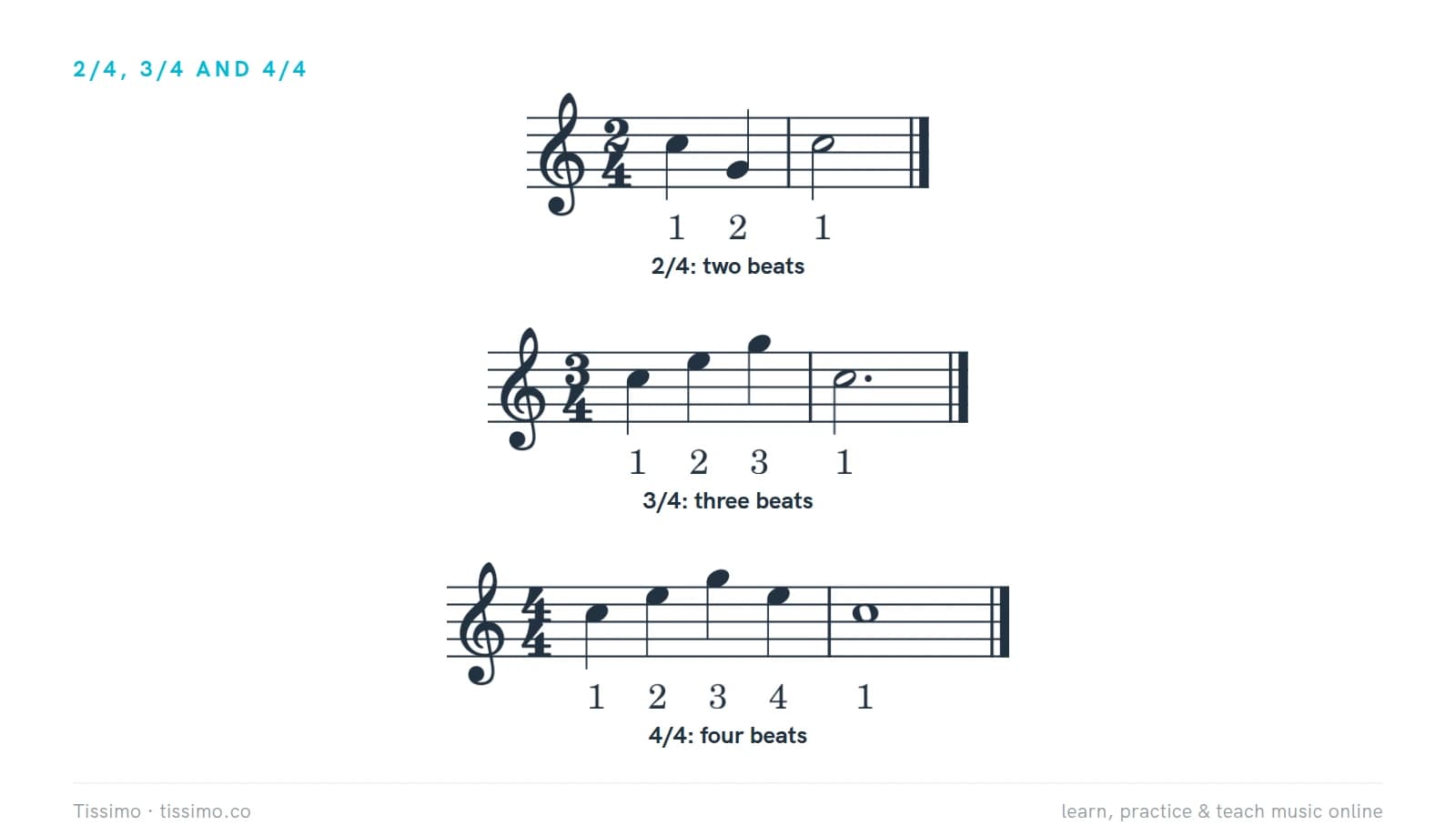
- The bottom number names a note value: 2 means a half note, 4 a quarter note, 8 an eighth note and 16 a sixteenth note.
- The top number says how many of those notes fill one bar.
So 3/4 means three quarter notes per bar, and 2/2 means two half notes per bar. In simple meters like these, the bottom note is also the beat: you count "1, 2, 3" in 3/4.
When the top number is 6, 9 or 12
In compound meters the top number counts the small notes, not the beats. 6/8 holds six eighth notes, but they are grouped in two sets of three, so the music has two beats, each one a dotted quarter. 9/8 has three such beats and 12/8 has four. To find the number of beats in a compound meter, divide the top number by three.
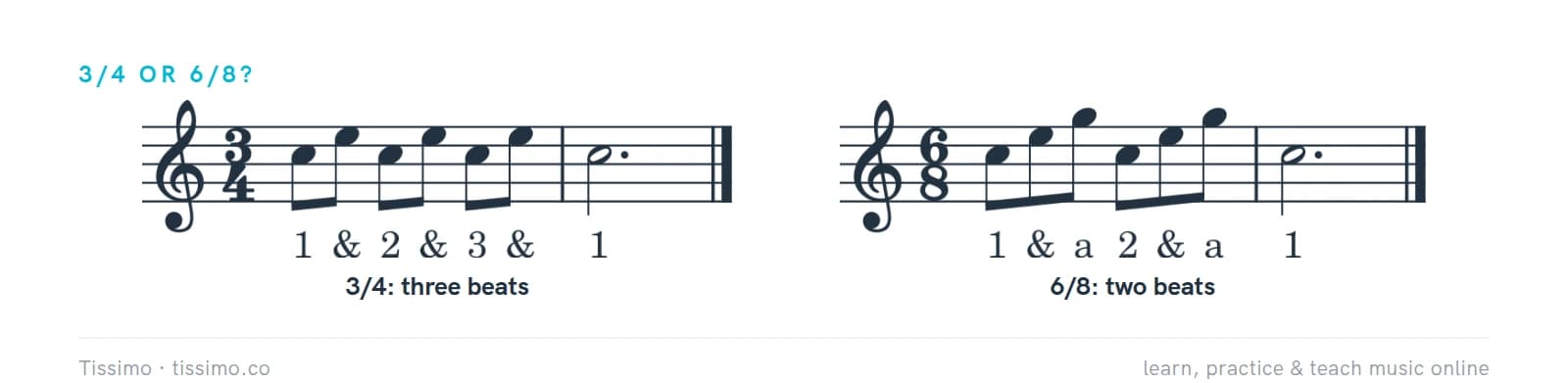
That is why 3/4 and 6/8 feel different even though each bar holds six eighth notes:
Symbols instead of numbers
Two time signatures are often written as symbols. A large C stands for 4/4, which is called common time. A C with a vertical line through it stands for 2/2, called cut time or alla breve.
Where it appears
The time signature is printed at the start of the piece, not on every line like the clef and key signature. It appears again only where the meter changes. If the change falls at the start of a new line, the new signature is usually also shown at the end of the line before, as a warning.
Practice reading time signatures with Time Signatures I: Simple Time and Time Signatures II: Compound Time, then try the Meter Detective puzzles.
Common questions
What does 4/4 mean?
Four quarter notes fill each bar, so you count four beats: 1, 2, 3, 4. 4/4 is so widespread that it is also called common time and is often written as a large C.
What is the difference between 3/4 and 6/8?
Both hold six eighth notes per bar. 3/4 groups them in pairs, giving three quarter-note beats (1 & 2 & 3 &). 6/8 groups them in threes, giving two dotted-quarter beats (1 & a 2 & a). 3/4 sways like a waltz; 6/8 rocks in a lilting two.
Is a time signature a fraction?
No, even though it looks like one. 2/4 and 4/8 would be equal fractions, but as time signatures they describe different meters: two quarter-note beats against four eighth-note beats.
Practice it: free worksheets
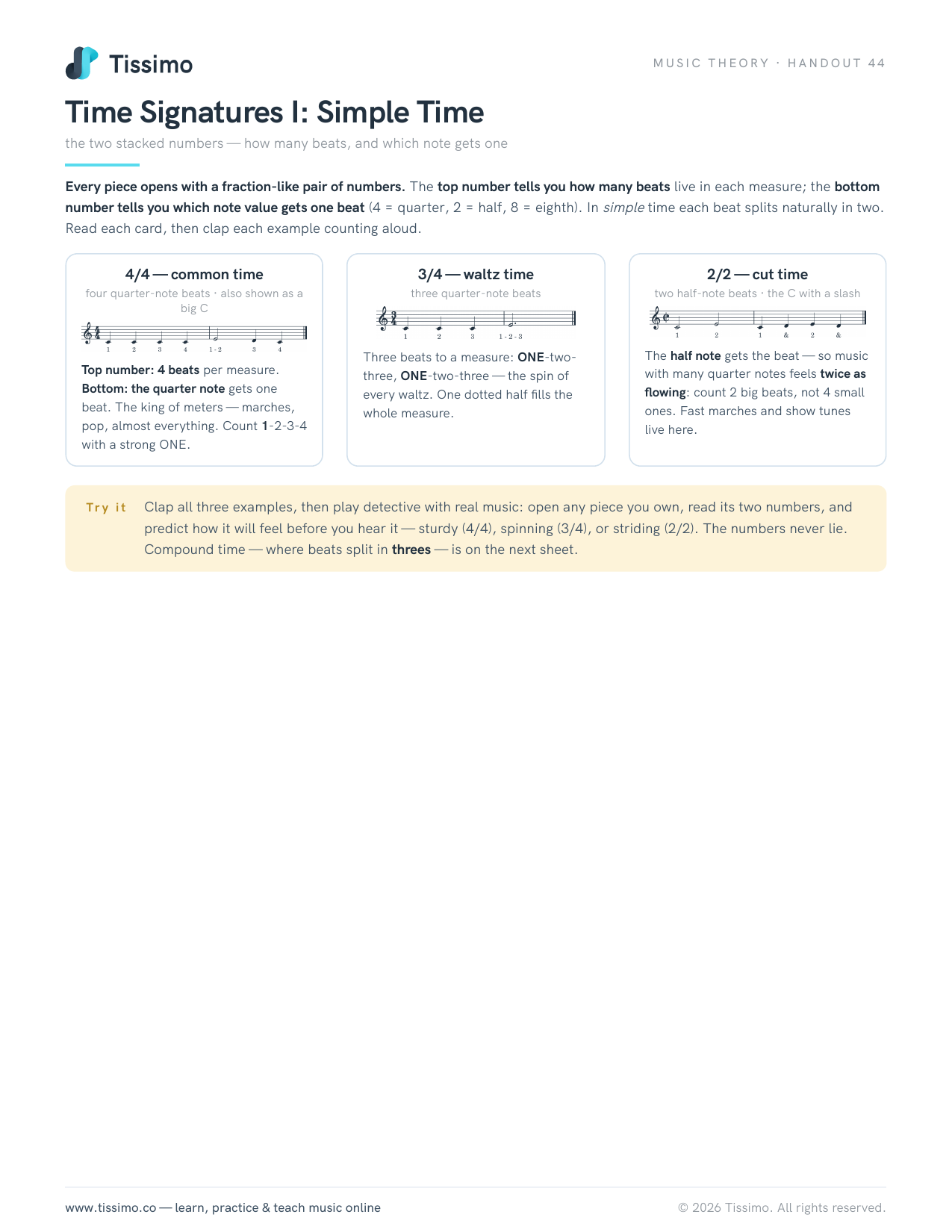 Time Signatures I: Simple Timethe two stacked numbers — how many beats, and which note gets one
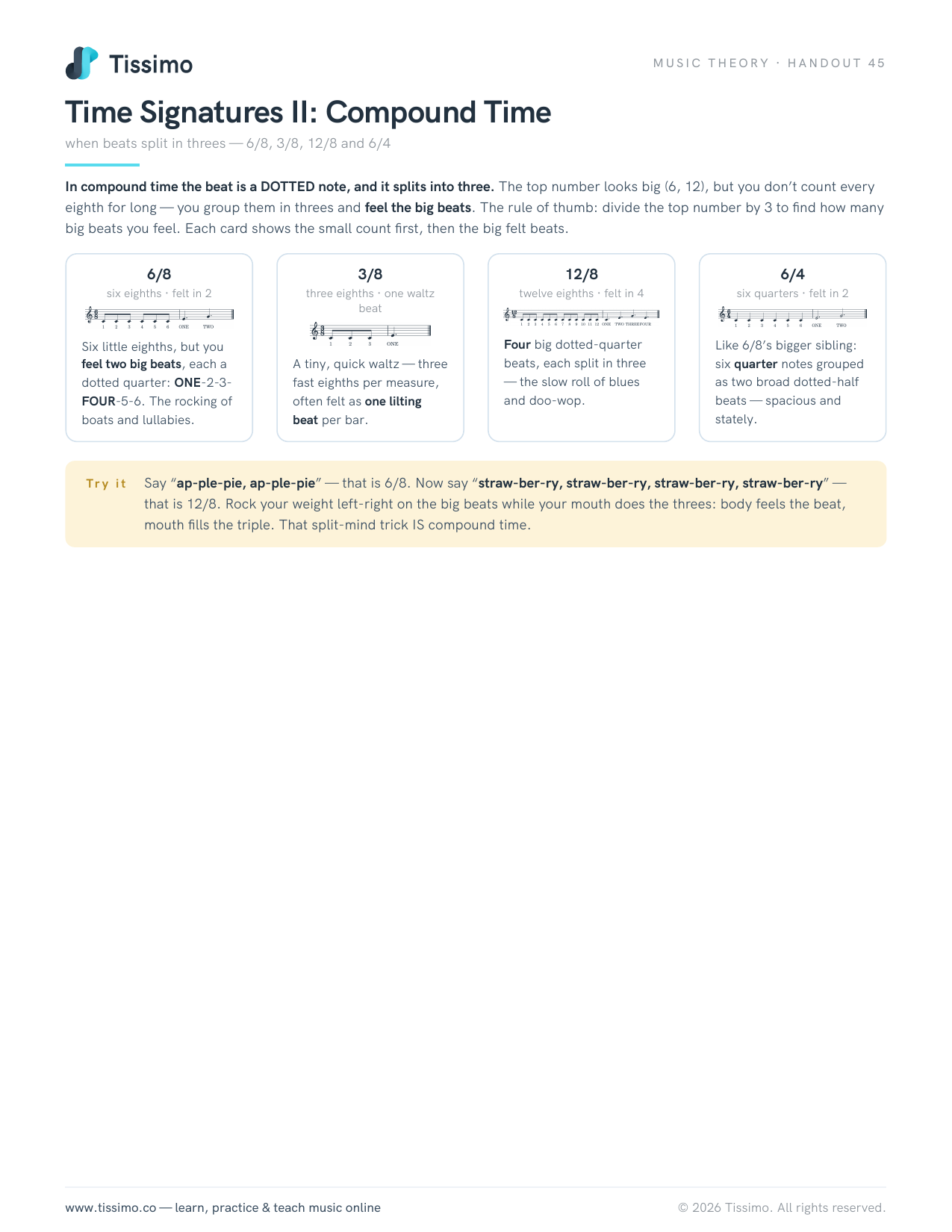 Time Signatures II: Compound Timewhen beats split in threes — 6/8, 9/8, 12/8 and 6/4
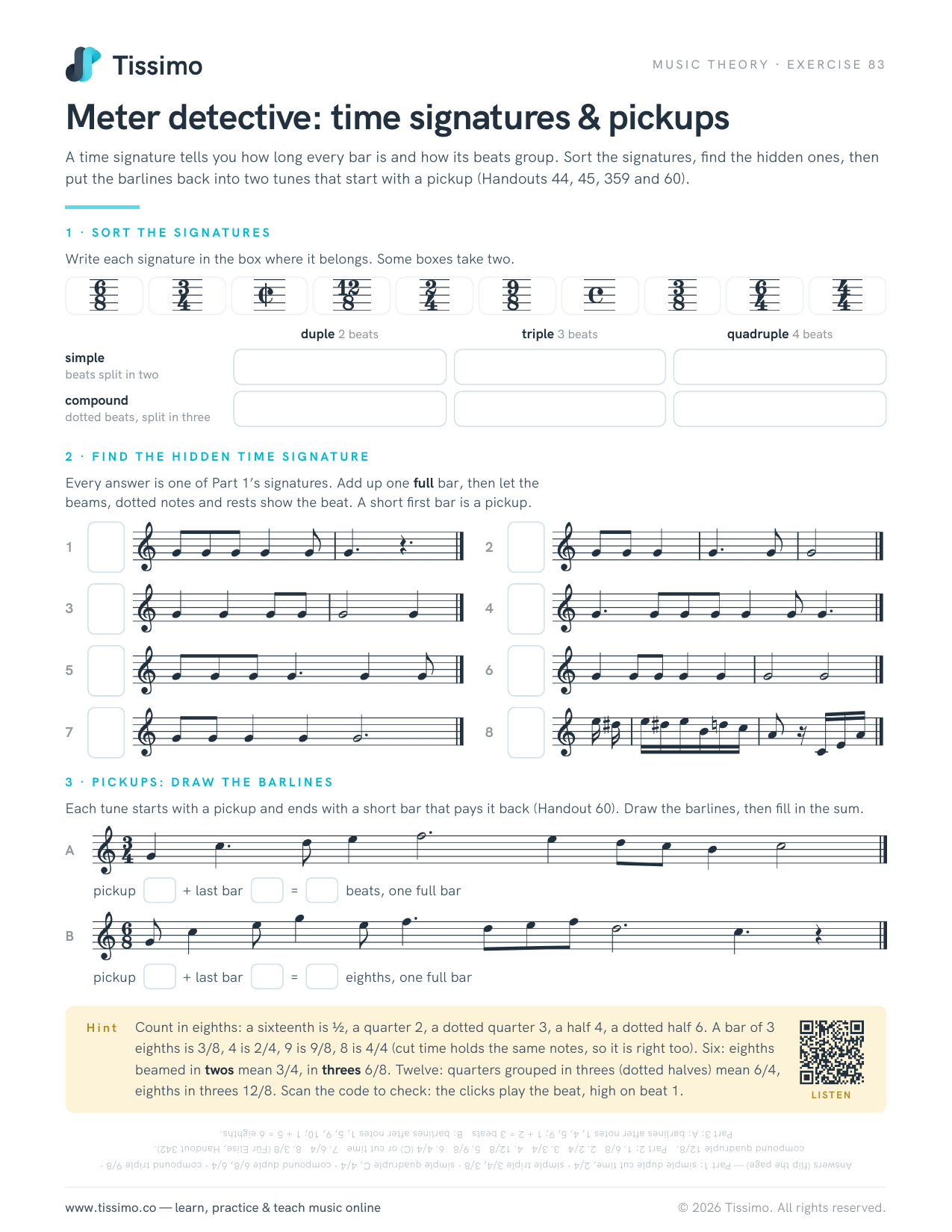 Meter detective: time signatures & pickupsA time signature tells you how long every bar is and how its beats group. Sort the signatures, find the hidden ones, then put the barlines back into two tunes that start with a pickup (Handouts 44, 45, 359 and 60).
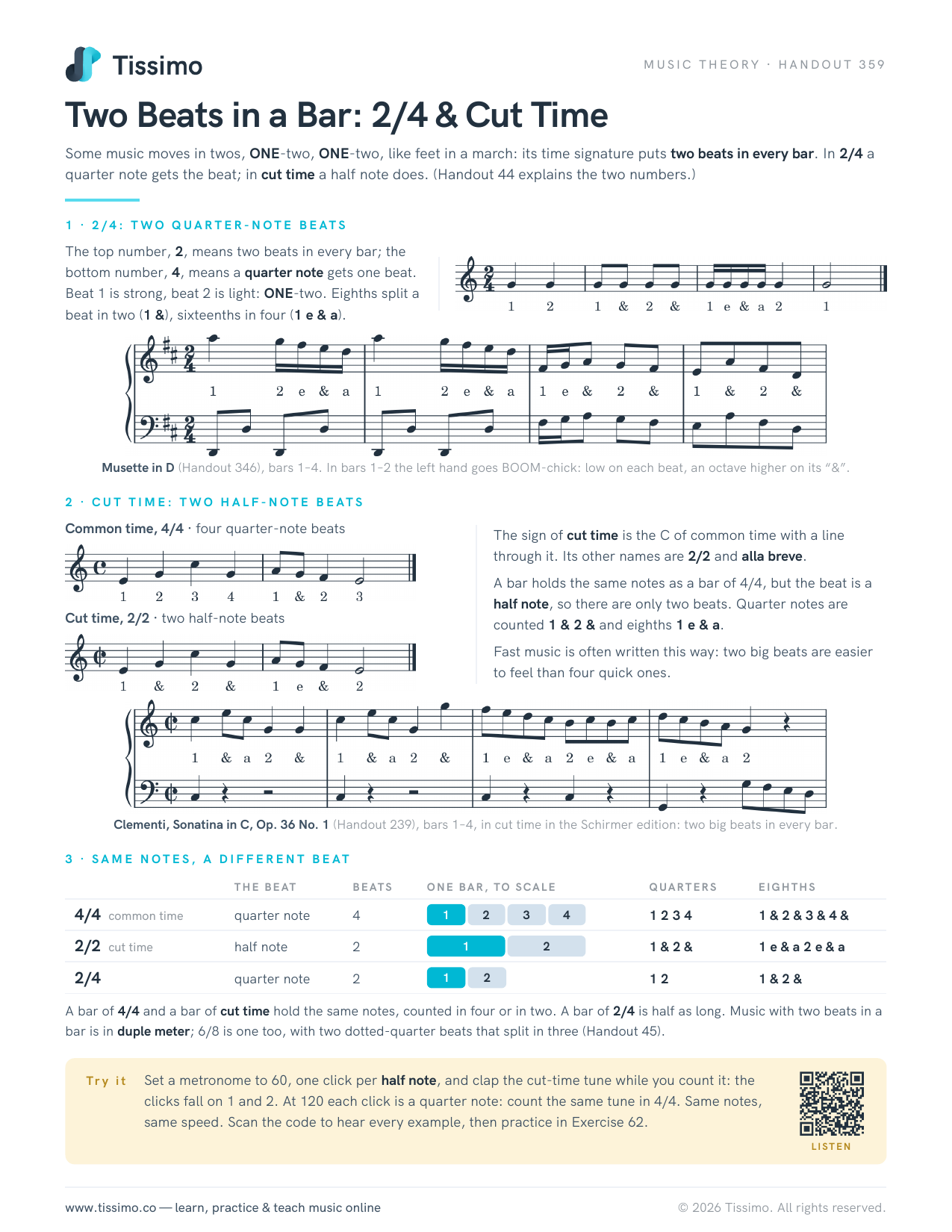 Two Beats in a Bar: 2/4 & Cut TimeSome music moves in twos, ONE-two, ONE-two, like feet in a march: its time signature puts two beats in every bar. In 2/4 a quarter note gets the beat; in cut time a half note does. (Handout 44 explains the two numbers.)
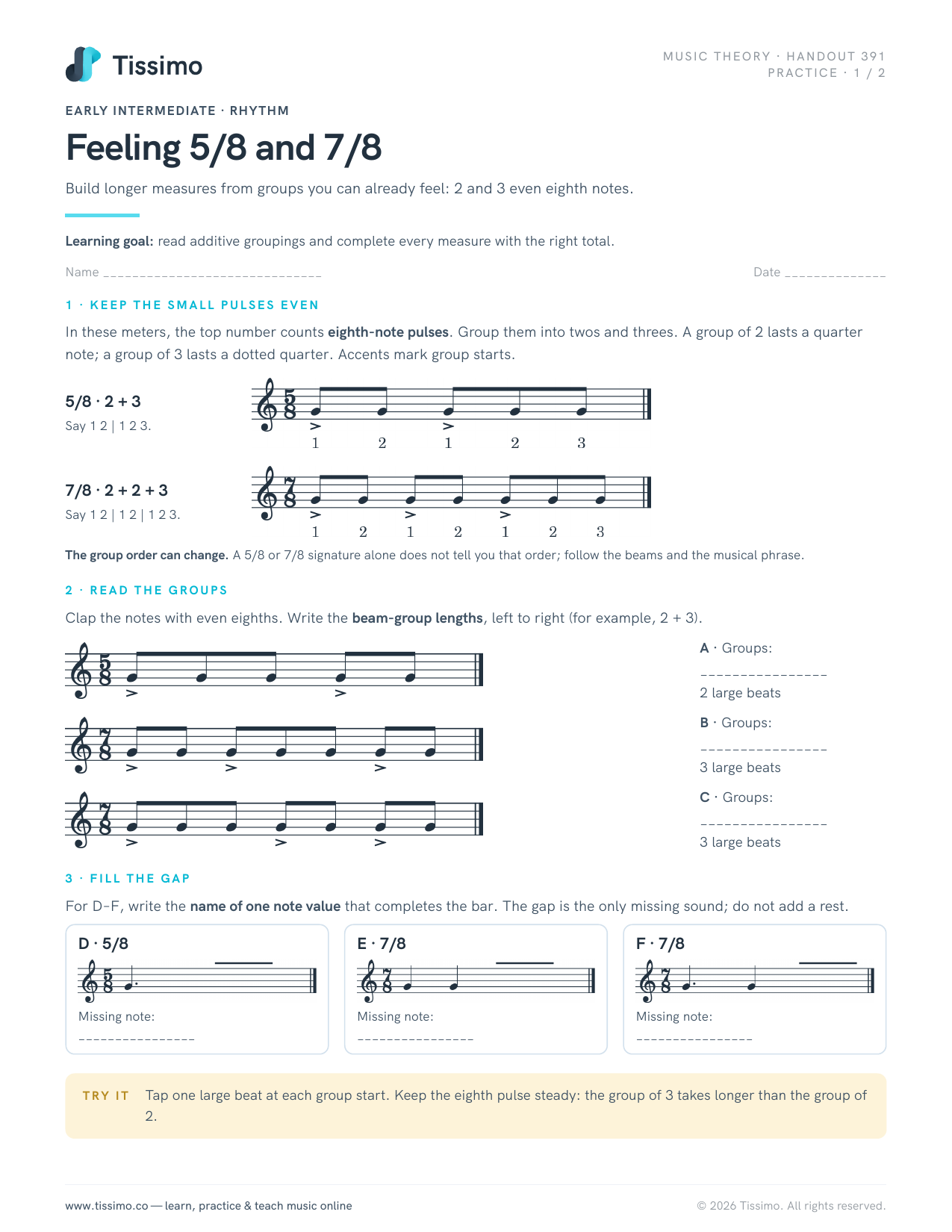 Feeling 5/8 and 7/8Build longer measures from groups you can already feel: 2 and 3 even eighth notes.
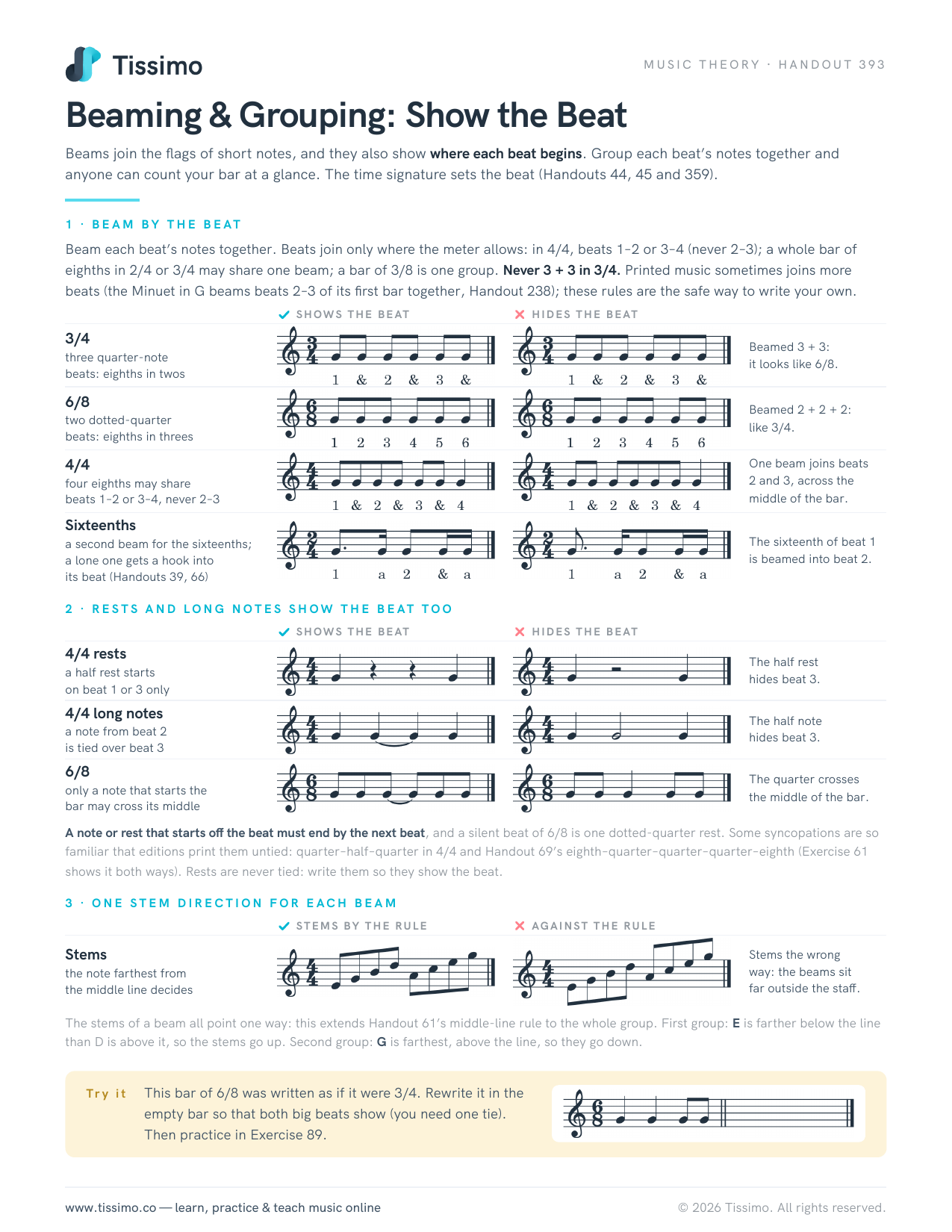 Beaming & Grouping: Show the BeatBeams join the flags of short notes, and they also show where each beat begins. Group each beat’s notes together and anyone can count your bar at a glance. The time signature sets the beat (Handouts 44, 45 and 359).