Rhythm & Meter
Eighth Note
An eighth note is a filled notehead with a stem and one flag, or one beam when several are grouped. Two eighth notes last as long as one quarter note.
An eighth note lasts half as long as a quarter note. It looks like a quarter note with a single flag added to the end of its stem. When two or more eighth notes sit together, the flags are usually replaced by a beam, a thick straight line joining the stems. In British English it is called a quaver.
Counting eighth notes
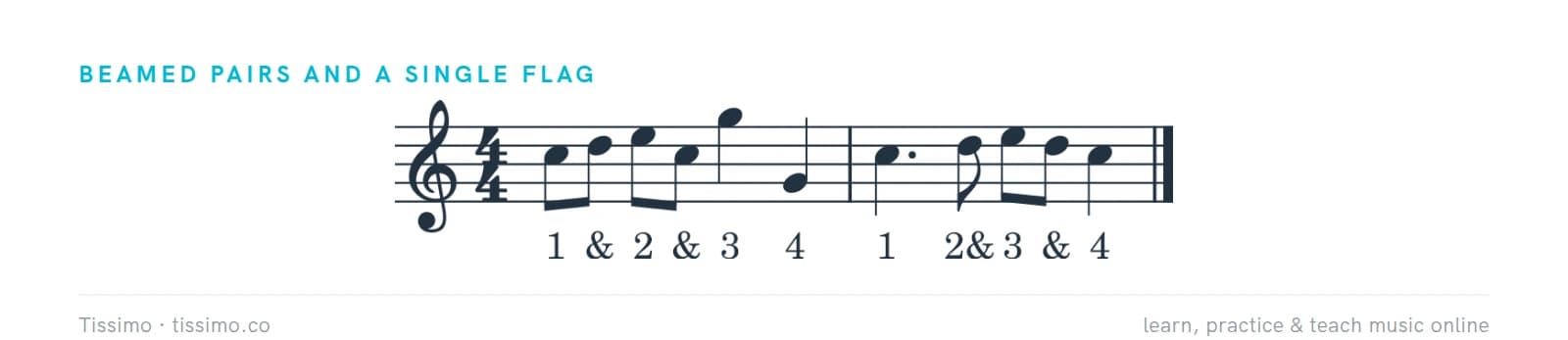
In 2/4, 3/4 and 4/4, two eighth notes fill one beat. Count the first on the number and the second on "&" (said "and"): "1 & 2 & 3 & 4 &". A single eighth note on the "&" falls off the beat, which is the basis of many syncopated rhythms.
Flags or beams?
The two look different but sound the same. Beams make rhythms easier to read because they show where each beat begins:
- In 2/4, 3/4 and 4/4, eighth notes are beamed in pairs, one pair per beat, or in fours within each half of a 4/4 bar.
- In 6/8, 9/8 and 12/8 they are beamed in threes, one group per dotted-quarter beat.
- A single eighth note, for example after a dotted quarter note, keeps its flag.
In vocal music, older editions often gave each sung syllable its own flagged note; many modern editions beam vocal lines just like instrumental ones. Practice grouping eighth notes correctly with Beaming & Grouping and Beam the Rhythm.
Eighth rests and swing
An eighth rest marks half a beat of silence. In jazz, blues and related styles, pairs of eighth notes are often played unevenly, long-short, which is called swing. The notation looks the same, so a word such as "Swing" at the top of the music tells you.
Learn the basics in The Eighth Note.
Common questions
How many eighth notes are in a beat?
Two, in meters where the quarter note gets the beat, such as 2/4, 3/4 and 4/4. In 6/8 and other compound meters, three eighth notes make one dotted-quarter beat.
When are eighth notes beamed together?
When they belong to the same beat, or to the same half of a 4/4 bar. Beams show the beat, so they should not hide where a new beat starts. A single eighth note on its own keeps its flag.
Practice it: free worksheets
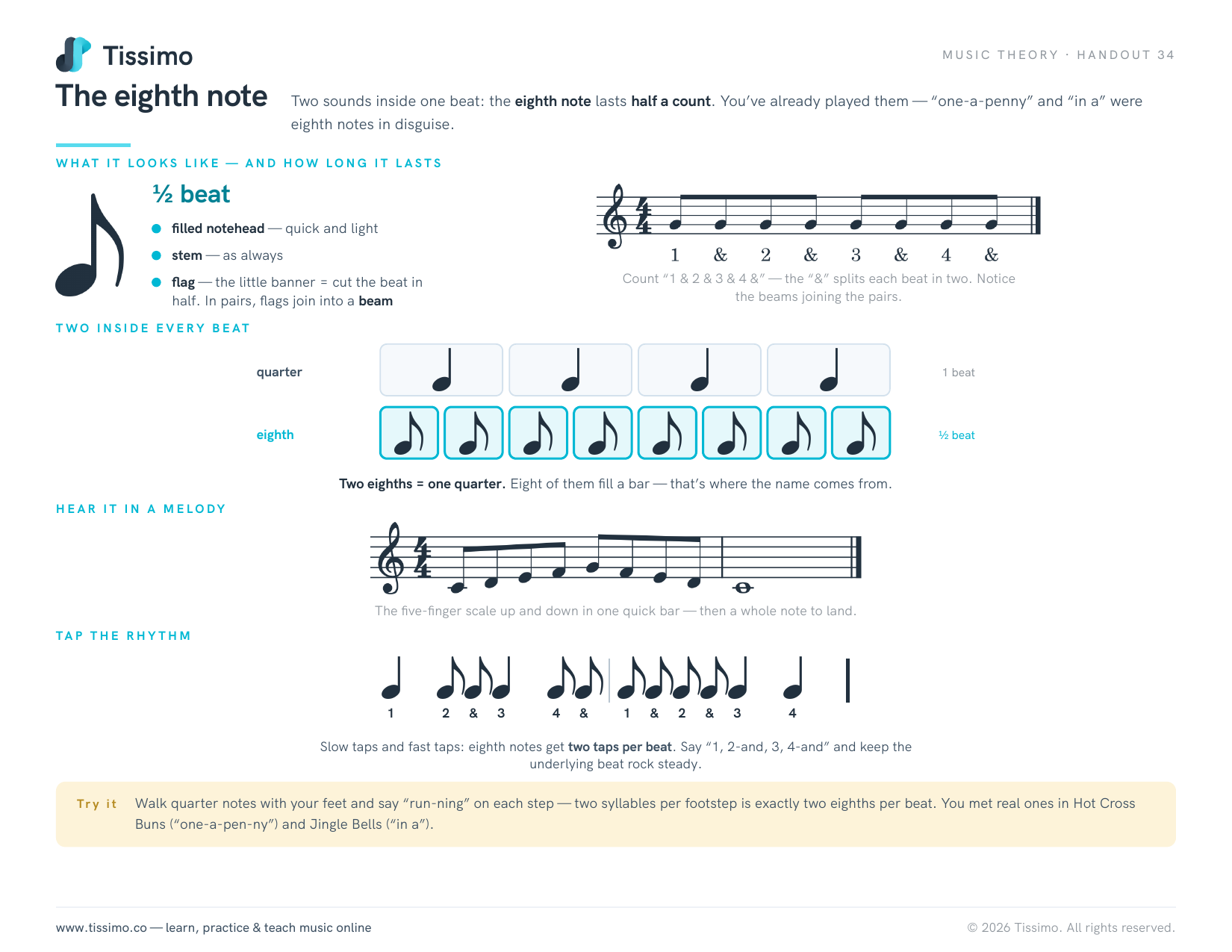 The eighth noteTwo sounds inside one beat: the eighth note lasts half a count. You’ve already played them — “one-a-penny” and “in a” were eighth notes in disguise.
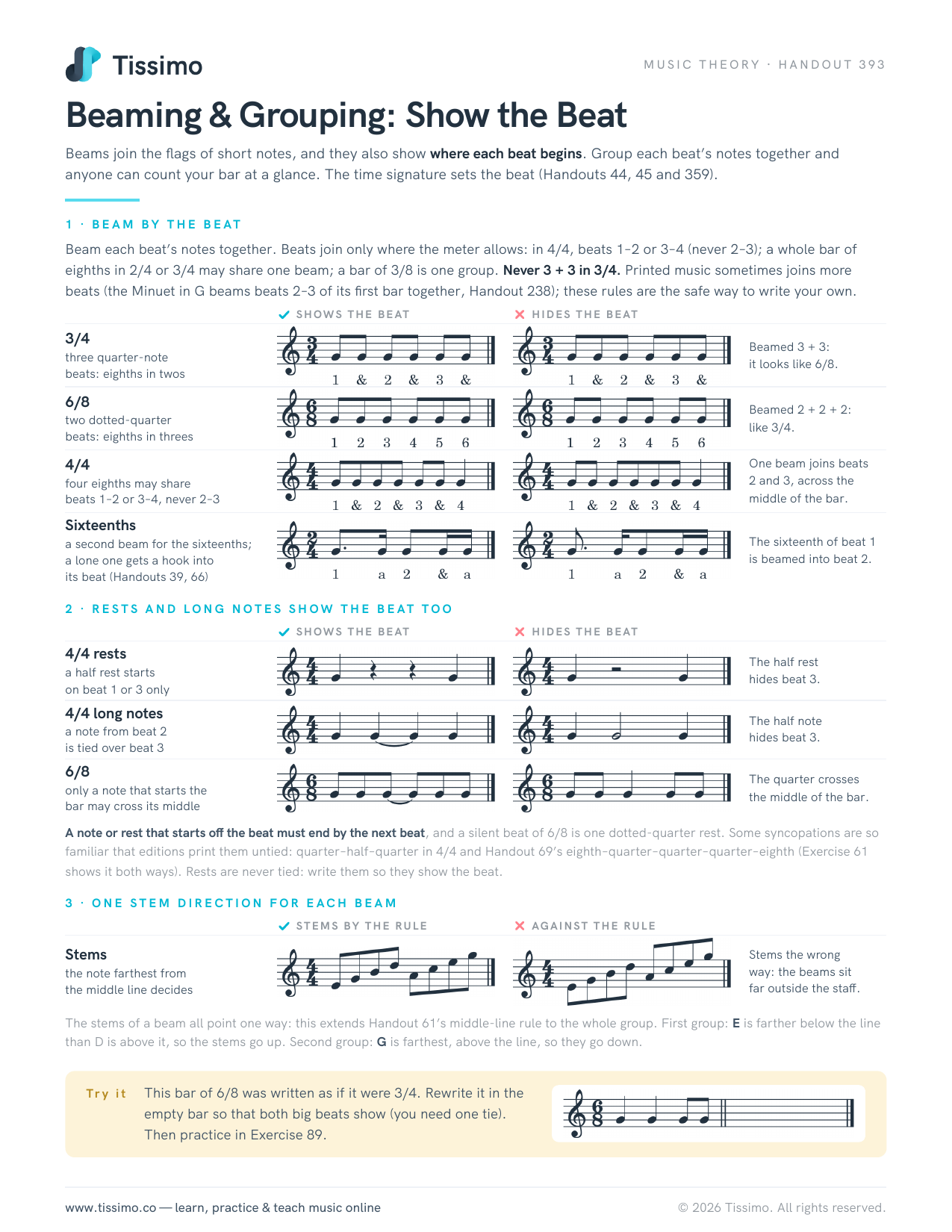 Beaming & Grouping: Show the BeatBeams join the flags of short notes, and they also show where each beat begins. Group each beat’s notes together and anyone can count your bar at a glance. The time signature sets the beat (Handouts 44, 45 and 359).
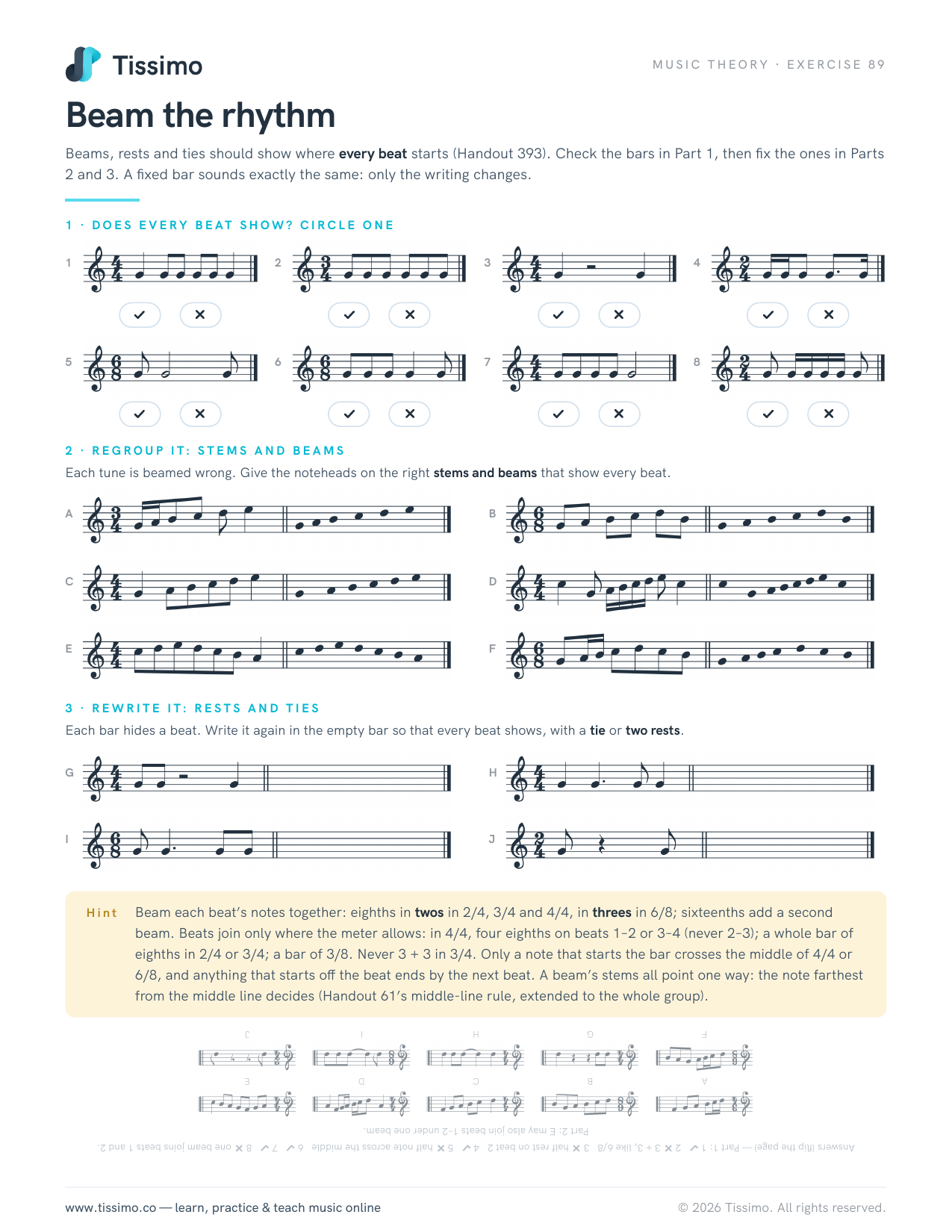 Beam the rhythmBeams, rests and ties should show where every beat starts (Handout 393). Check the bars in Part 1, then fix the ones in Parts 2 and 3. A fixed bar sounds exactly the same: only the writing changes.
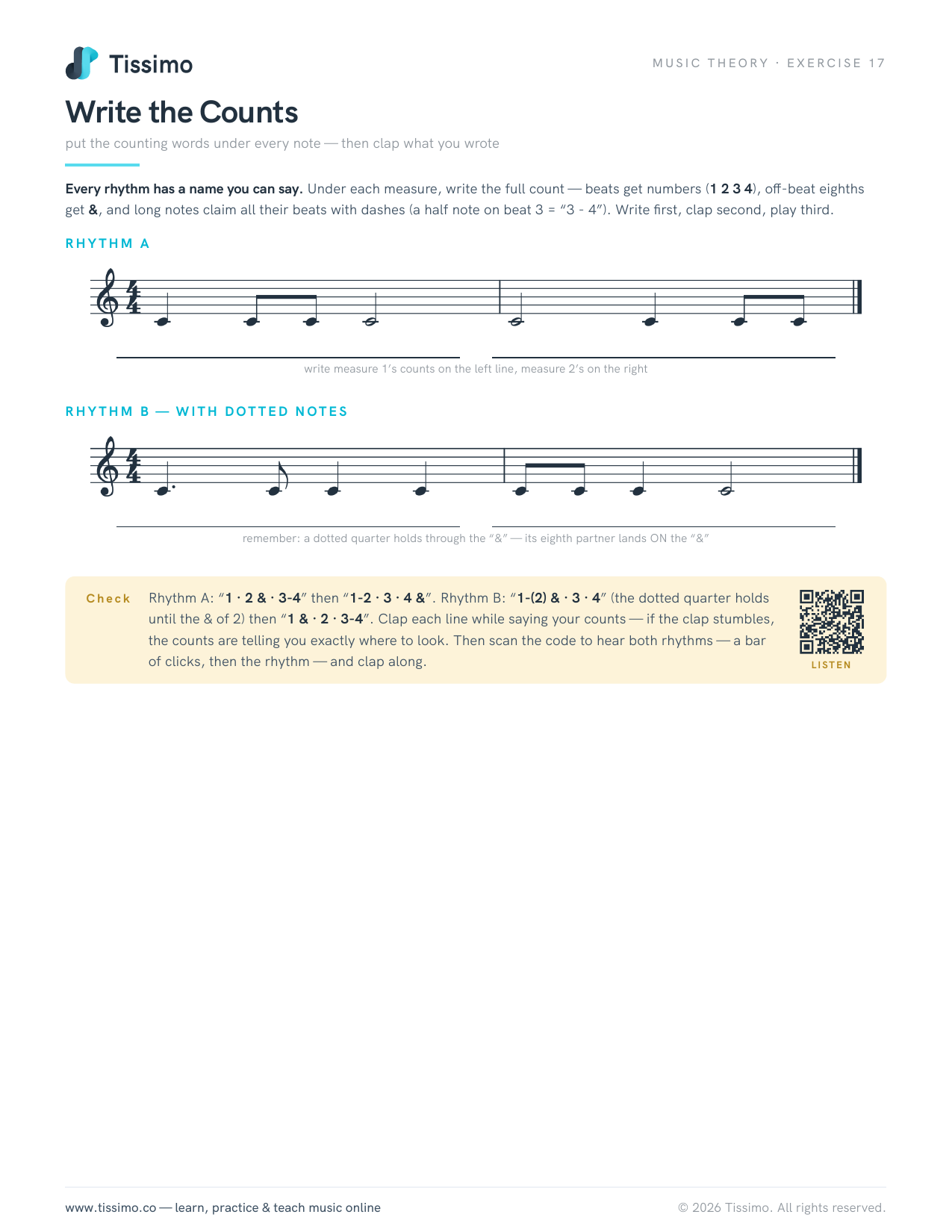 Write the Countsput the counting words under every note — then clap what you wrote