Rhythm & Meter
Simple Meter
A simple meter is one whose beats divide naturally into two equal parts, such as 2/4, 3/4 and 4/4. The beat is a plain, undotted note, most often a quarter note.
In a simple meter, each beat divides naturally into two equal parts. If the beat is a quarter note, it splits into two eighth notes, and those split again into four sixteenths. You count the halves of the beat with "&": "1 & 2 & 3 &". The everyday meters 2/4, 3/4 and 4/4 are all simple.
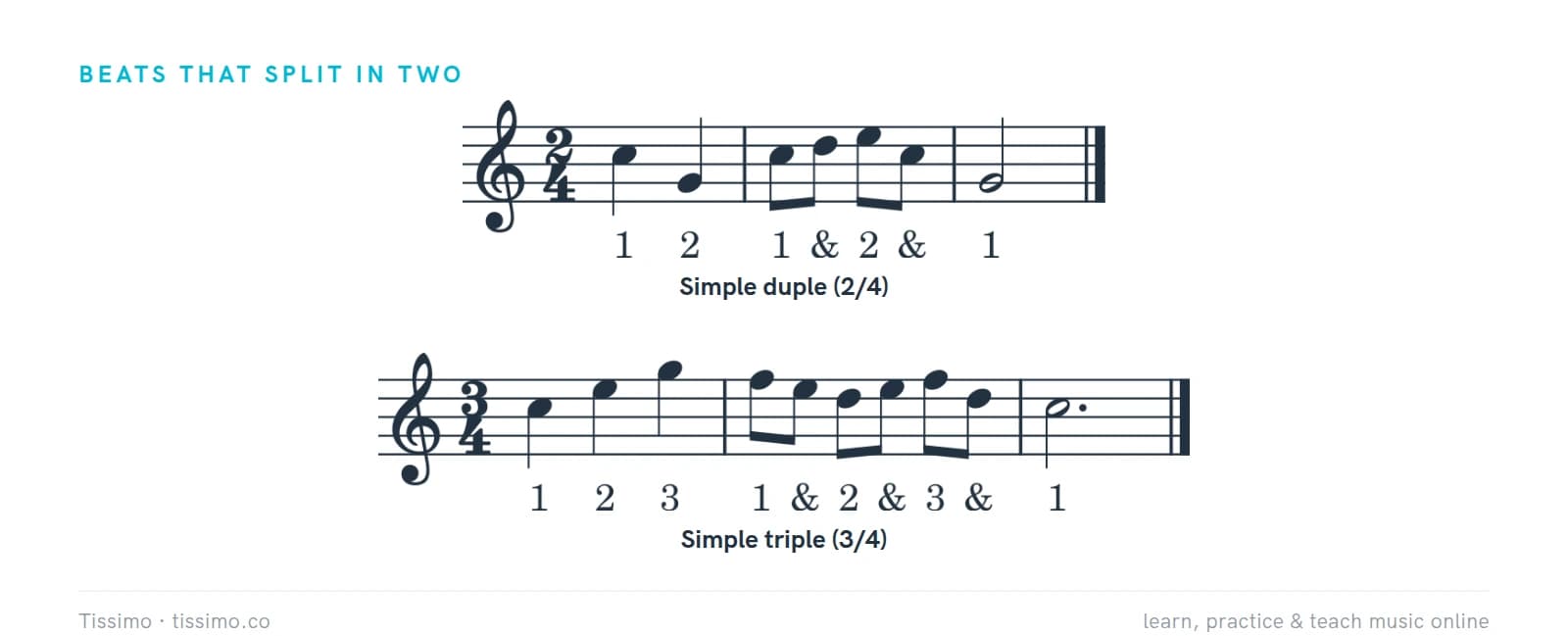
Recognizing a simple time signature
A time signature is simple when its top number is 2, 3 or 4. The top number is then the number of beats, and the bottom number is the beat note:
- 2/4: simple duple, two quarter-note beats
- 3/4: simple triple, three quarter-note beats
- 4/4: simple quadruple, four quarter-note beats
- 2/2 (cut time): simple duple, two half-note beats
- 3/8: simple triple, three eighth-note beats (though fast pieces in 3/8 are often felt as one beat per bar)
In a simple meter the beat is a plain, undotted note. That is the quickest way to tell it apart from a compound meter, where the beat is a dotted note that splits into three.
Counting simple meter
- Beats: "1, 2, 3, 4".
- Halves of the beat (eighth notes in 4/4): "1 & 2 & 3 & 4 &".
- Quarters of the beat (sixteenth notes in 4/4): "1 e & a 2 e & a".
Short notes in a simple meter are usually beamed in pairs or fours, so that each beat starts a new group. The Beaming & Grouping worksheet practices exactly that, and Write the Counts gives you the counting.
When three notes appear in a beat
A simple meter can still have a beat split into three. Composers write it as a triplet, marked with a 3. A triplet borrows the three-part division that is normal in compound meter, and it stands out because the music around it divides in two.
Read more about the two-number system in Time Signatures I: Simple Time.
Common questions
How can you tell if a time signature is simple or compound?
Look at the top number. 2, 3 or 4 means simple: that many beats, each splitting into two. 6, 9 or 12 usually means compound: divide by three to get the number of beats, each splitting into three.
Is 3/8 simple or compound?
On paper 3/8 is a simple triple meter, with three eighth-note beats. At a fast tempo, though, it is often felt as one beat per bar that divides into three, much like half a bar of 6/8.
Practice it: free worksheets
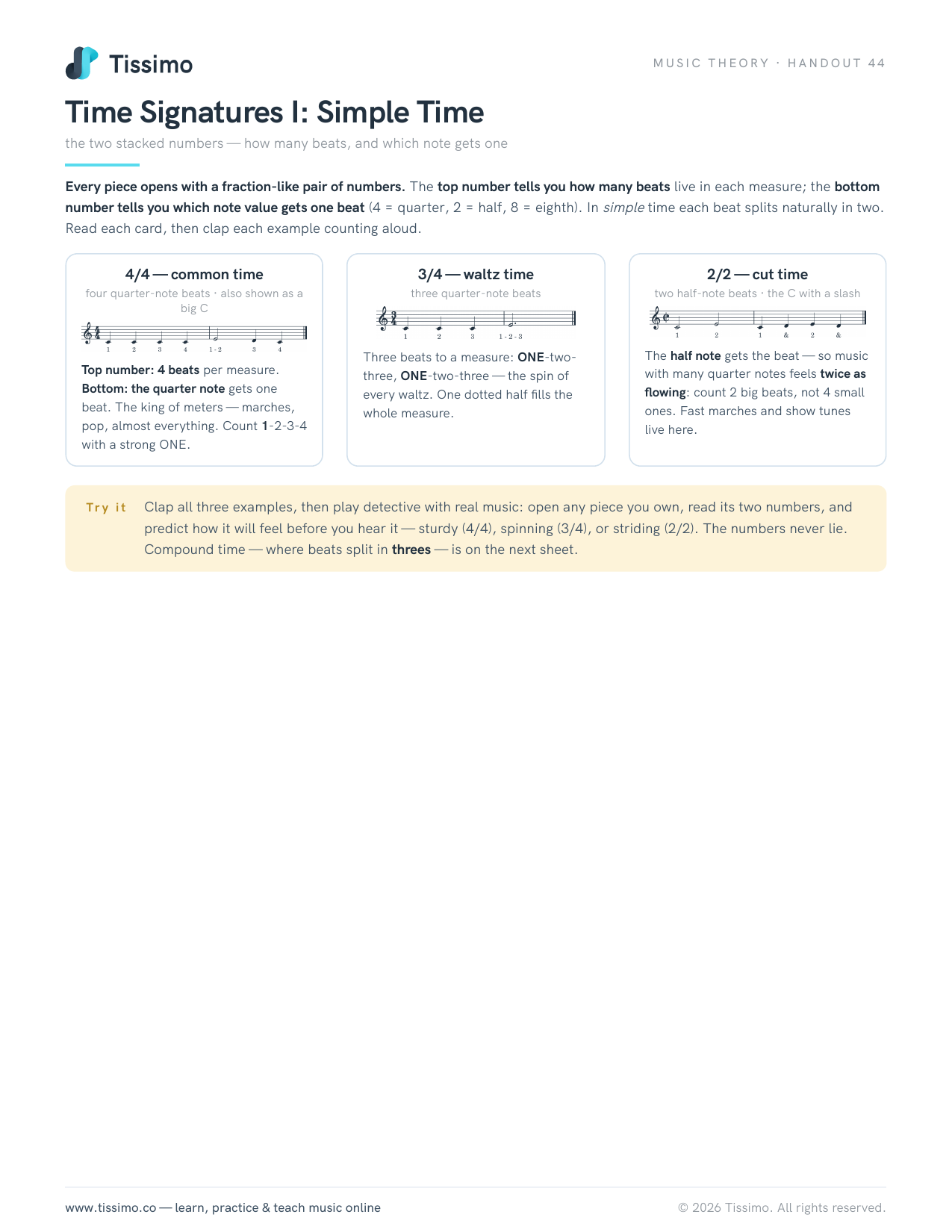 Time Signatures I: Simple Timethe two stacked numbers — how many beats, and which note gets one
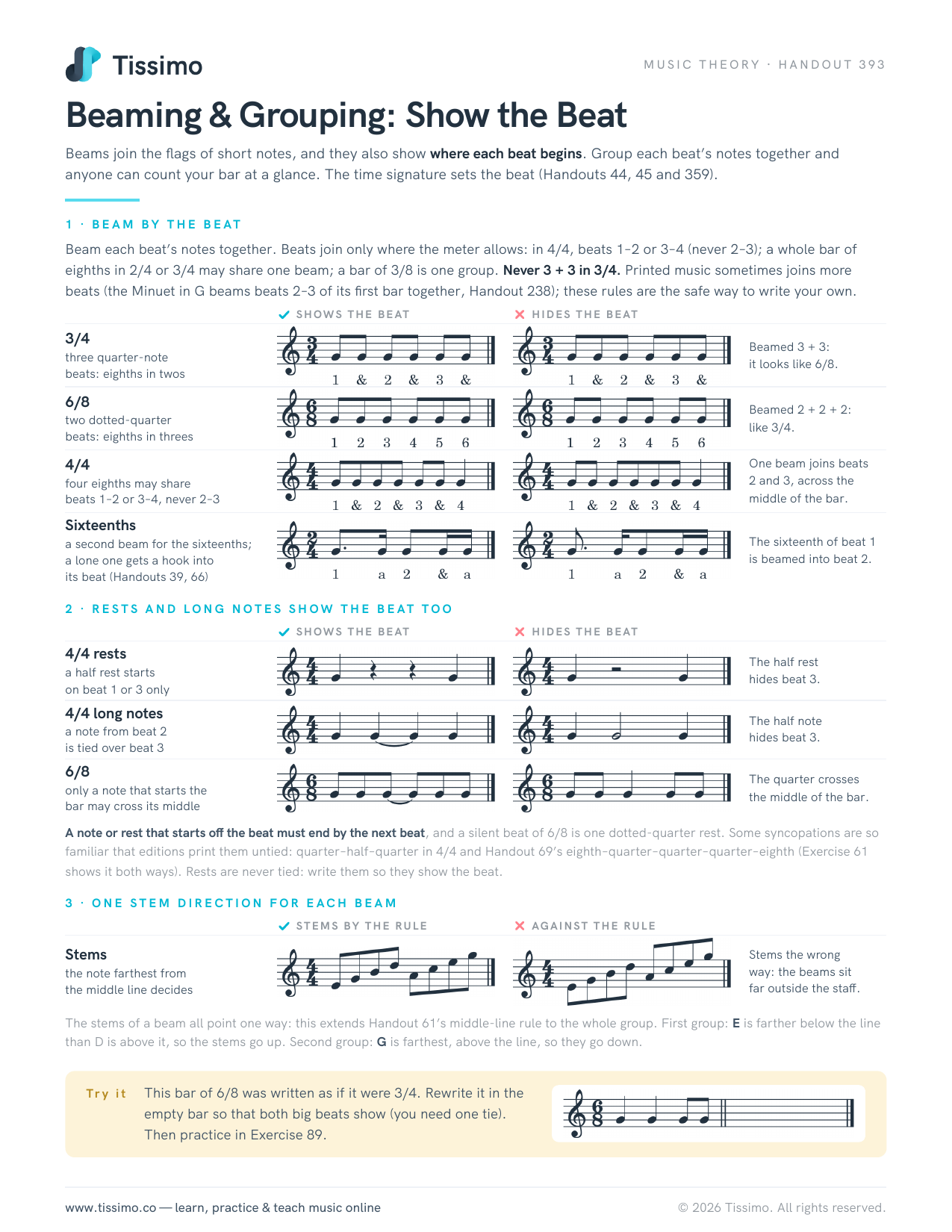 Beaming & Grouping: Show the BeatBeams join the flags of short notes, and they also show where each beat begins. Group each beat’s notes together and anyone can count your bar at a glance. The time signature sets the beat (Handouts 44, 45 and 359).
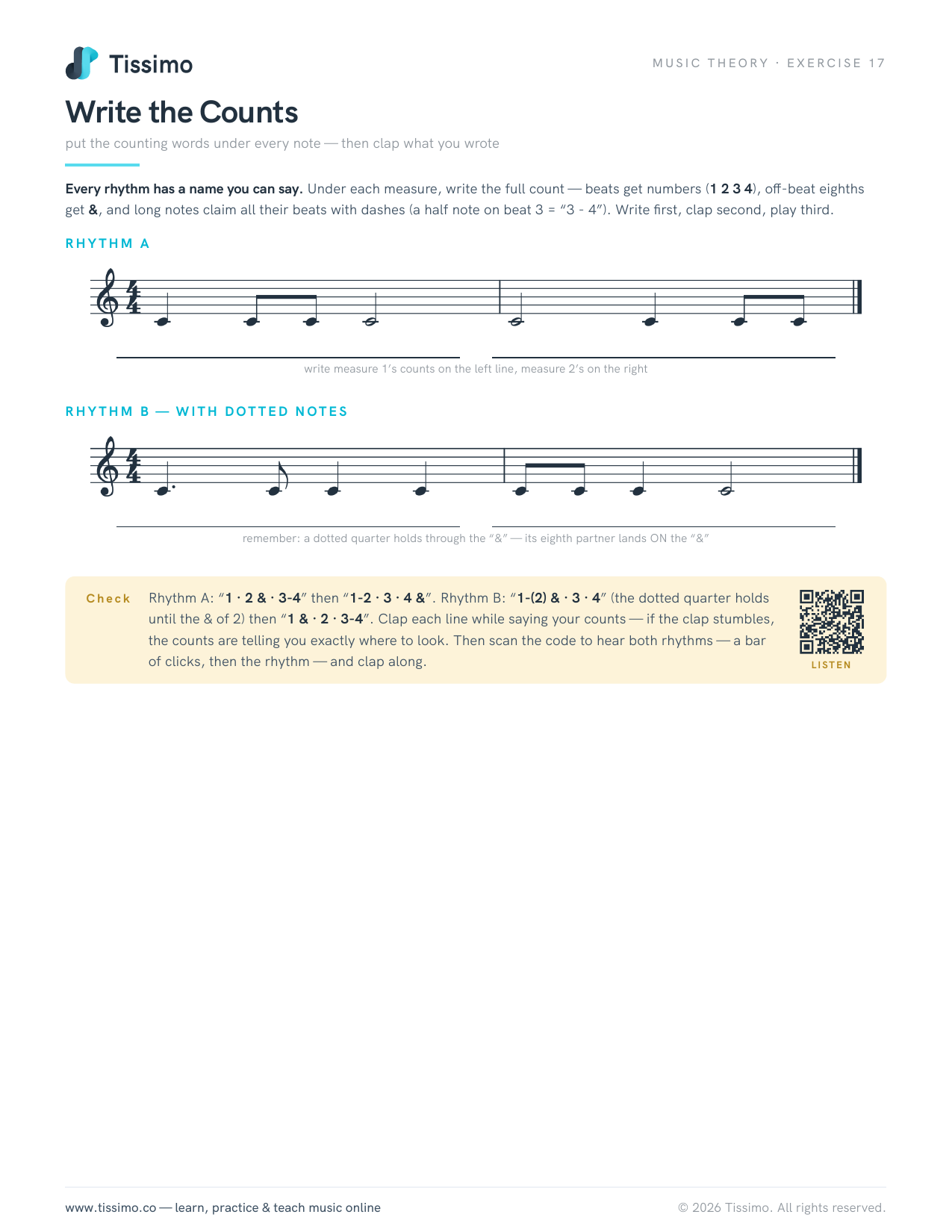 Write the Countsput the counting words under every note — then clap what you wrote