Rhythm & Meter
Triple Meter
Triple meter groups the beats in threes, strong-weak-weak. 3/4, the meter of the waltz and the minuet, is the most familiar simple triple meter; 9/8 is compound triple.
Triple meter groups the beats in threes: STRONG-weak-weak. Its most familiar form is 3/4, the meter of the waltz and the minuet. In a waltz accompaniment, a bass note on beat 1 is answered by two lighter chords on beats 2 and 3: "oom-pah-pah".
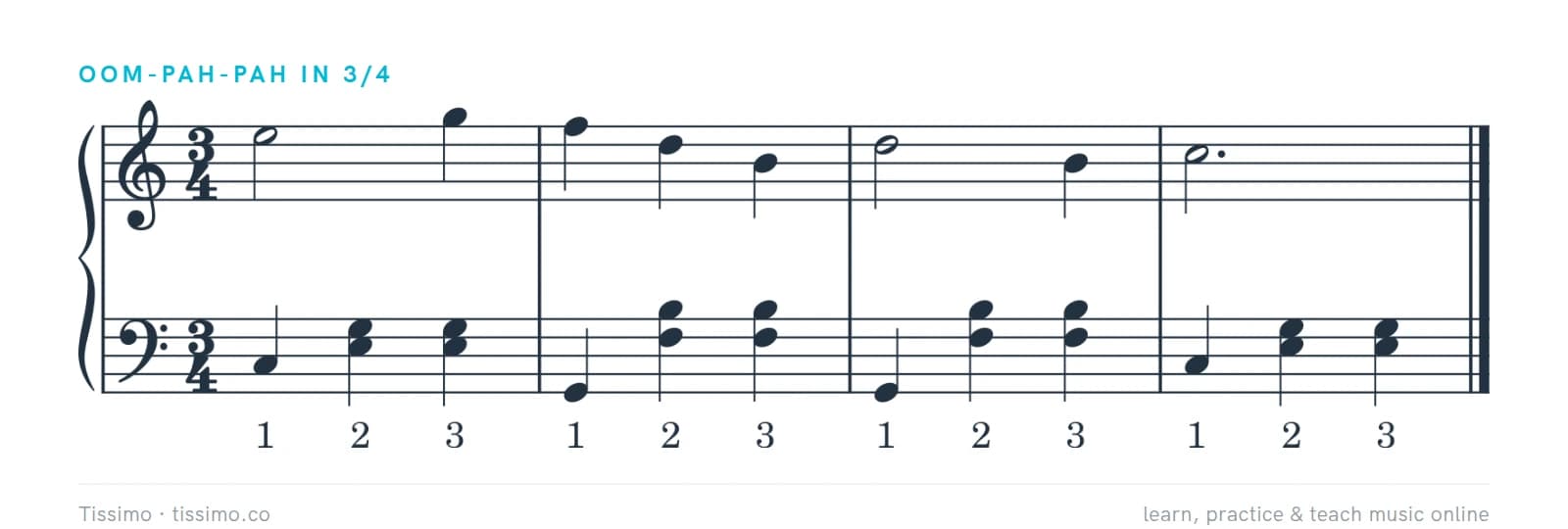
Simple and compound triple
- Simple triple: three beats, each splitting into two. 3/4 is by far the most common; 3/8 and 3/2 also appear.
- Compound triple: three beats, each splitting into three. 9/8 has three dotted-quarter beats, each holding three eighth notes.
Counting and feeling three
Count "1, 2, 3", with the weight on 1. When eighth notes appear in 3/4, count "1 & 2 & 3 &". Conductors beat triple meter as a triangle: down on 1, out to the side on 2, and up on 3, ready for the next downbeat.
At quick tempos a waltz is often felt as one big beat per bar, with the three quarter notes as its parts. Players then think in pairs or groups of four bars rather than counting every beat.
Triple meter and 6/8
A bar of 3/4 and a bar of 6/8 both hold six eighth notes, but they are not the same meter. 3/4 is triple (three quarter-note beats); 6/8 is duple (two dotted-quarter beats). Composers sometimes play with this double meaning. A passage in 3/4 that suddenly groups its beats in twos, so that two bars sound like three bars of 2/4, is called a hemiola.
Test your eye and ear on threes with Time Signatures I: Simple Time and Meter Detective.
Common questions
Is 3/4 the same as 6/8?
No. Both hold six eighth notes, but 3/4 has three quarter-note beats and 6/8 has two dotted-quarter beats. Tap along and you will feel three in a waltz and two in a jig.
What is the difference between triple meter and a triplet?
Triple meter means three beats in each bar. A triplet is three notes played in the time of two, and it can appear in any meter.
Practice it: free worksheets
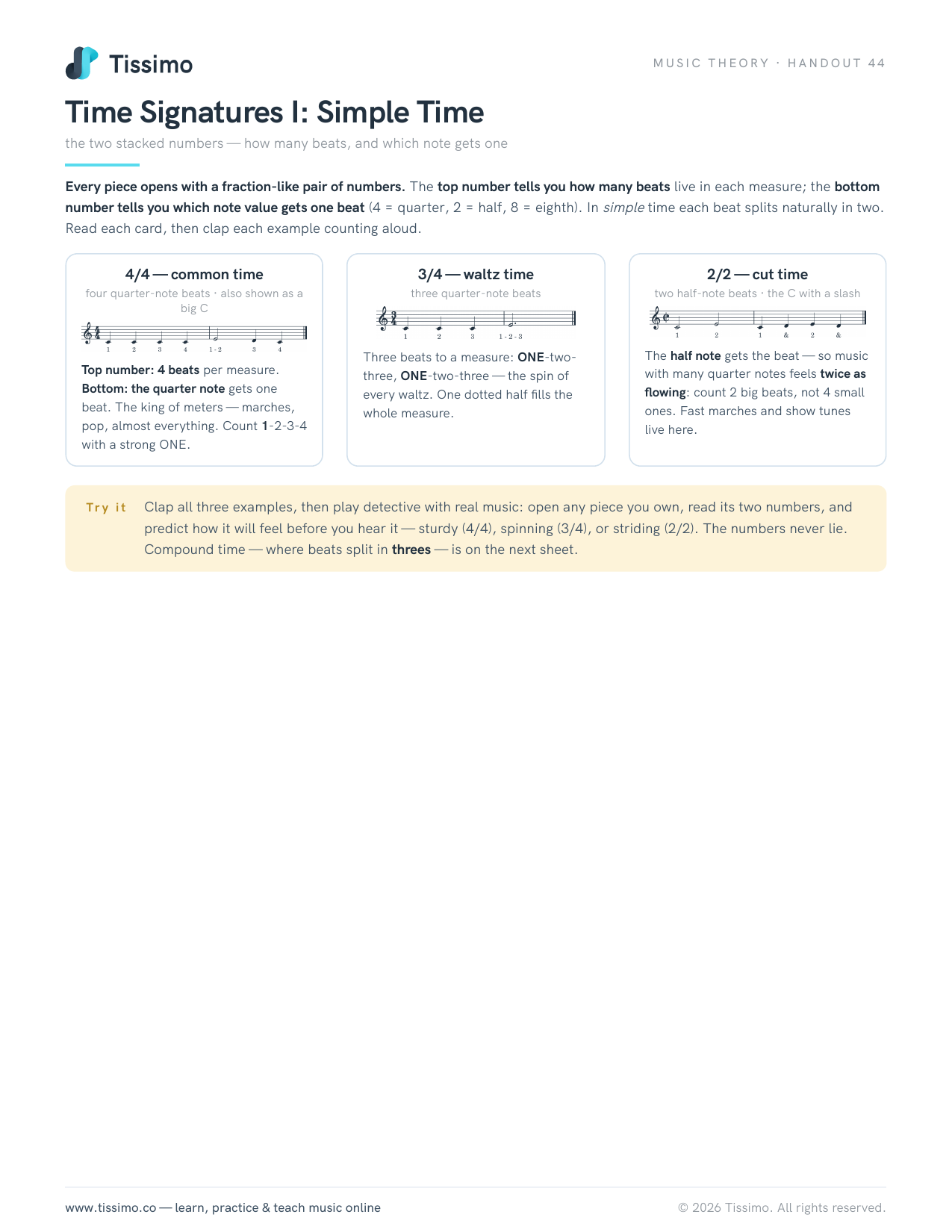 Time Signatures I: Simple Timethe two stacked numbers — how many beats, and which note gets one
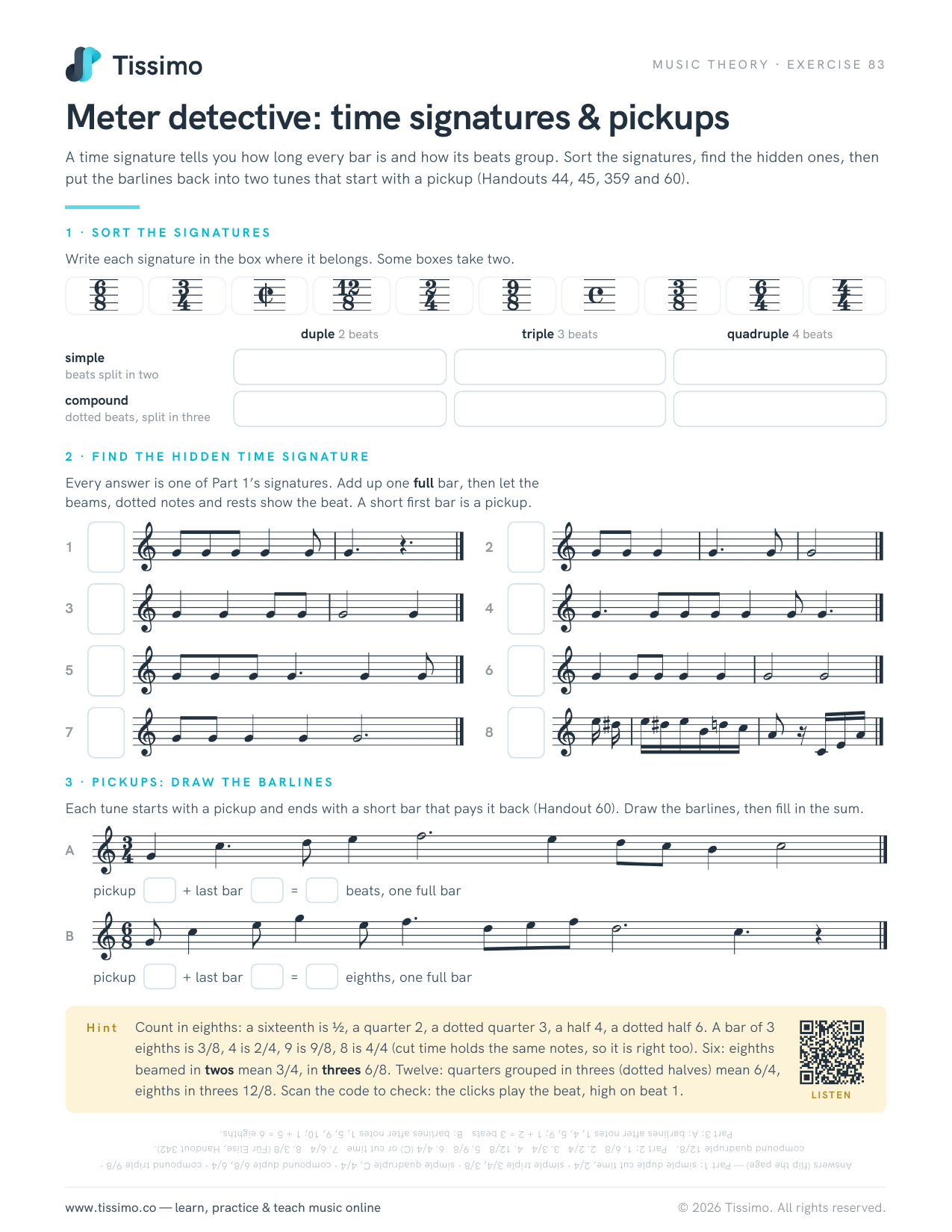 Meter detective: time signatures & pickupsA time signature tells you how long every bar is and how its beats group. Sort the signatures, find the hidden ones, then put the barlines back into two tunes that start with a pickup (Handouts 44, 45, 359 and 60).