Rhythm & Meter
Hemiola
Pronounced hem-ee-OH-luh
A hemiola is a rhythmic regrouping in which two bars of triple meter are heard as three groups of two, so the accents shift from 3+3 to 2+2+2. It is especially common just before cadences in Baroque music.
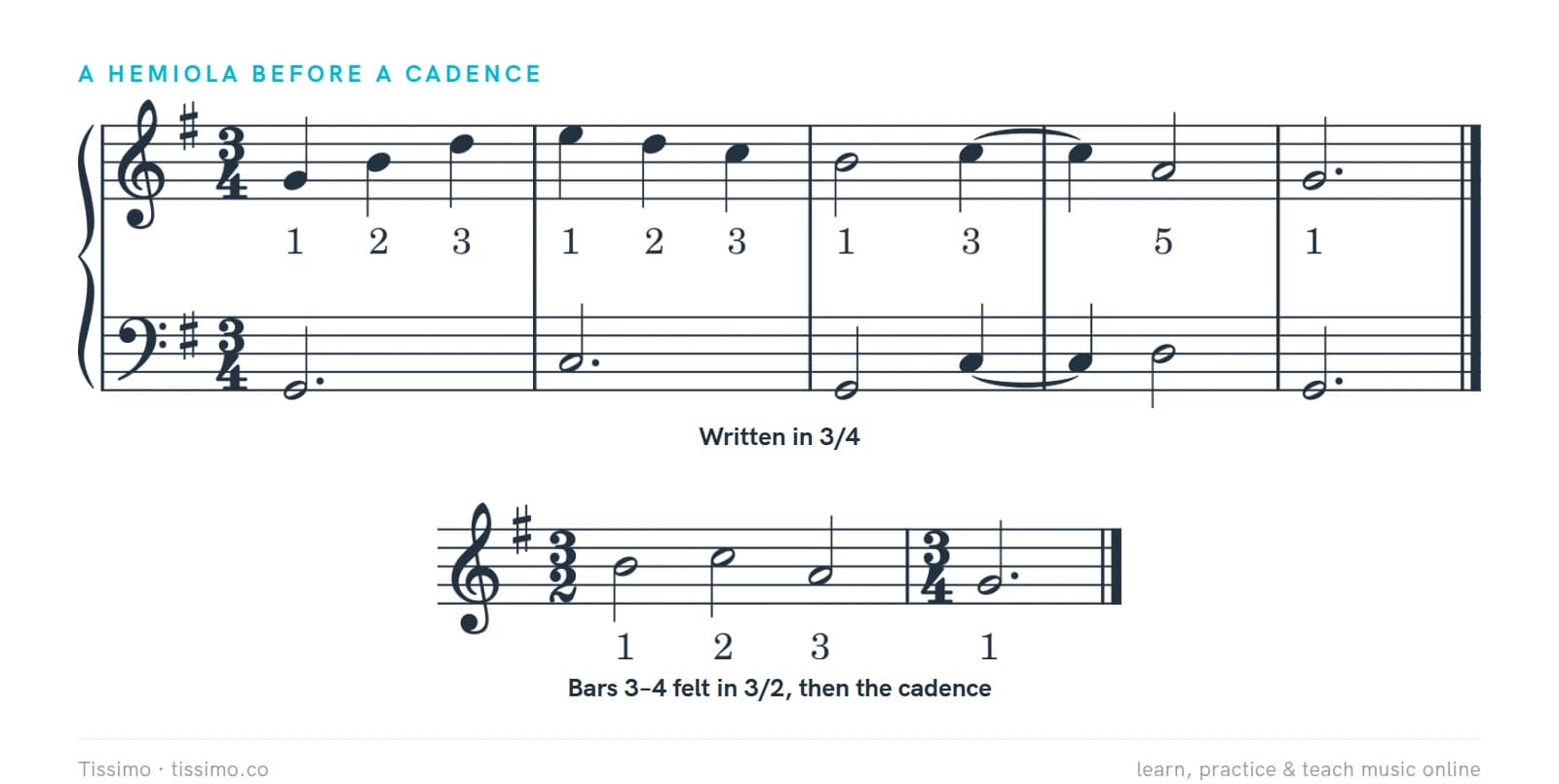
A hemiola makes the meter seem to change for a moment without any change of time signature. In 3/4, two bars normally group as ONE-two-three ONE-two-three. In a hemiola, the same six beats are grouped as ONE-two ONE-two ONE-two, as if one large bar of 3/2 had been laid across the bar line. The listener feels the beat broaden, and then the music settles back into its normal triple meter.
How to spot one
On the page, a hemiola usually shows up as half notes, or notes tied across the bar line, that break the usual three-beat pattern: a half note on beat 1, a note tied over the bar line, and another half note to finish. The harmony and the bass line help too: in a hemiola the chords often change every two beats instead of every three.
Where you hear it
Hemiolas are a hallmark of Baroque music in triple meter. Minuets, courantes and many arias and choruses broaden into a hemiola just before a cadence. Brahms was famously fond of them and used them throughout his music, sometimes over long stretches. The same 3:2 regrouping is part of everyday rhythm in much Latin American music, where 6/8 (two groups of three) and 3/4 (three groups of two) alternate or sound together; "America" from Bernstein's West Side Story is a well-known example of that alternation.
Hemiola, syncopation and polyrhythm
- A hemiola is a kind of large-scale syncopation: the accents fall where the meter does not expect them, but here whole beats regroup rather than a single note being displaced.
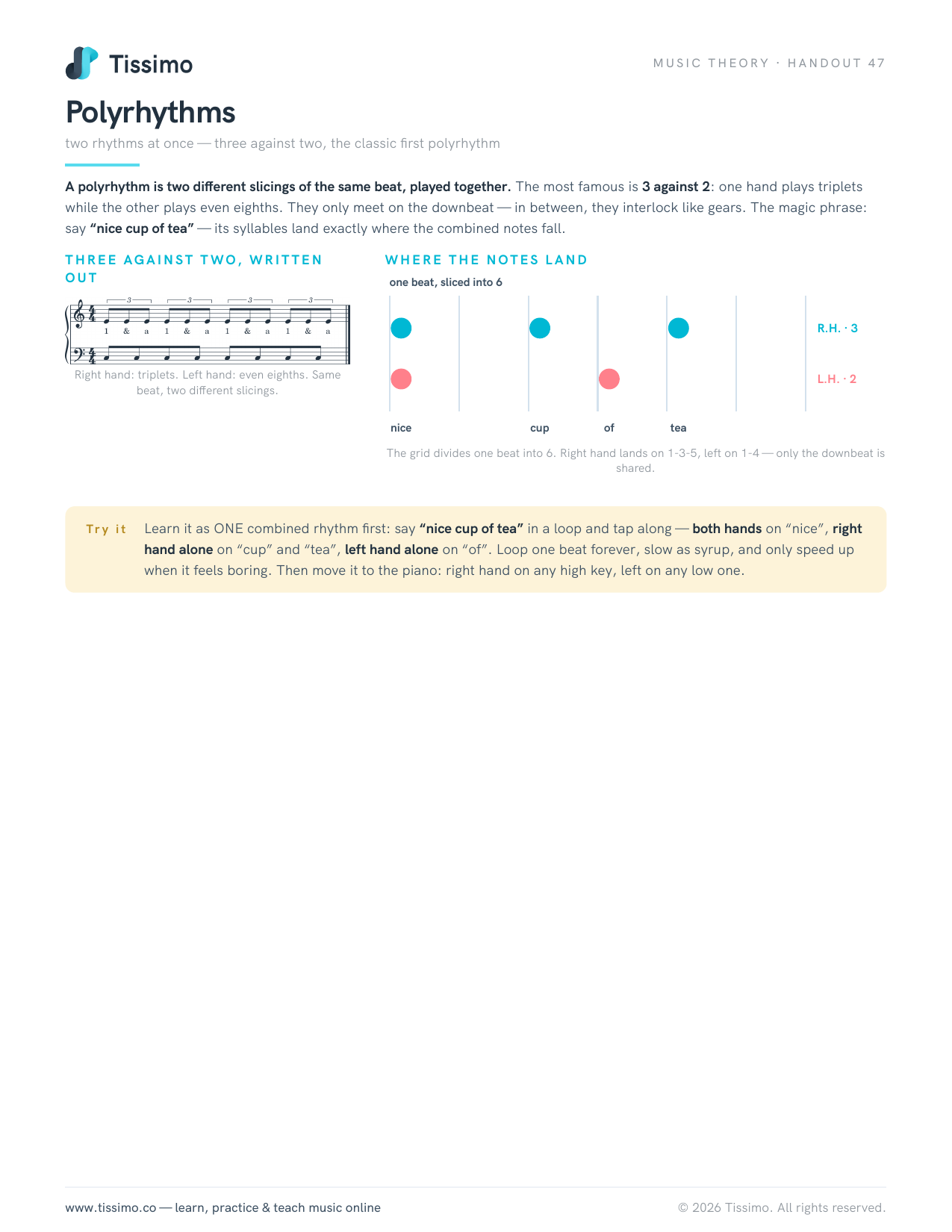
- When the 3+3 and 2+2+2 groupings sound at the same time in different parts, the result is a 3-against-2 polyrhythm, sometimes called a vertical hemiola.
Playing a hemiola
Do not fight it. Let the half notes and ties lean the music into twos, play the bar line lightly, and arrive firmly on the next downbeat. A helpful way to count the two hemiola bars is to count six quarter notes, "1 2 3 4 5 6", with the weight on 1, 3 and 5, then return to "1 2 3" in the following bar.
Common questions
What is the difference between hemiola and syncopation?
Syncopation displaces individual notes or accents off the strong beats. A hemiola regroups whole beats: two bars of three are heard as three groups of two, so for a moment the meter itself seems to change.
What is the difference between hemiola and polyrhythm?
A hemiola usually happens in one part, one grouping after another. When groups of three and two sound at the same time in different parts, it is a polyrhythm, sometimes called a vertical hemiola.